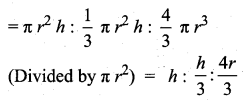
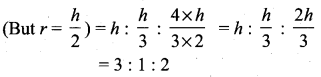
Samacheer Kalvi 10th Maths Guide Chapter 8 Statistics and Probability Ex 8.2

Students can download Maths Chapter 8 Statistics and Probability Ex 8.2 Questions and Answers, Notes, Samacheer Kalvi 10th Maths Guide Pdf helps you to revise the complete Tamilnadu State Board New Syllabus, helps students complete homework assignments and to score high marks in board exams.

Tamilnadu Samacheer Kalvi 10th Maths Solutions Chapter 8 Statistics and Probability Ex 8.2

Question 1.
The standard deviation and mean of a data are 6.5 and 12.5 respectively. Find the coefficient of variation.
Answer:
Standard deviation of a data (σ) = 6.5
Mean of the data (\(\bar{x}\)) = 12.5
Coefficient of variation = \(\frac{\sigma}{\bar{x}} \times 100 \%\)
= \(\frac{6.5}{12.5} \times 100 \%=52 \%\)
Coefficient of variation = 52%

Question 2.
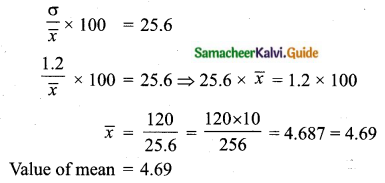
The standard deviation and coefficient of variation of a data are 1.2 and 25.6 respectively. Find the value of mean.
Answer:
Standard deviation (σ) = 1.2
Coefficient of variation = 25.6
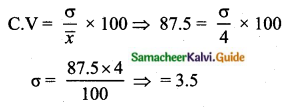
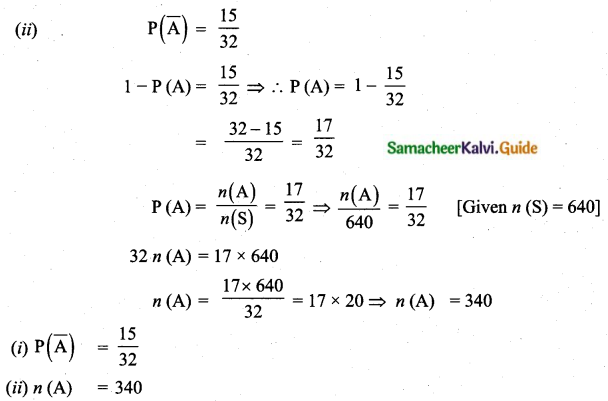
Samacheer Kalvi 10th Maths Guide Chapter 8 Statistics and Probability Ex 8.2 Q2

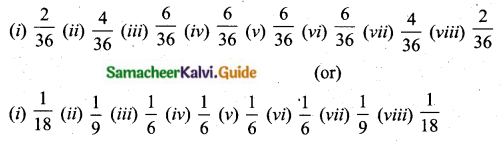
Samacheer Kalvi 10th Maths Guide Chapter 8 Statistics and Probability Ex 8.2

Question 3.
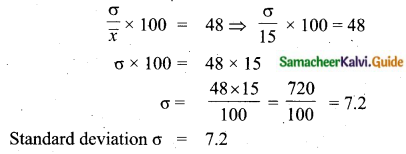
If the mean and coefficient of variation of a data are 15 and 48 respectively, then find the value of standard deviation.
Answer:
Mean (\(\bar{x}\)) = 15
Co efficient of variation = 48
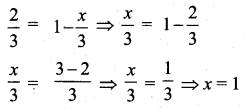
Samacheer Kalvi 10th Maths Guide Chapter 8 Statistics and Probability Ex 8.2 Q3

Question 4.
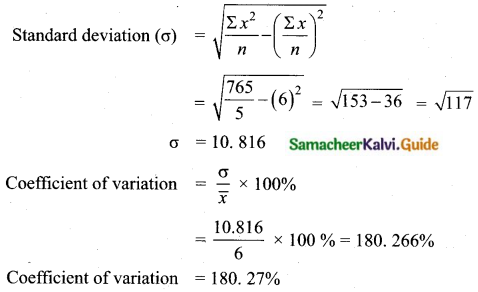
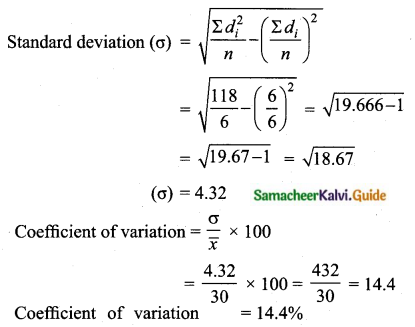
If n = 5, \(\bar{x}\) = 6, Σx2 = 765, then calculate the coefficient of variation.
Answer:
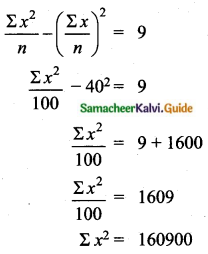
Samacheer Kalvi 10th Maths Guide Chapter 8 Statistics and Probability Ex 8.2 Q4

Question 5.
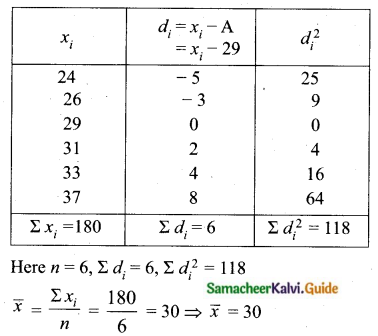
Find the coefficient of variation of 24, 26, 33, 37, 29, 31.
Answer:
Arrange in ascending order we get 24, 26, 29, 31, 33, 37
Assumed mean = 29
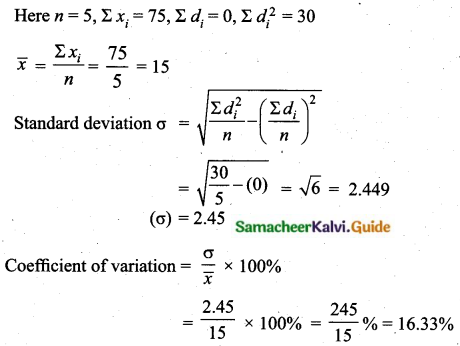
Samacheer Kalvi 10th Maths Guide Chapter 8 Statistics and Probability Ex 8.2 Q5
Samacheer Kalvi 10th Maths Guide Chapter 8 Statistics and Probability Ex 8.2 Q5.1

Question 6.
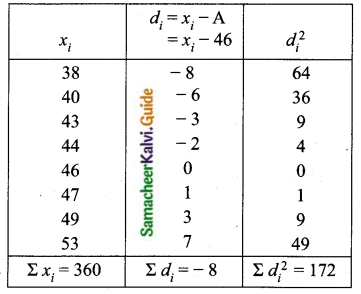
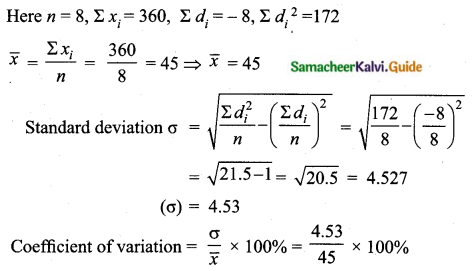
The time taken (in minutes) to complete homework by 8 students in a day are given by 38, 40, 47, 44, 46, 43, 49, 53. Find the coefficient of variation.
Answer:
Arrange in ascending order we get, 38, 40, 43, 44, 46, 47, 49, 53.
Assumed mean = 46
Samacheer Kalvi 10th Maths Guide Chapter 8 Statistics and Probability Ex 8.2 Q6
Samacheer Kalvi 10th Maths Guide Chapter 8 Statistics and Probability Ex 8.2 Q6.1
= \(\frac{453}{45}\)%
= 10.066
Coefficient of variation = 10.07%

Samacheer Kalvi 10th Maths Guide Chapter 8 Statistics and Probability Ex 8.2

Question 7.
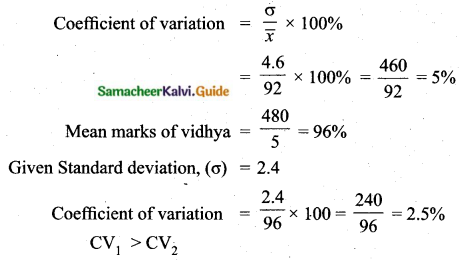
The total marks scored by two students Sathya and Vidhya in 5 subjects are 460 and 480 with standard deviation of 4.6 and 2.4 respectively. Who is more consistent in performance?
Answer:
Total marks scored by sathya = 460
Total marks scored by vidhya = 480
Number of subjects = 5
Mean marks of sathya = \(\frac{460}{5}\)
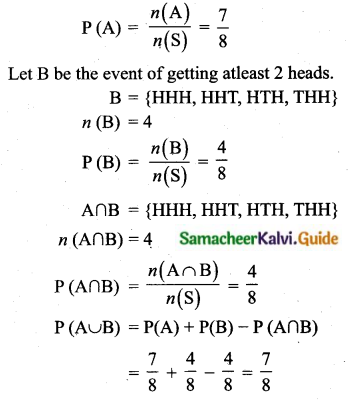
\(\bar{x}\) = 92%
Given standard deviation, (σ) = 4.6
Samacheer Kalvi 10th Maths Guide Chapter 8 Statistics and Probability Ex 8.2 Q7
Vidhya coefficient of variation is less than Sathya.
Vidhya is more consistent.

Question 8.
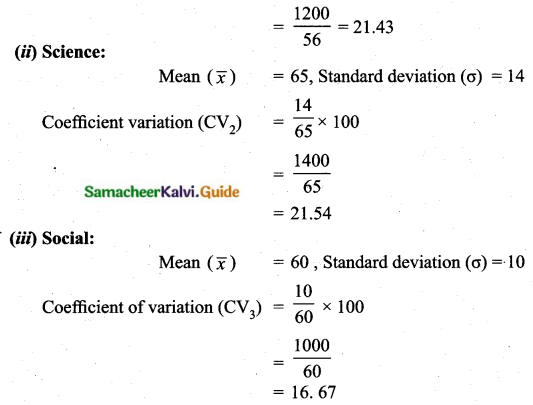
The mean and standard deviation of marks obtained by 40 students of a class in three subjects Mathematics, Science and Social Science are given below.
Samacheer Kalvi 10th Maths Guide Chapter 8 Statistics and Probability Ex 8.2 Q8
Which of the three subjects shows the highest variation and which shows the lowest variation in marks?
Answer:
(i) Mathematics:
Mean (\(\bar{x}\)) = 56
Standard deviation (σ) = 12
Coefficient variation (CV1) = \(\frac{\sigma}{\bar{x}} \times 100=\frac{12}{56} \times 100\)
Samacheer Kalvi 10th Maths Guide Chapter 8 Statistics and Probability Ex 8.2 Q8.1
Science shows the highest variation
Social science shows the lowest variation

Question 9.
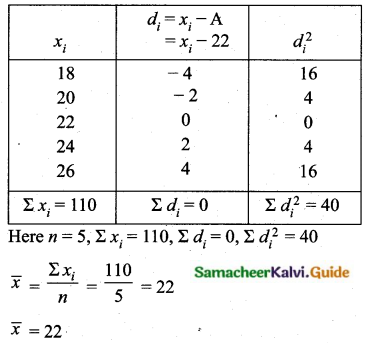
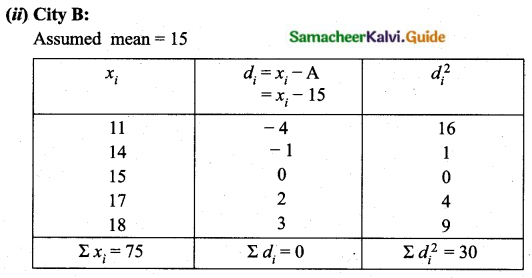
The temperature of two cities A and B in the winter season are given below.
Samacheer Kalvi 10th Maths Guide Chapter 8 Statistics and Probability Ex 8.2 Q9
Find which city is more consistent in temperature changes?
Answer:
(i) city A:
Assumed mean = 22
Samacheer Kalvi 10th Maths Guide Chapter 8 Statistics and Probability Ex 8.2 Q9.1
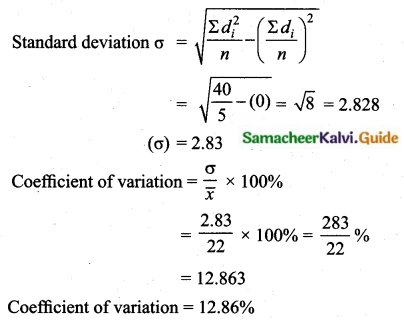
Samacheer Kalvi 10th Maths Guide Chapter 8 Statistics and Probability Ex 8.2 Q9.2
Samacheer Kalvi 10th Maths Guide Chapter 8 Statistics and Probability Ex 8.2 Q9.3
Samacheer Kalvi 10th Maths Guide Chapter 8 Statistics and Probability Ex 8.2 Q9.4
C.V of city A < C.V of city B
City A is more consistent in temperature change.

Samacheer Kalvi 10th Maths Guide Chapter 8 Statistics and Probability Ex 8.1

Students can download Maths Chapter 8 Statistics and Probability Ex 8.1 Questions and Answers, Notes, Samacheer Kalvi 10th Maths Guide Pdf helps you to revise the complete Tamilnadu State Board New Syllabus, helps students complete homework assignments and to score high marks in board exams.

Tamilnadu Samacheer Kalvi 10th Maths Solutions Chapter 8 Statistics and Probability Ex 8.1

Question 1.
Find the range and coefficient of range of the following data.
(i) 63, 89, 98, 125, 79, 108, 117, 68
(ii) 43.5, 13.6, 18.9, 38.4, 61.4, 29.8
Answer:
(i) Here the largest value (L) = 125
The smallest value (S) = 63
Range = L – S = 125 – 63 = 62
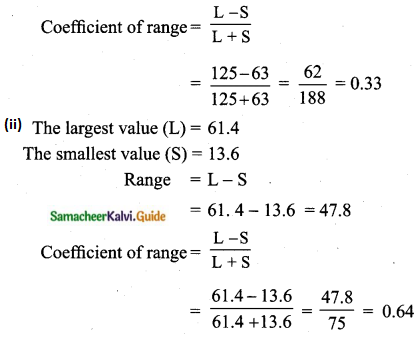
Samacheer Kalvi 10th Maths Guide Chapter 8 Statistics and Probability Ex 8.1 Q1

Question 2.
If the range and the smallest value of a set of data are 36.8 and 13.4 respectively, then find the largest value.
Solution:
If the range = 36.8 and
the smallest value = 13.4 then
the largest value = L = R + S
= 36.8 + 13.4 = 50.2

Question 3.
Calculate the range of the following data.
Samacheer Kalvi 10th Maths Guide Chapter 8 Statistics and Probability Ex 8.1 Q3
Answer:
Smallest value (S) = 400
Largest value (L) = 650
Range = L – S = 650 – 400 = 250

Samacheer Kalvi 10th Maths Guide Chapter 8 Statistics and Probability Ex 8.1

Question 4.
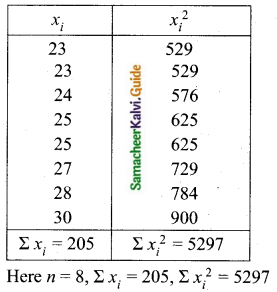
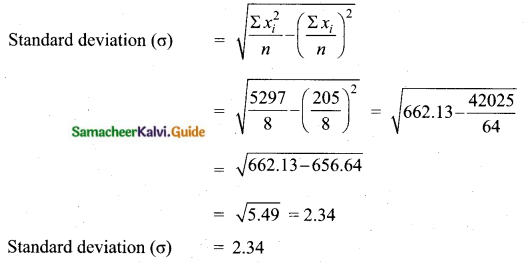
A teacher asked the students to complete 60 pages of a record notebook. Eight students have completed only 32, 35, 37, 30, 33, 36, 35 and 37 pages. Find the standard deviation of the pages yet to be completed by them.
Answer:
The remaining number of pages to be completed is 60 – 32; 60 – 35; 60 – 37; 60 – 30; 60 – 33; 60 – 36; 60 – 35 and 60 – 37
The pages to be completed are, 28, 25, 23, 30, 27, 24, 25, and 23
Arrange in ascending order we get, 23, 23, 24, 25, 25, 27, 28 and 30
Samacheer Kalvi 10th Maths Guide Chapter 8 Statistics and Probability Ex 8.1 Q4
Samacheer Kalvi 10th Maths Guide Chapter 8 Statistics and Probability Ex 8.1 Q4.1

Question 5.
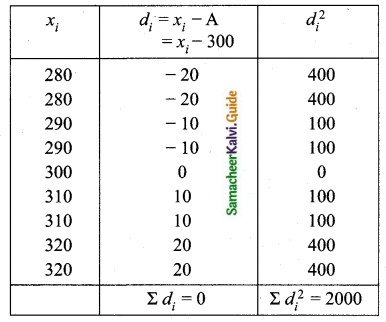
Find the variance and standard deviation of the wages of 9 workers given below:
₹ 310, ₹ 290, ₹ 320, ₹ 280, ₹ 300, ₹ 290, ₹ 320, ₹ 310, ₹ 280.
Answer:
Arrange in ascending order we get,
280, 280, 290, 290, 300, 310, 310, 320 and 320
Assumed mean = 300
Samacheer Kalvi 10th Maths Guide Chapter 8 Statistics and Probability Ex 8.1 Q5
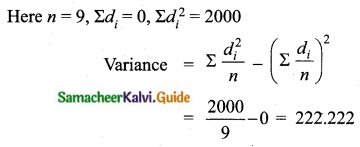
Samacheer Kalvi 10th Maths Guide Chapter 8 Statistics and Probability Ex 8.1 Q5.1
Variance = 222.222
Standard deviation = √Variance = √222.222 = 14.907 = 14.91
Variance = 222.22
Standard deviation = 14.91

Question 6.
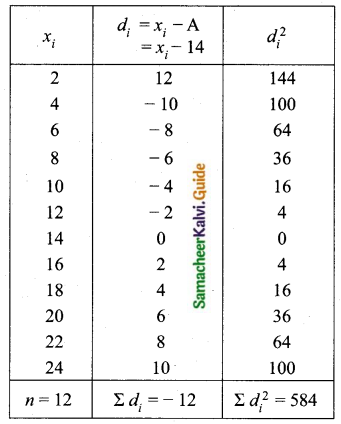
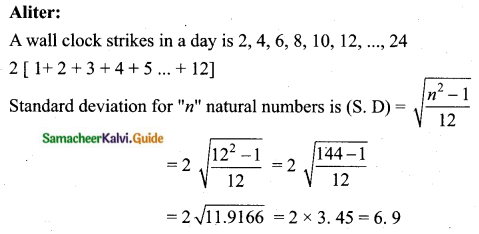
A wall clock strikes the bell once at 1 o’clock, 2 times at 2 o’clock, 3 times at 3 o’clock and so on. How many times will it strike in a particular day? Find the standard deviation of the number of strikes the bell make a day.
Answer:
Wall clock strikes the bell in 12 hours
1, 2, 3, 4, 5,… ,12
Wall clock strikes in a day (24 hours)
2, 4, 6, 8, 10, 12, 14, 16, 18, 20, 22, 24.
Assumed mean = 14
Samacheer Kalvi 10th Maths Guide Chapter 8 Statistics and Probability Ex 8.1 Q6
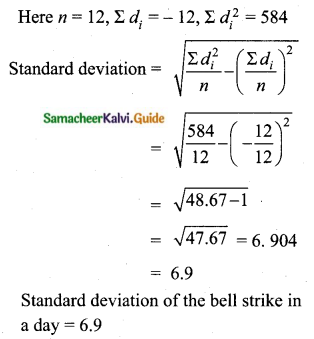
Samacheer Kalvi 10th Maths Guide Chapter 8 Statistics and Probability Ex 8.1 Q6.1
Samacheer Kalvi 10th Maths Guide Chapter 8 Statistics and Probability Ex 8.1 Q6.2
The standard deviation of bell strike in a day is 6.9

Samacheer Kalvi 10th Maths Guide Chapter 8 Statistics and Probability Ex 8.1

Question 7.
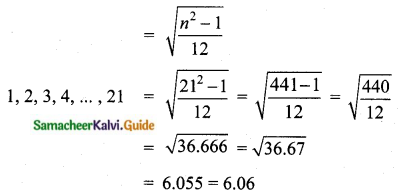
Find the standard deviation of the first 21 natural numbers.
Answer:
Here n = 21
The standard deviation of the first ‘n’ natural numbers,
Samacheer Kalvi 10th Maths Guide Chapter 8 Statistics and Probability Ex 8.1 Q7
The standard deviation of the first 21 natural numbers = 6.06

Question 8.
If the standard deviation of a data is 4.5 and if each value of the data is decreased by 5, then find the new standard deviation.
Solution:
If the standard deviation of a data is 4.5 and each value of the data decreased by 5, the new standard deviation does not change and it is also 4.5.

Question 9.
If the standard deviation of a data is 3.6 and each value of the data is divided by 3, then find the new variance and new standard deviation.
Answer:
The standard deviation of the data = 3.6
Each value of the data is divided by 3
New standard deviation = \(\frac{3.6}{3}\) = 1.2
New Variance = (1.2)2 = 1.44 [∴ Variance = (S.D)2]
New standard Deviation = 1.2
New variance = 1.44

Question 10.
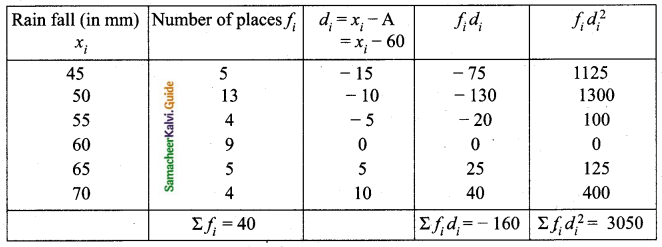
The rainfall recorded in various places of five districts in a week are given below.
Samacheer Kalvi 10th Maths Guide Chapter 8 Statistics and Probability Ex 8.1 Q10
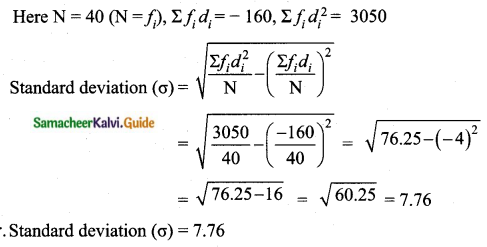
Find its standard deviation.
Answer:
Assumed mean = 60
Samacheer Kalvi 10th Maths Guide Chapter 8 Statistics and Probability Ex 8.1 Q10.1
Samacheer Kalvi 10th Maths Guide Chapter 8 Statistics and Probability Ex 8.1 Q10.2

Samacheer Kalvi 10th Maths Guide Chapter 8 Statistics and Probability Ex 8.1

Question 11.
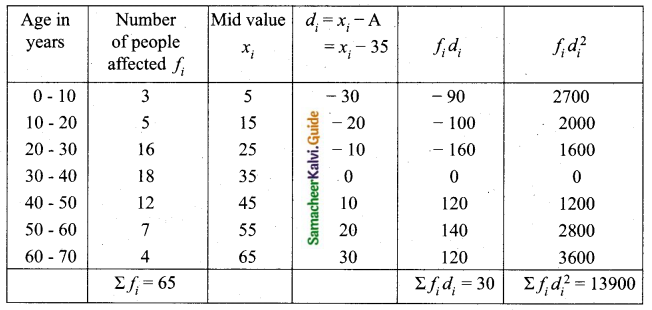
In a study about viral fever, the number of people affected in a town were noted as
Samacheer Kalvi 10th Maths Guide Chapter 8 Statistics and Probability Ex 8.1 Q11
Find its standard deviation.
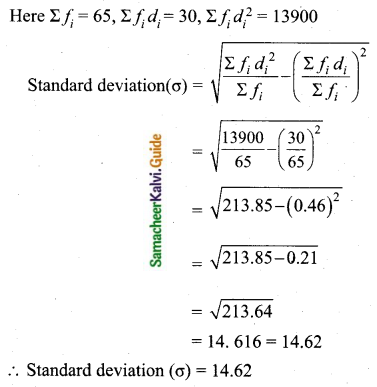
Answer:
Assumed mean = 35
Samacheer Kalvi 10th Maths Guide Chapter 8 Statistics and Probability Ex 8.1 Q11.1
Samacheer Kalvi 10th Maths Guide Chapter 8 Statistics and Probability Ex 8.1 Q11.2

Question 12.
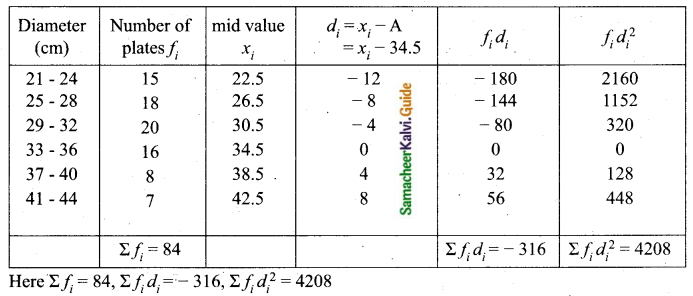
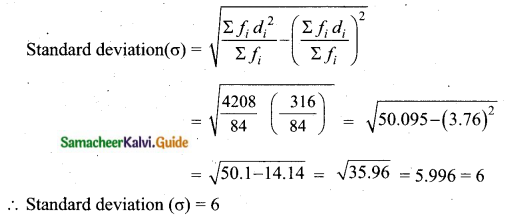
The measurements of the diameters (in cms) of the plates prepared in a factory are given below. Find the standard deviation.
Samacheer Kalvi 10th Maths Guide Chapter 8 Statistics and Probability Ex 8.1 Q12
Answer:
Assumed mean = 34.5
Samacheer Kalvi 10th Maths Guide Chapter 8 Statistics and Probability Ex 8.1 Q12.1
Samacheer Kalvi 10th Maths Guide Chapter 8 Statistics and Probability Ex 8.1 Q12.2

Question 13.
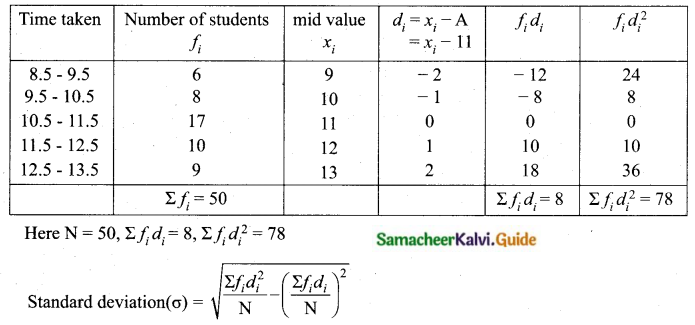
The time taken by 50 students to complete a 100 meter race are given below. Find its standard deviation.
Samacheer Kalvi 10th Maths Guide Chapter 8 Statistics and Probability Ex 8.1 Q13
Answer:
Assumed mean = 11
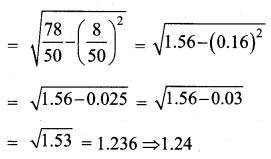
Samacheer Kalvi 10th Maths Guide Chapter 8 Statistics and Probability Ex 8.1 Q13.1
Samacheer Kalvi 10th Maths Guide Chapter 8 Statistics and Probability Ex 8.1 Q13.2
Standard deviation (σ) = 1.24

Question 14.
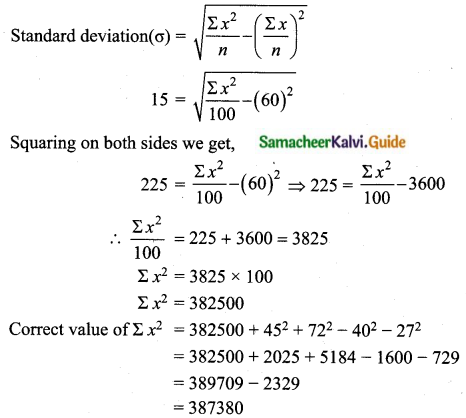
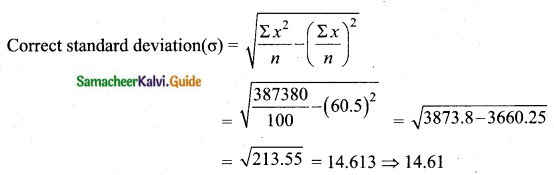
For a group of 100 candidates, the mean and standard deviation of their marks were found to be 60 and 15 respectively. Later on, it was found that the scores 45 and 72 were wrongly entered as 40 and 27. Find the correct mean and standard deviation.
Answer:
Number of candidates = 100
n = 100
Mean (\(\bar{x}\)) = 60
standard deviation (σ) = 15
Mean (\(\bar{x}\)) = \(\frac{\Sigma x}{n} \Rightarrow 60=\frac{\Sigma x}{100}\)
Σx = 6000
Correct total = 6000 + (45 – 40) + ( 72 – 27) = 6000 + 5 + 45 = 6050
Correct mean (\(\bar{x}\)) = \(\frac{6050}{100}\) = 60.5
Given standard deviation = 15
Samacheer Kalvi 10th Maths Guide Chapter 8 Statistics and Probability Ex 8.1 Q14
Samacheer Kalvi 10th Maths Guide Chapter 8 Statistics and Probability Ex 8.1 Q14.1
Correct mean = 60.5
Correct standard deviation (σ) = 14. 61

Samacheer Kalvi 10th Maths Guide Chapter 8 Statistics and Probability Ex 8.1

Question 15.
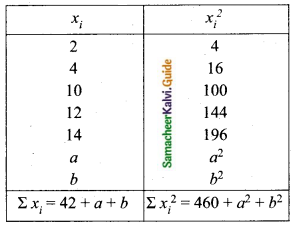
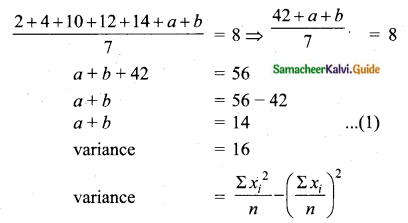
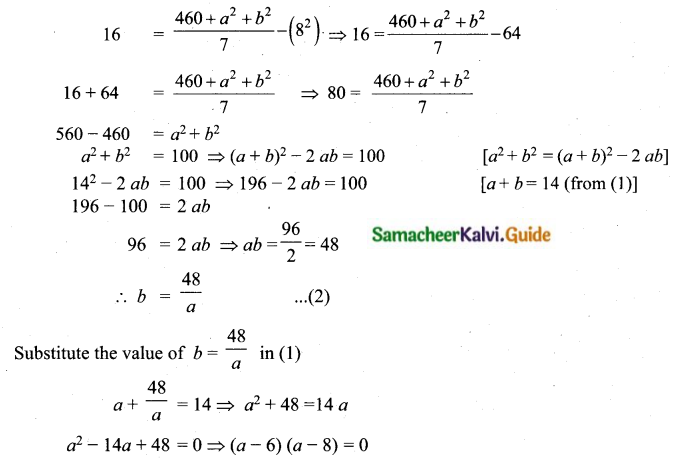
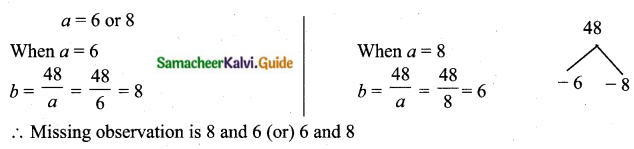
The mean and variance of seven observations are 8 and 16 respectively. If five of these are 2, 4, 10, 12 and 14, then find the remaining two observations.
Answer:
Let the missing two observations be ‘a’ and ‘b’
Arithmetic mean = 8
Samacheer Kalvi 10th Maths Guide Chapter 8 Statistics and Probability Ex 8.1 Q15
Samacheer Kalvi 10th Maths Guide Chapter 8 Statistics and Probability Ex 8.1 Q15.1
Samacheer Kalvi 10th Maths Guide Chapter 8 Statistics and Probability Ex 8.1 Q15.2
Samacheer Kalvi 10th Maths Guide Chapter 8 Statistics and Probability Ex 8.1 Q15.3

Samacheer Kalvi 10th Maths Guide Chapter 7 Mensuration Additional Questions

Students can download Maths Chapter 7 Mensuration Additional Questions and Answers, Notes, Samacheer Kalvi 10th Maths Guide Pdf helps you to revise the complete Tamilnadu State Board New Syllabus, helps students complete homework assignments and to score high marks in board exams.

Tamilnadu Samacheer Kalvi 10th Maths Solutions Chapter 7 Mensuration Additional Questions

I. Multiple Choice Questions:

Question 1.
The curved surface area of a right circular cylinder of radius 1 cm and height 1 cm is equal to ______
(1) π cm2
(2) 2π cm2
(3) 3π cm2
(4) 2 cm2
Answer:
(2) 2π cm2
Hint:
C.S.A of a cylinder = 2πrh sq. units = 2 × π × 1 × 1 cm2 = 2π cm2

Question 2.
The total surface area of a solid right circular cylinder whose radius is half of its height h is equal to ______ sq. units.
(1) \(\frac{3}{2} \pi h\)
(2) \(\frac{2}{3} \pi h^{2}\)
(3) \(\frac{3}{2} \pi h^{2}\)
(4) \(\frac{2}{3} \pi h\)
Answer:
(3) \(\frac{3}{2} \pi h^{2}\)
Hint:
T.S.A = 2πr(h + r)
[radius is half of the height]
= \(2 \pi \times \frac{h}{2}\left(\frac{h}{2}+h\right)\)
= \(=\pi h\left(\frac{3 h}{2}\right)=\frac{3}{2} \pi h^{2}\) sq. units

Samacheer Kalvi 10th Maths Guide Chapter 7 Mensuration Additional Questions

Question 3.
Base area of a right circular cylinder is 80 cm2. If its height is 5 cm, then the volume is equal to _______
(1) 400 cm3
(2) 16 cm3
(3) 200 cm3
(4) \(\frac{400}{3}\) cm3
Answer:
(1) 400 cm3
Hint:
Volume of a cylinder = πr2h cu. units
[Base area (πr2) = 80 cm2 = 80 × 5 cm3 = 400 cm3

Question 4.
If the total surface area of a solid right circular cylinder is 200π cm2 and its radius is 5 cm, then the sum of its height and radius is ______
(1) 20 cm
(2) 25 cm
(3) 30 cm
(4) 15 cm
Answer:
(1) 20 cm
Hint:
T.S.A of a cylinder = 200π cm2
2πr (h + r) = 200π
2 × 5 (h + r) = 200
(h + r) = 20 cm

Samacheer Kalvi 10th Maths Guide Chapter 7 Mensuration Additional Questions

Question 5.
The curved surface area of a right circular cylinder whose radius is a units and height is b units, is equal to ______
(1) πa2b sq.cm
(2) 2πab sq.cm
(3) 2π sq.cm
(4) 2 sq.cm
Answer:
(2) 2πab sq.cm .
Hint:
C.S.A. of a cylinder = 2πrh sq. units = 2 × π × a × b sq. cm = 2πab sq. cm

Question 6.
Radius and height of a right circular cone and that of a right circular cylinder are respectively, equal. If the volume of the cylinder is 120 cm3, then the volume of the cone is equal to _______
(1) 1200 cm3
(2) 360 cm3
(3) 40 cm3
(4) 90 cm3
Answer:
(3) 40 cm3
Hint:
Volume of the cone = \(\frac{1}{3}\) × volume of the cylinder
= \(\frac{1}{3}\) × 120 cm3
= 40 cm3

Samacheer Kalvi 10th Maths Guide Chapter 7 Mensuration Additional Questions

Question 7.
If the diameter and height of a right circular cone are 12 cm and 8 cm respectively, then the slant height is
(1) 10 cm
(2) 20 cm
(3) 30 cm
(4) 96 cm
Answer:
(1) 10 cm
Hint:
Slant height of a cone
Samacheer Kalvi 10th Maths Guide Chapter 7 Mensuration Additional Questions MCQ 7

Question 8.
If the circumference at the base of a right circular cone and the slant height are 120π cm and 10 cm respectively, then the curved surface area of the cone is equal to ______
(1) 1200π cm2
(2) 600π cm2
(3) 300π cm2
(4) 600 cm2
Answer:
(2) 600π cm2
Hint:
Circumference (2πr) = 120π cm
Slant height (l) = 10 cm;
Curved surface area of a cone = πrl sq. units
= \(\frac{120 \pi}{2}\) × 10 cm2 = 600π cm2

Samacheer Kalvi 10th Maths Guide Chapter 7 Mensuration Additional Questions

Question 9.
If the volume and the base area of a right circular cone are 48π cm and 12π cm respectively, then the height of the cone is equal to ______
(1) 6 cm
(2) 8 cm
(3) 10 cm
(4) 12 cm
Answer:
(4) 12 cm
Hint:
Volume of a cone = 48π cm3
[Base area (πr2) = 12π]
\(\frac{1}{3}\) πr2h = 48π
\(\frac{1}{3}\) × 12π × h = 48π
[Substitute πr2 = 12π]
h = \(\frac{48}{4}\) = 12 cm

Question 10.
If the height and the base area of a right circular cone are 5 cm and 48 sq.cm respectively, then the volume of the cone is equal to _______
(1) 240 cm3
(2) 120 cm3
(3) 80 cm3
(4) 480 cm3
Answer:
(3) 80 cm3
Hint:
Volume of a cone (V) = \(\frac{1}{3}\) πr2h sq. units
Base area (πr2) = 48 sq. cm
V = \(\frac{1}{3}\) × 48 × 5 = 80 cm3

Samacheer Kalvi 10th Maths Guide Chapter 7 Mensuration Additional Questions

Question 11.
The ratios of the respective heights and the respective radii of two cylinders are 1 : 2 and 2 : 1 respectively. Then their respective volumes are in the ratio _______
(1) 4 : 1
(2) 1 : 4
(3) 2 : 1
(4) 1 : 2
Answer:
(3) 2 : 1
Hint:
h1 : h2 = 1 : 2
r1 : r2 = 2 : 1
Ratio of their volumes
= \(\frac{1}{3} \pi r_{1}^{2} h_{1}: \frac{1}{3} \pi r_{2}^{2} h_{2}\)
= 22 × 1 : 12 × 2 = 4 : 2 = 2 : 1

Question 12.
If the radius of a sphere is 2 cm, then the curved surface area of the sphere is equal to ________
(1) 8π cm2
(2) 16 cm2
(3) 12π cm2
(4) 16π cm2
Answer:
(4) 16π cm2
Hint:
C.S.A of a sphere = 4πr2 sq. units
[radius = 2 cm]
= 4 × π × 22 cm2
= 16π cm2

Samacheer Kalvi 10th Maths Guide Chapter 7 Mensuration Additional Questions

Question 13.
The total surface area of a solid hemisphere of diameter 2 cm is equal to _______
(1) 12 cm2
(2) 12π cm2
(3) 4π cm2
(4) 3π cm2
Answer:
(4) 3π cm2
Hint:
Radius of a hemisphere = \(\frac{2}{2}\) = 1 cm
Total surface area of a hemisphere = 3πr2 sq. units = 3 × π × 12 cm2 = 3π cm2

Question 14.
If the volume of a sphere is \(\frac{9}{16} \pi\) cu.cm, then its radius is ________
(1) \(\frac{4}{3}\) cm
(2) \(\frac{3}{4}\) cm
(3) \(\frac{3}{2}\) cm
(4) \(\frac{2}{3}\) cm
Answer:
(2) \(\frac{3}{4}\) cm
Hint:
Volume of the sphere = \(\frac{9}{16} \pi\)
Samacheer Kalvi 10th Maths Guide Chapter 7 Mensuration Additional Questions MCQ 14

Question 15.
The surface areas of two spheres are in the ratio of 9 : 25. Then their volumes are in the ratio _______
(1) 81 : 625
(2) 729 : 15625
(3) 27 : 75
(4) 27 : 125
Answer:
(4) 27 : 125
Hint:
Ratio of their surface area = 9 : 25
Samacheer Kalvi 10th Maths Guide Chapter 7 Mensuration Additional Questions MCQ 15

Question 16.
The total surface area of a solid hemisphere whose radius is a units, is equal to ________
(1) 2πa2 sq. units
(2) 3πa2 sq. units
(3) 3πa sq. units
(4) 3a2 sq. units
Answer:
(2) 3πa2 sq. units
Hint:
T.S.A. of a solid hemisphere = 3πr2 sq. units
= 3 × π × a × a sq.units
= 3πa2 sq. units

Samacheer Kalvi 10th Maths Guide Chapter 7 Mensuration Additional Questions

Question 17.
If the surface area of a sphere is 100π cm2, then its radius is equal to ______
(1) 25 cm
(2) 100 cm
(3) 5 cm
(4) 10 cm
Answer:
(3) 5 cm
Hint:
Surface area of a sphere = 100π cm2
4πr2 = 100π
r2 = 25
r = √25 = 5 cm

Question 18.
If the surface area of a sphere is 36π cm2, then the volume of the sphere is equal to _______
(1) 12π cm3
(2) 36π cm3
(3) 72π cm3
(4) 108π cm3
Answer:
(2) 36π cm3
Hint:
Surface area of a sphere = 36π cm2
4πr2 = 36π
r2 = 9
r = 3 cm
Volume of a sphere = \(\frac{4}{3} \pi r^{3}\) cu. units
= \(\frac{4}{3} \pi\) × 3 × 3 × 3 cm3 = 36π cm3

Samacheer Kalvi 10th Maths Guide Chapter 7 Mensuration Additional Questions

Question 19.
If the total surface area of a solid hemisphere is 12π cm2 then its curved surface area is equal to ______
(1) 6π cm2
(2) 24π cm2
(3) 36π cm2
(4) 8π cm2
Answer:
(4) 8π cm2
Hint:
T.S.A of a hemisphere = 12π cm2
3πr2 = 12π
r2 = 4
r = 2
Curved surface area of a hemisphere = 2πr2 = 2 × π × 4 = 8π cm2

Question 20.
If the radius of a sphere is half of the radius of another sphere, then their respective volumes are in the ratio _____
(1) 1 : 8
(2) 2 : 1
(3) 1 : 2
(4) 8 : 1
Answer:
(1) 1 : 8
Hint:
\(r_{1}=\frac{r_{2}}{2} \Rightarrow \frac{r_{1}}{r_{2}}=\frac{1}{2} \Rightarrow r_{1}: r_{2}=1: 2\)

II. Answer the following questions:

Question 1.
Curved surface area and circumference at the base of a solid right circular cylinder are 4400 sq.cm and 110 cm respectively. Find its height and diameter.
Answer:
Given, Circumference of the base of a cylinder = 110 cm
2πr = 110 ……. (1)
Curved surface area = 4400 cm2
2πrh = 4400 cm2 ……. (2)
From (1) & (2), \(\frac{(2)}{(1)} \Rightarrow \frac{2 \pi r h}{2 \pi r}=\frac{4400}{110}=40 \mathrm{cm}\)
Height of the cylinder (h) = 40 cm
From (1), 2πr = 110
2 × \(\frac{22}{7}\) × r = 110
r = \(\frac{35}{2}\)
We know that, diameter (d) = 2 × radius
d = 2 × \(\frac{35}{2}\) = 35 cm
Diameter of the Circular cylinder = 35 cm

Samacheer Kalvi 10th Maths Guide Chapter 7 Mensuration Additional Questions

Question 2.
A mansion has 12 right cylindrical pillars each having radius 50 cm and height 3.5 m. Find the cost of painting the lateral surface of the pillars at ₹ 20 per square metre.
Answer:
Given, Radius of a cylinder (r) = 50 cm = 0.5 m
Height of a cylinder (h) = 3.5 m
Curved surface area of a pillar = 2πrh sq. units
Curved surface area of 12 pillars = 12 × 2πrh
= 12 × 2 × \(\frac{22}{7}\) × 0.5 × 3.5 m2
= 132 sq. m.
Cost for painting the lateral surface of pillars per metre = ₹ 20
Cost of painting = 132 × ₹ 20 = ₹ 2640

Question 3.
The total surface area of a solid right circular cylinder is 231 cm2. Its curved surface area is two thirds of the total surface area. Find the radius and height of the cylinder.
Answer:
Given, Total surface area of a cylinder (T.S. A) = 231 sq.cm
Curved surface area = \(\frac{2}{3}\) × T.S.A = \(\frac{2}{3}\) × 231 = 154 cm2
2πrh = 154 cm2 …… (1)
Total surface area = 231 cm2
2πr (h + r) = 231
2πrh + 2πr2= 231
154 + 2πr2 = 231 [from (1)]
2πr2 = 231 – 154 = 77
Samacheer Kalvi 10th Maths Guide Chapter 7 Mensuration Additional Questions SAQ 3
Radius of the cylinder = 3.5 cm
Height of the cylinder = 7 cm

Question 4.
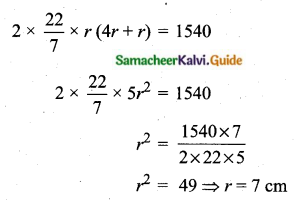
The total surface area of a solid right circular cylinder is 1540 cm2. If the height is four times the radius of the base, then find the height of the cylinder.
Answer:
Given, Let the radius of the cylinder be ‘r’
Height of a cylinder (h) = 4r (by given condition)
Total surface area = 1540 cm2
2πr(h + r) = 1540 cm2
Samacheer Kalvi 10th Maths Guide Chapter 7 Mensuration Additional Questions SAQ 4
Height of the cylinder = 4r = 4 × 7 = 28 cm

Question 5.
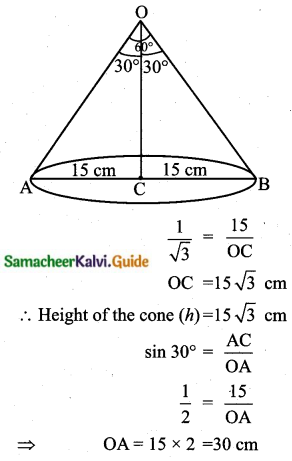
If the vertical angle and the radius of a right circular cone are 60° and 15 cm respectively, then find its height and slant height.
Answer:
Given, In the figure, OAB is a cone and OC ⊥ AB
∠AOC = \(\frac{60^{\circ}}{2}\) = 30°
In the right ∆OAC, tan 30° = \(\frac{\mathrm{AC}}{\mathrm{OC}}\)
Samacheer Kalvi 10th Maths Guide Chapter 7 Mensuration Additional Questions SAQ 5
Slant Height of the cone (l) = 15 × 2 = 30 cm

Question 6.
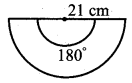
The central angle and radius of a sector of a circular disc are 180° and 21 cm respectively. If the edges of the sector are joined together to make a hollow cone, then find the radius of the cone.
Answer:
Samacheer Kalvi 10th Maths Guide Chapter 7 Mensuration Additional Questions SAQ 6
Given, Radius of a sector (r) = 21 cm
The angle of the sector (θ) = 180°
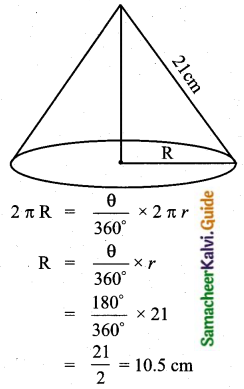
Let “R” be the radius of the cone.
Circumference of the base of a cone = Arc length of the sector
Samacheer Kalvi 10th Maths Guide Chapter 7 Mensuration Additional Questions SAQ 6.1
Radius of the cone (R) = 10.5 cm

Question 7.
If the curved surface area of a solid hemisphere is 2772 sq.cm, then find its total surface area.
Answer:
Given, the Curved surface area of a solid hemisphere = 2772 cm2
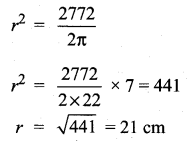
2πr2 = 2772
Samacheer Kalvi 10th Maths Guide Chapter 7 Mensuration Additional Questions SAQ 7
Total surface area = 3πr2 sq. units
= 3 × \(\frac{22}{7}\) × 21 × 21
= 4158 sq.cm
Aliter:
C.S.A of a hemisphere = 2772 cm2
2πr2 = 2772 cm2
πr2 = \(\frac{2772}{2}\) = 1386 cm
T.S.A of a hemisphere = 3πr2 sq.units = 3 × 1386 cm2 = 4158 cm2

Question 8.
An inner curved surface area of a hemispherical dome of a building needs to be painted. If the circumference of the base is 17.6 m, find the cost of painting it at the rate of ₹ 5 per sq. m.
Answer:
Given, Circumference of the dome = 17.6 m
2πr = 17.6
\(r=\frac{17.6 \times 7}{2 \times 22}=\frac{8.8 \times 7}{22}=2.8 \mathrm{m}\)
Curved surface area of the dome = 2πr2 sq. units
= 2 × \(\frac{22}{7}\) × 2.8 × 2.8 m2
= 49.28 m2
Cost of painting for one sq.metre = ₹ 5
Cost of painting the curved surface = 49.28 × ₹ 5 = ₹ 246.40

Question 9.
Volume of a solid cylinder is 62.37 cu.cm. Find the radius if its height is 4.5 cm.
Answer:
Given, Height of a cylinder (h) = 4.5 cm
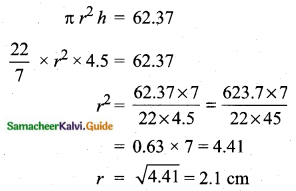
Volume of a solid cylinder = 62.37 cu. cm
Samacheer Kalvi 10th Maths Guide Chapter 7 Mensuration Additional Questions SAQ 9
Radius of a cylinder (r) = 2.1 cm

Question 10.
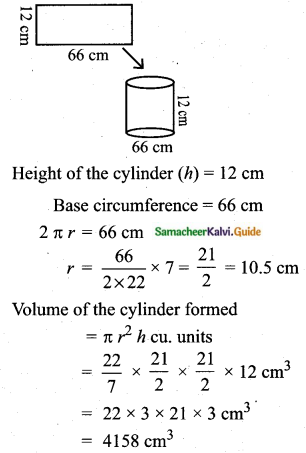
A rectangular sheet of metal foil with dimension 66 cm × 12 cm is rolled to form a cylinder of height 12 cm. Find the volume of the cylinder.
Answer:
After rolling the rectangular sheet into a cylinder
Samacheer Kalvi 10th Maths Guide Chapter 7 Mensuration Additional Questions SAQ 10
Volume of the cylinder = 4158 cm3

Question 11.
The circumference of the base of a 12 m high wooden solid cone is 44 m. Find the volume.
Answer:
Given, Height of the wooden solid cone (h) = 12 m
Circumference of the base = 44 m
2πr = 44
r = \(\frac{44 \times 7}{2 \times 22}\) = 7 m
Volume of the wooden solid = \(\frac{1}{3} \pi r^{2} h\) cu. units
= \(\frac{1}{3} \times \frac{22}{7} \times 7 \times 7 \times 12 \mathrm{m}^{3}\)
= 88 × 7
= 616 m3
Volume of the solid = 616 m3

Question 12.
Find the volume of the largest right circular cone that can be cut out of a cube whose edge is 14 cm.
Answer:
Given, Edge of the cube = 14 cm
The largest circular cone is cut out from the cube.
Radius of the cone (r) = \(\frac{14}{2}\) = 7 cm
Height of the cone (h) = 14 cm
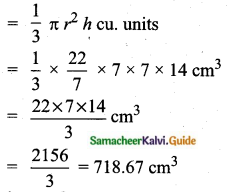
Volume of a cone
Samacheer Kalvi 10th Maths Guide Chapter 7 Mensuration Additional Questions SAQ 12
Volume of a cone = 718.67 cm3

Question 13.
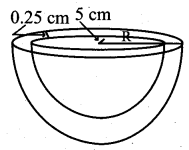
The thickness of a hemispherical bowl is 0.25 cm. The inner radius of the bowl is 5 cm. Find the outer curved surface area of the bowl. (Take π = \(\frac{22}{7}\))
Answer:
Let r, R and w be the inner and outer radii and thickness of the hemispherical bowl respectively.
Samacheer Kalvi 10th Maths Guide Chapter 7 Mensuration Additional Questions SAQ 13
Given that r = 5 cm, w = 0.25 cm
R = r + w = 5 + 0.25 = 5.25 cm
Now, outer surface area of the bowl = 2πR2
= 2 × \(\frac{22}{7}\) × 5.25 × 5.25
= 173.25 sq. cm
Thus, the outer surface area of the bowl = 173.25 sq. cm

Question 14.
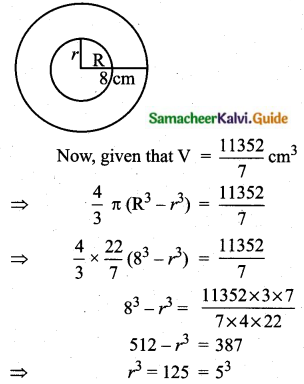
Volume of a hollow sphere is \(\frac{11352}{7}\) cm3. If the outer radius is 8 cm, find the inner radius of the sphere. (Take π = \(\frac{22}{7}\))
Answer:
Let R and r be the outer and inner radii of the hollow sphere respectively.
Let V be the volume of the hollow sphere.
Samacheer Kalvi 10th Maths Guide Chapter 7 Mensuration Additional Questions SAQ 14
Hence, the inner radius r = 5 cm

Question 15.
How many litres of water will a hemispherical tank whose diameter is 4.2 m?
Answer:
Radius of the tank = \(\frac{4.2}{2}\) = 2.1 m
Volume of the hemisphere
= \(\frac{2}{3} \pi r^{3}\) cu.units
= \(\frac{2}{3} \times \frac{22}{7} \times 2.1 \times 2.1 \times 2.1 \mathrm{m}^{3}\)
= 19.404 m3
= 19.404 x 1000 lit
= 19,404 litres

III. Answer the following questions.

Question 1.
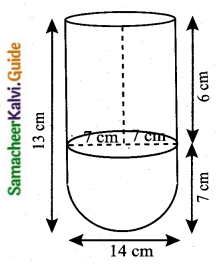
A vessel is in the form of a hollow hemisphere mounted by a hollow cylinder. The diameter of the hemisphere is 14 cm and the total height of the vessel is 13 cm. Find the inner surface area of the vessel.
Answer:
Samacheer Kalvi 10th Maths Guide Chapter 7 Mensuration Additional Questions LAQ 1
For cylindrical part:
Radius (r) = 7 cm
Height (h) = 6 cm
Curved surface area = 2πrh = 2 × \(\frac{22}{7}\) × 7 × 6 cm2 = 264 cm2
For hemispherical part:
Radius (r) = 7 cm
Surface area (h) = 2πr2
= 2 × \(\frac{22}{7}\) × 7 × 7 cm2
= 308 cm2
Total surface area = (264 + 308) = 572 cm2

Question 2.
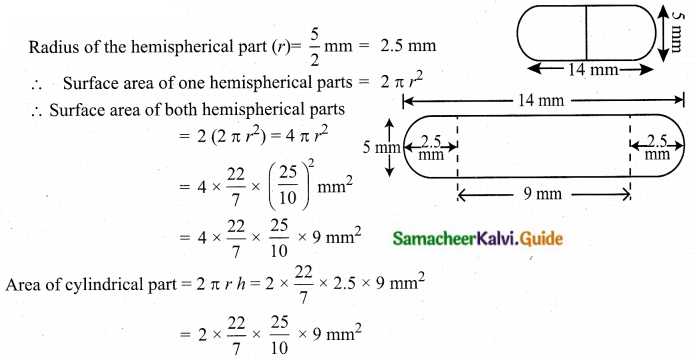
A medicine capsule is in the shape of a cylinder with two hemispheres stuck to each of its ends. The length of the entire capsule is 14 mm and the diameter of the capsule is 5 mm. Find its surface area.
Answer:
Samacheer Kalvi 10th Maths Guide Chapter 7 Mensuration Additional Questions LAQ 2
Samacheer Kalvi 10th Maths Guide Chapter 7 Mensuration Additional Questions LAQ 2.1

Question 3.
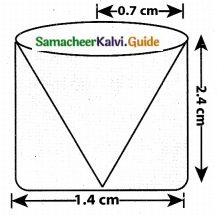
From a solid cylinder whose height is 2.4 cm and diameter 1.4 cm, a conical cavity of the same height and same diameter is hollowed out. Find the total surface area of the remaining solid to the nearest cm2.
Answer:
Samacheer Kalvi 10th Maths Guide Chapter 7 Mensuration Additional Questions LAQ 3
For cylinderical part:
Height (h) = 2.4 cm
Diameter (d) = 1.4 cm
Radius (r) = 0.7 cm
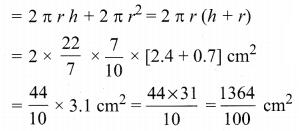
Total surface area of the cylindrical part
Samacheer Kalvi 10th Maths Guide Chapter 7 Mensuration Additional Questions LAQ 3.1
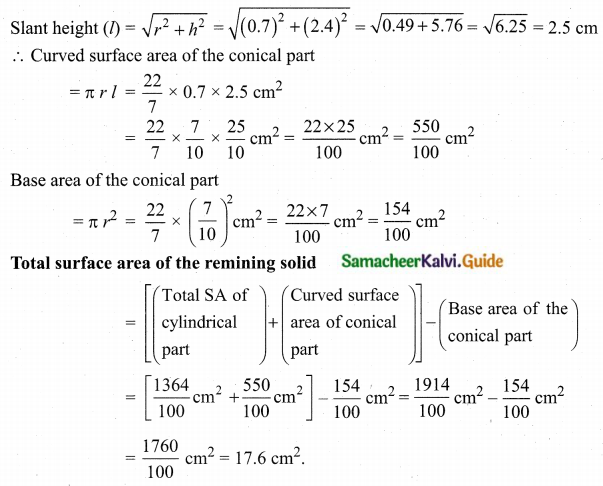
For conical part:
Base area (r) = 0.7 cm
Height (h) = 2.4 cm
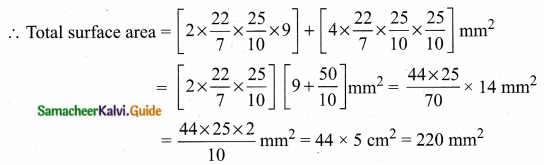
Samacheer Kalvi 10th Maths Guide Chapter 7 Mensuration Additional Questions LAQ 3.2

Question 4.
A 20 m deep well with diameter 7 m is dug and the earth from digging is evenly spread out to form a platform 22 m by 14 m. Find the height of the platform.
Answer:
Diameter of the cylindrical well = 7 m
Radius of the cylinder (r) = \(\frac{7}{2}\) m
Depth of the well (h) = 20 m
Volume = πr2h
= \(\frac{22}{7} \times \frac{7}{2} \times \frac{7}{2} \times 20 \mathrm{m}^{3}\)
= 22 × 7 × 5 m3
Volume of the earth taken out = 22 × 7 × 5 m3
Now this earth is spread out to form a cuboidal platform having
Length (l) = 22 m
Breadth (b) = 14 m
Let ‘h’ be the height of the platform.
Volume of the platform = 22 × 14 × h m3
Volume of the platform = Volume of the earth taken out
22 × 14 × h = 22 × 7 × 5
\(h=\frac{22 \times 7 \times 5}{22 \times 14}=\frac{5}{2} \mathrm{m}=2.5 \mathrm{m}\)
Thus, the required height of the platform is 2.5 m.

Question 5.
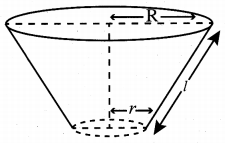
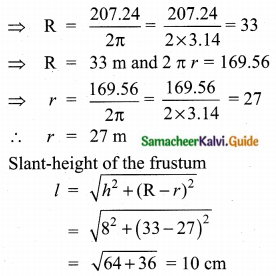
The perimeters of the ends of the frustum of a cone are 207.24 cm and 169.56 cm. If the height of the frustum is 8 cm, find the whole surface area of the frustum. [Use π = 3.14]
Answer:
Samacheer Kalvi 10th Maths Guide Chapter 7 Mensuration Additional Questions LAQ 5
Let the radii of circular ends are R and r [R > r]
Perimeter of circular ends are 207.24 cm and 169.56 cm
2πR = 207.24 cm
Samacheer Kalvi 10th Maths Guide Chapter 7 Mensuration Additional Questions LAQ 5.1
The whole surface area of the frustum = π [(R2 + r2) + (R + r) l]
Required whole surface area of the frustum
= 3.14 [332 + 272 + (33 + 27) × 10] cm2
= 3.14 [1089 + 729 + 600] cm2
= 3.14 [2418] cm2
= 7592.52 cm2

Question 6.
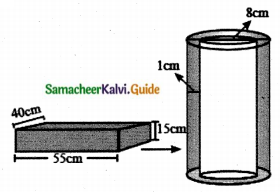
A cuboid-shaped slab of iron whose dimensions are 55 cm × 40 cm × 15 cm is melted and recast into a pipe. The outer diameter and thickness of the pipe are 8 cm and 1 cm respectively. Find the length of the pipe. (Take π = \(\frac {22}{7}\))
Answer:
Samacheer Kalvi 10th Maths Guide Chapter 7 Mensuration Additional Questions LAQ 6
Let h1 be the length of the pipe
Let R and r be the outer and inner radii of the pipe respectively.
Iron slab:
Volume = lbh = 55 × 40 × 15 cm3
Iron pipe:
Outer diameter, 2R = 8 cm
Outer radius, R = 4 cm
Thickness, w = 1 cm
Inner radius, r = R – w = 4 – 1 = 3 cm
Now, the volume of the iron pipe = Volume of the iron slab
Samacheer Kalvi 10th Maths Guide Chapter 7 Mensuration Additional Questions LAQ 6.1
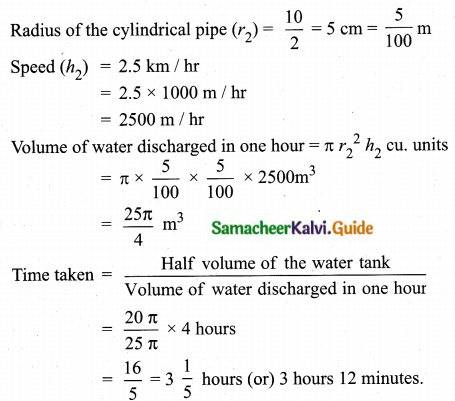
Time is taken by the pipe to empty half of the tank = 3 hours 12 minutes.

Question 7.
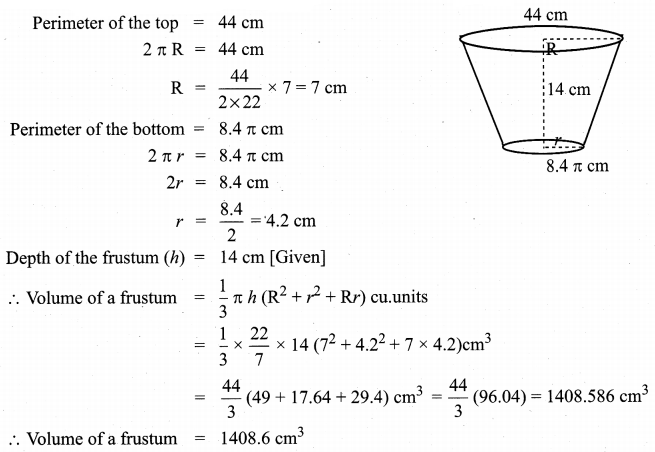
The perimeter of the ends of a frustum of a cone are 44 cm and 8.4π cm. If the depth is 14 cm., then find its volume.
Answer:
Given let the radius of the top of the frustum be “R” and the radius of the bottom of the frustum be “r”
Samacheer Kalvi 10th Maths Guide Chapter 7 Mensuration Additional Questions LAQ 7

Question 8.
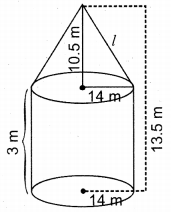
A tent is in the shape of a right circular cylinder surmounted by a cone. The total height and the diameter of the base are 13.5 m and 28 m. If the height of the cylindrical portion is 3 m, find the total surface area of the tent.
Answer:
Samacheer Kalvi 10th Maths Guide Chapter 7 Mensuration Additional Questions LAQ 8
Given, Total height of solid = 13.5 cm
Diameter of the cylinder (d) = 28 m
Height of a cylinder (h) = 3 m
Height of a conical portion = 13.5 – 3 = 10.5 m
From the diagram, Radius of a cone = Radius of a cylinder
Radius (r) = 14 m
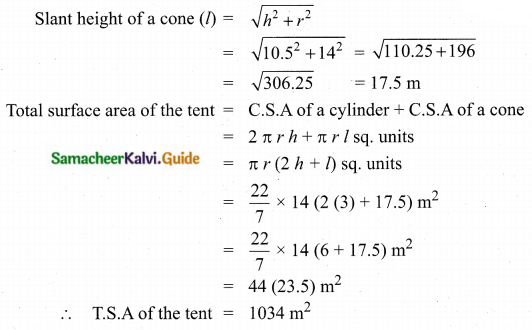
Samacheer Kalvi 10th Maths Guide Chapter 7 Mensuration Additional Questions LAQ 9

Tamil Nadu 11th Chemistry Model Question Paper 3 English Medium

Students can Download Tamil Nadu 11th Chemistry Model Question Paper 3 English Medium Pdf, Tamil Nadu 11th Chemistry Model Question Papers helps you to revise the complete Tamilnadu State Board New Syllabus, helps students complete homework assignments and to score high marks in board exams.

TN State Board 11th Chemistry Model Question Paper 3 English Medium

General Instructions:

  1. The question paper comprises of four parts.
  2. You are to attempt all the parts. An internal choice of questions is provided wherever applicable.
  3. All questions of Part I, II, III and IV are to be attempted separately.
  4. Question numbers 1 to 15 in Part I are Multiple Choice Questions of one mark each.
    These are to be answered by choosing the most suitable answer from the given four alternatives and writing the option code and the corresponding answer
  5. Question numbers 16 to 24 in Part II are two-mark questions. These are to be answered in about one or two sentences.
  6. Question numbers 25 to 33 in Part III are three-mark questions. These are to be answered in about three to five short sentences.
  7. Question numbers 34 to 38 in Part IV are five-mark questions. These are to be answered in detail Draw diagrams wherever necessary.

Time: 2:30 Hours
Maximum Marks: 70

PART – I

Answer all the Questions: [15 × 1 = 15]
Choose the most suitable answer from the given four alternatives.

Question 1.
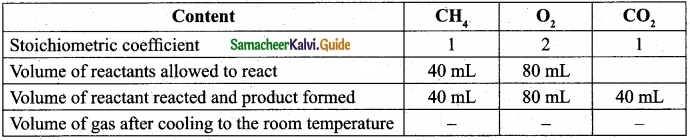
40 ml of methane is completely burnt using 80ml of oxygen at room temperature. The volume of gas left after cooling to room temperature. The volume of gas left after cooling to room temperature is …………………….
(a) 40 ml of CO2 gas
(b) 40 ml of CO2 gas and 80 ml of H2O gas
(c) 60 ml of CO2 gas and 60 ml H2O gas
(d) 120 ml of CO2 gas
Solution:
CH4(g) + 2O2(g) → CO2(g) + 2H2O(l)

Tamil Nadu 11th Chemistry Model Question Paper 3 English Medium img 1 - Copy

Since the product was cooled to room temperature, water exists mostly as liquid. Hence, option (a) is correct.
Answer:
(a) 40 ml of CO2 gas

Tamil Nadu 11th Chemistry Model Question Paper 3 English Medium

Question 2.
What are the values of n, l, m and s for 3px electron?
(a) 3, 2, 1,0
(b) 3, 1,-1, +\(\frac{1}{2}\)
(c) 3, 2, +1, –\(\frac{1}{2}\)
(d) 3, 0, 0, +\(\frac{1}{2}\)
Solution:
3px electron; n = 3 (main shell)
for px orbital, l = 1, m = -1, s = \(\frac{1}{2}\)
Answer:
(b) 3, 1,-1, +\(\frac{1}{2}\)

Tamil Nadu 11th Chemistry Model Question Paper 3 English Medium

Question 3.
Which of the following statements is incorrect in relation to ionization enthalpy?
(a) Ionization enthalpy increases for each successive electron.
(b) The greatest increase in ionization enthalpy is experienced on removal of electrons from core noble gas configuration.
(c) End of valence electrons is marked by a big jump in ionization enthalpy.
(d) Removal of electron from orbitals bearing lower n value is easier than from orbital having high n value.
Answer:
(d) Removal of electron from orbitals bearing lower n value is easier than from orbital having high n value.

Question 4.
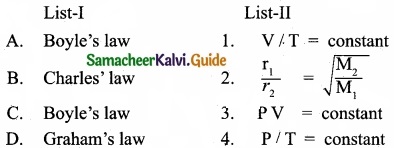
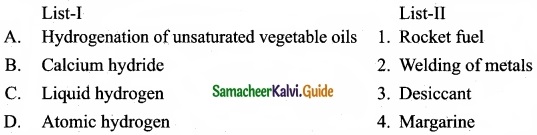
Match the List-I and List-II using the correct code given below the list.

Tamil Nadu 11th Chemistry Model Question Paper 3 English Medium img 2

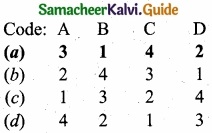
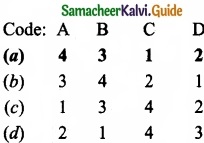
Answer:

Tamil Nadu 11th Chemistry Model Question Paper 3 English Medium img 3

Question 5.
Lithium shows diagonal relationship with ………………………
(a) Sodium
(b) Magnesium
(c) Calcium
(d) Ahuninium
Answer:
(b) Magnesium

Tamil Nadu 11th Chemistry Model Question Paper 3 English Medium

Question 6.
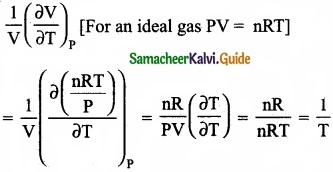
The variation of volume V, with temperature T, keeping pressure constant is called the coefficient of thermal expansion ie α = \(\frac{1}{V}\) \((\frac { \partial V }{ \partial T } )\)
(a) T
(b) 1/T
(c) P
(d) None of these
Solution:

Tamil Nadu 11th Chemistry Model Question Paper 3 English Medium img 4

Answer:
(b) 1/T

Question 7.
Heat of combustion is always …………………….
(a) Positive
(b) Negative
(c) Zero
(d) Either positive or negative
Answer:
(b) Negative

Question 8.
If in a mixture where Q = K, then what happens?
(a) The reaction shift towards products
(b) The reaction shift towards reactants
(c) Nothing appears to happen, but forward and reverse reactions are continuing at the same rate
(d) Nothing happens
Answer:
(c) Nothing appears to happen, but forward and reverse reactions are continuing at the same rate

Tamil Nadu 11th Chemistry Model Question Paper 3 English Medium

Question 9.
Which one of the following gases has the lowest value of Henry’s law constant?
(a) N2
(b) He
(c) CO2
(d) H2
Solution:
Carbon dioxide; most stable gas and has lowest value of Henry’s Law constant.
Answer:
(c) CO2

Question 10.
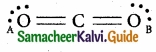
In the molecule OA = C = OB, the formal charge on OA, C and OB are respectively.
(a) – 1, 0, + 1
(b) + 1, 0, -1
(c) – 2, 0, + 2
(d) 0, 0, 0
Solution:

Tamil Nadu 11th Chemistry Model Question Paper 3 English Medium img 5

Formal charge of OA/OB = NV – (Ne + \(\frac { N_{ b } }{ 2 } \)) = 6 – (4 + \(\frac{4}{2}\)) = 6 – 6 = 0
Formal charge of C = 4 – (0 + \(\frac{8}{2}\)) = 4 – 4 = 0
Answer:
(d) 0, 0, 0

Question 11.
In the hydrocarbon CH3 – CH3 – CH = CH – CH2 – C = CH the state of hybridisation of carbon 1, 2, 3, 4 and 7 are in the following sequence.
(a) sp, sp, sp3, sp2, sp3
(b) sp2, sp, sp3, sp2, sp3
(c) sp, sp, sp2, sp, sp3
(d) None of these
Answer:
(a) sp, sp, sp3, sp2, sp3

Tamil Nadu 11th Chemistry Model Question Paper 3 English Medium

Question 12.
Enzyme present in apple is ………………………..
(a) Polyphenol oxidase
(b) Polyphenol reductase
(c) Polyphenol
(d) Polyphenol hydrolase
Answer:
(a) Polyphenol oxidase

Question 13.
The correct statement regarding the comparison of staggered and eclipsed conformations of ethane is ………………………….
(a) The eclipsed conformation of ethane is more stable than staggered conformation even though the eclipsed conformation has torsional strain.
(b) The staggered conformation of ethane is more stable than eclipsed conformation, because staggered conformation has no torsional strain.
(c) The staggered conformation of ethane is less stable than eclipsed conformation, because staggered conformation has torsional strain.
(d) The staggered conformation of ethane is less stable than eclipsed conformation, because staggered conformation has no torsional strain.
Answer:
(b) The staggered conformation of ethane is more stable than eclipsed conformation, because staggered conformation has no torsional strain.

Tamil Nadu 11th Chemistry Model Question Paper 3 English Medium

Question 14.
In Finkelstein reaction, the mechanism followed is ……………………….
(a) SN1
(b) E1
(c) E2
(d) SN2
Answer:
(d) SN2

Question 15.
Which sequence for greenhouse gases is based on GWP?
(a) CFC > N2O > CO2 > CH4
(b) CFC > CO2 > N2O > CH4
(c) CFC > N2O > CH4 > CO2
(d) CFC > CH4 > N2O > CO2
Answer:
(c) CFC > N2O > CH4 > CO2

PART – II

Answer any six questions in which question No. 24 is compulsory. [6 × 2 = 12]

Question 16.
Define Avogadro Number?
Answer:
Avogadro number is the number of atoms present in one mole of an element or number of molecules present in one mole of a compound. The value of Avogadro number (N) = 6.023 × 10²³.

Tamil Nadu 11th Chemistry Model Question Paper 3 English Medium

Question 17.
Explain the meaning of the symbol 4P. Write all the four quantum numbers for these electrons?
Answer:
4f2: It means that the element has 2 electrons in outermost 4f shell.
Quantum number values are, Tamil Nadu 11th Chemistry Model Question Paper 3 English Medium img 6 - Copy
n = principal quantum number = 4
l = azimuthal quantum number = 3
m = magnetic quantum number = – 3, -2
s = spin quantum number = +\(\frac{1}{2}\), –\(\frac{1}{2}\)

Question 18.
Is the definition given below for ionization enthalpy is correct?
“Ionization enthalpy is defined as the energy required to remove the most loosely bound electron from the valence shell of an atom”?
Answer:
No, It is not correct. Thq accurate and absolute definition is as follows:
Ionization energy is defined as the minimum amount of energy required to remove the most loosely bound electron from the valence shell of the isolated neutral gaseous atom in its ground state.

Tamil Nadu 11th Chemistry Model Question Paper 3 English Medium

Question 19.
What are the uses of calcium hydroxide?
Calcium hydroxide is used
Answer:

  1. In the preparation of mortar, a building material.
  2. In white wash due to its disinfectant nature.
  3. In glass making and tanning industry.
  4. For the preparation of bleaching powder and for the purification of sugar.

Question 20.
30.4 kJ is required to melt one mole of sodium chloride. The entropy change during melting is 28.4 JK-1 mol-1. Calculate the melting point of sodium chloride?
Answer:
Given:
∆Hf = 30.4 kJ = 30400 J mol-1
∆Sf (NaCl) = 28.4 kJ-1 mol-1
Tf = ?
∆Sf = \(\frac{\Delta \mathrm{H}_{\mathrm{f}}}{\Delta \mathrm{T}_{\mathrm{f}}}\); Tf = \(\frac{\Delta \mathrm{H}_{\mathrm{f}}}{\Delta \mathrm{S}_{\mathrm{f}}}\)
Tf = \(\frac{30400 \mathrm{J} \mathrm{mol}^{-1}}{28.4 \mathrm{JK}^{-1} \mathrm{mol}^{-1}}\) = 1070.4 K

Tamil Nadu 11th Chemistry Model Question Paper 3 English Medium

Question 21.
How is a gas-solution equilibrium exist?
Answer:
When a gas dissolves in a liquid under a given pressure, there will be an equilibrium between gas molecules in the gaseous state and those dissolved in the liquid.
Example: In carbonate beverages the following equilibrium exists.
CO2(g) ⇄ CO2 (solution).

Question 22.
What type of hybridisations are possible in the following geometeries?

  1. Octahedral
  2. Tetrahedral
  3. Square planar

Answer:

  1. Octahedral geometry is possible by sp3d2 (or) d2sp3 hybridisation.
  2. Tetrahedral geometry is possible by sp3 hybridisation.
  3. Square planar geometry is possible by dsp2 hybridisation.

Tamil Nadu 11th Chemistry Model Question Paper 3 English Medium

Question 23.
How will you prepare Lassaigne’s extract?
Lassagine’s extract preparation:
Answer:

  1. A small piece of Na dried by pressing between the folds of filter paper is taken in a fusion tube and it is gently heated. When it melts to a shining globule, a pinch of organic compound is added.
  2. The tube is heated till reaction ceases and become red hot. Then it is plunged in 50 ml of distilled water taken in a china dish and the bottom of the tube is broken by striking it against the dish.
  3. The contents of the dist is boiled for 10 minutes and then it is filtered. The filtrate is known as Lassaigne’s extract.

Tamil Nadu 11th Chemistry Model Question Paper 3 English Medium

Question 24.
Complete the reactions and identify the products?

Tamil Nadu 11th Chemistry Model Question Paper 3 English Medium img 7

Answer:

Tamil Nadu 11th Chemistry Model Question Paper 3 English Medium img 8

PART – III

Answer any six questions in which question No. 32 is compulsory. [6 × 3 = 18]

Question 25.
The balanced equation for a reaction is given below 2x + 3y → 41 + m
When 8 moles of x react with 15 moles of y, then

  1. Which is the limiting reagent?
  2. Calculate the amount of products formed.
  3. Calculate the amount of excess reactant left at the end of the reaction.

Answer:
2x + 3y → 41 + m
1. 2x reacts with 3y to give products.
8x reacts with 15y means, y is the excess because 8 moles of x should react with 4 × 3y = 12y moles of y to give products.
In this reaction 15y moles are used.
Therefore, 3 moles of y is excess and x is the limiting agent.

2. When 8 moles of x react with 12 moles of y, the product formed will be 4 × 41 i.e. 161 and 4m as product.
8x+ 12y → 161 + 4m

3. At the end of the reaction, the excess reactant left is 3 moles of y.

Tamil Nadu 11th Chemistry Model Question Paper 3 English Medium

Question 26.
Which would you expect to have a higher melting point, magnesium oxide or magnesium fluoride? Explain your reasoning.
Answer:

  1. Magnesium oxide has very strong ionic bonds as compared to magnesium fluoride.
  2. Mg2+ and O2- have charges of +2 and -2, respectively.
  3. Oxygen ion is smaller than fluoride ion.
  4. The smaller the ionic radii, the smaller the bond length in MgO and the bond is stronger than MgF2.
  5. Due to more strong bond nature in MgO, it has high melting point than MgF2.

Tamil Nadu 11th Chemistry Model Question Paper 3 English Medium

Question 27.
A sample of solid KClO3 (potassium chlorate) was heated in a test tube to obtain O2 according to the reaction
2KClO3(s) → 2KCl + 3O2
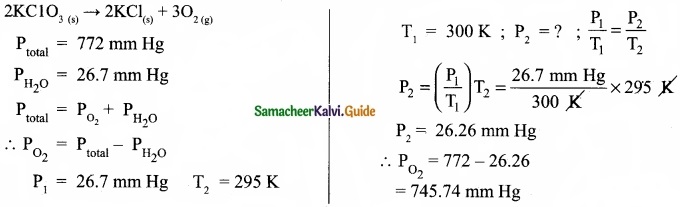
The oxygen gas was collected by downward displacement of water at 295 K. The total pressure of the mixture is 772 mm of Hg. The vapour pressure of water is 26.7 mm of Hg at 300K. What is the partial pressure of the oxygen gas?
Answer:

Tamil Nadu 11th Chemistry Model Question Paper 3 English Medium img 9

Question 28.
List the characteristics of entropy?
Characteristics of entropy:
Answer:

  • Entropy is a thermodynamic state function that is a measure of the randomness or disorderliness of the system.
  • In general, the entropy of gaseous system is greater than liquids and greater than solids. The symbol of entropy is S.
  • Entropy is defined as “for a reversible change taking place at a constant temperature (T), the change in entropy (∆S) of the system is equal to heat energy absorbed or evolved (q) by the system divided by the constant temperature (T).
    \(\Delta S_{\mathrm{sys}}=\frac{q_{\mathrm{rev}}}{T}\)
  • If heat is absorbed, then ∆S is positive and there will be increase in entropy. If heat is evolved, ∆S is negative and there is a decrease in entropy,
  • The change in entropy of a process represented by ∆S and is given by the equation,
    ∆Ssys = Sf – Si
  • If Sf > Si, ∆S is positive, the reaction is spontaneous and reversible.
    If Sf < Si, ∆S is negative, the reaction is non-spontaneous and irreversible.
  • Unit of entropy: SI unit of entropy is J K-1.

Tamil Nadu 11th Chemistry Model Question Paper 3 English Medium

Question 29.
Derive the values of KC and KP for the synthesis of HI.
Answer:
H2(g) + I2(g) ⇄ 2HI(g)
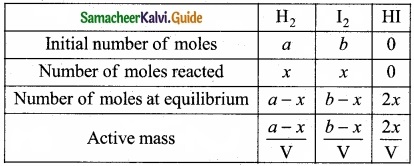
Let us consider the formation of HI in which V moles of hydrogen, ‘b’ moles of iodine gas are allowed to react in an container of volume ‘V’.
Let ‘x’ moles of each of H2 and I2 react together to form 2x moles of HI.

Tamil Nadu 11th Chemistry Model Question Paper 3 English Medium img 10

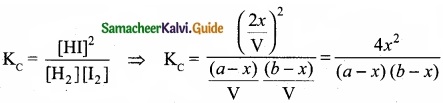
Applying mass of action

Tamil Nadu 11th Chemistry Model Question Paper 3 English Medium img 11

Caluculation of KP: KP = KC.RT∆ng
Here ∆ng = np – nr = 2 -2 = 0
Hence, KP = KC
KP = \(\frac{4 x^{2}}{(a-x)(b-x)}\)

Tamil Nadu 11th Chemistry Model Question Paper 3 English Medium

Question 30.
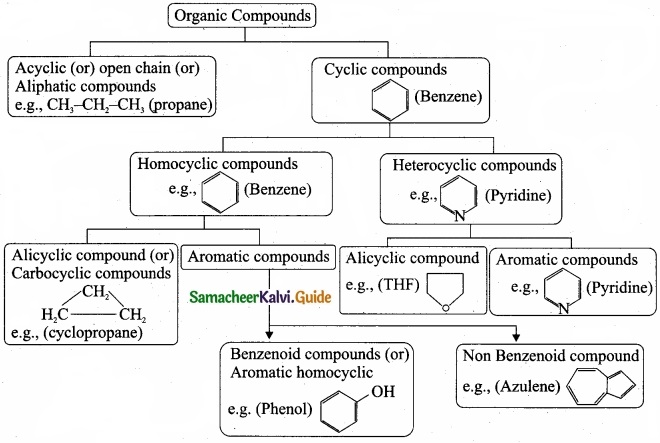
Describe the classification of organic compounds based on their structure?
Answer:
Classification of organic compounds based on the structure

Tamil Nadu 11th Chemistry Model Question Paper 3 English Medium img 12

Question 31.
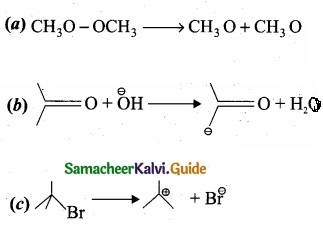
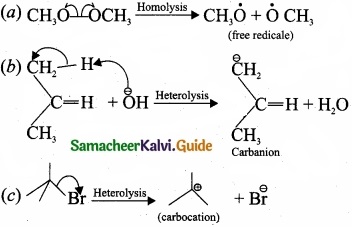
For the following bond cleavages use curved-arrows to show the electron flow and classify each as homolytic or heterolytic fission. Identify reactive intermediate produced as free radical, carbocation and carbanion?

Tamil Nadu 11th Chemistry Model Question Paper 3 English Medium img 13

Answer:

Tamil Nadu 11th Chemistry Model Question Paper 3 English Medium img 14

Tamil Nadu 11th Chemistry Model Question Paper 3 English Medium

Question 32.
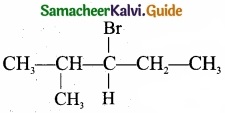
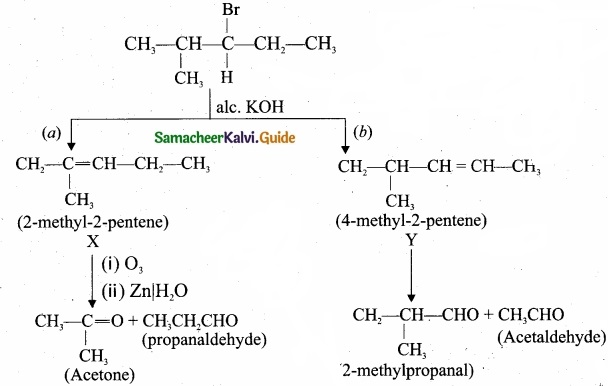
An alkyl halide with molecular formula C6H12Br on dehydrohalogenation gave two isomeric alkenes X and,Y with molecular formula C6H12. On reductive ozonolysis, X and Y gave four compounds CH3COCH3, CH3CHO, CH3CH2CHO and (CH3)2 CHCHO. Find the alkyl halide?
Answer:

  1. C6 H13 Br is 3 – Bromo – 4 – methylpentane. Tamil Nadu 11th Chemistry Model Question Paper 3 English Medium img 15
  2. 3 – Bromo – 4 – methylpentane on dehydration give two isomers X and Y as follows:

Tamil Nadu 11th Chemistry Model Question Paper 3 English Medium img 16

Therefore C6H13 Br is 3 – Bromo – 4 – methylpentane

Tamil Nadu 11th Chemistry Model Question Paper 3 English Medium

Question 33.
What do you mean by ozone hole? What are its consequences?
Answer:
Depletion of ozone layer creates some sort of holes in the blanket of ozone which surrounds us in the atmosphere and this is known as ozone hole.

  1. With the depletion of the ozone layer, UV radiations filters into the troposphere which leads to ageing of skin, cataract, sunburn, skin cancer etc.
  2. By killing many of the phytoplanktons, it can damage the fish productivity.
  3. Evaporation rate increases through the surface and stomata of leaves which can decrease the moisture content of the soil.

PART – IV

Answer all the questions. [5 × 5 = 25]

Question 34 (a).
(I) Balance the following equations by ion electron method?
KMnO4 + SnCl2 + HCl → MnCl2 + SnCl4 + H2O + KCl
(II) Boric acid, H3BO3 is a mild antiseptic and is often used as an eye wash. A sample contains 0.543 mol H3BO3. What is the mass of boric acid in the sample?

[OR]

(b)
(I) How many unpaired electrons are present in the ground state of Fe3+ (z = 26), Mn2+ (z = 25) and argon (z = 18)?
(II) Explain about the significance of de Broglie equation?
Answer:
KMnO4 + SnCl2 + HCl → MnCl2 + SnCl4 + H2O + KCl
Oxidation half reaction: (loss of electron)

Tamil Nadu 11th Chemistry Model Question Paper 3 English Medium img 17

Reduction of halfa reaction: (gain of electron)

Tamil Nadu 11th Chemistry Model Question Paper 3 English Medium img 18

Add H2O to balance oxygen atoms

Tamil Nadu 11th Chemistry Model Question Paper 3 English Medium img 19

Add Hcl to balance hydrogen atoms
KMnO4 + 5e + 8 HCl → MnCl2 + 4H2O …………………. (4)

To equalize the number of electrons equation (1) × 5 and equation (2) × 2

Tamil Nadu 11th Chemistry Model Question Paper 3 English Medium img 20

(II) Molecular mass of H3BO3 = (1 × 3) + (11 × 1) + (16 × 3) = 62
Boric acid sample contains 0.543 mole.
Mass of 0.543 mole of Boric acid = Molecular mass x mole
= 62 × 0.543
= 33.66 g

[OR]

(b) (I) Fe → Fe3+ + 3e
Fe (Z = 26)
Fe3+ = number of electrons = 23
1s2 2s2 2p6 3s2 3p6 3d6 4s2 for Fe atom.
1s2 2s2 2p6 3s2 3p6 3d5 for Fe3+ ion.
So, it contain 5 unpaired electrons.
Mn (Z = 25) Electronic configuration is
1s2 2s2 2p5 3s2 3p6 4s2 3d5
Mn → Mn2+ + 2e
Number of unpaired electrons in Mn2+ = 5
Ar (Z = 18). Electronic configuration is
1s2 2s2 2p6 3s2 3p6.
All orbitals are completely filled. So, no unpaired electrons in it.

(II) Significance of de Broglie equation:

  1. λ = \(\frac{h}{mv}\) This equation implies that a moving particle can be considered as a wave and a wave can exhibit the properties of a particle.
  2. For a particle with high linear momentum (mv) the wavelength will be so small and cannot be observed.
  3. For a microscopic particle such as an electron, the mass is of the order of 10-31 kg, hence the wavelength is much larger than the size of atom and it becomes significant.
  4. For the electron, the de Broglie wavelength is significant and measurable while for the iron ball it is too small to measure, hence it becomes insignificant.

Tamil Nadu 11th Chemistry Model Question Paper 3 English Medium

Question 35 (a).
(I) Mention any two anomalous properties of second period elements?
(II) Arrange Na+, Mg2+ and Al3+ in the increasing order of ionic radii. Give reason?

[OR]

(b)
(I) How do you expect the metallic hydrides to be useful for hydrogen storage?
(II) Write a note about ortho water and para water?
Answer:
(a) (I) Anomalous properties of second period elements:

  1. In the 1st group, lithium forms compounds with more covalent character while the other elements of this group form only ionic compounds.
  2. In the 2nd group, beryllium forms compounds with more covalent character while the other elements of this family form only ionic compounds.

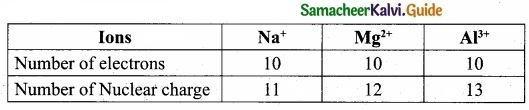
(II) Na+, Mg2+ and Al3+ are isoelectronic cations.

Tamil Nadu 11th Chemistry Model Question Paper 3 English Medium img 21

The cation with the greater positive charge will have a smaller radius because of the greater attraction of the electrons to the nucleus. Hence the increasing order of ionic radii is, \(\mathbf{r}_{\mathrm{Na}^{+}}\), > \(\mathbf{r}_{\mathrm{Mg}^{2+}}\), > \(\mathbf{r}_{\mathrm{Al}^{3+}}\).

[OR]

(b)
(I) In metallic hydrides, hydrogen is adsorbed as H-atoms. Due to the adsorption of H atoms the metal lattice expands and become unstable. Thus, when metallic hydride is heated, it decomposes to form hydrogen and finely divided metal. The hydrogen evolved can be used as fuel.

(II)
1. Water exists in space in the interstellar clouds, in proto-planetary disks, in the comets and icy satellites on the solar system, and on the Earth.
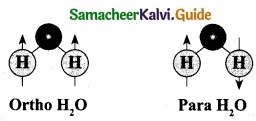
2. In particular, the ortho-to-para ratio (OPR) of water in space has recently received attention. Like hydrogen, water can also be classified into ortho – H2O and para – H2O, in which the directions are antiparallel.

Tamil Nadu 11th Chemistry Model Question Paper 3 English Medium img 22

3. At the temperature conditions of the Earth (300 K), the OPR of H2O is 3.
4. At low temperatures below (< 50 K) the amount of para – H2O increases. It is known that the OPR of water in interstellar clouds and comets has more para – H2O (OPR = 2.5) than on Earth.

Tamil Nadu 11th Chemistry Model Question Paper 3 English Medium

Question 36 (a).
Derive the values of critical constants from the Van der Waals constants?

[OR]

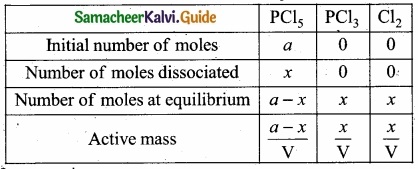
(b) Derive the values of Kp and KC for dissociation of PCl5?
Answer:
(a) Derivation of critical constants from the Van der Waals constants:
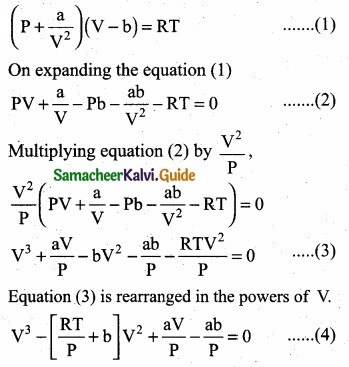
Van der Waals equation is,
\(\left(P+\frac{a n^{2}}{V^{2}}\right)\) (V – nb) = nRT for 1 mole.
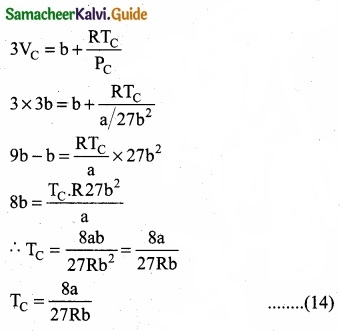
From this equation, the values of critical constant PC, VC and TC are derived in terms of a and b the Vander Waals constants.

Tamil Nadu 11th Chemistry Model Question Paper 3 English Medium img 23

The above equation (4) is an cubic equation of V, which can have three roots. At the critical point, all the three values of V are equal to the critical volume Vc. i.e. V = VC
i.e; V = VC
V – VC = 0 ………………… (5)
(V – VC)3 ………………….. (6)
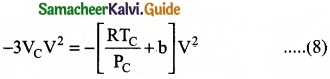
(V3 – 3VCV2) + 3VC2V – VC3 …………………. (7)
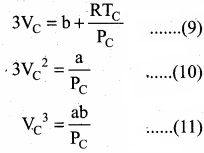
As the equation (4) is identical with equation (7), comparing the ‘V’ terms in (4) and (7),

Tamil Nadu 11th Chemistry Model Question Paper 3 English Medium img 24
Tamil Nadu 11th Chemistry Model Question Paper 3 English Medium img 24a

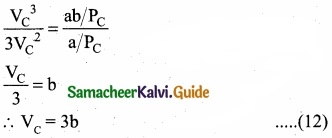
Divide equation (11) by (10)

Tamil Nadu 11th Chemistry Model Question Paper 3 English Medium img 25

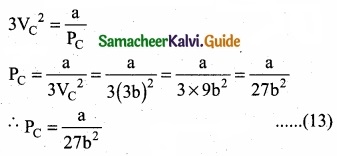
When equation (12) is substituted in (10)

Tamil Nadu 11th Chemistry Model Question Paper 3 English Medium img 26

Substituting the values of VC and PC in equation (9)

Tamil Nadu 11th Chemistry Model Question Paper 3 English Medium img 27

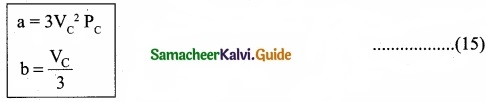
Critical constants a and b can be calculated rising Vander Waals constants as follows:

Tamil Nadu 11th Chemistry Model Question Paper 3 English Medium img 28
(b) Consider that V moles of PCl5is taken in container of volume‘V’
Let x moles of PCl5 be dissociated into x moles of PCl3 and x moles of Cl2.

Tamil Nadu 11th Chemistry Model Question Paper 3 English Medium img 29

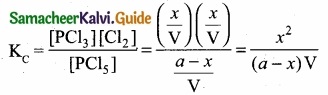
Applying law of mass action

Tamil Nadu 11th Chemistry Model Question Paper 3 English Medium img 30

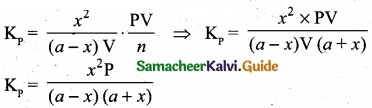
Kp caluculation: Kp = KC. \(\mathrm{RT}^{\mathrm{An}}\); ∆ng = 2 – 1 = 1
We know that PV = nRT
RT = \(\frac{PV}{n}\)
Where ‘n’ is the total number of moles at equilibrium
n = a – x + x + x = a + x

Tamil Nadu 11th Chemistry Model Question Paper 3 English Medium img 31

Tamil Nadu 11th Chemistry Model Question Paper 3 English Medium

Question 37 (a).
(I) Solubility of a solid solute in a liquid solvent increases with increase in temperature. Justify this statement?
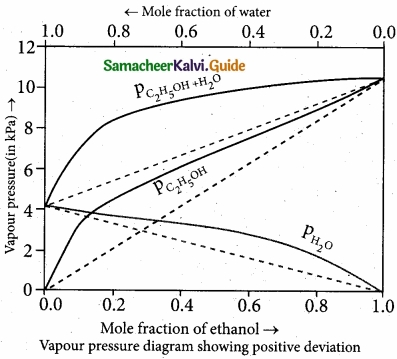
(II) Explain how non-ideal solutions shows positive deviation from Raoult’s law?

[OR]

(b)
(I) How will you distinguish between electrophiles and nucleophiles?
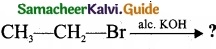
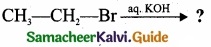
(II) Complete the following reactions and identify the products?
(a) Tamil Nadu 11th Chemistry Model Question Paper 3 English Medium img 32
(b) Tamil Nadu 11th Chemistry Model Question Paper 3 English Medium img 33
Answer:
(a) (I) When the temperature is increased,the average kinetic energy of the molecules of the solute and the solvent increases. The increase in the kinetic energy facilitates the solvent molecules to break the intermolecular attractive forces that keep the solute molecules together and hence the solubility increases.
(II)

  1. Let us consider the positive deviation shown by a solution of ethyl alcohol and water
  2. In this solution, the hydrogen bonding interaction between ethanol and water is weaker than those hydrogen bonding interactions amongst themselves (ethyl alcohol-ethyl alco¬hol and water-water interaction).
  3. This results in the increased evaporation of both components from the aqueous solution of ethanol.
  4. Consequently, the vapour pressure of the solution is greater than the vapour pressure
    predicted by Raoult’s law.
  5. Here, the mixing process is endothermic i.e., DHmixing > 0 and there will be a slight increase in volume (DVmixing > 0)
  6. Tamil Nadu 11th Chemistry Model Question Paper 3 English Medium img 34

(b)
(I)
Electrophiles:

  1. They are electron deficient.
  2. They are cations.
  3. They are lewis acids.
  4. Accept an electron pair.
  5. Attack on electron rich sites.

Nucleophiles:

  1. They are electron rich.
  2. They are anions.
  3. They are lewis bases.
  4. Donate an electron pair.
  5. Attack on electron deficient sites.

(II)
(a) Tamil Nadu 11th Chemistry Model Question Paper 3 English Medium img 36
(b) Tamil Nadu 11th Chemistry Model Question Paper 3 English Medium img 37

Tamil Nadu 11th Chemistry Model Question Paper 3 English Medium

Question 38 (a).
(I) Is it possible to prepare methane by Kolbe’s electrolytic method?
(II) Explain how 2-butyne reacts with
(a) Lindlar’s catalyst
(b) Sodium in liquid ammonia.

[OR]

(b) (I) Discuss the aromatic nucleophilic substitution reactions of chlorobenzene?
(II) CCl4 > CHCl3 > CH2C12 > CH3Cl is the decreasing order of boiling point in haloalkanes. Give reason?
Answer:
(a) (I) Kolbe’s electrolytic method is suitable for the preparation of symmetrical alkanes, that is alkanes containing even number of carbon atoms. Methane has only one carbon, hence it cannot be prepared by Kolbe’s electrolytic method.
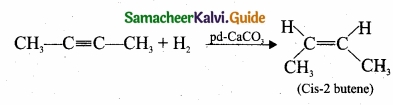
(II) (a) 2-butyne reacts with Lindlar’s catalyst: 2-butyne can be reduced to cis – 2 butene using CaCO3 supported in Pd -metal partially deactivated with sulphur.
This reaction is stereo specific giving only the cis – 2 – butene.

Tamil Nadu 11th Chemistry Model Question Paper 3 English Medium img 38

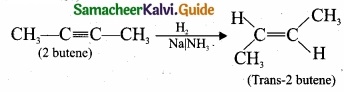
(b) 2-butyne reacts with sodium in liquid ammonia:
2-butyne can also be reduced to trans – 2 – butene using sodium in liquid ammonia. This reaction is stereospecific giving only the trans – 2 – butene.

Tamil Nadu 11th Chemistry Model Question Paper 3 English Medium img 39

[OR]

(b) (I) Aromatic nucleophilic substitution reactions:
Dow’s process:

1. Tamil Nadu 11th Chemistry Model Question Paper 3 English Medium img 40

2. Tamil Nadu 11th Chemistry Model Question Paper 3 English Medium img 41

3. Tamil Nadu 11th Chemistry Model Question Paper 3 English Medium img 42

(II) The boiling point of chloro, bromo and iodoalkanes increases with increase in the number of halogen atoms. So the correct decreasing order of boiling point of haloalkanes is:
CCl4 > CHCl3 > CH2Cl2 > CH3Cl.

Samacheer Kalvi 10th Maths Guide Chapter 7 Mensuration Unit Exercise 7

Students can download Maths Chapter 7 Mensuration Unit Exercise 7 Questions and Answers, Notes, Samacheer Kalvi 10th Maths Guide Pdf helps you to revise the complete Tamilnadu State Board New Syllabus, helps students complete homework assignments and to score high marks in board exams.

Tamilnadu Samacheer Kalvi 10th Maths Solutions Chapter 7 Mensuration Unit Exercise 7

Question 1.
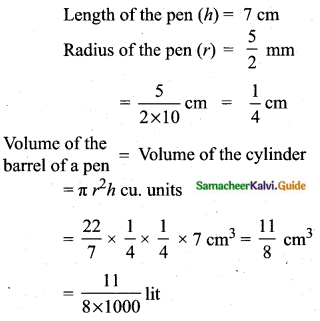
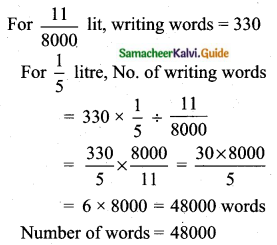
The barrel of a fountain-pen cylindrical in shape is 7 cm long and 5 mm in diameter. A full barrel of ink in the pen will be used for writing 330 words on an average. How many words can be written using a bottle of ink containing one-fifth of a litre?
Answer:
Samacheer Kalvi 10th Maths Guide Chapter 7 Mensuration Unit Exercise 7 Q1
Samacheer Kalvi 10th Maths Guide Chapter 7 Mensuration Unit Exercise 7 Q1.1

Question 2.
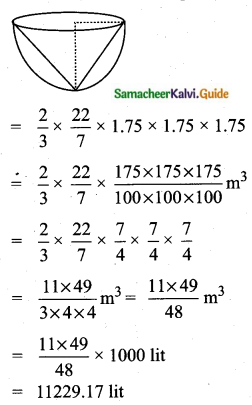
A hemispherical tank of radius 1.75 m is full of water. It is connected with a pipe which empties the tank at the rate of 7 litres per second. How much time will it take to empty the tank completely?
Answer:
Radius of the hemispherical tank = 1.75 m
Volume of the tank = \(\frac{2}{3} \pi r^{3}\) cu.units
Samacheer Kalvi 10th Maths Guide Chapter 7 Mensuration Unit Exercise 7 Q2
Time taken = \(\frac{11229.17}{7}\) = 1604.17 seconds = 26.74 minutes = 27 minutes (approximately)

Question 3.
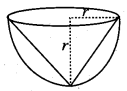
Find the maximum volume of a cone that can be carved out of a solid hemisphere of radius r units.
Answer:
Radius of a cone = Radius of a hemisphere = r unit
Samacheer Kalvi 10th Maths Guide Chapter 7 Mensuration Unit Exercise 7 Q3
Height of a cone = r units
(height of the cone = radius of a hemisphere)
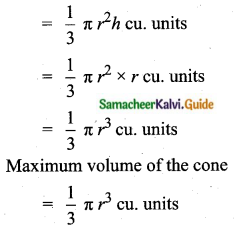
Maximum volume of the cone
Samacheer Kalvi 10th Maths Guide Chapter 7 Mensuration Unit Exercise 7 Q3.1

Question 4.
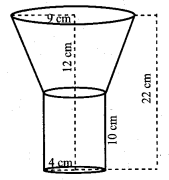
An oil funnel of the tin sheet consists of a cylindrical portion 10 cm long attached to a frustum of a cone. If the total height is 22 cm, the diameter of the cylindrical portion by 8 cm and the diameter of the top of the funnel be 18 cm, then find the area of the tin sheet required to make the funnel.
Answer:
Samacheer Kalvi 10th Maths Guide Chapter 7 Mensuration Unit Exercise 7 Q4
Total height of oil funnel = 22 cm
Height of the cylindrical portion = 10 cm
Height of the frustum (h) = 22 – 10 = 12 cm
Radius of the cylindrical portion = 4 cm
Radius of the bottom of the frustum = 4 cm
Top radius of the funnel (frustum) = \(\frac{18}{2}\) = 9 cm
Area of the tin sheet required = C.S.A of the frustum + C.S.A of the cylinder
= π (R + r) l + 2πrh sq. units.
= [π(9 + 4) \(\sqrt{12^{2}+(9-4)^{2}}\) + 2π × 4 × 10] cm2
= π [13 × \(\sqrt{144+25}\) + 25 + 80] cm2
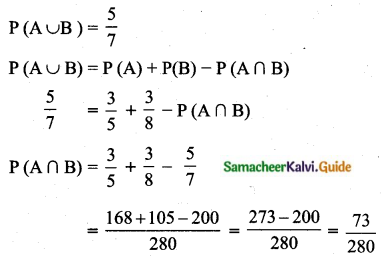
= \(\frac{22}{7}\) [13 × 13 + 80] cm2
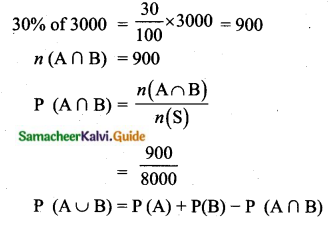
= \(\frac{22}{7}\) [169 + 80] cm2
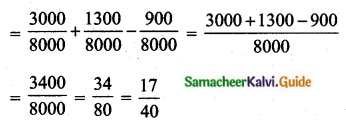
= \(\frac{22}{7}\) × 249 cm2
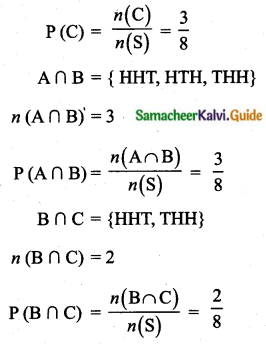
= 782.57 cm2
Area of sheet required to make the funnel = 782.57 cm2

Question 5.
Find the number of coins, 1.5 cm in diameter and 2 mm thick, to be melted to form a right circular cylinder of height 10 cm and diameter 4.5 cm.
Answer:
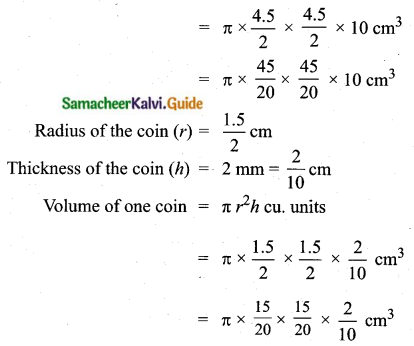
Radius of the cylinder = \(\frac{4.5}{2}\) cm
Height of the cylinder = 10 cm
Volume of the cylinder = πr2h cu. units
Samacheer Kalvi 10th Maths Guide Chapter 7 Mensuration Unit Exercise 7 Q5
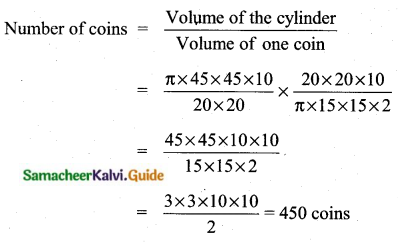
Samacheer Kalvi 10th Maths Guide Chapter 7 Mensuration Unit Exercise 7 Q5.1
Number of coins = 450

Question 6.
A hollow metallic cylinder whose external radius is 4.3 cm and internal radius is 1.1 cm and the whole length is 4 cm is melted and recast into a solid cylinder of 12 cm long. Find the diameter of a solid cylinder.
Answer:
External radius of the hollow cylinder R = 4.3 cm
Internal radius of the hollow cylinder r = 1.1 cm
Length of the cylinder (h) = 4 cm
Length of the solid cylinder (H) = 12 cm
Let the radius of the solid cylinder be “x”
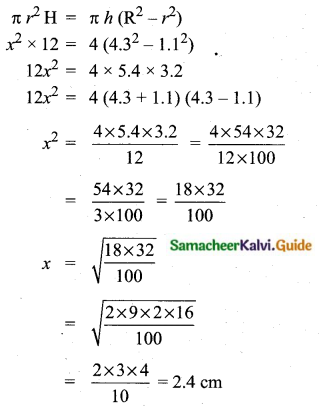
Volume of the solid cylinder = Volume of the hollow cylinder
Samacheer Kalvi 10th Maths Guide Chapter 7 Mensuration Unit Exercise 7 Q6
Diameter of the solid cylinder = 2 × 2.4 = 4.8 cm

Question 7.
The slant height of a frustum of a cone is 4 m and the perimeter of circular ends are 18 m and 16 m. Find the cost of painting its curved surface area at ₹ 100 per sq. m.
Answer:
Slant height of a frustum (l) = 4 m
Perimeter of the top part = 18 m
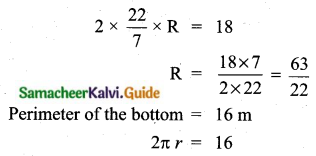
2πR = 18
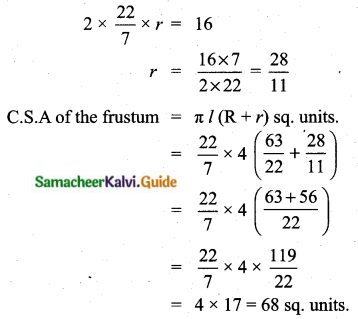
Samacheer Kalvi 10th Maths Guide Chapter 7 Mensuration Unit Exercise 7 Q7
Samacheer Kalvi 10th Maths Guide Chapter 7 Mensuration Unit Exercise 7 Q7.1
Cost of painting = ₹ 100 × 68 = ₹ 6800

Question 8.
A hemispherical hollow bowl has material of volume cubic \(\frac{436 \pi}{3}\) cubic cm. Its external diameter is 14 cm. Find its thickness.
Answer:
External radius of a hemisphere (R) = 7 cm
Volume of a hemi-spherical bowl = \(\frac{436 \pi}{3}\) cm3
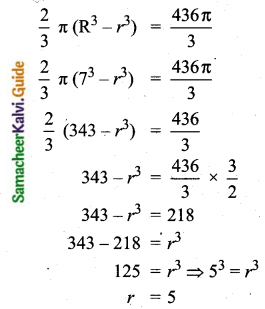
Samacheer Kalvi 10th Maths Guide Chapter 7 Mensuration Unit Exercise 7 Q8
Internal radius = 5 cm
Thickness of the hemisphere = (7 – 5) cm = 2 cm

Question 9.
The volume of a cone is 1005\(\frac{5}{7}\) cu. cm. The area of its base is 201\(\frac{1}{7}\) sq. cm. Find the slant height of the cone.
Answer:
Area of the base of a cone = 201\(\frac{1}{7}\) sq. cm
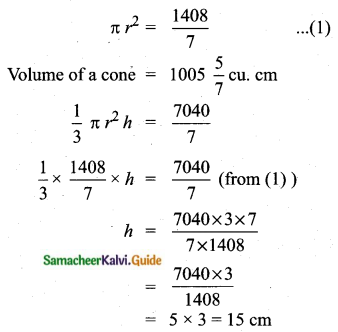
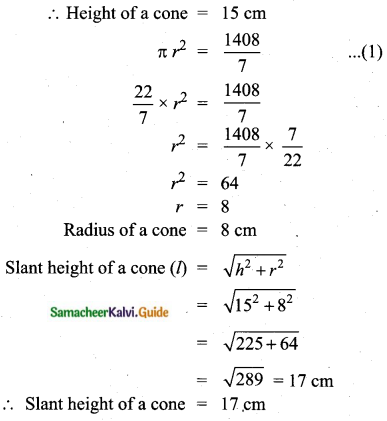
Samacheer Kalvi 10th Maths Guide Chapter 7 Mensuration Unit Exercise 7 Q9
Samacheer Kalvi 10th Maths Guide Chapter 7 Mensuration Unit Exercise 7 Q9.1

Question 10.
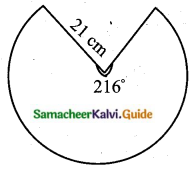
A metallic sheet in the form of a sector of a circle of radius 21 cm has a central angle of 216°. The sector is made into a cone by bringing the bounding radii together. Find the volume of the cone formed.
Answer:
Samacheer Kalvi 10th Maths Guide Chapter 7 Mensuration Unit Exercise 7 Q10
Radius of a cone (r) = 21 cm
Central angle (θ) = 216°
Let “R” be the radius of a cone
Circumference of the base of a cone = arc length of the sector
2πR = \(\frac{\theta}{360} \times 2 \pi r\)
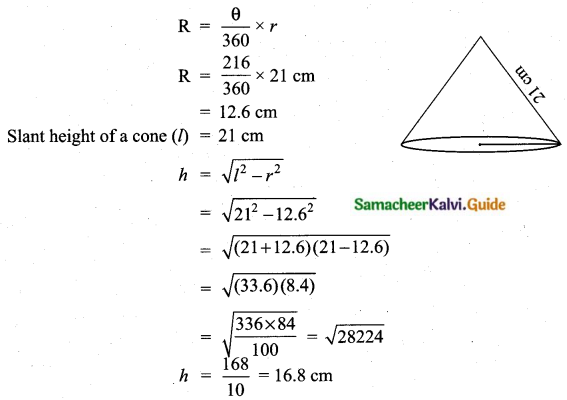
Samacheer Kalvi 10th Maths Guide Chapter 7 Mensuration Unit Exercise 7 Q10.1
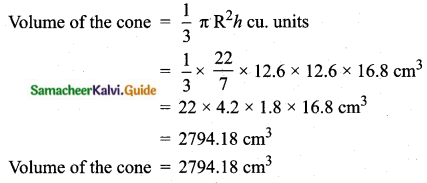
Samacheer Kalvi 10th Maths Guide Chapter 7 Mensuration Unit Exercise 7 Q10.2

Samacheer Kalvi 10th Maths Guide Chapter 7 Mensuration Ex 7.5

Students can download Maths Chapter 7 Mensuration Ex 7.5 Questions and Answers, Notes, Samacheer Kalvi 10th Maths Guide Pdf helps you to revise the complete Tamilnadu State Board New Syllabus, helps students complete homework assignments and to score high marks in board exams.

Tamilnadu Samacheer Kalvi 10th Maths Solutions Chapter 7 Mensuration Ex 7.5

Multiple Choice Questions

Question 1.
The curved surface area of a right circular cone of height 15 cm and base diameter 16 cm is
(1) 60π cm2
(2) 68π cm2
(3) 120π cm2
(4) 136π cm2
Solution:
(4) 13671 cm2
Hint:
Here, h = 15 cm, r = 8 cm
Samacheer Kalvi 10th Maths Guide Chapter 7 Mensuration Ex 7.5 Q1
C.S.A of a cone = πrl sq. units. = π × 8 × 17 = 136π cm3

Question 2.
If two solid hemispheres of same base radius r units are joined together along with their bases, then the curved surface area of this new solid is
(1) 4πr2 sq. units
(2) 6πr2 sq. units
(3) 3πr2 sq. units
(4) 8πr2 sq. units
Answer:
(1) 4πr2 sq. units
Hint:
When you joined two hemispheres together, the solid sphere is formed
C.S.A of the new solid = C.S.A of a sphere = 4πr2 sq. units.

Samacheer Kalvi 10th Maths Guide Chapter 7 Mensuration Ex 7.5

Question 3.
The height of a right circular cone whose radius is 5 cm and slant height is 13 cm will be
(1) 12 cm
(2) 10 cm
(3) 13 cm
(4) 5 cm
Solution:
(1) 12 cm
Hint:
Here r = 5 cm and l = 13 cm
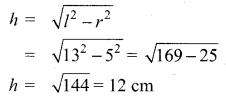
Samacheer Kalvi 10th Maths Guide Chapter 7 Mensuration Ex 7.5 Q3

Question 4.
If the radius of the base of a right circular cylinder is halved keeping the same height, then the ratio of the volume of the cylinder thus obtained to the volume of original cylinder is _________
(1) 1 : 2
(2) 1 : 4
(3) 1 : 6
(4) 1 : 8
Answer:
(2) 1 : 4
Hint:
Let the radius of the cylinder be “r” and the height be “h”
Radius of the new cylinder = \(\frac{r}{2}\) (Height will be same)
Volume of the new cylinder : Volume of the original cylinder
= \(\pi r_{1}^{2} h: \pi r_{2}^{2} h\) (πh is same)
= \(r_{1}^{2}: r_{2}^{2}\)
= \(\left(\frac{r}{2}\right)^{2}: r^{2}\)
= \(\frac{r^{2}}{4}: r^{2}=\frac{1}{4}: 1\)
= 1 : 4

Samacheer Kalvi 10th Maths Guide Chapter 7 Mensuration Ex 7.5

Question 5.
The total surface area of a cylinder whose radius is \(\frac{1}{3}\) of its height is _______
(1) \(\frac{9 \pi h^{2}}{8}\) sq. units
(2) 24πh2 sq.units
(3) \(\frac{8 \pi h^{2}}{8}\) sq.units
(4) \(\frac{56 \pi h^{2}}{8}\) sq.units
Answer:
(3) \(\frac{8 \pi h^{2}}{8}\) sq.units
Hint:
Let the height of the cylinder be “h”
Radius of the cylinder = \(\frac{1}{3}\) h
T.S.A of the cylinder = 2πr(h + r)
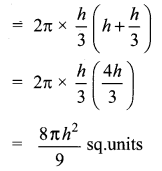
Samacheer Kalvi 10th Maths Guide Chapter 7 Mensuration Ex 7.5 Q5

Question 6.
In a hollow cylinder, the sum of the external and internal radii is 14 cm and the width is 4 cm. If its height is 20 cm, the volume of the material in it is
(1) 5600π cm3
(2) 11200π cm3
(3) 56π cm3
(4) 3600π cm3
Solution:
(2) 112007π cm3
Hint:
Here, let the external radius be “R” and the internal radius be “r”
R + r = 14 ……(1)
Width (R – r) = 4 ……(2)
Height of the hollow cylinder = 20 cm
Volume of the hollow cylinder = πh × (R2 – r2)
= πh(R + r) (R – r)
= π × 20 (14) × 4
= π × 1120
= 1120π cm3

Samacheer Kalvi 10th Maths Guide Chapter 7 Mensuration Ex 7.5

Question 7.
If the radius of the base of a cone is tripled and the height is doubled then the volume is ______
(1) made 6 times
(2) made 18 times
(3) made 12 times
(4) unchanged
Answer:
(2) made 18 times
Hint:
Radius of a cone = r
Height of a cone = h
Volume of the cone = \(\frac{1}{3}\) πr2h cu. units
When the radius is increased three-time (tripled) and the height is doubled
Radius is 3r and the height is 2h
Volume of the new cone
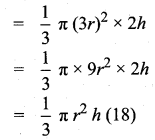
Samacheer Kalvi 10th Maths Guide Chapter 7 Mensuration Ex 7.5 Q7
Volume is increased 18 times.

Question 8.
The total surface area of a hemisphere is how many times the square of its radius.
(1) π
(2) 4π
(3) 3π
(4) 2π
Solution:
(3) 3π
Hint:
T.S.A of the hemisphere = 3πr2
The square of the radius is 3π times.

Samacheer Kalvi 10th Maths Guide Chapter 7 Mensuration Ex 7.5

Question 9.
A solid sphere of radius x cm is melted and cast into a shape of a solid cone of the same radius. The height of the cone is _______
(1) 3x cm
(2) x cm
(3) 4x cm
(4) 2x cm
Answer:
(3) 4x cm
Hint:
Radius of a sphere = Radius of a cone = x cm
Volume of a cone = Volume of a sphere
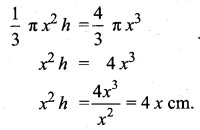
Samacheer Kalvi 10th Maths Guide Chapter 7 Mensuration Ex 7.5 Q9

Question 10.
A frustum of a right circular cone is of height 16cm with radii of its ends as 8cm and 20cm. Then, the volume of the frustum is
(1) 3328π cm3
(2) 3228π cm3
(3) 3240πcm3
(4) 3340π cm3
Solution:
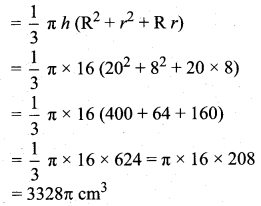
(1) 3328π cm3
Hint:
Here, h = 16 cm, r = 8 cm, R = 20 cm
Volume of the frustum
Samacheer Kalvi 10th Maths Guide Chapter 7 Mensuration Ex 7.5 Q10

Samacheer Kalvi 10th Maths Guide Chapter 7 Mensuration Ex 7.5

Question 11.
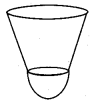
A shuttlecock used for playing badminton has the shape of the combination of ______
(1) a cylinder and a sphere
(2) a hemisphere and a cone
(3) a sphere and a cone
(4) frustum of a cone and a hemisphere
Answer:
(4) frustum of a cone and a hemisphere
Hint:
Samacheer Kalvi 10th Maths Guide Chapter 7 Mensuration Ex 7.5 Q11

Question 12.
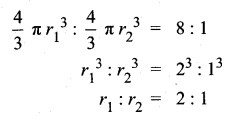
A spherical ball of radius r1 units is melted to make 8 new identical balls each of radius r2 units. Then r1 : r2 is _______
(1) 2 : 1
(2) 1 : 2
(3) 4 : 1
(4) 1 : 4
Answer:
(1) 2 : 1
Hint:
Volume of the first sphere : Volume of second sphere = 8 : 1
Samacheer Kalvi 10th Maths Guide Chapter 7 Mensuration Ex 7.5 Q12

Samacheer Kalvi 10th Maths Guide Chapter 7 Mensuration Ex 7.5

Question 13.
The volume (in cm3) of the greatest sphere that can be cut off from a cylindrical log of wood of base radius 1 cm and height 5 cm is ________
(1) \(\frac{4}{3} \pi\)
(2) \(\frac{10}{3} \pi\)
(3) 5π
(4) \(\frac{20}{3} \pi\)
Answer:
(1) \(\frac{4}{3} \pi\)
Hint:
Radius of the sphere = 1 cm
Volume of the Sphere = \(\frac{4}{3}\) πr3 cu. units
= \(\frac{4}{3}\) × π × 1 × 1 × 1 cm3
= \(\frac{4}{3}\) π cm3

Question 14.
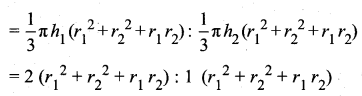
The height and radius of the cone of which the frustum is a part are h1 units and r1 units respectively. Height of the frustum is h2 units and the radius of the smaller base is r2 units. If h2 : h1 = 1 : 2 then r2 : r1 is ______
(1) 1 : 3
(2) 1 : 2
(3) 2 : 1
(4) 3 : 1
Answer:
(2) 1 : 2
Hint:
h2 : h1 = 1 : 2
h1 : h2 = 2 : 1
Ratio of their volumes
Samacheer Kalvi 10th Maths Guide Chapter 7 Mensuration Ex 7.5 Q14
Volume is 2 : 1 the ratio of their radius also 2 : 1
r1 : r2 = 2 : 1 But r2 : r1 = 1 : 2

Samacheer Kalvi 10th Maths Guide Chapter 7 Mensuration Ex 7.5

Question 15.
The ratio of the volumes of a cylinder, a cone and a sphere, if each has the same diameter and same height is
(1) 1 : 2 : 3
(2) 2 : 1 : 3
(3) 1 : 3 : 2
(4) 3 : 1 : 2
Solution:
(4) 3 : 1 : 2
Hint:
Volume of (cylinder : cone : sphere)
Samacheer Kalvi 10th Maths Guide Chapter 7 Mensuration Ex 7.5 Q15
Samacheer Kalvi 10th Maths Guide Chapter 7 Mensuration Ex 7.5 Q15.1

Samacheer Kalvi 10th Maths Guide Chapter 7 Mensuration Ex 7.4

Students can download Maths Chapter 7 Mensuration Ex 7.4 Questions and Answers, Notes, Samacheer Kalvi 10th Maths Guide Pdf helps you to revise the complete Tamilnadu State Board New Syllabus, helps students complete homework assignments and to score high marks in board exams.

Tamilnadu Samacheer Kalvi 10th Maths Solutions Chapter 7 Mensuration Ex 7.4

Question 1.
An aluminium sphere of radius 12 cm is melted to make a cylinder of radius 8 cm. Find the height of the cylinder.
Answer:
Sphere – Radius r1 = 12 cm
Cylinder – Radius r2 = 8 cm
h2 = ?
Volume of cylinder = Volume of sphere melted
Samacheer Kalvi 10th Maths Guide Chapter 7 Mensuration Ex 7.4 Q1
∴ Height of the cylinder made = 36 cm.

Question 2.
Water is flowing at the rate of 15 km per hour through a pipe of diameter 14 cm into a rectangular tank which is 50 m long and 44 m wide. Find the time in which the level of water in the tanks will rise by 21 cm.
Answer:
Length of the rectangular tank (l) = 50 m = 5000 cm
Width of the rectangular tank (b) = 44 m = 4400 cm
Level of water in the tank (h) = 21 cm
Volume of the tank = l × b × h cu. units = 5000 × 4400 × 21 cm3
Radius of the pipe (r) = 7 cm
Speed of the water = 15 km/hr.
(h) = 15000 × 100 cm / hr.
Volume of water flowing in one hour
Samacheer Kalvi 10th Maths Guide Chapter 7 Mensuration Ex 7.4 Q2

Question 3.
A conical flask is full of water. The flask has base radius r units and height h units, the water poured into a cylindrical flask of base radius x r units. Find the height of water in the cylindrical flask.
Answer:
Radius of the conical flask = r units
Height of the conical flask = h units
Volume of the conical flask = \(\frac{1}{3} \pi r^{2} h\) cu.units
Radius of the cylindrical flask = x r units
Let the height of the cylindrical flask be “H” units
Volume of the cylindrical flask = Volume of the Conical flask
Samacheer Kalvi 10th Maths Guide Chapter 7 Mensuration Ex 7.4 Q3
Height of the cylindrical flask = \(\frac{h}{3 x^{2}}\) units

Question 4.
A solid right circular cone of diameter 14 cm and height 8 cm is melted to form a hollow sphere. If the external diameter of the sphere is 10 cm, find the internal diameter.
Answer:
Radius of a cone (V) = 7 cm
Height of a cone (h) = 8 cm
External radius of the hollow sphere (R) = 5 cm
Let the internal radius be “x”
Volume of the hollow sphere = Volume of the Cone
Samacheer Kalvi 10th Maths Guide Chapter 7 Mensuration Ex 7.4 Q4
Samacheer Kalvi 10th Maths Guide Chapter 7 Mensuration Ex 7.4 Q4.1
Internal diameter of the Hollowsphere = 2 × 3 = 6 cm.

Question 5.
Seenu’s house has an overhead tank in the shape of a cylinder. This is filled by pumping water from a sump (underground tank) which is in the shape of a cuboid. The sump has dimensions 2 m × 1.5 m × 1 m. The overhead tank has its radius of 60 cm and height 105 cm. Find the volume of the water left in the sump after the overhead tank has been completely filled with water from the sump which has been full, initially.
Answer:
Length of the cuboid tank (l) = 2 cm = 200 cm
Breadth of the cuboid tank (b) = 1.5 cm = 150 cm
Height of the tank (h) = 1 m = 100 cm
Volume of the cuboid = l × b × h cu. units
= 200 × 150 × 100 cm3
= 30,00,000 cm3
Radius of the tank (r) = 60 cm
Height of the tank (h) = 105 cm
Volume of the cylindrical tank = πr2h cu. units
= \(\frac{22}{7}\) × 60 × 60 × 105 cm3
= 22 × 60 × 60 × 15 cm3
= 1188000 cm3
Volume of water left in the sump = Volume of the sump – Volume of the tank
= 3000000 – 1188000 cm3
= 1812000 cm3

Question 6.
The internal and external diameter of a hollow hemispherical shell is 6 cm and 10 cm respectively. If it is melted and recast into a solid cylinder of diameter 14 cm, then find the height of the cylinder.
Answer:
Internal radius of the shell (r) = 3 cm
External radius of the shell (R) = 5 cm
Radius of the cylinder (r) = 7 cm
Let the height of the cylinder be “h”
Volume of the cylinder = Volume of the hemispherical shell
Samacheer Kalvi 10th Maths Guide Chapter 7 Mensuration Ex 7.4 Q6
Height of the cylinder = 1.33 cm

Question 7.
A solid sphere of radius 6 cm is melted into a hollow cylinder of uniform thickness. If the external radius of the base of the cylinder is 5 cm and its height is 32 cm, then find the thickness of the cylinder.
Answer:
Radius of a sphere (r) = 6 cm
External radius of the cylinder (R) = 5 cm
Height of the cylinder (h) = 32 cm
Let the internal radius of the cylinder be ‘x’
Volume of the hollow cylinder = Volume of a sphere
πh (R2 – r2) = \(\frac{4}{3}\) πr3
π × 32 (5 + x) (5 – x) = \(\frac{4}{3}\) × π × 6 × 6 × 6
32 (25 – x2) = 4 × 2 × 6 × 6
25 – x2 = 9
x2 = 25 – 9 = 16
x = √16 = 4
Thickness of the cylinder = 5 – 4 = 1 cm.

Question 8.
A hemispherical bowl is filled to the brim with juice. The juice is poured into a cylindrical vessel whose radius is 50% more than its height. If the diameter is same for both the bowl and the cylinder then find the percentage of juice that can be transferred from the bowl into the cylindrical vessel.
Answer:
Let the height of the cylinder be “h”
radius is 50% more than the height
Samacheer Kalvi 10th Maths Guide Chapter 7 Mensuration Ex 7.4 Q8
Samacheer Kalvi 10th Maths Guide Chapter 7 Mensuration Ex 7.4 Q8.1
From (1) and (2) we get,
Volume of the cylinder = Volume of the hemisphere
It is possible to transfer the full quantity from the bowl into the cylindrical vessel.
100 % of the juice can be transferred.

Samacheer Kalvi 10th Maths Guide Chapter 7 Mensuration Ex 7.3

Students can download Maths Chapter 7 Mensuration Ex 7.3 Questions and Answers, Notes, Samacheer Kalvi 10th Maths Guide Pdf helps you to revise the complete Tamilnadu State Board New Syllabus, helps students complete homework assignments and to score high marks in board exams.

Tamilnadu Samacheer Kalvi 10th Maths Solutions Chapter 7 Mensuration Ex 7.3

Question 1.
A vessel is in the form of a hemispherical bowl mounted by a hollow cylinder. The diameter is 14 cm and the height of the vessel is 13 cm. Find the capacity of the vessel.
Answer:
Radius of a hemisphere = Radius of the cylinder
Samacheer Kalvi 10th Maths Guide Chapter 7 Mensuration Ex 7.3 Q1
Samacheer Kalvi 10th Maths Guide Chapter 7 Mensuration Ex 7.3 Q1.1

Question 2.
Nathan, an engineering student was asked to make a model shaped like a cylinder with two cones attached at its two ends. The diameter of the model is 3 cm and its length is 12 cm. If each cone has a height of 2 cm, find the volume of the model that Nathan made.
Answer:
Radius of the cone = Radius of the cylinder
Samacheer Kalvi 10th Maths Guide Chapter 7 Mensuration Ex 7.3 Q2
r = \(\frac{3}{2}\) cm
Height of the cone (H) = 2 cm
Height of the cylinder (h) = 12 – (2 + 2) cm = 8 cm
Volume of the model = Volume of the cylinder + Volume of 2 cones
Samacheer Kalvi 10th Maths Guide Chapter 7 Mensuration Ex 7.3 Q2.1

Samacheer Kalvi 10th Maths Guide Chapter 7 Mensuration Ex 7.3

Question 3.
From a solid cylinder whose height is 2.4 cm and the diameter 1.4 cm, a cone of the same height and same diameter is carved out. Find the volume of the remaining solid to the nearest cm3.
Answer:
Radius of a cylinder = Radius of a cone r = 0.7 cm
Height of a cylinder = Height of a cone (h) = 2.4 cm
Samacheer Kalvi 10th Maths Guide Chapter 7 Mensuration Ex 7.3 Q3
Volume of the remaining solid = Volume of the cylinder – Volume of a cone
Samacheer Kalvi 10th Maths Guide Chapter 7 Mensuration Ex 7.3 Q3.1
Volume of the remaining soild = 2.46 cm3

Question 4.
A solid consisting of a right circular cone of height 12 cm and radius 6 cm standing on a hemisphere of radius 6 cm is placed upright in a right circular cylinder full of water such that it touches the bottom. Find the volume of the water displaced out of the cylinder, if the radius of the cylinder is 6 cm and height is 18 cm.
Samacheer Kalvi 10th Maths Guide Chapter 7 Mensuration Ex 7.3 Q4
Answer:
Radius of a cone = Radius of a hemisphere = Radius of a cylinder
r = 6 cm
Height of a cone (h) = 12 cm
Volume of the water displaced = Volume of the solid inside = Volume of the cone + Volume of the hemisphere
Samacheer Kalvi 10th Maths Guide Chapter 7 Mensuration Ex 7.3 Q4.1
Volume of water displaced = 905. 14 cm3.

Samacheer Kalvi 10th Maths Guide Chapter 7 Mensuration Ex 7.3

Question 5.
A capsule is in the shape of a cylinder with two hemispheres stuck to each of its ends. If the length of the entire capsule is 12 mm and the diameter of the capsule is 3 mm, how much medicine it can hold?
Answer:
Radius of a hemisphere = Radius of a Cylinder
Samacheer Kalvi 10th Maths Guide Chapter 7 Mensuration Ex 7.3 Q5
r = \(\frac{3}{2}\) mm = 1.5 mm
Height of the cylinderical portion = 12 mm – (1.5 mm + 1.5 mm) = (12 – 3) mm = 9 mm
Volume of the capsule
Samacheer Kalvi 10th Maths Guide Chapter 7 Mensuration Ex 7.3 Q5.1
Volume of the capsule = 77.8 cu. mm

Question 6.
As shown in figure a cubical block of side 7 cm is surmounted by a hemisphere. Find the surface area of the solid.
Samacheer Kalvi 10th Maths Guide Chapter 7 Mensuration Ex 7.3 Q6
Answer:
Side of a cube (a) = 7 cm
Radius of a hemisphere (r) = \(\frac{7}{2}\) cm
Surface area of the solid = T.S.A of the cube + C.S.A of the hemisphere – Area of the base of the hemisphere
Samacheer Kalvi 10th Maths Guide Chapter 7 Mensuration Ex 7.3 Q6.1

Samacheer Kalvi 10th Maths Guide Chapter 7 Mensuration Ex 7.3

Question 7.
A right circular cylinder just encloses a sphere of radius r units. Calculate
(i) the surface area of the sphere
(ii) the curved surface area of the cylinder
(iii) the ratio of the areas obtained in (i) and (ii).
Answer:
(i) Surface area of sphere = 4πr2 sq. units
Samacheer Kalvi 10th Maths Guide Chapter 7 Mensuration Ex 7.3 Q7

Question 8.
A shuttlecock used for playing badminton has the shape of a frustum of a cone is mounted on a hemisphere. The diameters of the frustum are 5 cm and 2 cm. The height of the entire shuttlecock is 7 cm. Find its external surface area.
Answer:
Samacheer Kalvi 10th Maths Guide Chapter 7 Mensuration Ex 7.3 Q8
Samacheer Kalvi 10th Maths Guide Chapter 7 Mensuration Ex 7.3 Q8.1

Tamil Nadu 11th Chemistry Model Question Paper 2 English Medium

Students can Download Tamil Nadu 11th Chemistry Model Question Paper 2 English Medium Pdf, Tamil Nadu 11th Chemistry Model Question Papers helps you to revise the complete Tamilnadu State Board New Syllabus, helps students complete homework assignments and to score high marks in board exams.

TN State Board 11th Chemistry Model Question Paper 2 English Medium

General Instructions:

  1. The question paper comprises of four parts.
  2. You are to attempt all the parts. An internal choice of questions is provided wherever applicable.
  3. All questions of Part I, II, III and IV are to be attempted separately.
  4. Question numbers 1 to 15 in Part I are Multiple Choice Questions of one mark each.
    These are to be answered by choosing the most suitable answer from the given four alternatives and writing the option code and the corresponding answer
  5. Question numbers 16 to 24 in Part II are two-mark questions. These are to be answered in about one or two sentences.
  6. Question numbers 25 to 33 in Part III are three-mark questions. These are to be answered in about three to five short sentences.
  7. Question numbers 34 to 38 in Part IV are five-mark questions. These are to be answered in detail Draw diagrams wherever necessary.

Time: 2:30 Hours
Maximum Marks: 70

PART – I

Answer all the Questions: [15 × 1 = 15]
Choose the most suitable answer from the given four alternatives.

Question 1.
An element X has the following isotopic composition 200X = 90 %, 100X = 8 % and 202X = 2 %.
The weighted average atomic mass of the element X is closest to ………………………….
(a) 201 u
(b) 202 u
(c) 199 u
(d) 200 u
\(\frac { (200\times 90)+(199\times 18)+(202\times 2) }{ 100 } \)
= 199.96 = 200 u
Answer:
(d) 200 u

Tamil Nadu 11th Chemistry Model Question Paper 2 English Medium

Question 2.
Which of the following is not used in writing electronic configuration of an atom?
(a) Aufbau principle
(b) Hund’s rule
(c) Pauli’s exclusion principle
(d) Heisenberg’s uncertainty principle
Answer:
(d) Heisenberg’s uncertainty principle

Question 3.
Assertion (A): Cr with electronic configuration [Ar]3d5 4s1 is more stable than [Ar] 3d4 4s2.
Reason (R): Half filled orbitals have been found to have extra stability than partially filled orbitals.
(a) A and R are correct and R is the correct explanation of A.
(b) A and R are correct but R is not the correct explanation of A.
(c) A is correct but R is wrong.
(d) A is wrong but R is correct.
Answer:
(a) A and R are correct and R is the correct explanation of A.

Tamil Nadu 11th Chemistry Model Question Paper 2 English Medium

Question 4.
The type of H-bonding present in ortho nitro phenol and p-nitro phenol are respectively ……………………..
(a) Inter molecular H-bonding and intra molecular H – bonding
(b) Intra molecular H-bonding and inter molecular H – bonding
(c) Intra molecular H – bonding and no H – bonding
(d) Intra molecular H – bonding and intra molecular H – bonding

Tamil Nadu 11th Chemistry Model Question Paper 2 English Medium img 1

Answer:
(b) Intra molecular H-bonding and inter molecular H – bonding

Question 5.
Match the following:

Tamil Nadu 11th Chemistry Model Question Paper 2 English Medium img 2

Answer:

Tamil Nadu 11th Chemistry Model Question Paper 2 English Medium img 3

Question 6.
Which of the following is the correct expression for the equation of state of van der Waals gas?
(a) \(\left(P+\frac{a}{n^{2} V^{2}}\right)\) (V – nb) = nRT
(b) \(\left(P+\frac{n a}{n^{2} V^{2}}\right)\) (V – nb) = nRT
(c) \(\left(P+\frac{a n^{2}}{V^{2}}\right)\) (V – nb) = nRT
(d) \(\left(P+\frac{n^{2} a^{2}}{V^{2}}\right)\) (V – nb) = nRT
Answer:
(c) \(\left(P+\frac{a n^{2}}{V^{2}}\right)\) (V – nb) = nRT

Tamil Nadu 11th Chemistry Model Question Paper 2 English Medium

Question 7.
In a reversible process, the change in entropy of the universe is ………………………
(a) > 0
(b) >0
(c) <0
(d) = 0
Answer:
(d) = 0

Question 8.
Which of the following is not a general characteristic of equilibrium involving physical process?
(a) Equilibrium is possible only in a closed system at a given temperature
(b) The opposing processes occur at the same rate and there is a dynamic but stable condition
(c) All the physical processes stop at equilibrium
(d) All measurable properties of the system remains constant
Solution:
Correct statement: Physical processes occurs at the same rate at equilibrium.
Answer:
(c) All the physical processes stop at equilibrium

Question 9.
Stomach acid, a dilute solution of HCl can be neutralised by reaction with Aluminium hydroxide
Al(OH)3 + 3HCl(aq) → AlCl3 + 3H2O
How many millilitres of 0.1 M Al(OH)3 solution are needed to neutralise 21 mL of 0.1 M HCl?
(a) 14 mL
(b) 7 mL
(c) 21 mL
(d) None of these
Solution:
M1 × V = M2 × V2
∵ 0.1 M Al(OH)3 gives 3 × 0.1 = 0.3 M OH ions
0.3 × V1 = 0.1 × 21
V1 = \(\frac{0.1×21}{0.3}\) = 7 ml
Answer:
(b) 7 mL

Tamil Nadu 11th Chemistry Model Question Paper 2 English Medium

Question 10.
Shape and hybridisation of IF5 are ……………………..
(a) Trigonal bipyramidal, sp3d2
(b) Trigonal bipyramidal, sp3d
(c) Square pyramidal, sp3d2
(d) Octahedral, sp3d2
Solution:
IF5 – 5 bond pair + 1 lone pair
∴ hybridisation sp3d2

Tamil Nadu 11th Chemistry Model Question Paper 2 English Medium img 4

Answer:
(c) Square pyramidal, sp3d2

Question 11.
Consider the following statements:

  1. It is not possible for the carbon to form either C4+ (or) C4- ions.
  2. Carbon can form ionic bonds.
  3. In compounds of carbon, it form covalent bonds.

Which of the above statement is/are not correct?
(a) (I) and (II)
(b) (III) only
(c) (I) only
(d) (II) only
Answer:
(d) (II) only

Tamil Nadu 11th Chemistry Model Question Paper 2 English Medium

Question 12.
For the following reactions
(A) CH3CH2CH2Br + KOH → CH3-CH + KBr + H2O
(B) (CH3)3CBr + KOH → (CH3)3 COH + KBr
(C) Tamil Nadu 11th Chemistry Model Question Paper 2 English Medium img 5
Which of the following statement is correct?
(a) (A) is elimination, (B) and (G) are substitution
(b) (A) is substitution, (B) and (C) are elimination
(c) (A) and (B) are elimination and (C) is addition reaction
(d) (A) is elimination, B is substitution and (C) is addition reaction.
Answer:
(d) (A) is elimination, B is substitution and (C) is addition reaction.

Question 13.
Which of the following compound used for metal cleaning solvent?
(a) Methylene chloride
(b) Methyl chloride
(c) Chloroform
(d) Ethane
Answer:
(a) Methylene chloride

Tamil Nadu 11th Chemistry Model Question Paper 2 English Medium

Question 14.
The number of possible isomers of C6H12 is ……………………..
(a) 2
(b) 3
(c) 5
(d) 6
Answer:
(c) 5

Question 15.
Ozone layer is depleted by the reactive ……………………..
(a) Hydrogen atom
(b) Oxygen atom
(c) Fluorine atom
(d) Chlorine atom
Answer:
(d) Chlorine atom

PART – II

Answer any six questions in which question No. 19 is compulsory. [6 × 2 = 12]

Question 16.
Calculate the average atomic mass of naturally occurring magnesium using the following data?
Tamil Nadu 11th Chemistry Model Question Paper 2 English Medium img 6
Answer:
Solution: Isotopes of Mg.
Atomic mass = Mg24 = 23.99 × 78.99/100 = 18.95
Atomic mass = Mg26 = 24.99 × 10/100 = 2.499
Atomic mass = Mg25 = 25.98 × 11.01/100 = 2,860
Average Atomic mass = 24.309
Average atomic mass of Mg = 24.309

Tamil Nadu 11th Chemistry Model Question Paper 2 English Medium

Question 17.
What are quantum numbers?
Answer:

  1. The electron in an atom can be characterized by a set of four quantum numbers, namely – principal quantum number (n), azimuthal quantum number (l), magnetic quantum number (m) and spin quantum number (s).
  2. When Schrodinger equation is solved for a wave function φ, the solution contains the first three quantum numbers n, 1 and m.
  3. The fourth quantum number arises due to the spinning of the electron about its own axis.

Question 18.
How 2-ethylanthraquinone helps to prepare hydrogen peroxide?
Answer:
On an industrial scale, hydrogen peroxide is prepared by auto oxidation of 2-alkyl anthraquinol.

Tamil Nadu 11th Chemistry Model Question Paper 2 English Medium img 7

Question 19.
Calculate the pressure exerted by 2 moles of sulphur hexafluoride in a steel vessel of volume 6 dm3 at 70°C assuming it is an ideal gas?
Answer:
We will use the ideal gas equation for this calculation as below:
P = \(\frac{nRT}{V}\) = image 7 = 9.39 atm.

Tamil Nadu 11th Chemistry Model Question Paper 2 English Medium

Question 20.
What are the important features of lattice enthalpy?
Answer:

  1. Higher lattice energy shows greater electrostatic attraction and therefore a stronger bond in the solid.
  2. The lattice enthalpy is greater for ions of higher charge and smaller radii.

Question 21.
What are aqueous and non-aqueous solution? Give example?
Answer:

  1. If the solute is dissolved in the solvent water, the resultant solution is called as an aqueous solution, e.g., salt in water.
  2. If the solute is dissolved in the solvent other than water such as benzene, ether, CCl4 etc, the resultant solution is called a non aqueous solution, e.g., Br2 in CCl4.

Question 22.
What is bond enthalpy? How they relate with bond strength?
Answer:
The bond enthalpy is defined as the minimum amount of energy required to break one mole of a particular bond in molecules in their gaseous state. Larger the bond enthalpy stronger will be the bond.

Tamil Nadu 11th Chemistry Model Question Paper 2 English Medium

Question 23.
What is triad system? Give example?
Answer:
(I) In this system hydrogen atom oscillates between three polyvalent atoms. It involves 1, 3 – migration of hydrogen atom from one polyvalent atom to other with in the molecule

(II) The most important type of triad system is keto-enol tautomerism and the two groups of tautomers are keto form and enol form.

(III) Tamil Nadu 11th Chemistry Model Question Paper 2 English Medium img 8

Question 24.
What is stone leprosy? How is it formed?
Answer:

  1. The attack on, the marble of buildings by acid rain is called stone leprosy.
  2. Acid rain causes extensive damage to buildings made up of marble.

CaCO + H2SO4 → CaSO4 + H2O + CO2

PART – III

Answer any six questions in which question No. 26 is compulsory. [6 × 3 = 18]

Question 25.
Calculate the equivalent mass of hydrated ferrous sulphate?
Answer:
Hydrated ferrous sulphate = FeSO4.7H2O
Ferrous sulphate – Reducing agent
Ferrous sulphate reacts with an oxidising agent in acid medium according to the equation.

Tamil Nadu 11th Chemistry Model Question Paper 2 English Medium img 9

16 parts by mass of oxygen oxidised 304 g of FeSO4.
8 parts by mass of oxygen will oxidise \(\frac{304}{16}\) × 8 parts by mass of FeSO4 = 152
Equivalent mass of Ferrous sulphate (Anhydrous) = 152
Equivalent mass of crystalline Ferrous sulphate FeSO4.7H2O = 152 + 126 = 278

Tamil Nadu 11th Chemistry Model Question Paper 2 English Medium

Question 26.
Calculate the uncertainty in position of an electron, if ∆v = 0.1% and v = 2.2 × 10⁶ ms-1.
Answer:
Mass of an electron = m = 9.1 × 10⁻³¹ kg.
∆v = Uncertainty in velocity = \(\frac{0.1}{100}\) × 2.2 × 10⁶ ms-1
∆v = 0.22 × 104 = 2.2 × 10³ ms-1
∆x. ∆v.m = \(\frac{h}{4π}\)

Tamil Nadu 11th Chemistry Model Question Paper 2 English Medium img 10

∆x = 2.635 × 10⁻⁸
Uncertainty in position = 2.635 × 10⁻⁸

Question 27.
Distinguish between diffusion and effusion?
Answer:
Diffusion:

  1. Diffusion is the spreading of molecules of a substance throughout a space or a second subsance.
  2. Diffusion refers to the ability of the gases to mix with each other.
  3. E.g; Spreading of something such as brown tea liquid spreading through the water in a tea cup.

Effusion:

  1. Effusion is the escape of gas molecules through a very small hole in a membrane into an evacuated area.
  2. Effusion is a ability of a gas to travel through a small pin-hole.
  3. E.g; Pouring out something like the soap studs bubbling out from a bucket of water.

Question 28.
For a chemical reaction the values of ∆H and ∆S at 300 K are – 10 kJ mol-1 and – 20 JK-1 mol-1 respectively. What is the value of ∆G of the reaction? Calculate the ∆G of a reaction at 600K assuming ∆H and ∆S values are constant. Predict the nature of the reaction?
Answer:
Given:
∆H = -10 kJ mol-1 = -10000 J mol-1
∆S = – 20 JK-1 mol-1
T = 300 K

∆G?
∆G = ∆H – T∆S
∆G = -10 kJ mol-1 – 300 K × (-20 × 10-3) kJ K-1 mol-1
∆G = (-10 + 6) kJ mol-1
∆G = – 4 kJ mol-1

At 600 K,
∆G = – 10 kJ mol-1 – 600 K × (-20 × 10-3) k-1 mol-1
∆G = (-10 + 12) kJ mol-1
∆G + 2 kJ mol-1
The value of ∆G is negative at 300K and the reaction is spontaneous, but at 600K the value ∆G becomes positive and the reaction is non-spontaneous.

Tamil Nadu 11th Chemistry Model Question Paper 2 English Medium

Question 29.
For the reaction: A2(g) + B2(g) ⇄ 2AB(g); H is -∆ve.
The following molecular scenes represent different reaction mixture (A – light grey, B-dark grey)

Tamil Nadu 11th Chemistry Model Question Paper 2 English Medium img 12

  1. Calculate the equilibrium constant Kp and Kc.
  2. For the reaction mixture represented by scene (x), (y) the reaction proceed in which directions?
  3. What is the effect of increase in pressure for the mixture at equilibrium?

Answer:

Tamil Nadu 11th Chemistry Model Question Paper 2 English Medium img 13

Kc > Q i.e; forward reaction is favoured.

(III) Since ∆ng = 2 -2 = 0, thus, pressure has no effect. So by increasing the pressure, equilibrium will not be affected.

Tamil Nadu 11th Chemistry Model Question Paper 2 English Medium

Question 30.
Derive the relationship between the relative lowering of vapour pressure and mole fraction of the solute?
Answer:

Tamil Nadu 11th Chemistry Model Question Paper 2 English Medium img 14

Question 31.
Differentiate between the principle of estimation of nitrogen in an organic compound by

  1. Dumas method
  2. Kjeldahl’s method

Answer:

1. Dumas method:
The organic compound is heated strongly with excess of CuO (Cupic Oxide) in an atmosphere of CO2 where free nitrogen, CO2 and H2O are obtained.

2. Kjeldahl’s method:
A known mass of the organic compound is heated strongly with cone. H2SO4, a little amount of potassium sulphate arid a little amount of mercury (as catalyst). As a result of reaction, the nitrogen present in the organic compound is converted to ammonium sulphate.

Tamil Nadu 11th Chemistry Model Question Paper 2 English Medium

Question 32.
In what way free radical affect the human body?
Answer:

  1. Free radicals can disrupt cell membranes.
  2. Increase the risk of many forms of cancer.
  3. Damage the interior lining of blood vessels.
  4. Eads to a high risk of heart disease and stroke.

Question 33.
Dissolved oxygen in water is responsible for aquatic life. What processes are responsible for the reduction in dissolved oxygen in water?
Answer:

  1. Organic matter such as leaves, grass, trash can pollute water. Microorganisms present in water can decompose these organic matter and consume dissolved oxygen in water.
  2. Eutrophication is a process by which water bodies receive excess nutrients that stimulates excessive plant growth.
  3. This enhanced plant growth in water bodies is called algal bloom.
  4. The growth of algae in extreme abundance covers the water surface and reduces the oxygen concentration in water. Thus, bloom-infeded water inhibits the growth of other living organisms in the water body.
  5. This process in which the nutrient rich water support a dense plant population, kills animal life by depriving it of oxygen and results in loss of biodiversity is known as eutrophication.

PART – IV

Answer all the questions. [5 × 5 = 25]

Question 34 (a).
(I) Calculate the equivalent mass of sulphuric acid?
(II) The reaction between aluminium and ferric oxide can generate temperatures up to 3273 K and is used in welding metals.
(Atomic mass of Al = 27 u Atomic mass of O = 16 u)
2Al + Fe2O3 → Al2O3 + 2Fe; If, in this process, 324 g of aluminium is allowed to react with 1.12 kg of ferric oxide.
(a) Calculate the mass of Al2O3 formed.
(b) How much of the excess reagent is left at the end of the reaction?

[OR]

(b) (I) Consider the following electronic arrangements for the d5 configuration?

(a) Tamil Nadu 11th Chemistry Model Question Paper 2 English Medium img 15

(b) Tamil Nadu 11th Chemistry Model Question Paper 2 English Medium img 16

(c) Tamil Nadu 11th Chemistry Model Question Paper 2 English Medium img 17

  1. Which of these represents the ground state?
  2. Which configuration has the maximum exchange energy?

(II) An ion with mass number 56 contains 3 units of positive charge and 30.4% more neutrons than electrons. Assign symbol to the ion?
Answer:
(a) (I) Equivalent mass of sulphuric acid:
Sulphuric acid = H2SO4
Molar mass of Sulphuric acid = 2 + 32 + 64 = 96
Basicity of Sulphuric acid = 2

Tamil Nadu 11th Chemistry Model Question Paper 2 English Medium img 18

= \(\frac{96}{2}\) = 49 g eq-1

(II) (a) Tamil Nadu 11th Chemistry Model Question Paper 2 English Medium img 19

As per balanced equation 54 g Al is required for 112 g of iron and 102 g of Al2O3.
54 g of Al gives 102 g of Al2O3.
∴ 324 g of Al will give \(\frac{102}{54}\) × 324 = 612 g of AlcO3

(b) 54 g of Al requires 160 g of Fe2O3 for welding reaction.
∴ 324 g of Al will require \(\frac{160}{54}\) × 324 = 960 g of Fe\(\frac{102}{54}\)O3
∴ Excess Fe2O3 -Unreacted Fe2O3 = 1120 – 960 = 160 g 160 g of exces reagent is left at the end of the reaction.

[0R]

(b)
(I) 1. Tamil Nadu 11th Chemistry Model Question Paper 2 English Medium img 20
2. Tamil Nadu 11th Chemistry Model Question Paper 2 English Medium img 21

(II) Let the no. of electrons in the ion = x
∴ The no. of the protons = x + 3 (as the ion has three units positive charge)
and the no. of neutrons = x + \(\frac{30.4x}{100}\) = x + 0.304 x
Now, mass number of ion = Number of protons + Number of neutrons
= (x + 3) + (x + 0.304 x)
∴ 56 = (x + 3) + (x + 0.304 x) or 2.304 x = 56 – 3 = 53
x = \(\frac{53}{2.304}\) = 23
Atomic number of the ion (or element) = 23 + 3 = 26
The element with atomic number 26 is iron (Fe) and the corresponding ion is Fe3+.

Tamil Nadu 11th Chemistry Model Question Paper 2 English Medium

Question 35 (a).
(I) State the Newland’s law of octaves?
(II) What are the two exceptions of block division in the periodic table?

[OR]

(b) (I) Complete the following reactions.
(a) Tamil Nadu 11th Chemistry Model Question Paper 2 English Medium img 22

(b) 2 BeCl2 + LiaH4 →?

(II) What happens when quick lime reacts with
(a) H2O and
(b) CO2?

(I) The Law of octaves states that, “when elements are arranged in the order of increasing atomic weights, the properties of the eighth element are a repetition of the properties of the first element”.

(II)

1. Helium has two electrons. Its electronic configuration is 1s2. As per the configuration, it is supposed to be placed in ‘s’ block, but actually placed in 18th group which belongs to ‘p’ block. Because it has a completely filled valence shell as the other elements present in 18th group. It also resembles with 18th group elements in other properties. Hence helium is placed with other noble gases.

2. The other exception is hydrogen. It has only one s-electron and hence can be placed in group 1. It can also gain an electron to achieve a noble gas arrangement and hence it can behave as halogens (17th group elements). Because of these assumptions, position of hydrogen becomes a special case. Finally, it is placed separately at the top of the periodic table.

[OR]

(b) (I) (a) Beryllium oxide is heated with carbon and chloride to get BeCl2

Tamil Nadu 11th Chemistry Model Question Paper 2 English Medium img 23

(b) Beryllium chloride is treated with LiAlH4 to get beryllium hydride.
2BeCl2 + LiAlH4 → 2BeH2 + Licl + Alcl3

(II) (a) CaO + H2O → Ca(OH)2 (calcium hydroxide)
(b) CaO + CO2 → CaO3 (calcium carbonate)

Tamil Nadu 11th Chemistry Model Question Paper 2 English Medium

Question 36 (a).
(I) State the first law of thermodynamics?
(II) Calculate the enthalpy of combustion of ethylene at 300 Kc at constant pressure, if its heat of combustion at constant volume (∆U) is -1406 kJ?

[OR]

(b)
(I) Explain how the equilibrium constant Kc predict the extent of a reaction? (3)
(II) Explain about the effect of catalyst in an equilibrium reaction? (2)
Answer:
(a) (I) The first law of thermodynamics states that “the total energy of an isolated system . remains constant though it may change from one form to another” (or) Energy can neither be created nor destroyed, but may be converted from one form to another.
(II) The complete ethylene combustion reaction can be written as,

C2H4(g) + 3O2(g) → 2CO2(g) + 2H2O(l)
ΔU = -1406 kJ
Δn = np(g) – nr(g)
Δn = 2 – 4 – 2
ΔH = ΔU + RTΔng
ΔH = -1406 + (8.314 × 10-3 × 300 × (-2)) ΔH = -1410.9 kJ

[OR]

(b) (I)

  1. The value of equilibrium constant KC tells us the extent of the reaction i.e., it indicatehow far the reaction has proceeded towards product formation at a given temperature.
  2. A large value of KC indicates that the reaction reaches equilibrium with high product yield on the other hand, lower value of KC indicates that the reaction reaches equilibrium with low product yield.
  3. If KC > 103, the reaction proceeds nearly to completion.
  4. If KC < 10-3 the reaction rarely proceeds.
  5. It the KC is in the range 10-3 to 103, significant amount of both reactants and products are present at equilibrium.

(II) Addition of catalyst does not affect the state of equilibrium. The catalyst increases the rate of both the forward and reverse reactions to the same extent. Hence it does not change the equilibrium composition of the reaction mixture.

Tamil Nadu 11th Chemistry Model Question Paper 2 English Medium

Question 37 (a).
(I) Briefly explain geometrical isomerism in alkenes by considering 2- butene as an example.
2 – butene: Geometrical isomerism: CH3 – CH = CH – CH

(II) What is meant by condensed structure? Explain with an example.

[OR]

(b)
(I) Why cut apple turns a brown colour?
(II) Predict the product for the following reaction,

1. Tamil Nadu 11th Chemistry Model Question Paper 2 English Medium img 25

2. Tamil Nadu 11th Chemistry Model Question Paper 2 English Medium img 26

3. Tamil Nadu 11th Chemistry Model Question Paper 2 English Medium img 27

Answer:
(a) (I)

  • Geometrical isomers are the stereoisomers which have different arrangement of groups or atoms around a rigid framework of double bonds. This type of isomerism occurs due to restricted rotation of double bonds or about single bonds in cyclic compounds.
  • In 2-butene, the carbon-carbon double bond is sp2 hybridised. The carbon-carbon double bond consists of a s bond and a p bond. The presence of p bond lock the molecule in one position. Hence, rotation around C = C bond is not possible.
  • Tamil Nadu 11th Chemistry Model Question Paper 2 English Medium img 28
  • These two compounds are termed as geometrical isomers and are termed as cis and transform.
  • The cis isomer is the one in which two similar groups are on the same side of the double bond. The trans isomer is that in which two similar groups are on the opposite side of the double bond. Hence, this type of isomerism is called cis-trans isomerism.

(II) The bond line structure can be further abbreviated by omittiilg all the these dashes representing covalent bonds and by indicating the number of identical groups attached to an atom by a subscript. The resulting expression of the compound is called a condensed structural formula.
e.g., 1,3 – butadiene.

Tamil Nadu 11th Chemistry Model Question Paper 2 English Medium img 29

[OR]

(b) (I)

  1. Apples contains an enzyme called polyphenol oxidase (PPO) also known as tyrosinase.
  2. Cutting an apple exposes its cells to the atmospheric oxygen and oxidizes the phenolic compounds present in apples. This is called the “enzymatic browning” that turns a cut apple brown.
  3. In addition to apples, enzymatic browning is also evident in bananas, pears, avocados and even potatoes.

Tamil Nadu 11th Chemistry Model Question Paper 2 English Medium img 30

Tamil Nadu 11th Chemistry Model Question Paper 2 English Medium

Question 38 (a).
Suggest the route for the preparation of the following from benzene?

  1. 3 – chloro-nitrobenzene
  2. 4 – chlorotoluene
  3. Bromobenzene
  4. m – dinitrobenzene

[OR]

(b) A hydrocarbon C3H6 (A) reacts with HBr to form compound (B). Compound (B) reacts with aqueous potassium hydroxide to give (C) of molecular formula C3H6O. What are (A) (B) and (C). Explain the reactions?
Answer:
(a)
1. Preparation of 3 – chloronitro – benzene from benzene: Benzene undergoes nitration and followed by chlorination and it leads to the formation of 3 – chloronitrobenzene.
Tamil Nadu 11th Chemistry Model Question Paper 2 English Medium img 31

2. Preparation 4-chlorotoulene from benzene: Benzene undergoes Friedal craft’s alkylation followed by chlorination and it leads to the formation of 4 – chlorotoulene.
Tamil Nadu 11th Chemistry Model Question Paper 2 English Medium img 32

3. Preparation of Bromobenzene from benzene: Benzene undergo bromination to give bromobenzene.

Tamil Nadu 11th Chemistry Model Question Paper 2 English Medium img 33

4. Preparation of m-dinitrobenzene from benzene: Benzene undergo twice the time nitration to give m-dinitrobenzene.
Tamil Nadu 11th Chemistry Model Question Paper 2 English Medium img 34

[OR]

(b) Tamil Nadu 11th Chemistry Model Question Paper 2 English Medium img 35
1. The hydrocarbon with molecular formula C3H6 (A) is identified as propene,
CH – CH = CH2
2. Propene reacts with HBr to form bromopropane CH3 – CH2 – CH2Br as (B).Tamil Nadu 11th Chemistry Model Question Paper 2 English Medium img 36

3. 1 – bromopropane react with aqueous potassium hydroxide to give 1 – propanol CH3 – CH2 – CH2OH as (C).
4. 2 – bromo propane reacts with aqueous KOH to give 2-propanol as (C)Tamil Nadu 11th Chemistry Model Question Paper 2 English Medium img 37

Samacheer Kalvi 10th Maths Guide Chapter 7 Mensuration Ex 7.2

Students can download Maths Chapter 7 Mensuration Ex 7.2 Questions and Answers, Notes, Samacheer Kalvi 10th Maths Guide Pdf helps you to revise the complete Tamilnadu State Board New Syllabus, helps students complete homework assignments and to score high marks in board exams.

Tamilnadu Samacheer Kalvi 10th Maths Solutions Chapter 7 Mensuration Ex 7.2

Question 1.
A 14 m deep well with inner diameter 10 m is dug and the earth taken out is evenly spread all around the well to form an embankment of width 5 m. Find the height of the embankment.
Samacheer Kalvi 10th Maths Guide Chapter 7 Mensuration Ex 7.2 Q1
Answer:
Radius of the well (r1) = 5 m
Depth of the well (h) = 14 m
Width of the embankment = 5 m
Outer radius (R) = 5 + 5 = 10 m
Let the height of the embankment be “H”
Volume of Earth in the embankment = Volume of the well
πH(R2 – r2) = \(\pi r_{1}^{2} h\)
H(102 – 52) = 5 × 5 × 14
H (100 – 25) = 5 × 5 × 14
H = \(\frac{5 \times 5 \times 14}{75}\) = 4.67 m
Height of the embankment = 4.67 m

Samacheer Kalvi 10th Maths Guide Chapter 7 Mensuration Ex 7.2

Question 2.
A cylindrical glass with diameter 20 cm has water to a height of 9 cm. A small cylindrical metal of radius 5 cm and height 4 cm is immersed it completely. Calculate the rise of the water in the glass?
Answer:
Radius of the cylindrical glass (r) = 10 cm
Height of the water (h) = 9 cm
Radius of the cylindrical metal (R) = 5 cm
Height of the metal (H) = 4 cm
Let the height of the water raised be “h”
Volume of the water raised in the cylinder = Volume of the cylindrical metal
πr2h = πr2H
10 × 10 × h = 5 × 5 × 4
h = \(\frac{5 \times 5 \times 4}{10 \times 10}\) = 1 cm
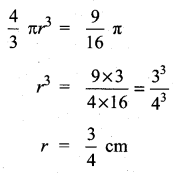
Raise of water in the glass = 1 cm

Samacheer Kalvi 10th Maths Guide Chapter 7 Mensuration Ex 7.2

Question 3.
If the circumference of a conical wooden piece is 484 cm then find its volume when its height is 105 cm.
Answer:
Circumference of the wooden piece = 484 cm
2πr = 484
2 × \(\frac{22}{7}\) × r = 484 cm
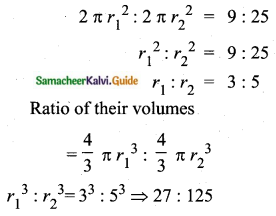
r = \(\frac{484 \times 7}{2 \times 22}\)
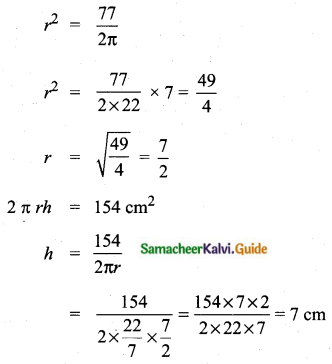
r = 77 cm
Height of the wooden piece (h) = 105 cm
Volume of the conical wooden piece = \(\frac{1}{3} \pi r^{2} h\) cu.units
= \(\frac{1}{3} \times \frac{22}{7} \times 77 \times 77 \times 105 \mathrm{cm}^{3}\)
= 22 × 11 × 77 × 35 cm3
= 652190 cm3
Volume of the wooden piece = 652190 cm3

Samacheer Kalvi 10th Maths Guide Chapter 7 Mensuration Ex 7.2

Question 4.
A conical container is fully filled with petrol. The radius is 10m and the height is 15 m. If the container can release the petrol through its bottom at the rate of 25 cu. meter per minute, in how many minutes the container will be emptied. Round off your answer to the nearest minute.
Answer:
The radius of the conical container (r) = 10 m
Height of the container (h) = 15 m
Samacheer Kalvi 10th Maths Guide Chapter 7 Mensuration Ex 7.2 Q4

Question 5.
A right-angled triangle whose sides are 6 cm, 8 cm and 10 cm is revolved about the sides containing the right angle in two ways. Find the difference in volumes of the two solids so formed.
Samacheer Kalvi 10th Maths Guide Chapter 7 Mensuration Ex 7.2 Q5
Answer:
Three sides of a triangle are 6 cm, 8 cm and 10 cm.
Case (i): If the triangle is revolved about the side 6 cm, the cone will be formed with radius 6 cm and height 8 cm.
Volume of the cone = \(\frac{1}{3} \pi r^{2} h\) cu. units
= \(\frac{1}{3}\) × π × 6 × 6 × 8 = 96π cm3
Case (ii): If the triangle is revolved about the side 8 cm, the cone will be formed with radius 8 cm and height 6 cm.
Volume of the cone = \(\frac{1}{3}\) × π × 8 × 8 × 6 = 128π cm3
Difference in volume of the two solids = (128π – 96π) cm3 = 32π cm3 = 32 × \(\frac{22}{7}\) cm3 = 100.57 cm3
The difference in the volume of the two solids = 100.57 cm3

Question 6.
The volumes of two cones of same base radius are 3600 cm3 and 5040 cm3. Find the ratio of heights.
Answer:
Let the radius of the two cones be ‘r’
Let the height of the two cones be h1 and h2
Ratio of their volumes = 3600 : 5040 (÷ 10)
\(\frac{1}{3} \pi r^{2} h_{1}: \frac{1}{3} \pi r^{2} h_{2}\) = 360 : 504 (÷4)
h1 : h2 = 90 : 126 (÷3)
= 30 : 42 (÷3)
= 10 : 14 (÷2)
h1 : h2 = 5 : 7
Ratio of heights = 5 : 7

Samacheer Kalvi 10th Maths Guide Chapter 7 Mensuration Ex 7.2

Question 7.
If the ratio of radii of two spheres is 4 : 7, find the ratio of their volumes.
Answer:
Let the ratio of their radii is r1 : r2
r1 : r2 = 4 : 7
Ratio of their volumes
V1 : V2 = \(\frac{4}{3} \pi r_{1}^{3}: \frac{4}{3} \pi r_{2}^{3}\)
= \(r_{1}^{3}: r_{2}^{3}\)
= 43 : 73
Ratio of their volumes = 64 : 343

Question 8.
A solid sphere and a solid hemisphere have an equal total surface area. Prove that the ratio of their volume is 3√3 : 4.
Answer:
Total surface area of a sphere = \(4 \pi r_{1}^{2}\) sq. units
Total surface area of a hemisphere = \(3 \pi r_{2}^{2}\) sq. units
Ratio of Total surface area = \(4 \pi r_{1}^{2}: 3 \pi r_{2}^{2}\)
1 = \(\frac{4 \pi r_{1}^{2}}{3 \pi r_{2}^{2}}\) (Same Surface Area)
1 = \(\frac{4 r_{1}^{2}}{3 r_{2}^{2}}\)
Samacheer Kalvi 10th Maths Guide Chapter 7 Mensuration Ex 7.2 Q8
Ratio of their volumes = 3√3 : 4
Hence it is proved.

Samacheer Kalvi 10th Maths Guide Chapter 7 Mensuration Ex 7.2

Question 9.
The outer and the inner surface areas of a spherical copper shell are 576π cm2 and 324π cm2 respectively. Find the volume of the material required to make the shell.
Answer:
Outer surface area of a spherical shell = 576π cm2
4πR2 = 576π
4 × R2 = 576
R2 = \(\frac{576}{4}\) = 144
R = √144 = 12 cm
Inner surface area of a spherical shell = 324π cm2
4πr2 = 324π
4r2 = 324
r2 = 81
r = √81 = 9
Volume of the material required = Volume of the hollow hemisphere = \(\frac{4}{3}\) π(R3 – r3) cm3
Samacheer Kalvi 10th Maths Guide Chapter 7 Mensuration Ex 7.2 Q9
Volume of the material required = 4186.29 cm3

Question 10.
A container open at the top is in the form of a frustum of a cone of height 16 cm with radii of its lower and upper ends are 8 cm and 20 cm respectively. Find the cost of milk which can completely fill a container at the rate of ₹ 40 per litre.
Answer:
Height of the frustrum (h) = 16 cm
Radius of the upper part (R) = 20 cm
Radius of the lower part (r) = 8 cm
Volume of the frustum
Samacheer Kalvi 10th Maths Guide Chapter 7 Mensuration Ex 7.2 Q10
Cost of milk in the container = 10.459 × 40 = ₹ 418.36
Cost of the milk = ₹ 418.36