Samacheer Kalvi 10th Maths Guide Chapter 7 Mensuration Ex 7.1

Students can download Maths Chapter 7 Mensuration Ex 7.1 Questions and Answers, Notes, Samacheer Kalvi 10th Maths Guide Pdf helps you to revise the complete Tamilnadu State Board New Syllabus, helps students complete homework assignments and to score high marks in board exams.

Tamilnadu Samacheer Kalvi 10th Maths Solutions Chapter 7 Mensuration Ex 7.1

Question 1.
The radius and height of a cylinder are in the ratio 5 : 7 and its curved surface area is 5500 sq.cm. Find its radius and height.
Answer:
Let the radius be 5x and the height be 7x
C.S.A of a cylinder = 5500 sq.cm.
2πrh = 5500
2 × \(\frac{22}{7}\) × 5x × 7x = 5500
2 × 22 × 5 × x2 = 5500
x2 = \(\frac{5500}{2 \times 22 \times 5}\)
x2 = 25 cm
x = 5 cm
Radius of the cylinder = 5 × 5 = 25 cm
Height of the cylinder = 7 × 5 = 35 cm

Samacheer Kalvi 10th Maths Guide Chapter 7 Mensuration Ex 7.1

Question 2.
A solid iron cylinder has total surface area of 1848 sq.m. Its curved surface area is five-sixth of its total surface area. Find the radius and height of the iron cylinder.
Answer:
T.S.A of the cylinder =1848 sq.cm
2πr(h + r) = 1848 ……. (1)
Curved surface area = \(\frac{5}{6}\) × 1848 sq.cm
2πrh = 5 × 308
2πrh = 1540 sq.m ……… (2)
Substitute the value of2πrh in (1)
2πr(h + r) = 1848
2πrh + 2πr2 = 1848
1540 + 2πr2 = 1848
2πr2 = 1848 – 1540
2 × \(\frac{22}{7}\) × r2 = 308
r2 = \(\frac{308 \times 7}{2 \times 22}\) = 49
r = 7
Radius of the cylinder = 7m
2πrh = 1540
2 × \(\frac{22}{7}\) × 7 × h = 1540
h = \(\frac{1540}{2 \times 22}\) = 35 m
Radius of the cylinder = 7 m
Height of the cylinder = 35 m

Samacheer Kalvi 10th Maths Guide Chapter 7 Mensuration Ex 7.1

Question 3.
The external radius and the length of a hollow wooden log are 16 cm and 13 cm respectively. If its thickness is 4 cm then find its T.S.A.
Answer:
External radius of the wooden log (R) = 16 cm
Thickness = 4 cm
Internal radius (r) = 16 – 4 = 12 cm
Length of the wooden log (h) = 13 cm
T.S.A of the hollow cylinder = 2π (R + r) (R – r + h) sq.cm
= 2 × \(\frac{22}{7}\) × (16 + 12) (16 – 12 + 13) sq.cm
= 2 × \(\frac{22}{7}\) × 28 × 17 sq.cm
= 2 × 22 × 4 × 17 sq.cm.
= 2992 sq.cm.
T.S.A of the hollow wooden = 2992 sq.cm.

Samacheer Kalvi 10th Maths Guide Chapter 7 Mensuration Ex 7.1

Question 4.
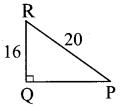
A right angled triangle PQR where ∠Q = 90° is rotated about QR and PQ. If QR = 16 cm and PR = 20 cm, compare the curved surface areas of the right circular cones so formed by the triangle.
Answer:
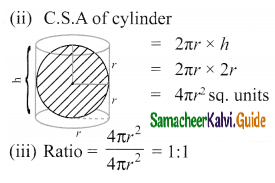
Samacheer Kalvi 10th Maths Guide Chapter 7 Mensuration Ex 7.1 Q4
In the Right Triangle
QP2 = PR2 – QR2= 202 – 162 = 400 – 256 = 144
QP = √144 = 12 cm
When PQ is rotated r = 12, l = 20
C.S.A of the cone = πrl sq. units = π × 12 × 20 cm2 = 240π cm2
When QR is rotated r = 16, l = 20
C.S.A of the cone = nrl sq. units = π × 16 × 20 = 320π cm2
C.S.A. of a cone when rotated about QR is larger.

Question 5.
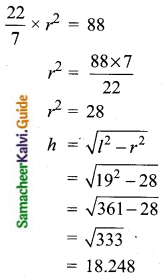
4 persons live in a conical tent whose slant height is 19 cm. If each person requires 22 cm2 of the floor area, then find the height of the tent.
Answer:
Slant height of a cone (r) = 19 cm
Floor area for 4 persons = 4 × 22 cm2
πr2 = 88 cm
Samacheer Kalvi 10th Maths Guide Chapter 7 Mensuration Ex 7.1 Q5
Height of the tent = 18.25 cm

Question 6.
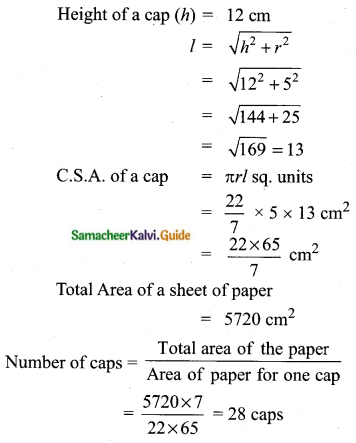
A girl wishes to prepare birthday caps in the form of right circular cones for her birthday party, using a sheet of paper whose area is 5720 cm2, how many caps can be made with radius 5 cm and height 12 cm.
Answer:
Radius of a cap (r) = 5 cm
Samacheer Kalvi 10th Maths Guide Chapter 7 Mensuration Ex 7.1 Q6

Question 7.
The ratio of the radii of two right circular cones of the same height is 1 : 3. Find the ratio of their curved surface area when the height of each cone is 3 times the radius of the smaller cone.
Answer:
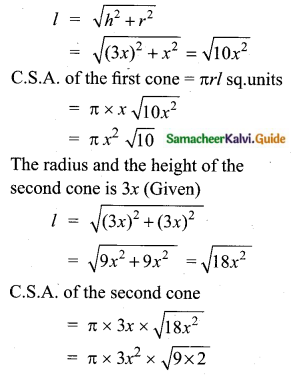
Let the radius of the first cone be ‘x’ and the Height of the cone be 3x
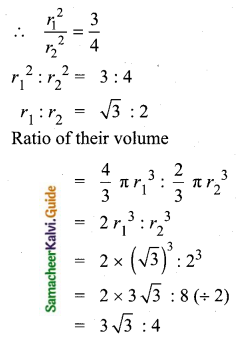
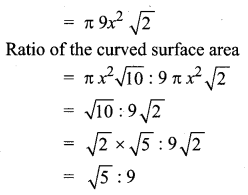
Samacheer Kalvi 10th Maths Guide Chapter 7 Mensuration Ex 7.1 Q7
Samacheer Kalvi 10th Maths Guide Chapter 7 Mensuration Ex 7.1 Q7.1

Question 8.
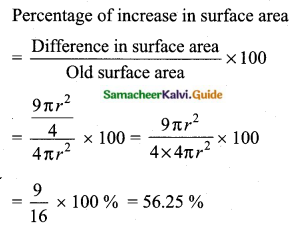
The radius of a sphere increases by 25%. Find the percentage increase in its surface area.
Answer:
Let the radius of the be “r”
Surface area of the sphere = 4πr2 sq.units …….. (1)
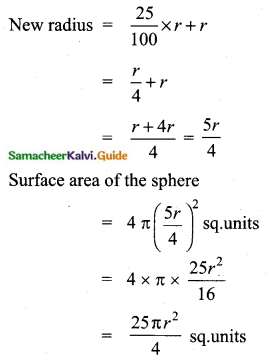
If the radius is increased by 25%
Samacheer Kalvi 10th Maths Guide Chapter 7 Mensuration Ex 7.1 Q8
Samacheer Kalvi 10th Maths Guide Chapter 7 Mensuration Ex 7.1 Q8.1
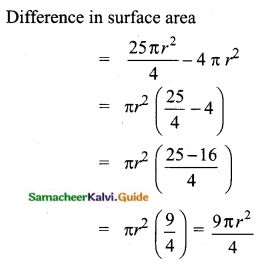
Samacheer Kalvi 10th Maths Guide Chapter 7 Mensuration Ex 7.1 Q8.2
Percentage of increase in surface area = 56.25 %

Question 9.
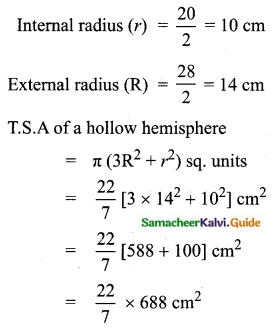
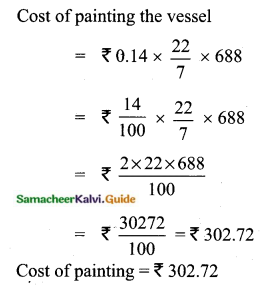
The internal and external diameters of a hollow hemispherical vessel are 20 cm and 28 cm respectively. Find the cost to paint the vessel all over at ₹ 0.14 per cm2.
Answer:
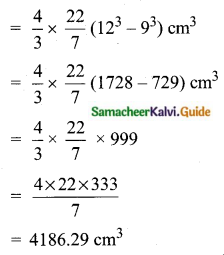
Samacheer Kalvi 10th Maths Guide Chapter 7 Mensuration Ex 7.1 Q9
Samacheer Kalvi 10th Maths Guide Chapter 7 Mensuration Ex 7.1 Q9.1

Question 10.
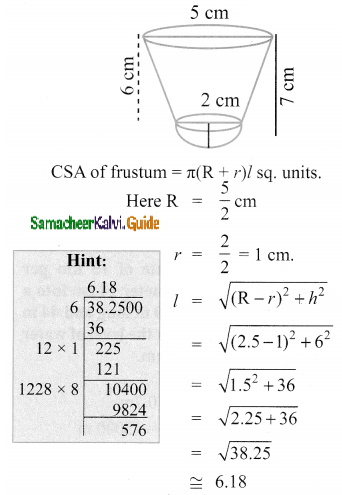
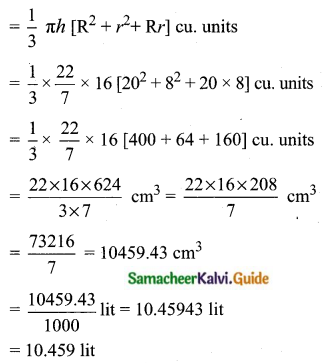
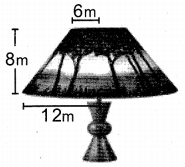
The frustum shaped outer portion of the table lamp has to be painted including the top part. Find the total cost of painting the lamp if the cost of painting 1 sq.cm is ₹ 2.
Samacheer Kalvi 10th Maths Guide Chapter 7 Mensuration Ex 7.1 Q10
Answer:
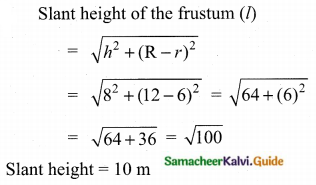
The slant height of the frustum (l)
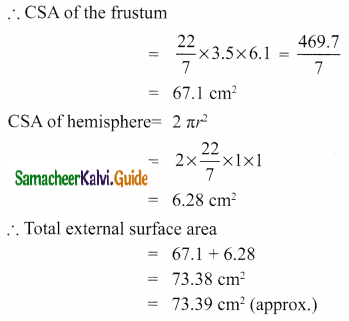
Samacheer Kalvi 10th Maths Guide Chapter 7 Mensuration Ex 7.1 Q10.1
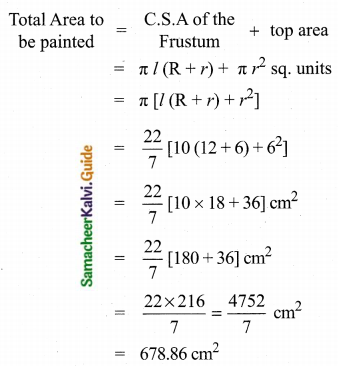
Samacheer Kalvi 10th Maths Guide Chapter 7 Mensuration Ex 7.1 Q10.2
Cost of painting = ₹ 678.86 × 2 = ₹ 1357.72

Tamil Nadu 11th Chemistry Model Question Paper 1 English Medium

Students can Download Tamil Nadu 11th Chemistry Model Question Paper 1 English Medium Pdf, Tamil Nadu 11th Chemistry Model Question Papers helps you to revise the complete Tamilnadu State Board New Syllabus, helps students complete homework assignments and to score high marks in board exams.

TN State Board 11th Chemistry Model Question Paper 1 English Medium

General Instructions:

  1. The question paper comprises of four parts.
  2. You are to attempt all the parts. An internal choice of questions is provided wherever applicable.
  3. All questions of Part I, II, III and IV are to be attempted separately.
  4. Question numbers 1 to 15 in Part I are Multiple Choice Questions of one mark each.
    These are to be answered by choosing the most suitable answer from the given four alternatives and writing the option code and the corresponding answer
  5. Question numbers 16 to 24 in Part II are two-mark questions. These are to be answered in about one or two sentences.
  6. Question numbers 25 to 33 in Part III are three-mark questions. These are to be answered in about three to five short sentences.
  7. Question numbers 34 to 38 in Part IV are five-mark questions. These are to be answered in detail Draw diagrams wherever necessary.

Time: 2:30 Hours
Maximum Marks: 70

PART – I

Answer all the Questions: [15 × 1 = 15]
Choose the most suitable answer from the given four alternatives.

Question 1.
1 g of an impure sample of magnesium carbonate (containing no thermally decomposable impurities) on complete thermal decomposition gave 0.44 g of carbon dioxide gas. The percentage of impurity in the sample is …………………….
(a) 0%
(b) 4.4%
(c) 16%
(d) 8.4%
MgCO3 → MgO + CO2
MgCO3: (1 × 24) + (1 × 12) + (3 × 16) = 84g
CO2: (1 × 12) + (2 × 16) = 44g
100% pure 84 g MgCO3 on heating gives 44 g CO2
Given that 1 g of MgCO3 on heating gives 0.44 g CO2
Therefore, 84 g MgCO3 sample on heating gives 36.96 g CO2
Percentage of purity of the sample = \(\frac { 100% }{ 44gCO_{ 2 } } \) × 36.96 g CO2 = 84%
Percentage of impurity = 16%
Answer:
(c) 16%

Tamil Nadu 11th Chemistry Model Question Paper 1 English Medium

Question 2.
The electronic configuration of Eu (atomic no. 63) Gd (atomic no. 64) and Tb (atomic no. 65) are …………………….. [NEET – Phase II]
(a) [Xe] 4f6 5d1 6s2, [Xe] 4f7 5d1 6s2 and [Xe] 4f8 5d1 6s2
(b) [Xe] 4f7 6s2 [Xe] 4f8 6s2 and [Xe] 4f9 6s2
(c) [Xe] 4f7 6s2 [Xe] 4f7 5d1 6s2 and [Xe] 4f9 6s2
(d) [Xe] 4f 6 5d1 6s2, [Xe] 4f7 5d1 6s2 and [Xe] 4f9 6s2
Solution:
Eu : [Xe] 4f7, 5d0, 6s2
Gd : [Xe] 4f7, 5d1, 6s2
Tb : [Xe] 4f9, 5d0, 6s2
Answer:
(b) [Xe] 4f7 6s2 [Xe] 4f8 6s2 and [Xe] 4f9 6s2

Tamil Nadu 11th Chemistry Model Question Paper 1 English Medium

Question 3.
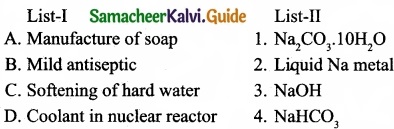
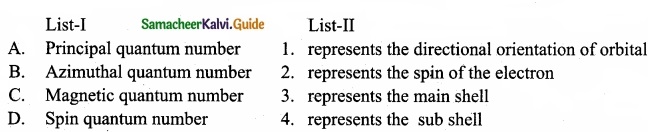
Match the following:

Tamil Nadu 11th Chemistry Model Question Paper 1 English Medium img 1

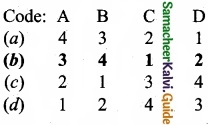
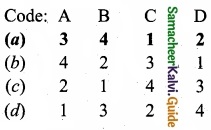
Answer:

Tamil Nadu 11th Chemistry Model Question Paper 1 English Medium img 2

Question 4.
Various successive ionization enthalpies (in kJ mol-1) of an element are given below.

Tamil Nadu 11th Chemistry Model Question Paper 1 English Medium img 3

The element is ……………………….
(a) Phosphorus
(b) Sodium
(c) Aluminium
(d) Silicon
Answer:
(c) Aluminium

Question 5.
Non-stoichiometric hydrides are formed by ……………………..
(a) Palladium, vanadium
(b) Carbon, nickel
(c) Manganese, lithium
(d) Nitrogen, chlorine
Answer:
(a) Palladium, vanadium

Tamil Nadu 11th Chemistry Model Question Paper 1 English Medium

Question 6.
Which is the function of sodium – potassium pump?
(a) Maintenance of ion balance
(b) Used in nerve impulse conduction
(c) Transmitting nerve signals
(d) Regulates the blood level
Answer:
(c) Transmitting nerve signals

Question 7.
∆S is expected to be maximum for the reaction ………………………
(a) Ca(s) + 1/2O2(g) → CaO(s)
(b) C(s) + O2(g) → CO2(g)
(c) N2(g) + O2(g) → 2NO(g)
(d) CaCO3(s) → CaO(s) + CO2(g)
Solution:
In CaCO3(s) → CaO(s) + CO2(g) entropy change is positive. In (a) and (b) entropy change is negative; in (c) entropy change is zero.
Answer:
(d) CaCO3(s) → CaO(s) + CO2(g)

Tamil Nadu 11th Chemistry Model Question Paper 1 English Medium

Question 8.
Which one of the following is a reversible reaction?
(a) Ripening of a banana
(b) Rusting of iron
(c) Tarnishing of silver
(d) Transport of oxygen by Hemoglobin in our body
Solution:
All the other three reactions are irreversible reactions. But the hemoglobin combines with O2 in lungs to form oxyhemoglobin. The oxyhemoglobin has a tendency to form hemoglobin by releasing O2. So it is a reversible reaction.
Answer:
(d) Transport of oxygen by Hemoglobin in our body

Question 9.
P1 and P2 are the vapour pressures of pure liquid components, 1 and 2 respectively of an ideal binary solution if x1 represents the mole fraction of component 1, the total pressure of the solution formed by 1 and 2 will be ………………………….
Solution:
(a) P1 + x1 (P2 – P1)
(b) P2 – x1 (P2 + P1)
(c) P1 – x2 (P1 – P2)
(d) P1 + x2 (P1 – P2)
Ptotal = P1 + P2
= P1x1 + P2 x2
= P1(1 – x2) + P2x2 [∵x1 + x2 = 1, x1 = 1 – x2]
= P1 – P1x2 + P2x2 = P1 – x2 = P1 – x2 (P1 – P2)
Answer:
(c) P1 – x2 (P1 – P2)

Tamil Nadu 11th Chemistry Model Question Paper 1 English Medium

Question 10.
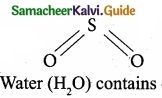
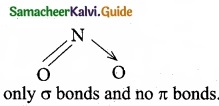
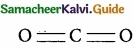
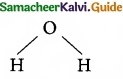
Which of the following molecule contain no n bond?
(a) SO2

Tamil Nadu 11th Chemistry Model Question Paper 1 English Medium img 4

(b) NO2

Tamil Nadu 11th Chemistry Model Question Paper 1 English Medium img 5

(c) CO2

Tamil Nadu 11th Chemistry Model Question Paper 1 English Medium img 6

(d) H2O

Tamil Nadu 11th Chemistry Model Question Paper 1 English Medium img 7

Solution:
Water (H2O) contains only σ bonds and no π bonds.
Answer:
(d) H2O

Tamil Nadu 11th Chemistry Model Question Paper 1 English Medium img 7

Question 11.
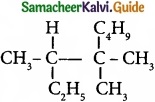
IUPAC name of Tamil Nadu 11th Chemistry Model Question Paper 1 English Medium img 8 is …………………….
(a) Trimethylheptane
(b) 2 -Ethyl -3, 3- dimethyl heptane
(c) 3, 4, 4 – Trimethyloctane
(d) 2 – Butyl -2 -methyl – 3 – ethyl-butane.
Answer:
(c) 3, 4, 4 – Trimethyloctane

Question 12.
Which one of the following is an example for free radical initiators?
(a) Benzoyl peroxide
(b) Benzyl alcohol
(c) Benzyl acetate
(d) Benzaldehyde.
Answer:
(a) Benzoyl peroxide

Question 13.
Some meta-directing substituents in aromatic substitution are given. Which one is most – deactivating?
(a) – COOH
(b) – NO2
(C) – C ≡ N
(d) – SO3H
Answer:
(b) – NO2

Tamil Nadu 11th Chemistry Model Question Paper 1 English Medium

Question 14.
Consider the following statements.
(I) SN2 reaction is a bimolecular nucleophilic first order reaction.
(II) SN2 reaction take place in one step.
(III) SN2 reaction involves the formation of a carbocation. Which of the above statements is/are not correct?
(a) (II)
(b) (I) only
(c) (I) & (III)
(d) (III)
Answer:
(c) (I) & (III)

Question 15.
The questions given below consists of an assertion and the reason. Choose the correct option out of the choices given below each question.
Assertion (A): If BOD level of water in a reservoir is more than 5 ppm it is highly polluted.
Reason(R): High biological oxygen demand means high activity of bacteria in water.
(a) Both (A) and R are correct and (R) is the correct explanation of (A)
(b) Both (A) and R are correct and (R) is not the correct explanation of (A)
(c) Both (A) and R are not correct
(d) (A) is correct but( R) is not correct
Answer:
(d) (A) is correct but( R) is not correct

PART – II

Answer any six questions in which question No. 24 is compulsory. [6 × 2 = 12]

Question 16.
What is the actual configuration of copper (Z = 29)? Explain about its stability?
Answer:
Copper (Z = 29)
Expected configuration : 1s2 2s2 2p6 3s2 3p6 3d9 4s2
Actual configuration : 1s2 2s2 2p6 3s2 3p6 3d10 4s1
The reason is that fully filled orbitals have been found to have extra stability.

Copper has the electronic configuration [Ar] 3d10 4s1 and not [Ar] 3d9 4s2 due the symmetrical distribution and exchange energies of d electrons.

Symmetry leads to stability. The full filled configuration have symmetrical distribution of electrons and hence they are more stable than unsymmetrical configuration.

Tamil Nadu 11th Chemistry Model Question Paper 1 English Medium

Question 17.
What is screening effect?
Answer:
Screening effect:
The repulsive force between inner shell electrons and the valence electrons leads to a decrease in the electrostatic attractive forces acting on the valence electrons by the nucleus. Thus the inner shell elections act as a shield between the nucleus and the valence electrons. This effect is called shielding effect (or) screening effect.

Question 18.
Ice is less dense than water at 0°C. Justify this statement?
Answer:
In ice, each oxygen atom is surrounded tetrahedrally by through hydrogen bonds to four water molecules. That is, the presence of two hydrogen atoms and two lone electron pairs (on oxygen) in each water molecule results in a three-dimensional structure. The arrangements creates an open structure, which in turn accounts for the fact that ice is less dense than water at 0°C.

Tamil Nadu 11th Chemistry Model Question Paper 1 English Medium

Question 19.
Aerosol cans carry clear warning of heating of the can. Why?
Answer:
Aerosol cans carry clear warning of heating of the can. As the temperature rises, pressure in the can will increase and ambient temperatures about 120°F may lead to explosions.

So aerosol cans should always be stored in dry areas where they will not be exposed to excessive temperatures. You should never throw an aerosol can onto a fire, or leave it in the direct sunlight, even it is empty. This is because the pressure will build up so much that the can will burst. It is due to 2 reasons.

  1. The gas pressure increases.
  2. More of the liquefied propellant turns into a gas.

Question 20.
One mole of PCl5 is heated in one litre closed container. If 0.6 mole of chlorine is found at equilibrium, calculate the value of equilibrium constant?
Answer:
Given that [PCl5]initial = \(\frac { 1mol }{ dm^{ 3 } } \)
[Cl2]eq = 0.6 mol dm-3
PCl5⇄ PCl3 + Cl2
[PCl5]eq = 0.6 mole dm-3
[PCl5]eq = 0.4 mole dm-3
∴ KC = \(\frac{0.6×0.6}{0.4}\)
KC = 0.9

Tamil Nadu 11th Chemistry Model Question Paper 1 English Medium

Question 21.
Why do gases always tend to be less soluble in liquids as the temperature is raised?
Answer:
Mostly dissolution of gases in liquid is an exothermic process. It is because the fact that this process involves decrease of entropy.

Thus, increase of temperature tends to push the equilibrium towards backward direction as a result of which solubility of the gas decrease with rise in temperature.
(Gas + Solvent ⇄ Solution + Heat)

Question 22.
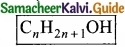
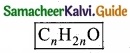
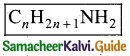
Give the general formula for the following classes of organic compounds?
(a) Aliphatic monohydric alcohol
(b) Aliphatic ketones
(c) Aliphatic amines.
Answer:
(a) Aliphatic monohydric alcohol
Tamil Nadu 11th Chemistry Model Question Paper 1 English Medium img 9

(b) Aliphatic ketones
Tamil Nadu 11th Chemistry Model Question Paper 1 English Medium img 10

(c) Aliphatic amines
Tamil Nadu 11th Chemistry Model Question Paper 1 English Medium img 11

Tamil Nadu 11th Chemistry Model Question Paper 1 English Medium

Question 23.
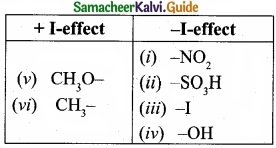
Identify which of the following shows +1 and -I effect?

(I) -NO2
(II) -SO3H
(III) -I
(IV) -OH
(V) CH3O
(VI) CH3-

Answer:
Tamil Nadu 11th Chemistry Model Question Paper 1 English Medium img 12

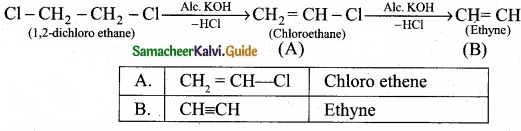
Question 24.
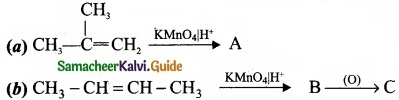
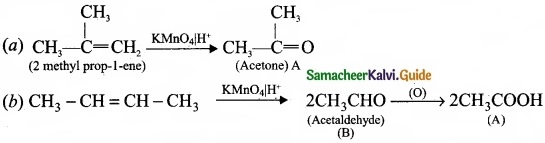
Write the products A & B for the following reaction?
Tamil Nadu 11th Chemistry Model Question Paper 1 English Medium img 13
Answer:
Tamil Nadu 11th Chemistry Model Question Paper 1 English Medium img 14

PART – III

Answer any six questions in which question No. 33 is compulsory. [6 × 3 = 18]

Question 25.
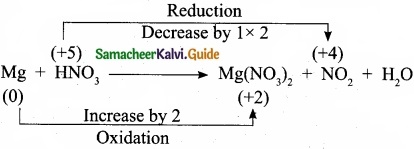
Balance by oxidation number method: Mg + HNO3 → Mg(N03)2 + NO2 + H2O.
Answer:
Step 1:
Tamil Nadu 11th Chemistry Model Question Paper 1 English Medium img 15

Step 2:
Mg + 2HNO3 → Mg(NO3)2 + NG2 + H2O

Step 3:
To balance the number of oxygen atoms and hydrogen atoms 2HNO3 is multiplied by 2.
Mg + 4HNO3 → Mg(NO3)2 + 2NO2 + H2O

Step 4:
To balance the number of hydrogen atoms, the H2O molecule is multiplied by 2.
Mg + 4HNO3 → Mg(NO3)2 + 2NO2 + 2H2O

Tamil Nadu 11th Chemistry Model Question Paper 1 English Medium

Question 26.
For each of the following, give the sub level designation, the allowable m values and the number of orbitals?
Answer:

  1. n = 4, l = 2
  2. n = 5, l = 3
  3. n = 7, l = 0

1. n = 4, l = 2
If l = 2, ‘m’values are -2,-1, 0, +1, +2. So, 5 orbitals such as dxy, dyz ,dxz, \(d_{ x^{ 2 }-y^{ 2 } }\) and \(d_{ z^{ 2 } }\)

2. n = 5, l = 3
If l = 3, ‘m’ values are -3, -2, -1, 0, +1, +2, +3
So, 7 orbitals such as \(\mathrm{f}_{\mathrm{z}}^{3}, \mathrm{f}_{\mathrm{xz}}^{2}, \mathrm{f}_{\mathrm{yz}}^{2}, \mathrm{f}_{\mathrm{xyz}}, \mathrm{f}_{\mathrm{z}\left(\mathrm{x}^{2}-\mathrm{y}^{2}\right)}, \mathrm{f}_{\mathrm{x}\left(\mathrm{x}^{2}-3 \mathrm{y}^{2}\right)}, \mathrm{f}_{\mathrm{y}\left(3 \mathrm{x}^{2}-\mathrm{z}^{2}\right)}\)

3. n = 7, l = 0
If l = 0, ‘m’ values are 0. Only one value. So, 1 orbital such as 7s orbital.

Tamil Nadu 11th Chemistry Model Question Paper 1 English Medium

Question 27.
Prove that ionization energy is a periodic property?
Answer:
Variation in a period:
On moving across a period from left to right, the ionization enthalpy value increases.
This is due to the following reasons:

  1. Increase of nuclear charge in a period
  2. Decrease of atomic size in a period

Because of these reasons, the valence electrons are held more tightly by the nucleus, thus ionization enthalpy increases. Hence, ionization energy is a periodic property.

Variation in a group:
As we move from top to bottom along a group, the ionization enthalpy decreases. This is due to the following reasons:

  1. A gradual increase in atomic size
  2. Increase of screening effect on the outermost electrons due. to the increase of number of inner electrons.

Hence, ionization enthalpy is a periodic property.

Tamil Nadu 11th Chemistry Model Question Paper 1 English Medium

Question 28.
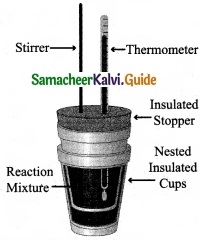
Explain how heat absorbed at constant pressure is measured using coffee cup calorimeter with neat diagram?
Answer:

  1. Measurement of heat change at constant pressure can be done in a coffee cup calorimeter.
  2. We know that ∆H = qp (at constant P) and therefore, heat absorbed or evolved, qp at constant pressure is also called the heat of reaction or enthalpy of reaction, ∆Hr
  3. In an exothermic reaction, heat is evolved, and system loses heat to the surroundings. Therefore, qp will be negative and ∆Hr will Reaction also be negative. Mixture
  4. Similarly in an endothermic reaction, heat is absorbed, qp is positive and ∆Hr will also be positive.

Tamil Nadu 11th Chemistry Model Question Paper 1 English Medium img 16

Question 29.
Consider the following reactions,
(a) H2(g) + I2(g) ⇄ 2 HI(g)
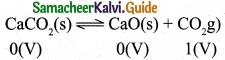
(b) CaCO2(s) ⇄ CaO(s) + CO2(g)
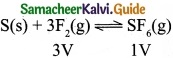
(c) S(s) + 3F2(g) ⇄ SF6(g)
In each of the above reaction find out whether you have to increase (or) decrease the volume to increase the yield of the product?
Answer:
(a) H2(g) + I22(g) ⇄ 2HI(g)
In the above equilibrium reaction, volume of gaseous mdlecules is equal on both sides. So increase or decrease the volume will not affect the equilibrium and there will be no change in the yield of product.

(b) Tamil Nadu 11th Chemistry Model Question Paper 1 English Medium img 17
Volume is greater in product side. By decreasing the pressure, volume will increase thus, to get more of product CO2, the pressure should be decreased or volume should be increased.

(c) Tamil Nadu 11th Chemistry Model Question Paper 1 English Medium img 18
Volume is lesser in product side. So by increasing the pressure, equilibrium shifts to the product side.

Tamil Nadu 11th Chemistry Model Question Paper 1 English Medium

Question 30.
You are provided with a solid ‘A’ and three solutions of A dissolved in water one saturated, one unsaturated, and one super saturated. How would you determine each solution?
Answer:
(I) Saturated solution:
When maximum amount of solute is dissolved in a solvent, any more addition of solute will result in precipitation at a given temperature and pressure. Such a solution is called a saturated solution.

(II) Unsaturated solution:
When minimum amount of solute is dissolved in a solvent at a given temperature and pressure is called an unsaturated solution.

(III) Super saturated solution:
It is a solution that holds more solute than it normally could in its saturated form.

Example:

  1. A saturated solution where the addition of more compound would not dissolve in the solution. 359 g of NaCl in 1 litre of water at 25°C.
  2. An unsaturated solution has the capacity to dissolve more of the compound. 36 g of NaCl in 1 litre of water at 25°C.
  3. A super saturated solution is the solution in which crystals can start growing. 500 g of NaCl in 1 litre of water at 25°C.

Tamil Nadu 11th Chemistry Model Question Paper 1 English Medium

Question 31.
Explain about the salient features of molecular orbital theory?
Answer:

  • When atoms combine to fonn molecules, their individual atomic orbitals lose their identity and form new orbitals called molecular orbitals.
  • The shape of molecular orbitals depend upon the shapes of combining atomic orbitals.
  • The number of molecular orbitals formed is the same as the number of combining atomic orbitals. Half the number of molecular orbitals formed will have lower energy and are called bonding orbitals, while the remaining half molecular orbitals will have higher energy and are called anti-bonding molecular orbitals.
  • The bonding molecular orbitals are represented as σ (sigma), π (pi), δ (delta) and the corresponding anti-bonding orbitals are called C*, 7t* and 5*.
  • The electrons in the molecule are accommodated in the newly formed molecular orbitals. The filling of electrons in these orbitals follow Aufbau’s Principle, Pauli’s exclusion principle and Hund’s rule as in the case of filling of electrons in the atomic orbitals.
  • Bond order gives the number of covalent bonds between the two combining atoms.

The bond order of a molecule can be calculated using the following equation:
Bond order = \(\frac { N_{ b }-N_{ a } }{ 2 } \)
Nb = Number of electrons in bonding molecular orbitals.
Na = Number of electrons in anti-bonding molecular orbitals.
(vii) A bond order of zero value indicates that the molecule does not exist.

Tamil Nadu 11th Chemistry Model Question Paper 1 English Medium

Question 32.
Explain the types of addition reactions?
Answer:
Addition reactions are classified into three types they are,

  1. Electrophilic addition reaction
  2. Nucleophilic addition reaction
  3. Free radical addition reaction

1. Electrophilic addition reaction:
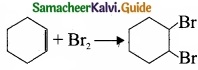
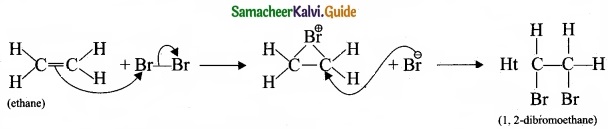
An electrophilic addition reaction can be described as an addition reaction in whifth a reactant with multiple bonds as in a double or triple bond undergoes has its n bond broken and two new a bond are formed.

Tamil Nadu 11th Chemistry Model Question Paper 1 English Medium img 19

(ethane) Br Bf

2. Nucleophilic addition reaction:
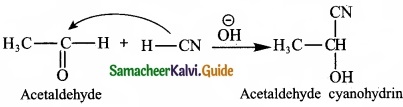
A nucleophilic addition reaction is an addition reaction where a chemical compound with an electron deficient or electrophilic double or triple bond, a n bond, reacts with a nucleophilic which is an electron rich reactant with the disappearance of the double bond and creation of two new single or a bonds.

Tamil Nadu 11th Chemistry Model Question Paper 1 English Medium img 20

3. Free radical addition reaction:
It is an addition reaction in organic chemistry involving free radicals. The addition may occur between a radical and a non radical or between two radicals.

Tamil Nadu 11th Chemistry Model Question Paper 1 English Medium img 21

Question 33.
Complete the following reaction and identify A, B and C?

Tamil Nadu 11th Chemistry Model Question Paper 1 English Medium img 22

Answer:

Tamil Nadu 11th Chemistry Model Question Paper 1 English Medium img 23

PART – IV

Answer all the questions. [5 × 5 = 25]

Question 34 (a).
(I) How many radial nodes for 2s, 4p, 5d and 4f orbitals exhibit? How many angular nodes?
(II) How many unpaired electrons are present in the ground state of

(a) Cr3+ (Z = 24)
(b) Ne (Z = 10)

[OR]

(b) (I) The electronic configuration of an atom is one of the important factor which affects the value of ionization potential and electron gain enthalpy. Explain?
(II) Explain why cation are smaller and anions are larger in radii than their parent atoms?
Answer:
(a) (I) Formula for total number of nodes = n – 1
For 2s orbital: Number of radial nodes = 1.
For 4p orbital: Number of radial nodes = n – l – 1.
= 4 – 1 – 1 = 2
Number of angular nodes = l
∴Number of angular nodes = l.
So, 4p orbital has 2 radial nodes and 1 angular node.

For 5d orbital:
Total number of nodes = n – 1
= 5 – 1 =4 nodes
Number of radial nodes = n – l – 1
= 5 – 2 – 1 = 2 radial nodes.
Number of angular nodes = l = 2
∴5d orbital have 2 radial nodes and 2 angular nodes.

For 4f orbital:
Total number of nodes = n – 1
= 4 – 1 = 3 nodes
Number of radial nodes = n – l – 1
= 4 – 3 – 1 = 0 node.
Number of angular nodes = l
= 3 nodes
∴ 5d orbital have 0 radial node and 3 angular nodes.

(II) (a) Cr (Z = 24) 1s2 2s2 2p6 3s2 3p6 3d5 4s1
Cr3+ – 1s2 2s2 2p6 3s2 3p6 3d4.
It contains 4 unpaired electrons.
(b) Ne(Z=10) 1s2 2s2 2p6. No unpaired electrons in it.

[OR]

(b) (I)

  • Electronic configuration of an atom affects the value of ionization potential and electron gain enthalpy.
  • Half filled valence shell electronic configuration and completely filled valence shell electronic configuration are more stable than partially filled electronic configuration.
  • For e.g. Beryllium (Z = 4) 1s2 2s2 (completely filled electronic configuration)
    Nitrogen (Z = 7) 1s2 2s2 2px1 2py1 2pz1 (half filled electronic configuration)
    Both beryllium and nitrogen have high ionization energy due to more stable nature.
  • In the case of beryllium (1s2 2s2), nitrogen (1s2 2s2 2p3) the addition of extra electron will disturb their stable electronic configuration and they have almost zero electron affinity.
  • Noble gases have stable ns2 np6 configuration and the addition of further electron is unfavorable and they have zero electron affinity.

(II) A cation is smaller than the parent atom because it has fewer electrons while its nuclear charge remains the same. The size of anion will be larger than that of parent atom because the addition of one or more electrons would result in increased repulsion among the electrons and a decrease in effective nuclear charge.

Tamil Nadu 11th Chemistry Model Question Paper 1 English Medium

Question 35 (a).
(I) Arrange NH3, H2O and HF in the order of increasing magnitude of hydrogen bonding and explain the basis for your arrangement?
(II) Can we use concentrated sulphuric acid and pure zinc in the preparation of dihydrogen?

[OR]

(b) (I) Beryllium halides are covalent whereas magnesium halides are ionic. Why?
(II) What happens when
Sodium metal is dropped in water?

  1. Sodium metal is heated in free supply of air?
  2. Sodium peroxide dissolves in water?

Answer:
(a) 1. Increasing magnitude of hydrogen bonding among NH3, H2O and HF is
HF > H2O > NH3

2. The extent of hydrogen bonding depends upon electronegativity and the number of hydrogne atoms available for bonding.

3. Among N, F and O the increasing order of their electronegativities are
N < O < F 4. Hence the expected order of the extent of hydrogen bonding is HF > H2O > NH3

(II) Conc. H2SO4 cannot be used because it acts as an oxidizing agent also and gets reduced to SO2.
Zn + 2H2SO4 (Conc) → ZnSO4 + 2H2O + SO2 Pure Zn is not used because it is non-porous and reaction will be slow. The impurities in Zn help in constitute of electrochemical couple and speed up reaction.

[OR]

(b)
(I) Beryllium ion (Be2+) is smaller in size and it is involved in equal sharing of electrons with halogens to form covalent bond, whereas magnesium ion (Mg2+) is bigger and it is involved in transfer of electrons to form ionic bond.

(II)

  1. 2Na + 2H2O → 2NaOH + H2
  2. 2Na + O2 → Na2O2
  3. Na2O2 + 2H2O → 2NaOH + H2O2

Tamil Nadu 11th Chemistry Model Question Paper 1 English Medium

Question 36 (a).
(I) Define Gibb’s free energy?
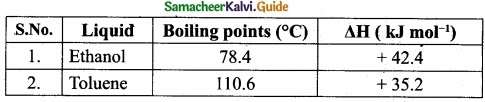
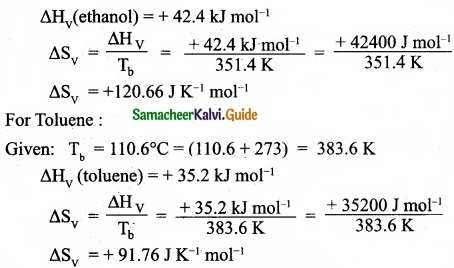
(II) You are given normal boiling points and standard enthalpies of vapourisation. Calculate the entropy of vapourisation of liquids listed below?
Answer:

Tamil Nadu 11th Chemistry Model Question Paper 1 English Medium img 24

[OR]

(b) (I) Define mole fraction.
(II) Differentiate between ideal solution and non-ideal solution.
Answer:
(a) (I) Gibbs free energy is defined as the part of total energy of a system that can be converted (or) available for conversion into work.
G = H – TS, where G = Gibb’s free energy
H – enthalpy;
T = temperature;
S = entropy

(II) For ethanol:
Given: Tb = 78.4°C = (78.4 + 273) = 351.4 K

Tamil Nadu 11th Chemistry Model Question Paper 1 English Medium img 25

[OR]

(b) (I) Mole fraction of a component is the ratio of number of moles of the component to the total number of moles of all components present in the solution.

Tamil Nadu 11th Chemistry Model Question Paper 1 English Medium img 26
(II)
Ideal Solution:

  1. An ideal solution is a solution in which each component obeys the Raoult’s law over entire range of concentration.
  2. For an ideal solution,
    ΔHmissing = 0, ΔVmixing = 0
  3. Example: Benzene and toulene n – Hexane and n – Heptane.

Non – Ideal Solution:

  1. The solution which do not obey Raults’s law over entire range of concentrations are called non-ideal solution.
  2. For an ideal solution,
    ΔHmixing ≠ 0, ΔVmixing ≠ 0
  3. Example: Ethyl alcohol and Cyclo hexane, Benzene and aceton.

Tamil Nadu 11th Chemistry Model Question Paper 1 English Medium

Question 37 (a).
(I) What is dipole moment?
(II) Describe Fajan’s rule?

[OR]

(b) (I) How does Huckel rule help to decide the aromatic character of a compound?
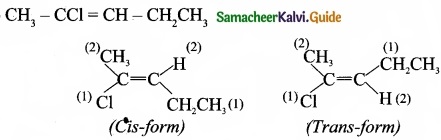
(II) Draw cis-trans isomers for the following compounds
(a) 2- chloro-2-butene
(b) CH3-CCl=CH-CH2CH3
Answer:
(a)
(I)

  1. The polarity of a covalent bond can be measured in terms of dipole moment which is defined as: m = q × 2d, where m is the dipole moment, q is the charge, 2d is the distance between the two charges.
  2. The dipole moment is a vector quantity and the direction of the dipole moment points from the negative charge to positive charge.
  3. The unit of dipole moment is Coulomb metre (C m). It is usually expressed in Debye unit (D).
  4. 1 Debye = 3.336 × 10⁻³o C m

(II)

1. The ability of a cation to polarise an anion is called its polarising ability and the tendency of ah anion to get polarised is called its polarisibility. The extent of polarisation in an ionic compound is given by the Fajans rule.

2. To show greater covalent character, both the cation and anion should have high charge on them. Higher the positive charge on the cation greater will be the attraction on the electron cloud of the anion. Similarly higher the magnitude of negative charge on anion, greater is its polarisability. For example, Na+ < Mg2+ < Al3+, the covalent character also follows the order:
NaCl < MgCl2 < AlCl3.

3. The smaller cation and larger anion show greater covalent character due to the greater extent of polarisation, e.g., LiCl is more covalent than NaCl.

4. Cation having ns2 np6 nd0 configuration shows greater polarising power than the cations with ns2 np6 configuration, e.g., CuCl is more covalent than NaCl.

[OR]

(b) (I) A compound is said to be aromatic, if it obeys the following rules:

  1. The molecule must be cyclic.
  2. The molecule must be co-planar.
  3. Complete delocalisation of rc-electrons in the ring.
  4. Presence of (4n + 2)π electrons in the ring where n is an integer (n = 0, 1, 2 …)

This is known as Huckel’s rule.
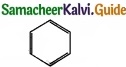
Example – Tamil Nadu 11th Chemistry Model Question Paper 1 English Medium img 28 – Benzene

  1. It is cyclic one.
  2. It is a co-planar molecule.
  3. It has six delocalised n electrons.
  4. 4n + 2 = 6

4n = 6 – 2
4n = 4
⇒ n = 1
It obey Huckel’s rule, with n = 1, hence benzene is aromatic in nature.

(II) (a) 2-Chloro-2-butene:

(b) Tamil Nadu 11th Chemistry Model Question Paper 1 English Medium img 29

Tamil Nadu 11th Chemistry Model Question Paper 1 English Medium

Question 38 (a).
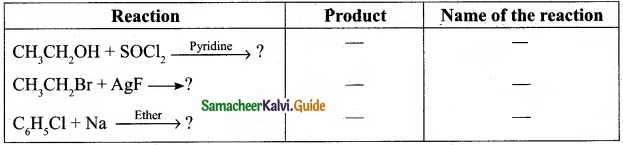
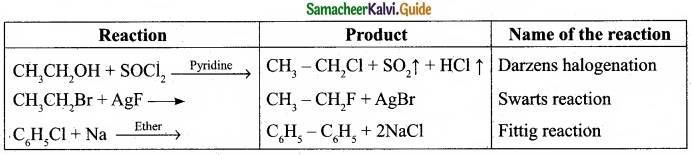
(I) Reagents and the conditions used in the reactions are given below. Complete the table by writing down the product and the name of the reaction?
Answer:

Tamil Nadu 11th Chemistry Model Question Paper 1 English Medium img 30

(II) What is the IUPAC name of the insecticide DDT? Why is their use banned in most of the countries?

[OR]

(b) (I) Explain about green chemistry in day-to-day life?
(II) How acetaldehyde is commercially prepared by green chemistry?
Answer:
(a)
(I) Tamil Nadu 11th Chemistry Model Question Paper 1 English Medium img 31

(II)

  •  The IUPAC name of the insecticide DDT is p, p’-dichloro-diphenyl trichloroethane.
  • Even DDT is an effective insecticide. Now-adays it is banned because of its long term toxic effects.
  • DDT is very persistent in the environment and it has a high affinity for fatty tissues. As a result, DDT gets accumulated in animal tissue fat, in particular that of birds of prey with subsequent thinning of their eggs shells and impacting their rate of reproduction. That is why DDT is banned in most of the countries.

[OR]

(b)
(I)
1. Dry cleaning of clothes:
Solvents like tetrachloroethylene used in dry cleaning of clothes, pollute the ground water and are carcinogenic. In place of tetrachloro ethylene, liquefied CO2 with suitable detergent is an alternate solvent used. Liquefied CO2 is not harmful to the ground water. Nowadays H2O2 is used for bleaching clothes in laundry, gives better result and utilises less water.

2. Bleaching of paper:
Conventional method of bleaching was done with chlorine. Nowadays H2O2 can be used for bleaching paper in the presence of catalyst.

  1. Instead of petrol, methaftol is used as a fuel in automobiles.
  2. Neem based pesticides have been synthesised, which are more safer than the chlorinated hydrocarbons.

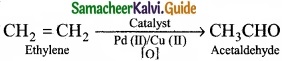
(II) Acetaldehyde is commericially prepared by one step oxidation of ethene in the presence of ionic catalyst in aqueous medium with 90% yield.

Tamil Nadu 11th Chemistry Model Question Paper 1 English Medium img 32

Tamil Nadu 11th Physics Model Question Paper 5 English Medium

Students can Download Tamil Nadu 11th Physics Model Question Paper 5 English Medium Pdf, Tamil Nadu 11th Physics Model Question Papers helps you to revise the complete Tamilnadu State Board New Syllabus, helps students complete homework assignments and to score high marks in board exams.

TN State Board 11th Physics Model Question Paper 5 English Medium

General Instructions:

  1. The question paper comprises of four parts.
  2. You are to attempt all the parts. An internal choice of questions is provided wherever applicable.
  3. All questions of Part I, II, III and IV are to be attempted separately.
  4. Question numbers 1 to 15 in Part I are Multiple Choice Questions of one mark each.
    These are to be answered by choosing the most suitable answer from the given four alternatives and writing the option code and the corresponding answer
  5. Question numbers 16 to 24 in Part II are two-mark questions. These are to be answered in about one or two sentences.
  6. Question numbers 25 to 33 in Part III are three-mark questions. These are to be answered in about three to five short sentences.
  7. Question numbers 34 to 38 in Part IV are five-mark questions. These are to be answered in detail Draw diagrams wherever necessary.

Time: 3 Hours
Maximum Marks: 70

PART – I

Answer all the questions: [15 × 1 = 15]

Question 1.
Two protons are travelling. along the same straight path but in opposite directions. The relative velocity between the two is ……………………
(a) c
(b) \(\frac{c}{2}\)
(c) 2c
(d) 0
Hint:
One of the velocity V1 = V; Other velocity V2 = -V
Relative velocity (Vrel) = \(\frac{V_{1}-V_{2}}{\left[1+\frac{V^{2}}{C^{2}}\right]}\) = \(\frac{V-(-V)}{\left[1+\frac{V^{2}}{C^{2}}\right]}\) = \(\frac{2v}{2}\)
V = C
Vrelative = C
Answer:
(a) c

Tamil Nadu 11th Physics Model Question Paper 5 English Medium

Question 2.
If the Earth stops rotating about its own axis, g remains unchanged at …………………..
(a) Equator
(b) Poles
(c) Latitude of 45°
(d) No where
Answer:
(b) Poles

Question 3.
When train stops, the passenger moves forward. It is due to ……………………
(a) Inertia of passenger
(b) Inertia of train
(c) Gravitational pull by Earth
(d) None of the above
Answer:
(a) Inertia of passenger

Tamil Nadu 11th Physics Model Question Paper 5 English Medium

Question 4.
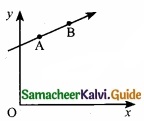
A particle of mass m moves in the xy plane with a velocity v along the straight line AB. If the angular momention of the particle with respect to origin O is LA when it is at A and LB when it is at B, then …………………….
(a) LA = LB
(b) LA < LB
(c) LA > LB
(d) The relationship between LA and LB depends uopn the slope of the line AB

Tamil Nadu 11th Physics Model Question Paper 5 English Medium img 1

Hint:
Magnitude of L is, L = mvr sin ϕ = mvd
d = r sin ϕ is the distance of closest approach of the particle so the origin, as ‘d’ is same for both particles.
So, L A = LB
Answer:
(a) LA = LB

Question 5.
A couple produces ……………………….
(a) Pure rotation
(b) Pure translation
(c) Rotation and translation
(d) No motion
Answer:
(a) Pure rotation

Tamil Nadu 11th Physics Model Question Paper 5 English Medium

Question 6.
A body starting from rest has an acceleration of 20 ms~2 the distance travelled by it in the sixth second is ……………………..
(a) 110 m
(b) 130m
(c) 90m
(d) 50 m
Hint:
Distance travelled in nth second, u = 0
Sn = u + \(\frac{1}{2}\)a(2n – 1)
S6 = 0 + \(\frac{1}{2}\) × 20 × (2 × 6 – 1); S6 = 110 m
Answer:
(a) 110 m

Question 7.
A lift of mass 1000 kg, which is moving with an acceleration of 1m/s2 in upward direction has tension has developed in its string is ………………………
(a) 9800 N
(b) 10800 N
(c) 11000 N
(d) 10000 N
Hint:
Tension, T = mg + ma = m(g + a) = 1000 (10 + 1)
T = 11000 N
Answer:
(c) 11000 N

Tamil Nadu 11th Physics Model Question Paper 5 English Medium

Question 8.
The relation between acceleration and displacement of four particles are given below ………………………..
(a) ax = 2x
(b) ax = + 2x2
(c) ax = -2x2
(d) ax = -2x
Answer:
(d) ax = -2x

Question 9.
A sonometer wire is vibrating in the second overtone. In the wire there are, ……………………..
(a) Two nodes and two antinodes
(b) One node and two antinodes
(c) Four nodes and three antinodes
(d) Three nodes and three antinodes
Answer:
(d) Three nodes and three antinodes

Tamil Nadu 11th Physics Model Question Paper 5 English Medium

Question 10.
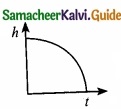
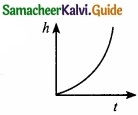
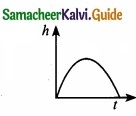
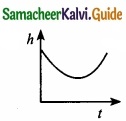
Which of the following is the graph between the light (h) of a projectile and time (t), when it is projected from the ground ………………………..
(a) Tamil Nadu 11th Physics Model Question Paper 5 English Medium img 2
(b) Tamil Nadu 11th Physics Model Question Paper 5 English Medium img 3
(c) Tamil Nadu 11th Physics Model Question Paper 5 English Medium img 4
(d) Tamil Nadu 11th Physics Model Question Paper 5 English Medium img 5
Answer:
(c) Tamil Nadu 11th Physics Model Question Paper 5 English Medium img 4

Question 11.
According to kinetic theory of gases, the rms velocity of the gas molecules is directly proportional to ………………………
(a) \(\sqrt{T}\)
(b) T3
(c) T
(d) T4
Hint:
The rms velocity, Vrms = \(\sqrt{3KT/m}\) ⇒ Vrms ∝ \(\sqrt{T}\)
Answer:
(a) \(\sqrt{T}\)

Question 12.
A body of mass m moving with velocity v collides head on with another body of mass 2m which is initially at rest. The ratio of K.E of colliding body before and after collision will be ……………………..
(a) 1 : 1
(b) 2 : 1
(c) 4 : 1
(d) 9 : 1
Hint:
KE of colliding bodies before collision = \(\frac{1}{2}\) mv2
After collision the mass = m + 2m = 3m
velocity becomes V’ = \(\left(\frac{m_{1}-m_{2}}{m_{1}+m_{2}}\right)\)v = \(\frac{mv}{3m}\) = \(\frac{v}{3}\)
KE after collision = \(\frac{1}{2}\)m (\(\frac{V}{3}\)2 = \(\frac{1}{9}\) (\(\frac{1}{2}\) mv2)
\(\frac{\mathrm{KE}_{\text {before }}}{\mathrm{KE}_{\text {after }}}=\frac{\frac{1}{2} \mathrm{mv}^{2}}{\frac{1}{9}\left(\frac{1}{2} \mathrm{mv}^{2}\right)}=9: 1\)
Answer:
(d) 9 : 1

Tamil Nadu 11th Physics Model Question Paper 5 English Medium

Question 13.
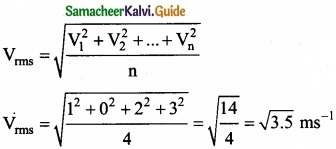
Four particles have velocity 1, 0, 2 and 3ms-1. The root mean square velocity of the particles is ……………………..
(a) 3.5 ms-1
(b) \(\sqrt{3.5}\) ms-1
(c) 1.5ms-1
(d) Zero
Hint:

Tamil Nadu 11th Physics Model Question Paper 5 English Medium img 6

Answer:
(b) \(\sqrt{3.5}\) ms-1

Tamil Nadu 11th Physics Model Question Paper 5 English Medium

Question 14.
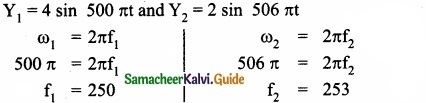
Two vibrating tuning forks produce progressive waves given by y1 = 4 sin 500 πt and y2 = 2 sin 506 πt where t is in seconds Number of beat produced per minute is ………………………
(a) 360
(b) 180
(c) 3
(d) 60
Hint:

Tamil Nadu 11th Physics Model Question Paper 5 English Medium img 7
f2 – f1 = 3 = beats per sec and 3 × 60 = 180 beats per min

Answer:
(b) 180

Question 15.
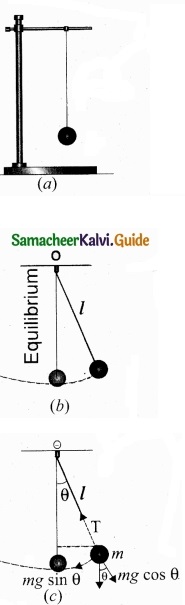
Workdone by a simple pendulum in one complete oscillation is …………………………..
(a) Zero
(b) Jmg
(c) mg cos θ
(d) mg sin θ
Answer:
(a) Zero

PART – II

Answer any six questions in which Q. No 23 is compulsory. [6 × 2 = 12]

Question 16.
A girl is swinging in the sitting position. How will the period of the swing be changed if she stands up?
Answer:
This can be explained using the concept of a simple pendulum. We know that the time period of a simple pendulum is given by
T = 2π\(\sqrt{l/g}\) i.e; T ∝\(\sqrt{l}\)
When the girl stands up, the distance between the point of suspension and the centre of mass of the swinging body decreases i.e., l decreases, so T will also decrease.

Question 17.
A car starts to move from rest with uniform acceleration 10 ms-2 then after 2 sec, what is its velocity?
Answer:
a =10 ms-2;
t = 2s;
w = 0;
v = ?
v = u + at
v = 0 + 10 × 2
= 20 ms-1

Tamil Nadu 11th Physics Model Question Paper 5 English Medium

Question 18.
State Lami’s theorem?
Answer:
If a system of three concurrent and coplanar forces is in equilibrium, then Lami’s theorem states that the magnitude of each force of the system is proportional to sine of the angle between the other two forces. The constant of proportionality is same for all three forces.

Question 19.
Due to the action of constant torque, a wheel from rest makes n rotations in t seconds? Show that the angular acceleration of a wheel as \(\frac{4 \pi n}{t^{2}}\) rad s-2
Answer:
Initial angluar velocity ω0 = 0
Number of rotations in t seconds = n
angular displacement θ = 2πn
but, θ = ω0t + \(\frac{1}{2}\)αt2
2πn = \(\frac{1}{2}\)αt2
α = \(\frac{4 \pi n}{t^{2}}\)

Question 20.
Why a given sound is louder in a hall than in the open?
Answer:
In a hall, repeated reflections of sound take place from the walls and the ceiling. These reflected sounds mix with original sound which results in increase the intensity of sound. But in open, no such a repeated reflection is possible. .’. sound will not be louder as in hall.

Tamil Nadu 11th Physics Model Question Paper 5 English Medium

Question 21.
What are the differences between connection and conduction?
Answer:
Conduction:
Conduction is the process of direct transfer of heat through matter due to temperature difference. When two objects are in direct contact with one another, heat will be transferred from the hotter object to the colder one. The objects which allow heat to travel easily through them are called conductors.

Convection:
Convection is the process in which heat transfer is by actual movement of molecules in fluids such as liquids and gases. In convection, molecules move freely from one place to another.

Question 22.
Why two holes are made to empty an oil tin?
Answer:
When oil comes out through a tin with one hole, the pressure inside the tin becomes less than the atmospheric pressure, soon the oil stops flowing out. When two holes are made in the tin, air keeps on entering the tin through the other hole and maintains pressure inside.

Tamil Nadu 11th Physics Model Question Paper 5 English Medium

Question 23.
If the length of the simple pendulum is increased by 44% from its original length, calculate the percentage increase in time period of the pendulum?
Answer:
Since T ∝ \(\sqrt{l}\) = Constant \(\sqrt{l}\)

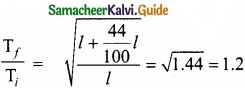
Tamil Nadu 11th Physics Model Question Paper 5 English Medium img 8

∴ Tf = 1.2 Ti = Ti + 20% Ti

Question 24.
When do the real gases obey more correctly the gas equation PV = nRT?
Answer:
An ideal gas is one whose molecules have zero volume and no mutual force between them. At low pressure, the volume of a gas is large and so the volume occupied by the molecules is negligible in comparison to the volume of the gas.

At high temperature, the molecules have large velocities and so the intermolecular force has no influence on their motion. Hence at low pressure and high temperature, the behaviour of real gases approach the ideal gas behaviour.

PART – III

Answer any six questions in which Q.No. 29 is compulsory. [6 × 3 = 18]

Question 25.
A stone is thrown upwards with a speed v from the top of a tower. It reaches the ground with a velocity 3v. What is the height of the tower?
Answer:
From equation of motion,
v’ = u + at ……………….. (1)
h = ut + \(\frac{1}{2}\) at2
here, v’ = av; u = v; a = +g
Using equ. (1)
3v = v + gt ⇒ 3v – v = gt
t = \(\frac{2v}{g}\)

Substitute ‘t’ value in equ. (2)
h = v(\(\frac{2v}{g}\)) + \(\frac{1}{2}\)g(\(\frac{2v}{g}\))2 = \(\frac { 2v^{ 2 } }{ g } \) + \(\frac{1}{2}\)g (\(\frac{2v}{g}\))2
h = \(\frac { 2v^{ 2 } }{ g } \) + \(\frac { 2v^{ 2 } }{ g } \)
= \(\frac { 4v^{ 2 } }{ g } \) g = 10 ms-2
= \(\frac { 4v^{ 2 } }{ 10 } \); h = \(\frac { 2v^{ 2 } }{ 5 } \)

Tamil Nadu 11th Physics Model Question Paper 5 English Medium

Question 26.
An object is projected at an angle such that the horizontal range is 4 times of the maximum height. What is the angle of projection of the object?
Answer:
Given:
Horizontal range = 4 Hmax
Horizontal range = \(\frac{u^{2} \sin 2 \theta}{g}\) = \(\frac{2 u^{2} \sin \theta \cos \theta}{g}\)
Maximum height = \(\frac{u^{2} \sin ^{2} \theta}{2 g}\)
as given, \(\frac{2 u^{2} \sin \theta \cos \theta}{g}\) = \(\frac{4 u^{2} \sin ^{2} \theta}{2 g}\)
2 cos θ = 2 sin θ
tan θ = 1
∴ θ = 45°

Question 27.
A room contains oxygen and hydrogen molecules in the ratio 3 : 1. The temperature of the room is 27°C. The molar mass of 02 is 32 g mol-1 and for H2, 2 g mol-1. The value of gas constant R is 8.32 J mol-11 k-1. Calculate rms speed of oxygen and hydrogen molecule?
Answer:
(a) Absolute Temperature T = 27°C = 27 + 273 = 300 K.
Gas constant R = 8.32 J mol-1 K-1
For Oxygen molecule: Molar mass

M = 32 gm/mol = 32 × 10-3 kg mol-1
rms speed vrms = \(\sqrt { \frac { 3RT }{ M } } \) = \(\sqrt{\frac{3 \times 8.32 \times 300}{32 \times 10^{-3}}}\) = 483.73 ms-1 ~ 484ms-1

For Hydrogen molecule: Molar mass M = 2 × 10⁻³ kg mol-1
rms speed vrms = \(\sqrt { \frac { 3RT }{ M } } \) = \(\sqrt{\frac{3 \times 8.32 \times 300}{2 \times 10^{-3}}}\) = 1934 ms-1 = 1.93 K ms-1

Note that the rms speed is inversely proportional to \(\sqrt{M}\) and the molar mass of oxygen is 16 times higher than molar mass of hydrogen. It implies that the rms speed of hydrogen is 4 times greater than rms speed of oxygen at the same temperature. \(\frac{1934}{484}\) ~ 4.

Tamil Nadu 11th Physics Model Question Paper 5 English Medium

Question 28.
Explain about an angle of friction?
Answer:
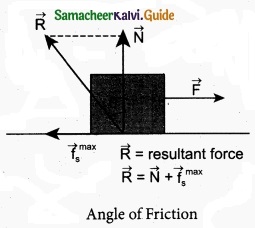
The angle of friction is defined as the angle between the normal force (N) and the resultant force (R) of normal force and maximum friction force (\(f_{s}^{\max }\))

Tamil Nadu 11th Physics Model Question Paper 5 English Medium img 9

In the figure the resultant force is R = \(\sqrt{\left(f_{s}^{\max }\right)^{2}+\mathrm{N}^{2}}\)
tan θ = \(\frac{f_{s}^{\max }}{\mathrm{N}}\) ………………….. (1)

But from the frictional relation, the object begins to slide when \(f_{s}^{\max }=\mu_{\mathrm{s}} \mathrm{N}\)
or when \(\frac{f_{s}^{\max }}{\mathrm{N}}\) = µs ………………….. (2)

From equations (1) and (2) the coefficient of static friction is
µs = tan θ ……………………. (3)
The coefficient of static friction is equal to tangent of the angle of friction.

Tamil Nadu 11th Physics Model Question Paper 5 English Medium

Question 29.
How does resolve a vector into its component? Explain?
Answer:
component of a resolve:
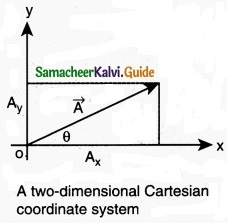
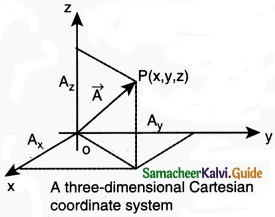
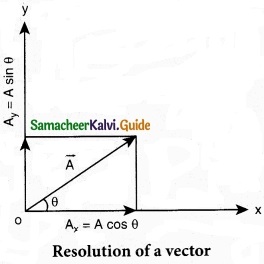
In the Cartesian coordinate system any vector \(\vec { A } \) can be resolved into three components along x, y and z directions. This is shown in figure. Consider a 3-dimensional coordinate system. With respect to this a vector can be written in component form as
\(\vec { A } \) = Ax \(\hat { i } \) + Ay\(\hat { j } \) + Az\(\hat { k } \)
Components of a vector in 2 dimensions and 3 dimensions

Tamil Nadu 11th Physics Model Question Paper 5 English Medium img 10

Tamil Nadu 11th Physics Model Question Paper 5 English Medium img 11

Here Ax is the x-component of \(\vec { A } \), Ay is the y-component of \(\vec { A } \) and Az is the z component of \(\vec { A } \).
In a 2-dimensional Cartesian coordinate system (which is shown in the figure) the vector \(\vec { A } \) is given by
\(\vec { A } \) = Ax \(\hat { i } \) + Ay \(\hat { j } \)

If \(\vec { A } \) makes an angle θ with x axis, and Ax and Ay are the components of A along x-axis and y-axis respectively, then as shown in figure,
Ax θ = A cos θ, A = A sin θ
where ‘A’ is the magnitude (length) of the vector \(\vec { A } \), A = \(\sqrt{\mathrm{A}_{x}^{2}+\mathrm{A}_{y}^{2}}\)

Tamil Nadu 11th Physics Model Question Paper 5 English Medium img 12

Question 30.
Derive an expression for energy of an orbiting satellite?
Answer:
The total energy of the satellite is the sum of its kinetic energy and the gravitational potential energy. The potential energy of the satellite is,
U = \(-\frac{\mathrm{GM}_{s} \mathrm{M}_{\mathrm{E}}}{\left(\mathrm{R}_{\mathrm{E}}+h\right)}\) ………………….. (1)

Here Ms -mass of the satellite, ME -mass of the Earth, RE – radius of the Earth.
The Kinetic energy of the satellite is
K.E = \(\frac{1}{2}\) Msv2 ………………….. (2)

Here v is the orbital speed of the satellite and is equal to
v = \(\sqrt{\frac{\mathrm{GM}_{\mathrm{E}}}{\left(\mathrm{R}_{\mathrm{E}}+h\right)}}\)

Substituting the value of v in (2) the kinetic energy of the satellite becomes,
K.E = \(\frac{1}{2} \frac{\mathrm{GM}_{\mathrm{E}} \mathrm{M}_{s}}{\left(\mathrm{R}_{\mathrm{E}}+h\right)}\)

Therefore the total energy of the satellite is
E = \(\frac{1}{2}\) \(\frac{\mathrm{GM}_{\mathrm{E}} \mathrm{M}_{s}}{\left(\mathrm{R}_{\mathrm{E}}+h\right)}-\frac{\mathrm{GM}_{s} \mathrm{M}_{\mathrm{E}}}{\left(\mathrm{R}_{\mathrm{E}}+h\right)}\)
E = \(-\frac{\mathrm{GM}_{s} \mathrm{M}_{\mathrm{E}}}{\left(\mathrm{R}_{\mathrm{E}}+h\right)}\)
The total energy implies that the satellite is bound to the Earth by means of the attractive gravitational force.

Note:
As h approaches ∞, the total energy tends to zero. Its physical meaning is that the satellite is completely free from the influence of Earth’s gravity and is not bound to Earth at large distance.

Tamil Nadu 11th Physics Model Question Paper 5 English Medium

Question 31.
Explain in detail Newton’s law of cooling?
Answer:
Newton’s law of cooling:
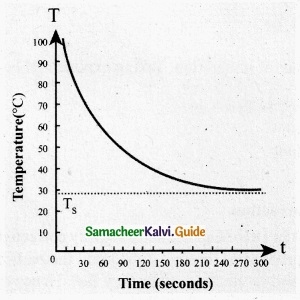
Newton’s law of cooling body is directly proportional to the difference in the temperature between that body and its surroundings.
\(\frac{dQ}{dT}\) ∝(T – Ts) …………………. (1)
The negative sign indicates that the quantity of heat lost by liquid goes on decreasing with time. Where,

Tamil Nadu 11th Physics Model Question Paper 5 English Medium img 13

T = Temperature of the object
Ts = Temperature of the surrounding

From the graph in figure it is clear that the rate of cooling is high initially and decreases with falling temperature.

Let us consider an object of mass m and specific heat capacity s at temperature T. Let Ts be the temperature of the surroundings. If the temperature falls by a small amount dT in time dt, then the amount of heat lost is,
dQ = msdT …………………….. (2)

Dividing both sides of equation (2) by dt
\(\frac{dQ}{dT}\) = \(\frac{msdT}{dt}\) ………………….. (3)

From Newton’s law of cooling
\(\frac{dQ}{dT}\) ∝(T – Ts)
\(\frac{dQ}{dT}\) = -a(T – Ts) ………………………… (4)

Where a is some positive constant.
From equation (3) and (4)
-a (T – Ts) = ms\(\frac{dT}{dt}\)
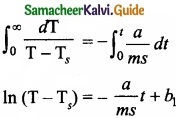
\(\frac{d \mathrm{T}}{\mathrm{T}-\mathrm{T}_{s}}\) = -a\(\frac{a}{ms}\) dt …………………… (5)

Integrating equation (5) on both sides,

Tamil Nadu 11th Physics Model Question Paper 5 English Medium img 14

Where b1 is the constant of integration. Taking exponential both sides we get,
T = Ts + \(b_{2} e^{\frac{-a}{m s} t}\) …………………….. (6)
Here b2 = eb1 Constant

Tamil Nadu 11th Physics Model Question Paper 5 English Medium

Question 32.
Explain Laplace’s correction?
Answer:
Laplace’s correction: In 1816, Laplace satisfactorily corrected this discrepancy by assuming that when the sound propagates through a medium, the particles oscillate very rapidly such that the compression and rarefaction occur very fast.

Hence the exchange of heat produced due to compression and cooling effect due to rarefaction do not take place, because, air (medium) is a bad conductor of heat. Since, temperature is no longer considered as a constant here, sound propagation is an adiabatic process. By adiabatic considerations, the gas obeys Poisson’s law (not Boyle’s law as Newton assumed), which is
PVγ = Constant …………………. (1)
where, γ = \(\frac { C_{ p } }{ C_{ v } } \) which is the ratio between specific heat at constant pressure and specific heat at constant volume. Differentiating equation (1) on both the sides, we get
\(V^{ \gamma }dP+P(\gamma ^{ V\gamma -1 }dV)=0\)

or

\(\gamma \mathrm{P}=-\mathrm{V} \frac{d p}{d \mathrm{V}}=\mathrm{B}_{\mathrm{A}}\) ………………….. (2)
where, BA is the adiabatic bulk modulus of air. Now, substituting equation (2) in equation
V = \(\sqrt{\frac{B}{\rho}}\), the speed of sound in air is
vA = \(\sqrt{\frac{\mathrm{B}_{\mathrm{A}}}{\rho}}=\sqrt{\frac{\gamma \mathrm{P}}{\rho}}=\sqrt{\gamma v_{\mathrm{T}}}\)
Since air contains mainly, nitrogen, oxygen, hydrogen etc, (diatomic gas), we take γ = 1.47. Hence, speed of sound in air is vA = (\(\sqrt{1.4}\)) (280 m s-1) = 331.30 ms-1, which is very much closer to experimental data.

Tamil Nadu 11th Physics Model Question Paper 5 English Medium

Question 33.
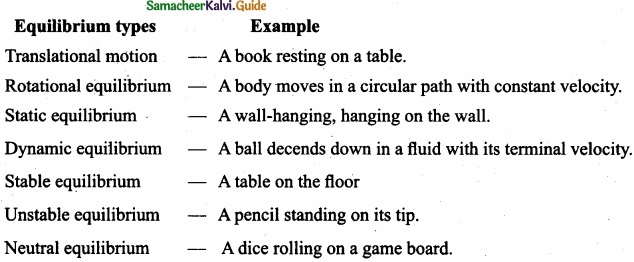
Explain types of equilibrium?
Answer:
Tamil Nadu 11th Physics Model Question Paper 5 English Medium img 15

PART – IV

Answer all the questions. [5 × 5 = 25]

Question 34 (a).
What are the applications of dimensional analysis?
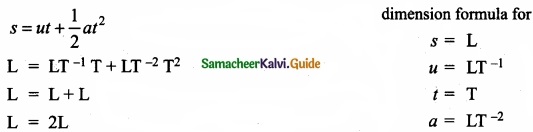
Verify s = ut + \(\frac{1}{2}\)at2 by dimensional analysis?
Answer:

Tamil Nadu 11th Physics Model Question Paper 5 English Medium img 16

Given equation is dimensionally correct as the dimensions on the both side are same. Applications of dimensional analysis

  1. Convert a physical quantity from one system of units to another.
  2. Check the dimensional correctness of a given physical equation.
  3. Establish relations among various physical quantities.

[OR]

(b) Explain the types of equilibrium with suitable examples?
Answer:
Translational motion – A book resting on a table.
Rotational equilibrium – A body moves in a circular path with constant velocity.
Static equilibrium – A wall-hanging, hanging on the wall.
Dynamic equilibrium – A ball decends down in a fluid with its terminal velocity.
Stable equilibrium – A table on the floor A pencil
Unstable equilibrium – standing on its tip.
Neutral equilibrium – A dice rolling on a game board.

Tamil Nadu 11th Physics Model Question Paper 5 English Medium

Question 35 (a)
Explain the motion of block connected by a string in vertical motion?
Answer:
When objects are connected by strings and a force F is applied either vertically or horizontally or along an inclined plane, it produces a tension T in the string, which affects the acceleration to an extent. Let us discuss various cases for the same.

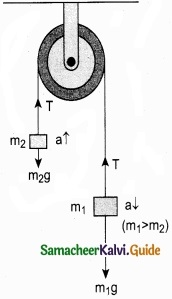
Tamil Nadu 11th Physics Model Question Paper 5 English Medium img 17

Vertical motion:
Consider two blocks of masses m1 and m2 (m1 > m2) connected by a light and inextensible string that passes over a pulley as shown in Figure 1.

Let the tension in the string be T and acceleration a.

When the system is released, both the blocks start, Two blocks connected by a string moving, m2 vertically upward and m1 downward with same acceleration a. The gravitational force m1g on mass m1 is used in lifting the mass m2.

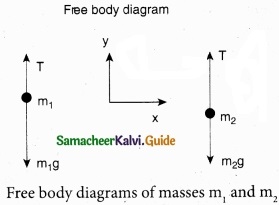
The upward direction is chosen as y direction. The free body diagrams of both masses are shown in Figure 2.

Tamil Nadu 11th Physics Model Question Paper 5 English Medium img 18

Applying Newton’s second law for mass m2
T\(\hat { j } \) – m2\(\hat { j } \)g = m2 a\(\hat { j } \)

The left hand side of the above equation is the total force that acts on m2 and the right hand side is the product of mass and acceleration of m2 in direction.

By comparing the components on both sides, we get
T -m2g = m2a ……………………. (1)

Similarly, applying Newton’s law second law of for mass m1
T\(\hat { j } \) – m1g\(\hat { j } \) = -m1a\(\hat { j } \)

As mass m1 moves downward (-\(\hat { j } \)), its accleration is along (-\(\hat { j } \))
By comparing the components on both sides, we get
T – m1g = -m1a
m1g – T = m1a …………………….. (2)

Adding equations (1) and (2), we get
m1g – m2g = m1a + m2a
(m1g – m2)g = (m1 + m2)a …………………….. (3)

From equation (3), the acceleration of both the masses is
a = \(\left(\frac{m_{1}-m_{2}}{m_{1}+m_{2}}\right)\)g ……………………… (4)

If both the masses are equal (m1 = m2), from equation (4)
a = 0

This shows that if the masses are equal, there is no acceleration and the system as a whole will be at rest. To find the tension acting on the string, substitute the acceleration from the equation (4)
T – m2g = m2 \(\left(\frac{m_{1}-m_{2}}{m_{1}+m_{2}}\right)\)g
T = m2g + m2\(\left(\frac{m_{1}-m_{2}}{m_{1}+m_{2}}\right)\)g ……………………… (5)
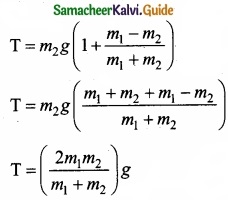
By taking m2g common in the RHS of equation (5)

Tamil Nadu 11th Physics Model Question Paper 5 English Medium img 19

Equation (4) gives only magnitude of accleration.

For mass m1 g the accleration vector is given by \(\vec{a}=-\left(\frac{m_{1}-m_{2}}{m_{1}+m_{2}}\right) g \hat{j}\)
For mass m2 g the accleration vector is given by \(\vec{a}=-\left(\frac{m_{1}-m_{2}}{m_{1}+m_{2}}\right) g \hat{j}\)

[OR]

(b) Derive the kinematic equation of motion for constant acceleration?
Answer:
Consider an object moving in a straight line with uniform or constant acceleration ‘a’. Let u be the velocity of the object at time t = 0, and v be velocity of the body at a later time t.

Velocity – time relation:

(I) The acceleration of the body at any instant is given by the first derivative of the velocity with respect to time,
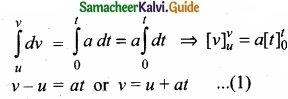
a = \(\frac{dv}{dt}\) or dv = a dt
Integrating both sides with the condition that as time changes from 0 to t, the velocity changes from u to v. For the constant acceleration,

Tamil Nadu 11th Physics Model Question Paper 5 English Medium img 20

Displacement – time relation:

(II) The velocity of the body is given by the first derivative of the displacement with respect to time.
v = \(\frac{ds}{dt}\) or ds = vdt
and since v = u + at,
We get ds = (u + at)dt
Assume that initially at time t = 0, the particle started from the origin. At a later time t, the particle displacement is s. Further assuming that acceleration is time-independent, we have
\(\int_{0}^{s} d s=\int_{0}^{t} u d t+\int_{0}^{t} a t d t \text { or } s=u t+\frac{1}{2} a t^{2}\) ……………………. (2)
Velocity – displacement relation

(III) The acceleration is given by the first derivative of velocity with respect to time.
a = \(\frac{dv}{dt}\) = \(\frac{dv}{ds}\) \(\frac{ds}{dt}\) = \(\frac{dv}{ds}\) v [since ds/dt = v] where s is displacement traversed.
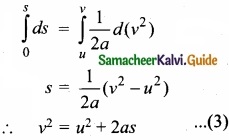
This is rewritten as a = \(\frac{1}{2}\) \(\frac { dv^{ 2 } }{ s } \) or ds = \(\frac{1}{2a}\) d(v2)
Integrating the above equation, using the fact when the velocity changes from u2 to v2, displacement changes from u2 to v2, we get

Tamil Nadu 11th Physics Model Question Paper 5 English Medium img 21

We can also derive the displacement s in terms of initial velocity u and final velocity v.
From equation we can write,
at = v – u
Substitute this in equation, we get
s = ut + \(\frac{1}{2}\) (v -u)t
s = \(\frac{(u+v)t}{2}\)

Tamil Nadu 11th Physics Model Question Paper 5 English Medium

Question 36 (a).
State and prove perpendicular axis theorem?
Answer:
Perpendicular axis theorem: This perpendicular axis theorem holds good only for plane laminar objects.

The theorem states that the moment of inertia of a plane laminar body about an axis perpendicular to its plane is equal to the sum of moments of inertia about two perpendicular axes lying in the plane of the body such that all the three axes are mutually perpendicular and have a common point.

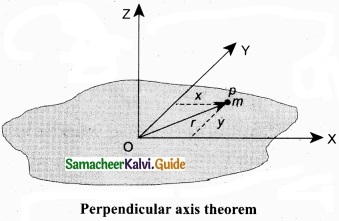
Let the X and Y-axes lie in the plane and Z-axis perpendicular to the plane of the laminar object. If the moments of inertia of the body about X and Y-axes are Ix and IY respectively and Iz is the moment of inertia about Z-axis, then the perpendicular axis theorem could be expressed as,
Iz = Ix + Iy

To prove this theorem, let us consider a plane laminar object of negligible thickness on which lies the origin (O). The X and Y-axes lie on the plane and Z-axis is perpendicular to it as shown in figure. The lamina is considered to be made up of a large number of particles of mass m. Let us choose one such particle at a point P which has coordinates (x, y) at a distance r from O.

Tamil Nadu 11th Physics Model Question Paper 5 English Medium img 22

The moment of inertia of the particle about Z-axis is, mr2.
The summation of the above expression gives the moment of inertia of the entire lamina about Z-axis as,
Iz = Σ mr2
Here, r2 = x2 + y2
Then, Iz = Σm(x2 + y2)
Iz = Σmx2 + Σmy2
In the above expression, the term Σmx2 is the moment of inertia of the body about the Y-axis and similarly the term Σmy2 is the moment of inertia about X-axis. Thus,
IX = Σmy2 and IY = Σmx2
Substituting in the equation for IZ gives, IZ = IX + IY
Thus, the perpendicular axis theorem is proved.

[OR]

(b) Explain in detail the triangle law of addition?
Answer:
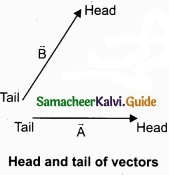
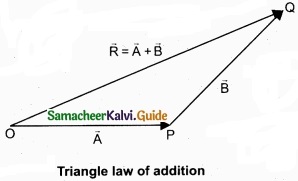
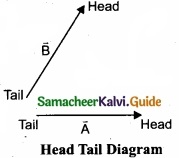
Let us consider two vectors \(\vec { A } \) and \(\vec { B } \) as shown in figure.

Tamil Nadu 11th Physics Model Question Paper 5 English Medium img 23

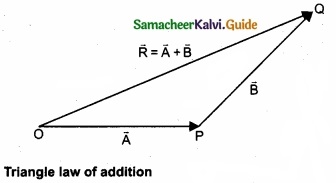
To find the resultant of the two vectors we apply the triangular law of addition as follows:

Represent the vectors \(\vec { A } \) and \(\vec { B } \) by the two adjacent sides of a triangle taken in the same order. Then the resultant is given by the third side of the triangle as shown in figure.

Tamil Nadu 11th Physics Model Question Paper 5 English Medium img 24

To explain further, the head of the first vector \(\vec { A } \) is connected to the tail of the second vector \(\vec { B } \). Let θ be the angle between A and B. Then R is the resultant vector connecting the tail of the first vector \(\vec { A } \) to the head of the second vector \(\vec { B } \).

The magnitude of \(\vec { R } \) (resultant) is given geometrically by the length of \(\vec { R } \)(OQ) and the direction of the resultant vector is the angle between \(\vec { R } \) and \(\vec { A } \). Thus we write \(\vec { R } \) = \(\vec { A } \) + \(\vec { B } \).
\(\overline { OQ } \) = \(\overline { OP } \) + \(\overline { PQ } \)

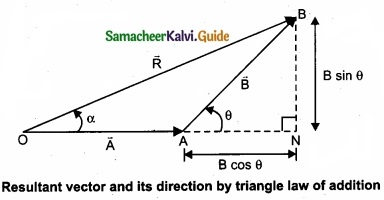
1. Magnitude of resultant vector:
The magnitude and angle of the resultant vector are determined by using triangle law of vectors as follows.

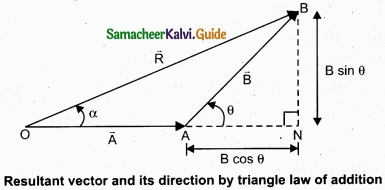
From figure, consider the triangle ABN, which is obtained by extending the side OA to ON. ABN is a right angled triangle.

Tamil Nadu 11th Physics Model Question Paper 5 English Medium img 25

From figure, let R is the magnitude of the resultant of \(\vec { A } \) and \(\vec { B } \).

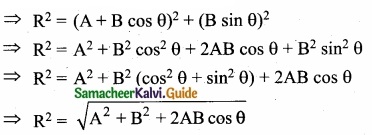
For ∆OBN, we have OB2 = ON2 + BN2
⇒ R2 = (A + B cos θ)2 + (B sin θ)2
⇒ R2 = A2 + B2 cos2 θ + 2AB cos θ + B2sin2 θ
⇒ R2 = A2 + B2(cos2 θ + sin2 θ) + 2AB cos θ
⇒R2 = \(\sqrt{A^{2}+B^{2}+2 A B \cos \theta}\)

2. Direction of resultant vectors:
If θ is the angle between \(\vec { A } \) and \(\vec { B } \), then
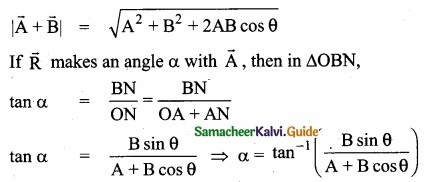
|\(\vec { A } \) + \(\vec { B } \)| = \(\sqrt{A^{2}+B^{2}+2 A B \cos \theta}\)
If \(\vec { R } \) makes an angle α with \(\vec { A } \), then in ∆OBN,
tan α = \(\frac{BN}{ON}\) = \(\frac{BN}{OA+AN}\)
tan α = \(\frac{B \sin \theta}{A+B \cos \theta}\) ⇒ α = tan-1\(\left(\frac{B \sin \theta}{A+B \cos \theta}\right)\)

Tamil Nadu 11th Physics Model Question Paper 5 English Medium

Question 37 (a).
Explain in detail the various types of errors?
Answer:
The uncertainty in a measurement is called an error. Random error, systematic error and gross error are the three possible errors.

(I) Systematic errors:
Systematic errors are reproducible inaccuracies that are consistently in the same direction. These occur often due to a problem that persists throughout the .experiment. Systematic errors can be classified as follows.

(1) Instrumental errors:
When an instrument is not calibrated properly at the time of manufacture, instrumental errors may arise. If a measurement is made with a meter scale whose end is worn out, the result obtained will have errors. These errors can be corrected by choosing the instrument carefully.

(2) Imperfections in experimental technique or procedure:
These errors arise due to the limitations in the experimental arrangement. As an example, while performing experiments with a calorimeter, if there is no proper insulation, there will be radiation losses. This results in errors and to overcome these, necessary correction has to be applied

(3) Personal errors:
These errors are due to individuals performing the experiment, may be due to incorrect initial setting up of the experiment or carelessness of the individual making the observation due to improper precautions.

(4) Errors due to external causes:
The change in the external conditions during an experiment can cause error in measurement. For example, changes in temperature, humidity, or pressure during measurements may affect the result of the measurement.

(5) Least count error:
Least count is the smallest value that can be measured by the measuring instrument, and the error due to this measurement is least count error. The instrument’s resolution hence is the cause of this error. Least count error can be reduced by using a high precision instrument for the measurement.

(II) Random errors:
Random errors may arise due to random and unpredictable variations in experimental conditions like pressure, temperature, voltage supply etc. Errors may also be due to personal errors by the observer who performs the experiment. Random errors are sometimes called “chance error”.

When different readings are obtained by a person every time he repeats the experiment, personal error occurs. For example, consider the case of the thickness of a wire measured using a screw gauge. The readings taken may be different for different trials. In this case, a large number of measurements are made and then the arithmetic mean is taken.
If n number of trial readings are taken in an experiment, and the readings are
a1, a2, a3, ……………………….. an. The arithmetic mean is

Tamil Nadu 11th Physics Model Question Paper 5 English Medium img 26

[OR]

(b) To move an object, which one is easier, push or pull? Explain?
Answer:
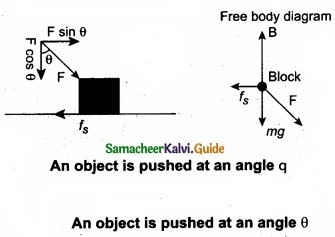
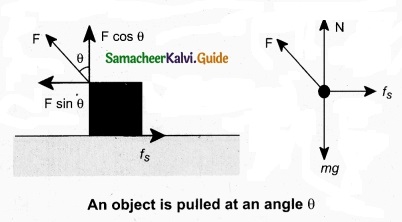
When a body is pushed at an arbitrary angle θ (0 to \(\frac{π}{2}\)), the applied force F can be resolved into two components as F sin θ parallel to the surface and F cos θ perpendicular to the surface as shown in figure. The total downward force acting on the body is mg + F cos θ. It implies that the normal force acting on the body increases. Since there is no acceleration along the vertical direction the normal force N is equal to
Npush = mg + F cos θ …………………. (1)
As a result the maximal static friction also increases and is equal to
\(f_{s}^{\max }=\mu_{r} N_{\text {push }}=\mu_{s}(m g+F \cos \theta)\) …………………. (2)
Equation (2) shows that a greater force needs to be applied to push the object into motion.

Tamil Nadu 11th Physics Model Question Paper 5 English Medium img 27

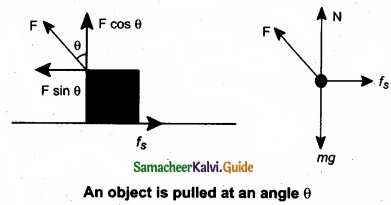
When an object is pulled at an angle 0, the applied force is resolved into two components as shown in figure. The total downward force acting on the object is
Npull = mg – F cos θ …………………….. (3)

Tamil Nadu 11th Physics Model Question Paper 5 English Medium img 28

Tamil Nadu 11th Physics Model Question Paper 5 English Medium

Question 38 (a).
Describe the method of measuring angle of repose?
Answer:
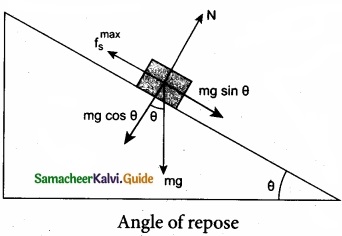
Angle of Repose Consider an inclined plane on which an object is placed, as shown in figure. Let the angle which this plane makes with the horizontal be θ. For small angles of θ, the object may not slide down. As θ is increased, for a particular value of θ, the object begins to slide down. This value is called angle of repose. Hence, the angle of repose is the angle of inclined plane with the horizontal such that an object placed on it begins to slide.

Tamil Nadu 11th Physics Model Question Paper 5 English Medium img 29

Let us consider the various forces in action here. The gravitational force mg is resolved into components parallel (mg sin θ) and perpendicular (mg cos θ) to the inclined plane. The component of force parallel to the inclined plane (mg sin θ) tries to move the object down. The component of force perpendicular to the inclined plane (mg cos θ) is balanced by the Normal force (N).
N = mg cos θ ……………… (1)

When the object just begins to move, the static friction attains its maximum value
fs = \(f_{s}^{\max }\)

This friction also satisfies the relation
\(f_{s}^{\max }\) = µs = mg sin θ …………………… (2)

Equating the right hand side of equations (1) and (2),
\(\left(f_{s}^{\max }\right) / \mathrm{N}=\sin \theta / \cos \theta\)

From the definition of angle of friction, we also know that
tan θ = µs ……………………… (3) in which θ is the angle of friction.

Thus the angle of repose is the same as angle of friction. But the difference is that the angle of repose refers to inclined surfaces and the angle of friction is applicable to any type of surface.

[OR]

(b) A block of mass m slides down the plane inclined at an angle 60° with an acceleration g/2. Find the co-efficient of kinetic friction?
Answer:
Kinetic friction comes to play as the block is moving on the surface.
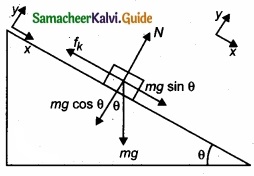
The forces acting on the mass are the normal force perpendicular to surface, downward gravitational force and kinetic friction along the surface.
Along the x-direction

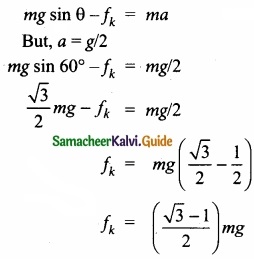
Tamil Nadu 11th Physics Model Question Paper 5 English Medium img 30

Tamil Nadu 11th Physics Model Question Paper 5 English Medium img 30a
There is no motion along the y-direction as normal force is exactly balanced by the mg cos θ.
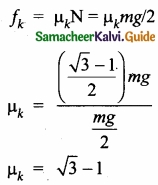
mg cos θ = N = mg/2

Tamil Nadu 11th Physics Model Question Paper 5 English Medium img 31

[OR]

(c) Write a note on triangulation method and radar method to measure larger distances?
Answer:
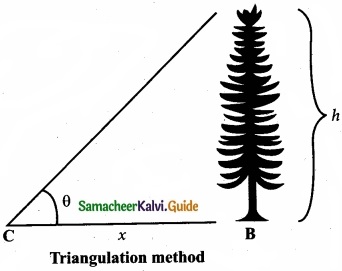
Triangulation method for the height of an accessible object:
Let AB = h be the height of the tree or tower to 6e measured. Let C be the point of observation at distance x from B. Place a range finder at C and measure the angle of elevation, ACB = θ as shown in figure.

From right angled triangle ABC,
tan θ = \(\frac{AB}{BC}\) = \(\frac{h}{x}\)
(or) height h = x tan θ
Knowing the distance x. the height h can be detennined.

Tamil Nadu 11th Physics Model Question Paper 5 English Medium img 32

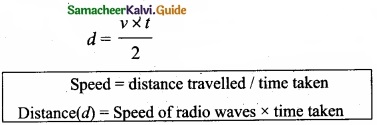
RADAR method:
The word RADAR stands for radio detection and ranging. A radar can be used to measure accurately the distance of a nearby planet such as Mars. In this method, radio waves are sent from transmitters which, after reflection from the planet, are detected by the receiver.

By measuring, the time interval (t) between the instants the radio waves are sent and received, the distance of the planet can be determined as where v is the speed of the radio wave. As the time taken (t) is for the distance covered during the forward and backward path of the radio waves, it is divided by 2 to get the actual distance of the object. This method can also be used to determine the height, at which an aeroplane flies from the ground.

Tamil Nadu 11th Physics Model Question Paper 5 English Medium img 33

[OR]

(d) Jupiter is at a distance of 824.7 million km from the earth. Its angular diameter is measured to be 35.75”. Calculate the diameter of jupiter?
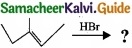
Answer:
Given,
Distance of Jupiter = 824.7 × 10⁶ km = 8.247 × 10¹¹ m
angular diameter = 35.72 × 4.85 × 10-6 rad = 173.242 × 10⁻⁶ rad
= 1.73 × 10⁻⁴rad
∴ Diameter of Jupiter D = θ × d = 1.73 × 10-4 rad × 8.247 × 1011 m
14.267 × 10⁷ m = 1.427 × 10⁸ m (or) 1.427 × 10⁵ km

Tamil Nadu 11th Physics Model Question Paper 4 English Medium

Students can Download Tamil Nadu 11th Physics Model Question Paper 4 English Medium Pdf, Tamil Nadu 11th Physics Model Question Papers helps you to revise the complete Tamilnadu State Board New Syllabus, helps students complete homework assignments and to score high marks in board exams.

TN State Board 11th Physics Model Question Paper 4 English Medium

General Instructions:

  1. The question paper comprises of four parts.
  2. You are to attempt all the parts. An internal choice of questions is provided wherever applicable.
  3. All questions of Part I, II, III and IV are to be attempted separately.
  4. Question numbers 1 to 15 in Part I are Multiple Choice Questions of one mark each.
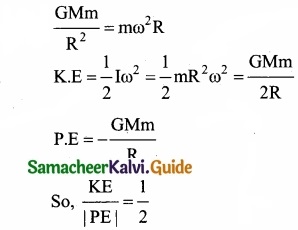
    These are to be answered by choosing the most suitable answer from the given four alternatives and writing the option code and the corresponding answer
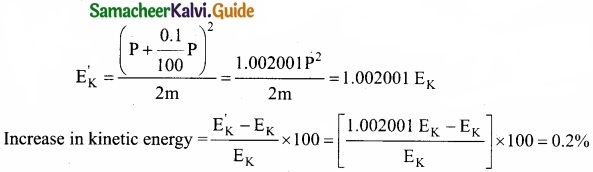
  5. Question numbers 16 to 24 in Part II are two-mark questions. These are to be answered in about one or two sentences.
  6. Question numbers 25 to 33 in Part III are three-mark questions. These are to be answered in about three to five short sentences.
  7. Question numbers 34 to 38 in Part IV are five-mark questions. These are to be answered in detail Draw diagrams wherever necessary.

Time: 3 Hours
Maximum Marks: 70

PART – 1

Answer all the questions: [15 × 1 = 15]

Question 1.
In some region, the gravitational field is zero. The gravitational potential in this region is …………………….
(a) A variable
(b) A constant
(c) Zero
(d) Can’t be zero
Answer:
(b) A constant

Tamil Nadu 11th Physics Model Question Paper 4 English Medium

Question 2.
The angle between two vectors 2\(\hat { i } \) + 3\(\hat { j } \) + \(\hat { k } \) and -3\(\hat { j } \) + 6k is …………………..
(a) 0°
(b) 30°
(c) 60°
(d) 90°
Hint:
The angle between the two vector is 90°.
[cos θ = \(\frac{\overrightarrow{\mathrm{A}} \cdot \overrightarrow{\mathrm{B}}}{\mathrm{AB}}\)]
Answer:
(d) 90°

Question 3.
A stretched rubber has
(a) Increased kinetic energy
(b) Increased potential energy
(c) Decreased kinetic energy
(d) The axis of rotation
Answer:
(b) Increased potential energy

Tamil Nadu 11th Physics Model Question Paper 4 English Medium

Question 4.
The direction of the angular velocity vector is along ……………………..
(a) The tangent to the circular path
(b) The inward radius
(c) The outward radius
(d) The axis of rotation
Answer:
(d) The axis of rotation

Question 5.
For a satellite moving in an orbit around the earth, the ratio of kinetic energy to potential energy is …………………….
(a) \(\frac{1}{2}\)
(b) \(\frac { 1 }{ \sqrt { 2 } } \)
(c) 2
(d) \(\sqrt{2}\)
Hint:

Tamil Nadu 11th Physics Model Question Paper 4 English Medium img 1

Answer:
(a) \(\frac{1}{2}\)

Tamil Nadu 11th Physics Model Question Paper 4 English Medium

Question 6.
If the linear momentum of the object is increased by 0.1 %, then the kinetic energy is increased by ………………………..
(a) 0.1%
(b) 0.2%
(c) 0.4%
(d) 0.01%
Hint:
The relation b/w linear momentum and kinetic energy
P = \(\sqrt{2 \mathrm{mE}_{\mathrm{K}}} \Rightarrow \mathrm{E}_{\mathrm{K}}=\frac{\mathrm{P}^{2}}{2 \mathrm{m}}\)
If L is increased by 0.1% 1′ = P + \(\frac{0.1}{100}\)P

Tamil Nadu 11th Physics Model Question Paper 4 English Medium img 2

Answer:
(c) 0.4%

Question 7.
A block of mass 4 kg is suspended through two light spring balances A and B. Then A and B will read respectively ………………………
(a) 4 kg and 0 kg
(b) 0 kg and 4 kg
(c) 4 kg and 4 kg
(d) 2kg and 2 kg
Hint:
Tension is uniformly transmitted if the springs are massless.
Answer:
(c) 4 kg and 4 kg

Tamil Nadu 11th Physics Model Question Paper 4 English Medium

Question 8.
At the same temperature, the mean kinetic energies of molecules of hydrogen and oxygen are in the ratio of ………………………
(a) 1 : 1
(b) 1 : 16
(c) 8 : 1
(d) 16 : 1
Hint:
Average kinetic energy of a molecule is proportional to the absolute temperature.
Answer:
(a) 1 : 1

Question 9.
A uniform rope having mass m hangs vertically from a rigid support. A transverse wave pulse is produced at the lower end. Which of the following plots shows the correct variation of speed v with height h from the lower end?
(a) Tamil Nadu 11th Physics Model Question Paper 4 English Medium img 3
(b) Tamil Nadu 11th Physics Model Question Paper 4 English Medium img 4
(c) Tamil Nadu 11th Physics Model Question Paper 4 English Medium img 5
(d) Tamil Nadu 11th Physics Model Question Paper 4 English Medium img 6
Answer:

(d)Tamil Nadu 11th Physics Model Question Paper 4 English Medium img 6

Question 10.
In a simple hormonic oscillation, the acceleration against displacement for one complete oscillation will be ………………………
(a) An ellipse
(b) A circle
(c) A parabola
(d) A straight line
Answer:
(d) A straight line

Tamil Nadu 11th Physics Model Question Paper 4 English Medium

Question 11.
A shell is fired from a canon with velocity v m/s at an angle 0 with the horizontal direction. At the highest point in the path it explodes into two pieces of equal mass. One of the pieces retraces it path of the cannon and the speed in m/s of the other piece immediately after the. explosion is ………………………..
(a) 3v cos θ
(b) 2v cos θ
(c) \(\frac{3}{2}\)v cos θ
(d) \(\frac { \sqrt { 3 } }{ 2 } \) cos θ
Hint:
Velocity at the highest point = horizontal component of velocity = V cos θ
Momentum of shell before explosion = mv cos θ
Momentum of two pieces after explosion = \(\frac{m}{2}\) (- V cos θ) + \(\frac{m}{2}\) v
Law of conservation of momentum mv cos θ = –\(\frac{mv}{2}\)cos θ + \(\frac{m}{2}\) v
∴ V = 3V cos θ
Answer:
(a) 3v cos θ

Question 12.
In which process, the p – v indicator diagram is a straight line parallel to volume axis?
(a) Isothermal
(b) Adiabatic
(c) Isobaric
(d) Irreversible
Answer:
(c) Isobaric

Tamil Nadu 11th Physics Model Question Paper 4 English Medium

Question 13.
For a liquid to rise in capillary tube, the angle of contact should be ………………………….
(a) Acute
(b) Obtuse
(c) Right
(d) None of these
Answer:
(a) Acute

Question 14.
The increase in internal energy of a system is equal to the work done on the system which process does the system undergo?
(a) Isochoric
(b) Adiabatic
(c) Isobaric
(d) Isothermal
Answer:
(b) Adiabatic

Tamil Nadu 11th Physics Model Question Paper 4 English Medium

Question 15.
The change in frequency due to Doppler effect does not depend on …………………………
(a) The speed of the source
(b) The speed of the observer
(c) The frequency of the source
(d) Separation between the source and the observer
Answer:
(d) Separation between the source and the observer

PART – II

Answer any six questions in which Q. No 23 is compulsory. [6 × 2 = 12]

Question 16.
What are the advantages of SI system?
Answer:

  1. This system makes use of only one unit for one physical quantity, which means a rational system of units
  2. In this system, all the derived units can be easily obtained from basic and supplementary units, which means it is a coherent system of units.
  3. It is a metric system which means that multiples and submultiples can be expressed as powers of 10.

Tamil Nadu 11th Physics Model Question Paper 4 English Medium

Question 17.
Using the principle of homogunity of dimensions, check dimensionally the given equations are correct,
(a) \(\mathbf{T}^{2}=\frac{4 \pi^{2} r^{3}}{\mathbf{G}}\)
(b) \(T^{2}=\frac{4 \pi^{2} r^{3}}{G M}\)?
Answer:
Here G-gravitational constant
r – radius of orbit M – mass
Dimensional formula for T = T
Dimensional formula for r = L
Dimensional formula for G = M-1L3T-2
Dimensional formula for M = M
(a) T2 M° L° = [L3] [M L-3T-2]
T2 M° L° = L° MT2 – Not correct

(b) T2 = [L3][ML-3T2][M-1]
T2 = T2 – Dimensionally correct

Question 18.
Find out the workdone required to extract water from the well of depth 20 m. Weight of water and backet is 2.8 kg wt?
Answer:
Workdone, W = mgh
W = (Weight) × depth
= 2.8 × 20
W = 56 J

Tamil Nadu 11th Physics Model Question Paper 4 English Medium

Question 19.
Is a single isolated force possible in nature?
Answer:
No. According to Newton’s third law, for every action, there is an equal and opposite reaction. So, whatever case we consider, if there is an action there is always a reaction. So it is impossible.

Question 20.
State the factors on which the moment of inertia of a body depends?
Answer:

  1. Mass of body
  2. Size and shape of body
  3. Mass distribution w.r.t. axis of rotation
  4. Position and orientation of rotational axis

Question 21.
If a drop of water falls on a very hot iron, it takes long time to evaporate. Explain why?
Answer:
When a drop of water falls on a very hot iron it gets insulated from the hot iron due to a thin layer of water vapour which is a bad conductor of heat. It takes quite long to evaporate as heat is conducted from hot iron to the drop through the insulating layer of water vapour very slowly.

Tamil Nadu 11th Physics Model Question Paper 4 English Medium

Question 22.
What is meant by gravitational field. Give its unit?
Answer:
The gravitational field intensity \(\vec { E } \)1, at a point is defined as the gravitational force experienced by unit mass at that point. It’s unit N kg-1.

Question 23.
Why dimensional methods are applicable only up to three quantities?
Answer:
Understanding dimensions is of utmost importance as it helps us in studying the nature of physical quantities mathematically. The basic concept of dimensions is that we can add or subtract only those quantities which have same dimensions. Also, two physical quantities are equal if they have same dimensions, these basic ideas help us in deriving the new relation between physical quantities, it is just like units.

Tamil Nadu 11th Physics Model Question Paper 4 English Medium

Question 24.
Why does a porter bend forward while carrying a sack of rice on his back?
Answer:
When a porter carries a sack of rice, the line of action of his centre of gravity will go away from the body. It affects the balance, to avoid this he bends. By which centre of gravity will realign within the body again. So balance is maintained.

PART – III

Answer any six questions in which Q.No. 29 is compulsory. [6 × 3 = 18]

Question 25.
Explain variation of ‘g’ with latitude?
Answer:
When an object is on the surface for the Earth, it experiences a centrifugal force that depends on the latitude of the object on Earth. If the Earth were not spinning, the force on the object would have been mg. However, the object experiences an additional centrifugal force due to spinning of the Earth.
OPz, cos λ = \(\frac{PZ}{OP}\) = \(\frac{R’}{R}\)
R’ = R cos λ

Tamil Nadu 11th Physics Model Question Paper 4 English Medium img 7

where λ is is the latitude. The component of centrifugal acceleration experienced by the object in the direction opposite to g is
aPQ = ω2R cos λ = ω2R cos2 λ
Since R’ = R cos λ
Therefore, g’ = g – ω’2R cos2λ
From the above expression, we can infer that at equator, λ = 0, g’ = g – ω2R. The acceleration due to gravity is minimum. At poles λ = 90; g1 = g. it is maximum. At the equator, g’ is minimum.

Tamil Nadu 11th Physics Model Question Paper 4 English Medium

Question 26.
Cap you associate a vector with
(a) the length of a wire bent into a loop
(b) a plane area
(c) a sphere.
Answer:
(a) We cannot associate a vector with the length of a wire bent into a loop, this is cause the length of the loop does not have a definite direction.

(b) We can associate a vector with a plane area. Such a vector is called area vector and its direction is represented by a normal drawn outward to the area.

(c) The area of a sphere does not point in any difinite direction. However, we can associate a null vector with the area of the sphere. We cannot associate a vector with the volume of a sphere.

Tamil Nadu 11th Physics Model Question Paper 4 English Medium

Question 27.
What is mean by inertia? Explain its types with example?
Answer:
The inability of objects to move on its own or change its state of motion is called inertia.
Inertia means resistance to change its state. There are three types of inertia:

1. Inertia of rest: The inability of an object to change its state of rest is called inertia of rest.
Example:

  • When a stationary bus starts to move, the passengers experience a sudden backward push.
  • A book lying on the table will remain at rest until it is moved by some external agencies.

2. Inertia of motion: The inability of an object to change its state of uniform speed (constant speed) on its own is called inertia of motion.
Example:

  • When the bus is in motion, and if the brake is applied suddenly, passengers move forward and hit against the front seat.
  • An athlete running in a race will continue to run even after reaching the finishing point.

3. Inertia of direction: The inability of an object to change its direction of motion on its own is called inertia of direction.
Example:

  • When a stone attached to a string is in whirling motion, and if the string is cut suddenly, the stone will not continue to move in circular motion but moves tangential to the circle.
  • When a bus moving along a straight line takes a turn to the right. The passengers are thrown towards left.

Tamil Nadu 11th Physics Model Question Paper 4 English Medium

Question 28.
A light body and body with greater mass both are having equal kinetic energy. Among these two which one will have greater linear momentum?
Answer:
Given Data:
E1 – E2

Tamil Nadu 11th Physics Model Question Paper 4 English Medium img 8

then P2 > P1
i.e; a heavier body has greater linear momemtum.

Question 29.
Three particles of masses m1 = 1 kg, m2 = 2 kg and m3 = 3 kg are placed at the corners of an equilateral triangle of side lm as shown in Figure. Find the position of center of mass?
Answer:
The center of mass of an equilateral triangle lies at its geometrical center G.
The positions of the mass m1, m2 and m3 are at positions A, B and C as shown in the Figure. From the given position of the masses, the coordinates of the masses m1 and m2 are easily marked as (0,0) and (1,0) respectively.

To find the position of m3 the Pythagoras theorem is applied. As the ∆DBC is a right angle triangle,
BC2 = CD2 + DB2
CD2 = BC2 – DB2
CD2 = 12 – (\(\frac{1}{2}\))2 = 1 – (\(\frac{1}{4}\)) = \(\frac{3}{4}\)
CD = \(\frac { \sqrt { 3 } }{ 2 } \)

Tamil Nadu 11th Physics Model Question Paper 4 English Medium img 9

The position of mass m3 is or (0.5, 0.5\(\sqrt{3}\))
X coordìnate of center of mass,
yCM = \(\frac{m_{1} y_{1}+m_{2} y_{2}+m_{3} y_{3}}{m_{1}+m_{2}+m_{3}}\)
yCM = \(\frac { \sqrt { 3 } }{ 4 } \) m
∴ The coordinates of center of mass G (xCM, yCM) is (\(\frac{7}{12}\), \(\frac { \sqrt { 3 } }{ 4 } \))

Tamil Nadu 11th Physics Model Question Paper 4 English Medium

Question 30.
Define precision and accuracy. Explain with one example?
Answer:
The accuracy of a measurement is a measure of how close the measured value is to the true value of the quantity. Precision of a measurement is a closeness of two or more measured values to each other.

The true value of a certain length is near 5.678 cm. In one experiment, using a measuring instrument of resolution 0.1 cm, the measured value is found to be 5.5 cm. In another experiment using a measuring instrument of greater resolution, say 0.01 cm, the length is found to be 5.38 cm. We find that the first measurement is more accurate as it is closer to the true value, but it has lesser precision. On the contrary, the second measurement is less accurate, but it is more precise.

Question 31.
Derive an expression for total acceleration in the non uniform circular motion?
Answer:
If the speed of the object in circular motion is not constant, then we have non-uniform circular motion. For example, when the bob attached to a string moves in vertical circle, the speed of the bob is not the same at all time. Whenever the speed is not same in circular motion, the particle will have both centripetal and tangential acceleration as shown in the figure.

Tamil Nadu 11th Physics Model Question Paper 4 English Medium img 10

The resultant acceleration is obtained by vector sum of centripetal and tangential acceleration. Since centripetal acceleration is \(\frac { v^{ 2 } }{ r } \), the magnitude of this resultant acceleration is given by
aR = \(\sqrt{a_{t}^{2}+\left(\frac{v^{2}}{r}\right)^{2}}\)

This resultant acceleration makes an angle θ with the radius vector as shown in figure.
This angle is given by tan θ = \(\frac{a_{t}}{\left(v^{2} / r\right)}\)

Tamil Nadu 11th Physics Model Question Paper 4 English Medium

Question 32.
Calculate the value of adiabatic exponent for monoatomic molecule?
Answer:
Monoatomic molecule:
Average kinetic energy of a molecule = [\(\frac{3}{2}\)kT]
Total energy of a mole of gas = \(\frac{3}{2}\) kT × NA = \(\frac{3}{2}\)RT
For one mole, the molar specific heat at constant volume

Tamil Nadu 11th Physics Model Question Paper 4 English Medium img 11

Question 33.
At what temperature will the rms speed of oxygen molecules become just sufficient for escaping from the Earth’s surface, (mass of oxygen molecule : 2.76 × 10⁻²⁶kg Boltzmann’s constant (kB) = 1.38 × 10⁻²³ J mol-1 k-1
Answer:

Tamil Nadu 11th Physics Model Question Paper 4 English Medium img 12

PART – IV

Answer all the questions. [5 × 5 = 25]

Question 34 (a).
State kegler’s laws of planetary motion?
Answer:
1. Law of Orbits:
Each planet moves around the Sun in an elliptical orbit with the Sun at one of the foci.

2. Law of area:
The radial vector (line joining the Sun to a planet) sweeps equal areas in equal intervals of time.

3. Law of period:
The square of the time period of revolution of a planet around the Sun in its elliptical orbit is directly proportional to the cube of the semi-major axis of the ellipse.
T2 ∝ a3
\(\frac { T^{ 2 } }{ a^{ 3 } } \) = Constant

(b) The distance of planet Jupiter from the sun is 5.2 times that of the earth. Find the period of resolution of Jupiter around the sun?
Answer:
Here r1 = 5.2 re; TJ = ?; Te = 1 year

Tamil Nadu 11th Physics Model Question Paper 4 English Medium img 13
= 11.86 years

[OR]

(c) Explain the propagation of errors in multiplication?
Answer:
Error in the product of two quantities:
Let ∆A and ∆B be the absolute errors in the two quantities A, and B, respectively. Consider the product Z = AB,
The error AZ in Z is given by Z ± AZ = (A ± ∆A) (B ± ∆B)
= (AB) ± (A ∆ B) ± (B ∆ A) ± (∆A • ∆B)
Dividing L.H.S by Z and R.H.S by AB, we get,
1 ± \(\frac{∆Z}{Z}\) = 1 ± \(\frac{∆B}{B}\) ± \(\frac{∆A}{A}\) ± \(\frac{∆A}{A}\). \(\frac{∆B}{B}\)
As ∆A/A, ∆B/B are both small quantities, their product term \(\frac{∆A}{A}\).\(\frac{∆B}{B}\) can be neglected.
The maximum fractional error in Z is
\(\frac{∆Z}{Z}\) = ± (\(\frac{∆A}{A}\) + \(\frac{∆B}{B}\))

(d) The period of oscillation of a simple pendulum in the experiment is recorded as 2.63 s, 2.56 s, 2.42s, 271s and 2.80s respectively. Calculate the average absolute error?
Answer:
Mean absolute error = \(\frac{\Sigma\left|\Delta \mathrm{T}_{i}\right|}{n}\)
∆Tm = \(\frac{0.01+0.06+0.20+0.09+0.18}{5}\)
∆Tin = \(\frac{0.54}{5}\) = 0.108s = 0.1 1s (Rounded of 2nd decimal place).

Tamil Nadu 11th Physics Model Question Paper 4 English Medium

Question 35 (a).
Explain in detail the triangle law of vector addition?
Answer:
Let us consider two vectors \(\vec { A } \) and \(\vec { B } \) as shown in figure.

To find the resultant of the two vectors we apply the triangular law of addition as follows:

Represent the vectors \(\vec { A } \) and \(\vec { B } \) by the two adjacent sides of a triangle taken in the same order. Then the resultant is given by the third side of the triangle as shown in figure.

Tamil Nadu 11th Physics Model Question Paper 4 English Medium img 14

Tamil Nadu 11th Physics Model Question Paper 4 English Medium img 15

To explain further, the head of the first vector \(\vec { A } \) is connected to the tail of the second vector \(\vec { B } \). Let θ be the angle between \(\vec { A } \) and \(\vec { B } \). Then \(\vec { R } \) is the resultant vector connecting the tail of the first vector A to the head of the second vector B.

The magnitude of R (resultant) is given geometrically by the length of \(\vec { R } \) (OQ) and the direction of the resultant vector is the angle between \(\vec { R } \) and \(\vec { A } \). Thus we write \(\vec { R } \) = \(\vec { A } \) + \(\vec { B } \).

1. Magnitude of resultant vector:
The magnitude and angle of the resultant vector are determined by using triangle law of vectors as follows. From figure, consider the triangle ABN, which is obtained by extending the side OA to ON. ABN is a right angled triangle.

Tamil Nadu 11th Physics Model Question Paper 4 English Medium img 16

From figure, let R is the magnitude of the resultant of \(\vec { A } \) and \(\vec { B } \).
cos θ = \(\frac{AN}{B}\) ∴AN = B cos θ ans sin θ = \(\frac{BN}{B}\) ∴ BN = B sin θ
For ∆OBN, we have OB2 = ON2 + BN2

Tamil Nadu 11th Physics Model Question Paper 4 English Medium img 17

2. Direction of resultant vectors: If θ is the angle between \(\vec { A } \) and \(\vec { B } \), then

Tamil Nadu 11th Physics Model Question Paper 4 English Medium img 18

(b) State and prove Bernoulli’s theorem for a flow of incompressible, non-viscous, and streamlined flow of fluid?
Answer:
Bernoulli’s theorem:
According to Bernoulli’s theorem, the sum of pressure energy, kinetic energy, and potential energy per unit mass of an incompressible, non-viscous fluid in a streamlined flow remains a constant. Mathematically,
\(\frac { P }{ \rho } \) + \(\frac{1}{2}\)v2 + gh = Constant
This is known as Bernoulli’s equation.

Proof: Let us consider a flow of liquid through a pipe AB. Let V be the volume of the liquid when it enters A in a time t which is equal to the volume of the liquid leaving B in the same time. Let aA, vA and PA be the area of cross section of the tube, velocity of the liquid and pressure exerted by the liquid at A respectively.

Let the force exerted by the liquid at A is
FA = PAaA

Distance travelled by the liquid in time t is d = vat

Therefore, the work done is W = FAd = PAaAvAt
But aAvAt = aAd = V, volume of the liquid entering at A.

Thus, the work done is the pressure energy (at A), W = PAd = PAV
Pressure energy per unit volume at
A = \($\frac{\text { Pressure energy }}{\text { Volume }}$\) = \(\frac{P_{A} V}{V}\) = PA

Pressure energy per unit mass
A = \($\frac{\text { Pressure energy }}{\text { Mass }}$\) = \(\frac{P_{A} V}{m}\) = \(\frac{P_{A}}{\frac{m}{V}}=\frac{P_{A}}{\rho}\)

Since m is the mass of the liquid entering at A in a given time, therefore, pressure energy of the liquid at A is
EPA = PAV = PAV × (\(\frac{m}{m}\)) = m\(\frac { P_{ A } }{ \rho } \)

Potential energy of the liquid at A,
PEA = mg hA

Due to the flow of liquid, the kinetic energy of the liquid at A,
KEA = \(\frac{1}{2} m v_{\mathrm{A}^{2}}\)

Therefore, the total energy due to the flow of liquid at A,
EA = EPA + KEA + PEA
EA = m \(m \frac{P_{A}}{\rho}+\frac{1}{2} m v_{A}^{2}+m g h_{A}\)

Similarly, let aB, vB and PB be the area of cross section of the tube, velocity of the liquid and pressure exerted by the liquid at B. Calculating the total energy at FB, we get
EB = m \(m \frac{P_{B}}{\rho}+\frac{1}{2} m v_{B}^{2}+m g h_{B}\)
From the law of conservation of energy,
EA = EB

Tamil Nadu 11th Physics Model Question Paper 4 English Medium img 19

Thus, the above equation can be written as
\(\frac{P}{\rho g}+\frac{1}{2} \frac{v^{2}}{g}\) + h = Constant

The above equation is the consequence of the conservation of energy which is true until there is no loss of energy due to friction. But in practice, some energy is lost due to friction.

This arises due to the fact that in a fluid flow, the layers flowing with different velocities exert frictional forces on each other. This loss of energy is generally converted into heat energy. Therefore, Bernoulli’s relation is strictly valid for fluids with zero viscosity or non-viscous liquids. Notice that when the liquid flows through a horizontal pipe, then
h = 0 ⇒ \(\frac{P}{\rho g}+\frac{1}{2} \frac{v^{2}}{g}\) = Constant

Tamil Nadu 11th Physics Model Question Paper 4 English Medium

Question 36 (a).
What are the limitations of dimensional analysis?
Answer:
Limitations of Dimensional analysis

  1. This method gives no information about the dimensionless constants in the formula like 1, 2, …………….. π, e, etc.
  2. This method cannot decide whether the given quantity is a vector or a scalar.
  3. This method is not suitable to derive relations involving trigonometric, exponential and logarithmic functions.
  4. It cannot be applied to an equation involving more than three physical quantities.
  5. It can only check on whether a physical relation is dimensionally correct but not the correctness of the relation.

For example, using dimensional analysis, s = ut + \(\frac{1}{3}\)at2 is dimensionally correct whereas the correct relation is s = ut + \(\frac{1}{2}\)at2

(b) The escape velocity v of a body depends on

  1. The acceleration due to gravity ‘g’ of the planet
  2. The radius R of the planet. Establish dimensionally the relation for the escape velocity?

Answer:
\(v \propto g^{a} \mathrm{R}^{b} \Rightarrow v=k g^{a} \mathrm{R}^{b}\), K → dimensionally proportionality constant.
[v] = [g]a [R]b
[M0L1T-1] = [M0L1T-2]a [M0L1T10]b
equating powers
1 = a + b
-1 = -2a ⇒ a = \(\frac{1}{2}\)
b = 1 – a = 1 – \(\frac{1}{2}\) = \(\frac{1}{2}\)
∴ v = k\(\sqrt{gR}\)

[OR]

(c) Discuss the law of transverse vibrations In stretched string?
Answer:
Laws of transverse vibrations in stretched strings:
There are three laws of transverse vibrations of stretched strings which are given as follows:

(I) The law of length:
For a given wire with tension T (which is fixed) and mass per unit length p (fixed) the frequency varies inversely with the vibrating length. Therefore,
f ∝\(\frac{1}{l}\) ⇒ f = \(\frac{C}{2}\)
⇒1 × f = C, where C is constant

(II) The law of tension:
For a given vibrating length I (fixed) and mass per unit length p (fixed) the frequency varies directly with the square root of the tension T,
f ∝\(\sqrt{T}\)
⇒f = A\(\sqrt{T}\), where A is constant

(III) The law of mass:
For a given vibrating length l (fixed) and tension T (fixed) the frequency varies inverely with the square root of the mass per unit length µ,
f = \(\frac{1}{\sqrt{\mu}}\)
⇒f = \(\frac{B}{\sqrt{\mu}}\), where B is constant

(d) Explain how to determine the frequency of tuning for k using sonometer?
Answer:
Working: A transverse stationary or standing wave is produced and hence, at the knife edges P and Q, nodes are formed. In between the knife edges, anti-nodes are formed. If the length of the vibrating element is l then
l = \(\frac{\lambda}{2}\) ⇒ λ = 2l
Let f be the frequency of the vibrating element, T the tension of in the string and µ the mass per unit length of the string. Then using equation ,we get
f = \(\frac{v}{\lambda}=\frac{1}{2 l} \sqrt{\frac{T}{\mu}}\) in Hertz …………………. (1)

Let ρ be the density of the material of the string and d be the diameter of the string. Then the mass per unit length µ,

Tamil Nadu 11th Physics Model Question Paper 4 English Medium img 20

Tamil Nadu 11th Physics Model Question Paper 4 English Medium

Question 37.
(a) To move an object, which one is easier, push or pull? Explain?
Answer:
When a body is pushed at an arbitrary angle θ (o to \(\frac{π}{2}\)), the applied force F can be resolved into two components as F sin e parallel to the surface and F cos θ perpendicular to the surface as shown in figure. The total downward force acting on the body is mg + F cos θ. It implies that the normal force acting on the body increases. Since there is
no acceleration along the vertical direction the normal force N is equal to
Npush = mg + F cos θ ………………………. (1)
As a result the maximal static friction also increases and is equal to
\(f_{s}^{\max }=\mu_{r} N_{p u s h}=\mu_{s}(m g+F \cos \theta)\) ………………… (2)
Equation (2) shows that a greater force needs to be applied to push the object into motion.
When an object is pulled at an angle θ, the applied force is resolved into two components as shown in figure. The total downward force acting on the object is
Npull = mg – F cos θ ……………….. (3)

Tamil Nadu 11th Physics Model Question Paper 4 English Medium img 21

Equation (3) shows that the normal force needs is less than Npush. From equations (1) and (3), it is easier to pull an object than to push to make it move.

[OR]

(b) Derive an expression for the velocities of two objects colliding elastically in one dimension?
Answer:
Consider two elastic bodies of masses m1 and m2 moving in a straight line (along positive x direction) on a frictionless horizontal surface as shown in figure.

Tamil Nadu 11th Physics Model Question Paper 4 English Medium img 22
Tamil Nadu 11th Physics Model Question Paper 4 English Medium img 23

In order to have collision, we assume that the mass m1 moves, faster than mass m2 i.e., u1 > u2. For elastic collision, the total linear momentum and kinetic energies of the two bodies before and after collision must remain the same.

Tamil Nadu 11th Physics Model Question Paper 4 English Medium img 24

From the law of conservation of linear momentum,
Total momentum before collision (ρi) = Total momentum after collision (ρf)
m1u1 + m2u2 = m1v1 + m2 v1 …………………. (1)
or m1 (u1 – v1) = m2(v2 – u2) …………………… (2)
Furthur,

Tamil Nadu 11th Physics Model Question Paper 4 English Medium img 25

For elastic collision,
Total kinetic energy before collision KEi = Total kinetic energy after collision KEf
\(\frac{1}{2} m_{1} u_{1}^{2}+\frac{1}{2} m_{2} u_{2}^{2}=\frac{1}{2} m_{1} v_{1}^{2}+\frac{1}{2} m_{2} v_{2}^{2}\) ………………….. (3)
\(m_{1}\left(u_{1}^{2}-v_{1}^{2}\right)=m_{2}\left(v_{2}^{2}-u_{2}^{2}\right)\)
After simplifying and rearranging the terms,
Using the formula a2 – b2 = (a + b) (a – b), we can rewrite the above equation as
\(m_{1}\left(u_{1}+v_{1}\right)\left(u_{1}-v_{1}\right)=m_{2}\left(v_{2}+u_{2}\right)\left(v_{2}-u_{2}\right)\) ……………….. (4)
Dividing the equation (4) by (2) we get

Tamil Nadu 11th Physics Model Question Paper 4 English Medium img 26

Equation (5) can be written as
u1 – u2 = -(v1 – v2)
This means that for any elastic head on collision, the relative speed of the two elastic bodies after the collision has the same magnitude as before collision but in opposite direction. Further note that this result is independent of mass.
Rewriting the above equation for v1 and v2,
v1 = v2 + u2 – u1 …………………….. (6)
or v2 = u1 + v1 – u1 …………………….. (7)
To find the final velocities V1 and v2:
Substituting equation (5) in equation (2) gives the velocity of m1 as
m1 (u1 – v1) = m2 (u1 + v1 – u2 – u2)
m (u1 – v1) = m2 (u1 + v1 – 2u2)
m1u1 – m1v1 = m2u1 + m2v1 + 2m2u2
m1u1 – m2u1 + 2m2u2 = m1v1 + m2v1
(m1 – m2)u1 + 2m2u2 = (m1 + m2) v1
or v1 = \(\left(\frac{m_{1}-m_{2}}{m_{1}+m_{2}}\right)\) u1  + \(\left(\frac{2 m_{2}}{m_{1}+m_{2}}\right)\) u2
Similarly, by substituting (6) in equation (2) or substituting equation (8) in equation (7), we get the final m2 as
v2 = \(\left(\frac{2 m_{1}}{m_{1}+m_{2}}\right)\) u1 + \(\left(\frac{m_{2}-m_{1}}{m_{1}+m_{2}}\right)\) u2 …………………. (9)

Tamil Nadu 11th Physics Model Question Paper 4 English Medium

Question 38 (a).
Prove that at points near the surface of the Earth the gravitational potential energy of the object is v = mgh?
Answer:
When an object of mass m is raised to a height h, the potential energy stored in the object is mgh. This can be derived using the general expression for gravitational potential energy. Consider the Earth and mass system, with r, the distance between the mass m and the Earth’s centre. Then the gravitational potential energy.
U = –\(\frac{\mathrm{GM}_{e} m}{r}\) …………………… (1)

Tamil Nadu 11th Physics Model Question Paper 4 English Medium img 28

Here r = Re + h, where Re is the radius of the Earth, h is the height above the Earth’s surface

Tamil Nadu 11th Physics Model Question Paper 4 English Medium img 29

By using Binomial expansion and neglecting the higher order

Tamil Nadu 11th Physics Model Question Paper 4 English Medium img 30

Replace this value and we get,
U = \(-\frac{\mathrm{GM}_{e} m}{\mathrm{R}_{e}}\left(1-\frac{h}{\mathrm{R}_{e}}\right)\) ………………… (4)

We know that, for a mass m on the Earth’s surface,
\(\mathrm{G} \frac{\mathrm{M}_{e} m}{\mathrm{R}_{e}}=m g \mathrm{R}_{e}\) …………………… (5)

Substituting equation (4) in (5) we get,
U = -mgRe + mgh ………………….. (6)

It is clear that the first term in the above expression is independent of the height h. For example, if the object is taken from height h1 to h2, then the potential energy at h1 is
U(h1) = -mgRe + mgh1 …………………… (7)
and the potential energy at h2 is
U(h2) = -mgRe + mgh2 …………………… (8)

The potential energy differenqe between h1 and h2 is
U(h2) – U(h1) = mg(h1-h2) …………………. (9)

The term mgRe in equation (7) and (8) plays no role in the result. Hence in the equation (6) the first term can be omitted or taken to zero. Thus it can be stated that the gravitational potential energy stored in the particle of mass m at a height h from the surface of the Earth is U = mgh. On the surface of the Earth, U = 0, since h is zero.

[OR]

(b) Derive an expression for Radius of gyration?
Answer:
For bulk objects of regular shape with uniform mass distribution, the expression for moment of inertia about an axis involves their total mass and geometrical features like radius, length, breadth, which take care of the shape and the size of the objects.

But, we need an expression for the moment of inertia which could take care of not only the mass, shape and size of objects, but also its orientation to the axis of rotation. Such an expression should be general so that it is applicable even for objects of irregular shape and non-uniform distribution of mass. The general expression for moment of inertia is given as,
I = MK2

where, M is the total mass of the object and K is called the radius of gyration. The radius of gyration of an object is the perpendicular distance from the axis of rotation to an equivalent point mass, which would have the same mass as well as the same moment of inertia of the object.

As the radius of gyration is distance, its unit is m. Its dimension is L. A rotating rigid body with respect to any axis, is considered to be made up of point masses m1, m2, m3, . . . mn at perpendicular distances (or positions) r1, r2, r3 . . . rn respectively as shown in figure. The moment of inertia of that object can be written as,

I = \(\sum m_{1} r_{1}^{2}=m_{1} r_{1}^{2}+m_{2} r_{2}^{2}+m_{3} r_{3}^{2}+\ldots .+m_{n} r_{n}^{2}\)
If we take all the n number of individual masses to be equal
m = m1 = m, = m2 = m3 = ……………… = mn
then

Tamil Nadu 11th Physics Model Question Paper 4 English Medium img 31

I = MK2

where, nm is the total mass M of the body and K is the radius of gyration.

The expression for radius of gyration indicates that it is the root mean square (rms) distance of the particles of the body from the axis of rotation. In fact, the moment of inertia of any object could be expressed in the form, I = MK2

For example, let us take the moment of inertia of a uniform rod of mass M and length l. Its moment of inertia with respect to a perpendicular axis passing through the center of mass is,
I = \(\frac{1}{12}\)Ml2
In terms of radius of gyration, I = MK2
Hence, MK2 = \(\frac{1}{12}\)Ml2
K2 = \(\frac{1}{12}\)l2
K = \(\frac{1}{12}\) or K = \(\frac{1}{2 \sqrt{3}} l\) or K = (0.289)l

Tamil Nadu 11th Physics Model Question Paper 4 English Medium img 32

Tamil Nadu 11th Physics Model Question Paper 3 English Medium

Students can Download Tamil Nadu 11th Physics Model Question Paper 3 English Medium Pdf, Tamil Nadu 11th Physics Model Question Papers helps you to revise the complete Tamilnadu State Board New Syllabus, helps students complete homework assignments and to score high marks in board exams.

TN State Board 11th Physics Model Question Paper 3 English Medium

General Instructions:

  1. The question paper comprises of four parts.
  2. You are to attempt all the parts. An internal choice of questions is provided wherever applicable.
  3. All questions of Part I, II, III and IV are to be attempted separately.
  4. Question numbers 1 to 15 in Part I are Multiple Choice Questions of one mark each.
    These are to be answered by choosing the most suitable answer from the given four alternatives and writing the option code and the corresponding answer
  5. Question numbers 16 to 24 in Part II are two-mark questions. These are to be answered in about one or two sentences.
  6. Question numbers 25 to 33 in Part III are three-mark questions. These are to be answered in about three to five short sentences.
  7. Question numbers 34 to 38 in Part IV are five-mark questions. These are to be answered in detail Draw diagrams wherever necessary.

Time: 3 Hours
Maximum Marks: 70

PART – I

Answer all the questions: [15 × 1 = 15]

Question 1.
A new unit of length is chosen such that the speed of light in vacuum is unity. The distance between the Sun and the Earth in terms of the new unit, if light takes 8 minute and 20 sec to cover the distance is …………………..
(a) 100 new unit
(b) 300 new unit
(c) 500 new unit
(d) 700 new unit
Hint:
Speed is unity = 1 unit/sec
Time = 8 min and 20 sec = 500 sec
Distance b/w sun and earth = Speed × Time
= 1 × 500 = 500 unit
Answer:
(c) 500 new unit

Tamil Nadu 11th Physics Model Question Paper 3 English Medium

Question 2.
For a satellite moving in an orbit around the Earth, the ratio of kinetic energy to potential energy is ………………….
(a) 2
(b) 1 : 2
(c) 1 : \(\sqrt{2}\)
(d) \(\sqrt{2}\)
Hint:
\(\frac { GMm }{ R^{ 2 } } \) = mω2R
K.E = \(\frac{1}{2}\)Iω2 = \(\frac{1}{2}\)mR2ω2 = \(\frac{GMm}{2R}\)
P.E = – \(\frac{GMm}{R}\) ⇒ So \(\frac{K.E}{|P.E|}\) = \(\frac{1}{2}\)
Answer:
(b) 1 : 2

Question 3.
In the equilibrium position a body has ……………….
(a) Maximum potential energy
(b) Minimum potential energy
(c) Minimum kinetic energy
(d) Neither maximum nor minimum potential energy
Answer:
(c) Minimum kinetic energy

Tamil Nadu 11th Physics Model Question Paper 3 English Medium

Question 4.
The centrifugal force appears to exist ………………….
(a) Only in inertial frames
(b) Only in rotating frames
(c) In any accelerated frame
(d) Both in inertial and non-inertial frames
Answer:
(b) Only in rotating frames

Question 5.
A particle is moving with a constant velocity along a line parallel to positive x-axis. The magnitude of its angular momentum with respect to the origin is …………………..
(a) Zero
(b) Increasing with x
(c) Decreasing with x
(d) Remaining constant
Answer:
(d) Remaining constant

Question 6.
When 8 droplets of water of radius 0.5 mm combine to form a single droplet. The radius of it is …………………
(a) 4 mm
(b) 2 mm
(c) 1 mm
(d) 8 mm
Hint:
Volume of 8 droplets of water = 8 × \(\frac{4}{3}\) π(0.5)3
When each droplet combine to form one volume remains conserved
R3 = 8 × (0.5)3
R3 = (8 × (0.5)3)
R3 = 2 × 0.5 = 1 mm
Answer:
(c) 1 mm

Tamil Nadu 11th Physics Model Question Paper 3 English Medium

Question 7.
Pressure head in Bernoulli’s equation is …………………
(a) \(\frac { P_{ \rho } }{ g } \)
(b) \(\frac { P }{ \rho g } \)
(c) ρg
(d) Pρg
Answer:
(b) \(\frac { P }{ \rho g } \)

Question 8.
The angle between particle velocity and wave velocity in a transverse wave is ……………………
(a) Zero
(b) π/4
(c) π/2
(d) π
Answer:
(c) π/2

Question 9.
If the masses of the Earth and Sun suddenly double, the gravitational force between them will …………………….
(a) Remains the same
(b) Increase two times
(c) Increase four times
(d) Decrease two times
Answer:
(c) Increase four times

Question 10.
A mobile phone tower transmits a wave signal of frequency 900 MHz, the length of the transmitted from the mobile phone tower ……………………
(a) 0.33 m
(b) 300 m
(c) 2700 × 108m
(d) 1200 m
Hint:
f = 900 MHz = 900 × 106 Hz
Speed of wave (c) = 3 × 10⁶ ms-1
λ = \(\frac{v}{f}\) = \(\frac { 3\times 10^{ 8 } }{ 900\times 10^{ 6 } } \) = \(\frac{1}{3}\) = 0.33m
Answer:
(a) 0.33 m

Tamil Nadu 11th Physics Model Question Paper 3 English Medium

Question 11.
The displacement y of a wave travelling in the x direction is given by
y = (2 × 10⁻³) sin (300 t – 2x + \(\frac { \pi }{ 4 } \)), where x and y are measured in metres and t in second. The speed of the wave is …………………
(a) 150 ms-1
(b) 300 ms-1
(c) 450 ms-1
(d) 600 ms-1
Hint:
From standard equation of wave, Y = a sin (ωt – kx + ϕ)
ω = 300 ; k = 2
Speed of wave, V = \(\frac{ω}{k}\) = \(\frac{300}{2}\) = 150ms-1
Answer:
(a) 150 ms-1

Question 12.
The increase in internal energy of a system is equal to the workdone on the system. The process does the system undergoes is ……………………
(a) Isochoric
(b) Adiabatic
(c) Isobaric
(d) Isothermal
Answer:
(d) Isothermal

Question 13.
The minimum velocity with which a body of mass m must enter a vertical loop of radius R so that it can complete the loop is ……………………..
(a) \(\sqrt{2gR}\)
(b) \(\sqrt{3gR}\)
(c) \(\sqrt{5gR}\)
(d) \(\sqrt{gR}\)
Answer:
(c) \(\sqrt{5gR}\)

Tamil Nadu 11th Physics Model Question Paper 3 English Medium

Question 14.
If the rms velocity of the molecules of a gas in a container be doubled then the pressure of the gas will.
(a) Becomes 4 times of the previous value
(b) Becomes 2 times of its previous value
(c) Remains same
(d) Becomes \(\frac{1}{4}\) of its previous value
Hint:

Tamil Nadu 11th Physics Model Question Paper 3 English Medium img 1

Answer:
(a) Becomes 4 times of the previous value

Question 15.
Gravitational mass is proportional to gravitational ………………….
(a) Intensity
(b) Force
(c) Field
(d) All of these
Answer:
(b) Force

PART – II

Answer any six questions in which Q. No 23 is compulsory. [6 × 2 = 12]

Question 16.
Write any four postulates of Kinetic theory of gases?
Answer:

  1. A gas consists of a very large number of molecules. Each one is a perfectly identical elastic sphere.
  2. The molecules of a gas are in a state of continuous and random motion. They move in all directions with all possible velocities.
  3. The size of each molecule is very small as compared to the distance between them. Hence, the volume occupied by the molecule is negligible in comparison to the volume of the gas:
  4. There is no force of attraction or repulsion between the molecules and the walls of the container.

Tamil Nadu 11th Physics Model Question Paper 3 English Medium

Question 17.
Draw the free body diagram of the book at rest on the table?
Answer:

Tamil Nadu 11th Physics Model Question Paper 3 English Medium img 2

Question 18.
Three block are connected as shown in fig on a horizontal frictionless table. If m1 = 1 kg, m2 = 8 kg, m3 = 27 kg and T3 = 36 N then calculate tension T2?
Answer:

Tamil Nadu 11th Physics Model Question Paper 3 English Medium img 3

Acceleration acquired by all blocks a = \(\frac { T_{ 3 } }{ m_{ 1 }+m_{ 2 }+m_{ 3 } } \) = \(\frac{36}{36}\) = 1ms-2
∴ Tension T2 = (m1 + m2) a
= (1 + 8) × 1 = 9N

Tamil Nadu 11th Physics Model Question Paper 3 English Medium

Question 19.
What is power? Give its dimensional formula?
Answer:
The rate of work done is called power. Dimensional formula of power is ML2 T-3

Question 20.
What are geostationary and polar satellites?
Answer:
Geostationary Satellite: It is the satellite which appears at a fixed position and at a definite height to an observer on Earth.
Polar Satellite: It is the satellite which revolves in polar orbit around the Earth.

Question 21.
An iceberg of density 900 kg m-3 is floating in water of density 1000 kg m-3. What is the percentage of volume of iceberg outside the water?
Answer:
Fraction of volume inside water = Relative density of the body
\(\frac { V’ }{ V } \) = \(\frac { \rho }{ \rho ‘ } \) = \(\frac{900}{1000}\) = 0.9
Fraction of volume outside water = 1 – 0.9 = 0.1
Percentage of volume outside water = 0.1 × 100 = 10%

Tamil Nadu 11th Physics Model Question Paper 3 English Medium

Question 22.
State stoke’s law and define terminal velocity?
Answer:
Stoke’s law:
When a body falls through a highly viscous liquid, it drags the layer of the liquid immediately in contact with it. This results in a relative motion between the different layers of the liquid. As a result of this, the falling body experiences a viscous force F.

Stoke performed many experiments on the motion of small spherical bodies in different fluids and concluded that the viscous force F acting on the spherical body depends on

  1. Coefficient of viscosity q of the liquid
  2. Radius a of the sphere and
  3. Velocity v of the spherical body

Dimensionally it can be proved that ∴ F = k ηav
Experimentally Stoke found that k = 6π
This is Stoke’s law

Terminal velocity:
Terminal velocity of a body is defined as the constant velocity acquired by a body while falling through a viscous liquid.

Tamil Nadu 11th Physics Model Question Paper 3 English Medium

Question 23.
The Earth without its atmosphere would be hospitably cold. Explain why?
Answer:
The lower layers of Earth’s atmosphere reflect infrared radiations from Earth back to the surface of Earth. Thus the heat radiation received by the earth from the Sun during the day are kept trapped by the atmosphere. If atmosphere of Earth were not there, its surface would become too cold to live.

Question 24.
A body A is projected upwards with velocity v1 Another body B of same mass is proj eeted at an angle of 45°. Both reach the same height. Calculate the ratio of their initial kinetic energies?
Answer:
As A and B attain the same height therefore vertical component of initial velocity of B is equal to initial velocity of A
v2 cos 45° = V1 (or) \(\frac { v_{ 2 } }{ \sqrt { 2 } } \) = v1

Tamil Nadu 11th Physics Model Question Paper 3 English Medium img 4

PART – III

Answer any six questions in which Q.No. 29 is compulsory. [6 × 3 = 18]

Question 25.
Explain the rules for counting significant figures with examples?
Rules for counting significant figures:
Answer:

Tamil Nadu 11th Physics Model Question Paper 3 English Medium img 5

Question 26.
Elastic headon collision, consider two particles one is moving and another one is stationary with their respective masses m and \(\frac { M }{ m } \). A moving particle meets collides elastically on stationary particle in the opposite direction. Find the kinetic energy of the stationary particle after a collision?
Answer:
mass of the moving particle m1 = m (say)
mass of the stationary particle m1 = \(\frac { 1 }{ m } \) M
Velocity of the moving particle before collision = v1i (say)
Velocity of the stationary particle before collision = v2i = 0
Velocity of the stationary particle after collision = v2f (say)

Tamil Nadu 11th Physics Model Question Paper 3 English Medium img 6

Kinetic energy of the stationary particle after a collision

Tamil Nadu 11th Physics Model Question Paper 3 English Medium img 7

Question 27.
Calculate the angle for which a cyclist bends when he turns a circular path of length 34.3 m in \(\sqrt{22}\) s?
Answer:
Given Data:
l = 34.3 m, t = \(\sqrt{22}\) , g = 9.8 ms-2, θ = ?
If r is radius of circular path, then length of path = 2πr = 34.3 m
r = \(\frac { 33.4 }{ 2\pi } \) and time taken t = \(\sqrt{22}\)s

As tan θ = \(\frac { v^{ 2 } }{ rg } \)
∴ tan θ = (\(\frac { 34.3 }{ \sqrt { 22 } } \))2 × \(\frac { 2\pi }{ 34.3\times 9.8 } \)
tan θ = \(\frac { 34.3\times 34.3 }{ 22 } \) × \(\frac{2×22}{7×343×9.8}\) = \(\frac{34.3×2}{68.6}\) = 1 [∴θ = 45°]

Tamil Nadu 11th Physics Model Question Paper 3 English Medium

Question 28.
Explain how density, moisture affect the velocity of sound in gases?
Answer:
Effect of density:
Let us consider two gases with different densities having same temperature and pressure. Then the speed of sound in the two gases are

Tamil Nadu 11th Physics Model Question Paper 3 English Medium img 8

Taking ratio of equation (1) and equation (2) we get

Tamil Nadu 11th Physics Model Question Paper 3 English Medium img 9

For gases having same value of γ,
\(\frac { v_{ 1 } }{ v_{ 2 } } \) = \(\sqrt { \frac { \rho _{ 2 } }{ \rho _{ 1 } } } \)
Thus the velocity of sound in a gas is inversely proportional to the square root of the density of the gas.

Effect of moisture (humidity):
We know that density of moist air is 0.625 of that of dry air, which means the presence of moisture in air (increase in humidity) decreases its density. Therefore, speed of sound increases with rise in humidity. From equation:
v = \(\sqrt { \frac { \gamma \rho }{ \rho } } \)

Let ρ1, v1 = and ρ2, v2 be the density and speeds of sound in dry air and moist air, respectively.

Tamil Nadu 11th Physics Model Question Paper 3 English Medium img 10

Since P is the atmospheric pressure, it can be shown that
\(\frac { \rho _{ 2 } }{ \rho _{ 1 } } \) = \(\frac { P }{ p_{ 1 }+0.625p_{ 2 } } \)
where p1 and p2 are the partial pressures of dry air and water vapour respectively. Then

Tamil Nadu 11th Physics Model Question Paper 3 English Medium img 11

Question 29.
Explain
(a) Why there are no lunar eclipse and solar eclipse every month?
(b) Why do we have seasons on earth?
Answer:
(a) If the orbits of the Moon and Earth lie on the same plane, during full Moon of every month, we can observe lunar eclipse. If this is so during new Moon we can observe solar eclipse.

But Moon’s orbit is tilted 5° with respect to Earth’s orbit. Due to this 5° tilt, only during certain periods of the year, the Sun, Earth and Moon align in straight line leading to either lunar eclipse or solar eclipse depending on the alignment.

(b) The common misconception is that ‘Earth revolves around the Sun, so when the Earth is very far away, it is winter and when the Earth is nearer, it is summer’.

Actually, the seasons in the Earth arise due to the rotation of Earth around the Sun with 23.5° tilt. Due to this 23.5° tilt, when the northern part of Earth is farther to the Sun, the southern part is nearer to the Sun. So when it is summer in the northern hemisphere, the southern hemisphere experience winter.

Tamil Nadu 11th Physics Model Question Paper 3 English Medium

Question 30.
When a person breathes, his lungs can hold up to 5.5 1 of air at body temperature 37°C and atmospheric pressure (1 atm = 101 kPa). This air contains 21% oxygen, calculate the number of oxygen molecules in the lungs?
Answer:
We can treat the air inside the lungs as an ideal gas. To find the number of molecules, we can use the ideal gas law.
PV = NkT
Here volume is given in the Litre. 1 Litre is volume occupied by a cube of side 10 cm
1 Litre = 10 cm × 10 cm × 10 cm = 10-3m-3
N = \(\frac{PV}{kT}\) = \(\frac { 1.01\times 10^{ 5 }\times 5.5\times 10^{ -3 } }{ 1.38\times 10^{ -23 }\times 310 } \)
= 1.29 × 10²³ × \(\frac{21}{100}\)
Number of oxygen molecules = 2.7 × 10²² molecules

Question 31.
Give any five properties of vector product of two vectors?
Answer:
(I) The vector product of any two vectors is always another vector whose direction is perpendicular to the plane containing these two vectors, i.e., orthogonal to both the vectors \(\vec { A } \) and \(\vec { B } \), even though the vectors AandB may or may not be mutually orthogonal.

(II) The vector product of two vectors is not commutative, i.e., \(\vec { A } \) × \(\vec { B } \) ≠ \(\vec { B } \) × \(\vec { A } \) . But, \(\vec { A } \) × \(\vec { B } \) = –\(\vec { B } \) × \(\vec { A } \).

Here it is worthwhile to note that |\(\vec { A } \) × \(\vec { B } \)| = |\(\vec { B } \) × \(\vec { A } \)| = AB sin θ i.e., in the case of the product vectors \(\vec { A } \) × \(\vec { B } \) and \(\vec { B } \) × \(\vec { A } \), the magnitudes are equal but directions are opposite to each other.

(III) The vector product of two vectors will have maximum magnitude when sin 0 = 1, i.e., θ = 90° i.e., when the vectors \(\vec { A } \) and \(\vec { B } \) are orthogonal to each other.
(\(\vec { A } \) × \(\vec { B } \))max = AB\(\hat { n } \)

(IV) The vector product of two non-zero vectors will be minimum when sin 0 = 0, i.e., 0 = 0° or 180°
(\(\vec { A } \) × \(\vec { B } \))max = 0
i.e., the vector product of two non-zero vectors vanishes, if the vectors are either parallel or antiparallel.

(V) The self-cross product, i.e., product of a vector with itself is the null vector
\(\vec { A } \) × \(\vec { A } \) = AA sin 0°\(\hat { n } \) = \(\vec { 0 } \)
In physics the null vector \(\vec { 0 } \) is simply denoted as zero.

Tamil Nadu 11th Physics Model Question Paper 3 English Medium

Question 32.
Why does a porter bend forward w hile carrying a sack of rice on his back?
Answer:
When a porter carries a sack of rice, the line of action of his centre of gravity will go away from the body. It affects the balance, to avoid this he bends. By which centre of gravity will realign within the body again. So balance is maintained.

Question 33.
A piece of wood of mass m is floating erect in a liquid whose density is p. If it is slightly pressed down and released, then executes simple harmonic motion. Show that its time period of oscillation is T = 2π\(\sqrt{m/Agρ}\)
Answer:
Spring factor of liquid(k) = Aρg
Inertia factor of wood = m
Time period T = 2π = image 12
T = 2π\(\sqrt{m/Aρg}\)

PART – IV

Answer all the questions. [5 × 5 = 25]

Question 34 (a).
Describe the vertical oscillations of a spring?
Answer:
Vertical oscillations of a spring: Let us consider a massless spring with stiffness constant or force constant k attached to a ceiling as shown in figure. Let the length of the spring before loading mass m be L.

If the block of mass m is attached to the other end of spring, then the spring elongates by a length. Let F, be the restoring force due to stretching of spring. Due to mass m, the gravitational force acts vertically downward. We can draw free-body diagram for this system as shown in figure. When the system is under equilibrium,

Tamil Nadu 11th Physics Model Question Paper 3 English Medium img 12

F1 + mg = 0 ……………… (1)
But the spring elongates by small displacement 1, therefore,
F1 ∝ l ⇒ F1 = -kl ……………….. (2)
Substituting equation (2) in equation (1) we get
-kl + mg = 0
mg = kl or
\(\frac{m}{k}\) = \(\frac{l}{g}\) ………………….. (3)

Suppose we apply a very small external force on the mass such that the mass further displaces downward by a displacement y, then it will oscillate up and down. Now, the restoring force due to this stretching of spring (total extension of spring is y + 1) is
F2 ∝ (y + l)
F2 = -k(y + l) = -ky – kl …………………… (4)

Since, the mass moves up and down with acceleration \(\frac{d^{2} y}{d t^{2}}\), by drawing the free body diagram for this case we get
-ky – kl + mg = m \(\frac{d^{2} y}{d t^{2}}\) ……………………. (5)
The net force acting on the mass due to this stretching is
F = F2 + mg
F = -ky – kl + mg …………………… (6)
The gravitational force opposes the restoring force. Substituting equation (3) in equation (6), we get
F = – ky- kl + kl = -ky
Applying Newton’s law we get
m \(\frac{d^{2} y}{d t^{2}}\) = -ky
\(\frac{d^{2} y}{d t^{2}}\) = –\(\frac{k}{m}\)y ………………… (7)
The above equation is in the form of simple harmonic differential equation. Therefore, we get the time period as
T = 2π\(\sqrt{m/k}\) second ……………………. (8)
The time period can be rewritten using equation (3)
T = 2π\(\sqrt{m/k}\) = 2πl\(\frac{1}{g}\) second ……………………. (9)
The accleration due to gravity g can be computed by the formula
g = 4π2\((\frac { 1 }{ T } )^{ 2 }\)ms-2 …………………….. (10)

[OR]

(b) Derive poiseuille’s formula for the volume of a liquid flowing per second through a pipe under streamlined flow?
Answer:
Consider a liquid flowing steadily through a horizontal capillary tube. Let v = (\(\frac{1}{g}\)) be the volume of the liquid flowing out per second through a capillary tube. It depends on (1) coefficient of viscosity (η) of the liquid, (2) radius of the tube (r), and (3) the pressure gradient (\(\frac{P}{l}\)) . Then,
v ∝ηarb(\(\frac{P}{l}\))c
v = kηarb(\(\frac{P}{l}\))c …………………….. (1)

where, k is a dimensionless constant.
Therefore, [v] = \(\frac { Volume }{ Time } \) = [L3T-1]; [ \(\frac{dP}{dX}\) ] = \(\frac { Pressure }{ Distance } \) = [ML-2T-2]
[η] = [Ml-1T-1] and [r] = [L]

Substituting in equation (1)
[L3T-1] = [ML-1T-1]a[L]b [ML-2T-2]c
M0L3T-1 = Ma+bL-a+b-2cT-a-2c = -1

So, equating the powers of M, L and T on both sides, we get
a + c = 0, – a + b – 2c = 3, and – a – 2c = – 1

We have three unknowns a, b and c. We have three equations, on solving, we get
a = – 1, b = 4 and c = 1

Therefore, equation (1) becomes,
v = kη-1r4(\(\frac{P}{l}\))1

Experimentally, the value of k is shown to be , we have \(\frac{π}{8}\), we have
v = \(\frac{\pi r^{4} \mathrm{P}}{8 \eta /}\)

The above equation is known as Poiseuille’s equation for the flow of liquid through a narrow tube or a capillary tube. This relation holds good for the fluids whose velocities are lesser than the critical velocity (vc).

Tamil Nadu 11th Physics Model Question Paper 3 English Medium

Question 35 (a).
Describe briefly simple harmonic oscillation as a projection of uniform circular motion?
Answer:
Consider a particle of mass m moving with unifonn speed v along the circumference of a circle whose radius is r in anti-clockwise direction (as shown in figure). Let us assume that the origin of the coordinate system coincides with the center O of the circle.

If ω is the angular velocity of the particle and θ the angular displacement of the particle at any instant of time t, then θ = ωt. By projecting the uniform circular motion on its diameter gives a simple harmonic motion.

This means that we can associate a map (or a relationship) between uniform circular (or revolution) motion to vibratory motion. Conversely, any vibratory motion or revolution can be mapped to unifonn circular motion. In other words, these two motions are similar in nature.

Let us first project the position of a particle moving on a circle, on to its vertical diameter or on to a line parallel to vertical diameter as shown in figure. Similarly, we can do it for horizontal axis or a line parallel to horizontal axis.

Tamil Nadu 11th Physics Model Question Paper 3 English Medium img 13

The projection of uniform circular motion on a diameter of SHM:
As a specific example, consider a spring mass system (or oscillation of pendulum). When the spring moves up and down (or pendulum moves to and fro), the motion of the mass or bob is mapped to points on the circular motion.

Thus, if a particle undergoes uniform circular motion then the projection of the particle on the diameter of the circle (or on a line parallel to the diameter) traces straight line motion which is simple harmonic in nature. The circle is known as reference circle of the simple harmonic motion. The simple harmonic motion can also be defined as the motion of the projection of a particle on any diameter of a circle of reference.

[OR]

(b) State and prove Bernoulli’s theorem for a flow of incompressible non viscous and stream lined flow of fluid?
Answer:
Bernoulli’s theorem:
According to Bernoulli’s theorem, the sum of pressure energy, kinetic energy, and potential energy per unit mass of an incompressible, non-viscous fluid in a streamlined flow remains a constant. Mathematically,
\(\frac{P}{ρ}\) + \(\frac{1}{2}\)v2 + gh – constant
This is known as Bernoulli’s equation.
Proof:
Let us consider a flow of liquid through a pipe AB. Let V be the volume of the liquid when it enters A in a time t. Which is equal to the volume of the liquid leaving B in the same time. Let aA, vA and PA be the area of cross section of the tube, velocity of the liquid and pressure exerted by the liquid at A respectively.

Let the force exerted by the liquid at A is
FA = PAaA

Distance travelled by the liquid in time t is d = vAt
Therefore, the work done is W = FAd = PAaAvAt
But aAvAt = aAd = V, volume of the liquid entering at A.

Thus, the work done is the pressure energy (at A), W = FAd = PAV

Pressure energy per unit volume at
A = \($\frac{\text { Pressure energy }}{\text { Volume }}$\) = \(\frac { P_{ A }V }{ V } \) = PA

Pressure energy per unit mass at
A = \($\frac{\text { Pressure energy }}{\text { Mass }}$\) = \(\frac { P_{ A }V }{ m } \) = \(\frac { P_{ A } }{ \frac { m }{ V } } \) = \(\frac { P_{ A } }{ \rho } \)

Since m is the mass of the liquid entering at A in a given time, therefore, pressure energy of the liquid at A is
EPA = PAV = PAV × (\(\frac{m}{m}\)) = m\(\frac { P_{ A } }{ \rho } \)

Potential energy of the liquid at A,
PEA = mghA

Due to the flow of liquid, the kinetic energy of the liquid at A,
KEA = \(\frac{1}{2}\)mv2A

Therefore, the total energy due to the flow of liquid at A,
EA = EPA + KEA + PEA
EA = \(m \frac{P_{A}}{\rho}+\frac{1}{2} m v_{A}^{2}+m g h_{A}\)

Similarly, let aB, VB and PB be the area of cross section of the tube, velocity of the liquid and pressure exerted by the liquid at B. Calculating the total energy at FB, we get .
\(\mathrm{E}_{\mathrm{B}}=m \frac{\mathrm{P}_{\mathrm{B}}}{\rho}+\frac{1}{2} m v_{\mathrm{B}}^{2}+m g h_{\mathrm{B}}\)
From the law of conservation of energy.
EA = EB

Tamil Nadu 11th Physics Model Question Paper 3 English Medium img 14

Thus, the above equation can be written as
\(\frac { P }{ \rho g } \) + \(\frac{1}{2}\) \(\frac { v^{ 2 } }{ g } \) + h = Constant

The above equation is the consequence of the conservation of energy which is true until there is no loss of energy due to friction. But in practice, some energy is lost due to friction. This arises due to the fact that in a fluid flow, the layers flowing with different velocities exert frictional forces on each other. This loss of energy is generally converted into heat energy. Therefore, Bernoulli’s relation is strictly valid for fluids with zero viscosity or non-viscous liquids. Notice that when the liquid flows through a horizontal pipe, then
h = 0 ⇒ \(\frac { P }{ \rho g } \) + \(\frac{1}{2}\) \(\frac { v^{ 2 } }{ g } \) = Constant

Tamil Nadu 11th Physics Model Question Paper 3 English Medium

Question 36 (a).
Explain perfect inelastic collision and derive an expression for loss of kinetic energy in perfect inelastic collision?
Answer:
In a perfectly inelastic or completely inelastic collision, the objects stick together permanently after collision such that they move with common velocity. Let the two bodies with masses m1 and m2 move with initial velocities u1 and u2 respectively before collision. Aft er perfect inelastic collision both the objects move together with a common velocity v as shown in figure.
Since, the linear momentum is conserved during collisions,

Tamil Nadu 11th Physics Model Question Paper 3 English Medium img 15

m1u1 + m2u2 = (m1 + m2) v

Tamil Nadu 11th Physics Model Question Paper 3 English Medium img 16

The common velocity can be computed by
v = \(\frac{m_{1} u_{1}+m_{2} u_{2}}{\left(m_{1}+m_{2}\right)}\) ………………….. (1)

Loss of kinetic energy in perfect inelastic collision;
In perfectly inelastic collision, the loss in kinetic energy during collision is transformed to another form of energy like sound, thermal, heat, light etc. Let KEi be the total kinetic energy before collision and KEf be the total kinetic energy after collision.
Total kinetic energy before collision,
KEe = \(\frac{1}{2} m_{1} u_{1}^{2}+\frac{1}{2} m_{2} u_{2}^{2}\) …………………… (2)
Total kinetic energy after collision,
KEf = \(\frac{1}{2}\left(m_{1}+m_{2}\right) v^{2}\) …………………….. (3)
Then the loss of kinetic energy is Loss of KE, ∆Q = KEf – KEi
= \(\frac{1}{2}\left(m_{1}+m_{2}\right) v^{2}-\frac{1}{2} m_{1} u_{1}^{2}-\frac{1}{2} m_{2} u_{2}^{2}\) ………………….. (4)
Substituting equation (1) in equation (4), and on simplifying (expand v by using the algebra (a + b)2 = a2 + b2 + 2ab), we get
Loss of KE, ∆Q = \(\frac{1}{2}\) \(\left(\frac{m_{1} m_{2}}{m_{1}+m_{2}}\right)\) (u1 – u2)2

[OR]

(b) Derive an expression for maximum height attained, time of flight, horizontal range for a projectile in oblique projection?
Answer:

Tamil Nadu 11th Physics Model Question Paper 3 English Medium img 17

Maximum height (hmax):
The maximum vertical distance travelled by the projectile during the journey is called maximum height. This is determined as follows:
For the vertical part of the motion
\(v_{y}^{2}=u_{y}^{2}+2 a_{y} s\)
Here, uy= u sin θ, a = -g, s = hmax, and at the maximum height v = 0

Time of flight (Tf):
The total time taken by the projectile from the point of projection till it hits the horizontal plane is called time of flight. This time of flight is the time taken by the projectile to go from point O to B via point A as shown in figure.
We know that sy = uyt + \(\frac{1}{2}\)ayt2
Here, sy = y = 0 (net displacement in y-direction is zero), uy = u sin θ, ay = -g, t = Tf, Then
0 = u sin θ Tf – \(\frac{1}{2} g \mathrm{T}_{f}^{2}\)
Tf = 2u \(\frac{sin θ}{g}\) …………………….. (2)

Horizontal range (R):
The maximum horizontal distance between the point of projection and the point on the horizontal plane where the projectile hits the ground is called horizontal range (R). This is found easily since the horizontal component of initial velocity remains the same. We can write.

Range R = Horizontal component of velocity % time of flight = u cos θ × Tf = \(\frac{u^{2} \sin 2 \theta}{g}\)
The horizontal range directly depends on the initial speed (u) and the sine of angle of projection (θ). It inversely depends on acceleration due to gravity ‘g’.

For a given initial speed u, the maximum possible range is reached when sin 2θ is
maximum, sin 2θ = 1. This implies 2θ = π/2 or θ = π/4
This means that if the particle is projected at 45 degrees with respect to horizontal, it attains maximum range, given by
Rmax = \(\frac { u^{ 2 } }{ g } \).

Tamil Nadu 11th Physics Model Question Paper 3 English Medium

Question 37 (a).
Explain the work-energy theorem in detail and also give three examples?
Answer:

  1. If the work done by the force on the body is positive then its kinetic energy increases.
  2. If the work done by the force on the body is negative then its kinetic energy decreases.
  3. If there is no work done by the force on the body then there is no change in its kinetic energy, which means that the body has moved at constant speed provided its mass remains constant.
  4. When a particle moves with constant speed in a circle, there is no change in the kinetic energy of the particle. So according to work energy principle, the work done by centripetal force is zero.

[OR]

(b) (i) Define molar specific heat capacity?
Answer:
Molar specific heat capacity is defined as heat energy required to increase the temperature of one mole of substance by IK or 1°C

(ii) Derive Mayer’s relation for an ideal gas?

Mayer’s relation: Consider p mole of an ideal gas in a container with volume V, pressure P and temperature T.

When the gas is heated at constant volume the temperature increases by dT. As no work is done by the gas, the heat that flows into the system will increase only the internal energy. Let the change in internal energy be dU.

If CV is the molar specific heat capacity at constant volume, from equation.
CV = \(\frac { 1 }{ \mu } \) \(\frac{dU}{dT}\) …………………… (1)
dU = µCV dT ………………… (2)

Suppose the gas is heated at constant pressure so that the temperature increases by dT. If ‘Q’ is the heat supplied in this process and ‘dV’ the change in volume of the gas.
Q = pCpdT ……………. (3)

If W is the workdone by the gas in this process, then
W = P dV ………………….. (4)

But from the first law of thermodynamics,
Q = dU + W ………………… (5)

Substituting equations (2), (3) and (4) in (5), we get,
For mole of ideal gas, the equation of state is given by
\(\mu \mathrm{C}_{\mathrm{p}} d \mathrm{T}=\mu \mathrm{C}_{\mathrm{v}} d \mathrm{T}+\mathrm{P} d \mathrm{V}\)

Since the pressure is constant, dP = 0
CpdT = CVdT + PdV
∴ Cp = CV + R (or) Cp – CV = R …………………… (6)
This relation is called Mayer’s relation It implies that the molar specific heat capacity of an ideal gas at constant pressure is greater than molar specific heat capacity at constant volume.
The relation shows that specific heat at constant pressure (sp) is always greater than specific heat at constant volume (sv).

Tamil Nadu 11th Physics Model Question Paper 3 English Medium

Question 38 (a).
Derive an expression of pressure exerted by the gas on the walls of the container?
Answer:
Expression for pressure exerted by a gas : Consider a monoatomic gas of N molecules each having a mass m inside a cubical container of side l.
The molecules of the gas are in random motion. They collide with each other and also with the walls of the container. As the collisions are elastic in nature, there is no loss of energy, but a change in momentum occurs.

Tamil Nadu 11th Physics Model Question Paper 3 English Medium img 18

The molecules of the gas exert pressure on the walls of the container due to collision on it. During each collision, the molecules impart certain momentum to the wall. Due to transfer of momentum, the walls experience a continuous force. The force experienced per unit area of the walls of the container determines the pressure exerted by the gas. It is essential to determine the total momentum transferred by the molecules in a short interval of time.

A molecule of mass m moving with a velocity \(\vec { v } \) having components (vx, vy, vz) hits the right side wall. Since we have assumed that the collision is elastic, the particle rebounds with same speed and its x-component is reversed. This is shown in the figure. The components of velocity of the molecule after collision are (-vx, vy, vz).

The x-component of momentum of the molecule before collision = mvx
The x-component of momentum of the molecule after collision = – mvx
The change in momentum of the molecule in x direction
= Final momentum – initial momentum = – mvx – mvx = – 2mvx
According to law of conservation of linear momentum, the change in momentum of the wall = 2 mvx
The number of molecules hitting the right side wall in a small interval of time ∆t.

Tamil Nadu 11th Physics Model Question Paper 3 English Medium img 19

The molecules within the distance of vx∆t from the right side wall and moving towards the right will hit the wall in the time interval ∆t. The number of molecules that will hit the right side wall in a time interval ∆t is equal to the product of volume (Avx∆t) and number density of the molecules (n).

Here A is area of the wall and n is number of molecules per \(\frac{N}{V}\) unit volume. We have assumed that the number density is the same throughout the cube.

Not all the n molecules will move to the right, therefore on an average only half of the n molecules move to the right and the other half moves towards left side.

The number of molecules that hit the right side wall in a time interval ∆t
= \(\frac{n}{2}\) Avx∆t
In the same interval of time ∆t, the total momentum transferred by the molecules
\(\Delta \mathrm{P}=\frac{n}{2} \mathrm{A} v_{x} \Delta t \times 2 m v_{x}=\mathrm{A} v_{x}^{2} m n \Delta t\) ………………….. (2)
From Newton’s second law, the change in momentum in a small interval of time gives rise to force.

The force exerted by the molecules on the wall (in magnitude)
F = \(\frac{∆p}{∆t}\) = nmAv2x ……………………. (3)

Pressure, P = force divided by the area of the wall
P = \(\frac{F}{A}\) = nmAv2x ……………………….. (4)
p = \(nm\bar{v}_{x}^{2}\)

Since all the molecules are moving completely in random manner, they do not have same . speed. So we can replace the term vnmAv2x by the average \(\bar { v } \)2x in equation (4).
P = nm\(\bar { v } \)2x ……………………. (5)

Since the gas is assumed to move in random direction, it has no preferred direction of motion (the effect of gravity on the molecules is neglected). It implies that the molecule has same average speed in all the three direction. So, \(\bar{v}_{x}^{2}\) = \(\bar{v}_{y}^{2}\) = \(\bar{v}_{z}^{2}\). The mean square speed is written as
\(\bar{v}^{2}\) = \(\bar{v}_{x}^{2}\) + \(\bar{v}_{y}^{2}\) + \(\bar{v}_{z}^{2}\) = 3\(\bar{v}_{x}^{2}\)
\(\bar{v}_{x}^{2}\) = \(\frac{1}{3}\) \(\bar{v}^{2}\)
Using this in equation (5), we get
P = \(\frac{1}{3} n m \bar{v}^{2} \quad \text { or } P=\frac{1}{3} \frac{N}{V} m \bar{v}^{2}\) ………………….. (6)

[OR]

(b) Discuss the simple pendulum in detail?
Answer:
Simple pendulum

Tamil Nadu 11th Physics Model Question Paper 3 English Medium img 20

A pendulum is a mechanical system which exhibits periodic motion. It has a bob with mass m suspended by a long string (assumed to be massless and inextensible string) and the other end is fixed on a stand. At equilibrium, the pendulum does not oscillate and hangs vertically downward.

Such a position is known as mean position or equilibrium position. When a pendulum is displaced through a small displacement from its equilibrium position and released, the bob of the pendulum executes to and fro motion. Let l be the length of the pendulum which is taken as the distance between the point of suspension and the centre of gravity of the bob. Two forces act on the bob of the pendulum at any displaced position.

  • The gravitational force acting on the body (\(\vec { F} \) = m\(\vec { g } \)) which acts vertically downwards.
  • The tension in the string T which acts along the string to the point of suspension.

Resolving the gravitational force into its components:

  1. Normal component: The component along the string but in opposition to the direction of tension, Fas = mg cos θ.
  2. Tangential component: The component perpendicular to the string i.e., along tangential direction of arc of swing, Fps = mg sin θ.

Therefore, The normal component of the force is, along the string,
\(\mathrm{T}-\mathrm{W}_{a s}=m \frac{v^{2}}{l}\)

Here v is speed of bob
T -mg cos θ = m \(\frac{v^{2}}{l}\)

From the figure, we can observe that the tangential component Wps of the gravitational force always points towards the equilibrium position i.e., the direction in which it always points opposite to the direction of displacement of the bob from the mean position. Hence, in this case, the tangential force is nothing but the restoring force. Applying Newton’s second law along tangential direction, we have
\(m \frac{d^{2} s}{d t^{2}}+\mathrm{F}_{p s}=0 \Rightarrow m \frac{d^{2} s}{d t^{2}}=-\mathrm{F}_{p s}\)
\(m \frac{d^{2} s}{d t^{2}}=-m g \sin \theta\) …………………. (1)

where, s is the position of bob which is measured along the arc. Expressing arc length in terms of angular displacement i.e.,
s = lθ ………………… (2)
then its acceleration, \(\frac{d^{2} s}{d t^{2}}=l \frac{d^{2} \theta}{d t^{2}}\) …………………. (3)

Substituting equation (3) in equation (1), we get
\(\begin{aligned}
l \frac{d^{2} \theta}{d t^{2}} &=-g \sin \theta \\
\frac{d^{2} \theta}{d t^{2}} &=-\frac{g}{l} \sin \theta
\end{aligned}\) ………………….. (4)

Because of the presence of sin θ in the above differential equation, it is a non-linear differential equation (Here, homogeneous second order). Assume “the small oscillation approximation”, sin θ ~ 0, the above differential equation becomes linear differential equation.
\(\frac{d^{2} \theta}{d t^{2}}=-\frac{g}{l} \theta\) …………………… (5)

This is the well known oscillatory differential equation. Therefore, the angular frequency of this oscillator (natural frequency of this system) is
ω2 = \(\frac{g}{l}\) …………………… (6)
∴ ω = \(\sqrt{g/l}\) in rad s-1 ……………….. (7)

The frequency of oscillation is
f = \(f=\frac{1}{2 \pi} \sqrt{\frac{g}{l}} \text { in } \mathrm{Hz}\) ………………… (8)
and time period of sscillations is
T = 2π\(\sqrt{l/g}\) in second. ……………….. (9)

Samacheer Kalvi 6th Social Science Guide Civics Term 3 Chapter 3 Road Safety

Students can download 6th Social Science Term 3 Civics Chapter 3 Road Safety Questions and Answers, Notes, Samacheer Kalvi 6th Social Science Guide Pdf helps you to revise the complete Tamilnadu State Board New Syllabus, helps students complete homework assignments and to score high marks in board exams.

Tamilnadu Samacheer Kalvi 6th Social Science Civics Solutions Term 3 Chapter 3 Road Safety

Samacheer Kalvi 6th Social Science Road Safety Text Book Back Questions and Answers

I. Answer the following

Question 1.
Prepare slogans for Road safety.
Answer:
Slogans on Road Safety

  1. Alert today – Alive tomorrow.
  2. Leave sooner, drive slower, live longer.
  3. Speed thrills but kills.
  4. Be alert! Accidents hurt.
  5. Drive carefully, to live joyfully.
  6. A little care makes accidents rare.
  7. Fast-drive could be your last drive.
  8. Driving faster can cause disaster
  9. Chance takers are accident makers.

Question 2.
Identify the following signs.
Answer:
Samacheer Kalvi 6th Social Science Guide Civics Term 3 Chapter 3 Road Safety
(a) No U-turn
(b) No entry
(c) Crossroad
(d) Hospital

Question 3.
Discuss the statistics of 2017 accidents data.
Answer:

  1. Nearly three persons died every ten minutes in road accidents across India last year.
  2. The Report, prepared by the Transport Research Wing of the Ministry of Road Transport and highways, discovered that a total of 4,64,910 road accidents were reported by States and Union territories in the calendar year of 2017, claiming 1,47,913 lives and causing injuries to 4,70,975 persons.
  3. The subject of road safety is an important one. Victims of hit and run cases would now be compensated for up to Rs one million in case of road accident fatalities.
  4. Among vehicle categories involved in road accidents, two-wheelers accounted for the highest share (33.9%) in total accidents and fatalities (29.8%) in 2017.
  5. However, there has been a decline in the total number of road accidents as compared with the year 2016.
  6. In percentage terms, the number of accidents in 2017 was lower by 3.3 percent and injuries 4.8 percent over that of the previous year.

Samacheer Kalvi 6th Social Science Guide Civics Term 3 Chapter 3 Road Safety

Question 4.
Debate: Is wearing a helmet necessary?
Answer:
Advantages of wearing Helmets:

  1. Higher visibility in general weather protection.
  2. Upto 47% of injured cyclists get head injuries.
  3. Wearing a helmet can provide an 88% reduction in the risk of head injury.
  4. Disadvantages of wearing Helmets
  5. Helmets look uncool
  6. Helmets are uncomfortable to wear

Conclusion:

  1. Even though there are few disadvantages to wearing helmets, we should practice the habit of wearing helmets.
  2. After all our life is the most important reason for us to live in this world.
  3. Let’s Spread this good awareness and let’s make the most of our lives.

Question 5.
Draw posters related to road safety.
Answer:
Safety on the Road:
To be safe on the road, we must follow some rules.
Samacheer Kalvi 6th Social Science Guide Civics Term 3 Chapter 3 Road Safety

Samacheer Kalvi 6th Social Science Road Safety Additional Important Questions and Answers

I. Fill in the blanks Answer

  1. ……………… are the laws that govern how, when, and why you are allowed to drive any vehicle.
  2. ……………… and ……………… ensure the safety of the children at home and School.
  3. Cautionary signs are generally in ……………… Shape.
  4. In road signs ……………… Circles give positive instructions.
  5. Wait until a ……………… Singal appears before proceeding.

Answer:

  1. Traffic rules
  2. Parents and teachers
  3. triangular
  4. Blue
  5. Green

II. Choose the Correct answer

Question 1.
In road signs …………….. Circles give negative instructions.
(a) Orange
(b) Red
(c) Green
Answer:
(b) Red

Question 2.
…………….. arrow means you can go in the direction shown by the arrow.
(a) Green
(b) Red
(c) Blue
Answer:
(a) Green

Samacheer Kalvi 6th Social Science Guide Civics Term 3 Chapter 3 Road Safety

Question 3.
The pedestrian crossing was instituted in …………….. in 1934.
(a) France
(b) Russia
(c) Britain
Answer:
(c) Britain

Question 4.
Mandatory road signs are generally …………….. in shape.
(a) triangular
(b) rectangular
(c) Circular
Answer:
(c) Circular

III. Answer the following questions

Question 1.
What are the three types of traffic signs?
Answer:
The three types of traffic signs are Mandatory, Cautionary, and Informatory.

Question 2.
What are Mandatory road signs?
Answer:
Mandatory road signs are the ones that give orders regarding do’s and don’ts and are to be followed strictly. These are generally circular in shape.

Samacheer Kalvi 6th Social Science Guide Civics Term 3 Chapter 3 Road Safety

Question 3.
What are Cautionary road signs?
Answer:
Cautionary road signs are the ones that warn the road user regarding the road situation ahead. Cautionary signs are generally in a triangular shape.

Question 4.
What are the Informatory signs?
Answer:
Informatory signs are the ones that give information regarding directions, destinations, etc. Informatory signs are generally rectangular in shape.

Question 5.
What do the three Colours Red, Amber, and Green signify?
Answer:

  1. Red means Stop
  2. Amber means Caution
  3. Green means Go

Samacheer Kalvi 6th Social Science Guide Civics Term 3 Chapter 3 Road Safety

Question 6.
What are the traffic signs?
Answer:
Traffic signs are there to regulate traffic, warn about hazards, and to guide the road user.

Question 7.
What are the safety measures for a pillion rider / Co – passengers.
Answer:

  1. Always wear helmet/seat belt
  2. Do not indulge in talking with the driver.
  3. Children above 12 years of age should occupy the back seat.

Question 8.
Mention the safety measures you take while playing.
Answer:

  1. Do not play on roads
  2. Look for a playground or vacant land to play.
  3. Do not play around a vehicle parked inside your School Premises / Colony or near your residence.

IV. Answer the following in detail

Question 1.
Discuss the Do’s and Don’ts of a Pedestrian.
Answer:
Do’s:

  1. Walk on any side of the road if there are Foot Paths.
  2. On roads without footpath walk on your extreme right side facing the oncoming traffic.
  3. Children below 8 years of age should cross the road with the help of elders.
  4. Cross the road when the vehicles are at a safe distance.
  5. Wear light coloured dresses at night.

Don’ts:

  1. Don’t Cross the road hastily by running.
  2. Don’t Cross the road in front of or in between Parked Vehicles.
  3. Don’t try to cross the road where you are not visible to the vehicle driver.
  4. Don’t jump over railings to cross the road.

Samacheer Kalvi 6th Social Science Guide Civics Term 3 Chapter 3 Road Safety

Question 2.
Safety measures would you take while riding a bicycle.
Answer:

  1. The cycle must be fixed with the standard gadgets.
  2. Cycle on the extreme left side of the road or use service road, if available.
  3. Avoid busy roads
  4. Keep a safe distance from a fast motorized vehicle.
  5. Give proper indications before stopping and turning.
  6. Don’t indulge in any kind of Stunts
  7. Don’t load the cycle with heavy goods
  8. Don’t ride holding on to other fast-moving vehicles.

Question 3.
Mention the rules you need to follow while Commuting in School transportation.
Answer:

  1. Get up early and start at home early.
  2. Board the bus from the designated bus stop in a queue.
  3. Once inside the bus behave properly.
  4. Get down only when the bus has Completely Stopped.
  5. If the driver is not following the road safety norms bring it to the notice of school authorities/parents or traffic helpline.
  6. Do not run or rush to catch your bus.
  7. Do not stand on the steps of the bus.
  8. Do not make noise that may distract the driver.
  9. Do not put any part of the body outside the bus.

V. Mind map

Samacheer Kalvi 6th Social Science Guide Civics Term 3 Chapter 3 Road Safety

Samacheer Kalvi 6th Social Science Guide Civics Term 3 Chapter 2 Local Bodies: Rural and Urban

Students can download 6th Social Science Term 3 Civics Chapter 2 Local Bodies: Rural and Urban Questions and Answers, Notes, Samacheer Kalvi 6th Social Science Guide Pdf helps you to revise the complete Tamilnadu State Board New Syllabus, helps students complete homework assignments and to score high marks in board exams.

Tamilnadu Samacheer Kalvi 6th Social Science Civics Solutions Term 3 Chapter 2 Local Bodies: Rural and Urban

Samacheer Kalvi 6th Social Science Local Bodies: Rural and Urban Text Book Back Questions and Answers

I. Choose the correct answer

Question 1.
……………… is set up with several village panchayats
(a) Panchayat Union
(b) District Panchayat
(c) Taluk
(d) Revenue village
Answer:
(a) Panchayat Union

Samacheer Kalvi 6th Social Science Guide Civics Term 3 Chapter 2 Local Bodies: Rural and Urban

Question 2.
_______ is National panchayat Raj day
a) January 24
(b) July 24
(c) November 24
(d) April 24
Answer:
(d) April 24

Question 3.
The oldest urban local body in India is ………………
(a) Delhi
(b) Chennai
(c) Kolkata
(d) Mumbai
Answer:
(b) Chennai

Samacheer Kalvi 6th Social Science Guide Civics Term 3 Chapter 2 Local Bodies: Rural and Urban

Question 4.
_________ District has the highest number of Panchayat Unions.
(a) Vellore
(b) Thiruvallore
(c) Villupuram
(d) Kanchipuram
Answer:
(c) Villupuram

Question 5.
The head of a corporation is called a ………………
(a) Mayor
(b) Commissioner
(c) Chair Person
(d) President
Answer:
(a) Mayor

II. Fill in the blanks

  1. ……………… is the first state in India to introduce town Panchayat.
  2. The Panchayat Raj Act was enacted in the year ………………
  3. The tenure of the local body representative is ……………… years.
  4. ……………… is the first municipality in Tamil Nadu.

Answer:

  1. Tamil Nadu
  2. 1992
  3. 5
  4. Walajahphet Municipality

III. Match the following Answer

Samacheer Kalvi 6th Social Science Guide Civics Term 3 Chapter 2 Local Bodies Rural and Urban
Answer:
1. – d
2. – c
3. – a
4. – b

IV. Answer the following

Question 1.
Is there any corporation in your district? Name it.
Answer:
Yes, Tirunelveli Corporation.

Question 2.
What is the need for local bodies?
Answer:
In order to fulfill the requirements of the people and to involve them directly in governance, there is a need for an effective system of local bodies.

Samacheer Kalvi 6th Social Science Guide Civics Term 3 Chapter 2 Local Bodies: Rural and Urban

Question 3.
What are the divisions of a rural local body?
Answer:
The rural bodies are categorized into village panchayats, Panchayat Unions, and District panchayats.

Question 4.
What are the divisions of an Urban local body?
Answer:
The Urban local bodies are Categorized into City Municipal Corporations, Municipalities and Town Panchayats.

Question 5.
Who are the representatives elected in a Village Panchayat?
Answer:
The Elected Representatives in a Village Panchayat

  1. Panchayat president
  2. Ward members
  3. Councillor
  4. District Panchayat Ward Councillor

Question 6.
List out a few functions of corporations.
Answer:

  1. Drinking-Water Supply
  2. Street Light
  3. Maintenance of Clean Environment
  4. Primary Health facilities
  5. Corporation Schools
  6. Birth and Death registration etc.

Samacheer Kalvi 6th Social Science Guide Civics Term 3 Chapter 2 Local Bodies: Rural and Urban

Question 7.
List out a few means of revenue of village Panchayats.
Answer:

  1. House tax
  2. Professional tax
  3. Tax on shops
  4. Water charges
  5. Specific fees for property tax Funds from Central and State Governments etc.

Question 8.
When are Grama Sabha meetings convened? What are the special on those days?
Answer:

  1. The Grama Sabha meetings are Convened on January 26, May 1, August 15, and October 2.
  2. These days are celebrated as National festival days every year.

Question 9.
What are the special features of the Panchayat Raj system?
Answer:

  1. Special features of Panchayat Raj
  2. Grama Sabha
  3. Three-tier local body governance
  4. Reservations
  5. Panchayat Elections
  6. Tenure
  7. Finance Commission
  8. Account and Audit etc.

Question 10.
What is the importance of Grama Sabha?
Answer:

  1. Grama Sabha is essential for the effective functioning of Village Panchayat.
  2. It enhances public participation in the planning and implementation of schemes for social benefit.

V. HOTS

Question 1.
Local bodies play an important role in the development of villages and cities. How?
Answer:

  1. India is a vast nation. It is very difficult for a single government to run the entire Country.
  2. Our Constitution has provided for three separate levels of government.
  3. Union government
  4. State government
  5. Local government
  6. The Local government takes care of the local administration of cities and villages.
  7. The main jobs of these bodies are
  8. Keeping an area clean
  9. Construction of roads and schools
  10. arrangements for water and electricity etc.

VI. Activities

  1. Prepare a questionnaire to interview a local body representative.
  2. Discuss; If there is a contribution to the improvement of your school by local body representatives.
  3. If I were a local body representative, I would
  4. Find out the number of local bodies in your district and list them.
    Samacheer Kalvi 6th Social Science Guide Civics Term 3 Chapter 2 Local Bodies Rural and Urban

Question 1.
Prepare …………… representative
1. What is your plan to bring in a good drainage system?
2. When will the bridgework Connecting Maharaja Nagar and Thyagaraja Nagar be completed?
3. How many months it will take to bring street lights in our area?

Samacheer Kalvi 6th Social Science Guide Civics Term 3 Chapter 2 Local Bodies: Rural and Urban

Question 2.
Discuss: If there representatives:
1. Local body members of our area have Contributed much to the upliftment of our school.
2. They met the VIPS, the Common public, and the old Students to meet out the needs of the school.
3. From the Sponsorship they supplied things like Computer Laboratory equipment and books for the library.

Question 3.
If I were …………… them.
1. I would take steps to eradicate Dengu and all sorts of infectious diseases.
2. I would try to maintain a proper drainage system.
3. I would bring in proper roads and lightings etc.

Samacheer Kalvi 6th Social Science Local Bodies: Rural and Urban Additional Important Questions and Answers

I. Fill in the blanks Answer

  1. There are ………………. Corporations in Tamil Nadu.
  2. The Chennai Corporation was founded in ……………….
  3. ………………. District has the most number of municipalities
  4. A ………………. Panchayat is between a Village and a city
  5. The ………………. Panchayats are the local bodies of Villages.
  6. The ………………. and ………………. Districts have the lowest number of Panchayat Unions.
  7. The Constituencies are also called……………….

Answer:

  1. Twelve
  2. 1688
  3. Kanchipuram
  4. Town
  5. Village
  6. Nilgris and Perambalur
  7. Wards

II. Choose the Correct answer

Question 1.
advocated Panchayat Raj as the foundation of India’s Political System ……………….
(a) Jawaharlal Nehru
(b) Mahatma Gandhi
(c) Rajendra Prasad
Answer:
(b) Mahatma Gandhi

Question 2.
A Bio element Officer (BDQ) is the administrative head of a __________
(a) Village Panchayat
(b) District Panchayat
(c) Panchayat Union
(d) Town Panchayat
Answer:
(c) Panchayat Union

Question 3.
In the 2011 Local Bodies election, percent Seats were won by women ……………….
(a) 38
(b) 28
(c) 48
Answer:
(a) 38

Samacheer Kalvi 6th Social Science Guide Civics Term 3 Chapter 2 Local Bodies: Rural and Urban

Question 4.
Discretionary function of a Village Panchayat __________
(a) Cleaning roads
(b) Libraries
(c) Water supply
(d) Street lighting
Answer:
(b) Libraries

Question 5.
The Tamil Nadu State Election Commission is situated in ……………….
(a) Chennai
(b) Coimbatore
(c) Trichy
Answer:
(a) Chennai

III. Answer the following briefly

Question 1.
Write about the officials of Municipal Corporation.
Answer:

  1. A City Municipal Corporation has a Commissioner, who is an IAS Officer.
  2. Government Officials are deputed as Commissioners for municipalities.
  3. The administrative officer of a Municipality is an Executive officer (EO)

Question 2.
Explain briefly about Panchayat Union.
Answer:

  1. Many Village Panchayats join to form a Panchayat Union.
  2. A Councillor is elected from each Panchayat.
  3. The Councillors will elect a Panchayat union Chairperson among themselves.
  4. A Vice-Chairperson is also elected.
  5. A Block Development Officer (BDO) is the administrative head, of a Panchayat Union.
  6. The Services are provided on the Panchayat Union level.

Samacheer Kalvi 6th Social Science Guide Civics Term 3 Chapter 2 Local Bodies: Rural and Urban

Question 3.
List out the Strength of local bodies in Tamil Nadu.
Answer:
Tamil Nadu:

  1. Village Panchayats – 12, 524
  2. Panchayat Unions – 385
  3. District Panchayats – 31
  4. Town Panchayats – 561
  5. Municipalities – 125
  6. City Municipal Corporation – 12

IV. Answer the following in detail

Question 1.
Discuss the District Panchayat
Answer:

  1. A District Panchayat is formed in every district.
  2. A district is divided into wards on the basis of a 50,000 population.
  3. The ward members are elected by the village panchayats.
  4. The members of the District Panchayat elect the District Panchayat Committee Chairperson.
  5. They provide essential services and facilities to the rural population.
  6. They also provide planning and execution of development programmes for the district.

Question 2.
List out the Works carried out by local bodies during natural disasters and outbreaks of diseases.
Answer:

  1. Rescuing the public and settle them in a safer places.
  2. Arranging food packets and pure drinking water.
  3. Assisting them with medical Aids.
  4. Creating awareness about the clean environment to the public.
  5. Keeping the medicines in the upto date conditions.
  6. Preventing them from getting panic against the diseases and make the situation, calm.

V. Mind map

Samacheer Kalvi 6th Social Science Guide Civics Term 3 Chapter 2 Local Bodies Rural and Urban

Samacheer Kalvi 6th Social Science Guide Civics Term 3 Chapter 1 Democracy

Students can download 6th Social Science Term 3 Civics Chapter 1 Democracy Questions and Answers, Notes, Samacheer Kalvi 6th Social Science Guide Pdf helps you to revise the complete Tamilnadu State Board New Syllabus, helps students complete homework assignments and to score high marks in board exams.

Tamilnadu Samacheer Kalvi 6th Social Science Civics Solutions Term 3 Chapter 1 Democracy

Samacheer Kalvi 6th Social Science Democracy Text Book Back Questions and Answers

I. Choose the correct answer

Question 1.
The early man settled near ……………….. and practiced agriculture.
(a) plains
(b) bank of rivers
(c) mountains
(d) hills
Answer:
(b) bank of rivers

Question 2.
The birth place of democracy is ________
(a) China
(b) America
(c) Greece
(d) Rome
Answer:
(c) Greece

Samacheer Kalvi 6th Social Science Guide Civics Term 3 Chapter 1 Democracy

Question 3.
……………….. is celebrated as the International Democracy Day.
(a) September 15
(b) October 15
(c) November 15
(d) December 15
Answer:
(a) September 15

Question 4.
Who has the right to work in a direct Democracy?
(a) Men
(b) Women
(c) Representatives
(d) All eligible voters
Answer:
(d) All eligible voters

II. Fill in the blanks 

  1. Direct Democracy is practiced in ………………
  2. The definition of democracy is defined by ………………
  3. People choose their representatives by giving their ………………
  4. In our country ……………… democracy is in practice.

Answer:

  1. Switzerland
  2. Abraham Lincoln
  3. Votes
  4. Parliamentary

III. Answer the following

Question 1.
What is Democracy?
Answer:

  1. The citizens of a country select their representatives through elections.
  2. Thus they take part in the direct governance of a country. This is termed democracy.

Question 2.
What are the types of democracy?
Answer:

  1. There are various types of democracy in practice around the world.
  2. Among those, direct democracy and representative democracy are the most popular forms of government.

Question 3.
Define: Direct Democracy
Answer:

  1. In a direct democracy, only the citizens can make laws.
  2. All changes have to be approved by the citizens.
  3. The politicians only rule over parliamentary procedure. Eg. Switzerland.

Samacheer Kalvi 6th Social Science Guide Civics Term 3 Chapter 1 Democracy

Question 4.
Define Representative Democracy.
Answer:

  1. In a representative democracy, all the members should be represented by a group of representatives.
  2. To select their representative’s elections are held.
  3. On behalf of people, these representatives obtain the power to take decisions in a democratic manner.
  4. This is termed Representative Democracy.

Question 5.
What are the salient features of our constitution that you have understood?
Answer:

  1. The Constitution of India guides the Indians in all aspects and maintains law and order.
  2. It ensures freedom, equality and justice to everyone.
  3. It defines the political principles, the structure of government, the powers and responsibilities.
  4. It fixes the Rights and Duties and Directive Principles of the Citizens.
  5. It is the longest written constitution in the world.

IV. HOTS

Question 1.
Compare and contrast direct democracy and representative democracy.
Answer:
Samacheer Kalvi 6th Social Science Guide Civics Term 3 Chapter 1 Democracy

V. Activity

Question 1.
Find out your area’s representative’s names and write down

  1. MP
  2. MLA
  3. Local body member

Answer:

  1. MP – KRPPrabakara
  2. MLA – TPM Mohideenkhan
  3. Local body member – A. Radhakrishnan

Samacheer Kalvi 6th Social Science Guide Civics Term 3 Chapter 1 Democracy

Question 2.
Discuss about the merits and demerits of democracy.
Answer:
The merits of democracy are :

  1. A democratic government is better form of government because it is more accountable form of government.
  2. Democracy improves the quality of decision making,
  3. Democracy enhances the dignity of citizens.
  4. Poor and least educated has the same status as the rich and educated.
  5. Democracy allows us to correct own mistake.

Demerits:

  1. Leaders keep on changing leading to instability.
  2. Democracy in all about political competition and power play and there is no scope for mortality.
  3. So many people have to be consulted in a democracy that it lead to delays.
  4. Democracy leads to corruption for it is based on electoral competition.
  5. Ordinary people do not know what is good for them, they should not decide anything

Samacheer Kalvi 6th Social Science Democracy Additional Important Questions and Answers

I. Fill in the blanks Answer

  1. The UNO General Assembly resolved to observe 15th September as the International Day of Democracy in ………………
  2. ……………… constitution is the longest written constitution in the world.
  3. The Drafting committee of the Constituent Assembly was headed by ………………
  4. In India, all the people above ……………… years of age enjoy universal Adult Franchise.
  5. The oldest and longest functioning parliament in the world is ………………

Answer:

  1. 2007
  2. Indian
  3. Dr. B.R. Ambedkar
  4. 18
  5. The Iceland Democracy

II. Choose the Correct answer

Question 1.
The Chief Architect of our constitution is ………………
(a) Dr. Rajendra Prasad
(b) Dr. B.R. Ambedkar
(c) Dr. S. Radhakrishnan
Answer:
(b) Dr. B.R. Ambedkar

Question 2.
USA follows ______
(a) Direct democracy
(b) Representative democracy
(c) Monarchy
(d) Dictatorship
Answer:
(b) Representative democracy

Samacheer Kalvi 6th Social Science Guide Civics Term 3 Chapter 1 Democracy

Question 3.
Presidential Democracy is practised in ………………
(a) USA
(b) Canada
(c) (a) and (b)
Answer:
(c) (a) and (b)

Question 4.
Presidential democracy is followed in
(a) USA
(b) India
(c) England
(d) Switzerland
Answer:
(a) USA

Question 5.
The Constitution of India guarantees ……………… fundamental rights to its citizens.
(a) 6
(b) 9
(c) 8
Answer:
(a) 6

III. Match the following

Samacheer Kalvi 6th Social Science Guide Civics Term 3 Chapter 1 Democracy
Answer:
1. – d
2. – c
3. – b
4. – e
5. – a

IV. Answer the following questions

Question 1.
What is a Government
Answer:
A group of people with the authority to govern a country is called government.

Question 2.
How did Abraham Lincoln define democracy?
Answer:
Abraham Lincoln defined democracy as “Government of the people, by the people, and for the people”

Samacheer Kalvi 6th Social Science Guide Civics Term 3 Chapter 1 Democracy

Question 3.
What is meant by democratic decision making?
Answer:

  1. In the system of democracy, the power to take decisions does not lie with the head.
  2. All the members of the group hold open discussions and take final decisions only when everyone is convinced.
  3. This is called democratic way of decision making.

IV. Answer the following in detail

Question 1.
What are the Aims of Democracy?
Answer:

  1. To preserve and promote the dignity and fundamental rights of the individual
  2. To achieve Social justice and Social development of the Community.
  3. To establish the rule of law.
  4. To enable the People to choose their government.
  5. To work towards the development of the country with the help of People’s Participation.

V. Mind map

Samacheer Kalvi 6th Social Science Guide Civics Term 3 Chapter 1 Democracy


Samacheer Kalvi 6th Social Science Guide Geography Term 3 Chapter 3 Understanding Disaster

Students can download 6th Social Science Term 3 Geography Chapter 3 Understanding Disaster Questions and Answers, Notes, Samacheer Kalvi 6th Social Science Guide Pdf helps you to revise the complete Tamilnadu State Board New Syllabus, helps students complete homework assignments and to score high marks in board exams.

Tamilnadu Samacheer Kalvi 6th Social Science Geography Solutions Term 3 Chapter 3 Understanding Disaster

Samacheer Kalvi 6th Social Science Understanding Disaster Text Book Back Questions and Answers

I. Choose the correct answer

Question 1.
……………… was the founder of Gupta dynasty.
(a) Chandragupta I
(b) Sri Gupta
(c) Vishnu Gopa
(d) Vishnugupta
Answer:
(b) Sri Gupta

Question 2.
Prayog prashasti was composed by ………………
(a) Kalidasa
(b) Amarasimha
(c) Harisena
(d) Dhanvantri
Answer:
(c) Harisena

Samacheer Kalvi 6th Social Science Guide Geography Term 3 Chapter 3 Understanding Disaster

Question 3.
The monolithic iron pillar of Chandragupta is at ………………
(a) Mehrauli
(b) Bhitari
(c) Gadhva
(d) Mathura
Answer:
(a) Mehrauli

Question 4.
……………… was the first Indian to explain the process of surgery.
(a) Charaka
(b) Sushruta
(c) Dhanvantri
(d) Agnivasa
Answer:
(b) Sushruta

Question 5.
……………… was the Gauda ruler of Bengal.
(a) Sasanka
(b) Maitraka
(c) Rajavardhana
(d) Pulikesin II
Answer:
(a) Sasanka

II. Match the statement with the reason and tick the appropriate answer

Question 1.
Assertion (A) : Chandragupta I crowned himself as a monarch of a large kingdom after eliminating various small states in Northern India.
Reason (R) : Chandragupta I married Kumaradevi of Lichchavi family.
(a) Both A and R are true and R is the correct explanation of A.
(b) Both A and R are correct but R is not correct explanation of A.
(c) A is correct but R is not correct.
(d) A is not correct but R is correct.
Answer:
(a) Both A and R are true and R is the correct explanation of A

Question 2.
Statement I : Chandragupta II did not have cordial relationship with the rules of South India.
Statement II : The divine theory of kingship was practised by the Gupta rulers.
(a) Statement I is wrong but statement II is correct.
(b) Statement II is wrong but statement I is correct.
(c) Both the statements are correct.
(d) Both the statements are wrong.
Answer:
(a) Statement I is wrong but statement II is correct.

Question 3.
Which of the following is arranged in chronological order?
(a) Srigupta – Chandragupta I – Samudragupta – Vikramaditya
(b) Chandragupta I – Vikramaditya – Srigupta – Samudragupta
(c) Srigupta – Samudragupta – Vikramaditya – Chandragupta I
(d) Vikramaditya – Srigupta – Samudragupta – Chandragupta I
Answer:
(a) Srigupta – Chandragupta I – Samudragupta – Vikramaditya

Samacheer Kalvi 6th Social Science Guide Geography Term 3 Chapter 3 Understanding Disaster

Question 4.
Consider the following statements and find out which of the following statements (s) is/are correct.
(1) Lending money at high rate of interest was practised.
(2) Pottery and mining were the most flourishing industries,
(a) 1. is correct
(b) 2. is correct
(c) Both 1 and 2 are correct
(d) Both 1 and 2 are wrong
Answer:
(a) 1. is correct

Question 5.
Circle the odd one
(1) Samacheer Kalvi 6th Social Science Guide Geography Term 3 Chapter 3 Understanding Disaster
Answer:
Samudragupta

(2) Samacheer Kalvi 6th Social Science Guide Geography Term 3 Chapter 3 Understanding Disaster
Answer:
Harshacharita

III. Fill in the blanks Answer

  1. …………….., the king of Ceylon, was a contemporary of Samudragupta
  2. Buddhist monk from China …………….., visited India during the reign of Chandragupta II.
  3. …………….. invasion led to the downfall of Gupta Empire.
  4. …………….. was the main revenue to the Government.
  5. The official language of the Guptas was ……………..
  6. …………….., the Pallava king was defeated by Samudragupta.
  7. …………….. was the popular king of Vardhana dynasty.
  8. Harsha shifted his capital from …………….. to Kanauj.

Answer:

  1. reign of
  2. Fahien
  3. Huns
  4. Land tax
  5. Sanskrit
  6. Vishnugopa
  7. Harsha Vardhana
  8. Thaneswar

IV. State whether True of False

  1. Dhanvantri was a famous scholar in the field of medicine.
  2. The structural temples built during the Gupta period resemble the Indo – Aryan style.
  3. Sati was not in practice in the Gupta Empire.
  4. Harsha belonged to Hinayana school of thought
  5. Harsha was noted for his religious intolerance.

Answer:

  1. True
  2. False
  3. False
  4. False
  5. False

V. Match the following

A.
Samacheer Kalvi 6th Social Science Guide Geography Term 3 Chapter 3 Understanding Disaster
Answer:
b) 2,4,1,3,5

B.
Samacheer Kalvi 6th Social Science Guide Geography Term 3 Chapter 3 Understanding Disaster
Answer:
c) 3, 5,1, 2,4

VI. Answer in one or two sentences

Question 1.
Who was given the title Kaviraja? Why?
Answer:

  1. Samudragupta was given the title Kaviraja.
  2. Because he was a lover of poetry and music.

Question 2.
What are the two types of disasters? Give examples.
Answer:

  1. Disaster can be classified as natural and man-made disaster.
  2. Natural disaster: Earthquakes, Volcanoes, Tsunami, Cyclones, Floods, Landslides, Avalanches, Thunder and lightning.
  3. Man made disaster: Fire, Destruction of building, Accidents in industries, Accident in transport, Terrorism, Stampede.

Question 3.
Explain the Divine Theory of Kingship.
Answer:

  1. The Divine Theory of Kingship was practised by the Gupta rulers.
  2. The king is the representative of God on earth. He is answerable only to God and not to anyone else.

Question 4.
Chennai, Cuddalore and Cauvery delta are frequently affected by floods. Give reason.
Answer:

  1. In our State, Northeast Monsoon season starts from October. It will continue till December.
  2. Every year, during this Northeast Monsoon season, low pressure depressions are formed in the Bay of Bengal.
  3. The low pressure depressions are then transformed into cyclones and hit the coastal districts.
  4. Heavy rain follows the depressions and cyclones.
  5. Hence, Chennai, Cuddalore and Cauvery delta are often affected by floods

Samacheer Kalvi 6th Social Science Guide Geography Term 3 Chapter 3 Understanding Disaster

Question 5.
Who were the Huns?
Answer:

  1. Huns were the nomadic tribes.
  2. They were terrorising Rome and Constantinople.
  3. The white Huns came to India through Central Asia.
  4. They were giving trouble to all Indian frontier states.

Question 6.
Differentiate Landslide – Avalanches.
Answer:

Landslide

  1. The movement of a mass of rocks, debris, soil etc., down slope is called landslide.

Avalanches

  1. A large amount of ice, snow and rock falling quickly down the side of a mountain is called an Avalanches.

Question 7.
Name the books authored by Harsha.
Answer:

  1. Ratnavali
  2. Nagananda
  3. Priyadharshika

VII. Answer the following briefly

Question 1.
Write a note on Prashasti.
Answer:

  1. Prashasti is a Sanskrit word, meaning communication or in praise of.
  2. Court poets flattered their kings listing out their achievements.
  3. These accounts were later engraved on pillars so that the people could read them.

Question 2.
Give an account of Samudragupta’s military conquests.
Answer:

  1. Samudragupta was a great general and he carried on a vigorous campaign all over the country.
  2. He defeated the Pallava king Vishnugopa.
  3. He conquered nine kingdoms in northern India.
  4. He reduced 12 rulers of southern India to the status of feudatories and to pay tribute.
  5. He received homage from the rulers of East Bengal, Assam, Nepal, the eastern part of Punjab and various tribes of Rajasthan.

Question 3.
Describe the land classification during the Gupta period.
Answer:
Classification of land during Gupta period.

  1. Kshetra – Cultivable land
  2. Khila – Wasteland
  3. Aprahata – Jungle (or) Forest land
  4. Vasti – Habitable land
  5. Gapata saraha – Pastoral land

Samacheer Kalvi 6th Social Science Guide Geography Term 3 Chapter 3 Understanding Disaster

Question 4.
Write about Sresti and Sarthavaha traders.
Answer:
Sresti:
Sresti traders were usually settled at a standard place.

Sarthavaha:
Sarthavaha traders caravan traders who carried their goods to different places.

Question 5.
Highlight the contribution of Guptas to architecture.
Answer:

  1. From the earlier tradition of rock-out shrines, the Guptas were the first to contruct temples.
  2. These temples, adorned with towers and elaborate carvings, were dedicated ‘ to all Hindu deities.
  3. The most notable rock – cut caves are found at Ajanta and Ellora, Bagh and Udaygiri.
  4. The structural temples built during this period resemble the Dravidian style.

Question 6.
Name the works of Kalidasa.
Answer:

  1. Kalidasa’s famous dramas were Sakunthala, Malavikagnimitra and Vikramaoorvashiyam.
  2. Other sigrificant works were Meghaduta, Raghuvamsa, Kumarasambava and Ritusamhara

Question 7.
Estimate Harshvardhana as a poet and a dramatist.
Answer:

  1. Harsha himself was a poet and dramatist.
  2. Around him gathered a best of poets and artists.
  3. His popular works are Ratnavali, Nagananda and Priyadharshika
  4. His royal court was adorned by Banabhatta, Mayura, Hardatta and Jayasena.

VIII. HOTS

Question 1.
The gold coins issued by Gupta kings indicate.
Answer:
(a) the availability of gold mines in the kingdom
(b) the ability of the people to work with gold
(c) the prosperity of the kingdom
(d) the extravagant nature of kings.
Answer:
(c) the prosperity of the kingdom

Question 2.
The famous ancient paintings at Ajanta were painted on.
(a) walls of caves
(b) ceilings of temples
(c) rocks
(d) papyrus
Answer:
(a) walls of caves

Samacheer Kalvi 6th Social Science Guide Geography Term 3 Chapter 3 Understanding Disaster

Question 3.
Gupta period is remembered for.
(a) renaissance in literature and art
(b) expeditions to southern India
(c) invasion of Huns
(d) religious tolerance
Answer:
(a) renaissance in literature and art

Question 4.
What did Indian scientists achieve in astronomy and mathematics during the Gupta period?
Answer:

  1. Invention of Zero and the cosequent evolution of the decimal system to the modern world.
  2. Aryabhatta explained the true causes of solar and lunar eclipses. He was the, first Indian astronomer to declare that the earth revolves around its own axis.

IX. Student activity (For Students)

  1. Stage any one of the dramas of Kalidasa in the classroom.
  2. Compare and contrast the society of Guptas with that of Mauryas.

X. Life Skills (For Students)

  1. Collect information about the contribution of Aryabhatta, Varahamihira and Brahmagupta to astronomy.
  2. Visit a nearby ISRO centre to know more about satellite launching.

XI. Answer Grid

Question 1.
Who was Toromana?
Answer:
Answer:
Toromana was the chief of white Huns.

Question 2.
Name the high ranking officials of Gupta Empire.
Answer:
Dandanayakas and Maha dandanayakas

Question 3.
Name the Gupta kings who performed AsVamedha yagna.
Answer:
Samudragupta and Kumaragupta I

Question 4.
Name the book which explained the causes for the lunar and solar eclipses.
Answer:
Surya Siddhanta

Samacheer Kalvi 6th Social Science Guide Geography Term 3 Chapter 3 Understanding Disaster

Question 5.
Name the first Gupta king to find a place on coins.
Answer:
Samudragupta

Question 6.
Which was the main source of information to know about the Samudragupta’s reign?
Answer:
Allahabad Pillar

Question 7.
Harsha was the worshipper of in the beginning.
Answer:
Shiva

Question 8.
Universitv reached its fame during Harsha period.
Answer:
The Nalanda

Samacheer Kalvi 6th Social Science Understanding Disaster Additional Important Questions and Answers

I. Choose the Correct Answer

Question 1.
The successor of Sri Gupta …………….
(a) Kumaragupta I
(b) Skandagupta
(c) Vishnugupta
(d) Ghatotkacha
Answer:
(d) Ghatotkacha

Question 2.
‘Nitisara’ emphasises the importance of …………….
(a) Trade
(b) Military
(c) Agriculture
(d) Treasury
Answer:
(d) Treasury

Question 3.
The Huhs chief who crowned himself as king.
(a) Yasodharman
(b) Attila
(c) Mihirakula
(d) Toromana
Answer:
(d) Toromana

Samacheer Kalvi 6th Social Science Guide Geography Term 3 Chapter 3 Understanding Disaster

Question 4.
The Gupta coins were known as Dinara …………….
(a) Copper
(b) Silver
(c) Bronze
(d) Gold
Answer:

Question 5.
The place Harsha went to participate in the great Kumbhamela held.
(a) Allahabad
(b) Kasi
(c) Ayodhya
(d) Prayag
Answer:
(d) Prayag

II. Match the statement with the reason and tick the appropriate answer

Question 1.
Assertion (A) : The last of the great Guptas Narasimha Gupta I was paying tribute to Mihirakula.
Reason (R) : He stopped paying tribute as Mihirakula’s hostility towards Buddhism.
(a) Both A and R are true and R is the correct explantion of A.
(b) Both A and R are correct but R is not correct explanation of A.
(c) A is correct but R is not correct
(d) A is not correct but R is correct
Answer:
(b) Both A and R are correct but R is no correct explanation of A

Question 2.
Statement I : Criminal law was not more severe than that of the Gupta age.
Statement II : Death punishment was the punishment for violation of the laws and for plotting against the king.
(a) Statement I is wrong but statement II is correct
(b) Statement II is wrong but statement I is correct.
(c) Both the statements are correct.
(d) Both the statements are wrong.
Answer:
(d) Both the statements are wrong

III. Fill in the blanks

  1. In the assembly at ……………. Harsha distributed his weath.
  2. The capital of China ……………. was a great centre of art and learning.
  3. ……………. was wife of chandragupta I.
  4. The military campaigns of kings were financed through revenue.
  5. The peasants were required to pay various taxes and were reduced to the position of ……………..

Answer:

  1. Prayag
  2. Xi’an
  3. Kumaradevi
  4. surpluses revenue
  5. serfs

IV. Match the following

Samacheer Kalvi 6th Social Science Guide Geography Term 3 Chapter 3 Understanding Disaster
Answer:
b) 4, 5, 2,1, 3

V. Answer in one or two sentences

Question 1.
Write a note on ‘Lichchhavi’.
Answer:

  1. Lichchhavi was an old gana – Sanga and its territory lay between the Ganges and the Nepal Terai.
  2. Chandragupta I married Kumaradevi of the famous and powerful lichchhavi family.

Question 2.
What do you know about ‘Kaviraja’?
Answer:

  1. In one of the gold coins issued by Samudragupta he is portrayed playing harp (Veena).
  2. He was a lover of poetry and music and for this, he earned the title ‘Kaviraja’.

Samacheer Kalvi 6th Social Science Guide Geography Term 3 Chapter 3 Understanding Disaster

Question 3.
What did the travel accounts of Fahien provide information about the condi¬tions of the people of Magadha?
Answer:

  1. According to Fahien the people of Magadha were happy and prosperous.
  2. Gaya was desolated. Kapilvasthu had become a jungle, but at Pataliputra people were rich and prosperous.

VII. Answer the following briefly

Question 1.
Name the officials employed by the Gupta rulers.
Answer:

  1. High – ranking officials were called dandanayakas and mahadandnayakas.
  2. The provinces known as deshas or bhuktis were administered by the governors designated as Uparikas. The districts such as vishyas, were controlled by vishyapatis. At the village level gramika and gramadhyaksha were the functionaries.
  3. The military designations.
    Baladhikrita (Commander of infantry)
    Mahabaladhikrita (Commander of cavalry)
    Dutakas (spies)

Question 2.
Mention the importance of Forecasting and Early warning.
Answer:
(i) Weather forecasting, Tsunami early warning system, cyclonic forecasting and warning provide necessary information. This information help in reducing risks during disasters.

(ii) School Disaster Management Committee, Village Disaster Management Committee, State and Central government institutions take mitigation measures, together during disaster.

(iii) Newspaper, Radio, Television and social media bring updated information and give alerts on the vulnerable area, risk preparatory measures and relief measures including medicine.

VIII. Mind map

Samacheer Kalvi 6th Social Science Guide Geography Term 3 Chapter 3 Understanding Disaster

Tamil Nadu 11th Physics Model Question Paper 2 English Medium

Students can Download Tamil Nadu 11th Physics Model Question Paper 2 English Medium Pdf, Tamil Nadu 11th Physics Model Question Papers helps you to revise the complete Tamilnadu State Board New Syllabus, helps students complete homework assignments and to score high marks in board exams.

TN State Board 11th Physics Model Question Paper 2 English Medium

General Instructions:

  1. The question paper comprises of four parts.
  2. You are to attempt all the parts. An internal choice of questions is provided wherever applicable.
  3. All questions of Part I, II, III and IV are to be attempted separately.
  4. Question numbers 1 to 15 in Part I are Multiple Choice Questions of one mark each.
    These are to be answered by choosing the most suitable answer from the given four alternatives and writing the option code and the corresponding answer
  5. Question numbers 16 to 24 in Part II are two-mark questions. These are to be answered in about one or two sentences.
  6. Question numbers 25 to 33 in Part III are three-mark questions. These are to be answered in about three to five short sentences.
  7. Question numbers 34 to 38 in Part IV are five-mark questions. These are to be answered in detail Draw diagrams wherever necessary.

Time: 3 Hours
Maximum Marks: 70

PART – I

Answer all the questions: [15 × 1 = 15]

Question 1.
If the error in the measurement of radius is 2%, then the error in the determination of volume of the sphere will be ………………..
(a) 8%
(b) 2%
(c) 4%
(d) 6%
Hint:
Volume of the sphere, V = \(\frac{4}{3}\) πr3
\(\frac{∆V}{V}\) × 100 = 3 × (\(\frac{∆r}{r}\) × 100) = 3 × 2%
\(\frac{∆V}{V}\) × 100 = 6%
Answer:
(d) 6%

Tamil Nadu 11th Physics Model Question Paper 2 English Medium

Question 2.
A ball is dropped from a building. It takes 4s to reach the ground. The height of the building is (use g= 10 m/s2)
(a) 20 m
(b) 40 m
(c) 80 m
(d) 75 m
Hint:
s = ut + \(\frac{1}{2}\) at2 s = h, g = a, u = 0
h = \(\frac{1}{2}\) gt2
h = \(\frac{1}{2}\) × 10 × (4)2; h = 80m
Answer:
(c) 80 m

Question 3.
For inelastic collision between two spherical rigid bodies ……………………
(a) the total kinetic energy is conserved
(b) the total mechanical energy is not conserved
(c) the linear momentum is not conserved
(d) the linear momentum is conserved
Answer:
(d) the linear momentum is conserved

Tamil Nadu 11th Physics Model Question Paper 2 English Medium

Question 4.
Two rods OA and OB of equal length and mass are lying on xy plane as shown in figure. Let Ix, Iy and Iz be the moments of inertia of the the rods about x, y and z axis respectively, then …………………….
(a) Ix = Iy > Iz
(b) Ix > Iy > Iz
(c) Ix = Iy < Iz
(d) Iz > Iy > Ix

Tamil Nadu 11th Physics Model Question Paper 2 English Medium img 1

Hint:
Ix = Iy = 2\(\left[\frac{\mathrm{M} l^{2}}{3} \sin ^{2} 45^{\circ}\right]\) = \(\frac { ml^{ 2 } }{ 3 }\)
Iz = \(\left[\frac{m l^{2}}{3}\right]\) = \(\frac { 2ml^{ 2 } }{ 3 }\)
Answer:
(c) Ix = Iy < Iz

Question 5.
The motion of a rocket is based on the principle of conservation of ………………….
(a) Linear momentum
(b) Mass
(c) Angular momentum
(d) Kinetic energy
Answer:
(a) Linear momentum

Tamil Nadu 11th Physics Model Question Paper 2 English Medium

Question 6.
The work done by the Sun’s gravitational force on the Earth is ………………….
(a) Always zero
(b) Always positive
(c) Can be positive or negative
(d) Always negative
Answer:
(c) Can be positive or negative

Question 7.
A given glass tube having uniform cross section is filled with water and is mounted on a rotatable shaft as shown. If the tube is rotated with a constant angular velocity ω, then …………………
(a) Water levels in both sections A and B go up
(b) Water level in section A goes up and that in B comes down
(c) Water level in section B goes up and that in A comes down
(d) Water level remain same in both
Answer:
(a) Water levels in both sections A and B go up

Tamil Nadu 11th Physics Model Question Paper 2 English Medium img 2

Question 8.
The efficiency of a heat engine working between the freezing point and boiling point of water is …………………..
(a) 6.25%
(b) 20%
(c) 26.8%
(d) 12.5%
Hint:
Freezing point of water TL = 0°C = 273K
Boiling point of water TH – 100°C = 373K
∴ Efficiency, η = 1 – \(\frac { T_{ L } }{ T_{ H } } \) = 1- \(\frac{273}{373}\) = 0.2861; η = 26.8%.
Answer:
(c) 26.8%

Tamil Nadu 11th Physics Model Question Paper 2 English Medium

Question 9.
Two waves represented by the following equation are travelling in the same medium
y1 = 5 sin 2π (75 t – 0.25 x), y2 = 10 sin 2π (150 – 0.25 x)
The intensity ratio of the two waves is ………………….
(a) 1 : 2
(b) 1 : 4
(c) 1 : 8
(d) 1 : 16
Hint:
I ∝ A2 ⇒ \(\frac { I_{ 1 } }{ I_{ 2 } }\) = (\(\frac { A_{ 1 } }{ A_{ 2 } }\))2 = (\(\frac{5}{2}\))2 = \(\frac{1}{4}\)
Answer:
(b) 1 : 4

Question 10.
A man pushes a wall and fails to displace it. He does …………………..
(a) Negative work
(b) Positive but not maximum work
(c) No work at all
(d) Maximum work
Answer:
(c) No work at all

Tamil Nadu 11th Physics Model Question Paper 2 English Medium

Question 11.
A car moving on a horizontal road may be thrown out of the road in taking a turn …………………
(а) By the gravitational force
(b) Due to lack of sufficient centripetal force
(c) Due to rolling frictional force between tyre and road
(d) Due to the reaction of the ground
Answer:
(b) Due to lack of sufficient centripetal force

Question 12.
The volume of a gas expands by 0.25 m3 at a constant pressure of 103 N/m, the workdone is equal to ……………………..
(a) 250 W
(b) 2.5 W
(c) 250 N
(d) 250 J
Hint:
Workdone = P. ∆V = 103 × 0.25 = 250 J
Answer:
(d) 250 J

Tamil Nadu 11th Physics Model Question Paper 2 English Medium

Question 13.
When three springs of spring constants k1, k2, k3 connected in parallel, then the resultant spring constant is ……………………
(a) K = k1 + k2 + k3
(b) \(\frac{1}{K}\) = \(\frac { 1 }{ k_{ 1 } } +\frac { 1 }{ k_{ 2 } } +\frac { 1 }{ k_{ 3 } } \)
(c) K = \(\frac { 1 }{ k_{ 1 } } +\frac { 1 }{ k_{ 2 } } +\frac { 1 }{ k_{ 3 } } \)
(d) K = k1 – k2 – k3
Answer:
(a) K = k1 + k2 + k3

Question 14.
The distance of the two planets from Sun are 1013 and 1012 m respectively. The ratio of time period of the planets is …………………..
(a) 100
(b) \(\frac { 1 }{ \sqrt { 10 } } \)
(c) \(\sqrt{10}\)
(d) 10\(\sqrt{10}\)
Hint:
According to Kepler’s third law of planetary motion.
\(\frac { T_{ 1 } }{ T_{ 2 } } \) = \(\sqrt{\frac{R_{1}^{3}}{R_{2}^{3}}}\) = \(\sqrt{\frac{\left(10^{13}\right)^{3}}{\left(10^{12}\right)^{3}}}\) = \(\sqrt{\frac{10^{39}}{10^{36}}}\) = \(\sqrt{10^{3}}\) = 10\(\sqrt{10}\)
Answer:
(d) 10\(\sqrt{10}\)

Tamil Nadu 11th Physics Model Question Paper 2 English Medium

Question 15.
The dimensional formula of planck’s constant is ………………..
(a) [M L2 T-1]
(b) [M L2 T-3]
(c) [M L T-1]
(d) [M L3 T-3]
Answer:
(a) [M L2 T-1]

PART – II

Answer any six questions in which Q. No 23 is compulsory. [6 × 2 = 12]

Question 16.
A particle is moving along a circular track of radius lm with uniform speed. What is the ratio of the distance covered and the displacement in half revolution?
Answer:
Distance covered by a particle = π × 1 = πm
Displacement covered by a particle = 2 × 1 = 2m
Ratio between distance and displacement

Tamil Nadu 11th Physics Model Question Paper 2 English Medium

Question 17.
Give one argument in favour of the fact that frictional force is a non-conservative force?
Answer:
The direction of the frictional force is opposite to the direction of motion. When a body is moved, say from A to B and then back to A, work is required to be done both during forward and backward motion. So, the net workidone in a round trip is not zero. Hence, the frictional force is a non-conservative force.

Question Question 18.
Why does a gas not have a unique value of specific heat?
Answer:
This is because a gas can be heated under different conditions of pressure and volume. The amount of heat required to raise the temperature of unit mass through unit degree is different under different conditions of heating.

Question 19.
A boat which has a speed of 5 km/h in still water crosses a river of width 1 km along the shortest path in 15 min. Calculate the velocity of river water in km/h?
Answer:
Resultant velocity = \(\frac{1km}{(15/60)h}\) = 4 km/h
If v is velocity of river, then v2 + 42 = 52 ⇒ v = \(\sqrt{2-16}\) =3 km/h

Tamil Nadu 11th Physics Model Question Paper 2 English Medium

Question 20.
In a dark room would you be able to tell whether a given note had been produced by a Piano or a Violin?
Answer:
Yes, in a dark room we can easily identify a sound produced by a Piano or a Violin by using the knowledge of timber or quality of sound. The two sources even though having the same intensity and fundamental frequency will be associated with different number of overtones of different relative intensities. These overtones combine and produce different sounds which enables us to identify them.

Question 21.
What is mean by P – V diagram?
Answer:
PV diagram is a graph between pressure P and volume V of the system. The P-V diagram is used to calculate the amount of work done by the gas during expansion or on the gas during compression.

Question 22.
Why does a parachute descend slowly?
Answer:
The surface area of a parachute is much larger as compared to the surface area of stone. So, the air resistance in the case of a parachute is much larger than in the case of a stone. This explains as to why parachute descends slowly.

Tamil Nadu 11th Physics Model Question Paper 2 English Medium

Question 23.
What is Brownian motion?
Answer:
The motion of the particles in a random and zig-zag mannar in a fluid is called Brownian motion.

Question 24.
Write a note on reverberation?
Answer:
The persistence of audible sound after the source has ceased to emit sound is called reverberation.

PART – III

Answer any six questions in which Q.No. 29 is compulsory. [6 × 3 = 18]

Question 25.
Write the rules for determining significant figure?
Answer:
Rules for counting significant figures:

Tamil Nadu 11th Physics Model Question Paper 2 English Medium img 3

Question 26.
Explain Joule’s experiment of the mechanical equivalent of heat?
Answer:
Joule’s mechanical equivalent of heat:
The temperature of an object can be increased by heating it or by doing some work on it. In the eighteenth century, James Prescott Joule showed that mechanical energy can be converted into internal energy and vice versa. In his experiment, two masses were attached with a rope and a paddle wheel as shown in Figure. When these masses fall through a distance h due to gravity, both the masses lose potential energy equal to 2 mgh.

When the masses fall, the paddle wheel turns. Due to the turning of wheel inside water, frictional force comes in between the water and the paddle wheel. This causes a rise in temperature of the water. This implies that gravitational potential energy is converted to internal energy of water.

The temperature of water increases due to the work done by the masses. In fact, Joule was able to show that the mechanical work has the same effect as giving heat. He found that to raise 1 g of an object by 1°C , 4.186 J of energy is required. In earlier days the heat was measured in calorie. 1 cal = 4.186 J This is called Joule’s mechanical equivalent of heat.

Tamil Nadu 11th Physics Model Question Paper 2 English Medium img 4

Question 27.
How do you classify the physical quantities on the basis of dimension?
Answer:
(I) Dimensional variables:
Physical quantities, which possess dimensions and have variable values are called dimensional variables. Examples are length, velocity, and acceleration etc.

(II) Dimensionless variables:
Physical quantities which have no dimensions, but have variable values are called dimensionless variables. Examples are specific gravity, strain, refractive index etc.

(III) Dimensional Constant:
Physical quantities which possess dimensions and have constant values are called dimensional constants. Examples are Gravitational constant, Planck’s constant etc.

(IV) Dimensionless Constant:
Quantities which have constant values and also have no dimensions are called dimensionless constants. Examples are n, e, numbers etc.

Tamil Nadu 11th Physics Model Question Paper 2 English Medium

Question 28.
State laws of simple pendulum?
Answer:
Law of length:
For a given value of acceleration due to gravity, the time period of a simple pendulum is directly proportional to the square root of length of the pendulum.
T ∝ \(\sqrt{l}\)

Law of acceleration:
For a fixed length, the time period of a simple pendulum is inversely proportional to square root of acceleration due to gravity.
T ∝ \(\frac { 1 }{ \sqrt { g } } \)

Question 29.
Explain super position principle for gravitational field?
Answer:
The total gravitational field at a point due to all the masses is given by the vector sum of the gravitational field due to the individual masses. This principle is known as superposition of
\(\overrightarrow{\mathrm{E}}_{\text {total }}=\overrightarrow{\mathrm{E}}_{1}+\overrightarrow{\mathrm{E}}_{2}+\ldots \overrightarrow{\mathrm{E}}_{n}=-\frac{\mathrm{G} m_{1}}{r_{1}^{2}} \hat{r}_{1}-\frac{\mathrm{G} m_{2}}{r_{2}^{2}} \hat{r}_{2}-\ldots \cdot \frac{\mathrm{G} m_{n}}{r_{n}^{2}} \hat{r}_{n}\)
\(\overrightarrow{\mathrm{E}}_{\mathrm{total}}=-\sum_{i=1}^{n} \frac{\mathrm{G} m_{n}}{r_{n}^{2}} \hat{r}_{n}\)

Tamil Nadu 11th Physics Model Question Paper 2 English Medium

Question 30.
Write a note on static friction?
Answer:
Static Friction:
Static friction is the force which opposes the initiation of motion of an object on the surface. The magnitude of static frictional force fs lies between
0 ≤ fs ≤ µsN
where, µs – coefficient of static friction
N – Normal force then, equation shows that fs can take any value from 0 & µsN. If object is at rest, when no external force acts on it then fs = 0. If object is at rest, also external force acts on it, then fs = Fext
But still the static friction fs is less than µsN when object begins to slide, the static friction (fs) acting on the object attains maximum.

Question 31.
A small metal ball falls in liquid with a terminal velocity of V. If a ball of radius twice of first ball but same mass falls through a same medium, calculate the terminal velocity with which it falls?
Answer:
Given v = \(\frac{2 r^{2} \rho g}{9 \eta}\)
mass = \(\frac{4}{3}\) πr3 ρ = \(\frac{4}{3}\)π(2r)3 ρ1 or ρ1 = \(\frac{ρ}{8}\)
Terminal velocity of second ball is
v1 = \(\frac{2(2 r)^{2}\left(\frac{\rho}{8}\right) g}{9 \eta}\) = \(\frac{v}{2}\)
v1 = \(\frac{v}{2}\)

Tamil Nadu 11th Physics Model Question Paper 2 English Medium

Question 32.
Derive an expression for co-efficient of performance of refrigerator?
Answer:
Coefficient of performance (COP) (β):
COP is a measure of the efficiency of a refrigerator. It is defined as the ratio of heat extracted from the cold body (sink) to the external work done by the compressor W.
COP = β = \(\frac { Q_{ L } }{ W } \) …………………… (1)
From the equation QL + W = QH
β = \(\frac{Q_{L}}{Q_{H}-Q_{L}}\)
β = \(\frac{1}{\frac{\mathrm{Q}_{\mathrm{H}}}{\mathrm{Q}_{\mathrm{L}}}-1}\) ………………. (2)
But we know that \(\frac { Q_{ H } }{ Q_{ L } } \) = \(\frac { T_{ H } }{ T_{ L } } \)
Substituting this equation (1) we get β = \(\frac{1}{\frac{T_{H}}{T_{L}}-1}\) = \(\frac{\mathrm{T}_{\mathrm{L}}}{\mathrm{T}_{\mathrm{H}}-\mathrm{T}_{\mathrm{L}}}\)

Tamil Nadu 11th Physics Model Question Paper 2 English Medium

Question 33.
Derive an expression for Laplace’s correction?
Answer:
Laplace’s correction:
In 1816, Laplace satisfactorily corrected this discrepancy by assuming that when the sound propagates through a medium, the particles oscillate very rapidly such that the compression and rarefaction occur very fast. Hence the exchange of heat produced due to compression and cooling effect due to rarefaction do not take place, because, air (medium) is a bad conductor of heat.

Since, temperature is no longer considered as a constant here, sound propagation is an adiabatic process. By adiabatic considerations, the gas obeys Poisson’s law (not Boyle’s law as Newton assumed), which is
PVγ = Constant …………… (4)

where, γ = \(\frac { C_{ p } }{ C_{ v } } \) which is the ratio between specific heat at constant pressure and specific heat at constant volume.

Differentiating equation (4) on both the sides, we get
\(\mathrm{V}^{\gamma} d \mathrm{P}+\mathrm{P}\left(\gamma \mathrm{V}^{\gamma-1} d \mathrm{V}\right)=0\)
or
\(\gamma \mathrm{P}=-\mathrm{V} \frac{d p}{d \mathrm{V}}=\mathrm{B}_{\mathrm{A}}\) ………………… (5)

where, BA is the adiabatic bulk modulus of air. Now, substituting equation (5) in equation
V = \(\sqrt{\frac{B}{\rho}}\), the speed of sound in air is
va = \(\sqrt{\frac{B_{A}}{\rho}}=\sqrt{\frac{\gamma P}{\rho}}=\sqrt{\gamma v_{T}}\)

Since air contains mainly, nitrogen, oxygen, hydrogen etc, (diatomic gas), we take γ = 1.47. Hence, speed of sound in air is va = (\(\sqrt{1.4}\)) (280m s-1) = 331.30 m s-1, which is very much closer to experimental data.

PART – IV

Answer all the questions. [5 × 5 = 25]

Question 34 (a).
Explain different types of error?
Answer:
The uncertainty in a measurement is called an error. Random error, systematic error and gross error are the three possible errors.

(I) Systematic errors:
Systematic errors are reproducible inaccuracies that are consistently in the same direction. These occur often due to a problem that persists throughout the experiment. Systematic errors can be classified as follows

(i) Instrumental errors:
When an instrument is not calibrated properly at the time of manufacture, instrumental errors may arise. If a measurement is made with a meter scale whose end is worn out, the result obtained will have errors. These errors can be corrected by choosing the instrument carefully.

(ii) Imperfections in experimental technique or procedure:
These errors arise due to the limitations in the experimental arrangement. As an example, while performing experiments with a calorimeter, if there is no proper insulation, there will be radiation losses. This results in errors and to overcome these, necessary correction has to be applied

(iii) Personal errors:
These errors are due to individuals performing the experiment, may be due to incorrect initial setting up of the experiment or carelessness of the individual making the observation due to improper precautions.

(iv) Errors due to external causes:
The change in the external conditions during an experiment can cause error in measurement. For example, changes in temperature, humidity, or pressure during measurements may affect the result of the measurement.

(v) Least count error:
Least count is the smallest value that can be measured by the measuring instrument, and the error due to this measurement is least count error. The instrument’s resolution hence is the cause of this error. Least count error can be reduced by using a high precision instrument for the measurement.

(II) Random errors:
Random errors may arise due to random and unpredictable variations in experimental conditions like pressure, temperature, voltage supply etc. Errors may also be due to personal errors by the observer. Who performs the experiment. Random errors are sometimes called “chance error”. When different readings are obtained by a person every time he repeats the experiment, personal error occurs.

For example, consider the case of the thickness of a wire measured using a screw gauge. The readings taken may be different for different trials. In this case, a large number of measurements are made and then the arithmetic mean is taken.

If n number of trial readings are taken in an experiment, and the readings are
a1, a2, a3, ………………. an. The arthematic mean is
\(a_{m}=\frac{a_{1}+a_{2}+a_{3}+\ldots \ldots \ldots a_{n}}{n}\) (or) \(a_{m}=\frac{1}{n} \sum_{i=1}^{i=n} a_{i}\)

[OR]

(b) By using equations of motion, derive an expression for range and maximum height reached by the object thrown at an oblique angle θ with respect to the horizontal direction?
Answer:
Tamil Nadu 11th Physics Model Question Paper 2 English Medium img 5

This projectile motion takes place when the initial velocity is not horizontal, but at some angle with the vertical, as shown in Figure.

(Oblique projectile):
Examples:

  1. Water ejected out of a hose pipe held obliquely.
  2. Cannot fired in a battle ground.

Consider an object thrown with initial velocity at an angle 0 with the horizontal.
Then,
\(\vec { u } \) = ux\(\hat { i } \) + uy\(\hat { j } \)
where ux = u cos θ is the horizontal component and uy = u sin θ the vertical component of velocity.

Since the acceleration due to gravity is in the direction opposite to the direction of vertical component uy, this component will gradually reduce to zero at the maximum height of the projectile.

At this maximum height, the same gravitational force will push the projectile to move downward and fall to the ground. There is no acceleration along the x direction throughout the motion. So, the horizontal component of the velocity (ux = u cos θ) remains the same till the object reaches the ground.

Hence after the time f, the velocity along horizontal motion vx = ux + axt = ux = u cos θ.
The horizontal distance travelled by projectile in time t is sx = uxt + \(\frac{1}{2}\)axt2
Here, sx = x, ux = u cos θ, ax = 0.

Tamil Nadu 11th Physics Model Question Paper 2 English Medium img 6

Thus, x = u cos θ.t or t = \(\frac{x}{u cosθ}\) …………….. (1)
Next, for the vertical motion vy= uy + ayt
Here uy = u sin θ, ay = – g (acceleration due to gravity acts opposite to the motion).
Thus, vy = u sin θ – gt
The vertical distance travelled by the projectile in the same time t is
Here, sy = y, uy = u sin θ, ax = – g Then,
y = u sin θ t – \(\frac{1}{2}\)gt2 ……………….. (2)
Subsitute the value of t from equation (i) and equation (ii), we have
y = \(u \sin \theta \frac{x}{u \cos \theta}-\frac{1}{2} g \frac{x^{2}}{u^{2} \cos ^{2} \theta}\)
y = \(x \tan \theta-\frac{1}{2} g \frac{x^{2}}{u^{2} \cos ^{2} \theta}\) ………………… (3)
Thus the path followed by the projectile is an inverted parabola.

Maximum height (hmax):
The maximum vertical distance travelled by the projectile during the journey is called maximum height. This is determined as follows:
For the vertical part of the motion
\(v_{y}^{2}=u_{y}^{2}+2 a_{y} s\)
Here, uy = u sin θ, a = -g, s = hmax, and at the maximum height vy = 0
Hence, (0)2 = u2 sin2 θ = 2ghmax
or
hmax = \(\frac{u^{2} \sin ^{2} \theta}{2 g}\) …………….. (4)

Time of flight (Tf):
The total time taken by the projectile from the point of projection till it hits the horizontal plane is called time of flight.
This time of flight is the time taken by the projectile to go from point O to B via point A as shown in figure.
We know that sy = uyt + \(\frac{1}{2}\) ayt2
Here, sy = y = 0 (net displacement in y-direction is zero), uy = u sin θ, ay = -g, t = Tf.
Then 0 = u sinθ Tf – \(\frac{1}{2}\)gT2f
Tf = 2u \(\frac{sin θ}{g}\) …………………. (5)

Horizontal range (R):
The maximum horizontal distance between the point of projection and the point on the horizontal plane where the projectile hits the ground is called horizontal range (R). This is found easily since the horizontal component of initial velocity remains the same. We can write

Range R = Horizontal component of velocity x time of flight = u cos θ × Tf = \(\vec{r}_{1} \times \vec{r}_{2}\)

The horizontal range directly depends on the initial speed (u) and the sine of angle of projection (θ). It inversely depends on acceleration due to gravity ‘g’.

For a given initial speed u, the maximum possible range is reached when sin 2θ is maximum,
sin 2θ = 1. This implies 2θ = π/2
or θ = \(\frac{π}{4}\)
This means that if the particle is projected at 45 degrees with respect to horizontal, it attains maximum range is given by.
Rmax = \(\frac { u^{ 2 } }{ g }\) ……………….. (6)

Tamil Nadu 11th Physics Model Question Paper 2 English Medium

Question 35 (a).
Explain in detail the triangle law of vector addition?
Answer:
Let us consider two vectors \(\vec { A } \) and \(\vec { B } \) as shown in figure.

To find the resultant of the two vectors we apply the triangular law of addition as follows: Represent the vectors \(\vec { A } \) and \(\vec { B } \) by the two adjacent sides of a triangle taken in the same order. Then the resultant is given by the third side of the triangle as shown in figure.

Tamil Nadu 11th Physics Model Question Paper 2 English Medium img 7

To explain further, the head of the first vector \(\vec { A } \) is connected to the tail of the second vector \(\vec { B } \). Let 0 be the angle between A and B. Then R is the resultant vector connecting the tail of the first vector \(\vec { A } \) to the head of the second vector \(\vec { B } \).

The magnitude of R (resultant) is given geometrically by the length of \(\vec { R } \)(OQ) and the direction of the resultant vector is the angle between R and A. Thus we write \(\vec { R } \) = \(\vec { A } \) + \(\vec { B } \).
\(\overline { OQ } \) = \(\overline { OP } \) + \(\overline { PQ } \)

(I) Magnitude of resultant vector:
The magnitude and angle of the resultant vector are determined by using triangle law of vectors as follows.
From figure, consider the triangle ABN, which is obtained by extending the side OA to ON. ABN is a right angled triangle.

Tamil Nadu 11th Physics Model Question Paper 2 English Medium img 8

From figure, let R is the magnitude of the resultant of \(\vec { A } \) and \(\vec { B } \).
cos θ = \(\frac{AN}{B}\) ∴ AN = B cos θ and sin θ = \(\frac{BN}{B}\) ∴BN = B sin θ
For ∆OBN, we have OB2 = ON2 + BN2
⇒ R2 = (A + B cos θ)2 + (B sin θ)2
⇒ R2 = A2 + B2 cos2 θ + 2AB cos θ + B2 sin2 θ
⇒ R2 = A2 + B 2 (cos2 θ + sin2 θ) + 2AB cos θ
⇒ R2 = \(\sqrt{A^{2}+B^{2}+2 A B \cos \theta}\)

(II) Direction of resultant vectors:
If θ is the angle between \(\vec { A } \) and \(\vec { B } \), then
|\(\vec { A } \) + \(\vec { B } \)| = \(\sqrt{A^{2}+B^{2}+2 A B \cos \theta}\)
IF \(\vec { R } \) makes an angle α with \(\vec { A } \), then in ∆OBN,
tan α = \(\frac{BN}{ON}\) = \(\frac{BN}{OA + AN}\)
tan α = \(\frac{B \sin \theta}{A+B \cos \theta}\) ⇒ α = tan-1(\(\frac{B \sin \theta}{A+B \cos \theta}\))

[OR]

(b) Arrive at an expression for velocity of objects in one dimensional elastic collision?
Answer:
Consider two elastic bodies of masses m1 and m2 moving in a straight line (along positive x direction) on a frictionless horizontal surface as shown in figure.

Tamil Nadu 11th Physics Model Question Paper 2 English Medium img 9

Tamil Nadu 11th Physics Model Question Paper 2 English Medium img 10

In order to have collision, we assume that the mass m1 moves faster than mass m2 i.e., u1 > u2. For elastic collision, the total linear momentum and kinetic energies of the two bodies before and after collision must remain the same.

Tamil Nadu 11th Physics Model Question Paper 2 English Medium img 11

From the law of conservation of linear momentum,
Total momentum before collision (ρi) = Total momentum after collision (ρf)
m1u1 + m2u2 = m1u1 + m2v1 ………………. (1)
or m1 (u1 – v1) = m2(v2 – u2) ………………. (2)
Further,

Tamil Nadu 11th Physics Model Question Paper 2 English Medium img 12

Total kinetic energy before collision KEi = Total kinetic energy after collision KEf
\(\frac{1}{2} m_{1} u_{1}^{2}+\frac{1}{2} m_{2} u_{2}^{2}=\frac{1}{2} m_{1} v_{1}^{2}+\frac{1}{2} m_{2} v_{2}^{2}\) ……………….. (3)
After simplifying and rearranging terms,
\(m_{1}\left(u_{1}^{2}-v_{1}^{2}\right)=m_{2}\left(v_{2}^{2}-u_{2}^{2}\right)\)
Using the formula a2 – b2 = (a + b) (a – b), we can rewrite the above equation as
m1(u1 + v1) = m2(v2 + u2) (v2 – u2) …………………. (4)
Dividing equation (4) by (2) gives,
\(\frac{m_{1}\left(u_{1}+v_{1}\right)\left(u_{1}-v_{1}\right)}{m_{1}\left(u_{1}-v_{1}\right)}=\frac{m_{2}\left(v_{2}+u_{2}\right)\left(v_{2}-u_{2}\right)}{m_{2}\left(v_{2}-u_{2}\right)}\)
u1 + v1 = v2 + u1
Rearranging, u1 – u2 = v2 – v1 ………………… (5)
Equation (5) can be written as
u1 – u2 = -(v1 – v2)
This means that for any elastic head on collision, the relative speed of the two elastic bodies after the collision has the same magnitude as before collision but in opposite direction. Further note that this result is independent of mass.
Rewriting the above equation for v1 and v2,
v1 = v2 + u2 – u1 …………………. (6)
or v2 = u1 + v1 – u1 ………………. (7)

To find the final velocities v1 and v2:
Substituting equation (7) in equation (2) gives the velocity of m1 as
m1 (u1 – v1) = m2 (u1 + v1 – u2 – u2)
m1 (u1 – v1) = m2 (u1 + v1 – 2a2)
m1u1 – m1v1 = m2u1 + m2v1 + 2m2u2
m1u1 = m2u1 + 2m2u2 = m1v1 + m2v1
(m1 – m2) u1 + 2m2u2 = (m1 + m2)v1
or v1 = \(\left(\frac{m_{1}-m_{2}}{m_{1}+m_{2}}\right)\) u1 + \(\left(\frac{2 m_{2}}{m_{1}+m_{2}}\right)\) u2 ……………. (8)
Similarly, by substituting (6) in equation (2) or substituting equation (8) in equation (7), we get the final velocity of m2 as
v2 = \(\left(\frac{2 m_{1}}{m_{1}+m_{2}}\right)\) u1 + \(\left(\frac{m_{2}-m_{1}}{m_{1}+m_{2}}\right)\) u2 ………………. (9)

Tamil Nadu 11th Physics Model Question Paper 2 English Medium

Question 36 (a).
Discuss the variation of g with change in altitude and depth?
Answer:
When an object is on the surface fo the Earth, it experiences a centrifugal force that depends on the latitude of the object on Earth. If the Earth were not spinning, the force on the objecf would have been mg. Elowever, the object experiences an additional centrifugal force due to spinning of the Earth.

Tamil Nadu 11th Physics Model Question Paper 2 English Medium img 13

This centrifugal force is given by mω2R’.
\(\mathrm{OP}_{z}, \cos \lambda=\frac{\mathrm{PZ}}{\mathrm{OP}}=\frac{\mathrm{R}^{\prime}}{\mathrm{R}}\)
R’ = R cos λ
where λ is the latitude. The component of centrifugal acceleration experienced by the object in the direction opposite to g is
\(a_{\mathrm{PQ}}=\omega^{2} \mathrm{R} \cos \lambda=\omega^{2} \mathrm{R} \cos ^{2} \lambda\)
Since R’ = R cos λ

Therefore, g’ = g – ω22 R cos2 λ
From the above expression, we can infer that at equator, λ = 0, g’ = g – ω2R. The acceleration due to gravity is minimum. At poles λ = 90; g’ = g, it is maximum. At the equator, g’ is minimum.

Variation of g with depth:
Consider a particle of mass m which is in a deep mine on the Earth. (Example: coal mines in Neyveli). Assume the depth of the mine as d. To calculate g’ at a depth d, consider the following points. The part of the Earth which is above the radius (Re – d) do not contribute to the acceleration. The result is proved earlier and is given as

Tamil Nadu 11th Physics Model Question Paper 2 English Medium img 14

g’ = \(\frac{\mathrm{GM}^{\prime}}{\left(\mathrm{R}_{\mathrm{e}}-d\right)^{2}}\) ………………. (1)
Here M’ is the mass of the Earth of radius (Re – d) Assuming the density of the earth ρ be constant,
ρ = \(\frac{M}{V}\) …………………. (2)

where M is the mass of the Earth and V its volume, Thus,

Tamil Nadu 11th Physics Model Question Paper 2 English Medium img 15

Here also g’ < g. As depth increases, g’ decreases. It is very interesting to know that acceleration due to gravity is maximum on the surface of the Earth but decreases when we go either upward or downward.

[OR]

(b) Explain in detail the maxwell Boltzmann distribution function?
Answer:
Maxwell-Boltzmann: In speed distribution function:-
Consider an atmosphere, the air molecules-are moving in random directions. The speed of each molecule is not the same even though macroscopic parameters like temperature and pressure are fixed. Each molecule collides with every other molecule and they exchange their speed.

In the previously we calculated the rms speed of each molecule and not the speed of each molecule which is rather difficult. In this scenario we can find the number of gas molecules that move with the speed of 5 ms-1 to 10 ms-1 or 10 ms-1
to 15 ms-1 etc. In general our interest is to find how many gas molecules have the range of speed from v to v + dv. This is given by Maxwell’s speed distribution function.

Tamil Nadu 11th Physics Model Question Paper 2 English Medium img 16

The above expression is graphically shown as follows:

From the figure (1), it is clear that, for a given temperature the number of molecules having lower speed increases parabolically but decreases exponentially after reaching most probable speed. The rms speed, average speed and most probable speed are indicated in the figure (1). It can be seen that the rms speed is greatest among the three.

  1. The area under the graph will give the total number of gas molecules in the system.
  2. Figure 2 shows the speed distribution graph for two different temperatures.

As temperature increases, the peak of the curve is shifted to the right. It implies that the average speed of each molecule will increase. But the area under each graph is same since it represents the total number of gas molecules.

Tamil Nadu 11th Physics Model Question Paper 2 English Medium img 17

Tamil Nadu 11th Physics Model Question Paper 2 English Medium

Question 37 (a).
What is meant by simple harmonic motion?
Answer:
A particle is said to execute simple harmonic motion if it moves to and fro about a mean position under the action of a restoring force which is directly proportional to its displacement from the mean position and is always directed towards the mean position.

(b) The acceleration due to gravity on the surface of the moon is 1.7 ms-2. What is the time period of simple pendulum on the moon if its time period on the Earth is 3.5 s? Given g on Earth = 9.8 ms-2?
Answer:
Tamil Nadu 11th Physics Model Question Paper 2 English Medium img 18

(c) A man with wrist watch on his hand falls from the top of the tower. Does the watch , give correct time during the free fall?
Answer:
Yes. Because the working of a wrist watch does pot depend on gravity at that place but depends on spring action.

[OR]

(d) State Wien’s law?
Answer:
When the animals feed cold, they curl their bodies into the ball so as to decrease the surface area of their bodies. As total energy radiated by a body varies directly as the surface area of the body, the loss of heat due to radiation would be reduced.

(e) Normal human body of the temperature is 98.6°F. During high fever if the temperature increases to 104°F. What is the change in peak wavelength that emitted by our body (Assume human body is a black body)?
Answer:
Normal human body temperature (T) = 98.6°F.
Convert Fahrenheit into Kelvin, \(\frac{F-32}{180}\) = \(\frac{K-273}{100}\)
So, T = 98.6°F = 310K
From Wien’s displacement law
Maximum wavelength λmax = \(\frac{b}{T}\) = \(\frac { 2.898\times 10^{ -3 } }{ 313 } \)
λmax = 9348 × 10-9 m
λmax = 9348 nm (at 98.6°F)
During high fever, human body temperature
T = 104°F = 313K
Peak wavelength λmax = \(\frac{b}{T}\) = \(\frac { 2.898\times 10^{ -3 } }{ 313 } \)
λmax = 9259 × 10-9 m
λmax = 9259 (at 104°F)

(f) Animals curl into a ball, when they feel very cold. Why?
Answer:
When animals feel cold, they curl their bodies into the ball so as to decrease the surface area of their bodies. As total energy radiated by a body varies directly as the surface area of the body, the loss of heat due to radiation would be reduced.

Tamil Nadu 11th Physics Model Question Paper 2 English Medium

Question 38 (a).
Explain the horizontal oscillations of spring?
Answer:
Horizontal oscillations of a spring-mass system: Consider a system containing a block of mass m attached to a massless spring with stiffness constant or force constant or spring constant k placed on a smooth horizontal surface (frictionless surface) as shown in figure.

Let x0 be the equilibrium position or mean position of mass m when it is left undisturbed. Suppose the mass is displaced through a small displacement x towards right from its equilibrium position and then released, it will oscillate back and forth about its mean position x0. Let F be the restoring force (due to stretching of the spring) which is proportional to the amount of displacement of block. For one dimensional motion, . mathematically, we have.
F ∝ x
F = -kx ……………… (1)

where negative sign implies that the restoring force will always act opposite to the direction of the displacement. This equation is called Hooke’s law. Notice that, the restoring force is linear with the displacement (i.e., the exponent of force and displacement are unity).

This is not always true; in case if we apply a very large stretching force, then the amplitude of oscillations becomes very large (which means, force is proportional to displacement containing higher powers of x) and therefore, the oscillation of the system is not linear and hence, it is called non-linear oscillation.

We restrict ourselves only to linear oscillations throughout our discussions, which means Hooke’s law is valid (force and displacement have a linear relationship). From Newton’s second law, we can write the equation for the particle executing simple harmonic motion.

\(m \frac{d^{2} x}{d t^{2}}=-k x\) ……………….. (1)
\(\frac{d^{2} x}{d t^{2}}=-\frac{k}{m} x\) ……………….. (2)
Comparing the equation with simple harmonic motion equation, we get
ω2 = \(\frac{k}{m}\) ………………….. (3)

which means the angular frequency or natural frequency of the oscillator is
ω = \(\sqrt{\frac{k}{m}} \mathrm{rad} s^{-1}\) ……………….. (4)

The frequency of the oscillation is
f = \(\frac{\omega}{2 \pi}=\frac{1}{2 \pi} \sqrt{\frac{k}{m}} \mathrm{Hertz}\) …………………… (5)
and the time period of the oscillation is
T = \(\frac{1}{f}\) = 2π \(\sqrt{m/k}\) seconds …………………. (6)

[OR]

(b) What is capillarity? Obtain an expression for the surface tension of a liquid by capillary rise method?
Answer:
In a liquid whose angle of contact with solid is less than 90° suffers capillar rise. On the other hand, in a liquid whose angle of contact is greater than 90°, suffers capillary fall. The rise or fall of a liquid in a narrow tube is called capillarity or capillary action.

Tamil Nadu 11th Physics Model Question Paper 2 English Medium img 20

Practical application of capillarity:

  1. Due to capillary action, oil rises in the cotton within an earthen lamp. Likewise, sap raises from the roots of a plant to its leaves and branches.
  2. Absorption of ink by a blotting paper.
  3. Capillary action is also essential for the tear fluid from the eye to drain constantly.
  4. Cotton dresses are preferred in summer because cotton dresses have fine pores which act as capillaries for sweat.

Surface Tension by capillary rise method:
The pressure difference across a curved liquid air interface is the basic factor behind the rising up of water in a narrow tube (influence of gravity is ignored). The capillary rise is more dominant in the case of very fine tubes.

But this phenomenon is the outcome of the force of surface tension. In order to arrive a relation between the capillary rise (h) and surface tension (T), consider a capillary tube which is held vertically in a beaker containing water, the water rises in the capillary tube to a height h due to surface tension.

The surface tension force FT acts along the tangent at the point of contact downwards and its reaction force upwards. Surface tension T, it resolved into two components

  1. Horizontal component T sin θ and
  2. Vertical component T cos θ acting upwards, all along the whole circumference of the meniscus.

Total upward force = (T cos θ) (2nr) = 2nrT cos θ)

where θ is the angle of contact, r is the radius of the tube. Let ρ be the density of water and h be the height to which the liquid rises inside the tube. Then,

Tamil Nadu 11th Physics Model Question Paper 2 English Medium img 21

The upward force supports the weight of the liquid column above the free surface, therefore,

Tamil Nadu 11th Physics Model Question Paper 2 English Medium img 22

If the capillary is a very fine tube of radius (i.e., radius is very small) then \(\frac{r}{3}\) can be neglected when it is compared to the height h. Therefore,
T = \(\frac{r \rho g h}{2 \cos \theta}\)
Liquid rises through a height h
h = \(\frac{2 \mathrm{T} \cos \theta}{r \rho g} \Rightarrow h \alpha \frac{1}{r}\)
This implies that the capillary rise (h) is inversely proportional to the radius (r) of the tube, i.e., the smaller the radius of thd tube greater will be the capillarity.