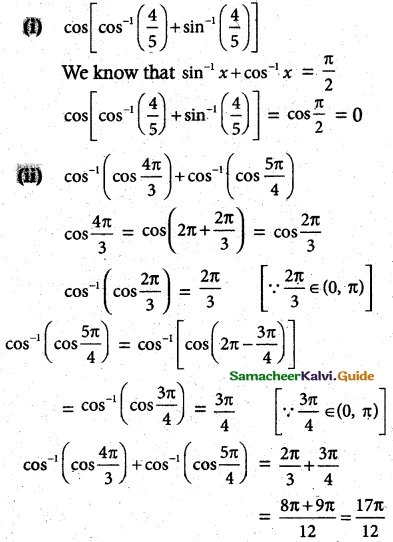
Samacheer Kalvi 12th Maths Guide Chapter 4 Inverse Trigonometric Functions Ex 4.3

Tamilnadu State Board New Syllabus Samacheer Kalvi 12th Maths Guide Pdf Chapter 4 Inverse Trigonometric Functions Ex 4.3 Textbook Questions and Answers, Notes.

Tamilnadu Samacheer Kalvi 12th Maths Solutions Chapter 4 Inverse Trigonometric Functions Ex 4.3

Question 1.
Find the domain of the following functions
(i) tan-1 (\(\sqrt {9-x^2}\))
(ii) \(\frac {1}{2}\) tan-1 (1 – x²) – \(\frac {π}{4}\)
Solution:
(i) f(x) = \(\tan ^{-1}(\sqrt{9-x^{2}})\)
We know the domain of tan-1 x is (-∞, ∞) and range is \(\left(-\frac{\pi}{2}, \frac{\pi}{2}\right)\)
So, the domain of f(x) = \(\tan ^{-1}(\sqrt{9-x^{2}})\) is the set of values of x satisfying the inequality
\(-\infty \leq \sqrt{9-x^{2}} \leq \infty\)
⇒ 9 – x2 ≥ 0
⇒ x2 ≤ 9
⇒ |x| ≤ 3

(ii) Range of tan-1 x is R
-∞ < 1 – x² < ∞
-∞ < -x² < ∞
-∞ < x < ∞
x ∈ R
Domain = R

Samacheer Kalvi 12th Maths Guide Chapter 4 Inverse Trigonometric Functions Ex 4.3

Question 2.
Find the value of
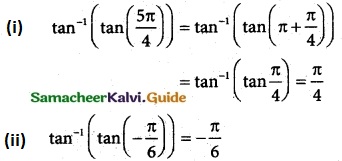
(i) tan-1(tan\(\frac {5π}{4}\))
(ii) tan-1(tan(-\(\frac {π}{6}\)))
Solution:
Samacheer Kalvi 12th Maths Guide Chapter 4 Inverse Trigonometric Functions Ex 4.3 1

Samacheer Kalvi 12th Maths Guide Chapter 4 Inverse Trigonometric Functions Ex 4.3

Question 3.
Find the value of
(i) tan(tan-1(\(\frac {7π}{4}\)))
(ii) tan(tan-1(1947))
(iii) tan(tan-1(-0.2021))
solution:
We know that tan(tan-1 x) = x
(i) \(\tan \left(\tan ^{-1} \frac{7 \pi}{4}\right)=\frac{7 \pi}{4}\)
(ii) tan(tan-1(1947))= 1947
(iii) tan(tan-1 (-0.2021)) = -0.2021

Samacheer Kalvi 12th Maths Guide Chapter 4 Inverse Trigonometric Functions Ex 4.3

Question 4.
Find the value of
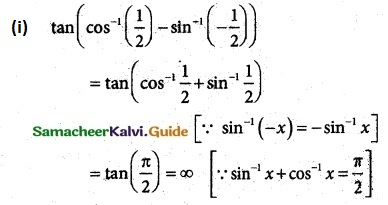
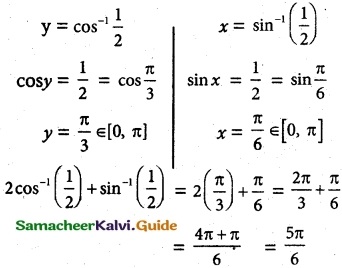
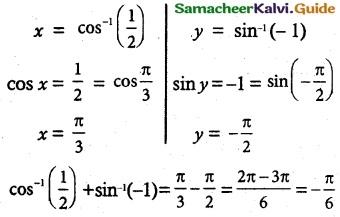
(i) tan(cos-1(\(\frac {1}{2}\)) – sin-1(-\(\frac {1}{2}\)))
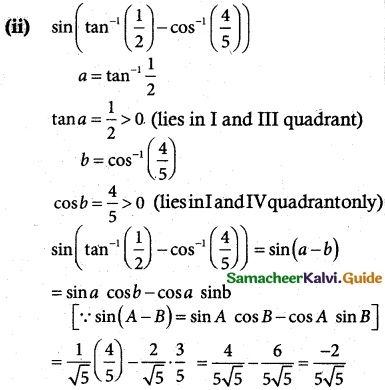
(ii) sin(tan-1(\(\frac {1}{2}\)) – cos-1(\(\frac {4}{5}\)))
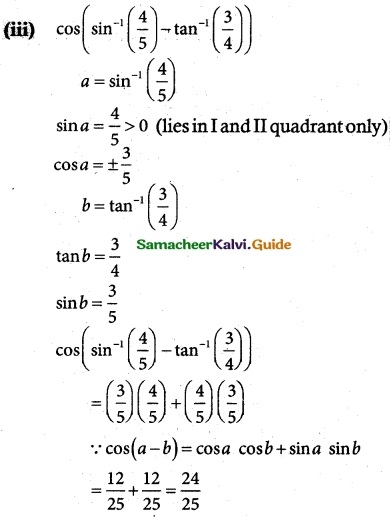
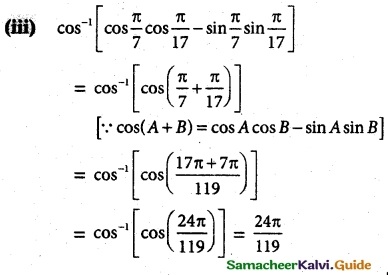
(iii) cos(sin-1(\(\frac {4}{5}\)) – tan-1(\(\frac {3}{4}\)))
solution:
Samacheer Kalvi 12th Maths Guide Chapter 4 Inverse Trigonometric Functions Ex 4.3 2
Samacheer Kalvi 12th Maths Guide Chapter 4 Inverse Trigonometric Functions Ex 4.3 3

Samacheer Kalvi 12th Maths Guide Chapter 4 Inverse Trigonometric Functions Ex 4.3

Samacheer Kalvi 12th Maths Guide Chapter 4 Inverse Trigonometric Functions Ex 4.3 4

Samacheer Kalvi 12th Maths Guide Chapter 4 Inverse Trigonometric Functions Ex 4.3

Samacheer Kalvi 11th Maths Guide Chapter 3 Trigonometry Ex 3.8

Tamilnadu State Board New Syllabus Samacheer Kalvi 11th Maths Guide Pdf Chapter 3 Trigonometry Ex 3.8 Text Book Back Questions and Answers, Notes.

Tamilnadu Samacheer Kalvi 11th Maths Solutions Chapter 3 Trigonometry Ex 3.8

Question 1.
Find the principal solution and general solutions of the following
(i) sin θ = – \(\frac{1}{\sqrt{2}}\)
(ii) cot θ = √3
(iii) tan θ = –\(\frac{1}{\sqrt{3}}\)
Answer:
(i) sin θ = – \(\frac{1}{\sqrt{2}}\)
We know that principal of sin θ lies in \(\left[-\frac{\pi}{2}, \frac{\pi}{2}\right]\)
sin θ = – \(\frac{1}{\sqrt{2}}\) < 0
∴ The principal value of sin θ lies in the IV quadrant.
sin θ = – \(\frac{1}{\sqrt{2}}\)
= – sin \(\left(\frac{\pi}{4}\right)\)
sin o = sin \(\left(-\frac{\pi}{4}\right)\)
Hence θ = \(-\frac{\pi}{4}\) is the principal solution.
The general solution is
θ = nπ + (- 1)n . \(\left(-\frac{\pi}{4}\right)\) , n ∈ Z
θ = nπ + (- 1)n + 1 . \(\frac{\pi}{4}\) , n ∈ Z

Samacheer Kalvi 11th Maths Guide Chapter 3 Trigonometry Ex 3.8

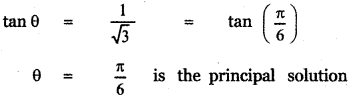
(ii) cot θ = √3
Samacheer Kalvi 11th Maths Guide Chapter 3 Trigonometry Ex 3.8 1
The principal value of tan θ lies in \(\left(-\frac{\pi}{2}, \frac{\pi}{2}\right)\)
Since tan θ = \(\frac{1}{\sqrt{3}}\) > 0
The principal value of tan θ lies in the I quadrant.
Samacheer Kalvi 11th Maths Guide Chapter 3 Trigonometry Ex 3.8 2
The general solution of tan θ is
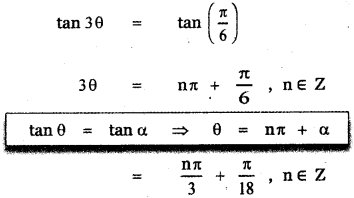
θ = nπ + \(\frac{\pi}{6}\) , n ∈ Z

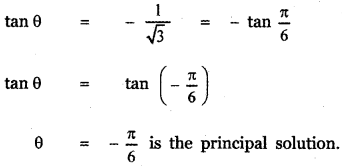
(iii) tan θ = –\(\frac{1}{\sqrt{3}}\)
The principal value of tan θ lies in \(\left(-\frac{\pi}{2}, \frac{\pi}{2}\right)\)
Since tan θ = – \(\frac{1}{\sqrt{3}}\) > 0
The principal value of tan θ lies in the IV quadrant.
Samacheer Kalvi 11th Maths Guide Chapter 3 Trigonometry Ex 3.8 3
The general solution of tan θ is
θ = nπ – \(\frac{\pi}{6}\) , n ∈ Z

Samacheer Kalvi 11th Maths Guide Chapter 3 Trigonometry Ex 3.8

Question 2.
Solve the following equations for which solutions lies in the interval 0° ≤ 9 < 360°
(i) sin4x = sin2x
Answer:
sin4x – sin2x = 0
sin2 x (sin2 x – 1) = 0
sin2 x [ – (1 – sin2 x)] = 0
sin2x × – cos2x = 0
– sin2x cos2x = 0
(sin x cos x)2 = 0
(\(\frac { 1 }{ 2 }\) × 2 sin cos x)2 = 0
\(\frac { 1 }{ 4 }\) sin 2x = 0
sin 2x = 0
The general solution is
2x = nπ, n ∈ Z
x = \(\frac{\mathrm{n} \pi}{2}\), n ∈ Z
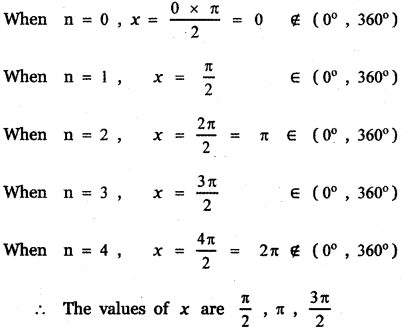
Samacheer Kalvi 11th Maths Guide Chapter 3 Trigonometry Ex 3.8 4

Samacheer Kalvi 11th Maths Guide Chapter 3 Trigonometry Ex 3.8

(ii) 2 cos2x + 1 = – 3 cos x
Answer:
2 cos2x + 1 = – 3 cos x
2 cos2x + 3 cos x + 1 = 0
2 cos2x + 2 cos x + cos x + 1 = 0
2 cos x (cos x + 1) + 1 (cos x + 1) = 0
(2 cos x + 1) (cos x + 1) = 0
2 cos x + 1 = 0 or cos x + 1 = 0
cos x = \(-\frac{1}{2}\) or cos x = – 1
To find the solution of cos x = \(-\frac{1}{2}\)
cos x = \(-\frac{1}{2}\)
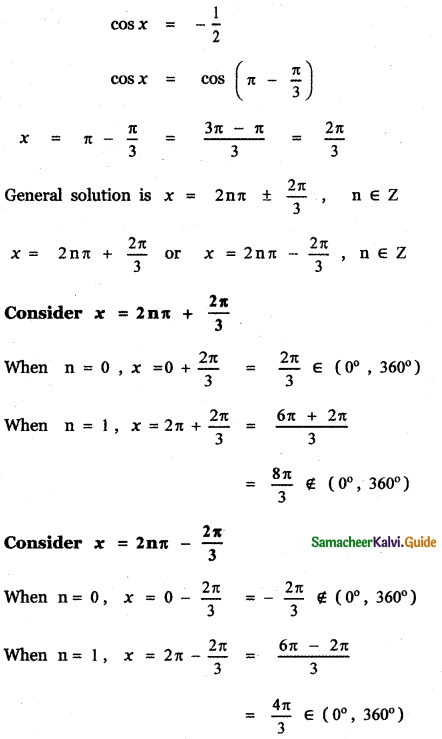
Samacheer Kalvi 11th Maths Guide Chapter 3 Trigonometry Ex 3.8 5
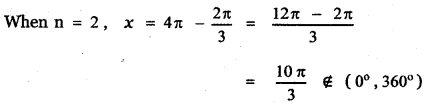
Samacheer Kalvi 11th Maths Guide Chapter 3 Trigonometry Ex 3.8 6
To find the solution of cos x = – 1
cos x = – 1
cos x = cos π
The general solution is
x = 2nπ ± π, n ∈ Z
x = 2nπ + π or x = 2nπ – π, n ∈ Z

Consider x = 2nπ + π
when n = 0 , x = 0 + π = π ∈ (0°, 360°)
when n = 1 , x = 2π + π = 3π ∉ (0°, 360°)

Consider x = 2nπ – π
when n = 0, x = 0 – π ∉ (0°, 360°)
when n = 1, x = 2π – π = π ∈ (0°, 360°)
when n = 2, x = 4π – π = 3π ∉ (0°, 360°)
∴ The required solution are x = \(\frac{2 \pi}{3}\), \(\frac{4 \pi}{3}\), π

Samacheer Kalvi 11th Maths Guide Chapter 3 Trigonometry Ex 3.8

(iii) 2 sin2x + 1 = 3 sin x
Answer:
2 sin2x – 3 sin x + 1 = 0
2 sin2x – 2 sin x – sin x + 1 = 0
2 sin x (sin x – 1) – 1 (sin x – 1) = 0
(2 sin x – 1)(sin x – 1) = 0
2 sin x – 1 = 0 or sin x – 1 = 0
sin x = \(\frac { 1 }{ 2 }\) or sin x = 1
To find the solution of sin x = \(\frac { 1 }{ 2 }\)
sin x = \(\frac { 1 }{ 2 }\)
sin x = sin \(\left(\frac{\pi}{6}\right)\)
The general solution is x = nπ + (-1)n\(\frac{\pi}{6}\), n ∈ z
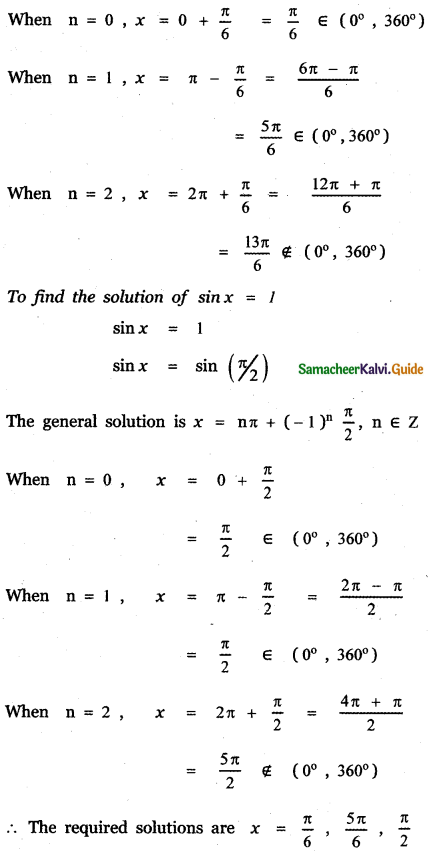
Samacheer Kalvi 11th Maths Guide Chapter 3 Trigonometry Ex 3.8 7

Samacheer Kalvi 11th Maths Guide Chapter 3 Trigonometry Ex 3.8

(iv) cos2x = 1 – 3 sin x
Answer:
1 – 2 sin2x = 1 – 3 sinx
2 sin2 x – 3 sin x = 0
sin x(2 sin x – 3) = 0smx =
sin x = 0 or 2 sin x – 3 = 0
sin x = 0 or sin x = \(\frac{3}{2}\)
sin x = \(\frac{3}{2}\) is not possible since sin x ≤ 1
∴ sin x = 0 = sin 0
The general solution is x = nit ,
When n = 0, x = 0 ∉ (0°, 360°)
When n = 1, x = π ∈ (0°, 360°)
When n = 2, x = 2π ∉ (0°, 360°)
∴ The required solutions is x = π

Samacheer Kalvi 11th Maths Guide Chapter 3 Trigonometry Ex 3.8

Question 3.
Solve the following equations:
(i) sin 5x – sin x = cos 3x
Answer:
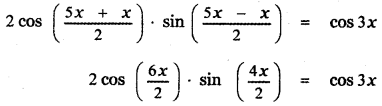
Samacheer Kalvi 11th Maths Guide Chapter 3 Trigonometry Ex 3.8 8
2 cos 3 x . sin 2x = cos 3 x
2 cos 3x . sin 2x – cos3x = 0
cos 3x (2 sin 2x – 1) = 0
cos 3x = 0 or 2 sin 2x – 1 = 0
cos 3x = 0 or sin 2x = \(\frac { 1 }{ 2 }\)
To find the general solution of cos 3x = 0
The general solution of cos 3x = 0 is
3x = (2n + 1)\(\frac{\pi}{2}\), n ∈ Z
x = (2n + 1)\(\frac{\pi}{6}\), n ∈ Z
To find the general solution of sin 2x = \(\frac{1}{2}\)
sin 2x = \(\frac{1}{2}\)
sin 2x = sin \(\left(\frac{\pi}{6}\right)\)
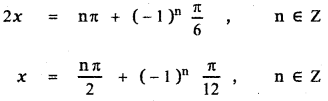
The general solution is
Samacheer Kalvi 11th Maths Guide Chapter 3 Trigonometry Ex 3.8 9
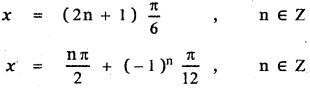
∴ The required solutions are
Samacheer Kalvi 11th Maths Guide Chapter 3 Trigonometry Ex 3.8 10

Samacheer Kalvi 11th Maths Guide Chapter 3 Trigonometry Ex 3.8

(ii) 2 cos2θ + 3 sin θ – 3 = θ
Answer:
2 cos2θ + 3 sin θ – 3 = θ
2(1 – sin2θ)+ 3 sin θ – 3 = θ
2 – 2 sin2θ + 3 sin θ – 3 = θ
– 2 sin2θ + 3 sin θ – 1 = θ
2 sin2 θ – 3 sin θ + 1 = θ
2 sin2θ – 2 sin θ – sin θ + 1 = θ
2 sin θ (sin θ – 1) – (sin θ – 1) = θ
(2 sin θ – 1) (sin θ – 1) = 0
2 sin θ – 1 = 0 or sin θ – 1 = θ
sin θ = \(\frac { 1 }{ 2 }\) or sin θ = 1
To find the general solution of’ sin θ = \(\frac { 1 }{ 2 }\)
sin θ = \(\frac { 1 }{ 2 }\)
sin θ = sin \(\frac{\pi}{6}\)
The general solution is θ = nπ + (-1)n\(\frac{\pi}{6}\), n ∈ Z
To find the general solution of sin θ = 1
sin θ = 1
sin θ = \(\frac{\pi}{2}\)
The general solution is θ = nπ + (-1)n\(\frac{\pi}{2}\), n ∈ Z
∴ The required solutions are
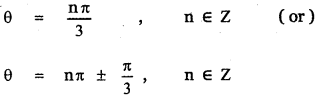
θ = nπ + (-1)n\(\frac{\pi}{6}\), n ∈ Z (or)
θ = nπ + (-1)n\(\frac{\pi}{6}\), n ∈ Z

Samacheer Kalvi 11th Maths Guide Chapter 3 Trigonometry Ex 3.8

(iii) cos θ + cos 3θ = 2 cos 2θ
Answer:
cos 3θ + cos θ = 2 cos 2θ
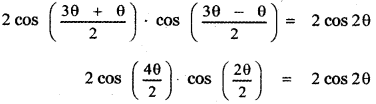
Samacheer Kalvi 11th Maths Guide Chapter 3 Trigonometry Ex 3.8 11
2 cos 2θ . cos θ = 2 cos 2θ
cos 2θ . cos θ – cos 2θ = θ
cos 2θ (cos θ – 1) = θ
cos 2θ = θ or cos θ – 1 = θ
cos 2θ = θ or cos θ = 1
To find the general solution of cos 2θ = θ
The general solution is
2θ = (2n + 1)\(\frac{\pi}{2}\), n ∈ Z
θ = (2n + 1)\(\frac{\pi}{4}\), n ∈ Z
To find the general solution of cos θ = 1
cos θ = 1
cos θ = cos 0
The general solution is θ = 2nπ , n ∈ Z
∴ The required solutions are
θ = (2n + 1)\(\frac{\pi}{4}\), n ∈ Z (or)
θ = 2nπ, n ∈ Z

Samacheer Kalvi 11th Maths Guide Chapter 3 Trigonometry Ex 3.8

(iv) sin θ + sin 3θ + sin 5θ = 0
Answer:
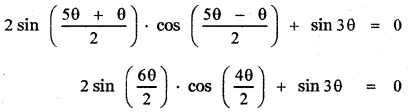
sin 5θ + sin 3θ + sin θ = 0
Samacheer Kalvi 11th Maths Guide Chapter 3 Trigonometry Ex 3.8 12
2 sin 3θ . cos 2θ + sin 3θ = 0
sin 3θ (2 cos 2θ + 1) = θ
sin 3θ = 0 or 2 cos 2θ + 1 = θ
sin 3θ = 0 or cos 2θ = –\(\frac { 1 }{ 2 }\)
To find the general solution of sin 3θ = 0
The general solution is
3θ = nπ, n ∈ Z
θ = \(\frac{\mathbf{n} \pi}{3}\), n ∈ Z
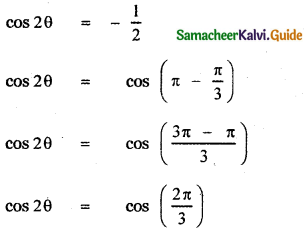
To find the general solution of cos 2θ = –\(\frac { 1 }{ 2 }\)
Samacheer Kalvi 11th Maths Guide Chapter 3 Trigonometry Ex 3.8 13
The general solution is
Samacheer Kalvi 11th Maths Guide Chapter 3 Trigonometry Ex 3.8 14
∴ The required solutions are
Samacheer Kalvi 11th Maths Guide Chapter 3 Trigonometry Ex 3.8 15

Samacheer Kalvi 11th Maths Guide Chapter 3 Trigonometry Ex 3.8

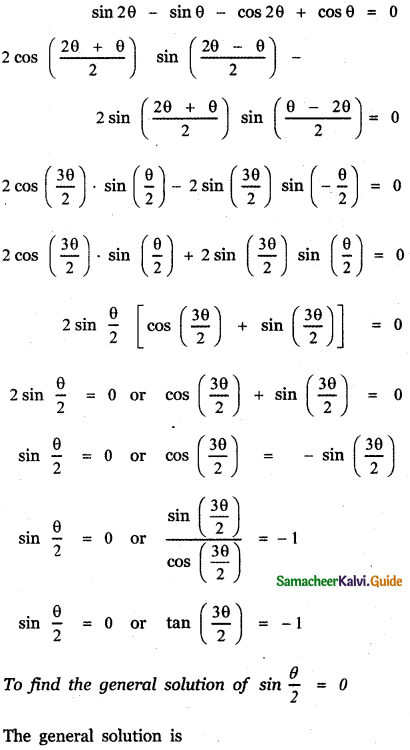
(v) sin 2θ – cos 2θ – sin θ + cos θ = θ
Answer:
Samacheer Kalvi 11th Maths Guide Chapter 3 Trigonometry Ex 3.8 16
Samacheer Kalvi 11th Maths Guide Chapter 3 Trigonometry Ex 3.8 17

Samacheer Kalvi 11th Maths Guide Chapter 3 Trigonometry Ex 3.8

(vi) sin θ + cos θ = √2
Answer:
Samacheer Kalvi 11th Maths Guide Chapter 3 Trigonometry Ex 3.8 18
The general solution is
Samacheer Kalvi 11th Maths Guide Chapter 3 Trigonometry Ex 3.8 19

Samacheer Kalvi 11th Maths Guide Chapter 3 Trigonometry Ex 3.8

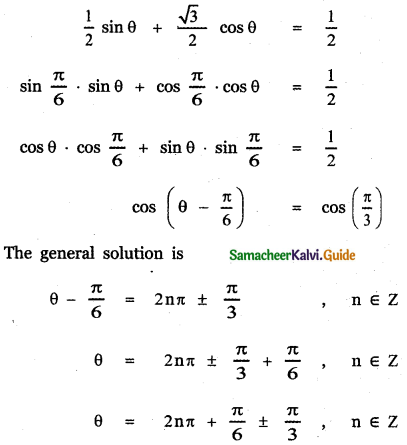
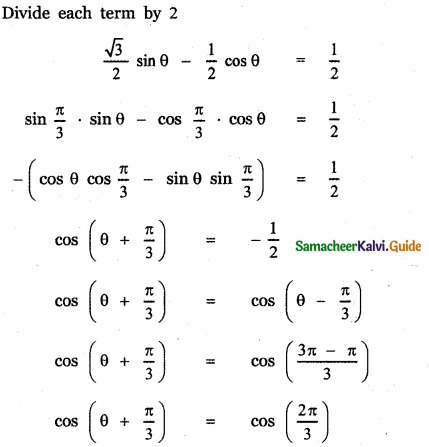
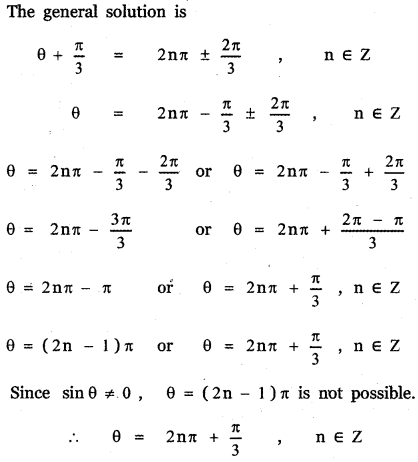
(vii) sin θ + √3 cos θ = 1
Answer:
Divide each term by 2
Samacheer Kalvi 11th Maths Guide Chapter 3 Trigonometry Ex 3.8 20

Samacheer Kalvi 11th Maths Guide Chapter 3 Trigonometry Ex 3.8

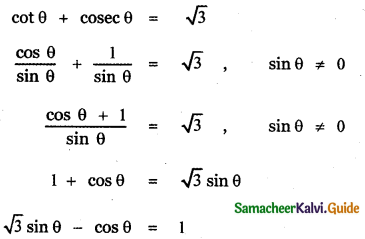
(viii) cot θ + cosec θ = √3
Answer:
Samacheer Kalvi 11th Maths Guide Chapter 3 Trigonometry Ex 3.8 21
Samacheer Kalvi 11th Maths Guide Chapter 3 Trigonometry Ex 3.8 22
Samacheer Kalvi 11th Maths Guide Chapter 3 Trigonometry Ex 3.8 23

Samacheer Kalvi 11th Maths Guide Chapter 3 Trigonometry Ex 3.8

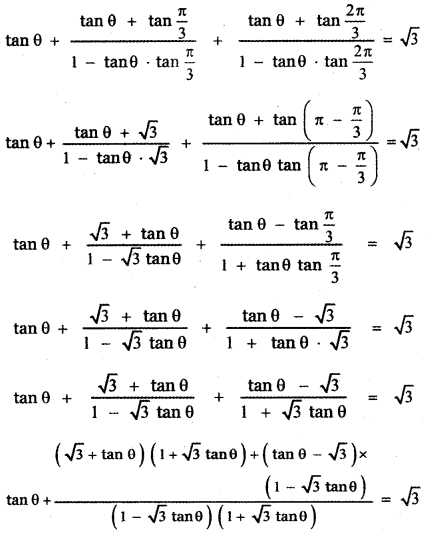
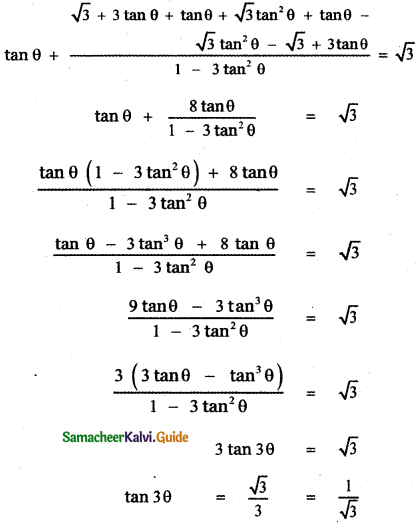
(ix) tan θ + tan \(\left(\theta+\frac{\pi}{3}\right)\) + tan \(\left(\theta+\frac{2 \pi}{3}\right)\) = √3
Answer:
Samacheer Kalvi 11th Maths Guide Chapter 3 Trigonometry Ex 3.8 24
Samacheer Kalvi 11th Maths Guide Chapter 3 Trigonometry Ex 3.8 25
Samacheer Kalvi 11th Maths Guide Chapter 3 Trigonometry Ex 3.8 26

Samacheer Kalvi 11th Maths Guide Chapter 3 Trigonometry Ex 3.8

Samacheer Kalvi 11th Maths Guide Chapter 3 Trigonometry Ex 3.8 27

(x) cos 2θ = \(\frac{\sqrt{5}+1}{4}\)
Answer:
we know cos 36° = \(\frac{\sqrt{5}+1}{4}\), 36° = \(\frac{\pi}{5}\)
cos 2θ = cos 36° = cos \(\left(\frac{\pi}{5}\right)\)
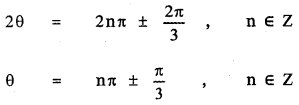
The general solution is
2θ = 2nπ ± \(\frac{\pi}{5}\), n ∈ Z
θ = nπ ± \(\frac{\pi}{10}\), n ∈ Z

Samacheer Kalvi 11th Maths Guide Chapter 3 Trigonometry Ex 3.8

(xi) 2cos 2x – 7 cos x + 3 = 0
Answer:
2 cos2x – 7 cos x + 3 = 0
2 cos2x – 6 cos x – cos x + 3 = 0
2 cos x (cos x – 3) – 1 (cos x – 3) = 0
(2 cos x – 1) (cos x – 3) = 0
2 cos x – 1 = 0 or cos x – 3 = 0
cos x = \(\frac { 1 }{ 2 }\) or cos x = 3
Since – 1 ≤ cos x ≤ 1 , we have
cos x = 3 is not possible.
∴ cos x = \(\frac { 1 }{ 2 }\)
cos x = cos \(\frac{\pi}{3}\)
The general solution is x = 2nπ ± \(\frac{\pi}{3}\), n ∈ Z

Samacheer Kalvi 9th Science Guide Chapter 6 Light

Tamilnadu State Board New Syllabus Samacheer Kalvi 9th Science Guide Pdf Chapter 6 Light Text Book Back Questions and Answers, Notes.

Tamilnadu Samacheer Kalvi 9th Science Solutions Chapter 6 Light

9th Science Guide Light Text Book Back Questions and Answers

I. Choose the correct answer :

Question 1.
A ray of light passes from one medium to another medium. Refraction takes place when angle of incidence is
(a) 0°
(b) 45°
(c) 90°
Answer:
(c) 90°

Samacheer Kalvi 9th Science Guide Chapter 6 Light

Question 2.
is used as reflectors in torchlight.
(a) Concave mirror
(b) Plane mirror
(c) Convex mirror
Answer:
(a) Concave mirror

Question 3.
We can create enlarged, virtual images with
(a) concave mirror
(b) plane mirror
(c) convex mirror
Answer:
(a) concave mirror

Samacheer Kalvi 9th Science Guide Chapter 6 Light

Question 4.
When the reflecting surface is curved outwards the mirror formed will be
(a) concave mirror
(b) convex mirror
(c) plane mirror
Answer:
(b) convex mirror

Question 5.
When a beam of white light passes through a prism it gets
(a) reflected
(b) only deviated
(c) deviated and dispersedAnswer:
(c) deviated and dispersed

Question 6.
The speed of light is maximum in
(a) vacuum
(b) glass
(c) diamond
Answer:
(a) vacuum

Samacheer Kalvi 9th Science Guide Chapter 6 Light

II. State whether true or false. If false, correct the statement :

1. The angle of deviation depends on the refractive index of the glass.
Answer:
True

2. If a ray of light passes obliquely from one medium to another, it does not suffer any deviation.
Answer:
False.
Correct statement: If a ray of light passes obliquely from one medium to another, it bends and from the normal.

3. The convex mirror always produces a virtual, diminished and erect image of the object.
Answer:
True.

4. When an object is at the centre of curvature of concave mirror the image formed will be virtual and erect.
Answer:
False.
Correct statement: When an object is at the centre of curvature of concave mirror the image formed will be real and inverted.

5. The reason for brilliance of diamonds is total internal reflection of light.
Answer:
True.

Samacheer Kalvi 9th Science Guide Chapter 6 Light

III. Fill in the blanks :

1. In going from a rarer to denser medium, the ray of light bends ……………………….
Answer:
towards the normal

2. The mirror used in search light is ……………………….
Answer:
concave

3. The angle of deviation of light ray in a prism depends on the angle of . ……………………….
Answer:
incidence

4. The radius of curvature of a concave mirror whose focal length is 5cm is ………………………..
Answer:
10 cm

5. Large ……………………….mirrors are used to concentrate sunlight to produce heat in solar furnaces.
Answer:
concave

Samacheer Kalvi 9th Science Guide Chapter 6 Light

IV. Match- the following :

Ratio of height of image to height of object.Concave mirror
Used in hairpin bends in mountains.Total internal reflection
Coin inside water appearing slightly raised.Magnification
MirageConvex mirror
Used as Dentist’s mirror.Refraction

Answer:

Ratio of height of image to height of object.Magnification
Used in hairpin bends in mountains.Convex mirror
Coin inside water appearing slightly raised.Refraction
MirageTotal internal reflection
Used as Dentist’s mirror.Concave mirror

V. Assertion & Reason :

Mark the correct choice as:
(a) If both assertion and reason are true and reason is the correct explanation.
(b) If both assertion and reason are true and reason is not the correct explanation.
(c) If assertion is true but reason is false.
(d) If assertion is false but reason is true

Samacheer Kalvi 9th Science Guide Chapter 6 Light

Question 1.
Assertion: For observing the traffic at a hairpin bend in mountain paths a plane mirror is preferred over the convex mirror and concave mirror.
Reason: A convex mirror has a much larger field of view than a plane mirror or a . concave mirror.
Answer:
(d) Assertion is false but reason is true

Question 2.
Assertion: The incident ray is directed towards the centre of curvature of spherical mirror. After reflection it retraces its path.
Reason : Angle of incidence (i) = Angle of reflection (r) = 0°.
Answer:
(a) Both assertion and reason are true and reason is the correct explanation

VI. Answer very briefly:

Question 1.
According to cartesian sign convention, which mirror and which lens has negative focal length?
Answer:
Concave mirror is having a negative focal length.

Samacheer Kalvi 9th Science Guide Chapter 6 Light

Question 2.
Name the mirror(s) that can give (i) an erect and enlarged image, (ii) same sized, inverted image.
Answer:
Concave mirror.

Question 3.
If an object is placed at the focus of a concave mirror, where is the image formed?
Answer:
The image will be formed at infinity as real and inverted.

Question 4.
Why does a ray of light bend when it travels from one medium to another?
Answer:
A ray of light bend when it travels from one medium to another due to the change in velocity of light in two different medium.

Question 5.
What is the speed of light in vacuum?
Answer:
The speed of light in vacuum is known to be almost exactly 300,000 km per second. In 1665 the Danish astronomer Ole Roemer first estimated the speed of light by observing one of the twelve moons of the planet Jupiter.

Samacheer Kalvi 9th Science Guide Chapter 6 Light

Question 6.
Concave mirrors are used by dentists to examine teeth. Why?
Answer:
As concave mirror produces virtual, erect and magnified images when an object is placed in

VII. Answer briefly :

Question 1.
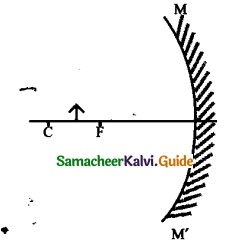
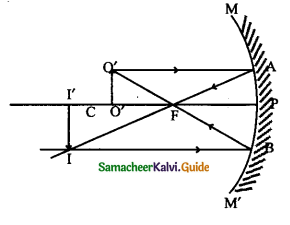
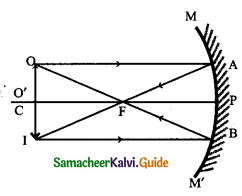
a) Complete the diagram to show how a concave mirror forms the image of the object.
b) What is the nature of the image?
Samacheer Kalvi 9th Science Guide Chapter 6 Light 1
Answer:
a)
Samacheer Kalvi 9th Science Guide Chapter 6 Light 2

Samacheer Kalvi 9th Science Guide Chapter 6 Light
b) Real, inverted and magnified.

Question 2.
Pick out the concave and convex mirrors from the following and tabulate them. Rear-view mirror, Dentist’s mirror, Torch-light mirror, Mirrors in shopping malls, Make-up mirror.
Answer:

Concave MirrorConvex Mirror
Dentist’s mirrorRearview mirror
Torchlight mirrorMirrors in shopping malls
Makeup mirror

Question 3.
State the direction of the incident ray which after reflection from a spherical mirror retraces its path. Give a reason for your answer.
Answer:
When an incident ray is directed towards the centre of curvature, at all the points of the spherical mirror, the ray is always normal. Therefore, angle of incidence i = Angle of reflection r = 0°.

Question 4.
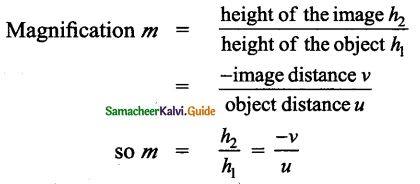
What is meant by magnification? Write its expression. What is its sign for real image and virtual image?
Answer:
Magnification is the increase in size of an image compared to true size.
Samacheer Kalvi 9th Science Guide Chapter 6 Light 3
(a) Negative sign – real image
(b) Positive sign – virtual image

Samacheer Kalvi 9th Science Guide Chapter 6 Light

Question 5.
Write the spherical mirror formula and explain the meaning of each symbol used in it.
Answer:
The expression relating the distance of the object u, distance of image v and focal length/of a spherical mirror is called the mirror equation. It is given as:
Mirror formula: \(\frac{1}{f}=\frac{1}{u}+\frac{1}{v}\)
Here, f – focal length of spherical mirror; u – distance of the objective; v – distance of the image.

VIII. Answer in detail :

Question 1.
a) Draw ray diagrams to show how the image is formed using a concave mirror, when the position of objeict is (i) at C (ii) between C and F (iii) between F and P of the mirror.
b) Mention the position and nature of image in each case.
Answer:
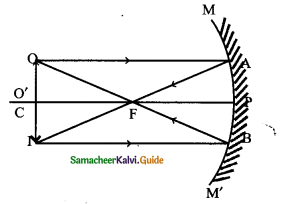
a) object At C
i)
Samacheer Kalvi 9th Science Guide Chapter 6 Light 4
(b) Position of an object: At C
Position of the image: At C

Nature of the image:
(i) Real
(ii) Inverted
(iii) Same size as the object

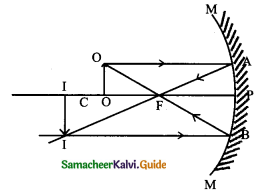
(ii) object At C and F
Samacheer Kalvi 9th Science Guide Chapter 6 Light 5
Position of the object: Between C and F
Position of the image: Beyond C

Nature of the image :
(i) Real
(ii) Inverted
(iii) Magnified

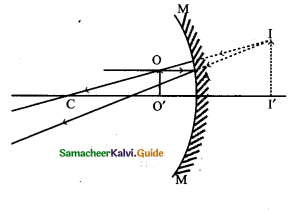
(iii) Object between F and P of the Mirror
Samacheer Kalvi 9th Science Guide Chapter 6 Light 6
Position of object : Between F and P
Position of the image : Behind the Mirror

Nature of the image :
(i) Virtual
(ii) Erect
(iii) Magnified

Samacheer Kalvi 9th Science Guide Chapter 6 Light

Question 2.
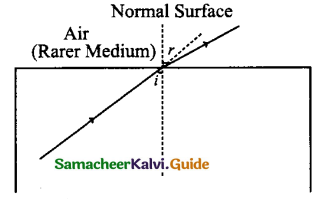
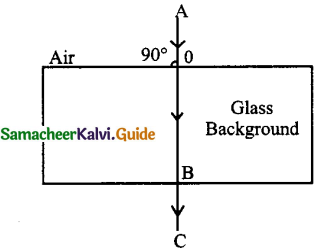
Explain with diagrams how refraction of incident light takes place from a) rarer to denser medium b) denser to rarer medium c) normal to the surface separating the two media.
Answer:
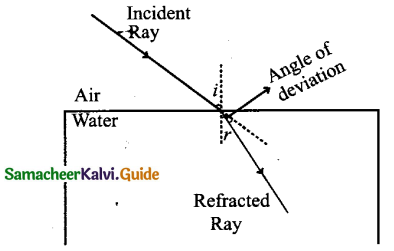
a) rarer to denser medium
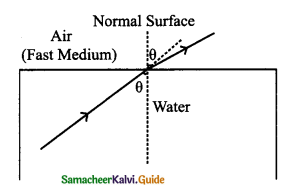
When a ray of light travels from optically rarer medium to optically denser medium, it bends towards the normal.
Samacheer Kalvi 9th Science Guide Chapter 6 Light 7

b) denser to rarer medium
When a ray of light from an optically denser medium to an optically rarer medium it bends away from the normal.
Samacheer Kalvi 9th Science Guide Chapter 6 Light 8

c) normal to the surface separating the two media.
A ray of light incident normally on a denser medium it goes without any deviation.
Samacheer Kalvi 9th Science Guide Chapter 6 Light 9

Samacheer Kalvi 9th Science Guide Chapter 6 Light

IX. Numerical Problems:

Question 1.
A concave mirror produces three times magnified real image of an object placed at 7 cm in front of it. Where is the image located?
Answer:
Here given magnification m = 3
Object distance u = -7 cm
Magnification m = \(-\frac{v}{u}\) Real image
-3 = \(-\frac{v}{u}\)
3u = -v
v = 3u = 3 x 7 = 21 cm
The image will be formed at a distance of 21 cm in front of concave mirror from its pole.

Question 2.
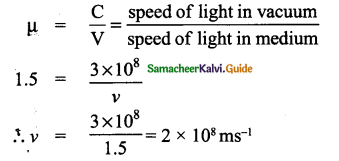
Light enters from air into a glass plate having a refractive index of 1.5. What is the speed of light in glass?
Answer:
Refractive index of a glass plate μ = 1.5
Speed of light in vacuum is C = 3 x 10⁸ms-1
Speed of light in glass V =?
Samacheer Kalvi 9th Science Guide Chapter 6 Light 10
speed of light in glass = 2 × 10⁸ms-1

Samacheer Kalvi 9th Science Guide Chapter 6 Light

Question 3.
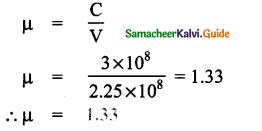
The speed of light in water is 2.25 × 10⁸ms-1. If the speed of light in a vacuum is 3 × 10⁸ms-1, calculate the refractive index of water.
Answer:
Speed of light in water V = 2.25 × 10⁸ms-1
Speed of light in vacuum C = 3 × 10⁸ms-1
Refractive index of water μ =?
Samacheer Kalvi 9th Science Guide Chapter 6 Light 11

X. Higher Order Thinking Skills.

Question 1.
Lightray emerges from water into the air. Draw a ray diagram indicating the change in its path in the water.
Answer:
Samacheer Kalvi 9th Science Guide Chapter 6 Light 12

Samacheer Kalvi 9th Science Guide Chapter 6 Light

Question 2.
When a ray of light passes from air into glass, is the angle of refraction greater than or less than the angle of incidence?
Answer:
Light bends towards the normal because glass is denser than air.
It bends towards normal since light has to travel with the lesser speed in the glass but within a short time.
r < i. The angle of refraction is less than the angle of incidence.

Question 3.
What do you conclude about the speed of light in diamond, if the refractive index of diamond is 2.41?
Answer:
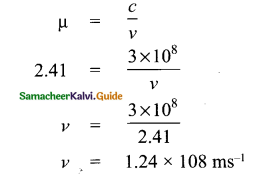
Refractive index of diamond μ = 2.41
Samacheer Kalvi 9th Science Guide Chapter 6 Light 13
∴ Speed of light in a diamond (1.24 × 10⁸ms-1) is less than the speed of light in air (3 × 10⁸ms-1).
The refractive index of diamond is 2.42, it means that speed of light in air (vacuum) is 2.42 times the speed of light in a diamond.

Intext Activities

ACTIVITY – 1

Stand before the mirror in your dressing table or the mirror fixed in a steel almirah. Do you see your whole body? To see your entire body in a mirror, the mirror should be atleast half of your height. Height of the mirror= Your height/2.
Solution :
(i) If the height of a person is 5 feet, then he should use a plane mirror of 2Vi feet height and fix in a steal almirah.
(ii) Now if he stand before it his full body will be seen on the mirror because hight of the mirror = \(\frac{\text { Our hieight }}{2}\)

Samacheer Kalvi 9th Science Guide Chapter 6 Light

ACTIVITY – 2

Hold a concave mirror in your hand (or place it in a stand). Direct its reflecting surface towards the sun. Direct the light reflected by the mirror onto a sheet of paper held not very far from the mirror. Move the sheet of paper back and forth gradually until you find a bright, sharp spot of light on the paper. Position the mirror and the paper at the same location for few moments. What do you observe? Why does the paper catch fire?
Solution :
A concave mirror converges all the light rays coming from the Sun. All these light rays converge and meet at the focus of the mirror.
So, all the heat and light is focused on the principal focus (F). When a paper is kept at the focus (F), it starts burning, as this point is very hot.

ACTIVITY – 3

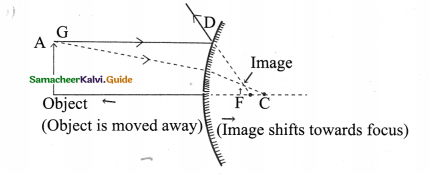
Take a convex mirror. Hold it in one hand. Hold a pencil close to the mirror in the upright position in the other hand. Observe the image of the pencil in the mirror. Is the image erect or inverted? Is it diminished or enlarged? Move the pencil slowly away from the mirror. Does the image become smaller or larger? What do you observe?
Samacheer Kalvi 9th Science Guide Chapter 6 Light 14
Solution :

  1. When a pencil is held in the upright position in front of a convex mirror, its diminished, erect image is formed which is virtual and therefore seen in the convex mirror.
  2. When the pencil is moved away from the convex mirror size of image becomes smaller and smaller but image remains erect.
  3. As we move away, the object from the convex mirror, image shifts towards the focus.

Samacheer Kalvi 9th Science Guide Chapter 6 Light

ACTIVITY – 4

Refraction of light at air-water interface
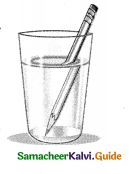
Put a straight pencil into a tank of water or beaker of water at an angle of 45° and look at it from one side and above. How does the pencil look now?
The pencil appears to be bent at the surface of water.
Solution :
Samacheer Kalvi 9th Science Guide Chapter 6 Light 15
Both the above activities are the result of refraction of light. The bending of light rays when they pass obliquely from one medium to another medium is called refraction of light.

9th Science Guide Light Additional Important Questions and Answers

I. Choose the correct answer :

Question 1.
A ray of light is incident towards a plane mirror at an angle of 30° with the mirror surface. What will be the angle of reflection?
(a) 45°
(b) 30°
(c) 90°
(d) 60°
Answer:
(d) 60°

Samacheer Kalvi 9th Science Guide Chapter 6 Light

Question 2.
A 10 mm long bin is placed vertically in front of a concave mirror. A 5 mm long image of the bin is formed at 30 cm in front of the mirror. The focal length of this mirror is
(a) -20cm
(b) -30cm
(c) -60cm
(d) -40cm
Answer:
(a) – 20cm

Question 3.
A ray of light as it travels from medium A to medium B refractive index of the medium B relative to medium A is (μB/ μA)
(a) \(\frac{\sqrt{3}}{\sqrt{2}}\)
(b) \(\frac{\sqrt{2}}{\sqrt{3}}\)
(c) \(\frac{{1}}{\sqrt{2}}\)
(d) \(\sqrt{2}\)
Answer:
(b) \(\frac{\sqrt{2}}{\sqrt{3}}\)

Samacheer Kalvi 9th Science Guide Chapter 6 Light

Question 4.
Under which of the following conditions a concave mirror can form an image larger than the actual object?
(a) when the object is kept at a distance equal to its radius of curvature.
(b) when object is kept at a distance less than its focal length.
(c) when object is placed between the focus and centre of curvature
(d) when object is kept at a distance greater than its radius of curvature.
Answer:
(c) when object is placed between the focus and centre of curvature

Question 5.
In torches, searchlights and head lights of vehicles the bulb is placed …………………………… of the concave mirror.
(a) between and F of the reflector
(b) Very near to F
(c) between F & C
(d) at C
Answer:
(b) Very near to F

Question 6.
A boy is standing at a distance of 3m in front of a plane mirror. The distance between the boy and his image is ………………….. m
(a) 4
(b) 2
(c) 3
(d) 6
Answer:
(c) 3

Samacheer Kalvi 9th Science Guide Chapter 6 Light

Question 7.
The image formed by a concave mirror is real, inverted and of the same size as that of the object the position of the object should be
(a) beyond C
(b) between C & F
(c) at C
(d) at F
Answer:
(c) at C

Question 8.
Which of the following has the highest refractive index
(a) air
(b) water
(c) diamond
(d) glass
Answer:
(c) diamond

Question 9.
The image formed by a plane mirror is
(a) real
(b) diminished
(c) enlarged
(d) laterally inverted
Answer:
(d) laterally inverted

Samacheer Kalvi 9th Science Guide Chapter 6 Light

Question 10.
The incident ray passing through ‘F of a mirror ………………….. after reflection
(a) passes through C
(b) passes through F
(c) passes parallel to the principal axis
(d) passes through the pole
Answer:
(c) passes parallel to the principal axis

Question 11.
The incident ray passing through C of a mirror ………………….. after reflection.
(a) passes through C
(b) passes through F
(c) passes through P
(d) parallel to the principal axis
Answer:
(a) passes through C

Question 12.
The incident ray parallel to the principal axis of a mirror ………………….. after reflection.
(a) passes through C
(b) passes through F
(c) passes through P
(d) reverts back in the opposite direction
Answer:
(b) passes through F

Samacheer Kalvi 9th Science Guide Chapter 6 Light

Question 13.
According to sign convention the distance of the object.
(a) is always positive
(b) is always negative
(c) maybe positive or negative
(d) is equal to object height.
Answer:
(b) is always negative

Question 14.
According to sign convention the distance of the image.
(a) is always positive
(b) is always negative
(c) maybe positive or negative
(d) is equal to image height
Answer:
(c) maybe positive or negative

Question 15.
Total internal reflection will occur if the angle of reflection is
(a) 45°
(b) 60°
(c) 90°
(d) 99°
Answer:
(d) 99°

Samacheer Kalvi 9th Science Guide Chapter 6 Light

Question 16.
Magnification for the………………….. image is always …………………..
(a) real, positive
(b) real, negative
(c) virtual, negative
(d) virtual, positive
Answer:
(b) real, negative

Question 17.
If magnification is +1.5. The image is …………………..
(a) erect
(b) diminished
(c) real
(d) invected
Answer:
(a) erect

Question 18.
The refractive index of a denser medium with respect to rarer medium is
(a) 1
(b) greater than 1
(c) less than 1
(d) negative
Answer:
(b) greater than 1

Samacheer Kalvi 9th Science Guide Chapter 6 Light

Question 19.
We can see objects because of
(a) reflection
(b) refraction
(c) transmission
(d) diffraction
Answer:
(a) reflection

Question 20.
The image formed by a convex mirror is always
(a) real (b) enlarged
(c) virtual & enlarged
(d) diminished
Answer:
(d) diminished

Samacheer Kalvi 9th Science Guide Chapter 6 Light

Question 21.
As you move an object always from a convex mirror, its image becomes…………………..
and moves towards
(a) smaller, infinity
(b) smaller, focus
(c) enlarged, infinity
(d) enlarged, focus
Answer:
(b) smaller, focus

Question 22.
For a spherical mirror ………………….. is true.
(a) f = 2R
(b) R = 2f
(c) fR = 2
(d) fR = \(\frac { 1 }{ 2 }\)
Answer:
(b) R = 2f

Samacheer Kalvi 9th Science Guide Chapter 6 Light

Question 23.
The mirror formula is…………………..
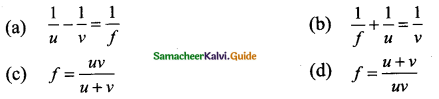
Samacheer Kalvi 9th Science Guide Chapter 6 Light 16
Answer:
(c) \(\frac{1}{f}=\frac{1}{u}+\frac{1}{v}\)

Question 24.
For a plane mirror, magnification m =
(a) 0
(b) 1
(c) ± 1
(d) ≤0
Answer:
(b) 1

Question 25.
Magnification for convex mirror is
(a) always positive
(b) always negative
(c) some times positive
(d) 1
Answer::
(a) always positive

Question 26.
If the angle of incidence i = 0, the angle of reflection r =
(a) 0°
(b) 90°
(c) 180°
(d) 45°
Answer:
(a) 0°

Samacheer Kalvi 9th Science Guide Chapter 6 Light

Question 27.
Refractive index of a medium is …………………..
(a) speed of light in air to speed of light in vacuum
(b) speed of light in vacuum to speed of light in air
(c) focal length to object distance
(d) speed of light in the medium × speed of light in the air
Answer:
(a) speed of light in air to speed of light in vacuum

Question 28.
Bending of light as it passes from one medium to another is called
(a) reflection
(b) diffraction
(c) refraction
(d) deviation
Answer:
(c) refraction

Question 29.
Ratio of sine of angle of incidence to sine of angle of refraction is ………………….
(a) gravitational law
(b) law of reflection
(c) law of refraction
(d) snell’s law.
Answer:
(d) snell’s law

Samacheer Kalvi 9th Science Guide Chapter 6 Light

Question 30.
Entire light is reflected back into denser medium is called
(a) total internal reflection
(b) refraction
(c) reflection
(d) total external refraction.
Answer:
(a) total internal reflection

Question 31.
Outer concentric shell in optic fiber is called
(a) cladding
(b) core
(c) mantel
(d) coat
Answer:
(a) cladding

Question 32.
When light is going from a denser to a less dense medium, the critical angle is the angle of incidence for which the angle of refraction is
(a) 48°
(b) 90°
(c) 42°
(d) 51°
Answer:
(b) 90°

Question 33.
A bundle of glass threads, each of which is capable of transmitting messages using light waves is called
(a) microscope
(b) convex
(c) periscope
(d) optic fibre
Answer:
(d) optic fibre

Samacheer Kalvi 9th Science Guide Chapter 6 Light

Question 34.
A ray of light travelling in medium 1 strikes and travels into another transparent medium 2. If the speed of light is greater in medium 1, the ray will
(a) refract towards the normal
(b) have an angle of incidence smaller than be angle of refraction
(c) refract away from the normal
(d) undergo total internal reflection
Answer:
(a) refract towards the normal

Question 35.
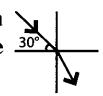
A ray of light travels from air into a glass block as shown. It makes an angle of 30° with the surface of the block. If the refractive index of the glass is 1.5, what will be the angle of refraction?
Samacheer Kalvi 9th Science Guide Chapter 6 Light 17
(a) 35.26°
(b) 1.30°
(c) 48.59°
(d) 19.47°
Answer:
(d) 19.47°

Question 36.
The field of view is maximum for …………………
(* FOV is the extent of the observable area that is seen at any given instant)
(a) plane mirror
(b) concave mirror
(c) convex mirror
Answer:
(c) convex mirror

Samacheer Kalvi 9th Science Guide Chapter 6 Light

Question 37.
A real and enlarged image can be obtained by using a
(a) convex mirror
(b) plane mirror
(c) concave mirror
Answer:
(c) concave mirror

Question 38.
Which of the following statements about total internal reflection is true?
(a) angle of incidence should be greater than the critical angle
(b) light must travel from a medium of higher refractive index to a medium of lower refractive index
(c) both (a) and (b)
Answer:
(c) both (a) and (b)

Question 39.
The focal length of a concave mirror is 5cm. Its radius of curvature is
(a) 5 cm
(b) 10 cm
(c) 2.5 cm
Answer:
(b) 10 cm

Samacheer Kalvi 9th Science Guide Chapter 6 Light

II. Fill in the blanks :

1. The ratio of the sine of the angle of incidence to the sine of …………………is constant.
Answer:
angle of refraction

2. A spherical mirror whose reflecting surface is curved outwards is called ………………… mirror.
Answer:
convex

3. All distances parallel to the principal axis are measured from the ………………… of the
mirror.
Answer:
pole

4. A negative sign in the value of magnification indicates that the image is …………………
Answer:
real

5. Light is refracted or bent while going from one medium to another because of its ………………… changes.
Answer:
speed

Samacheer Kalvi 9th Science Guide Chapter 6 Light

III. State whether true or false. If false, correct the statement:

1. The critical angle is defined as the angle of incidence at which the total internal reflection starts to occur.
Answer:
True.

2. The angle of incidence is equal to the angle of reflection for perfect reflection.
Answer:
True.

3. The image formed in a plane mirror is always inverted.
Answer:
False.
Correct statement: The image formed in a plane mirror is always erect.

4. A star appears twinkling into the sky because of the reflection of light by the atmosphere
Answer:
False.
Correct statement: A star appears twinkling into the sky because of the refraction of light by the atmosphere.

5. Mirage is an example of refraction and total internal reflection of light.
Answer:
True.

Samacheer Kalvi 9th Science Guide Chapter 6 Light

6. Optical Fibres are based on the phenomenon of dispersion
Answer:
False.
Correct statement: Optical Fibres are based on total internal reflection.

7. A water tank appears shallower when it is viewed from the top due to refraction.
Answer:
True.

8. Twinkling of stars and Mirage are the two phenomena occurring due to refraction.
Answer:
True.
Twinkling of stars and Mirage.

9. Angle of incidence is zero if a ray of light is incident normal to be surface separating the low media.
Answer:
True.

10. A real image is inverted and can be caught on the screen.
Answer:
True.

11. The minimum length of the mirror required to see the full image of the person is half ‘ of his height.
Answer:
true.

Samacheer Kalvi 9th Science Guide Chapter 6 Light

12. The pencil appears to be bent at the surface of the water is due to refraction.
Answer:
True.

13. The speed of light decreases in a denser medium, light bends towards the normal.
Answer:
True.

14. If the object is at infinity in front of a convex mirror the image is formed at infinity.
Answer:
False.
Correct statement: The image is formed at F, behind the mirror

15. An object is placed at a distance of 3cm from a plane mirror. The distance of the object and image is 3cm.
Answer:
False.
Correct statement: The distance of the object and image is 6 cm.

16. The distance from centre of curvature of the mirror to the pole is called the focal length of the mirror.
Answer:
False.
Correct statement: The distance between the centre of the mirror and the focal point of the mirror is called the focal length of a mirror.

Samacheer Kalvi 9th Science Guide Chapter 6 Light

17. Light is one of the slowest travelling energy with a speed of 3 × 10⁻⁸ms-1
Answer:
False.
Correct statement : (Light is one of the fastest travelling energy with a speed of 3 × 10⁻⁸ms-1

18. The angle of incidence at which the angle of refraction is Q£ is called the critical angle.
Answer:
False.
Correct statement: The angle of incidence at which the angle of refraction is 90° is called the critical angle.

IV. Match the following :

Question 1.

Column IColumn II
(i) A plane mirror(a) Image is erect & smaller in size than the object.
(ii) A concave mirror(b) Image is erect & of the same size as of the object.
(iii) A convex(c) Used by dentists to see an enlarged images of teeth.
(d) Can form images of objects spread over a large area.

Answer:

Column IColumn II
(i) A plane mirror(b) Image is erect & of the same size as of the object.
(ii) A concave mirror(c) Used by dentists to see enlarged image of teeth.
(iii) A convex(d) Can form image of objects spread over a large area.

Question 2.

Column IColumn II
(i) r > 90(a) Light gazes the surface of separation between two mode.
(ii) r = 90(b) No refraction.
(iii) r < 90(c) Refracted ray away from the normal

Answer:

Column IColumn II
(i) r > 90(b) No refraction.
(ii) r = 90(a) Light gazes the surface of separation between two mode.
(iii) r < 90(c) Refracted ray away from the normal

Samacheer Kalvi 9th Science Guide Chapter 6 Light

Question 3.

Column IColumn II
(i) plane mirror(a) Focal length is positive.
(ii) concave(b) Focal length is negative.
(iii) convex(c) Focal length is infinity.
(iv) Real image(d) Magnification if positive value.
(v) Virtual image(e) Magnification if negative value.

Answer:

Column IColumn II
(i) plane mirror(c) Focal length is infinity.
(ii) concave(b) Focal length is negative.
(iii) convex(a) Focal length is positive.
(iv) Real image(e) Magnification if negative value.
(v) Virtual image(d) Magnification if positive value.

Question 4.
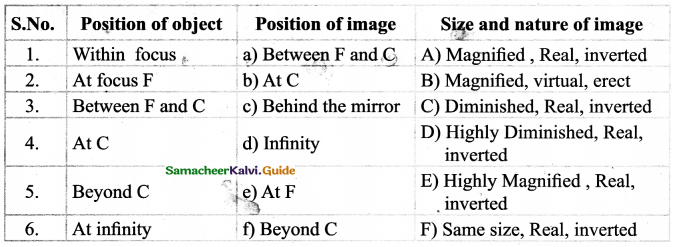
Samacheer Kalvi 9th Science Guide Chapter 6 Light 18
Answer:
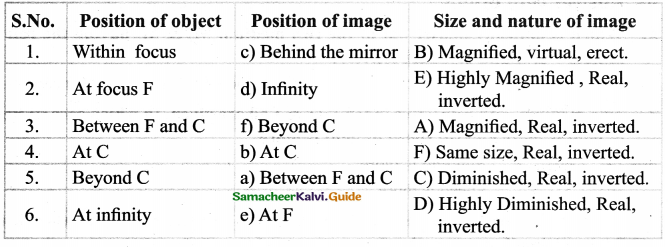
Samacheer Kalvi 9th Science Guide Chapter 6 Light 19

V. Assertion & Reason Type :

(a) If both assertion & reason are true and the reason is the correct explanation of the assertion.
(b) If both assertion & reason are true but the reason is not correct explanation of the assertion.
(c) If assertion is true but reason is false.
(d) If assertion & reason both are false.
(e) If assertion is false but reason is true.

Samacheer Kalvi 9th Science Guide Chapter 6 Light

Question 1.
Assertion : The air bubble shines in water.
Reason : Air bubble shines due to refraction of light.
Answer:
(c) If assertion is true but reason is false

Question 2.
Assertion : The focal length of the mirror is /and distance of the object from the
focus is V then the magnification of the mirror will be \(\left(\frac{f}{f-u}\right)\)
Samacheer Kalvi 9th Science Guide Chapter 6 Light 20
Answer:
(a) Both assertion & reason are true and the reason is the correct explanation of the assertion

Question 3.
Assertion : When an object is placed between two plane mirrors, then all the images found are of equal brightness.
Reason : Only two images are obtained in case of plane-parallel mirrors.
Answer:
(d) Assertion & reason both are false

Samacheer Kalvi 9th Science Guide Chapter 6 Light

Question 4.
Assertion: The mirrors used in torch lights are parabolic not concave.
Reason: The image formed by concave mirror is always virtual.
Answer:
(c) Assertion is true but reason is false

Question 5.
Assertion : The nature of the image depends on the size of the mirror.
Reason : Small mirrors always form a virtual image.
Answer:
(d) Assertion & reason both are false

Question 6.
Assertion : A real image cannot be produced by plane or convex mirror.
Reason : The focal length of a convex mirror is always taken as possitive.
Answer:
(e) Assertion is false but reason is true

Samacheer Kalvi 9th Science Guide Chapter 6 Light

VI. Answer very briefly :

Question 1.
Which is optically denser out of the two medium M1& M2 having the refractive indices = 1.71 and 1.36 respectively?
Answer:
M1
Reason: Optical density increases as the value of the refractive index increases.

Question 2.
Two medium with refractive index 1.31 & 1.50 is given. In which case (i) Bending of light is more and (ii) speed of light is more.
Answer:
(i) 1.50 – Bending is more
(ii) 1.31 – Speed is more

Samacheer Kalvi 9th Science Guide Chapter 6 Light

Question 3.
Under what circumstances there won’t be any refraction of light when it enters from one medium to another?
Answer:

  • When light incident at 90°, it will not bend.
  • When light passes from denser medium to rarer medium and if it is incident at an angle greater than the critical angle, it will reflect but will not refract.

Question 4.
A ray of light traveling in air enters obliquely into water. Does the light ray bend towards the normal or away from the normal? Why?
Answer:

  • When a ray of light travels from air into water obliquely, it bends towards the normal.
  • This is because water is optically denser than air.
  • On entering water, speed of light decreases and the light bends towards normal.

Question 5.
List down the uses of concave mirror.
Answer:
Concave mirrors are used :

  • As Shaving mirror.
  • As Reflectors in automobile headlights & torches.
  • By dentists to see large images of the teeth of patients.
  • To produce heat in solar furnaces.

Samacheer Kalvi 9th Science Guide Chapter 6 Light

Question 6.
What are the characteristics of the image formed on a plane mirror?
Answer:

  • Image is upright.
  • Size of the image is the same as the size of the object.

Question 7.
State the laws of reflection of light.
Answer:

  • The incident ray, the normal at the point of incidence and the reflected ray, all lie in the same plane.
  • Angle of incidence is equal to the angle of reflection.

Question 8.
Describe the nature of images formed by plane mirrors.
Answer:

  • It is always virtual and erect.
  • Its size is equal to that of the object
  • It is formed at the same distance behind the mirror as the object is in front of the mirror.
  • It is laterally inverted.

Samacheer Kalvi 9th Science Guide Chapter 6 Light

Question 9.
What is lateral inversion in a plane mirror?
Answer:
It means the apparent reversal of left and right in the mirror image compared with the object.

Question 10.
Explain why a ray of light passing through the centre of curvature of a concave mirror, gets reflected along with the same pattern.
Answer:
The ray passing through the centre of curvature incident to the mirror along its normal so < i = < r = 0
∴ The ray retraces its pattern

Question 11.
How tall does a mirror have to be to fit an entire person’s body?
Answer:
The height of the mirror should behalf of the person’s height regardless of the distance of the person from the mirror.

Question 12.
What is concave and convex mirror?
Answer:

  • If the reflecting surface is curved inwards that is called concave mirror.
  • The reflecting surface is curved outwards, then it is called convex mirror.

Samacheer Kalvi 9th Science Guide Chapter 6 Light

Question 13.
Define principal focus of concave mirror.
Answer:
Principal focus (F): The point on the principal axis of the spherical mirror where the rays of light parallel to the principal axis meet or appear to meet after reflection from the spherical mirror.

Question 14.
What is focal length (f) of a mirror?
Answer:
The distance between the pole (P) and the principal focus (F) of the spherical mirror is called the focal length.
f = \(\frac { R }{ 2 }\) , where R is the radius of curvature of the mirror.

Question 15.
Define Radius of curvature.
Answer:
The radius of the hollow sphere of which the spherical mirror forms a part is called the radius of curvature (R)
R = 2 × focal length

Samacheer Kalvi 9th Science Guide Chapter 6 Light

Question 16.
What is “aperture”?
Answer:
The diameter of the circular rim of the mirror is called the aperture of the mirror. It is the entire area of the reflecting surface of the mirror.

Question 17.
Distinguish between real & virtual image.
Answer:
Real :

  1. Light rays that come from an object actually meet after reflection.
  2. It can be obtained on a screen
  3. Image is inverted

Virtual :

  1. Light comes from an object does not actually meet but appears to meet.
  2. It cannot be obtained on the screen.
  3. The image is erect.

Samacheer Kalvi 9th Science Guide Chapter 6 Light

Question 18.
What do you mean by linear magnification?
Answer:
It is defined as the ratio of the height of the image (hi) to the height of the object (ho).
\(m=\frac{h_{i}}{h_{o}}(\text { or }) \quad m=-\frac{v}{u}\)

Question 19.
Which kind of mirrors are used in the shaving mirror? Why?
Answer:
Cancave mirror, to get magnified image. When a cancave mirror is held near the face (between the pole and focus of the mirror) then an upright and magnified image is seen.

Question 20.
Which mirror is used as a reflector? Why?
Answer:

  • Concave mirrors are used as reflectors in torches, vehicle headlights and searchlights.
  • To get a powerful parallel beam of light.

Question 21.
Write the uses of cancave mirror
Answer:

  1. As a shaving mirror: Magnified face will be seen
  2. As a dentist head mirror: Focuses the lights on to see a small area of the body (teeth, throat, etc.)
  3. As reflectors: To get a powerful beam of light
  4. In solar heaters: To focus sun light for heaters

Question 22.
What do you observe when an object is placed anywhere between P and infinity in front of a convex mirror?
Answer:

  • The image is formed behind the mirror between the pole (P) and focus (F).
  • Virtual and erect image.
  • Diminished image.

Samacheer Kalvi 9th Science Guide Chapter 6 Light

Question 23.
What is the nature of the image formed by a concave mirror if the magnification produced by the mirror is +4?
Answer:
Positive sign of magnification indicates that image is virtual, erect and enlarged.

Question 24.
Between which two points of a concave mirror should an object be placed to obtain a magnification of -2?
Answer:
Negative sign of magnification indicates that image is real and inverted. Sign of image is magnified (enlarge)
∴ Object is placed between F and C.

Question 25.
To obtain an image twice the size of the object, between which two points related to a concave mirror should an object be placed?
Answer:
Between F (principal focus) and C centre of curvature.
Real Image.
Question 26.
Draw a ray diagram and also state the position the relative size and nature of image formed by a concave mirror, when an object is placed at C.
Answer:
Image Position: At C, itself
Size: Same size
Nature : (i) Real
(ii) Inverted
Samacheer Kalvi 9th Science Guide Chapter 6 Light 21

Samacheer Kalvi 9th Science Guide Chapter 6 Light

Question 27.
Why a pencil partly immersed in water appears to be bent at the water surface.
Answer:
The pencil dipped in water appears bent due to the refraction of light.
The angle of refraction depends on the refractive index of the medium.

Question 28.
How should a ray of light be incident on a rectangular glass slab so that it comes out from the opposite side of the slab without being displaced?
Answer:
Along the normal to the surface or at an angle of incidence of i = 0.

Question 29.
Why a convex mirror is preferred for rearview mirrors in cars?
Answer:

  • It always forms virtual, erect, and diminished images.
  • The field of view increases.

Question 30.
List four properties of the image formed by a convex mirror.
Answer:

  • Always formed behind the mirror between P & F.
  • Virtual & erect
  • Size is always smaller than the object.
  • Magnification is always positive.

Samacheer Kalvi 9th Science Guide Chapter 6 Light

Question 31.
List four properties of the image formed by the concave mirror when the object is placed between F & P
Answer:

  • The image formed behind the mirror
  • Enlarged
  • Virtual
  • Erect

Question 32.
What is meant by the refraction of light?
Answer:
Light does not travel in the same direction in all media. It changes its direction, the bending of a light ray when it passes from one medium to another is called refraction of light.

Question 33.
State the laws of refraction of light.
Answer:
(i) The incident ray, the refracted ray, and the normal to the interface of two transparent media at the point of incidence, all lie in the same plane.

(ii) The ratio of the sine of the angle of incidence to the sine of the angle of refraction is a constant for a light of a given colour and for the given pair of media. This law is also known as Snell’s law of refraction.
If i is the angle of incidence and r is the angle of refraction, then \(\frac{\sin i}{\sin r}[latex] = constant
This constant is called the refractive index of the second medium with respect to the first medium. T

Samacheer Kalvi 9th Science Guide Chapter 6 Light

Question 34.
Define refractive index & write its unit.
Answer:
The refractive index of the second medium with respect to the first medium is defined as the ratio of the sine of the angle of incidence in the first medium to the sine of the angle of refraction in the second medium.
Unit: The refractive index has no unit as it is the ratio of two similar quantities

Question 35.
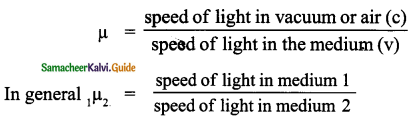
Define refractive index in terms of speed of light.
Answer:
The refractive index of a medium is also defined in terms of speed of light in different media
Samacheer Kalvi 9th Science Guide Chapter 6 Light 22

Question 36.
What is total internal reflection?
Answer:
Total internal reflection: When the angle of incidence exceeds the value of the critical angle, the refracted ray is not possible, since r > 90°, the ray is totally reflected back to the same medium (denser medium). This is called as total internal reflection.

Samacheer Kalvi 9th Science Guide Chapter 6 Light

Question 37.
Define the critical angle.
Answer:
The angle of incidence at which the angle of refraction is 90° is called the critical angle.

Question 38.
What are the conditions to achieve total internal reflection?
Answer:

  • Light must travel from denser medium (Water) to rarer medium (Air).
  • The angle of incidence inside the denser medium must be greater than that of the critical angle.

Question 39.
What is mirage? How it occurs?
Answer:

  • Mirage is an optical illusion caused by the refraction of light from the sky by heated air.
  • The air near the ground becomes hotter than the air at higher levels.
  • The refractive index of air increases with its density. Hotter air is less dense, and has smaller refractive index than cooler air.
  • If the air currents are small, that is, the air is still, the optical density of different layers of air increases with height.
  • As a result, light from an object such as a car passes through a medium whose refractive index decreases towards the ground.
  • Thus, a ray of light from such an object successively bends away from the normal and undergoes total internal reflection, if the angle of incidence for the air near the ground exceeds the critical angle.

Samacheer Kalvi 9th Science Guide Chapter 6 Light

Question 40.
How do twinkling stars occur? (or) what is the cause of the twinkling of stars?
Answer:
Refraction of light:

  • Light from a star is refracted as it passes through our atmosphere because the light
    passes rapidly through moving cells of air with different densities, temperatures, etc.
  • These cells bend light by different amounts and make the apparent position of the star move around. This movement is seen as twinkling.

Question 41.
What is the phenomenon used in optical fibre? Explain.
Answer:

  • Optical fibres are extensively used for transmitting audio and video signals through long distances.
  • Optical fibres too make use of the phenomenon of total internal reflection.
  • Optical fibers are fabricated with high-quality composite glass/quartz fibres.
    Each fibres consists of a core and cladding. The refractive index of the material of the core is higher than that of the cladding.

When a signal in the form of light is directed at one end of the fibre at a suitable angle, it undergoes repeated total internal reflection along the length of the fibre and finally comes out at the other end. Optical fibres are extensively used for transmitting and receiving electrical signals which are converted to light between the ends of the fibre, over long distances.

Samacheer Kalvi 9th Science Guide Chapter 6 Light

Question 42.
Write any two uses of total internal reflection.
Answer:

  1. Spectacular brilliance of diamonds.
  2. Transmission of audio and video signals to long-distance through optical fibres.

Question 43.
What are the examples of total internal reflection in nature?
Answer:

  1. Mirage
  2. Twinkling of stars

Question 44.
Give two examples of the transparent medium that are denser than air.
Answer:
Water, glass.

Question 45.
A coin in a glass beaker appears to rise as the beaker is slowly filled with water why?
Answer:
Refraction of light at the air-water interface.

Samacheer Kalvi 9th Science Guide Chapter 6 Light

Question 46.
Name the spherical mirror(s) that has/have
(i) Virtual principal focus
(ii) Real principal focus
Answer:
(i) Convex
(ii) Concave.

VII. Long Answers

Question 1.
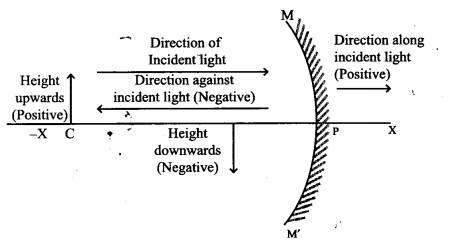
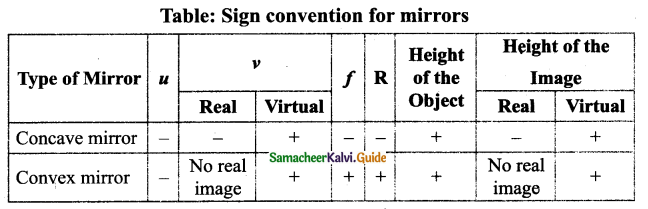
List the sign conventions for reflection of light by spherical mirrors.
(i) Write the formula for the spherical mirror.
(ii) Mirror Equation
Answer:
Samacheer Kalvi 9th Science Guide Chapter 6 Light 23
(i)

  • The object is always placed on the left side of the mirror.
  • All distances are measured from the pole of the mirror.
  • Distances measured in the direction of light are taken as positive (along + X-axis) and those measured in the opposite direction are taken as negative (along – X-axis).
  • All distances measured perpendicular to and above the principal axis (along + Y-axis) are considered to be positive.
  • All distances measured perpendicular to and below the principal axis (along – Y-axis) are considered to be negative. Cartesian sign conventions are used to derive mirror formula and do simple calculations.

Samacheer Kalvi 9th Science Guide Chapter 6 Light 24

(ii) Mirror Equation
The expression relating the distance of the object u, a distance of image v, and focal length f of a spherical mirror is called the mirror equation.
[latex]\frac{1}{f}=\frac{1}{u}+\frac{1}{v}\)

f – focal length of a spherical mirror
u – Distance of the object
v – Distance of the image

Linear Magnification:

It can be defined as the ratio of the height of the image (hi) to the height of the object (ho)
m = \(\frac{h_{i}}{h_{o}}(\text { or }) \frac{-v}{u}\)
hi = height of the image
ho = height of the object

Question 2.
State the type of mirror used as
(i) Convex mirror
(ii) Concave mirror
Answer:
(i) Convex mirror :

  • It gives a wide field of view
  • It produces erect and small size image of the object. [As the vehicles approach the driver from behind, the size of the image increases. When vehicles are moving away from the driver, the image size decreases]

(ii) Concave mirror:
To see a large size image of the face.
When the object lies in between pole and principal focus, it forms a virtual, erect and enlarged image.

Samacheer Kalvi 9th Science Guide Chapter 6 Light

Question 3.
Write the rules for the construction of image by Concave mirrors, along with ray diagram. .
Answer:
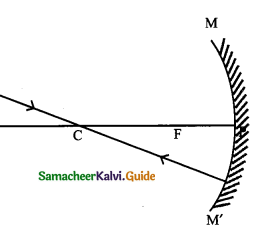
(i) Rule 1 : A ray passing through the centre of curvature is reflected back along its own path.
Samacheer Kalvi 9th Science Guide Chapter 6 Light 25

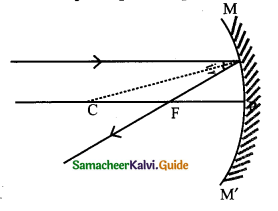
(ii) Rule 2 : A ray parallel to the principal axis passes through the focus after reflection.
Samacheer Kalvi 9th Science Guide Chapter 6 Light 26

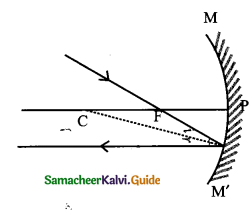
(iii) Rule 3 :A ray passing through the focus gets reflected and travels parallel to the principal axis.
Samacheer Kalvi 9th Science Guide Chapter 6 Light 27

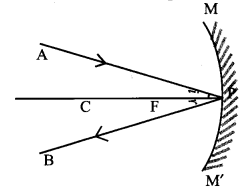
(iv) Rule 4 : A ray AP incident at the pole of the mirror gets reflected along a path PB
such that the angle of incidence APC is equal to the angle of reflection BPC.
Samacheer Kalvi 9th Science Guide Chapter 6 Light 28

Samacheer Kalvi 9th Science Guide Chapter 6 Light

Question 4.
Describe the nature and location of the images for the different positions of object which is placed in front of the concave mirror.
Answer:
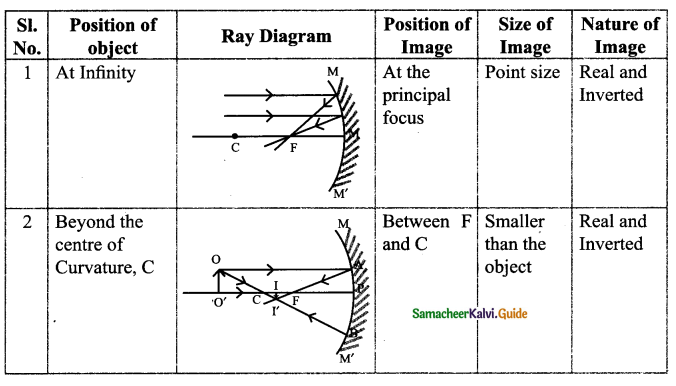
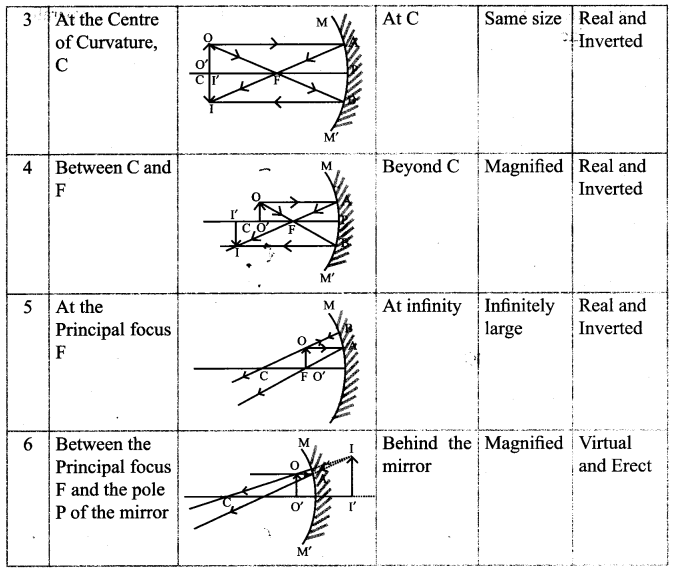
Samacheer Kalvi 9th Science Guide Chapter 6 Light 29
Samacheer Kalvi 9th Science Guide Chapter 6 Light 30

VIII. Higher-Order Thinking Skills :

Question 1.
M = 2.42 for diamond. What is the meaning of this statement in relation to the speed of light?
Answer:
It means that light travels 2.42 times faster in a vacuum than in a diamond.

Question 2.
A convex mirror is in water. What should be the change in its focal length?
Answer:
No change. The focal length of a convex mirror does not depend on the nature of the medium.

Samacheer Kalvi 9th Science Guide Chapter 6 Light

Question 3.
Are the laws of reflection true in the case of irregular reflection?
Answer:
Yes, at the point of incidence both laws of reflection will hold good.

Samacheer Kalvi 4th English Guide Term 3 Supplementary Chapter 2 The Wooden Toy

Tamilnadu State Board New Syllabus Samacheer Kalvi 4th English Guide Pdf Term 3 Supplementary Chapter 2 The Wooden Toy Text Book Back Questions and Answers, Summary, Notes.

Tamilnadu Samacheer Kalvi 4th English Solutions Term 3 Supplementary Chapter 2 The Wooden Toy

4th English Guide The Wooden Toy Book Back Questions and Answers

Samacheer Kalvi 4th English Guide Term 3 Supplementary Chapter 2 The Wooden Toy

A. Choose the best answer.

Question 1.
Mugund made ___________ using the dry woods.
(a) Pots
(b) Dolls
(c) Cups
(d) Deer
Answer:
(b) Dolls

Question 2.
In memory of his mother, he carved ___________ statue.
(a) Golden
(b) Sliver
(c) Wooden
(d) Brass
Answer:
(c) Wooden

Question 3.
____________ is a great risk to the environment.
(a) Paper
(b) Cotton cloth
(c) Plastic
(d) Wood
Answer:
(c) Plastic

Question 4.
Mugund learnt the art from his ___________
(a) Father
(b) Mother
(c) Grandfather
(d) Uncle
Answer:
(c) Grandfather

Question 5.
___________ was helpful for his father to drive out the wild animals.
(a) Drum
(b) Wooden tiger
(c) Wooden doll
(d) Clay doll
Answer:
(a) Drum

Samacheer Kalvi 4th English Guide Term 3 Supplementary Chapter 2 The Wooden Toy

B. Write True or false.

Question 1.
Mugund loved wild animals.
Answer:
False

Question 2.
Mugund did not cut the raw wood.
Answer:
True

Question 3.
He started selling wooden toys at a high price.
Answer:
False

Samacheer Kalvi 4th English Guide Term 3 Supplementary Chapter 2 The Wooden Toy

C. Answer the following questions.

Question 1.
How did Mugund’s mother die?
Answer:
Mugund’s mother died as the wild animals hunted her.

Question 2.
What did his mother say in his dream?
Answer:
Mugund’s mother said in his dream that he should do his part in eradicating the use of plastics through his art as plastics are a great risk to the environment.

Question 3.
What incident made Mugund make a wooden drum?
Answer:
Mugund made a wooden drum to drive out the wild animals because the losses of his father’s cattle kept min creasing and he had to do something.

Question 4.
Why was his father unable to sleep?
Answer:
His father was unable to sleep because the losses of the animals, he was rearing, kept increasing.

Question 5.
Which problem do you think you can solve with art? How?
Answer:
We can solve the problem of using plastic, which is a great risk to the environment. By replacing plastic toys with wooden dolls we can save the world.

Samacheer Kalvi 4th English Guide Term 3 Supplementary Chapter 2 The Wooden Toy

I. Fill in the blanks.

Question 1.
Long ago, the wild animals hunted Mugund’s ___________
Answer:
Mother

Question 2.
Mugund started selling wooden toys at a ___________ rate.
Answer:
Cheap

Question 3.
Mugund’s father owned nothing but a flock of sheep and a piece of ____________.
Answer:
Land

Question 4.
The massive ___________ from the wooden drum helped his father, to drive out the wild animals.
Answer:
Noise

Samacheer Kalvi 4th English Guide Term 3 Supplementary Chapter 2 The Wooden Toy

II. Write True or False.

Question 1.
Children used to play with his dolls known as marapachi bommai.
Answer:
True

Question 2.
The restlessness and worry made Mugund’s father healthy.
Answer:
False

Question 3.
Mugund started selling wooden toys in all corners of the land.
Answer:
True

Question 4.
Mugund was the son of a plumber.
Answer:
False

Samacheer Kalvi 4th English Guide Term 3 Supplementary Chapter 2 The Wooden Toy

III. Name the character / speaker.

Question 1.
“Do your part in eradicating the use of plastics”.
Answer:
Mugund’s mother

Question 2.
“Mugund, cut the raw wood”.
Answer:
Mugund’s friend

Samacheer Kalvi 4th English Guide Term 3 Supplementary Chapter 2 The Wooden Toy

IV. Answer the following questions.

Question 1.
Where did the wild dogs live? What did they do?
Answer:
The wild dogs lived in the mountains around the village. They hunted the animals in the forest and domestic animals in the village.

Question 2.
What did Mugund do every day?
Answer:
Mugund went to the forest everyday. He collected dry wood and made dolls with it for the children to play.

Question 3.
What did Mugund do in memory of his mother?
Answer:
Mugund carved a wooden statue in memory of his mother and prayed every day.

Question 4.
What did Mugund learn from his grandfather?
Answer:
Mugund learnt the art of making handicrafts from his grandfather. He made dolls using dry wood and statues of any photo that was shown to him.

Question 5.
How did Mugund’s father make a living?
Answer:
Mugund’s father was running a farm and rearing some animals like goat, cow and hen. He worked hard on the farm and took all the cattle to pasture every day.

Question 6.
Why did Mugund make a wooden drum?
Answer:
Mugund made a wooden drum so that the massive noise from the drum would help his father to drive out the wild animals.

Question 7.
What was the problem in using the drum?
Answer:
When the drum was used, the wild animals would not come to the village due to the massive noise. But, the animals came to the village as soon as someone stopped drumming. So, the problem in using the drum was that one should continuously drum without any break and that was not possible.

Question 8.
Why did Mugund refuse to cut the raw wood?
Answer:
Mugund wanted to follow his mother’s advice. He did not want to cut the raw wood and destroy the living trees in the forest.

Question 9.
How did Mugund save the animals in his village from the wild animals?
Answer:
Mugund designed some wooden tigers and wooden people and placed on the farm. The wild animals thought the wooden images were real and were. afraid thinking the people were awake.

Samacheer Kalvi 4th English Guide Term 3 Supplementary Chapter 2 The Wooden Toy

Let us read aloud

A. Read the passage 3 times and colour the trees for each time.

Trees help us in many ways. The colour green is calming and heals your worries. By planting and caring for trees, we help improve our surroundings, as they give fresh air. When air is dirty the people of Delhi suffered a lot. But people of Madhubani district in Bihar have shown how art can be used to make our air clean. So that people made paintings on trees to stop people from cutting the trees.

Samacheer Kalvi 4th English Guide Term 3 Supplementary 2 The wooden toy 4

Question 1.
Bihar people saved trees by ____________ painting.
Answer:
Bihar people save trees by painting on trees.

Question 2.
What is the main idea of the story?
Answer:
The main idea of the story is to stop cutting the trees and save the trees.

Samacheer Kalvi 4th English Guide Term 3 Supplementary Chapter 2 The Wooden Toy

Do you want to try to write your own paragraph now?

Question 1.
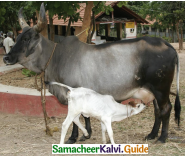
Write a paragraph on cow.
Samacheer Kalvi 4th English Guide Term 3 Supplementary 2 The wooden toy 1
Answer:

  1. Cow is a domestic animal.
  2. Cow gives us milk, butter and cheese.
  3. The young one of a cow is calf.
  4. Cows are decorated during ‘mattu pongal’.
  5. We must not be rude but kind and loving.

Question 2.
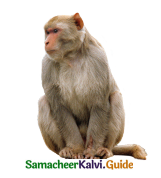
Write a paragraph on monkey.
Samacheer Kalvi 4th English Guide Term 3 Supplementary 2 The wooden toy 2
Answer:

  1. Monkeys jump from tree to tree.
  2. They eat fruits and nuts.
  3. Monkeys carry their little ones on them.
  4. Big monkeys are called chimpanzees.
  5. We must not throw stones or drop plastic around them.

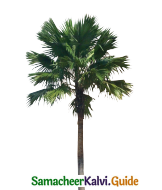
Question 3.
Write a paragraph on palm tree.
Samacheer Kalvi 4th English Guide Term 3 Supplementary 2 The wooden toy 3
Answer:

  1. Palm trees grow tall.
  2. All the parts of a palm tree are useful.
  3. Men climb to the top to take the palmyra.
  4. Palm tree leaves are used to make hut roofs.
  5. We must grow more palm trees around us.

Samacheer Kalvi 4th English Guide Term 3 Supplementary Chapter 2 The Wooden Toy

Additional Questions and Answers.

Question 1.
Write a paragraph on Diwali.
Answer:

  1. Diwali is the festival of light.
  2. We burst crackers during Diwali.
  3. People distribute sweets to their friends.
  4. We decorate our houses with lights.
  5. Diwali chases the darkness in our life and brings in light.

Samacheer Kalvi 4th English Guide Term 3 Supplementary Chapter 2 The Wooden Toy

I can do

I. Choose the correct option.

Question 1.
We ___________ yarn to make sarees.
(a) Weave
(b) Water
(c) Knead
Answer:
(a) Weave

Question 2.
The plants because of the wind.
(a) Grow
(b) Bend
(c) Chokes
Answer:
(b) Bend

Samacheer Kalvi 4th English Guide Term 3 Supplementary Chapter 2 The Wooden Toy

II. Match the words with similar meaning.

Question 1.
Truck – subway
Answer:
Truck – lorry

Question 2.
Under ground – lorry
Answer:
Under ground – subway

Question 3.
Tap – wallet
Answer:
Tap – faucet

Question 4.
Purse – faucet
Answer:
Purse – wallet

Samacheer Kalvi 4th English Guide Term 3 Supplementary Chapter 2 The Wooden Toy

III. Write the words with same meaning,

Question 1.
Samacheer Kalvi 4th English Guide Term 3 Supplementary 2 The wooden toy 5
Touch ______
Answer:
Flash light

Question 2.
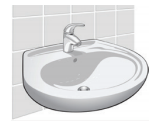
Samacheer Kalvi 4th English Guide Term 3 Supplementary 2 The wooden toy 6
Sink ______
Answer:
Wash basin

Question 3.
Samacheer Kalvi 4th English Guide Term 3 Supplementary 2 The wooden toy 7
Flat ______
Answer:
Apartment

Samacheer Kalvi 4th English Guide Term 3 Supplementary Chapter 2 The Wooden Toy

IV. Recite the poem The Painter with correct intonation.

V. Match the rhyming words.

Question 1.
Strokes – floor
Answer:
strokes – chokes

Question 2.
Shore – rush
Answer:
shore – floor

Question 3.
Brush – chokes
Answer:
Brush – rush

Samacheer Kalvi 4th English Guide Term 3 Supplementary Chapter 2 The Wooden Toy

VI. Describe the picture with adjectives.

(sweet, red, round)
Samacheer Kalvi 4th English Guide Term 3 Supplementary 2 The wooden toy 8
Question 1.
The apple is ____________
Answer:
Red

Question 2.
The apple tastes __________
Answer:
Sweet

Question 3.
It is ___________ in shape.
Answer:
Round

Samacheer Kalvi 4th English Guide Term 3 Supplementary Chapter 2 The Wooden Toy

The Wooden Toy Summary in English and Tamil

Once there was a village circled by mountains and many big trees. It was the home to many wild animals, especially wild dogs. They used to hunt not only the animals in the forest but, also the domestic animals in the village. This affected the farmer who lived near the edge of the forest with his son the most.

ஒரு காலத்தில் மலைகளாலும், மரங்களாலும் சூழப்பட்ட ஒரு கிராமம் இருந்தது. அது பல காட்டு விலங்குகளின் குறிப்பாக காட்டுநாய்களின்-இல்லமாக திகழ்ந்த து. அந்த காட்டு நாய்கள் வனவிலங்குகளை மட்டுமல்லாது கிராமத்தில் வளர்க்கப்பட்டுவந்த வீட்டு விலங்குகளையும் வேட்டையாடும். காட்டோரம் தன் மகனுடன் வாழ்ந்து வந்த ஒரு விவசாயியை இது வெகுவாக பாதித்தது.

Mugund was the son of the farmer. He was good at creating many things. Every day he went into the forest to collect dry wood. He used to make dolls using the dry wood. Mugund’s art was very famous in the town. Children used to play with his dolls, mostly known as marapachi bommai.

முகுந்த் என்பது அந்த விவசாயியின் மகனின் பெயராகும். அவன் பல பொருட்களை உருவாக்குவதில் சிறந்து விளங்கினான். தினமும் காட்டிற்கு சென்று காய்ந்த விறகுகளை அவன் கொண்டு வருவான். அவற்றை உபயோகப்படுத்தி பொம்மைகளை தயாரிப்பான். அவனுடைய கலை அந்த நகரத்தில் மிகவும் பிரபலமானது. அவன் தயாரிக்கும் பொம்மைகளுக்கு “மரப்பாச்சி பொம்மை” என்றுபெயராகும். அவற்றுடன் குழந்தைகள் விளையாடுவர்.

Samacheer Kalvi 4th English Guide Term 3 Supplementary Chapter 2 The Wooden Toy

Long ago, the wild animals hunted Mugund’s mother. That incident made Mugund hate wild animals. In memory of his mother, he carved a wooden statue of his mother and prayed every day. One night, he woke to hear his mother’s words, “Do your part in eradicating the use of plastics through your art because plastic is a great risk to the environment.”

வெகு காலத்திற்கு முன், முகுந்தின் – தாயார் வனவிலங்குகளால் வேட்டையாடப்பட்டார். அந்தசம்பவம், வனவிலங்குகளை முகுந்த் வெறுப்பதற்கு
காரணமாய் அமைந்தது. தன் தாயாரின் நினைவாக, அவன் மரத்தினால் தனது தாயின் சிலையைச் செய்து அதை தினமும் வணங்கி வந்தான். ஒரு நாள் இரவு, தன் தாயாரின் குரல் ஒலித்ததை கேட்டு உறக்கத்திலிருந்துஎழுந்தான். அந்தக் குரல் “உன் பங்களிப்பாக, பிளாஸ்டிக் பொருட்களின் உபயோகத்தை, உன் கலையின் மூலம் ஒழித்து விடு, ஏனெனில் பிளாஸ்டிக் சுற்றுச்சூழலுக்கு ஆபத்து விளைவிப்பதாகும்” எனஒலித்தது.

So, he started selling wooden toys at a cheap rate He was also clever at making handicrafts. He learnt the art from his grandfather. In the beginning, he made dolls for children, using dry wood. Then, he was making statues of any photo that was show to him.

அதனால், அவன் குறைந்த விலையில் மரப்பொம்மைகளை விற்கத் துவங்கினான். அவன் கைவினை பொருட்களை தயாரிப்பதிலும் நிபுணனாக இருந்தான், இதை அவன் தன் பாட்டனாரிடமிருந்து கற்று இருந்தான். முதலில், காய்ந்த மரத்துண்டுகளில் விறகுகளில் குழந்தைகளுக்கான பொம்மைகள் செய்யத் தொடங்கினான் அவன். பிறகு அவன் | தன்னிடம் காண்பிக்கப்படும் எந்த ஒரு புகைப்படத்திலும் உள்ள ஓர் உருவம் போல சிலைகள் செய்யத் துவங்கினான்.

Samacheer Kalvi 4th English Guide Term 3 Supplementary Chapter 2 The Wooden Toy

His father owned nothing but a flock of sheep and a piece of land. Also, he worked hard to keep the farm running. He was rearing some animals like goat, cow and hen. His father took all the cattle to pasture every day. When he returned home, he would always count all the animals. One day, when his father returned, he saw that some animals were missing. His father was unable to sleep because the losses of the animals kept increasing. Mohan was worried about his father.He had to do something.

அவனது தந்தையாரிடம் சிறு ஆட்டு மந்தையும், சிறிது நிலமும் இருந்தது. அவர் கடுமையாய் உழைத்து தன் பண்ணையை நடத்தி வந்தார். அவர் ஆடு, பசு மற்றும் கோழி போன்றவற்றை வளர்த்து வந்தார். தினமும் அவற்றை மேய்ச்சலுக்கு அழைத்து செல்லும்அவர், வீடு திரும்பியதும் அவற்றை கணக்கெடுப்பார். ஒருநாள், அவர் இல்லம் திரும்பியதும் அவற்றில் சில குறைந்திருப்பதை கண்டார். விலங்குகளின் இழப்பு அதிகரிக்க, அதிகரிக்க, அவரால் உறங்க முடியாமல் போனது. தன் தந்தையை நினைத்து கவலைப்பட்ட முகுந்த், ஏதாவது செய்ய வேண்டுமென முடிவெடுத்தான்.

He had an idea. He made a wooden drum because the massive noise from the drum would help his father to drive out the wild animals. Mugund’s father was happy because the drum threatened the animals. But, the animals came as soon as someone stopped drumming. His father could not be awake all night. Soon, the wild animals started attacking only at night. The restlessness and worry made the father ill.

அவனுக்கு ஒரு யோசனை வந்தது. மரத்தாலான ஒரு முரசு அவனால் தயாரிக்கப்பட்டது. ஏனெனில் முரசிலிருந்து வரும்பெரும் சப்தம், காட்டு விலங்குகளை விரட்டிவிரட்டி அடிக்க, அவன் தந்தைக்கு உதவும் என நினைத்தான். அந்த முரசு, காட்டு விலங்குகளை பயமுறுத்துவதைக் கண்டு அவன் தந்தை மகிழ்ந்தார்.ஆயினும், முரசின் ஓசை நின்றவுடன் மறுபடியும் அவை வர ஆரம்பித்துவிட்டன. இரவு நேரம் அவரால் விழித்திருக்க முடியாதபொழுது அவை தாக்க ஆரம்பித்துவிட்டன. இதனால் அந்த உளைச்சலாலும், கவலையாலும் அவன் தந்தை நோய்வாய்பட்டார்.

Samacheer Kalvi 4th English Guide Term 3 Supplementary Chapter 2 The Wooden Toy

The next day, Mugund went into the forest to find a hollow log of cedar. But, w too of cedar he could not find it. His friend told him to cut the raw wood. But, he refused. Mugund felt that his mother was still living in each tree. At last, they found some wood and brought it home. Mugund went to bed a little early. His father was beating the drums to drive all the animals

மறுநாள் காட்டிற்கு சென்ற முகுந்த் அங்கு ஏதாவது உட்புறம் காலியான தேவதாரு மரத்துண்டுகிடைக்குமா? என தேடினான். ஆனால், அது போல ஒரு மரத்துண்டு அவனுக்கு கிடைக்கவில்லை. ஒரு மரத்தையே வெட்டி தனக்கு வேண்டிய உட்குழிவான பகுதியை செய்து கொள்ளலாம் என அவனது நண்பன் சொன்னான். ஆனால் முகுந்த் மறுத்துவிட்டான். தன்தாயார் இன்னும் ஒவ்வொரு மரத்திலும் வாழ்வதாக முகுந்த் எண்ணினான். கடைசியில் அவர்களுக்கு ஏதோ ஒரு மரத்துண்டு கிடைத்தது. அதை வீட்டிற்கு அவர்கள் கொண்டு வந்தனர். away.முகுந்த் சீக்கிரம் உறங்கச் சென்றுவிட்டான். அவன் தந்தை விலங்குகளை விரட்டுவதற்கு முரசை ஒலித்துக் கொண்டே இருந்தார்.

Suddenly the sounds of the drum stopped. Mugund’s father was tired, and he slept. Nearly twenty-five animals got attacked that night. Then, Mugund thought of designing some wooden tigers and some wooden people to place on the farm. So, the animals would be afraid as the people were still awake.

முகுந்தின் தந்தை களைப்பில் உறங்கிவிட்டதால் திடீரென முரசின் ஓசை நின்றது. அன்றிரவு 25 விலங்குகள் வேட்டையாடப்பட்டன. அதனால், மரத்தினால் சில புலிகளையும், மனிதர்களையும் 9″ செய்து பண்ணையில் வைப்பதற்கு முகுந்த் திட்டமிட்டான். ஏனெனில், மனிதர்கள்விழித்திருப்பதை கண்டால் மிருகங்கள் அஞ்சும் அல்லவா?

Samacheer Kalvi 4th English Guide Term 3 Supplementary Chapter 2 The Wooden Toy

From that day on wards, the farmer and his son had a good sleep. Most of the landowners ordered wooden animals from Mugund. They wanted to save their crops and farms. Soon, Mugund started selling toys to all 10 d selling toys to all corners of the land. This led to a demand for wooden dolls over plastic ones. He was happy that he was able to take part in saving the world through his art.

நிம்மதியாக உறங்கினர். தங்கள் பயிர்களையும்,பண்ணையையும் காக்க, பல நில உரிமையாளர்கள் மரத்தால் செய்யப்பட்ட மிருகங்களை செய்து தருமாறு முகுந்திடம் கேட்டனர். வெகு விரைவில், எல்லா பகுதிகளுக்கும் தன் தொடங்கினான். இதனால் பிளாஸ்டிக்கை விட மரப்பொம்மைகளுக்கு தேவை கூடியது. இந்த பங்கெடுத்ததில், முகுந்த் மிகவும் மகிழ்ச்சி அடைந்தான்.

Samacheer Kalvi 12th English Guide Poem 4 Ulysses

Tamilnadu State Board New Syllabus Samacheer Kalvi 12th English Guide Pdf Poem 4 Ulysses Text Book Back Questions and Answers, Summary, Notes.

Tamilnadu Samacheer Kalvi 12th English Solutions Poem 4 Ulysses

12th English Guide Ulysses Text Book Back Questions and Answers

Textual Questions:

1. Complete the summary of the poem, choosing words from the list given below:

Lines 1 to 32:
Samacheer Kalvi 12th English Guide Poem 4 Ulysses 3

Ulysses is (1) _________ to discharge his duties as a (2) ______, as he longs for (3) ________. He is filled with an (4) ___________ thirst for (5) __________ and wishes to live life to the (6) ________. He has travelled far and wide gaining (7) _________ of various places, cultures, men and (8). He recalls with delight his experience at the battle of Troy. Enriched by his (9) ________ he longs for more and his quest seems endless. Like metal which would (10) ________ if unused, life without adventure is meaningless. According to him living is not merely (11) ___________ to stay alive. Though old but zestful, Ulysses looks at every hour as a bringer of new things and yearns to follow knowledge even if it is (12) ________.
Answers:

  1. unwilling
  2. king,
  3. travel
  4. unguenchable
  5. adventure
  6. fullest
  7. experience
  8. matters
  9. knowledge
  10.  rust
  11. breathing
  12. unattainable

Samacheer Kalvi 12th English Guide Poem 4 Ulysses

Lines 33 to 42:
Samacheer Kalvi 12th English Guide Poem 4 Ulysses 4

Ulysses desires to hand over his (1) ______ to his son Telemachus, who would fulfil his duties towards his subjects with care and (2) ______. Telemachus possesses patience and has the will to civilise the citizens of Ithaca in a (3) _______ way. Ulysses is happy that his son would do his work blamelessly and he would pursue his (4) ________ for travel and knowledge.
Answers:

  1. kingdom
  2. tender
  3. prudence
  4. guest

Lines 44 to 70:
Samacheer Kalvi 12th English Guide Poem 4 Ulysses 5

Ulysses beckons his sailors to (1) ________ at the port where the ship is ready to sail. His companions who have faced both (2) ______and sunshine with a smile, are united by their undying spirit of adventure. Though death would end everything, Ulysses urges his companions to join him and sail beyond the sunset and seek a newer (3) _____, regardless of consequences. These brave hearts who had once moved (4) ______ and earth, may have grown old and weak physically but their spirit is young and (5) ______. His call is an inspiration for all those who seek true knowledge and strive to lead (6) _____ lives.
Answers:

  1. gather
  2. thunder
  3. world
  4. heaven
  5. undaunted

Samacheer Kalvi 12th English Guide Poem 4 Ulysses

2. Answer the following questions in one or two sentences each: (Text Book Page No. 131)

Question a.
‘Ulysses is not happy to perform his duties as a king’ Why?
Answer:
Ulysses is not happy to perform the ordinary duties of a king mainly because his heart is in voyages beyond horizon. He is bored with the task of enforcing law and order and giving reward and punishment to a savage race.

Question b.
What does he think of the people of his kingdom?
Answer:
Ulysses views the people of Ithaca as uncultured and uncivilized. They are like country bumpkins with a little bit of an attitude.

Question c.
What has Ulysses gained from his travel experiences?
Answer:
Ulysses has met people hailing from different cultural backgrounds. He has learned much from their manners, climates, councils, and governments. He learned strategies of warfare in battles.

Question d.
Pick out the lines which convey that his quest for travel is unending.
Answer:
“I cannot rest from travel: I will drink life to the lees;

Question e.
‘As tho’ to breathe were life!’ – From the given line what do you understand of Ulysses’ attitude to life?
Answer:
Ulysses strongly believes that just breathing is not life. Life has to be adventurous and full of action.

Question f.
What does Ulysses yearn for?
Answer:
Ulysses yearns for travel and adventure. He has a passion to travel to unknown lands.

Samacheer Kalvi 12th English Guide Poem 4 Ulysses

Question g.
Who does the speaker address in the second part?
Answer:
The speaker addresses the readers in the second part explaining the difference between his roles and that of Telemachus.

Question h.
Why did Ulysses want to hand over the kingdom to his son?
Answer:
Ulysses wanted to hand over the kingdom to his son Telemachus who would fulfill his duties towards his subjects and his son would pursue his quest for travel and knowledge.

Question i.
How would Telemachus transform the subjects?
Answer:
Ulysses believes that his son Telemachus is wise and kind enough to transform rugged citizens into mild and civilized subjects by his tenderness and love.

Question j.
‘He works his work, I mine’ – How is the work distinguished?
Answer:
Here Ulysses’ work and his son’s work are distinguished. At the end of his parting with Ithaca, Ulysses has his duty to hand over his kingdom to his son Telemachus and his son has the duty of ruling the kingdom in a fair manner.

Question k.
In what ways were Ulysses and his mariners alike?
Answer:
Both Ulysses and his fellow sailors are now old. They no more have the strength they possessed in olden days moving earth and heaven. They are made weak by time and fate but strong in will “to strive, to seek, to find and not to yield.” They share the heroic temper and undying quest for knowledge and adventure.

Question l.
What could be the possible outcomes of their travel?
Answer:
The possible outcomes of their travel could be gaining true knowledge and leading meaningful lives.

Samacheer Kalvi 12th English Guide Poem 4 Ulysses

3. Identify the figures of speech employed in the following lines:

Poetic linesFigure of Speech
1. Thro’ scudding drifts the rainy Hyades Vext the dim sea…Personification
2. For always roaming with a hungry heartMetaphor
3. And drunk delight of battle with my peers;Metaphor
4. the deep, Moans round with many voices.Personification
5. To follow knowledge like a sinking star.Simile
6. There lies the port the vessel puffs her sailPersonification
7. ‘I cannot rest from travel’Oxymoron
8. The thunder and sunshine, and opposedMetaphor
9. ‘I will drink life to the lees’Metaphor
10. ‘Yet all experience is an arch’

Gleams that untravelled world whose margin fades to store and hoard me,

A rugged people, and thro’

Subdue them to the useful

The long day wanes: the slow moon climbs:

smite the sounding furrows; for my purpose holds

Metaphor
11. ‘T is not too late to seek a newer world.

Souls that have toil’d, and wrought, and thought

Synecdoche
12. Match’d with an aged wife 1 mete and doleAlliteration
13. ‘For some three suns to store and hoard myself,’Alliteration
14. ‘Of common duties, decent riot to fail’Alliteration
15. ‘The long day wanes: the slow moon climbs: the deep”Alliteration
16. ‘Push off and sitting well in order smite’Alliteration
17. ‘Push off and sitting well in order smite’Alliteration

Samacheer Kalvi 12th English Guide Poem 4 Ulysses

4. Read the sets of lines from the poem and answer the questions that follow: (Text Book Page No. 132)

a) ……..I mete and dole ”
Unequal laws unto a savage race,
That hoard, and sleep, and feed, and know not me.

i. What does Ulysses do?
Answer:
Ulysses awards rewards and punishments to his people.

ii. Did he enjoy what he was doing? Give reasons.
Answer:
No, he didn’t enjoy what he was doing. He thought this life a waste when compared with the previous life (adventurous life). He also complained that the people were savage and they were only eating and sleeping.

b) Yet all experience is an arch wherethrough
Gleams that untravelled world, whose margin
fades
Forever and forever when I move.

i. What is experience compared to?
Answer:
Experience is compared to an ‘arch’.

ii. How do the fines convey that the experience is endless?
Answer:
His desire is to keep travelling and living a life of adventure.

c) Little remains: but every hour is saved
From that eternal silence, something more,
A bringer of new things; and vile it were

i. How is every hour important to Ulysses?
Answer:
As every hour passes, Ulysses gains experience.

ii. What does the term Little remains to convey?
Answer:
He is old and is left with a few more days of life.

Samacheer Kalvi 12th English Guide Poem 4 Ulysses

d) This is my son, mine own Telemachus,
To whom I leave the sceptre and the isle Well-loved of me,

i. Who does Ulysses entrust his kingdom to, in his absence?
Answer:
Ulysses desires to hand over his kingdom to his son Telemachus.

ii. Bring out the significance of the ‘sceptre’.
Answer:
A ‘Sceptre’ is a ceremonial staff that symbolizes authority. Here, Ulysses gave the sceptre to his son. Who would do his work blamelessly and fulfill his duties towards his subjects with care?

e) That ever with a frolic welcome look
The thunder and the sunshine, and opposed

i. What do ‘thunder’ and ‘sunshine’ refer to?
Answer:
‘Thunder’ and ‘Sunshine’ refer to bad times and good times.

ii. What do we infer about the attitude of the sailors?
Answer:
We infer that the sailors have brave hearts. They had once moved heaven and earth, may have grown old and weak physically but their spirit is young and undaunted. Thus the sailor’s attitude is young and energetic.

f) Death closes all: but something ere the end,
Some work of noble note may yet be done,
Not unbecoming men that strove with Gods.

i. The above lines convey the undying spirit of Ulysses. Explain.
Answer:
Ulysses wants to do something great which can outweigh his previous achievements. He wants to achieve before his death.

ii. Pick out the words in alliteration in the above lines.
Answer:
ere, end
noble, note.

g) ……………for my purpose holds
To sail beyond the sunset and the baths
Of all the western stars, until I die.

i. What was Ulysses’ purpose in life?
Answer:
Ulysses purpose in life was to travel to unknown lands.

ii. How long would his venture last?
Answer:
His venture would last till his death.

h) One equal temper of heroic hearts,
Made weak by time and fate, but strong in will
To strive, to seek, to find, and not to yield.

i. Though made weak by time and fate, the hearts are heroic. Explain.
Answer:
Ulysses and his companions have brave hearts who had once moved heaven and earth, may have grown old and weak physically but their spirit is young and undaunted.

ii. Pick out the words in alliteration in the above lines.
Answer:
heroic hearts strive to seek.

Samacheer Kalvi 12th English Guide Poem 4 Ulysses

Additional Questions:

a) “Match’d with an aged wife, I mete and dole”

i) Whom does ‘I’ refer to?
Answer:
‘I’ refer to king Ulysses.

ii) What does the word ‘mete’ mean?
Answer:
The word ‘mete’ means ‘to allot’ or ‘measure out’.

b) ‘Thro’ scudding drifts the rainy Hyades’

i) Explain ‘Scudding drifts’
Answer:
‘Scudding drifts’ are pounding showers of rain that one might encounter at sea during a storm.

ii) What do you mean by ‘Hyades’?
Answer:
‘Hyades’ means a group of stars in the constellation.

c) “Myself not least, but honour’d of them all
And drunk delight of battle with my peers”

i) Explain the phrase ‘Myself not least’.
Answer:
‘Myself not least’ means, Ulysses wasn’t treated like the least little thing but was honoured by everybody he met.

ii) Name the battle mentioned in the above lines.
Answer:
‘The battle of Troy’ is mentioned.

Samacheer Kalvi 12th English Guide Poem 4 Ulysses

d) “Well-loved of me, discerning to fulfill
This labour, by slow prudence, to make mild”

i) Whose labour is mentioned as ‘this labour’?
Answer:
Son of Ulysses ‘Telemachus’ labour is mentioned here.

ii) How does Telemachus do his duties?
Answer:
Telemachus does his duties with care and mild. He will civilise the citizen of Ithaca ina prudence way.

e) “A rugged people and through soft degrees
Subdue them to the useful and the good

i) Who are rugged people?
Answer:
The people of Ithaca are rugged people.

ii) What does ‘rugged’ mean here?
Answer:
‘Rugged’ means that the people are a little uncivilized and uncultured.

f) “Death closes all but something ere the end,
Some work of noble note may yet be done”

i) What does ‘ere’ mean?
Answer:
‘ere’ means an old poetic word that means ‘before’.

ii) Is the poet ready to stop his work (travel)?
Answer:
No, the poet is not ready to stop his work (travel).

g) “I may be we shall touch the Happy Isles And see
the great Achilles, whom we knew”

i) What is referred to as ‘happy isles’?
Answer:
‘Happy Isles’ is referred to as the islands of the blessed.

ii) Who can be seen in the happy isles?
Answer:
Greek heroes like Achilles can be seen in the happy isles.

Samacheer Kalvi 12th English Guide Poem 4 Ulysses

5. Explain with reference to the context the following lines: (Text Book Page No. 133)

a) I cannot rest from travel: I will drink
Lie to the lees:

Reference:
These lines are taken from Poem – “Ulysses”, Poet – “Alfred Tennyson”.
Context:
The poet brings out Ulysses’s passion for travelling.
Explanation:
Ulysses decides that he cannot rest and wants to travel beyond. He is a restless spirit who doesn’t want to take a break from roaming the ocean in search of adventure.

b) I become a name;
For always roaming with a hungry heart

Reference:
These lines are taken from Poem – “Ulysses”, Poet – “Alfred Tennyson”.
Context:
The poet brings out Ulysses’s fame.
Explanation:
Ulysses has become famous because he travelled to so many places. He has travelled far and wide gaining experience of various places, cultures, men, and matters.

c) How dull it is to pause, to make an end,
To rust unburnished, not to shine in use!

Reference:
These lines are taken from Poem – “Ulysses”, Poet – “Alfred Tennyson”.
Context:
The poet brings out Ulysses’ boredom.
Explanation:
Ulysses gets boredom by just sitting around when he could be out exploring the world. Ulysses thinks himself to some kind of metallic instrument that is still perfectly useful and shiny but just rusts if nobody uses it. So he likes to travel far away, instead of being king in Ithaca.

d) To follow knowledge like a sinking star,
Beyond the utmost bound of human thought.

Reference:
These lines are taken from Poem – “Ulysses”, Poet – “Alfred Tennyson”.
Context:
The poet compares Ulysses to a ‘Sinking Star’.
Explanation:
On the one hand, Ulysses wants to chase after knowledge and try to catch it as it sinks like a star. On the other hand, Ulysses himself could be the ‘sinking star that makes sense too he is a great personality who is moving closer to death.

e) ‘He works his work, I mine

Reference:
This line is taken from Poem – “Ulysses”, Poet – “Alfred Tennyson”.
Context:
The poet talks about Ulysses’ work and his son’s work.
Explanation:
At the end of his parting with Ithaca, Ulysses has his duty to hand over his kingdom to his son Telemachus and his son has the duty of ruling the kingdom in a manner.

Samacheer Kalvi 12th English Guide Poem 4 Ulysses

f) “You and I are old:
Old age hath yet his honour and his toil;”

Reference:
These lines are taken from Poem – “Ulysses”, Poet – “Alfred Tennyson”.
Context:
The poet talks about the spirit and power of Ulysses mental strength
Explanation:
Ulysses and his companions have brave hearts who had once moved heaven and çarth, may have grown old and weak physically but their spirit is young and undaunted.

g) The long day wanes the slow moon climbs: the deep
Means round with many voices”

Reference:
These lines are taken from Poem – “Ulysses”, Poet – “Alfred Tennyson”.
Context:
The poet brings out the time of the journey of Ulysses and his companions.
Explanation:
He starts his journey to gain indented success. He says to his mariners not to forget that they have fought with the gods and they are the same persons who are now going for an adventure. He says that it is getting night and stars are coming out, the moon is appearing. It is the time they started their journey to get fresh knowledge and adventure.

h) It may be we shall touch the Happy Isles
And see the great Achilles, whom we knew”

Reference:
These lines are taken from Poem – “Ulysses”, Poet – “Alfred Tennyson”.
Context:
The poet brings out the confidence of Ulysses to reach Happy Isles.
Explanation:
Ulysses and his companion may reach Happy isles which can be assumed as heaven. There he has the ambition to meet his co- warrior in the war of Trojan. The Warrior wants to meet Achilles. All the warriors who are presently sailing knew Achilles very well.

i) “We are not that strength which in old days
moved earth and heaven;
Reference:
These lines are taken from “Ulysses”, Poet – “Alfred Tennyson”.
Context:
The poet brings out the daring performance of Ulysses and his companion.
Explanation:
Ulysses and his companions have brave hearts who had once moved heaven and earth, may have grown old and weak physically. But they still have the will to seek out and faœ challenges without giving up.

j) “To strive, to seek to find and not yield”.

Reference:
These lines are taken from “Ulysses”, Poet – “Alfred Tennyson”.
Context:
The poet brings out Ulysses’ determination in his work (travel).
Explanations:
Ulysses urges his companion to join him and sail beyond the sunset and seek a newer world. Ulysses is an inspiration for all those who seek true knowledge and strive to lead meaningful lives.

Samacheer Kalvi 12th English Guide Poem 4 Ulysses

6. Answer the following questions in a paragraph of about 100 words each: (Text Book Page No. 133)

a) What makes Ulysses seek a newer adventure?
Answer:
Ulysses once a great hero of Ithaca is very aware that he is now old. Ulysses is unwilling to discharge his duties as a king as he longs for travel.

“I cannot take rest from travel; I will drink
Life to the lees: All time I have enjoyed”.

Ulysses is filled with an unquenchable thirst for adventure and wishes to live to the fullest. He has travelled far and wide gaining experience of various places, cultures, men, and matters. Ulysses wants to chase after knowledge and try to catch it as it sinks Ijke a star. Every hour is important to Ulysses because he has already wasted the time to be in Ithaca. Ulysses wants every hour as a bringer of new things and to yearn for more knowledge by travelling.

b) List the roles and responsibilities Ulysses assigns to his son Telemachus, while He is away:
Answer:
Ulysses obviously loves his son Telemachus. He assumes that Telemachus will be able to effectively rule the subjects and citizens of Ithaca with wisdom.

“This is my son, mine own Telemachus,
To whom I have the sceptre and the Isle,-”

Ulysses desires to hand over his kingdom to his son Telemachus, who would fulfill his duties towards his subjects with care and tenderness. His son is the right person to rule the people of Ithaca and He will surely civilise them in a prudence way. The people of Ithaca are rugged people which means they are a little uncivilized and uncultured but his son will rule them in a fine way. Ulysses is happy that his son would do his work blamelessly and he would pursue his quest for travel and knowledge.

Samacheer Kalvi 12th English Guide Poem 4 Ulysses

c) What is Ulysses clarion’s call to his sailors? How does he inspire them?
Answer:
Ulysses was the king of Ithaca. He was very brave and courageous. He went on many adventures on the sea with his companions and fought many battles bravely. Ulysses beckons his sailors to gather at the port where the ship is ready to sail. His Companions who have faced both thunder and sunshine with a smile are united by their undying spirit of adventure.

His companions have brave hearts who had once moved heaven and earth, which means good times and bad times they may have grown old and weak physically but their spirit is young and undaunted. To start another great and long voyage. They will not surrender themself and try to discover a new world. His call is an inspiration for all those who seek true knowledge and strive to lead meaningful lives.
“To Strive to seek to find and not to yield”.

Paragraph:

a) What makes Ulysses seek a newer adventure?
b) List the roles and responsibilities Ulysses assigns to his son Telemachus, while He is away.
c) What is Ulysses clarion’s call to his sailors? How does he inspire them?

Introduction:
Ulysses was the king of Ithaca. He does not want to end his life as an idle king, but seek true knowledge and strive to lead meaningful lives.

Thirst for travel:
Ulysses is filled with an unquenchable thirst for travel and wishes to live life to the fullest. He has travelled far and wide gaining knowledge of various places, cultures men, and matters. Enriched by the experience he longs for more and his quest seems endless. Like metal that would rust if unused, life without adventure is meaningless. Ulysses looks at every hour as a bringer of new things and yearns to follow knowledge even if it is unattainable.

Son of Ulysses:
Ulysses desires to hand over his kingdom to his son Telemachus who would fulfill his duties towards his subjects with care and prudence. He would ‘civilise the citizens of Ithaca in a tender way.

Ulysses companions:
Ulysses beckons his sailors to gather at the port where the ship is ready to sail. His companions who have faced both thunder and sunshine with a smile are united by their undying spirit of adventure. Ulysses urges his companions to join him and sail beyond the sunset and seek a newer world regardless of the consequences. His call is an inspiration for all those who seek true knowledge and strive to lead meaningful lives.

Conclusion:
Thus Ulysses’ unquenchable thirst for travel is clearly dealt in this poem.

Samacheer Kalvi 12th English Guide Poem 4 Ulysses

Listening:

Listen to the poem and fill in the blanks with appropriate words and phrases. If required listen to the poem again.
Choose the best option and complete the sentences.

Question 1.
________ works like madness ¡n the poet.
a) Wander—Thirst
b) Bidding Farewell
c) Eastern Sunrise
d) Western Seas
Answer:
a) Wander—Thirst

Question 2.
A man could choose ________ as his guide.
a) the sun
b) the hills
C) a star
d) a bird
Answer:
c) a star

Question 3.
There is no end of________ once the voice is heard.
a) walking
b) roaming
c) talking
d) voyaging
Answer:
d) voyaging

Question 4.
The old ships return, while the young ships ______.
a) drift
b) move
C) sail
d) wander
Answer:
c) sail

Question 5.
The blame is on the sun, stars, the road, and the _____.
a) hills
b) trees
c) seas
d) sky
Answer:
d) sky

Samacheer Kalvi 12th English Guide Poem 4 Ulysses

கவிஞரைப் பற்றி:

ஆல்பிரர் லாட் டென்னிசன் (Alfred Lord Tennyson) (6 August 1809 – 6 October 1892) பிரிட்டிஸ் (British) கவிஞர். இவர் விக்டோரியா ராணியின் காலத்தைச் சார்ந்த ஒரு கவிச்சக்கரவர்த்தி (Poet Laureate). பிரிட்டிஸ் அரசாட்சியைச் சார்ந்த புகழ்பெற்ற புலவர்களில் இவரும் ஒருவர். “Break Break Break”, “The charge of the light Brigade”, “Tears, Idle Tears” மற்றும் “Crossing the bar” போன்ற சிறிய கவிதைகளை எழுதியுள்ளார். கிரேக்க இதிகாசங்களையும் இவர் கவிதை வடிவில் தந்துள்ளார். “Ulysses” மற்றும் “Idylls of the king and Tithonus” ஆகியவை அதற்கு சான்று. இசையோடு வார்த்தைகளை படைப்பது டென்னிசனின் தனித் திறமையே.

கவிதையைப் பற்றி:

கல்ஃப்ரட் லார்ட் டெனிசனின் “Ulysses” ஆங்கில இலக்கியத்தின் புகழ்பெற்ற நாடகத்தனி மொழிப் பாடல்களில் ஒன்று. “Ulysses” கிரேக்க நாட்டின் மாபெரும் வீரன். 20 ஆண்டுகள் கழித்து தன் நாடான இத்தாலிக்கு வருகிறான். பல நாடுகள் சென்று வெற்றி கொண்டு அங்குள்ள கலாச்சாரங்களை அறிகிறான்.

அதன் மூலம் பரந்து விரிந்த அறிவை பெறுகிறான் அந்த அறிவு தான் சாகும் வரை நீடிக்க வேண்டும் என்று எண்ணி தன் மகன் டெலமாகஸ்னிடம் நாட்டை ஒப்படைக்கிறது. அவனை மக்களை ஆட்சி செய்ய பணிக்கிறான். அவனைக் கொண்டு தன் நாட்டை நாகரீக பூமியாக மாற்றுகிறான்.

யுலிசஸ் என்பது ஒரு நாடக தனியுரை. இது வரிகளைக் கொண்ட முறையற்ற கவிதை. இதாகாவின் அரசனான யுலிசஸ் போருக்கு தன் படையைத் தயார் செய்கிறான். அவன் அவர்களுக்கு நேரத்தை வீணடிக்க கூடாது என அறிவுறுத்துகிறான். ட்ராய் போர் மற்றும் பல சமுத்திர சாதனைகளை கண்ட யுலிசஸ் வயது முதிர்ந்தவராகிறார். இதற்காக திரும்பி வந்த உடனே அடுத்த சாதனை படைக்க யுலிசஸ் தயாராகிறார். இன்னும் அதிகமான சாதனை படைப்பதே அவரது இலட்சியம்.

இந்த கவிதை மூன்று பாகங்களாக பிரிக்கப்படுகிறது. (அ) தனது நாட்டில் தன்னை இருக்கவிடாமல தொடர்ந்து சாதனை படைக்க எண்ணும் அவனது ஆர்வம், (ஆ) டெலிமேகஸ்க்கு செய்ய வேண்டிய கடமைகள் மற்றும் மகன் மீது அவன் கொண்ட நம்பிக்கை, (இ மாலுமிகளுக்கு புதிய தெரியாத நாடுகளைக் கண்டறிய உரத்தக் குரலில் யுலிசஸ் விடுக்கும் அழைப்பு.

Samacheer Kalvi 12th English Guide Poem 4 Ulysses

Ulysses Summary in Tamil

உயர் மன்னருக்கு எந்த பயனுமில்லை – மனைவியுடன்
உலையருகில் அமர்ந்து பாறைகள் நடுவில் குளிர்காய்வதால்
உண்மை வேந்தன் யாரென்றே அறியா மக்களுக்கு
உட்கார்ந்து சட்டதிட்டங்களை வகுத்துக் கொண்டிருப்பதால்,

உருத்தலின்றி ஓயாமல் உண்டு ஓய்வெடுக்கும் இந்த மக்களால்
பயணத்திலிருந்து ஓய்ந்திருக்க முடியாது – வாழ்க்கையின்
அடியாழம் வரை சென்று (life to the lees) அனுபவிக்கப் போகிறேன்.
உச்ச இன்பமும் கண்டிருக்கிறேன் உச்ச வலியும் பெற்றிருக்கிறேன்.

என் அன்புக்குரியவர்களுடனும், தனிமையிலும், கடற்கரைகளிலும் (shore)
மழைதரும் நட்சத்திர குழுமங்களின் விரைவு சறுக்கலில்,
சமுத்திரமே சிக்கல்களுக்குள்ளானது. நான் பிரபலமாகிறேன்,
ஓயாமல் ஓடிக் கொண்டிருக்கும் என் தீராத் தாகம் கொண்ட இதயத்தால்.

பல நகரத்து மனிதர்களை நான் நன்கு அறிந்திருக்கிறேன்.
வேறுபட்ட பண்புகள், காலநிலை மற்ற அரசாங்கங்களுடன்,
அங்கு அனைவராலும் நான் கௌரவிக்கப்பட்டேன், (honour’d)
போர்களின் வெற்றியை நண்பர்களுடன் பகிர்ந்து பருகியிருக்கிறேன்.

ட்ராய் (Troy) போரில் சமவெளிகள் கூட சத்தமிட்டுக் கொண்டிருந்தன
நான் சந்தித்த அனைத்திலும் எனக்கும் பங்குண்டு
இருந்தும் இந்த அனுபவங்கள் வெறும் நுழைவாயிலே
எல்லைகள் மங்கும் பயணிக்கா உலகின் பிராகசத்திற்கு
Samacheer Kalvi 12th English Guide Poem 4 Ulysses 1

எப்போதும் எல்லாநேரமும் நான் பயணிக்கும் போது
அதை முடிக்க நிறுத்துவது எவ்வளவு சோகமானது
உபயோகிக்காமல் அந்த அனுபவத்தை வீணாக்குவது
மூச்சுவிடுவது மட்டுமல்ல வாழ்க்கை, வாழ்க்கை மேல் வாழ்க்கை

ஒன்று என்பது மிகச் சொற்பம் எனக்கு
நான் வாழும் ஒவ்வொரு மணிநேரமும்
சாவின் கையிலிருந்து நான் காப்பாற்றிய கணம் ஒவ்வொன்றும்
புதுப்புது அனுபவம் தருவது, மற்றும் வெறுக்கத்தக்கது

வெறும் மூன்று வருடங்களுக்குள் என்னைத் தொலைப்பது,
ஏக்கத்தோடு விரும்புகிறது என் மனது
மூழ்கும் நட்சத்திரமாய் அறிவை பின்பற்றுவதற்கு
மனித சிந்தனையின் எல்லைகளையும் தாண்டி,

இது என் மகன், என் சொந்த மகன் டெலிமேக்ஸ்,
இவனுக்காகவே நான் விட்டுச்செல்கிறேன் இத்தீவையும் என் செங்கோலையும்
என் அன்புக்குரியவன், இப்பணியைச் செய்யவே வந்தவன்
எளிய ஞானத்தால் கடினமானவர்களை கனியச் செய்பவன்.

மற்றும் இலகுவான முறையில் இளைத்திடுவான்
அவர்களை உபயோகமானவர்களாகவும் நல்லவர்களாகவும்
கள்ளம் கூறவே முடியாதவன், பொது வாழ்வின்
மையமானவன், தோற்பதற்காக பிறவாதவன்

இளமையான அலுவல்களிலும் எம் இல்ல
இறைவனுக்கும் ஆராதனை செலுத்துவான்,
நான் சென்றபின் அவன் தன் வேலையைச் செய்கிறான். நான் என்னுடையதாக
அங்கிருக்கிறது துறைமுகம், கப்பல்கள் கிழம்பிய நிலையில்,

அங்குள்ளது அந்த கடிய, கரிய, பரந்த கடல் என் மாலுமிகள்
என்னோடு உழைத்து, உருவாக்கி, நினைத்த ஆத்மாக்கள்
இடியையும் சூரிய ஒளியையும் எப்போதும்
இன்முகத்துடன் எதிர்த்து நின்று வரவேற்பவர்கள்.

சுதந்திர இதயத்தோடும் நெற்றியோடும் நீயும் நானும் வயதானோர்,
முதிய வயதுடன் இன்னுமுண்டு பெருமையும் கடின உழைப்பும்,
இறப்பு அனைத்தையும் முடிக்கிறது. ஆனால் அதற்குமுன்
சில நல்ல செயல்கள் செய்யப்பட உள்ளது,
Samacheer Kalvi 12th English Guide Poem 4 Ulysses 2

அது கடவுளோடு நடப்பவருக்கு பொருந்தாது.
பாறையினின்று வெளிச்சம் மிளிரத் துவங்குகிறது,
நீண்ட பகல் மறைகிறது. நிலவு துளிர்கிறது, ஆழ்ந்த
முணக்கங்கள் பல குரல்களால் சூழப்படுகிறது வாருங்கள் நண்பரே,

இன்னும் தாமதமில்லை புதிய உலகை தேடுவதற்கு
தள்ளுங்கள், ஒழுங்காய் அமர்ந்து ஒலியெழுப்பும்
கடல் எல்லைக் கோடுகளை அடிப்பதற்கு, ஏனெனில் என் இலக்கு
சூரிய அஸ்தமனத்தைத் தாண்டிய நிலப்பகுதிக்கு பயணிப்பது

அனைத்து மேற்கத்திய நட்சத்திரங்களுக்கு, இறக்கும் வரை
அந்த வளைகுடாக்குள் நம்மை அழித்து விடலாம்
மகிழ்ச்சித் தீவை நாம் அடைந்து நாமறிந்த
ஆகிலஸின் முகத்தையும் நாம் பார்க்கலாம்.

பலவற்றை நாம் பெற்றிருந்தும், பலவற்றை பொருத்திருந்தும்
பழைய பலத்தை நாம் இப்போது பெற்றிறாவிடினும் –
முன்பு பூமியையும் வானத்தையும் நகர்த்திய நாம், நாம் தான்,
ஒரு சிறந்த இதயத்தின் சமநிலை காலத்தாலும் விதியாலும் வலுவிழக்கிறது,
ஆனால் வலுப்பெறுகிறது. போராடி, தேடி அடைய வேண்டும்,
விடக் கூடாது என்ற மன உறுதியில்.

Samacheer Kalvi 12th Maths Guide Chapter 4 Inverse Trigonometric Functions Ex 4.2

Tamilnadu State Board New Syllabus Samacheer Kalvi 12th Maths Guide Pdf Chapter 4 Inverse Trigonometric Functions Ex 4.2 Textbook Questions and Answers, Notes.

Tamilnadu Samacheer Kalvi 12th Maths Solutions Chapter 4 Inverse Trigonometric Functions Ex 4.2

Question 1.
Find all values of x such that
(j) -6π ≤ x ≤ 6π and cos x = 0
(ii) -5π ≤ x ≤ 5π and cos x = 1
Solution:
(i) cos x = 0
cos x = cos \(\frac {π}{2}\)
x = (2n + 1) \(\frac {π}{2}\), n = 0, ±1, ±2, ±3, ±4, ±5, -6

(ii) cos x = -1
cos x = cos π
x = (2n + 1) π, n = 0, ±1, ±2, -3

Samacheer Kalvi 12th Maths Guide Chapter 4 Inverse Trigonometric Functions Ex 4.2

Question 2.
state the reason for cos -1 [cos(\(\frac {-π}{6}\))] ≠ –\(\frac {π}{6}\)
Solution:
cos -1 [cos(-\(\frac {π}{6}\))] = cos -1[ \(\frac {π}{6}\) ] = \(\frac {π}{6}\) ≠ \(\frac {-π}{6}\) ∉ [0, π]
Which is the principle domain of cosine function [∵ cos(-θ) = cos θ]

Question 3.
Is cos-1 (-x) = π – cos-1 true? justify your answer.
solution:

Samacheer Kalvi 12th Maths Guide Chapter 4 Inverse Trigonometric Functions Ex 4.2

Question 4.
Find the principle value of cos-1(\(\frac {1}{2}\))
solution:
y = cos-1(\(\frac {1}{2}\))
cos-1x range is [0, π]
cos y = \(\frac {1}{2}\) = cos = \(\frac {π}{3}\)
y = \(\frac {π}{3}\) ∈ [0, π]
principle value is \(\frac {π}{3}\)

Question 5.
find the value of
(i) 2 cos-1 (\(\frac {1}{2}\)) + sin-1 (\(\frac {1}{2}\))
(ii) cos-1 (\(\frac {1}{2}\)) + sin-1(-1)
(iii) cos-1 (cos\(\frac {π}{2}\)cos\(\frac {π}{17}\) – sin\(\frac {π}{7}\)sin\(\frac {π}{17}\))
Solution:
(i) 2 cos-1 \(\frac {1}{2}\) + sin-1 \(\frac {1}{2}\)
Samacheer Kalvi 12th Maths Guide Chapter 4 Inverse Trigonometric Functions Ex 4.2 1

Samacheer Kalvi 12th Maths Guide Chapter 4 Inverse Trigonometric Functions Ex 4.2

(ii) cos-1 \(\frac {1}{2}\) + sin-1(-1)
Samacheer Kalvi 12th Maths Guide Chapter 4 Inverse Trigonometric Functions Ex 4.2 2
Samacheer Kalvi 12th Maths Guide Chapter 4 Inverse Trigonometric Functions Ex 4.2 3

Question 6.
Find the domain of
(i) f(x) = sin-1 (\(\frac {|x|-2}{3}\)) + cos-1 (\(\frac {1-|x|}{4}\))
(ii) g(x) = sin-1 x + cos-1 x
Solution:
(i) -1 ≤ sin-1 (x) ≤ 1
-1 ≤ \(\frac {|x|-2}{3}\) ≤ 1
-3 ≤ |x| – 2 ≤ 3
-3 + 2 ≤ |x| ≤ 3 + 2
-1 ≤ |x| ≤ 5
|x| ≤ 5
since -1 ≤ |x| is not possible
-5 ≤ x ≤ 5 ………. (1)
By the definitions
-1 ≤ cos-1 (x) ≤ 1
-1 ≤ \(\frac {1-|x|}{4}\) ≤ 1
-4 ≤ 1 – |x| ≤ 4
-5 ≤ -|x| ≤ 3
-3 ≤ |x| ≤ 5
-3 ≤ |x| is not possible
-5 ≤ x ≤ 5 ………. (2)
From 1 and 2 we get
domain is x ∈ [-5, 5]

Samacheer Kalvi 12th Maths Guide Chapter 4 Inverse Trigonometric Functions Ex 4.2

(ii) g(x) = sin-1 x + cos-1 x
range of sin x and cos x is [-1, 1]
-1 ≤ x ≤ 1
∴ x ∈ [-1, 1]
The domain of g(x) = [-1, 1]

Question 7.
For what value of x, the inequality
\(\frac {π}{2}\) < cos-1 (3x – 1) < π holds?
Solution:
\(\frac {π}{2}\) < cos-1 (3x – 1) < π
cos \(\frac {π}{2}\) < (3x – 1) < cos π
0 < 3x < 1 < -1
0 + 1 < 3x < -1 + 1
1 < 3x < 0
The inequality is true, only when
0 < x < \(\frac {1}{3}\)

Samacheer Kalvi 12th Maths Guide Chapter 4 Inverse Trigonometric Functions Ex 4.2

Question 8.
Find the value of
(i) cos[cos-1(\(\frac {4}{5}\)) + sin-1(\(\frac {4}{5}\))]
(ii) (cos-1(cos \(\frac {4π}{3}\))) + cos-1(cos(\(\frac {5π}{4}\)))
Solution:
Samacheer Kalvi 12th Maths Guide Chapter 4 Inverse Trigonometric Functions Ex 4.2 4

Samacheer Kalvi 12th Maths Guide Chapter 4 Inverse Trigonometric Functions Ex 4.2

Samacheer Kalvi 11th Maths Guide Chapter 3 Trigonometry Ex 3.7

Tamilnadu State Board New Syllabus Samacheer Kalvi 11th Maths Guide Pdf Chapter 3 Trigonometry Ex 3.7 Text Book Back Questions and Answers, Notes.

Tamilnadu Samacheer Kalvi 11th Maths Solutions Chapter 3 Trigonometry Ex 3.7

Question 1.
If A + B + C = 180° prove that
(i) sin 2A + sin 2B + sin 2C = 4 sin A sin B sin C
Answer:
sin 2A + sin 2 B + sin 2 C = 2 sin \(\left(\frac{2 \mathrm{~A}+2 \mathrm{~B}}{2}\right)\) . cos \(\left(\frac{2 \mathrm{~A}-2 \mathrm{~B}}{2}\right)\) + 2 sin C cos C
= 2 sin (A + B) . cos (A – B) + 2 sin C cos C
= 2 sin( 180° – C) cos (A – B) + 2 sin C cos C (∴ A + B + C = 180°)
= 2 sin C cos (A – B) + 2 sin C cos C
= 2 sin C (cos(A – B) + cos C)
= 2 sin C [(cos (A – B) + cos (180° – (A + B))]
= 2 sin C [cos (A – B) – cos (A + B)]
Samacheer Kalvi 11th Maths Guide Chapter 3 Trigonometry Ex 3.7 2
= 2 sin C . 2 sin A . sin B
= 4 sin A sin B sin C

Samacheer Kalvi 11th Maths Guide Chapter 3 Trigonometry Ex 3.7

(ii) cos A + cos B – cos C = -1 + 4 cos \(\frac{\mathbf{A}}{2}\) cos \(\frac{B}{2}\) sin \(\frac{\mathbf{c}}{2}\)
Answer:
Samacheer Kalvi 11th Maths Guide Chapter 3 Trigonometry Ex 3.7 3

Samacheer Kalvi 11th Maths Guide Chapter 3 Trigonometry Ex 3.7

(iii) sin 2A + sin 2B + sin 2C = 2 + 2 cos A cos B cos C
Answer:
Samacheer Kalvi 11th Maths Guide Chapter 3 Trigonometry Ex 3.7 4

Samacheer Kalvi 11th Maths Guide Chapter 3 Trigonometry Ex 3.7

(iv) sin 2A + sin 2B – sin 2C = 2 sin A sin B cos C
Answer:
Given A + B + C = 180° ⇒ c = 180° – (A + B)
Samacheer Kalvi 11th Maths Guide Chapter 3 Trigonometry Ex 3.7 5
Samacheer Kalvi 11th Maths Guide Chapter 3 Trigonometry Ex 3.7 6

Samacheer Kalvi 11th Maths Guide Chapter 3 Trigonometry Ex 3.7

(v) Samacheer Kalvi 11th Maths Guide Chapter 3 Trigonometry Ex 3.7 1
Answer:
Given A + B + C = 180° ⇒ A + B = 180° – C
Samacheer Kalvi 11th Maths Guide Chapter 3 Trigonometry Ex 3.7 7

Samacheer Kalvi 11th Maths Guide Chapter 3 Trigonometry Ex 3.7

(vi) sin A + sin B + sin C = 4 cos \(\frac{\mathbf{A}}{2}\) cos \(\frac{\mathbf{B}}{2}\) cos \(\frac{\mathbf{c}}{2}\)
Answer:
Samacheer Kalvi 11th Maths Guide Chapter 3 Trigonometry Ex 3.7 8

Samacheer Kalvi 11th Maths Guide Chapter 3 Trigonometry Ex 3.7

(vii) sin(B + C – A) + sin(C + A – B) + sin(A + B – C) = 4 sin A sin B sin C
Answer:
Given A + B + C = 180°
sin ( B + C – A) = sin (180° – A – A) = sin (180° – 2A) = sin 2A
sin ( C + A – B) = sin (180° – B – B) = sin ( 180° – 2B) = sin 2B
sin (A + B – C) = sin (180° – C – C) = sin ( 180° – 2C) = sin 2C
∴ sin ( B + C – A) + sin ( C + A – B) + sin (A + B – C) = sin 2A + sin 2B + sin 2C
= 2 sin \(\left(\frac{2 \mathrm{~A}+2 \mathrm{~B}}{2}\right)\) . cos \(\left(\frac{2 \mathrm{~A}-2 \mathrm{~B}}{2}\right)\) + 2 sin C . cos C
= 2 sin(A + B) . cos(A – B) + 2 sin C cos C
= 2 sin(180° – C) cos(A – B) + 2 sin C cos C
= 2 sin C cos(A – B) + 2 sin C cos C
= 2sin C(cos(A – B) + cos C)
= 2 sin C [cos(A – B) + cos (180° -(A + B))]
= 2 sin C [cos(A – B) – cos(A + B)]
Samacheer Kalvi 11th Maths Guide Chapter 3 Trigonometry Ex 3.7 9

Samacheer Kalvi 11th Maths Guide Chapter 3 Trigonometry Ex 3.7

Question 2.
If A + B + C = 2s, then prove that sin (s – A) sin (s- B )+ sin s . sin(s – C) = sin A sin B
Answer:
Given A + B + C = 2s , we have sin A sin B = \(\frac { 1 }{ 2 }\) [cos ( A – B) – cos ( A + B)]
sin(s – A) sin(s – B) + sins . sin(s – C) = \(\frac { 1 }{ 2 }\) [cos((s – A) – (s – B)) – cos(s – A + s – B)] + \(\frac { 1 }{ 2 }\) [cos (s – (s – C)) – cos (s + s – C)]
= \(\frac { 1 }{ 2 }\) [cos (s – A – s + B) – cos(2s – A – B)] + \(\frac { 1 }{ 2 }\) [cos(s – s + C) – cos(2s – C)]
= \(\frac { 1 }{ 2 }\) [cos (B – A) – cos(2s – A – B)] + \(\frac { 1 }{ 2 }\) [cos C – cos(2s – C)]
= \(\frac { 1 }{ 2 }\) [cos(A – B) – cos(A + B + C – A – B)] + \(\frac { 1 }{ 2 }\) [cos C – cos (A + B + C – C)]
= \(\frac { 1 }{ 2 }\) [cos (A – B) – cos C] + \(\frac { 1 }{ 2 }\) [cos C – cos(A + B)]
= \(\frac { 1 }{ 2 }\) [cos (A – B) – cos C + cos C – cos (A + B)] = \(\frac { 1 }{ 2 }\) [cos(A – B) – cos(A + B)]
Samacheer Kalvi 11th Maths Guide Chapter 3 Trigonometry Ex 3.7 10

Samacheer Kalvi 11th Maths Guide Chapter 3 Trigonometry Ex 3.7

Question 3.
If x + y + z = xyz prove that
Samacheer Kalvi 11th Maths Guide Chapter 3 Trigonometry Ex 3.7 11
Answer:
Given x + y + z = x y z ,
Let x = tan A,
y = tan B,
z = tan C
x + y + z = xyz ⇒ tan A + tan B + tan C = tan A tan B tan C
tan A + tan B + tan C – tan A tan B tan C = 0 ——– (1)
Samacheer Kalvi 11th Maths Guide Chapter 3 Trigonometry Ex 3.7 12
tan A + tan B + tan C – tan A tan B tan C = 0 ——– (2)
A + B + C = 180° ⇒ tan A + tan B + tan C – tan A tan B tan C = 0
⇒ tan (A + B + C) = 0
⇒ tan A + tan B + tan C – tan A tan B tan C = 0
⇒ tan (A + B + C) = 0
∴ tan 2(A + B + C) = o
⇒ tan (2A + 2B + 2C) = 0
⇒ tan 2A + tan 2B + tan 2C – tan 2A tan 2B tan 2C = 0 By eqn (1)
tan 2 A + tan 2B + tan 2C = tan 2A tan 2B tan 2C
Samacheer Kalvi 11th Maths Guide Chapter 3 Trigonometry Ex 3.7 13

Samacheer Kalvi 11th Maths Guide Chapter 3 Trigonometry Ex 3.7

Question 4.
If A + B + C = prove the following
(i) sin 2A + sin 2B + sin 2C = 4 cos A cos B cos C
Answer:
Samacheer Kalvi 11th Maths Guide Chapter 3 Trigonometry Ex 3.7 14

Samacheer Kalvi 11th Maths Guide Chapter 3 Trigonometry Ex 3.7

(ii) cos 2A + cos 2B + cos 2C = 1 + 4 sin A sin B sin C
Answer:
Samacheer Kalvi 11th Maths Guide Chapter 3 Trigonometry Ex 3.7 15
Samacheer Kalvi 11th Maths Guide Chapter 3 Trigonometry Ex 3.7 16

Samacheer Kalvi 11th Maths Guide Chapter 3 Trigonometry Ex 3.7

Question 5.
If ∆ABC is a right triangle and if ∠A = \(\frac{\pi}{2}\) then prove that
(i) cos2 B + cos2 C = 1
Answer:
Samacheer Kalvi 11th Maths Guide Chapter 3 Trigonometry Ex 3.7 17
∆ ABC is a right triangle. Given ∠A = 90°
we know A + B + C = 180°
∴ B + C = 180° – A
B + C = 180° – 90° = 90°
Samacheer Kalvi 11th Maths Guide Chapter 3 Trigonometry Ex 3.7 18

(ii) sin2 B + sin2 C = 1
Answer:
Samacheer Kalvi 11th Maths Guide Chapter 3 Trigonometry Ex 3.7 19

Samacheer Kalvi 11th Maths Guide Chapter 3 Trigonometry Ex 3.7

(iii) cos B – cos C = -1 + 2√2 cos \(\frac{\mathbf{B}}{2}\) . sin \(\frac{\mathbf{C}}{2}\)
Answer:
Samacheer Kalvi 11th Maths Guide Chapter 3 Trigonometry Ex 3.7 20

Samacheer Kalvi 4th English Guide Term 3 Supplementary Chapter 1 The Mistaken Plate

amilnadu State Board New Syllabus Samacheer Kalvi 4th English Guide Pdf Term 3 Supplementary Chapter 1 The Mistaken Plate Text Book Back Questions and Answers, Summary, Notes.

Tamilnadu Samacheer Kalvi 4th English Solutions Term 3 Supplementary Chapter 1 The Mistaken Plate

4th English Guide The Mistaken Plate Book Back Questions and Answers

Samacheer Kalvi 4th English Guide Term 3 Supplementary Chapter 1 The Mistaken Plate

A. Choose the correct answer.

Question 1.
The merchants sold things made of ____________
(a) Gold
(b) Silver
(c) Brass
Ans:
(c) Brass

Question 2.
The grandmother had kept the plate in memory of her ____________.
(a) Son
(b) Husband
(c) Daughter
Answer:
(b) Husband

Question 3.
In real the plate was made of ____________.
(a) Gold
(b) Silver
(c) Brass
Answer:
(a) Gold

Question 4.
The merchant paid ____________ to the boatman.
(a) Ten rupees
(b) Eight rupees
(c) Three gold coins
Answer:
(b) Eight rupees

Question 5.
Secondly the greedy merchant is ready to offer ____________.
(a) Ten rupees
(b) Twenty rupees
(c) Horse
Answer:
(a) Ten rupees

Samacheer Kalvi 4th English Guide Term 3 Supplementary Chapter 1 The Mistaken Plate

B. Whose words are these? Name the character.

Question 1.
“Utensils made of brass and tin for sale!” ____________
Answer:
The merchants

Question 2.
“I am not rich enough to buy this plate. This is a gold plate.”___________
Answer:
The good merchant

Question 3.
“We do not have money to buy anything.” ___________
Answer:
Grandmother

Samacheer Kalvi 4th English Guide Term 3 Supplementary Chapter 1 The Mistaken Plate

C. Answer the following questions.

Question 1.
Who lived in the old house?
Answer:
A woman and her granddaughter lived in the old house.

Question 2.
Why did the greedy merchant get angry?
Answer:
The greedy merchant pretended to be angry to make grandma and her granddaughter to believe that the gold plate was worthless. He wanted to
get it from them very cheaply.

Question 3.
Name the things that good merchant offered for the plate.
Answer:
The good merchant offered all his money, his donkey, his cart and his wares.

Question 4.
What will you do if you have a gold plate?
Answer:
If I have a gold plate, I will not sell it to anybody. I will keep it as a memory of my ancestors.

Samacheer Kalvi 4th English Guide Term 3 Supplementary Chapter 1 The Mistaken Plate

I. Fill in the blanks.

Question 1.
The second merchant was ___________ as he tried to pay as less as possible.
Answer:
Greedy

Question 2.
The grandmother had kept the plate in memory of her ___________.
Answer:
Husband

Question 3.
The man took the plate and scratched it with a ___________.
Answer:
Needle

Question 4.
The other merchant threw this plate on the ____________.
Answer:
Ground

Question 5.
He only kept eight rupees for the ___________ home.
Answer:
Ferry

Samacheer Kalvi 4th English Guide Term 3 Supplementary Chapter 1 The Mistaken Plate

II. Write true on false.

Question 1.
The merchant sold things made of copper and tin.
Answer:
False

Question 2.
The girl asked, “Will you take this plate and give any of your fruits?”.
Answer:
False

Question 3.
He threw the plate on the ground and walked away.
Answer:
True

Question 4.
The little girl took some dishes of her choice but, the merchant was not happy.
Answer:
True

Samacheer Kalvi 4th English Guide Term 3 Supplementary Chapter 1 The Mistaken Plate

III. Identify the character / speaker.

Question 1.
“We can get something we can use.
Answer:
The granddaughter

Question 2.
“What is it worth? Not even one rupee”.
Answer:
The greedy merchant

Question 3.
“I have nothing else to offer.”
Answer:
The grandmother

Question 4.
“Grandma, that merchant was angry”.
Answer:
The little girl

Question 5.
“I do not know why he did that.”
Answer:
The good merchant

Samacheer Kalvi 4th English Guide Term 3 Supplementary Chapter 1 The Mistaken Plate

IV. Answer the following questions.

Question 1.
What did the merchant sell and buy?
Answer:
The merchant sold things made of brass and tin. He bought things made of different metals to melt and use.

Question 2.
Where did the merchants travel to sell?
Answer:
The merchants travelled across the rivers and mountains, and the streets of the town to sell.

Question 3.
What do you know about the woman and her granddaughter?
Answer:
The woman and her granddaughter lived in an old house. They were once wealthy but now lived in poverty. They just had a plate as a memory of their wealth.

Question 4.
Without money, how did the granddaughter want to trade with the merchant?
Answer:
The granddaughter did not have money but she had an old plate that she did not use. She wanted to give the plate to the merchant and get from him some utensils to use.

Question 5.
How did the merchant find that it was a golden plate?
Answer:
The merchant took the plate and scratched it with a needle and found that it was a gold plate.

Question 6.
Why did the good merchant give all he had to the little girl?
Answer:
The good merchant knew that the gold plate was more valuable than all the things he had. He did not want to cheat the woman and the little girl. So he gave everything he had, for the gold plate.

Question 7.
Why did the greedy merchant throw the plate the first time knowing that it was gold?
Answer:
The greedy merchant wanted to deceive the woman and the little girl. So he told them that the plate was worthless. He wanted to come again and take the plate for a cheap price by cheating them. Hence, he threw it the first time.

Question 8.
Why did the good merchant keep back eight rupees?
Answer:
The good merchant kept back eight rupees with him to pay for the boatman to take him back home across the river.

Samacheer Kalvi 4th English Guide Term 3 Supplementary Chapter 1 The Mistaken Plate

Let us read aloud

Read the passage and colour one bag each time you read.

There lived a poor but an honest farmer in a village. He supported himself, his wife and seven children using his small piece of land. One day while he was walking in his field, he found a bag of gold. He took it home and showed it to his wife. His wife told him to keep some of the gold. He told his wife that honesty is the best policy. He tried to find the person who lost it. At last, he found that the owner of the bag and gave it back. The rich man took the bag and thanked him.
Samacheer Kalvi 4th English Guide Term 3 Supplementary 1 The mistaken plate 1

Samacheer Kalvi 4th English Guide Term 3 Supplementary Chapter 1 The Mistaken Plate

Read the above passage carefully and answer for the following questions.

Question 1.
What did the farmer find in the field?
(a) A bag full of gold
(b) A bag full of money
Answer:
(a) A bag full of gold

Question 2.
What is the main idea of the story?
(a) Farmer
(b) Honesty
Answer:
(b) honesty

Samacheer Kalvi 4th English Guide Term 3 Supplementary Chapter 1 The Mistaken Plate

I. What will Glory say? Do you think you can help Glory by giving some ideas to Ravi?

Question 1.
Glory : You can write a story about the _________ and the ________
Ravi : Great idea! Thank you!
Glory : _____________________ Ravi.
Answer:
Glory : You can write a story about the dog and the bone.
Ravi : Great idea! Thank you!
Glory : You are welcome Ravi.

Can we try to complete another dialogue now?

Rathi is visiting a shop to buy a pen. Let us try and complete the dialogues between her and the shopkeeper.

Question 1.
Rathi : Hi Akka!
Shopkeeper : Hi! How can I help?
Rathi : I need a ______________
Shopkeeper : Sure. Which colour?
Rathi : Give a ___________________ pen.
Shopkeeper : Do you need a ten rupee pen or a five rupee pen?
Rathi : Give me the ten rupee pen.
Shopkeeper : Do you want anything else?
Rathi : ____________________
Shopkeeper : Thank you. Goodbye.
Rathi. : __________________
Answer:
Rathi : Hi Akka!
Shopkeeper : Hi! How can I help?
Rathi : I need a pen.
Shopkeeper : Sure. Which colour?
Rathi : Give a gold colour pen.
Shopkeeper : Do you need a ten rupee pen or a five rupee pen?
Rathi : Give me the ten rupee pen.
Shopkeeper : Do you want anything else?
Rathi : No. Thank you!
Shopkeeper : Thank you. Goodbye.
Rathi. : Welcome.

Samacheer Kalvi 4th English Guide Term 3 Supplementary Chapter 1 The Mistaken Plate

Additional Questions and Answers.

One more dialogue

Question 1.
Write a dialogue between a teacher and a student who had not done his homework.
Answer:
Teacher : Students, all of you submit your homework note.
Student : Madam, can I submit it tomorrow?
Teacher : Why are you not submitting it now?
Student : I did not bring my book today.
Teacher : Did you do the homework?
Student : No, madam.
Teacher : Why?
Student : I did not understand the sum.
Teacher : Its ok . Bring your book tomorrow. I will teach the sum once again and clear your doubt.
Student : Thank you so much madam. I will do.

Samacheer Kalvi 4th English Guide Term 3 Supplementary Chapter 1 The Mistaken Plate

I can do

A. Choose the word with same meaning.

Question 1.
Foothills ___________
(a) Mountain
(b) Small
(c) Low hill at base
Answer:
(c) Low hill at base

Question 2.
Kingdom ____________
(a) Country
(b) Field
(c) Land
Answer:
(a) Country

Samacheer Kalvi 4th English Guide Term 3 Supplementary Chapter 1 The Mistaken Plate

B. Tick (✓) the correct one.

Question 1.
Samacheer Kalvi 4th English Guide Term 3 Supplementary 1 The mistaken plate 3
Answer:
Samacheer Kalvi 4th English Guide Term 3 Supplementary 1 The mistaken plate 9
Chatter

Question 2.
Samacheer Kalvi 4th English Guide Term 3 Supplementary 1 The mistaken plate 4
Answer:
Samacheer Kalvi 4th English Guide Term 3 Supplementary 1 The mistaken plate 10
Trumpet

Question 3.
Samacheer Kalvi 4th English Guide Term 3 Supplementary 1 The mistaken plate 5
Answer:
Samacheer Kalvi 4th English Guide Term 3 Supplementary 1 The mistaken plate 11
Crow

Samacheer Kalvi 4th English Guide Term 3 Supplementary Chapter 1 The Mistaken Plate

C. Name the animal and sound it makes.

Question 1.
Samacheer Kalvi 4th English Guide Term 3 Supplementary 1 The mistaken plate 6
Answer:

  1. A dog
  2. Bark

Question 2.
Samacheer Kalvi 4th English Guide Term 3 Supplementary 1 The mistaken plate 7
Answer:

  1. Snake
  2. Hiss

Question 3.
Samacheer Kalvi 4th English Guide Term 3 Supplementary 1 The mistaken plate 8
Answer:

  1. A lion
  2. Roar

Samacheer Kalvi 4th English Guide Term 3 Supplementary Chapter 1 The Mistaken Plate

D. Match the rhyming words.

Question 1.
Say – fall
Answer:
Say – day

Question 2.
Go – day
Answer:
Go – grow

Question 3.
All – grow
Answer:
All – fall

Samacheer Kalvi 4th English Guide Term 3 Supplementary Chapter 1 The Mistaken Plate

E. Fill in the blanks with a, an, the.

Question 1.
Samacheer Kalvi 4th English Guide Term 3 Supplementary 1 The mistaken plate 12
_______ Himalayas
Answer:
The

Question 2.
Samacheer Kalvi 4th English Guide Term 3 Supplementary 1 The mistaken plate 13
______ Vaigai
Answer:
The

Question 3.
Samacheer Kalvi 4th English Guide Term 3 Supplementary 1 The mistaken plate 14
______ old man
Answer:
An

Question 4.
Samacheer Kalvi 4th English Guide Term 3 Supplementary 1 The mistaken plate 15
______ sun
Answer:
The

Samacheer Kalvi 4th English Guide Term 3 Supplementary Chapter 1 The Mistaken Plate

The Mistaken Plate Summary in English and Tamil

Once upon a time, there lived a merchant who sold things made of brass and tin. He used to travel across the rivers and mountains to sell. He usually travelled with another merchant, who also sold things made of brass and tin. They also used to buy things made of different metals to melt and use. The second merchant was always greedy as he tried to pay as less as possible.

ஒரு காலத்தில் பித்தளை மற்றும் தகரத்தில் ஆன பொருட்களை விற்பனை செய்யும் ஒரு வியாபாரிவசித்து வந்தார். அவர் மலைகளையும், நதிகளையும் மற்றொரு வியாபாரியுடன் கடந்து சென்று பயணித்து, பொருட்களை விற்று வந்தார். பல உலோகங்களால் செய்யப்பட்டவைகளையும் வாங்கி, உருக்கி, அவர்கள் உபயோகித்து வந்தனர். இதில், அந்த இரண்டாவதுவியாபாரி எப்போதும் பேராசை கொண்டவராகவும், எதையு குறைந்தவிலைக்கேவாங்கமுயலுபவராகவுமஇருந்தார்.

One day, when they went to a town, they divided the streets of the town. They did not want to disturb each other while selling. They moved through the streets they had chosen and called, “Utensils made of brass and tin for sale!”

ஒரு நாள் அவர்கள் ஒரு நகரத்திற்கு செல்கையில், தாங்கதாங்கள் வியாபாரம் செய்வதற்கான தெருக்களைபிரித்துக்கொண்டு, ஒருவர் பணியில் மற்றவர் “குறுக்கிடாமல் “பித்தளை, தகர பாத்திரங்கள் விற்பனைக்கு” என கூவிக்கொண்டே சென்றனர்.

In an old house, there lived a woman and her grand daughter. They were once a wealthy family but now lived in poverty. They only had one plate left as a memory of their wealth. The grandmother had kept the plate in memory of her husband.

தன் பேத்தியுடன், ஒரு கிழவி ஒரு பழைய வீட்டில் வசித்து வந்தார். செல்வ வளம் மிக்க குடும்பத்தினராய் ஒரு காலத்தில் இருந்த அவர்கள், தற்சமயம் வறுமையில் வாடினர். தங்கள் பழைய கால ஞாபகமாக அவர்களிடம் ஒரே ஒரு தட்டு மட்டும் இருந்தது. தன் கணவரின் ஞாபகமாக அந்த தட்டை கிழவி வைத்திருந்தார்.

The greedy merchant passed this house saying, “Utensils made of brass and tin for sale!”.

பேராசை குணம் கொண்ட வியாபாரி, அந்த வீட்டை கடக்கும் பொழுது “பித்தளை, தகர பாத்திரங்கள்விற்பனைக்கு” என கூவிக்கொண்டே சென்றார்.

Samacheer Kalvi 4th English Guide Term 3 Supplementary Chapter 1 The Mistaken Plate

The granddaughter heard him and said to her grand mother, “Ammama, please buy something for me.”

“அம்மம்மா! எனக்கு ஏதாவது வாங்கித் தாருங்கள்” என பேத்தி தன் பாட்டியிடம் கேட்டாள்.

She replied, “Kanna, we do not have money to buy anything. We do not have anything to trade with.” The grand daughter said, “We have that one old plate that we don’t use. Let’s see what the merchant will offer for it. we can get something we can use.”,

“நம்மிடம் கொடுத்து வாங்க பணமும், மாற்றிக்கொள்ள பொருளும் இல்லையே!” என பாட்டி, பேத்தியிடம் கூறினார். அதற்கு பேத்தி, “நாம் உபயோகப்படுத்தாத ஒரு பழைய தட்டு உள்ளதே, அதற்கு வியாபாரி என்ன தருகிறார் என கேட்போம். அதற்கு பதிலாக, நம் உபயோகத்திற்கேற்ற பொருளை பெற்றுக்கொள்வோம்” என்றாள்.

Ammama called the merchant and showed him the plate. She asked, “Will you take this plate and aive any of your utensils?” The man took the plate and scratched it with a needle. He found that it was a golden plate. He said, “What is it worth? Not even one rupee.” He threw the plate on the ground and walked away.

அம்மம்மா (பாட்டி அந்த வியாபாரியை அழைத்து அவரிடம் அந்த தட்டைக் காட்டி “இதை எடுத்துக் கொண்டு, உன்னிடமுள்ள ஏதாவது பாத்திரங்களை பொருளை) தருகிறாயா?” என்று கேட்டார். அந்த வியாபாரி தட்டை எடுத்து அதை ஓர் ஊசியினால் கீறிப் பார்த்தான். அது தங்கத்தால் ஆனது என புரிந்துகொண்டான். (ஆயினும்) “இது ஒரு ரூபாய்க்கு கூடத் தேறாது” என கூறி அதை தரையில் வீசிவிட்டு சென்று விட்டான்.

Samacheer Kalvi 4th English Guide Term 3 Supplementary Chapter 1 The Mistaken Plate

Both the merchants completed their streets. They had decided that either of them could go to any house that the other did not sell in. The first merchant passed the same old house and called, “Utensils made of brass and tin for sale!”.

தெருக்களில் தங்கள் வியாபாரம் முடிந்ததும், வியாபாரிகள் இருவரும் ஒருவருக்கொருவர்பேசிக்கொண்டு, மற்றவர் சென்று விற்க முடியாத ஏதாவது ஒரு வீட்டிற்கு சென்று, வியாபாரம் செய்ய எண்ணினர். அதன்படி, முதல் வியாபாரி, (பேராசை கொண்ட) இரண்டாவது வியாபாரி சென்ற அதே வீட்டிற்கு சென்று “பித்தளை, தகர பாத்திரங்கள்விற்பனைக்கு” என கூவினான்.

The little girl again asked her Ammama to check. She said “Kanna the first merchant threw the plate and went away. I have nothing else to offer.” The girl replied, “Grandma, that merchant was angry. This merchant looks nice. Maybe we will get something.”

அந்த சிறுமி மறுபடியும் தன் பாட்டியிடம் அந்த வியாபாரியை அழைத்து கேட்கச் சொன்னாள். அவளது பாட்டியோ, “கண்ணா , முதல் வியாபாரி அந்த தட்டை தூக்கி எறிந்துவிட்டு சென்றான். வேறு எதுவும் என்னிடம் இல்லையே?,” என்றார். அதற்கு அந்த சிறுமி, தன் பாட்டியிடம் “பாட்டி, முதலில் வந்த அந்த வியாபாரி கோபக்காரர். இந்த வியாபாரி நல்லவராக தோன்றுகிறார். இவரிடம் நமக்கு ஏதாவது கிடைக்கும்” என்று கூறினாள்.

Ammama asked the girl to call the merchant and show the plate. The merchant took the plate in his hands and found that it was made of gold. He said, “I am not rich enough to buy this plate. This is a gold plate.” Ammama said, “Are you sure? This is gold? The other merchant threw this on the and ground went away.”

அம்மம்மா (பாட்டி தன் பேத்தியிடம் கூறி அந்த காட்டினார். அதை தன் கைகளில் வாங்கிய வியாபாரி, அதை சோதித்து அது தங்கத்தால் ஆனது என தெரிந்து’ கொண்டார். “இதை வாங்கும் அளவிற்கு நான் பணக்காரனில்லை. இது தங்க தட்டாகும்” என்றார். அம்மம்மா அந்த வியாபாரியிடம் “இது உண்மையிலேயே தங்க தட்டு என்கிறீர்களா? அந்த வியாபாரி இதை தரையில் வீசிவிட்டு சென்றாரே?” என்று கேட்டார்.

Samacheer Kalvi 4th English Guide Term 3 Supplementary Chapter 1 The Mistaken Plate

The merchant said, “I do not know why he did that. If you wish to sell it take all the dishes you want.”The little girl took some dishes of her choice but, the merchant was not happy. So, he gave all his money, his donkey, his cart and his wares to Ammama. He only kept eight rupees for the ferry home.

அதற்கு அந்த வியாபாரி “அவர் ஏன் அவ்வாறு செய்தார் என எனக்கு தெரியாது. நீங்கள் விரும்பினால்இந்த தட்டை எனக்கு விற்று உங்களுக்கு தேவையான அனைத்து (பித்தளை / தகர) பாத்திரங்களையும் எடுத்துக் கொள்ளுங்கள்” என்றார். அந்த சிறுமியும் சிலb பாத்திரங்களைஎடுத்துக்கொண்டாள். இதில் அந்த வியாபாரிக்கு திருப்தி ஏற்படவில்லை . எனவே, அவர், தான் வீடு சென்று சேர்வதற்கு படகில் செல்ல தேவையான எட்டு ரூபாயை மட்டும் வைத்துக்கொண்டு தன்னிடமிருந்த பணம்,கழுதை, வண்டி மற்றும் பாத்திரங்கள் அனைத்தையும் அம்மம்மாவிடம் கொடுத்துவிட்டார். –

He quickly went towards the river. He paid the eight rupees to the boatman to take him across the river. Soon, the greedy merchant went back to the old house. He called the girl and said, “I’ve changed my mind. I will give you ten rupees for it.” Ammama said, “You considered the plate worthless, but another merchant has paid a huge price for it and took it.”

பிறகு, அவர் (தட்டை பெற்றுக்கொண்டு உடனே நதிக்கு சென்று படகோட்டியிடம் எட்டு ரூபாயைக்கொடுத்துவிட்டு, நதியின் மறுகரையில் கடந்து சென்று தன்னைவிட்டு விடும்படி கூறினார். அதற்கு சற்று நேராநேரத்திற்குள், அந்த பேராசைக்கார வியாபாரி பழைய வீட்டிற்கு சென்றார். அந்த சிறுமியை அவர் அழைத்து “நான் என் மனதை மாற்றிக் கொண்டேன். உனக்கு நான் பத்து ரூபாய் தருகிறேன் (தட்டுக்காக)” என்றுகூறினார். “நீங்கள் – அந்த தட்டுக்கு ஒரு மதிப்புமில்லை என்கிறீர்கள். ஆனால், மற்றொருவர் அதற்குபெரும்தொகை கொடுத்து பெற்றுச் சென்றுவிட்டார்” என்றார் அம்மம்மா.

Samacheer Kalvi 4th English Guide Term 3 Supplementary Chapter 1 The Mistaken Plate

The Mistaken Plate Glossary

Considered – thought about
Decided – determined
Disturb – trouble
Greedy – having an intense and selfish desire for wealth
Huge – enormous
Memory – something remembered from the past
Poverty – the state of being extremely poor
Scratched – rubbed
Utensils – vessels commonly used in a kitchen
Wares – goods
Worth – value

Samacheer Kalvi 12th English Guide Poem 3 All The World’s A Stage

Tamilnadu State Board New Syllabus Samacheer Kalvi 12th English Guide Pdf Poem 3 All The World’s A Stage Text Book Back Questions and Answers, Summary, Notes.

Tamilnadu Samacheer Kalvi 12th English Solutions Poem 3 All The World’s A Stage

12th English Guide All The World’s A Stage Text Book Back Questions and Answers

Textual Questions:

1. Fill in the blanks using the words given in the box to complete the summary of the poem:
(Text Book Page No. 91)

Shakespeare considers the whole world a stage where men and women are only (1)________. They (2) ________ the stage when they are born and exit when they die. Every man, during his lifetime, plays seven roles based on age. In the first act, as an infant, he is wholly (3) ______on the mother or a nurse. Later, emerging as a schoolchild, he slings his bag over his shoulder and creeps most (4)________ to school. His next act is that of a lover, busy (5) ______ballads for his beloved and yearns for her (6)________. In the fourth stage, he is aggressive and ambitious and seeks (7) ______in all that he does. He (8)________ solemnly to guard his country and becomes a soldier. As he grows older, with (9) _____and wisdom, he becomes a fair judge. During this stage, he is firm, and (10)________. In the sixth act, he is seen with loose pantaloons and spectacles. His manly voice changes into a childish (11)________. The last scene of all is his
second childhood. Slowly, he loses his (12) ______of sight, hearing, smell, and taste and exits from the role of life.

Answer:

  1. actors
  2. enter
  3. dependent
  4. reluctantly
  5. composing
  6. attention
  7. reputation
  8. promises
  9. maturity
  10. serious
  11. treble
  12. faculties

Samacheer Kalvi 12th English Guide Poem 3 All The World's A Stage

2. From your understanding of the poem, answer the following questions briefly in a sentence or two:
(Text Book Page No. 91)

Question a.
What is the world compared to?
Answer:
The world is compared to a stage.

Question b.
“And they have their exits and their entrances” – What do the words ‘exits’ and ‘entrances’ mean?
Answer:
The word ‘exits’ means death. ‘entrances’ means birth.

Question c.
What is the first stage of a human’s life?
Answer:
The first stage of human life is “infant”. The babe on the nurse’s arms pukes and mewls.

Question d.
Describe the second stage of life as depicted by Shakespeare.
Answer:
The second stage of life is a schoolchild, who is unwilling to go to school.

Question e.
How does a man play a lover’s role7
Answer:
As a lover, a man sings serenades seeking the attention of his lady love.

Samacheer Kalvi 12th English Guide Poem 3 All The World's A Stage

Question f.
Bring out the features of the fourth stage of a man as described by the poet.
Answer:
The fourth stage portrays the man as a soldier. He is aggressive and ambitious and seeks a (bubble) a short-lived reputation in all that he does. This is perhaps the toughest stage in his life.

Question g.
When does a man become a judge? How?
Answer:
As a man grows older with maturity and wisdom, he becomes a fair judge. He turns into justice, the one who knows what is good and what is right. At this stage, he is perhaps the best person to approach to find out who is correct and who is wrong.

Question h.
Which stage of man’s life is associated with the ‘shrunk shank’?
Answer:
In the sixth stage, the man becomes thin and weak. His fashionable dresses of youthful days have now become too lose to use for his shrunk shank (i.e.) legs that have become very lean with age.

Question i.
Why is the last stage called a second childhood?
Answer:
When he enters old age, he turns into a child again. Slowly, he loses his teeth, his eyesight, the taste in his mouth, and the love or greed for everything that he once wanted in his life.

Question j.
Why is the last stage called a second childhood?
Answer:
The last stage is called the second childhood. The old man slowly loses all his senses. He requires the support of a nurse or wife to do anything. In this stage, he departs from the world.

Samacheer Kalvi 12th English Guide Poem 3 All The World's A Stage

3. Explain the following lines briefly with reference to the context: (Text Book Page No. 92)

a) “They have their exits and their entrances;
And one man in his time plays many parts,”

Reference:
These lines are taken from Poem – “All the World’s a Stage”, Poet – “William Shakespeare”.
Context:
The poet tells about the ‘birth’ and ‘death’ of a man.
Explanation:
All the people take birth and then die after a certain period of time. When a man enters the world he has to undergo seven different stages. He has to play different roles. Season as a brother, father, husband, a fighter for the nation, etc. Finally, he exits from the roles of his life.

b) “Jealous in honour, sudden and quick in quarrel,
Seeking the bubble reputation”.

Reference:
These lines are taken from Poem – “All the World’s a Stage”, Poet – “William Shakespeare”.
Context:
Here, the poet explains the behaviour of a man in the 4t stage.
Explanation:
Here he is aggressive and ambitious. This stage portrays the man as a soldier. He takes an oath to protect his country. He quarrels, but he also maintains his dignity to create and develop his short-lived reputation.

c) “Is second childishness and mere oblivion;
Sans teeth, sans eyes, sans taste, sans everything.”

Reference:
These lines are taken from Poem – “All the World’s a Stage”, Poet – “William Shakespeare”.
Context:
The poet brings out the inability of man in his last stage.
Explanation:
When the man enters old age. He turns into a child again. He loses his teeth, his eyesight, the taste, and the love or greed for everything that he once wanted in his life.

Samacheer Kalvi 12th English Guide Poem 3 All The World's A Stage

4. Read the poem once again carefully and identify the figure of speech that has been used in each of the following lines from the poem. (Text Book Page No. 92)

Poetic linesFigure of speech
1.  “All the world’s a stage”Metaphor
2. “And all the men and women merely players”Metaphor
3. “And shining morning face, creeping like a snail”Simile
4. “Full of strange oaths, and bearded like the pard,”Simile
5. “Seeking the bubble reputation”Metaphor
6. “His youthful hose, well saved, a world too wide”Alliteration
7. “Arid his big manly voice, Turning again toward childish treble”Metaphor
8. “Sighing like furnace, with a woeful ballad”Simile
9. “Even in the cannon’s mouth”Personification
10. “Is second childishness….’’Metaphor
11. “Sans teeth, sans eyes, sans taste, sans everything”Anaphora

Samacheer Kalvi 12th English Guide Poem 3 All The World's A Stage

5. Read the poem once again carefully and identify the figure of speech that has been used in each of the following lines from the poem. (Text Book Page No. 92)

Poetic linesFigure of speech
1. “And all the men and women merely players”Alliteration
2. “And one man in his time plays many parts”Alliteration
3. “Jealous in honour, sudden and quick in quarrel.”Alliteration / Imagery
4. “For his shrunk shank….”Alliteration
5. “They have their exits and their entrances” / “His acts being seven stages”Imagery

Samacheer Kalvi 12th English Guide Poem 3 All The World's A Stage

6. Read the given lines and answer the questions that follow. (Text Book Page No. 92)

a) Then the whining school-boy, with his satchel
And shining morning face, creeping like snail
Unwillingly to school.

i. Which stage of life is being referred to here by the poet?
Answer:
2nd stage of life is being referred to here by the poet. (He is a schoolboy).

ii. What are the characteristics of this stage?
Answer:
The boy is unwilling to go to school and unwilling to take the responsibility of being a student. He is naughty and irresponsible. He doesn’t care for anything.

iii. How does the boy go to school?
Answer:
The boy goes to school unwillingly. He doesn’t like to go and take up the responsibility of being a student.

iv. Which figure of speech has been employed in the second line?
Answer:
‘Simile’ has been employed in the second line.

b) Then a soldier,
full of strange oaths, and bearded like the pard,
Jealous in honour, sudden and quick in quarrel,
Seeking the bubble reputation
Even in the cannon’s mouth.

i. What is the soldier ready to do?
Answer:
The soldier is ready to guard his country.

ii. Explain ‘bubble reputation’.
Answer:
Bubble stands for a short time. Reputation means earning a good name. In the fourth stage, man seeks fame though it is temporary and short-lived.

iii. What are the distinguishing features of this stage?
Answer:
The fourth stage portrays the man as a soldier. He is very aggressive and ambitious and seeks a reputation in all that he does. This is perhaps the toughest stage in his life.

c. And then the justice,
In fair round belly with good capon lin’d,
With eyes severe and beard of formal cut,
Full of wise saws and modern instances;

i. Whom does justice refer to?
Answer:
Justice refers to the man in the fifth stage. In this stage, the man turns into being justice, the one who knows what is good and who is right.

ii. Describe his appearance.
Answer:
He is a man with maturity and wisdom, he becomes a fair judge. He has a round belly. He becomes fatter. He wears a short, formal beard and his eyes become intense.

iii. How does he behave with the people around him?
Answer:
He behaves wisely with the people around him. He is full of wisdom, speaking to everyone in a just and wise manner.

iv. What does he do to show his wisdom?
Answer:
He is the best person to approach to find out who is correct and who is wrong. He is full of wisdom, speaking to everyone in a just and wise manner.

Samacheer Kalvi 12th English Guide Poem 3 All The World's A Stage

Additional Questions:

1. “All the world’s a stage,
And all the men and women merely players.

i. What is compared to ‘the world’s a stage’?
Answer:
The world’s stage is compared to a human’s life. Everyman plays several parts during his lifetime.

ii. Who are the players?
Answer:
All men and women are the players.

2. “Mewling and puking in the nurse’s arms,
Then the whining schoolboy with his satchel”.

i. Who pukes in the nurse’s arms?
Answer:
A child pukes ¡n the nurse’s arms.

ii. What does ‘Satchel’ mean?
Answer:
‘Satchel’ means a shoulder bag.

iii. Describe the whining school-boy.
Answer:
Whining means expressing unhappiness. The schoolboy is unwilling to go to school.

3. ‘Sighing like furnace, with a woeful ballad’

i. Which stage of life is being referred to here by the poet?
Answer:
The third stage is referred to here by the poet.

ii Which figure of speech has been employed in this line?
Answer:
‘Simile’ has been employed in this line.

4. ‘Into the lean and slipper’d pantaloon.
i. Describe the phrase “lean and slipper’d pantaloon”.
Answer:
The phrase “lean and slipper’d pantaloon” describes a thin old man who becomes very weak too.

ii. Which stage of life is being referred to hereby by the poet?
Answer:
The sixth stage of life ¡s referred to here by the poet.

5. “Is second childishness and mere oblivion”

i. Which stage is the second childhood? why?
Answer:
The last stage is the second childhood, He becomes dependent on people once more. He loses his sight, hearing, smell, and taste.

ii. Explain ‘mere oblivion’.
Answer:
Oblivion means unconsciousness. He doesn’t know what is happening around him, because he has grown very old and weak.

Samacheer Kalvi 12th English Guide Poem 3 All The World's A Stage

7. Complete the table based on your understanding of the poem:

Samacheer Kalvi 12th English Guide Poem 3 All The World's A Stage 4
Answer:

StageCharacteristic
Infantcrying
judgefirm and serious
soldieraggressive and ambitious
lover boyunhappy
second childhoodlosing his facilities
schoolboywhining
old manthin and weak

Samacheer Kalvi 12th English Guide Poem 3 All The World's A Stage

8. Based on your understanding of the poem, answer the following questions ¡n about 100-150 words each. You may add your own ideas if required, to present and justify your point of view: (Text Book Page No. 94)

a) Describe the various stages of a man’s life picturized in the poem “All the World’s a stage.”
b) Shakespeare has skillfully brought out the parallels between the life of man and actors on stage. Elaborate this statement with reference to the poem.

Introduction:
Shakespeare considers the whole world a stage where men and women are only actors. They enter the stage when they are born and exist when they die. Every player plays seven roles during his life.

First stage:
The first stage of a man’s life is infancy. As a baby he ‘mewls’ and ‘pukes’ in the arms of a nurse. In this stage, the baby is cared for by his mother.

Second stage:
As a whining schoolboy, he creeps towards the school ‘like a snail’. He is unwilling to go to school and unwilling to take the responsibility of being a student.

Third stage:
The lover’s behaviour bears a resemblance to a ‘sighing’ ‘furnance’. For him, there is definitely no other place that can comfort him, than the eyebrow of his ladylove.

Fourth stage: [soldier]
He is a soldier who fights for the nation. He goes in search of fame, which is short-lived and temporary. His beard depicts all those strange oaths that he takes he protect his country. He is aggressive and ambitious. This is perhaps the toughest stage in his life.

Fifth stage: [Middle aged man]
He is a man of justice. He grows older with maturity and wisdom, he becomes a fair judge.

Sixth stage: [Old man]
He is a weak, thin, old man. He seems funny in his loose clothes, even his voice is undergoing a transformation from its ‘manly’ huskiness to that of a childish voice.

Seventh stage: [Second childishness]
He becomes like a child and forgets everything. He loses his teeth, his eyesight, the taste, and the love or greed for everything that he once wanted in his life.

Samacheer Kalvi 12th English Guide Poem 3 All The World's A Stage

Listening:

Listen to the poem and fill in the blanks with appropriate words and phrases. If required listen to the poem again. (P No. 94)

Question 1.
The World Is Too Much with Us
The world is too much with us; late and soon,
Getting and spending, we lay waste our powers;
Little we see _______ in that is ours;
We have given _______ away, a sordid boon!
This Sea that bares her bosom _______
_________ that will be howling at all hours,
And are up-gathered now like _______
For this, for everything, we are _______;
It ____________ us not. Great God!
I’d rather be
A Pagan suckled in a creed outworn;
So might 1, standing on this pleasant lea,
Have glimpses that would make me less forlorn;
Have sight of Proteus rising _______
Or hear old Triton blow his wreathed horn.
_William Wordsworth.
Answer:
The World Is Too Much with Us
The world is too much with us; late and soon,
Getting and spending, we lay waste our powers;
Little we see in Nature that is ours;
We have given our hearts away, a sordid boon!
This Sea that bares her bosom to the moon,
The wind that will be howling at all hours,
And are up-gathered now like sleeping flowers,
For this, for everything, we are out of tune;
It moves us not. Great God! I’d rather be
A Pagan suckled in a creed outworn;
So might I, standing on this pleasant lea,
Have glimpses that would make me less forlorn;
Have sight of Proteus rising from the sea;
Or hear old Triton blow his wreathed horn.

Samacheer Kalvi 12th English Guide Poem 3 All The World's A Stage

கவிஞரைப் பற்றி வில்லியம் ஷேக்ஸ்பியர் (William Shakespeare):

(1564-1616) எலிசபத் ராணி (Elizabethan) மற்றும் ஜேக்கப் மன்னர் (Jacobean) காலத்தைச் சார்ந்த சிறந்த ஆங்கில எழுத்தாளர். (சில நேரங்களில் ஆங்கில புரட்சியாளர் (Renaissance) என அழைக்கப்பட்டவரி. ஷேக்ஸ்பியர் நாடகங்களுக்கு சிறந்தவர் என்றாலும், அவை மட்டும் அவர் எழுதவில்ல. அவரது கவிதைகள் இன்றளவும் புகழ் பெற்றுள்ளன. அவரது படைப்புகள் எண்ணற்ற (countless) வெவ்வேறான படைப்புகளை உருவாக்கியுள்ளது.

அவரது படைப்புகள் அனைத்தும “வில்லியம் ஷேக்ஸ்பியரின் மொத்த படைப்புகள்” (The Complete Works of William Shakespeare) என்ற பெயரில் தொகுக்கப்பட்டுள்ளது. இது அவரது நாடகங்கள் (flays), செய்யுள்கள் (sonnels) மற்றும் கவிதைகள் (poems) அனைத்தையும் உள் அடக்கியது. வில்லியம் ஷேக்ஸ்பியர் இன்றளவும் ஆங்கிலத்தில் தலைசிறந்த இலக்கியவாதிகளில் (literary figures) ஒருவராக திகழ்கிறார்.

Discuss with your partner the different stages in the growth of a man from a newborn to an adult.
மனித வளர்ச்சியின் வெவ்வேறு நிலைகளை நண்பர்களுடன் கலந்துரையாடி அறிந்து கொள்க.

Samacheer Kalvi 12th English Guide Poem 3 All The World's A Stage 1

“உலகமே ஒரு நாடக மேடை” என்ற வரி வில்லியம் ஷேக்ஸ்பியர் எழுதிய “As you like it” என்ற நாடகத்தில் ஜேக்குயிஸ் (jaques) என்ற கதாபாத்திரம் பேசும் முதல் ஐந்து வரிகள். அவன் உலகத்தை ஒரு நாடக மேடைக்கும், மனித வாழ்க்கையை ஒரு நாடகத்திற்கும், ஆண்களும், பெண்களும் அதில் நடக்கும் நடிகர்களாகவும், வாழ்வின் பல்வேறு நிகழ்வுகள் நடிக்கப்படும் வேடங்கள் என்றும், பிறப்பின் மூலம் உள்நுழைந்து இறப்பின் மூலம் வெளிசெல்வதாக ஒப்பிடுகிறார்.

மனிதர்கள் வெவ்வேறு கதாபாத்திரங்களாக நடிக்கிறார்கள். ஷேக்ஸ்பியரின் வரிகளில் அடிக்கடி பிறரால் குறிப்பிடப்பட்ட வரிகளில் இதுவும் ஒன்று.

Samacheer Kalvi 12th English Guide Poem 3 All The World's A Stage

All The World’s A Stage Summary in Tamil

உலகமே ஒரு நாடகமேடை (stage),
அதில் அனைவருமே நடிகர் நடிகைகள்;
அவர்களுக்கு நுழைவாயில்களும் (entrances) உண்டு வெளிச்செல்லும் (exits) வழிகளும் உண்டு
ஒருவருக்கோ அவரது காலத்தில் பல வேடங்களும் உண்டு.
அவரது நடிப்பு ஏழு பருவங்களாய் உள்ளது. முதலில் குழந்தை (infant) பருவம்
செவிலியின் (nurse) கரங்களில் அழுவதும் (mewling) வாந்தி எடுப்பதுமாய் (puking).
பின்னர் புலம்பியழும் (whining) பள்ளி சிறுவன், அவன் தனது பையுடன் (satchel)
மின்னும் முகப்பொலிவுடன், நத்தை (snail) போன்று நகர்கின்றான்.
விருப்பமின்றி பள்ளிக்கு. அதன்பின் காதல் பருவம்,
எரியும் நெருப்பு சுவாலை போன்று அவனது காதலியின் புருவங்கள்
பற்றி சோகமான (woeful) ராகங்களின் வெளிப்பாடு.
Samacheer Kalvi 12th English Guide Poem 3 All The World's A Stage 2

Samacheer Kalvi 12th English Guide Poem 3 All The World's A Stage 3

பின்ன ர் ஒரு படைவீரன் (soldier), வித்யாச சத்தியபிரமாணங்கள் (oaths)
தாவும் சிறுத்தை தாடியுடன், வெற்றி பொறாமையில் (jealous), துடிப்பும்
துணிவும் அவன் சண்டையில் நொடிப்பொழுது பெருமையைத் தேடுகிறான்.
பீரங்கியின் துழையின் முன் கூட. அடுத்து ஒரு நீதிபதி (justice),
வட்ட வடிவ வயிற்றுடன் இடைவெளிகளற்ற வரிகளுடன் (capon lin’d)
கூரிய பார்வை மற்றும் சீரான சிகையலங்காரத்துடன்
அறிவான அறிவுரைகளும் (wise saws) புதிய பார்வைகளுடன்
தன் பணி செய்கிறான். ஆறாம் பருவம் நகர்கிறது (shifts)
மெல்லிய எளிய காலணி அணிந்த முதுமை பருவத்திற்குள்.

மூக்குக் கண்ணாடியும் தோளில் பையும் (pouch)
அவரது இளமைக்கால கால்சட்டை (hose) பாதுகாப்பாய் உள்ளது இப்பரந்த உலகில்.
அவரது மெலிந்த கால்களுக்காய் (shrunk shank), அவனது ஆண்மைக் குரலோ (manly voice)
மீண்டும் மாற்றம் பெறுகிறது, குழந்தையின் மழலைக் குரலாய்
கீச்சொலி (whistles) கேட்கிறது அவரது குரலில். இறுதிக் காட்சி,
இந்த அசாதாரண நிகழ்வுநிறை வரலாற்றை முடிப்பதற்கு
இரண்டாம் குழந்தைப்பருவம் மறதியின் பருவம் (oblivion)
பற்களில்லை, பார்வையில்லை, ருசியில்லை, ஏதுமில்லை.

Samacheer Kalvi 9th Science Guide Chapter 2 Motion

Tamilnadu State Board New Syllabus Samacheer Kalvi 9th Science Guide Pdf Chapter 2 Motion Text Book Back Questions and Answers, Notes.

Tamilnadu Samacheer Kalvi 9th Science Solutions Chapter 2 Motion

9th Science Guide Motion Text Book Back Questions and Answers

I. Choose the correct answer:

Question 1.
The area under velocity – time graph represents the
(a) velocity of the moving object.
(b) displacement covered by the moving object,
(c) speed of the moving object.
(d) acceleration of the moving object.
Answer:
(b) displacement covered by the moving object

Samacheer Kalvi 9th Science Guide Chapter 2 Motion

Question 2.
Which one of the following is most likely not a case of uniform circular motion?
(a) Motion of the Earth around the Sim.
(b) Motion of a toy train on a circular track.
(c) Motion of a racing car on a circular track.
(d) Motion of hours’ hand on the dial of the clock.
Answer:
(c) Motion of a racing car on a circular track

Question 3.
Which of the following graph represents uniform motion of a moving particle?
Samacheer Kalvi 9th Science Guide Chapter 2 Motion 1
Samacheer Kalvi 9th Science Guide Chapter 2 Motion 2
Answer:
Samacheer Kalvi 9th Science Guide Chapter 2 Motion 3

Samacheer Kalvi 9th Science Guide Chapter 2 Motion

Question 4.
The centrifugal force is
(a) a real force.
(b) the force of reaction of centripetal force.
(c) a virtual force.
(d) directed towards the centre of the circular path.
Answer:
(c) a virtual force

II. Fill in the blanks :

1. Speed is a …………………….quantity whereas velocity is a …………….quantity.
Answer:
Scalar, Vector

2. The slope of the distance – time graph at any point gives ………………
Answer:
Speed

Samacheer Kalvi 9th Science Guide Chapter 2 Motion

3. Negative acceleration is called ……………………
Answer:
retardation (or) deceleration

4. Area under velocity – time graph shows ……………………………….
Answer:
displacement

III. State whether true or false. If false, correct the statement:

1. The motion of a city bus in a heavy traffic road is an example for uniform motion.
Answer:
False.
Correct statement: The motion of a city bus in a heavy traffic road is an example for non-uniform motion.

2. Acceleration can get negative value also.
Answer:
True.

Samacheer Kalvi 9th Science Guide Chapter 2 Motion

3. Distance covered by a particle never becomes zero but displacement becomes zero.
Answer:
True.

4. The velocity – time graph of a particle falling freely under gravity would be a straight line parallel to the x axis. .
Answer:
False.
Correct statement: The velocity – time graph of aparticle moving at uniform do dry. would be straight line parallel to the x axis.

5. If the velocity – time graph of a particle is a straight line inclined to X-axis then its displacement – time graph will be a straight line.
Answer:
True.

IV. Assertion and Reason Type Questions :

Mark the correct choice as:
(a) If both assertion and reason are true and reason is the correct explanation of assertion.
(b) If both assertion and reason are true but reason is not the correct explanation of assertion.
(c) If assertion is true but reason is false.
(d) If assertion is false but reason is true.

Samacheer Kalvi 9th Science Guide Chapter 2 Motion

Question 1.
Assertion : The accelerated motion of an object may be due to change in magnitude of velocity or direction or both of them..
Reason : Acceleration can be produced only by change in magnitude of the velocity. It does not depend the direction.
Answer:
(c) If assertion is true but reason is false.

Question 2.
Assertion : The Speedometer of a car or a motor-cycle measures its average speed.
Reason : Average velocity is equal to total displacement divided by total time taken.
Answer:
(d) Assertion is false but reason is true

Question 3.
Assertion : Displacement of a body may be zero when distance travelled by it is not zero.
Reason : The displacement is the shortest distance between initial and final position.
Answer:
(a) Both assertion and reason are true and reason is the correct explanation of assertion

Samacheer Kalvi 9th Science Guide Chapter 2 Motion

V. Match the Following :

Samacheer Kalvi 9th Science Guide Chapter 2 Motion 4
Answer:
Samacheer Kalvi 9th Science Guide Chapter 2 Motion 5

Samacheer Kalvi 9th Science Guide Chapter 2 Motion

VI. Answer briefly :

Question 1.
Define velocity.
Answer:
Velocity is the rate of change of displacement. It. is the displacement in unit time.

Question 2.
Distinguish distance and displacement.
Answer:
Table
Distance

  1. The actual length of the path travelled by a moving body irrespective of the direction
  2. It is a Scalar quantity

Displacement:

  1. The change in position of a moving body in a particular direction
  2. It is a Vector quantity

Question 3.
What do you mean by uniform-motion?
Answer:
An object is said to be in uniform motion if it covers equal distances in equal intervals of time how so ever big or small these time intervals may be.

Samacheer Kalvi 9th Science Guide Chapter 2 Motion

Question 4.
Compare speed and velocity.
Answer:

SpeedVelocity
1. It is the rate of change of distance with respect to timeIt is the rate of change of displacement with respect to time
2. It is a scalar quantity having magnitude onlyIt is a vector quantity having both magnitude and direction
3. Speed is velocity without a particular directionVelocity is speed in a particular direction
4. It is measured in ms-1 in SI systemIt is also measured in ms-1 in a particular direction in SI system
5. Speed in any direction would be a positive quantify, since the distance in any direction is a positive quantity.Velocity can get both positive and negative values. If velocity in one direction is assumed to be positive then the velocity in the opposite direction would be a negative quantity. Velocity can get zero value also.

Question 5.
What do you understand about negative acceleration?
Answer:
If v < u, i.e. if final velocity is less than initial velocity, the velocity decreases with time and the value of acceleration is negative. It is called negative acceleration. It is also called as retardation (or) deceleration.

Question 6.
Is the uniform circular motion accelerated? Give reasons for your answer.
Answer: When an object is moving with a constant speed along a circular path, the change in velocity is only due to the change in direction. Hence it is accelerated motion.

Samacheer Kalvi 9th Science Guide Chapter 2 Motion

Question 7.
What is meant by uniform circular motion? Give two examples of uniform circular motion.
Answer:
When an object moves with constant speed along a circular path, the motion is called uniform circular motion.
Example :

  • The earth moves around the sun in the uniform circular motion.
  • The moon moves in uniform circular motion around the earth.

VII. Answer in detail :

Question 1.
Derive the equations of motion by graphical method.
Answer:
Equations of motion from velocity-time graph:
Samacheer Kalvi 9th Science Guide Chapter 2 Motion 6

Graph shows the change in velocity with time of a uniformly accelerated object. The object starts from the point D in the graph with velocity u. Its velocity keeps increasing and after time t it reaches the point B on the graph.
The initial velocity of the object = u = OD = EA
The final velocity of the object = v = OC = EB
Time = t = OE = DA
Also from the graph we know that, AB = DC

Samacheer Kalvi 9th Science Guide Chapter 2 Motion

1. First equation of motion :

By definition, acceleration = change in velocity / time
= (final velocity – initial velocity)/time
= (OC – OD) / OE
= DC / OE
a = DC /t
DC = AB = at
From the graph EB = EA + AB
v = u + at…………..(1)
This is first equation of motion. .

2. Second equation on of motion :
From the graph the distance covered by the object during time t is given by the area of quadrangle DOEB

s = area of the quadrangle DOEB
= area of the rectangle DOEA + area of the triangle DAB
= (AE x OE) + (1/2 × AB × DA) .
s = ut + 1/2 (at2) …………(2)
This is the second equation of motion.

Samacheer Kalvi 9th Science Guide Chapter 2 Motion

3. Third equation of motion :
From the graph the distance covered by the object during time, t is given by the area of the quadrangle DOEB. Here DOEB is a trapezium. Then,
s = area of trapezium DOEB
= 1/2 × sum of length of parallel side × distance between parallel sides
= 1/2 × (OD + BE) × OE
S = 1/2 ×× (u + v) × t
since a = (v – u) /1 or t = (v – u) / a
Therefore s = 1/2 × (v + u) x (v – u) / a
2as = v2 – u2
v2 = u2 + 2 as …………….. (3)
This is the third equation of motion.

Question 2.
Explain different types of motion.
Answer:
In physics, motion can be classified as below.

1. Linear motion: Motion along a straight line.

2. Circular motion: Motion along a circular path.

3. Oscillatory motion: Repetitive to and fro motion of an object at regular intervals of time. Random motion: Motion of the object which does not fall in any of the above categories.

Uniform and Non-uniform motion:

Uniform motion: Consider a car that covers 60 km in the first hour, 60 km in the second horn-, and another 60 km in the third hour, and so on. The car covers equal distance at equal intervals of time. We can say that the motion of the car is uniform. An object is said to be in uniform motion if it covers equal distances in equal intervals of time howsoever big or small these time intervals may be.

Non-uniform motion: Now, consider a bus starting from one stop. It proceeds slowly when it passes through a crowded area of the road. Suppose, it manages to travel merely 100 m in 5 minutes due to heavy traffic and is able to travel about 2 km in 5 minutes when the road is clear. Hence, the motion of the bus is non-uniform i.e. it travels unequal distances in equal intervals of time.

VIII. Exercise Problems:

Question 1.
A ball is gently dropped from a height of 20 m. If its velocity increases uniformly at the rate of 10ms-2, with what velocity will it strike the ground? After what time will it strike the ground?
Answer:
Here we have
Initial velocity, u = 0
Distance, s = 20 m
Acceleration, a = 10 m/s2
Final velocity, v = ?
Time, t = ?

a) Calculation of final velocity, v
We know that, v2 = u2 + 2as
v2 = 0 + 2 × 10m/s2 × 20m
v2 = 400m2/s2
\(=\sqrt{400 m^{2} / s^{2}}\)
v = 20m/s

b) Calculation of time, t
We know that, v = u + at
20 m/s = 0 + 10m/s2 × t
t = \(\frac{20 m / s^{2}}{20 m / s}=2 s\)
∴ Ball will strike the ground at a velocity of 20 ms-1
Time taken to reach the ground = 2s.

Samacheer Kalvi 9th Science Guide Chapter 2 Motion

Question 2.
An athlete completes one round of a circular track of diameter 200 m in 40 s. What will be the distance covered and the displacement at the end of 2 m and 20 s?
Answer:
Here we have
Diameter = 200. m
∴ Radius = 200 m/2 = 100 m
Time of one rotation = 40 s
Time after 2m 20 s = 2 × 60 s +20 s = 140 s
Distance after 140 s = ?
Displacement after 140 s = ?
Circular track with a diameter of 200m
We know that, velocity
Samacheer Kalvi 9th Science Guide Chapter 2 Motion 7
Samacheer Kalvi 9th Science Guide Chapter 2 Motion 8

a) Distance after 140 s
We know that, distance = velocity × time
= Distance 15.7 rn/s × 140 s
= 2198m

Samacheer Kalvi 9th Science Guide Chapter 2 Motion

b) Displacement after 2 min 20 s i.e, in 140 s
We know that, distance = velocity × time
Since, rotation in 40 s = 1
∴ Rotation in 1 s = \(\frac{1}{40}\)
∴ Rotation in 140 s = \(\frac{1}{40} \times 140=3.5\)
∴ In 3.5 rotation athlete will be just at the opposite side of the circular track,
i.e. at a distance equal to the diameter of the circular track which is equal to 200m
∴ Distance covered in 2min 20 s = 2198 m
Displacement after 2min 20 5 = 200 m.

Question 3.
A racing car has a uniform acceleration of 4ms-2. What distance it covers in 10s after the start?
Answer:
Here we have
Acceleration, a = 4 m/s2.
Initial velocity u = 0
Time t = 10 s
Distance (s) covered =?
We know that, s = ut + \(\frac { 1 }{ 2 }\) at2
s = (0 × 10s) + [\(\frac { 1 }{ 2 }\) × 4 m/s2 × (10 s)2]
= \(\frac { 1 }{ 2 }\) × 4 m/s2 × 100 s2
= 2 × 100 m = 200 m

Thus, racing car will cover a distance of 200 m after start in 10s with given acceleration.

Samacheer Kalvi 9th Science Guide Chapter 2 Motion

Intex Activities

ACTIVITY – 1

Look around you. You can see many things: a row of houses, large trees, small plants, flying birds, running cars and many more. List the objects which remain fixed at their position and the objects which keep on changing their position.
Solution:

  1. Row of houses, large trees, small plants are the examples, of immovable objects.
  2. Flying birds, running cars and buses are the examples of movable objects.

Activity to be done by the students themselves

ACTIVITY – 2

Tabulate the distance covered by a bus in a heavy traffic road in equal intervals of time and do the same for a train which is not in an accelerated motion. From your table what do you understand?
The bus covers unequal distance in equal intervals of time but the train covers equal distances in equal intervals of time.
Solution:
Samacheer Kalvi 9th Science Guide Chapter 2 Motion 9

Samacheer Kalvi 9th Science Guide Chapter 2 Motion

ACTIVITY – 3

Observe the motion of a car as shown in the figure and answer the following questions:
Compare the distance covered by the car through the path ABC and AC. What do you observe? Which path gives the shortest distance to reach D from A? Is it the path ABCD or the path ACD or the path AD?
Samacheer Kalvi 9th Science Guide Chapter 2 Motion 10
Solution:

  1. Distance covered by the car through the path ABC = 4m + 3m = 7 m. and AC = 5 m. The distance covered by the car through the path ABC is large compared to AC.
  2. The shortest distance to resell D from A is path AD = 3m.
  3. The total distance covered by the car ABCD A = 14 m. It finally reaches to A.

Samacheer Kalvi 9th Science Guide Chapter 2 Motion

ACTIVITY – 4

Take a large stone and a small eraser. Stand on the top fit a table and drop them simultaneously from the same height? What do you observe? Now, take a small eraser and a sheet of paper. Drop them simultaneously from the same height. What do you observe? This time, take two sheets of paper having same mass and crumple one of the sheets into a ball. Now, drop the sheet and the ball from the same height. What do you observe?
Solution :
Both the stone and the eraser have reached the surface of the earth almost at the same time.
The eraser reaches first and the sheet of paper reaches later.
The paper crumpled into a ball reaches ground first and plain sheet of paper reaches later, although they have equal mass. It is because of air resistance. The magnitude of air resistance despends on the area of object exposed to air. So the sheet of paper reaches later.

Samacheer Kalvi 9th Science Guide Chapter 2 Motion

9th Science Guide Motion Additional Important Questions and Answers

I. Choose the correct answer :

Question 1.
A particle is moving in a circular pattern of radius r. The displacement after half a circle would be
(a) zero
(b) πr
(c) 2r
(d) 2πr
Answer:
(c) 2r

Question 2.
In which of the following cases of motions, the distance moved and the magnitude of displacement are equal?
(a) If the car is moving in the straight road.
(b) If the car is moving in a circular road.
(c) The earth is revolving around the sun.
(d) The pendulum is moving to and fro
Answer:
(a) If the car is moving in the straight road

Samacheer Kalvi 9th Science Guide Chapter 2 Motion

Question 3.
A body is thrown vertically upward with velocity, the greatest height h to which it will rise is
(a) u2/2g
(b) u2/g
(c) u/g
(d) u/2g
Answer:
(a) u2/2g

Question 4.
If the displacement of an object is proportional to square of time, then the object moves with
(a) uniform velocity
(b) uniform acceleration
(c) increasing acceleration
(d) decreasing acceleration
Answer:
(b) uniform acceleration

Samacheer Kalvi 9th Science Guide Chapter 2 Motion

Question 5.
From the given v-t graph, u can be inferred that the object is
(a) in uniform motion
(b) at rest
(c) in non-uniform motion
(d) moving with uniform acceleration
Answer:
(a) in uniform motion

Question 6.
The area under v-t graph represents a physical quantity which has the unit.
(a) m2
(b) m
(c) m3
(d) ms-1
Answer:
(b) m

Question 7.
m/s2 is the unit of
(a) distance
(b) displacement
(c) velocity
(d) acceleration
Answer:
(d) acceleration

Samacheer Kalvi 9th Science Guide Chapter 2 Motion

Question 8.
The rate of change of displacement
(a) speed
(b) velocity
(c) acceleration
(d) retardation
Answer:
(b) velocity

Question 9.
A scalar quantity has T
(a) magnitude only
(b) direction only
(c) both
(d) none
Answer:
(a) magnitude only

Samacheer Kalvi 9th Science Guide Chapter 2 Motion

Question 10.
When an object undergoes acceleration
(a) there is always an increase in its velocity
(b) there is always an increase in its speed
(c) a force always acting on it.
(d) all of the above
Answer:
(c) a force always acting on it

Question 11.
A body is projected up with an initial velocity u m/s. It goes up to a height, ‘h’ metres in seconds time. Then it comes back at the point of projection. Considering negligible air resistance, which of the following statement is true?
(a) the acceleration is zero
(b) the displacement is zero
(c) the average velocity is 2hit
(d) the final velocity is 2u when body reaches projection point
Answer:
(b) the displacement is zero

Samacheer Kalvi 9th Science Guide Chapter 2 Motion

Question 12.
A car accelerates at 1.5m/s2in a straight road. How much is the increase in velocity in 4s.
(a) 6 m/s
(b) 4 m/s
(c) 3 m/s
(d) 2.66 m/s
Answer:
(a) 6 m/s

Question 13.
The slope of the distance-time curve is steeper / greater is the
(a) velocity
(b) acceleration
(c) displacement
(d) speed
Answer:
(d) speed

Question 14.
The given graph represents motion with …………….speed.
Samacheer Kalvi 9th Science Guide Chapter 2 Motion 11
(a) uniform
(b) non-uniform
(c) constant
(d) none
Answer:
(b) non-uniform

Samacheer Kalvi 9th Science Guide Chapter 2 Motion

Question 15.
The relation between displacemeñt and time is given by the equation of
(a) v2 = ut + at
(b) s = ut + \(\frac { 1 }{ 2 }\) at2
(e) c = s/t
(d) v2 = u2 + 2as
Answer:
(b) s = ut + \(\frac { 1 }{ 2 }\) at2

Question 16.
A body moves in a uniform circular motion
(a) It is moving with constant velocity
(b) its acceleration is zero
(c) the body has an acceleration y
(d) none of the above
Answer:
(a) It is moving with constant velocity

Question 17.
Speed of the body in particular direction can be called
(a) acceleration
(b) displacement
(c) velocity
(d) distance
Answer:
(c) velocity

Samacheer Kalvi 9th Science Guide Chapter 2 Motion

Question 18.
Statement A: Uniform circular motion is a case of accelerated motion
Statement B: In third equation of motion we do not have the term time
(a) Statement B is true, A is false
(b) Statement A is true, B is false
(c) neither statement A nor B is true
(d) both are true
Answer:
(d) both are true

Question 19.
Which of the following is correct about uniform circular motion
(i) direction of motion is continuously changed
(ii) direction of motion is not changed
(iii) speed and direction both remain constant
(iv) speed is constant but direction is changing
(a) ii & iii are correct
(b) i, ii & iii are correct
(c) i & iv are correct
(d) all of these
Answer:
(c) i & iv are correct

Question 20.
Which of the quantities have the same SI unit?
(a) speed, velocity
(b) acceleration, time
(c) velocity, time
(d) velocity, acceleration
Answer:
(a) speed, velocity

Samacheer Kalvi 9th Science Guide Chapter 2 Motion

Question 21.
Rest and motion of body are
(a) non-relative
(b) not related
(c) relative
(d) none
Answer:
(c) relative

Question 22.
An ant moves from one corner of a room diagonally to the opposite corner. If the dimensions of the hall are 8m x 6m, the displacement of the ant is
(a) 10m
(b) 14m
(c) 28m
(d) 2m
Answer:
(a) 10m

Samacheer Kalvi 9th Science Guide Chapter 2 Motion

Question 23.
The displacement covered by a second hand of radius V in a clock after one revolution is
(a) 360°
(b) 0
(c) 3r
(d) 2r
Answer:
(b) 0

Question 24.
A man leaves his house at 6.30 a.m. for a morning walk and returns back at 7.30 a.m. after covering 4 km. Displacement covered by him is …………….
(a) 2 km
(b) zero
(c) 8 km
(d) 4 km
Answer:
(b) zero

Question 25.
A body is said to be in non uniform motion if it travels
(a) equal distance in unequal interval of time
(b) equal distance in equal interval of time
(c) unequal distance in unequal interval of time
(d) unequal distance in equal interval of time.
Answer:
(d) unequal distance in equal interval of time

Question 26.
A quantity which has both magnitude and direction is
(a) scalar
(b) distant
(c) vector
(d) moving body
Answer:
(c) vector

Question 27.
A bus accelerating with 4ms-2 changes its speed from 60ms_1 to a certain value in 5s. The final speed is
(a) 40 m/s
(b) 25 ms-1
(c) 60 ms-1
(d) 30 ms-1
Answer:
(a) 40 m/s

Samacheer Kalvi 9th Science Guide Chapter 2 Motion

Question 28.
A quantity has a value of 16ms-2. It is the
(a) acceleration of an object
(b) velocity of an object
(c) retardation of an object
(d) speed of an object
Answer:
(c) retardation of an object

Question 29.
A boy throws a ball up and catches it when the ball falls back. In which part of the motion the ball is accelerating?
(a) during downward motion
(b) when the ball comes to rest
(c) during upward motion
(d) when the boy catches the ball.
Answer:
(a) during downward motion]

Question 30.
Choose the correct option.
(a) distance is a scalar, velocity is a vector, acceleration is a vector
(b) distance is a vector, velocity is a scalar, acceleration is a vector
(c) distance is a vector, velocity is a vector, acceleration is a vector
(d) distance is a scalar, velocity is a vector, acceleration is scalar
Answer:
(a) distance is a scalar, velocity is a vector, acceleration is a vector

Question 31.
If a moving body comes to rest, then its acceleration is
(a) positive
(b) negative
(c) zero
(d) all of these depending upon initial velocity.
Answer:
(b) negative

Samacheer Kalvi 9th Science Guide Chapter 2 Motion

Question 32.
If the velocity of a body changes uniformly from u to v in time t, the sum of average velocity and acceleration is
Samacheer Kalvi 9th Science Guide Chapter 2 Motion 12
Samacheer Kalvi 9th Science Guide Chapter 2 Motion 13
Answer:
Samacheer Kalvi 9th Science Guide Chapter 2 Motion 14

Question 33.
Acceleration is defined as the rate of change of
(a) distance
(b) velocity
(c) speed
(d) displacement
Answer:
(b) velocity

Samacheer Kalvi 9th Science Guide Chapter 2 Motion

Question 34.
When an object undergoes acceleration
(a) there is always an increase in its velocity ‘
(b) there is always an increase in its speed
(c) a force always acting on it.
(d) all the above
Answer:
(c) a force always acting on it

Question 35.
The equation v = u + at gives information as
(a) velocity is a function of time
(b) velocity is a function of position
(c) position is a function of time
(d) position is a function of time and velocity
Answer:
(a) velocity is a function of time

Question 36.
Which of the following can determine the acceleration of a moving object.
(a) area of the velocity-time graph
(b) the slope of the velocity-time graph
(c) area of a distance-time graph
(d) the slope of a distance-time graph
Answer:
(b) slope of the velocity-time graph

Samacheer Kalvi 9th Science Guide Chapter 2 Motion

Question 37.
What is the slope of the body when it moves with uniform velocity?
(a) positive
(b) negative
(c) zero
(d) may be positive or negative
Answer:
(c) zero]

Question 38.
If a body starts from rest, what can be said about the acceleration of the body?
(a) positively accelerated
(b) negative accelerated
(c) uniform accelerated
(d) none of the above
Answer:
(a) positively accelerated

Question 39.
When a body moves uniformly along the circle then
(a) its velocity changes but speed remain the same
(b) its speed changes but velocity remains the same
(c) both speed and velocity changes
(d) both speed and velocity remains same
Answer:
(a) its velocity changes but speed remains the same

Samacheer Kalvi 9th Science Guide Chapter 2 Motion

Question 40.
Distance travelled by a freely falling body is proportional to
(a) mass of the body
(b) square of the acceleration due to gravity
(c) square of the time of fall
(d) time of fall
Answer:
(c) square of the time of fall

Question 41.
If the displacement-time graph of a particle is parallel to the time axis, then velocity of the particle is.
(a) infinity
(b) unity
(c) equal to acceleration
(d) zero
Answer:
(d) zero

Question 42.
In the velocity-time graph, AB shows that the body has
Samacheer Kalvi 9th Science Guide Chapter 2 Motion 15
(a) uniform acceleration
(b) non-uniform retardation
(c) uniform speed
(d) initial velocity OA & is moving with uniform retardation.
Answer:
(d) initial velocity OA & is moving with uniform retardation

Samacheer Kalvi 9th Science Guide Chapter 2 Motion

Question 43.
The magnitude of the centripetal force is given by (F= ….)
Samacheer Kalvi 9th Science Guide Chapter 2 Motion 16
Samacheer Kalvi 9th Science Guide Chapter 2 Motion 17
Answer:
Samacheer Kalvi 9th Science Guide Chapter 2 Motion 18

Question 44.
A body moving with an initial velocity 5ms-1 and accelerates at 2ms -2. Its velocity after 10s is
(a) 20ms-1
(b) 25ms-1
(c) 5ms-1
(d) 22.55ms-1
Answer:
(b) 25ms-1

Samacheer Kalvi 9th Science Guide Chapter 2 Motion

Question 45.
In a 100m race, the winner takes 10s to reach the finishing point. The average speed of the winner is
(a) 5ms-1
b) 20ms-1
c) 40ms-1
d) 10ms-1
Answer:
(d) 10ms-2

Question 46.
The area under the velocity-time graph represents
(a) the velocity of the moving object
(b) displacement covered by the moving object
(c) speed of the moving object.
(d) acceleration of the moving object
Answer:
(b) displacement covered by the moving object

Question 47.
A car is being driven at a speed of 20ms-1 when brakes are applied to bring it to rest in 5 s. The deceleration produced in this case will be
(a) +4ms-2
(b) -4ms-2
(c) -0.25ms-2
(d) +0.25ms-2
Answer:
(b) -4ms-2

Samacheer Kalvi 9th Science Guide Chapter 2 Motion

Question 48.
Unit of acceleration is
(a) ms-1
(b) ms-2
(c) ms
(d) ms2
Answer:
(b) ms-2

Question 49.
The force responsible for drying clothes in a washing machine is …………….
(a) Centripetal force
(b) Centrifugal force
(c) Gravitational force
(d) Electro static force
Answer:
(b) Centrifugal force

II. Fill in the blanks:

1. If a body does not change its position, then it is said to be at …………………
Answer:
rest

2. The back and forth motion of a swing is an ………………… motion.
Answer:
Oscillatory

3. In uniform motion an object travels equal ………………… in ………………… interval of time.
Answer:
distances, equal

Samacheer Kalvi 9th Science Guide Chapter 2 Motion

4. The actual path covered by a body is called …………………
Answer:
distance

5. Displacement is the ………………… distance covered by a body.
Answer:
shortest

6. The motion of the bus is ………………… motion.
Answer:
non-uniform

7. Rate of change of displacement is …………………
Answer:
velocity

8. Speed is a ………………… quantity whereas velocity is a …………………
Answer:
scalar, vector

9. If final velocity is less than initial velocity the acceleration is ………………….
Answer:
negative

Samacheer Kalvi 9th Science Guide Chapter 2 Motion

10. If final velocity is equal to initial velocity the value of acceleration is ………………….
Answer:
zero

11. The slope of the distance-time graph becomes steeper & steeper the speed ………………….
Answer:
increases

12. A straight line parallel to the x-axis in the velocity-time graph, represents the object moves in…………………
Answer:
uniform velocity

Samacheer Kalvi 9th Science Guide Chapter 2 Motion

13. From v-t graph ………………… can be calculated.
Answer:
displacement

14. ………………… measures the instantaneous speed of the automobile.
Answer:
Speedometer

15. Slope of the velocity-time graph gives…………………
Answer:
acceleration

16. The value of acceleration for a body at rest is…………………
Answer:
zero

17. At the highest point, when a body is thrown vertically upwards, the velocity is ………………….
Answer:
zero

Samacheer Kalvi 9th Science Guide Chapter 2 Motion

18. A body moves in a circular pattern the ………………… of velocity does not change but changes.
Answer:
magnitude, direction

19. When a body moves in a circular pattern ………………… acceleration is directed radially towards the centre of the circle.
Answer:
centripetal

20. The separation of cream from milk-hn example for the application of ………………….
Answer:
centrifugal

21. Consider an object is rest at position x = 20m. Then its displacement – time graph will be straight-line ………………… to the time axis.
Answer:
Parallel

Samacheer Kalvi 9th Science Guide Chapter 2 Motion

III. State whether true or false. If false, correct the statement:

1. Displacement can be zero but distance never.
Answer:
True.

2. Time is a vector quantity.
Answer:
False.
Correct statement: Time is a scalar quantity.

3. Displacement magnitude can be greater than the distance travelled by the object.
Answer:
True.

4. If the velocity of the body decreases with time the acceleration is negative and the motion is called decelerated motion.
Answer:
True.

Samacheer Kalvi 9th Science Guide Chapter 2 Motion

5. Acceleration is a scalar.
Answer:
False.
Correct statement: Acceleration is a vector.

6. The area of the velocity-time graph gives the displacement of the body.
Answer:
True.

7. Motion & rest are relative terms.
Answer:
True.

8. An object can be moving with uniform speed but variable acceleration.
Answer:
True.

9. Slope of the distance-time graph indicates the speed.
Answer:
True.

Samacheer Kalvi 9th Science Guide Chapter 2 Motion

10. It is possible to have object moving with uniform velocity but non-uniform acceleration.
Answer:
True.

11. It is possible to have object moving with uniform speed but variable acceleration.
Answer:
False.
Correct statement : It is possible to have object moving with uniform speed but constant acceleration.

12. The force experienced by a boy in the merry-go-round is a centripetal force.
Answer:
False.
Correct statement: The force experienced by a boy in the merry-go-round is a centrifugal force.

13. The initial velocity of a freely falling object is zero as it is released from rest.
Answer:
True.

Samacheer Kalvi 9th Science Guide Chapter 2 Motion

IV. Assertion and Reason Type Questions :

(a) If both assertion & reason are true and the reason is the correct explanation of the assertion.
(b) If both assertion & reason are true but the reason is not correct explanation of the assertion.
(c) If the assertion is true but the reason is false.
(d) If assertion & reason both are false.
(e) If assertion is false but reason is true.

Question 1.
Assertion : A body can have acceleration even if its velocity is zero at a given instant of time.
Reason: A body is momentarily at rest when it reverses its direction of motion.
Answer:
(a) Both assertion & reason are true and the reason is the correct explanation of the assertion

Question 2.
Assertion : If the displacement of the body is zero, the distance covered by it may not be zero.
Reason: Displacement is a vector & distance is a scalar quantity.
Answer:
(a) Both assertion & reason are true and the reason is the correct explanation of the assertion

Samacheer Kalvi 9th Science Guide Chapter 2 Motion

Question 3.
Assertion: An object can have constant speed but the variable velocity
Reason: Speed is a scalar but velocity is a vector.
Answer:
(a) Both assertion & reason are true and the reason is the correct explanation of the assertion

Question 4.
Assertion: The speed of a body can be Negative.
Reason : If the body is moving in the opposite direction of positive motion, then its speed is Negative.
Answer:
(d) Assertion & reason both are false

Question 5.
Assertion : The position-time graph of a uniform motion in one dimension of a body can have Negative slope
Reason : When the speed of body decreases with time then, position-time graph of the moving body has Negative slope.
[Answer:
(c) Assertion is true but the reason is false

Samacheer Kalvi 9th Science Guide Chapter 2 Motion

Question 6.
Assertion: A positive acceleration of a body can be associated with slowing down of the body.
Reason: Acceleration is a vector.
[Answer: (b) Both assertion & reason are true but the reason is not correct explanation of the assertion]

Question 7.
Assertion :A negative acceleration of a body can be associated with speeding up of the body.
Reason: Increase in speed of a moving body is independent of its direction of motion.
Answer:
(b) Both assertion & reason are true but the reason is not the correct explanation of the assertion

Question 8.
Assertion When a body is subjected to a uniform acceleration, it is always moving in a straight line.
Reason: Motion may be straight-line motion or circular motion.
Answer:
(e) Assertion is false but the reason is true

Question 9.
Assertion : Position-time graph of a stationary object is a straight line parallel to time axis. ’
Reason : For a stationary object, position does not change with time.
Answer:
(a) Both assertion & reason are true and the reason is the correct explanation of the assertion

Samacheer Kalvi 9th Science Guide Chapter 2 Motion

Question 10.
Assertion : The slope of distance-time graph of a body moving with high speed is steeper than slope of distance-time graph of a body with low velocity.
Reason: Slope of distance-time graph = speed of the body.
Answer:
(a) Both assertion & reason are true and the reason is the correct explanation of the assertion

V. Answer briefly :

Question 1.
What are centripetal acceleration and centripetal force?
Answer:
When a body moves in a circular pattern the acceleration is directed radially towards the centre of the circle.
The force causing this acceleration is also directed towards the centre of the circle and it is called centripetal force.

Question 2.
Find the magnitude of centripetal force.
Answer:
Consider an object of mass m, moving along a circular path of radius r, with a velocity v, its centripetal acceleration is given by a = v2 / r
Hence, the magnitude of centripetal force is given by,
F = mass x centripetal acceleration
F = mv2 / r

Samacheer Kalvi 9th Science Guide Chapter 2 Motion

Question 3.
What is centrifugal force? Give examples.
Answer:
Force acting on a body away from the centre of circular path is called centrifugal force. Thus centrifugal force is in a direction opposite to the direction of centripetal force. Its magnitude is same as that of centripetal force.
Example : Spin dryer of a washing machine, ride on a merry-go-round.

Question 4.
When an object is thrown upwards, what is true of velocity and acceleration at the highest point of motion of the object?
Answer:

  • Velocity becomes zero
  • Acceleration remains same as g.

Question 5.
Name the two quantities, the slope of whose graph gives (i) speed (ii) acceleration.
Answer:
(i) Distance – Time
(ii) Speed – Time

Question 6.
Define Average speed.
Answer:
It is the total distance travelled divided by the total time taken to cover this distance.
Samacheer Kalvi 9th Science Guide Chapter 2 Motion 19

Samacheer Kalvi 9th Science Guide Chapter 2 Motion

Question 7.
What do you infer if
(i) Distance – time graph is straight line.
(ii) Velocity time graph is curved.
(iii) Displacement time is zig zag.
Answer:
(i) Speed is constant.
(ii) Acceleration is not uniform.
(iii) Non uniform velocity.

Question 8.
Give the formula for each.
(i) Relation between initial, final velocity, acceleration and displacement in a uniformly accelerated straight line motion.
(ii) Relation between initial, final velocity, acceleration & time in a uniformly accelerated straight line motion.
(iii) Relation between initial velocity, acceleration, displacement and time.
Answer:
(i) Relation between initial, final Velocity, acceleration & displacement
in a uniformly accelerated straight line motion. v2 = u2 + 2as
(ii) Relation between initial, final velocity, acceleration & time
in a uniformly accelerated straight line motion. v = u + at
(iii) Relation between initial velocity, acceleration, displacement and time. s = ut+ 1/2 at2

Samacheer Kalvi 9th Science Guide Chapter 2 Motion

Question 9.
What is the difference between uniform acceleration and non – uniform acceleration?
Answer:
Uniform Acceleration

  1. It is the acceleration in which the object changes its velocity with equal intervals of time.
  2. eg. The motion of a ball rolling down.

Non – Uniform Acceleration

  1. It is the acceleration in which the object changes its velocity with unequal intervals of time.
  2. A car travels 2 km in 1st hour, 3 km in 2nd hour and 3.5 km in 3rd horn.

Question 11.
Define Acceleration.
Answer:
Acceleration is the rate of change of velocity with respect to time or it is the rate of change of velocity in unit time. It is a vector quantity. The SI unit of acceleration is

VI. Paragraph Questions :

Question 1.
Define acceleration and state its SI unit for motion along a straight line, when do we consider the acceleration to be (i) positive (ii) negative? Give an example of a body in uniform acceleration.
Answer:
Answer: Acceleration is the rate of change of velocity with respect to time or it is the rate of change of velocity in unit time. It is a vector quantity. The SI unit of acceleration is ms-2
Acceleration = Change in velocity/time
= (Final velocity – initial velocity)/time
a = \(\frac{v-u}{t}\)

If v > u, then ‘a’ is positive. If final velocity is greater than initial velocity, the velocity increase with time, the value of acceleration is positive.

If v < u, then a is negative. If final velocity is less than initial velocity
Example : The motion of a freely falling body and vertically thrown up body are the examples of uniform acceleration.
The motion of ball rolling down on an inclined plane is another example.

Samacheer Kalvi 9th Science Guide Chapter 2 Motion

Question 2.
Distinguish between uniform motion and non
Answer:
uniform motion.

  1. An object is said to be in uniform motion if it covers equkl distances in equal intervals of time.
  2. example of uniform motion ‘train’

non-uniform motion.

  1. If a body covers unequal distances in equal interval of time (or) equal distances in a different interval of time
  2. example of non – uniform motion ‘bus’

Question 3.
Define uniform circular motion and give an example of it. Why is it called accelerated motion?
Answer:
When an object is moving with a constant speed along a circular path, the change in velocity is only due to the change in direction. Hence it is accelerated motion. Example:

  1. The earth moves around the sun in a uniform circular motion.
  2. The moon moves in uniform circular motion around the earth.

Question 4.
When a body is said to be in (i) uniform acceleration (ii) non – uniform acceleration?
Answer:
(i) A body is said to be in uniform acceleration if it travels in a straight line and its velocity increases or decreases by equal amounts in equal time intervals.
(ii) A body is said to be in non-uniform acceleration if the rate of change of its velocity is not constant i.e. differs in different time intervals.

Samacheer Kalvi 9th Science Guide Chapter 2 Motion

Question 5.
What remains constant in uniform circular motion? And what changes continuously in uniform circular motion?
Answer:

  • Speed remains constant in a uniform circular motion.
  • Velocity changes continuously in a uniform circular motion.

Problems

Question 1.
A bus speed decreases from 50 km/h to 40 km/h in 3s, find the acceleration of the bus.
Answer:
Samacheer Kalvi 9th Science Guide Chapter 2 Motion 20

Question 2.
A car starting from rest moves with uniform acceleration of 0.2 ms-2 for 3 min. Fine the (a) speed acquired (b) the distance travelled.
Answer:
Initial speed (u) = 0 m/s
Acceleration (a) = 0.2 ms-2
Time taken (t) = 3 min = 3 × 60 = 180 s
Final velocity (v) = ?
Distance covered(s) = ?
v = u + at = 0 + 0.2 × 180 = 36 m/s
v = 36m/s
s = ut + 1/2 at2 = 0 + 1/2 × 0.2 × (180)2
= 0.1 × 32400 = 3240 m
s = 3240m

Samacheer Kalvi 9th Science Guide Chapter 2 Motion

Question 3.
A train is travelling at a speed of 90 kmh-1. Brakes are applied so as to produce a uniform acceleration of-0.5 ms-2, find how far the train will go before it is brought to rest.
Answer:
Initial velocity of train (u) = 90 km/h = \(\frac{90,000 \mathrm{~m}}{3,600 \mathrm{sec}}=25 \mathrm{~ms}^{-1}\)
Final velocity (v) = 0 ms-1
Acceleration (a) = – 0.5 ms-2
v2 = u2+ 2as
s = (v2 – u2) / 2a = (02 – 252) / -(2 × 0.5)
s = -625/-1 = 625m
s = 625m

Samacheer Kalvi 9th Science Guide Chapter 2 Motion

Question 4.
In a long-distance race the athletes were expected to take four rounds of the track such that the line of finish was same as the line of start. Suppose the length of the track was 300m,
Samacheer Kalvi 9th Science Guide Chapter 2 Motion 21
(i) What is the total distance to be covered by the athletes?
What is the total displacement of the athletes when they touch the finish line?
(iii) Is the motion of the athletes uniform or non- D .^starting point uniform?
(iv) Is the displacement & distance moved by an athlete at the end of the race equal?
Answer:
(i) Total distance covered = 4 × 300 = 1200 m
(ii) Displacement = 0 [final position – initial position]
(iii) Non – uniform.
∵ the direction of motion is changing while running on the track.
(iv) Both are not equal.

Question 5.
Ram swims in a 80m long swimming pool. He covers 160m in 1 min by swimming from one end to the other and back along the same straight pattern. Find the average speed and average velocity.
Answer:
Total distance = 160m
Total displacement = 0
Time taken (t) = 1 min = 60s
Samacheer Kalvi 9th Science Guide Chapter 2 Motion 22

Samacheer Kalvi 9th Science Guide Chapter 2 Motion

Question 6.
Abus from Chennai travels to Trichy passes loo km, 160 km at 10.15 am, 11.15 am respectively. Find the average speed of the bus during 10.15 – 11.15 am.
Answer:
The distance coveredbetween 10.l5am& 11.15 am = 160 – 100
= 60km
The time interval = 1 h
Average speed = 60/1
= 60km/h

Question 7.
In a distance-time graph of two objects A & B, which object is moving with greater speed when both are moving?
Answer:
Object B makes a longer angle with the time – axis. Its slope is greater than the slope of object A. Thus the speed of B is greater than that of A.
Samacheer Kalvi 9th Science Guide Chapter 2 Motion 23

Question 8.
Find the distance covered by a particle during the time interval which the speed-time graph is-shown in figure.
Answer:
Samacheer Kalvi 9th Science Guide Chapter 2 Motion 24
Distance covered in the. time interval 0 to 20s is equal to the area of the triangle OAB.
Area of A OAB. \(\frac { 1 }{ 2 }\) × base × height
\(\frac { 1 }{ 2 }\) × 20 x 20 = 200 ms-1

Samacheer Kalvi 9th Science Guide Chapter 2 Motion

Question 9.
A car moves 30 km in 30 min and the next 30 km in 40 min. Calculate the average speed for the entire journey.
Answer:
Answer:
Total time taken = 30 + 40 = 70 min. = \(\frac { 70 }{ 60 }\) hour
Total distance = 30 + 30 = 60 km
Samacheer Kalvi 9th Science Guide Chapter 2 Motion 25

Question 10.
A boy travels a distance of 3m due east and then 4m due north.
(a) How much is the total distance covered?
(b) What is the magnitude of the displacement?
Answer:
Samacheer Kalvi 9th Science Guide Chapter 2 Motion 26
(a) Total distance covered = 3 + 4 = 7m
(b) Net displacement: OB2 = OA2 + AB2
= 32 + 42
OB2 = 25m2
∴OB = 5m 0 3m
Net displacement = 5m

Samacheer Kalvi 9th Science Guide Chapter 2 Motion

Question 11.
During an experiment, a signal from a spaceship reached the ground station in five seconds. What was the distance of the spaceship from the ground station? The signal
travels at the speed of light that is 3 × 10⁸ ms-1
Answer:
Time taken = 5 seconds.
Speed of signal u = 3 × 10⁸ m/s ?
Distance = ?
Speed = Distance / Time
∴ Distance = Speed × Time
Distance = 3 × 108 × 5 = 15 × 108 m.

Question 12.
A train travelling at a speed of 90kmph. Brakes are applied so as to produce a uniform acceleration of -0.5 ms-2. Find how far the train will go before it is brought to rest?
Answer:
Here we have
Initial velocity , u = 90km/h
\(=\frac{90 \times 1000 \mathrm{~m}}{60 \times 60 \mathrm{~s}}=25 \mathrm{~m} / \mathrm{s}\)
Final velocity, v = 0
Acceleration, a = -0.5m/s2
Thus, distance travelled = ?
We know that, v2 = u2 + 2as
Samacheer Kalvi 9th Science Guide Chapter 2 Motion 27

Question 13.
The adjacent diagram shows the velocity-time graph of the body.
a) During what time interval is the motion of the body accelerated?
Answer:
At 0 to 4 second

Samacheer Kalvi 9th Science Guide Chapter 2 Motion

b) Find the acceleration in the time Interval mentioned in part ‘a’.
Answer:
\(\mathrm{a}=\frac{v-u}{t}=\frac{30-0}{4}=7.5 \mathrm{~m} / \mathrm{s}^{2}\)

c) What is the distance travelled by the body in the time interval mentioned ¡n part ‘a’?
Answer:Distance travelled Area under the graph
= Area of the triangle = 1/2 bh
= 1/2 × 4 × 30 = 60m

Question 14.
The following graph shows the motion of a car. What do you infer from the graph along with OA and AB? What is the speed of the car along with AB and what time it reached this speed?
a) What do you infer from the graph along OÄ and AB
Answer:
Graph along with OA: The car travels with uniform acceleration and uniform motion.
Graph along with AB : The car travels with constant speed and unaccelerated motion.
Samacheer Kalvi 9th Science Guide Chapter 2 Motion 28

b) What is the speed of the car along AB?
Answer:
Along AB : The speed of the car is constant.
From the graph, it seems the speed along AB is 72 km/hr.

c) What time it reached this speed
Answer:
It reaches this speed after 3.2 hours, that is, 3 hours, 12 minutes.

Samacheer Kalvi 9th Science Guide Chapter 2 Motion

Question 15.
From the following table, check the shape of the graph.
Samacheer Kalvi 9th Science Guide Chapter 2 Motion 29
Answer:
Samacheer Kalvi 9th Science Guide Chapter 2 Motion 30