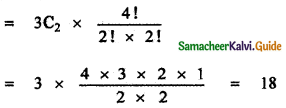
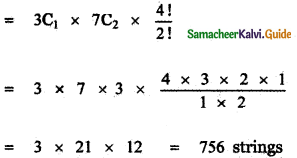
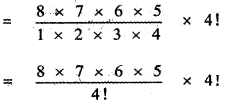
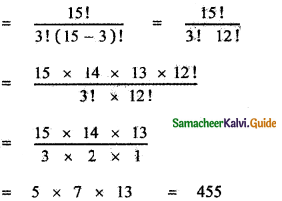
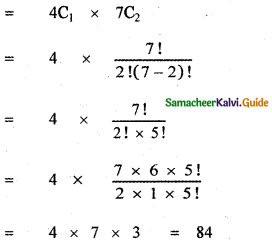
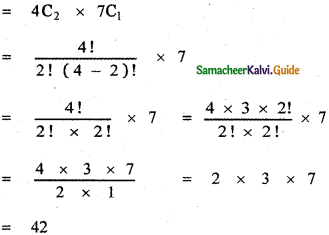
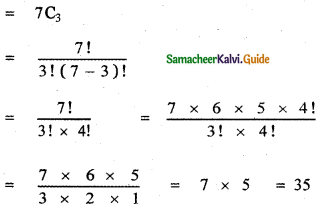
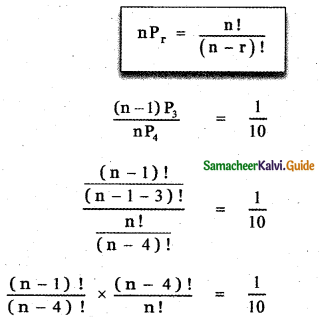
Samacheer Kalvi 11th Maths Guide Chapter 4 Combinatorics and Mathematical Induction Ex 4.1

Tamilnadu State Board New Syllabus Samacheer Kalvi 11th Maths Guide Pdf Chapter 4 Combinatorics and Mathematical Induction Ex 4.1 Text Book Back Questions and Answers, Notes.

Tamilnadu Samacheer Kalvi 11th Maths Solutions Chapter 4 Combinatorics and Mathematical Induction Ex 4.1

Question 1.
(i) A person went to a restaurant for dinner. In the menu card, the person saw 10 Indian and 7 Chinese food items. In how many ways the person can select either an Indian or Chinese food?
Answer:
Selecting an Indian food item from the given 10 can be done in 10 ways. Selecting a Chinese food item from the given 7 can be done in 7 ways.
∴ Selecting an Indian or Chinese food can be done in 10 + 7 = 17 ways.

Samacheer Kalvi 11th Maths Guide Chapter 4 Combinatorics and Mathematical Induction Ex 4.1

(ii) There are 3 types of a toy car and 2 types of toy train are available in a shop. Find the number of ways a baby can buy a toy car and a toy train?
Answer:
Number of types of Toy car = 3
Number of types of Toy Train = 2
Number of ways of buying a Toy car = 3 ways
Number of ways of buying a toy train = 2 ways
∴ By fundamental principle of multiplication, number of ways of buying a toy car and a toy train = 3 × 2 ways = 6 ways

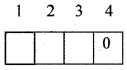
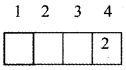
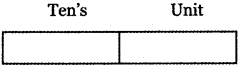
(iii) How many two – digit numbers can be formed using 1 , 2,3,4,5 without repetition of digits?
Answer:
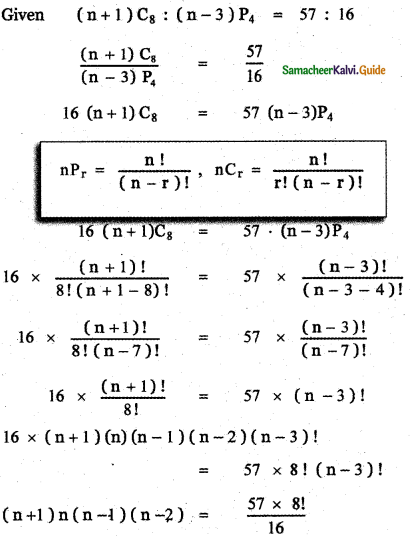
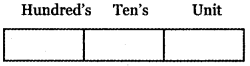
Samacheer Kalvi 11th Maths Guide Chapter 4 Combinatorics and Mathematical Induction Ex 4.1 1
The given digits are 1, 2, 3, 4, 5
A two-digit number has a unit place and 10’s place. We are given 5 digits (1, 2, 3, 4, 5). The unit place can be filled (using the 5 digits) in 5 ways. After filling the unit place since repetition is not allowed one number (filled in the unit place) should be excluded. So the 10’s place can be filled (using the remaining 4 digits) in 4 ways.
∴ Unit place and 10’s place together can be filled in 5 × 4 = 20 ways. So the number of two-digit numbers = 20

(iv) Three persons enter into a conference hall in which there are 10 seats. In how many ways can they take their seats?
Answer:
Number of seats in the conference hall = 10
Number of persons entering into the conference hall = 3
Number of ways of getting a seat for 1st person = 10
Number of ways of getting a seat for 2nd person = 9
Number of ways of getting a seat for 3rd person = 8
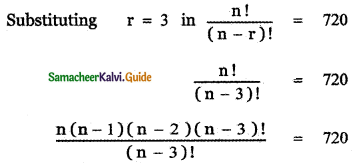
By fundamental principle of multiplication, number of ways of getting seats for 3 persons in conference hall = 10 × 9 × 8 ways = 720 ways

Samacheer Kalvi 11th Maths Guide Chapter 4 Combinatorics and Mathematical Induction Ex 4.1

(v) In how ways 5 persons can be seated In a row?
Answer:
Number of persons = 5
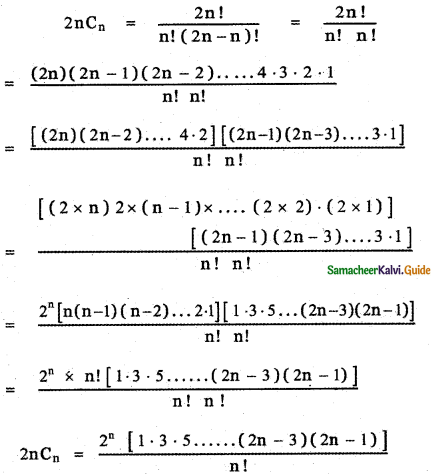
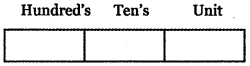
Samacheer Kalvi 11th Maths Guide Chapter 4 Combinatorics and Mathematical Induction Ex 4.1 2

5 persons can be arranged among themselves in 5! ways
(i.e) 5 × 4 × 3 × 2 × 1 = 120 ways

Question 2.
(i) A mobile phone has a passcode of 6 distinct digits. What is the maximum number of attempts one makes to retrieve the passcode?
Answer:
Number of distinct digit in a passcode of a mobile phone = 6
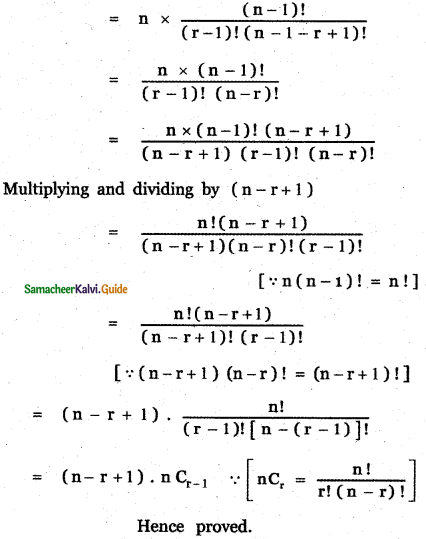
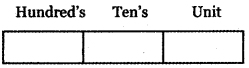
Samacheer Kalvi 11th Maths Guide Chapter 4 Combinatorics and Mathematical Induction Ex 4.1 3
First digit can be tried in 10 ways using the digits 0, 1, 2, 3, 4, 5, 6, 7, 8, 9
Second digit can be tried in 9 ways
Third digit can be tried in 8 ways
Fourth digit can be tried in 7 ways
Fifth digit can be tried in 6 ways
Sixth digit can be tried in 5 ways
Therefore, the maximum number of attempts made to retrieve the passcode = 10 × 9 × 8 × 7 × 6 × 5 = 151200

Samacheer Kalvi 11th Maths Guide Chapter 4 Combinatorics and Mathematical Induction Ex 4.1

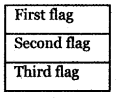
(ii) Given four flags of different colours, how many different signals can be generated if each signal requires the use of three flags, one below the other?
Answer:
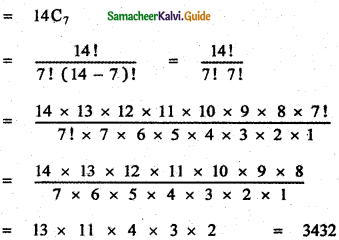
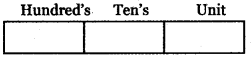
Samacheer Kalvi 11th Maths Guide Chapter 4 Combinatorics and Mathematical Induction Ex 4.1 4
Number of flags = 4
Number of flags required for a signal = 3
The total number of signals is equal to the number of ways of filling 3 places in succession by 4 flags of different colours. Number of ways of filling the top place using 4 different colour flags is 4 ways. Number of ways of filling the middle place using the remaining 3 different colour flags is 3 ways. Number of ways of filling the bottom place using the remaining 2 different colour flags is 2 ways.

Therefore, by fundamental principle of multiplication, the total number of signals = 4 × 3 × 2 = 24 ways

Question 3.
Four children are running a race.
(i) In how many ways can the first two places be filled?
(ii) In how many different ways could they finish the race?
Answer:
(i) Number of children in the running race = 4
The first place can be filled in (from the 4 children) 4 ways
After filling in the first place only 3 children are left out
So the second place can be filled in (from the remaining 3 children) 3 ways
So the first and the second places together can be filled in 4 × 3 = 12 ways

(ii) The first and second places can be filled in 12 ways
The third-place can be filled (from the remaining 2 children) in 2 ways and the fourth place can be filled in 1 way
So the race can be finished in 12 × 2 × 1 = 24 ways

Samacheer Kalvi 11th Maths Guide Chapter 4 Combinatorics and Mathematical Induction Ex 4.1

Question 4.
Count the number of three – digit numbers which can be formed from the digits 2, 4, 6, 8 if
(i) Repetitions of digits is allowed.
(ii) Repetitions of digits is not allowed?
Answer:
(i) Repetitions of digits is allowed
The given digits are 2, 4, 6, 8
Samacheer Kalvi 11th Maths Guide Chapter 4 Combinatorics and Mathematical Induction Ex 4.1 5
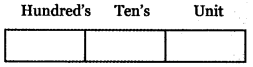
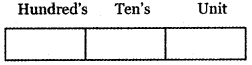
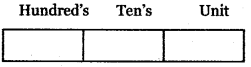
A number of ways of filling the unit place using the 4 digits 2, 4, 6, 8 is 4 ways. Number of ways of filling the tens place using the 4 digits 2, 4, 6, 8 in 4 ways Number of ways of filling the hundred’s place using the 4 digits 2, 4, 6, 8 is 4 ways

Therefore, by fundamental principle of multiplication, the total number of 3 digit numbers = 4 × 4 × 4
= 64 ways
Samacheer Kalvi 11th Maths Guide Chapter 4 Combinatorics and Mathematical Induction Ex 4.1 6

Samacheer Kalvi 11th Maths Guide Chapter 4 Combinatorics and Mathematical Induction Ex 4.1

(ii) The unit place can be filled (using the 4 digits) in 4 ways after filling the unit place since repetition of digits is not allowed that digit should be excluded.
So the 10’s place can be filled in (4 – 1) 3 ways and the 100’s place can be filled in (3 – 1) 2 ways
So the unit place, 10’s and 100’s places together can be filled in 4 × 3 × 2 = 24 ways
(i.e) The number of 3 digit numbers = 4 × 3 × 2 = 24 ways

Question 5.
How many three-digit numbers are there with 3 in the unit place?
(i) with repetition
(ii) without repetition.
Answer:
(i) With repetition:
Samacheer Kalvi 11th Maths Guide Chapter 4 Combinatorics and Mathematical Induction Ex 4.1 7
The given digits are 0, 1, 2, 3, 4, 5, 6, 7, 8, 9
The unit place can be filled in only one way using the digit 3. The ten’s place can be filled in 10 ways using the digits 0, 1, 2, 3, 4, 5, 6, 7, 8, 9. The hundred’s place can be filled in 9 ways using the digits 1, 2, 3, 4, 5, 6, 7, 8, 9.

Therefore, by the fundamental principle of multiplication, the total number of 3 digit numbers is = 1 × 10 × 9 = 90

(ii) Without repetition:
Samacheer Kalvi 11th Maths Guide Chapter 4 Combinatorics and Mathematical Induction Ex 4.1 8

The digits are 0, 1,2, 3, 4, 5, 6, 7, 8, 9
A three-digit number has 3 digits l’s, 10’s, and 100’s place.
The unit place is (filled by 3) filled in one way.
After filling the unit place since the digit ‘0’ is there, we have to fill the 100’s place. Now to fill the 100’s place we have 8 digits (excluding 0 and 3) So 100’s place can be filled in 8 ways.
Now to fill the 10’s place we have again 8 digits (excluding 3 and any one of the number) So 10’s place can be filled in 8 ways.
∴ Number of 3 digit numbers with ‘3’ in unit place = 8 × 8 × 1 = 64

Samacheer Kalvi 11th Maths Guide Chapter 4 Combinatorics and Mathematical Induction Ex 4.1

Question 6.
How many numbers are there between 100 and 500 with the digits 0,1,2,3,4,5 if
(i) Repetition of digit is allowed
(ii) Repetition of digits is not allowed.
Answer:
(i) Repetition of digit is allowed:
Samacheer Kalvi 11th Maths Guide Chapter 4 Combinatorics and Mathematical Induction Ex 4.1 9
The numbers between 100 and 500 will have 3 digits. The unit place can be filled in 6 ways using the digits 0, 1, 2, 3, 4, 5. The ten’s place can be filled in 6 ways using the digits 0, 1, 2, 3, 4, 5. The hundred’s place can be filled in 4 ways using the digits 0, 1, 2, 3, 4, 5 ( Excluding 0 and 5). Therefore, by fundamental principle of multiplication, the number of 3 digit, numbers between 100 and 500 with repetition of digits using the digits 0, 1, 2, 3, 4, 5 is = 6 × 6 × 4 = 144

(ii) Repetition of digits is not allowed:
Samacheer Kalvi 11th Maths Guide Chapter 4 Combinatorics and Mathematical Induction Ex 4.1 10
The 100’s place can be filled (by using 1, 2, 3, 4) 10’s in 4 ways
The 10’s place can be filled in (6 – 1) 5 ways and the unit place can be filled in (5 – 1) 4 ways
So the number of 3 digit number 4 × 5 × 4 = 80

Question 7.
How many three-digit odd numbers can be formed by using the digits 0, 1, 2, 3, 4, 5? if
(i) The repetition of digits is not allowed
(ii) The repetition of digits is allowed.
Answer:
The given digits are 0, 1, 2, 3, 4, 5
To find the possible 3 – digit odd numbers.

(i) Repetition of digits is not allowed:
Samacheer Kalvi 11th Maths Guide Chapter 4 Combinatorics and Mathematical Induction Ex 4.1 11
Since we need 3 – digit odd numbers the unit place can be filled in 3 ways using the digits 1, 3 or 5. Hundred’s place can be filled in 4 ways using the digits 0, 1, 2, 3, 4, 5 excluding 0 and the number placed in unit place. Ten’s place can be filled in 4 ways using the digits 0, 1, 2, 3, 4, 5 excluding the digit placed in the hundred’s place.

Therefore, by the fundamental principle of multiplication, the number of 3 – digit odd numbers formed without repetition of digits using the digits 0, 1, 2, 3, 4, 5 is
= 4 × 4 × 3 = 48

Samacheer Kalvi 11th Maths Guide Chapter 4 Combinatorics and Mathematical Induction Ex 4.1

(ii) Repetition of digits is allowed:
Samacheer Kalvi 11th Maths Guide Chapter 4 Combinatorics and Mathematical Induction Ex 4.1 12
The unit place can be filled in 3 ways. We are given 6 digits.
So 10’s place can be filled in 6 ways and the 100’s place can be filled in (6 – 1) (excluding zero) 5 ways
So the Number of 3 digit numbers = 3 × 6 × 5 = 90

Question 8.
Count the numbers between 999 and 10000 subject to the condition that there are
(i) no restriction
(ii) no digit is repeated
(iii) At atleast one of the digits is repeated.
Answer:
To find the numbers between 999 and 10,000 using the digits 0, 1, 2, 3, 4, 5, 6, 7, 8, 9
To find the possible 4 digit numbers.

(i) No restriction:
Samacheer Kalvi 11th Maths Guide Chapter 4 Combinatorics and Mathematical Induction Ex 4.1 13
Thousand’s place can be filled in 9 ways using the digits 0, 1, 2, 3, 4, 5, 6, 7, 8, 9 excluding 0. Since there is no restriction, the hundred’s place, Ten’s place, and the unit place can be filled in 10 ways using the digit 0, 1, 2, 3, 4, 5, 6, 7, 8, 9.

Therefore, by the fundamental principle of multiplication, the number of 4 digit numbers between 999 and 10,000 is = 9 × 10 × 10 × 10 = 9000

(ii) No digit is repeated:
Samacheer Kalvi 11th Maths Guide Chapter 4 Combinatorics and Mathematical Induction Ex 4.1 14
Thousand’s place can be filled in 9 ways using the digits 0, 1, 2, 3, 4, 5, 6, 7, 8, 9 excluding 0. Since repetition is not allowed. The unit place can be filled in 9 ways using the digits 0,1, 2, 3, 4, 5, 6, 7, 8, 9 excluding the digit placed in the thousand’s place. Since repetition of digits is not allowed, the ten’s place can be filled in 8 ways using the digits 0, 1, 2, 3, 4, 5, 6, 7, 8, 9 excluding the digits used in thousand’s a place and unit place. Since repetition of digits is not allowed, the hundred’s place can be filled in 7 ways using the digits 0,1,2,3,4, 5,6,7,8,9 excluding the digits used in thousand’s a place and unit place.

Therefore, by the fundamental principle of multiplication, the number of numbers between 999 and 10,000 without repetition of digits is = 9 × 7 × 8 × 9 = 4536

Samacheer Kalvi 11th Maths Guide Chapter 4 Combinatorics and Mathematical Induction Ex 4.1

(iii) At least one of the digits is repeated:
Required number of 4 digit numbers = Total number of 4 digit numbers – Number of 4 digit numbers when no digit is repeated = 9000 – 4536 = 4464

Question 9.
How many three-digit numbers, which are divisible by 5, can be formed using the digits 0, 1, 2, 3, 4, 5 if
(i) Repetition of digits is not allowed?
(ii) Repetition of digits is allowed?
Answer:
The given digits are 0, 1, 2, 3, 4, 5
To find the 3 – digit numbers formed by using the digits 0, 1, 2, 3, 4, 5 which are divisible by 5.

(i)The repetition of digits are not allowed:
Samacheer Kalvi 11th Maths Guide Chapter 4 Combinatorics and Mathematical Induction Ex 4.1 15
Since the 3 – digit number is divisible by 5, the unit place can be filled in 2 ways using the digits 0 or 5

Case (i) When the unit place is filled with the digit 0. The hundreds place can be filled in 5 ways using the digits 1, 2, 3, 4, 5 and the ten’s place can be filled in 4 ways using the digits 0, 1, 2, 3, 4, 5 excluding 0 and the digit which is placed in hundred’s place.

Therefore, by fundamental principle of multiplication, the number of 3 – digit numbers divisible by 5 is
= 5 × 4 × 1 = 20

Case (ii) When the unit place is tilled with the digit 5, since repetition of digit is not allowed the hundred’s place can be filled in 4 ways using the digits 1, 2 , 3 , 4 (0 and 5 are excluded). The ten’s place can be filled in 4 ways using the digits 0, 1 , 2, 3 , 4, 5 (excluding 5 and the digit placed in the hundred’s place).
Therefore, by the fundamental principle of multiplication, the number of 3 – digit numbers, in this case, is = 4 × 4 × 1 = 16
Therefore, the total number of 3 – digit numbers divisible by 5 using the digits 0, 1, 2, 3, 4, 5 is = 20 + 16 = 36

Samacheer Kalvi 11th Maths Guide Chapter 4 Combinatorics and Mathematical Induction Ex 4.1

(ii) The repetition of digits are allowed:
Samacheer Kalvi 11th Maths Guide Chapter 4 Combinatorics and Mathematical Induction Ex 4.1 16
The digits are
0 1 2 3 4 5
To get a number divisible by 5 we should have the unit place as 5 or 0 So the unit place (using 0 or 5) can be filled in 2 ways.
The 10’s place can be filled (Using 0, 1, 2, 3, 4, 5) in 6 ways and the 100’s place (Using 1, 2, 3, 4, 5) can be filled in 5 ways.
So the number of 3 digit numbers ÷ by 5 (with repetition) = 2 × 6 × 5 = 60

Question 10.
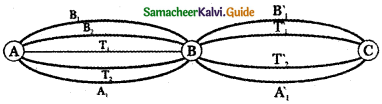
To travel from place A to place B, there are two different bus routes B1, B2, two different train routes T1, T2, and one air route A1. From place B to place C, there is one bus route say B’1, two different train routes say T’1, T’2, and one air route A’1. Find the number of routes of commuting from place A to place C via place B without using a similar mode of transportation.
Answer:
Route map diagram for the given data.
Samacheer Kalvi 11th Maths Guide Chapter 4 Combinatorics and Mathematical Induction Ex 4.1 17
The possible choices for a number of routes commuting from A to place C via place B without using similar mode transportation are
(B1, T’1), (B1, T’2), ( B1, A1), ( B2, T’1), (B2, T’2)
(B2, A’1), (T1, B’1), (T1, A’1), ( T2, B’1), ( T2, A’1) (A1, B’1) , (A1, T’1) and (A1, T’2)
Therefore, the Required number of routes is 13.

Question 11.
How many numbers are there between 1 and 1000 (both inclusive) which are divisible neither by 2 nor by 5 ?
Answer:
From 1 to 1000, the numbers ÷ by 2 = 500
the number ÷ by 5 = 200
and the numbers ÷ by 10 = 100(5 × 2 = 10)
So number ÷ by 2 or 5 = 500 + 200 – 100 = 600
Total numbers from 1 to 1000 = 1000
So the number of numbers which are ÷ neither by 2 nor by 5 = 1000 – 600 = 400

Three-digit numbers:
Samacheer Kalvi 11th Maths Guide Chapter 4 Combinatorics and Mathematical Induction Ex 4.1 18
The unit place can be filed in 4 ways using the digits 1, 3, 7, 9. Hundred’s place can be filled in 9 ways excluding 0. Ten’s place can be filled in 10 ways using the digits 0, 1, 2, 3, 4, 5, 6, 7, 8, 9. Therefore, the required number of 3 digit numbers neither divisible by 2 nor by 5 is = 9 × 10 × 4 = 360.
There is only one 4 – digit number, but it is divisible by 2 and 5.
Therefore, required numbers using fundamental principle of addition = 4 + 36 + 360 = 400

Samacheer Kalvi 11th Maths Guide Chapter 4 Combinatorics and Mathematical Induction Ex 4.1

Question 12.
How many strings can be formed using the letters of the word LOTUS if the word
(i) either start with L or end with S?
(ii) neither starts with L nor ends with S?
Answer:
(i) Either starts with L or ends with S
Samacheer Kalvi 11th Maths Guide Chapter 4 Combinatorics and Mathematical Induction Ex 4.1 19
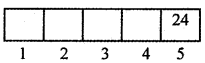
The first box is filled with the letter L. The second box can be filled with the remaining letters O, T, U, S in 4 ways. The third box can be filled with the remaining letters excluding L and the letter placed in box 2 in 3 ways. The fourth box can be filled with the remaining letters excluding L and the letters placed in a box – 2 and box – 3 in 2 ways. The fifth box can be filled with the remaining one letter excluding L and the letters placed in a box – 2 and box – 3, box – 4 in 1 way.
Therefore, by fundamental principle of multiplication, the number of words start with L is = 1 × 4 × 3 × 2 × 1 = 24
Samacheer Kalvi 11th Maths Guide Chapter 4 Combinatorics and Mathematical Induction Ex 4.1 20
Since the word ends with S, the fifth box can be filled in one way with the letter S. The remaining four boxes can be filled 4 × 3 × 2 × 1 way.
Therefore, the number of words ending with S = 4 × 3 × 2 × 1 × 1 = 24

Number of words starting with L and ends with S: The first box can be filled with L in one way fifth box can be filled with S in one way second box, third box, and fourth box can be filled in 3x2x1 ways with the remaining letters O, T, U.
∴ Number of words starting with L and ends with S = 1 × 3 × 2 × 1 × 1 = 6
Therefore, by fundamental principle of addition, number of words either starts with L or ends with S = 24 + 24 – 6 = 48 – 6 = 42

(ii) Neither starts with L nor ends with S Total number of words formed using the letters L, O, T, U, S is = 5 × 4 × 3 × 2 × 1 = 120
The number of words neither starts with L nor ends with S = Total number of words – Number of words starts with either L or ends with S = 120 – 42 = 78

Samacheer Kalvi 11th Maths Guide Chapter 4 Combinatorics and Mathematical Induction Ex 4.1

Question 13.
(i) Count the total number of ways of answering 6 objective type questions, each question having 4 choices.
Answer:
Count the total number of ways of answering 6 objective type questions, each question having 4 choices.
One question can be answered in 4 ways
Two questions can be answered in 4 × 4 = 42 ways
∴ Six questions can be answered in 46 ways

(ii) In how many ways 10 pigeons can be placed in 3 different pigeon holes?
Solution:
First pigeons can be placed in a pigeon-hole in 3 ways (selecting 1 from 3 holes)
Second pigeons can be placed in a pigeon-hole in 3 ways Tenth pigeons can be placed in a pigeon-hole in 3 ways
So total number of ways in which all the number 10 place can be sent = 3 × 3 × 3 × 3 × 3 × 3 × 3 × 3 × 3 × 3 = 310 ways

(iii) Find the number of ways of distributing 12 distinct prizes to 10 students?
Solution:
To give the first prize we have to select, from the 10 students which can be done in 10 ways.
To give the second prize we have to select one from the 10 students which can be done is 10 ways.
To give the 12th prize we have to select one from 10 students which can be done in 10 ways.
So all the 12 prizes can be given in (10 × 10 × 10 …. 12 times) = 1012 ways.

Question 14.
Find the value of
(i) 6!
(ii) 4! +5!
(iii) 3! – 2!
(iv) 31 × 21
(v) \(\frac{12 !}{9 ! \times 3 !}\)
(vi) \(\frac{(n+3) !}{(n+1) !}\)
Answer:
(i) 6!
6! = 6 × 5 × 4 × 3 × 2 × 1 = 720

(ii) 4! +5!
4! +5! = (4 × 3 × 2 × 1) + (5 × 4 × 3 × 2 × 1)
= (4 × 3 × 2 × 1) [1 + 5]
= 24 × 6 = 144

(iii) 3! – 2!
3! – 2! = (3 × 2 × 1) × (4 × 3 × 2 × 1)
= 6 × 24 = 144

(iv) 3! × 2!
3! × 2! = (3 × 2 × 1) × (4 × 3 × 2 × 1)
= 6 × 24 = 144

(v) \(\frac{12 !}{9 ! \times 3 !}\)
Samacheer Kalvi 11th Maths Guide Chapter 4 Combinatorics and Mathematical Induction Ex 4.1 21
= 2 × 11 × 10 = 220

(vi) \(\frac{(n+3) !}{(n+1) !}\)
Samacheer Kalvi 11th Maths Guide Chapter 4 Combinatorics and Mathematical Induction Ex 4.1 22
= (n + 3) (n + 2)
= n2 + 3n + 2n + 6
= n2 + 5n + 6

Samacheer Kalvi 11th Maths Guide Chapter 4 Combinatorics and Mathematical Induction Ex 4.1

Question 15.
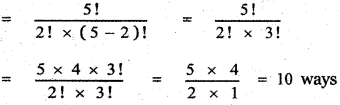
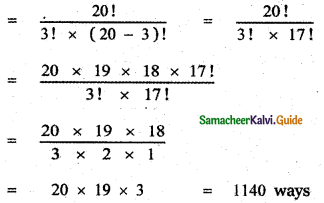
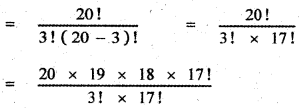
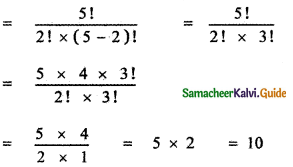
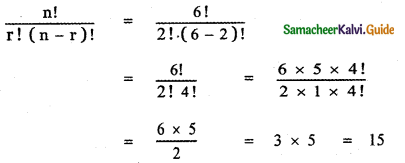
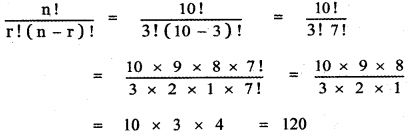
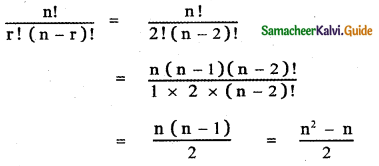
Evaluate \(\frac{\mathbf{n} !}{\mathbf{r} !(\mathbf{n}-\mathbf{r}) !}\) when
(i) n = 6 , r = 2
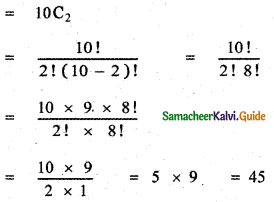
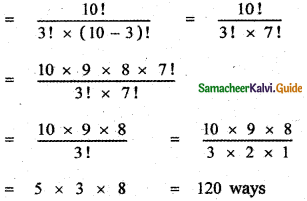
(ii) n = 10, r = 3
(iii) For any n with r = 2.
Answer:
(i) n = 6 , r = 2
Samacheer Kalvi 11th Maths Guide Chapter 4 Combinatorics and Mathematical Induction Ex 4.1 23

(ii) n = 10, r = 3
Samacheer Kalvi 11th Maths Guide Chapter 4 Combinatorics and Mathematical Induction Ex 4.1 24

(iii) For any n with r = 2.
Samacheer Kalvi 11th Maths Guide Chapter 4 Combinatorics and Mathematical Induction Ex 4.1 25

Samacheer Kalvi 11th Maths Guide Chapter 4 Combinatorics and Mathematical Induction Ex 4.1

Question 16.
Find the value of n if
(i) ( n + 1) ! = 20 ( n – 1 )!
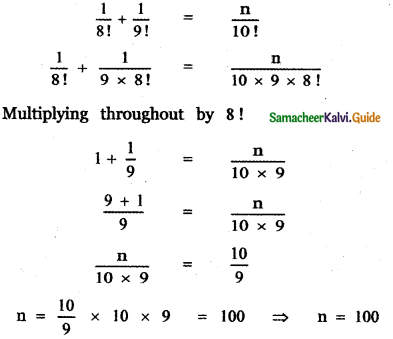
(ii) \(\frac{1}{8 !}+\frac{1}{9 !}=\frac{n}{10 !}\)
Answer:
(i) ( n + 1) ! = 20 ( n – 1 )!
(n + 1) n(n – 1)! = 20(n – 1)!
n(n + 1) = 20
n2 + n – 20 = 0
n2 + 5n – 4n – 20 = 0
n(n + 5) – 4(n + 5) = 0
(n – 4) (n + 5) = 0
n – 4 = 0 or n + 5 = 0
n = 4 or n = -5
But n = -5 is not possible. ∴ n = 4

(ii) \(\frac{1}{8 !}+\frac{1}{9 !}=\frac{n}{10 !}\)
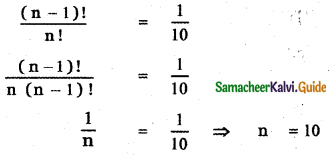
Samacheer Kalvi 11th Maths Guide Chapter 4 Combinatorics and Mathematical Induction Ex 4.1 27

Samacheer Kalvi 12th English Guide Prose Chapter 2 A Nice Cup of Tea

Tamilnadu State Board New Syllabus Samacheer Kalvi 12th English Guide Pdf Prose Chapter 2 A Nice Cup of Tea Text Book Back Questions and Answers, Summary, Notes.

Tamilnadu Samacheer Kalvi 12th English Solutions Prose Chapter 2 A Nice Cup of Tea

12th English Guide A Nice Cup of Tea Text Book Back Questions and Answers

Textual Questions:

Based on your understanding of the text, answer each of the following questions in one or two sentences:
(Note: IQ → Important Questions)

Question a.
What seems ‘Curious’ to the author? (IQ)
Answer:
The absence of “Tea” in the recipes of the cookery book is curious to the author.

Question b.
Why does the author say that it is important to include a tea recipe in cookery books?
Answer:
The author says that it is important to include a tea recipe in cookery books as it is one of the mainstays of civilization in the country.

Question c.
Mention the countries in which tea is a part of civilization? (IQ)
Answer:
It is one of the mainstays of civilization in the UK, Australia, Eire, and New Zealand.

Question d.
Which tea does the author prefer – China tea or Indian tea?
Answer:
The author prefers Indian tea.

Question e.
According to the author, What does the phrase “a nice cup of tea” refer to?
Answer:
Nice cup of tea means Indian tea which makes one feel wiser, optimistic and wiser.

Samacheer Kalvi 12th English Guide Prose Chapter 2 A Nice Cup of Tea

Question f.
What is the second golden rule in the preparation of tea?
Answer:
The second golden rule is that tea should be made in small quantities in a teapot which is made up of China or earthenware.

Question g.
How does army tea taste? (IQ)
Answer:
Army tea tastes of grease and whitewash.

Question h.
Do tea lovers generally like strong tea or weak tea?
Answer:
Tea lovers generally like strong tea.

Question i.
Why should tea be directly added to the pot?
Answer:
Tea should be added directly to the pot because imprisoning tea leaves in strainers, muslin bags or other devices can be really harmful.

Question j.
Why does the author prefer the cylindrical cup to a flat cup?
Answer:
The author prefers a cylindrical cup as it holds more and the hotness is well maintained.

Samacheer Kalvi 12th English Guide Prose Chapter 2 A Nice Cup of Tea

Question k.
What should be poured into the cup first tea or milk? (IQ)
Answer:
One should pour tea first into the cup and then add milk to the desired level. Thus one can regulate the amount of milk added to tea.

Question l.
Why does the author advise removing cream from the milk?
Answer:
The author advises removing cream from the milk as it gives the tea a sickly taste.

Question m.
Does the author like drinking tea with sugar? Give reasons.
Answer:
Adding sugar to tea will deprive tea of its real taste. Misguided people who take tea do it because of the sweetness and not because of the taste of tea.

Question n.
Why does the author refer to himself as being in a ‘minority’?
Answer:
The author refers to himself as being in a ‘minority’ with his view of drinking tea without sugar.

Question o.
Whom does the author call “misguided people”? What is his advice to them?
Answer:
Some misguided people admit that they drink tea for stimulation and warmth. They are not interested in tea. So, they add sugar to take the taste away. He advises them to drink tea without adding sugar for a fortnight. They would never again ruin the real taste of tea by adding sugar.

Samacheer Kalvi 12th English Guide Prose Chapter 2 A Nice Cup of Tea

2. Based on your understanding of the text, answer each of the following questions in four or five sentences:
(Text Book Page No. 38)

Question a.
What are the author’s views on China tea?
Answer:
China tea has virtues which are not to be despised, it is economic. One can drink it without milk, but there is not much stimulation in it. One does not feel wiser, braver or more optimistic after drinking it.

Question b.
How does adding sugar affect the taste of tea? (IQ)
Answer:
Adding sugar affects the taste of tea to a greater extend. If the tea is sweetened it means one is merely tasting the sugar and not the tea. It is just similar to that of dissolving sugar in plain hot water.

Question c.
Elucidate the author’s ideas about teapots.
Answer:
The teapot should be made of China or earthen ware. Silver or Britannia ware teapot produce inferior quality tea. Enamel pots are worse. Though curiously enough a pewter teapot, a rarity nowadays, is not so bad.

Samacheer Kalvi 12th English Guide Prose Chapter 2 A Nice Cup of Tea

3. Answer each of the following questions in a paragraph of 100-150 words: (Text Book Page No. 38)

a. Summarise George Orwell’s distinctive ideas in “A nice cup of tea”.
b. Discuss how the essay reveals the factual points and the author’s personal opinions on the preparation of tea.

While saying about the preparation of tea in a strong manner, the author brings in his personal view that one strong cup of tea is better than twenty weak ones. The same is the case when he speaks about pouring the tea into the cup first. His view in this regard is by adding milk after pouring the tea, one can exactly regulate the amount of milk. Adding of sugar to tea is strongly objected by him.

By doing so one is just tasting the sugar and not the tea. Orwell’s advice for those people to drink tea without sugar at least a fortnight, So that they will never ruin the tea by sweetening it. Thus it is made clear that the essay reveals not only the factual points but also author’s personal opinions on the preparation of tea.

Paragraph:

Note: Qns. No. 3 a & b:

Introduction:
George Orwell brings forth eleven golden rules in the preparation of tea. According to him “A nice cup of tea” always means an Indian tea.

A nice cup of tea:
He compares Indian tea with China tea and feels that China tea does not have much stimulation in it. He is of the opinion that tea should be made in China or earthenware. The third step is that the pot should be warmed by placing it on the hob. Fourthly the tea should be strong. Six heaped teaspoons of tea are needed for making a tea strong which may hinder the rationing in a family.

Tea making:
The fifth golden rule is that one should not use any strainers to imprison the tea. It should be poured. straight into the pot. In fact the tea brews properly only when it is loose. The next rule is the tea should be boiling at the moment of impact. Seventhly the tea should be stirred well.

The best way of drinking tea:
Eightly the better way to drink tea is by making use of cylindrical cups rather than flat, shallow type. Ninthly the cream in milk is to be taken off before using it for tea as it gives the tea a sickly taste. The tenth rule is that of pouring the tea into the cup first and then adding milk to it so that one can exactly regulate the amount of milk. The last rule is the proper way to drink tea is to drink it without sugar. If sugar is added then it means that one is tasting the sugar not the tea.

Samacheer Kalvi 12th English Guide Prose Chapter 2 A Nice Cup of Tea

4. Based on your understanding of the text, complete the chart given below by choosing the appropriate words or phrases given in brackets. (Text Book Page No. 38)

Golden Rules of Tea Preparation:
(add sugar, shaken, milk, infused properly, strainers, without cream, taken to the kettle, small quantities, China or earthenware, stirred, warmed)

Question 1.
Tea should be made in ________ in a teapot.
Answer:
small quantities

Question 2.
The teapot should be made of________.
Answer:
China or earthenware

Question 3.
The pot should be __________ beforehand.
Answer:
warmed

Question 4.
The pot should not have ______.
Answer:
strainers

Question 5.
While pouring water the teapot should be ________
Answer:
infused properly

Question 6.
The tea leaves should be ______.
Answer:
stirred

Question 7.
After making tea, it should be ________ or the pot should be ________.
Answer:
shaken, taken to the kettle

Question 8.
The milk for the tea should be ______.
Answer:
without cream

Question 9.
The author does not like to _________ to tea.
Answer:
add sugar

Samacheer Kalvi 12th English Guide Prose Chapter 2 A Nice Cup of Tea

Vocabulary:

a) Find out the synonym of the underlined word in each of the following sentences:

Question 1.
But because the best manner of making it is the subject of violent disputes.
a) agreements
b) applauses
c) conflicts
d) discussions
Answer:
c) conflicts

Question 2.
______ tea is one of the mainstays of civilization in the country.
a) a society in an advanced state of social development
b) a society that has slow progress
c) a society that has no progress
d) a society in an average state of social development
Answer:
d) a society in an average state of social development

Question 3.
______ that they only drink it in order to be warmed and stimulated.
a) motivated
b) discouraged
c) passive
d) admired
Answer:
a) motivated

Question 4.
_________ under the spout to catch the stray leaves.
a) fresh
b) loose
c) gathered
d) harmful
Answer:
b) loose

Question 5.
One is ______ to put in too much milk.
a) likely
b) certain
c) eager
d) responsible
Answer:
a) likely

Samacheer Kalvi 12th English Guide Prose Chapter 2 A Nice Cup of Tea

b) Find out the antonym of the underlined word ¡n each of the following sentences:

Question 1.
________ which are not to be despised.
a) hated
b) liked
c) respected
d) defeated
Answer:
b) liked

Question 2.
One does not feel wise, braver or more ________  optimistic.
a) opportunistic
b) cheerful
c) realistic
d) pessimistic
Answer:
d) pessimistic

Question 3.
Not the flat, shallow type _____.
a) narrow
b) wide
c) deep
d) direct
Answer:
c) deep

Question 4.
Predicting the arrival of visitors ______.
a) journey
b) departure
c) migration
d) perusal
Answer:
b) departure

Question 5.
_____ but they are sufficient to show how sub-utilized the whole business has become.
a) enough
b) suffocative
c) inadequate
d) submissive
Answer:
c) inadequate

Samacheer Kalvi 12th English Guide Prose Chapter 2 A Nice Cup of Tea

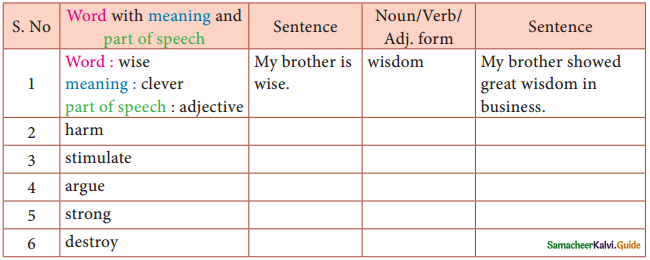
c) Fill in the boxes with the correct answers. The first one has been done for you: (Text Book Page No. 39)

Samacheer Kalvi 12th English Guide Prose Chapter 2 A Nice Cup of Tea 1
Answer:

Word with meaning and part of speechSentenceNoun/Verb/ Adj. formSentence
1. Word meaning parts of speechwise

clever

adjective

My brother is wise.wisdomMy brother showed great

wisdom in business.

2. word Meaning Parts of speechharm

physical injury noun

I don’t want him to get any harmharmfulI am always harmful to my enemies.
3. word Meaning Parts of speechstimulate

arouse

verb

My friend stimulate me to eat an ice creamstimulativeMy friend makes me to get interest in English because of his stimulative nature.
4. Word meaning parts of speechargue

proclaim

Verb

You don’t argue with meargumentIt is really a good argument.
5. Word meaning parts of speechstrong

powerful

adjective

He is very strongStrengthHe has enough strength to do his job.
6. Word meaning parts of speechdestroy

demolish

verb

I destroyed my old housedestructionThe bomb blast causes many destructions.

Samacheer Kalvi 12th English Guide Prose Chapter 2 A Nice Cup of Tea

Listening: (Text Book Page No. 40)

Listen to the passage about the ‘Significance of Tea’ and answer the questions:

Questions:

Question 1.
Which country is the largest tea producer in the world?
Answer:
China is the largest tea producer in my world.

Question 2.
______ percentage of the tea produced ¡n India is exported.
Answer:
30

Question 3.
What is the role of antioxidants in tea?
Answer:
Antioxidants in tea might prevent cancer.

Question 4.
Drinking tea strengthens one’s _____, _____ and _____.
Answer:
Teeth, bones, and immune system.

Question 5.
How does tea drinking help a diabetic?
Answer:
Regular tea drinking might lower blood sugar.

Samacheer Kalvi 12th English Guide Prose Chapter 2 A Nice Cup of Tea

Reading (Non-Verbal Representations):

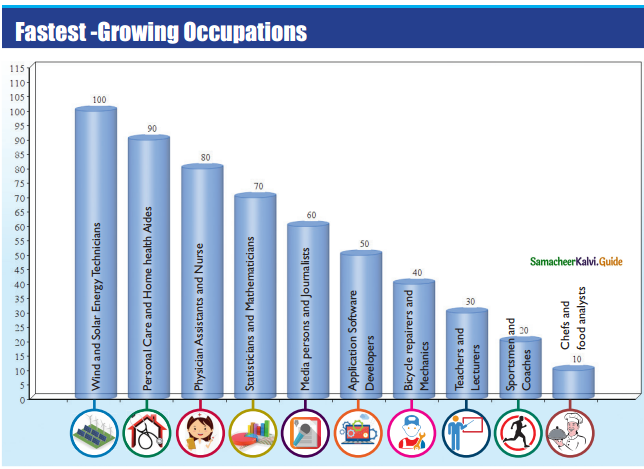
Look at the following non-verbal representation. Based on your understanding and inference, Write a paragraph on career trends in the next decade: (Text Book Page No. 41)

Samacheer Kalvi 12th English Guide Prose Chapter 2 A Nice Cup of Tea 2
Answer:
The chart shows the 10 fastest-growing occupations from 2018 to 2028. The most popular profession will be is the wind and solar energy fields. The technician course in the field will grow by 106%. Next, come personal care and home health aides. It has 85% growth. Physician Assistants and nurses stand third with 70% growth. Next comes software developers with 55% growth, so the highest is wind and solar energy technology and the lowest is a chef and food Analyst.

Samacheer Kalvi 12th English Guide Prose Chapter 2 A Nice Cup of Tea

Task 1:
Now read the following article on the emerging career option in the modern era and answer the question that follows: (Text Book Page No. 42,43)

The students at the higher secondary level in schools start thinking of suitable courses to take up at the university level based on their aptitude, ability, and interests. While considering the higher education options, they should also plan the career path they wish to take. In today’s complex job scenario, there is a mismatch between demand and supply on one hand we have qualified professionals desperately trying to find a job, while on the other hand, there are many professions that need suitable talented employees. But such skilled employees are unavailable. Therefore, the need of the hour is that students have an understanding of the
emerging career options.

Schools should take the initiative to organise career guidance and counselling sessions for students. However, students need to remember that to build a strong career, they must understand the perspective field and their primary interest. It is also important for students to focus on overall personality development and hone their communication skills as these are important for the success of their career.

Students are also advised that in order to build a solid career foundation, they need to qualify suitably by pursuing a degree course in the chosen area of interest and also consider post-graduate education. Diploma/Short—term courses may help one find a job in the short run but may not promise career progression. Rapid advancement in science and technology and globalization has widened the scope of career options in the twenty-first century.
Let us consider some popular careers.

Fashion Designing:
The current cosmopolitan and fashion-conscious wave that has taken over our country has opened up a huge
arena for careers in fashion. These careers encompass designing clothes, costumes, jewellery, footwear, wardrobe, costumes, accessories, and the like.

Samacheer Kalvi 12th English Guide Prose Chapter 2 A Nice Cup of Tea

Culinary Arts:
With food and cookery shows being a major trend across the world, culinary arts, a sub-domain of the hospitality sector has now become the most sought after career.

Paramedical sciences:

In recent times, there has been a great demand in the health care industry. Paramedical professionals who support medical practitioners in areas such as optometry, pathology, nursing, physiotherapy, and dentistry are much sought after.

Media, Journalism, and Advertising:

In this information era, print and entertainment media have become a force to reckon with. This arena has become a huge career playground because youngsters are attracted to it as the exposure and reach is greater through such mass media. We notice that radio and TV channels, internet companies, and advertising agencies are increasingly recruiting qualified professionals.

Hotel Management:

The hotel industry is the fastest growing industry in India. The number of international travellers (both for business and leisure) is increasing. The hospitality and service industry offers career options such as housekeeping, front-desk executives, tourism management, etc.

Sports Management:

With multinational companies supporting sports, careers in sports offer enormous scope. One need not be a player or an athlete to shine in a sports career because the field of sports offers various career options such as technical trainers, commentators, sports journalists, dieticians, referees, etc. Conducting sports events successfully, organizing the event laudably, preparing the ground for the event are all part of sports management.

Question a.
When do students start thinking about their career path?
Answer:
The students at the higher secondary level in schools start thinking of suitable courses as their career path based on their ability, aptitude, and interests.

Question b.
How can students build a strong career?
Answer:
They build a strong career by understanding the prospective field and their primary interest.

Question c.
What are the integral aspects of a successful career?
Answer:
The integral aspects of a successful career are personality development and communication skills.

Question d.
What is meant by ‘culinary art’?
Answer:
Culinary art is the art of preparing and cooking food a subdomain of the hospitality sector.

Question e.
Why is media a popular career option?
Answer:
Media is a popular career option because many youngsters are attracted to it as exposure and reach is greater through mass media.

Question f.
Name some paramedical courses mentioned in the passage.
Answer:
Some paramedical courses mentioned in the passage are optometry, pathology, nursing, physiotherapy, and dentistry.

Question g.
Why is the hotel industry seen as the fastest growing in India?
Answer:
The hotel industry is seen as the fastest-growing in India because the number of travellers on an international level is increasing.

Question h.
Does one have to be a player to opt for a career in the field of sports? Answer giving reasons.
Answer:
One need not be a player or an athlete to shine in a sports career because the field of sports offers various career options.

Question i.
Pick one word from the passage which is the opposite of ‘modern’.
Answer:
‘Past’

Question j.
Which word in the passage means ‘composed of people from many parts of the country’?
Answer:
International travellers.

Samacheer Kalvi 12th English Guide Prose Chapter 2 A Nice Cup of Tea

Grammar:

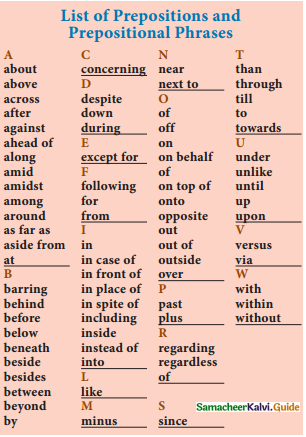
Prepositions:
Samacheer Kalvi 12th English Guide Prose Chapter 2 A Nice Cup of Tea 3

Recall your learning of basic prepositions and complete the sentences using the prepositions given in brackets: (Text Book Page No. 45)
(over, under, on, between, among, into, with, since, in front of near / beside)

Question a.
The boy jumped _____ a narrow stream.
Answer:
into

Question b.
Afsar will meet me _____ Friday morning.
Answer:
on

Question c.
The temple is _____ the bank.
Answer:
near

Question d.
My friend _____ his brother will meet me tomorrow.
Answer:
with

Question e.
There is usually a garden _____ a bungalow.
Answer:
in front of

Question f.
Yuvan has been studying well _____ childhood.
Answer:
since

Question g.
A trekker climbed _____ a mountain meticulously.
Answer:
on

Question h.
There was a skirmish _____ my brother and sister.
Answer:
between

Question i.
The laudable thoughts were apparent _____ many scholars in a conference.
Answer:
among

Question j.
It is easy to work _____ the aegis of a visionary leader.
Answer:
under

Samacheer Kalvi 12th English Guide Prose Chapter 2 A Nice Cup of Tea

Task 2:
Complete the following passages using the prepositions given in brackets:
(among, for, at, to, in)

Question i.
When Lakshmi was (1) _____ school, she practiced music from Monday (2) _____ Friday. She involved herself (3) _____ the school orchestra. She was responsible for (4) _____ conducting many programmes. She was very popular (5) _____ her schoolmates, as she was kind, friendly, and helpful.

Answer:

  1. at
  2. to
  3. in
  4. for
  5. among

(after, with, on, before, of, in, for)

Question ii.
(1) _____ the interview, Solomon was confident (2) _____ getting the job. He knew that he was qualified (3) _____ the
job. He was interested (4) _____ discharging his duty perfectly. The interview panel was impressed (5) _____ his attitude and skills. So (6) _____ the interview, he was (7) _____ cloud nine.

Answer:

  1. before
  2. of
  3. for
  4. in
  5. with
  6. after
  7. on

Samacheer Kalvi 12th English Guide Prose Chapter 2 A Nice Cup of Tea

Prepositional Phrases:
A prepositional phrase is made up of a preposition and a noun phrase.

Task 1:
Underline the prepositional phrases. The first two examples have been done for you: (Text Book Page No. 45) 

  1. With reference to your advertisement in a local newspaper, I am applying for the post of salesman.
  2. The assignment will be completed in a few weeks.
  3. Ravi was appreciated by his teachers.
  4. We feel sorry for our mistakes.
  5. The boy studied well in spite of many obstacles.
  6. Our nation is famous for its glorious culture.
  7. We are proud of our children.
  8. My brother will return home in the evening.

Samacheer Kalvi 12th English Guide Prose Chapter 2 A Nice Cup of Tea

Task 2:

Fill in the blanks with suitable prepositional phrase given in brackets: (Text Book Page No. 46)
(in favour of, in case of, according to, on the whole, on account of, on behalf of, in spite of, instead of)

Question a.
_____ Kiran, Rajesh may attend a programme.
Answer:
Instead of

Question b.
Many tourists visited Ooty _____ heavy rains.
Answer:
in spite of

Question c.
Expressing gratitude _____ others is common in a vote of thanks.
Answer:
on behalf of

Question d.
_____, I had a happy childhood.
Answer:
On the whole

Question e.
Our teacher always acts _____ her students.
Answer:
in favour of

Question f.
_____ his laziness, the boy remained passive for a long time.
Answer:
On account of

Question g.
_____ Gandhiji, ahimsa means infinite love.
Answer:
According to

Question h.
_____ rain, take an umbrella.
Answer:
In the case of

Samacheer Kalvi 12th English Guide Prose Chapter 2 A Nice Cup of Tea

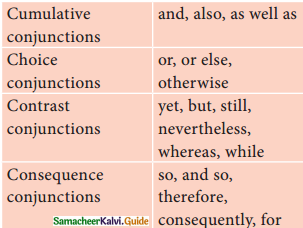
Conjunctions:

Coordinating Conjunctions:
Samacheer Kalvi 12th English Guide Prose Chapter 2 A Nice Cup of Tea 4

Subordinating Conjunctions:
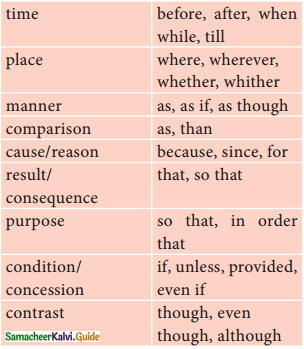
Samacheer Kalvi 12th English Guide Prose Chapter 2 A Nice Cup of Tea 5

Connectives or Linkers:
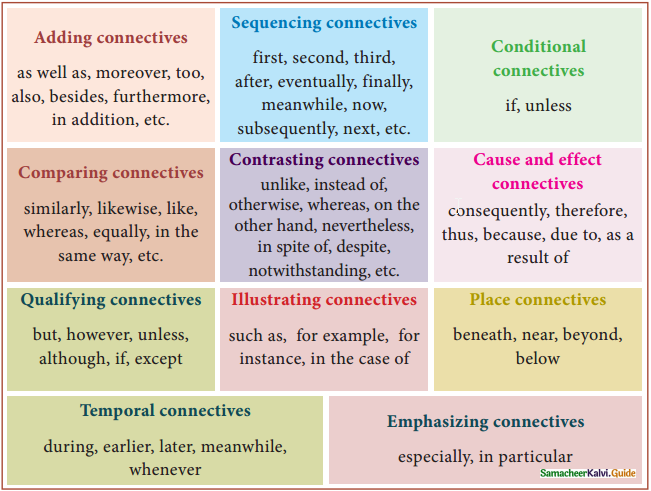
Samacheer Kalvi 12th English Guide Prose Chapter 2 A Nice Cup of Tea 6

Samacheer Kalvi 12th English Guide Prose Chapter 2 A Nice Cup of Tea

Task 1:
Choose the appropriate linker from within the brackets and complete the sentences:

Question a.
I could not complete my paper in the examination __________ (because, but) I was slow in answering the questions.
Answer:
because

Question b.
It started raining, _________ (yet, so) we could not play.
Answer:
so

Question c.
___________ (As, If) I got up early, I managed to reach school on time.
Answer:
As

Question d.
______ (Though/Whereas) he committed a mistake, he apologised ___________ (and/since) promised that he would not repeat it.
Answer:
Though, and

Question e.
This is __________ (how/what) it must be done.
Answer:
how

Question f.
The vendor saw the train moving slowly from the platform, ______ (therefore/until) he got in.
Answer:
therefore

Question g.
I was not well, ___________ (but/so) I did not attend the class.
Answer:
so

Question h.
______ (If, Although) she can drive, she travels by bus.
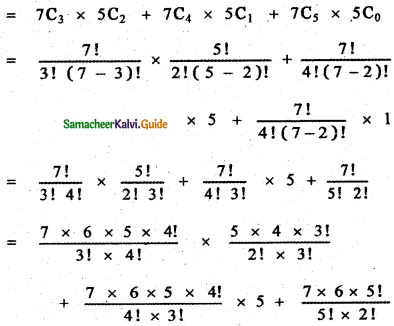
Answer:
Although

Question i.
______ (If/Unless) you register your name, you cannot participate in the competitions.
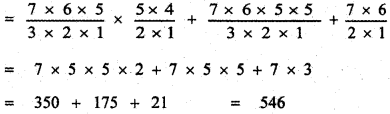
Answer:
Unless

Question j.
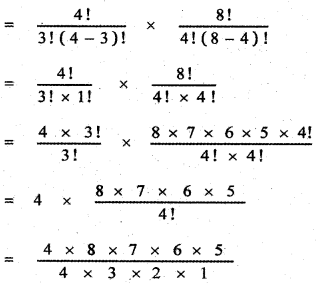
________ (As soon as/beside) my father arrived home, I narrated the incident.
Answer:
As soon as

Question k.
Be quick to hear _________ (then /and) slow to speak.
Answer:
and

Question l.
I am ___________ (neither/either) an ascetic in theory ________ nor/or) in practice.
Answer:
neither, nor

Question m.
We fail to harness the rainwater, ________ (consequently, nevertheless) we suffer.
Answer:
consequently

Question n.
My brother will certainly clear GRE; ______ (yet/for) he works very hard.
Answer:
for

Samacheer Kalvi 12th English Guide Prose Chapter 2 A Nice Cup of Tea

Task 2:
Combine the sentences and rewrite them using the words given in the brackets: (Text Book Page No. 48)

Question a.
The well was deep. Therefore, the fox could not get out of the well, (because)
Answer:
The fox could not get out of the well because the well was deep.

Question b.
The work was over. We went home, (when)
Answer:
When the work was over, we went home.

Question c.
A library is a public place. We see a number of books kept there for reading, (where)
Answer:
A library is a public place where we see a number of books kept there for the reading.

Question d.
The culprit was caught. Immediately, he was taken to the police station, (as soon as)
Answer:
As soon as the culprit was caught, he was taken to the police station.

Question e.
The boys were stealing mangoes from a grove. At that time, the owner of the grove came in. (while)
Answer:
The owner of the grove came in while the boys were stealing mangoes from a grove.

Question f.
Artificially flavoured juices are hazardous to health. Moreover, they lead to kidney problems, (and)
Answer:
Artificially flavoured juices are hazardous to health and lead to kidney problems.

Question g.
Adit has been promoted. Ranjan has been promoted, (as well as)
Answer:
Adit as well as Ranjan has been promoted.

Question h.
Caesar was declared emperor. The conspirators killed him. (After)
Answer:
After Caesar was declared emperor, the conspirators killed him.

Samacheer Kalvi 12th English Guide Prose Chapter 2 A Nice Cup of Tea

Task 3:
Fill in the blanks with appropriate correlative conjunctions: (Text Book Page No. 48)

Question a.
She is ________ an understanding person _____ everybody likes to be with her.
Answer:
such, that

Question b.
Suraj owns ________ a typewriter _______ a computer.
Answer:
both, and

Question c.
Vani is _______ a good singer _____ a good dancer.
Answer:
not only, but also

Question d.
Amit did not know _______ his father met his class teacher _________ not.
Answer:
whether, or

Question e.
I would _______ starve _______ beg.
Answer:
rather, than.

Writing:

Article Writing: (Text Book Page No. 49)
Task 1:

Write an article of 150 words for your school magazine to create an awareness of the dangers posed by the indiscriminate use of plastics, Expand the ideas given below as notes: (P No. 50)

The Government of Tamil Nadu has imposed a ban on the use of plastic. Effective implementation of this ban depends on public awareness and individual responsibility.

Notes:
a. Introduction

  • Plastic – synthetic material – doesn’t decompose in the soil
  • inevitable role of plastic – man’s day-to-day life

b. Human Health Hazard:

  • Leeching of plastic into food – microplastic entering the food chain
  • Human body’s inability to deal with this unnatural substance
  • The reaction of microplastic in the human body and ill- effects

c. Adverse effects on plants and animals:

  • Plastic particles choking waterways – affect aquatic animals
  • Ingestion by aquatic and terrestrial animals – blocking of intestines and respiratory passages

d. Environmental Degradation:

  • Manufacturing process & burning of plastics – pollute atmosphere
  • Plastic – non-biodegradable – interferes with soil microorganisms – affects soil fertility

e. Conclusion:

  • suggestions for restricted use -alternatives for a one-time use of plastics
  • segregation of plastic waste – for recycling

Samacheer Kalvi 12th English Guide Prose Chapter 2 A Nice Cup of Tea

Introduction:
Plastic is a synthetic material. It does not decompose in the soil. Its presence in the soil spoils the soil and it becomes barren. It has an inevitable role to play in the life of man. It has become a part of man’s day-to-day life.

Human Health Hazard:
It poses a health hazard. The micro part of plastic enters our food. It becomes like a leech in our food. It produces indigestion problems for aquatic and terrestrial animals. Its presence inside our body blocks the intestines and respiratory passages.

Environmental Degradation:
The manufacturing process and burning of plastics pollute the atmosphere. It is non-biodegradable so it interferes with soil micro-organism and affects soil fertility.

Conclusion:
We can go for the restricted use of plastic. The plastic companies may be restricted to make one-time use plastics. All plastic waste should be segregated into different types and used for recycling.

Samacheer Kalvi 12th English Guide Prose Chapter 2 A Nice Cup of Tea

Task 2:
Now write an article of about 150 words for a leading newspaper on the various ways of maintaining personal hygiene and sanitation in order to ensure a healthy living. Make use of the hints given below: (Text Book Page No. 50)

Urban living brings with it very dense co-habitation, This can often result in the transfer of various communicable diseases that could quickly develop into an outbreak.

Hints:
a) Introduction – ‘Cleanliness is next to Godliness’ – brief explanation

b) Personal Hygiene

  • Frequent washing of hands & regular bathing
  • Brushing of teeth, cutting of nails & hair
  • Wearing dean clothes

c) Keeping diseases at bay:

  • Avoid street food
  • Keep food containers closed with lids
  • Drink boiled water
  • Wash fruits and vegetables in flowing water

d) Keeping living area, surroundings, and the environment clean:

  • Disposal of domestic organic waste on a daily basis, and hazardous waste in designated places
  • Regular sweeping, mopping, and dusting
  • Disinfection of toilets and bathing areas
  • Avoid littering of public places
  • Avoid spitting, urinating, and defecating in public places

Samacheer Kalvi 12th English Guide Prose Chapter 2 A Nice Cup of Tea

e) Conclusion:
– Hygiene – a collective exercise – everyone’s involvement and practice, a must -b ensure community – health and happiness – celebrate life.

Introduction:
‘Cleanliness is next to Godliness’. This adage shows the importance of cleanliness. Cleanliness is important for a healthy life. If we keep ourselves and our place dean, we can avoid many diseases.

Personal Hygiene:
Our personal hygiene is important. We should wash our hands frequently. Regular bathing is necessary to maintain our hygiene. Brushing of teeth should be done every day before we take our first food. Cutting of nails and hair is also essential. We should always wear clean clothes.

Keeping diseases at bay:
We should avoid street food. Our food should be kept in dosed containers. We should drink only boiled water. Fruits and vegetables should be washed in flowing water.

Keeping living areas, surroundings, and the environment clean:
Our living area and surroundings should be kept clean. Domestic organic waste should be disposed of on daily basis. Our area should be swept, mopped, and dusted regularly. Disinfection lotion should be used in the toilets and bathing area. Littering in public places should be avoided. We should avoid spitting, urinating, and defecating in public places.

Conclusion:
Hygiene is a collective exercise. Everyone’s involvement and practice is needed. If we must ensure a healthy and happy community we can celebrate our life.

Samacheer Kalvi 12th English Guide Prose Chapter 2 A Nice Cup of Tea

Essay Writing:

Task 1:
Write an essay of about 200 words each: (P No. 51)

1. The Profession you would like to choose:
Introduction:
Everyone has his dreams and plans in life. Some people want to become doctors, engineers, or collectors. I want to uplift our country. So I want to become a teacher. The teachers are the real builders of the nation.

Teaching Profession:
The world of tomorrow will be born from the school of today. Teachers are the trustees of common welfare. A teacher should be a friend, philosopher, and guide. A teacher should love his students. Our country needs such good teachers.

Service in the Village:
I like teaching very much. My motto in life is simple living and high thinking. India lives in her villages. So I will serve in a village. I will be earnest and sincere to my students. I will not be proud of. Thus I will be a good citizen and serve mankind.

2. The Importance of a Balanced Diet:

A balanced diet is very important to a healthy lifestyle. A balanced diet should contain all the right foods in the right quantities like carbohydrates, high fiber content, water, proteins, fats, vitamins, and minerals. If you want to lead a healthy lifestyle, eating healthy food is important. Fluids are very essential for the human body to have a healthy lifestyle. Drink a lot of water every day.

Eat fresh fruits and vegetables which will help avoid many health disorders. Our balanced diet should contain all five elements which are bitter, pungent, sour, sweet, and salt. Most people do not recognize the importance of chewing as it is essential to digest many of components. We must avoid eating when we don’t have an appetite. Excess food may lead to overweight. We must avoid eating while working or watching TV. It may lead to heartburn and colitis. A balanced diet keeps our bodies healthy and brisk.

3. A memorable journey:
The most memorable journey I have enjoyed is the train journey towards Mumbai. It is a three-day journey from Tirunelveli. During last summer vacation, with my parents. I went by train, I was able to learn about the different cultures and languages of the people. A college student was seated across he engaged me in a lively conversation.
They were from Chennai and talked about their purpose of visit.

I had an occasion to have a chat with a few Hindi – speaking people. They were very polite and kind to me. I was extremely ’ happy when the train passed through Mumbai, where I bought delicious apples. Though I could not understand Hindi, I talked with them in Tamil. They gave me nice apples and I gave them some money that pleased him. At the end of the second day, we reached Mumbai. The journey broadened my knowledge about our country.

Samacheer Kalvi 12th English Guide Prose Chapter 2 A Nice Cup of Tea

Suggested Topics: (Text Book Page No. 51)

1. Importance of Physical Exercises / Sports and Games:
Regular physical exercise will improve your muscle strength. Exercise gives oxygen and nutrients to your tissues. It helps your cardiovascular system work more efficiently. When your heart and lung health improve, you have more energy to do daily activities. Exercise acts on the digestive system. It helps in digestion and induces appetite. The free movement of the parts of the body especially arms and limbs help you to lead a tension-free life in old age.

2. Travel and its Benefits:
Travelling improves your health. It cuts down stress. The health benefits of traveling are huge. Travelling makes your body feel better. Traveling is a source of knowledge, education, and experience. There is scope for improving one’s social and communication skills. Creative thoughts and broadening the horizon, enhancing tolerance are all the benefits of travel. Travel gives confidence, and it is a real education in life. The memories of travel give us pleasure.

3. Water Conservation:
Our lives depend fully on water. It is our duty to conserve water. We have only 3% of the water on earth. The remaining is 97% of saltwater in the seas. It is our responsibility not to pollute and abuse it. We must know how to conserve water. We can contribute to the conservation of potable water by protecting from water pollution. Modern irrigation methods help to solve water shortages and avoid wastage. Water can be saved in industries. Industries can adopt water recycling. Digging lakes, ponds, wells will help save rainwater. Children can be educated to save water and avoid wastage during their chores like washing, bathing, and cleaning.

4. Child Labour:
Child labour means making the children in hard labour which affects their physical and mental development. Children in the school-going age are employed in all kinds of jobs. They work in a bad atmosphere. They are never paid or paid less. The poverty of the parents is exploited to employ the children than giving them education. The children must go to school and only adults should be employed. The government should make strict laws to eradicate child labour. We should give a bright future to our children.

5. Mobile Phone – Advantages and Disadvantages:
A mobile phone is a device, which is used only for communication. However technological developments in the field of communication have made the phone a smartphone with features like video calls, surfing the net, play games, and take high-resolution pictures.

Samacheer Kalvi 12th English Guide Prose Chapter 2 A Nice Cup of Tea

Smartphones have become a great disadvantage to people, especially to students. They get addicted to it, thereby inviting various health problems and social problems. Mobile phones should be useful and necessary gadgets for our everyday life. Without cell phones, life would be harder. While enjoying the benefits of phones, we must be aware of their abuses too. Mobile phones could cause many dangers if not used properly.

6. Consumerism – Wants and Needs:
Consumerism means the protection of the interests of the consumers. The growth of consumerism has led to many organizations improving their service to the customer. It is a social and economic order that encourages the acquisition of goods and services. Various methods are used to create demand. It protects consumers against harmful products or business methods.

Wants and needs:
We have to consume to live. We need food, water, shelter, and clothing. People go behind electronics, enjoyment, luxury, etc. They forget that what they “need” is not a real “need”. Many people cannot draw a line between the two. While one part of the world food is wasted, in the other part people are starving. People should learn not to waste anything.

7. Value of Education:
Education is necessary for all. It develops confidence and builds the personality of a person. School education plays an important role in everyone’s life. The whole education has been divided into three divisions such as the Primary, Secondary, and Higher Secondary education. Primary education prepares the base which helps throughout life. Secondary education prepares the path for higher studies.

Higher Secondary education decides the final path to life and career. Our education decides what kind of person we would be in the future. In the competitive world, it is a must for all to have a good education. It makes us strong, mentally, socially, and intellectually by increasing our knowledge level, technical skills, and good position in the job. The only way to fulfill all dreams is only through education.

8. Value-based Education:
The purpose of value-based education is to build the social, moral, and spiritual behaviour of a person. It plays a big role in teaching the importance of being honest with others, being humble’ in all situations, and be able to face challenges. It helps in shaping the individual’s behaviour to fit into society. It will have an impact on the whole society, making the world, a better place to live in. Value-based education plays a big role in shaping the individual’s behaviour, so that they can display good morals, interact with others well, and become spiritual in all aspects of life.

Samacheer Kalvi 12th English Guide Prose Chapter 2 A Nice Cup of Tea

(ஆசிரியரைப் பற்றி:

ஜார்ஜ் ஆர்வெல் (George Orwell) என்னும் புனைப்பெயரால் (Pen name) அறியப்பட்ட எரிக் ஆர்த்த ர் ப்ளையர் (Eric Arthur Blair) (25 ஜீன் 1903 – 21 ஜனவரி 1950) ஒரு ஆங்கில புதினவியளாளர், கட்டுரையாளர், பத்திரிக்கையாளர், மற்றும் விமர்சகர். இவரின் படைப்புகள் நல்ல படிப்பினைகளையும், சமூக விழிப்புணர்வையும் ஏற்படுத்துவதாகவும், சர்வதிகாரத்திற்கு எதிராகவும், ஜனனாயகத்திற்கு ஆதரவாகவும் அமைக்கப்பட்டு இருக்கும்.

ஆர்வெல் இலக்கிய விமர்சனங்கள், கவிதைகள், புதினங்கள், தர்க்க இதழியல் போன்றவற்றை எழுதியுள்ளார். இவர் எண்ணியல் புதினமான Animal Farm (1945) மற்றும் டைஸ்டோபியன் புதினமான Nineteen Eighty – four(1949) ஆகியவற்றால் மிகச் சிறந்தவராக அறியப்பட்டார். 2008ஆம் ஆண்டு Times இவரை 1945 வரை உள்ள 50 சிறந்த British எழுத்தாளர்களில் இரண்டாவதாக பட்டியலிட்டது.

பாடத்தைப் பற்றி:

கொடுக்கப்பட்ட இந்த பாடப்பகுதி ஜார்ஜ் ஆர்வெல் அவர்களின் கட்டுரைகள், பத்திரிக்கைகள் மற்றும் கடிதங்களிலிருந்து எடுக்கப்பட்டது. தேநீர் நகரத்தின் ஆதாரப் பொருட்களுள் ஒன்றாக இந்தியா, அயர்லாந்து, ஆஸ்திரேலியா முதலிய நாடுகள் கருதப்படுகிறது. இந்தியா, இலங்கை தேயிலைதான் மிகச்சிறந்தது.

இப்பாடத்தில் தேனீர் தயாரிக்கும் விதத்தைப் பற்றியும், பல நாடுகளில் அதன் பயன்பாடுகள் பற்றியும் அதை எவ்வாறு அருந்த வேண்டும் என்பதைப்பற்றியும் ஜார்ஜ் ஆர்வெல் 11 (கருத்துக்கள் மூலம் தெளிவாக எடுத்துரைக்கிறார். அதைப்பற்றி முழுமையாக படித்து தெரிந்து கொள்வோம்.

Samacheer Kalvi 12th English Guide Prose Chapter 2 A Nice Cup of Tea

A Nice Cup of Tea Summary in Tamil

தமிழாக்கம் நீங்கள் உங்கள் கையில் கிடைக்கும் சமையல் புத்தகத்தை எடுத்து அதில் ‘டீ’ தயாரிப்பதை தேடினீர்கள் (look up) என்றால், அதனைப் பற்றிய குறிப்பு கிடைக்காமல் போகலாம் அல்லது அதிகபட்சமாக நீங்கள் பல முக்கியமான கருத்துக்கள் விடுபட்ட (unmentioned) மேலோட்டமான சில வரிகளை காணலாம்.

இந்திய நாடு, இதேப்போல் ஐர், ஆஸ்திரேலியா, நியூசிலாந்து போன்ற நாடுகளின் நாகரிகத்தில் முக்கியமானதாக டீ இருப்பதால் மட்டும் இது ஆர்வமானதாக இல்லை, டீ-ஐ எப்படி சிறந்த முறையில் தயாரிக்க வேண்டும் என்பதே ஒரு காரசாரமான விவாத தலைப்பாக (violent disputes) இருப்பதால் தான்.

நான் என்னுடைய “தேநீர் தயாரிப்பதற்கான சொந்த சமையல் குறிப்பை (recipe)” பார்த்த போது 11ற்கும் குறைவான மிக முக்கியமான குறிப்புகளைக் கண்டேன். அவற்றில் 2 குறிப்புகள் பொதுவானதாக இருந்தாலும், குறைந்தது 4 குறிப்புகளாவது கண்டிப்பாக சர்ச்சைக்குரியவை (controversial). இங்கே குறிபிடப்பட்டுள்ள என்னுடைய 11 விதிகளில், ஒவ்வொன்றையும் நான் பொன்னாகவே (goldens) கருதுகிறேன்.
Samacheer Kalvi 12th English Guide Prose Chapter 2 A Nice Cup of Tea 7

எல்லாவற்றிக்கும் முதலாவதாக ஒருவர் இந்திய அல்லது சிங்கள (இலங்கை) தேநீர் இலைகளைத் தான் உபயோகப்படுத்த வேண்டும். சீனத் தேநீரின் மதிப்பிடத்தக்க பண்புகளையும் (virtues) நாம் இக்காலத்தில் வெறுக்க கூடாது, இது சிக்கனமானது (economical), பாலுடன் கலக்காமலும் இதனை அருந்தலாம், ஆனால் போதுமான அளவு உற்சாகம் (stimulation) இருக்காது.

Samacheer Kalvi 12th English Guide Prose Chapter 2 A Nice Cup of Tea

அதனைப் பருகிய பிறகு, ஒருவர் அறிவார்ந்ததாகவும் (wiser), தைரியமானவராகவும் (braver), அதிக நேர்மறையாளராகவும் (optimistic) உணர மாட்டார். எவரேனும் ஒருவர் “ இது ஒரு மிகச்சிறந்த குவளைத் தேநீர்” என்ற வரிகளை உபயோகப்படுத்தினால், அது நிச்சயமாக இந்தியத் தேநீரையே குறிக்கும்.
Samacheer Kalvi 12th English Guide Prose Chapter 2 A Nice Cup of Tea 8

இரண்டாவதாக, தேநீரை மிகச்சிறிய அளவில் மட்டுமே தயாரிக்க வேண்டும், அதாவது சிறிய தேநீர் குடுவையில் தான் தயாரிக்க வேண்டும். பெரிய பாத்திரத்தில் தயாரிக்கும் தேநீர் சுவையற்று (tasteless) இருக்கும், இராணுவத்தில் பெரிய கலனில் (cauldron) தயாரிக்கும் தேநீர், எண்ணெய்ப்பசை மற்றும் சுண்ணாம்பு போன்ற சுவையுடன் இருக்கும். தேநீர் குடுவையானது களிமண்ணால் அல்லது பீங்கானால் செய்யப்பட வேண்டும்.
Samacheer Kalvi 12th English Guide Prose Chapter 2 A Nice Cup of Tea 9

வெள்ளி அல்லது உலோக கலவையில் ஆன தேநீர் குடுவையில் தரக்குறைவான தேநீரையே தயாரிக்க முடியும், கண்ணாடியால் ஆன பாத்திரங்கள் மிக மோசம். போதுமான ஆர்வமுடையதாக இருந்தாலும் காரியத்தால் ஆன தேநீர் குடுவை மிகவும் மோசமானது அல்ல. மூன்றாவதாக, குடுவையானது முன்னதாகவே சூடுபடுத்தப்பட (warmed) வேண்டும். குடுவையினை அடுப்பில் வைத்து சூடுபடுத்துவதே, வழக்கமான வெந்நீரால் சூடுபடுத்தும் முறையே சிறந்தது.
Samacheer Kalvi 12th English Guide Prose Chapter 2 A Nice Cup of Tea 10

நான்காவதாக, தேநீர் திடமாக இருக்க வேண்டும். 1 லிட்டருக்கு சற்று அதிகமான கொள்ளளவு உடைய கலனில், நீங்கள் கழுத்துவரை நிரப்புவதாக இருந்தால், 6 தேக்கரண்டி (teaspoons) போதுமானதாக இருக்கும். போர் நடவடிக்கை (rationing) காலங்களில் வாரத்தின் அனைத்து நாட்களிலும் இம்முறையை பின்பற்ற இயலாது. ஆனால் ஒரு குவளை திடமான தேநீரானது 20 குவளை திடமற்றது. “அனைத்து உண்மையான தேநீர் விரும்பிகளுக்கும், தங்களது தேநீர் திடமாக இருந்தால் மட்டும் போதாது. ஒவ்வொரு வருடம் கடந்து போகும் போதும் அவர்களது தேநீர் கூடுதல் திடமாக இருக்க வேண்டுமென விரும்புகிறார்கள். அது வயதான ஓய்வூதியதாரர்களுக்கு (pensioners) கூடுதல் உணவுப்படி வழங்கப்படும் போது கண்டறியப்பட்ட உண்மை.

Samacheer Kalvi 12th English Guide Prose Chapter 2 A Nice Cup of Tea

ஐந்தாவதாக, தேநீரானது நேரடியாக குடுவையினுள் இடப்படவேண்டும். வடிகட்டியோ அல்லது மெல்லிய துணியோ தேநீரை வடிகட்ட உபயோகப்படுத்தக் கூடாது. சில நாடுகளில் தேநீர் குடுவைகள், நீர்க்குழாயின் (spout) கீழே தேவையில்லாத சிறிய தேநீர் இலைகளை சேகரிக்க சிறிய கூடைகளுடன் இணைக்கப்பட்டிருக்கும். அது தீங்கு விளைவிக்கும். உண்மையில் ஒருவர் குறிப்பிட்ட அளவு தேநீர் இலைகளை விழுங்கினாலும், அது தீங்கு விளைவிக்காது. தேநீரானது குடுவையில் தளர்வாக இல்லாவிட்டால், அது முறையாக கலக்காது.

ஆறாவதாக, தேநீர் குடுவையிலிருந்து நேரடியாக தேநீர் கொதி கெண்டிக்கு (kettle) மாற்ற வேண்டும். அப்பொழுது நீரானது கொதித்து கொண்டிருக்க வேண்டும். அதாவது ஒருவர் கொதி கெண்டிக்கு ஊற்றும் போது நீராவி தான் உபயோகிக்க வேண்டும் என்பார்கள் ஆனால் என்னைப் பொறுத்தவரையில் அது எவ்வித வித்தியாசத்தையும் உண்டு பண்ணாது.
ஏழாவதாக தேநீர் தயாரித்த பிறகு, நன்கு கலக்கி, தேநீர் குடுவையை நன்கு குலுக்கி அதன்பின் தேநீர் இலைகளை அமரச் செய்ய வேண்டும்.
Samacheer Kalvi 12th English Guide Prose Chapter 2 A Nice Cup of Tea 11

எட்டாவதாக, ஒருவர் காலைகுவளையில் தான் குடிக்க வேண்டும், காலை உணவுக் (breakfastcup) குவளையானது, உருளை வடிவில் (cylindrical type), ஆழமற்றும் காணப்படும். காலை உணவுக் குவளையானது அதிகக் கொள்ளளவு உடையது, வேறு வகையான குவளையில் அருந்தினால், அருந்த தொடங்கும் முன்பே பாதி ஆறிவிடும்.

ஒன்பதாவதாக தேநீர் தயாரிக்கும் முன்பே உபயோகப்படுத்தப்படும் பாலின் பாலேட்டினை நீக்கி விட வேண்டும். அதிக பாலேட்டுடன் கூடிய பால், மங்கிய (sickly) சுவையுள்ள தேநீரைத் தரும்.

பத்தாவதாக, ஒருவர் முதலில் தேநீரை குவளையில் ஊற்ற வேண்டும் இதுவே ஒரு முறையான கருத்தாகும். உண்மையில் பிரிட்டனில் உள்ள அனைத்து வீடுகளிலும் இது குறித்து இரு கருத்துக்கள் நிலவுகின்றன. பாலை முதலில் ஊற்ற வேண்டும் என்ற கருத்து சற்று கடுமையான விவாதங்கள் கொண்டு வந்தாலும், என்னுடைய கருத்தினை பதிலளிக்க முடியாததாகவே நான் வைத்து வருகிறேன். அது என்னவென்றால் தேநீரை முதலில் ஊற்றுவதால். ஒருவரால் தனக்கு தேவையான அளவு பாலை ஊற்றிக்கொள்ளலாம்.

Samacheer Kalvi 12th English Guide Prose Chapter 2 A Nice Cup of Tea

மாற்றுக்கருத்தில், ஒருவர் தேவைக்கு அதிகப்படியான பாலை ஊற்றும் நிலைமை வரலாம். கடைசியாக (lastly) ஒருவர், தேநீரை ரஷிய நாட்டு வழக்கத்தில் அருந்தவில்லை என்றால், அவர் கண்டிப்பாக சர்க்கரை இல்லாமல் தான் அருந்த வேண்டும் என கருத்து சிலரால் மட்டுமே ஏற்றுக்கொள்ளப்படும் என்று எனக்கு தெரியும், இருந்தாலும் தேநீரில் சர்க்கரையைச் சேர்த்து அதன் சுவையை குறைக்கும்.

நீங்கள் எவ்வாறு உங்களை தேநீர் விரும்பி என்று அழைத்து கொள்ள முடியும்? இது தேநீரில் மிளகுத்தூளையோ (pepper) அல்லது உப்பையோ (salt) சேர்ப்பதற்கு சமமானதாகும். தேநீரை நீங்கள் இனிப்பூட்டினால் நீங்கள் தேநீரை சுவைக்கவில்லை, சர்க்கரையைத் தான் சுவைக்கிறீர்கள். இதற்கு நீங்கள் வெறும் சுடு தண்ணீரில் சர்க்கரையை கரைத்து அருந்தலாம்.

சிலர் தாங்கள் தேநீரை விரும்புவதில்லை என்றும், உற்சாகத்திற்காகவும் (stimulated) வெப்பமாக இருப்பதற்காக மட்டுமே தேநீரை அருந்துவதாகவும் அதனால் தான் சர்க்கரையைச் சேர்த்து தேநீரின் சுவையை நீக்குவதாகவும் சொல்லுவார்கள். அவ்வாறு தவறாக வழிகாட்டப்பட்டவர்களுக்கு (misguided) நான் கூறுவதாவது, நீங்கள் தொடர்ந்து இரு வாரங்களுக்கு தேநீரை சர்க்கரை இல்லாமல் அருந்தினீர்கள் என்றால், நீங்கள் மறுபடியும் தேநீரில் சர்க்கரை சேர்த்து வீணாக்கமாட்டீர்கள்.

தேநீர் அருந்துவதை குறித்து எழும்பக்கூடிய முரணான (controversial) கருத்துக்கள் இவை மட்டுமல்ல. இந்த தொழில் எவ்வளவு நுட்பமானது என்பதை காட்ட பல கருத்துக்கள் உள்ளன. மேலும் தேநீர் குடுவையைச் சுற்றி புரிந்து கொள்ள (mysterious) முடியாத ஆசாரங்கள் பல உள்ளன. எடுத்துக்காட்டாக நாம் ஏன் தேநீர் கோப்பையில் அருந்துகிறோம்).

தேநீர் இலைகளின் கிளை துணை உபயோகங்களை, தீர்க்க தரிசனம் கூறுவது, விருந்தினர்களின் வருகையை கணிப்பது, முயல்களுக்கு உணவாவது, தீக்காயங்களுக்கு மருந்தாவது தரையை கூட்டிப் பெருக்குவது குறித்து கூட நிறைய எழுதலாம். 2 (28 கிராம்) எடையுள்ள முறையாக கையாளப்பட்ட தேநீர் இலைகளில் இருந்து 20 தேநீர்

Samacheer Kalvi 9th Science Guide Chapter 12 Periodic Classification of Elements

Tamilnadu State Board New Syllabus Samacheer Kalvi 9th Science Guide Pdf Chapter 12 Periodic Classification of Elements Text Book Back Questions and Answers, Notes.

Samacheer Kalvi 9th Science Solutions Chapter 12 Periodic Classification of Elements

9th Science Guide Periodic Classification of Elements Text Book Back Questions and Answers

 Samacheer Kalvi 9th Science Guide Chapter 12 Periodic Classification of Elements

I. Choose the correct answer :
Question 1.
If Dobereiner is related with ‘law of triads’, then Newlands is related with
(a) Modem periodic law
(b) Hund’s rule
(c) Law of octaves
(d) Pauli’s Exclusion principle
Answer:
(c) law of octaves

Question 2.
Modern periodic law states that the physical and chemical properties of elements are the periodic functions of their ……………
(a) atomic numbers
(b) atomic masses
(c) similarities
(d) anomalies
Answer:
(a) atomic numbers

 Samacheer Kalvi 9th Science Guide Chapter 12 Periodic Classification of Elements

Question 3.
Elements in the modern periodic table are arranged in …………. groups and ………….. periods .
(a) 7, 18
(b) 18,7
(c) 17,8
(d) 8, 17
Answer:
(b) 18, 7

Fill in the blanks:

1. In Dobereiner’s triads, the atomic weight of the middle element is the __________ of the atomic masses of 1 and 3rd elements.
Answer:
average

2. Noble gases belong to ___________ group of the periodic table.
Answer:
18th

 Samacheer Kalvi 9th Science Guide Chapter 12 Periodic Classification of Elements

3. The basis of the classifications proposed by Dobereiner, Newlands and Mendeleev was ……………….
Answer:
atomic mass

4. Example for liquid metal is ______________ .
Answer:
mercury

III. Match the following:
Question

TriadsNewlands
Alkali metalCalcium
Law of octavesHenry Moseley
Alkaline earth metalSodium
Modern Periodic LawDobereiner

Answer:

TriadsDobereiner
Alkali metalSodium
Law of octavesNewlands
Alkaline earth metalCalcium
Modern Periodic LawHenry Moseley

 Samacheer Kalvi 9th Science Guide Chapter 12 Periodic Classification of Elements

IV. State whether true or false. If false, correct the statement:

Question 1.
Newlands’ periodic table is based on atomic masses of elements and modem periodic table is based on atomic number of elements.
Answer:
True.

Question 2.
Metals can gain electrons.
Answer:
False.
Correct statement: Metals tend to lose electrons.

Question 3.
Alloys bear the characteristics of both metals and nonmetals.
Answer:
False.
Correct statement: Metalloids bear the characteristics of both metals and nonmetals.

 Samacheer Kalvi 9th Science Guide Chapter 12 Periodic Classification of Elements

Question 4.
Lanthanides and actinides are kept at the bottom of the periodic table because they resemble each other but they do not resemble with any other group elements.
Answer:
True.

Question 5.
Group 17 elements are named as Halogens.
Answer:
True.

 Samacheer Kalvi 9th Science Guide Chapter 12 Periodic Classification of Elements

V. Assertion and Reason :

Question
Statement : Elements in a group generally possess similar properties but elements along a period have different properties.
Reason : The difference in electronic configuration makes the element differ in their chemical properties along a period.
a) Statement is true and reason explains the statement.
b) Statement is false but the reason is correct.
Answer:
(a) Statement is true and reason explains the statement

VI. Answer the following :

Question 1.
State modern periodic law.
Answer:
The modem periodic law states that:
“The Chemical and Physical properties of elements are periodic functions of their atomic numbers”.

Question 2.
What are groups and periods in the modern periodic table?
Answer:

  •  The horizontal rows in the periodic table are called periods.
  • Vertical columns in the periodic table starting from top to bottom are called groups.

 Samacheer Kalvi 9th Science Guide Chapter 12 Periodic Classification of Elements

Question 3.
What are the limitations of Mendeleev’s periodic table?
Answer:

  • Elements with large differences in properties were included in the same group. Eg: Hard metals like copper (Cu) and silver (Ag) were included along with soft metals like sodium (Na) and potassium (K).
  • No proper position could be given to the element hydrogen. Non-metallic hydrogen was placed along with metals like lithium (Li), sodium (Na) and potassium (K).
  • The increasing order of atomic mass was not strictly followed throughout. Eg. Co & Ni, Te &I.
  • No place for isotopes in the periodic table.

Question 4.
State any five features of the modern periodic table.
Answer:

  • All the elements are arranged in the increasing order of their atomic number.
  • The horizontal rows are called periods. There are seven periods in the periodic table.
  • The elements are placed in periods based on the number of shells in their atoms.
  • Vertical columns in the periodic table starting from top to bottom are called groups. There are 18 groups in the periodic table.
  • Based on the physical and chemical properties of elements, they are grouped into various families.

 Samacheer Kalvi 9th Science Guide Chapter 12 Periodic Classification of Elements

Intext Activities

ACTIVITY -1

Find the pair of elements having similar properties by applying Newlands’ law of Octaves
(Example: Mg & Ca):
Set I : F, Mg, C, O,B
Set II: Al, Si, S, Cl, Ca
Answer:

  1. F-Cl
  2. Mg-Ca
  3. C-Si
  4. O-S
  5. B-Al

9th Science Guide Periodic Classification of Elements Additional Important Questions and Answers

Choose the correct answer:

Question 1.
Noble gases are placed in the _______ group in the modern periodic table.
(a) 13th
(b) 18th
(c) 17th
(d) 2nd
Answer:
(b) l8th

Question 2.
Group 16 elements are collectively called as _______ .
(a) chalcogen family
(b) carbon family
(e) halogens
(d) nitrogen family
Answer:
(a) chalcogen family

 Samacheer Kalvi 9th Science Guide Chapter 12 Periodic Classification of Elements

Question 3.
The maximum number of electrons that can be accommodated in s, p ,d, and f subshells are _________ .
(a) 14, 10, 6, 2
(b) 6, 10, 2, 14
(c) 2, 6, 10, 14
(d) 6, 2, 14, 10
Answer:
c) 2, 6, 10, 14

Question 4.
d-block elements are otherwise known as _________ .
(a) transition elements
(b) inner transition elements
(c) halogens
(d) alkali metals
Answer:
(a) transition elements

 Samacheer Kalvi 9th Science Guide Chapter 12 Periodic Classification of Elements

Question 5.
Which block of the periodic table contains metals, non-metals and metalloids?
(a) s
(b) p
(c) d
(d) f
Answer:
(b) p

Question 6.
Which of the following non-metals can form alloys with metals?
(a) Boron
(b) Carbon
(c) Silicon
(d) All the above
Answer:
(d) all the above

 Samacheer Kalvi 9th Science Guide Chapter 12 Periodic Classification of Elements

Question 7.
Which of the following metals have low melting and boiling point?
(a) Sodium :
(b) Potassium
(e) Iroñ
(d) Both a & b
Answer:
(d) Both a & b

 Samacheer Kalvi 9th Science Guide Chapter 12 Periodic Classification of Elements

Question 8.
Which of the following metal (s) do not react with water?
(a) Gold
(b) Silver
(c) Copper
(d) All the above
Answer:
(d) All the above

Question 9.
If the electronic configuration of an element is 1s2 2s2 2p6 3s2 3p1’then it will
occupy ……………… block of the periodic table.
(a) s
(b) p
(c) d
(d) f
Answer:
(b) p

 Samacheer Kalvi 9th Science Guide Chapter 12 Periodic Classification of Elements

II. Fill in the blanks :

1. ……………… group elements are called alkaline earth metals.
Answer:
Second

2. The elements that follow lanthanum are called ……………..
Answer:
Lanthanides

3. f-block elements are also known as …………………..
Answer:
inner transition elements

 Samacheer Kalvi 9th Science Guide Chapter 12 Periodic Classification of Elements

4. …………… block element is placed at the bottom of the periodic table.
Answer:
f-

5. The mixture of metal with mercury is called …………………..
Answer:
amalgam

6. Elements are placed in periods based on the number of ……………… in their atoms.
Answer:
shells

 Samacheer Kalvi 9th Science Guide Chapter 12 Periodic Classification of Elements

III. Spot the error :

Question 1.
The elements of group 13 are called the carbon family.
Answer:
The elements of group 13 are called boron family
(or)
The elements of group 14 are called the carbon family.

Question 2.
There are 5 periods and 17 groups in the modern periodic table.
Answer:
There are 7 periods and 18 groups in the modem periodic table.

 Samacheer Kalvi 9th Science Guide Chapter 12 Periodic Classification of Elements

IV. Pick the odd one out and write the reason:

Question 1.
Copper, brass, gold ornament, bronze.
Answer:
Copper.
Copper is metal whereas the other three are alloys.

Question 2.
Bromine, carbon, hydrogen, aluminium.
Answer:
Aluminium.
Aluminium is metal whereas the other three are non-metals.

 Samacheer Kalvi 9th Science Guide Chapter 12 Periodic Classification of Elements

V. To match :

Group in the modern periodic tableFamilies
a) 1?
b) ?Transition metals
c) ?Boron family
d) 15?
e) 17?

Answer:
a) alkali metals
b) 3 to 12
c) 13
d) Nitrogen family
e) halogens

VI. Answer in brief :

Question 1.
What are the s-block elements?
Answer:
Elements whose valence electron is filled in s subshell is known as s-block elements.

Question 2.
What are the p-block elements?
Answer:
The last electron in these elements is filled in p subshells and hence these elements are called p block elements. These elements are in group 13 to 18 in the periodic table.

 Samacheer Kalvi 9th Science Guide Chapter 12 Periodic Classification of Elements

Question 3.
What are alloys?
Answer:
Alloys are mixtures of two or more metals and are formed by mixing molten metals thoroughly. Rarely nonmetals are also mixed with metals to produce alloys.

Question 4.
What are metalloids? Give examples.
Answer:
Elements which have the properties of both metals and non-metals are called as metalloids, (eg) Boron, Arsenic.

Question 5.
State Mendeleev’s Law of Periodicity.
Answer:
The physical and chemical properties of elements are the periodic functions of their atomic masses.

 Samacheer Kalvi 9th Science Guide Chapter 12 Periodic Classification of Elements

Question 6.
State Newlands’ Law of Octaves.
Answer:
Every eighth element had properties similar to those of the first element like the eighth note in an octave of music is similar to the first.

Question 7.
An element has atomic number 12.
a) Write the electric configuration.
b)To which group and period do it belong.
Answer:
a) K = 2, L = 8, M = 2
b) Group No . 2, Period No. 3

 Samacheer Kalvi 9th Science Guide Chapter 12 Periodic Classification of Elements

Question 8.
Relate the names of the following scientists with the statements given below. (Mendeleev, Newlands, Dobereiner).
a) Arranged elements into groups containing three elements each.
b) Arranged elements in a group of seven with increasing atomic masses and eighth elements with similar properties kept below the first like eight note in an act of music.
c) Arranged elements in the increasing order of atomic mass
Answer:
a) Dobereiner
b) Newlands
c) Mendeleev

Question 9.
Complete the following triads by inserting the missing elements.
a) Cl, ………., I
b) Li, ………, K
c) Ca, …………, Ba
Answer:
a) Br
b) Na
c) Sr

Question 10.
How are elements grouped into various families in the periodic table?
Answer:
Based on the physical and chemical properties of elements, they are grouped into various families.

 Samacheer Kalvi 9th Science Guide Chapter 12 Periodic Classification of Elements

VII. To interpret:

Question 1.
Group 1 (except hydrogen) elements are called alkali metals.
Answer:
The elements of group 1 (except hydrogen) are metals. They react with water to form solutions that change the colour of a vegetable dye from red to blue. These solutions are said to be highly alkaline or basic. Hence they are called alkali metals.

Question 2.
d-block elements are called transition elements.
Answer:
d-block elements are found in the centre of the periodic table. Their properties are intermediate to that of s block and p block elements and so they are called transition elements.

Question 3.
Group 3-12 elements in the modern periodic table are called d block elements.
Answer:
The elements of group 3 to 12 have their valence electrons in their outermost d subshells. These elements are called d block elements.

 Samacheer Kalvi 9th Science Guide Chapter 12 Periodic Classification of Elements

VIII. Complete the following table :

Question

SymbolAtomic No.Electronic Configuration
1) He2?
2) Ne?2,8
3) Ar?2, 8,8
4) Na11?

Answer:
1) 2
2) 10
3) 18
4) 2,8,1

IX. Assertion and Reason :

Question 1.
Assertion (A): Group 2 elements in the modem periodic table are called alkaline earth metals.
Reason (R): The oxides of group 2 elements produce alkaline solutions when they are dissolved in water.
(a) A is right R is wrong
(b) R explains A
(c) R does not explain A
(d) R is right A is wrong
Answer:
(b) R explains A

 Samacheer Kalvi 9th Science Guide Chapter 12 Periodic Classification of Elements

Question 2.
(A) : Noble gases are chemically inert in nature.
Reason (R) : Noble gases have stable electronic structures.
(a) Both A & R are right
(b) Both A & R are wrong
(c) A is right R is wrong
(d) A is wrong R is right
Answer:
(a) Both A & R are right]

Question 3.
Assertion (A): Non-metals are electronegative.
Reason (R) : Non-metal losë electrons to form cation.
(a) Both A & R are right
(b) Both A & R are wrong
(c) A is right R is wrong
(d) A is the wrong R is right
Answer:
(c) A is right R is wrong

 Samacheer Kalvi 9th Science Guide Chapter 12 Periodic Classification of Elements

X. Long answer type questions:

Question 1.
List the advantages of alloys.
Answer:

  • Alloys do not get corroded or get corroded to a very less extent.
  • They are harder and str9ner than pure metals (Example: Gold is mixed with copper and it is harder than pure gold)
  • They have less conductance than pure metals (Example: Copper is a good conductor of heat and electricity whereas brass and bronze are not good conductors)
  • Some alloys have lower melting point than pure metals (Example: Solder is an alloy of lead and tin which has a lower melting point thàn each of the metals)
  • When metal is alloyed with mercury, it is called amalgam.

Question 2.
Write the advantages of the Modern Periodic Table.
Answer:

  • The table is based on a more fundamental property i.e., atomic number.
  • It correlates the position of the element with its electronic configuration more clearly.
  • The completion of each peçiod is more logical. In a period, as the atomic number increases, the energy shells are gradually filled up until an inert gas configuration is reached.
  • It is easy to remember and reproduce.
  • Each group is an independent group and the idea of subgroups has been discarded.
  • One position for all isotopes of an element is justified since the isotopes have the same atomic number.
  • The position of the eighth group (in Mendeleev’s table) is also justified in this table. All transition elements have been brought in the middle as the properties of transition elements are intermediate between the left portion and right portion elements of the periodic table.
  • The table completely separates metals from nonmetals. The nonmetals are present in the upper right corners of the periodic table.
  • The positions of certain elements which were earlier misfit (interchanged) in Mendeleev’s periodic table are now justified because it is based on an atomic number of the elements.
  • Justification has been offered for placing lanthanides and actinides at the bottom of the periodic table.

 Samacheer Kalvi 9th Science Guide Chapter 12 Periodic Classification of Elements

Question 3.
Explain the position of hydrogen in the periodic table.
Answer:
Hydrogen is the lightest, smallest and first element of the periodic table. Its electronic configuration (1s1) is the simplest of all the elements. It occupies a unique position in the periodic table. It behaves like alkali metals as well as halogens in its properties. In the periodic table, it is placed at the top of the alkali metals.

  • Hydrogen can lose its one electron to form a hydrogen ion (H+) like alkali metals.
  • It can also gain one electron to form the hydride ion (H) like halogens.
  • Alkali metals are solids while hydrogen is a gas.
    Hence the position of hydrogen in the modem periodic table is still under debate
    as the properties of hydrogen are unique.

Question 4.
List the features of Mendeleev’s Periodic Table.
Answer:
1. It has eight vertical columns called ‘groups’ and seven horizontal rows called ‘period’.

2. Each group has two subgroups ‘A’ and ‘B’. All the elements appearing in a group were found to have similar properties.

3. For the first time,-elements were comprehensively classified in such a way that elements of similar properties were placed in the same group.

4. It was noticed that certain elements could not be placed in their proper groups in this manner. The reason for this was wrongly determined atomic masses, and consequently those wrong atomic masses were corrected. Eg: The atomic mass of beryllium was known to be 14. Mendeleev reassessed it as 9 and assigned beryllium a proper place;

5. Columns were left vacant for elements which were not known at that time and their properties also were predicted. This gave me the motivation to experiment in Chemistry. Eg: Mendeleev gave the names Eka Aluminium and Eka Silicon to those elements which were to be placed below aluminium and silicon respectively in the periodic table and predicted their properties. The discovery of Germanium later on, during his lifetime, proved him correct.

Properties of Germanium:

PropertyMendeleev’s prediction (1871)Actual property (1886)
Atomic MassAbout 7272.59
Specific Gravity5.55.47
ColourDark greyDark grey
Formula of oxideEsO2GeO2
Nature of chlorideESCl4GeCl4


Samacheer Kalvi 12th English Guide Prose Chapter 1 Two Gentlemen of Verona

Tamilnadu State Board New Syllabus Samacheer Kalvi 12th English Guide Pdf Prose Chapter 1 Two Gentlemen of Verona Text Book Back Questions and Answers, Summary, Notes.

Tamilnadu Samacheer Kalvi 12th English Solutions Prose Chapter 1 Two Gentlemen of Verona

12th English Guide Two Gentlemen of Verona Text Book Back Questions and Answers

Textual Questions:

I. Answer the following questions in one or two sentences each based on your understanding of the story:
(Note: IQ Important Questions)

Question a.
Who did the narrator meet at the outskirts of Verona? (IQ)
Answer:
The Narrator met Nicola and Jacopo at the outskirts of Verona.

Question b.
Why did the driver not approve of the narrator buying fruits from the boys?
Answer:
The driver did not approve of the narrator buying fruits from the boys because of their shabby appearance.

Question c.
The boys did not spend much on clothes and food, why?
Answer:
The boys had to save every penny towards the weekly medical bill of their sister Lucia. So, they did not spend much on clothes and food.

Samacheer Kalvi 12th English Guide Prose Chapter 1 Two Gentlemen Of Verona

Question d.
Were the boys saving money to go to the states? How do you know?
Answer:

  1. The boys had the commitment to saving the life of their sister.
  2. So they were not saving money to go to the states.

Question e.
Why did the author avoid going to Lucia’s room?
Answer:

  1. The author did not like to disturb the happy family party.
  2. So he avoided going to Lucia’s room.

Question f.
What was Lucia suffering from? (IQ)
Answer:
Lucia was suffering from tuberculosis of the spine.

Question g.
What made the boys join the resistance movement against the Germans?
Answer:

  1. The Germans killed the boy’s father and made them homeless.
  2. This made the boys join the resistance movement.

Question h.
What made the boys work so hard? (IQ)
Answer:
They did not want charity from the hospital. The determination to save the life of their sister made the boys work hard.

Question i.
Why didn’t the boys disclose their problem to the author?
Answer:

  1. The boys didn’t like to gain sympathy.
  2. So they did not disclose their problem to the author.

Samacheer Kalvi 12th English Guide Prose Chapter 1 Two Gentlemen Of Verona

2. Answer the following questions in three or four sentences each: (Text Book Page No. 5)

Question a.
Describe the appearance of Nicola and Jacopo.
Answer:
One boy had worn Jersey and cut-off khaki pants. The other had a shortened army tunic gathered in loose folds about his skinny frame. They had tangled hair and dark earnest eyes.

Question b.
What were the various jobs undertaken by the little boys? (IQ)
Answer:
They shined shoes, sold fruits, hawked newspapers, conducted tourists round the town, and ran errands.

Question c.
How did the narrator help the boys on Sunday? (IQ)
Answer:
The author took the boys in his car to a tiny village called Poleta, set high upon a hill. He drove the car up to a large red-roofed villa. The boys asked the author to come thereafter for an hour and went inside.

Question d.
Who took the author to the cubicle? (IQ)
Answer:
The nurse who was taking care of the boy’s sister Lucia took the author to the cubicle.

Question e.
Describe the girl with whom the boys were talking to in the cubicle.
Answer:

  1. The girl seemed to be about twenty.
  2. She wore a pretty lace jacket.
  3. Propping up on pillows, she was listening to the chatter of the boys.
  4. Her eyes were soft and tender.

Question f.
Recount the untold sufferings undergone by the siblings after they were rendered homeless.
Answer:
The boys and their sister were thrown in the streets. Lucia had to give up her singing lessons. They had suffered horribly from near starvation and exposure to the cold winter. Lucia developed tuberculosis of the spine. The boys built a home from the rubbles. They had to admit Lucia to a nursing home. To pay the weekly medical bill, they worked from dawn to midnight doing odd jobs eating very little.

Question g.
The narrator did not utter a word and preferred to keep the secret to himself. Why? Substantiate the statement with reference to the story.
Answer:

  1. The narrator kept the secret to himself because he knew that the boys did not like to reveal their secret to anyone.
  2. When the narrator asked them what did they do with the money they earned, they were not ready to give a prompt reply for it.

Samacheer Kalvi 12th English Guide Prose Chapter 1 Two Gentlemen Of Verona

3. Answer the following in a paragraph of 100-150 words each: (Text Book Page No. 5)

Question a.
What was the driving force that made the boys do various jobs?
Answer:
In the war-hit Verona, everything was difficult. Food had become scarce and dear. The hospital which offered to treat Lucia was forced to charge a weekly fee. Work was scarce. But the boys were determined to save the life of their beloved sister.

After the untimely death of the father in the war, the two little boys Nicola and Jacopo took the responsibility of earning money by doing all odd jobs for defraying the medical expenses for their sister on their tender shoulders. They spent very little on their food and clothes. The driving force behind their selfless sacrifice and hard work from dawn to midnight was the love they had for their elder sister. They wanted her to get well soon and become an accomplished singer in life. Once you set a goal far above your capacity but work hard ceaselessly, you are bound to achieve it.

Question b.
How was the family affected by the war?
Answer:
The family was terribly affected by the war. Their father, a well-known singer had been killed in the early part of the war. After some time a bomb had destroyed their home and so the three children Nicola, Jacopo, and Lucia were thrown out into the streets. Their comfortable and cultured life got destroyed by the war. In fact, they suffered horribly from near starvation and exposure to the cold winter.

For many months they lived in a shelter made of broken building walls and bricks. In the meantime, the two boys get separated from their sister. They were under German rule for nearly three years. The boys grew to hate the Germans just because they suffered a lot because of them. In fact, they were the first to join the resistance movement against the Germans.

Question c.
Write a character sketch of Nicola and Jacopo.
Answer:
Nicola was 13 and Jacopo only 12. They were brothers. They were tanned, had tangled hair and dark earnest eyes. Though they were just kids, they were serious about their work. They did hundreds of errands for the tourists. They were found doing brisk business shining shoes or selling wild berries. They had the skill to find seats in the theater for the tourists and also guide the tourists through many important sites of the city of Verona such as Juliet’s tomb. Jacopo was lively as a squirrel.

Nicola’s smile was steady and engaging yet in their innocent faces, one could find seriousness far beyond their years. What struck one was the extreme willingness of both the boys to work. Under the scorching Sun, they hawked newspapers. When the narrator enquired what they did with the money they earned as they were not spending it on clothes or food or saving it for emigrating to America, Nicola coloured but he did not reveal the secret family adversity. Both are gentlemen because they did not want anyone’s sympathy.

Samacheer Kalvi 12th English Guide Prose Chapter 1 Two Gentlemen Of Verona

Question d.
What message is conveyed through the story “Two Gentlemen of Verona”
Answer:
The message conveyed through the story is one can overcome one’s adversities with strong will and determination. Nothing is impossible in this world. It is one’s hard work and dedication which can help one to achieve one’s goal. The boys in the story were badly affected by the war. In spite of it they were ready to do many odd jobs to save their sister.

This action of the boys throws light on the fact that family is the true demonstration of love, affection, and faith. Yet another message which gets conveyed is that it is the situation and circumstance which one faces in one’s life that makes one shoulder responsibilities with strong determination. In simple words, we can say that Nature is the best teacher who teaches us many lessons in our life.

Question e.
Justify the title of the story “Two Gentlemen of Verona”.
Answer:
In the story ‘Two Gentlemen of Verona’, the two orphan boys Jacopo and Nicola work immensely and exhaustively. They shine shoes, sell newspapers, run errands, and show tourists round the city. They take only figs and black tea as food. They save every penny for the medical treatment of their sister Lucia who is suffering from tuberculosis of the spine. The narrator himself admits that their willingness to work impressed him. They demonstrate an unusual devotion to their work.

The objective of their hard work and purpose behind their half-starved daily routine is not known to many in Verona. Anyone may polish shoes or hawk newspapers but it is the magnanimity of heart and nobleness of purpose that actually determines whether one is a real gentleman or a hypocrite. Hence the title ‘‘Two Gentlemen of Verona” is justified.

Question f.
Adversity brings out the best as well as the worst in people. Elucidate this statement with reference to the story.
Answer:
No human life is possible without adversities. In fact, it is these adversities that bring out the qualities of self-confidence and endeavor in a person. It depends upon the mentality of a man to make it the worst or brings out the best out of it. In this story, the two boys faced the great disaster of losing their father and their home because of the war. To add fuel to it their sister suffered from tuberculosis of the spine.

This was the worst adversity in their life as they lost almost everything at a young age. but they did not lose hope. They had a strong determination to work hard and earn money for the treatment of their sister. Many good qualities like love, devotion, sacrifice, sincerity, and maturity get revealed just because of the adversities they face in their life. Thus the statement “Adversity brings out the best as well as the worst in people” is justified.

Question g.
Which character do you like the most in the story and why?
Answer:
Of all the characters, I like Nicola who is a 13-year-old boy (i.e.) one of the two gentlemen of Verona. Though he is small, he is mature beyond his years. Like John Keets, he hated sympathy and self-pity. He does not want any favour except for the opportunity to work. He has an engaging smile. He and his brother Jacopo were hardworking and devoted to their sister Lucia. He has seriousness far beyond his years.

Even when kindly enquired by the narrator as to why he was spending little on clothes and food, he doesn’t open up. He colours deeply and grows pale. He even avoided the eyes of the narrator. When his squirrel-like brother requested the narrator to send them in his car to Poleta on Sunday, Nicola doesn’t like it. He glares at his brother in vexation and says, “we couldn’t think of troubling you, sir.” He wins the respect of all readers because of his maturity, willingness to work, and devotion to his sister.

Samacheer Kalvi 12th English Guide Prose Chapter 1 Two Gentlemen Of Verona

Paragraph:

Introduction:
A.J. Cronin has explained the importance of dedication towards a relationship in the story, “Two Gentlemen of Verona”.

About the story:
The story is about the two boys named Nicola and Jacopo, who do numerous things to earn money only to pay for their sister’s treatment who suffers from tuberculosis of the spine. The narrator was driving down the foothills of the Alps along with his companion. At that time, two young boys who sold wild strawberries stopped their car.

Two gentlemen of Verona:
‘The small boys appeared to be quite shabby. The boys were brothers, The elder one Nicola was 13 and the younger Jacopo was 12 years old. The narrator and his companion bought the biggest basket of strawberries from the boys. They came to know that the boys did many kinds of jobs like selling fruits, polishing shoes, selling newspapers, etc., to earn money. During the time of their stay in the town, the young boys were very helpful.

Lucia’s Suffering:
The boys earned money but they spent only a little. The boys earned the money to cure their sister who was hospitalised for tuberculosis of spine. They had a decent life before the war and the war made them orphans. They tried their best to make the payments regularly to the hospital, The narrator drove them to the hospital one Sunday and knew everything about the boys and he did not reveal it to the boys. He drove them back in silence.

Conclusion:
Their selfless action brought nobility to human life, they were really two gentlemen of Verona.

Samacheer Kalvi 12th English Guide Prose Chapter 1 Two Gentlemen Of Verona

Vocabulary:
a) Read the following words taken from the story. Give two synonyms and one antonym for each of these words. Use a dictionary, if required: O(Text Book Page No. 6)

Samacheer Kalvi 12th English Guide Prose Chapter 1 Two Gentlemen Of Verona 1
Answer:

WordSynonymsAntonym
cautiouscareful/watchfulcareless
disapprovecondemn / criticise / refuseapprove
briskquick / hurried / activeidle / inactive
engagingattractive / appealing / interestingboring.
humblecourteous / polite / modestimpolite
eagerkeen / willing / cravinguninterested
resistanceoppositioncompliance
persuadeinduce / encouragedissuade
scarcerareadequate
nobilityhonour / dignitydishonour

b) Homophones and Confusables: (Text Book Page No. 6, 72, 148)
Homophones are two or more words with the same sound but with different spellings and meanings. You have already learned that homophones are words that sound alike but are different in spelling and
meaning.
E.g. feet – feat / face – phase / sort – sought / hair – heir/

Question 1.
What are confusables?
Answer:
Confusables /confusables are words that are commonly confused with one another in meaning or usage
because of slight similarities in spelling, pronunciation, or meaning.
e.g. moment – movement / except – expect / human – humane / discover – invent.

Samacheer Kalvi 12th English Guide Prose Chapter 1 Two Gentlemen Of Verona

(i) Given below is a list of common confusables. Distinguish the meaning of each pair of words by framing your own sentences: (Text Book Page No. 6)

a) emigrate – leave one’s country/move abroad (my friend wants to emigrate from Asia)
immigrate – come to live permanently in a foreign country (He wants to immigrate to India)

b) beside – near (He stands beside me)
besides – in addition to (Besides having a car, he also has a bike)

c) judicial – legal (The court ordered judicial custody of the convict)
judicious – wise (The lawyer argued in a judicious manner)

d) eligible – qualified (He ¡s an eligible hand)
illegible – not clear (Mostly doctor’s prescriptions are illegible)

e) conscience – moral sense (His conscience promoted him to know his mistakes)
conscious – awareness (He has consciously abused his teacher)

f) industrial – commercial (The industrial chemicals are polluting the river)
industrious – hard-working (Sathish is an industrious student)

g) eminent – famous (Ramesh is an eminent scientist)
imminent – about to happen (There is an imminent danger of corona virus)

h) illicit – illegal (Ten people were arrested for brewing illicit liquor)
elicit – bring out (The teacher elicited answers from the student)

i) prescribed – advised (The doctor prescribed powerful medicines to me)
proscribed – remove (The police proscribed the striking students)

j) affect – change (The place is affected by the flood)
effect – the result of a change (The effect of the flood in very heavy)

k) aural – related to hearing
oral – related to speaking

l) born – related to birth (Raji was born on 2nd January 2020)
borne – carry (The people near the border borne the brunt of the attack.)

(ii) Fill in the blanks using suitable homophones or confusables:

Samacheer Kalvi 12th English Guide Prose Chapter 1 Two Gentlemen Of Verona 2
Answer:

walletvalethoardhorde
fairyfaeriedesertdessert
medalmeddlenightknight
waitweightsweetsuite
yokeyolkplainplane
growngroanmightmite
earnerne/urnquitequiet

Samacheer Kalvi 12th English Guide Prose Chapter 1 Two Gentlemen Of Verona

c) Give the meanings of the following phrasal verbs and frame sentences using them: (Text Book Page No. 7)

Question 1.
cut off
Answer:

  • to remove something by cutting
  • The branch was cut off from the tree

Question 2.
come upon
Answer:

  • meet someone by chance
  • I came upon my Maths teacher in Chennai

Question 3.
put out
Answer:

  • stop something burning
  • The firefighters put out the fire

Question 4.
draw up
Answer:

  • stop
  • A taxi drew up outside the hotel

Question 5.
pass out
Answer:

  • become unconscious/faint
  • The politician passed out when the income tax officials quizzed him.

Question 6.
take off
Answer:

  • Start flying/remove clothing
  • The flight took off at the right time.

Question 7.
turn away
Answer:

  • refuse permission
  • The reporters who came to interview the Prime Minister were turned away.

Question 8.
stand by
Answer:

  • help someone who ¡s in difficult to be ready.
  • My friend stood by me all the time.

Question 9.
bank on
Answer:

  • depend on
  • The whole team is banking on him to win the match.

Samacheer Kalvi 12th English Guide Prose Chapter 1 Two Gentlemen Of Verona

d) Read the list of words formed by adding suffixes: (Text Book Page No. 7)
frequently, satisfaction, willingness, inevitable, preparation, government, periodic, management,
population, department, announcement, comfortable, resemblance, nobility.

Form two derivatives from each of the following words by adding prefixes and suffixes: (Text Book Page No. 7)
Samacheer Kalvi 12th English Guide Prose Chapter 1 Two Gentlemen Of Verona 3
Answer:

WordPrefixSuffix
patientimpatientpatiently
honourdishonourhonourable
respectdisrespectrespectful
managemismanagemanagement, manageable
fertileinfertilefertility
differentindifferentdifferentiate / difference
friendbefriendfriendship, friendly
obeydisobeyobedience

Listening:

Floods are an inevitable natural disaster which can occur in any part of the world. Floods can prove all the more
disastrous in localities, where population density is high. Preparation for Disaster Management has become imperative for any city, town, or village during monsoons. The Government Department entrusted with Disaster Management makes periodic announcements about the precautions to be taken whenever floods are anticipated.

Samacheer Kalvi 12th English Guide Prose Chapter 1 Two Gentlemen Of Verona

Now, you are going to listen to the cautionary instructions that are given to the general public living in flood-prone areas. Listen carefully and complete the following sentences:

Question a.
The announcement was made by the Department of _______.
Answer:
Disaster Management.

Question b.
Widespread heavy rains are expected from the early hours of _______.
Answer:
Sunday.

Question c.
The public is asked to find out the locations of _______.
Answer:
the closest flood shelters available and routes to reach them

Question d.
An emergency kit should contain water bottles, biscuit packets, and a _______.
Answer:
whistle to signal for help

Question e.
A list of__________ should be displayed on the wall.
Answer:
emergency telephone numbers

Question f.
Important documents can be secured by keeping them in a ___________case.
Answer:
waterproof

Question g.
Damage to refrigerators can be avoided by _______.
Answer:
leaving their door open

Question h.
Mobile phones should be charged to enable the marooned to contact their friends, relatives, and _______.
Answer:
emergency services

Question i.
___________ should be placed in the toilet bowls to prevent sewage inflow.
Answer:
Sandbags

Question j.
Listen to the_________ and follow the instructions implicitly.
Answer:
periodic news updates

Samacheer Kalvi 12th English Guide Prose Chapter 1 Two Gentlemen Of Verona

Speaking: (Text Book Page No. 8)

Drafting a Speech:

Task 1:
On the occasion of World Environment Day, you have been asked to deliver a speech during the morning assembly on the importance of tree planting. Write the speech in about 100 – 150 words:

  1. Introduction
  2. Suggested value points:
    Pollution control – Medicine – Necessary for wildlife – Cause rainfall
  3. Conclusion

Respected Principal, the chief guest

Good evening. I am immensely delighted to speak to you on World Environment Day. All of you know that
we celebrate Environment Day on 5th June, every year. Let me explain why we celebrate World Environment
Day. The relationship between humanity and the environment is a delicate balance. Since the industrial revolution,
the world’s population has increased exponentially.

With the population growth, the environment has been profoundly affected Deforestation, pollution and global climatic changes are amongst the adverse effect the explosive population and technological expansion have introduced. The main objective of Environment Day is to gain a greater understanding of the environment.

This enhanced awareness, I believe, will help the country reduce its carbon footprint, increase the use of solar power, reduce and recycle non-biodegradable waste and evolve alternative technologies which would reduce our dependence on fossil fuels.

Moreover, tree planting will be done on a mission mode by school children and college students representing
NCC and NSS wings. This would spread the forest cover and give shelter to the wildlife and also ensure
plentiful rainfall sustaining life on this lovely planet. The student community shall disseminate the urgent need to
conserve water and other natural resources appeal to the younger generation, I mean my friends to be socially
responsive and do their part to preserve the environment.

Samacheer Kalvi 12th English Guide Prose Chapter 1 Two Gentlemen Of Verona

Task 2:
Prepare a speech on “The importance of a reading habit” in about 100—150 words as using the hints given below together with your own ideas: (Text Book Page No. 9)

  1. Introduction
  2. Suggested value points
    Knowledge enrichment — Skill development — Meaningful usage of time — Overall development
  3. Conclusion

The most distinguished chief guest, revered Principal, dignitaries on the Dias and off the dais, my beloved teachers and friends. This morning I wish to share my views on a man-making habit called ‘Reading’.

Books are the quietest and most constant of friends. They are the most accessible and wisest of counsellors and the most patient of teachers. Some schools do focus on developing a flair for reading by keeping a library period. Children are allowed to borrow books and also share their observations with their peers after the library hour is over. Such sharing introduces children to the wonderful world of books.

The art of reading is in great part that of acquiring a better understanding of life from one’s encounter with it in a book. Through reading, one exposes oneself to new things, new ways to solve a problem. Reading is a very useful hobby. Wiseman has lauded the importance of reading and the hobby of reading. Kofi Annan said, “Literacy is a bridge from misery to hope”.

William James said, “So it is with children who learn to read fluently and well. They begin to take flight into whole new worlds as effortlessly as young birds take to the sky”. Dear friends let us read books and conquer the world.

Samacheer Kalvi 12th English Guide Prose Chapter 1 Two Gentlemen of Verona

Reading – Note Making: (Text Book Page No. 9)

Read the passage given below and make notes:

To match the best cities across the world, the Government of India initiated ‘smart cities’ to drive economic growth and improve the quality of life of people. The agenda under smart city promises to resolve urban sustainability problems. Urban forests provide a range of important ecosystem services that are critical for the sustainability of cities. Urban forestry, which is defined more as ‘Management of Trees’ contributes to the physiological, sociological, and economic well-being of the society.

Mangroves, lakes, grasslands, and forests in and around our cities, act as sponges that absorb the air and noise pollution and they present themselves as our cultural and recreational hotspots. However, these spots are rapidly being reclaimed and replaced in the name of development. The presence of urban green has shown to increase the economic value of the place.

Urban forests contribute to reducing the cost of building stormwater drain systems for municipalities and neutralizing the urban heat island effect. Plants not only provide shade but also help in regulating the micro-climate. They help regulate energy budgets, improve air quality, and curtail noise pollution. Trees, herbs, shrubs, and grasses arrest sedimentation and prevent other pollutants from entering our water systems, This will give a chance for our urban lakes and rivers to recover and help improve aquatic ecosystems.

Biodiversity also gets a boost through the urban forests and helps create corridors connecting the forest areas, High biodiversity areas can also help to build resilient ecosystems. The availability of forests within our urban areas gives an opportunity for children to connect to the natural environment and learn about native species.
Answer:
Smart city:
1. Initiation by Indian Government

  • Economic growth
  • Urban sustainability.

2. Urban forestry

  • management of trees
  • Act as sponges to absorb pollution.

3. Benefits of urban forestry

  • Regulated micro-climate
  • Arrests sedimentation and pollutants.

Samacheer Kalvi 12th English Guide Prose Chapter 1 Two Gentlemen of Verona

Grammar:

Task 1:
Tick the correct options and complete the dialogue:

A: Hello. What do you watch/are you watching?

B: A programme about the Jillian Wala Bagh massacre, which I recorded last night. I study /I’m studying about it this term.

A: All that I know / I’ve known about it is that hundreds of people died /had died in it.

B: Yes, it was much, much worse than anyone has expected/had expected. It went on / has gone off for hours. Do you want / Have you wanted to watch the programme with me?

A: No, thanks. I’ve got to do some veena practice. I’ve just remembered / I just remembered that we’ve got a concert tomorrow, and I don’t have/haven’t had time to practice my new piece this week.

B: OK. I’ve already done / I already did my practice, so I’ve got time to watch TV. See you later.

Task 2:
Complete the sentences with the correct tense form of the verbs in brackets: (Text Book Page No. 11)

Question a.
(tell) me exactly what (happen) last night!
Answer:
Tell me exactly what happened last night.

Question b.
Mrs. Mageswari is my Maths teacher. She (teach) me for four years.
Answer:
Mrs. Mageswari is my maths teacher She has been teaching me for four years.

Question c.
I (never /think) of a career ¡n medicine before I spoke to my Biology teacher but now I (seriously! consider) it.
Answer:
I had never thought of a career in medicine before I spoke to my biology teacher but now I seriously consider it.

Question d.
Oh no! I (forget) to bring my assignment! What am I going to do? This is the second time I (do) this!
Answer:
Oh no I forgot to bring my assignment! what am I going to do? This is the second time I am doing this.

Question e.
I can’t remember what my teacher (say) yesterday about our homework. I (not listen) properly because Hussain (talk) to me at the same time.
Answer:
I can’t remember what my teacher said yesterday about our homework. I did not listen properly because Hussian was talking to me at the same time.

Question f.
Last year we (go) on a school trip to Kanyakumari. We (have) a very interesting time.
Answer:
Last year we went on a school trip to Kanyakumari. We had a very interesting time.

Question g.
At the moment I (think) about what course to pursue next year but I (not make) a final decision yet.
Answer:
At the moment I am thinking about what course to pursue next year but I have not made a final decision yet.

Question h.
I (get) up at 7 every morning but this morning I (sleep) for a long time and I (not get) up until 8.
Answer:
I get up at 7 every morning but this morning I slept for a long time and I did not get up until 8.

Samacheer Kalvi 12th English Guide Prose Chapter 1 Two Gentlemen Of Verona

Task 3:
Fill in the blanks with the correct form of the verbs given in the brackets:

Question a.
Everyone _________ when the earthquake hit the small town. (sleep)
Answer:
was sleeping

Question b.
Evangeline _______ her job a couple of years ago. (quit)
Answer:
quit

Question c.
Where ___________ your last holidays? (you spend)
Answer:
did you spend

Question d.
I think Suresh _________ for Tiruvallur next morning. (leave)
Answer:
will leave

Question e.
I was angry that I _______ such a mistake (make).
Answer:
had made

Question f.
My mother was tired yesterday because she __________ well the night before (not sleep).
Answer:
did not sleep

Question g.
Her parents ___________ in Coimbatore for two weeks from today (be).
Answer:
havebeen

Question h.
Nothing much ________ when I got to the meeting (happen).
Answer:
had happened

Question i.
Scientists predict that by 2050, man ________ on Mars. (land)
Answer:
will land

Question j.
Sh! Someone ___________ to our conversation! (listen)
Answer:
is listening

Question k.
The plane ________ off in a few minutes. (take)
Answer:
will take

Question l.
They _________ about me when I interrupted their conversation. (talk)
Answer:
were talking

Question m.
Justin and his parents _________ in an apartment right now because they can’t find a cheap house. (live)
Answer:
are living

Question n.
Rajini Prem’s family _________ in Chengalpet now. (be)
Answer:
is
Question o.
Yusuf_________ to the movies once in a while. (go)
Answer:
goes

Question p.
This _________ an easy quiz so far (be).
Answer:
has been

Question q.
Our team _________ any games last year. (not win)
Answer:
did not win

Question r.
We _________ a wonderful film at the cinema last night. (see)
Answer:
saw

Question s.
Hurry up! The movie ________ (already begin)
Answer:
has already begun.

Samacheer Kalvi 12th English Guide Prose Chapter 1 Two Gentlemen Of Verona

Modal Auxiliaries: (Text Book Page No. 12)

Modal Auxiliary is a special auxiliary that is used to denote a particular mood or expression of the subject.
There are 13 Modal Auxiliaries (four of which are quasi-modals/ margins).
Samacheer Kalvi 12th English Guide Prose Chapter 1 Two Gentlemen Of Verona 4

Task 1:
Fill in the blanks with modal auxiliaries: (Text Book Page No. 14)

Question a.
The candidates _______ answer five out of ten questions.
Answer:
must

Question b.
How _______ you open my bag?
Answer:
dare/can

Question c.
Tajudeen ________ finish this work by Monday.
Answer:
will

Question d.
_______ I go to school today?
Answer:
Shall

Question e.
I wish you ________ tell me the truth.
Answer:
would

Question f.
Poonam __________ not catch the bus yesterday.
Answer:
could

Question g.
People who live in glass houses ______ not throw stones.
Answer:
should/must

Question h.
You ________ not go to the market as I have brought vegetables.
Answer:
need

Question i.
_______ you have taken all this trouble?
Answer:
Must

Question j.
You ______ be joking.
Answer:
must

Question k.
I tried to climb up the tree, but _____ not.
Answer:
could

Question l.
Hima Das ran so fast that she ______ win the medal.
Answer:
could

Question m.
You ________ lead a horse to water, but you _______ make it drink.
Answer:
can, cannot

Question n.
I ________ like to have a cup of coffee.
Answer:
would

Question o.
My grandfather _____ visit this temple when he was young.
Answer:
used to/would

Samacheer Kalvi 12th English Guide Prose Chapter 1 Two Gentlemen Of Verona

Task 2:
Complete the following sentences with modals using the clues given:

Question a.
You _________ help the needy. (moral obligation)
Answer:
must/ought to

Question b.
If I were you, I ________ not behave like that. (conditional sentence)
Answer:
would

Question c.
I _______ never tell a lie. (determination)
Answer:
will

Question d.
My uncle _______ have reached by now. (possibility)
Answer:
may

Question e.
The patient is critical. He __________be taken to the hospital.(compulsion)
Answer:
must

Question f.
I ________ to play hockey when I was a student. (past habit)
Answer:
used to

Question g.
You _______ not attend my class. (order)
Answer:
must

Question h.
He ___________ come today. (remote possibility)
Answer:
might

Question i.
You ___________ follow the traffic rules. (regulation)
Answer:
must

Question j.
He play the match. (willingness)
Answer:
will

Question k.
You __________ not waste time on it. (necessity)
Answer:
need

Question l.
Had the doctor come in time, he _______ have saved the patient.(probability)
Answer:
would

Samacheer Kalvi 12th English Guide Prose Chapter 1 Two Gentlemen Of Verona

Reported Speech:

Task 1:
Read what these people say and rewrite as sentences: (Text Book Page No. 15)underlines

Question 1.
I am very busy.
Answer:
Raja said that he was very busy.

Question 2.
I have completed my work.
Answer:
Satya said that he had completed his work.

Question 3.
I don’t like to go out.
Answer:
Johnson said that he didn’t like to go out.

Question 4.
I have just come back from Chennai.
Answer:
Akshita said that she had just come back from Chennai.

Question 5.
I am learning English.
Answer:
Jayan said that he was learning English.

Question 6.
I bought a pen yesterday.
Answer:
Madhu said that she had bought a pen the previous day.

Question 7.
We will go shopping tomorrow.
Answer:
Joseph and Mary said that they would go shopping the next day.

Question 8.
We can’t attend the party.
Answer:
Afsar and Ayesha said that they could not attend the party.

Question 9.
How are you?
Answer:
Satish asked how he was.

Question 10.
I am fine. Thank you
Answer:
Victor said that he was fine and thanked him.

Samacheer Kalvi 12th English Guide Prose Chapter 1 Two Gentlemen Of Verona

Task 2:
Read the following dialogue and complete the report in the space provided:

Priya: Where are you going to?
Vijay: I am going to the railway station.
Priya: Why are you going there?
Vijay: I want to receive my uncle who is coming from Bangalore.

Question 1.
Priya asked Vijay ___________
Answer:
Priya asked Vijay where he was going.

Question 2.
Vijay replied __________
Answer:
Vijay replied that he was going to the railway station.

Question 3.
Priya further inquired ___________
Answer:
Priya further enquired why he was going there.

Question 4.
Vijay stated that ___________
Answer:
Vijay stated that he wanted to receive his uncle who was coming from Bangalore.

b) Teacher: Why are you late?
Divya: I missed the bus.
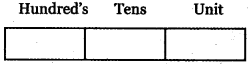
Teacher: You should have reached the bus stop on time.
Divya: My grandmother is ill. So, I had to take her to the doctor.
Teacher: I am sorry. What ails her?
Divya: She has a high fever.

Question 1.
The teacher asked Divya why she was late. Divya replied that (a) ________.The teacher told her that (b) _____. Divya said that her grandmother was ill so she had to take her to the doctor. The teacher felt sorry and further asked her (c) _____. Divya explained that she (c)_________ high fever.
Answers:
(a) She had missed the bus
(b) She should have reached the bus stop on time.
(c) what ailed her?
(d) had

Samacheer Kalvi 12th English Guide Prose Chapter 1 Two Gentlemen Of Verona

Task 3:
Rewrite the following passage in indirect speech: (Text Book Page No. 16)

Question 1.
Pradeep got out of bed with much excitement. “It is going to be a lovely sunny day,” he remarked
to his sister Varshini. “Just let me sleep a bit longer, Pradeep,” Varshini begged, “and since you are feeling so
enthusiastic, “she suggested, “Why don’t you go and help a mother in cooking?” Sure, I will say Pradeep.
“Can I help you, mum?’ he said to his mother. “Yes, of course. There are idlis and vadas on the dining table.
Have your breakfast.” “Thank you, mum; I’ll surely help you by eating them.”
Answer:
Pradeep got out of bed with much excitement. He told his sister Varshini that it was going to be a lovely sunny day. Varshini begged him to let her sleep a bit longer and since he was feeling so enthusiastic she asked him why not go and help a mother in cooking. Pradeep said that he would. He asked his mother if he could help her. The mother replied positively and added that there were idlis and vadas on the dining table and told him to have his breakfast. Pradeep thanked his mother and said that he would surely help her by eating them.

Samacheer Kalvi 12th English Guide Prose Chapter 1 Two Gentlemen Of Verona

Writing:
Read the following letter carefully, discuss with your partner, and answer the questions:

Sir,
I request you to publish the following letter in your daily to address an important issue which needs immediate redressal.

During weekends motorcyclists are seen racing on the East Coast Road and the Old Mahabalipuram road of Chennai. The amateur racers are risking their own lives and of the public as well. They are fearless and irresponsible, not knowing the price of human lives. Risking others and their lives for their pleasure is highly condemnable.
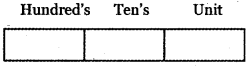
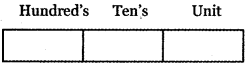
Even school students indulge in such activities and cause fatal accidents. The racers have started
occupying the lanes and streets of busy localities. As such, the violation of traffic rules often results in the loss of young lives. Such reckless riders who violate traffic rules should be punished severely. As a responsible citizen of society, I request the authorities concerned to take appropriate measures to put an end to this menace.
Yours truly,
xxxxx.

Questions:

Question a)
Who is the sender of the letter?
Answer:
Srivastava is the sender of the letter.

Question b)
Who is the receiver?
Answer:
The editor of a daily is the receiver.

Question c)
What is the issue?
Answer:
Motorcycle racing is the issue.

Question d)
What is the request of the sender?
Answer:
The request of the sender to the authorities concerned is to take appropriate measures to put an end to the motorcycle racing.

Question e)
Who will take steps after reading it?
Answer:
The traffic police will take steps after reading it.

Samacheer Kalvi 12th English Guide Prose Chapter 1 Two Gentlemen Of Verona

b) You have chosen Computer Science in the Higher Secondary Course. Write a letter to your friend giving reasons for your choice. Read the clues given in brackets to complete the letter.

Dear Arjun (Greeting),

Hope you are well (enquire about his well-being). I would like to say that I have chosen computer science in Hr. Sec course. Firstly I want you to help me with my future (the reason for your choice of group). I wish to become an Engineer (state your ambition). We come to hear a lot of instances of misusing social media. (discuss recent unhealthy happenings in social media and society). These have made me select the course so that after knowing the system well. I will be able to find out something to stop such things (demand or need of this profession). I have plans to pursue M.S in the US (higher studies or specialization).

All the best for your CA preparation. Convey my regards to all at home.

Yours lovingly,
(your name)

Task: (Text Book Page No. 18)
a) You had been to your Grandma’s house during the summer holidays. You enjoyed your stay in her company. Write a letter to your Grandma stating how much you miss her after returning to your home.

My dear Grandma,

I hope, you are quite well. But I am not fine here, because I miss you a lot. I enjoyed your company during my summer holidays. I feel very sad after returning to my home. I am expecting my next vacation to come. I felt very happy when I stayed with you. Take care of your health. See you on your next vacation.

Yours lovingly,
Arjun S.

Address on the envelope
To

STAMP

Mrs. R.Vasantha,
No.75, West Street,
Trichy – 627032.

Samacheer Kalvi 12th English Guide Prose Chapter 1 Two Gentlemen Of Verona

b) You are the head of the English department in a renowned institution. You are invited to preside over the inauguration of the English Literary club in your alma mater. Respond to the letter you have received either accepting the invitation or expressing your inability to attend the function.

From
M Ravi Kumar,
Head of the Department of English,
Joseph College of Arts and Science,
Madurai – 627035

To
The Principal,
ABC College of Arts and Science
Trichy – 620177

Sir,

Sub: Accepting your invitation – reg.

This is to kindly inform you that I have received your invitation to the inauguration of the English Literary club. I am really happy to preside over the function in my alma mater. I am sure that I will be at the function on time.
Thanking you,

Yours faithfully,
M Ravikumar.

Madurai,
10.04.2020.

Address on the envelope
To

STAMP

The Principal
ABC College of Arts and Science
Trichy-620177

c. Write a letter to the Headmaster of your school requesting him to help you obtain a duplicate mark sheet of class XII, which you lost while traveling.

From
S. Anand,
No. 12, West Street,
Virudhunagar.

To
The Headmaster,
TCS. Hr. Sec. School,
Virudhunagar.

Sir,
Sub: Requesting to obtain a duplicate mark sheet of class XH-reg.

I would like to bring to your kind notice that I had missed my mark sheet for class XII while traveling. Therefore, I kindly request you to help me to obtain a duplicate mark sheet.

Thanking you,

Yours faithfully,
B. Anand.

Virudhunagar,
15.04.2020.

Address on the envelope
To

STAMP

The Headmaster,
TCS. Hr. Sec. School,
Virudhunagar.

d) Write a letter to AZ Company requesting them to replace the defective juicer that you bought recently. Include the following details: the problem, date of purchase, receipt number, model, and warranty.

From
S. Rahul,
No.2, North Street,
Kovilpatti.

To
The manager,
AZ company,
Chennai-627201

Sir,

Sub: Requesting to replace the defective juicer-reg.

I would like to bring to your kind notice that I had bought a juicer in your company a week ago. Now it is not working but properly due to magnetic sensors. I have also mentioned the date of purchase and receipt number. So, kindly replace the defective juices as early as possible.
Thanking you,

Yours faithfully,
S. Raghul.

Kovilpatti,
20.05.2020.

Address on the envelope

To

Stamp

The manager,
AZ company,
Chennai-627201

e) You wish to become a pilot. Write a letter to a college enquiring about the details of the pilot training course offered by the college. Include the following details in your inquiry: duration of the course, fee structure, scholarships, hostel facilities, and placement details.

From
D.Kumar,
No.75, East street,
Tenkasi.

To
The principal,
ABC College of Technology,
Coimbatore.

Sir.

Sub: Enquiring about the details of the pilot training course offered-reg.
This is to inform you that I would like to know about the pilot training course offered at your college. Please let me know the duration of the course, fee structure, scholarships, hostel facilities, and placement details as soon as possible.

Thanking you,

Yours faithfully,
D. Kumar.

Tenkasi,
25.04.2020.

Address on the envelope

To

STAMP

The principal,
ABC College of Technology,
Coimbatore.

Samacheer Kalvi 12th English Guide Prose Chapter 1 Two Gentlemen of Verona

f) Write a letter to the manager of Waves Furniture Company ordering furniture for a coaching center. Include the following details: description of the furniture, number of pieces, mode of payment, time, and delivery options.

From
S. Ramesh,
No.72, Anbu Nagar, Palayamkottai.

To
The manager,
The waves furniture company,
Chennai.

Sir,

Sub: Ordering some furniture-reg.

We are in need of some furniture for our coaching center. Kindly send the goods by train to the above address.

ItemsQuantity
Chair50 nos
Tables10 nos
Boards5 nos

Thanking you,

Yours faithfully,
S. Ramesh.

Palayamkottai,
20.06.2020.

Address on the envelope
To

STAMP

The manager,
The waves furniture company,
Chennai.

g. Write an application for the post of Personal Secretary to the Managing Director of a company. Include the following details: Educational qualification, experience, various other qualifications required for the post.

From
XXX
YYY
ZZZ.

To
The Managing Director,
Software solution,
Chennai-28

Sir,

Sub: Application for the post of personal secretary -reg.

Ref: Advertisement in The Hindu dated 8th June 2020.

I read your advertisement in “The Hindu” dated 8th June 2020.1 wish to apply for the post of personal secretary. I have given below my bio-data. If I am appointed, I assure you that I will discharge my duties to your entire satisfaction.

Bio – Data

  1. Name of the applicant: xxx
  2. Residential Address: yyy
  3. Father’s name: A.Jeyaraj
  4. Date of birth and age: 27th Dec 1990
  5. Age: 28 years old
  6. Sex: Male/Female
  7. Educational Qualification: M.A. English
  8. Experience: 3 years
  9. Languages Known: Tamil, English, and Hindi
  10. Special Talent: Fluency in English, good knowledge of computer, a good athlete
  11. Salary expected: 15,000/- per month

Thanking you,

Declaration:

I, XXX hereby declare that the information which I have furnished is true to the best of my knowledge.

Yours faithfully,
Place: yyy, XXX
Date: 10.06.2020.

Address on the envelope

To

STAMP

The Managing Director,
Software solution,
Chennai-28

h) Write a letter to the editor of a newspaper about the nuisance created by the roadside vendors blocking the pavements and occupying the parking zone.

From
K. Ashok,
No.7, West Mambalam st,
Villupuram.

To
The Editor,
The Indian Express,
Villupuram-27.

Sir,

Sub: Publishing the nuisance created by the roadside vendors in your newspaper -reg.

This is to bring to your kind attention that the roadside vendors are blocking the pavements and occupying the parking zone and thereby creating a nuisance to the public. So, please bring the news to the government by publishing this in your newspaper.

Thanking you,

Yours faithfully,
K.Ashok.

Villupuram,
05.07.2020.

Address on the envelope

To

STAMP

The Editor,
The Indian Express,
Villupuram-27.

j) Write a letter to your relative or friend who is admitted in the hospital for treatment of jaundice. Advise him/her not to worry about the illness and be positive. Assure him/her of your psychological and financial help during the crisis.

My dear Friend,

I heard that you are admitted to the hospital for the treatment of jaundice. It is only a common disease, especially in summer days. So, you take rest and always think positive which will enable you to recover from it soon. If you need any financial help, please inform me at once, So that I will help and be with you.

Yours lovingly,
Arun S

Address on the envelope
To

STAMP

Mrs. M. Karthick,
No.45, North street,
Tirunelveli

Samacheer Kalvi 12th English Guide Prose Chapter 1 Two Gentlemen of Verona

ஆசிரியரைப் பற்றி:

ஆர்ச்சிபால்டு ஜோசப் க்ரோனின் (Archibald Joseph Cronin) (1896-1981) ஸ்காட்டிஷை சார்ந்த நாவலாசிரியர், நாடக ஆசிரியர் மற்றும் இயற்பியலாளர் ஆவார். மருத்துவப் பயிற்சிப் பெற்ற க்ரோனின் இருபதாம் நூற்றாண்டின் புகழ் பெற்ற கதை சொல்லுபவரில் ஒருவர், அவரின் பல கதைகள் இவரின் மருத்துவ பணியிலிருந்து வெளிப்பட்டதாகவும் (emerged) அவைகளின் கதைப்பாணி, சமூக அக்கறையுடையதாகவும், அமைக்கப்பட்டிருக்கும்.

க்ரோனின் புத்தகங்கள் அதிகமாக விற்பனையாவது மட்டுமல்லாமல் சில படைப்புகள் (The Citadel and The Keys of the Kingdom) வெற்றிகரமான படங்களாகவும், வானொலி மற்றும் தொலைகாட்சிகளிலும் ஒளிபரப்பப்பட்டன. இவரின் “Novella country doctor” என்னும் படைப்பு தேர்ந்தெடுக்கப்பட்டு BBC வானொலியிலும், தொலைக்காட்சி தொடரிலும் அதிக நாட்களாக ஒளிபரப்பப்பட்டது.

பாடத்தைப் பற்றி:

கொடுக்கப்பட்டுள்ள இந்த பாடத்தின் ஆசிரியர் A.J.Cronin இரு சிறுவர்களின் வாழ்க்கைப்பற்றியும், அவர்கள் தங்களின் சிறுவயதிலேயே அனுபவிக்கின்ற துன்பங்களைப் பற்றியும் விவரிக்கிறார். பெற்றோரை தங்களின் சிறு வயதிலேயே இழந்த முதுகெலும்பு காசநோயால் பாதிக்கப்பட்ட (Tuberculosis of the spine) சகோதரியைக் காப்பாற்ற போராடும் இரு சகோதரர்களின் செயல்களில் வெளிப்படும் அன்பு, அர்ப்பணிப்பு, தியாகம், நேர்மை மற்றும் முதிர்ச்சி ஆகியவை குறித்த ஒரு கதை கொடுக்கப்பட்டுள்ளது. அவர்களுடைய செயல்கள் எவ்வாறு மனிதநேயத்திற்கு ஒரு புதிய நம்பிக்கையை ஊட்டுகிறது என்பதை அறிய தொடர்ந்து வாசிப்போம்.

Two Gentlemen Of Verona Summary in Tamil

நாங்கள் மகிழுந்தில் (Car) வெரோனா புறநகர்பகுதியில் ஆல்ப்ஸ் (Alps) மலையின் அடிவாரம் வழியாக பயணித்த போது இரு சிறுவர்கள் எங்களை நிறுத்தினர். அவர்கள் காட்டு ஸ்ட்ராபெரி (strawberry) பழங்களை விற்றுக் கொண்டிருந்தனர். ”வாங்காதீர்கள்” என்று, எங்களின் எச்சரிக்கையான (Cautious) வாகன ஓட்டுநர் லூகி (Luigi) கூறினான். “வெரோனா நகரின் உட்பகுதியில் இதை விட சிறந்த பழங்களை நீங்கள் பெறலாம். மேலும் இந்தப் பையன்கள்….” என்று அவர்களின் அழுக்குத் தோற்றத்தை ஏற்றுக்கொள்ளாத வகையில் அவரது தோளை அழுத்தினார். ஒரு சிறுவன் மேலாடையையும், வெட்டப்பட்ட காக்கி காற்சட்டையையும் அணிந்திருந்தான்.

மற்றொருவன் சிறியதாக்கப்பட்ட, முழங்கால் வரை அணியக்கூடிய உடையை அவனது மெல்லிய உடம்பில் தொளதொளவென் அணிந்திருந்தான். பழுப்பு நிறத்தையும், கலைந்த முடியையும், ஊக்கமான கண்களையும் உடைய அந்த இரு சிறிய உருவங்களை இன்னும் கூர்ந்து நோக்கியபடியே, நாங்கள் அவர்களால் கவரப்பட்டதை உணர்ந்தோம். என்னுடன் வந்தவர் (companion), அச்சிறுவர்களிடம் பேச்சுக்கொடுத்து அவர்களிருவரும் சகோதரர்கள் என்று அறிந்தார். மூத்தவன் பெயர் நிக்கோலா (Nicola), வயது 13; எங்கள் காரின் கதவின் அருகே வந்து நின்றவன் பெயர் ஜாகோபா (Jacopo), வயது 12-யை நெருங்கும். நாங்கள் அவர்களின் பெரிய கூடை முழுவதையும் வாங்கிக்கொண்டு (bought) நகரத்தை நோக்கிப் புறப்பட்டோம்.

அடுத்த நாள் காலையில் நாங்கள் எங்கள் விடுதியில் இருந்து வெளியே வந்தபோது, எங்களின் அந்த நண்பர்கள் காலணிகளை பளபளப்பாக்கும் பெட்டியில் (shoe shine box) குணிந்தவாறு, நகரின் பொது சதுக்கத்தின் (public square) நீர்வீழ்ச்சி அருகில் சுறுசுறுப்பாக வேலை செய்வதைக் கண்டோம்.

சிறிது நேரம் அவர்களைக் கவனித்தோம் (watched). அவர்களின் தொழில் மந்தமான (slackened) போது நாங்கள் அவர்களிடம் சென்றோம். அவர்கள் எங்களை இன்முகத்தோடுவரவேற்றார்கள் “நீங்கள் வாழ்வாதாரத்திற்கு தான் பழங்களை விற்றீர்கள் என்று நினைத்தேன்” என்றேன்.

“நாங்கள் நிறைய வேலைகள் பார்ப்போம்” ஐயா என்றான் நிக்கோலா. அவன் நம்பிக்கையுடன் (hopefully) எங்களை நோக்கினான். “நாங்கள் இங்கு வரும் பார்வையாளர்களுக்கு இந்த நகரத்தையும், ஜீலியட்டின் கல்லறையையும் மற்றும் அவர்கள் விரும்பும் இடங்களையும் சுற்றிக்காண்பிப்போம்’, என்றான்.

நான் புன்னகையுடன் “சரி எங்களுக்கும் சுற்றிக் காண்பி” என்றேன். நாங்கள் சுற்றிப்பார்த்து கொண்டிருந்த போது, அவர்களின் குறிப்பிடத்தக்க நடத்தை (demeanour) என் ஆர்வத்தை மேலும் தூண்டியது. அவர்கள் குழந்தைத்தனத்துடன் பல செயல்களில் கள்ளக்கபடமில்லாமல் (artless) இருந்தார்கள். ஜாகோபா அணிற்பிள்ளைப் (squirrel) போன்று மிகவும் சுறுசுறுப்புடன் இருந்தான். நிக்கோலா எப்பொழுதும் சிரித்த முகத்தோடு இருந்தான். இருந்தாலும் அச்சிறுவர்களின் குழந்தை முகங்களில், அவர்களின் வயதுக்கு அப்பாற்பட்ட தீவிரம் (seriousness) காணப்பட்டது.

Samacheer Kalvi 12th English Guide Prose Chapter 1 Two Gentlemen of Verona

அதற்கு அடுத்த வாரத்தில் அவர்களை நாங்கள் அடிக்கடி (frequently) பார்த்தோம். அவர்கள் எங்களுக்கு மிகவும் உபயோகமாக (useful) இருந்தார்கள். எங்களுக்கு அமெரிக்க சிகரெட்டுகள் வேண்டுமென்றாலும், இசை நிகழ்ச்சிக்கு சீட்டு வேண்டுமென்றாலும், நல்ல உணவகத்திற்கு செல்ல வேண்டுமென்றாலும் எங்களின் தேவைகளை நிறைவேற்ற நாங்கள் நிக்கோலா மற்றும் ஜாகோபாவை நம்பினோம். அவர்களின் வேலை செய்யும் ஆர்வம் எங்களை வெகுவாக ஈர்த்தது. இந்த கடுமையான வெயிலிலும் அவர்கள், காலணிகளை பளபளப்பாக்குதல், பழங்கள் விற்றல், ஓர் இடத்திலிருந்து இன்னொரு இடத்திற்கு எடுத்துச் சென்று செய்தித்தாள்களை விற்றல், பார்வையாளர்களை சுற்றிக் காண்பித்தல் என அனைத்து வேலைகளையும் ஒரே நேரத்தில் செய்தனர்.

ஒரு நாள் இரவு அவர்களை காற்றோட்டமான, ஆள் நடமாட்டமில்லாத (deserted), சதுக்கத்தின், விளக்குகளுக்கு கீழே, கல் நடைபாதையில் (pavement) ஓய்வெடுப்பதை கண்டோம். நிக்கோலா கலைப்புடன் அமர்ந்திருந்தான். விற்காத ஒரு கட்டு செய்தித்தாள்கள் அவன் காலடியில் கிடந்தன. ஜாகோபா, அவனது சகோதரரின் தோளின் மேல் தலைவைத்து தூங்கி கொண்டிருந்தான். நேரம் நள்ளிரவை நெருங்கியது.

“ஏன் இவ்வளவு நேரம் இங்கே இருக்கிறீர்கள், நிக்கோலா?”

“பதுவாவிலிருந்து (Padua) வரும் கடைசி பேருந்துக்காக காத்துக் கொண்டிருக்கிறோம். அது வந்தவுடன் எங்களின் அனைத்து செய்தித்தாள்களையும் விற்று விடுவோம்”. என்றான்.

“நீங்கள் இவ்வளவு கடினமாக உழைக்க வேண்டுமா? பார்பதற்கு மிகவும் களைப்பாக (tired) இருக்கிறீர்கள்”. என்று நான் கேட்டேன்.

“நாங்கள் அதனை குறையாக தெரிவிக்கவில்லை ஐயா”, என்றான்.

மறுநாள் காலை நான் காலணிகளை பளபளப்பாக்க சதுக்கத்தின் நீர்வீழ்ச்சி அருகே சென்றபோது, “நிக்கோலா, நீங்கள் உழைப்பதைப் பார்த்தால் நீங்கள் நிறைய சம்பாதிக்க வேண்டும். நீங்கள் ஆடைகளில் செலவலிப்பதில்லை. மிகக் குறைவாகவே சாப்பிடுகிறீர்கள், வழக்கமாக நீ கருத்த ரொட்டித்துண்டு (blackbread) மற்றும் அத்திப்பழங்களை (figs) மட்டுமே சாப்பிடுவதை நான் கண்டிருக்கிறேன். உங்கள் பணத்தை வைத்து நீங்கள் என்ன செய்கிறீர்கள்? என்று என்னிடம் சொல்”.

அவன் உடனே குழம்பிப்போய் மிகுந்த வருத்தமுற்றான். பின்பு தரையைப் பார்த்துக் குணிந்தான்.
”அமெரிக்காவிற்கு புலம் பெயர்வதற்காகவா (emigrate) பணத்தை சேமிக்கிறீர்கள்?” என்று கேட்டேன். அவன் என்னை பக்கவாட்டில் பார்த்து பேசினான். “எங்களுக்கும் அமெரிக்கா போக வேண்டும் என்று பெரிய ஆசை உண்டு” ஆனால், இங்கே, இப்போது நாங்கள் வேறு திட்டங்கள் வைத்திருக்கிறோம்”.

“என்ன திட்டங்கள்?” (plans)
அவன் சங்கடத்துடன் (uncomfortably) புன்னகைத்தான். “சாதரணமான திட்டங்கள் தான்”, என்றான் மெதுவான குரலில்.

“நல்லது,” “நாங்கள் வரும் திங்கட்கிழமை புறப்படுகிறோம். நாங்கள் புறப்படுவதற்குள் உனக்கு ஏதாவது செய்ய வேண்டுமா?” என்றேன். வேண்டாமென் நிக்கோலா தலையை அசைத்தான். ஆனால் திடிரென ஜாகோபா, ஐயா நாங்கள் ஒவ்வொரு ஞாயிற்றுகிழமையும் முப்பது கிலோமீட்டர் அப்பால் இருக்கக்கூடிய ‘பொலேடா (Poleta) என்ற இடத்திற்கு வாடகை மிதிவண்டியில் (hire bicycles) செல்வோம். நீங்கள் எங்களிடம் மிக கனிவுடன் நடந்து கொள்வதால், நாளை எங்களை உங்கள் காரில் அங்கு அழைத்து செல்லலாம் என்றான். நான் லூகியிடம் ஞாயிற்றுகிழமை ஓய்வு. இருந்தபோதும் உங்களுக்காக கார் ஓட்டுகிறேன்” என்று பதிலளித்தேன்.

சிறிய இடைவெளிக்குப்பின், நிக்கோலா அவனது சகோதரனை எரிச்சலுடன் (Vexation) முறைத்தான். “உங்களுக்கு தொந்தரவு வேண்டாம் என்று நினைத்தோம் ஐயா”
“இது ஒன்றும் தொந்தரவு இல்லை”.

தனது உதட்டை கடித்தபடியே மெல்லிய குரலில் சரி நல்லது’ என்றான். அடுத்த கிராமத்திற்கு காரில் பயணமானோம். நாங்கள் அங்கு வசிக்கக் கூடிய இடம் மிகச்சாதரணமாகத்தான் இருக்கும் என கற்பனை செய்திருந்தேன். ஆனால், ஜாகாபாவோ எங்களை பெரிய சிவப்புக் கூரையிட்ட, பெரிய கல் சுவரால் சூழப்பட்ட கிராமப்புற வீட்டுக்கு அழைத்துச் சென்றான். என்னால் என் கண்களையே நம்பமுடியாமல் திகைத்திருந்த வேளையில், என்னுடன் வந்த இரு பயணிகளும் காரில் இருந்து குதித்து இறங்கினர்.

“நாங்கள் அதிக நேரம் எடுத்துக்கொள்ள மாட்டோம் ஐயா, ஒரு மணி நேரம் மட்டுமே. நீங்கள் இங்கே உள்ள தேநீர் கடையில் ஏதேனும் அருந்த விரும்புகிறீர்களா?”. அவர்கள் இருவரும் சுவரின் பின்னால் மறைய (disappear) ஆரம்பித்தனர்.

சில நிமிடங்களுக்கு பிறகு, நானும் அவர்களை பின்தொடர்ந்தேன். நான் கம்பியினால் ஆன ஒரு வாசலைக் கண்டேன். தீர்மானமாக (determinedly) அழைப்பு மணியை அடித்தேன்.

இரும்பு வளையத்தினால் (steel-rimmed) ஆன கண்ணாடியை அணிந்த ஒரு கனிவான பெண்மணி வந்தாள். அந்த பெண்மணி வெள்ளை நிற செவிலியர் உடையுடன் வந்தாள். நான் வியந்து பார்த்தேன்.

“நான் இங்கே இரு சிறுவர்களை அழைத்து வந்தேன்”. ஓ! அப்படியா! என்று அவர் முகம் பிரகாசமானது. அவள் கதவை திறந்து என்னை உள்ளே அனுமதித்தாள். நிக்கோலா, ஜாகோபாவிடம், நான் உங்களை அழைத்துச் செல்கிறேன்” என்றேன்.

Samacheer Kalvi 12th English Guide Prose Chapter 1 Two Gentlemen of Verona

அவள் என்னை குளிர்ந்த, பளிங்கினால் ஆன தாழ்வாரம் (vestibule) வழியே ஒரு மருத்துவமனைக்கு அழைத்துச்சென்றாள். (அந்த கிராமத்து வீடே இப்போது மருத்துவமனையாகி இருந்தது. ஒரு சிறிய படுக்கை அறையின் வாசலில் அவள் நின்று, தன் வாயில் அவள் கையை வைத்து புன்னகைத்தப்படி, கண்ணாடி பிளவின் (glass partition) வழியே என்னைப் பார்க்கச் சொன்னாள்.

அந்த இரு பையன்களும், 20 வயது மதிக்கத்தக்க அழகான பின்னலாடை அணிந்திருந்த தலையணைகளால் தாங்கப்பட்டு படுக்கையிலிருந்த பெண்ணின் அருகில் கட்டிலில் அமர்ந்திருந்தனர். அந்த பெண் அவர்கள் பேசுவதைக் (chatter) கேட்டுக் கொண்டிருந்தாள். அவளது கண்கள் இளமையாகவும், மென்மையாகவும் இருந்தது. பார்த்தவுடன் அவளது தோற்றம் அவளுடைய சகோதரர்களை ஒத்திருப்பதை யாராலும் சொல்ல முடியும். அவளது மேசையில் ஒரு ஜாடி நிறைய காட்டு மலர்களும், கூடவே பழங்களும், நிறைய புத்தகங்களும் இருந்தன.

“நீங்கள் உள்ளே போகவில்லையா?” என்று முனுமுனுத்தாள் அந்த செவிலியப் பெண். “உங்களைப் பார்த்தால் ‘லூசியா (Lucia) மகிழ்வாள்” என்றாள் செவிலி.

நான் தலையை அசைத்து மறுத்த படியே அங்கிருந்து நகர்ந்தேன். அவர்களின் மகிழ்ச்சியான குடும்ப சந்திப்பின் போது உள்ளே நுழைய வேண்டாம் என்று நான் நினைத்தேன். ஆனால் படிகட்டுகளின் கீழே நின்று அவளிடம் அந்த இரு சிறுவர்களைப் பற்றி நீ அறிந்ததை கூறு என்று கெஞ்சி (begged) கேட்டேன். அவளும் சம்மதித்தாள்.

“அவர்கள் இருவருக்கும் அவர்களின் அக்கா லூசியாவைத் தவிர இவ்வுலகில் யாரும் கிடையாது” என்று விவரித்தாள் (explained). மனைவியை இழந்த அவர்களின் தந்தை ஒரு நல்ல பாடகர் (singer), அவர் போர்காலத்தில் கொல்லப்பட்டார்.

பின் சிறிது காலத்தில் அவர்கள் வீட்டின் மீது ஒரு குண்டு விழுந்து, இம்மூன்று சிறுவர்களையும் வீதிக்கு தூக்கி எறிந்தது. அவர்கள் எப்போதும் சுகமான (comfortable) வாழ்வை வாழ்ந்து வந்தார்கள். லூசியாவோ ஒரு பாடகராக பயிற்சி செய்து கொண்டிருந்தாள். மேலும் அவர்கள் கடுங்குளிரினாலும், பசியினாலும் கடுமையாகப் பாதிக்கப்பட்டார்கள்.

பல மாதங்கள், அவர்கள் பழைய செங்கல் மற்றும் சிறந்த பொருள்களினால், அவர்களே செய்த கூடாரத்தில் வாழ்ந்து வந்தார்கள். அதன்பின் 3 வருடங்கள் ஜெர்மனியர்கள் இந்த நகரை ஆண்டார்கள் ஜெர்மானியர்களை (Germans) வெறுத்தபடியே (hate) இச்சிறுவர்கள் வளர்ந்த னர்.

“ஜெர்மானியர்களை எதிர்த்து எதிர்ப்பு இயக்கம் (resistance movement) தோன்றிய போது இவர்கள் முதலில் போய் அதில் இணைந்தனர். போர் முடிவடைந்து அமைதி திரும்பியபோது, அவர்கள் தங்கள் அன்பிற்குரிய சகோதரியிடம் திரும்பி வந்தார்கள். மேலும் தங்களது சகோதரி முதுகெலும்பு காசநோயால் (tuberculosis) பாதிக்கப்பட்டிருப்பதை கண்டறிந்தார்கள்”, என்று அவள் ஒரு கணம் நிறுத்தி மூச்சை உள்ளிளுத்தாள்.

“அவர்கள் அவளை கை விட்டு (give up) விட்டார்களா? என்ற கேள்விக்கு நான் பதில் கூற வேண்டியதில்லை. அவர்களே அவளை இங்கு கொண்டு வந்து எங்களிடம் அவளை இந்த மருத்துவமனையில் சேர்த்துக் கொள்ளும் படி வேண்டி கேட்டுக் கொண்டார்கள், இந்த 12 மாதங்கள் அவள் எங்கள் நோயாளியாகவே (patient) இருக்கிறாள், மேலும் அவளது நிலையில் முன்னேற்றம் இருக்கிறது. அவள் மீண்டும் எழுந்து வந்து பாடுவாள் என்ற நம்பிக்கை எங்களுக்கு உள்ளது”.

“இங்கு எல்லாமே இப்போது மிக கடினமாக (difficult) உள்ளது. எனவே உணவு, தங்குமிடம் என அனைத்திற்கும் நாங்கள் பணம் வசூலிக்கவில்லையென்றால் எங்களால் மருத்துவமனையை நடத்த இயலாது. ஆனால் ஒவ்வொரு வாரமும் லூசியாவின் சகோதரர்கள் அவளுக்கான கட்டணத்தை (payment) செலுத்திவிடுவார்கள்.

அவர்கள் என்ன வேலை செய்கிறார்கள் என்று தெரியவில்லை, நானும் கேட்பதில்லை. வெரோனா நகரில் வேலைக் கிடைப்பது மிகக் கடினம். என்னவாக இருந்தாலும் சரி, அவர்கள் நன்றாக செய்கிறார்கள் என்று எனக்குத் தெரியும்”.

“ஆமாம், இதைவிடச் சிறப்பாக அவர்களால் செய்ய இயலாது” என்று நானும் சம்மதித்தேன் (agreed). அவர்கள் என்னிடம் வரும் வரையில் நான் வெளியே காத்திருந்தேன். வந்ததும் மீண்டும் நகருக்கு திரும்பினோம். அவர்கள் என்னிடம் எதுவும் பேசாமல் அமர்ந்திருந்தார்கள். நானும் அவர்களிடம் ஒரு வார்த்தைக்கூட கேட்கவில்லை. அவர்கள் தங்கள் சகோதரி குறித்த இரகசியத்தை (secret) தங்களுடன் மட்டுமே வைத்துக் கொள்ள விரும்புவார்கள் என்று எனக்குத் தெரியும்.

போர் (war) அவர்களது மனநிலையை உடைக்கமுடியவில்லை . அவர்களின் தன்னலமற்ற செயல், மனித வாழ்க்கைக்கு ஒரு புதிய பெருந்தன்மையையும் (nobility), மனித சமுதாயத்திற்கு ஒரு பெரிய நம்பிக்கையைத் (hope) தரக்கூடிய உறுதியையும் அளித்துள்ளன.

Samacheer Kalvi 12th English Guide Prose Chapter 1 Two Gentlemen of Verona

Glossary:

WORDSSYNONYMSANTONYMS
1. Shrugraise one’s shoulders slightlyconcur
2. tunica loose outer garment without sleeves
3. slackenedreducedgrow/increase
4. demeanorappearance and behaviourrudeness
5. artlessinnocentartful
6. hawksell things crying out loudly, going from place to place
7. deserteduninhabited, unoccupiedcrowded, populous
8. emigratetake up citizenship of another countryimmigrate
9. vexationannoyancedelight, contentment
10. vestibulelobbywayout
11. chattera series of short, quick, high- pitched soundsquiet
12. intrudeenter without permissionabandon
13. rubbledebris, broken brickstreasure, valuable
14. glaringstaring fiercelysoft
15. destinationend, terminalstart, beginning
16. dwellinghabitat, residence
17. scarcelyrarely, seldomfrequently
18. leapedjumpeddescended
19. blinkwink of an eye, flutterbe aware
20. propped upto supportlet down
21. resemblancesimilarity, affinitycontrast, difference
22. exposuresubjection, risksafety, cover
23. starvationmalnutrition, needsupply, plenty
24. barelyscarcely, hardlyoften
25. persuadedconvinced, induceddissuaded
26. devotionattachment, fondnessaversion, dislike
27. nobilitygreatness, honordishonour, humiliation
28. cautiouscarefulreckless
29. disapprovecriticizeapprove
30. briskenergetic / fast / quickidle / slow
31.engagingamicable / charming / captivatinghateful / boring
32. humblecourteous / poor / inferiorintricate / superior
33. eagercraving / anxious / enthusiasticapathetic/unenthusiastic
34. resistancedefiance / fighting / struggleassistance / cooperation
35. persuadeinduce / promptdissuade / discourage
36. scarceinsufficient, deficientfrequent / adequate
37. nobilityhonour / dignity / virtuedishonour

Samacheer Kalvi 12th English Guide Prose Chapter 1 Two Gentlemen Of Verona

Additional:

WORDSSYNONYMSANTONYMS
1. outskirtsborderinterior
2. cautiouscarefulreckless / careless
3. disapprovedcriticizeapproval/permit
4. shabbyill-dressedsmart
5. angledentwinedplain
6. set offto start on a journey
7. glanceglimpse, lookexamine
8. provokeevoke, cause, kindleallay
9. frequentlyregularly, oftenrarely
10. relied upondepended ondistrusted
11. errandsodd jobs
12. paleill or tiredhealthy
13. burst outexplode, begin suddenlydull

Samacheer Kalvi 9th Science Guide Chapter 9 Universe

Tamilnadu State Board New Syllabus Samacheer Kalvi 9th Science Guide Pdf Chapter 9 Universe Text Book Back Questions and Answers, Notes.

Tamilnadu Samacheer Kalvi 9th Science Solutions Chapter 9 Universe

9th Science Guide Universe Text Book Back Questions and Answers

I. Choose the correct answer:

Samacheer Kalvi 9th Science Guide Chapter 9 Universe

Question 1.
Who proposed the heliocentric model of the universe?
(a) Tycho Brahe
(b) Nicolaus Copernicus
(c) Ptolemy
(d) Archimedes
Answer:
(b) Nicolaus Copernicus

Question 2.
Which of the following is not a part of outer solar system?
(a) Mercury
(b) Saturn
(c) Uranus
(d) Neptune
Answer:
(a) Mercury

Samacheer Kalvi 9th Science Guide Chapter 9 Universe

Question 3.
Ceres is a …………….
(a) Meteor
(b) Star
(e) Planet
(d) Asteroid
Answer:
(d) Asteroid

Question 4.
The period of revolution of planet A around the Sun is 8 times that of planet B. How many times is the distance of planet A as great as that of planet B?
(a) 4
(b) 5
(e) 2
(d) 3
Answer:
(a) 4

Samacheer Kalvi 9th Science Guide Chapter 9 Universe

Question 5.
The Big Bang occurred _____ years ago.
(a) 13.7 billion
(b) 15 million
(e) 15 billion
(d) 20 million
Answer:
(a) 13.7 billion

II. Fill in the blanks :

1. The speed of Sun in km/s is ………………
Answer:
250 km/s

2. The rotational period of the Sun near its poles is ………………
Answer:
36 days

Samacheer Kalvi 9th Science Guide Chapter 9 Universe

3. India’s first satellite is ……………..
Answer:
Aryabhatta

4. The third law of Kepler is also known as the Law of ……………….
Answer:
Harmonics

5. The number of planets in our Solar System is …………………
Answer:
8

Samacheer Kalvi 9th Science Guide Chapter 9 Universe

III. State whether true or false. If false, correct the statement:

1. ISS is a proof for international cooperation.
Answer:
True.

2. Halley’s comet appears after hearly 67 hours.
Answer:
False.
Correct statement: Halley’s comet appears after nearly 76 years.

3. Satellites nearer to the Earth should have lesser orbital velocity.
Answer:
False.
Correct statement: Satellites nearer to the Earth should have faster orbital velocity.

Samacheer Kalvi 9th Science Guide Chapter 9 Universe

4. Mars is called the red planet.
Answer:
True.

IV. Answer briefly :

Question 1.
What is the solar system?
Answer:
The Sun and celestial bodies which revolve around it form the solar system. It consists of a large number of bodies such as planets, comets, asteroids, and meteors.

Question 2.
Define orbital velocity.
Answer:
The horizontal velocity that has to be imparted to a satellite at the determined height so that it makes a circular orbit around the planet is called “orbital velocity”.

Samacheer Kalvi 9th Science Guide Chapter 9 Universe

Question 3.
Define time period of a satellite.
Answer:
Time taken by the satellite to complete one revolution around the Earth is called the time period.
Time period, T = Distance covered/Orbital velocity
T = 2πr/v

Question 4.
What is the satellite? What are the two types of satellites?
Answer:
A body moving in orbit around a planet is called a satellite.
The two types of Satellites are

  1.  Natural satellites,
  2.  Man-made satellites.

Samacheer Kalvi 9th Science Guide Chapter 9 Universe

Question 5.
Write a note on the inner planets.
Answer:
The planets are spaced unevenly. The first four planets are relatively close together and close to the Sun. They form the inner solar system. The four planets grouped together in the inner solar system are Mercury, Venus, Earth, and Mars. They are called inner planets. They have a surface of solid rock crust and so are called terrestrial or rocky planets. Their insides, surfaces, and atmospheres are formed in a similar way and form a similar pattern. Our planet, Earth can be taken as a model of the other three planets.

Question 6.
Write about comets.
Answer:

  • Comets are lumps of dust and ice that revolve around the Sim in highly elliptical orbits.
  • Their period of revolution is very long.
  • Comet vapourises and forms a head and tail on approaching the sun.
  • Tail of the biggest comet may be around 160 million km.
  • There are period comets (e:g) Halley’s comet which appears after every 76 years.

Samacheer Kalvi 9th Science Guide Chapter 9 Universe

Question 7.
State Kepler’s laws.
Answer:
In the early 1600s, Johannes Kepler proposed three laws of planetary motion.
First Law – The Law of Ellipses
The path of the planets about the Sun is elliptical in shape, with the center of the Sun being located at one of the foci.

Second Law – The Law of Equal Areas
An imaginary line drawn from the center of the Sun to the center of the planet will sweep out equal areas in equal intervals of time.

Third Law – The Law of Harmonies
The ratio of the squares of the periods of any two planets is equal to the ratio of the cubes of their semi-major axis from the Sun.

Question 8.
What factors have made life on Earth possible?
Answer:
Factors responsible for life on Earth.

  1. Right distance from the Sun.
  2. Right temperature.
  3. Presence of water.
  4. Suitable atmosphere.
  5. Blanket of ozone.

Samacheer Kalvi 9th Science Guide Chapter 9 Universe

V. Answer in detail:

Question 1.
Give an account of all the planets in the solar system.
Answer:

The planets are spaced unevenly. The first four planets are relatively close together and close to the Sun. They form the inner solar system. Farther from the Sun is the outer solar system, where the planets are much more spread out. Thus the distance between Saturn and Uranus is much greater (about 20 times) than between the Earth and Mars.

The four planets grouped together in the inner solar system are Mercury, Venus, Earth, and Mars. They are called inner planets. They have a surface of solid rock crust and so are called terrestrial or rocky planets. Their insides, surfaces, and atmospheres are formed in a similar way and form a similar pattern. Our planet, Earth can be taken as a model of the other three planets.

The four large planets Jupiter, Saturn, Uranus and Neptune spread out in the outer solar system that slowly orbits the Sun are called outer planets. They are made of hydrogen, helium and other gases in huge amounts and have very dense atmosphere. They are known as gas giants and are called gaseous planets. The four outer planets Jupiter, Saturn, Uranus and Neptune have rings whereas the four inner planets do not have any rings. The rings are actually tiny pieces of rock covered with ice.

Samacheer Kalvi 9th Science Guide Chapter 9 Universe

Question 2.
Discuss the benefits of ISS.
Answer:

1. Water purification efforts :
The water recovery system (WRS) and the oxygen generation system (OGS) techniques developed by ISS provides advanced water Alteration and purification to water scarcity areas

2. Eye-tracking technology :
Eye-tracking technology can be used in many laser surgeries which tracks eye’s position very accurately and helps the disabled people with limited movement and speech.

3. Robotic arms and Surgeries :
Robotic arms provide significant help to surgeons in removing inoperable tumours and taking biopsies with great accuracies.

4. Apart from the above, there are many other applications such as the development of improved vaccines, breast cancer detection and treatment, and so on.

Question 3.
Write a note on orbital velocity.
Answer:
Nowadays many artificial satellites are launched into the Earth’s orbit. The first artificial satellite Sputnik was launched in 1956. India launched its first satellite Aryabhatta on April 19, 1975. Artificial satellites are made to revolve in an orbit at a height of a few hundred kilometres. At this altitude, the friction due to air is negligible. The satellite is carried by rocket to the desired height and released horizontally with a high velocity so that it remains moving in a nearly circular orbit. The horizontal velocity that has to be imparted to a satellite at the determined height so that it makes a circular orbit around the planet is called orbital velocity.

The orbital velocity of the satellite depends on its altitude above Earth. The nearer the object to the Earth, the faster is the required orbital velocity. At an altitude of 200 kilometres, the required orbital velocity is a little more than 27,400 kph. That orbital speed and distance permit the satellite to make one revolution in 24 hours. Since Earth also rotates once in 24 hours, a satellite stays in a fixed position relative to a point on Earth’s surface. Because the satellite stays over the same spot all the time, this kind of orbit is called ‘geostationary’.

Orbital velocity can be calculated using the following formula.
v = \(\sqrt{\frac{\mathrm{GM}}{(\mathrm{R}+\mathrm{h})}}\)
where; G = Gravitational constant (6.673 × 10– 11Nm2kg– 2)
M = Mass of the Earth (5.972 × 1024kg)
R = Radius of the Earth (6371 km)
h = Height of the satellite from the surface of the Earth.

Samacheer Kalvi 9th Science Guide Chapter 9 Universe

VI. Conceptual Questions

Question 1.
Why do some stars appear blue and some red?
Answer:

  1. Stars appear in different colours depending on their temperatures.
  2. Hot stars are white or blue in colour.
  3. Cooler stars are orange or red in colour.

Question 2.
How is a satellite maintained in nearly circular orbit?
Answer:
Artificial satellites are made to revolve in an orbit at a height of a few hundred kilometres. At this altitude, the friction due to air is negligible. The satellite is carried by rocket to the desired height and released horizontally with a high velocity so that it remains moving in a nearly circular orbit.

Samacheer Kalvi 9th Science Guide Chapter 9 Universe

Question 3.
Why are some satellites called geostationary?
Answer:
The Earth rotates once in 24 hours, a satellite stays in a fixed position.
Because the satellite stays over the same spot all the time, this kind of orbit is called . “geostationary”.

Question 4.
A man weighing 60 kg on the Earth will weigh 1680 kg in the Sun. Why?
Answer:
Mass of the man = 60Kg
w = m × g
m = 60Kg, g = 274.13m/s2
The sun’s gravitational acceleration is 30 times more than that of the earth. So the person would weigh 16,447N on the surface of the sun.

Samacheer Kalvi 9th Science Guide Chapter 9 Universe

VII. Numerical Problems

Question 1.
Calculate the speed with which a satellite moves if it is at a height of 36,000 km from the Earth’s surface and has an orbital period of 24 hr (Take R = 6370 km).
[Hint: Convert hr into seconds before doing the calculation)

Solution:
Given:
Height of the satellite, h = 36,000 km = (36,000) ×103m
Radius of the Earth, R = 6370 km = (6370) × 103m
We know: Gravitational constant, G = 6.673 10-11Nm2kg-2
Mass of the Earth, M = 5.972 × 1024kg.
Samacheer Kalvi 9th Science Guide Chapter 9 Universe 1
Orbital velocity, v = 3.067×10 3 m/s (or) 3067m/s (or) 3.067 km/s.

Question 2.
At an orbital height of 400 km, find the orbital period of the satellite.
Solution : Given : Orbital height, h = 400 km = 400 × 103m
We know : Gravitational constant, G = 6.673 × 10⁻¹¹Nm2kg-2
Mass of the earth, M =5.972 ×1024kg
Radius of the Earth, R = 6371 km = 6371 × 10-3m.
Samacheer Kalvi 9th Science Guide Chapter 9 Universe 2
Intext Activities

ACTIVITY – 1

Form a team of three to four students. Prepare a poster about the astronomers

Samacheer Kalvi 9th Science Guide Chapter 9 Universe 3

Samacheer Kalvi 9th Science Guide Chapter 9 Universe

ACTIVITY – 2

Observe the sky keenly during night. Can you see group of stars? Can you figure out any shape? Discuss with your teachers and find out their name.
Aim : To observe the group of stars in the night sky.

Procedure :

  1. Observe the night sky keenly.
  2. Observe the movements of stars
  3. Imagine the shapes

Observation :
By discussing with the teachers following groups are identified.

Group of Starshape
1. OrionHunter
2. piscesFish
3. GeminiTwins table
4. LeoLion
5. CancerCrab
6. CapricornusSea goat

Samacheer Kalvi 9th Science Guide Chapter 9 Universe

ACTIVITY – 3

Watch the sky in the early morning. Do you see any planet? What is its name? Find out with the help of your teachers.
Aim :
1. Most of the planets cannot be seen in normal sky.
2. Few planets can be seen during some specific period in the night sky.
3. Mercury, closest to the sun can be seen from the earth.
4. Venus is also seen few days in a year.
5. Uranus may be also seen on odd days in October.

Samacheer Kalvi 9th Science Guide Chapter 9 Universe

ACTIVITY – 4

Prepare a list of Indian satellites from Aryabhatta to the latest along with their purposes.
S.No. Name of satellite Year Purpose
E:\jyothi\images\2\Samacheer Kalvi 9th Science Guide Chapter 9 Universe 4.pngs

9th Science Guide Universe Additional Important Questions and Answers

I. Choose the correct answer :

Question 1.
The Geocentric model of universe was proposed by ……………
(a) Tyago Brane
(b) Kepler
(c ) Ptolemy
(d) Copernicus
Answer:
ptolemy

Question 2.
The total area of observable universe is about light-years.
(a) 9.3 billion
(b) 93 billion
(c) 93 million
(d) 9.3 million
Answer:
93 billion

Question 3.
All the atoms together only make up ______ percent of universe.
(a) 3
(b) 4
(c) 5
(d) 2
Answer:
(b) 4

Samacheer Kalvi 9th Science Guide Chapter 9 Universe

Question 4.
The milky way galaxy is ………………in shape.
(a) Elliptical
(b) Circular
(e) Spiral
(d) Irregular
Answer:
(c) spiral

Question 5.
Stars are built by ____ gases.
(a) Hydrogen
(b) Helium
(e) Nitrogen
(d) Oxygen
Answer:
(a) Hydrogen

Samacheer Kalvi 9th Science Guide Chapter 9 Universe

Question 6.
The process that takes place in the Sun is ………………
(a) Nuclear Fission
(b) Spallation
(c) Nuclear Fusion
(d) None of these
Answer:(c)
Nuclear Fusion
Question 7.
The energy of the sun is radiated in the form of_____ Rays.
(a) Ultraviolet
(b) Infrared
(e) neutron radiation
(d) X-rays
Answer:
(b) Infrared

Samacheer Kalvi 9th Science Guide Chapter 9 Universe

Question 8.
The ____ colour is the most intense colour in solar radiation.
(a) blue
(b) red
c) violet
(d) yellow
Answer:
(d) yellow

Question 9.
Athe distance of the planet from the sun increases, the period of revolution ………………..
(a) increases
b) decreases
(c) remains the same
(d) a & b
Answer:
(a) increases

Samacheer Kalvi 9th Science Guide Chapter 9 Universe

Question 10.
Which among the planets has less length of a day?
(a) Mercury
(b) Uranus
(c) Jupiter
(d) Saturn
Answer:
(c) Jupiter

Question 11.
The hottest planet on the solar system is ……………….
(a) Venus
(b) Mercury
(c) Mars
(d) Earth
Answer:
(a) Venus

Samacheer Kalvi 9th Science Guide Chapter 9 Universe

Question 12.
Which planet is known as Red Planet?
(a) Venus
(b) Saturn
(c) Mars
(d) Neptune
Answer:
(c) Mars

Question 13.
The number of moons present in Saturn is ………………..
(a) 20
(b) 30
(c) 50
(d) 60
Answer:
(d) 60

Samacheer Kalvi 9th Science Guide Chapter 9 Universe

Question 14.
The planet having the longest summers and winters is ………………….
(a) Saturn
(b) Neptune
(c) Uranus
(d) Jupiter
Answer:
(c) Uranus

Question 15.
Windiest planet in the solar system ………………..
(a) Neptune
(b) Uranus
(c) Saturn
(d) Jupiter
Answer:
a) Neptune

Samacheer Kalvi 9th Science Guide Chapter 9 Universe

Question 16.
Which among the planets does not have a moon?
(a) Mars
(b) Earth
(c) Uranus
(d) Mercury
Answer :
(d) Mercury

Question 17.
The orbital velocity of the satellite depends on its ……………………
(a) Shape of orbit
(b) altitude
(c) distance
(d) All of these
Answer:
(b) altitude

Samacheer Kalvi 9th Science Guide Chapter 9 Universe

Question 18.
Which among the following statements is correct?
(i) Meteors are attracted by the gravitational at force of earth.
(ii) Meteors are travelling in low speeds.
(iii) Most of Meteors are burnt by the heat generated by friction in atmosphere.
(a) (i) & (ii)
(b) (ii) & (iii)
(c) (i) & (iii)
(d) All of these
Answer:
(c) (i) & (iii)

Question 19.
The first part of the ISS was launched by
(a) Russian Soyuz
(b) Russian Zarya
(c) Russian Orbital
(d) American Sputnik
Answer:
(b) Russian Zarya

Samacheer Kalvi 9th Science Guide Chapter 9 Universe

Question 20.
The time is taken by the sun to complete one revolution around the milky way
(a) 250 million years
(b) 200 million years
(c) 225 million years
(d) 240 million years
Answer:
(c) 225 million years

Question 21.
Which of the following statements is correct?
A. There are eight planets in our Solar System.
B. Except Mars, all other planets revolve around the Sun in elliptical orbits.
(a) A only
(b) B only
(c) Both A and
(d) None
Answer:
(a) A only

Samacheer Kalvi 9th Science Guide Chapter 9 Universe

II. Fill in the blanks :

1. Sun is the star present in the galaxy called ………………
Answer:
milky way

2. The universe began with the start of a massive explosion called ……………..
Answer:
Big Bang

3. Scientists believe that there are ……………… galaxies in the observable universe.
Answer:
one hundred billion (1011)

Samacheer Kalvi 9th Science Guide Chapter 9 Universe

4. Our closest neighbouring galaxy is ……………
Answer:
Andromeda

5.We can see nearly _______ stars with the naked eye in the dark night
Answer:
3000

6. The brightness of stars depends on their _______ and _____ from the earth.
Answer:
Intensity and distance

Samacheer Kalvi 9th Science Guide Chapter 9 Universe

7. The Greek name for the Sun is …………………
Answer:
Helios

8. The sun is believed to be more than ______ years ago
Answer:
4.6 billion

9. The inner planets are also known as __________
Answer:
Rocky planets

Samacheer Kalvi 9th Science Guide Chapter 9 Universe

10. The outer planets are also called as _____
Answer:
Gaseous planets

11. ______ is the brightest heavenly body in our night sky.
Answer :
Venus

12. ______ is called as giant planet
Answer :
Jupiter

Samacheer Kalvi 9th Science Guide Chapter 9 Universe

13. ________ is the only moon iñ the solar system with clouds.
Answer :
Titan

14. Uranus is a ______ giant
Answer:
cold gas

15. Pluto crosses the orbit of Neptune in every ______
Answer :
248 years

Samacheer Kalvi 9th Science Guide Chapter 9 Universe

16. The biggest asteroid is …………………
Answer :
Ceres

17. Satellites move around the planets due to ………….. and ……………… force.
Answer :
gravitý, the centripetal

18. The ratio of____ of the periods of any two planets is equal to the ratio of their semi-major axis from the Sun.
Answer :
squares, cubes

Samacheer Kalvi 9th Science Guide Chapter 9 Universe

19. The temperature of the star is determined by ______
Answer :
Colour

20. ……………… is the only moon in the solar system that moves in the opposite direction to
the direction in which its planet spins.
Answer:
Triton

Samacheer Kalvi 9th Science Guide Chapter 9 Universe

III. Match the following:

(I)

1.Mercurya) Hottest planet
2.Saturnb) Greenish star
3.Neptunec) Rocky planet
4.Venusd) Lightest planet

Answer:
1-c,2-d,3-b,4-a

(II)

1.Marsa) Bluish-green planet
2.Jupiterb) Cold gas giant
3. Earthc) Giand planet
4. Uranusd) Red planet

Answer:
1-d,2-c,3-a,4-b

Samacheer Kalvi 9th Science Guide Chapter 9 Universe

(III)

1. Ganymedea) Neptune
2. Tritonb) Jupiter
3. Titanc) Mars
4. Phobasd) Saturn

Answer:
1-b,2-a,3-d,4-c,
(IV)

1. Jupitera)17.2 hours
2. Mercuryb)10.7 hours
3. Venusc) 87.97 days
4. Saturnd) 9 hours 55 min
5. Marse) 243 days
f) 87.97 days
g) 24 hours 37 min

Answer:
1-d,2-c,3-e,4-b,5-g

Samacheer Kalvi 9th Science Guide Chapter 9 Universe

IV. State whether true or false. If false, correct the statement:

1. The basic constituent of the universe is the luminous matter.
Answer:
True.

2. The important thing about universe is that it is currently shrinking.
Answer:
False.
Correct statement: The important thing about the universe is that it is currently expanding.

3. All the matter in the universe is made up of hydrogen and helium.
Answer:
True.

Samacheer Kalvi 9th Science Guide Chapter 9 Universe

4. Stars also appear to be in different colours depending on their composition of Gases.
Answer:
False.
Correct statement: Stars also appear to be in different colours depending on their temperature.

5. The planets are revolving around the sun because of the gravitational force of attraction between them.
Answer:
True.

6. The rotation of the sun near the poles takes around 25.4 days.
Answer: False.
Correct statement: The rotation of the Sun near the poles takes around 36 days.

Samacheer Kalvi 9th Science Guide Chapter 9 Universe

7. Mercury is a special planet from the Sun, almost the same size as Earth.
Answer:
False.
Correct statement: Venus is a special planet from the Sun, almost the same size as Earth.

8. The axis of rotation of the Earth is perpendicular to the plane of its orbit.
Answer:
False.
Correct statement: The axis of rotation of the Earth is not perpendicular to the plane of its orbit.

9. Pole star is not visible from the southern hemisphere.
Answer:
True.

Samacheer Kalvi 9th Science Guide Chapter 9 Universe

10. Comets revolve around the Sun in highly spiral orbits.
Answer:
False.
Correct statement: Comets revolve around the Sun in highly elliptical orbits.

11. The distance between Saturn and Uranus is about 10 times that between Earth and Mars.
Answer:
False.
Correct statement: The distance between Saturn and Uranus is about 20 times that between Earth and Mars.

Samacheer Kalvi 9th Science Guide Chapter 9 Universe

V. Assertion and Reason type questions :

Mark the correct choice as :
(a) If both assertion and reason are true and Reason is the correct explanation of Assertion.
(b) If both assertion and reason are true but reason is not the correct explanation of assertion. ,
(c) If assertion is true but reason is false.
(d) If assertion is false but reason is true.

Question 1.
Assertion: Earth appears bluish-green.
Reason: This is due to the reflection of light from water and land mass on its surface.
Answer:
(a) If both assertion and reason are true and Reason is the correct explanation of Assertion.

Question 2.
Assertion: Sun is a medium-sized star.
Reason: Sun is situated at the centre of the solar system.
Answer:
(b) Both assertion and reason are true but the reason is not the correct explanation of the assertion

Samacheer Kalvi 9th Science Guide Chapter 9 Universe

Question 3.
Assertion : The outer planets are called as Terrestial Planets.
Reason : Outer planets are made up of hydrogen, helium and other gases in huge amounts and have very dense atmospheres.
Answer:
(d) Assertion is false but reason is true
Assertion : The outer planets are called as Gas giants.

Question 4.
Assertion : The period of revolution of a satellite around a planet is directly proportional to the radius of the orbit of the satellite.
Reason : Artificial satellites do not follow Kepler’s Laws of motion.
Answer:
(c) Assertion is true but reason is false
Reason : Artificial satellites follow Kepler’s laws of motion.

Samacheer Kalvi 9th Science Guide Chapter 9 Universe

Question 5.
Assertion : At the pole, the value of acceleration due to gravity (g) is greater than equator.
Reason : Earth rotates on its axis in addition to revolving around the sun.
Answer:
(a) Both Assertion and Reason are true and Reason is the correct explanation of Assertion

VI. Very Short Answer questions :

Question 1.
What is the universe?
Answer:
The collection of all the things that exist in space is known as the universe.

Question 2.
What is a galaxy?
Answer:
A galaxy is a massive collection of gas, dust and billions of stars and their solar systems.

Samacheer Kalvi 9th Science Guide Chapter 9 Universe

Question 3.
How are galaxies classified?
Answer:
Depending on their appearance, galaxies are classified as

  • Spiral,
  • Elliptical, (or)
  • Irregular.

Question 4.
Why is our galaxy called Milky way?
Answer:
Our galaxy is called milky way galaxy, because it appears as a Milky band of light in the sky.

Question 5.
What is an orbit?
Answer:
A definite curved path in which a planet revolves around the sun is called an orbit.

Samacheer Kalvi 9th Science Guide Chapter 9 Universe

Question 6.
Define Period of rotation.
Answer:
The time taken by a planet to complete one rotation is called its period of rotation.

Question 7.
Give a reason for changes of seasons on Earth.
Answer:

  • Earth is not perpendicular to the plane of its orbit.
  • This tilt is responsible for the change of seasons on earth.

Samacheer Kalvi 9th Science Guide Chapter 9 Universe

Question 8.
Mention the factors responsible for motion of satellite.
Answer:

  • Gravity and
  • The centripetal force are the factors responsible for motion of satellite

Question 9.
What is a geostationary orbit?
Answer:
A satellite stays in a fixed position relative to a point on Earth’s surface. That is, the satellite stays over the same spot all the time. This kind of orbit is called “Geostationary Orbit”.

Question 10.
How is eye-tracking technology helpful?
Answer:
Eye-tracking technology is helping disabled people with limited movement and speech.

Samacheer Kalvi 9th Science Guide Chapter 9 Universe

Question 11.
What is a cosmic year?
Answer:
The sun travelling at a speed of 250 km per second (9 lakhs km/h) takes about 225 million years to complete one revolution around the Milky Way. This period is called a cosmic year.

Question 12.
Why are we able to see the Moon even though it is not a luminous body?
Answer:
are able to see the moon, because it reflects the light of the Sun

Samacheer Kalvi 9th Science Guide Chapter 9 Universe

VII. Answer briefly :

Question 1.
Write notes on the Milky Way.
Answer:

  1. Milky Way galaxy is spiral in shape.
  2. It is made up of approximately 100 billion stars.
  3. Its diameter is 1,00,000 light years.
  4. Our solar system is 25,000 light-years away from the centre of our galaxy.

Question 2.
How does a planet differ from a star?
Answer:

StarPlanet
1. Star is luminous body (emit their own light).Planet is a non-luminous body, (does not emit light). table
2. It revolves in the galaxy-without any centre.Planet revolves around the star.

Samacheer Kalvi 9th Science Guide Chapter 9 Universe

Question 3.
Briefly explain (i) brightness (ii) colour of star.
Answer:
Brightness of star:
The brightness of a star depends upon their intensity and distance from the earth. Colour of star:

  1. The colour of the stars depends on their temperature.
  2. Hot stars are white or blue.
  3. Cooler stars are orange or red in colour.

Question 4.
What is a constellation?
Answer:

  1. A group of stars forming an imaginary outline or meaningful pattern on the space is called a constellation.
  2. They represent an animal, mythological person or creature or an object.
  3. Samacheer Kalvi 9th Science Guide Chapter 9 Universe

Question 5.
How is life on earth supported?
Answer:

  1. Life on earth is supported by Sun.
  2. Solar energy from the Sim has supported and sustained terrestial existence on Earth since the beginning of time.

Question 6.
Write short notes on Asteroids.
Answer:

    1. Half a million pieces of rocks that were left over when the planets were formed are called Asteroids.
  1. Asteroids revolve around the Sun.
  2. Asteroids can only be seen through large telescope.
  3. The biggest asteriod is Ceres.

Samacheer Kalvi 9th Science Guide Chapter 9 Universe

Question 7.
Differentiate Meteors and Meteorites?
Answer:

MeteorsMeteorites
Small pieces of rocks that are burnt up by the heat generated due to friction in the Earth’s atmosphere.Bigger pieces of rocks that are not completely burnt by heat and fall on the surface of the Earth.

Question 8.
Write down the formula of orbital velocity.
Answer:
v = \(v=\sqrt{\frac{\mathrm{GM}}{(\mathrm{R}+h)}}\)
where v = Orbital velocity.
G = Gravitational constant. (6.673 × 10⁻¹¹Nm 2kg-2
M = Mass of the Earth (5.972 × 1024kg)
R = Radius of Earth (6371 km)
h = Height of thé satellite from the surface of the Earth.

Samacheer Kalvi 9th Science Guide Chapter 9 Universe

Question 9.
Write short notes on Halley’s comet.
Answer:

  1. Halley’s comet is a periodical comet.
  2. It appears after nearly everý 76 years.
  3. It was last seen in 1986 and will next be seen in 2062

Question 10.
Mention the uses of Robotic arms.
Answer:
Robotic arms

  1. Helps in removing inoperable tumours.
  2. Takes biopsies with great accuracy.
  3. Helpful in breast cancer detection and treatment.
  4. Helpful in the development of improved vaccines.

Samacheer Kalvi 9th Science Guide Chapter 9 Universe

VIII. Answer In detail:

Question 1.
Explain the salient features of the Big Bang Theory.
Answer:
According to the Big Bang Theory,

  1. The universe was a hot dense matter.
  2. 13.7 billion years ago, an explosion occurred.
  3. All the matter is ejected in all directions in the form of galaxies.
  4. The galaxies consist of stars which are held together by gravity.
  5. The stars explode and planets are liberated throughout the Universe.

Question 2.
How is Sun formed according to Big Bang theory?
Answer:
According to the Big Bang theory.

  1. Hydrogen gas condensed to form huge clouds.
  2. Some of the hydrogen gas was left free and started floating around. in our galax
  3. The free-floating hydrogen gas concentrated and paved way for the formation Sun and solar system.
  4. The Sun and solar system turned into a slowly spinning molecular cloud, composed of hydrogen and Helium molecules.
  5. The clouds undergo compression due to gravity.
  6. The excessive and high-speed spinning of cloud results in flattening into a giant disc.

Samacheer Kalvi 9th Science Guide Chapter 9 Universe

Question 3.
Give a comparative account of satellites and rings of planets.
Answer:
Samacheer Kalvi 9th Science Guide Chapter 9 Universe 5

IX. Numerical problems :

Question 1.
The Earth’s distance from the Sun is 149.6 × 10⁶km and the period of Earth’s revolution is 1 year. Calculate the ratio of the squares of the periods to cubes of the major axis.
Solution :
Semi major axis from sun, R = 149.6 × 10⁶ km.
Period of Earth, T = 1 year.
The ratio = \(\frac{T^{2}}{R^{3}}=\frac{(1)^{2}}{\left(149.6 \times 10^{6}\right)^{3}}\) = 2.98 ×10⁻²⁵ year2 / km 3.

Samacheer Kalvi 9th Science Guide Chapter 9 Universe

Question 2.
The mean distance of Earth from the Sun is 149.6 × 10⁶ km and the mean distance of mercury from the sun is 57.9× 10⁶km. The period of Earth’s revolution is 1 year. What is the period of Mercury’s revolution? .
Solution: Given
1. Mean distance of Earth from Sun, r1 = 149.6 × 10 6
2. Mean distance of Mercury from sun, r2 = 57.9 × 10⁶
3. The period of Earth’s revolution, T1 = 1 year
4. The period of Mercury’s revolution, T2 = ?
According to Keplar’s Third Law
Samacheer Kalvi 9th Science Guide Chapter 9 Universe 6
Samacheer Kalvi 9th Science Guide Chapter 9 Universe 7
Question 3.
Calculate the speed and period of revolution of satellite orbiting at a height 700 km above the Earth’s surface.
Solution:
Given: 1. Height of th Satellite, h = 700 km = 700 x 103 m
We Know: 2. Gravitational constant G = 6.673 × 0-11 Nm2 kg-2
3. Mass of the Earth, M = 5.972 × 1024 kg
4. Radius of Earth, R = 6371 km = 6371 × 103 m
Formula (R + h) = (6371 + 700)km = 7071 km
= 7071 × 103m=0.7071 × 10⁷m
Samacheer Kalvi 9th Science Guide Chapter 9 Universe 8

Period of Revolution T = 5.9 15 × 103 s
= 5915 sec. (or) 98 min 35 sec.

Samacheer Kalvi 9th Science Guide Chapter 11 Atomic Structure

Tamilnadu State Board New Syllabus Samacheer Kalvi 9th Science Guide Pdf Chapter 11 Atomic Structure Text Book Back Questions and Answers, Notes.

Tamilnadu Samacheer Kalvi 9th Science Solutions Chapter 11 Atomic Structure

9th Science Guide Atomic Structure Text Book Back Questions and Answers

Samacheer Kalvi 9th Science Guide Chapter 11 Atomic Structure

I. Choose the correct answer :

Question 1.
Among the following the odd pair is
Samacheer Kalvi 9th Science Guide Chapter 11 Atomic Structure 1 Samacheer Kalvi 9th Science Guide Chapter 11 Atomic Structure 2
Answer:
Samacheer Kalvi 9th Science Guide Chapter 11 Atomic Structure 3

Question 2.
Change in the number of neutrons in an atom changes it to
(a) an ion.
(b) an isotope.
(c) an isobar.
(d) another element.
Answer:
(b) an isotope

Samacheer Kalvi 9th Science Guide Chapter 11 Atomic Structure

Question 3.
The term nucleons refer to
(a) protons and electrons
(b) only neutrons
(c) electrons and neutrons
(d) protons and neutrons
Answer::
(d) protons and neutrons

Question 4.
The number of protons, neutrons and electrons present respectively in \({ }_{35}^{80} \mathrm{Br}\) are
(a) 80,80,35
(b) 35,55,80
(c) 35,35,80
(d) 35,45,35
Answer:
(d) 35,45,35

Samacheer Kalvi 9th Science Guide Chapter 11 Atomic Structure

Question 5.
The correct electronic configuration of potassium is
(a) 2,8,9
(b) 2,8,1
(c) 2, 8, 8, 1
(d) 2, 8, 8, 3
Answer:
(c) 2, 8, 8,1

II. State whether true or false. If false, correct the statement:

1. In an atom, electrons revolve around the nucleus in fixed orbits.
Answer:
True.

Samacheer Kalvi 9th Science Guide Chapter 11 Atomic Structure

2. Isotopes of an element have different atomic numbers.
Answer:
False.
Correct statement: Same atomic numbers but different mass numbers.

3. Electrons have negligible mass and charge.
Answer:
True.

4. Smaller the size of the orbit, lower is the energy of the orbit.
Answer:
True.

5. The maximum number of electron in L Shell is 10.
Answer:
False.
Correct statement :The maximum number of electrons in L Shell is 8.

Samacheer Kalvi 9th Science Guide Chapter 11 Atomic Structure

III. Fill in the Blanks :

1. Calcium and Argon are examples of a pair of ………….
Answer:
isobars

2. Total number of electrons that can be accommodated in an orbit is given by …………..
Answer:
the formula 2n2

3. ………….isotope is used in the nuclear reactors.
Answer:
Uranium-235

4. The number of neutrons present in \({ }_{3}^{7} \mathrm{Li}\) is ………….
Answer:
4

5. The valency of Argon is ………………
Answer:
Zero

Samacheer Kalvi 9th Science Guide Chapter 11 Atomic Structure

IV. Match the following :

a) Dalton1. Hydrogen atom model
b) Chadwick2. Discovery of nucleus
c) Rutherford3. First atomic theory
d) Neils Bohr4. Plum pudding model
5. Discovery of neutrons

Answer:
a – 3, b – 5, c – 2, d – 1.

V. Complete the following table :
Samacheer Kalvi 9th Science Guide Chapter 11 Atomic Structure 4
Answer:
Samacheer Kalvi 9th Science Guide Chapter 11 Atomic Structure 5

VI. Answer very briefly :

Question 1.
Name an element which has the same number of electrons in its first and second shell.
Answer:
Beryllium. Atomic number – 4 (K-shell-2, L-shell-2)

Samacheer Kalvi 9th Science Guide Chapter 11 Atomic Structure

Question 2.
Write the electronic configuration of K and Cl
Answer:
Samacheer Kalvi 9th Science Guide Chapter 11 Atomic Structure 6

Question 3.
Write down the names of the particles represented by the following symbols and explain the meaning of superscript and subscript numbers attached. 1H1, 0n1, -1C0
Answer:
1H1 – hydrogen atom mass number 1. Atom number 1.
0n1– neutron change 0. Mass 1 amu.
-1C0 – electron change -1. Mass negligible.

Question 4.
For an atom ‘X’, K, L, and M shells are completely filled. How many electrons will be present in it?
Answer:
K – 2, L – 8, M – 18, 28 electrons – Nickel

Samacheer Kalvi 9th Science Guide Chapter 11 Atomic Structure

Question 5.
What is the same about the electron structures of:
a. Lithium, Sodium and Potassium.
b. Beryllium, Magnesium and Calcium.
Answer:
a. Lithium, sodium & potassium have 1 electron in their outermost shell.
b. Beryllium, magnesium and calcium have 2 electrons in their outermost shell.

VII. Answer briefly :

Question 1.
How was it shown that atom has empty space?
Answer:
Rutherford performed an experiment of bombarding a thin gold foil with very small positively charged particles called a particles. He observed that most of the alpha particles passed straight through the foil. He infered by thin experiment that most of the space in the atom is empty.

Question 2.
Why do \({ }_{17}^{35} \mathrm{Cl}\) and \({ }_{17}^{37} \mathrm{Cl}\) have the same chemical properties? In what respect do these atoms differ?
Answer:
\({ }_{17}^{35} \mathrm{Cl}\) and \({ }_{17}^{37} \mathrm{Cl}\) have same chemical properties because they have same number of electrons but their atoms differ in the number of neutrons.

Samacheer Kalvi 9th Science Guide Chapter 11 Atomic Structure

Question 3.
Draw the structure of oxygen and sulphur atoms.
Answer:
Samacheer Kalvi 9th Science Guide Chapter 11 Atomic Structure 7

Question 4.
Calculate the number of neutrons, protons and electrons :
(i) atomic number 3 and mass number 7
(ii) atomic number 92 and mass number 238.
Answer:
(i) atomic number 3 and mass number 7
∴ No. of electrons (or) No. of protons = 3
Mass number = No. of protons + No. of neutrons
∴ No. of neutrons = 7-3=4

(ii) atomic number 92 and mass number 238
Atomic number = 92
∴ No. of electrons = 92
No. of protons = 92
No. of neutrons = 238-92 = 146

Samacheer Kalvi 9th Science Guide Chapter 11 Atomic Structure

Question 5.
What are nucleons? How many nucleons are present in Phosphorous? Draw its structure.
Answer:
Samacheer Kalvi 9th Science Guide Chapter 11 Atomic Structure 8
The number of protons and neutrons present in the nucleus are called nucleons. The number of nucleons present is phosphorus is 31.

VIII. Answer in detail :

Question 1.
What conclusions were made from the observations of Gold foil experiment?
Answer:

In Rutherford’s Alpha ray scattering experiment, the following conclusions were made from the observations.

  • Atom has a very small nucleus at the centre.
  • There is a large empty space around the nucleus.
  • The entire mass of an atom is concentrated in a very small positively charged region, which is called Nucleus.
  • The electrons are distributed in the vacant space around the nucleus.
  • The electrons move in circular paths around the nucleus.

Question 2.
Explain the postulates of Bohr’s atomic model.
Answer:
The main postulates are:

  • In atoms, electrons revolve around the nucleus in stationary circular paths called orbits or shells or energy levels.
  • While revolving in orbits the electrons do not radiate energy.
  • The circular orbits are numbered as 1,2,3,4,… or designated as K, L, M, N, shells. These numbers are referred to as principal quantum numbers (n).
  • K shell (n=l) is closest to the nucleus and is associated with lowest energy.
  • The energy of each orbit or shell is a fixed quantity and the energy is quantized.

Samacheer Kalvi 9th Science Guide Chapter 11 Atomic Structure 9

Samacheer Kalvi 9th Science Guide Chapter 11 Atomic Structure

Question 3.
State Gay Lussac’s law of combining volumes, explain with an illustration.
Answer:
Whenever gases react together, the volumes of the reacting gases as well as the products, if they are gases, bear a simple whole number ratio, provided all the volumes are measured under similar conditions of temperature and pressure.
Example:
Step 1: Hydrogen combines with oxygen to form water (word equation) Hydrogen + Oxygen → Water.
Samacheer Kalvi 9th Science Guide Chapter 11 Atomic Structure 10
i. e. Two volumes of hydrogen reacts with one volume of oxygen to form two volumes of water vapour, i.e. the ratio by volume which gases bears is 2:1:2 which is a simple whole number ratio.
It follows that at a given temperature and pressure, the volumes of all gaseous reactants and products bear a simple whole number ratio to each other.

Intext Activities

ACTIVITY – 1

Symbolically represent the following atoms using the atomic number and mass number, a) Carbon b) Oxygen c) Silicon d) Beryllium
Answer:
Samacheer Kalvi 9th Science Guide Chapter 11 Atomic Structure 11

Samacheer Kalvi 9th Science Guide Chapter 11 Atomic Structure

ACTIVITY – 2

Assign the valency for Phosphorus, Chlorine, Silicon and Argon
Answer:
Phosphorus – P – 3, 5
Chlorine – Cl – 1
Silicon – Si – 4
Argon – Ar – 0

ACTIVITY – 4

Draw the structures of the isotopes of oxygen O16 and O18
Atomic number of oxygen = 8.
Answer:
Samacheer Kalvi 9th Science Guide Chapter 11 Atomic Structure 12

ACTIVITY – 5

Draw the model of the following pairs of isotones:
(i) Fluorine & Neon (ii) Sodium & Magnesium (iii) Aluminum and Silicon.
Answer:
Samacheer Kalvi 9th Science Guide Chapter 11 Atomic Structure 13

ACTIVITY – 6

Nitrogen combines with hydrogen to form ammonia (NH3). Illustrate Gay Lussac’s law using this example.
Answer:
Samacheer Kalvi 9th Science Guide Chapter 11 Atomic Structure 14
1 volume of nitrogen reacts with 3 volumes of hydrogen to form 2 volumes of ammonia gas. The ratio by volume which gases bear is 1 : 3 : 2. Which is a simple while number ratio.

Samacheer Kalvi 9th Science Guide Chapter 11 Atomic Structure

Test Yourself :

Question 1.
Calculate the number of neutrons in the following atoms:
Samacheer Kalvi 9th Science Guide Chapter 11 Atomic Structure 15
Answer:
Number of neutrons (n) = Mass number (A) – Atomic number (z)
a) \(\frac{27}{13} \mathrm{Al}\) ⇒ Number of neutrons (n) = 27 – 13 = 14
b) \(\frac{31}{15} \mathrm{P}\) ⇒ Number of neutrons (n) = 31-15 = 16
c) \(\frac{190}{76} \mathrm{Os}\) ⇒ Number of neutrons (n) = 190 – 76 = 114
d) \(\frac{54}{24} \mathrm{Cr}\) ⇒ Number of neutrons (n) = 54 – 24 = 30

9th Science Guide Atomic Structure Additional Important Questions and Answers

I. Choose the correct answer :

Question 1.
Hydrogen atom does not have …………………..
(a) Proton
(b) Neutron
(c) Electron
(d) Proton and electron
Answer:
(b) Neutron

Question 2.
An electron has ……………………
(a) Mass 1/1837th of proton and positively charged
(b) Mass equal to proton and positively charged.
(c) Mass 1 / 1837th of proton and negatively charged.
(d) Mass equal to proton and negatively charged.
Answer:
(c) Mass 1/1837thof proton and negatively charged

Samacheer Kalvi 9th Science Guide Chapter 11 Atomic Structure

Question 3.
Which statement is not correct about isotopes of an element?
(a) Their chemical properties are same.
(b) Their atomic number is same.
(c) Number of electrons are different.
(d) Number of neutrons are different.
Answer:
(c) Number of electrons are different

Question 4.
Co-60 is used in the treatment of …………………..
(a) Cancer
(b) Thyroid disorders
(c) Leukemia
(d) Blockage of arteries.
Answer:
(a) Cancer

Samacheer Kalvi 9th Science Guide Chapter 11 Atomic Structure

Question 5.
Every atom has an equal number of protons and electrons. The nature of the atom is …………………..
(a) Positive
(b) Neutral
(c) Negative
(d) None of the above
Answer:
(b) Neutral

Question 6.
Gold foil alpha particle scattering experiment was performed by …………………..
(a) Dalton
(b) Goldstein
(c) Thomson
(d) Rutherford
Answer:
(d) Rutherford

Question 7.
Which subatomic particles have no charge …………………..
(a) Proton
(b) Neutron
(c) Electron
(d) Proton and electron
Answer:
(b) Neutron

Samacheer Kalvi 9th Science Guide Chapter 11 Atomic Structure

Question 8.
The outermost shell of an atom cannot accommodate electrons more than
(a) 2
(b) 8
(c) 18
(d) 32
Answer:
(b)8

Question 9.
The ratio of masses of oxygen in CO and C02 for fixed mass of carbon is 1 : 2. The above is the law of ……………………
(a) Law of multiple proportions
(b) Law of reciprocal proportions
(c) Gay Lussac’s Law of combining volumes
(d) None of the above
Ans:
(a) Law of multiple proportions

Question 10.
………………….. is a radioactive isotope present in our bodv.
(a) Cobalt 60
(b) Uranium 235
(c) Iodine 131
(d) Potassium 40
Answer:
(d) Pottassium 40

Question 11.
Proton was discovered by ………………….
(a) Rutherford
(b) Goldstein
(c) Chadwick
(d) J.J. Thomson
Answer:
(a) Rutherford

Samacheer Kalvi 9th Science Guide Chapter 11 Atomic Structure

Question 12.
Electron was discovered by …………………..
(a) J.J. Thomson
(b) Rutherford
(c) Goldstein
(d) Chadwick
Answer:
(a) J.J. Thomson

Question 13.
α – particles are …………………..
(a) Negative charged particles
(b) Positive charged particles
(c) Beam of Neutrons
(d) gamma radiation
Answer:
(a) Negative charged particles

Question 14.
An α – particle is …………………..
(a) hydrogen Nucleus
(b) a Helium Nucleus
(c) a Proton
(d) an electron
Answer:
(b) a He Nucleus

Question 15.
The electronic configuration of an atom is 2,8,3. The valency of the atom is ……………………
(a) 13
(b) 10
(c) 3
(d) 8
Answer:
(c) 3

Samacheer Kalvi 9th Science Guide Chapter 11 Atomic Structure

Question 16.
The No. of electrons in the outermost shell of the atom of an inert gas ……………………
(a) 0
(b) 1
(c) 2
(d) 8
Answer:
(d) 8

Question 17.
Which one of the following will have the maximum charge / mass ratio?
(a) Electron
(b) Proton
(c) Neutron
(d) a – Particle
Answer:
(a) Electron

Question 18.
The maximum No. of electrons that can be accommodated in M shell is ……………………
(a) 2
(b) 8
(c) 18
(d) 32
Answer:
(c) 18

Question 19.
Elements with valency 1 are ……………………
(a) always metals
(b) always metaloids
(c) either metals (or) non-metals
(d) always non – metals
Answer:
(a) always metals

Question 20.
The electronic configuration of ‘Cl’ is ……………………
(a) 2,7
(b) 2,8,8,7
(c) 2,8,7
(d) 2,7,8
Answer:
(c) 2, 8, 7

Samacheer Kalvi 9th Science Guide Chapter 11 Atomic Structure

Question 21.
The isotope used to remove the brain tumour and treatment of Cancer is ……………………
(a) Cobalt 60
(b) Uranium 235
(c) Iodine 131
(d) Na – 24
Answer:
(a) Cobalt 60

II. Fill in the Blanks :

1. ………………….. are the building blocks of matter.
Answer:
Atoms

2. The combination of different elements to form a compound is governed by certain basic rules called …………………..
Answer:
Laws of chemical combination

3. Volume of the nucleus of an atom is ………………….. compared to the volume of the extranuclear part of the atom.
Answer:
very small

4. the Atomic number of an element is 20. It has………………….. valence electrons.
Answer:
2

5. Atoms are so tiny their mass number cannot be expressed in grams but expressed in…………………..
Answer:
atomic mass unit (amu)

6. Elements having completely filled outermost shell, show………………….. valency.
Answer:
Zero

7. A ………………….. number describes a specific aspect of an electron.
Answer:
quantum

Samacheer Kalvi 9th Science Guide Chapter 11 Atomic Structure

8. When an atom gives electrons from its outermost shell, it becomes ………………….. charged.
Answer:
positively

9. The elementary particles such as protons and neutrons are collectively called as…………………..
Answer:
nucleons

10. In two isotopic species number of protons is same but the number of………………….. is different.
Answer:
Neutrons

11. The combination of different elements form a…………………..
Answer:
Compound

12. A compound is governed by basic rules are known as ……………………
Answer:
Laws of chemical combination

13. The ratio of masses of H and O in H2O is…………….
Answer:
1 : 8

14. α, β, γ rays are during the ratio active decay of an atom.
Answer:
emitted

Samacheer Kalvi 9th Science Guide Chapter 11 Atomic Structure

15. Beryllium + α – rays → Carbon +……………….
Answer:
Neutron

16. …………… = No. of protons = No. of the electrons.
Answer:
Atomic No.

17. ‘A’ is denoted by …………………
Answer:
Mass No

18. ‘Z’ is denoted by . …………………
Answer:
Atomic No

19. Mass No =………………… + No. of Neutrons
Answer:
No. of protons

Samacheer Kalvi 9th Science Guide Chapter 11 Atomic Structure

20. The Mass No. of 27 is for the element…………………….
Answer:
Aluminium

21. U-235 Isotope is used as ………………….
Answer:
Fuel in nuclear reactors

22. The symbol of phosphorus is ……………………….
Answer:
P

23. Na – →……………….. Na+.
Answer:
e-

24. Elements with 4 to 7 in their valence shells are …………………
Answer:
non -metals

Samacheer Kalvi 9th Science Guide Chapter 11 Atomic Structure

25. Valency of the elements having ……………..is 1, 2, 3 respectively.
Answer:
Valence electrons 1, 2, 3

26. Atomic orbitals allow atoms to make…………………….. bonds
Answer:
Co-valent

27. The symbol of Azimuthal quantum number is……………………..
Answer:
l

28. The symbol of the Principal quantum number is……………………..
Answer:
n

29. Valency is the combining capacity of ……………………..
Answer:
an atom

Samacheer Kalvi 9th Science Guide Chapter 11 Atomic Structure

III. State whether true or false. If false, correct the statement:

1. In Rutherford’s experiment, bouncing of alpha particles suggests that nucleus of an atom is negatively charged.
Answer:
False
Correct statement: Nucleus of an atom is positively charged.

2. Electrons revolve around the nucleus in definite open shells.
Answer:
False
Correct statement: Electrons revolve around the nucleus in definite closed shells.

3. K and L shell can accommodate a maximum 2 and 8 electrons respectively.
Answer:
True

4. Radio activity of Carbon 14 is considered to determine the age of object, especially of archeological importance.
Answer:
True

5. In a neutral atom number of protons is equal to the number of neutrons.
Answer:
Correct statement: In a neutral atom number of protons is equal to the number of
electrons.

6. If an atom has 6 electrons in its outermost shell, it is inert.
Answer:
Correct statement: If an atom has 8 electrons in its outermost shell, it is inert.

Samacheer Kalvi 9th Science Guide Chapter 11 Atomic Structure

7. The valency of Chlorine is 7.
Answer:
Correct statement: The valency is 1.

8. Smaller the size of the orbit, the smaller the energy of the orbit.
Answer:
True

9. The stability of the nucleus is determined by the Neutron – Proton ratio.
Answer:
True

Samacheer Kalvi 9th Science Guide Chapter 11 Atomic Structure

10. Isotopes of elements have the same chemical properties.
Answer:
True

IV. Match the following :

1.

Column A

Column B

1) Prinicipal quantum numbera) Orientation of orbitals
2) Azimuthal quantum numberb) Spin of the electron
3) Magnetic quantum numberc) Main energy level
4) Spin quantum number of orbitald) Sub shell/shape of orbital

Answer:
1) – c, 2) – d, 3) – a, 4) – b

Samacheer Kalvi 9th Science Guide Chapter 11 Atomic Structure

2.

Column AColumn B
1. K shella) 8
2. L shellb) 32
3. M shellc) 2
4. N shelld) 18

Answer:
1) – c, 2) – a, 3) – d, 4) – b

3.

Column AColumn B
a) Mass of proton1. +1
b) Mass of electron2. -1
c) Charge of electron3. 9.31 x 10⁻²⁸g
d) Charge of proton4. 1.67 x 10⁻²⁴g

Answer:

a) 4
b) 3
c) 2
d) 1

V. Answer very briefly :

Question 1.
If and element M has mass number 24 and atomic number 12, how many neutrons does its atom contain?
Answer:
Mass number = No. of protons + neutrons
Atomic number = No. of protons
No. of neutrons = 24 – 12 = 12.

Question 2.
Atomic number of A and B are 18 and 19 respectively. What is the electronic configuration of A and B?
Answer:
Electronic configuration of A = 2, 8, 8
Electronic configuration of B = 2, 8, 8, 1.

Question 3.
How will you define the term ‘electronic configuration’?
Answer:
The systematic arrangement of electrons in various shells or orbits in an atom is called the electronic configuration.

Question 4.
Why do the chemical properties of an element are determined by valence electrons?
Answer:
Because they are the one which takes part in the chemical reaction.

Question 5.
What are the elements which have valence electrons 1 or 2 or 3 are called and what are the elements with valence Electrons 4 to 7 in their valence shells?
Answer:
Elements with valence electrons 1 or 2 or 3 are metals and valence electrons with 4 to 7 are non – metals.

Question 6.
How is an atom of the element represented? Give an example.
Answer:
If ‘X’ is the element, atomic mass at the upper left side and atomic number at the lower left side of the symbol of the element.
Example : \({ }_{11}^{23} \mathrm{Na}\) ⇒ 23 →Atomic Mass, 11 →Atomic number.

Question 7.
Why an atom is considered neutral?
Answer:
An atom of an element contains equal number of positively charged protons and negatively charged electrons and so it is neutral.

Question 8.
Name the scientist and his experiment to prove that nucleus of an atom is positively charged.
Answer:
Name of the scientist – Earnest Rutherford
Name of the experiment – Gold foil alpha particle scattering experiment.

Question 9.
Name the particles which determine the mass of an atom?
Answer:
The mass of an atom is determined by protons and neutrons.
Atomic mass = No. of protons + No. of neutrons.

Question 10.
What are the shells?
Answer:
Different energy levels outside the nucleus are called as shells. They are designated as K, L, M, N and numbered as 1, 2, 3…..

Question 11.
Rutherford’s model of an atom has a very small ………….. at the center.
Answer:
Nucleus.

Question 12.
Niels Bohr was Born on …………
Answer:
October 7, 1885.

Question 13.
When an electron returns from high energy level to lower energy level it gives …………
Answer:
It gives off energy.

Question 14.
In \({ }_{\mathrm{Z}}^{\mathrm{A}} \mathrm{X}\)what are the letters A, Z, X stand for?
Answer:
X → symbol of element
Z →Atomic No.
A → Mass No.

VI. Answer briefly :

Question 1.
State the law of reciprocal proportion.
Answer:
If two different elements combine separately with the same weight of a third element, the ratios of the masses in which they do so are either the same or a simple multiple of the mass ratio in which they combine.

Question 2.
Why proton is considered to be the fingerprint of an atom?
Answer:
An atom of an element has its own characteristic number of protons in its nucleus, which distinguishes it from the atoms of other elements. Hence proton is considered to be the fingerprint of an atom.
This characteristic number (Number of protons) is called the atomic number of the element. The atomic number is denoted by Z.

Question 3.
How can an element be identified on the Periodic Table? What makes an element different from another element?
Answer:
An element can be identified by its atomic number which is a representation of the number of protons contained in the nucleus of a particular element. The amount of protons of an element never changes.

Question 4.
Because atoms are so small, what do scientists do?
Answer:
Since atoms are so small, scientists create models to describe them. A model may be a diagram, mental picture, a mathematical statement or an object that helps explain ideas about the natural world.

Question 5.
What are isotopes?
Answer:
Atoms of the same element with the same number of protons and a different number of neutrons – the number of protons will never change! Ex.: Carbon 12, Carbon 13 and Carbon 14 are isotopes of the element carbon.

Question 6.
Draw the diagram of laws of chemical combination.
Answer:
Laws of chemical combination
Samacheer Kalvi 9th Science Guide Chapter 11 Atomic Structure 16

Question 7.
Define Isobars.
Answer:
Isobars are the atoms of the different elements of same mass number but different atomic number.

Question 8.
What is a combination reaction?
Answer:
A combination reaction is a reaction where two or more substances combine to form a single substance.
The combination of different elements to form a compound is governed by certain basic rules. These rules are known as Laws of chemical combination.

Question 9.
What are the salient features of Rutherford’s model of an atom?
Answer:
RUTHERFORD’S MODEL OF AN ATOM- Salient features
Samacheer Kalvi 9th Science Guide Chapter 11 Atomic Structure 17

  • Atom has a very small nucleus at the center.
  • There is large empty space around the nucleus.
  • Entire mass of an atom is concentrated in a very small positively charged region which is called the nucleus.
  • Electrons are distributed in the vacant space around the nucleus.
  • The electrons move in circular paths around the nucleus.

Question 10.
What are the Limitations of Bohr’s Model?
Answer:
Limitations of Bohr’s model:

  • One main limitation was that his model was applicable only to Hydrogen.
  • It could not be extended to multi-electron atoms.
  • Hence more research and deeper study of atoms became necessary.

Question 11.
Explain the Composition of the Nucleus.
Answer:
COMPOSITION OF NUCLEUS

  • Electrons have a negligible mass; hence the mass of the atom mainly depends on the mass of the nucleus. Nucleus of an atom consists of two components, they are protons and neutrons.
  • Protons are positively charged. Protons repel each other because of their like charges. Hence more than one proton cannot be packed in a small volume to form a stable nucleus, unless neutrons are present.
  • Neutrons reduce the repulsive force between the positively charged protons and contribute to the force that holds the particles in the nucleus together.

Question 12.
Define the Nucleons.
Answer:
Nucleons: The elementary particles such as protons and neutrons are collectively called as Nucleons.

Question 13.
What are the relation between mass no. & atomic no?
Answer:
Relationship between Mass Number and Atomic Number:
Mass Number (A) = Number of Protons + Number of Neutrons(n)
Atomic Number (Z) = Number of Protons or Number of Electrons
Mass Number = Atomic Number (Z) + Number of neutrons (n)
A = Z + n.

Question 14.
What are the types of Quantum Number?
Answer:
Samacheer Kalvi 9th Science Guide Chapter 11 Atomic Structure 18

Question 15.
Draw the atomic structure of Mg (At. No. 12, Mass No. 24)
Answer:
Samacheer Kalvi 9th Science Guide Chapter 11 Atomic Structure 19

Question 16.
Compare the charge and mass of protons and electrons.
Answer:
Samacheer Kalvi 9th Science Guide Chapter 11 Atomic Structure 20

Question 17.
Ca2+ has completely filled outer shell. Justify your answer.
Answer:
The atomic number of Calcium is 20. It has K = 2, L = 8, M = 8, N = 2.
If we remove the last 2 electrons, that is from N shell, Ca2+ and we will be having 8 in the outermost shell (M shell). So we have completely filled outer shell. (The maximum 8 electrons in a shell is a completely filled shell).

Question 18.
State the law of multiple proportion. .
Answer:
When two elements A and B combine together to form more than one compound, then masses of A which separately combines with a fixed mass of B are in simple ratio.

Question 19.
List the uses of isotopes.
Answer:
Uranium 235 – Used as fuel in nuclear reactors
Cobalt 60 – Used in the treatment of cancer
Iodine 131 – Used in the treatment of goitre.
Carbon 14 – To find the age of plants and animals.

Question 20.
What is isotone? Give an example.
Answer:
Atoms of different elements with different atomic numbers and different mass numbers, but with the same number of neutrons are called isotones.
Example: Pair of elements Boron and Carbon has the same number of neutrons but
different number of protons and hence different atomic numbers.

VII. Answer in detail :

Question 1.
Prove that in the following example, Sulphur and Oxygen combine using the law of reciprocal proportions.
Answer:
Oxygen and sulfur react with copper to give copper oxide and copper sulfide, respectively. Sulphur and oxygen also react with each other to form S02. Therefore,

in CuS ⇒ Cu : S = 63.5 : 32
in CuO ⇒ Cu : O = 63.5 : 16
S : 0 = 32 : 16 ⇒ S:0= 2:1
Now in SO2:
S : 0 = 32 : 32 ⇒ S: 0 = 1:1
Thus the ratio between the two ratios is 2 : 1
This is a simple multiple ratio.

Question 2.
Explain about radioactive decay and radioactive isotopes.
Answer:
When the nucleus of an atom possesses either too many or too few neutrons compared to the number of protons it becomes unstable. These are called radioactive isotopes. Unstable nuclei split up in a process called radioactive decay and emit radioactive radiation.

Many elements have isotopes of which some of them are radioactive isotopes. There is a lot of low-level natural radioactivity around us. For example, our bodies contain radioisotopes, such as Potassium – 40, which continuously emit radiation, but because the amount is very low this does not harm us. Carbon -14 is a radioactive isotope used to date organic material.

Question 3.
Describe the limitations in Rutherford’s model.
Answer:

  • According to electromagnetic theory, a moving electron, accelerate and continuously lose energy.
  • Due to the loss of energy, path of the electron may reduce and finally the electron fall into the nucleus.
  • If it happens so, atom becomes unstable. But atom are stable. Thus Rutherford’s model failed to explain the stability of an atom.

Question 4.
Explain the electronic configuration of atoms with an illustration.
Ans. Electronic configuration of atoms:

  • Electrons occupy different energy levels called orbits or shells.
  • The distribution of electrons in these orbits of an atom is governed by certain rules or conditions. These are known as Bohr and Bury Rules of electronic configuration.
  • Bohr and Bury simultaneously proposed the following rules for the distribution of electrons in different shells.

Rule 1: The maximum number of electrons that can be accommodated in a shell is equal to 2n2 where ‘n’ is the quantum number of the shell (i.e., the serial number of the shell from the nucleus).
Shell Value of (n) Maximum number of electrons (2n2)

ShellValue of (n)Maximum number of electrons (2n2)
K12 x 12 = 2
L22 x 22 = 8
M32 x 32 = 18
N42 x 42 = 32

Rule 2: Shells are filled in a stepwise manner in the increasing order of energy.
Rule 3: The outermost shell of an atom cannot have more than 8 electrons even if it has the capacity to accommodate more electrons. For example Electronic configuration in Ca

Illustration:
Samacheer Kalvi 9th Science Guide Chapter 11 Atomic Structure 21

Question 5.
Explain the valence electron and valency with an illustration.
Answer:
Samacheer Kalvi 9th Science Guide Chapter 11 Atomic Structure 22
Valence elect runs
How many electrons are in the outermost shell of nitrogen? 5 The outermost shell of an atorh is called its valence shell and the electrons present in the valence shell are known as valence electrons.

The chemical properties of elements are decided by these valance electrons, since they are the ones that take part in chemical reaction.

The elements with same number of electrons in the valence shell show similar properties and those with a different number of valence electrons show different chemical properties. Elements, which have valence electrons 1 ‘ or 2 or 3 (except Hydrogen) are metals.

These elements can lose electrons to form ions which are positive charged and are called cations.
Samacheer Kalvi 9th Science Guide Chapter 11 Atomic Structure 23
Elements with 4 to 7 electrons in their valence shells are non-metals.
These elements can gain electrons to form ions which are negatively charged and are called anions
Samacheer Kalvi 9th Science Guide Chapter 11 Atomic Structure 24

VALENCY:

Valency of the element is the combining capacity of the element with other elements and is equal to the number of electrons that take part in a chemical reaction. The valency of the elements having valence electrons 1, 2, 3 is 1, 2, 3 respectively.
While valency of element with 4, 5, 6 & 7 valence electron is 4, 3, 2 and 1 (8 – valence electrons) respectively. Elements having completely filled the outermost shell show Zero valency.

For example The electronic configuration of Neon is 2,8 (completely filled). So valency is 0

Illustration:
Assign the valency of Magnesium & Sulphur.
Electronic configuration of magnesium is 2, 8, 2. So valency is 2.
The electronic configuration of sulphur is 2, 8, 6. So valency is 2 i.e. (8 – 6).

Samacheer Kalvi 12th Maths Guide Chapter 4 Inverse Trigonometric Functions Ex 4.6

Tamilnadu State Board New Syllabus Samacheer Kalvi 12th Maths Guide Pdf Chapter 4 Inverse Trigonometric Functions Ex 4.6 Textbook Questions and Answers, Notes.

Tamilnadu Samacheer Kalvi 12th Maths Solutions Chapter 4 Inverse Trigonometric Functions Ex 4.6

Choose the most suitable answer from the given four alternatives:

Question 1.
The value of sin-1(cos x), 0 ≤ x ≤ π is
(a) π – x
(b) x – \(\frac {π}{2}\)
(c) \(\frac {π}{2}\) – x
(d) x – π
Solution:
(c) \(\frac {π}{2}\) – x
Hint:
sin-1(cos x) = sin-1(sin(\(\frac {π}{2}\) – x)) = \(\frac {π}{2}\) – x

Question 2.
If sin-1 x + sin-1 y = \(\frac {2π}{3}\); then cos-1 x + cos-1 y is equal to
(a) \(\frac {2π}{3}\)
(b) \(\frac {π}{3}\)
(c) \(\frac {π}{6}\)
(d) π
Solution:
(b) \(\frac {π}{3}\)
Hint:
sin-1x + cos-1x + cos-1y + sin-1y = \(\frac {π}{2}\) + \(\frac {π}{2}\) = π
\(\frac {2π}{3}\) + cos-1x + cos-1y = π
cos-1x + cos-1y = π – \(\frac {2π}{3}\) = \(\frac {3π-2π}{3}\) = \(\frac {π}{3}\)

Samacheer Kalvi 12th Maths Guide Chapter 4 Inverse Trigonometric Functions Ex 4.6

Question 3.
sin-1\(\frac {3}{5}\) – cos-1\(\frac {12}{13}\) + sec-1\(\frac {5}{3}\) – cosec-1\(\frac {13}{12}\) is equal to
(a) 2π
(b) π
(c) 0
(d) tan-1\(\frac {12}{65}\)
Solution:
(c) 0
Hint:
Samacheer Kalvi 12th Maths Guide Chapter 4 Inverse Trigonometric Functions Ex 4.6 1

Question 4.
If sin-1 x = 2sin-1 α has a solution, then
(a) |α| ≤ \(\frac {1}{√2}\)
(b) |α| ≥ \(\frac {1}{√2}\)
(c) |α| < \(\frac {1}{√2}\)
(d) |α| > \(\frac {1}{√2}\)
Solution:
(a) |α| ≤ \(\frac {1}{√2}\)
Hint:
If sin-1 x = 2sin-1 α has a solution then
–\(\frac {π}{2}\) ≤ 2sin-1α ≤ \(\frac {π}{2}\)
–\(\frac {π}{4}\) ≤ sin-1α ≤ \(\frac {π}{4}\)
sin(\(\frac {-π}{4}\)) ≤ α ≤ sin\(\frac {π}{4}\)
–\(\frac {1}{√2}\) ≤ α ≤ \(\frac {1}{√2}\)
-|α| ≤ \(\frac {1}{√2}\)

Samacheer Kalvi 12th Maths Guide Chapter 4 Inverse Trigonometric Functions Ex 4.6

Question 5.
sin-1(cos x) = \(\frac {π}{2}\) – x is valid for
(a) -π ≤ x ≤ 0
(b) 0 ≤ x ≤ π
(c) –\(\frac {π}{2}\) ≤ x ≤ \(\frac {π}{2}\)
(d) –\(\frac {π}{4}\) ≤ x ≤ \(\frac {3π}{4}\)
Solution:
(b) 0 ≤ x ≤ π
Hint:
sin-1 (cosx) = \(\frac {π}{2}\) – x is valid for
cos x = sin (\(\frac {π}{2}\) – x)
cos x ∈ [0, π]
∴ 0 ≤ x ≤ π

Question 6.
If sin-1 x + sin-1 y + sin-1 z = \(\frac {3π}{2}\), the value of show that x2017 + y2018 + z2019 – \(\frac {9}{x^{101}+y^{101}+z^{101}}\) is
(a) 0
(b) 1
(c) 2
(d) 3
Solution:
(a) 0
Hint:
Samacheer Kalvi 12th Maths Guide Chapter 4 Inverse Trigonometric Functions Ex 4.6 2

Samacheer Kalvi 12th Maths Guide Chapter 4 Inverse Trigonometric Functions Ex 4.6

Question 7.
If cot-1 x = \(\frac {2π}{5}\) for some x ∈ R, the value of tan-1 x is
(a) –\(\frac {π}{10}\)
(b) \(\frac {π}{5}\)
(c) \(\frac {π}{10}\)
(d) –\(\frac {π}{5}\)
Solution:
(c) \(\frac {π}{10}\)
Hint:
tan-1 x + cos-1 \(\frac {π}{2}\)
tan-1x = \(\frac {π}{2}\) – cot-1 x = \(\frac {π}{2}\) – \(\frac {2π}{5}\)
= \(\frac {5π-4π}{10}\) = \(\frac {π}{10}\)

Question 8.
The domain of the function defined by f(x) = sin-1 \(\sqrt {x-1}\) is
(a) [1, 2]
(b) [-1, 1]
(c) [0, 1]
(d) [-1, 0]
Solution:
(a) [1, 2]
Hint:
f(x) = sin-1 \(\sqrt {x-1}\)
\(\sqrt {x-1}\) ≥ 0
-1 ≤ \(\sqrt {x-1}\) ≤ 1
∴ 0 ≤ \(\sqrt {x-1}\) ≤ 1
0 ≤ x – 1 ≤ 1
1 ≤ x ≤ 2
x ∈ [1, 2]

Samacheer Kalvi 12th Maths Guide Chapter 4 Inverse Trigonometric Functions Ex 4.6

Question 9.
If x = \(\frac {1}{5}\) the value of cos(cos-1x + 2sin-1x) is
(a) –\(\sqrt{\frac {24}{25}}\)
(b) \(\sqrt{\frac {24}{25}}\)
(c) \(\frac {1}{5}\)
(d) –\(\frac {1}{5}\)
Solution:
(d) –\(\frac {1}{5}\)
Hint:
cos[cos-1x + sin-1x + sin-1x] = cos(\(\frac {π}{2}\) + sin-1x)
= -sin(sin-1x)
[∵ cos(90+θ) = -sin θ]
= -x = –\(\frac {1}{5}\)

Question 10.
tan-1(\(\frac {1}{4}\)) + tan-1(\(\frac {2}{9}\)) is equal to
(a) \(\frac {1}{2}\)cos-1(\(\frac {3}{5}\))
(b) \(\frac {1}{2}\)sins-1(\(\frac {3}{5}\))
(c) \(\frac {1}{2}\)tan-1(\(\frac {3}{5}\))
(d) tan-1(\(\frac {1}{2}\))
Solution:
(d) tan-1(\(\frac {1}{2}\))
Hint:
Samacheer Kalvi 12th Maths Guide Chapter 4 Inverse Trigonometric Functions Ex 4.6 3

Samacheer Kalvi 12th Maths Guide Chapter 4 Inverse Trigonometric Functions Ex 4.6

Question 11.
If the function f(x) = sin-1(x² – 3), then x belongs to
(a) [-1, 1]
(b) [√2, 2]
(c) [-2, -√2]∪[√2, 2]
(d) [-2, -√2]
Solution:
(c) [-2, -√2]∪[√2, 2]
Hint:
-1 ≤ x² – 3 ≤ 1
-1 + 3 ≤ x² ≤ 1 + 3
⇒ 2 ≤ x² ≤ 4
±√2 ≤ x ≤ ± 2
[-2, -√2]∪[√2, 2]

Question 12.
If cot-1 2 and cot-1 3 are two angles of a triangle, then the third angle is
(a) \(\frac {π}{4}\)
(b) \(\frac {3π}{4}\)
(c) \(\frac {π}{6}\)
(d) \(\frac {π}{3}\)
Solution:
(b) \(\frac {3π}{4}\)
Hint:
A + B + C = π (triangle)
cot-1 2 + cot-1 3 + C = π
Samacheer Kalvi 12th Maths Guide Chapter 4 Inverse Trigonometric Functions Ex 4.6 4

Samacheer Kalvi 12th Maths Guide Chapter 4 Inverse Trigonometric Functions Ex 4.6

Question 13.
sin-1(tan\(\frac {π}{4}\)) – sin-1(\(\sqrt{\frac {3}{x}}\)) = \(\frac {π}{6}\). Then x is root of the equation
(a) x² – x – 6 = 0
(b) x² – x – 12 = 0
(c) x² + x – 12 = 0
(d) x² + x – 6 = 0
Solution:
(b) x² – x – 12 = 0
Hint:
Samacheer Kalvi 12th Maths Guide Chapter 4 Inverse Trigonometric Functions Ex 4.6 5

Question 14.
sin-1(2 cos²x – 1) + cos-1(1 – 2 sin²x) =
(a) \(\frac {π}{2}\)
(b) \(\frac {π}{3}\)
(c) \(\frac {π}{4}\)
(d) \(\frac {π}{6}\)
Solution:
(a) \(\frac {π}{2}\)
Hint:
sin-1(2 cos² x – 1) + cos-1(1 – 2 sin²x)
= sin-1 (2 cos² x – 1) + cos-1 (1 – sin² x – sin² x)
= sin-1(2 cos² x – 1) + cos-1(cos² x – (1 – cos²x))
= sin-1(2 cos² x – 1) + cos-1(cos² x – 1 + cos²x)
= sin-1(2 cos² x – 1) + cos-1(2 cos² x – 1)
= \(\frac {π}{2}\) [∵ sin-1 x + cos-1 x = \(\frac {π}{2}\)]

Samacheer Kalvi 12th Maths Guide Chapter 4 Inverse Trigonometric Functions Ex 4.6

Question 15.
If cot-1(\(\sqrt {sinα}\)) + tan-1(\(\sqrt {sinα}\)) = u, then cos 2u is equal to
(a) tan²α
(b) 0
(c) -1
(d) tan 2α
Solution:
(c) -1
Hint:
cot-1 x + tan-1 x = \(\frac {π}{2}\)
∴ u = \(\frac {π}{2}\)
cos 2u = cos 2(\(\frac {π}{2}\)) = cos π = -1

Question 16.
If |x| ≤ 1, then 2 tan-1 x – sin-1\(\frac {2x}{1+x²}\) is equal to
(a) tan-1x
(b) sin-1x
(c) 0
(d) π
Solution:
(c) 0
Hint:
sin-1\(\frac {2x}{1+x²}\) = 2 tan-1x
∴ 2 tan-1 x – 2 tan-1 x = 0

Samacheer Kalvi 12th Maths Guide Chapter 4 Inverse Trigonometric Functions Ex 4.6

Question 17.
The equation tan-1 x – cot-1 x = tan-1(\(\frac {1}{√3}\)) has
(a) no solution
(b) unique solution
(c) two solutions
(d) infinite number of solutions
Solution:
(b) unique solution
Hint:
tan-1 x – cot-1 x = tan-1(\(\frac {1}{√3}\)) …….. (1)
tan-1 x – cot-1 x = \(\frac {π}{2}\) ……… (2)
Add 1 and 2
2 tan-1 x = \(\frac {π}{6}\) + \(\frac {π}{2}\) = \(\frac {2π}{3}\)
tan-1 x = \(\frac {π}{3}\)
x = √3 which is uniqe solution.

Question 18.
If sin-1 x + cot-1(\(\frac {1}{2}\)) = \(\frac {π}{2}\), then x is equal to
(a) \(\frac {1}{2}\)
(b) \(\frac {1}{√5}\)
(c) \(\frac {2}{√5}\)
(d) \(\frac {√3}{2}\)
Solution:
(b) \(\frac {1}{√5}\)
Hint:
Samacheer Kalvi 12th Maths Guide Chapter 4 Inverse Trigonometric Functions Ex 4.6 6

Samacheer Kalvi 12th Maths Guide Chapter 4 Inverse Trigonometric Functions Ex 4.6

Question 19.
If sin-1 \(\frac {x}{5}\) + cosec-1\(\frac {5}{4}\) = \(\frac {π}{2}\), then the value of x is
(a) 4
(b) 5
(c) 2
(d) 3
Solution:
(d) 3
Hint:
Samacheer Kalvi 12th Maths Guide Chapter 4 Inverse Trigonometric Functions Ex 4.6 7

Question 20.
sin(tan-1 x), |x| < 1 is equal to
(a) \(\frac {x}{\sqrt{1-x^2}}\)
(b) \(\frac {1}{\sqrt{1-x^2}}\)
(c) \(\frac {1}{\sqrt{1+x^2}}\)
(d) \(\frac {x}{\sqrt{1+x^2}}\)
Solution:
(d) \(\frac {x}{\sqrt{1+x^2}}\)
Hint:
tan a = x
W.K.T 1 + tan² a = sec² a
1 + x² = sec² a
sec a = \(\sqrt{1+x^2}\)
\(\frac {1}{cosa}\) = \(\sqrt{1+x^2}\)
cos a= \(\frac {1}{\sqrt{1+x^2}}\)
sin a = \(\sqrt{1-cos^2a}\) = \(\sqrt{1-\frac {1}{1+x^2}}\)
\(\sqrt{\frac{1+x^2 -1}{1+x^2}}\) = \(\frac {x}{\sqrt{1+x^2}}\)

Samacheer Kalvi 12th Maths Guide Chapter 4 Inverse Trigonometric Functions Ex 4.6

Samacheer Kalvi 11th Maths Guide Chapter 3 Trigonometry Ex 3.12

Tamilnadu State Board New Syllabus Samacheer Kalvi 11th Maths Guide Pdf Chapter 3 Trigonometry Ex 3.12 Text Book Back Questions and Answers, Notes.

Tamilnadu Samacheer Kalvi 11th Maths Solutions Chapter 3 Trigonometry Ex 3.12

Choose the correct or the most suitable answer:

Question 1.
Samacheer Kalvi 11th Maths Guide Chapter 3 Trigonometry Ex 3.12 1
(1) √2
(2) √3
(3) 2
(4) 4
Answer:
(4) 4

Samacheer Kalvi 11th Maths Guide Chapter 3 Trigonometry Ex 3.12

Explaination:
Samacheer Kalvi 11th Maths Guide Chapter 3 Trigonometry Ex 3.12 2
Samacheer Kalvi 11th Maths Guide Chapter 3 Trigonometry Ex 3.12 3

Samacheer Kalvi 11th Maths Guide Chapter 3 Trigonometry Ex 3.12

Question 2.
If cos 28° + sin 28°= k3, then cos 17° is equal to
(1) \(\frac{\mathbf{k}^{3}}{\sqrt{2}}\)
(2) \(-\frac{\mathbf{k}^{3}}{\sqrt{2}}\)
(3) \(\pm \frac{\mathbf{k}^{3}}{\sqrt{2}}\)
(4) \(-\frac{\mathbf{k}^{3}}{\sqrt{3}}\)
Answer:
(1) \(\frac{\mathbf{k}^{3}}{\sqrt{2}}\)

Explaination:
cos 28° + sin 28° = k3
cos 28° + sin (90° – 62°) = k3
cos 28° + cos 62° = k3
Samacheer Kalvi 11th Maths Guide Chapter 3 Trigonometry Ex 3.12 4
2 cos 45° . cos 17° = k3
2 × \(\frac{1}{\sqrt{2}}\) cos 17° = k3
√2 cos 17° = k3
cos 17° = \(\frac{\mathrm{k}^{3}}{\sqrt{2}}\)

Samacheer Kalvi 11th Maths Guide Chapter 3 Trigonometry Ex 3.12

Question 3.
The maximum value of
4 sin2x + 3 cos2x + sin \(\) + cos \(\) is
(1) 4 + √2
(2) 3 + √2
(3) 9
(4) 4
Answer:
(1) 4 + √2

Explaination:
4 sin2x + 3 cos2x + sin \(\frac{x}{2}\) + cos \(\frac{x}{2}\)
= sin2x + 3 sin2x + 3 cos2x + sin \(\frac{x}{2}\) + cos \(\frac{x}{2}\)
= sin2x + 3(sin2x + cos2x) + sin \(\frac{x}{2}\) + cos \(\frac{x}{2}\)
= 3 + sin2x + sin \(\frac{x}{2}\) + cos \(\frac{x}{2}\) —– (1)
Maximum value of sin x = 1
sin x = 1 when x = \(\frac{\pi}{2}\)
Maximum value of sin2x = 1
Maximum value is obtained when x = \(\frac{\pi}{2}\)
∴ (1) ⇒ 4 sin2 x + 3 cos2 x + sin \(\frac{x}{2}\) + cos \(\frac{x}{2}\)
= 3 + 1 + sin \(\left(\frac{90^{\circ}}{2}\right)\) + cos \(\left(\frac{90^{\circ}}{2}\right)\)
= 4 + sin 5° + cos 45°
= 4 + \(\frac{1}{\sqrt{2}}\) + \(\frac{1}{\sqrt{2}}\) = 4 + \(\frac{2}{\sqrt{2}}\)
= 4 + √2

Samacheer Kalvi 11th Maths Guide Chapter 3 Trigonometry Ex 3.12

Question 4.
Samacheer Kalvi 11th Maths Guide Chapter 3 Trigonometry Ex 3.12 5
(1) \(\frac{1}{8}\)
(2) \(\frac{1}{2}\)
(3) \(\frac{1}{\sqrt{3}}\)
(4) \(\frac{1}{\sqrt{2}}\)
Answer:
(1) \(\frac{1}{8}\)

Explaination:
Samacheer Kalvi 11th Maths Guide Chapter 3 Trigonometry Ex 3.12 6

Samacheer Kalvi 11th Maths Guide Chapter 3 Trigonometry Ex 3.12

Question 5.
If π < 2θ < \(\frac{3 \pi}{2}\), \(\sqrt{2+\sqrt{2+2 \cos 4 \theta}}\) equals to
(1) – 2 cos θ
(2) – 2 sin θ
(3) 2 cos θ
(4) 2 sin θ
Answer:
(1) – 2 cos θ

Explaination:
Samacheer Kalvi 11th Maths Guide Chapter 3 Trigonometry Ex 3.12 7
Samacheer Kalvi 11th Maths Guide Chapter 3 Trigonometry Ex 3.12 8
Samacheer Kalvi 11th Maths Guide Chapter 3 Trigonometry Ex 3.12 9
∴ θ lies in the second quadrant, cos θ is negative in the IInd quadrant.
∴ \(\sqrt{2+\sqrt{2+2 \cos 4 \theta}}\) = – 2 cos θ

Samacheer Kalvi 11th Maths Guide Chapter 3 Trigonometry Ex 3.12

Question 6.
If tan 40° = λ, then
Samacheer Kalvi 11th Maths Guide Chapter 3 Trigonometry Ex 3.12 10
(1) \(\frac{1-\lambda^{2}}{\lambda}\)
(2) \(\frac{1+\lambda^{2}}{\lambda}\)
(3) \(\frac{1+\lambda^{2}}{2 \lambda}\)
(4) \(\frac{1-\lambda^{2}}{2 \lambda}\)
Answer:
(4) \(\frac{1-\lambda^{2}}{2 \lambda}\)

Explaination:
Samacheer Kalvi 11th Maths Guide Chapter 3 Trigonometry Ex 3.12 11

Samacheer Kalvi 11th Maths Guide Chapter 3 Trigonometry Ex 3.12

Question 7.
cos 1° + cos 2° + cos 3° + ….. + cos 179° =
(1) 0
(2) 1
(3) – 1
(4) 89
Answer:
(1) 0

Explaination:
cos 1° + cos 2° + cos 3° + ……………… + cos 179°
= (cos 1° + cos 179°) + (cos 2° + cos 178°) + (cos 3° + cos 177°) + …………..
Samacheer Kalvi 11th Maths Guide Chapter 3 Trigonometry Ex 3.12 12
= 2 cos 90° cos 89° + 2 cos 90° . cos 88° + …………….
= 2 × 0 × cos 89°+ 2 × 0 × cos 88° + …………..
= 0

Question 8.
Let fk(x) = \(\frac{1}{k}\)[sinkx + coskx] where x ∈ R and k ≥ 1. Then f4(x) – f6(x) =
(1) \(\frac{1}{4}\)
(2) \(\frac{1}{12}\)
(3) \(\frac{1}{6}\)
(4) \(\frac{1}{3}\)
Answer:
(2) \(\frac{1}{12}\)

Explaination:
Samacheer Kalvi 11th Maths Guide Chapter 3 Trigonometry Ex 3.12 13

Samacheer Kalvi 11th Maths Guide Chapter 3 Trigonometry Ex 3.12

Question 9.
Which of the following is not true?
(1) sin θ = – \(\frac{3}{4}\)
(2) cos θ = – 1
(3) tan θ = 25
(4) sec θ = \(\frac{1}{4}\)
Answer:
(4) sec θ = \(\frac{1}{4}\)

Explaination:
We know |cos θ| < 1
sec θ = \(\frac{1}{4}\)
⇒ \(\frac{1}{\cos \theta}\) = \(\frac{1}{4}\)
⇒ cos θ = 4
which is not possible.

Question 10.
cos 2θ cos 2Φ + sin2(θ – Φ) – sin2(θ + Φ) is equal to
(1) sin 2 (θ + Φ)
(2) cos 2 (8 + Φ)
(3) sin 2 (θ – Φ)
(4) cos 2(θ – Φ)
Answer:
(2) cos 2 (8 + Φ)

Explaination:
cos 2θ cos 2Φ + sin2(θ – Φ) – sin2(θ + Φ)
Samacheer Kalvi 11th Maths Guide Chapter 3 Trigonometry Ex 3.12 14
Samacheer Kalvi 11th Maths Guide Chapter 3 Trigonometry Ex 3.12 15
= cos 2θ cos 2Φ – sin 2θ sin 2Φ
= cos(2θ + 2Φ)
= cos 2(θ + Φ)

Samacheer Kalvi 11th Maths Guide Chapter 3 Trigonometry Ex 3.12

Question 11.
Samacheer Kalvi 11th Maths Guide Chapter 3 Trigonometry Ex 3.12 16
(1) sin A + sin B + sin C
(2) 1
(3) 0
(4) cos A + cos B + cos C
Answer:
(3) 0

Explaination:
Samacheer Kalvi 11th Maths Guide Chapter 3 Trigonometry Ex 3.12 17

Samacheer Kalvi 11th Maths Guide Chapter 3 Trigonometry Ex 3.12

Question 12.
If cos pθ + cos qθ = o and if p ≠ q then θ is equal to(n is any integer)
(1) Samacheer Kalvi 11th Maths Guide Chapter 3 Trigonometry Ex 3.12 18
(2) Samacheer Kalvi 11th Maths Guide Chapter 3 Trigonometry Ex 3.12 19
(3) Samacheer Kalvi 11th Maths Guide Chapter 3 Trigonometry Ex 3.12 20
(4) Samacheer Kalvi 11th Maths Guide Chapter 3 Trigonometry Ex 3.12 21
Answer:
Given cos pθ + cos qθ = o
Samacheer Kalvi 11th Maths Guide Chapter 3 Trigonometry Ex 3.12 22

Question 13.
If tan α and tan β are the roots of x2 + ax + b = 0 then \(\frac{\sin (\alpha+\beta)}{\sin \alpha \sin \beta}\) is equal to
(1) \(\frac{\mathbf{b}}{\mathbf{a}}\)
(2) \(\frac{\mathbf{a}}{\mathbf{b}}\)
(3) –\(\frac{\mathbf{a}}{\mathbf{b}}\)
(4) –\(\frac{\mathbf{b}}{\mathbf{a}}\)
Answer:
(3) –\(\frac{\mathbf{a}}{\mathbf{b}}\)

Explaination:
x2 + ax + b = 0
Given tan α and tan β are the roots of the above equation. Then
Samacheer Kalvi 11th Maths Guide Chapter 3 Trigonometry Ex 3.12 23
Samacheer Kalvi 11th Maths Guide Chapter 3 Trigonometry Ex 3.12 24

Samacheer Kalvi 11th Maths Guide Chapter 3 Trigonometry Ex 3.12

Question 14.
In a triangle ABC, sin2 A + sin2 B + sin2 C = 2 then the triangle is .
(1) equilateral triangle
(2) isosceles triangle
(3) right triangle
(4) scalene triangle
Answer:
(3) right triangle

Explaination:
On simplifying we get
sin2 A + sin2 B + sin2 C = 2 + 2 cos A cos B cos C
= 2 (given)
⇒ cos A cos B cos C = 0
cos A (or) cos B (or) cos C = 0
⇒ A (or) B (or) C = π/2
⇒ ABC (is a right angled triangle).

Question 15.
If f(θ) = |sin θ| + |cos θ|, θ ∈ R then f(θ) is in the interval
(1) [0, 2]
(2) [1, √2]
(3) [1, 2]
(4) [0, 1]
Answer:
(2) [1, √2]

Explaination:
Samacheer Kalvi 11th Maths Guide Chapter 3 Trigonometry Ex 3.12 25
f(θ) = |sin θ| + |cos θ|
To find the point of intersection of the sine curve and cosine curve solving
Samacheer Kalvi 11th Maths Guide Chapter 3 Trigonometry Ex 3.12 26

Samacheer Kalvi 11th Maths Guide Chapter 3 Trigonometry Ex 3.12

Question 16.
Samacheer Kalvi 11th Maths Guide Chapter 3 Trigonometry Ex 3.12 27
(1) cos 2x
(2) cos x
(3) cos 3x
(4) 2 cos x
Answer:
(4) 2 cos x

Explaination:
Consider the numerator cos 6x + 6 cos 4x + 15 cos 2x + 10
cos 6x + 6 cos 4x + 15 cos 2x + 10 = cos 6x + cos 4x + 5 cos 4x + 5 cos 2x + 10 cos 2x + 10
= (cos 6x + cos 4x) + 5 (cos 4x + cos 2x) + 10(cos 2x + 1)
Samacheer Kalvi 11th Maths Guide Chapter 3 Trigonometry Ex 3.12 28
= 2 cos 5x cos x + 10 cos 3x . cos x + 20 cos2x
= 2 cos x (cos 5x + 5 cos 3x + 10 cos x)
Samacheer Kalvi 11th Maths Guide Chapter 3 Trigonometry Ex 3.12 29
= 2 cos x

Samacheer Kalvi 11th Maths Guide Chapter 3 Trigonometry Ex 3.12

Question 17.
The triangle of the maximum area with a constant perimeter of 12m
(1) is an equilateral triangle with a side of 4m
(2) is an isosceles triangle with sides 2m, 5m, 5m
(3) is a triangle with sides 3m, 4m, 5m
(4) does not exist.
Answer:
(1) is an equilateral triangle with a side of 4m

Explanation:
A triangle will have a max area (with a given perimeter) when it is an equilateral triangle.

Question 18.
A wheel is spinning at 2 radians/second. How many seconds will it take to make 10 complete rotations?
(1) 10 π seconds
(2) 20 π seconds
(3) 5 π seconds
(4) 15 π seconds
Answer:
(1) 10 π seconds

Explanation:
1 rotation makes 2πc
Distance travelled in 1 second = 2 radians
So time taken to complete 10 rotations = 6 × 2π = 20 πc
\(=\frac{20 \pi}{2}=10 \pi\) seconds

Question 19.
If sin α + cos α = b, then sin 2α is equal to
(1) b2 – 1, if b ≤ √2
(2) b2 – 1, if b > √2
(3) b2 – 1, if b ≥ √2
(4) b2 – 1, if b < √2
Answer:
(1) b2 – 1, if b ≤ √2

Explaination:
sin α + cos α = b
(sin α + cos α)2 = b2
sinv α + cos2 α + 2 sin α cos α = b2
1 + sin 2α = b2
sin 2α = b2 – 1
But – 1 ≤ sin 2α ≤ I
– 1 ≤ b2 – 1 ≤ 1
b2 – 1 ≤ 1 ⇒ b2 ≤ 2
⇒ b ≤ √2
∴ sin 2α = b2 – 1 if b ≤ √2

Samacheer Kalvi 11th Maths Guide Chapter 3 Trigonometry Ex 3.12

Question 20.
In an ∆ABC
(i) sin \(\frac{\mathbf{A}}{2}\) sin \(\frac{\mathbf{B}}{2}\) sin \(\frac{\mathbf{C}}{2}\) > 0
(ii) sin A sin B sin C > 0,then
(1) Both (i) and (ii) are true
(2) only (1) is true
(3) only (ii) Is true
(4) neither (i) nor (ii) is true
Answer:
(1) Both (i) and (ii) are true

Explaination:
When A + B + C = 180°
Samacheer Kalvi 11th Maths Solutions Chapter 3 Trigonometry Ex 3.12 82
When A + B + C = 180° each angle will be lesser than 180°
So sin A, sin B, sin C > 0
⇒ sin A sin B sin C > 0
So both (i) and (ii) are true

Samacheer Kalvi 11th Maths Guide Chapter 3 Trigonometry Ex 3.11

Tamilnadu State Board New Syllabus Samacheer Kalvi 11th Maths Guide Pdf Chapter 3 Trigonometry Ex 3.11 Text Book Back Questions and Answers, Notes.

Tamilnadu Samacheer Kalvi 11th Maths Solutions Chapter 3 Trigonometry Ex 3.11

Question 1.
Find the principal value of
(i) sin-1 \(\)
(ii) Cos-1 \(\)
(iii) cosec-1 (- 1)
(iv) sec-1 (- √2)
(v) tan-1 (√3)
Answer:
(i) sin-1 \(\frac{1}{\sqrt{2}}\)
Samacheer Kalvi 11th Maths Guide Chapter 3 Trigonometry Ex 3.11 1

Samacheer Kalvi 11th Maths Guide Chapter 3 Trigonometry Ex 3.11

(ii) Cos-1 \(\frac{\sqrt{3}}{2}\)
Samacheer Kalvi 11th Maths Guide Chapter 3 Trigonometry Ex 3.11 3

(iii) cosec-1 (- 1)
Samacheer Kalvi 11th Maths Guide Chapter 3 Trigonometry Ex 3.11 4

Samacheer Kalvi 11th Maths Guide Chapter 3 Trigonometry Ex 3.11

(iv) sec-1 (- √2)
Samacheer Kalvi 11th Maths Guide Chapter 3 Trigonometry Ex 3.11 5

(v) tan-1 (√3)
Samacheer Kalvi 11th Maths Guide Chapter 3 Trigonometry Ex 3.11 6

Samacheer Kalvi 11th Maths Guide Chapter 3 Trigonometry Ex 3.11

Question 2.
A man standing directly opposite to one side of a road of width x meter views a circular shaped traffic green signal of diameter ‘a’ meter on the other side of the road. The bottom of the green signal Is ‘b’ meter height from the horizontal level of viewer’s eye. If ‘a’ denotes the angle subtended by the diameter of the green signal at the viewer’s eye, then prove that
Samacheer Kalvi 11th Maths Guide Chapter 3 Trigonometry Ex 3.11 7
Answer:
Given Width of the Road = x meter
Diameter of the signal AB = a meter
Height of the signal from the eye level = b meter
In ∆ ADC, DC = x, AC = AB + BC = a + b
Samacheer Kalvi 11th Maths Guide Chapter 3 Trigonometry Ex 3.11 8
Samacheer Kalvi 11th Maths Guide Chapter 3 Trigonometry Ex 3.11 9

Samacheer Kalvi 11th Maths Guide Chapter 3 Trigonometry Ex 3.10

Tamilnadu State Board New Syllabus Samacheer Kalvi 11th Maths Guide Pdf Chapter 3 Trigonometry Ex 3.10 Text Book Back Questions and Answers, Notes.

Tamilnadu Samacheer Kalvi 11th Maths Solutions Chapter 3 Trigonometry Ex 3.10

Question 1.
Determine whether the following measurements produce one triangle, two triangles or no triangle. ∠B = 88°, a = 23 , b = 2. Solve if solution exists.
Answer:
Using sine formula
Samacheer Kalvi 11th Maths Guide Chapter 3 Trigonometry Ex 3.10 1
= 23 × 0.999
= 22.99
which is not possible
∴ Solution of the given triangle does not exsit.

Samacheer Kalvi 11th Maths Guide Chapter 3 Trigonometry Ex 3.10

Question 2.
If the sides of a ∆ ABC are a = 4, b = 6 and C = 8, then show that 4 cos B + 3 cos C = 2.
Answer:
In ∆ ABC Given that a = 4, b = 6, c = 8
Using cosine formula
Samacheer Kalvi 11th Maths Guide Chapter 3 Trigonometry Ex 3.10 2
Samacheer Kalvi 11th Maths Guide Chapter 3 Trigonometry Ex 3.10 3

Samacheer Kalvi 11th Maths Guide Chapter 3 Trigonometry Ex 3.10

Question 3.
In a ∆ ABC, if a = √3 – 1, b = √3 + 1 and C = 60° find the other side and other two angles.
Answer:
Samacheer Kalvi 11th Maths Guide Chapter 3 Trigonometry Ex 3.10 4
In a ∆ ABC, Given
a = √3 – 1, b = √3 + 1
C = 60°
Using cosine formula a
C2 = a2 + b2 – 2 ab cos C
= (√3 – 1)2 + (√3 + 1)2 – 2(√3 – 1) × (√3 + 1) cos 6o°
= 3 – 2√3 + 1 + 3 + 2√3 + 1 – 2 (3 – 1) × \(\frac { 1 }{ 2 }\)
c2 = 8 – 2 = 6 ⇒ c = √6
Using sine formula
Samacheer Kalvi 11th Maths Guide Chapter 3 Trigonometry Ex 3.10 5
sin (45° – 30°) = sin 45° . cos 30° – cos 45° sin 30°
Samacheer Kalvi 11th Maths Guide Chapter 3 Trigonometry Ex 3.10 6
From equations (1) and (2), we have
sin A = sin 15° ⇒ A = 15°
In ∆ ABC, we have A + B + C = 180°
15° + B + 60° = 180°
B = 180°- 75°
B = 105°
∴ The required sides and angles are
c = √6, A = 15°, B = 105°

Samacheer Kalvi 11th Maths Guide Chapter 3 Trigonometry Ex 3.10

Question 4.
In any ∆ ABC, prove that the area
Samacheer Kalvi 11th Maths Guide Chapter 3 Trigonometry Ex 3.10 7
Answer:
Area of ∆ ABC is ∆ = \(\frac { 1 }{ 2 }\) bc = sin A
Using cosine formula
Samacheer Kalvi 11th Maths Guide Chapter 3 Trigonometry Ex 3.10 8

Question 5.
In a ∆ABC, if a = 12 cm, b = 8 cm and C = 30°, then show that its area is 24 sq.cm.
Answer:
Samacheer Kalvi 11th Maths Guide Chapter 3 Trigonometry Ex 3.10 9
In ∆ ABC Given
a = 12 cm ,
b = 8 cm,
C = 30°
Samacheer Kalvi 11th Maths Guide Chapter 3 Trigonometry Ex 3.10 10

Samacheer Kalvi 11th Maths Guide Chapter 3 Trigonometry Ex 3.10

Question 6.
In a ∆ABC, if a = 18 cm, b = 24 cm and c = 30 cm, then show that its area is 216 sq.cm.
Answer:
In a ∆ ABC, Given a = 18 cm, b = 24cm and c = 30 cm
Samacheer Kalvi 11th Maths Guide Chapter 3 Trigonometry Ex 3.10 11
Area of the triangle ABC
Samacheer Kalvi 11th Maths Guide Chapter 3 Trigonometry Ex 3.10 12

Question 7.
Two soldiers A and B in two different underground bunkers on a straighi road, spot an intruder at the top of a hill. The angle of elevation of the intruder from A and B to the ground level in the eastern direction are 30° and 45° respectively. If A and B stand 5km apart, find the distance of the intruder from B.
Answer:
Let A and B be the two positions of the soldiers.
AC – direction of the intruder seen from A.
BC – the direction of the intruder seen from B.
∠ BAC = 30° angle of elevation of the intruder from A.
∠ PBC = 45° angle of elevation of the intruder from B.
Samacheer Kalvi 11th Maths Guide Chapter 3 Trigonometry Ex 3.10 13
Distance between A and B = 5k.m.
In ∆ ABC, ∠ ABC = 180° – 45° = 135°
∠ BCA = 180° – ( 135° + 30°)
= 180° – 165° = 15°
Using sine formula
Samacheer Kalvi 11th Maths Guide Chapter 3 Trigonometry Ex 3.10 14
Samacheer Kalvi 11th Maths Guide Chapter 3 Trigonometry Ex 3.10 15

Samacheer Kalvi 11th Maths Guide Chapter 3 Trigonometry Ex 3.10

Question 8.
A researcher wants to determine the width of a pond from east to west, which cannot be done by actual measurement. From a point P, he finds the distance to the eastern-most point of the pond to be 8 km, while the distance to the westernmost point from P to be 6 km. If the angle between the two lines of sight is 60°, find the width of the pond.
Answer:
Samacheer Kalvi 11th Maths Guide Chapter 3 Trigonometry Ex 3.10 16
A – be the easternmost point on the pond and
B – be the westernmost point on the pond.
AB – Width of the pond
P – Point of observation.
The distance of A from P = 8 km
Distance of B from P = 6km
Angle between the directions PA and PB
∠APB = 60°
In ∆ PAB, using cosine formula
AB2 = PA2 + PB2 – 2PA . PB . cos ∠APB
AB2 = 82 + 62 – 2 × 8 × 6 . cos 60°
= 64 + 36 – 96 × \(\frac { 1 }{ 2 }\)
= 100 – 48 = 52
AB = \(\sqrt{52}\) = \(\sqrt{4 \times 13}\)
AB = 2\(\sqrt{13}\) k.m.
Width of the pond = 2\(\sqrt{13}\) k.m

Samacheer Kalvi 11th Maths Guide Chapter 3 Trigonometry Ex 3.10

Question 9.
Two Navy helicopters A and B are flying over the Bay of Bengal at saine altitude from sea level to search a missing boat. Pilots of both the helicopters sight the boat at the same time while they are apart 10km from each other. If the distance of the boat from A is 6 km and if the line segment AB subtends 60° at the boat, find the distance of the boat from B.
Answer:
A , B are the positions of the helicopter above the sea level.
Samacheer Kalvi 11th Maths Guide Chapter 3 Trigonometry Ex 3.10 17
Distance between A and B = 10 km
C – Position of the boat on the surface of sea.
AC, BC are the directions of the boat as seen from A and B respectively.
Distance of the boat C from A = 6 k.m
∠ ACB = 60°
Using cosine formula
AB2 = BC2 + AC2 – 2 BC . AC cos ∠ACB
c2 = a2 + b2 – 2 ab cos C
102 = a2 + 62 – 2a × 6 cos 60°
100 = a2 + 36 – 12a\(\left(\frac{1}{2}\right)\)
0 = a2 + 36 – 6a – 100
a2 – 6a – 64 = 0
Samacheer Kalvi 11th Maths Guide Chapter 3 Trigonometry Ex 3.10 18
Samacheer Kalvi 11th Maths Guide Chapter 3 Trigonometry Ex 3.10 19

Samacheer Kalvi 11th Maths Guide Chapter 3 Trigonometry Ex 3.10

Question 10.
A straight tunnel is to be made through a mountain. A surveyor observes the two extremities A and B of the tunnel to be built from a point P in front of the mountain. If AP = 3 km, BP = 5 km, and ∠APB = 120°, then find the length of the tunnel to be built.
Answer:
Samacheer Kalvi 11th Maths Guide Chapter 3 Trigonometry Ex 3.10 20
p2 = a2 + b2 – 2ab cos P
p2 = 9 + 25 – 30 Cos 120°
p2 = 9 + 25 – 30 (-1/2) = 34 + 15 = 49
⇒ p = \(\sqrt{49}\) = 7 km

Samacheer Kalvi 11th Maths Guide Chapter 3 Trigonometry Ex 3.10

Question 11.
A farmer wants to purchase a triangular-shaped land with sides 120 feet and 60 feet and the angle included between these two sides is 60°. If the land costs Rs.500 per square feet, find the amount he needed to purchase the land. Also, find the perimeter of the land.
Answer:
Samacheer Kalvi 11th Maths Guide Chapter 3 Trigonometry Ex 3.10 21
Let ∆ ABC be the shape of the land.
Given AB = 120 ft, AC = 60ft
∠ BAC = 60°
Using cosine formula in ∆ ABC
BC2 = AB2 + AC2 – 2AB . AC cos ¿BAC
BC2 = 1202 + 602 – 2 × 120 × 60 cos (60°)
= 14400 + 3600 – 14400 × \(\frac { 1 }{ 2 }\)
= 18000 – 7200
BC2 = 10800 = 100 × 2 × 2 × 3 × 3 × 3
BC2 = 102 × 22 × 32 × 3
BC = \(\sqrt{10^{2} \times 2^{2} \times 3^{2} \times 3}\)
BC = 10 × 2 × 3√3
BC = 60√3 k.m.
Perimeter of the Land = AB + BC + AC
= 120 + 60√3 + 60
= 180 + 60√3
= 60 (3 + √3) feet.
Area of ∆ ABC = \(\frac { 1 }{ 2 }\) × AB × AC × sin ∠ BAC
= \(\frac { 1 }{ 2 }\) × 60 × 120 sin 60°
= 30 × 120 × \(\frac{\sqrt{3}}{2}\)
= 30 × 60 × √3
= 1800 √3 sq. feet.
Cost of 1 sq. feet Rs. 500
∴ Cost of 800 √3 sq. feet = 800 √3 × 500 = 900000√3
Total amount needed = Rs. 900000√3
Perimeter of the land = 60(3 + √3)feet.

Samacheer Kalvi 11th Maths Guide Chapter 3 Trigonometry Ex 3.10

Question 12.
A fighter jet has to hit a small target by flying a horizontal distance. When the target is sighted, the pilot measures the angle of depression to be 30°. If after 100 km, the target has an angle of depression of 45°, how far is the target from the fighter jet at that instant?
Answer:
Samacheer Kalvi 11th Maths Guide Chapter 3 Trigonometry Ex 3.10 22
Let A be the position of the jet fighter observing the target at an angle of depression 30°.
Also, Let B be the position of the jet 100 k.m away horizontally from A observing the target at an angle of depression 45°.
In ∆ TAB, AB = 100 k.m
∠TAB = 30°
∠ABT = 180°- 45° = 135°
∠ATB = 180° – (135°+ 300) = 180° – 165° = 15°
Samacheer Kalvi 11th Maths Guide Chapter 3 Trigonometry Ex 3.10 24
Samacheer Kalvi 11th Maths Guide Chapter 3 Trigonometry Ex 3.10 23

Samacheer Kalvi 11th Maths Guide Chapter 3 Trigonometry Ex 3.10

Question 13.
A plane is 1 km from one landmark and 2 km from another. From the plane’s point of view, the land between them subtends an angle of 45°. How far apart are the landmarks?
Answer:
A, B are the two landmarks,
C – Position of the plane.
The distance of the plane from the landmark A = 1 k.m
The distance of the plane from the landmark B = 2 k.m
∠ACB = 45°
Samacheer Kalvi 11th Maths Guide Chapter 3 Trigonometry Ex 3.10 25
From the ∆ ABC, using cosine formula
AB2 = AC2 + BC2 – 2AC. BC. cos45°
= 12 + 22 – 2 × 1 × 2
AB2 = 1 + 4 – 2 × √2 = 5 – 2√2
AB = \(\sqrt{5-2 \sqrt{2}}\)
Distance between the landmarks AB = \(\sqrt{5-2 \sqrt{2}}\) km.

Samacheer Kalvi 11th Maths Guide Chapter 3 Trigonometry Ex 3.10

Question 14.
A man starts his morning walk at a point A reaches two points B and C and finally back to A such that ∠A = 60° and ∠B = 45°, AC = 4km in the ∆ ABC. Find the total distance he covered during his morning walk.
Answer:
Samacheer Kalvi 11th Maths Guide Chapter 3 Trigonometry Ex 3.10 26
Given In ∆ABC
AC = 4 k.m
∠A = 60°,
∠B = 45°
∠C = 180° – (60° + 45°)
∴ ∠C = 180° – 105° = 75°
Using sine formula
Samacheer Kalvi 11th Maths Guide Chapter 3 Trigonometry Ex 3.10 27
Samacheer Kalvi 11th Maths Guide Chapter 3 Trigonometry Ex 3.10 29
Samacheer Kalvi 11th Maths Guide Chapter 3 Trigonometry Ex 3.10 30

Samacheer Kalvi 11th Maths Guide Chapter 3 Trigonometry Ex 3.10

Question 15.
Two vehicles leave the same place P at the same time moving along two different roads. One vehicle moves at an average speed of 60 km/hr and the other vehicle moves at an average speed of 80 km/hr. After half an hour the vehicle reaches destinations A and B. If AB subtends 60° at the initial point P, then find AB.
Answer:
Samacheer Kalvi 11th Maths Guide Chapter 3 Trigonometry Ex 3.10 31
P – Initial point.
PA – The direction of the first vehicle travels with speed km/hr.
PB – The direction of the second vehicle travels with a speed of 80km/hr.
Given in half an hour first vehicle reaches destination A.
∴ PA = \(\frac{60}{2}\) = 30 km.
Also in half an hour the second vehicle reaches the destination B.
∴ PA = \(\frac{80}{2}\) = km.
In ∆ PAB, PA = 30, PB = 40, ∠APB = 60°
Using cosine formula
AB2 = PA2 + PB2 – 2PA PB cos ∠APB
AB = 302 + 402 – 2 × 30 × 40 cos 60°
= 900 + 1600 – 2400 × \(\frac { 1 }{ 2 }\)
= 2500 – 1200
AB2 = 1300
AB = \(\sqrt{1300}\) = \(\sqrt{13 \times 100}\)
AB = 10√13 k.m.

Samacheer Kalvi 11th Maths Guide Chapter 3 Trigonometry Ex 3.10

Question 16.
Suppose that a satellite in space, an earth station, and the centre of earth all lie in the same plane. Let r be the radius of earth and R he the distance from the centre of earth to the satellite. Let d be the distance from the earth station to the satellite. Let 30° be the angle of elevation from the earth station to the satellite, If the line segment connecting the earth station and satellite subtends angle α at the centre of earth then prove that
Samacheer Kalvi 11th Maths Guide Chapter 3 Trigonometry Ex 3.10 32
Answer:
Samacheer Kalvi 11th Maths Guide Chapter 3 Trigonometry Ex 3.10 33
O – Centre of Earth,
A – Position of Earth station.
S – Position of the satellite.
Given the radius of Earth
OA = r
The angle of elevation of the satellite from the Earth station = 30°
The distance of the satellite from the Earth station AS = d
The distance of the satellite from the centre of the Earth OS = R.
Angle subtended by the line segment AS at the centre of earth ∠AOS = α
In △ AOS, OA = r, AS = d, OS = R, ∠AOS = α
Using cosine formula
AS2 = OA2 + OS2 – 2 OA . OS cos ∠AOS
d2 = r2 + R2 – 2(r) (R) cos α
Samacheer Kalvi 11th Maths Guide Chapter 3 Trigonometry Ex 3.10 34