Samacheer Kalvi 10th English Guide Supplementary Chapter 7 A Dilemma

Tamilnadu State Board New Syllabus Samacheer Kalvi 10th English Guide Pdf Supplementary Chapter 7 A Dilemma Questions and Answers, Summary, Notes.

Tamilnadu Samacheer Kalvi 10th English Solutions Supplementary Chapter 7 A Dilemma

10th English Guide Supplementary A Dilemma Textbook Questions and Answers

A. Read the given lines carefully and identify the character / speaker:

Question 1.
I suppose you think me queer. I will explain?
Answer:
Uncle Philip

Samacheer Kalvi 10th English Guide Supplementary Chapter 7 A Dilemma

Question 2.
Don’t come back. I won’t hasten things?
Answer:
Uncle Philip

Question 3.
He thought it simply a cruel jest?
Answer:
Tom’s Father Confessor.

Samacheer Kalvi 10th English Guide Supplementary Chapter 7 A Dilemma

Question 4.
He did not desire to do so?
Answer:
Professor Clinch

Question 5.
He would think it over and come back later?
Answer:
The collector

B. Based on your understanding of the story, answer the following briefly.

Question 1.
What did the uncle do as soon as he bought a stone?
Answer:
As soon the uncle bought a stone, he carried it in his pocket for a month and now and then he took it out and looked at it.

Samacheer Kalvi 10th English Guide Supplementary Chapter 7 A Dilemma

Question 2.
What did the uncle bequeath to the narrator?
Answer:
The uncle bequeathed an iron safe containing gems and a dynamite that would explode in his safe.

Question 3.
What was the condition laid by the uncle to inherit his property?
Answer:
The uncle asked Tom to open the box with belief and trust which increase his expectation and desire. If he doubted and opened the dynamite would explode.

Samacheer Kalvi 10th English Guide Supplementary Chapter 7 A Dilemma

Question 4.
Why do you think Tom happily looked forward to the expenditure for his uncle’s funeral?
Answer:
Tom thought he would become a very rich man after his uncle died when he inherited the box of gems.

Question 5.
Write a few words about the mechanism used in the iron box?
Answer:
The box contained an interesting mechanism. It will act with certainty as one unlocks it, and explode 9 1/2 ounces of his improved, super sensitive dynamite one must open without doubting to desire a fortune. If they doubt, the person will be blown to atoms.

Samacheer Kalvi 10th English Guide Supplementary Chapter 7 A Dilemma

Question 6.
What was the counsel offered to the narrator?
Answer:
The narrator was counselled to give up thinking about the box and its contents

Question 7.
Why and when was the narrator shocked?
Answer:
The narrator was shocked when he read the letter that the box contained sensitive dynamite.

Samacheer Kalvi 10th English Guide Supplementary Chapter 7 A Dilemma

Question 8.
What was the doctor’s warning to Tom?
Answer:
The doctor warned Tom not to lose his mind thinking a lot about the rubies.

Question 9.
Why didn’t Tom dare to assign the task of unlocking the box to someone?
Answer:
Tom felt a stranger had no right to be subjected to the trial that he dare not face. So he did not want a stranger to open the box.

C. Answer the questions given below in a paragraph of 150 words.

Question 1.
Describe briefly the contents of the letter written by Tom’s uncle.
Answer:
Title: A Dilemma
Character: Tom and Uncle Philip
Author: Silas Weir Mitchell
Theme: ‘A Bird in hand is worth two in the bush’

In his letter Uncle Philip wrote that the box contained a large number of fine pigeon – blood rubies and a lot of diamonds of which one was a beautiful blue diamond. There were hundreds of pearls, a famous green pearl and a necklace of blue pearls. Regarding Susan, he insisted Tom to continue to have expectations and remember his dear uncle.

He gave the stones to Tom instead of leaving them to a charity. The letter instructed Tom about the mechanism of unlocking it. It would explode 9 1/2 ounces of improved, super sensitive diamond. The letter added that if he opened it doubtfully it would rain him to atoms. If he opened it with faith and care, he would nourish hopes and expectations. He asked Tom to be very careful.

(OR)

Uncle Philip wrote that there were plenty of pigeon – blood rubies, diamonds, pearls and a necklace of blue pearls. Among them there was a beautiful blue diamond and a famous green pearl.

He thought of Susan and said he must have expectations and remembrance of his dear uncle. He gave the stones to him instead of a charity. He told about the mechanism of unlocking it. If he opened it doubtfully, 9 1/2 ounces of quality dynamite would turn to atoms. With faith, if he opened it carefully, he would nourish hopes and expectations. Tom was warned to be careful.

(OR)

  1. Uncle Philip wrote about plenty of rubies, diamonds, pearls and a blue pearls necklace in the box.
  2. There was a beautiful blue diamond and a famous green pearl.
  3. Uncle gave him the stones instead of a charity
  4. He told about the mechanism of unlocking the box
  5. Opening the box doubtfully, 9 1/2 ounces of dynamite would explode
  6. Opening it with faith and care, Tom would nourish hopes and expectations
  7. Uncle philip asked Tom to be careful

Samacheer Kalvi 10th English Guide Supplementary Chapter 7 A Dilemma

Question 2.
Explain the efforts taken by Tom to open the iron box. Did he succeed? Why?
Answer:
Title: A Dilemma
Author: Silas Weir Mitchell
Characters: Tom, Prof. Clinch, Father Confessor and the Collector.
Theme: ‘Take the risk or lose the chance’

After getting the box, Tom went on thinking about it. He went after people for their advice. He spent his spare times in the libraries. He imagined wild plans like dropping the box from a height to open it. He wanted to get the gems after the explosion. In all his attempts, he could not succeed.

He thought very hard in vain over weeks and months. His father confessor dismissed it that it was a cruel joke of his uncle. His doctor advised him to stop thinking about the box with precious gems as it would make him mad.

He tried to deposit it in the bank, but withdrew it because he was afraid of burglary. He consulted Professor Clinch about his dilemma. He dismissed it as an incredible story. Thus Tom had to leave the box to the society for Preservation of Human Vivisection.

“Take the risk and drop the fear”

(OR)

Tom inherited the iron box. He constantly thought about it. He went after people for their advice. He ransacked libraries. He imagined wild plans like dropping the box from a height to open it.

He wanted to get the gems after the explosion. He thought hard in vain for weeks and months. His father dismissed it as a cruel joke of his uncle. His doctor advised him to stop thinking about it. He tried to deposit it in the bank. He consulted Prof. Clinch about his dilemma. He dismissed it as an incredible story. Finally, Tom had to leave the box to the society for Preservation of Human Vivisection.

(OR)

  1. Tom always thought about the box
  2. He asked many people to advise him
  3. He imagined wild plans to open the box
  4. He thought of getting the gems after the box’s explosion
  5. Nothing worked out for his success
  6. His father dismissed it
  7. His doctor advised him to stop thinking about the box
  8. He was afraid of deposit
  9. His Professor Clinch dismissed it
  10. Thus Tom left the box to the society for the Preservation of Human Vivisection

D. Fill in the blanks with the right options and write down the summary of the story ‘A dilemma’.

Question 1.
The narrator was sent for, by his uncle when we was ……………….. (on his death bad / on his travels / in his work place)
Answer:
on his death bed

Samacheer Kalvi 10th English Guide Supplementary Chapter 7 A Dilemma

Question 2.
The uncle had collected precious ……………….. (jewels / stones / articles)
Answer:
stones

Question 3.
His uncle announced Tom as his heir and wanted him to pay for his …………………. (rented house / marriage / funeral)
Answer:
funeral

Samacheer Kalvi 10th English Guide Supplementary Chapter 7 A Dilemma

Question 4.
Leaving an iron box for Tom, his uncle instructed him not to …………………… the box. (throw / carry / shake)
Answer:
shake

Question 5.
The letter read that the box contained ……………….. (a sensitive dynamite / jewels / money)
Answer:
a sensitive dynamite

Samacheer Kalvi 10th English Guide Supplementary Chapter 7 A Dilemma

Question 6.
He started thinking of all possible ways to open the box without being …………………. (wounded / killed / maimed)
Answer:
killed

Question 7.
He planned to explode the box at but dropped the plant in fear of losing the rubies (home / a safe distance / a waste land)
Answer:
a safe distance

Question 8.
His consultation with …………………. did not yield him any fruitful solution. (Uncle Philip / Professor Clinch / Susan)
Answer:
Professor Clinch

Samacheer Kalvi 10th English Guide Supplementary Chapter 7 A Dilemma

Question 9.
He failed in his attempts to open the box. His efforts to read about explosives led to ……………….. (hopes / confusions / suspicious) and he had to change his (name and occupation / lodgings / appearance)
Answer:
confusion, name and occupation

Question 10.
At last, he bequeathed the box to ………………… (his offspring / his friends / the society)
Answer:
the society

Read the following passage and answer the questions that follow.

1. I was just thirty-seven when my Uncle Philip died. A week before that event he sent for me; and here let me say that I had never set eyes on him. He hated my mother, but I do not know why. She told me long before his last illness that I need expect nothing from my father’s brother. He was an inventor, an able and ingenious mechanical engineer, and had much money by his improvement in turbine-wheels.

He was a bachelor; lived alone, cooked his own meals, and collected precious stones, especially rubies and pearls. From the time he made his first money he had this mania. As he grew richer, the desire to possess rare and costly gems became stronger. When he bought a new stone, he carried it in his pocket for a month and now and then took it out and looked at it. Then it was added to the collection in his safe at the trust company.

Question 1.
How old was the narrator when his uncle died?
Answer:
The narrator was just thirty-seven, when his Uncle Philip died.

Samacheer Kalvi 10th English Guide Supplementary Chapter 7 A Dilemma

Question 2.
Had the narrator seen his uncle before? Give lines from the passage that support your answer?
Answer:
No, the narrator had not seen his uncle before, “A week before that even he sent for me; and here let me say that I had never set eyes on him”.

Question 3.
What had the narrator’s mother told him of his father’s brother?
Answer:
He was an inventor, an able and ingenious mechanical engineer and had much money by his improvement in turbine wheels.

Samacheer Kalvi 10th English Guide Supplementary Chapter 7 A Dilemma

Question 4.
What do you know about Uncle Philip?
Answer:
He was a bachelor lived alone cooked his own meals and collected precious stones, especially rubies and pearls. From the time he made his first money, he had this mania.

Question 5.
What did the uncle do, when he bought a new stone?
Answer:
He carried the new stonein his pocket for a month and now and then took it out and looked at it. Then it was added to the collection in his safe at the trust company.

2. Now I repent of my wickedness to you all, and desire to live in the memory of at least one of my family. You think I am poor and have only my annuity. You will be profitably surprised. I have never parted with my precious stones; they will be yours. You are my sole heir. I shall carry with me to the other world the satisfaction of making one man.

Question 1.
What did he repent of?
Answer:
He repented of his wickedness to all.

Samacheer Kalvi 10th English Guide Supplementary Chapter 7 A Dilemma

Question 2.
What didn’t he part with?
Answer:
He did not part with his precious stones.

Question 3.
Who would be his sole heir?
Answer:
Tom would be his sole heir.

Samacheer Kalvi 10th English Guide Supplementary Chapter 7 A Dilemma

Question 4.
What kind of satisfaction was he going to have?
Answer:
By announcing Tom his sole heir, he makes Tom happy. This kind of satisfaction was he going to have.

Question 5.
Was he a poor man?
Answer:
No, Tom’s uncle was not a poor man.

Samacheer Kalvi 10th English Guide Supplementary Chapter 6 The Little Hero of Holland

Tamilnadu State Board New Syllabus Samacheer Kalvi 10th English Guide Pdf Supplementary Chapter 6 The Little Hero of Holland Questions and Answers, Summary, Notes.

Tamilnadu Samacheer Kalvi 10th English Solutions Supplementary Chapter 6 The Little Hero of Holland

10th English Guide Supplementary The Little Hero of Holland Textbook Questions and Answers

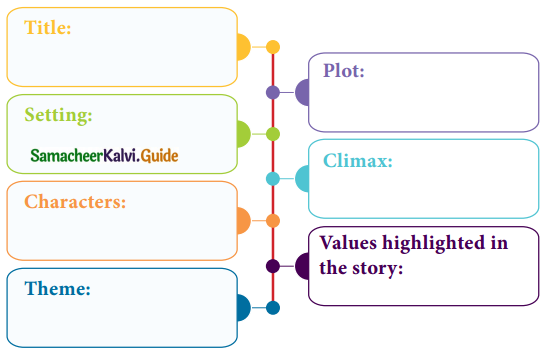
A. Based on the understanding of the story, complete the Graphic Organiser suitably.


Answer:
Title: The Little Hero of Holland
Setting: A dike above the sea water
Characters: Peter, Peter’s mother and father, Peter’s blind friend, people of Holland.
Theme: Sacrifice to save the country
Plots: Father works in the dike as a gate keeper.
Mother sends Peter with cakes to visit his blind filend.
Peter notices a leak ¡n the dike while returning.
He plucks the hole with his finger the whole night to save his people of Holland.
Brave little hero Peter saves Holland from drowning.
Climax: Peter stays at the dike with his finger In the whole night in cold weather with his finger stuffed and numbed. Next morning passers by saved him and mended the hole. Peter saved Holland.

Values
Highlighted: Love and concern for the nation. Determination to save the people. Dedication towards the mother land.

B. Based on your understanding of the story answer the following questions in one or two sentences:

Question 1.
What are the little children of Holland, aware of?
Answer:
The little children of Holland are aware the dikes must be watched every moment and that even a small hole can be very dangerous. It would bring the sea to Holland.

Samacheer Kalvi 10th English Guide Supplementary Chapter 6 The Little Hero of Holland

Question 2.
What is the work assigned to Peter’s father?
Answer:
Tending the gates of the dike was the work assigned to Peter’s father. He opened and closed the gates when ships entered the sea from Holland.

Question 3.
Why did Peter’s mother call him?
Answer:
Peter’s mother called him to go and give cakes to his friend who was blind.

Question 4.
How did Peter spend his time with his blind friend?
Answer:
Peter’s stayed with his poor blind man a little while to tell him about his walk along the dike and the sun and the flowers and the ships far out at sea.

Samacheer Kalvi 10th English Guide Supplementary Chapter 6 The Little Hero of Holland

Question 5.
Why did the father always say angry waters’?
Answer:
The father always said angry waters because the seawater lashed on the dikes always.

Question 6.
What did Peter see when he stopped near the dikes?
Answer:
When Peter stopped near the dikes he saw a small hole in the dike through which a tiny stream was flowing.

Samacheer Kalvi 10th English Guide Supplementary Chapter 6 The Little Hero of Holland

Question 7.
What were the thoughts of the mother when Peter did not return home?
Answer:
Peter’s mother thought that she was spending that night with his friend and that she would scold him next morning for staying away from home without permission.

Question 8.
How did Peter spend his night at the dikes?
Answer:
Peter put his finger in the hole. He crouched on a stone bending his head. He did not sleep, though his eyes were closed. He rubbed his hand thinking that he could stay throughout the night.

Samacheer Kalvi 10th English Guide Supplementary Chapter 6 The Little Hero of Holland

Question 9.
Who found Peter in the dikes and what did he do?
Answer:
A man who went for his work heard Peter moaning and found him clinging to the side of the great wall.

Question 10.
How did the villagers mend the hole?
Answer:
The villagers brought shovels and mended the hole after hearing the alarm.

C. Based on your understanding of the story answer the following question in about 100-150 words.

Question 1.
Narrate in your own words the circumstances that led Peter to be a brief little hero.
Answer:
Introduction:
This story is about a little boy who saved his country from flooding.

Across the dikes:
Peter was a little boy who lived in Holland. Peter’s mother wanted him to go across the dikes to meet his blind friend. Peter went there and stayed till evening. When returning he heard some sound of trickling water. He found a small hole in the dikes. He put his finger into the hole and stopped the water.

Little hero:
He stayed there putting his finger in that hole. His finger became numb. He slept there the whole night. In the morning, a villager saw Peter sitting there. He called the villagers. The villagers arrived with shovels and mended the hole.

Conclusion:
Thus, Peter saved his country, from flooding and was called as the “Hero of Holland”.

(OR)

Peter was a little boy in Holland. One day his mother sent him to give a cake to his blind friend. He walked along the dike. He spent sometime and wanted to return home early. On his way he saw water streaming through a small hole in the dike. He wanted to save Holland.

He climbed down and put his finger into the hole and stopped the leakage. He stayed outside in cold without sleeping. He shouted for help but in vain. Next day a passer by heard his groan and came to rescue him. He spread the alarm. The villagers came runnng with shovels and mended the dike. Thus Peter became a great hero who saved Holland.

(OR)

  1. Peter was a little boy in Holland
  2. His mother asked him to visit his blind friend
  3. He stayed with him for a while and returned home
  4. On his way he saw a small hole in the dike and water was gushing out.
  5. He wanted to save Holland
  6. He climbed down the dike and closed the hole with his little finger
  7. The water leakage was stopped
  8. He stayed outside at night in cold weather without sleeping
  9. Next morning a passer by heard his groan and went nearer him
  10. He alarmed and the villagers came running and mended the dike
  11. Peter became a great little hero of Holland

D. Identify the character / speaker:

Question 1.
‘I want you to go across the dike and take these cakes to your friend, the blind man’
Answer:
Peter’s Mother

Samacheer Kalvi 10th English Guide Supplementary Chapter 6 The Little Hero of Holland

Question 2.
I am glad they are so strong?
Answer:
Peter

Question 3.
‘Holland shall not be drowned while I am here’.
Answer:
Peter

Samacheer Kalvi 10th English Guide Supplementary Chapter 6 The Little Hero of Holland

Question 4.
‘What’s the matter?” he called. “Are you hurt?’
Answer:
Passer by

Question 5.
‘Tell them to come quickly!’
Answer:
Peter

E. Read the following passage and answer the questions that follow.

1. One afternoon the early fall when Peter was eight years old his mother called him from his play, “Come, Peter,” she said. “I want you to go across the dike and take these cakes to your friend, the blind man. If you go quickly, and do not stop to play, you will be home again before dark.” The little boy was glad to go on such an errand, and started off with a light heart.

He stayed with the poor blind man a little while to tell him about his walk along the dike and about the sun and the flowers and the ships far out at sea. Then he remembered his mother’s wish that he should return before dark and, bidding his friend goodbye, he set out for home.

Question 1.
What did Peter’s mother want him to do?
Answer:
Peter’s mother wanted him to go across the dike and take those cakes to his blind friend.

Samacheer Kalvi 10th English Guide Supplementary Chapter 6 The Little Hero of Holland

Question 2.
What did Peter’s mother advise him to do?
Answer:
Peter’s mother advised him not to indulge in playing and to return home before dark.

Question 3.
Why was the little boy glad?
Answer:
The little boy was glad to go on such an errand to meet the blind man.

Samacheer Kalvi 10th English Guide Supplementary Chapter 6 The Little Hero of Holland

Question 4.
What did the little boy tell his friend?
Answer:
The little boy told his friend about his walk along the dike and about the sun and the flowers and the ships far out at sea.

Question 5.
What did the little boy remember?
Answer:
The little boy remembered his mother’s wish that he should return before dark.

Samacheer Kalvi 10th English Guide Supplementary Chapter 5 A Day in 2889 of an American Journalist

Tamilnadu State Board New Syllabus Samacheer Kalvi 10th English Guide Pdf Supplementary Chapter 5 A Day in 2889 of an American Journalist Questions and Answers, Summary, Notes.

Tamilnadu Samacheer Kalvi 10th English Solutions Supplementary Chapter 5 A Day in 2889 of an American Journalist

10th English Guide Supplementary A Day in 2889 of an American Journalist Textbook Questions and Answers

A. Answer the following questions in two or three lines.

Question 1.
Why did Francis Bennett wake up with a bad temper?
Answer:
Francis Bennett woke up with a bad temper because he was feeling lonely and bored. It was eight days since his wife had gone to France.

Samacheer Kalvi 10th English Guide Supplementary Chapter 5 A Day in 2889 of an American Journalist

Question 2.
What was a mechanized dressing room?
Answer:
It is a dressing room in which the machines in the room wash, shaves, and dresses a person. It buttons him top to toe on the threshold of his office.

Question 3.
How was food served to him?
Answer:
Food was served to him through a network of pneumatic tubes. It was an expensive system, but cooking was better.

Samacheer Kalvi 10th English Guide Supplementary Chapter 5 A Day in 2889 of an American Journalist

Question 4.
What was Bennett curious about astronomy?
Answer:
Bennett was curious about astronomy because one astronomer had just determined the elements of the new planet ‘Gandini’. He was delighted to know about the accuracy of it.

Question 5.
Why did he visit Niagara?
Answer:
He visited Niagara to see his accumulator works. Thereafter using the force of cataracts to produce energy, he sold or hired it out to the consumers.

Samacheer Kalvi 10th English Guide Supplementary Chapter 5 A Day in 2889 of an American Journalist

Question 6.
How did Bennett travel?
Answer:
Bennett travelled by aero-car which shot across space at a speed of about 400 miles an hour. Within half an hour, he reached his works at Niagara.

Question 7.
Give three instances of how mechanization has changed life at home in 2889?
Answer:
At home through phonotelephote, vision and speech are transmitted. In two minutes, without the help of an attendant, the machine gets a person to be ready, for his office. Food can be served through pneumatic tubes.

Samacheer Kalvi 10th English Guide Supplementary Chapter 5 A Day in 2889 of an American Journalist

Question 8.
How is advertising in this age different from what we have today?
Answer:
The gigantic advertisement signs are reflected in the clouds so large that they can be seen all over the Country. From that gallery, a thousand projectors were unendingly employed in sending to the clouds on which they were reproduced in color, these inordinate advertisements.

B. Identify the character/speaker.

Question 1.
As soon as he woke up, he switched on his phonotelephote.
Answer:
Francis Bennett

Question 2.
Well, Cash, what have you got?
Answer:
Francis Bennett

Samacheer Kalvi 10th English Guide Supplementary Chapter 5 A Day in 2889 of an American Journalist

Question 3.
‘Photo telegrams from Mercury, Venus, and Mars, Sir.’
Answer:
Cash

Question 4.
‘Interesting! And Jupiter?’
Answer:
Francis Bennett

Question 5.
‘Not yet, Mr.Bennett.’
Answer:
Cash

Samacheer Kalvi 10th English Guide Supplementary Chapter 5 A Day in 2889 of an American Journalist

Question 6.
‘No, it’s the inhabitants.’
Answer:
Corley

Question 7.
‘Where are we going, Sir?’
Answer:
Aero – coachman

Samacheer Kalvi 10th English Guide Supplementary Chapter 5 A Day in 2889 of an American Journalist

Question 8.
‘Then, Sir, I shall really have discovered the absolute’?
Answer:
The young inventor

Question 9.
‘Are you saying you’re going to be able to construct a human being?’
Answer:
Francis Bennett’

Samacheer Kalvi 10th English Guide Supplementary Chapter 5 A Day in 2889 of an American Journalist

Question 10.
‘I’m going to start this moment.’
Answer:
Edith

C. Choose the best answer.

Question 1.
Bennette’s wife was in …………………
(i) Germany
(ii) Australia
(iii) France
(iv) Holland
Answer:
(iii) France

Samacheer Kalvi 10th English Guide Supplementary Chapter 5 A Day in 2889 of an American Journalist

Question 2.
The data from the stellar world was gathered by …………………..
(i) Bennette
(ii) astronomical reporters
(iii) the computer
(iv) telephote
Answer:
(ii) astronomical reporters

Question 3.
The food was being delivered through …………………. tubes.
(i) pneumatic
(ii) shallow
(iii) hollow
(iv) virtual
Answer:
(i) pneumatic

Samacheer Kalvi 10th English Guide Supplementary Chapter 5 A Day in 2889 of an American Journalist

Question 4.
The wayfarers were carried from one place to another by the …………………..
(i) bullet train
(ii) jet
(iii) moving pavement
(iv) heli-taxi
Answer:
(iii) moving pavement

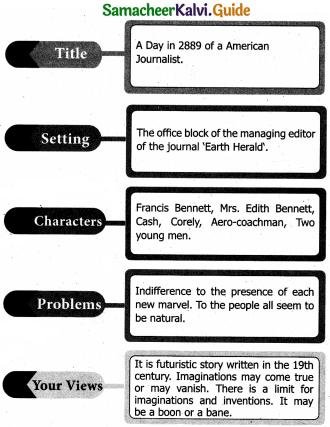
D. Fill in the story map given below.

Samacheer Kalvi 10th English Guide Supplementary Chapter 5 A Day in 2889 of an American Journalist img 1
Answer:
Samacheer Kalvi 10th English Guide Supplementary Chapter 5 A Day in 2889 of an American Journalist img 2

Read the passage given below and answer the questions that follow:

1. A second inventor, using as a basis some old experiments that dated from the 19th century, had the idea of moving a whole city in a single block. He suggested, as a demonstration, the town of Saaf, situated fifteen miles from the sea; after conveying it on rails down to the shore, he would transform it into a seaside resort.

Francis Bennett, attracted by this project, agreed to take a half-share in it. The proposals heard and dealt with, Francis Bennett went to stretch himself out in an easy-chair in the audition-room. Then, pressing a button, he was put into communication with the Central Concert.

After so busy a day, what a charm he found in the works of our greatest masters, based on a series of delicious harmonico- algebraic formulae during his meal, phonotelephotic communication had been set up with Paris.

Question 1.
In which century were the old experiments dated? And what was it?
Answer:
The old experiments were dated from the 19th century. It was the idea of moving a whole city in a single block.

Samacheer Kalvi 10th English Guide Supplementary Chapter 5 A Day in 2889 of an American Journalist

Question 2.
Where was Saaf situated?
Answer:
Saaf was situated fifteen miles from the sea.

Question 3.
What was the proposal awaiting for Saaf?
Answer:
The proposal awaiting for Saaf was ‘that to convey it on the rails down to the shore and to transform it into a seaside resort.

Samacheer Kalvi 10th English Guide Supplementary Chapter 5 A Day in 2889 of an American Journalist

Question 4.
How and to whom was Francis Bennett connected?
Answer:
Francis Bennett was connected with the Central Concert, by pressing a button.

Question 5.
Pick out any two words that refer to technology?
Answer:

  1. Harmonico – algebraic formulae
  2. Phonotelephotic communication

2. The next room, a broad gallery about a quarter of a mile long, was devoted to publicity, and it well may be imagined what the publicity for such a journal as the Earth Herald had to be. It brought in a daily average of three million dollars. They are gigantic signs reflected on the clouds, so large that they can be seen all over the whole country.

For that gallery, a thousand projectors were unceasingly employed in sending to the clouds, on which they were reproduced in colour, these inordinate advertisements. At that moment the clock struck twelve. The director of the Earth Herald left the hall and sat down in a rolling armchair. In a few minutes, he had reached his dining room half a mile away, at the far end of the office.

Question 1.
What was the next room devoted to?
Answer:
The next room was devoted to publicity.

Question 2.
What was the breadth of the gallery?
Answer:
The breadth of the gallery was about a quarter of a mile long.

Samacheer Kalvi 10th English Guide Supplementary Chapter 5 A Day in 2889 of an American Journalist

Question 3.
How much did the gallery bring in?
Answer:
The gallery brought in a daily average of three million dollars.

Question 4.
How was the advertisement done here?
Answer:
A thousand projectors would send gigantic signs to the clouds and the signs would be reflected and they could be seen all over a whole country.

Samacheer Kalvi 10th English Guide Supplementary Chapter 5 A Day in 2889 of an American Journalist

Question 5.
Where did the director of the Earth Herald sit?
Answer:
The director of the Earth Herald sat down in a rolling armchair

Samacheer Kalvi 5th Tamil Guide Chapter 9.2 புதுவை வளர்த்த தமிழ்

Tamilnadu State Board New Syllabus Samacheer Kalvi 5th Tamil Guide Pdf Chapter 9.2 புதுவை வளர்த்த தமிழ் Text Book Back Questions and Answers, Summary, Notes.

Tamilnadu Samacheer Kalvi 5th Tamil Solutions Chapter 9.2 புதுவை வளர்த்த தமிழ்

Samacheer Kalvi 5th Tamil Guide Chapter 9.2 புதுவை வளர்த்த தமிழ்

மதிப்பீடு

படிப்போம்! சிந்திப்போம்! எழுதுவோம்!

அ. சரியான சொல்லைத் தெரிவு செய்து எழுதுக.

Question 1.
‘குயில்பாட்டு’ நூலை எழுதியவர் யார் …………………
அ) பாரதியார்
ஆ) பாரதிதாசன்
இ) வாணிதாசன்
ஈ) புதுவை சிவம்
Answer:
அ) பாரதியார்

Samacheer Kalvi 5th Tamil Guide Chapter 9.2 புதுவை வளர்த்த தமிழ்

Question 2.
‘தமிழுக்கு அமுதென்று பேர்’ எனப் பாடியவர் …………
அ) பாரதிதாசன்
ஆ) வாணிதாசன்
இ) கண்ண தாசன்
ஈ) பிரபஞ்சன்
Answer:
அ) பாரதிதாசன்

Question 3.
“பாரதிநாள் இன்றடா, பாட்டிசைத்து ஆட்டா ” எனப் பாடியவர் …………
அ) பாரதிதாசன்
ஆ) வாணிதாசன்
இ) கண்ண தாசன்
ஈ) திருமுருகன்
Answer:
ஆ) வாணிதாசன்

Question 4.
பாட்டிசைத்து – இச்சொல்லைப் பிரித்து எழுதக் கிடைப்பது …………..
அ) பாட்டு + இசைத்து
ஆ) பாடல் + இசைத்து
இ) பா + இசைத்து
ஈ) பாட + இசைத்து
Answer:
அ) பாட்டு + இசைத்து

Samacheer Kalvi 5th Tamil Guide Chapter 9.2 புதுவை வளர்த்த தமிழ்

Question 5.
மூன்று + தமிழ் – இச்சொற்களைச் சேர்த்து எழுதக் கிடைப்பது …………….
அ) மூன்றுதமிழ்
ஆ) முத்துத்தமிழ்
இ) முதுதமிழ்
ஈ) முத்தமிழ்
Answer:
ஈ) முத்தமிழ்

ஆ. பொருத்துக

1. பாரதிதாசன் – கொடி முல்லை
2. தமிழ் ஒளி – பாஞ்சாலி சபதம்
3. பாரதியார் – பாவலர் பண்ணை
4. வாணிதாசன் – மாதவி காவியம்
5. திருமுருகன் – இருண்ட வீடு
Answer:
1. பாரதிதாசன் – இருண்ட வீடு
2. தமிழ் ஒளி – மாதவி காவியம்
3. பாரதியார் – பாஞ்சாலி சபதம்
4. வாணிதாசன் – கொடி முல்லை
5. திருமுருகன் – பாவலர் பண்ணை

Samacheer Kalvi 5th Tamil Guide Chapter 9.2 புதுவை வளர்த்த தமிழ்

இ. வினாக்களுக்கு விடையளிக்க.

Question 1.
பாரதியார் படைத்த முப்பெருங் காவியங்கள் யாவை?
Answer:

  • பாஞ்சாலி சபதம்
  • குயில் பாட்டு
  • கண்ணன் பாட்டு.

Question 2.
பாரதிதாசன் – பெயர்க் காரணம் தருக.
Answer:
பாரதிதாசன், பாரதியார் மீது அன்பும், பாசமும், பற்றும் உடையவர். அதனால்தான் கனகசுப்புரத்தினம் என்ற தம் பெயரைப் பாரதிதாசன் என்று மாற்றியமைத்துக் கொண்டார்.

Question 3.
பிரபஞ்சனுக்குச் சிறப்பைச் சேர்த்த நூல் எது?
Answer:
பிரபஞ்சனுக்குச் சிறப்பைச் சேர்த்த நூல் சாகித்திய அகாதெமி விருது பெற்ற ‘வானம் வசப்படும்’ என்ற நூல் ஆகும்.

Samacheer Kalvi 5th Tamil Guide Chapter 9.2 புதுவை வளர்த்த தமிழ்

Question 4.
பாவேந்தர் விருதைப் பெற்றவர்கள் யாவர்?
Answer:
பாவேந்தர் விருதைப் பெற்றவர்கள் ;

  • வாணிதாசன்
  • புதுவை சிவம்.

Question 5.
தமிழ்ஒளியின் படைப்புகளை எழுதுக.
Answer:
வீராயி, கவிஞனின் காதல், நிலை பெற்ற சிலை, கவிதைத் தொகுப்புகள், குழந்தைப் பாடல்கள், ஆய்வு நூல்கள், கதைகள், குறுநாவல்கள் முதலியன தமிழ் ஒளியின் படைப்புகளாகும்.

ஈ. சிந்தனை வினா.

தமிழின் வளர்ச்சிக்குக் கவிஞர்கள் எவ்வாறெல்லாம் தொண்டாற்றியுள்ளனர்?
Answer:
தமிழ் வளர்ச்சிக்குக் கவிஞர்கள் தொண்டாற்றிய விதம் ;
தமிழ்ப்பற்றும் நாட்டுப்பற்றும் மிகுந்த பாரதியார் “யாமறிந்த மொழிகளிலே தமிழ் மொழி போல் இனிதாவது எங்கும் காணோம்” என்று தமது சுதேசமித்திரன் நாளிதழில் எழுதினார். இதன் மூலம் தமிழை மீட்சி பெறச் செய்தார்.

பாரதிதாசன் “தமிழுக்கும் அமுதென்று பேர்” என்று பாடினார். தமிழைத் தன் உயிர் என்று பாடினார். இசையமுது, குடும்ப விளக்கு, பாண்டியன் பரிசு போன்ற பல நூல்களை எழுதி தமிழை வளர்த்தார்.

Samacheer Kalvi 5th Tamil Guide Chapter 9.2 புதுவை வளர்த்த தமிழ்

தமிழில் பெரும்புலமை பெற்ற செய்குத்தம்பி பாவலர் பல அரிய தமிழ் நூல்களை எழுதி தமிழுக்கு வளம் சேர்த்துள்ளார். சீறாப்புராணத்திற்கு உரை எழுதியுள்ளார்.

அழ. வள்ளியப்பாகுழந்தைக் கவிஞர் என்ற பாராட்டுகுரியவர். சென்னை சக்தி பத்திரிகை அலுவலகத்தில் காசாளராகச் சேர்ந்தபோது தம் தமிழ்ப் பணியைத் தொடங்கினார். பிறகு வங்கிப் பணிக்குச் சென்றார். வங்கிப் பணியில் இருந்தாலும் அவருடைய தமிழ்ப்பணியை விடாமல் பலநூல்களை இயற்றித் தமிழுக்குத் தொண்டாற்றினார்.

இவ்வாறு எத்தனையோ கவிஞர்கள் தமிழுக்குத் தொண்டாற்றியுள்ளனர். பிறநாட்டு அறிஞர்களும் தமிழை வளர்த்துள்ளனர்.

கற்பவை கற்றபின்

Question 1.
நிறுத்தக் குறிகளைப் பயன்படுத்திச் சரியான ஒலிப்புடன் படித்துக்காட்டுக.
Answer:
மாணவர்கள் தாங்களாகவே செய்ய வேண்டியவை.

Samacheer Kalvi 5th Tamil Guide Chapter 9.2 புதுவை வளர்த்த தமிழ்

Question 2.
தமிழ்மொழியின் வளர்ச்சிக்குப் பங்காற்றிய புதுவை படைப்பாளிகளைப் பற்றிய செய்திகளை திரட்டுக.
Answer:
மாணவர்கள் தாங்களாகவே செய்ய வேண்டியவை.

கூடுதல் வினாக்கள்

நிரப்புக.

1. பாரதிதாசனின் இயற்பெயர் ……………
Answer:
னகசுப்புரத்தினம்

2. பாரதிதாசனின் சிறப்புப் பெயர்கள் ……………………
Answer:
புரட்சிக் கவிஞர், பாவேந்தர்

3. பாரதிதாசனுக்கு புரட்சிக்கவி’ என்ற பட்டத்தைக் கொடுத்தவர்……..
Answer:
தந்தை பெரியார்

Samacheer Kalvi 5th Tamil Guide Chapter 9.2 புதுவை வளர்த்த தமிழ்

4. பாரதியார் எழுதிய முப்பெருங்காவியங்கள் …………..
Answer:
பாஞ்சாலி சபதம், குயில்பாட்டு, கண்ணன் பாட்டு

5. கல்வியின் உயர்வைச் சொல்லும் பாரதிதாசனின் நூல் ……………
Answer:
குடும்ப விளக்கு

6. கல்லாமையின் இழிவைக் கூறும் பாரதிதாசனின் நூல் ………..
Answer:
இருண்ட வீடு)

7. பாரதிதாசனின் நூல்களுள் சாகித்திய அகாதெமி விருதினைப் பெற்ற நாடக நூல்
Answer:
பிசிராந்தையார் நாடக நூல்)

8. வாணிதாசன் அறிந்த மொழிகள் ………..
Answer:
தமிழ், பிரெஞ்சு , ஆங்கிலம்)

9. வாணிதாசனின் புனைப்பெயர் ……………
Answer:
ரமி

10. வாணிதாசனின் இயற்பெயர் .. ………….. என்கின்ற அரங்கசாமி.
Answer:
எத்திராசலு

11. வாணிதாசன் இலக்கண இலக்கியங்களைப் …………. கற்றுத் தேர்ந்தார்.
Answer:
பாரதிதாசனிடம்)

12. பாவேந்தரின் கவிதா மண்டலத்தைச் சேர்ந்தவர்கள் ……………..
Answer:
வாணிதாசன், புதுவை சிவம்)

Samacheer Kalvi 5th Tamil Guide Chapter 9.2 புதுவை வளர்த்த தமிழ்

13. தமிழ் ஒளிக்கு பெற்றோர் வைத்த பெயர் …………….
Answer:
விஜயரங்கம்

14. தமிழ் ஒளி எழுதிய மேடை நாடகம் ……..
Answer:
சிற்பியின் கனவு

15. சிலப்பதிகாரத்திற்குப் பின் தோன்றிய இசை நாடகமாகக் கூறப்படுவது தமிழ் ஒளியின் …….. என்ற காவியம்.
Answer:
விதியோ, வீணையோ

16. பிரபஞ்சனின் சாகித்திய அகாதெமி விருது பெற்ற நூல் ……….
Answer:
வானம் வசப்படும்

Samacheer Kalvi 5th Tamil Guide Chapter 9.2 புதுவை வளர்த்த தமிழ்

குறுவினா :

Question 1.
தமிழ் ஒளி பாரதியாரைப் பற்றி என்ன பாடியுள்ளார்?
Answer:
“சீறி அடித்துச் சுழன்ற அலைகளில் சிக்கிய ஒரு படகாய்த் தடுமாறி இளைத்து மடிந்த மகாகவி தன் சரிதம் உரைப்பேன்” என்று பாரதியாரைப் பற்றிப் பாடியுள்ளார் கவிஞர் தமிழ் ஒளி.

Question 2.
புதுவையில் பிறந்த தமிழ்ச் சான்றோர் யாவர்?
Answer:
வாணிதாசன், புதுவை சிவம், தமிழ் ஒளி, பிரபஞ்சன், திருமுருகன்.

சிறுவினா :

Question 1.
பாரதிதாசன் பற்றி நீ அறிந்தவற்றை எழுதுக.
Answer:

  • பாரதிதாசனின் இயற்பெயர் கனகசுப்புரத்தினம்.
  • இளமையிலேயே கவிபாடும் ஆற்றல் கொண்டவர். பாரதியார் முன் ‘எங்கெங்கு காணினும் சக்தியடா!’ என்ற பாடலைப் பாடிக் காட்டினார்.
  • பாரதியார் மீது அன்பும் பாசமும் பற்றும் உடையவர். அதனால்தான், தம் பெயரைப் பாரதிதாசன் என்று மாற்றியமைத்துக் கொண்டார்.
  • தமிழின் சிறப்பை, பொதுவுடைமையை, பெண்ணின் பெருமையைப் பாடியவர். இயற்கை, பெண் விடுதலை போன்ற பல கருத்துகளை முன் வைத்து நிறைய பாடல்களைப் பாடியுள்ளார்.
  • குடும்ப விளக்கு, இருண்ட வீடு, அழகின் சிரிப்பு, பாண்டியன் பரிசு, தமிழியக்கம், குறிஞ்சித்திட்டு, புரட்சிக்கவி, இசையமுது என 72 நூல்களுக்கும் மேல் எழுதி தமிழுக்குப் பெருமை சேர்த்துள்ளார்.
  • இவருடைய பிசிராந்தையார் நாடக நூல் ‘சாகித்திய அகாதெமி’ விருதினைப் பெற்றுள்ளது.
  • தமிழக அரசு ஆண்டு தோறும் சிறந்த தமிழறிஞர்களுக்கு இவரது பெயரால் விருது வழங்கிச் சிறப்பு செய்கிறது.

Samacheer Kalvi 5th Tamil Guide Chapter 9.2 புதுவை வளர்த்த தமிழ்

Question 2.
வாணிதாசன், புதுவை சிவம் பற்றி எழுதுக.
Answer:

  • வாணிதாசன் புதுவைக் கவிஞர்களுள் ஒருவர். இயற்பெயர் எத்திராசலு என்கிற அரங்கசாமி.
  • இவர் தமிழ், பிரெஞ்சு, ஆங்கிலம் முதலிய மொழிகளை அறிந்தவர். ‘ரமி’ என்று புனைபெயரில் எழுதியவர்.
  • பாரதிதாசன் நடத்திய தமிழ் வகுப்பில் அவரிடம் இலக்கண இலக்கியங்களைக் கற்றுத் தேர்ந்தவர்கள் கவிஞர் வாணிதாசனும், புதுவை சிவமும் ஆவர்.
  • பாரதியார் பிறந்த நாளன்று, “பாரதிநாள் இன்றடா பாட்டிசைத்து ஆட்டா” என்று வாணிதாசன் பாடிய பாடல், அவருக்கு முதற்பரிசைப் பெற்றுத் தந்தது.
  • யாப்பு இலக்கணம் பயின்றதோடு புலவர் தேர்வு எழுதியும் இருவரும் தேர்ச்சி பெற்றனர்.
  • பாவேந்தரின் கவிதா மண்டலத்தைச் சேர்ந்தவர்களாகக் கருதப்பட்ட இருவருமே பல்வேறு நூல்களை எழுதியுள்ளனர். வாணிதாசனின் ‘கொடிமுல்லை’ என்னும் நூல் சிறப்பு பெற்றது.
  • புதுச்சேரி அரசு இவர்கள் இருவரின் நூற்றாண்டு விழாக்களையும் மிகச் சிறப்பாக நடத்தியது. மேலும் ஆண்டுதோறும் பிறந்தநாள் விழாக்களையும் நடத்தி வருகிறது.
  • தமிழக அரசு, பாவேந்தர் விருதினை இவர்கள் இருவருக்கும் வழங்கிச் சிறப்பித்தது.

Samacheer Kalvi 5th Tamil Guide Chapter 9.2 புதுவை வளர்த்த தமிழ்

Question 3.
தமிழ் ஒளி பற்றி நீவிர் அறிந்தவற்றை எழுதுக.
Answer:
(i) தமிழ் ஒளிக்குப் பெற்றோர் வைத்த பெயர், விஜயரங்கம். இவரும் பாரதிதாசனின் மாணவர்தாம். தமிழ்ஒளி என்னும் பெயரில் இவர், தம்மைக் கவிஞராக அறிமுகப்படுத்திக் கொண்டவர்.

(ii) இவரது முற்போக்கான கருத்துகள், பாடலில் எதிரொலித்தன. கல்லூரிக் காலத்தில், ‘சிற்பியின் கனவு’ என்னும் மேடை நாடகத்தைப் படைத்துள்ளார். இந்த நாடகம்தான் பின்னாளில் ‘வணங்காமுடி’ என்னும் பெயரில் திரைப்படமாக எடுக்கப்பட்டது.

(iii) வீராயி, கவிஞனின் காதல், நிலை பெற்ற சிலை என்னும் குறுங்காவியங்களைப் படைத்துள்ளார். இந்நூல்களைப் பற்றிய திறனாய்வு, சென்னை வானொலியிலும் திருச்சி வானொலியிலும் ஒளிபரப்பப்பட்டது.

(iv) இவை மட்டுமின்றிக் கவிதைத் தொகுப்புகள், குழந்தைப் பாடல்கள், ஆய்வு நூல்கள், கதைகள், குறுநாவல்கள் முதலியவற்றையும் படைத்துள்ளார். இவரது ‘விதியோ வீணையோ’ என்னும் காவியம், சிலப்பதிகாரத்திற்குப் பின் தோன்றிய இசை நாடகமாகக் கூறப்படுகிறது.

Samacheer Kalvi 5th Tamil Guide Chapter 9.2 புதுவை வளர்த்த தமிழ்

(v) ‘முன்னும் பின்னும்’, ‘அணுவின் ஆற்றல்’ ஆகிய இரண்டு பாடல்கள் பாடநூல்களில் இடம் பெற்றுள்ளது. இவரது ‘மாதவி காவியம்’ என்னும் நூல் கல்லூரிப் பாடநூலாக வைக்கப்பட்டது.

Question 4.
திருமுருகன் பற்றி நீவிர் அறிந்தவற்றை எழுதுக.
Answer:
தமிழில் பிழையின்றி எழுதுவது குறித்த நூல்களைப் படைத்தவர் இலக்கணச் சுடர் இரா.திருமுருகன். இவர் தனித்தமிழ்ப் பற்றால் சுப்பிரமணியன் என்ற தம் பெயரைத் ‘திருமுருகன்’ என்று மாற்றி அமைத்துக் கொண்டவர்.

நூறு சொல்வதெழுதல், 17 தமிழ்ப் பாடநூல்கள், ஆய்வு நூல்கள், வரலாற்று நூல்கள், பாவலர் பண்ணை , என் தமிழ் இயக்கம் போன்ற பல்வேறு நூல்களை எழுதியுள்ளார். இவரும் சாகித்திய அகாதெமி விருது பெற்ற ம.லெனின் தங்கப்பாவும் இணைந்து நடத்திய ‘தெளிதமிழ்’ இதழ் இன்றும் தொடர்ந்து வெளிவந்து கொண்டிருக்கிறது.

Samacheer Kalvi 5th Tamil Guide Chapter 9.2 புதுவை வளர்த்த தமிழ்

Question 5.
எழுத்தாளர் பிரபஞ்சன் பற்றிய செய்திகளை எழுதுக.
Answer:
பிரபஞ்சன் தம் எழுத்தால் தாய்நாட்டைப் போற்றச் செய்தவர்; உலகம் போற்றும் உயர்ந்த எழுத்தாளர், எண்ணற்ற சிறுகதைகள், நாவல்கள், வரலாற்று நூல்களை எழுதியுள்ளார்.

இவரது ‘வானம் வசப்படும்’ என்ற நூலுக்குச் சாகித்திய அகாதெமி விருது கிடைத்துள்ளது. இவரது உடல், புதுவை அரசு மரியாதையுடன் தகனம் செய்யப்பட்டது என்பது தமிழுக்குக் கிடைத்த சிறப்பாகும்.

Samacheer Kalvi 5th Tamil Guide Chapter 9.1 அறநெறிச்சாரம்

Tamilnadu State Board New Syllabus Samacheer Kalvi 5th Tamil Guide Pdf Chapter 9.1 அறநெறிச்சாரம் Text Book Back Questions and Answers, Summary, Notes.

Tamilnadu Samacheer Kalvi 5th Tamil Solutions Chapter 9.1 அறநெறிச்சாரம்

Samacheer Kalvi 5th Tamil Guide Chapter 9.1 அறநெறிச்சாரம்

மதிப்பீடு

படிப்போம்! சிந்திப்போம்! எழுதுவோம்!

அ. சரியான சொல்லைத் தெரிவு செய்து எழுதுக.

Question 1.
‘சொல்லாடல்’ – இச்சொல்லைப் பிரித்து எழுதக் கிடைப்பது…………
அ) சொல் + லாடல்
ஆ) சொல + ஆடல்
இ) சொல் + ஆடல்
ஈ) சொல்லா + ஆடல்
Answer:
இ) சொல் + ஆடல்

Question 2.
‘பொழுதாற்றும்’ – இச்சொல்லைப் பிரித்து எழுதக் கிடைப்பது …………..
அ) பொழு + தாற்றும்
ஆ) பொழுது + ஆற்றும்
இ) பொழு + ஆற்றும்
ஈ) பொழுது + தூற்றும்
Answer:
ஆ) பொழுது + ஆற்றும்

Samacheer Kalvi 5th Tamil Guide Chapter 9.1 அறநெறிச்சாரம்

Question 3.
வேற்றுமை – இச்சொல்லுக்குரிய எதிர்ச்சொல் ………
அ) பிரிவு
ஆ) வேறுபாடு
இ) பாகுபாடு
ஈ) ஒற்றுமை
Answer:
ஈ) ஒற்றுமை

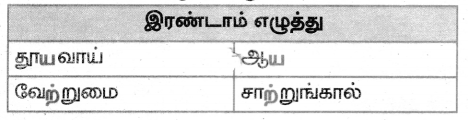
ஆ. இரண்டாம் எழுத்து ஒன்றுபோல் வரும் சொற்களை எடுத்து எழுதுக.
………………………, ……………………..
………………………, ……………………..
………………………, ……………………..
………………………, ……………………..
Answer:
Samacheer Kalvi 5th Tamil Guide Chapter 9.1 அறநெறிச்சாரம் - 1

இ. எதிர்ச்சொல் எழுதுக.
1. துன்பம்  x
2. வேற்றுமை  x
3. மெய்ம்மை  x
Answer:
1. துன்பம் x இன்பம்
2. வேற்றுமை x ஒற்றுமை
3. மெய்ம்மை x பொய்ம்மை

Samacheer Kalvi 5th Tamil Guide Chapter 9.1 அறநெறிச்சாரம்

ஈ. வினாக்களுக்கு விடையளிக்க.

Question 1.
நாம் பேசும்போது கடைப்பிடிக்க வேண்டிய பண்பு யாது?
Answer:
நாம் பேசும்போது குற்றம் ஏற்படாமல் பேசுவதைக் கடைபிடிக்க வேண்டும்.

Question 2.
மிக உயர்ந்த பண்புகளாக அறநெறிச்சாரம் குறிப்பிடுவதை எழுதுக.
Answer:
உயர்ந்த பண்புகள் :

  • குற்றம் ஏற்படாமல் பேசுதல்.
  • துன்பங்கள் உண்டான போதும் மனம் தளராமலிருத்தல்.
  • தம்மை வெறுப்பவரிடத்தும் வேற்றுமை பாராட்டாத உண்மை நிலை.

Samacheer Kalvi 5th Tamil Guide Chapter 9.1 அறநெறிச்சாரம்

உ. சிந்தனை வினா.

உன் நண்பர் உன்னை விட்டுப் புதிய நண்பர்களுடன் பழகுவதாகக் கருதுகிறாய். இந்நிலையில், அவருக்குச் சிறு துன்பம் ஏற்படுகிது. இப்போது உன் நிலை என்ன?
1. அவர் என் நண்பர் இல்லை, அவருக்குத் துன்பம் வந்தால் தான் ஏன் கவலைப்பட வேண்டும்?
2. அவருக்குப் பல நண்பர்கள் இருக்கிறார்கள். நான் ஏன் உதவ வேண்டும்?
3. அவர் என்னை வெறுத்தாலும், அவருக்குத் தேவையான உதவிகளைச் செய்ய
வேண்டும்.
Answer:
3. அவர் என்னை வெறுத்தாலும், அவருக்குத் தேவையான உதவிகளைச் செய்ய வேண்டும்.

Samacheer Kalvi 5th Tamil Guide Chapter 9.1 அறநெறிச்சாரம்

கற்பவை கற்றபின்

Question 1.
சொற்குற்றத்தால் ஏற்படும் துன்பங்களைப் பிறர்க்கு எடுத்துக் கூறுக.
Answer:
அவையோர்க்கு வணக்கம்! நான் சொற்குற்றத்தால் ஏற்படும் குற்றங்கள் பற்றிக் கூற வந்துள்ளேன்.

நாம் நம் ஐம்புலன்களில் எதை அடக்குகிறோமோ இல்லையோ நாவைக் கட்டாயமாக அடக்க வேண்டும். அவ்வாறு அடக்காவிட்டால் பல இன்னல்களுக்கு ஆளாக நேரிடும்.‘நுணலும் தன் வாயால் கெடும்’ என்பது பழமொழி. நுணல் என்றால் தவளை என்பது 2 பொருள். பேச்சுத் தன்மை, பகுத்தறிவு இவை இரண்டும் இல்லாத ஜீவராசி தவளை. அது 3 தன்னுடைய சப்தத்தினால், தன் உயிருக்கு ஆபத்தை விளைவித்துக் கொள்கிறது.

தீயினால் சுட்ட புண் உடம்பில் தழும்பு இருந்தாலும், உள்ளத்தில் ஆறி விடும். நாவினால் தீயச் சொல் கூறிச் சுடும் புண், என்றுமே ஆறாது. சொல்லினால் ஆக்கமும்,  அழிவும் ஏற்படும். கோபத்தை அடக்கிக் காக்க முடியாவிட்டாலும் நாக்கை அடக்க  வேண்டும். நாவை அடக்காமல், சொல்லத் தகாத சொற்களால் எடுத்தெறிந்து பேசுவதால், அச்சொற்கள் கேட்போர் மனதைப் புண்ணாக்கி, கடும் கோபத்தை உண்டாக்கும். இப்படி நாவை அடக்காது ஒருவர் மாறி ஒருவர் தாக்கப்படுவதால் வேண்டத்தகாத விளைவுகள் ஏற்படும். அது உயிர் இழப்பையும்கூட உருவாக்கலாம். விளையாட்டாகப் பேசியது – வினையாக முடிவதும் உண்டு.

Samacheer Kalvi 5th Tamil Guide Chapter 9.1 அறநெறிச்சாரம்

நாம் நாவைக் காத்தல் வேண்டும். அதனைக் காக்காவிட்டால், குற்றமான சொற்களைச் சொல்லி துன்பம் அடைவர்.

Question 2.
பாடலின் பொருள் புரிந்து சரியான ஒலிப்புடன் படித்துக்காட்டுக.
Answer:
மாணவர்கள் தாங்களாகவே செய்ய வேண்டியவை.

Question 3.
பாடலை அடிபிறழாமல் எழுதுக.
Answer:
மாணவர்கள் தாங்களாகவே செய்ய வேண்டியவை.

Samacheer Kalvi 5th Tamil Guide Chapter 9.1 அறநெறிச்சாரம்

கூடுதல் வினாக்கள்

நிரப்புக.

1. அறநெறிச்சாரம் நூலை இயற்றியவர் ………….
Answer:
முனைப்பாடியார்

2. அறநெறிக் கருத்துகளைக் கொண்டு வெண்பா வடிவில் இயற்றப்பெற்ற நூல்…………………
Answer:
அறநெறிச்சாரம்

விடையளி :

Question 1.
அறநெறிச்சாரம் நூல் குறிப்பு எழுதுக.
Answer:
அறநெறிக் கருத்துகளைக் கொண்டு வெண்பா வடிவில் இயற்றப் பெற்ற நூல் அறநெறிச்சாரம். இப்பாடல்கள் சுருங்கச் சொல்லல், விளங்க வைத்தல் முதலிய அழகுகளைப் பெற்று விளங்குகின்றன. இந்நூலை எழுதியவர் முனைப்பாடியார்.

பாடல் பொருள்

குற்றம் ஏற்படாமல் பேசுதல், துன்பங்கள் உண்டான போதும் மனம் தளராமலிருத்தல், தம்மை வெறுப்பவரிடத்தும் வேற்றுமை பாராட்டாத உண்மை நிலை ஆகிய இவை மூன்றும் மிக உயர்ந்த பண்புகளாகும்.

Samacheer Kalvi 5th Tamil Guide Chapter 9.1 அறநெறிச்சாரம்

நூல் குறிப்பு

அறநெறிக் கருத்துகளைக் கொண்டு, வெண்பா வடிவில் இயற்றப்பெற்ற நூல், அறநெறிச்சாரம், இப்பாடல்கள் சுருங்கச் சொல்லல், விளங்க வைத்தல் முதலிய அழகுகளைப் பெற்று விளங்குகின்றன. இந்நூலை எழுதியவர், முனைப்பாடியார்.

சொல்பொருள்

1. காய்விடத்து – வெறுப்பவரிடத்து
2. சால – மிகவும்
3. சாற்றுங்கால் – கூறுமிடத்து
4. தலை – முதன்மை

Samacheer Kalvi 5th Tamil Guide Chapter 8.4 மயங்கொலிச்சொற்கள்

Tamilnadu State Board New Syllabus Samacheer Kalvi 5th Tamil Guide Pdf Chapter 8.4 மயங்கொலிச்சொற்கள் Text Book Back Questions and Answers, Summary, Notes.

Tamilnadu Samacheer Kalvi 5th Tamil Solutions Chapter 8.4 மயங்கொலிச்சொற்கள்

மதிப்பீடு

Samacheer Kalvi 5th Tamil Guide Chapter 8.4 மயங்கொலிச்சொற்கள்

படிப்போம்! சிந்திப்போம்! எழுதுவோம்!

அ. சரியான சொல்லைத் தெரிவு செய்து எழுதுக.

Question 1.
சாலையில் பள்ளம் இருந்ததால், …………… பேருந்தை மெதுவாக ஓட்டிச் சென்றார்.
அ) ஓட்டுநர்
ஆ) ஓட்டுனர்
இ) ஓட்டுணர்
Answer:
அ) ஓட்டுநர்

Samacheer Kalvi 5th Tamil Guide Chapter 8.4 மயங்கொலிச்சொற்கள்

Question 2.
கடவூருக்குச் செல்ல எந்த ………….. ப்போக வேண்டும்?
அ) வலியாக
ஆ) வளியாக
இ) வழியாக
Answer:
இ) வழியாக

Question 3.
கூண்டிலிருந்த ………….. யைச் சுதந்திரமாகப் பறக்கவிட்டான் எழிலன்.
அ) கிலி
ஆ) கிளி
இ) கிழி
Answer:
ஆ) கிளி

Samacheer Kalvi 5th Tamil Guide Chapter 8.4 மயங்கொலிச்சொற்கள்

Question 4.
நீரில் துள்ளி விளையாடுகிறது …………… மீன்.
அ) வாளை
ஆ) வாலை
இ) வாழை
Answer:
அ) வாளை

Question 5.
தாய்ப் பசு இல்லாமையால் நாளடைவில் கன்று ………….ப்போனது.
அ) இழைத்து
ஆ) இளைத்து
இ) இலைத்து
Answer:
ஆ) இளைத்து

Question 6.
கடல் …………….யில் கால் நனைத்து மகிழ்வது அனைவருக்குமே பிடிக்கும்.
அ) அளை
ஆ) அழை
இ) அலை
Answer:
இ) அலை

Samacheer Kalvi 5th Tamil Guide Chapter 8.4 மயங்கொலிச்சொற்கள்

ஆ. பொருத்தமான சொல்லை நிரப்பித் தொடர்களைப் படித்துக்காட்டுக.

1. நடனம் என்பது, ஒரு …………………… (களை /கலை/கழை)
Answer:
கலை

2. சோளம் என்பது, ஒரு ………………… (தினை /திணை )
Answer:
தினை

3. பெட்ரோல் என்பது, ஓர் …………………. (எரிபொருள்/எறிபொருள்)
Answer:
எரிபொருள்

4. ஒட்டகம் என்பது, ஒரு …. ……………… (விளங்கு/விலங்கு)
Answer:
விலங்கு

5. தென்னை என்பது, ஒரு ………………… (மறம்/மரம்)
Answer:
மரம்

Samacheer Kalvi 5th Tamil Guide Chapter 8.4 மயங்கொலிச்சொற்கள்

இ. வண்ண எழுத்துகளில் உள்ள சொற்களைச் சரியான ஒலிப்புடன் படித்துக் காட்டுக.

முல்லை : நிலா, நீ வரைந்த படம் மிகவும் அகாக உள்ளது. வெண்பஞ்சு போன்ற மேகங்கள் சூழ்ந்த மலை; அம்மலையினின்று வீழும் பாலாவி போன்ற அருவி; பசுமை மிகுந்த மம், செடி, கொடிகள்; துள்ளித் திரியும் புள்ளி மான்ள்; சிகடிக்கும் வண்ணப் பறவைகள்; மரக்கிளைளில் ஊஞ்சலாடும் குங்குக் குட்டிகள் அப்பப்பா! நீ எப்படி இவ்வாறு வரையக் கற்றுக் கொண்டாய்?

நிலா : இதிலென்ன புதுமை? முந்தைய வகுப்புத் தமிழ்ப் பாடநூல்ளில் வரைந்து பார்ப்போமா என்றொரு பயிற்சி இருந்ததே. நினைவிருக்கிதா? அந்தப் பயிற்சிகளை நான் மிகவும் ஆர்வத்துடன் செய்வேன். அதனால்தான் இப்போது நன்றாக வரைகிறேன்ன்று நினைக்கிறேன்.

Samacheer Kalvi 5th Tamil Guide Chapter 8.4 மயங்கொலிச்சொற்கள்

ஈ. விடுபட்ட இடங்களில் உரிய சொற்களை எழுதுக.
Samacheer Kalvi 5th Tamil Guide Chapter 8.4 மயங்கொலிச் சொற்கள் - 5
Answer:
Samacheer Kalvi 5th Tamil Guide Chapter 8.4 மயங்கொலிச் சொற்கள் - 1

கற்பவை கற்றபின்

Question 1.
மயங்கொலி எழுத்துகள் இடம்பெறும் சொற்களை அடையாளம் காண்க.
Answer:
மாணவர்கள் தாங்களாகவே செய்ய வேண்டியவை.

Question 2.
மயங்கொலிச் சொற்களின் பொருள் வேறுபாடு அறிக.
Answer:
Samacheer Kalvi 5th Tamil Guide Chapter 8.4 மயங்கொலிச் சொற்கள் - 2

Samacheer Kalvi 5th Tamil Guide Chapter 8.4 மயங்கொலிச்சொற்கள்

கூடுதல் வினா

Question 1.
மயங்கொலி எழுத்துகள் யாவை?
Answer:
மயங்கொலி எழுத்துகள் – ணநன
ரற
– லழள.

மொழியை ஆள்வோம்

பேசுதல்

Question 1.
‘சிலம்பின் வெற்றி’ என்னும் தலைப்பில் பேசுவதற்கு ஏற்ற உரை தயாரிக்க.
Answer:
அவையோர்க்கு வணக்கம்! நான் ‘சிலம்பின் வெற்றி பற்றிப் பேச வந்துள்ளேன்.
கோவலன் தன் தீவினைப் பயனால் செல்வங்களை இழந்துவிட்டான். – பொருளீட்டுவதற்காக மதுரை நகருக்குக் கண்ணகியுடன் வந்தான். கோவலன் மட்டும் கண்ணகியின் ஒரு காற்சிலம்பை விற்பதற்காக எடுத்துக் கொண்டு சென்றான். ஆனால் அங்கு அவன் அரசியின் காற்சிலம்பைத் திருடிவிட்டான் என்று பொய்க் குற்றச்சாட்டுக்கு ஆளானான். அதனால் மரண தண்டனை பெற்றான்.

இதையறிந்த கண்ணகி அரண்மனைக்குச் சென்றாள். வாயிற்காவலன் அரசனிடம், “தலைவிரி கோலத்துடன் ஒரு பெண் வந்த நிற்பதாகவும், நீதி கேட்டு வந்திருப்பதாகவும்” கூறினான். மன்னன் “அவளை உள்ளே அனுப்பு” என்று கூறினான்.

Samacheer Kalvi 5th Tamil Guide Chapter 8.4 மயங்கொலிச்சொற்கள்

ஆன்றோர்களும் சான்றோர்களும் நிறைந்திருக்கும் அவையிலே நடுநாயகமாய் மன்னர் வீற்றிருக்க அரசவைக்குள் நுழைந்தாள் கண்ணகி. மன்னன், “நீ யார்? உனக்கு என்ன வேண்டும்” என்று கேட்டான்.

கண்ணகி, “ஆராயாது நீதி வழங்கிய மன்னனே! ஒரு புறாவுக்காக தன் உடலையே தந்த சிபி மன்னனும், பசுவின் துயர் போக்க தன் மகனைத் தேர்க்காலில் இட்டுக் கொன்ற மனுநீதிச் சோழனும் வாழ்ந்த புகார் நகரைச் சார்ந்தவள் நான். கண்ணகி என்பது என் பெயர். அவ்வூரில் பழியில்லாச் சிறப்பினையுடைய புகழ்மிக்க மாசாத்துவான் மகனாகிய கோவலன் என்பானின் மனைவி நான். மன்னன் ஏளனமாக “கோவலனின் மனைவியா நீ?” என்றான்.

கண்ணகி, “என் கணவனை இகழ்வதற்கு உனக்கு என்ன தகுதி இருக்கிறது? ஊழ்வினைப் பயனால் உன் ஊருக்கு வந்து என் கால் சிலம்பை விற்பதற்காக வந்த என் கணவனைக் கொன்று விட்டாயே, நீ செய்தது தகுமா?” என்று மன்னனிடம் கேட்டாள்.

“கள்வனைக் கொல்வது கொடுங்கோலன்று. இதை அனைவரும் அறிவர்” என்று மன்னன் கூறினான். “என் கணவன் கள்வனல்லன்; அவனிடமிருந்த சிலம்பும் அரசிக்குரிய சிலம்பன்று; அதன் இணைச் சிலம்பு இதோ என்னிடம் உள்ளது. என் கால்சிலம்பின் பரல் மாணிக்கக் கற்களால் ஆனது” என்று கண்ணகி கூறினாள்.

மன்னன் “தன் அரசியின் காற்சிலம்பு முத்துப்பரல்களால் ஆனது” என்று கூறினான். பிறகு , கோவலனிடமிருந்து பெற்ற காற்சிலம்பை எடுத்து வரச் செய்தான். கண்ணகி அச்சிலம்பை எடுத்துத் தரையில் போட்டு உடைத்தாள். அதிலிருந்த மாணிக்க கல் ஒன்று அரசனின் முகத்தில் பட்டுத் தெறித்து விழுந்தது.

Samacheer Kalvi 5th Tamil Guide Chapter 8.4 மயங்கொலிச்சொற்கள்

மன்னன் தன் தவற்றை உணர்ந்தான். “யானோ அரசன் யானே கள்வன்” என்று கூறித் தன்னால் தன் குலத்திற்கு இழுக்கு ஏற்பட்டதாக எண்ணி உயிர் துறந்தான்.

Question 2.
சிலப்பதிகார வழக்குரை நிகழ்ச்சியில் வரும் கண்ணகிபோல் பேசிக் காட்டுக.
மாணவர்கள் தாங்களாகவே செய்ய வேண்டியவை.
Answer:
1. சொல்லக்கேட்டு எழுதுக.

1. அன்னையும் தந்தையும் தெய்வம்.
2. கல்வியைக் கசடறக் கற்றிட வேண்டும்.
3. தவறிழைத்தவர்களுக்குத் தண்டனை வழங்க வேண்டும்.

2. சொற்களைத் தொடரில் அமைத்து எழுதுக.
1. ஆயிரம் – ………………………….
2. உண்மை – ………………………….
3. புகார் நகரம் – ………………………….
4. ஆடுகள்- ………………………….
Answer:
1. ஆயிரம் – தற்பொழுது ஆயிரம் ரூபாய் நோட்டு வழக்கத்தில் இல்லை.
2. உண்மை – நாம் எப்போதும் உண்மையைப் பேச வேண்டும்.
3. புகார் நகரம் – கண்ண கி புகார் நகரில் வாழ்ந்தவள்.
4. ஆடுகள்- ஆடுகள் மந்தை மந்தையாய் செல்கின்றன.

Samacheer Kalvi 5th Tamil Guide Chapter 8.4 மயங்கொலிச்சொற்கள்

Question 3.
கீழ்க்காணும் சொற்றொடர்களைப் படித்து வினாக்களுக்கு விடை எழுதுக.
கல்வி கண் போன்றது
நீதி தவறாதவன் அரசன்
சிலம்பின் பரல் முத்துகளால் ஆனது
ஏழைக்கிழவி பணப்பையுடன் வந்தாள்
தீங்கு செய்தால் தீமை விளையும்.

Question 1.
தீங்கு செய்தால் என்ன நேரிடும்?
Answer:
தீங்கு செய்தால் தீமை விளையும்.

Samacheer Kalvi 5th Tamil Guide Chapter 8.4 மயங்கொலிச்சொற்கள்

Question 2.
சிலம்பின் பரல் எவற்றால் ஆனது?
Answer:
சிலம்பின் பரல் முத்துகளால் ஆனது.

Question 3.
கல்வி எதனைப் போன்றது?
Answer:
கல்வி கண் போன்றது.

Question 4.
நீதி தவறாதவன் யார்?
Answer:
நீதி தவறாதவன் அரசன்.

Question 5.
பணப்பையுடன் வந்தது யார்?
Answer:
ஏழைக்கிழவி பணப்பையுடன் வந்தாள்.

Samacheer Kalvi 5th Tamil Guide Chapter 8.4 மயங்கொலிச்சொற்கள்

4. உரைப்பகுதியைப் படித்து வினாக்களுக்கு விடையளிக்க.

புறநானூறு என்னும் நூலில் அறப்போர் குறித்த செய்திகள் இடம்பெற்றுள்ளன. அரசன் ஒருவன் மற்றொரு நாட்டு அரசன்மீது போர் தொடுக்கும் முன்பு, பசுக்களையும், அறவோரையும், பெண்களையும், பிணியாளர்களையும் போர் நிகழும் இடத்தைவிட்டுப் புறத்தே போய்விடும்படி எச்சரித்த பின்னரே படையெடுப்பு நிகழும். இச்செய்தி முதுகுடுமிப்பெருவழுதியிடம் அமைந்திருந்ததாக நெட்டிமையார் என்னும் புலவர் பாராட்டுகிறார். மேலும், படையெடுத்து வரும் பகைவன் மீது, மறைந்து நின்று, அம்பு
எய்தும் நிலையங்கள் ஞாயில்கள்’ என்று அழைக்கப்பட்டன.

வினாக்கள் :

Question 1.
உரைப்பகுதியில் இடம்பெற்றுள்ள நூலின் பெயர் யாது?
Answer:
உரைப்பகுதியில் இடம்பெற்றுள்ள நூலின் பெயர் புறநானூறு.

Question 2.
நெட்டிமையாரால் பாராட்டப்படும் அரசர் யார்?
Answer:
நெட்டிமையாரால் பாராட்டப்படும் அரசர் முதுகுடுமிப் பெருவழுதி ஆவார்.

Question 3.
‘ஞாயில்கள்’ என்றால் என்ன?
Answer:
படையெடுத்து வரும் பகைவன் மீது மறைந்து நின்று, அம்பு எய்தும் நிலையங்கள் ‘ஞாயில்கள்’ என்று அழைக்கப்பட்டன.

Samacheer Kalvi 5th Tamil Guide Chapter 8.4 மயங்கொலிச்சொற்கள்

4. பகைவன் – இச்சொல்லுக்குரிய எதிர்ச்சொல்.
பகைவன் இச்சொல்லுக்குரிய எதிர்ச்சொல் – நண்பன்.

5. ‘பிணி’ என்பதன் பொருள்
‘பிணி’ என்பதன் பொருள் – நோய்.

Question 5.
பொருத்தமான சொற்களால் பாடலை நிறைவு செய்க.
(சொல்லி, மீனவன், கடலிலே, பார்த்ததே, வலையில், விட்டதே, செய்ததே)
துள்ளி குதிக்கும் மீன் ……………………….
வெள்ளியை வானத்தில் ……………………….
………………………. வலை போட்டானே
………………………. சிக்கிய மீனுமே
வெளியேற முயற்சி ……………………….
நண்டு நண்பன் வந்ததே
வலையை வெட்டி ……………………….
மீன் நன்றி ………………………. சென்றதே.
Asnwer:
துள்ளி குதிக்கும் மீன் கடலிலே
வெள்ளியை வானத்தில் பார்த்ததே
மீனவன் வலை போட்டானே
வலையில் சிக்கிய மீனுமே
வெளியேற முயற்சி செய்ததே
நண்டு நண்பன் வந்ததே
வலையை வெட்டி விட்டதே
மீன் நன்றி சொல்லி சென்றதே.

மொழியோடு விளையாடு

Question 1.
பாடலில் முதல் எழுத்து ஒன்றுபோல் வரும் சொற்களை எடுத்து எழுதுக.
im 6
Answer:
Samacheer Kalvi 5th Tamil Guide Chapter 8.4 மயங்கொலிச் சொற்கள் - 3

2. ஒரு சொல்லில் இரு தொடரை உருவாக்குவோம்.

Question 1.
திங்கள் வாரத்தின் இரண்டாம் நாள் திங்கள்
Answer:
பௌர்ணமி அன்று வானில் முழு திங்களைப் பார்த்தேன்.

Question 2.
ஞாயிறு கிழக்கே உதிக்கும். ஞாயிறு
Answer:
வாரத்தின் முதல் நாள் ஞாயிறு.

3. முறைமாறியுள்ள சொற்களை முறைப்படுத்தித் தொடர் எழுதுக.

Question 1.
கல்விக் கண் திறந்தவர் போற்றப்படுகிறார் எனக் காமராசர்.
Answer:
கல்விக்கண் திறந்தவர் எனக் காமராசர் போற்றப்படுகிறார்.

Question 2.
கற்றிட வேண்டும் கல்வியைக் கசடறக்
Answer:
கல்வியைக் கசடறக் கற்றிட வேண்டும்.

Question 3.
மனுநீதிச் சோழன் மன்னர் சோழமன்னர்களுள் புகழ்வாய்ந்த
Answer:
சோழ மன்னர்களுள் புகழ் வாய்ந்த மன்னர் மனுநீதிச் சோழன்.

Question 4.
காற்சிலம்பு உடையது கண்ணகியின் மாணிக்கப்பரல்கள்
Answer:
கண்ணகியின் காற்சிலம்பு மாணிக்கப்பரல்கள் உடையது.

Question 5.
தந்தையும் தெய்வம் அன்னையும்
Answer:
அன்னையும் தந்தையும் தெய்வம்.

Question 4.
சொல்லிருந்து புதிய சொல் உருவாக்கலாமா?
E:\image\Samacheer Kalvi 5th Tamil Guide Chapter 8.4 மயங்கொலிச் சொற்கள் - 7
Answer:
Samacheer Kalvi 5th Tamil Guide Chapter 8.4 மயங்கொலிச் சொற்கள் - 4

நிற்க அதற்குத் தக

1. கற்றோர்க்குச் சென்ற இடமெல்லாம் சிறப்பு என்று அறிந்து கொள்வேன்.
எண்ணித்துணிக கருமம் துணிந்தபின்
எண்ணுவம் என்பது இழுக்கு.
என்ற குறளின் பொருளை நன்கு உணர்ந்து செயல்படுவேன்.

2. உண்மை, உழைப்பு, நேர்மை போன்றவை நம் வாழ்வை மேம்படுத்தும் என்பதைப் புரிந்துகொண்டேன்.

அறிந்து கொள்வோம்

1. உலகின் முதன் தத்துவ ஞானி சாக்ரடீஸ்.
2. கணிதத் தத்துவத்தில் மிகப்பெரிய புரட்சியை ஏற்படுத்தியவர் பிளாட்டோ.

கூட்டு விண்ணப்பம் எழுதுதல்

நூல் நிலையம்/ படிப்பகம் அமைக்க வேண்டி ஊர்ப் பொதுமக்களின் கூட்டு விண்ணப்ப
Answer:

(மாதிரி)

அனுப்புநர்
ஊர்ப் பொதுமக்கள்,
புலியூர் கிராமம்,
நீலகிரி மாவட்டம்.

பெறுநர்
மாவட்ட நூலக அலுவலர்,
நீலகிரி மாவட்டம்.
மதிப்பிற்குரிய ஐயா,

பொருள் : நூல்நிலையம்/படிப்பகம் அமைக்கவேண்டிவிண்ணப்பித்தல் – சார்பு.

வணக்கம். நீலகிரி மாவட்டம், புலியூர் கிராமத்தில் மூவாயிரம் மக்கள் வாழ்கின்றனர். பெரும்பாலானோர் எழுத்தறிவு உடையவர்கள். அதனால், தங்களின் ஓய்வு நேரத்தைப் பயனுள்ள வகையில் கழிப்பதற்கு நூலகம் அல்லது படிப்பகம் வேண்டும் என விரும்புகிறார்கள். நூலகம் அமைப்பதற்குத் தேவையான இடமும் கிராமத்தில் உள்ளது. ஆகவே, அறிவை விரிவு செய்யும் நூலகத்தை எங்களுக்கு விரைவில் அமைத்துத் தர வேண்டுகிறோம்.

தங்கள் உண்மையுள்ள,
ஊர்ப்பொது மக்கள்,
புலியூர் கிராமம், நீலகிரி.

Samacheer Kalvi 8th Maths Guide Chapter 4 Life Mathematics Ex 4.3

Tamilnadu State Board New Syllabus Samacheer Kalvi 8th Maths Guide Pdf Chapter 4 Life Mathematics Ex 4.3 Text Book Back Questions and Answers, Notes.

Tamilnadu Samacheer Kalvi 8th Maths Solutions Chapter 4 Life Mathematics Ex 4.3

Question 1.
Fill in the blanks:
(i) The compound interest on ₹ 5000 at 12% p.a for 2 years, compounded annually is ________ .
Answer:
₹ 1272
Hint:
Compound Interest (CI) formula is
CI = Amount – Principal
Samacheer Kalvi 8th Maths Guide Answers Chapter 4 Life Mathematics Ex 4.3 1
∴ 6272 – 5000 = ₹ 1272

Samacheer Kalvi 8th Maths Guide Chapter 4 Life Mathematics Ex 4.3

(ii) The compound interest on ₹8000 at 10% p.a for 1 year, compounded half yearly is ________ .
Answer:
₹ 820
Hint:
Compound interest (CI) = Amount – Principal
Amount = p \(\left(1+\frac{r}{100}\right)^{2 n}\) [2n as it is compounded half yearly]
r = 10% p.a, for half yearly r = \(\frac{10}{2}\) = 5
∴ A = 8000 \(\left(1+\frac{5}{100}\right)^{2 \times 1}\) = 8000 × \(\left(\frac{105}{100}\right)^{2}\) = 8820
CI = Amount – principal = 8820 – 8000 = ₹ 820

(iii) The annual rate of growth in population of a town is 10%. If its present population is 26620, then the population 3 years ago was ________ .
Answer:
₹ 20,000
Hint:
Rate of growth of population r = 10%
Present population = 26620
Let population 3 years ago be x
∴ Applying the formula for population growth which is similar to compound interest,
Samacheer Kalvi 8th Maths Guide Answers Chapter 4 Life Mathematics Ex 4.3 2
The population 3 years ago was ₹ 20,000

Samacheer Kalvi 8th Maths Guide Chapter 4 Life Mathematics Ex 4.3

(iv) If the compound interest is calculated quarterly, the amount is found using the formula ________ .
Answer:
A = \(P\left(1+\frac{r}{400}\right)^{4 n}\)
Hint:
Quarterly means 4 times in a year.
∴ The formula for compound interest is
A = \(P\left(1+\frac{r}{400}\right)^{4 n}\)

(v) The difference between the C.I and S.I for 2 years for a principal of ₹ 5000 at the rate of interest 8% p.a is ________ .
Answer:
₹ 32
Hint:
Difference between S.I & C.I is given by the formula
CI – SI = \(\left(\frac{r}{100}\right)^{2}\)
Principal (P) = 5000. r = 8% p.a
∴ CI – SI = 5000\(\left(\frac{8}{100}\right)^{2}\) = 5000 × \(\left(\frac{8}{100}\right)^{2}\) × \(\left(\frac{8}{100}\right)^{2}\) = ₹ 32

Question 2.
Say True or False.
(i) Depreciation value is calculated by the formula, \(P\left(1-\frac{r}{100}\right)^{n}\).
Answer:
True
Hint:
Depreciation formula is \(P\left(1-\frac{r}{100}\right)^{n}\)

(ii) If the present population ola city is P and it increases at the rate of r% p.a, then the population n years ago would be \(P\left(1-\frac{r}{100}\right)^{n}\)
Answer:
False
Hint:
Let the population ‘n’ yrs ago be ‘x’
∴ Present popuLation (P) = x × \(\left(1+\frac{r}{100}\right)^{n}\)
∴ x = \(\frac{P}{\left(1+\frac{r}{100}\right)^{n}}\)

(iii) The present value of a machine is ₹ 16800. It depreciates at 25% p.a. Its worth after 2 years is ₹ 9450.
Answer:
True
Hint:
Present value of machine = ₹ 16800
Depreciation rate (n) = 25%
Samacheer Kalvi 8th Maths Guide Answers Chapter 4 Life Mathematics Ex 4.3 3

Samacheer Kalvi 8th Maths Guide Chapter 4 Life Mathematics Ex 4.3

(iv) The time taken for ₹ 1000 to become ₹ 1331 at 20% p.a, compounded annually is 3 years.
Answer:
False
Hint:
Pnncipal money = 1000
rate of interest = 20%
Amount = 1331, applying in formula we get
Samacheer Kalvi 8th Maths Guide Answers Chapter 4 Life Mathematics Ex 4.3 4

(v) The compound interest on ₹ 16000 for 9 months at 20% p.a, compounded quarterly is ₹ 2522.
Answer:
True
Hint:
Principal (P) = 16000
n = 9 months = \(\frac{9}{12}\) years
r = 20% p.a
For compounding quarterly, we have to use below formula,
Amount(A) = P × \(\left(1+\frac{r}{100}\right)^{4 n}\)
Since quarterly we have to divide ‘r’ by 4
Samacheer Kalvi 8th Maths Guide Answers Chapter 4 Life Mathematics Ex 4.3 5
∴ Interest A – P = 18522 – 16000 = 2522 (True)

Samacheer Kalvi 8th Maths Guide Chapter 4 Life Mathematics Ex 4.3

Question 3.
Find the compound interest on ₹ 3200 at 2.5 % p.a for 2 years, compounded annually.
Answer:
Principal (P) = ₹ 3200
r = 2.5% p.a
n = 2 years comp. annually
∴ Amount (A) = \(\left(1+\frac{r}{100}\right)^{n}\)
= 3200 \(\left(1+\frac{25}{100}\right)^{2}\)
= 3200 × (1.025)2 = 3362
Compound interest (CI) = Amount – Principal
= 3362 – 3200 = 162

Question 4.
Find the compound interest for 2\(\frac { 1 }{ 2 }\) years on ₹ 4000 at 10% p.a, if the interest is compounded yearly.
Answer:
Principal (P) = ₹ 4000
r = 10 %p.a
Compounded yearly
n = 2\(\frac { 1 }{ 2 }\) years. Since it is of the form a \(\frac{b}{c}\) years
Samacheer Kalvi 8th Maths Guide Answers Chapter 4 Life Mathematics Ex 4.3 6
∴ CI = Amount – principal = 5082 – 4000 = 1082

Samacheer Kalvi 8th Maths Guide Chapter 4 Life Mathematics Ex 4.3

Question 5.
A principal becomes ₹ 2028 in 2 years at 4% p.a compound interest. Find the principal.
Answer:
n = 2 years
r = rate of interest = 4% p.a
Amount A = ₹ 2028
Samacheer Kalvi 8th Maths Guide Answers Chapter 4 Life Mathematics Ex 4.3 7

Question 6.
In how many years will ₹ 3375 become ₹ 4096 at 13 % p.a if the interest is compounded half-yearly?
Answer:
Principal = ₹ 3375
Amount = ₹ 4096
r = 13\(\frac{1}{3}\)%p.a = \(\frac{40}{3}\)%p.a
Samacheer Kalvi 8th Maths Guide Answers Chapter 4 Life Mathematics Ex 4.3 8
Let no. of years be n
for compounding half yearly, formula is
Samacheer Kalvi 8th Maths Guide Answers Chapter 4 Life Mathematics Ex 4.3 9
Taking cubic root on both sides,
Samacheer Kalvi 8th Maths Guide Answers Chapter 4 Life Mathematics Ex 4.3 10Samacheer Kalvi 8th Maths Guide Answers Chapter 4 Life Mathematics Ex 4.3 10

Samacheer Kalvi 8th Maths Guide Chapter 4 Life Mathematics Ex 4.3

Question 7.
Find the CI on ₹ 15000 for 3 years if the rates of interest are 15%, 20% and 25% for the I, II and III years respectively.
Answer:
Principal (P) = ₹ 15000
rate of interest 1 (a) = 15% for year I
rate of interest 2 (b) = 20% for year II
rate of interest 3 (c) = 25% for year III
Formula for amount when rate of interest is different for different years is
Samacheer Kalvi 8th Maths Guide Answers Chapter 4 Life Mathematics Ex 4.3 11
Substituting in the above formula, we get
Samacheer Kalvi 8th Maths Guide Answers Chapter 4 Life Mathematics Ex 4.3 12
∴ Compound Interest(CI) = A – P = 25,875 – 15,000 = ₹ 10,875
CI = ₹ 10.875

Question 8.
Find the difference between C.I and S.I on ₹ 5000 for 1 year at 2% p.a, if the interest is compounded half yearly.
Answer:
Principal (P) = ₹ 5000
time period (n) = 1 yr.
Rate of interest (r) = 2%p.a
for half yearly r = 1%
Difference between CI & SI is given by the formula
Samacheer Kalvi 8th Maths Guide Answers Chapter 4 Life Mathematics Ex 4.3 13

Samacheer Kalvi 8th Maths Guide Chapter 4 Life Mathematics Ex 4.3

Question 9.
Find the rate of interest if the difference between C.I and S.I on ₹ 8000 compounded annually for 2 years is ₹ 20.
Answer:
Principal (P) = ₹ 8000
time period (n) = 2 yrs.
rate of interest (r) = ?
Difference between CI & SI is given by the formula
CI – SI = \(p\left(1+\frac{r}{100}\right)^{n}\)
Difference between CI & SI is given as 20
∴ 20 = 8000 × \(\left(\frac{r}{100}\right)^{2}\)
∴ \(\left(\frac{r}{100}\right)^{2}=\frac{20}{8000}=\frac{1}{400}\)
Taking square root on both sides
\(\frac{r}{100}=\sqrt{\frac{1}{400}}=\frac{1}{20}\)
∴ r = \(\) = 5 %

Question 10.
Find the principal if the difference between C.I and S.l on it at 15% p.a for 3 years is ₹ 1134.
Answer:
Rate of interest (r) = 15% p.a
time period (n) = 3 years
Difference between CI & SI is given as 1134
Principal = ? → required to find
Using formula for difference
Simple Interest SI = \(\frac{P n r}{100}\)
Compound Interest CI = p(1 + i)n – p
Samacheer Kalvi 8th Maths Guide Answers Chapter 4 Life Mathematics Ex 4.3 14
1134 = P[(1.15)3 – 1 – 0.45] = P(1.52 – 1.45) = P (0.07)
∴ p = \(\frac{1134 \times 100}{0.07 \times 100}=\frac{113400}{7}\)
P = ₹ 16200

Samacheer Kalvi 8th Maths Guide Chapter 4 Life Mathematics Ex 4.3

Objective Type Questions

Question 11.
The number of conversion periods in a year, if the interest on a principal is compounded every two months is _________ .
(A) 2
(B) 4
(C) 6
(D) 12
Answer:
(C) 6
Hint:
Conversion period is the time period after which the interest is added to the principal. If principal is compounded every two months then in a year, there will be 6\(\left(\frac{12}{2}\right)\) conversion periods.

Question 12.
The time taken for ₹ 4400 to become ₹ 4851 at 10%, compounded half yearly is _________ .
(A) 6 months
(B) 1 year
(C) 1\(\frac{1}{2}\) years
(D) 2 years
Answer:
(B) 1 year
Hint:
Principal = ₹ 4400
Amount = ₹ 4851
Rate of interest = 10% p.a
for half yearly, divide by 2,
r = \(\frac{10}{2}\) = 5 %
Compounded half yearly, so the formula is
A = P\(P\left(1+\frac{r}{100}\right)^{2 n}\)
Substituting in the above formula, we get
Samacheer Kalvi 8th Maths Guide Answers Chapter 4 Life Mathematics Ex 4.3 15
Taking square root on both sides, we get
\(\left(\frac{21}{20}\right)^{2 n}=\left(\frac{21}{20}\right)^{2}\)
Equating power on both sides
∴ 2n = 2, n = 1

Samacheer Kalvi 8th Maths Guide Chapter 4 Life Mathematics Ex 4.3

Question 13.
The cost of a machine is ₹ 18000 and it depreciates at 16\(\frac{2}{3}\)% annually. Its value after 2 years will be _________ .
(A) ₹ 2000
(B) ₹ 12500
(C) ₹ 15000
(D) ₹ 16500
Answer:
(B) ₹ 12500
Hint:
Cost of machine = 18000
Depreciation rate = 16\(\frac{2}{3}\)% = \(\frac{50}{3}\)%p.a
time period = 2 years
∴ As per depreciation formula,
Depriciated value = Original value \(\left(1-\frac{r}{100}\right)^{n}\)
Substituting in above formula, we get
Depreciated value after 2 years
Samacheer Kalvi 8th Maths Guide Answers Chapter 4 Life Mathematics Ex 4.3 16

Question 14.
The sum which amounts to ₹ 2662 at 10% p.a in 3 years, compounded yearly is _________ .
(A) ₹ 2000
(B) ₹ 1800
(C) ₹ 1500
(D) ₹ 2500
Answer:
(A) ₹ 2000
Hint:
Amount = ₹ 2662
rate of interest = 10 % p.a
Time period = 3 yrs. Compounded yearly
Principal (P) → required to find?
Samacheer Kalvi 8th Maths Guide Answers Chapter 4 Life Mathematics Ex 4.3 17

Samacheer Kalvi 8th Maths Guide Chapter 4 Life Mathematics Ex 4.3

Question 15.
The difference between compound and simple interest on a certain sum of money for 2 years at2%p.ais U. The sum of money is _________ .
(A) ₹ 2000
(B) ₹ 1500
(C) ₹ 3000
(D) ₹ 2500
Answer:
(D) ₹ 2500
Hint:
Difference between CI and SI is given as Re I
Time period (n) = 2 yrs.
Rate of interest (r) = 2 % p.a
Formula for difference is
CI – SI = \(P \times\left(1+\frac{r}{100}\right)^{n}\)
Substituting the values in above formula, we get
1 = p × \(\left(\frac{2}{100}\right)^{2}\)
∴ p = 1 × \(\left(\frac{100}{2}\right)^{2}\) = 1 × (50)2 = ₹ 2500

Samacheer Kalvi 8th Maths Guide Chapter 4 Life Mathematics Ex 4.2

Tamilnadu State Board New Syllabus Samacheer Kalvi 8th Maths Guide Pdf Chapter 4 Life Mathematics Ex 4.4 Text Book Back Questions and Answers, Notes.

Tamilnadu Samacheer Kalvi 8th Maths Solutions Chapter 4 Life Mathematics Ex 4.2

Question 1.
Fill in the blanks:
(i) Loss or gain percentage is always calculated on the ________ .
Answer:
Cost Price

(ii) A mobile phone is sold for ₹ 8400 at a gain of 20%. The cost price of the mobile phone is ________ .
Answer:
₹ 7000
Hint:
Let cost price of mobile be ₹ x
Given that selling price is ₹ 8400 and gain is 20%
As per formula,
Samacheer Kalvi 8th Maths Guide Answers Chapter 4 Life Mathematics Ex 4.2 1

Samacheer Kalvi 8th Maths Guide Chapter 4 Life Mathematics Ex 4.2

(iii) An article is sold for ₹ 555 at a loss of 7\(\frac { 1 }{ 2 }\)%. The cost price of the article is ________ .
Answer:
₹ 600
Hint:
Given selling price is ₹ 555 & loss 7\(\frac { 1 }{ 2 }\)%
as per formula
Samacheer Kalvi 8th Maths Guide Answers Chapter 4 Life Mathematics Ex 4.2 2

(iv) A mixer grinder marked at ₹ 4500 is sold for ₹ 4140 after discount. The rate of discount is ________ .
Answer:
8 %
Hint:
Marked price is ₹ 4500
Discounted price in ₹ 4140
∴ Discount = Marked price – Discounted priòe
= 4500 – 4140 = 360
Samacheer Kalvi 8th Maths Guide Answers Chapter 4 Life Mathematics Ex 4.2 3

Samacheer Kalvi 8th Maths Guide Chapter 4 Life Mathematics Ex 4.2

(v) The total bill amount of a shirt costing ₹ 575 and a T-shirt costing ₹ 325 with GST of 5% is ________ .
Answer:
Cost of price shirt = ₹ 575 (CP)
GST = 5%
Samacheer Kalvi 8th Maths Guide Answers Chapter 4 Life Mathematics Ex 4.2 4
Cost of price shirt = ₹ 325 (CP)
GST = 5%
Samacheer Kalvi 8th Maths Guide Answers Chapter 4 Life Mathematics Ex 4.2 5
∴ Total bill amount = ₹ 603.75 + ₹ 341.25 = ₹ 945

Question 2.
If selling an article for ₹ 820 causes 10% loss on the selling price, then find its cost price.
Answer:
Given that selling price (SP) = ₹ 820
Loss % = 10 %
Samacheer Kalvi 8th Maths Guide Answers Chapter 4 Life Mathematics Ex 4.2 6

Question 3.
If the profit earned on selling an article for ₹ 810 is the same as loss on selling it for ₹ 530, then find the cost price of the article.
Answer:
Case 1: Profit = Selling price (SP) – Cost price (CP)
Case 2: Loss = Cost price (CP) – Selling price (SP)
Given that profit of case 1 = loss of case 2
∴ P = 810 – CP
L = CP – 530
Since profit (P) = loss (L)
810 – CP = CP – 530
∴ 2CP = 810 + 530 = 1340 ⇒ C.P = \(\frac{1340}{2}\)
∴ CP = 670

Samacheer Kalvi 8th Maths Guide Chapter 4 Life Mathematics Ex 4.2

Question 4.
If the selling price of 10 rulers is the same as the cost price of 15 rulers, then find the profit percentage.
Answer:
Let cost price of one ruler be x
Given that selling price (SP) of 10 rulers.
i.e., same as cost price (CP) of 15 rulers
∴ SP of 10 rulers = 15 × x = 15x
∴ SP of 1 ruler = \(\frac{15 x}{10}\) = 1.5x
∴ Gain = SP of 1 ruler – CP of 1 ruler = 1.5x – x = 0.5x
Samacheer Kalvi 8th Maths Guide Answers Chapter 4 Life Mathematics Ex 4.2 7

Question 5.
Some articles are bought at 2 for ₹ 15 and sold at 3 for ₹ 25. Find the gain percentage.
Answer:
Let cost price of one article be C.P
Given that 2 are bought for ₹ 15
∴ 2 × CP = 15 ⇒ CP = \(\frac{15}{2}\)
Let selling price of one article be SP
Given that 3 are sold for ₹ 25
∴ 3 × SP = 25 ⇒ SP = \(\frac{25}{3}\)
∴ Gain = SP – CP = \(\frac{25}{3}-\frac{15}{2}=\frac{50-45}{6}=\frac{5}{6}\)
Samacheer Kalvi 8th Maths Guide Answers Chapter 4 Life Mathematics Ex 4.2 8
= \(11 \frac{1}{9}\)

Samacheer Kalvi 8th Maths Guide Chapter 4 Life Mathematics Ex 4.2

Question 6.
By selling a speaker for ₹ 768, a man loses 20%. In order to gain 20%, how much should he sell the speaker?
Samacheer Kalvi 8th Maths Guide Answers Chapter 4 Life Mathematics Ex 4.2 22
Answer:
Selling price (SP) of speaker = ₹ 768
Loss % = 20 %
as per formula
Samacheer Kalvi 8th Maths Guide Answers Chapter 4 Life Mathematics Ex 4.2 9
∴ CP = \(\frac{768 \times 100}{80}\) = 960
For gain of 20%, we should now calculate the selling price
Samacheer Kalvi 8th Maths Guide Answers Chapter 4 Life Mathematics Ex 4.2 10
= 96 × 12 = ₹ 1152

Question 7.
Find the unknowns x, y and z.
Samacheer Kalvi 8th Maths Guide Answers Chapter 4 Life Mathematics Ex 4.2 11
Answer:
(i) Book marked price = ₹ 225 discount 8%
∴ Selling price (x) = Marked price × \(\left(\frac{(100-d \%)}{100}\right)\)
= 225 × \(\frac{(100-8)}{100}\) = 225 × \(\frac{92}{100}\) = ₹ 207

(ii) LED TV selling price = 11970 discount = 5%, Marked price = y
∴ Selling price Marked price y × \(\left(\frac{(100-d \%)}{100}\right)\)
∴ 11970 = y × \(\frac{(100-5)}{100}\)
∴ y = \(\frac{11970 \times 100}{95}\) = 126 × 100 = ₹ 12,600

(iii) Digital clock marked price (MP) = ₹ 750, MP = ₹ 12.600
Selling price (SP) = ₹ 615, Discount = z
Samacheer Kalvi 8th Maths Guide Answers Chapter 4 Life Mathematics Ex 4.2 12
100 – z = 82
∴ z = 100 – 82, Discount = 18%

Samacheer Kalvi 8th Maths Guide Chapter 4 Life Mathematics Ex 4.2

Question 8.
Find the total bill amount for the data given below:
Samacheer Kalvi 8th Maths Guide Answers Chapter 4 Life Mathematics Ex 4.2 13
Answer:
Formula for discounted price LW = Marked price (MP) × \(\frac{(100-d \%)}{100}\)
When d is the discount %
Samacheer Kalvi 8th Maths Guide Answers Chapter 4 Life Mathematics Ex 4.2 14
For bill amount, we should apply GST on the discounted value of the items.
Formula: Bill amount = Discounted price × \(\left(\frac{(100+\mathrm{GST} \%)}{100}\right)\)
∴ For (i) School bag.
Bill amount 475 × \(\left(\frac{(100+12)}{100}\right)\) = 475 × 1.12 = %‘532
∴ For (ii) Hair drier,
Bill amount = 1800 × \(\left(\frac{(100+28)}{100}\right)\) = 1800 × 1.28 =
∴ Total bill amount Bill amount of School bag + Stationary + Cosmetics + Hair drier
= 532 + 252 + 1357 + 2304
= ₹ 4.445

Samacheer Kalvi 8th Maths Guide Chapter 4 Life Mathematics Ex 4.2

Question 9.
A branded Air-Conditioner (AC) has a marked price of ₹ 38000. There are 2 options given for the customer.
(i) Selling Price is the same ₹ 38000 but with attractive gifts worth ₹ 3000
(or)
(ii) Discount of 8% on the marked price but no free gifts. Which offer is better?
Samacheer Kalvi 8th Maths Guide Answers Chapter 4 Life Mathematics Ex 4.2 15
Answer:
Marked price of AC = ₹ 38,000
Option 1:
Selling price = ₹ 38000 & gifts worth ₹ 3000
∴ Net gain for customer = ₹ 3000 as there is no discount on AC

Option 2:
Discount of 8%, but no gift
∴ Discounted value = MP × \(\left(\frac{(100-d \%)}{100}\right)\)
38000 × \(\frac{(100-8)}{100}\) = 38000 × 0.92 = 34960
∴ Savings for customer = 38000 – 34960 = 3040
Therefore, the customer gets 3000 gift in option I where as he is able to save only ₹ 3040 in option 2. Therefore, option 2 is better.

Question 10.
If a mattress is marked for ₹ 7500 and is available at two successive discount of 10% and 20%, find the amount to be paid by the customer.
Answer:
Marked price of mattress = ₹ 7500
Discount d1 = 10%
Discount d2 = 20%
Samacheer Kalvi 8th Maths Guide Answers Chapter 4 Life Mathematics Ex 4.2 16

Samacheer Kalvi 8th Maths Guide Chapter 4 Life Mathematics Ex 4.2

Objective Type Questions

Question 11.
A fruit vendor sells fruits for ₹ 200 gaining ₹ 40. His gain percentage is
(A) 20%
(B) 22%
(C) 25%
(D) 16
Answer:
(C) 25%
Hint:
Selling price ₹ 200
Gain = 40
∴ CP – Selling price – gain = 200 – 40 = 160
Samacheer Kalvi 8th Maths Guide Answers Chapter 4 Life Mathematics Ex 4.2 17

Question 12.
By selling a flower pot for Z528, a woman gains 20%. At what price should she sell it to gain 25%?
(A) ₹ 500
(B) ₹ 550
(C) ₹ 553
(D) ₹ 573
Answer:
(B) ₹ 550
Hint:
If selling price (sp) = ₹ 528
Gain % = 20 %
∴ CP = ?
Samacheer Kalvi 8th Maths Guide Answers Chapter 4 Life Mathematics Ex 4.2 18

Samacheer Kalvi 8th Maths Guide Chapter 4 Life Mathematics Ex 4.2

Question 13.
A man buys an article for ₹ 150 and makes overhead expenses which are 12% of the cost price. At what price must he sell it to gain 5%?
(A) ₹ 180
(B) ₹ 168
(C) ₹ 176.40
(D) ₹ 88.20
Answer:
(C) ₹ 176.40
Hint:
Cost price of article = ₹ 150
Over head expenses = 12% of cost price
= \(\frac{12}{100}\) × 150 = ₹ 18
∴ Effective cost of article = 150 + 18 = ₹ 168
Now, to gain 5%, he has to sell at
Samacheer Kalvi 8th Maths Guide Answers Chapter 4 Life Mathematics Ex 4.2 19

Question 14.
What is the marked price of a hat which is bought for Z210 at 16% discount?
(A) ₹ 243
(B) ₹ 176
(C) ₹ 230
(D) ₹ 250
Answer:
(D) ₹ 250
Hint:
Let marked price be MP
Discounted price = ₹ 210
Rate of discount = 16%
As per formula:
Samacheer Kalvi 8th Maths Guide Answers Chapter 4 Life Mathematics Ex 4.2 20

Samacheer Kalvi 8th Maths Guide Chapter 4 Life Mathematics Ex 4.2

Question 15.
The single discount in % which is equivalent to two successive discounts of 20% and 25% is
(A) 40%
(B) 45%
(C) 5%
(D) 22.5%
Answer:
(A) 40%
Hint:
Let marked price be MP, after discount 1 of 20%,
Samacheer Kalvi 8th Maths Guide Answers Chapter 4 Life Mathematics Ex 4.2 21
Comparing with formula, we get
∴ This is equivalent to a single discount of 40%

Samacheer Kalvi 8th Maths Guide Chapter 4 Life Mathematics Ex 4.1

Tamilnadu State Board New Syllabus Samacheer Kalvi 8th Maths Guide Pdf Chapter 4 Life Mathematics Ex 4.1 Text Book Back Questions and Answers, Notes.

Tamilnadu Samacheer Kalvi 8th Maths Solutions Chapter 4 Life Mathematics Ex 4.1

Question 1.
Fill in the blanks:
(i) If 30 % of x is 150, then x is _______ .
Answer:
500
Hint:
Given 30% of x is 150
i.e \(\frac{30}{100}\) × x = 150
Samacheer Kalvi 8th Maths Guide Answers Chapter 4 Life Mathematics Ex 4.1 1
∴ x = 500

Samacheer Kalvi 8th Maths Guide Chapter 4 Life Mathematics Ex 4.1

(ii) 2 minutes is _______ % to an hour.
Answer:
3\(\frac{1}{3}\)%
Hint:
Let 2 min be x% of an hour
and 1 hr = 60mm
x% = \(\frac{2}{60} \times 100=\frac{200}{60}=\frac{10}{3}=3 \frac{1}{3}\)
x = 3\(\frac{1}{3}\)%

(iii) If x% of x = 25, then x = _______ .
Answer:
50
Hint:
Given that x% of x is 25
∴ \(\frac{x}{100}\) × x = 25
∴ x2 = 25 × 100 = 2500
∴ x = √2500 = 50

(iv) In a school of 1400 students, there are 420 girls. The percentage of boys in the school is _______ .
Answer:
70
Hint:
Given total number of students in school = 1400
Number of girls in school = 420
∴ Number of boys in school = 1400 – 420 = 980
Samacheer Kalvi 8th Maths Guide Answers Chapter 4 Life Mathematics Ex 4.1 2
= \(\frac{980}{14}\) = 70
% of boys = 70%

Samacheer Kalvi 8th Maths Guide Chapter 4 Life Mathematics Ex 4.1

(v) 0.5252 is _______ %.
Answer:
52.52%
Hint:
Given a number, and to express as a percentage, we need to multiply by 100
∴ to express 0.5252 as percentage, we should multiply by 100
∴ 0.5252 × 100 = 52.52%

Question 2.
Rewrite each underlined part using percentage language.
(i) One half of the cake is distributed to the children.
Answer:
50% of the cake is distributed to the children
Hint:
One half is nothing but \(\frac { 1 }{ 2 }\)
as percentage, we need to multiply by 100
∴ \(\frac { 1 }{ 2 }\) × 100 = 50%

(ii) Aparna scored 7.5 points out of 10 in a competition.
Answer:
Aparna scored 75% in a competition
Hint:
7.5 points out of 10 is \(\frac{7.5}{10}\) = 0.75
For percentage, we need to multiply by 100
We get 0.75 × 100 = 75%

(iii) The statue was made of pure silver.
Answer:
The statue was made of 100% pure silver
Hint:
Pure silver means there are no other metals
so, 100 out of 100 parts is made of silver = \(\frac{100}{100}\)
∴ to express as percentage, \(\frac{100}{100}\) × 100% = 100%

Samacheer Kalvi 8th Maths Guide Chapter 4 Life Mathematics Ex 4.1

(iv) 48 out of 50 students participated in sports.
Answer:
96% students participated in sports.
Hint:
48 out of 50 students in fraction form is \(\frac{48}{50}\)
As a percentage, we need to multiply by 100
Samacheer Kalvi 8th Maths Guide Answers Chapter 4 Life Mathematics Ex 4.1 3

(v) Only 2 persons out of 3 will be selected in the interview.
Answer:
Only 66\(\frac{2}{3}\)% will be selected in the interview.
Hint:
2 out of 3 in fraction form is \(\frac{2}{3}\)
to express as percentage, we need to multiply by 100
\(\frac{2}{3} \times 100=\frac{200}{3}=66 \frac{2}{3} \%\)

Question 3.
48 is 32% of which number?
Answer:
Let the number required to be found be ‘x’
Given that 32% of x is 48
i.e., \(\frac{32}{100}\) × x = 48
Samacheer Kalvi 8th Maths Guide Answers Chapter 4 Life Mathematics Ex 4.1 4
∴ x = 150

Question 4.
What is 25% of 30% of 400?
Answer:
Required to find 25% of 30% of 400
Samacheer Kalvi 8th Maths Guide Answers Chapter 4 Life Mathematics Ex 4.1 5

Samacheer Kalvi 8th Maths Guide Chapter 4 Life Mathematics Ex 4.1

Question 5.
If a car is sold for ₹ 2,00,000 from its original price of ₹ 3,00,000, then find the percentage of decrease in the value of the car.
Samacheer Kalvi 8th Maths Guide Answers Chapter 4 Life Mathematics Ex 4.1 6
Answer:
original price of car = ₹ 3,00,000
actual selling price of car = ₹ 2,00,000
Decrease in amount from original = 3,00,000 – 2,00,000 = 1,00,000
Samacheer Kalvi 8th Maths Guide Answers Chapter 4 Life Mathematics Ex 4.1 7

Question 6.
If the difference between 75% of a number and 60% of the same number is 82.5, then find 20% of that number.
Answer:
Given that 75% of number less 60% of number is 82.5
Let the number be ‘x’
∴ \(\frac{75}{100}\) x x – \(\frac{60}{100}\) x x = 82.5
∴ 0.75 x – 0.60 x = 82.5
∴ 0.15 x = 82.5
∴ x = \(\frac{82.5}{0.15}=\frac{8250}{15}\) = 550
Required to find 20% of number ie 20% of x.
Samacheer Kalvi 8th Maths Guide Answers Chapter 4 Life Mathematics Ex 4.1 8

Question 7.
A number when increased by 18% gives 236. Find the number.
Answer:
Let the number be x. Given that when it is increased by 18%, we get 236.
Samacheer Kalvi 8th Maths Guide Answers Chapter 4 Life Mathematics Ex 4.1 9

Question 8.
A number when decreased by 20% gives 80. Find the number.
Answer:
Let the number be x. Given that when it is increased by 20% we get 80.
Samacheer Kalvi 8th Maths Guide Answers Chapter 4 Life Mathematics Ex 4.1 10
x = 100

Samacheer Kalvi 8th Maths Guide Chapter 4 Life Mathematics Ex 4.1

Question 9.
A number is increased by 25% and then decreased by 20%. Find the percentage change in that number.
Answer:
Method 1.
Let the number be x.
First it is increased by 25%
∴ It becomes x + \(\frac{25}{100}\) × x = \(\frac{125}{100}\)
Secondary it is decreased by 20%
\(\frac{125 x}{100}-\frac{20}{100} \times \frac{125}{100} x=\frac{125}{100} x \times \frac{80}{100}=x\)
Now we get back x, therefore there is no change.
Hence percentage change in that number is 0%

Method 2.
[to understand, let us assume that number is 100]
So, first when we increase by 25%, we get
Samacheer Kalvi 8th Maths Guide Answers Chapter 4 Life Mathematics Ex 4.1 11
Now this 125 is decreased by 20%, we get
125 – \(\frac{25}{100}\) × 125 = 125 – 25 = 100
∴ We get back 100 ⇒ No change
Hence percentage change in that number is 0%

Samacheer Kalvi 8th Maths Guide Chapter 4 Life Mathematics Ex 4.1

Question 10.
The ratio of boys and girls in a class is 5:3. If 16% of boys and 8% of girls failed in an examination, then find the percentage of passed students.
Answer:
Let number of boys be ‘b’ and number of girls be ‘g’
Ratio of boys and girls is given as 5:3
b:g = 5:3 ⇒ \(\frac{b}{g}=\frac{5}{3}\) …… (A)
Failure in boys = 16% = \(\frac{16}{100}\) × b = \(\frac{16b}{100}\)
Failure in girls = 8% = \(\frac{8}{100}\) × g = \(\frac{8g}{100}\)
Pass in boys = 100 – 16% = 84% = \(\frac{84}{100} b\) …… (1)
Pass in girls = 100 – 8% = 92% = \(\frac{92}{100} g\) ……. (2)
From A, we have \(\frac{b}{g}=\frac{5}{3}\) , adding I on both sides, we get
\(\frac{b}{g}\) + 1 = \(\frac{5}{3}\) + 1
\(\frac{b+g}{g}=\frac{5+3}{3}=\frac{8}{3}\)
∴ g = \(\frac{3}{8}\)(b + g) ……. (3)
Similarly b = \(\frac{5}{8}\) (b + g) ……. (4)
Total pass = pass in girls + pass in boys
= (1) + (2) = \(\frac{84}{100} b+\frac{92}{100} g\)
Samacheer Kalvi 8th Maths Guide Answers Chapter 4 Life Mathematics Ex 4.1 12

Samacheer Kalvi 8th Maths Guide Chapter 4 Life Mathematics Ex 4.1

Objective Type Questions

Question 11.
12% of 250 litre is the same as ________ of 150 litre.
(A) 10%
(B) 15%
(C) 20%
(D) 30%
Answer:
(C) 20%
Hint:
12% of 250 = \(\frac{12}{100}\) × 250 = 30 lit.
Percentage: \(\frac{30}{150}\) × 100 = 20%

Question 12.
If three candidates A, B and C in a school election got 153,245 and 102 votes respectively, then the percentage of votes got by the winner is ________ .
(A) 48%
(B) 49%
(C) 50%
(D) 45%
Answer:
(B) 49%
Hint:
Candidate 1: 153
Candidate 2: 245 – winner [as maximum votes)
Candidate 3: 102
Total votes = 1 + 2 + 3 = 153 + 245 + 102 = 500
Samacheer Kalvi 8th Maths Guide Answers Chapter 4 Life Mathematics Ex 4.1 13
= \(\frac{245}{500}\) × 100 = 49%

Samacheer Kalvi 8th Maths Guide Chapter 4 Life Mathematics Ex 4.1

Question 13.
15% of 25% of 10000 = ________ .
(A) 375
(B) 400
(C) 425
(D) 475
Answer:
(A) 375
Hint:
15% of 25% of 10000 is
First let us do 25% of 10,000, which is
Samacheer Kalvi 8th Maths Guide Answers Chapter 4 Life Mathematics Ex 4.1 14
Next 15% of the above is \(\frac{15}{100}\) × 2500 = 375

Question 14.
When 60 is subtracted from 60% of a number to give 60, the number is
(A) 60
(B) 100
(C) 150
(D) 200
Answer:
(D) 200
Hint:
Let the number be ‘X’
60% of the number is \(\frac{60}{100}\) × x = \(\frac{60x}{100}\)
Given that when 60 is subtracted from 60%, we get 60
i.e \(\frac{60}{100}\) x – 60 = 60
∴ \(\frac{60}{100}\) x 60 + 60 = 120
∴ x = \(\frac{120 \times 100}{60}\) = 200

Samacheer Kalvi 8th Maths Guide Chapter 4 Life Mathematics Ex 4.1

Question 15.
If 48% of 48 = 64% of x, then x =
(A) 64
(B) 56
(C) 42
(D) 36
Answer:
(D) 36
Hint:
Given that 48% of 48 = 64% of x
Samacheer Kalvi 8th Maths Guide Answers Chapter 4 Life Mathematics Ex 4.1 15
x = 36

Samacheer Kalvi 9th English Guide Poem 2 A Poison Tree

Tamilnadu State Board New Syllabus Samacheer Kalvi 9th English Guide Pdf Poem 2 A Poison Tree Questions and Answers, Summary, Notes.

Tamilnadu Samacheer Kalvi 9th English Solutions Poem 2 A Poison Tree

9th English Guide A Poison Tree Textbook Questions and Answers

A. Answer the following questions in a sentence or two.

1. I was angry with my friend
I told my wrath my wrath did end.

Question (a).
Who does T refer to?
Answer:
‘I’ refer to the Poet.

Question (b).
How did the anger of the poet come to an end?
Answer:
The anger of the poet came to an end when he told his wrath

Samacheer Kalvi 9th English Guide Poem 2 A Poison Tree

2. And I watered it in fears
Night and morning with my tears;

Question (a).
What does ‘it’ refer to?
Answer:
It refers to the seed [wrath]

Question (b).
How is ‘it’ watered?
Answer:
It is watered with tears.

Samacheer Kalvi 9th English Guide Poem 2 A Poison Tree

3. In the morning glad I see
My foe outstretched beneath the tree

Question (a).
How did the poet feel in the morning?
Answer:
The poet was glad to see it in the morning

Question (b).
Who is the ‘foe’ referred to here?
Answer:
Satan is the foe referred to here.

Question (c).
Why was the ‘foe’ found lying outstretched beneath the tree?
Answer:
The foe was dead. So he was found to be so.

4. And it grew both day and night,
Till it bore an apple bright.

Question (a).
Who does ‘it’ refer to?
Answer:
‘It’ refers to the tree.

Question (b).
What does ‘apple’ signify?
Answer:
Apple signifies wrath

Samacheer Kalvi 9th English Guide Poem 2 A Poison Tree

Question (c).
What grew both day and night?
Answer:
The tree grew both day and night.

Additional Questions and Answers

1. I was angry with my foe
I told it not, my wrath did grow

Question (a).
Who was angry?
Answer:
The poet was angry.

Question (b).
Who was the Poet angry with?
Answer:
The poet was angry with his enemy (foe)

Samacheer Kalvi 9th English Guide Poem 2 A Poison Tree

Question (c).
What was the effect for not telling the wrath?
Answer:
The wrath started growing.

Question (d).
What is the antonym of ‘wrath’?
Answer:
The antonym of ‘wrath’ is calm or pleasure.

2. And I sunned it with smiles
And with soft deceitful wiles.

Question (a).
How did the Poet sun the tree?
Answer:
The poet sunned the tree with smiles and soft deceitful wiles

Question (b).
What is meant by ‘deceitful wiles’?
Answer:
‘Deceitful wiles’ means cunning tricks.

Samacheer Kalvi 9th English Guide Poem 2 A Poison Tree

3. And my foe beheld it shine
And he knew it was mine.

Question (a).
Who beheld it shine?
Answer:
The poet’s foe beheld it shine.

Question (b).
What does ‘foe’ refer to?
Answer:
‘Foe’ refers to Satan, the enemy of mankind.

Question (c).
What did the enemy know about the fruit?
Answer:
The enemy knew that the fruit belonged to the poet.

Samacheer Kalvi 9th English Guide Poem 2 A Poison Tree

4. And into my garden stole
When the night had veiled the pole

Question (a).
Where did the enemy steal?
Answer:
The enemy stole in the garden.

Question (b).
What did the enemy steal?
Answer:
The enemy stole the apple.

Question (c).
When did he steal the fruit?
Answer:
He stole the fruit when the night covered the pole.

Samacheer Kalvi 9th English Guide Poem 2 A Poison Tree

Question (d).
What is meant by ‘the pole’?
Answer:
The pole means north or south pole of the earth.

Question (d).
Explain the phrase; “night had veiled”
Answer:
The night is dark and it covers all. So night had covered up under darkness.

B. Complete the summary by filling in the given spaces with suitable words.

Once the poet was angry with his friend. He expressed his (1) ……….. and it ended. They became friendly but when he grew angry with his foe, he (2) ………. it and allowed his anger to grow. Day and night he watered it with his tears allowing it to grow. He (3) ……….. his foe with false smiles and cunning tricks. The tree kept growing and yielded a bright apple which (4) ………. his foe to eating it stealthily during the night. The next morning the poet was happy to see his foe lying (5) ……….. under the tree.
Answer:

  1. wrath or anger
  2. did not tell
  3. sunned
  4. beheld
  5. outstretched

Samacheer Kalvi 9th English Guide Poem 2 A Poison Tree

C. Answer the following questions in about 80-100 words

1. How did the poet’s anger with his friend end?
Answer:
The poet expressed his anger towards his friend as well as his enemy. But he specified the difference between two types of anger. He told me that when he was angry with a friend, he convinced his own heart to forgive his friend. He sorted out the differences with his friend by expressing his anger to him and by discussing his own points of view with him. Even if he was hurt and he knew that his friend had done injustice to him, he would have tried his best to forget the past and end the feeling of vengeance in his heart. In this way, the poet’s anger, with his friend, came to an end.

(OR)

The poet tells about a friend and an enemy. He was angry with both of them. But he told his friend that he was angry and why he was so. Due to some reasons, it might have happened. But the poet had love for his friend. He approached his friend. He could become easy and smooth. They could strengthen their friendship. The anger disappeared from their minds. The poet told his friend his extreme anger. The displeasure vanished in no time. Love defeated enmity. Enmity could not grow anymore.
“Love Your enemies”

Samacheer Kalvi 9th English Guide Poem 2 A Poison Tree

2. Describe how his anger kept, growing.
Answer:
Poem: A poison tree
Author: Ruskin bond
Theme: Grow love but not enmity
Character : poet, his friend, and enemy, tree

The poet encountered his enemy. But he was very careful not to tell him his anger. He allowed his anger to grow. He watered it regularly. It grew into a tree. It blossomed and began to bear fruit. The poet pretended to be friendly. But he sunned the tree only with false love.

The poet made his attitude more attractive. His aim was only to defeat his enemy and kill him finally. The poet was keen on his aim. His anger kept growing as a tree robustly.
“Grow love and throw enmity”

(OR)

The poet describes a different scenario with him. He was once angry with his enemy but he did not tell him about it. Since the poet did not talk about his anger, it became bigger and bigger. The Poets anger was like a seed. He watered the seed regularly in fear with tears. It sprouted and grew like a tree.

The poet pretends to be friendly to his enemy. The very act of being friendly strengthens his enemy act like sunshine on the plant of his anger. The poet makes his behavior appear more attractive than it is. But inwardly the poet’s anger keeps growing by all means.
“Never grow enmity but love”

Samacheer Kalvi 9th English Guide Poem 2 A Poison Tree

3. Describe the effect of the poisonous fruit on the ‘enemy’.
Answer:
The poet, William Blake, revealed his anger to his friend and the anger ended. But when the poet concealed his anger from his enemy, the anger grew. It grew like a tree that bore a bright apple. His enemy saw the shining apple. Even though he knew that the apple belonged to the poet, he wanted to have it. So the enemy came secretly into the garden when it was night and ate the apple. In the morning, the ‘ poet’s anger changed into gladness when he found the enemy outstretched under the poison tree. The apple in the tree of anger symbolizes the poisonous effect.

(OR)

The wrath of the poet has become an actual tree. Anger does not bear apples. But apple trees can do. The tree has grown well. It has started blossoming and bearing fruits. The apple is very bright and it is attractive to the enemy’s eyes. The enemy makes up his mind to taste it. He tries to get the fruit stealthily. Apparently, in the dark night the enemy eats the apple. It ends up killing the enemy or making him fall asleep. Death has become inevitable to the enemy. Thus the poisonous fruit killed the enemy and made the poet happy.
“Destroy enmity but not enemies”

Samacheer Kalvi 9th English Guide Poem 2 A Poison Tree

Poem appreciation:
D. Figures of Speech:
Samacheer Kalvi 9th English Guide Poem 2 A Poison Tree
Question 1.
I was angry with my foe
Answer:
The words ‘was’ and ‘with’ are alliterated. ( The sound /w/ is repeated)

Question 2.
Till it bore an apple bright
Answer:
The words ‘bore’ and ‘bright’ are in alliteration ( The sound / b / is repeated)

Question 3.
Night and morning with my tears
Answer:
The words ‘morning’ and ‘my’ are in alliteration (The sound / m / is repeated)

Question
And with soft deceitful wiles
Answer:
The words ‘with’ and ‘wiles’ are in alliteration. (The sound / w / is repeated)

Samacheer Kalvi 9th English Guide Poem 2 A Poison Tree

E. Read the following lines from the poem and answer the questions that follow.

1. I was angry with my friend
I told my wrath, my wrath did end
I was angry with my foe I told it not, my wrath did grow.

Question 1.
Pick out the rhyming words
Answer:
The rhyming words are “friend, end” and “foe, grow”

Question 2.
What is the rhyme scheme of the stanza?
Answer:
The rhyme scheme is “aabb”

Samacheer Kalvi 9th English Guide Poem 2 A Poison Tree

Question 3.
Identify the figure of speech in the title of the poem
Answer:
The figure of speech is a “metaphor”

2. And I watered it in fears
Night and morning with my tears.

Question 1.
What figure of speech is used in ‘watered it in fears’?
Answer:
The figure of speech used here is a ‘metaphor’

Additional Questions & Answers

1. And I watered it in fears
Night and morning with my tears
And I sunned it with smiles And with soft deceitful wiles

Question 1.
What are the rhyming words in this stanza?
Answer:
The rhyming words are fears, tears; smiles, wiles.

Samacheer Kalvi 9th English Guide Poem 2 A Poison Tree

Question 2.
What is the rhyme scheme used in this stanza.
Answer:
The rhyme scheme used in this stanza is “aabb”

Question 3.
Pick out the alliterated words in this stanza.
Answer:
(a) The words in alliteration in second-line are morning and my
(b) The words in alliteration in third line are ‘stunned and smiles’.
(c) The words in alliteration in the fourth line are ‘with and wiles’

Samacheer Kalvi 9th English Guide Poem 2 A Poison Tree

Listening:

F. Listen to your teacher reading out the tips on anger management. The recording can be played more than once if needed.
Samacheer Kalvi 9th English Guide Poem 2 A Poison Tree
Answer:

  1. c. to calm your inner self.
  2. e. who always tells you how to act.
  3. b. to know how to handle it is a virtue.
  4. a. who will take care of the reason why you got angry?
  5. d. speak to your self and calm yourself.

Samacheer Kalvi 9th English Guide Poem 2 A Poison Tree

G. Answer the following in about 80 – 100 words. Take ideas from the poem and also use your own ideas.

Question 1.
Recall a recent situation when you became angry. What were the consequences of your anger? After listening to the guidelines on anger management, find out how well you could have handled the situation. Write your findings.
Answer:
“When you squeeze an orange, orange juice comes out – because that s what is inside. When you are squeezed, what comes out is what is inside.” – Wayne Dyer
I don’t remember what the specific dates were of the incident but I do remember it involved my supervisor at the time. I think she had reacted in a way that I didn’t like.

Samacheer Kalvi 9th English Guide Poem 2 A Poison Tree

Question 2.
What might have caused the conflict which led to the poet becoming angry with his enemy? Think of one such situation that you have experienced. Describe how you felt and how the enmity grew and things became worse.
Answer:
In the poem ‘A poison tree’ the poet is not satisfied to wait for his enemy to die But he wants to kill him using deceit. Everyone knew a bully or had an enemy when they were growing up . There is enmity between individuals, groups, countries etc. The love of hating paves way to enmity. Enmity grows because of jealousy, greed, pride and arrogance, disloyalty and intolerance.

Things become worse when enmity grows. Enmity is a result of all evils. It leads to hatred and aversion. Enmity destroys the virtues of man. It affects the good character of oneself. It makes anyone very selfish. It cheers up at the defeat and death of the enemy. Thus the things become worse when the enmity grows.

Samacheer Kalvi 9th English Guide Poem 2 A Poison Tree

H. Discuss and Write.

Question 1.
Identify five to six qualities that make an ordinary person, loved and respected by all Work in groups of five or six. Each group has to take up one quality and discuss the methods for imbibing that quality and identify the challenges that need to be faced.
Answer:
Six qualities which make an ordinary person loved and respected by all

  1. Politeness
  2. Listening
  3. Helpfulness
  4. Avoiding excuses
  5. Adapting to changes
  6. forgiveness

Samacheer Kalvi 9th English Guide Poem 2 A Poison Tree

Question 2.
Adolescents are often distracted by feelings like anger, disappointment, and general helplessness when they face challenges at school or at home. Suggest ways to turn such feelings into positive ones.
Answer:

  1. When you are distracted by your feelings you may do the following to turn them into positive ones,
  2. Breathe and relax yourself
  3. Suspend your point of view and take on the others.
  4. Become more mindful
  5. Bring humor to the rescue.