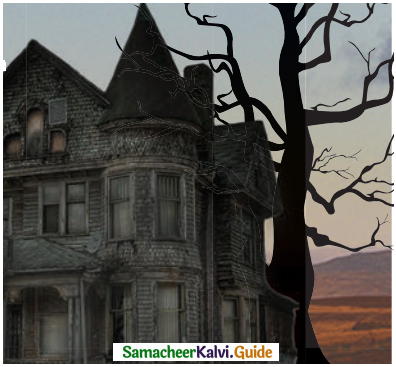
Samacheer Kalvi 9th English Guide Poem 1 Stopping by Woods on a Snowy Evening

Tamilnadu State Board New Syllabus Samacheer Kalvi 9th English Guide Pdf Poem 1 Stopping by Woods on a Snowy Evening Questions and Answers, Summary, Notes.

Tamilnadu Samacheer Kalvi 9th English Solutions Poem 1 Stopping by Woods on a Snowy Evening

9th English Guide Stopping by Woods on a Snowy Evening Textbook Questions and Answers

B. Answer the following questions in a sentence or two.

1. He will not see me stopping here
To watch his woods fill up with snow.

Question (a).
Who does ‘he’ refer to?
Answer:
He refers to the owner of the forest.

Question (b).
Identify the season with these lines
Answer:
It is the winter season.

2. My little horse must think it queer
To stop without a farmhouse near

Samacheer Kalvi 9th English Guide Poem 1 Stopping by Woods on a Snowy Evening

Question (a).
Who is the speaker?
Answer:
The poet is the speaker.

Question (b).
Why should the horse think it queer?
Answer:
The horse thought it queer because there was no farmhouse near,

Question (c).
Pick out the rhyming words:
Answer:
The rhyming words are: “queer, near”

3. He gives his harness bells a shake
To ask if there is some mistake.

Samacheer Kalvi 9th English Guide Poem 1 Stopping by Woods on a Snowy Evening

Question (a).
Whom does ‘he’ refer to in these lines?
Answer:
He refers to the horse.

Question (b).
Why does he give his harness bells a shake?
Answer:
He gives his harness bells a shake to ask the master if there is some mistake.

Question (c).
How does the horse communicate with the poet?
Answer:
The horse communicates with the sound of the harness bells.

4. The woods are lovely, dark, and deep
But I have promises to keep

Question (a).
How are the woods?
Answer:
The wood are lovely, dark and deep.

Samacheer Kalvi 9th English Guide Poem 1 Stopping by Woods on a Snowy Evening

Question (b).
Who does T refer to?
Answer:
T refers to the poet.

Question (c).
What are the promises the speaker is talking about?
Answer:
The poet is talking about his commitments in life.

5. And miles to go before I sleep,
And miles to go before I sleep.

Question (a).
Why has the poet repeated the last line?
Answer:
The poet has repeated the last line to show the regrets that he is unable to enjoy the beauty of the forest filled with sno w.

Question (b).
Explain: miles to go before I sleep
Answer:
The poet reminds himself of his duties he has to do before he goes to sleep. Sleep symbolizes daily sleep and eternal sleep which is death.

Samacheer Kalvi 9th English Guide Poem 1 Stopping by Woods on a Snowy Evening

C. Complete the summary of the poem by filling in the blanks.

After a long travel, the poet entered a (1) ………. He wondered to whom the wood (2)……….. He realized that the owner of the wood lived in a (3)………. He was happy that the owner would not be able to (4)………. him stopping in his woods to watch (5)………. fill the woods. The poet felt that the horse would think it very (6)………. to stop near the woods as he had never (7)……….. He was actually standing between the woods and (8)……….. The time was (9)………. The horse indicated that the poet had made a (10)………….. by shaking its head, The poet felt that the woods are lovely, (11)………. and (12)………. He suddenly realized that he had worldly (13)………. which would not allow him to (14)………. in the woods for a long time.
Answer:

  1. forest
  2. belongs to
  3. village
  4. see
  5. how the snow would
  6. strange
  7. stopped there
  8.  lake
  9. evening
  10. mistake
  11. dark
  12. deep
  13. duties
  14. stay

Samacheer Kalvi 9th English Guide Poem 1 Stopping by Woods on a Snowy Evening

D. Answer the questions in two or three sentences.

Question 1.
What information does the poet highlight about the seasons and the time of the day in the poem?
Answer:
The darkest evening of the year refers to December 21, the longest night of the year, when there is biting cold. The winter season had its spell on Nature. By using the symbol of darkness in the second stanza, the poet brings forth a sense of sadness and peace.

Question 2.
In which way is the reaction of the speaker different from that of the horse? what does it convey?
Answer:
The poet is compelled to stop to stare at the beauty of the woods. The horse is thinking it queer to stop by the forest before reaching the farmhouse. It conveys contradictory ideas over a certain action.

Question 3.
What are the sounds heard by the poet?
Answer:
Shaking of harness bells and the sound of the wind is heard by the poet.

Samacheer Kalvi 9th English Guide Poem 1 Stopping by Woods on a Snowy Evening

Question 4.
The poet is aware of two choices, what are they? what choice does he make ultimately?
Answer:
Hie poet can wait and watch the lovely woods or he can go home and attend to the important business. His ultimate choice was to go a long way and reach home.

Question 5.
Pick out words from the poem that brings to mind peace and quiet.
Answer:
Pick out words from the poem that brings to mind peace and quiet. Some words that bring to mind peace and quiet are: deep; easy wind; woods; snow; frozen lake; And miles to go before I sleep.

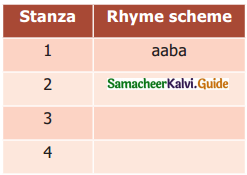
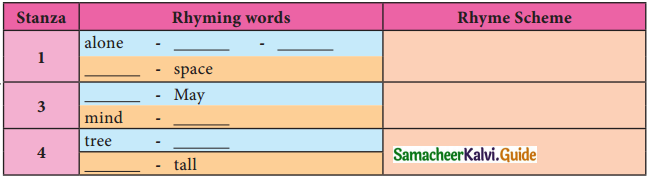
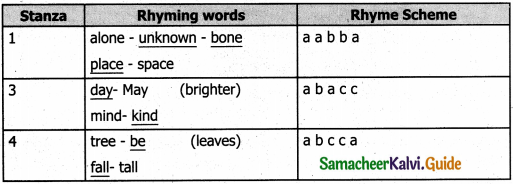
E. Identify the rhymes scheme used in each stanza. One example has been done for you.
Samacheer Kalvi 9th English Guide Poem 1 Stopping by Woods on a Snowy Evening
Answer:

  1. aaba
  2. aaba(bbcb)
  3. aaba (cede)
  4. aaaa (dddd)

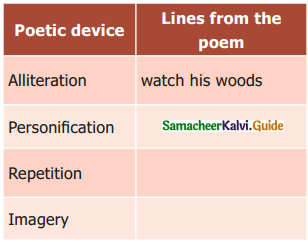
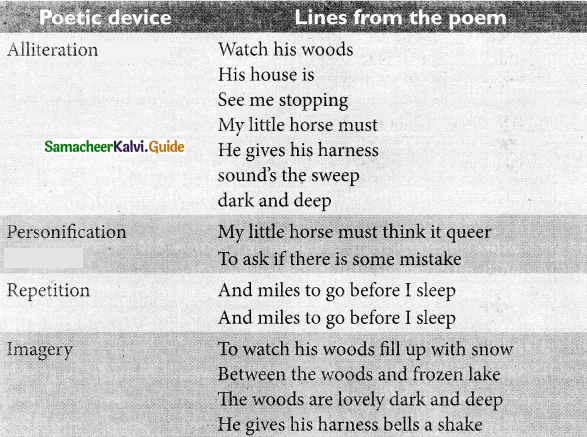
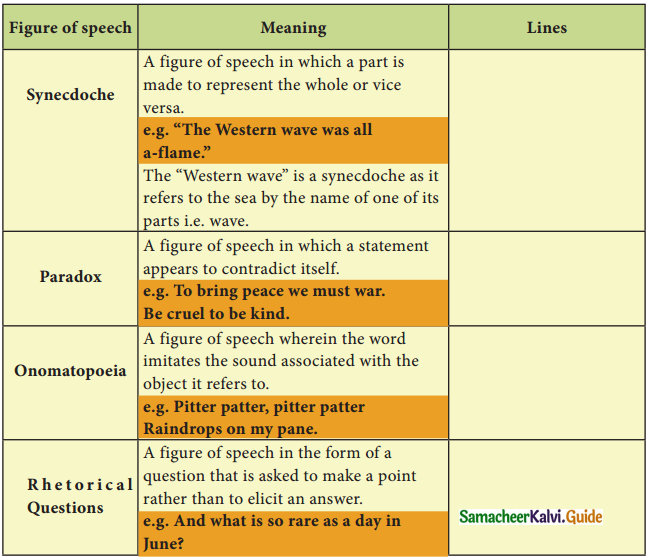
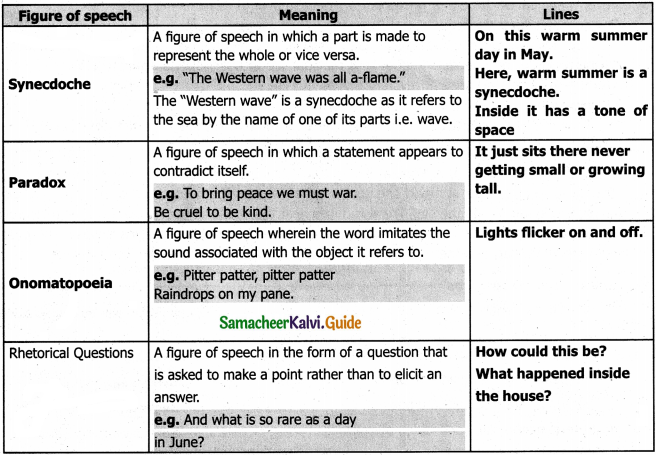
F. Complete the table by identifying lines, against the poetic devices front the poem. One example is done for you.
Samacheer Kalvi 9th English Guide Poem 1 Stopping by Woods on a Snowy Evening
Answer:
Samacheer Kalvi 9th English Guide Poem 1 Stopping by Woods on a Snowy Evening

Samacheer Kalvi 9th English Guide Poem 1 Stopping by Woods on a Snowy Evening

Writing

G. Answer the following questions in a paragraph about 80-100 words.
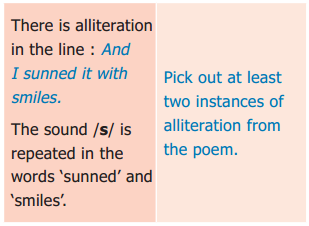
Question 1.
It is said that ’’the choices made by one, shape one’s destiny” Ponder on the thought and write a paragraph.
Answer:
The choices made by one, shape one’s destiny. This is the theme of the poem ‘Stopping by Woods on a Snowy Evening’ by Robert Frost. The biggest choice that he wrestles with is whether to return to the warmth and safety of the village or to stay and watch the woods fill up with snow. The poet finds it hard to decide. He ultimately decides to return home, but it seems to take all of his will power.

H. Work in. pairs and discuss the factors that contribute towards making a choice and make a presentation to the class.
Answer:
No one on this earth is without a choice, choice is an ambition in life. Everyone wants to become; somebody, Everyone wants to do something new in life. Each one wants to do different things. Each one is unique. Each choice demands a lot from the choice maker. In order to become an engineer or a scientist or doctor or sportsman or lawyer, one must choose his subject matching with the
career.

This is the first level in career choice. Once the studies are over, then comes the choice of a career. For everything, education is the basic thing except a few. whatever we desire or aim to do becomes true in our life. Destiny or fate is shaped by every individual’s choice. One who wants to be a sports person like Sachin or Srikkanth must work towards it. One who wants to be a doctor or a scientist.

Samacheer Kalvi 9th English Guide Poem 1 Stopping by Woods on a Snowy Evening

Samacheer Kalvi 10th English Guide Supplementary Chapter 4 The Aged Mother

Tamilnadu State Board New Syllabus Samacheer Kalvi 10th English Guide Pdf Supplementary Chapter 4 The Aged Mother Questions and Answers, Summary, Notes.

Tamilnadu Samacheer Kalvi 10th English Solutions Supplementary Chapter 4 The Aged Mother

10th English Guide Supplementary The Aged Mother Textbook Questions and Answers

A. Rearrange the sentences given below in the correct sequence.

  1. The son made up his mind to take back his mother home.
  2. A farmer decided to leave his old mother on top of a mountain.
  3. The governor realized his mistake and abolished the law.
  4. Once in Shining, a cruel ruler declared that all old people must be put to death.
  5. Using the clever idea of his mother, the farmer made a rope of ashes.
  6. When the farmer bade farewell, she advised him to return home with the aid of twigs.
  7. Filled with dread, he hid his mother in his home.
  8. The mother dropped the small twigs as markers on the way to help her son return.

Answers:

  1. Once in Shining, a cruel ruler declared that all old people must be put to death.
  2. A farmer decided to leave his old mother on top of a mountain.
  3. The mother dropped the small twigs as markers on the way to help her son return.
  4. When the farmer bade farewell, she advised him to return home with the aid of twigs.
  5. The son made up his mind to take back his mother home.
  6. Filled with dread, he hid his mother in his home.
  7. Using the clever idea of his mother, the farmer made a rope of ashes.
  8. The governor realized his mistake and abolished the law.

B. Answer the following questions in one or two sentences.

Question 1.
What was the cruel announcement made by the leader?
Answer:
The cruel announcement was to put to death all the aged people.

Samacheer Kalvi 10th English Guide Supplementary Chapter 4 The Aged Mother

Question 2.
Why was the farmer filled with sorrow?
Answer:
The farmer was filled with sorrow because he loved his aged mother very much. He did not want her to die.

Question 3.
What were the things carried by the farmer to the summit of the mountain?
Answer:
He took a quantity of unwhitened rice. He cooked and dried it. He tied it in a square cloth and swung it in a bundle around his neck. He also took a gourd filled with cool sweet water.

Samacheer Kalvi 10th English Guide Supplementary Chapter 4 The Aged Mother

Question 4.
Why did the mother become anxious as they climbed up the mountain?
Answer:
The mother became anxious because her son did not know the mountain’s many paths and his return might be one of the dangers.

Question 5.
What did the mother drop along the way?
Answer:
She dropped a pile of twigs along the way.

Question 6.
What was the advice given by his mother for the safe return of her son?
Answer:
The mother advised her son to look carefully and follow the path which holds the piles of twigs which will guide him to the familiar path farther down.

Samacheer Kalvi 10th English Guide Supplementary Chapter 4 The Aged Mother

Question 7.
Why did the farmer’s burden seem to be light on his way back home?
Answer:
The farmer’s burden seemed to be light on his way back because he was happy to take his mother back to his home.

Question 8.
Where did the farmer hide his mother?
Answer:
The farmer hid his mother in a walled closet beneath the kitchen floor.

Samacheer Kalvi 10th English Guide Supplementary Chapter 4 The Aged Mother

Question 9.
How did the farmer make the rope of ashes? On whose suggestion did he do it?
Answer:
Using the clever idea of his mother, the farmer made a rope of ashes. He made this by making a rope of twisted straw and burning it on a windless night.

Question 10.
How did the Governor realize his mistake?
Answer:
The governor realized his mistake when he listened to the farmer’s story and meditated in silence. He abolished his cruel law.

C. Answer each of the following in a paragraph of 120 to 150 words.
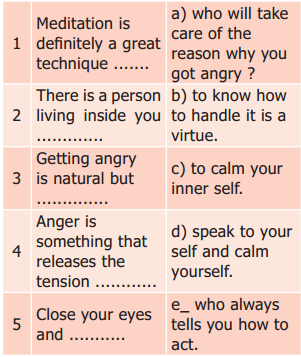
Question 1.
Narrate the circumstances that led to the abandoning of the aged in Shining.
Answer:
The country Shining was governed by a cruel leader. He was a warrior. But he had a great and cowardly shrinking from anything suggestive of failing health and strength. This caused him to send out a cruel announcement. The entire province was given strict orders to immediately put to death all aged people. Those were harsh days and the custom of abandoning old people to die was common.

The poor farmer loved his aged mother with tender respect. This order filled his heart with sorrow. But no one ever thought twice about it. So with many deep and hopeless sighs, the farmer prepared to give his mother the kindest mode of death. He decided to take her to the summit of the Obatsuyama mountain and leave her there.

(OR)

Title: The Aged Mother
Author: Matsuo Basho (1644 – 1694)
Character: The farmer, his mother, and the governor
Theme: “Haste makes waste”

Shining was ruled by a cruel ruler. He was a warrior. He was a coward shrinking from anything’ suggestive of failing health and strength. This caused him to make a cruel announcement.

The province was given strict orders to put to death all aged people. The poor farmer loved his aged mother and respected her. This order made him very sad. But none thought twice about it. So the farmer prepared to give his mother the kindest mode of death. He took her to the bare summit called Obat-suyama, the mountain of ‘abandoning of the aged’.

(OR)

  1. A cruel leader ruled ‘Shining’
  2. He was a warrior
  3. He made a cruel announcement to kill all aged people
  4. The poor farmer loved his aged mother very much
  5. This order made him very sad
  6. So, the farmer prepared the kindest mode of death for his mother
  7. He took his mother to the summit of Obatsuyama
  8. It was the mountain of abandoning of the aged

Samacheer Kalvi 10th English Guide Supplementary Chapter 4 The Aged Mother

Question 2.
Describe the farmer’s painful journey up the mountain.
Answer:
Introduction:
In this paragraph we are going to see about the painful journey of the farmer who loved his mother very much, up to the mountain.

Farmer’s thoughts:
Shining was ruled by a cruel leader. He ordered the entire province that the old must be killed. The farmer wanted his mother to die at the summit of Obatsuyama.

Painful journey:
At sunset, the farmer carried his mother and took some unwhitened rice. He also took a gourd filled with cool sweet water. The road was long and steep. The path was crossed and recrossed by many wood cutters and farmers.

In some place, he lost the path and got confused. But he didn’t mind it. He went blindly upwards. His mother was anxious about her son’s safety return. So she dropped some piles of twigs on their path. Weary and heart sick he gently released his burden. He made a comfortable place for her mother.

Conclusion:
Thus the farmer, with sorrow hearted left her mother in the mountains of Obatsuyama. Thus, he ended the painful journey up the mountain.

(OR)

Title: The Aged mother
Author: Matsuo Basho (1644 – 1694)
Character: The farmer, his mother
Theme: “Blood is thicker than water”

At sunset, the farmer took some cooked and dried unwhitened rice. He tied it in a cloth and swung it in a bundle around his neck with a gourd of cool sweet water. He took his helpless mother on his back and started his journey up the mountain. The narrow path was crossed.

His mother was anxious that her son did not know many mountain paths. She dropped piles of twigs on their path to help her son return home safely. Weary and heart sick he released his burden. He also prepared a place of comfort as his last duty to her mother. Thus he ended his painful journey up the mountain.

(OR)

  1. At sunset the farmer took some cooked and dried unwhitened rice.
  2. He tied it in a cloth and swung around his neck
  3. He took a gourd with cool sweet water.
  4. He lifted his helpless mother to his back and started his journey.
  5. The long narrow road was crossed by many paths.
  6. Tired and heart sick, he put down his burden
  7. He silently prepared a place of comfort to her mother
  8. Thus he ended his painful journey

Samacheer Kalvi 10th English Guide Supplementary Chapter 4 The Aged Mother

Question 3.
‘The old are wise’. Prove this with reference to the story ‘The Aged Mother.
Answer:
A cruel ruler of Shining in Japan proclaims an announcement that all old people should be put to death. A poor farmer s heart was filled with sorrow after hearing this, because he loved his mother very much. So he carried her to the top of the mountain with a lot of difficulties, as the path was confusing and dangerous. When he bid farewell to her, she advised him to follow the path where piles of twigs were dropped.

It would be easier for him to find his way. Her son’s heart broke at this attitude of his mother. He brought her back and hid her in a closet beneath the kitchen floor. His mother proved her wisdom, when the governor demanded a rope of ashes. She gave her son a clever idea to present a rope of ashes. The Governor was glad. He praised her sense of wisdom and abolished his cruel law.

(OR)

Title: The Aged Mother
Author: Matsuo Basho (1644 – 1694)
Character: The farmer, his mother and the governor.
Theme: “The old are always wise”

Shining was ruled by a cruel leader. He announced that all old people must be put to death. A poor farmer became sad after this announcement, because he loved his mother very much. So he took his mother on his back to the summit. It was very difficult as the path was long, narrow, steep and confusing.

It was crossed and recrossed by many paths. He brought his mother back and hid her in a closet beneath the kitchen floor. The governor demanded for a rope of ashes. The mother gave him clever idea to make it. Her son presented it to the governor. He was amazed. He praised the old mother for her wisdom. Thus he abolished his cruel law against the aged people.

“The aged people deserve our care”

(OR)

  1. Shining was ruled by a cruel leader
  2. He announced to put all the aged to death
  3. A poor farmer became sad as he loved his mother very much
  4. He took his mother to the summit
  5. The path was long, steep and narrow
  6. It was very difficult for him to carry his mother
  7. He left her there and bade farewell to her mother
  8. He brought his mother back home and hid her in a closet
  9. The governor demanded a rope of ashes
  10. The farmer’s mother gave a clever idea to make it
  11. The governor was amazed seeing it
  12. He praised the old mother for her wisdom
  13. The governor abolished the cruel law against the aged people.

D. Identify the character/speaker.

Question 1.
He gave orders for the aged to be put to death.
Answer:
governor

Samacheer Kalvi 10th English Guide Supplementary Chapter 4 The Aged Mother

Question 2.
He considered the order to be the kindest mode of death.
Answer:
farmer

Question 3.
She quietly dropped some twigs on the way.
Answer:
the aged mother

Question 4.
Let not thine eyes be blinded.
Answer:
the aged mother

Samacheer Kalvi 10th English Guide Supplementary Chapter 4 The Aged Mother

Question 5.
Together we will follow the path together we will die.
Answer:
farmer

Question 6.
I will think. I will think.
Answer:
the aged mother

Question 7.
The truth must be told.
Answer:
farmer

Samacheer Kalvi 10th English Guide Supplementary Chapter 4 The Aged Mother

Question 8.
He listened and meditated in silence.
Answer:
governor

Question 9.
Shining needs more than the strength of the youth.
Answer:
governor

Samacheer Kalvi 10th English Guide Supplementary Chapter 4 The Aged Mother

Question 10.
With the crown of snow there cometh wisdom.
Answer:
governor

E. Choose the appropriate answer and fill in the blanks.

Question 1.
Shining was governed by a ………………… leader.
(a) strict
(b) kind
(c) cruel
(d) diplomatic.
Answer:
(c) cruel

Samacheer Kalvi 10th English Guide Supplementary Chapter 4 The Aged Mother

Question 2.
The ………………. was the principal food for the poor.
(a) wheat
(b) brown rice
(c) unwhitened rice
(d) millet
Answer:
(c) unwhitened rice

Question 3.
The road was crossed and re-crossed by many paths made by the …………………
(a) hunters and woodcutters
(b) robbers and thieves
(c) vendors and tradesmen
(d) wildlife photographers and trekkers
Answer:
(a) hunters and woodcutters

Samacheer Kalvi 10th English Guide Supplementary Chapter 4 The Aged Mother

Question 4.
Gathering …………………. he made a soft cushion and tenderly lifted his old mother onto it.
(a) dry leaves
(b) fallen pine
(c) broken twigs
(d) flowers
Answer:
(b) fallen pine

Question 5.
The governor demanded that his subjects should present him with a …………………..
(a) basket of fruits
(b) rope of ashes
(c) flesh of animals
(d) bag of silverwares
Answer:
(b) rope of ashes

Rearrange the following sentence in coherent order.

Exercise: 1

1. (a) Strict order were given to put to death all aged people
2. (b) The poor farmer loved his aged mother with tender reverence
3. (c) The order filled his heart with sorrow
4. (d) He had a cowardly shrinking from anything suggestive of failing health and strength
5. (e) The country shining was governed by a despotic leader
Answer:
1. (e) The country shining was governed by a despotic leader
2. (d) He had a cowardly shrinking from anything suggestive of failing health and strength
3. (a) Strict order were given to put to death all aged people
4. (b) The poor farmer loved his aged mother with tender reverence
5. (c) The order filled his heart with sorrow

Exercise: 2

1. (a) The Governor said, “I should have forgotten the well-known saying – with the crown of snow, there cometh wisdom”.
2. (b) The aged mother’s son called the people and made a rope of ashes, as his mother said.
3. (c) With deep bows he related his story.
4. (d) He demanded to know where he had obtained his wisdom.
5. (e) The governor was pleased at the wit of the youth.
Answer:
1. (b) The aged mother’s son called the people and made a rope of ashes, as his mother said.
2. (e) The governor was pleased at the wit of the youth.
3. (d) He demanded to know where he had obtained his wisdom.
4. (c) With deep bows he related his story.
5. (a) The Governor said, “I should have forgotten the well-known saying – with the crown of snow, there cometh wisdom”.

Exercise: 3

1. (a) She gave an idea – “make a rope of twisted straw”
2. (b) Again the governor sent forth herald bearing an unreasonable order.
3. (c) An stretch it upon flat stone and burn it on a windless night.
4. (d) The son whispered the news to his hidden mother.
5. (e) He demanded his subject to present him with a rope of ashes.
Answer:
1. (b) Again the governor sent forth herald bearing an unreasonable order.
2. (e) He demanded his subject to present him with a rope of ashes.
3. (d) The son whispered the news to his hidden mother.
4. (a) She gave an idea – “make a rope of twisted straw”
5. (c) An stretch it upon a flat stone and burn it on a windless night.

Read the passage given below and answer the questions that follow.

1. The country Shining was governed by a despotic leader who though a warrior, had a great and cowardly shrinking from anything suggestive of failing health and strength. This caused him to send out a cruel proclamation. The entire province was given strict orders to immediately put to death all aged people.

Those were barbarous days, and the custom of abandoning old people to die was not uncommon. The poor farmer loved his aged mother with tender reverence, and the order filled his heart with sorrow. But no one ever thought twice about obeying the mandate of the governor, so with many deep and hopeless sighs, the youth prepared for what at that time was considered the kindest mode of death.

Question 1.
Who governed Shining?
Answer:
A despotic leader governed Shining.

Samacheer Kalvi 10th English Guide Supplementary Chapter 4 The Aged Mother

Question 2.
What was the cowardly act of the governor?
Answer:
The cowardly act of the governor was to shrink from anything.

Question 3.
What proclamation did the governor send out?
Answer:
The governor sent out a proclamation to put to death all the aged people.

Samacheer Kalvi 10th English Guide Supplementary Chapter 4 The Aged Mother

Question 4.
How did the poor farmer treat his mother?
Answer:
The poor farmer loved his mother with tender reverence.

Question 5.
Did the people obey the governor’s order?
Answer:
Yes. The people obeyed the governor’s order.

2. Just at sundown, when his day’s work was ended, he took a quantity of unwhitened rice which was the principal food for the poor, and he cooked, dried it, and tied it in a square cloth, which he swung in a bundle around his neck along with a gourd filled with cool, sweet water. Then he lifted his helpless old mother to his back and started on his painful journey up the mountain.

The road was long and steep; the narrow road was crossed and recrossed by many paths made by the hunters and woodcutters. In someplace, they lost and confuse, but he gave no heed. One path or another, it mattered not. On he went, climbing blindly upward ever upward towards the high bare summit of what is known as Obatsuyama, the mountain of the “abandoning of the aged”.

Question 1.
When did he start his journey to the mountain?
Answer:
He started his journey at sunset.

Samacheer Kalvi 10th English Guide Supplementary Chapter 4 The Aged Mother

Question 2.
What did he carry for his mother?
Answer:
He carried some cooked unwhitened rice and some cool sweet water.

Question 3.
How was the road on his journey?
Answer:
The road was long and steep.

Samacheer Kalvi 10th English Guide Supplementary Chapter 4 The Aged Mother

Question 4.
Who made many paths on the narrow road?
Answer:
The hunters and the woodcutters made many paths.

Question 5.
What was the name of the mountain?
Answer:
It was named Obatsuyama.

Samacheer Kalvi 10th English Guide Supplementary Chapter 3 The Story of Mulan

Tamilnadu State Board New Syllabus Samacheer Kalvi 10th English Guide Pdf Supplementary Chapter 3 The Story of Mulan Questions and Answers, Summary, Notes.

Tamilnadu Samacheer Kalvi 10th English Solutions Supplementary Chapter 3 The Story of Mulan

10th English Guide Supplementary The Story of Mulan Textbook Questions and Answers

A. Choose the best answers.

Question 1.
Mulan goes to the battle instead of her father because …………………
(a) she wants to be a soldier
(b) she was asked to join the army,
(c) her father is old
(d) her brother is sick.
Answer:
(c) her father is old

Samacheer Kalvi 10th English Guide Supplementary Chapter 3 The Story of Mulan

Question 2.
What did Mulan do before leaving the house?
(a) took leave from her mother
(b) cut off her hair
(c) prayed
(d) made a dress for war
Answer:
(b) cut off her hair

Question 3.
What is the story about?
(a) winning
(b) friendship
(c) women empowerment
(d) patriotism
Answer:
(c) women empowerment

Samacheer Kalvi 10th English Guide Supplementary Chapter 3 The Story of Mulan

Question 4.
The emperor asked Mulan to stay with him in the palace as his ………………….
(a) wife
(b) royal advisor
(c) army general
(d) friend
Answer:
(b) royal advisor

Question 5.
The emperor gave Mulan …………………..
(a) six horses and six swords
(b) a death sentence
(c) gold
(d) six camels
Answer:
(a) six horses and six swords

Samacheer Kalvi 10th English Guide Supplementary Chapter 3 The Story of Mulan

Question 6.
How did the people of the village react to Mulan after her return from the battle?
(a) cheered her
(b) mocked her
(c) punished her
(d) scolded he
Answer:
(a) cheered her

B. Identify the character or speaker of the following lines.

Question 1.
Did I hear about it in town?
Answer:
Mulan’s father

Question 2.
I am your son now?
Answer:
Mulan

Samacheer Kalvi 10th English Guide Supplementary Chapter 3 The Story of Mulan

Question 3.
The General is a woman?
Answer:
The soldiers

Question 4.
Mulan, stay with me in the palace?
Answer:
The emperor of china

Samacheer Kalvi 10th English Guide Supplementary Chapter 3 The Story of Mulan

Question 5.
You are too kind, sir?
Answer:
Mulan

C. Answer the following questions in a sentence or two.

Question 1.
What was the emperor’s order?
Answer:
The Emperor’s order was that one man from each Chinese family must leave his family. to join the army.

Question 2.
Where did Mulan’s father hear about the emperor’s order?
Answer:
Mulan’s father heard about the emperor’s order in the town.

Samacheer Kalvi 10th English Guide Supplementary Chapter 3 The Story of Mulan

Question 3.
Why couldn’t Mulan’s brother go to war?
Answer:
Mulan’s brother couldn’t go to the war because he was a child.

Question 4.
Why did Mulan disguise herself as a man?
Answer:
Women are not allowed to join the army. So Mulan disguised herself as a man.

Question 5.
How did the soldiers become sick?
Answer:
A bad fever swept through the army. So, many soldiers became sick.

Samacheer Kalvi 10th English Guide Supplementary Chapter 3 The Story of Mulan

Question 6.
How would she be punished if found guilty?
Answer:
She would be killed if found guilty.

Question 7.
Why did the emperor give her fine gifts?
Answer:
The Emperor gave her fine gifts because she won the battle and saved China.

Samacheer Kalvi 10th English Guide Supplementary Chapter 3 The Story of Mulan

Question 8.
How did the soldiers come to know about Mulan’s real identity?
Answer:
When Mulan was affected by fever, the doctor examined her in the tent. He came to know that she was a woman and told the soldiers. Thus they came to know about Mulan’s real identity.

D. Answer the following questions in a paragraph.

Question 1.
Sketch the character of Mulan?
Answer:
Mulan was a brave warrior who saved China from the enemies. She was determined, courageous and intelligent. She was unselfish too. The incident which best attests to this trait was after returning from the war, the Emperor offered her the post of royal advisor. She refused the post and simply told that she wanted to return home. Mulan’s determination helped her through her adventures defeating the enemies’ army. She never gave up in bad situations. At war, she was very intelligent and was a quick planner. This attitude won her the war for the Chinese. She fought in the battle for twelve years and gained high merit. She refused any rewards except for six fine horses and six fine swords.

(OR)

Title: The Story of Mulan
Author: Unknown
Character: Mulan
Theme: The empowered woman is powerful beyond measure.

Mulan was a teenage girl. She was brave and determined to join the army. She had more concern for her father. She acted as a dedicated soldier in the army. She was in charge of the soldiers. Later she was made the General of the army. She never gave up in bad situations. When she was sick she came out and advised the soldiers how they should attack the enemy.

She was intelligent to tackle the problems. They won the battle. The emperor was very glad. Emperor offered him the post of a royal advisor. The emperor was so glad that Mulan ended the long war. Though the emperor wished her to stay in the palace, She preferred to be with her family. She accepted only six fine horses and six fine swords as rewards. Thus Mulan save China from the enemies.

(OR)

  1. Mulan was a teenage girl.
  2. She was brave and intelligent.
  3. She joined the army.
  4. She was in charge of some soldiers.
  5. Later she was made the General of the army.
  6. They won the battle.
  7. The emperor was glad.
  8. He gave her six fine horses and six fine swords as rewards.
  9. Mulan saved China from the enemies.

Samacheer Kalvi 10th English Guide Supplementary Chapter 3 The Story of Mulan

Question 2.
Do you agree with Mulan’s decision to go to war? Justify
Answer:
I agree with Mulan’s decision to go to war. She did not want her father to suffer in his old age. She had the patriotic spirit to save the country. She was also optimistic in her approach. She never bothered about her gender. She had the courage and determination to join the army and fight for the country.

She had no fear of death. Her father was afraid that the emperor would kill her for being a woman. But she dared to fight in the battle. She cut her hair like a man. She wore her father’s robe and picked up the sword. She climbed on a horse and bade him goodbye. She went to join the army.

  1. I agree with Mulan’s decision to go to war.
  2. She did not want her father to suffer in his old age.
  3. She had a patriotic spirit.
  4. She was optimistic.
  5. She had no fear of death.
  6. She was courageous to fight for her country.
  7. But her father was afraid.
  8. She dared to fight in the battle.
  9. She cut her hair like a man.
  10. She climbed on the horse and went to fight in the battle.
  11. Finally she went to join the army.

Samacheer Kalvi 10th English Guide Supplementary Chapter 3 The Story of Mulan

Question 3.
Rearrange the following sentence in a coherent order.

Exercise: 1

1. (a) Mulan the General of the army, became sick too.
2. (b) A heavy fever swept through the army.
3. (c) The soldiers said, “we will not fight for a woment.
4. (d) “The General is a woman” yelled the soldiers.
5. (e) When the doctor came out of Mulan’s tent, he knew the truth.
Answers:
1. (b) A heavy fever swept through the army.
2. (a) Mulan the General of the army, became sick too.
3. (e) When the doctor came out of Mulan’s tent, he knew the truth.
4. (d) “The General is a woman” yelled the soldiers.
5. (c) The soldiers said, “we will not fight for women.

Exercise: 2

1. (a) The war was and China was saved.
2. (b) Mulan ordered the soldiers to hide so they could attack when the enemy king.
3. (c) Mulan heard about the surprise attack.
4. (d) She got dressed and went outside.
5. (e) No one cared anymore that Mulan was a woman.
Answers:
1. (c) Mulan heard about the surprise attack.
2. (d) She got dressed and went outside.
3. (b) Mulan ordered the soldiers to hide so they could attack when the enemy king.
4. (c) Mulan heard about the surprise attack.
5. (a) The war was and China was saved.

Exercise: 3

1. (a) She was not yet strong but stood tall.
2. (b) Mula heard this from inside her tent.
3. (c) A soldier announces, A surprise attack is coming.
4. (d) It was such a big victory that the enemy gave up at-last.
5. (e) She told the soldiers where they must go to hide so could attack the enemy king.

Answers:
1. (c) A soldier announces, A surprise attack is coming.
2. (b) Mula heard this from inside her tent.
3. (a) She was not yet strong but stood tall.
4. (e) She told the soldiers where they must go to hide so could attack the enemy king.
5. (c) A soldier announces, A surprise attack is coming.

Samacheer Kalvi 10th English Guide Supplementary Chapter 1 The Tempest

Tamilnadu State Board New Syllabus Samacheer Kalvi 10th English Guide Pdf Supplementary Chapter 1 The Tempest Questions and Answers, Summary, Notes.

Tamilnadu Samacheer Kalvi 10th English Solutions Supplementary Chapter 1 The Tempest

10th English Guide Supplementary The Tempest Textbook Questions and Answers

A. Choose the correct answer

Question 1.
………………… was the chief of all spirits.
(a) Sycorax
(b) Caliban
(c) Ariel
(d) Prospero
Answer:
(c) Ariel

Samacheer Kalvi 10th English Guide Supplementary Chapter 1 The Tempest

Question 2.
…………………. raised a dreadful storm
(a) Ariel
(b) Prospero
(c) Miranda
(d) Sycorax
Answer:
(b) Prospero

Question 3.
Miranda was brought to the island …………………. years ago
(a) fourteen
(b) ten
(c) twelve
(d) five
Answer:
(c) twelve

Samacheer Kalvi 10th English Guide Supplementary Chapter 1 The Tempest

Question 4.
Prospero ordered Ariel to bring …………………. to his place
(a) Gonzalo
(b) Ferdinand
(c) King of Naples
(d) Antonio
Answer:
(b) Ferdinand

Question 5.
…………………. had provided Prospero formerly with books and provisions
(a) Antonio
(b) Ferdinand
(c) Gonzalo
(d) Ariel
Answer:
(c) Gonzalo

Samacheer Kalvi 10th English Guide Supplementary Chapter 1 The Tempest

Question 6.
The second human being that Miranda saw on this island was …………………
(a) Ariel
(b) Prospero
(c) Ferdinand
(d) Ganzalo
Answer:
(c) Ferdinand

B. Identify the character or speaker

Question 1.
She imprisoned the spirits in the bodies of large trees?
Answer:
Sycorax

Question 2.
He was the chief of all spirits?
Answer:
Ariel

Samacheer Kalvi 10th English Guide Supplementary Chapter 1 The Tempest

Question 3.
I was the Duke of Milan, and you were a princess?
Answer:
Prospero

Question 4.
What a trouble must I have been to you then?
Answer:
Miranda

Samacheer Kalvi 10th English Guide Supplementary Chapter 1 The Tempest

Question 5.
Now pray tell me, sir, your reason for raising this sea-storm?
Answer:
Miranda

Question 6.
I will soon move you.
Answer:
Ariel

Question 7.
I will tie your neck and feet together.
Answer:
Prospero

Samacheer Kalvi 10th English Guide Supplementary Chapter 1 The Tempest

Question 8.
I must finish my task before I take my rest.
Answer:
Ferdinand

Question 9.
He repented and implored his brother’s forgiveness.
Answer:
Antonio

C. Answer the following questions in one or two sentences.

Question 1.
Who were the inhabitants of the island?
Answer:
The inhabitants of the island were an old man named Prospero and his daughter Miranda.

Question 2.
What powers did Prospero possess?
Answer:
Prospero possessed the powers of the duke of Milan.

Samacheer Kalvi 10th English Guide Supplementary Chapter 1 The Tempest

Question 3.
Who was Caliban? What was he employed for?
Answer:
Caliban was the son of a witch named Sycorax. He was employed like a slave to fetch wood and do the most laborious work.

Question 4.
Who was on the ship? How were they related to Prospero?
Answer:
Prospero, Antonio, Gonzalo, and Miranda were on the ship. Antonio was the brother of Prospero. Gonzalo was the lord of his court and Miranda was his little daughter.

Samacheer Kalvi 10th English Guide Supplementary Chapter 1 The Tempest

Question 5.
Why had Prospero raised a violent storm in the sea?
Answer:
Prospero raised a violent storm in the sea to make his enemies repent for the injustice done to him and his daughter.

Question 6.
How did Miranda feel when her father raised the storm to destroy the ship?
Answer:
Miranda felt that all the people will perish when his father raised the storm to destroy the ship.

Samacheer Kalvi 10th English Guide Supplementary Chapter 1 The Tempest

Question 7.
What was Ariel ordered to do with the people on the ship?
Answer:
Prospero ordered Ariel to torment the inmates of the ship by raising a violent storm. He also instructed Ariel to bring Ferdinand, the Prince of Naples to his cave.

Question 8.
Give two reasons why Miranda was so concerned about Ferdinand?
Answer:
Ferdinand was a handsome young man and he seemed to be a true man. For these two reasons, Miranda was so concerned about Ferdinand.

Samacheer Kalvi 10th English Guide Supplementary Chapter 1 The Tempest

Question 9.
Why did Prospero set Ferdinand a severe task to perform?
Answer:
Prospero set Ferdinand a severe task to perform to try his constancy. He resolved to throw some difficulties in his way.

Question 10.
How was Gonzalo helpful to Prospero when he left Milan?
Answer:
Gonzalo helped Prospero by providing books and provisions when he left Milan.

D. Answer the questions in a paragraph of about 100-150 words.

Question 1.
Write a detailed character sketch of Prospero?
Answer:
Prospero was skilled magically and used his powers to create storms, provide entertainment, manipulate others, exercise power, and control over the lives of others. He enjoyed knowledge and learning of spells. He became so entranced by his magic that he did not notice his brother trying to take his title and kill him. Prospero controlled all those who were around him. At the beginning of the play, he got the help of Ariel, the chief of gentle spirits, to create a violent and windy storm to punish his enemies who harmed him and his daughter. Ariel worked for Prospero in exchange for his freedom from a witch, Sycorax. But Caliban was the son of Prospero’s old enemy Sycorax. So, Prospero employed Caliban like a slave, to fetch wood and do the most laborious work.

(OR)

Prospero was an old man. He was a famous Duke of Milan. People of Milan loved him very much. He lived in an island. His daughter Miranda was a beautiful lady. He had released many good spirits from a witch called Sycorax. The spirits were obedient to him. Ariel was the chief among these spirits.

Prospero was deprived of his power by his false brother Antonio. His brother forced Prospero and his daughter into a small boat to die in the sea. But they reached the island and lived there. Prospero was a genuine person. Once Prospero raised a tempest. Prosper wanted Ferdinand to marry his daughter Miranda.

He tested by means of some hard tasks. He forgave his false brother Antonio and the king of Naples. Prospero embraced his brother. He restored their ship to them. Before he left the island. He dismissed Ariel from his service. Prospero was kind not only to his daughter but also to all. He was a nobleman.

Samacheer Kalvi 10th English Guide Supplementary Chapter 1 The Tempest

Question 2.
Narrate how Prospero made his enemies repent to restore his dukedom?
Answer:
Introduction:
Prospero was the Duke of Milan. His brother Antonio wanted to usurp the dukedom from him. So, he sent Prospero and his daughter to an Island. Now, Prospero wanted the enemies to repent for their deeds.

Prospero’s Revenge:
Prospero, by knowing the arrival of his brother Antonio and the king of Naples ordered Ariel to wreck the ship. Ariel wrecked the ship and brought Ferdinand to the island. Ariel tormented Antonio and the king of Naples. He tormented them till they repented for their mistake.

Ariel’s work:
Ariel brought Antonio and King of Naples and Lord Gonzalo. At first they couldn’t recognize him. He discovered himself to lord Gonzalo. The king realised. Antonio repented for his mistake. In turn, Prospero told that Miranda and Ferdinand got married.

Repentance of enemies:
Ariel made Antonio and the King of Naples to repent for their deeds. Antonio with sad words of sorrow, repented for his mistake. Thus, Prospero restored his kingdom.

Conclusion:
Thus, Prospero restored the kingdom. He restored their ship and freed Ariel from the service.

(OR)

Prospero had raised storms with the help of the spirits. Once his enemies, the King of Naples and his cruel brother Antonio were cast ashore. Prospero ordered his chief spirit Ariel to torment them. The King of Naples and Antonio the false brother repented of their injustice to Prospero. He asked Ariel to bring them there.

They could not recognise him. He first discovered himself to the good old Gonzalo, the preserver of his life and then his brother. The king realised that he was the injured Prospero.

When his brother implored his forgiveness, he forgave him. He gave his daughter Miranda as a gift to the king. Prospero told them not to remember their past trouble. He embraced his brother assuring him of his forgiveness. He restored their ship and also freed Ariel.

(OR)

  1. Prospero was the famous Duke of Milan.
  2. People of Milan loved Prospero.
  3. His brother Antonio seized the kingdom.
  4. Antonio sent away Prospero and Miranda to an island.
  5. Prospero released good spirits.
  6. A good spirit helped them.
  7. Prospero raised a storm to wreck the ship.
  8. All of them reached the Island.
  9. Ferdinand and Miranda loved each other.
  10. Prospero’s enemies repented for their fault.
  11. Prospero forgave them.

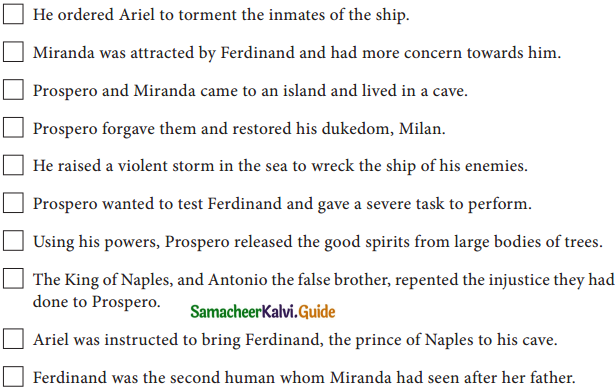
E. Rearrange the following sentences in a coherent order.

Samacheer Kalvi 10th English Guide Supplementary Chapter 1 The Tempest img 1
Answer:

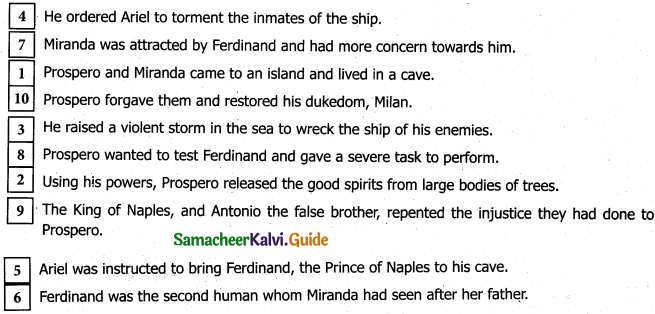
Coherent Order:

  1. Prospero and Miranda came to an island and lived in a cave.
  2. Using his powers, Prospero released the good spirits from large bodies of trees.
  3. He raised a violent storm in the sea to wreck the ship of his enemies.
  4. He ordered Ariel to torment the inmates of the ship.
  5. Ariel was instructed to bring Ferdinand, the Prince of Naples to his cave.
  6. Ferdinand was the second human whom Miranda had seen after her father.
  7. Miranda was attracted by Ferdinand and had more concern towards him.
  8. Prospero wanted to test Ferdinand and gave a severe task to perform.
  9. The King of Naples, and Antonio the false brother, repented the injustice they had done to Prospero.
  10. Prospero forgave them and restored his dukedom, Milan.

Samacheer Kalvi 10th English Guide Poem 7 The House on Elm Street

Tamilnadu State Board New Syllabus Samacheer Kalvi 10th English Guide Pdf Poem 7 The House on Elm Street Questions and Answers, Summary, Notes.

Tamilnadu Samacheer Kalvi 10th English Solutions Poem 7 The House on Elm Street

10th English Guide The House on Elm Street Textbook Questions and Answers

A. Read the given lines and answer the questions given below.

1. It sat alone.
What happened there is still today unknown.
It is a very mysterious place,
And inside you can tell it has a ton of space,
But at the same time, it is bare to the bone.
(a) What does ‘It’ refer to?
(b) Pick out the line that indicates the size of the house?
(c) What is unknown to the poet?
(d) Why is the house a mysterious place?
(e) Find out the rhyming words in the above stanza?
(f) What is the figure of speech in the 1st line?
(g) What is the figure of speech in the 4th line?
Answers:
(a) ‘It’ refers to the mysterious house.
(b) And inside you can tell it has a ton of space, – this line indicates the size of the house.
(c) What happened inside the house
(d) No one knows what is happening inside the house. So it is a mysterious place.
(e) alone – unknown – bone; place – space
(f) Personification
(g) Synecdoche

Samacheer Kalvi 10th English Guide Poem 7 The House on Elm Street

2. “I drive past the house almost every day.
The house seems to be a bit brighter.
On this warm summer day in May.
It plays with your mind.
To me I say, it is the one of a kind”
(a) To whom does ‘I’ refer to?
(b) Pick out the alliterated words in the 2nd line.
(c) When does the poet drive past the house?
(d) What is the season mentioned here?
(e) What plays with our mind?
(f) Pick out the alliterated words in the 1st line?
(g) Find out the rhyming words in the above stanza?
(h) What is the rhyme scheme mentioned in the above stanza?
Answers:
(a) ‘I’ refers to the poetess, Nadia Bush.
(b) The alliterated words in the second line are a bit brighter.
(c) The poet drives past the house every day.
(d) The summer season is mentioned here.
(e) The mystery of the house plays with our minds.
(f) drive – day.
(g) day – may; mind – kind
(h) abacc

Samacheer Kalvi 10th English Guide Poem 7 The House on Elm Street

3. It never grows leaves,
Not in the winter, spring, summer, or fall.
It just sits there never getting small or ever-growing tall
How could this be?
(a) What does ‘it’ refer to?
(b) In what way the tree is a mystery?
(c) What are the reasons mentioned here?
(d) Where does a tree sit?
(e) Pick out the alliterated words in the 4th line?
(f) Find out the rhyming words in the above stanza?
(h) What is the literary device used in the 3rd line?
Answers:
(a) ‘It’ refers to the tree that is beside the house.
(b) ‘It’ refers to the tree that is beside the house.
(c) The tree is a mystery because no leaves grow in it during any one of the season. It neither grow tall nor does it become short.
(d) A tree sits besides the house
(e) getting – growing
(f) tree – be; fall – tall
(g) abcca
(h) Paradox is the literary device.

Samacheer Kalvi 10th English Guide Poem 7 The House on Elm Street

4. “Rumours are conšlandy being made,
And each day the house juši begins to fade.
What happened inside thai house?”
(a) Does the house remain the same every day?
(b) Why does the poet consider the house to be a mystery?
(c) What rumours may be made about the house?
(d) Find out the rhyming words ¡n the above stanza?
(e) What is the rhyme scheme mentioned in the above stanza?
(f) What is the figure of speech In the 2nd line?
Answers:
(a) No, the house doesn’t remain the same everyday.
(b) The poet does not know what is happening in the house
(c) There may be a ghost in the house
(d) made – fade
(e) aab
(f) Hyperbole

Samacheer Kalvi 10th English Guide Poem 7 The House on Elm Street

5. “What happened inside thai house?
I really don‘t know
I guess ii will always be a myšlery”
(a) Does the poet know what happened in the house?
(b) What is the mystery about the house?
Answers:
(a) No, the poetess doesn’t know what happened in the house.
(b) The mystery about the house is nothing but the fact that no one will know what is happening inside the house.

Additional Questions and Answers

1. “At night the house seems to be alive,
Lights flicker on and off
I am often tempted to go to the house,
To just take a look and see what it is really about,
But fear takes over me”
(a) When does the house seem to be alive?
(b) What happened in the house at night?
(c) Does the poet go to the house?
(d) What stopped the poet from going to the house?
Answers:
(a) The house seems to be alive at night
(b) The lights ¡n the house flicker on and oft
(c) No, the poet does not go to the house
(d) It Is her fear.

Samacheer Kalvi 10th English Guide Poem 7 The House on Elm Street

2. At night the house seems to be alive
Lights flicker on and off
(a) How does the house seen to be at night?
(b) What happens to th, lights?
Answrs:
(a) The house seems to be alive at night,
(b) The lights flicker on and off.

3. I am often tempted to go to the house
To just take a look and see what it is really
about
But fear takes over me.
(a) What is the temptation of the poet?
(b) Why did the poet want to go to the house?
(c) Did the poet enter the house? Why?
Answers:
(a) The poet is often tempted to go to the house.
(b) The poet wanted to go to the house to look and see the reality about it.
(c) No, the poet didn’t enter the house because he was afraid to go in.

Samacheer Kalvi 10th English Guide Poem 7 The House on Elm Street

4. Beside the house sits a tree.
It never grows leaves
(a) Where does a tree-sit?
(b) What Is strange about the tree?
Answers:
(a) A tree sits beside the house.
(b) The tree never rows leaves. This is strange about the tree.

B. Answer the following in a paragraph.

Question 1.
Where is the house located? Why is it a mysterious place?
Answers:
The house is located on Elm Street. There isn’t any house around it. It stood all alone in an isolated place on Elm Street. Next to the house, is a tree. The tree to is mysterious like the house since no leaves sprout in any of the seasons. It is said to be a mysterious place ’ since no one knows who lives there or what is inside. No one knows what happens inside that house and hence it is very mysterious. It is for sure a big house with vast space inside the house. Generally, at night, the house looks like it is alive with people in it.

Lights are switched on and off. Every day the poetess drives past the house. The house seems to look a bit brighter on a fine warm summer day in the month of May. The very thought of this mysterious house plays with your mind since it is just one house of this kind in the areas known around. Likewise, the tree too is barren during winter, spring, summer and autumn. The poetess says that the tree just stays there and never grows tall nor becomes short. She wonders how a tree could survive without any leaves or without any growth and hence feels it is a mysterious place.
‘The mystery of existence will always remain a mystery and secret.”

(OR)

Poem: The house of Elm Street
Poet: Nadia Bush
Theme: Mystery of the house

The house is located on Elm Street. It is very big. It is there alone. No one knows about the house. At night the lights flicker on and off. Besides the house, there is a leafless tree.

It has no leaves in winter, spring, summer or fall. It is never getting small or growing tall. There are rumours spread about the house. Every day the house begins to fade. No one knows what happened inside the house. The poet wishes to go into the house. But fear overcome her wish. It is a mysterious house.

(OR)

  1. The house is in Elm Street.
  2. It is there alone.
  3. It is big and simple.
  4. No one lives there.
  5. At night light flickers.
  6. There is a tree without leaves.
  7. It is never getting small or growing tall.
  8. No one knows what happened inside.
  9. It is a mysterious house.

Samacheer Kalvi 10th English Guide Poem 7 The House on Elm Street

Question 2.
How is the mystery depicted in the poem?
Answers:
Introduction:
The poem “The house on Elm Street” tells us about a mysterious house. The house remains a mystery for the poet.

Mystery of the house:
It is a lonely place. It has a lot of space but it is empty. The house looks brighter in the hot summer. The poet doesn’t know what happens inside the house. There is a tree near the house. It never grows leaves. It neither grows tall nor gets smaller. It remains the same.

Poet’s describing theme:
The house begins to fade each day. Rumours are constantly made. But no one knows what happens inside the house. The poet tells that our life in this world is a mystery. We can’t go deep inside to know the purpose or mystery behind our life.

Conclusion:
Thus the poet doesn’t go inside the house. And the house remains a mystery forever.

(OR)

There is a house. It is alone at Elm street. It has plenty of space but remains empty. The lights go on and off at night. The poet is eager to enter the house and see but she is afraid. The house is brighter during the day. There is a tree near the house. It has no leaves. It neither grows tall nor becomes small. It is the same in all seasons. Every day the house begins to fade. The poet does not know what happens there. Thus the house remains a mystery forever.

(OR)

  1. The house is lonely,spacious but empty.
  2. At night lights go on and off.
  3. The poet is afraid of going inside.
  4. There is a bare tree near the house.
  5. It grows neither tall nor small in all seasons.
  6. The rumours spread constantly.
  7. Each day the house begins to fade.
  8. The poet does not know what happens
  9. Thus the house is a mystery forever.

C. Read the poem and write the rhyming words and rhyme scheme for the given stanzas.

Samacheer Kalvi 10th English Guide Poem Chapter 7 The House on Elm Street img 1
Answer:

D. Identify the poetic lines where the following figures of speech are employed and complete the tabular column.


Answer:

The House on Elm Street Summary of the poem

Samacheer Kalvi 10th English Guide Poem Chapter 7 The House on Elm Street img 5

The poem ‘The house on ELM street’ describes a mysterious house and a never growing tree. The poet fears to go inside the house. No one knows, what happened inside the house. It remains to be a mystery. The house begins to fade each day. The house remains to be a mystery always. Besides the house sits a tree which never grows leaves in any season. The poet metaphorically tells that our life ¡n this world is a mystery. We can’t go deep inside to know the purpose of the mystery behind our life.

Samacheer Kalvi 5th Tamil Guide Chapter 8.3 காணாமல் போன பணப்பை

Tamilnadu State Board New Syllabus Samacheer Kalvi 5th Tamil Guide Pdf Chapter 8.3 காணாமல் போன பணப்பை Text Book Back Questions and Answers, Summary, Notes.

Tamilnadu Samacheer Kalvi 5th Tamil Solutions Chapter 8.3 காணாமல் போன பணப்பை

மதிப்பீடு

வினாக்களுக்கு விடையளிக்க.

Question 1.
பணப்பையைப் பெற்றுக் கொண்ட வணிகன் என்ன கூறினான்?
Answer:
வணிகன், பணப்பையைப் பெற்றுக் கொண்டு “என் பையில் அதிகப் பணம் இருந்தது. இப்போது பணம் குறைகிறது” என்று பொய் சொன்னான்.

Samacheer Kalvi 5th Tamil Guide Chapter 8.3 காணாமல் போன பணப்பை

Question 2.
இக்கதையின் மூலம் நீ அறியும் நீதி என்ன?
Answer:
இக்கதையின் மூலம் நான் அறியும் நீதி – ‘நேர்மை நன்மை தரும்.’

Question 3.
இக்கதையில் நீ விரும்பிய கதைமாந்தர் யார்? அவர்ப் பற்றி ஐந்து வரிகளில் எழுதுக.
Answer:

  • இக்கதையில் நான் விரும்பிய கதைமாந்தர் மூதாட்டி.
  • மூதாட்டி நினைத்திருந்தால் அப்பணப்பையை அவளே எடுத்துக் கொண்டிருக்கலாம்.
    ஆனால் நேர்மையாக சிற்றரசரிடம் ஒப்படைத்துள்ளார்.
  • அம்மூதாட்டியின் நேர்மைக்குக் கிடைத்த பரிசுதான் அப்பணப்பை.
  • இச்செயலால் எனக்கு இம்மூதாட்டியைப் பிடிக்கும்.\

Samacheer Kalvi 5th Tamil Guide Chapter 8.3 காணாமல் போன பணப்பை

சிந்தனை வினா.

Question 1.
நீங்கள் அரசராக இருந்தால், இந்தச் சிக்கலுக்கு என்ன முடிவெடுப்பீர்கள்?
Answer:
நான் அரசராக இருந்தால் அவர் செய்தபடியே அப்பணத்தை மூதாட்டியிடம் ஒப்படைத்து விடுவேன். மேலும், அவ்வணிகரை ஒரு மாதத்திற்கு அரண்மனையிலும் அரசாங்க நிலத்திலும் ஊதியமின்றிப் பணி செய்ய வேண்டும் என கட்டளையிடுவேன்.

கற்பவை கற்றபின்

Question 1.
நேர்மையால் ஒருவர் உயர்வதாக ஒரு பக்க அளவில் கதை எழுதுக.
Answer:
மன்னன் ஒருவன் தன் நாட்டு மக்கள் நேர்மையாக வாழ்கின்றனரா என்று அறிய விரும்பினான். அதனால் அரசுப் பணியாளரிடம் இரண்டு ரொட்டித் துண்டுகளைக் கொடுத்து இரண்டு பேரிடம் கொடுக்கச் சொன்னார். ஒரு ரொட்டியில் வைரக்கற்களை உள்ளே வைத்தும் ஒரு ரொட்டித் துண்டில் ஒன்றும் வைக்காமலும் கொடுத்து விட்டார்.

Samacheer Kalvi 5th Tamil Guide Chapter 8.3 காணாமல் போன பணப்பை

அரசுப் பணியாளர் அரண்மனையை விட்டு வெளியே சென்று வைரக்கற்கள் உள்ள ரொட்டியைச் சாது ஒருவரிடமும் சாதாரண ரொட்டியைப் பிச்சைக்காரரிடமும் கொடுத்தான்.

மன்னர் அதைப் பார்த்துக்கொண்டே இருந்தார். சாது ரொட்டியை வாங்கிப் பார்த்தார். பெரியதாகவும் கரடுமுரடாகவும் இருந்தால் அது வேகவில்லை என எண்ணி அதனைப் பிச்சைக்காரரிடம் கொடுத்துவிட்டுப் பிச்சைக்காரரிடம் இருந்த ரொட்டியை அவர் வாங்கிக் கொண்டும் சென்று விட்டார்.

சாது வீட்டுக்குச் சென்றார். தாடியை அகற்றி விட்டு ரொட்டியைச் சாப்பிட்டுவிட்டு மீண்டும் தாடியைப் பொருத்திக் கொண்டார். வெளியே சென்றுவிட்டார். பிச்சைக்காரர் வீட்டிற்குச் சென்றார். தன் மனைவியுடன் ரொட்டியைப் பகிர்ந்து உண்பதற்காக எடுத்தார்.

அதற்குள் விலையுயர்ந்த வைரக் கற்களைப் பார்த்ததும் அதனை அரசுப் பணியாளரிடம் கொடுக்க 5 முன் வந்தார். மனைவியோ தானே வைத்துக் கொள்ளலாம் என்று கூறினாள். அவர் அவளுடைய பேச்சைக் கேட்காமல் அரண்மனைக்கு எடுத்துச் சென்றார்.

Samacheer Kalvi 5th Tamil Guide Chapter 8.3 காணாமல் போன பணப்பை

மன்னரிடம் நடந்தவற்றைக் கூறினான். மன்னன் அவனுடைய நேர்மையைப் பாராட்டி E அவர் கொண்டு வந்த வைரத்தை அவனுக்கே திருப்பிக் கொடுத்தார். பிச்சைக்காரரும் – தனது நேர்மைக்குக் கிடைத்த பரிசாக எண்ணி வாங்கிக் கொண்டார். கொஞ்சம் வைரத்தை : விற்றுப் புதிய தொழில் தொடங்கி வாழ்வில் முன்னேறினார்.

நீதி : நேர்மைக்கு கிடைத்த பரிசு

Question 2.
‘காணாமல் போன பணப்பை’ – இக்கதையை நாடகமாக நடித்துக் காட்டுக.
Answer:
மாணவர்கள் தாங்களாகவே செய்ய வேண்டியவை.

Question 3.
‘காணாமல் போன பணப்பை’ – கதையை உரையாடல் வடிவில் எழுதுக.
Answer:
காணாமல் போன பணப்பை
(வணிகன் ஒருவன் தன்னிடமிருந்த ஆடுகளை விற்று, பணத்துடன் தன் ஊருக்குத் திரும்பினான். “இப்பணத்தில் ஆடுகள் வாங்கி விற்றால் லாபம் கிடைக்கும். நான் பெரும் பணக்காரன் ஆவேன்” எனக் கற்பனை செய்தவாறு தன் கையில் இருந்து பணப்பையை நழுவ விட்டான். மறுநாள் சிற்றரசனிடம் சென்று முறையிட்டான்.)

Samacheer Kalvi 5th Tamil Guide Chapter 8.3 காணாமல் போன பணப்பை

வணிகன் : அரசே! என் பணப்பையை வரும் வழியில் தொலைத்து விட்டேன். அதை எடுத்தவர்கள் திருப்பிக் கொடுத்தால் நாற்பது பணம் சன்மானமாகக் கொடுத்து விடுகிறேன். அருள் கூர்ந்து இதை ஊர் மக்களுக்கு அறிவிக்க வேண்டுகிறேன்.

அரசன் : அவ்வாறே ஆகட்டும்!
முரசு அறைந்து நாட்டு மக்களுக்கு அறிவித்தான்.)
(மூன்று நாட்களுக்குப் பிறகு)

மூதாட்டி : அரசே! இப்பணப்பையை நான் சென்ற வழியில் பார்த்தேன். இதைப் பிடித்துக் கொள்ளுங்கள்.
சிற்றரசன் : உங்கள் நேர்மையையும், நாணயத்தையும் கண்டு மெச்சுகிறேன்.
சிற்றரசன் : (வணிகரிடம்) மூதாட்டிக்கு தக்க வெகுமதியை கொடுத்துவிடு.

வணிகன் : (பணத்தை எண்ணிப் பார்த்தான். சன்மானம் அளிக்க மனமில்லை இப்பையில் அதிகப் பணம் இருந்தது. இப்போது பணம் குறைகிறது.

சிற்றரசன் : (வணிகருக்கு நல்ல பாடம் கற்பிக்க நினைத்தான்) “வணிகனே! உன்பையில் இப்போது இருப்பதைக் காட்டிலும் அதிகமாகப் பணம் இருந்தது இல்லையா? எனவே, இது உன் பை இல்லை, வேறு யாருடையதோ தெரியவில்லை. பணத்திற்குச் சொந்தக்காரன் வந்து கேட்கும்வரை என்னிடமே இருக்கட்டும். நீ இவ்விடத்தைவிட்டுப் போகலாம்.

Samacheer Kalvi 5th Tamil Guide Chapter 8.3 காணாமல் போன பணப்பை

சிற்றரசன் : பணத்தை வைத்திருப்பவன் மட்டுமே பணக்காரன் அல்லன்; சொன்ன சொல்லை மறவாது மற்றவர்க்குப் பெருந்தன்மையுடன் கொடுக்கும் உள்ளம் படைத்தவனே பணக்காரன்.

(மூதாட்டியின் நேர்மையைப் பாராட்டிப் பணப்பையை அவருக்கே பரிசாகக் கொடுத்துவிட்டார்.)
(வணிகன் பணத்தையும் இழந்தான். மற்றவர்களின் கேலிப்பேச்சுக்கு ஆளானான்.)

Samacheer Kalvi 5th Tamil Guide Chapter 8.3 காணாமல் போன பணப்பை

கூடுதல் வினாக்கள்

நிரப்புக .

1. பணப்பையை நழுவ விட்டவன்
Answer:
வணிகன்

2. நேர்மையுற்றவனாய் இருந்தவன் …………………..
Answer:
வணிகன்

3. நேர்மையுடன் பணப்பையைக் கொண்டு வந்தவர் …………………………
Answer:
மூதாட்டி

4. வணிகன் நேர்மையற்றவனாய் இருந்ததனால் மற்றவர்களுடைய ……………….., ……………………..ஆளானான்.
Answer:
இகழ்ச்சிக்கும், கேலிப்பேச்சுக்கும்

Samacheer Kalvi 5th Tamil Guide Chapter 8.3 காணாமல் போன பணப்பை

விடையளி :

Question 1.
வணிகன் பணப்பையை நழுவ விட்டதற்கான காரணம் என்ன?
Answer:
வணிகன் ஆடுகளை விற்ற பணத்தை எடுத்துக் கொண்டு வரும்போது அளவுக்கு மிஞ்சிய கனவில் மிதந்துகொண்டே நடந்தான். இந்தப் பணத்தில் நிறைய ஆடுகள் வாங்கி விற்று பெரும் பணக்காரன் ஆக வேண்டும் என்று கற்பனை செய்து கொண்டே அவனையும் அறியாமல் தான் வைத்திருந்த பணப்பையை நழுவவிட்டான்.

Question 2.
வணிகன் சிற்றரசனிடம் என்னவென்று முறையிட்டான்?
Answer:
“அரசே! என் பணப்பையை வரும் வழியில் தொலைத்துவிட்டேன். அதை எடுத்தவர்கள் திருப்பிக் கொடுத்தால் நாற்பது பணம் சன்மானமாகக் கொடுத்து விடுகிறேன். அருள் கூர்ந்து இதை ஊர் மக்களுக்கு அறிவிக்க வேண்டுகிறேன்” என்று வணிகன் சிற்றரசனிடம் முறையிட்டான்.

Samacheer Kalvi 5th Tamil Guide Chapter 8.3 காணாமல் போன பணப்பை

Question 3.
வணிகனுக்குச் சிற்றரசன் எவ்வாறு பாடம் கற்பித்தார்?
Answer:
வணிகன் பணம் குறைகிறது என்று பொய் சொன்னதை அறிந்து கொண்ட அரசன், “வணிகனே உன் பையில் இப்போது இருப்பதைக் காட்டிலும் அதிகமாகப் பணம் இருந்தது இல்லையா? எனவே, இது உன் பை இல்லை; வேறு யாருடையதோ தெரியவில்லை. பணத்திற்குச் சொந்தக்காரன் வந்து கேட்கும் வரை என்னிடமே இருக்கட்டும். நீ இவ்விடத்தைவிட்டுப் போகலாம்” என ஆணையிட்டார்.

Samacheer Kalvi 5th Tamil Guide Chapter 8.2 நீதியை நிலைநாட்டிய சிலம்பு

Tamilnadu State Board New Syllabus Samacheer Kalvi 5th Tamil Guide Pdf Chapter 8.2 நீதியை நிலைநாட்டிய சிலம்பு Text Book Back Questions and Answers, Summary, Notes.

Tamilnadu Samacheer Kalvi 5th Tamil Solutions Chapter 8.2 நீதியை நிலைநாட்டிய சிலம்பு

மதிப்பீடு 

படிப்போம்! சிந்திப்போம்!

அ. எழுதுவோம்! சரியான சொல்லைத் தெரிவு செய்து எழுதுக.

Question 1.
புறாவிற்காகத் தன் உடலையே தந்த மன்னன் ………….
அ) மனுநீதிச்சோழன்
ஆ) பாண்டியன்
இ) சிபி மன்ன ன்
ஈ) அதியமான்
Answer:
இ) சிபி மன்னன்

Samacheer Kalvi 5th Tamil Guide Chapter 8.2 நீதியை நிலைநாட்டிய சிலம்பு

Question 2.
கண்ண கியின் சிலம்பு …………….. ஆல் ஆனது.
அ) முத்து
ஆ) மாணிக்கம்
இ) பவளம்
ஈ) மரகதம்
Answer:
ஆ) மாணிக்கம்

Question 3.
அறநெறி – இச்சொல்லைப் பிரித்து எழுதக் கிடைப்பது ……………….
அ) அறி + நெறி
ஆ) அற + நெறி
இ) அறம் + நெறி
ஈ) அறு + நெறி
Answer:
இ) அறம் + நெறி

Samacheer Kalvi 5th Tamil Guide Chapter 8.2 நீதியை நிலைநாட்டிய சிலம்பு

Question 4.
கால் + சிலம்பு – இச்சொற்களைச் சேர்த்து எழுதக் கிடைப்பது …………..
அ) காற்சிலம்பு
ஆ) கால்சிலம்பு
இ) கற்சிலம்பு
ஈ) கல்சிலம்பு
Answer:
அ) காற்சிலம்பு

Question 5.
தண்டித்தல் – இச்சொல்லின் பொருள் ………..
அ) புகழ்தல்
ஆ) நடித்தல்
இ) வழங்குவதல்
ஈ) ஒறுத்தல்
Answer:
ஈ) ஒறுத்தல்

ஆ. கீழ்க்காணும் சொற்களைச் சேர்த்து எழுதுக.
1. அ + ஊர் = ……………………….
2. தகுதி + உடைய = ……………………….
Answer:
1. அ + ஊர் = அவ்வூர்
2. தகுதி + உடைய = தகுதியுடைய

இ. கீழ்க்காணும் சொற்களைப் பிரித்து எழுதுக.
1. கள்வனல்லன் = ………………………. + ……………………….
2. செங்கோல் – = ………………………. + ……………………….
Answer:
1. கள்வனல்லன் = கள்வன் + அல்லன்
2. செங்கோல் – = செம்மை + கோல்

Samacheer Kalvi 5th Tamil Guide Chapter 8.2 நீதியை நிலைநாட்டிய சிலம்பு

ஈ. வினாக்களுக்கு விடையளிக்க.

Question 1.
கண்ணகிக்கு ஏற்பட்ட துன்பம் யாது?
Answer:
கண்ணகியின் கணவனான கோவலன் பாண்டிய மன்னனால் தவறான தீர்ப்பளிக்கப்பட்டு கொல்லப்பட்டான். இதுவே கண்ணகிக்கு ஏற்பட்ட துன்பம் ஆகும்.

Question 2.
புகார் நகரின் சிறப்புகள் யாவை?
Answer:
ஒரு புறாவுக்காக தன் உடலையே தந்த சிபி மன்னனும், பசுவிற்கு நீதி வழங்குவதற்காக, தன் மகனைத் தேர்காலில் இட்டுக் கொன்ற மனுநீதிச் சோழனும் வாழ்ந்த சிறப்புக்குரியது புகார் நகரம்.

Question 3.
பாண்டிய மன்னனின் வெண்கொற்றக் குடை வீழக் காரணமென்ன?
Answer:
பொற்கொல்லன் கூறியதைக் கேட்டு ஆராயாமல் கோவலனுக்குத் தண்டனை அளித்தான் பாண்டிய மன்னன். ஆதலால் அவனுடைய வெண்கொற்றக்குடை வீழ்ந்தது.

Samacheer Kalvi 5th Tamil Guide Chapter 8.2 நீதியை நிலைநாட்டிய சிலம்பு

உ. சிந்தனை வினாக்கள்.

எப்பொருள் யார்யார்வாய்க் கேட்பினும் அப்பொருள்
மெய்ப்பொருள் காண்பது அறிவு. – இந்தக் குறள் கருத்து யாருக்குப் பொருந்தும்?
கண்ணகிக்காக? பாண்டிய மன்னருக்கா? சிந்தித்து விடை தருக.
Answer:
இந்தக் குறள் பாண்டிய மன்னருக்குப் பொருந்தும்.

  • பாண்டிய மன்னன் பொற்கொல்லன் கூறிய பொய்யை உண்மை என நம்பி ஆராய்ந்து முடிவெடுக்கவில்லை.
  • பிறர் சொல் கேட்டுப் பிழை செய்து விட்டான்.
  • ஆட்சிப் பொறுப்பில் மன்னன் இருதரப்பினரின் கருத்துகளுக்கும் மதிப்பளிக்க வேண்டும். தீர விசாரிக்காமல் தீர்ப்பளித்துவிட்டான். ஆகையால் இக்குறள் பாண்டிய மன்னருக்கே பொருந்தும்.

கற்பவை கற்றபின்

Question 1.
நீதிநெறி தொடர்புள்ள கதை அல்லது உண்மை நிகழ்வுகள் பற்றிய செய்திகளைக் கூறி வகுப்பறையில் கலந்துரையாடுக.
Answer:
ஆசிரியர் : வணக்கம் மாணவர்களே! நீங்கள் படித்த நீதிக்கதைகள் பற்றி பேசுங்கள்.
மாலா : அனைவருக்கும் வணக்கம்! நான் நேற்று நூலகத்தில் மரியாதை ராமன் கதையைப் படித்தேன். மிகவும் நன்றாக இருந்தது. மரியாதைராமன் வசித்த ஊரில் சோமன் என்பவர் இருந்தார். அவர் மிகவும் பொல்லாதவர். தன்னிடம் வேலை செய்பவர்களுக்குச் சரியான கூலி கொடுக்கமாட்டார்.

Samacheer Kalvi 5th Tamil Guide Chapter 8.2 நீதியை நிலைநாட்டிய சிலம்பு

அவர் ஒருமுறை தன்னுடைய பணப்பையைத் அவர் தவறவிட்டுவிட்டார். அந்த பணப்பையைக் கண்டுபிடித்துக் கொடுப்பவர்களுக்குச் சன்மானம் தருவதாகக் கூறினார். ஒரு வாரத்திற்குப் பிறகு பூபாலன் என்பவரின் கையில் அப்பணப்பை கிடைத்தது. அப்பணப்பை சோமனுடையது என்று அறிந்து அவனிடம் கொண்டு சென்று கொடுத்தார். ஆனால் அவன் பணம் மட்டும் இருப்பதாகவும் வைர மோதிரம் இல்லையென்றும் கூறினான்.

சன்மானம் கொடுக்க மனமில்லாததால் பொய் கூறுகிறான் என்பதை அறிந்த ஊர் மக்கள் மரியாதைராமனிடம் சென்றனர். மரியதைராமன் நடந்தவற்றைக் கேட்டு அறிந்து, “பையில் வைரமோதிரம் இல்லாததால் அது சோமனுடைய பை இல்லை என்றும் பணப்பையைத் தொலைத்ததாக வேறு யாரும் கூறவில்லை என்பதாலும் இப்பையைப் பூபாலனுக்குக் கொடுத்துவிடலாம்” எனத் தீர்ப்பு கூறினார். ஏமாற்ற நினைத்த சோமன் ஏமாந்து போனான். நல்லது செய்ய நினைத்த
பூபாலன் நன்மையடைந்தான்.

நிலா : நான் தெனாலிராமன் கதைகளுள் ‘நீர் இறைத்த திருடர்கள்’ என்ற
கதையைப் படித்தேன். அதில் தெனாலிராமனின் கிணற்றில் நீர் மிகவும் ஆழத்தில் இருந்தது. தண்ணீர் இறைப்பது அவனுக்குக் கொஞ்சம் சிரமமாக இருந்தது. ஒருநாள் இரவு நான்கு திருடர்கள் அவனுடைய தோட்டத்தில் ஒளிந்திருப்பதைக் கண்டான். தன் மனைவியிடம் வீட்டில் உள்ள நகைகளைப் பெட்டியில் போட்டு எடுத்து வரும்படிக் கூறினான்.

Samacheer Kalvi 5th Tamil Guide Chapter 8.2 நீதியை நிலைநாட்டிய சிலம்பு

“அவற்றைக் கிணற்றில் போட்டு விடலாம். இப்போது வறுமை நீடிப்பதால் திருடர்கள் பயம் அதிகமாக உள்ளது” என்று கூறினான். அதில் கல், மண் போன்றவற்றை வைக்கும்படி மனைவியிடம் சைகை செய்தான். அவ்வாறே பெட்டியைக் கிணற்றில் போட்டுவிட்டு உள்ளே சென்றனர். திருடர்கள் தங்கள் வேலை எளிமையாகிவிட்டது என எண்ணி கிணற்றில் இருந்து தண்ணீரை இறைத்து ஊற்றிய படியே இருந்தனர்.

பொழுதும் விடிந்தது. அவர்கள் மறுநாள் பார்த்துக் கொள்ளலாம் என்று கூறிவிட்டுச் செல்லும்போது, தெனாலிராமன் அங்கு வந்து இரண்டு நாட்கள் கழித்து வரும்படிக் கூறினான். “இன்று இறைத்த நீர் இரண்டு நாட்களுக்குப் போதுமானது” என்று கூறினான். இதனைக் கேட்ட திருடர்கள் தெனாலிராமன் புத்திசாலித்தனமாக தங்களை வேலை வாங்கியதை எண்ணியும், கொஞ்சம் தயங்கினாலும் தாங்கள் மாட்டிக் கொள்வோம் என்றும் பயந்து ஓடினர்.

மாலா : இதுபோல நீதிக்கதைகள் நம்மைப் போன்ற மாணவர்களுக்கு ஒரு நல்ல வழிகாட்டியாய் இருக்கின்றன.

நீலா : சரியாகச் சொன்னாய் மாலா. நான் தெனாலிராமன் கதைகள், அக்பர் பீர்பால் கதைகளைப் படித்தேன். இக்கதைகளும் நமக்கு நீதியைப் புகட்டுகின்றன. தெனாலிராமனின் அறிவுக்கூர்மையும் பீர்பாலின் புத்திக் கூர்மையும் நமக்குச் சிறந்த எடுத்துக்காட்டுகளாகும்.

ஆசிரியர் : மாலா, நீலாவைப் போல் மற்றவர்களும் நூலகம் செல்லும்போது நீதிக்கதையைப் படித்து பயனடையுங்கள். வேறு யாராவது பேச விரும்புகிறீர்களா!

Samacheer Kalvi 5th Tamil Guide Chapter 8.2 நீதியை நிலைநாட்டிய சிலம்பு

கலா : நான்கூட இதுபோன்ற கதைகளை என் தாத்தா பாட்டியிடம் கேட்டிருக்கிறேன். என்னுடைய தாத்தா நேரம் இருக்கும் போதெல்லாம் ! என்னைப் பூங்காவிற்கு அழைத்துச் செல்வார். அப்போது நிறைய கதைகளைக் கூறியுள்ளார். இவர்கள் படித்துப் பெற்ற அனுபவத்தைக் கேட்டுப் பெற்றிருக்கிறேன்.

ஆசிரியர் : நன்று. தாத்தா பாட்டி இருவரும் நடமாடும் நூலகங்கள், அவர்களுடைய அனுபவமே ஒரு புத்தகம்தான். நாளைய வகுப்பில் தொடரலாம்.

கூடுதல் வினாக்கள்

நிரப்புக.

1. பசுவிற்கு நீதி வழங்க தன் மகனைத் தேர்க்காலில் இட்டவர்
Answer:
மனுநீதிச்சோழன்

2. கண்ண கி …………. மனைவி.
Answer:
கோவலனின்

3. பழியில்லாச் சிறப்பினையுடைய புகழ்மிக்கவன் …………. .
Answer:
மாசாத்துவான்

Samacheer Kalvi 5th Tamil Guide Chapter 8.2 நீதியை நிலைநாட்டிய சிலம்பு

4. புகார் நகரில் வாழ்ந்த மன்னர்கள்………………..
Answer:
சோழ மன்னர்கள்

5. பழிச்சொல்லுக்கு அஞ்சி உயிர் நீத்தவர் …………..
Answer:
பாண்டிய மன்னன் நெடுஞ்செழியன்

Samacheer Kalvi 5th Tamil Guide Chapter 8.2 நீதியை நிலைநாட்டிய சிலம்பு

விடையளி :

Question 1.
கண்ணகி அரண்மனை வாயிலின் முன் எவ்வாறு நின்றாள்?
Answer:
கண்ணகி, அழுத கண்களோடும் தலைவிரி கோலத்துடனும் அரண்மனை வாயிலின் முன் நின்றாள்.

Question 2.
புகார் நகரில் வாழ்ந்த மன்னர்களாக கண்ணகி குறிப்பிட்டவர் யாவர்?
Answer:
(i) உலகம் வியக்கும் வண்ணம் ஒரு புறாவுக்காக தன் உடலையே தந்த சிபி மன்னன்.

(ii) பார் போற்றும் பசுவை மக்கள் தெய்வமென வணங்க அதன் கன்றைத் தேர்க்காலிலிட்டுக் கொன்ற தன் மகனையும் அதே தேர்க்காலிலிட்டுக் கொன்றவன் மனுநீதிசோழன் ஆகிய இருமன்னர்களும் புகார் நகரில் வாழ்ந்தவர்கள் என்று கண்ண கி குறிப்பிடுகிறாள்.

Samacheer Kalvi 5th Tamil Guide Chapter 8.2 நீதியை நிலைநாட்டிய சிலம்பு

Question 3.
தாம் செய்தது பிழை என்றறிந்த பாண்டிய மன்னனின் செயல் யாது?
Answer:
“ஆ! தவறிழைத்து விட்டேனே! பிறர் சொல் கேட்டுப் பெரும்பிழை செய்தேனே! யானோ அரசன், யானே கள்வன். இதுவரை என் குலத்தில் எவரும் செய்யாத பழிச் சொல்லுக்கு ஆளாகிவிட்டேனே! இனிமேலும் யான் உயிரோடு இருத்தல் தகுமோ? இனி எனக்கு வெண்கொற்றக்குடை எதற்கு? செங்கோல்தான் எதற்கு? என் வாழ்நாள் இன்றோடு முடிவதாக!” என்று கூறிவிட்டு, பழிச் சொல்லுக்கு அஞ்சி, அரியணையிலிருந்து தரைமீது வீழ்ந்து தன் உயிரை இழந்தார்.

Samacheer Kalvi 5th Tamil Guide Chapter 8.2 நீதியை நிலைநாட்டிய சிலம்பு

Question 4.
கோவலன் கள்வனல்லன் என்பதைக் கண்ணகி எவ்வாறு நிரூபித்தாள்?
Answer:
“என் கணவன் கள்வனல்லன் அவனிடம் இருந்த சிலம்பும் அரசிக்குரிய சிலம்பன்று; அதன் இணைச் சிலம்பு இதோ என்னிடம் உள்ளது. என் கால்சிலம்பின் பரல் மாணிக்கக் கற்களால் ஆனது” என்று கூறியதும் மன்னன் “ அரசிக்குரிய சிலம்பின் பரல் முத்துகளால் ஆனது” என்று கூறிவிட்டு கோவலனிடமிருந்து பெற்ற சிலம்பைக் கொண்டு வரும்படி கட்டளையிட்டான்.

கண்ணகி அச்சிலம்பை எடுத்துத் தரையில் போட்டு உடைத்தாள். அச்சிலம்பில் மாணிக்கப் பரல்கள் இருந்தன. இதைக் கண்டதும் மன்னன் தன் தவற்றை உணர்ந்தான். இவ்வாறு கண்ணகி, கோவலன் கள்வனல்ல என்பதனை நிரூபித்தாள்.

Samacheer Kalvi 5th Tamil Guide Chapter 8.1 கல்வியே தெய்வம்

Tamilnadu State Board New Syllabus Samacheer Kalvi 5th Tamil Guide Pdf Chapter 8.1 கல்வியே தெய்வம் Text Book Back Questions and Answers, Summary, Notes.

Tamilnadu Samacheer Kalvi 5th Tamil Solutions Chapter 8.1 கல்வியே தெய்வம்

மதிப்பீடு 

படிப்போம்!‌ ‌சிந்திப்போம்!‌ ‌எழுதுவோம்!‌ ‌

அ.‌ ‌சரியான‌ ‌சொல்லைத்‌ ‌தெரிவு‌ ‌செய்து‌ ‌எழுதுக.‌

‌Question 1.‌
‌கசடற‌ ‌-‌ ‌இச்சொல்லின்‌ ‌பொருள்‌ ‌………………….‌ ‌
அ)‌ ‌தவறான‌ ‌
ஆ)‌ ‌குற்றம்‌ ‌நீங்க‌ ‌
இ)‌ ‌குற்றமுடன்‌ ‌
ஈ)‌ ‌தெளிவின்றி‌ ‌
Answer:
‌ஆ)‌ ‌குற்றம்‌ ‌நீங்க

Samacheer Kalvi 5th Tamil Guide Chapter 8.1 கல்வியே தெய்வம்

‌Question 2.
வளமதை‌ ‌-‌ ‌இச்சொல்லைப்‌ ‌பிரித்து‌ ‌எழுதக்‌ ‌கிடைப்பது‌ ‌………………….‌ ‌
அ)‌ ‌வள‌ ‌+‌ ‌மதை‌ ‌
ஆ)‌ ‌வளமை‌ ‌+‌ ‌அதை‌ ‌
இ)‌ ‌வளம்‌ ‌+‌ ‌அதை‌ ‌
ஈ)‌ ‌வளம்‌ ‌+‌ ‌மதை‌ ‌
Answer:
‌இ)‌ ‌வளம்‌ ‌+‌ ‌அதை

‌Question 3.
‌வெளிச்சம்‌ ‌-‌ ‌இச்சொல்லின்‌ ‌எதிர்ச்சொல்‌ ‌………………….‌
‌அ)‌ ‌இருட்டு‌ ‌
ஆ)‌ ‌வெளிப்படையான‌
‌இ)‌ ‌வெளியில்‌ ‌
ஈ)‌ ‌பகல்‌ ‌
Answer:
அ)‌ ‌இருட்டு

Samacheer Kalvi 5th Tamil Guide Chapter 8.1 கல்வியே தெய்வம்

ஆ. ஒன்றுபோல்‌ ‌வரும்‌ ‌சொற்களைப்‌ ‌பாடலிலிருந்து‌ ‌எழுதுக.‌
E:\image\Samacheer Kalvi 5th Tamil Guide Chapter 8.1 கல்வியே தெய்வம் - 2
Answer:
Samacheer Kalvi 5th Tamil Guide Chapter 8.1 கல்வியே தெய்வம் - 1

‌இ. எதிர்ச்சொல்‌ ‌எழுதுக.‌ ‌
1.‌ ‌நன்மை‌ ‌x‌ ‌………………….
‌2.‌ ‌புகழ்‌ ‌x‌ ‌‌ ‌………………….
3.‌ ‌வெற்றி‌ ‌x‌ ‌‌ ‌………………….
4.‌ ‌வெளிச்சம்‌ ‌x‌ ‌‌ ‌………………….
5.‌ ‌தோன்றும்‌ ‌x‌‌ ‌………………….
Answer:
1.‌ ‌நன்மை‌ ‌x‌ ‌தீமை‌ ‌
‌2.‌ ‌புகழ்‌ ‌x‌ ‌இகழ்‌ ‌
3.‌ ‌வெற்றி‌ ‌x‌ ‌தோல்வி‌
4.‌ ‌வெளிச்சம்‌ ‌x‌ ‌இருட்டு‌
5.‌ ‌தோன்றும்‌ ‌x‌ ‌மறையும்‌

Samacheer Kalvi 5th Tamil Guide Chapter 8.1 கல்வியே தெய்வம்

ஈ. “உம்” என முடியும் சொற்களைப் பாடலிலிருந்து எடுத்து எழுதுக.

‌1. அன்னையும் தந்தையும்
‌………………………………….
‌ ‌………………………………….
‌ ‌………………………………….
‌ ‌………………………………….
Answer:
1. அன்னையும் தந்தையும்
கண்ணெனும் கல்வியும்
பொன்னையும் மண்ணையும்
நன்மையும் மென்மையும்.

உ. வினாக்களுக்கு விடையளிக்க.

Question 1.
பொன்னையும் மண்ணையும் விடச் சிறந்தது எது?
Answer:
பொன்னையும் மண்ணையும் விடச் சிறந்தது கல்வி.

Question 2.
கல்வியை எவ்வாறு கற்க வேண்டும்?
Answer:
கல்வியைக் குற்றம் நீங்கக் கற்க வேண்டும்.

Samacheer Kalvi 5th Tamil Guide Chapter 8.1 கல்வியே தெய்வம்

ஊ. சிந்தனை வினா.

கல்வியோடு நற்பண்புகளும் அமைவதுதான் சிறப்பு என்று கூறுகிறார்களே, இதுபற்றி உங்கள் கருத்து என்ன?
Answer:
(i) கல்வியோடு நற்பண்புகள் அமைவதுதான் சிறப்பு என்று கூறுவது சரியே.

(ii) நற்பண்பு என்பது பல செயல்களின் கூட்டமைப்பே ஆகும். கருணை, நாணயம், நேர்மை, கவனமாகச் செயல்படுதல், எடுத்த காரியத்தில் உறுதியாக இருத்தல் ஆகியவை ஒவ்வொருவருக்கும் இருக்க வேண்டியவை ஆகும்.

(iii) கல்வி ஒருவருக்கு நல்ல வேலையைக் கொடுத்து செல்வந்தனாக்கும். ஆனால் செல்வத்தை அவன் நல்ல வழியில் செலவு செய்தால் மட்டுமே அச்செல்வத்தினாலும் கற்ற கல்வியினாலும் அவனுக்குப் பயன் கிடைக்கும்.

(iv) தற்காலத்தில் மாணவர்கள் புற உலகைப் பார்த்து தங்களைச் சீரழித்துக் கொள்கிறார்கள். அப்போது அவன் கற்ற கல்வியினால் பயன் இல்லாமல் போய்விடும். எனவே, கல்வியோடு நற்பண்புகள் ஒரு சேர அமைய வேண்டும் என்பதே என்னுடைய கருத்தாகும்.

Samacheer Kalvi 5th Tamil Guide Chapter 8.1 கல்வியே தெய்வம்

கற்பவை கற்றபின்

Question 1.
பாடலை ஓசைநயத்துடன் பாடி மகிழ்க.
Asnwer:
பாடலை ஓசைநயத்துடன் பாட வேண்டும்.

Question 2.
கல்வியின் சிறப்பை உம் சொந்த நடையில் கூறுக.
Answer:
கல்வியின் சிறப்பு :

  • கல்வி பிற செல்வங்களைப் போல அழியாதது. எவராலும் எடுத்துச் செல்ல இயலாதது. கல்வி என்பது வாழ்க்கைத் தரத்தையும் அறிவையும் உயர்த்துகிறது.
  • ஒழுக்கத்தை மேம்படுத்தும், நற்பண்புகளை அளிக்கிறது.
  • அவனுடைய திறமைகளை வெளிப்படுத்த உதவுகிறது.
  • கற்றவன் எங்கு சென்றாலும் சிறப்பிக்கப்படுவான்.
  • கற்றவனுக்குத் தனது நாடு மட்டுமின்றி அனைத்து நாடுகளும் சொந்தமாகும்.
  • கல்வி உடையவர் எல்லோரிடமும் நன்றாகப் பழகிக் கொள்கிறார்கள். அது மட்டுமல்லாமல் அனைவருடனும் மகிழ்ச்சியாக வாழவும் செய்கின்றனர்.
  • உலகில் உயர்ந்த மனிதனாக்கும் கல்வியைப் பெறுவோம்.

Question 3.
கல்வியின் சிறப்பை உணர்த்தும் வேறு பாடல்களை அறிந்து வந்து பாடுக.
Answer:
1. திருக்குறள் :
ஒருமைக்கண் தான்கற்ற கல்வி ஒருவற்கு
எழுமையும் ஏமாப் புடைத்து.

Samacheer Kalvi 5th Tamil Guide Chapter 8.1 கல்வியே தெய்வம்

2. புறநானூறு :
ஒரு குடிப் பிறந்த பல்லோருள்ளும்
‘மூத்தோன் வருக’ என்னாது, அவருள
அறிவுடையோன் ஆறு அரசும் செல்லும்.

3. பாரதியார் பாடல் :
தேடு கல்வியிலாதொரு ஊரைத்
தீயினுக்கிரையாக மடுத்தல்
கேடுதீர்க்கும் அமுதம் என் அன்னை
கேண்மை கொள்ள வழியிவை கண்டீர்!

4. பழமொழி :
உரைமுடிவு காணான் இளமையோன்; என்ற
நரை முது மக்கள் உவப்ப… நரைமுடித்துச்
சொல்லால் முறை செய்தான் சோழன் குல விச்சை
கல்லாமல் பாகம் படும்.

5. நான்மணிக்கடிகை :
திரிஅழல் காணின் தொழுப விறகின்
எரிஅழல் காணின் இகழ்ப – ஒரு குடியில்
கல்லாது மூத்தானைக் கைவிட்டுக் கற்றான்
இளமை பாராட்டும் உலகு. (பாடல் 66)

Samacheer Kalvi 5th Tamil Guide Chapter 8.1 கல்வியே தெய்வம்

6. வெற்றி வேற்கை :
கற்கை நன்றே; கற்கை நன்றே
பிச்சை புகினும் கற்கை நன்றே.

Question 4.
கல்வியினால் மேன்மை அடைந்தவர்களைப் பற்றிக் கலந்துரையாடுக.
Answer:
கல்வியினால் மேன்மை அடைந்தவர்கள் பற்றி கலந்துரையாடல் :
காவியா : என்ன மலர்விழி வானத்தையே பார்த்தபடி உள்ளாய்?
மலர்விழி : வானத்தைப் பார்க்கவில்லை. நாளைக்கு வீட்டுப்பாடம் பற்றிதான் சிந்தித்துக் கொண்டுள்ளேன்.
காவியா : நானும் அதற்குத்தான் வந்தேன். உனக்குத் தெரிந்ததைக் கூறு. எனக்குத் தெரிந்தவற்றைக் கூறுகிறேன்.

Samacheer Kalvi 5th Tamil Guide Chapter 8.1 கல்வியே தெய்வம்

மலர்விழி : கல்வியால் மேன்மை அடைந்தவர் எனில் என் நினைவுக்கு வருபவர் ஏ.பி.ஜே. அப்துல்கலாம் அவர்கள்தான். இவர் இந்தியாவின் 11வது ஜனாதிபதியாக பணியாற்றியவர். அது மட்டுமல்லாமல் அணுசக்தி விஞ்ஞானியும் ஆவார்.

காவியா : அப்துல்கலாம் ஏழ்மையான குடும்பத்தில் பிறந்தவர். வறுமையை ஒழிக்க இளம் வயதிலேயே வேலைக்குச் சென்றார்.
மலர்விழி : வேலைக்குச் சென்றுகொண்டே படித்துள்ளார். கணிதப் பாடத்திற்காகப் பல மணிநேரம் செலவு செய்துள்ளார். அவருடைய கடின உழைப்பினால் சென்னை எம்.ஐ.டியில் முதுகலை பட்டப்படிப்பை முடித்தார். படிப்படியாக வளர்ந்து சிறந்த விஞ்ஞானி ஆனார். பல உயர்ந்த விருதுகளைப் பெற்றுள்ளார்.

Samacheer Kalvi 5th Tamil Guide Chapter 8.1 கல்வியே தெய்வம்

காவியா : இவரைப்போலவே படிப்பால் உயர்ந்தவர். இஸ்ரோவின் தலைவரான
தமிழ்நாட்டைச் சேர்ந்த விஞ்ஞானி சிவன். இவர் நாகர்கோவில் அருகே சரக்கல்விளையில் விவசாயக் குடும்பத்தில் பிறந்தவர். இவர் அரசு தொடக்கப் பள்ளியில் தமிழ் வழிக் கல்வி பயின்றவர்.

மலர்விழி : என்ன தமிழ்வழியிலா கல்வி பயின்றார்?
காவியா :பி.யு.சி படிப்பை நாகர்கோவிலில் முடித்தார். பி.எஸ்.சி கணிதம் படித்தார். – 1980ல் எம்.ஐ.டியில் ஏரோநாட்டிகல் இன்ஜினியரிங் முடித்தார். பிறகு பெங்களூருவில் படித்தார். பிறகு இஸ்ரோவின் பி.எஸ்.எல்.வி ராக்கெட்டின் திட்டமிடுதல் மற்றும் வடிவமைப்புக் குழுவில் இணைந்து அப்பணியில் முக்கிய பணியாற்றினார்.

மலர்விழி : ஆமாம் நான்கூட படித்துள்ளேன். இவ்வாறு வளர்ந்த சிவன் அவர்கள் இஸ்ரோவின் தலைவராகித் தமிழ்நாட்டுக்கே சிறப்பு சேர்த்துள்ளார்.
காவியா : இவர்களைப் போன்று கல்வியால் மேன்மையடைந்த பெண்களும்
உள்ளனர். இந்தியாவின் முதல் பெண் விமானி சரளா தாக்ரல், இந்தியாவின் முதல் பெண் ஆசிரியர் சாவித்திரி பாய் புலே, முதல் பெண் மருத்துவர் முத்துலெட்சுமி அம்மையார், இந்தியாவின் முதல் பெண் பிரதமர் இந்திராகாந்தி போன்ற பலரும் கல்வியால் உயர்ந்து உலகிற்கு அறிமுகமானவர்கள்.

மலர்விழி : எப்படியோ இருவருமாக சேர்ந்து நம் வீட்டுப் பாடத்தை முடித்துவிட்டோம்.
நாம் கலந்துரையாடியதை எழுதிவிடுவோம்.
காவியா : சரி, நானும் உன் வீட்டுக்கு வந்து இரண்டு மணி நேரமாகிவிட்டது. அம்மா தேடுவார்கள். நான் வீட்டிற்குப் புறப்படுகிறேன்.

Samacheer Kalvi 5th Tamil Guide Chapter 8.1 கல்வியே தெய்வம்

கூடுதல் வினாக்கள்

நிரப்புக.

1. பெற்றோர்களுடன் நாம் கற்கும் கல்வியும் ……………. ஆகும்.
Answer:
தெய்வம்

2. கல்வியைக் ………………. நீங்க கற்றிட வேண்டும்.
Answer:
குற்றம்

3. நம்மை விடியலாய் எழச் செய்வது
Answer:
கல்வி

Samacheer Kalvi 5th Tamil Guide Chapter 8.1 கல்வியே தெய்வம்

4. கல்வி, மனத்தினில் தெளிந்த ………..வளரச் செய்கிறது.
Answer:
நல்லறிவை

5. கல்வி ………………. அளக்கச் செய்யும்.
Answer:
விண்ணையும்

Samacheer Kalvi 5th Tamil Guide Chapter 8.1 கல்வியே தெய்வம்

விடையளி :

Question 1.
கல்வி கற்றால் நம்மை நெருங்கி வருபவை எவை?
Answer:
கல்வி கற்றால், நன்மையும் மென்மையும் நல்லருளும் நம்மை நெருங்கி வரும்.

Question 2.
கற்ற கல்வி நெஞ்சில் பதியும். எப்போது?
Asnwer:
கல்வியை நாள்தோறும் கற்றிட கற்பன யாவும் மனக்கணக்கைப் போல் நெஞ்சில் பதியும்.

Samacheer Kalvi 5th Tamil Guide Chapter 8.1 கல்வியே தெய்வம்

Question 3.
‘கல்வியே தெய்வம்’ என்ற பாடல் பொருளை உம் சொந்த நடையில் எழுதுக.
Answer:

  • அன்னை , தந்தை இவர்களுடன் நாம் கற்கும் கல்வியும் தெய்வமாகும்.
  • பொன்னையும் மண்ணையும்விட மேலானது கல்வி. நமக்குப் புகழையும் பெற்றுத் தரும்.
  • கல்வி கற்றால் நன்மையும் மென்மையும் நல்லருளும் நம்மை நெருங்கி வரும். ஆகையால், கல்வியைக் குற்றம் நீங்க கற்றிட வேண்டும்.
  • ஆற்றலையும் நல்ல வளத்தையும் நாம் பெறவேண்டும். நாள்தோறும் கற்றிட, கற்பன யாவும் மனக்கணக்கைப் போல் நெஞ்சில் பதியும். வெற்றிகிட்டும். புகழ் தோன்றும்.
  • விண்ணையும் அளக்கச் செய்யும் நம்மை விடியலாய் எழச் செய்யும். நம்மிடத்தே வலிமையையும் சேர்க்கும் மனத்தினில் தெளிந்த நல்லறிவை வளரச் செய்யும்.

பாடல் பொருள்

கல்வி குறித்த விரிசிந்தனையைத் தருகிறது. அன்னை , தந்தை இவர்களுடன் நாம் கற்கும் கல்வியும் தெய்வமாகும். பொன்னையும் மண்ணையும்விட மேலானாது கல்வி. நமக்குப் புகழையும் தந்து நிற்கும். கல்வி கற்றால், நன்மையும் மென்மையும் நல்லருளும் நம்மை நெருங்கி வரும்.

Samacheer Kalvi 5th Tamil Guide Chapter 8.1 கல்வியே தெய்வம்

ஆகையால், கல்வியைக் குற்றம் நீங்க கற்றிட வேண்டும். ஆற்றலையும் நல்ல வளத்தையும் நாம் பெற வேண்டும். நாள்தோறும் கற்றிட, கற்பன யாவும் மனக்கணக்கைப் போல நெஞ்சில் பதியும். வெற்றி கிட்டும். புகழ் தோன்றும். விண்ணையும் அளக்கச் செய்யும். நம்மை விடியலாய் எழச் செய்யும். நம்மிடத்தே வலிமையையும் சேர்க்கும். மனத்தினில் தெளிந்த நல்லறிவை வளரச் செய்யும்.

சொல்பொருள்

1. விஞ்சும் – மிகும்
2. கசடற – குற்றம் நீங்க
3. திண்மை – வலிமை
4. அண்டும் – நெருங்கும்
5. ஊறும் – சுரக்கும்
6. செழித்திட – தழைத்திட

Samacheer Kalvi 9th English Guide Prose Chapter 1 Learning the Game

Tamilnadu State Board New Syllabus Samacheer Kalvi 9th English Guide Pdf Prose Chapter 1 Learning the Game Text Book Back Questions and Answers, Summary, Notes.

Tamilnadu Samacheer Kalvi 9th English Solutions Prose Chapter 1 Learning the Game

9th English Guide Learning the Game InText Questions and Answers

Question 1.
Who were Sachin’s favourite players?
Answer:
Sunil Gavaskar and the West Indian legend Viv Richards were Sachin’s favourite players.

Question 2.
What was special about Shardashram Vidyamandir in Mumbai?
Answer:
At Shardashram Vidyamandir in Mumbai, Ramakant Achrekar Sir was the cricket coach who gave due importance to the game of cricket. This was special about it.

Samacheer Kalvi 9th English Guide Prose Chapter 1 Learning the Game

Question 3.
What was the opportunity that transformed the life of Sachin?
Answer:
The opportunity to join Achrekar Sir’s camp involving a session in the morning and evening at Shivaji Park transformed the life of Sachin.

Question 4.
What sort of conversations did Ajit and Sachin have while travelling?
Answer:
The conversations were about the nuances of batting. Sachin enjoyed them a lot. (Ajit gave som thoughts about batting. It served as a personal coaching manual).

Question 5.
What routine did Sachin follow in washing his clothes?
Answer:
Sachin had only one set of cricket clothes and the routine was to wash them as soon as he’d return from the morning session. While he had his lunch, the clothes would dry out in the sun and he would wear them again in the afternoon. The pattern was repeated in the evening so that he could use the same set of clothes the following morning.

Samacheer Kalvi 9th English Guide Prose Chapter 1 Learning the Game

Question 6.
What did Achrekar inform Ajit?
Answer:
Achrekar informed Ajit that Sachin had the potential to be a good cricketer if he practised all year round.

Question 7.
What was the suggestion given by Achrekar to Sachin’s father?
Answer:
Achrekar suggested that Sachin should change schools if he wanted to pursue cricket seriously, since the New English School in Bandra, where Sachin was studying, did not have cricket facilities.

Question 8.
What acted as a safety valve?
Answer:
Cricket acted as a safety valve.

Samacheer Kalvi 9th English Guide Prose Chapter 1 Learning the Game

Question 9.
What did Sachin do during the thirty minutes break?
Answer:
During the thirty-minute break, Sachin would often have a vada pav, a popular Mumbai fast food, with the money that Achrekar sir would give him.

Question 10.
What is the intense ‘fifteen minutes’ mentioned?
Answer:
The intense fifteen minutes is the last part of his session. Sir would keep a one rupee coin on the top of the stumps. About sixty to seventy boys in fielding would bowl to him. He had to hit every ball along the ground to survive and win the one rupee coin.

Question 11.
What did Sachin’s father do just to make Sachin happy?
Answer:
Occasionally, Sachin’s father took him home. Sachin would always ask his father to treat him to a special fruit cocktail at a juice centre near the club. Though it was a little unreasonable, his father would give him what he wanted, just to see him happy.

Samacheer Kalvi 9th English Guide Prose Chapter 1 Learning the Game

Question 12.
What embarrassed Sachin in the bus?
Answer:
At peak hours it was hard to get a seat, it was a challenge just to stand with the kitbag. The conductors inevitably complained about Sachin that he had taken up the space of another passenger. They were often rude and sometimes asked him to buy two tickets. This embarrassed Sachin in the bus.

Question 13.
What made Sachin forget, to go to the nets?
Answer:
Occasionally, while playing with his friends at home, Sachin would conveniently forget to go to the nets amidst all the fun.

Samacheer Kalvi 9th English Guide Prose Chapter 1 Learning the Game

Question 14.
What did Achrekar advise Sachin?
Answer:
Achrekar advised Sachin not to waste his time playing insane games with those kids. He told him that cricket was waiting for him at the nets, he asked him to practise hard and see what magic it could transpire.

9th English Guide Learning the Game Textbook Questions and Answers

A. Answer the following questions in one or two sentence

Question 1.
What was coach Achrekar’s first impression of Sachin?
Answer:
Sachin felt more at ease and started to hit the ball well. This was coach Achrekar’s first impression on Sachin.

Question 2.
Why did Sachin feel that the schedule of the camp was ‘rigorous’?
Answer:
The camp involved a session every morning and evening at Shivaji Park, he practised between 7.30 am and 10.30am. He would return in the afternoon and practise till late evening. He was exhausted by the end of the day. Thus the schedule of the camp was ‘rigorous’.

Samacheer Kalvi 9th English Guide Prose Chapter 1 Learning the Game

Question 3.
What did serve as a very personal coaching manual to Sachin?
Answer:
Sachin’s brother Ajit gave him a note containing some thoughts about batting. This served as a very personal coaching manual.

Question 4.
Why was Sachin asked to change the school?
Answer:
Sachin’s school had no cricket facilities. So he was asked to change the school if he wanted to pursue cricket seriously.

Question 5.
What was the condition laid down by Sachin’s father for changing the school?
Answer:
Sachin was really serious about playing cricket. Sachin’s father said that if he should do so. he must change the school.

Samacheer Kalvi 9th English Guide Prose Chapter 1 Learning the Game

Question 6.
How did the act with the one rupee coin help Sachin become a good cricketer?
Answer:
Winning the one-rupee coin used to give Sachin immense satisfaction, if taught him to concentrate even when he was physically drained. Thus he became a good cricket.

Question 7.
What helped Sachin to build his physical and mental stamina?
Answer:
Sachin repeated the practice right through his summer holidays. The routine helped him build up physical and mental stamina.

Question 8.
Which incident triggered the coach to be angry on Sachin?
Answer:
Once, Sachin bunked his daily evening practice to watch an inter-school cricket match not anticipating ‘ that Sir would be there. So the coach was angry.

Question 9.
Why do you think Achrekar punished Sachin?
Answer:
Achrekar punished Sachin when he tried to him a very important lesson. I think it was because he might have been inattentive.

Samacheer Kalvi 9th English Guide Prose Chapter 1 Learning the Game

Question 10.
‘I owe myself to him’ – What does Sachin mean by this?
Answer:
‘Achrekar Sir made Sachin a great cricketer. He is grateful to him and his training. So he means to comment T owe me to him’.

B. Answer the following in a paragraph of 120 – 150 words.

Question 1.
‘Achrekar was a sincere coach’ – substantiate.
Answer:

Ramakant Achrekar started playing Cricket in the year 1943 when he was eleven. His most famous student is undoubtedly Sachin Ramesh Tendulkar, India’s Highest run-scorer in both Tests and ODIs and also the current record holder for multiple records! He has been instrumental in grooming some of the country’s most renowned cricketers like Vinod Kambli, Ajit Agarkar, and Romesh Powar.

Achrekar coached young cricketers at Shivaji Park, Dadar in Mumbai. Sachin trained under him when he too was just eleven, while he was a student at the New English School, Mumbai. Later Sachin was asked to change to Shardashram Vidyamandir, Mumbai where he coached. When he was young, Tendulkar would practice for hours and hours in the nets. If he became exhausted, Achrekar would put a one-rupee-coin on the top of the stumps, and the bowler who dismissed Tendulkar would get the coin.

If Tendulkar passed the whole session without getting dismissed, the coach would give him the coin. Such a motivational reward from the coach made Tendulkar strive and survive to win the coin. Tendulkar recalled an incident when his coach told him to play for ‘B’ team of his School. Instead of batting, he preferred sitting in the gallery and cheering for his schoolmates. In the evening, when he came across Achrekar, he was asked how many runs he had scored. Taken aback, Tendulkar told him that he was clapping and cheering up. Then came a slap which shattered his myth. He realized what a mistake he had committed. Achrekar told him firmly that he was not born to just clap for others but for others to watch him and clap for him.

Samacheer Kalvi 9th English Guide Prose Chapter 1 Learning the Game

Question 2.
Narrate in your own words the hardships undergone by Sachin to become a great cricketer.
Answer:
Topic: Learning the Game
Author : Sachin Tendulkar
Characters: Sachin, Ajit (brother), Dad, and Achrekar Sir. (Coach)
Theme: There is no substitute for hard work

(OR)

From very early age, Sachin played tennis ball cricket with his colony friends. Sunil Gavaskar and Viv Richards of West Indian were his favourite players, He loved both batting and bowling, Achrekar Sir who was the cricket coach at Shardashram Vidhyamandir in Mumbai. He ran summer camps too. Sachin’s brother Ajit took him for a trial at the camp. Sachin tried his best and joined the camp. The camp involved a session every morning and evening at Shivaji Park. Sachin practised between 7.30 am and 10.30 am. In the afternoon he practised till late evening.

The schedule was rigorous and he was i exhausted by the end of the day. His travelling from Bandra to Shivaji park was very tedious. Having only one set of cricket uniform clothes, he washed and dried it to wear them again in the afternoon, it was repeated in the evening to use them the next morning. On the advice of Achrekar, he moved to Shardhashram as he was serious in playing cricket. All his excess energies were getting channeled into 1 cricket. He played fifty-five practice matches during the summer break of sixty days. Apart from his summer sessions between 7.30 am and 4.30 pm, his evening session started at 5pm after only a thirty 1 minutes break. Between 5pm and 7pm he had five more net sessions.

Achrekar Sir placed a one rupee coin on the top of the stumps. If he managed to avoid getting out, the coin was his. There were sixty to seventy boys bowling to him. He hit every ball along the ground to survive those intense fifteen minutes. It gave him immense satisfaction and taught him to concentrate even when he was physically drained. The conductors were rude to him when he stood with kitbag in the bus. Dirty clothes often added to the embarrassment. Achrekar Sir warned him not waste his time playing insane games with his friends, One day Sachin was punished by his coach. Once he bunked daily evening practice and Sir was angry with him. He owed himself to his coach Achrekar Sir.

“Hard work pays rich dividend”

(OR)

From very early age, Sachin played cricket. His favourite players were Sunil Gavaskar and Viv Richards. Achrekar Sir was at Shardhashram as a cricket coach. He also ran a summer camp. Ajit took Sachin for a trial at the camp. Sachin impressed Sir and joined the camp. It was at Shivaji park. The sessions were held every morning and evening. He had rigorous practice for several hours. He was exhausted by the end of the day.

His to and fro journey from his home to Shivaji park was very tedious. He had only one set of uniform clothes. The routine was to wash them and dry out in the sun and wear it morning and after noon in turn. On Achrekar’s advice he moved to Shardhashram where cricket facilities were available. He practised cricket seriously. All his excess energies were channelled into cricket, he played 53 practice matches during the summer break of 60 days. He had his summer sessions between 7.30am and 4.30pm. With a thirty minutes break it started at 5pm. Between 5pm and 7pm he had five more net sessions. Achrekar placed a one rupee coin on the top of the stumps.

Sachin avoided getting out to own the coin. About seventy boys were fielding to bowl Sachin. He hit every ball and safe guarded himself. It gave him immense satisfaction and concentration though he was physically drained. The conductors were rude when he stood with his kitbag in the bus. Dirty clothes often added to his embarrassment. Achrekar warned him to avoid playing insane games with the kids. The coach punished him one day while teaching him an important lesson. Once he bunked daily evening practice and Sir was angry with him. Sachin owed himself to his cricket coach.

“Hard work pays rich dividend”

Samacheer Kalvi 9th English Guide Prose Chapter 1 Learning the Game

Question 3.
Quote the sentences which you find most inspiring from ‘Learning the Game’. How do they inspire you? Explain.
Answer:
‘The most inspiring sentences that I find in this lesson ‘Learning the Game’ are ;
‘Practise hard and see what magic can transpire’
‘Choose something you enjoy and really want to do and you will be successful’

These two are the utterances of the cricket coach Achrekar Sir. He was the cricket coach at Shardashram Vidhyamandir. He was running a summer camp too. Sachin went for a trail at the camp. Though he was nervous initially, he impressed the coach with his batting finally. Sachin had to undergo a rigorous practice at the camp. His travelling from his home in Bandra to the camp at Shivaji park was very tedious. Though he loved cricket, occasionally he played with his friends at home, conveniently forgetting that he had to go to the nets.

Achrekar was strict and would spot him in the melee and virtually drag him out. He would come up with excuses but sir would have none of it. He would get him to cliange and head off to Shivaji park. At this juncture sir advised him to practise hard and see what magic can transpire. He also asked him to choose his carreer he enjoyed and wanted to do and he would be successful. Sachin followed this advice religiously despite all the hardships. He admired the farsightedness of Achrekar Sir. Sachin practised hard enough and made the people across the world watch him play.

Had it not been for sir, Sachin would not be the cricketer he turned out to be. Sachin confesseds that he owed himself to his cricket coach Achrekar sir.

“There is no substitute for hard work”

(OR)

‘Practise hard and see what magic can transpire’
‘Choose something you enjoy and really want to do and you will be successful’.
These are the most inspiring sentences I find in this lesson ‘Learning the Game’.

The cricket coach Achrekar sir advises Sachin Tendulkar through these sentences, he was a Shardashram Vidhyamandir. he ran a camp too. Sachin joined the camp at the mercy of the coach, he impressed the coach, he underwent a rigorous training in the camp. He loved playing cricket. He travelled from bandra to church gate either by bus or train. He bore all the difficulties carrying his kitbag daily. He was often embarrassed by the conductors in the buses.

His coach did not allow him to play with his friends. He was strict and would spot him in the melee and drag him out. He would come up with excuses but Sir would have none of it. Though he hated being dragged off he looked back and admired Achrekar’s far sightedness. Sachin chose cricket, practised very hard and became a prominent cricketer following the advice of his disciplinarian coach. He openly said that he owed himself to Achrekar Sir.

Samacheer Kalvi 9th English Guide Prose Chapter 1 Learning the Game

Vocabulary

C. Match the words in column A with their synonyms in column B.

Samacheer Kalvi 9th English Guide Prose Chapter 1 Learning the Game
Answer:

  1. c
  2. e
  3. b
  4. a
  5. d

D. Match the words in column A with their antonyms in column B.

Samacheer Kalvi 9th English Guide Prose Chapter 1 Learning the Game
Answer:

  1. b
  2. e
  3. d
  4. a
  5. c

E. Use the words given below in your own sentences so as to get different meanings, one is done for you.

Samacheer Kalvi 9th English Guide Prose Chapter 1 Learning the Game
Answer:
Samacheer Kalvi 9th English Guide Prose Chapter 1 Learning the Game

F. Consult a dictionary, to find the homophones for the given words.

Samacheer Kalvi 9th English Guide Prose Chapter 1 Learning the Game
Answer:

  1. inn
  2. no
  3. bee
  4. two
  5. what
  6. rite
  7. where
  8. bear
  9. heard
  10. Thrown

Samacheer Kalvi 9th English Guide Prose Chapter 1 Learning the Game

G. Look at the prefixes given and frame two new words for each prefix and suffix. One is done for you.

Samacheer Kalvi 9th English Guide Prose Chapter 1 Learning the Game
Answer:
Samacheer Kalvi 9th English Guide Prose Chapter 1 Learning the Game
Listening Activity

H. Listen to the passage on Paralympics and choose the correct answer.

1. The paralympic games are for _______
(a) children
(b) disabled people
(c) women
Answer:
(b) disabled people

2. The paralympic games usually happen _______
(a) in Greece
(b) every four years
(c) after the Olympic games
Answer:
(b) after the Olympic games

Samacheer Kalvi 9th English Guide Prose Chapter 1 Learning the Game

3. The first true Paralympic Games happened in Rome in _______
(a) 1960
(b) 1952
(c) 1848
Answer:
(a) 1960

4. In 394 BC, the _______ stopped the Greek Olympic Games, because they didn’t like them.
(a) Romans
(b) Greeks
(c) British
Answer:
(a) Romans

5. _______ was a doctor at the stoke Mandeville hospital in England.
(a) Pierre de Coubertin
(b) Sir Ludwig Guttmann
(c) Natalie du Toit
Answer:
(b) Sir Ludwig Guttmann

Samacheer Kalvi 9th English Guide Prose Chapter 1 Learning the Game

Speaking Activity:

I. Just a minute

Given below are five main qualities for true sportsmanship.
Samacheer Kalvi 9th English Guide Prose Chapter 1 Learning the Game
Answer:
Get into groups of four. Each group will choose one quality to talk about to the whole class for about one minute. But before you talk, you have two minutes to think about it. You can make notes if you wish.

J. Prepare a speech in about 80-100 words for the morning assembly, stressing on the importance of games and sports in ensuring a healthy body and mind.

Answer:
The importance of games and sports (Speech)

It is my proud privilege to stand before you to share with you the importance of games and sports today.

“A sound mind in a sound body” is a well – known proverb. Sports and games play a vital role in developing moral, physical, social and spiritual skills of the students, when the students play together they learn to obey the rules. They respect the merits of the opponent team. They develop sportsmanship. This helps the students take success and failure with equanimity of mind. When they play regularly, they keep themselves physically fit and free from diseases. The government has made sports and games compulsory in schools and colleges. It provides all the necessary support to sportsmen.

Sports help them develop the team spirit and competitive nature. All round personality and character building are developed in them. Physical education is a boon to the general education. Academic achievement is made easy by sparing time for sports and games. This reduces stress and tension and keeps the mind fit for their studies. It is the duty of the students to make the best use of available facilities and services provided by the government through the educational institutions.

“Health is Wealth”

Samacheer Kalvi 9th English Guide Prose Chapter 1 Learning the Game

Writing

K. Your friend who lives in another town/city has won his/her championship trophy in the recent sports meet. Write a letter congratulating him/her.

Star Street,
Rajiv Nagar, Madurai – 16
12.06.2018.

Dear Ranjit,
I am very glad to know that you have won the championship trophy in the recent sports meet held in your city. I congratulate you on your success in winning the trophy.
With deep regards and wishes.

Yours sincerely
A. Britta

To

M. Ranjit,
63, Arul street, Anna Nagar,
Chennai – 40


L. Collect information from newspapers, magazines, periodicals and books about any two famous sports women. Prepare their profies. Use the following format.

Samacheer Kalvi 9th English Guide Prose Chapter 1 Learning the Game
Answer:
Samacheer Kalvi 9th English Guide Prose Chapter 1 Learning the Game

Creative writing

M. Write a newspaper article in about 100 words, comparing the achievements of the two sportswomen based on the information you have already collected.

Answer:
1. Sania Mirza:
Sania hails from Mumbai in Maharastra. She was born on 15th Nov 1981. Santa Mirza is an Indian professional tennis player who was formerly ranked No.l in the womens doubles rankings. From 2003 until her retirement from singles in 2013. She was ranked by the WTA as India’s No.l doubles player. Throughout her career, Mirza has established herself as the most successful female Indian tennis player ever and one of the highest paid arid high profile athletes in the country.

2. P.V.Sindhu:
P.V.Sindhu’s full name is Pusarla Venkata Sindhu. She was born on 05.07.1995 in Hyderabad in Andhra Pradesh. Her coach was Pullela Gopichand Mulyo Handoyo. She is an Indian professional badminton player who is currently world No.4 in the BWF world ranking. At the 2016 summer Olympics, She became the first Indian woman to win an Olympic silver medal. She was awarded Padma Shri and Arjuna Award for badminton,

Samacheer Kalvi 9th English Guide Prose Chapter 1 Learning the Game

Reading:

N. Answer the following question briefly.

Question 1.
What do Tamil Nadu folk dances and folk arts represent ?
Answer:
Tamil Nadu folk dances and folk arts represent the ethos, aesthetic values and melody of the region.

Question 2.
When are folk dances and folk music usually performed ?
Answer:
Folk dances and music are performed during the festivals and community functions.

Question 3.
How is karagaattam performed ?
Answer:
Karagaattam is performed by balancing a pot on the head. The pot is decorated with a cone of flower arrangements topped by a paper parrot.

Samacheer Kalvi 9th English Guide Prose Chapter 1 Learning the Game

Question 4.
How were offerings carried during the ancient period ?
Answer:
During the ancient period! the pilgrims used to carry offerings tied on either end of a long stick, balanced on their shoulders.

Question 5.
Bring out a few differences between the two art forms Therukoothu and Bommalaltam.
Answer:
Therukoothu:

  • It is conducted during village festivals in Aadi and panguni.
  • It is performed on the streets in the open air by the artistes.
  • In this dance form, make up and cos¬tumers are considered importance.

Bommalaltam:

  • It is held in rural areas during festivals and fairs
  • It is performed on the screen by the skilled puppeteers
  • The puppets with strings or wires are manipulated

Samacheer Kalvi 9th English Guide Prose Chapter 1 Learning the Game

Anagrams

O. An anagram is a word or a phrase formed by rearranging the letters of a different word or phrase, typically using all the original letters exactly once.

Samacheer Kalvi 9th English Guide Prose Chapter 1 Learning the Game
Now try to solve these anagrams
Answer:
Samacheer Kalvi 9th English Guide Prose Chapter 1 Learning the Game

P. Work with a partner

Pick out two words from the article on folk culture and folklore of Tamil Nadu with which you can form anagrams. Take turns and ask your partner to solve the anagram and come out with the right words.

Answer:
Samacheer Kalvi 9th English Guide Prose Chapter 1 Learning the Game

Grammar

A. Choose the most appropriate preposition from the brackets.

  1. We have been living in Chennai _______ eight years. (for/since)
  2. Abdul has taken _______ his father. (after!at)
  3. Vimal generally goes to his workplace bus. (by/on)
  4. The cricket ball was hidden _____ the leaves, (among/between)
  5. Mani divided his toys _______  his brothers and sisters, (among/between)
  6. Mani divided his toys _______  his brother and sister (among / between)

Answer:

  1. for
  2. after
  3. by
  4. among
  5. among
  6. between

Samacheer Kalvi 9th English Guide Prose Chapter 1 Learning the Game

B. Identify the prepositions in the given sentences and underline them.

  1. Riya borrowed a dress from me and lent it to her friend, Mary.
  2. When I moved back to the city, things had changed considerably.
  3. The burglar found the keys under the pot in the balcony.
  4. Prabhu was hiding behind the door when his sister came looking for him.
  5. My dog sat on my hat and squashed it.

Answer:

  1. Riya borrowed a dress from me and lent it to her friend, Mary.
  2. When I moved back to the city, things had changed considerably.
  3. The burglar found the keys under the pot in the balcony.
  4. Prabhu was hiding behind the door when his sister came looking for him.
  5. My dog sat on my hat and squashed it.

C. Complete the passage by filling in appropriate prepositions from the list- (with, out, in, from, during, of, for, by). Some prepositions may be used more than once.

In Tamil Nadu, a very interesting form of recitation named Villupattu developed (a) …………… the 15th century. Villupattu means bow-song because a bow-shaped musical instrument (b) ……………….. strong high tension string is used (c) ……………… placing it (d) …………….. an earthen pitcher. It is believed that this narrative form was an invention (e) ……………….. Arasa Pulavar. The troupe gives its performance mostly (f) ……………….. temple festivals. There are seven to eight persons in a troupe who form a kind (g) ………………… chorus that supports the main singer-narrator. When the chief narrator sings, the chorus takes (h) ……………… the refrain (i) ………………. the song and repeats it in unison. The whole party sits (j) ………………… the ground and performs (k) ……………… a lot (l) ……………. gesticulation and facial expression to suit the narrative they have taken. The ballad style songs are composed (m) …………………… the rural dialect which appeals (n) ………………… the audience who sometimes join the troupe (o) …………….. suitable notes or words.
Answers:
(a) in
(b) with
(c) for
(d) with
(e) by
(f) during
(g) of
(h) out
(i) from
(j) in
(k) with
(l) of
(m) from
(n) to
(o) with

D. Frame sentences using the prepositional phrase given in the box.

Samacheer Kalvi 9th English Guide Prose Chapter 1 Learning the Game
Answers:

  1. The farmers expect to benefit from the government.
  2. The Vice – President stands in for the president when he is away.
  3. She stayed at home when her children were young.
  4. The plane went into a nose dive.
  5. I am preparing for the I.A.S examination.
  6. The rail pass will pay for itself after about two trips.
  7. We cannot rely on others.
  8. She often joked about all the things that could go wrong.
  9. The committee consists of twelve members.
  10. The nurse attended to the patient.

E. Given below is a picture of a carnival. Complete the factual description by filing in the blanks with appropriate prepositions.

Samacheer Kalvi 9th English Guide Prose Chapter 1 Learning the Game
a festive look, as the open spaces are cleaned, spruced up and decorated (a) ……………. colourful streamers. People throng the premises (b) ……………… catch a glimpse (c) …………….. their village deity (d) ………………. a magnificently decorated chariot, and pay their respects. There is a big crowd (e) …………….. the food stalls that serve free piping hot sakkaraipongal (sweet pongal), lemon rice and curd rice. People (f) ………………. nearby villages and towns display their wares attractively, and call out loudly (g) ……………….. the people (h) ……………….. buy their wares. Cotton candy, cut raw mangoes smothered (i) ……………. salt and chilly powder, boiled groundnuts, murukku, sweets, buttermilk, etc., are sold. Men, women, grandmas, grandpas and little children dressed (j) …………………… their best clothes, enjoy the Thiruvizha greatly. You can hear the shrieks (k) ……………… happy children enjoying the rides on ferris wheels and carousels, elders looking (l) ……………………. each other with smiles on their faces. The entire day is spent (m) …………… fun and gaiety. All the village people irrespective of their age, look forward (n) ………………. the thiruvizha every year.
Answers:
(a) with
(b) to
(c) of
(d) on
(e) at
(f) from
(g) at
(h) to
(i) in
(j) in
(k) of
(l) at
(m) in
(n) to

Samacheer Kalvi 9th English Guide Prose Chapter 1 Learning the Game

Writing:

You stayed with your grandparents at your native village during Pongal. You had an unforgettable time with them. You visited the village fair and enjoyed the simple pleasures of life like bathing in the river, strolling in the fields, eating food cooked in earthen utensils over firewood, sleeping on a cot on the terrace under the star-lit sky, visiting temple fairs and watching Karagattam presentation.

F. Write a letter friend, describing the joy of celebrating festivals in a village.

52, North Car Street,
Tirunelveli – 6
21.06.2018

My dear Suresh,

Hope you are fine! I write to you to share my happiness with you.

I had been to my native village. It was pongal season. I stayed with my grandparents. I had an unforgettable time with them. I enjoyed bathing in the river. I liked strolling in the fields very much. It was fantastic to see them cooking food in earthen utensils over fire-wood. The meal was very delicious. It was lovely to sleep on a cot on the terrace under the star lit sky. The temple festival fairs were very grand. I enjoyed watching karagaattam which was very spectacular.

I missed you very much. You must visit our village next time.

Yours Sincerely
M. Vincent

To

A. Suresh
45, III Main Street, Millerpuram
Tuticorin – 628 002.

Project:

G. Your class has to stage a Puppet Show in the Assembly Open Forum on the topic ‘Child Labour’. Divide yourselves into groups and discuss the requirements for the presentation like storyline, characters, dialogues, choice of puppets and music for the interlude: Now complete the dialogues given below.

Ramesh : Let us, present a Puppet Show on CHILD LABOUR for our Assembly Open Forum.
Mohammed : That is a very good idea! Let us start planning right away.
Geetha : (1) ……………………………………………………………………………. ?
Leema : I suggest we begin with the storyline first.
Mani : How (2) ………………………………………………………………..?
Ramesh : We can have around five characters.
Mohammed : What (3) ………………………………………………………… ?
Meena : We can focus on the problems of poverty and illiteracy as the major reasons for child labour.
Ramesh : Can (4) …………………………………………………………………… ?
Leema : I am good at making stick puppets. I will make them myself. But I require some help.
Mani : I (5) ………………………………………………………. Tell me, (6) ……………………………………………. .
Leema : Thank you, Mani. Let us stay back after the meeting and discuss.
Ramesh : Have (7) ………………………………………………………………………………… ?
Meena : I think we should have some music for the interlude.
Geetha : That would make it really interesting. I will get my music group to start working on the tunes for our puppet show.
Answer:
1. What shall we do first?
2. How How many characters can we have?
3. What can we focus on as the major reason for child labour?
4. Can any one make stick puppets?
5. I will help you. Tell me,
6. what I have to do.
7. Have we anything to do for the interlude?

Samacheer Kalvi 5th Tamil Guide Chapter 7.4 இணைச்சொற்கள்

Tamilnadu State Board New Syllabus Samacheer Kalvi 5th Tamil Guide Pdf Chapter 7.4 இணைச்சொற்கள் Text Book Back Questions and Answers, Summary, Notes.

Tamilnadu Samacheer Kalvi 5th Tamil Solutions Chapter 7.4 இணைச்சொற்கள்

மதிப்பீடு 

படிப்போம்! சிந்திப்போம்! எழுதுவோம்!

அ. கீழ்க்காணும் தொடர்களில் பொருத்தமான இணைச்சொற்களைத் தேர்ந்தெடுத்து நிரப்புக.
(ஈடும் எடுப்புமாக, கண்ணுங்கருத்துமாக, அடுக்கடுக்காக,
இன்பமும் துன்பமும், கீரியும்பாம்பும் )
1. பானைகள் ……………………………..  வைக்கப்பட்டிருந்தன.
2. நேற்றுவரை  …………………………….. போல் இருந்தவர்கள் இன்று நட்புடன் பழகுகிறார்கள்.
3. தேர்வில்  …………………………….. படித்ததால், நான் வகுப்பில் முதலாவதாக வந்தேன்.
4. வாழ்வில் …………………………….. உண்டு. அதனைக் கண்டு நாம் சோர்வடையக்கூடாது.
5. மன்ற விழாக்களில் எங்கள் ஆசிரியரின் பேச்சு  ……………………………..  இருக்கும்.
Answers:
1. பானைகள் அடுக்கக்காக வைக்கப்பட்டிருந்தன.
2. நேற்றுவரை கீரியும்பாம்பும் போல் இருந்தவர்கள் இன்று நட்புடன் பழகுகிறார்கள்.
3. தேர்வில் கண்ணுங்கருத்துமாக படித்ததால், நான் வகுப்பில் முதலாவதாக வந்தேன்.
4. வாழ்வில் இன்பமும் துன்பமும் உண்டு. அதனைக் கண்டு நாம் சோர்வடையக்கூடாது.
5. மன்ற விழாக்களில் எங்கள் ஆசிரியரின் பேச்சு ஈடும்எடுப்புமாக இருக்கும்.

Samacheer Kalvi 5th Tamil Guide Chapter 7.4 இணைச்சொற்கள்

ஆ. விடுபட்ட இடங்களில் உரிய எதிரிணைச் சொற்களைக் கண்டறிந்து எழுதுக.

1. இன்பமும் – துன்பமும் – இன்பமும் துன்பமும்
2. அன்றும் – ……………………………. – ……………………………
3. அங்கும் –  ……………………………. – ……………………………
4. உயர்வும் –  ……………………………. – ……………………………
5. விண்ணும் –  ……………………………. – ……………………………
Answer:
1. இன்பமும் துன்பமும் – இன்பமும் துன்பமும்
2. அன்றும் இன்றும்அன்றும் இன்றும்
3. அங்கும் இங்கும்அங்கும் இங்கும்
4. உயர்வும் தாழ்வும்உயர்வும்தாழ்வும்
5. விண்ணும் மண்ணும்விண்ணும் மண்ணும்

கற்பவை கற்றபின்

Question 1.
நீங்கள் படிக்கும் நூல்களிலிருந்து இணைமொழிகளைத் தொகுக்க.
Answer:
இணை மொழிகள் :
Samacheer Kalvi 5th Tamil Guide Chapter 7.4 இணைச்சொற்கள் - 1

Samacheer Kalvi 5th Tamil Guide Chapter 7.4 இணைச்சொற்கள்

Question 2.
இணைமொழிகளைப் பயன்படுத்தி, சிறு உரையாடல் எழுதுக.
Answer:
உரையாடல் :
அம்மா : முருகா! நான் கடைக்குப் போய்விட்டு வருகிறேன். நீங்க கிண்டலும் கேலியும் பண்றேன்னு சண்டை போடாதீங்க.
முருகன் : நாங்க சண்டையெல்லாம் போடமாட்டோம் நீ போய்விட்டு ஆர அமர வாம்மா.
அம்மா : சரி சரி! வீட்டைத் திறந்து விட்டுட்டு வீடு வீடாய்ப் போகாதீங்க.
முருகன் : ஓடியாடி விளையாடக் கூடாது. பேசக்கூடாது. என்னம்மா சொல்றீங்க.
அம்மா : இதெல்லாம் தங்குதடையின்றிப் பேசு. படிக்கச் சொன்னா மட்டும் படிக்காதே!
முருகன் : அக்கம்பக்கத்தில் பேசாதே என்று சொன்னீங்க, பேசறதே இல்லை. விளையாட போவதும் இல்லை.
அம்மா : சரி சரி! பத்திரமாக இரு.
முருகன் :நீ பத்திரமா போய்விட்டு வாம்மா! மழைக்காலம் சாலையெல்லாம் பல்லாங்குழி போல் மேடும் பள்ளமுமாய் உள்ளது.
அம்மா : சரி சரி!

Samacheer Kalvi 5th Tamil Guide Chapter 7.4 இணைச்சொற்கள்

Question 3.
இணைமொழிகள் வருமாறு ஐந்து தொடர்கள் எழுதுக.
Answer:
(i) ஆழ்துளைக் கிணற்றில் விழுந்த குழந்தையைப் பார்க்க கூட்டங்கூட்டமாய் மக்கள் வந்தனர்.
(ii) தஞ்சை பெரியகோவில் தலைமுறை தலைமுறையாய் நின்று தமிழரின் பெருமையைப் பறைசாற்றுகின்றன.
(iii) மழையில்லாமல் பயிர்கள் வாடி வதங்கி உள்ளன.
(iv) குழந்தைகள் ஓடியாடி விளையாட வேண்டும்.
(v) நாளும்கிழமையும் எவருக்காகவும் காத்திருக்காது.

கூடுதல் வினாக்கள்

நிரப்புக.

1. இணைச்சொற்கள் …………. என மூவகைப்படும்.
Answer:
நேரிணை, எதிரிணை, செறியினை

2. வாடிவதங்கி ………………. இணைச்சொல்
Answer:
நேர்

Samacheer Kalvi 5th Tamil Guide Chapter 7.4 இணைச்சொற்கள்

3. வெற்றியும் தோல்வியும் ………….. இணைச்சொல்
Answer:
எதிர்

4. பச்சைப்பசேல் ………………. சொல்
Answer:
செறியினைச்

Samacheer Kalvi 5th Tamil Guide Chapter 7.4 இணைச்சொற்கள்

மொழியை ஆள்வோம்

பேசுதல்

Question 1.
அன்றாட வாழ்க்கைச் சூழலில் நீங்கள் காணும் சிக்கல்கள் பற்றிக் கலந்துரையாடுக.
Answer:
மாணவன்-1 : என்னடா குமரா! இன்றைக்கு பள்ளிக்கு ஒன்பது மணிக்குத்தான் வந்தாய்? என்னவாயிற்று?
மாணவன்-2 : என்ன செய்வதென்றே தெரியவில்லை. நாங்கள் வரும் வழியில் ஒரே போக்குவரத்து நெரிசல்.
மாணவன்-1 : கொஞ்சம் சீக்கிரம் புறப்படுவதுதானே!
மாணவன்-2 : சீக்கிரம்தான் புறப்படுகிறோம். சாலைகள் குண்டும் குழியுமாக உள்ளதால் வேகமாக வரவே இயலவில்லை .

மாணவன்-1 : நீ சொல்வதும் சரிதான். இந்தச் சிக்கல் எல்லா இடங்களிலும் இருக்கிறது. இப்பிரச்சனைகூட சீக்கிரம் புறப்பட்டு வந்தால் நேரத்துக்கு வந்துவிடலாம் என்ற தீர்வைத் தரும். குடிநீர் பற்றாக்குறை, மின்சாரம் துண்டிப்பு இவற்றையெல்லாம் என்ன சொல்வது?
மாணவன்-2 : ஆமாம்… ஆமாம்.
மாணவன்-1 : கொஞ்சம் மழை வந்தால் மின்சாரத்தைத் துண்டித்து விடுகின்றனர். கேட்டால் பாதுகாப்பு நடவடிக்கை எடுப்பதாகக் கூறுகின்றனர்.

Samacheer Kalvi 5th Tamil Guide Chapter 7.4 இணைச்சொற்கள்

மாணவன்-2 : அதேபோல்தான் குடிநீரும், மழைக்காலத்தில் ஐம்பது சதவீதம் குழாய்களில் சேறும் சகதியும் கலந்து வருகிறது. கோடைக்காலத்தில் தண்ணீர் வருவதே இல்லை.
மாணவன்-1 : இந்தச்சிக்கல்கள் நமக்கு மட்டும் இல்லை. நகரவாசிகள் அனைவருக்கும் உள்ள சிக்கல்தான்.
மாணவன்-2 : இவற்றிற்குத் தீர்வு காண வேண்டுமானால் அரசாங்கம் செய்யட்டும் என்று எதிர்பார்க்காமல் பொதுமக்கள் சேர்ந்து ஆவன செய்ய வேண்டும்.
மாணவன்-1 : நாமும் நம்மால் இயன்றவரை இச்சிக்கல்கள் தீர பணிபுரிவோம் என உறுதியேற்போம்.

Question 2.
உங்கள் மனம் கவர்ந்த தலைவர்களுள் ஒருவரைப் பற்றி 5 மணித்துளி பேசுக.
Answer:
என்னைக் கவர்ந்த தலைவர் “ஜெய்ஹிந்த்” செண்பகராமன்.
இந்திய விடுதலைக்காக நேதாஜி சுபாஷ் சந்திரபோஸ் துப்பாக்கி ஏந்தியபோது, “ஜெய்ஹிந்த்” என்று கோஷம் எழுப்பினார். இம்மந்திர கோஷத்தை உருவாக்கியவர் தமிழ்நாட்டைச் சேர்ந்தவரான செண்பகராமன். நாஞ்சில் நாட்டைச் சேர்ந்த புத்தன் சந்தை என்ற ஊரில் 1891 செப்டம்பர் 15ந்தேதி செண்பகராமன் பிறந்தார். பெற்றோர் சின்னசாமி பிள்ளை , நாகம்மாள் ஆவர்.

Samacheer Kalvi 5th Tamil Guide Chapter 7.4 இணைச்சொற்கள்

மாணவப் பருவத்திலேயே தேசபக்தி மிகுந்தவராகத் திகழ்ந்தார். செண்பகராமனின் அறிவும் சுதந்திர வேட்கையும் ஜெர்மன் நாட்டைச் சேர்ந்த வால்டர் வில்லியம் ஸ்டிரிக்லாண்ட் என்பவரைக் கவர்ந்தன. அதனால் செண்பகராமனை ஜெர்மனிக்கு அழைத்துச் சென்றார். செண்பகராமன் அங்கு பொறியியல் கல்வியில் டாக்டர் பட்டம் பெற்றார். அங்கிருந்து கொண்டே “சர்வதேச இந்திய ஆதரவுக் குழு” என்ற அமைப்பை உருவாக்கினார்.

முதல் உலகப்போரின்போது பிரிட்டிஷ் சாம்ராஜ்ஜியத்தின் கடற்படையை அழிப்பதற்காக ஜெர்மனி ஒரு நீர் மூழ்கிக் கப்பலை உருவாக்கியது. அந்தக் கப்பலின் பெயர் ‘எம்டன்’. இக்கப்பலின் என்ஜினியராகவும், இரண்டாவது கமாண்டராகவும் செண்பகராமன் நியமிக்கப்பட்டார். இக்கப்பல் சென்னை கடற்கரையில் தாக்குதல் நடத்தியது. இத்தாக்குதல் மக்களை மிரளச் செய்தது. முதல் உலகப்போர் முடிந்தது. ஆனால் சுதந்திரம் கிடைக்கவில்லை.

செண்பகராமன் பல அயல்நாடுகளுக்குச் சென்று வந்தார். ஜவஹர்லால் நேரு ஜெர்மனிக்குச் சென்றபோது செண்பகராமன் வீட்டில் தங்கியுள்ளார். நேதாஜியுடன் நிகழ்ந்த சந்திப்பிற்குப் பிறகு இந்திய தேசிய ராணுவம்’ நேதாஜியில் உருவாக்கப்பட்டது.

முதல் உலகப் போருக்குப் பின் ஜெர்மனியின் அதிபராக ஹிட்லர் பொறுப்பேற்றார். அவருக்கும் செண்பகராமனுக்கும் கருத்து வேறுபாடு ஏற்பட்டது. அதனால் ஹிட்லரின் ஆதரவாளர்களான ‘நாஜிக்கள்’ அவருடைய உணவில் மெல்ல மெல்ல விஷத்தைக் கலந்து விட்டனர். இதனால் அவர் உடல்நிலை நலிவுற்றது.

Samacheer Kalvi 5th Tamil Guide Chapter 7.4 இணைச்சொற்கள்

அவருடைய இறுதி விருப்பம் “இந்தியா விடுதலை பெறுவதற்கு முன் தான் இறந்துவிட்டதால் அஸ்தியைப் பத்திரமாக வைத்திருந்து, தேசியக் கொடி பறக்கும் கப்பலில் நமது நாட்டுக்கு எடுத்துச் செல்ல வேண்டும். பாதி அஸ்தியைக் கரமனை ஆற்றிலும் குமரிமுனை கடலிலும் மீதியை நாஞ்சில் நாட்டின் வளம் மிக்க வயல்களில் தூவ வேண்டும்” என்று கூறினார்.

அதன்படி இந்திராகாந்தி பிரதமராக இருந்த போது 1966 செப்டம்பரில் இந்தியாவின் கொடிக் கப்பலில் செண்பகராமனின் அஸ்தி கொச்சிக்குக் கொண்டு வரப்பட்டு அவருடைய ஆசை நிறைவேற்றப்பட்டது.

Question 3.
வல்வில் ஓரியின் கொடைச் சிறப்பைப் பற்றி பேசுக.
Answer:
அவையோர்க்கு வணக்கம்!
நான் கடையெழு வள்ளல்களுள் ஒருவரான வல்வில் ஓரியின் கொடைச் சிறப்பைப் பற்றிப் பேசவந்துள்ளேன்.

சங்க இலக்கியங்கள் கடையெழு வள்ளல்கள் பற்றிப் பாடியுள்ளன. பேகன், பாரி, காரி, ஆய், அதிகன், நள்ளி, ஓரி இவர்கள் எழுவரும் தங்களுடைய கொடைத்திறத்தால் பெயர் பெற்றவர்கள். அவர்களுள் ஒருவர் ஓரி.

இவர் கொல்லிமலையை ஆண்டு வந்தவர். விற்போரில் சிறந்தவர் என்பதால் வல்வில் ஓரி என்று அழைக்கப்பட்டார். இவன் புன்னை மரங்களையும் குன்றுகளையும் உடைய நாடுகளைக் கூத்தருக்குக் கொடுத்த ஓரி எனப் புகழப்படுபவர். தன்னை நாடி வரும் புலவர்களுக்கும் பிறருக்கும் பொன்னையும், தேர், யானை போன்றவற்றையும் வழங்கிய வள்ளல்.

Samacheer Kalvi 5th Tamil Guide Chapter 7.4 இணைச்சொற்கள்

ஒருநாள் ஓரி வேட்டையாட கானகத்துக்குச் சென்றான். அப்போது பெரும்புலவர் வன்பரணர் தனது பாணர் கூட்டத்துடன் அங்கு வந்து தங்கியிருந்தார்.

அப்போது ஒரு புலி சற்றுத் தூரத்தில் நின்று கொண்டிருந்த யானையைத் தாக்க தயாராக இருந்தது. இதைக் கண்ட ஓரி, யானையைக் குறிவைத்து அம்பைத் தொடுத்தான். அந்த அம்பு யானையை வீழ்த்தி விட்டுப் புலியைக் கொன்று, காட்டுப் பன்றியைத் துளைத்துவிட்டு, ஒரு புற்றுக்குள் பாய்ந்தது. புற்றுக்குள் இருந்த முள்ளம் பன்றியும் அம்புக்கு இரையாயிற்று. இந்தக் காட்சியைக் கண்ட வன்பரணரும் உடன் இருந்தவர்களும் வியப்படைந்தனர். ஓரியின் இத்திறமையைப் பாடலாக்கினார் பரணர். உடனிருந்தவர்கள் இசைக்கருவிகளை இசைத்தனர்.

அவர்களுக்குத் தான் வேட்டையாடிய விலங்கின் ஊனைத் தந்து நிறைய தேனையும் வழங்கினான் ஓரி. இசைவாணர்களுக்கு யானைகளைப் பரிசிலாகக் கொடுத்தான். வெள்ளி நாரிலே நீலமணியால் செய்த குவளை மலர்களைத் தொடுத்து அவர்களுக்கு வழங்கினான் என்று சங்கப்பாடல் கூறுகிறது.

இசைப்புலவர்கள் அவனை நாடி வந்தால், ‘நீங்கள் பாடுங்கள்’ என்று சொல்லமாட்டான். அவர்களுக்கு அறுசுவை உணவளித்து உறங்குவதற்கு மெத்தென்று படுக்கையைக் கொடுப்பான். பாணர்கள் பாடுவதும் இல்லை ஆடுவதும் இல்லை. அரச குமாரர்களைப் போல் கவலையின்றி இன்பம் துய்ப்பார்கள். இசைவாணர்கள் தானாகப் பாடும் போதுதான் உண்மையான இசை வெளிவரும் என்பது அவனுடைய எண்ணமாக இருந்தது.

இவ்வாறு சிறந்த கொடையாளியாகத் திகழ்ந்தான் ஓரி.

Samacheer Kalvi 5th Tamil Guide Chapter 7.4 இணைச்சொற்கள்

எழுதுதல்

Question 1.
சொல்லக்கேட்டு எழுதுக.
Answer:

  1. கண்ணுக்கு அழகு பிறருக்கு இரக்கம் காட்டல்.
  2. கொல்லிமலையை வல்வில் ஓரி என்ற மன்னர் ஆட்சி செய்தார்.
  3. பாலன் அவ்வூர் மக்களுக்கு அறுசுவை விருந்தளித்தார்.

Question 2.
சொற்களைத் தொடரில் அமைத்து எழுதுக.
1. பொருளுதவி – ………………………………………………………………….
2. திறமைசாலி – ………………………………………………………………….
3. நம்பிக்கை – ………………………………………………………………….
4. ஆராய்ச்சி – ………………………………………………………………….
5. வான்புகழ் – ………………………………………………………………….
Answer:
1. பொருளுதவி – செல்வந்தர்கள் வறியவர்களுக்குப் பொருளுதவி செய்து உதவ வேண்டும்.

2. திறமைசாலி – தெனாலிராமன் திறமைசாலியாக இருந்ததனால் கிருஷ்ணதேவராயரின் அவையில் விகடகவியாக இருந்தார்.

3. நம்பிக்கை – நாம் எச்செயலையும் நம்பிக்கையுடன் செய்து முடிக்க வேண்டும்.

4. ஆராய்ச்சி – எதனையும் ஏன்? எதற்கு? என்று ஆராய்ச்சி செய்து கூறுவது அறிவியல்.

5. வான்புகழ் – என் நண்பன், வெள்ளத்தில் அடித்துச் சென்ற சிறுவனைக் காப்பாற்றி ஒரே நாளில் வான்புகழ் பெற்றான்.

Samacheer Kalvi 5th Tamil Guide Chapter 7.4 இணைச்சொற்கள்

3. பொருத்தமான சொற்களைக் கொண்டு, தொடரை முழுமையாக்குக.
(பாணர், ஊர்த்தலைவர், வல்வில் ஓரி, பூவண்ணன், பாலன்)

1. கொடைத்திறத்தில் சிறந்தவர் …………………………………….
Answer:
வல்வில் ஓரி

2. மக்களுக்கு அறுசுவை விருந்தளித்தவர் …………………………………….
Answer:
பாலன்

3. திறமைசாலிகளைத் தேர்ந்தெடுத்தவர் …………………………………….
Answer:
பூவண்ணன்

4. இசைப் பாடல்களைப் பாடுபவர் …………………………………….
Answer:
பாணர்

5. மூதாட்டிபோல் வேடமிட்டவர் …………………………………….
Answer:
ஊர்த்தலைவர்

மொழியோடு விளையாடு

1. சரியான எழுத்தைத் தேர்ந்தெடுத்து எழுதுக.
1. வல்வில் ஓரி வாரித் தரும் வ……….ள………. (ள், ல், ழ்)
2. பாணரே! உம் வ……….மையைப் போக்குவது என் பொறுப்பு (று, ரு)
3. களிறும் கொடையாய் நல்கும் வா……….. புக……….வல்வில் ஓரி (ன், ண்/ல், ள்,ழ்)
4. மக்களுக்குப் பாலன் மீது அளவ……….ற நம்பிக்கை ஏற்பட்டது. (ர்/ற்)
5. பூவண்ணன் மூதாட்டிக்கு உ……….வு வாங்கிக் கொடுத்தான். (ண, ன, ந)
Answer:
1. வல்வில் ஓரி வாரித் தரும் வள்ல் (ள், ல், ழ்)
2. பாணரே! உம் வறுமையைப் போக்குவது என் பொறுப்பு (று, ரு)
3. களிறும் கொடையாய் நல்கும் வான் புகழ் வல்வில் ஓரி (ன், ண்/ல், ள்,ழ்)
4. மக்களுக்குப் பாலன் மீது அளவற்ற நம்பிக்கை ஏற்பட்டது. (ர்/ற்)
5. பூவண்ணன் மூதாட்டிக்கு உவு வாங்கிக் கொடுத்தான். (ண, ன, ந)

Samacheer Kalvi 5th Tamil Guide Chapter 7.4 இணைச்சொற்கள்

2. சொல்லிருந்து புதிய சொல் உருவாக்கலாமா?
கொடுக்கப்பட்ட சொற்களையும், குறிப்புகளையும் கொண்டு புதிய சொல் உருவாக்குக.

1. விடுகதை – மரத்திற்கு ஆதாரம் ……………………..
Answer:
விதை

2. திருநெல்வேலி – பயிர்களைப் பாதுகாக்கும் ……………………..
Answer:
வேலி

3. நகர்புறம் – விரலின் மணிமகுடம் ……………………..
Answer:
நகம்

4. இமயமலை – உண்க லம் ……………………..
Answer:
இலை

5. உருண்டை – நமது அடிப்படைத் தேவைகளுள் ஒன்று ……………………..
Answer:
உடை

3. சொற்களைக் கொண்டு புதிய தொடர்களை உருவாக்குக.

1. மதிவாணன் பலம் மிக்கவன்
Answer:
காற்றடித்ததால் மரத்திலிருந்து பழம் விழுந்தது. (பழம்)

2. இந்த மரம் உயரமாக உள்ளது.
Answer:
வீரபாண்டிய கட்டபொம்மன் மறம் மிகுந்தவன்.
(மறம்)

Samacheer Kalvi 5th Tamil Guide Chapter 7.4 இணைச்சொற்கள்

3. நிலா தன் கையில் வளை அணிந்திருந்தாள்.
Samacheer Kalvi 5th Tamil Guide Chapter 7.4 இணைச்சொற்கள் - 4
Answer:
எலி, கொசுவலையைக் கடித்துவிட்டது. (வலை )

4. சூரியனில் இருந்து ஒளி கிடைக்கிறது.
Answer:
பேக்குவரத்துப் பெருக்கத்தினால் ஒலிமாசு ஏற்படுகிறது. (ஒலி)

5. பரிமளா கடையில் வெல்லம் வாங்கினார்.
Answer:
தொடர்மழையால் ஆற்றில் வெள்ளம் வந்தது. (வெள்ளம்)

4. கீழ்க்காணும் குறுக்கெழுத்துப் புதிரில் உள்ள வினாக்களுக்குச் சிந்தித்துச் சரியான விடையைக் கண்டுபிடிக்க.
Samacheer Kalvi 5th Tamil Guide Chapter 7.4 இணைச்சொற்கள் - 2
இடமிருந்து வலம்

1. அறிவியல் அறிஞர்கள் செய்வது ………
Answer:
ஆராய்ச்சி

2. இரக்கம் என்ற சொல்லை இப்படியும் கூறலாம்………
Answer:
பரிவு

Samacheer Kalvi 5th Tamil Guide Chapter 7.4 இணைச்சொற்கள்

வலமிருந்து இடம்

1. உலகின் மற்றொரு பெயர் ……………
Answer:
தரணி

2. மக்களைக் காப்பவர் …………….
Answer:
வேந்தன்

3. நவதானிய வகைகளுள் ஒன்று ………..
Answer:
கம்பு

மேலிருந்து கீழ்

1. அரசரின் ஆலோசகர் ……….
Answer:
அமைச்சர்

2. கொல்லிமலை நாட்டின் அரசன் …..
Answer:
வல்வில் ஓரி

Samacheer Kalvi 5th Tamil Guide Chapter 7.4 இணைச்சொற்கள்

கீழிருந்து மேல்

1. இது வந்திட பத்தும் பறக்கும் ……….
Answer:
பசி

2. விரைந்து என்ற சொல்லின் எதிர்ச்சொல்……………….
விடை:
மெதுவாக

3. இதைக் கேட்டால் மனம் மயங்கும் ……….
Answer:
இசை

5. வரிசைமாறியுள்ள தொடர்களை நிகழ்வுகளின் அடிப்படையில் வரிசைப்படுத்துக.

1. மூதாட்டி ஒருவர் மரத்தடியில் அமர்ந்திருந்தார்.
2. ஊர்த்தலைவர் நிருவாகி ஒருவரை நியமிக்க எண்ணினார்.
3. ஊர்த்தலைவரின் முடிவை மக்கள் மகிழ்ந்து ஏற்றனர்.
4. பாலன், பூவண்ண ன் இருவரும் நிருவாகி பதவிக்கு விருப்பம் தெரிவித்தனர்.
5. பூவண்ணனே நிருவாகியாகத் தகுதியானவர் என்றார் ஊர்த்தலைவர்.
Answer:
1. ஊர்த்தலைவர் நிருவாகி ஒருவரை நியமிக்க எண்ணினார்.
2. பாலன், பூவண்ண ன் இருவரும் நிருவாகி பதவிக்கு விருப்பம் தெரிவித்தனர்.
3. மூதாட்டி ஒருவர் மரத்தடியில் அமர்ந்திருந்தார்.
4. பூவண்ணனே நிருவாகியாகத் தகுதியானவர் என்றார் ஊர்த்தலைவர்.
5. ஊர்த்தலைவரின் முடிவை மக்கள் மகிழ்ந்து ஏற்றனர்.

Samacheer Kalvi 5th Tamil Guide Chapter 7.4 இணைச்சொற்கள்

நிற்க அதற்குத் தக

1. நாட்டு உடைமைகளான பொதுச் சொத்துகளைப் பாதுகாப்பேன்.
2. அனைவருடனும் ஒற்றுமையாக வாழ்வேன்.

அறிந்து கொள்வோம்

பிறநாட்டு நாணயங்களை அறிவோமா?

Samacheer Kalvi 5th Tamil Guide Chapter 7.4 இணைச்சொற்கள் - 3

Samacheer Kalvi 5th Tamil Guide Chapter 7.4 இணைச்சொற்கள்

குறிப்புச் சட்டகத்தைப் பயன்படுத்திச் சிறு சிறு கட்டுரை எழுதுதல்

கல்வியின் சிறப்பு

குறிப்புச் சட்டகம் :

  • முன்னுரை
  • கல்வியின் தேவை
  • கல்வியின் சிறப்பு
  • கல்வியால் உயர்ந்தவர்கள்
  • கல்வியால் விளையும் பயன்
  • முடிவுரை

முன்னுரை :
இன்றைய உலகின் இன்றியமையாத ஒன்றாகத் திகழ்வது யாதெனில் கல்வியே ஆகும். அத்தகைய கல்வியைப் பற்றி இக்கட்டுரையில் பார்ப்போம்.

கல்வியின் தேவை :
கல்வி ஓர் ஒளிவிளக்கு. விளக்கானது தன்னைச் சுற்றியுள்ள இடத்தை ஒளி வீசச் செய்யும். அதுபோல் ஒருவர் கற்ற கல்வியானது பலருக்கும் பயன்தரும். கல்விதான் ஒருவனை அறிவாளி ஆக்குகிறது. நல்ல புத்தகங்களைப் படித்து அறிவுக் கண்களைத் திறக்கும் திறவுகோல் கல்வியாகும்.

Samacheer Kalvi 5th Tamil Guide Chapter 7.4 இணைச்சொற்கள்

கல்வியின் சிறப்பு :
கல்வி கற்றவர் எந்த இடத்திற்குச் சென்றாலும் அவன் பிறரால் மதிக்கப்படுவான். கற்றவனுக்குத் தனது நாடும் ஊருமே அல்லாமல் எந்த நாடும் ஊரும் தன்னுடைய ஊராகும். கல்வியறிவு பெற்றவர் எல்லா மக்களிடமும் நன்றாக பழகிக் கொள்வதோடு மட்டுமல்லாமல் அவர்களுடன் சந்தோசமாக சேர்ந்து வாழ்வதையே விரும்புவர்.

கல்வியால் உயர்ந்தவர்கள் :
அப்துல்கலாம், மயில்சாமி அண்ணாதுரை, சிவன், அம்பேத்கர், சுந்தர் பிச்சை, கல்பனா சாவ்லா, டாக்டர் முத்துலட்சுமி, ஆர். வெங்கட்ராமன் போன்றோர் கல்வியால் உயர்ந்தவர்கள் ஆவர்.

கல்வியால் விளையும் பயன் : –
கல்வியால் எல்லா வளங்களும் கிடைக்கும். கல்வியால் வாழ்க்கையில் எதிர்ப்படும் இடர்களையெல்லாம் விரட்டமுடியும். கல்வியால் நாட்டில் நன்னெறி படரும். மக்கள் மாண்புறுவர். கல்வி போல மனபயத்தைப் போக்கும் மருந்து வேறொன்றுமில்லை. கல்வித் துணை வறுமையில் கை கொடுக்கும். கல்வியின் பயனே மனித வாழ்வின் பெரும் பேறாகும்.

Samacheer Kalvi 5th Tamil Guide Chapter 7.4 இணைச்சொற்கள்

முடிவுரை :
கல்வியினால் மட்டுமே உலக அறிவினை வளர்த்துக் கொள்ள முடியும். உலகை முழுமையாகப் படிக்கவும் முடியும். கல்வி மனிதனுக்கு ஓர் உன்னதமான தேவையாகும். தாய் போலத் தாலாட்டி தந்தை போல காக்கும்.