Samacheer Kalvi 10th English Guide Poem 5 The Secret of the Machines

Tamilnadu State Board New Syllabus Samacheer Kalvi 10th English Guide Pdf Poem 5 The Secret of the Machines Questions and Answers, Summary, Notes.

Tamilnadu Samacheer Kalvi 10th English Solutions Poem 5 The Secret of the Machines

10th English Guide The Secret of the Machines Textbook Questions and Answers

A. Answer the following briefly.

Question 1.
Who does ‘we’ refer to in the first stanza?
(a) Human beings
(b) Machines
Answer:
(b) Machines

Samacheer Kalvi 10th English Guide Poem 5 The Secret of the Machines

Question 2.
Who are the speakers and listeners of this poem?
Answer:
The speakers are the Machines which is the brainchild of man. The listeners are the readers of this poem.

Question 3.
What metals are obtained from ores and mines? Iron ore
Answer:
Iron, Copper, Nickel, Lead, Tin, Aluminium, Gold and Chromium are some of the metals that are obtained from ores and mines.

Question 4.
Mention a few machines which are hammered to design?
Answer:
Pulley – Power lift, The Cutting Wedge, The Wheel and Axle are a few machines which are hammered to design.

Samacheer Kalvi 10th English Guide Poem 5 The Secret of the Machines

Question 5.
Mention the names of a few machines that run on water, coal or oil?
Answer:
Generator, steam engine, turbine of power plants etc., run on water, coal or oil.

Question 6.
Mention a few machines used for pulling, pushing, lifting, driving, printing, ploughing, reading, and writing etc?
Answer:
Pulling – Pulley, Winch, Elevator, Windlass, Pushing – Motor Engines, Lifting – Crane, „ Hoist, Driving – Car, Omnibus, Caravan, Printing – Typewriter, Computer printer, Fax machine, Ploughing – Tractor, Reading and Writing – Computer, Cellular Phones The above are a few machines used for pulling, pushing, lifting, driving, printing, ploughing, reading, and writing.

Question 7.
Are machines humble to accept the evolution of the human brain? Why?
Answer:
Yes, Machines are humble. They know that they are nothing more than the creation of human brain.

Samacheer Kalvi 10th English Guide Poem 5 The Secret of the Machines

Question 8.
What feelings are evoked in us by the machines in this poem?
Answer:
Pride and superiority are the feelings evoked in us by the machines in this poem. There is also the feeling of fear and perusal that no error in handling the machinery should take place.

Question 9.
‘And a thousandth of an inch to give us play;
Which of the following do the machines want to prove from this line?
(a) Once Machines are fed with fuel, they take a very long time to start.
(b) Once Machines are fed with fuel, they start quickly.
Answer:
(a) Once Machines are fed with fuel, they start quickly.

Samacheer Kalvi 10th English Guide Poem 5 The Secret of the Machines

Question 10.
And now, if you will set us to our task, We will serve you four and twenty hours a day!
(a) Who does the pronoun ‘you’ refer to here?
(b) Whose task is referred to as ‘our task’ here?
(c) Open conditional clause is used in the given line. Why ¡s the future tense ‘will set’ and ‘will serve’ used both in the ‘If clause’ and ¡n the ‘main clause?’
(d) Do the machines serve us twenty-four hours a day?
(e) Rewrite the given lines with the ending ‘365 days a year.’
Answer:
(a) ‘You’ refers to the industrialists and the people using the machines.
(b) The task to be performed for the industrialists by the machines is referred to as ‘our task’.
(c) The future tense ‘will set’ and ‘will serve’ is used both in the ‘if clause’ and in the ‘main clause’ to indicate surety and futurity.
(d) Yes, the machines serve us round the clock and non-stop the entire day.
(e) Some water, coal, and oil is all we ask,
And a thousandth of an inch to give us play, lend us your ear:
And now, if you will set us to our task,
We’ll serve you three hundred and twenty-four hours a year!

Poetic Appreciation:

1. “We were taken from the ore bed and the mine
We were melted in the furnace and the pit
We were cast and wrought and hammered to design
We were cut and filled and tooled and gauged to fit”
(a) Where are the ore-metals obtained from?
(b) Where are the metals melted?
(c) Who is the speaker here?
(d) How are the machine designed?
(e) Who does ‘We’ refer to?
(f) Find out the rhyming words ¡n the above lines?
(g) What is the rhyme scheme of the above lines?
(h) What is the figure of speech employed in the above lines?
(i) What is the alliteration word in the 4th line?
Answers:
(a) The metals are obtained from the ore-bed and the time
(b) The metals are melted in the blast furnaces
(c) The machine is the speaker here
(d) The machine are designed by casting and hammering
(e) We refer to machines
(f) Rhyming words: mine – design; pit – fit;
(g) abab
(h) Anaphora
(i) filled – fit

Samacheer Kalvi 10th English Guide Poem 5 The Secret of the Machines

2. “Some water, coal, and oil is all we ask
And a thousandth of an inch to give us play
And now, if you will set us to our task
We will serve you four and twenty hours a day?”
(a) What do the machines need to run?
(b) What does the mean “thousandth of an inch to give us play”?
(c) Who will set the task? (or) Who allots the tasks to the machines?
(d) Who will serve us twenty-four hours?
(e) Find out the rhyming words in the above lines?
(f) What is the rhyme scheme of the above lines?
(g) What is the figure of speech employed in the last line? / First line
Answers:
(a) The machines need water, coal, and oil to run.
(b) A very small place is enough for machines to operate.
(c) Human beings will set the task.
(d) The machine will serve us twenty-four hours.
(e) ask – task; play – day;
(f) abab
(g) Hyperbole / Anaphora

Samacheer Kalvi 10th English Guide Poem 5 The Secret of the Machines

3. “We can pull and haul and push and lift and drive
We can print and plough and weave and heat and light
We can run and race and swim and fly and dive
We can see and hear and count and read and write”
(a) What kind of works can machines do?
(b) What are the rhyming words in the above lines?
(c) What is the rhyme scheme of the above lines?
(d) What is the figure of speech employed in the third line? and first line?
Answers:
(a) Machines can pull, haul, push, drive, print, plough and weave.
(b) drive – dive; light – write;
(c) abab
(d) Personification / Oxymoron

Samacheer Kalvi 10th English Guide Poem 5 The Secret of the Machines

4. “But remember, please, the law by which we live
We are not built to comprehend a lie
We can neither love nor pity nor forgive
if you make a slip in handling us you die!”
(a) What does the machine ask us to remember?
(b) Do machines purposefully harm us?
(c) What is the result of the mishandling machine?
(d) What are the rhyming words given in the above lines?
(e) What is the rhyme scheme of the above lines?
(f) What is the figure of speech employed in the third line?
Answers:
(a) They are operated according to the law.
(b) No, Machines have no feelings, so they never purposefully harm us.
(c) Mishandling machines causes death.
(d) live-forgive; lie-die;
(e) abab
(f) Personification

Samacheer Kalvi 10th English Guide Poem 5 The Secret of the Machines

5. “Though our smoke may hide the Heavens from your eyes
It will vanish and the stars will shine again
Because for all our power and weight and size
We are nothing more than children of your brain”
(a) Who is the speaker of these lines?
(b) who does ‘Children’ refer to?
(c) What do machines give out when they run?
(d) Mention the major themes of the poem?
(e) What are the rhyming words given in the above lines?
(f) What ¡s the rhyme scheme of the above lines?
(g) What is the figure of speech employed in the 1st line?
(h) What ¡s the figure of speech employed in the last line?
Answers:
(a) The machines are the speakers.
(b) Children refer to the machines.
(c) When they run machines give out smoke.
(d) Significance of machines, Advance of Technology.
(e) eyes-size; again-brain.
(f) abab.
(g) Metaphor.
(h) Personification.

(OR)

Write the outline of the poem “The secret of the Machines”, (or)
What feelings are evoked in us by the machines in the poem, “The secret of the machines”.

(OR)

Introduction:
The poem “The secret of machines” deal with the problems of model technology. The poet informs about how the machines are produced.

Tools of Machines:
Machines are made from different kinds of metals. Metals are found in the earth in the form of ores. Ores are taken from the ore-bed and the mines. They were melted in the furnace and the pit. They were hammered to design. They are made into tools of perfection in appearance and quality.

Need of Machines:
Machines run by water, coal and oil. A very small place is enough for machines to operate. They are ready to serve us all around a day. But it did not get tired.

Uses of Machines:
Machines are used to pull; to drag without effort; to push; to life and to drive. Machines are used to print in papers, to plough the fields; to weave cloths; to heat water and oil. They are used in running, racing, swimming and flying. Machines are able to see, hear, count, read and write.

Feelings of Machines:
Machines run on certain rules. They can neither love nor pity. We should handle it carefully. Its smoke may hide the sky from our eyes. But the stars will shine again. Machines are powerful. They have no feelings. They are the children of the human brain.

Conclusion:
The machines explain how they serve humanity and state that they are our creation. Machines cannot create, they just transform things.

(OR)

Lesson: The secret of machines
Poet: Rudyard Kipling
Theme: Importance of machines

Machines are made from different kinds of metals. The ores of metals are taken from the ore-bed and mines. They were melted in the furnace and the pit.

They were hammered to design. Machines run by water, coal, and oil. They can pull, haul, push, lift, plough, heat, run, swim, fly, see, hear, count, read, and write. They don’t lie. They can neither love nor pity. We should handle it carefully. Its smoke may hide the sky from our eyes. But the stars will shine again. Machines are powerful. They are the children of the human brain.

(OR)

  1. Machines are made from ores.
  2. Man-made machines to do work.
  3. They need water, coal, and oil.
  4. But they work all around a day.
  5. Machines are powerful and mighty.
  6. They obey human commands.
  7. They run on certain rules.
  8. They have no feelings like love or pity.
  9. They are our creations.
  10. They are the children of human beings.

Samacheer Kalvi 10th English Guide Poem 5 The Secret of the Machines

B. Write your favourite stanza from the poem and find the rhyming scheme.

Some water coal and oil ¡s all we ask
And a thousandth of an inch to give us play.
And now, if you will set us to our task
We will serve you four and twenty hours a day!
Answer:
The rhyming words are “ask, task and play, day.
Hence, the rhyme scheme is a b a b

C. Read the poem and find the lines for the following poetic devices or write your own example.

(I) Personification:
We can pull and haul and push and lift and drive.
Here the human attributes are given to the machines.

(II) Alliteration:
(a) We can print and plough and weave and heat and light.
Here the alliterated words are ‘print, plough’.
(b) We can run and race and swim and fly and dive
The alliterated words are ‘run, race’
(c) But remember, please, the law by which we live the words “Law, live; which, we” are alliterated.
(d) We can neither love nor pity nor forgive.
The alliterated words in this line are: “neither, nor”

(III) Assonance:
Some water, coal, and oil are all we ask.
The words ‘all, ask’ are in assonance.

(IV) Hyperbole:
We will serve you four and twenty hours a day!
The figure of speech used here is hyperbole.

The Secret of the Machines Summary of the poem

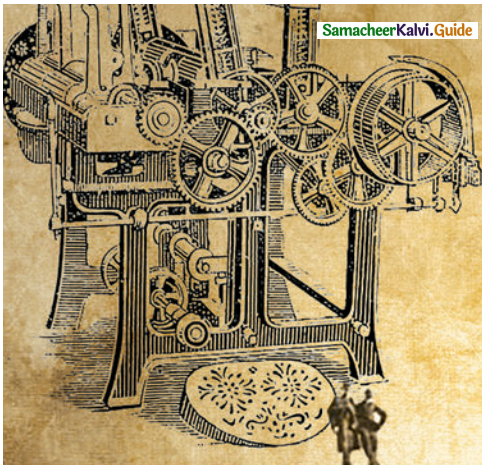
Samacheer Kalvi 10th English Guide Poem Chapter 5 The Secret of the Machines img 1

The poem ‘The secret of machines’ describes a machine’s life. It describes the innocent manner of the machines. The machines are made by cutting, filing, etc and they work for four and twenty hours a day. The machines ask humans to remember that they work by the law of physics. If they have not cared properly the results will be fatal. The machines tell us that they are not build to comprehend a lie. At last, the machines agree that they are not only the children of the human brain.

Glossary:

furnace (n) – an enclosed structure in which material is heated to very high temperatures
wrought (adj) – beaten out of shape by hammering
gauge (n) – an instrument that measures perfection in appearance and quality
thousandth (adv) – a fraction of thousand
haul (y) – pull or drag with effort or force
comprehend (v) – grasp, understand
vanish(v) – disappear suddenly and completely

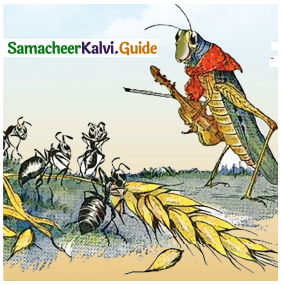
Samacheer Kalvi 10th English Guide Poem 4 The Ant and the Cricket

Tamilnadu State Board New Syllabus Samacheer Kalvi 10th English Guide Pdf Poem 4 The Ant and the Cricket Questions and Answers, Summary, Notes.

Tamilnadu Samacheer Kalvi 10th English Solutions Poem 4 The Ant and the Cricket

10th English Guide The Ant and the Cricket Textbook Questions and Answers

A. Based on your understanding of the poem, re|ad the following lines and answer the questions given below.

1. “A silly young cricket accustomed to sing
Through the warm, sunny months of gay summer and spring.”
(a) What was the routine of the cricket?
(b) Name the seasons mentioned here.
Answer:
(a) The routine of the cricket was to sing and while away the time enjoying the spring.
(b) The seasons mentioned are summer and winter.

Samacheer Kalvi 10th English Guide Poem 4 The Ant and the Cricket

2. “Began to complain when he found that, at home,
His cupboard was empty, and winter has come.”
(a) Who does ‘he’ refer to?
(b) Why was his cupboard empty?
Answer:
(a) ‘He’ refers to foolish cricket.
(b) His cupboard was empty because he had not stored any food during summer.

3. “Not a crumb to be found
On the snow-covered ground;
(a) What couldn’t he find on the ground?
(b) Why was the ground covered with snow?
Answer:
(a) He couldn’t find even a single piece of bread on the ground.
(b) The ground was covered with snow because of the onset of the winter season.

Samacheer Kalvi 10th English Guide Poem 4 The Ant and the Cricket

4. “At last by starvation and famine made bold,
All dripping with wet, and all trembling with cold,”
(a) What made the cricket bold?
(b) Why did the cricket drip and tremble?
Answer:
(a) Starvation and hunger made the cricket bold.
(b) The cricket dripped wet and trembled with cold because it was winter.

5. “Away he set off to a miserly ant,
To keep if, to keep him alive, he would grant
His shelter from the rain,
And a mouthful of grain.”
(a) Whom did the cricket want to meet? Why?
(b) What would keep him alive?
Answer:
(a) The cricket wanted to meet the miserly ant to ask for shelter and food.
(b) Shelter from rain and a mouthful of grain would keep him alive.

Samacheer Kalvi 10th English Guide Poem 4 The Ant and the Cricket

6. “But we ants never borrow; we ants never lend. ”
(a) Why do you think ants neither borrow nor lend?
(b) Who says these lines to whom?
Answer:
(a) Ants are industrious and good planners. So they neither borrow nor lend.
(b) The miserly and says this to the silly cricket.

7. “Not I!
My heart was so light
That I sang day and night,
For all nature looked gay.”
(a) Who does ‘I’ refer to?
(b) What was the nature of cricket? How do you know?
Answer:
(a) ‘I’ refers to cricket.
(b) The nature of cricket is to sing day and night and be happy.

Samacheer Kalvi 10th English Guide Poem 4 The Ant and the Cricket

8. “Thus ending, he hastily lifted the wicket,
And out of the door turned the poor little cricket,”
(a) The ant refused to help the cricket. Why?
(b) Explain the second line.
Answer:
(a) The ant refused to help the cricket since they will end up in starvation giving food to the silly cricket.
(b) Since the ant closed the door, the poor little cricket had to turn and go away.

9. “He wished only to borrow;
He’d repay it tomorrow;”
(a) Pick out the rhyming words in the above lines.
(b) Give more examples of rhyming words from the poem.
Answer:
(a) The rhyming words in the above lines are borrow and tomorrow.
(b) Sing-spring; home-come; found-ground; see-tree-me; bold-cold; ant-grant; rain-grain; tomorrow-sorrow; ffiend-lend; by-I; light-night; gay-say-away; wicket-cricket and true-two are the rhyming words.

Samacheer Kalvi 10th English Guide Poem 4 The Ant and the Cricket

10. “My heart was so light
that I sang day and night,
For all nature looked gay.
“You sang, Sir, you say”?
(a) Mention the rhyme scheme employed in the above lines.
Answer:
aabb’ is the rhyme scheme.

B. Based on your understanding of the poem, complete the summary using the phrases given below.

In this narrative poem, the poet brings out the idea that is essential for every creature. He conveys this message to the readers through a story (1) …………………. The ant spends all its summer saving (2) ……………….. The cricket (3) ………………… happily in the summer. He (4) …………………. anything for the winter. When winter comes, he is worried that his (5) ………………….. (6) ………………… is empty. So, he seeks the help of the ant to have (7) ………………… and a (8) ……………… (9) ……………… to stay. The cricket was even prepared to repay it in the future. The ant made it clear that ants (10) …………………. He also enquired the cricket if it had saved anything when the weather was fine. The cricket answered that it had sung day and night enjoying (11) …………………. The ant threw the cricket out and stated in a stern voice it should dance in the winter season too. In his concluding lines, the poet affirms that this is not (12) ……………….. but it is true and applicable to (13) ………………… also.
Answers:

  1. of an act and a cricket
  2. for future
  3. sings and dance
  4. doesn’t save
  5. kitchen
  6. cupboard
  7. some grains
  8. warm
  9. place
  10. never borrow or lend
  11. the pleasant nature
  12. just a fable
  13. human being

C. Answer each of the following questions in a paragraph about 100 words.

Question 1.
‘Some crickets have four legs and some have two’. Elucidate this statement from the poet’s point of view.
Answers:
The poet is comparing the lazy crickets to the two-legged creatures – human beings. The poetic device Metaphor is perfectly used to fit into the situation. Everyone knows that crickets have four legs. But he says some have two to compare the silly cricket to the two-legged human-beings who sometimes are as lazy and silly as the cricket in this poem.

The poet wants to suggest that this story is not entirely a fable; rather, it is related to the real world. Surely, some people are as careless and lazy as cricket is. Likewise, some humans like cricket also don’t plan out for the future or for the bad times. They just enjoy the present moment. The poet is thus calling such people as mindless as the cricket.

‘God gave us the gift of life; it is up to us to give ourselves the gift of living well.’

(OR)

Poem: The Ant and The cricket
Poet: Adapted from Aesop’s fables.
Theme: Ant vs Cricket
Moral: Hard work never fails

Once an ant and a cricket lived in a forest. The cricket was fun-loving. It enjoyed singing all through the summer. But the ant was hard working. In the winter season, snow covered the earth. There was no piece of food. Cricket trembled in snow. He was hungry.

So it asked the ant to give him some food. But the ant never borrows or lends. It refused the cricket’s request. It drove him out of his place without giving anything. The poet teaches a lesson to human beings. We must work hard, earn money, and save something for the future.

(OR)

  1. Cricket sings and dances in summer
  2. It enjoyed in summer
  3. Ants worked hard in the summer.
  4. The ant saved food for winter ‘
  5. During winter, cricket suffers without food.
  6. It asked the ant for food.
  7. Ants didn’t help him.
  8. We must work hard, earn money, and save something for the future.

Samacheer Kalvi 10th English Guide Poem 4 The Ant and the Cricket

Question 2.
Compare and contrast the attitude of the ant and the cricket.
Answer:
Introduction:
In this poem, the poet brings out the idea of hard work. The poem is taken from Aesop’s fables. Let us see the comparison between the ant and the cricket.

Attitude of Cricket:
The cricket was so lazy. It sat alone and sang happily along with the summer. It didn’t worry about the future. It didn’t save anything for the winter. It enjoyed singing all through the summer.

Attitude of Ant:
The Ant was hard-working in nature. It worked hard and saved food for the winter. It never borrows or lends from anyone.

Comparison:
The poet projects the cricket as a borrower and the ant as neither borrower nor a lender. However, the attitude of the ant in the last stanza is quite disappointing because the ant sent away the poor little cricket.

Conclusion:
Through this poem, the poet tells us not be like the cricket and he advises us to work hard and plan for the future like the wise ant.

(OR)

Title: The Ant and the Cricket
Author: Aesop
Characters: Ant and Cricket
Theme: Contrast is the shadow of comparison

In this poem ‘The Ant and the Cricket’, we find the good and bad nature of the ant and the cricket respectively. The cricket is lazy. He sang and dance during summer. The ant was wise and hard working. It saves its food for winter.

It teaches us the moral values of life. It never borrows nor lends. It’s lives on this principle. It has no concern over the foolish cricket. It tells that it is a servant and friend of the cricket. It sends the cricket out of its house without giving anything. This shows the ant is hardworking and clever.

‘Work while you work; Play while you play;
That’s the way to be happy and gay’.

(OR)

  1. The ant and the cricket are the two creatures.
  2. The ant is wise and hard working.
  3. It saves food for the winter season.
  4. It never borrows nor lends.
  5. The cricket is a little lazy creature.
  6. It sings and dances during the warm summer.
  7. In winter it has no food to eat.
  8. It went to the ant to borrow and repay tomorrow.
  9. But the ant send him without giving anything.
  10. This story teaches a lesson to human beings.
  11. We must work hard and save money for future.

Samacheer Kalvi 10th English Guide Poem 4 The Ant and the Cricket

Question 3.
If given a chance, who would you want to be – the ant or the cricket. Justify your answer.
Answer:
If given a chance to be a Cricket or an Ant, it is obvious that I would like to be an ant. I surely wouldn’t like to be called a silly cricket. Who would like to be foolish like the Cricket? I do like to enjoy life and have fun but I strongly do understand the importance of seeing the future needs. I prefer to be wise and intelligent rather than being foolish and silly in my behaviour. Year after year, I have witnessed the different seasons.

I do know that during winter, I will be deprived of food if I am not discrete. Hence, I will be judicious and meticulously work for the future like the Ant. I hate to be put to shame. I do not like the idea of borrowing or lending like the Cricket. I agree it’s indeed a shame to be a debtor. So I will never be a debtor borrowing things from others like Cricket. I hate to brood and be morose.

The Cricket is pushed to such a state looking at the empty cupboard, Surely I do not want to be a moaner. I do like to be courageous but not like the Cricket that became courageous because of starvation and famine. I cannot be so shameless like the Cricket and get turned down by the Ant.
‘I would like to live a day in the life of an ant and hope not to get squashed. ’

(OR)

I want to be an ant. An ant is a symbol of wisdom and hard work. It makes use of the opportunity to work hard to save food for winter. It is aware of the hard times during the winter. It never wastes the time like cricket in singing and dancing.

Cricket is foolish and lazy. They do not save anything. They suffer a lot in the future and old age. They starve like cricket. They borrow for tomorrow and remain in sorrow. We must learn the lesson from the ant. We must plan with foresight for our future and old age. If we live like the ant, we need not worry about the future.

‘Work is worship’
‘Hard work is the key to success’

(OR)

  1. I would be an ant and not cricket.
  2. The ant is wise and hard working.
  3. The ants never borrow nor lend.
  4. It avoids starvation even in famine
  5. Likewise, we also must plan and work hard
  6. We must save to avoid problems in the future.
  7. I wish to be an ant and never miss anything in my future life.

“Be an ant always and never be a cricket”

The Ant and the Cricket Summary of the poem

Samacheer Kalvi 10th English Guide Poem Chapter 4 The Ant and the Cricket img 1

The Poem ‘The Ant and the cricket’ tells about a hardworking ant and a lazy cricket. The last line of the poem says ‘Some crickets have four legs and some have two’ serves as a moral for the readers. The last line tells about the lazy humans who don’t save anything and don’t worry about their future. The poet tells us not to be lazy as the cricket and he wants us to be like the hardworking ant.

Glossary:

accustomed to (y) – be used to
gay (adj) – glad, joyful
crumb (n) – a piece of bread
famine (n) – extreme scarcity of food
miserly (adj) – hesitant to spend money
quoth (y) – said (old English usage. used only in first and third-person singular before the subject)
hastily (adv) – hurriedly
warrant (y) – guarantee, promise

Samacheer Kalvi 10th English Guide Poem 3 I am Every Woman

Tamilnadu State Board New Syllabus Samacheer Kalvi 10th English Guide Pdf Poem 3 I am Every Woman Questions and Answers, Summary, Notes.

Tamilnadu Samacheer Kalvi 10th English Solutions Poem 3 I am Every Woman

10th English Guide I am Every Woman Textbook Questions and Answers

A. Read the lines and answer the questions.

Question 1.
The summer of life she’s ready to see in spring.
She says, “Spring will come again, my dear Let me care for the ones who’re near.”
(a) What does the word summer mean here?
(b) How does she take a life?
(c) What does she mean by “spring will come again”?
Answer:
(a) Summer here means development.
(b) She takes life optimistically.
(c) By the phrase ‘spring will come again’, the poet means that the future will be better.

Samacheer Kalvi 10th English Guide Poem 3 I am Every Woman

Question 2.
Strong is she in her faith and belief.
“Persistence is the key to everything,” says she.
(a) What is she strong about?
(b) How does she deal with the adversities in life?
Answer:
(a) She is strong about her faith and belief.
(b) She is strong in her faith and belief and is determined while dealing with the adversities in life.

Question 3.
Despite the sighs and groans and moans,
She’s strong in her faith, firm in her belief!
(a) Is she complaining about the problems of life?
(b) Pick out the words that show her grit.
Answer:
(a) No she is not complaining about the problems of life.
(b) The words that show her grit are strong and firm.

Samacheer Kalvi 10th English Guide Poem 3 I am Every Woman

Question 4.
Don’t ever try to saw her pride, her self-respect.
She knows how to thaw you, saw you-so beware!
(a) What do the words thaw and saw mean here?
(b) What is the tone of the author?
Answer:
(a) Thaw and saw means that she will reduce you to nothing.
(b) The tone of the poetess is cautious about careful intervention.

Question 5.
She’s today’s woman. Today’s woman dear.
Love her, respect her, keep her near …
(a) Describe today’s woman according to the poet.
(b) How should a woman be treated?
Answer:
(a) Today’s woman is a woman born with determination, ready to take risks in life, and is strong in her faith and beliefs.
(b) A woman should be treated with love and respect.

B. Read the lines and identify the figure of speech.

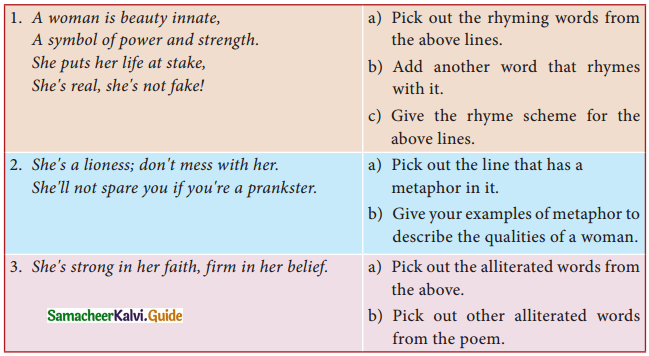
Samacheer Kalvi 10th English Guide Poem Chapter 3 I am Every Woman img 1

1. A woman is beauty innate,
A symbol of power and strength.
She puts her life at stake,
She’s real, she’s not fake!
(a) Pick out the rhyming words from the above lines.
(b) Add another word that rhymes with it.
(c) Give the rhyme scheme for the above lines.
Answer:
(a) The rhyming words are: ‘stake and fake’
(b) ‘Make’ is another word that rhymes with it
(c) The rhyme scheme is ‘abcc’

Samacheer Kalvi 10th English Guide Poem 3 I am Every Woman

2. She’s a lioness; don’t mess with her.
She’ll not spare you if you’re a prankster.
(a) Pick out the line that has a metaphor in it.
(b) Give your examples of metaphor to describe the qualities of a woman.
Answer:
(a) ‘She’s a lioness’ is the line that has a metaphor in it.
(b) “she is beauty innate’, ‘she is strength’, She is power” are examples of metaphors to describe the qualities of a woman.

3. She’s strong in her faith, firm in her belief.
(a) Pick out the alliterated words from the given lines.
(b) Pick out other alliterated words from the poem.
Answer:
(a) Faith, Firm; her, her are the alliterated words.
(b) Line 2: symbol, strength / Line 4: she’s, she’s / Line 5: summer, see, spring
Line 6: says, spring / Line 8: she’s/she / Line 14: you, you’re / Line 15: saw, self-respect
Line 16: you, you; saw, so / Line 17: woman, woman; today’s, today’s / Line 18: her, her, her

C. Fill In with a word in each blank to complete the summary of the poem. Use the help.

Every woman is beautiful (1) …………….. She is the (2) ………….. of power and (3) …………….. She is prone to put her (4) ………….. at risk. Every woman is true in expressing her love and she is never (5) …………….. She is very (6) ………………. in her approach even at times of (7) …………… she finds a ray of (8) …………….. and she continues to (9) …………………. or her (10) ……………………. ones. She is the (11) ……………… and she has no (12) ……………. She is forceful in her (13) ………… and (14) …………….. She is never a (15) ……………….. and she is (16) ……………. She is ferocious like a (17) ……………… It’s better for the (18) ……………… to stay away from her. Never should one try to bring (19) …………………to her pride and (20) ……………… for she knows how to (21) …………… and (22) ………….. them. She is (23) ………………. woman. It is (24) …………………. to love her (25) ……………. her and to keep her (26) ……………….
Answers:

  1. innate
  2. symbol
  3. strength
  4. life
  5. fake
  6. optimistic
  7. adversity
  8. hope
  9. care
  10. near
  11. woman
  12. fear
  13. faith
  14. beliefs
  15. quitter
  16. persistent
  17. lioness
  18. prankster
  19. disgrace
  20. self-respect
  21. thaw
  22. saw
  23. today’s
  24. healthier
  25. respect
  26. dignified

D. Answer the following in a paragraph in about 80 to 100 words.

Question 1.
How are today’s women portrayed by the poet?
Answer:
Introduction:
The poet Rakhi Nariani Shirke was a teacher. She has a passion for writing poems as a medium of self-expression. The poem is about the wonderful qualities of a woman. It talks about the multi-faced nature of women.

Woman are brave:
The poet says that every woman is naturally beautiful. She is the symbol of power and strength. They are bold, strong, and resolute. They are always ready to take up any risk. She is very optimistic in her approach.

The woman the hope raiser:
Every woman is true in expressing her love. They are not fake. She has hope and cares for her near ones. They work tirelessly to prove themselves. They can solve problems. She is a woman with no fear.

Women’s courage:
She is never a quitter. She is always persistent. They are very strong in their faith. They don’t give up their desires. They are very firm in achieving goals. They are very powerful to lead a happy life.

Conclusion:
The poet is in the view that growth depends on the women. They must be treated well and respected in their life.

(OR)

Title: I am Every Woman
Poet: Rakhi Nariani Shirke
Theme: The qualities of the woman
Moral: Every woman is powerful

Today’s women are a symbol of power and strength. They are naturally beautiful. They take up any risk. She has hopes and cares for her near ones. They work tirelessly. They can solve problems. She is a woman with no fears. She is always persistent in her works. She is true in her faith and beliefs. They have overcome bad days. They teach to lead a happy life. They can overcome sighs, groans, and moans. Today’s woman should be loved and respected.

(OR)

  1. Women are brave and strong
  2. They work tirelessly
  3. They can solve problems
  4. They don’t give up
  5. She is a woman with no fears
  6. They have overcome bad days.
  7. They teach to lead a happy life.
  8. They should be loved and respected

Samacheer Kalvi 10th English Guide Poem 3 I am Every Woman

Question 2.
What qualities have made women powerful?
Answer:
Introduction:
The poet Rakhi-Nariani-Shirke was a teacher. The poem is about the wonderful qualities of a woman. It talks about the Multi-faceted nature of women.

Qualities of Women:
Every woman is naturally beautiful. She is the symbol of power and strength. She is always optimistic in everything. She has no fear. She is strong in her faith and belief. She knows to thaw and saw a prankster.

Women’s courage:
She is never a quitter. She is a person of the determination. They are very strong in their faith. They don’t give up their desires. They are very firm in achieving goals. They are very powerful to lead a happy life.

Poet’s request:
The poet asks us to keep the women safe. She tells us that women are the future. So, we must take care, love, and respect them.

Conclusion:
The poet Is of the view that the growth depends on the women. They must be treated well. They teach morals to society.

(OR)

Title: I am Every Woman
Poet: Rakhi Nariani Shirke
Character: Woman
Theme: The qualities of empowered women

Every woman is naturally beautiful. She is the symbol of power and strength. She takes up any risk in life. She is always optimistic in everything. She has no fear. She cares for her near ones. She is very firm in her faith and beliefs. She is persistent to do any work. She is a lioness. She knows to freeze, cut, and size any mischievous man. So be careful of her. She is today’s woman to be loved and respected and kept near.

(OR)

  1. Every woman has natural beauty.
  2. She is the symbol of power and strength.
  3. She always takes up any risk.
  4. She has no fear.
  5. She is truthful to faith and beliefs.
  6. She is always persistent in her works.
  7. She is a lioness.
  8. She is today’s woman who love and respects her.

I am Every Woman Summary of the poem

Samacheer Kalvi 10th English Guide Poem Chapter 3 I am Every Woman img 3

The poem ‘I am Every Woman’ is about describing the special features of men. Here the poet describes the women as a symbol of love, faith, and strength. They are ready to “sacrifice their lives for their loved ones. They are strong in their faith and beliefs. Here the women ar€escribed as a lioness. The poet warns the pranksters not to mess with her. The poet tells that every woman s strong enough to bear the weight of the world. The poet concludes that with a kind heart people should take care of them.

Glossary:

innate (adj) – inborn and natural
prankster (n) – a person who acts
stake (n) – risk mischievous
persistence (n) – determination
groans (y) – complaints and grumbles
sigh (y) – expressing grief
moans (y) – grieves
mess with (p) – to tease or play a joke

Samacheer Kalvi 5th Tamil Guide Chapter 5.4 இணைப்புச்சொற்கள்

Tamilnadu State Board New Syllabus Samacheer Kalvi 5th Tamil Guide Pdf Chapter 5.4 இணைப்புச்சொற்கள் Text Book Back Questions and Answers, Summary, Notes.

Tamilnadu Samacheer Kalvi 5th Tamil Solutions Chapter 5.4 இணைப்புச்சொற்கள்

மதிப்பீடு

படிப்போம்! சிந்திப்போம்! எழுதுவோம்!

அ. சரியான சொல்லைத் தெரிவு செய்து எழுதுக.

Question 1.
‘அதனால்’ என்பது ………..
அ) பெயர்ச்சொல்
ஆ) வினைச்சொல்
இ) உரிச்சொல்
ஈ) இணைப்புச்சொல்
Answer:
ஈ) இணைப்புச் சொல்

Samacheer Kalvi 5th Tamil Guide Chapter 5.4 இணைப்புச்சொற்கள்

Question 2.
கருமேகங்கள் வானில் திரண்டன ………………..மழைபெய்யவில்லை .இத்தொடருக்குப் பொருத்தமான இணைப்புச்சொல்
அ) எனவே
ஆ) ஆகையால்
இ) ஏனெனில்
ஈ) ஆயினும்
Answer:
ஈ) ஆயினும்

Question 3.
கண்ணன் பேருந்தில் செல்ல விரும்பினான் ………… அவன் நண்ப ன் மிதிவண்டியே போதும் என்றான்.
அ) அதனால்
ஆ) ஆதலால்
இ) இருந்தபோதிலும்
ஈ) ஆனால்
Answer:
ஈ) ஆனால்

Samacheer Kalvi 5th Tamil Guide Chapter 5.4 இணைப்புச்சொற்கள்

ஆ. கீழ்க்காணும் தொடர்களை இணைத்து எழுதுக.

Question 1.
நான் விளையாடச் சென்றேன். கண்ணன் விளையாடச் சென்றான். (உம்).
Answer:
நானும் கண்ணனும் விளையாடச் சென்றோம்.

Question 2.
வள்ளி எழுதி முடித்துவிட்டாள். எழிலி எழுதவில்லை . (ஆனால்)
Answer:
வள்ளி எழுதி முடித்துவிட்டாள். ஆனால் எழிலி எழுதவில்லை.

Question 3.
பெருமழை பெய்தது. ஏரி, குளங்கள் நிரம்பின. (அதனால்)
Answer:
பெருமழை பெய்தது. அதனால் ஏரி, குளங்கள் நிரம்பின.

Samacheer Kalvi 5th Tamil Guide Chapter 5.4 இணைப்புச்சொற்கள்

Question 4.
முகில் பள்ளிக்குச் செல்லவில்லை. அவனுக்கு உடல்நலமில்லை. (ஏனெனில்)
Answer:
முகில் பள்ளிக்குச் செல்லவில்லை. ஏனெனில் அவனுக்கு உடல்நலமில்லை.

Question 5.
அறிவு வளர்ச்சிக்குக் கணினி தேவை. கணினியை இயக்கத் தெரிதல் வேண்டும். (ஆகவே)
Answer:
அறிவு வளர்ச்சிக்குக் கணினி தேவை. ஆகவே கணினியை இயக்கத் தெரிதல் வேண்டும்.

Samacheer Kalvi 5th Tamil Guide Chapter 5.4 இணைப்புச்சொற்கள்

இ. கீழ்க்காணும் உரைப்பகுதியில் பொருத்தமான இணைப்புச்சொற்களை இணைத்து எழுதுக.

(ஆனால், அதனால், ஏனெனில், ஆகையால், எனவே, ஆகவே, பிற) அடர்ந்த காடு ஒன்றில் பல விலங்குகள் வாழ்ந்து வந்தன. …………………….. , சிங்கம் மட்டும் அரசனாக விளங்கியது. …………………….., அது பார்ப்பதற்கு மிடுக்கான தோற்றமுடையது. …………………….., அதனைக் கண்டு…………………….. விலங்குகள் அஞ்சின………………………, அது தனியாகக் குகையில் வசித்தது. …………………….. அது எப்போதும் விழிப்போடு இருந்தது. ஒருநாள் அதற்குப் பசித்தது. …………………….. குகைக்கு வெளியே வந்து இரைக்காகக் காத்திருந்தது. சிங்கத்தைப் பார்த்தவுடன்…………………….. விலங்குகள் அஞ்சியோடின………………………, அவற்றைச் சிங்கம் அடித்துவிடும் அல்லவா?
Answer:
(ஆனால், அதனால், ஏனெனில், ஆகையால், எனவே, ஆகவே, பிற)

அடர்ந்த காடு ஒன்றில் பல விலங்குகள் வாழ்ந்து வந்தன. ஆனால், சிங்கம் மட்டும் அரசனாக விளங்கியது. ஏனெனில், அது பார்ப்பதற்கு மிடுக்கான தோற்றமுடையது. ஆகையால், அதனைக் கண்டு பிற விலங்குகள் அஞ்சின. எனவே, அது தனியாகக் குகையில் வசித்தது. ஆனால் அது எப்போதும் விழிப்போடு இருந்தது. ஒருநாள் அதற்குப் பசித்தது. அதனால் குகைக்கு வெளியே வந்து இரைக்காகக் காத்திருந்தது. சிங்கத்தைப் பார்த்தவுடன் பிற விலங்குகள் அஞ்சியோடின. ஏனெனில், அவற்றைச் சிங்கம் அடித்துவிடும் அல்லவா?

ஈ. வினாக்களுக்கு விடையளிக்க.

Question 1.
இணைப்புச் சொற்கள் எதற்குப் பயன்படுகின்றன?
Answer:
தங்கு தடையின்றிப் பேசவும், எழுதவும் இணைப்புச்சொற்கள் பயன்படுகின்றன.

Samacheer Kalvi 5th Tamil Guide Chapter 5.4 இணைப்புச்சொற்கள்

Question 2.
இணைப்புச்சொற்களுள் நான்கு எழுதுக.
Answer:

  • அதனால்
  • ஆகையால்
  • அப்படியானால்
  • ஆதலால்

Question 3.
இணைப்புச்சொற்களைப் பயன்படுத்தி, எவையேனும் இரண்டு தொடர்களை எழுதுக.
Answer:

  • கண்ணன் வந்துவிடுகிறேன் என்றான். ஆனால், இன்னும் வரவில்லை.
  • நான் தாய்நாட்டிலேயே பணியாற்ற விரும்புகிறேன். ஆகையால், வெளிநாடு செல்லமாட்டேன்.

Samacheer Kalvi 5th Tamil Guide Chapter 5.4 இணைப்புச்சொற்கள்

கற்பவை கற்றபின்

Question 1.
புத்தகப் பூங்கொத்து கதையொன்றில் இடம்பெற்றிருக்கும் இணைப்புச்சொற்களைக் கண்டறிக.
Answer:
மாணவர்கள் தாங்களாகவே செய்ய வேண்டியது.

Question 2.
வீட்டிலோ பள்ளியிலோ பிறர் பேசும்போது, என்னென்ன இணைப்புச்சொற்களைப் பயன்படுத்துகின்றனர். அவற்றைப் பட்டியலிடுக.
Answer:
மாணவர்கள் தாங்களாகவே செய்ய வேண்டியது.

Samacheer Kalvi 5th Tamil Guide Chapter 5.4 இணைப்புச்சொற்கள்

கூடுதல் வினா

விடையளி :

Question 1.
இணைப்புச்சொற்கள் பற்றி எழுதுக.
Answer:
தொடர்களை இணைப்பதற்கு இணைப்புச்சொற்கள் பயன்படுகின்றன. இவற்றை இணைப்பிடைச் சொற்கள் எனவும் கூறுவர்.

மொழியை ஆள்வோம்

அ. கேட்டல்

Question 1.
நாள்தோறும் வழிபாட்டுக் கூடத்தில் சொல்லப்படும் திருக்குறளைக் கேட்டறிக.
Answer:
மாணவர்கள் தாங்களாகவே செய்ய வேண்டும்.

Samacheer Kalvi 5th Tamil Guide Chapter 5.4 இணைப்புச்சொற்கள்

Question 2.
வானொலி, தொலைக்காட்சி நிகழ்ச்சிகளில் ஒளிபரப்பாகும் கட்டடக்கலைகள் பற்றிய செய்திகளைக் கேட்டு அறிந்து கொள்க.
Answer:
மாணவர்கள் தாங்களாகவே செய்ய வேண்டும்.

ஆ. பேசுதல் :

Question 1.
நீங்கள் கண்டுகளித்த வரலாற்றுச் சிறப்புமிக்க இடங்கள் குறித்து 5 மணித்துளி பேசுக.
Answer:
வரலாற்றுச் சிறப்புமிக்க இடங்கள் :
அனைவருக்கும் வணக்கம்!
நான் கண்டுகளித்த வரலாற்றுச் சிறப்புமிக்க இடம் மதுரை. இம்மதுரை தூங்கா நகர், கோவில் நகர், தமிழர் நாகரிகத் தொட்டில், தென்னிந்தியாவின் ஏதென்சு, தமிழ் வளர்த்த நகரம் என்றெல்லாம் சிறப்பிக்கப் பெறுகிறது.

மதுரை என்றாலே முதலில் நினைவிற்கு வருவது மீனாட்சியம்மன் கோவில். இக்கோவிலில் ஆயிரங்கால் மண்டபத்தில் அருங்காட்சியகம் அமைக்கப்பட்டுள்ளது. சிலைகள், ஓவியங்கள் மற்றும் புகைப்படங்கள் எனக் காட்சிப் பொருள்கள் ஏராளமாக உள்ளன.

மீனாட்சி சுந்தரேசுவரர் கோவில் மதுரை நகரின் நடுவில் அமைந்து மதுரைக்கே அழகூட்டுகிறது. இராமர், லட்சுமணர், இந்திரன், தேவர்கள் போன்றவர்களால் வழிபடப்பட்ட பெருமைக்குரியது. மீனாட்சி அம்மன் கோவிலில் தெப்பகுளம் உள்ளது. இக்குளத்திலிருந்து திருமலை நாயக்கர் மகாலுக்குச் செல்வதற்குச் சுரங்கப்பாதை இருப்பதாகக் கூறப்படுகிறது.

Samacheer Kalvi 5th Tamil Guide Chapter 5.4 இணைப்புச்சொற்கள்

திருமலை நாயக்கர் மகால் திருமலை நாயக்க மன்னரால் கட்டப்பட்டது. இது கலைநயத்தில் ‘தாஜ்மகால்’ போன்றது. அந்த மகாலில் மிகச்சிறந்த ஓவியங்கள் அமைக்கப்பட்டுள்ளன. அதில் அமைந்துள்ள தூணின் உயரம் 82 அடி, சுற்றளவு 19 அடி ஆகும்.

அடுத்ததாக நாங்கள் பார்த்தது காந்தி மியூசியம். இவ்விடம் இராணி மங்கம்மாளின் அரண்மனையாக இருந்த இடம் ஆகும். இங்கு காந்தியடிகள் பயன்படுத்திய ஆடைகள், கடைசியாக அவர் அணிந்திருந்த உடை ஆகியவை இடம்பெற்றுள்ளன. நல்ல நூலகம் ஒன்றும் அமைந்துள்ளது.

மதுரைக்கு அருகே திருப்பரங்குன்றம் சென்றோம். இது ஒரு குகைக் கோவில். ஒரே கல்லில் குடைந்த கோவில் ஆகும். மதுரையில் இவ்வளவு வரலாற்றுச் சிறப்பு மிக்க இடங்கள் உள்ளன.

Question 2.
நற்பண்புகள் கொண்ட சான்றோர் ஒருவரைப்பற்றி 5 மணித்துளி பேசுக.
Answer:
அனைவருக்கும் காலை வணக்கம்!
நான் பாலம் என்ற அமைப்பை நடத்திவரும் ‘பாலம் கல்யாணசுந்தரம்’ அவர்களைப் பற்றிக் கூறவிருக்கிறேன்.

இவர் திருநெல்வேலி மேலக்கருவேலங்குளம் என்ற ஊரில் 1940ஆம் ஆண்டில் பிறந்தவர். தமிழ்மீது பற்றுக் கொண்டவர். கல்லூரியில் வேறு பாடம் எடுக்கச் சொல்லி வற்புறுத்தினாலும் அவர் தமிழையே படித்தவர்.

தூத்துக்குடி மாவட்டம் திருவைகுண்டத்தில் உள்ள ஸ்ரீ குமரகுருபர சுவாமிகள் கலைக் கல்லூரியில் பணியாற்றி ஓய்வு பெற்றார்.
இவர் முப்பத்தைந்து ஆண்டுகள் பேராசிரியர் பதவியில் பணிபுரிந்து பெற்ற சம்பளம் அனைத்தையும் ஏழை மக்களின் நலனுக்காகச் செலவிட்டுத் தமது சொந்தச் செலவிற்கு ஒரு உணவகத்தில் உணவு பரிமாறுபவராக வேலை பார்த்தவர். அவர் ஈட்டிய மொத்த வருவாயைக் கொடுத்து வரலாறு படைத்தவர்.

இவரைப் போன்று உலகில் எந்த நாட்டைச் சேர்ந்த எவரும் செய்ததில்லை என்பதால் அமெரிக்காவில் “ஆயிரம் ஆண்டுகளில் சிறந்த மனிதர்” என்ற விருதுக்குத் தேர்ந்தெடுக்கப்பட்டு 6.5 மில்லியன் டாலர் (இந்தியப் பணம் 30 கோடி) பரிசாகப் பெற்றவர். அதையும் குழந்தைகள் நலனுக்காக அளித்து உலகையே வியப்பில் ஆழ்த்தியவர்.

Samacheer Kalvi 5th Tamil Guide Chapter 5.4 இணைப்புச்சொற்கள்

குடும்பப்பங்காகக் கிடைத்த ஐம்பது லட்சம் ரூபாய் மதிப்புடைய சொத்தைத் தனக்கென்று வைத்துக் கொள்ளாமல் மக்களுக்கு அளித்து மகிழ்வுற்றவர். ஏழைகளின் துயரினை நேரிடையாக அறிந்து கொள்ள ஏழு ஆண்டுகள் நடைபாதைவாசியாக வாழ்ந்தவர்.
தனக்கென வாழாமல் பிறருக்கென வாழும் அவரைப் போற்றுவோம். அவரைப் போல நாமும் நற்பண்புகளுடன் வாழ்வோம் என்று உறுதியேற்போம்.

இ. படித்தல் :

Question 1.
திருக்குறளைப் பொருள் விளங்கப் படித்துக்காட்டுக.
Answer:
மாணவர்கள் தாங்களாகவே திருக்குறளைப் பொருள் விளங்கப் படிக்க வேண்டும்.

Question 2.
புத்தகப் பூங்கொத்தில் விளையாட்டுகள் தொடர்பான கதைகளைப் படித்துக் காட்டுக
Answer:
மாணவர்கள் தாங்களாகவே புத்தகப் பூங்கொத்தில் விளையாட்டுகள் தொடர்பான கதைகளை படிக்க வேண்டும்.

Samacheer Kalvi 5th Tamil Guide Chapter 5.4 இணைப்புச்சொற்கள்

ஈ. எழுதுதல்.

Question 1.
சொல்லக் கேட்டு எழுதுக.
Answer:

  • பண்பு உடையவராக வாழ்தல் நல்வழியாகும்.
  • திருக்குறள் “உலகப்பொதுமறை” என்றழைக்கப்படுகிறது.
  • கங்கை கொண்ட சோழபுரம் உலகப் பாரம்பரியச் சின்னமாகும்.

Question 2.
தொடரில் அமைத்து எழுதுக.
1. வெற்றி – ………………………………….
2. நாகரிகம் – ………………………………….
3. உழவுத்தொழில் – ………………………………….
4. கலையழகு – ………………………………….
Answer:

  1. வெற்றி – குமரன் மல்யுத்த போட்டியில் முதல் பரிசு பெற்று வெற்றி வாகை சூடினான்.
  2. நாகரிகம் – தனக்கென்று தனித்த நாகரிகமும் பண்பாடும் உடையது தமிழ் மரபு.
  3. உழவுத்தொழில் – கண்ணன் தன் விடாமுயற்சியால் உழவுத்தொழிலில் வளம் பெருக்கினான்.
  4. கலையழகு – கண்ணன் வரைந்த ஓவியம் கலையழகின் மொத்த உருவமாகும்.

3. உரைப்பகுதியைப் படித்து வினாக்களுக்கு விடை எழுதுக.

அரசர்க்குரிய அங்கங்களுள் தலைசிறந்தது படை. படைத்திறத்தால் அரசன் உட்பகையை அழிப்பான். புறப்பகையை ஒழிப்பான். முன்னாளில் தேர்ப்படை, யானைப்படை, குதிரைப்படை, காலாட்படை என்னும் நாற்படையுடைய அரசன் மிகச் சிறந்தவனாக மதிக்கப்பெற்றான். நால்வகைப் படைகளுள் ஏற்றமும் தோற்றமும் பெற்றது யானைப்படை.

போர்க்களத்தில் வீறுகொண்டு செம்போர் விளைப்பதும், மாற்றார்க்குரிய மாட மதில்களைத் தாக்கித் தகர்ப்பதும் யானைப்படையே ஆகும். வலிமை சான்ற அழகிய யானை, பட்டத்து யானை என்று பெயர் பெற்றது. உயர்ந்த மேனியும், ஓங்கிய நடையும், சிறந்த கொம்பும், பரந்த அடியும், சிறிய கண்ணும், செந்நிற வாயும் உடைய யானையே அப்பதவிக்கு உரியதாகத் தேர்ந்தெடுக்கப்பட்டது.

Samacheer Kalvi 5th Tamil Guide Chapter 5.4 இணைப்புச்சொற்கள்

Question 1.
நால்வகைப் படைகள் யாவை?
Answer:
தேர்ப்படை, யானைப்படை, குதிரைப்படை, காலாட்படை.

Question 2.
நால்வகைப் படைகளுள் ஏற்றமும் தோற்றமும் பெற்றது எது?
Answer:
நால்வகைப் படைகளுள் ஏற்றமும் தோற்றமும் பெற்றது யானைப்படை.

Question 3.
மாற்றார் என்னும் சொல்லின் பொருள் யாது?
Answer:
மாற்றார் என்னும் சொல்லின் பொருள் பகைநாட்டரசர் (பகைவர்).

Question 4.
உரைப்பகுதியில் இடம்பெற்றுள்ள வருணனைச் சொற்களை எடுத்து எழுதுக.
Answer:
உயர்ந்த மேனியும், ஓங்கிய நடையும், சிறந்த கொம்பும், பரந்த அடியும், சிறிய கண்ணும், செந்நிற வாயும்.

Samacheer Kalvi 5th Tamil Guide Chapter 5.4 இணைப்புச்சொற்கள்

Question 5.
காலாட்படை – இச்சொல்லைப் பிரித்து எழுதுக.
Answer:
கால் + ஆள் + படை.

4. கோடிட்ட இடத்தை நிரப்புக.

1. மக்களுக்கு உரிய பண்பில்லாதவர் ……………….. போன்றவர் என வள்ளுவர் கூறுகிறார்.
2. கங்கை கொண்ட சோழபுரம் ……………….. என்று புலவர்களால் போற்றப்பட்டது.
3. கம்பைக் குறிக்கும் வீரக்கலை ……………….. ஆகும்.
Answer:
1. மரத்தைப்
2. கங்காபுரி
3. சிலம்பாட்டம்

Samacheer Kalvi 5th Tamil Guide Chapter 5.4 இணைப்புச்சொற்கள்

5. பிறமொழிச் சொற்களையும் பேச்சுத்தமிழையும் நீக்கிச் சரியாக எழுதுக.

1. டூமாரோ ஈவினிங் என் ஸிஸ்டர் ஊருக்குப் போவா.
Answer:
நாளை மாலை என் தங்கை ஊருக்குச் செல்வாள்.

2. ஷேர் ஆட்டோவில் பைவ் பாசஞ்சர்ஸ் இருக்காங்க.
Answer:
பகிர் தானியங்கியில் ஐந்து பயணிகள் இருக்கிறார்கள்.

3. என் வீட்டில் வாசிங் மிஷின் ரிப்பேராக இருக்கு.
Answer:
என் வீட்டில் சலவை இயந்திரம் பழுதாகி இருக்கிறது.

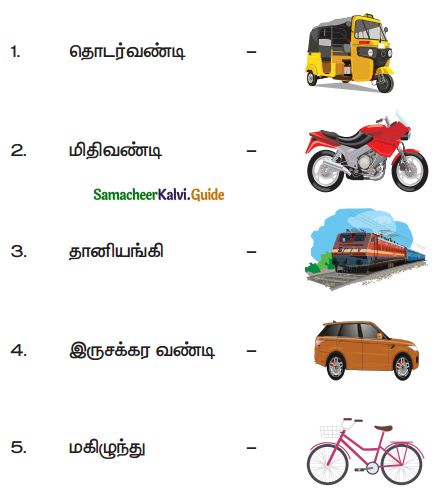
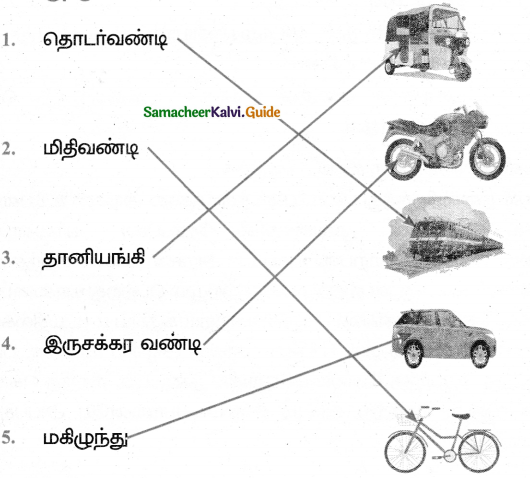
Question 6.
பொருத்துக.
Samacheer Kalvi 5th Tamil Guide Chapter 5.4 இணைப்புச்சொற்கள் - 13
Answer:
Samacheer Kalvi 5th Tamil Guide Chapter 5.4 இணைப்புச்சொற்கள் - 1

Samacheer Kalvi 5th Tamil Guide Chapter 5.4 இணைப்புச்சொற்கள்

Question 7.
பாடலை நிறைவு செய்க.
Samacheer Kalvi 5th Tamil Guide Chapter 5.4 இணைப்புச்சொற்கள் - 14
Answer:
Samacheer Kalvi 5th Tamil Guide Chapter 5.4 இணைப்புச்சொற்கள் - 2

Samacheer Kalvi 5th Tamil Guide Chapter 5.4 இணைப்புச்சொற்கள்

Question 8.
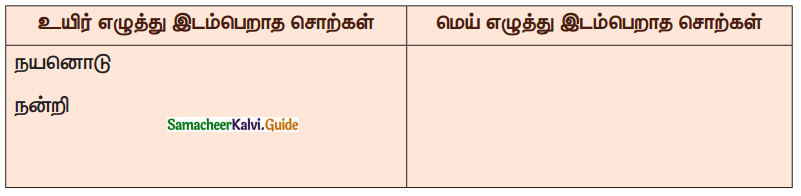
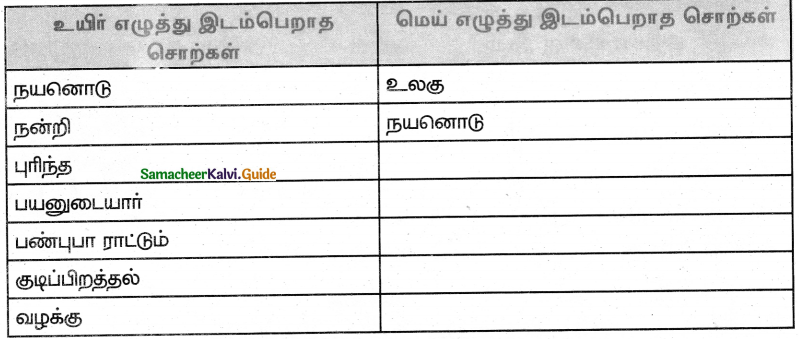
கீழ்க்காணும் குறட்பாக்களிலுள்ள சொற்களைப் பின்வருமாறு அட்டவணைப்படுத்துக.
நயனொடு நன்றி புரிந்த பயனுடையார்
பண்புபா ராட்டும் உலகு.
அன்புடைமை ஆன்ற குடிப்பிறத்தல் இவ்விரண்டும்
பண்புஉடைமை என்னும் வழக்கு.
Samacheer Kalvi 5th Tamil Guide Chapter 5.4 இணைப்புச்சொற்கள் - 15
Answer:
Samacheer Kalvi 5th Tamil Guide Chapter 5.4 இணைப்புச்சொற்கள் - 3

Samacheer Kalvi 5th Tamil Guide Chapter 5.4 இணைப்புச்சொற்கள்

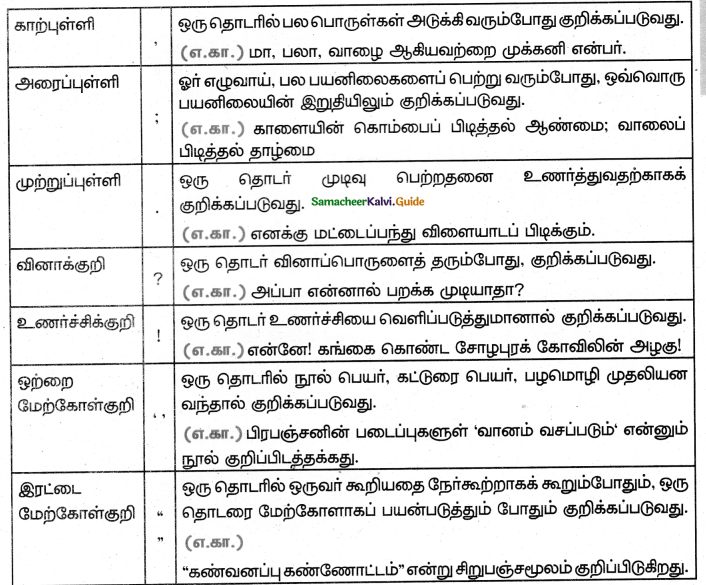
நிறுத்தக்குறிகளை அறிந்துகொள்வோம்

Samacheer Kalvi 5th Tamil Guide Chapter 5.4 இணைப்புச்சொற்கள் - 4

மொழியோடு விளையாடு

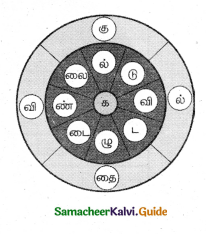
Question 1.
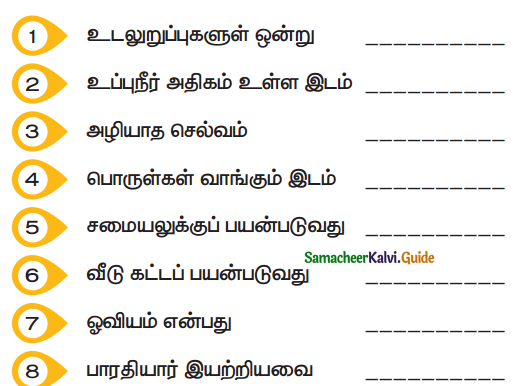
சுழலட்டையைப் பயன்படுத்திக் குறிப்புகளுக்கு விடை எழுதுக
Samacheer Kalvi 5th Tamil Guide Chapter 5.4 இணைப்புச்சொற்கள் - 5
Samacheer Kalvi 5th Tamil Guide Chapter 5.4 இணைப்புச்சொற்கள் - 16
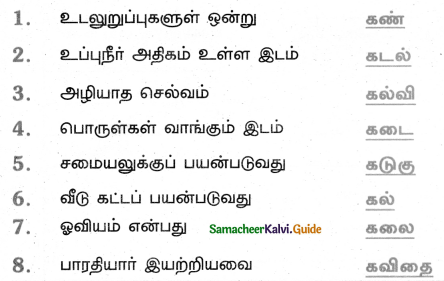
Answer:
Samacheer Kalvi 5th Tamil Guide Chapter 5.4 இணைப்புச்சொற்கள் - 6

Samacheer Kalvi 5th Tamil Guide Chapter 5.4 இணைப்புச்சொற்கள்

Samacheer Kalvi 5th Tamil Guide Chapter 5.4 இணைப்புச்சொற்கள் - 17
Samacheer Kalvi 5th Tamil Guide Chapter 5.4 இணைப்புச்சொற்கள் - 18
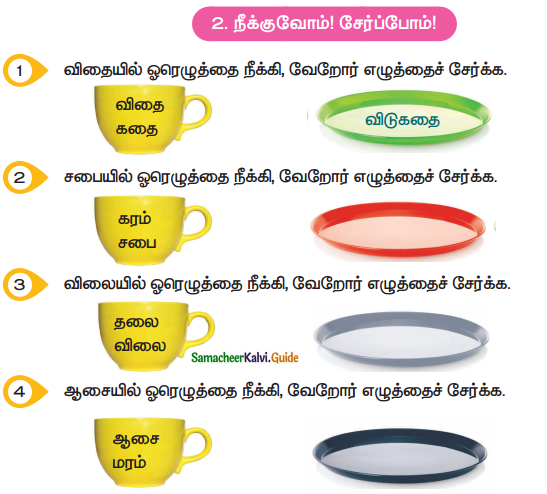
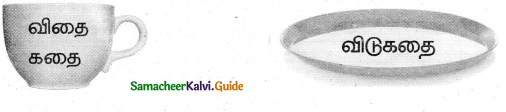
1. விதையில் ஓரெழுத்தை நீக்கி, வேறோர் எழுத்தைச் சேர்க்க.
Answer:
Samacheer Kalvi 5th Tamil Guide Chapter 5.4 இணைப்புச்சொற்கள் - 7

2. சபையில் ஓரெழுத்தை நீக்கி, வேறொர் எழுத்தைச் சேர்க்க.
Answer:
Samacheer Kalvi 5th Tamil Guide Chapter 5.4 இணைப்புச்சொற்கள் - 8

Samacheer Kalvi 5th Tamil Guide Chapter 5.4 இணைப்புச்சொற்கள்
3.விலையில் ஓரெழுத்தை நீக்கி, வேறொர் எழுத்தைச் சேர்க்க.
Answer:
Samacheer Kalvi 5th Tamil Guide Chapter 5.4 இணைப்புச்சொற்கள் - 9

4.ஆசையில் ஓரெழுத்தை நீக்கி, வேறொர் எழுத்தைச் சேர்க்க.
Answer:
Samacheer Kalvi 5th Tamil Guide Chapter 5.4 இணைப்புச்சொற்கள் - 10

5. கடையில் ஓரெழுத்தை நீக்கி, வேறொர் எழுத்தைச் சேர்க்க.
Answer:
Samacheer Kalvi 5th Tamil Guide Chapter 5.4 இணைப்புச்சொற்கள் - 11

Samacheer Kalvi 5th Tamil Guide Chapter 5.4 இணைப்புச்சொற்கள்

Samacheer Kalvi 5th Tamil Guide Chapter 5.4 இணைப்புச்சொற்கள் - 12
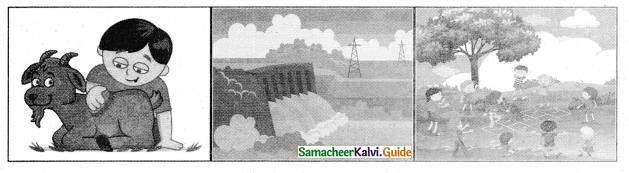
1. பிற உயிரினங்களின் மீது அன்பு காட்டுவேன்
2. விளையாட்டு, உடலுக்கும் மனத்திற்கும் நல்லது என அறிந்துகொண்டேன்.
3. நீர்த்தேக்கங்கள், வேளாண்மைக்கு உயிர் என்பதைப் புரிந்துகொண்டேன்.

அறிந்து கொள்வோம்

தன்னை நோக்கி வரும் விருந்தினரை நாள்தோறும் போற்றுகின்றவனுடையவாழ்க்கை, துன்பத்தால் வருந்திக் கெட்டுப் போவதில்லை.

வருவிருந்து வைகலும் ஓம்புவான் வாழ்க்கை பருவந்து பாழ்படுதல் இன்று.

Samacheer Kalvi 5th Tamil Guide Chapter 5.4 இணைப்புச்சொற்கள்

செயல் திட்டம்

தமிழர் கலைகள் குறித்துச் செய்தித்தாளில் வரும் படங்களையும் செய்திகளையும் தொகுத்து வருக.
Answer:
மாணவர்கள் தாங்களாகவே செய்ய வேண்டும்.

Samacheer Kalvi 5th Tamil Guide Chapter 5.3 கங்கை கொண்ட சோழபுரம்

Tamilnadu State Board New Syllabus Samacheer Kalvi 5th Tamil Guide Pdf Chapter 5.3 கங்கை கொண்ட சோழபுரம் Text Book Back Questions and Answers, Summary, Notes.

Tamilnadu Samacheer Kalvi 5th Tamil Solutions Chapter 5.3 கங்கை கொண்ட சோழபுரம்

மதிப்பீடு

வினாக்களுக்கு விடையளிக்க.

Question 1.
முதலாம் இராசேந்திர சோழனை ஏன் கங்கை கொண்ட சோழன் என்று அழைக்கிறோம்?
Answer:
முதலாம் இராசேந்திர சோழன் வட நாடு சென்று பகைவர்களை வென்று கங்கை நீரைக் கொண்டு வந்ததன் அடையாளமாகத்தான் கங்கை கொண்ட சோழன் என்று அழைக்கிறோம்.

Samacheer Kalvi 5th Tamil Guide Chapter 5.3 கங்கை கொண்ட சோழபுரம்

Question 2.
சிங்கமுகக் கிணறு – குறிப்பு எழுதுக.
Answer:
சிங்க வடிவத்தில் சிங்கமுகக் கிணறு அமைந்திருக்கும். இந்தச் சிற்பத்தின் வயிற்றில் ஒரு வாயில் இருக்கும்.

Question 3.
சோழ கங்கப் பேரேரிக்கு நீர் எங்கிருந்து வருகிறது?
Answer:
மலைகளும் குன்றுகளும் இல்லாத சமவெளியில் பதினாறு கல் தொலைவு வரை வலிமையான உயரமான கரைகளைக் கட்டி, நீண்ட கால்வாய் வெட்டித் தண்ணீரைப் பள்ளத்தாக்கிலிருந்து மேட்டிற்குக் கொண்டு வந்து, ஏரியில் தேக்கி வைத்தனர். சோழ கங்கப் பேரேரி இன்றி பொன்னேரி என்று அழைக்கப்படுகிறது.

Question 4.
கங்கை கொண்ட சோழபுரம் கோவிலிலுள்ள வாயில்களின் பெயர்களைக் கூறுக.
Answer:

  • தெற்குப் பக்க நுழைவாயில்
  • வடக்குப் பக்க நுழைவாயில்.

Samacheer Kalvi 5th Tamil Guide Chapter 5.3 கங்கை கொண்ட சோழபுரம்

சிந்தனை வினா.

Question 1.
ஏரிகளும் குளங்களும் தூர் வாரப்படாமல் மண்மூடி இருந்தால் என்ன ஆகும்? கருத்துகளைக் குழுவில் பகிர்ந்து கொள்க.
Answer:
மாணவன் 1 : ஏரிகளும் குளங்களும் தூர் வாரப்படாமல் மண்மூடி இருந்தால் மழைநீரைத் தேக்கி வைக்க முடியாது.
மாணவன் 2 : நிலத்தடி நீரின்றி மக்கள் துன்பப்படுவர்.
மாணவன் 3 : விவசாயத்திற்குப் போதுமான நீர் கிடைக்காது.
மாணவன் 1 : நீர்நிலைகள் மண் மூடிய நிலையில் உள்ளதால், மழைக்காலங்களில் வரும் மழைநீர் சிறிதளவே தேங்கும். உபரிநீர் வீணாகக் கடலில் கலந்துவிடும்.
மாணவன் 2 : கோடைக்காலங்களில் நீர்நிலைகளைத் தூர்வாரி நிலத்தடி நீரைச் சேமிக்க வேண்டும்.

Samacheer Kalvi 5th Tamil Guide Chapter 5.3 கங்கை கொண்ட சோழபுரம்

கற்பவை கற்றபின்

Question 1.
காலம் வென்ற கங்கை கொண்ட சோழபுரம் என்ற பாடப் பகுதியைச் சரியான ஒலிப்போடும் நிறுத்தக்குறிகளோடும் படித்துக்காட்டுக.
Answer:
மாணவர்கள் தாங்களாகவே சரியான ஒலிப்போடும் நிறுத்தக்குறிகளோடும் படிக்க வேண்டும். கங்கை கொண்ட சோழபுரம் பற்றியும் அக்கோவிலிலுள்ள சிற்பங்களின் சிறப்புகளைப் பற்றியும் வகுப்பறையில் கலந்துரையாடுக. கலந்துரையாடுதல் (சிற்பங்களின் சிறப்புகள்)

மாணவன் 1 : நீ சென்று வந்த கங்கை கொண்ட சோழபுரம் கோவில் பற்றிக் கூறுகிறாயா?
மாணவன் 2 : கங்கை கொண்ட சோழபுரக் கோவில் தஞ்சைப் பெரிய கோவில் போன்ற அமைப்பில் உள்ளது. ஆனால் அக்கோயிலைவிட உயரம் குறைவானது.
மாணவன் 1 : அப்படியா?
மாணவன் 2 : ஆமாம். அதற்கடுத்து செங்கற்களால் கட்டப்பட்ட நந்திச்சிலை இருந்தது. இக்கோவிலின் வாயில், தரைமட்டத்திலிருந்து 20 அடி உயரத்தில் இருப்பது தனிச்சிறப்பாகும். அது மட்டுமா? தூண்களிலும் கோவில்களிலும் அழகான சிற்பங்கள் எங்களை வியப்பில் ஆழ்த்தின.

Samacheer Kalvi 5th Tamil Guide Chapter 5.3 கங்கை கொண்ட சோழபுரம்

மாணவன் 3 : நான்கூட இக்கோவிலுக்கு ஒருமுறை சென்றுள்ளேன். கோவிலின்
வடக்குப் பக்க நுழைவாயிலின் இருபக்கங்களிலும் உள்ள கலைச் செல்வி மற்றும் சண்டேசுவர அனுக்கிரக மூர்த்தி ஆகிய சிற்பங்கள் உலகப் புகழ் பெற்றவை என்று என் அப்பா கூறியுள்ளார்.
மாணவன் 2 : இக்கோவிலில் சிங்க முகக் கிணறு ஒன்று உள்ளது.
மாணவன் 1 : சிங்க முகக் கிணறா? அது என்ன? மாணவன் 2 : கிணறு சிங்கம் வடிவத்திலிருக்கும். இந்தச் சிற்பத்தின் வயிற்றிலே ஒரு வாயில் இருக்கும். சிங்க வடிவத்தில் இருப்பதால் சிங்கமுகக் கிணறு என்ற பெயர் பெற்றது.

மாணவன் 1 : சோழர்களின் சிற்பக்கலைக்கு இதைவிட வேறு சான்று வேண்டுமா?
மாணவன் 2 : சரியாகச் சொன்னாய். இந்தியச் சிற்ப வரலாற்றில் கங்கை கொண்ட சோழபுரச் சிற்பங்கள் தமக்கென ஒரு தனியிடத்தைப் பெற்றுள்ளன. கங்கை கொண்ட சோழபுரம் சிற்பக்கூடமாக அமைந்துள்ளது. இச்சிறப்புகளால் கங்கை கொண்ட சோழபுரத்தை யுனெஸ்கோ நிறுவனம் உலகப் பாரம்பரியச் சின்னமாக அறிவித்துள்ளது.
மாணவன் 1 : இது நம் தமிழகத்திற்கே பெருமையன்றோ ?
மாணவர்கள் : ஆமாம். பெருமைதான்.

Samacheer Kalvi 5th Tamil Guide Chapter 5.3 கங்கை கொண்ட சோழபுரம்

Question 2.
சுராவின் – தமிழ் உரைநூல் (முழு பருவம்) – 5 ஆம் வகுப்பு நீங்கள் கண்டுகளித்த சுற்றுலா இடங்களின் சிறப்புகளைப் பட்டியலிடுக. நான் கண்டுகளித்த சுற்றுலாத்தளம் – பிச்சாவரம் :

  • பிச்சாவரத்தில் சுமார் 3000 ஏக்கர் பரப்பளவில் பரந்து விரிந்துள்ள அலையாத்தி காடு உலகின் இரண்டாவது பெரிய அலையாத்திக் காடாகும்.
  • சிறுசிறு தீவுக்கூட்டங்கள், படகுக் குழாம், எழில்மிகு கடற்கரை, மாங்குரோவ் செடிகளைக் கொண்ட காடுகளின் ஊடே படகுப் பயணம் இவை மிகவும் சிறப்பானது.
  • கடலோரத்தில் உப்பனாற்றில் உள்ள கால்வாய்களையும் காடுகளையும் பார்வையிட படகு மூலம் சென்று பார்த்தேன்.
  • இங்கு உயர்கோபுரம் ஒன்று அமைக்கப்பட்டுள்ளது. அதில் அதி நவீன தொலைநோக்கிக் கருவிகள் பொருத்தப்பட்டுள்ளன. இங்கிருந்து பிச்சாவரம் சுற்றுலா வனப் பகுதியைப் பார்த்தேன்.
  • இப்பகுதிக்கு வெளிநாட்டுப் பறவைகள் கூட்டம் கூட்டமாக இருப்பதைப் பார்த்து வியந்து போனேன். பிச்சாவரம் பார்க்கப் பார்க்க ஆனந்ததை அள்ளித் தந்தது.

Samacheer Kalvi 5th Tamil Guide Chapter 5.2 தமிழர்களின் வீரக்கலைகள்

Tamilnadu State Board New Syllabus Samacheer Kalvi 5th Tamil Guide Pdf Chapter 5.2 தமிழர்களின் வீரக்கலைகள் Text Book Back Questions and Answers, Summary, Notes.

Tamilnadu Samacheer Kalvi 5th Tamil Solutions Chapter 5.2 தமிழர்களின் வீரக்கலைகள்

மதிப்பீடு

படிப்போம்! சிந்திப்போம்! எழுதுவோம்!

சரியான சொல்லைத் தெரிவு செய்து எழுதுக.

Question 1.
தமிழரின் வீர விளையாட்டாகக் கருதப்படாதது …………..
அ) சிலம்பம்
ஆ) மற்போர்
இ) மட்டைப்பந்து
ஈ) நீர் விளையாட்டு
Answer:
இ) மட்டைப்பந்து

Samacheer Kalvi 5th Tamil Guide Chapter 5.2 தமிழர்களின் வீரக்கலைகள்

Question 2.
‘மஞ்சு விரட்டு’ என்பதைக் குறிக்கும் விளையாட்டு …………………
அ) மற்போர்
ஆ) ஏறுதழுவுதல்
இ) சிலம்பாட்டம்
ஈ) வில்வித்தை
Answer:
ஆ) ஏறுதழுவுதல்

Question 3.
மற்போர் – இச்சொல்லைப் பிரித்து எழுதக் கிடைப்பது ……………
அ) மற் + போர்
ஆ) மள் + போர்
இ) மல் + போர்
ஈ) மறு + போர்
Answer:
ஈ) மறு + போர்

Samacheer Kalvi 5th Tamil Guide Chapter 5.2 தமிழர்களின் வீரக்கலைகள்

Question 4.
தன் + காப்பு – இச்சொற்களைச் சேர்த்து எழுதக் கிடைப்பது ……………
அ) தன்காப்பு
ஆ) தண்காப்பு
இ) தனிகாப்பு
ஈ) தற்காப்பு
Answer:
ஈ) தற்காப்பு

Question 5.
ஒலிம்பிக் போட்டியில் சேர்க்கப்பட்டுள்ள கலை …….
அ) சிலம்பாட்டம்
ஆ) வில்வித்தை
இ) ஏறுதழுவுதல்
ஈ) வழுக்கு மரம் ஏறுதல்
Answer:
ஆ) வில்வித்தை

Samacheer Kalvi 5th Tamil Guide Chapter 5.2 தமிழர்களின் வீரக்கலைகள்

ஆ. கீழ்க்காணும் சொற்களைச் சேர்த்து எழுதுக.
அ) சிலம்பு + ஆட்டம் = …………………….
ஆ) வீரம் + கலை = …………………….
Answer:
அ) சிலம்பு + ஆட்டம் – சிலம்பாட்டம்
ஆ) வீரம் + கலை – வீரக்கலை

இ. கீழ்க்காணும் சொற்களைப் பிரித்து எழுதுக.
அ) தனக்கென்று= ……………………. + ……………………….
ஆ) கொடைத்திறம்= ……………………. + ……………………….
Answer:
அ) தனக்கென்று – தனக்கு + என்று
ஆ) கொடைத்திறம் – கொடை + திறம்

Samacheer Kalvi 5th Tamil Guide Chapter 5.2 தமிழர்களின் வீரக்கலைகள்

ஈ. பொருத்துக

1. காளை – கம்பு
2. சிலம்பு – மூங்கில்
3. சிறுவாரைக்கம்பு – திமில்
4. தாளாண்மை – உழவு
வேளாண்மை – முயற்சி
Answer:
1. காளை – திமில்
2. சிலம்பு – கம்பு
3. சிறுவாரைக்கம்பு – மூங்கில்
4. தாளாண்மை — முயற்சி
5. தாளாண்மை – உழவு

Samacheer Kalvi 5th Tamil Guide Chapter 5.2 தமிழர்களின் வீரக்கலைகள்

உ. வினாக்களுக்கு விடையளிக்க.

Question 1.
தமிழர்களின் வீரக்கலைகளுள் இரண்டைக் குறிப்பிடுக.
Answer:

  • சிலம்பாட்டம்
  • ஏறுதழுவதல்

Samacheer Kalvi 5th Tamil Guide Chapter 5.2 தமிழர்களின் வீரக்கலைகள்

Question 2.
ஏறுதழுவுதல் என்றால் என்ன?
Answer:
ஏறு என்பது, காளை மாட்டைக் குறிக்கும். ஏறு தழுவுதல் என்பது, காளையைத் தழுவி, அதன் வீரத்தை அடக்குவதாகும்.

Question 3.
சிலம்பாட்டம் – பெயர்க்காரணம் தருக.
Answer:
சிலம்பு என்றால் ஒலித்தல் என்பது பொருள். கம்பு சுழலும்போது ஏற்படும் ஓசையை அடிப்படையாகக் கொண்டே சிலம்பம் எனப் பெயரிட்டனர். கம்பு சுழற்றுதல் என்னும் பெயரும் உண்டு.

Samacheer Kalvi 5th Tamil Guide Chapter 5.2 தமிழர்களின் வீரக்கலைகள்

Question 4.
வல்வில் ஓரியின் வில்லாற்றல் சிறப்பைக் கூறுக.
Answer:
(i) கடையெழு வள்ளல்களுள் ஒருவரான ‘வல்வில் ஓரி’ வில்லாற்றலில் சிறந்து விளங்கியவர் என்பதைத் தமிழ் இலக்கியங்களில் காணலாம்.

(ii) அவர், வேட்டையாட காட்டுக்குச் சென்றபோது, பெரிய யானையொன்று எதிர்ப்பட, அதன் மீது அம்பெய்தினார்.
(iii) அந்த அம்பானது, அப்பெரிய யானையின் தலையில் பாய்ந்தும், அங்குக் குறுக்கிட்ட பெரும்புலியைக் கொன்றும், அதனைக் கடந்து சென்ற கலைமானைச் சாய்த்தும், மேலும் விசை குறையாமல் சென்று, ஒரு பன்றியின் மேல் பாய்ந்ததோடு அல்லாமல், புற்றிலே இருந்த ஓர் உடும்பின் மீதும் பாய்ந்து தன் சினம் தீர்ந்தது என்று புறநானூற்றுப் பாடல் கூறுகிறது.

(iv) படைத் திறமும் கொடைத் திறமும் கொண்டு விளங்கிய வல்வில் ஓரியை வன்பரணர் இவ்வாறு பாடி மகிழ்ந்தார்.

Samacheer Kalvi 5th Tamil Guide Chapter 5.2 தமிழர்களின் வீரக்கலைகள்

Question 5.
மற்போர் எவ்வாறு நடைபெறுகிறது?
Answer:
இருவர் கைகோர்த்துக் கால்களாலும் தலையாலும் இடித்தும் உதைத்தும் ஒருவருடன் ஒருவர் போர் செய்வதே மற்போர்.
ஊ. சிந்தனை வினாக்கள்.

Question 1.
சிலம்பாட்டம் தற்காப்புக் கலைகளுள் ஒன்று. ஏன்?
Answer:
(i) சிலம்பாட்டம் தற்காப்புக் கலைகளுள் ஒன்றுதான்.

(ii) ஏனென்றால் சிலம்பு எடுத்து சுழற்றும்போது உடம்பில் உள்ள ஒவ்வொரு நாடி, நரம்பும், தசைகளும் இயக்கப்படுகின்றன.

(iii) கம்பைக் கைகளால் பிடித்து, தன்னைச் சுற்றிலும் சுழற்றிச் சுற்றும்போது தம் உடலைச் சுற்றிலும் ஒரு வேலி போன்ற அமைப்பை உருவாக்கிட முடியும்.

(iv) ஒரே ஒரு தடியைக் கொண்டு அமைக்கும் இது போன்ற வேலிக்குள் வேறு ஆயுதங்களைக் கொண்டு யார் தாக்க முற்பாட்டாலும் அதனை சுழற்றும் கம்பால் தடுத்திட முடியும்.

Samacheer Kalvi 5th Tamil Guide Chapter 5.2 தமிழர்களின் வீரக்கலைகள்

Question 2.
உடலில் உறுதி உடையவரே உலகை ஆளும் உள்ள உறுதி உடையவர். இவ்வரிகளை பற்றி உமது கருத்து யாது?
Answer:
‘சுவர் இருந்தால்தான் சித்திரம் வரைய முடியும். நம் உடல் நலம் நன்றாக இருந்தால்தான் உள்ளமும் நன்றாக இருக்கும். உடல் வலிமை பெறும்போது எதையும் தாங்கும் திறனைப் பெற முடியும். தெளிவான மனம் அமையும். சோம்பலின்றி சுறுசுறுப்பாகச் செயலாற்ற முடியும். உள்ளம் துடிதுடிப்பாக இருக்கும். அதனால் உலகை ஆளும் அளவிற்கு உள்ள உறுதியைத் தருகிறது.

Samacheer Kalvi 5th Tamil Guide Chapter 5.2 தமிழர்களின் வீரக்கலைகள்

எ. எதிர்ச்சொல் உருவாக்குக.
Samacheer Kalvi 5th Tamil Guide Chapter 5.2 தமிழர்களின் வீரக்கலைகள் - 3
Answer:
Samacheer Kalvi 5th Tamil Guide Chapter 5.2 தமிழர்களின் வீரக்கலைகள் - 1

கற்பவை கற்றபின்

Question 1.
உங்கள் ஊரில் விளையாடும் விளையாட்டுகளைப் பற்றிப் பேசுக.
Answer:
எங்கள் ஊரில் விளையாடும் விளையாட்டுகளில் ஒன்று வழுக்கு மரம். ஆடவரின் உடல் திறனைச் சோதிப்பது வழுக்கு மர விளையாட்டு ஆகும். நன்கு வழுவழுப்பாகச் செதுக்கப்பட்ட உயரமான மரம் நடப்பட்டு, மேலும் வழுவழுப்பாக்கப் பலவிதமான எண்ணெய்கள் திரும்பத் திரும்பத் தடவுவார்கள். மரத்தின் உச்சியில் பண முடிப்பு வைக்கப்பட்டு இருக்கும்.

Samacheer Kalvi 5th Tamil Guide Chapter 5.2 தமிழர்களின் வீரக்கலைகள்

வழுக்கு மரத்தில் ஏறி அந்தப் பண முடிப்பை எடுக்கும் திறன் உள்ளவர் யார் என்பதைக் கண்டறிவதுதான் போட்டி. அவ்வளவு எளிதாக அந்தப் பண முடிப்பை எடுத்துவிட முடியாது. இளைஞர்கள் முண்டியடித்துக் கொண்டு இப்போட்டியில் கலந்து கொள்வார்கள்.

ஊர் மக்கள் அனைவரும் திரண்டு மகிழ்ச்சி ஆரவாரத்தோடு இவ்விளையாட்டைக் கண்டு களிப்பார்கள். வழுக்கு மரத்தில் ஏறிப் பண முடிப்பை எடுக்கும் இளைஞர் சிறந்த வீரராகக் கருதப்படுவார். அவருக்கு மேலும் பணமும் பாராட்டுகளும் கிடைக்கும். தெய்வ வழிபாட்டின் ஒரு பகுதியாக எங்கள் கிராமத்தில் இவ்விளையாட்டு நடத்துகிறார்கள்.

Question 2.
உங்களுக்குப் பிடித்த விளையாட்டுகள் எவை? ஏன்?
Answer:
எனக்குப் பிடித்த விளையாட்டு கபடி. கபடி விளையாட்டு ஓர் அற்புதமான விளையாட்டு. இந்த விளையாட்டுக்கு உடல் வலிமை வேண்டும். ஜல்லிக்கட்டிற்கு ஏறு தழுவுதல்) தயாராகும் முன் செய்யும் பயிற்சியே கபடி என்ற பெயரால் பல காலமாக விளையாடப்பட்டு வருகிறது. எதிரணிக்குச் செல்லும் வீரர் மாட்டைப்போல் கருதப்படுவார்.

Samacheer Kalvi 5th Tamil Guide Chapter 5.2 தமிழர்களின் வீரக்கலைகள்

அவ்வீரரைத் தொடவிடாமல் மடக்கிப் பிடித்து, மாட்டை முட்ட விடாமல் அடக்குவதற்குச் சமமாகும். மூச்சு விடாமல் ‘கபடி கபடி’ என்று சொல்லிக்கொண்டே எதிராளியைத் தொட்டுவிட்டு அகப்படாமல் திரும்பி வரவேண்டும், அகப்பட்டால் சென்றவர் ஆட்டமிழப்பார். அப்படிப்பட்ட ஓர் அருமையான விளையாட்டு.

இந்த விளையாட்டிற்கு நல்ல உடல் வலிமை வேண்டும், உடல் வலிமை இருந்தால் தான் இந்த விளையாட்டு வீரர்கள் அதில் சாதனை படைக்க முடியும். தம் அணிக்குத் திரும்பும் முன் ‘கபடி கபடி’ என்று பாட்டை நிறுத்தினாலும் ஆட்டம் இழந்து விடுவார்.

Question 3.
விழாக்காலங்களில் ஊர் கூடி விளையாடும் விளையாட்டுகள் எவை? அவற்றைப் பற்றி உங்களுடைய கருத்துகளைக் கூறுக.
Answer:
விழாக்காலங்களில் ஊர் கூடி விளையாடும் விளையாட்டுகள் :

  • தவளை ஓட்டம்
  • இசை நாற்காலி
  • கயிறு இழுத்தல்
  • பானை உடைத்தல்
  • மெதுவாக சைக்கிள் ஓட்டுதல்

அவற்றைப் பற்றி என் கருத்து :
திருவிழாக்கள் நம் முன்னோர்களால் ஏற்படுத்தப்பட்டவை. உழைத்து உழைத்துக் களைத்தவர்கள் தங்களின் களைப்பைப் போக்கிக் கொள்ள ஏற்படுத்தப்பட்டவைதான் திருவிழாக்களும் விளையாட்டுகளும்

விளையாட்டுகளின் மூலம் ஒற்றுமை உணர்வு உண்டாகிறது. விட்டுக் கொடுக்கும் பழக்கம் வளர்கிறது. தன்னம்பிக்கை கூடுகிறது. உடல் உறுதியடைகிறது. மனவலிமை பெறுகின்றனர். திட்டமிட்டுச் செயல்படக் கற்றுக் கொள்கின்றனர். ஒழுக்கத்துடன் இருக்க விளையாட்டு பயன்படுகிறது.

Samacheer Kalvi 5th Tamil Guide Chapter 5.2 தமிழர்களின் வீரக்கலைகள்

படித்து அறிக

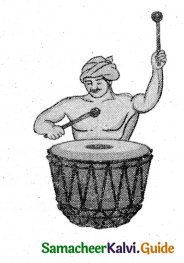
வங்கனூர் வாழ் பொதுமக்களுக்கு ஒரு நற்செய்தி… டம்… டம்… டம்…
இதன் மூலம் தெரிவிப்பது என்னவென்றால், வரும் பொங்கல்
திருவிழா அன்று மாலை 4.00 மணியளவில் பூங்கா நகர்
மைதானத்தில் சிலம்பாட்டம் நடைபெற உள்ளது. விருப்பமுள்ளவர்கள்
திரு. மணி அவர்களிடம் பெயரைப் பதிவு செய்யுமாறு ஊராட்சி சார்பில் தெரிவிக்கலாகிறது.
டம்… டம்… டம்
Samacheer Kalvi 5th Tamil Guide Chapter 5.2 தமிழர்களின் வீரக்கலைகள் - 2

கூடுதல் வினாக்கள்

சரியான சொல்லைத் தேர்வு செய்து எழுதுக.

Question 1.
ஏறுதழுவுதலுக்கு உகந்த நிலம் ……….
அ) நெய்தல்
ஆ) முல்லை
இ) பாலை
ஈ) குறிஞ்சி
Answer:
ஆ) முல்லை

Samacheer Kalvi 5th Tamil Guide Chapter 5.2 தமிழர்களின் வீரக்கலைகள்

Question 2.
ஏறுதழுவுதல் மறுபெயர் …..
அ) சிலம்பாட்டம்
ஆ) சிலம்பம்
இ) மற்போர்
ஈ) மஞ்சுவிரட்டு
Answer:
ஈ) மஞ்சுவிரட்டு

Question 3.
சிலம்பு என்பதன் பொருள்
அ) கொம்பு
ஆ) சுருள்பட்டா
இ) ஒலித்தல்
ஈ) வளரி
Answer:
இ) ஒலித்தல்

Samacheer Kalvi 5th Tamil Guide Chapter 5.2 தமிழர்களின் வீரக்கலைகள்

விடையளி :

Question 1.
சிலம்பக் கலையில் பயன்படுத்தப்படும் ஆயுதங்களின் பெயர்களை எழுதுக.
Answer:

  • மான்கொம்பு
  • பிச்சுவா கத்தி
  • சுருள் பட்டா
  • வளரி

Question 2.
மற்போரில் வெற்றிப் பெற்றவர்களை எவ்வாறு அழைப்பார்கள்?
Answer:
மற்போரில் வெற்றிப் பெற்றவர்களை ‘மல்லன்’ என்னும் சொல்லால் குறிக்கும் வழக்கம் இருந்தது. மற்போரில் சிறந்து விளங்கியமையாலேயே மாமல்லன் என்று அக்கால அரசர்கள் போற்றப்பெற்றனர்.

Samacheer Kalvi 5th Tamil Guide Chapter 5.1 திருக்குறள்

Tamilnadu State Board New Syllabus Samacheer Kalvi 5th Tamil Guide Pdf Chapter 5.1 திருக்குறள் Text Book Back Questions and Answers, Summary, Notes.

Tamilnadu Samacheer Kalvi 5th Tamil Solutions Chapter 5.1 திருக்குறள்

மதிப்பீடு

படிப்போம்! சிந்திப்போம்! எழுதுவோம்!

அ. சரியான சொல்லைத் தெரிவு செய்து எழுதுக.

Question 1.
‘ஆன்ற’ – இச்சொல்லின் பொருள்………………..
அ) உயர்ந்த
ஆ) பொலிந்த
இ) அணிந்த
ஈ) அயர்ந்த
Answer:
அ) உயர்ந்த

Samacheer Kalvi 5th Tamil Guide Chapter 5.1 திருக்குறள்

Question 2.
பெருஞ்செல்வம் – இச்சொல்லைப் பிரித்து எழுதக் கிடைப்பது ………..
அ) பெருஞ் + செல்வம்
ஆ) பெரும் + செல்வம்
இ) பெருமை + செல்வம்
ஈ) பெரு + செல்வம்
Answer:
இ) பெருமை + செல்வம்

Question 3.
பண்புடைமை – இச்சொல்லைப் பிரித்து எழுதக் கிடைப்பது …………..
அ) பண் + புடைமை
ஆ) பண்பு + புடைமை
இ) பண்பு + உடைமை
ஈ) பண் + உடைமை
Answer:
இ) பண்பு + உடைமை

Samacheer Kalvi 5th Tamil Guide Chapter 5.1 திருக்குறள்

Question 4.
அது + இன்றேல் – இச்சொற்களைச் சேர்த்து எழுதக் கிடைப்பது …………
அ) அது இன்றேல்
ஆ) அதுயின்றேல்
இ) அதுவின்றேல்
ஈ) அதுவன்றேல்
Answer:
இ) அதுவின்றேல்

Question 5.
பாடலில், நேர்மை என்னும் பொருள் தரும் சொல் ……………
அ) நயன்
ஆ) நன்றி
இ) பயன்
ஈ) பண்பு
Answer:
அ) நயன்

Samacheer Kalvi 5th Tamil Guide Chapter 5.1 திருக்குறள்

ஆ. கீழ்க்காணும் சொற்களைப் பிரித்து எழுதுக. இவ்விரண்டும்
அ) இவ்விரண்டும் = …………………… + ………………………….
ஆ) மக்கட்பண்பு = …………………… + ………………………….
Answer:
அ) இவ்விரண்டும் – இ + இரண்டும்
ஆ) மக்கட்பண்பு – மக்கள் + பண்பு

இ. உயிரெழுத்தில் தொடங்கும் சொற்களை எழுதுக.
Samacheer Kalvi 5th Tamil Guide Chapter 5.1 திருக்குறள் - 5
Asnwer:

Samacheer Kalvi 5th Tamil Guide Chapter 5.1 திருக்குறள் - 1

Samacheer Kalvi 5th Tamil Guide Chapter 5.1 திருக்குறள்

ஈ. பாடலில் இரண்டாம் எழுத்து ஒன்றுபோல் வரும் சொற்களை எடுத்து எழுதுக
Samacheer Kalvi 5th Tamil Guide Chapter 5.1 திருக்குறள் - 6
Answer:
Samacheer Kalvi 5th Tamil Guide Chapter 5.1 திருக்குறள் - 2

Samacheer Kalvi 5th Tamil Guide Chapter 5.1 திருக்குறள்

உ. அன்புடைமை, பண்புடைமை போல் ஈற்றில் ‘மை’ என முடியும்படி நான்கு சொற்கள் எழுதுக.
Samacheer Kalvi 5th Tamil Guide Chapter 5.1 திருக்குறள் - 7
Answer:
Samacheer Kalvi 5th Tamil Guide Chapter 5.1 திருக்குறள் - 3

ஊ. வினாக்களுக்கு விடையளிக்க.

Question 1.
பண்புடையவராக வாழ்வதற்குரிய நல்ல செயல்கள் யாவை?
Answer:
அன்புடையவராக இருத்தல், உயர்ந்த குடியில் பிறந்திருத்தல் ஆகிய இவ்விரண்டும் பண்பு உடையவராக வாழ்வதற்குரிய நல்ல செயலாகும்.

Samacheer Kalvi 5th Tamil Guide Chapter 5.1 திருக்குறள்

Question 2.
‘மரம் போன்றவர்’ எனத் திருக்குறள் யாரைக் குறிப்பிடுகிறது?
Answer:
அரத்தைப்போல் கூர்மையான அறிவு உடையவரானாலும் மக்களுக்கு உரிய பண்பு இல்லாதவர், மரத்தைப் போன்றவர் எனத் திருக்குறள் குறிப்பிடுகிறது.

Question 3.
பண்பில்லாதவன் பெற்ற செல்வம் எவ்வாறு பயனிலாது போகும்?
Answer:
பண்பு இல்லாதவன் பெற்ற பெருஞ்செல்வமானது, தூய்மையற்ற பாத்திரத்தின் தன்மையால் நல்ல பால் திரிவது போன்று பயனில்லாமல் போகும்.

Samacheer Kalvi 5th Tamil Guide Chapter 5.1 திருக்குறள்

எ. சிந்தனை வினா.

ஒருவரின் பண்புகளைக் கொண்டே, இந்த உலகம் அவரை மதிக்கிறது. இதுபற்றி உங்கள் கருத்தென்ன?
Answer:

  • ஒருவரின் பண்புகளைக் கொண்டே, இந்த உலகம் அவரை மதிக்கிறது.
  • ‘தீதும் நன்றும் பிறர் தர வாரா’ என்று புறநானூறு கூறும்.
  • ஒருவர் நற்செயல்களைச் செய்து, அன்புடன் பேசுதல், பிறர் துன்பத்தைத் தன் துன்பமாக எண்ணுதல், இன்சொல் பேசுதல் ஆகிய நற்பண்புகளுடன் செயல்புரிந்தால் அவரை இவ்வுலகம் மதிக்கும் என்பதில் ஐயமில்லை \

Samacheer Kalvi 5th Tamil Guide Chapter 5.1 திருக்குறள்

கற்பவை கற்றபின்

Question 1.
பாடலைச் சரியான ஒலிப்புடன் படித்து மகிழ்க.
Answer:

Question 2.
நம்மிடம் இருக்கவேண்டிய நற்பண்புகளைப் பட்டியலிடுக.
Answer:

  • இரக்கம்
  • ஈகை
  • நடுவுநிலை
  • கருணை
  • சான்றாண்மை (நெறி பிறழாமல் வாழ்வது)

Samacheer Kalvi 5th Tamil Guide Chapter 5.1 திருக்குறள்

Question 3.
பண்பா, பணமா எதற்கு முதன்மையளிக்க வேண்டும்? பட்டிமன்றத்திற்கு உரை தயாரித்துப் பேசுக.
Samacheer Kalvi 5th Tamil Guide Chapter 5.1 திருக்குறள் - 4
Answer:
நடுவர் – கமலநாதன் :
நாம் எடுத்துக் கொண்ட தலைப்பு பண்பா, பணமா எதற்கு முதன்மையளிக்க வேண்டும்? ஒரு மனிதன் தொழிலில் சிறப்படைய வேண்டும்; குடும்பத்துக்கு நல்ல தலைவனாக இருக்க வேண்டும்; சமுதாயத்தில் சிறந்த மதிப்போடு வாழ வேண்டும். இம்மூன்றும் ஒரு மனிதனுக்கு இருந்தால், அவன் சிறந்த வாழ்க்கையை வாழ்வதாக அர்த்தம். இவ்வுலகத்தில் குறையே இல்லாத மனிதன் யாருமே கிடையாது. அனைவரிடத்திலும் ஏதோ ஒரு குறை இருந்தே தீரும். இப்போது பண்பே என்ற தலைப்பில் பேச கண்ணனை அழைக்கிறேன்.

பண்பே – கண்ணன் :
பண்பு எல்லா உயிருக்கும் ஆன்மாவிற்கும் இன்றியமையாத ஒன்று. பிறர் மனம் நோகாமல் சொற்களை கையாள்வது ஒரு பண்பு! செயல்படுவது ஒரு பண்பு. அறிமுகம் ஆனவர்களுக்கு உதவும்போது, மனிதன் ஆகிறான். அதுவே, அறிமுகம் இல்லாதவர்களுக்கு உதவும்போது இறைவன் ஆகிறான். பணிவு நல்ல நட்பை தருகிறது, எளிதில் வேலை கிடைக்க உதவுகிறது.

பணி உயர்வுக்கு பிறரிடமிருந்து சிபாரிசு பெற்றுத்தருகிறது. போட்டிகள், பொறாமைகள், எதிர்ப்புகள், தடைகள் எதுவும் இருக்காது. இனிமையாக பேசுதலும் பிறர் நலனில் அக்கறை காட்டுதலும் எப்போதும் நமக்கு பல மடங்காகத் திரும்பிக் கிடைக்கும். நேர்மையையும் நன்மையையும் விரும்பி, பிறருக்குப் பயன்படும்படி வாழும் பெரியாரின் நல்ல பண்பை உலகத்தார் போற்றிக் கொண்டாடுவர். ஆகவே பண்பிற்கே முதன்மையளிக்க வேண்டும் என்று கூறி விடைபெறுகிறேன்.

Samacheer Kalvi 5th Tamil Guide Chapter 5.1 திருக்குறள்

பணமே – நிரஞ்சனா :
வள்ளுவர் கூறும் அறம், பொருள், இன்பம் என்கின்ற மூன்றில் பொருளை மட்டும் பெற்றுவிட்டால் அறமும், இன்பமும் தானே வந்துவிடும். பொருளில்லார்க்கு இவ்வுலகம் இல்லை ,பணம் பத்தும் செய்யும், பணம் இல்லாதவன் பிணம், பணம் பந்தியிலே- என்பன பணத்தின் முக்கியத்துவத்தைத் தெரிவிக்கும் பழமொழிகள். இந்தக் கலியுகக் காலத்தில் பணம் இல்லாதவன் பிணமாகக் கருதப்படுவான்.

பணம் என்றால் என்ன? உங்கள் இமைக் கதவுகளை மூடி சிந்தனை என்னும் சன்னலைத் திறந்து பார்த்தால் பதில் கிட்டும். பணம் என்றால் ஒரு மதிப்புள்ள நாணயம் என்று பொருள்படும். பணம் மனிதனின் அத்தியாவசியத் தேவைகளுள் முதல் இடத்தை வகிக்கிறது. ஆகவே பணத்திற்கே முதன்மையளிக்க வேண்டும் என்று கூறி விடை பெறுகிறேன்.

Samacheer Kalvi 5th Tamil Guide Chapter 5.1 திருக்குறள்

நடுவர் – கமலநாதன் :
கடவுளின் படைப்பில் திசைகள் எட்டு, ஸ்வரங்கள் ஏழு, சுவைகள் ஆறு, நிலங்கள் ஐந்து, காற்று நான்கு, மொழி மூன்று (இயல், இசை, நாடகம்), வாழ்க்கை இரண்டு (அகம், புறம்) என்று படைத்த இறைவன், ஒழுக்கத்தை ஒன்றாக மட்டுமே படைத்துள்ளான். நேர்மை, ஒழுக்கத்துடன் வாழ்ந்தால், அவன் மனதை பிறர் படிப்பார்கள். அங்கே பண்பு ஓங்கும். எனவே, பண்பு கொண்டவனே சிறந்த மனிதனாகிறான்.

கூடுதல் வினாக்கள்

சரியான சொல்லைத் தேர்வு செய்து எழுதுக.

Question 1.
நன்பால் – பொருள் தருக .
அ) செல்வம்
ஆ) நல்ல பால்
இ) உரிய பண்பு
ஈ) திரிவது
Answer:
ஆ) நல்ல பால்

Samacheer Kalvi 5th Tamil Guide Chapter 5.1 திருக்குறள்

Question 2.
திருக்குறள் ……………. எனப் போற்றப்படுகிறது.
அ) உலகப்பொதுமறை
ஆ) பதினெண்கீழ்க்கணக்கு
இ) அறத்துப்பால்
ஈ) பண்புடைமை
Answer:
அ) உலகப்பொதுமறை

விடையளி :

Question 1.
எப்பண்புகளை உலகத்தார் போற்றிக் கொண்டாடுவர்?
Answer:
நேர்மையையும் நன்மையையும் விரும்பி, பிறருக்குப் பயன்படும்படி வாழும் பெரியாரின் நல்ல பண்பை உலகத்தார் போற்றிக் கொண்டாடுவர்.

Samacheer Kalvi 5th Tamil Guide Chapter 5.1 திருக்குறள்

Question 2.
உலகம் எதனால் மண்ணோடு மண்ணாகி அழிந்துவிடும்?
Answer:
நற்பண்பு உடையவர் செய்யும் நல்ல செயல்களாலேயே இவ்வுலகம் இயங்குகிறது. இல்லையெனில், அது மண்ணோடு மண்ணாகி அழிந்து விடும்.

Samacheer Kalvi 8th Maths Guide Chapter 3 Algebra Ex 3.9

Tamilnadu State Board New Syllabus Samacheer Kalvi 8th Maths Guide Pdf Chapter 3 Algebra Ex 3.9 Text Book Back Questions and Answers, Notes.

Tamilnadu Samacheer Kalvi 8th Maths Solutions Chapter 3 Algebra Ex 3.9

Question 1.
Fill in the blanks:
(i) y = p x where p ∈ Z always passes through the _________ .
Answer:
Origin (0,0)
Hint:
[When we substitute x = 0 in equation, y also becomes zero. (0,0) is a solution]

Samacheer Kalvi 8th Maths Guide Chapter 3 Algebra Ex 3.9

(ii) The intersecting point of the line x = 4 and y = -4 is _________ .
Answer:
4, -4
Hint:
x = 4 is a line parallel to the y – axis and
y = -4 is a line parallel to the x – axis. The point of intersection is a point that lies on both lines & which should satisfy both the equations. Therefore, that point is (4, -4)

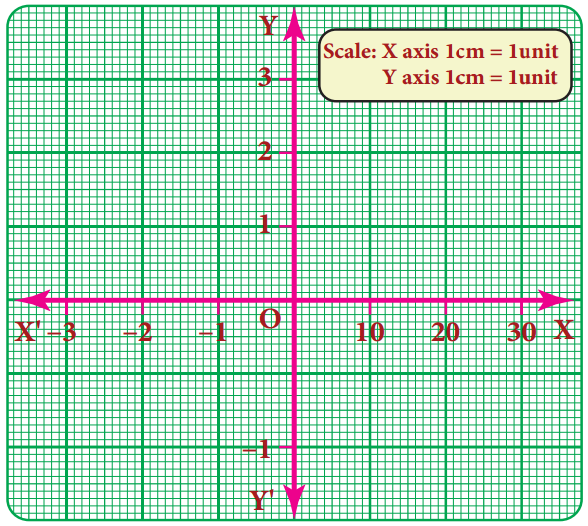
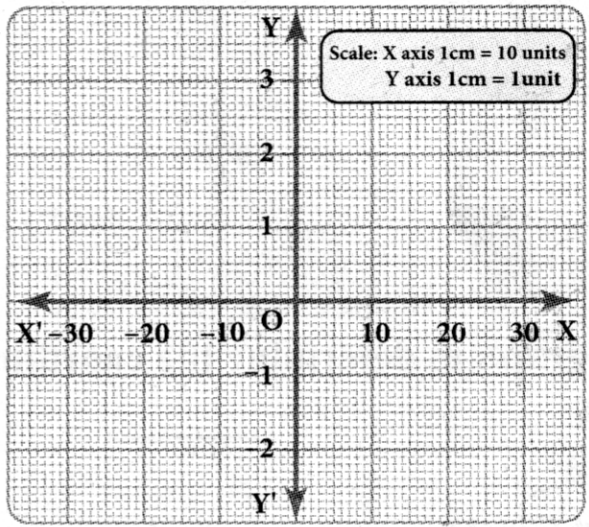
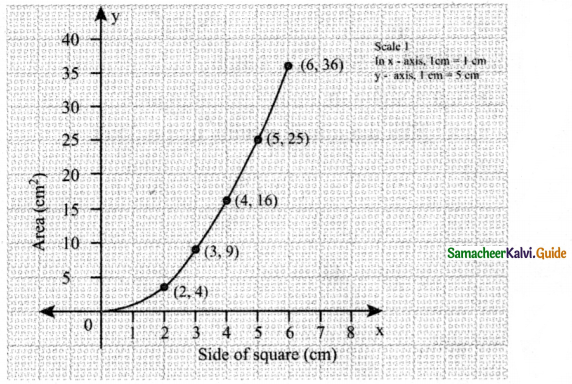
(iii) Scale for the given graph,
On the x-axis 1 cm = _________ units
y-axis 1 cm = _________ units
Samacheer Kalvi 8th Maths Guide Answers Chapter 3 Algebra Ex 3.9 1
Answer:
3 units, 25 units
Hint:
With reference to given graph,
On the x – axis. 1 cm = 3 units
y axis, 1 cm = 25 units

Samacheer Kalvi 8th Maths Guide Chapter 3 Algebra Ex 3.9

Question 2.
Say True or False.
(i) The points (1,1) (2,2) (3,3) lie on a same straight line.
Answer:
True
Hint:
The points (1, 1), (2, 2), (3, 3) all satisfy the equation y = x which is straight line. Hence, it is true

(ii) y = -9x not passes through the origin.
Answer:
False
Hint:
y = -9x substituting for x as zero, we get y = -9 × 0 = 0
∴ for x = 0, y = 0. Which means line passes through (0, 0), hence statement is false.

Question 3.
Will a line pass through (2, 2) if it intersects the axes at (2, 0) and (0, 2).
Answer:
Given a line intersects the axis at (2, 0) & (0, 2)
Let line intercept form be expressed as
ax + by = 1 Where a & b are the x & y intercept respectively.
Since the intercept points are (2. 0) & (0, 2)
a = 2, b = 2
∴ 2x + 2y = 1
When the point (2. 2) is considered & substituted in the equation
2x + 2y = 1, we get
2 × 2 + 2 × 2 = 4 ≠ 1
∴ the point (2. 2) does not satisfy the equation. Therefore the line does not pass through (2, 2)
Alternatively graphical method
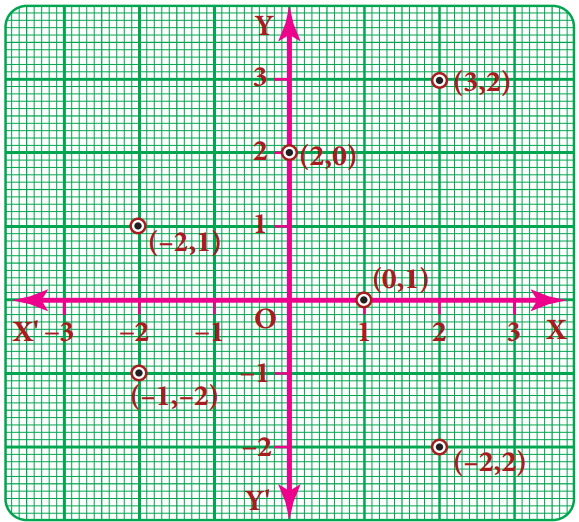
Samacheer Kalvi 8th Maths Guide Answers Chapter 3 Algebra Ex 3.9 2
as we can see the line doesn’t pass through (2, 2)

Samacheer Kalvi 8th Maths Guide Chapter 3 Algebra Ex 3.9

Question 4.
A line passing through (4, – 2) and intersects the Y-axis at (0, 2). Find a point on the line in the second quadrant.
Answer:
Line passes through (4, – 2)
y – axis intercept point – (0, 2) using 2 point formula.
amacheer Kalvi 8th Maths Guide Answers Chapter 3 Algebra Ex 3.9 3
Samacheer Kalvi 8th Maths Guide Answers Chapter 3 Algebra Ex 3.9 4
Samacheer Kalvi 8th Maths Guide Answers Chapter 3 Algebra Ex 3.9 5
Any point in II quadrant will have x as negative & y as positive.
So let us take x value as – 2
∴ -2 + y = 2
∴ y = 2 + 2 = 4
∴ Point in II Quadrant is (-2, 4)

Samacheer Kalvi 8th Maths Guide Chapter 3 Algebra Ex 3.9

Question 5.
If the points P(5, 3) Q(-3, 3) R (-3, -4) and S form a rectangle then find the coordinate of S.
Answer:
Plotting the points on a graph (approximately)
Steps:

  • Plot P, Q, R approximately on a graph.
  • As it is a rectangle, RS should be parallel to PQ & QR should be paraHel to PS
  • S should lie on the straight line from R parallel to x-axis & straight line from P parallel to y-axis
  • Therefore, we get S to be (5, -4)

[Note: We don’t need graph sheet for approximate plotting. This is just for graphical understanding]
Samacheer Kalvi 8th Maths Guide Answers Chapter 3 Algebra Ex 3.9 6

Samacheer Kalvi 8th Maths Guide Chapter 3 Algebra Ex 3.9

Question 6.
A line passes through (6, 0) and (0, 6) and an another line passes through (-3, 0) and (0, -3). What are the points to be joined to get a trapezium?
Answer:
In a trapezium. there are 2 opposite sides that are parallel. The other opposite sides are non-parallel.
Now, let us approximately plot the points for our understanding
[no need of graph sheet]
Samacheer Kalvi 8th Maths Guide Answers Chapter 3 Algebra Ex 3.9 7

  • Plot the points (0, 6), (6, 0), (-3, 0) & (0, -3)
  • Join (0, 6) & (6, 0)
  • Join (-3,0) & (0, – 3)
  • We find that the lines formed by joining the points are parallel lines.
  • So, for forming a trapezium, we should join (0, 6), (-3, 0) & (0, -3), (6, 0)

Samacheer Kalvi 8th Maths Guide Chapter 3 Algebra Ex 3.9

Question 7.
Find the point of intersection of the line joining points (- 3, 7) (2, – 4) and (4, 6) (- 5, – 7).Also find the point of intersection of these lines and also their intersection with the axis.
Answer:
Samacheer Kalvi 8th Maths Guide Answers Chapter 3 Algebra Ex 3.9 8
Equation of line joining 2 points by 2 point formula is given by
Samacheer Kalvi 8th Maths Guide Answers Chapter 3 Algebra Ex 3.9 9
Cross multiplying, we get
Samacheer Kalvi 8th Maths Guide Answers Chapter 3 Algebra Ex 3.9 10
Transposing the variables, we get
11 x + 5 y = 35 – 33 = 2
11 x + 5y = 2 – Line 1
Similarly, we should find out equation of second line
Samacheer Kalvi 8th Maths Guide Answers Chapter 3 Algebra Ex 3.9 11
Samacheer Kalvi 8th Maths Guide Answers Chapter 3 Algebra Ex 3.9 12
∴ 9y – 54 = 13x – 52
∴ 9y – 13x = 2 – Line 2
For finding point of intersection, we need to solve the 2 line equation to find a point that will satisfy both the line equations.
∴ Solving for x & y from line 1 & line 2 as below
11x + 5y = 2 ⇒ multiply both sides by 13,
11 × 13x + 5 × 13y = 26 …….. (3)
Line 2: 9y – 13x = 2 ⇒ multiply both sides by 11
9 × 11y – 13 × 11x = 22 ……… (4)
Samacheer Kalvi 8th Maths Guide Answers Chapter 3 Algebra Ex 3.9 13
∴ 164 y = 48
∴ y = \(\frac{48}{164}=\frac{12}{41}\)
Substituting this value ofy in line I we get
11 x + 5 y = 2
11 x + 5 × \(\frac{12}{41}\) = 2
11 x = 2 – \(\frac{60}{41}=\frac{82-60}{41}=\frac{22}{41}\)
∴ x = \(\frac{2}{41}\)
[∴ Point of intersection is \(\left(\frac{2}{41}, \frac{12}{41}\right)\)]
To find point of intersection of the lines with the axis, we should substitute values & check
Line 1: 11 x + 5 y = 2
Point of intersection of line with x – axis, i.e y coordinate is ‘0’
∴ put y = 0 in above equation
∴ 11 x – 5 × 0 = 2
∴ 11x + 0 = 2
∴ x = \(\frac{2}{11}\)
∴ [Point is \(\left(\frac{2}{11}, 0\right)\)]
Similarly, Point of intersection of line with y – axis is when x-coordinate becomes ‘0’
∴ put x = 0 in above equation
∴ 11 × 0 + 5y = 2
∴ 0 + 5y = 2
y = \(\frac{2}{5}\)
∴ [Point is \(\left(0, \frac{2}{5}\right)\)]
Similarly for line 2,
9y – 13x = 2
For finding x intercept, i.e point where line meets x axis, we know that y coordinate becomes ‘0’
∴ Substituting y = 0 in above eqn. we get
9 × 0 – 13x = 2
∴ 0 – 13x = 2
∴ x = \(\frac{-2}{13}\)
∴ [Point: \(\left(\frac{-2}{13}, 0\right)\)]
Similarly for y – intercept, x – coordinate becomes ‘0’,
∴ Substituting for x = 0 in above equation, we get
9 y – 13 × 0 = 2
9y – 0 = 2
9y = 2
y = \(\frac{2}{9}\)
[Point \(\left(0, \frac{2}{9}\right)\)]

Samacheer Kalvi 8th Maths Guide Chapter 3 Algebra Ex 3.9

Question 8.
Draw the graph of the following equations: (i) x = – 7 (ii) y = 6
Answer:
Samacheer Kalvi 8th Maths Guide Answers Chapter 3 Algebra Ex 3.9 14

Question 9.
Draw the graph of
(i) y = – 3x
(ii ) y = x – 4
(ii) y = 2x + 5
Answer:
To draw graph, we need to find out some points.
(i) y = – 3x
for y = -3x, let us first substituting values & check
put x = 0
y = 3 × 0 = 0
∴ (0,0) is a point
put x = 1
y = -3 × 1 = – 3
∴ (1, – 3) is a point
If join these 2 points, we will get the line

(ii) y = x – 4
for y = x – 4
put x = 0
y = 0 – 4 = – 4
∴ (0, – 4) is a point
x = 4
y = 4 – 4 = 0
∴ (4, 0) is a point

(iii) y = 2x + 5
for y = 2x + 5
put x = – 1
y = 2(-1) + 5 = – 2 + 5 = 3
∴ (-1, 3) is a point
put x = – 2
y = 2(-2) + 5 = – 4 + 5 = 1
∴ (-2, 1) is a point
Now let us plot the points & join them on graph
Samacheer Kalvi 8th Maths Guide Answers Chapter 3 Algebra Ex 3.9 15

Samacheer Kalvi 8th Maths Guide Chapter 3 Algebra Ex 3.9

Question 10.
Find the values
(a) y = x + 3
Samacheer Kalvi 8th Maths Guide Answers Chapter 3 Algebra Ex 3.9 16
Answer:
Let y = x+3
(i) if x = 0, y = 0 + 3 = 3,
∴ y = 3
(ii) y = 0, 0 = x + 3,
∴ x = – 3
(iii) x = -2, y = -2 + 3,
∴ y = 1
(iv) y = – 3, – 3 = x + 3,
∴ x = – 6

y = x + 3
Samacheer Kalvi 8th Maths Guide Answers Chapter 3 Algebra Ex 3.9 17

Samacheer Kalvi 8th Maths Guide Chapter 3 Algebra Ex 3.9

(b) 2x + y – 6 = 0
Samacheer Kalvi 8th Maths Guide Answers Chapter 3 Algebra Ex 3.9 18
Answer:
Let 2x + y – 6 = 0
(i) x = 0 2 × 0 + y – 6 = 0 ∴ y = 6
(ii) y = 0, 2x + 0 – 6 = 0, ∴ 2x = 6
x = 3 ,
(iii) x = -1, 2 × (-1) + y – 6 = 0, 8 + y = 0
y = 8
(iv) y = -2, 2x – 2 – 6 = 0, 2x = 8
x = 4

2x + y – 6 = 0
Samacheer Kalvi 8th Maths Guide Answers Chapter 3 Algebra Ex 3.9 19

Samacheer Kalvi 8th Maths Guide Chapter 3 Algebra Ex 3.9

(c) y = 3x + 1
Samacheer Kalvi 8th Maths Guide Answers Chapter 3 Algebra Ex 3.9 20
Answer:
(i) x = -1, y = 3(-1) + 1 = 0
∴ y = -2
(ii) x = 0, y = 3(0) + 1 = 0
∴ y = 1
(iii) x = 1, y = 3(1) + 1 = 0
∴ y = 4
(iv) x = 2, y = 3(2) + 1 = 0
∴ y = 7

y = 3x + 1
Samacheer Kalvi 8th Maths Guide Answers Chapter 3 Algebra Ex 3.9 21

Samacheer Kalvi 8th Maths Guide Chapter 3 Algebra Ex 3.8

Tamilnadu State Board New Syllabus Samacheer Kalvi 8th Maths Guide Pdf Chapter 3 Algebra Ex 3.8 Text Book Back Questions and Answers, Notes.

Tamilnadu Samacheer Kalvi 8th Maths Solutions Chapter 3 Algebra Ex 3.8

Question 1.
Fill in the blanks:
(i) X- axis and Y-axis intersect at _________ .
Answer:
Origin (0,0)

(ii) The coordinates of the point in third quadrant are always _________ .
Answer:
negative

Samacheer Kalvi 8th Maths Guide Chapter 3 Algebra Ex 3.8

(iii) (0, -5) point lies on _________ axis.
Answer:
Y-axis

(iv) The x- coordinate is always ______ on the y-axis.
Answer:
Zero

(v) ___________ coordinates are the same for a line parallel to Y-axis.
Answer:
X

Question 2.
Say True or False:
(i) (-10,20) lies in the second quadrant.
Answer:
True
Hint:
(-10, 20)
x = -10, y = 20
∴ (-10, 20) lies in second quadrant – True

(ii) (-9, 0) lies on the x-axis.
Answer:
True
Hint:
(-9, 0) on x – axis. Y- coordinate is always zero.
∴ (-9, 0) lies on x axis – True

Samacheer Kalvi 8th Maths Guide Chapter 3 Algebra Ex 3.8

(iii) The coordinates of the origin are (1,1).
Answer:
False
Hint:
Coordinate of origin is (0, 0), not (1, 1). Hence – False

Question 3.
Find the quadrants without plotting the points on a graph sheet.
(3, -4), (5, 7), (2, 0), (-3, -5), (4, -3), (-7, 2), (-8, 0), (0, 10), (-9, 50).
Answer:
amacheer Kalvi 8th Maths Guide Answers Chapter 3 Algebra Ex 3.8 1
If X & y coordinate are positive – I quad
If x is positive,y is negative – IV quad
If x is negative, y is positive – II quad
If both are negative, then – III quad
Samacheer Kalvi 8th Maths Guide Answers Chapter 3 Algebra Ex 3.8 2

Samacheer Kalvi 8th Maths Guide Chapter 3 Algebra Ex 3.8

Question 4.
Plot the following points in a graph sheet.
A(5, 2), B(-7, -3), C(-2, 4), D(-1, -1), E(0, -5), F(2, 0), G(7, -4), H(-4, 0), I(2, 3), J(8, -4), K(0, 7).
Answer:
Samacheer Kalvi 8th Maths Guide Answers Chapter 3 Algebra Ex 3.8 3

Samacheer Kalvi 8th Maths Guide Chapter 3 Algebra Ex 3.8

Question 5.
Use the graph to determine the coordinates where each figure is located.
Samacheer Kalvi 8th Maths Guide Answers Chapter 3 Algebra Ex 3.8 4

a) Star____________
b) Bird____________
c) Red circle____________
d) Diamond____________
e) Triangle____________
f) Ant____________
g) Mango____________
h) Housefly____________
i) Medal____________
j) Spider____________

Answer:

a) Star(3, 2)
b) Bird(-2, 0)
c) Red circle(-2, -2)
d) Diamond(-2, 2)
e) Triangle(-1, 1)
f) Ant(3, -1)
g) Mango(0, 2)
h) Housefly(2, 0)
i) Medal(-3, 3)
j) Spider(0, -2)

Samacheer Kalvi 8th Maths Guide Chapter 3 Algebra Ex 3.7

Tamilnadu State Board New Syllabus Samacheer Kalvi 8th Maths Guide Pdf Chapter 3 Algebra Ex 3.7 Text Book Back Questions and Answers, Notes.

Tamilnadu Samacheer Kalvi 8th Maths Solutions Chapter 3 Algebra Ex 3.7

Question 1.
Fill in the blanks:
(i) The solution of the equation ax + b = 0 is _______ .
Answer:
\(-\frac{b}{a}\)
Hint:
ax + b = 0
ax = – b
∴ x = \(-\frac{b}{a}\)

Samacheer Kalvi 8th Maths Guide Chapter 3 Algebra Ex 3.7

(ii) If a and b are positive integers then the solution of the equation ax = b has to be always _______ .
Answer:
Positive
Hint:
Since a & b are positive integers, b
The solution to the equation ax = b is x = \(\frac{b}{a}\) is also positive.

(iii) One-sixth of a number when subtracted from the number itself gives 25. The number is _______ .
Answer:
30
Hint:
Let the number be x.
As per question, when one sixth of number is subtracted from itself it gives 25
Samacheer Kalvi 8th Maths Guide Answers Chapter 3 Algebra Ex 3.7 1

(iv) If the angles of a triangle are in the ratio 2:3:4 then the difference between the greatest and the smallest angle is _______ .
Answer:
40°
Hint:
Given angles are in the ratio 2:3:4
Let the angles be 2x, 3x & 4x
Since sum of the angles of a triangle is 180°,
We get 2x + 3x + 4x = 180
∴ 9x = 180
∴ x = \(\frac{180}{9}\) = 20°
∴ The angles are 2x = 2 × 20 = 40°
3x = 3 × 20 = 60°
4x = 4 × 20 = 80°
∴ Difference between greatest & smallest angle is
80° – 40° = 40°

Samacheer Kalvi 8th Maths Guide Chapter 3 Algebra Ex 3.7

(v) In an equation a + b = 23. The value of a is 14 then the value of b is _______ .
Answer:
b = 9
Hint:
Given equation is a + b = 23, a = 14
14 + b = 23
∴ b = 23 – 14 = 9
b = 9

Question 2.
Say True or False
(i) “Sum of a number and two times that number is 48” can be written as y + 2y = 48
Answer:
True
Hint:
Let the number be ‘y’
∴ Sum of number & two times that number is 48
Can be written as y + 2y = 48 – True

(ii) 5(3x + 2) = 3(5x – 7) is a linear equation in one variable.
Answer:
True
Hint:
5 (3x + 2) = 3 (5x – 7) is a linear equation in one variable – ‘x’ – True

(iii) x = 25 is the solution of one third of a number is less than 10 the original number.
Answer:
False
Hint:
One third of number is 10 less than original number.
Let number be ‘x’. Therefore let us frame the equation
\(\frac{x}{3}\) = x – 10
∴ x = 3x – 30
3x – x = 30
2x = 30
x = 15 is the solution

Samacheer Kalvi 8th Maths Guide Chapter 3 Algebra Ex 3.7

Question 3.
One number is seven times another. If their difference is 18, find the numbers.
Answer:
Let the numbers be x & y
Given that one number is 7 times the other & that the difference is 18.
Let x = 7y
also, x – y = 18 (given)
Substituting for x in the above
We get 7y – y = 18
∴ 6y = 18
y = \(\frac{18}{6}\) = 3
∴ x = 7y = 7 × 3 = 21
The number are 3 & 21

Question 4.
The sum of three consecutive odd numbers is 75. Which is the largest among them?
Answer:
Given sum of three consecutive odd numbers is 75
Odd numbers are 1,3,5,7,9, 11, 13
∴ The difference between 2 consecutive odd numbers is always 2. or in other words, if one odd number is x, the next odd number would be x + 2 and the next number would be x + 2 + 2x + 4
i.e x + 4
Since sum of 3 consecutive odd nos is 75
∴ x + x + 2 + x + 4 = 75
∴ 3x + 6 = 75 ⇒ 3x = 75 – 6
∴ 3x = 69
x = \(\frac{69}{3}\) = 23
∴ The odd numbers are 23, 23 + 2, 23 + 4
i.e 23, 25, 27
∴ Largest number is 27.

Samacheer Kalvi 8th Maths Guide Chapter 3 Algebra Ex 3.7

Question 5.
The length of a rectangle is \(\frac{1}{3}\) rd of its breadth. If its perimeter is 64 m, then find the length and breadth of the rectangle.
Answer:
Let length & breadth of rectangle be ‘l’ and ‘b’ respectively
Given that length is \(\frac{1}{3}\) of breadth,
∴ l = \(\frac{1}{3}\) × b ⇒ l = \(\frac{b}{3}\) ⇒ b = 3l ……. (1)
Samacheer Kalvi 8th Maths Guide Answers Chapter 3 Algebra Ex 3.7 2
Also given that perimeter is 64 m
Perimeter = 2 × (l + b)
2 × 1 + 2 × b = 64
Substituting for value of b from (1), we get
2l + 2(3l) = 64
∴ 2l + 6l = 64
8l = 64
∴ l = \(\frac{64}{8}\) = 8m
b = 3l = 3 × 8 = 24m
Ienglh l = 8 m in & breadth b = 24 m

Question 6.
A total of 90 currency notes, consisting only of ₹ 5 and ₹ 10 denominations, amount to ₹ 500. Find the number of notes in each denomination.
Answer:
Let the number of ₹ 5 notes be ‘x’
And number of ₹ 10 notes be ‘y’
Total numbers of notes is x + y = 90 (given)
The total value of the notes is 500 rupees.
Value of one ₹ 5 rupee note is 5
Value of x ₹ 5 rupee notes is 5 × x = 5x
∴ Value of y ₹ 10 rupee flotes is 10 × y = lOy
∴ The total value is 5x + 10y which is 500
∴ we have 2 equations:
x + y = 90 ….(1)
5x + 10y = 500 ….(2)
Multiplying both sides of(1) by 5, we get
5 × x + 5 × y = 90 × 5
5x + 5y = 450
Subtracting (3) from (2), we get
Samacheer Kalvi 8th Maths Guide Answers Chapter 3 Algebra Ex 3.7 3
∴ y = \(\frac{50}{5}\) = 10
Substitute y = 10 in equation (1)
x + y = 90 ⇒ x + 10 = 90 ⇒ x = 90 – 10 ⇒ x = 80
There are ₹5 denominations are 80 numbers and ₹10 denominations are 10 numbers

Samacheer Kalvi 8th Maths Guide Chapter 3 Algebra Ex 3.7

Question 7.
At present, Thenmozhi’s age is 5 years more than that of Murali’s age. Five years ago, the ratio of Then mozhi’s age to Murali’s age was 3 : 2. Find their present ages.
Answer:
Let present ages of Thenmozhi & Murali be ‘t’ & ‘m’
Given that at present
Then mozhi’s age is 5 years more than Murali
∴ t = m + 5 …… (1)
5 years ago, Thenmozhi’s age would be t – 5
& Murali’s age would be m – 5
Ratio of their ages is given as 3 : 2
Samacheer Kalvi 8th Maths Guide Answers Chapter 3 Algebra Ex 3.7 4
2(t – 5) = 3(m – 5)
2 × t – 2 × 5 = 3 × m – 3 × 5 ⇒ 2t – 10 = 3m – 15
Substituting for t from (1)
2(m + 5) – 10 = 3m – 15
Samacheer Kalvi 8th Maths Guide Answers Chapter 3 Algebra Ex 3.7 5
2m = 3m – 15
3m – 2m = 15
m = 15
t = m + 5 = 15 + 5 = 20
∴ Present ages of Thenmozhi & Murali are 20 & 15

Question 8.
A number consists of two digits whose sum is 9. If 27 is subtracted from the original number, its djgit.s are interchanged. Find the original number.
Answer:
Let the units/digit of a number be ‘u’ & tens digit of the number be ‘t’
Given that sum of it’s digits is 9
∴ t + u = 9 ……. (1)
If 27 is subtracted from original number, the digits are interchanged
The number is written as 10t + u
[Understand: Suppose a 2 digit number is 21
it can be written as 2 × 10 + 1
∴ 32 = 3 × 10 + 2
45 = 4 × 10 + 5
tu = t × 10 + u = 1ot + u]
Given that when 27 is subtracted, digits interchange
10t + u – 27 = 10u + t (number with interchanged digits)
∴ By transposition & bringing like variables together
10t – t + u – 10u = 27
∴ 9t – 9u = 27
Dividing by ‘9’ throughout , we get
\(\frac{9 t}{9}-\frac{9 u}{9}=\frac{27}{9}\) ⇒ t – u = 3 ……. (2)
Solving (1) & (2):
Samacheer Kalvi 8th Maths Guide Answers Chapter 3 Algebra Ex 3.7 6/im - 6
t = 6 substitute in (1)
t + u = 9 ⇒ 6 + u = 9 ⇒ u = 9 – 6 = 3
Hence the number is 63.

Samacheer Kalvi 8th Maths Guide Chapter 3 Algebra Ex 3.7

Question 9.
The denominator of a fraction exceeds Its numerator by 8. If the numerator is increased by 17 and the denominator is decreased by 1, we get \(\frac{3}{2}\). Find the original fraction.
Answer:
Let the numerator & denominator be ‘n’ & ‘d’
Given that denominator exceeds numerator by 8
∴ d = n + 8 ……. (1)
If numerator increased by 17 & denominator decreased by 1,
it becomes (n + 17) & (d – 1), fraction is \(\frac{3}{2}\).
Samacheer Kalvi 8th Maths Guide Answers Chapter 3 Algebra Ex 3.7 7
2(n + 17) = 3(d – 1)
2n + 2 × 17 = 3d – 3
Samacheer Kalvi 8th Maths Guide Answers Chapter 3 Algebra Ex 3.7 8
∴ 34 + 3 = 3d – 2n
∴ 3d – 2n = 37 …….. (2)
Substituting eqn. (1) in (2), we get,
3 × (n + 8) – 2n = 37
3n + 3 × 8 – 2n = 37
Samacheer Kalvi 8th Maths Guide Answers Chapter 3 Algebra Ex 3.7 9
∴ n = 37 – 24 = 13
d = n + 8 = 13 + 8 = 21
The fraction is \(\frac{n}{d}=\frac{13}{21}\)

Question 10.
If a train runs at 60 km/hr it reaches its destination late by 15 minutes. But, if it runs at 85 kmph it is late by only 4 minutes. Find the distance to be covered by the train.
Answer:
Let the distance to be covered by train be ‘d’
Samacheer Kalvi 8th Maths Guide Answers Chapter 3 Algebra Ex 3.7 10

Case 1:
If speed = 60km/h
The time taken is 15 minutes more than usual (t + \(\frac{15}{60}\))
Let usual time taken be ‘t’ hrs.
Caution: Since speed is given in km/hr, we should take care to maintain all units such as time should be in hour and distance should be in kin.
Given that in case 1, it takes 15 min. more
15m = \(\frac{15}{60}\) hr = \(\frac{1}{4}\)hr.
∴ Substituting in formula,
Samacheer Kalvi 8th Maths Guide Answers Chapter 3 Algebra Ex 3.7 11
Since usually it takes ‘t’ hr, but when running at 60 k, it kes 15 min (\(\frac{1}{4}\)hr) extra.
Multiplying by 60 on both sides
d = 60 × t + 60 × \(\frac{1}{4}\) = 6ot + 15 …… (1)

Case 2:
Speed is given as 85 km/h
Time taken is only 4 min (\(\frac{4}{60}\)hr) more than usual time
∴ time taken = (t + \(\frac{1}{15}\)) hr. \(\left(\frac{4}{60}=\frac{1}{15}\right)\)
Using the formula,
Samacheer Kalvi 8th Maths Guide Answers Chapter 3 Algebra Ex 3.7 12
Multiplying by 85 on both sides
\(\frac{d}{85}\) × 85 = 85 × t + 85 × \(\frac{1}{15}\)
∴ d = 85t + \(\frac{17}{3}\) ….. (2)
From (1) & (2), we will solve for ‘r’
Equating & eliminating ‘d’ we get
Samacheer Kalvi 8th Maths Guide Answers Chapter 3 Algebra Ex 3.7 13
∴ By transposing, we get
Samacheer Kalvi 8th Maths Guide Answers Chapter 3 Algebra Ex 3.7 14
Substituting this value of ‘t’ in eqn. (1), we get
d = 60t + 15
= 60 × \(\frac{28}{75}\) + 15 = \(\frac{1680}{75}\) + 15 = 22.4 + 15
= 37.4 km

Samacheer Kalvi 8th Maths Guide Chapter 3 Algebra Ex 3.7

Question 11.
Sum of a number and its half is 30 then the number is ______
(a) 15
(b) 20
(c) 25
(d) 40
Answer:
(b) 20
Hint:
Let number be ‘x’
∴ half of number is \(\frac{x}{2}\)
Sum of number and it’s half is given by
x + \(\frac{x}{2}\) = 30 [Multiplying by 2 on both sides]
2x + x = 30 × 2
3x = 60
x = \(\frac{60}{3}\) = 20

Question 12.
The exterior angle of a triangle is 1200 and one of its interior opposite angle 58°, then the other opposite interior angle is _________
(a) 62°
(b) 72°
(c) 78°
(d) 68°
Answer:
(a) 62°
As per property of A. exterior angle is equals to sum of interior opposite angles
Let the other interior angle to be found be ‘x’
∴ x + 58 = 120°
∴ x = 120 – 58 = 62°
Samacheer Kalvi 8th Maths Guide Answers Chapter 3 Algebra Ex 3.7 15

Samacheer Kalvi 8th Maths Guide Chapter 3 Algebra Ex 3.7

Question 13.
What sum of money will earn 500 as simple interest in 1 year at 5% per annum?
(a) 50000
(b) 30000
(c) 10000
(d) 5000
Answer:
(c) 10000
Hint:
Let sum of money be P’
Time period (n) is given as 1 yr.
Rate of simple interest (r) is given as 5% p.a
∴ As per formula for simple interest.
S.I = \(\frac{\mathrm{P} \times r \times n}{100}=\frac{\mathrm{P} \times 5 \times 1}{100}\) = 500
∴ P × 5 × n = 500 × 100
∴ p = \(\frac{500 \times 100}{5}\) = 100 × 100 = 10,000

Question 14.
The product of LCM and HCF of two numbers is 24. If one of the number is 6, then the other number is ________
(a) 6
(b) 2
(c) 4
(d) 8
Answer:
(C) 4
Hint:
Product of LCM & HCF of 2 numbers is always product of the numbers. [this is property]
Product of LCM & HCF is given as 24
∴ Product of the 2 nos. is 24
Given one number is 6. Let other number be ‘x’
∴ 6 × x = 24
x = \(\frac{24}{6}\) = 4

Samacheer Kalvi 8th Maths Guide Chapter 3 Algebra Ex 3.7

Question 15.
The largest number of the three consecutie numbers is x+ 1, then the smallest number is ________ .
(A) x
(B) x + 1
(C) x + 2
(D) x – 1
Answer:
(D) x – 1
Hint:
The 3 consecutive numbers are: x – 1, x, x + 1