Samacheer Kalvi 12th Maths Guide Chapter 7 Applications of Differential Calculus Ex 7.4

Tamilnadu State Board New Syllabus Samacheer Kalvi 12th Maths Guide Pdf Chapter 7 Applications of Differential Calculus Ex 7.4 Textbook Questions and Answers, Notes.

Tamilnadu Samacheer Kalvi 12th Maths Solutions Chapter 7 Applications of Differential Calculus Ex 7.4

Question 1.
Write the Maclaurin series expansion of thef following functions:
(i) ex
(ii) sin x
(iii) cos x
(iv) log (1 – x); – 1 ≤ x ≤ 1
(v) tan-1 (x); -1 ≤ x ≤ 1
(vi) cos² x
Solution:
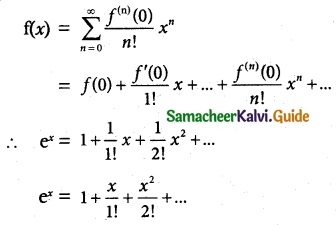
(i) Let f(x) = ex
f(x) = ex f'(0) = e° = 1
f”(x) = ex f”(0) = e° = 1
Maclaurin ‘s expansion is
Samacheer Kalvi 12th Maths Guide Chapter 7 Applications of Differential Calculus Ex 7.4 1

Samacheer Kalvi 12th Maths Guide Chapter 7 Applications of Differential Calculus Ex 7.4

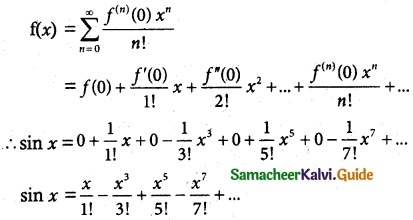
(ii) Let f(x) = sin x
f(x) = sin x; f(0) = 0
f'(x) = cos x; f'(0) = 1
f”(x) = -sin x; f”(0) = 0
f”‘(x) = -cos x; f”'(0) = -1
fIV(x) = sin x; fIV(0) = 0
fV(x) = cos x; fV(0) = 1
fVI(x) = -sin x; fVI(0) = 0
fVII(x) = -cos x; fVII(0) = -1
Maclaurin ‘s expansion is
Samacheer Kalvi 12th Maths Guide Chapter 7 Applications of Differential Calculus Ex 7.4 2

Samacheer Kalvi 12th Maths Guide Chapter 7 Applications of Differential Calculus Ex 7.4

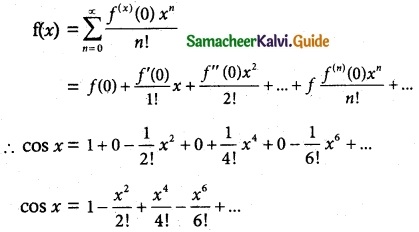
(iii) Let f(x) = cos x
f(x) = cos x ; f(0) = 1
f'(x) = -sin x ; f'(0) = 0
f”(x) = -cos x ; f”(0) = -1
f”'(x) = sin x ; f”'(0) = 0
fIV(x) = cos x ; fIV(0) = 1
fV(x) = -sin x ; fV(0) = 0
fVI(x) = -cos x ; fVI(0) = -1
Maclaurin ‘s expansion is
Samacheer Kalvi 12th Maths Guide Chapter 7 Applications of Differential Calculus Ex 7.4 3

(iv) log (1 – x); – 1 ≤ x ≤ 1
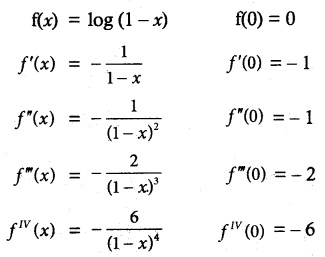
Samacheer Kalvi 12th Maths Guide Chapter 7 Applications of Differential Calculus Ex 7.4 4
Maclaurin ‘s expansion is
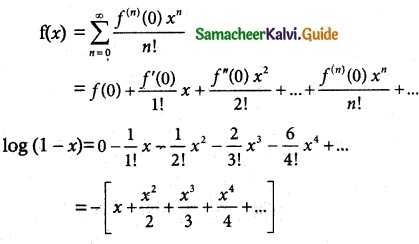
Samacheer Kalvi 12th Maths Guide Chapter 7 Applications of Differential Calculus Ex 7.4 5

Samacheer Kalvi 12th Maths Guide Chapter 7 Applications of Differential Calculus Ex 7.4

(v) tan-1 (x); -1 ≤ x ≤ 1
f(x) = tan-1 x ; f(0) = 0
f'(x) = \(\frac { 1 }{ 1+x^2 }\) f'(0) = 1
= 1 – x² + x4 – x6 + …..
f”(x) = -2x + 4x3 – 6x5 + ….. f”(0) = 0
f”'(x) = -2 + 12x² – 30x4 + ….. f”(0) = -2
fIV(x) = 24x – 120x³ + …… fIV(0) = 0
fV(x) = 24 – 360x² + ….. fV(0) = 24 .
fVI(x) = -720x + ….. fVI(0) = 0
fVII(x) = -720 + … fVII(0) = -720
Maclaurin ‘s expansion is
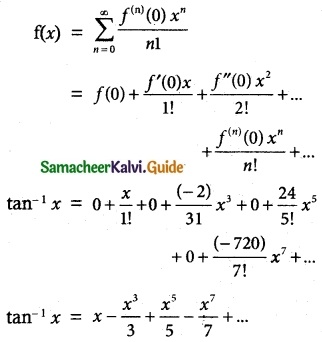
Samacheer Kalvi 12th Maths Guide Chapter 7 Applications of Differential Calculus Ex 7.4 6

Samacheer Kalvi 12th Maths Guide Chapter 7 Applications of Differential Calculus Ex 7.4

(vi) Let f(x) = cos² x
f(x) = cos² x ; f(0) = 1
f'(x) = -2 cos x sin x ; f'(0) = 0
= -sin 2 x
f”(x) = -2 cos 2x ; f”(0) = -2
f”‘(x) = 4 sin 2x ; f”‘(0) = 0
fIV(x) = 8 cos 2x ; fIV( 0) = 8
fV(x) = -16 sin 2x ; fV(0) = 0
fVI(x) = -32 cos 2x ; fVI(0) = -32
Maclaurin’s expansion is
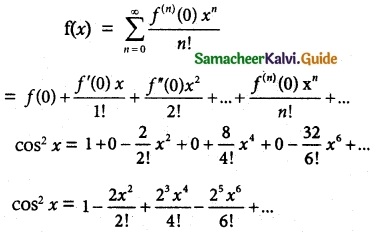
Samacheer Kalvi 12th Maths Guide Chapter 7 Applications of Differential Calculus Ex 7.4 7

Question 2.
Write down the Taylor series expansion, of the function log x about x = 1 upto three non-zero terms for x > 0.
Solution:
Let f(x) = log x
Taylor series of f(x) is
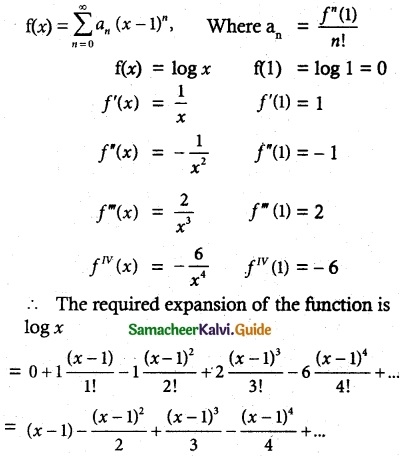
Samacheer Kalvi 12th Maths Guide Chapter 7 Applications of Differential Calculus Ex 7.4 8

Samacheer Kalvi 12th Maths Guide Chapter 7 Applications of Differential Calculus Ex 7.4

Question 3.
Expand sin x ascending powers x – \(\frac { π }{ 4 }\) upto three non-zero terms.
Solution:
Let f(x) = sin x
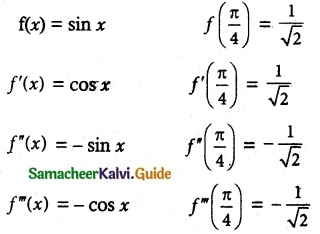
Samacheer Kalvi 12th Maths Guide Chapter 7 Applications of Differential Calculus Ex 7.4 9
Taylor series of f(x) is
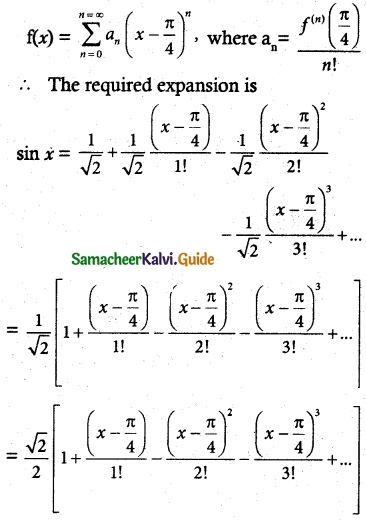
Samacheer Kalvi 12th Maths Guide Chapter 7 Applications of Differential Calculus Ex 7.4 10

Question 4.
Expand the polynomial f(x) = x² – 3x + 2 in power of x – 1.
Solution:
Let f(x) = x² – 3x + 2
f(x) = x² – 3x + 2 ; f(1) = 0
f'(x) = 2x – 3 ; f'(1) = -1
f”(x) = 2 ; f”(1) = 2
Taylor series of f(x) is
f(x) = \(\sum_{n=0}^{n=\infty}\) an (x – 1)n, where an = \(\frac { f^{(n)} (1)}{ n! }\)
∴ The required expansion is
x² – 3x + 2 = 0 – \(\frac { 1(x-1) }{ 1! }\) + \(\frac { 2(x-1)^2 }{ 2! }\)
= -(x – 1) + (x – 1)²
Samacheer Kalvi 12th Maths Guide Chapter 7 Applications of Differential Calculus Ex 7.4

Samacheer Kalvi 12th Bio Botany Guide Chapter 9 Plant Breeding

Tamilnadu State Board New Syllabus Samacheer Kalvi 12th Bio Botany Guide Pdf Chapter 9 Plant Breeding Text Book Back Questions and Answers, Notes.

Tamilnadu Samacheer Kalvi 12th Bio Botany Solutions Chapter 9 Plant Breeding

12th Bio Botany Guide Plant Breeding Text Book Back Questions and Answers

I. Choose the correct answer

Question 1.
Assertion : Genetic variation provides the raw material for selection.
Reason : Genetic variations are differences in genotypes of the individuals.
a) Assertion is right and reason is wrong.
b) Assertion is wrong and reason is right.
c) Both reason and assertion is right.
d) Both reason and assertion is wrong.
Answer:
b) Assertion is wrong and reason is right.

Question 2.
While studying the history of domestication of various cultivated plants ………………. were recognized earlier.
a) Centres of origin
b) Centres of domestication
c) Centres of hybrid
d) Centres of variation
Answer:
a) Centres of origin

 Samacheer Kalvi 12th Bio Botany Guide Chapter 9 Plant Breeding

Question 3.
Pick out the odd pair …………..
a) Mass selection – Morphological characters
b) Purline selection – Repeated self pollination
c) Clonal selection — Sexually propagated
d) Natural selection – Involves nature
Answer:
c) Clonal selection – Sexually propagated

Question 4.
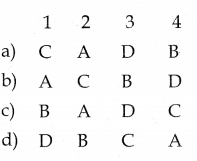
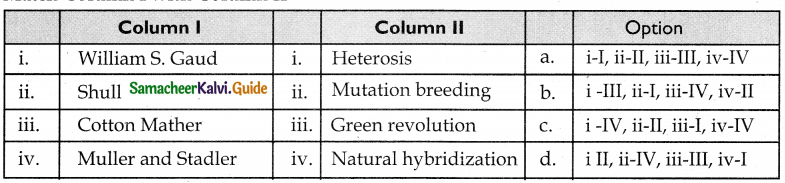
Match Column I with Column II
Samacheer Kalvi 12th Bio Botany Guide Chapter 9 Plant Breeding 1
Answer:
b) i -III, ii-I, iii-IV, iv-II

Question 5.
The quickest method of plant breeding is
a) Introduction
b) Selection
c) Hybridization
d) Mutation breeding
Answer:
b) Selection

 Samacheer Kalvi 12th Bio Botany Guide Chapter 9 Plant Breeding

Question 6.
Desired improved variety of economically useful crops are raised by
a) Natural selection
b) hybridization
c) mutation
d) biofertilisers
Answer:
b) hybridization

Question 7.
Plants having similar genotypes produced by plant breeding are called
a) clone
b) haploid
c) autopolyploid
d) genome
Answer:
a) clone

Question 8.
Importing better varieties and plants from outside and acclimatising them to local environment is called
a) cloning
b) heterosis
c) selection
d) introduction
Answer:
d) Introduction

 Samacheer Kalvi 12th Bio Botany Guide Chapter 9 Plant Breeding

Question 9.
Dwarfing gene of wheat is
a) pal 1
b) Atomita 1
c) Norin 10
d) pelita 2
Answer:
c) Norin 10

Question 10.
Crosses between the plants of the same variety are called
a) interspecific
b) inter varietal
c) intra varietal
d) inter generic
Answer:
c) Intra varietal

Question 11.
Progeny obtained as a result of repeat self pollination a cross pollinated crop to called
a) pure line
b) pedigree line
c) inbreed line
d) heterosis
Answer:
b) Pure line

 Samacheer Kalvi 12th Bio Botany Guide Chapter 9 Plant Breeding

Question 12.
Jaya and Ratna are the semi dwarf varieties of
a) wheat
b) rice
c) cowpea
d) mustard
Answer:
b) Rice

Question 13.
Which one of the following are the species that are crossed to give sugarcane varieties with high sugar, high yield, thick stems and ability to grow in the sugarcane belt of North India?
a) Saccharum robustum and Saccharum officinarum
b) Saccharum barberi and Saccharum officinarum
c) Saccharum sinense and Saccharum officinarum
d) Saccharum barberi and Saccharum robustum
Answer:
b)Saccharum barberi and Saccharum officinarum

Question 14.
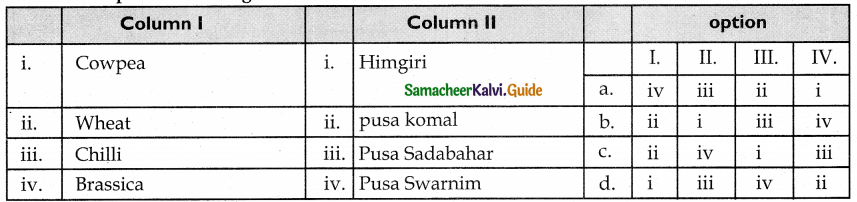
Match column I (crop) with column II (Corresponding disease resistant variety) and select the correct option from the given codes.
Samacheer Kalvi 12th Bio Botany Guide Chapter 9 Plant Breeding 2
Answer:
b) I-(ii), II-(i), IH-(iii), IV-(iv)

 Samacheer Kalvi 12th Bio Botany Guide Chapter 9 Plant Breeding

Question 15.
A Wheat variety, Atlas 66 which has been used as a donor for improving cultivated wheat, which is rich in
a) iron
b) carbohydrates
c) proteins
d) vitamins
Answer:
c) proteins

Question 16.
Which one of the following crop varieties correct matches with its resistance to a disease

VarietyResistance to disease
a. Pusa KomalBacterial blight
b. Pusa SadabaharWhite rust
c. Pusa ShubhraChilli mosaic virus
d. BrassicaPusa swarnim

Answer:
a) Pusa Komal – Bacterial blight

Question 17.
Which of the following is incorrectly paired?
a) Wheat – Himgiri
b) Milch breed – Sahiwal
c) Rice – Ratna
d) Pusa Komal – Brassica
Answer:
d) Pusa Komal – Brassica

 Samacheer Kalvi 12th Bio Botany Guide Chapter 9 Plant Breeding

Question 18.
Match list I with list II

List IList II
BiofertilizerOrganisms
i. Free living N2a. Aspergillus
ii. Symbiotic N2b. Arnanita
iii. P Solubilizingc. Anabaena azollae
iv. P Mobilizingd.d. Azotobactor

a. i c, ii a, iii b, iv d
b. i d, ii c, iii a, iv b
c. i a, ii c, iii b, iv d,
d. i b, ii a, iii d, iv c
Answer:
b. i d, ii c, iii a, iv b

Question 19.
Differentiate primary introduction from secondary introduction
Answer:

Primary introductionSecondary introduction
1. The introduced Variety is well adapted to the new environment.
2. There is no alternation to the original genotype
1. The introduced Variety is subjected to selection
2. The introduced Variety is subjected to selection
3. That variety is hybridized with a local variety to transfer one or a few characters to them.

Example :
Tea varieties collected from china and North East India initially grown in Botanical garden of kolkate from which appropriate clones have selected and introduced to different parts of India.

Question 20.
How are microbial innoculants used to increase the soil fertility?
Answer:

Biofertilizers or microbial innoculants are defined as preparations containing living cells or latent cells of efficient strains of microorganisms that help crop plants uptake of nutrients by their interactions in the rhizosphere when applied through seed or soil.

They are efficient in fixing nitrogen, solubilising phosphate and decomposing cellulose. They are designed to improve the soil fertility, plant growth, and also the number and biological activity of beneficial microorganisms in the soil. They are ecofriendly organic agro inputs and are more efficient and cost effective than chemical fertilizers.

 Samacheer Kalvi 12th Bio Botany Guide Chapter 9 Plant Breeding

Question 21.
What are the different types of hybridization?
Answer:
Types of hybridization:

(i) Intravarietal hybridization:
The cross between the plants of same variety. such crosses are useful only in the self. pollinated crops.

(ii) Intervarietal hybridization:
The cross between the plants belonging to two different varieties of the same species and is also known as intraspecific hybridization.

(iii) Interspecific hybridization:
The cross between the plants belonging to different species belonging to the same genus is also called intragenic hybridization.
Example:
Gossypium hirsutum
Gossypium arboreum

(v) Intergeneric hybridization:

  • The crosses are made between the plants belonging to two different genera.
  • The disadvantages are hybrid sterility time consuming and expensive procedure.
    Example : Raphanobrassica x Triticale

Question 22.
Explain the best suited type followed by plant breeders at present?
Answer:
Mutation breeding represents a new method of conventional breeding procedures as they have the advantage of improving the defect without losing an agronomic and quality character in agriculture and crop improvement. Mutation means the sudden heritable changes in the genotype or phenotype of an organism. Gene mutations are of considerable importance in plant breeding as they provide essential inputs for evolution as well as for recombination and selection. It is the only method for improving seedless crops.

 Samacheer Kalvi 12th Bio Botany Guide Chapter 9 Plant Breeding

Question 23.
Write a note on heterosis.
Answer:

  • The superiority of the FI hybrid in performance over its parents is called heterosis or hybird vigour.
  • G.H. Shull was the first scientist to use the term heterosis in 1912.
  • Heterosis are of the following types.
  • Euheterosis, Mutational Euheterosis, Balanced Euheterosis and Pseudoheterosis

(i) Euheterosis:
This is the true heterrosis which is inherited and is further classified as.

(a) Mutational Euheteosis:
Simplest type of euheterosis and results from the sheltering or eliminating of the deleterious unfavourable often lethal, recessive, mutant genes by their adaptively superior dominant alleles in cross pollinated crops.

(b) Balanced Euheterosis :
well balanced gene combinations which is more adaptive to environmental conditions and agricultural usefulness.

(ii) Psuedohetrosis:
Also termed as luxuriance progeny possess superiority over parents in vegetative growth but not in yield and adaptation usually sterile or poorly fertile.

Question 24.
List out the new breeding techniques involved in developing new traits in plant breeding.
Answer:
New Breeding Techniques (NBT) are a collection of methods that could increase and accelerate the development of new traits in plant breeding. These techniques often involve genome editing, to modify DNA at specific locations within the plants to produce new traits in crop plants. The various methods of achieving these changes in traits include the following.

  • Cutting and modifying the genome during the repair process by tools like CRISPR /Cas.
  • Genome editing to introduce changes in a few base pairs using a technique called Oligonucleotide-directed mutagenesis (ODM).
  • Transferring a gene from an identical or closely related species (cisgenesis).
  • Organizing processes that alter gene activity without altering the DNA itself (epigenetic methods)

 Samacheer Kalvi 12th Bio Botany Guide Chapter 9 Plant Breeding

12th Bio Botany Guide Plant Breeding Additional Important Questions and Answers

I. Match the Following

Question 1.

Column AColumn B
a. Darwins’s evolutionary theoryI. Origin of Cultivated plants
b. VavilovII. 12 mega gene centres
c. ZhukovskyIII. 12 main geographic centres
d. De candolleIV. Natural selection and Hybridization

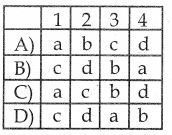
A) a – iv, b – iii, c – ii, d – i
B) a – iv, b – ii, c – iii, d – i
C) a – ii, b – i, c – iv, d – iii
D) a – i, b – iv, c – ii, d – iii
Answer:
A) a – iv, b – iii, c – ii, d – i

Question 2.

Column AColumn B
a. Green RevolutionI. Muller and stadler
b. Mutation BreedingII. G.H. Shull
c. HeterosisIII. William S. Gaud
d. Director of IARIIV. Dr.B.P. Pal

A) a – ii, b – iii, c-iv, d-i
B) a – iii, b-ii, c-i, d-iv
c) a – iii, b – i, c-ii, d-iv
D) a – i, b-iv c-iii, d-ii
Answer:
c) a – iii, b – i, c – i, d – iv

 Samacheer Kalvi 12th Bio Botany Guide Chapter 9 Plant Breeding

Question 3.

Column AColumn B
a. MesoamericaI. Sesame
b. South East AsiaII. Bamboo
c. AbyssinianIII. Guava
d. ChinaIV. Hemp

A) a – ii, b – iii, c- i, d – iv
B) a – i, b – ii, c – iv, d – iii
c) a – iv, b – i, c – ii, d – iii
D) a – iii, b – iv c – i, d – iv
Answer:
D) a – iii, b – iv c – i, d – iv

Question 4.

Column AColumn B
a. Atomic GardenI. Dwarfing Genes
b. Protein EnrichedII. Caesium 137
c. Vitamin C EntichedIII. French Peas
d. Norin 10IV. Bitter Gourd

A) a – i, b – ii, c – iv, d – iii
B) a – ii, b – iii, c – iv, d – i
c) a – iii, b – iv, c – i, d – iii
D) a – iv, b – i, c – iii, d – ii
Answer:
B) a – ii, b – iii, c – iv, d – i

 Samacheer Kalvi 12th Bio Botany Guide Chapter 9 Plant Breeding

II. Choose the Odd man Out

Question 1.
a) Rhizoblum
b) Azolla
c) Trichoderma
d) Arbuscular mycorhizae
Answer:
c) Trichoderma

Question 2.
a) Anabaena
b) Amanita
c) Nostoc
d) Azospirillum
Answer:
b) Amanita

Question 3.
a) Natural selection
b) Mass selection
c) Purelinc selection
d) Clonal selection
Answer:
a) Natural selection

Question 4.
a) Cesium
b) Nitromethyl
c) Urea
d) X-ray
Answer:
d) X-ray

 Samacheer Kalvi 12th Bio Botany Guide Chapter 9 Plant Breeding

III. Choose the incorrect Pair

Question 1.

Column AColumn B
a. China1. Bamboo
b. South East Asia2. Coconut
c. Ethiopia3. Castor
d. South America4. Onion

Answer:
d) South America – Onion

Question 2.

Column AColumn B
a. C.T.Patel1. First Cotton hybrid
b. Dr. B.P. Pal2. Superior disease resistant wheat
c. Dr. K. Ramiah3. Wheat breeder
d. Sir. T.S. Venkataraman4. Sugar cane breeder

Answer:
C) Dr. K. Ramiah – Wheat breeder

 Samacheer Kalvi 12th Bio Botany Guide Chapter 9 Plant Breeding

Question 3.

Column AColumn B
a. N2 Fixing Bacteria1. Bacillus
b. Fungi2. Penicillium
c. Bacillus3. Silicate and Zinc Solubilizers
d. Symbiotic4. Rhizobium

Answer:
a) N2 Fixing Bacteria – Bacillus

Question 4.

Column AColumn B
a. Free Living fungi1. Trichoderma
b.Entomopathogenic2. Beauveria
c. Green Manuring3. Sonora – 63
d. Green Leaf Manure4. Cassia fistula

Answer:
c) Green Manuring – Sonora – 63

 Samacheer Kalvi 12th Bio Botany Guide Chapter 9 Plant Breeding

IV. Choose the incorrect Pair

Question 5.

Column AColumn B
a. Domestication wheat1. 1926
b. Blast resistant Rice2. 1940
c. Insect Resistant Cotton3. 1903
d. Waxy Corn4. 1953

Answer:
b) Blast resistant Rice -1940

Question 6.

Column AColumn B
a. Green Manuring1. Tephrosia purpurea
b. Rhizoctonia Solani2. Potato
c. Rice Variety3. Sonora 64
d. Ectomycorrhiza4. Nostoc

Answer:
a) Green Manuring – Tephrosia purpurea

 Samacheer Kalvi 12th Bio Botany Guide Chapter 9 Plant Breeding

Question 7

Column AColumn B
a. Mutational Breeding1. Triticale
b. Polyploid Breeding2. Atomita -2
c. M.S. Swaminathan3. TN 1 – hybrid rice
d. Jaya and Ratna4. Semi dwarf wheat

Answer:
c) M.S. Swaminathan – TN 1 – hybrid rice

Question 8.

Column AColumn B
a. Wheat1. Pusa komal
b. Cow pea2. pusa sadabahar
c. Brassica3. Himgiri
d. Cauliflower4. Pusa shubhra

Answer:
d) Cauliflower – Pusa shubhra

 Samacheer Kalvi 12th Bio Botany Guide Chapter 9 Plant Breeding

V. Assertion and Reason

Question 1.
Assertion : Growing of green manure crops and use of these crops as manure is called Green Manuring.
Reason : It helps to increase the nitrogen in the soil.
a) A & R are true.
b) A & R are Wrong.
c) A is true and R is Wrong.
d) A is wrong and R is true.
Answer:
a) A & R are true.

Question 2.
Assertion : Dr. M.S. Swaminathan is called “Father of green revolution in India.
Reason : He strived hard for conservation of traditional rice varities.
a) Both A & R is True.
b) Both A & R is Wrong.
c) A is True and R is Wrong.
d) A is wrong and R is True.
Answer:
c) A is True and R is Wrong

 Samacheer Kalvi 12th Bio Botany Guide Chapter 9 Plant Breeding

Question 3.
Assertion(A): A variety formed by pure line selection method shows more homozggosity with respect to all genes.
Reason(R): The pure line plants are produced by asexual method of vegetative propagation method.
a) (A) is correct; (R) is wrong
b) (A) is wrong; (R) is correct
c) (A) is correct; (R) does not explain
d) (A) is correct; (R) explain (A)
Answer:
a) (A) is correct; (R) is wrong

Question 4.
Assertion : Earliest record of Agriculture is found in the fertile Crescent region in and around River Nile
Reason : Approximately 12000, years ago Fertile crescent region is in and around. Tigris and Euphrates river.
a) Both A & R are True.
b) Both A & R are Wrong.
c) A is True and R is Wrong.
d) A is Wrong and R is True.
Answer:
d) A is Wrong and R is True

 Samacheer Kalvi 12th Bio Botany Guide Chapter 9 Plant Breeding

VI. Choose the Correct Statements

Question 1.
a) Vavilov Studied 247 Cultivated plants
b) Zhukovsky divided the whole world into 12 mega gene centres.
c) Valvilo intially propose 12 main geographic centres of origin
d) Harlan put forward the concept of mega gene centre for the origin of cultivated plants
Answer:
b) Zhukovsky divided the whole world into 12 mega gene centres

Question 2.
a) Foxtail mullet was domesticated by India
b) Wheat & Pea war domesticated by Ethiopia.
c) Castor and Coffee was domesticated by central East
d) Tomato & Pineapple was domesticated by south America
Answer:
d) Tomato & Pineapple was domesticated by south America

 Samacheer Kalvi 12th Bio Botany Guide Chapter 9 Plant Breeding

Question 3.
a) Seaweeds has more than 70 minerals vitamins and enzymes
b) Trichoderma is a parasitic fungi.
c) Rhizobium is a pathogenic bacteria
d) Azolla is submerged water fern
Answer:
a) Seaweeds has more than 70 minerals vitamins and enzymes

Question 4.
a) Hirngiri is a wheat variety that is resistant to Bacterial blight disease.
b) A Variety of CowPea, Pusakomal is resistent to Hill bunt disease.
c) Pusa shubra is a cauliflower variety that is resistant to Black rot disease
d) Pusa swarnim is a variety of Brassica that is resistent to TMV disease
Answer:
c) Pusa shubra is a cauliflower variety that is resistant to Black disease

 Samacheer Kalvi 12th Bio Botany Guide Chapter 9 Plant Breeding

VII. Choose the incorrect Statements

Question 1.
a) Mr. Jayaraman was a disciple of Dr. Nammalvar
b) Normal E. Borlaug was awarded Noble prize for peace in 1970.
c) M.S. Swaminathan produced the first semidwarf fertiliser responsive hybrid variety of rice TN 1..
d) Green revolution the term was Coined by Muller
Answer:
d) Green revolution the term was Coined by Muller

Question 2.
The disadvantage of pureline selection is
a) It is difficult to distinguish between hereditary variation from environmental variation.
b) New genotypes are never created so they are less stable to environmental fluctuations
c) The genotype is unchanged for a long period of time.
d) The plants show more heterozygosity.
Answer:
c) The genotype is unchanged for a long period of time.

Question 3.
The possible changes in the plant species due to domestication are
a) Adaptation to a greater diversity of environments.
b) Uniform flowering and fruiting.
c) Drop in Yield
d) Change in breeding system
Answer:
c) Drop in yield

 Samacheer Kalvi 12th Bio Botany Guide Chapter 9 Plant Breeding

Question 4.
a) Rhizobiurn is best suited for the wheat fields.
b) Azolla that fixes the atmospheric nitrogen along with blue green algae.
c) Arbuscular mycorrhizae also assures water availability
cl) Sea weed liquid fertilizer improves resistance of plants to frost and disease.
Answer:
a) Rhizobium is best suited for the wheat fields

VIII. Choose the correct answer.

Question 1.
The domesticated crop of Mesoamerica is …………………..
a) Tomato
b) Pine apple
c) Sweet Potato
d) Rubber
Answer:
a) Tomato

Question 2.
The domesticated plant of the chiloe centre.
a) Maize
b)Potato
c) Tobacco
d) Olive
Answer:
a) Maize

 Samacheer Kalvi 12th Bio Botany Guide Chapter 9 Plant Breeding

Question 3.
The domesticated plant of the Near East is______
a) Rye
b) Rice
c) hemp
d) Cotton
Answer:
a) Rye

Question 4.
Name the rice variety with saline tolerance and pest resistance.
a) Wild-type rice
b) Atomita – 2
c) Dwarf rice variety
d) Golden rice
Answer:
b) Atomita -2

Question 5.
Biofertilizers could be also called as …………………
a) Viral inoculants
b) Myco inoculants
c) Protozoan inoculants
d) Bacterial Inoculants
Answer:
d) Bacterial Inoculants

 Samacheer Kalvi 12th Bio Botany Guide Chapter 9 Plant Breeding

Question 6.
Beauveria species act as a parasite on …………… species.
a) Mammals
b) Aves
c) Arthropod
d) Amphibians
Answer:
c) Arthropod

Question 7.
Damping off of ……………. is caused by Rhizoctonia solani.
a) Tomato
b) Potato
c) Millet
d) Maize
Answer:
a) Tomato

Question 8.
Pongamia pinnata is an important plant species useful for ………………. manure.
a) Organic
b) Potassium rich
c) Green leaf
d) Calcium rich
Answer:
c) Green leaf

 Samacheer Kalvi 12th Bio Botany Guide Chapter 9 Plant Breeding

Question 9.
Match the following and find the correct answer
(i) Rhizobium – (A) Water ferm
(ii) Trichoderma – (B) Green manuring
(iii) Azolla – (C) Symbiotic bacterium
(iv) Crotolaria – (D) Free living fungus
a) (i) B; (ii) C; (iii) D; (iv) A
b) (i) C; (ii) D; (iii) B; (iv) A
c) (i) C; (ii) D; (iii) A; (iv) B
d) (i) B; (ii) D; (iii) C; (iv) A
Answer:
c) (i) C; (ii) D; (iii) A; (iv) B

Question 10.
More Vigorous hybrid corn was developed in _______
a) 1926
b) 1943
c) 1950
d) 1936
Answer:
a) 1926

Question 11.
In 10,000 BC Domestication of ……………….. was done.
a) Maize
b) Paddy
c) Wheat
d) Sugar cane
Answer:
c) Wheat

 Samacheer Kalvi 12th Bio Botany Guide Chapter 9 Plant Breeding

Question 12.
The newly introduced plant was carefully examined by the process called …………….
a) PCR Method
b) Dots Method
c) Cisgenesid
d) Quarantine
Answer:
d) Quarantine

Question 13.
National Bureau of plant Genetic Resources is located at ……………….
a) Rangpuri
b) Andhra
c) Pune
d) Bihar
Answer:
a) Rangpuri

Question 14.
Hereditary Variation cannot be distinguished from environmental variation in ………………
a) Pureline selection
b) Clonal Selection
c) Mass Selection
d) Hybridization
Answer:
c) Mass Selection

 Samacheer Kalvi 12th Bio Botany Guide Chapter 9 Plant Breeding

Question 15.
Johannsen in 1903 coined the word.
a) Clonal Selection
b) Pure line
c) Mass Selection
d) Heterosis
Answer:
b) Pure line

Question 16.
Which one of the following is a biopesticide?
a) Azolla
b) Rhizobium
c) Beauveria
d) Hevea
Answer:
c) Beauveria

 Samacheer Kalvi 12th Bio Botany Guide Chapter 9 Plant Breeding

Question 17.
…………….. is the best suited measure for maintaining hybrid vigour.
a) Asexual reproduction
b) Vegetative Propagation
c) Grafting
d) Cutting
Answer:
b) Vegetative Propagation

Question 18.
…………. is also termed as luxuriance.
a) Euheterosis
b) Heterosis
c) Mutational heterosis
d) Pseudo heterosis
Answer:
d) Pseudo heterosis

Question 19.
Muller and Stadler coined the term ………………….
a) Mutation Breeding
b) Modern Breeding
c) Plant Breeding
d) Poly ploidy
Answer:
a) Mutation Breeding

 Samacheer Kalvi 12th Bio Botany Guide Chapter 9 Plant Breeding

Question 20.
Mutation Breeding is the only method of improving …………… crops.
a) Multi seeded
b) single seeded
C) seedless
d) Nutritional
Answer:
c) seedless

Question 21.
Bose Research institute at Calcutta is the first …………. in India.
a) Botanical garden
b) planatorium
c) Zoological park
d) Gamma garden
Answer:
d) Gamma garden

Question 22.
Which one of the following selection method takes longer time in bringing about desired variation?
a) clonal selection
b) Mass selection
c) pureline selection
d) Natural selection
Answer:
d) Natural selection

 Samacheer Kalvi 12th Bio Botany Guide Chapter 9 Plant Breeding

Question 23.
(A) was originally grown in North India
(B) was orginally grown in South India
a) (A) Saccharum officinarum (B) Saccharum bareri
b) (A) Saccharu bareri (B) Saccharum officinarum
c) (A) Saccharum coarctatum (B) Saccharum alopecuroidum
d) (A) Saccharum alopecuroidum (B) Saccharu coarctatum
Answer:
b) (A) Saccharu bareri (B) Saccharum officinarum

Question 24.
Green revolution is the ………………. Agricultural revolution.
a) Third
b) second
c) third
d) fourth
Answer:
a) Third

Question 25.
…………….. received the national award for best genome saviour. .
a) Nel jeyaraman
b) C.T.Patel
c) Dr.B.P.Pal
d) N.G.P.Rao
Answer:
a) Nel jeyaraman

 Samacheer Kalvi 12th Bio Botany Guide Chapter 9 Plant Breeding

Question 26.
……………. is the breeding of crops for improved nutritional quality
a) Plant Breeding
b) Heterosis
c) Mutation
d) Biofortification
Answer:
d) Biofortification

Question 27.
High aspartic acid maize leads to resistance to ………………….
a) aphids
b) jassids
c) maize stem borer
d) leaf roller
Answer:
c) maize stem borer

Question 28.
Which one of the following is not a free living N2 fixing organism?
a) Anabaena azollae
b)Azotobacter
c) Clostridium
d) Nostoc
Answer:
c) Clostridium

 Samacheer Kalvi 12th Bio Botany Guide Chapter 9 Plant Breeding

IX. Fill in the blanks.

1. De candolle in his ……………. studied 247 caltivated plants.
Answer:
Origen of cultivated plants

2. Bamboo eas demesticated by ……………….
Answer:
China

3. He was an eminet Sorghum breeder,devoloped World’s first hybrid of Sorghum CSH-1.
Answer:
N.G.P.Rao.

 Samacheer Kalvi 12th Bio Botany Guide Chapter 9 Plant Breeding

4. ……………… is used as a biofertilizer for wetland rice cultivation
Answer:
Azolla.

5. Vavilov in the year ………………. converted 8 main geographic centres of origin to 12
Answer:
1935

6. Harlan says that the centre of crop plants means the places of ……………… origin of the crop plants.
Answer:
Agricultural

7. The ……………… was domesticate only in the Chiloe centre
Answer:
Potato

 Samacheer Kalvi 12th Bio Botany Guide Chapter 9 Plant Breeding

8. ………………. could be also called as Bioinoculants
Answer:
Biofertilizers

9. C.T.Patel devoloped World’s first …………….. hybrid
Answer:
Cotton

10. Choudhary ram dhan made …………….. as punjab granary of India.
Answer:
Wheat

11. Azdla is used as biofertiliser for wetland rice cultivation and is known to contribute ……………./ha/crop.
Answer:
40-60 kg

 Samacheer Kalvi 12th Bio Botany Guide Chapter 9 Plant Breeding

12. …………….. is Associated with Phycomycetous fungi and angiosperm roots.
Answer:
Arbuscular Mycorhizzoe

13. ……………… contains Auxin,Cytokinin and Gibberellins
Answer:
Seaweed liquid fertiliser

14. ……………… species are free living fungi that are common in soil and root ecosystem
Answer:
Trichoderma

15. Damping of tomato is caused by ……………..
Answer:
Rhizoctonia Solani

 Samacheer Kalvi 12th Bio Botany Guide Chapter 9 Plant Breeding

16. It is one of the most important green manure crops
Answer:
Tephrosia Purpurea

17. The double helix structure of DNA was identified by ……………. and …………….
Answer:
James Watson,Francis Crick

18. By 2050 we will …………….. need more food to feed the rapid growing population.
Answer:
50%

19. Crop domestication started early during ……………….
Answer:
10,000 Bc

20. ………………. Corn was developed using targetted breeding.
Answer:
Waxy

 Samacheer Kalvi 12th Bio Botany Guide Chapter 9 Plant Breeding

21. Rice variety of ……………. introduced from Philippines
Answer:
IR8

22. NBPGR is located in Chennai at …………………..
Answer:
Meenembakkan

23. Introduced plants get adapted to the new environment is called as ……………….
Answer:
Acclimatization

24. Tea varieties collected from China and North East India initially grown in Botanical garden of ……………….
Answer:
Kolkatta
Selection

 Samacheer Kalvi 12th Bio Botany Guide Chapter 9 Plant Breeding

25. ______ is the oldest and basic method of plant breeding
Answer:
Preliminary

26. In clonal selection …………… yield trial takes place during 3rd year.
Answer:
Intrageneric

27. Interspecific hybridization is also called as _____
Answer:
hybridization

28. Green revolution scheme began in ……………. in 1940’s.
Answer:
Mexico

 Samacheer Kalvi 12th Bio Botany Guide Chapter 9 Plant Breeding

29. In 2005 …………….. organized a first ever traditional paddy seed festival in his farm as an individual.
Answer:
Nel jayaraman

30. …………… is a cleaving protein.
Answer:
Cas9

X. Two Marks

Question 1.
What is Economic Botany?
Answer:
It is the study of the relationship between people and economically important plants.

Question 2.
When did people started practising Agriculture?
Answer:

  • Archeological evidence for earliest record of agriculture is found in the fertile crescent region in and around Tigris and Euphrates river valleys, approximate about 12,000 years
    ago

Question 3.
What was the contribution by De Candolle towards agriculture?
Answer:

  • He studied 247 cultivated plant species.
  • He attempted to solve the mystery about the anscestral form, region of domestication and history.

 Samacheer Kalvi 12th Bio Botany Guide Chapter 9 Plant Breeding

Question 4.
How many geographic centres were proposed by vavilov?
Answer:

  • Initially he proposed eight main geographic centres of origin.
  • Later by dividing few centres into two or three centres and added a new centre USA.
  • Thus making the 8 centres of Origin into 12.

Question 5.
Define Biofertilizers.
Answer:

  • It is defined as preparations containing living cells of efficient strains of micro organisms that help in crop yield.

Question 6.
What is component of seaweed liquid fertilizer?
Answer:

  • It contains Cytokinin, Gibberellins, and auxin a part from macro & micro nutrients.
  • It has Alginates, Carbohydrate, 70 types of minerals, Vitaming and enzymes.

 Samacheer Kalvi 12th Bio Botany Guide Chapter 9 Plant Breeding

Question 7.
Trichoderma has been recognised as bio¬control agent – Give Reasons.
Answer:

  • It control plant diseases
  • Ability to enhance root growth.
  • Increases crop productivity.
  • Provides resistance to abiotic stress.
  • Helps in uptake and use of nutrients.

Question 8.
What is plant introduction?
Answer:

  • Introduction of genotypes from a place where it is normally grown to a new place.
  • eg. IR & Rice from Philippines.

Question 9.
Define Acclimatization?
Answer:

  • The adjustment or adaptation of the introduced plant in the changed environment is called acclimatization.

 Samacheer Kalvi 12th Bio Botany Guide Chapter 9 Plant Breeding

Question 10.
What is Quarantine?
Answer:

  • All the introduced Crop must be free from presence of weeds, insects and disease causing Organisms.
  • It has to be carefully examined by the process called quarantine.
  • A strict isolation imposed to prevent the spread of disease.

Question 11.
What is Natural Selection?
Answer:

  • This is a rule in the nature.
  • It results in evolution reflected in the Darwinian’s principle survival of the fittest.
  • It takes longer time to bring about desired Variation.

Question 12.
What is Arificial Selection?
Answer:

  • It is a human involved process.
  • Having better crop from a mixed population.
  • The individuals differ in character.

 Samacheer Kalvi 12th Bio Botany Guide Chapter 9 Plant Breeding

Question 13.
Name the three types of Artificial Selection.
Answer:
a) Mass Selection,
b) Pureline Selection,
c) Clonal Selection

Question 14.
What is Emasculation
Answer:

  • It is a process of removal of anthers to prevent self pollination before the opening of a flower.

Question 15.
What are the various types of Mutagens?
Answer:

  • Physical Mutagen – UV short wave, X-ray, Alpha, Beta and Gamma Waves.
  • Chemical Mutagen – Cesium, Ethylmethane sulfonate Nitromethyl and Urea.

 Samacheer Kalvi 12th Bio Botany Guide Chapter 9 Plant Breeding

Question 16.
What is Gamma Garden?
Answer:

  • It is a form of mutation breeding.
  • The Radioactive sources are cobalt – 60 and Caesium -137
  • The first Gamma Garden in India is Bose Research institute at Calcutta.

Question 17.
What are the benefits of polyploidy?
Answer:

  • It often exhibit increase hybrid vigour.
  • Increase the tolerance to both biotic and abiotic stresses

Question 18.
How Polyploidy can be induced? List out the products achieved through polyploidy.
Answer:

  • Polyploidy can be induced by the use of cochicine to double the chromosome number.
  • Seedless Tomato, Apple, Watermelon and orange.

 Samacheer Kalvi 12th Bio Botany Guide Chapter 9 Plant Breeding

Question 19.
Define Green Revolution.
Answer:

  • It is the cumulative result of a series of research, development, innovation and technology transfer initiatives in Agriculture.

Question 20.
Write about the contribution of Dr. M.S.Swaminathan in mutation breeding.
Answer:

  • He is the pioneer mutation breeder.
  • He has produce sharbati Sonora is the amber grain coloured variety of wheat.
  • He is responsible for green revolution in India.

Question 21.
What are the objectives considered in Breeding to improve the nutritional quality of plants?
Answer:
To improve protein, oil, vitamin, Micronutrient and mineral content and quality

 Samacheer Kalvi 12th Bio Botany Guide Chapter 9 Plant Breeding

Question 22.
Tabulate certain crops and the pest resistant Variety?
Answer:

CropVarietyInsect pests
Brasica (rapeseed mustard)
Flat been
Okra (Bhindi)
Pusa Gaurav
Pusa Sem 2, Pusa Sem 3
Pusa Sawani, Pusa A
Aphids
Jassids, aphids and fruit borer
Shoot and Fruit borer

Question 23.
Expand the following.
Answer:

  • CRISPR – Clustered Regularly Interspaced short Palindromic Repeats
  • ODM – Oligonucleotide – Directed Mutagenesis.

Question 24.
Which method of artificial vegetative reproduction is good in plants. Give reason for your answer.
Answer:
Tissue culture is the modern artifical reproductive technique.

Reasons:

  •  large scale production of clones (genitically uniform population) from the callus tissue – developed from the chosen explant cells (invitro)
  • Both crop and tree species useful in forestry can be produced with desirable characters in large numbers with in a short span of time.

 Samacheer Kalvi 12th Bio Botany Guide Chapter 9 Plant Breeding

Question 25.
What are the advantages of rice field?
Answer:

  • Azolla is a free floating water fern that fixes atmospheric nitrogen in association with nitrogen fixing blue green algae. Anabaena azolla.
  • It is used as a bio-fertilizer for wetland rice cultivation and is known to contribute 40-60 kh/hal/crop.

Question 26.
Write the any three names of plant species useful in green manure?
Answer:

  • Cassia fistula
  • Sesbania grandiflora
  • Azadirachta indica

Question 27.
What is Bio-pesticides with example
Answer:
Bio-pesticides are biologically based agents used for the control of plant pests.
Example: Trichoderma.

 Samacheer Kalvi 12th Bio Botany Guide Chapter 9 Plant Breeding

XI. Differentiate Type Questions

Question 1.
Differentiate Biofertilizers and Green manuring
Answer:

Biofertilizers

Green Manure

It is defined aspreparations containing living or latent cells of efficient strains of micro organismsIt is defined as the growing of green manure crops and use of these crops directly in the field by ploughing
It helps the crops uptake of nutrients, when they are applied through seed or soil.It helps in increasing the content of nitrogen in the soil.
In improve soil fertility and ecofriendlyIt helps in improving the structure and physical properties of the soil.

Question 2.
Differentiate Pureline selection and clonal selection
Answer:

Pureline SelectionClonal Selection
It is a collection of plant obtained as a result of repeated self pollination from a single homozygous individual.It is asexually propagated and the clonal selection is employed to select improved variety from a mixed population.
The progeny shows more. homozygosity with respect to all genes.The progeny resemble in genetic constitution with the parent plant as they are mitotically divided

 Samacheer Kalvi 12th Bio Botany Guide Chapter 9 Plant Breeding

Question 3.
Differentiate Mutation Breeding and Polyploid Breeding
Answer:

Mutation BreedingPolyploid Breeding
Mutation means the sudden heritable changes in the genotype or phenotypeThe plants which possess more than two sets of chromosomes are called polyploids.
It is of considerable importance in plant breeding as they provide essential inputs for evolution as well as for recombination and selection.Poly ploidy often exhibit increased hybrid vigour and increased heterozygosity.

Question 4.
Differentiate Intervarietal and Interspecific Hybridization.
Answer:

Intervarietal HybridizationInterspecific Hybridization
The cross between the plants of two different varieties of the same species.The cross between the plants of two different species.
This technique has been the basis of improving self pollinated as well as cross pollinated crops.It is commonly used for transferring the beneficial genes from one species to another.


 Samacheer Kalvi 12th Bio Botany Guide Chapter 9 Plant Breeding

XII. Three marks

Question 1.
What are the fields involved in Economic Botany?
Answer:

  • Agronomy, Anthropology, Archaeology, Chemistry, trade and commerce.

Question 2.
Define Domestication.
Answer:

  • It is the process of bringing a plant species under the control of humans and gradually changing it through careful selection.

Question 3.
What is Organic Agriculture?
Answer:

  • It is as alternative agricultural system.
  • It is due to rapidly changing farming practices.
  • It is a production system that sustains the health of the soils, ecosystems and people.
  • It is based on ecological processes biodiversity and cycles adapted to local conditions

 Samacheer Kalvi 12th Bio Botany Guide Chapter 9 Plant Breeding

Question 4.
Write about the role played by Beauveria as a Bio-pesticide
Answer:

  • It is an entomo-pathogenic fungi
  • It acts as a parasite on various arthropod that causes white muscardine disease.
  • It also controls datnping off of tomato caused by Rhizoctonia Solani.

Question 5.
Differentiate Green manuring and Green leaf manuring.
Green Manuring

  • Growing of green manure crops and use these crops directly in the field by ploughing.
  • It increases the nitrogen in the soil.
  • It helps to improve the physical property of the soil.
    eg. Crotalaria juncea.

Green Leaf Manuring

  • Application of green leaves twigs, shrubs, plants growing in wasteland and field bunds.
  • The important plant species useful for green leaf manure are – cassia fistula. Delonix regia.

 Samacheer Kalvi 12th Bio Botany Guide Chapter 9 Plant Breeding

Question 6.
Define plant breeding
Answer:

  • Plant breeding is the science of improvement of crop varities with higher yield better quality, resistance to diseases and shorter durations which are suitable to particular environment.

Question 7.
What is the plan of thrid Agricultural Revolution
Answer:
The Green revolution or thrid Agricultural Revolution is the intensive plan of 1960’s to increase crop yield in developing countries by introducing the high yielding, resistant varieties, increased irrigation facilities, fertilizer application and better agricultural management.

Question 8.
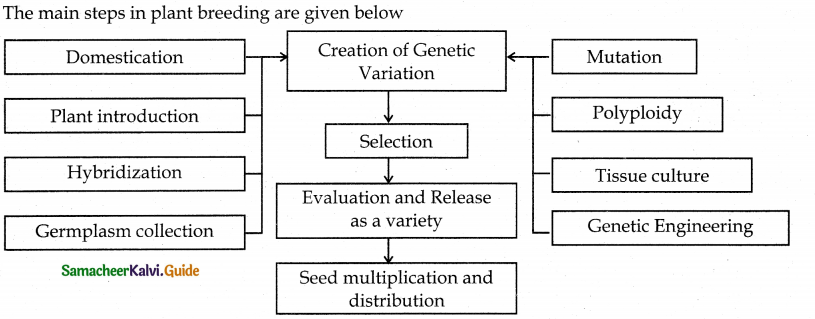
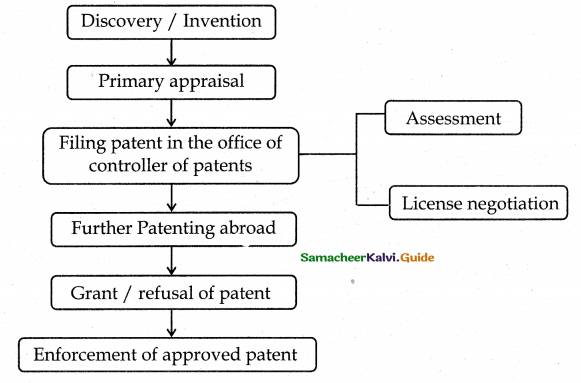
Draw a flow chart showing the steps involved in plant Breeding.
Answer:
The main steps in plant breeding are given below
Samacheer Kalvi 12th Bio Botany Guide Chapter 9 Plant Breeding 3

Question 9.
Write about NBPG R
Answer:

  • It is responsible for introduction and maintence of germplasm of various agricultural and horticultural station in our country.
  • It is also responsible for maintenance of plant materials of botanical and medicinal interest.
  • It is located at Rangpuri/New Delhi with four regional station at Amristar, Kolkata, Mumbai and Chennai.

 Samacheer Kalvi 12th Bio Botany Guide Chapter 9 Plant Breeding

Question 10.
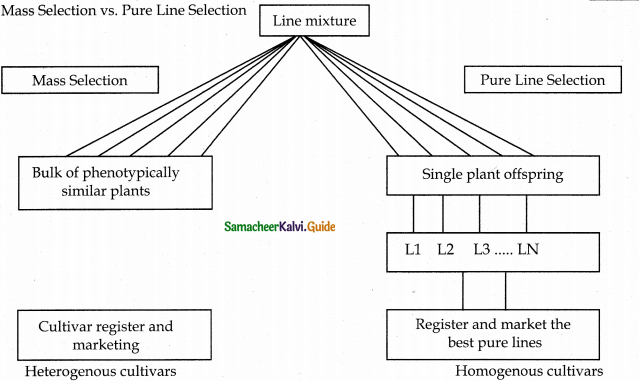
Draw the Schematic difference between Mass & Pureline selection.
Answer:
Samacheer Kalvi 12th Bio Botany Guide Chapter 9 Plant Breeding 4

Question 11.
What is hybridization?
Answer:

  • Hybridization is the method of producing new crop verities by crossing of plants that are genetically different.
  • It offers improvement in crop by combining the desirable character of two or more varities.
  • The first natural hybridization was observed by Cotton Mather in maize.

Question 12.
A type of Heterosis is called as Pseudoheterosis – Why?
Answer:

  • It is called as pseudoheterosis because the progeny is superior over parents by vegetative growth.
  • They are usually sterile.
  • It is also called as Luxuriance.

 Samacheer Kalvi 12th Bio Botany Guide Chapter 9 Plant Breeding

Question 13.
Tabulate certain crop variety and the disease to which they are resistant.
Answer:

CropVarietyResistance to diseases
WheatHimgiriLeaf and Stripe rust, hill bunt
BrassicaPusa swarnim (Kara rai)White rust
CauliflowerPusa Shubhra, Pusa snowball K-1Black rot and curl blight black rot.
CowpeaPusa KomalBacterial blight
ChilliPusa SadabaharChilly mosaic virus, Tobacco mosaic virus and Leaf curl.

Question 14.
What is Norm 10?

  • It is dwarfing genes with high photosynthetic rate and increases the respiratory activity.
  • Gonjiro Inazuka was scientist, who selected the Semi- dwarf wheat variety – Norm 1o.
  • This variety helped one billion lives from hunger and starvation.

Question 15.
How can we develop resistance to Insect pests in plants?

  • Insect resistance in host crop plants may be due to morphological, biochemical 0r physiological characteristics.
  • Hairy leaves in plants – Jassids in cotton
    – Cereal leaf bettle in wheat.
  • Solids Stem – Stem sawfly.
    Smooth leaves and nectar less cotton – Bol worms.
    High aspartic acid, low nitrogen and sugar content – Maize stem borers.

 Samacheer Kalvi 12th Bio Botany Guide Chapter 9 Plant Breeding

Question 16.
What are the plant breeding tools used to improve the crop varieties?
Answer:

  • Genetic Engineering, plant tissue culture, protoplasmic fusion, Molecular marking and DNA finger printing.

Question 17.
Define mutation breeding?
Answer:
Mutation means the sudden heritable changes in the genotype or phenotype of an organism.

Question 18.
What is Bio-fortification?
Answer:
Breeding crops with higher levels of vitamins and minerals or higher protein and healthier fats is the most practical means to improve public health.

 Samacheer Kalvi 12th Bio Botany Guide Chapter 9 Plant Breeding

Question 19.
Comment on sugercane.
Answer:

  • Saccharum bareri was originally grown in north India.
  • It is poor sugar content and yield.
  • Tropical canes grown in south India saccharurn officinarum had thicker stems and higher sugar content.
  • It did not grow well in North India
  • These two species were successfully crossed to get sugar cane varieties combining the desirable qualities of high yield thick stems high sugar and ability to grows in the sugar cane areas of North India.

XIII. Five Marks

Question 1.
What are the possible changes in the plant due to domestication?
Answer:

  • Adaption to the environmental alteration.
  • Adaption to wider geographical range.
  • Uniformity in flowering and fruiting.
  • Increased size of fruits and seeds.
  • Change in breeding system.
  • Increase in yield.
  • Increased resistance for disease and pest.
  • Developing seedless parthenocarpic fruit.
  • Enhancing the taste and nutritional composition.

Question 2.
Enumerate the History of Agriculture:
Answer:

  • 1807 – Alexander Yon Humboldt considered that original & source of most and their origin is an importable secret.
  • 1868 – Darwin’s theory proposed that natural selection and hybridization led to the origin of cultivate plants.
  • 1883 – De Candolle studied 247 cultivated plants species and was able to find the ancestral form, region of domestication and history.
  • 1887-1943 – Vavilov studied about the diverse forms of plants based on various criteria like morphology,cytology etc., He proposed 8 geographic centres and later developed it to 12 centres.
  • 1968 – Zhukovsky put forward the concept of mega gene and divided the whole world into 12 mega gene centres.
  • 1971 – Harlen believed that agriculture originated independently in three different areas.
    – There were non centres are the area were the crop has been shifted.

 Samacheer Kalvi 12th Bio Botany Guide Chapter 9 Plant Breeding

Question 3.
Tabulate the vavilov’s centres of crop origin and crop domesticated.
Answer:
Vavilov’s centres of crop origin and crops domesticated.

Vavilov’s centre of crop originCrops domesticated
1. ChinaFoxtail millet, soybean, bamboo, onion, .crucifers
2. IndiaRice, Sugarcane, mango, orange, eggplant, sesame
2a. South East AsiaRice, banana, coconut, clove, hemp.
3. Central EastWheat, pea, hemp, cotton, etc.,
4. The Near EastWheat, rye, many subtropical and tropical fruits
5. MediterraneanOlive, vegetables, oil, yielding plants, wheats
6. Ethiopia (Abyssinian)Wheat, barley, sesame, castor, coffee
7. Mesomerica (South Mexican & central American centre)Maize, bean, sweet potato, papaya, guava,
tobacco
8. South AmericaTomato, pine-apple
8a. South AmericaPotato
8b. The Brazilian-Paraguayan centreGroundnut, cashew nut, pine apple, peppers, rubber.

Question 4.
Write an essay on Indian plant Breeders.
Answer:

  • Dr.M.S.Swaminathan- He is pioneer in mutation breeder.
  • Sir.T.S.Venkatraman- An eminent sugarcane breeder.
  • Dr.B.P.Pal-Developed superior disease resistant varieties of wheat
  • Dr.K.Ramiah- Eminent Rice Breeder.
    N.G.P.Rao-An eminent sorghum breeder, developed world’s first hybrid of sorghum (CSH-1).
  • C.T.Patel-Developed world’s first cotton hybrid.
  • Choudhary Ram Dhan – wheat breeder,developed C-591 wheat which made Punjab as wheat granary of india.

 Samacheer Kalvi 12th Bio Botany Guide Chapter 9 Plant Breeding

Question 5.
Differentiate Rhizobium from Azolla as bio-fertilizers.
Answer:

  • Bio-fertilizers could also be called as microbial cultures or bacteria) fertilizers.
  • They are efficient in fixing nitrogen improve soil fertility, eco-friendly and cost effective.

Rhizobium:

  • It resides in the root nodules of leguminous plants.
  • It fixes the atmospheric Nitrogen.
  • It increases yield of paddy by 15-40%

Azolla:

  • Free floating water fern, with blue green algae fixes the Nitrogrn.
  • It increases the yield of rice.
  • It decomposes quickly.

Arbuscular Mycorrhizae:

  • They can dissolve the phosphates found in the soil.
  • It provides strength to resist disease, germ and unfavourable weather.

Seaweed Liquid Fertilizer:

  • It contains cytokinin, gibberellins and Auxin
  • Most of it are made from kelp ( Brown Algae).
  • The alginates in it react with metals in soil and retain moisture for a long time.
  • They have more than 70 minerals vitamin and enzymes.
  • Seeds soaked in seaweed germinate rapidly.

Question 6.
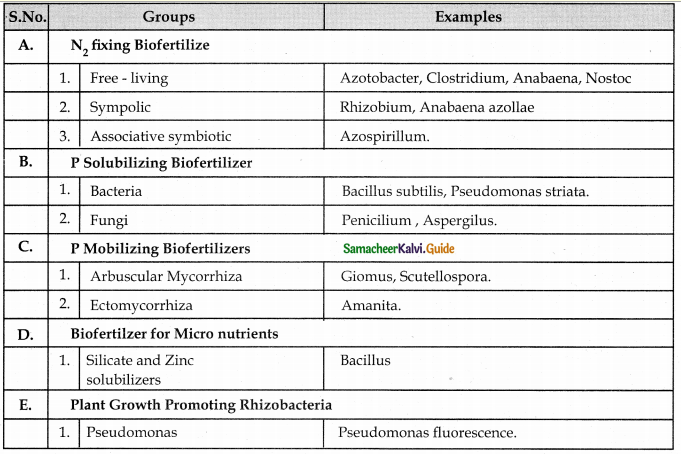
Tabulate the classification of Biofertilizers.
Answer:
Samacheer Kalvi 12th Bio Botany Guide Chapter 9 Plant Breeding 5

Question 7.
Discuss about Biopesticides in detail.
Answer:

  • They are biologically based agents used for the control of plant pests.
  • They are ecofriendly , Non – toxic and cheaper the chemical pesticide.

Trichoderma:

  • They are free living fungi in the soil.
  • They control plant disease.
  • It has the ability to enhance root growth development.
  • Increases the crop productivity.
  • It helps in resisting Abiotic stress.
  • It increases the uptake and use of nutrients.

Beauveria:

  • It is an entomo – pathogenic fungus
  • It parasitse arthropods that cause white muscardine and controls damping off of tomato

 Samacheer Kalvi 12th Bio Botany Guide Chapter 9 Plant Breeding

Question 8.
Enumerate the objectives of plant Breeding.
Answer:

  • To increase yield, Vigour and fertility of the crop.
  • To increase tolerance to environmental condition, Salinity, Temperature and drought.
  • To prevent premature falling of buds fruits etc.,
  • To improve the maturation of both the male and female gametes at the same time.
  • To develop resistance to pathogens and pests.
  • To develop photosensitive and thermos – Sensitive Varieties.

Question 9.
Discuss about the types of selection.
Answer:

  • Selection is the oldest and basic method of plant breeding.
  • There are two main types of selection – Natural and Artificial.

Natural Selection:

  • It occurs naturally.
  • It takes longer time in bringing about desired variation.
  • It reflected the Darwinian principle.

Artificial Selection:

  • It is a human involved process.
  • Producing better crop from a mixed population.

a) Mass Selection :

  • Large number of plants of similar phenotype are selected and crossed to get a new variety.
  • After repeated selection for five to six years it is distributed to the farmers.

b) Pureline Selection:

  • Plants obtained as a result of self pollination from a single homozygous individual.
  • The progeny shows homozy gosity with respect to all genes.
  • New Genotypes are never created,

c) Clonal Seection:

  • The progenies that are asexually propagated resembles the parent genetically.
  • The progeny is multiplied to form clone.
  • The genotype of a clone remains unchanged for a long period of time.

 Samacheer Kalvi 12th Bio Botany Guide Chapter 9 Plant Breeding

Question 10.
Describe the steps involved in Hybri-dization.
Answer:
a) Selection of Parents :

  • Male and female plants of desired characters are selected.
  • It should be tested for their homozygosity

b) Emasculation:

  • It is removal of anther before blooming.
  • It avoids self pollination

c) Bagging:
The stigma is protected against any undesirable pollen grains, by covering with a bag.

d) Crossing:
Transfer of pollen grains from selected male flower to the stigma of the emasculated female flower.

e) Harvesting Seeds and Raising Plants :

  • Due to fertilization seeds form.
  • These seeds are grown into a new generation.

Question 11.
Discuss about the types of heterosis.
Answer:
a) Euheterosis:

  • It is the true heterosis.
  • It is inherited

b) Mutational Euheterosis :

  • It is the simplest form.
  • Removal of harmful, recessive, mutant genes by superior dominant allele in cross pollinated crops.

c) Balanced Euheterosis:

  • Well balanced gene combination.
  • More adaptive to environment and agricultural usefulness.

d) Psuedo heterosis :

  • Also known as luxuriance.
  • Progeny possess superiority over parents in regetative Growth.
  • But not in yield & adaptation.
  • Usually sterile or poorly fertile.

 Samacheer Kalvi 12th Bio Botany Guide Chapter 9 Plant Breeding

Question 12.
Describe polyploid Breeding.
Answer:

  • The plants which posses more than two sets of chromosomes are called Polyploids.
  • It is the major force in the evolution of both wild and cultivated plants.
  • Polyploid of exhibit hybrid vigour.
  • Increases tolerance to biotic and abiotic stresses.
  • Polyploidy results in reduced fertility and producing seedless varieties.
  • If chromosomes is doubled by itself it is autopolyploidy.
  • Triploid condition in Sugarbeets result in Vigour.
  • Colchicine used to double the chromosomes. Eg. Triticale and Raphanobrassica

Question 13,
Biofortification is the breeding crops with
higher levels of nutrients. Justify it..
Answer:
Breeding of improved nutritional quality like
– Protein content and quality.
– Oil content and quality
– Vitamin Content
– Micro & Macro nutrient content.

  • In 2000 – Maize hybrid had twice the nutrient value than the parents.
  • Wheat – Atlass 66 having high protein content.
  • Iron fortified rice can be developed.
  • Vitamin A enriched vegetable.
  • Vitamin C enriched vegetables and iron and calcium crops also developed.

Question 14.
Enumerate the New Breeding Techniques.
Answer:

  • It is a collection of methods that could increase the development of new traits in plant breeding.
  • It often involve genome editing.
  • Cutting and modifying the genome during the repair process by tools like CRISPR.
  • Genome editing to introduce changes in few base pairs using a technique called ODM.
  • Transferring a gene from an identical or closely related species (Cisgenesis)
  • Organising process that alter gene activity without altering the DNA itself.

 Samacheer Kalvi 12th Bio Botany Guide Chapter 9 Plant Breeding

Question 15.
Ramu and Somu are farmers. Ramu cultivated the crops by self fertilization method. Somu cultivated the crops from mixed population.
(i) Who will get new variety?
(ii) Write the advantage and disadvantages of their selection.
Answer:
(i) Somu will get the new variety. Because he had selected the mixed population method.

(ii) Advantages of self fertilization method:
The repeated self pollination from a single homozygous individual produces a variety that shows more homozygosity with respect to all genes.

(iii) Dis advantages:

  • The major disadvantage of this type is that it never creates new genotypes.
  • The plants produced are also less adaptible and less stable to the environmental fluctuations.

Advantages of Mixed population method
In this method, a large number of plants of similar phenotype (or) morphological characters are selected and their seeds are mixed together to constitute a newer variety’.

Disadvantages:
The disadvantage of mixed population method is that it is difficult to distinguish the hereditary variation from environmental variation .

Question 16.
Mention the benefits of seed treatment?
Answer:

  • Prevents spread of plant disease
  • Protects seed from seedling blights
  • Improves germination
  • Improves germination
  • provides protection from storage insects
  • controls soil insects.

Samacheer Kalvi 12th Maths Guide Chapter 7 Applications of Differential Calculus Ex 7.3

Tamilnadu State Board New Syllabus Samacheer Kalvi 12th Maths Guide Pdf Chapter 7 Applications of Differential Calculus Ex 7.3 Textbook Questions and Answers, Notes.

Tamilnadu Samacheer Kalvi 12th Maths Solutions Chapter 7 Applications of Differential Calculus Ex 7.3

Question 1.
Explain why Rolle’s theorem is not applicable to the following functions in the respective intervals.
(i) f(x) = |\(\frac { 1 }{ x }\)|, x ∈ [-1, 1]
(ii) f(x) = tan x, x ∈ [0, π]
(iii) f(x) = x – 2 log x, x ∈ [2, 7]
Solution:
(i) f(x) = |\(\frac { 1 }{ x }\)|, x ∈ [-1, 1]
f(-1) = 1
f(1) = 1
⇒ f(-1) = f(1) = 1
But f(x) is not differentiable at x = 0
∴ Rolle’s theorem is not applicable.

(ii) f (x) = tan x
f(x) is not continuous at x = \(\frac{\pi}{2}\).
So Rolle’s Theorem is not applicable.

Samacheer Kalvi 12th Maths Guide Chapter 7 Applications of Differential Calculus Ex 7.3

(iii) f(x) = x – 2 log x
f(x) = x – 2 log x
f(2) = 2 – 2 log 2 = 2 – log 4
f(7) = 7 – 2 log 7 = 7 – log 49
f(2) ≠ f(7)
So Rolle’s theorem is not applicable.

Question 2.
Using the Rolle’s theorem, determine the values of x at which the tangent is parallel to the x-axis for the following functions:
(i) f(x) = x² – x, x ∈ [0, 1]
(ii) f(x) = \(\frac { x^2-2x }{ x+2 }\), x ∈ [-1, 6]
(iii) f(x) = √x – \(\frac { x }{ 3 }\), x ∈ [0, 9]
Solution:
(i) f(x) = x² – x, x ∈ [0, 1]
f(0) = 0, f(1) = 0
⇒ f(0) = f(1) = 0
f(x) is continuous on [0, 1]
f(x) is differentiable on (0, 1)
Now, f'(x) = 2x – 1
Since, the tangent is parallel to x-axis then
f'(x) = 0 ⇒ 2x – 1 = 0
x = \(\frac { x }{ 3 }\) ∈ (0, 1)

(ii) f(x) = \(\frac { x^2-2x }{ x+2 }\), x ∈ [-1, 6]
f(-1) = \(\frac { 1+2 }{ -1+2 }\) = 3
f(6) = \(\frac { 36-12 }{ 8 }\) = \(\frac { 24 }{ 8 }\) = 3
⇒ f (-1) = 3 = f(6)
f(x) is continuous on [- 1, 6]
f(x) is differentiable on (- 1, 6)
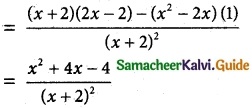
Now, f'(x)
Samacheer Kalvi 12th Maths Guide Chapter 7 Applications of Differential Calculus Ex 7.3 1
Since the tangent is parallel to the x-axis.
f'(x) = 0
⇒ x² + 4x – 4 = 0
⇒ x = –\(\frac { 4±\sqrt{16+16} }{ 2 }\)
x = –\(\frac { 4±4√2 }{ 2 }\) = -2 ± 2√2
x = -2 ± 2√2 ∈ (-1, 6)

Samacheer Kalvi 12th Maths Guide Chapter 7 Applications of Differential Calculus Ex 7.3

(iii) f(x) = √x – \(\frac { x }{ 3 }\), x ∈ [0, 9]
f(0) = 0, f(9) = √9 – \(\frac { 9 }{ 3 }\) = 3 – 3 = 0
⇒ f(0) = 0 = f(9)
f(x) is continuous on [0, 9]
f(x) is differentiable on (0, 9)
Now f'(x) = \(\frac { 1 }{ 2√x }\) – \(\frac { 1 }{ 3 }\)
Since, the tangent is parallel to x-axis.
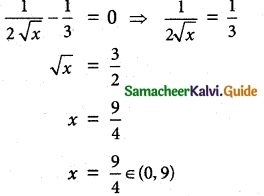
f'(x) = 0
Samacheer Kalvi 12th Maths Guide Chapter 7 Applications of Differential Calculus Ex 7.3 2

Question 3.
Explain why Lagrange’s mean value theorem is not applicable to the following functions in the respective intervals:
(i) f(x) = \(\frac { 1 }{ 2√x }\), x ∈ [-1, 2]
(ii) f(x) = |3x + 1|, x ∈ [-1, 3]
Solution:
(i) f(x) = \(\frac { 1 }{ 2√x }\), x ∈ [-1, 2]
f(0) = undefined
∴ f(x) is not continuous at x = 0
Hence, Lagrange’s mean value theorem is not applicable.

(ii) f(x) =|3x + 1|, x ∈ [-1, 3]
The function is not differentiable at x = \(\frac{-1}{3}\).
So Lagrange’s mean value theorem is not applicable in the given interval.

Question 4.
Using the Lagrange’s mean value theorem determine the values of x at which the tangent is parallel to the secant line at the end points of the given interval:
(i) f(x) = x³ – 3x + 2, x ∈ [-2, 2]
(ii) f(x) = (x – 2) (x – 7), x ∈ [3, 11]
Solution:
f(x) = x³ – 3x + 2, x ∈ [-2, 2]
f(x) is continuous in [- 2, 2]
f(x) is differentiable in (- 2, 2)
f(-2) = (-2)³ – 3 (-2) + 2 = – 8 + 6 + 2 = 0
f(2) = (2)³ -3(2) + 2 = 8 – 6 + 2 = 4
∴ f(x) is defined in the given interval.
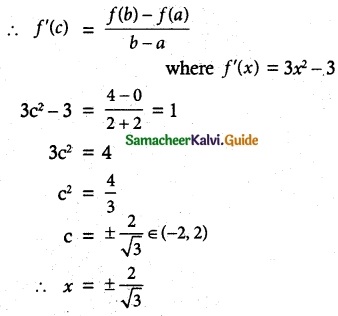
Given that tangent is parallel to the secant line of the curve between x = -2 and x = 2.
Samacheer Kalvi 12th Maths Guide Chapter 7 Applications of Differential Calculus Ex 7.3 3

Samacheer Kalvi 12th Maths Guide Chapter 7 Applications of Differential Calculus Ex 7.3

(ii) f(x) = (x – 2)(x – 7), x ∈ [3, 11]
f(x) is continuous in [3, 11]
f(x) is differentiable in (3, 11)
f(3) = (3 – 2) (3 – 7) = (1) (-4) = -4
f(11) = (11 – 2) (11 – 7) = (9) (4) = 36
∴ f(x) is defined in the given interval.
Given that the tangent is parallel to the secant line ofthe curve between x = 3 and x = 11.
∴ f'(c) = \(\frac { f(b)-f(a) }{ b-a }\)
2c – 9 = \(\frac { 36+4 }{ 11-3 }\) where f'(x) = 2x – 9
2x – 9 = \(\frac { 40 }{ 8 }\) = 5
2c = 14 ⇒ c = 7 ∈ (3, 11)
∴ x = 7.

Question 5.
Show that the value in the conclusion of the mean value theorem for
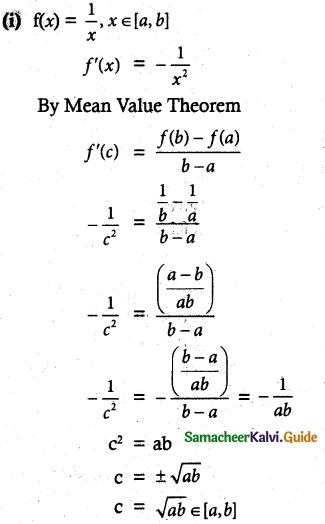
(i) f(x) = \(\frac { 1 }{ x }\) on a closed interval of positive numbers [a, b] is \(\sqrt { ab }\)
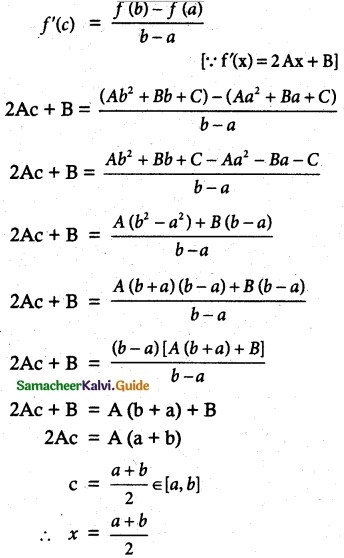
(ii) f(x) = Ax² + Bx + C on any interval [a, b] is \(\frac { a+b }{ 2 }\)
Solution:
Samacheer Kalvi 12th Maths Guide Chapter 7 Applications of Differential Calculus Ex 7.3 4

Samacheer Kalvi 12th Maths Guide Chapter 7 Applications of Differential Calculus Ex 7.3

(ii) f(x) = Ax² + Bx + C, x ∈ [a, b]
f'(x) = 2Ax + B
By Mean Value Theorem,
Samacheer Kalvi 12th Maths Guide Chapter 7 Applications of Differential Calculus Ex 7.3 5

Question 6.
A race car driver is racing at 20th km. If his speed never exceeds 150 km/hr, what is the maximum distance he can cover in the next two hours?
Solution:
Let a = 0, b = 2 and the interval is [0, 2] and f(0) = 20 (given)
We need to find f(2)
By Lagrange’s Mean Value Theorem,
f(b) – f(a) ≤ f'(c) [b – a]
f(b) – 20 ≤ 150(2 – 0)
f(b) ≤ 300 + 20
f(b) ≤ 320
∴ Maximum distance f(2) = 320 km.

Samacheer Kalvi 12th Maths Guide Chapter 7 Applications of Differential Calculus Ex 7.3

Question 7.
Suppose that for a function f(x), f'(x) ≤ 1 for all 1 ≤ x ≤ 4. Show that f(4) – f(1) ≤ 3.
Solution:
Given: For f(x), f'(x) ≤ 1 for all 1 ≤ x ≤ 4
∴ a = 1, b = 4.
By Lagrange’s Mean Value Theorem,
f(b) – f(a) ≤ f'(c) (b – a)
f(4) – f(1) ≤ 1(4 – 1)
f(4) – f(1) ≤ 3
Hence Proved.

Question 8.
Does there exist a differentiable function f(x) such that f(0) = -1, f(2) = 4 and f (x) ≤ 2 for all x. Justify your answer.
Solution:
Given:For f(x), f'(x) ≤ 2, f(0) = -1, f(2) = 4
∴ a = 0, b = 2
By Lagrange’s Mean Value Theorem,
f(b) – f(a) ≤ f'(c)(b – a)
f(2) – f(0) ≤ f'(c) (2 – 0)
\(\frac { 4+1 }{ 2 }\) ≤ f'(c) ⇒ \(\frac { 5 }{ 2 }\) ≤ f'(c) ≤ 2 (given)
f(x) cannot be a differentiable function in (0, 2) as f'(x) cannot be 2.5.

Samacheer Kalvi 12th Maths Guide Chapter 7 Applications of Differential Calculus Ex 7.3

Question 9.
Show that there lies a point on the curve f(x) = x(x + 3)e-π/2, -3 ≤ x ≤ 0 where tangent drawn is parallel to the x-axis.
Solution:
f(x) = x(x + 3)e-π/2, -3 ≤ x ≤ 0
f(x) is continuous in [-3, 0]
f(x) is differentiable in (- 3, 0)
f(-3) = -3 (-3 + 3)e-π/2 = 0
f(0) = 0
⇒ f(-3) = f(0) = 0
Since the tangent is parallel to x-axis.
f'(c) = 0
e-π/2 (2c + 3) = 0 where f'(x) = e-π/2 (2x + 3)
2c + 3 = 0
c = –\(\frac { 3 }{ 2 }\) ∈ (-3, 0)
∴ The point lies on the curve.

Question 10.
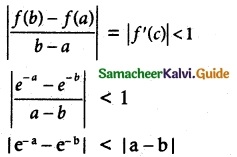
Using Mean Value Theorem prove that for, a > 0, b > 0, |e-a – e-b| < |a – b|
Solution:
Let f(x) = e-x
f'(x) = e-x
By Lagrange’s Mean Value Theorem,
Samacheer Kalvi 12th Maths Guide Chapter 7 Applications of Differential Calculus Ex 7.3 6
Hence Proved.

Samacheer Kalvi 12th Maths Guide Chapter 7 Applications of Differential Calculus Ex 7.3

Samacheer Kalvi 12th Bio Botany Guide Chapter 5 Plant Tissue Culture

Tamilnadu State Board New Syllabus Samacheer Kalvi 12th Bio Botany Guide Pdf Chapter 5 Plant Tissue Culture Text Book Back Questions and Answers, Notes.

Tamilnadu Samacheer Kalvi 12th Bio Botany Solutions Chapter 5 Plant Tissue Culture

12th Bio Botany Guide Plant Tissue Culture Text Book Back Questions and Answers

Samacheer Kalvi 12th Bio Botany Guide Chapter 5 Plant Tissue Culture

I. Choose the correct answer from the given option:

Question 1.
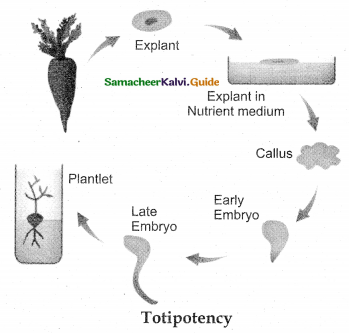
Totipotency refers to.
a) capacity to generate genetically identical plants.
b) capacity to generate a whole plant from any plant cell/explant.
c) capacity to generate hybrid protoplasts.
d) recovery of healthy plants from diseased plants.
Answer:
b) capacity to generate a whole plant from any plant cell / explant

Question 2.
Micro propagation involves
a) vegetative multiplication of plants by using micro – organisms.
b) vegetative multiplication of plants by using small explants.
c) vegetative multiplication of plants by using microspores.
d) Non – vegetative multiplication of plants by using microspores and megaspores.
Ans:
b) vegetative multiplication of plants by using small explants.

Samacheer Kalvi 12th Bio Botany Guide Chapter 5 Plant Tissue Culture

Question 3.
Match the following

Column AColumn B
1. TotipotencyA. Reversion of mature cells into meristerm
2. DedifferentiationB. Biochemical and structural changes of cells
3. ExplantC. Properties of living cells develops into entire plant
4. DifferentiationD. Selected plant tissue transferred to culture medium

Samacheer Kalvi 12th Bio Botany Guide Chapter 5 Plant Tissue Culture 01
Answer:
c) 1-B, 2-A, 3-D, 4-C

Question 4.
The time duration for sterilization process by using autoclave is _____ minutes and the temperature is
a) 10 to 30 minutes and 1250 C
b) 15 to 30 minutes and 1210 C
c) 15 to 20 minutes and 1250 C
d) 10 to 20 minutes and 1210 C
Answer:
b) 15 to 30 minutes and 1210 C

Question 5.
Which of the following statement is correct.
a) Agar is not extracted from marine algae such as seaweeds.
b) Callus undergoes differentiation and produces somatic embryoids.
c) Surface sterilization of explants is done by using mercuric bromide
d) PH of the culture medium is 5.0 to 6.0
Answer:
b) Callus undergoes differentiation and produces somatic embryoids.

Samacheer Kalvi 12th Bio Botany Guide Chapter 5 Plant Tissue Culture

Question 6.
Select the incorrect statement from given statement
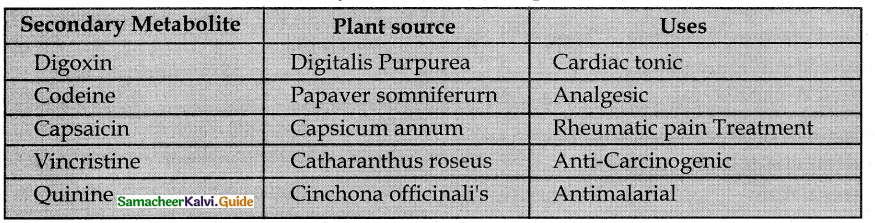
a) A tonic used for cardiac arrest is obtained from Digitalis purpuria
b) Medicine used to treat Rheumatic pain is extracted from Capsicum annum
c) An anti malarial drug is isolated from Cinchona officinalis.
d) Anti – carcinogenic property is not seen in Catharanthus roseus.
Answer:
d) Anti – carcinogenic property is not seen in Catharanthus roseus

Question 7.
Virus free plants are developed from
a) Organ culture
b) Meristem culture
c) Protoplast culture
d) Cell suspension culture
Answer:
b) Meristem culture

Question 8.
The prevention of large scale loss of biological interity.
a) Biopatent
b) Bioethics
c) Biosafety
d) Biofuel
Answer:
c) Biosafety

Samacheer Kalvi 12th Bio Botany Guide Chapter 5 Plant Tissue Culture

Question 9.
Cryopreservation means it is a process to preserve plant cells, tissues or organs
a) at very low temperature by using ether.
b) at very high temperature by using liquid nitrogen
c) at very low temperature of -196 by using liquid nitrogen
d) at very low temperature by using liquid nitrogen
Answer:
c) at very low temperature of -196 by using liquid nitrogen

Question 10.
Solidifying agent used in plant tissue culture is
a) Nicotinic acid
b) Cobaltous chloride
c) EDTA
d) Agar
Answer:
d) Agar

Question 11.
What is the name of the process given below? Write its 4 types.
Answer:
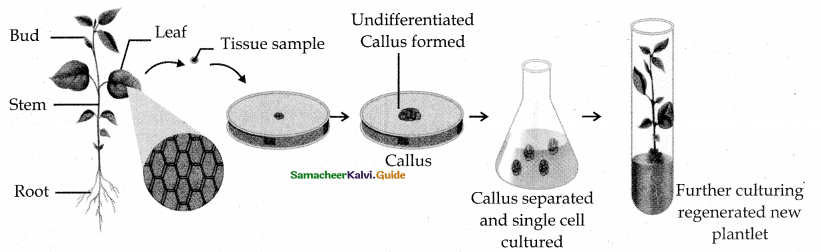
Samacheer Kalvi 12th Bio Botany Guide Chapter 5 Plant Tissue Culture 1
These are the basic steps in plat Tissue culture technology
The process is plant tissue culture. Based on the explants, plant tissue culture is classified as:

  1. Organ culture
  2. Meristem culture
  3. Protoplast culture
  4. Cell culture

Samacheer Kalvi 12th Bio Botany Guide Chapter 5 Plant Tissue Culture

Question 12.
How will you avoid the growth of microbes in the nutrient medium during the culture process? What are the techniques used to remove the microbes?
Answer:
The microbial growth in the culture medium can be overcome by autoclaving the medium at Plant Tissue Culture II 121°C (15 psi) for 15 to 30 minutes.

Chemical sterilization using chemicals, sterilizing using UV radiation. Alcoholic sterilization using ethanol, autoclaving and filtration, etc., are the various techniques used to remove microbes.

Question 13.
Write the various steps involved in cell suspension culture
Answer:
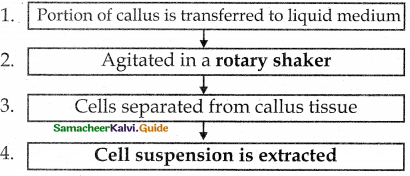
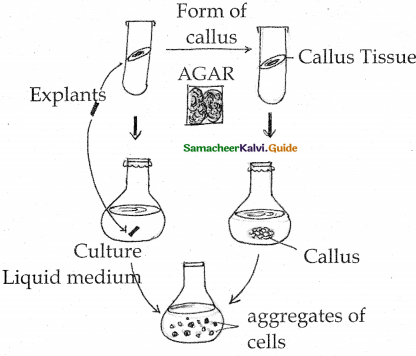
Definition: The culture of single cells or small aggregate of cells invitro in liquid medium is called cells suspension culture.

Preparation steps:
Samacheer Kalvi 12th Bio Botany Guide Chapter 5 Plant Tissue Culture 2

Production of Secondary Metabolites:

  • Alkaloids, flavonoids, terpenoids, phenolic compounds, and recombinant proteins.
  • secondary metabolites are chemical compounds that are not required by the plant for normal growth and development.
  • The process of production of secondary metabolites can be scaled up and automated using bio-reactors for commercial production.
  • Many strategies such as biotransformation, elicitation, and immobilization have been used to make cell suspension cultures more efficient in the production of secondary metabolites.

Samacheer Kalvi 12th Bio Botany Guide Chapter 5 Plant Tissue Culture

Question 14.
What do you mean Embryoids? Write its application.
Answer:
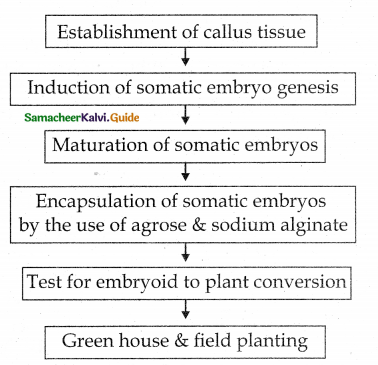
Somatic embryogenesis is the formation of embryos from the callus tissue directly and these embryos are called Embryoids or from the in vitro cells directly form pre-embryonic cells which differentiate into embryoids.
Applications:

  1. Somatic embryogenesis provides potential plantlets which after the hardening period can establish into plants.
  2. Somatic embryoids can be used for the production of synthetic seeds.
  3. Somatic embryogenesis is now reported in many plants such as Allium sativum, Hordeum vulgare, Oryza sativa, Zea mays and this is possible in any plant.

Question 15.
Give examples of micropropagation performed in plants.
Answer:
Micropropagations are performed in many plants.
Examples:

  1. Pineapple
  2. banana
  3. strawberry
  4. Potato, etc

Question 16.
Explain the basic concepts involved in plant tissue culture.
Answer:
Basic concepts of plant tissue culture are totipotency, differentiation, differentiation, and redifferentiation.

1. Totipotency: The property of live plant cells that they have the genetic potential when cultured in a nutrient medium to give rise to a complete individual plant.

2. Differentiation: The process of biochemical and structural changes by which cells become specialized in form and function.

3. Redifferentiation: The further differentiation of already differentiated cell into another type of cell. For example, when the component cells of callus have the ability to form a whole plant in a nutrient medium, the phenomenon is called redifferentiation.

4. Dedifferentiation: The phenomenon of the reversion of mature cells to the meristematic state leading to the formation of callus is called dedifferentiation. These two phenomena of redifferentiation and dedifferentiation are the inherent capacities of living plant cells or tissue. This is described as totipotency.
Samacheer Kalvi 12th Bio Botany Guide Chapter 5 Plant Tissue Culture 3

Samacheer Kalvi 12th Bio Botany Guide Chapter 5 Plant Tissue Culture

Question 17.
Based on the material used, how will you classify culture technology? Explain it.
Answer:
Based on the explants some other plant tissue culture types are:
1. The culture of embryos

  • anthers
  • ovaries
  • roots
  • shoots etc
    Samacheer Kalvi 12th Bio Botany Guide Chapter 5 Plant Tissue Culture 4

2. Meristem culture
The culture of any plant meristematic tissue on culture media.

3. Protoplast culture

  • Protoplasts (cells without a cell wall, but plasma membrane) are used to regenerate whole plants from single-cell protoplasts of 2 different plants fused into hybrids – later by PTC – develop into many plantlets.
  • This process of formation of somatic hybrids into somatic hybridization.

4. Cell culture

  • The formation of cell suspension from the callus
  • The cells are separated from the callus tissue and used for cell suspension culture

Question 18.
Give an account on Cryopreservation. The parts such as,
Answer:
Cryopreservation, also known as Cryo-conservation, is a process by which protoplasts, cells, tissues, organelles, organs, extracellular matrix, enzymes or any other biological materials are subjected to preservation by cooling to a very low-temperature of-196°C using liquid nitrogen. At this extremely low temperature, any enzymatic or chemical activity of the biological material will be totally stopped and this leads to the preservation of material in dormant status.

Later these materials can be activated by bringing to room temperature slowly for any experimental work. Protective agents like dimethyl sulphoxide, glycerol, or sucrose are added before the cryopreservation process. These protective agents are called cryoprotectants since they protect the cells, or tissues from the stress of freezing temperature.

Samacheer Kalvi 12th Bio Botany Guide Chapter 5 Plant Tissue Culture

Question 19.
What do you know about Germplasm conservation? Describe it. Definition
Answer:
Living genetic resources such as pollen, seeds, or plant tissue materials are preserved in living conditions for future use for many hybridization crop improvement research works. Eg. Pollen banks, Seedbanks

Purpose

  • To maintain viability and Fertility for future use
  • Gene bank, DNA bank of elite plants are maintained to keep
    • biological diversity
    • food security

Question 20.
Write the protocol for artificial seed preparation
Answer:
Later these seeds are grown in vitro medium and converted into plantlets. These plantlets require a hardening period (either greenhouse or hardening chamber) and then shifted to normal environmental conditions.

Samacheer Kalvi 12th Bio Botany Guide Chapter 5 Plant Tissue Culture 5

Samacheer Kalvi 12th Bio Botany Guide Chapter 5 Plant Tissue Culture

12th Bio Botany Guide Plant Tissue Culture Additional Important Questions and Answers

I. Choose the correct answer

Question 1.
Invitro means.
a) In a test tube.
b) inside the body
c) inside the cell
d) in a laboratory
Answer:
a) In a test tube

Samacheer Kalvi 12th Bio Botany Guide Chapter 5 Plant Tissue Culture

Question 2.
The concept of Totipotency was proposed by.
a) Hildbrandt
b) Haberlandt
c) Chilton
d) Takebe et-al
Answer:
b) Haberlandt

Question 3.
The scientist developed root cultures, used Knop’s solution along with 3 vitamins is.
a) Murashige & Skoog
b) P.R. White
c) Kanta et-al
d) E.C. Steward
Answer:
b) P.R. White

Samacheer Kalvi 12th Bio Botany Guide Chapter 5 Plant Tissue Culture

Question 4.
Virus-free Dahlia and Potato plants are produced by.
a) Morel
b) Martin
c) Morel & Martin
d) E.C steward
Answer:
c) Morel & Martin

Question 5.
The Indian scientists developed in vitro production of haploid embryos from
a) ovule of Nicotiana
b) anthers of Datura
c) gametes of Dahlia
d) Zygote of Carrot
Answer:
b) anthers of Datura

Samacheer Kalvi 12th Bio Botany Guide Chapter 5 Plant Tissue Culture

Question 6.
Melchers & Co workers produced
a) Somatic hybrid of Nicotiana species
b) Intergeneric hybrid between potato & tomato
c) Interspecific hybrid of Nicotiana glauca and Nicotiana longs dorffii
d) test tube fertilization in flowering plants
Answer:
b) Intergeneric hybrid between potato & tomato

Question 7.
The growth hormones added in MS – medium are
a) Auxin & Gibberellins
b) IAA & Kinetin
c) Gaibberelline & cytokinin
d) Auxin & ABA
Answer:
b) IAA & Kinetin

Question 8.
Somatic embryogenes is not applied in
a) Oryza sativa
b) Hordeum vulgare
c) Ficus bengaliensis
d) Avena sativa
Answer:
c) Ficus bengaliensis

Samacheer Kalvi 12th Bio Botany Guide Chapter 5 Plant Tissue Culture

Question 9.
Which one of the following is a correct set?
a) Vincristine Cinchona officinalis Anti carcinogen
b) Capsacin catharanthus roseus – Antimalarial
c) Digoxin Digitalis purpuria Cardiac tonic
d) Codeine Capsicum annum Analgesic
Answer:
c) Digoxin Digitalis purpuria Cardiac tonic

Question 10.
Germ plasm conservation does not include
a) DNA bank
b) Seed bank
c) SWISS bank
d) pollen bank
Answer:
c) SWISS bank

Question 11.
This is not of the strategies used to make cell suspension
a) biotrans formation
b) elicitation
c) immobilization
d) filtration
Answer:
d) filtration

Samacheer Kalvi 12th Bio Botany Guide Chapter 5 Plant Tissue Culture

Question 12.
Choose the odd man out with regard to protoplasmic fusion
a) somatic hybridization
b) Protoplasmic fusion
c) Embryoids
d) Polyethylene Glycol
Answer:
c) Embryoids

Question 13.
This is not a technique in PTC?
a) organ culture
b) Meristem culture
c) Cell culture
d) M.S. culture
Ans:Answer:d) M.S. culture

Question 14.
Which one of the following is the correct steps in the direct embryogenesis?
Samacheer Kalvi 12th Bio Botany Guide Chapter 5 Plant Tissue Culture 6
Answer:
b

Question 15.
Protoplasts are transferred to sucrose solution to
a) retain osmotic pressure
b)retain viability
c) restore solubility
d) sterilize the protoplast
Answer:
b) retain viability

Samacheer Kalvi 12th Bio Botany Guide Chapter 5 Plant Tissue Culture

Question 16.
Plants those can’not be subjected to hybridization technique can be raised by?
a) somatic embryogenesis
b) PTC
c) somatic hybridization
d) meristem culture
Answer:
c) somatic hybridization

Question 17.
Indole alkaloids used as bio medicine is got from
a) phyllanthus amaras
b) Acalypha indica
c) Catharanthus roseue
d) Avena sativa
Answer:
c) Catharanthus roseus

Question 18.
Virus is free in
a) cell culture
d) cambial culture
b) protoplasm culture
c) Apical meristem culture
Answer:
c) Apical meristem culture

Samacheer Kalvi 12th Bio Botany Guide Chapter 5 Plant Tissue Culture

Question 19.
From the following secondary metabolites which one is used as cardioc tonic
a) capsaicin
b) Quinine
c) Codeine
d) Digoxin
Answer:
d) Digoxin

II. Match the following

Question 20.

Column AColumn B
a Artificial seeds1 Protoplasmic Fusion
b Cybrid2 Plant tissue culture
c Virus free Potato3 Sec. metabolite
d Cosmetics / Pharmaceuticals4 Artificial / synseeds
e encapsulated embryoids5 Meristmculture

A) a-2, b-1, c-5, d-3, e-4
B) a-1, b-2, c-3, d-4, e-5
C) a-5, b-4, c-3, d-2, e-1
D) a-4, b-3, c-2, d-1, e-5
Answer:
a) a-2, b-1, c-5, d-3, e-4

Question 21.

Column AColumn B
a. Codeine1. Cardiac tonic
b. Quinine2. Treatment of Rheumatic pain
c. Vincristine3. Antimalaria drug
d. Digoxin4. Analgesic
e. Capsaicin5. Anti carcinogenic

A) a -1, b – 2, c-3, d-4, e-5
B) a – 4, b-3, c-5, d-1, e-2
C) a – 5, b – 4, c-3, d-2, e-1
D) a – 3, b-1 c-2, d-5, e-4 .
Answer:
b) a – 4, b-3, c-5, d-1, e-2

Samacheer Kalvi 12th Bio Botany Guide Chapter 5 Plant Tissue Culture

Question 22.

Column AColumn B
a High standard of homogeneity1. encapsulated seeds
b. Conservation of plant biodiversity2. cryopreservation
c. Conservation resources of germplasm3. micro-propagation
d. Liquid nitrogen4. Pollen banks/seed banks

A) a-4, b-3, c-2, d-1
B) a-2, b-4, c-1, d-3
C) a-3, b-1, c-4, d-2
D) a-1, b-2, c-3, d-4
Answer:
C) a-3, b-1, c-4, d-2

III. Choose the incorrect Statement

Question 23.
a) The plant material used in tissue culture should be surface sterilized
b) Callus is a mass of unorganized growth of plant cells or tissues in invivo culture
c) The fusion product of protoplasts without a nucleus of different cells is called cybrid
d) Bioreactors are used for the production of secondary metabolites in a commercial way
Answer:
b) Callus is a mass of unorganized growth of plant cells or tissues in invivo culture

Question 24.
Which one of the following statements is true regarding IPR?
a) The discoverer has the full rights on his / her property
b) IPR – includes only the process of the product, not trade secrets.
c) IPR is not protected by laws formed by the country.
d) The discoverer can use his discovery for his own company but can not sell it to others.
Answer:
a) The discoverer has the full rights on his/her property.

Samacheer Kalvi 12th Bio Botany Guide Chapter 5 Plant Tissue Culture

IV. Choose the correct Statement

Question 25.
a) The HGP was founded in 2010 as an integral part of ELSI
b) GEAC is an apex body under the UNO
c) GMOs-GEMs & Trans genie plants approval are not coming under the scanning of GEAC
d) The release of genetically engineered organisms and products into the environment need at least three levels of field trials such as BRL -1, BRLII & BRL III
Answer:
d) The release of genetically engineered organisms and products into the environment need at least three levels of field trials such as BRL -1, BRL II & BRL III

Question 26.
a) ‘Takepe’ regenerated tobacco plants from isolated mesophyll protoplasts.
b) Morel & Martin formulated Bioethics.
c) The photoperiod needs for Tissue culture is 12-18 hours of light.
d) The PH medium for Tissue culture should be below 5
Answer:
a) Takepe’ regenerated tobacco plants from isolated mesophyll protoplasts

V. In each of the following questions, two statements are given – one as Assertion (A) and the other one is Reason (R) Mark the correct answer as

Question 27.
Assertion: High yielding plants can be raised in large number by Micropropagation.
Reason: Micropropagation maintain high standards of homogeneity
a) If both ‘A’ and ‘R’ are true and ‘R’ is the correct explanation of A
b) It both A’ and ‘R’ are true but ‘R’ is not the correct explanation of A
c) It A is true but ‘R’ is false d) If both A & R are false
Answer:
a) If both ‘A’ and ‘R’ are true and ‘R’ is the correct explanation of A

Samacheer Kalvi 12th Bio Botany Guide Chapter 5 Plant Tissue Culture

Question 28.
Assertion: A major advantage of tissue culture is protoplast fusion.
Reason: It produces a genetically uniform population.
a) If both ‘A’ and ‘R1 are true and ‘R’ is the correct explanation of A
b) It both A’ and ‘R’ are true but ‘R’ is not the correct explanation of A
c) It A is true but ‘R’ is false
d) If both A & R are false
Answer:
c) It A is true but ‘R’ is false

Question 29.
Assertion(A): The explants are sterilized by mercuric chloride
Reason(R): Sterilization prevents the growth of other microorganisms in the Culture medium
a) (A) correct; (R) wrong
b) (A) wrong: (R) correct
c) Both (A) and (R) are correct; but (R) is not the explanation to (A)
d) Both (A) and (R) are correct; (R) is the explanation of (A)
Answer:
b) (A) wrong: (R) correct

VI. Two Marks

Question 1.
What are the contributions of Haberlandt to PTC?
Answer:

  • He did the in-vitro culture of plant cells
  • He used Knop’s salt solution as a culture medium
  • He only proposed the concept – Totipotency

Samacheer Kalvi 12th Bio Botany Guide Chapter 5 Plant Tissue Culture

Question 2.
What is the special contribution of Murashige and Skoog?
Answer:

  • They formulated a tissue culture medium
  • A landmark in PTC, because it is the most frequently medium for all kinds of tissue culture work.

Question 3.
Who developed first interspecific somatic hybrid?
Answer:
Carlson & co-worker obtained protoplast fusion between Nicotiana glauca & Nicotiana longdorffii, and developed the first interspecific somatic hybrid in 1971

Samacheer Kalvi 12th Bio Botany Guide Chapter 5 Plant Tissue Culture

Question 4.
Define Totipotency?
Answer:

  • The inherent genetic potential of any living plant cell, when cultured in the nutrient medium can develop into a complete individual plant.
  • One of the basic concepts exploited in tissue culture.

Question 5.
What are the components of Knop’s solution?
Answer:
I. It contains various salts dissolved in Sucrose solution

  • Calcium Chloride: 3.0 gm
  • Potassium Nitrate: 1.0 gm
  • Magnesium Sulphate: 1.0 gm
  • Dibasic Potassium Phosphate: 1.0 gm

II. Sucrose: 50 gm(optimal)
III. Deionized Water: 1000ml

Question 6.
Distinguish between Redifferentiation and Dedifferentiation.
Answer:
Redifferentiation :
The ability of callus tissue to develop into shoot & root (embryoid)

Dedifferentiation :
Reversion of mature tissue into meristematic state leading to the formation of callus.

Samacheer Kalvi 12th Bio Botany Guide Chapter 5 Plant Tissue Culture

Question 7.
Notes on PEG.
Answer:

  • PEG is Poly Ethylene Glycol.
  • It is the fusogenic agent that facilitates the fusion of 2 different protoplasts coming together in somatic hybridization to produce cybrid.

Question 8.
What is Agar?
Answer:

  • Agar is a mucilaginous polysaccharide obtained from marine algae (seaweeds)
  • Gelladium, Gracilaria, Gellidiella.
  • The Agar is a solidifying agent used in culture media preparation.

Question 9.
Notes on Autoclave.
Answer:

  • An autoclave is a device used to do wet steam sterilization.
  • Autoclaving at 15 psi (121°C) for 15-30 minutes.
  • Glassware, forceps, scalpels, and all accessories are subjected to autoclaving for

Question 10.
What are the minor nutrients added in MS medium?
Answer:

  • Sodium molybdate
  • Cupric sulphate
  • Cobaltous chloride.

Samacheer Kalvi 12th Bio Botany Guide Chapter 5 Plant Tissue Culture

Question 11.
Why do we subject plantlets to hardening?
Answer:
Hardening slowly steadily helps the plantlets from the conditions of readymade medium, light & temperature of the laboratory, to which they were used, to the conditions of light, temperature & soil in the natural environment.

Question 12.
What is cybrid?
Answer:
The fusion product of a protoplast without a nucleus of different cells is called a cybrid.

Question 13.
What are the various components of MS- Medium?
Answer:

  • Macronutrients, Micronutrients, Minor nutrients
  • Iron stock
  • Vitamins.
  • Growth Hormone all in specific measurement & along with these solidifying agent- Agar is also added.

Question 14.
How to remove the cell wall of a plant cell.
Answer:
The chosen leaf tissue is immersed in the following solutions.

  • 0.5% macrozyme. 2% onozuka cellulose enzyme dissolved in 13% sorbitol or mannitol kept at pH 5.4 at 25°c incubated during the night.
  • After a gentle teasing of the cells, the protoplasts are obtained.
  • Then they are transferred to 20% sucrose solution to retain viability.
  • Finally by centrifuging the protoplasts are isolated.

Samacheer Kalvi 12th Bio Botany Guide Chapter 5 Plant Tissue Culture

Question 15.
What is organogenesis?
Answer:

  • The morphological changes in the callus leading to the formation of the shoot, root, and then plantlets. The plantlets formation has 2 steps
  • Root formation is known as Rhizogenesis
  • Shoot formation is known as Caulogenesis.

Question 16.
Distinguish between callus & clone
Answer:
Callus :
It is the mass of unorganized growth of plant cells or tissues in in-vitro -culture medium.

Clone :
The clone develops from callus – which gets differentiated into many plantlets known as clones (i.e) genetically uniform population.

Question 17.
What is meant by hardening?
Answer:

  • Hardening is the gradual exposure of invitro developed plantlets in humid chambers in diffused light – or transferred to – greenhouse setup.
  • This enables them to get acclimatized to grow under normal field conditions.

Question 18.
How are the syn seeds produced?
Answer:

  • Somatic embryoids – can be used in the production of syn seeds.
  • They are nothing but somatic embryoids encapsulated in Agarose gel or calcium alginate/sodium
    alginate.

Samacheer Kalvi 12th Bio Botany Guide Chapter 5 Plant Tissue Culture

Question 19.
Give the tabulation of a few secondary metabolites their plant sources.
Answer:
Samacheer Kalvi 12th Bio Botany Guide Chapter 5 Plant Tissue Culture 7

Question 20.
Give the IPR – aspects in India
Answer:
Samacheer Kalvi 12th Bio Botany Guide Chapter 5 Plant Tissue Culture 8

Question 21.
Expand the following.
PTC, HEPA, RCGM -, GE AC, ELSI, GMO
Answer:
PTA – Plant Tissue Culture
HEPA – High-Efficiency Particulate Air
RCGM – Review Committee on Genetic Manipulation
GEAC – Genetic Engineering Approval Committee
ELSI – Ethical Legal and Social Implications
GMO – Genetically Modified Organism
GEM – Genetically Engineered Micro Organism

Samacheer Kalvi 12th Bio Botany Guide Chapter 5 Plant Tissue Culture

Question 22.
Name the cryoprotectants used in Cryopreservation
Answer:

  • Dimethyl sulphoxide, glycerol, or sucrose are added before cryopreservation process.
  • They protect the cells and tissues from the stress of freezing temperature, So known as Cryo protectants.

Question 23.
How is ELSI research funded?
Answer:
A percentage of the HGP – budget at the National Institute of Health & the V S Department of Energy was devoted to ELSI – research.

Question 24.
What is Biosafety?
Answer:
Biosafety is the prevention of large – scale loss of biological integrity, focusing both on ecology and human health.

Question 25.
Differentiate of Organ culture and meristem culture
Answer:
Organ culture :
The culture of embryos anthers, ovaries, roots, shoots

Meristem culture :
The culture of plant meristematic tissue on culture media
Give the tabulation of few secondary metaboltes a their plant sources.

Samacheer Kalvi 12th Bio Botany Guide Chapter 5 Plant Tissue Culture

Question 26.
What is somatic Embryogenesis?
Answer:
Somatic embryogenesis is the formation of embryos from the callus tissue directly and these embryos are called Embryoids or from the pre-embryonic cells which differentiate into embryoids.

VII. Three Marks

Question 1.
Give the name of few culture media used in PTC & their nature.
Answer:

  • M.S. Nutrient Medium (Muroshige & Skoog -1992)
    It has carbon sources, suitable vitamins & hormones
  • B5 – Medium (Gamborg.et.al 1968)
  • White Medium (White 1943)
  • Nitsch’s Medium (Nitsch & Nitsch 1969)
    The medium may be solid or semisolid or liquid – For solidification, a gelling agent such as agar is added.

Question 2.
Explain the Induction of Callus.
Answer:
Steps
I) Inoculation: Sterile segment of leaf, stem, tuber or root or (explant) is transferred to the sterile nutrient medium (MS – medium – + Auxins)

II) Incubation: The inoculated medium + auxins are incubated at 25 °C ± 2°C in an alternate light & dark period of 12 hours.

III) Induction of Callus:
The cell division occurs & the upper surface of the explant develop into a callus.
Callus – is a mass of unorganized growth of plant cells/tissue in-vitro – culture medium

Question 3.
Write the flow chart of plant Regeneration pathway.
Answer:
Plant Regeneration Pathway
From the explants, plants can be regenerated by somatic embryogenesis or organogenesis.
Samacheer Kalvi 12th Bio Botany Guide Chapter 5 Plant Tissue Culture 9

Samacheer Kalvi 12th Bio Botany Guide Chapter 5 Plant Tissue Culture

Question 4.
What are the application of somatic embrogenesis
Answer:

  • It provides potential → after hardening becomes plantlets
  • Used for production of synthetic seeds
  • Eg. Allium sativum, Hordeum Vulgare, Oryza – sativa, Zee mays etc.,

Question 5.
Distinguish between Somaclonal Variations & Gametoclonal variations (Invitro Condition)
Answer:
Somaclonal Variations :
Variation found in somatic parts such as

  • Leaf, stem
  • root, tuber
  • propagule etc

Gametoclonal variations:
Variations found in plants regenerated in vitro by gametes & gametophytes

Question 6.
Why there is a need to produce Virus-free plants?
Answer:

  • Chemicals can be used to control fungal and bacterial mycoplasma pathogens but not viruses generally.
  • Viral pathogens also cause great economic loss to the crops.
  • Shoot meristem culture – help to produce virus-free plants because shoot meristem is free of viruses.

Question 7.
What are the Advantages of Artificial seeds?
Answer:

  • Number/ time / cost – Millions of seeds produced / at any time / cheaper cost.
  • Method – Easy method to produce genetically engineered plants.
  • Quality – Seeds with desirable traits are produced.
  • Storage – can be stored for long time use by Cryopreservation method.
  • Nature of plants – Plants – Produced are identical
  • Period of dormancy – greatly reduced
  • Growth & Lifespan – grow faster, plants have a shorter life span

Samacheer Kalvi 12th Bio Botany Guide Chapter 5 Plant Tissue Culture

Question 8.
What are the applications of plant tissue culture?
Answer:

  • Somatic hybridization → Improve hybrids produced
  • Somatic embryoids → develop into syn – seeds help to conserve biodiversity
  • Meristem & Shoot tip culture → production of Disease Resistant Varieties
  • Production of plants → Stress resistant → herbicide tolerant → Drought tolerant
  • Micropropagation → Large number of plantlets produced in a short time & throughout the year of both
  • crop plants & true species – Used in Forestry

Question 9.
Write down the protocol for the micropropagation of banana.
Answer:
Samacheer Kalvi 12th Bio Botany Guide Chapter 5 Plant Tissue Culture 10 Samacheer Kalvi 12th Bio Botany Guide Chapter 5 Plant Tissue Culture 11

Question 10.
Write down the protocol for virus-free meristem tip culture.
Answer:
Samacheer Kalvi 12th Bio Botany Guide Chapter 5 Plant Tissue Culture 12

Question 11.
Which is the best conventional method to introduce disease resistance capacity into a plant? Explain.
Answer:

  • Plant tissue culture is the conventional method which is also known as micropropagation.
  • In this method, we take the meristematic tissue of the plant, referred to as explant is cultured over the given conditions of temperature and humidity, which makes the plant disease resistant.

Question 12.
What are the 3 parts of a patent? Explain them.
Answer:
It has 3 parts

  1. The grant
  2. The specifications
  3. The claim

The grant

  • It is a signed document (actually agreement) that grants patent rights to the inventor.
  • It is filled at the patent office, (not published)

The Specifications

    • It is a narrative describing the invention & how it was carried out.
  • Specifications & their claims are published from the patent office.

The Claim
The scope of the invention to be protected by the patent, preventing others from practicing it.

Samacheer Kalvi 12th Bio Botany Guide Chapter 5 Plant Tissue Culture

Question 13.
Write down the – general steps in patenting
Answer:
Samacheer Kalvi 12th Bio Botany Guide Chapter 5 Plant Tissue Culture 13

Question 14.
What is IPR? Explain the various aspects of if.
Answer:

  • It is a category of properly include products created through one’s knowledge, research & creativity.
  • It includes v Copyrights v Patents & v Trademarks
  • It also includes v trade secrets v publicity rights v moral rights v rights against unfair competitions
  • It also includes – designs & geographical indications

Other Various aspects :
The above-mentioned property of the discovery should not be exploited by others without legal permission or by getting proper authorization.
Rights – must be protected by the enforcement of laws framed by a country.

Samacheer Kalvi 12th Bio Botany Guide Chapter 5 Plant Tissue Culture

Question 15.
What are the future prospects of Biotechnology?
Answer:

  • It will bring in a great revolution like the computer revolution.
  • It will lead to new scientific – revolutions that would change the lives & future of people.
  • Major challenges will be met and major changes incomprehensible in many aspects of modern life.

Question 16.
What is the function of GEAC?
Answer:

  • It regulates -manufacturing, use, import, export, and storage of hazardous microbes or genetically modified organisms (GMOs) and cells in the country.
  • It approves – activities involving large-scale use of hazardous microbes and recombinants in research & Industrial production.
  • It is responsible – for approval of proposals relating to the release of GEO and products into the environment including experimental field trials (Biosafety Research Level – trial – I and II are known as BRL – I and BRL – II)

Question 17.
Write short notes on Ethical issues in Genomic Research?
Answer:

  • Privacy and fairness in the use of genetic information, including the potential for genetic discrimination in employment and insurance.
  • The integration of new genetic technologies such as genetic testing, into the practice of clinical medicine.
  • Ethical issues surrounding the design and conduct of genetic research with people, including the process of informed consent.

Question 18.
Which is Laboratory Facilities for PTC?
Answer:
Washing facility for glassware and ovens for drying glassware.
Medium preparation room with autoclave, electronic balance, and PH meter.

Culture facility:
Growing the plant inoculated into culture tubes at 22-280C with the illumination of light 2400 lux, with a photoperiod of 8 -16 hours and relative humidity of about 60%

Samacheer Kalvi 12th Bio Botany Guide Chapter 5 Plant Tissue Culture

VIII. Five Marks.

Question 1.
Give the milestones in PTC – (Any 5 only)
Answer:

  • Haberlandt (1902) – In-vitro culture of plant cells – (using knop’s salt solution + glucose & peptone)
  • He proposed the Totipotency concept.
  • P.R.White (1934) – In Knop’s solution + 3 vitamins (Pyridine, thiamine & nicotinic acid → developed root culture)
  • F.C.Steward (1948) – used coconut water → produced cell proliferates from carrot explants.
  • Morel & Martin (1952, 55) – Produced virus-free plants by shoot meristem culture →  Eg. Dahlia, Potato.
  • Murashige & Skoog (1962) – Most frequently used culture medium for all kinds of tissue culture work.
  • Guha & Maheswari (1964) – developed in-vitro production of haploid embryos from another of Datura.
  • Vasil & Hildbrandt (1965) – developed a tobacco plant by micropropagation.

Question 2.
List down the culture conditions PTC.
Answer:
PH :

  • PH of medium – should lie between 5.6 to 6 – Temperature
  • Incubation of culture normally at temperature 25°C ± 2°C for optimal growth.

Humidity & Light Intensity

  • 50-60% relative humidity
  • 16-hours of photo period by the illumination of cool white fluorescent tubes of approximately 1000 lux

Aeration :

  • Provided by shaking of flasks or tubes of liquid culture of Automatic shaker
  • Aeration of the medium bypassing with filter-sterilized air.

Samacheer Kalvi 12th Bio Botany Guide Chapter 5 Plant Tissue Culture

Question 3.
What are the needed Lab – facilities for PTC?
Answer:
Washing & drying facility (oven) for the glassware
Medium preparation room with

  • autoclave
  • electronic balance
  • PH meter etc., Maintain aseptic condition in,

a) Laminar air flow bench a positive pressure ventilation, unit

  • (High-Efficiency Particulate Air (HEPA) filter to maintain the aseptic condition.
  • Culture facility
  • growing the ex-plant – inoculate into culture tube at 22 – 28°C with the illumination of light 2000 lux with 8-6 hours photoperiod, the relative humidity of about 60%

Question 4.
Explain various steps in Protoplast culture.
Answer:
Protoplasts are cells without a cell wall but with a cell membrane or plasma membrane.
1. Isolation of protoplast
Samacheer Kalvi 12th Bio Botany Guide Chapter 5 Plant Tissue Culture 14 Samacheer Kalvi 12th Bio Botany Guide Chapter 5 Plant Tissue Culture 15

2. Fusion of protoplast (Agglutination & Fusion)
Protoplast (A) + Protoplast (B) – fused in to one in the presence of Fusogenic agent PEG in 25 – 30% concentration (Poly Ethylene Glycol) with Ca++ ions.

3. Culture of protoplast:
Protoplast viability is tested with Fluorescein diacetate – before culture.
MS – Medium – used – (with some modifications) droplet, plating or Micro drop array technique.

a. Incubation: done in continuous light (1000 – 2000 lux) at 25°C.
The cell wall formation occurs within (24-48 hrs).
The first division of new cells occurs between 2-7 days of culture.

4. Selection of somatic hybrid cells:
The fusion product of protoplasts without a nucleus of different cells – (cybrid)
Cybrid is also known as Somatic hybrid the process is known as somatic hybridization
Samacheer Kalvi 12th Bio Botany Guide Chapter 5 Plant Tissue Culture 16

Samacheer Kalvi 12th Bio Botany Guide Chapter 5 Plant Tissue Culture

Question 5.
What is meant by biosafety? Explain.
Answer:

  • It deals with the application of knowledge, techniques & equipment with strict guidelines in biological laboratories & related industries,
  • to prevent large scale loss of
    • biological integrity
    • ecology
    • human health aspects
  • to minimize human error and technical flaws & failures which contribute to unnecessary.
  • exposures & disposal of – pathogenic microbes & hazardous chemicals, to regularise, risk management assessment and to set in best safeguard measures as per need.

Question 6.
Expand ELSI & What is meant by Bioethics.
Answer:

  • ELSI – represents Ethical legal and social Implications.
  • Advancements in biotechnology such as,
    • In Agriculture – Transgenic plants
    • In the pharmaceutical Industry – genotherapy
    • Advancements of medicine etc.,
  • The biotechnological applications have raised controversies, hurting social beliefs, raising legal
    issues certain ecological principles & moral values.
  • So it is high time to regularise legally the modern biotechnological applications & manipulation as Bioethics, for the welfare of humanity & other plant & animal communities of our world.

Samacheer Kalvi 12th Bio Botany Guide Chapter 5 Plant Tissue Culture

Question 7.
Write about Potential risks and consideration for safety aspects.
Answer:

  • Pathogenicity – of living organisms & viruses natural or genetically modified to infect i) humans, ii) animals, iii) plants causing diseases
  • Toxicity of allergy – associated with microbial production.
  • Antibiotic-Resistant Microbes – increasing in number day by day.
  • Disposal problem – regard to spent microbial biomass & purification of effluents.
  • Safety aspects – regard to – i) contamination, ii) infection, iii) mutant strains
  • regard to industrial use of microorganisms containing invitro recombinants.

Samacheer Kalvi 12th Bio Botany Guide Chapter 5 Plant Tissue Culture

Question 8.
List down organizations implementing Bio-safety guidelines.
Answer:
IBSCs – Institutional Bio-Safety Committees monitor the research activity at the institutional level.
RCGM – The Review Committee on Genetic manipulation, functioning in the Department of Biotechnology (DBT) monitors the risky research activities in the laboratories.
GEAC – Genetic Engineering Approval Committee
– (Ministry of Environment and Forest)
– has the power to use GMO at a commercial level and open field trials of transgenic

  • crops
  • industrial product
  • health care products

Samacheer Kalvi 12th Maths Guide Chapter 7 Applications of Differential Calculus Ex 7.2

Tamilnadu State Board New Syllabus Samacheer Kalvi 12th Maths Guide Pdf Chapter 7 Applications of Differential Calculus Ex 7.2 Textbook Questions and Answers, Notes.

Tamilnadu Samacheer Kalvi 12th Maths Solutions Chapter 7 Applications of Differential Calculus Ex 7.2

Question 1.
Find the slope of the tangent to the following curves at the respective given points.
(i) y = x4 + 2x² – x at x = 1
(ii) x = a cos³ t, y = b sin³ t at t = \(\frac { π }{ 2 }\)
Solution:
(i) y = x4 + 2x² – x
Differentiating w.r.t. ‘x’
\(\frac { dy }{ dx }\) = 4x³ + 4x – 1
Slope of the tangent (\(\frac { dy }{ dx }\))(x=1)
= 4(1)³ + 4(1) – 1
= 4 + 4 – 1 = 7
(ii) x = a cos³ t, y = b sin³ t
Differenriating w.r.t. ‘t’
\(\frac { dx }{ dt }\) = – 3a cos² t sin t
\(\frac { dy }{ dt }\) = 3b sin² t sin t
Samacheer Kalvi 12th Maths Guide Chapter 7 Applications of Differential Calculus Ex 7.2 1

Samacheer Kalvi 12th Maths Guide Chapter 7 Applications of Differential Calculus Ex 7.2

Question 2.
Find the point on the curve y = x² – 5x + 4 at which the tangent is parallel to the line 3x + y = 7.
Solution:
y = x² – 5x + 4
Differentiating w.r.t. ‘x’
Slope of the tangent \(\frac { dy }{ dx }\) = 2x – 5
Given line 3x + y = 7
Slope of the line = –\(\frac { 3 }{ 1 }\) = -3
Since the tangent is parallel to the line, their slopes are equal.
∴ \(\frac { dy }{ dx }\) = -3
⇒ 2x – 5 = -3
2x = 2
x = 1
When x = 1, y = (1)² – 5 (1) + 4 = 0
∴ Point on the curve is (1, 0).

Question 3.
Find the points on curve y = x³ – 6x² + x + 3 where the normal is parallel to the line x + y = 1729.
Solution:
y = x³ – 6x² + x+ 3
Differentiating w.r.t. ‘x’
Slope of the tangent \(\frac { dy }{ dx }\) = 3x² – 12x + 1
Slope of the normal = \(\frac { 1 }{ 3x^2 – 12x + 1 }\)
Given line is x + y = 1729
Slope of the line is – 1
Since the normal is parallel to the line, their slopes are equal.
\(\frac { 1 }{ 3x^2 – 12x + 1 }\) = -1
3x² – 12x + 1 = 1
3x² – 12x =0
3x(x – 4) = 0
x = 0, 4
When x = 0, y = (0)³ – 6(0)² + 0 + 3 = 3
When x = 4, y = (4)³ – 6(4)² + 4 + 3
= 64 – 96 + 4 + 3 = -25
∴ The points on the curve are (0, 3) and (4, -25).

Samacheer Kalvi 12th Maths Guide Chapter 7 Applications of Differential Calculus Ex 7.2

Question 4.
Find the points on the curve y² – 4xy = x² + 5 for which the tangent is horizontal.
Solution:
y² – 4xy = x² + 5 ………… (1)
Differentiating w.r.t. ‘x’
Samacheer Kalvi 12th Maths Guide Chapter 7 Applications of Differential Calculus Ex 7.2 2
When the tangent is horizontal(Parallel to X-axis) then slope of the tangent is zero.
\(\frac { dy }{ dx }\) = 0 ⇒ \(\frac { x+2y }{ y-2x }\) = 0
⇒ x + 2y = 0
x = -2y
Substituting in (1)
y² – 4 (-2y) y = (-2y)² + 5
y² + 8y² = 4y² + 5
5y² = 5 ⇒ y² = 1
y = ±1
When y = 1, x = -2
When y = – 1, x = 2
∴ The points on the curve are (- 2, 1) and (2, -1).

Samacheer Kalvi 12th Maths Guide Chapter 7 Applications of Differential Calculus Ex 7.2

Question 5.
Find the tangent and normal to the following curves at the given points on the curve.
(i) y = x² – x4 at (1, 0)
(ii) y = x4 + 2ex at (0, 2)
(iii) y = x sin x at (\(\frac { π }{ 2 }\), \(\frac { π }{ 2 }\))
(iv) x = cos t, y = 2 sin² t at t = \(\frac { π }{ 3 }\)
Solution:
(i) y = x² – x4 at (1, 0)
Differentiating w.r.t. ‘x’
\(\frac { dx }{ dy }\) = 2x – 4x³
Slope of the tangent ‘m’ = (\(\frac { dx }{ dy }\))(1, 0)
= 2 (1) – 4 (1)³ = -2
Slope of the normal –\(\frac { 1 }{ m }\) = \(\frac { -1 }{ -2 }\) = \(\frac { 1 }{ 2 }\)
Equation of tangent is
y – y1 = m (x – x1)
y – 0 = – 2 (x – 1)
y = -2x + 2
2x + y – 2 = 0
Equation of Normal is
y – y1 = –\(\frac { 1 }{ m }\)(x – x1)
y – 0 = \(\frac { 1 }{ 2 }\)(x – 1)
2y = x- 1
x – 2y – 1 = 0

(ii) y = x4 + 2ex at (0, 2)
Differentiating w.r.t. ‘x’
\(\frac { dy }{ dx }\) = 4x3 + 2ex
Slope of the tangent ‘m’
(\(\frac { dy }{ dx }\))(0, 2) = 4(0)³ + 2e0 = 2
Slope of the Normal –\(\frac { 1 }{ m }\) =-\(\frac { 1 }{ 2 }\)
Equation of tangent is
y – y1 = m(x – x1)
⇒ y – 2 = 2(x – 0)
⇒ y – 2 = 2x
⇒ 2x – y + 2 = 0
Equation of Normal is
y – y1 = –\(\frac { 1 }{ m }\) (x – x1)
y – 2 = –\(\frac { 1 }{ 2 }\)(x – 0)
2y – 4 = -x
x + 2y – 4 = 0

(iii) y = x sin x at (\(\frac { π }{ 2 }\), \(\frac { π }{ 2 }\))
Differentiating w.r.t. ‘x’
\(\frac { dy }{ dx }\) = x cos x + sin x
Slope of the tangent ‘m’ = (\(\frac { dy }{ dx }\))(π/2, π/2)
= \(\frac { π }{ 2 }\) cos \(\frac { π }{ 2 }\) + sin \(\frac { π }{ 2 }\) = 1
Slope of the Normal –\(\frac { 1 }{ m }\) = -1
Equation of tangent is
y – y1 = m(x – x1)
⇒ y – \(\frac { π }{ 2 }\) = 1 (x – \(\frac { π }{ 2 }\))
⇒ x – y = 0
Equation of Normal is
y – y1 = –\(\frac { 1 }{ m }\)(x – x1)
⇒ y – \(\frac { π }{ 2 }\) = -1(x – \(\frac { π }{ 2 }\))
⇒ y – \(\frac { π }{ 2 }\) = -x + \(\frac { π }{ 2 }\)
⇒ x + y – π = 0

Samacheer Kalvi 12th Maths Guide Chapter 7 Applications of Differential Calculus Ex 7.2

(iv) x = cos t, y = 2 sin² t at t = \(\frac { π }{ 2 }\)
at t = \(\frac { π }{ 3 }\), x = cos \(\frac { π }{ 3 }\) = \(\frac { 1 }{ 2 }\)
at t = \(\frac { π }{ 3 }\), y = 2 sin² \(\frac { π }{ 3 }\) = 2(\(\frac { 3 }{ 4}\)) = \(\frac { 3 }{ 2 }\)
Point is (\(\frac { 1 }{ 2 }\), \(\frac { 3 }{ 2 }\))
Now x = cos t y = 2 sin² t
Differentiating w.r.t. ‘t’,
\(\frac { dx }{ dt }\) = -sin t; \(\frac { dy }{ dt }\) = 4 sin t cos t
Slope of the tangent
Samacheer Kalvi 12th Maths Guide Chapter 7 Applications of Differential Calculus Ex 7.2 3
Slope of the Normal –\(\frac { 1 }{ m }\) = \(\frac { 1 }{ 2 }\)
Equation of tangent is
y – y1 = m(x – x1)
⇒ y – \(\frac { 3 }{ 2 }\) = -2(x – \(\frac { 1 }{ 2 }\))
⇒ 2y – 3 = – 4x + 2
⇒ 4x + 2y – 5 = 0
Equation of Normal is
y – y1 = –\(\frac { 1 }{ m }\)(x – x1)
⇒ y – \(\frac { 3 }{ 2 }\) = \(\frac { 1 }{ 2 }\)(x – \(\frac { 1 }{ 2 }\))
⇒ 2 (2y – 3) = 2x – 1
⇒ 4y – 6 = 2x – 1
⇒ 2x – 4y + 5 = 0

Question 6.
Find the equations of the tangents to the curve y = 1 + x³ for which the tangent is orthogonal with the line x + 12y = 12.
Solution:
Curve is y = 1 + x³
Differentiating w.r.t ‘x’,
Slope of the tangent ‘m’ = \(\frac { dy }{ dx }\) = 3x²
Given line is x + 12y = 12
Slope of the line is –\(\frac { 1 }{ 12 }\)
Since the tangent is orthogonal with the line, the slope of the tangent is 12.
∴ \(\frac { dy }{ dx }\) = 12
i.e 3x² = 12
x² = 4
x = ±2
When x = 2, y = 1 + 8 = 9 ⇒ point is (2, 9)
When x = -2, y = 1 – 8 = -7 ⇒ point is (-2, -7)
Equation of tangent with slope 12 and at the j point (2, 9) is
y – 9 = 12 (x – 2)
y – 9 = 12x – 24
12x – y – 15 = 0
Equation of tangent with slope 12 and at the point (-2, -7) is
y + 7 = 12 (x + 2)
y + 7 = 12x + 24
12x – y + 17 = 0

Samacheer Kalvi 12th Maths Guide Chapter 7 Applications of Differential Calculus Ex 7.2

Question 7.
Find the equations of the tangents to the curve y = –\(\frac { x+1 }{ x-1 }\) which are parallel to the line x + 2y = 6.
Solution:
Samacheer Kalvi 12th Maths Guide Chapter 7 Applications of Differential Calculus Ex 7.2 4
Given line is x + 2y = 6
Slope of the line = –\(\frac { 1 }{ 2 }\)
Since the tangent is parallel to the line, then the slope of the tangent is –\(\frac { 1 }{ 2 }\)
∴ \(\frac { dy }{ dx }\) = \(\frac { 2 }{ (x-1)^2 }\) = –\(\frac { 1 }{ 2 }\)
(x – 1)² = 4
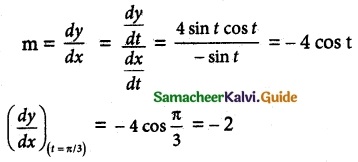
x – 1 = ±2
x = -1, 3
When x = – 1, y = 0 ⇒ point is (-1, 0)
When x = 3, y = 2 ⇒ point is (3, 2)
Equation of tangent with slope –\(\frac { 1 }{ 2 }\) and at the point (-1, 0) is
y – o = –\(\frac { 1 }{ 2 }\)(x + 1)
2y = -x – 1 ⇒ x + 2y + 1 = 0
Equation of tangent with slope –\(\frac { 1 }{ 2 }\) and at the point (3, 2) is 2
y – 2 = –\(\frac { 1 }{ 2 }\) (x – 3)
2y – 4 = -x + 3
x + 2y – 7 = 0.

Question 8.
Find the equation of tangent and normal to the curve given by x – 7 cos t andy = 2 sin t, t ∈ R at any point on the curve.
Solution:
x = 7 cos t and y = 2 sin t, t ∈ R
Differentiating w.r.t. ‘t’,
\(\frac { dx }{ dt }\) = -7 sin t and \(\frac { dy }{ dt }\) = 2 cos t
Slope of the tangent ‘m’
\(\frac { dy }{ dx }\) = \(\frac{\frac { dy }{ dt }}{\frac{ dx }{ dt }}\) = \(\frac { 2 cot t }{ -7 sin t }\)
Any point on the curve is (7 Cos t, 2 sin t)
Equation of tangent is y – y1 = m (x – x1)
y – 2 sint = –\(\frac { 2 cot t }{ 7 sin t }\) (x – 7 cos t)
7y sin t – 14 sin² t = -2x cos t + 14 cos² t
2x cos t + 7 y sin t – 14 (sin² t + cos² t) = 0
2x cos t + 7y sin t – 14 = 0
Now slope of normal is –\(\frac { 1 }{ 3 }\) = \(\frac { 7 sin t }{ 2 cos t }\)
Equation of normal is y – y1 = –\(\frac { 1 }{ m }\)(x – x1)
y – 2 sin t = \(\frac { 7 sin t }{ 2 cos t }\) (x – 7 cos t)
2y cos t – 4 sin t cos t = 7x sin t – 49 sin t cos t 7x sin t – 2y cos t – 45 sin t cos t = 0

Samacheer Kalvi 12th Maths Guide Chapter 7 Applications of Differential Calculus Ex 7.2

Question 9.
Find the angle between the rectangular hyperbola xy = 2 and the parabola x² + 4y = 0
Solution:
Given curves are xy = 2 ……… (1)
x² + 4y = 0 ………. (2)
Now solving (1) and (2)
Substituting (1) in (2)
⇒ x² + 4(2/x) = 0
x³ + 8 = 0
x³ = -8
x = -2
Substituting in (1) ⇒ y = \(\frac { 2 }{ -2 }\) = -1
∴ Point of intersection of (1) and (2) is (-2, -1)
xy = 2 ⇒ y = \(\frac { 2 }{ x }\) ……….. (1)
Differentiating w.r.t. ‘x’
Samacheer Kalvi 12th Maths Guide Chapter 7 Applications of Differential Calculus Ex 7.2 5
The angle between the curves
Samacheer Kalvi 12th Maths Guide Chapter 7 Applications of Differential Calculus Ex 7.2 6

Question 10.
Show that the two curves x² – y² = r² and xy = c² where c, r are constants, cut orthogonally.
Solution:
Given curves are x² – y² = r² ……….. (1)
xy = c² …….. (2)
Let (x1, y1) be the point of intersection of the given curves.
(1) ⇒ x² – y² = r²
Differentiating w.r.t ‘x’,
2x – 2y \(\frac { dx }{ dy }\) = 0
\(\frac { dx }{ dy }\) = \(\frac { x }{ y }\)
now (\(\frac { dx }{ dy }\))(x1,y1) = m1 = \(\frac { x_1 }{ y_1 }\)
(2) ⇒ xy = c²
Differentiating w.r.t ‘x’,
Samacheer Kalvi 12th Maths Guide Chapter 7 Applications of Differential Calculus Ex 7.2 7
Hence, the given curves cut orthogonally.

Samacheer Kalvi 12th Maths Guide Chapter 7 Applications of Differential Calculus Ex 7.2

Samacheer Kalvi 12th Bio Botany Guide Chapter 4 Principles and Processes of Biotechnology

Tamilnadu State Board New Syllabus Samacheer Kalvi 12th Bio Botany Guide Pdf Chapter 4 Principles and Processes of Biotechnology Text Book Back Questions and Answers, Notes.

Tamilnadu Samacheer Kalvi 12th Bio Botany Solutions Chapter 4 Principles and Processes of Biotechnology

12th Bio Botany Guide Principles and Processes of Biotechnology Text Book Back Questions and Answers

Samacheer Kalvi 12th Bio Botany Guide Chapter 4 Principles and Processes of Biotechnology

I. Choose the correct answer from the given option:

Question 1.
Restriction enzymes are.
a) Not always required in genetic engineering
b) Essential tools in genetic engineering.
c) Nucleases that cleave DNA at specific sites,
d) both b and c.
Answer:
d) both b and c

Question 2.
Plasmids are
a) circular protein molecules
b) required by bacteria.
c) tiny bacteria.
d) confer resistance to antibiotics.
Answer:
d) confer resistance to antibiotics

Samacheer Kalvi 12th Bio Botany Guide Chapter 4 Principles and Processes of Biotechnology

Question 3.
EcoRI cleaves DNA at.
a) AGGGTT
b) GTATATC.
c) GAATTC
d) TATAGC.
Answer:
c) GAATTC

Question 4.
Genetic engineering is
a) making artificial genes
b) hybridization of DNA of one organism to that of the others
c) production of alcohol by using micro organisms
d) making artificial limbs, diagnostic instruments such as ECG, EEC, etc.,
Answer:
b) hybridization of DNA of one organism to that of the others

Question 5.
Consider the following statements:
I) Recombinant DNA tecimology is popularly known as genetic engineering is a stream of biotechnology which deals with manipulation of genetic materials by man invitro.
II) pBR322 is the first artificial cloning vector developed in 1977 by Boliver and Rodriguez from E.coli plasmid.
III) Restriction enzymes belongs to a class of enzymes called nucleases.
Choose the correct option regarding above statements
a) I & II.
b) I & III.
c) II & III
d) I, II, & III
Answer:
d) I, II & III

Question 6.
The process of recombinant DNA technology has the following steps
I) Amplication of the gene
II) Insertion of recombinant DNA into host cells
III) Cutting of DNA at specific location using restriction enzyme
IV) Isolation of genetic material(DNA)
Pick out the correct sequence of step for recombinant DNA technology,
a) II, III, IV, I
b) IV, II, III, I
c) I, II, III, IV
d) IV, III, I, II
Answer:
d) IV, III, I, II

Samacheer Kalvi 12th Bio Botany Guide Chapter 4 Principles and Processes of Biotechnology

Question 7.
Which one of the following palindromic base sequence in DNA can be easily cut about the middle by some particular restriction enzymes?
a) 5’ CGTTCG 3′ 3′ ATCGTA 5!
b) 5’ GATATG3′ 3′ CTACTA 5’
c) 5′ GAAHC 3′ 3′ CTTAAG 5′
d) 5′ CACGTA 3′ 3′ CTCAGT 5′
Answer:
c) 5′ GAAHC 3′ 3′ CTTAAG 5′

Question 8.
pBR 322, BR stands for
a) Plasmid Bacterial Recombination
b) Plasmid Bacterial Replication
c) Plasmid Boliver and Rodriguez
d) Plasmid Baltimore and Rodriguez
Answer:
c) Plasmid Boliver and Rodriguez

Question 9.
Which of the following one is used as a Biosensors?
a) Electrophoresis
b) Bioreactors
c) Vectors
d) Electroporation
Answer:
Correct Answer: enzymes

Samacheer Kalvi 12th Bio Botany Guide Chapter 4 Principles and Processes of Biotechnology

Question 10.
Match the following

Column AColumn B
1. Exonucleasea. add or remove phosphate
2. Endonucleaseb. binding the DNA fragments
3. Alkaline Phosphasec. cut the DNA at terminus
4. Ligased. cut the DNA at middle

Samacheer Kalvi 12th Bio Botany Guide Chapter 4 Principles and Processes of Biotechnology 17
Answer:
b) 1-c, 2-d, 3-a, 4-b

Question 11.
In which techniques Ethidium Bromide is used?
a) Southern Blotting Techniques
b) Western Blotting Techniques.
c) Polymerase Chain Reaction.
d) Agrose Gel Electroporosis.
Answer:
d) Agrose Gel Electroporosis

Question 12.
Assertion : Agrobacterium tumifaciens is popular in genetic engineering because this bacterium is associated with the root nodules of all cereals and pulse crops.
Reason : A gene incorporated in the bacterial chromosomal genome gets automatically transferred to the cross with which bacterium is associated.
a) Both assertion and reason are true. But reason is correct explanation of assertion.
b) Both assertion and reason are true. But reason is not correct explanation of assertion.
c) Assertion is true but reason is false.
d) Assertion is false but reason is true.
e) Both assertion and reason are false.
Answer:
e) Both assertion and reason are false

Samacheer Kalvi 12th Bio Botany Guide Chapter 4 Principles and Processes of Biotechnology

Question 13.
Which one of the following is not correct statement.
a) Ti plasmid causes the bunchy top disease.
b) Multiple cloning site is known as Polylinker.
c) Non viral method tranfection of Nucleic acid in cell
d) Polyactic acid is a kind of biodegradable and bioactive thermoplastic
Answer:
a) Ti plasmid causes the bunchy top disease

Question 14.
An analysis of chromosomal DNA using the southern hybridisation technique does not use
a) Electrophoresis .
b) Blotting
c) Autoradiography
d) Polymerase Chain Reaction
Answer:
d) Polymerase Chain Reaction

Question 15.
An antibiotic gene in a vector usually helps in the selection of.
a) Competent cells.
b) Transformed cells
c) Recombinant cells
d) None of the above
Answer:
b) Transformed cells

Samacheer Kalvi 12th Bio Botany Guide Chapter 4 Principles and Processes of Biotechnology

Question 16.
Some of the characteristics of Bt cotton are
a) Long fibre and resistant to aphids
b) Medium yield, long fibre and resistant to beetle pests
c) high yield and production of toxic protein crystals which kill dipteran pests
d) High yield and resistance to ball worms.
Answer:
d) High yield and resistance to bollworms

Question 17.
How do you use biotechnology in modern practice?
Answer:
Today biotechnology is a billion-dollar business around the world, applies biotechnological tools for their product improvement.

  • Pharmaceutical companies.
  • Breweries.
  • Agro Industries & others.
  • Modern biotechnology – include all methods, rDNA technology, cell fusion technology, etc.,
  • Major focus of Biotechnology (see the tabulation)

Samacheer Kalvi 12th Bio Botany Guide Chapter 4 Principles and Processes of Biotechnology 1

Question 18.
What are the materials used to grow microorganisms like Spirulina?
Answer:
Spirulina can be grown easily on materials like waste water from potato processing plants (containing starch), straw, molasses, animal manure and even sewage, to produce large quantities.

Samacheer Kalvi 12th Bio Botany Guide Chapter 4 Principles and Processes of Biotechnology

Question 19.
You are working in a biotechnology lab with a bacterium namely E.Coli. How will you cut the nucleotide sequence? Explain it.
Answer:

  • The exact kind of cleavage produced by a v restriction enzyme is important in the • design of a gene cloning experiment.
  • Some cleave both strands of DNA through the centre resulting in blunt or flush end known as symmetric cuts.
  • Some restriction enzymes cut the strand of DNA, a little away from the centre of palindrome sites, between the same two bases on the opposite strands, protruding and recessed ends known as sticky or cohesive end, cuts known as asymmetric cut or
    staggered cuts.
  • It is necessary that the vector and the source DNA are cut with the same restriction enzyme, so that the resultant DNA fragments have the same sticky ends facilitating the action of DNA ligase to join them.

Samacheer Kalvi 12th Bio Botany Guide Chapter 4 Principles and Processes of Biotechnology 2

Question 20.
What are the enzymes you can used to cut terminal end and internal phosphodiester bond of nucleotide sequence?
Answer:
Restriction exonuclease are the restriction enzyme used to cut nucleotides from the terminal end of DNA. Whereas, restriction endonucleases cut the internal phosphodiester bond with DNA molecule.

Samacheer Kalvi 12th Bio Botany Guide Chapter 4 Principles and Processes of Biotechnology

Question 21.
Name the chemicals used in gene transfer.
Answer:
Director vector less Gene transfer is possible through several mediators

Chemical mediated gene transfer:
Certain chemicals like Poly Ethylene Glycol(PEG) and Dextran Sulphate.
These chemicals induce the uptake of DNA into plant protoplasts.

Question 22.
What do you know about the word pBR332?
Answer:
pBR332 – It is a reconstructed plasmid and most widely used as cloning vector.

  • It contains 4361 base pairs.
  • P denotes Plasmid .
  • B&R – The names of Boliver and Rodriguez, the scientists developed this plasmid.
  • 322 – The number of plasmid developed from their lab.
  • It contains ampR & tetR – 2 different antibiotic resistant genes & the recognition sites for several restriction enzymes (Hindlll, ECoRI, Bam H-I, Sal I, Pvu II, Pst I, Cla I) ori & antibiotic resistance genes.
  • Rop – Codes for the proteins involved in the replication of the plasmid.

Samacheer Kalvi 12th Bio Botany Guide Chapter 4 Principles and Processes of Biotechnology 3

Question 23.
Mention the application of Biotechnology.
Answer:
Introduction: Most important applied interdisciplinary sciences of the 21 st century
It has promise for the benefits of Human Being.
Samacheer Kalvi 12th Bio Botany Guide Chapter 4 Principles and Processes of Biotechnology 4 Samacheer Kalvi 12th Bio Botany Guide Chapter 4 Principles and Processes of Biotechnology 5

Production of secondary metabolites – Biofertilizers, Biopesticides & Enzymes
Biomass Energy, Biofuel, Biorernediation phvtoremediation for environmental biotechnology.

Question 24.
What is the restriction enzymes? Mention their type with a role in Biotechnology.
Answer:
Restriction enzymes are the enzymes of bacterial origin which cleaves DNA into fragments at or near specific recognition sites within DNA molecules. This principle is used in biotechnology to cut and insert the desired gene (gene of interest) thereby generating an rDNA with desirable characters.

Samacheer Kalvi 12th Bio Botany Guide Chapter 4 Principles and Processes of Biotechnology

a) Exonucleases – remove nucleotides one at a time from the end of DNA.
Eg: Bal 31, Exonuclease III

b) Endonucleases – break the internal phosphodiester bonds with in a DNA.
Eg: Hind II, EcoRI, Pvul, Bam HI, Taql.

Three classes of Restriction endonuclease

  • Type 1, II & III – which differ slightly by their mode of action
  • Type II – preferred in rDNA technology as they cut DNA with in a specific sequence consisting of 4 – 8 bp.
  • Hind II – cut DNA at a point of specific sequence of 6 base pairs (recognition
    sequence).
  • From 200 strains 900 restriction enzymes isolated from over 230 strains of bacteria with different recognition sequences.
  • Restriction endonucleases are named by a standard procedure.
  • The first letter of the enzymes indicates the genus name, followed by the first two letters of the species, then comes the strain of the organism and finally a roman numeral indicating the order of discovery.
  • For example ECORI is from Escherichia (E) coli (co) strain Ry 13 (R) and first endonuclease (I) to be discovered .
  • It contains 2 different antibiotic resistance genes and recognition site for several restriction enzymes.
    This sequence is referred to as a restriction site and is generally – palindromic which means that the sequence in both DNA strands at this site read same in 5′ – 3′ direction and in the 3′ – 5′ direction.

Samacheer Kalvi 12th Bio Botany Guide Chapter 4 Principles and Processes of Biotechnology

Question 25.
Are there any possibilities to transfer a suitable desirable gene to host plant without vector? Justify your answer.
Answer:
Yes, it is possible to transfer a suitable desired gene to a host plant using certain chemicals, microinjection method, electroporation or by biolistics.

a. Chemical mediated gene transfer:
Chemicals Poly Ethylene Glycol (PEG) & Dextran sulphate – induce DNA uptake into plant protoplasts.

b. Microinjection:
With a fine-tipped glass needle, DNA is directly injected into the nucleus.
The protoplasts are immobilized on solid support (agarose on a microscopic slide)

c. Electroporation method of gene transferJjjJU Protoplasts, cells or tissues subjected to a pulse of high voltage electric power to make transient pores in the plasma membrane, through which uptake of foreign DNA occurs.

d. Liposome – mediated methods of gene transfer
The gene or DNA is transferred in an encapsulated form from Liposome ( the artificial phospholipid vesicles) into the vacuole of plant cells.

e. Biolistics:
The DNA particle with gold or tungsten particle (1.3 gm) coating are bombarded into the target tissue by gene gun or microprojectile gun/shotgun The bombarded cells/tissues are cultured to regenerate plants from transformed cells.
Samacheer Kalvi 12th Bio Botany Guide Chapter 4 Principles and Processes of Biotechnology 6

Samacheer Kalvi 12th Bio Botany Guide Chapter 4 Principles and Processes of Biotechnology

Question 26.
How will you identify vectors?
Answer:

PropertiesEffect
Able to replicate automatically.Multiple copies can be got along with insert in the host cell.
Small size, low molecular weight less than 10kbpEntry into the host cell is easy.
Should contain oriIt can independently replicate within the host.
Contain suitable marker (Antibiotic resistance) etc.It permit its detection in the transformed host cell.
Should have unique target sites for integration with DNA insert & should have ability to integrate with DNA insert.So that it can be carried into the genome of the host cell.
Most of the cloning vectors have more than one restriction site (MCS) or polylinker.Multiple cloning site (MCS) facilitates the use of restriction enzyme of choice.

Question 27.
Compare the various types of Blotting techniques.
Answer:

Type. Transfer of DNA/RNA (From – To)
1. Southern BlottingDNA from Agarose gels to Nitrocellulose membrane.
2. Northern Blotting.RNA transferred to Nitrocellulose membrane.
3. Western Blotting.Proteins transferred from protein to Nitrocellulose membrane.

Question 28.
Write the advantages of herbicide-tolerant crops.
Answer:

CharacterEffect
1. Weed controlImproves high yielding crops
2. Reduces spray of HerbicideEconomic effort – also ecofriendly & Nonhazardous
3. Use of low toxicity compoundsDoes not harm soil because do not remain active in the soil.
4. Reduce competition between crop plant & weedHealthy plant growth is assured

Samacheer Kalvi 12th Bio Botany Guide Chapter 4 Principles and Processes of Biotechnology

Question 29.
Write the advantages and disadvantages of Bt cotton.
Answer:

AdvantagesDisadvantages
1. Yield – Increase due to effective control of bollwormsCost of Bt cotton seeds are high.
2. Usage of insecticide is reducedRemain effective only up to 120 days after that effectiveness is reduced
3. Cost of cultivation potentially reducedIneffective – against
sucking pests like 1. Jassids, 2.aphids, 3. Whitefly
Affects pollinating insects & thus yield.

Question 30.
What is bioremediation? Give some examples of bioremediation.
Answer:
Bioremediation:
It is defined as the use of microorganisms or plants to clean up the environmental pollution. It is an approach used to treat wastes including wastewater, industrial waste, and solid waste. The bioremediation process is applied to the removal of oil, petrochemical residues, pesticides, or heavy metals from soil or groundwater.

In many cases, bioremediation is less expensive and more sustainable than other physical and chemical methods of remediation. The bioremediation process is a cheaper and eco-friendly approach and can deal with lower concentrations of contaminants more effectively. The strategies for bioremediation in soil and water can be as follows:

  1. Use of indigenous microbial population as indicator species for the bioremediation process.
  2. Bioremediation with the addition of adapted or designed microbial inoculants.
  3. Use of plants for bioremediation – green technology.

Samacheer Kalvi 12th Bio Botany Guide Chapter 4 Principles and Processes of Biotechnology

Question 31.
Write the benefits and risks of Genetically Modified Foods.
Answer:

Benefits

Risk (Believed to)

Yield:
High yield without pest.
Health Hazards: Liver, kidney function affected cause cancer.
Reduction in usage of chemical pesticides.Hormonal Imbalance and Physical Disorder.
Reduction in soil pollution.Anaphylactic shock (Sudden hypersensitive reaction) & Allergies.
Conservation of microbial population of soil.Loss of viability of seeds as in terminator seed technology of GM crops.
Reduction in groundwater pollution.Not favoured by agriculturists.
Reduction in air pollution (Chemical spray of pesticides – reduced)

12th Bio Botany Guide Principles and Processes of Biotechnology Additional Important Questions and Answers

I. Choose the correct answer

Question 1.
Which one of the following is a secondary metabolite? IWriiWJ
a. Ethanol
b. Acetic acid
c. Citric acid
d. Toxic pigments
Answer:
d) Toxic pigments

Samacheer Kalvi 12th Bio Botany Guide Chapter 4 Principles and Processes of Biotechnology

Question 2.
Bio-Technology was coined by.
a. Weisner
b. Karl Prantl
c. Sanger & Gilbert
d. KarlEreky
Answer:
d) Karl Ereky

Question 3.
Traditional Bio-Technology is also known as.
a. Fermentation Biology
b. Kitchen Technology
c. Hybridization Biology
d. Transgenic Biology
Answer:
b) Kitchen Technology

Question 4.
The study of Drugs or medicines used in medical treatment is known as.
a. Pharmaceuticals
b. Biomedical Engineering
c. Chemical Engineering
d. Tissue Engineering
Answer:
a) Pharmaceuticals

Samacheer Kalvi 12th Bio Botany Guide Chapter 4 Principles and Processes of Biotechnology

Question 5.
Which of the following can be Bio Technological products?
a. Antibiotics
b. Vaccines
c. Enzymes
d. All the above.
Answer:
d) All the above

Question 6.
Multiplication of Alien DNA in organisms required
a. ROP
b. ORI
c. Stop codon
d. TATA box
Answer:
b) ORI

Question 7.
Tools of Biotechnology is used for effluent treatment, water cycling is known as
a. Process Engineering
b. Production Engineering
c. Mechanical Engineering
d. Microbial Engineering
Answer:
a) Process Engineering

Samacheer Kalvi 12th Bio Botany Guide Chapter 4 Principles and Processes of Biotechnology

Question 8.
The scientist who use a first viral vaccine to inoculate a child from smallpox is
a. Louis Pasteur
b. Edward Jenner
c. Sanger and Gilbert.
d. Arber and Nathans
Answer:
b) Edward Jenner

Question 9.
The enzyme used for making artificial sweeteners is
a. Lactose
b. Galactose
c. Invertase
d. Reductase
Answer:
c) Invertase

Question 10.
Development of Artificial gene functioning within living cells was done by
a. H.G.Khorana
b. Ian Wilmet
c. Sir Robert
d. G. Edwards
Answer:
a) H.G.Khorana

Samacheer Kalvi 12th Bio Botany Guide Chapter 4 Principles and Processes of Biotechnology

Question 11.
rDNA is also known as
a. Hybrid DNA-RNA
b. Recombinant of vector DNA and desired genes
c. Chimeric DNA
d. Bothb&c
Answer:
d) Both b & c

Question 12.
Plasmids are
a. ss DNA
b. ds DNA(linear)
c.rDNA
d. Vector DNA
Answer:
d) Vector DNA

Question 13.
pBR322 is most extensively studied
a. Foreign gene
b. r DNA
c. done
d. Plasmid DNA of Ecoli.
Answer:
d) Plasmid DNA of Ecoli

Question 14.
Restriction enzymes recognize specific
a. Palindromic region,
b. Exons
c. Introns
d. None of these
Answer:
a) Palindromic region

Samacheer Kalvi 12th Bio Botany Guide Chapter 4 Principles and Processes of Biotechnology

Question 15.
Restriction enzymes of Ecoli are
a. Hind III
b. Bam III
c. EcoRI I & EcoRI II
d. All of these.
Answer:
c) EcoRI I & EcoRI II

Question 16.
The best cloning organism for biotechnology is
a. Agrobacterium
b. Pseudomonas
c. Lambda phage
d. E. Coli
Answer:
d) E.Coli

Question 17.
The ability to form tumours is found in the plasmids of
a. E.coli
b. Pseudomonas
c. Agrobacterium tumefaciens
d. Pneumococcus
Answer:
c) Agrobacterium tumefaciens

Question 18.
Engineered bacterium carries
a. Plasmids
b. rDNA
c. c DNA
d. ssDNA
Answer:
b) rDNA

Samacheer Kalvi 12th Bio Botany Guide Chapter 4 Principles and Processes of Biotechnology

Question 19.
Electrophoresis and southern blotting techniques are used in
a. DNA fingerprinting
b. Gene Synthesis
c. gene cloning
d. All of these.
Answer:
a) DNA fingerprinting

Question 20.
In biosesnsors Green Fluorescent protein is used which is isolated from A and spliced
a. A Chlamydomonas – B Ecoli
b. A Gelidium – B Bacillus subtilis
c. A Aequorea victoria – B Arabidopsis thaliana
d. A Asoaragus – B Accacia melanoxylon
Answer:
c. A Aequorea victoria – B Arabidopsis thaliana

Question 21.
Bacteria protects themselves from viral attack by producing
a. Exonuclease
b. Endonuclease
c.DNAligase
d. Gy ase
Answer:
b) Endonuclease

Question 22.
Molecular scissor is
a. Urease
b. Helicase
c. Peptidase
d. Restriction Endonuclease
Answer:
d) Restriction Endonuclease

Samacheer Kalvi 12th Bio Botany Guide Chapter 4 Principles and Processes of Biotechnology

Question 23.
Which one of the following is used in transfer of foreign DNA to crop plants?
a. Penicillum Expansum
b. TrichodermaHarzianum
c. Meloidogyne Incognita
d. Agrobacterium tumefaciens
Answer:
d) Agrobacterium tumefaciens

Question 24.
E coli is the mostly used organism for gene cloning, because
a. It is easy to handle
b. It is growing easily under optimal condition
c. It is the safe organism d. All the above.
Answer:
d) All the above.

Question 25.
Which one of the following palindromic base sequences in DNA can be easily cut at about the middle by some particular restriction enzyme?
a. 5′ CGTTCG3’3′ ATGGTA 5′
b. 5′ GATATG 3′ 3′ CTACTA 5′
c. 5′ GAATTC 3′ 3’CTTAAG 5′
d. 5′ CACGTA3’3′ CTCAGT 5′
Answer:
c. 5′ GAATTC 3′ 3’CTTAAG 5′

Question 26.
Biolistics (gene gun) is suitable for
a. Constructing recombinant DNA by joining with vectors
b. DNA finger printing
c. Disease resistant genes
d. Transformation of plant cells
Answer:
d) Transformation of plant cells

Samacheer Kalvi 12th Bio Botany Guide Chapter 4 Principles and Processes of Biotechnology

Question 27.
For transformation micro particles coated with DNA to be bombarded with gene gun are made up of
a. Silver or Platinum
b. Platinum or Zinc
c. Silicon or Platinum
d. Gold or Tungsten
Answer:
d) Gold or Tungsten

Question 28.
Rising of dough is due to
a. Multiplication of Yeast
b. Production of CO2
c. Emulsification
d. Hydrolysis of wheat flour starch in to sugar
Answer:
b) Production of CO2

Question 29.
All the process after the fermentation process is known as
a. upstream process
b. downstream process
c. forward process
d. backward process
Answer:
b) downstream process

Question 30.
For making GMO, the three basic steps that are required are
a. Identification of DNA with desirable gene
b. Introduction of identified DNA into the host
c. Maintenance of introduced DNA in to the host and transfer of DNS to its progeny
d. All the above
Answer:
d) All the above

Samacheer Kalvi 12th Bio Botany Guide Chapter 4 Principles and Processes of Biotechnology

Question 31.
Zymology is the study of
a. Fermentation & its practical use
b. Name of Bioreactors
c. Upstream pro^ss
d. Downstream process
Answer:
a) Fermentation & its practical use

Question 32.
ECORI – R stands for
a. Genus
b. Species
c. Strains
d. Group
Answer:
a) Genus

Question 33.
Which is suitable for transferring an alien DNA into a plant cell?
a. CaCl2
b. Biolistics or gene gun method
c. Micro infection
d. Heat shock
Answer:
b) Biolistics or gene gun method

Question 34.
The group of degradable biopolymers are
a. CrylAc and DMH-11
b. PHAsandPHB
c. GFPandPGA
d. DMH and HT
Answer:
b) PHAs and PHB

Samacheer Kalvi 12th Bio Botany Guide Chapter 4 Principles and Processes of Biotechnology

Question 35.
Genetically engineered human insulin is
a. Haematiri
b. Pro insulin
c. Hybridin
d. Humulin
Answer:
d) Humulin

Question 36.
Probiotics are
a. Food Allergens
b. safe antibiotics
c, Carcinogenic microbes
d. Live microbial food supplements
Answer:
d) Live microbial food supplement

Question 37.
Bt Brinjal is produced by using A and is having resistance against B.
a. A Ecoli – B Virus
b. A Virus – B Bacteria
c. A Agrobacterium – B Bacillus
d. A Agrobacterium – B Lepidopteron
Answer:
d. A Agrobacterium – B Lepidopteron

Samacheer Kalvi 12th Bio Botany Guide Chapter 4 Principles and Processes of Biotechnology

Question 38.
PCR refers to
a. A common laboratory technique of making millions of copies of a particular region of DNA
b. A biotechnological procedure of replicating DNA strands
c. Hybridization of DNA molecules in to several fragments
d. It is a test for tracing genetic defects.
Answer:
a) A common laboratory technique of making millions of copies of a particular region of DNA

Question 39.
The test used in the diagnosis of AIDS are
a. ELISA and Southern blot
b. Northern blot and ELISA
c. Western blot and ELISA
d. ELISA and Widal test
Answer:
c) Western blot and ELISA

Question 40.
The characteristics of molecular probe are
a. very long molecule
b. double stranded
c. DNAorRNA
d. complementary to a part of desired gene options
I. a & b
II. b & c
III. a & d
IV. c & d
Answer:
iv) c & d

Samacheer Kalvi 12th Bio Botany Guide Chapter 4 Principles and Processes of Biotechnology

Question 41.
Use of biology in industrial process and for improving quality of life is called
a. Biotechnology
b. Genetic engineering
c. Eugenics
d. Microbiology
Answer:
c) Eugenics

Question 42.
Somoclonal variations occur in plants subjected to
a. r DNA technology
b. Exposed to gamma rays
c. Tissue culture
d. Highly polluted environmrnt
Answer:
c) Tissue culture

Question 43.
DNA elements with ability to change positions is called
a. intron
b. transposon
c. exon
d. recon
Answer:
b) transposon

Samacheer Kalvi 12th Bio Botany Guide Chapter 4 Principles and Processes of Biotechnology

Question 44.
The process of RNA interference has been used in the development of plants resistant to
a. viruses
b. Nematodes
c. Fungi
d. Insect pests
Answer:
b) Nematodes

Question 45.
A transgenic food crop which may help in solving the problem of night blindness in developing countries is
a. Bt Soyabean
b. Star link Maize
c. Golden rice
d. FlavrSavr Tomato
Answer:
c) Golden rice

Question 46.
LacZ is a reporter gene used in
a. Antibiotic resistant markers
b. Replica Plating Technique
c. Vector mediated gene transfer
d. Insertional Inactivation (Blue white colony selection method)
Answer:
d) Insertional Inactivation (Blue white colony selection method)

Samacheer Kalvi 12th Bio Botany Guide Chapter 4 Principles and Processes of Biotechnology

Question 47.
PTA – 6
a. GMF
b. Circular protein
c. GFP
d. PLA
Answer:
c) GFP

Question 48.
The introduction of foreign nucleic acids ito cells by non viral methods is known as
a. Transduction
b. Transfection
c.Inoculatin
d.Transformation
Answer:
b) Transfection

Question 49.
The CO2 and Ethyl alcohol of fermentation are used respectively in
a. Bakery and Brewery
b. Brewery and Sugar Refining
c. Refinery and Brewery
d. Sewage treatment plants & Alcoholic beverage factories
Answer:
a) Bakery and Brewery

Question 50.
This enzyme is purified from bacteria and calf intestine is
a. DNAligase
b. Alkaline Phosphatase
c. Exo nuclease
d. Endo nuclease
Answer:
b) Alkaline Phosphatase

Samacheer Kalvi 12th Bio Botany Guide Chapter 4 Principles and Processes of Biotechnology

Question 51.
The use of transposon is well studied in
a. Arabidopsis thaliana & Escherichia coli
b. Escherichia coli & Yeast cell
c. Salmonella typhi & Pisum Sativum
d. None of the above
Answer:
a) Arabidopsis thaliana & Escherichia coli

Question 52.
Curd milk, cheese and butter are produced with the help of
a. penicillium
b. streptomyces
c. saccharomyces
d. none of the above
Answer:
d. none of the above

Question 53.
Basta herbicide tolerant gene PPT was isolat ed from
a. Medicago sativa
b. Ginkgo biloba
c. Mentha viridis
d. None of the above
Answer:
a) Medicago sativa

Samacheer Kalvi 12th Bio Botany Guide Chapter 4 Principles and Processes of Biotechnology

Question 54.
The number of Bt Toxin produced by strains of Bacillus thurigiensis is
a. 200
b.400
c. 2600
d, 2400
Answer:
a) 200

Question 55.
The name & source organism of the gene crylAc and its target pest are
a. Meloidegyne incognita – root borer
b. Bacillus thuringiensis – cotton bollworm
c. Agrobacterium tumefaciens – stem borer
d. Manducta sexta – horn worm
Answer:
b) Bacillus thuringiensis – cotton bollworm

Question 56.
Which was the first plants to be used to demonstrate the feasibility of CRISPR – mediated targeted mutagenesis and gene replacement
a. Wheat
b. Rice
c. Maize
d. Arabidiopsis
Answer:
b) Rice

Samacheer Kalvi 12th Bio Botany Guide Chapter 4 Principles and Processes of Biotechnology

Question 57.
Which one of the following selection method takes longer time in bringing about desired
a. Clonal selection
b. Mass selection
c. Pure line selection
d. Natural selection
Answer:
d) Natural selection

Question 58.
EPSPSisa
a. Hydrolysins substance
b. Round up Enzyme
c. Bio Pesticide
d. Fertilizer
Answer:
b) Round up Enzyme

Question 59.
Match the following

1 Plasmida. Jumping gene
2 Ti plasmidb. ds- circular gene
3 PBR322 plasmidc. Has one, ori & inc genes
4 Transposable elementsd. most widely used as cloning vector

Answer:
1. b. ds- circular gene
2. c. Has one, ori & inc genes
3. d. most widely used as cloning vector
4. a. Jumping gene
Samacheer Kalvi 12th Bio Botany Guide Chapter 4 Principles and Processes of Biotechnology

Question 60.
Match
1. Fermentation – Kohler
2. Monoclonal antibodies – Francis cirde
3. Viral Vaccine – Louis pasteur
4. Double helix structure . of DNA – Edward jenner
a) i-III, ii) I, iii) IV, iv) II
a) i-II, ii) III, iii) IV, iv) I
a) i-IV, ii) III, iii) I, iv) IV
a) i-II, ii) III, iii) I, iv) IV
Answer:
a) i-III, ii) I, iii) IV, iv) II

Question 61.
Choose the odd man out
With regard to the strategies of Bio remediation
a. Use of indigenous microbial population as indicator species
b. The addition of adapted or designed microbial inoculants
c. Use of plants to clean up pollutants
d. Molecular pharming to produce transgenic organisms.
Answer:
d. Molecular pharming to produce transgenic organisms.

Samacheer Kalvi 12th Bio Botany Guide Chapter 4 Principles and Processes of Biotechnology

Question 62.
With regard to SCP – Choose the odd man out.
a. Chlorella
b. Spirulina
c. Chlamydomonas
d. Bacillus thuringiensis
Answer:
d) Bacillus thuringiensis

Question 63.
With regard to secondary metabolites choose the odd man out
a. Antibiotics
b. Terpenoids
c. Rubber
d. Lactic acid
Answer:
d) Lactic acid

Question 64.
Choose the incorrect pair

a.PBR 322Ecoli cloning vector
b.EcoRl — cIal, Hind 1HRestriction Enzyme
c.ROPProtein involved in the replication of the plasmid
d.PCR


Technique in which multiple copies of the gene (or DNA) of interest is synthesized, invitro

Answer:
c) ROP – Protein involved in the replication of the plasmid

Question 65.

a. DMH -IIHerbicide-tolerant Pea
b. PLABio degradable & Bio active thermoplastic
c. GFPProtein is isolated from the Jellyfish Aequora Victoria
d. PPTBasta herbicide tolerant gene

Answer:
a) DMH -11 – Herbicide tolerant Pea

Samacheer Kalvi 12th Bio Botany Guide Chapter 4 Principles and Processes of Biotechnology

Question 66.
Which is the set of fragments obtained by the action of Hae III restriction enzymes on
\(\left\{\begin{array}{l}
5^{\prime} \mathrm{GGCC}^{\prime} \\
3^{\prime} \mathrm{CCGG} 5^{\prime}
\end{array}\right\}=?\)
Samacheer Kalvi 12th Bio Botany Guide Chapter 4 Principles and Processes of Biotechnology 18
Answer:
Samacheer Kalvi 12th Bio Botany Guide Chapter 4 Principles and Processes of Biotechnology 19

Question 67.
With regard to transgenic organism & the processes

a. Biopharrninggenetically engineered pharmaceuticals substances
b. Mycoremediationuse of bacteria to bring about environmental remediation
d. Bioaugmentationuse of selected microbes to speed up degradation process
d. Bioleachinguse of microbes to recover metal pollutants from contaminated place

Answer:
b. Mycoremediation – use of bacteria to bring about environmental remediation

Samacheer Kalvi 12th Bio Botany Guide Chapter 4 Principles and Processes of Biotechnology

II. Assertion and Reason

In each of the following questions, two statements are given. One is assertion (A) and the other one is reason(R) Mark the correct answer as
a) If both ‘A’ and ‘R’ are true and ‘R’ is the correct explanation of A
b) It both ‘A’ and ‘R’ are true but ‘R’ is not the correct explanation of A
c) It A is true but’R’is false
d) If both A&R are false

Question 68.
Assertion : Stirred tank fermenters help in obtaining the foreign gene product Reason : They allow the large scale growth of the biomass that leads to a higher yield of desired proteins
Answer:
a) If both ‘A’ and ‘R’ are true and ‘R’ is the correct explanation of A

Question 69.
Assertion: PCR is used inrDNA technology. Reason : Special fast multiplying vectors are produced using PCR method.
Answer:
b) It both ‘A’ and ‘R’ are true but ‘R’ is not the correct explanation of A

Question 70.
Assertion : In EcoRI, the letter R is derived from the genus of bacteria.
Reason :
EcoRI, the name of palindromic nucleotide sequences.
Answer:
d) If both A & R are false

Samacheer Kalvi 12th Bio Botany Guide Chapter 4 Principles and Processes of Biotechnology

Question 71.
Assertion : Assertion:Micro injection technique is used to inject rDNA directly into the nucleus of an animal cell
Reason: Genegun is used to transfer rDNA into plant cells
Answer:
b) It both ‘A’ and ‘R’ are true but ‘R’ is not the correct explanation of A

Question 72.
Assertion : In bio reactors, the transforming cells are maintained in their physiologically most active phase..
Reason : A large biomass using higher yields of desired protein is got by it.
Answer:
a) It both ‘A’ and ‘R’ are true but ‘R’ is not the correct explanation of A

Question 73.
Assertion: n rDNA technology, the restriction enzymes, those produce sticky ends are commonly used.
Reason : Sticky ends facilitates the action of enzyme DNA ligase.
Answer:
a) It both ‘A’ and ‘R’ are true but ‘R’ is not the correct explanation of A

Question 74.
Assertion : Cloning vector should have selectable marker.
Reason : Selectable marker helps in identifying and eliminating non – trnsformants and selectively permitting the growth of transformants.
Answer:
a) It both ‘A’ and ‘R’ are true but ‘R’ is not the correct explanation of A

Samacheer Kalvi 12th Bio Botany Guide Chapter 4 Principles and Processes of Biotechnology

III. Choose the correct statement

Question 75.
The bio reactor is a Fermentor – vessel in which the following factors are controlled.
a. Nutrient, temperature and microorganism
b. Aeration, agitation, temperature and pH
c. Aeration, Activation, Agarose gel & hormones.
d. Hormones, Oxygen, Carbon Dioxide & not trade secrets.
Answer:
b. Aeration, agitation, temperature and pH

Question 76.
Which one of the following statement is true regarding IPR?
a. The discoverer has the full rights on his/her property.
b. IPR includes only the process of the product
c. IPR is not protected by laws framed by the country.
d. The discoverer can use his discovery for his own company but can not sell it to others.
Answer:
a) The discoverer has the full rights on his/her property.

Question 77.
a. Most of Bt toxins are insecticidal to the larvae of Honeybees, Butterflies & Lepidoptera.
b. Bt – Brinjal is developed to give resistant against viral attacks.
c. Flavr – Savr is a variety of corn produced by Agrobacterium mediated genetic engineering technique
d. Goldenrice has been genetically altered so that the endosperm now accumulates Beta – Carotene
Answer:
d) Goldenrice has been genetically altered so that the endosperm now accumulates Beta -Carotene

Question 78.
a.Cosmids are hybrid vectors derived from plasmids.
b. YAC plasmid vector does not behave like a yeast chromosome.
c. BAC vector is not used inrDNA technology.
d. The shuttle vectors are plasmids present in most of the Prokaryotes.
Answer:
a.Cosmids are hybrid vectors derived from plasmids.

Samacheer Kalvi 12th Bio Botany Guide Chapter 4 Principles and Processes of Biotechnology

IV. Choose the incorrect statements

Question 79.
a. ELISA is a diagnostic tool in the identification of pathogen species by using antibodies
b. In plant pathology ELISA is used to weed out virus infected plants.
c. ELISA test is one of the tests in the diagnosis of AIDS.
d. The presence of Mycobacterium tuberculosis is also traced by ELISA test.
Answer:
d) The presence of Mycobacterium tuberculosis is also traced by ELISA test.

Question 80.
a. DNA probes are used in the identification of viruses and other pathogen.
b. RNA probes are used in the identification of bacteria as pathogens.
c. Northern Blotting can also be used in the «identification of pathogenecity of viruses.
d. Southern Blotting help as a tool to identify virus and other pathogens.
Answer:
b) RNA probes are used in the identification of bacteria as pathogens

Samacheer Kalvi 12th Bio Botany Guide Chapter 4 Principles and Processes of Biotechnology

IV. Fill in the blanks Answer

1. The method that involved the growth of tissues & cells in a suitable new medium and away from the parent plant is known as…………………….
Answer:
Tissue culture

2. The range of insects killed by Bt. Toxins are…………………….
Answer:
Lepitopteron

Samacheer Kalvi 12th Bio Botany Guide Chapter 4 Principles and Processes of Biotechnology

3. The genes that code for Bt toxins are commercially called…………………….
Answer:
Cry genes

4. The first company to produce insulin by rDNA technology is…………………….
Answer:
Eli Lilly

5. The Indian scientist who was the innovator of ELISA in India is…………………….
Answer:
Usha M.Joshi

6. PCR is usually used to detect the……………………. in a suspected …………………….patient.
Answer:
HIV & AIDS

7. Are present in increased quantities in glutelin is…………………….
Answer:
rice

8. Protein encoded by cry Ab control…………………….
Answer:
Cotton borer

Samacheer Kalvi 12th Bio Botany Guide Chapter 4 Principles and Processes of Biotechnology

9. Use of microorganism in solution to recover toxic metal pollutants from contaminated sites is…………………….
Answer:
Bioleaching

10. The endosperm of normal rice doesnot contain…………………….
Answer:
Beta carotene

V. Two Marks

Question 1.
What are the tools for genetic engineering?
Answer:

  • Enzymes (1) restriction endonuclease (2) DNA ligase
  • Vectors
  • Host organisms

Question 2.
What is PCR?
Answer:
PCR (Polymerase Chain Reaction is common laboratory technique used to make copies (millions) of a particular region of DNA

Question 3.
Differtiate between Exonuclease & Endonuclease
Exonuclease

  1. It remove nucleotides one at a time from the end of a DNA molecule
  2. May also cut RNA Eg;Exonuclease

Samacheer Kalvi 12th Bio Botany Guide Chapter 4 Principles and Processes of Biotechnology

Exonuclease :

  1. It break the internal internal phosphodiester bonds with in a DNA molecule
  2. They do not cut RNA | Eg:Hind II -ecoRI Pvul, Bam HI, Taq I

Question 4.
What is the role of Restriction endonuclease in the life of bacteria?
Answer:

  • They exist in many bacteria, where they function as a part of their defence mechanism called restriction-modification system
  • It helps the bacteria to cut the genetic material of the virus that attack it and render them harmless. EgiE.coli

Question 5.
How do DNA ligases join the DNA fragments?
Answer:
DNA ligase,joins the sugar and phosphate molecule of double stranded DNA (ds.DNA) with 5’po4 and 3′-OH in an ATP -dependent reaction

Question 6.
What are the two types of vectors?
Answer:
Cloning vector
It is used for cloning of DNA,insert inside the suitable host cell

Expression vector
It is used to express the DNA insert for producing specific protein inside the host

Samacheer Kalvi 12th Bio Botany Guide Chapter 4 Principles and Processes of Biotechnology

Question 7.
What is meant by ori?
Answer:
Origin replication (ori) is a sequence from
where replication starts and piece of DNA when linked to this sequence can be made to replicate within the host cells

Question 8.
What is the main function of a selectable marker?
Answer:

  • Selectable marker , which helps in identifying and eliminating nontransformants
  • It will selectively permit the growth to the transformants

Question 9.
What is known as Walking genes or jumping genes or Transposons?
Answer:
The DNA sequence able to insert itself at a new location in the – Genome without having any sequence relationship with the target locus -,hence known as walking or jumping genes-or Transposons

Question 10.
Differentiate between BAG &Y AC vector
BAC vector:

  1. It is a shuttle plasmid vector
  2. Most useful cloning vector in r DNAtechnology
  3. Can clone DNA inserts of up to 300 kb
  4. Stable & more user friendly

YAC vector :

  1. Behave like a yeast chromosome
  2. It occur in 2 forms i) circular ii) linear
    I. Circular YAC- multiplies in bacteria
    II. Linear YAC-multiplies in yeast cells

Question 11.
Differentiate between plasmid DNA & chromosomal DNA
Answer:
Plasmid DNA

  1. Extra chromosomal DNA
  2. Mostly circular double stranded (ds)
  3. Not associated with histones
  4. Show autonomous replication with in a suitable host
  5. Do not act as genetic factor
  6. Don’t have introns

Chromosomal DNA :

  1. Chromosomal DNA
  2. Associated with histone proteins
  3. They replicate with the genome
  4. Can be linear/circular ss or ds
  5. They act as genetic factor
  6. Have both introns & exons

Samacheer Kalvi 12th Bio Botany Guide Chapter 4 Principles and Processes of Biotechnology

Question 12
Ecoli is the most widely used organism as genetic material in Biotechnological studies-justify
Answer:

  • E.coli genetic makeup has been extensively studied
  • It is easy to handle & grow in short time
  • It can accept a range of vectors & also been studied for safety
  • Under optimal growing conditions the cells divide every 20 minutes

Question 13.
What is Biolistics method/ gene gun/ shot gun/method of DNA introduction ? Give any one practical application of this method of gene transfer
Answer:

  • It is a method of transfecting cells by bombarding them with microprojectiles coated with DNA
  • It is most useful for inserting genes(such as pesticide/ herbicide resistance genes) into plant cells
  • The bombarded cells or tissues are cultured on selected medium to regenerate plants from the transformed cells

Question 14.
Biotechnologists refer to Agrobacterium tumifaciens as a natural genetic engineer of plants. Give reasons to support then statement
Answer:
Yes – because the T1 plasmid of this bacterium is very large sized one known as(Tumour inducing) and a portion of it is referred as T-DNA (transfer DNA).Since upon infection of the cells at wound site the bacterium has the natural ability to transfer T- DNA region of its plasmid in to plant genome it is also known as Natural genetic engineer of plants

Samacheer Kalvi 12th Bio Botany Guide Chapter 4 Principles and Processes of Biotechnology

Question 15.
What is ‘Gene knock out’ . Name the two types of vectors used for ‘Gene knock out’
Answer:

  • In gene targeting experiments the nuclei has been targeted. This is known as gene knock out
  • Two types of vectors are used for it. They are insertion vectors & the replacement vectors

Question 16.
What is Genome project?
Answer:
In this project the whole – genome of plant is analysed using sequence analysis & sequence homology with other plants.
Eg: Chlamydomonas(Algae), Arabidopsis thaliana, Rice & Maize

Question 17.
What is biofortification?
Answer:

  • A process in biotechnology by which the nuitritive quantity of food material is increased by gene transfer technology .It is also known as Biofortification
  • The nutritive protein, carbohydrate, Vitamins can be enriched by this process.
  • Eg: Golden rice with vitamin A

Question 18.
What are the advantages of Herbicide tolerant crops
Answer:

  • Weed control, improves higher crop yields
  • Reduces usage of herbicides
  • Reduces competition between crop & weed
  • Use of low toxicity compounds ( not remain active in soil)
  • Conservation of soil structure and soil microbes

Samacheer Kalvi 12th Bio Botany Guide Chapter 4 Principles and Processes of Biotechnology

Question 19.
How is the Bacillus thuringiensis bacterium protected from BT. toxin and how it is effective in insect body?
Answer:
BT.toxin is present in its inactive form called protoxin in bacillus thuringiensis
When the bacterium is ingested by the insect, the alkaline PH of the- alimentary canal of insect is activated .The toxin which binds to the epithelial cells of midgut forming pores -leading to swelling & lysis of the cells -leading to death of the insects

Question 20.
Distinguish between cry & cry III Ab
Answer:

  • Gene for BT.toxin is written as cry and the prote in as cry III At
  • The first letter of protein symbol is always written capital form and written as cry III Ab.

Question 21.
What is bio remediation?
Answer:
It is an approach in which genetically engineered Micro organism (GEMS) or green plants etc., can be used to treat nonbiodegradable/toxic wastes suches
oil,petrochemical residues,pesticides or heavy metals in
i) Soil ii) Ground water iii) Marine environment and to make environment more sustainable.

Question 22.
What are the limitations of Bioremediation?
Answer:

  • Only biodegradable contaminants can be degraded
  • The process must be specific to the contaminated site
  • Small scale tests to be conducted before carrying out on a pilot scale
  • It is a costly affair also need more research in these areas.

Question 23.
What is Algal bio-fuel-Explain
Answer:

  • The use of Algae as a source of energy
  • It is an alternative to i) Fossil fuels, ii) Fuel from corn, iii) Sugar cane
  • It is also used for making bio-fuel or bio-iesal
  • Land unsuitable for Agriculture can be utilised for (farming algae) algal culture. Eg.Botryococcus braunii

Samacheer Kalvi 12th Bio Botany Guide Chapter 4 Principles and Processes of Biotechnology

Question 24.
Write the chemistry of biological hydrogen production by algae?
Answer:

  • The Technology is photo biological water splitting
  • When thenormal condition of photosynthesis was altered, or when it is deprived of sulfur it switches to the production of Hydrogen and the electrons are transported to ferredoxins
  • [Fe]-hydrogenase enzymes combine them into the production of Hydrogen gas, an alternative fuel for the next generation

Question 25.
Write the principle of electrophoresis?
Answer:

  • Electrophoresis is a separating technique used to separate different biomolecules with positive and negative charges.
  • By applying electricity (DC) the molecules migrate according to the type of charges they have.
  • The electrical charges on different molecules are variable.
  • +ve charged cation will move towards -ve cathod.
  • -ve charged anions will move towards +ve anode.

Question 26.
What is screening?
Answer:

  • After the introduction of r-DNA into a suitable host cell
  • It is essential to identify those cells which have received the r-DNA molecule.
  • This process is called screening

Question 27.
Name the two types of gene transfer methods in plants?
Answer:

  • Direct or vector less gene transfer
  • Indirect or vector mediated gene transfer

Question 28.
Define Zymology?
Answer:
The study of termentation, its practical uses is called zymology.

Samacheer Kalvi 12th Bio Botany Guide Chapter 4 Principles and Processes of Biotechnology

VI. Three Marks.

Question 1.
Give the two main features of modern biotechnology that differentiated it from conventional technology
Answer:

  • Ability to change the -genetic material for getting new products according to the requirement through r DNA technology
  • Ownership of the newly developed technology and its social impact

Question 2.
What is a bioreactor?
Answer:
It is a vessal or container , designed,

A. To provide an optimum environment, in which microorganism or their enzymes interact with a subtract to produce a product
B. It provide a controlled condition, aeration, agitation, temperature and PH.
C. It has 2 processes i) upstream ii) down stream

Question 3.
Differentiate between upstream & downstream process
Answer:
Upstream process :

  1. 1st part
  2. All the process-of preparation before the starting the process >
  3. Includes sterilization of the bioreactor, preparation & sterilization of culture medium and growth of the suitable inoculum

Downstream process :

  1. Follows upstream
  2. All the process after the fermentation process
  3. Includes distillation centrifuging, filteration & solvent extraction Mostly- involves the purification of the desired product

Samacheer Kalvi 12th Bio Botany Guide Chapter 4 Principles and Processes of Biotechnology

Question 4.
Explain the role of Agrobacterium as a vector in gene transfer.
Answer:
Ti plasmid :

  • Ti plasmid is found in Agrobacterium tumefaciens a bacteria responsible for inducing tumours in several dicot plants.
  • It plasmid carries transfer (tra) gene which help to transfer T-DNA from one bacterium to other bacterial or plant cell.
  • It has one gene for oncogonecity, ori gene for origin for replication and inc gene for incompatibility.
  • T-DNA of Ti-plasmid is stably integrated with plant DNA
  • Agrobacterium plasmids have been used for introduction of genes of desirable traits in to plants.

Question 5.
Write down the various Applications of SCP. SCP is used in various ways
Answer:

  • Protein supplement
  • Cosmetic product for healthy hair & skin
  • Poultry industry as excellent source of proteinacious food.
  • In food industry – canbe carrier in production of aroma, tic compounds vitamin, emulsifying agent  improve the nutritive value of baked products & ready to serve meals.
  • In the processing of paper & leather as foam stabilizers.

Samacheer Kalvi 12th Bio Botany Guide Chapter 4 Principles and Processes of Biotechnology

Question 6.
What is Barcode in genetic term?
Answer:

  • It is genetic form refer to the identify of the taxon based on its genetic makeup.
  • It is an optical machine readable representation of data which describes about A the characters of any plants / objects.

Question 7.
Define Genome or Gene editing.
Answer:

  • A group of technologies that has the ability to change an organism’s DNA.
  • Genetic material can be added, removed or altered at particular locations in the genome – known as genome or gene editing.
  • Eg. GRISPR – mediated gene replacement – Rice can be switched from sexual to an asexual mode.

Question 8.
What are the (believed to be) Risks of GM Food
Answer:

  • Affect Liver, Kidney functioning
  • Carcinogenic (cause cancer)
  • Hormonal imbalance & Physical disorder
  • Anaphylactic shocks (sudden hypersensitive reaction) & Allergies
  • Adverse effects on immune system – due to interference of bacterial protein
  • Loss of viability of seeds, (shown in terminator seed technology of GM crops).

Question 9.
What is Northern to Blot & differentiate it from western Blot?.
Answer:

  • Alwin et al. (1979) devised a special technique Northern Blot hybridization to
    transfer RNA bands.
  • Amino Benzyloxymethyl paper is the filter paper used, which can be prepared from what man 540 paper.

Western Blot

  • It is electrophoretic transfer of protein to blotting papers.
  • Nitrocellulose filter paper can be used.
  • A particular protein is then identified by probing the blot with a radio-labelled antibody – binds on the specific protein to which the – antibody was prepared.

Samacheer Kalvi 12th Bio Botany Guide Chapter 4 Principles and Processes of Biotechnology

Question 10.
How are the flavr-savr type of Tomatoes formed?.
Answer:

  • The native genes in Tomato produce enzyme Polygalacturonase and this leads to ripening follow by senescence & fruits get spoit.
  • When Anitsense RNA genes inserted into Tomato plant via Agrobacterium mediated gene transfer the gene interfere with the production of Polygalacturonase, there by delay ripening, softening and further spoiling (shelf life of fruits increased).
  • Transgenic tomatos can be transported to long distance with out getting spoilt.

Question 11.
Western blot test is more perfect than ELISA. How?
Answer:
Both ELISA and Western Blotting are indirect tests – to measure he immune system’s response to an infections agent rather than looking for the components of the agent itself.

ELISA TestWestern Blot Test
It detects the antibodies which the
body starts to produce between 2-12 weeks after being infected,
It is a confirmative test. It is less likely to have false positive results – as it can effectively distinguish between the anti bodies of the particular disease from other antibodies
It is a qualitative, sensitive test – but not a confirmative test. Eg.: HIV – AIDSIt is a clear confirmative test.
Eg.: HIV – AIDS

Samacheer Kalvi 12th Bio Botany Guide Chapter 4 Principles and Processes of Biotechnology

VII. Five marks

Question 1.
Upstream process, fermentation process & downstream process are the 3 steps.
Answer:

1. Up-stream proces (Preparation)
It include,

  • Sterilization of the fermenter
  • Sterilization of the culture medium
  • Growth of the suitable inoculum

2. Fermentation process

3. Down stream process (Purification)
It include,

  • Distillation
  • Centrifuging
  • filtration &
  • solvent extraction.

So; for fermentation process to occur the preparation process(upstream process) is essential. If no inoculum we can’t produce culture. Also without sterilization contami-nation occur leading to spoilage of the culture by the harmful microbes.

Samacheer Kalvi 12th Bio Botany Guide Chapter 4 Principles and Processes of Biotechnology

Question 2.
Antibiotic resistant maker is a useful selective marker – Explain.
Answer:

  • Antibiotic Resistant Marker (ARM) is – a gene when introduced into bacterial cells – (Recombinant) produce – a protein that provide resistance to antibiotics.
  • Recombinants (A) may grow well in a medium with antibiotics (such as ampicillin, chioramphenicol, teiracycline or kanamycinetc)
  • Non recombinants (B) may not be able to grow in these media with these antibiotics.
  • Thus Antibiotic resistant marker is a useful selectable marker in distinguishing the two.

Question 3.
How will you select the transformed cells using Replica plating technique?
Answer:
Technique:
Pattern of colonies growing on a culture plate can be copied.

Procedure:

  • A culture plate with growing bacterial colonies is taken (A) – infected.
  • A sterile filter plate (B) – is pressed against culture plate (A) – infected.
  • The filter (B) got infected and then it is pressed against a sterile culture plate (C)
  • New plate (C) got infected with same relative positions as colonies in the original.

The study can be repeated on different conditions.

(i) with an Antibiotic
(ii) with a growth factor etc.,
Samacheer Kalvi 12th Bio Botany Guide Chapter 4 Principles and Processes of Biotechnology 7

Samacheer Kalvi 12th Bio Botany Guide Chapter 4 Principles and Processes of Biotechnology

Question 4.
Explain the separation & Isolation of DNA using GEL Electrophoresis.
Answer:

  • Agarose GEL Electrophoresis is a,medium used to separate DNA fragements of larger sizes (few 100S to 20,000 bp)
  • Polycrylamide is a medium used to separate DNA fragments of smaller sizes.
  • Agarose GEL provides – a three dimensional matrix & DNA molecules migrates through the – gel and DNA bands can be readily detected at highter sensitivity.
  • Energy – The electric field provide energy
  • Technique – DNA are negatively charged and migrate towards the positive pole (anode)
  • (The marker DNA fragments of known size which allow accurate size determination of an unknown DNA molecule by interpolation)
  • The bands of DNA can be stained by a dye Ethium bromide and can be detected as visible orange fluorescence under UV light and can also be photographed.

Question 6.
Explain RNA or RNA-Interf erence or RNA mediated gene silencing
Answer:
Definition:
RNAi (is a phenomena in which ds RNA molecules targetedly select m RNA – molecule and inactive or inhabit or neutralise its gene expression into protein (Translation)

Samacheer Kalvi 12th Bio Botany Guide Chapter 4 Principles and Processes of Biotechnology 8

Samacheer Kalvi 12th Bio Botany Guide Chapter 4 Principles and Processes of Biotechnology

Question 7.
Explain Herbicide tolerant – Basta or Notes on PPT & PAT with reference to Herbicide
resistance.
Answer:
1. Basta refers to nonselective herbicide with chemical compoumd Phosphinothricin – which inhibit, the enzyme glutamine synthetase involved in ammonia assimilation.
Steps:
Samacheer Kalvi 12th Bio Botany Guide Chapter 4 Principles and Processes of Biotechnology 9

2. Like wise PAT – similer FPT was extracted
to get Herbicide resistant transgenic plant:
Samacheer Kalvi 12th Bio Botany Guide Chapter 4 Principles and Processes of Biotechnology 10

Question 8.
Give a tabulation of some transgenic plants & their applications.
Answer:

Transgenic plantsUseful application of transgenic plants
1 Bt.cottonResist bollworms & gat flies
Increased yield
Reduction in insecticide use
2 Bt.BrinjalResist lepidopteron insects such as fruit and shoot borer- Leucinodes or bonalis
3 Golden riceBio fortified rice-modified to produce beta carotene (used by the body to make vitamin A)
4 Dhara mustard hybrid (DMH-I)Transgenic mustard is resistant to herbicide Basta
Yield is increased
5 Flavrsavr tomatoTransgenic tomato, retaining color & flavor ripening is delayed & can be transported to long distance without getting spoiled.

Samacheer Kalvi 12th Bio Botany Guide Chapter 4 Principles and Processes of Biotechnology

Question 9.
Distinguish between the bio polymers PHB, PHA & PLA.
Answer:
Samacheer Kalvi 12th Bio Botany Guide Chapter 4 Principles and Processes of Biotechnology 11

Question 10.
Give the protocol for the herbicide glyphosate tolerant potato plant.
Answer:
Samacheer Kalvi 12th Bio Botany Guide Chapter 4 Principles and Processes of Biotechnology 12
Explain the development of transgenic brinjal
Steps:
Samacheer Kalvi 12th Bio Botany Guide Chapter 4 Principles and Processes of Biotechnology 13

Question 11.
How do the Bt.cotton – plant resist pests?
Answer:
Bt.cotton is a transgenic plant
Bacillus thuringiensis produces 200 different Bt. toxins
Most of the toxins are effective against moths, Butterflies, Beeltes, cotton bollworms & gatflies

Cry genes produce crytoxins, when dissolved in the alkaline PH of gut of insect the toxins become active , form pores on the epithelial cells , there by sufficient regulation of potassium ions are lost resulting in the death of the epithelial cells leading to death of the larves.

Samacheer Kalvi 12th Bio Botany Guide Chapter 4 Principles and Processes of Biotechnology

Question 12.
What is GFP? What are its properties?
Answer:
Nature:

  • Green Fluorescent protein (GFF) – contain aminoacid residues of 26.9 KD a that exhibits bright green fluorescence when exposed to blue UV range (395 nm)

Properties:

  • This protein is 1st isolated from a Jelly fish Aequorea victoria
  • It has the ability to form internal chromophore without any co factor except molecular oxygen Uses:
  • GFP is used as a reporter of expression
  • It is used in modified forms to make biosensors

Question 13.
Explain the Bio piracy attempt on Neem & Turmeric.
Answer:
Samacheer Kalvi 12th Bio Botany Guide Chapter 4 Principles and Processes of Biotechnology 14
Samacheer Kalvi 12th Bio Botany Guide Chapter 4 Principles and Processes of Biotechnology 15

Question 14.
Explain the Biopiracy of ‘Basmati’s, and how India fought back its rights?
Answer:
Samacheer Kalvi 12th Bio Botany Guide Chapter 4 Principles and Processes of Biotechnology 16

Question 15.
What are the applications of Biotechnology?
Answer:
It has wide applications in various sectors

I. Agriculture – Transgenic plants
Bt.cotton, Bt.brinjal, Golden rice, Flavr Savr tomato, Cauliflower, Potato, and Banana – are
the outcome of Biotechnology Resistant varieties They are Resistant to pest, stress, disease, etc.,

II. Medicine:

  • Insulin – is produced by r DNA technology is a breakthrough in medicine
  • Vaccines, enzymes, antibiotics, dairy products & beverages are also products of biotechnology

III. Biochip:
Bio chip-based biological computer

IV. Genetic engineering:
It involves

  • gene manipulation
  • Tissue culture
  • Single-cell protein (food industry) SCP
  • secondary metabolites & etc.,
  • biofertilizers – biopesticides etc.,

V. Environmental aspects Include

  • Bio mass-energy
  • Biofuel
  • Bio & phytoremediation
  • Environmental biotechnology etc.,

Samacheer Kalvi 12th Bio Botany Guide Chapter 4 Principles and Processes of Biotechnology

Question 16.
Give the explanation in a single or two sentences
Answer:

  1. Bio-pesticide: pesticide derived from plants bacteria, animals, etc.,
  2. Bio-fertilizer: all nutrient outputs of biological origin include plants, animals & microbes
  3. Bio venting: The process that increases oxygen to accelerate the degradation of environmental pollutants
  4. Bio leaching: Microbes in solution, used to recover poisonous metal pollutants in the soil
  5. Bioprospecting: The process of commercialization of new products of based on biological resources
  6. Bio – pharming: use of genetically engineered plants/microbes to produce molecular pharming: pharmaceutical products
  7. BioFuel: plant/microbes/algae used as an alternative fuel source
  8. Biofortification: Breeding crops to enrich the nutritional value either by conventional or gene by genetic engineering
  9. Bioremediation: use plants/microbes to clean up environmental pollutants
  10. Biopiracy: exploiting the traditional knowledge/invention of poor countries by MNC or developed countries without approval or proper compensation
  11. Bio patency: The legal exclusive right for the inventor and thereby excluding others from exploiting the knowledge/invention.
  12. Bio chip: microchip designed intended to function in a biological environment or inside the body of an organism

Samacheer Kalvi 12th Chemistry Guide Chapter 2 p-Block Elements – I

Tamilnadu State Board New Syllabus Samacheer Kalvi 12th Chemistry Guide Pdf Chapter 2 p-Block Elements – I Text Book Back Questions and Answers, Notes.

Tamilnadu Samacheer Kalvi 12th Chemistry Solutions Chapter 2 p-Block Elements – I

12th Chemistry Guide p-Block Elements – I Text Book Questions and Answers

I. Choose the qorrect answer

1. An aqueous solution of borax is __________ .
a) neutral
b) acidic
c) basic
d) amphoteric
Answer:
c) basic

2. Boric acid is an acid because its molecule (NEET)
a) contains replaceable H+ ion
b) gives up a proton
c) combines with proton to form water molecule
d) accepts OH from water, releasing proton
Answer:
d) accepts OH from water, releasing proton

Samacheer Kalvi 9th English Guide Prose Chapter 2 I Can’t Climb Trees Anymore

3. Which among the following is not a borane?
a) B2H6
b) B3H6
c) B4H10
d) none of these
Answer:
b) B3H6

4. Which of the following metals has the largest abundance in the earth’s crust?
a) Aluminium
b) Calcium
b) Magnesium
d) Sodium
Answer:
a) Aluminium

5. In diborane, the number of electrons that accounts for banana bonds is
a) six
b) two
c) four
d) three
Answer:
c) four

6. The element that does not show catenation among the following p-block elements is
a) Carbon
b) Silicon
c) Lead
d) germanium
Answer:
c) Lead

7. Carbon atoms in fullerene with formula C60 have
a) sp³ hybridised
b) sp hybridised
c) sp² hybridised
d) partially sp² and partially sp³ hybridised
Answer:
c) sp2 hybridised

8. Oxidation state of carbon in its hybrides
a) +4
b) -4
c) +3
d) +2
Answer:
a) +4

9. The basic structural unit of silicates is (NEET) (PTA – 1)
a) (SiO3)2-
b) (SiO4)2-
c) (SiO)
d) (SiO4)4-
Answer:
d) (SiO4)4-

10. The repeating unit in silicone is
Samacheer Kalvi 12th Chemistry Guide Chapter 2 p-Block Elements – I 1

11. Which of these is not a monomer for a high molecular mass silicone polymer?
a) Me3SiCl
b) PhSiCl3
c) MeSiCl3
d) Me2SiCl2
Answer:
a) Me3SiCl

12. Which of the following is not sp² hybridised?
a) Graphite
b) graphene
c) Fullerene
d) dry ice
Answer:
d) dry ice

Samacheer Kalvi 9th English Guide Prose Chapter 2 I Can’t Climb Trees Anymore

13. The geometry at which carbon atom in diamond are bonded to each other is
a) Tetrahedral
b) hexagonal
c) Octahedral
d) None of these
Answer:
a) Tetrahedral

14. Which of the following statements is not correct?
a) Beryl is a cylic silicate
b) Mg2SiO4 is an orthosilicate
c) SiO44- is the basic structural unit of silicates
d) Feldspar is not aluminosilicate
Answer:
d) Feldspar is not aluminosilicate

15. Match items in Column-I with the items of Column-II and assign the correct code.
Samacheer Kalvi 12th Chemistry Guide Chapter 2 p-Block Elements – I 2

Answer:
a) 2 1 4 3

16. Duralumin is an alloy of
a) Cu, Mn
b) Cu, AZ, Mg
c) AZ, Mn
d) AZ, Cu, Mn, Mg
Answer:
d) Al, Cu, Mn, Mg

17. The compound that is used in nuclear reactors as protective shields and control rods is
a) Metal borides
b) Metal oxides
c) Metal carbonates
d) Metal carbide
Answer:
a) Metal borides

18. The stability of +1 oxidation state increases in the sequence
a) AZ < Ga < In < TZ
b) TZ < In < Ga < Al
c) In < TZ < Ga < Al
d) Ga < In < AZ < TZ
Answer:
a) Al< Ga < In < TZ

II. Answer the following questions

Question 1.
Write a short note on anamolous properties of the first element of p-block.
Answer:
The following factors are resposible for the anamolous properties of the first elements of p-blick.
1. Small size of the first member
2. High ionisation enthalpy and high electronegativity.
3. Absence of d-orbitals in their valence shell.

First elemenlProperty of First elementsOther elements in the family
BMettaloidMetals
C1. Non-metal
2. It can form multiple bonds.
1. Metalloids – Si and Ge.
2. Other elements are metals.
3. It can’t form multiple bonds.
N1. Non metal
2. It can form multiple bonds
3. Diamagnetic
1. Non metal – “P” Metalloids – As. Sb.
2. It cann’t form multiple bonds
O1. Non metal and diatomic gas
2. It forms H-bonds
1. S, Se – non metals.
2. Te- metalloid and others are metals.
F1. Non-metals
2. High electro­ negativity
3. Highly reactive.
1. Non-metals
2. Low reactive than ‘F’

Question 2.
Describe briefly allotropiam in p-block elements with specific reference to carbon.
Answer:

  • Some elements exist in more than one crystalline or molecular forms in the same physical state.
  • This phenomenon is called allotropism.
  • The different forms of an element are called allotropes.
  • Example: Carbon exists as diamond, graphite, graphene, fullerenes, carbon nanotubes

Question 3.
Give the uses of Borax.
Answer:

  1. Borax is used for the identification of coloured metal ions.
  2. In the manufacture optical and borosilicate glass, enamels and glazes for pottery.
  3. It is also used as a flux in metallurgy and also acts as a good preservative.

Question 4.
What is catenation? Describe briefly the catenation property of carbon. (MARCH 2020)
Answer:
Catenation:
It is the phenomenon of an atom to form a strong covalent bond with the atoms of itself. Carbon shares the property of catenation to the maximum extent because it is small in size and can form pn-pn multiple bonds to itself. The following conditions are necessary for catenation.

  1. The valency of element is greater than or equal to two.
  2. Element should have the ability to bond with itself.
  3. The self-bond must be as strong as its bond with other elements.
  4. Kinetic inertness of catenated compound towards other molecules.
  5. Carbon possesses all the above properties and forms a wide range of compounds with itself.

Samacheer Kalvi 9th English Guide Prose Chapter 2 I Can’t Climb Trees Anymore

Question 5.
Write a note on Fisher Tropsch synthesis. Fischer Tropsch synthesis: (PTA – 4)
Answer:
This is a reaction in which carbon monoxide reacts with hydrogen at a pressure less than 50 atm and temperature 500 – 700 K in presence of metal catalysts to give saturated and unsaturated hydrocarbons.
n CO + (2n+l) H2 → CnH2n+2 + nH2O
n CO + 2n H2 → CnH2n + nH2O

Question 6.
Give the structure of CO and CO2.
Answer:
Structure of CO:
Structure is linear.

Samacheer Kalvi 12th Chemistry Guide Chapter 2 p-Block Elements – I 3

Structure of CO2:
Structure is linear.
Samacheer Kalvi 12th Chemistry Guide Chapter 2 p-Block Elements – I 4

Question 7.
Give the uses of silicones.
Answer:

  1. Used for low temperature lubrication.
  2. Used in vacuum pumps.
  3. Used in high temperature oil baths.
  4. Used for making water proof cloths.
  5. Used as insulating material in electrical motor and other applicances.
  6. Mixed with paints and enamels to make them resistant towards high temperature, sunlight, dampness and chemicals

Question 8.
Describe the structure of diborane. (PTA – 3)
Answer:

  • In diborane two BH2 units are linked by two bridged hydrogens, rherefore it has eight B-H bonds.
  • Diborane has only 12 valence electrons anc are- not sufficient to form normal covalen bonds.
  • The four terminal B-H bonds are norma covalent bonds. (2c 2e bond) (Totally 8e-s)
  • The remaining four electrons have to be used for the bridged bonds, ie two 3 centred B-H-B bonds utilise two electrons each.
  • Hence these bonds are 3c – 2e bonds.
    Samacheer Kalvi 12th Chemistry Guide Chapter 2 p-Block Elements – I 5
  • The bridging hydrogen atoms are in a plane.
  • In diborane, boron is sp³ hybridised.
  • Three sp³ hybridised orbitals contain single electron and the fourth orbital is empty.
  • Two half filled sp³ hybridised orbitals of each boron overlap with two hydrogens to form four terminal 2C – 2e bonds.
  • One empty and one half filled sp³ hybridised orbital on each boron is left.
  • Empty sp³ hybridised orbital of one boron, overlaps with half filled sp³ hybridised orbital of the other boron and Is orbital of hydrogen to form two bridged 3C – 2e B-l 1-B bonds.

Question 9.
Write a short note on hydroboration.
Answer:

  • Diborane adds on to alkenes and alkynes in ether solvent at room temperature.
  • This reaction is known as hydroboration.
  • This is used in synthetic organic chemistry especially for anti Markovnikov addition.
    B2H6 + 6 RCH = CHR → 2B (CH2-CH2 R)3

Question 10.
Give one example for each of the following:
Answer:
i) icosogens
ii) tetragen
iii) pnictogen
iv) chalcogen

Group NameExample
i. IcosagensBoron
ii. TetragensCarbon
iii. PnictogenNitrogen
iv. ChalcogensOxy gen

Question 11.
Write a note on metallic nature of p-block elements.
Answer:

  • The tendency of an element to form a cation by losing electrons is known as electro positive or metallic character.
  • This character depends on the ionisation energy.
  • Generally on moving down a group ionisation energy decreases and hence the metallic character increases.
  • In p-block, the elements present in lower left part are metals, while the elements in the upper right part are non metals.
GroupNon-metalsMetalloidsMetals
13BAl, Ga, In, Tl
14CSi, GeSn, Pb
15N, PAs, SbBi
16O, S, SeTe, Po
17F, Cl, Br, I
18He, Ne, Ar, Kr, Xe

Question 12.
Complete the following reactions:
a) B(OH)3 + NH3
b) Na2B4O7 + H2SO4 + H2O →
c) B2H6 + 2NaOH + 2H2O →
d) B2H6 + CH3OH →
e) BF3 + 9H2O →
f) HCOOH+ H2SO4
g) SiCl4 + NH3
h) SiCl4 + C2H5OH →
I) B + NaOH →
j) H2B4O7 \(\underrightarrow { Red\quad hot } \)
Answer:
Samacheer Kalvi 12th Chemistry Guide Chapter 2 p-Block Elements – I 6
Samacheer Kalvi 12th Chemistry Guide Chapter 2 p-Block Elements – I 7

Question 13.
How will you identify borate radical? (PTA – 5)
Answer:

  • When boric acid or borate salt is heated with ethyl alcohol in presence of cone, sulphuric acid, an ester triaikvl borate is formed.
  • The vapour of this ester bums with a green edged flame.
  • This is ethyl borate test to identify borate radical,
    Samacheer Kalvi 12th Chemistry Guide Chapter 2 p-Block Elements – I 8
    B(OC2H5)3 Ethyl borate (Green edged flame)

Question 14.
Write a note on zeolites. ( PTA – 2)
Answer:

  • Zeolites are three dimensional crystalline solids containing aluminium, silicon and oxvgen in their regular three dimensional frame work.
  • They are hydrated sodium alumino silicates.
  • General formula is
    Na2O.(Al2O3).x(SiO2).y(H2O)
    where x = 2 to 10; y = 2 to 6
  • Zeolites have porous structure in which the monovalent sodium ions and water molecules are loosely held.
  • Si and AI atoms are tetrahedrally coordinated with each other through shared oxygen atoms.
  • Zeolites are similar to Clay minerals but they differ in their crystalline structure.
  • Zeolites have a three dimensional crystalline structure looks like a honey comb consisting of a network of interconnected tunnels and cages.
  • Water molecules move freely In and out of these pores but the zeolite frame work remains rigid.
  • Another special aspect of this structure is that the pore/channel sizes are nearly uniform, allowing the crystal to act as a molecular sieve.
  • Zeolites are used in the removal of permanent hardness of water.

Samacheer Kalvi 9th English Guide Prose Chapter 2 I Can’t Climb Trees Anymore

Question 15.
How will you convert boric acid to boron nitride? (PTA – 3)
Answer:
Fusion of urea with boric acid in an atmosphere of ammonia at 800 -1200 K gives boron nitride.
Samacheer Kalvi 12th Chemistry Guide Chapter 2 p-Block Elements – I 9

Question 16.
A hydride of 2nd period alkali metal (A) on reaction with compound of Boron (B) to give a reducting agent (C). Identify (A), (B) and ( C) (PTA – 1)
Answer:
A hydride of 2nd period alkali metal (A) is LiH

Lithium hydride reacts with compound of boron (B) B2H6 to give reducing agent (C) lithium boro hydride.
∴ Compound B is diborane
Compound C is lithium boro hydride.
Samacheer Kalvi 12th Chemistry Guide Chapter 2 p-Block Elements – I 10

Question 17.
A double salt which contains fourth period alkali metal (A) on heating at 500 K gives (B). Aqueous solution of (B) gives white precipitate with BaCl2 and gives a red colour compound with alizarin. Identify (A) and (B).
Answer:

  •  A double salt which contains fourth period alkali metal (A) is Potash alum
    K2SO4. Al2 (SO4)3.24H2O
  • (A) on heating at 500 K gives
    K2SO4.Al2(SO4)3 (B) which is burnt alum.

Samacheer Kalvi 12th Chemistry Guide Chapter 2 p-Block Elements – I 11

Question 18.
CO is a reducing agent, justify with an example.
Answer:

  • CO is a strong reducing agent.
  • It reduces metallic oxides inlo melais.
    Example : 3CO + Fe2CO3 → 2Fe + 3CO2

III. Evaluate Yourself

Question 1.
Why group 18 elements are called inert gases? Write the general electronic configuraton of group 18 elements.
Answer:

  • These elements are gases.
  • Their outer electronic configuration is ns²np6 which is stable completely filled configuration.
  • So they are more stable and least reactive.
  • Hence they are called inert gases.

12th Chemistry Guide Chapter 2 p-Block Elements – I Additional Questions and Answers

Part – II – Additional Questions

I. Choose the correct answer

1. The general electronic configuration of p-block elements is
a) ns¹
b) ns²
c) ns² np1-6
d) (n-1)s² np1-6
Answer:
c) ns² np1-6

2. p-block element consists of the groups
a) 1 & 2
b) 3 – 12
c) 13 – 17
d) 13 – 18
Answer:
d) 13 – 18

3. Group 18 elements are inert because of their
a) unstable incompletely filled orbitals
b) stable completely filled orbitals
c) half filled orbitals
d) stable nucleus
Answer:
b) stable completely filled orbitals

Samacheer Kalvi 9th English Guide Prose Chapter 2 I Can’t Climb Trees Anymore

4. As we go down the group ionisation energy
a) decreases
b) increases
c) becomes constant
d) becomes zero
Answer:
a) decreases

5. As we go down the group metallic character
a) decreases
b) increases
c) becomes constant
d) becomes zero
Answer:
b) increases

6. As ionisation energy decreases, the metallic character of elements
a) decreases
b) increases
c) becomes constant
d) becomes zero
Answer:
b) increases

7. In p-block, metals are placed in
a) upper right part
b) middle part
c) lower left part
d) top of the group
Answer:
c) lower left part

8. In p-block, non-metals are placed in
a) upper right part
b) middle part
c) lower left part
d) bottom of the group
Answer:
a) upper right part

9. Which of the following factor is not responsible for the anamolous behaviour of the first member of each group in p-block elements?
a) small size
b) high ionisation enthalpy
c) outer electronic configuration
d) absence of d-orbitals
Answer:
c) outer electronic configuration

10. The correct order of catenation property in group 14 elements is
a) C << Si < Ge = Sn < Pb
b) C >> Si > Ge = Sn > Pb
c) C >> Si < Ge = Sn < Pb
d) C << Si » Ge = Sn > Pb
Answer:
b) C >> Si > Ge = Sn > Pb

11. The elements N, O, F readily forms hydrogen bonds due to their high
a) ionisation energy
b) electron affinity
c) electro negativity
d) atomic radius
Answer:
c) electro negativity

Samacheer Kalvi 9th English Guide Prose Chapter 2 I Can’t Climb Trees Anymore

12. The most electro negative element is
a) Flourine
b) Chlorine
c) Bromine
d) Iodine
Answer:
a) Flourine

13. The element with maximum electron affinity is
a) Flourine
b) Chlorine
c) Bromine
d) Iodine
Answer:
b) Chlorine

14. The most reactive element among halogens is
a) Flourine
b) Chlorine
c) Bromine
d) Iodine
Answer:
a) Flourine

15. The strongest oxidising agent among halogens is
a) Flourine
b) Chlorine
c) Bromine
d) Iodine
Answer:
a) Flourine

16. The important property shown by p-block elements is
a) complex formation
b) coloured ion formation
c) inert pair effect
d) metallic character
Answer:
c) inert pair effect

17. In 13th group Tl+1 ion is more stable than Tl3+ ion due to
a) high electronegatively
b) inert pair effect
c) high ionisation energy
d) stable electronic configuration
Answer:
b) inert pair effect

18. Diamond and graphite are ______ of carbon.
a) Isotopes
b) Isobars
c) Isomers
d) Allotropes
Answer:
d) Allotropes

19. The formula of Borax is
i) Na2B4O7.10H2O
ii) Na2[B4O5(OH)4].8H2O
iii) Na2[B4O5(OH)4].2H2O
a) (i) only
b) (i) & (ii) only
c) (i) & (iii) only
d) (iii) only
Answer:
b) (i) & (ii) only

Samacheer Kalvi 9th English Guide Prose Chapter 2 I Can’t Climb Trees Anymore

20. Ortho boric acid on dehydration at 373K produces mainly (PTA – 3)
a) metaboric acid
b) boric anhydride
c) Boron metal and Oxygen
d) tetra boric acid
Answer:
a) metaboric acid

21. The formula of colemanite is
a) Na2B4O7
b) Na2B4O7.10H2O
c) Ca2B6O11
d) NaBO2
Answer:
c) Ca2B6O11

22. Which is used as moderator in nuclear reactors?
a) boron nitride
b) boron
c) borax
d) boric acid
Answer:
b) boron

23. The compound used in eye drops and antiseptics is
a) boron nitride
b) boric acid
c) sodium meta borate
d) boron tri oxide
Answer:
b) boric acid

24. The compound used as a flux in metallurgy is
a) boron nitride
b) boric acid
c) borax
d) boron tri oxide
Answer:
c) borax

25. Boric acid on heating at 413 K gives
a) meta boric acid
b) tetra boric acid
c) boric anhydride
d) borax
Answer:
b) tetra boric acid

26. In ethyl borate test the colour of the flame obtained is
a) red
b) yellow
c) blue
d) green
Answer:
d) green

27. On hydrolysis BF3 gives Boric acid and converted to fluroboric acid. The fluoroboric acid contains the species. (PTA – 6)
a) H+, F & BF3
b) H+ & [BF4]
c) [H BF3]+ & F
d) H+, B3+ & F
Answer:
b) H+ & [BF4]

28. In organic benzene is
a) diborane
b) borazole
c) borax
d) boric acid
Answer:
b) borazole

Samacheer Kalvi 9th English Guide Prose Chapter 2 I Can’t Climb Trees Anymore

29. The formula of Inorganic benzene is
a) B3N3
b) B3N3H3
c) B3N3H6
d)B6N6H6
Answer:
c) B3N3H6

30. The most stable form of carbon is
a) graphite
b) diamond
c) fullerene
d) carbon nano tubes
Answer:
a) graphite

31. The formula of buckminster fullerene is
a) C32
b) C50
e) C60
d) C70
Answer:
c) C60

32. The number of six membered and five membered rings fused together respectively in buckminster fullerene is
a) 12 & 20
b) 20 & 12
c) 10 & 22
d) 22 & 10
Answer:
b) 20 & 12

33. Water gas is a mixture of
a) CO2 + H2
b) CO + H2O
c) CO + H2
d) CO + N2
Answer:
c) CO + H2

34. Producer gas is a mixture of
a) CO2 + H2
b) CO + H2O
c) CO + H2
d) CO + N2
Answer:
d) CO + N2

35. In the presence of light carbon monoxide reacts with chlorine to form a poisonous gas called
a) mustard gas
b) phosgene
c) phosphine
d) carbylamine
Answer:
b) phosgene

36. Fischer Tropsch synthesis is used for preparing
a) Silicones
b) Boranes
c) Hydrocarbons
d) Carbonyls
Answer:
c) Hydrocarbons

37. In metal carbonyls the oxidation state of metals is
a) 0
b) +1
c) +2
d) +3
Answer:
a) 0

38. The structure of CO molecule is
a) trigonal
b) tetrahedral
c) linear
d) square planar
Answer:
c) linear

39. The structure of CO2 molecule is
a) trigonal
b) tetrahedral
c) linear
d) square planar
Answer:
c) linear

40. The critical temperature of CO2 is
a) 21 °C
b) 31°C
c) 12°C
d) 13°C
Answer:
b) 31°C

41. When CO2 is dissolved in water, the solution is slightly
a) acidic
b) basic
c) amphoteric
d) neutral
Answer:
a) acidic

Samacheer Kalvi 9th English Guide Prose Chapter 2 I Can’t Climb Trees Anymore

42. Which among the following is important for photo synthesis?
a) O2
b) N2
C) CO
d) CO2
Answer:
d) CO2

43. The water repellant property of silicones is due to the presence of
a) -OH group
b) -Si group
c) -R group
d) -Cl group
Answer:
c) -R group

44. The percentage of silicate minerals and silica present in earth’s crust is
a) 75
b) 85
c) 95
d) 100
Answer:
c) 95

45. The basic unit present in silicates is
a) SiO2
b) [SiO3]
c) [SiO4]2-
d) [SiO4]4-
Answer:
d) [SiO4]4-

46. Talc is an example of
a) Ino silicates
b) Phyllo silicates
c) Tecto silicates
d) Chain silicates
Answer:
b) Phyllo silicates

47. Quartz is an example of
a) Ino silicates
b) Phyllo silicates
c) Tecto silicates
d) Chain silicates
Answer:
c) Tecto silicates

48. The formula of Spodumene is
a) Sc2Si2O7
b) Li Ai(SiO3)2
c) [Be3 Al2(SiO3)6]
d) Be2SiO4
Answer:
b) Li Ai(SiO3)2

49. The silicate which is used in the removal of permanent hardness of water is
a) Feldspar
b) Quartz
c) Zeolites
d) Talc
Answer:
c) Zeolites

50. Thermodynamically the most stable form of carbon is (PTA – 4)
a) Diamond
b) Fullerenes
c) graphite
d) Nano tubes
Answer:
c) graphite

II. Pick the odd man out

1. W.r.t. their metallic character pick the odd man out.
a) Ge
b) Ga
c) B
d) As
Answer:
b) Ga – It is a metal while others are metalloids

2. W.r.t. their metallic character pick the odd man out
a) In
b)Pb
c) Cl
d) Bi
Answer:
c) Cl – It is a non metal while others are metals.

3. Pick the odd man out
a) Borax
b) Kernite
c) Colemanite
d) Bauxite
Answer:
d) Bauxite – It is an ore of aluminium others are ores of boron.

4. W.r.t. to hybridisation pick the odd man out.
a) Graphite
b) Diamond
c) Fullerene
d) Graphene
Answer:
b. Diamond – It is sp³ hybridised while others are sp² hybridised.

III. Assertion and Reason

i) Both A and R are correct, R explains A
ii) A is wrong but R is wrong
iii) A is wrong but R is correct
iv) Both A and R are correct but R does not explain A

1. Assertion (A) : Boron shows non metallic character.
Reason (R) : Atomic radius of boron is small and its nuclear charge is high.
Answer:
(i).Both A and R are correct, R explains A

2. Assertion (A) : As we move down Boron group the elements show less tendency to exhibit +1 oxidation state rather than +3. Reason (R) : As we move down Boron group the elements show inert pair effect.
Ans : (iii).A is wrong but R is correct

3. Assertion (A) : Graphite conducts electricity.
Reason (R) : In Graphite, successive carbon sheets are held together by weak Vander Waals force.
Answer:
(iv). Both A and R are corrrect but R does not explain A

Samacheer Kalvi 9th English Guide Prose Chapter 2 I Can’t Climb Trees Anymore

4. Assertion (A) : Silicones are used for making water proofing clothes.
Reason (R) : In silicones the organic side groups which surrounds silicon make the molecule looks like an alkane.
Answer:
(i).Both A and R are correct, R explains A

IV. Choose the correct statement

1. i) Some of the p-block elements show negative oxidation states also.
ii) Halogens gain two electrons to give a stable halide ion.
iii) Inert gases have ns²np6 configuration and hence more stable.
iv) p-block elements have a general electronic configuration (n-1)s² np1-6
a) (i) & (ii)
b) (i) & (iii)
c) (ii) & (iii)
d) (iii) & (iv)
Answer:
b) (i) & (iii)
Correction:
ii) Halogens gain one electron to give a stable halide ion.
iv) p-block elements have a general electronic configuration ns² np1-6

2. i) Boron compounds are electron rich compounds.
ii) Boron does not react directly with hydrogen.
iii) Borax is sodium salt of metaboric acid.
iv) Boric acid is used as an antiseptic,
a) (i) & (ii)
b) (ii) & (iii)
c) (ii) & (iv)
d) (iii) & (iv)
Answer:
c) (ii) & (iv)
Correction:
i) Boron compounds are electron deficient compounds.
iii) Borax is sodium salt of tetraboric acid.

3. i) In graphite carbon atoms are sp³ hybridised.
ii) A single planar sheet of graphite is known as graphene.
iii) In diamond each carbon atom is tetrahedrally surrounded by four other carbon atoms.
iv) Carbon nanotubes do not conduct electricity,
a) (i) & (ii)
b) (ii) & (iii)
c) (iii) & (iv)
d) (i) & (iv)
Answer:
b) (ii) & (iii)
Correction:
i) In graphite carbon atoms are sp² hybridised.
iv) Carbon nanotubes conduct electricity.

Samacheer Kalvi 9th English Guide Prose Chapter 2 I Can’t Climb Trees Anymore

4. i) Silicones are organo silicon polymers.
ii) Hydrolysis of R2SiCl2 yields complex cross linked polymer.
iii) Silicones are good thermal and electrical conductors.
iv) All silicones are water repellent,
a) (i) & (ii)
b) (ii) & (iii)
c) (iii) & (iv)
d) (i) & (iv)
Answer:
d)(i) & (iv)
Correction:
ii) Hydrolysis of R2SiCl2 yields a straight chain polymer.
iii) Silicones are good thermal and electrical insulators.

V. Choose the wrong statement

i) Boron is a metal.
ii) Nitrogen is a metalloid.
iii) Oxygen is a non metal.
iv) Antimony is a metalloid.
a) (i) & (ii)
b) (i) & (iii)
c) (ii) & (iii)
d) (iii) & (iv)
Answer:
a) (i) & (ii)
Correction:
i) Boron is a metalloid (or) non metal
ii) Nitrogen is a non metal.

2. i) Aluminium chloride is a Lewis acid.
ii) Alum is a double salt of potassium aluminium sulphate.
iii) Aluminium chloride is used as a styptic agent to arrest bleeding.
iv) Alum is used as a catalyst in Friedel Crafts reaction.
a) (i) & (ii)
b) (ii) & (iii)
c) (iii) & (iv)
d) (i) & (iv)
Answer:
c) (iii) & (iv)
Correction:
iii) Alum is used as a styptic agent to arrest bleeding.
iv) Anhydrous Aluminium chloride is used as a catalyst in Friedel Crafts reaction.

3. Which of the following statement about H3BO3 is not correct? (PTA – 5)
a) It is a strong tribasic acid
b) It is prepared by acidifying an aqueous solution of borax.
c) It is a layer structure in which planer BO3 units are joined by hydrogen bonds.
d) It does not act as proton donor but acts as a Lewis acid by accepting hydroxyl ion.
Answer:
a) It is a strong tribasic acid

Samacheer Kalvi 9th English Guide Prose Chapter 2 I Can’t Climb Trees Anymore

4. i) Silicates which contain discrete [SiO4]4- units are called neso silicates.
ii) Beryl is an example for amphiboles.
iii) Spodumene is an example for phyllo silicates.
iv) Silicates which contain [Si7O7]6- ions are called Soro silicates,
a) (i) & (ii)
b) (ii) & (iv)
c) (ii) & (iii)
d) (i) & (iv)
Answer:
c) (ii) & (iii)
Correction:
ii) Beryl is an example for cyclic silicates.
iii) Spodumene is an example for chain silicates.

VI. Match the following
1.

Group No.Group Name
i13a) Pnictogens
ii14b) Chalcogens
iii15c) Inert gases
iv16d) Halogens
v17e) Icosagens
vi18f) Tetragens

Answer:

Group No.Group Name
i13e) Icosagens
ii14f) Tetragens
iii15a) Pnictogens
iv16b) Chalcogens
v17d) Halogens
vi18c) Inert gases

2.

1. Fluorinei) Identification of coloured metal ions
2. Boraxii) strong oxidising agent
3. Aluminiumiii) chalgogens present in volcanic ashes
4. Sulphuriv) Most abundant element

Answer:

1. Fluorineii) strong oxidising agent
2. Boraxi) Identification of coloured metal ions
3. Aluminiumiv) Most abundant element
4. Sulphuriii) chalgogens present in volcanic ashes

3.

CompoundUses
1. Borona) Eye drops
2. Amorphous boronb) Pyrex glass
3. Boric acidc) Moderator
4. Boric oxided) Rocket fuel igniter

Answer:

CompoundUses
1. Boronc) Moderator
2. Amorphous borond) Rocket fuel igniter
3. Boric acida) Eye drops
4. Boric oxideb) Pyrex glass

4.

Type ofExample
1. Ortho silicatesa) Quartz
2. Pyro silicatesb) Asbestos
3. Cyclic silicatesc) Mica
4. Chain silicatesd) Thortveitite
5. Amphibolese) Spodumene
6. Sheet silicatesf) Phenacite
7. Tecto silicatesg) Beryl

Answer:

Type ofExample
1. Ortho silicatesf) Phenacite
2. Pyro silicatesd) Thortveitite
3. Cyclic silicatesg) Beryl
4. Chain silicatese) Spodumene
5. Amphibolesb) Asbestos
6. Sheet silicatesc) Mica
7. Tecto silicatesa) Quartz

VII. 2 Marks questions

Question 1.
What are ‘p’-block elements? Write their general outer electronic configuration.
Answer:
The elements in which their last electron enters the ‘p’ orbital are called ‘p’-block elements.

  • They are placed in 13 -18 groups.
  • General outer electronic configuration is ns²np1-6.

Question 2.
How are the p-block elements classified.
Answer:

  • Based on the outer electronic configuration they are classified as 13 -18 group elements.
  • Based on the nature of the elements they are classified as non metals, metalloids and metals.

Question 3.
Aluminium (III) chloride is stable where as Thallium (III) chloride is unstable. Why? (PTA – 2)
Answer:

  • Due to inert pair effect, as we move down the 13th group ns² electrons remain inert and np¹ electron takes part in the reaction.
  • So Tl3+ ion is less stable and Tl+1 ion is more stable.
  • Hence AlCl3 is stable where as TICl3 is unstable and decomposes into TlCl.

Question 4.
How is boric acid prepared from borax?
Answer:
Boric acid can be extracted from borax by treating with HCl or H2SO4.
Na2B4O7 + 2HCl + 5H2O → 4H3BO3 + 2NaCl
Na2B4O7 + H2SO4 + 5H2O → 4H3BO3 + 2Na2SO4

Samacheer Kalvi 9th English Guide Prose Chapter 2 I Can’t Climb Trees Anymore

Question 5.
How is boric acid prepared from Colemanite?
Answer:
When sulphur dioxide is passed through colemanite solution, boric acid is obtained.
Ca2B6O11 + 2SO2 + 9H2O → 2CaSO3 + 6H3BO3

Question 6.
What is the action of sodium hydroxide on boric acid?
Answer:
Boric acid reacts with sodium hydroxide to form sodium metaborate and sodium tetra borate.
Samacheer Kalvi 12th Chemistry Guide Chapter 2 p-Block Elements – I 12

Question 7.
Write the action of water on diborane.
Answer:
Diborane reacts with water to form boric acid.
B2H6 + 6H2O → 2H3BO3 + 6H2

Question 8.
What is the action of NaOH on diborane.
Answer:
Diborane reacts with NaOH to form sodium meta borate.
B2H6 + 2NaOH + 2H2O → 2NaBO2 + 6H2

Question 9.
What is the action of air on diborane?
Answer:
At room temperature pure diborane does not react with air or oxygen.

But impure diborane reacts with air or oxygen to giveB203 along with large amount of heat.
B3H6 + 3O2 → B2O3 + 3H2O
∆H =-2165 KJ mol-1

Question 10.
How does diborane react with methyl alcohol?
Answer:
Diborane reacts with methyl alcohol to give trimethyl borate.
B2H6 + 6CH3OH → 2B(OCH3)3 + 6H2

Question 11.
How does diborane react with metal hydrides?
Answer:
When treated with metal hydrides, diborane forms metal boro hydrides.
Samacheer Kalvi 12th Chemistry Guide Chapter 2 p-Block Elements – I 13

Question 12.
How does diborane react with ammonia at low temperature?
Answer:
When treated with excess ammonia at low temperature diborane gives diborane di ammonate.
3B2H6 + 6NH3 \(\underrightarrow { -153K } \) 3B2H6.2NH3

Question 13.
How is inorganic benzene prepared? (PTA – 1)
Answer:

  • On heating at higher temperatures with ammonia, diborane forms borazole or borazine.
  • Borazole or borazine is called as Inorganic benzene
    Samacheer Kalvi 12th Chemistry Guide Chapter 2 p-Block Elements – I 14

Question 14.
BF3 acts as a Lewis acid. Give example.
Answer:
BF3 is an electron deficient compound and accepts electron pairs to form coordinate covalent bonds. Hence BF3 acts as a Lewis acid.
BF3 + NH3 → F3B ← NH3
BF3 + H2O → F3B ← OH2

Question 15.
Convert BF3 into hydro fluoro boric acid.
Answer:
On hydrolysis BF3 gives boric acid, which is converted into hydro fluoro boric acid.
4BF3 + 3H2O → H3BO3 + 3HBF4
3HBF4 (Hydro fluoro boric acid)

Question 16.
Write about McAfee process of manufacturing AlCl3.
Answer:
AlCl3 is obtained by heating a mixture of alumina and coke in a current of chlorine.
Al2O3 + 3C + 3Cl2 → 2AlCl3 + 3CO

Question 17.
Write the action of NaOH on AlCl3
Answer:
With excess of NaOH, AlCl3 gives sodium alumina te.
AlCl3 + 4NaOH → NaAlO2 + 2H2O + 3NaCl

Question 18.
Write the uses of aluminium chloride.
Answer:
1. Anhydrous AlCl3 is used as a catalyst in Friedel crafts reaction.
2. AlCl3 is used for the manufacture of petrol by cracking the mineral oils.
3. AlCl3 is used as a catalyst in the manufacture of dyes, drugs and perfumes.

Question 19.
What are alums? Give examples.
Answer:
1. Alum is a double salt of potassium aluminium sulphate.
2. Now a days the name alum is used for all the double salts with the formula
M’2 SO4 M”2 (SO4)3.24H2O
Where M’ is univalent metal ion or NH4+
M” is trivalent metal ion
Example: K2SO4.Al2(SO4)3.24H2O Potash alum
K2SO4.Cr2(SO4)3.24H2O Chrome alum

Question 20.
Aqueous solution of carbon di oxide is acidic. Why?
Answer:
Aqueous solution of carbon di oxide is slightly acidic as it forms carbonic acid which dissociates to give H+ ions.
Samacheer Kalvi 12th Chemistry Guide Chapter 2 p-Block Elements – I 15

Question 21.
How is silicon tetra choride prepared?
Answer:
SiCl4 is prepared by passing dry chlorine over an intimate mixture of silica and carbon heating to 1675 K in a porcelain tube.
SiO2 + 2C + 2Cl2 → SiCl4 + 2CO
SiCl4 is prepared commercially by the reaction of silicon with hydrogen chloride gas above 600 K.
SiO + 4HCl → SiCl4 + 2H2

Question 22.
Write the uses of silicon tetra chloride.
Answer:
Silicon tetra chloride is used
i) In the production of semi conducting silicon.
ii) As a starting material in the synthesis of silica gel, silicic esters, a binder for ceramic materials.

Question 23.
What is water gas equilibrium? (PTA – 5)
Answer:
Water gas equilibrium
The equilibrium involved in the reaction between carbon di oxide and hydrogen, has many industrial applications and is called water gas equilibrium.
Samacheer Kalvi 12th Chemistry Guide Chapter 2 p-Block Elements – I 16

VIII. Three Marks questions

Question 1.
How is borax prepared from colemanite?
Answer:
When colemanite ore solution is boiled with sodium carbonate solution borax is obtained.
Samacheer Kalvi 12th Chemistry Guide Chapter 2 p-Block Elements – I 17

Question 2.
Write the uses of boron.
Answer:
1. 5B10 absorbs neutrons, hence it is used as a moderator in nuclear reactors.
2. Amorphous boron is used as a rocket fuel igniter.
3. Boron is essential for the cell walls of plants.
4. Boric acid and borax are used in eye drops, antiseptics, washing powders.
5. Boric oxide is used in the manufacture of pyrex glass.

Question 3.
Aqueous solution of borax is basic. Why?
Answer:
In hot water borax dissociates into boric acid and sodium hydroxide.
Na2B4O7 + 7H2O → 4H3BO3 + 2NaOH
Boric acid is a weak acid, whereas sodium hydroxide is a strong base.

As a result the resulting solution is basic.

Question 4.
What is the action of heat on borax?
Answer:
On heating borax loses its water of crystallisation first and then decomposes into sodium metaborate and boron trioxide.

Boron trioxide appears as transparent glassy beads.
Samacheer Kalvi 12th Chemistry Guide Chapter 2 p-Block Elements – I 18

Samacheer Kalvi 9th English Guide Prose Chapter 2 I Can’t Climb Trees Anymore

Question 5.
What is the action of heat on boric acid?
Answer:

TemperatureCompound obtained
373 KMeta boric acid
413 KTetra boric acid
Red hotBoric anhydride (glassy mass)

Samacheer Kalvi 12th Chemistry Guide Chapter 2 p-Block Elements – I 19

Question 6.
Describe the structure of boric acid.
Answer:

  • Boric acid has a two dimensional structure.
  • It consists of [BO3]3- unit.
  • These unit are linked to each other by hydrogen bonds.

Samacheer Kalvi 12th Chemistry Guide Chapter 2 p-Block Elements – I 20

Question 7.
Write the uses of boric acid.
Answer:
Boric acid is
1. Used in the manufacture of pottery glazes, glass, enamels and pigments.
2. Used as an antiseptic.
3. Used as an eye lotion.
4. Used as a food preservative.

Question 8.
How is diborane prepared?
Answer:

  • When sodium boro hydride in diglyme is reacted with iodine diborane is obtained.
    2NaBH4 + I2 → B2H6 + 2NaI + H2
  • On heating magnesium boride with Hcl, a mixture of volatile boranes are obtained.
    2Mg3B2 + 12HCl → 6MgCl2 + B4H10 + H2
    B4H10 + H2 → 2B2H6

Question 9.
Write the uses of diborane.
Answer:
Diborane is
1. Used as a high energy fuel for propellant.
2. Used as a reducing agent in organic

Question 10.
How is boron trifluoride prepared from boron trioxide?
Answer:
When boron trioxide is treated with calcium fluroide in presence of conc.sulphruic acid, boron trifluoride is obtained.
Samacheer Kalvi 12th Chemistry Guide Chapter 2 p-Block Elements – I 21
When boron trioxide is reacted with carbon and fluorine, boron trifluoride is obtained.
B2O3 + 3C + 3F2 → 2BF3 + 3CO

Samacheer Kalvi 9th English Guide Prose Chapter 2 I Can’t Climb Trees Anymore

Question 11.
How is boron trifluoride prepared in the laboratory?
Answer:
In the laboratory pure BF3 is prepared by the. thermal decomposition of benzene, diozonium tetrafluro borate.
Samacheer Kalvi 12th Chemistry Guide Chapter 2 p-Block Elements – I 22

Question 12.
How is potash alum prepared? (PTA – 4)
Answer:
Potash alum is prepared from alunite or alum stone.
When alunite is treated with excess of sulphuric acid, the aluminium hydroxide present is converted into aluminium sulphate.
A calculated quantity of potassium sulphate is added.
The solution is crystallised to obtain potash alum.
It is purified bv recrystallisation.
Samacheer Kalvi 12th Chemistry Guide Chapter 2 p-Block Elements – I 23

Question 13.
Write the uses of alum.
Answer:
Alum is used
i) for the purification of water.
ii) for water proofing and textiles.
iii) in dyeing, paper and leather tanning industries.
iv) as a styptic agent to arrest bleeding.

Question 14.
Write the uses of carbon monoxide.
Answer:
Carbon monoxide is used
i) as a reducing agent and can reduce many metal oxides to metal.
ii) as an important ligand and forms metal carbonyls.
iii) a mixture of CO & H2 is called as water gas and a mixture of CO & N2 is called as producer gas. Both are used as important industrial fuels.

Question 15.
Write the uses of carbon dioxide.
Answer:
Carbon dioxide is used

  • to produce an inert atmosphere for chemical processing.
  • by plants in photosynthesis.
  • as fire extinguisher.
  • as a propellant gas.
  • in the production of carbonated beverages.
  • in the production of foam.

Question 16.
Write note on Boron Neutron Capture Therapy (BNCT).
Answer:

  • The affinity of Boron-10 for neutrons is the bases of this technique BNCT for treating patients suffering from brain tumours.
  • It is based on the nuclear reaction which occurs when Boron-10 is irradiated with low- energy thermal neutrons to give high linear energy a-particles and a Li particle.
  • Boron compounds are injected into a brain tumour patient and the compounds collect preferentially in the tumour.
  • The tumour area is then irradiated with / thermal neutrons and results in the release of an alpha particle.
  • This a-particle damages the tissue in the tumour each time a Boron-10 nucleus captures a neutron.
  • In this wav damage can be limited preferentially to the tumour, leaving the normal brain tissue less affected.
  • BNCT has been studied as a treatment for several other tumours of the head and neck, the breast the prostate, the bladder and the liver.

IX. Five Marks questions

Question 1.
How is higher boranes obtained from diborane.
Answer:
At high temperatures diborane forms higher boranes liberating hydrogen.
Samacheer Kalvi 12th Chemistry Guide Chapter 2 p-Block Elements – I 24

Question 2.
Explain the allotropes of carbon.
Answer:

  • Carbon exists in many allotropic forms.
  • Graphite and diamond are the most common allotropes.
  • Graphene, fullerenes and carbon nano tubes are other important allotropes of carbon.

Graphite:

  • It is the most stable allotrope of carbon at normal temperature and pressure.
  • It is composed of flat two dimensional hexagonal sheets of sp² hybridised carbon atoms.
  • C-C bond length is 1.41 Å which is close to the C-C bond distance in benzene (1.40 Å )
  • Each carbon atom forms three sbonds with three neighbouring carbon atoms using three of its valence electrons and the fourth electron present in the unhybridised p-orbital forms a p-bond.
  • These pelectrons are delocalised over the entire sheet, hence graphite conducts electricity.
  • Successive carbon sheets at a distance of 3.40 Ao are held together by weak Vander Waals forces, hence graphite is soft, slippery and used as a lubricant.

Samacheer Kalvi 12th Chemistry Guide Chapter 2 p-Block Elements – I 25

Diamond:

  • Carbon atoms in diamond are sp3 hybridised.
  • Each carbon is bonded tetra hedrally with four other carbon atoms by s-bonds with C-C bond length of 1.54 Å. Hence diamond is hard.
  • Since all the four valence electrons of carbon are involved in bonding and there is no free electrons, diamond is not a conductor.
  • Being the hardest substance, diamond is used for sharpening hard tools, cutting glasses, making bores and rock drilling.

Samacheer Kalvi 12th Chemistry Guide Chapter 2 p-Block Elements – I 26

Fullerenes:

  • There are newly synthesised allotropes of carbon.
  • Unlike graphite and diamond these are discrete molecules of carbon like C32, C50, C60, C70, C76 …….
  • These have cage like structures.
  • Buck‘minster fullerene or bucky ball have a soccer ball like structure with the formula C60.
    It has a fused’ ring structure with 20 six membered rings and 12 five membered rings.
  • Each carbon is sp² hybridised and forms three π sbonds and one delocalised pbond giving aromatic character.
  • C-C bond distance is 1.44 Å and C=C bond distance is 1.38 Å.

Samacheer Kalvi 12th Chemistry Guide Chapter 2 p-Block Elements – I 27

Carbon nano tubes:

  • This is another recently discovered allotropes of carbon.
  • They have graphite like tubes with fullerene ends.
  • Along the axis, carbon nano tubes are stronger than steel and conduct electricity.
  • They have many applications in nano scale electronics, Catalysis, polymers and medicine.

Samacheer Kalvi 12th Chemistry Guide Chapter 2 p-Block Elements – I 28

Graphene:

  • It is a single planar sheet of graphite.
  • In this sp² hybridised carbon atoms are densely packed in a honey comb crystal lattice.

Samacheer Kalvi 12th Chemistry Guide Chapter 2 p-Block Elements – I 29

Question 3.
Write about the preparation and structure of silicones.
Answer:

  • Silicones or poly siloxanes are organo silicon polymers.
  • Their general empirical formula is (R2SiO)
  • Since their empirical formula is similar to Ketones (R2CO) they are called as Silicones.
  • They may be linear or cross linked.
  • Due to their very high thermal stability they are called high-temperature polymers.

Types of Silicones:
i) Linear Silicones:
They are obtained by the hydrolysis and subsequent condensation of dialkyl or diaryl
a) Silicone rubbers:
These are bridged together by methylene or similar groups.
b) Silicone resins:
They are obtained by blending silicones with organic resins such as acrylic esters.

ii) Cyclic Silicones:
These are obtained by the hydrolysis of R2SiCl2.

iii) Cross linked Silicones:
These are obtained by the hydrolysis of RSiCl3.

Preparation:
Vapours of RCl or ArCl are passed over silicon at 570 K with copper catalyst gives R2SiCl2 (dialkyl dichloro silanes) or Ar2SiCl2 (diaryl dichloro silanes)
2RCl + Si \(\underrightarrow { Cu / 570K } \) R2SiCl2

Hydrolysis of R2SiCl2 gives a straight chain polymer which grows from both sides.
Samacheer Kalvi 12th Chemistry Guide Chapter 2 p-Block Elements – I 30

Hydrolysis of mono alkyl trichloro silanes RSiCl3 gives a very complex cross linked polymer.

Linear silicones can be converted into cyclic or ring silicones when water molecules are removed from the terminal -OH groups.
Samacheer Kalvi 12th Chemistry Guide Chapter 2 p-Block Elements – I 31

Question 4.
Explain various types of silicates.
Answer:
The mineral which contains silicon and oxygen in tetrahedral [SiO4]4- units linked together in different patterns are called silicates.
Samacheer Kalvi 12th Chemistry Guide Chapter 2 p-Block Elements – I 33

Samacheer Kalvi 12th Maths Guide Chapter 7 Applications of Differential Calculus Ex 7.1

Tamilnadu State Board New Syllabus Samacheer Kalvi 12th Maths Guide Pdf Chapter 7 Applications of Differential Calculus Ex 7.1 Textbook Questions and Answers, Notes.

Tamilnadu Samacheer Kalvi 12th Maths Solutions Chapter 7 Applications of Differential Calculus Ex 7.1

Question 1.
A particle moves along a straight line in such a way that after t seconds its distance from the origin is s = 2t² + 3t metres.
(i) Find the average velocity between t = 3 and t = 6 seconds.
(ii) Find the instantaneous velocities at t = 3 and t = 6 seconds.
Solution:
s = 2t² + 3t
(i) Average velocity between t = 3 and t = 6 seconds
Now s(t) = 2t² + 3t
Average velocity
Samacheer Kalvi 12th Maths Guide Chapter 7 Applications of Differential Calculus Ex 7.1 1

(ii) f(t) = 2t2 + 3t
f'(t) = 4t + 3
f'(3) = 4(3) + 3 = 15
f'(6) = 4(3) + 3 = 15

Samacheer Kalvi 12th Maths Guide Chapter 7 Applications of Differential Calculus Ex 7.1

Question 2.
A camera is accidentally knocked off an edge of a cliff 400 ft high. The camera falls a distance of s = 16t² in t seconds.
(i) How long does the camera fall before it hits the ground?
(ii) What is the average velocity with which the camera falls during the last 2 seconds?
(iii) What is the instantaneous velocity of the camera when it hits the ground?
Solution:
(i) The camera falls a distance of s = 16t² in t sec.
s = 400 ft
∴ 16t² =400
t² = \(\frac { 400 }{ 16 }\) = 25
t = 5 sec
∴ Camera falls for 5 sec before it hits the ground.

(ii) In 5 sec camera falls 400 ft (given)
∴ Average velocity in 2 sec
= \(\frac { s(5)-s(3) }{ 5-3 }\)
= \(\frac { 16(5^2)-16(3^2) }{ 2 }\)
= \(\frac { 400-144 }{ 2 }\)
= \(\frac { 256 }{ 2 }\)
= 128 ft/sec

(iii) f(t) = 16t2
f'(t) = 32t
f'(t) at t = 5 = 32(5)
= 160 ft/sec

Question 3.
A particle moves along a line according to the law s(t) = 2t³ – 9t² + 12t – 4, where t ≥ 0.
(i) At what times the particle changes direction?
(ii) Find the total distance travelled by the particle in the first 4 seconds.
(iii) Find the particle’s acceleration each time the velocity is zero.
Solution:
s (t) = 2t³ – 9t² + 12t – 4, t ≥ 0
velocity v = \(\frac { ds }{ dt }\) = 6t² – 18t + 12
When the particle changes its direction, v = 0
6t² – 18t + 12 = 0 (÷6)
t² – 3t + 2 = 0
(t – 2) (t – 1) = 0
t = 1, 2
∴ When time t = 1 sec and t = 2 sec, the particle changes its direction.

Samacheer Kalvi 12th Maths Guide Chapter 7 Applications of Differential Calculus Ex 7.1

(ii) The distance travelled in the first 4 seconds is
|s(0) – s(1)| + |s(1) – s(2)| + |s(2) – s(3)| + |s(3) – s(4)|
Here, s(t) = 2t3 – 9t2 + 12t – 4
s(0) = -4
s(1) = 1
s(2) = 0
s(3) = 5
and s(4) = 28
∴ Distance travelled in the first 4 seconds
= |-4 – 1| + |1 – 0| + |0 – 5| + |5 – 28|
= 5 + 1 + 5 + 23 = 34 m

(iii) s (t) = 2t³ – 9t² + 12t – 4
velocity v = \(\frac { ds }{ dt }\) = 6t² – 18t + 12
v = 0 ⇒ 6(t² – 3t + 2) = 0 ⇒ t = 1, 2
Acceleration = \(\frac { d^2s }{ dt^2 }\) = 12t – 18
at t = 1, Acceleration = 12(1) – 18 = -6m/sec²
at t = 2, Acceleration = 12 (2) – 18 = 6 m/sec²

Question 4.
If the volume of a cube of side length x is v = x³. Find the rate of change of the volume with respect to x when x = 5 units.
Solution:
volume of a cube v = x³
Rate of change \(\frac { dv }{ dx }\) = 3x²
When x = 5 units, \(\frac { dv }{ dx }\) = 3(5)² = 3(25) = 75 units.
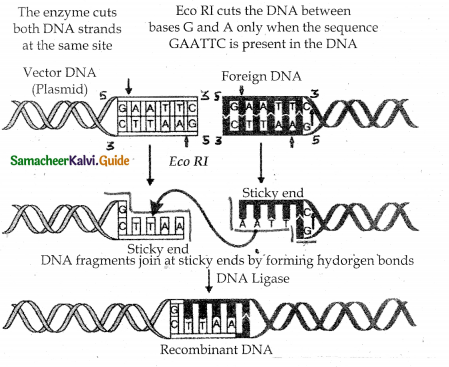
Samacheer Kalvi 12th Maths Guide Chapter 7 Applications of Differential Calculus Ex 7.1

Question 5.
If the mass m(x) (in kilograms) of a thin rod of length x (in metres) is given by, m(x) = \(\sqrt { 3x }\) then what is the rate of change of mass with respect to the length when it is x = 3 and x = 27 metres.
Solution:
Samacheer Kalvi 12th Maths Guide Chapter 7 Applications of Differential Calculus Ex 7.1 2

Question 6.
A stone is dropped into a pond causing ripples in the from of concentric circles. The radius r of the outer ripple is increasing at a constant rate of 2 cm per second. When the radius is 5 cm find the rate of changing of the total area of the disturbed water?
Solution:
radius = r, Rate of changes of radius \(\frac { dr }{ dt }\) = 2 and
given r = 5 cm
Area of circle A = πr²
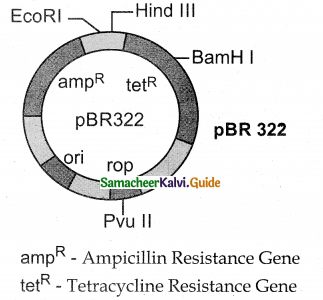
Differentiating w.r.t ‘t’,
\(\frac { dA }{ dt }\)= 2πr\(\frac { dr }{ dt }\)
= 2π (5) (2)
= 20 π
∴ Area of circle (ripple) is increasing at the rate of 20 π cm²/sec.

Samacheer Kalvi 12th Maths Guide Chapter 7 Applications of Differential Calculus Ex 7.1

Question 7.
A beacon makes one revolution every 10 seconds. It is located on a ship which is anchored 5 km from a straight shore line. How fast is the beam moving along the shoreline when it makes an angle of 45° with the shore?
Solution:
Samacheer Kalvi 12th Maths Guide Chapter 7 Applications of Differential Calculus Ex 7.1 3
Time for one revolution = 10 sec
Now, angular velocity \(\frac { dv }{ dt }\) = \(\frac { 2π }{ 10 }\) = \(\frac { π }{ 5 }\)
From the figure, tan 45° = \(\frac { AB }{ OA }\)
1 = \(\frac { x }{ 5 }\) ⇒ x = 5
Again, tan θ = \(\frac { x }{ 5 }\)
x = 5 tan θ
Differentiating w.r.t. ‘t’
\(\frac { dx }{ dt }\) = 5 sec² θ \(\frac { dθ }{ dt }\)
= 5 sec² (45°) (\(\frac { π }{ 5 }\))
= (√2)² π = 2π
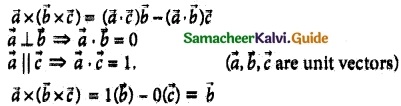
∴ The beam is moving at the rate of 2π km/sec.

Question 8.
A conical water tank with a vertex down of 12 metres height has a radius of 5 metres at the top. If water flows into the tank at a rate of 10 cubic m/min, how fast is the depth of the water increases when the water is 8 metres deep?
Solution:
Samacheer Kalvi 12th Maths Guide Chapter 7 Applications of Differential Calculus Ex 7.1 4
From the figure \(\frac { r}{ h }\) = \(\frac { 5 }{ 12 }\)
r = \(\frac { 5h }{ 12 }\)
given rate of change of volume \(\frac { dV }{ dt }\) = 10
When h = 8 to find \(\frac { dh }{ dt }\)
Volume of cone V = \(\frac { 1 }{ 3 }\) πr² h
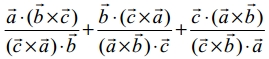
Samacheer Kalvi 12th Maths Guide Chapter 7 Applications of Differential Calculus Ex 7.1 5
The depth of the water increasing at the rate of \(\frac { 9 }{ 10π }\) m/min

Samacheer Kalvi 12th Maths Guide Chapter 7 Applications of Differential Calculus Ex 7.1

Question 9.
A ladder 17 metre long is leaning against the wall. The base of the ladder is pulled away from the wall at a rate of 5 m/s. When the base of the ladder is 8 metres from the wall.
(i) How fast is the top of the ladder moving down the wall?
(ii) At what rate, the area of the triangle formed by the ladder, wall, and floor is changing?
Solution:
Samacheer Kalvi 12th Maths Guide Chapter 7 Applications of Differential Calculus Ex 7.1 6
Let the height of the wall where the ladder touches are ‘y’ m.
The bottom of the ladder is at a distance of ‘x’ m from the wall.
Given x = 8, \(\frac { dx }{ dt }\) = 5
x² + y² = 17²
(Pythagoras Theorem)
y² = 17² – x² = 289 – 64 = 225
∴ y = 15
Differentiating w.r.t. ‘t’
Samacheer Kalvi 12th Maths Guide Chapter 7 Applications of Differential Calculus Ex 7.1 7
(i) The top of the ladder is moving down the wall at the rate of \(\frac { 8 }{ 3 }\) m/sec
(ii) Area of triangle formed by the ladder, wall and the floor is A = \(\frac { 1 }{ 2 }\) xy
differentiating w.r.t. ‘t’
Samacheer Kalvi 12th Maths Guide Chapter 7 Applications of Differential Calculus Ex 7.1 8
∴ Area of the triangle is increasing at the rate of 26.83 m²/sec.

Question 10.
A police jeep, approaching an orthogonal intersection from the northern direction, is chasing a speeding car that has turned and moving straight east. When the jeep is 0.6 km north of the intersection and the car is 0.8 km to the east. The police determine with a radar that the distance between them and the car is increasing at 20 km/hr. If the jeep is moving at 60 km/hr at the instant of measurement, what is the speed of the car?
Solution:
Samacheer Kalvi 12th Maths Guide Chapter 7 Applications of Differential Calculus Ex 7.1 9
given x = 0.8, y = 0.6, \(\frac { dy }{ dt }\) = -60
and \(\frac { ds }{ dt }\) = 20
from the figure
S² = x² + y²,
S² = (0.8)² + (0.6)² = 0.64 + 0.36 = 1
S² = 1 ⇒ S = 1
S² = x² + y²,
Differentiating w.r.t. ‘t’
Samacheer Kalvi 12th Maths Guide Chapter 7 Applications of Differential Calculus Ex 7.1 10
∴ Speed of the car is 70 km/hr.

Samacheer Kalvi 12th Maths Guide Chapter 7 Applications of Differential Calculus Ex 7.1

Samacheer Kalvi 12th Maths Guide Chapter 6 Applications of Vector Algebra Ex 6.10

Tamilnadu State Board New Syllabus Samacheer Kalvi 12th Maths Guide Pdf Chapter 6 Applications of Vector Algebra Ex 6.10 Textbook Questions and Answers, Notes.

Tamilnadu Samacheer Kalvi 12th Maths Solutions Chapter 6 Applications of Vector Algebra Ex 6.10

Choose the most suitable answer from the given four alternatives

Question 1.
If \(\overline { a }\) and \(\overline { b }\) are parallel vectors, then [\(\overline { a }\), \(\overline { c }\), \(\overline { b }\)] is equal to
(a) 2
(b) -1
(c) 1
(d) 0
Solution:
(d) 0
Hint:
Since \(\overline { a }\) and \(\overline { b }\) are parallel ⇒ \(\overline { a }\) = λ\(\overline { b }\)
[ \(\overline { a }, \overline { c }, \overline { b }\)] = [λ\(\overline { b }, \overline { c }, \overline { b }\) ]
= λ[ \(\overline { b }, \overline { c }, \overline { b }\) ]
= λ(0) = 0

Samacheer Kalvi 12th Maths Guide Chapter 6 Applications of Vector Algebra Ex 6.10

Question 2.
If a vector \(\overline { α }\) lies in the plane of \(\overline { ß }\) and \(\overline { γ }\), then
(a) [ \(\overline { α }, \overline { ß }, \overline { γ }\) ] = 1
(b) [ \(\overline { α }, \overline { ß }, \overline { γ }\) ] = -1
(c) [ \(\overline { α }, \overline { ß }, \overline { γ }\) ] = 0
(d) [ \(\overline { α }, \overline { ß }, \overline { γ }\) ] = 2
Solution:
(c) [ \(\overline { α }, \overline { ß }, \overline { γ }\) ] = 0
Hint:
If \(\overline { α }\) lies in \(\overline { ß }\) & \(\overline { γ }\) plane
we have [ \(\overline { α }, \overline { ß }, \overline { γ }\) ] = 0

Question 3.
If \(\overline { a }\).\(\overline { b }\) = \(\overline { b }\).\(\overline { c }\) = \(\overline { c }\).\(\overline { a }\) = 0, then the value of [ \(\overline { a }, \overline { b }, \overline { c }\) ] is
(a) |\(\overline { a }\)| |\(\overline { b }\)| |\(\overline { c }\)|
(b) \(\frac { 1 }{ 3 }\)|\(\overline { a }\)| |\(\overline { b }\)| |\(\overline { c }\)|
(c) 1
(d) -1
Solution:
(a) |\(\overline { a }\)| |\(\overline { b }\)| |\(\overline { c }\)|
Hint:
Samacheer Kalvi 12th Maths Guide Chapter 6 Applications of Vector Algebra Ex 6.10 1

Samacheer Kalvi 12th Maths Guide Chapter 6 Applications of Vector Algebra Ex 6.10

Question 4.
If \(\overline { a }\), \(\overline { b }\), \(\overline { c }\) are three unit vectors such that \(\overline { a }\) is perpendicular to \(\overline { b }\) and is parallel to \(\overline { c }\) then \(\overline { a }\) × (\(\overline { b }\) × \(\overline { c }\)) is equal to
(a) \(\overline { a }\)
(b) \(\overline { b }\)
(c) \(\overline { c }\)
(d) \(\overline { 0 }\)
Solution:
(b) \(\overline { b }\)
Hint:
Samacheer Kalvi 12th Maths Guide Chapter 6 Applications of Vector Algebra Ex 6.10 2

Question 5.
If [ \(\overline { a }, \overline { b }, \overline { c }\) ] = 1 then the value of
Samacheer Kalvi 12th Maths Guide Chapter 6 Applications of Vector Algebra Ex 6.10 3
(a) 1
(b) -1
(c) 2
(d) 3
Solution:
(a) 1
Hint:
Samacheer Kalvi 12th Maths Guide Chapter 6 Applications of Vector Algebra Ex 6.10 4

Samacheer Kalvi 12th Maths Guide Chapter 6 Applications of Vector Algebra Ex 6.10

Question 6.
The volume of the parallelepiped with its edges represented by the vectors \(\hat { i }\) + \(\hat { j }\), \(\hat { i }\) + 2\(\hat { j }\), \(\hat { i }\) + \(\hat { j }\) + π\(\hat { k }\) is
(a) \(\frac { π }{ 2 }\)
(b) \(\frac { π }{ 3 }\)
(c) π
(d) \(\frac { π }{ 4 }\)
Solution:
(c) π
Hint:
\(\left|\begin{array}{lll}
1 & 1 & 0 \\
1 & 2 & 0 \\
1 & 1 & \pi
\end{array}\right|\) = π\(\left|\begin{array}{ll}
1 & 1 \\
1 & 2
\end{array}\right|\)
= π (2 – 1) = π

Question 7.
If \(\overline { a }\) and \(\overline { b }\) are unit vectors such that [\(\overline { a }\), \(\overline { b }\), \(\overline { a }\) × \(\overline { b }\)] = \(\frac { 1 }{ 4 }\), then the angle between \(\overline { a }\) and \(\overline { b }\) is
(a) \(\frac { π }{ 6 }\)
(b) \(\frac { π }{ 4 }\)
(c) \(\frac { π }{ 3 }\)
(d) \(\frac { π }{ 2 }\)
Solution:
(a) \(\frac { π }{ 6 }\)
Hint:
Samacheer Kalvi 12th Maths Guide Chapter 6 Applications of Vector Algebra Ex 6.10 5

Samacheer Kalvi 12th Maths Guide Chapter 6 Applications of Vector Algebra Ex 6.10

Question 8.
If \(\overline { a }\) = \(\hat { i }\) + \(\hat { j }\) + \(\hat { k }\), \(\overline { b }\) = \(\hat { i }\) + \(\hat { j }\), \(\overline { c }\) = \(\hat { i }\) and (\(\overline { a }\) × \(\overline { b }\))\(\overline { c }\) – λ\(\overline { a }\) + µ\(\overline { b }\) then the value of λ + µ is
(a) 0
(b) 1
(c) 6
(d) 3
Solution:
(a) 0
Hint:
\(\overline { a }\).\(\overline { c }\) = 1 and \(\overline { b }\).\(\overline { c }\) = 1
(\(\overline { a }\) × \(\overline { b }\))\(\overline { c }\) = (\(\overline { c }\) × \(\overline { a }\))\(\overline { b }\) – (\(\overline { c }\) × \(\overline { b }\))\(\overline { a }\) = λ\(\overline { a }\) + µ\(\overline { b }\)
⇒ µ = c; a = 1λ = -(\(\overline { c }\).\(\overline { b }\)) = -1
µ + λ = 1 – 1 = 0

Question 9.
If \(\overline { a }\), \(\overline { b }\), \(\overline { c }\) are non-coplanar, non-zero vectors
such that [\(\overline { a }\), \(\overline { b }\), \(\overline { c }\)] = 3, then {[\(\overline { a }\) × \(\overline { b }\), \(\overline { b }\) × \(\overline { c }\), \(\overline { c }\) × \(\overline { a }\)]²} is equal to
is equal to
(a) 81
(b) 9
(c) 27
(d) 18
Solution:
(a) 81
Hint:
Samacheer Kalvi 12th Maths Guide Chapter 6 Applications of Vector Algebra Ex 6.10 6
= 34 = 81

Samacheer Kalvi 12th Maths Guide Chapter 6 Applications of Vector Algebra Ex 6.10

Question 10.
If \(\overline { a }\), \(\overline { b }\), \(\overline { c }\) are three non-coplanar vectors such that \(\overline { a }\) × (\(\overline { b }\) × \(\overline { c }\)) = \(\frac { \overline{b}+\overline{c} }{ √2 }\) then the angle between \(\overline { a }\) and \(\overline { b }\) is
(a) \(\frac { π }{ 2 }\)
(b) \(\frac { 3π }{ 4 }\)
(c) \(\frac { π }{ 4 }\)
(d) π
Solution:
(b) \(\frac { 3π }{ 4 }\)
Hint:
Samacheer Kalvi 12th Maths Guide Chapter 6 Applications of Vector Algebra Ex 6.10 7

Question 11.
If the volume of the parallelepiped with \(\overline { a }\) × \(\overline { b }\), \(\overline { b }\) × \(\overline { c }\), \(\overline { c }\) × \(\overline { a }\) as coterminous edges is 8 cubic units, then the volume of the parallelepiped with (\(\overline { a }\) × \(\overline { b }\)) × (\(\overline { b }\) × \(\overline { c }\)), (\(\overline { b }\) × \(\overline { c }\)) × (\(\overline { c }\) × \(\overline { a }\)) and (\(\overline { c }\) × \(\overline { a }\)) × (\(\overline { a }\) × \(\overline { b }\)) as coterminous edges is
(a) 8 cubic units
(b) 512 cubic units
(c) 64 cubic units
(d) 24 cubic units
Solution:
(c) 64 cubic units
Hint:
Given volume of the parallelepiped with
Samacheer Kalvi 12th Maths Guide Chapter 6 Applications of Vector Algebra Ex 6.10 8

Samacheer Kalvi 12th Maths Guide Chapter 6 Applications of Vector Algebra Ex 6.10

Question 12.
Consider the vectors \(\overline { a }\), \(\overline { b }\), \(\overline { c }\), \(\overline { d }\) such that (\(\overline { a }\) × \(\overline { b }\)) × (\(\overline { c }\) × \(\overline { d }\)) = \(\overline { 0 }\) Let P1 and P2 be the planes determined by the pairs of vectors \(\overline { a }\), \(\overline { b }\) and \(\overline { c }\), \(\overline { d }\) respectively. Then the angle between P1 and P2 is
(a) 0°
(b) 45°
(c) 60°
(d) 90°
Solution:
(a) 0°
Hint:
A vector perpendicular to the plane P1 of a, b is \(\overline { a }\) × \(\overline { b }\),
A vector perpendicular to the plane P2 of c and d is \(\overline { c }\) × \(\overline { d }\)
∴ (\(\overline { a }\) × \(\overline { b }\)) × (\(\overline { c }\) × \(\overline { d }\)) = 0
⇒ (\(\overline { a }\) × \(\overline { b }\)) || \(\overline { c }\) × \(\overline { d }\)
⇒ The angle between the planes is \(\overline { 0 }\)

Question 13.
If \(\overline { a }\) × (\(\overline { b }\) × \(\overline { c }\)) = (\(\overline { a }\) × \(\overline { b }\)) × \(\overline { c }\) where \(\overline { a }\), \(\overline { b }\), \(\overline { c }\) are any three vectors such that \(\overline { b }\).\(\overline { c }\) ≠ 0 and \(\overline { a }\).\(\overline { b }\) ≠ 0, then \(\overline { a }\) and \(\overline { c }\) are
(a) perpendicular
(b) parallel
(c) inclined at angle \(\frac { π }{ 3 }\)
(d) inclined at an angle \(\frac { π }{ 6 }\)
Solution:
(b) parallel
Hint:
Samacheer Kalvi 12th Maths Guide Chapter 6 Applications of Vector Algebra Ex 6.10 9

Samacheer Kalvi 12th Maths Guide Chapter 6 Applications of Vector Algebra Ex 6.10

Question 14.
If \(\overline { a }\) = 2\(\hat { i }\) + 3\(\hat { j }\) – \(\hat { k }\), \(\overline { b }\) = \(\hat { i }\) + 2\(\hat { j }\) – 5\(\hat { k }\), \(\overline { c }\) = 3\(\hat { i }\) + 5\(\hat { j }\) – \(\hat { k }\) then \(\overline { a }\) vector perpendicular to a and lies in the plane containing \(\overline { b }\) and \(\overline { c }\) is
(a) -17\(\hat { i }\) + 21\(\hat { j }\) – 97\(\hat { k }\)
(b) 17\(\hat { i }\) + 21\(\hat { j }\) – 123\(\hat { k }\)
(c) -17\(\hat { i }\) – 21\(\hat { j }\) + 97\(\hat { k }\)
(d) -17\(\hat { i }\) – 21\(\hat { j }\) – 97\(\hat { k }\)
Solution:
(d) -17\(\hat { i }\) – 21\(\hat { j }\) – 97\(\hat { k }\)
Hint:
A vector ⊥r to \(\overline { a }\) and lies in the plane containing \(\overline { b }\) and \(\overline { c }\)
Samacheer Kalvi 12th Maths Guide Chapter 6 Applications of Vector Algebra Ex 6.10 10

Question 15.
The angle between the lines \(\frac { x-2 }{ 3 }\) = \(\frac { y+1 }{ -2 }\), z = 2 and \(\frac { x-1 }{ 1 }\) = \(\frac { 2y+3 }{ 3 }\) = \(\frac { z+5 }{ 2 }\) is
(a) \(\frac { π }{ 6 }\)
(b) \(\frac { π }{ 4 }\)
(c) \(\frac { π }{ 3 }\)
(d) \(\frac { π }{ 2 }\)
Solution:
(d) \(\frac { π }{ 2 }\)
Hint:
Samacheer Kalvi 12th Maths Guide Chapter 6 Applications of Vector Algebra Ex 6.10 11

Question 16.
If the line \(\frac { x-2 }{ 3 }\) = \(\frac { y-1 }{ -5 }\) = \(\frac { z+2 }{ 2 }\) lies in the plane x + 3y – αz + ß = 0 then (α + ß) is
(a) (-5, 5)
(b) (-6, 7)
(c) (5, -5)
(d) (6, -7)
Solution:
(b) (-6, 7)
Hint:
\(\frac { x-2 }{ 3 }\) = \(\frac { y-1 }{ 5 }\) = \(\frac { z+2 }{ 2 }\) = λ ⇒ (3λ + 2, -5λ + 1, 2λ – 2)
which lie in x + 3y – αz + ß = 0
(3λ + 2) + 3(-5λ + 1) – α(2λ – 2) + ß = 0
3λ + 2 – 15λ + 3 – 2αλ + 2α + ß = 0.
(-12λ – 2αλ) + 2α + ß + 5 = 0.
-12λ – 2αλ = 0
2αλ = -12λ
α = -6
2α+ ß +5 = 0
-12 + ß + 5 = 0
ß – 7 = 0
ß = 7
(α, ß) = (-6, 7)

Samacheer Kalvi 12th Maths Guide Chapter 6 Applications of Vector Algebra Ex 6.10

Question 17.
The angle between the line \(\overline { r }\) = (\(\hat { i }\) + 2\(\hat { j }\) – 3\(\hat { k }\)) + t(2\(\hat { i }\) + \(\hat { j }\) – 2\(\hat { k }\)) and the plane \(\overline { r }\) (\(\hat { i }\) + \(\hat { j }\)) + 4 = 0 is
(a) 0°
(b) 30°
(c) 45°
(d) 90°
Solution:
(c) 45°
Hint:
Samacheer Kalvi 12th Maths Guide Chapter 6 Applications of Vector Algebra Ex 6.10 12

Question 18.
The co-ordinates of the point where the line \(\overline { r }\) = (6(\(\hat { i }\) – \(\hat { j }\) – 3\(\hat { k }\)) + t(-\(\hat { i }\) + \(\hat { k }\) meets the plane \(\overline { r }\) ((\(\hat { i }\) + (\(\hat { j }\) – (\(\hat { k }\)) = 3 are
(a) (2, 1, 0)
(b) (7, -1, -7)
(c) (1, 2, -6)
(d) (5, -1, 1)
Solution:
(d) (5, -1, 1)
Hint:
Given \(\overline { r }\) = (6(\(\hat { i }\) – (\(\hat { j }\) – 3(\(\hat { k }\)) + t(-(\(\hat { i }\) + (\(\hat { k }\))
\(\frac { x-6 }{ -1 }\) = \(\frac { y+1 }{ 0 }\) = \(\frac { z+3 }{ 4 }\) = t ⇒ (-t + 6, -1, 4t – 3)
which meets x + y – z = 3
-t + 6 – 1 – 4t + 3 = 3
-5t + 5 = 0
5t = 5
t = 1
∴ Co-ordinate is (5, -1, 1)

Question 19.
Distance from the origin to the plane 3x – 6y + 2z + 7 = 0 is
(a) 0
(b) 1
(c) 2
(d) 3
Solution:
(b) 1
Hint:
(x1, y1, z1) = (o, 0, o)
(a, b, c) = (3, -6, 2); d = 7.
d = \(\frac { ax_1+by_1+cz_1+d }{ \sqrt{a^2+b^2+c^2} }\) = \(\frac { 7 }{ \sqrt{9+36+4} }\) = \(\frac { 7 }{ 7 }\) = 1

Samacheer Kalvi 12th Maths Guide Chapter 6 Applications of Vector Algebra Ex 6.10

Question 20.
The distance between the planes
x + 2y + 3z + 7 = 0 and 2x + 4y + 6z + 7 = 0 is
(a) \(\frac { √7 }{ 2√2 }\)
(b) \(\frac { 7 }{ 2 }\)
(c) \(\frac { √7 }{ 2 }\)
(d) \(\frac { 7 }{ 2√2 }\)
Solution:
(a) \(\frac { √7 }{ 2√2 }\)
Hint:
x + 2y + 3z+7 = 0
2x + 4y + 6z + 7 = 0
(÷ 2) x + 2y + 3z + \(\frac { 7 }{ 2 }\) = 0
(1) and (2) are parallel planes
Samacheer Kalvi 12th Maths Guide Chapter 6 Applications of Vector Algebra Ex 6.10 13

Question 21.
If the direction cosines of a line are \(\frac { 1 }{ c }\), \(\frac { 1 }{ c }\), \(\frac { 1 }{ c }\)
(a) c = ±3
(b) c = ±√3
(c) c > 0
(d) 0 < c < 1
Solution:
(b) c = ±√3
Hint:
cos²α + cos²ß + cos²γ = 1
\(\frac { 1 }{ c^2 }\) + \(\frac { 1 }{ c^2 }\) + \(\frac { 1 }{ c^2 }\) = 1
\(\frac { 3 }{ c ^2}\) = 1
c² = 3
c = ±√3

Question 22.
The vector equation \(\overline { r }\) = (\(\hat { i }\) – 2\(\hat { j }\) – \(\hat { k }\)) + t(6\(\hat { i }\) – \(\hat { k }\)) represents a straight line passing through the points
(a) (0, 6, -1) and (1, -2, -1)
(b) (0, 6, -1) and (-1, -4, -2)
(c) (1, -2, -1) and (1, 4, -2)
(d) (1, -2, -1) and (0, -6, 1)
Solution:
(c) (1, -2, -1) and (1, 4, -2)
Hint:
Given vector equation is
Samacheer Kalvi 12th Maths Guide Chapter 6 Applications of Vector Algebra Ex 6.10 14

Samacheer Kalvi 12th Maths Guide Chapter 6 Applications of Vector Algebra Ex 6.10

Question 23.
If the distance of the point (1, 1, 1) from the origin is half of its distance from the plane x + y + z + k = Q, then the values of k are
(a) ±3
(b) ±6
(c) -3, 9
(d) 3, -9
Solution:
(d) 3, -9
Hint:
Samacheer Kalvi 12th Maths Guide Chapter 6 Applications of Vector Algebra Ex 6.10 15

Question 24.
If the planes \(\overline { r }\) (2\(\hat { i }\) – λ\(\hat { j }\) + \(\hat { k }\)) = 3 and \(\overline { r }\) (4\(\hat { i }\) + \(\hat { j }\) – µ\(\hat { k }\)) = 5 are parallel, then the value of λ and µ are
(a) \(\frac { 1 }{ 2 }\), -2
(b) –\(\frac { 1 }{ 2 }\), 2
(c) –\(\frac { 1 }{ 2 }\), -2
(d) \(\frac { 1 }{ 2 }\), 2
Solution:
(c) –\(\frac { 1 }{ 2 }\), -2
Hint:
Samacheer Kalvi 12th Maths Guide Chapter 6 Applications of Vector Algebra Ex 6.10 16

Samacheer Kalvi 12th Maths Guide Chapter 6 Applications of Vector Algebra Ex 6.10

Question 25.
If the length of the perpendicular from the origin to the plane 2x + 3y + λz = 1, λ > 0 is \(\frac { 1 }{ 5 }\), then the value of λ is
(a) 2√3
(b) 3√2
(c) 0
(d) 1
Solution:
(a) 2√3
Hint:
Samacheer Kalvi 12th Maths Guide Chapter 6 Applications of Vector Algebra Ex 6.10 17
5 = \(\sqrt { 4+9+λ^2 }\)
25 = 4 + 9 + λ²
25 = 13 + λ²
λ² = 12
λ = 2√3

Samacheer Kalvi 12th Bio Botany Guide Chapter 10 Economically Useful Plants and Entrepreneurial Botany

Tamilnadu State Board New Syllabus Samacheer Kalvi 12th Bio Botany Guide Pdf Chapter 10 Economically Useful Plants and Entrepreneurial Botany Text Book Back Questions and Answers, Notes.

Tamilnadu Samacheer Kalvi 12th Bio Botany Solutions Chapter 10 Economically Useful Plants and Entrepreneurial Botany

12th Bio Botany Guide Economically Useful Plants and Entrepreneurial Botany Text Book Back Questions and Answers

I. Choose the correct answer :

Question 1.
Consider the following statements and choose the right option.
i) Cereals are members of grass family
ii) Most of the food grains come from monocotyledon
a) (i) is correct and (ii) is wrong
b) Both (i) and (ii) are correct
c) (i) is wrong and (ii) is correct
d) Both (i) and (ii) are wrong
Answer:
b) Both (i) and (ii) are correct

Question 2.
Assertion: Vegetables are important part of healthy eating.
Reason : Vegetables are succulent structures of plants with pleasant aroma and flavours.
a) Assertion is correct, Reason is wrong
b) Assertion is wrong, Reason is correct
c) Both are correct and reason is the correct explanation for assertion.
d) Both are correct and reason is not the correct explanation for assertion.
Answer:
a) Assertion is correct, Reason is wrong

Question 3.
Groundnut is native of ……………..
a) Philippines
b) India
c) North America
d) Brazil
Answer:
d) Brazil
 Samacheer Kalvi 12th Bio Botany Guide Chapter 10 Economically Useful Plants and Entrepreneurial Botany

Question 4.
Statement A : Coffee contains caffeine
Statement B : Drinking coffee enhances cancer
a) A is correct, B is wrong
b) A and B – both are correct
c) A is wrong, B is correct
d) A and B – both are wrong
Answer:
a) A is correct, B is wrong

Question 5.
Tectona grandis is coming under family.
a) Lamiaceae
b) Fabaceae
c) Dipterocaipaceae
d) Ebenaceae
Answer:
a) Lamiaceae

 Samacheer Kalvi 12th Bio Botany Guide Chapter 10 Economically Useful Plants and Entrepreneurial Botany

Question 6.
Tamarindus indica is indigenous to ……………..
a) Tropical African region
b) South India, Sri Lanka
c) South America, Greece
d) India alone
Answer:
a) Tropical African region

Question 7.
New world species of cotton
a) Gossipium arboretum
b) G. herbaceum
c) Both a and b
d) G.barbadense
Answer:
d) G. barbadense

 Samacheer Kalvi 12th Bio Botany Guide Chapter 10 Economically Useful Plants and Entrepreneurial Botany

Question 8.
Assertion : Turmeric fights various kinds of cancer.
Reason : Curcumin is an anti-oxidant present in turmeric.
a) Assertion is correct, Reason is wrong
b) Assertion is wrong, Reason is correct
c) Both are correct
d) Both are wrong
Answer:
c) Both are correct

Question 9.
Find out the correctly matched pair.
a) Rubber – Shorea robusta
b) Dye – Lawsonia inermis
c) Timber – Cyperus papyrus
d) Pulp – Hevea brasiliensis
Answer:
b) Dye : Lawsonia inermis

Question 10.
Observe the following statements and pick out the right option from the following.
Statement I : Perfumes are manufactured from essential oils.
Statement II : Essential oils are formed at different parts of the plants.
a) Statement I is correct
b) Statement II is correct
c) Both statements are correct
d) Both statements are wrong
Answer:
c) Both statements are correct

 Samacheer Kalvi 12th Bio Botany Guide Chapter 10 Economically Useful Plants and Entrepreneurial Botany

Question 11.
Observe the following statements and pick out the right option from the following.
Statement I : The drug sources of Siddha include plants, animal parts, ores and minerals.
Statement II: Minerals are used for preparing drugs with long shelf-life.
a) Statement I is correct
b) Statement II is correct
c) Both statements are correct
d) Both statements are wrong
Answer:
Both statements are correct

Question 12.
The active principle trans-tetra hydro canabial is present in
a) Opium
b) Curcuma
c) Marijuana
d) Andrographis
Answer:
c) Marijuana

Question 13.
Which one of the following matches is correct?
a) Palmyra – Native of Brazil
b) Saccharun – Abundant in Kanyakumari
c) Stevecide – Natural sweetener
d) Palmyra sap – Fermented to give ethanol
Answer:
c) Stevecide – Natural sweetener

 Samacheer Kalvi 12th Bio Botany Guide Chapter 10 Economically Useful Plants and Entrepreneurial Botany

Question 14.
The only cereal that has originated and domesticated from the New world.
a) Oryza sativa
b) Triticum asetumn
c) Triticum duram
d) Zea mays
Answer:
d) Zea mays

Question 15.
Write the cosmetic uses of Aloe.
Answer:
Aloe gel are used as skin tonic. It has a cooling effect and moisturizing characteristics and hence used in preparation of creams, lotions, shampoos, shaving creams, after shave lotions and allied products. It is used in gerontological applications for rejuvenation of aging skin. Products prepared from aloe leaves have multiple properties such as emollient, antibacterial, antioxidant, antifungal and antiseptic. Aloe vera gel is used in skin care cosmetics.

 Samacheer Kalvi 12th Bio Botany Guide Chapter 10 Economically Useful Plants and Entrepreneurial Botany

Question 16.
What is pseudo cereal? Give an example.
Answer:

  • These are foods that are prepared and eaten as whole grain. Eg. quinoa (தினை) is a seed from Chenopodium quinoa plant. It belongs Amaranthaceae family.
  • It is gluten free, whole grain carbohydrate.
  • It is a whole protein with a essential amino acids.
  • Taken for 6000 years in Andes hills.

Question 17.
Discuss which wood is better for making furniture.
Answer:
Teak wood is the ideal type of wood for making household furnitures because, it is highly durable and shows great resistance against the attack of termites and fungi. Moreover it doesnot split or crack and is a carpenter friendly wood.

 Samacheer Kalvi 12th Bio Botany Guide Chapter 10 Economically Useful Plants and Entrepreneurial Botany

Question 18.
A person got irritation while applying chemical dye. What would be your suggestion for alternative?
Answer:

  • Henna is the best alternative dye.
  • It is in North Africa, South west Asia. It is in Gujarat, Madhya Pradesh and Rajesthan.
  • Orange dye henna is from leaves and shoots of
    Lawsonia inermis.
  • Principal colouring matter is ‘lacosone’
  • It is harmless causing no skin irritation.
  • It is u sed to dye skin, hair and finger nails.

Question 19.
Name the humors that are responsible for the health of human beings.
Answer:
Vatam, Pittam and Kapam.

Question 20.
Give definitions for organic farming?
Answer:

  • Alternative agricultural system.
  • Plants and crops are cultivated in natural ways, by using biological inputs.
  • It helps to maintain soil fertility and ecological balance.
  • It minimizes pollution, wastage.

 Samacheer Kalvi 12th Bio Botany Guide Chapter 10 Economically Useful Plants and Entrepreneurial Botany

Question 21.
Which is called the “King of Bitters”? Mention their medicinal importance.
Answer:
Andrographis paniculata is called as King of Bitters. Andrographis is a potent hepatoprotective agent and is widely used to treat liver disorders. Concoction of Andrographis paniculata and eight other herbs (Nilavembu Kudineer) is effectively used to treat malaria and dengue.

Question 22.
Differentiate Bio-medicines and botanical medicines.
Answer:
Bio-medicines: Medicinally useful molecules obtained from plants are marketed as drugs. These are called bio-medicines.
Botanical Medicines: Medicinal plants are marketed as powders or in other modified forms. They are called Botanical medicines.

Question 23.
Write the origin and area of cultivation of green gram and red gram.
Answer:
Origin and area of cultivation of Green Gram.

  • Native of India
  • Archaeological evidence is in Maharashtra.
  • Cultivated in Madhya Pradesh, Karnataka and Tamil Nadu.

Origin and area of cultivation of Red Gram

  • The only pulse native of South India.
  • Grown in Maharashtra, Andhra Pradesh,
    Madhya Pradesh, Karnataka, Gujarat.

 Samacheer Kalvi 12th Bio Botany Guide Chapter 10 Economically Useful Plants and Entrepreneurial Botany

Question 24.
What are millets? What are its types? Give example for each type.
Answer:
Millet’s: Small seeds cultivated by ancient people of Africa, Asia. Gluten-free with the less glycemic index.

Finger Millet (Ragi) (Eleusine coracana)
Came to India from East Africa. It is rich in calcium.’

Uses:

  • Staple food in South Indian hills.
  • Made into porridge, gruel.
  • Ragi malt is a nutrient drink.
  • Source of fermented beverages.

Sorghum vulgare.
Native of Africa. Major millet of the world with calcium, iron
Uses:

  • Feed to poultry, birds, pigs, cattle
  • Alcoholic beverage source.

Fox tail Millet (Setariaitalica)
Oldest traditional millet of India. Domesticated in China about 6000 years.
Uses: Strengthens heart, eye sight, lactation.

Kodo Millet (Paspalum scrobiculatum)
From West Africa.
Uses:

  • Flour for pudding
  • Diuretic, cures constipation.
  • Reduce obesity, blood sugar, blood pressure.

Question 25.
If a person drinks a cup of coffee daily it will help him for his health. Is this correct? If it is correct, list out the benefits.
Answer:
Benefits of Coffee:

  • Stimulates central nervous system.
  • Mild diuretic
  • Enhances acetyl choline release in brain.
  • Enhances efficiency.
  • Lower fatty liver diseases, cirrhosis, cancer.
  • Reduce the risk of type 2 diabetes,

 Samacheer Kalvi 12th Bio Botany Guide Chapter 10 Economically Useful Plants and Entrepreneurial Botany

Question 26.
Enumerate the uses of turmeric.
Answer:
Turmeric is one of the most important and ancient Indian spices and used traditionally over thousands of years for culinary, cosmetic, dyeing and for medicinal purposes. It is an important constituent of curry powders. Turmeric is used as a colouring agent in pharmacy, confectionery and food industry. Rice coloured with turmeric (yellow) is considered sacred and auspicious which is used in ceremonies. It is also used for dyeing leather, fibre, paper and toys.

Curcumin extracted from turmeric is responsible for the yellow colour. Curcumin is a very good anti-oxidant which may help fight various kinds of cancer. It has anti-inflammatory, anti- ‘ diabetic, anti-bacterial, anti-fungal and anti-viral activities. It stops platelets from clotting in arteries, which leads to heart attack.

Question 27.
What is TSM? How does it classify and what does it focus on?
Answer:
Traditional System of Medicines (TSM)
It is classified into

  1. Institutionalized (documented) system
  2. Non-institutionalized (oral) system

Institutionalized system:

  • It includes Siddha, Ayurvedha
  • It is practiced for 2000 years.
  • Text with symptoms, diagnosis, drugs, preparation of drugs, dosage, diet regimen.

Non-Institutionalized system:

  • Do not have any records
  • Practiced by rural, tribal people of India.
  • Knowledge is in oral form.

Focus of TSM:

  • Healthy lifestyle
  • A healthy diet for good health
  • Disease reversal.

Siddha system

  • Siddha is the most popular, widely practiced and culturally accepted systm in Tamil Nadu.
  • Siddha is principally based on the pancabute philosophy
  • This system specializes in using minerals for preparing drugs with a long shelf-life.
  • This system uses about 800 herbs as source of drugs.
  • Great stress is laid on disease prevention, health promotion, rejuvenation and cure.

Ayurveda system:

  • Ayurveda supposed to have originated from Brahma.
  • The core knowledge is documented by charaka, sushruta and vagbhata in compendiums written by them.
  • This system uses more of herbs and few animal parts as drug sources.
  • Plant sources include a good propertion of Himalayan plants.
  • The Ayurvedic pharmacopoeia of India lists about 500 plants used as source of drugs.

Folk system of medicine

  • Major tribal communities in Tamil Nadu who are known for their medicinal knowledge indued Irulas, Malayalis, Kurumbas, paliyans and kaanis.
  • Folk system survive as oral traditions among innumerable rural and tribal communities of India.

 Samacheer Kalvi 12th Bio Botany Guide Chapter 10 Economically Useful Plants and Entrepreneurial Botany

Question 28.
Write the uses of nuts you have studied.
Answer:
Cashews are commonly used for garnishing sweets or curries, or ground into a paste that forms a base of sauces for curries or some sweets. Roasted and raw kernels are used as snacks.

Question 29.
Give an account of the role of Jasminum in perfuming.
Answer:
Role of Jasminum in perfuming:

  • Used in India for worship, ceremonial purposes, incense, fumigants.
  • For making perfumed hair oil, cosmetics and soaps.
  • Essential oil for soothing relaxing, antidepressant qualities.
  • Blends with other perfumes.
  • Used in modern perfumery and cosmetics.
  • Popular in air fresheners, antiperspirants, talcum powder, shampoo, and deodorants.

Rose:
The average oil yield is a little less than 0.5 g from lOOOg of flowers.
Uses:

  • Rose oil is largely used in perfumes, scenting
    soaps, flovouring soft drinks, liqueurs, and certain types of tobacco, particularly snuff of chewing tobacco.
  • In India, water is much used in eye lotions
    and eyewashes.
  • Rosewater (panner) containing much of phenyl ethyl alcohol and other compounds in dissolved confectioneries syrups and soft drinks.
  • In addition, it is sprinkled on guests as a ceremonial welcome.

 Samacheer Kalvi 12th Bio Botany Guide Chapter 10 Economically Useful Plants and Entrepreneurial Botany

Question 30.
Give an account of active principle and medicinal values of any two plants you have studied.
Answer:
A) Medical importance of Keezhanelli (Phyllanthus amarus):
Active principle: Phyllanthus is a major chemical component.
Medical Importance:

  • Hepatoprotective.
  • Used in Tamil Nadu for jaundice treatment.
  • Effective against hepatitis B virus.

B) Nilavembu (Andrographis paniculata) (King of Bitters)
Active principle: Andrographolides.
Medicinal Importance:

  • Potent hepatoprotective
  • Treats liver disorders.
  • A concoction of Andrographis + 8 herbs
    (Nilavembu Kudineer) treats malaria, dengue.

Question 31.
Write the economic importance of rice.
Answer:
Rice is the easily digestible calorie rich cereal food which is used as a staple food in Southern and North East India. Various rice products such as Flaked rice (Aval), Puffed rice / parched rice (Pori) are used as breakfast cereal or as snack food in different parts of India. Rice bran oil obtained from the rice bran is used in culinary and industrial purposes. Husks are used as fuel, and in the manufacture of packing material and fertilizer.

Question 32.
Which TSM is widely practiced and culturally accepted in Tamil Nadu? explain.
Answer:
Siddha system of Medicine:

  • It is widely practiced and culturally accepted in Tamil Nadu.
  • Based on text of 18siddhars.
  • Knowledge is documented as Tamil poems.
  • Based on Pancabuta philosophy.
  • Vatam, Pittam, Kapam are 3 humors. They are responsible for the health.
  • Drug sources are plant, animal parts, marine products, minerals.
  • Minerals are used for preparing drugs with long self life.
  • 800 herbs are source of drugs.
  • Disease prevention, health promotion, rejuvenation and cure are important.

 Samacheer Kalvi 12th Bio Botany Guide Chapter 10 Economically Useful Plants and Entrepreneurial Botany

Question 33.
What are psychoactive drugs? Add a note of Marijuana and Opium.
Answer:
Phytochemicals or drugs from some of the plants alter an individual’s perceptions of mind by producing hallucination are known as psychoactive drugs.

  1. Marijuana: Marijuana is obtained from Cannabis sativa. The active principle in Marijuana is trans – tetrahydrocannabinol (TCH). It is used as pain killer and reduce hypertension. It is also used in the treatment of Glaucoma, cancer radiotherapy and asthma, etc.
  2. Opium: Opium is obtained from the exudates of the fruits of papaver somniferum (poppy plants). It is used to induce sleep and relieve pain. Opium yields morphine which is used as a strong analgesic in surgeries.

Question 34.
What are the King and Queen of Spices? Explain about them and their uses.
Answer:
Queen of Spices: Cardamom (Elettaria Cardamomum)

Origin and area of cultivation:

  • Indigenous to Southern India and Sri Lanka.
  • Main cash crop in the Western Ghats, North-Eastern India.

Uses:

  • For flavouring confectionaries, Bakery products, beverages.
  • Seeds are used in curry powder, pickles and cakes.
  • Medicinally, a stimulant and carminative (a drug for flatulence)
  • Chewed as mouth fresheners.

King of Spices: Black Pepper (Piper nigrum)

Origin and area of cultivation:

  • Indigenous to western ghats.
  • Black gold of India.
  • Kerala, Karnataka and Tamil Nadu are top producers in India.
  • Pungency is due to alkaloid piperine.
  • 2 types (Black pepper, white pepper)

Uses:

  • Flavouring sauce, soup, curry, and pickles
  • Aromatic stimulant for salivary gastric secretions as a stomachic.
  • Pepper enhances the absorption of medicines.

 Samacheer Kalvi 12th Bio Botany Guide Chapter 10 Economically Useful Plants and Entrepreneurial Botany

Question 35.
How will you prepare an organic pesticide for your home garden with the vegetables available from your kitchen?
Answer:
Preparation of Organic Pesticide:

Step 1: Mix 120 g of hot chilies with 110 g of garlic or onion. Chop them thoroughly.

Step 2: Blend the vegetables together manually or using an electric grinder until it forms a thick paste.

Step 3: Add the vegetable paste to 500 ml of warm water. Give the ingredients a stir to thoroughly mix them together.

Step 4: Pour the solution into a glass container and leave it undisturbed for 24 hours. If possible, keep the container in a sunny location. If not, at least keep the mixture in a warm place.

Step 5: Strain the mixture. Pom- the solution through a strainer, remove the vegetables and collect the vegetable-infused water and pour into another container. This filtrate is the pesticide. Either discard the vegetables or use it as a compost.

Step 6: Pour the pesticide into a squirt bottle. Make sure that the spray bottle has first been cleaned with warm water and soap to get rid it of any potential contaminants. Use a funnel to transfer the liquid into the squirt bottle and replace the nozzle.

Step 7: Spray your plants with the pesticide. Treat the infected plants every 4 to 5 days with the solution. After 3 or 4 treatments, the pest will be eliminated. If the area is thoroughly covered with the solution, this pesticide should keep bugs away for the rest of the season.

12th Bio Botany Guide Economically Useful Plants and Entrepreneurial Botany Additional Important Questions and Answers

I. Choose the correct answer :

Question 1.
Staple food of North India is ………………….
a) Sorghum
b) Millet
c) Paddy
d) Wheat
Answer:
d) Wheat

Question 2.
Folk system of medicine is popular in ………………
a) Nigeria
b) USA
c) India
d) UK
Answer:
c) India

Question 3.
State not growing black gram
a) Uttar Pradesh
b) Tamil Nadu
c) Chattisgarh
d) Karnataka
Answer:
b) Tamil Nadu

 Samacheer Kalvi 12th Bio Botany Guide Chapter 10 Economically Useful Plants and Entrepreneurial Botany

Question 4.
The very common rubber yielding plant of Tamilnadu is ……………………
a) Manihot esculenta
b) Ficus elastica
c) Hevea benthamiana
d) Hevea brasiliensis
Answer:
d) Hevea brasiliensis

Question 5.
Not a major cultivar mango in India
a) Alphonsa
b) Neelam
c) Malgova
d) Salem Mango
Answer:
d) Salem Mango

Question 6.
Toddy is from ……………… tree
a) Palmyra
b) Coconut
c) Mango
d) Sugar cane
Answer:
a) Palmyra

 Samacheer Kalvi 12th Bio Botany Guide Chapter 10 Economically Useful Plants and Entrepreneurial Botany

Question 7.
Chillies are a good source of:
a) Vitamin A, C and E
b) Vitamin K
c) Vitamin D
d) Vitamin B complex and Vitamin D
Answer:
a) Vitamin A, C and E

Question 8.
Gingeelly or sesame is originated in ……………………..
a) Asia
b) Africa
c) China
d) Europe
Answer:
b) Africa

Question 9.
Coffee is native of ……………….
a) Nigeria
b) Cuba
c) Ethiopia
d) Egypt
Answer:
c) Ethiopia

 Samacheer Kalvi 12th Bio Botany Guide Chapter 10 Economically Useful Plants and Entrepreneurial Botany

Question 10.
India is the largest producer of
a) Chilly
b) Tamarind
c) Turmeric
d) Pepper
Answer:
c) Turmeric

Question 11.
World’s largest turmeric market is in ………………. of Tamil Nadu
a) Coimbatore
b) Erode
c) Madurai
d) Nagercoil
Answer:
b) Erode

Question 12.
Asia contributes …………… % of latex in world production.
a) 80
b) 90
c) 70
d) 50
Answer:
b) 90

 Samacheer Kalvi 12th Bio Botany Guide Chapter 10 Economically Useful Plants and Entrepreneurial Botany

Question 13.
……………….. is the largest producer of latex
a) Kerala
b) Karnataka
c) Andhra
d) Delhi
Answer:
a) Kerala

Question 14.
…………….. is native of Sudan
a) Henna
b) Aloe
c) Jasmine
d) Turmeric
Answer:
b) Aloe

Question 15.
Thovalai of Tamil Nadu produces ………………..
a) Aloe
b) Tamarind
c) Turmeric
d) Jasmine
Answer:
d) Jasmine

 Samacheer Kalvi 12th Bio Botany Guide Chapter 10 Economically Useful Plants and Entrepreneurial Botany

Question 16.
Paste of this plant is used in bone fracture
a) Ocimum
b) Phyllanthus
c) Cissus
d) Acalypha
Answer:
c) Cissus

Question 17.
Find the Matching Pair
a) Ocimum – Antiseptic
b) Phyllanthus – Ringworm disease
c) Acalypha – Immune modulator
d) Aegle marmelos – Bone fracture
Answer:
a) Ocimum – Antiseptic

Question 18.
Capsaicin is in ……………..
a) Chilly
b) Pepper
c) tea
d) coffee
Answer:
a) Chilly

 Samacheer Kalvi 12th Bio Botany Guide Chapter 10 Economically Useful Plants and Entrepreneurial Botany

Question 19.
Veldt grape is the common name of …………….
a) Ocimum
b) I’hyllanthus
c) Acalypha
d) Cissus
Answer:
d) Cissus

Question 20.
Find the Mismatching Pair
a) Pappaver somniferum – Opium
b) Cannabis sativa – Marijuana
c) Phyllanthus amarus – Keezhanelli
d) Andrographis paniculata – Turmeric
Answer:
d) Andrographis paniculata – Turmeric

Question 21.
Match

A. Rice1. East Africa
B. Wheat2. Africa
C. Ragi3. Crescent Region
D. Sorghum4. South East Asia

a) A-4, B-3, C-l, D-2
b) A-l, B-2, C-3, D-4
c) A-4, B-3, C-2, D-l
d) A-2, B-l, C-4, D-3
Answer:
a) A-4, B-3, C-l, D-2

 Samacheer Kalvi 12th Bio Botany Guide Chapter 10 Economically Useful Plants and Entrepreneurial Botany

Question 22.
Vigna mungo is the botanical name of ………………..
a) Black gram
b) Red gram
c) Green gram
d) Brown gram
Answer:
a) Black gram

Question 23.
Match

A. Sesamum indicum1. Sugar cane
B. Arachis hypogea2. Palmyra
C. Borassus flabellifer3. Peanut
D. Saccharum officinarum4. Gingelly

a) A-4, B-3, C-2, D-l
b) A-l, B-2, C-3, D-4
c) A-2, B-l, C-4, D-3
d) A-3, B-l, C-2, D-4
Answer:
a) A-4, B-3, C-2, D-l

Question 24.
Which one of the following is an incorrect pair?
a) Turmeric – Erode
b) Cardamom – Queen of spices
c) Rubber – Kerala
d) Banana – National fruit of India
Answer:
d)Banana – National fruit of India

 Samacheer Kalvi 12th Bio Botany Guide Chapter 10 Economically Useful Plants and Entrepreneurial Botany

Question 25.
Assertion (A): Rice is the staple food for most of people in the world.
Reason (R): It is easily digestible and calorie-rich food.
a) (A) correct; (R) wrong
b) (A) wrong; (R) correct
c) (A) correct; (R) correct; but (R) does not explain (A)
d) (A) correct; (R) correct; (R) explains (A)
Answer:
d) (A) correct; (R) correct; (R) explains (A)

Question 26.
………………… is the largest consumer of coffee in India?
a) Tamil Nadu
b) Andhra
c) Kerala
d) Karnataka
Answer:
a) Tamil Nadu

Question 27.
………………… is the largest coffee producing estate in India
a) Kerala
b) Karnataka
c) Tamil Nadu
d) Andhra
Answer:
b) Karnataka

 Samacheer Kalvi 12th Bio Botany Guide Chapter 10 Economically Useful Plants and Entrepreneurial Botany

Question 28.
Curcumin is extracted from
a) Turmeric
b) Chilly
c) Cardamom
d) Tamarind
Answer:
a) Turmeric

Question 29.
Vilvum belongs to ……………………
a) Lamiaceae
b) Rutaceae
c) Vitaceae
d)Euphorbiaceae
Answer:
b) Rutaceae

Question 30.
Dr. Thyagarajan of university of Madras proved effect of Phyllanthus amarus against
a) Hepatitis-B
b) Cirrhosis
c) Cancer
d) Typhoid
Answer:
a) Hepatitis-B

 Samacheer Kalvi 12th Bio Botany Guide Chapter 10 Economically Useful Plants and Entrepreneurial Botany

Question 31.
Which one of the following is highly effective against jaundice?
a) Nilavembu
b) Opium poppy
c) Marijuana
d) Phyllanthus
Answer:
d) Phyllanthus

Question 32.
……………… Are gluten free with less Glycemic indess
a) pulses
b) gram
c) vegetables
d) millets
Answer:
d) millets

Question 33.
…………….. is native to tropical region of Africa.
a) Sugar cane
b) Palmyra
c) Peanut
d) Sesame
Answer:
b) Palmyra

 Samacheer Kalvi 12th Bio Botany Guide Chapter 10 Economically Useful Plants and Entrepreneurial Botany

Question 34.
Nuts contain ……………. Oil
a) 54%
b) 45%
c) 44%
d) 54%
Answer:
c) 44%

Question 35.
The medicinal plant commonly known as “King of Bitters” is ……………………
a) Nilavembu
b) Holy basil
c) Adathodai
d) Turmeric
Answer:
a) Nilavembu

Question 36.
Pungency of cayenne pepper is ……………….. Scoville Heat Units (SHU)
a) 30,000 to 50,000
b) 1,349,000
c) 2,200,000
d) 1,200,000
Answer:
a) 30,000 to 50,000

 Samacheer Kalvi 12th Bio Botany Guide Chapter 10 Economically Useful Plants and Entrepreneurial Botany

Question 37.
Foxtail millet is domesticated in China ……………….. years ago
a) 4000
b) 3000
c) 5000
d) 6000
Answer:
d) 6000

Question 38.
Setaria italica is the scientific name of ……………………
a) kodo millet
b) foxtail millet
c) sorghum
d) finger millet
Answer:
b) foxtail millet

Question 39.
Lady’s finger is not grown in abundance in ……………..
a) Tamil Nadu
b) Assam
c) Maharashtra
d) Gujarat
Answer:
a) Tamil Nadu

 Samacheer Kalvi 12th Bio Botany Guide Chapter 10 Economically Useful Plants and Entrepreneurial Botany

Question 40.
Which is the temperature region fruit?
a) Mango
b) Jack
c) Banana
d) plum
Answer:
c) Banana and d) plum

Question 41.
The following are the activities of entrepreneurship
a) Mushroom cultivation
b) Single cell protein production
c) Organi farming
d) Above all
Answer:
d) Above all

Question 42.
…………………. is a bio-pest repellent
a) Tamarind
b) Chilly
c) Sesame
d) Neem
Answer:
d) Neem

 Samacheer Kalvi 12th Bio Botany Guide Chapter 10 Economically Useful Plants and Entrepreneurial Botany

Question 43.
Indigenous to western ghats of India
a) Black pepper
b) Cardamom
c) Turmeric
d) Red pepper
Answer:
a) Black pepper

Question 44.
Endosperm of ………………… is a refreshing summer food
a) Coconut
b) Groundnut
c) Gingelly
d) Palmyra
Answer:
d) Palmyra

Question 45.
……………….. Enhances salivary and gastric secretions
a) Cardamom
b) Black pepper
c) Red pepper
d) Turmeric
Answer:
b) Black pepper

 Samacheer Kalvi 12th Bio Botany Guide Chapter 10 Economically Useful Plants and Entrepreneurial Botany

Question 46.
………………… is used in gerontological applications
a) Aloe
b) Turmeric
c) Jasmine
d) Phyllanthus
Answer:
a) Aloe

Question 47.
Lacosone (Colouring Matter) is in ……………………
a) Aloe
b) Jasminum
c) Henna
d) Turmeric
Answer:
c) Henna

Question 48.
Paper pulp is made from ………………
a) Eucalyphis
b) Casuarina
c) Neolamarkia
d) all the above
Answer:
d) all the above

 Samacheer Kalvi 12th Bio Botany Guide Chapter 10 Economically Useful Plants and Entrepreneurial Botany

Question 49.
Eco friendly packaging material is ……………………
a) cotton
b) latex
c) wood pulp
d) jute
Answer:
d) jute

Question 50
……………….. is a ingredient of Ponga I of Tamil Nadu
a) Green gram
b) Red gram
c) Black gram
d) Brown gram
Answer:
a) Green gram

II Two Marks

Question 1.
Name the 3 grass species of food plants?
Answer:
Rice, Wheat, Maize.

Question 2.
What are the nutrients provided by cereals?
Answer:
Carbohydrates, proteins, fibres, vitamins and minerals.

 Samacheer Kalvi 12th Bio Botany Guide Chapter 10 Economically Useful Plants and Entrepreneurial Botany

Question 3.
Classify cereals based on size? Give example.
Answer:

  • Major Cereals. Eg. Rice, Wheat
  • Minor Cereals. Eg. Millet’s, Sorghum

Question 4.
Comment on Maida?
Answer:

  • Processed wheat flour is called Maida.
  • It is used in making Parota, Naan and Bakery products.

Question 5.
Explain the rice products?
Answer:

  • Flaked rice (Aval)
  • Puffed rice (Pori) are used as breakfast cereal (or) snack food in India.

Question 6.
What are millet’s?
Answer:
A variety of very small seeds. These were originally cultivated by ancient people in Africa. It is gluten free, less glycemic index.

 Samacheer Kalvi 12th Bio Botany Guide Chapter 10 Economically Useful Plants and Entrepreneurial Botany

Question 7.
Enlist the uses of finger millet?
Answer:

  • Rich in calcium
  • Staple food of south hilly regions in India.
  • Ragi is made into porridge and gruel.
  • Ragi malt is a nutrient drink
  • It is the source of fermented beverage.

Question 8.
How is Sorghum useful?
Answer:

  • It is used to feed poultry, birds, pigs, cattle.
  • Source of fermented alcoholic beverage.

Question 9.
Discuss the medicinal uses of Fox tail millet?
Answer:

  • Strengthens heart
  • Improves eye sight
  • Thinai porridge is given to lactating mother.

Question 10.
Kodo Millet is medicinally useful – Discuss?
Answer:

  • It is a good diuretic
  • It cures constipation
  • It reduces obesity, blood sugar, blood pressure.

 Samacheer Kalvi 12th Bio Botany Guide Chapter 10 Economically Useful Plants and Entrepreneurial Botany

Question 11.
Which is the only pulse native to southern India? Give it’s uses?
Answer:
Red gram (Pigeon pea) Cajanus cajan is the only pulse native to south India.
Uses:

  • Major ingredient of Sambar
  • Roasted, salted, unsalted seeds are snacks.
  • Young pods are cooked and consumed.

Question 12.
Enlist the nutrients in vegetables?
Answer:
Potassium, fibre, folic acid, vitamin A, E, C

Question 13.
Molecular farming plants are different from natural medicinial plants. How?
Answer:

Molecular farmingNatural medicinal plants
It is a bio-technological method of production of valuable pharmaceutical products from transgenete plants.Natural method of extraction of medicine from cultivated medicinal plants.
Large scale production at cheaper cost bus need bi-technological expertsSimple but can’t produce on very large scale, due to lack of man power, at higher cost.

 Samacheer Kalvi 12th Bio Botany Guide Chapter 10 Economically Useful Plants and Entrepreneurial Botany

Question 14.
What are the major cultivating states of okra in Tamil Nadu?
Answer:
Coimbatore, Dharmapuri, Vellore.

Question 15.
Classify fruits based on the climatic region in which they grow?
Answer:

  • Temperate Eg. Apple, Pear, Plum
  • Tropical fruits Eg. Mango, Jack, Banana.

Question 16.
Which is the National fruit of India? Give its origin and area of cultivation?
Answer:
Mango (Mangifera Indica)
Origin and area of cultivation.

  • Native of southern Asia, Burma and Eastern India.
  • Mango producing states are Andhra Pradesh, Bihar, Gujarat and Karnataka.
  • Salem, Krishnagiri, Dharmapuri are major mango producing districts of Tamil Nadu.

 Samacheer Kalvi 12th Bio Botany Guide Chapter 10 Economically Useful Plants and Entrepreneurial Botany

Question 17.
Name the Major Cultivars of Mango in India.
Answer:
Alphonsa, Banganapalli, Neelam, Malgova.

Question 18.
Which food is the source of antioxidants?
Answer:
Dry fruits with hard shell and edible kernel are nuts. They are the good source of health fat, fibre, protein, vitamin, mineral, antioxidants.

Question 19.
Name the plants ideal for the extraction of commercial sugar?
Answer:
Sugar Cane, Palmyra

 Samacheer Kalvi 12th Bio Botany Guide Chapter 10 Economically Useful Plants and Entrepreneurial Botany

Question 20.
What is sugar?
Answer:
It is the generic name for sweet tasting soluble carbohydrate. They are used in food, beverages.

Question 21.
Give the sources of sugar?
Answer:
Roots of Sugar beet, Stems of Sugar cane, Fruits of Apple, Palmyra sap.

Question 22.
How is cultivated Saccharum officinarum evolved?
Answer:
By repeated back crossing of Saccharum officinarum of new guinea with wild Saccharum Spontaneum.

Question 23.
Toddy-Comment?
Answer:
The sap from Palmyra inflorescence is fermented to get toddy.

 Samacheer Kalvi 12th Bio Botany Guide Chapter 10 Economically Useful Plants and Entrepreneurial Botany

Question 24.
Name the 2 kinds of oils?
Answer:

  • Essential oil
  • Vegetable, fatty oil

Question 25.
Define Essential oil?
Answer:
They evaporate or volatilize in contact with air. So, they are called volatile oils.

Question 26.
Give the sources of essential oils?
Answer:
Flowers of jasmine, fruits of orange and roots of ginger.

Question 27.
Comment on vegetable oil?
Answer:
These are non-volatile oils or fixed oils. They do no evaporate. Eg. Whole seeds or endosperm are the sources.

 Samacheer Kalvi 12th Bio Botany Guide Chapter 10 Economically Useful Plants and Entrepreneurial Botany

Question 28.
What are spices?
Answer:
Aromatic plant products. They are of sweet or bitter taste. They give flavour and improve the palatability of food.

Question 29.
Comment on condiments?
Answer:
Flavouring substances with sharp taste. They are added to food after cooking Eg. Curry leaves.

Question 30.
Dates of India – Discuss.
Answer:
Tamarindus is an Arabian word. It means dates of India (Tamar – Taste; Indus – India)

 Samacheer Kalvi 12th Bio Botany Guide Chapter 10 Economically Useful Plants and Entrepreneurial Botany

Question 31.
Write any two uses of THC.
Answer:
THC is used in treating Glaucoma a condition in which presšure develops in the eyes.

  • THC is also used in reducing nausea of cancer patients under going radiation and chemotherapy.
  • It is an effective pain reliever and reduces hypertension.

III. Three Marks

Question 1.
Suggest the 4 commercial cotton species?
Answer:

  • G. hirsutum
  • G. barbadense
  • G. arboreum
  • G. herbaceum

Question 2.
Give the uses of cotton?
Answer:
Manufacturing of textile, hosiery products, toys. UsedinFlospitals.

Question 3.
Name the 2 species of plants from which Jute is derived?
Answer:

  • Corchorus capsularis (Indo – Burmese origin)
  • Corchorus olitorius (African origin)

 Samacheer Kalvi 12th Bio Botany Guide Chapter 10 Economically Useful Plants and Entrepreneurial Botany

Question 4.
Define Vulcanization?
Answer:
Heating rubber with sulphur under pressure at 150°C. It overcomes defect in rubber articles. (Vulcan is the Roman god of fire)

Question 5.
Name the woods used for making paper pulp?
Answer:

  • Wood of Melia azadirachta.
  • Neolamarkia chienensis
  • Cauarinaspe, Eucalyptus spe.

Question 6.
Dyeing is in use since that ancient times? Substantiate?
Answer:

  • Authentic records of dyeing is in the tomb painting of ancient Egypt.
  • Colouring of mummy cements (wrapping) included saffron and indigo.
  • Found in rock paintings of India.

 Samacheer Kalvi 12th Bio Botany Guide Chapter 10 Economically Useful Plants and Entrepreneurial Botany

Question 7.
Give the significance of Henna?
Answer:

  • Orange dye henna is from the leaves and shoots of Lawsonia intermis.
  • The colouring matter Lacosone is harmless and causes no skin irritation.
  • This dye is used for skin, hair and finger nails.
  • It is used for colouring leather for tails of horses and in hair dyes.

Question 8.
What do the south Indian people traditionally for skin and hair care?
Answer:
People of South India use turmeric, green gram powder, henna, sigaikai and usilai for skin, hair care.

Question 9.
What does the word’perfume’mean?
Answer:

  • ‘Perfume’ is a word derived from Latin.
  • Per (through) and fumus (to smoke) means through smoke.
  • Age old tradition of burning scented woods at religious ceremonies.

Question 10.
Give an account of NCB?
Answer:
The Narcotics Control Bureau is the drug law enforcement and intelligence agency of India. It is responsible for drug trafficking and abuse of illegal substances.

 Samacheer Kalvi 12th Bio Botany Guide Chapter 10 Economically Useful Plants and Entrepreneurial Botany

Question 11.
Can we create new business using plant resources?
Answer:
Entrepreneurial botany is the study of new business created using plant resources.

Question 12.
What is entrepreneurship?
Answer:
Developing ideas to create new ventures among young people.

Question 13.
What is the role of an Entrepreneur?
Answer:

  • One who works to create a product or service that people will buy
  • He builds an organization to support the sales.

Question 14.
Discuss about ‘Capsaicin’
Answer:

  • It is an active component of chillies.
  • It has pain relieving properties.
  • It gives pungency or spicy taste to chillies.
  • Pungency is measured in Scoville Heat Unit (SHU)
  • Eg. Naga piper is the hottest chilly of India with 1,349,000 SHU.

 Samacheer Kalvi 12th Bio Botany Guide Chapter 10 Economically Useful Plants and Entrepreneurial Botany

Question 15.
Name some plants used in making paper pulp?
Answer:

  • Melia azadirachta
  • Neolamarkia chinensis
  • Casuarina spe
  • Eucalyptus spe

Question 16.
Give the uses of purified dissolving pulp?
Answer:
It helps to manufacture rayon, artificial silk, fabrics, transparent films (cellophane, cellulose, acetate films), plastic. Viscose process of making rayon is common.

Question 17.
Which the second geographical Indication tag after Mysore Malli? How?
Answer:

  • Madurai Malli is the second GI Tag.
  • It has thick petals, long stalk.
  • Distinct fragrance is due to chemicals like jasmine, alpha terpineol.

 Samacheer Kalvi 12th Bio Botany Guide Chapter 10 Economically Useful Plants and Entrepreneurial Botany

Question 18.
Name the major tribal communities in Tamil Nadu known for their medicinal knowledge?
Answer:
Irulas, Malayalis, Kurumbas, Paliyans and Kaanis

Question 19.
Discuss the origin and area of cultivation of black gram?
Answer:

  • Archeo botanical evidence show the presence of black gram 3500 years ago.
  • India gives 80 % of global production.
  • Black gram is grown in Uttar Pradesh, Chattisgarh and Karnataka.

Question 20.
Suggest the nutrients in fruits?
Answer:
Potassium, dietary fibre, folic acid, vitamins.

 Samacheer Kalvi 12th Bio Botany Guide Chapter 10 Economically Useful Plants and Entrepreneurial Botany

Question 21.
What is rayon?
Answer:

  • Rayon is purified dis solving pulp is used as a basic material in the manufacture of rayon or artificial silk, fabrics, transport films (cellophane), cellulose, acetate films), plastics.
  • This viscose process of making rayon is the most common process.

Question 22.
What is known as sustainable development of agriculture?
Answer:

  • Use of biofertilizers is one of the important components of integrated organic farm management, as they are cost effective and renewable source of plant nutrients to supplement the chemical fertilizers for sustainable agriculture.

IV . Five Marks

Question 1.
What kind of cereal can be eaten as a whole grain? Discuss?
Answer:

  • Pseudocereal can be eaten as wholegrain.
  • These are botanical outliers from grasses.
  • Eg. Seed from the Chenopodium quinoa (Family: Amaranthaceae)
  • Gluten-free, whole grain carbohydrate, whole protein with all essential amino acids.
  • Eaten for 6000 years in Andes hill region.

 Samacheer Kalvi 12th Bio Botany Guide Chapter 10 Economically Useful Plants and Entrepreneurial Botany

Question 2.
Suggest the attributes of cereals as food plants?
Answer:

  • Adaptability and colonisation on every type of habitat.
  • Ease of cultivation.
  • Tillering property gives high yield per unit area.
  • Compact dry grains are easily handled, transported, stored without spoilage.
  • High-calorie value provides energy.

Question 3.
How will you prepare a Bio-pest repellent?
Answer:

  • Neem tree leaves are plucked.
  • Put chopped leaves in 50 litre container half-filled with water. Leave it for 3 days to brow.
  • Strain the mixture and spray on plants.
  • 100 ml of cooking oil is added to make the repellent stick to the plants.
  • Soap water is added to break down the oil.
  • A stewed leaf mixture can be composted around the base of the plant.

Question 4.
Tabulate the uses of common medicinal plants?
Answer:
Samacheer Kalvi 12th Bio Botany Guide Chapter 10 Economically Useful Plants and Entrepreneurial Botany 1

 Samacheer Kalvi 12th Bio Botany Guide Chapter 10 Economically Useful Plants and Entrepreneurial Botany

Question 5.
Give a detailed account on the ‘National Fruit of India’?
Answer:
Mango (Mangifera indica) belongs to the family Anacardiaceae
Origin and area of cultivation.

  • Native of southern Asia, Burma and Eastern India.
  • Andhra, Bihar, Gujarat and Karnataka are mango producing states.
  • Salem, Krishnagiri, Dharmapuri are mango producing districts of Tamil Nadu.
  • Major cultivars of Mango are Alphonsa, Banganapalli, Neelam and Malgova.

Uses:

  • Major Indian table fruit.
  • Rich in beta carotenes.
  • Used as dessert, canned, dried, preserves in Indian cuisine.
  • Unripe mangoes are used in chutney, pickle, side dishes, eaten raw with salt, chilli.
  • Pulp is made as jelly
  • Aerated, non aerated soft drinks are prepared.

Question 6.
Enlist the uses of Sugar cane.
Answer:
Botanical Name : Saccharum officinarum of
Poaceae family
Uses:

  • Raw material for white sugar
  • Industries supported are
  • Sugar mills producing refined sugar
  • Distilleries producing liquor grade ethanol.
  • Jaggery manufacturing unit.
  • Refreshing drink can be extracted.
  • Gives molasses. It is the raw material for ethyl alcohol.

 Samacheer Kalvi 12th Bio Botany Guide Chapter 10 Economically Useful Plants and Entrepreneurial Botany

Question 7.
Detail on the State Tree of Tamil Nadu.
Answer:
Botanical Name : Borassus flabellifer of Arecaceae family
Origin and area of cultivation

  • Native of tropical Africa, Asia, New Guinea.
  • All over Tamil Nadu especially in coastal districts.

Uses:

  • Exudate from inflorescence gives palm sugar
  • Sap of inflorescence is a healthy drink
  • Processed sap gives palm sugar
  • Fermented sap gives toddy
  • Endosperm is a refreshing summer food
  • Elongated embryo of germinated seeds is edible.

Question 8.
Enlist the uses of Chilly / Red pepper?
Answer:
Botanical Name : Capsicum annuum of
Solanaceae family
Uses:

  • Capsicum annuum is less pungent
  • Capsicum annuum includes large sweet bell peppers.
  • Long fruit cultivars called ‘Cayenne Pepper’ are crushed, powdered and used as condiment.
  • Sauce, Curry powder, pickle can be prepared.
  • Capsaicin has pain relieving property. Good source of vitamins A, C, E.

 Samacheer Kalvi 12th Bio Botany Guide Chapter 10 Economically Useful Plants and Entrepreneurial Botany

Question 9.
Which plant contributes to 90% of world production by Asia? Detail the uses?
Answer:
Rubber (Hevea brasiliensis) of Euphorbiaceae.
Origin and Cultivation

  • Native of Brazil
  • Kerala is the largest Indian producers

Uses:

  • Tyre, automobile parts consume 70% of rubber.
  • To manufacture footwear, wire, cable insulation, rain coats, household, hospital goods, shock absorbers, belts, sports goods, erasers, adhesives, rubber band
  • Hard rubber is used in electrical and radio engineering
  • Latex makes gloves, balloons, condoms.
  • Foamed latex used for the manufacture of cushion, pillow, life belts.

Question 10.
Which system of medicine originated from Brahma? Explain?
Answer:

  • Ayurveda system of Medicine
  • Core knowledge is documented in compendium of Charaka, Sushruta and Vagbhata.
  • It is based on 3 humor principles Vatha, Pitha, Kapha.
  • Herbs, few animal parts are drug sources.
  • Himalayan plants are plant sources.
  • Ayurvedic pharmacopoeia of India list 500 plant sources.

Question 11.
Which system of medicine survives as oral tradition? Explain?
Answer:
Folk system of Medicine:

  • It is a oral tradition in rural, tribal communities.
  • Document of plants used by ethnic communities was launched by Ministry of Environment and Forest, Government of India.
  • The document is All India Co-ordinated Research Project on Ethnobiology.
  • 8000 species of medical plants are documented.
  • Major tribal communities with medicinal knowledge are Irulas, Malayalis, Kurumbas, Paliyans and Kaanis.

Question 12.
Jute Industry occupies an important place in the national economy of India. Explain?
Answer:

  • One of the largest exported fibre of India.
  • Used for safe packaging of natural, renewable, bio degradable, Eco-friendly products.
  • Used in bagging, wrapping textile.
  • 75% is used to prepare sack, bag.
  • Manufacture of blanket, rag, curtain
  • Used in textiles recently.

 Samacheer Kalvi 12th Bio Botany Guide Chapter 10 Economically Useful Plants and Entrepreneurial Botany

Question 13.
Organic farming is considered as the movement towards the philosophy of Back to Nature. Explain
Answer:

  • Organic farming is an alternative agricultural system in which plants / crops are cultivated in natural ways by using biological inputs to maintain soil fertility and ecological balance thereby minimizing pollution and wastage
  • Indians were organic farmers by default until the green revolution came in to practice.
  • Use of bio-fertilizers is one of the important components of integrated organic farm management, as they are cost effective and renewable source of plant nutrients to supplement the chemical fertilizers for sustainable agriculture.
  • Several microorganisms and their association with crop plants are being exploited in the production of bio-fertilizers.
  • Organic farming is thus considered as the movement directed towards the philosophy of Back to Nature.