Samacheer Kalvi 12th Bio Botany Guide Chapter 2 Classical Genetics

Tamilnadu State Board New Syllabus Samacheer Kalvi 12th Bio Botany Guide Pdf Chapter 2 Classical Genetics Text Book Back Questions and Answers, Notes.

Tamilnadu Samacheer Kalvi 12th Bio Botany Solutions Chapter 2 Classical Genetics

12th Bio Botany Guide Classical Genetics Text Book Back Questions and Answers

Samacheer Kalvi 12th Bio Botany Guide Chapter 2 Classical Genetics

I. Choose the correct answer from the given option

Question 1.
Extra nuclear inheritance is a consequence of presence of genes in
a) Mitrochondria and chloroplasts
b) Endoplasmic reticulum and mitrochondria
c) Ribosomes and chloroplast
d) Lysososmes and ribosomes
Answer:
a) Mitrochondria and chloroplasts

Question 2.
In order to find out the different types of gametes produced by a pea plant having the genotype AaBb, it should be crossed to a plant with the genotype
a) aaBB
b) AaBB
c) AABB
d) aabb
Answer:
d) aabb

Question 3.
How many different kinds of gametes will be produced by a plant having the genotype AABbCC?
a) Three
b) Four
c) Nine
d) Two
Answer:
b) Four

Question 4.
Which one of the following is an example of polygenic inheritance?
a) Flower colour in Mirabilis jalapa
b) production of male honey bee
c) Pod shape in garden pea
d) Skin colour in humans
Answer:
d) Skin colour in humans

Samacheer Kalvi 12th Bio Botany Guide Chapter 2 Classical Genetics

Question 5.
In Mendel’s experiments with garden pea round seed shape (RR) was dominant over wrinkled seeds (rr), Yellow cotyledon on (YY) was dominant over green cotyledon (yy). What are the expected phenotypes in the F2 generation of the cross RRYY x rryy?
a) Only round seeds with green cotyledons
b) Only wrinkled seeds with yellow cotyledons
c) Only wrinkled seeds with green cotyledons
d) Round seeds with yellow cotyledons and wrinkled seeds with yellow cotyledons
Answer:
d) Round seeds with yellow cotyledons and wrinkled seeds with yellow cotyledons

Question 6.
Test cross involves
a) Crossing between two genotypes with a recessive trait
b) Crossing between two F1 hybrids
c) Crossing the F1 hybrid with a double recessive genotype
d) Crossing between two genotypes with dominant trait
Answer:
c) Crossing the Fx hybrid with a double recessive genotype

Samacheer Kalvi 12th Bio Botany Guide Chapter 2 Classical Genetics

Question 7.
In pea plants, yellow seeds are dominant to green. If a heterozygous yellow seed plant is crossed with a green seeded plant, what ratio of yellow and green seeded plants would you expect in FI generation?
a) 9:1
b) 1:3
c) 3:1
d) 50:50
Answer:
d) 50 : 50

Question 8.
The genotype of a plant showing the dominant phenotype can be determined by
a) Back cross
b) Test cross
c) Dihybrid cross
d) Pedigree analysis
Answer:
b) Test cross

Samacheer Kalvi 12th Bio Botany Guide Chapter 2 Classical Genetics

Question 9.
Select the correct statement from the ones given below with respect to dihybrid cross
a) Tightly linked genes on the same chromosomes show very few combinations
b) Tightly linked genes on the same chromosomes show higher combinations
c) Genes far apart on the same chromosomes show very few recombinations
d) Genes loosely linked on the same chromosomes show similar recombinations as the tightly linked ones
Answer:
a) Tightly linked genes on the same chromosomes show very few combinations

Question 10.
Which Mendelian idea is depicted by a cross in which the Fx generation resembles both the parents
a) Incomplete dominance
b) Law of dominance
c) Inheritance of one gene
d) Codominance
Answer:
d) Codominance

Samacheer Kalvi 12th Bio Botany Guide Chapter 2 Classical Genetics

Question 11.
Fruit colour in squash is an example of
a) Recessive epistasis
b) Dominant epistasis
c) Complementary genes
d) Inhibitory genes
Answer:
b) Dominant epistasis

Question 12.
In his classic experiments on Pea plants, Mendel did not use
a) Flowering position
b) seed colour
c) pod length
d) Seed shape
Answer:
c) pod length

Samacheer Kalvi 12th Bio Botany Guide Chapter 2 Classical Genetics

Question 13.
The epistatic effect, in which the dihybrid cross 9:3:3:1 between AaBb Aabb is modified as
a) Dominance of one allele on another allele of both loci
b) Interaction between two alleles of different loci
c) Dominance of one allele to another allele of same loci
d) Interaction between two alleles of some loci
Answer:
b) Interaction between two alleles of different loci

Question 14.
In a test cross involving FI dihybrid flies, more parental type offspring were produced than the recombination type offspring. This indicates
a) The two genes are located on two different chromosomes
b) Chromosomes failed to separate during meiosis
c) The two genes are linked and present on the same chromosome
d) Both of the characters are controlled by more than one gene
Answer:
c) The two genes are linked and present on the same chromosome

Question 15.
The genes controlling the seven pea characters studied by Mendel are known to be located on how many different chromosomes?
a) Seven
b) Six
c) Five
d) Four
Answer:
a) Seven

Question 16.
Which of the following explains how progeny can possess the combinations of traits that none of the parents possessed?
a) law of segregation
b) Chromosome theory
c) Law of independent assortment
d) Polygenic inheritance
Answer:
c) Law of independent assortment

Samacheer Kalvi 12th Bio Botany Guide Chapter 2 Classical Genetics

Question 17.
“Gametes are never hybrid” This is a statement of
a) Law of dominance
b) Law of independent assortment
c) law of segregation
d) Law of random fertilization
Answer:
c) law of segregation

Question 18.
Gene which suppresses other genes activity but does not lie on the same locus is called as
a) Epistatic
b) Supplement only
c) Hypostatic
d) Codominant
Answer:
a) Epistatic

Samacheer Kalvi 12th Bio Botany Guide Chapter 2 Classical Genetics

Question 19.
Pure tall plants are crossed with the pure dwarf plants. In the FI generation, all plants were tall. These tall plants of the F1 generation were selfed and the ratio of tall to dwarf plants obtained was 3 : 1. This is called
a) Dominance
b) Inheritance
c) Codominance
d) Heredity
Answer:
a) Dominance

Question 20.
The dominant epistatis ratio is
a) 9:3:3:1
b) 12:3:1
c) 9:3:4
d) 9:6:1
Answer:
b) 12:3:1

Question 21.
Select the period for Mendel’s hybridiza tion experiments
a) 1856 -1863
b) 1850 -1870
c) 1857 – 1869
d) 1870 – 1877
Answer:
a) 1856 -1863

Samacheer Kalvi 12th Bio Botany Guide Chapter 2 Classical Genetics

Question 22.
Among the following characters which one was not considered by Mendel in his experimentation pea ?
a) Stem – Tall or dwarf
b) Trichomal glandular or non – glandular
c) Seed – Green or yellow
d) Pod – Inflated or constricted
Answer:
b) Trichomalgalandular or non – glandular

Question 23.
Name the seven contrasting traits of Mendel.
Answer:
Plant Height, Seed Shape, Cotyledon colour, Flower colour, Pod colour, Pod form, Flower position

Question 24.
What is meant by true-breeding or pure breeding lines/strain?
Answer:

  • True breeding lines (pure breeding strains) means it has undergone continuous self-pollination having specific phenotype trait inheritance from parent to offspring.
  • Mating within pure breeding lines produces offsprings having, specific parental traits that are the same in inheritance and expression for many generations.
  • Parents are homozygous for every trait.

Samacheer Kalvi 12th Bio Botany Guide Chapter 2 Classical Genetics

Question 25.
Give the names of the scientists who rediscovered Mendelism.
Answer:
Mendel’s experiments were rediscovered by three biologists, Hugo de Vries of Holland, Car Correns of Germany and Erich von Tschermak of Austria.

Question 26.
what is back cross?
Answer:

  • back cross is a cross off Fi offsprings with either one of the parental genotypes.
  • The recessive back cross helps to identify the heterozygosity of the hybrid.
  • It involves the cross between the fi offspring with either of the parents dominant.

Question 27.
Define Genetics.
Answer:
“Genetics” is the branch of biological science which deals with the mechanism of transmission of characters from parents to offsprings. The term Genetics was introduced by W. Bateson in 1906.

Question 28.
What are multiple alleles?
Answer:

  • Alleles are alternative form of gene and they are responsible for differences in the phenotypic expression of a given trait. A gene for which atleast two alleles exist is to be polymorphic, so a particular gene may exist in three or more allelic forms known as multiple alleles
  • eg) ABO of human blood is controlled by three alleles

Question 29.
What are the reasons for Mendels successes in his breeding experiment? Pisum sativum a wise choice, because
Answer:
Mendel was successful because:

  1. He applied mathematics and statistical methods to biology and laws of probability to his breeding experiments.
  2. He followed scientific methods and kept accurate and detailed records that include quantitative data of the outcome of his crosses.
  3. His experiments were carefully planned and he used large samples.
  4. The pairs of contrasting characters which were controlled by a factor (genes) were present on separate chromosomes.
  5. The parents selected by Mendel were pure breed lines and the purity was tested by self crossing the progeny for many generations.

Question 30.
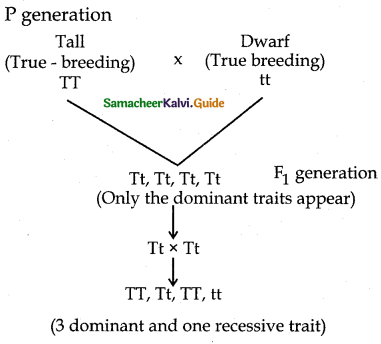
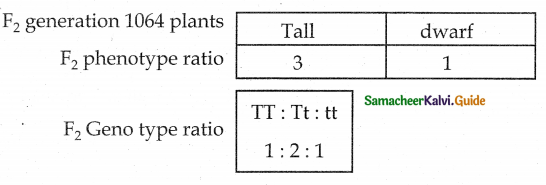
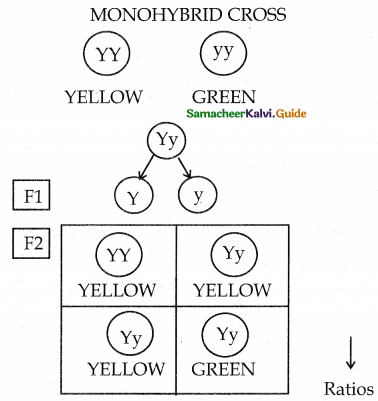
Explain the law of dominance in monohybrid cross.
Answer:
Law of dominance
In cross of parents that are pure for contrasting traits only one form of the trait will appear in the next generation. They have hybrid or dominant trait in the phenotype.
eg) Monohybrid cross
Samacheer Kalvi 12th Bio Botany Guide Chapter 2 Classical Genetics 1
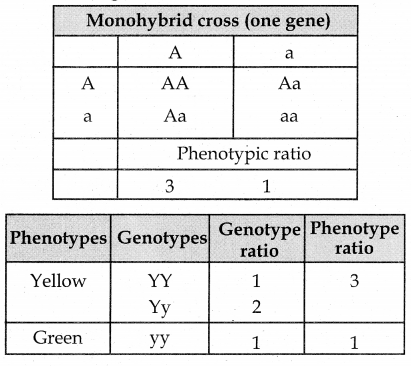
Regarding F1 generation the recessive allele is not lost, and it remain hidden or masked. But it reappears in the next generation.
Samacheer Kalvi 12th Bio Botany Guide Chapter 2 Classical Genetics 2

Samacheer Kalvi 12th Bio Botany Guide Chapter 2 Classical Genetics

Question 31.
Differentiate incomplete dominance and co-dominance.
Answer:
Incomplete Dominance:

  1. In incomplete dominance, neither of the allele is not completely dominant to another allele rather combine and produce new trait
  2. New phenotype is formed due to character blending (not alleles)
  3. Example : Pink flowers of Mirabilis Jalapa

Co-dominance:

  1. In co-dominance, both the alleles in a heterozygote are dominant and the traits are equally expressed (joint expression)
  2. No formation of new phenotype rather both dominant traits are expressed, conjointly
  3. Example: Red and white flowers of camellia

Question 32.
What is meant by cytoplasmic inheritance?
Answer:

  • DNA is a universal genetic material.
  • Genes located in nuclear chromosomes follow Mendelian inheritance.
  • Certain traits are governed by the chloroplast (or) mitochondrial genes which is known as extranuclear inheritance.
  • It is a kind of Non – Mendelian inheritance.
  • The cytoplasmic organelles chloroplast and mitochondrion act as inheritance vectors so-called cytoplasmic inheritance.
  • It is based on self – replicating extrachromosomal unit called plasminogen in the cytoplasmic Organelles, Chloroplast, and mitochondria.

Question 33.
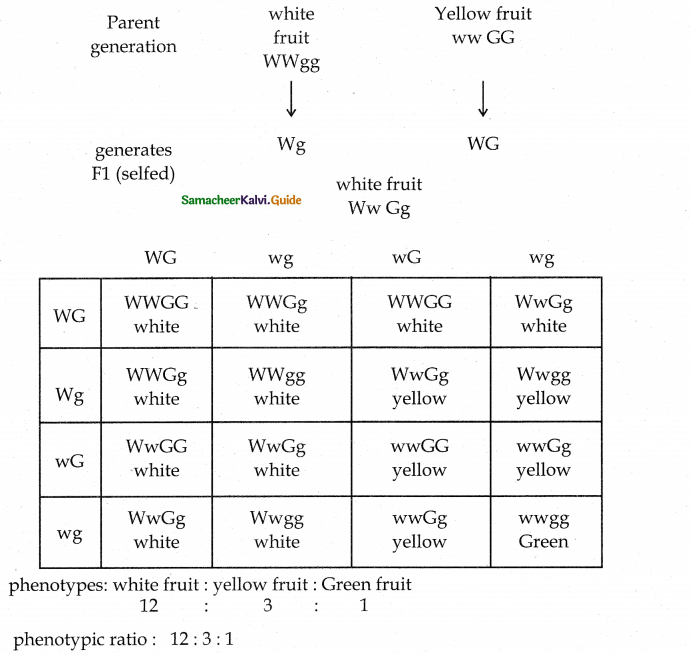
Describe dominant epistasis with an example.
Answer:
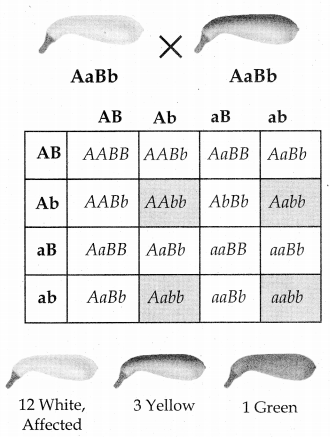
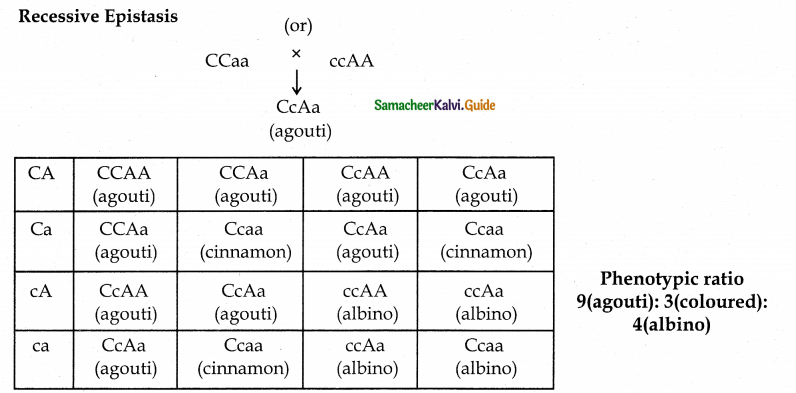
Epistasis can be defined as a gene interaction whereby one gene interferes with the phenotypic expression of another non-allelic gene. The gene or locus which suppresses or masks the action of a gene at another locus is called the epistatic gene. The gene or locus where expressions are suppressed by an epistatic gene is called gene hypostatic.
Dominant epistasis A dominant epistasis suppresses the expression of a non-allelic gene, (dominant (or) recessive)
The F2 phenotypic ratio is 12:3:1
Samacheer Kalvi 12th Bio Botany Guide Chapter 2 Classical Genetics 3

Samacheer Kalvi 12th Bio Botany Guide Chapter 2 Classical Genetics

Question 34.
Explain polygenic inheritance with an example
Answer:

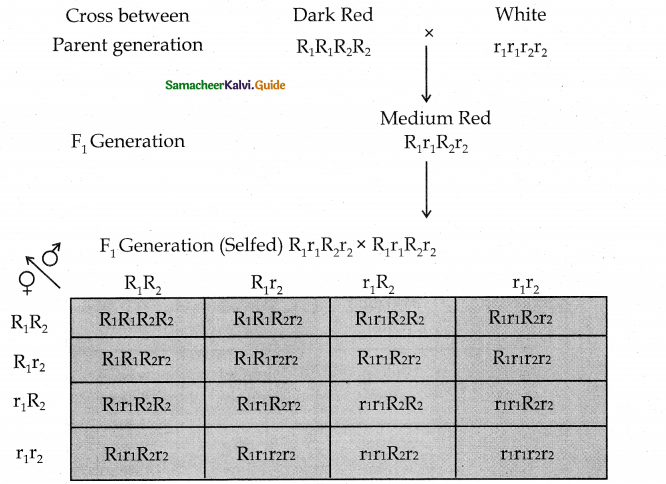
  • Polygenic inheritance, also known as quantitative inheritance, refers to a single inherited phenotypic trait that is combined bv two or more different: genes.
    (or)
  • Several genes combine to affect a single trait. A group of genes that together determine (or) contribute a characteristic of an organism is called polygenic Inheritance
    (or)
  • Polyinheritance occur when one characteristic is controlled bv two or more genes.
    Eg. Human skin colour & eye colour and weight.
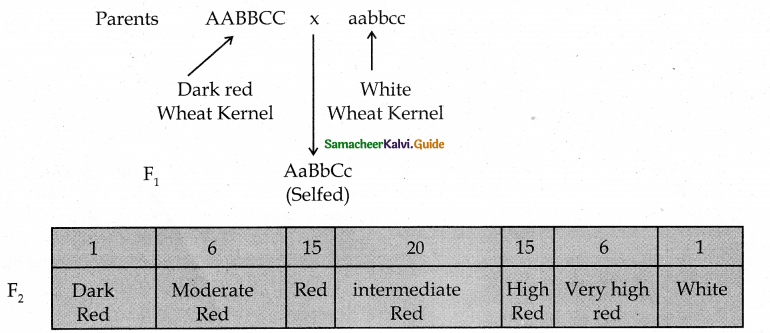
  • H.Nilsson -Ehle (1909), a Swedish geneticist discovered a polygenic inheritance in wheat (kernel colour). Kernel colour is controlled by two genes each with two alleles, one with red kernel colour was dominant to white. He crossed the pure breeding wheat varieties dark red and a white.
  • Dark red genotypes R1R1R2R2 crosed unit r1 r1 r2 r2. In the F1 generation medium red were obtained with genotype R2 r1 R, r2. So the intensity of the red colour is determined by the number of R genes in the F2 generation
  • Four R genes: A dark red kernel colour is obtained.
  • Three R genes: Medium – dark red kernel colour is obtained.
  • Two R genes: Medium-red kernel colour is obtained.
  • One R gene: Light red kernel colour is obtained.
  • Absence of R gene:Results in White kernel colour is obtained.
    Samacheer Kalvi 12th Bio Botany Guide Chapter 2 Classical Genetics 4

The data produces a bell shaped curve which demonstrate continuous variation in wheat kernel from dark red to white in F2 when the number F1 were self crossed five different phenotypic classes appeared in F2 in into ratio of 1:4:6:4:1
The phenotype ratio is Dark red :1 Medium dark red :4 Medium red : 6
light red : 4 white : 1
Hence the total ratio is 63 red : 1 white in F2 generation
1:6:15 :20:15:6:1 in generation

Samacheer Kalvi 12th Bio Botany Guide Chapter 2 Classical Genetics 5

He found that In F2 generation plants have Kernel’s with range of colour variation. This is due to the fact that the genes are segregating and recombination takes place.

Samacheer Kalvi 12th Bio Botany Guide Chapter 2 Classical Genetics

Question 35.
Differentiate continuous variation with discontinuous variation .
Answer:
Variation is the difference between individual with in a species. This can be caused by inherited or environmental factors. It can be continuous and discontinuous. Height, and weight of the human being are best examples of continuous variation. Human blood group, gender identity and eye colour are best example of discontinuous variation

Continuous VariationDiscontinuous Variation
Variation are fluctuate or meanmean or average is absent
Direction is predictableunpredictable
already exists in the populationvariation occur previously
It is due to the chance of segregation of chromosomes during gamete formation & crossing over & chance pairing during fertilisation 

Produced by changes in genome or genes

 They can increase adaptability of the raceevolutionary based
It is also called fluctuationIt is also called fluctuation
graphically produce bell shaped curveNo curve is produced
Very commonappears occasionally
do not disturb the genetic systemThey disturb the genetic system

Question 36.
Explain with an example how single genes affect multiple traits and alleles the phenotype of an organism.
Answer:

  • There are several patterns responsible for the inheritance of traits, gene causes one trait. But in some cases one gene is responsible for multiple traits. Sometimes two or more gene are required to produce one trait.
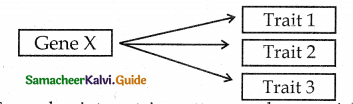
  • It is otherwise called pleiotropy. It means, where one gene will code and control the phenotype or expression of several different and unrelated traits.
  • Eg. Phenylketenuria disease.
  • A gene that produces multiple or effect is called a Pleitropic gene. Multiple effects of a single gene is know as pleiotropy. A Pleitropic gene is a single gene that controls more that one trait.
  • Eg. Human genetic disorder are often pleitropic ie, unusual tall height, thin finger and toes, dislocation of the lens of the eye, heart in the aorta (heart function)
  • Eg : Pisum sativum plant with purple brown seeds and dark spot on the axis of the leaves were crossed with a variety of a peas having white flowers light coloured seed and no spot on the axils of the leaves, the three traits for peas colour, seed colour and a leaf axil spot all were inherited together as a single exist. This is due to the pattern of inheritances controlled by a single gene with dominant and recessive alleles,
  • eg .Sickle cell anemia
  • eg .Marfan syndrome
  • A human genetic disorder called marfan syndrome is caused by a mutation in one gene, yet it affects many aspects of growth and development inducing height, vision and heart function. This is an example of pleiotropy or one gene affecting multiple characteristics.

Samacheer Kalvi 12th Bio Botany Guide Chapter 2 Classical Genetics 6

  • Gene also interact in pattern such a partial dominance or co-dominance, the trait is expressed a mix between two gene , Those are possibilities for one gene. Most trait are influenced by many genes. There are many different way for these gene to influence how trait is expressed.

Samacheer Kalvi 12th Bio Botany Guide Chapter 2 Classical Genetics

Question 37.
Bring out the inheritance of chloroplast gene with an example.
Answer:

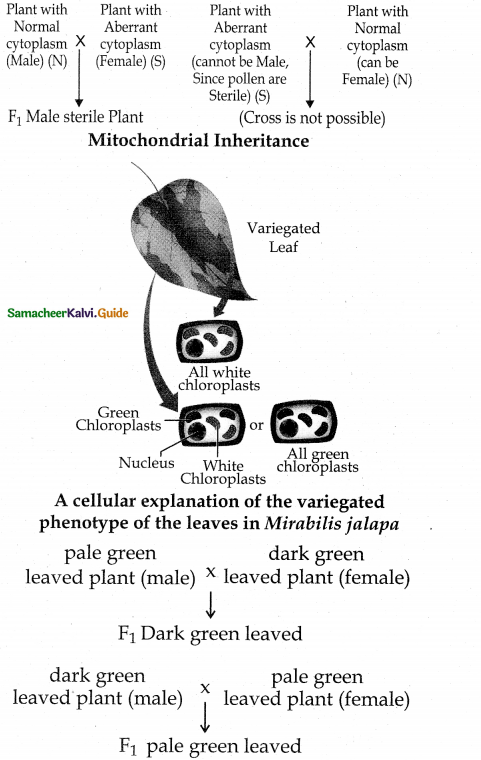
  • It is found in 4 O’clock plant (Mirabilis jalapa)
  • There are dark green leaved plants and pale green leaved plants.
  • When the pollen of dark green leaved plant (male) is transferred to the stigma of pale green leaved plant (female) the pollen of pale green leaved plant is transferred to the stigma of dark green leaved plant, the F1 generation of both the crosses is identical as per mendelian inheritance.
  • In the reciprocal cross the F1 plant differs from each other.
  • The F1 plant reveals the character of the plant.
  • The inheritance is due to the chloroplast gene found in the ovum of the female plant which contributes the cytoplasm during fertilization.
  • The male gamete contribute only the nucleus.

Samacheer Kalvi 12th Bio Botany Guide Chapter 2 Classical Genetics 7

12th Bio Botany Guide Classical Genetics Additional Important Questions and Answers

I. Match the following

Question 1.

Column -IColumn – II
a. Talli) White
b. Purpleii) Wrinkled
c. arialiii) terminal
d. Roundiv) dwarf

Answer:
(a) Tall – (iv) dwarf
(b) Purple – (i) white
(c) arial – (iii) terminal
(d) Round – (ii) wrinkled

Question 2.

Column -IColumn – II
a. Dominant epistasisi) 9:7
b. Duplicate genesii) 12:3:1
c. Recessive epistasisiii) 15:1
d. Complementary gene iv) 9:3:4

Answer:
(a) Dominant epistasis – (ii) 12:3:1
(b) Duplicate genes – (iii) 15 :1
(c) Recessive epistasis – (iv) 9:3:4
(d) Complementary gene – (i) 9:7

Question 3.

Column -IColumn – II
a. Geneticsi) E. Baeur
b. Mendelii) W. Batson
c. lethal geneiii) Father of Genetics
d. H. Nilsson Ehle iv) Kernel colour

Answer:
(a) Genetics – (ii) W. Batson
(b) Mendel – (iii) Father of Geetics
(c) lethal gene – (i) E. Baeur
(d) H. Nillsson Ehle – (iv) Kernel colour

Question 4.

Column -IColumn – II
a. Polygenic inherence i) Pisum sativm
b. 4 O’ dock pea plant ii) genetic materia
c. Garden pea plantiii) Mirabilis jalapa
d. H. NillssanEhleiv) wheat kernel colour

Answer:
(a) Polygenic inherence – (iv) wheat kernel colour
(b) 4 O’clock pea plant – (iii) Mirabilis jalapa
(c) Garden pea plant – (i) Pisum sativm
(d) H. NillssanEhle – (ii) genetic material

Samacheer Kalvi 12th Bio Botany Guide Chapter 2 Classical Genetics

II. Choose the correct statement

Question 5.
a. HbA and Hbs alleles of normal and single-cell hemoglobin are multiple alleles
b. HbA and Hbs alleles of normal and single-cell hemoglobin are dominant recessive allele
c. HbA and HbA alleles of normal and single cell heamoglobin are codominant allele
d. HbA and Hb & alleles of normal and single-cell hemoglobin are recessive alleles
Answer:
c) HbA and HbA alleles of normal and single cell heamoglobin are codominant allele

Question 6.
a. When alleles of the two contrasting characters are present together, one of the character ex-press and the other remains hidden. There is the law of purity of gametes.
b. When alleles of the contrasting characters are present together, one of the character express and the other remains hidden . There is a law of dominance.
c. When alleles of the contrasting characters are present together with one of the character express and the other remain hidden This is law of segregation
d. When allele of two contrasting character are present together, one of the character express and remain hidden. This is law of independent assortment.
Answer:
b) When alleles of the contrasting characters are present together, one of the character express and the other remains hidden. This is the law of dominance

Question 7.
a. Monohybrid ratio is 9:3:3:1
b. The crossing of FI to any one of the parent is called test cross
c. The phenotypic ratio of a monohybrid cross is 1:2:1
d. A cross in which parents differ in a single pair of contrasting character is called a dihybrid cross
Answer:
c) The phenotypic ratio of a monohybrid cross is 1:2:1

Samacheer Kalvi 12th Bio Botany Guide Chapter 2 Classical Genetics

Question 8.
a. The hybrid progeny in the first generation is called F2
b. The major reasons for the success of Mendelian experiment was the true-breeding of Garden Pea plant
c. X and Y are examples of alleles.
d. A pedigree chart shows the genotypes of any parent.
Answer:
b) The major reason for the success of mendelian experiment was true-breeding of Garden Pea plant

III. Choose the correct pair

Question 9.
a. Discontinuous variation – qualitative inheritance
b. Continuous variation – qualitative inheritance
c. Duplicate gene – 13: 3
d. Recessive epilate – 9:7
Answer:
a) Discontinuous variation – qualitative inheritance

Question 10.
a. Monohybrid – 9:3:3:1
b. Dihybrid – 1: 2: 1
c. recessive epistasis — 9: 3 : 4
d. extra chromosomal
inheritance — Mendelian inheritance
Answer:
c) recessive epistasis – 9 : 3 : 4

Question 11.
a. Emasculation – removal of anther
b. Tt – homozygous
c. genetic constitution – phenotype
d. mono hybrid cross – law of independent
assortment
Answer:
a) Emasculation – removal of anther

Samacheer Kalvi 12th Bio Botany Guide Chapter 2 Classical Genetics

Question 12.
a. polygenic trait – Traits that are controlled by multiple gene
b. Multiple alleles – A gene that is controlled by one allele
c. Pleiotropy – one gene cannot affects multiple characters
d. Phenotype – genetic makeup of an organism.
Answer:
a) polygenic trait – Traits that are controlled by multiple gene

IV. Choose the incorrect statement

Question 13.
a. A pedigree charts are shown which genes are co-dominant
b. A true-breeding is a kind of breeding where the parents would produce offspring that would carry the same phenotype
c. In polygenic inheritance, traits are determined by interaction of single gene
d. The interactions between separate genes, in which one masks the effect of another is called epistasis.
Answer:
c) In polygenic inheritance traits are determined by interaction of single gene

Question 14.
a. The outward appearance resulting from an individual’s genotype for a particular characteristic is called phenotype
b. The recessive allele of the same gene represented by lower case letter.
c. Blood group is a human characteristic that shown discrete variation
d. The name given to different form of the same gene is gametes
Answer:
d) The name given to different form of the same gene is gametes

Samacheer Kalvi 12th Bio Botany Guide Chapter 2 Classical Genetics

Question 15.
a. An allele is a viable DNA, coding that occupies a given locus on a chromosome
b. An allele is an alternative form of gene
c. An organism which has two different alleles of the gene is called homozygous
d. A person with one ‘A’ blood type and one ‘B’ blood type allele would have a blood type of “AB” ”
Answer:
c) An organism which has two different alleles of the gene is called homozygous

Question 16.
a. A pleiotropic gene is a single gene that more than one trait
b. A single gene affects multiple traits and alter the phenotype of the organism called as pleiotropy
c. Marfans syndrome is an example of pleiotropy.
d. one (or) single gene that cannot affect multiple traits are called pleiotropy.
Answer:
d) one (or) single gene that cannot affect multiple traits are called pleiotropy.

V. Choose the Incorrect Pair

Question 17.
a. Genotype – Genetic makeup of organism
b. recessive – A trait that is hidden
c. probability – The chance that an event will take place
d. Independent assortment – Mendel’s first law
Answer:
d) Independent assortment – Mendel’s first law

Question 18.
a. Dominant Allele – RR
b. Recessive allele – rr
c. Heterozygous – Tt
d. Homozygous recessive – TT
Answer:
d) Homozygous recessive – TT

Samacheer Kalvi 12th Bio Botany Guide Chapter 2 Classical Genetics

Question 19.
a. Intra-locus interaction – allelic interactions
b. Inter-locus interaction – non-allelic interactions
c. Epistatic – allelic interactions
d. Polygenic interaction – non-allelic interaction
Ans:
c) Epistatic – allelic interactions

Question 20.
a. Complementary gene – 9:7
b. Co -dominance -1:2:1
c. Dominant epistatics – 9:3:4
d. Inhibitor gene -13:3
Answer:
c) Dominant epistatics – 9:3:4

VI. Choose the Odd one out

Question 21.
a) Mirabilis jalapa
b) Snapdragon
c) ABO Blood system
d) Epistasis
Explanation: a,b,c are F2 phenotypic ratio is 1:2:1
Answer:
d) Epistasis

Question 22.
a. DNA
b. mitochondrial inheritance
c. Chloroplast inheritance
d. Atavism
Explanation : a,b,c are used as genetic material.
Answer:
d) Atavism

Question 23.
a. Monohybrid cross
b. checkerboard
c. genotype
d. phenotype
Answer:
b) checkerboard

Question 24.
a) co-dominance
b) Duplicate gene
c) inhibitor gene
d) supplementary gene
Explanation : b,c and d are intergenic or non¬allele interaction
Answer:
b) Duplicate gene

Samacheer Kalvi 12th Bio Botany Guide Chapter 2 Classical Genetics

VII. Assertion and Reason

Question 25.
A : Polygenic inheritance
R : Several genes combine to affect a single trait
(a) A is correct (b) R is false
(c) R is the correct explanation of A
(d) R only correct
Answer:
c) R is the correct explanation of A

Question 26.
A : Atavism is a modification of biological structure whereby an ancestral trait reappears after having been lost through evolutionary changes in the previous generation
R : Reemergence of sexual reproduction in the flowering plant Hieracium pilosella is the best example for Atavism in plants
(a) A is correct R is the correct explanation of A
(b) A only true
(c) R only True (d) A false & R is true
Answer:
(a) A is correct R is the correct explana-tion of A

Question 27.
A: The physical expression of an individual gene called phenotype
R: Phenotype is physical observable charactertics of an organism
a) A & R True
b) A & R False
c) A is correct
d) R is correct
Answer:
(a) A & R True

Question 28.
A : Interaction between two alleles of the same loci is the effect of epistasis
R : The epistasis is the kind of intergenic and allelic interaction.
(a) A is correct R is false
(b) R alone correct
(c) R & A are true
(d) R is the correct explanation of A
Answer:
(a) A is correct R is false

VIII. Choose the best answer

Question 29.
If you do dihybrid cross in Pisum sativum on the traits of pod shape and plant height, Will you get 9:3:3:1 ratio in F2 ?
a. Yes, because they are independently assorting genes.
b. No, they are linked genes.
c. Yes, because thev are situated on different chromosomes
d. No, we can not do experiments on these two traits.
Answer:
a) Yes, because they are independently assorting genes.

Samacheer Kalvi 12th Bio Botany Guide Chapter 2 Classical Genetics

Question 30.
A single characteristic is controlled by a number of genes is called
a. Inheritance
b. Epistasis
c. Polygenic inheritance
d. Co-dominance
Answer:
c) Polygenic inheritance

Question 31.
An allele is
a. a homozygous genotype
b. a heterozygous genotype
c. another word for gene
d. several possible form of gene
Answer:
c) another word for gene

Question 32.
Continuous variation is due to
a. effect of polygenes
b. effect of environment
c. effect of polygenes and environment
d. effect of one or two genes.
Answer:
c) effect of polygenes and environment

Samacheer Kalvi 12th Bio Botany Guide Chapter 2 Classical Genetics

Question 33.
A variation in a characteristic in which individuals show two or a few traits with large differences between them.
a. dominant
b. continuous variation
c. discontinuous variation
d. recessive
Answer:
c)discontinuous variation

Question 34.
A trait that masks the expression of another trait when both versions of the gene are present in an individual
a. variation
b. recessive
c. co-dominance
d. dominant
Answer:
d) dominant

Question 35.
Which one of the following is not a correct pair regarding genes of pea plant,
a. Seed shape – Chromosome number 6
b. Pod colour – Chromosome number 5
c. Flower position – Chromosome number 4
d. Seed colour – Chromosome number 1
Answer:
a) Seed shape – Chromosome number 6

Question 36.
The study of heredity behaviour of several genes by Gregor Mendel.
a. Molecular genetics
b. Population genetics
c. Quantitative genetics
d. Transmission genetics
Answer:
d) Transmission genetics

Samacheer Kalvi 12th Bio Botany Guide Chapter 2 Classical Genetics

Question 37.
Transmission of characters from parents to offsprings
a. variation
b. dominance
c. heredity
d. growth
Answer:
c) heredity

Question 38.
Species that shows a difference in the characteristics of the same natural population is called
a. heredity
b. variation
c. recessive
d. co -dominace
Answer:
b) variation

Question 39.
Qualitative inheritance is otherwise called
a. co – dominance
b. continuous variation
c. discontinuous variation
d. heredity
Answer:
c) discontinuous variation

Question 40.
“Experiments on plant hybrids” is a
a. book
b. research paper
c. journal
d. Magazine
Answer:
b) research paper

Samacheer Kalvi 12th Bio Botany Guide Chapter 2 Classical Genetics

Question 41.
Mendels theory of inheritance is based on
a. Particulate theory
b. mass
c. hybridization
d. variation theory
Answer:
a) Particulate theory

Question 42.
Removal of the anther is called
a. Atavism
b. Epistasis
c. Hybridization
d. Emasculation
Answer:
d) Emasculation

Question 43.
Botanical name of garden pea is
a. Solanum tuberosum
Question b. Coccus nucitera
c. Pisum sativum
d. pea
Answer:
c) Pisum sativum

Samacheer Kalvi 12th Bio Botany Guide Chapter 2 Classical Genetics

44.
Mendel’s experiments were rediscovered by
a. Hugo de vries & carl correns
b. E. Baur
c. H. Nilsson
d. T.H.Morgan
Answer:
a) Hugo de vries & carl correns

Question 45.
If a homozygous red flowered plant is crossed with a homozygous white flower plant then the off-spring will be_
a. All red flowered
b. Half white flowered
c. Half red flowered
d. All white flowered
Answer:
c) Half red flowered

Question 46.
…………….. is he best example for chloroplast inheritance
a. Mirabilis jalapa
b. Sorgum vulgare
c. Triticum vulgare
d. Musa paradisiaca
Answer:
a) Mirabilis jalapa

Samacheer Kalvi 12th Bio Botany Guide Chapter 2 Classical Genetics

Question 47.
Among the pea plant cell which one has the ability to convert a precursor molecule into an active inform
a. Le:le
b. GA1
c. Le
d. le
Answer:
b) GA1

Question 48.
Gene interaction concept was introduced and explained by
a. W. Bateson
b. Morgan
c. E. Baur
d. Nilsson
Answer:
a) W. Bateson

Question 49.
An allele which has the potential to cause the death of an organism is called
a. Genetic interaction
b. lethal alleles/lethal gene
c. Atavism
d. Autism
Answer:
b) lethal alleles/lethal genes

Question 50.
The gene whose expression is interfered by non- alletic gene and prevents from exhibiting its character is known as
a. hypostatic
b. epistatic
c. metastatic
d. hipostatic
Answer:
a) hypostatic

Samacheer Kalvi 12th Bio Botany Guide Chapter 2 Classical Genetics

Question 51.
Height and skin colour in human are controlled by
a. two pair of genes
b. three pair of genes
c. five pair of genes
d. a pair of genes
Answer:
b) three pair of genes

Question 52.
The genotypic ratio of monohybrid cross is
a. 3:1
b. 1:2:1
c. 3:1:1
d. 9:3:3:1
Answer:
b) 1:2:1

Question 53.
Which of the following statements are true regarding law of segregation
a. alleles separate with each other during gametogenesis
b. The segregation of factors is due to the segregation of chromosomes during meiosis
c. Law of segregation is called as law of purity of gametes
d. all of the above
Answer:
d) all of the above

Samacheer Kalvi 12th Bio Botany Guide Chapter 2 Classical Genetics

Question 54.
The crossing of Fj to anyone of the parents is called
a. test cross
b. back cross
c. FI cross
d. all of these
Answer:
b) back cross

Question 55.
The character that is express in to the F2 is called
a. recessive character
b. co-dominant character
c. dominant character
d. none of these
Answer:
c) dominant character

Question 56.
The recessive character will express in
a. F1
b. F2
c. both a & b
d. F3 only
Answer:
b) F2

Question 57.
Which of the following pair is not correct
a. KK=dominant
b. hybrid = heterogeneous
c. heterozygous = Kk
d. homozygous = Rr
Answer:
a) KK=dominat

Samacheer Kalvi 12th Bio Botany Guide Chapter 2 Classical Genetics

Question 58.
What is the phenotype of wheat kernal colour for the genotype: R1 R1 r2 r2 ?
a. Dark red
b. Medium dark red
c. Medium red
d. Light red
Answer:
c) Medium red

Question 59.
Mendel worked at the rules of inheritance and arrived at the correct mechanism. But
a. without any knowledge of cellular mechanism
b. knowledge of cellular mechanism
c. heredity mechanism
d. growth mechanism
Answer:
a) without any knowledge of cellular mechanism

Question 60.
is crossing an individual of unknown one pair of a genes is called genetic genotype with a homogeneous recessive.
a. back cross
b. test cross
c. monohybrid cross
d. dihybrid cross
Answer:
b) test cross

Samacheer Kalvi 12th Bio Botany Guide Chapter 2 Classical Genetics

Question 61.
……………….is the expression of a single character by the interaction of more than interaction or interaction of genes.
a. factor hypothesis/ Bateson factor hypo¬thesis
b. alternative hypothesis
c. nell hypothesis
d. All of the above
Answer:
d) All of the above

IX. One Mark Question

1. The genetic constitution of the individual is called
Answer:
Genotype

2. The observable characteristics of an organism are called
Answer:
Phenotype

3. Who is father of genetics?
Answer:
Gregor Johann Mendel

4. Name the Mendel’s published work.
Answer:
Experiments on plant Hybrids.

Samacheer Kalvi 12th Bio Botany Guide Chapter 2 Classical Genetics

5. Name the publication of Mendel research work
Answer:
1899

6. What is the year of published work Mendel’s Research paper?
Answer:
The proceedings of the Brunn Society & Natural History.

7. What is an allele?
Answer:
It is another word for a Gene.

8. Individuals show a range of traits with small difference between them.
Answer:
Continuous variation

Samacheer Kalvi 12th Bio Botany Guide Chapter 2 Classical Genetics

9. When an individual show two or a few traits with large differences between them. This type of variation is called.
Answer:
discontinuous variation

10. Human height is the good example of ………….. variation.
Answer:
Continuous variation

11. Human skin colour is the good example of …………….. variation.
Answer:
Continuous variation

Samacheer Kalvi 12th Bio Botany Guide Chapter 2 Classical Genetics

12. Mention any two examples of continuous variation.
Answer:
a. Human height
b. Human skin colour

13. Mention any two examples of discontinuous variation.
Answer:
Style length of Primula & Height of the garden pea.

14. A trait that makes the expression of another trait when both version of the gene are present in the individual called
Answer:
Dominant.

Samacheer Kalvi 12th Bio Botany Guide Chapter 2 Classical Genetics

15. What is F1?
Answer:
It is the first filial generation in a cross; the offspring of the parental generation.

16. The letter ‘P’ denoted in genetics is
Answer:
The parental generation in a cross

17. A variation in an inherited characteristics is
Answer:
Trait

18. One pair genes can completely makes the expression of another pair of genes known as
Answer:
Epistasis

19. Who discovered incomplete dominance?
Answer:
Correns. (Germany)

20. Crosses between F1 offsprings with either of the two parents (hybrids) are known as
Answer:
Back cross

Samacheer Kalvi 12th Bio Botany Guide Chapter 2 Classical Genetics

21. Diploid organisms that have two different allele at a specific gene locus are said to be
Answer:
Heterozygous

22. TT referred as…………….
Answer:
Homogenous dominant variety.

23. ‘tt’ referred as ……………
Answer:
Homozygous recessive character.

24. ‘Tt’ denotes for …………….
Answer:
Heterogeneous hybrid variety.

25. The superiority of hybrid over either of its parents in one or more traits known as
Answer:
Hybrid vigour or Heterosis

Samacheer Kalvi 12th Bio Botany Guide Chapter 2 Classical Genetics

26. The site or position of a particular gene on a chromosome is
Answer:
locus

27. An allele which has the potential to cause the death of an organism is called ……………….
Answer:
Lethal genes

28. A single gene affects multiple traits are called ……………..
Answer:
Pleiotropy

29. A single gene affects multiple traits and alter the phenotype of the organism is
Answer:
Pleiotropy

30. Several genes combine to affect a single trait of an organism.
This kind of inheritance is ……………
Answer:
Polygenic inheritance.

Samacheer Kalvi 12th Bio Botany Guide Chapter 2 Classical Genetics

31. Who demonstrated first experiment on polygenic inheritance.
Answer:
Swedish Geneticist H. Nilsson – Ehle (1909)

32. Which plant to use to identify the polygenic inheritance?
Answer:
Wheat – Kernel colour (dark red & white variety)

33. List any two intragenic or allele interaction.
Answer:

  1. Incomplete Dominance
  2. Co-dominance

Samacheer Kalvi 12th Bio Botany Guide Chapter 2 Classical Genetics

34. List any two intergenic or non-allele interaction
Answer:

  1. Dominant Epistasis
  2. Recessive Epistasis

35. Corren has used plant for studied incomplete dominance.
Answer:
Mirabilis jalapa (4′ O clock plant)

36. Mention the botanical name of 4′ O clock plant.
Answer:
Mirabilis jalapa.

37. Duplicate genes with cumulative effect of non-alleleic interaction is derived in
Answer:
Fruit shape in Summer squash.

38. What is the FI phenotypic ratio of inhibitor genes in the intergenic interaction?
Answer:
13:3

39. When the heterozygote exhibits a mixture of phenotypic character of both homozygous called as
Answer:
Co-Dominance.

40. Name the two gene interaction.
Answer:

  1. Intralocus interaction (allelic interaction)
  2. Interlocus interaction (non-allelic interaction)

41. A chart shows which genes are co-dominant. This is known as
Answer:
A pedigree charts.

42. Each character is controlled by distinct units called factor, which occur in pairs. If the pairs are heterozygous, one wiil always dominant other. This is known as
Answer:
First law of inheritance or Law of Dominance.

Samacheer Kalvi 12th Bio Botany Guide Chapter 2 Classical Genetics

43. The second law of inheritance otherwise called as
Answer:
Law of Segregation.

44. Give the name of the scientists who re-discovered Mendelism
Answer:

  1. Hugo Devries
  2. Carl Correns
  3. Erich Von Tschermak.

45. is the prerequisite for Hybridization technique.
Answer:
Emasculation.

46. Transmission of genes that occur outside the nucleus is called………………
Answer:
Cytoplasmic Inheritance or Extra Nuclear

47. Cytoplasmic inheritance are found in
Answer:
Mitochondria & Chloroplast

48. The interaction between separate gene in which one makes the effect of another
Answer:
Epistasis

49. The acquisition of traits or conditions controlled by self replicating substances within the cytoplasm. This is a type of
Answer:
Cytoplasmic Inheritance.

50. The hybrid progeny in the first generation is called as
Answer:
F1

51. The innate tendency of offspring to resemble their parents is called
Answer:
Heredity

Samacheer Kalvi 12th Bio Botany Guide Chapter 2 Classical Genetics

52. The tendency of offspring to differ from parents is called
Answer:
Variation

53. Multiple allelic inheritances is otherwise called as
Answer:
Co – dominance

54. What is the use of pedigree analysis in genetics?
Answer:
It helps in genetic counselling.

55. Who proposed the genetic theory of inheritance?
Answer:
T.H.Morgan

56. Give one good example for Atavism in plants.
Answer:
Reemergence of sexual reproduction in Hieracium pilosella.

57. In pea plant, yellow seeds are dominant to green. If a heterozygous yellow seeded plant is crossed with a green seeded plant. What ratio of yellow and green seeded plants would you expect in FI generation?
Answer:
50:50 (or) 1:1

58. Some genes have allele that prevents survival when homozygous or heterozygous. What is the kind of allele?
Answer:
Lethal alleles

59. Recessive alleles of two different genes may give the same phenotype; This kind of genes also called
Answer:
Complementary gene.

60. A gene is a functional unit of DNA which codes for a
Answer:
Polypetide chain

61. Allele are the alternative form of the
Answer:
gene

62. discovered incomplete dominance.
Answer:
Correns

Samacheer Kalvi 12th Bio Botany Guide Chapter 2 Classical Genetics

63. Human blood group is an example of variation.
Answer:
Discontinuous

X. Two marks

Question 1.
Write short note on Genotype.
Answer:
It is the genetic makeup of an organism responsible for a particular trait.

Question 2.
What is phenotype?
Answer:
It is the outward appearance or observable physical attributes of that trait.

Question 3.
Briefly explain monohybrid inheritance.
Answer:
Monohybrid inheritance looks at the inheritance of a single trait (a characteristics such as eye color, round or wrinkled seed type) coded by a single gene locus on a chromosome

Question 4.
Define Mendel’s first law.
Answer:
Mendel’s first law is ‘The law of segregation’. Segregation means separation. The two alleles are separated from each other during meiosis, so each gamete produced is haploids that is contain one allele of each gene.

Question 5.
What is epistasis?
Answer:
It is a term which describes how genes interact to affect a phenotype whereby an allele at one locus prevents an allele at another locus from manifesting its effect.
(or)
One gene is effectively interfering with or masking the effects of another gene.

Question 6.
What is epistatic?
The gene that suppresses or masks the . phenotypic expression of a gene at another locus is known as epistatic.

Question 7.
Write a note on hypostatic?
Answer:
In epistatsis, the gene whose expression is interfered by non- allelic genes and prevents from exhibiting its character is known as hypostatic.

Samacheer Kalvi 12th Bio Botany Guide Chapter 2 Classical Genetics

Question 8.
Describe one of the reason that made the garden pea an excellent choice of Mendel system for studying inheritance.
Answer:
It is easily available self pollinated crop.

Question 9.
What is continuous variation with examples?
Answer:
A variation in a characteristics in which individuals show a range of traits with small difference between them. Eg: Human height and skin colour.

Question 10.
Write a note on discontinuous variation with suitable examples.
Answer:
Discontinuous is a variation in characteristic in which individuals show two or a few traits with large differences between them. (Eg) Height or Length of a plant.

Question 11.
What is hybridization?
Answer:
The process of mating two individuals that differ, with the goal of achieving a certain characteristics in their offspring.

Question 12.
Briefly explain ‘F2‘.
Answer:
The second filial generation produced when Fi individuals are self-crossed or fertilized with each other.

Samacheer Kalvi 12th Bio Botany Guide Chapter 2 Classical Genetics

Question 13.
Write a short note on Punnett square or checkerboard?
Answer:
A sort of cross multiplication matrix used in the prediction of the outcome of a genetic cross, in which male and female gametes and their frequencies are arranged along the edges.

Question 14.
List out the ‘R’ gene on responsible for polygenic inheritance in wheat (kernel colour)
Answer:
Four R genes are produced dark red kernel color. Three R genes are produced medium dark red kernel colour. Two R genes are produced medium red kernel colour. One R gene is produced medium red kernel colour and absence of R genes in results in white kernel colour.

Question 15.
Explain the role of genes in the formation of purple colour in the flowers of pisum sativum.
Answer:

  • It was called Pea Gene A which encodes a protein that functions as a transcription factor which is responsible for the production of anthocyanin pigment.
  • So the flowers are purple. Pea plants with white flowers do not have anthocyanin, even though they have the gene that encodes the enzyme involved in anthocyanin synthesis.

Question 16.
Write a note on Mendel’s Law of Dominance.
Answer:
It states that a dominant allele expresses itself in a monohybrid cross and suppresses the expression of recessive allele. However this recessive allele for a character is not lost and remain that hidden or masked in the progenies of F:l generation and reappear in the next generation.

Samacheer Kalvi 12th Bio Botany Guide Chapter 2 Classical Genetics

Question 17.
What are multiple alleles?
Answer:
Alleles are alternative form of a gene. A gene for which at least two alleles exist is said to be polymorphic. Instances in which a particular gene may exist in three or more allelic forms are known as multiple allele conditions.

Question 18.
Briefly explain Mendelian Genetics.
Answer:
The set of theories prepared by Gregor Mendel, which attempt to explain the inheritance pattern of genetic characteristics based on simple breeding experiments involving single gene on chromosome pairs.

Question 19.
Write a note on Gene interaction.
Answer:
A single phenotype is controlled by more than one set of genes, each of which has two or more alleles. This phenomenon is called gene interaction.

Question 20.
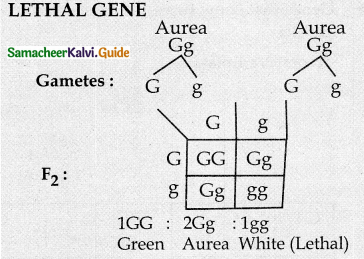
Explain the three kinds of plants that have recersive lethal gene in Antirrhinum sp.
Answer:

  1. Green plants with chlorophyll (CC)
  2. Yellowish green plants with carotenoids are referred to as pale green, golden or a urea plants (Cc)
  3. White plants without any chlorophyll, (cc)
  4. The genotype of the homozygous green plants is CC. The genotype of the homozy¬gous white plant is cc.

Question 21.
Write a note on incomplete dominance.
Answer:
It refers to genetic situation in which one allele does not completely dominate another allele, and therefore results in a new phenotype.
(or)
It is a form of intermediate inheritance in which one allele for a specific trait is not completely expressed over its paired allele. This results in third phenotype in which the expressed physical traits is a combination of the phenotypes of both alleles.

Question 22.
A diagram that shows the possible outcomes of breeding between two individuals.
Answer:
Punnett Square or Checkerboard

Samacheer Kalvi 12th Bio Botany Guide Chapter 2 Classical Genetics

Question 23.
Write a note on Punnet Square.
Answer:
It is a square type of a diagram that shows the possible outcomes of breeding between two individuals.

Question 24.
What do you mean by genetics ?
Answer:
Genetics is the study of how living things receive common traits from previous generation.

Question 25.
What are genes ?
Answer:
Genes are functional unit of inheritance. It is the basic unit of heredity (biological information) which transmits biochemical, anatomical and behavioural traits from parents to off springs.

Question 26.
What is population Genetics ?
Answer:
It deals with heredity in groups of individuals for trait which is determined by a few genes.
(or)
Population genetics is the study of genetic variation with in population, and the examination and moddling of changes in the frequencies of gene and allele in populations over space and time.

Question 27.
Define Molecular genetics .
Answer:
It is the field of that biology that studies the structure and function of genes at a molecular level
(or)
Study of structure and function of genes at molecular level
(or)
A branch of genetics that deals with structure and function of genes at molecular leve

Question 28.
Define Mutation.
Answer:
A permanent, heritable change in the nucleotide sequence in a genes or a chromosome , the process in which such a change occurs in a gene or in chromosome.

Samacheer Kalvi 12th Bio Botany Guide Chapter 2 Classical Genetics

Question 29.
What do you mean by genetic transmission ?
Answer:
Genetic transmission is the transfer of genetic information (From parent to offspring), almost synonymous with heredity, or from one location in a cell to another .

Question 30.
Define Transmission Genetics :
Answer:
The study of the mechanisms involved in the passage of gene from one generation to the next.

Question 31.
What are polygenes ?
Answer:
A gene where individual effect on a phenotype is too small to be observed but which can act together with others to produce observable variation.
(or)
Characters are determined by two or more gene pairs, and they have additive or cumulative effect. Such genes are called polygenes or multiple factors or cumulative gene. Eg. Human skin colour.

Question 32.
Define Polygene ?
Answer:
Inheritance of phenotype is determined by the combined effects of many genes with environmental factor . These gene are called as polygene

Question 33.
Mendel was successful, why?
Answer:

  • He applied mathematical method of law of probability to his breeding experiments
  • He used pairs of contrasting characters in their experiment.

Samacheer Kalvi 12th Bio Botany Guide Chapter 2 Classical Genetics

Question 34.
Write a note on self fertization.
Answer:
> (2 Marks) Fertilisation in a plant or animal by the fusion of male and female gametes produced by the same individual
(or)
> (3 Marks) Fertilisation that occurs when male and female gamete produced by the organism unite self fertilisation occur in many protozoans and invertebrate animal. It result from self pollination in plants. Seeds fertilization allows an isolated individual organism to reproduce but restricts the genetic diversity of a community.

Question 35.
What is cross fertilisation ?
Answer:
The fertilisation of an organism by the fusion of an egg from one individual with a sperm or male gamete from a different individual’s is opposite to the self.
(or)
Cross fertilisation is a term used in the field of biological reproduction describing the fertilisation of an occurs from one individual with spermatozoa of another. It is also called allogamy.
(or)
The fusion of male and female gamete (sex cells) from different individual of the same species.
It is mostly occur in dieocious plant and in animal species which they are separate male and female individual.

Samacheer Kalvi 12th Bio Botany Guide Chapter 2 Classical Genetics

Question 36.
Does pure breeding means homozygous?
Answer:
If they are pure breeding that mean they are homozygous . So A group of identical individual that always produce offspring and same phenotype when intercrossed

Question 37.
What is the relationship between pure breeding and true breeding ?
Answer:
True breeding means that the parents with also pass down a specific phenotypic trait to their offspring. True breeding organism will have a pure genotype (genetic expression of a trait) and they will produce a certain phenotype. True breed is sometime also called pure breed.

Question 38.
Write a short note on Anthocyanin pigment.
Answer:

  • Anthocyanin are naturally occurring pigment of red, purple and blue.
  • Anthocyanin pigments are more stable at low PH (Acidic condition) which gives a red pigment. Measurable higher the PH value of anthocyanin will provide of colour fading of the colour blue or purple.

Question 39.
What is the mean ‘progeny’?
Answer:
The word progeny is the progeny of the Latin verb “progignere” meaning “to beget” . In biology, offspring are the young born of living organism, produced either by a single organism or in the case of sexual reproduction, true organism. Collective offspring may be known as a brood or progeny. It is also called as offspring of animals or plants or the children and other descendants.

Samacheer Kalvi 12th Bio Botany Guide Chapter 2 Classical Genetics

Question 40.
Point out the mechanism of Trihybird cross.
Answer:
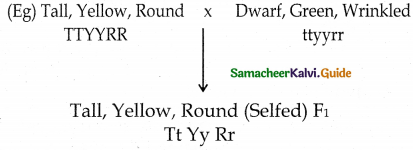
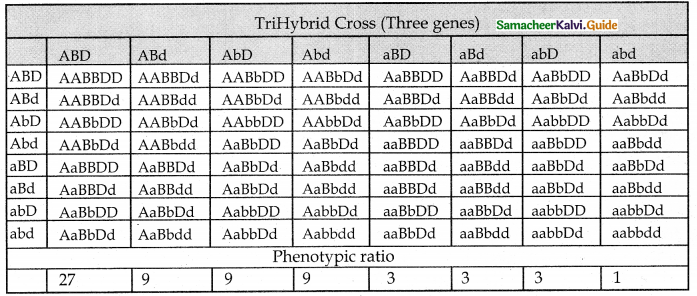
A cross between homozygous parent that differ in three gene pairs is called to trihybrid cross. A self fertilising trihybird plants forms 8 different gemeter and 64 different zygote. So these combination of three pair crosses operating together.
Samacheer Kalvi 12th Bio Botany Guide Chapter 2 Classical Genetics 8
Phenotypic ratio -27:9:9:9:3:3:3:1 F2
Mendel laws of segregation and independent assortment are also applicable to three pairs of contrasting traits ie. Trihybrid cross

Question 41.
What is back cross ?
Answer:
The cross between the F1 offspring with either of the two parents. The parent may be dominant or recessive
(or)
When F1 individuals are crossed with one of the true parenst from which they were derived, then such cross is called back cross
Explanation

  • When TT is crossed with tt we get Tt as F1 generation
  • TT x tt = Tt
  • when Tt (F1 ) is crossed with either TT or tt (parent) it is called a back cross .

Question 42.
What are the classification of gene interactions?
Answer:
Interactions take place between the alleles o the same gene.
alleles at the same locus is called intragenic or intralocus gene interactions.

  • Incomplete dominance
  • co dominance
  • multiple alleles
  • pleiotropic genes.

Samacheer Kalvi 12th Bio Botany Guide Chapter 2 Classical Genetics

Question 43.
Inheritance of chloroplast and mitochondria characters are non-mendelian inheritance
pattern why?
Answer:
The chloroplast arid mitochondrial genes show special pattern of inheritance known as Extra chromosomal inheritance.

Chromosomal inheritance:
The other aspects are

  • They have vegetative segregation involving cytoplasmic plasmagenes. .
  • It has uniparental inheritance (only from female parent)
  • Both have reduced rate of recombinations.

Question 44.
What is hybrids?
Answer:
Mendels non-true breeding plants ae heterozygous called as hybrids.

Question 45.
What is Dihybrid cross?
Answer:

  • It is a genetic cross which involves individuals differing in two characters.
  • Dihvbrid inheritance is the inheritance of two separate genes each with two alleles.

Samacheer Kalvi 12th Bio Botany Guide Chapter 2 Classical Genetics

XI. Three marks

Question 1.
Explain Bateson’s factor hypothesis ?
Answer:
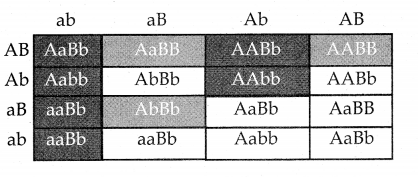
Mendelian experiments prove that a single gene controls one character. But in the post mendelion findings, various exception have been noticed, in which different types of interaction are possible between the genes. FTence the expression of a single character by the interaction of more one pair of genes is called genic interaction or interaction of genes. According to this hypothesis some character are produced by the interaction of two or more pairs factor (gene).

Question 2.
What is the human ABO phenotype blood type based on?
Answer:
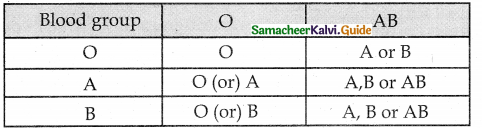
It is the major human blood group system. The ABO type of a person depends on they presence of absence of two gene, A and B. These gene determine the configuration of the red blood cell surface. A person who has two A gene or an A and O gene has bloodcells of type A. There are four main group of blood A,B,AB and O. The phenotype ratio is given below.
Blood group inheritance phenotype only
Samacheer Kalvi 12th Bio Botany Guide Chapter 2 Classical Genetics 9

Question 3.
Explain the Genetic inheritance of pattern of human blood system ?
Answer:
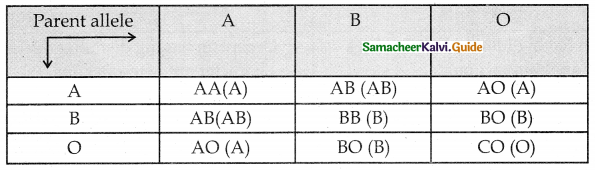
An individually ABO type results from the inheritance of 193 alleles is A,B,0 from each parent . The possible out comes are given below
Samacheer Kalvi 12th Bio Botany Guide Chapter 2 Classical Genetics 10
Both A and B alleles are dominant over O. As a results individual who have an AO gene type will- have an A phenotype. People who are type O have OO genotype. In other words, they inherited a recessive ‘O’ allele from both parents . The A and B alleles are co-dominant. Therefore, if an A is inherited from one parent and a B from the other the phenotype will be AB.

Samacheer Kalvi 12th Bio Botany Guide Chapter 2 Classical Genetics

Question 4.
In blood type co-dominance or incomplete dominance ?
Answer:
It is closely related to incomplete dominance is co-dominance is which both alleles are simultaneously expressed in the heterozygote. In both co-dominonce and incomplete dominance both alleles for a trait are dominate in co-dominance a hetrozygous individual express both simultaneously with out any blending. People who are to type O have OO genotype. In other words they inherited a recessive O allele from both parents. The A and B alleles are co-dominant. Therefc )re is an A is inherited from one parent and a B from other the phenotype will be AB

Question 5.
In sickle cell co-dominant or incomplete dominance ?
Answer:
sickle cell anemia is a disease, in which the haemoglobin protein is produced incorrectly and the red bloodcells have a sickle shape. A person that is homozygous recessive for the sickle cells traits wills have red blood cells that all have the incorrect haemoglobin.

Question 6.
Write a note on co-dominance ?
Answer:
Co-dominance occurs when the phenotype of both parents are simultaneously expressed in the same offspring . An example of co¬dominance occurs in the human ABO blood group

Question 7.
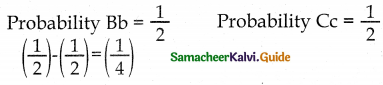
Across between Bbcc and Bbcc. What is the probability of Bbcc?
Samacheer Kalvi 12th Bio Botany Guide Chapter 2 Classical Genetics 11
Answer:
Solution
Probability of Bbcc = (Probability Bb) . (Probability Cc)
Samacheer Kalvi 12th Bio Botany Guide Chapter 2 Classical Genetics 12

Samacheer Kalvi 12th Bio Botany Guide Chapter 2 Classical Genetics

Question 8.
Write a note on Homologous chromosome or homologous.
Answer:
Morphologically, physiologically and genetically similar chromosome present is a diploid cell are called homologous or homologous chromosomes. In each pair of homologous chromosomes, one chromosome maternal and the other is paternal.

Question 9.
Write a note Emasculation.
Answer:
Removal of stamen well before another is called emasculation . It is done in bud condition to prevent self -pollination.

Question 10.
What is Punnett square or checker board?
Answer:
Punnett square is a graphical representation to calculate the probability of all possible genotypes of offsprings in a genetic cross. It was developed by Reginald C.Punnett.

Question 11.
Distinguish between homozygous and heterozygous
Answer:
homozygous :

  1. Organism having identical alleles for a character are homozygous.
  2. It is pure or true breeding
  3. They form only one type of gametes
  4. (eg) Tall (TT) dwarf (tt)

heterozygous :

  1. Organism having dismillar alleles for a character are heterozygous.
  2. It is hybrid
  3. They form more then one type of gametes.
  4. es (Tt)

Samacheer Kalvi 12th Bio Botany Guide Chapter 2 Classical Genetics

Question 12.
Differentiate dominant from recessive character.
Answer:

Dominant characterRecessive character
1. The character that are expressed in F1 generation are dominantThe characters that are not expressed in F1 generation are recessive
2. It is expressed in presence of dominant as well as recessive allele.
Eg. Tt, TT = tall
It is expressed only when both the recessive allele of a gene are present Eg. tt – dwarf
3. In pea plants tallness and red flowers are dominant character.In pea plant dwarf and white flowers are recessive characters.
4. Dominant character can expression in both homozygous as well as hetrozygous conditionRecessive character can be expressed only in homozygous condition

Question 13.
Differentiate between Phenotype and Genotype
Answer:
Phenotype

  1. It is the physical appearance of and organism
  2. It can be directly seen
  3. phenotype can be determined from genotype, (eg) Tt =Tall

Genotype

  1. It is the genetic constitution of an organism
  2. It is determined by inheritance pattern
  3. Genotype can not be determined from phenotype (eg) Tall can either Tt (or) TT

Question 14.
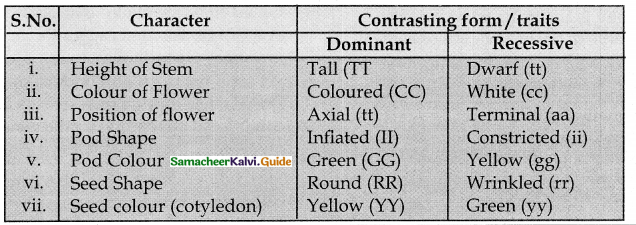
Listant/Point out/Enlist the several traits in pea selected by mendel
Answer:
Samacheer Kalvi 12th Bio Botany Guide Chapter 2 Classical Genetics 13

Question 15.
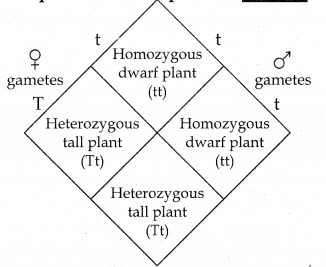
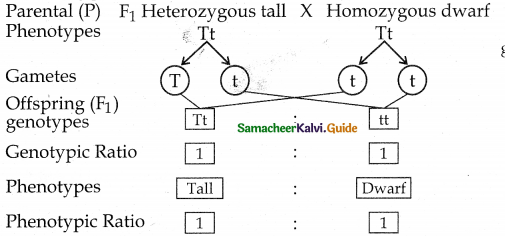
Draw the flow chart for heterozygous tall X homozygous dwarf pisum sativum plants If heterozygous tall test cross
Answer:
Samacheer Kalvi 12th Bio Botany Guide Chapter 2 Classical Genetics 14 Samacheer Kalvi 12th Bio Botany Guide Chapter 2 Classical Genetics 15

Samacheer Kalvi 12th Bio Botany Guide Chapter 2 Classical Genetics

Question 16.
Distinguish between monohybrid cross and dihybrid cross
Answer:
Monohybrid cross :

  1. The cross between to pure parents differing in a single pair of contrasting character is called Monohybrid cross
  2. Phenotypic ratio is 3:1
  3. Genotypic ratio is 1:2:1
  4.  The law of segregation is explained by this method

Dihybrid cross :

  1. The cross between two pure parents differing in two pairs of contrasting character is called dihybrid cross
  2. phenotype ratio is 9:3:3:1
  3. genotype ratio is 1:2:2:4:1:2:1:2:1
  4. The law a independent is explained by this cross.

Question 17.
Distinguish between Test cross and Back cross
Answer:
Test Cross

  1. The cross between F1 hybrid and its recessive parent is called test cross
  2. A test cross is always a back cross
  3. Test cross determines the genetic constitution of an organism
  4. Test cross produces both dominant and recessive character is equal proportion

Back Cross :

  1. The cross between F1 hybrid and any one of its parents (either dominant or recessive) is called back cross.
  2. A back cross is not always a test cross
  3. Back cross helps in improving and obtaining desirable character
  4. Back cross helps in improving and obtaining desirable character

Samacheer Kalvi 12th Bio Botany Guide Chapter 2 Classical Genetics

Question 18.
What is genetic testing?
Answer:
Genetic testing is analysing an individuals genetic material to determine predisposition to a particular health condition or to confirm a diagnosis of genetic disease

Question 19.
What are genetic disorder ?
Answer:
Genetic disorders are nothing but malfunctioning of genes due to some changes in their arrangement brought by mutation. Often these disorders characterized by absence or inactive protein products.

Question 20.
Write a short note on ‘Mutation’?
Answer:
Sudden heritable change in DNA or chromosome is called mutation. There are agents which cause mutation called Mutagens. Due to mutations many abnormalities will appear in new generations which may be useful or harmful.

Question 21.
Co-dominance is an example of intragenic gene interaction. How?
Answer:

  • The phenomenon in which two alleles are both expressed in the heterzygous individual is known as codominance
    Example:
  • Red and white flowers of camellia, inheritance of sickle cell haemoglobin.
  • ABO blood group system in human beings.
  • In humanbeings, IA and IB alleles of I gene are codominant which follows mendels law of segregation.
  • The co-dominance was demonstrated in plants with the help of electrophoresis or chromatography for protein or flavonoid substance.

Samacheer Kalvi 12th Bio Botany Guide Chapter 2 Classical Genetics

Question 23.
What is the different between sex linked and sex influenced diseases ?
Answer:
In sex linked diseases the defected gene are present on the sex chromosomes attached to them whereas in sex influenced diseases defective gene are present on the other chromosome but affects the sex chromosomes.

Question 24.
What is Genome ?
Answer:
A complete set off gene is an organism is called genome .

Question 25.
What are lethal gene or lethal allele ?
Answer:
Lethal allele are alleles that cause the death of the organism that carries them. They are unusually a result of mutation is gene that are essential to growth or development. Lethal allele may be recessive, dominant or conditional depending on the genes or genes involved.

Question 26.
What do you mean by inheritance of sickle cell anemia in man.
Answer:
The diseases sickle cell anemia is causes by a gene (Hbs) which is lethal in homozygous condition. But has a slight denotable effect is the heterozygous conditions, producing sickle cell trait. The homozygous for this gene (Hbs/HbS) generally die of fatal anemia. The hetrozygotes or carriers for Hbs. (ie) HbA/HbS) show signs of mild anemia as their RBC become sickle – shaped in oxygen deficiency. A marriage between two carriers, therefore results in carrier and normal offspring in the ratio 2:1

Samacheer Kalvi 12th Bio Botany Guide Chapter 2 Classical Genetics

Question 27.
What is cytoplasmic male sterility ?
Answer:
Plants that fail to produce functional pollengrains are said to be male-sterile. If the traits conditioning the sterility is not inherited according to mendelion rules, but is instead maternally transmitted, it is referred to as cytoplasmic male sterility(cms). So in this male-sterility is inherited maternally.
The gene for cytoplasmic male sterility is found in the mitochondrial DNA
(or)
When plants fails to produce functional pollengrain, they are called male sterile mole. Male sterility may be conditioned by either nuclear or Cytoplasmic genes. If the sterility trait is inherited is a non -Mandelian fashion, it is designated as cytoplasmic male sterility (CMS). Cytoplasmic gene are most often maternally transmitted in plants.

Question 28.
Briefly explain ‘Atavism’ with suitable examples.
Answer:
Atavism derives via French from Latin atavius, meaning “ancestor”. Avus in Latin means ‘grand father’; and its is believed that the ‘at’ is related to atta a word for “Daddy”. Atavism is a term rooted in evolutionary study referring to instances when an organism possesses trait closer to a more remote ancestor, rather than its own parents. It is modification of a biological structure whereby an ancestral traits re appears after having been lost through evolutionary changes is the previous generations.

(eg) Re-emergence of sexual reproduction in the flowering plant Hieracium pilosella is the best example for Atavism in plants

Question 29.
How to do test for homozygosity of a trait in plant.
Answer:

  • To identify whether an organism exhibiting a dominant trait is homozygous or hesterozy- gous for a specific allele a scientist can perform a test cross.
  • The organism in question can be crossed with an organism that is homozygous for the recessive trait – and the offspring’s of the test cross are examined.

Samacheer Kalvi 12th Bio Botany Guide Chapter 2 Classical Genetics

XII. Five Marks

Question 1.

Difference between Pleiotropy and polygenic inheritance with suitable examples.
Answer:
Pleiotropy is when one gene affect multiple characters eg. Marfan syndrome and polygene inheritance is when one traits is controlled by multiple genes (eg), skin colour (or) skin pigmentation

Question 2.
Co-dominance and incomplete dominance are not the same? why?
Answer:

  • In co-dominance neither allele is dominant over the other, so both will be expressed equally in the heterozygote.
  • In incomplete dominance, there is an intermediate heterozygote. Such as pink flower when the parent phenotypes are red. and white.

Question 3.
Difference between Monohybrid cross and Reciprocal cross.
Answer:
Monohybrid

  1.  It is one sided or both sided
  2.  It is used to study the inheritance of single pair of alleles.
  3. It cannot distinguish between nuclear and Cytoplasmic (or) sex linked and autosomal traits

Reciprocal cross

  1. It is both sided cross in which female of one type is crossed with male of the second type and vice versa
  2. It may study inheritance of one, two or more traits
  3. It can distinguish between nuclear and cytoplasmic inheritance as well as sea linked l j and autosomal inheritance.

Samacheer Kalvi 12th Bio Botany Guide Chapter 2 Classical Genetics

Question 4.
Difference between Monohybrid and Dihybrid cross
Answer:
Monohybrid :

  1. Mono refer to single and hybrid means mixed breed
  2. It is used to study the inheritance of single pair of alleles.
  3. Genotype ratio is 1:2:1
  4. Phenotypic ratio is 3:1
  5. One pair of contrasting character are involved

Dihybrid

  1. Di refers to two or double and hybrid means breed.
  2. It is used to study the inheritance of two different alleles.
  3. Genotype is ratio is 1:2:1:2:4:2:1:2:1
  4. Phenotypic ratio is 9:3:3:1
  5. Two pair of contrasting character are involved.

Question 5.
Explain Monohybird cross.
Answer:
A monohybird is a genetic cross which occurs between two individuals, focusing on the inheritance of one trait at one time. Monohybrid cross is also known as single trait cross. Two homozygous parent are selected for this cross.
Samacheer Kalvi 12th Bio Botany Guide Chapter 2 Classical Genetics 16
Each homozygous parent in the P generation produces only one kind of gamete.
The heterozygous F] offspring produces two kinds of gamete
The heterozygous Fi offspring produces two kinds of gamete
Samacheer Kalvi 12th Bio Botany Guide Chapter 2 Classical Genetics 17

Samacheer Kalvi 12th Bio Botany Guide Chapter 2 Classical Genetics

Question 6.
Explain Dihybrid cross.
Answer:
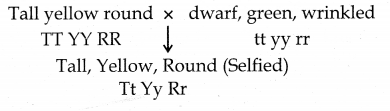
A dihybrid cross is a genetic cross that occurs between two individuals, focusing on the inheritance of two independent traits at one time. It is also known as two trait cross.
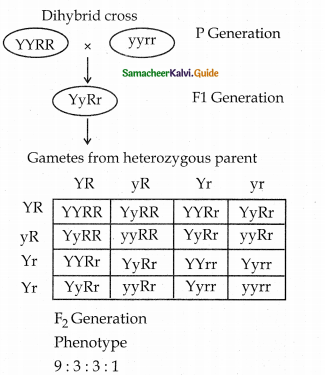
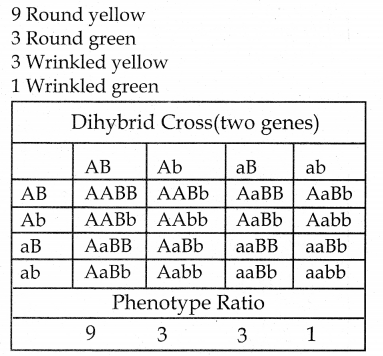
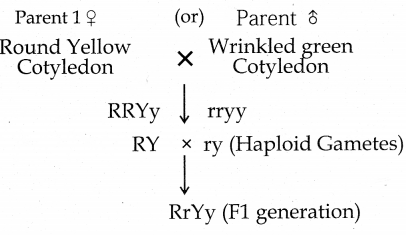
Two parents considered for this cross have two independent traits (eg: pea colour and pea shapes of plants). Thus a dihybrid cross involves two pairs of genes. The following figure explains the process of dihybrid crossing.
Samacheer Kalvi 12th Bio Botany Guide Chapter 2 Classical Genetics 18
Samacheer Kalvi 12th Bio Botany Guide Chapter 2 Classical Genetics 19

Samacheer Kalvi 12th Bio Botany Guide Chapter 2 Classical Genetics 20

F1 phenotype: All round yellow cotyledon
Fi genotype : All RrYy
RrYy x RrYy (Fj generation selfied)
Ry Ry rY rY x Ry Ry ry ry (Haploid gametes)

How to do a Dihybrid Cross

  • Analyze the data!
  • Make a tally of all possible phenotypes.

Samacheer Kalvi 12th Bio Botany Guide Chapter 2 Classical Genetics 21

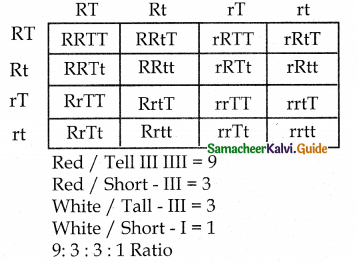
In a dihybrid cross, traits are considered as not linked, and they have an equal probability of sharing up in offspring. Each pair of alleles segregates independently of the gametes. Offspring is predicted and assessed for two trait inheritance. The phenotypic ratio of the offspring generation is 9:3:3:1 in a dihybrid cross.

Samacheer Kalvi 12th Bio Botany Guide Chapter 2 Classical Genetics

Question 7.
Briefly explain Trihybrid cross.
Answer:
A trihybrid cross is between two individuals that are homozygous for three different traits. (Eg: Pea shape, colour and pea shape)
(or)
A cross between homozygous parents that differ in three gene pairs, (ie: producing trihybrid) is called trihybrid cross. A seed fertilizing trihybrid plant forms 8 different gametes and 64 different zygotes. So a combination of three single pair crosses operating together. The three contrasting characters of a trihybrid crosses are
Samacheer Kalvi 12th Bio Botany Guide Chapter 2 Classical Genetics 22

  • F2 Phenotypic ratio – 27:9:9:9:3:3:3:1
  • 27 – round, green, smooth pod
  • 9 – round, green, constructed pod
  • 9 – round, yellow, smooth pod
  • 9 – wrinkled, green, smooth pod
  • 3 – round, yellow, constructed pod
  • 3 – wrinkled, green, constructed pod
  • 3 – wrinkled, yellow, smooth pod
  • 1- wrinkled, yellow, constructed pod

Samacheer Kalvi 12th Bio Botany Guide Chapter 2 Classical Genetics 23

Question 8.
What traits are determined by multiple alleles?
Answer:
A trait controlled by one gene but multiple allele is blood type. There are four phenotypes A, B, AB, O. Type A and B are co-dominant and ‘O’ is recessive to A and B. None are dominant. Some traits are controlled by a single gene with two alleles. Mendelian heredity had only two alternative expression or alleles. However many genes can change in several different ways or changes. Those changes give rise to several alternative states which are called multiple alleles.
(or)
Blood type is an example of a common multiple allele trait. There are three different alleles for blood type A, B & O. A is dominant to O, B is also dominant to O. A and B are both co-dominant.

Samacheer Kalvi 12th Bio Botany Guide Chapter 2 Classical Genetics

Question 9.
What is a gene?
Answer:
A gene is a segment of DNA that spells out the gentic code for a particular trait. A trait is a physical characteristics.

Question 10.
What is Incomplete dominance with example.
Answer:

  • Carl Correns’s (1905) experimented in 40′ clock plant, Mirabilis jalapn.
  • When the pure breeding homozygous red (R1R1) parent is crossed with homozygous white (R1R1)
  • The phenotype of the F1 hybrid is heterozygous pink (R2R2)
  • The F1 heterozygous phenotype differs from both the parental homozygous phenotype.
  • This cross did not exhibit the character of the dominant parent but has an intermediate colour pink.
  • The phenotypic and genotypic ratios were found to be same as 1:2:1 (1 red : 2 pink : 1 white). Genotypic ratio is 1 R1R1: 2 R1R2: 1 R2R2 in F2 interbreed.
  • In the F2 generation, R1 and R2 genes segregate and recombine to produce red, pink and white in the ratio of 1:2:1.
  • R1 allele codes for an enzyme responsible for the formation of red pigment and R2 allele codes for defective enzyme. R1 and R2 genotypes produce only enough red pigments to make the flower pink.
  • Mendel’s particulate inheritance takes place in this cross which is confirmed by the reappearance of original phenoty in F2
    Samacheer Kalvi 12th Bio Botany Guide Chapter 2 Classical Genetics 24
    Samacheer Kalvi 12th Bio Botany Guide Chapter 2 Classical Genetics 25

Samacheer Kalvi 12th Bio Botany Guide Chapter 2 Classical Genetics

Question 11.
Briefly explain about lethal gene.
Answer:
Allele that cause an organism to die are called lethal alleles or lethal genes. Lethal genes are usually a result of mutations in genes that are essential to the growth or development. Lethal gene can cause death of an organism prenatally or anytime after birth. Lethal genes are first discovered by Lucien cuenot in the study of coat colour in mice.
Samacheer Kalvi 12th Bio Botany Guide Chapter 2 Classical Genetics 26

Question 12.
Explain epistatsis and its two types.
Answer:
Epistasis is a type of polygenic interaction where one gene controls the phenotype of another gene for a trait. Both genes have an influence on the physical appearance of the traits, but the one that shows epistasis masks the effect of the other. Eg: albinism.

Dominant epistatsis: It happens when the dominant allele of one gene masks the expression of all allele of another gene.

Recessive Epistasis:
Recessive epistasis is when the recessive allele of one gene in a homozygous slate masks the phenotypic expression of the dominant allele of another gene.
(eg) Mice,
In Mice, body Colour is determined by a gene A. A is hypostatic to an allele C of another gene, which mean that C marks the expression of A. C is the presence of a gives cinnamon mice, While C in the prsence of A gives agouti mice.

Recessive Epistasis :
Samacheer Kalvi 12th Bio Botany Guide Chapter 2 Classical Genetics 28

  • Samacheer Kalvi 12th Bio Botany Guide Chapter 2 Classical Genetics 27

In dominant epistasis, the majority of the individuals are affected. There is a 12:3:1 ration.
Samacheer Kalvi 12th Bio Botany Guide Chapter 2 Classical Genetics 29
Genes that show recessive epistasis can only mask a phenotype if two alleles are present The ratio is 9:3:4
Samacheer Kalvi 12th Bio Botany Guide Chapter 2 Classical Genetics 30

Samacheer Kalvi 12th Bio Botany Guide Chapter 2 Classical Genetics

Question 13.
Briefly explain duplicate recessive gene in Intergenic interaction (or) complementary gene interaction
Answer:
If both gene loci have homozygous recessive alleles and both of them produce identical phenotype the F2 ratio 9:3:3:1 would be 9:7. The genotype aaBB, aaBb, AAbb, Aabb and aabb produce same phenotype. Both dominant alleles when are present together only than they can complement each other. This is known as complementary gene.
Complementary Genes (9:7)
Ex: In Lathyrusodoratus ,Bateson and punnet crossed two varieties(CCpp x ccPP),each with white flowers.
Samacheer Kalvi 12th Bio Botany Guide Chapter 2 Classical Genetics 31

  • Eg: complete dominance at both gene pairs, but either recessive homozygote is epistatic to the effect of the other gene.
  • In sweet pea flower colour.
  • Gene pair A = purple dominant over white
  • Gene pair B = colour dominant over white
  • Interaction = Homozygous recessive of either gene A or B produce white

Samacheer Kalvi 12th Bio Botany Guide Chapter 2 Classical Genetics 32

Question 14.
Explain duplicate gene with cumulative effect (9:6:1)
Answer:

  • Certain phenotype traits despond on the dominant alleles of two gene loci. When dominant is present it will share its phenotype. The ratio will be 9:6;1 Eg: Fruit shape in summer squash.
  • Complete dominance at both gene pair, interaction between, both dominance to give new phenotype.
  • Gene pair ‘A’ sphere shape dominant over long.
  • Gene pair ‘B’ sphere shape dominant over long.
  • So interaction at ‘AB’ when present together form disc shaped fruit.
  • Finally disc shaped fruit 9/16 Sphere shaped fruit 6/16
    Samacheer Kalvi 12th Bio Botany Guide Chapter 2 Classical Genetics 33

Duplicate genes with cumulative effect (9:6:1) :
Samacheer Kalvi 12th Bio Botany Guide Chapter 2 Classical Genetics 34

Samacheer Kalvi 12th Bio Botany Guide Chapter 2 Classical Genetics

Question 15.
What are Duplicate dominant gene (15:1) or duplicate gene?
Answer:

  • If a dominant allele of both gene low produces the same phenotype without cumulative effect i.e., independently the ratio will be 15:1
  • Eg : seed capsule of shephered’s purse complete dominance at both gene pair, but either gene when dominant, epistatic to the other.
  • Gene pair ‘A’=Triangular shape dominant over ovoid
    Gene pair ‘B’=Triangular shape dominant over ovoid (double recessive)

Duplicate dominant genes (15:1):
15/16 = Triangular
1/16= Ovoid (top shaped)
AABB x aabb
Triangular ovoid
AaBb x AaBb
Triangular Samacheer Kalvi 12th Bio Botany Guide Chapter 2 Classical Genetics 35

Question 16.
Explain dominant and recessive interaction (or) inhibitor gene (13:3)
Answer:
Sometimes the dominant alleles of one gene locus (A) in homozygous and heterozygous (AA, Aa) condition and homozygous recessive alleles bb of another locus (B) produces the same phenotype. The F2 ratio will become 13:3. The genotype AABB, AaBB, AAbb, Aabb and aabb produce one type of phenotype and genotype aaBb, aaBB, will produce another type of phenotype.

  • Eg: Feather colour of Fowl
  • Complete dominance at both gene pair, but are gene when dominant epistatic to the other and the second gene when homozygous recessive epistatic to the first.
  • Gene ‘A’ colour inhibition is dominant to colour appearance.
  • Gene ‘B’ colour in dominant to white.

Interaction:

  • Dominant colour inhibitors prevents colour even when colour is present, colour gene, when homozygous recessive prevents colour when dominant inhibitor is present.

Dominant and recessive interaction (13:3):

13/16 = white
3/16 = coloured
Samacheer Kalvi 12th Bio Botany Guide Chapter 2 Classical Genetics 36
Samacheer Kalvi 12th Bio Botany Guide Chapter 2 Classical Genetics 37

Samacheer Kalvi 12th Bio Botany Guide Chapter 2 Classical Genetics

Question 17.
Male sterility found in pearl maize (sorgum Vulgare) is the best example for mitochondria cytoplasmic inheritance.
Answer: Male sterility found in pearl maize (sorgum Vulgare) is the best example for mitochondria cytoplasmic inheritance. so it is called cytoplasmic male sterility.
In this, male sterility is inherited maternally.
The gene for cytoplasmic male sterility is found in the mitochondrial DNA.

In this plant there are two types, one with normal cytoplasm (N) which is male fertile and the other one with aberrant cytoplasm (s) which is male sterile.
These types also exhibit reciprocal differences as found in Mirabilis jalapa
Samacheer Kalvi 12th Bio Botany Guide Chapter 2 Classical Genetics 38

Recently it has been discovered that cytoplasmic genetic male sterility is common in many plant species.
This sterility maintained by the influence of both nuclear and cytoplasmic genes.
There are commonly two types of cytoplasm N (Normal) and S (Sterile)
The genes for these are found in mitochondrian.
There are also restores of fertility (Rf) genes. Even though these genes are nuclear genes, they are distinct from genetic male sterility genes of other plants.
Because the Rf genes do not have any expression of their own, unless the sterile cytoplasm is present.
Rf genes are required to restore fertility in S cytoplasm which is responsible for sterility.
So the combination of N cytoplasm with rfrf and s cytoplasm with RfRf products plants with fertile pollens, while S cytoplasm with rfrf produces only male sterile plants.
Samacheer Kalvi 12th Bio Botany Guide Chapter 2 Classical Genetics 39

Samacheer Kalvi 12th Maths Guide Chapter 6 Applications of Vector Algebra Ex 6.9

Tamilnadu State Board New Syllabus Samacheer Kalvi 12th Maths Guide Pdf Chapter 6 Applications of Vector Algebra Ex 6.9 Textbook Questions and Answers, Notes.

Tamilnadu Samacheer Kalvi 12th Maths Solutions Chapter 6 Applications of Vector Algebra Ex 6.9

Question 1.
Find the equation of the plane passing through the line of intersection of the planes \(\overline { r }\) = (2\(\hat { i }\) – 7\(\hat { j }\) + 4\(\hat { k }\)) = 3 and 3x – 5y + 4z + 11 = 0 and the point (- 2, 1, 3).
Solution:
Given planes are
\(\vec{r} \cdot(2 \hat{i}-7 \hat{j}+4 \hat{k})\) = 3
2x – 7y + 4z – 3 = 0 and 3x – 5y + 4z + 11 = 0
Equation of a plane which passes through the line of intersection of the planes
(2x – 7y + 4z – 3) + λ(3x – 5y + 4z + 11) = 0 …………… (1)
This passes through the point (-2, 1, 3).
(1) ⇒ (-4 – 7 + 12 – 3) + λ(-6 – 5 + 12 + 11) = 0
-2 + λ(12) = 0 ⇒ 12λ = 2
λ = \(\frac{2}{12}\) ⇒ λ = \(\frac{1}{6}\)
The required equation is
(1) ⇒ (2x – 7y + 4z – 3) + \(\frac{1}{6}\) (3x – 5y + 4z + 11) = 0
12x – 42y + 24z – 18 + 3x – 5y + 4z + 11 = 0
15x – 47y + 28z – 7 = 0

Samacheer Kalvi 12th Maths Guide Chapter 6 Applications of Vector Algebra Ex 6.9

Question 2.
Find the equation of the plane passing through the line of intersection of the planes x + 2y + 3z = 2 and x – y + z = 3 and at a distance \(\frac { 2 }{ √3 }\) from the point (3, 1, -1).
Solution:
Required equation of the plane
(x + 2y + 3z – 2) + λ(x – y + z – 3) = 0 ………. (1)
(1 + λ)x + (2 – λ)y + (3 + λ)z + (-2 – 3λ) = 0 ………(2)
Distance from (2) to the point (3, 1, -1) is \(\frac { 2 }{ √3 }\)
Samacheer Kalvi 12th Maths Guide Chapter 6 Applications of Vector Algebra Ex 6.9 1
putting
λ = \(\frac { -7 }{ 2 }\) in (1)
The required equation
(x + 2y + 3z – 2) – \(\frac { 7 }{ 2 }\) (x – y + z – 3) = 0
2x + 4y + 6z – 4 – 7x + 7y – 7z + 21 = 0
-5x + 11y – z + 17 = 0
5x – 11y + z – 17 = 0

Question 3.
Find the angle between the line
\(\overline { r }\) = (2\(\hat { i }\) – \(\hat { j }\) + \(\hat { k }\)) + (\(\hat { i }\) + 2\(\hat { j }\) – 2\(\hat { k }\)) and the plane \(\overline { r }\) (6\(\hat { i }\) + 3\(\hat { j }\) + 2\(\hat { k }\)) = 8
Solution:
Samacheer Kalvi 12th Maths Guide Chapter 6 Applications of Vector Algebra Ex 6.9 6

Samacheer Kalvi 12th Maths Guide Chapter 6 Applications of Vector Algebra Ex 6.9

Question 4.
Find the angle between the planes \(\overline { r }\) (\(\hat { i }\) + \(\hat { j }\) – 2\(\hat { k }\)) = 3 and 2x – 2y + z = 2.
Solution:
Samacheer Kalvi 12th Maths Guide Chapter 6 Applications of Vector Algebra Ex 6.9 2

Question 5.
Find the equation of the plane which passes through the point (3, 4, -1) and is parallel to the plane 2x – 3y + 5z + 7 = 0. Also, find the distance between the two planes.
Solution:
The required equation parallel to the plane
2x – 3y + 5z + 7 = 0 ………….. (1)
2x – 3y + 5z + λ = 0 ………….. (2)
This passes through (3, 4, -1)
(2) ⇒ 2(3) – 3(4) + 5(-1) + λ = 0
6 – 12 – 5 + 1 = 0
λ = 11
(2) ⇒ The required equation is 2x – 3y + 5z + 11 =0 …………… (3)
∴ Now, distance between the above parallel lines (1) and (3)
a = 2, b = -3, c = 5, d1 = 7, d2 = 11
Samacheer Kalvi 12th Maths Guide Chapter 6 Applications of Vector Algebra Ex 6.9 3

Samacheer Kalvi 12th Maths Guide Chapter 6 Applications of Vector Algebra Ex 6.9

Question 6.
Find the length of the perpendicular from the point (1, -2, 3) to the plane x – y + z = 5.
Solution:
Samacheer Kalvi 12th Maths Guide Chapter 6 Applications of Vector Algebra Ex 6.9 4

Question 7.
Find the point of intersection of the line with the plane (x – 1) = \(\frac { y }{ 2 }\) = z + 1 with the plane 2x – y – 2z = 2. Also, the angle between the line and the plane.
Solution:
Any point on the line x – 1 = \(\frac{y}{2}\) = z + 1 is
x – 1 = \(\frac{y}{2}\) = z + 1 = λ,(say)
(λ + 1, 2λ, λ – 1)
This passes through the plane 2x – y + 2z = 2
2(λ + 1) – 2λ + 2(λ – 1) = 2
2λ + 2 – 2λ + 2λ – 2 = 2
λ = 1
∴ The required point of intersection is (2, 2, 0)
Samacheer Kalvi 12th Maths Guide Chapter 6 Applications of Vector Algebra Ex 6.9 5

Samacheer Kalvi 12th Maths Guide Chapter 6 Applications of Vector Algebra Ex 6.9

Question 8.
Find the co-ordinates of the foot of the perpendicular and length of the perpendicular from the point (4, 3, 2) to the plane x + 2y + 3z = 2.
Solution:
Let us take the point P(4, 3, 2) and Q(x1, y1, z1)
⇒ (x1 – 4, y1 – 3, z1 – 2)
Plane x + 2y + 3z = 2 ………. (1)
Cartesian equation of PQ, \(\frac { x_1-4 }{ 1 }\) = \(\frac { y_1-3 }{ 2 }\) = \(\frac { z_3-2 }{ 3 }\) = λ
(λ + 4, 2λ + 3, 3λ + 2) lies in (1)
(λ + 4) + 2(2λ + 3) + 3(3λ + 2) – 2 = 0
λ + 4 + 4λ + 6 + 9λ + 6 – 2 = 0
14λ + 14 = 0
14λ = -14 .
λ = -1
Co-ordinates of the foot of the ⊥r is (3, 1, -1).
Distance PQ = \(\sqrt{(4-3)^2 + (3-1)^2 + (2+1)^2}\)
= \(\sqrt{1^2 + 2^2 + 3^2}\) = \(\sqrt{1 + 4 + 9}\)
= \(\sqrt{14}\) units.

Samacheer Kalvi 12th Bio Botany Guide Chapter 1 Asexual and Sexual Reproduction in Plants

Tamilnadu State Board New Syllabus Samacheer Kalvi 12th Bio Botany Guide Pdf Chapter 1 Asexual and Sexual Reproduction in Plants Text Book Back Questions and Answers, Notes.

Tamilnadu Samacheer Kalvi 12th Bio Botany Solutions Chapter 1 Asexual and Sexual Reproduction in Plants

12th Bio Botany Guide Asexual and Sexual Reproduction in Plants Text Book Back Questions and Answers

Samacheer Kalvi 12th Bio Botany Guide Chapter 1 Asexual and Sexual Reproduction in Plants

I. Choose the correct answer

Question 1.
Choose the correct statement from the following
a) Gametes are involved in asexual reproduction
b) Bacteria reproduce asexually by budding
c) Conidia formation is a method of sexual reproduction
d) Yeast reproduce by budding
Answer:
d) Yeast reproduce by budding

Question 2.
An eminent Indian embryologist is
a) S.R.Kashyap
b) P.Maheswari
c) M.S. Swaminathan
d) K.C.Mehta
Answer:
b) P.Maheswari

Question 3.
Identify the correctly matched pair
a) Tuber – Allium cepa
b) Sucker – Pistia
c) Rhizome – Musa
d) Stolon – Zingiber
Answer:
c) Rhizome – Musa

Samacheer Kalvi 12th Bio Botany Guide Chapter 1 Asexual and Sexual Reproduction in Plants

Question 4.
Pollen tube was discovered by
a) J.G.Kolreuter
b) G.B.Amici
c) E.Strasburger
d) E.Hanning
Answer:
b) G.B.Amici

Question 5.
Size of pollen grain in Myosotis
a) 10 micrometer
b) 20 micrometer
c) 200 micrometer
d) 2000 micrometer
Answer:
a) 10 micrometer

Question 6.
First cell of male gametophyte in angiosperm is
a) Microspore
b) megaspore
c) Nucleus
d) Primary Endosperm Nucleus
Answer:
a) Microspore

Samacheer Kalvi 12th Bio Botany Guide Chapter 1 Asexual and Sexual Reproduction in Plants

Question 7.
Match the following

I. External fertilizationi. pollen grain
II. Androeciumii. anther wall
III. Male gametophyteiii. algae
IV. Primary parietal layeriv stamens

Answer:
a) I—iv; ll—i; III—ii; I’V—iii
b) 1—iii; J1—iv; III—i; V—ii
c) I—iii; I1—iv; III—ii, IV—i
d) I—iii; II—i; III—iv; IV—ii
Answer:
b) I—iii;II—iv;III—i;1 V—ii

Samacheer Kalvi 12th Bio Botany Guide Chapter 1 Asexual and Sexual Reproduction in Plants

Question 8.
Arrange the layers of anther wail from locus to periphery
a) Epidermis,middle layers, tapetum, endothecium
b) Tapetum, middle layers, epidermis, endothecium
c) Endothecium, epidermis, middle layers, tapetum
d)Tapetum, middle layers endothecium epidermis
Answer:
d) Tapetum, middle layers endothecium epidermis

Question 9.
Identify the incorrect pair
a) sporopollenin – exine of pollen grain
b) tapetum – nutritive tissue for developing microspores
c) Nucellus – nutritive tissue for developing embryo
d) obturator – directs the pollen tube into micropyle
Answer:
c) Nucellus – nutritive tissue for developing embryo

Samacheer Kalvi 12th Bio Botany Guide Chapter 1 Asexual and Sexual Reproduction in Plants

Question 10.
Assertion : Sporopollenin preserves pollen in fossil deposits.
Reason : Sporopollenin is resistant to physical and biological decomposition.
a) Assertion is true; reason is false
b) Assertion is false; reason is true
c) Both Assertion and reason are not true
d) Both Assertion and reason are true
Answer:
d) Both Assertion and reason are true

Question 11.
Choose the correct statement(s) about tenuinucellate ovule
a) Sporogenous cell is hypodermal
b) Ovules have fairly large nucellus
c) sporogenous cell is epidermal
d) ovules have single layer of nucellus tissue
Answer:
a) Sporogenous cell is hypodermal and d)ovules have single layer of nucellus tissue

Samacheer Kalvi 12th Bio Botany Guide Chapter 1 Asexual and Sexual Reproduction in Plants

Question 12.
Which of the following represent megagametophyte
a) Ovule
b)Embryo sac
c) Nucellus
d)Endosperm
Answer:
b) Embryo sac

Question 13.
In Haplopappus gracilis, number of chromosomes in cells of nucellus is 4. What will be the chromosome number in Primary endosperm cell?
a) 8
b) 12
c) 6
d) 2
Answer:
C) 6 (3n)

Samacheer Kalvi 12th Bio Botany Guide Chapter 1 Asexual and Sexual Reproduction in Plants

Question 14.
Transmitting tissue is found in
a) Micropylar region of ovule
b) Pollen tube wall
c) Stylar region of gynoecium
d) Integument
Answer:
c) Stylar region of gynoecium

Question 15.
The scar left by funiculus in the seed is
a) tegmen
b) radicle
c) epicotyl
d) hilum
Answer:
d) hilum

Question 16.
A Plant called X possesses small flower with reduced perianth and versatile anther. The probable agent for pollination would be
a) water
b) air
c) butterflies
d) beetles
Answer:
b) air

Samacheer Kalvi 12th Bio Botany Guide Chapter 1 Asexual and Sexual Reproduction in Plants

Question 17.
Consider the following statement(s)
i) In Protandrous flowers pistil matures earlier
ii) In Protogynous flowers pistil matures earlier
iii) Herkogamy is noticed in unisexual flowers
iv) Distyly is present in Primula
a) i and ii are correct
b) ii and iv are correct
c) ii and iii are correct
d) i and iv are correct
Answer:
b) ii and iv are correct

Question 18.
Coelorhiza is found in
a) Paddy
b)Bean
c) Pea
d) Tridax
Answer:
a) Paddy

Samacheer Kalvi 12th Bio Botany Guide Chapter 1 Asexual and Sexual Reproduction in Plants

Question 19.
Parthenocarpic fruits lack
a) Endocarp
b) Epicarp
c) Mesocarp
d) seed
Answer:
d) seed

Question 20.
In the majority of plants, pollen is liberated at
a) 1 celled stage
b) 2 celled stage
c) 3 celled stage
d) 4 celled stage
Answer:
b) 2 celled stage

Question 21.
What is reproduction?
Answer:
Reproduction is the biological process of producing young ones of their own kind. It is a vital process for the existence of a species and it also brings suitable changes through variation in the offsprings for their survival on ear

Question 22.
Mention the contribution of Hofmeister towards Embryology.
Answer:

  • He worked on flowering plant embryology.
  • Discovered alternation of generation in plants.
  • He described the structure of pollen tetrad.

Samacheer Kalvi 12th Bio Botany Guide Chapter 1 Asexual and Sexual Reproduction in Plants

Question 23.
List out two sub-aerial stem modifications with example.
Answer:
Subaerial stem modifications.
The stem is partly aerial and partly underground.

a) Runner. (Ex. oxalis, Centella Asiatica)

  • It is running horizontally on the soil surface.
  • Nodes have axillary buds, scale leaves, and adventitious roots.
  • Runner arises from the axillary bud.
  • Mother plant produces many runners in all directions.
  • They break off and grow into individual plants.

b) Sucker. (Ex. Musa (banana), chrysanthemum)
Grows horizontally for a distance under the soil. Then it emerges obliquely upwards.

c) Stolon (Ex. Strawberry, Vallisneria)
Develop from underground stems.
They grow horizontally outwards.

d) Offset (condensed runners)
Unlike runners, they produce tilt of leaves above and duster of roots below Ex. Pistia, Eichhornia.

Samacheer Kalvi 12th Bio Botany Guide Chapter 1 Asexual and Sexual Reproduction in Plants

Question 24.
What is layering?
Answer:

  • It is an artificial method of vegetative propagation.
  • The stem of the parent plant is allowed to develop roots while still intact.
  • The root develops. The rooted part is cut. It is planted to grow as a new plant.
  • Ex. Ixora, Jasminum.

Question 25.
What are clones?
Answer:
Individuals developed by asexual reproduction are morphologically and genetically identical. Such individuals are called clones.

Question 26.
A detached leaf of Bryophyllum produces new plants. How?
Answer:

  • Bryophyllum undergoes vegetative reproduction in the leaf.
  • The succulent leaf is notched in its margin.
  • Adventitious buds develop at these notches. They are called epiphyllous buds.
  • These buds develop a root system. When the leaf decays, they become independent plants.

Question 27.
Differentiate Grafting and Layering.
Answer:
Grafting:

  1. In grafting, two different plants (stock & scion) are used to develop new plants.
  2. The new plant will support to possess the characters of both the parents or new variation can be noticed.

Layering:

  1. In layering, only one plant is used to develop a new plant.
  2. Variation cannot be expected. The new individual is exactly similar to the parent plant.

Question 28.
“Tissue culture is the best method for propagating rare and endangered plant species” Discuss.
Answer:
Micropropagation.
The growth of plant tissue in special culture medium under suitable controlled conditions is known as “tissue culture”.
it is the regeneration of a whole plant from a single cell or tissue.

Advantages.

  • Rare, Endangered plants are propagated.
  • In a short duration, plants with desirable characteristics can be multiplied.
  • Produce Genetically identical plants.
  • Done in any season.
  • Plants without viable seeds (or) difficult to germinate can be propagated.
  • Meristem culture produces disease-free plants.
  • Cells can be genetically modified or transformed.

Samacheer Kalvi 12th Bio Botany Guide Chapter 1 Asexual and Sexual Reproduction in Plants

Question 29.
Distinguish mound layering and air layering.
Answer:
Mound Layering:
In mound layering, a lower flexible branch with leaves is bent to the ground and a part of the stem is buried in the soil and the tip of the branch is exposed above the soil. After the roots emerge from the buried stem, a cut is made in the parent plant so that the buried plant grows into a new plant.

Question 30.
Explain the conventional methods adopted in the vegetative propagation of higher plants.
Answer:
Conventional methods of vegetative propagation.
a) Cutting (Ex. Hibiscus)

  • Plant parts like stem, leaf are cut from the parent plant.
  • Cut part is placed in suitable medium,
  • It produces root and grows into a new plant.

b) Grafting (Ex. Citrus, Mango)

  • Two different plants are joined.
  • They grow as one plant.
  • Plant in soil is called stock.
  • Plant used for grafting is the scion.
  • It is of 5 types.

i) Bud grafting – scion is placed in the incision of stock.
ii) Approach grafting – Cut surfaces of stock scion are tied together.
iii) Crown Grafting – Wedge-shaped scion is inserted into the cleft of stock.
iv) Tongue grafting – Stock and scion are cut obliquely scion is fit into stock and bound with tape.
v) Wedge grafting – Twig of the scion is inserted into slot in the stock.

Samacheer Kalvi 12th Bio Botany Guide Chapter 1 Asexual and Sexual Reproduction in Plants

c) Layering
Stem of parent plant is allowed to develop roots while still intact. The root develops. The rooted part is cut and planted to grow as a new plant.

I) Mound Layering

  • Flexible branch is buried in soil.
  • Roots emerge from buried stem. It grows into a new plant.

ii) Air Layering

  • Nodal region is girdled.
  • Hormones are applied.
  • Rooting is promoted.
  • This area is covered by moist soil.
  • Roots emerge in 2-4 months.
  • Roots branches are removed from parent. They are grown separately.

Question 31.
Highlight the milestones from the history of plant embryology.
Answer:

  1. 1682 – Nehemiah Grew mentioned stamens as the male organ of a flower.
  2. 1694 – R.J. Camerarius described the structure of a flower, anther, pollen, and ovule
  3. 1761 – J.G. Kolreuter gave a detailed account of the importance of insects in pollination.
  4. 1824 – G.B. Amici discovered the pollen tube.
  5. 1848 – Hofmeister described the structure of pollen tetrad.
  6. 1870 – Hanstein described the development of embryos in Capsella and Alisma.
  7. 1878 – E. Strasburger reported polyembryony.
  8. 1884 – E. Strasburger discovered the process of Syngamy.
  9. 1899 – S.G. Nawaschin and L. Guignard independently discovered Double fertilization.
  10. 1904- E. Hanning initiated embryo culture.
  11. 1950 – D.A. Johansen proposed classification for embryo development.
  12. 1964 – S. Guha and S.C. Maheswari raised haploids from Datura pollen grains
  13. 1991 – E.S. Coen and E.M. Meyerowitz proposed the ABC model to describe the genetics of initiation and development of floral parts
  14. 2015 – K.V. Krishnamurthy summarized the molecular aspects of pre and post-fertilization reproductive development in flowering plants.

Question 32.
Discuss the importance of Modern methods in reproduction of plants.
Answer:
The genetic ability of a plant cell to produce the entire plant under suitable condition is said to be totipotency.

  • This characteristic feature of a cell is utilized in horticulture, forestry and industries to propagate plants.
  • The mature phloem parenchyma cells removed from the carrot were placed in a suitable medium under controlled conditions.
  • It stimulate to start dividing again to produce a new carrot plant.

Importance of modern methods of reproduction in plants.

  • Rapid Multiplication of desired plants in short duration.
  • Genetically identical plants are produced.
  • Tissue culture can be done at any season
  • Plants without viable seeds (or) difficult to germinate can be propagated.
  • Rare, Endangered plants are propagated.
  • Meristem culture produces disease-free plants.
  • Cells are genetically modified or transformed.

Samacheer Kalvi 12th Bio Botany Guide Chapter 1 Asexual and Sexual Reproduction in Plants

Question 33.
What is Cantharophily?
Answer:

  • It is the cross-pollination of flowers by beetles. They feed on pollen or juicy tissues of their flower.
  • The plants using this mode of pollination
  • Er. Nymphaea species of plants – Rhinoceros beetle.
  • Giant Water lily – Scarab beetle
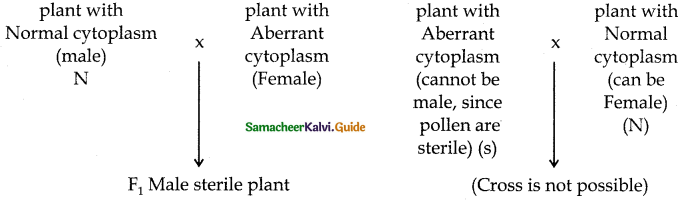
  • Illicium plant – Diptera files.

Question 34.
List any two strategy adopted by bisexual flowers to prevent self-pollination.
Answer:
1) Dichogamy
Anthers and stigmas mature at different times.

  •  Protandry – Stamens mature earlier.
  • Protogyny – Stigmas mature earlier.

2) Herkogamy

  • Self pollination is impossible by the arrangement of stamens and stigmas.
  • Ex: In Hibiscus, stigmas project above the stamens.
  • In some plants, when the pollen grain of a flower reaches the stigma of the same.
  • It is unable to germinate or prevented to germinate on its own stigma.
  • It is a genetic mechanism.
    Example: Abutilon, passiflora.

Question 35.
What is the endothelium?
Answer:
In the Asteraceae species, the inner layer of the integument gets specialized for nourishing the embryosac and this is called the integumentary tapetum or endothelium.

Samacheer Kalvi 12th Bio Botany Guide Chapter 1 Asexual and Sexual Reproduction in Plants

Question 36.
“The endosperm of angiosperm is different from gymnosperm”. Do you agree? Justify your answer.
Answer:
Endosperm of Angiosperms

  1. Triploid Endosperm
  2. Endosperm is formed by triple fusion.
  3. Endosperm surrounds the embryo.

Endosperm of Gymnosperm

  1. Haploid endosperm.
  2. The endosperm is formed before fertilisation.
  3. Gymnosperms (Ex; pine) produce embryos. It provides nutrition as starch. with many cotyledons. Primary Endosperm is used as food.

Question 37.
Define the term Diplospory.
Answer:
Diplospory is a condition where a diploid embryosac is formed from megaspore mother cells without a regular meiotic division.
E.g: Eupatorium.

Question 38.
What is polyembryony? How can it be commercially exploited?
Answer:
Polyembryony

  • The occurrence of more than one embryo in a seed is called poly embroyony.

Practical Applications.

  • Seedlings from nucellar tissue of citrus are better clones for orchards.
  • Embryos from polyembryonic are virus-free.

Question 39.
Why does the zygote divide only after the division of the Primary endosperm cell?
Answer:
The primary endosperm nuclear (PEN) divides prior to zygotic division and form endosperm. Endosperm acts as a nutritive tissue and nourishes the developing embryo.

Samacheer Kalvi 12th Bio Botany Guide Chapter 1 Asexual and Sexual Reproduction in Plants

Question 40.
What is Mellitophily?
Answer:
Pollination by honeybee is called mellitophily (Latin word mellitus= honey or sweet), Among the insects the bees are the main flower visitors and dominant pollinators.

Question 41.
“Endothecium is associated with dehiscence of anther” Justify the statement.
Answer:
The inner tangential wall develops bands (sometimes radial walls also) of cellulose (sometimes also slightly lignified). The cells are hygroscopic. The cells along the junction of the two sporangia of an anther lobe lack these thickenings. This region is called stomium. This region along with the hygroscopic nature of endothecium helps in the dehiscence of anther at maturity.

Question 42.
List out the functions of tapetum.
Tapetum is the innermost layers of anther wall.
Answer:

  • Supplies nutrition to developing microspores.
  • Contributes sporopollenin through ubisch bodies. They play role in pollen wall formation.
  • Pollenkitt material is contributed by tapetal cells. It is layer transferred to pollen surface.
  • Exine proteins for rejection reaction are derived from tapetal cells.

Question 43.
Write a short note on Pollen kitt.
Answer:
Pollenkitt is contributed by the tapetum and coloured yellow or orange and is chiefly made of carotenoids or flavonoids. It is an oily layer forming a thick viscous coating over pollen surface. It attracts insects and protects damage from UV radiation.

Samacheer Kalvi 12th Bio Botany Guide Chapter 1 Asexual and Sexual Reproduction in Plants

Question 44.
Distinguish tenuinucellate and crassinucellate ovules.
Answer:
Tenuinucellate ovule

  1. The sporogenous cell is hypodermal
  2. It has single layer of nuclear tissue.
  3. It has very small nucellus

Crassinucellate ovule

  1. These ovules have sub-hypodermal sporogenous cell
  2. They have large nucellus.
  3. Many layers of cells are seen.

Question 45.
‘Pollination in Gymnosperms is different from Angiosperms’ – Give reasons.
Answer:
In gymnosperms, the ovules are exposed and the pollens are deposited directly on it. Hence the pollution is direct in a gymnosperm. Whereas in angiosperms it is said to be indirect, as the pollens are deposited on stigma or the pistil.

Samacheer Kalvi 12th Bio Botany Guide Chapter 1 Asexual and Sexual Reproduction in Plants

Question 46.
Write a short note on Heterostyly.
Answer:

  1. Heterostyly is a mechanism to promote cross-pollination.
  2. Different forms of flowers with different lengths of stamen and style.
  3. Pollination takes place between organs of same length.

a) Distyly. (Ex. Primula)

  • Thrum-eyed flowers have short styles. Anthers of pin have short stamen.
  • Anthers of thrum-eyed flowers and stigma of the pin are of the same height (both are long). This helps in effective pollination.

b) Tristyly (Ex. Lythrum)
3 kinds of flowers are there, with respect to the length of style and stamens. Flower of one type can’t pollinate their own type. They pollinate the other 2 types.

Question 47.
Enumerate the characteristic features of Entomophilous flowers.
Answer:
The characteristic features of entomophilous flowers are as follows:

  1. Flowers are generally large or if small they are aggregated in dense inflorescence. Example: Asteraceae flowers.
  2. Flowers are brightly coloured. The adjacent parts of the flowers may also be brightly coloured to attract insects. For example in Poinsettia and Bougainvillea, the bracts become coloured.
  3. Flowers are scented and produce nectar.
  4. Flowers in which there is no secretion of nectar, the pollen is either consumed as food or used in building up of its hive by the honeybees. Pollen and nectar are floral rewards for visitors.
  5. Flowers pollinated by flies and beetles produce foul odour to attract pollinators.
  6. In some flowers, juicy cells are present which are pierced and the contents are sucked by the insects.

Samacheer Kalvi 12th Bio Botany Guide Chapter 1 Asexual and Sexual Reproduction in Plants

Question 48.
Discuss the steps involved in
Microsporogenesis.
Microsporogenesis.
Answer:
Formation of haploid microspores from diploid microspore mother cell by meiosis.

  • The primary sporogeneous cells undergo mitosis to form sporogenous tissue. ‘
  • Sporogenous tissue functions as microspore mother cells.
  • Microspore mother cell divides meiotically to form a tetrad (4 haploid microspores)
  • Microspores get separated. They remain free in the anther locule. They develop into pollen grains.
  • Microspores are held together by pollinium. Filament (or thread) like part form pollinium is called retinaculum. Through retinaculum pollinia are attached to clip like corpusculum. This structure is called Translator (Y shapled).
    Samacheer Kalvi 12th Bio Botany Guide Chapter 1 Asexual and Sexual Reproduction in Plants (4)
    Samacheer Kalvi 12th Bio Botany Guide Chapter 1 Asexual and Sexual Reproduction in Plants (5)

Question 49.
With a suitable diagram explain the structure of an ovule.
Structure of ovule (Megasporangium)
Answer:
Samacheer Kalvi 12th Bio Botany Guide Chapter 1 Asexual and Sexual Reproduction in Plants (6)

  • Ovule of ovule (Megasporangium)
  • It has a stalk and a body.
  • stalk (funiculus) is at the base of ovule. It attaches ovule to the placenta.
  • Hilum is the junction (point of attachment) between ovule and funicle.
  • In an inverted ovule, the funicle is fused to the body of ovule. Thus a ridge called raphe is formed.
  • Body of ovule has central mass of reserve food called nucellus.
  • Nucellus is covered by 2 layers, called integuments.
  • Integument covers the nucellus completely except at the top. This forms a pore called micropyle.
  • Ovule with single integument is called unitegmic.
  • At the base of body, nucellus, integument and funicle meet. This is called chalaza.
  • Sac like structure in nucellus towards micropylar end is called embryosac (or) female gametophyte. It is formed from functional megaspore of nucellus.
  • The nutritive inner intergument layer is called integumentary tapetum or endothelium.
  • Tenuinucellate type ovule has hypodermal sporogenous cell. It has single layer of nucellar tissue.
  • Crassinucellate type, ovule has subhypodermal sporogenous cell.
  • Group of cells between chalaza and embryosac is called hypostase.
  • Thick walled cells above micropyle are called epistase.

Samacheer Kalvi 12th Bio Botany Guide Chapter 1 Asexual and Sexual Reproduction in Plants

Question 50.
Give a concise account on steps involved in the fertilization of an angiosperm plant.
Answer:
Steps in the fertilization of Angiosperms
1. Germination of pollen to form pollen tube in the stigma.

  • Pollens fall on receptive stigma.
  • Compatible pollen germinates to form a tube.
  • This is helped by stigmatic fluid in wet stigma and pellicle in dry stigma.
  • Compatibility is decided by recognition, rejection protein reaction, between pollen and stigma surface.
  • Pollen undergoes hydration. Pollen wall proteins cire released.
  • The entire content moves into pollen tube.
  • Growth is at the cytoplasmic contents at the tip.
  • The remaining part of pollen tube is occupied by a vacuole.
  • It is cut off from tip by callose plug.
  • The hemispherical, transparent pollen tip of pollen tube is called ‘cap block.
  • The “cape block” disappears and the growth of the pollen tube stops.

2. Growth of pollen tube in the style.

  • Hollow style glandular canal cells secrete mucilaginous substance. These secretions are nutrition for growing pollen tube. They control compatibility of style and pollen tube.
  • In solid style the pollen tube grows through the intercellular space of transmitting tissue. Semisolid style is intermediate between solid and open type.

Samacheer Kalvi 12th Bio Botany Guide Chapter 1 Asexual and Sexual Reproduction in Plants (7)

3. Entry of the pollen tube into the ovule.

  • Propgamy – Pollen tube enters through the micropyle.
  • Chalazogamy – Pollen tube enters through chalaza.
  • Monogamy – Pollen tube enters through integument.

4. Entry of pollen tube into the embryo sac.

  • Pollen tube enters embryosac at the micropylar end. It is guided by an obturator.
  • Pollen tube enters into one of the synergids.

5. Double fertilization and Triple fusion.

  • In Angiosperms, both the male gametes are involved in fertilization, it is called double fertilisation.
  • One of the male gametes fuses with the egg nucleus (syngamy). Thus zygote is formed.
  • The second gamete migrates to central cell. It fuses with polar nuclei (or) secondary nucleus. Thus primary Endosperm nucleus is formed. This involves the fusion of 3 nuclei so it is called Triple fusion.

Samacheer Kalvi 12th Bio Botany Guide Chapter 1 Asexual and Sexual Reproduction in Plants

Question 51.
What is endosperm. Explain the types. (OR) Write the three fusion of Antisper- mous plant fertilization.
The zygote divides into an endosperm.
The primary Endosperm Nucleus is the regulatory structure. It nourishes the developing embryo.
These types of endosperms are based on the mode of development.

a) Nuclear Endosperm. (Ex.Arachis)

  • Primary Endosperm Nucleus undergoes mitosis.
  • No cell wall formation.
  • A free nuclear condition exists

b) Cellular Endosperm (Ex. Helianthus)

  • Primary Endosperm Nucleus divides into 2 nuclei.
  • It is followed by wall formation.

c) Helobial Endosperm. (Ex. Vallisneria)

  • Primary Endosperm Nucleus moves towards the base of the embryo sac. It divides into 2 nuclei.
  • Cell wall is formed. It divides large micropylar chamber into form the small chalazal chamber.
  • Nucleus of micropylar chamber divides. The Chalazal chamber nucleus does not divide.

Question 52.
Differentiate the structure of Dicot and Monocot seed.
Answer:
Structure of Dicot seed

  1. Two cotyledons
  2. Two seeds may be seen
  3. The seed coat has outer coat testa and inner tegmen.
  4. In pea the cotyledons store the food. In castor the endosperm, stores reserve food.
  5. Coleoptile (sheath of plumule) coleorhiza (sheath of radicle) are absent.

Structure of Monocot seed :

  1. Only one cotyledon
  2. Paddy is one-seeded.
  3. Seed is enclosed by husk. The brown membranous seed coat closely adheres to grair
  4. Scutellum supplies embryo with food from endosperm through epithelium
  5. Coleoptile and coleorhiza are seen.

Samacheer Kalvi 12th Bio Botany Guide Chapter 1 Asexual and Sexual Reproduction in Plants

Question 53.
Give a detailed account of parthenocarpy. Add a note on its significance.
Answer:
In some plants, fruit-like structures may develop from the ovary without the act of fertilization. Such fruits are called parthenocarpic fruits. Invariably they will not have true seeds. Many commercial fruits are made seedless.
Examples: Banana, Grapes, and Papaya. Nitsch in 1963 classified the parthenocarpy into the following types:

  1. Genetic Parthenocarpy: Parthenocarpy arises due to hybridization or mutation.
    Examples: Citrus, Cucurbita.
  2. Environmental Parthenocarpy: Environmental conditions like frost, fog, low temperature, high temperature etc., induce Parthenocarpy. For example, low temperature for 3-19 hours induces parthenocarpy in Pear. Chemically
  3. induced Parthenocarpy: Application of growth-promoting substances like Auxins and Gibberellins induces parthenocarpy.
  4. Significance: The seedless fruits have great significance in horticulture.
    • Seedless fruits have great commercial importance.
    • Seedless fruits are useful for the preparation of jams, jellies, sauces, fruit drinks, etc.
    • A high proportion of edible parts is available in parthenocarpic fruits due to the absence of seeds.

12th Bio Botany Guide Asexual and Sexual Reproduction in Plants in Animals Additional Important Questions and Answers

I. Choose the correct answer

Question 1.
Match the following

A) Camerarius1. structure of a flower
B) Hofmeister2. Pollen Tetrad.
C) Hanning3. Discovery of the pollen tube.
D) Amici4. Embryo culture

a) A-1, B-2, C-4, D-3
b) A-1, B-2, C-3, D-4
c) A-4, B-3, C-2, D-1
d) A-2, B-1, C-4, D-3
Answer:
A-1,B-2,C-4,D-3

Samacheer Kalvi 12th Bio Botany Guide Chapter 1 Asexual and Sexual Reproduction in Plants

Question 2.
Find the Matching pair
a) Rhizome – Zingiber
b) Corm – Solanum
c) Tuber – Lilium
d) Bulb – Tuber
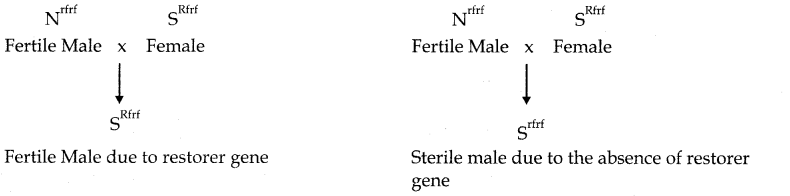
Answer:
a) Rhizome – Zingiber.

Question 3.
Find the mismatching pair
a) Runner – Centella
b) Sucker – Chrysanthemum
c) Stolon – Fragaria
d) Offset – Bryophyllum
Answer:
d) Offset – Bryophyllum.

Question 4.
Epiphyllous buds are in
a) Chrysanthemum
b) Agave
c) Curcuma
d) Scilla
Answer:
d) Scilla

Samacheer Kalvi 12th Bio Botany Guide Chapter 1 Asexual and Sexual Reproduction in Plants

Question 5.
Eyes of potato are referred to
a) adventitious roots
b) axillary buds
c) terminal buds
d) intercalary buds
Answer:
b) axillary buds

Question 6.
The T-shaped incision is made in grafting.
a) Bud
b) Approach
c) Tongue
d) Crown
Answer:
a) Bud

Question 7.
Plants propagated economically by vegetative propagation
a) Solanum tuberosum
b) Ixora
c) Jasminum
d) Chrysanthemum
Answer:
a) Solanum tuberosum

Samacheer Kalvi 12th Bio Botany Guide Chapter 1 Asexual and Sexual Reproduction in Plants

Question 8.
Steward produced……………plant from phloem
a) Beetroot
b) Carrot
c) Solanum
d) Radish
Answer:
b) Carrot

Question 9.
Arrange from the periphery to centre in another wall.
a) Endothecium, Middle layer, tapetum
b) Tapetum, middle layer, Endothecium
c) Endothecium, tapetum, middle layer
d) Middle layer, endothecium, tapetum
Answer:
a) Endothecium, Middle layer, tapetum

Question 10.
Microspores are held together by pollinium in
a) Hibiscus
b) Calotropis
c) Ixora
d) Datura
Answer:
b) Calotropis

Samacheer Kalvi 12th Bio Botany Guide Chapter 1 Asexual and Sexual Reproduction in Plants

Question 11.
…………… cells are hygroscopic in anther wall.
a) Epidermis
b) Endothecium
c) Middle layer
d) tapetum
Answer:
b) Endothecium

Question 12.
Find the wrong statement
a) Invasive tapetum is peri plasmodial.
b) Amoeboid tapetum is associated with male sterility
c) Middle layer is ephemeral.
d) Epithelium is hygroscopic
Answer:
d) Epithelium is hygroscopic

Question 13.
Find the correct statement
a) Carrot grass causes allergy
b) Bee pollen is an artificial substance.
c) Palynology is the study of honey pollen.
d) Mellitopalynology is the study of pollen grain.
Answer:
a) Carrot grass causes allergy

Samacheer Kalvi 12th Bio Botany Guide Chapter 1 Asexual and Sexual Reproduction in Plants

Question 14.
Not a shape of pollen grain
a) Globose
b) Ellipsoid
c) crescent-shaped
d) Cubical
Answer:
d) Cubical

Question 15.
…………… protects pollen grain from UV
radiation.
a) Sporopollenin
b) pollenkitt
c) Exine
d) callose.
Answer:
b) pollenkitt

Question 16.
Not in exine of pollen grain
a) Cellulose
b) Sporopollenin
c) Pollenkitt
d) Callose
Answer:
d) Callose

Samacheer Kalvi 12th Bio Botany Guide Chapter 1 Asexual and Sexual Reproduction in Plants

Question 17.
………………….. % of angiosperm pollen is liberated in 2 cell stage
a) 50
b) 60
c) 40
d) 30
Answer:
b) 60

Question 18.
Which one of the following is a dioecious plant?
a) Coconut
b) Bitter gourd
c) Pea plant
d) Date palm
Answer:
d) Date palm

Question 19.
Match the following

A) Orthotropous1. Leguminosae.
B) Anatropous2. Primulaceae
C) Hemianatropous3. Dicot, Monocot
D) Campylotropous4. Piperaceae

a) A-4, B-3, C-2, D-1
b) A-1, B-2, C-3, D-4
c) A-4, B-2, C-3, D-1
d) A-2, B-1, C-4, D-3
Answer:
a) A-4, B-3, C-2, D-1

Samacheer Kalvi 12th Bio Botany Guide Chapter 1 Asexual and Sexual Reproduction in Plants

Question 20.
Horseshoe shaped nucellus is in ……………  ovule.
a) Circinotropous
b) Amphitropous
c) Anatropous
d) Hemianatropous
Ans:
b) Amphitropous

Question 21.
Find the mismatching pair
a) Tetrasporic – Peperomia
b) Bisporic – Allium
c) Monosporic – Polygonum
d) Trisporic – Cactaceae
Ans :
d) Trisporic – Cactaceae

Question 22.
Homogamy is in ……………………….
a) Mirabilis
b) Commelina
c) Viola
d) Oxalis.
Answer:
a) Mirabilis

Question 23.
Protogyny is in ………………………..
a) Aristolochia
b) Helianthus
c) Viola
d) Oxalis.
Answer:
a) Aristolochia

Samacheer Kalvi 12th Bio Botany Guide Chapter 1 Asexual and Sexual Reproduction in Plants

Question 24.
Distyly is in ……………………….
a) Primula
b) Lythrum
c) Abutilon
d) Hibiscus
Answer:
a) Primula

Question 25.
Find the mismatching following
a) Passiflora – self sterility
b) Gloriosa – Herkogamy
c) Sugarcane – Anemophily
d) Urtica – Hydrophily
Answer:
d) Urtica – Hydrophily

Question 26.
Find the matching pair
a) Epihydrophily – Elodea.
b) Ornithaphily – Lemna
c) Entomophily – Vallisneria
d) Hydrophily – Kigelia.
Answer:
a) Epihydrophily – Elodea

Question 27.
Find the odd one
Not dealing with entry of pollen tube
a) Herkogamy
b) Porugamy
c) Mesogamy
d) chalozogamy
Answer:
a) Herkogamy

Samacheer Kalvi 12th Bio Botany Guide Chapter 1 Asexual and Sexual Reproduction in Plants

Question 28.
Not a post-fertilization change
a) Endosperm
b) Embryo development
c) Seed formation
d) Triple fusion
Answer:
d) Triple fusion.

Question 29.
Matching

A) Apple1. Edible receptacle
B) Jack fruit2. Beet root
C) Juicy flower stalk3. Anacardium
D) Perisperm4. Fleshy perianth

a) A-1, B-4, C-3, D-2
b) A-1, B-2, C-3, D-4
c) A-4, B-3, C-2, D-1
d) A-2, B-1, C-4, D-3
Answer:
a) A-1, B-4, C-3, D-2

Samacheer Kalvi 12th Bio Botany Guide Chapter 1 Asexual and Sexual Reproduction in Plants

Question 30.
Matching the following

A) Ovary1. zygote
B) Ovule2. Endosperm
C) Secondary nucleus3. Seed
D) Egg4. Fruit

a) A-4, B-3, C-2, D-1
b) A-1, B-2, C-4, D-3
c) A-2, B-1, C-4, D-3
d) A-3, B-2, C-1, D-4
Answer:
a) A-4, B-3, C-2, D-1

Question 31.
Which one of the following statements is not true regarding sporopollenin? I a
a) Sporopollenin is contributed by both pollen cytoplasm and tapetum.
b) It helps the pollen to withstand strong acid.
c) Sporopollenin is derived from phycobilins
d) It helps pollen during long period perservation in fossil deposits.
Answer:
a) Sporopollenin is contributed by both pollen cytoplasm and tapetum.

Question 32.
True (or) False
1) Beetles show Palaenophily
2) Bees show Cantharophily
3) Snails show Malacophily
4) Ants show Myrmecophily
a) 1,2,3 true 4 is false
b) 1,2 are true, 3,4 are false
c) 1,2,3 are true, 4 true
d) 1 is true 2,3,4 are false
Answer:
a) 1,2, 3 true 4 is false

Samacheer Kalvi 12th Bio Botany Guide Chapter 1 Asexual and Sexual Reproduction in Plants

Question 33.
Find the mismatching pair
a) Trap mechanism – Aristolochia.
b) Pit fall mechanism – Arum.
c) Clipmechanism – Aeclepiadaceae
d) Piston mechanism – Salvia
Answer:
d) Piston mechanism – Salvia

Question 34.
Find the mismatching pair
a) Obligate mutualism – Tridax
b) Pollen robber – Amurphophallus.
c) Pseudo copulation – Ophyrus.
d) Fig pollination – Wash.
Answer:
a) Obligate mutualism – Tridax

Question 35.
Fritillaria imperialis shows vegetative propagation by
a) Bulb
b) Runner
c) Bulbils
d) Sucker
Answer:
c) Bulblis

Samacheer Kalvi 12th Bio Botany Guide Chapter 1 Asexual and Sexual Reproduction in Plants

Question 36.
Generative apospory is in
a) Aerva
b) Ulmus
c) Balanophova
d) Allium
Answer:
a) Aerva

Question 37.
Terror of Bengal is
a) Eichhornia
b) Centella
c) Lilium
d) Murraya
Answer:
a) Eichhornia

Question 38.
Allium cepa is an example for ………………….
a) Corm
b) Tuber
c) Tunicated bulb
d) Naked bulb
Answer:
c) Tunicated bulb

Question 39.
Jasminum shows…………………….
a) Bud grafting
b) Approach grafting
c) Crown grafting
d) None
Answer:
d) None

Samacheer Kalvi 12th Bio Botany Guide Chapter 1 Asexual and Sexual Reproduction in Plants

Question 40.
Endangered plants can be produced by
a) Layering
b) Grafting
c) Micropropagation
d) Cutting
Answer:
c) Micropropagation

Question 41.
Disease free plants can be produced by
a) Meristem, culture
b) Grafting
c) Cutting
d) Layering
Answer:
a) Meristem, culture

Question 42.
Which one of the following is not an advantage of micro propagation?
a) Plants produced are genetically identical
b) Endangered plants can be propagated
c) Sometimes undesirable genetical changes occur.
d) Disease free plants can be produced.
Answer:
c) Sometimes undesirable genetical changes occur.

Question 43.
…………………………. has underground and aerial flowers
a) Scrophularia
b) Catharanthus
c) Commelina
d) Clerodendron
Answer:
c) commelina

Samacheer Kalvi 12th Bio Botany Guide Chapter 1 Asexual and Sexual Reproduction in Plants

Question 44.
Juicy cells are in the …………………. flowers
a) Ornithophilous
b) Hydrophilous
c) Entomophilous
d) Malacophilous
Answer:
c) Entomophilous

Question 45.
The central mass of parenchyma in ovule is
a) Nucellus
b) Chalaza
c) Endothelium
d) Embryosac.
Answer:
a) Nucellus

Question 46.
From the following which one is the column of sterile tissue surrounded by the anther lobe.
a) Periplasodium
b) pollen chamber
c) connective tissue
d) tapetum
Answer:
c) connective tissue

Question 47.
Oxalis shows …………………
a) Cleistogamy
b) Homogamy
c) Incomplete dichogamy
d) Geitonogamy
Answer:
a) Cleistogamy

Samacheer Kalvi 12th Bio Botany Guide Chapter 1 Asexual and Sexual Reproduction in Plants

Question 48.
Brightly coloured bracts attract insects in……………..
a) Poinsettia
b) Bougainvillea
c) Lemna
d) Both a,b
Answer:
d) Both a,b

Question 49.
In a male gametophyte, the chromosomal number of generative nucleus is (A)
a) (A)-(n);(B)-(2n)
b) (A)-(2n);(B)-(n)
c) (A)-(2n);(B)-(2n)
d) (A)-(n);(B)-(n)
Answer:
b) (A)-(2n);(B)-(n)

Question 50.
Endosperm is formed from …………………..
a) Ovary
b) Ovule
c) egg
d) Secondary nucleus
Answer:
d) secondary nucleus

Samacheer Kalvi 12th Bio Botany Guide Chapter 1 Asexual and Sexual Reproduction in Plants

Question 51.
First cell of Male gametophyte in angio…………………..
a) Primary endosperm
b) Microspore
c) Megaspore
d) Nucleus
Answer:
b) Microspore

Question 52.
Malus shows ………………….. cutting
a) Root
b) stem
c) leaf
d) Flower
Answer:
a) Root

Samacheer Kalvi 12th Bio Botany Guide Chapter 1 Asexual and Sexual Reproduction in Plants

Question 53.
Polygonaceae has …………………..type of ovule
a) Orthotropous
b) Anatropous
c) Hemianatropous
d) Campylotropous.
Answer:
a) Orthotropous

Question 54.
Not an animal pollinater
a) Lemur
b) Gecko Lizard
c) Garden lizard
d) All the above
Answer:
d) All the above

Question 55.
This shape is not seen in Tridax embryo
a) Globular
b) Heart
c) torpedo shape
d) Cuboidal
Answer:
d) cuboidal

Samacheer Kalvi 12th Bio Botany Guide Chapter 1 Asexual and Sexual Reproduction in Plants

Question 56.
Kigelia africana shows
a) Cheiropterophily
b) Malacophily
c) Entomophily
d) Zoophily
Answer:
a) Cheiropterophily

Question 57.
The pollen of Myosotis is micrometers.
a) 10
b) 100
c) 1
d) 20
Answer:
a) 10

Samacheer Kalvi 12th Bio Botany Guide Chapter 1 Asexual and Sexual Reproduction in Plants

Question 58.
Rhizome is not in
a) Musa paradisiaca
b) Zingifer officinale.
c) Curcuma longa
d) Colocasia
Answer:
d) Colocasia

Question 59.
The pollen of Nyctaginaceae is of microns
a) 50
b) 100
c) 200
d) 300
Answer:
c) 200

Question 60.
Does not show vegetative reproduction by root
a) Murraya
b) Dalberigia
c) Millinagtonia
d) Spinifex.
Answer:
d) spinifex

Samacheer Kalvi 12th Bio Botany Guide Chapter 1 Asexual and Sexual Reproduction in Plants

II. Two Marks 

Question 1.
Which characteristic feature of a plant cell in used in horticulture, forestry and industries to propagate plants
Answer:
The Genetic ability of plant cell to produce entire plant under suitable conditions is called totipotency.

Question 2.
Define tissue culture?
Answer:
The growth of plant tissue in special culture medium suitable controlled conditions.

Question 3.
Name the 3 types of gametic fusions in sexual reproduction of plants?
Answer:
Isogamy, Anisogamy and Oogamy.

Question 4.
What is microsporogenesis?
Answer:
Formation of haploid microspores from diploid microspore mother cell by meiosis.

Question 5.
Comment on amoeboid tapetum?
Answer:

  •  It is a third type of tapetum.
  • The cell wall is not lost.
  • Cells protrude into the anther cavity, by amoeboid movement.
  • It is connected to male sterility. It is not periplasmodial type.

Samacheer Kalvi 12th Bio Botany Guide Chapter 1 Asexual and Sexual Reproduction in Plants

Question 6.
What are Ubisch bodies?
Answer:
Tapetum contributes to sporopollenin through ubisch bodies. They play an important role in pollen wall formation.

Question 7.
Differentiate Exine and Intine?
Answer:
Exine Intine:

  1. Outer wall layer of pollen
  2. Thick
  3. Not uniform. Made of cellulose, sporopollenin, pollenkitt.

Intine :

  1. Inner wall layer.
  2. Thin
  3. Uniform made of pectin, hemicellulosc, cellulose, callose.

Question 8.
Comment on the sculpturing pattern of pollengrains?
Answer:

  • The exine is sculptured as rod, groove, wart, punctuation etc.
  • This pattern is used in plant identification and classification.

Question 9.
Mention the various shapes of pollengrains?
Answer:
Globose, ellipsoid, fusiform, lobed, angular, crescent shaped.

Samacheer Kalvi 12th Bio Botany Guide Chapter 1 Asexual and Sexual Reproduction in Plants

Question 10.
What do you know of Palynology?
Mention its uses.
Answer:

  • It is the study of pollengrains.
  • It helps to identity the coal, oil fields.
  • It reflects the vegetation of that area.

Question 11.
How can we preserve pollengrains?
Answer:
Pollen is preserved in liquid nitrogen (-196°C) in viable condition for prolonged duration. It is called cryopreservation. This pollen of economically important plants are stored in pollen bank.

Question 12.
What is Mellitopalynology?
Answer:
Study of flower honey and pollen.

Question 13.
Comment on Carrot Grass?
Answer:

  • Parthenium hysterophorus of Asteraceae family is called as carrot grass.
  • It is introduced as a contaminant with cereal from Tropical America.
  • Pollen of this plant causes allergy.

Question 14.
Differentiate hypostase from Epistase?
Answer:
Hypostase
Group of cells in the ovule between chalaza and embryosac.

Epistase :
Thick walled cells above the micropylar end above the embryosac.

Samacheer Kalvi 12th Bio Botany Guide Chapter 1 Asexual and Sexual Reproduction in Plants

Question 15.
What is Archesporium?
Answer:
In the ovule, a single hvpodermal cell in the nucellus become enlarged. “I his functions as Archesporium. In some plants it functions as megaspore mother cell directlv. It mev divide.

Question 16.
Prove that there is a co.evolution between plants and animals?
Answer:
Many plants are pollinated hv a particular animal species. The flowers are modified accordingly. This proves their co.evolution.

Question 17.
Draw this diagram and table the parts.
Answer:
Samacheer Kalvi 12th Bio Botany Guide Chapter 1 Asexual and Sexual Reproduction in Plants (8)

Question 18.
Define pollination?
Answer:
Transfer of pollengrains from anther to stigma of a flower.

Samacheer Kalvi 12th Bio Botany Guide Chapter 1 Asexual and Sexual Reproduction in Plants

Question 19.
Differentiate pollination in gymnosperms and angiosperms.
Answer:
Pollination in Gymnosperms

  1. Direct
  2. Pollens are directly deposited on the exposed ovules.

Pollination in Angiosperms :

  1. Indirect
  2. Pollens are deposited on the stigma of pistil.

Question 20.
What is chasmogamy?
Answer:
In many angiosperms, the flowers open. They exposure mature anther and stigma for pollination. This phenomenon is chasmo¬gamy. These are chasmogamous flowers.

Question 21.
Define cleistogamy?
Answer:
In some plants, pollination occurs without exposing or opening the sex organs. This phenomenon is called cleistogamy. Such flowers are called cleistogamous flowers.

Samacheer Kalvi 12th Bio Botany Guide Chapter 1 Asexual and Sexual Reproduction in Plants

Question 22.
Differentiate Autogamy and allogamy?
Answer:
Autogamy
Transfer of pollen on the stigma of the same flower

Allogamy :
Transfer of pollen of one flower to the stigma of another flower.

Question 23.
Name the abiotic agents of pollination?
Answer:

  • Pollination by wind (or) Anemophily.
  • Pollination by water (or) Hydrophily.

Question 24.
Define Zoophily?
Answer:
Pollination through animals (Ex. insects) is called as Zoophily.

Question 25.
What is cheiropterophily? Give example?
Answer:
Pollination by bats. Such plants are kigelia africana, Adansonia digitata.

Question 26.
Malacophily – Comment?
Answer:
Pollination by slugs and snail. Ex. Plants of Araceae, Water snails pollinate Lemna.

Samacheer Kalvi 12th Bio Botany Guide Chapter 1 Asexual and Sexual Reproduction in Plants

Question 27.
What is Myrmecophily?
Answer:
Pollination by ants Ex. Eegnminosae, plants.

Question 28.
Redraw the diagram and lable the parts.
Answer:
Samacheer Kalvi 12th Bio Botany Guide Chapter 1 Asexual and Sexual Reproduction in Plants (9)

Question 29.
What is cap block?
Answer:
The Hemispherical, transparent tip of pollentube is called cap block. It is seen by microscope. When it disappears the growth of pollen tube stops.

Samacheer Kalvi 12th Bio Botany Guide Chapter 1 Asexual and Sexual Reproduction in Plants

Question 30.
What is the significance of obtruator?
Answer:
In the ovary locule, the obtruator guides pollen tube towards the micropyle, of ovule.

Question 31.
Suggest the events after fertilization ?
Answer:

  • Endosperm, embryo development.
  • Formation of seed, fruit. These are called post fertilization changes.

Question 32.
What is Suspensor ?
Answer:

  • During the developement, the two cells of the basal cell undergoes several transverse division into form a six to ten called suspensor.
  • The suspensor helps to push the embryo deep into the endosperm.

Question 33.
What is Callus?
Answer:
Undifferentiated mass of cells obtained through tissue culture.

Samacheer Kalvi 12th Bio Botany Guide Chapter 1 Asexual and Sexual Reproduction in Plants

Question 34.
Define Apomixis ?
Answer:

  • It is defined as the substitution of the usual sexual system (Ampimixis) by a form of reproduction.
  • It does not involve meiosis and syngamy.

Question 35.
What is Scutellum?
Answer:

  • The seeds of paddy is one seeded and is called Caryopsis.
  • The embryo is small and consists of one shield shaped cotyledon known as scutellum.
  • It is present towards lateral side of embryonal axis.

Question 36.
Define Pollinium.
Answer:
In some plants, all the microspores in a microsporangium remain held together called pollinium.
Example: Calotropis

Samacheer Kalvi 12th Bio Botany Guide Chapter 1 Asexual and Sexual Reproduction in Plants

Question 37.
What is Amphitropous?
Answer:

  • A type of ovule.
  • It is between hilum and chalaza.
  • The curvature of the ovule leads to horse – shoe shaped nucellus.
    Example: Alismataceae.

Question 38.
Write the practical application of activation of nucellar tissue.
Answer:

  • The activation of micellar tissue or an\ other cells (sporopln lie ceils of the ovule) can produce more’ Ilian one embryo, known as poly embryonv.
  • The seedlings formed from the nucellar tissues in citrus are found belter clones lor orchards.
  • They are Disease resistant (virus free) and are preferred by Agriculturists than the normal seedlings.

Question 39.
Differentiate pineyed flower and thrum eyed flower.
Answer:
Pineyed flower :
Pin or long stv!e, long stigma tic pa iliac, short stamens and small pollen grains.
Ex : primula

Samacheer Kalvi 12th Bio Botany Guide Chapter 1 Asexual and Sexual Reproduction in Plants

Thrum eyed flower :
Thrum-eved or short style, small stigmatic papillae, long stamens and large pollen gains.

Question 40.
Differentiate Coleoptile and
Answer:
Coleoptile Coleorhiza :
The plumule is surrounded bv a proteetive sheath called coleoptile.

Coleorhiza:
The radicle including root cap is also covered bv a protects e sheath called coleorhiza.

III. Three Marks 

Question 1.
How does pollen tube grow through a solid style?
Answer:

  • It is common among dicots. It is character¬ized by the presence of central core of elorgated highly specialised cells called transmitting tissue.
  • This is equivalent to the lining cells of hollow style and does the same function.
  • Its contents are also similar to the content of those cells. The pollen tube grows through inter-cellular spaces of the transmitting tissue.

Samacheer Kalvi 12th Bio Botany Guide Chapter 1 Asexual and Sexual Reproduction in Plants

Question 2.
Give the significance of pollen calendar?
Answer:

  • It shows the production of pollen by plants during different seasons.
  • This benefits the allergic persons.
  • Pollen grains cause asthma, bronchitis, has fever, allergic rhinitis.

Question 3.
Comment on Caruncle?
Answer:
Cells at the tip of outer integument around micropyle develop into fleshy stucture. It is called caruncle. Ex. Ricinus communis.

Question 4.
What is perisperm?
Answer:
Remnant of nucellar tissue in the seed is called perisperm.
Ex. Black pepper, beet root.

Samacheer Kalvi 12th Bio Botany Guide Chapter 1 Asexual and Sexual Reproduction in Plants

Question 5.
What is Aril?
Answer:
The colourful, fleshy funiculus is called Aril. Ex. Myristica and Pithe cellobium.

Question 6.
Write about Endosperm?
Answer:
The Zygotas divides into endosperm. It is a nutritive tissue nourishing embryo. It is a regulatory structure.

Question 7.
Differentiate Endospermous and non-endospermous seeds?
Answer:
Endospermous seeds  :

  1. Seeds with endosperm
  2. It is also called ex-albuminous seeds
  3. Ex-Pea, Ground nut, bean

Non-Endospermous seeds :

  1. Seeds without endosperm
  2. It is also called albuminous seeds
  3. Paddy, Coconut, Castor.

Samacheer Kalvi 12th Bio Botany Guide Chapter 1 Asexual and Sexual Reproduction in Plants

Question 8.
Comment on Aleurone Tissue.
Answer:

  • These are layers of specialized cells around the endosperm, in cereals.
  • They have sphaerosomes (Ex. Barley, Maize) During germination, they secrete hydrolytic enzymes amylase,
  • protease. They digest reserve food of endosperm.

Question 9.
Mention the other interesting pollinating mechanism of plants?
Answer:

  • Trap Mechanism Ex. Aristolochia.
  • Pit fall mechanism Ex. Arum.
  • Clip or Translator Mechanism
    Ex. Asclepiadaceae
  • Piston Mechanism Ex. Papilionaceae.

Question 10.
Grafting is method of production of hybrid plants but not the method of reproduction. Do you agree this statement? Give logic reason for your answer.
Answer:

  • Eventhough Grafting is considered as artifica! method of vegetative reproduction, it is realtv used to produce plants combining favourable stem characteristics with root characteristics.
  • The stem of the plant to be grafted is known as scion and the root is called stock.
  • Here, one fnbrid is produced unlike in other method where manv number of plants are produced.

Question 11.
Comment on pollen (nectar) robber?
Answer:
Amorphophallus provide floral rewards. They are the safe site for laying eggs, visitors consume pollen and nectar. They do not help in pollination. They are pollen robbers.

Question 12.
Describe pseudocopulations?
Answer:

  • In Bee orchid (ophyrus) the morphology of flower is similar to female wasp (colpa).
  • Male wasp mistakes the flower for female wasp, and try to copulate. This pseudocopulation helps in pollination.
  • In pea cotyledons store food.

Samacheer Kalvi 12th Bio Botany Guide Chapter 1 Asexual and Sexual Reproduction in Plants

Question 13.
Write any two differences between male gametophyte and female gametophyte.
Anwer:
Male gametophyte :

  1. It is the pollen grain (microsporangium)
  2. It has two phases of growth – pro pollination and post pollination
  3. Pre pollination occurs in it.
  4. It is only 3 celled
  5. All cells of it are functional

Female gametophyte :

  1. it is t mbedded in side the ovum (megasporangium)
  2. All the cells are formed in single phase ol growth surrounded bv megaspore membrane.
  3. It is 7 celled and the growth occurs inside megasporangium

Question 14.
What are the disadvantages of self pollination?
Answer:

  1. Continuons self pollination produce weaker progeny
  2. Chance of producing new species and varieties are meagre.

Question 15.
Enlist the disadvantages of cross pollination?
Answer:

  • The process is uncertain since it depends on external agencies.
  • Various devices are needed to attract the pollinating agents.

Question 16.
Pollination is prerequisite for fertilisation. Discuss?
Answer:

  • Fertilisation forms fruits and seeds.
  • Pollination brings male and female gametes closer.
  • Cross pollination produces variations, due to mixing of genes. Variations help the adaptation of plants to environment. It helps in specifiation.

Question 17.
How is the surface of endosperm ? Discuss?
Answer:
Endosperm with irregularity and uneven ness in its surface forms the ruminate endosperm. Ex. Areca catchu, Passiflora, Myristica.

Question 18.
Discuss the functions of Endosperm?
Answer:

  • It is the nutritive tissue for the developing embryo.
  • The zygote divides only after the develpment of endosperm.
  • Endosperm regulates the embryo development.

Question 19.
Relate the role of cocount as endosperm?
Answer:

  • Coconut milk is a nutrient medium.
  • It induces the differentiation of embryo (embryoids), Plantlets of various plant tissues.
  • Coconut water is free nuclear endosperm. The white kernel part is cellular.

IV. Five Marks 

Question 1.
Illustrate the structure of cicer, a dicot seed?
Answer:

  • Seeds are attached to fruits by funiculus.
  • The scar of funiculus is called hilum.
  • Micropyle is the small pore below hilum.
  • O2 and water enters seed for germination through micropyle.
  • Each seed has outer thick seed coat.seed coat develops from the integuments of ovule.
  • Testa is the hard outer coat.
  • Tegmen is the thin membranous inner coat.
  • In pea testa, tegmen are fused.
  • Two cotyledons are laterally attached to embryonic axis.
    Samacheer Kalvi 12th Bio Botany Guide Chapter 1 Asexual and Sexual Reproduction in Plants 22
  • In castor endosperm has reserve food.
  • One end of embryonal axis projecting beyond the cotyledons. It is called radicle (embryonic root)
  • The other end of embryonal axis called plumule (embryonic shoot)
  • Embryonic axis above the cotyledons is epicotyl.
  • Cylindrical region between the cotyledons is hypocotyl.
  • Epicotyle terminates in plumule. Hypocotyl ends in radicle

Question 2.
Describe the structure of a monocot seed (Ex. Paddy)?
Answer:
Samacheer Kalvi 12th Bio Botany Guide Chapter 1 Asexual and Sexual Reproduction in Plants (10)

  • Paddy is a one seeded caryopsis.
  • The seed is enclosed by brown husk with 2 rows of glumes.
  • The brown, membranous seed coat is attached to grain.
  • Endosperm is the bulk of grain. It is the storage tissue.
  • It is separated from embryo by epithelium.
  • Embryo has one cotyledon called scutellum. It is later to embryonal axis.
  • A short axis with plumule and radicle is protected by root ‘ cap.
  • Coleoptile is a protective sheath of plumule.
  • Coleorhiza is the protective sheath of radicle.
  • Scutellum supplies food to embryo from endosperm through epithelium.

Samacheer Kalvi 12th Bio Botany Guide Chapter 1 Asexual and Sexual Reproduction in Plants

Question 3.
In some kinds of plant reproductions male, female gametes are not involved ? Justify? Apomixis.
Answer:
it is tile plant reproduction which does not involuo the union of male and female gametes.
A) Recurrent Apomixis.
Vegetative Reproduction and agamospernw.

B) Non recurrent Apomixis.
Alter meiosis, haploid embrvosoe is lormed.
It devleps into emhrvo without fertilization.

I) Vegetative Reproduction
Eiopagation of plants by parts other than seeds.
Ex. bulbil – I’riiiliaria imperialis.
Bulbs – Allium
Sucker – Chrysanthemum.
Samacheer Kalvi 12th Bio Botany Guide Chapter 1 Asexual and Sexual Reproduction in Plants (11)

a) Agamospory
Embryos are rormed without syngamy and meiosis.

b) Advcntiver Embryony
Embrvo arises from diploid sporopln tic coll of nuceilus or integument, lt is called sporophytic budding, Gametophylic phase is completeh absent.

c) Diplospory (Generative apospory)
Megaspore mother ceils gives rise to diploid embrvosac without meiosis. ex. Eupatorium.

d.) Apospory
Nucellar cell develop into diploid emhryo sac. This is somatic apospory. Ex. Hieracium, parthenium.

Samacheer Kalvi 12th Bio Botany Guide Chapter 1 Asexual and Sexual Reproduction in Plants

Question 4.
Differentiate heterostyly from herkogamy
Answer:
Heterostyly :

  1. Some plants produce two or three different forms of flowers that are different in their length of stamens and style
  2. Pollination will take place only between organs of the same length. Distyly: Eg Primula Herkogamy:

Herkogamy

  • Stamens and stigmas are arranged in such a way preventing self pollination.
  • Stigmas project for above the stamens Eg: Hibiscus

Question 5.
An entire plant can be produced from a single cell – Justify?
Answer:
The genetic ability of a plant cell to produce entire plant in suitable condition is called Totipotency.
i) Tissue Culture
Growth of plant tissue in special cutture medium under suitable conditions is called tissue culture.
Ex. F.C steward of Cornell University developed a new carrot plant from the phloem parenchyma cell.

ii) Micropropagation
Regenerationof whole plant from a cell or tissue of vegetative structures.

  • Advantages of Modern methods.
  • Plants with desired characteristics are multiplied rapidly in short duration.
  • Genetically identical plants are produced.
  • Done at any season.
  • Plants without viable seeds, difficult to germinate can be propagated.
  • Rare, endangered plants are propagated.
  • Meristem culture produces disease free plants.
  • Cells are transformed by genetic modification.

Disadvantages of modem methods

  • Labour intensive. It requires skilled workers.
  • Maintenance of sterile condition increases cost.
  • Genetically identical clones are susceptible to new diseases.
  • Genetical changes in callus is not desirable for commercial use.

Samacheer Kalvi 12th Bio Botany Guide Chapter 1 Asexual and Sexual Reproduction in Plants

Question 6.
Elaborate an account on the T.S of anther.
Answer:
1. Anther Wall
a) Epidermis

  • Protective single layer.
  • Cells undergo anticlinal division to cope up enlarging internal tissue.

b) Endothecium

  • Single layer of radially elongated cells.
  • Bands of cellulose (or) lignin are seen in tangetial wall.
  • At the junction of 2 sporangia these thickenings are absent. This region is called stomium.
  • Hygroscopic nature of endothecium helps in dehiscence of anther.

c) Middle layer

  • 2 to 3 layers next to endothecium.
  • These are ephemeral. Disintegrate or crushed during maturity.

d) Tapetum

  • It is dual in origin (from peripheral wall layer and connective tissue of anther lining.
  • It nourishes sporogenous tissue, microspore mother cell, microspores.
  • Cells are uninucleate, multinucleate with polyploid nucleus.
  • It contributes to wall material, sporopollenin, pollen kitt, tryphine.
  • It controls fertility or sterility of pollengrains. It is of 2 tvpes i) Secretory tapetum ii) Invasive tapetum

Samacheer Kalvi 12th Bio Botany Guide Chapter 1 Asexual and Sexual Reproduction in Plants (12)

2. Anther cavity.

  • It is filled with young microspores or mature pollengrains.
  • Microspore mother cells form microspore by meiosis.

3) Connective.

  • It is a colume of sterile tissue. It is surrounded by anther lobe. It has vascular tissue.

Question 7.
How does the male gametophyte develop?
Answer:

  • Haploid microspore is the first cell.
  • Development takes place at microsporangium.
  • Microspore nucleus divides into vegetative and generative nucleus.
  • Large vegetative cell and small generative cell is formed.
  • At this 2 celled stage, pollens are liberated from anther.
  • In some plants generative cell form 2 male gametes.
  • Male gametophyte grows when the pollen reaches the right stigma.
  • Pollen absorbs moisture and swells.
  • Intine grows as pollen tube through germ pore.
  • At the 2 celled stage, generative cells divides into 2 male cells at stigma.

Samacheer Kalvi 12th Bio Botany Guide Chapter 1 Asexual and Sexual Reproduction in Plants (13)
Samacheer Kalvi 12th Bio Botany Guide Chapter 1 Asexual and Sexual Reproduction in Plants (14)
Samacheer Kalvi 12th Bio Botany Guide Chapter 1 Asexual and Sexual Reproduction in Plants (15)

Samacheer Kalvi 12th Bio Botany Guide Chapter 1 Asexual and Sexual Reproduction in Plants

Question 8.
Ovules are of many types based on the orientation, form, position of micropyle with respect to funicle, chalaza – discuss?
Answer:
1. Orthotropous

  • Micropyle is at distal end,
  • Funicle and chalaza lie in one straight vertical line (Ex. Piperaceae)

2. Anatropous

  • Body of ovule is inverted.
  • Micropyle, funiculus lie close to each other Ex. Dicots, Monocots.

3. Hemianatropous

  • Body is transverse
  • It is at right angle to funicle. Ex. Primulaceae.

4. Campylotropous

  • Body is curved at micropylar end. Embroysac is curved.
  • Hilum, micropyle and chalaza are nearer. Ex.Leguminosae

5. Amphitropous
Less distance between hilum and chalaza. Nucellus is horse shoe shaped. Ex. Alismataceae.

6. Circinotropous. (Ex. Cactaceae)
Long funicle surrounds the ovule.

Samacheer Kalvi 12th Bio Botany Guide Chapter 1 Asexual and Sexual Reproduction in Plants (16)

Samacheer Kalvi 12th Bio Botany Guide Chapter 1 Asexual and Sexual Reproduction in Plants

Question 9.
How does the monosporic embryosac develop?
Answer:

  • Functional megaspore is the first cell of embryosac or female gametophyte.
  • Megaspore elongates along micropylar – chalaza! axis.
  • Nucleus undergoes mitosis without wall formation.
  • A central vacuole expands and pushed the nuclei towards the opposite poles.
  • Each nucleus divide mitotically twice. Thus 4 nuclei are formed at each pole.
  • Eight nuclei are in common cytoplasm.
  • Of the 4 nuclei at micropylar end, 3 nuclei form 3 antipodal cells. Fourth one is the lower polar nucleus.
  • Two polar nuclei fuse into secondary nucleus.
  • Thus 7 celled, 8 nucleated embrovsac is formed.

Samacheer Kalvi 12th Bio Botany Guide Chapter 1 Asexual and Sexual Reproduction in Plants (17)

Question 10.
Enlist the contrivances for crosspollination ?
Answer:
1) Dicliny or Unisexuality. ’
In unisexual flowers, only cross pollination is possible,

i) Monoecious (Ex. coconut)

  • Male and female flowers on same plant
  • Autogany is prevent in castor, maize. Geitonogamy takes place.

Dioecious.

  • Male and female flowers are on different plants.
  • Both autogamy, geitonogamy are prevented.

2) Monocliny or Bisexuality.
i) Dichogamy.
Anther and stigma mature at different times.

  • Protandry (Ex. Helianthus)
    Stamens mature earlier than stigma
  • Protogymy (Ex. Aristolochia)
    Stigmas mature earlier than stamen.

ii) Herkogamy.
Arrangement of stamen, stigma are different. Thus self pollination is prevented.
Ex . Hibiscus – Stigma project above stamen.

Samacheer Kalvi 12th Bio Botany Guide Chapter 1 Asexual and Sexual Reproduction in Plants (18)

Samacheer Kalvi 12th Bio Botany Guide Chapter 1 Asexual and Sexual Reproduction in Plants (19)

iii) Heterostyly,
Flowers differ in the length of stamen and style.
Pollination takes place between organs of the same length.

a) Distyly.
Pin flowers have long style. Thrum eyed flowers have long stamens. This same height helps in pollination.
Pin flowers have short stamens. Thrum eyed flowers have short style.
This helps in pollination.

b) Tristyly (Ex. Lythrum)
Plant produces 3 kinds of flowers with respect to length of style and stamens.
iv) Self sterility / Self incompatibility. Pollengrain of one flower is unable to germinate in the stigma of the same.
Ex. Passiflora

Question 11.
Enlist the characteristics of Anemophilous
Answer:

  • Flowers in pendulous, catkin like, spike inflorescence.
  • Inflorescence axis elongates. So, flowers are brought above leaf level.
  • Reduced perianth (or) Absent.
  • Small, colourless flowers do not / secrete nectar. The are not scented
  • Long, exerted, versatile filaments.
  • Enormous quantitv of pollen grains.
  • Minute, light, dry pollen easily cart ied by wind to long distances.
  • Violent bursting of anthers release the pollengrains. Ex. Urlica.
  • Protruding, feathery, branched stigma catch pollengrains.
  • Flowers are produced before leaves. So, they are carried without hindrance.

Samacheer Kalvi 12th Bio Botany Guide Chapter 1 Asexual and Sexual Reproduction in Plants

Question 12.
Explain pollination in maize?
Answer:

  • Maize is monoecious and unisexual.
  • Male inflorescence is at the terminal.
  • Female inflorescence is at the lateral lower level.
  • Heavy pollens cannot be carried by breeze.
  • Male inflorescence is shaken by wind. The released pollens fall vertically below
  • Male inflorescence (Tassel) Female inflorescence (Cob)
  • The long stigma (23 cm) projects beyond the leaves.
  • Pollens dropping from tassel is caught by the stigma.

Samacheer Kalvi 12th Bio Botany Guide Chapter 1 Asexual and Sexual Reproduction in Plants (20)

Question 13.
What do you know about the lever mechanism of pollination? Explain?
Answer:
Samacheer Kalvi 12th Bio Botany Guide Chapter 1 Asexual and Sexual Reproduction in Plants (21)

  • Salvia is adapted for bee pollination.
  • Bilabiate corolla has 2 stamens.
  • Each anther has upper fertile lobe and lower sterile lobe separated by long connective. The anthers swing freely.
  • The bee strikes against the sterile end of connective. So, fertile part of stamen descend. It strikes at the back of the bee.
  • When the bee visits another flower, the pollen is rubbed on stigma. Thus pollination is

Question 14.
Describe the development of Dicot embryo?
Answer:
Samacheer Kalvi 12th Bio Botany Guide Chapter 1 Asexual and Sexual Reproduction in Plants (1)

  • The embryo develops at micropylar end of embryo sac.
  • The zygote undergoes transverse division.
  • An upper terminal cell and lower basal cell is formed.
  • Divisions in zygote during development lead to the formation of embryo.
  • Before mature stage, embryo undergoes globular, heart shaped stages.
  • Mature embryo has a radicle, 2 cotyledons and a plumule.

Samacheer Kalvi 12th Bio Botany Guide Chapter 1 Asexual and Sexual Reproduction in Plants

Question 15.
Summarise the whole life cycle of an Angiosperm plant in the form of schematics diagram.
Answer:
Samacheer Kalvi 12th Bio Botany Guide Chapter 1 Asexual and Sexual Reproduction in Plants (2)

Question 16.
Explain epihy drophily with an example?
Answer:
Pollination occurs at water level Pollination in vallisneria.

  • It is submerged rooted hydrophyte.
  • At the time of pollination, the flowers come to water level by long coiled stalk.
  • Cup shaped depression is formed in female flower.
  • The detached male flower floats on water surface.
  • Male flower gets settled on the depression of female flower. It contacts stigma and bring out pollination.
  • Stalk of female flower coils. Thus the flower comes under water from surface. Then fruits are produced.

Samacheer Kalvi 12th Bio Botany Guide Chapter 1 Asexual and Sexual Reproduction in Plants (3)

Question 17.
Enlist the advantages, disadvantages of conventional methods of vegetative propagation?
Answer:
Advantages of conventional Methods.

  • Plants are genetically uniform.
  • Plants are produced quickly.
  • For plants with little or no seeds (or) when seeds do not germinate.
  • Economical vegetative propagation. Ex. Solanum tuberosum,
  • Plants with desirable characters like disease resistance, high yield can be grafted.

Disadvantages.

  • Virus infected plants produce virus infected new plants.
  • Bulky vegetative structures are difficult to handle.

Samacheer Kalvi 12th Bio Botany Guide Chapter 1 Asexual and Sexual Reproduction in Plants

Question 18.
Differentiate biosporic megaspore development from tetrasporic development.
Answer:
Biosporic megaspore :

  1. of the four megaspores if two are involved in Embryo Sac formation the development is called bisporic.
  2. Example: Allium

Tetrasporic megaspore

  1. If all the four megaspores are involved in Embryo Sac formation the . development is. called tetrasporic.
  2. Example: peperomia

Samacheer Kalvi 12th Biology Guide Book Answers Solutions

Subject Matter Experts at SamacheerKalvi.Guide have created Tamilnadu State Board Samacheer Kalvi 12th Biology Answers Solutions Guide Pdf Free Download in English Medium and Tamil Medium are part of Samacheer Kalvi 12th Books Solutions.

Let us look at these TN Board Samacheer Kalvi 12th Std Biology Guide Pdf of Text Book Back Questions and Answers, Notes, Chapter Wise Important Questions, Model Question Papers with Answers, Study Material, Question Bank and revise our understanding of the subject.

Students can also read Tamil Nadu 12th Biology Model Question Papers 2020-2021 English & Tamil Medium.

Samacheer Kalvi 12th Biology Book Solutions Answers Guide

Samacheer Kalvi 12th Biology Book Back Answers

Tamilnadu State Board Samacheer Kalvi 12th Biology Book Back Answers Solutions Guide.

Samacheer Kalvi 12th Bio Botany Book Solutions

Samacheer Kalvi 12th Bio Zoology Book Solutions

We hope these Tamilnadu State Board Class 12th Biology Book Solutions Answers Guide Pdf Free Download in English Medium and Tamil Medium will help you get through your subjective questions in the exam.

Let us know if you have any concerns regarding TN State Board New Syllabus Samacheer Kalvi 12th Standard Biology Guide Pdf Text Book Back Questions and Answers, Notes, Chapter Wise Important Questions, Model Question Papers with Answers, Study Material, Question Bank, drop a comment below and we will get back to you as soon as possible.

Samacheer Kalvi 12th Maths Guide Chapter 6 Applications of Vector Algebra Ex 6.8

Tamilnadu State Board New Syllabus Samacheer Kalvi 12th Maths Guide Pdf Chapter 6 Applications of Vector Algebra Ex 6.8 Textbook Questions and Answers, Notes.

Tamilnadu Samacheer Kalvi 12th Maths Solutions Chapter 6 Applications of Vector Algebra Ex 6.8

Question 1.
Show that the straight lines
\(\overline { r }\) = (5\(\hat { i }\) + 7\(\hat { j }\) – 3\(\hat { k }\)) + s(4\(\hat { i }\) + 4\(\hat { j }\) – 5\(\hat { k }\)) and
\(\overline { r }\) = (8\(\hat { i }\) + 4\(\hat { j }\) + 5\(\hat { k }\)) + t(7\(\hat { i }\) + \(\hat { j }\) + 3\(\hat { k }\)) are coplanar. Find the vector equation of the, plane in which they lie.
Solution:
Samacheer Kalvi 12th Maths Guide Chapter 6 Applications of Vector Algebra Ex 6.8 1

Samacheer Kalvi 12th Maths Guide Chapter 6 Applications of Vector Algebra Ex 6.8

Question 2.
Show that the lines \(\frac { x-2 }{ 1 }\) = \(\frac { y-3 }{ 1 }\) = \(\frac { z -4}{ 3 }\) and \(\frac { x-1 }{ -3 }\) = \(\frac { y-4 }{ 2 }\) = \(\frac { z-5 }{ 1 }\) are coplanar. Also, find the plane containing these lines.
Solution:
Samacheer Kalvi 12th Maths Guide Chapter 6 Applications of Vector Algebra Ex 6.8 2
Cartesian equation
x + 2y – 2z = 4
x + 2y – 2z – 4 = 0

Question 3.
If the straight lines \(\frac { x-1 }{ 1 }\) = \(\frac { y-2 }{ 2 }\) = \(\frac { z-3}{ m^2 }\) and \(\frac { x-3 }{ 1 }\) = \(\frac { y-2 }{ m^2 }\) = \(\frac { z-1 }{ 2 }\) are coplanar, find the distinct real values of m
Solution:
Samacheer Kalvi 12th Maths Guide Chapter 6 Applications of Vector Algebra Ex 6.8 3
2(4 – m4) – 2(m² – 2) = 0
8 – 2m4 – 2m² + 4 = 0
12 – 2m4 – 2m² = 0
(÷ -2) -6 + m4 + m² = 0
m4 + m² – 6 = 0
(m² – 2)(m² + 3) = 0
m² – 2 = 2; m² = -3 (not possible)
m² = 2
m = ±√2

Samacheer Kalvi 12th Maths Guide Chapter 6 Applications of Vector Algebra Ex 6.8

Question 4.
If the straight lines \(\frac { x-1 }{ 2 }\) = \(\frac { y+1 }{ λ }\) = \(\frac { z }{ 2 }\) and \(\frac { x+1 }{ 5 }\) = \(\frac { y+1 }{ 2 }\) = \(\frac { z }{ λ }\) are coplanar, find λ and equations of the planes containing these two lines.
Solution:
If the two lines are coplanar
Samacheer Kalvi 12th Maths Guide Chapter 6 Applications of Vector Algebra Ex 6.8 4
When λ = 2
(x1, y1, z1) = (1, -1, 0)
(b1, b2, b3) = (2, 2, 2)
(d1, d2, d3) = (5, 2, 2)
\(\left|\begin{array}{ccc}
x-x_{1} & y-y_{1} & z-z_{1} \\
b_{1} & b_{2} & b_{3} \\
d_{1} & d_{2} & d_{3}
\end{array}\right|\) = 0
⇒ \(\left|\begin{array}{ccc}
x-1 & y+1 & z-0 \\
2 & 2 & 2 \\
5 & 2 & 2
\end{array}\right|\) = 0
⇒ (x – 1)(0) – (y + 1)(-6) + z(6) = 0
⇒6(y + 1) – 6z = 0
⇒ 6y + 6 – 6z = 0
⇒ y – z + 1 = 0
When λ = 2
(b1, b2, b3) = (2, -2, 2)
(d1, d2, d3) = (5, 2, -2)
⇒ \(\left|\begin{array}{ccc}
x-1 & y+1 & z-0 \\
2 & -2 & 2 \\
5 & 2 & -2
\end{array}\right|\) = 0
⇒ (x – 1)(0) – (y + 1)(-14) + z(4 + 10) = 0
⇒ 14(y + 1) + 14z = 0
⇒ 14y + 14 + 14z = 0
⇒ y + z + 1 = 0

Samacheer Kalvi 12th Maths Guide Chapter 6 Applications of Vector Algebra Ex 6.8

Samacheer Kalvi 12th Maths Guide Chapter 6 Applications of Vector Algebra Ex 6.7

Tamilnadu State Board New Syllabus Samacheer Kalvi 12th Maths Guide Pdf Chapter 6 Applications of Vector Algebra Ex 6.7 Textbook Questions and Answers, Notes.

Tamilnadu Samacheer Kalvi 12th Maths Solutions Chapter 6 Applications of Vector Algebra Ex 6.7

Question 1.
Find the non-parametric form of vector equation and Cartesian equation of the plane passing through the point (2, 3, 6) and parallel to the .straight lines.
\(\frac { x-1 }{ 2 }\) = \(\frac { y+1 }{ 3 }\) = \(\frac { z-3 }{ 1 }\) and \(\frac { x+3 }{ 2 }\) = \(\frac { y-3 }{ -5 }\) = \(\frac { z+1 }{ -3 }\)
Solution:
Samacheer Kalvi 12th Maths Guide Chapter 6 Applications of Vector Algebra Ex 6.7 1

Samacheer Kalvi 12th Maths Guide Chapter 6 Applications of Vector Algebra Ex 6.7

Question 2.
Find the non-parametric form of vector equation and Cartesian equations of the plane passing through the points (2, 2, 1), (9, 3, 6) and perpendicular to the plane 2x + 6y + 6z = 9.
Solution:
Samacheer Kalvi 12th Maths Guide Chapter 6 Applications of Vector Algebra Ex 6.7 2
Cartesian equation
3x + 4y – 5z = 9
3x + 4y – 5z – 9 = 0

Question 3.
Find parametric form of vector equation and Cartesian equations of the plane passing through the points (2, 2, 1), (1, -2, 3) and parallel to the straight line passing through the points (2, 1, -3) and (-1, 5, -8)
Solution:
Samacheer Kalvi 12th Maths Guide Chapter 6 Applications of Vector Algebra Ex 6.7 3
Cartesian equation
-12x + 11y + 16z = 14
12x – 11y – 16z = -14
12x – 11y – 16z + 14 = 0

Samacheer Kalvi 12th Maths Guide Chapter 6 Applications of Vector Algebra Ex 6.7

Question 4.
Find the non-parametric form of vector equation and Cartesian equation of the plane passing through the point (1, -2, 4) and perpendicular to the plane x + 2y – 3z = 11 and parallel to the line \(\frac { x+7 }{ 3 }\) = \(\frac { y+3 }{ -1 }\) = \(\frac { z }{ 1 }\)
Solution:
Samacheer Kalvi 12th Maths Guide Chapter 6 Applications of Vector Algebra Ex 6.7 4
Non parametric form
Samacheer Kalvi 12th Maths Guide Chapter 6 Applications of Vector Algebra Ex 6.7 5
Which is the required Cartesian equation of the place.

Question 5.
Find the parametric form of vector equation and Cartesian equations of the plane containing
the line \(\overline { r }\) = (\(\hat { i }\) – \(\hat { j }\) + 3\(\hat { k }\)) + t(2\(\hat { i }\) – \(\hat { j }\) + 4\(\hat { k }\) ) and perpendicular to plane \(\overline { r }\) (\(\hat { i }\) + 2\(\hat { j }\) + \(\hat { k }\)) = 8
Solution:
Samacheer Kalvi 12th Maths Guide Chapter 6 Applications of Vector Algebra Ex 6.7 6
Cartesian equation
9x – 2y – 5z = -4
9x – 2y – 5z + 4 = 0

Samacheer Kalvi 12th Maths Guide Chapter 6 Applications of Vector Algebra Ex 6.7

Question 6.
Find the parametric vector non-parametric vector and Cartesian form of the equations of the plane passing through the three non- collinear points (3, 6, -2), (-1, -2, 6) and (6, 4, -2).
Solution:
Samacheer Kalvi 12th Maths Guide Chapter 6 Applications of Vector Algebra Ex 6.7 7
Samacheer Kalvi 12th Maths Guide Chapter 6 Applications of Vector Algebra Ex 6.7 8
Cartesian equation
⇒ \(\overline { r }\)(2\(\hat { i }\) + 3\(\hat { j }\) + 4\(\hat { k }\)) = 16
⇒ 2x + 3y + 4z – 16 = 0

Question 7.
Find the non-parametric form of vector equation and Cartesian equations of the plane
\(\overline { r }\) = (6\(\hat { i }\) – \(\hat { j }\) + \(\hat { k }\)) + s(\(\hat { -i }\) + 2\(\hat { j }\) + \(\hat { k }\)) + t(\(\hat { -5i }\) – 4\(\hat { j }\) – 5\(\hat { k }\))
Solution:
Samacheer Kalvi 12th Maths Guide Chapter 6 Applications of Vector Algebra Ex 6.7 9
Cartesian equation:
3x + Sy – 7z = 6
3x + 5y – 7z – 6 = 0

Samacheer Kalvi 12th Maths Guide Chapter 6 Applications of Vector Algebra Ex 6.7

Samacheer Kalvi 12th Bio Zoology Guide Book Answers Solutions

Subject Matter Experts at SamacheerKalvi.Guide have created Tamilnadu State Board Samacheer Kalvi 12th Bio Zoology Answers Solutions Guide Pdf Free Download in English Medium and Tamil Medium are part of Samacheer Kalvi 12th Books Solutions.

Let us look at these TN Board Samacheer Kalvi 12th Std Bio Zoology Guide Pdf of Text Book Back Questions and Answers, Notes, Chapter Wise Important Questions, Model Question Papers with Answers, Study Material, Question Bank and revise our understanding of the subject.

Students can also read Tamil Nadu 12th Biology Model Question Papers 2020-2021 English & Tamil Medium.

Samacheer Kalvi 12th Bio Zoology Book Solutions Answers Guide

Samacheer Kalvi 12th Bio Zoology Book Back Answers

Tamilnadu State Board Samacheer Kalvi 12th Bio Zoology Book Back Answers Solutions Guide.

We hope these Tamilnadu State Board Class 12th Bio Zoology Book Solutions Answers Guide Pdf Free Download in English Medium and Tamil Medium will help you get through your subjective questions in the exam.

Let us know if you have any concerns regarding TN State Board New Syllabus Samacheer Kalvi 12th Standard Bio Zoology Guide Pdf Text Book Back Questions and Answers, Notes, Chapter Wise Important Questions, Model Question Papers with Answers, Study Material, Question Bank, drop a comment below and we will get back to you as soon as possible.

Samacheer Kalvi 12th Bio Botany Guide Book Answers Solutions

Subject Matter Experts at SamacheerKalvi.Guide have created Tamilnadu State Board Samacheer Kalvi 12th Bio Botany Answers Solutions Guide Pdf Free Download in English Medium and Tamil Medium are part of Samacheer Kalvi 12th Books Solutions.

Let us look at these TN Board Samacheer Kalvi 12th Std Bio Botany Guide Pdf of Text Book Back Questions and Answers, Notes, Chapter Wise Important Questions, Model Question Papers with Answers, Study Material, Question Bank, Formulas and revise our understanding of the subject.

Students can also read Tamil Nadu 12th Biology Model Question Papers 2020-2021 English & Tamil Medium.

Samacheer Kalvi 12th Bio Botany Book Solutions Answers Guide

Samacheer Kalvi 12th Bio Botany Book Back Answers

Tamilnadu State Board Samacheer Kalvi 12th Bio Botany Book Back Answers Solutions Guide.

We hope these Tamilnadu State Board Class 12th Bio Botany Book Solutions Answers Guide Pdf Free Download in English Medium and Tamil Medium will help you get through your subjective questions in the exam.

Let us know if you have any concerns regarding TN State Board New Syllabus Samacheer Kalvi 12th Standard Bio Botany Guide Pdf Text Book Back Questions and Answers, Notes, Chapter Wise Important Questions, Model Question Papers with Answers, Study Material, Question Bank, Formulas, drop a comment below and we will get back to you as soon as possible.

Samacheer Kalvi 12th Chemistry Guide Chapter 1 Metallurgy

Tamilnadu State Board New Syllabus Samacheer Kalvi 12th Chemistry Guide Pdf Chapter 1 Metallurgy Text Book Back Questions and Answers, Notes.

Tamilnadu Samacheer Kalvi 12th Chemistry Solutions Chapter 1 Metallurgy

12th Chemistry Guide Metallurgy Text Book Questions and Answers

I. Choose the correct answer

1. Bauxite has the composition
a) Al2O3
b) Al2O3.nH2O
c) Fe2O3.2H2O
d) None of these
Answer:
b) Al2O3.nH2O

2. Roasting of sulphide ore gives the gas (A). (A) is a colorless gas. An aqueous solution of (A) is acidic. The gas (A) is
a) CO2
b) SO3
c) SO2
d)H2S
Answer:
c) SO2

3. Which one of the following reaction represents calcinations?
a) 2Zn + O2 → 2ZnO
b) 2ZnS + 3O2 → 2ZnO + 2SO2
c) MgCO3 → MgO + CO2
d) Both (a) and (c)
Answer:
c) MgCOa → MgO + CO2

Samacheer Kalvi 9th English Guide Prose Chapter 2 I Can’t Climb Trees Anymore

4. The metal oxide which cannot be reduced to metal by carbon is
a) PbO
b) Al2O3
c) ZnO
d) FeO
Answer:
b) Al2O3

5. Which of the metal is extracted by Hall – Heroult process?
a) Al
b) Ni
c) Cu
d) Zn
Answer:
a) Al

6. Which of the following statements, about the advantage of roasting of sulphide ore before the reduction is not true?
a) ΔG°f of sulphide is greater than those for CS2 and H2S
b) ΔG°r is negative for roasting of sulphide ore to oxide
c) Roasting of the sulphide to its oxide is thermodynamically feasible.
d) Carbon and hydrogen are suitable reducing agents for metal sulphides.
Answer:
d) Carbon and hydrogen are suitable reducing agents for metal sulphides.

7. Match items in Column I – with the items of Column – II and assign the correct code.

Samacheer Kalvi 12th Chemistry Guide Chapter 1 Metallurgy 1
Answer:
c) (iv) (ii) (iii) (i)

8. Wolframite ore is separated from tinstone by the process of
a) Smelting
b) Calcination
c) Roasting
d) Electromagnetic separation
Answer:
d) Electromagnetic separation

Samacheer Kalvi 9th English Guide Prose Chapter 2 I Can’t Climb Trees Anymore

9. Which one of the following is not feasible
a) Zn(S) + Cu2+(aq) → Cu(s) + Zn2+(aq)
b) Cu(S) + Zn2+(aq) → Zn(s) + Cu2+(aq)
c) Cu(S) + 2Ag+(aq) → Ag(s) + Cu2+(aq)
d) Fe(S) + Cu2+(aq) → Cu(s) + Fe2+(aq)
Answer:
b) Cu(S) + Zn2+(aq) → Zn(s) + Cu2+(aq)

10. Electrochemical process is used to extract
a) Iron
b) Lead
c) Sodium
d) Silver
Answer:
c) Sodium

11. Flux is a substance which is used to convert
a) Mineral’into silicate
b) Infusible impurities to soluble impurities
c) Soluble impurities to infusible impurities
d) All of these
Answer:
b) Infusible impurities to soluble impurities

12. Which one of the following ores is best concentrated by froth floatation method?
a) Magnetite
b) Heamatite
c) Galena
d) Cassiterite
Answer:
c) Galena

Samacheer Kalvi 9th English Guide Prose Chapter 2 I Can’t Climb Trees Anymore

13. In the extraction of aluminium from alumina by electrolysis, cryolite is added to
a) Lower the melting point of alumina
b) Remove impurities from alumina
c) Decrease the electrical conductivity
d) Increase the rate of reduction
Answer:
a) Lower the melting point of alumina

14. Zinc is obtained from ZnO by
a) Carbon reduction
b) Reduction using silver
c) Electrochemical process
d) Acid leaching
Answer:
a) Carbon reduction

15. Extraction of gold and silver involves leaching with cyanide ion. silver is later recovered by (NEET – 2017)
a) Distillation
b) Zone refining
c) Displacement with zinc
d) liquation
Answer:
c) Displacement with zinc

16. Considering the Ellingham diagram, which of the following metals can be used to reduce alumina? (NEET – 2018)
a) Fe
b) Cu
c) Mg
d) Zn
Answer:
c) Mg

17. The following set of reactions are used in refining Zirconium
Samacheer Kalvi 12th Chemistry Guide Chapter 1 Metallurgy 2
This method is known as
a) Liquation
b) Van Arkel process
c) Zone refining
d) Mond’s process
Answer:
b) Van Arkel process

Samacheer Kalvi 9th English Guide Prose Chapter 2 I Can’t Climb Trees Anymore

18. Which of the following is used for concentrating ore in metallurgy?
a) Leaching
b) Roasting
c) Froth floatation
d) Both (a) and (c)
Answer:
d) Both (a) and (c)

19. The incorrect statement among the following is
a) Nickel is refined by Mond’s process
b) Titanium is refined by Van Arkel’s process
c) Zinc blende is concentrated by froth floatation
d) In the metallurgy of gold, the metal is leached with a dilute sodium chloride solution
Answer:
d) In the metallurgy of gold, the metal is leached with a dilute sodium chloride solution

20. In the electrolytic refining of copper, which one of the following is used as anode?
a) Pure copper
b) Impure copper
c) Carbon rod
d) Platinum electrode
Answer:
b) Impure copper

Samacheer Kalvi 9th English Guide Prose Chapter 2 I Can’t Climb Trees Anymore

21. Which of the following plot gives Ellingham diagram
a) ΔS VsT
b) ΔG° VsT
c) ΔG° Vs1/T
d) ΔG° VsT²
Answer:
b) ΔG°VsT

22. In the Ellingham diagram, for the formation of carbon monoxide
Samacheer Kalvi 12th Chemistry Guide Chapter 1 Metallurgy 3
Answer:
c) \(\left(\frac{\Delta \mathrm{G}^{0}}{\Delta \mathrm{T}}\right)\) is negative

23. Which of the following reduction is not thermodynamically feasible?
a) Cr2O3 + 2Al → Al2O3 + 2Cr
b) Al2O3 + 2Cr → Cr2O3 + 2Al
c) 3TiO2 + 4Al → 2Al2O3 + 3Ti
d) None of these
Answer:
b) Al2O3 + 2Cr → Cr2O3 + 2Al

24. Which of the following is not true with respect to the Ellingham diagram?
a) Free energy changes follow a straight line. The deviation occurs when there is a phase change.
b) The graph for the formation of CO2is a straight line almost parallel to the free energy axis.
c) Negative slope of CO shows that it becomes more stable with an increase in temperature.
d) Positive slope of metal oxides shows that their stabilities decrease with an increase in temperature.
Answer:
b) The graph for the formation of CO2 is a straight line almost parallel to the free energy axis.

II. Answer the following questions

Question 1.
What is the difference between minerals and ores?
Answer:
Minerals:

  1. Minerals contain a low percentage of metal.
  2. Metal cannot be extracted easily from minerals.
  3. Clay Al2O3. SiO2. 2H2O is the mineral of aluminium.

Ores:

  1. Ores contain a large percentage of metal.
  2. Ores can be used for the extraction of metals on a large scale readily and economically.
  3. Bauxite Al2O3. 2H2O is the ore of aluminium.

Samacheer Kalvi 9th English Guide Prose Chapter 2 I Can’t Climb Trees Anymore

Question 2.
What are the various steps involved in the extraction of pure metals from their ores?
Answer:
Steps involved in the extraction of pure metals from their ores are

  1. Concentration of the ore
  2. Extraction of the crude metal.
  3. Refining of the crude metal.

Question 3.
What is the role of Limestone in the extraction of iron from its oxide Fe2O3?
Answer:

  • Limestone (CaO) is used as a flux in the extraction of iron from its oxide Fe2O3.
  • Flux is a chemical substance that forms an easily fusible slag with gangue.
  • Oxide of iron can be reduced by carbon monoxide as follows
    Fe2O3(s) + 3CO(g) → 2Fe(s) + 3CO2(g)
  • In this extraction, a basic flux quick lime (or) lime (CaO) reacts with acidic gangue silica to form the slag calcium silicate.
    Samacheer Kalvi 12th Chemistry Guide Chapter 1 Metallurgy 4

Question 4.
Which type of ores can be concentrated by froth floatation method? Give two examples for such ores.
Answer:
Sulphide ores can be concentrated by the froth floatation method.
e.g.,

  1. Copper pyrites (CuFeS2H2)
  2. Zinc blende (ZnS)
  3. Galena (PbS)

Question 5.
Describe a method for refining nickel Mond process for refining nickel: (PTA – 3)
Answer:

  • Impure nickel is heated in a stream of carbon monoxide at around 350K. Nickel reacts with CO to form a highly volatile nickel tetracarbonyl. The solid impurities are left behind.
    Ni(S) + 4CO(g) → Ni(Co)4(g)
  • On heating nickel tetra carbonyl around 460K, the complex decomposes to give a pure nickel.
    Ni(CO)4(g) → Ni(S)+ 4CO(g)

Question 6.
Explain the zone refining process with an example. (PTA – 6 MARCH 2020)
Answer:
1. Zone Refining method is based on the principles of fractional crystallisation. When an impure metal is melted and allowed to solidify, the impurities will prefer to be in the molten region, i.e. impurities are more soluble in the melt than in the solid-state metal.

2. In this process, the impure metal is taken in the form of a rod. One end of the rod is heated using a mobile induction heater which results in the melting of the metal on that portion of the rod.

3. When the heater is slowly moved to the other end the pure metal crystallises while the impurities will move on to the adjacent molten zone formed due to the movement of the heater. As the heater moves further away, the molten zone containing impurities also moves along with it.

4. The process is repeated several times by moving the heater in the same direction again and again to achieve the desired purity level.

5. This process is carried out in an inert gas atmosphere to prevent the oxidation of metals.

6. Elements such as germanium (Ge), silicon (Si) and gallium (Ga) that are used as semiconductors are refined using this process.

Samacheer Kalvi 9th English Guide Prose Chapter 2 I Can’t Climb Trees Anymore

Question 7.
Using the Ellingham diagram
(A) Predict the conditions under which
i) Aluminium might be expected to reduce magnesia.
ii) Magnesium could reduce alumina.
B) It is possible to reduce Fe2O3 by coke at a temperature around 1200K
Answer:
A) i) Ellingham diagram for the formation of Al2O3 and MgO intersects around 1600K. Above this temperature aluminium line lies below the magnesium line. Hence we can use aluminium to reduce magnesia above 1600K.

ii) In Ellingham diagram below 1600K magnesium line lies below aluminium line. Hence below 1600K magnesium can reduce alumina.

B) In Ellingham diagram above 1000K carbon line lies below the iron line. Hence it is possible to reduce Fe2O3 by coke at a temperature around 1200K.

Question 8.
Give the uses of zinc. (PTA – 4)
Answer:

  • Metallic zinc is used in galvanisation to protect iron and steel structures from rusting and corrosion.
  • Zinc is used to produce die – castings in the automobile, electrical and hardware industries.
  • Zinc oxide is used in the manufacture of paints, rubber, cosmetics, pharmaceuticals, plastics, inks, batteries, textiles and electrical equipment.
  • Zinc sulphide is used in making luminous paints, fluorescent lights and x-ray screens.
  • Brass an alloy of zinc which is highly resistant to corrosion is used in water valves and communication equipment.

Question 9.
Explain the electrometallurgy of aluminium.
Answer:
Hall – Heroult Process
Cathode: Iron tanked lined with carbon
Anode: Carbon blocks
Electrolyte: 20% solution of alumina obtained from bauxite + Molten Cryolite +10 % calcium chloride (lowers the melting point of the mixture)
Temperature: Above 1270K
Ionisation of Alumina Al2O3 → +2Al3+ + 3O2-
Reaction at cathode: Al3+ (melt) + 3e → All
Reaction at anode : 2O2- (melt) → O2 (melt) + 4e
Since carbon acts as anode the following reaction also takes place on it.
C(s) + O2 (melt) → CO + 2e
C(s) + 2O2 (melt) → CO2 + 4e
During electrolysis, anodes are slowly consumed due to the above two reactions. Pure aluminium is formed at the cathode and settles at the bottom.
Net electrolysis reaction is
4Al3+ (melt) + 6O2- (melt) + 3C(s) → 4Al(l) + 3CO2(g)

Question 10.
Explain the following terms with suitable examples, i) Gangue ii) Slag (PAT – 2)
Answer:
i) Gangue:
The non-metallic impurities, rocky materials and siliceous matter present in the ores are called gangue.
(eg): SiO2 is the gangue present in the iron ore Fe2O3.

ii) Slag:
Slag is a fusible chemical substance formed by the reaction of gangue with a flux.
Samacheer Kalvi 12th Chemistry Guide Chapter 1 Metallurgy 4

Question 11.
Give the basic requirement for vapour phase refining.
Answer:

  • The metal is treated with a suitable reagent to form a volatile compound.
  • Then the volatile compound is decomposed to give the pure metal.

Question 12.
Describe the role of the following in the process mentioned.
i) Silica in the extraction of copper.
ii) Cryolite in the extraction of aluminium.
iii) Iodine in the refining of Zirconium.
iv) Sodium cyanide in froth floatation.
Answer:
i) In the extraction of copper silica acts as an acidic flux to remove FeO as slag FeSiO3.
Samacheer Kalvi 12th Chemistry Guide Chapter 1 Metallurgy 5

ii) As Al2O2 is a poor conductor cryolite improves the electrical conductivity.
In addition, crvolite serves as an added impurity and lowers the melting point of the electrolyte.

iii) First Iodine forms a Volatile tetraiodide with impure metal, which decomposes to give pure metal. Impure zirconium metal is heated in an evacuated vessel with iodine to form the volatile zirconium tetraiodide (Zrl4). The impurities are left behind, as they do not react with iodine.
Zr(S) + 2I2(S) → Zrl4(Vapour)

On passing volatile zirconium tetraiodide vapour over a tungsten filament, it is decomposed to give pure zirconium.
Zrl4(Vapour) → Zrl(S) + 2I2(S)

iv) Sodium cyanide acts as a depressing agent in froth floatation process. It prevent other metal sulphides from coming to the froth.
eg: NaCN depresses the floatation property ZnS present in Galena (PbS) by forming a layer of Zinc complex Na2[Zn(CN)4] on the surface of Zinc sulphide.

Samacheer Kalvi 9th English Guide Prose Chapter 2 I Can’t Climb Trees Anymore

Question 13.
Explain the principle of electrolytic refining with an example. (PTA – 5)
Answer:

  • Crude metal is refined by electrolysis carried out in an electrolytic cell.
  • Cathode: Thin strips of pure metal.
    Anode: Impure metal to be refined.
    Electrolyte: Aqueous solution of the salt of the metal with dilute acid.
  • As the current is passed, the metal of interest dissolves from the anode and passes into the electrolytic solution.
  • At the same time, same amount of metal ions from the electrolytic solution will be deposited at the cathode.
  • Less electro positive impurities in the anode settle down as anode mud.
  • eg: Electrorefining of silver:
    Cathode: Pure silver Anode: Impure silver rods.
    Electrolyte: Acidified aqueous solution of silver nitrate.
  • On passing current the following reactions will take place.
    Reaction at anode: Ag(s) → Ag+(aq) + e
    Reaction at cathode: Ag+(aq) + e → Ag(s)
  • At anode silver atoms lose electrons and enter the solution. From the solution silver ions migrate towards the cathode. At cathode silver ions get discharged by gaining electrons and deposited on the cathode.

Question 14.
The selection of reducing agent depends on the thermodynamic factor: Explain with an example.
Answer:

  • A suitable reducing agent is selected based on the thermodynamic considerations.
  • For a spontaneous reaction AG should be negative.
  • Thermodynamically, the reduction of metal oxide with a given reducing agent can occur if AG for the coupled reaction is negative.
  • Hence the reducing agent is selected in such a way that it provides a large negative value for the coupled reaction.
  • Ellingham diagram is used to predict thermodynamic feasibility of reduction of oxides of one metal by another metal.
  • Any metal can reduce the oxides of other metals that are located above it in the diagram.
  • Ellingham diagram for the formation of FeO and CO intersects around 1000K. Below this temperature the carbon line lies above the iron line.
  • Hence FeO is more stable than CO and the reduction is not thermodynamically feasible.
  • However above 1000K carbon line lies below the iron line. Hence at this condition, FeO is less stable than CO and the reduction is thermodynamically feasible. So coke can be used as a reducing agent above this temperature.
  • Following free energy calculation also confirm that the reduction is thermo¬dynamically favoured.
  • From theEllingham diagram at 1500K
    2Fe(s) + O2(g) → 2FeO(g) = 350 KJmol-1 …………….. 1
    2C(s) + 022(g) → 2CO(g) = 480 KJmol-1 ……………… 2
    Reverse the reaction 1
    2FeO(s) → 2Fe(s) + O2(g) = 350 KJmol-1 ……………… 3
    Couple the reactions 2 and 3
    2FeO(s) + 2C(s) → 2Fe(s)+ 2CO(g) = 130 KJmol-1 ……………… 4
  • The standard tree energy change for the reduction of one mole of FeO is = \(\frac{\Delta \mathrm{G}_{3}}{2}\) = -65 KJmol-1

Question 15.
Give the limitations of Ellingham diagram.
Answer:

  • Ellingham diagram is constructed based only on thermodynamic considerations.
  • It gives information about the thermodynamic feasibility of a reaction.
  • It does not tell anything about the rate of the reaction.
  • Moreover, it does not: give an idea about the possibility of other reactions that might be taking place.
  • The interpreparation of G is based on the assumption that the reactants are in equilibrium with the product which is not always true.

Question 16.
Write a short note on electrochemical principles of metallurgy.
Answer:

  • Reduction of oxides of active metals such as sodium, potassium etc. by carbon is thermodynamically not feasible.
  • Such metals are extracted from their ores by using electrochemical methods.
  • In this method the metal salts are taken infused form or in solution form.
  • The metal ion present can be reduced by treating the solution with a suitable reducing agent or by electrolysis.
  • Gibbs free energy change for the electrolysis is ∆G° = nFE°
    n = number of electrons involved in the reduction
    F = Faraday = 96500 coulombs
    E° = electrode potential of the redox couple.
  • If E° is positive, is negative and the reduction is spontaneous.
  • Hence a redox reaction is planned in such a way that the e.mi of the net redox reaction is positive.
    A more reactive metal displaces a less reactive metal from its salt solution.
    eg;Cu2+(aq) + Zn(s) → Cu(s) + Zn2+(aq)
  • Zinc is more reactive than copper and displaces copper from its salt solution.

III. Evaluate yourself

Question 1.
Write the equation for the extraction of silver by leaching with sodium cyanide and show that the leaching process is a redox reaction.
Answer:
Ag → Ag+ (O.N increases from 0 to +1, hence oxidation)
O2 OH (O.N decreases from 0 to -2, hence reduction)
The leaching of silver is a redox reaction.

Question 2.
Magnesite (Magnesium carbonate) is calcined to obtain magnesia, which is used to make refractory bricks. Write the decomposition reaction
Answer:
MgCO3\(\underrightarrow { \triangle } \) MgO + CO2

Samacheer Kalvi 9th English Guide Prose Chapter 2 I Can’t Climb Trees Anymore

Question 3.
Using the Ellingham diagram (fig 1.4) indicates the lowest temperature at which ZnO can be reduced to Zinc metal by carbon. Write the overall reduction reaction at this temperature
Answer:
Ellingham diagram for the formation of ZnO and CO intersects around 1200K Below this temperature, Carbon line lies above Zinc line. Hence ZnO is more stable than CO so the reduction is thermodynamically not feasible at this temperature range. However above 1200K carbon line lies below the zinc line, hence carbon can be used as a reducing agent above 1200K.
2Zn + O2 → 2ZnO ………………….. 1
2C + O2 → 2CO ………………….. 2
Reversing 1 and adding with equation 2
2ZnO → 2Zn + O2
2C + O2 → 2CO
2ZnO +2C → 2Zn + 2CO

Question 4.
Metallic Sodium is extracted by the electrolysis of brine (aq.NaCl). After electrolysis, the electrolytic solution becomes basic in nature. Write the possible electrode reactions.
Answer:
2NaCl(aq) → 2Na+(aq) + 2Cl(aq)
Anode: 2Cl(aq) → Cl2(g) + 2e
Cathode: 2H2O(l) + 2e → H2(g) + 2OH(aq)
Nothing happens to sodium ion but it is still important. Na+ ions are spectator ions and combine with OH ions to form NaOH
Three products are H2, Cl2 and NaOH
Over all equation is
2NaCl(aq) + 2H2O → H2(g) + Cl2(g) + 2NaOH(aq)
Ionic equation is
2H2O(l) + 2Cl(aq) + 2Na(aq) → 2Na+(aq) + 2OH(aq) + H2(g) + Cl2(g)
(or)
2H2O(l) + 2Cl(aq) → 2OH(aq) + H2(g) + Cl2(g)

12th Chemistry Guide Metallurgy Additional Questions and Answers

Part – II – Additional Questions one mark

I. Match the following
1.

OreFormula
1. Magnetitea) ZnCO3
2. Cupriteb) PbCO3
3. Calaminec) Fe3O4
4. Cerrusited) SnO2
5. Cassiteritee) Cu2O

Answer:

OreFormula
1. Magnetitec) Fe3O4
2. Cupritee) Cu2O
3. Calaminea) ZnCO3
4. Cerrusiteb) PbCO3
5. Cassiterited) SnO2

2.

Ore of metalName
1. Ore of coppera) Diaspore
2. Ore of aluminiumb) Chlorargyrite
3. Ore of ironc) Malachite
4. Ore of leadd) Limonite
5. Ore of silvere) Anglesite

Answer:

Ore of metalName
1. Ore of copperc) Malachite
2. Ore of aluminiuma) Diaspore
3. Ore of irond) Limonite
4. Ore of leade) Anglesite
5. Ore of silverb) Chlorargyrite

3.

ConcentrationOre
Gravity separationa) Pyrolusite
Froth floatationb) Alumina
Cyanide leachingc) Zinc blende
Alkali leachingd) Tinstone
Magnetic separatione) Gold

Answer:

ConcentrationOre
Gravity separationd) Tinstone
Froth floatationc) Zinc blende
Cyanide leachinge) Gold
Alkali leachingb) Alumina
Magnetic separationa) Pyrolusite

4.

PurificationMetal
1. Distillationa) Silicon
2. Liquationb) Zinc
3. Electrolytic refiningc) Nickel
4. Zone refiningd) Tin
5. Mond processe) Silver

Answer:

PurificationMetal
1. Distillationb) Zinc
2. Liquationd) Tin
3. Electrolytic refininge) Silver
4. Zone refininga) Silicon
5. Mond processc) Nickel

II. Fill in the blanks

1. The metal which shows high resistance to corrosion and used in the design of Chemical reactors is ___________ .
Answer:
Aluminium

2. ___________ are used for increasing the efficiency of the solar cells.
Answer:
Gold nanoparticles

3. The removal of gangue from ores is called as ___________ .
Answer:
Concentration of ores

4. ___________ is the process in which concentrated ore is strongly heated in the absence of air.
Answer:
Calcination

III. Find the odd man out.

1. a) Sphalerite b) Galena c) Azurite d) Iron pyrite
Answer:
c) Azurite. This is a basic carbonate ore others are sulphide ores.

2. a) Malachite b) Limonite c) Siderite d) Haematite
Answer:
a) Malachite. This is the ore of copper, others are ores of iron.

IV. Choose the incorrect pair.

1. a) Malachite, Azurite b) Ruby silver, Horn silver c) Zincite, Cuprite d) Anglesite, Cerrusite
Answer:
c) Zincite, Cuprite. They are ores of Zinc and copper

Samacheer Kalvi 9th English Guide Prose Chapter 2 I Can’t Climb Trees Anymore

2. a) Kaolinite, Aluminium b) Stefinite, Silver c) Galena, Lead d) Prousitite, Tin
Answer:
d) Prousitite, Tin. Correct pair is prousitite, silver.

V. Choose the correct pair.

1. Choose the correct pair.
a) Cerrusite, Cassiterite b) Siderite, Limonite c) Anglesite, Zincite d) Azurite, Kaolinite
Answer:
b) Siderite, Limonite. Both are ores of irons.

2. a) Diaspore, Copper b) Galena, Tin c) Stefinite, Silver d) Malachite, Aluminium
Answer:
c) Stefinite, Silver. Stefinite is the ore of silver

VI. Assertion and Reason

1. Assertion (A): Tinstone ore is concentrated by magnetic separation.
Reason (R) : Wolframite impurities are magnetic
i) A and R are correct, R explains A.
ii) A is correct, R is wrong
iii) A is wrong, R is correct
iv) A and R are correct but R does not explain A.
Answer:
i) A and R are correct, R explains A. 2

2. Correct Assertion (A): Aluminium can be commercially extracted from china clay which is a profitable one
Reason (R): China clay is a mineral of aluminium.
i) A and R are correct, R explains A.
ii) A is correct, R is wrong
iii) A is wrong, R is correct
iv) A and R are correct but R does not explain A.
Answer:
iii) A is wrong, R is correct
Correct Assertion: Aluminium can be commercially extracted from bauxite which is a profitable ore

Samacheer Kalvi 9th English Guide Prose Chapter 2 I Can’t Climb Trees Anymore

3. Assertion (A): Zinc blend can be concentrated by the froth floatation method.
Reason (R) : Metallic ore particles are preferentially wetted by water and settle at the bottom.
A and R are correct, R explains A.
A is correct, R is wrong A is wrong, R is correct A and R are correct but R does not explain A.
Answer:
ii) A is correct, R is wrong
Correct (R) : Metallic particles are preferentially wetted by oil and rise to the surface.

4. Assertion (A) : Cr2O3 is reduced into chromium by aluminothermic process.
Reason (R): Aluminium acts as the reducing agent.
i) A and R are correct, R explains A.
ii) A is correct, R is wrong
iii) A is wrong, R is correct
iv) A and R are correct but R does not explain A.
Answer:
i) A and R are correct, R explains A.

VII. Choose the correct statement

1. a) Metals having more chemical reactivity occur as native elements.
b) Removal of gangue from ores is called refining.
c) Tin stone ore is concentrated by gravity separation.
d) Silver glance is a carbonate ore.
Answer:
c) Tin stone ore is concentrated by gravity separation.

2. a) In froth floatation sodium ethyl xanthate acts as a collector.
b) In leaching the ore is converted into insoluble salt or complex and the gangue remains in the solution.
c) Ammonia leaching is suitable for gold and silver.
d) Bauxite ore is subjected to acid leaching.
Answer:
a) In froth floatation sodium ethyl xanthate acts as a collector.

Samacheer Kalvi 9th English Guide Prose Chapter 2 I Can’t Climb Trees Anymore

3. a) Calcination is the process in which concentrated ore is strongly heated in the presence of air.
b) Flux is a chemical substance that forms an easily fusible slag with gangue.
c) In aluminothermic process the ignition mixture used is magnesium peroxide and barium.
d) Any metal can reduce the oxides of other metals that are located below it in Ellingham diagram.
Answer:
b) Flux is a chemical substance that forms an easily fusible slag with gangue.

4. a) In electrorefining pure metal is taken as anode and impure metal is taken as cathode.
b) Distillation is employed for high boiling nonvolatile metals.
c) Zone refining is based on the principle of fractional crystallisation.
d) Mond’s process is used for refining titanium.
Answer:
c) Zone refining is based on the principle of fractional crystallisation.

VIII. Choose the incorrect statement

1. i) In cyanide leaching gold is converted into an insoluble cyanide complex.
ii) In ammonia leaching nickel forms a soluble complex.
iii) In alkali leaching aluminum forms an insoluble complex,
a) i & ii
b) i & iii
c) ii & iii
d) i, ii, iii
Answer:
D) i,ii & iii

2. i) In the Ellingham diagram for most of the metal oxide forming the slope is negative.
ii) Oxygen gas is consumed during the formation of metal oxides resulting in the increase of randomness.
iii) As temperature increases value for the formation of the metal oxide become more negative
a) i & ii
b) i & iii
c) ii & iii
d) i, ii, & iii
Answer:
c) ii & iii

3. i) The reduction of oxides of active metals such as sodium, potassium, etc. by carbon is thermodynamically feasible
ii) When a more reactive metal is added to the solution containing less reactive metal, the less reactive metal will go into the solution.
iii) Copper displaces zinc from zinc salt
solution.
a) i & ii
b) i & iii
c) ii & iii
d) i, ii, iii
Answer:
d) i, ii & iii

Samacheer Kalvi 9th English Guide Prose Chapter 2 I Can’t Climb Trees Anymore

4. i) When an impure metal is melted and allowed to solidify, the impurities will prefer to be in the solid region.
ii) Zone refining is carried out in an inert gas atmosphere to prevent the reduction of metals.
iii) Elements such as germanium, silicon, and gallium are refined by zone refining.
a) i & ii
b) i & iii
c) ii & iii
d) i, ii, iii
Answer:
a) i & ii

IX. Choose the best answer.

1. Which of the following is not an oxide ore?
a) Cuprite
b) Siderite
c) Cassiterite
d) Zincite
Answer:
b) Siderite

2. Which of the following is an oxide ore?
a) Sphalerite
b) Calamine
c) Cassiterite
d) Stefinite
Answer:
c) Cassiterite

3. The process of converting hydrated alumina into anhydrous alumina is called
a) Roasting
b) Smelting
c) Auto-reduction
d) Calcination
Answer:
d) Calcination

4. Which of the following is a sulphide ore?
a) Pyrargyrite
b) Malachite
c) Limonite
d) Kaolinite
Answer:
a) Pyrargyrite

Samacheer Kalvi 9th English Guide Prose Chapter 2 I Can’t Climb Trees Anymore

5. Which of the following is not a carbonate ore?
a) Siderite
b) Calamine
c) Cerrusite
d) Cassiterite
Answer:
d) Cassiterite

6. Which of the following is a carbonate ore?
a) Limonite
b) Siderite
c) Magnetite
d) Haematite
Answer:
b) Siderite

7. Which of the following is the ore of iron?
a) Limonite
b) Azurite
c) Stefinite
d) Cerrusite
Answer:
a) Limonite

8. Which of the following is not an ore of iron?
a) Haematite
b) Magnetite
c) Siderite
d) Anglesite
Answer:
d) Anglesite

9. Which of the following is an ore of silver?
a) Azurite
b) Prousitite
c) Cerrusite
d) Limonite
Answer:
b) Prousitite

10. Which of the following is a sulphate ore?
a) Galena
b) Zinc blende
c) Cerrusite
d) Anglesite
Answer:
d) Anglesite

11. Non-metallic impurities, rocky materials, and siliceous matter which are associated with ores are called as.
a) Slag
b) Flux
c) Gangue
d) residue
Answer:
c) Gangue

Samacheer Kalvi 9th English Guide Prose Chapter 2 I Can’t Climb Trees Anymore

12. Gravity separation is suitable for
a) Oxide ore
b) Sulphide ore
c) Carbonate ore
d) Sulphate ore
Answer:
a) Oxide ore

13. Froth floatation is suitable for
a) Oxide ore
b) Sulphide ore
c) Carbonate ore
d) Sulphate ore
Answer:
b) Sulphide ore

14. In froth floatation, pine oil is used as a
a) Collector
b) depressing agent
c) Frothing agent
d) Flux
Answer:
c) Frothing agent

15. In froth floatation sodium ethyl Xanthate is used as a
a) Collector
b) depressing agent
c) frothing agent
d) Flux
Answer:
a) Collector

16. In froth floatation sodium cyanide is used as a
a) Collector
b) depressing agent
c) frothing agent
d) Flux
Answer:
b) depressing agent

17. The floatation property of the impurity ZnS present in galena is depressed by adding
a) Pure oil
b) Eucalyptus oil
c) Sodium cyanide
d) Sodium ethyl Xanthate
Answer:
c) Sodium cyanide

18. Which method of purification represented by the equation?
Ti(Impure) + 2I2 \(\underrightarrow { 550K } \) Til4 \(\underrightarrow { 1800K } \) Ti(pure) + 2I2
a) Cupellation
b) Zone refining
c) Van-Arkel method
d) Mond’s process
Answer:
c) Van-Arkel method

Samacheer Kalvi 9th English Guide Prose Chapter 2 I Can’t Climb Trees Anymore

19. Concentration of gold ore is done by
a) Cyanide leaching
b) Ammonia leaching
c) Alkali leaching
d) Acid leaching
Answer:
a) Cyanide leaching

20. Ammonia leaching is done for the concentration of the ore of
a) Silver
b) Copper
c) Aluminium
d) Zinc
Answer:
b) Copper

21. During roasting sulphide ores are converted into their
a) Metals
b) Oxides
c) Carbonates
d) nitrates
Answer:
b) Oxides

22. During the calcination of carbonate ore the expelled gas is
a) Carbon monoxide
b) Carbon dioxide
c) Sulphur dioxide
d) Nitrogen dioxide
Answer:
b) Carbon dioxide

23. Sulphite ores of metals are usually concentrated by froth floatation process. Which one of the following sulphide ore offers an exception and is concentrated by chemical leaching.
a) Argentite
b) galena
c) Copper pyrites
d) Sphalerite
Answer:
a) Argentite

24. Cinnabar is converted into mercury by
a) Reduction by metal
b) Reduction by hydrogen
c) Reduction by carbon
d) Auto reduction
Answer:
d) Auto reduction

25. Thermodynamically the reduction of metal oxide with a given reducing agent can occur if the free energy change for the coupled reaction is
a) Positive
b) Negative
c) One
d) Zero
Answer:
b) Negative

26. For the reduction of metal oxide into metal a reducing agent is selected in such a way that for the coupled reaction it provides a
a) Large positive G value
b) Small positive G value
c) Large negative G value
d) Small negative G value
Answer:
c) Large negative G value

27. For the formation of various metal oxides Ellingham diagram is a graphical representation between
a) G° & S
b) G° & H
c) G° & T
d) H & S
Answer:
c) G° & T

28. In the Ellingham diagram, for most of the metal oxide formation the slope is
a) Positive
b) Negative
c) Zero
d) One
Answer:
a) Positive

29. Elements like Silicon and Germanium to be used as a semiconductor is purified by (PTA – 1)
a) heating under Vaccum
b) Van-Arkel method
c) Zone refining
d) Electrolysis
Answer:
c)Zone refining

30. If the e.m.f of the net redox reaction is positive, its G is
a) Positive
b) Negative
c) Zero
d) One
Answer:
b) Negative

31. Which of the following metal is refined by distillation?
a) Tin
b) Lead
c) Zinc
d) Bismuth
Answer:
c) Zinc

32. Which of the following is not refined by zone refining?
a) Germanium
b) Zirconium
c) Silicon
d) Gallium
Answer:
b) Zirconium

Samacheer Kalvi 9th English Guide Prose Chapter 2 I Can’t Climb Trees Anymore

33. Which of the following is refined by the Mond process?
a) Silicon
b) Copper
c) Nickel
d) Zinc
Answer:
c) Nickel

34. Which of the following is defined by Van
Arkel method?
a) Gallium
b) Titanium
c) Germanium
d) Silicon
Answer:
b) Titanium

35. Which of the following metal is used in galvanization?
a) Copper
b) Aluminium
c) Zinc
d) Gold
Answer:
c) Zinc

36. Which is used in making luminous paints, fluorescent lights, and x-ray screens?
a) Brass
b) Zinc sulphide
c) Cast iron
d) Gold nanoparticles
Answer:
b) Zinc sulphide

37. Which is used for increasing the efficiency of solar cells?
a) Brass
b) Zinc sulphide
c) Cast iron
d) Gold nanoparticles
Answer:
d) Gold nanoparticles

38. Which is not refined by liquation?
a) Tin
b) Zinc
c) Lead
d) Bismuth
Answer:
b) Zinc. Zinc is refined by distillation.

39. Which is not refined by zone refining?
a) Silicon
b) Gallium
c) Zirconium
d) Germanium
Answer:
c) Zirconium. Zirconium is refined by Van Arkel method

X. Two Mark Questions

Question 1.
What is a mineral?
Answer:
A naturally occurring substance obtained by mining, which contains the metal in a free state or in the form of compounds like oxides, sulphides, etc; is called a mineral.

Question 2.
What is an ore?
Answer:
A mineral which contains high percentage of metal, from which it can be extracted conveniently and economically is called an ore.

Samacheer Kalvi 9th English Guide Prose Chapter 2 I Can’t Climb Trees Anymore

Question 3.
What is a concentration of ores?
Answer:
The removal of non metallic impurities, rocky materials and siliceous matter (called as gangue) from the ores is known as concentration of ores.

Question 4.
What is leaching?
Answer:
The process of dissolving metal present in an ore in a suitable solvent to form a soluble metal salt or complex leaving the gangue undissolved is called leaching.

Question 5.
What is the reaction of Ammonia with Iron and copper salts? (PTA – 4)
Answer:
Ammonia reacts with metallic salts to give metal hydroxides (in case of Fe) or forming complexes (in case of Cu)
Fe3+ + 3NH+4 → Fe(OH)3 + 3NH+4
Cu2+ + 4NH3 → [Cu(NH3)4 ]2+
Tetra ammine copper (II) ion

Question 6.
What is acid leaching?
Answer:

  • Sulphide ores ZnS, PbS can be leached with hot aqueous sulphuric acid.
  • In this process, the insoluble sulphide is converted into soluble sulphate and elemental sulphur.
    2ZnS(s) + 2H2SO4(aq) + O2(g) → 2ZnSO4(aq) + 2S(s) + 2H2O

Question 7.
What is the role of the depressing agent In the froth flotation process? (PTA – 1)
Answer:
When impurities such as ZnS is present in galena (PbS), sodium cyanide (NaCN) is added to depresses the flotation property of ZnS by forming a layer of zinc complex Na2[Zn(CN)4] on the surface of zinc sulphide.

Samacheer Kalvi 9th English Guide Prose Chapter 2 I Can’t Climb Trees Anymore

Question 8.
In the extraction of metal, the ore is first converted into metal oxide before reduction into metal, why?
Answer:

  • In the concentrated ore, the metal exists in a positive oxidation state and hence it is to be reduced to an elemental state.
  • From the principles of thermodynamics, the reduction of oxide is easier compared to the reduction of other compounds of metal.
  • Hence before reduction, the ore is first converted into metal oxide.

Question 9.
Write about roasting.
Answer:

  • Roasting is applied for the conversion of sulphide ores into their oxides.
  • Concentrated ore is oxidised by heating with excess of oxygen below the melting point of the metal in a suitable furnace.
    2PbS + 3O2 → 2PbO+ 2SO2
  • Roasting also removes impurities like aresenic, sulphur, phosphorous into their volatile oxides.
    4As + 3O2 → 2AS2O3

Question 10.
Write about the extraction of metal by the process of reduction by carbon.
Answer:

  • In this method oxide ore of the metal is mixed with coal (coke) and heated strongly in a blast furnace.
  • This method can be applied to metals which do not form carbides with carbon at the reduction temperature.
    ZnO(s) + C → Zn(s) + CO(g)

Question 11.
Write about the extraction of metal by the process of reduction by hydrogen.
Answer:

  •  This method can be applied to the oxides of the metals (Fe, Pb, Cu) which are less electropositive than hydrogen.
    Ag2O(s) + H2(g) 2Ag(s) + H2O(l)
  • Nickel oxide is reduced to nickel by a mixture of hydrogen and carbon monoxide (water gas)
    2NiO(s) + CO(g) + H2(g) → 2Ni(s) + CO2(g) + H2O(l)

Question 12.
Write about the extraction of metal by the process of reduction by metal.
Answer:

  • In this process a metal oxide is reduced to metal by some active metals, like sodium, potassium and calcium.
    Rb2O3 + 3Mg → 2Rb + 3MgO
    TiO2 + 2Mg → Ti + 2MgO
    ThO2 + 2Ca \(\underrightarrow { 1260K } \) Th + 2CaO
  • Alumino thermite process is also an example of reduction by metal.

Question 13.
How Cr2O3 is reduced to Cr by Al powder? (PTA – 6)
Answer:

  • In this method a metal oxide is reduced to metal by aluminium.
  • It is an exothermic process where heat is liberated.
  • Cr2O3 is mixed with aluminium powder in a fire clay crucible.
  • Ignition mixture is magnesium and barium peroxide.
    BBaO2 + Mg —> BaO + MgO
  • Temperature = 2400°C Heat liberated = 852KJmol-1 This heat helps the reduction of Cr2O3 by Al.
    Cr2O3 + 2Al \(\underrightarrow { \triangle } \) 2Cr + Al2O3

Question 14.
What is auto reduction of metallic ores?
Answer:

  • Simple roasting of some of the metallic ores give the crude metal.
  • Use of reducing agent is not necessary.
  • (eg) Cinnabar is roasted to give mercury.
    HgS(s) + O2(g) → Hg(l) + SO2(g)

Question 15.
What is the role of graphite rods in the electrometallurgy of Aluminium? (PTA – 1)
Answer:
Electrolysis is carried in an iron tank lined with carbon which acts as a cathode. The carbon blocks immersed in the electrolyte acts as a anode.

Samacheer Kalvi 9th English Guide Prose Chapter 2 I Can’t Climb Trees Anymore

Question 16.
Write about the distillation process of refining a metal?
Answer:
In this method, impure metal is heated to evaporate and the vapours are condensed to get pure metal.

This method is used for low boiling volatile metals like zinc and mercury.

Question 17.
Write about the liquation process of refining a metal?
Answer:

  • This method is used to remove the impurities with high melting points from metals having relatively low melting points,
    (eg) Tin, lead, mercury, bismuth.
  • Crude metal is heated to form a fusible liquid and allowed to flow on a sloping surface.
  • Impure metal is placed on the sloping hearth of a reverberatory furnace.
  • Impure metal is heated just above the melting point of the metal in the absence of air.
  • The molten pure metal flows down. Impurities are left behind.
  • Molten metal is collected and solidified.

Question 18.
Write the applications or uses of copper.
Answer:

  • Copper is the first metal used by humans and extended use of its alloy bronze resulted in a new era, ‘Bronze age’.
  • Used for making coins and ornaments along with gold and other metals.
  • Copper and its alloys are used for making wires, water pipes and other electrical parts.

Question 19.
Write the applications or uses of gold.
Answer:

  • Gold is one of the expensive and precious metals.
  • Used for coinage and has been used as standard for monetary systems in some countries.
  • Extensively used in jewellery in its alloy form with copper.
  • Used in electroplating to cover other metals with a thin layer of gold in watches, artificial limb joints, cheap jewelry, dental fillings and electrical connectors.
  • Gold nanoparticles are used for increasing the efficiency of solar cells.
  • Used as catalyst.

Question 20.
Describe the underlying principle of froth floation process. (PTA – 3)
Answer:
This method is commonly used to concentrate sulphide ores such as galena (pbs) Zinc blende (Zns)

In this method, the metalic ore particles which are preferentially wetted by oil can be separated from gangue.

XI. Three Mark Questions

Question 1.
Write about gravity separation or hydraulic wash?
Answer:

  • Ore with high specific gravity is separated from gangue with low specific gravity by simply washing with running water.
  • The finely powdered ore is treated with rapidly flowing current of water.
  • Lighter gangue particles are washed away by the running water.
  • This method is used for concentrating native ore such as gold and oxide ores such as haematite, tinstone.

Question 2.
What is cyanide leaching?
Answer:

  • Crushed ore of gold is leached with aerated dilute solution of sodium cyanide.
  • Gold is converted into a soluble cyanide complex.
  • The gangue alumino silicate remains insoluble.
    4Au(s) + 8CN(aq) + O2(g)+ 2H2O(l) → 4[Au(CN)2](aq) + 4OH(aq)
  • Gold can be recovered by reacting the deoxygenated leached solution with Zinc. Gold is reduced to its elemental state (zero oxidation state.)
  • This process is called cementation.
    Zn(s) + 2[Au(CN)2](aq) → [Zn(CN)4]2-(aq) + 2Au(s)

Question 3.
Write about alkali leaching?
Answer:

  • In this method, the ore is heated with aqueous alkali to form a soluble complex.
  • Bauxite is heated with a solution of sodium hydroxide or sodium carbonate at 470K – 520K and 35 atm to form soluble sodium meta aluminate.
  • The impurities iron oxide and titanium oxide are left behind.
    Al2O3(s) + 2NaOH(aq) + 3H2O(l) → 2Na [Al(OH)4](aq)
  • The hot solution is decanted, cooled and diluted.
  • This solution is neutralised by passing CO2 gas to form a hydrated Al2O3 precipitate.
    2Na[AZ(0H)4](aq)4CO2(g) → Al2O3.XH2O(s) + 2NaHCO3(aq)
  • The precipitate is filtered off and heated around 1670K to get pure Alumina Al2O3.

Question 4.
Write about magnetic separation.
Answer:

  • This method is applicable to ferromagnetic ores.
  • It is based on the difference in the magnetic properties of the ore and the impurities.
  • Non-magnetic tin stone can be separated from the magnetic impurities wolframite.
  • Similarly magnetic ores chromite, pyrolusite can be removed from non-magnetic siliceous impurities.
    Samacheer Kalvi 12th Chemistry Guide Chapter 1 Metallurgy 6
  • Crushed ore is poured on to an electromagnetic separator with a belt moving over two rollers of which one is magnetic.
  • The magnetic part of the ore is attracted towards the magnet and falls as a heap close to the magnetic region.
  • The non-magnetic part falls away from it.

Question 5.
Write about calcination. (PTA – 4)
Answer:

  • Calcination is the process in which the concentrated ore is strongly heated in the absence of air.
  • During this process water of crystallisation present in the hydrated oxide escapes as moisture.
  • Any organic matter present also get expelled leaving the ore porous.
  • This method can also be carried out with a limited supply of air.
  • During the calcination of carbonate ore, carbon dioxide is liberated.
    PbCO3 \(\underrightarrow { \triangle } \) PbO + CO2
    CaCO3 \(\underrightarrow { \triangle } \) CaO + CO2
    Al2O3. 2H2O \(\underrightarrow { \triangle } \) Al2O3(s) + 2H2O(g)

Samacheer Kalvi 9th English Guide Prose Chapter 2 I Can’t Climb Trees Anymore

Question 6.
Write about smelting.
Answer:

  • Smelting is a process in which the concentrated ore is mixed with a mixture of a flux and reducing agent in a smelting furnace.
  • Flux is a chemical substance which forms an easily fusible slag with gangue.
  • Carbon, carbon monoxide, and aluminium are used as reducing agents.
  • Iron oxide can be reduced by carbon monoxide.
    Fe2O3(s) + 3CO(g) → 2Fe(s) + 3CO2(g)
  • Silica gangue present m the ore is acidic, hence a basic flux lime combines with it forming slag calcium silicate.
    Samacheer Kalvi 12th Chemistry Guide Chapter 1 Metallurgy 7

Question 7.
Write about the Ellingham diagram.
Answer:

  • The graphical representation of the variation of the standard Gibbs free energy for the formation of various metal oxides with temperature is called the Ellingham diagram.
  • Change in Gibbs free energy ∆G is given as ∆G = ∆H – T∆S
    ∆H = Enthalpy change T = Temperature in Kelvin S = Entropy change.
  • For an equilibrium, ∆G° can be calculated using the equilibrium constant by the equation.
    ∆G° = -RT In Kp
  • By treating the reduction of metal oxides as an equilibrium process Harold Ellingham used the above relationship to calculate ∆G° values at various temperatures.
  • Fie Plotted T in the x-axis and ∆G° for the formation of metal oxides in the y axis.
  • He obtained a straight line graph with ∆S as slope and ∆H as the y-intercept.

Question 8.
Write the observations from the Ellingham diagram.
Answer:

  • For most of the metal oxide forming the slope is positive. This can be explained as follows. Oxygen gas is consumed during the formation of metal oxides resulting in the decrease of randomness. Hence ∆S becomes negative, T∆S is positive in the straight line equation.
  • For the formation of carbon monoxide the graph is a straight line with a negative slope. In this case ∆S is positive because 2 moles of CO. gas is formed by consuming 1 mole of oxygen gas. This shows CO is more stable at higher temperature.
  • As temperature increases ∆G for the formation of metal oxide becomes less negative and becomes zero at a particular temperature. Below this temperature is negative and the oxide is stable. Above this temperature ∆G is positive and the oxide is less stable. Metal oxides become less stable at higher temperature and their decomposition becomes easier.
  • Due to phase transition (melting or evaporation) there is a sudden change in the slope at a particular temperature for some metal oxides like MgO, HgO.

Question 9.
Write about Van – Arkel method for refining zirconium/titanium?
Answer:

  • This method is based on the thermal decomposition of metal compounds to metals.
    (eg) Titanium and Zirconium.
  • Impure titanium is heated in an evacuated vessel with iodine at 550K to form volatile titanium tetraiodide.
  • The impurities do not react with iodine.
    Ti(s) + 2I2(s) → Til4(vapour)
  • Volatile titanium tetraiodide is passed over a tungsten filament at 1800K.
  • Titanium tetraiodide is decomposed to pure titanium which is deposited over the filament.
  • Iodine is reused. TiI4(vapour) → Ti(s) + 2I2(s)

Question 10.
Write the applications or uses of aluminium.
Answer:

  • For making heat exchangers/ sinks.
  • For making our day to day vessels.
  • For making aluminium foils for packing, food items.
  • Alloys of aluminium with copper, manganese, magnesium, silicon are lightweight and strong hence used in design of aeroplanes and other forms of transport.
  • Due to its high resistance to corrosion, it is used in the design of chemical reactors, medical equipments, refrigeration units and gas pipelines.
  • It is a good electrical conductor and cheap, hence used in electrical overhead cables with a steel core for strength.

Samacheer Kalvi 9th English Guide Prose Chapter 2 I Can’t Climb Trees Anymore

Question 11.
Write the applications or uses of iron.
Answer:

  • Iron is one the most useful metals and its alloys are used everywhere including bridges, electricity pylons, bicycle chains, cutting tools and rifle barrels.
  • Cast iron is used to make pipes, valves and pumps stoves etc.
  • Magnets can be made of iron and its alloys and compounds.
  • An important alloy of iron is stainless steel which is very resistant to corrosion.
  • It is used in architecture, bearings, cutlery, surgical instruments and jewellery.
  • Nickel steel is used for making cables, automobiles, and aeroplane parts.
  • Chrome steels are used for manufacturing cutting tools and crushing machines.

Question 12.
Out of coke and CO, which is a better reducing agent for the reduction of ZnO? why? (PTA – 2)
Answer:

  • Out of coke and CO, coke is a better reducing agent than CO for the reduction of ZnO.
  • Reduction by carbon can be applied to zinc which does not form carbide with carbon at the reduction temperature.
    ZnO(s) + C → Zn(s) + CO(g)
  • ZnO lies above CO in the Ellingham diagram meaning that CO is more stable than ZnO. Hence carbon can be used as a reducing agent for the reduction of ZnO. During reduction oxygen from ZnO combines with carbon used for reduction.

XII. Five Mark Questions

Question 1.
Explain the froth floatation method.
Answer:

  • This is used to concentrate sulphide ores such as galena (PbS) Zinc blende (ZnS) etc.
  • Metallic ore particles preferentially wetted by oil can be separated from gangue.
  • Crushed ore is mixed with water and a frothing agent like pine oil or eucalyptus oil.
  • A small amount of sodium ethyl xanthate is added as a collector.
  • A froth is formed by blowing air through the mixture.
  • The collector molecules attach to the ore particles and make them water repellent.
  • As a result ore particles wetted by the oil rise to the surface along with the froth.
  • The froth is skimmed off and dried to recover the concentrated ore.
  • Gangue particles preferentially wetted by water settle at the bottom.
  • If the sulphide ore contains other metal sulphides as impurities, they are selectively prevented from coming to the froth by using depressing agents like sodium cyanide, sodium carbonate, etc.
    Samacheer Kalvi 12th Chemistry Guide Chapter 1 Metallurgy 9
  • Sodium cyanide depresses the floatation property of the impurity ZnS present in galena (PbS) by forming a layer of zinc complex Na2[Zn(CN)4] on the surface of ZnS.

Question 2.
How is copper extracted from its ore. (PTA – 5)
Answer:

  • Principle ore: Copper pyrites.
  • Concentration: Froth floatation Concentrated ore is heated in a reverberatory furnace with an acidic flux silica.
  • The basic ferrous oxide formed reacts with silica to form the slag ferrous silicate.
  • Mutually soluble metal sulphides Cu2S and FeS known as copper matte is formed.
    Samacheer Kalvi 12th Chemistry Guide Chapter 1 Metallurgy 8
  • Matte is removed from the slag and fed to the converting furnace.
  • FeS present in the matte is first converted to FeO.
  • FeO is removed as slag with silica.
  • The remaining copper sulfide is oxidised to cuprous oxide.
  • Cuprous oxide and copper sulphide react to form metallic copper. :
    2Cu2S(l,s) + 3O2(g) 2Cu2O(l,s) + 2SO2(g)
    2Cu2O(l) 6Cu(l) + SO2(g)
  • SO2 is liberated through molten copper and on solidification it has blistered appearance. This copper is called blister copper.

Electrorefining:
Cathode: Thin pure sheet of copper.
Anode: Impure Copper
Electrolyte: CuSO4 solution + dil H2SO4
On passing, current pure copper is deposited at the cathode.

Samacheer Kalvi 9th English Guide Prose Chapter 2 I Can’t Climb Trees Anymore

Question 3.
Explain the thermodynamic principle of metallurgy.
Answer:

  • Extraction of metals can be carried out by using different reducing agents.
  • Consider the reduction of a metal oxide Mx Oy
    \(\frac{2}{Y}\) MxOy(s) → \(\frac{2}{Y}\)M(s) + O2(g) ……………….. 1
  • Above reduction may be carried out with carbon.
  • In this case the reducing agent carbon may be oxidised to CO or CO2
    C + O2 → CO2(g) …………….. 2
    2C + O2 → 2CO(g) ……………………… 3
  • If carbon monoxide is used as a reducing agent, it is oxidised to CO2
    2CO + O2 → 2CO2 ……………………… 4
  • A suitable reducing agent is selected based on thermodynamic considerations.
  • For a spontaneous reaction, the change in free energy ∆G should be negative.
  • Thermodynamically the reduction of metal oxide [equation (1)] with a given reducing agent [equation 2,3, or 4] can occur if the free energy change for the coupled reaction [equation 1&2, 1&3 or 1&4] is negative.
  • Hence the reducing agent which gives large negative ∆G value for the coupled reaction is selected.

Question 4.
Write the applications of Eliingham diagram.
Answer:

  • Eliingham diagram helps us to select a suitable reducing agent and appropriate temperature range for reduction.
  • Reduction of metal oxide to metal is considered as a competition between the element used for reduction and the metal to combine with oxygen.
  • If metal oxide is more stable, oxygen remains with the metal.
  • If oxide of the element used for reduction is more stable, oxygen from metal oxide combines with the element used for reduction.
  • From Eliingham diagram the relative stablility of different metal oxides at a given temperature can be inferred.
  • Eliingham diagram for the formation of Ag2O and HgO is at the upper part and their decomposition temperatures are 600 and 700K respectively. This shows that these oxides are unstable at moderate temperatures and will decompose on heating even in the absence of a reducing agent.
  • Eliingham diagram is used to predict the thermodynamic feasibility of reduction of oxides of one metal by another metal.
  • For example, in the Eliingham diagram, the line for the formation chromium oxide ties above that of aluminium, meaning that Al2O3 is more stable than Cr2O3. Hence aluminium can be used as a reducing agent for the reduction of chromic oxide.
  • However, aluminium can not be used to reduce the oxides of magnesium and calcium since they occupy lower position than aluminium oxide in the Eliingham diagram.
  • Any metal can reduce the oxides of other metals that are located above it in the diagram.
  • Carbon line cuts across the lines of many metal oxides and hence it can reduce all these metal oxides at sufficently high temperature.

Samacheer Kalvi 12th English Guide Supplementary Chapter 6 Remember Caesar (Play)

Tamilnadu State Board New Syllabus Samacheer Kalvi 12th English Guide Pdf Supplementary Chapter 6 Remember Caesar (Play) Text Book Back Questions and Answers, Summary, Notes.

Tamilnadu Samacheer Kalvi 12th English Solutions Supplementary Chapter 6 Remember Caesar (Play)

12th English Guide Remember Caesar (Play) Text Book Back Questions and Answers

Textual Questions:

1. Complete the summary of the play, choosing the appropriate words from the list given below the passage: (Text Book Page No. 206)
Samacheer Kalvi 12th English Guide Supplementary Chapter 6 Remember Caesar (Play) 2

Lord Weston was a (1) _____ judge in England. Being pompous and vain, he told his secretary Roger that he had attained glory by hard work and (2) ____. He expressed his displeasure over Roger’s request for a half-holiday. Suddenly, he discovered a piece of paper with the words (3) _____ in his pocket, and he feared that the message was a warning conveyed by his enemies who had received legal punishments from him. As the message was sent on the 15th of March, (the day Julius Caesar was assassinated), he was (4) ______ that someone affected by his fair judgement was plotting his murder. Sensing the definite attack, Lord Weston ordered his secretary to (5)______ all the doors and windows. But his wife remained (6) ______ by the threat. So, Lord Weston was angered by her (7) ______ reaction. He ordered Roger to send the cook and the (8) ______ away. Both Weston and Roger took elaborate precautionary measures to thwart the (9) ______ attempt. Finally, Weston was able to recollect that he had written the message “Remember Caesar” himself as a (10) ______. Caesar was actually a gardener who had an appointment to visit Weston’s garden. The play revolves around Weston’s absent-mindedness which is the crux of the play.
Answers:

  1. well-known
  2. zealous service
  3. Remember Caesar
  4. Convinced
  5. shut
  6. unperturbed
  7. callous
  8. gardener
  9. assassination
  10. reminder

Samacheer Kalvi 12th English Guide Supplementary Chapter 6 Remember Caesar (Play)

2. Based on your understanding of the text, answer the following questions briefly: (Text Book Page No. 206)

Question a.
How did Lord Weston describe himself?
Answer:
Lord Weston claimed that he had won his honours by hard work and zealous service. He is acknowledged as the most impartial judge in England.

Question b.
How did Roger react to Lord Weston’s advice?
Answer:
Roger was not very serious in listening to Lord Weston’^advice. While talking to Roger, Weston discovered his misplaced diligence.

Question c.
What made Lord Weston think that his life was in danger?
Answer:

Question d.
Why was the speaker keen to know what day it was?
Answer:
The speaker was keen to know what day it was and he was told the fifteenth of March by Roger. When he heard the day, he was looking at the paper in a horrified manner and thought of’The Ides of March’ how, Julius Caesar was assassinated.

Question e.
Mention the immediate steps taken by Lord Weston to protect himself from his assassination.
Answer:
Weston along with Roger takes such precautions that they almost ruined the floors, shut all the entries, drowned some newly bought Velvet Cloak along with some precious books, and even drew the pistol out to attack the intruders. Thus Lord Weston has taken immediate steps in order to protect himself from his assassination.

Samacheer Kalvi 12th English Guide Supplementary Chapter 6 Remember Caesar (Play)

Question f.
Do you think that Lady Weston did not care about the threat to her husband? State reasons.
Answer:
Lady Weston did not care about the threat to her husband. It was so evident that when Weston informed her of the danger and threat of assassination, she seemed to be unaffected and undisturbed. She reminded him of his panic sometimes and then laughed at his fears. She said that he didn’t value to anything to be assassinated.

Question g.
How did Lord Weston ‘defuse’ the ‘infernal machine’?
Answer:
Lord Weston wanted the pail to submerge the suspicious-looking parcel in the water to deactivate it if it contained explosives. So he told Roger to pick the wet cloth off the edge of the pail, dropping it on the carpet, and plunges the books into the water, which very naturally overflows at this new incursion. This is how Weston planned to defuse the ‘infernal machine’.

Question h.
Whose life was of ‘great value’ to England? In what way?
Answer:
According to Roger, Lord Weston’s life was of great value to England. When Weston asked Roger to open the window in order to throw the suspicious-looking parcel outside, he told Weston to keep away from the danger and he would handle the thing. Because he said that life was not more important than Lord Weston.

Question i.
Why did the speaker consider his lifeless important?
Answer:
The speaker considered his lifeless important because he has already had his life. When Roger told that his life was nothing and Weston’s life was of great value to England, he stopped him to say so, and made Roger to feel for a long life as he was too younger than Weston. He also told him that there were many great things for him to do in the world.

Question j.
Who reminded Lord Weston about Mr. Caesar?
Answer:
Roger reminded Lord Weston about Mr. Caesar whom he met on Tuesday at Hampton and has come to see him just to discuss rose trees.

Question k.
What was the truth about the crumpled piece of paper?
Answer:
Weston has found a scrap of paper while searching for a fill for his pipe in his pocket with a warning – “Remember Caesar”. Actually, it was written by Weston himself as a reminder of Mr. Caesar whom he, met at Hampton. Since he was absent-minded, he totally forgot about Mr. Caesar and (Disconnected the statement with the historical king Julius Caesar.

Question l.
Bring out the irony in the message “Remember Caesar”.
Answer:
The irony that keeps the reader on the point of suspense is the message, On seeing Remember Caesar Scribbled on a paper, Lord Weston suspects that it was a message for him from someone. Who had made all preparations to assassinate him? In fact, it was all due to a misunderstanding brought in by a slip of memory.

Samacheer Kalvi 12th English Guide Supplementary Chapter 6 Remember Caesar (Play)

3. Based on your understanding of the play, complete the Graphic Organiser (GO) suitably: (Text Book Page No. 206)
Samacheer Kalvi 12th English Guide Supplementary Chapter 6 Remember Caesar (Play) 3

Title:
Remember Caesar

Author:
Gordon Daviot

Setting:
The play is set in a way, Lord Weston is seated by the fireplace, talking to Roger with a table of books and papers beside him.

Characters:
Lord Weston, Roger Chetwynd, Lady Weston.

Climax:
At the end of the story, the real Caesar enters. It was Mr. Caesar, a gardener who had agreed to visit Weston’s garden that morning.

Humorous elements:
The message was handwritten by Weston himself, as a reminder but the entire confusion was created by Weston because of his absent-mindedness.

Samacheer Kalvi 12th English Guide Supplementary Chapter 6 Remember Caesar (Play)

4. Answer the following questions in a paragraph about 150 words each: (Text Book Page No. 207)

Question a.
“Remember Caesar” is a light-hearted comedy. Discuss the statement in a group and identify various aspects such as title, plot, and characterization that contribute to the humour in the play.
Answer:
The play “Remember Caesar” is actually a light-hearted comedy. Here, the play centers around the ides of March, that is the 15th of March, the day Julius Caesar was assassinated. It is about a pompous and proud judge who fears a life threat after he discovers a message ‘Remember Caesar’ scribbled on a piece of paper in his pocket.

He exhorts his assistant Roger to remain alert to foil the possible attempt of the assassin. He is panic-stricken and makes his assistant engage in elaborate precautionary measures. The title indeed is very apt to the plot, and as far as the characterization is concerned, it brings out a lot of humorous elements, especially by Lord Weston and Roger.

Even Weston’s wife Frances makes fun of his foolishness when he takes his pistol out to protect him from enemies. Though the plot gives us the suspense of what comes next, it focuses on the absent-minded Weston. Only because of Weston’s forgetfulness fullness, the story continues and has a lot of comical elements in it.

Question b.
Compare the character traits of Lord Weston and his wife.
Answer:
Lord Weston is a judge. He is always busy, giving advices to his servants, particularly to his assistant Roger. He is a man of ambitious and hard-working personality and always focussed on his own achievements in life. He expects Roger to follow the same in order to get success in his life.

The only weakness of Weston is his absent-mindedness. Due to the slip of his memory, he wasted his valuable time in taking precautionary measures from his enemies. It is all happened just because of his forgetfulness and of the habit of taking a note in a piece of paper. On the other hand, Weston’s wife Frances is an excellent lady and a total contrast of her husband.

It goes to her credit that the lady behaved at the sight of their daffodils. At the same time, she pokes fun at her pompous husband with a view to correct him as a patient mother does. In general, Lord Weston is absent-minded whereas lady Weston is steadily minded in the play “Remember Caesar”.

Samacheer Kalvi 12th English Guide Supplementary Chapter 6 Remember Caesar (Play)

Paragraph:

Introduction:
The play “Remember Caesar” is actually a light-hearted comedy. Here, the play centers around the ides of March, that is the 15th of March, the day Julius Caesar was assassinated.

Plot:
Lord Weston is a pompous and proud judge and absent-minded who fears a life threat after he discovers a message ‘Remember Caesar’ scribbled on a piece of paper in his pocket. He exhorts his assistant Roger to remain alert to foil the possible attempt of the assassin. He is panic-stricken and makes his assistant engage in elaborate precautionary measures.

Characterization:
The title indeed is very apt to the plot, and as far as the characterization is concerned, it brings out a lot of humorous elements, especially by Lord Weston and Roger. Even Weston’s wife Frances makes fun of his foolishness when he takes his pistol out to protect him from enemies. Though the plot gives us the suspense of what comes next, it focuses on the absent-minded Weston. Only because of Weston’s forget fullness, the story. continues and has a lot of comical elements in it. Finally, Roger reminds Lord Weston about Mr. Caesar whom he met on Tuesday at Hampton. He has come to see him just to discuss rose trees.

Question C.
Group Work: (Text Book Page No. 207)

The play revolves around a ‘perceived threat’ and how Lord Weston and Lady Weston react to it. Let’s reverse their roles. Imagine a panic-stricken Lady Weston and a frivolous Lord Weston. Read the following piece of dialogue from the play and rewrite it to suit the changing roles.

Weston: My dear, your husband’s life is in grave danger.
Lady Weston: The last time it was in danger you had been eating game pie. What is it this time?
Weston : (annihilating her flippancy with one broadside): Assassination!
Lady Weston: Well, well! You always wanted to be a great man and now you have got your wish!
Weston: What do you mean?
Lady Weston: They don’t assassinate anybody.
Weston and Lady Weston in reversed roles:
Lady Weston: Dear husband. Look at this paper. Your life is in danger.
Weston: No dear, You thought my life was in danger when I ate game pie last time. What is this time?
Lady Weston: You may be assassinated?
Weston: Assassination It is silly.
Lady Weston: Don’t be so careless.
Weston: They don’t assassinate anybody. Particularly not me. You know. I am the most respected judge close to the king. Don’t worry.

Samacheer Kalvi 12th English Guide Supplementary Chapter 6 Remember Caesar (Play)

ஆசிரியரைப் பற்றி:

கோர்டன் டேவியாட் (Gordon Daviot) (1896-1952) என்ற புனை பெயரைக் கொண்ட மிஸ் எலிசபத் மேக்கின்டோஷ் (Elizabeth McKintosh) ஸ்காட்லாந்தில் பிறந்த நாவலாசிரியர் (novelist) மற்றும் நாடக ஆசிரியர் (Playwright) ஆவார்.

இங்கிலாந்திலும் (England), ஸ்காட்டலாந்திலும் (Scotland) கல்வியாளராகவும், உடற்பயிற்சி ஊக்குனராகவும் (Physical Education Instructor) பணியாற்றி பின்னர் pseudonym Josephine Tey என்பவரின் தலைமையின் கீழ் கதைகள், நாவல் எழுதுவதிலும் தன்னை ஈடுபடுத்திக் கொண்டார்.

கதைச் சுருக்கம்:

ஜீலியஸ் சிசர் (Julius Caesar) ஒரு அற்புதமான இராணுவ ஜெனரல் மற்றும் பெரிய ரோமன் (Roman) மன்னர் ஆவார். அவர் கி.மு 100-ல் ஜீலை 13-ம் தேதி பிறந்தார். இன்றைய காலண்டரை அடிப்படையாகக் கொண்ட ஜீலியன் நாட்காட்டியை அவர் உருவாக்கியுள்ளார். அவர் 44 கி.மு (பொ,ச,மு) இல் ரோமன் செனட்டர்களின் குழுவினால் படுகொலை செய்யப்ட்டார்.

ஜீலியஸ் சீசர் கொலை செய்யப்பட்ட மார்ச் 15-ம் நாள் பண்டைய ரோபிஸ் ஐட்ஸ் ஆஃப் மார்ச் (Ides of March) என அழைக்கப்பட்டது. இங்கு மார்ச் மாதங்கள் பற்றி இந்நாடகம் சுழல்கிறது. (ஜீலியஸ் சீசர் படுகொலை செய்யப்பட்ட நாள் மார்ச் 15).

வெஸ்டன் பிரபு (Lord Weston) ஒரு நீதிபதி. அவர் ஞாபக மறதி உள்ளவர். தன் சட்டை (Coat Pocket) பையில் ஒரு காகிதத்துண்டைக் காண்கிறார். அதில் “சீஸரை நினைவு கொள்” (Remember Caesar) என்று எழுதப்பட்டிருக்கிறது. ஒரு ஜோதிடரால் எச்சரிக்கப்பட்ட (ரோமானிய) ஜீலியஸ் சீசர் நினைவால் வெஸ்டன் அதிர்ச்சியடைகிறார்.

இது தன் உயிருக்கு அச்சுறுத்தல் என எண்ணுகிறார். ஒரு நபர் இந்த சீட்டை தம் கோட்டுப் பையில் திணித்திருக்கலாம் என்று சந்தேகப்படுகிறார். அவர் தன் உதவியாளரை வீட்டிலுள்ள எல்லா கதவுகளையும் மூடச் சொல்லுகிறார்.

தோட்டக்காரனையும் சமையல்காரரையும் வெளியே அனுப்பி விடச் சொல்கிறார். உண்மையில் சீசர் என்பது ஒரு தோட்டக்காரன் பெயர். சீசரை நினைவுகொள் என்று எழுதியதும் அவரே. அவருக்கு நேரம் ஒதுக்கியதை நினைவுகொள்ள தன் கைப்பட வெஸ்டன் எழுதிய சீட்டுதான் அது. நாடகத்தின் முடிவை வாசித்துக் காண்போம்.

Samacheer Kalvi 12th English Guide Supplementary Chapter 6 Remember Caesar (Play)

கதாபாத்திரங்கள் (Characters)அவர்களின் பங்கு (Role/Part)
Lord WestonJudge (நீதிபதி)
Roger ChetwyndWeston’s Secretary (வெஸ்டனின் உதவியாளர்)
Lady WestonWeston’s Wife (வெஸ்டனின் மனைவி)

Remember Caesar (Play) Summary in Tamil

ஜீலியஸ் சீஸர் கொலையுண்ட “இட்ஸ் ஆஃப் மார்ச்” (மார்ச் 15 ஆம் நாளைச்) சுற்றி அமைந்த நாடகம் இதோ இங்கேயுள்ளது. ‘சீஸரை நினைவு கொள்’ என்ற இந்த நாடகம் ஆடம்பரமான, கர்வம் கொண்ட நீதிபதியைப் பற்றியது. தம்முடைய கோட்டுப்பையில் “சீஸரை நினைவுகொள்” என்ற வாசகம் எழுதிய செய்தியைக் கண்டபிறகு தன்னுடைய உயிருக்கு ஏற்படுத்தப்பட்ட அச்சுறுத்தல் என அவர் அஞ்சினார்.

கொலை முயற்சியை முறியடிக்க கவனமாக இருக்குமாறு தன் உதவியாளர் ரோஜரை வலியுறுத்துகிறார். அச்சத்தால் பீதியடைந்த அவர், விரிவான முன்னெச்சரிக்கை நடவடிக்கைகளில் தீவிரமாக இறங்குமாறு தன் உதவியாளரை அறிவுறுத்துகிறார். வெஸ்டன் பிரபுவும் ரோஜரும் அந்தக் கொலை முயற்சியை முறியடிக்கிறார்களா இல்லையா என்பதை அறிய நாடகத்தைப் படிப்போமாக.

வெஸ்டன் பிரபு தீ மாடத்தின் அருகே அமர்ந்துள்ளார். அவர் அருகே புத்தகங்களும், தாள்களும் கொண்ட ஒரு மேஜை உள்ளது. பேசிக் கொண்டிருக்கிறார். அவருக்கு நேர் எதிரே, ஒல்லியான, உண்மையாளரான, மறதி நிறைந்த, மனசாட்சி மிக்க இளைஞர் திரு. ரோஜர் செட்விண்ட் அமர்ந்துள்ளார். எந்த அளவுக்கு மனசாட்சிமிக்கவர் என்றால் விடுமுறையில் இருந்தாலும் தன் எஜமானரின் வேலைகளில் நினைவு தவறியவராகவே இருப்பார்.

அவர் தன் எஜமானரின் பேச்சை (அவர் சொல்லச்சொல்ல குறிப்பெடுப்பதற்காக) கேட்கத் துவங்கி இருக்கிறார். ஆனால் வேலையின் வசீகரம் படிப்படியாக அதிகரித்துக் கொண்டே செல்கிறது. எஜமானர் சொல்லும் வரையறுக்கப்பட்ட சொற்கள் அவரை நோக்கிப் பாய்ந்து வந்தபோது, அவர் ஒரு தாளிலிருந்து மற்றொரு தாளுக்கு எழுதிக் கொண்டு இருந்தார். அவருடைய உதடுகளும் சொற்றொடர்களை அமைத்துக் கொண்டே இருந்தன.

வெஸ்டன்: ரோஜர் இது கடமையின் கேள்வி மட்டுமல்ல. உலகத்தில் உன்னுடைய சொந்த வெற்றியை நிர்ணயிப்பதாகும். உன் வாழ்க்கை முழுவதும் செயலாளராக இருப்பது உன் எண்ணம் இல்லை, இல்லையா? இல்லை. மிகவும் நல்லது. புத்திக் கூர்மையும், விளக்கங்களுக்கான மதிப்பும் உன்னுடைய கவனத்தில் இருக்க வேண்டும். நான் சோம்பலாக இருந்து கொண்டும், அபிமானங்களை நம்பிக் கொண்டும் வெஸ்டன் பிரபுவாக வரவில்லை.

கடும் உழைப்பினாலும், அக்கறையுடன் பணியாற்றியதாலும் நான் மரியாதையாக வென்றேன். இன்று இங்கிலாந்து நாட்டில் நான் மிகவும் புகழ்பெற்ற நடுநிலையான நீதிபதியாக இருக்கின்றேன் மற்றும் மாண்புமிகு இரண்டாம் சார்லஸ் மன்னருடைய அபிமானமுள்ள ஊழியனாக இருக்கின்றேன். அன்புள்ள ரோஜர் நான் நீ கற்றுக் கொள்வதற்கான எடுத்துக்காட்டாக இருக்கிறேன். அரைநாள் விடுமுறை கேட்பது உனக்கு ஏற்றதல்ல.

Samacheer Kalvi 12th English Guide Supplementary Chapter 6 Remember Caesar (Play)

ஆனால் அது உன்னுடைய தகுதிக்குச் சரியில்லை. நான் அஞ்சுகிறேன்….. (தன் செயலாளரை நோக்கி அவர் திரும்புகின்றார். தன்னுடைய அறிவுக்கூர்மை தவறான வைக்கப்பட்டிருப்பதாகக் (தவறான நபரிடம் சொல்லப்படுவதற்காகக்) கண்டறிகின்றார். ஒரு இடைவெளிக்குப் பின் மிகவும் ஆர்வமில்லாமல்) நீ என்னுடைய சொற்பொழிவைக் கேட்காமல் இருக்கிறாய். திரு. செட்விண்ட் அவர்களே இப்படி இருக்க முடியுமா?

ரோஜர் : (அந்த வார்த்தையின் இசை நிறுத்தப்பட்டதால் சகஜ நிலைக்குக் கொண்டுவரப்படுகிறார்) என்ன, சொன்னீர்கள் எஜமானரே? ஓ…. இல்லை, ஆமாம், நிச்சயமாகக் நான் கேட்டுக் கொண்டு இருக்கிறேன்.

வெஸ்டன் : நான் எதைப் பற்றி பேசிக் கொண்டு இருந்தேன்?

ரோஜர் : உங்களைப் பற்றி ஐய்யா (திருத்திக் கொண்டு அதாவது வெற்றியை நோக்கி, தங்களின் எழுச்சி எஜமானே (இது அடிக்கடிக் கேட்கப்பட்ட கதை என்பது தெளிவாகிறது)

வெஸ்டன் : அரை நாள் விடுமுறைக்காக நீ அசாதாரணமாக வேண்டிக் கொண்டதைப் பற்றி நாம் பேசிக் கொண்டு
இருந்தோம். சென்ற மாதம் நீ ஒரே ஒரு நாள் மட்டும் விடுமுறை எடுத்திருந்தாய். உன்னுடைய இந்த புதிய கோரிக்கையை, பொருளற்ற ஓய்வை கேட்க, நான் விசாரிக்க இருந்ததால் அது உனக்கு சகஜமான சிரமம்தானே?

ரோஜர் : உங்களுக்கு ஒருவேளை இந்தப் பிற்பகலில் என்னுடைய தேவை இல்லாமல் இருந்தால், நான் விருது வழங்கும் குழுவின் எழுத்தாளரை நேரடியாகச் சந்தித்து அவன் ஏன் அந்த ஆவணத்தை அனுப்பவில்லை என்று கண்டறியலாம்.

வெஸ்டன் : (சிறிதளவு வியப்படைந்தவராக) ஓ….. ஓ நிச்சயமாக.

ரோஜர் : அது இல்லாத குறைதான் மெதுவாக வேலை நடக்கிறது. அது என்னுடைய வேலையை நிறுத்தி வைக்கிறது. பாருங்கள், இந்த மிகவும் சுவாரசியமான தருணத்தில், (ஆசையுடன் அவர் பார்வை அவர் மேஜையை நோக்கிச் செல்கின்றது)

வெஸ்டன் : அது நிச்சயமாக ஒரு வேறுபட்ட விசயம். காலநிலை நன்றாக இருந்தால் நீ திரு. கிளே வீட்டிற்கு இந்தப் பிற்பகலில் நடந்து செல்லக் கூடாது என்பதில் நான் காரணம் காணவில்லை .

உயர்ந்து வரும் ஒரு இளைஞனாக உன்னுடைய சிந்தனைகள் முக்கிய விஷயங்களில் செல்வதைக் கண்டு நான் மிகவும் விலகியுள்ளேன். புத்திக்கூர்மை, ஊக்கம், விளக்கத்தில் கவனம் இந்த மூன்றும் உனக்குத் தேவை. முறையான மனமின்றி இன்றி எந்த மனிதனும் நம்பிக்கை கொள்ள முடியாது.

(ரோஜர் தம் பணியைச் செய்யத் திரும்பப் போகிறார்) கற்றறிந்த எந்த தொழிலையும் திறம்படச் செய்வதற்கு ……. (அவர் நசுக்கப்பட்ட ஒரு காகிதத்துண்டை தன்னுடைய சட்டைப் பையில் காண்கிறார். அதை மென்மையாக வெளியே எடுக்கின்றார். விருப்பம் இல்லாமல் அதை சாதாரண தாளாக வைக்கிறார்).

விளக்கம், என் அன்புள்ள ரோஜர் விளக்கத்திற்கு கவனம் அதுதான், உயர்வின் தொடக்கம். அது….. சிறிது கஷ்டத்துடன் அந்த காகிதத்துண்டில் என்ன எழுதியிருக்கின்றது என்பதை தானே படிக்கின்றார். (சீஸரை நினைவுகொள்) தெளிவற்ற உற்சாகத்தோடு மீண்டும் படிக்கிறார்.

ஏதோ இழந்தவரைப் போல அந்தத்தாளை முன்னும் பின்னுமாகத் திருப்பிப் பார்க்கின்றார். அதன்பின் ஒரு பயங்கரமான கருத்து அவருக்குத் தோன்றுகிறது. ரோஜரை நோக்கி, இன்று என்ன தேதி? (மீண்டும் ரோஜர் தன்னுடைய பணியில் மூழ்கி இருக்கிறார். பதில் அளிக்கவில்லை ) ரோஜர்,,,,, நான் கேட்டேன் இது மாதத்தின் எந்த நாள்?

ரோஜர் : (சிரமத்துடன் இடைவெளி விட்டு இது 15வது நாள் எஜமானரே.

வெஸ்டன் : 15வது? மார் இன் 15 வது நாள் “இட்ஸ் ஆஃப் மார்ச் (மீண்டும் காகிதத்தாளை பார்த்துக் கொண்டு பயங்கரமான தாழ்ந்த குரலில்) சீஸரை நினைவுகொள் (உரத்தக்குரலில்) ஆஹா அவர்கள் என்னைக் கொல்ல நினைக்கிறார்கள்? அவர்கள் என்னை கொல்ல நினைக்கிறார்கள்? (ரோஜர் வியப்புடன் அந்த இடத்திற்கு வருகிறார்.

மக்களுக்கு நீதிபதியாக இருந்தாலே இப்படிதான். (அவருடைய பெருமை கிளர்ச்சியில் கரைந்து விடுகிறது) நீதியின் ஒரு கருவியாக இருந்தாலே இப்படித்தான். விரைவிலோ, தாமதமாகவோ, தெருக்களில் பழி தீர்த்தல் கிடக்கிறது. ஒரு நீதிபதி, நீதிபதியாக இருக்க அதிக அளவு அச்சமற்றவராக இருக்க வேண்டும். (வியப்பில் ஆழ்ந்த ரோஜரின் முகத்தில் அந்த காகிதத் துண்டை வீசுகிறார்) அந்த அளவுக்கு வெறுப்பு நிலவுகிறது.

ரோஜர் : பிரபுவே இது என்ன? இது என்ன?

Samacheer Kalvi 12th English Guide Supplementary Chapter 6 Remember Caesar (Play)

வெஸ்டன் : நான் கவனத்துடன் இல்லாவிட்டால், (இது ஒரு மரணதண்டனை நிறைவேற்றும் ஆணை. நாம் எந்த வழக்குகளைப் பெற்று இருந்தோம்? தேசத்துரோக வழக்கில் கையூட்டுப் பெற நான் மறுத்துவிட்டேன். (இந்த தற்பெருமை அவருக்கு ஆறுதல் அளிக்கிறது) கடற்கொள்ளையர் இரு தரப்பினரும் என்னை வெறுக்கின்றார்கள் அல்லது அந்த பாதசாரி கொள்ளைக்காரனா.

ரோஜர் : இந்த காகிதத்தாள் ஓர் அச்சுறுத்தலா? எங்கே இருந்து இது வந்தது?

வெஸ்டன் : இது என் கோட் பையில் இருந்தது. யாரோ இதை… ஆம், இப்பொழுது நான் நினைத்துப் பார்க்கிறேன். நேற்று நான் நீதிமன்றத்தை விட்டு வரும்போது ஒரு மனிதன் என்னை உரசிக் கொண்டு போனான். அவன் குள்ளமான, தீயபார்வை கொண்ட மிகவும் அச்சமூட்டுபவன்.

ரோஜர் : இந்த காகிதத்தாள் என்ன சொல்கிறது?

வெஸ்டன் : (தன்னுடைய செயலாளரின் ஆவலைக் கவனித்த வகையில் தன்னுடைய தலைவிதியைப் பற்றிய நினைவில் மூழ்கியவராக) இது கதவின் சற்று அருகில் நடந்தது. மன்னிப்புக் கோருவதற்காக அவன் காத்திருக்கவில்லை. எனக்கு நினைவு இருக்கின்றது. நன்று. அவர்களின் எச்சரிக்கைக்காக, நான் நன்றி மட்டும் செலுத்த முடியும். என்னால் உதவி செய்ய முடியுமானால் நான் என்னுடைய காலத்திற்கு முன்னதாகவே இறந்து விடலாம்.

ஆனால், இன்று இல்லை. உடனே கீழே செல். எல்லாக் கதவுகளையும் பூட்டி விடு. தாழ் போட்டு விடு. சங்கிலி போட்டு விடு மற்றும் என் மனைவியை உடனே என்னிடம் வருமாறு சொல். உடனே. நில் வீட்டில் அறிமுகமற்றவர்கள் யாராவது இருக்கிறார்களா? வேலை ஆட்கள் அல்லது அத்தகையவர்கள்?

ரோஜர் : தோட்டக்காரன் ஜோயல் மட்டும்தான் பிரபுவே. அவன் கீழ் தளத்தில் ஜன்னல்களை சுத்தம் செய்து கொண்டு இருக்கிறான். (ஜோயல் சற்றுமுன் வெளியே போகிறான் என்று தன் தலையால் சுட்டிக் காட்டுகிறான்)

வெஸ்டன் : உடனே அவனை வெளியே அனுப்பி விடு. அவனிடம் ஒவ்வொன்றையும் விட்டுச் செல்ல சொல்லிவிடு போ. அவன் வெளியே போனவுடன் கதவைப் பூட்டி விடு. ஜன்னல்களும் மூடி இருப்பதை பார்த்துக் கொள்.

கொலைகாரன் இருப்பதாக நினைத்துக் கொண்டு…..

வெஸ்டன் : (துப்பாக்கி ஏந்தியவாறு அலமாரியை நோக்கி வெளியே வா. நான் சொல்கிறேன் வெளியே வா! (நிசப்தம்) உன் ஆயுதத்தைக் கீழே போடு. வெளியே வா. இல்லாவிடில் இப்பொழுது நான் உன்னை சுட்டு விடுவேன்.

(இன்னும் நிசப்தம் நிலவுவதால் தானாகவே அலமாரியின் கதவுக்கு அருகில் செல்கின்றார். அது காலியாக உள்ளது. நிம்மதி கிடைத்தவுடன் வெட்கப்படுகிறார். அவசரமாக துப்பாக்கியை மேஜை டிராயரில் திரும்பப் போடுகிறார்).

Samacheer Kalvi 12th English Guide Supplementary Chapter 6 Remember Caesar (Play)

மகிழ்ச்சியான மற்றும் குறிக்கோளுடன் கூடிய திருமதி. வெஸ்டன் பிரவேசிக்கின்றார். ஒரு கவர்ச்சி மிக்க படைப்பு. அவர் ஒரு மிகச்சிறந்த இல்லத்தரசி என்பதை ஒரே பார்வையில் ஒருவர் அறிந்து கொள்ளலாம். அவர் எந்த அளவு புத்திசாலி என்பதையும் அவருடைய செயல்ரீதியான எளிமை, அவருடைய இனிமையான தீய எண்ணத்திற்கு பின்னால் அமைந்திருப்பதை யாரும் உறுதியாகச் சொல்ல முடியாது.

திருமதி, வெஸ்டன் : (உள்ளே வரும் போதே பின்னால் பார்த்துக் கொண்டு, தோட்டக்காரன் ஜோயல் கீழ் தளத்தில் தண்ணீர் பாத்திரங்களை விட்டுச் செல்லக் கூடாது என்று நான் விரும்புகின்றேன்! என்ன இது. ரிச்சர்ட்?

வெஸ்டன் : என் அன்புக்குரியவளே. உன் கணவனின் உயிர் மிக்க ஆபத்தில் உள்ளது.

திருமதி, வெஸ்டன் : சென்ற முறை வேட்டையாடப்பட்ட மாமிசத்துண்டை நீங்கள் சாப்பிட்டுக் கொண்டு இருக்கும் போது ஆபத்தில் இருந்தீர்கள். இந்த முறை என்ன?

வெஸ்டன் : (அவளுடைய கேலிப்பேச்சை அறியாதவராக) ஒரு கொலை!

திருமதி. வெஸ்டன் : நன்று. நன்று! நீங்கள் எப்பொழுதும் ஒரு பெரிய மனிதராக வர விரும்பினீர்கள். இப்பொழுது உங்கள் விருப்பத்தை பெற்று இருக்கிறீர்கள். ஏதோ ஒரு கொலை வழக்கு நினைத்துக் கொண்டு பேசுகிறாள்).

வெஸ்டன் : நீ என்ன கருதுகிறாய்?

திருமதி. வெஸ்டன் : அவர்கள் யாரையும் கொலை செய்யவில்லை.

வெஸ்டன் : (காகிதத்தாளை அவளுக்குக் காட்டியவாறு அதைப்படி. உன்னால் சிரிக்க முடிந்தால் பார்.

திருமதி. வெஸ்டன் : நான் சிரித்துக் கொண்டு இருக்கவில்லை. (படிக்க முயற்சித்தவாறு எவ்வளவு பயங்கரமான கிறுக்கல்.

வெஸ்டன் : ஆமாம், ஒரு மூர்க்கனின் நச்சு நிறைந்த கிறுக்கல்கள்.

திருமதி, வெஸ்டன் : (புரிந்துகொண்டவாறு “சீஸரை நினைவுகொள்“ இது ஒரு புதிரா?

வெஸ்டன் : இது ஒரு மரண அழைப்பு. இன்று என்ன நாள் என்று உனக்குத் தெரியுமா?

திருமதி, வெஸ்டன் : வியாழக்கிழமை

வெஸ்டன் : மாதத்தின் என்ன நாள்?

திருமதி. வெஸ்டன் : அநேகமாக 12. நான் யூகிக்கின்றேன்.

வெஸ்டன் : (பொருள்பட) இது பதினைந்து மார்ச்.

திருமதி, வெஸ்டன் : கடவுள் இரக்கம் காட்டுவாராக. உங்கள் அன்புச் சகோதரியின் பிறந்த நாள். நாம் அவளுக்கு தேவையான குவளைமலர்களைக் கூட பரிசாக அனுப்பவில்லை.

வெஸ்டன் : நான் முன்பே கைவிட்டு விட்டேன். பிரான்ஸிஸ். உன்னுடைய உள்ளத்தில் தீர்க்கமுடியாத வியாதி அது. மார்ச் 15 அன்று சீஸர் சட்டமன்றத்தில் கொல்லப்பட்டார்.

திருமதி, வெஸ்டன் : ஆமாம். நிச்சயமாக எனக்கு நினைவு இருக்கிறது. அவர்கள் சீஸரின் புகழுக்கு நிகராக நிற்க முடியவில்லை.

வெஸ்டன் : (நிரூபித்க் காட்டியவாறு அவர் ஒரு மாபெரும் மனிதராக இருந்தார்.

திருமதி. வெஸ்டன் : (இரக்கத்துடன்) ஆம் என் அன்புமிக்கவரே. நிச்சயமாக அவர் இருந்தார். (மீண்டும் அந்த காகிதத் துண்டைப் பார்த்தவாறு) யாரோ ஒருவர் உங்களைக் கொலை செய்ய நினைத்துக் கொண்டு இருக்கிறாரா?

வெஸ்டன் : தெள்ளத் தெளிவாக.

Samacheer Kalvi 12th English Guide Supplementary Chapter 6 Remember Caesar (Play)

திருமதி. வெஸ்டன் : நீண்ட நாட்களுக்கு முன்னதாகவே யாரும் இதை செய்யவில்லை என்று ஆச்சர்யப்படுகிறேன். (அவர் கண்ணில் வியப்பு நிறைந்த பார்வை ஏற்படும் முன்) பெரும்பாலான மக்கள் நீதிபதிகளை வெறுக்க வேண்டும். நீங்கள் ஒரு கண்டிப்பான நீதிபதி என்று அவர்கள் சொல்கின்றார்கள்.

வெஸ்டன் : கண்டிப்பாக இருப்பது சட்டம்தான். நான் ஒரு நீதிபதி. அன்புள்ள பிரான்ஸிஸ், வித்தைக்காரன் இல்லை. மக்கள் கூட்டத்தை மகிழ்விக்க நான் சட்டத்தை திரித்துக் கூறவில்லை. அவர்கள் விருப்பப்படும் நாளன்று இறந்து நான் அவர்களை மகிழ்விக்க மாட்டேன்.

திருமதி. வெஸ்டன் : இல்லை, நிச்சயமாகவே இல்லை. இன்று நீங்கள் வீட்டைவிட்டு வெளியே போகமாட்டீர்கள். அழகிய லேசான விருந்து மற்றும் ஒரு டம்ளர்….

வெஸ்டன் : நான் எல்லாக் கதவுகளையும் வழியையும் அடைத்து தடைசெய்ய ரோஜர்-ஐ அனுப்பியுள்ளேன். தரைதளத்தையும் மூடுவது புத்திசாலிதனம் என்று நான் நினைக்கின்றேன். அவைகள் யாருக்காகவும், திறக்கப்படாமல் இருக்கப் பார்த்துக் கொள்ள வேண்டும்.

திருமதி. வெஸ்டன் : பிரெஞ்சுக்காரர்களையும். டச்சுக்காரர்களையும் ஒரு சேர நீங்கள் எதிர்பார்த்துக் கொண்டு இருக்கிறீர்களா? இது காலை நேரம். திரு. காம்மென்ஸ்-ஸின் பையன் மளிகைப் பொருட்கள் கொண்டு வருவான். நான் எப்படி வாங்குவது)…..

வெஸ்டன் : உனக்கு, உன் கணவனின் உயிரைவிட சிறிதளவு மிளகு பெரியதா, அன்பே?

திருமதி. வெஸ்டன் : இது சிறிதளவு மிளகு அல்ல. பெருமளவு மாவு. ரொட்டி பற்றாக்குறையாகிவிட்டால், குழம்பு தண்ணீர் மாதிரி இருந்தால் நீங்கள்தான் குறை கூறுவீர்கள். (காகிகத் துண்டை அவரிடம் திரும்பக் கொடுத்து இந்த சிறிய காகிதத் துண்டு உங்களைத்தான் குறிக்கின்றது என எப்படி தெரியும்?

வெஸ்டன் : ஏனெனில் அது என் பாக்கெட்டில் இருந்தது. என் புகைக்குழாயைப் பற்ற வைக்க ஏதோ ஒன்றைப் பார்த்துக் கொண்டிருக்கும்போது இதை நான் கண்டேன். (பொருள்பட) அங்கே (பையில்) ஓட்டைகள் இல்லை.

திருமதி. வெஸ்டன் : ஓட்டைகள் இல்லையா. பின்னே என்ன மறுபடியும்? ரிச்சர்ட் நீங்கள் அளவுக்கு மீறி புகைக்கிறீர்கள்.

வெஸ்டன் : (அவசரமாகத் தொடர்ந்து) நேற்று என்னை உரசிக் கொண்டு போன மனிதனால் இது என் பாக்கெட்டில் நழுவவிடப்பட்டது. ஒரு கருத்த ஒல்லியான கெட்ட முகமுடைய மனிதன்.

Samacheer Kalvi 12th English Guide Supplementary Chapter 6 Remember Caesar (Play)

திருமதி. வெஸ்டன் : அவன் மிகவும் தீமையானவன் என்று நான் கருதவில்லை.

வெஸ்டன் : இதைப்பற்றி உனக்கு என்ன தெரியும்! (ஒரு நாற்காலியில் சாய்ந்தவாறு நிறுத்து பிரான்ஸிஸ் நிறுத்து! இது என்னை மனம் உடையச் செய்கிறது….. (வீட்டைச் சுற்றி ஓடோடிப் பார்த்தப்பின் ரோஜர் பிரவேசிக்கிறார்).

வெஸ்டன் : ஹாய் ரோஜர்! நீ எல்லாவற்றையும் பார்த்து விட்டாயா? ஒவ்வொரு கதவும் பூட்டப்பட்டதா? ஒவ்வொரு ஜன்னலும் பூட்டப்பட்டதா? பணியாளர் எல்லாம் வெளியேறிவிட்டார்களா?

ரோஜர் : (சற்று சஞ்சலப்பட்டவனாக) எல்லா கதவுகளும், சமையலறை கதவு ஒன்றைத் தவிர. பிரபுவே!

வெஸ்டன் : (கோபத்துடன்) ஏன் சமையலறை ஒன்று மட்டும் பூட்டவில்லை?

ரோஜர் : (உளறிக்கொண்டு சமையல்காரி நினைக்கிறாள்…. அதாவது…. அவள் சொன்னாள்.

வெஸ்டன் : சரி. பேசு, அவள் என்ன சொன்னாள். சமையலறைக் கதவை நான் பூட்டச்சொன்னதைப் பற்றி அவள் என்ன நினைக்கிறாள்?

ரோஜர் : (வேகத்துடன்) தான் ஒரு மரியாதைக்குரிய பெண் என்றும் தன் வாழ்நாளில் தாழிடுவதில்லை என்றும், தன் வயதில் (தவறு செய்ய துவங்க வில்லையென்றும்) சமையலறைக் கதவு பக்கம் யார் வந்தாலும் சமாளிக்க முடியும் என்று அவள் சொன்னாள்.

வெஸ்டன் : அவளை தன் பொருட்களைக் கட்டிக் கொண்டு வீட்டைவிட்டு உடனே வெளியேறச் சொல்.

திருமதி. வெஸ்டன் : உங்கள் அபிமான உணவுகளை யார் சமைப்பது? நீங்கள் சொன்னபடி எல்லாக் கதவுகளும் மூடப்படுவதை நான் பார்க்கிறேன். எப்பொழுதும் நாம் மேல் ஜன்னல் வழியாக (ஒரு வேளை மளிகை சாமான்கள் கொண்டு வரப்பட்டால்) மளிகைச் சாமான்களை இழுக்க முடியும்.

வெஸ்டன் : (தம்மைத்தாமே கட்டுப் படுத்திக்கொண்டு ஆவல் மிகுந்த இந்த நேரத்தில் இத்தகைய கீழ்த்தரமான யோசனை ஏற்றதல்ல. பிரான்ஸிஸ். நீ மோசமானவள்.

திருமதி. வெஸ்டன் : உங்களுக்கு இது கீழ்த்தரமானதாகத் தோன்றவில்லையா? என்ன விசித்திரம்? (கதவுகளை) சுவர்களை மூடி மேற்கூரை வழியாக அனுமதிப்பது புதுமையானது என நான் நினைத்தேன். எப்படியோ! (அவள் மீண்டும் அறைக்குள் வருகிறாள். அறையின் வெவ்வேறு இடங்களிலிருந்து இரண்டு மெழுகுவர்த்தித் தாங்கிகளை எடுக்கிறாள் கதவு பக்கம் போகிறாள்).

Samacheer Kalvi 12th English Guide Supplementary Chapter 6 Remember Caesar (Play)

வெஸ்டன் : இவற்றால் நீ என்ன செய்ய விரும்புகிறாய்?

திருமதி. வெஸ்டன் : தரைத்தளத்தில் இருளில் மூழ்கி கிடப்போமானால் நாம் எல்லா மெழுகுவர்த்திகளையும் சேகரிக்க
விரும்புவோம் வெளியேறுதல்).

வெஸ்டன் : பெண்களின் புத்தி தொடர்பற்ற கருதப்படாத செயல்களில் ஈடுபடுவது எனக்கு முடிவற்ற வியப்பாக தோன்றுகிறது. (தான் என்ன செய்கிறோம் என்பதைக் கவனிக்காமல் தீமாடத்தின் பக்கம் நகர்கின்றார்.

புகைக்கூண்டில் தலையை ஒட்டி வைத்து அதன் அகலத்தை பார்ப்பதைப் போல இருக்கிறார். தலையை திரும்ப எடுத்தவாறு ரோஜர் நின்று கொண்டு கவனிப்பதை அறிகிறார்) நீ உன் வேலையை மறுபடியும் தொடராமலிருக்க, எந்த காரணத்தையும் நான் காணவில்லை, ரோஜர்.

ரோஜர் : எஜமானரே, நீங்கள் ஆபத்தில் சிக்கி இருக்கும்போது, வேலை செய்வது என் அதிகாரத்துக்கு அப்பாற்பட்டது. என்னால் செய்ய முடிந்த எதுவும் இல்லையா?

வெஸ்டன் : (மிகவும் முகஸ்துதி செய்யப்பட்டவராக) முட்டாள். என் அன்பு ரோஜர், முட்டாள். எனக்கு எதுவும் நடக்கப் போவதில்லை.

ரோஜர் : ஒருவேளை நான் சென்று அதிகாரிகளை தடுத்து எச்சரிக்கிறேன்.

வெஸ்டன் : (மிகவும் வீரமாக) இல்லை , இல்லை, இல்லை. என் காலடியில் ஒரு பாதுகாவலரை வைத்து என் மீதி வாழ்க்கையை கழிக்க வேண்டுமா? உன் வேலையைத் தொடர்ந்து செய் மற்றும் ….. (அவர் கண்கள், வலதுபுறச் சுவரில் ஒரு நாற்காலியில் கிடக்கும் பார்சலைப் பார்த்து, ஒளிர்கின்றன. சுமார் 18 ஓ 10 ஒ 4 அங்குல அளவுள்ள கன செவ்வகப் பெட்டி அது. ஒரு மெல்லிய கயிற்றால் கட்டப்பட்டுள்ளது. தீவிரமாக) என்ன இது?

ரோஜர் : இன்று காலை அது உங்களுக்காக வந்தது ஐயா,

வெஸ்டன் : என்ன அது?

ரோஜர் : (தன் குரலில் லேசான துவக்கச் சந்தேகத்துடன்) எனக்குத் தெரியாது, பிரபு. இதை எடுத்துக்
கொண்டு வந்தவர் இன்று இதை பெறுவது உங்களுக்கு மிகவும் முக்கியம் என்று சொன்னார்.

வெஸ்டன் : நீ அது என்னவென்று கேட்கவில்லையா, முட்டாள்.

Samacheer Kalvi 12th English Guide Supplementary Chapter 6 Remember Caesar (Play)

ரோஜர் : (பணிவுடன்) அது என்னுடைய வேலையாக எனக்குத் தோன்றவில்லை. நான் ஒரு போதும் தங்களுடைய விசயத்தைப் பற்றி கேட்பதில்லை. தங்களுக்கு இந்த பார்சலை காட்டிவிட்டேன். இது வந்த போது அங்கேயே விட்டுவிடு என்று சொன்னீர்கள்.

வெஸ்டன் : (அந்த பொருளின் மீது, அதிகரிக்கும் அசாதாரண மனநிலையுடன் எட்டிப் பார்த்தவாறு இதைக் கொண்டு வந்தவன் என்ன விதமான மனிதன்? அவன் குட்டையாக, கருப்பு நிறமாக இருந்தானா?

ரோஜர் : (அதைப்பற்றித் தெளிவாக கவனிக்காமல் இருந்ததால்) அவன் குட்டையாக இருந்தான் என நினைக்கிறேன். ஆனால் கருப்பாக இல்லை அவன் தொப்பி முகத்தை மறைத்துவிட்டது. நான் நினைக்கிறேன், அவன் மேவாய்க் கட்டையில் ஒரு மச்சம் இருந்தது. ஆனால் நான்…. இது ஒரு ……..

வெஸ்டன் : மச்சமா? (அவர் கற்பனை வேலை செய்கிறது) ஒரு மச்சம் ஆம். ஆம். அந்த மனிதனுக்கும் ஒரு மச்சம் தாடையில் வலது புறம். அவன் இங்கே நின்று இருப்பது போல் நான் பார்க்கிறேன். நாம் இதில் இருந்து உடனே விடுபட வேண்டும்.

ரோஜர் : இது ஓர் நரக கொல்லும்) இயந்திரம் என்று நினைக்கிறீர்களா அய்யா? நாம் இதை வைத்து என்ன செய்வோம்?

வெஸ்டன் : (பக்கவாட்டு ஜன்னலைச் சுட்டிக் காட்டி ஜன்னலைத் திற, நான் இதை என்னால் முடிந்த அளவுக்கு தோட்டத்தில் தூக்கி எறிகின்றேன்.

ரோஜர் : ஆனால் அது வெடித்து விடலாம், ஐயா நாம் அதை எறிந்தோமானால்.

வெஸ்டன் : நாம் எறியாவிட்டால் அது வெடித்து விடலாம், என்பது நிச்சயம். அது எவ்வளவு நேரமாக இங்கே
இருக்கிறது?

ரோஜர் : சுமார் 9 மணிக்கு அது வந்தது, அய்யா.

வெஸ்டன் : (மன வேதனையுடன்) சுமார் மூன்று மணி நேரத்துக்கு முன். ரோஜர், ஜன்னலைத் திற

ரோஜர் : இல்லை அய்யா. நீங்கள் ஜன்னலைத் திறங்கள், நான் அதைக் கையாளுகிறேன். என் உயிர் ஒன்றுமில்லை. உங்கள் உயிர் இங்கிலாந்து நாட்டுக்கு மதிப்பு மிக்கது.

வெஸ்டன் : இல்லை. ரோஜர் இல்லை. நீ இளைஞன். நான் என் வாழ்க்கையைக் கழித்து விட்டேன். உலகில் நீ இன்னும் செய்ய வேண்டிய பெரும்பணிகள் உள்ளன. நீ வாழ வேண்டும். என் வாழ்க்கையை வருங்கால சந்ததியருக்கு எழுதிவிடு.

நான் சொல்வதைச் செய். நீ மிகுந்த கவனத்துடன் கையாள நான் வாக்குறுதி தருகின்றேன். (ரோஜர் ஜன்னல் பக்கம் விரைந்து ஓடுகிறான்) இல்லை. காத்திரு. ஒரு சிறந்த யோசனை. தோட்டக்காரனின் வாளி, அது இன்னும் படிக்கட்டில்தான் உள்ளது?

Samacheer Kalvi 12th English Guide Supplementary Chapter 6 Remember Caesar (Play)

ரோஜர் : ஆம். ஆம். நிச்சயமாக (அவன் அறையை விட்டுச் செல்கிறான்) ஒரு நொடியில் திரும்ப வரும் போது, சுத்தப்படுத்தும் கந்தல் துணி தொங்கிக் கொண்டிருக்கும் தண்ணீர் நிரம்பிய மரவாளியை எடுத்துக் கொண்டு வருகிறான்.

Samacheer Kalvi 12th English Guide Supplementary Chapter 6 Remember Caesar (Play) 1

வெஸ்டன் : பின்னால் நில். (அவர் அச்சத்துடன் பார்சலை எடுக்கின்றார்) என்ன நடக்கும் என்று நமக்கு தெரியாது. (அவர் பார்சலை நீளவசமாக பாத்திரத்தில் இடுகிறார், தம்முடைய கையை முழு நீளத்திற்குப் பயன்படுத்துகிறார். தலையைப் பின்னோக்கி வைக்கிறார். கண்களின் ஓரங்களில் இருந்து பார்க்கின்றார். போதியளவு தண்ணீர் இல்லை. அதை (பார்சலை) மறைக்கும் அளவுக்கு இல்லை.

ரோஜர் : ஒரு வினாடிக்குள் நான் கொஞ்சம் தண்ணீர் கொண்டு வருகிறேன்.

வெஸ்டன் : இல்லை போகாதே. அந்த மலர்கள் (மலர்த் தொட்டியைச் சுட்டிக்காட்டுகிறார்)

ரோஜர் : நிச்சயமாக (மலர் தொட்டியில் அமைக்கப்பட்டிருந்த டாபடில்ஸ் மலர்களை இழுத்து ஆவேசமாக மேஜையின் பக்கம் எறிகின்றார். (அதிலிருந்த தண்ணீ ரை மரத்தொட்டியில் கொட்டுகிறார்) ஆ… வேலை முடிந்துவிட்டது.

வெஸ்டன் : (ரும்பிக்கை இழந்தவரா பார்சலில் இருந்து தம்முடைய கையை எடுக்கின்றார்) இப்பொழுது அது மிதக்கத் துவங்கும். அது முழுவதும் ஈரமாகிவிடும் அல்லது பயன் இல்லாமல் போகும்.

ரோஜர் : அது உள்ளே மூழ்குவதற்கு கீழே செல்வதற்கு நாம் அதன் மீது கனமான பொருளை வைக்க வேண்டும்.

வெஸ்டன் : ஆம். ஆம். ஏதாவது ஒன்றை எடுத்து வா.

வெஸ்டன் : நான் என்ன எடுப்பேன்?

வெஸ்டன் : ஏதாவது ஒன்று, கனமான தொட்டிக்குள் பொருத்தமான புத்தகங்கள். ஏதாவது ஒன்று.

ரோஜர் : (பயம் இல்லாவிட்டால் மட்டும், இவருக்கு புத்தகங்கள் மரியாதைக்குரிய பொருள்கள்) புத்தகங்களா ஐயா? ஆனால், அவைகள் மிகவும் நினைந்துவிடுமே, இல்லையா?

வெஸ்டன் : கடவுள் பெயரைச் சொல்லி அடுக்குகளில் உள்ள முதல் 6 புத்தகங்களைக் கொண்டு வா.

Samacheer Kalvi 12th English Guide Supplementary Chapter 6 Remember Caesar (Play)

ரோஜர் : (புத்தகங்களை எடுத்துக்கொண்டு வருகிறார். இது உதவி செய்யாது என்று நான் கருதுகின்றேன். இத்தகைய அழகான பைண்டிங் செய்யப்பட்டவை. (மரத்தொட்டியின் மேல் இருந்த ஈரத்துணியை எடுத்து அதை தரை விரிப்பின் மீது போட்டு புத்தகங்களை (அதில் சுற்றி மூட்டையாக்கி தண்ணீரில் போடுகிறார். இதனால் இயல்பாக தண்ணீர் மேலே வழிகின்றது.

வெஸ்டன் : தன்னுடைய கைகளை வெளியே எடுத்து நிம்மதிப் பெருமூச்சுடன் பின்னோக்கி உட்காருகின்றார். நன்றாக, உண்மையாக மூழ்கிவிட்டது. (தம் நெற்றியைத் துடைக்கின்றார் ரோஜர் அருகிலுள்ள நாற்காலியில் அமர்கின்றார்) (திருமதி வெஸ்டன் ஒரு தட்டில் மதுபானமும், சில பிஸ்கட்டுகளும் வைத்துக் கொண்டு பிரவேசிக்கின்றார்)

திருமதி, வெஸ்டன் : (அவர்களின் விசித்திர (செயலைக்) தொழிலைக் கண்டு ரிச்சர்ட்! இந்த தொட்டியில் நீங்கள் என்ன வைத்திருக்கிறீர்கள்?

வெஸ்டன் : இன்று காலையில் வந்த பார்சல். இதைக் கொண்டு வந்தவன்தான் நேற்று என்னை உரசிக்கொண்டு என் பாக்கெட்டில் அந்தக் காகிதத் துண்டைப் போட்டவன். முட்டாள்கள்! நான் இதை திறந்து பார்ப்பேன் என்று எண்ணி இருந்தார்கள். (இப்பொழுது அவர் நிம்மதியாக இருக்க தொடங்குகின்றார்) ஆனால், அந்த பலருக்கு, நாம் ஒருவரே போதும்.

திருமதி. வெஸ்டன் : (மிகவும் நம்பிக்கை இழந்தவராக) நீங்கள் அழகிய புத்தம் புதிய ஒன்றை …… கெடுத்துவிட்டீர்கள்….

வெஸ்டன் : (ஆத்திரத்துடன் இடைமறித்து) பிரான்ஸிஸ் (இடி இடிப்பதைப் போல் அவள் பெயர் சொன்னதால் அவள் பேச்சு அணைக்கப்படுகிறது.) நீ சொன்ன புத்தகம் என்ன புதிய பொருள். உன்னுடைய கணவனின் உயிர் ஆபத்தில் இருக்கும் போது தரைவிரிப்பு ஒரு பொருட்டா? நீ எனக்கு அதிர்ச்சி ஊட்டுகின்றாய்.

திருமதி. வெஸ்டன் : (தரைவிரிப்பை பற்றி அவள் சொல்லவில்லை தரை விரிப்பா? (இடைவெளிக்குப் பின் நிதானமாக)
இல்லை. நிச்சயமாக இல்லை. நான் உங்கள் பாதுகாப்புக்கு எதிராக, ஆசியாவிலேயே மிக்க அழகிய எந்த ஒரு பொருளையும் எடைபோட கனவில் கூட நினைக்கவில்லை. உங்களுக்குத் தெரியும். நீங்கள் இப்படி இருப்பதை டாக்டர் ஏற்றுக் கொள்ளமாட்டார்.

வெஸ்டன் : ஒரு வேளை, வசந்தகால காலை நேரத்தில் டாக்டர் தன் கதவின் அருகே நரக எந்திரத்தை வைத்திருக்கமாட்டார்.

திருமதி. வெஸ்டன் : (நிதானத்துடன் ஜன்னலுக்கு எதிராக தொங்கிய உருவப்படத்தின் மீது தன் கண்களைச் செலுத்தினார்) எங்கள் மூத்த அத்தை சிசிலியின் உருவப்படத்தை அகற்றுவது சிறந்தது என்று நீங்கள் நினைக்கிறீர்களா?

வெஸ்டன் : கடவுள் பெயரால், ஏன்?

Samacheer Kalvi 12th English Guide Supplementary Chapter 6 Remember Caesar (Play)

திருமதி. வெஸ்டன் : ஜன்னல் வழியாக சுடப்படும் போது அவள் உருவப்படம் நேர்க்கோட்டில் அமைகிறது.

வெஸ்டன் : ஜன்னல் வழியாக ஏன் யாரும் சுட வேண்டும், நான் கேட்கலாமா?

திருமதி. வெஸ்டன் : (நிதானமாக அந்த குரலை ஆட்சேபனை செய்பவராக) நான் உங்கள் உடைமைகளை பற்றி சிந்தித்துக் கொண்டு இருந்தேன். என் அன்புமிக்க ரிச்சர்ட், யாராவது ஒருவர் அந்த அய்லெக்ஸ் மரத்தில் உட்கார்ந்து கொண்டு……

வெஸ்டன் : ஓடி வந்து) பிரான்ஸிஸ்! அய்லெக்ஸ் மரத்தைப் பற்றிச் சிந்திக்க உன்னைத் தூண்டியது எது?

திருமதி. வெஸ்டன் : நான் அங்கே இருந்துதான் உங்களைச் சுட்டு இருப்பேன். அதாவது நான் உங்களை சுடப்போனால் அந்த மரத்தின் இலைகள் ஒருவரை மறைப்பதற்கு போதிய அளவு அடர்த்தியாக உள்ளன. இருப்பினும் அவர்களின் பார்வையை மறைக்க போதுமானது இல்லை.

வெஸ்டன் : அந்த ஜன்னலை விட்டு வந்து விடு.
திருமதி. வெஸ்டன் : என்ன?
வெஸ்டன் : அந்த ஜன்னலிலிருந்து தூரமாக வா.
திருமதி. வெஸ்டன் : (அவர் பக்கம் நகர்ந்து) என்னை யாரும் சுடப் போவதில்லை.
வெஸ்டன் : (அறைக்கு வெளியே ஓடி வந்து தரை தளத்திலிருந்து வரும் ரோஜரை அழைத்தவராக) ரோஜர்! ரோஜர்!

ரோஜர் : (வெகு தொலைவிலிருந்து) என் பிரபுவே?
வெஸ்டன் : தோட்டக்காரன் போய் விட்டானா?
ரோஜர் : இல்லை பிரபுவே. சமையலறை ஜன்னலுக்கு வெளியே சாப்பிட்டுக் கொண்டு இருக்கிறான்.

வெஸ்டன் : நான் சொல்லும் வரை அவனை அய்லெக்ஸ் மரத்தின் அடியில் உட்காரச் சொல்.

ரோஜர் : அய்லெக்ஸ் மரமா? சரி பிரபுவே. (வெஸ்டன் திரும்ப வந்து தன்னுடைய கைத்துப்பாக்கி வைத்திருந்த மேஜை டிராயர் பக்கம் போகின்றார்)

திருமதி, வெஸ்டன் : (அவர் கைத்துப்பாக்கியை வெளியே எடுக்கும்போது) அன்புள்ள ரிச்சர்ட், கவனமாக இருங்கள்.
அது மிகவும் ஆபத்தான ஆயுதம்.

வெஸ்டன் : அது மிகவும் ஆபத்தான ஆயுதம்.

வெஸ்டன் : (கம்பீரமாக) எனக்குத் தெரியும்

திருமதி, வெஸ்டன் : சரி, கொலைகாரனை முறியடிக்க இது ஒரு மோசமான வழி என்று நான் நினைக்கிறேன்.
வெஸ்டன் : எது?
திருமதி, வெஸ்டன் : ஒருவர் தம்மையே தாக்குவது. (டாபடில்ஸ் மலர்களின் கோப்பையை எடுத்துக் கொண்டு ரோஜர்
பிரவேசிக்கிறார்)

வெஸ்டன் : (அவர் உள்ளே வரும் போது அவரைச் சுற்றிப் பார்க்கின்றார்) ஜோயல் மரத்தின் அடியில் உட்கார
போய்விட்டானா?

Samacheer Kalvi 12th English Guide Supplementary Chapter 6 Remember Caesar (Play)

ரோஜர் : ஆம், ஐயா, (மலர்க் கோப்பையை வைத்து விட்டு, பக்கவாட்டு ஜன்னலின் பக்கம் போகிறார்) நான் உங்கள் செய்தியை அவனுக்குச் சொல்லிவிட்டேன்.

வெஸ்டன் : அந்த ஜன்னலில் இருந்து விலகி நில். (ரோஜர் வியப்புடன் பார்க்க) அய்கெல்ஸ் மரத்தில் யாராவது
இருக்கலாம்.

ரோஜர் : ஆனால் அவர்கள் உங்களைச் சுடுவதற்கு முயற்சிப்பார்கள் என்று நீங்கள் நினைக்கின்றீர்களா. அத்துடன்……. (அவர் வாளியை சுட்டிக்காட்டுகிறார்)

வெஸ்டன் : யாருக்குத் தெரியும்? நீ ஒரு குற்றவாளி மனதுடன் இதைக் கையாளும் போது, நான் சொல்லும் வரையில் …. நீ தோட்டக்காரனிடம் பேசுவதற்கு கதவைத் திறந்தாயா?

ரோஜர் : இல்லை பிரபுவே. நான் ஷட்டர் வழியே பேசினேன்.

வெஸ்டன் : (கைத்துப்பாக்கியின் லாக்-கைத் தொட்டுக் கொண்டு இப்பொழுது மரத்தில் யாராவது இருக்கிறார்களா என்பதைப்பார்க்கப்போகிறோம். (ஜன்னல் பக்கம் நகர்கின்றனர், ஓரக்கண்ணால் எட்டிப்பார்க்கிறார்)

திருமதி. வெஸ்டன் : ரிச்சர்ட், அதை நீங்கள் சுடப்போனீர்களானால் தயவு செய்து நான் சொல்லும் வரையில் காத்திருங்கள். (கீழ் தளத்திலுள்ள முன் பக்க கதவிலிருந்து வேகமாக கதவு தட்டும் ஒசையால் அவள் பேசுவது இடைமறிக்கப்பட்டது. அங்கே உள்ள அனைவரும் முற்றிலும் தப்பித்துவிடும் அளவுக்கு எதிர்பாராத நிகழ்ச்சி. ரோஜர் முதலாவதாக அதிர்ச்சியில் இருந்து மீளுகின்றார்)

ரோஜர் : முன்கதவுப் பக்கம் யாரோ இருக்கிறார்கள். தெருவின் பக்கம் பார்க்க, வசதியாக பின்புறச் சுவரில் ஜன்னல் பக்கம் நகர்கின்றனர். கதவை திறக்கப் போகிறார். வெஸ்டன் பிரபு அவரைத் தடுக்கின்றார்)

வெஸ்டன் : (இன்னும் தீமாடத்தின் அருகே) அந்த ஜன்னலை திறக்காதே.

ரோஜர் : ஆனால் ஜன்னலைத் திறக்காவிட்டால் அங்கே யார் என்பதை எப்படிப் பார்க்க முடியும். வெஸ்டன் : நீ உன் தலையை அந்த ஜன்னலின் வழியே நீட்டினால், கேள்வி கேட்பதற்கு காத்து இருக்காமல்
அவர்கள் உன்னைச் சுட்டு விடுவார்கள்.

திருமதி. வெஸ்டன் : ஆனால், ரிச்சர்ட் அது முற்றிலும் குற்றமற்ற பார்வையாளராக இருக்கலாம். (கதவு தட்டப்படுவது
மீண்டும் கேட்கிறது)

ரோஜர் : நான் ஒரு நாற்காலியின் மீது நின்று கொண்டு இருந்தால்…. (அவர் ஜன்னலின் பக்கம் ஒரு நாற்காலியைக் கொண்டு வருகிறார் மற்றும் அதன் மீது நிற்கின்றார். ஆனால் முன் கதவருகில் காத்திருப்பது யார் என்பதைப் பார்ப்பதற்கு அவர் போதிய அளவு உயரமானவர் இல்லை)

வெஸ்டன் : நன்று! நன்று! அது யார் என்பதை உன்னால் சொல்ல முடியுமா?

ரோஜர் : நான் போதிய அளவு உயரமானவன் இல்லை பிரபுவே.

Samacheer Kalvi 12th English Guide Supplementary Chapter 6 Remember Caesar (Play)

திருமதி. வெஸ்டன் : ஒரு ஸ்டூல் சேர்த்துக் கொள் ரோஜர். (ரோஜர் நாற்காலியின் மீது ஸ்டூல் சேர்க்கின்றார். அந்த
ஆபத்தான கட்டமைப்பில் ஏறுவதற்கு திருமதி. வெஸ்டன் உதவி செய்கின்றாள்).

திருமதி. வெஸ்டன் : இப்பொழுது நீ யாரையாவது பார்க்க முடிகின்றதா?

ரோஜர் : (பார்த்துவிட்டு, பிறகு கீழே இறங்கி வந்து) எல்லாம் நன்மைக்கே பிரபுவே. (மாடிப்படி கதவைத் திறந்து கீழே உள்ள ஒருவரை அழைக்கின்றார்) அது திருவாளர். சீஸர் (இந்தத் தகவல் ஒரு இடைவெளியால் தொடரப்படுகிறது?) அவரை நான் உள்ளே அனுமதிக்கலாமா?

வெஸ்டன் : உனக்கு யார் சொன்னது?

ரோஜர் : திரு. சீஸர், உங்களுக்கு நினைவு இருக்கிறதா, செவ்வாய்கிழமை ஹாம்ப்டனில் உங்களைச் சந்தித்தவர், பிரபு. ரோஜாச் செடிகளைப் பற்றி இன்று காலை உங்களைப் பார்க்க அவர் Mவரவேண்டி இருந்தது. நீங்கள் அதை குறிப்பு எடுத்துக் கொண்டீர்கள்.

வெஸ்டன் : (மயக்கமுற்று தன் பாக்கெட்டில் இருந்த நசுங்கிய காகிதத் துண்டை எடுத்து நான் குறிப்பு எடுத்தேனா? “சீஸரை நினைவுகொள்” இது என்னுடைய கையெழுத்தா? ஆமாம். இது என்னுடைய கையெழுத்தாகத்தான் இருக்க வேண்டும்.

திருமதி, வெஸ்டன் : (தயவுடன்) இது ஒரு மூர்க்கனின் நச்சு நிறைந்த கிறுக்கல் என்று நான் சொல்லி இருக்கக் கூடாது. ரோஜர் நீ கீழே போய் திரு. சீஸரை உள்ளே அழைத்து வருவது நல்லது. ரிச்சர்ட் கைத்துப்பாக்கியை தூரத்தில் வையுங்கள்.

உங்கள் பார்வையாளர் இதை தவறாக புரிந்துக் கொள்ளலாம். ஒரு குழந்தையிடம் பேசுவதைப்போல அவள் சந்தோஷமாகப் பேசுகிறாள். அவளிடம் வியப்பு காணப்படவில்லை. ஏனென்றால் இந்த குழப்பமான ஓசைகளும், சின்னஞ்சிறு நிகழ்வுகளுக்காக அவர் கணவர் பெரும் குழப்பத்தை ஏற்படுத்துவதும் சர்வசாதாரணம்)

Samacheer Kalvi 12th English Guide Supplementary Chapter 6 Remember Caesar (Play)

வெஸ்டன் : திரு. சீஸர் (அவர் வாளியின் பக்கம் நகர்கின்றார்)

திருமதி. வெஸ்டன் : நிச்சயமாக. இத்தகைய பெயரை யாரும் எப்படி மறக்க முடியும்? இப்போ நீங்கள் என்னை மன்னித்தால்… இது என்னுடைய பரபரப்பான காலை நேரம்.

வெஸ்டன் : (கதவிற்கு வெளியே அவள் செல்வதைத் தடுத்து) பிரான்ஸிஸ் அந்த பார்சலில் என்ன இருந்தது என்று நீ நினைக்கிறாய்?

திருமதி. வெஸ்டன் : அது உங்களுடைய புதிய வெல்வட் மேலங்கி. அன்பே, நான் சொல்வதற்கு முயன்றேன். உங்களுக்கு தெரியுமா?

(திரை கீழே இறங்குகிறது. வெஸ்டன் பிரபு தண்ணீரிலிருந்து முற்றிலும் நனைந்துவிட்ட மேலங்கியை எடுக்கிறார்)