Tamil Nadu 12th English Model Question Paper 1

Students can Download Tamil Nadu 12th English Model Question Paper 1 Pdf, Tamil Nadu 12th English Model Question Papers helps you to revise the complete Tamilnadu State Board New Syllabus, helps students complete homework assignments and to score high marks in board exams.

TN State Board 12th English Model Question Paper 1

Tamil Nadu 12th English Model Question Paper 1

Time: 2 1/2 Hours
Maximum Marks: 90

General Instructions:

  • The question paper comprises of four parts.
  • You are to attempt all the sections in each part. An internal choice of questions is provided wherever applicable.
  • All questions of Part I, II, III, and IV are to be attempted separately.
  • Question numbers 1 to 20 in Part I are Multiple Choice Questions of one mark each. These are to be answered by writing the correct answer along with the corresponding option code.
  • Part II has got two sections. The questions are of two marks each. Question numbers 21 to 26 in Section I and Question numbers 27 to 30 in Section II are to be answered in about one or two sentences each.
  • Question numbers 31 to 40 in Part III are of three marks each and have been divided in three sections. These are to be answered as directed.
  • Question numbers 41 and 47 in Part IV are of five marks each. These are to be answered as directed.

Part -1

I. Answer all the questions. [20 x 1 = 20]
Choose the correct synonyms for the underlined words from the options given:

Question 1.
We may choose to be wise or ridiculous.
(a) funny (b) earnest (c) critical (d) serious
Answer:
(a) funny

Question 2.
Tenzing kicked steps in a long traverse.
(a) vertical movement (b) diving (c) jumping (d) crisscross
Answer:
(d) crisscross

Question 3.
Suffering ennobles you.
(a) destroys (b) dignifies (c) distresses (d) encourages
Answer:
(b) dignifies

Tamil Nadu 12th English Model Question Paper 1

Choose the correct antonyms for the underlined words from the options given:

Question 4.
Liberties of everybody must be curtailed.
(a) restricted (b) reduced (c) constrained (d) increased
Answer:
(d) increased

Question 5.
With effort I could muster my arms and shoulder.
(a) collect (b) give (c) lose (d) gather
Answer:
(c) lose

Question 6.
He was a walking horror.
(a) delight (b) shock (c) disgust (d) fear
Answer:
(a) delight

Tamil Nadu 12th English Model Question Paper 1

Question 7.
Choose the correct combination for the compound word ‘merciless’.
(a) Noun + Verb (b) Noun + Adjective (c) Gerund + Noun (d) Preposition + Noun
Answer:
(b) Noun + Adjective

Question 8.
Choose the correct expansion of VAT.
(a) Value Added Task (b) Value Added Time, (c) Value Addictive Task (d) Value Added Tax
Answer:
(d) Value Added Tax

Question 9.
Choose the meaning of the foreign word in the sentence:
The guerrilla fighters took control of the capital of the country, which gave them control of the government.
(a) civil war (b) monkey war (c) little war (d) giant war
Answer:
(c) little war

Tamil Nadu 12th English Model Question Paper 1

Question 10.
Choose the right combination for the blended word adflation.
(a) ad + flation (b) advertisement + inflation (c) advt + elation (d) advt + flation
Answer:
(a) ad + flation

Question 11.
Choose the clipped word for influenza.
(a) flu (b) influ (c) inf (d) fluenz
Answer:
(a) flu

Question 12.
The craze for collecting postage stamps is known as ………………………
(a) Melomania (b) parricide (c) pragmatist (d) stampomania
Answer:
(d) stampomania

Question 13.
Form a derivative by adding the right suffix to the word ‘reconcile’.
(a) -ment (b) -ion (c) -able (d) -ly
Answer:
(a) -ment

Tamil Nadu 12th English Model Question Paper 1

Question 14.
Fill in the blanks with a suitable relative pronoun.
The management is the one …………………….. promised to block it off.
(a) which (b) where (c) who (d) whose
Answer:
(a) which

Question 15.
Fill in the blanks with a suitable preposition.
I got ………………………. the horse.
(a) above (b) by (c) onto (d) from
Answer:
(c) onto

Question 16.
Choose the correct question tag for the following statement.
You met Seth yesterday, ………………………….?
(a) won’t you (b) didn’t you (c) will you (d) don’t you
Answer:
(b) didn’t you

Tamil Nadu 12th English Model Question Paper 1

Question 17.
Choose the suitable meaning for the idiom found in the following sentence.
Sasidharan was accusing us of stealing his phone until he found it, and now he’s trying to sweep it under the rug.
(a) hiding under the rug (b) pretend that the incident never happened (c) sweeping the floor (d) make up for his mistake
Answer:
(b) pretend that the incident never happened

Question 18.
Replace the underlined word with a euphemistic expression.
The Government bans ethnic cleansing of the disabled.
(a) infanticide (b) matricide (c) regicide (d) genocide
Answer:
(d) genocide

Question 19.
Choose the correct sentence pattern for the following sentence.
Their selfless action gave a promise for human society.
(a) SVIODO (b) SVOA (c) SVOC (d) SVO
Answer:
(b) SVOA

Tamil Nadu 12th English Model Question Paper 1

Question 20.
Fill in the blank with a suitable phrasal verb.
The burglars had to ……………………… all the jewels and money that had gone missing.
(a) account to (b) account in (c) account for (d) account towards
Answer:
(c) account for

Part II
Section – 1

Read the following sets of poetic lines and answer any four from it. [4 x 2 = 8]

Question 21.
“All through the summer at ease we lay,
And daily from the turret wall
We watched the mowers in the hay’”
(a) Who does ‘we’ refer to?
(b) How did the soldiers spend the summer days?
Answer:
(a) “We” refers to the brave and loyal soldiers in the castle.
(b) They spent the summer days gazing out of the castle. They were ready to shoot the enemy at sight who were at half-a kilometer distance. But none came near. So, they were relaxed.

Question 22.
“ Thro ’ scudding drifts the rainy Hyades Vext the dim sea: I am become a name;”
(a) What is the figure of speech employed in the above lines?
(b) What is Hyades?
Answer:
(a) Personification is the figure of speech employed in the above lines.
(b) Hyades is a group of stars in the constellation Taurus often associated with rain.

Tamil Nadu 12th English Model Question Paper 1

Question 23.
“Full-galloping: nor bridle drew Until he reached the mound.”
(a) Why was the rider in a hurry?
(b) Where did the soldier stop? Why?
Answer:
(a) The rider was carrying an urgent message to Napoleon Bonaparte.
(b) The soldier stopped at the mound. Napoleon Bonaparte was expecting news about the outcome of the battle at Ratisbon.

Question 24.
“Mine inner vision rose a form sublime,
Thy form, O Tree, as in my happy prime
I saw thee, in my own loved native clime.”
(a) What rose in the mind of the poet?
(b) What was found in the sublime inner vision?
Answer:
(a) A glorious inner vision rose in the mind of the poet.
(b) The tree’s youthful and handsome figure was found in the inner vision of the poet.

Question 25.
“Brutes have been gentled where lashes failed.”
(a) When does the Government or law use lashes?
(b) What can transform brutes?
Answer:
(a) When a brute has committed a crime, the law uses lashes to punish him.
(b) Gentleness can transform brutes.

Tamil Nadu 12th English Model Question Paper 1

Question 26.
“Then a soldier.
Full of strange oaths, and bearded like the pard,
Jealous in honour, sudden and quick in quarrel,”
(a) Describe the two traits of a soldier.
(b) What is the poetic device used in : ‘bearded like the pard’?
Answer:
(a) A soldier is always ready to swear and is full of oaths. He is ever ready to compete for honour and glory.
(b) The poet uses a simile for comparison.

Section – 2

Answer any three of the following questions. [3 x 2 = 6]

Question 27.
Report the following dialogue:
Answer:
Annette : I want to order a big pineapple cake for my husband’s birthday.
Confectioner : When is his birthday and at what time do you want it to be delivered?
Annette told the Confectioner that she wanted to order a big pineapple cake for her husband’s birthday. The confectioner asked Annette when his birthday was and at what time she wanted it to be delivered.

Question 28.
You must read the clause carefully. Otherwise you will not understand it. (combine using if)
Answer:
If you do not read the clause carefully, you will not understand it.

Question 29.
Rewrite the sentence making an inversion in the conditional clause.
If they had arrived sooner, they could have prevented this tragedy!
Answer:
Had they arrived sooner, they could have prevented this tragedy!

Tamil Nadu 12th English Model Question Paper 1

Question 30.
Even though he suffered from arthritis, he studied hard because he wanted to go to medical school. (Change the following into a simple sentence)
Answer:
In spite of him suffering from arthritis, he studied hard because he wanted to go to medical school.
Or
Despite suffering from arthritis, he studied hard because he wanted to go to medical school.

Part-III
Section -1

III. Answer any two of the following with reference to the context. [2 x 3 = 6]

Question 31.
Sung darkling from our tree, while men repose.
Answer:
Reference: These lines are from the poem ‘Our Casuarina Tree” written by Torn Dutt.

Context: The poet says this while describing Casuarina and its inhabitants at night.

Explanation: The Casuarina Tree allows the birds and animals to abide in it. At night, the garden overflows with endless melodious song sung by the dark king from the Casuarina Tree. It is a kind of a lullaby to sleeping humans.

Tamil Nadu 12th English Model Question Paper 1

Question 32.
They have their exits and their entrances;
And one man in his time plays many parts,
Answer:
Reference: These lines are from the poem ‘All the world’s a stage’ written by William Shakespeare.

Context: The poet says this while hinting at the beginning and the end of life.

Explanation: The poet divides man’s life into seven stages. The first stage symbolises birth and the last stage death. So, he uses the words “entrances and exits”.

Question 33.
To see your flag-birdflap his vans Where I, to heart’s desire, Perched him!
Answer:
Reference: These lines are from the poem ‘Incident of the French Camp” written by Robert Browning.

Context: The narrator says these through the boy-soldier while explaining his role in the final stages of storming of Ratisbon.

Explanation: The boy soldier flung himself in the midst of battle and risked his life. He did not bother about his death. He doggedly carried out the mission of hoisting French national flag. After announcing that the battle was won he proudly says that he himself hoisted French Flag to his heart’s content at the Market place in Ratisbon.

Tamil Nadu 12th English Model Question Paper 1

Section – 2

Answer any two of the following questions in about 30 words. [2 x 3 = 6]

Question 34.
How does George Orwell explode the myth about the harmfulness of tea leaves?
Answer:
In some countries, tea pots are fitted with little dangling baskets under the spout to catch the stray leaves which are supposed to be harmful. The author asserts that one can swallow tea leaves in considerable quantities without ill-effect. He claims that if the tea is not loose in the pot it never infuses properly with the hot beverage (i.e.) tea.

Question 35.
What did Tenzing and Edmund Hillary gift to the God of lofty Summit? How did they do it?
Answer:
A hole was made in the ice where Tenzing placed reverentially a bar of chocolate, a packet of biscuits, and a handfull of lollies. As Hillary remembered that his team head Col. Hunt had requested to place a crucifix after reaching the peak. So, he also made a hole in the snow and placed the crucifix beside Tenzing’s gift to the Gods. Devout Buddhists believed that at least a small token of gift should be left with Gods who have their homes in that lofty Everest.

Tamil Nadu 12th English Model Question Paper 1

Question 36.
What is ‘liberty’ according to the old lady?
Answer:
According to the Russian old lady, liberty is the right to walk in the middle of the road. She is liberty-drunk. She wasn’t aware that if the pedestrian chooses to walk down the middle of the road, then the end of such liberty would be a universal chaos.

Section – 3

Answer any three of the following questions in about 30 words. [3 x 3 = 9]

Question 37.
Study the pie chart given and answer the questions that follow.
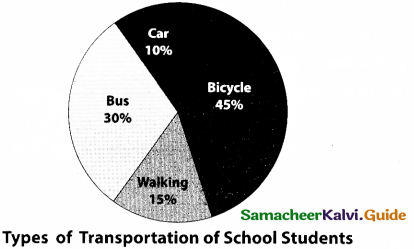
Tamil Nadu 12th English Model Question Paper 1 1
(a) What is the mode of transport preferred by most of the students?
(b) How many students prefer bus?
(c) What does the remaining students prefer?
Answer:
(a) Bicycle is preferred by most of the students.
(b) Thirty percent of students prefer to come by bus.
(c) The remaining students prefer to come by car or by walk to school.

Write a dialogue of minimum 3 exchanges between a fresher and a company manager.
Answer:
Manager : Good Morning Vikram. please take your seat.
Vikram : Good morning Sir. Thank you.
Manager : I understand that you are a First class Engineering graduate. Tell us about yourself.
Vikram : Well, I hail from a village in Iddayangudi and my parents are fanners.
Manager : If given an opportunity, can you handle project presentations on your own?
Vikram : Yes certainly Sir as I am well versed in Computer and have done various presentations during my course of study.

Tamil Nadu 12th English Model Question Paper 1

Question 39.
Describe the process of how to knot a bow tie.
Answer:
Place the tie around the neck, with one end slightly longer than the other.
Then place the longer end over the other and pass it upwards and behind the point where the two ends cross.
Next, take the other end of the tie and bend it twice to form an ‘S’ shape.
Bring the longer end down and in front, so that it holds the ‘S’ curve in place.
Now comes the trickiest part of the process when you have to take the long end of the tie and form a similar ‘S’ shape before passing it through the narrow gap behind the other end.
This creates a knot and the bow should now be held securely in place.
Finally, adjust both sides of the bow to make it symmetrical.

Question 40.
Complete the proverbs using the word given below.
(a) A bad ……………………….. makes a bad ending, (plan, beginning, plot)
(b) All roads lead to ……………………….. (Paris, London, Rome)
(c) ……………………….. have ears. (Walls, Floors, Windows)
Answer:
(a) beginning (b) Rome (c) Walls

Part – IV

Answer the following questions: [7 x 5 = 35]
Answer in a paragraph in about 150 words.

Tamil Nadu 12th English Model Question Paper 1

Question 41.
Summarise George Orwell’s distinctive ideas in “A Nice Cup of Tea”.
Answer:
Tea is one of the mainstays of civilizations of UK, New Zealand, Australia and Eire. But, it is not found in the recipes of cookeiy books. The nicest manner in which tea must be prepared has become a subject matter of violent disputes among tea loving persons even within a family. Indian tea fits in with the author’s description of “nicest cup of tea” as it rejuvenates the drinker with wisdom, stimulation, bravery and optimism. One cup of strong tea is equal to twenty weak ones.

Best tea is prepared by boiling tea leaves first and then adding milk to taste. Milk first schools and tea first schools still fight. Tea prepared in earthen pot or china ware is good. The real flavour of tea should never be imprisoned by strainers. Consuming tea leaves will not harm one’s health. Adding sugar to tea will naturally ruin its real flavour and taste.

The author advises misguided people who drink sweet tea to desist from the practice for a fortnight. He guarantees them that they would like the natural taste of tea and would never again add sugar to tea. Tea should be taken in a cylindrical or breakfast cup to enjoy it. Shallow and flat cups don’t retain wannth and taste for a long time.

Tamil Nadu 12th English Model Question Paper 1

Or

Life is unjust and cruel to certain people. Do they all resign themselves to their fate? Can you think of some who have fought their disabilities heroically and remained a stellar example for others? (for e.g. the astrophysicist Stephen Hawking, a paraplegic). Give an account of one such person and his/her struggle to live a fruitful life.

Alexis Leon lives in Kakkanad, Kerala. He passed B.Tech from the university of Kerala with first rank. Then he did his M.Tech. He met with an accident in 1993 which left him paralysed from chest down and confined him to a wheel chair for the rest of his life. After a brief spell of dejection owing to a suspended marriage, he made up his mind to write books. He has written 50 books for Engineering graduates.

His notable work is ‘Internet for Everyone’ and ‘A Guide to Software Configuration Management’. He is also a mentor at International Mentoring Network Association. He offers software consultancy to international IT companies. He travels across the world and delivers lectures to graduates and Corporates. His indomitable will has made him strong. He has become a light house for many aspirants in the software industry.

Question 42.
Shakespeare has skilfully brought out the parallels between the life of man and actors on stage. Elaborate this statement with reference to the poem.
Answer:
Shakespeare has beautifully compared the growth of humans by stages with his emergent role during that stage. In the first stage man plays the role of an infant. As an infant, he does represent characterisation of mewling and puking. In the second Act, he does the role of a school boy with the characteristics of unwillingness to go to schools and innocence shining in his face. In the third Act, he performs the role of a lover head over heels in love with a beautiful lady. He composes woeful romantic ballads and sings serenades to impress his love. In the fourth act, he plays the impressive role of a short-tempered, honour pursuing soldier.

Tamil Nadu 12th English Model Question Paper 1

He is ready to put his mouth in the Cannon’s mouth for conquering the bubble like honour in order to defend the territory of his countiy. In the fifth Act, he performs the role of a mature and fair judge criticising the ways of the world often spicing up his conversations with wise remarks and wit. His pot belly and well-cut beard shows the social status he enjoys in life. In the sixth act, he is old. He performs the role of a thin old man wearing ill-fitting loose garments with a changed treble in his voice.

He is bespectacled and slow in walking. In the final act, he becomes a total invalid losing all senses of hearing, taste and sight. Then the performer leaves the stage (i.e.) the lonely planet.

[OR]

How according to the poet is it possible for his son to bring changes into a world that resents change?
The poet advises his son to introspect often and not feel ashamed of being called a fool especially when he pursues knowledge. He can examine himself and remove his follies. He must enjoy the advantages of solitude. Solitude would help him to be creative. He would invariably learn that final decisions are always taken in silent rooms. Being alone, he can identify his innate potential and talents. His free imagination will bring about changes even if the world resents them. The zest to bring about changes will elevate him to the level of Shakespeare, Pasteur, Wright Brothers, Pavlov and Michael Faraday. Thus he will be remembered as one of the great men who changed the world.

Question 43.
Develop the hints into a paragraph.
Aksionov, meek – fellow prisoners respect – prison authorities – old man unjustly punished – speaks truth – prison shelf dug – newcomer Semyonich – could be the culprit – suspicion – all prisoners summoned – denied – some quiet – betray – Governor – enormous trust in Aksionov – stayed quiet.
Answer:

Tamil Nadu 12th English Model Question Paper 1

Aksionov was a merchant who was condemned for a murder he had not committed. He waits for God’s justice. Meanwhile in prison he learnt to make boots and earned a little money. Aksionov was meek. Fellow prisoners, having realized that he was innocent, respected him and called him grandfather. The prison authorities also believed that the religious old man must have been unjustly punished. They knew Aksionov never told lies. The prison authorities found out that someone had been digging the prison shelf to escape. They doubted that newcomer Semyonich could be the culprit. But they could not nail him on the grounds of suspicion alone. All the prisoners were summoned and enquired including Semyonich. All denied any knowledge of it. Those who knew kept quiet because they knew Semyonich will get flogged if someone betrayed him. As no one was ready to tell the truth, the Governor, who had enormous trust in the nobility and honesty of Aksionov asked him to tell the truth. But Aksionov preferred to stay quiet.

[OR]

Richard Parker calmed Pi – irony of life – peace, purpose and wholeness – same boat – Pi’s personality – Parker’s presence – realized danger and peace – innate strength – tiger – less tormenting – loneliness and despair – chances of survival – middle of Pacific Ocean – optimistic, balanced and stoical – thanks to the presence of Parker.
Answer:
Pi was alone and orphaned. He was drifting in the middle of pacific ocean hanging on to the oar. The elements of nature which threatened his survival the previous night had calmed down. The life boat did not sink. It was Richard Parker who calmed down Pi. The irony of life is that the animal that scared him witless to start with was the same who brought him peace, purpose and even wholeness. They were literally and figuratively in the same boat. They had to live together.

Tamil Nadu 12th English Model Question Paper 1

A part of Pi’s personality was glad about Parker’s presence, who gave him the will to hang on to life under the toughest conditions. He realized danger and peace can co-exist when one is aware of one’s innate strength. He realizes the fact that staying with a tiger is less tormenting than living alone with despair. Loneliness and despair can easily kill a person.

He decided to focus on the chances of survival and shut off the tragic circumstances he was placed in a lonely boat in the middle of Pacific Ocean. In short, he became optimistic, balanced and stoical in his attitude to life. Thanks to the presence of Richard Parker.

Question 44.
Write a summary or make notes of the following passage.
Answer:
There is an enemy beneath our feet – an enemy more deadly for his complete neutrality. He recognizes no national frontiers, no political parties. Everyone in the world is endangered by him. The enemy is the earth itself. When an earthquake strikes, the world trembles. The power of a quake is greater than anything man himself can produce.

But today scientists are directing a great deal of their effort into finding some way of battling earthquakes, and it is possible that at some time in the near future mankind will discover a means of protecting itself from earthquakes. An earthquake strikes without warning.

Tamil Nadu 12th English Model Question Paper 1

When it does, its power is immense. If it strikes a modem city, the damage is very immense. When gas cylinders burst, explosions are caused and fires start. Underground railways are wrecked. Buildings collapse, bridges fall, dams burst, and gaping crevices appear in busy streets. If the quake strikes at sea, huge tidal waves sweep inland. If it strikes in mountain regions, avalanches roar down into the valley.

Consider the terrifying statistics from the past 1755: Lisbon, capital of Portugal – the city destroyed entirely and 450 were killed. 1970: Peru: 50,000 were killed. In 1968 an earthquake struck Alaska. As this is a relatively depopulated part, only a few people were killed. But it is likely that this was one of the most powerful quakes ever to have hit the world.

Geologists estimate that during the tremors, the whole of the state moved over 80 feet farther west into the Pacific Ocean. Imagine the power of something that can move an entire subcontinent!

This is the problem that the scientists face. They are dealing with forces so immense that man cannot hope to resist them. All that can be done is to try to pinpoint just where the earthquake will strike and work from there. At least some protective measures can then be taken to save lives and some of the property.

Tamil Nadu 12th English Model Question Paper 1

Summary

No. of words given in the original passage: 326
No. of words to be written in the summary: 326/3 = 108 ± 5

Rough Draft
The enemy, Earth more deadly for neutrality, recognizes no national frontiers, no political parties Everyone is endangered by him. When an earthquake strikes, the world trembles and is powerful. Today-scientists are finding ways of battling earthquakes which strikes without warning. In a modem city the damage is immense.

When gas cylinders burst, explosions trigger fires and damages occur. If the quake strikes at sea, huge tidal waves sweep inland. Iin mountain regions, avalanches roar down the valley. Once Alaska escaped because it is thinly populated unlike other countries. Geologists estimate-fiiat the state moved over 80 feet farther west into the Pacific Ocean.

This is the problem that the scientists face. They are dealing with forces soAmnjense. We should try to pinpoint just where the earthquake will strike for some protective measured

Fair draft:
The enemy, Earth more deadly for neutrality, recognizes none and endangers all. When an earthquake strikes, the world trembles. Scientists find ways to battle powerful earthquakes which strikes without warning. In modem cities, the damage is immense. When gas cylinders burst, explosions trigger fire. If the quake strikes at sea, huge tidal waves sweep inland.

Tamil Nadu 12th English Model Question Paper 1

In mountain regions, avalanches roar down the valley. Once Alaska escaped because it is depopulated unlike others. Geologists estimate that the state moved over 80 feet farther west into the Pacific Ocean.

Scientists face such problems with forces so immense. We should try to pinpoint just where the earthquake will strike for some protective measures.

No. of words in the summary: 110
[OR]

Notes
Title : Earthquake – the deadly enemy of mankind.
Deadly Enemy of Mankind

  • strikes all without a distn. – national boundary/political affiliation
  • Power greater than man-made weap.
  • Scientists finding means to combat eq.; they will find ways to protect themselves from eq.

Damage Cause by an Earthquake in General

  • Strikes without warning.
  • Modem city when struck red. to a primitive village.

Damage Caused by an Earthquake in Particular

  • strikes plains, seas, mnts. – all round destm.
  • In 1755, Lisbon destyd, 450 killed.
  • In 1970, Peru struck, 50,000 killed.
  • In 1968, Alaska hit, subcontinent moved 80 feet into the Pacific Ocean.

Tamil Nadu 12th English Model Question Paper 1

Problems Scientists Face

  • cannot resist powerful eq.
  • can predict the place of origin
  • precaution can be taken to save man & property.

Abbreviations used: eq. – earthquakes; distn. – distinction; weap. – weapon; red. – reduced; mnts. -mountains; destm. -destruction; destyd.-destroyed;

Question 45.
Write a letter to the editor of the newspaper on the mindless felling of trees on the road side.
Answer:
12.11.2020
From
XXX
YYY

To
The Editor
The Hindu Anna Salai
Chennai-600 002.

Sir,
Sub: Frequent felling of Trees

Tamil Nadu 12th English Model Question Paper 1

I am the Secretary of the YYY Colony Association. Our locality was surely a haven to us in the past few years. The fruits of labour that we had sown about ten years ago is well nurtured and utilised.

Most of the roads in our locality was filled with greenery because of the Flame of the Forest trees that we had planted and taken care of. The roads had enough shade and was filled with beautiful flowers.

In the recent past, we have encountered the mindless felling of trees by the Corporation staff for various reasons. We kindly request you to publish the same in the newspapers to bring to notice the mindless felling of trees to the public and the authorities concerned.

We hope that such a scenario doesn’t take place in our locality again and looking forward to a positive change in this situation.

Thank you,

Yours sincerely,
XXX

Address on the envelope
To
The Editor The Hindu Anna Salai
Chennai-600 002

[OR]

Tamil Nadu 12th English Model Question Paper 1

Write a paragraph of 150 words on “India-A Tourist’s Paradise”.
Answer:

India-A Tourist’s Paradise

India is a huge country with varied cultures and races. It is a land with primordial traditional heritage and rich history. India is the only country which has all the four seasons viz summer, autumn, winter and spring. It has beauty in all its places whether they are mountains, deserts, plains, seas or rivers. All these and the modem cities like Delhi, Mumbai, Chennai, Hyderabad and Bangalore as well as the places of pilgrimage make it one of the most sought-after tourist destinations in the world.

India is blessed with places that have natural beauty like Kashmir, Darjeeling, Matheran, Goa, Puri, Kerala, Valparai Ooty, Kodaikanal etc. All such beautiful places are often visited by people who try to combine spirituality with pleasure. India has a variety of beautiful locations to visit which makes it a tourist’s paradise.

Question 46.
Spot the errors and rewrite the sentences correctly.
(a) He spoke the English perfectly.
(b) I and she have booked tickets for the latest Harry Potter movie.
(c) My little sister is afraid for cockroaches.
(d) You can type quickly, won’t you?
(e) Though I had a cup of coffee yet I feel tired.
Answer:
(a) He spoke English perfectly.
(b) She and I have booked tickets for the latest Harry Potter movie.
(c) My little sister is afraid of cockroaches.
(d) You can type quickly, can’t you?
(e) Though I had a cup of coffee, I feel tired.

Tamil Nadu 12th English Model Question Paper 1

[OR]

Fill in the blanks correctly.
(a) When I was walking ……………………. foot outside my farm house, I saw a ……………………. under the grape vine, (bear/bare)
(b) I ……………………. arrive home late this evening. (Use a modal in the given blank.)
(c) He ……………………. buy a new car. (Use a semi-modal)
(d) ……………………. you ……………………. (see) my wallet and keys recently? (use proper tense)
Answer:
(a) bare/bear
(b) shall
(c) ought to
(d) Have, seen

Question 47.
Identify each of the following sentences with the fields given below:
(a) The deliberate suppression of texts by organisations shrouds the subject.
(b) The study of stars and stellar evolution is fundamental to our understanding of the universe.
(c) This shift to farming may have occurred because of climate change.
(d) Sovereign power may be vested on an individual or it may be vested on a group.
(e) Some medicines may not be safe during pregnancy.
[Astronomy; Medicine; Politics; Literature; Agriculture]
Answer:
(a) Literature
(b) Astronomy
(c) Agriculture
(d) Politics
(e) Health

Tamil Nadu 12th English Model Question Paper 1

[OR]

Read the following passage and answer in your own words.
Answer:
The earth is losing its forests. Presently, trees cover about 30 percent of the earth’s surface, but they are being destroyed at an alarming rate, especially in the tropics. Timber harvesting is a major reason for the destruction of the forests. Trees are used for building houses, making furniture, and providing pulp for paper products, such as newspapers and magazines. At least 40 hectares of rainforest are being felled every minute, mostly in order to extract the valuable timber.

Another way that man is destroying the world’s forests is by burning them down. In the Amazon, for example, rainforests are being burnt down at a rate of 20 hectares a minute. The main reason of burning down the rainforests is to clear the land for farming. Farmers in rainforest countries are often poor and cannot afford to buy land. Instead, these farmers clear rainforest land to raise their animals or grow their crops.

Because tropical rainforest soil is so poor in nutrients, farmers cannot reuse the same land year after year. In the following years, farmers just clear more land, destroying the forest piece by piece. Already more than 30 tropical countries have reached a critical level of forest destruction and one-time exporters of timber such as Nigeria and Thailand now have to import timber for their domestic needs.

Tamil Nadu 12th English Model Question Paper 1

Questions:
a. What is the major reason for the destruction of forests?
b. Mention any two uses of trees.
c. Why do some people burn down the rainforests?
d. How many tropical countries have reached a critical level of forest destruction?
e. From where do Nigeria and Thailand get timber for their domestic needs?
Answers:
(a) Timber harvest is the major reason for the destruction of forests.
(b) Trees are cut and their logs are used for making furniture and building houses.
(c) Some people bum down rain forests to clear the land for farming.
(d) More than 30 tropical countries have reached a critical level of forest destruction.
(e) Nigeria and Thailand get their timber from foreign countries.
Tamil Nadu 12th English Model Question Paper 1

Tamil Nadu 12th Commerce Model Question Papers 2020-2021 English Tamil Medium

Subject Matter Experts at SamacheerKalvi.Guide have created Samacheer Kalvi Tamil Nadu State Board Syllabus New Paper Pattern 12th Commerce Model Question Papers 2020-2021 with Answers Pdf Free Download in English Medium and Tamil Medium of TN 12th Standard Commerce Public Exam Question Papers Answer Key, New Paper Pattern of HSC 12th Class Commerce Previous Year Question Papers, Plus Two +2 Commerce Model Sample Papers are part of Tamil Nadu 12th Model Question Papers.

Let us look at these Government of Tamil Nadu State Board 12th Commerce Model Question Papers Tamil Medium with Answers 2020-21 Pdf. Students can view or download the Class 12th Commerce New Model Question Papers 2021 Tamil Nadu English Medium Pdf for their upcoming Tamil Nadu HSC Board Exams. Students can also read Tamilnadu Samcheer Kalvi 12th Commerce Guide.

TN State Board 12th Commerce Model Question Papers 2020 2021 English Tamil Medium

Tamil Nadu 12th Commerce Model Question Papers English Medium 2020-2021

Tamil Nadu 12th Commerce Model Question Papers Tamil Medium 2020-2021

  • Tamil Nadu 12th Commerce Model Question Paper 1 Tamil Medium
  • Tamil Nadu 12th Commerce Model Question Paper 2 Tamil Medium
  • Tamil Nadu 12th Commerce Model Question Paper 3 Tamil Medium
  • Tamil Nadu 12th Commerce Model Question Paper 4 Tamil Medium
  • Tamil Nadu 12th Commerce Model Question Paper 5 Tamil Medium

12th Commerce Model Question Paper Design 2020-2021 Tamil Nadu

Types of Questions Marks No. of Questions to be Answered Total Marks
Part-I Objective Type 1 20 20
Part-II Very Short Answers
(Totally 10 questions will be given. Answer any Seven. Any one question should be answered compulsorily)
2 7 14
Part-Ill Short Answers
(Totally 10 questions will be given. Answer any Seven. Any one question should be answered compulsorily)
3 7 21
Part-IV Essay Type 5 7 35
Total Marks 90

Tamil Nadu 12th Commerce Model Question Paper Weightage of Marks

Purpose Weightage
1. Knowledge 30%
2. Understanding 40%
3. Application 20%
4. Skill/Creativity 10%

It is necessary that students will understand the new pattern and style of Model Question Papers of 12th Standard Commerce Tamilnadu State Board Syllabus according to the latest exam pattern. These Tamil Nadu Plus Two 12th Commerce Model Question Papers State Board Tamil Medium and English Medium are useful to understand the pattern of questions asked in the board exam. Know about the important concepts to be prepared for TN HSLC Board Exams and Score More marks.

We hope the given Samacheer Kalvi Tamil Nadu State Board Syllabus New Paper Pattern Class 12th Commerce Model Question Papers 2020 2021 with Answers Pdf Free Download in English Medium and Tamil Medium will help you get through your subjective questions in the exam.

Let us know if you have any concerns regarding the Tamil Nadu Government 12th Commerce State Board Model Question Papers with Answers 2020 21, TN 12th Std Commerce Public Exam Question Papers with Answer Key, New Paper Pattern of HSC Class 12th Commerce Previous Year Question Papers, Plus Two +2 Commerce Model Sample Papers, drop a comment below and we will get back to you as soon as possible.

Tamil Nadu 12th Chemistry Model Question Papers 2020-2021 English Tamil Medium

Subject Matter Experts at SamacheerKalvi.Guide have created Samacheer Kalvi Tamil Nadu State Board Syllabus New Paper Pattern 12th Chemistry Model Question Papers 2019-2020 with Answers Pdf Free Download in English Medium and Tamil Medium of TN 12th Standard Chemistry Public Exam Question Papers Answer Key, New Paper Pattern of HSC 12th Class Chemistry Previous Year Question Papers, Plus Two +2 Chemistry Model Sample Papers are part of Tamil Nadu 12th Model Question Papers.

Let us look at these Government of Tamil Nadu State Board 12th Chemistry Model Question Papers Tamil Medium with Answers 2019-20 Pdf. Students can view or download the Class 12th Chemistry New Model Question Papers 2020 Tamil Nadu English Medium Pdf for their upcoming Tamil Nadu HSC Board Exams. Students can also read Tamilnadu Samcheer Kalvi 12th Chemistry Guide.

TN State Board 12th Chemistry Model Question Papers 2020 2021 English Tamil Medium

Tamil Nadu 12th Chemistry Model Question Papers English Medium 2019-2020

Tamil Nadu 12th Chemistry Model Question Papers Tamil Medium 2019-2020

  • Tamil Nadu 12th Chemistry Model Question Paper 1 Tamil Medium
  • Tamil Nadu 12th Chemistry Model Question Paper 2 Tamil Medium
  • Tamil Nadu 12th Chemistry Model Question Paper 3 Tamil Medium
  • Tamil Nadu 12th Chemistry Model Question Paper 4 Tamil Medium
  • Tamil Nadu 12th Chemistry Model Question Paper 5 Tamil Medium

12th Chemistry Model Question Paper Design 2019-2020 Tamil Nadu

Types of Questions Marks No. of Questions to be Answered Total Marks
Part-I Objective Type 1 15 15
Part-II Very Short Answers
(Totally 9 questions will be given. Answer any Six. Any one question should be answered compulsorily)
2 6 12
Part-Ill Short Answers
(Totally 9 questions will be given. Answer any Six. Any one question should be answered compulsorily)
3 6 18
Part-IV Essay Type 5 5 25
Total 70
Practical Marks + Internal Assessment (20+10) 30
Total Marks 100

Tamil Nadu 12th Chemistry Model Question Paper Weightage of Marks

Purpose Weightage
1. Knowledge 30%
2. Understanding 40%
3. Application 20%
4. Skill/Creativity 10%

It is necessary that students will understand the new pattern and style of Model Question Papers of 12th Standard Chemistry Tamilnadu State Board Syllabus according to the latest exam pattern. These Tamil Nadu Plus Two 12th Chemistry Model Question Papers State Board Tamil Medium and English Medium are useful to understand the pattern of questions asked in the board exam. Know about the important concepts to be prepared for TN HSLC Board Exams and Score More marks.

We hope the given Samacheer Kalvi Tamil Nadu State Board Syllabus New Paper Pattern Class 12th Chemistry Model Question Papers 2019 2020 with Answers Pdf Free Download in English Medium and Tamil Medium will help you get through your subjective questions in the exam.

Let us know if you have any concerns regarding the Tamil Nadu Government 12th Chemistry State Board Model Question Papers with Answers 2019 20, TN 12th Std Chemistry Public Exam Question Papers with Answer Key, New Paper Pattern of HSC Class 12th Chemistry Previous Year Question Papers, Plus Two +2 Chemistry Model Sample Papers, drop a comment below and we will get back to you as soon as possible.

Tamil Nadu 12th Physics Model Question Papers 2020-2021 English Tamil Medium

Subject Matter Experts at SamacheerKalvi.Guide have created Samacheer Kalvi Tamil Nadu State Board Syllabus New Paper Pattern 12th Physics Model Question Papers 2019-2020 with Answers Pdf Free Download in English Medium and Tamil Medium of TN 12th Standard Physics Public Exam Question Papers Answer Key, New Paper Pattern of HSC 12th Class Physics Previous Year Question Papers, Plus Two +2 Physics Model Sample Papers are part of Tamil Nadu 12th Model Question Papers.

Let us look at these Government of Tamil Nadu State Board 12th Physics Model Question Papers Tamil Medium with Answers 2019-20 Pdf. Students can view or download the Class 12th Physics New Model Question Papers 2020 Tamil Nadu English Medium Pdf for their upcoming Tamil Nadu HSC Board Exams. Students can also read Tamilnadu Samcheer Kalvi 12th Physics Guide.

TN State Board 12th Physics Model Question Papers 2020 2021 English Tamil Medium

Tamil Nadu 12th Physics Model Question Papers English Medium 2019-2020

Tamil Nadu 12th Physics Model Question Papers Tamil Medium 2019-2020

  • Tamil Nadu 12th Physics Model Question Paper 1 Tamil Medium
  • Tamil Nadu 12th Physics Model Question Paper 2 Tamil Medium
  • Tamil Nadu 12th Physics Model Question Paper 3 Tamil Medium
  • Tamil Nadu 12th Physics Model Question Paper 4 Tamil Medium
  • Tamil Nadu 12th Physics Model Question Paper 5 Tamil Medium

12th Physics Model Question Paper Design 2019-2020 Tamil Nadu

Types of Questions Marks No. of Questions to be Answered Total Marks
Part-I Objective Type 1 15 15
Part-II Very Short Answers
(Totally 9 questions will be given. Answer any Six. Any one question should be answered compulsorily)
2 6 12
Part-Ill Short Answers
(Totally 9 questions will be given. Answer any Six. Any one question should be answered compulsorily)
3 6 18
Part-IV Essay Type 5 5 25
Total 70
Practical Marks + Internal Assessment (20+10) 30
Total Marks 100

Tamil Nadu 12th Physics Model Question Paper Weightage of Marks

Purpose Weightage
1. Knowledge 30%
2. Understanding 40%
3. Application 20%
4. Skill/Creativity 10%

It is necessary that students will understand the new pattern and style of Model Question Papers of 12th Standard Physics Tamilnadu State Board Syllabus according to the latest exam pattern. These Tamil Nadu Plus Two 12th Physics Model Question Papers State Board Tamil Medium and English Medium are useful to understand the pattern of questions asked in the board exam. Know about the important concepts to be prepared for TN HSLC Board Exams and Score More marks.

We hope the given Samacheer Kalvi Tamil Nadu State Board Syllabus New Paper Pattern Class 12th Physics Model Question Papers 2019 2020 with Answers Pdf Free Download in English Medium and Tamil Medium will help you get through your subjective questions in the exam.

Let us know if you have any concerns regarding the Tamil Nadu Government 12th Physics State Board Model Question Papers with Answers 2019 20, TN 12th Std Physics Public Exam Question Papers with Answer Key, New Paper Pattern of HSC Class 12th Physics Previous Year Question Papers, Plus Two +2 Physics Model Sample Papers, drop a comment below and we will get back to you as soon as possible.

Samacheer Kalvi 12th Maths Guide Chapter 2 Complex Numbers Ex 2.2

Tamilnadu State Board New Syllabus Samacheer Kalvi 12th Maths Guide Pdf Chapter 2 Complex Numbers Ex 2.2 Textbook Questions and Answers, Notes.
Tamilnadu Samacheer Kalvi 12th Maths Solutions Chapter 2 Complex Numbers Ex 2.2

Question 1.
Evaluate the following if z = 5 – 2i and w = -1 + 3i
(i) z + w
Solution:
z = 5 – 2i, w = -1 + 3i
z + w = (5 – 2i) + (-1 + 3i)
= (5 – 1) + (-2i + 3i)
= 4 + i

(ii) z – iw
Solution:
z – iw = (5 – 2i) – i (-1 + 3i)
= 5 – 2i + i + 3
= (5 + 3) + (-2i + i)
= 8 – i

Samacheer Kalvi 12th Maths Guide Chapter 2 Complex Numbers Ex 2.2

(iii) 2z + 3w
Solution:
2z + 3w = 2(5 – 2i) + 3 (-1 +3i)
= 10 – 4i – 3 + 9i
= 7 + 5 i

(iv) zw
Solution:
zw = (5 – 2i) (-1 + 3i)
= -5 + 15i + 2i – 6i2
= -5 + 17i + 6
= 1 + 17i

(v) z² + 2zw + w²
Solution:
= (z + w)2 [from (i)]
= (4 + i)2
= 16 – 1 + 8i
= 15 + 8i

Samacheer Kalvi 12th Maths Guide Chapter 2 Complex Numbers Ex 2.2

(vi) (z + w)²
Solution:
(vi) (z + w)2 = 15 + 8z [from (v)]

Question 2.
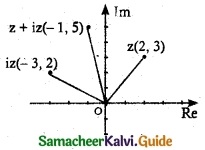
Given the complex number z = 2 + 3i, represent the complex numbers in the Argand diagram.
(i) z = 2 + 3i
iz = i(2 + 3i)
= (2i – 3)
= -3 + 2i
z + iz = (2 + 3i) + (-3 + 2i)
= -1 + 5i
Samacheer Kalvi 12th Maths Guide Chapter 2 Complex Numbers Ex 2.2 1

Samacheer Kalvi 12th Maths Guide Chapter 2 Complex Numbers Ex 2.2

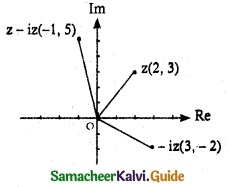
(ii) z, – iz and z – iz
z = 2 + 3i
-iz = -i (2 + 3i)
= -2i – 3i² = -2i + 3
= 3 – 2i
z- iz= 2 + 3i -3 + 2i
= 5 + i
Samacheer Kalvi 12th Maths Guide Chapter 2 Complex Numbers Ex 2.2 2

Samacheer Kalvi 12th Maths Guide Chapter 2 Complex Numbers Ex 2.2

Question 3.
Find the values of the real numbers x and y. if the complex numbers
(3 – i)x – (2 – i) y + 2i + 5 and 2x + (-1 + 2i)y + 3 + 2i are equal.
Solution:
(3 – i) x – (2 – i) y + 2i + 5 = 2x + (-1 + 2i) y + 3 + 2i
⇒ 3x – ix – 2y + iy + 2i + 5 = 2x – y + 2yi + 3 + 2i
⇒ (3x – 2y + 5) + 1 (-x + y + 2) = (2x – y + 3) + i (2y + 2)
Equate real parts on both sides
3x – 2y + 5 = 2x – y + 3
x – y = -2 ……. (1)
Equate imaginary parts on both sides
-x + y + 2 = 2y + 2
-x – y = 0
x + y = 0 ……. (2)
(1) + (2) ⇒ 2x = -2
x = -1
Substituting x = -1 in (2)
-1 + y = 0
⇒ y = 1
∴ x = -1, y = 1

Samacheer Kalvi 12th Maths Guide Chapter 2 Complex Numbers Ex 2.2

Samacheer Kalvi 12th Maths Guide Chapter 1 Applications of Matrices and Determinants Ex 1.8

Tamilnadu State Board New Syllabus Samacheer Kalvi 12th Maths Guide Pdf Chapter 1 Applications of Matrices and Determinants Ex 1.8 Textbook Questions and Answers, Notes.
Tamilnadu Samacheer Kalvi 12th Maths Solutions Chapter 1 Applications of Matrices and Determinants Ex 1.8

Choose the Most Suitable Answer.
Question 1.
If |adj(adj A) |=| A|9, then the order of the square matrix A is:
(a) 3
(b) 4
(c) 2
(d) 5
Solution:
(b) 4
Hint:
Since |adj(adj A)| = |A|(n – 1)2
(n – 1)2 = 9 = 3²
n – 1 = 3
n = 4

Samacheer Kalvi 12th Maths Guide Chapter 1 Applications of Matrices and Determinants Ex 1.8

Question 2.
If A is a 3 × 3 non-singular matrix such that AAT = AT A and B = A-1AT, then BBT =
(a) A
(b) B
(C) I3
(d) BT
Solution:
(C) I
Hint:
AAT = ATA and B = A-1AT
BT = (A-1)T(AT)T = (A-1)T A
BB-1 = (A-1 AT) (A-1)T A = A-1 (AA-1)T A
= A-1 (I)T A = A-1 A = I3

Question 3.
If A = \(\begin{bmatrix} 3 & 5 \\ 1 & 2 \end{bmatrix}\) B = adj A and C = 3A, then \(\frac{|adj B|}{|C|}\) =
(a) \(\frac{1}{3}\)
(b) \(\frac{1}{9}\)
(C) \(\frac{1}{4}\)
(d) 1
Solution:
(a) \(\frac{1}{3}\)
Hint:
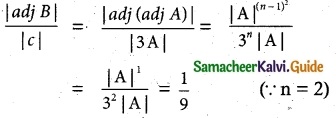
Samacheer Kalvi 12th Maths Guide Chapter 1 Applications of Matrices and Determinants Ex 1.8 1

Samacheer Kalvi 12th Maths Guide Chapter 1 Applications of Matrices and Determinants Ex 1.8

Question 4.
If A \(\begin{bmatrix} 1 & -2 \\ 1 & 4 \end{bmatrix}\) = \(\begin{bmatrix} 6 & 0 \\ 0 & 6 \end{bmatrix}\), then A:
Samacheer Kalvi 12th Maths Guide Chapter 1 Applications of Matrices and Determinants Ex 1.8 2
Solution:
(c) \(\begin{bmatrix} 4 & 2 \\ -1 & 1 \end{bmatrix}\)
Hint:
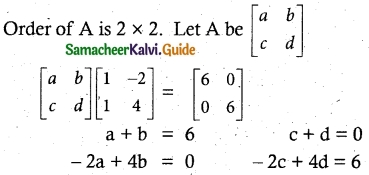
Samacheer Kalvi 12th Maths Guide Chapter 1 Applications of Matrices and Determinants Ex 1.8 3
Solve the equations we get
a = 4, b = 2, c = -1, d = 1
A = \(\begin{bmatrix} 4 & 2 \\ -1 & 1 \end{bmatrix}\)

Question 5.
If A = \(\begin{bmatrix} 7 & 3 \\ 4 & 2 \end{bmatrix}\) then 9I2 – A =
(a) A-1
(b) \(\frac{A^{-1}}{2}\)
(c) 3A-1
(d) 2A-1
Solution:
(d) 2A-1
Hint:
|A| = 14 – 12 = 2
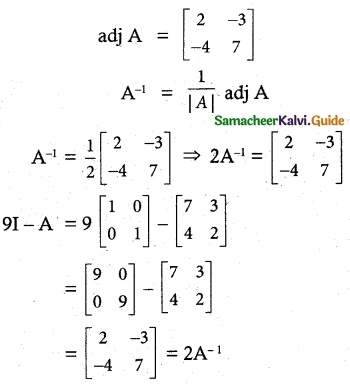
Samacheer Kalvi 12th Maths Guide Chapter 1 Applications of Matrices and Determinants Ex 1.8 4

Samacheer Kalvi 12th Maths Guide Chapter 1 Applications of Matrices and Determinants Ex 1.8

Question 6.
If A = \(\begin{bmatrix} 2 & 0 \\ 1 & 5 \end{bmatrix}\) and B = \(\begin{bmatrix} 1 & 4 \\ 2 & 0 \end{bmatrix}\) then |adj (AB)| =
(a) -40
(b) -80
(c) -60
(d) -20
Solution:
(b) -80
Hint:
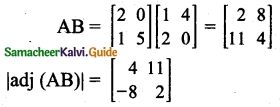
Samacheer Kalvi 12th Maths Guide Chapter 1 Applications of Matrices and Determinants Ex 1.8 5
∴ |adj (AB)| = 8 – 88 = -80

Question 7.
If P = \(\left[ \begin{matrix} 1 & x & 0 \\ 1 & 3 & 0 \\ 2 & 4 & -2 \end{matrix} \right] \) is the adjoint of 3 × 3 matrix A and |A| = 4, then x is
(a) 15
(b) 12
(c) 14
(d) 11
Solution:
(d) 11
Hint:
Since |adj A| = |A|n – 1 (n = 3)
1(-6 + 0) – x(-2) = 4²
-6 + 2x = 16
2x = 16 + 6 = 22
x = 11

Samacheer Kalvi 12th Maths Guide Chapter 1 Applications of Matrices and Determinants Ex 1.8

Question 8.
Samacheer Kalvi 12th Maths Guide Chapter 1 Applications of Matrices and Determinants Ex 1.8 6
(a) 0
(b) -2
(c) -3
(d) -1
Solution:
(d) -1
Hint:
Samacheer Kalvi 12th Maths Guide Chapter 1 Applications of Matrices and Determinants Ex 1.8 7

Question 9.
If A, B and C are invertible matrices of some order, then which one of the following is not true?
(a) adj A = |A|A-1
(b) adj (AB) = (adj A)(adj B)
(c) det A-1 = (det A)-1
(d) (ABC)-1 = C-1B-1A-1
Solution:
(b) adj (AB) = (adj A)(adj B)
Hint:
adj (AB) ≠ (adj A)(adj B)

Samacheer Kalvi 12th Maths Guide Chapter 1 Applications of Matrices and Determinants Ex 1.8

Question 10.
Samacheer Kalvi 12th Maths Guide Chapter 1 Applications of Matrices and Determinants Ex 1.8 8
Solution:
(a) \(\begin{bmatrix} 2 & -5 \\ -3 & 8 \end{bmatrix}\)
Hint:
(AB)-1 = B-1 A-1
(AB)-1 A = B-1 [A-1]A
(AB)-1 A = B-1
(A-1)-1 = A
|A-1| = 3 – 2 = 1
Samacheer Kalvi 12th Maths Guide Chapter 1 Applications of Matrices and Determinants Ex 1.8 9

Question 11.
If ATA-1 is symmetric, then A² =
(a) A-1
(b) (AT
(c) AT
(d) (A-1
Solution:
(b) (AT
Hint:
(AT A-1)T = AT A-1
(A-1)T (AT)T = AT A-1
(A-1)T A = AT A-1
AT (A-1)T AA = (AT) AT A-1 A
(pre and post multiply by AT and A)
A2 = (AT

Samacheer Kalvi 12th Maths Guide Chapter 1 Applications of Matrices and Determinants Ex 1.8

Question 12.
If A is a non-singular matrix such that A-1 = \(\begin{bmatrix} 5 & 3 \\ -2 & -1 \end{bmatrix}\), then (AT)-1 =
Samacheer Kalvi 12th Maths Guide Chapter 1 Applications of Matrices and Determinants Ex 1.8 10
Solution:
(d) \(\begin{bmatrix} 5 & -2 \\ 3 & -1 \end{bmatrix}\)
Hint:
A-1 = \(\begin{bmatrix} 5 & 3 \\ -2 & -1 \end{bmatrix}\)
Since (AT)-1 = (A-1)T = \(\begin{bmatrix} 5 & -2 \\ 3 & -1 \end{bmatrix}\)

Question 13.
Samacheer Kalvi 12th Maths Guide Chapter 1 Applications of Matrices and Determinants Ex 1.8 11
(a) \(\frac{-4}{5}\)
(b) \(\frac{-3}{5}\)
(c) \(\frac{3}{5}\)
(d) \(\frac{4}{5}\)
Solution:
(a) \(\frac{-4}{5}\)
Hint:
Since AT = A-1
AAT =  I
Samacheer Kalvi 12th Maths Guide Chapter 1 Applications of Matrices and Determinants Ex 1.8 12

Samacheer Kalvi 12th Maths Guide Chapter 1 Applications of Matrices and Determinants Ex 1.8

Question 14.
Samacheer Kalvi 12th Maths Guide Chapter 1 Applications of Matrices and Determinants Ex 1.8 13
(a) (cos² \(\frac{θ}{2}\))A
(b) (cos² \(\frac{θ}{2}\))AT
(c) (cos²θ)I
(d) (sin² \(\frac{θ}{2}\))A
Solution:
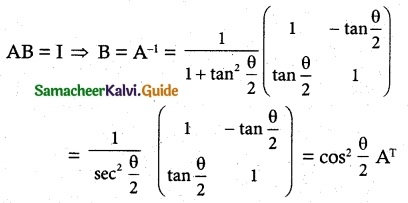
(b) (cos² \(\frac{θ}{2}\))AT
Hint:
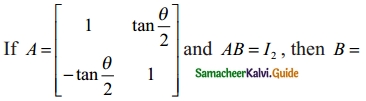
Samacheer Kalvi 12th Maths Guide Chapter 1 Applications of Matrices and Determinants Ex 1.8 14

Question 15.
Samacheer Kalvi 12th Maths Guide Chapter 1 Applications of Matrices and Determinants Ex 1.8 15
(a) 0
(b) sin θ
(c) cos θ
(d) 1
Solution:
(d) 1
Hint:
Samacheer Kalvi 12th Maths Guide Chapter 1 Applications of Matrices and Determinants Ex 1.8 16
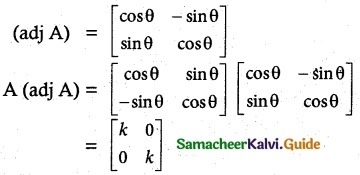
cos² θ + sin² θ = k
Hence k = 1

Samacheer Kalvi 12th Maths Guide Chapter 1 Applications of Matrices and Determinants Ex 1.8

Question 16.
If A = \(\begin{bmatrix} 2 & 3 \\ 5 & -2 \end{bmatrix}\) be such that λA-1 = A, then λ is:
(a) 17
(b) 14
(c) 19
(d) 21
Solution:
(c) 19
Hint:
λA-1 = A
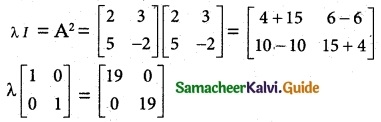
Samacheer Kalvi 12th Maths Guide Chapter 1 Applications of Matrices and Determinants Ex 1.8 17
⇒ λ = 19

Question 17.
If adj A = \(\begin{bmatrix} 2 & 3 \\ 4 & 1 \end{bmatrix}\) and adj B = \(\begin{bmatrix} 1 & -2 \\ -3 & 1 \end{bmatrix}\) then adj (AB) is:
Samacheer Kalvi 12th Maths Guide Chapter 1 Applications of Matrices and Determinants Ex 1.8 18
Solution:
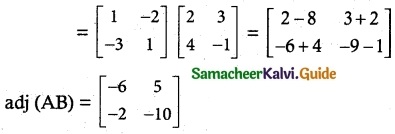
(b) \(\begin{bmatrix} -6 & 5 \\ -2 & -10 \end{bmatrix}\)
Hint:
adj (AB) = (adj B) (adj A)
Samacheer Kalvi 12th Maths Guide Chapter 1 Applications of Matrices and Determinants Ex 1.8 19

Samacheer Kalvi 12th Maths Guide Chapter 1 Applications of Matrices and Determinants Ex 1.8

Question 18.
Samacheer Kalvi 12th Maths Guide Chapter 1 Applications of Matrices and Determinants Ex 1.8 20
(a) 1
(b) 2
(c) 4
(d) 4
Solution:
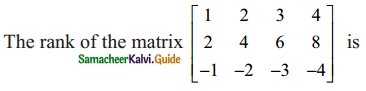
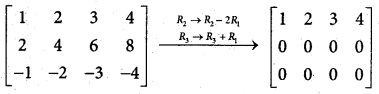
(a) 1
Hint:
Samacheer Kalvi 12th Maths Guide Chapter 1 Applications of Matrices and Determinants Ex 1.8 21
∴ Number of non zero row = 1
ρ(A) = 1

Question 19.
Samacheer Kalvi 12th Maths Guide Chapter 1 Applications of Matrices and Determinants Ex 1.8 22
(a) \(e^{(Δ_{2}/Δ_{1})}\), \(e^{(Δ_{3}/Δ_{1})}\)
(b) log(Δ13), log(Δ23)
(c) log(Δ21), log(Δ31)
(d) \(e^{(Δ_{1}/Δ_{3})}\), \(e^{(Δ_{2}/Δ_{3})}\)
Solution:
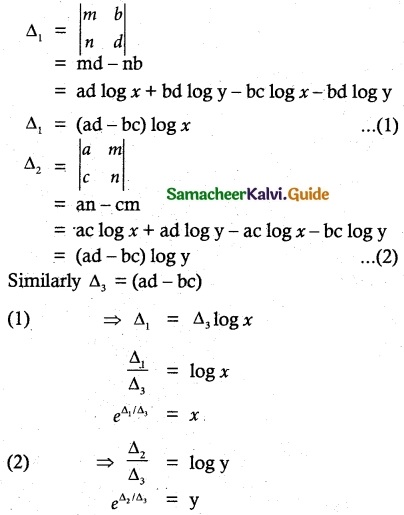
(d) \(e^{(Δ_{1}/Δ_{3})}\), \(e^{(Δ_{2}/Δ_{3})}\)
Hint:
xayb = em
a log x + b log y = m
xcyd = en
c log x + d log y = n
Samacheer Kalvi 12th Maths Guide Chapter 1 Applications of Matrices and Determinants Ex 1.8 23

Samacheer Kalvi 12th Maths Guide Chapter 1 Applications of Matrices and Determinants Ex 1.8

Question 20.
Which of the following is/are correct?
(i) Adjoint of a symmetric matrix is also a symmetric matrix.
(ii) Adjoint of a diagonal matrix is also a diagonal matrix.
(iii) If A is a square matrix of order n and λ is a scalar, then adj(λA) = λn adj (A).
(iv) A(adj A) = (adj A)A = |A|I
(a) Only (i)
(b) (ii) and (iii)
(c) (iii) and (iv)
(d) (i), (ii) and (iv)
Solution:
(d) (i), (ii) and (iv)

Question 21.
If ρ(A) ρ([A | B]), then the system AX = B of linear equations is:
(a) consistent and has a unique solution
(b) consistent
(c) consistent and has infinitely many solutions
(d) inconsistent
Solution:
(b) consistent
Hint:
If ρ(A) = ρ[A|B] = no. of unknowns
We say consistent an unique solutions
Hence ρ(A) = ρ[A|B] ← given

Question 22.
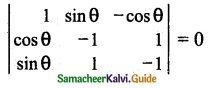
If 0 ≤ θ ≤ π and the system of equations x + (sin θ)y – (cos θ)z = 0, (cos θ) x – y + z = 0, (sin θ) x + y + z = 0 has a non-trivial solution then θ is:
(a) \(\frac{2π}{3}\)
(b) \(\frac{3π}{4}\)
(c) \(\frac{5π}{6}\)
(d) \(\frac{π}{4}\)
Solution:
(d) \(\frac{π}{4}\)
Hint:
If AX = 0 has non  trivial solution if |A| = 0
Samacheer Kalvi 12th Maths Guide Chapter 1 Applications of Matrices and Determinants Ex 1.8 24
⇒ 1(1 – 1) – sinθ (-cosθ – sinθ) – cosθ (cosθ + sinθ) = 0
⇒ + sinθ cosθ + sin²θ – cos²θ – sinθ cosθ = 0
⇒ sin²θ – cos²θ = 0
⇒ sinθ = cosθ
θ =\(\frac{π}{4}\)

Samacheer Kalvi 12th Maths Guide Chapter 1 Applications of Matrices and Determinants Ex 1.8

Question 23.
Samacheer Kalvi 12th Maths Guide Chapter 1 Applications of Matrices and Determinants Ex 1.8 25
(a) λ = 7, µ ≠ -5
(b) λ = -7, µ = 5
(c) λ ≠ 7, µ ≠ -5
(d) λ = 7, µ = -5
Solution:
(d) λ = 7, µ = -5
Hint:
ρ(A) = ρ[A | B] = 2
λ – 7 = 0 and µ + 5 = 0
λ = 7, µ = -5

Question 24.
Samacheer Kalvi 12th Maths Guide Chapter 1 Applications of Matrices and Determinants Ex 1.8 26
(a) 2
(b) 4
(c) 3
(d) 1
Solution:
(b) 4
Hint:
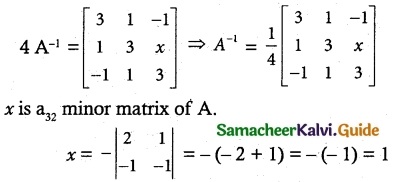
B = A-1
Samacheer Kalvi 12th Maths Guide Chapter 1 Applications of Matrices and Determinants Ex 1.8 27

Samacheer Kalvi 12th Maths Guide Chapter 1 Applications of Matrices and Determinants Ex 1.8

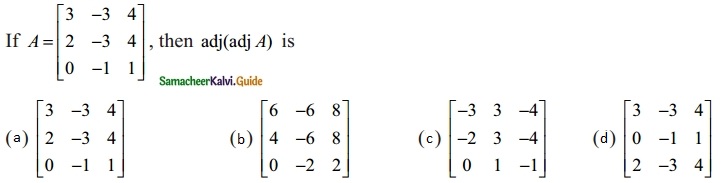
Question 25.
Samacheer Kalvi 12th Maths Guide Chapter 1 Applications of Matrices and Determinants Ex 1.8 28
Solution:
(a) \(\left[\begin{array}{rrr}
3 & -3 & 4 \\
2 & -3 & 4 \\
0 & -1 & 1
\end{array}\right]\)
Hint:
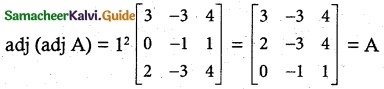
adj (adj A) = |A|n-2 A = |A|² A
|A|= 3(-3 + 4) + 3(2) + 4 (-2)
= 3 + 6 – 8
= 1
Samacheer Kalvi 12th Maths Guide Chapter 1 Applications of Matrices and Determinants Ex 1.8 29

Samacheer Kalvi 12th Maths Guide Chapter 1 Applications of Matrices and Determinants Ex 1.7

Tamilnadu State Board New Syllabus Samacheer Kalvi 12th Maths Guide Pdf Chapter 1 Applications of Matrices and Determinants Ex 1.7 Textbook Questions and Answers, Notes.

Tamilnadu Samacheer Kalvi 12th Maths Solutions Chapter 1 Applications of Matrices and Determinants Ex 1.7

Question 1.
Solve the following system of homogeneous equations.
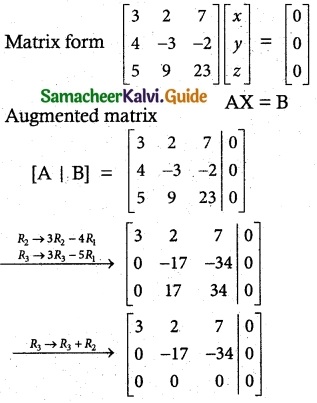
(i) 3x + 2y + 7z = 0; 4x – 3y – 2z = 0; 5x + 9y + 23z = 0
Solution:
Samacheer Kalvi 12th Maths Guide Chapter 1 Applications of Matrices and Determinants Ex 1.7 1
ρ(A) = 2 ρ[A | B] = 2
ρ(A) ρ[A | B] = 2 < n
The system is consistent. It has non trivial solution.
Writing the equivalent equations from echelon form
3x + 2y + 7z = 0 ………… (1)
-17y – 34z = 0 ……….. (2)
Put z = t
(2) ⇒ -17y = 34t
y = \(\frac {34t}{-17}\) = -2t
(1) ⇒ 3x + 2(-2t) + 7t = 0
3x – 4t + 7t = 0
3x + 3t = 0
3x = -3t
x = -t
(x, y, z) (-t, -2t, t) ∀ t ∈ R

Samacheer Kalvi 12th Maths Guide Chapter 1 Applications of Matrices and Determinants Ex 1.7

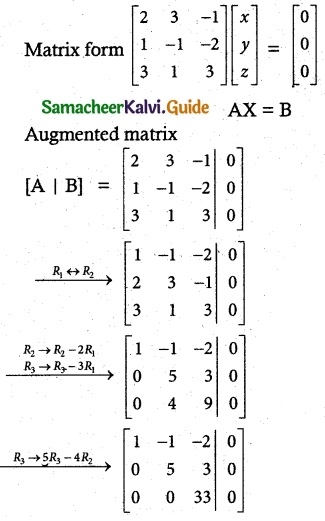
(ii) 2x + 3y – z = 0, x – y – 2z = 0, 3x + y + 3z = 0
Solution:
Samacheer Kalvi 12th Maths Guide Chapter 1 Applications of Matrices and Determinants Ex 1.7 2
ρ(A) = 3 ρ[A | B] = 3
ρ(A) = ρ[A | B] = 3
The system is consistent. It has trivial solution.
x = 0, y = 0, z = 0

Samacheer Kalvi 12th Maths Guide Chapter 1 Applications of Matrices and Determinants Ex 1.7

Question 2.
Determine the values of λ for which the following system of equations.
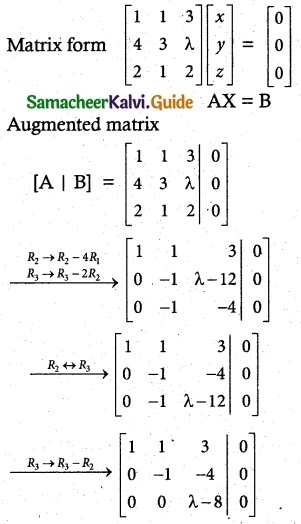
x + y + 3z = 0; 4x + 3y + λz = 0, 2x + y + 2z = 0 has
(i) a unique solution
(ii) a non-trivial solution.
Solution:
Samacheer Kalvi 12th Maths Guide Chapter 1 Applications of Matrices and Determinants Ex 1.7 3
Case (i):
if λ ≠ 8
ρ(A) = 3 ρ(A | B) = 3
ρ(A) = ρ(A | B) = 3 = n
The system is consistent. It has unique (trivial) solution.
∴ Solution x = 0, y = 0, z = 0

Case (ii):
if λ = 8
ρ(A)= ρ(A | B) = 2
ρ(A) = ρ(A | B) = 2 < n
The system is consistent. It has non trivial solution.

Samacheer Kalvi 12th Maths Guide Chapter 1 Applications of Matrices and Determinants Ex 1.7

Question 3.
By using Gaussian elimination method, balance the chemical -reaction equation:
C2H6 + O2 → H2O + CO2.
Solution:
We are searching for positive integers x1, x2, x3 and x4
x1 C2H6 + x2 O2 → x3 H2O + x4 CO2 ……….(1)
The number of carbon atoms on the LHS of (1) should be equal to the number of carbon atoms on the RHS of (1) so we get a linear
homogeneous equation.
2x1 x4 = 2x1 – x4 = 0 ……..(2)
6x1 = 2x3 = 6x1 – 2x3 = 0
÷ 2 ⇒ 3x1 – x3 = 0 ………(3)
2x2 = x3 + 2x4 ⇒ 2x2 – x3 – 2x4 = 0 ……… (4)
Equation (2), (3) and (4) constitute a homogeneous system of linear equations in four unknowns.
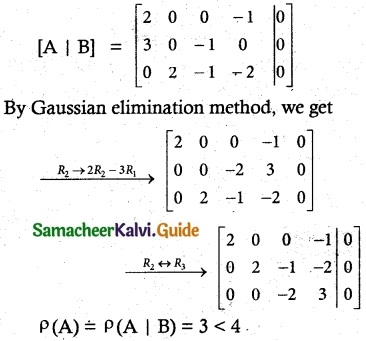
Augmented matrix
Samacheer Kalvi 12th Maths Guide Chapter 1 Applications of Matrices and Determinants Ex 1.7 4
The system is consistent and has an infinite number of solutions.
Writing the equations using the echelon form we get
-2x3 + 3x4 = 0 ……….. (1)
2x2 – x3 – 2x4 = 0 ………… (2)
2x1 – x4 = 0 …………. (3)
Put x4 = t
(3) ⇒ 2x1 – t = 0
x1 = \(\frac {t}{2}\)
(1) ⇒ -2x3 + 3x4 = 0
-2x3 = -3t
x3 = \(\frac {3}{2}\) t
(2) ⇒ 2x2 – x3 – 2x4 = 0
2x2 – \(\frac {3}{2}\) t – 2t = 0
2x2 = \(\frac {3}{2}\) t + 2t = \(\frac {7t}{2}\)
x2 = \(\frac {7t}{4}\)
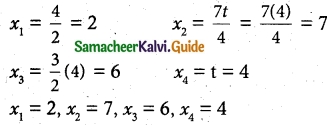
(x1, x2, x3, x4) = (\(\frac {t}{2}\), \(\frac {7t}{4}\), \(\frac {3}{2}\)t, t) ∀ t ∈ R
since x1, x2, x3 and x4 are positive integers.
Let us choose t = 4
Samacheer Kalvi 12th Maths Guide Chapter 1 Applications of Matrices and Determinants Ex 1.7 5
So the balanced equation is
2C2H6 + 7O2 → 6H2O + 4CO2.

Samacheer Kalvi 12th Maths Guide Chapter 1 Applications of Matrices and Determinants Ex 1.7

Samacheer Kalvi 12th Maths Guide Chapter 2 Complex Numbers Ex 2.3

Tamilnadu State Board New Syllabus Samacheer Kalvi 12th Maths Guide Pdf Chapter 2 Complex Numbers Ex 2.3 Textbook Questions and Answers, Notes.

Tamilnadu Samacheer Kalvi 12th Maths Solutions Chapter 2 Complex Numbers Ex 2.3

Question 1.
If z1 = 1 – 3i, z2 = -4i, and z3 = 5, show that
(i) (z1 + z2) + z3 = z1 + (z2 + z3)
Solution:
z1 = 1 – 3i, z2 = -4i, z3 = 5
(z1 + z2) + z3
= (1 – 3i – 4i) + 5
= (1 – 7i) + 5
= 6 – 7i …… (1)
z1 + (z2 + z3)
= (1 – 3i) + (-4i + 5)
= 6 – 7i ……. (2)
from (1) & (2) we get
∴ (z1 + z2) + z3 = z1 + (z2 + z3)

Samacheer Kalvi 12th Maths Guide Chapter 2 Complex Numbers Ex 2.3

(ii) (z1 z2)z3 = z1(z2 z3)
Solution:
(z1 z2) z3 = [(1 – 3i) (-4i]5
= [-4i + 12 i2]5
= [-12 – 4i] 5
= -60 – 20i ……. (1)
z1 (z2 z3) = (1 – 3i)[(-4i)(5)]
= (-20i + 60 i2)
= -20i – 60 ……. (2)
from (1) & (2) we get
∴ (z1 z2)(z3) = z1 (z2 z3)

Samacheer Kalvi 12th Maths Guide Chapter 2 Complex Numbers Ex 2.3

Question 2.
If z1 = 3, z2 = 7i, and z3 = 5 + 4i, show that
(i) z1(z2 + z3) = z1 z2 + z1 z3
Solution:
z1 = 3, z2 = 7i, z3 = 5 + 4i
z2 + z3 = -7i + 5 + 4i
= 5 – 3i
z1 (z2 + z3) = 3 (5 – 3i) + 15 – 9i …………. (1)
z1 z2 = 3(-7i) = -21i
z1 z3 = 3(5 + 4i) = 15 + 12i
z1 z2 + z1 z3 = -21i + 15 + 12i
= 15 – 9i ……… (2)
∴ from 1 and 2
z1(z2 + z3) = z1 z2 + z1 z3
Hence proved.

Samacheer Kalvi 12th Maths Guide Chapter 2 Complex Numbers Ex 2.3

(ii) (z1 + z2)z3 = z1 z3 + z2 z3
Solution:
z1 + z2 = 3 – 7i
(z1 + z2)z3 = (3 – 7i) (5 + 4i)
= 15 + 12i – 35i + 28i²
= 15 + 12i – 35i + 28i
= 43 – 23i ………… (1)
z1 z3 = 3(5 + 4i) = 15 + 12i
z2 z3 = – 7i(5 + 4i) = -35i – 28i²
= – 35i + 28
z1 z3 + z2 z3 = (15 + 12i) + (-35i + 28)
= 15 + 12i – 35i + 28
= 43 – 23i …………. (2)
∴ from 1 and 2
(z1 + z2)z3 = z1 z3 + z2 z3
Hence proved.

Samacheer Kalvi 12th Maths Guide Chapter 2 Complex Numbers Ex 2.3

Question 3.
If z1 = 2 + 5i, z2 = – 3 – 4i, and z3 = 1 + i, find the additive and multiplicative inverse of z1, z2 and z3.
Solution:
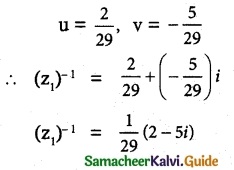
(i) z1 = 2 + 5i
additive inverse z1 is -z1
⇒ -(2 + 5i) = -2 – 5i
Multiplicative inverse z1 is (z1)-1
We know
z1 z1-1 = 1
⇒ (2 + 5i) (u + iv) = 1 [∵ z-1 = u + iv]
2u + 2iv + 5iu – 5v = 1
(2u – 5v) + i (5u + 2v) = 1 + i 0
Equating real and imaginary parts
2u – 5v = 1
5u + 2v = 0
Solving them, we get
Samacheer Kalvi 12th Maths Guide Chapter 2 Complex Numbers Ex 2.3 1

Samacheer Kalvi 12th Maths Guide Chapter 2 Complex Numbers Ex 2.3

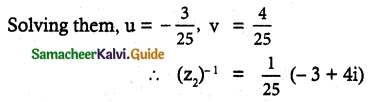
(ii) z2 = – 3 – 4i
Additive inverse z2 is -z2
⇒ -(3 – 4i) = 3 + 4i
Multiplicative inverse z2 is (z2)-1
We know
z2 z2-1 = 1
⇒ (-3 – 4i) (u + iv) = 1 [∵ z2-1 = u + iv]
-3u – 3iv – 4iu + 4v = 1
(-3u + 4v) + i (-4u – 3v) = 1 + i 0
we get -3u + 4v = 1
-4u – 3v = 0
Samacheer Kalvi 12th Maths Guide Chapter 2 Complex Numbers Ex 2.3 2

(iii) z3 = 1 + i
(а) Additive inverse of z3 = -z3 = -(1 + i) = -1 – i
(b) Multiplicative inverse of
\(z_{3}=\frac{1}{z_{3}} \frac{1}{1+i} \times \frac{1-i}{1-i}=\frac{1-i}{2}\)

Samacheer Kalvi 12th Maths Guide Chapter 2 Complex Numbers Ex 2.3

Samacheer Kalvi 12th Maths Guide Chapter 1 Applications of Matrices and Determinants Ex 1.6

Tamilnadu State Board New Syllabus Samacheer Kalvi 12th Maths Guide Pdf Chapter 1 Applications of Matrices and Determinants Ex 1.6 Textbook Questions and Answers, Notes.

Tamilnadu Samacheer Kalvi 12th Maths Solutions Chapter 1 Applications of Matrices and Determinants Ex 1.6

Question 1.
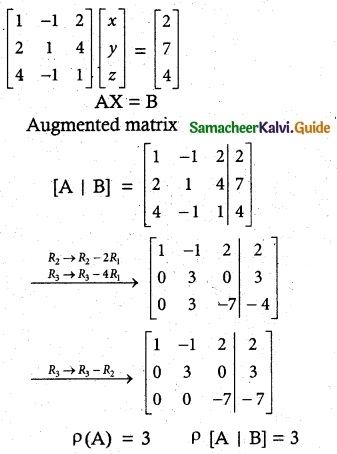
Test for consistency and if possible, solve the following systems of equations by rank method.
(i) x – y + 2z = 2, 2x + y + 4z = 7, 4x – y + z = 4
Solution:
Matrix form
Samacheer Kalvi 12th Maths Guide Chapter 1 Applications of Matrices and Determinants Ex 1.6 1
The system is consistent.
ρ(A) ρ[A|B] = 3 = n
it has unique solution.
Writing the equivalent equations from echelon form
x – y + 2z = 2 ………… (1)
3y = 3 ⇒ y = 1
-7z = -7
z = 1
(1)⇒ x – y + 2z = 2
x – 1 + 2 = 2
x = 1
∴ Solution is x = 1, y = 1, z = 1

Samacheer Kalvi 12th Maths Guide Chapter 1 Applications of Matrices and Determinants Ex 1.6

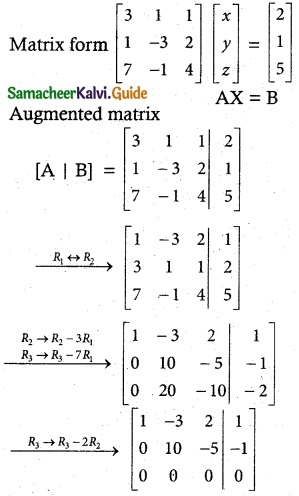
(ii) 3x + y + z = 2, x – 3y + 2z = 1, 7x – y + 4z = 5
Solution:
Samacheer Kalvi 12th Maths Guide Chapter 1 Applications of Matrices and Determinants Ex 1.6 2
ρ(A) = 2 ρ[A | B] = 2
ρ(A) = ρ[A | B] = 2 < n
The system is consistent. It has infinitely many solution.
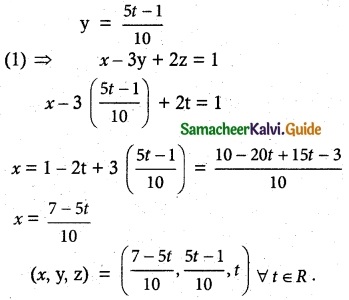
Writing the equivalent equations from echelon form.
x – 3y + 2z = 1 ………. (1)
10y – 5z = -1 ………. (2)
Put z = t.
(2) ⇒ 10y – 5z = -1
10y = -1 + 5z = 5t – 1
Samacheer Kalvi 12th Maths Guide Chapter 1 Applications of Matrices and Determinants Ex 1.6 3

Samacheer Kalvi 12th Maths Guide Chapter 1 Applications of Matrices and Determinants Ex 1.6

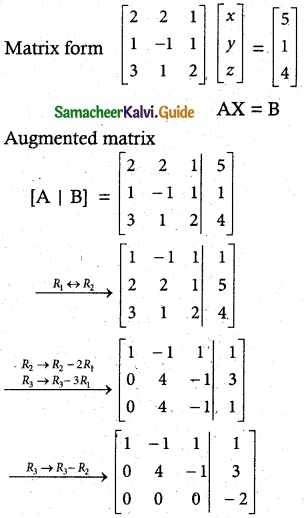
(iii) 2x + 2y + z = 5, x – y + z = 1, 3x + y + 2z = 4
Solution:
Samacheer Kalvi 12th Maths Guide Chapter 1 Applications of Matrices and Determinants Ex 1.6 4
ρ(A) = 2 ρ[A | B] = 3
ρ(A) ≠ ρ[A | B] = 2 < n
∴ The system is inconsistent. It has no solution.

Samacheer Kalvi 12th Maths Guide Chapter 1 Applications of Matrices and Determinants Ex 1.6

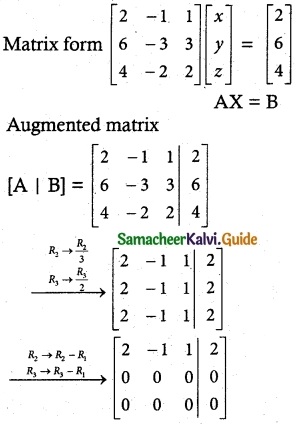
(iv) 2x – y + z = 2, 6x – 3y + 3z = 6, 4x – 2y + 2z = 4
Solution:
Samacheer Kalvi 12th Maths Guide Chapter 1 Applications of Matrices and Determinants Ex 1.6 5
ρ(A) = 1 ρ[A | B] = 1
ρ(A) = ρ[A | B] = 1 < n.
∴ The system reduces into a single equation.
∴ It is consistent and has infinitely many solutions.
Writing the equivalent equations from echelon form
2x – y + z = 2
Put y = s, z = t
2x – s + t = 2
2x = 2 + s – t
x = \(\frac {2+s-t}{2}\)
(x, y, z) = (\(\frac {2+s-t}{2}\), s, t) ∀ s, t ∈ R

Samacheer Kalvi 12th Maths Guide Chapter 1 Applications of Matrices and Determinants Ex 1.6

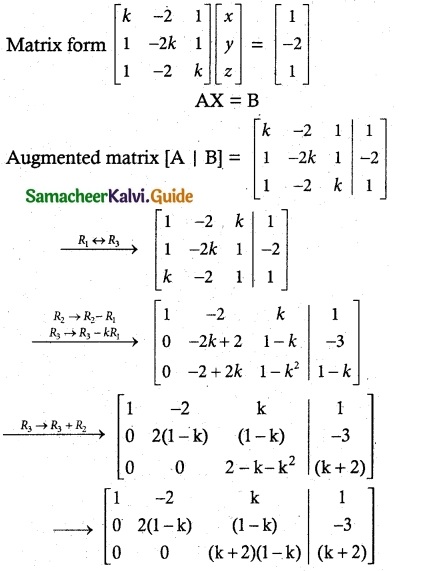
Question 2.
Find the value of k for which the equations kx – 2y + z = 1, x – 2ky + z = -2, x – 2y + kz = 1 have
(i) no solution
(ii) unique solution
(iii) infinitely many solution.
Solution:
Samacheer Kalvi 12th Maths Guide Chapter 1 Applications of Matrices and Determinants Ex 1.6 6
[∵ 2 – k – k² = -(k² + k – 2)
= -(k + 2)(k – 1)
= (k + 2)(1 – k)]
case (i)
If k = 1
ρ(A) = 2, ρ(A | B) = 3.
ρ(A) ≠ ρ(A | B)
The system is inconsistent and it has no solution.

Case (ii)
If k ≠ 1, k ≠ -2
ρ(A) = 3, ρ(A | B) = 3 = n
The system is consistent and it has unique solution.

Case (iii)
If k = -2
ρ(A) = 2, ρ(A | B) = 2
The system is consistent and it has infinitely many solution.

Samacheer Kalvi 12th Maths Guide Chapter 1 Applications of Matrices and Determinants Ex 1.6

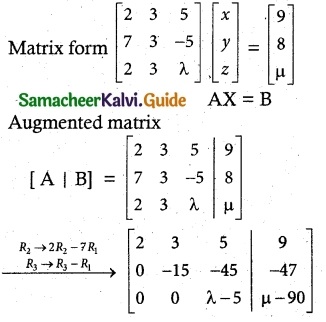
Question 3.
Investigate the values of λ and µ the system of linear equations 2x + 3y + 5z = 9, 7x + 3y – 5z = 8, 2x + 3y + λz = µ, have
(i) no solution
(ii) a unique solution
(iii) an infinite number of solutions.
Solution:
Samacheer Kalvi 12th Maths Guide Chapter 1 Applications of Matrices and Determinants Ex 1.6 7
Case (i)
If λ = 5, µ ≠ 9
ρ(A) = 2, ρ(A | B) = 3
ρ(A) ≠ ρ(A | B)
The system is inconsistent. It has no solution.

Case (ii)
If λ = 5, µ ≠ 9
ρ(A) = 3, ρ(A | B) = 3
ρ(A) = ρ(A | B) = 3 = n
The system is consistent. It has unique solution.

Case (iii)
If λ = 5, µ = 9
ρ(A) = 2, ρ(A | B) =2
ρ(A) = ρ(A | B) = 2 < n
The system is consistent. It has infinitely many solution.

Samacheer Kalvi 12th Maths Guide Chapter 1 Applications of Matrices and Determinants Ex 1.6

Samacheer Kalvi 12th Maths Guide Chapter 2 Complex Numbers Ex 2.1

Tamilnadu State Board New Syllabus Samacheer Kalvi 12th Maths Guide Pdf Chapter 2 Complex Numbers Ex 2.1 Textbook Questions and Answers, Notes.

Tamilnadu Samacheer Kalvi 12th Maths Solutions Chapter 2 Complex Numbers Ex 2.1

Question 1.
i1947 + i1950
Solution:
i1947 + i1950 = (i4)486 i³ + (i4)487
[∵ i² = -1; i³ = i; i4 = 1]
= (1)486 (-i) + (1)487 (-1)
= – i – 1 = -(1 + i)

Samacheer Kalvi 12th Maths Guide Chapter 2 Complex Numbers Ex 2.1

Question 2.
i1948 – i-1869
Solution:
= (i4)487 – [(i4)467 i1]-1
= (1)487 – (i)-1 = 1 – \(\frac{1}{i}\) = 1 + i

Samacheer Kalvi 12th Maths Guide Chapter 2 Complex Numbers Ex 2.1

Question 3.
\(\sum_{n=1}^{12} i^{n}\)
Solution:
= i1 + i² + i³ + i4 + …. + i12
= (i – 1 – i + 1) + (i – 1 – i + 1) + (i – 1 – i + 1)
= 0

Samacheer Kalvi 12th Maths Guide Chapter 2 Complex Numbers Ex 2.1

Question 4.
i59 + \(\frac{1}{i^{59}}\)
Solution:
(-i) + \(\frac{1}{(-i)}\)
[∵ i59 = i56 i³ = (i4)14 (-i) = 1(-i) = -i]
= -i + i = 0

Samacheer Kalvi 12th Maths Guide Chapter 2 Complex Numbers Ex 2.1

Question 5.
i i² i³ …… i2000
Solution:
= i1+2+3+2000
[∵ 1 + 2 + 3 + …….. n = \(\frac{n(n+1)}{2}\)]
= i(\(\frac{2000×2001}{2}\))
= i(1000×2001)
= [i1000]2001
= i2001000
= 1

Samacheer Kalvi 12th Maths Guide Chapter 2 Complex Numbers Ex 2.1

Question 6.
\(\sum_{n=1}^{10} i^{n+50}\)
solution:
= i51 + i52 + i53 + ……. + i60
= i3 + i4 +i + i2 + ……. + i4
= -i + 1 + i – 1 – i + 1 + i – 1 – i + 1
= 1 – i
Samacheer Kalvi 12th Maths Guide Chapter 2 Complex Numbers Ex 2.1