Samacheer Kalvi 6th Science Guide Term 1 Chapter 1 Measurements

Students can download 6th Science Term 1 Chapter 1 Measurements Questions and Answers, Notes, Samacheer Kalvi 6th Science Guide Pdf helps you to revise the complete Tamilnadu State Board New Syllabus, helps students complete homework assignments and to score high marks in board exams.

Tamilnadu Samacheer Kalvi 6th Science Solutions Term 1 Chapter 1 Measurements

Samacheer Kalvi 6th Science Measurements Text Book Back Questions and Answers

I. Choose the correct answer

Question 1.
The girth of a tree can be measured by
(a) Metre scale
(b) Metre rod
(c) plastic ruler
(d)Measuring tape.
Answer:
(d) Measuring tape.

Question 2.
The conversion of 7 m into cm gives
(a) 70 cm
(b) 7 cm
(c) 700 cm
(d) 7000 cm
Answer:
(c) 700 cm

 Samacheer Kalvi 6th Science Guide Term 1 Chapter 1 Measurements

Question 3.
Quantity that can be measured is called ………
(a) Physical quantity
(b) Measurement
(c) Unit
(d) Motion.
Answer:
(b) Measurement

Question 4.
Choose the correct one
(a) km > mm > cm > m
(b) km> mm> m > cm
(c) km>m>cm>mm
(d) km > cm > m > mm
Answer:
(c) km > m > cm > mm

Question 5.
While measuring length of an oject using a ruler, the position of your eye should be
(a) Left side of the point.
(b) Vertically above the point where the measurement is to be taken.
(c) Right side of the point.
(d) Anywhere according to one’s convenience.
Answer:
(b) Vertically above the point where the measurement is to be taken.

II. True or false.

  1. We can say that mass an object is 126 kg
  2. Length of one’s chest can be measured by using metre scale.
  3. Ten millimetres makes one centimetre.
  4. A hand span is a reliable measure of length.
  5. The SI system of units is accepted everywhere in the world.

Answer:

  1. True
  2. False
  3. True
  4. False
  5. True

 Samacheer Kalvi 6th Science Guide Term 1 Chapter 1 Measurements

III. Fill up the blanks:

  1. SI unit of length is symbolically represented as ………..
  2. 500 gm = …………. kilogram.
  3. Distance between Delhi and Chennai can be measured in ……….
  4. 1 m = ………. cm.
  5. 5 km = ………. m.

Answer:

  1. metre
  2. 0.5
  3. Kilometre
  4. 100
  5. 5000

IV. Analogy

Sugar: Beam Balance, Lime Juice?
Answer:
Graduated cylinders.

Height of a person: Cm: Length of your sharpened pencil lead?
Answer:
mm

Milk: Volume; vegetables?
Answer:
Weight

V. Match the following:

Samacheer Kalvi 6th Science Guide Term 1 Chapter 1 Measurements 1
Answer:
1. Cubit
2. metre
3. 10-9
4. second
5. 10³

 Samacheer Kalvi 6th Science Guide Term 1 Chapter 1 Measurements

VI. Complete the given table:

Samacheer Kalvi 6th Science Guide Term 1 Chapter 1 Measurements 2
Answer:
Samacheer Kalvi 6th Science Guide Term 1 Chapter 1 Measurements 3

VI. Arrange in increasing order of unit

1 Metre, 1 Centimetre, 1 Kilometre, and 1 Millimetre.
Answer:
1 Millimetre, 1 Centimetre, 1 Metre, 1 Kilometre.

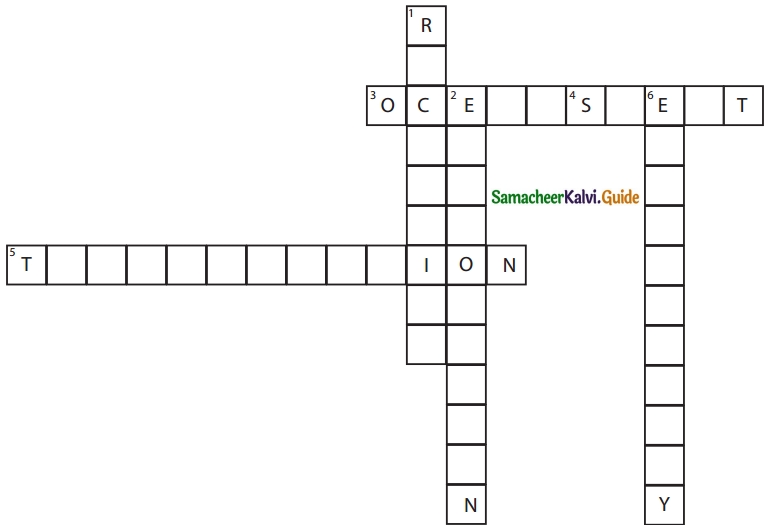
VIII. Find the answer for the following questions within the grid:

Samacheer Kalvi 6th Science Guide Term 1 Chapter 1 Measurements 4

  1. 10-3 is one _______
  2. SI unit of time ______
  3. Cross view of reading for measurement leads to ______
  4. _______ is the one what a clock reads.
  5. ______ is the amount of substance present in an object.
  6. _______ can be taken to get the final reading of the recordings of different students for a single measurement.
  7. ______ is a fundamental quantity.
  8. _______ shows the distance covered by an automobile.
  9. A tailor use _______ to take measurements to stitch a cloth.
  10. Liquids are measured with this physical quantity ______

Answer:

  1. millimeter
  2. Second
  3. Parallax
  4. Time
  5. mass
  6. Accurate
  7. Length
  8. Odometer
  9. tape
  10. litres

 Samacheer Kalvi 6th Science Guide Term 1 Chapter 1 Measurements

IX. Answer in a word or two.

Question 1.
What is the full form of the SI system?
Answer:
An International System of unit

Question 2.
Name any one instrument used for measuring mass.
Answer:
Beam Balance

Question 3.
Find the odd one out: Kilogram, Millimetre, Centimetre, Nanometre
Answer:
Kilogram.

Question 4.
What is the SI unit of mass?
Answer:
Kilogram

Question 5.
What are the two parts present in a measurement?
Answer:

  1. multiple
  2. sub

X. Answer in a sentence or two:

Question 1.
Define measurement.
Answer:
The comparison of an unknown quantity with some known quantity is known as measurement.

Question 2.
Define mass.
Answer:
Mass is the measure of the amount of matter in an object.

Question 3.
The distance between the two places is 43.65 km. convert it into meter and cm.
Answer:
(a) Convert km into metre
1 km = 1000m
∴ 43.65 km = 43.65 × 1000 = 43650.00 = 43650
= 43650 m.

(b) Convert km into cm.
1 km = 1000 m
1 m = 100 cm
1 km = 1000 × 100 cm
1 km = 100000 cm
∴ 43.65 km = 43.65 × 100000 = 4365000.00
= 4365000 cm.

 Samacheer Kalvi 6th Science Guide Term 1 Chapter 1 Measurements

Question 4.
What are the rules to be followed to make an accurate measurement with scale?
Answer:

  1. Take care to write the correct submultiple.
  2. Always keep the object in parallel to the scale.
  3. Start the measurement from ‘0’ of the scale.

XI. Solve the following:

Question 1.
The distance between your school and your house is 2250 m. Express this distance in kilometre.
Answer:
Distance between school and house is 2250 m.
1000 m = 1 km
∴ 2250 m = 2250 ÷ 1000 = 2.25 km.

Question 2.
While measuring the length of a sharpened pencil, the reading of the scale at one end is 2.0 cm and at the other end is 12.1 cm. What is the length of the pencil?
Answer:
Sharpened pencil Reading at one end = 2.0 cm.
Sharpened pencil Reading at the other end = 12.1 cm.
Length of the pencil = Difference between two ends.
= 12.1 cm. – 2.0 cm.
= 10.1 cm.

XII. Write in detail:

Question 1.
Explain two methods that you can use to measure the length of a curved line.
Answer:
Measuring the length of a curved line, by two methods.
First method – using a string.

  1. Draw a curved line AB on the paper.
  2. Place a string along the curved line.
  3. Make sure that the string covers every bit of the curved line.
  4. Mark the points where the curved line begins and ends on the string.
  5. Now stretch the string along the length of a meter scale.
  6. Measure the distance between two markings of the string.
  7. This will give the length of a curved line.

Second method – using a divider.

  1. Draw a curved line AB on a paper.
  2. Separate the legs of the divider by 0.5 cm or 1 cm using a ruler.
  3. Place it on the curved line starting from one end. Mark the position of the other end.
  4. Move it along the line again and again cutting the line into a number of segments of equal lengths.
  5. The remaining parts of the line can be measured using a scale.
  6. Count the number of segments.
  7. Length of the line = (No. of segments × length of each segment) + length of the leftover part.

 Samacheer Kalvi 6th Science Guide Term 1 Chapter 1 Measurements

Question 2.
Fill up the following chart.
Samacheer Kalvi 6th Science Guide Term 1 Chapter 1 Measurements 5
Answer:
Samacheer Kalvi 6th Science Guide Term 1 Chapter 1 Measurements 6

Samacheer Kalvi 6th Science Measurements Additional Important Questions and Answers

I. Choose the best option:

Question 1.
What is 7 m in mm?
(a) 0.7 mm
(b) 700 mm
(c) 7000 mm
(d) 70 mm
Answer:
(c) 7000 mm

Question 2.
The distance between one end and the other end is called _____
(a) mass
(b) length
(c) time
(d) None
Answer:
(b) length

Question 3.
What is the unit of length?
(a) metre
(b) litre
(c) second
(d) kilogram.
Answer:
(a) metre

 Samacheer Kalvi 6th Science Guide Term 1 Chapter 1 Measurements

Question 4.
Five kilometre is equal to _____
(a) 500 cm
(b) 500 m
(c) 5000 m
(d) 5000 cm
Answer:
(c) 5000 m

Question 5.
These are the instruments used in measuring the volume of objects with irregular shapes.
(a) Balance
(b) Electronic balance
(c) Displacement of water method
(d) sand clock.
Answer:
(c) Displacement of water method.

II. True or false:

  1. The comparison of a known quantity with the unknown quantity is the mass.
  2. The area can be calculated by using the two lengths and width.
  3. Using electronic balance weight can be measured accurately.

Answer:

  1. False
  2. True
  3. False.

III. Fill in the Blanks.

  1. 78.75 cm = ______ m ______ cm
  2. 1195 m = ______km ______ m
  3. 15 cm 10 mm = ______ mm
  4. 45 km 33 m = ______ m.
  5. The metric system of unit is developed in the year ______ by French.

Answer:

  1. -78 m, 75 cm
  2. -1 km, 195 m
  3. -160 mm
  4. -45033 m
  5. -1790

 Samacheer Kalvi 6th Science Guide Term 1 Chapter 1 Measurements

IV. Matching

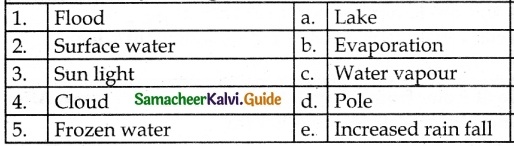
Question 1.
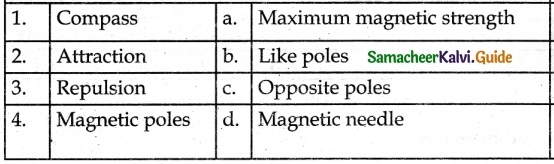
Samacheer Kalvi 6th Science Guide Term 1 Chapter 1 Measurements 7
Answer:
1. – d
2. – c
3. – b
4. – a

Question 2.
Samacheer Kalvi 6th Science Guide Term 1 Chapter 1 Measurements 8
Answer:
1. – d
2. – c
3. – b
4. – a

V. Write the following unit in ascending order.

Question 1.
Ton – gram – kilogram – Metric ton
Answer:
Gram – kilogram – ton – metric ton.

VI. Very Short Answer (2 marks)

Question 1.
What is the length?
Answer:
The distance between one end and the other desired end is called length.

Question 2.
Differentiate mass from weight:
Answer:
Mass :
Mass is the measure of the amount of matter in an object.
Unit – kilogram

Weight :
Weight is the gravitational pull experienced by the mass.
Unit – Newton.

 Samacheer Kalvi 6th Science Guide Term 1 Chapter 1 Measurements

Question 3.
List the SI units of length, mass, and time.
Solution:

  1. Length is measured by metre (m)
  2. Mass is measured by the kilogram (kg)
  3. Time is measured by second (s).

Question 4.
What is the basic quantity of physics?
Answer:

  1. Length
  2. Mass
  3. Time.

Question 5.
Differentiate of Mass and Weight.
Answer:
Mass:

  • Amount of matter in an object
  • The measuring instrument is Beam balance

Weight:

  • Gravitational pull experienced by the mass
  • The measuring instrument is an electronic balance

Question 6.
What is the clock used to measure the time accurately?
Answer:

  1. Electronic clock
  2. Stop clock

Question 7.
Hold a sheet paper in one hand and a book in one hand. Which hand feels heavy? Why?
Solution:
The hand, which holds the book, will feel heavy. The mass of the book is more than that of a single sheet of paper. Therefore, the pull on the book is more than that of the paper. Hence our hand has to give more force to hold a book than a paper.

VII. Give detailed answers: (5 marks)

Question 1.
What are the features that we must give importance in measuring?
Answer:
The object should match with the ‘o’ of the scale.
The object should be in parallel with the scale.
Always start from ‘O’.
Measure the bigger division (m) first and then measure the smaller (mm) division. When we measure the bigger division it should be measured initially and then mark a point and then measure the smaller division (eg) if the length of the pencil is 6 cm 2 mm and then it is 6.2 cm.

 Samacheer Kalvi 6th Science Guide Term 1 Chapter 1 Measurements

Question 2.
How will you measure the weight of the object with irregular shapes?
Answer:
Fill a graduated measuring cylinder with 50 ml of water.
Tie the stone with a piece of fine thread and immerse the stone completely in the water. As the stone is immersed the water level will increase. And show 75 ml of rising. The stone displaces water and hence the rise. The amount of water displaced will be the volume of the stone.

Samacheer Kalvi 10th Science Guide Chapter 23 Visual Communication

Students can download 10th Science Chapter 23 Visual Communication Questions and Answers, Notes, Samacheer Kalvi 10th Science Guide Pdf helps you to revise the complete Tamilnadu State Board New Syllabus, helps students complete homework assignments and to score high marks in board exams.

Tamilnadu Samacheer Kalvi 10th Science Solutions Chapter 23 Visual Communication

Samacheer Kalvi 10th Science Visual Communication Text Book Back Questions and Answers

I. Choose the best answer:

Question 1.
Which software is used to create animation?
(a) Paint
(b) PDF
(c) MS Word
(d) Scratch
Answer:
(d) Scratch

Question 2.
All files are stored in the _______.
(a) folder
(b) box
(c) pai
(d) scanner.
Answer:
(a) folder

Samacheer Kalvi 10th Science Guide Chapter 23 Visual Communication

Question 3.
Which is used to build scripts?
(a) Script area
(b) Block palette
(c) Stage
(d) Sprite
Answer:
(a) Script area

Question 4.
Which is used to edit programs?
(a) Inkscape
(b) Script editor
(c) Stage
(d) Sprite.
Answer:
(b) Script editor

Question 5.
Where you will create category of blocks?
(a) Block palette
(b) Block menu
(c) Script area
(d) sprite
Answer:
(b) Block menu

II. Match the following:

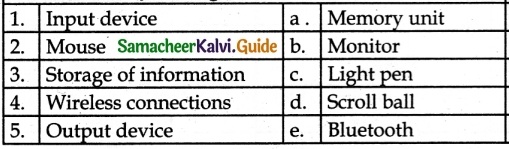
Samacheer Kalvi 10th Science Guide Chapter 23 Visual Communication 1
Answer:
A. (v)
B. (iv)
C. (ii)
D. (iii)
E. (i)

III. Answer the following:

Question 1.
What is Scratch?
Answer:
Scratch is a software used to create animations, cartoons and games easily. Scratch, on the other hand, is a visual programming language.

Samacheer Kalvi 10th Science Guide Chapter 23 Visual Communication

Question 2.
Write a short note on the editor and its types.
Answer:
Editors or text Editors are software programs that enable the user to create and edit text files Editors are generally classified into 5 types as,

  1. Line Editor [Ex: teco]
  2. Stream Editor [Ex: Sed]
  3. Screen Editor [Ex: Notepad]
  4. Word processors [Ex: MS – word]
  5. Structure Editor [Ex: Netbeans IDE].

Question 3.
What is stage?
Answer:
Stage is the background appearing when we open the scratch window. The background will most often be white. You can change the background colour as you like.

Question 4.
What is Sprite?
Answer:
The characters on the background of a Scratch window are known as Sprite. Usually, a cat appears as a sprite when the Scratch window is opened. The software provides facilities to make alternations in the sprite.

Samacheer Kalvi 10th Science Visual Communication Additional Important Questions and Answers

I. Choose the best answer:

Question 1.
The output we get from any application is commonly referred as
(a) file
(b) data
(c) record
(d) folder
Answer:
(a) file

Question 2.
_______ is used to choose the block to use.
(a) Script area
(b) Block palette
(c) Block menu
(d) Sprite.
Answer:
(b) Block palette

Samacheer Kalvi 10th Science Guide Chapter 23 Visual Communication

Question 3.
Which app is used, we can draw and edit pictures?
(a) My computer
(b) Notepad
(c) Paint
(d) Games
Answer:
(c) Paint

Question 4.
Choose the odd one from the following _______.
(a) File
(b) Folder
(c) Memory space
(d) Mouse.
Answer:
(d) Mouse.

Question 5.
Write a good example for visual communication.
(a) Picture
(b) Cinema
(c) Radio
(d) FM
Answer:
(b) Cinema

Question 6.
Choose the wrong statement from the following statements _______.
(a) The scripts tab contains additional tabs of costumes and sounds.
(b) Block palette is used to choose the block to use.
(c) The right contains additional tabs of costumes and sounds.
(d) Scratch is software.
Answer:
(a) The scripts tab contains additional tabs of costumes and sounds.

Question 7.
Choose the incorrect pair:
(a) Windows – operating system
(b) Visual – Cinema
(c) Costume – editor
(d) Stage – a input device
Answer:
(d) Stage – a input device

Samacheer Kalvi 10th Science Guide Chapter 23 Visual Communication

Question 8.
Identify which is not a file format _______.
(a) CSS
(b) PSO
(c) PNG
(d) EPS.
Answer:
(b) PSO

Question 9.
Choose the incorrect statement:
(a) More people are using windows operating system.
(b) We can collect our notes in Notepad application.
(c) We can draw pictures in paint application.
(d) A folder is a file name.
Answer:
(d) A folder is a file name.

Question 10.
The start button is present in the ______ corner of the computer.
(a) Center
(b) top
(c) left
(d) right.
Answer:
(c) left

Question 11.
Assertion (A) : Pictures and audio-visuals gives us more understanding than teaching and writing on the black board.
Reason (R) : The device which helps in explaining the concepts easily through pictures is known as visual communication device.
(a) Both assertion and reason are true, and reason is the correct explanation assertion.
(b) Both assertion and reason are true, but reason is not the correct explanation of assertion.
(c) Assertion is true but reason is false.
(d) Assertion is false but reason is true.
Answer:
(a) Both assertion and reason are true, and reason is the correct explanation assertion.

Question 12.
Pick the odd one out:
(a) LINUX
(b) Paint
(c) Spread sheet
(d) PPTs
Answer:
(a) LINUX

Samacheer Kalvi 10th Science Guide Chapter 23 Visual Communication

II. Match the following:

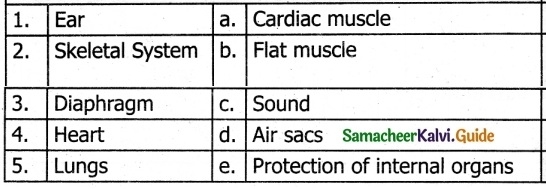
Samacheer Kalvi 10th Science Guide Chapter 23 Visual Communication 2
Answer:
A – (iii)
B – (i)
C – (iv)
D – (ii)

III. Answer the following:

Question 1.
What is the reason, we prefer computer?
Answer:
The reason, we prefer computer is its speed and the ability to store data.

Question 2.
What is a folder?
Answer:
A folder is a storage space that contains multiple files. We can create files as per the user’s need.

Question 3.
What is a file?
Answer:
The output we get from any application is commonly referred as file.
Therefore, the application for the specific purposes determines the nature of the file.

Question 4.
Name the different parts of Scratch Editor?
Answer:

  • Stage
  • Sprite
  • Script Editor / Costume Editor.

Samacheer Kalvi 10th Science Guide Chapter 23 Visual Communication

Question 5.
Explain the using script editor?
Answer:
Script editor / costume editor: Where you edit your programs or your sprite’s pictures.
You should see a single window with at least the following three panes: the stage (top left), the Sprite List (bottom left), and the Scripts tab (right), which contains the Blocks tab and the Scripts Area. The right pane also contains two additional tabs, Costumes and Sounds.
The script editor has three main parts:

  1. Script area: Where you build scripts.
  2. Block menu: Where you choose the category of blocks (programming statements) to use.
  3. Block palette: Where your choose the block to use.

Question 6.
Write a note on Script editor.
Answer:
Script editor/costume editor: Where you edit your programs or your sprite’s pictures. You should see a single window with at least the following three panes: the Stage (top left), the Sprite List (bottom left), and the Scripts tab (right), which contains the Blocks tab and the Scripts Area. The right pane also contains two additional tabs, Costumes and Sounds.

Samacheer Kalvi 10th Science Guide Chapter 22 Environmental Management

Students can download 10th Science Chapter 22 Environmental Management Questions and Answers, Notes, Samacheer Kalvi 10th Science Guide Pdf helps you to revise the complete Tamilnadu State Board New Syllabus, helps students complete homework assignments and to score high marks in board exams.

Tamilnadu Samacheer Kalvi 10th Science Solutions Chapter 22 Environmental Management

Samacheer Kalvi 10th Science Environmental Management Text Book Back Questions and Answers

I. Fill in the blanks:

  1. Deforestation leads to ……… in rainfall.
  2. Removal of soil particles from the land is called ……….
  3. Chipko movement is initiated against ……….
  4. ……….. is a biosphere reserve in Tamilnadu.
  5. Tidal energy is ………. type of energy.
  6. Coal, petroleum and natural gas are called ……… fuels.
  7. ……….. is the most commonly used fuel for the production of electricity.

Answer:

  1. Decrease
  2. Soil Erosion
  3. Deforestation
  4. Nilgiris
  5. Non-conventional
  6. Fossil
  7. Coal

Samacheer Kalvi 10th Science Guide Chapter 22 Environmental Management

II. State whether True or False. Correct the statements which are false:

  1. Biogas is a fossil fuel.
  2. Planting trees increases the groundwater level.
  3. Habitat destruction cause loss of wile life.
  4. Nuclear energy is a renewable energy
  5. Overgrazing prevents soil erosion.
  6. Poaching of wild animals is a legal act.
  7. National park is a protected park.
  8. Wild life protection act was established in 1972.

Answer:

  1. False – Biogas is a natural gas
  2. True
  3. True
  4. False – Nuclear energy is non-renewable energy
  5. False – Overgrazing causes soil erosion
  6. False – Poaching of wild animals is an illegal act.
  7. True
  8. Tme

III. Match the following:

Samacheer Kalvi 10th Science Guide Chapter 22 Environmental Management 1
Answer:
A. (iii)
B. (v)
C. (vi)
D. (ii)
E. (i)
F. (iv)
G. (vii)

IV. Choose the correct answer:

Question 1.
Which of the following is / are a fossil fuel?
(i) Tar, (ii) Coal, (iii) Petroleum
(a) (i) only
(b) (i) and (ii)
(c) (ii) and (iii)
(d) (i), (ii) and (iii)
Answer:
(c) (ii) and (iii)

Question 2.
What are the steps will you adopt for better waste management?
(a) reduce the amount of waste formed
(b) reuse the waste
(c) recycle the waste
(d) all of the above
Answer:
(d) all of the above

Question 3.
The gas released from vehicles exhaust are:
(i) carbon monoxide
(ii) Sulphur dioxide
(iii) Oxides of nitrogen:
(a) (i) and (ii)
(b) (i) and (iii)
(c) (ii) and (iii)
(d) (i), (ii) and (iii)
Answer:
(b) (i) and (iii)

Question 4.
Soil erosion can be prevented by ______
(a) deforestation
(b) afforestation
(c) over growing
(d) removal of vegetation
Answer:
(b) afforestation

Question 5.
A renewable source of energy is:
(a) petroleum
(b) coal
(c) nuclear fuel
(d) trees
Answer:
(d) trees

Samacheer Kalvi 10th Science Guide Chapter 22 Environmental Management

Question 6.
Soil erosion is more where there is _______
(a) no rainfall
(b) low rainfall
(c) rainfall is high
(d) none of these
Answer:
(c) rainfall is high

Question 7.
An inexhaustible resources is:
(a) wind power
(b) soil fertility
(c) wild life
(d) all of the above
Answer:
(d) all of the above

Question 8.
Common energy source in village is ______
(a) electricity
(b) coal
(c) biogas
(d) wood and animal dung
Answer:
(d) wood and animal dung

Question 9.
Green house effect refers to:
(a) cooling of earth
(b) trapping of UV rays
(c) cultivation of plants
(d) warming of earth
Answer:
(d) warming of earth

Question 10.
A cheap, conventional, commercial and inexhaustible source of energy is _____
(a) hydropower
(b) solar energy
(c) wind energy
(d) thermal energy
Answer:
(b) solar energy

Question 11.
Global warming will cause
(a) raise in level of oceans
(b) melting of glaciers
(c) sinking of islands
(d) all of these
Answer:
(d) all of these

Question 12.
Which of the following statement is wrong with respect to wind energy?
(a) wind energy is a renewable energy
(b) the blades of windmill are operated with the help of an electric motor
(c) production of wind energy is pollution-free
(d) usage of wind energy can reduce the consumption of fossil fuels
Answer:
(b) the blades of windmill are operated with the help of the electric motor

Samacheer Kalvi 10th Science Guide Chapter 22 Environmental Management

V. Answer in a Sentence:

Question 1.
What will happen if trees are cut down?
Answer:
If trees are cut down it give rise to ecological problems like floods, drought, soil erosion, loss of wild life, extinction of species, imbalance of biogeochemical cycles, alternation of climatic conditions and desertification.

Question 2.
What would happen if the habitat of wild animals is disturbed?
Answer:
If the habitual wild animals disturbed, the biological diversity cannot be maintained and cannot promote economic activities, which generates revenue to the government.

Question 3.
What are the agents of soil erosion?
Answer:
Agents of soil erosion are high velocity of wind, air currents, flowing water, land slide, human activities like deforestation, farming and mining overgrazing by cattle.

Question 4.
Why fossil fuels are to be conserved?
Answer:
Like fossil fuels, accumulation is a very slow process and takes a very long period, and in order to preserve them for a future generation, fossil fuels are to be conserved.

Question 5.
Solar energy is a renewable energy. How?
Answer:
Solar energy is the energy obtained from the sun. This energy resources is available in unlimited amount in nature and it can be renewed over a short period of time, inexpensive and can be harvested continuously.

Question 6.
How are e-wastes generated?
Answer:
E-wastes are generated from spoiled, outdated, non-repairable electrical and electronic devices.

VI. Short Answer Questions

Question 1.
What is the importance of rainwater harvesting?
Answer:

  1. Overcome the rapid depletion of ground water levels.
  2. To Meet the increase demand of water.
  3. Reduces flood and soil erosion.
  4. Water stored in ground is not contaminated by human and animal wastes and hence can be used for drinking purpose.

Question 2.
What are the advantages of using biogas?
Answer:
The advantages of using biogas are as follows:

  • It burns without smoke, causing less pollution.
  • It is an excellent way to get rid of organic wastes like bio-waste and sewage material.
  • The leftover slurry is good manure rich in nitrogen and phosphorus.
  • It is safe and convenient to use.
  • It can reduce the number of greenhouse gases emitted.

Question 3.
What are the environmental effect caused by sewage?
Answer:
Sewage water results in agricultural contamination and environmental degradation, pollute the water resources.

Question 4.
What are the consequences of deforestation?
Answer:
The contaminants can harm animals and damage the food chain.

  • Deforestation becomes a threat to the economy, quality of life and future of the environment.
  • Loss of many forests.
  • It gives rise to ecological problems like floods, drought, soil erosion, loss of wildlife, extinction of species, imbalance of biogeochemical cycles, alteration of climatic conditions and desertification.

Samacheer Kalvi 10th Science Guide Chapter 22 Environmental Management

VII. Long Answer Questions:

Question 1.
How does rainwater harvesting structures recharge groundwater?
Answer:
Recharge pit: In this method, the rainwater is first collected from the roof tops or open spaces and is directed into the percolation pits through pipes for filtration. After filtration the rainwater enters the recharge pits or ground wells.

People living in rural areas adopt a variety of water collecting methods to capture and store as rain water. Some of the methods used are-
(i) Digging of tanks or lakes (Eris) : It is one of the traditional water harvesting system in Tamil Nadu. Eris are constructed in such a way that if the water in one eri overflows, it automatically gets diverted to the eri of the next village, as these eris are interconnected.

(ii) Ooranis : These are small ponds to collect rainwater. The water is used for various domestic purposes (drinking, washing and bathing). These ponds cater the nearby villages.
Samacheer Kalvi 10th Science Guide Chapter 22 Environmental Management 2

Question 2.
How will you prevent soil erosion?
Answer:
The following are the methods to prevent soil erosion:

  • Retain vegetation cover, so that soil is not exposed.
  • Cattle grazing should be controlled.
  • Crop rotation and soil management improve soil organic matter.
  • Runoff water should be stored in the catchment.
  • Reforestation, terracing and contour ploughing.
  • Wind speed can be controlled by planting trees in the form of a shelterbelt.

Question 3.
What are the sources of solid wastes? How are solid wastes managed?
Answer:
Solid wastes mainly include municipal wastes, hospital wastes, industrial wastes and e-wastes etc. The solid wastes are dumped in the soil which results in landscape pollution.

Solid-waste management involves the collection, treatment and proper disposing of solid material that is discarded from the household and industrial activities.

Methods of solid wastes disposal:

  1. Segregation : It is the separation of different type of waste materials like biodegradable and non biodegradable wastes.
  2. Sanitary landfill : Solid wastes are dumped into low lying areas. The layers are compacted by trucks to allow settlement. The waste materials get stabilised in about 2-12 months. The organic matter undergoes decomposition.
  3. Incineration : It is the burning of nonbiodegradable solid wastes (medical wastes) in properly constructed furnace at high temperature.
  4. Composting : Biodegradable matter of solid wastes is digested by microbial action or earthworms and converted into humus.

Recycling of wastes:

  1. Papers from old books, magazines and newspapers are recycled to produce papers in papermills.
  2. Agricultural wastes like coconut shells, jute cotton stalk, bagasse of sugarcane can be used to make paper and hard board. Paddy husk can be used as livestock fodder.
  3. Cowdung and other organic wastes can be used in gobar gas plant to provide biogas and manure for fields. The 3R approach such as Reduce, Reuse and Recycle may be followed for effective waste management.

Question 4.
Enumerate the importance of forest.
Answer:

  • Forests are an important component of our environment.
  • There are microorganisms, flowering plants, shrubs, climbers and dense trees in the forest.
  • Forests provide a vast habitat for wild animals.
  • Forests help for the economic development of our country.
  • Forests are the source for a wide range of renewable natural resource.
  • Forests provide wood, food, fodder, fibre and medicine.
  • They act as a carbon sink, regulate climatic conditions, increase rainfall and reduce global warming.
  • The natural hazards like flood and landslides are prevented.
  • Wildlife is protected.
  • It acts as a catchment for water conservation.
  • Forests maintain ecological balance.

Samacheer Kalvi 10th Science Guide Chapter 22 Environmental Management

Question 5.
What are the consequences of soil erosion?
Answer:
The effects of soil erosion leads to loss of fertility of land, humus and nutrient. It leads to increased pollution, sedimentation in streams and rivers. Degraded lands able to hold water which can worsen flooding.

Question 6.
Why is the management of forest and wildlife resource considered as a challenging task?
Answer:
The management of forest and wildlife resource is considered as a challenging task because,

  • Due to deforestation, there is a lack of oxygen.
  • People kill animals, for making cloth designs so it harms the wildlife.
  • There is a lack of public awareness.
  • There are global warming and climate change.
  • Water scarcity and changes in rainfall pattern.
  • People kill animals and cut down trees, for economic benefit.
  • Poaching.
  • Forests cannot be irrigated like fields they depend on rain.
  • Changes in rainfall pattern, affect the development of forests and may lead to destruction.

VIII. Assertion and Reasoning:

In each of the following question a statement of assertion(A) is given and a corresponding statement of reason (R). Of the four statements given below mark the correct answer.
Question 1.
Assertion (A): Rainwater harvesting is to collect and store rain water.
Reason (R): Rainwater can be directed to recharge the underground water source.
(a) Both Assertion and Reason are true and Reason is correct explanation of Assertion.
(b) Both Assertion and Reason are true but Reason is not the correct explanation of Assertion.
(c) Assertion is true but Reason is false.
(d) Both Assertion and Reason are false.
Answer:
(a) Both Assertion and Reason are true and Reason is correct explanation of Assertion.

Question 2.
Assertion (A): Energy efficient bulbs like CFL must be used to save electric energy.
Reason (R): CFL bulbs are costlier than ordinary bulbs, hence using ordinary bulbs can save our money.
(a) Both assertion and reason are true and reason is correct explanation of assertion.
(b) Both Assertion and Reason are true but Reason is not the correct explanation of Assertion.
(c) Assertion is true but Reason is false.
(d) Both Assertion and Reason are false.
Answer:
(b) Both Assertion and Reason are true but Reason is not the correct explanation of Assertion.

IX. Higher Order Thinking Skills: (HOTS)

Question 1.
Although coal and petroleum are produced by degradation of biomass, yet we need to conserve them. Why?
Answer:
The formation of coal and petroleum is a very slow process and takes very long period of time for renewal. Moreover coal is uses for generation of electricity’ petroleum is used to run automobile, trucks, trains, ships and aeroplane. So we need to conserve them as they get exhausted.

Question 2.
What are the objectives for replacing non-conventional energy resources from conventional energy resources?
Answer:

  • Non-conventional energy resources can be replenished quickly.
  • Hydrocarbons are formed over a period of thousands of years when the remains of dead plants and animals are buried inside the Earth.
  • Burning coal and oil results in air pollution.
  • Conserve fossil fuels, using an alternate source of energy, when possible.
  • Wise utilization of non-renewable natural resources.

Samacheer Kalvi 10th Science Guide Chapter 22 Environmental Management

Question 3.
Why is the Government imposing ban on the use of polythene bags and plastics? Suggest alternatives. How is this ban likely to improve the environment?
Answer:

  1. It is non-biodegradable material which cause environmental pollution. It is harmful to wild life and marine life. It is very hard to clean or remove from environment.
  2. Alternatives to plastic bag are jute or canvas bags, paper bags.
  3. It control the pollution and clean the environment and make it better’ place to live for all organism.

X. Value-Based Questions:

Question 1.
Why is it not possible to use solar cells to meet our energy needs? State three reason to support your answer.
Answer:

  • The installing cost of solar cell panel is high, as the silicon wafer is very expensive and also the silver used in connecting solar cells.
  • D.C electricity is produced. To operate any A.C device, this D.C. has to be connected in, as by using an inverter.
  • The efficiency of energy conversion is low as compared to other means of generating electricity.

Question 2.
How would you dispose the following wastes?
(a) Domestic wastes like vegetable peels
(b) Industrial wastes like metallic cans
Can the disposal protect the environment? How?
Answer:
(a) Domestic waste like vegetable peels can be disposed by composting where solid wastes is digested by microbial action or earthworms and converted into humus.

(b) The metallic ions melt into molten aluminium this removes the coating and inks that may be present on the aluminium. The aluminium is then made into large blocks which is used to make other products.

Question 3.
List any three activities based on the 3R approach to conserve natural resources.
Answer:

  • Integrated solid waste management is based on the 3R approach. (Reduce, Reuse and Recycle).
  • 3R is aimed at the management of solid waste from all waste generating sectors.
  • 3R helps to minimize the amount of wastes from generation to disposal.

Samacheer Kalvi 10th Science Guide Chapter 22 Environmental Management

Samacheer Kalvi 10th Science Environmental Management Additional Important Questions and Answers

I. Choose the correct answers:

Question 1.
The best way to dispose waste is by:
(a) Making a paste for all domestic waste and putting them in a river.
(b) Separating biodegradable and non biodegradable before disposing in bins.
(c) Throw the waste an round side
(d) Dumping all domestic waste is better bin.
Answer:
(b) Separating biodegradable and non biodegradable before disposing in bins.

Question 2.
The solar energy which falls on the atmosphere reaches the Earth’s surface ______
(a) a little less than 42%
(b) more than 60%
(c) more than 52%
(d) a little less than 47%
Answer:
(d) a little less than 47%

Question 3.
Chipko Andolan is associated with
(a) Protesting against pasting of posters on walls.
(b) Saving money
(c) Using more postal stamps.
(d) Saving trees.
Answer:
(d) Saving trees.

Question 4.
The technique to harness the water energy is _______
(a) hydropower
(b) electrical energy
(c) tidal energy
(d) hydraulic fracturing
Answer:
(a) Hydropower

Question 5.
Conservation of wild life includes:
(a) Preventing poaching of animals
(b) Construction of National parks, Sanctuaries
(c) Ban on trading endangered species
(d) All the above
Answer:
(d) All the above

Question 6.
Select the eco-friendly activity among the following:
(a) Using car for transportation.
(b) Using polybags for shopping
(c) Using dyes for colouring clothes
(d) Using windmills to generate power for irrigation
Answer:
(d) Using windmills to generate power for irrigation

Question 7.
Pick the right combination of terms which has no fossil fuel.
(a) Wind, Ocean, Coal
(b) Kerosene, Wind, tide
(c) Wind, Wood, Sun
(d) Petroleum, Wood, Sun
Answer:
(c) Wind, Wood, Sun

Question 8.
Ground water will not be depleted due to:
(a) Afforestation
(b) Thermal power plants
(c) Loss of forest and decreased rainfall
(d) Cropping of high water demanding crops
Answer:
(a) Afforestation

Samacheer Kalvi 10th Science Guide Chapter 22 Environmental Management

Question 9.
Select the wrong statement:
(a) Forests provide variety of products
(b) Forests have greater plant diversity
(c) Forests do not conserve soil
(d) Forests conserve water
Answer:
(c) Forests do not conserve soil

Question 10.
The important messages conveyed by the ‘chipko movement’ is:
(a) To improve the community in forest conservation efforts.
(b) To ignore the community in forest conservation efforts.
(c) To cut down forest trees for developmental activities
(d) Preserves the natural ecosystem in the area.
Answer:
(a) To improve the community in forest conservation efforts.

II. Fill in the blanks:

1. Automobiles are largest source of ……… pollution in cities.
2. The first movement against tree felling was fought in chamoli district name ……….
3. ………. National park was the first in India.
4. Removal of upper layer of soil by wind and water is called ……..
5. The white marble of ……….. became yellow due to air pollution.
6. Arrangement of many solar cells side by side connected to each other is ……..
7. Gas produced by the decomposition of animal and plant waste in the absence of oxygen is ……….
8. The fuel extracted by a technique called ………… from the rock.
9. The World’s largest and tallest wind turbine is situated in …………
10. ………… Dam is constructed by King Karikala Chola.
Answer:
1. air
2. Chipko movement
3. Jim Corbett
4. soil erosion
5. Taj Mahal
6. Solar panel
7. Gobar gas
8. hydraulic fracturing
9. Hawaii
10. Kallanai

III. Assertion and Reason:

Question 1.
Assertion (A): Natural habitats of plants and animals should not be destroyed.
Reason (R): This is necessary for the conservation of biotic resources.
(a) Both Assertion and Reason are true and Reason is correct explanation of Assertion.
(b) Both assertion and reason are true but reason is not the correct explanation of assertion.
(c) Assertion is true but reason is false.
(d) Both assertion and reason are false.
Answer:
(a) Both Assertion and Reason are true and Reason is correct explanation of Assertion.

Samacheer Kalvi 10th Science Guide Chapter 22 Environmental Management

Question 2.
Assertion (A): To prevent hunting is not wildlife conservation in the real sense.
Reason (R): Some animals may multiply to the extent that they exhaust the food supply.
(a) Both assertion and reason are true and reason is correct explanation of assertion.
(b) Both assertion and reason are true but reason is not the correct explanation of assertion.
(c) Assertion is true but reason is false.
(d) Both assertion and reason are false.
Answer:
(b) Both assertion and reason are true but reason is not the correct explanation of assertion.

IV. Match the following:

Samacheer Kalvi 10th Science Guide Chapter 22 Environmental Management 3
Answer:
A. (iii)
B. (i)
C. (v)
D. (ii)
E. (iv)

V. State whether True or False. Correct the statements which are false:

  1. The devices used for harnessing sun energy is wind mill.
  2. Liquefied petroleum gas is obtained from petroleum.
  3. Harnessing the energy from flowing water to produce electricity is hydro power.
  4. 12% of e-wastes are from computer components.
  5. LED bulbs consume more electrical energy.

Answer:

  1. False – The devices used for harnessing wind is wind mill.
  2. True
  3. True
  4. False – 12% of e-wastes are from telecommunication components
  5. False – LED bulbs consume less electrical energy.

VI. Answer in a word or sentence:

Question 1.
Define Conservation.
Answer:
Proper utilization and management of nature and its resources in conservations.

Question 2.
What are the ways to sustain our resources?
Answer:
Some of the ways to sustain continuous use of resources are practices to utilise energy efficiently avoid wastage of water, avoid usage of Plastics and other non-biodegradable materials and to take care for the environment.

Samacheer Kalvi 10th Science Guide Chapter 22 Environmental Management

Question 3.
Suggest any two activities in daily life which are eco-friendly.
Answer:
Carrying jute or canvas bags for shopping instead of plastic bags.
Switch off electrical and electronic devices when not in use.

Question 4.
Name four substances that can be recycled.
Answer:
Newspaper, PET plastic bottles, steel can glass containers.

Question 5.
List any two common methods by which solid wastes of urban areas are disposed off.
Answer:

  1. Segregation of waste into biodegradable and non-biodegradable.
  2. Solid wastes are dumped into low lying areas.

Question 6.
What is chipko movement?
Answer:
The chipko movement was a non-violent that was aimed to protect and conserve the tree by the villagers of chamoli district of uttar pradesh.

Question 7.
Give the reason for decline in wildlife population.
Answer:
Over exploitation and shrinking of forest cover areas are the reason for animal extinction and verge of extinction.

VII. Short Answer Questions:

Question 1.
What is conservation? Why should we conserve natural resources?
Answer:
Proper utilization and management of nature and its resources are termed as conservation. It is important to conserve the natural resources carefully, to preserve it for future generations. We have to build a sustainable world, which should last forever.

Samacheer Kalvi 10th Science Guide Chapter 22 Environmental Management

Question 2.
How can you as an individual contribute to the management of coal and petroleum.
Answer:

  1. Use of coal and petroleum as a source of energy should be minimised.
  2. Use of CNG or LPG as fuels in automobiles.
  3. Renewable sources of energy like solar power, hydro power, wind energy, tidal energy should be used.

Question 3.
What are the methods to conserve the forest?
Answer:

  • Afforestation: Planting and protecting trees which help in the restoration of green cover is called the afforestation programme. Destruction of trees should be avoided.
  • Social forestry programme: Active participation of the public and utilization of common land, to produce firewood, fodder and timber for the benefit of the rural community.
  • Forest Conservation through Laws: Adopting laws and policies, to conserve and protect forests through National Forest Policy,

Question 4.
List the wild life conservation Initiatives in India.
Answer:

  1. Project Tiger and Project Elephant has been launched in 1973 and 1992 respectively.
  2. Crocodile Conservation Project was launched in 1976.
  3. Sea Turtle Conservation Project was launched in 1999.
  4. Indian Rhino Vision 2020 is to conserve at least 3000 greater one-homed rhinos in Assam, India by 2020.

Question 5.
What are the steps to be taken to conserve coal and petroleum resources?
Answer:

  • If electricity is saved, it will, in turn, reduce the use of coal.
  • Using bicycles for covering short distances instead of using cars, scooters or motorcycles.
  • Using pressure cooker can reduce the consumption of kerosene and LPG, during cooking food.
  • Solar cooker and solar heaters can be used wherever possible.
  • Motor vehicles should be designed with fuel-efficient engines to increase efficiency and also to reduce pollution.

Question 6.
What are the advantages of solar energy?
Answer:

  1. It is available in abundance in our country and is free of cost.
  2. It is a renewable source of energy.
  3. It can be used for generating electricity or heat.
  4. It does not cause pollution.

VIII. Long Answers Questions:

Question 1.
(a) What are the aims of wildlife management?
(b) What is the provision of the wildlife protection act?
Answer:
(a) The main aim of wildlife conservation are:

  • To control and limit exploitation of species.
  • To preserve the plants and animals from extinction.
  • Maintenance of threatened species and protect species which are on the verge of extinction.
  • Preserve the endangered species.
  • To study the ecological relationship of the plants and animals in natural habitat.
  • Hunting and poaching should be prohibited.
  • Establishment of national parks, wildlife sanctuaries, protected areas and biosphere reserves.

(b) The provisions of the wildlife protection act:

  • Prohibit killing and hunting of specified animals.
  • Constitute sanctuaries, national parks and closed areas for wildlife conservation.
  • Special schemes for the preservation of endangered species.
  • Constitute central zoo authority and recognition of zoos.
  • Restrict, regulate or prohibit trade in wild animals and products obtained from them.

Samacheer Kalvi 10th Science Guide Chapter 22 Environmental Management

Question 2.
Give the various steps to conserve non-renewable resource.
Answer:
It is necessary to conserve or save coal and petroleum resources for the future use, which can be done by reducing their consumption.

  1. If electricity is saved, it will intum reduce the use of coal.
  2. Using bicycle for covering short distances instead of using cars, scooters or motorcycles.
  3. Using pressure cooker can reduce the consumption of kerosene and LPG while cooking food. Solar cooker and solar heaters can be used wherever possible.
  4. Motor vehicles should be designed with fuel efficient engines to increase efficiency and also reduce air pollution.

Question 3.
Write notes for the following:
(a) Solar cells
(b) Solar panel
(c) Solar cooker and
(d) Solar thermal power plant
Answer:
(a) Solar cells: Solar cells are called photovoltaic devices, which are made up of silicon, that converts sunlight directly into electricity. Solar cells produce electricity, without polluting the environment. No harmful gases, no burning and no wastes are produced.

  • It can be used for street lighting, traffic signals, water pumping and battery charging system, etc.
  • It is used in artificial satellites and space probes.
  • It provides radio and TV transmission to remote areas.
  • It is used in calculators, electronic toys and watches.

(b) Solar panel: Arrangement of many solar cells side by side connected to each other is called solar panel. The capacity to provide electric current is much increased in the solar panel, but the process of manufacture is very expensive.

(c) Solar cooker: Solar cooker consists of an insulated metal box or wooden box, which is painted from inside, so as to absorb maximum solar radiations. A thick glass sheet forms the cover over the box. The reflector is the piano mirror, which is attached to the box. The food is cooked by energy radiated by the Sun.

(d) Solar thermal power plant:
In solar thermal power plants, many solar panels are used to concentrate sun rays, to heat up water into steam. The steam is used to run the turbines to produce electricity. The solar energy is available in our country at free of cost, do not cause any pollution and is a renewable source of energy.

Question 4.
Explain the tidal energy with its advantages.
Answer:
Tidal energy is the energy obtained from the movement of water due to ocean tides. Tides are the rise and fall of sea levels caused by the combined effects of the gravitational forces exerted on the oceans of the earth.

A tidal stream is a fast flowing body of water created by tides. Turbines are placed in tidal streams. When the tides hit the turbine, the turbine rotates and converts the tidal energy into electric energy.

Advantages of tidal energy:

  1. Tidal energy does not produce any pollution.
  2. It does not use any fuel and does not produce any waste.
  3. Tides are predictable, so tidal energy can be produced at any time.
  4. Water is denser than air and therefore can generate electricity at lower speeds than wind turbines.

Question 5.
Explain the convention method of waste water treatments.
Answer:
The conventional wastewater treatment methods involve the following steps (a) Pre-screening (b) Aeration (c) Sludge Management and (d) Water Reuse.
(a) Pre-screening : Wastewater generated from domestic and industrial activities is screened to remove soil and solid particulates.

(b) Aeration : Screened wastewater is then pumped to an aeration tank. Here the microbial contaminants are removed by the biological degradation that occurs in the presence of air.
Sedimentation process : In this process, the solid particles in suspension form are allowed to settle. The particles that settle out from the suspension is known as sludge.

(c) Sludge removal : The sludge generated by the degradation process is transferred periodically from the tank for safe disposal.
Disinfection : Chlorination and ultraviolet (UV) radiation of treated water is required to remove any microorganism contamination.

(d) Water recycling : The water will then be supplied for domestic or industrial purposes.

Samacheer Kalvi 10th Science Guide Chapter 22 Environmental Management

IX. Hot Questions:

Question 1.
Name the movement aimed at the protection and conservation of trees. In which district was it originated?
Answer:
Chipko movement at Uttarkhand.

Question 2.
Name any two wildlife conservation initiatives in India.
Answer:

  • Crocodile conservation project
  • Indian Rhino vision 2020
  • Sea Turtle conservation

X. Value Based Question:

Question 1.
The over exploitation of natural resources leads to decline of natural resources.
(a) What will be the effects decline of natural resources.
(b) How can be prevent it?
Answer:
(a) Decline of natural resources leads to energy crisis and disturbance in ecological balance.
(b) It can be prevented by using non-conventional energy resources.

Samacheer Kalvi 10th Social Science Guide Civics Chapter 1 Indian Constitution

Students can download 10th Social Science Civics Chapter 1 Indian Constitution Questions and Answers, Notes, Samacheer Kalvi 10th Social Science Guide Pdf helps you to revise the complete Tamilnadu State Board New Syllabus, helps students complete homework assignments and to score high marks in board exams.

Tamilnadu Samacheer Kalvi 10th Social Science Solutions Civics Chapter 1 Indian Constitution

Samacheer Kalvi 10th Social Science Indian Constitution Text Book Back Questions and Answers

I. Choose the correct answer

Question 1.
Which of the following sequences in right regarding the Preamble?
(a) Republic, democratic, secular, socialist, sovereign
(b) Sovereign, socialist, secular, republic, democratic
(c) Sovereign, republic, secular,socialist, democratic
(d) Sovereign, socialist, secular, democratic, republic
Answer:
(d) Sovereign, socialist, secular, democratic, republic

Question 2.
How many times has the Preamble to the Constitution of India amended?
(a) once
(b) Twice
(c) Thrice
(d) Never
Answer:
(a) once

Samacheer Kalvi 10th Social Science Guide Civics Chapter 1 Indian Constitution

Question 3.
The Indian Constitution gives to its citizens:
(a) Double Citizenship
(b) Single Citizenship
(c) Single Citizenship in some States and double in others
(d) None of the above
Answer:
(b) Single Citizenship

Question 4.
A foreigner can acquire Indian citizenship through …………..
(a) Descent
(b) Registration
(c) Naturalisation
(d) All of the above
Answer:
(c) Naturalisation

Question 5.
Find the odd one out.
(a) Right to Equality
(b) Right against Exploitation
(c) Right to Property
(d) Cultural and Educational Rights
Answer:
(c) Right to Property

Question 6.
One of the following is not an instance of an exercise of a fundamental right?
(a) Workers from Karnataka go to Kerala to work on the farms.
(b) Christian missions set up a chain of missionary schools.
(c) Men and Women government employees got the same salary.
(d) Parents property is inherited by their children
Answer:
(d) Parents property is inherited by their children

Question 7.
If the fundamental rights of Indian citizen are violated, they possess the right to have an access to:
(a) The Parliament
(b) The Attorney General
(c) The President of India
(d) The Supreme court of India
Answer:
(d) The Supreme court of India

Samacheer Kalvi 10th Social Science Guide Civics Chapter 1 Indian Constitution

Question 8.
Which one of the following rights was described by Dr. B. R. Ambedkar as the heart and soul of the Constitution?
(a) Right to freedom of religion
(b) Right to equality
(c) Right to Constitutional remedies
(d) Right to property
Answer:
(c) Right to Constitutional remedies

Question 9.
How can the Fundamental Rights be suspended?
(a) If the Supreme Court so desires
(b) If the Prime Minister orders to this effect
(c) If the President orders it during the national emergency
(d) All of the above
Answer:
(c) If the President orders it during the national emergency

Question 10.
We borrowed the Fundamental Duties from the ……………..
(a) American Constitution
(b) Canadian Constitution
(c) Russian Constitution
(d) Irish Constitution
Answer:
(c) Russian Constitution

Question 11.
The Directive Principles can be classified into:
(a) Liberal and Communist principles
(b) Socialist and Communist principles
(c) Liberal, Gandhian and Communist principles
(d) Socialist, Gandhian and Liberal principles
Answer:
(d) Socialist, Gandhian and Liberal principles

Question 12.
Under which Article financial emergency can be proclaimed?
(a) Article 352
(b) Article 356
(c) Article 360
(d) Article 368
Answer:
(c) Article 360

Question 13.
The procedure for the amendment of the Indian Constitution is given in:
(a) Article 352
(b) Article 356
(c) Article 360
(d) Article 368
Answer:
(d) Article 368

Question 14.
Which of the following committees/commissions made recommendations about the Centre-State Relations?
(i) Sarkaria Commission
(ii) Rajamannar Committee
(iii) M.N. Venkatachaliah Commission Select the correct answer from the codes given below
(a) i, ii and iii
(b) i and ii
(c) i and iii
(d) ii and iii
Answer:
(b) i and ii

II. Fill in the Blanks

  1. The concept of Constitution first originated in ……………….
  2. ………………. was elected as the temporary President of the Constituent Assembly.
  3. The Constitution of India was adopted on ……………….
  4. ………………. writs are mentioned in Article 32.
  5. Fundamental duties have been given to the citizen of India under Article ……………….

Answers:

  1. U.S.A
  2. Dr. Sachidanandha Sinha
  3. 26th November 1949
  4. Five
  5. 51 A

Samacheer Kalvi 10th Social Science Guide Civics Chapter 1 Indian Constitution

III. Match the following
Samacheer Kalvi 10th Social Science Guide Civics Chapter 1 Indian Constitution 1
Answer:
A. (iii)
B. (i)
C. (ii)
D. (v)
E. (iv)

IV. Give short Answers

Question 1.
What is the Constitution?
Answer:
A Constitution is a set of rules that form the basis of any kind of a state that we as citizens, desire to live in.

Question 2.
What is meant by citizenship?
Answer:
Citizenship is the state of being a person belonging to a particular country’. Having enjoying rights, privileges and duty to perform to the country. The Constitution of India provide for a single citizenship for the whole of India.

Question 3.
How many types of fundamental rights are listed by the Indian Constitution?
Answer:
There are six types of fundamental rights listed by the Indian Constitution.

Question 4.
What is a Writ?
Answer:
A Writ is an order or command issued by a court writing under its seal. Both the Supreme court and the High courts are empowered to issue five kinds of Writs- Habeas Corpus, Mandamus, Prohibition, Quo Warranto and Certiorari.

Samacheer Kalvi 10th Social Science Guide Civics Chapter 1 Indian Constitution

Question 5.
What are the classical languages in India?
Answer:
There are six classical languages namely – Tamil, Sanskrit, Telugu, Kannada, Malayalam and Odia.

Question 6.
What is National Emergency?
Answer:
National Emergency is declared by the President. If India’s security is threatened by war or external aggression or armed rebellion or if there is an imminent danger or threat under Article 352.

Question 7.
List out the three heads of the relations between the Centre and the States.
Answer:
There are

  1. Legislative relations
  2. Administrative relations
  3. Financial relations.

V. Answer in Detail

Question 1.
Explain the salient features of the Constitution of India.
Answer:
Constitution is the set of rules framed by the Constituent Assembly by which we are governed and abide by it.

Salient features of Indian Constitution:

  1. It is the lengthiest of all the written Constitution in the world.
  2. It is partly rigid and partly flexible.
  3. Most of its provisions are borrowed from the Constitutions of various countries.
  4. It establishes a Federal system of government.
  5. It establishes Parliamentary system.
  6. It provides an independent Judiciary.
  7. It provides single citizenship.
  8. Introduces Universal Adult franchise, the right to vote to all citizens above the age of 18 without any discrimination.
  9. It makes special provision for minorities scheduled castes, Scheduled Tribes etc.

Samacheer Kalvi 10th Social Science Guide Civics Chapter 1 Indian Constitution

Question 2.
Point out the Fundamental Rights.
Answer:
The Fundamental Rights are enshrined in Part III of the Constitution from Articles 12 to 35. There are six Fundamental Rights –
(i) Right to Equality: It provides equality before law. It prohibits discrimination on grounds of religion, race, caste, sex or place of birth. It abolishes untouchability.

(ii) Right to Freedom: It provides freedom of speech and expression, assembly, association, movement, residence and profession.

(iii) “Right against Exploitation: It prohibits trafficking in human beings and forced labour. It also prohibits employment of children in factories, etc.

(iv) Right to religion: It gives freedom of conscience and free profession practice and propagations of religion.

(v) Cultural and Educational rights: It gives protection of language, script and culture of minorities. It also gives minorities the right to establish and administer educational institutions.

(vi) Right to Constitutional Remedies It allows individuals to seek redressal for the violation of their Fundamental Rights.

Question 3.
Write briefly on the Right to Constitutional Remedies.
Answer:

  1. Article 32 of our Constitution deals with right to Constitutional remedies to safeguard other fundamental rights through writs.
  2. A Writ is an order or command issued by a court in writing under its seal.
  3. It is in the nature of a command or prohibition from performing certain acts that are specified in the order of the court.
  4. Both the Supreme court and the High courts are empowered to issue five kinds of writs namely – Habeas Corpus, Mandamus, Prohibition, Certiorari and Quo Warranto.
  5. According to Dr. B.R. Ambedkar Article 32 is “ the heart and soul of the Constitution”.
  6. “Supreme Court’ is called the “ Guardian of our Constitution”.

Question 4.
Mention the differences between Fundamental Rights and Directive Principles of State Policy.
Answer:
Fundamental Rights:

  1. Derived from the Constitution of the U.S.A.
  2. Even the Government cannot take away or abridge these rights.
  3. These rights can be enforceable by law.
  4. The rights have legal sanctions.
  5. Strengthen the political democracy of the country.
  6. They are natural and basic rights.

Directive Principles of State Policy:

  1. Drawn on the model of the Constitution of Ireland.
  2. These are mere instructions to the Government.
  3. They are not enforceable by law in any court.
  4. These directives have moral and political sanctions.
  5. Implementation of these principles ensures social and economic democracy.
  6. These lead to protect human rights.

Samacheer Kalvi 10th Social Science Guide Civics Chapter 1 Indian Constitution

VI. Project and activity

Question 1.
Collect information about the various members of the Constituent Assembly and their social background.
Answer:
Members of the constituent Assembly and their Social background.
Refer: https : //www.scrip.com: document. 15
https://www.wikipedia.org:wiki:const.

Question 2.
Collect the pictures of the Members of the Drafting Committee and their social background.
Answer:
Drafting committee is the most important body responsible for creating the constitution of India.
Samacheer Kalvi 10th Social Science Guide Civics Chapter 1 Indian Constitution 2

Dr. Rajendra Prasad: President of the Drafting committee:

Ambedkar. An Indian Jurist, Social Reformer and Politician. Hailed as “Father of Indian Constitution’’. Campaigned against social discrimination towards the untouchables supported the Rights of women and labour.
Samacheer Kalvi 10th Social Science Guide Civics Chapter 1 Indian Constitution 3

Indian political leader. A lawyer by training. Joined the Indian National congress during the Independence movement and became a major leader from the Region of Bihar. He was the first President of India after Independence and served for full two terms from 1950 – 1962. The President who served foreth longest term.
Samacheer Kalvi 10th Social Science Guide Civics Chapter 1 Indian Constitution 4
Other members:

Alladi Krishnaswamy Iyer. He was an Indian Lawy er. He also served as the Advocate General of Madras state from 1929 to 1944.
Samacheer Kalvi 10th Social Science Guide Civics Chapter 1 Indian Constitution 5

N. Gopalswami Iyengar: He was the Minister of Jammu and Kashmir from 1937 – 1943 and was appointed as council of state from 1943 – 1947. During that time he was the chairman of the committee for the Indianisation of Army from 1947 – 1948. He served as minister without Port folio in the 1st Cabinet under Pandit. Jawaharlal Nehru.
Samacheer Kalvi 10th Social Science Guide Civics Chapter 1 Indian Constitution 6

Samacheer Kalvi 10th Social Science Guide Civics Chapter 1 Indian Constitution

K.M. Munshi: A lawyer by profession. He was an Indian Independence movement activist, politician, writer and an educationist from Gujarat State.
Samacheer Kalvi 10th Social Science Guide Civics Chapter 1 Indian Constitution 7

Mohammad Saadullah B.L: A youthful Chairman of Gauhati (Guwahati) Municipality in 1919. Tali and an Athletic. M.A.BL. He served as the Minister incharge of Education and Agriculture for Assam from 1924 – 1934. He was the Prime Minister of Assam under British India.
Samacheer Kalvi 10th Social Science Guide Civics Chapter 1 Indian Constitution 8

B.L. Mitter: Ex-advocate General. The one and only official subreddit for India (Nehru’s cabinet) Governor of Bihar between 1962 – 1967. Resigned from the drafting committee due to ill health. N. Madhava Rao (Diwan of Mysore state) had replaced B.L. Mitter.

D.R Khaitan: A renounced lawyer. Scion of Khaitan business family ( a new firm). Died in 1948 and T.T. Krishnamachari replaced D.R Khaitan

TB Page 175
VII. Life Skill.

Question 1.
Prepare a chart containing the Rights and Duties of citizens and display it in your class room.
Answer:
I. Right to Equality
Samacheer Kalvi 10th Social Science Guide Civics Chapter 1 Indian Constitution 9
Art. 14 – Equality before law.
Art. 15 – Prohibition of discrimination on grounds of religion, race,caste, sex or place of birth.
Art. 16 – Equality of opportunity in matters of public employment.
Art. 17 – Abolition of Untouchability.
Art. 18 – Abolition of titles except military and academic.

II. Right to Freedom
Samacheer Kalvi 10th Social Science Guide Civics Chapter 1 Indian Constitution 10
Art. 19 – Freedom of speech and expression, assembly, association, movement, residence and profession.
Art. 20 – Protection in respect of conviction for offences.
Art. 21 – Protection of life and personal liberty.
Art. 21A – Right to elementary education.
Art. 22 – Protection against arrest and detention in certain cases.

III. Right Against Exploitation
Samacheer Kalvi 10th Social Science Guide Civics Chapter 1 Indian Constitution 11
Art. 23 – Prohibition of traffic in human beings and forced labour.
Art. 24 – Prohibition of employment of children in factories, etc.

Samacheer Kalvi 10th Social Science Guide Civics Chapter 1 Indian Constitution

IV. Right to Religion
Samacheer Kalvi 10th Social Science Guide Civics Chapter 1 Indian Constitution 12
Art. 25 – Freedom of conscience and free profession, practice and propagation of religion.
Art. 26 – Freedom to manage religious affairs.
Art. 27 – Freedom from payment of taxes for promotion of any religion.
Art. 28 – Freedom from attending religious instruction or worship in certain educational institutions.

V. Cultural and Educational Rights
Samacheer Kalvi 10th Social Science Guide Civics Chapter 1 Indian Constitution 13
Art. 29 – Protection of language, script and culture of minorities.
Art. 30 – Right of minorities to establish and administer educational institutions.

VI. Right to Constitutional Remedies
Samacheer Kalvi 10th Social Science Guide Civics Chapter 1 Indian Constitution 14
Art. 32 – It allows individuals to seek redressal for the violation of their fundamental rights.

List of Fundamental Duties:

  1. To abide by the constitution and respect its ideals and institutions, the National Flag and the National Anthem.
  2. To cherish and follow the noble ideals which inspired the national struggle for freedom.
  3. To uphold and protect the sovereignty, unity and integrity of India.
  4. To defend the country and render national service when called upon to do so.
  5. To promote harmony and the spirit of common brotherhood among all the people of India transcending religious, linguistic and regional or sectional diversities; to renounce practices derogatory to the dignity of women.
  6. To value and preserve the rich heritage of our composite culture.
  7. To protect and improve the natural environment including forests, lakes, rivers and wildlife, and to have compassion for living creatures.
  8. To develop scientific temper, humanism and the spirit of inquiry and reform.
  9. To safeguard public property and to abjure violence.
  10. To strive towards excellence in all spheres of individual and collective activity, so that the nation constantly rises to higher levels of endeavour and achievement.
  11. To provide opportunities for education to his child or ward between the age of six and fourteen years. (The 86th Constitutional Amendment Act. 2002 has also introduced the 11th Fundamental Duty under 51 A(k) under which all citizens of India or parents shall provide opportunities for education to their children between age of 6 and 14 years).

Samacheer Kalvi 10th Social Science Guide Civics Chapter 1 Indian Constitution

TB Page 172

Question 1.
Violation of which Fundamental right is associated with the theme depleted in the stamps?
Answer:
Samacheer Kalvi 10th Social Science Guide Civics Chapter 1 Indian Constitution 15
The theme (child labour) depicted in the stamps is associated with Fundamental Right. Right against Exploitation. Art 24: Prohibition of employment of children in factories, etc. (violation of employment children).

TB Page 175
Activity:

Question 1.
List out the recognised languages in the Eighth schedule of the Constitution:
Answer:
The Eighth schedule of the Constitution has recognised at present 22 languages .
They are:

  1. Assamee
  2. Bengali
  3. Bodo
  4. Dogri
  5. Gujarathi
  6. Hindi
  7. Kannada
  8. Kashmiri
  9. Kenkani
  10. Maithili
  11. Malayalam
  12. Manipuri
  13. Marathi
  14. Nepali
  15. Oriya
  16. Punjabi
  17. Sanskrit
  18. Santhali
  19. Sindhi
  20. Tamil
  21. Telugu
  22. Urdu

Samacheer Kalvi 10th Social Science Guide Civics Chapter 1 Indian Constitution

Samacheer Kalvi 10th Social Science Indian Constitution Additional Important Questions and Answers

I. Choose the correct answer

Question 1.
The Government of India granted ………………. languages as classical language status.
(a) 6
(b) 12
(c) 22
(d) 14
Answer:
(a) 6

Question 2.
Which of the following is given importance in the Preamble of our Constitution?
(a) Liberty
(b) Equality
(c) Fraternity
(d) All the above
Answer:
(d) All the above

Question 3.
The constituent Assembly held its first meeting on December ………………. 1946.
(a) 1st
(b) 5th
(c) 6th
(d) 26th
Answer:
(c) 6th

Samacheer Kalvi 10th Social Science Guide Civics Chapter 1 Indian Constitution

Question 4.
‘Education’ comes under which list?
(a) Union list
(b) State list
(c) Concurrent list
(d) None of the above
Answer:
(c) Concurrent list

Question 5.
Every year 26th January is observed as ……………….
(a) Independence day
(b) Gandhi Jayanthi
(c) Voters day
(d) Republic day
Answer:
(d) Republic day

Question 6.
Indian Constitution is the …………… Constitution in the world.
(a) Longest
(b) Shortest
(c) Lengthiest
Answer:
(c) Lengthiest

Question 7.
In the preamble of our Constitution the slogans of ………………. Liberty, Equality and Fraternity is given importance.
(a) French Revolution
(b) Russian Revolution
(c) American Revolution
(d) German Revolution
Answer:
(a) French Revolution

Samacheer Kalvi 10th Social Science Guide Civics Chapter 1 Indian Constitution

Question 8.
The Constituent Assembly was set up under ……………..
(a) Cripps Mission
(b) Cabinet Mission Plan of 1946
(c) Government of India Act, 1935
Answer:
(b) Cabinet Mission Plan of 1946

Question 9.
………………. emergency can be declared under Article 356.
(a) National
(b) Financial
(c) State
(d) None of these
Answer:
(c) State

Question 10.
Apart from B.R. Ambedkar, how many other members were in the Drafting Committee?
(a) 4
(b) 6
(c) 7
Answer:
(b) 6

II. Fill in the Blanks

  1. Our Constitution is concerned with the framework of distribution of powers between the various organs of the government and between ………………. and ……………….
  2. H.C. Mukherjee and ………………. were elected as the Vice-Presidents of the constituent Assembly at the time of framing Constitution.
  3. The original Constitution was hand written by ……………….
  4. Our Constitution is the ………………. of all the written Constitutions of the world.
  5. India is a ………………. state.
  6. The right to vote to all citizens above 18 years of age without any discrimination is ……………….
  7. The preamble to the Indian Constitution is based on the ………………. drafted by Jawaharlal Nehru
  8. Preamble begins with the phrase ……………….
  9. The citizenship Act has been amended is far ………………. times.
  10. The ………………. writ safeguards people from illegal arrest.
  11. Under Article 21 A ………………. education was made as fundamental right to provide early childhood care and education.
  12. The 42nd Amendment Act of 1976 transferred ………………. subjects from state list to concurrent list.
  13. Article 51A specified for the first time a code of fundamental duties of ………………. the citizens.
  14. Parliament enacted the official language Act in the year

Answers:

  1. Union and the States
  2. V.T. Krishnamachari
  3. Prem Behari Narain Raizada
  4. lengthiest
  5. Secular
  6. Universal Adult Franchise
  7. ‘Objective Resolution’
  8. We the people of India
  9. eight
  10. Habeas Corpus
  11. elementary
  12. five
  13. ten
  14. 1963

Samacheer Kalvi 10th Social Science Guide Civics Chapter 1 Indian Constitution

III. Match the Following

Question 1.
Match the Column I with Column II.
Samacheer Kalvi 10th Social Science Guide Civics Chapter 1 Indian Constitution 16
Samacheer Kalvi 10th Social Science Guide Civics Chapter 1 Indian Constitution 17
Answers:
A. (iii)
B. (iv)
C. (v)
D. (ii)
E. (i)

Question 2.
Match the Column I with Column II.
Samacheer Kalvi 10th Social Science Guide Civics Chapter 1 Indian Constitution 18
Answers:
A. (iv)
B. (iii)
C. (i)
D. (v)
E. (ii)

IV. Give short Answers

Question 1.
Mention the phrase with which the Preamble of our Constitution begins? What does this imply?
Answer:
The Preamble of our Constitution beings with the phrase “We, the People of India”. This implies that the constitution derives its authority from the people of India.

Question 2.
Write a brief note on how our Constitution is framed?
Answer:
A Constituent Assembly was set up in 1946 to frame the Constitution . The Assembly consisted 389 members Dr. Rajendra Prasad as the president and Dr. B.R. Ambedkar Chairman of the drafting committee. The Assembly worked through various committees and finally completed the draft. It was adopted on November 26th 1949. Came into force on 26th January 1950.

Samacheer Kalvi 10th Social Science Guide Civics Chapter 1 Indian Constitution

Question 3.
What is mandamus?
Answer:
Mandamus is a kind of writ that protects the petitioner who requires legal help to get his work done by respective public authorities.

Question 4.
What does Preamble refer to ? What does it contain?
Answer:

  1. The term Preamble refers to the introduction or preface to the Constitution.
  2. It consists of ideals, objectives and basic principles of the Constitution.
  3. It is described as the ‘Key to the Constitution’.

Question 5.
Mention three ways of amendments in our Constitution.
Answer:
Our Constitution can be amended in the following three ways –

  1. Amendment by a simple majority of the Parliament.
  2. Amendment by a special majority of the Parliament.
  3. Amendment by a special majority of the Parliament and the ratification of half of the State legislatives.

Question 6.
Name the three basic principles of our Constitution adopted from die slogan of French Revolution (1789).
Answer:

  1. Liberty of thought, expression, belief, faith and worship to all.
  2. It gives Equality of status and opportunity.
  3. It wants to promote Fratemity(brotherhood) among all Indians.

Question 7.
Abolition of titles lies in which Article of the Constitution.
Answer:
Abolition of titles lies in Article 18.

Question 8.
What change is made in Article 45 by 86th Amendment Act?
Answer:

  1. The 86th Amendment Act of 2002 changed the subject matter of Article 45 and made elementary education a fundamental right under Article 21 A.
  2. The amended directive request the State to provide early childhood care and education for all children until they complete the age of 6 years.

Question 9.
Which is the single biggest source of Indian Constitution?
Answer:
The single biggest source of Indian Constitution is Government of India Act 1935.

Question 10.
Name the five subjects that are transferred from the State List to the Concurrent List.
Answer:
Education, Forests, weights and measures, protection of wild animals and birds and administration of justice, Constitution and organisation of all courts except the supreme court and the high courts.

Samacheer Kalvi 10th Social Science Guide Civics Chapter 1 Indian Constitution

V. Answer in Detail

Question 1.
Mention any five Fundamental duties of the citizens of India.
Answer:

  1. To abide by the Constitution and respect its ideals and institutions, the National Flag and the National Anthem.
  2. To cherish and follow the noble ideals which inspired the National struggle for freedom.
  3. To uphold and protect the sovereignty, unity and integrity of India.
  4. To defend the country and render national service when called upon to do so.
  5. To promote harmony and the spirit of common brotherhood among all the people of India transcending religious, linguistic and regional or sectional diversities; to renounce practices derogatory to the dignity of women.

Question 2.
How can a person acquire citizenship of our country?
Answer:
According to the citizenship Act 1955, the citizenship could be acquired by any of these five ways.

  1. By Birth: All persons bom in India on or after January 26th, 1950 are treated as citizens by birth.
  2. By Descent: A person bom outside India on or after January 26th 1950 shall be a citizen of India by descent if his father is a citizen of India at the time of his birth.
  3. By Registration: Aperson can acquire citizenship of India by registration with appropriate authority.
  4. By Naturalization: A foreigner can acquire Indian citizenship on application for naturalization to the Government of India.
  5. By incorporation of Territory: In the event of a certain territory being added to the territory of India, the Government of India shall specify the persons of that territory who shall be the citizen of India.

Question 3.
What are the circumstances that compel the President to declare an emergency in a State?
Answer:
(i) Under Article 356, the President has the power to declare an emergency in a State if the Governor reports that a situation has risen under which the Government of a State cannot be carried on in accordance with the provisions of the Constitution.

(ii) The continuance of such an emergency beyond one year is possible only if emergency under Article 352 are in operation or the Election Commission certifies that there are difficulties in holding Assembly Elections. Maximum duration of the emergency can be three years.

(iii) In this kind of emergency, the States lose much of their autonomy in legislative and executive matters.

(iv) After such an announcement State legislative is suspended and the State is governed by the Governor on behalf of the President.

Question 4.
List the fundamental duties of every citizen of India.
Answer:
Under part IVA of our Constitution Article 51A declares the duty of a Citizen of India.

  1. To abide by the Constitution and respect its ideals and institutions, the National Flag and the National Anthem.
  2. To Cherish and follow the noble ideals which inspired die national struggle for freedom.
  3. To uphold and protect the sovereignty, unity and integrity of India.
  4. To defend the country and render national service when called upon to do so.
  5. To promote harmony and the spirit of common brotherhood among all the people of India.
  6. To renounce practices derogatory to the dignity of women.
  7. To value and preserve the rich heritage of our composite culture.
  8. To Protect and improve the natural environment including forests, lakes,
  9. rivers and wild life and to have compassion for living creatures.
  10. To develop scientific temper, humanism and the spirit of inquiry and reform.
  11. To safe guard public property and to abjure violence.
  12. To strive towards excellence in all spheres of individual and collective activity making the nation constantly rises to higher levels of endeavor and achievement.
  13. To provide opportunities for education to his child or ward between the age of six and fourteen years.
  14. Under 51 A (k) 11th fundamental duty.

Samacheer Kalvi 10th Social Science Guide Civics Chapter 1 Indian Constitution

Question 5.
Write briefly about Acquisition of Citizenship.
Answer:
The Citizenship Act of 1935 prescribes five ways of acquiring citizenship, “viz, birth, descent, registration, naturalisation and incorporation of territory.
According to the Citizenship Act, 1955, the citizenship could be acquired through any of the following methods.
(i) By Birth: All persons bom in India on or after 26 January, 1950 are treated as citizens by birth.

(ii) By Descent: A person bom outside India on or after 26 January, 1950 shall be a citizen of India by descent. If his father is a citizen of India at the time of his birth.

(iii) By Registration: A person can acquire citizenship of India by registration with appropriate authority.

(iv) By Naturalisation: A foreigner can acquire Indian Citizenship on application for naturalization to the Government of India.

(v) By Incorporation of Territory: In the event of a certain territory being added to the “territory of India, the Government of India shall specify the persons of that territory who shall be citizen of India.

Samacheer Kalvi 10th Social Science Guide Civics Chapter 1 Indian Constitution

Question 6.
Write a paragraph on Constitutional Reform commissions.
Answer:
The National commission to review the working of the Constitution was set up by a resolution of the Government of India in 2000, headed by M.N Venkatachaliah. In April 2007 a three member commission headed by the former Chief Justice of India M.M. Punchchi was set up by the Government to take a fresh look at relative roles and responsibilities of various levels of Government and their inter relations.

Samacheer Kalvi 10th Science Guide Chapter 21 Health and Diseases

Students can download 10th Science Chapter 21 Health and Diseases Questions and Answers, Notes, Samacheer Kalvi 10th Science Guide Pdf helps you to revise the complete Tamilnadu State Board New Syllabus, helps students complete homework assignments and to score high marks in board exams.

Tamilnadu Samacheer Kalvi 10th Science Solutions Chapter 21 Health and Diseases

Samacheer Kalvi 10th Science Health and Diseases Text Book Back Questions and Answers

I. Choose the correct answer:

Question 1.
Tobacco consumption is known to stimulate secretion of adrenaline. The component causing this could be:
(a) Nicotine
(b) Tannic acid
(c) Curcumin
(d) heptin
Answer:
(a) Nicotine

Question 2.
World ‘No Tobacco Day’ is observed on _______.
(a) May 31
(b) June 6
(c) April 22
(d) October 2.
Answer:
(a) May 31

Question 3.
Cancer cells are more easily damaged by radiations than normal cells because they are:
(a) Different in structure
(b) Non-dividing
(c) Starved mutation
(d) Undergoing rapid division
Answer:
(d) Undergoing rapid division

Samacheer Kalvi 10th Science Guide Chapter 21 Health and Diseases

Question 4.
Which type of cancer affects lymph nodes and spleen?
(a) Carcinoma
(b) Sarcoma
(c) Leukaemia
(d) Lymphoma.
Answer:
(c) Leukaemia

Question 5.
Excessive consumption of alcohol leads to;
(a) Loss of memory
(b) Cirrhosis of liver
(c) State of hallucination
(d) Supression of brain
Answer:
(b) Cirrhosis of liver

Question 6.
Coronary heart disease is due to _______.
(a) Streptococci bacteria
(b) Inflammation of pericardium
(c) The weakening of heart valves
(d) Insufficient blood supply to heart muscles.
Answer:
(d) Insufficient blood supply to heart muscles.

Question 7.
Cancer of the epithelial cells is called:
(a) Leukemia
(b) Sarcoma
(c) Carcinoma
(d) Lipoma
Answer:
(c) Carcinoma

Question 8.
Metastasis is associated with _______.
(a) Malignant tumour
(b) Benign tumour
(c) Both (a) and (b)
(d) Crown gall tumour.
Answer:
(a) Malignant tumour

Question 9.
Polyphagia is a condition seen in:
(a) Obesity
(b) Diabetes mellitus
(c) Diabetes insipidus
(d) AIDS
Answer:
(b) Diabetes mellitus

Question 10.
Where does alcohol effect immediately after drinking?
(a) Eyes
(b) Auditory region
(c) Liver
(d) Central nervous system.
Answer:
(d) Central nervous system.

Samacheer Kalvi 10th Science Guide Chapter 21 Health and Diseases

II. State whether True or False, if false write the correct statement:

1. AIDS is an epidemic disease.
2. Cancer causing genes are called Oncogenes.
3. Obesity is characterized by tumour formation.
4. In leukemia both WBCs and RBCs increase in number.
5. Study of cause of disease is called etiology.
6. AIDS is not transmitted by contact with a patient’s clothes.
7. Type 2 diabetes mellitus results due to insulin deficiency.
8. Carcinogens are cancer causing agents.
9. Nicotine is a narcotic drug.
10. Cirrhosis is associated with brain disorder.
Answer:
1. False – AIDS is an pandemic disease
2. True
3. False – Obesity is characterized by cancer formation.
4. False – In leukemia only WBC increases in number.
5. True
6. True
7. False – Type 1 diabetes mellitus results due to insulin deficiency.
8. True
9. False – Nicotine is a stimulant.
10. False – Cirrhosis is associated with liver disorder.

III. Expand the following abbreviations:

1. IDDM – Insulin Dependent Diabetes Mellitus
2. HIV – Human Immuno deficiency Virus
3. BMI – Body Mass Index
4. AIDS – Acquired Immuno Deficieny Syndrome
5. CHD – Coronary Heart Disease
6. NIDDM – Non-Insulin Dependent Diabetes Mellitus

Samacheer Kalvi 10th Science Guide Chapter 21 Health and Diseases

IV. Match the following:

Samacheer Kalvi 10th Science Guide Chapter 21 Health and Diseases 1
Answer:
A. (v)
B. (i)
C. (ii)
D. (iii)
E. (iv)

V. Fill in the blanks:

  1. Cirrhosis is caused in liver due to excessive use of ……….
  2. A highly poisonous chemicals derived from tobacco is ………..
  3. Blood cancer is called ………..
  4. Less response of a drug to a specific dose with repeated use is called ………..
  5. Insulin resistance is a condition in ……….. diabetes mellitus.

Answer:

  1. alcohol
  2. nicotine
  3. Leukaemia
  4. Drug tolerance
  5. Type 2

VI. Analogy type questions. Identify the first words and their relationship and suggest a suitable word for the fourth blank:

  1. Communicable: AIDS: Non communicable: ………..
  2. Chemotherapy: Chemicals: Radiation therapy: …………
  3. Hypertension: Hypercholesterolomia: Glycosuria: ………….

Answer:

  1. Cancer
  2. Radiation
  3. Hyper glycemia

VII. Answer in a Sentence:

Question 1.
What are psychotropic drugs?
Answer:
Drugs which acts on the brain and alter the behaviour, consciousness, power of thinking and perception are called psychotropic drug.

Question 2.
Mention the diseases caused by tobacco smoke.
Answer:
Lung cancer, bronchitis, pulmonary tuberculosis, emphysema and hypoxia are some of the diseases caused by tobacco smoke.

Samacheer Kalvi 10th Science Guide Chapter 21 Health and Diseases

Question 3.
What are the contributing factors for Obesity?
Answer:
The social, behavioural, psychological, metabolic and cellular factors are the contributing factors of obesity.

Question 4.
What is adult – onset diabetes?
Answer:
In adult-onset diabetes, insulin production by the pancreas is normal and target cells do not respond to insulin.

Question 5.
What is metastasis?
Answer:
The cancerous cell migrate to distant Parts of the body affect new tissues. This process is called metastasis.

Question 6.
How does insulin deficiency occur?
Answer:
Insulin deficiency occurs by the destruction of P-cells of the pancreas and blood glucose levels are increased (hyperglycemia).

VIII. Short Answer Questions:

Question 1.
What are the various routes by which transmission of human immunodeficiency virus takes place?
Answer:
AIDS virus is present in urine, tears, saliva, breast milk and vaginal secretions. The virus is transmitted by the infected patient, who comes in contact with the blood of a healthy person. HIV/ AIDS is not transmitted by touch or any physical contact. It spreads through contact with body fluids or blood. HIV is generally transmitted by

  • Sexual contact with an infected person.
  • Use of contaminated needles or syringes.
  • By the transfusion of contaminated or infected blood or blood products.
  • From infected mother to her child through the placenta.

Question 2.
How is a cancer cell different from a normal cell?
Answer:
Samacheer Kalvi 10th Science Guide Chapter 21 Health and Diseases 2

Question 3.
Differentiate between Type-1 and Type-2 diabetes mellitus.
Answer:
Samacheer Kalvi 10th Science Guide Chapter 21 Health and Diseases 3

Question 4.
Why is a dietary restriction recommended for an obese individual?
Answer:
Low calorie, normal protein, vitamins and minerals, restricted carbohydrate Mid fat, high fibre diet can prevent overweight. Calorie restriction for weight reduction is safe and most effective. A low – calorie diet accompanied by moderate exercise will be effective in causing weight loss. Meditation, Yoga and Physical activity can also reduce stress-related to overeating.

Samacheer Kalvi 10th Science Guide Chapter 21 Health and Diseases

Question 5.
What precautions can be taken for preventing heart diseases?
Answer:
Diet management: Reduction in the intake of calories, low saturated fat and cholesterol-rich food, low carbohydrates and common salt are some of the dietary modifications. Diet rich in polyunsaturated fatty acids (PUFA) is essential. Increase in the intake of fibre diet, fruits and vegetables, protein, minerals and vitamin are required.

Physical activity: Regular exercise, walking and yoga are essential for bodyweight maintenance.
Addictive substance avoidance: Alcohol consumption and smoking are to be avoided.

IX. Long Answer Questions:

Question 1.
Suggest measures to overcome the problems of an alcoholic.
Answer:
Measures to overcome the problems of an alcoholic:

  1. Education and Counselling: Education and proper counselling will help the alcoholics to overcome their problems and stress, to accept failures in their life.
  2. Physical activity: Individuals undergoing Rehabilitation measures should be guided into healthy activities like reading, music, sports, yoga and meditation.
  3. Seeking help from parents and peers: The affected individuals should seek help and guidance from parents and peers. This would help them to share their feeling of anxiety of wrongdoing and get rid of the habit.
  4. Medical assistance: Individuals should seek help from psychologists, and psychiatrists, to get relieved from this condition and to lead a relaxed and peaceful life.

Question 2.
Changes in lifestyle is a risk factor for occurrence of cardiovascular diseases. Can it be modified? If yes, suggest measures for prevention.
Answer:
The diseases that affect the heart and the blood vessels are called cardio vascular diseases. High blood cholesterol and high blood pressure are the major reason for heart diseases.
Yes, it can be modified by the following methods.

  1. By maintaining the desirable blood cholesterol (level less than 200 mg/dl).
  2. By following a good good diet with include increase in the intake of fibre diet, fruits and vegetables, protein, minerals and vitamins. Diet rich in polyunsaturated fatty acid.
  3. By doing physical activities like regular exercise, walking and yoga.
  4. By Avoiding alcohol and smoking.

X. Higher Order Thinking Skills: (HOTS)

Question 1.
What is the role of fat in the cause of atherosclerosis?
Answer:
The atherosclerosis is the condition, where the arteries become narrowed and hardened, due to the build-up of plaque (fatty streak to a fibrous form) around the artery wall and leads to the narrowing of blood vessels. It leads to Ischemia (deficient blood supply to the heart muscle) and myocardial infarction (death of the heart muscle tissue) occur. This disease disrupts the flow of blood around the body, posing the risk of serious complications.

Samacheer Kalvi 10th Science Guide Chapter 21 Health and Diseases

Question 2.
Eating junk food and consuming soft drinks results in health problems like obesity, still children prefer. What are the suggestions you would give to avoid children eating junk food/ consumption of soft drinks?
Answer:

  1. Get them involved in Planning healthy meals shopping.
  2. Make them to understand the risk factors of eating junk food.
  3. Understand the importance of eating low caloric food and to avoid junk food as junk food and soft drinks have high calorie.
  4. To maintain the correct BMI.

Question 3.
Regular physical exercise is advisable for normal functioning of the human body. What are the advantages of practising exercise in daily life?
Answer:
The advantages of practising exercise in daily life are as follows:

  • Practising exercise daily in our life make us feel happier.
  • It helps us with weight loss.
  • Exercises are good for the muscles and bones.
  • It can increase our energy level.
  • It can reduce the risk of chronic pain and chronic diseases.
  • It can keep our skin, brain, health and memory.
  • Exercises can help with relaxation and quality sleep.

Question 4.
A leading weekly magazine has recently published a survey analysis which says that number of AIDS patient in the country is increasing day by day. The report says that the awareness among the people about AIDS is still very poor. You are discussing the magazine report in your class and a team of your class decides to help people to fight against the dreadful disease.
(a) What problem you face when trying to educate the people in your village near by your school?
(b) How do you overcome the problem?
Answer:
(a) Many people are ignorant and not ready to discuss about the sexually transmitted disease like AIDS.
(b) Awareness to be created on the dreadful effects of AIDS and HIV.

XI. Value-Based Questions:

Question 1.
Once a person starts taking drugs or alcohol it is difficult to get rid of the habit. Why?
Answer:
It is difficult to get rid of the habit because they feel a strong urge to keep taking a drug or alcohol are dependent. It reaches the brain through the bloodstream. The persons fully dependent on drug or alcohol and they cannot live without drugs, which we call drug dependence.

Question 2.
Men addicted to tobacco lead to oxygen deficiency in their body. What could be the possible reason?
Answer:
Smoking increases carbon monoxide content in blood and reduces the concentration of haembound oxygen. This causes O2 deficiency in the blood.

Question 3.
Name any three foods that are to be avoided and included in the diet of a diabetic patient. Why should it be followed?
Answer:
The foods that are to be avoided in the diet of a diabetic patient, are all processed grains, french fries, packaged snacks high in salt and carbohydrates, white bread and white flour. Foods that are to be included in the diet of diabetic patients are Brown rice, whole wheat bread, whole-grain cereal, oatmeal, millet and vegetables.

Samacheer Kalvi 10th Science Guide Chapter 21 Health and Diseases

Question 4.
How can informational efforts change people’s HIV knowledge and behaviour?
Answer:
Creating awareness campaign and educating people on the consequences of AIDS. Persons with HIV/AIDS should not be isolated from the family and society.

XII. Assertion and Reasoning:

In each of the following questions, a statement of Assertion is given and a corresponding statement of Reason is given just below it. Of statements given below mark the correct answer as:
(a) If both Assertion and Reason are true and Reason is the correct explanation of Assertion.
(b) If both Assertion and Reason are true and Reason is not the correct explanation of Assertion.
(c) Assertion is true but Reason is false.
(d) Both Assertion and Reason are false.
1. Assertion: All drugs act on the brain.
Reason: Drugs disturb the functioning of the body and mind.
Answer:
(a) If both Assertion and Reason are true and Reason is the correct explanation of Assertion.

2. Assertion: Excretion of excess glucose in urine is observed in a person with diabetes mellitus.
Reason: Pancreas is unable to produce sufficient quantity of insulin.
Answer:
(b) If both Assertion and Reason are true and Reason is not the correct explanation of Assertion.

Samacheer Kalvi 10th Science Health and Diseases Additional Important Questions and Answers

I. Choose the correct Answers:

Question 1.
Which is cancerous tumour?
(a) Benign tumour
(b) Malignant tumour
(c) Lymphoma
(d) All the above
Answer:
(b) Malignant tumour

Question 2.
The elevated blood glucose level is termed as ______.
(a) Glycosuria
(b) Hyperglycemia
(c) Polyphagia
(d) Hypoxia.
Answer:
(b) Hyperglycemia

Samacheer Kalvi 10th Science Guide Chapter 21 Health and Diseases

Question 3.
Treatment of cancer is:
(a) Surgery
(b) Radiation
(c) Chemotherapy
(d) All the above
Answer:
(d) All the above

Question 4.
The fatty streak, plaque leads to the narrowing of blood vessels lead to ______.
(a) Ischemia
(b) Psychotherapy
(c) Emphysema
(d) Atherosclerosis.
Answer:
(d) Atherosclerosis.

Question 5.
The best diagnosis of cancer is done by:
(a) Biopsy
(b) X-ray
(c) Microscopic examination by body fluids
(d) Any of these
Answer:
(a) Biopsy

Question 6.
Tobacco chewing results in:
(a) Mouth cancer
(b) Lung cancer
(c) Bone cancer
(d) Leukaemia
Answer:
(a) Mouth cancer

Question 7.
Addicion of tobacco is due to:
(a) Histamine
(b) Nicotine
(c) Cocaine
(d) Caffeine
Answer:
(b) Nicotine

Question 8.
A factor responsible for cirhosis of liver is:
(a) vitamins
(b) fats and oils
(c) alcoholism
(d) sugar
Answer:
(c) alcoholism

Question 9.
Which is related to tobacco addiction?
(a) Gastric and duadenal ulcers
(b) Bronchitis
(c) Emphysema
(d) All the above
Answer:
(d) All the above

Question 10.
Aizheimers disease affects:
(a) childhood
(b) adolescent
(c) young people
(d) elderly people
Answer:
(d) elderly people

Samacheer Kalvi 10th Science Guide Chapter 21 Health and Diseases

Question 11.
HIV that causes AIDS, first starts destroying:
(a) (3-Lymphocytes
(b) Leucocytes
(c) Helper-t-Lymphocytes
(d) Thrombocyte
Answer:
(c) Helper-t-Lymphocytes

Question 12.
ELISA test is used for detection of:
(a) Antibodies
(b) Viral diseases
(c) AIDS
(d) All the above
Answer:
(c) AIDS

II. State whether True or False, if false write the correct statement:

  1. Insulin administration is necessary for Type-2 diabetes.
  2. Hypoxin is decrease of oxygen in body tissue.
  3. International Day against drug abuse and Illicit trafficking is on June 5th.

Answer:

  1. False – Insulin administration is necessary for Type-1 diabetes.
  2. True
  3. False – International Day against drug abuse and Illicit trafficking is on June 26,h

III. Expand the following abbreviations:

1. POCSO – Protection Of Children from Sexual Offences
2. WHO – World Health Organisation
3. CVD – Cardio Vascular Disease
4. ELISA – Enzyme Linked Immuno Sorbert Assay
5. NC PCR – National Commission for Protection of Child Rights
6. LDL – Low Density Lipo protein

IV. Match the following:

Samacheer Kalvi 10th Science Guide Chapter 21 Health and Diseases 4
Answer:
A. (iii)
B. (i)
C. (iv)
D. (iii)
E. (ii)

V. Fill in the blanks:

1. Child helpline number is …………
2. Psychotropic drugs are also called as ………..
3. ……….. is powdered tobacco taken through nose.
4. Body Mass Index = …………
5. ………. seed contains Insoluble fibre.
6. Desirable level for blood cholesterol is ………..
7. The study of cancer is called ………….
8. World Aids Day is observed on ………….
9. The condition of suppressing the body’s defence mechanism is …………
Answer:
1. 1098
2. mood altering drug
3. Sniffing
4. Samacheer Kalvi 10th Science Guide Chapter 21 Health and Diseases 5
5. Flax seed
6. Less than 200 mg/dl
7. Concology
8. December 1st
9. AIDS

Samacheer Kalvi 10th Science Guide Chapter 21 Health and Diseases

VI. Analogy type questions. Identify the first words and their relationship and suggest a suitable word for the fourth blank:

  1. Sarcome: Skin cancer :: Leukaemia ………
  2. Diabetes: Increase in blood glucose :: Obesity : ……….

Answer:

  1. Blood Pressure
  2. Increase in body weight

VII. Answer in a word or sentence:

Question 1.
Name some of the risk factors for illness and early death.
Answer:
Smoking cigarettes, Alcohol addiction, use of drugs, eating high fat and cholesterol-rich diets, excessive intake of Junk foods and reduced physical activity are some of the risk factors for illness and early death.

Question 2.
What is neoplasm?
Answer:
The uncontrolled proliferation of cells results in clones are called neoplasm or tumour.

Question 3.
Why sharing of injection needles between two individuals is not recommended?
Answer:
Because it may transmit certain pathogens like HIV, Hepatitis B.

Question 4.
What does child helpline provides?
Answer:
The child helpline provides a social worker who can assist the child by providing food, shelter and protection.

Question 5.
Define physical abuse.
Answer:
Physical abuse of a child is defined as those acts that cause physical harm such as threatening, beating, kicking and hitting the child.

Question 6.
Who is a drug addict?
Answer:
A person who is habituated to a drug due to its prolonged use is called drug addict.

Samacheer Kalvi 10th Science Guide Chapter 21 Health and Diseases

Question 7.
What are addictive drug?
Answer:
A drug that modifies the physical, biological, psychological or social behaviour of a person by stimulating, depressing or disturbing the functions of the body and the mind is called addictive drug,

Question 8.
How does sexually abused children behave?
Answer:
Sexually abused children show symptoms of genital injury, abdominal pain, frequent urinary infection and behavioural problems.

Question 9.
What are the symptoms of heart diseases?
Answer:
Shortness of breath, headache, tiredness, dizziness, chest pain, swelling of leg and gastrointestinal disturbances.

Question 10.
What is Glycosuria?
Answer:
Excessive glucose excreted in urine is called Glycosuria.

VIII. Short Answer Questions:

Question 1.
What are the objectives of POCSO?
Answer:
Objectives of the POCSO Act, 2012.
(i) To protect children from the offences of

  1. Sexual assault
  2. Sexual harassment
  3. Pornography

(ii) To establish Special Courts for speedy trial of such offences.

Question 2.
How is psychotheraphy given to drug de addictive?
Answer:
Psychotherapy : Individual and group counselling is given by psychologists and counsellors. The treatment includes efforts to reduce the addict’s stress, taught new ways to solve everyday’s problems, adequate diet, rest and relaxation.

Question 3.
What is physical abuse? What does child abuse constitute?
Answer:
Physical abuse of a child is defined as those acts that cause physical harm such as the threatening, beating, kicking and hitting the child. Child abuse constitutes all forms of physical or emotional ill – treatment, sexual abuse, exploitation resulting in child’s ill health, survival and development.

Samacheer Kalvi 10th Science Guide Chapter 21 Health and Diseases

Question 4.
How can we prevent smoking?
Answer:
Knowing the dangers of smoking and chewing tobacco adolescents and the old people need to avoid these habits. Proper counselling and medical assistance can help an addict to give up the habit of smoking.

Question 5.
What are the harmful effects of Alcohol?
Answer:

  • Prolonged use of alcohol depresses the nervous system, by acting as a sedative and analgesic substance.
  • Nerve cell damage, causing mental or physical disturbances.
  • Lack of Co-ordination of body organs.
  • Blurred or reduced vision, results in road accidents.
  • Dilation of blood vessels, which affect the functioning of the heart.
  • Liver damage, resulting in fatty liver which leads to cirrhosis and formation of fibrous tissues.
  • Body loses its control and consciousness leading to health complications.

Question 6.
How can we control and prevent diabetes?
Answer:
Diet, hypoglycemic drugs, insulin injection and exercise are the management options based on the type and severity of the condition. The overall goal of diabetes management is to maintain normal blood glucose level.

Question 7.
Explain the Carcinogenic agents.
Answer:
Cancer-causing agents are called Carcinogenic agents or Carcinogens. They are:

  • Physical Irritant: Heavy smoking causes lung cancer and cancers of the oral cavity, pharynx and larynx. Betel and tobacco chewing causes oral cancer. Excessive exposure to sunlight may cause skin cancer.
  • Chemical agents: Nicotine, caffeine, products of combustion of coal and oil, pesticides, asbestos, nickel, certain dyes and artificial sweeteners induce cancer.
  • Radiations: Ionizing radiations like X – rays, gamma – rays, radioactive substances and non – ionising radiations like UV rays cause DNA damage leading to cancer.
  • Biological agents: Cancer-causing virus are called oncogenic viruses.

IX. Long Answer Questions:

Question 1.
List out the behavioural changes of drug user.
Answer:
Adverse effects of drug use among adolescents are:

  1. Drop in academic performance, absence from school or college.
  2. Lack of interest in personal hygiene,isolation, depression, fatigue and aggressive behaviour.
  3. Deteriorating relationship with family and friends.
  4. Change in food and sleeping habits.
  5. Fluctuation in body weight and appetite.
  6. Always looking out for an easy way to get money for obtaining drugs.
  7. Prone to infections like AIDS and Hepatitis-B.

Question 2.
Explain the following:
(a) Drug Dependence
(b) Behavioural Changes of Drug Users
(c) Drug De – addiction
Answer:
(a) Drug Dependence: Persons who consume psychotropic drugs become fully dependent on them, they cannot live without drugs. This condition is referred to as Drug Dependence. The dependence maybe

  • Physical and mental dependence: Dependence on the drug for normal condition of well being and to maintain physiological state.
  • Psychological dependence is a feel that drugs help them to reduce stress.

(b) Behavioural Changes of Drug Users:

  • Drop-in Academic performance, absence from school or college.
  • Lack of interest in personal hygiene, isolation, depression, fatigue and aggressive behaviour.
  • Deteriorating relationship with family and friends.
  • Change in food and sleeping habits.
  • Fluctuation in body weight and appetite.
  • Always looking for an easy way to get money for obtaining drugs.
  • Prone to infections like AIDS and Hepatitis – B.

(c) Drug De-addiction:

  • Detoxification: The drug is stopped gradually and the addict is helped to overcome the withdrawal symptoms. The addict undergoes severe physical and emotional disturbance. This is taken care of by specific medication.
  • Psychotherapy: Individual and group counselling is given by psychologists and counsellors.
    The treatment includes efforts to reduce the addict’s stress, taught new ways to solve everyday’s problems, adequate diet, rest and relaxation.
  • Counselling to family members: Social workers counsel family members in order to change the attitude of rejection. So that the addict is accepted by the family and society.
  • Rehabilitation: They are given proper vocational training so that they can lead a healthy life and become useful members of society.

Samacheer Kalvi 10th Science Guide Chapter 21 Health and Diseases

Question 3.
What are Carcinogen? Write a note on carcinogenic agents.
Answer:
Cancer causing agents are called carcinogens. They are physical, chemical agents, ionizing radiations and biological agents.
Physical Irritant : Heavy smoking causes lung cancer and cancers of oral cavity, pharynx (throat) and larynx. Betel and tobacco chewing causes oral cancer. Excessive exposure to sunlight may cause skin cancer.

Chemical agents : Nicotine, caffeine, products of combustion of coal and oil, pesticides, asbestos, nickel, certain dyes and artificial sweetners induce cancer.

Radiations : Ionizing radiations like X-rays, gamma-rays, radioactive substances and non-ionising radiations like UV rays cause DNA damage leading to cancer.

Biological agents : Cancer causing viruses are called oncogenic viruses.

X. Higher Order Thinking Skills: (HOTS)

Question 1.
Ram participated in a group discussion on the topic ill effects of tobacco on human health
(a) List any two ill effects of tobacco.
(b) Suggest any two measures on anti-tobacco awareness.
Answer:
(a) Pulmonary tuberculosis and emphysema are caused by tobacco.
(b) Proper Counselling and medical assistance help to give up the habit.

Question 2.
Which diagnosis is essential for confirming diabetes?
Answer:
If the fasting blood glucose is greater than 140 mg/dl or the random blood glucose is greater than 200 mg/ml, on more than two occasions, confirms diabetes.

XI. Value-Based Questions:

Question 1.
Adolescence is a vulnerable phase of mental and physiological development in an individual. They are more to addiction at this age.
(a) Give two reasons for addiction in adolescence.
(b) Mention two preventive measures.
Answer:
(a) Peer Pressure and mood swing
(b) Creating awareness and proper counselling

Samacheer Kalvi 10th Science Guide Chapter 21 Health and Diseases

Question 2.
A person is your locality has been diagnosed with AIDS people in your locality want him to leave the colony for the fear of spread of AIDS.
(a) List the way AIDS virus be transmitted.
(b) Give two suggestion to prevent it.
Answer:
(a) AIDS transmitted by sexual contact with infected person or by infected blood transfusion.
(b) Advocating safe sex screening of blood from blood banks for HIV before transfusion.

XII. Assertion and Reasoning;

In each of the following questions, a statement of Assertion is given and a corresponding statement of Reason is given fust below if. Of statements given below mark the correct answer as:
Question 1.
Assertion (A): Alcohol consumption during pregnancy is not desirable.
Reason (R): Alcohol causes physical and mental defects in the offspring.
(a) If both Assertion and Reason are true and Reason is the correct explanation of Assertion.
(b) If both Assertion and Reason are true that Reason is not the correct explanation of Assertion.
(c) Assertion is true but Reason is false.
(d) Both Assertion and Reason are false.
Answer:
(a) If both Assertion and Reason are true and Reason is the correct explanation of Assertion.

Question 2.
Assertion (A): All types of cancer results in tumours.
Reason (R): Cancer is easily treatable with anti biotic.
(a) If both Assertion and Reason are true and Reason is the correct explanation of Assertion.
(b) If both Assertion and Reason are true that Reason is not the correct explanation of Assertion.
(c) Assertion is true but Reason is false.
(d) Both Assertion and Reason are false.
Answer:
(d) Both Assertion and Reason are false.

Samacheer Kalvi 10th Science Guide Chapter 21 Health and Diseases

Question 3.
Assertion (A): Cancer is a contagious disease.
Reason (R): It is transmitted from a patient to a healthy person by casual contact.
(a) If both Assertion and Reason are true and Reason is the correct explanation of Assertion.
(b) If both Assertion and Reason are true that Reason is not the correct explanation of Assertion.
(c) Assertion is true but Reason is false.
(d) Both Assertion and Reason are false.
Answer:
(d) Both Assertion and Reason are false.

Samacheer Kalvi 10th Social Science Guide Geography Chapter 7 Human Geography of Tamil Nadu

Students can download 10th Social Science Geography Chapter 7 Human Geography of Tamil Nadu Questions and Answers, Notes, Samacheer Kalvi 10th Social Science Guide Pdf helps you to revise the complete Tamilnadu State Board New Syllabus, helps students complete homework assignments and to score high marks in board exams.

Tamilnadu Samacheer Kalvi 10th Social Science Solutions Geography Chapter 7 Human Geography of Tamil Nadu

Samacheer Kalvi 10th Social Science Human Geography of Tamil Nadu Text Book Back Questions and Answers

I. Choose the correct answer

Question 1.
The delta which is known as Granary of South India is:
(a) Cauvery delta
(b) Mahanadi delta
(c) Godavari delta
(d) Krishna delta
Answer:
(a) Cauvery delta

Question 2.
Second staple food of the people of Tamil Nadu is ……………
(a) Pulses
(b) Millets
(c) Oilseeds
(d) Rice
Answer:
(b) Millets

Question 3.
Literacy rate of Tamil Nadu as per 2011 census is:
(a) 80.32%
(b) 62.33%
(c) 73.45%
(d) 80.33%
Answer:
(d) 80.33%

Samacheer Kalvi 10th Social Science Guide Geography Chapter 7 Human Geography of Tamil Nadu

Question 4.
A major hydro-electric power project of Tamil Nadu is …………..
(a) Mettur
(b) Papanasam
(c) Sathanur
(d) Tungabhadra
Answer:
(a) Mettur

Question 5.
Number of major and minor ports in Tamil Nadu are:
(a) 3 and 15
(b) 4 and 15
(c) 3 and 16
(d) 4 and 15
Answer:
(a) 3 and 15

II. Fill in the blanks

  1. Agriculture of Tamil Nadu constitutes ………………. % of its economy.
  2. Sathanur dam is constructed across the river ……………….
  3. Tamil Nadu ranks ………………. in India with a share of over 20% in total road projects under operation in the Public – Private Partnership (PPP).
  4. ………………. is the third largest airport in India after Mumbai and Delhi.
  5. The difference between the value of exports and imports is called ……………….

Answers:

  1. 21%
  2. Then Pennai
  3. second
  4. Chennai
  5. balance of trade

Samacheer Kalvi 10th Social Science Guide Geography Chapter 7 Human Geography of Tamil Nadu

III. Match the following
Samacheer Kalvi 10th Social Science Guide Geography Chapter 7 Human Geography of Tamil Nadu 1
Answer:
A. (ii)
B. (iv)
C. (i)
D. (iii)

IV. Questions 1-2 are assertion and reasoning type

Question 1.
Assertion (A): Coimbatore, Tiruppur and Erode region is called as The Textile Valley of Tamil Nadu.
Reason (R): They contribute a major share to the state’s economy through textiles.
(a) Both (A) and (R) are true and (R) explains (A)
(b) Both (A) and (R) are true but, (R) does not explain (A)
(c) (A) is true but (R) is false
(d) (A) is false but (R) is true
Answer:
(a) Both (A) and (R) are true and (R) explains (A)

Question 2.
Assertion (A): The Nilgiris is the least populated district of Tamil Nadu. Reason (R): It is located in the western most part of Tamil Nadu.
(a) Both (A) and (R) are true and (R) explains (A)
(b) Both (A) and (R) are true but, (R) does not explain (A)
(c) (A) is true but (R) is false
(d) (A) is false but (R) is false
Answer:
(d) (A) is false but (R) is false

Samacheer Kalvi 10th Social Science Guide Geography Chapter 7 Human Geography of Tamil Nadu

V. Answer the following in brief

Question 1.
Explain the cropping seasons of Tamil Nadu.
Answer:
The farmers select different crops for different seasons of cultivation based on the temperature and availability of moisture in the soil.Samacheer Kalvi 10th Social Science Guide Geography Chapter 7 Human Geography of Tamil Nadu 2

Question 2.
Why is Coimbatore called the Manchester of Tamil Nadu?
Answer:
Maximum units are concentrated in and around Coimbatore region. For this region, it is known as the “Manchester of South India”. It is known as such because of presence of more than 25,000 small, medium, large scale industries and textile mills.

Question 3.
Name the important multipurpose projects of Tamil Nadu.
Answer:
The important multipurpose project of Tamil Nadu are:

  1. Mettur Dam – River Cauvery – Mettur (Salem)
  2. Bhavani Sagar Dam – Bhavani – Erode
  3. Amaravathi Dam – Amaravathi – Udumalpet (Tirupur)
  4. Krishnagiri Dam – Cauvery – Krishnagiri
  5. Sathanur Dam – Then Pennai – Chengam
  6. Mullai Periyar – Periyar – Tamil Nadu, Kerala Border fix) Vaigai Dam – Vaigai – Andipatti (Theni)
  7. Manimuthar Dam – manimuthar – Tirunelveli
  8. Papanasam Dam – Karaiyar – Tirunelveli
  9. Parambikulam Aliyar – Aliyar and Parambikulam – Joint venture of Tamil Nadu and Kerala.

Question 4.
What is MRTS?
Answer:
MRTS means mass Rapid Transport System and currently developing a Metro System, with its first underground stretch in operation since May 2017.

Samacheer Kalvi 10th Social Science Guide Geography Chapter 7 Human Geography of Tamil Nadu

Question 5.
List out the air ports and sea ports of Tamil Nadu.
Answer:
Airports: Chennai, Coimbatore, Madurai and Tiruchiraplli.
Sea ports:
Three major sea ports – Chennai, Ennore, Tuticorin. An intermediate port at Nagapattinam and 51 minor ports are there in Tamil Nadu.

Question 6.
Have you heard about any stampede in your district? Write about that incident briefly.
Answer:
Do it yourself.

Samacheer Kalvi 10th Social Science Guide Geography Chapter 7 Human Geography of Tamil Nadu

VI. Distinguish between the following

Question 1.
Marine Fishing and inland fishing.
Answer:
Marine Fishing:

  1. Fishing is carried out in ocean and sea in shore fishing and off shore fishing.
  2. Fish varieties caught are sharks, flying fish, counch, cat fish, silver bellies and crabs.
  3. Large mechanised boats are used.
  4. Chennai, Kanyakumari, Tirunelveli, Nagapattinam, Thanjavur and Ramanathapuram are the major areas.

Inland Fishing:

  1. Fishing is carried out in lakes, rivers, ponds, estuaries, backwaters and swamps.
  2. Carp, Tilapia, Barbus, Rohu, catla and mrigal are caught. Oyster and prawns are cultured in nurseries.
  3. Catamaran, diesel boats and floating nets are used.
  4. Vellore leads in inland fishing production followed by Cuddalore, Sivagangai and Virudhunagar districts.

Question 2.
Food crops and non-food crops.
Answer:
Food Crops:

  1. Staple food crops paddy, millets and pulses.
  2. From the major source of regular diet.
  3. Mostly grown under subsistence farming the excess is given for sale

Non – Food Crops:

  1. Oil seeds, sugarcane, cotton and plantation crops.
  2. Mainly used for commercial purpose (cash crops).
  3. Mostly grown and commercial farming mainly grown for agro-based manufacturing sector.

Question 3.
Surface water and groundwater.
Answer:
Surface Water:

  1. Water available on the surface of the earth in lakes, ponds, rivers, stream, reservoirs etc.,
  2. The surface water is put in to various uses like drinking, for hydelpower, irrigation etc.
  3. Availability depend upon the rainfall nature of soil, land form temperature etc.
  4. Not reliable
  5. May be polluted and contaminated by the external forces.

Ground Water:

  1. Water found underground at deep in large aquifers (porous rock layers) by seeping the soil.
  2. Water has to be pumped out by drilling a deep well.
  3. Availability depend upon the nature of absorption by the aqueous layer of rocks.
  4. Reliable sources of water.
  5. Mostly polluted due to depth.

Samacheer Kalvi 10th Social Science Guide Geography Chapter 7 Human Geography of Tamil Nadu

VII. Give reasons for the following

Question 1.
Farmers switch over from inorganic to organic farming.
Answer:
To promote organic farming a central scheme named ‘National Project on Organic Farming’ was launched Apart from general things, the scheme provides financial assistance through Capital investment Subsidy Scheme for agro-waste compost production units, bio-fertilizers/ bio-pesticides production units, development and implementation of a quality control regime, human resource development etc. In organic farming synthetic fertilizers, pesticides, growth regulator and livestock feed additives are not used. This type of fanning rely on crop rotation, crop residues, animal manure, off-farm organic wastes and biological pest control to maintain soil productivity.

Question 2.
Cities are densely populated than the villages.
Answer:
Cities are densely populated than villages because of several facilities like education, recreation, medical and mainly employment opportunities in various sectors to earn for their livelihood.

Question 3.
Karur is Called the Textile Capital of Tamil Nadu.
Answer:
Karur is a well known industrial centre the city is famous for cottage and handloom textiles. It exports all kinds of textile items all over the world.

Question 4.
Mostly stampede occurs in Temples.
Answer:
During festival seasons in temples people from all over gather in thousands or lakhs. Sometimes the uncontrolled crowds when they move towards each other (to and fro) may push each other. The packed situation and lack of space lead to panic and asphysciation that make breathing very difficult and stampede occurs.

Samacheer Kalvi 10th Social Science Guide Geography Chapter 7 Human Geography of Tamil Nadu

VIII. Answer the following in a paragraph

Question 1.
Write about the plantation farming of Tamil Nadu.
Answer:

  • Tea, coffee, cashew, rubber and cinchona are the major plantation crops of the state.
  • Tamil Nadu ranks second in area and production of tea in India next to Assam.
  • Tea plantations are found in the hills of the Nilgiris and Coimbatore.
  • Coffee plants are grown in the hills of Western Ghats as well as Eastern Ghats.
  • The Nilgiris and Yercaud in Salem are the notable regions for tea plantations.
  • It is also found in the hilly slopes of Dindigul, Madurai, Theni and Dharmapuri districts.
  • Tamil Nadu stands second in area and production of coffee next to Karnataka.
  • Rubber plantations are significant in Kanyakumari.
  • Pepper is confined to the warm and wet slopes of Eastern and Western Ghats of Tamil Nadu
  • Cashew is extensively cultivated in Cuddalore district.
  • Cinchona is planted at heights varying from 1060 to 1280 metres in Anaimalai hills.
  • Cardamom estates are located at few places in the hills of the Madurai region at an elevation of 915 to 1525 metres.

Samacheer Kalvi 10th Social Science Guide Geography Chapter 7 Human Geography of Tamil Nadu

Question 2.
Give an account on water resources of Tamil Nadu.
Answer:
Tamil Nadu has only 2.5% of India’s water resources. More than 95% of the surface water and 80% of the ground water have already been put into use.

Major uses of water: It include human / animal consumption, irrigation and industrial use.

Rainfall: The state is mainly dependent on monsoon rains. The average annual rainfall is around 930 mm. 47% during north east monsoon, 35% during the south west Monsoon 14% in summer and 4% in winter.

Surface water Resources: River Basin, Reservoirs, Tanks, Tube wells and other wells and open wells. Approximately getting 20,46,788 million cubic metres.

Question 3.
Bring out the mineral distribution in Tamil Nadu.
Answer:
Tamil Nadu is the leading holder of country’s. resources of vermiculite, magnetite, dunite, rutile, garnet, molybdenum and ilmenite.

Contribution for the country’s mineral resources:
75% vermiculite, 55.3% lignite, 69% dunite, 52% molybdenum, 59% garnet, 30% titanium.
Important Minerals and area of occurrence:
Samacheer Kalvi 10th Social Science Guide Geography Chapter 7 Human Geography of Tamil Nadu 3
In some parts of the state feldspar, quartz, copper and lead also found in less quantity.

Samacheer Kalvi 10th Social Science Guide Geography Chapter 7 Human Geography of Tamil Nadu

Question 4.
State the densely populated regions of Tamil Nadu and account for its high density.
Answer:

  1. The plains with suitable climate, the coasted plains with mild temperature and large towns are densely populated.
  2. The state ranks 12lh among the Indian States in population density.
  3. The nation average density of population as per the 2011 census in 382. Chennai is the densest district with 26,903 person per sq. km.
  4. Followed by Kanyakumari – 1106
    Tiruvallur – 1049
    Kancheepuram – 927
    Madurai – 823
    Coimbatore – 748
    Cuddalore – 702
    Thanjavur – 691
    Nagapattinam – 668
    Salem – 663
    Vellore – 646
    Tiruchirappalli – 602
    These are the regions with high density of population.

Question 5.
Explain the different modes of transport available in Tamil Nadu.
Answer:
Road ways:

  1. The state has a total road length of 1,67,000 km. 60,628 km are maintained by state Highways department.
  2. It ranks second in India with a share of over 20% in total road projects under operation in the Public Private Partnership (PPP) model.

Railways:

  1. As a part of Southern Railway with headquarters at Chennai, Tamil Nadu has well developed rail network.
  2. Tamil Nadu has a total railway track length 6,693 km with 690 railway station.
  3. Main Junctions: Chennai, Coimbatore, Erode, Madurai, Salem, Tiruchirapalli and Tirunelveli.
  4. Chennai has a well established suburban railway network a Mass Rapid Transit System (MRTS) and is currently developing a metro system with its first underground stretch in operation since May 2017.

Airways:

  1. Increased industrial activity has given rise to an increase in passenger traffic as well as freight movement. It has been growing over 18% per year.
  2. Major International Airports – Chennai, Coimbatore, Madurai and Tiruchirapalli. Chennai International airport is the third largest airport in India next to Mumbai and Delhi.
  3. Domestic Airport – The state has domestic airports at Tuticorin and Salem connecting several parts of the country.

Waterways:

  1. Tamil Nadu has three major ports – Chennai, Ennore and Tuticorin.
  2. Minor ports – About 15 and Nagapattinam serves as an intermediate port.

Cargo handling:

  1. 24% of India’s cargo is handled by the ports of Tamil Nadu. They are currently capable of handling over 73 millions metric tonnes of cargo annually.
  2. All the minor ports are managed by the Tamil Nadu Maritime Board, Chennai port.
  3. Chennai port – It is an artificial harbour and the second principal port in the country for handling containers.
  4. It is currently upgraded to have a dedicated terminal for cars capable of handling 4,00,0000 vehicles.
  5. Ennore port – It was recently converted as a major port and handles the major coal and are traffic in Tamil Nadu.

Samacheer Kalvi 10th Social Science Guide Geography Chapter 7 Human Geography of Tamil Nadu

Question 6.
Write about Road safety rules.
Answer:

  • Aware of the road signals
  • Stop, look and cross
  • Listen and ensure whether a vehicle is approaching
  • Don’t rush on roads
  • Crossroads in pedestrian crossings
  • Don’t stretch hands while driving vehicles
  • Never crossroad at bends and stay safe in a moving vehicle

Samacheer Kalvi 10th Social Science Guide Geography Chapter 7 Human Geography of Tamil Nadu

IX. Map study

Question 1.
Mark the areas of major crops, minerals, dams, airports and seaports.
Answer:
(a) On an outline map of Tamil Nadu the areas of major crops.

  1. Paddy – Thanjavur, Tiruvarur, Tirunelveli
  2. Millets – Coimbatore, Dharmapuri, Vellore, Perambalur.
  3. Pulses – Coimbatore, Tiruvarur, Nagapattinam, Thoothukudi, Krishnagiri.
  4. Oil seeds – Vellore, Tiruvannamalai, Villupuram, Salem, Pudukottai.
  5. Sugarcane – Kancheepuram, Tiruvallur, Cuddalore, Erode, Tirunelveli.
  6. Cotton – Coimbatore, Salem, Madurai, Ramanathapuram, Virudhunagar.
  7. Tea and coffee – Nilgiris, Kodaikanal, Kanyakumari, Anaimalai hills.

Samacheer Kalvi 10th Social Science Guide Geography Chapter 7 Human Geography of Tamil Nadu 4

(b) Distribution of minerals:
Refer VIII. Paragraph Q. No 3 for Distribution of minerals areas.

Samacheer Kalvi 10th Social Science Guide Geography Chapter 7 Human Geography of Tamil Nadu 5

(c) Dams:

Samacheer Kalvi 10th Social Science Guide Geography Chapter 7 Human Geography of Tamil Nadu 6

(d) Seaports and airports:

Samacheer Kalvi 10th Social Science Guide Geography Chapter 7 Human Geography of Tamil Nadu 7

Samacheer Kalvi 10th Social Science Human Geography of Tamil Nadu Additional Important Questions and Answers

I. Choose the correct answer

Question 1.
A triangular-shaped alluvial tract formed at the mouth of the river:
(a) Doab
(b) Bay
(c) Delta
(d) Harbour
Answer:
(c) Delta

Question 2.
Agriculture is the ………….. and traditional occupation.
(a) Primary
(b) Secondary
(c) Service
Answer:
(a) Primary

Question 3.
……………….. with alluvial soil enhances agricultural productivity.
(a) hills
(b) plateaus
(c) plains
(d) dry lands
Answer:
(c) plains

Samacheer Kalvi 10th Social Science Guide Geography Chapter 7 Human Geography of Tamil Nadu

Question 4.
Pearl fishing is predominant in ………….. region.
(a) Gulf of Mannar
(b) Rameshwaram
(c) Chinna muttom
Answer:
(a) Gulf of Mannar

Question 5.
India observed as ……………….. national year of millets.
(a) 2015
(b) 2016
(c) 2017
(d) 2018
Answer:
(d) 2018

Question 6.
The Manchester of South India is ……………..
(a) Salem
(b) Coimbatore
(c) Mumbai
Answer:
(b) Coimbatore

Question 7.
……………….. is the major oil seed of the Tamil Nadu state.
(a) Coconut
(b) Ground nut
(c) Sunflower
(d) Gingelly
Answer:
(b) Ground nut

Samacheer Kalvi 10th Social Science Guide Geography Chapter 7 Human Geography of Tamil Nadu

Question 8.
The Headquarters of the Southern Railways is in …………….
(a) Chennai
(b) Cochin
(c) Mumbai
Answer:
(a) Chennai

Question 9.
……………….. is also called inshore fishing or neritic fishing.
(a) Oyster cultivation
(b) Inland fishing
(c) Marine fishing
(d) Pearl fishing
Answer:
(c) Marine fishing

Question 10.
…………….. dam was built by British administration in 1895.
(a) Cauvery
(b) Mettur
(c) Mullaiperiyar
Answer:
(c) Mullaiperiyar

Question 11.
……………….. is one of the biggest Earthen dams in the country.
(a) Mullai Periyar Dam
(b) Bhavani Sagar Dam
(c) Mettur Dam
(d) Sathanur Dam
Answer:
(b) Bhavani Sagar Dam

Question 12.
……………….. is also known as ‘Karaiyar Dam’.
(a) Papanasam Dam
(b) Vaigai Dam
(c) Manimuthar Dam
(d) Krishnagiri Dam
Answer:
(a) Papanasam Dam

Question 13.
……………….. silk is unique in its quality and traditional value all over the world.
(a) Ami
(b) Salem
(c) Kancheepuram
(d) Banaras
Answer:
(c) Kancheepuram

Question 14.
The lowest literacy rate is found in ……………….. district.
(a) Kanyakumari
(b) Coimbatore
(c) Nilgiris
(d) Dharmapuri
Answer:
(d) Dharmapuri

Question 15.
……………….. is the shortest national highway in Tamil Nadu.
(a) NH7
(b) NH44
(c) NH785
(d) NH4
Answer:
(c) NH785

Question 16.
“Fire works” capital of India is:
(a) Sivakasi
(b) Salem
(c) Kamr
(d) Erode
Answer:
(a) Sivakasi

Samacheer Kalvi 10th Social Science Guide Geography Chapter 7 Human Geography of Tamil Nadu

Question 17.
……………….. is the official enumeration of population-based on various aspects.
(a) Density
(b) Census
(c) Religion
(d) Stampede
Answer:
(b) Census

Question 18.
At districts level ……………….. is the Chairman of disaster management in the state.
(a) Local Police
(b) Civil Defence
(c) District Magistrate
(d) District Collector
Answer:
(d) District Collector

Question 19.
As per 2011 census the rural population of the state is:
(a) 48.40%
(b) 11.19%
(c) 60.07%
(d) 51.60%
Answer:
(d) 51.60%

Question 20.
The rapid increase of ……………….. may retard economic growth.
(a) population
(b) literacy
(c) agriculture
(d) industries
Answer:
(a) population

Samacheer Kalvi 10th Social Science Guide Geography Chapter 7 Human Geography of Tamil Nadu

II. Fill in the blanks

  1. The ………………. are the most significant resource on the earth surface.
  2. ………………. is the mainstay of the state’s economy.
  3. ………………. is the major sources of rainfall for Tamil Nadu.
  4. Fruits and vegetables are mainly cultivated in ………………. cropping season.
  5. FAO has decided to observe ………………. as the International year of millets.
  6. Tamil Nadu co-operative Milk Producers Federation Limited is popularly known as ……………….
  7. With very low investments ………………. can be made into profitable venture for small farmers.
  8. Fishing done in 20 – 30 miles away from the shore is known as ……………….
  9. Vaigai dam is has its surname as ………………. due to its unique as
  10. Parappalar project is located near ……………….
  11. The percapita availability of water resources in Tamil Nadu is just ………………. cubic metres.
  12. Coimbatore, Tirupur and Erode region is referred as ……………….
  13. ………………. convert raw materials into usable product or goods.
  14. ………………. districts has some specialised areas for the manufacturing of synthetic silk clothes.
  15. Hundreds of leather tanneries are located around ………………. district.
  16. Vellore leather accounts for more than ………………. % of leather and related products.
  17. ………………. paper mill in Karur was started in the year 1979.
  18. G.l Tag of Nagercoil is its ……………….
  19. Pattamadai is famous for ……………….
  20. ………………. is the second largest software exporter next to Karnataka.
  21. Tamil Nadu accounts for ………………. % automobile components produced in India.
  22. The single largest cottage industry in the state is the ……………….
  23. ………………. is an area in which business and trade laws are different from the rest of the country.
  24. ………………. refers to the number to people living in a defined area.
  25. If any district has a population of about 15 – 20 lakhs it cames under ………………. population category.
  26. ………………. district is the least populated one.
  27. The ………………. represents the number of females per 1000 males.
  28. The ………………. is the commercial part of a harbour with the facility of loading and unloading of goods and storage of cargo.
  29. N.H 785 runs from to to a distance of 35 km.
  30. ‘1077’ is the ………………. contact number.
  31. The state Disaster management Authority chairman is ……………….
  32. Education on awareness regarding the disasters may help in the ………………. during disasters.
  33. ………………. is a deposit in the earth crust with one or more value minerals.
  34. ………………. are the people with the ability to read and write.
  35. ………………. is a large natural or artificial lake used as a source of water supply.
  36. ………………. is the statistical study of the characteristics of human population.
  37. ………………. are the people who make a deep and detailed study of the population.
  38. ………………. is one of major problem confronting our nation with all its evil effects.
  39. ………………. is reared in the arid, semi-arid and mountainous areas in Tamil Nadu.
  40. ………………. is the best alternative for rearing in the marginal and undulating lands.

Answer:

  1. human beings
  2. Agriculture
  3. North-East monsoon
  4. Navarai
  5. 2023
  6. Aavin
  7. goat rearing
  8. off-shore fishing
  9. little – Brindavan
  10. Ottanchatram
  11. 900
  12. Textile Valley of Tamil Nadu
  13. Industries
  14. Ramanathapuram
  15. Vellore
  16. 37
  17. Kagithapuram
  18. Temple Jewellery
  19. mats
  20. Tamil Nadu
  21. 35%
  22. handloom sector
  23. Special Economic Zone ,(SEZ)
  24. Population
  25. Moderate
  26. The Nilgiri
  27. Sex – Ration
  28. Port
  29. Madurai to Nattham
  30. control room of district Collector / Magistrate
  31. Chief Minister
  32. reduction of risks
  33. Ore
  34. Literates
  35. Reservoirs
  36. Demography
  37. Demographers
  38. Over population
  39. Sheep
  40. Goat

Samacheer Kalvi 10th Social Science Guide Geography Chapter 7 Human Geography of Tamil Nadu

III. Match the following

Question 1.
Match the Column I with Column II
Samacheer Kalvi 10th Social Science Guide Geography Chapter 7 Human Geography of Tamil Nadu 8
Answer:
A. (iv)
B. (v)
C. (i)
D. (iii)
E. (ii)

Question 2.
Match the Column I with Column II
Samacheer Kalvi 10th Social Science Guide Geography Chapter 7 Human Geography of Tamil Nadu 9
Answer:
A. (iv)
B. (v)
C. (i)
D. (ii)
E. (iii)

IV. Assertion and Reason

Question 1.
Assertion (A): Vellore is the top exporter of finished leather goods.
Reason (R): Hundreds of leather tannaries are located around Vellore.
(a) Both (A) and (R) are correct (R) is the correct explanation of (A)
(b) (A) is true (R) is false.
(c) (A) is false (R) is true.
(d) Both (A) and (R) is correct R does not explains (A).
Answer:
(a) Both (A) and (R) are correct (R) is the correct explanation of (A)

Question 2.
Assertion (A): TNPL is one of the most accomplished paper mill in the world. Reason (R): TNPL is a Government of Tamil Nadu enterprise.
(a) Both (A) and (R) is correct (R) explains of (A).
(b) Both (A) and (R) are correct but (R) does not explains (A).
(c) (A) is correct (R) is false.
(d) Both (A) and (R) are false.
Answer:
(b) Both (A) and (R) are correct but (R) does not explains (A).

Question 3.
Assertion (A): Industrial disaster are caused by negligence or incompetence. Reason (R): Over heating and use of high quality control.
(a) Both (A) and (R) is true.
(b) (A) is correct (R) is false.
(c) Both (A) and (R) is correct (R) explains (A).
(d) Both (A) and (R) is correct but (R) does not explains (A).
Answer:
(b) (A) is correct (R) is false.

Question 4.
Assertion (A): Cropping seasons in Tamil Nadu have different types of crop cultivation.
Reason (R): Cultivation of crops depend on the temperature and availability of moisture.
(a) Both (A) and (R) is true (R) explains (A).
(b) (A) is correct (R) is false.
(c) (A) is false (R) is correct.
(d) Both (A) and (R) is correct but (R) does not explain (A).
Answer:
(d) Both (A) and (R) is correct but (R) does not explain (A).

Samacheer Kalvi 10th Social Science Guide Geography Chapter 7 Human Geography of Tamil Nadu

V. Answer the following in brief

Question 1.
What is Agriculture?
Answer:
It is the process of producing food, feed fiber and many other desired products by the cultivation of certain plants and the raising of domesticated plants.

Question 2.
What do you mean by “Human Geography”.
Answer:
Human Geography refers to the study of ways of development of human societies and their operation in relation to their physical environment.

Question 3.
What is Port?
Answer:
The commercial port of a harbour with the facility of loading and unloading of goods and space for the storage of cargo.

Question 4.
Name the types of agriculture practices followed in Tamil Nadu and their regions.
Answer:
Farming Type:

  1. Subsistence intensive agriculture
  2. Plantation agriculture
  3. Mixed farming

Regions:

  1. All over Tamil Nadu except few regions
  2. Hill slopes of Eastern and Western Ghats
  3. Banks of R. Cauvery and ThenPennai

Question 5.
Define Birth rate:
Answer:
The number of live births per annum per thousand people in a region is called birth rate.

Samacheer Kalvi 10th Social Science Guide Geography Chapter 7 Human Geography of Tamil Nadu

Question 6.
What are the conditions required for the cultivation of pulses?
Answer:

  1. Pulses are mostly grown in drier regions with or without irrigation.
  2. Mild cool climate and a low to moderate rainfall are best suited for these crops.

Question 7.
What are the important pulses varieties grown in Tamil Nadu? and their uses.
Answer:

  1. Bengal gram, black gram, green gram, cow pea, and horse gram.
  2. Uses: Pulses are the major sources of protein and they serve as excellent fodder.

Question 8.
What do you understand by the term ‘mixed farming’?
Answer:
It is a type of farming which involves both growing of crops and the raising of live-stock simultaneously in a land holding.

Question 9.
What are fibre crops?
Answer:

  • Fibre crops include cotton and jute.
  • Cotton thrives well in black soil.
  • It is the major fibre crop of Tamil Nadu.
  • It is cultivated on a large scale in the districts of Coimbatore, Tirunelveli, Cuddalore.

Question 10.
Write the significance of Hand looms and power looms industry.
Answer:

  1. Handloom sector in the state is the single largest cottage industry.
  2. It provides livelihood to a large number of rural people.
  3. It promotes export earnings.
  4. It generates gainful employment for more than 4.29 lakh weaver households and 11.64 lakh weavers in the state.

Significance of power loom industry:

  1. A tradition industry.
  2. Contributes a large to India economy in. terms of foreign exchange earnings,
  3. Greater employment opportunities are provided (nearly 6.5 million people are employed).

Question 11.
Define Harbour.
Answer:

  1. Harbour is an extensive stretch of deepwater near the seashore where vessels (ships) can anchor securely.
  2. It is used for exports and imports of goods.

Question 12.
What do you mean by Irrigation?
Answer:
Irrigation refers to the artificial supply of watering the fields. For a monsoon fed region like Tamil Nadu where rainfall is irregular and seasonal irrigation – become essential.

Question 13.
What are economic activities?
Answer:
The activities that involve the production, distribution and consumption of goods and services at all levels within a country are called as economic activities.

Samacheer Kalvi 10th Social Science Guide Geography Chapter 7 Human Geography of Tamil Nadu

Question 14.
What is the aim of Special Economic Zones (SEZ)?
Answer:
The aims of Special Economic Zones is to increase trade balance, employment increased investment, job creation and effective administration.

Question 15.
What are the significant contributions of the manufacturing industry?
Answer:
The manufacturing industry broadly covers manufacture of machinery and equipment, motor vehicles, basic metal and alloy industries, metal products and repair of capital goods.

VI. Distinguish between the following

Question 1.
Sornavari cropping season and Samba cropping season.
Answer:
Sornavari cropping season:

  1. Sornavari cropping season is called chithirai pattam as it falls in the Tamil month Chithirai.
  2. Sowing period: April – May and Harvesting period : August – September.
  3. Millets and cotton are the crops grown in this season.

Samba cropping season:

  1. Samba cropping season also called as Adipattam as it falls in the Tamil month Adi.
  2. Sowing period: July – August Harvesting period: January – February.
  3. Paddy and sugarcane are the crops grown in this season.

Question 2.
Subsistence farming and Plantation farming.
Answer:
Subsistence farming:

  1. Mostly food crops are grown.
  2. Farming is done for own consumption purpose only excess is sent for sale.
  3. Plains with alluvial soil is suitable for cultivation.
  4. Paddy, pulses and millets are grown.

Plantation farming:

  1. Mainly cash crops are grown.
  2. Farming is done mainly for sale purpose.
  3. Hill slopes are the ideal landform of this type of farming.
  4. Tea, coffee and spices are grown.

Samacheer Kalvi 10th Social Science Guide Geography Chapter 7 Human Geography of Tamil Nadu

Question 3.
Imports and exports.
Answer:
Imports:

  1. Goods and services are bought from overseas producers.
  2. Local currency is involved.
  3. Improves the internal economy.
  4. Main imports are Machineries, Newsprint and Fertilisers.

Exports:

  1. Goods and services arc sold to other countries.
  2. Earns foreign exchange (Foreign currency).
  3. Improves the standard of living of the people.
  4. Main exports are agricultural products and leather goods.

Question 4.
Harbour and Port.
Answer:
Harbour:

  1. An extensive stretch of deep water near the sea shore where vessels can anchor securely.
  2. It may be natural or artificial.
  3. Vishakapattinam (Natural harbour) Chennai (artificial harbour).

Port:

  1. The commercial part of a harbour with the facility of loading and unloading of goods and space for storage of goods.
  2. It is man made feature.
  3. Chennai, Ennore and Tuticorin are the major ports of Tamil Nadu.

Question 5.
Personal communication and Mass communication.
Answer:
Personal Communication:

  1. Communication is only between two persons.
  2. Telephone, letter and e-mail are some form of personal communication.
  3. Personal messages and informations are shared.

Mass Communication:

  1. Communication is shared with large number of people.
  2. Mass medias like radio, television and news papers are the medium of communication,
  3. Awareness, entertainment, news and weather report are shared.

Samacheer Kalvi 10th Social Science Guide Geography Chapter 7 Human Geography of Tamil Nadu

VII. Give reasons for the following

Question 1.
Only the tropical crops are grown in Tamil Nadu.
Answer:
Tamil Nadu is situated in the tropical zone nearer to the equator. The . temperature in Tamil Nadu is relatively high almost throughout the year. So only the tropical crops are grown in Tamil Nadu.

Question 2.
Human beings are the most significant reasons on the earth surface.
Answer:

  1. The resources available on the earth are useful only when they are utilised.
  2. Human beings using their intelligence and skill made these resources useful to mankind.

Thus the human beings are the most significant resources on the earth surface.

Question 3.
Agriculture has strong link with economic growth.
Answer:

  1. Agriculture has been the mainstay of the state’s economy since independence.
  2. More than 65% of the population depends upon this sector.
  3. It provides employment to rural people on a large scale, enhancing economic growth.

Samacheer Kalvi 10th Social Science Guide Geography Chapter 7 Human Geography of Tamil Nadu

Question 4.
Live stock has remained an integral part of socio-economic fabric of rural people.
Answer:

  1. Livestock provides a profitable venture for small and marginal farmers.
  2. More over they provide a dependable sources of income to the rural people who rear cow, goat, sheep and poultry.
  3. Rearing of cattle breed for milk forms major component of rural economy.

Question 5.
It is important to save water for us and the future generation.
Answer:

  1. The state is entirely dependent on rains for recharging its water resources.
  2. Monsoon failures lead to acute water scarcity and severe droughts. So it is important to save water for us and the future generation.

Question 6.
TNPL is one of the most accomplished mills in the world.
Answer:
TNPL produces different varieties paper of acceptable quality primarily from bagasse and wood pulp and is eco-friendly. Thus it is referred as one of the , most accomplished mills in the world.

Samacheer Kalvi 10th Social Science Guide Geography Chapter 7 Human Geography of Tamil Nadu

VIII. Answer the following in paragraph

Question 1.
Write about the Paper Industry in Tamil Nadu.
Answer:
Paper Industry:
Tamil Nadu stands second in paper production in our country Bambo, grass and bagasse from sugercane are raw materials for paper industry. Soda, Soda ash, Chlorine, Sulphur, wood pulp and plenty of water are other requirements for setting up of paper industries. Pukkathurai in Kancheepuram district, Bhavani sagar, Pallipalayam, Pugalur, Paramathi Vellore, Coimbatore, Udumalai pettai, Thoppampettai, Nilakottai and Cheranmadevi are centres of paper mills in Tamil Nadu.

Tamil Nadu Newsprint and Papers Limited (TNPL) is a government of Tamil Nadu enterprise producing newsprint and printing and writing paper at its mill located at Kagithapuram in Karur district. It was started in 1979 with an installed capacity of 2.45 lakh MT of production per annum. TNPL is one of the most accomplished mills in the world/producing different varieties paper of acceptable quality primarily from bagasse and pulpwood.

Question 2.
Define the man-made disaster and enumerate the reasons for the industrial disaster.
Answer:

  1. “A disastrous events caused directly or indirectly by human actions” are called as man made disaster.
  2. Industrial Disaster.

Major Reasons: Disasters caused by industrial companies either by

  • Accident
  • Negligence or
  • Incompetence
  • Electrical faults

(iii) Main factors contributing to fire accidents in industries:

  • Overheating
  • Aging of materials
  • Use of sub – stranded quality of electrical gadgets.

(iv) Electricity is not just a life line; it can also take away life when handled improperly. Other causes for industrial disasters are:

  • Explosions
  • Leaking of poisonous gases
  • Injuries and deaths caused by machines.

The regular maintenance of machines and wires may reduce the frequency of accidents. More over the administration should be employees friendly and ready to extend their help in case of any untoward incidents.

Samacheer Kalvi 10th Social Science Guide Geography Chapter 7 Human Geography of Tamil Nadu

Question 3.
“Write about the Central Scheme” National Project on Organic Farming”.
Answer:
(i) To promote organic Farming a central scheme named “National project on Organic Farming” was launched.

(ii) Apart from general things likes

  • Creating awareness
  • Promoting organic fertilizers
  • Training
  • Capacity building etc.,

(iii) The scheme provides financial assistance through “Capital Investment Subsidy Scheme” for

  • agro-waste compost production units.
  • bio fertilizers / bio pesticides production units.
  • development and implementation of quality control regime.
  • human resources development etc.,

Question 4.
What do you understand by the term “Second Green Revolution”?
Answer:
The Second Green Revolution is nothing but Eco-Farming or Organic Farming.

  1. In this type of farming inorganic farming synthetic fertilizers, pesticides, growth regulator, and live stock feed additives are not used.
  2. This type of farming rely on crop – rotation off-farm organic wastes and biological pest control.
  3. This in turn helps in maintaining soil fertility.
  4. This farming method has to be encouraged so that the present and future generation may able to get chemical free substances.

Samacheer Kalvi 10th Social Science Guide Geography Chapter 7 Human Geography of Tamil Nadu

Question 5.
Write a note on (i) TANTEA (ii) TANCEM.
Answer:
TANTEA: Tamil Nadu Tea Plantation Corporation Limited is one of the biggest black tea producers in India with high quality clonal tea. It’s plantation spreads over nearly 4500 hectares.

TANCEM: Tamil Nadu Cements Corporation Limited is one among the major cement producers in Tamil Nadu operating two cement units at (i) Ariyalur and (ii) Alangulam

The other units of TANCEM are (i) Asbestos cement sheet plant at Alangulam and (ii) Stone ware pipe unit at Virudhachalam.

Major private cement brands produced in Tamil Nadu are

Sankar cement, Zuari cement, Ultratech cement, Madras cement and Dalmia cement.

Question 6.
What does the term ‘Gl Tag’ refer to? List out some important Gl tags of Tamil Nadu.
Answer:
“Gl (Geographical Indication) is a name or sign used on products which corresponds to a specific geographical location. It provides rights and protection of holders.

Some important Gl tags of Tamil Nadu are:
Samacheer Kalvi 10th Social Science Guide Geography Chapter 7 Human Geography of Tamil Nadu 10
Samacheer Kalvi 10th Social Science Guide Geography Chapter 7 Human Geography of Tamil Nadu 111

Samacheer Kalvi 10th Social Science Guide Geography Chapter 7 Human Geography of Tamil Nadu

Question 7.
What is special about SEZs and write about the SEZs zones in Tamil Nadu.
Answer:

  1. Special Economic Zones (SEZs) provide an internationally competetive hassle free environment for exports.
  2. Units in SEZs manufacture goods and provide range of services.
  3. SEZs are located in Nanguneri, Ennore, Hosur and Perambalur.
  4. IT and ITES, SEZ named TIDEL – IT and TIDEL IIT and Bio – Pharmaceuticals SEZ are located in Chennai and Coimbatore SEZ called the TIDEL park IV is located in the city.
  5. Special Economic Zone means the specified area within the territory of the state.
  6. There are 36 special economics zone are operational in Tamil Nadu which tops in highest number of SEZ.
  7. It helps in the economic and Industrial development of the state.
  8. Helps to create employment opportunity and to earn foreign exchange.

IX. Map study

Question 1.
Industrial area
Answer:
(i) Textile Industry:
Cotton – Coimbatore, Tirupur, Erode.
Silk – Arani, Salem, Kancheepuram.

(ii) Leather Industry – Vellore.
Paper industry – Coimbatore, Karur, Erode.
Cement industry – Ariyalur, Virudhachalam.

(iii) Cities having Special Economic Zones (SEZ)
SEZ Zones: Chennai, Coimbatore.

Samacheer Kalvi 10th Social Science Guide Geography Chapter 7 Human Geography of Tamil Nadu

Samacheer Kalvi 10th Social Science Guide Geography Chapter 7 Human Geography of Tamil Nadu 12

Samacheer Kalvi 10th Social Science Guide Geography Chapter 7 Human Geography of Tamil Nadu 13

Samacheer Kalvi 10th Social Science Guide Geography Chapter 7 Human Geography of Tamil Nadu 14

Samacheer Kalvi 10th Social Science Guide Geography Chapter 7 Human Geography of Tamil Nadu 15

Samacheer Kalvi 10th Social Science Guide Geography Chapter 7 Human Geography of Tamil Nadu 16

Samacheer Kalvi 10th Science Guide Chapter 20 Breeding and Biotechnology

Students can download 10th Science Chapter 20 Breeding and Biotechnology Questions and Answers, Notes, Samacheer Kalvi 10th Science Guide Pdf helps you to revise the complete Tamilnadu State Board New Syllabus, helps students complete homework assignments and to score high marks in board exams.

Tamilnadu Samacheer Kalvi 10th Science Solutions Chapter 20 Breeding and Biotechnology

Samacheer Kalvi 10th Science Breeding and Biotechnology Text Book Back Questions and Answers

I. Choose the correct answer:

Question 1.
Which method of crop improvement can be practised by a farmer if he is inexperienced?
(a) clonal selection
(b) mass selection
(c) pureline selection
(d) hybridisation
Answer:
(b) mass selection

Question 2.
Pusa Komal is a disease resistant variety of ______.
(a) sugarcane
(b) rice
(c) cow pea
(d) maize.
Answer:
(c) cow pea

Samacheer Kalvi 10th Science Guide Chapter 20 Breeding and Biotechnology

Question 3.
Himgiri developed by hybridisation and selection for disease resistance against rust pathogens is a variety of:
(a) chilli
(b) maize
(c) sugarcane
(d) wheat
Answer:
(d) wheat

Question 4.
The miracle rice which saved millions of lives and celebrated its 50th birthday is ______.
(a) IR – 8
(b) IR – 24
(c) Atomita – 2
(d) Ponni.
Answer:
(a) IR – 8

Question 5.
Which of the following is used to produce products useful to humans by biotechnology techniques?
(a) enzyme from organism
(b) live organism
(c) vitamins
(d) both (a) and (b)
Answer:
(a) enzyme from organism

Question 6.
We can cut the DNA with the help of ______.
(a) scissors
(b) restriction endonucleases
(c) knife
(d) RNAase.
Answer:
(b) restriction endonucleases

Question 7.
rDNA is a:
(a) vector DNA
(b) circular DNA
(c) recombinant of vector DNA and desired DNA:
(d) satellite DNA
Answer:
(c) recombinant of vector DNA and desired DNA:

Question 8.
DNA fingerprinting is based on the principle of identifying ______ sequences of DNA.
(a) single-stranded
(b) mutated
(c) polymorphic
(d) repetitive.
Answer:
(d) repetitive

Question 9.
Organisms with modified endogenous gene or a foreign gene are also known as:
(a) transgenic organsims
(b) genetically modified
(c) mutated
(d) both (a) and (b)
Answer:
(a) transgenic organsims

Question 10.
In a hexaploid wheat (2n = 6x = 42) the haploid (n) and the basic (x) number of chromosomes respectively are ______.
(a) n = 7 and x = 21
(b) n = 21 and x = 21
(c) n = 7 and x = 7
(d) n = 21 and x = 7.
Answer:
(d) n = 21 and x = 7.

Samacheer Kalvi 10th Science Guide Chapter 20 Breeding and Biotechnology

II. Fill in the blanks:

1. Economically important crop plants with superior quality are raised by ………..
2. A protein rich wheat variety is ………
3. ………. is the chemical used for doubling the chromosomes.
4. The scientific process which produces crop plants enriched with desirable nutrients are called ………
5. Rice normally grows well in alluvial soil, but ………… is a rice variety produced by mutation breeding that grows well in saline soil.
6. ……….. technique made it possible to genetically engineer living organism.
7. Restriction endonucleases cut the DNA molecule at specific positions known as …………
8. Similar DNA fingerprinting is obtained for ………..
9. ………… cells are undifferentiated mass of cells.
10. In gene cloning the DNA of interest is integrated in a …………
Answer:
1. Hybridization
2. Altas 66
3. Colchicine
4. Bio fortification
5. Atomita 2 rice
6. Recombinant
7. Phosphodiester
8. Identical twins
9. stem cells
10. bacterial cell

III. State whether true or false. If false, write the correct statement:

1. Raphanobrassica is a tetraploid man-made genus produced by colchicine treatment.
2. The process of producing an organism with more than two sets of chromosome is called mutation.
3. A group of plants produced from a single plant through vegetative or asexual reproduction are called a pureline.
4. Iron fortified rice variety determines the protein quality of the cultivated plant.
5. Golden rice is a hybrid.
6. Bt gene from bacteria can kill insects. ,
7. In vitro fertilisation means the fertilisation done inside the body.
8. DNA fingerprinting technique was developed by Alec Jeffrey.
9. Molecular scissors refers to DNA ligases.
Answer:
1. False – Raphanobrassica is a allotetra ploid man-made genus produced by colchicine treatment.
2. False – The process of producing an organism with more than two sets of chromosome is called polyploidy.
3. True
4. False – Iron rich rice variety determines the protein quality of the cultivated plant.
5. False – Golden rice is a genetically modified plant
6. True
7. False – In vitro fertilisation means the fertilisation done outside the body.
8. True
9. False – Molecular scissors refers to Restriction enzymes

IV. Match the following:

Samacheer Kalvi 10th Science Guide Chapter 20 Breeding and Biotechnology 1
Answer:
A. (iii)
B. (v)
C. (ii)
D. (i)
E. (iv)
F. (viii)
G. (vi)
H. (vii)

Samacheer Kalvi 10th Science Guide Chapter 20 Breeding and Biotechnology

V. Understand the assertion statement, justify the reason given and choose the correct choice:

(a) Assertion is correct and reason is wrong.
(b) Reason is correct and the assertion is wrong.
(c) Both assertion and reason is correct.
(d) Both assertion and reason is wrong.
1. Assertion : Hybrid is superior than either of its parents.
Reason: Hybrid vigour is lost upon inbreeding.
Answer:
(c) Both assertion and reason is correct.

2. Assertion: Colchicine reduces the chromosome number.
Reason: It promotes the movement of sister chromatids to the opposite poles.
Answer:
(d) Both assertion and reason is wrong.

3. Assertion: rDNA is superior over hybridisation techniques.
Reason: Desired genes are inserted without introducing the undesirable genes in target organisms.
Answer:
(a) Assertion is correct and reason is wrong.

VI. Answer in a sentence:

Question 1.
Give the name of the wheat variety having higher dietary fibre and protein.
Answer:
Triticale a hybrid of wheat having dietary fibre and protein.

Question 2.
Semi-dwarf varieties were introduced in rice. This was made possible by the presence of the dwarfing gene in rice. Name this dwarfing gene.
Answer:
The dwarfing gene is Sd.I.

Question 3.
Define genetic engineering.
Answer:
Genetic engineering is the manipulation and transfer of genes from one, organism to another organism to create a new DNA called as recombinant DNA(rDNA).

Question 4.
Name the types of stem cells?
Answer:
Embryonic stem cell and Adult stem cell or somatic stem cell, are the two types of stem cells.

Question 5.
What are transgenic organisms?
Answer:
Plants or animals expressing a modified endogenous gene or a foreign gene is known as transgenic organism.

Samacheer Kalvi 10th Science Guide Chapter 20 Breeding and Biotechnology

Question 6.
State the importance of bio-fertiliser.
Answer:
Increasing the harvest yields, improving soil structure, better water relation, economical, eco – friendly and more efficient farms are due importance of biofertilizer.

VII. Short Answers Questions:

Question 1.
Discuss the method of breeding for disease resistance.
Answer:
Samacheer Kalvi 10th Science Guide Chapter 20 Breeding and Biotechnology 2

Question 2.
Name three improved characteristics of wheat that helped India to achieve high productivity.
Answer:

  1. High yielding
  2. Semi – dwarf
  3. Fertilizer responsive.

These are the three improved characteristics of wheat that helped India to achieve high productivity. Sonalika and Kalyan Sona are the high yielding varieties of wheat.

Question 3.
Name two maize hybrids rich in amino acid lysine.
Answer:
Protina, shakthi are the maize hybrids rich in amino acid lysin.

Question 4.
Distinguish between
(a) somatic gene therapy and germ line gene therapy.
Answer:
Somatic gene therapy :
It is the replacement of defective gene in somatic cells.

Germ line gene therapy :
It is replacement of defective gene in germ cell (egg and sperm).

(b) undifferentiated cells and differentiated cells.
Answer:
Undifferentiated cells :
The cells which have not become specialized are called undifferentiated cells.
Eg: Cells in early embryos

Differentiated cells :
The cells which have become specialized for doing certain job.
Eg: Muscle cell, nerve cell.

Samacheer Kalvi 10th Science Guide Chapter 20 Breeding and Biotechnology

Question 5.
State the applications of DNA fingerprinting technique.
Answer:
DNA fingerprinting technique is widely used in forensic applications such as identifying the – culprit. It is also used for paternity testing in case of disputes. It also helps in the study of genetic diversity of population, evolution and speciation.

Question 6.
How are stem cells useful in regenerative process?
Answer:
If cells, tissues and organs in the body get permanently damaged or lost due to genetic condition or disease or injury, it can be cured by regeneration process of stem cell. In stem cell therapy, stem cells are used to replace the damage of lost cells.

Question 7.
Differentiate between outbreeding and inbreeding.
Answer:
Outbreeding Inbreeding
Samacheer Kalvi 10th Science Guide Chapter 20 Breeding and Biotechnology 3

VIII. Long Answers Questions:

Question 1.
What are the effects of hybrid vigour in animals?
Answer:
The superiority of the hybrid, obtained by cross-breeding is called heterosis or hybrid vigour.
Effects of hybrid vigour in animal breeding:

  • Increased production of milk by cattle.
  • Increased production of an egg by poultry.
  • High quality of meat is produced.
  • The increased growth rate in domesticated animals.

Question 2.
Describe mutation breeding with an example.
Answer:
Mutation is defined as the sudden heritable change in the nucleotide sequence of DNA in an organism. It is a process by which genetic variations are created which in turn brings about changes in the organism. The organism which undergoes mutation is called a mutant.

The factors which induce mutations are known as mutagens or mutagenic agents. Mutagens are of two types namely physical mutagens and chemical mutagens.
(i) Physical mutagens : Radiations like X-rays, a, (3 and y-rays, UV rays, temperature etc. which induce mutations are called physical mutagens
(ii) Chemical mutagens : Chemical substances that induce mutations are called chemical mutagens. Eg: Mustard gas and nitrous acid. The utilisation of induced mutation in crop improvement is called mutation breeding.

Achievements of mutation breeding: Some achievements of mutation breeding are-
(a) Sharbati Sonora wheat produced from Sonora-64 by using gamma rays.
(b) Atomita 2 rice with saline tolerance and pest resistance
(c) Groundnuts with thick shells

Samacheer Kalvi 10th Science Guide Chapter 20 Breeding and Biotechnology

Question 3.
Biofortification may help in removing hidden hunger. How?
Answer:
Biofortification is the scientific process of helping crop plants, enriched with high levels of desirable nutrients like vitamins, proteins and minerals. Micronutrient malnutrition is called hidden hunger, the lack of micronutrients such as vitamin A, zinc and iron in the diet.

Biofortification is effective in removing hidden hunger and improving the nutritional value of food. Scientists breed crops whose edible parts (seed, tuber and roots) have improved nutritional value. Biofortified foods can contribute to body stores of micronutrients throughout the life cycle.
Some example of crop varieties developed as a result of biofortification are:

  • Protina, Shakti and Rathna are lysine-rich maize hybrids.
  • Atlas 66, a protein-rich wheat variety.
  • Iron-rich fortified rice variety.
  • Vitamin A enriched carrots, pumpkin and spinach.

Question 4.
With a neat labelled diagram explain the techniques involved in gene cloning.
Answer:
Samacheer Kalvi 10th Science Guide Chapter 20 Breeding and Biotechnology 4
In gene cloning, a gene or a piece of DNA fragment is inserted into a bacterial cell where DNA will be multiplied (copied) as the cell divides. A brief outline of the basic steps involved in gene cloning are:

  1. Isolation of desired DNA fragment by using restriction enzymes.
  2. Insertion of the DNA fragment into a suitable vector (Plasmid) to make rDNA.
  3. Transfer of rDNA into bacterial host cell (Transformation)
  4. Selection and multiplication of recombinant host cell to get a clone.
  5. Expression of cloned gene in host cell.
    Using this strategy several enzymes, hormones and vaccines can be produced.

Question 5.
Discuss the importance of biotechnology in the field of medicine.
Answer:
Using genetic engineering techniques, medicinally important valuable proteins or polypeptides, which form the potential pharmaceutical products for the treatment of various diseases have been developed on a commercial scale.
Pharmaceutical products developed by rDNA technique:

  • Insulin used in the treatment of diabetes.
  • Human growth hormone used for treating children with growth deficiencies.
  • Blood clotting factors are developed to treat haemophilia.
  • Tissue plasminogen activator is used to dissolve blood clots and to prevent heart attack.
  • Development of vaccines against various diseases like hepatitis B and rabies.

IX. Higher Order Thinking Skills: (HOTS)

Question 1.
A breeder wishes to incorporate desirable characters into the crop plants. Prepare a list of characters he will incorporate.
Answer:
Tallness and profuse branching are desirable characters for fodder crop.

Samacheer Kalvi 10th Science Guide Chapter 20 Breeding and Biotechnology

Question 2.
Organic farming is better than Green Revolution. Give reasons.
Answer:
Green revolution is the process of increasing food production through high yielding crop varieties and modem agricultural techniques. Organic farming is a method of crop production in an ecofriendly and pollution free environment to release nutrients to crop. As organic farming is an ecofriendly and pollution free, it is better than green revolution.

Question 3.
Polyploids are characterised by gigantism. Justify your answer.
Answer:
An organism having more than 2 sets of chromosomes is called polyploid. It can be induced by physical events such as heat or cold treatment, X – rays and chemical agents like colchicine. Polyploid cell or organism has three or more times the haploid chromosomal number.

Polyploid has a major role in the evolution of both wild and cultivated plants. Polyploid has a key role in plant breeding. There are increase and increased woodiness which has been observed in some insular plants. So polyploids are characterized by gigantism.

Question 4.
‘P’ is a gene required for the synthesis of vitamin A. It is integrated with genome of ‘Q’ to produce genetically modified plant ‘R’
(i) What is P, Q and R?
(ii) State the importance of ‘R’ in India.
Answer:
(i) P is Beta carotene gene
Q Bio fortification
R Golden rice

(ii) Golden rice is genetically modified rice can produce beta carotene,that prevent vitamin A deficiency.

Samacheer Kalvi 10th Science Breeding and Biotechnology Additional Important Questions and Answers

I. Choose the correct answer:

Question 1.
Modem biotechnology consist:
(a) Genetic engineering
(b) Tissue culture
(c) Gene cloning
(d) All of the above
Answer:
(d) All of the above

Question 2.
The disease-resistant cauliflower variety is ______.
(a) Himgiri
(b) Pusa Shubhra
(c) Pusa Komal
(d) IR – 8.
Answer:
(b) Pusa Shubhra

Question 3.
Transgenic animals has:
(a) Foreign DNA in all its cell
(b) Foreign RNA in all its cells
(c) Foreign DNA in some of the cells
(d) Both (b) and (c)
Answer:
(a) Foreign DNA in all its cell

Samacheer Kalvi 10th Science Guide Chapter 20 Breeding and Biotechnology

Question 4.
The gamete cells, which have only one set of chromosomes is called ______.
(a) diploid
(b) polyploid
(c) triploid
(d) haploid.
Answer:
(d) haploid.

Question 5.
A kind of Biotechnology involving manipulation of DNA is:
(a) DNA replication
(b) Denaturation
(c) Genetic Engineering
(d) Renaturation
Answer:
(c) Genetic Engineering

Question 6.
A foreign DNA and plasmid cut by the same restriction endonuclease can be joined to form a recombinant plasmid using:
(a) ECORI
(b) Taq polymerase
(c) Polymerase III
(d) Ligase
Answer:
(d) Ligase

Question 7.
Consumption of which one of the following foods can prevent the kind of blindness associated with Vitamin ‘A’ deficiency?
(a) Golden Rice
(b) Bt-Brinjal
(c) Flaver savr tomato
(d) Canolla
Answer:
(a) Golden Rice

Question 8.
Restriction endonucleses are enzymes which:
(a) Remove nucleotides from the ends of the DNA molecule.
(b) Make cuts at specific positions within the DNA molecule.
(c) Recognise a specific nucleotide sequence for binding of DNA ligase.
(d) Restrict the action of the enzyme DNA polymerase.
Answer:
(b) Make cuts at specific positions within the DNA molecule.

Question 9.
……….. is the Father of Indian Green Revolution.
(a) Nammalvar
(b) Dr Borloug
(c) Dr M.S.Swaminathan
(d) Dr Sultan Ismail
Answer:
(c) Dr M.S.Swaminathan

Question 10.
New lined of sheep developed in Punjab is:
(a) Sahiwal
(b) Hisardale
(c) Triticale
(d) Sharbati sonara
Answer:
(b) Hisardale

II. Fill in the blanks:

1. ………. is a cross between Male Donkey and Female Horse.
2. ……….. is a DNA molecule found in the cytoplasm of bacterial cell.
3. ………. was the first cloned female sheep.
4. Human insulin can be synthesized by using ……….
5. In genetic engineering, a DNA segment is transfered to the host cell through ………..
6. Genetically identical individuals are ………..
7. Ligase is used for joining two ………..
8. Enzyme that cleaves nucleic acids within the polynucleotide chain is known as …………
9. The bacterium used as biopesticide is …………
10. A strain of golden rice contains high content of …………..
Answer:
1. Mule
2. Plasmid
3. Dolly
4. rDNA technology
5. Vector
6. Clones
7. DNA fragments
8. Endonuclease
9. Bacillus thuringiensis.
10. Vitamin A

Samacheer Kalvi 10th Science Guide Chapter 20 Breeding and Biotechnology

III. State whether true or false. If false, write the correct statement:

  1. The structure used to transfer the piece of DNA attached to it into a host ceil is vector.
  2. Restriction endonucleases are used to join the DNA fragments having sticky ends.
  3. The progeny of a single individual obtained by self breeding is clonal selection.
  4. The aim of crop improvement is to develop improved crop varieties.
  5. International Rice Research institute (IRRI) is in Indonesia.

Answer:

  1. True
  2. False – Restriction endonucleases are used to join the DNA fragments having ligase ends.
  3. False – The progeny of a single individual obtained by self breeding is pureline selection.
  4. True
  5. False – International Rice Research institute (IRRI) is in Philippines.

IV. M.atch the following:

Samacheer Kalvi 10th Science Guide Chapter 20 Breeding and Biotechnology 5
Answer:
A. (v)
B. (i)
C. (ii)
D. (iii)
E. (iv)

V. Understand the assertion statement, justify the reason given and choose the correct choice:

(a) Assertion is correct and reason is wrong
(b) Reason is correct and the assertion is wrong
(c) Both assertion and reason is correct
(d) Both assertion and reason is wrong
1. Assertion: Bacillus thuringiensis is toxic to many insects.
Reason: It inhibits ion transport in the mid gut.
Answer:
(a) Assertion is correct and reason is wrong

2. Assertion.: Recombinant DNA technology has become successful due to restriction endonucleases present in Eukaryotic cells.
Reason: Restriction endonucleases cut the DNA molecule to form blunt ends.
Answer:
(d) Both assertion and reason is wrong

VI. Answer in a word or sentence:

Question 1.
Name two neurodegenerative disorders.
Answer:
Parkinson’s disease and Alzheimer disease.

Question 2.
Name two chemical mutagens.
Answer:
Mustard gas and nitrous acid.

Question 3.
What is plant breeding?
Answer:
Plant breeding is the art of developing economically important plants with superior quality.

Samacheer Kalvi 10th Science Guide Chapter 20 Breeding and Biotechnology

Question 4.
What is the aim of Animal husbandry?
Answer:
The aim of Animal husbandry is to improve the genotypes of animals to make them more useful to the welfare of mankind.

Question 5.
What are exotic species?
Answer:
The process of introducing high yield varieties of plants from one place to another are called as exotic species.

Question 6.
List the two main aspects of hybridization.
Answer:
Combining the characters of two plants in one plant and to utilize hybrid vigour are the two main aspects of hybridization.

Question 7.
What is heterosis?
Answer:
The superiority of the hybrid obtained by cross breeding is called heterosis.

Question 8.
What are plasmids?
Answer:
Circular, self-replicating, extra chromosomal DNA in bacteria.

Question 9.
What is transgene?
Answer:
A gene which is transferred from one organism into another organism by genetic engineering.

Samacheer Kalvi 10th Science Guide Chapter 20 Breeding and Biotechnology

Question 10.
Name the Research institute found by Nammalvar.
Answer:
Nammalvar ecological foundation for farm research and global food security trust.

VII. Short Answers Questions:

Question 1.
List out the pest-resistant crop varieties.
Answer:
Samacheer Kalvi 10th Science Guide Chapter 20 Breeding and Biotechnology 6

Question 2.
What does the nutritional quality of crop depend on?
Answer:
The nutritional quality of crops depends on the quality and quantity of nutrients.
The nutritional quality may be improved with respect to its:

  • Protein content and quality of proteins.
  • Oil content.
  • Mineral content.

Question 3.
Write a note on Gamma Garden.
Answer:
Gamma garden or Atomic garden is a concept popularised after World War -II for the peaceful use of atomic energy for crop improvement. This is a type of induced mutation breeding where radioactive sources particularly gamma rays from Cobalt-60 or Caesium-137 are used to induce desirable mutations in crop plants.

Samacheer Kalvi 10th Science Guide Chapter 20 Breeding and Biotechnology

Question 4.
An organism having more than two sets of chromosomes is called polyploid. It can be induced by physical agents such as heat or cold treatment, X-rays and chemical agents like colchicine.
Answer:
Achievements of polyploidy breeding:

  • Seedless watermelons (3n) and bananas (3n).
  • TV – 29 (triploid variety of tea) with larger shoots and drought tolerance.
  • Triticale (6n) is a hybrid of wheat and rye: It has higher dietary fibre and protein.
  • Rapuano brassica is an allotetraploid by colchicine treatment.

Question 5.
Mention the two important properties of stem cells.
Answer:

  1. Its ability to divide and give rise to more stem cells by self-renewal.
  2. Its ability to give rise to specialised cells with specific functions by the process of differentiation.

Question 6.
Illustrate hybridization with example.
Answer:
Triticale is the first man made cereal hybrid. It is obtained by crossing wheat Triticum durum (2n = 28) and rye (secale cereal, 2n = 14)
Parent Tritium durum × Secale cereal
Samacheer Kalvi 10th Science Guide Chapter 20 Breeding and Biotechnology 7

VIII. Long Answer Questions:

Question 1.
Explain the following methods of plant breeding for crop improvement.
Answer:
(a) Introduction of new varieties in plants:
The process of introducing high yielding varieties of plants from one place to another is called exotic species. These imported plants may carry pathogens and pests. It should be thoroughly checked before introducing to the fields, eg. Phaseolus mungo was introduced from China.

(b) Selection:
Selection is a type of plant breeding, in which individual plants or group of plants are sorted out from a mixed population based on the morphological characters.

Methods of selection:
(i) Mass selection:
Seeds of plants with desired characters are collected from a mixed population. The collected seeds are allowed to raise the second generation. This process is carried out for seven or eight generations. In the end, they are distributed to the farmers for cultivation, eg. TMV – 2 and AK – 10 (groundnut varieties).

(ii) Pure line selection:
Pureline is the “progeny of a single individual obtained by self breeding”. This is also called as individual plant selection. In pure line selection, large numbers of plants are selected from a self – pollinated crop and harvested individually. Progeny is similar, both genotypically and phenotypically.

(iii) Clonal selection:
A group of plants produced from a single plant through vegetative or asexual reproduction are called clones. All the plants of a clone are similar both in genotype and phenotype. Selection of desirable clones from the mixed population of the vegetatively propagated crop is called clonal selection.

Question 2.
In what way trans organism are better?
Answer:
Plants or animals expressing a modified endogenous gene or a foreign gene are also known as transgenic organisms.

The transgenic plants are much stable, with improved nutritional quality, resistant to diseases and tolerant to various environment conditions. Similarly transgenic animals are used to produce proteins of medicinal importance at low cost and improve livestock quality.

Samacheer Kalvi 10th Science Guide Chapter 20 Breeding and Biotechnology

Question 3.
Describe the tools of recombinant DNA technology.
Answer:
Techniques of Genetic Engineering – Basic Requirements:
Important discoveries that led to the stepping stone of rDNA technology were

  1. Presence ofplasmid in bacteria that can undergo replication independently along with chromosomal DNA.
  2. Restriction enzymes cuts or break DNA at specific sites and are also called as molecular scissors.
  3. DNA ligases are the enzymes which help in ligating (joining) the broken DNA fragments.

Question 4.
Give the Schematic representation of Mass selection.
Answer:
Samacheer Kalvi 10th Science Guide Chapter 20 Breeding and Biotechnology 8
Mass selection : Seeds of best plants showing desired characters are collected from a mixed population. The collected seeds are allowed to raise the second generation. This process is carried out for seven or eight generations. At the end, they will be multiplied and distributed to the farmers for cultivation. Some common examples for mass selection are groundnut varieties like TMV-2 and AK-10. Its schematic representation is given below.

IX. Higher Order Thinking Skills: (HOTS)

Question 1.
Although ‘green revolution’ increases the food production, it is not enough to feed growing population. This probelm is overcomed by ‘X’ crops.
(a) What is ‘X’?
(b) Explain it with examples.
Answer:
(a) ‘X’ is Genetically modified crops.
(b) Genetic modification refers to the manipulation of genes in the organism using rDNA techniques to produce desired character.

Samacheer Kalvi 10th Science Guide Chapter 20 Breeding and Biotechnology

Question 2.
What is Gamma garden?
Answer:
In gamma garden or atomic garden, a type of induced mutation breeding, where radioactive sources, particularly gamma rays from Cobalt – 60 or Caesium – 137 are used to induce desirable mutations in crop plants.

Samacheer Kalvi 10th Science Guide Chapter 19 Origin and Evolution of Life

Students can download 10th Science Chapter 19 Origin and Evolution of Life Questions and Answers, Notes, Samacheer Kalvi 10th Science Guide Pdf helps you to revise the complete Tamilnadu State Board New Syllabus, helps students complete homework assignments and to score high marks in board exams.

Tamilnadu Samacheer Kalvi 10th Science Solutions Chapter 19 Origin and Evolution of Life

Samacheer Kalvi 10th Science Origin and Evolution of Life Text Book Back Questions and Answers

I. Choose the correct answer.

Question 1.
Biogenetic law states that:
(a) Ontogeny and phylogeny go together
(b) Ontogeny recapitulates phylogeny
(c) Phylogeny recapitulates ontogeny
(d) There is no relationship between phylogeny and ontogeny
Answer:
(b) Ontogeny recapitulates phylogeny

Question 2.
The ‘use and disuse theory’ was proposed by:
(a) Charles Darwin
(b) Ernst Haeckel
(c) Jean Baptiste Lamarck
(d) Gregor Mendel
Answer:
(c) Jean Baptiste Lamarck

Question 3.
Paleontologists deal with:
(a) Embryological evidences
(b) Fossil evidences
(c) Vestigial organ evidences
(d) All the above
Answer:
(a) Embryological evidences

Samacheer Kalvi 10th Science Guide Chapter 19 Origin and Evolution of Life

Question 4.
The best way of direct dating fossils of recent origin is by:
(a) Radio-carbon method
(b) Uranium lead method
(c) Potassium-argon method
(d) Both (a) and (c)
Answer:
(a) Radio-carbon method

Question 5.
The term Ethnobotany was coined by:
(a) Khorana
(b) J.W. Harshberger
(c) Ronald Ross
(d) Hugo de Vries
Answer:
(b) J.W. Harshberger

II. Fill in the blanks.

  1. The characters developed by the animals during their life time, in response to the environmental changes are called ………..
  2. The degenerated and non-functional organs found in an organism are called ……….
  3. The forelimb of bat and human are examples of ………. organs.
  4. The theory of natural selection for evolution was proposed by ………..

Answer:

  1. acquired characters
  2. vestigial organs
  3. homologous
  4. Charles Darwin

III. State true or false. Correct the false statements.

  1. The use and disuse theory of organs’ was postulated by Charles Darwin.
  2. The homologous organs look similar and perform similar functions but they have different origin and developmental pattern.
  3. Birds have evolved from reptiles.

Answer:

  1. False – The use and disuse theory of organs’ was postulated by Jean Baptiste Lamarck.
  2. False – The analogous organs look similar and perform similar functions but they have different origin and developmental pattern.
  3. True

IV. Match the following.

Samacheer Kalvi 10th Science Guide Chapter 19 Origin and Evolution of Life 1
Answer:
A. (iii)
B. (i)
C. (iv)
D. (ii)
E. (vi)
F. (v)

V. Answer in a word or sentence.

Question 1.
A human hand, a front leg of a cat, a front flipper of a whale and a bat’s wing look dissimilar and adapted for different functions. What is the name given to these organs?
Answer:
Homologous organ – as they have inherited from common ancestors with similar developmental pattern in embryos.

Samacheer Kalvi 10th Science Guide Chapter 19 Origin and Evolution of Life

Question 2.
Which organism is considered to be the fossil bird?
Answer:
Archaeopteryx is the fossil bird, found in the Jurassic period.

Question 3.
Why is Archaeopteryx considered to be a connecting link?
Answer:
Archaeopteryx is considered to be a connecting link between reptiles and birds as it had wings with feathers like a bird and had a long tail, clawed digits and conical teeth like a reptile.

VI. Short Answers Questions

Question 1.
The degenerated wing of a kiwi is an acquired character. Why is it an acquired character?
Answer:
The characters developed by the animals during their life time in response to the environmental changes are called acquired character. The acquired characters are transmitted to the offspring by the process of inheritance.

Question 2.
Why is Archaeopteryx considered to be a connecting link?
Answer:
Archaeopteryx is the oldest known fossil bird. It is considered to be a connecting link between reptiles and birds. It had wings with feathers, like a bird. It had a long tail, clawed digits and conical teeth, like a reptile.

Question 3.
Define Ethnobotany and write its importance.
Answer:
Ethnobotany is the study of a region’s plants and their practical uses through the traditional knowledge of the local culture of people.

Question 4.
How can you determine the age of the fossils?
Answer:
The age of fossils is determined by radioactive elements present in it. The elements may be carbon, uranium, lead or potassium. Carbon consumption of animals and plants stops after death, and the decaying process of C14 occurs continuously. The time passed since the death of a plant or animal can be calculated by measuring the amount of C14 present in their body.

Samacheer Kalvi 10th Science Guide Chapter 19 Origin and Evolution of Life

VII. Long Answer Questions

Question 1.
Natural selection is a driving force for evolution-How?
Answer:
Survival of the fittest or Natural selection : During the struggle for existence, the organisms which can overcome the challenging situation, survive and adapt to the surrounding environment. Organisms which are unable to face the challenges, are unfit to survive and disappear. The process of selection of organisms with favourable variation is called as natural selection.

Question 2.
How do you differentiate homologous organs from analogous organs?
Answer:
Samacheer Kalvi 10th Science Guide Chapter 19 Origin and Evolution of Life 2

Question 3.
How does fossilization occur in plants?
Answer:
The process of formation of fossil in the rocks is called Fossilization. The common methods of fossilization include:
1. Petrifaction: Minerals like silica slowly penetrate in and replace the original organic tissue and forms a rock-like fossil. This method of fossilization can preserve hard and soft parts mostly bones and wood fossils are petrified.

2. Mould and cast: A replica of a plant or animal is preserved in sedimentary rocks. When the organism gets buried in sediment it is dissolved by underground water leaving a hollow depression called a mould. It shows the original shape but does not reveal the internal structure. Minerals or sediment fill the hollow depression and form a cast.

3. Preservation: Original remains can be preserved in ice or amber (tree sap). They protect the organisms from decay. The entire plant or animal is preserved.

4. Compression: When an organism dies, the hard parts of their bodies settle at the bottom of the sea bed and are covered by sediment. The process of sedimentation goes on continuously and fossils are formed.

5. Infiltration or Replacement: The precipitation of minerals takes place which later on infiltrates the cell wall. The process is brought about by several mineral elements such as silica, calcium carbonate and magnesium carbonate. Hard parts are dissolved and replaced by these minerals.

VIII. Higher Order Thinking Skills (HOTS).

Question 1.
Arun was playing in the garden. Suddenly he saw a dragon fly sitting on a plant. He observed the wings of it. He thought it looked similar to a wing of a crow. Is he correct? Give reason for your answer.
Answer:
No. Arun is not correct. It is called as Analogous organ. They look similar and perform similar functions, but they have different origin and developmental pattern.

Question 2.
Imprints of fossils tell us about evolution-How?
Answer:
Fossils provide solid evidence that organisms from the past are not the same as those found today. Fossils show a progression of evolution by comparing the anatomical record of fossils with modem and extinct species. Palaeontologist can infer the linkages of their species. For this the body parts such as shell bones or teeth are used. The resulting fossil record tells the story of the part and show the evolution of form over millions of years.

Question 3.
Octopus, cockroach and frog all have eyes. Can we group these animals together to establish a common evolutionary origin. Justify your answer.
Answer:
No, we cannot group these animals together because development of eye is not a point utilised in classification as well as in evolution.

Samacheer Kalvi 10th Science Guide Chapter 19 Origin and Evolution of Life

Samacheer Kalvi 10th Science Origin and Evolution of Life Additional Important Questions and Answers

I. Choose the correct answer.

Question 1.
Life originated in:
(a) Air
(b) Earth
(c) Water
(d) Nitrogen
Answer:
(c) Water

Question 2.
Believers of spontaneous generation theory believed that:
(a) Life originated from a similar organism
(b) Life originated from the air
(c) Life originated only spontaneously
(d) Life originated from pre-existing life
Answer:
(c) Life originated only spontaneously

Question 3.
Which of the following organ in man is not vestigial?
(a) Vermiform appendix
(b) Nictitating membrane
(c) Ear muscles
(d) Epiglottis
Answer:
(a) Vermiform appendix

Question 4.
Analogous organs are:
(a) similar in origin
(b) similar in structure
(c) non-functional
(d) similar in function
Answer:
(b) similar in structure

Question 5.
Wings of locust, pigeon and bat are example of:
(a) Vestigial organs
(b) Analogous organs
(c) Homologous organs
(d) Evolution
Answer:
(a) Vestigial organs

Question 6.
The distance needs to be neither too hot nor too cold is called ______.
(a) habitable zone
(b) Goldilock zone
(c) Aquatic zone
(d) Terrestrial zone.
Answer:
(c) Aquatic zone

Samacheer Kalvi 10th Science Guide Chapter 19 Origin and Evolution of Life

Question 7.
Fossils are dated by:
(a) Amount of calcium residue
(b) Amount of radio active carbon compound
(c) Association with other mammals
(d) Structure of bones
Answer:
(b) Amount of radio active carbon compound

Question 8.
A basket of vegetables contains carrot, potato and tomato. Which of them represent the correct homologous structures?
(a) Carrot and potato
(b) Carrot and tomato
(c) Radish and carrot
(d) Radish and potato
Answer:
(c) Radish and carrot

Question 9.
Most fossil have been found in:
(a) Black soil
(b) Lava flows
(c) Granite
(d) Sedimentary rocks
Answer:
(d) Sedimentary rocks

Question 10.
Birbal sahni was a:
(a) Zoologist
(b) Lounder of Central Drug Research Institute
(c) Ornithologist
(d) Palaeobotanist
Answer:
(d) Palaeobotanist

Question 11.
Darwin in his ‘Natural Selection Theory’ did not believe in any role of which one of the following in organic evolution.
(a) Parasites and Predators as natural enemies
(b) Survival of the fittest
(c) Struggle for existence
(d) Discontinuous Variation
Answer:
(d) Discontinuous Variation

Question 12.
Fossilizaticn can occur in:
(a) Animals are burned and preserved by natural process
(b) Animals are destroyed by scavangers
(c) Animals are eaten by predators
(d) Animals are destroyed by environmental conditions
Answer:
(a) Animals are burned and preserved by natural process

Samacheer Kalvi 10th Science Guide Chapter 19 Origin and Evolution of Life

II. Fill in the blanks.

1. Branch of biology which deals with fossils is …………
2. Archaeopteryx is connecting link between reptiles and ………..
3. Darwin explained origin of species through …………
4. The ship on which Darwin worked as naturalist was …………
5. The book Origin of Species was published in the year …………
6. Mutation can be artificially induced by ………..
7. Extraterrestrial states that units of life called ………..
8. The idea of chemical evolution of life was developed by …………..
9. Living being able to reproduce more individuals and form the own progeny is called …………..
10. ……….. is the raw material which plays an important role in evolution.
Answer:
1. Palaeontology
2. Birds
3. Natural selection
4. H.M.S. Beagle
5.1859
6. Radiation
7. Panspermia (spores)
8. Oparin and Haldane
9. Over production
10. Variation

III. Match the following.

Samacheer Kalvi 10th Science Guide Chapter 19 Origin and Evolution of Life 3
Answer:
A. (ii)
B. (iv)
C. (i)
D. (v)
E. (iii)

IV. State whether True or false. If false write the correct statement.

  1. De Vries is called as the Father of Palaeontology.
  2. NASA is developing the Mars 2020 astrobiology to investigate an astrobiologically details of Mars.
  3. Competition among the individual of same species is Interspecific struggle.
  4. Abiogenesis states that life originates from pre existing life.
  5. The Big Bang theory explains the origin of Universe.

Answer:

  1. False – Leonardo da vinci is called as the Father of Palaeontology.
  2. True
  3. False – Competition among the individual of same species is Intraspecific struggle.
  4. False – Biogenesis states that life originates from pre existing life.
  5. True

V. Answer in a word or sentence.

Question 1.
Who proposed the theory of Natural selection?
Answer:
Charles Darwin

Question 2.
What do you understand by evolution?
Answer:
Formation of new species due to changes in specific characters over several generations as response to natural selection is called evolution.

Samacheer Kalvi 10th Science Guide Chapter 19 Origin and Evolution of Life

Question 3.
How do embryological studies provide evidences for evolution?
Answer:
The embryos from fish to mammals are similar in their early stages of development. The differentiation of their special characters appear in the later stages of development.

Question 4.
Mention three important features of fossils.
Answer:

  1. Fossils are useful in classification of organisms.
  2. Fossils are used in the field of descriptive and comparative analoms.
  3. Fossils throw light on phylogeny and evolution of organisms.

Question 5.
Who is the Father of Indian Paleobotany? What is his contribution in this field.
Answer:
Birbal Sahani is the Father of Indian Paleobotany. He presented his research on two different areas of Paleobotany.

  1. The anatomy and morphology of paleozoic ferns.
  2. The fossil plants of the Indian Gondwana formation.

Question 6.
List out the methods of Fossilization.
Answer:
Common methods of fossilization includes petrifaction molds and cast, carbonization preservation, compression and infiltration.

Question 7.
What are extremophiles?
Answer:
The organisms which live in extreme environmental conditions on earth are called extremophiles.

Question 8.
What is Goldilock zone for life. Name the planet in the Goldilock zone.
Answer:
The Goldilock zone for life is the zone having a right mass to retain an atmosphere and have an orbit at the right distance from its star that allows liquid water to exist and the distance need to be neither too hot or cold. In our solar system – Earth is the only planet in the Goldilock zone.

Samacheer Kalvi 10th Science Guide Chapter 19 Origin and Evolution of Life

Question 9.
What are the three types of struggle for existence?
Answer:

  1. Intra specific struggle
  2. Inter specific struggle
  3. Environmental struggle

Question 10.
What is Atavism?
Answer:
The appearance of the ancestral character in some individuals is called Atavism. Eg: Presence of rudimentary tail in newborn babies.

VI. Short Answer Questions.

Question 1.
Distinguish between acquired and inherited trait with example.
Answer:
Samacheer Kalvi 10th Science Guide Chapter 19 Origin and Evolution of Life 4

Question 2.
What are the aspects of ethnobotany?
Answer:
Ethnobotany has relevance with problems of nutrition, health care and life support system, faith in plants, cottage industries, economic upliftment, conservation of biodiversity and sustainable use of plant resources.

Question 3.
What is the Geological Time Scale?
Answer:
The geological time scale is a system of chronological dating that relates geological rock strata to time and is used by geologists, palaeontologists and other Earth scientists to describe the timing and relationships of events that have occurred during Earth’s history.

Question 4.
Write a note on types of Germinal Variation.
Answer:
Germinal variation are classified into two types:

  1. Continuous variation,
  2. Discontinuous variation

1. Continuous variation : These are small variations which occur among individuals of a population. They are also called as fluctuating variations. They occur by gradual accumulation in a population, e.g. skin colour, height and weight of an individual, colour of eye, etc.

2. Discontinuous variation : These are sudden changes which occur in an organism due to mutations. They do not have any intermediate forms. These large variations are not useful for evolution, e.g. short legged Ancon sheep, six or more digits (fingers) in human, etc.

Samacheer Kalvi 10th Science Guide Chapter 19 Origin and Evolution of Life

Question 5.
Explain the existence for astro biology.
Answer:
The theory explains that any planets can support the existence of life, if it fulfills two important criteria.

  1. It must have a right mass to retain an atmosphere.
  2. It must have an orbit at just the right distance from its star (Sun) that it allows liquid water to exist. Thus, the distance need to be neither too hot or not too cold and is often referred as Goldilock Zone for life.

VII. Long Answer Questions.

Question 1.
Explain the various methods of Fossilization.
Answer:
Common methods of fossilization includes petrifaction, molds and cast, carbonization, preservation, compression and infiltration.
Petrifaction : Minerals like silica slowly penetrate in and replace the original organic tissue and forms a rock like fossil. This method of fossilization can preserve hard and soft parts. Most bones and wood fossils are petrified.

Mold and Cast : A replica of a plant or animal is preserved in sedimentary rocks. When the organism gets buried in sediment it is dissolved by underground water leaving a hollow depression called a mold. It shows the original shape but does not reveal the internal structure. Minerals or sediment fill the hollow depression and forms a cast.

Preservation : Original remains can be preserved in ice or amber (tree sap). They protect the organisms from decay. The entire plant or animal is preserved.

Compression : When an organism dies, the hard parts of their bodies settle at the bottom of the sea bed and are covered by sediment. The process of sedimentation goes on continuously and fossils are formed.

Infiltration or Replacement : The precipitation of minerals takes place which later on infiltrate the cell wall. The process is brought about by several mineral elements such as silica, calcium carbonate and magnesium carbonate. Hard parts are dissolved and replaced by these minerals.

Question 2.
Explain the principles of Lamarckism.
Answer:
Principles of Lamarckism:
(i) Internal vital force : Living organisms or their component parts tend to increase in size continuously. This increase in size is due to the inherent ability of the organisms.

(ii) Environment and new needs : A change in the environment brings about changes in the need of the organisms. In response to the changing environment, the organisms develop certain adaptive characters. The adaptations of the organisms may be in the form of development of new parts of the body.

(iii) Use and disuse theory : Lamarck’s use and disuse theory states that if an organ is used constantly, the organ develops well and gets strengthened. When an organ is not used for a long time, it gradually degenerates.

The ancestors of giraffe were provided with short neck and short – forelimbs. Due to shortage of grass, they were forced to feed on leaves from trees. The continuous stretching of their neck and forelimbs resulted in the development of long neck and long forelimbs which is an example for constant use of an organ. The degenerated wing of Kiwi is an example for organ of disuse.

(iv) Theory of Inheritance of acquired characters : When there is a change in the environment, the animals respond to the change. They develop adaptive structures. The characters developed by the animals during their life time, in response to the environmental changes are called acquired characters. According to Lamarck, the acquired characters are transmitted to the offspring by the process of inheritance.

Samacheer Kalvi 10th Science Guide Chapter 19 Origin and Evolution of Life

VIII. Higher Order Thinking Skills (HOTS).

Question 1.
What is the relationship between mutation and variation?
Answer:
Mutation and variation are the two events involved in the process of evolution. Mutation arises due to errors occurring in DNA during replication or exposure to ultraviolet rays or chemicals. The mutation leads to variation. It brings about changes in a single individual.

Question 2.
Picture of the newborn baby to be given.
Samacheer Kalvi 10th Science Guide Chapter 19 Origin and Evolution of Life 5
(i) Name the phenomenon responsible for the structure marked (a) in the Figure.
Answer:
Atavism

(ii) Give the definition of the phenomenon responsible for the development for the structure marked.
Answer:
The reappearance, ancestral character in some individuals.

Samacheer Kalvi 10th Science Guide Chapter 18 Heredity

Students can download 10th Science Chapter 18 Heredity Questions and Answers, Notes, Samacheer Kalvi 10th Science Guide Pdf helps you to revise the complete Tamilnadu State Board New Syllabus, helps students complete homework assignments and to score high marks in board exams.

Tamilnadu Samacheer Kalvi 10th Science Solutions Chapter 18 Heredity

Samacheer Kalvi 10th Science Heredity Text Book Back Questions and Answers

I. Choose the correct answer.

Question 1.
According to Mendel alleles have the following character:
(a) Pair of genes
(b) Responsible for character
(c) Production of gametes
(d) Recessive factors
Answer:
(b) Responsible for character

Question 2.
9 : 3 : 3 : 1 ratio is due to ______.
(a) Segregation
(b) Crossing over
(c) Independent assortment
(d) Recessiveness.
Answer:
(c) Independent assortment

Samacheer Kalvi 10th Science Guide Chapter 18 Heredity

Question 3.
The region of the chromosome where the spindle fibres get attached during cell division:
(a) Chromomere
(b) Centrosome
(c) Centromere
(d) Chromonema
Answer:
(c) Centromere

Question 4.
The centromere is found at the centre of the ______ chromosome.
(a) Telocentric
(b) Metacentric
(c) Sub – metacentric
(d) Acrocentric.
Answer:
(b) Metacentric

Question 5.
The units form the backbone of the DNA.
(a) 5 carbon sugar
(b) Phosphate
(c) Nitrogenous bases
(d) Sugar phosphate
Answer:
(d) Sugar phosphate

Question 6.
Okazaki fragments are joined together by ______.
(a) Helicase
(b) DNA polymerase
(c) RNA primer
(d) DNA ligase.
Answer:
(d) DNA ligase.

Question 7.
The number of chromosomes found in human beings are:
(a) 22 pairs of autosomes and 1 pair of allosomes.
(b) 22 autosomes and 1 allosome
(c) 46 autosomes
(d) 46 pairs autosomes and 1 pair of allosomes.
Answer:
(a) 22 pairs of autosomes and 1 pair of allosomes.

Question 8.
The loss of one or more chromosome in ploidy is called ______.
(a) Tetraploidy
(b) Aneuploidy
(c) Euploidy
(d) Polyploidy.
Answer:
(b) Aneuploidy

Samacheer Kalvi 10th Science Guide Chapter 18 Heredity

II. Fill in the blanks:

  1. The pairs of contrasting character (traits) of Mendel are called ……..
  2. Physical expression of a gene is called ………..
  3. The thin thread like structures found in the nucleus of each cell are called ……….
  4. DNA consists of two ……….. chains.
  5. An inheritable change in the amount or the structure of a gene or a chromosome is called ……….

Answer:

  1. alleles or allelomorphs
  2. Phenotype
  3. Chromosomes
  4. Polynucleotide chain
  5. Mutation

III. Identify whether the statement are True or False. Correct the false statement.

  1. A typical Mendelian dihybrid ratio of F2 generation is 3 : 1.
  2. A recessive factor is altered by the presence of a dominant factor.
  3. Each gamete has only one allele of a gene.
  4. Hybrid is an offspring from a cross between genetically different parent.
  5. Some of the chromosomes have an elongated knob-like appendages known as telomere.
  6. New nucleotides are added and new complementary strand of DNA is formed with the help of enzyme DNA polymerase.
  7. Down’s syndrome is the genetic condition with 45 chromosomes.

Answer:

  1. False – A typical Mendelian dihybrid ratio of F2 generation is 9 : 3 : 3 : 1
  2. True
  3. True
  4. True
  5. False – Some of the chromosomes have an elongated knob-like appendages known as satellite
  6. True
  7. True

IV. Match the following:

Samacheer Kalvi 10th Science Guide Chapter 18 Heredity 1
Answer:
A. (iii)
B. (iv)
C. (v)
D. (i)
E. (ii)

V. Answer in a sentence.

Question 1.
What is a cross in which inheritance of two pairs of contrasting characters are studied?
Answer:
Dihybrid cross is a cross in which inheritance of two pairs of contrasting characters.

Question 2.
Name the conditions when both the aisles are identical?
Answer:
Homozygous alleles.

Question 3.
A garden pea plant produces axial white flowers. Another of the same species produced terminal violet flowers. Identify the dominant trait.
Answer:
The dominant trait is axial white flower.

Samacheer Kalvi 10th Science Guide Chapter 18 Heredity

Question 4.
What is the name given to the segments of DNA, which are responsible for the inheritance of a particular character?
Answer:
Genes are the segments of DNA, which are responsible for the inheritance of a particular character.

Question 5.
Name the bond which binds the nucleotides in a DNA.
Answer:
Hydrogen bond binds the nucleotides in a DNA.

VI. Short Answer Questions.

Question 1.
Why did Mendel select pea plant for his experiments?
Answer:

  1. It is naturally self-pollinating and so is very easy to raise pure breeding individuals.
  2. It has a short life span as it is an annual and so it was possible to follow several generations.
  3. It is easy to cross-pollinate.
  4. It has deeply defined contrasting characters.
  5. The flowers are bisexual.

Question 2.
What do you understand by the term phenotype and genotype?
Answer:

  • The external expression of a particular trait is known as the phenotype.
  • The genetic expression of an organism is a genotype.

Question 3.
What are allosomes?
Answer:
Allosomes are chromosomes which are responsible for determining the sex of an individual. They are also called as sex chromosomes or hetero-chromosomes. There are two types of sex chromosomes, X and Y- chromosomes.

Question 4.
What are the Okazaki fragments?
Answer:
The short segments of DNA are called Okazaki fragments.

Question 5.
Why is euploidy considered to be advantageous to both plants and animals?
Answer:
Euploidy is the condition in which individual bears more than the usual number of diploid (2n) chromosome. It is used in plant breeding and horticulture. It has economic significance by the production of large sized flowers and fruits. It plays a significant role in the evolution of new species.

Question 6.
A pure tall plant (TT) is crossed with the pure dwarf plant (tt), what would be the F1 and F2 generations? Explain.
Answer:
In the F1 generation, all are tall plants. (Genotype all are Tt and phenotype all are tall).
In F2 generation, genotype three tall and one dwarf. [TT : Tt : tt = 1 : 2 : 1] phenotype.
Tall : dwarf 3 : 1 [TT : Tt : Tt : tt].

Samacheer Kalvi 10th Science Guide Chapter 18 Heredity

Question 7.
Explain the structure of a chromosome.
Answer:
The chromosomes are thin, long and thread like structures consisting of two identical strands called sister chromatids. They are held together by the centromere. Each chromatid is made up of spirally coiled thin structure called chromonema. The chromonema has number of bead-like structures along its length which are called chromomeres.

Question 8.
Label the parts of the DNA in the diagram given below. Explain the structure briefly.
Answer:
(i) DNA molecule consists of two polynucleotide chains.
(ii) These chains form a double helix structure with two strands which run anti-parallel to one another.
(iii) Nitrogenous bases in the centre are linked to sugar-phosphate units which form the backbone of the DNA.
(iv) Pairing between the nitrogenous bases is very specific and is always between purine and pyrimidine linked by hydrogen bonds.
Samacheer Kalvi 10th Science Guide Chapter 18 Heredity 2

VII. Long Answer Questions

Question 1.
Explain with an example of the inheritance of dihybrid cross. How is it different from a monohybrid cross?
Answer:
Dihybrid cross involves the inheritance of two pairs of contrasting characteristics (or contrasting traits) at the same time. The two pairs of contrasting characteristics chosen by Mendel were shape and color of seeds: round-yellow seeds and wrinkled-green seeds.
Mendel crossed pea plants having round-yellow seeds with pea plants having wrinkled-green seeds. Mendel made the following observations:

(i) Mendel first crossed pure breeding pea plants having round-yellow seeds with pure breeding pea plants having wrinkled-green seeds and found that only round-yellow seeds were produced in the first generation (F1). No wrinkled-green seeds were obtained in the F1 generation. From this it was concluded that round shape and yellow color of the seeds were dominant traits over the wrinkled shape and green color of the seeds.

(ii) When the hybrids of F1 generation pea plants having round-yellow seeds were cross-bred by self pollination, then four types of seeds having different combinations of shape and color were obtained in second generation or F2 generation. They were round yellow, round-green, wrinkled-yellow and wrinkled-green seeds.
The ratio of each phenotype (or appearance)of seeds in the F2 generation is 9 : 3 : 3 : 1. This is known as the Dihybrid ratio.
Samacheer Kalvi 10th Science Guide Chapter 18 Heredity 3
Monohybrid cross is a genetic cross that involves a single pair of gene or trait. In this parents differ by single trait. Eg: Height.
Dihybrid cross is a genetic cross that involves two pairs of genes, which are responsible for two trait. In this, parents have two different independent trait. Eg: flower colour, stem length.

Question 2.
How is the structure of DNA organised? What is the biological significance of DNA?
Answer:
DNA is the genetic material of almost all the organisms. One of the active functions of DNA is to make its copies which are transmitted to the daughter cells. Replication is the process by which DNA makes exact copies of itself. Replication is the basis of like and takes place during the inter phase stage.

During replication of DNA, two complementary strand of DNA unwind and separate from one end in a zipper like fashion. The enzyme helicase unwinds the two strands of the DNA. The enzyme called topoisomerase separates the double helix above the replication fork and removes the twists formed during the unwinding process. For the synthesis of new DNA, two things are required. One is RNA primer and enzyme primase. The DNA polymerase moves along the newly formed RNA primer nucleotides, which leads to the elongation of DNA. In the other strand DNA is synthesized in small fragments called Okazaki fragments.

These fragments are linked by the enzyme called ligase. In the resulting DNA, one of the strand is parental and the other is the newer strands which is formed discontinuously.

Significance of DNA:
(i) It is responsible for the transmission of hereditary information from one generation to next generation.
(ii) It contains information required for the formation of proteins.
(iii) It controls the developmental process and life activities of an organism.
Samacheer Kalvi 10th Science Guide Chapter 18 Heredity 4

Question 3.
The sex of the new born child is a matter of chance and neither of the parents may be considered responsible for it. What would be the possible fusion of gametes to determine the sex of the child?
Answer:
Sex determination is a chance of probability as to which category of sperm fuses with the egg. If the egg (X) is fused by the X-bearing sperm an XX individual (female) is produced. If the egg (X) is fused by the Y-bearing sperm an XY individual (male) is produced. The sperm, produced by the father, determines the sex of the child. The mother is not responsible in determining the sex of the child.

Now let’s see how the chromosomes take part in this formation. Fertilization of the egg (22+X) with a sperm (22+X) will produce a female child (44+XX). while fertilization of the egg (22+X) with a sperm (22+Y) will give rise to a male child (44+XY).

Samacheer Kalvi 10th Science Guide Chapter 18 Heredity

VIII. Higher Order Thinking Skills: (HOTS)

Question 1.
Flowers of the garden pea are bisexual and self-pollinated. Therefore, it is difficult to perform hybridization experiment by crossing a particular pistil with the specific pollen grains. How Mendel made it possible in his monohybrid and dihybrid crosses?
Answer:
He worked on nearly 10,000 pea plants of 34 different varieties. He had chosen 7 pairs of contrasting characters. As the pea plants, are self-pollinating it is easy to raise pure breeding individuals. It is easy to cross-pollinate. It has contrasting characters. So Mendel made it possible in his monohybrid and dihybrid crosses.

Question 2.
Pure-bred tall pea plants are first crossed with pure-bred dwarf pea plants. The pea plants obtained in F1 generation are then cross-bred to produce F2 generation of pea plants.
(a) What do the plants of F1 generation look like?
(b) What is the ratio of tall plants to dwarf plants in F2 generation?
(c) Which type of plants were missing in F1 generation but reappeared in F2 generation?
Answer:
(a) plants will be tall
(b) 3 : 1
(c) Tall heterozygous (Tt)

Question 3.
Kavitha gave birth to a female baby. Her family members say that she can give birth to only female babies because of her family history. Is the statement given by her family members true? Justify your answer.
Answer:
The statement given by her family members were not true. It is not hereditary or family history. The sex determination mainly depends on which category of sperm fuses with the egg. If the egg [X] is fused by the X – bearing sperm, an XX individual (female) is produced. If the egg [X] is fused by the Y – bearing sperm an XY individual (male) is produced.

IX. Value-Based Questions

Question 1.
Under which conditions does the law of independent assortment hold good and why?
Answer:
During meiosis, chromosomes assort randomly into gametes, such that the segregation of alleles of one gene is independent of alleles of another gene. This is stated in Mendel’s Second Law and is known as the law of independent assortment.

Samacheer Kalvi 10th Science Heredity Additional Important Questions and Answers

I. Choose the correct answer.

Question 1.
Exchange of genetic material take place in:
(a) vegetative reproduction
(b) asexual reproduction
(c) sexual reproduction
(d) budding
Answer:
(c) sexual reproduction

Question 2.
In human, the number of chromosomes in each cell is _______
(a) 22 pairs
(b) 21 pairs
(c) 23 pairs
(d) 20 pairs
Answer:
(c) 23 pairs

Samacheer Kalvi 10th Science Guide Chapter 18 Heredity

Question 3.
If a round green seeded pea plant (RRYY) is crossed with wrinkled, yellow seeded pea plant,(rrYY) the seeds produced in F1 generation are:
(a) round and yellow
(b) round and green
(c) wrinkled and green
(d) wrinkled and yellow
Answer:
(a) round and yellow

Question 4.

In the new complementary strand of DNA, in one strand, the daughter strand is synthesized, as a continuous strand called ______
(a) Lagging strand
(b) Parent strand
(c) RNA primer
(d) Leading strand
Answer:
(d) Leading strand

Question 5.
A zygote which has an X-chromosome inherited from the father will develop into a:
(a) boy
(b) girl
(c) x- chromosome does not determine the sex of a child
(d) either boy or girl
Answer:
(b) girl

Question 6.
In pea, a pure tall plant (TT) is crossed to a short plant (tt). The ratio of pure tall plants to short plants in F2 is:
(a) 1 : 3
(b) 3 : 1
(c) 1 : 1
(d) 2 : 1
Answer:
(b) 3 : 1

Question 7.
The number of pairs of sex chromosomes in the zygote of human is:
(a) one
(b) two
(c) three
(d) four
Answer:
(a) one

Question 8.
Pure breeding varieties are otherwise called as:
(a) dominant
(b) recessive
(c) wild type
(d) mixed type
Answer:
(c) wild type

Question 9.
The genotype of a character is influenced by factors called:
(a) chromosome
(b) nucleus
(c) cytoplasm
(d) genes
Answer:
(d) genes

Question 10.
Monosomy is represented by:
(a) 2n + 1
(b) 2n – 1
(c) 2n + 2
(d) 2n – 2
Answer:
(b) 2n – 1

Samacheer Kalvi 10th Science Guide Chapter 18 Heredity

Question 11.
The term chromosome was introduced by:
(a) Bridges
(b) Waldeyer
(c) Balboni
(d) Flemming
Answer:
(b) Waldeyer

Question 12.
Diagrammatic representation of Karyotype of a species is:
(a) Idiogram
(b) Albinism
(c) Karyo tyning
(d) Heredity
Answer:
(a) Idiogram

II. Fill in the blanks:

1. The Genotypic ratio of Monohybrid cross is ………….
2. ……… is a graphical representation to calculate the probability of all possible genotype of off spring in a genetic cross.
3. The gene is present at a specific position on the chromosome called ……….
4. The end of the chromosome is called ………
5. The chromosomes with satellites are called as ………..
6. ……… act as a aging clock in every cell.
7. Nitrogen base + sugar = …………
8. The two strands of DNA open and separate at the point forming …………
9. Nullisomy is represented by ……….
10. The gametes produced by the organisms contain a single set of chromosomes is ……….
Answer:
1. 1 : 2 : 1
2. Punnet square
3. Locus
4. Telomere
5. Sat-chromosome
6. Telomeres
7. Nucleoside
8. Replication fork
9. 2n – 2
10. haploid (n)

III. Match the following:

Samacheer Kalvi 10th Science Guide Chapter 18 Heredity 5
Answer:
A. (v)
B. (i)
C. (ii)
D. (iii)
E. (iv)

IV. State whether True or false, If false write the correct statement:

  1. The daughter strand synthesized in DNA is called logging strand.
  2. The centromere is found near the centre of the chromosome in sub metacentric.
  3. Primary construction in chromosome is called as nucleolar organizer.
  4. T.H. Morgan was awarded Nobel prize for determining the role of chromosome in heredity.
  5. Adenine links Thymine with three hydrogen bonds.

Answer:

  1. False – The daughter strand synthesized in DNA is called leading strand
  2. True
  3. False – Primary construction in chromosome is called as secondary construction.
  4. True
  5. False – Adenine links Thymine with two hydrogen bonds.

Samacheer Kalvi 10th Science Guide Chapter 18 Heredity

V. Answer in a word or sentence:

Question 1.
What is heredity?
Answer:
Heredity is transmission of characters from one generation to the next generation.

Question 2.
What is Alleles or Allelomorphs?
Answer:
The factors making up a pair of contrasting characters are called alleles or allelomorphs.

Question 3.
Define variation.
Answer:
Differences shown by the individuals of the same species and also by the offspring of the same parents.

Question 4.
What is Terminus?
Answer:
The replication fork of DNA, of the two sides, meet at a site called terminus.

Question 5.
Write the expanded form of DNA.
Answer:
Deoxyribo nucleic acid

Question 6.
What is the satellite?
Answer:
Some of the chromosomes have an elongated knob-like appendage at one end of the chromosome known as the satellite.

Question 7.
How many types of nitrogenous bases are present in DNA? Name them.
Answer:
There are two types of nitrogenous bases in DNA. They are purines (Adenine and Guanine) pyrimidines (Cytosine and Thymine).

Question 8.
Why is DNA called polynucleotide?
Answer:
DNA is a large molecule consisting of millions of nucleotides. Hence it is called as polynucleotide.

Samacheer Kalvi 10th Science Guide Chapter 18 Heredity

Question 9.
Name two purine nitrogenous bases found in a DNA molecule.
Answer:
Adenine and Guanine

Question 10.
What are the three chemically essential parts of nucleotides containing a DNA?
Answer:
Nitrogenous base, pentose sugar and phosphate.

Question 11.
What are autosomes?
Answer:
Autosomes are chromosomes that contain genes which determine the somatic characters.

Question 12.
How is the sex of a new born determines in humans?
Answer:
The sperm produced by the father determines the sex of the child.

Question 13.
Define genetics.
Answer:
The branch of biology that deals with the genes genetic variation and heredity of living organisms is called genetics.

Question 14.
Define mutation.
Answer:
Mutation is an inheritable sudden change in the genetic material (DNA) of an organism.

Question 15.
Name the types of chromosomes based on the position of centromere.
Answer:
Based on the position of centromere, the chromosomes are classified as Telocentric, Aerocentric, submeta centric and meta centric.

VI. Short Answer Questions

Question 1.
What are chromosomes made up of?
Answer:
Chromosomes are made up of DNA, RNA, chromosomal proteins (histones and non-histones) and certain metallic ions. These proteins provide structural support to the chromosome.

Question 2.
What is the mechanism behind the expression of a particular trait? Explain.
Answer:
The factor for each character or trait remain independent and maintain their identity in the gametes. The factors are independent to each other and pass to the offspring through gametes.

Samacheer Kalvi 10th Science Guide Chapter 18 Heredity

Question 3.
If a pure tall pea plant is crossed with a pure dwarf plant, then in the first generation only tall plant appears.
(a) What happens to the traits of the dwarf plant?
(b) In the second generation, the dwarf trait reappears? Why?
Answer:
(a) The tall plant (dominant) mask the expression of the dwarf plant.
(b) When F1 hybrids are self crossed, the two entities separate and then unite independently forming tall and dwarf plant.

Question 4.
Explain the types of chromosome-based on function.
Answer:
Based on function, the chromosomes are classified into:

  1. Autosomes: Autosomes contain genes that determine the somatic (body) characters. Male and female have an equal number of autosomes.
  2. Allosomes: Allosomes are responsible for determining the sex of an individual. They are also called sex chromosomes or heterochromosomes. There are two types of sex chromosomes.

The human male has one X chromosome and one Y chromosome and human female have two X chromosomes.

VII. Long Question and Answer:

Question 1.
How are Mutation classified? Explain.
Answer:
Mutations are classified into two main types, namely chromosomal mutation and gene mutation.
Chromosomal mutation:
The sudden change in the structure or number of chromosomes is called a chromosomal mutation. This may result in
(i) Changes in the structure of chromosomes: Structural changes in the chromosomes usually occurs due to errors in cell division. Changes in the number and arrangement of genes take place as a result of deletion, duplication, inversion and translocation in chromosomes.

(ii) Changes in the number of chromosomes: They involve addition or deletion in the number of chromosomes present in a cell. This is called ploidy. There are two types of ploidy
(a) Euploidy (b) Aneuploidy.

Gene or point mutation: Gene mutation is the changes occurring in the nucleotide sequence of a gene. It involves substitution, deletion, insertion or inversion of a single or more than one nitrogenous base. Gene alteration results in abnormal protein formation in an organism.

Question 2.
What is a mutation? Explain the two types of mutation.
Answer:
The mutation is an inheritable sudden change in the genetic material (DNA) of an organism. Mutations are broadly classified into 1. Chromosomal mutation and 2. Gene mutation.

1. Chromosomal Mutation:
The sudden change in the structure or number of chromosomes is called chromosomal mutation. This result in
(a) Change in the structure of chromosomes: Structural changes occur due to errors in cell division. Changes in the number and arrangement of genes take place as a result of deletion, duplication, inversion and translocation in chromosomes.

(b) Changes in the number of chromosomes: They involve addition or deletion in the number of chromosomes present in a cell and is called ploidy. The two types of ploidy are:

(i) Euploidy: It is the condition, in which the individual bears more than the usual number. If an individual has three haploid sets of chromosomes, the condition is called triploidy [3n]. Triploid plants and animals are sterile. If an individual has four haploid sets of chromosomes, the condition is called tetraploidy [4n], Tetraploid plants often result in increased fruit and flower size.

(ii) Aneuploidy:
It is the loss or gain of one or more chromosomes in a set. It is of three types:

  • Monosomy [2n – 1]
  • Trisomy [2n + 1]
  • Nullisomy [2n – 2]

(iii) Down’s syndrome:
It is one of the commonly known aneuploid condition, in man. It is a genetic condition, in which there is an extra copy of chromosome 21 (Trisomy 21). It is associated with mental retardation, delayed development, behavioural problems, weak muscle tone, vision and hearing disability are some of the conditions seen in children.

2. Gene or point mutation:
Gene mutation is the changes occurring in the nucleotide sequence of a gene. It involves substitution, deletion, insertion or inversion of a single or more than one nitrogenous base. Gene alteration results in abnormal protein formation.

Question 3.
Write a note on down’s syndrome.
Answer:
Down’s syndrome: This condition was first identified by a doctor named Langdon Down in 1866. It is a genetic condition in which there is an extra copy of chromosome 21 (Trisomy 21). It is associated with mental retardation, delayed development, behavioural problems, weak muscle tone, vision and hearing disability are some of the conditions seen in these children.

Samacheer Kalvi 10th Science Guide Chapter 18 Heredity

VIII. Higher Order Thinking Skills: (HOTS)

Question 1.
In a plant gene ‘A’ is responsible for tallness and its recessibe allele ‘a’ for dwarfness and ‘B’ is responsible for red colour to recessive allele ‘b’ for white flower colour. A tall and red flowered plant with genotype AaBb crossed with dwarf and red flowers (aaBb). What is the percentage of dwarf white flowered off spring of above cross?
Answer:
12.5 %

Question 2.
In a population of 1000 individuals 360 belong to genotype AA, 480 to Aa and the remaining 160 to aa. Based on this data, the frequency of allele A in the population is:
Answer:
0.6

Question 3.
A tall true breeding garden pea plant is crossed with dwarf true breeding garden Pea plant. When the F1 plants were selfed the resulting genotypes were in the ratio of:
Answer:
1 : 2 : 1 :: Tall homozygous; Tall heterozygous Dwarf.

Samacheer Kalvi 10th Science Guide Chapter 16 Plant and Animal Hormones

Students can download 10th Science Chapter 16 Plant and Animal Hormones Questions and Answers, Notes, Samacheer Kalvi 10th Science Guide Pdf helps you to revise the complete Tamilnadu State Board New Syllabus, helps students complete homework assignments and to score high marks in board exams.

Tamilnadu Samacheer Kalvi 10th Science Solutions Chapter 16 Plant and Animal Hormones

Samacheer Kalvi 10th Science Plant and Animal Hormones Text Book Back Questions and Answers

I. Choose the correct answer:

Question 1.
Gibberellins cause:
(a) Shortening of genetically tall plants
(b) Elongation of dwarf plants
(c) Promotion of rooting
(d) Yellowing of young leaves
Answer:
(b) Elongation of dwarf plants

Question 2.
The hormone which has a positive effect on apical dominance is _____.
(a) Cytokinin
(b) Auxin
(c) Gibberellin
(d) Ethylene.
Answer:
(b) Auxin

Question 3.
Which one of the following hormones is naturally not found in plants:
(a) 2, 4-D
(b) GA3
(c) Gibberellin
(d) IAA
Answer:
(a) 2, 4-D

Samacheer Kalvi 10th Science Guide Chapter 16 Plant and Animal Hormones

Question 4.
Avena coleoptile test was conducted by _____.
(a) Darwin
(b) N. Smit
(c) Paal
(d) F.W. Went.
Answer:
(d) F.W. Went.

Question 5.
To increase the sugar production in sugarcanes they are sprayed with
(a) Auxin
(b) Cytokinin
(c) Gibberellins
(d) Ethylene
Answer:
(d) Ethylene

Question 6.
LH is secreted by _____.
(a) Adrenal gland
(b) Thyroid gland
(c) Anterior pituitary
(d) Hypothalamus.
Answer:
(c) Anterior pituitary

Question 7.
Identify the exocrine gland:
(a) Pituitary gland
(b) Adrenal gland
(c) Salivary gland
(d) Thyroid gland
Answer:
(c) Salivary gland

Question 8.
Which organ acts as both exocrine gland as well as endocrine gland?
(a) Pancreas
(b) Kidney
(c) Liver
(d) Lungs.
Answer:
(a) Pancreas

Question 9.
Which one is referred to as “Master Gland”?
(a) Pineal gland
(b) Pituitary gland
(c) Thyroid gland
(d) Adrenal gland
Answer:
(b) Pituitary gland

II. Fill in the blanks:

  1. ………. causes cell elongation, apical dominance and prevents abscission.
  2. …………. is a gaseous hormone involved in abscission of organs and acceleration of fruit ripening.
  3. ……… causes stomatal closure.
  4. Gibberellins induce stem elongation in ……… plants.
  5. The hormone which has negative effect on apical dominance is ………
  6. Calcium metabolism of the body is controlled by ………
  7. In the islets of Langerhans, beta cells secrete ………
  8. The growth and functions of thyroid gland is controlled by ………..
  9. Decreased secretion of thyroid hormones in the children leads to ………

Answer:

  1. Auxin
  2. Ethylene
  3. Abscisic acid
  4. Rosette
  5. Ethylene
  6. Parathormone
  7. Insulin
  8. Thyroid Stimulating Hormone (TSH)
  9. Cretinism

Samacheer Kalvi 10th Science Guide Chapter 16 Plant and Animal Hormones

III. Match Column I with Columns II and III

Question 1
Samacheer Kalvi 10th Science Guide Chapter 16 Plant and Animal Hormones 1
Answer:
Samacheer Kalvi 10th Science Guide Chapter 16 Plant and Animal Hormones 2

Question 2.
Match the following hormones with their deficiency states.
Samacheer Kalvi 10th Science Guide Chapter 16 Plant and Animal Hormones 3
Answer:
A. (iii)
B. (v)
C. (ii)
D. (i)
E. (iv)

IV. State whether True or false, If false write the correct statement.

  1. A plant hormone concerned with stimulation of cell division and promotion of nutrient mobilization is cytokinin.
  2. Gibberellins cause parthenocarpy in tomato.
  3. Ethylene retards senescence of leaves,flowers and fruits.
  4. Exopthalmic goiter is due to the over secretion of thyroxine.
  5. Pituitary gland is divided into four lobes.
  6. Oestrogen is secreted by corpus luteum.

Answer:

  1. True
  2. True
  3. False – Ascorbic Acid retards senescence of leaves, flowers and fruits.
  4. True
  5. False – Parathyroid gland is divided into four lobes.
  6. False – Oestrogen is produced by the Graffian follicles.

V. Assertion and Reasoning:

Direction: In each of the following questions a statement of assertion (A) is given and a corresponding statement of reason (R) is given just below it. Mark the correct statement as.
Question 1.
Assertion (A): Application of cytokinin to marketed vegetables can keep them fresh for several days.
Reason (R): Cytokinins delay senescence of leaves and other organs by mobilisation of nutrients.
(a) If both A and R are true and R is correct explanation of A
(b) If both A and R are true but R is not the correct explanation of A
(c) A is true but R is false
(d) Both A and R are false
Answer:
(b) If both A and R are true but R is not the correct explanation of A

Question 2.
Assertion (A): Pituitary gland is referred as “Master gland”.
Reason (R): It controls the functioning of other endocrine glands.
(a) If both A and R are true and R is correct explanation of A
(b) If both A and R are true but R is not the correct explanation of A
(c) A is true but R is false
(d) Both A and R are false
Answer:
(a) If both A and R are true and R is correct explanation of A

Question 3.
Assertion (A): Diabetes mellitus increases the blood sugar levels.
Reason (R): Insulin decreases the blood sugar levels.
(a) If both A and R are true and R is correct explanation of A
(b) If both A and R are true but R is not the correct explanation of A
(c) A is true but R is false
(d) Both A and R are false
Answer:
(a) If both A and R are true and R is correct explanation of A

VI. Answer in a word or sentence:

Question 1.
Which hormone promotes the production of male flowers in Cucurbits?
Answer:
Gibberellin promotes the production of male flower in Cucurbits.

Question 2.
Write the name of synthetic auxin.
Answer:
2, 4 D (2, 4 Dichlorophenoxy Acetic acid).

Question 3.
Which hormone induces parthenocarpy in tomatoes?
Answer:
Gibberellin induces parthenocarpy in tomatoes.

Samacheer Kalvi 10th Science Guide Chapter 16 Plant and Animal Hormones

Question 4.
What is the hormone responsible for the secretion of milk in the female after childbirth?
Answer:
Prolactin stimulates the production of milk after childbirth. Oxytocin helps milk ejection from the mammary gland after childbirth.

Question 5.
Name the hormones which regulates water and mineral metabolism in man.
Answer:
Mineralocorticoids hormones of Adrenal cortea maintain the water balance and mineral metabolism in man.

Question 6.
Which hormone is secreted during an emergency situation in a man?
Answer:
The hormones of Adrenal medulla,

  • Epinephrine (Adrenaline)
  • Norepinephrine (Noradrenaline) are secreted during an emergency situation in man.

Question 7.
Which gland secretes digestive enzymes and hormones?
Answer:
Pancreas secretes digestive enzymes and hormones.

Question 8.
Name the endocrine glands associated with kidneys.
Answer:
Adrenal gland, which is called suprarenal glands is associated with kidneys.

VII. Short Answer Questions:

Question 1.
What are synthetic auxins? Give examples.
Answer:
Artificially synthesized auxin which has the properties of auxins are called Synthetic Auxin. Eg: 2, 4-D

Question 2.
What is bolting? How can it be induced artificially?
Answer:
Treatment of rosette plants with gibberellin induces sudden shoot elongation followed by flowering is called bolting. It can be induced artificially before the crop is harvested.

Question 3.
Bring out any two physiological activities of abscisic acid.
Answer:
The two physiological activities of abscisic acid are:

  1. During water stress and drought conditions, Abscisic acid causes stomatal closure.
  2. Abscisic acid induces bud dormancy towards the approach of winter in trees like birch.

Question 4.
What will you do to prevent leaf fall and fruit drop in plants? Support your answer with reason.
Answer:

  • Very chill deposition on leaves and fruits cause the drop in plants. Protect the tree from frost providing an overhead cover.
  • The plant hormone ethylene controls fruit ripening, flower wilting and leaf fall by stimulating the conversion of starch and acids to sugar.

Samacheer Kalvi 10th Science Guide Chapter 16 Plant and Animal Hormones

Question 5.
What are chemical messengers?
Answer:
Endocrine glands control and coordinate the body functions through secreting certain chemical messengers called hormones.

Question 6.
Write the differences between endocrine and exocrine gland.
Answer:
Samacheer Kalvi 10th Science Guide Chapter 16 Plant and Animal Hormones 4

Question 7.
What is the role of parathormone?
Answer:
The parathormone regulates calcium and phosphorus metabolism in the body. They act on bone, kidney and intestine to maintain blood calcium levels.

Question 8.
What are the hormones secreted by posterior lobe of the pituitary gland? Mention the tissues on which they exert their effect.
Answer:
The hormones secreted by the posterior pituitary are:

  1. Vasopressin or Antidiuretic hormone: In kidney tubules it increases reabsorption of water.
  2. Oxytocin: They exert their effect on the muscles of uterus which helps in the contraction of smooth muscles of uterus at the time of child birth and milk ejection from mammary gland after child birth.

Question 9.
Why are thyroid hormones referred to as personality hormone?
Answer:
Thyroid hormones are referred to as personality hormone because they are essential for normal physical, mental and personality development.

Question 10.
Which hormone requires iodine for its formation? What will happen if intake of iodine in our diet is low?
Answer:
The formation of Thyroxine or Thyroid hormone requires iodine. If there is an inadequate supply of iodine in our diet it leads to goitre.

VIII. Long Answer Questions:

Question 1.
(a) Name the gaseous plant hormone. Describe its three different actions in plants.
(b) Which hormone is known as a stress hormone in plants? Why?
Answer:
(a) Ethylene is a gaseous plant hormone. It is a growth inhibitor. The different actions of ethylene are as follows:

  • Ethylene promotes the ripening of fruits, eg. Tomato, Apple, Mango, Banana and etc.
  • Ethylene inhibits the elongation of stem and root in dicots.
  • Ethylene hastens the senescence of leaves and flowers.
  • Ethylene stimulates the formation of Abscission zone in leaves, flowers and fruits. This leads to premature shedding.
  • Ethylene breaks the dormancy of buds, seeds and storage organs.

(b) Abscisic acid (ABA) is a growth inhibitor which regulates abscission and dormancy. It increases the tolerance of plants to various kinds of stress. So, it is also called a stress hormone.

Question 2.
Describe an experiment which demonstrates that growth stimulating hormone is produced at the tip of coleoptile.
Answer:
Frits Warmolt Went (1903 – 1990), a Dutch biologist demonstrated the , existence and effect of auxin in plants. He did a series of experiments in , Avena coleoptiles.
Samacheer Kalvi 10th Science Guide Chapter 16 Plant and Animal Hormones 5
In his first experiment he removed the tips of Avena coleoptiles. The cut tips did not grow indicating that the tips produced something essential for growth.In his second experiment he placed the agar blocks on the decapitated coleoptile tips. The coleoptile tips did not show any response. In his next experiment he placed the detached coleoptile tips on agar blocks. After an hour, he discarded the tips and placed this agar block on the decapitated coleoptile. It grew straight up indicating that some chemical had diffused from the cut coleoptile tips into the agar block which stimulated the growth.

From his experiments went concluded that a chemical diffusing from the tip of coleoptiles was responsible for growth and he named it as “Auxin” meaning “to grow”.

Samacheer Kalvi 10th Science Guide Chapter 16 Plant and Animal Hormones

Question 3.
Write the physiological effects of gibberellins.
Answer:

  • Application of gibberellins on plants stimulates extraordinary elongation of internodes. eg. Com and Pea.
  • Treatment of rosette plants with gibberellin induces sudden shoot elongation followed by flowering, called bolting.
  • Gibberellins promote the production of male flowers in monoecious plants like Cucurbits
  • Gibberellins break the dormancy of potato tubers.
  • Gibberellins is inducing the formation of seedless fruit, termed as Parthenocarpic fruits (Development of fruits without fertilization) eg. Tomato.

Question 4.
Where are oestrogens produced? What is the role of oestrogens in the human body?
Answer:
Oestrogen is produced by the Graafian follicles of the ovary.
Functions of oestrogens:

  1. It brings about the changes that occur during puberty.
  2. It initiates the process of oogenesis.
  3. It stimulates the maturation of ovarian follicles in the ovaiy.
  4. It promotes the development of secondary sexual characters (breast development, high pitched voice etc).

Question 5.
What are the conditions which occur due to lack of ADH and insulin? How are the conditions different from one another?
Answer:
Lack of ADH: Deficiency of ADH (Antidiuretic hormone) reduces the reabsorption of water and causes an increase in urine output (polyuria). This deficiency disorder is called Diabetes insipidus.
Lack of insulin: The deficiency of insulin causes Diabetes mellitus. It is characterised by,

  • Increase in blood sugar level (Hyperglycemia).
  • Excretion of excess glucose in the urine (Glycosuria).
  • Frequent Urination (Polyuria).
  • Increased thirst (Polydipsia).
  • Increase in appetite (Polyphagia).

Lack of ADH reduces the reabsorption of water and increases the urine output. Lack of insulin causes the Diabetes mellitus, which increases the blood sugar level and excrete the excess glucose in the urine, causing frequent urination.

Insulin:
Deficiency in insulin causes Diabetes mellitus.
Insulin deficiency increase the blood sugar level (Hyperglycemia), excretion of excess glucose in the urine (Glycosuria), frequent urination (Polyuria) increased thirst (Polydipsia), increase in appetite (Polyphagia).

IX. Higher Order Thinking Skills: (HOTS)

Question 1.
What would be expected to happen if
(a) Gibberellin is applied to rice seedlings.
Answer:
Causes imemodal elongation in rice.

(b) A rotten fruit gets mixed with unripe fruits.
Answer:
If a rotten fruits get mixed with unripe fruit. Then the ethylene produced from the rotten fruit will hasten the ripening of the unripe fruits.

(c) When cytokinin is not added to culture medium.
Answer:
Formation of new organs from the callus in tissue culture (Morphogenesis) will not be formed.

Question 2.
A plant hormone was first discovered in Japan when rice plants were suffering from Bakanae disease caused by Gibberella fujikoroi. Based on this information answer the following questions:

  1. Identify the hormone involved in this process.
  2. Which property of this hormone causes the disease?
  3. Give two functions of this hormone.

Answer:

  1. Gibberellins
  2. Intermodal elongation
  3. Functions:
    • promotes the production of male flowers in monoecious plants.
    • Gibberellins break the dormancy of potato tubers.

Question 3.
Senthil has high blood pressure, protruded eyeball and increased body temperature. Name the endocrine gland involved and hormone secretion responsible for this condition.
Answer:
The gland involved is the thyroid gland. The hormone involved in a thyroid hormone. It is due to excess secretion of thyroid hormones called hyperthyroidism which leads to Graver’s disease.

Samacheer Kalvi 10th Science Guide Chapter 16 Plant and Animal Hormones

Question 4.
Sanjay is sitting in the exam hall. Before the start of the exam, he sweats a lot, with an increased rate of heartbeat. Why does this condition occur?
Answer:
This is due to the secretion of the hormone Adrenaline in Adrenal medulla of Adrenal gland.

Question 5.
Susan’s father feels very tired and frequently urinates. After clinical diagnosis he was advised to take an injection daily to maintain his blood glucose level. What would be the possible cause for this? Suggest preventive measures.
Answer:
A balance between insulin and glucogon production is necessary to maintain blood glucose concentration.
The deficiency of insulin causes Diabetes Mellitus.
Preventive measure:

  1. Take proper or balanced diet.
  2. Exercise regularly
  3. Avoid stress.

Samacheer Kalvi 10th Science Plant and Animal Hormones Additional Important Questions and Answers

I. Choose the correct answer

Question 1.
Auxin is mainly produced by:
(a) Apical root meristem
(b) Root cambium
(c) Apical shoot meristem
(d) Phloem in shoot tip
Answer:
(c) Apical shoot meristem

Question 2.
Plant hormones are;
(a) Growth regulators
(b) Growth promoters
(c) Growth inhibitors
(d) None of the above
Answer:
(a) Growth regulators

Question 3.
Pick out the hormone which maintain mineral metabolism.
(a) Parathormone
(b) Thymosin
(c) Thyroxine
(d) Melatonin
Answer:
(a) Parathormone

Question 4.
Among the following, which one is attached to the hypothalamus.
(a) Pineal
(b) Pituitary
(c) Thymus
(d) Thyroid
Answer:
(b) Pituitary

Question 5.
Stem elongation affected by:
(a) Gibberellin and Florigen
(b) Florigen and Kinn
(c) Kinn and Auxin
(d) Auxin and Gibberellin
Answer:
(d) Auxin and Gibberellin

Samacheer Kalvi 10th Science Guide Chapter 16 Plant and Animal Hormones

Question 6.
Which of the following is not natural occuring plant hormone?
(a) 2, 4-D
(b) Cytokinin
(c) Gibberellin
(d) IAA
Answer:
(a) 2, 4-D

Question 7.
Leaf fall occur when the content of:
(a) Auxin increases
(b) Auxin decreases
(c) Abscisic acid decreases
(d) Gibberellin acid decreases
Answer:
(b) Auxin decreases

Question 8.
Indole acetic add generally inhibits the growth of:
(a) Root
(b) Leaves
(c) Shoots
(d) Plants in general
Answer:
(a) Root

Question 9.
Hormones are chemically:
(a) Amino acid
(b) Protein
(c) Steroid
(d) All
Answer:
(d) All

Question 10.
Pituitary gland is under the control of:
(a) Hypothalamus
(b) Adrenal gland
(c) Pineal gland
(d) Thyroid
Answer:
(a) Hypothalamus

Question 11.
Hypothyroidism in adults causes:
(a) Addison’s disease
(b) Myxoedema
(c) Sterility
(d) Cretinism
Answer:
(b) Myxoedema

Question 12.
Parathormone deficiency in man causes:
(a) Hyper calcaemia
(b) Hypo calcaemia
(c) Goitre
(d) All
Answer:
(b) Hypo calcaemia

Question 13.
The function of norepinephrine is:
(a) Almost similar to epinephrine
(b) Similar to ADH
(c) Opposite to epinephrine
(d) Opposite to ADH
Answer:
(a) Almost similar to epinephrine

Question 14.
Adrenalin increases:
(a) Heart beat
(b) Blood pressure
(c) Both (a) and (b)
(d) None
Answer:
(c) Both (a) and (b)

Question 15.
Hormone responsible for ovulation is:
(a) LH
(b) GSH
(c) Progesterone
(d) Testosterone
Answer:
(a) LH

Question 16.
Which hormone is responsible for milk ejection after the birth of baby?
(a) Progesterone
(b) Prolactin
(c) Oxytocin
(d) Oestrogen
Answer:
(c) Oxytocin

Samacheer Kalvi 10th Science Guide Chapter 16 Plant and Animal Hormones

Question 17.
The islets of Langerhans are found in:
(a) Pancreas
(b) Stomach
(c) Liver
(d) Alimentary canal
Answer:
(a) Pancreas

II. Fill in the blanks:

1. Gibbereilin promotes cell division and elongation in ………, ………. and ………
2. Abscisic acid controls ……….
3. ………. is called as ‘Master gland’ of the body.
4. Growth hormone is produced in …………
5. Urine concentration is controlled by …………
6. The two lobes of thyroid glands are joined by horizontal connection called …………
7. Insulin are secreted by ……….. cells.
8. Progesterone maintains ……….. pregnancy.
9. The normal blood glucose level is ………… mg/100 ml of blood.
10. ………… converts glycogen into glucose.
11. ………… is responsible for growth of female reproductive organs.
12. Anti-inflammatory hormone is ……….
13. ……….. hormone stimulates the growth of mammary gland.
14. …….. helps in reabsorption of water.
15. Endocrine glands are ………. glands.
Answer:
1. Roots, stem and leaves
2. Leaf fall and dormancy
3. Pituitary
4. Pituitary
5. ADH
6. isthumus
7. Beta
8. normal
9. 80 – 120
10. Glucogon
11. oestrogen
12. Cortisone
13. LTH
14. Oxytocin
15. duct less

III. Match the following:

Question 1.
Match the Column I with Column II.
Samacheer Kalvi 10th Science Guide Chapter 16 Plant and Animal Hormones 6
Answer:
A. (iii)
B. (i)
C. (ii)
D. (iv)
E. (v)

Question 2.
Match the Column I with Column II.
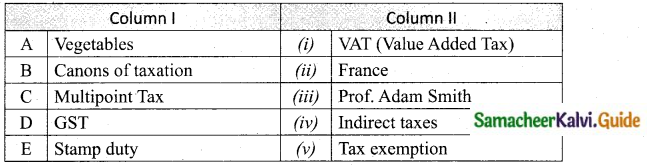
Samacheer Kalvi 10th Science Guide Chapter 16 Plant and Animal Hormones 7
Answer:
A. (iii)
B. (v)
C. (ii)
D. (i)
E. (iv)

IV. State whether True or false, If false write the correct statement.

  1. Bakacae disease or Foolish seedling disease in cucurbits.
  2. Synthesis of ethylene occurs during ripening of fruits.
  3. The secretion of Neurohypophysis are secretions of part of only pituitary.
  4. Excess production of GH in children result in dwarfism.
  5. Cortisone stimulates the breakdown of glycogen into glucose.

Answer:

  1. False – Bakacae disease or Foolish seedling disease in rice
  2. True
  3. False – The secretion of Neurohypophysis are secretions of part of the nervous system.
  4. False – Excess production of GH in children result in Gigantism.
  5. True

V. Assertion and Reasoning:

Direction: In each of the following questions a statement of assertion (A) is given and a corresponding statement of reason (R) is given just below it. Mark the correct statement as.
Question 1.
Assertion (A): Ethylene is a plant hormone, which can transfer from one plant to another plant.
Reason (R): Ethylene is a gaseous hormones in plants.
(a) If both A and R are true and R is correct explanation of A.
(b) If both A and R are true but R is not the correct explanation of A.
(c) A is true but R is false.
(d) Both A and R are false.
Answer:
(a) If both A and R are true and R is correct explanation of A.

Samacheer Kalvi 10th Science Guide Chapter 16 Plant and Animal Hormones

Question 2.
Assertion (A): Senescence is induced by the application of cytokinin in plants.
Reason (R): Cytokinin promotes the degradation of chlorophyll and nucleic acids.
(a) If both A and R are true and R is correct explanation of A.
(b) If both A and R are true but R is not the correct explanation of A.
(c) A is true but R is false.
(d) Both A and R are false.
Answer:
(d) Both A and R are false.

Question 3.
Assertion (A): ABA plays an important role in plants during water stress.
Reason (R): ABA promotes stomatal closing during water stress.
(a) If both A and R are true and R is correct explanation of A.
(b) If both A and R are true but R is not the correct explanation of A.
(c) A is true but R is false.
(d) Both A and R are false.
Answer:
(a) If both A and R are true and R is correct explanation of A.

Question 4.
Assertion (A): Gibberellin is a bolting hormone.
Reason (R): Gibberellin induces parthenocarpy in fruits.
(a) If both A and R are true and R is correct explanation of A.
(b) If both A and R are true but R is not the correct explanation of A.
(c) A is true but R is false.
(d) Both A and R are false.
Answer:
(d) Both A and R are false.

Question 5.
Assertion (A): Bolting effect in plants is performed by Gibberellin.
Reason (R): Gibberellin induce internode elongation.
(a) If both A and R are true and R is correct explanation of A.
(b) If both A and R are true but R is not the correct explanation of A.
(c) A is true but R is false.
(d) Both A and R are false.
Answer:
(a) If both A and R are true and R is correct explanation of A.

Question 6.
Assertion (A): Vasopressin is a new hormone.
Reason (R): Vasopressin is synthesized by pars nervosa of pituitary glands.
(a) If both A and R are true and R is correct explanation of A.
(b) If both A and R are true but R is not the correct explanation of A.
(c) A is true but R is false.
(d) Both A and R are false.
Answer:
(c) A is true but R is false.

Question 7.
Assertion (A): Hormones are said to be similar to enzyme in action and chemical nature.
Reason (R): Hormones and enzymes are proteinaceous in nature and act as informational nature.
(a) If both A and R are true and R is correct explanation of A.
(b) If both A and R are true but R is not the correct explanation of A.
(c) A is true but R is false.
(d) Both A and R are false.
Answer:
(d) Both A and R are false.

Question 8.
Assertion (A): Deficiency of insulin produce polyuria condition.
Reason (R): Glucogon is antagonistic hormone of insulin.
(a) If both A and R are true and R is correct explanation of A.
(b) If both A and R are true but R is not the correct explanation of A.
(c) A is true but R is false.
(d) Both A and R are false.
Answer:
(b) If both A and R are true but R is not the correct explanation of A.

Question 9.
Assertion (A): Epinephrine and nor-epinephrine are secreted by adrenal medulla are called emergency hormone.
Reason (R): These hormones rapidly mobilize the body to face a stress or emergency situation.
(a) If both A and R are true and R is correct explanation of A.
(b) If both A and R are true but R is not the correct explanation of A.
(c) A is true but R is false.
(d) Both A and R are false.
Answer:
(a) If both A and R are true and R is correct explanation of A.

Question 10.
Assertion (A): Ovaries are both cytogenic and endocrine.
Reason (R): Ovaries produce ovum and reproductive hormone.
(a) If both A and R are true and R is correct explanation of A.
(b) If both A and R are true but R is not the correct explanation of A.
(c) A is true but R is false.
(d) Both A and R are false.
Answer:
(a) If both A and R are true and R is the correct explanation of A.

VI. Answer in a word or sentence:

Question 1.
What is apical dominance?
Answer:
The auxins produced by the apical buds suppress the growth of lateral bud is called apical dominance.

Samacheer Kalvi 10th Science Guide Chapter 16 Plant and Animal Hormones

Question 2.
Name the types of Auxins.
Answer:

  • Natural Auxins – The Auxins produced by plants.
  • Synthetic Auxins – Artificially synthesized auxins.

Question 3.
Write the chemical composition of thyroxine?
Answer:
Thyroxine is an iodinated protein, composed of the amino acid, tyrosine and iodine.

Question 4.
When does the maximum synthesis of ethylene occur?
Answer:
Maximum synthesis of ethylene occurs during the ripening of fruits like apples, bananas and melons.

Question 5.
In which condition the excess of dilute urine is produced? Name the disease.
Answer:
Due to less production of ADH, excess of dilute urine is produced, it causes diabetes insipidus.

Question 6.
Name the two distinct parts of adrenal.
Answer:
Adrenal cortex and adrenal medulla.

Question 7.
What are the target organs?
Answer:
The hormones, which are produced in minute quantities, act on specific organs which are called as target organs.

VII. Short Answer Questions:

Question 1.
Name the layers of the adrenal cortex.
Answer:
The adrenal cortex consists of three layers of cells called zono glomerulosa, zona fasciculata and zona reticularis.

Question 2.
Write any three physiological effects of Auxins.
Answer:

  • Auxins promote the elongation of stems and coleoptiles.
  • Auxins prevent the formation of abscission layer.
  • Auxins induce root formation at low concentration and inhibit it at higher concentration.

Question 3.
Which hormone is called as life-saving hormone? Why?
Answer:
The cortisol hormones is called as life saving hormone. The cortisol hormones of adrenal cortex serves to maintain the body in living condition and recover it from the severe effects of stress reaction. Thus an increased output of cortisol is life saving in shock conditions.

Question 4.
Name the endocrine glands present in human and other vertebrates.
Answer:

  • Pituitary gland
  • Thyroid gland
  • Parathyroid gland
  • Pancreas (Islets of Langerhans)
  • Adrenal gland (Adrenal cortex and Adrenal medulla)
  • Gonads (Testes and Ovary)
  • Thymus gland.

Question 5.
Write the functions of thymosin.
Answer:

  1. It has a stimulatory effect on the immune function.
  2. It stimulates the production and differentiation of lymphocytes.

Question 6.
Which endocrine gland is called “Master gland”? Why?
Answer:
Pituitary gland. The pituitary gland forms the major endocrine gland in most vertebrates. It regulates and controls other endocrine glands and so it is called “Master gland”.

Samacheer Kalvi 10th Science Guide Chapter 16 Plant and Animal Hormones

Question 7.
Differentiate Hyperglycemia and Hypoglycemia.
Answer:
Samacheer Kalvi 10th Science Guide Chapter 16 Plant and Animal Hormones 8

Question 8.
Write any three physiological effects of Gibberellins.
Answer:

  • Elongation of internodes.
  • Promote the production of male flowers in monoecious plants.
  • Break dormancy of potato tubers.

VIII. Long Answer Questions:

Question 1.
Write the functions of thyroid hormones.
Answer:
The functions of thyroid hormones are:

  1. Production of energy by maintaining the Basal Metabolic Rate (BMR) of the body.
  2. Helps to maintain normal body temperature.
  3. Influences the activity of the central nervous system.
  4. Controls growth of the body and bone formation and development of gonads.
  5. Essential for normal physical, mental and personality development. It is also known as personality hormone.
  6. Regulates cell metabolism.
  7. Increases oxygen consumption in tissues.

Question 2.
List out the hormones secreted by Adenohypophysis of pituitary-Explain any two.
Answer:

  1. Growth Hormone
  2. Thyroid-stimulating Hormone
  3. Adrenocorticotropic Hormone
  4. Gonadotropic Hormone which comprises the Follicle Stimulating Hormone and Luteinizing Hormone
  5. Prolactin

Thyroid-stimulating hormone (TSH) : TSH controls the growth of thyroid gland, coordinates its activities and hormone secretion.

Adrenocorticotropic hormone (ACTH) : ACTH stimulates adrenal cortex of the adrenal gland for the production of its hormones. It also influences protein synthesis in the adrenal cortex.

Question 3.
Explain the testes and its functions.
Answer:
Testes are the reproductive glands of the males. They are composed of ‘ seminiferous tubules, leydig cells and sertoli cells. Leydig cells form the endocrine part of the testes. They secrete the male sex hormone called testosterone.
Functions of testosterone:

  1. It influences the process of spermatogenesis.
  2. It stimulates protein synthesis and controls muscular growth.
  3. It is responsible for the development of secondary’ sexual characters (distribution of hair on body and face, deep voice pattern, etc).

Question 4.
Write the physiological effects of cytokinin.
Answer:

  1. Cytokinin induces cell division (cytokinesis) in the presence of auxins.
  2. Cytokinin also causes cell enlargement.
  3. Both auxins and cytokinins are essential for the formation of new organs from the callus in tissue culture (Morphogenesis).
  4. Cytokinins promote the growth of lateral buds even in the presence of apical bud.
  5. Application of cytokinin delays the process of ageing in plants. This is called Richmond Lang effect.

IX. Higher Order Thinking Skills: (HOTS)

Question 1.
You are given a tissue with its potential for differentiation in an artificial culture. Name the hormones to be added to the medium to secure shoots as well as roots.
Answer:
The hormones to be added to the medium are gibberellin and abscisic acid.

Samacheer Kalvi 10th Science Guide Chapter 16 Plant and Animal Hormones

Question 2.
Insulin and thyroxine arrive at an organ at the same time. Thyroxine causes an effect on the organ but insulin does not. This is because:
Answer:
The organ’s cells have receptors for thyroxine but not for insulin.

Question 3.
A person entering an empty room suddenly finds a snake right in front on opening the door. What changes happen in his neuro-hormonal control system?
Answer:
Sympathetic nervous system is activated releasing epinephrin and norepinephrine from adrenal medulla.

Question 4.
A pregnant female delivers a baby who suffers from stunted growth, mental retardation, low intelligence quotient and abnormal skin. This is the result of:
Answer:
Deficiency of iodine in diet.

Question 5.
A patient of diabetes mellitus excretes glucose in urine even when he kept in a carbohydrate free diet. It is because:
Answer:
Fats are catabolised to form glucose.

Question 6.
Dr. F went noted that if Coleoptile tips were removed and placed on agar for one hour, the agar would produce a bending when placed on one side of freshly cut coleoptile stumps. What is the significance of this experiment.
Answer:
The experiment demonstrated the polar movement of Auxin.