Samacheer Kalvi 9th Science Guide Chapter 15 Carbon and its Compounds

Tamilnadu State Board New Syllabus Samacheer Kalvi 9th Science Guide Pdf Chapter 15 Carbon and its Compounds Text Book Back Questions and Answers, Notes.

Samacheer Kalvi 9th Science Solutions Chapter 15 Carbon and its Compounds

9th Science Guide Carbon and its Compounds Text Book Back Questions and Answers

 Samacheer Kalvi 9th Science Guide Chapter 15 Carbon and its Compounds

I. Choose the correct answer :

Question 1.
A phenomenon in which an element exists in different modification in same physical state is called
(a) isomerism
(b) allotropy
(c) catenation
(d) crystallinity
Answer:
(b) allotropy

Question 2
Carbon forms large number of organic compounds due to
(a) Allotropy
(b) Isomerism
(c) Tetravalency
(d) Catenation
Answer:
(d) Catenation

 Samacheer Kalvi 9th Science Guide Chapter 15 Carbon and its Compounds

Question 3.
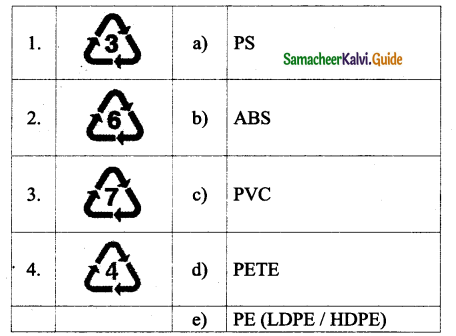
Nandhini brings her lunch every day to school in a plastic container which has resin code number 5. The container is made of
(a) Polystyrene
(b) PVC
(c) Polypropylene
(d) LDPE
Answer:
(c) Polypropylene

Question 4.
Plastics made of Polycarbonate (PC) and Acrylonitrile Butadiene Styrene (ABS) . are made of resin code …………………
(a) 2
(b) 5
(c) 6
(d) 7
Answer:
(a) 7

 Samacheer Kalvi 9th Science Guide Chapter 15 Carbon and its Compounds

Question 5.
Graphene is one atom thick layer of carbon obtained from
(a) diamond
(b) fiillerene
(c) graphite
(d) gas carbon
Answer:
(c) graphite

 Samacheer Kalvi 9th Science Guide Chapter 15 Carbon and its Compounds

Question 6.
The legal measures to prevent plastic pollution come under the Protection …………….. Act 1988.
(a) Forest
(b) Wildlife
(c) Environment
(d) Human rights
Answer:
(c) Environment

II. Fill in the blanks :

1. ………………. named carbon.
Answer:
Antoine Lavoisier

2. Buckminster Fullerene contains ………………… carbon atoms.
Answer:
60

3. Compounds with same molecular formula and different structural formula are known as ………………….. .
Answer:
Isomers

 Samacheer Kalvi 9th Science Guide Chapter 15 Carbon and its Compounds

4. …………….. is a suitable solven for Sulphur.
Answer:
Allotropy

5. There are ……………. plastic resin codes.
Answer:
seven

III. Match the following :

AlkyneBucky Ball
Andre GeimOxidation
C60Graphene
ThermocolTriple bond
CombutionPolystyrene

Answer:

AlkyneTriple bond
Andre GeimGraphene
C60Bucky Ball
ThermocolPolystyrene
CombutionOxidation

 Samacheer Kalvi 9th Science Guide Chapter 15 Carbon and its Compounds

IV. Answer in briefly :

Question 1.
Differentiate graphite and diamond.
Answer:

GraphiteDiamond
Each carbon atom has three covalent bonds.Each carbon atom has four covalent bonds.
Soft, slippery to touch and opaqueHard, heavy and transparent
It has planar layers of hexagon units.It has tetrahedral units linked in three dimension
It is conductor of heat and electricity.It is non-conductor of heat and electricity

Question 2.
Write all possible isomers of C4H10
Answer:
Samacheer Kalvi 9th Science Guide Chapter 15 Carbon and its Compounds 1

Question 3.
Carbon forms only covalent compounds. Why?
Answer:
Carbon forms only covalent compounds because it has 4 electrons, in its.

 Samacheer Kalvi 9th Science Guide Chapter 15 Carbon and its Compounds

Question 4.
Define Allotrophy.
Answer:
Allotrophy is a property by which are element can exist in more than one form that are physically different and chemically similar.

Samacheer Kalvi 9th Science Guide Chapter 15 Carbon and its Compounds 1

Question 5.
Why are one-time use and throwaway plastics harmful?
Answer:

  1. Use and throwaway plastics cause short and long-term environmental damage.
  2. Half of all the plastic made today is used for throwaway plastic items. These block drains and pollute water bodies.
  3. One-time use plastic causes health problems for humans, plants and animals.
  4. Some examples are plastic carry bags, cups, plates, straws, water pouches, cutlery and plastic sheets used for food wrapping.

 Samacheer Kalvi 9th Science Guide Chapter 15 Carbon and its Compounds

V. Answer in detail :

Question 1.
What is catenation? How does carbon form catenated compounds?
Answer:
Catenation is binding of an element to itself or with other elements through covalent bonds to form open chain or closed chain compounds.

  • Carbon is the most common element which undergoes catenation and long chain compounds.
  • Carbon atom links repeatedly to itself through covalent bond to form linear branched chain (or) ring structure

Samacheer Kalvi 9th Science Guide Chapter 15 Carbon and its Compounds 2

  • This property of carbon itself is the reason for the presence of large number of organic carbon compounds.
  • So organic chemistry essentially deals with catenated carbon compounds.
  • Example: Starch and cellulose contain chains of hundreds of carbon atoms.

Question 2.
What are the chemical reactions of carbon?
Answer:
Elemental carbon undergoes no reaction at room temperature.
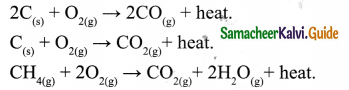
Oxidation : Carbon combines with oxygen to form its oxides such as carbon monoxide (CO) and carbon dioxide (CO2), with evolution of heat. Organic carbon compounds like hydrocarbon also undergo oxidation to form oxides and steam with evolution of heat and flame.

This reaction is also called ‘Combustion’.
Samacheer Kalvi 9th Science Guide Chapter 15 Carbon and its Compounds 3

Reaction with Steam : Carbon reacts with steam to form carbon monoxide hydrogen. This mixture is called water gas.
C(S) + H2O(g) → CO(g) + H2(g)

Reaction with Sulphur: With sulphur, carbon forms its disuiphide at high temperature.
C(S) + S(g) → CS2(g)

Reaction with Metals : At elevated temperatures, carbon reacts with some metals like iron, tungsten, titanium, etc., to form their carbides
W(S)+C(g) → WC(S)

 Samacheer Kalvi 9th Science Guide Chapter 15 Carbon and its Compounds
Question 3.
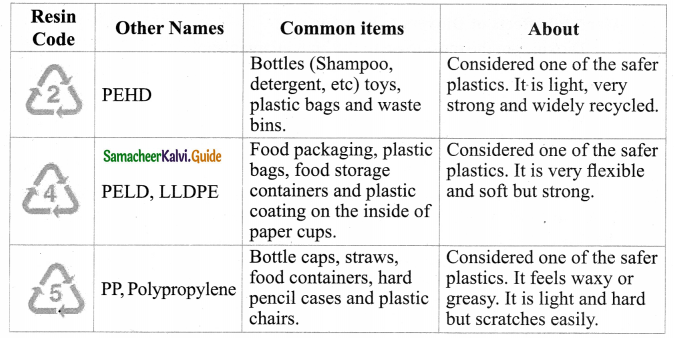
Name the three safer resin codes of plastics and describe their features.
Answer:
Samacheer Kalvi 9th Science Guide Chapter 15 Carbon and its Compounds 4

VI. Higher Order Thinking Skills:

Question 1.
Why do carbon exist mostly in combined state?
Answer:
Carbon is an element that can form many different compounds, as each carbon atom can form 4 chemical bonds with other atoms and because the carbon atom is just the right size to fit in comfortably as parts of very large molecules.

 Samacheer Kalvi 9th Science Guide Chapter 15 Carbon and its Compounds

Question 2.
When a carbon fuel burns in less aerated room, it is dangerous to stay there. Why?
Answer:

  • When a carbon fuel bums in less aerated room, the fuel may undergo incomplete combustion.
  • It results in the formation of carbon monoxide.
  • When exposed to carbon monoxide (CO) it enters human body, through breathing, affects the function of haemoglobin.
  • Sometimes, it will lead to death.

Question 3.
Explain how dioxins are formed? Which plastic-type they are linked to and why they are harmful to humans?
Answer:
Dioxin formation:

  • Dioxin compounds are not created intentionally but are formed inadvertently by a number of human and natural activities.
  • These activities include combustion and incineration, forest fires, chlorine bleaching of pulp and paper, certain types of chemical manufacturing and processing, and other industrial processes.
  • Cigarette smoke, some home-heating systems, and exhaust from vehicles using leaded and unleaded petrol as well as diesel fuels also produce small amounts of dioxins.
  • Burning materials that may contain chlorine such as plastics, wood treated with pentachlorophenol (PCP), pesticide-treated wastes, other chemicals such as polychlorinated biphenols (PCBs), and even bleached paper can produce dioxins.

Their link with plastic :

  • Dioxins are linked with PVC (Polyvinyl Chloride plastics).
  • The most dangerous emissions can be caused by burning PVC, as it releases dioxins.

Harmful effects of Dioxins to humans :

  • Dioxins are the most toxic to human organisms.
  • Dioxins can cause cancer, disrupt the endocrine system, alteration in pituitary and thyroid gland functions, immune suppression, neurobehavioral effects and cause reproductive and developmental effects.
  • They are carcinogenic and a hormone disruptor and persistent, and they accumulate in our body-fat and thus mothers give it directly to their babies via the placenta.

 Samacheer Kalvi 9th Science Guide Chapter 15 Carbon and its Compounds

Question 4.
Yugaa wants to buy a plastic water bottle. She goes to the shop and sees four different kinds of plastic bottles with resin codes 1, 3, 5, and 7. Which one should she buy? Why?
Answer:

  • Yugaa should buy a plastic water bottle with Resin Code No.5, which is considered as one of the safer plastics. It is light and hard.

Reasons to avoid resin codes 1,3,7

  • Bottle with Resin Code 1 is to be used only once. This plastic can release a chemical additive called antimony, which is not good for health.
  • Bottle with Resin Code 3 is the most toxic plastic. It will have a smell of a new shoe. It should be avoided.
  • Bottle with Resin Code 7 has the plastic types PC and ABS which are unsafe and toxic.

Intext Activities

ACTIVITY -1
With the help of your teacher, try to classify the following as organic and inorganic compounds.
HCN, CO2, Propane, PVC, CO Kerosene, LPG, Coconut oil, Wood, Perfume, Alcohol, Na2CO3, CaCO3. MgO, Cotton, Petrol.
Solution:

InorganicOrganic
CO2Propane
COWood, kerosene, coconut oil
MgOParfume
HCNAlcohol
Na2CO3Cotton
PVCPetrol
LPG

[End of the activity]

 Samacheer Kalvi 9th Science Guide Chapter 15 Carbon and its Compounds

ACTIVITY – 2

Take a football since it resembles Buckminsterfullerene. Count how many hexagonal and pentagonal panels are in it very comer is considered as one carbon. Compare your observation with fullerene and discuss with your friends.
Aim:
To compare the structure of fullerene with football.
Materials required:
Football

Procedure:

  1. Take football.
  2. Count the hexagonal and pentagonal rings shapes in football.

Observation:

ShapesFullerene (C60)Football
Pentagon12 Pentagonal rings12 Black pentagons
Hexagon20 Hexagonal rings20 White hexagons
StructureClosed cage-like structurePolyhedron Structure

Conclusion :
The structure of football is compared with fullerene.

9th Science Guide Carbon and its Compounds Additional Important Questions and Answers

I. Choose the correct answer :

Question 1.
Carbon is one of the most important ………………….element.
(a) Metallic
(b) Non-metallic
(c) Metalloid _
(d) None of these
Answer:
(b) Non-metallic

Question 2.
The most recently discovered allotrope of carbon is ……………….
(a) Graphite
(b) Fullerene
(c) Graphene ‘
(d) Gas carbon
Answer:
(c) Graphene

 Samacheer Kalvi 9th Science Guide Chapter 15 Carbon and its Compounds

Question 3.
……………. is the first organic compound synthesized in the laboratory.
(a) Urea
(b) Acetic acid
(c) Methane
(d) Ethanol
Answer:
(a) Urea

Question 4.
The main component of water gas is …………….
(a) Carbon dioxide
(b) Carbon monoxide
(c) Calcium carbide
(d) Methane
Answer:
(b) Carbon monoxide

 Samacheer Kalvi 9th Science Guide Chapter 15 Carbon and its Compounds

Question 5.
The ability of carbon to form …………… is the main reason for the formation of various classes of carbon compounds.
(a) Tetravalency
(b) Catenation
(c) Isomerism
(d) Multiple bonds
Answer:
(d) Multiple bonds

Question 6.
Arrangement of atoms in diamond is …………………
(a) Hexagonal
(b) Trigonal
(c) Tetrahedral
(d) Pentagonal
Answer:
(c) Tetrahedral

 Samacheer Kalvi 9th Science Guide Chapter 15 Carbon and its Compounds

Question 7.
The amorphous allotropic carbon used for making electrodes in dry cell
(a) Coke
(b) Charcoal
(c) Lampblack
(d) Gas carbon
Answer:
(d) Gas carbon

Question 8.
Elemental carbon undergoes …………. reaction at room temperature.
(a) Oxidation
(b) Reduction
(c) Free radical
(d) no.
Answer:
(d) no

 Samacheer Kalvi 9th Science Guide Chapter 15 Carbon and its Compounds

Question 9.
Amorphous forms of carbon and graphite are almost …………… in colour.
(a) Grey
(b) brownish
(c) black
(d) dirty white
Answer:
(c) black

Question 10.
Carbon monoxide displaces ………………. from hemoglobin.
(a) nitrogen
(b) oxygen
(c) hydrogen
(d) carbon dioxide
Answer:
(b) oxygen

 Samacheer Kalvi 9th Science Guide Chapter 15 Carbon and its Compounds

Question 11.
Burning of PVC releases
(a) Dioxins
(b) Carbon monoxide
(c) Sulphur dioxide
(d) Chlorine
Answer:
(a) Dioxins

Question 12.
Which among the following plastics release antimony when we reuse.
(a) PVC
(b) HDPE
(c) PP
(d) PET
Answer:
(d) PET

Question 13.
According to the Octet rule, carbon requires ……………. electrons to attain the nearest noble gas.
(a) One
(b) two
(c) Three
(d) Four
Answer:
(d) Four

 Samacheer Kalvi 9th Science Guide Chapter 15 Carbon and its Compounds

Question 14.
Most one-time use plates are made from ……………
(a) Polypropylene
(b) Polystyrene
(c) Polyethylene
(d) Polyvinylchloride
Answer:
(b) Polystyrene

Question 15.
Which among the following compound is soluble in water?
(a) Methane
(b) Ethylene
(c) Ethanol
(d) Phenol
Answer:
(c) Ethanol

 Samacheer Kalvi 9th Science Guide Chapter 15 Carbon and its Compounds

Question 16.
The number of free electrons in each carbon of diamond is
(a) Zero
(b) One
(c) Two
(d) None of these
Answer:
(a) zero

Question 17.
The carbon atoms in Graphene are arranged in
(a) Hexagon
(b) Pentagon
(c) octagon
(d) Tetragon
Answer:
(a) Hexagon

 Samacheer Kalvi 9th Science Guide Chapter 15 Carbon and its Compounds

Question 18.
Resin Code” represents the type of …………….. used to make the plastic.
(a) Polymer
(b) Rubber
(c) monomer
(d) Polymerisation
Answer:
a) Polymer

Question 19.
Diamond is not a good conductor of electricity because
(a) it is very hard
(b) it has no free electron
(c) its structure is uniform
(d) it is insoluble in water
Answer:
(b) it has no free electron
Hint: Diamond contains no free electron and it behaves as an insulator

 Samacheer Kalvi 9th Science Guide Chapter 15 Carbon and its Compounds

Question 20.
Which of the following is highly toxic?
(a) Carbon dioxide
(b) Carbon monoxide
(c) Calcium carbonate
(d) Sodium bicarbonate
Answer:
(b) Carbon monoxide
Hint: CO easily binds with Haemoglobin and then causes death

Question 21.
Which of the following plastic items are banned by the Government of Tamil Nadu as of 1st January 2019?
(a) Plastic sheets
(b) Plastic teacups
(c) Plastic water packet
(d) All the above
Answer:
(d) All the above

 Samacheer Kalvi 9th Science Guide Chapter 15 Carbon and its Compounds

Question 22.
Graphite is used as a lubricant in machines because
(a) it is a good conductor of electricity
(b) it is made of slippery layers and  has a high melting point
(c) it has a high density
(d) it is strong and soft
Answer:
(b) it is made of slippery layers and has a high melting point

Question 23.
Plastic resin codes are shown as three chasing arrows in a ………………. with a number in the middle or letters (an acronym of that plastic type).
(a) Logo
(b) Recycling Symbol
(c) Square
(d) Triangle
Answer:
(d) Triangle

 Samacheer Kalvi 9th Science Guide Chapter 15 Carbon and its Compounds

II. Fill in the blanks :

1. …………… is the main constituent of coal.
Answer:
Carbon

2. Carbon chemistry is also called as ……………..
Answer:
Living chemistry

3. Graphene has a thickness of just …………… atom.
Answer:
One

 Samacheer Kalvi 9th Science Guide Chapter 15 Carbon and its Compounds

4. ……………. is the Father of Modem Organic Chemistry
Answer:
Friedrich Wohler

5. The inorganic carbon compound that takes past in photosynthesis is …………………….
Answer:
Carbon dioxide

6. The carbon cycle is the …………….. cycle.
Answer:
Biogeochemical

 Samacheer Kalvi 9th Science Guide Chapter 15 Carbon and its Compounds

7. ……………….. structure accountable for hardness and rigidity of diamond.
Answer:
Three dimensional

8. Hexagonal layers in Graphite are held together by ……………………
Answer:
weak VanderWaals forces

9. Pet name for Buckminster Fullerene is ………………….
Answer:
Bucky ball

 Samacheer Kalvi 9th Science Guide Chapter 15 Carbon and its Compounds

10. A large family of fullerene exists, starting at ………………… and reaching upto .
Answer:
C20, C540

11. Graphene is ………………. shaped hexagonal ring
Answer:
Honeycomb

12. Cigarette smoking is a source of ……………….
Answer:
Carbon Monoxide

 Samacheer Kalvi 9th Science Guide Chapter 15 Carbon and its Compounds

13. Carbon monoxide enters into human body through …………………
Answer:
breathing

14. Do not use _______ for school projects.
Answer:
Thermocol

15. Polycarbonate (PC) plastic contains ……………..
Answer:
Bisphenol A

 Samacheer Kalvi 9th Science Guide Chapter 15 Carbon and its Compounds

III. Match the following :
(I)

1. Graphitea) Honeycomb
2. Fullereneb) Tetrahedral
3. Graphenec) Hexagonal
4. Diamondd) Dome-shaped

Answer:
1 – c, 2 – d, 3 – a, 4 – b

(II)
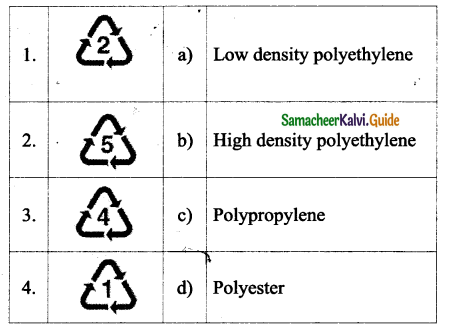
Samacheer Kalvi 9th Science Guide Chapter 15 Carbon and its Compounds 5
Answer:
1-b,2-c,3-a,4-d

(III)
Samacheer Kalvi 9th Science Guide Chapter 15 Carbon and its Compounds 6
Answer:
1-c, 2 -a, 3-b, 4-c

IV. True or False :

1. About 18% of the weight of the human body is carbon.
Answer:
True.

2. There is more abundance of carbon in the earth
Answer:
False.
Correct statement: There is less abundance of carbon in the earth.

 Samacheer Kalvi 9th Science Guide Chapter 15 Carbon and its Compounds

3. Carbon has the tendency to lose its four electrons with that of other atoms to complete its octet.
Answer:
False.
Correct statement: Carbon has the tendency to share its four electrons with that of other atoms to complete its octet

4. All the allotropic forms of carbon are solids.
Answer:
True.

5. Carbon’s amorphous forms have high melting and boiling poult compared to crystalline forms.
Answer:
False.
Correct statement: Carbon’s amorphous forms have low melting and boiling point compared to crystalline forms.

 Samacheer Kalvi 9th Science Guide Chapter 15 Carbon and its Compounds

6. Used plate is easy to recycle.
Answer:
False.
Correct statement: Used plate difficult to recycle.

7. Do not eat hot food items in plastic containers.
Answer:
True.

V. Assertion and Reason type questions :

Mark the correct choice as:
(a) If both Assertion and Reason are true and Reason is the correct explanation of Assertion.
(b) If both assertion and reason are true but the reason is not the correct explanation of assertion.
(c) If Assertion is true but the reason is false.
(d) Both assertion and reason are false.

Question 1.
Assertion (A) : The number of carbon compounds alone is more than the number of compounds of all the elements taken together.
Reason (R) : Carbon has some unique properties such as
1) Catenation, 2) Tetravalency, 3) Multiple bonds, 4) Allotropy, 5) Isomerism.
Answer:
(a) Both Assertion and Reason are true and Reason is the correct explanation for Assertion

 Samacheer Kalvi 9th Science Guide Chapter 15 Carbon and its Compounds

Question 2.
Assertion (A) : There are various classes of carbon compounds formed.
Reason (R) : The property of Isomerism is the main reason.
Answer:
(c) Assertion is true but reason is false
Reason : The ability to form multiple bonds is the main reason.

Question 3.
Assertion (A) : Carbon monoxide is a toxic gas of carbon.
Reason (R): smoking is a source of carbon monoxide.
Answer:
(b) Both assertion and reason are true but reason is not the correct explanation for assertion

Question 4.
Assertion (A): PVC is an unsafe plastic.
Reason (R)Burning PVC releases dioxins, a most toxic chemical.
Answer:
(a) Both Assertion and Reason are true and Reason is the correct explanation for Assertion

 Samacheer Kalvi 9th Science Guide Chapter 15 Carbon and its Compounds

VI. Answer the following by rearranging the jumbled letters :

Question 1.
It is the hardest allotrope of carbon
mnodaid
Answer:
Diamond

Question 2.
Organic compounds having a double bond between carbon atoms are
knelaes
Answer:
Alkenes

 Samacheer Kalvi 9th Science Guide Chapter 15 Carbon and its Compounds

Question 3.
Reaction of carbon with oxygen gives
osdiex
Answer:
Oxides

Question 4.
In this molecule, carbon is attached to four hydrõgen atoms.
emathen
Answer:
Methane

 Samacheer Kalvi 9th Science Guide Chapter 15 Carbon and its Compounds

Question 5.
Carbon combines with other elements through the _______ bond.
lnaocvet
Answer:
Covalent

Question 6.
Plastics made of________ are represented by resin code #6.
sytlopynere
Answer:
Polystyrene

Question 7.
One-time use plastics are also known as ______ plastics.
áwyrhotwa
Answer:
throwaway

 Samacheer Kalvi 9th Science Guide Chapter 15 Carbon and its Compounds

Question 8.
One-time use plastics cause ________ damage.
trnvomenialne
Answer:
Environmental

Question 9.
Expanded polystyrene is commercially known as
mthreolco
Answer:
Thermocol

 Samacheer Kalvi 9th Science Guide Chapter 15 Carbon and its Compounds

VII. Very Short Answer questions :

Question 1.
How can graphite be transformed to diamond?
Answer:
Graphite could be transformed to the diamond at high temperature and high pressure.

Question 2.
How did the ancients obtain charcoal?
Answer:
Ancients manufactured charcoal by burning organic compounds.

Question 3.
Which theory was challenged by the synthetic preparation of Urea?
Answer:
Vital force theory.

 Samacheer Kalvi 9th Science Guide Chapter 15 Carbon and its Compounds

Question 4.
Name two inorganic carbon compounds which are used as an antacid?
Answer:
Calcium carbonate (CaCO3), Sodium bicarbonate (NaHCO3)

Question 5.
What is tetravalency?
Answer:
Carbon has the tendency to share~its four electrons with other atoms to complete its octet. This is called Tetravalency.

Question 6.
Name the primary factor that determines the physical and chemical properties of compounds.
Answer:
Nature of bonding in a compound.

 Samacheer Kalvi 9th Science Guide Chapter 15 Carbon and its Compounds

Question 7.
Why do elements show allotropy?
Answer:
It’s a method of formation or preparation.

Question 8.
Why is graphite softer than a diamond?
Answer:
The hexagonal layers in graphite are held together by weak Vander Waals forces of attraction.

Question 9.
What are Polymer resins?
Answer:
Plastics, made from long-chain organic compounds, are called “Polymer resins”.

 Samacheer Kalvi 9th Science Guide Chapter 15 Carbon and its Compounds

Question 10.
List the three unsafe plastics.
Answer:

  1. Polyvinyl chloride (PVC)
  2. Polystyrene (Thermocol)
  3. Polycarbonates (PC).

Question 11.
How many valence electrons are there in carbon?
Answer:
There are 4 valence electrons in carbon, out of 6 total electrons.

Question 12.
Who is called ‘Father of Modern Organic Chemistry’?
Answer:
Friedrich Wohler is called the ‘Father of Modern Organic Chemistry’.

 Samacheer Kalvi 9th Science Guide Chapter 15 Carbon and its Compounds

Question 13.
Which three resin codes are unsafe?
Answer:
Resin Code Nos. 3, 6, and 7 unsafe.

VIII. Short Answer questions:

Question 1.
Prove that a diamond is a pure form of carbon?
Answer:

  • When an equal weight of charcoal and diamond were burned, they produced the same amount of carbon dioxide.
  • So like charcoal, diamond is also a pure form of carbon.

Question 2.
Write the classification of carbon compounds.
Answer:

1. Organic Carbon Compound2. Inorganic Carbon Compounds
These are the compounds of carbon obtained from living organisms such as plants and animals.
(e.g) Cellulose, Ethanol, Starch.
These are the compounds containing carbon but obtained from non-living matter.
(e.g) Calcium carbonate, Carbon dioxide, Carbon monoxide

Question 3.
Write short notes on the carbon cycle.
Answer:

  1. The carbon cycle is the biogeochemical cycle.
  2. Carbon is exchanged among the biosphere, geosphere, hydrosphere, and atmosphere of the Earth.
  3. Carbon is the main component of biological compounds as well as a major component of many minerals such as limestone.

 Samacheer Kalvi 9th Science Guide Chapter 15 Carbon and its Compounds

Question 4.
Define: (i) Allotropy (ii) Allotrope
Answer:
(i) Allotropy: It is a property by which an element can exist in more than one form that is physically different and chemically similar.
(ii) Allotrope: The different forms of an element.

Question 5.
Differentiate crystalline and amorphous forms of allotropes of carbon.
Answer:

Crystalline allotropes of carbonAmorphous allotropes of carbon
1. Diamond1. Charcoal
2. Graphite2. Lampblack
3. Fullerene3. Coke
4. Graphene4. Gas Carbon

Question 6.
Why is carbon monoxide harmful to health? (or) What happens when we breath Carbon monoxide?
Answer:

  • On exposition, carbon monoxide (CO) enters the human body through breathing.
  • It affects the function of hemoglobin by displacing oxygen from hemoglobin.
  • It will lead to death.

 Samacheer Kalvi 9th Science Guide Chapter 15 Carbon and its Compounds

Question 7.
Why. do we remove plastics safely? How can it be done?
Answer:

  • Plastics are non-biogradable.
  • Plastics can be recycled (or) disposed safely without harming environment.

Question 8.
Mention two reasons for the harmful nature of plastics.
Answer:

  1. Plastics contain chemicals that are harmful to our health.
  2. Most of the plastics are one-time use (or) throwaway in nature and pollutes the environment.

Question 9.
Give some examples of one-time-use plastic.
Answer:

  • Plastic carry bags,
  • Cups,
  • Plastic plates,
  • Straws,
  • Water pouches, 6. Plastic sheets.

 Samacheer Kalvi 9th Science Guide Chapter 15 Carbon and its Compounds

Question 10.
What we can do to prevent plastic pollution?
Answer:

  • Share scientific knowledge on plastics and their effects with our family, friends, and relatives.
  • Create awareness to avoid harmful plastics by educating about the resin codes.
  • Educate about the new rules to stop one-time use of plastics.

IX. Long Answer questions

Question 1.
Draw a timeline of carbon chemistry depicting the contribution by scientists.
Answer:

YearScientistContribution
1772Antoine Lavoisier (France)Diamond and charcoal are carbon allotropes
1779 Carl Scheele (Sweden)Graphite is another form of carbon
1796Smithson TennantDiamond is a pure carbon like charcoal.
1855Benjamin Brodie (England)Pure graphite from carbon, proving graphite is a form of carbon
1955Francis Bundy (USA)Transformed graphite into diamond.
1985Robert Curl, Harry Kroto and Richard SmalleyDiscovered a new form of carbon called fullerenes.
2004KostyaNovoselov Andre GeimGraphene – lightest carbon

 Samacheer Kalvi 9th Science Guide Chapter 15 Carbon and its Compounds

Question 2.
Give an account of (I) Isomerism (II) Isomers with an illustration.
Answer:
(1) Isomerism: The Phenomenon in which an element has the same molecular formula may exhibit different structural arrangement is called Isomerism.
(II) Isomers: Compounds that have the same molecular formula but different structural formula are called isomers.
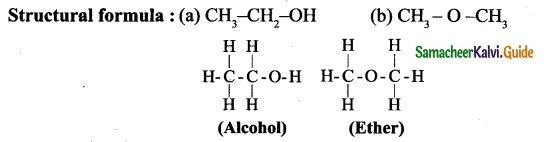
Illustration: Molecular formula: C2H6O, is having two kinds of the arrangement of atoms as shown below.

Samacheer Kalvi 9th Science Guide Chapter 15 Carbon and its Compounds 7

In the above illustration, the molecular formula C2H6O has two different structural formulae
(a) Alcohol (CH3CH2OH) [Oxygen at the end of Chain
(b) Ether (CH3OCH3) [Oxygen at the middle
Both structural formulae will show different physical and chemical properties.

Question 3.
Write the salient features of Graphene.
Answer:

  • Graphene is the most recently produced allotrope of carbon.
  • It is honey comb-shaped hexagonal rings repeatedly arranged in a plane.
  • It is the thinnest compound known to man at one atom thick.
  • It is the lightest material known and the strongest compound discovered.
  • Layers of graphene are stacked to form graphite by Vander Waals forces.

Question 4.
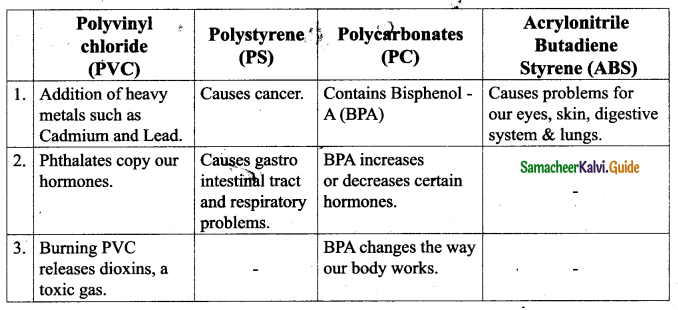
Briefly note the harmful effects of any four plastics.
Answer:
Samacheer Kalvi 9th Science Guide Chapter 15 Carbon and its Compounds 8

 Samacheer Kalvi 9th Science Guide Chapter 15 Carbon and its Compounds

Question 5.
How can you minimise plastic pollution by your daily practices?
Answer:

  • Don’t litter the environment by throwing plastic items.
  • Don’t burn plastics since it causes the evolution of highly toxic gases.
  • Avoid one-time use (or) throw away plastics like plastic bags, teacups, carry bags, plastic plates, etc.
  • Don’t eat hot (or) spicy food items in plastic containers. ‘
  • Segregate the plastic wastes and hand this over to the municipal authorities so that it can be recycled.
  • Know about the resin codes and avoid unsafe plastics.
  • Don’t use thermocol for school projects.

Samacheer Kalvi 12th English Guide Supplementary Chapter 1 God Sees the Truth, But Waits

Tamilnadu State Board New Syllabus Samacheer Kalvi 12th English Guide Pdf Supplementary Chapter 1 God Sees the Truth, But Waits Text Book Back Questions and Answers, Summary, Notes.

Tamilnadu Samacheer Kalvi 12th English Solutions Supplementary Chapter 1 God Sees the Truth, But Waits

12th English Guide God Sees the Truth, But Waits Text Book Back Questions and Answers

Textual Questions:

1. Answer the following questions in a sentence or two each, based on your understanding of the story: (Text Book Page No. 31)

Question a.
Why did Aksionov’s wife stop him from going to the fair?
Answer:
Aksionov’s wife had a very bad dream about him. So, she stopped him from going to the fair,

Question b.
What is the importance of Aksionov’s wife’s dream?
Answer:
The importance of her dream is that when he returned from the town, she saw that his hair was quite grey.

Question c.
What made Aksionov leave the inn before dawn?
Answer:
Aksionov was an early riser. He wanted to travel when the air was cool. So, he left the inn before dawn.

Question d.
What were the circumstances that led to Aksionov’s imprisonment?
Answer:
A blood-stained knife has been taken from his bag and in his former days, he used to drink and waste his time. These were the circumstances that led to Aksionov’s imprisonment.

Question e.
Why did Aksionov give up sending petitions?
Answer:
Aksionov’s wife came to visit him. She informed that her petition for clemency had been turned down. She asked him if he had done it. Realizing that his wife also suspected him, Aksionov gave up sending petitions to the Tsar.

Samacheer Kalvi 12th English Guide Supplementary Chapter 1 God Sees the Truth, But Waits

Question f.
Why didn’t Makar disclose that he had killed the merchant?
Answer:
Makar didn’t disclose that he had killed the merchant. Because, if he disclosed he would put him in jail.

Question g.
Did Makar feel guilty when he heard Aksionov’s story?
Answer:
No, Makar did not feel guilty. Instead, he casually said that it must be the person in whose bag the knife was found.

Question h.
What made Aksionov think that Makar was the real murderer?
Answer:
When Makar said how could anyone put a knife into his bag while it was under his head. This statement made Aksionov think that Makar was the real murderer.

Question i.
What was Aksionov’s realization by the end of the story?
Answer:
Aksionov realized that vengeance will get nothing. God knows the truth and God’s will happen. He forgave Makar and felt light at the end.

Question j.
Why did Aksionov’s wife suspect him of involvement in the murder?
Answer:
Aksionov’s wife dreams that he returns from town with grey hair. She begs him not to leave for the fair, but he ignores her warning. Thus she suspects him of involvement in the murder as she co-related the situation.

Samacheer Kalvi 12th English Guide Supplementary Chapter 1 God Sees the Truth, But Waits

2. Answer the following questions in three or four sentences each: (Text Book Page No. 31)

Question a.
Did the police officer have sufficient evidence to convict Aksionov?
Answer:
Yes, the blood-stained knife was found in Aksionov’s bag. When interrogated, he turned pale and started shivering. He did not have much to say to prove his innocence. Thus, the circumstantial evidence were sufficient to convict Aksionov.

Question b.
What impact did the book “The Lives of Saints” have on Aksionov?
Answer:
The book “The lives of saints” had a more impact on Aksionov. He read this book when there was enough time in prison. The prison authorities liked Aksionov for his weakness and his fellow prisoners respected and called him “grandfather” and “The Saint” when there were quarrels among the prisoners, they came to him to put things right and to judge the matter.

Question c.
Pick out the clues that convey that Makar Semyonich recognized Aksionov.
Answer:
When Makar Semyonich heard the story as to why Aksionov has been kept in Siberia, he became excited. He said, “It is wonderful that we should meet here.” Aksionov asked anxiously if he knew who had murdered the merchant. He blurted out, “how could anyone put a knife into your bag while it was under your head? It would have surely woken you up.” From this Aksionov got the clue that Makar was the murderer and he recognized him clearly.

Samacheer Kalvi 12th English Guide Supplementary Chapter 1 God Sees the Truth, But Waits

3. Answer the following questions in a paragraph of about 150 words each: (Text Book Page No. 31)

Question a.
Compare and contrast the main characters, Aksionov and Makar Semyonich in the story.
Answer:
The protagonist – Aksionov – prison – twenty-six years – nobody believes – works hard in prison – lives a simple life – helps other prisoners – make a real convict – accepts the murder at the end – governor came – questioned all the prisoners – someone dug the hole – Aksionov – no words Makar – told the truth – Aksionov surprised – forgive him – rather revenge.

The protagonist Aksionov is sentenced to prison for twenty-six years for a crime he did not commit. He is unable to defend himself. Nobody believes him, not even his wife. He works hard in prison, buys books with the money he earns, reads, and lives a simple life. Instead of focusing on his grief, he helps others and earns their respect in jail. As far as the character of Makar Semyonich is considered, he is the real convict of the story but it is revealed only at the end of the story.

Somehow he accepted the murder only after seeing the noble personality of Ivan Dmitrich Aksionov. Makar felt guilty for murdering the merchant and he begs for forgiveness. Though Aksionov came to know that Makar is the real culprit, he did not try to reveal the truth. It was so evident that one day the Governor came and questioned all the prisoners to find out who had dug the hole.

Aksionov did not say even a word about Makar thinking why he should ruin his life. When Makar Semyonich told him that it was he who killed the merchant and hid the knife in Aksionov’s bag, he was rather surprised and not want to take revenge on him. Thus “God sees the truth but waits”, Leo Tolstoy highlights the theme of guilt, faith, forgiveness, conflict, freedom, and acceptance by comparing the characters Ivan Dmitrich Aksionov and Makar Semyonich.

Question b.
How did Aksionov react when his wife suspected him?
Answer:
Aksionov – wealthy merchant – Vladimir – happy family – a joyful person – living in his own style – wife loved – bad dreams – stopped from going to the fair – Aksionov – met a merchant – murder happened – Aksionov in jail – wife suspected — unable to tolerate – the only god save his life.

Ivan Dmitrich Aksionov is a wealthy merchant from Vladimir. He possesses kinds of wealth, family, and children which made him happy and thankful for his lifestyle. Aksionov is a joyful person, living in his own dream. Aksiono’s wife also loved him very much. That is why, she stopped her husband Aksionov from going to the fair, telling him that she had bad dreams about him.

According to her dream if he left for the fair he would return his home with grey hair. The dream may be a symbol for his wife to think that there is something going to happen. On the other hand, Aksionov did not give importance to his wife’s dream rather he would like to live in reality. When she went to meet Aksionov in jail, he did not know how to tackle the situation. Aksionov couldn’t tolerate it when his wife asked what had happened to him.

His wife told him that she had sent a petition to the czar, but it had not been accepted. He was not able to tolerate when his wife suspected him and Aksionov said “so you, too suspect me!”. He began to weep and hiding his face in his hands. Unable to tolerate the situation, he said to himself, “It seems that only God can know the truth; it is to Him alone we must appeal and from Him alone expect mercy”.

Samacheer Kalvi 12th English Guide Supplementary Chapter 1 God Sees the Truth, But Waits

Question c.
Describe the life of Aksionov in prison.
Answer:
Aksionov – to be flagged -sent to mines – driven to Siberia – twenty-six years – became white hair – often prayed – earned a little – read the book – respected – lived simple – called – grandfather – saint – spent life peacefully.
Ivan Dmitrich Aksionov was condemned to be flogged and sent to the mines. So he was flogged with a knot and when the wounds made by the knot were healed, he was driven to Siberia with other convicts. For twenty-six years Aksionov lived as a convict in Siberia.

In prison, Aksionov learned to make boots and earned a little money, with which he bought the book “The lives of saints”. He read the book when there was sufficient light in prison. On Sundays, he read the lessons and sang in the choir. The prison authorities liked him for his meekness. Fellow prisoners, having realized that he was innocent, respected him and called him grandfather. He was made their spokesperson petition their genuine grievances in the jail. When there were quarrels among the prisoners, they brought their cases to Aksionov for settlement. The jail authorities respected him for his exemplary manners.

Question d.
Why did Aksionov decide not to reveal the truth about Makar Semyonich?
Answer:
Aksionov – a fresh gang of convicts – old prisoners met the newcomers from towns – villages – no speak of his misfortune – Makar – the real murderer – repeat his prayers – telling the truth – government release.

Ivan Dmitrich Aksionov met a fresh gang of convicts, came to the prison one day. In the evening the old prisoners collected the new prisoners and asked them what towns or villages they came from and what for they were sentenced. Aksionov sat down near the newcomers and listened to what was said, one of the new convicts, a tall, strong man of sixty with a closely-cropped grey beard was telling the others why he had been arrested for. He said that he was arrested and accused of stealing and thereby came to prison.

When he was asked where he was from, he said that he was from Vladimir. At once Aksionov raised his head and asked about his family. Makar Semyonich asked Aksionov how he came here. But Aksionov did not like to speak of his misfortune. He only sighed and said “For my sins, I have been in prison these twenty-six years” After a long conversation with Makar Semyonich, he came to know that Makar was the real murderer and he was the real culprit behind all his sufferings lasted for twenty-six years.

He kept repeating prayers all night but could get no peace. Aksionov felt that if he had told the truth to the governor he might be released from the prison but he thought not to perish the life of Makar. So he decided not to reveal the truth about Makar Semyonich.

Samacheer Kalvi 12th English Guide Supplementary Chapter 1 God Sees the Truth, But Waits

Question e.
Discuss the meaning and importance of the saying “God sees the truth but waits”
Answer:
According – Leo Tolstoy – important element – last two words – but waits – Aksinov – innocent – a clever reader – very much respected – justice arrived – end of the story Makar confesses – Aksionov dies

According to Leo Tolstoy, it is important not to neglect the last two words of the title. “But waits”. An important element of the story is that the truth comes out only after waiting a long time. The reader knows from the very beginning that Aksionov is innocent; a clever reader and even in the prison he was very much respected. Justice, however, is not arrived at until the very end of the story. When years later after the crime Makar confesses and Aksionov dies a contented man. The ‘moral’ of the story is debatable whether Tolstoy is saying that God will eventually bring justice to every situation or pointing out that justice sometimes arrives too late.

Question f.
Forgiveness is the best form of revenge. Substantiate the statement with reference to the story.
Answer:
The theme of guilt – faith – conflict – forgiveness – freedom – acceptance – faith in god – merchant’s murder – Aksionov’s prison life – Makar’s regret – begging for forgiveness – Aksionov’s patience.

There are two important conflicts that help the reader understand Ivan Aksionov’s character. He is condemned for a murder he had not committed. He is hurt more when his wife also suspects him. He submits himself totally to God and expecting mercy and forgiveness only from him. But when he faces another enquiry within the prison, he is forced to tell the truth about Makar. But instead of exposing the sinner Makar, he allows God to take over and keeps quiet. Remorseful Makar seeks his forgiveness in prison. There is a debate with his conscience

“To forgive or not”. Then he tells Makar, “God will forgive you. Maybe I am a hundred times worse than you. Both Makar and Aksionov come to an understanding that God’s forgiveness and mercy towards humans are incomprehensible. If Aksionov had exposed Makar and got him punished, Makar would never have felt guilty and asked for Ivan’s forgiveness. It is true “Forgiveness is the sweetest form of revenge.”

Samacheer Kalvi 12th English Guide Supplementary Chapter 1 God Sees the Truth, But Waits

Paragraph:

Life of Aksionov:
Once there lived a young merchant named Ivan Dmitrich Aksionov with his family in Vladimir, Before he got married, he experienced all the material things in his younger days.

Bad dream:
One summer, he planned to go to the Nizhny fair. But his wife warned him that she dreamt bad about Aksionov that when he returned home from the tour his hair was turned grey. Aksionov laughed as if he did not care and went on the fair. He travelled halfway and met a merchant whom he spent the night in an inn. The next morning he woke up early and continued his journey.

Murder and arrest:
During his journey, two soldiers in a troika stopped him and began asking questions about the merchant he met halfway on his travel who was found dead. So he was arrested and imprisoned. Hearing the sad fate of Aksionov, his wife was also remembered of her dream about Aksionov; She was worried and considered the thought of her husband being guilty.

Prison life:
Twenty-six years in prison made Aksionov a well-grounded and god-fearing man in spite of the feat that his family has completely forgotten him. He still serves as a grandpa to the other prisoners. Then there came a new prisoner named Makar Semyonich. Aksionov discovered that Makar was the one who killed the merchant. He was furious with what he found out but he didn’t speak a word about it.

Makar the real murderer:
One day at night, Aksionov heard some earth rolling under where the prisoners were sleeping. He went out and saw Makar. Makar told him not to tell about that, else he would kill him. When they were led out to work, a soldier planned and found the tunnel. Then the soldier asked everyone but nobody dared to witness against Makar. Aksionov was closely questioned by the governor of the prison because the governor knew that his testimony would be honest. But he did not want to see Makar harshly punished.

Conclusion:
At night, Makar came to Aksionov’s bed and begged the old man for forgiveness. He confessed that he had indeed killed the merchant and he had hidden the bloody knife in Aksionov’s bag. Makar continued to beg Aksionov for forgiveness. Both men were soon weeping and Aksionov said “God will forgive you” when the day for release came, he was found dead.

Samacheer Kalvi 12th English Guide Supplementary Chapter 1 God Sees the Truth, But Waits

Mind Map: (Text Book Page No. 32)
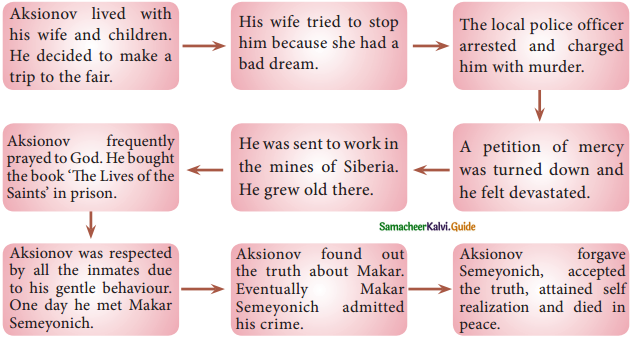
Samacheer Kalvi 12th English Guide Supplementary Chapter 1 God Sees the Truth, But Waits 1

Samacheer Kalvi 12th English Guide Supplementary Chapter 1 God Sees the Truth, But Waits

ஆசிரியரைப் பற்றி:

லியோ டால்ஸ்டாய் (Leo Tolstoy) செப்டம்பர் மாதம் ஒன்பதாம் நாள் 1828ம் ஆண்டு ரஷ்யாவில் உள்ள டியூலா பிராவின்ஸ்ஸில் (Tula Province) பிறந்தவர். இவர் War and Peace (1869) Anna Karenina (1877) ஆகிய புதினங்களால் புகழ்பெற்றவர்.

தம்முடைய 20ம் வயதில் அவரது சுயசரிதையில் 3 படிகளாக இவரின் படைப்புகள் Childhood, Boyhood, Youth ஆகியவைகளுக்காக இலக்கிய விருது பெற்றவர். கிரிமியன் போரில் ஏற்பட்ட தம்முடைய அனுபவங்களை அடிப்படையாகக் கொண்ட Se vastopol sketches-காக பாராட்டப் பெற்றவர்.

டாஸ்டாயின் புனைவுகதைகள் அதிகமான சிறுகதைகளில் அமைக்கப்பட்டு இருக்கும்.The Death of Ivan Ilyich (1886), Family Happiness, Hadji murad ஆகியவை இவரின் படைப்புகள், நாடகங்களும், பல்வேறு தத்துவக் கட்டுரைகளும் இவர் எழுதியுள்ளார். இவர் நவம்பர் 20, 1910ல் ரஷ்யாவில் Astapovo என்னும் இடத்தில் இயற்க்கை எய்தினார்.

Samacheer Kalvi 12th English Guide Supplementary Chapter 1 God Sees the Truth, But Waits

கதைச் சுருக்கம்:

இளம் வணிகரான ஆக்சியோநவ் (Aksionov) தம் பொருட்களை விற்பனை செய்வதற்காக சந்தைக்கு செல்கிறார். அவரின் மனைவி அவரை வியாபாரம் செய்ய போக வேண்டாமென்று தடுக்கிறார். அதையும் மீறி அவர் செல்கிறார். இரவை கழிப்பதற்காக மற்றொரு வணிகருடன் ஒரு விடுதியில் தங்கி ஓய்வெடுக்கிறார்.

விடியும் முன் விடுதியை விட்டு வெளியே செல்லும் வேளையில் காவலர்கள் அவரை சோதனை செய்யும் போது இரத்தம் படிந்த ஒரு கத்தியை அவரின் பையிலிருந்து எடுக்கிறார்கள். மற்றொரு வணிகரை கொன்ற குற்றத்திற்காக சிறைபடுத்தப்படுகிறார்.

அவர் சைபீரியாவில் உள்ள சிறையில் 26 ஆண்டுகள் தன் வாழ்வை கழிக்கிறார். வயதிற்கு முன்னரே நரைமுடியுடன் முதுமை அடைகிறார். எப்போதும் கடவுளிடம் பிரார்த்தனை செய்கிறார். புதிய கைதிகளின் கூட்டம் அச்சிறைக்கு வருகிறது. அதில் உண்மையான குற்றவாளி செம்யோனிக்கும் (semyonich) வருகிறான்.

ஆக்சியோநவ் அவரைச் சந்திக்கிறார். இறுதியாக செம்யோனிக் தாம் இழைத்த குற்றத்தை ஒப்புக் கொள்கிறார். ஆக்சியோநவ்வின் விடுதலைக்கான ஆணை வெளிவருகிறது. ஆனால் அதற்குள் ஆக்சியோநவ் இறந்து விடுகிறார்.

Samacheer Kalvi 12th English Guide Supplementary Chapter 1 God Sees the Truth, But Waits

CharactersRole/Part
Ivan Dmitrich Aksionova young, innocent merchant (Protagonist)
VanyaThe wife of Aksionov
Makar Semyonicha robber (Antagonist)
The MerchantVictim (who stayed with Ivan)
Aksionov’s children, two soldiers, the police, the prison authorities.

God Sees the Truth, But Waits Summary in Tamil

இந்த கதை, ஆக்சியோநவ் என்ற ஓர் இளம் வணிகரின் விசுவாசம், மன்னிக்கும் தன்மை, சுதந்திரம் மற்றும் ஏற்புடைமையைப் பற்றியது. இவர் தாம் செய்யாத குற்றத்திற்காக சிறைவாசம் அடைகிறார்.

விலாடிமிர் (Vladimir) என்ற நகரத்தில் ஒரு இளம் வியாபாரி (merchant) வாழ்ந்து வந்தார். அவருடைய பெயர் ஐவன் ட்மிட்ரிச் அக்சியோநவ் (Ivan Dmitrich Aksionov). அவர் சொந்தமாக ஒரு வீட்டையும், இரு கடைகளையும் வைத்திருந்தார்.

அக்சியோநவ் அழகு வாய்ந்தவன். அழகிய முடிகளைக் கொண்ட அலை வளைவு போன்ற தலைமுடியை உடையவர். அவர் நகைச்சுவை தன்மை மிக்கவன். பாடல் பாடுவதில் நாட்டம் கொண்டவர். இந்த அமைதியான மனிதர் குடிக்கக் கொடுத்தால், விதிகளை மீறும் வரை குடித்துக் கொண்டே இருப்பார். ஆனால் திருமணத்திற்குப் பின் தன் குடிப்பழக்கத்தைத் துறந்தார்.

ஒரு கோடைக்காலத்தில் அக்சியோநவ், நிஸ்னி கண்காட்சிக்குச் (Nizhny Fair) சென்றான். தம் குடும்பத்திலிருந்து விடைபெறுவதைக் கூறும்போது, அவனது மனைவி, “ஐவன் ட்மிட்ரிச், இன்று நீங்கள் செல்ல வேண்டாம், ஏனெனில் உங்களைப் பற்றி தீய கனவு (bad dream) ஒன்றைக் கண்டேன்” என்றாள்.

அதற்கு அக்சியோநவ் “நான் கண்காட்சிக்குச் சென்றதும் களிப்பூட்டும் குடிவெறியாட்டம் போடுவேன் என்று அஞ்சுகிறாயா?” என்று சிரித்துக்கொண்டே கூறினான். அதற்கு அவர் மனைவி “நான் எதற்கு அஞ்சுகிறேன் என்று எனக்குத் தெரியாது. எனக்குத் தெரிந்ததெல்லாம் அந்த தீய கனவைப் பற்றிதான். எனது கனவில், நீங்கள் நகரத்தை விட்டு திரும்பும்போது தொப்பியைக் கழற்றுகிறீர்கள் அப்போது நான் உங்கள் தலைமுடியனைத்தும் நரைத்து இருப்பதைக் காண்கிறேன்” என்றாள்.

அக்சியோநவ் சிரித்தார். “அது அதிர்ஷ்டத்தின் அடையாளம்” என்றார். “இதோ பார், நான் எனது பொருள்களை விற்கவில்லை என்றாலும் உனக்கு அங்கிருந்து பரிசுகளைக் கொண்டு வருகிறேன்” என்றான்.

Samacheer Kalvi 12th English Guide Supplementary Chapter 1 God Sees the Truth, But Waits

அதனால் அவர் தனது குடும்பத்திடமிருந்து விடைபெற்றுசென்றார். அவர் பாதிதொலைவில் சென்றுகொண்டிருக்கும் போது, அக்சியோநவ் தனக்கு அறிமுகமான ஒரு வியாபாரியை சந்தித்தான். அவர்கள் அன்றிரவு தங்குவதற்கு ஒரே விடுதியைப் (inn) பதிவு செய்திருந்தனர். அவர்கள் இருவரும் சேர்ந்தே தேனீர் அருந்தினர். பிறகு அவர்கள் படுக்கைக்குச் சென்றனர்.

இரவு தாமதமாக உறங்க செல்வதும், குளிரில் பயணிப்பதும் அக்சியோநவ்வின் பழக்கமன்று. அவர் விடியும் முன் தனது ஓட்டுநரை எழுப்பி விட்டு குதிரைகளை (horses) ஆய்த்தப் படுத்தக் கூறினான்.

Samacheer Kalvi 12th English Guide Supplementary Chapter 1 God Sees the Truth, But Waits 2

பின்னர், அவன் தனது விடுதியின் உரிமையாளரிடம், (விடுதிக்குப் பின்புறம் உள்ள சுவரின் வீட்டிற்கு சென்று விடுதியின் கட்டணத்தை கட்டிவிட்டு தனது பயணத்தைத் தொடர்ந்தார்.

இருபத்தைந்து மைல் தூரம் சென்றபின், குதிரைகளுக்கு உணவளிப்பதற்காக நிறுத்தினார். அக்சியோநவ் வழியோரம் இருந்த விடுதியில் ஓய்வெடுத்துக் (rested) கொண்டிருந்தார். பிறகு விடுதியின் முற்றத்திற்கு (porch) வந்து தேனீர் பாத்திரத்தை சூடுபடுத்த கட்டளையிட்டார். தனது இசைக் கருவியைக் (guitar) கொண்டு வாசிக்கத் தொடங்கினார்.

திடீரென்று மூன்று குதிரைகள் பூட்டப்பட்ட வண்டி மணியோசையுடன் வந்தது. ஓர் அதிகாரி இரண்டு படைவீரர்களுடன் (soldiers) கீழிறங்கினார். அவர் அக்சியோநவ்விடம் வந்து கேள்விகள் கேட்கத் தொடங்கினார். அவர் யார் என்றும், எப்பொழுது இங்கே வந்தார் என்றும் வினவினார். அக்சியோநவ் அனைத்தையும் கூறி, “என்னுடன் தேனீர் அருந்துகிறீர்களா?” என்றான்.

Samacheer Kalvi 12th English Guide Supplementary Chapter 1 God Sees the Truth, But Waits

ஆனால் அதிகாரி அவனிடம் குறுக்கு கேள்வி கேட்டார். அவனிடம், “நேற்றிரவு எங்கே கழித்தீர்கள்? என்றும் நீ மட்டுமா அல்லது வேறு வியாபாரியுடன் தங்கி இருந்தாரா? என்றும் காலையில் வியாபாரியை பார்த்தீர்களா? என்றும் பொழுதுவிடியும் முன் ஏன் விடுதியிலிருந்து வந்தீர்கள்? என்றும் கேட்டார்.

ஏன் இவ்வளவு வினாக்கள் தன்னிடம் கேட்கப்பட்டன என்று வியப்படைந்தான் அக்சியோநவ். ஆனால் அனைத்திற்கும் விடையளித்தான். கூடதலாக “ஏன் என்னிடம் இவ்வளவு குறுக்கு வினாக்கள், நான் என்ன திருடனா (thief) அல்லது கொள்ளையனா (robber)? நான் எனது வியாபாரத்திற்காகப் பயணித்துக் கொண்டிருக்கிறேன் மற்றும் என்னிடம் கேள்வி கேட்க வேண்டியதில்லை’ என்றார்.

பின்னர் அந்த அதிகாரி, படைவீரர்களை அழைத்து அக்சியோநாவிடம் “நான் இந்த மாவட்டத்தின் காவல் அதிகாரி, நான் உன்னிடம் ஏன் வினா கேட்கிறேனென்றால் நீ எந்த வியாபாரியுடன் நேற்றைய இரவைக் கழித்தாயோ அவர் தற்போது கழுத்து வெட்டுண்டு இறந்து கிடக்கிறார்” ஆகவே நாங்கள் நிச்சயமாக உன் பொருள்களைச் சோதிக்க வேண்டும்,” என்று கூறினார்.

அவர்கள் வீட்டினுள் நுழைந்தனர் (entered). படைவீரர்களும், காவல் அதிகாரியும் அக்சியோநவ்வின் மூட்டை (luggage) முடிச்சை அவிழ்த்து தேடினார். உடனே அதிகாரி மூட்டையிலிருந்து ஒரு கத்தியை எடுத்தார். “இது யாருடையது?” என்று கத்தினார். தனது பையிலிருந்து வெளியே எடுக்கப்பட்ட இரத்தக்கறைப் படிந்த கத்தியைப் பார்த்து அக்சியோநவ் அச்சமடைந்தார். “எப்படி இந்த கத்தியின் மேல் இரத்தம் படிந்தது?”

அக்சியோநவ் பதிலளிக்க முயன்றான் ஆனால் தொடர்ச்சியாக பேசமுடியவில்லை. எனக்கு தெரியாது…… என்னுடையது இல்லை ….. என்று திக்கித் திக்கிக் (stammered) கூறினார். “இந்தக் காலைபொழுதில் அந்த வியாபாரி அவரது படுக்கையில் கழுத்து வெட்டுண்டு கிடந்தார்”, உங்களால் மட்டும்தான் இதைச் செய்திருக்க முடியும். அந்த வீடு உள்ளிருந்து பூட்டப்பட்டிருந்தது மற்றும் அங்கு வேறு யாரும் இல்லை .

இங்கு இரத்தம் படிந்த கத்தி (blood stained knief) உங்கள் பையில் இருக்கிறது மற்றும் உங்களது முகமும், போக்கும் உங்களைக் காட்டிக்கொடுக்கின்றன. எவ்வாறு நீங்கள் அவனை கொன்றீர்கள், எவ்வளவு பணம் நீங்கள் கொள்ளையடித்தீர்கள்?” என்று என்னிடம் கூறுங்கள்” என்று கேட்டார்.

Samacheer Kalvi 12th English Guide Supplementary Chapter 1 God Sees the Truth, But Waits

அக்சியோநவ், தான் தவறு செய்யவில்லை என்று அவனுக்கு உறுதியாக தெரியும், அவனும், கொலையுண்ட வியாபாரியும் சேர்ந்து தேனீர் அருந்தியபின், அந்த வணிகரை அக்சியோநவ் பார்க்கவில்லை . அவனிடம் எட்டாயிரம் ரூபிள்கள் (rubles) தவிர வேறு பணம் இல்லை மற்றும் அந்த கத்தி அவனுடையதன்று. ஆனால் அவனது குரலில் தடுமாற்றம் எழுந்தது, முகம் வெளிறிப் போனது (pale) மற்றும் அவன் பயத்தால் ஆட்கொள்ளப்பட்டார். இருப்பினும் பழிக்குற்றத்திற்குத் (guilty) தள்ளப்பட்டார்.

அந்த காவல் அதிகாரி, அக்சியோநவ்வைக் கட்டி (bind) வண்டியிலேற்றும்படி படைவீரர்களுக்கு கட்டளையிட்டார். அவர்கள் அச்சியோநவ்வின் கால்களைச் சேர்த்துக்கட்டி வண்டியிலேற்றினர். அக்சியோநவ் தனக்குத்தானே சிலுவையை (cross) தொட்டு அழுதார். அவரது பணமும் மற்றும் பொருட்களும் அவனிடமிருந்து பறிக்கப்பட்டன. அவர் பக்கத்து நகரத்துக்கு அனுப்பப்பட்டு சிறையிலடைக்கப்பட்டார்.

விலாடிமிரில் (Vladimir) அவனைப் பற்றிய விசாரணை (enquiries) நடத்தப்பட்டது. அங்குள்ள வியாபாரிகளும், குடிமக்களும் முந்தைய நாட்களில் அவன் குடித்துக்கொண்டு நேரத்தை வீணாக்கிக் கொண்டிருப்பான், ஆனால் அவன் நல்ல மனிதனாக மாறி விட்டான் என்று கூறினர். பின்பு விசாரணை தொடங்கியது, ரையாசான் வியாபாரியைக் கொன்றதாகவும், இருபதாயிரம் ரூபிள்களைக் கொள்ளையடித்ததாகவும் பழிச்சுமத்தப்பட்டார்.

அவனது மனைவி நம்பிக்கையிழந்து இருந்தாள். அவருக்கு எதை நம்புவது என்று தெரியவில்லை. அவளுடைய குழந்தைகள் அனைவருமே மிகச்சிறியவர்கள், ஒரு குழந்தை தாய்ப்பால் குடிக்கும் பருவத்தில் இருந்தது. அனைவரையும் தன்னுடன் கூட்டிக்கொண்டு, தன் கணவன் சிறையிலடைக்கப்பட்டிருக்கும் நகரத்திற்குச் சென்றாள். முதலில் அவள், தன் கணவனைப் பார்பதற்கு அனுமதி அளிக்கப்படவில்லை. ஆனால் பிறகு மிகவும் கெஞ்சியப்பின், மேலதிகாரியால் அனுமதிக்கப்பட்டு அவனிடம் கொண்டுச் செல்லப்பட்டாள்.

தனது கணவனைக் கைதி உடையில் விலங்கிட்டு குற்றவாளிகள் மற்றும் திருடர்கள் மத்தியில் பார்த்தவுடன் அவள் கீழே விழுந்தாள். நீண்ட நேரம் வரை எழவில்லை . பிறகு தன் குழுந்தைகளை தூக்கிக்கொண்டு, தன் கணவன் அருகில் அமர்ந்தாள். வீட்டு நடப்பை அவரிடம் கூறினாள். அவருக்கு என்ன நேர்ந்தது என்று கேட்டாள். அவன் அனைத்தையும் அவளிடம் கூறினான். “நாம் இப்போது என்ன செய்வது?” என்று அவள் கேட்டாள்.

”நாம் கண்டிப்பாக சிசார் மன்னருக்கு ஒரு நிரபராதி அழிவிற்கு செல்லவேண்டாம்” என்று மனு செய்ய வேண்டும் ஆனால், தான் சிசார் மன்னருக்கு விண்ணப்பம் அனுப்பியதையும், அது ஏற்றுக் கொள்ளப் படாததையும் பற்றி அவள் தன் கணவனிடம் கூறினாள்.

அவன் எதுவும் கூறவில்லை . ஆனால் ஊக்கம் குறைந்தபடி காணப்பட்டான்.

பிறகு அவன் மனைவி கூறினாள், “ இது ஒன்றும் பயனில்லை. நான் அன்று உங்கள் தலைமுடி நரைத்து விட்டதாகக் கனவு கண்டேன். நினைவில் உள்ளதா? அந்த நாளில் செல்ல வேண்டாம் என்றேன். அவள் தன் விரல்களை அவன் முடிகளினுள் விட்டு கூறினாள் “வாண்யா (ஐவன் என்பதன் செல்லப் பெயர்) அன்பிற்குரியவரே உண்மையை உங்கள் மனைவியிடம் கூறுங்கள், நீங்கள் இல்லை என்றால் யார் செய்தார்?”

Samacheer Kalvi 12th English Guide Supplementary Chapter 1 God Sees the Truth, But Waits

அதனால் நீ கூட என்னை சந்தேகிக்கிறாயா! என்று முகத்தை கைகளால் மூடி (hiding) அழத் தொடங்கினான். பிறகு ஒரு படைவீரர் அவனது மனைவியிடமும், குழந்தைகளிடமும் “இங்கேயிருந்து செல்லுங்கள்” என்றான். அக்சியோநவ் அவனது குடும்பத்திற்கு கடைசி முறையாக பிரியா விடை கொடுத்தார்.

அவர்கள் சென்றதும், அக்சியோநவ் பேசியதனைத்தையும் மீண்டும் நினைவு படுத்திப் பார்த்தார். எப்போது தன் மனைவி தன்னைச் சந்தேகப்பட்டு கேட்ட வினாக்கள் நினைவில் எழுந்ததோ, அவன் தனக்குத் தானே “கடவுளுக்கு மட்டும் உண்மை தெரியும், அவனிடம் மட்டும்தான் முறையீடு செய்ய முடியும் மற்றும் அவனிடம் மட்டும் தான் இரக்கத்தை எதிர்ப்பார்க்கமுடியும் என்று கூறிக்கொண்டான் மற்றும் அக்சியோநவ் மேலும் எந்த விண்ணப்பங்களையும் எழுதவில்லை, அனைத்து நம்பிக்கைகளையும் கைவிட்டுவிட்டு, கடவுளை வணங்கத் தொடங்கினார்.

பிரம்பால் அடிபடுவதற்கும், சுரங்கத்திற்குச் செல்வதற்கும் ஆழ்ந்த வெறுப்பு தெரிவித்தார். அக்சியோநவ் அதனால் சாட்டையால் அடிக்கப்பட்டார். சாட்டையடியால் ஏற்பட்ட காயங்கள் ஆறியபின் மற்ற குற்றவாளிகளுடன் சிபோரியாவிற்கு கொண்டு செல்லப்பட்டார்.

இருபத்தாறு ஆண்டுகளுக்கு அக்சியோநவ் குற்றவாளியாக சைபீரியா சிறையில் வாழ்ந்தார். அவரது முடி பனிப்போன்று வெண்மையாயின. அவரது தாடி நீளமாக வளர்ந்து, மெல்லியதாக நரைத்துக் காணப்பட்டது. அவனது அனைத்து மகிழ்ச்சியும் சென்றுவிட்டன, அவனுக்கு கூன் விழுந்தது, மெதுவாக நடந்தார், குறைவாக பேசினார் மற்றும் சிரிக்காமலேயே இருந்தார். ஆனால் அவர் கடவுளைத் துதித்துக் கொண்டே இருந்தார்.

சிறையில் அக்சியோநவ் காலணி (boots) செய்வதைக் கற்றுக்கொண்டு அதன் மூலம் சிறிது பணத்தைச் சம்பாதித்தார். அவற்றைக் கொண்டு “புனிதர்களின் வாழ்வு” என்ற நூலை வாங்கினார். அவர் அந்த நூலை, சிறையில் போதிய ஒளி இருக்கும்போது வாசித்தார். ஞாயிற்றுக்கிழமைகளில் சிறையில் இருக்கும் தேவாலயத்தில் புனித நூல்களை வாசித்தும், பாடல் குழுவில் இணைந்து பாடல்கள் பாடியும் வழிபட்டார். அவருடைய குரல் அப்போதும் நன்றாக இருந்தது.

சிறை அதிகாரிகள் மென்மை (meekness) குணத்திற்காக அக்சியோநவ்வை நேசித்தனர். சக குற்றவாளிகள் அவரை மதித்தனர். அவர்கள் அவரை “தாத்தா” என்றும் “புனிதர்” என்றும் அழைத்தனர். சிறை அதிகாரிகளிடம் ஏதேனும் விண்ணப்பம் எழுப்பினால் அனைவர் சார்பாக அக்சியோநவ்வே பேசுவார். குற்றவாளிகளுக்குள் மோதல் ஏற்பட்டால் அந்த பிரச்சனை அக்சியோநவ்விடம் கொண்டுவரப்பட்டு தீர்க்கப்பட்டது.

Samacheer Kalvi 12th English Guide Supplementary Chapter 1 God Sees the Truth, But Waits

தன் வீட்டிலிருந்து எந்த செய்தியும் அக்சியோநவ்விடம் வந்து சேரவில்லை. மனைவியும், குழந்தைகளும் உயிரோடு இருக்கின்றனரா என்று கூட அவருக்குத் தெரியவில்லை . ஒரு நாள், ஒரு புது குற்றவாளிக் குழு சிறைக்கு வந்தடைந்தது. மாலைப் பொழுதில் பழைய குற்றவாளிகள் புது குற்றவாளிகளை வட்டமாக அமரச்செய்து, எந்த நகரம் அல்லது கிராமத்திலிருந்து வருகிறீர்கள் என்றும், எதற்காகச் சிறைக்கு அடைக்கப்பட்டார்கள் என்றும் விசாரித்தனர். அக்சியோநவ்வோ மகிழ்ச்சி குறைந்தவராய் புது குற்றவாளிகள் அருகில் அமர்ந்து அவர்கள் கூறியதைக் கேட்டுக்கொண்டிருந்தார்.

புது குற்றவாளிகளுள் ஒருவர், உயரமாக அறுபது வயது பொருந்திய உறுதியான, நரைத்த தாடியுடன் இருந்தார். எதற்காக அவர் கைது செய்யப்பட்டார் என்பதைக் கூறிக்கொண்டிருந்தார்.

“நல்லது நண்பர்களே”, என்று அவர் கூறினார். “நான் பனிப்பிரதேசத்தில் வண்டியை இழுத்துச் (sledge) செல்லும் ஒரு குதிரையைத் திருடினேன். நான் அதற்காகக் கைது செய்யப்பட்டு சிறைவாசம் அனுபவிக்கிறேன்” என்றான்.

தான் அக்குதிரையை வீட்டிற்கு விரைவாகச் செல்வதற்கு எடுத்ததாகவும், பிறகு விட்டுவிடலாம் என்று இருந்ததாகவும் மேலும் அக்குதிரை ஓட்டுநர் தனக்குத் தனிப்பட்ட நண்பர் என்றும், ஆதலால் ‘இது சரியே’ என்றும் கூறினார். ஆனால் அவர்கள் ‘இல்லை ‘ ‘நீ இதைத் திருடிவிட்டாய்’ என்றனர்.

ஆனால் எங்கு அல்லது எப்படி திருடினேன் என்று அவர்கள் கூறவில்லை . ஒரு நாள் நான் சில தவறுகள் செய்தேன். அதன் கட்டாயமான முன்பு இங்கே வந்தேன். ஆனால் அப்பொழுது என்னைக் கண்டுபிடிக்கவில்லை. இப்போது எதுவும் செய்யவில்லை ஆனாலும் இங்கே அனுப்பப்பட்டிருக்கிறேன்……. ஆனால் தற்போது கூறுவது பொய். முன்பு சைபீரியாவில் இருந்தேன், ஆனால் வெகுகாலம் அல்ல.”

“எங்கிருந்து வருகிறீர்கள்” என்று சிலர் கேட்டனர். ஒருவர் கேட்டார். “விலாடிமிர்ரிலிருந்து”.

எனது குடும்பம் அங்குள்ள நகரத்தில் இருக்கிறது. எனது பெயர் மகர் (makar) மற்றும் சிலர் என்னை செம்யோனிச் (semyonich) என்று அழைப்பர், அக்சியோநவ்தலையைத் தூக்கி “கூறு, செம்யோனிச் உனக்குவிலாடிமிர்ரைச் சேர்ந்த வியாபாரி அக்சியோநவ்வைப் பற்றித் தெரியுமா? அவர்கள் இன்றும் வாழ்கின்றனரா?”

“அவர்களைத் தெரியுமா? நன்றாகத் தெரியும். அந்த அக்சியோநவ் பணக்காரர், அவர்களின் தந்தை சிபேரியாவிலிருந்தாலும். அவர் நம்மைப் போன்ற பாவி, தாத்தா நீங்கள் எவ்வாறு இங்கு வந்தீர்கள்?”

Samacheer Kalvi 12th English Guide Supplementary Chapter 1 God Sees the Truth, But Waits 3

அக்சியோநவ் தன் துரதிஷ்டத்தைப் பற்றி கூற விரும்பவில்லை . அவர் ஒரு பெருமூச்சு விட்டு கூறினார், “எனது பாவங்களுக்காக இந்த சிறையில் இருபத்தாறு ஆண்டுகள் இருக்கிறேன்”.

“என்ன பாவங்கள்?” என்று கேட்டார் மகர் செம்யோனிச்.

Samacheer Kalvi 12th English Guide Supplementary Chapter 1 God Sees the Truth, But Waits

ஆனால் அக்சியோநவ் “விடுங்கள், விடுங்கள் நான். இதற்கு தகுதியுடையவன் தான்” என்று மட்டும் கூறினார். ஆனால் அவருடைய சகதோழர்கள் புதிய நண்பர்களிடம் எவ்வாறு அக்சியோநவ் சிபேரியாவிற்கு வந்தார் என்றும், எவ்வாறு மர்ம நபர் ஒருவர் ஒரு வியாபாரியைக் கொன்று விட்டு அந்தக் கத்தியை அக்சியோநவ் பையில் மற்ற பொருள்களோடு வைத்தவிட்டுச் சென்றதையும் கூறினார்கள் அதனால் அக்சியொநவ் அநியாயமாக தண்டிக்கப்பட்டார் என்றும் கூறினார்கள்.

இதை மகர் செம்யோனிக் கேட்டதும், அக்சியோநவ்வைப் பார்த்து, தன் மூட்டினை (knee) அடித்துக்கொண்டு (slapped) வியந்து, “இது வியப்பாக உள்ளது! உண்மையிலேயே வியப்பு! ஆனால் நீங்கள் முதுமை அடைந்து வீட்டீர்களே! தாத்தா! என்றார்.

மற்றவர்கள் அவரிடம் (மகரிடம்) எதற்காக அவன் இவ்வளவு ஆச்சரியப்படுகிறான், அவனுக்கு முன்னதாகவே அக்சியோநவ்வைத் தெரியுமா என்றும் வினவினர், ஆனால் மகர் செம்யோனிச் பதில் ஏதும் கூறவில்லை . இதில் வியப்பு என்னவென்றால் “நாம் இங்கு சந்திக்கிறோம் சிறுவர்களே! (lads)” என்று மட்டும் உரைத்தான்.

இவ்வார்த்தைகள் அக்சியோநவ்வைவியப்பூட்டியது. ஏனென்றால் ஒரு வேளை இம்மனிதருக்கு அந்த வியாபாரியைக் கொன்றவனைப் பற்றித் தெரியுமோ என்று. ஆதலால் அவர் ஒருவேளை செம்யோனிச் உங்களுக்கு அந்த விவகாரம் பற்றித் தெரிந்திருக்கலாம் அல்லது எப்போதாவது முன்பு என்னைப் பார்த்திருக்கிறீர்களா?” என்று கேட்டார்.

“நான் கேட்டதை வைத்து உங்களுக்கு எவ்வாறு உதவ முடியும்? இந்த உலகம் வதந்திகளால் நிறைந்துள்ளது. ஆனால் இது நீண்ட காலத்துக்கு முன்பு நான் என்ன கேட்டேன் என்பதை மறந்துவிட்டேன் “ஒருவேளையார் அந்த வியாபாரியைக் கொன்றிருப்பார்? என்பதை நீங்கள் கேட்டிருப்பாய்” என்றார் அக்சியோநவ்.

மகர் செம்யோனிச் சிரித்துக்கொண்டே “கத்தியை எவர் மறைத்து வைத்தாரோ அவர் பிடிபடும்வரை குற்றவாளியல்ல.” என்று கூறினார். “உங்கள் கண்காணிப்பில் இருக்கும்போது யாரால் கத்தியை உங்கள் பையில் போட முடியும்? இது நிச்சயமாக உங்களிடத்தில் விழிப்புணர்வை ஏற்படுத்தியிருக்கும்”.

எப்பொழுது இவ்வார்த்தைகளை அக்சியோநவ் கேட்டாரோ, அப்பொழுதே இந்த மனிதர்தான் அந்த வியாபாரியை கொன்றிருப்பார் என்று உறுதி செய்தார். அவர் எழுந்து அங்கிருந்து சென்றார். அன்றிரவு முழுவதும் அக்சியோநவ் விழித்துக் (awake) கொண்டிருந்தார். அவர் பயங்கரச் (terribly) சோகத்தில் ஆழ்ந்தார். பலவிதமான கற்பனைகளும் அவர் மனதில் எழுந்தன. அவர் கண்காட்சிக்கு (fair) செல்லும் முன் தன் மனைவியுடன் இருந்த தருணங்கள் நினைவிற்கு வந்தன.

Samacheer Kalvi 12th English Guide Supplementary Chapter 1 God Sees the Truth, But Waits

அவர் கண்முன் தன் மனைவியின் குரல், பேச்சு மற்றும் சிரிப்புத் தோன்றின. பிறகு அப்போது சிறுவர்களாக இருந்த குழந்தைகள் கண் முன் தோன்றினர். ஒரு குழந்தை சிறிய மேலங்கியுடனும், மற்றொன்று தாய்ப்பால் குடிக்கும் பருவத்திலும் இருந்தது. அவர் இளமையாகவும், சந்தோசமாகவும் இருந்த தருணங்கள் நினைவிற்கு வந்தன.

அவர் கைதுசெய்யப்பட்ட இடத்தில் இருந்த திண்ணையில் அவர் இசைக்கருவி வாசித்ததும், சவுக்கு அடி வாங்கியதும், மக்கள் அவரைச் சுற்றி நின்றதும், சங்கிலியும், குற்றவாளிகளும், சிறைவாழ்க்கையும் அவருடைய முதிர்வும் அவரின் நினைவிற்கு வந்தன. இந்த அனைத்துச் சிந்தனைகளும் அவரை பரிதாபமாக (wretched) மாற்றி தன்னைத்தானே கொல்வதற்கு ஆயத்தப்படுத்தியது (ready).

“இவையனைத்தும் அந்த வில்லன் செய்தது” என்று சிந்தித்தார் அக்சியோநவ். அவரது கோபம் மகர் செம்யோனிச் மீது பெருகியது. தான் இறந்தாலும் அவரைப் பழித்தீர்த்துவிடவேண்டும் என்று எண்ணினார். அவர் அனைத்து இரவுப் பொழுதுகளிலும் இறைவனிடம் வேண்டினார். ஆனாலும் அவருக்கு அமைதி கிடைக்கவில்லை. அந்த நாட்களில் அக்சியோநவ் செம்யோனிச்சின் அருகில் செல்லவும் இல்லை, அவரைப் பார்க்கவும் இல்லை.

இரண்டு வாரம் கழிந்தது. அன்றிரவு அக்சியோநவ் உறங்கவில்லை, தான் அடுத்து என்ன செய்யப் போவது என்று தெரியாமல் பரிதாபமாக (miserable) இருந்தார்.

ஓர் இரவு, அவர் சிறையில் நடந்துக்கொண்டிருக்கும்போது கைதிகள் உறங்கும் பலகையின் கீழ் நிலத்தைத் தோண்டிக்கொண்டு யாரோ வருவதைக் கண்டார். அவர் தன்னை நிறுத்திக்கொண்டு என்ன நடக்கிறது என்பதனைக் கவனித்தார். திடீரென அந்த படுக்கையில் கீழிருந்து மகர் செம்யோனிச் வெளியேறினார். முகத்தில் பதட்டத்துடன் அக்சியோநவ்வைக் கண்டார்.

அக்சியோநவ் அவரைக் காணாததுப்போல் சென்றுவிடப் பார்த்தார் ஆனால் மகர் அவரது கையைப் பற்றிக்கொண்ட அவரிடம் தான் சுரங்கத்தின் வழியே தப்பிப்பதற்கு ஒரு குழியைத் தோண்டுவதாகவும், தோண்டியவற்றை தன் நீண்ட காலணியில் வைத்து தினமும் கைதிகள் வேலைக்கு செல்லும்போது அவற்றை சாலையில் அப்புறப்படுத்திவிடுவதற்கும் ஏற்பாடு செய்துள்ளதாகவும் கூறினார்.

“அமைதியாக இருங்கள் வயதானவரே, நீங்களும் வெளியேறலாம் முட்டாள்தனமாக இந்த ரகசியத்தை வெளியே கூறினால், அவர்கள் என்னை சவுக்கால் வாழ்க்கை முழுவதும் அடிப்பார்கள், ஆனால் நான் முதலில் உங்களைக் கொன்றுவிடுவேன்” என்றான்.

“அவர் தன் எதிரியைப் பார்க்கும்போது கோபத்தால் நடுக்கமுற்றார். அவர் தன் கையை விடுவித்துக் கொண்டு “எனக்கு இங்கிருந்து தப்பித்து செல்ல ஆசையில்லை. நீ என்னை கொல்ல தேவையில்லை, நீ என்னை முன்பே கொன்றுவிட்டாய், நான் ஒருவேளை நீ கூறியபடி நடக்கலாம், இல்லாமலும் இருக்கலாம், அது கடவுள் வழிநடத்துவதைப் பொருத்தது.” என்று கூறினார்.

அடுத்த நாள், கைதிகள் வேலைக்காக வெளியே சென்றதும், படைவீரர், கைதிகளில் ஒரு சிலர் மணலை தங்கள் காலணியிலிருந்து வெளியே கொட்டுவதைக் கவனித்தார். சிறையில் தேடப்பட்ட அந்த சுரங்கம் கண்டறியப்பட்டது. ஆளுநர் அங்குள்ள அனைத்துக் கைதிகளிடமும் யார் இதைத் தோண்டியிருப்பார் என்று அறிந்துகொள்ள விசாரணை நடத்தினார். அவர்கள் அனைவரும் மறுத்துவிட்டனர் ஏனெனில் அவற்றைக் கூறினால் செம்யோனிச்சுக்குச் சாகும் வரை சவுக்கு அடி விழும் என்பது அவர்களுக்குத் தெரியும்.

இறுதியாக ஆளுநர் அக்சியோநவ்விடம், “நீங்கள் உண்மையான (அ) நேர்மையான முதியவர், கடவுள் சாட்சியாக யார் இந்த குழியைத் தோண்டியது?” என்று என்னிடம் கூறுங்கள் என்றார்.

Samacheer Kalvi 12th English Guide Supplementary Chapter 1 God Sees the Truth, But Waits

மகர் செம்யோனிச் கவலையுற்றவனாய், ஆளுநரை பார்த்துக்கொண்டே அக்சியோநவ்வை நோக்கியபடி நின்றுக்கொண்டிருந்தார். அக்சியோநவ்வுடைய உதடுகள் மற்றும் கைகள் நடுங்கின, நீண்ட நேரத்திற்கு அவர் எதுவும் கூறவில்லை. “எதற்காக என் வாழ்க்கையை அழித்தவனைக் காட்டிக் கொடுக்க வேண்டும்?

நான் பட்ட கஷ்டத்துக்கு ஈடுகொடுக்கமுடியுமா?, ஆனால் நான் கூறினால் அவன் வாழ்க்கை முழுதும் சவுக்கு அடி பெறுவான், நான் அவனை தவறாகவும் கணித்திருக்கலாம் மற்றும் இதனால் நான் பெறும் பயன் என்ன?” என்று நினைத்தார்.

Samacheer Kalvi 12th English Guide Supplementary Chapter 1 God Sees the Truth, But Waits 4

“நல்லது, பெரியவரே, என்றுரைத்தார் ஆளுநர்,” “உண்மையை என்னிடம் கூறுங்கள் யார் சுவற்றின் அடியில் குழியைத் தோண்டினார்?”

அக்சியோநவ் மகர் செம்யோனிச்சைப் பார்த்துவிட்டு பின்னர் கவர்னரிடம், “என்னால் கூற முடியாது, யுவர் ஆனர். நான் கூறுவது இறைவனின் விருப்பமன்று” என்றார்.

எவ்வளவு ஆளுநர் முயன்றும், அக்சியோநவ் ஒன்றும் கூறவில்லை. ஆகையால் அந்த விசாரணை கைவிடப்பட்டது.

அன்றிரவு, அக்சியோநவ் தன் படுக்கையில் படுத்திருந்தபோது யாரோ ஒருவர் அமைதியாக வந்து அவர் படுக்கையின் மேல் அமர்ந்தார். அவர் இருளில் கூர்ந்து நோக்கி அது மகர் தான் என்பதை உறுதி செய்தார்.

“என்னிடம் இன்னும் உனக்கு என்ன வேண்டும்?” என்று கேட்டார் அக்சியோநவ். “ எதற்காக நீ இங்கு வந்தாய்?”

மகர் செம்யோனிச் அமைதியாக இருந்தார். அதனால் அக்சியோநவ் எழுந்து, “உனக்கு என்ன வேண்டும்?” அங்கே போ, இல்லையேல் காவலரை நான் அழைப்பேன்” என்று கூறினார்.

மகர் செம்யோனிச் அக்சியோநவ்வை நெருங்கி மெதுவாக “ஐவன் டிமிட்ரிச் என்னை மன்னித்துவிடு” என்று கூறினார். “எதற்காக” என்று கேட்டார் அக்சியோநவ்.

“நான் தான் அந்த வியாபாரியைக் கொன்று அந்த கத்தியை உன் பொருட்களோடு மறைத்து வைத்தேன். நான் உன்னையும் கொன்றிருப்பேன் ஆனால் வெளியிலிருந்து சத்தத்தைக் கேட்டேன். ஆதலால் அந்தக் கத்தியை உன் பையில் மறைத்து வைத்துவிட்டு ஜன்னல் வழியே தப்பிச்சென்றேன்” என்றான்.

அக்சியோநவ் அமைதியாக என்ன கூறுவது என்று தெரியாமல் இருந்தார். மகர் செம்யோனிச் படுக்கையிலிருந்து படிப்படியாக கீழே இறங்கி தரையில் மண்டியிட்டு, “ஐவன் டிமிட்ரிச்” என்றார். அவர், “என்னை மன்னித்துவிடு, கடவுளின் அன்பிற்காக, என்னை மன்னித்துவிடு. நான் தான் அந்த வியாபாரியைக் கொன்றேன் என்று சொல்லி விடுகிறேன், நீ விடுதலைச் செய்யப்பட்டு உன் வீட்டிற்குச் செல்வாய்” என்றான்.

Samacheer Kalvi 12th English Guide Supplementary Chapter 1 God Sees the Truth, But Waits

“இதைப் பேசுவதற்கு உனக்கு எளிமையாக இருக்கும்,” என்றார் அக்சியோநவ், “ஆனால் நான் உன்னால் இதற்காக இருபத்தாறு ஆண்டுகள் சிறையில் கஷ்டப்பட்டுக்கொண்டிருக்கிறேன். நான் இப்பொழுது எங்கு செல்வது? எனது மனைவி இறந்துவிட்டாள். எனது குழந்தைகள் என்னை மறந்துவிட்டனர். எங்கும் என்னால் செல்ல முடியாது ………….”

மகர் செம்யோனிச் எதுவும் கூறவில்லை. ஆனால் தன் தலையைத் தரையில் அடித்துக்கொண்டான். “ஐவன் டிமிரிச், என்னை மன்னித்து விடு என்று கத்தினார். அவர்கள் என்னை சவுக்கால் அடிக்கும்போது கூட இவ்வளவு வலியில்லை, ஆனால் உங்களை இந்நிலையில் பார்ப்பது வலிக்கிறது. இதுவரையிலும் உங்களுக்கு என்மேல் இரக்கமிருக்கிறது. கிறிஸ்துவின் பொருட்டு என்னை மன்னியும், துரதிஷ்டசாலி நான்” என்று சொல்லி அவன் அழத் தொடங்கினான்.

எப்போது அக்சியோநவ் மகர் அழுவதைக் கேட்டாரோ, அவரும் அழத் (sobbing) தொடங்கினார், “கடவுள் உன்னை மன்னிப்பார்” என்றார் அவர். “உன்னை விட நூறுமடங்கு துரதிஷ்டசாலி நானாக இருக்கலாம்” இவ்வார்த்தைகளில் அவரின் இதயம் ஒளிமிளிர்ந்தது. வீட்டின் ஏக்கத்தைப் பிரதிபலித்தது. அவருக்கு அந்த சிறையிலிருந்து செல்வதற்கு விருப்பமில்லை , ஆனால் அவர் தனது இறுதி நேரத்திற்காகக் காத்திருந்தார்.

Samacheer Kalvi 12th English Guide Supplementary Chapter 1 God Sees the Truth, But Waits

அக்சியோநவ் என்ன சொன்னபோதிலும், மகர் தன் குற்ற உணர்ச்சியால் தனது குற்றத்தை ஏற்றுக்கொண்டான். ஆனால் சிறையிலிருந்து வெளிவருவதற்கான ஆணை வரும் பொழுது, ஏற்கனவே அக்சியோநவ் இறந்திருந்தார்.

Samacheer Kalvi 9th Science Guide Chapter 25 Computer – An Introduction

Tamilnadu State Board New Syllabus Samacheer Kalvi 9th Science Guide Pdf Chapter 25 Computer – An Introduction Text Book Back Questions and Answers, Notes.

Tamilnadu Samacheer Kalvi 9th Science Solutions Chapter 25 Computer – An Introduction

9th Science Guide Computer – An Introduction Text Book Back Questions and Answers

Samacheer Kalvi 9th Science Guide Chapter 25 Computer - An Introduction

I. Choose the correct answer.

Question 1.
………………. is an electronic device which stores data and information.
(a) Telescope
(b) Television
(c) Computer
(d) Radio
Answer:
(c) Computer

Question 2.
………………. belongs to the generation IV of the computer
(a) Microprocessor
(b) Artificial Intelligence
(c) Transistor
(d) Vaccum Tubes
Answer:
(a) Microprocessor

Samacheer Kalvi 9th Science Guide Chapter 25 Computer - An Introduction

Question 3.
Data processing involves……………….steps.
(a) seven
(b) four
(c) six
(d) eight
Answer:
(c) six

II. Match the following:

III generation computerIntegrated circuit
Text,Information
TransistorFather of computer
Directly usedData
Charles BabbageII generation

Answer:

III generation computerIntegrated circuit
Text, numberData
TransistorII generation
Directly usedInformation
Charles BabbageFather of computer

Samacheer Kalvi 9th Science Guide Chapter 25 Computer - An Introduction

III. Answer briefly :

Question 1.
Define computer.
Answer:
A computer is an electronic device, which manipulates and stores data and information through commands or program codes.

Question 2.
Differentiate data and information.
Answer:
Data
Data is the set of values of qualitative and quantitative variables. The data that is fed to the computer can be text, numbers, or statistics. These data stored in computer memory cannot be used directly. It has to be processed.

Information
The information we get or obtain or receive using the data from the computer can be used directly.

Samacheer Kalvi 9th Science Guide Chapter 25 Computer - An Introduction

Question 3.
What is data processing?
Answer:
The data processing in a computer is collecting data and converting it into information according to our needs and requirements.

IV. Answer in detail :

Question 1.
What are the different steps involved in data processing?
Answer:
Data processing has six steps. They are,

  • Data collection
  • Data storage
  • Data sorting
  • The data processing
  • Data analysis
  • Data presentation and conclusions

Samacheer Kalvi 9th Science Guide Chapter 25 Computer - An Introduction

Question 2.
List out the generations of computers.
Answer:
The history of computers has been classified into many stages. The main difference between the generations is the speed and efficiency of the computer. On the basis of performance and speed, the generations of the computer was categorised as follows.

Generations of Computer:

PeriodGeneration

Digital devices

1940-1956I GenerationVacuum tubes
1956-1963II GenerationTransistor
1964-1971III GenerationIntegrated circuits
1972-2010IV GenerationMicroprocessors
After 2010V GenerationArtificial Intelligence

Samacheer Kalvi 9th Science Guide Chapter 25 Computer - An Introduction

9th Science Guide Computer – An Introduction Additional Important Questions and Answers

I. Choose the correct answers :

Question 1.
The people of China used ……………….
(a) abacus
(b) transistor
(c) vacuum tubes
(d) microprocessors
Answer:
(a) abacus

Samacheer Kalvi 9th Science Guide Chapter 25 Computer - An Introduction

Question 2.
ENIAC computer had approximately ………………. vacuum tubes.
(a) 16,000
(b) 14,000
(c) 18, 000
(d) 12,000
Answer:
(c) 18,000

Question 3.
ATM machine works with the help of …………… only.
(a) calculator
(b) mobile
(c) transistor
(d) computer
Answer:
(d) computer

Question 4.
How many generations of computers are there?
(a) 2
(b) 5
(c) 3
(d) 6
Answer:
(b) 5

Samacheer Kalvi 9th Science Guide Chapter 25 Computer - An Introduction

Question 5.
………………. was used by the American Military.
(a) ENIAC
(b) Computer
(c) Transistor
(d) Calculator
Answer:
(a) ENIAC

Question 6.
The main difference between the generations is the ………… and …………….. of the computer.
(a) size, shape
(b) hardware, software
(c) speed, efficiency
(d) shape, performance
Answer:
(c) speed, efficiency

Question 7.
………….. is one of the steps in the data processing.
(a) Data management
(b) Data storage
(c) Data calculation
(d) Data transformation
Answer:
(b) Data storage

Samacheer Kalvi 9th Science Guide Chapter 25 Computer - An Introduction

Question 8.
………………….. stored in computer memory cannot be used directly.
Information
a) Information
(b) Words
(c) Data
(d) Numbers
Answer:
(c) Data

Question 9.
Which of the following is the period of the first generation of computers?
(a) 1956- 1963
(b) 1964- 1971
(c) 1940- 1956
(d) 1972-2010
Answer:
(c) 1940 – 1956

Samacheer Kalvi 9th Science Guide Chapter 25 Computer - An Introduction

Question 10.
(i) The computer operates by the exchange of commands between hardware and
software.
(ii) Lady Augusta Ada Lovelace gave the first programming to do arithmetic operations.
(a) Both the statements are Wrong
(b) Statement (i) is correct but’ statement (ii) is wrong
(c) Statement (i) is wrong but statement (ii) is correct
(d) Both the statements are correct
Answer:
(d) Both the statements are correct

Samacheer Kalvi 9th Science Guide Chapter 25 Computer - An Introduction

II. Match the following :

ATMset of values
Lady Augusta Ada Lovelacestep in the data processing
Data analysiswithdraw money
Datageneral-purpose computer
ENIAC1956 – 1963
II Generation1972 – 2010
IV GenerationFirst programmer

Answer:

ATMwithdraw money
Lady Augusta Ada LovelaceFirst programmer
Data analysisstep in the data processing
Dataset of values
ENIACgeneral-purpose computer
II Generation1956 – 1963
IV Generation1972 – 2010

Samacheer Kalvi 9th Science Guide Chapter 25 Computer - An Introduction

III. Answer briefly:

Question 1.
Define ENIAC.
Answer:

  • ENIAC (Electronic Numerical Integrator And Computer) was designed in the year 1946 was equivalent to the size of a huge classroom.
  • ENIAC had approximately 18,000 vacuum tubes.
  • ENIAC, which was used by the American Military in 1946 to predict the trajectory of artillery shells, recognized as the world’s first general-purpose computer.

Question 2.
What is meant by hardware and software?
Answer:

  • The computer operates by the exchange of commands between the hardware and software.
  • Hardware can be touched and felt.
  • The software cannot be touched and felt.

Samacheer Kalvi 9th Science Guide Chapter 25 Computer - An Introduction

Question 3.
Name the fields where computers are used.
Answer:
The fields where computers are used are:

  • Banks
  • Hospitals
  • Post offices
  • Transport
  • Market
  • Media
  • Defense sector
  • Education and space research

IV. Answer in detail :

Question 1.
Explain the history of computers.
Answer:

  • Around 2000 years ago, the people of China used Abacus.
  • This was considered as the most basic model of a computer.
  • Nineteenth century was considered as the birth of the computer when Charles Babbage designed the basic construction of a computer.
  • ENLAC, which was used by the American Military in 1946 to predict the trajectory of artillery shells, recognized as the world’s first general-purpose computer.
  • ENIAC had approximately 18,000 vacuum tubes.
  • The size occupied by the ENIAC could be equivalent to a classroom.
  • Lady Augusta Ada Lovelace was honored as the first programmer as she gave the first programming to do arithmetic operations.

Samacheer Kalvi 9th Science Guide Chapter 25 Computer - An Introduction

Question 2.
Write the history of computers.
Answer:

  • Around 2000 years ago, the people of China used Abacus. This was considered as the most basic model of a computer.
  • Nineteenth-century was considered as the birth of the computer when Charles Babbage designed the basic construction of a computer.
  • ENIAC, which was used by the American Military in 1946 to predict the trajectory of artillery shells was recognized as the world’s first general-purpose computer.
  • Lady Augusta Ada Lovelace was honored as the first programmer as she gave the first programming to do arithmetic operations.

Question 3.
Explain in detail about data and data processing.
Answer:
Data:

  • Data is the set of values of qualitative and quantitative variables.
  • The data that is fed to the computer can be text, numbers or statistics.
  • These data stored in computer memory cannot be used directly.
  • It has to be processed.

Samacheer Kalvi 9th Science Guide Chapter 25 Computer - An Introduction

Data Processing:
The data processing in a computer is collecting data and converting it into information according to our needs and requirements.

Steps in data processing:
Data processing has six steps. They are:

  • Data collection
  • Data storage
  • Data sorting
  • Data processing
  • Data analysis
  • Data presentation and conclusions

Samacheer Kalvi 9th Science Guide Chapter 25 Computer - An Introduction

Question 4.
What are the different generations of computers?
Answer:

  • The main difference between the generations is the speed and efficiency of the computer.
  • On the basis of performance and speed, the generations of the computer were categorised.

Generations of Computer:

PeriodGenerationDigital devices
1940-1956I GenerationVacuum tubes
1956-1963II GenerationTransistor
1964-1971III GenerationIntegrated circuits
1972-2010IV GenerationMicroprocessors
After 2010V GenerationArtificial Intelligence

Samacheer Kalvi 12th English Guide Prose Chapter 6 On the Rule of the Road

Tamilnadu State Board New Syllabus Samacheer Kalvi 12th English Guide Pdf Prose Chapter 6 On the Rule of the Road Text Book Back Questions and Answers, Summary, Notes.

Tamilnadu Samacheer Kalvi 12th English Solutions Prose Chapter 6 On the Rule of the Road

12th English Guide On the Rule of the Road Text Book Back Questions and Answers

Textual Questions:

1. Answer the following questions in one or two sentences each: (Note: 10 → Important Questions) (Text Book Page No. 180)

Question a.
Why did the lady think she was entitled to walk down the middle of the road?
Answer:
The lady thought that they got liberty. She could walk anywhere she liked even if it is the middle of the road.

Question b.
What would be the consequence of the old lady’s action?
Answer:
The consequence of the old lady’s action would be universal confusion.

Question c.
What does the ‘rule of the road’ mean?
Answer:
The road of the rule means that in order that the liberties of all may be preserved, the liberty’ of everyone must be curtailed.

Question d.
Why should individual liberty be curtailed?
Answer:
Individual liberty should be curtailed in order to enjoy a social order which makes one’s liberty a reality.

Samacheer Kalvi 12th English Guide Prose Chapter 6 On the Rule of the Road

Question e.
How would a reasonable person react when his actions affect another person’s liberty?
Answer:
A reasonable person would understand that if the traffic police don’t interfere with the liberty of individuals at signal points, there will be a huge traffic jam and none will be able to drive on the road.

Question f.
Define Liberty as perceived by the author.
Answer:
Liberty is not only a personal affair but also a social contract. It is an accommodation of interests.

Question g.
According to the author, what are we more conscious of?
Answer:
We are more conscious of the imperfections of others than of our own.

Question h.
What is the foundation of social conduct?
Answer:
A reasonable consideration for the rights or feelings of others is the foundation of social conduct.

Question i.
How can we sweeten our life’s journey?
Answer:
We can sweeten our life’s journey with the-little habits of commonplace interactions accommodating the interests of fellow human beings.

Question j.
What does the traffic policeman symbolize?
Answer:
The traffic policeman is a symbol of liberty and not tyranny.

Samacheer Kalvi 12th English Guide Prose Chapter 6 On the Rule of the Road

2. Answer the following questions in three or four sentences each: (Text Book Page No. 181)

Question a.
What is ‘liberty’ according to the old lady?
Answer:

  1. According to the old lady, walking wherever she likes is her liberty.
  2. She feels so as the people of her country have got liberty.

Question b.
How would ‘liberty’ cause universal chaos?
Answer:
If the traffic police do not interfere with driving in any way, the result would be chaos. Piccadilly Circus would be a maelstrom which no one would be able to cross.

Question c.
Why is there a danger of the world getting ‘liberty drunk’?
Answer:

  1. When an individual asserts his liberty and does what he likes, he would be disturbing other person’s liberty in one way or the other.
  2. Thus there arises a danger of the world getting ‘liberty drunk’.

Question d.
‘Curtailment of private liberty is done to establish social order’ – Do you agree?
Answer:

  1. Yes, liberty is considered to be a social commitment.
  2. One can enjoy one’s liberty to their fullest as long as it does not hinder others.
  3. If so it should be curtailed.
  4. Only then social order can be maintained.

Samacheer Kalvi 12th English Guide Prose Chapter 6 On the Rule of the Road

3. Answer each of the following in a paragraph of 100-150 words: (Text Book Page No. 181)

Question a.
What do you infer from Gardiner’s essay ‘On the rule of the Road’?
Answer:
A.G. Gardiner’s essay ‘On the rule of the Road’ is a treatise on “liberty”. He starts the essay with an anecdote. A liberty-drunk Russian lady starts walking down the middle of the Highway frustrating car drivers, bus drivers, and the traffic police. When questioned about her behaviour, she just replied that she now has the liberty to walk anywhere she liked. The author observes that if a- pedestrian gives up the pavement in preference to the road, cars will be forced to move on to the pavement. This would result in universal chaos. Everybody would be getting in everybody’s way. Nobody would get anywhere. Individual liberty would have become social anarchy.

Under such circumstances, the world is in danger of getting liberty-drunk. The rule of the road reminds the readers that in order that liberties of all may be preserved, the liberty of everybody must be curtailed. Thus the traffic police at Piccadilly Circus is not a symbol of tyranny but of liberty. He doesn’t hinder but helps the smooth flow of traffic. One has to allow curtailment of one’s liberty to enjoy the fruits of social order.

Question b.
Explain in your own words, “What freedom means?”
Answer:
Freedom is doing whatever we like without disturbing the liberty of others. In fact, freedom is not considered to be a personal event. Rather it is a social contract. One has got the freedom to choose his dress, eat whatever he likes, follow whatever religion he wishes to follow. Permission from others is not expected in performing these actions. Moreover, it does not disturb others’ freedom in any way. On the other hand, walking in the middle of the road when there is heavy traffic may lead to great chaos. So it is essential that in order to preserve the liberties of all the liberties of everybody must be curtailed.

Question c.
“My right to swing my fist ends, where your nose begins.” Elucidate with reference to, ‘On the Rule of the Road’.
Answer:
Rights are not completely individual affairs. In order to enjoy one’s rights, one has to respect the rights of others too. The lady in Petrograd had the right to walk on the pavement. The right to move stops when the other person’s right to drive starts. A person may have a walking stick and roll it too. But his right just stops where the other person’s nose begins. No one has the right to violate the rights of others. The right, one exercise, must not affect or erode the rights of others. One should not think of one’s own rights but also the rights of others.

A.G.Gardiner beautifully illustrates this idea by emphasising the metaphor of traffic rules. Rules of the road are in fact rules of politeness and unselfishness. One may have absolute freedom in the choice, of food, religion, fashionable dress, upkeep of hair, funny hairstyle, etc. But one must be conscious of the rights of others. So, the statement “my right to swing my fist ends, where your nose begins” fits well with the central theme of the essay ‘ On the Rule of the Road’.

Question d.
Civilization can only exist when the public collectively accepts constraints on its freedom of action – Explain.
Answer:
It is a fact that civilization can only exist when the freedom of the public is curtailed. The liberties of everybody must be curtailed for the liberties of all to be preserved. One may choose to go down the street in a dressing gown. One may have the choice of his food. Once we step into society, our personal liberty of action becomes qualified by other people’s liberty. For instance, if everyone chooses their own way without following traffic rules naturally it will lead to a great chaos. None can reach their destination on time. Thus a good and proper civilization can exist only when the public collectively accepts constraints on its freedom of action.

Samacheer Kalvi 12th English Guide Prose Chapter 6 On the Rule of the Road

Paragraph:

Introduction:
“On the rule of the Road” clearly portrays the difference between individual liberty and social liberty. A stout old lady was walking down in the middle of a street in Petrograd causing great chaos in the traffic. When this was pointed out, the old lady replied that she has got all the liberty to do so, the result of it would be universal chaos.

Author’s explanation on Liberty:
The rule of the road simply means that in order to preserve the liberties of all, the liberties of everybody must be curtailed. When the policeman put out his hand at Piccadilly circus street, we must not think that our liberty has been violated. If we are a reasonable person. We will reflect that he didn’t interfere and hence result would be that we would never cross the Piccadilly circus at all. We have submitted to a curtailment of private liberty in order that we may enjoy a social order, which makes our liberty a reality.

Rule-Independent:
Liberty is not a personal affair but is a social contract. In this context, he brings forth a few examples which reveal individual liberty. Wearing a gown and walking down the street, dyeing one hair, wearing an overcoat, eating whatever one likes, following any religion, etc. These are the few things which do not need any man’s permission. One has got the liberty to practice trombone throughout the night standing on the top of Everest as no person will be found there on the other hand if the same practice is done in his bedroom or in the streets, it naturally interferes with the liberty of other people.

Conclusion:
The author concludes his essay by saying that we have to preserve both individual liberty and social liberty. It is the little habits of commonplace intercourse that makes the journey of our life sweeten or bitter.

Samacheer Kalvi 12th English Guide Prose Chapter 6 On the Rule of the Road

Vocabulary:

Pronunciation – Functional Stress:

a) Now the teacher will read the following words. Listen carefully to the stress in each word. Write against each word whether it is a noun or a verb and mark the stress: (Text Book Page No. 181)

Samacheer Kalvi 12th English Guide Prose Chapter 6 On the Rule of the Road 1
Answer:

‘contract(n)contract(v)
‘conduct(n)con’duct(v)
‘object(n)ob’ject(v)
‘subject(n)sub’ject(v)
‘present(n)pre’sent(v)
‘desert(n)de’sert(v)
‘project(n)pro’ject(v)
‘refuse(n)re’fuse(v)
‘address(n)ad’dress(v)

Samacheer Kalvi 12th English Guide Prose Chapter 6 On the Rule of the Road

c) Some British English words are given in column ‘A’. Write their corresponding American English word is Column ‘B’: (Text Book Page No.182)
Samacheer Kalvi 12th English Guide Prose Chapter 6 On the Rule of the Road 2
Samacheer Kalvi 12th English Guide Prose Chapter 6 On the Rule of the Road 3
Answer:

BRITISHAMERICAN
pavementsidewalk
pulloversweater
waistcoatsvest
chipscrisps / French fries
flatapartment
ground floorfirst floor
undergroundsubway/cellar
queueline
windscreenwindshield
indicatorturn signal / blinker
timetableschedule
postmail
holidayvacation
autumnfall
liftelevator
nappydiaper
fullycompletely/full
lootoilet / restroom
sweetsCandies
bintrash can

Samacheer Kalvi 12th English Guide Prose Chapter 6 On the Rule of the Road

d) Similarly there is a difference in the spelling of certain words between American and British English. In Column ‘A’ words are spelled in American. Write down the corresponding British English spelling for those words in column ‘B’. (The first one is done for you) (Text Book Page No.182)
Samacheer Kalvi 12th English Guide Prose Chapter 6 On the Rule of the Road 4
Answer:

AB
odorodour
programprogramme
parlorparlour
apologizeapologise
colorcolour
checkcheque
theatertheatre
grayGrey
behaviourBehavior
humorhumour
laborlabour

Samacheer Kalvi 12th English Guide Prose Chapter 6 On the Rule of the Road

Listening:

Listen carefully to the story being read out and answer the questions: (Text Book Page No. 182)

Question 1.
According to the father, what kept the kite up?
a) the kite itself
b) air
c) the string
d) father’s skills
Answer:
c) the string

Question 2.
The string helped the kite to __________.
a) withstand the pressure
b) break free
c) crash
d) soar high
Answer:
d) soar high

Question 3.
To realize our full potential, we should __________.
a) obey our elders
b) follow a set of rules
C) work hard
d) plan well
Answer:
b) follow a set of rules

Question 4.
A train should go on the __________ to reach its destination.
a) track
b) line
c) road
d) path
Answer:
a) track

Question 5.
To realize our full potential, we should __________.
a) obey our elders
b) follow a set of rules
C) work hard
d) plan well
Answer:
b) follow a set of rules

Question 6.
Taking freedom in our own hands will lead to __________.
a) self-discipline
b) chaos
c) a code of conduct
d) freedom
Answer:
b) chaos

7. The main idea of the passage is __________.
a) the art of flying kites
b) father’s advice to his son
c) the importance of discipline
d) the right to freedom
Answer:
c) the importance of discipline

Samacheer Kalvi 12th English Guide Prose Chapter 6 On the Rule of the Road

Speaking:

Question a.
Everybody enjoys holidays but when it comes to safety ‘There is no holiday for safety’. Discuss in groups what safety measures one should take while driving a car two-wheeler. (Text Book Page No. 183)
Answer:

  1. Never drink and drive
  2. Never jump signals
  3. Follow Road wles
  4. Maintain speed limit
  5. Keep a safe distance
  6. Don’t use a mobile phone while driving
  7. Always wear a seat belt/helmet

Question b.
Your school has arranged for a road safety campaign, Share a few ideas with your classmates which can be used during the campaign. For example ‘Speed thrills but kills’.
Answer:

  1. Create awareness about the ill – effects of dangerous online games.
  2. Alert today – Alive tomorrow
  3. Speed thrills but kills
  4. Stop accidents before they stop you.
  5. Safety rules are your best tools
  6. Night doubles traffic troubles
  7. Prepare and prevent – don’t repair and repent.
  8. Stop driving saves lives.

Samacheer Kalvi 12th English Guide Prose Chapter 6 On the Rule of the Road

Reading:

Cyber Safety

Technology is a double-edged sword. In this day and age, it is not possible to restrict the children totally from using the digital technologies. But some sort of checks and balances should be maintained at all times.

Given below is a text on “Cybersafety” developed from the inputs received from Crime- Branch Crime Investigation Department (CBCID), Tamilnadu dated: 0512.2018. Read the text and answer the questions that follow. (for passage please refer to Text Book Page No. 182).

Questions:

Question 1.
Which of the following should one avoid while using social media? Tick against the correct options: (Text Book Page No. 185)

a. Interacting with strangers on social media [ ✓ ]
b. Avoid posting your picture as a profile picture[ ✓ ]
c. Forwarding Whatsapp messages without verifying facts [ ✓ ]
d. Use a secure browser [ – ]
e.Entering passwords while using public network[ ✓ ]

Question 2.
How can we identify insecure websites?
Answer:
If the website URL starts only as http: I we can identify that it is insecure.

Question 3.
Mention any three details that should not be revealed in the public domain.
Answer:

  1. Any passwords.
  2. Credit Card / Debit Card details.
  3. Bank Account.

Samacheer Kalvi 12th English Guide Prose Chapter 6 On the Rule of the Road

Question 4.
What should parents do to ensure cyber safety for their wards? (Any three points)
Answer:

  1. The parents should set a fixed time during which children may be allowed to surf the internet.
  2. They should not keep the computer in a secluded part.
  3. They should make it a habit of checking browsing history/ hidden files/apps installed etc., on the computer.

Question 5.
Why is it not advisable to play online games?
Answer:
It is not advisable to play online games as it will distract their attention from studies and lead to addiction, homicide or suicide.

Question 6.
Pick out words which mean the same as:

Question a.
stop doing something (para 1)
Answer:
desist

Question b.
place or fix (para 2)
Answer:
installed

Question c.
not protected (para 2)
Answer:
insecure

Question d.
keep a check on (para 3)
Answer:
monitor

Samacheer Kalvi 12th English Guide Prose Chapter 6 On the Rule of the Road

Grammar:
Agreement of the subject with the verb:

Task 1:
I. Choose the correct option and complete the sentences: (Text Book Page No. 187)

Question 1.
Manoj ________(was, were) present along with his parents.
Answer:
was

Question 2.
Each of these boys _______ (has, have) passed.
Answer:
has

Question 3.
Neither Lekha nor Leda ______ (has, have) been selected.
Answer:
has

Question 4.
Every man, woman, and child _______ (was, were) happy.
Answer:
was

Question 5.
One of the machines _______ (is, are)defective.
Answer:
is

Samacheer Kalvi 12th English Guide Prose Chapter 6 On the Rule of the Road

Question 6.
A number of books _________ (is, are) missing.
Answer:
are

Question 7.
Sekar or his brothers _________ (has, have) done it.
Answer:
have

Question 8.
To make a promise and then not to keep it ________ (is, are) dishonesty.
Answer:
is

Question 9.
One of the other of those men _______ (has, have) lodged a complaint.
Answer:
has

Question 10.
Each leaf and each flower _______ (was, were) stripped off the tree.
Answer:
was

Samacheer Kalvi 12th English Guide Prose Chapter 6 On the Rule of the Road

Task 2:
II. Identify the errors in each of the following sentences and rewrite them Correctly: (Text Book Page No. 188)

Question 1.
Either Shyam or Ram have to pay the fine.
Answer:
has

Question 2.
Abdul as well as Karim deserve praise.
Answer:
deserves

Question 3.
Ten thousand rupees a month are an insufficient income.
Answer:
is

Question 4.
Many a student were awarded at the function.
Answer:
was

Question 5.
Neither Veena nor her sisters h been informed of the accident.
Answer:
have

Samacheer Kalvi 12th English Guide Prose Chapter 6 On the Rule of the Road

Question 6.
Mithra as well as her daughters enjoy singing.
Answer:
enjoys

Question 7.
You, who is my friend, should help me.
Answer:
are

Question 8.
My scissors is missing.
Answer:
are

Question 9.
A variety of pleasing objects charm the eye.
Answer:
charms

Question 10.
Sixty miles are a long distance.
Answer:
is

Samacheer Kalvi 12th English Guide Prose Chapter 6 On the Rule of the Road

Writing:

Describing a process: (Text Book Page No. 187)

Task 1:
Preparation of apple juice: (Text Book Page No. 188)

You plan to delight your parents and sister, serving them chilled apple juice. Here is the process: (Complete the sentences with the right form of the verbs)

Question 1.
Four or five apples ____ (take) and ________ (wash) well. They ______ (wipe) dry and cut into pieces of medium size. The seeds ____ (remove). Then the apples ____ (put) into the mixer. Some milk ____(add) .The apples ____ (crush) and a fine liquid ____ (obtain). This liquid ____ (filter) and the juice ____ (store) in the refrigerator. It is _______ (take ) out whenever needed, and after adding sugar, it _________ (serve) in cups.
Answer:
Four or five apples are taken (take) and washed (wash) well. They are wiped (wipe) dry and cut into pieces of medium size. The seeds are removed (remove). Then the apples are put (put) into the mixer. Some milk is added tied (add). The apples are crushed (crush) and a fine liquid is obtained (obtain). This liquid is filtered (filter) and the juice stored (store) in the refrigerator. It is taken (take) out whenever needed, and after adding sugar, it is served (serve) in cups.

Samacheer Kalvi 12th English Guide Prose Chapter 6 On the Rule of the Road

Task 2:
Installing a computer:

The description of installing a computer in your study room is given in the form of jumbled sentences. Rearrange the sentences in the right order and form a coherent paragraph.

  1. Once you connect the CPU, connect the keyboard and mouse.
  2. Before turning on the power, check that all parts are connected to the CPU.
  3. First, open the box and take out the computer parts.
  4. Plug both the computer and the monitor with a power cord.
  5. Set the computer on a table or flat surface.
  6. Finally, turn on the power.

Answer:

  1. 3
  2. 5
  3. 4
  4. 2
  5. 1
  6. 6

Samacheer Kalvi 12th English Guide Prose Chapter 6 On the Rule of the Road

Paragraph:

First, open the box and take out the computer parts. Set the computer on a table or flat surface. Plug both the computer and the monitor with a power cord. Before turning on the power, check that all parts are connected to the CPU. Once you connect the CPU, connect the keyboard and mouse. Finally, turn on the power.

Task 3:
Attempt a description of the following processes, in about 100 words each, either using the imperative or the passive: (Text Book Page No. 189)

1. Preparing your favourite dish:

Omelette:
Ingredients:
Eggs, onion, chillies, cumin powder, pepper powder, salt. Take three eggs. Break the eggs into a bowl. Add two chopped onions, two green chillies, a spoon of cumin powder, and pepper powder to it. Beat all ingredients together with enough salt. Keep a frying pan on the stove. Pour oil and then pour the beaten ingredients on the pan. Cook it and serve it hot.

2. Organising a birthday party at your house:

Plan a budget to organise a birthday party. Invite your friends and family members to your home. Plan the menu for the party. Order a birthday cake. Decorate your home with the necessary things. Plan some activities along with the birthday party. Thank the guests for their presence at the birthday party.

3. Sending a letter by courier service:

Go to a nearby courier service to post your letter. Weigh the cover which contains the letter. It should be 25kg. The size of the cover should not exceed the prescribed form. Write your detail and the recipient’s detail and then pay the money. Now your letter is ready to be sent by the courier service.

4. Obtain a demand draft from a bank:

  1. Collect a demand draft application
  2. Fill in the details like senders address
  3. Mention the amount to be sent
  4. Mention mode of payment in cash or by cheque.
  5. Mention the place where the DD is encashed
  6. Put your sign and hand over the form to the clerk
  7. Obtain a counterfoil and get your DD.

Samacheer Kalvi 12th English Guide Prose Chapter 6 On the Rule of the Road

ஆசிரியரைப் பற்றி:

ஆல்ஃப்ரெட் ஜார்ஜ் கார்டினர் (Alfred George Gardiner) பிரிட்டிஷை சார்ந்த பத்திரிக்கையாளரும், (journalist) ஆசிரியரும் ஆவார். இவர் ஒரு தலைச் சிறந்த கட்டுரையாளர். இவரின் கதை எழுதும் விதம், கதைக்கரு, கற்றறிந்த சிறந்த மனிதர் என்பதை நிரூபிக்கிறது. இவரின் கட்டுரைகள் On Habits, On Being Tidy and On Talk and Talkers என்பதை உள்ளடக்கியதாகும். சாலை விதி கார்டினரின் Leaves in the wind என்பதின் ஒரு பகுதியாகும். இது Alpha of the Plough என்ற தலைப்பில் வெளியிடப்பட்டது.

Samacheer Kalvi 12th English Guide Prose Chapter 6 On the Rule of the Road

பாடத்தைப் பற்றி:

இப்பாடத்தில் சாலை விதிகளைப் பற்றியும், அதை நாம் கடைபிடிக்க வேண்டிய முக்கியத்துவத்தைப் பற்றியும் ஆசிரியர் கூறுகிறார். சுதந்திரத்திற்கும், விதிகளை பின்பற்ற வேண்டிய கடமைக்கும் உள்ள வேறுபாட்டையும் பிரித்து காண்பிக்கிறார். அதிகமான எடுத்துக்காட்டுகளை கொண்டு ஆசிரியர் உணவு, உடை மற்றும் தனிப்பட்ட விசயங்களில் தனிநபர் சுதந்திரத்தை அனுபவிக்கலாம் என்றும் ஆனால் நம் தனிமனித சுதந்திரம் மற்றவர்களின் சுதந்திரங்களை பாதிக்கக் கூடாதென்றும் அறிவுறுத்துகிறார். ஒவ்வொருவரும் மற்றவரின் செயல்களில் கவனம் செலுத்தாமல் தன் சுதந்திரத்தை நேர்மையோடு அனுபவித்தால் நல்லதே நடக்கும்.

Samacheer Kalvi 12th English Guide Prose Chapter 6 On the Rule of the Road

On the Rule of the Road Summary in Tamil

ஒரு பருமனான (stout) வயது நிரம்பிய பெண்மணி சாலை நெரிசலின் குழப்பத்தோடு (confusion) மற்றும் தனக்கு ஆபத்து நேரிடாவண்ண ம் பெட்ரோகிராடின் (Pedestrian) நடு வீதியில் தனது கூடையுடன் இறங்கி நடந்து கொண்டிருந்தார். இது அவரைக் குறித்த மட்டில் அந்த தளம் வீதியில் நடப்பவரின் இடம்.

ஆனால் அவள் எனக்கு விருப்பமான இடத்தில் நான் நடப்பேன் இப்போது நாம் விடுதலைப் பெற்றுள்ளோம் என்று சொன்னார். ஒரு வேளை வீதியில் நடப்பவர் சாலையின் நடுவே இறங்குவதற்கு உரிமைக் கொடுத்தால் அத்தகைய சுதந்திரத்தின் முடிவு பொதுவான குழப்பமாகிவிடும் (chaos) என்பது அந்த மூதாட்டிக்கு தெரியவில்லை.

ஒவ்வொருவரும் மற்றவர்களின் வழிகளை ஆக்கிரமிப்பு செய்தால் எவரும் எங்கேயும் செல்லமுடியாது.

Samacheer Kalvi 12th English Guide Prose Chapter 6 On the Rule of the Road

தனிநபரின் சுதந்திரம் சமூக கட்டுப்பாடற்ற நிலையை உருவாக்கிவிடும். இந்த நாட்களில் அந்தக் கூடையுடன் கூடிய மூதாட்டியைப் போல சுதந்திர போதையில் மூழ்கி இருந்தால் இந்த உலகிற்கு ஆபத்தாகிவிடும் (social anarchy). இவை நமக்கு சாலையின் விதிகள் என்ன என்பதை நினைவூட்டுகிறது.

Samacheer Kalvi 12th English Guide Prose Chapter 6 On the Rule of the Road 5

இது எதை குறிக்கிறது என்றால் அந்த தனிப்பட்ட சுதந்திரம் தொடர்ந்து செயலாற்றிவந்தால், அனைவரது சுதந்திரமும் கண்டிப்பாக குறையும். பிக்காடில்லி சர்கஸ்ஸில் (Piccadilly Circus) நடுவீதியின் வெளியே ஒரு காவலர் அவரின் கைகளை வெளியே நீட்டினால், அவர் கொடுங்கோன்மையின் சின்னம் அல்ல, ஆனால் அது சுதந்திரத்தின் அடையாளம். நீங்கள் அவ்வாறு நினைத்திருக்கலாகாது.

ஒருவேளை நீங்கள் அவசரப்பட்டு உங்களது மகிழுந்து கடுமையாக இழுக்கப்படுவதைக் காணலாம், உங்கள் சுதந்திரத்தை திடுக்கிடச் செய்வதாக உணரலாம். எப்படி இந்த இடர் தரும் மனிதன் நீங்கள் பொதுவான நெடுஞ்சாலையை உபயோகிப்பதில் தலையிடலாம் என்று நினைக்கலாம். பிறகு, நீங்கள் நியாயமான நபராக இருந்தால், உங்களிடம் தலையிடாதவர்கள் வேறு எவருடனும் தலையிடாதிருப்பார் என்பதைக் காட்டுவீர்கள்.

இதன் முடிவானது பிக்காடில்லி சர்கஸ் பயங்கர குழப்பம் நிறைந்த இடமாக மாறியிருக்கும். அவற்றை நீங்கள் என்றும் கடந்திருக்கயியலாது. தனிப்பட்ட சுதந்திரத்தின் குறைகளைக் கீழ்ப்படிதலுடன் ஏற்றுக் கொள்ள வேண்டும். அவை சமூக அமைப்பில் மகிழ்வு கொள்வதனால் உங்கள் சுதந்திரத்தை உண்மையாக்குகிறது.

சுதந்திரம் (liberty) என்பது ஒரு தனிநபரின் விருப்பம் மட்டும் அன்று, அது ஒரு சமூக கூட்டமைப்பு (social contract). இது விருப்பங்களை உள்ளடக்கியதாகும். எவரின் சுதந்திரத்தையும் தொடாதிருக்கையில் கண்டிப்பாக நான் (அ) நிச்சயமாக நான் விரும்பிய படியே என்னால் சுதந்திரமாக இருக்க முடிகிறது.

Samacheer Kalvi 12th English Guide Prose Chapter 6 On the Rule of the Road

நான் நீண்ட அங்கியை அணிந்துக் கொண்டு சாலையில் நடந்தால், யார் என்னிடம் மறுப்புத் தெரிவிக்க முடியும்? நீங்கள் என்னைப் பார்த்து சிரிப்பதற்கு உங்களுக்கு சுதந்திரம் உள்ளது ஆனால் எனக்கும் அவற்றை புறக்கணிப்பதற்குச் (indifferent) சுதந்திரம் இருக்கிறது.

மற்றும் என் முடியை நிறமுள்ளதாக மாற்றிக் கொள்வதற்கும் அவற்றை விரும்புவதற்கும் (அல்லது) என் மீசையை வளர்ப்பதற்கும் அல்லது மேலாடை மற்றும் காலணிகளை அணிவதற்கும் அல்லது தாமதமாக உறங்குவதற்கும் அல்லது விரைவாக எழுவதற்கும், நான் என் விருப்பத்தையே பின்தொடர்வேன், அதற்கு யாரிடமும் அனுமதி பெறவேண்டியதில்லை. நான் இறைச்சியுடன் கடுகைச் சேர்த்துச் சாப்பிட்டால் உங்களிடம் கேட்பதற்கு வேண்டியதில்லை. மற்றும் உங்களால் என்னிடம் எதையும் கேட்க இயலாது.

Samacheer Kalvi 12th English Guide Prose Chapter 6 On the Rule of the Road 6

நீங்கள் இந்த மதத்தைப் பின்பற்றுகிறீர்களா அல்லது அதுவா என்றும், நீங்கள் விரும்புவது “எல்லரா வீலர் வில்லாக்ஸ்”-ஐ விட வர்ட்ஸ்வொர்த்-ஆ என்று அல்லது விலையுயர்ந்த பிரெஞ்சு ஒயினிலிருந்து எலுமிச்சைப்பானமா என்று கேட்க இயலாது. இவையனைத்தும் ஆயிரக்கணக்கான பிற விவரங்களும் நீங்கள், நான் தங்களையே மன்னித்துக் கொண்டும் மற்றும் ஒவ்வொருவரின் பிரிவின்மையும் ஏற்றுக்கொள்ளுதல் வேண்டும்.

Samacheer Kalvi 12th English Guide Prose Chapter 6 On the Rule of the Road

நாம் ஒரு அரசாங்கத்தை (kingdom) கொண்டுள்ளோம் அவற்றை நாம் மட்டுமே அரசாட்சி செய்துக்கொண்டும், நினைத்ததை செய்தும், அறிவுடன் அல்லது ஏளனம் (ridiculous) செய்யும் விதமாக இருப்பதும், கடினம் அல்லது இனிமையாகவும், இயல்பாக அல்லது புதுமையாகவும் இருக்கலாம். ஆனால் எப்போது அந்த அரசாங்கத்தை விட்டு வெளியேறுகிறோமோ அப்போது, நம் தனிப்பட்ட செயல்களின் சுதந்திரம் மற்றவர்களின் சுதந்திரத்தால் தகுதியாக்கப்படுகிறது.

நள்ளிரவு முதல் காலை மூன்று மணி வரை காற்றிசைக் கருவி கொண்டு என்னால் பயிற்சிபெற விரும்ப முடியும். இவற்றைச் செய்வதற்கு எவரெஸ்ட் சிகரத்தின் உச்சிக்குச் சென்றால், இவற்றை என்னால் செய்ய இயலும், ஆனால் இவற்றை என் படுக்கையறையில் செய்தால் என் குடும்பத்தினர் எதிர்ப்பார்கள், மற்றும் இவற்றை நான் வீதியில் செய்தால் என் அண்டைவீட்டுக்காரர்கள் காற்றிசைக் கருவியை இசைப்பதற்குரிய என் சுதந்திரத்தை அவர்கள் அமைதியில் துயில் கொள்வதற்குரிய சுதந்திரத்தோடு தலையிடா வண்ணம் இருக்க நினைவூட்டுவர்.

இவ்வுலகில் அதிக மக்கள் இருக்கின்றனர் மற்றும் என் சுதந்திரத்தை அவர்கள் சுதந்திரத்தோடு உள்ளடக்கியாக வேண்டும். நாம் இந்த அனைத்து கட்டுப்பாடுகளையும் மறந்துவிடுகின்றோம். துரதிஷ்டவசமாக நாம் மற்றவரின் குறைகளில் அதிகம் கவனம் செலுத்துகிறோம் நம் குறைகளைவிட ஒரு தகுதியுடைய கூர்ந்து ஆராயத்தக்க மற்றவர்கள் உரிமைகள் அல்லது உணர்வுகள் சமூக வழி காட்டிக்கான அடித்தளமாக விளங்குகிறது.

Samacheer Kalvi 12th English Guide Prose Chapter 6 On the Rule of the Road

சாலை விதிகளை கருத்துடன் கவனிக்க வேண்டியது ஒரு சிறு கருத்துத் தொடர்புதான், நாம் நம்மையே தீர்ப்பிட்டுப் பார்க்க வேண்டும். நாம் நாகரிகம் கொண்டவரா அல்லது நாகரிகம் அற்றவரா என்று அறிந்துக்கொள்ள வேண்டும். வீரம் மற்றும் தியாகம் இவற்றின் சிறந்த தருணங்கள் அரிதானவை. இவை பொது இடங்களில் நமது. சின்னஞ்சிறு நன்நடத்தைகள் நம் வாழ்க்கையின் பெரும்பகுதியாக அமைகின்றன. அவை வாழ்க்கைப் பயணத்தை இனிமையாகவோ, கசப்பாகவோ உருவாக்கி விடுகின்றன.

Samacheer Kalvi 9th Science Guide Chapter 26 Parts of Computer

Tamilnadu State Board New Syllabus Samacheer Kalvi 9th Science Guide Pdf Chapter 26 Parts of Computer Text Book Back Questions and Answers, Notes.

Tamilnadu Samacheer Kalvi 9th Science Solutions Chapter 26 Parts of Computer

9th Science Guide Parts of Computer Text Book Back Questions and Answers

Samacheer Kalvi 9th Science Guide Chapter 26 Parts of Computer

I. Choose the correct answer:

Question 1.
Which one of the following is an output device?
(a) Mouse
(b) Keyboard
(c) Speaker
(d) Pendrive
Answer:
(c) Speaker

Question 2.
Name the cable that connects CPU to the Monitor.
(a) Ethernet
(b) VGA
(c) HDMI
(d) USB
Answer:
(b) VGA

Samacheer Kalvi 9th Science Guide Chapter 26 Parts of Computer

Question 3.
Which one of the following is an input device?
(a) Speaker
(b) Mouse
(c) Monitor
(d) Printer
Answer:
(b) Mouse

Question 4.
Which one of the following is an example for wireless connections?.
(a) Wi-Fi
(b) Electric wires
(c) VGA
(d) USB
Answer:
(a) Wi-Fi

Samacheer Kalvi 9th Science Guide Chapter 26 Parts of Computer

Question 5.
Pen drive is a/an ………….. device.
(a) output
(b) input
(c) storage
(d) connecting cable
Ans :
(c) storage

II. Match the following:

Question 1.

VGAInput device
BluetoothConnecting cable
PrinterLDMI
KeyboardWireless connection
HDMIOutput device

Answer:

VGAInput device
BluetoothWireless connection
PrinterOutput device
KeyboardLDMI
HDMIConnecting cable

III. Answer briefly :

Question 1.
Name the parts of a computer.
Answer:
Three parts of the computer are:

  1. Input Unit
  2. Central Processing Unit (CPU)
  3. Output Unit.

Samacheer Kalvi 9th Science Guide Chapter 26 Parts of Computer

Question 2.
Bring out any two differences between input and output devices.
Answer:
Input devices

  1. The Input units help to send the data and commands for the processing.
  2. Input devices only allow for the input of data to a computer.

Output devices

  1. The Output units convert the command received by the computer in the form of binary signals into easily understandable characters.
  2. Output devices only receive the output of data from another device.

9th Science Guide Parts of Computer Additional Important Questions and Answers

I. Choose the correct answer:

Question 1.
………………… plays an important role in a computer as an input device.
(a) Keyboard
(b) Scanner
(c) Printer
(d) Mouse
Answer:
(a) Keyboard

Samacheer Kalvi 9th Science Guide Chapter 26 Parts of Computer

Question 2.
………………….. is an essential part of the computer.
(a) Keyboard
(b) CPU
(c) Mouse
(d) Wi-Fi
Answer:
(c) Mouse

Question 3.
A bit has a single binary value either ……………….. or ………………..
(a) 1,-1
(b) 0,1
(c) 1,2
(d) 2,0
Answer:
(b) 0,1

Samacheer Kalvi 9th Science Guide Chapter 26 Parts of Computer

Question 4.
The personal computer comes under the ……………….. computer.
(a) mainframe
(b) mini
(c) micro
(d) super
Answer:
(c) micro

Question 5.
………………..cable transmits high quality and high bandwidth streams of audio and video.
(a) VGA
(b) USB
(c) Data
(d) HDMI
Answer:
(d) HDMI

Samacheer Kalvi 9th Science Guide Chapter 26 Parts of Computer

Question 6.
………………..is used to connect the speaker to the computer.
(a) Audio jack
(b) Power card
(c) Data cable
(d) USB cable
Answer:
(a) Audio jack

Question 7.
………………..cable helps to establish internet connectivity.
(a) Power card
(b) Audio jack
(c) Ethernet
(d) USB
Answer:
(c) Ethernet

Samacheer Kalvi 9th Science Guide Chapter 26 Parts of Computer

II. Answer the following :

Question 1.
What are the input devices?
Answer:
The input unit helps to send the data and commands for processing. The devices that are used to enter data are called injfut devices.

Question 2.
Write some examples of input and output devices of a computer system.
Answer:
Input devices:
Keyboard, Mouse, Scanner, Barcode reader, Microphone, Web camera, Light pen are some of the input devices.

Output devices:
Monitor, Printer, Speaker, Scanner, are some of the output devices.

Question 3.
What is Keyboard?
Answer:

  • The keyboard plays an important role in a computer as an input device.
  • Numbers and alphabet play a role of data in the computer.
  • The keyboard helps to enter data.;
  • Keyboard has two types of keys, namely number keys and alphabet keys.
  • The keys with numbers are called number keys and the keys with letters are called alphabet keys.

Question 4.
Explain CPU.
Answer:
CPU (Central Processing Unit)

(i) Memory Unit
(ii) Arithmetic Logic Unit (ALU)
(iii) Control Unit

(i) Memory Unit: The memory unit in the computer saves all data and information temporarily. The data is measured in units which is called as Bit. A Bit has a single binary value either 0 or 1. We can classify memory unit into two types namely primary and secondary memory. Memory can be expanded externally with the help of Compact Disk (CD), Pendrive, etc.

(ii) Arithmetic Logic Unit : Arithmetic and Logic unit performs all arithmetic computations like addition, subtraction, multiplication and division.

(iii) Control Unit: The control unit controls the functions of all parts of the computer.

Samacheer Kalvi 9th Science Guide Chapter 26 Parts of Computer

Question 5.
What is Bit?
Answer:
The memory unit in the computer saves all data and information temporarily. The data is measured in units which is called as Bit.

Question 6.
What are the types of monitors?
Answer:
There are two types of monitors namely.

  1. Cathode Ray Tube monitors (CRT)
  2. Thin Film Transistor Monitors (TFT)

Question 7.
What is the classification of the computer?
Answer:
The computers can be classified as follows based on their design, shape, speed, efficiency, working of the memory unit, and their applications.

  • Mainframe Computer
  • Mini Computer
  • Micro or personal compute
  • Supercomputer

Samacheer Kalvi 9th Science Guide Chapter 26 Parts of Computer

Question 8.
Explain the types of cables.
Answer:
Video Graphics Array (VGA), High Definition Multimedia Interface (HDMI), Universal Serial Bus (USB), Data cable, Power Cord, Mic cable, Ethernet cable.

  • VGA Cable: It is used to connect the computer monitor with the CPU.
  • USB cable /cord: Devices like Printer, Pendrive, Scanner, Mouse, Keyboard, web camera, and Mobile phone devices are connected with the computer using a USB cord or cable.
  • HDMI Cable: HDMI cable transmits high quality and high bandwidth streams of audio and video. It connects the monitor, projector with the computer.
  • Data Cable: Data cable transmits data and it is used to connect a tablet, mobile phone to the CPU for data transfer.
  • Audio jack: The audio jack is used to connect the speaker to the computer.
  • Power cord: Power cord temporarily connects an appliance to the main electricity supply.
  • Mic cable: To connect the Mic (Microphone) to the CPU, Mic wire/cord is used.

Samacheer Kalvi 9th Science Guide Chapter 26 Parts of Computer

Question 9.
Explain wireless connections.
Answer:
Bluetooth, Wi-Fi is used to connect to the internet without using any connecting cables/devices.

  • Bluetooth: Mouse, Keyboard can be connected to the computer using Bluetooth. Using Bluetooth the data can be shared with nearby devices.
  • Wi-Fi: Net connectivity can be obtained using Wi-Fi without any connecting cables. Any data from anywhere can be shared using Wi-Fi.

Samacheer Kalvi 9th Science Guide Chapter 27 Hardware and Software

Tamilnadu State Board New Syllabus Samacheer Kalvi 9th Science Guide Pdf Chapter 27 Hardware and Software Text Book Back Questions and Answers, Notes.

Tamilnadu Samacheer Kalvi 9th Science Solutions Chapter 27 Hardware and Software

9th Science Guide Hardware and Software Text Book Back Questions and Answers

Samacheer Kalvi 9th Science Guide Chapter 27 Hardware and Software

I. Choose the correct answer :

Question 1.
Find out the part which is not found in CPU?
(a) Mother Board
(b) SMPS
(c) RAM
(d) Mouse
Answer:
(d) Mouse

Question 2.
Which of the following is correct?
(a) Free and Open source
(b) Free and Traditional software
(c) Passive and Open source
(d) Passive and Traditional source
Answer:
(a) Free and Open source

Samacheer Kalvi 9th Science Guide Chapter 27 Hardware and Software

Question 3.
LINUX is a
(a) Paid Software
(b) Licensed Software
(c) Free and Proprietary software
(d) Free and Open source software
Answer:
(d) Free and Open source software

Question 4.
Find out the Paid and Proprietary software from the given list
(a) Windows
(b) MAC OS
(c) Adobe photoshop
(d) All the above
Answer:
(d) All the above

Samacheer Kalvi 9th Science Guide Chapter 27 Hardware and Software

Question 5.
……………… is an Operating system.
(a) Android
(b) Chrome
(c) Internet
(d) Pendrive
Answer:
(a) Android

II. Match the following :

MAC OSFree and Open source Software
SoftwarePaid and Proprietary Software
HardwareInput Device
KeyboardRAM
LINUXGeogebra

Answer:

MAC OSPaid and Proprietary Software
SoftwareGeogebra
HardwareRAM
KeyboardInput Device
LINUXFree and Open-source Software

Samacheer Kalvi 9th Science Guide Chapter 27 Hardware and Software

III. Answer in brief:

Question 1.
What are Hardware and Software?
Answer:
Hardware is the parts of a computer which we can touch and feel. Hardware includes Input and Output devices, Cabinet, Hard Disk, Mother Board, SMPS, CPU, RAM, CD Drive, and Graphics Card.

Software is programmed and coded applications to process the input information. The software processes the data by converting the input information into coding or programmed language.

Question 2.
What do you mean by Operating System? How does it work?
Answer:
Operating System (System software): Operating system is software that makes the 1 hardware devices process the data fed by the user.
Working of Operating system: It works by displaying the results on the output devices ‘ like Monitor.

Samacheer Kalvi 9th Science Guide Chapter 27 Hardware and Software

Question 3.
What is Free and Open Source Software? Give any two examples.
Answer:
Free and open software is available free of cost and can be shared with many end-users. Free software is editable and customizable by the user and this leads to the update or development of new software. Examples of Free and Open source software are LINUX, Open office, Geogebra, etc.

9th Science Guide Hardware and Software Additional Important Questions and Answers

I. Choose the correct answer :

Question 1.
The Software gives …………… in the monitor.
(a) input
(b) output
(c) a & b
(d) None of these
Answer:
(b) output

Samacheer Kalvi 9th Science Guide Chapter 27 Hardware and Software

Question 2.
Word Processing Software is ………………
(a) Application Software
(b) System Software
(c) Hardware
(d) None of these
Answer:
(a) Application software

Question 3.
Windows is ……………..
(i) Application Software
(ii) Operating System
(iii) Free and Open-source Software
(iv) Paid and Proprietary Software
(a) i and ii
(b) (ii) and (iii)
(c) (i) and (iv)
(d) (ii) and (iv)
Answer:
(d) (ii) and (iv)

Samacheer Kalvi 9th Science Guide Chapter 27 Hardware and Software

Question 4.
Which one of the following is an Application Software?
(a) Mac
(b) Chrome
(c) Windows
(d) Android
Answer:
(b) Chrome

II. Fill in the blanks :

1. Graphic Card is a …………….
Answer:
Hardware

Samacheer Kalvi 9th Science Guide Chapter 27 Hardware and Software

2. The Software processes the data by converting the input information into coding (or) programming ……………..
Answer:
Language

3. Free software is…………….. and …………….. by the user.
Answer:
editable, customizable

4. The application programmes can be installed in the …………….. for usage on a particular computer.
Answer:
Hard Disk

Samacheer Kalvi 9th Science Guide Chapter 27 Hardware and Software

III. State whether true or false. If false, correct the statement:

1. The functions of Hardware and Software are separate.
Answer:
False.
Correct statement: The functions of Hardware and Software combine together.

2. We cannot see the functions of Software.
Answer:
False.
Correct statement: We can see the functions of the software in the form of output.

Samacheer Kalvi 9th Science Guide Chapter 27 Hardware and Software

3. Application Software completes more than one work of the end-user.
Answer:
True.

4. The end users can legally use the pirated version of the paid and proprietary software.
Answer:
False.
Correct statement: The end users are legally prohibited to use the pirated versions of the paid and proprietary software.

Samacheer Kalvi 9th Science Guide Chapter 27 Hardware and Software

IV. Assertion and Reason type questions : 

Mark the correct choice as :
(a) If both assertion and reason are hue and Reason is the correct explanation of Assertion.
(b) If both assertion and reason are true but the reason is not the correct explanation of assertion.
(c) If the assertion is true but the reason is false.
(d) If the assertion is false but the reason is true.

Question 1.
Assertion (A) : The functions of hardware and software combine together to make the computer functional.
Reason (R) : A computer is a device comprising both hardware and software.
Answer:
(a) Both assertion and reason are true and Reason is the correct explanation of Assertion

Question 2.
Assertion (A) : The free and open-source software cannot be updated (or) developed to new software.
Reason (R) : Free software is editable and customizable by the user.
Answer:
(d) Assertion is false but the reason is true
Assertion (A) : The free and open-source can be updated (or) developed to new software.

Samacheer Kalvi 9th Science Guide Chapter 27 Hardware and Software

V. Answer very briefly :

Question 1.
How are parts of a computer compared to humans?
Answer:
A computer is like a human body, where the human body is the hardware and the soul is the Software.

Question 2.
What are the two forms of the operating system and application software?
Answer:
The Operating system and application software are available in two forms.
They are:

  • Free and Open-source.
  • Paid and Proprietary Software.

Samacheer Kalvi 9th Science Guide Chapter 27 Hardware and Software

Question 3.
WhatisOSI?
Answer:
The Open Source Initiative (OSI), is an organization dedicated to promoting Open Source Software.

VI. Answer in detail :

Question 1.
What is Application software? How is it utilised?
Answer:
Application software is a program (or) a group of programs designed for the benefit of the end-user to work on a computer.

UTILISATION:

  • The application programs can be installed on the hard disk for usage on a particular computer.
  • This type of application program completes one or more than one works of the end-user.
    The following are examples of the application program:
    (e.g) Drawing tools, Editing software, Word Processing Software, Video player, Audio player, etc.

Samacheer Kalvi 9th Science Guide Chapter 27 Hardware and Software

Question 2.
Write the conditions in the use of Paid and Proprietary Software.
Answer:
Conditions of Paid and Proprietary Software :

  • The software needs a license to use it.
  • We have to pay to use the software permanently (or) temporarily.
  • The end-user is legally prohibited to steal the software program.
  • The end-user is also prohibited to use the pirated versions of the software.
    (e.g.) Windows, Microsoft Office, Adobe Photoshop.

Samacheer Kalvi 12th English Guide Prose Chapter 5 The Chair

Tamilnadu State Board New Syllabus Samacheer Kalvi 12th English Guide Pdf Prose Chapter 5 The Chair Text Book Back Questions and Answers, Summary, Notes.

Tamilnadu Samacheer Kalvi 12th English Solutions Prose Chapter 5 The Chair

12th English Guide The Chair Text Book Back Questions and Answers

Textual Questions:

1. Answer the following questions in one or two sentences each based on your understanding of the story: (Text Book Page No. 148) (Note: IQ – Important Questions)

Question a.
What was put on the family agenda?
Answer:
The idea of buying a chair for the house was put on the family agenda.

Question b.
Who visited the family?
Answer:
Their family friend who was a sub-judge visited the family.

Question c.
Describe the stool that the narrator’s family hpd.
Answer:
The three legged stool measured a mere three – fourth foot. It would topple over if the weight vvps not placed exactly above the legs.

Question d.
What was Pedanna suggested to their father?
Answer:
Pedanna suggested that they could buy a chair from the town.

Samacheer Kalvi 12th English Guide Prose Chapter 5 The Chair

Question e.
What was offered to Maamanaar by their mother?
Answer:
Their mother offered buttermilk seasoned with asafoetida to Maamanaar.

Question f.
Why were the two chairs compared to Rama-Lakshmana?
Answer:
Rama and Lakshmana were the brothers who were identical in their character. In the same manner the two chairs were identical.

Question g.
When did the children shy away from the chair?
Answer:
The children shied away from the chair as it was used to propup a deadbody in their village.

Question h.
How did Maamanaar handle the chair at home?
Answer:
Maamanaar used to wipe it every morning. While shifting the chair he himself carried it and put it down carefully as if placing down gently a mud pot brimming with waiter.

Samacheer Kalvi 12th English Guide Prose Chapter 5 The Chair

2. Answer the following questions in three or four sentences each: (Text Book Page No. 149)

Question a.
What happened to the visitor when he sat on the stool?
Answer:
The stool would topple over if one didn’t place one’s weight exactly above the legs. Before the family members tried to caution the sub judge, he sat on it fell down with a thud and rolled over.

Question b.
Why did the family find it difficult to make a chair?
Answer:
The family found it difficult to make a chair because there was no model of a chair in their village. Moreover there was not a single carpenter who knew how to make one.

Question c.
What was grandmother’s suggestion of wood ? Why ?
Answer:
Grandmother suggested to make use of teak wood as it would be of light in weight and could be carried around easily. Moreover it would be strong.

Question d.
How was the chair made and how did the villagers react to it?
Answer:
The chair was made of black wood with a mirror like gleam. It had perfectly shaped front legs and curved back legs. The villagers arrived in groups to see the chair. A few touched it gently. An old man lifted it and fall it to be heavy and strong.

Question e.
When did the children get over the fear of sitting on the chair?
Answer:
One of their neighbour Suganthi came to their home with her baby brother. She put her baby brother on the chair. It was only after that incident the children got over the fear of sitting on the chair.

Question f.
Why did Maamanaar hand over the chair to the villagers to retain it?
Answer:
Maamanaar handed over the chair to the villagers to retain it as he thought that it could be used to prop up dead bodies in the village whenever needed.

Samacheer Kalvi 12th English Guide Prose Chapter 5 The Chair

3. Answer the following in a paragraph of 100-150 words each: (Text Book Page No. 149)

Question a.
Narrate the humorous incidents that happened in the author’s home before and after the arrival of the chair.
Answer:
There was only a three legged stool in the narrator’s home when the story begins. The woeful thing about the stool was that if one didn’t place one’s weight exactly above the legs, the stool would topple over. Their family friend, a sub-judge paid a visit to their home one day. He was provided with the stool to sit on. Before he was given a caution, he sat on it and fell down with a thud and rolled over.

This incident made the family members giggle for a long time. After the arrival of the chair there arose a different scenario. The chair was asked by the villagers whenever there was a death in the village. It was used to prop up the corpse. Whenever the mourners came for the chair, the family members felt very sad which was misinterpreted by the mourners. The family members had fear to sit on the chair after that incident. They persuaded their visitors to sit on it and made fun that they were rehearsing for their death. When they started to sit on the chair again it would be asked for by the mourners. Thus the witty incidents continued.

Question b.
Write character sketches of Maamanaar and Pedanna.
Answer:
Maamanaar is considered to be a person who is very affectionate and calm. Though his sister’s children tease him to a great extend he remains mum With a smile. He never scolds them for their action. He is the one who is well-mannered and tidy. The way in which he takes care of his betel box and the newly brought chair reveals his perfection in handling things at home.

His cleanliness also comes to lime light when one has a close look at his lime paste dabba. Though he considers and maintains the things in his home as treasures, he is ready to lend his chair to the villagers. He even asks them to retain it for funeral purpose. This act of him highlights his generosity.

Pedanna seems to be a person who disrespects elders. The way in which he ridicules his Maamanaar when the latter pays a visit to his home proves this statement. He is also very good in making tricks. When the mourners come for the chair he diverts them to his Maamanaar’s house, which shows his deceitful act. In other sense, based on the above said qualities we can also consider Pedanna to be a person who likes to lead his life with fun and cheer.

Samacheer Kalvi 12th English Guide Prose Chapter 5 The Chair

Paragraph:

Introduction:
In the story “The Chair” the narrator, Rajanarayanan amusingly narrates the humorous incidents that took place in his home before and after the arrival of the chair.

Fun with stool:
There was only a three legged stool in the narrator’s home. It would topple over if one didnot place his weight exactly above its legs. Their family friend, a sub judge paid a visit to their home on6 day. He was provided with the. stool to sit on-. Without knowing the wretched thing about the stool, he sat on it and fell down with a thud and rolled over. The family members could not control their giggles.

The arrival of chair:
The narrator’s family decided to make a chair for their home. They had a lengthy discussion about it. Finally they decided to make two chairs. One for them and the other for their maamanaar. The chair arrived. The narrator and his siblings took turns to sit on it and even fought for it often.

Ordeal of the chair:
The village people came in groups to have a look at the chair as it was the first chair in their village. Unfortunately, there was a death of an eminent person in the village and the chair was asked for the propup the corpse of that eminent person. From then the chair was asked for whenever there occurred a death in the village. This act disturbed the sleep of the family members as the chair was asked for mostly during late night hours.

Pedanna’s trick:
The narrator and his siblings were afraid to sit on the chair, once after it was got back after the funeral ceremony. They washed it with many buckets of water. They made each and every visitor who came to their home to sit on it. Only after a long time they started to sit on the chair again. By that time the mourners came for the chair again. In order to overcome it Pedanna diverted the mourners to go to his maamanaar’s house and get the chair.

Maamanaar’s generosity:
Pedanna thought that his Maamanaar would not give the chair to the mourners. Pedanna v and his siblings were of the opinion that their Maamanaar was stingy. But things happened viceversa. Maamanaar was so generous to lend the chair to the villagers and asked them to retain it for funeral purpose.

Conclusion:
Thus the narrator elucidates the incidents that took place because of the chair in a humorous way.

Samacheer Kalvi 12th English Guide Prose Chapter 5 The Chair

Vocabulary:

a) Find out the synonym of the underlined word in each of the following sentences: (Text Book Page No. 149)

Question 1.
Just as we thought our chuckles had subsided.
a) diminished
b) increased
c) completed
d) submerged.
Answer:
a) diminished

Question 2.
Our father rejected it, saying it wouldn’t be sturdy.
a) weak
b) strong
c) tall
d) good
Answer:
b) strong

Question 3.
Anna would say with an impudent smile.
a) innocent
b) fake
c) disrespectful
d) decent
Answer:
c) disrespectful

Question 4.
A silver tumbler of buttermilk seasoned with asafoetida.
a) mixed
b) garnished
c) filled
d) loosened
Answer:
b) garnished

Question 5.
A few people from the house of bereavement stood outside.
a) rejoice
b) celebration
c) grief
d)war
Answer:
c) grief

Samacheer Kalvi 12th English Guide Prose Chapter 5 The Chair

b. Find out the antonym of the underlined word in each of the following sentences: (Text Book Page No. 149)

Question 1.
The anticipation of this imagined separation only increases their fondness for the calf.
a) expectancy
b) contemplation
c) outlook
d) ignorance
Answer:
d) ignorance

Question 2.
Fortuitously, a quest visited our house.
a) luckily
b) peacefully
c) unfortunately
d) happily
Answer:
c) unfortunately

Question 3.
There he was sitting in splendour on his chair.
a) magnificence
b) pomp
c) effulgence
d) simplicity
Answer:
d) simplicity

Question 4.
Maamanaar was unmatched.
a) inferior
b) incomparable
c) excellent
d) supreme
Answer:
a) inferior

Question 5.
He greeted me with his usual smile and banter.
a) flattery
b) small talk
c) chitchat
d) repartee.
Answer:
a) flattery

Samacheer Kalvi 12th English Guide Prose Chapter 5 The Chair

c. Identify the correct combination of the following compound words: (Text Book Page No. 150)

  1. Haircut – Noun + Verb
  2. waterfall – Noun + Verb
  3. drawback – Verb + Adverb (verb+noun)
  4. output – Preposition + Verb
  5. show case – Verb + Noun
  6. headmaster – Noun + Noun
  7. swimming pool – Gerund + Verb
  8. public speaking – Adjective + Gerund
  9. software – Adjective + Noun
  10. world famous – Noun + Adjective

Samacheer Kalvi 12th English Guide Prose Chapter 5 The Chair

d. Blend the following words: (Text Book Page No. 150)

Question 1.
binary + digit
Answer:
bit

Question 2.
electronic + mail
Answer:
email

Question 3.
foreign + exchange
Answer:
forex

Question 4.
motor + pedal
Answer:
moped

Question 5.
parachute + troop
Answer:
paratroop

Samacheer Kalvi 12th English Guide Prose Chapter 5 The Chair

e. Replace the underlined word/ expressions with possibly polite forms: (Text Book Page No. 150) 

Question a.
The culprit was sent to jail.
Answer:
Jail – Penitentiary

Question b.
Dheeraj is unemployed.
Answer:
unemployed – between jobs

Question c.
I saw a disabled man.
Answer:
disabled – physically challenged

Question d.
Subsidies are given to the poor.
Answer:
poor – needy

Question e.
Elambrathi has a second-hand car.
Answer:
second hand – hand me down

Samacheer Kalvi 12th English Guide Prose Chapter 5 The Chair

Listening:

After listening to the pledge played on the tape recorder carefully, fill in the following statements with the right options given: (Text Book Page No. 153)

Question a.
The medical graduates take oath to dedicate their _______ to the service of humanity.
i) money
ii) talent
iii) life
iv) nation
Answer:
iii) life

Question b.
The _______ of the patient should be the doctor’s greatest concern.
i) dignity
ii) gratitude
iii) health
iv) honour
Answer:
iii) health

Question c.
The would-be graduates promise to practise their profession with _______ and dignity.
i) conscience
ii) knowledge
iii) understanding
iv) respect
Answer:
i) conscience

Question d.
They should respect the _______ of the patients.
i) age
ii) wealth
iii) background
iv) secrets
Answer:
iv) secrets

Question e.
The pledge is also to treat the patients without any _______.
i) fee
ii) discrimination
iii) interest
iv) hatred
Answer:
ii) discrimination

Samacheer Kalvi 12th English Guide Prose Chapter 5 The Chair

a. Read the following passage carefully and answer the following questions: (Text Book Page No. 153)
Questions and answer: (for passage please refer Text Book Page No. 152)

Question 1.
What is meant by pollution? Mention the different kinds of pollution.
Answer:
Pollution is the introduction of contaminants into the environment that cause harm to the ecosystem. The different kinds of pollution are air pollution, water pollution, and land pollution.

Question 2.
How does Particulate Matter cause air pollution?
Answer:
Particulate matter (PM), also known as particle pollution, is a complex mixture of extremely small particles and liquid droplets that get into the air. These particles if inhaled can affect health.

Question 3.
Identify three major causes of pollution in air.
Answer:
The release of various gases, finely divided solid particles, or liquid droplets that escape into the atmosphere to disperse and dilute in the environment are the major causes of air pollution.

Question 4.
Name the types of pollution we encounter now.
Answer:
Noise pollution, light pollution, and plastic pollution.

Question 5.
What sort of health issues do people face due to air pollution?
Answer:
Several studies have shown that poor air quality is a cause for many health issues among people with lower respiratory disorders with symptoms like dry cough, breathlessness, wheezing, chest discomfort, serious lung infections, and cardiovascular diseases. Some studies throw light on the fact that about 16 percent of the deaths worldwide in 2015 were due to pollution.

Question 6.
How can we protect ourselves outdoor from air pollution?
Answer:
Air Masks are an option to protect oneself outdoor. Air masks can be used while commuting or while one is exposed to a polluted area.

Question 7.
Suggest a suitable title to the passage.
Answer:
‘Air pollution’ is a suitable title for the passage.

Question 8.
Identify the meaning of the word similar to the one used in the fourth para:
Answer:
a) emerging
b) filtering
c) floating
d) falling.

Samacheer Kalvi 12th English Guide Prose Chapter 5 The Chair

b) Read the following information given in the table below and answer the questions: (Text Book Page No. 154)

A nice choice from Chennai to the National capital
RAJADHANI EXPRESS TIMETABLE

Shortest Route between Chennai and Hazrat Nizamuddin 8 Halts & 324 intermediate

stations in between

Station NameDepartsDaySpeed
Chennai Central06.05175
Vijayawada11.55176
Warangal14.40177
Balharshah18.00178
Nagpur20.45174
Bhopal02.10289
Jhansi05.31299
Gwalior06.32285
Agra Cantt07.57276
Hazrat Nizamuddin10.252

Samacheer Kalvi 12th English Guide Prose Chapter 5 The Chair

Question a.
The number of stations between Chennai Central and Hazrat Nizamuddin is _______.
i) five
ii) ten
iii) eight
iv) eleven
Answer:
iii) eight

Question b.
The train is expected to reach ______ around 8.45 PM.
i) Warangal
ii) Vijayawada
iii) Bhopal
iv) Nagpur
Answer:
iv) Nagpur

Question c.
Between ____________ the train runs at its maximum speed.
i) Bhopal and Gwalior
ii) Bhopal and Jhansi
iii) Bhopal and Hazarat Nizamudin
iv) Bhopal and Agra
Answer:
ii) Bhopal and Jhansi

Question d.
Almost ____________ the train reaches Vijayawada.
i) the day after
ii) around early morning
iii) late night
iv) around noon
Answer:
iv) around noon

Question e.
People prefer the Rajadhani Express to travel from Chennai to reach the capital because ______.
i) it reaches the destination on the same day
ii) the charge is reasonable
iii) the train halts at ten stations
iv) it is the shortest route from Chennai to New Delhi
Answer:
iv) it is the shortest route from Chennai to New Delhi

Question f.
The destination of Rajadhani express is ______.
i) Hazarat Nizamuddin
ii) New Delhi junction
iii) Old Delhi
iv) Rajkot
Answer:
i) Hazarat Nizamuddin

Samacheer Kalvi 12th English Guide Prose Chapter 5 The Chair

Grammar:

Non-finite Verbs:

Task 1:
Underline the gerunds in the following sentences: (Text Book Page No. 155)

Question 1.
Boys love playing cricket.
Answer:
playing

Question 2.
I love eating ice creams.
Answer:
eating

Question 3.
Jessie enjoys bothering others.
Answer:
bothering

Question 4.
Painting is an interesting hobby.
Answer:
interesting

Question 5.
Dancing gives me joy.
Answer:
Dancing

Samacheer Kalvi 12th English Guide Prose Chapter 5 The Chair

Task 2:
Use the gerundial form of the verb in the brackets and fill in the blanks: (Text Book Page No. 156)

Question 1.
______ (exercise) is good for health.
Answer:
Exercising

Question 2.
______ (fly) a kite is fun.
Answer:
Flying

Question 3.
______ (shop) is my favourite hobby.
Answer:
Shopping

Question 4.
My friend waited for the ______ (meet).
Answer:
meeting

Question 5.
Huckleberry Finn was responsible for _______ (signal).
Answer:
signaling

Samacheer Kalvi 12th English Guide Prose Chapter 5 The Chair

Task 3:
Fill in the blanks with the correct infinitives: (Text Book Page No. 156)

Question 1.
Deva forgot ______ the letter.
Answer:
to post

Question 2.
The doctor advised the patient ______ his medicines without fail.
Answer:
to take

Question 3.
Rajesh went to the airport ______ his friend.
Answer:
to receive

Question 4.
The bear climbed up the tree ______ the honey.
Answer:
to drink

Question 5.
The boys went to the forest ______ birds.
Answer:
to watch

Samacheer Kalvi 12th English Guide Prose Chapter 5 The Chair

Question 6.
I tried hard ______ both ends meet.
Answer:
to make

Question 7.
The archaeologists are trying ______ the ruins of Keelady.
Answer:
to study

Question 8.
Solar energy is used ______electricity.
Answer:
to generate

Question 9.
______ concession, you have to apply well in advance.
Answer:
To get

Question 10.
We have plans ______ to London during summer vacation.
Answer:
to go

Samacheer Kalvi 12th English Guide Prose Chapter 5 The Chair

Task 4:
Combine each of the following pairs of sentences using participles. The first one is done for you: (Text Book Page No. 156)

Example: I didn’t know what to do. I phoned the police.
Not knowing what to do, I phoned the police.

Question 1.
The baby cried. She was feeling sleepy.
Answer:
Feeling sleepy, the baby cried.

Question 2.
He lived alone. He had forgotten everybody.
Answer:
Having forgotten everybody, he lived alone.

Question 3.
She walked out. She was smiling.
Answer:
She walked out smiling.

Question 4.
The child says he needs attention. He shouts loudly.
Answer:
Shouting loudly the child says she needs attention.

Question 5.
I threw the pen. It was broken.
Answer:
I threw the broken pen.

Samacheer Kalvi 12th English Guide Prose Chapter 5 The Chair

Question 6.
His coat is tattered. It needs mending.
Answer:
His tattered coat needs mending.

Question 7.
I heard the noise. I turned around.
Answer:
Hearing the noise I turned around.

Question 8.
He was dissatisfied. He quit his job.
Answer:
Being dissatisfied he quit the job.

Question 9.
The politician entered the campus. He was accompanied by many comrades.
Answer:
Accompanied by many comrades the politician entered the campus.

Question 10.
The girl entered the room. She was singing a song.
Answer:
Singing a song the girl entered the room.

Samacheer Kalvi 12th English Guide Prose Chapter 5 The Chair

Articles and Determiners:

Articles:

Task 1:
Complete the following exercise using a / an / the / ‘o’ (no article) in the underlined space where appropriate. Change capital letters to lower case letters at the beginning of a sentence if necessary: (Text Book Page No. 156)

According to (1) ______ National Weather Report, cyclones are winds circulating (2) ______ counter clockwise in (3) ______ Northern Hemisphere and clockwise in (4) ______ southern Hemisphere. Cyclones are usually accompanied by (5) ______ stormy weather. Tornadoes and hurricanes are types of cyclones. (6) ______ hurricane is (7) ______ cyclone that forms over (8) ______ tropical oceans and seas. (9) ______ hurricane rotates in (10) ______ shape of (11) ______ oval or a circle. (12) ______ Hurricane Andrew, which hit (13) ______ coasts of Louisiana and Southern Florida in August 1992, caused (14) ______ extreme devastation. It was one of (15) ______ most devasting hurricanes ever to hit (16) ______ U.S.. Fourteen people died of (17) ______ Andrew’s effect.

Answer:

  1. the
  2. O
  3. the
  4. the
  5. a
  6. A
  7. a
  8. the
  9. A
  10. the
  11. an
  12. The
  13. the
  14. an
  15. the
  16. the
  17. O

Samacheer Kalvi 12th English Guide Prose Chapter 5 The Chair

Task 2:
Complete the following sentences using appropriate determines: (Text Book Page No. 157)

Question 1.
Only ______ people can afford to buy a flat in Chennai.
Answer:
a few

Question 2.
She earns so ______ that she could not make a decent living.
Answer:
little

Question 3.
______ information that she gave proved false.
Answer:
Every

Question 4.
How ______ sugar do you want?
Answer:
much

Question 5.
I am very tired today, as I had ______ guests today.
Answer:
some

Samacheer Kalvi 12th English Guide Prose Chapter 5 The Chair

Question 6.
______ of my students have become doctors.
Answer:
Most

Question 7.
______ do I know about his personal life.
Answer:
Little

Question 8.
How ______ pages did you read?
Answer:
many

Question 9.
______ fertilizer used these days spoils the soil.
Answer:
Each

Question 10.
During my student life I used to give ______ trouble to my teachers.
Answer:
much

Samacheer Kalvi 12th English Guide Prose Chapter 5 The Chair

Degrees of Comparison – Transformation:

Task 1:
Transform each of the following sentences using the comparative degree without changing the meaning: (Text Book Page No. 159)

Question 1.
Very few Indian languages are as ancient as Tamil.
Answer:
Tamil is more ancient than many other Indian languages.

Question 2.
Hurricanes are as dangerous as tornadoes.
Answer:
Tornadoes are not more dangerous than hurricanes.

Question 3.
This is the most challenging task I have ever undertaken.
Answer:
This task is more challenging than any other task, I have ever undertaken.

Question 4.
E-mail is the fastest means of communication.
Answer:
E-mail is faster than any other means of communications.

Question 5.
Compulsive gambling is the worst habit a man can develop.
Answer:
Compulsive gambling is worse than any other gambling a man can develop.

Samacheer Kalvi 12th English Guide Prose Chapter 5 The Chair

Task 2:
Rewrite each of the following sentences using the superlative degree retaining the meaning: (Text Book Page No. 159)

Question 1.
Shakespeare is greater than many other dramatists of the world.
Answer:
Shakespeare is one of the greatest dramatists in the world.

Question 2.
Some people think that nothing is as important as money in life.
Answer:
Some people think that money is the most important in life.

Question 3.
The peacock is more colourful than any other bird found in India.
Answer:
The peacock is the most colourful bird found in India.

Question 4.
Very few people in this town are as generous as Mr. Mohan.
Answer:
Mr.Mohan is one of the most generous persons in this town.

Question 5.
No other planet in our solar system is as cold as Neptune.
Answer:
Neptune is the coldest planet in the solar system.

Question 6.
I cannot do anything better for you than this.
Answer:
This is the best thing, I can do for you.

Samacheer Kalvi 12th English Guide Prose Chapter 5 The Chair

Task 3:
Replace the comparative adjectives in the following sentences with their positive forms: (Text Book Page No. 159)

Question 1.
Rural life is certainly more peaceful than urban life.
Answer:
Urban life is certainly not as peaceful as rural life.

Question 2.
The pen is mightier than the sword.
Answer:
The sword is not as mighty as the pen.

Question 3.
Train journey is more comfortable than bus journey.
Answer:
Bus journey is not as comfortable as train journey.

Question 4.
My mother can speak more sweetly than anyone else.
Answer:
No one speaks as sweet as my mother.

Question 5.
Gold is not more useful than Iron.
Answer:
Iron is as useful as Gold.

Samacheer Kalvi 12th English Guide Prose Chapter 5 The Chair

Writing:

Slogan writing:

Look at the pictures given below, and write slogans to advertise the products. Suggest your own brand name for each of the products. (Text Book Page No. 159)
Samacheer Kalvi 12th English Guide Prose Chapter 5 The Chair 1

1. Toothpaste → “Smile with strength”, Everyday protection for sensitive teeth.
2. Water purifier → “Purifying agent”, Perfect quality for perfect living.
3. Camera → “Candid camera”, we capture your memories.
4. Apples → “Orchard apples”, An apple a day keeps the doctor away.

Write slogans to create awareness of the following topics using the tips given above: (Text Book Page No.159)

1. Junk food →“Maintain your weight to just feel great”
2. Labour Day → “There is no success without hard work’’, “No work for labours to labour day”
3. Save Water → “Conserve water, Conserve life”, “Thousand lived without love, but not without water”
4. Yoga → “A boon to people on earth”, “A secret to retaining the beauty of body and mind”
5. Blood Donation → “Bring a life back to power”, “Every blood donor is a lifesaver’.

Samacheer Kalvi 12th English Guide Prose Chapter 5 The Chair

Write a paragraph of about 150 words, on the following topics: (Text Book Page No. 160)

a) The teacher I like the most:

A teacher is a person who educates a group of students known as his pupils. The teacher instills in his students, the values of discipline, responsibility, honesty, courage, and truthfulness. The teacher guides his students in the right direction and prevents them from falling prey to bad intentions and influences. My favourite teacher is my English teacher. She is an elderly lady with great knowledge. Her class is my favourite of the day.

She is a well-known face in our school. In her class, almost every student pays attention to what she says. She uses the help of charts and new methodology to make us understand even better. She makes sure that her students are comfortable with her and not threatened by her. My English teacher was like a mother to me.

Her affection towards me was like a mother’s towards her child. She is the person who pushed me to try everything in life. Her constant dedication towards my interests and hobbies motivated me to pursue the same with more enthusiasm. It is because of her that I complete my work in time and with sincerity even today.

b) The value of discipline:

Discipline is important in our everyday life. It is also important for the better development of a society. It helps in time management. When one is disciplined, they are better able to manage their time at school. Work and at home. Discipline also helps to build respect. It also helps one to achieve better grades in school.

One is able to concentrate more in their studies and not on other things. Discipline is a virtue that every person should have. There are many benefits associated with discipline. One is able to live a better life when they are disciplined. The absence of discipline brings disorder and chaos. If we do not obey our parents at home, our teachers at school, we can imagine what will happen. So both our parents and the teachers are very anxious to make us see the need for disciplined soldiers.

Samacheer Kalvi 12th English Guide Prose Chapter 5 The Chair

c) Need for Moral Education in schools:

Education is only complete when it leads to all-round development of the individual, not only mental but also moral development. Moral Education influences the social thinking of the individual and makes him or her distinguish between what is right and what is wrong. Moral Education is important as it teaches diversity, tolerance mutual respect, and moral values.

Moral values are values that express ideas about the good life. Honesty, responsibility, and respect for others is the domain of moral education. The study of morality is vital because we live in a world of rapid change. Education should make children to learn moral values such as truthfulness, honesty, charity, hospitality, tolerance, love, kindness, and simplicity. Moral education should be taught as a separate subject like moral science. Thus moral education is important in schools as it teaches many good things.

d) The importance of Good Health:

Good health is important because a man of health can enjoy great happiness during his lifetime. Without health, we can not do anything in this world. Health is wealth is a common proverb which reveals a very simple meaning by comparing the value of health with wealth. Everyone knows that nothing is important in life than good health. No one can be happy and peaceful without good health.

There is no success in people’s life if they suffer with bad health. In reality, health is more valuable for a person than money because money can not buy good health and happiness intellectually and financially. Maintaining health is not so simple. Good or bad health depends upon several factors including healthy food, environment, lifestyle, sleeping habits, social status, psychological condition, financial condition, and many more things.

e) The importance of Reading:

Reading is one of the most important and priceless activities. If you have ever read a book in life, you will know the pleasure of reading. Reading is the kind of exercise that keeps your mind active and healthy. It is important to develop the habit of reading not only for knowledge but also for personal growth and development. It develops positive thinking and gives you a better perspective of life.

Reading habits develop imagination, knowledge, and vocabulary. The most important reason for reading is that we gain knowledge. Books are a rich source of information and knowledge. It also develops the creative mind of a person. It is the best way to relieve your stress and enhance your mood. It builds your confidence and leads to higher self-esteem. So it is very important to develop a good reading habit.

Samacheer Kalvi 12th English Guide Prose Chapter 5 The Chair

ஆசிரியரைப் பற்றி:

ராஜநாராயணன் என்பவர் எல்லோராலும் தமிழிலில் கி.ரா. என்று அழைக்கப்படுபவர். இவர் ஒரு தமிழ் நாட்டார் வழக்காற்றியலாளர் (Folklorist) மற்றும் ஏராளமாகப் படைத்தளித்த (prolific) ஆசிரியர். “தி சேர்” என்ற சிறுகதை, 1969ல் நாற்காலி என்ற தலைப்பில் எழுதப்பட்டது. நாவல்கள் கோபால கிராமம் மற்றும் கோபாலபுரத்து மக்கள் அனைவராலும் மிகவும் பாராட்டப்பட்டது (acclaimed). இதற்காக 1991ல் அவருக்கு சாகித்ய அகாதமி விருது வழங்கப்பட்டது. நாட்டார் வழக்காற்றியல் துறையில் இருந்ததால், கி.ரா. 10 ஆண்டுகளில் (decade) நாட்டுப்புற கதைகளை கரிசல் காடுகளில் இருந்து சேகரித்து, இதனை மிகப் பிரபலமான இதழ்களில் வெளியிட்டார்.

2007ல் தஞ்சாவூரில் இருக்கும் புத்தக வெளியீட்டு நிறுவனம் (publishing house) “அன்னம்” இந்த நாட்டுப்புறக் கதைகளை, 944 பக்கங்களைக் கொண்ட ஒரு புத்தகமாகத் தொகுத்து “நாட்டுப்புறக் கதைக் களஞ்சியம்” என்ற தலைப்பில் வெளியிடப்பட்டது. 2009ல் கிட்டத்தட்ட அவர் 30 புத்தகங்களை வெளியிட்டார். அதிலிருந்து ஒரு சில புத்தகங்களைத் தேர்ந்தெடுத்து பிரித்தம் K. சக்கரவர்த்தி என்பவர் ஆங்கிலத்தில் மொழிபெயர்த்து, அதனை வேர் ஆர் யு கோயுங், யு மங்கீஸ்? என்ற தலைப்பில் தமிழ்நாட்டு நாட்டுப்புறக் கதைகளாக, புத்தக வடிவில் 2009ல் வெளியிட்டார்.

பாடத்தைப் பற்றி:

கீழே உள்ள கதையில் ஒரு நாற்காலி இல்லாத குடும்பத்தைப் பற்றி பார்ப்போம். (இருப்பினும் அந்த ஒட்டுமொத்த (entire) கிராமமே நாற்காலியைப் பார்த்ததில்லை ) இங்கு கதை சொல்பவர் (narrator) கிராம மக்கள் அந்த திட்டங்களை செயல்படுத்தும் விதம் பற்றியும் மற்றும் நாற்காலி வந்த பிறகு ஏற்படும் பின்விளைவு (aftermath) பற்றியும் ஒரு நகைச்சுவை சம்பவமாக மிகவும் வேடிக்கையாகக் கூறுகிறார். இதைப் பற்றி விரிவாக கீழே காண்போம்.

Samacheer Kalvi 12th English Guide Prose Chapter 5 The Chair

The Chair Summary in Tamil

தமிழாக்கம் நாற்காலி இல்லாத வீடா?

திடீரென எங்கள் வீட்டில் இருந்த அனைவரும் இவ்வாறு நினைக்கத் தொடங்கினர். அது என்னவெனில் குடும்ப நிகழ்ச்சி நிரலில் போடப்பட்டிருந்தது (agenda) மற்றும் விவாதங்கள் ஆரம்பிக்கப்பட்டன.

ஒரு நாள் முன்பு, ஒரு குடும்ப நண்பர், எங்கள் வீட்டுக்கு விஜயம் செய்தார். அவர் ஒரு துணை நீதிபதி. சட்டை அணிந்து வரவில்லை. மாறாக அவர் கோட்டும், சூட்டும், காலணியும் அணிந்து வந்திருந்தார். எங்கள் வீட்டில் ஒரு முக்காலி மட்டுமே இருந்தது. அது ஒன்றே முக்கால் மீட்டர் அடி அளவு கொண்டதாக இருக்கும். பாட்டி தயிர் சலிக்கும் போது அந்த முக்காலியில் தான் அமர்ந்திருப்பார். பாட்டி கொஞ்சம் எடை கொண்டவர் அதனால், தாத்தா அதனை தச்சரிடம் கொடுத்து கொஞ்சம் பரந்துபட்ட அளவு உடையதாக மாற்றிக் கேட்டார்.

வீட்டுக்கு வந்திருந்த துணை நீதிபதியும் சிறிய உருவம் கொண்டவர் (portly). எங்கள் வீட்டில் எந்த ஒரு இருக்கைகளும் இல்லாத காரணத்தால், அந்த முக்காலியை அவர் உட்கார கொண்டு வந்தோம். அதன் விளிம்பில் ஒருகையைவைத்தவாறு, அவரை அமரச் செய்தோம். அந்த முக்காலியைப் பற்றி ஒரு மோசமான (wretched)

செய்தி: சரியாக அந்த முக்காலியின் கால்கள் மேல் எடையை (உடலை) அமர்த்தவில்லையென்றால் அது கீழே கவிழ்ந்து (topple) விடும். நாங்கள் இது போன்று பலமுறை கவனக்குறைவினால் கீழே விழுந்திருக்கிறோம். அதன் மீது ஏறி, உறியில் இருந்த நெய்யைத் திருடும் போது (rope net). இந்த செய்தியைச் சொல்வதற்கு முன்னால், துணை நீதிபதி கீழே விழுந்தார்.

கீழே “தொப்” (thud) என்ற மெல்லிய சத்தத்தோடு விழுந்த அவர் உருண்டோடினார். நான் எனது தம்பி மற்றும் என் குட்டித் தங்கை, இதனைக் கண்டு இளித்தவர்களாய் (giggles) பின்புறம் உள்ள தோட்டத்துக்கு ஒடினோம். இந்த உள்ளூர சிரிப்பு தணிந்தது என்று தான் நினைத்தோம். என் தங்கை பல குரலில் நன்றாக பேசுவாள். அவள் அந்த துணை நீதிபதி விழுந்தது போன்று கைகளை சாய்த்தும், தரையில் உருண்டும் செய்து காண்பித்தாள். இதைப் பார்த்து எங்களுக்குச் சிரிப்பு நீளத்தான் செய்தது.

Samacheer Kalvi 12th English Guide Prose Chapter 5 The Chair

இந்த இளிப்புக்கு இன்னொரு காரணமும் உண்டு. இது போன்று மற்ற விருந்தினர்கள் தரையில் உருண்டு விழும்போது, எங்களின் பெற்றோர் சிரிப்பை அடக்கிக் கொண்டு (suppressing) அவர்கள் முன்னே நிற்பது எங்களின் நினைவுக்கு வந்தது.

அதனால், எல்லோருடைய சார்பாகவும் சிரிப்பை முடிவுக்கு கொண்டு வந்து, நாங்கள் மெல்ல வீட்டுக்குள் அடியெடுத்து வைத்தோம் (pussy footed). ஆனால் அந்த துணை நீதிபதி அங்கு இல்லை . அந்த முக்காலியும் அங்கு இல்லை. அவரோடு அதனை எடுத்துச் சென்று விட்டாரா? என்று என் சகோதரி என்னிடம் கேட்டாள்.

இந்த சம்பவத்திற்குப் பிறகு, எங்கள் வீட்டுக்கு ஒரு நாற்காலி செய்ய வேண்டும் என்று முடிவு எடுக்கப்பட்டது. இதில் ஒரு பிரச்சனை என்னவென்றால், அந்த நாற்காலியை செய்வதற்கு, அந்த கிராமத்தில், மாதிரி காண்பிக்க ஒரு நாற்காலி கூட இல்லை. ஒரு தச்சர் கூட அதனை செய்வதற்கு இல்லை.

“பரவாயில்லை. ஒரு நாற்காலியை நகரத்தில் இருந்து வாங்கி விடலாம்” என்று தம்பி பெடன்னா (Pedanna) பரிந்துரைத்தான். ஆனால் என் தந்தை அதனை நிராகரித்தார். காரணம் அது சாத்தியமிக்கது அல்ல (sturdy) என்று கூறினார்.

எங்கள் அத்தை, பக்கத்து கிராமத்தில் ஒரு கை தேர்ந்த (skilled) தச்சர் இருப்பதாகக் கூறினார். ஆனால், அவர் எந்த ஒரு நாற்காலியும் செய்ததில்லை. அந்த ஆளுநர் தாமே அவருக்கு பரிசாகக் கொடுத்திருந்தார்.

அம்மா, அத்தையின் இரண்டாவது வாக்கியத்தைச் கேட்ட போது, தலையைத் திருப்பி, “அவள் எல்லாவற்றையும் பார்த்திருப்பாள்” என்று கூறுவதைப் போல இருந்தது.

Samacheer Kalvi 12th English Guide Prose Chapter 5 The Chair

அப்பா வேலைக்காரர் ஒருவரை அழைத்து, அந்த தச்சன் இருக்கும் கிராமத்துக்கு அனுப்பி (despatched) அழைத்து வரச் சொன்னார். அவர் அருகில் வந்து அமர்ந்தார். இப்போது, என்ன வகையான மரத்தைப் பயன்படுத்தலாம் என்ற விவாதம் நடந்தது.

“தேக்குதான் சிறந்தது. அது தான் தூக்குவதற்கும், பிற இடங்களுக்கு நகர்த்தி செல்வதற்கும் சாத்தியம் உள்ளதாக இருக்கும்” என்று தன் பக்கவாத கால்களைத் தடவியவாறே கூறினார். பாட்டி (பாட்டி எப்போதும் தன் கால்களை பக்கவாதத்தின் காரணமாக, ஆட்டிக் கொண்டே இருப்பார்)

அந்நேரம், மாமனார் (தாய் வழி மாமன்) உள்ளே நுழைகிறார். பெடன்னா, ஓடிச்சென்று முக்காலியை எடுத்து வருகிறான். சற்று நேரம், ஒட்டுமொத்த குடும்பமே, உணர்ச்சி மிகுதியினால் (spluttered) இளித்தது. எல்லா நிகழ்வுகளும் சீராவதற்கு முன்.

மாமனார், அவரே, தனக்கென ஒரு இருப்பிடத்தை வீட்டுக்கு வரும்போதெல்லாம் தேர்ந்தெடுத்து கொள்வார். தலையை சாய்த்தவாறு (chop off) அந்த இடத்தைத் தவிர வேறு எங்கும் அமர மாட்டார். அந்த தூணில் அவர் சாய்ந்து கொண்டு இருப்பார். அந்த தூண் பொருட்கள் வைக்கும் அறைக்கு தெற்கே உள்ள சுவருக்கும் அடுத்து இருக்கும், முதல் காரியம் என்ன செய்வார் என்றால் உட்கார்ந்த உடனே, குடுமியை அவிழ்த்துவிட்டு, நன்கு குலுக்கி, தலையைத் நன்கு தேய்த்து, பின்பு இறுகலாக கட்டி விடுவார். இந்த சடங்குகளை (ritual) தவறாமல் அவர் செய்வார். பின்பு அந்த தரையினை ஆய்வு செய்வார். “ஏதாவது பணம் தலையில் இருந்து விழுந்ததா என்று பார்த்தீர்களா? அண்ணா ஒரு அடக்கமற்ற சிரிப்போடு சொல்வார்.

அவர் காகித அம்புகள் போல எப்போதும் துளைத்து கொண்டே இருப்பார். எங்களைப் பார்க்கும் போதெல்லாம் ஒரு புன்னகையுடன்கல்லுப்பிள்ளையார்போல இருப்பார். நீங்கள் என் உறவினர்கள். நீங்கள் கிண்டல் செய்யவில்லையென்றால் வேறு யார் செய்வார்கள்? நாங்கள் செய்யும் ஏளனம் எல்லை மீறி போனால், அம்மா எங்களிடம் கோபித்துக் கொண்டு சென்று விடுவார். கடைசியாக வரும் வார்த்தை, “நீங்கள் கழுதைகள்.

Samacheer Kalvi 12th English Guide Prose Chapter 5 The Chair

மாமனார் உட்கார்ந்த உடன், அம்மா சமையலறைக்குச் சென்றுவிடுவார். ஒரு ஆட்டுக்குட்டியைப் போல அப்பாவும் அவளைப் பின்தொடர்ந்தார். சிறிது நேரத்தில், அம்மா ஒரு வெள்ளி டம்ளரில் மோர் எடுத்து வந்தாள். பெருங்காயமும் கையில் எடுத்து வந்தாள். அப்பா பின்னால் வந்தது அவளுக்கு தெரியாது. நாங்கள் அவளை, “பார், அண்ணா வந்தவுடன், எவ்வாறு அக்கறையோடு கையில் மோர் கொண்டு கொடுக்கிறாள்”. மோரின் வாசனையும், பெருங்காயத்தின் வாசனையும் எங்களையும் குடிக்கத் (asafoetida) தூண்டியது.

நாங்கள் மாமனார் மோர் குடிப்பதற்காகவே வந்திருக்கிறார் என்று நினைத்தோம். எங்கள் பசுவிடம் இருந்து கிடைக்கும் மோர் மிகவும் தெய்வீகம் உடையதாக இருக்கும். இதற்கிடையில் எங்கள் மாமனார், அந்த கிராமத்தில் மிகப்பெரிய கஞ்சன் (stingiest) என்று கேள்விப்பட்டோம். அவரை எதுவும் யாருக்கும் கொடுக்க மாட்டார் என்று நம்பினோம், அவர் தானே கண்ணாவரத்திற்குச் சென்று புகழ்பெற்ற கருப்பு நாக்கு கறவை மாடு, அவரின் தங்கைக்காக வாங்கச் சென்றார். என் தம்பியும் தங்கையும் அந்த கன்றுக்குட்டியுடன் பேரன்பு கொண்டு இருந்தனர்.

மாமனார் இங்கு வரும் போதெல்லாம், அந்த மாட்டின் அருகில் சென்று தட்டிக் கொடுப்பார். (pat) (யாருடைய கண்களும் பட்டுவிடக் கூடாது என நினைப்பார்) சிக்கனமாக நடந்து கொள்வார். இதனால் அந்த குட்டிகள் எப்போதும் பயத்துடனே இருந்தன. மாட்டில் பால் வற்றி விட்டது என்றால் அவர் அந்த மாட்டை, கன்றுகளோடு அவருடைய வீட்டுக்கு அழைத்துச் சென்றுவிடுவார்.

இது நிகழ இருப்பதைக் கண்டு, மாமனாரின் மேல் ஒரு கசப்புத் தன்மையை உருவாக்கியது. அவர் எப்போதெல்லாம் மோரை மிக்க மகிழ்ச்சியோடு (relish) குடிக்கிறாரோ, சிறு பிள்ளைகள் அவரை முறைத்துப் பார்ப்பர்.

மாமனார் அந்த நாற்காலி பற்றி விவாதத்தில் பங்கு கொள்ள ஆர்வம் காட்டினார். தனக்கும் ஒன்று வேண்டும் என்று கூறினார். இதனால் எங்களுக்கும், அவர் உடன் வருவது மகிழ்ச்சி அளித்தது.

மாமனார் வேப்ப மர கட்டையில் நாற்காலி செய்தால் நல்லது என்றார். அது எப்போதும் உடலை குளிர்ச்சியாக வைத்திருக்கும் என்று கூறினார். – அவர் வேப்ப மர கட்டை பற்றி விளக்கும் போது (expounded) அப்பா, வட்டக் கண்களோடு அவரைப் பார்த்து ஆச்சரியப்பட்டார்.

(astonished) ஒரு நாளைக்கு முன்பு தான், அப்பா ஒரு பழமையான வைரம் பொருந்திய வேப்ப மரத்தை வெட்டுவதற்கு ஒரு கூலியாளிடம் (farmhand) பேசிக் கொண்டிருந்தார். பூவரச மரத்தில் நாற்காலி செய்தால் நல்லது. அது ஒரு பளபளப்பான (glossy), நன்றாக தானியங்கள் முடிச்சுகள் இல்லாத கட்டை மற்றும் பலத்திலும் சிறந்தது என்று பெடன்னா கூறினான்.

எங்கள் மூத்த சகோதரி, “இதெல்லாம் மெல்லிய நிற கட்டைகள், பார்ப்பதற்கு அழகாக இருக்காது என்று கூறினாள். சிறிது நேரத்தில் நாம் அவற்றை வெறுத்துவிடுவோம் (detest). பழுத்த கரும்பு அல்லது எள் எண்ணெய் கலரில் இருந்தால் நல்லது அப்புறம் உங்கள் இஷ்டம்” என்று கூறினாள். கருப்பு மரத்தில் கண்ணாடி போன்ற தோற்றத்துடன், நன்றாக வடிவமைக்கப்பட்ட கால்கள், வளைந்த பின் கால்கள், சோர்வு இல்லாத தோற்றம் தான் சாய்வு ஏற்படுத்தக்கூடிய ஒரு நல்ல – நாற்காலி. அந்த ஆடம்பர நாற்காலி தான் எங்கள் கண்களில் முன் நிழலாடியது.

Samacheer Kalvi 12th English Guide Prose Chapter 5 The Chair

எல்லோரும் அவள் சொல்வது சரி என்று ஆமோதித்தனர். எனவே, இரண்டு நாற்காலிகள் உடனடியாக செய்ய முடிவு. – எடுக்கப்பட்டது. ஒன்று எங்களுக்கு, மற்றொன்று மாமனாருக்கும்.

இரண்டு நாற்காலிகளும் வந்து சேர்ந்த போது, எந்த நாற்காலியை நாங்கள் வைத்துக் கொள்வது என்றும், எதை மாமனாருக்கு அனுப்புவது என்று தெரியவில்லை. ஒன்றைப் பார்த்தால், மற்றொன்றைப் பார்க்க அவசியமில்லை. இரண்டுமே ராமன் லெட்சுமணன் போல உருவத்தில் ஒத்து இருந்தது. நாங்கள் ஒன்றை வைத்துக் கொண்டு மற்றொன்றை. – மாமனாருக்கு அனுப்பிவிட்டோம். ஆனால் ஒரு சந்தேகம். நல்லதை அவருக்கு அனுப்பிவிட்டோமோ என்று?

ஒருவர் பின் ஒருவராக, அந்த புதிய நாற்காலியில் உட்கார நாங்கள் வரிசை அமைத்துக் கொண்டோம். அதிலிருந்து. எழுந்து செல்ல எங்களுக்கு மனமில்லை. ஆனால் மற்றவருக்கும் வாய்ப்புக் கிடைக்க வேண்டும் என்ற நியதிக்காகத் தான் எழ வேண்டியிருந்தது. பெடன்னா உட்கார்ந்து பார்த்துக் கொண்டு, ஆச்சரியத்தோடு ஆஹா ஹா என்று பாராட்டினான்.. இரு கைகளையும் அந்த நாற்காலியின் மேல் தூக்கினான். கால் மேல் கால் போட்டு அமர்ந்தான். “இதற்கு ஒரு உறை தைக்க வேண்டும். இல்லையெனில் அது மண்ணாகி விடும்” என்று அத்தை கூறினார்.

என்னுடைய இளைய சகோதரியும், தம்பியும் அந்நாற்காலிக்காக அடிக்கடி சண்டையிட்டனர். அதனால் அவள் நீ”, ரொம்ப நேரமாக அதில் உட்கார்ந்து கொண்டு இருக்கிறாய். எழுந்திரு. நானும் இப்போது அமர வேண்டும் என்று கத்தினாள்.

Samacheer Kalvi 12th English Guide Prose Chapter 5 The Chair

‘அய்யோ நான் இப்போது தான் அமர்ந்தேன். அம்மா அவளைப் பாருங்கள்’, என்று கூறுவான். அம்மாவைப் பார்த்து திரைப்புள்ள முகத்தோடு அழுவது போன்று கத்துவான்.

நாற்காலி வீடு வந்து சேர்ந்த விஷயம் காட்டுத்தீ போல் அக்கிராமம் முழுவதும் பரவியது. பெரியவர்கள், குழந்தைகள், முதியவர்கள் என அனைவரும் கூட்டமாக வந்து (hordes) பார்த்துச் சென்றனர். ஒரு சிலர் அதனை பக்கவாட்டில் தட்டிப் பார்த்தனர். ஒரு முதியவர் அதனை தூக்கி, கொஞ்சம் பாரமாகத்தான் இருக்கிறது. நல்ல துணிச்சலோடு செய்து இருக்கிறார்.” என்று அந்த தச்சரைப் பாராட்டினார் (commended).

சில நாட்கள் கழித்தன.

ஓர் இரவு யாரோ ஒருவர் வந்து கதவைத் தட்டினார். உள் திண்ணையில் தூங்கிக் கொண்டிருந்த பெடன்னா, எழுந்து கதவைத் திறந்தான். கிராமத்தில் உள்ள முக்கியமான நபர் ஒருவர் இறந்து விட்டதாகவும், அதற்கு நாற்காலி தேவைப்படுகிறது. என்று வந்தவர் கூறினார்.

இறந்தவர் யார் என்று எங்களுக்கும் தெரியுமாதலால் நாங்களும் அந்த இறுதிச்சடங்கில் கலந்து கொண்டோம். அங்கே எங்கள் நாற்காலியில் தான் இறந்தவரை உட்கார வைத்து முட்டுக்கொடுத்திருந்தனர் (propped).

ஆனால் இதுவரை எங்கள் கிராமத்தில் இறந்தவரை தரையில் தான் படுக்க வைத்திருப்பது வழக்கம். ஒரு பெரிய ஆட்டுக்கல்லை, தரையில் வைத்து, உருண்டு விடாமல் இருக்க முட்டுக் கொடுத்திருப்பர். ஒரு கோணிப்பையை எடுத்துக்கொண்டு அதனுள் தினை வைக்கோலை அடைத்து வைத்திருப்பர். அதன் மீது உயர்த்தி, அந்தப் பிணத்தைச் சாய்த்து வைத்திருப்பர் (bolster).

Samacheer Kalvi 12th English Guide Prose Chapter 5 The Chair

இதிலிருந்து தான் நகரத்துவாசிகளும் இந்த புதிய முறைக்கு மாறினார் (fad) அவர்களும் பிணத்தை நாற்காலியில் சாய்த்து வைக்கத் தொடங்கினர். எங்களுக்கு எந்த துப்பும் இல்லை. ஆனால் அன்றிலிருந்து தான் எங்கள் நாற்காலிக்கு ஒரு புதிய பிரச்சனை வரத் தொடங்கியது. (தரையில் படுக்க வைத்தவர்கள் இப்போது நாற்காலியில் சாய்த்து வைக்க முன்னேறினர்.

எல்லா நிகழ்வுகளும் அந்த வீட்டில் (துக்க வீட்டில்) முடிந்த பின்னர், அவர்கள் அந்த நாற்காலியினை எங்கள் முன் முற்றத்தில் வைத்துவிட்டனர். வீட்டில் உள்ள குழந்தைகள் யாவரும் அந்த நாற்காலியை பார்க்கப் பயந்தனர். நாங்கள் ஒரு வேலைக்காரனை அமர்த்தி, அதனை கிணற்றுக்குத் தூக்கிக் கொண்டு போய், நன்றாக வைக்கோலினால் தேய்த்து (scrub) அதை மீண்டும் 15 பெரிய வாளிகள் தண்ணீர் கொண்டு தேய்த்து கழுவினோம்.

வெகு நாட்களுக்கு பின்பு கூட, அந்த நாற்காலியில் அமர யாருக்கும் தைரியம் இல்லை (guts) எங்களுக்கு மீண்டும் அந்த நாற்காலியை எப்படி புழக்கத்திற்கு கொண்டு வர வேண்டும் என்று தெரியவில்லை.

ஒரு நாள் அதிர்ஷ்டவசமாக (fortuitously) ஒரு உறவினர் ஒருவர் வீட்டுக்கு வந்தார். அவருக்கு அந்த நாற்காலியை அமருவதற்குக் கொண்டு வந்தோம். இல்லை தம்பி வேண்டாம். நான் இதில் உட்கார்ந்து கொள்கிறேன் என்று அந்த நாற்காலியில் உட்காராமல், அங்கே கிடந்த துணி பாயை (cloth mat) நோக்கி நகர்ந்தார். நாங்கள் அவர் தரையில் உட்கார்ந்து விடுவார் என நினைத்தோம், பயந்தோம். அவரை நாற்காலியில் அமர சம்மதித்தோம்.

அவர் உட்கார்ந்த உடனே சின்னத் தம்பியும், தங்கையும் பின்புறத்தில் உள்ள தோட்டத்திற்கு தப்பி ஒடினர் (fled). சில சமயங்களில் அவர்கள் அங்கிருந்து வந்து நாற்காலியில் உட்கார்ந்து இருப்பவருக்கு எதுவும் நடந்துவிட்டதா என்று உற்றுப் பார்த்தனர்.

மறுநாள், எங்கள் ஊரில் உள்ள ஒரு மூத்தவர் நடந்து செல்லும் போது, தானாகவே, அந்த நாற்காலியில் வந்து அமர நினைத்தார். அது எங்களுக்கு மிகுந்த ஆறுதலைத் தந்தது. (இப்போதே அந்த நாற்காலியில் அமர ஒத்திகை பார்க்கிறார் என்று பெடன்னா என் காதுகளில் ஓதினான்). இப்படித்தான் நாங்கள் அந்த நாற்காலியைப் பயன்படுத்தினோம் (seasoned).

முதலில் அந்த நாற்காலியில் மூத்தவர்கள் அமர்ந்து பார்த்தனர். ஆனால் குழந்தைகள் பயந்து கொண்டு இருந்தனர். என்னுடைய சகோதரி, நீ ஏன் முதலில் போய் அதில் அமரக் கூடாது என்று என் தம்பியை நோக்கி கெஞ்சினாள். அதற்கு அவன், நீ ஏன் முதலில் போய் உட்காரக் கூடாது என எதிருரைத்தான்.

Samacheer Kalvi 12th English Guide Prose Chapter 5 The Chair

பக்கத்துத் தெருவைச் சேர்ந்தவர் சுகந்தி, அவர் வந்து தனது குழந்தைத் தம்பியை நாற்காலியில் வைத்தார். அன்றிலிருந்து தான், எங்கள் வீட்டில் உள்ள குழந்தைகளும் எவ்வித பயமும் இல்லாமல், அந்த நாற்காலியில் அமரத் தொடங்கினர்.

மீண்டும், ஓர் இரவு, இன்னொருவர் இறந்து போகவே, அந்த நாற்காலியைத் தூக்கிச் சென்றனர். இது அடிக்கடி நிகழ்ந்தது. நாங்கள் ஒவ்வொரு முறையும் சோகத்தில் அனுப்பினோம். துக்க வீட்டினர், எங்கள் சோகத்தை வேறு வழியில்லாமல் புரிந்து கொண்டனர். நாங்கள் இறந்து போனவர்களுக்காக வருந்துறோம் என்று தவறாக நினைத்துக் கொண்டனர்.

ஒவ்வொரு முறையும், எங்கள் தூக்கம் கெடுக்கப்படுவதை நினைத்து வருந்தினோம். அக்காள் ஒரு நாள், எதற்கு இந்த மோசமான (wretched) மனிதர்கள் நிலவுலகில் உரியதாக இயலும் போது, அந்நேரத்தில் ஏன் இறக்க வேண்டும் என்று கடவுளுக்குத் தெரியும் என்று குறிப்பிட்டாள். அண்ணா உற்சாகமாக (exasperatedly) நாம் நல்ல ஒரு நாற்காலியை உருவாக்கினோம். பிணங்களை (corpses) உட்கார வைக்க வேண்டிய நிலை வந்து விட்டதே …. சீ என்றான்.

இதெல்லாம் அந்த நாற்காலியை அமங்கலமான நேரத்தில் செய்ய சொன்னதே தான் காரணம் என்றாள் அத்தை.

பெடன்னா இறுதியாக ஒரு யோசனையை நினைத்தான். ஆனால் நாங்கள் இருவருக்குள்ளும் அதை மூடி மறைத்து வைத்துக் கொண்டோம்.

அம்மா என்னை ஒரு முறை மாமனாரின் வீட்டுக்கு தூது அனுப்பினார் (errand) நான் நுழைந்த வேளை, அங்கே மாமனார், அற்புதமாக நாற்காலியில் அமர்ந்திருந்தார். வெற்றிலையை மடித்து வாயில் போட்டு மென்று கொண்டிருந்தார். இது பார்ப்பதற்கு ஒரு இனிமையான தருணமாக இருந்தது. வெற்றிலை பெட்டியை, அவர் மிகவும் கவனமாக கையாள்வதும், அதற்கு வலிக்காதவாறும் அதனைத் திறந்தார்.

பரந்த அளவில் (span wide) முழங்கை நீளமான, நான்கு விரல்கள் உயரம் கொண்ட அந்த வெற்றிலையை, தினமும் பொன்னைப் போன்று மின்னும் வரை துடைத்தார். அந்த சாதனங்களை பயபக்தியோடு பூஜைப்பெட்டியில் இருந்து எடுப்பதைப் போன்று எடுப்பார்.

அவர் வெற்றிலையைத் தூய்மையாகத் துடைத்தாலும் அதன் தண்டினை (stalk) கிள்ளி எறிய மாட்டார். மிகவும் சிக்கனமானவர். அவர் ஒரு கரடுமுரடான (coarse leaf) இலையைக் கண்டாலும், அதன் நரம்புகளை துண்டு துண்டாக எடுத்துவிடுவார். இது வெற்றிலை பற்றிய ஒரு பழைய புதிர் மந்திரத்தை நினைவூட்டுகிறது.

முத்தப்பனை பிடித்துக் கொண்டு
அவன் முதுகெலும்பை நீக்கு
தூய்மையான வெண்ணெய் கொண்டு பூசு …..

அவர் உடைந்த பாக்கினை நுகர்ந்து பார்ப்பார். இது நுகர்ந்து பார்த்தலின் போது போதை ஏறுவதை விரட்டுகிறது (ward off) பாக்கில் இருக்கும் சின்னச் சின்ன பூச்சிகளை விரட்ட இவ்வாறு செய்யலாம். ஊதுதல் மூலம் ஒளிந்திருக்கும் பூச்சிகளை விரட்டலாம். முதலில் மெதுவாக ஆரம்பித்து பின்பு வேகம் எடுக்கும் பின்பு வாயில் போட்டு மென்று விடுவார்.

ஒருவர் எவ்வாறு சுத்தமாக இருக்கிறார் என்பதை அறிய, அவர் வைத்திருக்கும் சுண்ணாம்பு டப்பாவை பார்த்தாலே போதும். மாமனார் இதற்கு சற்றும் பொருந்தாதவர். விரலிலிருக்கும் மிஞ்சிய சுண்ணாம்பு பசையைக் கூட அடுத்த பொருட்களின் மீது துடைக்க மாட்டார். பயபக்தியோடு அவரின் சுண்ணாம்பு டப்பாவை கண்ணில் ஒற்றி எடுத்துக் கொள்ளலாம். அவரின் எவெரெடி டார்ச் விளக்கு 15 வருடங்களுக்கு முன் வாங்கப்பட்டது.

Samacheer Kalvi 12th English Guide Prose Chapter 5 The Chair

இன்னும் உபயோகத்தில் உள்ளது. ஆயினும் பளிச் என இருப்பதோடு இப்போது தான் வாங்கியது போன்று இருக்கும். அதோடு எங்கள் குடும்பத்துக்கும் சேர்த்து வாங்கிய டார்ச் லைட், துவாரம் உடையதாகவும், மஞ்சள் நிறத்தில், பரிதாபமிக்க நிலைக்குத் தள்ளப்பட்டு, நாட்பட்ட (chronic) நோயாளி சாகும் தருவாயில் இருப்பதைப் போல் இருக்கிறது.

அவரது வீட்டில் அவரைத் தவிர அந்த நாற்காலியை யாரும் உபயோகப்படுத்த மாட்டார்கள். காலை எழுந்தவுடன் ஒவ்வொரு நாளும் முதல் வேளையாக அதனை நன்கு துடைத்துவிடுவார். ஒரு மண் பானையில் தண்ணீர் உள்ளதைப் போல நினைத்து, அவரே அதனை கவனமாக தூக்குவதும், ஓரிடத்திலிருந்து மற்றொரு இடத்திற்கு மாற்றுவதும் அவரே செய்வார்.

என்னைப் பார்த்து, மாமனார் வாழ்த்து தெரிவித்து வரவேற்றார். மருமகனே, வாருங்கள். வெற்றிலை சாப்பிடுகிறீர்களா? பின்பு அவரே அதற்குப் பதிலளித்தார். பவுளிப்பருவத்து மாணவர்கள் இப்போதே வெற்றிலை. மென்றால், சிறு கோழிக்குஞ்சுகள் கூட பீப்பாய் போல உருமாறிவிடும் (butting).

நான், அம்மா கூறியவற்றை அவரிடம் சொல்லிவிட்டு வீடு திரும்பினேன்.

பின்பு, அன்று ஒரு தேவ பக்தியற்ற இரவில், கதவை யாரோ தட்டினர். எல்லோரும் ஆழ்ந்த தூக்கத்தில் இருந்தனர். நான் பெட்டனாவை எழுப்பினேன். வீட்டுக்கு வெளியே ஒரு சிலர் ஒரு துயரமடைந்த வீட்டில் இருந்து வந்து நின்று கொண்டிருந்தனர். அவர் நாற்காலி வாங்குவதற்காக நின்று கொண்டிருந்தனர். பெடன்னா அவர்களை தெருவுக்குள் அழைத்துச் செல்ல நானும் அவர்களைப் பின்தொடர்ந்தேன். அவர்கள் எதற்காக வந்திருக்கிறார்கள் என்பதை எங்களிடம் சொல்லி முடித்த பின்பு, பொறுமையாக பெடன்னா பதிலளித்தான். நாற்காலி தானே. அது என்னுடைய மாமனார் வீட்டில் உள்ளது. நீங்கள் போய் அவரிடம் கேளுங்கள். தருவார். அவர்களை அனுப்பிய பின் நாங்கள் வீட்டுக்குத் திரும்பினோம். சத்தமில்லாமல் யார் அது? தூக்கத்தில் அப்பா கேட்டார்.

“ஒன்னும் இல்லை ….” சிலர் நமது காளைகளை இதிரடிப்பதற்கு (threshing) கேட்டனர்.

Samacheer Kalvi 12th English Guide Prose Chapter 5 The Chair

போர்வையை இழுத்துப் போர்த்தியவராய் அப்பா மீண்டும் படுக்கைக்குச் சென்றார். இப்போது மாமனாரின் காட்டில் மழை. சில நாட்கள் கழித்து, மாமனாரை சந்தித்த போது அவர் தரையில் உட்கார்ந்திருந்தார். வெற்றிலை மெல்ல தயார் படுத்திக் கொண்டிருந்தார். அவர் வழக்கமான புன்னகையை உதிர்த்து என்னை வரவேற்றார்.

“இது என்ன? தரையில் அமர்ந்து இருக்கிறீர்கள், நாற்காலி எங்கே?” நான் தேடினேன். சுண்ணாம்பு பசையை வெற்றிலையில் பின்புறத்தில் தடவியவராய் என்னைப் பார்த்து புன்னகைத்தார். பின்பு மெல்லிய குரலில் கூறினார். நான் அவர்களை, அந்த நாற்காலியை அந்த ஒன்றுக்காக மட்டும் பயன்படுத்திக் கொள்ளுங்கள் என்று கூறினேன். இருப்பினும் உனக்கு இன்னொன்று தேவைப்படுகிறது என்றார்.

எனக்கு என்ன சொல்வது என்று தெரியவில்லை வீட்டுக்கு விரைந்தேன். இந்த செய்தியை சொல்வதற்காக பெடன்னாவைத் தேடிச் சென்றேன். ஆனால் என்னுடைய நகர்வுகள் அனைத்தும் சாதாரண நடையாக மாறியது (gait).

Samacheer Kalvi 9th Science Guide Chapter 14 Acids, Bases and Salts

Tamilnadu State Board New Syllabus Samacheer Kalvi 9th Science Guide Pdf Chapter 14 Acids, Bases and Salts Text Book Back Questions and Answers, Notes.

Samacheer Kalvi 9th Science Solutions Chapter 14 Acids, Bases and Salts

9th Science Guide Acids, Bases and Salts Text Book Back Questions and Answers

I. Choose the correct answer :
 Samacheer Kalvi 9th Science Guide Chapter 14 Acids, Bases and Salts
Question 1.
Zn + 2HCl → ZnCl2 + ….↑ (H2, O2, CO2)
Answer:
H2

Question 2.
Apple contains malic acid. Orange contains …………………(citric acid, ascorbic acid).
Answer:
ascorbic acid

Question 3.
Acids in plants and animals are organic acids. Whereas Acids in rocks and minerals are …………………. (Inorganic acids, Weak acids).
Answer:
Inorganic acids

 Samacheer Kalvi 9th Science Guide Chapter 14 Acids, Bases and Salts

Question 4.
Acids turn blue litmus paper to …………….. (green, red, orange).
Answer:
Red

Question 5.
Since metal carbonate and metal bicarbonate are basic, they react with acids to give salt and water with the liberation of ……………….. (NO2, SO2, CO2).
Answer:
CO2

Question 6.
The hydrated salt of copper sulphate has …………….colour (red, white, blue).
Answer:
Blue

 Samacheer Kalvi 9th Science Guide Chapter 14 Acids, Bases and Salts

II. Answer in briefly :

Question 1.
Classify the various types of Acids based on their sources.
Answer:
The acids are classified based on their sources and organic and inorganic acids.
Organic acids – acids present in plants and animals.
Inorganic acids – acids prepared from rocks and minerals.

Question 2.
Write any four uses of acids.
Answer:

  • Sulphuric acid is called King of Chemicals because it is used in the preparation of many other compounds. It is used in car batteries also.
  • Hydrochloric acid is used as a cleansing agent in toilets.
  • Citric acid is used in the preparation of effervescent salts and as a food preservative.
  • Nitric acid is used in the manufacture of fertilizers, dyes, paints and drugs.
  • Oxalic acid is used to clean iron and manganese deposits from quartz crystals. It is also used as bleach for wood and removing black stains.
  • Carbonic acid is used in aerated drinks.
  • Tartaric acid is a constituent of baking powder.

 Samacheer Kalvi 9th Science Guide Chapter 14 Acids, Bases and Salts

Question 3.
Give the significance of pH of .soil in agriculture.
Answer:
In agriculture, the pH of soil is very important. Citrus fruits require slightly alkaline soil, while rice requires acidic soil and sugarcane requires neutral soil.

Question 4.
What are the various uses of Aquaregia.
Answer:

  • It is used chiefly to dissolve metals such as gold and platinum.
  • It is used for cleaning and refining gold.

 Samacheer Kalvi 9th Science Guide Chapter 14 Acids, Bases and Salts

Question 5.
What are the uses of Plaster of Paris?
Answer:

  • It is used for plastering bones.
  • It is used for making casts for statues.

Question 6.
Two acids ‘A’ and ‘B’ are given. Acid A gives one hydrogen ion per molecule of the acid in solution. Acid B gives two hydrogen ions per molecule of the acid in solution.
(i) Find out acid A and acid B.
(ii) Which acid is called the King of Chemicals?
Answer:
(i) Acid A – HCl – Hydrochloric acid. Acid B – H2SO4 – Sulphuric acid.
(ii)Sulphuric acid – H2SO4.

 Samacheer Kalvi 9th Science Guide Chapter 14 Acids, Bases and Salts

Question 7.
Define aquaregia.
Answer:
It is the mixture of hydrochloric acid and nitric acid prepared optimally in a molar ratio of 3 : 1.

Question 8.
Correct the mistakes :
(a) Washing soda is used for making cakes and bread soft, spongy.
(b) Calcium sulphate hemihydrate is used in textile industry.
Answer:
(a) Baking soda (Sodium bicarbonate – NaHCO3) is used for making cakes and bread soft spongy, (or) Washing soda is used for softening hard water.
(b) Calcium sulphate hemihydrate (CaSO4, 1/2 H2O)is used for plastering bones (or) Bleaching powder (Calcium oxy Chloride – CaOC12) is used in textile industry.

 Samacheer Kalvi 9th Science Guide Chapter 14 Acids, Bases and Salts

Question 9.
What is neutralization reaction? Give an example.
Answer:
Neutralization reaction is a reaction in which an acid reacts with a base to form salt and water and H+ ion and OH ion combines to generate water. The neutralization of a strong acid and strong base has a pHequal 7.
Samacheer Kalvi 9th Science Guide Chapter 14 Acids, Bases and Salts 1

III. Answer in detail :

Question 1.
Differentiate hydrate and anhydrous salts with examples.
Answer:

HydratedAnhydrous
1. Hydrons is a term used to explain a substance that contains water as a constituentAnhydrous is a term used to explain a substance that does not contain water as a constituent.
2. Composed of water molecules.Not composed of water molecules.
3. These are known as hydrates.Known as anhydrates
4. Hydroscopic compounds can form hydrous compounds by Absorption of water from the air.Anhydrous compounds can absorb water from the air.
Ex : CuSO4 5H2O – Blue vitrol.Ex: NaCl

 Samacheer Kalvi 9th Science Guide Chapter 14 Acids, Bases and Salts

Question 2.
Give the tests to identify Acids and Bases.
Answer:

  • Acids turn blue litmus. Red bases turn red litmus blue.
  • In acid phenolphthalein is colourless. In base Phenolphthalein is pink in colour.
  • In acid methyl orange is pink. In bases methyl orange is yellow

Question 3.
Write any four uses of bases.
Answer:

  • Sodium hydroxide is used in the manufacture of soap.
  • Calcium hydroxide is used in the whitewashing of buildings.
  • Magnesium hydroxide is used as a medicine for a stomach disorder.
  • Ammonium hydroxide is used to remove grease stains from cloth.

 Samacheer Kalvi 9th Science Guide Chapter 14 Acids, Bases and Salts

Question 4.
Write any five uses of salts.
Answer:
Common Salt (NaCl) :
It is used in our daily food and used as a preservative
Washing Soda (Sodium Carbonate – Na2CO3) :

  • It is used in softening hard water.
  • It is used in glass, soap and paper industries.

Baking Soda (Sodium bicarbonate -NaHCO3):

  • It is used in making of baking powder which is a mixture of baking soda and tartaric acid.
  • It is used in soda-acid fire extinguishers.
  • Baking powder is used to make cakes and bread, soft and spongy.
  • It neutralizes excess acid in the stomach and provides relief.

Bleaching powder (Calcium Oxychloride – CaOCl2):

  • It is used as a disinfectant.
  • It is used in textile industry for bleaching cotton and linen.

Plaster of Paris (Calcium Sulphate Hemihydrate – CaSO4 .1/2 H2O):

  • It is used for plastering bones
  • It is used for making casts for statues.

 Samacheer Kalvi 9th Science Guide Chapter 14 Acids, Bases and Salts

Question 5.
Sulphuric acid is called King of Chemicals. Why is it called so?
Answer:
Sulphuric acid is called King of Chemicals because it is used in the preparation of many other compounds

Intext Activities

ACTIVITY – 2

Take solutions of hydrochloric acid or sulphuric acid. Fix two nails on a cork and place the cork in a 100 ml beaker.
Connect the nails to the two terminals of a 6 V battery through a bulb and a switch as shown in Figure. Now pour some dilute HCl in the beaker and switch on the current. Repeat the activity with dilute sulphuric acid, glucose and alcohol solutions. What do you observe now? Does the bulb glow in all cases?
Samacheer Kalvi 9th Science Guide Chapter 14 Acids, Bases and Salts 2
Answer:

  • The bulb glows when sulphuric acid and hydrochloric acid are used.
  • The bulb does not glow when the activity is done with alcohol and glucose solution.

 Samacheer Kalvi 9th Science Guide Chapter 14 Acids, Bases and Salts

ACTIVITY – 3

Collect the following samples from the science laboratory – Hydrochloric acid, Sulphuric acid and Nitric acid, Sodium hydroxide, Potassium hydroxide. Take 2 ml of each solution in a test tube and test with a litmus paper and indicators phenolphthalein and Methyl orange. Tabulate your observations.
Samacheer Kalvi 9th Science Guide Chapter 14 Acids, Bases and Salts 3
Answer:
Samacheer Kalvi 9th Science Guide Chapter 14 Acids, Bases and Salts 4

ACTIVITY-4
Samacheer Kalvi 9th Science Guide Chapter 14 Acids, Bases and Salts 5
Answer:
Samacheer Kalvi 9th Science Guide Chapter 14 Acids, Bases and Salts 6

ACTIVITY – 5
Boil about 100 ml of groundwater in a vessel to dryness. After all the water get evaporated observe the inner wall of the vessel. Can you observe any deposits? This is the deposit of dissolved salts present in water.
Answer:
This is the deposit of dissolved salts present in water.

 Samacheer Kalvi 9th Science Guide Chapter 14 Acids, Bases and Salts

9th Science Guide Acids, Bases and Salts Additional Important Questions and Answers

I. Choose the correct answer :

Question 1.
Acid secreted in our stomach is ……………….
(a) hydrochloric acid
(b) sulphuric acid
(c) nitric acid
(d) carbonic acid
Answer:
(a) hydrochloric acid

Question 2.
Hydrochloric Acid reacts with metal bicarbonates to give ……………
(a) metal chloride
(b) water
(c) carbon di – oxide
(d) all the above
Answer:
(d) all the above

 Samacheer Kalvi 9th Science Guide Chapter 14 Acids, Bases and Salts

Question 3.
…………… & ………….. metals do not react with HCl or HNO3.
(a) Gold & Magnesium
(b) Silver & Magnesium
(c) Gold & Silver
(d) Zinc & Silver
Answer:
(c) Gold & Silver

Question 4.
The molar ratio of hydrochloric acid and nitric acid in aquaregia is ………………..
(a) 1 : 3
(b) 6 : 3
(c) 2 : 3
(d) 3 : 1
Answer:
(d) 3 : 1

 Samacheer Kalvi 9th Science Guide Chapter 14 Acids, Bases and Salts

Question 5.
Bases ionise in water to form ……………………. ions.
(a) H+
(b) H3O+
(c) OH
(d) O2-
Answer:
(c) OH

Question 6.
Which of the following pairs are weak base?
(a) NH4OH & NaOH ‘
(b) Ca(OH)2 & KOH
(c) NH4OH & Ca(OH)2
(d) NaOH&KOH
Answer:
(c) NH4OH & Ca(OH)2

 Samacheer Kalvi 9th Science Guide Chapter 14 Acids, Bases and Salts

Question 7.
NaOH & KOH are …………….
(a) strong bases
(b) metal Oxides
(c) weak bases
(d) diacidic bases
Answer:
(a) strong bases

Question 8.
Which of the following solution is soapy to touch?
(a) Acidic
(b) Basic
(c) Salt
(a(d) Aquaregia
Answer:
(b) Basic

 Samacheer Kalvi 9th Science Guide Chapter 14 Acids, Bases and Salts

Question 9.
Which of the following solutions do not conduct electricity?
(a) alcohol
(b) glucose
(c) sulphuric acid
(d) both a & b
Answer:
(d) both a & b

Question 10.
The pH value of neutral solution is ………………
(a) = 7
(b) <7
(c) none of the above
(d) -7
Answer:
(a) = 7

 Samacheer Kalvi 9th Science Guide Chapter 14 Acids, Bases and Salts

Question 11.
The pH of stomach fluid is ……………….
(a) 4
(b) 2
(c) 6
(d) 7
Answer:
(b) 2

Question 12.
A salt which is formed by complete neutralization of an acid and a base is called ………………. salt.
(a) basic
(b) acid
(c) double
(d) normal
Answer:
(d) normal

 Samacheer Kalvi 9th Science Guide Chapter 14 Acids, Bases and Salts

Question 13.
The number of water molecules present in one molecule of copper sulphate is
(a) 2
(b) 3
(c) 4
(d) 5
Answer:
(d) 5

Question 14.
The molecular formula of copper sulphate pentahydrate is ………………..
(a) CuSO4. H2O
(b) CuSO4. 2H2O
(c) CuSO4. 5H2O
(d) CuSO4. 3H2O
Answer:
(c) CuSO4 . 5H2O

 Samacheer Kalvi 9th Science Guide Chapter 14 Acids, Bases and Salts

Question 15.
……………is the gas produced when HCl is added with carbonate salt.
(a) H2
(b) N2
(C) CO2
(d) O2
Answer:
(c)CO2

Question 16.
The formula of bleaching powder is ……………..
(a) CaCl2
(b) CaOCl2
(c) Ca(OH)2
(d) CaO
Answer:
(b) CaOCl2

 Samacheer Kalvi 9th Science Guide Chapter 14 Acids, Bases and Salts

Question 17.
The chemical name of plaster of paris is ……………………..
(a) Calcium sulphate hemihydrate
(b) Calcium sulphate monohydrate
(c) Calcium sulphate dihydrate
(d) Calcium sulphate trihydrate
Answer:
(a) Calcium sulphate hemihydrate

Question 18.
Which of the following metal does not react with sodium hydroxides?
(a) Cu
(b) Ag
(c) Cr
(d) All the above
Answer:
(d) All the above

 Samacheer Kalvi 9th Science Guide Chapter 14 Acids, Bases and Salts

Question 19.
Curd contains …………….acid.
(a) malic ‘
(b) formic
(c) lactic
(d) ascorbic
Answer:
(c) lactic

Question 20.
Which one of the following acids undergoes complete ionisation?.
(a) HCl
(b) CH3COOH
(c) H2SO4
(d) all the above
Answer:
(a) HCl

 Samacheer Kalvi 9th Science Guide Chapter 14 Acids, Bases and Salts

II. Fill in the blanks :

1. Acid reacts with base to form a neutral product called ………………
Answer:
Salt

2. The taste of acid is ………………..
Answer:
Sour

3. …………….. contain one or more replaceable hydrogen atoms.
Answer:
Acids

 Samacheer Kalvi 9th Science Guide Chapter 14 Acids, Bases and Salts

4. ………………..acids have a relatively smaller amount of acids dissolved in a solvent.
Answer:
Dilute

5. Acids react with metallic oxides to produce ……………….
Answer:
salt and water

6. _________ acid is used in aerated drinks.
Answer:
Carbonic acid

 Samacheer Kalvi 9th Science Guide Chapter 14 Acids, Bases and Salts

7. Chemical formula of aquaregia is ________
Answer:
3HCl + HNO3

8. Water soluble bases are called ________
Answer:
alkali

9. Non-metallic oxides are ___________ in nature.
Answer:
acid

 Samacheer Kalvi 9th Science Guide Chapter 14 Acids, Bases and Salts

10. __________ are bitter in taste.
Answer:
Bases

11. __________ alkali has a relatively high percentage of alkali in its aqueous solution.
Answer:
Concentrated

12. Acids turn blue litmus to ………….
Answer:
red

 Samacheer Kalvi 9th Science Guide Chapter 14 Acids, Bases and Salts

13. Phenolphthalein and methyl Orange are ………………
Answer:
indicators

14. pH stands for …………….. in a solution.
Answer:
power of hydrogen ion concentration

15. The pH value of acids are …………….. than 7.
Answer:
lesser

 Samacheer Kalvi 9th Science Guide Chapter 14 Acids, Bases and Salts

16. White enamel coating of our teeth is…………….
Answer:
Calcium phosphate

17. Salt is ………….. in nature.
Answer:
hygroscopic

18. Salt which is formed by the partial replacement of hydrogen ions of an acid by a metal is called ………………………..
Answer:
acid salt

 Samacheer Kalvi 9th Science Guide Chapter 14 Acids, Bases and Salts

19 Salts contaíning water of crystallisation are called …………. salts.
Answer:
hydrated

20. Salts that do not contain water of crystallisation is called …………..
Answer:
anhydrous salt

21. pH value of human blood is ……………..(7.0, 7.4, 7.6).
Answer:
7.4

 Samacheer Kalvi 9th Science Guide Chapter 14 Acids, Bases and Salts

22. The nature of the toothpaste commonly used is ……………. in nature (acidic, basic, neutral)
Answer:
basic

23. You are given pure water to test the pH value using pH paper. It shows colour (White, black, green)
Answer:
green

III. To Match:

Question 1.

SourceAcid present
1) Apple?
2) ?Citric acid
3) ?tartaric acid
4) Tomato?
5) Vinegar?

Answer:

SourceAcid present
1) AppleMalic acid
2) LemonCitric acid
3) Grapestartaric acid
4) TomatoOxalic acid
5) VinegarAcetic acid

 Samacheer Kalvi 9th Science Guide Chapter 14 Acids, Bases and Salts

Question 2.
Samacheer Kalvi 9th Science Guide Chapter 14 Acids, Bases and Salts 7

Answer:
Samacheer Kalvi 9th Science Guide Chapter 14 Acids, Bases and Salts 8

Question 3.
Samacheer Kalvi 9th Science Guide Chapter 14 Acids, Bases and Salts 9
Answer:
Samacheer Kalvi 9th Science Guide Chapter 14 Acids, Bases and Salts 10

Question 4.
Samacheer Kalvi 9th Science Guide Chapter 14 Acids, Bases and Salts 11
Answer:
Samacheer Kalvi 9th Science Guide Chapter 14 Acids, Bases and Salts 12

IV. Complete the following equations.

Question 1.
HCl + H2O → ? + ?
Answer:
HCl + H2O → H3O+ + Cl

 Samacheer Kalvi 9th Science Guide Chapter 14 Acids, Bases and Salts

Question 2.
H+ + H2O → ?
Answer:
H+ + H2O → H3O+

Question 3.
Mg+ ? → ? + H2
Answer:
Mg + H2SO4 → MgSO4 + H2

Question 4.
Na2CO3 + 2HCl → ? + ? + CO2
Answer: Na2CO3 + 2HCl → 2NaCl + H2O + CO2

 Samacheer Kalvi 9th Science Guide Chapter 14 Acids, Bases and Salts

Question 5.
ZnO + 2HCl → ? + ?
Answer:
ZnO + 2HCl → ZnCl2 + H2O↑

Question 6.
Zn + ? → Na2ZnO2 + H2
Answer:
Zn + 2NaOH → Na2ZnO2+ H2

Question 7.
CaO + H2SO4 → ? + H2O
Answer:
CaO + H2SO4 → CaSO4 + H2O

 Samacheer Kalvi 9th Science Guide Chapter 14 Acids, Bases and Salts

Question 8.
HCl + ? → NaCl + H2O
Answer:
HCl + NaOH → NaCl + H2O

Question 9.
Ca(OH)2 + ? → ? + H2O
Answer:
Ca(OH)2 + CO2 → CaCO3 + H2O

Question 10.
Samacheer Kalvi 9th Science Guide Chapter 14 Acids, Bases and Salts 13
Answer:
A = NH4Cl, B = NH3
C = HCl
D = NaHSO4,E = H2O

V. Answer in briefly :

Question 1.
What are organic acids? Given examples.
Answer:
Acids present in plants and animals (living things) are organic acids.
Example: HCOOH, CH3COOH

 Samacheer Kalvi 9th Science Guide Chapter 14 Acids, Bases and Salts

Question 2.
How are acids classified based on ionisation? Give examples.
Answer:
Acids get ionise in water (produce H+ ions) completely or partially. Based on the extent of ionisation, acids are classified as follows:
Strong Acids:
These are acids that ionise completely in water.
Example: HCl

Weak Acids :
These are acids that ionise partially in the water.
Example: CH3COOH.

Question 3.
What is Aquaregia? Mention its uses.
Answer:
It is a mixture of hydrochloric acid and nitric acid prepared optimally in a molar ratio of 3:1. It is a yellow-orange fuming liquid. It is a highly corrosive liquid, able to attack gold and other resistant substances.

  • Aquaregia is used tp dissolve noble metals such as gold, platinum, and palladium.
  • It is used Tor cleaning and refining gold.

Question 4.
What does the acidity of base mean?
Answer:
It means the number of replaceable hydroxyl groups present in one molecule of a base.

 Samacheer Kalvi 9th Science Guide Chapter 14 Acids, Bases and Salts

Question 5.
What is Potash alum? Write its formula.
Answer:
Potash alum is a mixture of potassium sulphate and aluminium sulphate. KAl(SO4)2.12H2O.

Question 6.
What are double salts? Give an example?
Answer:
Double salts are the salts formed by the combination of the saturated solution of two simple salts in equimolar ratio followed by crystallization. For example : Potash alum.

Question 7.
What are basic salts? Give suitable reaction for this.
Answer:
Basic salts are the product formed by the partial replacement of hydroxide ions of a diacidic or triacidic base with an acid radical.
Pb(OH)2 + HCl → Pb(OH)Cl + H2O

 Samacheer Kalvi 9th Science Guide Chapter 14 Acids, Bases and Salts

Question 8.
Why are tooth pastes basic?
Answer:
Toothpastes which are generally basic and used for cleaning the teeth can neutralise the excess acid and prevent tooth decay.

Question 9.
What is water of crystallisation?
Answer:
Many salts are found as crystals with water molecules they contain. These water molecules are known as water of crystallisation.

 Samacheer Kalvi 9th Science Guide Chapter 14 Acids, Bases and Salts

Question 10.
Why do blue colour copper sulphate becomes white on heating?
Answer:
On heating, blue colour copper sulphate loses its water molecules and becomes white.

Question 11.
Acidic or basic solutions are good conductors of electricity. Justify your answer.
Answer:
Acidic and basic solutions in water conduct electricity because they produce hydrogen and hydroxide ions respectively.

 Samacheer Kalvi 9th Science Guide Chapter 14 Acids, Bases and Salts

Question 12.
What are hygroscopic substances?
Answer:
Substance which absorbs water from the surroundings are called hygroscopic substances.

Question 13.
Define indicator. Give examples
Answer:
Chemical substances used to find out whether the given solution is acid or base are called indicators. Eg: Phenolphthalein, methyl orange.

 Samacheer Kalvi 9th Science Guide Chapter 14 Acids, Bases and Salts

Question 14.
Define ionisation.
Answer:
Ionisation is the condition of being dissociated into ions by heat or radiation or chemical reactions or electrical discharge.

Question 15.
How is normal salt obtained? Give a suitable reaction.
Answer:
A normal salt is obtained by complete neutralization of an acid by a base.
NaOH + HCl → NaCl + H2O

Question 16.
How are bases classified based on ionisation?
Answer:
Based on Ionisation
(a) Strong Bases :
These are bases which ionise completely in aqueous solution.
Example: NaOH, KOH

(b) Weak Bases:
These are bases that ionise partially in aqueous solution.
Example: NH4OH, Ca(OH)2

 Samacheer Kalvi 9th Science Guide Chapter 14 Acids, Bases and Salts

VI. To Interpret:

Question 1.
CH4 and NH3, are not acids.
Answer:
CH4 and NH3 do not produce hydrogen ion (H+) in its aqueous solution.

Question 2.
Acetic acid (CH3COOH) is a mono basic acid.
Answer:
Though acetic acid contains four hydrogen atoms only one hydrogen can be replaced in its aqueous solution. So CH3COOH is a mono basic acid.
CH3COOH → H++ + CH3COO

 Samacheer Kalvi 9th Science Guide Chapter 14 Acids, Bases and Salts

Question 3.
Al(OH)3 & Zn(OH)2 are not alkalis.
Answer:
Al(OH)3 & Zn(OH)2 are water insoluble bases. So they are bases not alkalies.

Question 4.
NaOH & KOH are strong bases.
Answer:
These are bases which ionise completely in aqueous solution.

Question 5.
NaHSO4 is an acid salt.
Answer:
It is formed by the partial replacement of hydrogen ion of sulphuric acid (H2 SO4 ) by a metal present in sodium hydroxide (NaOH).
NaOH + H2 SO4 → NaHSO4 + H2O

 Samacheer Kalvi 9th Science Guide Chapter 14 Acids, Bases and Salts

Question 6.
Non-metallic oxides are acidic is nature.
Answer:
When non – metallic oxides react with bases, they can form a salt and water similar to the reaction of base with acids. So non-metallic oxides are acidic in nature.
Samacheer Kalvi 9th Science Guide Chapter 14 Acids, Bases and Salts 14

VII. Complete the following table:

Question 1.
Samacheer Kalvi 9th Science Guide Chapter 14 Acids, Bases and Salts 15
Answer:
Samacheer Kalvi 9th Science Guide Chapter 14 Acids, Bases and Salts 16

Question 2.
Samacheer Kalvi 9th Science Guide Chapter 14 Acids, Bases and Salts 17
Answer:
Samacheer Kalvi 9th Science Guide Chapter 14 Acids, Bases and Salts 18

Question 3.

1) Hydrochloric acida) Fertilizer
2) Citric acidb) Baking powder
3) Nitric acidc) Car batteries
4) Oxalic acidd) Cleansing agent in toilets
5) Sulphuric acide) Removing black stains
f) Effervescent salts

Answer:
1. – d, 2. – f, 3. – a, 4. – e, 5. – c

Question 4.

1) Hardest substance in our bodya) Aluminium phosphate
2) Citrus fruitsb) Potash alum
3) Rice plantc) Insoluble in water
4) Double saltsd) Acidic soil
5) Silver chloridee) Calcium phophate
f) Alkaline soil

Answer:
l.-e,2.-f,3.-d,4-b,5.-c

VIII. Find odd one out & give reason :

Question 1.
HCl, HNO3, HCOOH, H3PO4
Answer:
H3PO4,
It is a tribasic acid whereas other three are monobasic acids.

Question 2.
Acetic acid, formic acid, tartaric acid, sulphuric acid.
Answer:
Sulphuric acid.
It is a mineral acid whereas other three are organic acids.

 Samacheer Kalvi 9th Science Guide Chapter 14 Acids, Bases and Salts

Question 3.
CaO, Na2O, ZnO, NaOH
Answer:
NaOH.
It is a base containing replaceable hydroxyl ion. whereas other three bases contain replaceable oxide ions.

Question 4.
Bitter taste, soupy to touch, turns red litmus to blue, produce pink colour with methyl orange.
Answer:
Produce pink colour with methyl orange.
It is the property of acids whereas other three are properties of bases.

 Samacheer Kalvi 9th Science Guide Chapter 14 Acids, Bases and Salts

Question 5.
Litmus paper, phenolphthalein, methyl orange, Aquaregia.
Answer:
Aquaregia.
It is a mixture of two acids namely, hydrochloric acid and nitric acid, used to dissolve metals such as gold and platinum whereas other three are indicators used to identify the nature of the solution.

IX. Spot the error / Correct the wrong statement given below :

Question 1.
An acid is the compound which are capable of forming hydroxyl ions (OH ) in aqueous solution. .
Answer:
An acid is the compound which are capable of forming hydrogen ions (H+) in aqueous , solution, (or) A base is the compound which are capable of forming hydroxyl ion (OH-) in aqueous solution.

 Samacheer Kalvi 9th Science Guide Chapter 14 Acids, Bases and Salts

Question 2.
Nitric Acid is a constituent of baking powder.
Answer:
Tartaric acid is a constituent of baking powder.

Question 3.
The pH value of the base in lesser than 7.
Answer:
The pH value of the base is greater than 7. (or) pH value of an acid is lesser than 7.

Question 4.
Ca(OH)2 is a triacidic base.
Answer:
Ca(OH)2 is a diacidic base (or) Al(OH)3 is a triacidic base.

 Samacheer Kalvi 9th Science Guide Chapter 14 Acids, Bases and Salts

Question 5.
Magnesium hydroxide is used in whitewashing of buildings.
Answer:
Magnesium hydroxide is used as an antacid. (or) Calcium hydroxide is used in whitewashing of buildings.

X. Answer in detail :

Question 1.
Explain the classification of acids based on their basicity.
Answer:
Monobasic Acid :
Acid that contain only one replaceable hydrogen atom per molecule is called monobasic acid. It gives one hydrogen ion per molecule of the acid in solutions.
Example: HCl, HNO3
.
Dibasic Acid :
An acid which gives two hydrogen ions per molecule of the acid in solution.
Example : H2SO4, H2CO3

Tribasic Acid :
An acid which gives three hydrogen ions per molecule of the acid in solution.
Example: H3PO4.

 Samacheer Kalvi 9th Science Guide Chapter 14 Acids, Bases and Salts

Question 2.
Write notes on the properties of acids.
Answer:
(a) They have sour taste.
(b) Their aqueous solutions conduct electricity since they contain ions
(c) Acids turns blue litmus red.
(d) Acids react with active metals to give hydrogen gas.
Mg + H2SO4 → MgSO4 + H 2
Zn + 2HCl → ZnCl2 + H2

(e) Acids react with metal carbonate and metal hydrogen carbonate to give carbon dioxide.
Na2CO3 + 2HCl → 2NaCl + H2O + CO2
NaHCO3 + HCl → NaCl + H2O + CO2

(f) Acids react with metallic oxides to give salt and water.
CaO + H2SO4 → CaSO4+ H2O

(g) Acids react with bases to give salt and water.
HCl + NaOH → NaCl + H2O.

Question 3.
Write notes on the properties of bases. .
Answer:
(a) They have bitter taste.
(b) Their aqueous solutions have soapy touch.
(c) They turn red litmus blue.
(d)Their aqueous solutions conduct electricity.
(e) Bases react with metals to form salt with the liberation of hydrogen gas.
Zn + 2 NaOH → Na2ZnO2 + H2

(f) Bases react with non-metallic oxides to produce salt and water. Since this is similar to the reaction between a base and an acid, we can conclude that non-metallic oxides are acidic in nature,
Ca(OH)2 + CO2 → CaCO3+ H2O

(g) Bases react with acids to form salt and water.
KOH + HCl → KCl + H2O
The above reaction between a base and an acid is known as Neutralisation reaction.

(h) On heating with ammonium salts, bases give ammonia gas.
NaOH + NH4Cl → NaCl + H2O+ NH3

 Samacheer Kalvi 9th Science Guide Chapter 14 Acids, Bases and Salts

Question 4.
Describe the classification of bases based on their acidity.
Answer:
(a) Monoacidic Base :
It is a base that ionises in water to give one hydroxide ion per molecule.
Example: NaOH, KOH

(b) Diacidic Base:
It is a base that ionises in water to give two hydroxide ions per molecule.
Example: Ca(OH)2, Mg(OH)2

(c) Triacidic Base :
It is a base that ionises in water to give three hydroxide ions per molecule.
Example: Al(OH)3, Fe(OH)3

Question 5.
Write notes on importance of pH in everyday life.
Answer:
pH in our digestive system :
Hydrochloric acid produced in our stomach helps in the digestion of food without harming the stomach. During indigestion, the stomach produces too much acid and this causes pain and irritation. pH of stomach fluid is approximately 2.0

pH changes is the cause of tooth decay :
White enamel coating of our teeth is calcium phosphate, the hardest substance in our body. Toothpaste which are generally basic and used for cleaning the teeth can neutralise the excess acid and prevent tooth decay.

pH of soil:
In agriculture, the pH of soil is very important. Citrus fruits require slightly alkaline soil, while rice requires acidic soil and sugarcane requires neutral soil.

pH of rain water:
The pH of rainwater is approximately 7 which means that it is neutral and also represents its high purity. If the atmospheric air is polluted with oxides of sulphur and nitrogen, they get dissolved in rainwater and make its pH less than 7. Thus, if the pH of rainwater is less than 7, then it is called acid rain. When acid rain flows into the rivers it lowers the pH of the river water. The survival of aquatic life in such rivers becomes difficult.

 Samacheer Kalvi 9th Science Guide Chapter 14 Acids, Bases and Salts

Question 6.
List the properties of salts.
Answer:

  •  Salts are mostly solids which melt as well as boil at high temperature.
  • Most of the salts are soluble in water.
    For example, chloride salts of potassium and sodium are soluble in water. But silver chloride is insoluble in water.
  • They are odourless, mostly white, cubic crystals or crystalline powder with a salty taste.
  • Salt is hygroscopic in nature.

Samacheer Kalvi 11th Maths Guide Chapter 5 Binomial Theorem, Sequences and Series Ex 5.5

Tamilnadu State Board New Syllabus Samacheer Kalvi 11th Maths Guide Pdf Chapter 5 Binomial Theorem, Sequences and Series Ex 5.5 Text Book Back Questions and Answers, Notes.

Tamilnadu Samacheer Kalvi 11th Maths Solutions Chapter 5 Binomial Theorem, Sequences and Series Ex 5.5

Choose the correct or the most suitable answer:

Question 1.
The value of 2 + 4 + 6 + …………… + 2n is
(1) \(\frac{n(n-1)}{2}\)
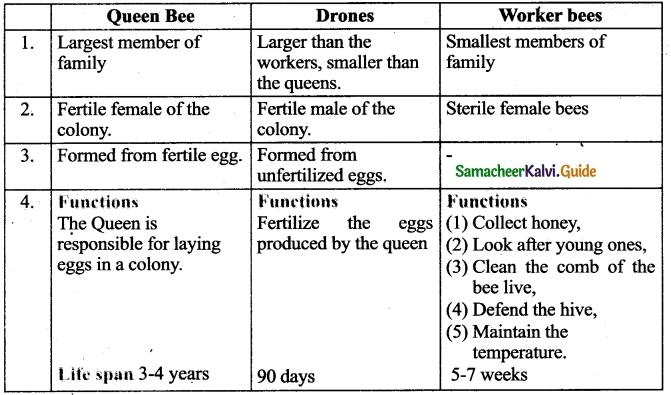
(2) \(\frac{n(n+1)}{2}\)
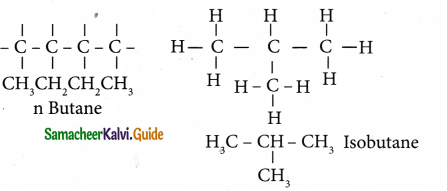
(3) \(\frac{2 n(2 n+1)}{2}\)
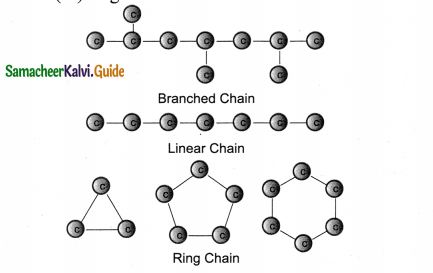
(4) n(n + 1)
Answer:
(4) n(n + 1)

Explaination:
2 + 4 + 6 + ……… + 2n = 2(1 + 2 + 3 + ………….. + n)
= 2 × \(\frac{n(n+1)}{2}\)
= n(n + 1)

Samacheer Kalvi 11th Maths Guide Chapter 5 Binomial Theorem, Sequences and Series Ex 5.5

Question 2.
The coefficient of x6 in (2 + 2x)10 is
(1) 10C6
(2) 26
(3) 10C626
(4) 10C6210
Answer:
(4) 10C6210

Explaination:
Samacheer Kalvi 11th Maths Guide Chapter 5 Binomial Theorem, Sequences and Series Ex 5.5 1

Question 3.
The coefficient of x8 y12 in the expansion of (2x + 3y)20 is
(1) 0
(2) 28 312
(3) 28 312 + 212 38
(4) 20C8 28 312
Answer:
(4) 20C8 28 312

Explaination:
Samacheer Kalvi 11th Maths Guide Chapter 5 Binomial Theorem, Sequences and Series Ex 5.5 2

Samacheer Kalvi 11th Maths Guide Chapter 5 Binomial Theorem, Sequences and Series Ex 5.5

Question 4.
If nC10 > nCr for all possible r then a value of n is
(1) 10
(2) 21
(3) 19
(4) 20
Answer:
(4) 20

Explaination:
Out of 10C10, 21C10, 19C10 and 20C10, 20C10 is larger.

Question 5.
If a is the Arithmetic mean and g is the Geometric mean of two numbers then
(1) a ≤ g
(2) a ≥ g
(3) a = g
(4) a > g
Answer:
(2) a ≥ g

Explaination:
Given Arithmetic mean = a,
Geometric mean = g
We have A. M ≥ G. M
∴ a ≥ g

Samacheer Kalvi 11th Maths Guide Chapter 5 Binomial Theorem, Sequences and Series Ex 5.5

Question 6.
If (1 + x2)2 (1 + x)n = a0 + a1x + a2x2 + ………… + xn + 4 and if a0, a1, a2 are in A. P then n is
(1) 1
(2) 2
(3) 3
(4) 4
Answer:
(3) 3

Explaination:
Samacheer Kalvi 11th Maths Guide Chapter 5 Binomial Theorem, Sequences and Series Ex 5.5 3
n2 – 5n + 6 = 0
(n – 2) (n – 3) = 0
n = 2 or n = 3

Samacheer Kalvi 11th Maths Guide Chapter 5 Binomial Theorem, Sequences and Series Ex 5.5

Question 7.
If a, 8, b are in A .P , a, 4 , b are in G. P and if a, x ,b are in H . P then x is
(1) 2
(2) 1
(3) 4
(4) 16
Answer:
(1) 2

Explaination:
Given a, 8, b are in A. P ∴ 2 × 8 = a + b ⇒ a + b = 16 ——— (1)
Also a, 4, b are in G.P ∴ 42 = a . b ⇒ ab = 16 ——- (2)
Also a, x, b are in H.P. ∴ \(\frac{1}{a}, \frac{1}{x}, \frac{1}{b}\) are in A.P
Samacheer Kalvi 11th Maths Guide Chapter 5 Binomial Theorem, Sequences and Series Ex 5.5 4

Question 8.
Samacheer Kalvi 11th Maths Guide Chapter 5 Binomial Theorem, Sequences and Series Ex 5.5 5
(1) A. P
(2) G.P
(3) H.P
(4) AGP
Answer:
(3) H.P

Explaination:
Samacheer Kalvi 11th Maths Guide Chapter 5 Binomial Theorem, Sequences and Series Ex 5.5 6

Question 9.
The H.M of two positive numbers whose A.M and G.M are 16,8 respectively is
(1) 10
(2) 6
(3) 5
(4) 4
Answer:
(4) 4

Explaination:
Let a, b be the two numbers. Given A. M = \(\frac{a+b}{2}\) = 16
G.M = \(\sqrt{a b}\) = 8
a+b = 16 × 2 = 32
ab = 82 = 64
H.M = \(\frac{2 a b}{a+b}\)
= \(\frac{2 \times 64}{32}\) = 2 × 2 = 4

Samacheer Kalvi 11th Maths Guide Chapter 5 Binomial Theorem, Sequences and Series Ex 5.5

Question 10.
If S denote the sum of n terms of an A. P whose common difference is d, the value of Sn – 2Sn- 1 + Sn – 2 is
(1) d
(2) 2d
(3) 4d
(4) d2
Answer:
(1) d

Explaination:
Samacheer Kalvi 11th Maths Guide Chapter 5 Binomial Theorem, Sequences and Series Ex 5.5 7
= a + (n – 1) d – (a + (n – 2)d)
= a + (n – 1) d – a – (n – 2)d
= a + nd – d – a – nd + 2d = d

Question 11.
The remainder when 3815 is divided by 13 is
(1) 12
(2) 1
(3) 11
(4) 5
Answer:
(1) 12

Explaination:
3815 = (39 – 1)15 = 3915 – 15C1 3914(1) + 15C2 (39)13(1)2 – 15C3 (39)12(1)3 ….. + 15C14 (39)1(1) – 15C15(1)
Except -1 all other terms are divisible by 13.
∴ When 1 is added to it the number is divisible by 13. So the remainder is 13 – 1 = 12.

Samacheer Kalvi 11th Maths Guide Chapter 5 Binomial Theorem, Sequences and Series Ex 5.5

Question 12.
The nth term of the sequence 1, 2, 4, 7, 11, ………….. is
(1) n2 + 3n2 + 2n
(2) n3 – 3n2 + 3n
(3) \(\frac{n(n+1)(n+2)}{3}\)
(4) \(\frac{n^{2}-n+2}{2}\)
Answer:
(4) \(\frac{n^{2}-n+2}{2}\)

Explaination:
Samacheer Kalvi 11th Maths Guide Chapter 5 Binomial Theorem, Sequences and Series Ex 5.5 8

Question 13.
The sum up to n terms of the series
Samacheer Kalvi 11th Maths Guide Chapter 5 Binomial Theorem, Sequences and Series Ex 5.5 9
(1) \(\sqrt{2 n+1}\)
(2) \(\frac{\sqrt{2 n+1}}{2}\)
(3) \(\sqrt{2 n+1}-1\)
(4) \(\frac{\sqrt{2 n+1}-1}{2}\)
Answer:
(4) \(\frac{\sqrt{2 n+1}-1}{2}\)

Explaination:
Samacheer Kalvi 11th Maths Guide Chapter 5 Binomial Theorem, Sequences and Series Ex 5.5 10
Samacheer Kalvi 11th Maths Guide Chapter 5 Binomial Theorem, Sequences and Series Ex 5.5 11

Samacheer Kalvi 11th Maths Guide Chapter 5 Binomial Theorem, Sequences and Series Ex 5.5

Question 14.
The nth term of the sequence
Samacheer Kalvi 11th Maths Guide Chapter 5 Binomial Theorem, Sequences and Series Ex 5.5 12
(1) 2n – n – 1
(2) 1 – 2-n
(3) 2-n + n – 1
(4) 2n-1
Answer:
(2) 1 – 2-n

Explaination:
Samacheer Kalvi 11th Maths Guide Chapter 5 Binomial Theorem, Sequences and Series Ex 5.5 13

Question 15.
The sum up to n terms of the series
Samacheer Kalvi 11th Maths Guide Chapter 5 Binomial Theorem, Sequences and Series Ex 5.5 14
(1) \(\frac{\mathbf{n}(\mathbf{n}+1)}{2}\)
(2) 2n (n + 1)
(3) \(\frac{\mathbf{n}(\mathbf{n}+1)}{\sqrt{2}}\)
(4) 1
Answer:
(3) \(\frac{\mathbf{n}(\mathbf{n}+1)}{\sqrt{2}}\)

Explaination:
Samacheer Kalvi 11th Maths Guide Chapter 5 Binomial Theorem, Sequences and Series Ex 5.5 15

Samacheer Kalvi 11th Maths Guide Chapter 5 Binomial Theorem, Sequences and Series Ex 5.5

Question 16.
The value of the series
Samacheer Kalvi 11th Maths Guide Chapter 5 Binomial Theorem, Sequences and Series Ex 5.5 16
(1) 14
(2) 7
(3) 4
(4) 6
Answer:
(1) 14

Explaination:
Samacheer Kalvi 11th Maths Guide Chapter 5 Binomial Theorem, Sequences and Series Ex 5.5 17

Question 17.
The sum of an infinite G.P is 18. If the first term is 6 the common ratio is
(1) \(\frac{1}{3}\)
(2) \(\frac{2}{3}\)
(3) \(\frac{1}{6}\)
(4) \(\frac{3}{4}\)
Answer:
(2) \(\frac{2}{3}\)

Explaination:
Let the geometric series be a, ar, ar2, …………… arn-1
Given a = 6, S = 18
Samacheer Kalvi 11th Maths Guide Chapter 5 Binomial Theorem, Sequences and Series Ex 5.5 18

Samacheer Kalvi 11th Maths Guide Chapter 5 Binomial Theorem, Sequences and Series Ex 5.5

Question 18.
The coefficient of x5 in the series e-2x is
(1) \(\frac{2}{3}\)
(2) \(\frac{3}{2}\)
(3) \(-\frac{4}{15}\)
(4) \(\frac{4}{15}\)
Answer:
(3) \(-\frac{4}{15}\)

Explaination:
Samacheer Kalvi 11th Maths Guide Chapter 5 Binomial Theorem, Sequences and Series Ex 5.5 19

Question 19.
The value of
Samacheer Kalvi 11th Maths Guide Chapter 5 Binomial Theorem, Sequences and Series Ex 5.5 20
(1) \(\frac{e^{2}+1}{2 e}\)
(2) \(\frac{(e+1)^{2}}{2 e}\)
(3) \(\frac{(e-1)^{2}}{2 e}\)
(4) \(\frac{e^{2}+1}{2 e}\)
Answer:
(3) \(\frac{(e-1)^{2}}{2 e}\)

Explaination:
Samacheer Kalvi 11th Maths Guide Chapter 5 Binomial Theorem, Sequences and Series Ex 5.5 21

Samacheer Kalvi 11th Maths Guide Chapter 5 Binomial Theorem, Sequences and Series Ex 5.5

Question 20.
The value of
Samacheer Kalvi 11th Maths Guide Chapter 5 Binomial Theorem, Sequences and Series Ex 5.5 22
(1) log \(\left(\frac{5}{3}\right)\)
(2) \(\frac{3}{2}\) log \(\left(\frac{5}{3}\right)\)
(3) \(\frac{5}{3}\) log \(\left(\frac{5}{3}\right)\)
(4) \(\frac{2}{3}\) log \(\left(\frac{2}{3}\right)\)
Answer:
(2) \(\frac{3}{2}\) log \(\left(\frac{5}{3}\right)\)

Explaination:
Samacheer Kalvi 11th Maths Guide Chapter 5 Binomial Theorem, Sequences and Series Ex 5.5 23

Samacheer Kalvi 11th Maths Guide Chapter 5 Binomial Theorem, Sequences and Series Ex 5.4

Tamilnadu State Board New Syllabus Samacheer Kalvi 11th Maths Guide Pdf Chapter 5 Binomial Theorem, Sequences and Series Ex 5.4 Text Book Back Questions and Answers, Notes.

Tamilnadu Samacheer Kalvi 11th Maths Solutions Chapter 5 Binomial Theorem, Sequences and Series Ex 5.4

Question 1.
Expand the following in ascending powers of x and find the condition on x for which the binomial expansion is valid.
(i) \(\frac{1}{5+x}\)
Answer:
Samacheer Kalvi 11th Maths Guide Chapter 5 Binomial Theorem, Sequences and Series Ex 5.4 1
Samacheer Kalvi 11th Maths Guide Chapter 5 Binomial Theorem, Sequences and Series Ex 5.4 2

Samacheer Kalvi 11th Maths Guide Chapter 5 Binomial Theorem, Sequences and Series Ex 5.4

(ii) \(\frac{2}{(3+4 x)^{2}}\)
Answer:
Samacheer Kalvi 11th Maths Guide Chapter 5 Binomial Theorem, Sequences and Series Ex 5.4 3

(iii) (5 + x2)2/3
Answer:
Samacheer Kalvi 11th Maths Guide Chapter 5 Binomial Theorem, Sequences and Series Ex 5.4 4

Samacheer Kalvi 11th Maths Guide Chapter 5 Binomial Theorem, Sequences and Series Ex 5.4

(iv) \((x+2)^{-\frac{2}{3}}\)
Answer:
Samacheer Kalvi 11th Maths Guide Chapter 5 Binomial Theorem, Sequences and Series Ex 5.4 5
Samacheer Kalvi 11th Maths Guide Chapter 5 Binomial Theorem, Sequences and Series Ex 5.4 6

Question 2.
Find \(\sqrt[3]{1001}\) approximately. (two decimal places)
Answer:
Samacheer Kalvi 11th Maths Guide Chapter 5 Binomial Theorem, Sequences and Series Ex 5.4 7

Samacheer Kalvi 11th Maths Guide Chapter 5 Binomial Theorem, Sequences and Series Ex 5.4

Question 3.
Prove that \(\sqrt[3]{x^{3}+6}-\sqrt[3]{x^{3}+3}\) is approximately equal to \(\frac{1}{x^{2}}\) when x is sufficiently large.
Answer:
Samacheer Kalvi 11th Maths Guide Chapter 5 Binomial Theorem, Sequences and Series Ex 5.4 8
Samacheer Kalvi 11th Maths Guide Chapter 5 Binomial Theorem, Sequences and Series Ex 5.4 9
Samacheer Kalvi 11th Maths Guide Chapter 5 Binomial Theorem, Sequences and Series Ex 5.4 10
Samacheer Kalvi 11th Maths Guide Chapter 5 Binomial Theorem, Sequences and Series Ex 5.4 11

Samacheer Kalvi 11th Maths Guide Chapter 5 Binomial Theorem, Sequences and Series Ex 5.4

Question 4.
Prove that \(\sqrt{\frac{1-x}{1+x}}\) is approximately equal to 1 – x + \(\frac{x^{2}}{2}\) when x is very small.
Answer:
Samacheer Kalvi 11th Maths Guide Chapter 5 Binomial Theorem, Sequences and Series Ex 5.4 12
Samacheer Kalvi 11th Maths Guide Chapter 5 Binomial Theorem, Sequences and Series Ex 5.4 13

Samacheer Kalvi 11th Maths Guide Chapter 5 Binomial Theorem, Sequences and Series Ex 5.4

Question 5.
Write the first 6 terms of the exponential series
(i) e5x
Answer:
Samacheer Kalvi 11th Maths Guide Chapter 5 Binomial Theorem, Sequences and Series Ex 5.4 14

(ii) e-2x
Answer:
Samacheer Kalvi 11th Maths Guide Chapter 5 Binomial Theorem, Sequences and Series Ex 5.4 15

Samacheer Kalvi 11th Maths Guide Chapter 5 Binomial Theorem, Sequences and Series Ex 5.4

(iii) ex/2
Answer:
Samacheer Kalvi 11th Maths Guide Chapter 5 Binomial Theorem, Sequences and Series Ex 5.4 16
Samacheer Kalvi 11th Maths Guide Chapter 5 Binomial Theorem, Sequences and Series Ex 5.4 17

Question 6.
Write the first 4 terms of the logarithmic series.
(i) log (1 + 4x)
(ii) log (1 – 2x)
(iii) log \(\left(\frac{1+3 x}{1-3 x}\right)\)
(iv) log \(\left(\frac{1-2 x}{1+2 x}\right)\)
Find the intervals on which the expansions are valid.
Answer:
(i) log ( 1 + 4x )
Samacheer Kalvi 11th Maths Guide Chapter 5 Binomial Theorem, Sequences and Series Ex 5.4 18

Samacheer Kalvi 11th Maths Guide Chapter 5 Binomial Theorem, Sequences and Series Ex 5.4

(ii) log (1 – 2x)
Samacheer Kalvi 11th Maths Guide Chapter 5 Binomial Theorem, Sequences and Series Ex 5.4 19

(iii) log \(\left(\frac{1+3 x}{1-3 x}\right)\)
Samacheer Kalvi 11th Maths Guide Chapter 5 Binomial Theorem, Sequences and Series Ex 5.4 20

Samacheer Kalvi 11th Maths Guide Chapter 5 Binomial Theorem, Sequences and Series Ex 5.4

(iv) log \(\left(\frac{1-2 x}{1+2 x}\right)\)
Samacheer Kalvi 11th Maths Guide Chapter 5 Binomial Theorem, Sequences and Series Ex 5.4 21
Samacheer Kalvi 11th Maths Guide Chapter 5 Binomial Theorem, Sequences and Series Ex 5.4 22

Question 7.
Samacheer Kalvi 11th Maths Guide Chapter 5 Binomial Theorem, Sequences and Series Ex 5.4 23
Answer:
Samacheer Kalvi 11th Maths Guide Chapter 5 Binomial Theorem, Sequences and Series Ex 5.4 24

Samacheer Kalvi 11th Maths Guide Chapter 5 Binomial Theorem, Sequences and Series Ex 5.4

Question 8.
Samacheer Kalvi 11th Maths Guide Chapter 5 Binomial Theorem, Sequences and Series Ex 5.4 25
Answer:
Samacheer Kalvi 11th Maths Guide Chapter 5 Binomial Theorem, Sequences and Series Ex 5.4 26
Samacheer Kalvi 11th Maths Guide Chapter 5 Binomial Theorem, Sequences and Series Ex 5.4 27
Samacheer Kalvi 11th Maths Guide Chapter 5 Binomial Theorem, Sequences and Series Ex 5.4 28
Samacheer Kalvi 11th Maths Guide Chapter 5 Binomial Theorem, Sequences and Series Ex 5.4 29

Samacheer Kalvi 11th Maths Guide Chapter 5 Binomial Theorem, Sequences and Series Ex 5.4

Question 9.
Find the coefficient of x4 in the expansion of \(\frac{3-4 x+x^{2}}{e^{2 x}}\)
Answer:
Samacheer Kalvi 11th Maths Guide Chapter 5 Binomial Theorem, Sequences and Series Ex 5.4 30

Samacheer Kalvi 11th Maths Guide Chapter 5 Binomial Theorem, Sequences and Series Ex 5.4

Question 10.
Find the value of Samacheer Kalvi 11th Maths Guide Chapter 5 Binomial Theorem, Sequences and Series Ex 5.4 31
Answer:
Samacheer Kalvi 11th Maths Guide Chapter 5 Binomial Theorem, Sequences and Series Ex 5.4 32
Samacheer Kalvi 11th Maths Guide Chapter 5 Binomial Theorem, Sequences and Series Ex 5.4 33