Samacheer Kalvi 9th Science Guide Chapter 18 Organization of Tissues

Tamilnadu State Board New Syllabus Samacheer Kalvi 9th Science Guide Pdf Chapter 18 Organization of Tissues Text Book Back Questions and Answers, Notes.

Samacheer Kalvi 9th Science Solutions Chapter 18 Organization of Tissues

9th Science Guide Organization of Tissues Text Book Back Questions and Answers

I. Choose the correct answer:

Question 1.
The tissue composed of living thin walled polyhedral cell is
(a) parenchyma
(b) pollenchyma
(c) pclerenchyma
(d) none of above
Answer:
(d) none of above

 Samacheer Kalvi 9th Science Guide Chapter 18 Organization of Tissues

Question 2.
The fibres consists of
(a) parenchyma
(b) sclerenchyma
(c) collenchyma
(d) none of above
Answer:
(b) sclerenchyma

Question 3.
Companion cells are closely associated with
(a) sieve elements
(b) vessel elements
(c) trichomes
(d) guard cells
Answer:
(a) sieve elements

 Samacheer Kalvi 9th Science Guide Chapter 18 Organization of Tissues

Question 4.
Which of the following is a complex tissue?
(a) Parenchyma
(b) Collenchyma
(c) Xylem
(d) Sclerenchyma
Answer:
(c) Xylem

Question 5.
Aerenchyma is found in
(a) epiphytes
(b) hydrophytes
(c) halophytes
(d) xerophytes
Answer:
(b) hydrophytes

 Samacheer Kalvi 9th Science Guide Chapter 18 Organization of Tissues

Question 6.
Smooth muscles occur in
(a) uterus
(b) artery
(c) vein
(d) all of the above
Answer:
(d) all of the above

Question 7.
Nerve cell does not contains
(a) axon
(b) nerve endings
(e) tendons
(d) dendrités
Answer:
(c) tendons

 Samacheer Kalvi 9th Science Guide Chapter 18 Organization of Tissues

II. Match the following.

Question 1.

SclereidsChlorenchyma
ChloroplastSclerenchyma
Simple tissueCollenchyma
Companion cellXylem
TracheidsPhloem

Answer:

SclereidsSclerenchyma
ChloroplastChlorenchyma
Simple tissueCollenchyma
Companion cellPhloem
TracheidsXylem

III Fill in the blanks :

1. ……………. tissues provide mechanical support to organs.
Answer:
Compound epithelium

 Samacheer Kalvi 9th Science Guide Chapter 18 Organization of Tissues

2. Parenchyma, Collenchyma, Sclerenchyma are ……………. type of tissue.
Answer:
simple

3. ……………. and ……………… are complex issues.
Answer:
Xylem, phloem

4. Epithelial cells with cilia are fóund in ……………….. of our body
Answer:
trachea or windpipe

 Samacheer Kalvi 9th Science Guide Chapter 18 Organization of Tissues

5. Lining of the small intestine is made up of …………………..
Answer:
columnar epithelium

IV. State whether true or false. If false, correct the statement :

1. Epithelial tissue is protective tissue in an animal body.
Answer:
True.

2. Bone and cartilage are two types of areolar connective tissue.
Answer:
False.
Correct statement: Bone and cartilage are two types of supportive connective tissue.

3. Parenchyma is a simple tissue.
Answer:
True.

 Samacheer Kalvi 9th Science Guide Chapter 18 Organization of Tissues

4. Phloem is made up of tracheids.
Answer:
False.
Correct statement: Phloem is made up of sieve tubes.

5. Vessels are found in collenchyma.
Answer:
False.
Correct statement: Vessels are found in the xylem.

 Samacheer Kalvi 9th Science Guide Chapter 18 Organization of Tissues

V. Answer briefly :

Question 1.
What are intercalary meristems? How do they differ from other meristems?
Answer:
Intercalary meristem lies between the region of permanent tissues and is part of primary meristem which is detached due to formation of intermittent permanent tissues. It is found either at the base of leaf e.g. Pinus or at the base of intemodes e.g. grasses.

Question 2.
What is complex tissue? Name the various kinds of complex tissues.
Answer:

  • Complex tissues are made of more than one type of cells that work together as a unit.
  • Complex tissues consist of parenchyma and sclerenchyma cells. However, collenchymatous cells are not present in such tissues.
  • Common examples are xylem and phloem.

 Samacheer Kalvi 9th Science Guide Chapter 18 Organization of Tissues

Question 3,.
Mention the most abundant muscular tissue found in our body. State its function.
Answer:
Connective tissue is the most abundant and widely distributed tissue. It provides a structural framework and gives support to different tissues forming organs.

Question 4.
What is skeletal connective tissue? How is it helpful in the functioning of our body?
Answer:
The supporting or skeletal connective tissues forms the endoskeleton of the vertebrate body. They protect various organs and help in locomotion. The supportive tissues include cartilage and bone.

 Samacheer Kalvi 9th Science Guide Chapter 18 Organization of Tissues

Question 5.
Why should gametes be produced by meiosis during sexual reproduction?
Answer:
Meiosis is important as it produces gametes i.e., male or female germ cells. During meiosis, a germ cell or gamete divides to make four new sex cells. As a result of fertilization two gamates join together to form an egg or zygote. Therefore only if gametes are produced, fertilization can take place.

Question 6.
In which stage of mitosis the chromosomes align in an equatorial plate? How?
Answer:
Metaphase (meta – after) The duplicated chromosomes arrange on the equatorial plane and form the metaphase plate. Each chromosome gets attached to a spindle fibre by its centromere. The centromere of each chromosome divides into two each being associated with a chromatid.

 Samacheer Kalvi 9th Science Guide Chapter 18 Organization of Tissues

VI. Answer in detail:

Question 1.
What are the permanent tissues? Describe the different types of simple permanent tissues.
Answer:
Permanent tissues:
Permanent tissues are those in which, growth has stopped either completely or for the time being. At times, they become meristematic partially or wholly.

Different types of simple permanent tissue :
Simple tissue: Simple tissue is homogeneous-composed of structurally and functionally similar cells. Eg : Parenchyma, collenchyma, and sclerenchyma.

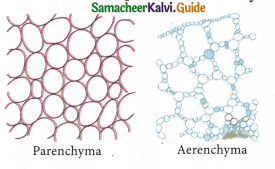
Parenchyma:

Samacheer Kalvi 9th Science Guide Chapter 18 Organization of Tissues 1

  • Parenchyma are simple permanent tissue composed of living cells.
  • Parenchyma cells are thin-walled, oval, rounded, or polygonal in shape with well-developed spaces among them.
  • In aquatic plants, parenchyma possesses intercellular air spaces and is named as aerenchyma.
  • When exposed to light, parenchyma cells may develop chloroplasts and are known as chlorenchyma.

Functions:

  • Parenchyma may store water in many succulent and xerophytic plants.
  • It also serves the functions of storage of food reserves, absorption, buoyancy, secretion, etc

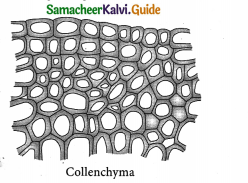
Collenchyma:
Samacheer Kalvi 9th Science Guide Chapter 18 Organization of Tissues 2

  • Collenchyma is a living tissue found beneath the epidermis.
  • Cells are elongated with unevenly thickened non-lignified walls. Cells have rectangular oblique or tapering ends and persistent protoplast.
  • They possess thick primary non-lignified walls.
    Functions: They provide mechanical support for growing organs.

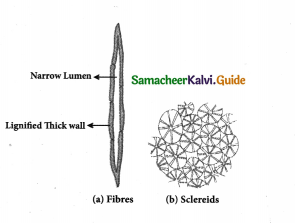
Sclerenchymà:

  • Scierenchyma consists of thick-walled cells which are often lignified.
  • Scierenchyma cells do not possess living protoplasts at maturity. Scierenchyma cells are grouped into

(i) fibers and (ii) sclereids.
Samacheer Kalvi 9th Science Guide Chapter 18 Organization of Tissues 3

Fibres : Elongated scierenchymatous cells, usually with pointed ends. Their walls are lignified. Fibres are abundantly found in many plants. Eg. Jute.
Sclereids:

  • Sclereids are widely distributed in plant body. They are usually broad, may occur in single or in groups.
  • Sclereids are isodiametric, with lignified walls. Pits are prominent and seen along the walls.
  • Lumen is filled with wall materials. Sclereids are also common in fruits and seeds.

 Samacheer Kalvi 9th Science Guide Chapter 18 Organization of Tissues

Question 2.
Write about the elements of Xylem.
Answer:
Xylem is a conducting tissue which conducts water, mineral nutrients upward from root to leaves. Xylem is also meant for mechanical support to the plant body. Xylem is composed of different kinds of elements. They are

  1. xylem tracheids
  2. xylem fibres
  3. xylem vessels and
  4. xylem parenchyma.

(i) Xylem tracheids: They are elongated or tube-like dead cells with hard, thick and lignified walls. Their ends are tapering, blunt or chisel-like. These cells are devoid of protoplast. They have large lumen without any content. Their function is conduction of water and providing mechanical support to the plant.

(ii) Xylem fibers: These cells are elongated, lignified and pointed at both the ends. Xylem fibres help in the conduction of water and nutrients from root to the leaf and also provide mechanical support to the plant.

(iii) Xylem vessels: They are long cylindrical, tube-like structures with lignified walls and wide central lumen. These cells are dead as these do not have protoplast. They are arranged in longitudinal series in which the partitioned walls (transverse walls) are perforated, and so the entire structure looks-like a water pipe. Their main function is the transport of water and minerals from root to leaf, and also to provide mechanical strength.

(iv) Xylem parenchyma: Its cells are living and thin-walled. The main function of xylem parenchyma is to store starch and fatty substances.

Question 3.
List out the differences< between mitosis and meipsis.
Answer:

MitosisMeiosis
1. Occurs in somatic cells.Occurs in reproductive cells
2. Involved in growth and occurs continuously throughout life.Involved in gamete formation only during the reproductively active age.
3. Consists of single division.Consists of two divisions.
4. Two diploid daughter cells are formed.Four haploid daughter cells are formed.
5. The chromosome number in the daughter cell is similar to the parent cell (2n).The chromosome number in the daughter cell is just half (n) of the parent cell.
6. Identical daughter cells are formed.Daughter cells are not similar to the parent cell and are randomly assorted.

 Samacheer Kalvi 9th Science Guide Chapter 18 Organization of Tissues

VII. Higher Order Thinking Skills :

Question 1.
What is the consequence that occurs if all blood platelets are removed from the blood?
Answer:
Blood platelets play a major role in the clotting of blood whenever there is a wound/injury. If blood platelets are removed from the blood, clotting of blood will not occur. In case of any injury/surgery etc., blood will be lost from the body in excess and may even prove to be fatal.

2. Which are not true cells in the blood? Why?
Answer:
Red blood cells or erythrocytes cannot be considered as true cells since they have a nucleus only in the early stages. A mature RBC lacks a nucleus which is the controlling centre of all living cells.

Intext Activities

ACTIVITY – 1
Rinse your mouth with water. Using a toothpick or ice-cream stick, scrap superficial cells from the inner side of the cheek and spread it on a clean glass slide. Dry the glass slide with the scrap cells taken from the inner side of the cheek. Add two drops of methylene blue stain. Identify the cells under low and high power of the microscope.
Solution:
1. Large irregularly shaped cells with cell walls.
2. Dark blue nucleus at the central part of each cell.
3. Lightly stained cytoplasm colour in each cell.

9th Science Guide Organization of Tissues Additional Important Questions and Answers

I. Choose the correct answer :

Question 1.
A meristematic tissue consists of
(a) immature cells that are capable of undergoing cell division.
(b) mature cells
(c) non-living cells
(d) sclerenchyma cells
Answer:
(a) immature cells that are capable of undergoing cell division

Question 2.
Two long bones of the hand are dislocated in a person who met with an accident. Which among the following may be the possible reason?
(a) Tendon injury
(b) Break of skeletal muscle
‘(c) Ligament tear
(d) Rupture of Areolar tissue
Answer:
(c) Ligament tear

 Samacheer Kalvi 9th Science Guide Chapter 18 Organization of Tissues

Question 3.
Non-striated muscles are found in
(a) blood vessels
(b) gastric glands
(c) urinary bladder
(d) all of these
Answer:
(d) all of these

Question 4.
Which of the following is not found in a neuron?
(a) Sarcolemma
(b) Dendrite
(c) Myelin sheath
(d) Axon
Answer:
(a) Sarcolemma

Question 5.
Cylindrical, unbranched multinucleated cells are
(a) striated muscle cells
(b) smooth muscles
(c) cardiac muscles
(d) none of the above.
Answer:
(a) striated muscle cells

 Samacheer Kalvi 9th Science Guide Chapter 18 Organization of Tissues

Question 6.
The matrix of the bone is rich in
(a) elastin
(b) reticular fibres
(c) collagen
(d) myosin
Answer:
(c) collagen

Question 7.
Which muscles act involuntarily?
(i) Striated muscles
(ii) Smooth muscles
(iii) Cardiac muscles
(iv) Skeletal muscles
(a) (i) and (ii)
(b) (ii) and (iii)
(c) (iii) and (iv)
(d)(i) and (iv)
Answer:
(b) (ii) and (iii)

Question 8.
Tendon connects
(a) cartilage with muscles
(b) bone with skeletal muscles
(c) ligament with muscles
(d) bone with bone
Answer:
(b) bone with skeletal muscles

 Samacheer Kalvi 9th Science Guide Chapter 18 Organization of Tissues

Question 9.
In a certain type of cell division, the diploid number of chromosomes is reduced to half. This kind of division occurs in
(a) testis
(b) ovary
(c) both ovary and testis
(d) all body cells
Answer:
(c) both ovary and testis

Question 10.
……………… is derived from the ground meristem.
(a) Cortex
(b) Epidermis
(c) Xylem
(d) Cambium
Answer:
(a) Cortex

Question 11.
The function of phloem fibres is …………….to the plant body
(a) passage of food
(b) Store food
(c) mechanical strength
(d) preparation of food
Answer:
(c) mechanical strength

 Samacheer Kalvi 9th Science Guide Chapter 18 Organization of Tissues

Question 12.
The …………….. epithelium is also known as pavement membrane.
(a) Ciliated
(b) Squamous
(c) Cuboidal
(d) Glandular
Answer:
(b) Squamous

Question 13.
Elastic structures that connect bones to bones are called ………………..
(a) muscles
(b) tendons
(c) ligaments
(d) areolar tissue
Answer:
(c) ligaments

 Samacheer Kalvi 9th Science Guide Chapter 18 Organization of Tissues

Question 14.
………………… is seen in unicellular animals.
(a) Mitosis
(b) meiosis
(e) Amitosis
(d) none of the above
Answer:
(c) Amitosis

Question 15.
The disappearance of spindle fibres is seen in …………….
(a) metaphase
(b) prophase
(c) anaphase
(d) telophase
Answer:
(d) telophase

Question 16.
The ………………… is a single, long fiber like process that develops from the cyton.
(a) dendron
(b) axon
(c) dendrite
(d) neurilemma
Answer:
(b) axon

 Samacheer Kalvi 9th Science Guide Chapter 18 Organization of Tissues

Question 17.
Bouquet stage refers to ……………..
(a) diakinesis
(b) leptotene
(c) zygotene
(d) pachytene
Answer:
(b) leptotene

Fill in the blanks :

1. The ……………. tissues are made up of more than one type of cells and these woks together as a unit.
Answer:
complex

2. The two types of skeletal connective tissues are ……………. and …………….
Answer:
bone, cartilage

3. Humans have 46 chromosomes. Their sperms and eggs will have ……………. chromosomes each.
Answer:
23

 Samacheer Kalvi 9th Science Guide Chapter 18 Organization of Tissues

4. During pairing of chromosomes in meiosis, the …………….. chromosomes come to lie side by side.
Answer:
homologous

5. The word meristem is derived from a Greek word ………………
Answer:
Meristos

6. Cork cambium is an example of ……………… meristem.
Answer:
secondary

 Samacheer Kalvi 9th Science Guide Chapter 18 Organization of Tissues

7. The meristem found at the base of intemodes is called ……………….
Answer:
intercalary meristem

8. In apple, paranchyma stores ………………
Answer:
sugar

9. Fibres are extensively longer ranging from 20 mm to 550 mm ……………….
Answer:
corchorus capsularis (jute)

10. During mieosis in pachytene, stages the paired chromosomes are called ………………….
Answer:
bivalents

 Samacheer Kalvi 9th Science Guide Chapter 18 Organization of Tissues

11. Mitosis was discovered by …………………..
Answer:
Flemming

12. Both smooth and cardiac muscles are …………….. in nature.
Answer:
involuntary

13. ………………. is a non-flexible skeletal connective tissue.
Answer:
Bone

 Samacheer Kalvi 9th Science Guide Chapter 18 Organization of Tissues

14. ……………. acts as a fat reservoir.
Answer:
Adipose tissue

15. …………….. epithelium is seen in sweat glands.
Answer:
Cuboidal

16. Genetic variations occur in meiosis because of …………….
Answer:
crossing over

III. State whether True or false. If false, write the correct statement:

1. Epithelial layer does not allow regulation of materials between the body and the external environment.
Answer:
False.
Correct statement: Epithelium is involved in the absorption and elimination of waste.

2. Striated and non-striated tissues are types of epithelial tissues.
Answer:
False.
Correct statement: They are types of muscular tissues.

 Samacheer Kalvi 9th Science Guide Chapter 18 Organization of Tissues

3. Spindle formation occur in amitosis.
Answer:
False.
Correct statement: Spindle formation occur in mitosis.

4. Movement of food in the alimentary canal is because of cardiac muscles.
Answer:
False.
Correct statement: Movement of food is alimentary canal by the rhythmic con t no-tom and relaxation of the muscular nails of the alimentary canal.
Correct statement: Movement of food in the alimentary canal.

5. A mature RBC lacks a nucleus.
Answer:
True

6. Excessive pulling of bones causes a sprain.
Answer:
False.
Correct statement: Sprain is caused by excessive pulling of ligaments.

 Samacheer Kalvi 9th Science Guide Chapter 18 Organization of Tissues

7. Glandular epithelium gives a stratified appearance.
Answer:
False.
Correct statement: Compound epithelium given a stratified appearance.

8. Sieve cells have no companion cells.
Answer:
True.

9. Conduction can be bidirectional in phloem tissue.
Answer:
True.

10. White blood corpuscles contain respiratory pigment hemoglobin.
Answer:
False.
Correct statement: Red blood corpuscles contain respiratory pigment hemoglobin.

 Samacheer Kalvi 9th Science Guide Chapter 18 Organization of Tissues

IV. Assertion and Reason type:

Direction: In each of the following questions, a statement of Assertion is given and a corresponding statement of Reason is given just below it. Of statements, given below, mark the correct answer as
(a) Both Assertion and Reason are true and Reason is the correct explanation of Assertion.
(b) Both Assertion and Reason are true that Reason is not the correct explanation of Assertion.
(c) Assertion is true but Reason is false.
(d) Both Assertion and Reason are false.

Question 1.
Assertion: Non-striated muscles are said to be voluntary in nature.
Reason: Non-striated muscles are under the control of our will.
Answer:
(d) Both Assertion and Reason are false

Question 2.
Assertion: Materials are exchanged between epithelial and connective tissues by diffusion.
Reason: Blood vessels are absent in epithelial tissue.
Answer:
(a) Assertion and Reason are true and Reason is the correct explanation of Assertion

 Samacheer Kalvi 9th Science Guide Chapter 18 Organization of Tissues

V. Answer in one or two sentences :

Question 1.
Name the two types of sclerenchyma cells.
Answer:
Sclerenchyma cells are grouped into

  1. fibres and
  2. sclereids.

Question 2.
Name the components of xylem and phloem.
Answer:
Xylem is composed of :

  • Xylem tracheids
  • Xylem fibres
  • Xylem vessels
  • Xylem parenchyma

Phloem is composed of:

  • Sieve elements
  • Companion cells
  • Phloem fibres
  • Phloem parenchyma

Question 3.
Name the tissue that connects muscle to bone in humans.
Answer:
Tendons join skeletal muscles to bones in our body.

 Samacheer Kalvi 9th Science Guide Chapter 18 Organization of Tissues

Question 4.
Name the tissue that stores excess fat in our body.
Answer:
Adipose tissue.

Question 5.
Name the connective tissue with a fluid matrix.
Answer:
Blood and lymph

Question 6.
Name the tissue present in the brain.
Answer:
Nervous tissue.

Question 7.
What is plate meristem?
Answer:
These cells divide into two planes resulting in an increase in the area of an organ.
Eg: Leaf formation.

 Samacheer Kalvi 9th Science Guide Chapter 18 Organization of Tissues

Question 8.
Differentiate collenchyma and sclerenchyma.
Answer:

CollenchymaSclerenchyma
It consists of living cellsIt consists of dead cells
Cells contain protoplasmCells do not possess living protoplast
Cell walls are non-lignifiedCell walls are lignified

Question 9.
Mention the type of epithelium seen in alveoli of lungs.,
Answer:
Squamous epithelium.

Question 10.
Name the supportive connective tissues.
Answer:
Cartilage and bone

Question 11.
Name the cartilage cells present in the matrix.
Answer:
Chondrocytes.

 Samacheer Kalvi 9th Science Guide Chapter 18 Organization of Tissues

Question 12.
What is the role of RBC?
Answer:
RBC contains a respiratory pigment called hemoglobin which is involved in the transport of oxygen to tissues.

Question 13.
Mention the stages of meiotic Prophase -I.
Answer:
Leptotene, Zygotene, Pachytene, Diplotene, Diakinesis.

Question 14.
What is the significance of Meiosis?
Answer:
The constant number of chromosomes in a given species is maintained by meiotic division.

 Samacheer Kalvi 9th Science Guide Chapter 18 Organization of Tissues

Question 15.
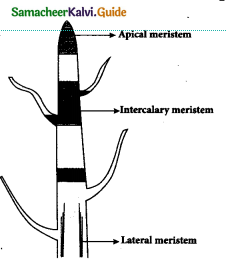
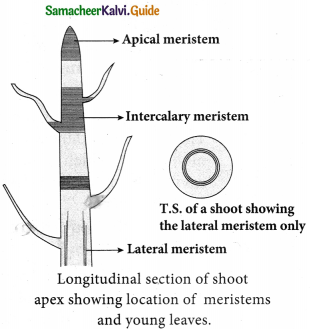
Draw a shoot apex and label the meristem’s parts.
Answer:
Samacheer Kalvi 9th Science Guide Chapter 18 Organization of Tissues 4

VI. Short Answer Type :

Question 1.
How would you differentiate meristematic and permanent tissue?
Answer:

Meristematic tissuePermanent tissue
Cytoplasm is dense, and vacuoles are nearly absent.Usually large central vacuole present in living permanent cells.
Intercellular spaces absent.Intercellular spaces present.
Component cells are small, spherical or polygonal and undifferentiated.Component cells are large, differentiated with different shapes.
Cell wall is thin and elastic.Cell wall is thick.
Nucleus is large and prominent.Nucleus is less conspicuous.
Cells grow and divide regularly.Cells do not normally divide.
Provides mechanical support and elasticity to the plant body.Provides only mechanical support.

Question 2.
Differentiate fibres from sclereids.
Answer:

SclereidsFibres
Usually broadElongated narrow thread-like
End walls bluntUsually with pointed ends.
Occur singlyOccur in bundles
Deep pitsNarrow pits

 Samacheer Kalvi 9th Science Guide Chapter 18 Organization of Tissues

Question 3.
Which tissue is the main component of tendons and ligaments? How do they differ in function?
Answer:
Dense Connective Tissue is a fibrous connective tissue densely packed with fibres and fibroblasts. It is the principal component of tendons and ligaments.

a. Tendons: Cord-like, strong, structures that join skeletal muscles to bones. Tendons have great strength and limited flexibility. They consist of parallel bundles of collagen fibres, between which are present rows of fibroblasts.

b. Ligaments: They are highly elastic structures and have great strength which connects bones to bones. They contain very little matrix. They strengthen the joints and allow normal movement.

Question 4.
What are the fibres present in the connective tissue proper?
Answer:
Connective tissue proper: Connective tissue proper consists of collagen fibres, elastin fibres and fibroblast cells.

Areolar tissue: It has cells and fibres loosely arranged in a semi-fluid ground substance called matrix. It takes the form of fine threads crossing each other in every direction leaving small spaces called areolae. It joins skin to muscles, fills space inside organs and is found around muscles, blood vessels and nerves. It helps in repair of tissues after injury and fixes skin to underlying muscles.

Adipose Tissue: Adipose tissue is the aggregation of fat cells or adipocytes spherical or oval in shape. It serves as fat reservoir. The matrix consists of collagen fibres, elastin fibres and fibroblast cells.

 Samacheer Kalvi 9th Science Guide Chapter 18 Organization of Tissues

Question 5.
How are collagen fibres organized in dense connective tissues?
Answer:

  • Dense connective tissue is a fibrous connective tissue densely packed with fibres and fibroblasts. It is the principal component of tendon and ligaments.
  • Tendons consist of parallel bundles of collagen fibres, between which are present rows of fibroblasts.
  • Ligaments are highly elastic structures and contain very little matrix.

Question 6.
Write one point of difference between
a) Bone and cartilage.
b) Simple and compound epithelial tissue.
Answer:
a)

BoneCartilage
It is solid, rigid, and strong, non-flexible skeletal connective tissue.It is a soft, semi-rigid, flexible skeletal connective tissue.
The matrix of the bone is in the form of concentric rings called lamellaeThe matrix is composed of large cartilage cells called chondrocytes

b)

Simple epithelium tissueÇompound epithelium tissue
It is composed of a single layer of cells
resting ón a basement membrane.
It is composed of several layers of cells.
Only the cells of the deepest layer rest
on the basement membrane.

Question 7.
Why is blood considered to be a fluid connective tissue?
Answer:

  • The blood and the lymph are the fluid connective tissues which link different parts of the body. The cells of the connective tissue are loosely spaced and are embedded in an intercellular matrix.
  • Blood contains corpuscles which are red blood cells (erythrocytes), white blood cells (leucocytes), and platelets. In this fluid connective tissue, blood cells move in a fluid matrix called plasma. The plasma contains inorganic salts and organic substances. It is a main circulating fluid that helps in the transport of nutrient substances.

 Samacheer Kalvi 9th Science Guide Chapter 18 Organization of Tissues

Question 8.
Give the sequence of the events occurring during prophase of mitosis.
Answer:

  • During this stage, chromosomes become short and thick and are clearly visible inside the nucleus.
  • Centrosome splits into two daughter centrioles and occupies opposite poles of the cell.
  • Each centriole is surrounded by aster rays. Spindle fibres appear between the two centrioles.
  • The nuclear membrane and nucleolus disappear gradually.

Question 9.
Why is meiosis called reductional division and mitosis as equational division?
Answer:

  • In mitosis one parent cell divides into two identical daughter cells, each with a nucleus having the same amount of DNA, same number of chromosomes and genes as the parent cells. It is therefore called an equational division.
  • Meiosis is called reduction division because the chromosome number is reduced to haploid (n) from diploid (2n) in the daughter cells.

Question 10.
What is terminalization?
Answer:
In the stage of diplotene of meiotic prophase I, chiasmata begin to move along the length of the chromosome from the centromere towards the end resulting in terminalization.

 Samacheer Kalvi 9th Science Guide Chapter 18 Organization of Tissues

Question 11.
What is a tetrad?
Answer:
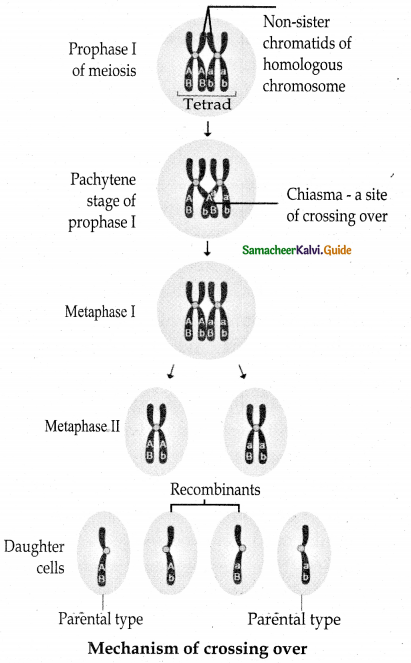
The chromosomes are visible as long paired twisted threads. The pairs so formed are called bivalents. Each bivalent now contains four chromatids (tetrad stage) in pachytene of mieotic prophase I. The condition of bivalent containing four chromatids are called tetrad stage.

Question 12.
What is crossing over?
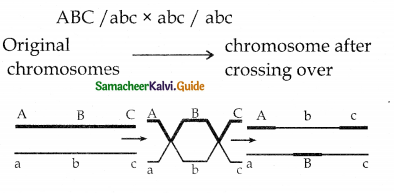
During pachytene of mieotic prophase I, the chromatids break and the broken segments are interchanged between homologous chromosomes. The points of exchange are the chiasmata. This is called .crossing over.

Question 13.
What is bouquet stage?
Answer:
During leptotene of mieotic prophase I, the chromosomes become uncoiled and assume long thread-like structures and take up a specific orientation inside the nucleus. They form a bouquet stage.

 Samacheer Kalvi 9th Science Guide Chapter 18 Organization of Tissues

Question 14.
What is zygotene?
Answer:
It is one of the stages of mieoticphophase I. Two homologous chromosomes approach each other and begin to pair. The pairing of homologous chromosomes is called synapsis.

Question 15.
Explain amitosis.
Answer:
It is the simplest model of cell division and occurs in unicellular animals, aging cells and in foetal membranes. During amitosis, the nucleus elongates first, and a constriction appears in it which deepens and divides the nucleus into two, followed by this cytoplasm divides resulting in the formation of two daughter cells.

Question 16.
Write the salient features of the compound epithelium.
Answer:

  • It consists of more than one layer of cells and gives a stratified appearance. Hence, they are also known as stratified epithelial cells.
  • The main function of this epithelium is to give protection to the underlying tissues against mechanical and chemical stress.
  • They also cover the dry surface of the skin, the moist surface of the buccal cavity, and the pharynx.

 Samacheer Kalvi 9th Science Guide Chapter 18 Organization of Tissues

Question 17.
Write a note the significance of mitosis.
Answer:

  • This equational division results in the production of diploid daughter cells (2n) with equal distribution of genetic material (DNA).
  • In multicellular organisms growth, organ development and an increase in body size are accomplished through the process of mitosis.
  • Mitosis helps in the repair of damaged and wounded tissues by the renewal of the lost cells.

Question 18.
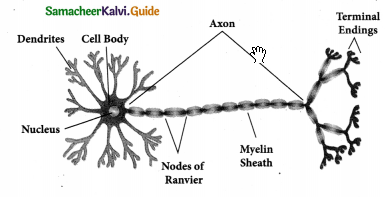
Draw a neuron and label the parts.
Answer:
Samacheer Kalvi 9th Science Guide Chapter 18 Organization of Tissues 5

VII. Answer in detail:

Question 1.
What are meristems? Describe the distribution and functions of various types of meristems.
Answer:
Meristematic tissues are group of immature cells that are capable of undergoing cell division. In plants, the meristem is found in zones where growth can take place. Example: apex of stem, root, leaf primordia, vascular cambium, cork cambium, etc.,

Types of Meristems based on position:
On the basis of their position in the plant, meristems are of three types: Apical meristem, Intercalary meristem, and Lateral meristem.

Apical meristem: These are found at the apices or growing points of root and shoot and bring about an increase in length.

Intercalary meristem: It lies between the region of permanent tissues and is part of the primary meristem. It is found either at the base of leaf e.g. pinus or at the base of internodes e.g. grasses.

Lateral Meristem: These are arranged parallel and causes the thickness of the plant part.

Functions: Meristems are actively dividing tissues of the plant, that are responsible for primary (elongation) and secondary (thickness) growth of the plant.
Samacheer Kalvi 9th Science Guide Chapter 18 Organization of Tissues 6

Question 2.
Give one reason for the following:
a. Blood is fluid connective tissue.
b. Skeletal muscles are voluntary muscles.
c. Heart muscles are involuntary in nature.
Answer:
The blood and the lymph are the fluid connective tissues which link different parts of the body. The cells of the connective tissue are loosely spaced and are embedded in an intercellular matrix.

(a) Blood: Blood contains corpuscles which are red blood cells (erythrocytes), white blood cells (leucocytes), and platelets. In this fluid connective tissue, blood cells move in a fluid matrix called plasma. The plasma contains inorganic salts and
organic substances. It is a main circulating fluid that helps in the transport of nutrient substances.

(b) They work under our control and are also known as voluntary muscles. They are not under the control of our will and so are called involuntary muscles.

(c) Cardiac muscle: It is a special contractile tissue present in the heart. The muscle fibers are cylindrical, branched, and uninucleate The branches join to form a network called as itercalated disc which are unique distinguishing features of the
cardiac muscles. The contraction of cardiac muscle is involuntary and rhythmic.

 Samacheer Kalvi 9th Science Guide Chapter 18 Organization of Tissues

Question 3.
Explain simple epithelium and its types.
Answer:
Simple Epithelium :
1. It is formed of a single layer of cells. It forms a lining for the body cavities and ducts.
2. Simple epithelium is further divided into the following types.

  • Squamous epithelium
  • Cuboidal epithelium
  • Columnar epithelium
  • Ciliated epithelium
  • Glandular epithelium

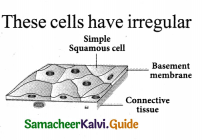
(i) Squamous epithelium :

  • It is made up of thin, flat cells with prominent nuclei. These cells have irregular boundaries and bind with neighbouring cells.
  • The squamous epithelium is also known as pavement membrane, which forms the delicate lining of the buccal cavity, alveoli of lungs, proximal tubule of kidneys, blood vessels etc.
  • It protects the body from mechanical injury, drying and invasion of germs.
    Samacheer Kalvi 9th Science Guide Chapter 18 Organization of Tissues 7

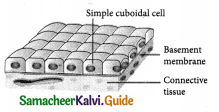
(ii) Cuboidal epithelium:

  • It is composed of single layer of cubical cells.
  • The nucleus is round and lies in the centre.
  • This tissue is present in the thyroid vesicles, salivary glands, sweat glands, exocrine pancreas.
  • It is also found in the intestine and tubular part of the nephron (kidney tubules) as microvilli that increase the absorptive surface area.
  • Their main function is secretion and absorption.
    Samacheer Kalvi 9th Science Guide Chapter 18 Organization of Tissues 8

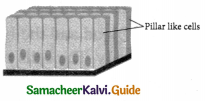
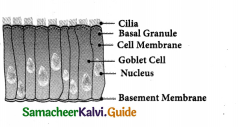
(iii) Columnar epithelium:

  • It is composed of a single layer of slender, elongated and pillar like cells.
  • Their nuclei are located at the base.
  • It is found lining the stomach, gall bladder, bile duct, small intestine, colon, oviducts and forms a mucous membrane. ‘
  • They are mainly involved in secretion and absorption.
    Samacheer Kalvi 9th Science Guide Chapter 18 Organization of Tissues 9

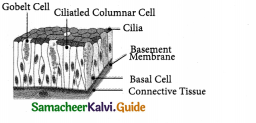
(iv) Ciliated epithelium :

  • Certain columnar cells bear numerous delicate hair like out growths called ilia and are called ciliated epithelium.
  • Their function is to move particles or mucus in a specific direction over the epithelium.
  • It is seen in the trachea of wind-pipe, bronchioles of respiratory tract, kidney tubules and fallopian tubes of oviducts.
    Samacheer Kalvi 9th Science Guide Chapter 18 Organization of Tissues 10

(v) Glandular epithelium :

  • Epithelial cells are often modified to form specialized gland cells which secrete chemical substances at the epithelial surface.
  • This lines the gastric glands, pancreatic tubules and intestinal glands.
    Samacheer Kalvi 9th Science Guide Chapter 18 Organization of Tissues 11

Question 4.
Explain the components of phloem tissue.
Answer:
Phloem is a complex tissue and consists of the following elements :
(i) Sieve elements
(ii) Companion cells
(iii) Phloem fibres
(iv) Phloem parenchyma

(i) Sieve elements :

  • The conducting elements of phloem are collectively called as Sieve elements.
  • Sieve tubes are elongated, tube-like slender cells placed end to end. The transverse walls at the ends are perforated and are known as sieve plates.
  • The main function of sieve tubes is translocation of food, from leaves to the storage organs of the plants.

(ii) Companion cells : These are elongated cells attached to the lateral wall of the sieve tubes. A companion cell may be equal in length to the accompanying sieve tube element or the mother cell may be divided transversely forming a series of companion cells.

(iii) Phloem parenchyma : The phloem parenchyma are living cells which have cytoplasm and nucleus. Their function is to store food materials.

(iv) Phloem fibers : Sclerenchymatous cells associated with primary and secondary phloem are commonly called phloem fibers. These cells are elongated, lignified and provide mechanical strength to the plant body.

 Samacheer Kalvi 9th Science Guide Chapter 18 Organization of Tissues

Question 5.
Write a note on blood and its components.
Answer:
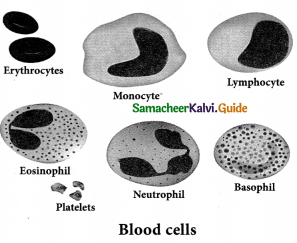
Blood is a fluid connective tissue.
Blood contains corpuscles which are red blood cells (erythrocytes), white blood cells (leucocytes) and platelets. In this fluid connective tissue, the blood cells move in a fluid matrix called. The plasma contains inorganic salts and organic substances. It is a main circulating fluid that helps in the transport of nutrient substances.

Red blood corpuscles (Erythrocytes):

  • The red blood corpuscles are oval shaped, circular, biconcave disc-like and lack nucleus when mature (mammalian RBC).
  • They contain a respiratory pigment called haemoglobin which is involved in the transport of oxygen to tissues.

White blood corpuscles (Leucocytes): They are larger in size, contain distinct nucleus and are colourless. They are capable of amoeboid movement and play an important ‘ role in body’s defense mechanism. WBC’s are of two types :
(i) Granulocytes.
(ii) Agranulocytes.

(i) Granulocytes have irregular shaped nuclei and cytoplasmic granules. They include the neutrophils, basophils and eosinophils. Agranulocytes lack cytoplasmic granules and include the lymphocytes and monocytes.

Blood platelets : They are minute, anucleated, fragile fragments of giant bone marrow called mega karyocytes They play an important role in blood clotting mechanism.
Samacheer Kalvi 9th Science Guide Chapter 18 Organization of Tissues 12

VIII. Higher Order Thinking Skills :

Question 1.
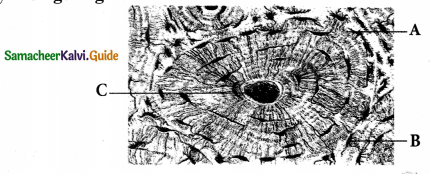
Identify the figure given below
Samacheer Kalvi 9th Science Guide Chapter 18 Organization of Tissues 13
(a) Label the parts A, B and C.
(b) What is the chemical composition of the tissue?
Answer:
(a) T.S. of Bone
(A) Lamellae
(B) Lacunae
(C) Central (Haversian canal)
(b) The matrix of the bone is rich in calcium salts and collagen fibres which gives the bone its strength.
(c) C – Haversian canal

 Samacheer Kalvi 9th Science Guide Chapter 18 Organization of Tissues

Question 2.
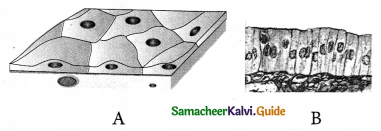
Identify figures A and B.
Samacheer Kalvi 9th Science Guide Chapter 18 Organization of Tissues 14
(a) …………… epithelium forms the outer lining of the buccal cavity.
(b) ………………. epithelium consist of ceils that are tall and pillar-like.
(c) Which one allows diffusion of substances?
(d) Which is called pavement epithelium?
(e) Which epithelium lines the gastrointestinal tract and epiglottis?
Answer:
Figure A – Squamous Epithelium
Figure B. – Glandular epithelium
(a) Squamous
(b) Columnar
(c) Columnar epithelium
(d) Squamous epithelium
(e) Columnar epithelium

Question 3.
If cell (A) has undergone one mitotic division and another cell (B) has completed its meiotic division. The number of cells produced in A and B would be
Cell A: Cell B :
Answer:
Cell A : 2 daughter cells.
Cell B : 4 daughter cells.

Question 4.
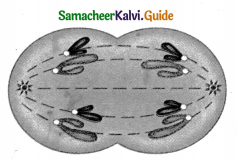
Identify the stage of mitosis from the below picture. List the chromosomal events in this stage.
Samacheer Kalvi 9th Science Guide Chapter 18 Organization of Tissues 15

Answer:
Mitotic anaphase
(i) The centromeres attaching the two chromatids divide and the two daughter chromatids of each chromosome separate and migrate towards the two opposite poles.
(ii) The migration of the daughter chromosomes is achieved by the contraction of spindle fibres.

 Samacheer Kalvi 9th Science Guide Chapter 18 Organization of Tissues

Question 5.
Identify the following relationship
Cuboidal : Epithelial
Cardiac : ………..
Granulocytes : …………
Osteocytes : ………….
Answer:
Cardiac : Muscular
Granulocytes : Blood cells
Osteocytes : Bone cells

Question 6.
Umbilical cord blood is collected at the time of child birth and stored in stem cell banks? Reason out.
Answer:

  • Umbilical cord blood consists of stem cells, they are undifferentiated cells which undergo unlimited divisions and give rise to one or more different types of cells. – Embryonic stem cells differentiate into different tissues and organs.
  • Stem cells can be used in the treatment of certain degenerative diseases in future.

Question 7.
How do WBC help in defence?
Answer:
They are capable of amoeboid movement and play an important role. They engulf or destroy foreign bodies.

Samacheer Kalvi 11th English Guide Prose Chapter 4 Tight Corners

Tamilnadu State Board New Syllabus Samacheer Kalvi 11th English Guide Pdf Prose Chapter 4 Tight Corners Text Book Back Questions and Answers, Summary, Notes.

Tamilnadu Samacheer Kalvi 11th English Solutions Prose Chapter 4 Tight Corners

11th English Guide Tight Corners Text Book Back Questions and Answers

I. Choose the most appropriate answer for the following questions:

Question a.
‘Tight Corner’ means a _______.
i. difficult situation
ii. crowded corner
iii. tragic incident
iv. fierce fight
Answer:
i. difficult situation

Question b.
Barbizon refers to a _______.
i. kind of paint
ii. type of architecture
iii. region in Britain
iv. French school of painters
Answer:
i. kind of paint

Question c.
The narrator visited the sale-room as he _______.
i. wished to see an auction
ii. had a painting to sell
iii. was persuaded by his friend
iv. wanted to buy a painting
Answer:
iii. was persuaded by his friend

Question d.
The narrator had been a safe contributor at the auction, as _______.
i. there were bidders quoting higher prices
ii. he had a sound financial background
iii. his friend had lent him money
iv. he did not make any bidding
Answer:
i. there were bidders quoting higher prices

Question e.
“And I got it.” Here ‘it’ refers to the _______.
i. picture he wanted to buy
ii. money he asked for
iii. card to participate in the auction
iv. amount he had to pay
Answer:
ii. money he asked for

Samacheer Kalvi 11th English Guide Prose Chapter 4 Tight Corners

2. Answer the following questions:

Question a.
What is a tight corner? What happens when one finds oneself in a tight corner?
Answer:
Tight corner refers to the difficult or critical situation that one faces in his life. The person who finds himself in a tight corner becomes stressful both physically and mentally.

Question b.
What is the difference between a physical and mental tight comer?
Answer:
A physical tight corner is something which is visualized in person on spot. One can overcome this if he has extreme courageousness. Mental tight corner affects the whole system of a man as his mind is filled with stress till he comes out of it. In fact, it is more dangerous than physically tight corner.

Question c.
Why did the narrator visit Christie’s?
Answer:
The narrator visited Christie’s as his friend persuaded him to see the auction inside.

Question d.
The narrator heard his own voice saying,” and fifty”.What does this suggest?
Answer:
The narrator without his knowledge and any understanding of the situation said, ‘and forty’.

Question e.
What was the narrator’s financial condition?
Answer:
The narrator had exactly sixty-three pounds in the bank and he did not have securities even for five hundred pounds.

Samacheer Kalvi 11th English Guide Prose Chapter 4 Tight Corners

Question f.
The narrator could not pretend to have made a mistake in bidding. Why?
Answer:
The narrator could not pretend to have made a mistake in bidding because already he made many biddings earlier which made others think of him as a bloatocrat. Moreover, a genuine mistake of such a kind would have been rectified at once.

Question g.
What could have been the best way for the narrator, to get himself out of the tight comer?
Answer:
The best way for the narrator to get himself out of the tight corner was to confess his poverty to one of Christie’s staff and having the picture put up again.

Question h.
Why did the narrator feel he could have welcomed a firing party?
Answer:
It was his thought of bidding for fun which made him get caught in a tight corner. If he welcomed a firing party that would bring his death and he need not be humiliated in front of others.

Question i.
What was the bidder’s offer to the narrator?
Answer:
The bidder’s offer was to give fifty guineas to the narrator.

Question j.
How did the narrator take advantage of the situation?
Answer:
The narrator took advantage of the situation by asking a hundred guineas from the bidder who offered four thousand guineas for big Daubigny.

Samacheer Kalvi 11th English Guide Prose Chapter 4 Tight Corners

Text Inside Questions:

Question a.
Describe the activity that was going on in the saleroom at king street.
Answer:
The place was full. They were selling Barbizon pictures and getting tremendous sums even for little bits of things.

Question b.
What can you say about the author’s attitude when he high – handedly participated in the auction?
Answer:
An author is a nonchalant person who tries to have some fun in his life. At the same time, he knows his limitations.

Question c.
Why was the author sure he would not be caught?
Answer:
The author decided to bid safely by just raising the stake a little bit and leave it for real millionaires to go ahead. Thus he was sure that he would not be caught.

Question d.
What made the author ignore his friend’s warning?
Answer:
The author ignored his friend’s warning just because he liked to have some fun and was sure that he was not going to run any risks.

Question e.
How had the author managed the auction without getting involved in the deal?
Answer:
Although many bids ended up in four figures, they were started with a modest price of fifty to a hundred guineas only. He ventured till the figures reached only upto three digits. Thus he managed the auction without getting involved in the deal.

Question f.
What came as a shock to the author?
Answer:
There was bidding for four thousand guineas and as usual, he added fifty guineas to it. But to his surprise, none of them bid more than that.

Samacheer Kalvi 11th English Guide Prose Chapter 4 Tight Corners

Question g.
What did the falling of the hammer indicate?
Answer:
The falling of the hammer indicated “closure of the bid” and it mandated the highest bidder to pay and collect his purchase.

Question h.
What made the friend laugh heartily?
Answer:
The narrator had to pay four thousand and fifty guineas for his bidding. In reality, he had only sixty-three pounds. This made his friend laugh heartily.

Question i.
What kind of excuses did the narrator think he could make?
Answer:
The author speculated on the possibility of confessing his poverty to one of Christie’s staff and request to put up the picture for sale once again.

Question j.
Why did the friend desert the narrator, a second time?
Answer:
The narrator was standing on the outskirts of the little knot of buyers to pay the amount and get the picture. His friend who joined the narrator had a look at his face and could not control his laughter. Thus he deserted the narrator, a second time.

Question k.
How does the narrator describe the man who approached him?
Answer:
The man was a messenger of the high gods who wore a green baize apron and spoke in husky cockney tones.

Question l.
How does the Narrator show the presence of mind in the sudden turn of events?
Answer:
The man who bid for the picture first was ready to pay fifty guineas to the narrator. At that moment the narrator asked for a hundred guineas which shows his presence of mind.

Question m.
The narrator would not forget two things about his friend What are they?
Answer:
The author’s friend only persuaded him to go to Christie’s auction. Secondly, he was the only witness to the author ’s mental agony in trying to get out of the crisis.

Samacheer Kalvi 11th English Guide Prose Chapter 4 Tight Corners

3. Form a meaningful summary of the lesson by rewriting the numbers in the correct sequence:

  1. The narrator had only 63 pounds with him and did not know how to manage the situation
  2. The narrator thought of all his relations from whom he could borrow
  3. Unfortunately, he had made the highest bid.
  4. The narrator entered Christie’s as his friend persuade him to visit the sale-room.
  5. Every time someone else made a higher bid and the narrator was not caught.
  6. The narrator on a sudden impulse added 50 more guineas, to the amount offered.
  7. His friend joined him then but left immediately unable to control his laughter.
  8. He even thought of borrowing from moneylenders and confessing the truth to the staff at Christie’s.
  9. The picture was declared sold to the narrator.
  10. After some time a picture was put up and a bid for 4000 guineas was a raise
  11. A sudden stroke of luck befell the narrator when he heard that the agent who had made the bid of 4000 guineas and buy the picture.
  12. The narrator kept bidding just for fun.
  13. The picture was given away to the other bidder and the narrator was saved from humiliation.
  14. His friend had left the place roaring with laughter at the narrator’s predicament.
  15. The narrator was quite happy at the offer but demanded 100 guineas instead of the 50. Now there was no need for him to make any payment.

Answers:

  1. 8
  2. 10
  3. 6
  4. 1
  5. 5
  6. 4
  7. 12
  8. 11
  9. 7
  10. 3
  11. 13
  12. 2
  13. 15
  14. 9
  15. 14

Samacheer Kalvi 11th English Guide Prose Chapter 4 Tight Corners

4. Answer the following questions in a paragraph of about 100-150 words:

Question a.
Narrate the circumstances that led to the narrator getting into a tight corner, by his own folly.
Answer:
Lucas learned that an auction was in progress. His friend suggested that they peeped in, to watch the fun. Despite the caution from his friend, he started bidding at moderate rates. He had only 63 pounds in his account. A bidder was supposed to have a minimum of 500 pounds to take part in the bid. As bidding for most of the paintings were started with two or three digits in guineas, the author sailed through raising the stakes of many paintings and staying behind watching millionaires bid with higher prices. But one painting viz big Daubigny was launched at an offer price of 4000 Guineas.

Only one bidder showed interest. The rest were in silence. The author heard himself say “and fifty”. After seconds of uncomfortable silence, the dealer banged the hammer indicating the acceptance of the narrator’s offer of 4050 guineas for the painting. It was only then the narrator realized that he was in a tight comer. He wished a firing squad would be welcomed to eliminate him and put an end to his mental agony. He had no friend or relative or even money lenders who could extend him a loan to raise the money. He had got into a mess of his own choice.

“Auction houses run a rigged game. They know exactly how many people will be bidding on work and exactly who they are. In a gallery, works of art just need to pay. ”

Question b.
Trace the thoughts that went on in the mind of the narrator, when picture after picture was put up and sold at the auction.
Answer:
The narrator started bidding for fun and got into a difficult position of paying four thousand and fifty guineas for a picture which was useless for him. He had only sixty-three pounds with him and didn’t know how to pay for it.

He handed over his card to the clerk and without seeing the picture put for sale he, was thinking about the names of uncles and other persons from whom he might borrow money. He wondered of the money lenders who would as promissory notes.

He also thought of confessing his poverty to one of Christie’s staff and make them put up the picture again. All his thoughts ended in vain as the staff of Christie’s seemed unsympathetic and he was sure that they wouldn’t believe it to be a mistake.

Samacheer Kalvi 11th English Guide Prose Chapter 4 Tight Corners

Question c.
Explain how the narrator got out of the tight corner that he was in.
Answer:
When the author was perplexed beyond measure and was even ready to welcome a firing squad to bail him out of the current crisis, a divine chance presented itself to the narrator. The narrator had stupidly given an open bid to buy “big Daubigny” for 4050 guineas when he had only 63 pounds in his bank account.

However hard he tried, he could not recall the name of an “uncle” or a friend who could extend him a loan to cover the price of the painting. To delay disgrace, he was standing at the end of the queue of the successful bidders. Like a providential intervention, a mediator from the starting bidder who was ready to take the same painting for 4000 guineas enquired the narrator in a husky cockney tone if he was the gentleman who had bought, “big Daubigny”.

The narrator admitted it. To the narrator’s great relief, the mediator said the first bidder wanted to know if he would take 50 guineas for his interest. The author should have embraced him and wept for joy for bailing him out of a potential disgrace. But he made the best use of the opportunity exhibiting his guile, by asking him if that was the most he could offer. The mediator said that there was no harm in asking for some more. The narrator said he would take a hundred guineas. When the man left to find out the possibility both the author and his friend laughed.

But when the author saw the cheque for a hundred guineas, he became serious. He said with joy and shock, “of all the luck! well, I’m hanged”. Thus the narrator had a narrow escape from a tight comer. One could even say that the narrator escaped by the skin of his teeth.

“Call it a narrow escape, maybe it’s your lucky day. ”

Samacheer Kalvi 11th English Guide Prose Chapter 4 Tight Corners

Vocabulary:

Auction House Puzzler: (Text Book Page No. 111)

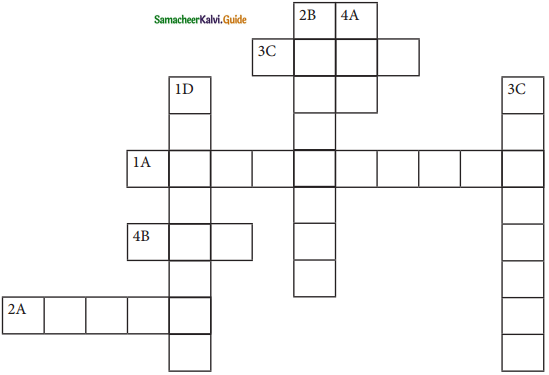
You have come across many terms associated with an auction, in the lesson. Now solve the crossword puzzle with words from the lesson. Make use of the clues given:

Samacheer Kalvi 11th English Guide Prose Chapter 4 Tight Corners 1
Across:

  1. conducts auction
  2. a protective garment
  3. strip with numbers
  4. offer

Down

  1. painter
  2. school of painting
  3. auction house
  4. painting

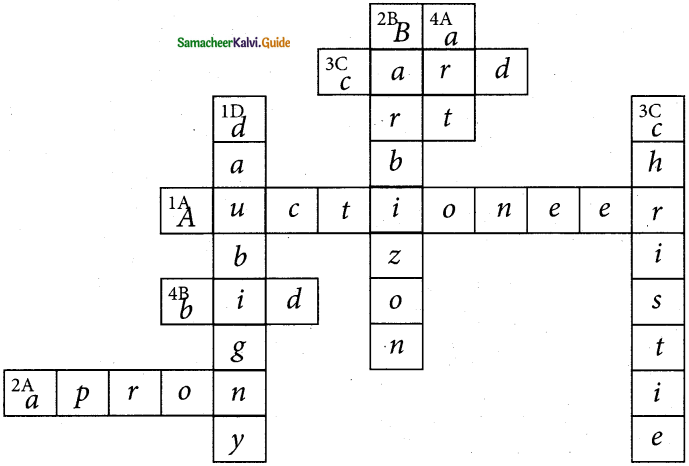
Answer:
Samacheer Kalvi 11th English Guide Prose Chapter 4 Tight Corners 2

Samacheer Kalvi 11th English Guide Prose Chapter 4 Tight Corners

Reading:

Read the following passage and answer the questions that follow:

The Stationmaster’s Supreme Sacrifice by Sanchari Pal (Adapted)

1. Thirty-three years ago, on the night of December 2, 1984, Bhopal was hit by a catastrophe that had no parallel in the world’s industrial history. An accident at the Union Carbide pesticide plant in Bhopal had released almost 30 tons of a highly toxic gas called methyl isocyanate, turning the city into a vast gas chamber.

The result was a nightmare; more than 600,000 people were exposed to the deadly gas cloud that left thousands dead and much more breathless, blind, and in agonizing pain. Few people know that during the Bhopal gas tragedy a heroic stationmaster risked his own life to save others.

2. On the evening of December 3, 1984, Ghulam Dastagir was settling down in his office to complete some pending paperwork. This work kept him in his office till lam in the night, when he emerged to check the arrival of the Gorakhpur Mumbai Express.

As he stepped on to the platform, the deputy stationmaster felt his eyes burn and a queer itching sensation in his throat. He did not know that poisonous fumes leaking from Union Carbide’s pesticide factory were stealthily enveloping the railway station.

3. Beginning to choke, Dastagir did not know then that twenty-three of his railway colleagues, including his boss, station superintendent Harish Dhurve, had already died. It was later reported that Dhurve had heard about the deadly gas and had immediately tried stopping the movement of trains passing through Bhopal before collapsing in his office chamber.

His suddenly worsening health and years of experience told Dastagirthat something was very wrong. Though he did not fully comprehend what was happening, he decided to act immediately when he did not get any response from the station master. He alerted the senior staff at nearby stations, like Vidisha and Itarsi, to suspend all train traffic to Bhopal.

4. However, the jam-packed Gorakhpur Kanpur Express was already standing at the platform and its departure time was 20 minutes away. Listening to his gut instinct, Dastagir summoned his staff and told them to immediately clear the train for departure. When they asked if they should wait until the order to do so came from the head office, Dastagir replied that he would take complete responsibility for the train’s early departure.

He wanted to ensure that the train left immediately, without any delay. His colleagues later recalled that Dastagir could barely stand and breathe as he spoke to them. Breaking all rules and without taking permission from anyone, he and his brave staff personally flagged off the train.

Samacheer Kalvi 11th English Guide Prose Chapter 4 Tight Corners

5. But Dastagir’s work was not done. The railway station was filling up with people, desperate to flee the fumes. Some were gasping, others were vomiting, and most were weeping. Dastagir chose to remain on duty, running from one platform to another, attending, helping, and consoling victims.

He also sent an SOS to all the nearby railway offices, asking for immediate medical help. As a result, four ambulances with paramedics and railway doctors arrived at the station. It was winter and the gas was staying low to the ground, a thick haze poisoning everything in its path.

Besieged by hordes of suffering people, the station soon resembled the emergency room of a large hospital. Dastagir stayed at the station, steadfastly doing his duty, knowing that his family was out there in the ill-fated city. That day all he had for his protection was a wet handkerchief on his mouth.

6. Ghulam Dastagir’s devotion to duty saved the lives of hundreds of people. However, the catastrophe didn’t leave him unscathed. One of his sons died on the night of the tragedy and another developed a lifelong skin infection.

Dastagir himself spent his last 19 years shuttling in and out of hospitals; he developed a painful growth in the throat due to prolonged exposure to toxic fumes. When he passed away in 2003, his death certificate mentioned that he was suffering from diseases caused as a direct result of exposure to MIC (Methyl Isocyanate) gas.

A memorial has been built at platform No.1 to pay tribute to those who sacrificed their lives in the line of duty on the fateful night of December 3, 1984. However, Ghulam Dastagir, who died later, is not one of them. A forgotten hero whose sense of duty and commitment saved countless lives, Dastagir’s story deserves to be recognized and remembered by our fellow countrymen.

Answer the following questions:

Question (i)
Why was the accident at union carbide unparalleled in the word’s industrial history?
Answer:
The accident was unparalleled in the world s Industrial history because it affected more than 600,000 people.

Question (ii)
How was Dastagir affected by the poisonous gas?
Answer:
He developed a painful growth in the throat due to prolonged exposure to toxic fumes.

Question (iii)
What was the action taken by the station superintendent?
Answer:
As soon as he heard about the deadly gas, he tried stopping the movement of trains through Bhopal.

Samacheer Kalvi 11th English Guide Prose Chapter 4 Tight Corners

ஆசிரியரைப் பற்றி:

எ.வே.லூக்காஸ் (1868-1938) ஒரு ஆங்கில நகைச்சுவை எழுத்தாளர், கட்டுரையாளர். நாடக ஆசிரியர், வாழ்க்கை வரலாற்று எழுத்தாளர், புத்தக வெளியீட்டாளர், கவிஞர், நாவலாசிரியர், சிறுகதை எழுத்தாளர், மற்றும் பத்திரிக்கை ஆசிரியர். லண்டன் புறநகர் பகுதியில் பிறந்தவர். தன் 16 வயதில் புத்தக விற்பனையாளரின் உதவியாளராக பணியாற்றியவர்.

பின்னர் பத்திரிக்கை துறையில் ஆர்வம் கொண்டு பிரிட்டனில் உள்ளூர் பத்திரிக்கையிலும், லண்டன் மாத இதழ் பத்திரிக்கையிலும் பணியாற்றினார். பெர்னார்ட் பார்ட்டன் என்ற குவாக்கர் கவிஞரின் வாழ்க்கை வரலாற்றை எழுத அவர் பணிக்கப்பட்டார்.

அதை சிறப்பாக எழுதியதால் சார்லஸ் லேம்பின் புத்தகங்களை மதிப்பிடும் வாய்ப்புக் கிடைத்தது. பின்பு இவர் 1904ல் பஞ்ச் என்ற இதழில் வாழ்நாள் முழுவதும் பணியாற்றினார். தன் சிறு கட்டுரைக்காக பிரபலமானார். பல பாடல்களையும், நாடகங்களையும் எழுதியுள்ளார்.

Samacheer Kalvi 11th English Guide Prose Chapter 4 Tight Corners

பாடச் சுருக்கம்:

இப்பாட பகுதியில் கதாசிரியர் தான் ஒரு இக்கட்டான சூழ்நிலையில் மாட்டிக் கொண்டு பின்னர் அதிலிருந்து எவ்வாறு தன் சாமர்த்தியத்தியத்தால் தப்பித்துக் கொள்கிறார் என்பதை தெளிவாக சொல்லியிருக்கிறார். தன் நண்பருடன் ஓவியங்களை ஏலம்விடும் இடத்திற்கு செல்கிறார்.

எல்லோரும் ஒவ்வொன்றாய் ஏலம்விட்டுக்கொண்டும், படங்களை வாங்கிக்கொண்டும் இருக்கையில் ஆசிரியர் விளையாட்டாக ஒரு ஓவியத்தை ஏலம் கேட்கிறார். ஆனால் இவரின் வங்கிக் கணக்கில் 63 பவுண்டுகள் மட்டுமே உள்ளது. ஆனால் விளையாட்டாக ஏலம் கேட்டிருக்கும் தொகையோ 4050 இனியாக்கள்.

விளையாட்டாக ஏலம் கேட்டு மாட்டிக் கொள்கிறார். இந்த சிக்கலாள தருனத்திலிருந்து தன் சமயோதித புத்திக்கூர்மையால் எப்படி இவர் இந்த இக்கெட்டான சூழ்நிலையில் இருந்து தன்னை காத்து கொள்கிறார் என்று இக்கட்டுரையில் விரிவாகக் காண்போம்.

Samacheer Kalvi 11th English Guide Prose Chapter 4 Tight Corners

Tight Corners Summary in Tamil

எங்கள் பேச்சி சிக்கலான நிலையில் மாட்டிக்கொள்ளும் நிகழ்வுகளைப்பற்றி ஓடிக்கொண்டிருந்தது, அதில் வாழத் தெரிந்தவர்கள் சாகசம் நிறைந்தவர்களாகவும் மற்றும் சமரசம் செய்ய தெரிந்தவர்களாகவும் இருப்பார்கள்.

ஒரு மனிதன் கடலோரப் பகுதியில் வடகிழக்கு France யில் பேரலையில் மாட்டிக்கொண்தாகவும், பின்பு சாமர்த்தியமாக தன் வலிமையினால் தப்பிவிட்டதாகவும் சொன்னார். மற்றொருவர் காயப்பட்ட புலியால் nதாக்கப்பட்டபோது யானையின் மீது இருந்தாக கூறினார்.

மூன்றாமவர் அவர் எரியும் வீட்டின் மூன்றாவது மாடியில் இருந்தார் எனவும் கூறினார். நான்காமவர் போரில் ஏவுகனையால் தாக்கப்பட்டார் எனவும் கூறினார்.

அவர்களில் ஒருவர் ஆனால் நீங்கள் எல்லோரும் உடல் ரீதியாக மாட்டிக்கொண்டவர்களை பற்றியே பேசுகிறீர்கள்”. கண்டிப்பாக அவர்கள் மனநிலையை விட உடல்நிலை இருக்கம் கொண்டவர்கள். நான் மிக மோசமான சிக்கலில் christies ல் இருந்தபோது சிக்கிக்கொண்டேன்”.

“Christie’s?” (க்ரைஸ்டீஸ்)

“ஆம். லண்டனில் பெரிதாக வணிகம் நடைபெறும் தெருவில் (St. Jame’s street) உள்ள எனது பழைய வெளிநாட்டு நண்பருடன் மதிய உணவு சாப்பிட்டேன், பின்னர் king streetயை கடந்தபோது, அவர் விற்பனை அறையை பார்வையிட என்னை வற்புறுத்தினார். அந்த இடம் மக்களால் நிறைந்து இருந்தது.

அவர்கள் Barbizon படங்களை விற்றனர், ஒவ்வொரு சிறு சிறு பொருட்களையும், படங்களையும் இரண்டாயிரம், மூவாயிரம் என நல்ல விலைக்கு விற்றனர். அவற்றில், காட்டுப்படங்கள், மாலை நேரத்து குளங்கள், மெய்ப்பர் ஆடுமேய்க்கும் சிறுவன் மற்றும் எப்போதும் போல உள்ள சாதாரன தலைப்பிலான படங்கள் இருந்தன.

Samacheer Kalvi 11th English Guide Prose Chapter 4 Tight Corners

எந்த ஏலமும் மூன்று இலக்க எண்களுக்கு மேல் ஏலத்திற்கு போகவில்லை. நான் வேடிக்கையாக ஏலத்தை கேட்டேன். என்னிடம் அறுபத்தி மூன்று பவுண்ட் மட்டுமே வங்கியில் இருந்தது. ஐந்நூறு பவுண்ட கடன் பெற நான் ஒரு பெரிய பணக்காரர் (bloatocrat) போல ஏல விற்பணையாளருடன் தலையை ஆட்டினேன்.

நீ கண்டிப்பாக மாட்டிக் கொள்வாய், என் நண்பன் என்னிடம் கூறினான் “இல்லை, நான் மாட்டிக்கொள்ள மாட்டேன்,” என்று கூறினேன். நான் எந்த விதமான இடர்களுக்கும் உள்ளாகமாட்டேன்” என்று நான் சொன்னேன்.

“நீண்ட நேரம் நான் சிக்கல் ஒன்றிலும் மாட்டிக்கொள்ளவில்லை ஒன்றும் செய்யவில்லை. பின்னர் ஒரு ஓவியத்தை ஏலத்திற்கு கொண்டுவந்தது வைத்தார்கள். சிவப்பு முகத்தை கொண்ட தொப்பியை அணிந்திருந்த ஒரு புதிய மனிதர் ஒரு படத்தை ஏலத்திற்காக முன்னே வைத்தார். யாரும் கேட்க இயலாத விலையை ஓவியத்திற்கு கேட்டு அனைவரையும் வியப்பில் ஆழ்த்தினர்.

முந்தைய ஏலம் (lots) நான்கு இலக்கங்களில் விற்கப்பட்டிருந்தாலம் ஐம்பது அல்லது நூறு Guineas என்று தொடங்கி, நான்கிலக்க எண்ணைத் தொட்டது. சிறப்பான முடிவை (crescendo) நோக்கி நான் அடிக்கடி பாதுகாப்பாக பங்களித்தேன். ஆனால் சிறிது நேரத்தில் புதியப்படம் வைக்கப்பட்டவுடன் வியாபாரி பரப்பரப்பாக ஆரம்பத் தொகையாக “நான்கு ஆயிரம் Guineas” என்று கூறினார்.

Samacheer Kalvi 11th English Guide Prose Chapter 4 Tight Corners 3

மிகுந்த சலசலப்பான உற்சாக ஒலி எழுந்தது. முடிவில் என் குரல் கூறியது, ”ஐம்பது!”. ஆழ்ந்த அமைதி நிலவியது. அப்போது ஏல அறிவிப்பாளர் ஏலத்தொகையை கேட்டவரையும் பின்பு எல்லோரையும் பார்த்தார்.

வியப்புடனும், அதிர்ச்சியுடனும் சிவப்பு முகம் வியாபாரி உயிரற்றவர் போல் தோன்றினார். அவர் தன்னுடைய பலத்தை பயன்படத்தியிருக்கிறார் என்று இப்போது நான் உணர்ந்தேன்.

“நான்கு ஆயிரத்து ஐம்பது Guineas வழங்கப்படும்”, திரும்பவும் அறையை நோட்டமிட்டுக்கொண்டு ஏலம் விடுபவர் கூறினார்.

எனது இதயதுடிப்பு நின்றது. இரத்தம் உறைந்தது (congealed). எந்த சத்தமும் இன்றி என் நண்பனின் கட்டுப்படுத்தப்பட்ட (smothered) சத்தம் மட்டுமே கேட்டது.

“நான்கு ஆயிரத்து ஐம்பது Guineas” நான்காயிரத்து ஐம்பதிற்கு ஏதாவது கேள்வி உண்டா ? பிறகு சுத்தியல் அடிக்கப்பட்டு ஏலம் முடிக்கப்பட்டது.

Samacheer Kalvi 11th English Guide Prose Chapter 4 Tight Corners

ஏல அறையின் உள்ளே இருக்க எனக்கு நெருக்கடியாக இருந்தது!, அறுபத்து மூன்று பவுன்டிற்கு நானூறு பவுன்ட் விலை மதிப்பு பெறாத எனக்கு பிடிக்காத அந்தப்படத்தை வேண்டாத, இந்நாளில் உயர்ந்த விலையான நான்காயிரத்து ஐம்பது guineas ற்கு வாங்கினேன்.

கனிவான ஆறுதல் பெற என் நண்பனை நோக்கி திரும்பினேன். நான் பார்த்தபோது என்னை தனியே விட்டு சென்றிருந்தான்; அந்த நிமிடம் பயந்தேன், ஆனால், என் நண்பன், தனிமையான இடத்தில் நின்று என் நிலையை பார்த்து சிரித்தான்.

நான் இதைக் கண்டு அதிர்ச்சியடைந்தேன். பணம் சேகரிப்பவரிடம் என் கார்டை ஒப்படைக்க நான் அங்கு இயல்பாக (nonchalantly) இருந்தேன். அடுத்து வரும் பிரச்சனையை சமாளிக்க நான் யோசித்தேன்- படங்கள் மேல் படங்கள் வந்து விற்பனை ஆகிறது .நான் எதையும் பார்க்கவில்லை.

நான் ஓடி சென்று கடன் வாங்க சாத்தியமாக இருக்குமென்று மாமாவின் (Uncles) பெயர் மனத்திரையுல் வருகிறதா எனப் பார்த்தேன். ஆனால் வரவில்லை. மறுபடியும் இப்படத்தை ஏலம் விட சாத்தியக்கூறு உள்ளதா? என வினவினேன். எனது ஏழ்மையை நான் Christies உள்ள ஒரு பணியாளரிடம் எடுத்துக்கூறினேன்.

அந்த படத்தை திரும்பவும் ஏலம் விட சொன்னேன். இதுதான் சிறந்த வழி – அனைத்து முயற்சியும் செய்தபிறகு நான் இந்த ஏலத்தை எவ்வாறு செய்ய போகிறேன், அந்த பணியாளர் வளமாக காட்சியளித்தாலும் இரக்கமற்றவர், இது ஒரு தவறு என்று யாரும் நம்பவில்லை. எத்தகைய தவறும் ஒரு நேரத்தில் சரி செய்யப்பட வேண்டும்.

சரியான நேரம் விற்பனை முடிவுக்கு வந்தது. நான் வியாபாரிகள் இருக்கும் வெளி இடத்திற்கு சென்றேன். அவர்கள் காசோலை எழுதிக்கொண்டும் வழிமுறைகள் சொன்னார்கள். எப்போதும் போல் நான்தான் கடைசி. அந்த நேரம் என் நண்பனுடன் சேர முயன்றேன், என்னை பார்த்தவுடன் அவன் கைக்குட்டையால் தன்முகத்தை மூடிக் கொண்டான்.

விதியின் படி நான் தனியாக விடப்பட்டேன் என் வாழ்நாளில் அதைபோல் முட்டாள்தனமாக நான் உணர்ந்ததில்லை. இரக்கமில்லாத மனிதரை பார்த்ததுமில்லை.

Samacheer Kalvi 11th English Guide Prose Chapter 4 Tight Corners

நேர்மையுள்ள வாழ்க்கையில் சில நேரங்களில் நல்லொழுக்கத்திற்கு அப்பால் வெகுமதிகள் பெற்றுள்ளது என்பதை உணர்ந்தேன். எனது காதில் ஒரு குரல் திடீரென சொன்னது, “மன்னித்துக் கொள்ளுங்கள், சார், நீங்கள் பெரிய மனிதர், பெரிய Daubigny படத்தை வாங்கிய சீமான் நீங்கள் தானே?”

“நான் தான் என்று ஒப்புக்கொண்டேன்”.

நன்று, நான்கு ஆயிரம் Guineas உங்களுக்கு அளித்தபெரிய மனிதர் உங்கள் ஏலத்தை ஐம்பது Guineasற்கு பெற்றுக் கொள்வீர்களா? என தெரிந்துகொள்ள நினைக்கிறார்.”

உயர்ந்த கடவுளின் தூதர் ஒரு கரடுமுரடான பச்சை கம்பளி மேலங்கி அணிந்து கொழகொழவென்ற Cockney குரலில் பேசினார். அவரை கட்டி தழுவி சந்தோசத்தில் நனைந்தேன். ஐம்பது Guineas எடுத்துகொண்டிருப்பேன். ஏன் நான் குறைந்த காசை (farthings எடுத்து) கொள்ள வேண்டும்.

”இது தான் கேட்கக் கூடிய அதிகபட்ச விலையா?” என்று கேட்டேன். “அவனிடம் சொல்லுங்கள் நான் நூறு எடுத்து கொள்கிறேன்”, நான் சொல்லி பிறகு பெற்றுக்கொண்டேன்.

என் நண்பனை நான் காணும் போது நானும் சிரித்து கொண்டிருந்தேன், ஆனால் அவன் அந்த காசோலை ‘ பார்த்தவுடன் மயங்கினான்”. “எல்லாம் அதிர்ஸ்டம். நல்லது நான் தொடங்குகிறேன்” என்றான்.

Samacheer Kalvi 11th English Guide Prose Chapter 4 Tight Corners

நான் அழைக்கவில்லையென்றால் நீ christies வந்திருக்க முடியாது என்பதை மறந்துவிடாதே” என்று நண்பன் சொன்னான், “நான் அதை மறக்க மாட்டேன்” என்று கூறினேன். “இது அழிக்கமுடியாத (indelibly) நெருப்பாக என் நெஞ்சில் இருக்கும். எனது முடி வெள்ளையாக மாறாது, பாருங்கள்?”

Samacheer Kalvi 11th Maths Guide Chapter 7 Matrices and Determinants Ex 7.4

Tamilnadu State Board New Syllabus Samacheer Kalvi 11th Maths Guide Pdf Chapter 7 Matrices and Determinants Ex 7.4 Text Book Back Questions and Answers, Notes.

Tamilnadu Samacheer Kalvi 11th Maths Solutions Chapter 7 Matrices and Determinants Ex 7.4

Question 1.
Find the area of the triangle whose vertices are (0, 0), (1, 2) and (4, 3)

Answer:
The given points are (0, 0), (1, 2) and (4, 3)
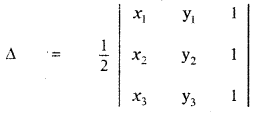
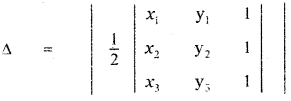
Area of the triangle with vertices
(x1, y1), (x2, y2) and (x3, y3) is
Samacheer Kalvi 11th Maths Guide Chapter 7 Matrices and Determinants Ex 7.4 1
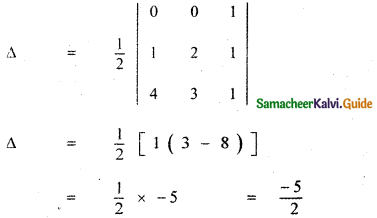
∴ The area of the triangle with vertices
(0, 0), (1, 2) and (4, 3) is
Samacheer Kalvi 11th Maths Guide Chapter 7 Matrices and Determinants Ex 7.4 2
Area cannot be negative. Taking positive value, we have
Required area Δ = \(\frac{5}{2}\) sq.units.

Samacheer Kalvi 11th Maths Guide Chapter 7 Matrices and Determinants Ex 7.4

Question 2.
If (k, 2), (2, 4) and (3, 2) are vertices of the triangle of area 4 square units then determine the value of k.
Answer:
Given Area of the triangle with vertices (k, 2), (2, 4) and (3, 2) is 4 square units.
The area of the triangle with vertices
(x1, y1) , (x2, y2) and (x3, y3) is
Samacheer Kalvi 11th Maths Guide Chapter 7 Matrices and Determinants Ex 7.4 3
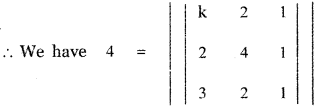
Given Δ = 4, (x1, y1) = (k , 2), (x2, y2) = (2 , 4) and (x3, y3) = (3 , 2)
Samacheer Kalvi 11th Maths Guide Chapter 7 Matrices and Determinants Ex 7.4 4
± 4 = k(4 – 2) – 2 (2 – 3) + 1(4 – 12)
± 4 = k × 2 – 2 × – 1 – 8
± 4 = 2k + 2 – 8
± 4 = 2k – 6
2k – 6 = 4 or 2k – 6 = -4
2k = 4 + 6 or 2k = – 4 + 6
2k = 10 or 2k = 2
k = 5 or k = 1
Required values of k are 1, 5.

Samacheer Kalvi 11th Maths Guide Chapter 7 Matrices and Determinants Ex 7.4

Question 3.
Identify the singular and non – singular matrices.
(i) \(\left[ \begin{matrix} 1 & 2 & 3 \\ 4 & 5 & 6 \\ 7 & 8 & 9 \end{matrix} \right] \)
(ii) \(\left[ \begin{matrix} 2 & -3 & 5 \\ 6 & 0 & 4 \\ 1 & 5 & -7 \end{matrix} \right] \)
(iii) \(\left[ \begin{matrix} 0 & a\quad -\quad b & k \\ b-\quad a & 0 & 5 \\ -k & -5 & 0 \end{matrix} \right] \)
Answer:
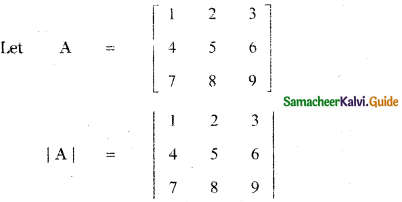
(i) \(\left[ \begin{matrix} 1 & 2 & 3 \\ 4 & 5 & 6 \\ 7 & 8 & 9 \end{matrix} \right] \)
Samacheer Kalvi 11th Maths Guide Chapter 7 Matrices and Determinants Ex 7.4 5
|A| = 1 (45 – 48) – 2(36 – 42) + 3(32 – 35)
|Al = – 3 – 2 × – 6 + 3 × – 3
|A| = – 3 + 12 – 9
|A| = – 12 + 12 = 0
∴ A is a singular matrix.

Samacheer Kalvi 11th Maths Guide Chapter 7 Matrices and Determinants Ex 7.4

(ii) \(\left[ \begin{matrix} 2 & -3 & 5 \\ 6 & 0 & 4 \\ 1 & 5 & -7 \end{matrix} \right] \)
Answer:
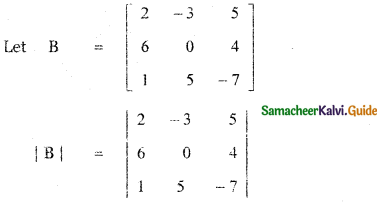
Samacheer Kalvi 11th Maths Guide Chapter 7 Matrices and Determinants Ex 7.4 6
|B| = 2(0 – 20) + 3 (- 42 – 4) + 5(30 – 0)
|B| = -40 + 3 × – 46 + 150
|B| = -40 – 138 + 150
|B| = -178 + 150 ≠ 0
∴ B is non singular.

(iii) \(\left[ \begin{matrix} 0 & a\quad -\quad b & k \\ b-\quad a & 0 & 5 \\ -k & -5 & 0 \end{matrix} \right] \)
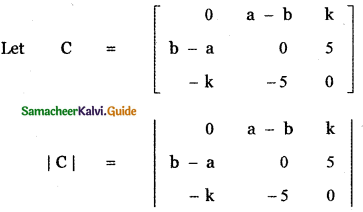
Samacheer Kalvi 11th Maths Guide Chapter 7 Matrices and Determinants Ex 7.4 7
|C| = 0 – (a – b) (0 + 5k) + k(-5 (b – a) – 0)
|C| = -5k (a – b) – 5k (b – a)
|C| = -5k (a – b) + 5k(a – b)
|C| = o
∴ C is a singular matrix.

Samacheer Kalvi 11th Maths Guide Chapter 7 Matrices and Determinants Ex 7.4

Question 4.
Determine the values of a and b so that the following matrices are singular:
(i) A = \(\left[ \begin{matrix} 7 & 3 \\ -2 & a \end{matrix} \right] \)
(ii) B = \(\left[ \begin{matrix} b\quad -\quad 1 & 2 & 3 \\ 3 & 1 & 2 \\ 1 & -2 & 4 \end{matrix} \right] \)
Answer:
(i) A = \(\left[ \begin{matrix} 7 & 3 \\ -2 & a \end{matrix} \right] \)
|A| = \(\left[ \begin{matrix} 7 & 3 \\ -2 & a \end{matrix} \right] \)
|A| = 7a + 6
Given that A is singular
∴ |A| = 0
7a + 6 = 0 ⇒ a = \(\frac{-6}{7}\)

(ii) B = \(\left[ \begin{matrix} b\quad -\quad 1 & 2 & 3 \\ 3 & 1 & 2 \\ 1 & -2 & 4 \end{matrix} \right] \)
|B| = \(\left[ \begin{matrix} b\quad -\quad 1 & 2 & 3 \\ 3 & 1 & 2 \\ 1 & -2 & 4 \end{matrix} \right] \)
= (b – 1 )(4 + 4) – 2(12 – 2) + 3(- 6 – 1)
= 8 (b – 1) – 20 – 21
= 8b – 8 – 41
|B| = 8b -49
Given that B is singular
∴ |B| = 0
8b – 49 = 0 ⇒ b = \(\frac{49}{8}\)

Samacheer Kalvi 11th Maths Guide Chapter 7 Matrices and Determinants Ex 7.4

Question 5.
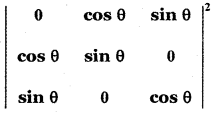
If cos 2θ = 0, determine
Samacheer Kalvi 11th Maths Guide Chapter 7 Matrices and Determinants Ex 7.4 8
Answer:
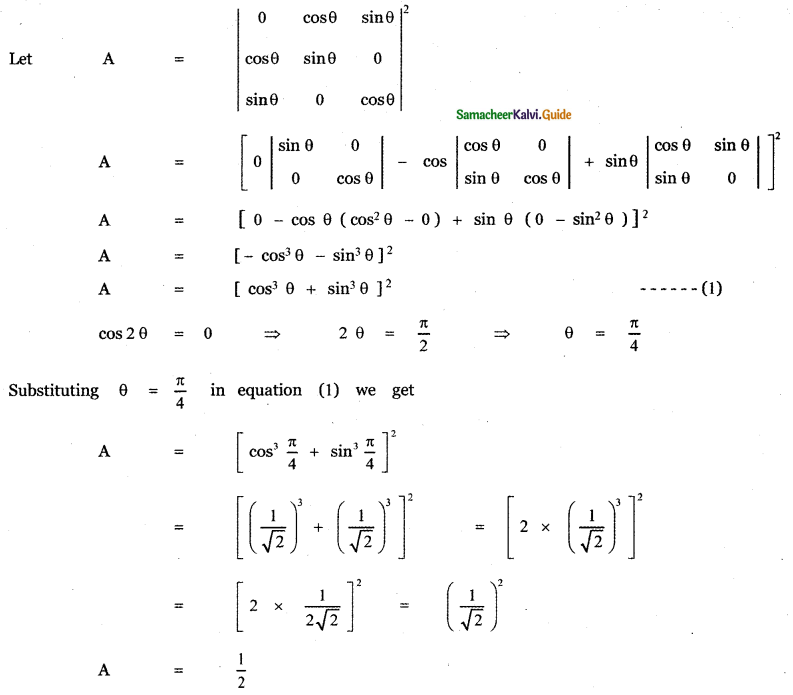
Given cos 2θ = 0
Samacheer Kalvi 11th Maths Guide Chapter 7 Matrices and Determinants Ex 7.4 9

Samacheer Kalvi 11th Maths Guide Chapter 7 Matrices and Determinants Ex 7.4

Question 6.
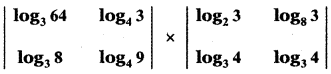
Find the value of the product
Samacheer Kalvi 11th Maths Guide Chapter 7 Matrices and Determinants Ex 7.4 10
Answer:
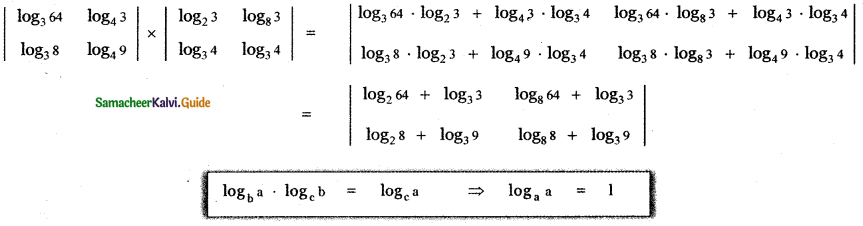
Samacheer Kalvi 11th Maths Guide Chapter 7 Matrices and Determinants Ex 7.4 11
Samacheer Kalvi 11th Maths Guide Chapter 7 Matrices and Determinants Ex 7.4 12

Samacheer Kalvi 11th Maths Guide Chapter 7 Matrices and Determinants Ex 7.3

Tamilnadu State Board New Syllabus Samacheer Kalvi 11th Maths Guide Pdf Chapter 7 Matrices and Determinants Ex 7.3 Text Book Back Questions and Answers, Notes.

Tamilnadu Samacheer Kalvi 11th Maths Solutions Chapter 7 Matrices and Determinants Ex 7.3

Solve the following problems by using Factor Theorem:

Samacheer Kalvi 11th Maths Guide Chapter 7 Matrices and Determinants Ex 7.3

Question 1.
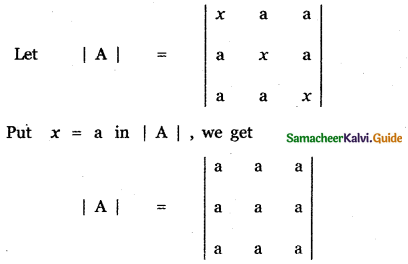
Show that \(\left| \begin{matrix} x & a & a \\ a & x & a \\ a & a & x \end{matrix} \right| \) = (x – a)2 (x + 2a)
Answer:
Samacheer Kalvi 11th Maths Guide Chapter 7 Matrices and Determinants Ex 7.3 1
By putting x = a , we have three rows of |A| are identical. Therefore (x – a)2 is a factor of |A|
Put x = – 2a in |A|
Samacheer Kalvi 11th Maths Guide Chapter 7 Matrices and Determinants Ex 7.3 2
∴ x + 2a is a factor of |A|. The degree of the product of the factors (x – a)2 (x + 2a) is 3.
The degree of tfie product of the leading diagonal elements x . x . x is 3.
∴ The other factor is the contant factor k.

Samacheer Kalvi 11th Maths Guide Chapter 7 Matrices and Determinants Ex 7.3 3
a3 [ – 1 (1 – 1) – 1 ( – 1 – 1) + 1 (1 + 1)] = k . 4a3
a3 [o + 2 + 2 ] = 4 ka3
4a3 = 4 ka3
k = 1
Samacheer Kalvi 11th Maths Guide Chapter 7 Matrices and Determinants Ex 7.3 4


Samacheer Kalvi 11th Maths Guide Chapter 7 Matrices and Determinants Ex 7.3

Question 2.
Show that \(\left| \begin{matrix} b\quad +\quad c & a\quad -\quad c & a\quad -\quad b \\ b\quad -\quad c & c\quad +\quad a & b\quad -\quad a \\ c\quad -\quad b & c\quad -\quad a & a\quad +\quad b \end{matrix} \right| \) = 8 abc
Answer:
Samacheer Kalvi 11th Maths Guide Chapter 7 Matrices and Determinants Ex 7.3 5
Samacheer Kalvi 11th Maths Guide Chapter 7 Matrices and Determinants Ex 7.3 6
since two columns identical
= bc × 0 = 0
∴ a – 0 is a factor. That is, a is a factor.
Put b = 0 in |A|
Samacheer Kalvi 11th Maths Guide Chapter 7 Matrices and Determinants Ex 7.3 7
since two columns identical
= ca × 0 = 0
∴ b – 0 is a factor. That is, a is a factor.
Put c = 0 in |A|
Samacheer Kalvi 11th Maths Guide Chapter 7 Matrices and Determinants Ex 7.3 8

Samacheer Kalvi 11th Maths Guide Chapter 7 Matrices and Determinants Ex 7.3

since two columns identical
= ab × 0 = 0
∴ c – 0 is a factor. That is, c is a factor.
The degree of the product of the factors abc is 3.
The degree of the product of leading diagonal elements (b + c) (c + a) (a + b) is 3.
∴ The other factor is the constant factor k.
Samacheer Kalvi 11th Maths Guide Chapter 7 Matrices and Determinants Ex 7.3 9

Samacheer Kalvi 11th Maths Guide Chapter 7 Matrices and Determinants Ex 7.3

Question 3.
Solve that \(\left| \begin{matrix} x\quad +\quad a & b & c \\ a & x\quad +\quad b & c \\ a & b & x\quad +\quad c \end{matrix} \right| \) = 0
Answer:
Samacheer Kalvi 11th Maths Guide Chapter 7 Matrices and Determinants Ex 7.3 10
Put x = 0
Samacheer Kalvi 11th Maths Guide Chapter 7 Matrices and Determinants Ex 7.3 11
x = 0 satisfies the given equation. x = 0 is a root of the given equation, since three rows are identical. x = 0 is a root of multiplicity 2. Since the degree of the product of the leading diagonal elements (x + a) (x + b) (x + c) is 3. There is one more root for the given equation.
Put x = – (a + b + c)
Samacheer Kalvi 11th Maths Guide Chapter 7 Matrices and Determinants Ex 7.3 12
∴ x = – (a + b + c) satisfies the given equation.
Hence, the required roots of the given equation are x = 0, 0 , – (a + b + c)

Samacheer Kalvi 11th Maths Guide Chapter 7 Matrices and Determinants Ex 7.3

Question 4.
Show that \(\left| \begin{matrix} b\quad +\quad c & a & { a }^{ 2 } \\ c\quad +\quad a & b & { b }^{ 2 } \\ a\quad +\quad b & c & { c }^{ 2 } \end{matrix} \right| \) = (a + b + c) (a – b) (b – c) (c – a)
Answer:
Samacheer Kalvi 11th Maths Guide Chapter 7 Matrices and Determinants Ex 7.3 13
Since two rows are idenctical
|A| = 0
since two rows are idenctical
|A| = 0
∴ a – b is a factor of | A |. The given determinant is in cyclic symmetric form in a , b and c. Therefore, b – c and c – a are also factors. The degree of the product of the factors (a – b) (b – c) (c – a) is 3 and the degree of the product of the leading diagonal elements (b + c) . b . c2 is 4.
Therefore, the other factor is k (a + b + c).
Samacheer Kalvi 11th Maths Guide Chapter 7 Matrices and Determinants Ex 7.3 14
5(18 – 12) – 1(36 – 12) + 1(12 – 6) = 12k
5 × 6 – 24 + 6 = 12k
30 – 24 + 6 = 12k
12 = 12 ⇒ k = 1
Samacheer Kalvi 11th Maths Guide Chapter 7 Matrices and Determinants Ex 7.3 15

Samacheer Kalvi 11th Maths Guide Chapter 7 Matrices and Determinants Ex 7.3

Question 5.
Solve \(\left| \begin{matrix} 4\quad -\quad x & 4\quad +\quad x & 4\quad +\quad x \\ 4\quad +\quad x & 4\quad -\quad x & 4\quad +\quad x \\ 4\quad +\quad x & 4\quad +\quad x & 4\quad -\quad x \end{matrix} \right| \) = 0
Answer:
Samacheer Kalvi 11th Maths Guide Chapter 7 Matrices and Determinants Ex 7.3 16
Put x = 0
Samacheer Kalvi 11th Maths Guide Chapter 7 Matrices and Determinants Ex 7.3 17
∴ x = 0 satisfies the given equation. Hence x = 0 is a root of the given equation. since three rows are identical, x = 0 is a root of multiplicity 2.

Since the degree of the product of the leading diagonal elements (4 – x) (4 – x) (4 – x) is 3. There is one more root for the given equation.
Samacheer Kalvi 11th Maths Guide Chapter 7 Matrices and Determinants Ex 7.3 18
Samacheer Kalvi 11th Maths Guide Chapter 7 Matrices and Determinants Ex 7.3 19
∴ x = – 12 is a root of the given equation.
Hence, the required roots are x = 0 , 0 , – 12

Samacheer Kalvi 11th Maths Guide Chapter 7 Matrices and Determinants Ex 7.3

Question 6.
Show that \(\left| \begin{matrix} 1 & 1 & 1 \\ x & y & z \\ { x }^{ 2 } & { y }^{ 2 } & { z }^{ 2 } \end{matrix} \right| \) = (x – y) (y – z) (z – x)
Answer:
Samacheer Kalvi 11th Maths Guide Chapter 7 Matrices and Determinants Ex 7.3 20
|A| = 0 since two columns identical
∴ x – y is a factor of A. The given determinant is in the cyclic symmetric form in x, y, and z. Therefore, y – z and z – x are also factors of |A|.

The degree of the product of the factors (x – y) (y – z) (z – x) is 3 and the degree of the product of the leading diagonal elements 1, y, z2 is 3. Therefore, the other factor is the constant factor k.
Samacheer Kalvi 11th Maths Guide Chapter 7 Matrices and Determinants Ex 7.3 21
Put x = 0, y = 1, z = -1 we get
Samacheer Kalvi 11th Maths Guide Chapter 7 Matrices and Determinants Ex 7.3 22
Expanding along the first column
1 (1 + 1) = 2k
2 = 2k ⇒ k = 1

Samacheer Kalvi 11th Maths Guide Chapter 7 Matrices and Determinants Ex 7.3

Samacheer Kalvi 11th Maths Guide Chapter 7 Matrices and Determinants Ex 7.3 23

Samacheer Kalvi 11th Maths Guide Chapter 7 Matrices and Determinants Ex 7.2

Tamilnadu State Board New Syllabus Samacheer Kalvi 11th Maths Guide Pdf Chapter 7 Matrices and Determinants Ex 7.2 Text Book Back Questions and Answers, Notes.

Tamilnadu Samacheer Kalvi 11th Maths Solutions Chapter 7 Matrices and Determinants Ex 7.2

Question 1.
without expanding the determinant,
Samacheer Kalvi 11th Maths Guide Chapter 7 Matrices and Determinants Ex 7.2 1
Answer:
Samacheer Kalvi 11th Maths Guide Chapter 7 Matrices and Determinants Ex 7.2 2
= s (a2 + b2 + c2) × 0
since two columns are equal.
= 0

Samacheer Kalvi 11th Maths Guide Chapter 7 Matrices and Determinants Ex 7.2

Question 2.
Samacheer Kalvi 11th Maths Guide Chapter 7 Matrices and Determinants Ex 7.2 3
Answer:
Samacheer Kalvi 11th Maths Guide Chapter 7 Matrices and Determinants Ex 7.2 4

Samacheer Kalvi 11th Maths Guide Chapter 7 Matrices and Determinants Ex 7.2

Question 3.
Prove that
Samacheer Kalvi 11th Maths Guide Chapter 7 Matrices and Determinants Ex 7.2 5
Answer:
Samacheer Kalvi 11th Maths Guide Chapter 7 Matrices and Determinants Ex 7.2 6
Samacheer Kalvi 11th Maths Guide Chapter 7 Matrices and Determinants Ex 7.2 7
Samacheer Kalvi 11th Maths Guide Chapter 7 Matrices and Determinants Ex 7.2 8
= 2abc [0 – b(0 – ac) + c(ab – 0)]
= 2 abc [ abc + abc ]
= 2 abc × 2abc
Δ = 4 a2b2c2

Samacheer Kalvi 11th Maths Guide Chapter 7 Matrices and Determinants Ex 7.2

Question 4.
Prove that
Samacheer Kalvi 11th Maths Guide Chapter 7 Matrices and Determinants Ex 7.2 9
Answer:
Samacheer Kalvi 11th Maths Guide Chapter 7 Matrices and Determinants Ex 7.2 10
= a [b(1 + c) + c (1)] – 0 – c [0 – b]
= a[b + bc + c] + bc
= ab + abc + ac + bc
= abc + ab + bc + ac
= abc
Samacheer Kalvi 11th Maths Guide Chapter 7 Matrices and Determinants Ex 7.2 11

Samacheer Kalvi 11th Maths Guide Chapter 7 Matrices and Determinants Ex 7.2

Question 5.
Samacheer Kalvi 11th Maths Guide Chapter 7 Matrices and Determinants Ex 7.2 12
Answer:
Samacheer Kalvi 11th Maths Guide Chapter 7 Matrices and Determinants Ex 7.2 13

Samacheer Kalvi 11th Maths Guide Chapter 7 Matrices and Determinants Ex 7.2

Question 6.
show that \(\left| \begin{matrix} x\quad +\quad 2a & y\quad +\quad 2b & z\quad +\quad 2c \\ x & y & z \\ a & b & c \end{matrix} \right| \) = 0
Answer:
Let Δ = \(\left| \begin{matrix} x\quad +\quad 2a & y\quad +\quad 2b & z\quad +\quad 2c \\ x & y & z \\ a & b & c \end{matrix} \right| \)
Samacheer Kalvi 11th Maths Guide Chapter 7 Matrices and Determinants Ex 7.2 14

Samacheer Kalvi 11th Maths Guide Chapter 7 Matrices and Determinants Ex 7.2

Question 7.
Write the general form of a 3 × 3 skew- symmetric matrix and prove that its determinant is 0.
Answer:
A square matrix A = [ aij ]3 × 3 is a skew – symmetric matrix if aij = – aij for all i,j and the elements on the main diagonal of a skew – symmetric matrix are zero.
Samacheer Kalvi 11th Maths Guide Chapter 7 Matrices and Determinants Ex 7.2 15
Samacheer Kalvi 11th Maths Guide Chapter 7 Matrices and Determinants Ex 7.2 16
= 0 – a12 (0 + a13 a23) + a13 (a12 a23 – 0)
= – a12 a13 a23 + a13 a12 a23
= 0
Hence the determinant of a skew – symmetric matrix is 0.

Samacheer Kalvi 11th Maths Guide Chapter 7 Matrices and Determinants Ex 7.2

Question 8.
Samacheer Kalvi 11th Maths Guide Chapter 7 Matrices and Determinants Ex 7.2 17
Prove that a, b, c are in G. P or α is a root of ax2 + 2bx + c = 0.
Answer:
Samacheer Kalvi 11th Maths Guide Chapter 7 Matrices and Determinants Ex 7.2 18
Samacheer Kalvi 11th Maths Guide Chapter 7 Matrices and Determinants Ex 7.2 19

Samacheer Kalvi 11th Maths Guide Chapter 7 Matrices and Determinants Ex 7.2

Question 9.
Samacheer Kalvi 11th Maths Guide Chapter 7 Matrices and Determinants Ex 7.2 20
Answer:
Samacheer Kalvi 11th Maths Guide Chapter 7 Matrices and Determinants Ex 7.2 21
Samacheer Kalvi 11th Maths Guide Chapter 7 Matrices and Determinants Ex 7.2 22
Samacheer Kalvi 11th Maths Guide Chapter 7 Matrices and Determinants Ex 7.2 23

Samacheer Kalvi 11th Maths Guide Chapter 7 Matrices and Determinants Ex 7.2

Question 10.
If a, b, c are pth, qth and rth terms of an A.P, find the value of \(\left| \begin{matrix} a & b & c \\ p & q & r \\ 1 & 1 & 1 \end{matrix} \right| \)
Answer:
Given a, b, c are pth, qth and rth terms of an A.P.
tp = a = A + (p – 1)D,
tq = b = A + (q – 1)D,
tr = c = A + (r – 1) D
where A – first term , D – Common difference of the AP.
Samacheer Kalvi 11th Maths Guide Chapter 7 Matrices and Determinants Ex 7.2 24
Samacheer Kalvi 11th Maths Guide Chapter 7 Matrices and Determinants Ex 7.2 25

Samacheer Kalvi 11th Maths Guide Chapter 7 Matrices and Determinants Ex 7.2

Question 11.
Samacheer Kalvi 11th Maths Guide Chapter 7 Matrices and Determinants Ex 7.2 26
Answer:
Samacheer Kalvi 11th Maths Guide Chapter 7 Matrices and Determinants Ex 7.2 27
Samacheer Kalvi 11th Maths Guide Chapter 7 Matrices and Determinants Ex 7.2 28

Samacheer Kalvi 11th Maths Guide Chapter 7 Matrices and Determinants Ex 7.2

Question 12.
If a , b , c , are all positive, and are pth, qth and rth terms of a G.P., show that \(\left| \begin{matrix} log\quad a & p & 1 \\ log\quad b & q & 1 \\ log\quad c & r & 1 \end{matrix} \right| \) – 0
Answer:
Given a, b, c are the pth, qth and rth terms of a G.P.
∴ a = ARp-1, b = ARq-1, c = ARr-1
where A is the first term , R – common ratio.
Samacheer Kalvi 11th Maths Guide Chapter 7 Matrices and Determinants Ex 7.2 29
Samacheer Kalvi 11th Maths Guide Chapter 7 Matrices and Determinants Ex 7.2 30
Samacheer Kalvi 11th Maths Guide Chapter 7 Matrices and Determinants Ex 7.2 31

Samacheer Kalvi 11th Maths Guide Chapter 7 Matrices and Determinants Ex 7.2

Question 13.
Find the value of
Samacheer Kalvi 11th Maths Guide Chapter 7 Matrices and Determinants Ex 7.2 32
Answer:
Samacheer Kalvi 11th Maths Guide Chapter 7 Matrices and Determinants Ex 7.2 33
Samacheer Kalvi 11th Maths Guide Chapter 7 Matrices and Determinants Ex 7.2 34

Samacheer Kalvi 11th Maths Guide Chapter 7 Matrices and Determinants Ex 7.2

Question 14.
Samacheer Kalvi 11th Maths Guide Chapter 7 Matrices and Determinants Ex 7.2 35
Answer:
Samacheer Kalvi 11th Maths Guide Chapter 7 Matrices and Determinants Ex 7.2 36
Samacheer Kalvi 11th Maths Guide Chapter 7 Matrices and Determinants Ex 7.2 37

Samacheer Kalvi 11th Maths Guide Chapter 7 Matrices and Determinants Ex 7.2

Samacheer Kalvi 11th Maths Guide Chapter 7 Matrices and Determinants Ex 7.2 38
Samacheer Kalvi 11th Maths Guide Chapter 7 Matrices and Determinants Ex 7.2 39
Samacheer Kalvi 11th Maths Guide Chapter 7 Matrices and Determinants Ex 7.2 40

Samacheer Kalvi 11th Maths Guide Chapter 7 Matrices and Determinants Ex 7.2

Question 15.
Without expanding, evaluate the following determinants:
(i) \(\left| \begin{matrix} 2 & 3 & 4 \\ 5 & 6 & 8 \\ 6x & 9x & 12x \end{matrix} \right| \)
(ii) \(\left| \begin{matrix} x\quad +\quad y & y\quad +\quad z & z\quad +\quad x \\ z & x & y \\ 1 & 1 & 1 \end{matrix} \right| \)
Answer:
(i) \(\left| \begin{matrix} 2 & 3 & 4 \\ 5 & 6 & 8 \\ 6x & 9x & 12x \end{matrix} \right| \)
Samacheer Kalvi 11th Maths Guide Chapter 7 Matrices and Determinants Ex 7.2 41

(ii) \(\left| \begin{matrix} x\quad +\quad y & y\quad +\quad z & z\quad +\quad x \\ z & x & y \\ 1 & 1 & 1 \end{matrix} \right| [
Samacheer Kalvi 11th Maths Guide Chapter 7 Matrices and Determinants Ex 7.2 42

Samacheer Kalvi 11th Maths Guide Chapter 7 Matrices and Determinants Ex 7.2

Question 16.
If A is a Square, matrix, and |A| = 2, find the value of |A AT|.
Answer:
|A| = 2 (Given) |AT| = 2
Now |AAT| = |A| |AT| = 2 × 2 = 4.

Question 17.
If A and B are square matrices of order 3 such that |A| = -1 and |B| = 3, find the value of |3 AB|.
Answer:
Given |A| = -1 : |B| = 3
Given A and B are square matrices of order 3.
∴ |kAB| = k3 |AB|
Here k = 3 ∴ |3AB| = 33 |AB|
= 27 |AB|
= 27 (-1) (3)
= -81

Question 18.
If λ = – 2, determine the value of
Samacheer Kalvi 11th Maths Guide Chapter 7 Matrices and Determinants Ex 7.2 43
Answer:
Samacheer Kalvi 11th Maths Guide Chapter 7 Matrices and Determinants Ex 7.2 44
Expanding along the first row
Δ = 0 + 4 [4 × 0 – (- 1 ) ( 13)] + [4 × -13 – 0 × – 1]
= 4 [0 + 13] + 1 [- 52 + 0]
= 52 – 52 = 0

Samacheer Kalvi 11th Maths Guide Chapter 7 Matrices and Determinants Ex 7.2

Question 19.
Determine the roots of the equation
[latex]\left| \begin{matrix} 1 & 4 & 20 \\ 1 & -2 & 5 \\ 1 & 2x & { 5x }^{ 2 } \end{matrix} \right| \) = 0
Answer:
\(\left| \begin{matrix} 1 & 4 & 20 \\ 1 & -2 & 5 \\ 1 & 2x & { 5x }^{ 2 } \end{matrix} \right| \) = 0 ………… (1)
Put x = -1 then (1) ⇒
Samacheer Kalvi 11th Maths Guide Chapter 7 Matrices and Determinants Ex 7.2 45
∴ x = – 1 satisfies equation (1)
Hence x = – 1 is a root of equation (1)
Put x = 2 then ……….. (1)
Samacheer Kalvi 11th Maths Guide Chapter 7 Matrices and Determinants Ex 7.2 46

[Property 4: If two rows (columns) of a determinant are identical then its determinant value is zero.]

∴ x = 2 satisfies equation (1)
Hence x = 2 is a root of equation (1)
Hence the required roots are x = -1 , 2

Question 20.
Verify that det (AB) = (det A) (det B) for
Samacheer Kalvi 11th Maths Guide Chapter 7 Matrices and Determinants Ex 7.2 47
Answer:
Samacheer Kalvi 11th Maths Guide Chapter 7 Matrices and Determinants Ex 7.2 48
Samacheer Kalvi 11th Maths Guide Chapter 7 Matrices and Determinants Ex 7.2 49

Samacheer Kalvi 11th Maths Guide Chapter 7 Matrices and Determinants Ex 7.2

= 4 [-10 (0 – 9 × 19) – 5 (0 + 17 × 19) + 1 (32 × 9 + 17 × 26)]
= 4 [1710 – 5 × 323 + 288 + 442]
= 4 [1710 – 1615 + 730]
= 4 [2440 – 1615]
= 4 × 825
det (AB) = 3300 …….. (1)
Samacheer Kalvi 11th Maths Guide Chapter 7 Matrices and Determinants Ex 7.2 50
= 4(0 – 21) – 3 (- 5 – 14) – 2 (3 – 0)
= -84 – 3 × – 19 – 6
= -84 + 57 – 6
= -90 + 57
det A = -33 ………… (2)
Samacheer Kalvi 11th Maths Guide Chapter 7 Matrices and Determinants Ex 7.2 51
= 1 (20 – 0) – 3 (- 10 – 0) + 3 (-14 – 36)
= 20 + 30 + 3 × – 50
= 50 – 150
det A = – 100 ……….. (3)

From equations (2) and (3)
(det A) (det B) = – 33 × – 100
(detA) (det B) = 3300 ………… (4)
From equations (1) and (4), we have
det (AB) = (det A) (det B)

Samacheer Kalvi 11th Maths Guide Chapter 7 Matrices and Determinants Ex 7.2

Question 21.
Using cofactors of elements of second row, evaluate |A|, where A = \(\left[ \begin{matrix} 5 & 3 & 8 \\ 2 & 0 & 1 \\ 1 & 2 & 3 \end{matrix} \right] \)
Answer:
Samacheer Kalvi 11th Maths Guide Chapter 7 Matrices and Determinants Ex 7.2 52
|A| = a21 A21 + a22 A22 + a23 A23
= 2 × 7 + 0 × 7 + 1 × – 7
= 14 – 7
|A| = 7

Samacheer Kalvi 11th Maths Guide Chapter 7 Matrices and Determinants Ex 7.1

Tamilnadu State Board New Syllabus Samacheer Kalvi 11th Maths Guide Pdf Chapter 7 Matrices and Determinants Ex 7.1 Text Book Back Questions and Answers, Notes.

Tamilnadu Samacheer Kalvi 11th Maths Solutions Chapter 7 Matrices and Determinants Ex 7.1

Samacheer Kalvi 11th Maths Guide Chapter 7 Matrices and Determinants Ex 7.1

Question 1.
Construct an m × n matrix A = [aij], where aij is given by
(i) aij = \(\frac{(\mathbf{i}-2 \mathbf{j})^{2}}{2}\) with m = 2 , n = 3
(ii) aij = \(\frac{|3 \mathbf{i}-4 \mathbf{j}|}{4}\) with m = 3 , n = 4
Answer:
(i) aij = \(\frac{(\mathbf{i}-2 \mathbf{j})^{2}}{2}\) with m = 2 , n = 3
To construct 2 × 3 matrices.
Samacheer Kalvi 11th Maths Guide Chapter 7 Matrices and Determinants Ex 7.1 1
Samacheer Kalvi 11th Maths Guide Chapter 7 Matrices and Determinants Ex 7.1 2

Samacheer Kalvi 11th Maths Guide Chapter 7 Matrices and Determinants Ex 7.1

(ii) aij = \(\frac{|3 \mathbf{i}-4 \mathbf{j}|}{4}\) with m = 3 , n = 4
To construct a 3 × 4 matrices.
Samacheer Kalvi 11th Maths Guide Chapter 7 Matrices and Determinants Ex 7.1 3
Samacheer Kalvi 11th Maths Guide Chapter 7 Matrices and Determinants Ex 7.1 4
Samacheer Kalvi 11th Maths Guide Chapter 7 Matrices and Determinants Ex 7.1 5

Samacheer Kalvi 11th Maths Guide Chapter 7 Matrices and Determinants Ex 7.1

Samacheer Kalvi 11th Maths Guide Chapter 7 Matrices and Determinants Ex 7.1 6

Question 2.
Find the value of p, q, r and s if
Samacheer Kalvi 11th Maths Guide Chapter 7 Matrices and Determinants Ex 7.1 7
Answer:
Samacheer Kalvi 11th Maths Guide Chapter 7 Matrices and Determinants Ex 7.1 8
Equating the corresponding entries
⇒ p2 – 1 = 1
⇒ p2 = 1 + 1 = 2
p = ± \(\sqrt{2}\)
-31 – q3 = -4
-q3 = -4 + 31 = 27
q3 = -27 = (-3)3
⇒ q = -3
r + 1 = \(\frac{3}{2}\)
⇒ r = \(\frac{3}{2}\) – 1 = \(\frac{3-2}{2}\) = \(\frac{1}{2}\)
s – 1 = π
⇒ s = – π + 1 (i.e.,) s = 1 – π
So, p = ± \(\sqrt{2}\), q = -3, r = 1/2 and s = 1 – π

Samacheer Kalvi 11th Maths Guide Chapter 7 Matrices and Determinants Ex 7.1

Question 3.
Determine the value of x + y if
\(\left[ \begin{matrix} 2x\quad +\quad y & 4x \\ 5x\quad -\quad 7 & 4x \end{matrix} \right] \) = \(\left[ \begin{matrix} 7 & 7y\quad -\quad 13 \\ y & x\quad +\quad 6 \end{matrix} \right]\)
Answer:
\(\left[\begin{array}{cc}{2 x+y} & {4 x} \\ {5 x-7} & {4 x}\end{array}\right]=\left[\begin{array}{cc}{7} & {7 y-13} \\ {y} & {x+6}\end{array}\right]\)
⇒ 2x + y = 7 ………….. (1)
4x = 7y – 13 ………….. (2)
5x – 7 = y …………… (3)
4x = x + 6 ……………. (4)
from (4) 4x – x = 6
3x = 6 ⇒ x = \(\frac{6}{3}\) = 2
Substituting x = 2 in (1), we get
2(2) + y = 7 ⇒ 4 + y = 7 ⇒ y = 7 – 4 = 3
So x = 2 and y = 3
∴ x + y = 2 + 3 = 5

Samacheer Kalvi 11th Maths Guide Chapter 7 Matrices and Determinants Ex 7.1

Question 4.
Determine the matrices A and B if they satisfy 2A – B + \(\left[ \begin{matrix} 6 & -6 & 0 \\ -4 & 2 & 1 \end{matrix} \right] \) = 0 and A – 2B = \(\left[ \begin{matrix} 3 & 2 & 8 \\ -2 & 1 & -7 \end{matrix} \right] \)
Answer:
Samacheer Kalvi 11th Maths Guide Chapter 7 Matrices and Determinants Ex 7.1 9
Samacheer Kalvi 11th Maths Guide Chapter 7 Matrices and Determinants Ex 7.1 10

Samacheer Kalvi 11th Maths Guide Chapter 7 Matrices and Determinants Ex 7.1

Samacheer Kalvi 11th Maths Guide Chapter 7 Matrices and Determinants Ex 7.1 11
Samacheer Kalvi 11th Maths Guide Chapter 7 Matrices and Determinants Ex 7.1 12

Question 5.
If A = \(\left[ \begin{matrix} 1 & a \\ 0 & 1 \end{matrix} \right] \), then compute A4
Answer:
Samacheer Kalvi 11th Maths Guide Chapter 7 Matrices and Determinants Ex 7.1 13

Samacheer Kalvi 11th Maths Guide Chapter 7 Matrices and Determinants Ex 7.1

Question 6.
Consider the matrix Aα = \(\left[ \begin{matrix} cos\quad α & -\quad sin\quad α \\ sin\quad α & cos\quad α \end{matrix} \right] \)
(i) Show that AαAβ = A(α+β)
Answer:
Samacheer Kalvi 11th Maths Guide Chapter 7 Matrices and Determinants Ex 7.1 14

(ii) Find all possible real values α satisfying the condition Aα + AαT = I
Answer:
Samacheer Kalvi 11th Maths Guide Chapter 7 Matrices and Determinants Ex 7.1 15
Samacheer Kalvi 11th Maths Guide Chapter 7 Matrices and Determinants Ex 7.1 16

Samacheer Kalvi 11th Maths Guide Chapter 7 Matrices and Determinants Ex 7.1

Question 7.
If A = \(\left[ \begin{matrix} 4 & 2 \\ -1 & x \end{matrix} \right] \) and such that (A – 2I) (A – 3I) = 0, find the value of x.
Answer:
Samacheer Kalvi 11th Maths Guide Chapter 7 Matrices and Determinants Ex 7.1 17
Samacheer Kalvi 11th Maths Guide Chapter 7 Matrices and Determinants Ex 7.1 18

Samacheer Kalvi 11th Maths Guide Chapter 7 Matrices and Determinants Ex 7.1

Samacheer Kalvi 11th Maths Guide Chapter 7 Matrices and Determinants Ex 7.1 19

Question 8.
If A = \(\left[ \begin{matrix} 1 & 0 & 0 \\ 0 & 1 & 0 \\ a & b & -1 \end{matrix} \right] \), show that A2 is a unit matrix.
Answer:
Samacheer Kalvi 11th Maths Guide Chapter 7 Matrices and Determinants Ex 7.1 20
Samacheer Kalvi 11th Maths Guide Chapter 7 Matrices and Determinants Ex 7.1 21

Samacheer Kalvi 11th Maths Guide Chapter 7 Matrices and Determinants Ex 7.1

Question 9.
If A = \(\left[ \begin{matrix} 1 & 0 & 2 \\ 0 & 2 & 1 \\ 2 & 0 & 3 \end{matrix} \right]\) and A3 – 6A2 + 7A + kI = 0, find the value of k.
Answer:
Samacheer Kalvi 11th Maths Guide Chapter 7 Matrices and Determinants Ex 7.1 22

Samacheer Kalvi 11th Maths Guide Chapter 7 Matrices and Determinants Ex 7.1

Samacheer Kalvi 11th Maths Guide Chapter 7 Matrices and Determinants Ex 7.1 23
Samacheer Kalvi 11th Maths Guide Chapter 7 Matrices and Determinants Ex 7.1 24
Equating the corresponding entries – 2 + k = 0 ⇒ k = 2
∴ The required value of k is k = 2

Question 10.
Give your own examples of matrices satisfying the following conditions in each case:
(i) A and B such that AB ≠ BA
(ii) A and B such that AB = 0 = BA, A ≠ 0 and B ≠ 0.
(iii) A and B such that AB = 0 and BA ≠ 0
Answer:
(i) A and B such that AB ≠ BA
Samacheer Kalvi 11th Maths Guide Chapter 7 Matrices and Determinants Ex 7.1 25
Samacheer Kalvi 11th Maths Guide Chapter 7 Matrices and Determinants Ex 7.1 26

Samacheer Kalvi 11th Maths Guide Chapter 7 Matrices and Determinants Ex 7.1

(ii) A and B such that AB = 0 = BA, A ≠ 0 and B ≠ 0.
Samacheer Kalvi 11th Maths Guide Chapter 7 Matrices and Determinants Ex 7.1 27
Samacheer Kalvi 11th Maths Guide Chapter 7 Matrices and Determinants Ex 7.1 28

(iii) A and B such that AB = 0 and BA ≠ 0
Samacheer Kalvi 11th Maths Guide Chapter 7 Matrices and Determinants Ex 7.1 29

Samacheer Kalvi 11th Maths Guide Chapter 7 Matrices and Determinants Ex 7.1

Question 11.
Show that f(x) f(y) = f(x + y) , where f(x) = \(\left[ \begin{matrix} cos\quad x & -\quad sin\quad x & 0 \\ sin\quad x & cos\quad x & 0 \\ 0 & 0 & 1 \end{matrix} \right] \)
Answer:
Samacheer Kalvi 11th Maths Guide Chapter 7 Matrices and Determinants Ex 7.1 30

Samacheer Kalvi 11th Maths Guide Chapter 7 Matrices and Determinants Ex 7.1

Question 12.
If A is a square matrix such that A2 = A, find the value of 7A – (I + A )3
Answer:
Given A2 = A
So 7A – (I + A)3 = 7A – (I + 3A + 3A2 + A3]
= 7A – I – 3A – 3 A2 – A3
Given A2 = A
7A – I – 3A – 3A – A3 = -I + A – A3
= -I + A – (A2 × A)
= -I + A – (A × A) = -I + A – A2
= -I + A – A = -I
So the value of 7A – (I + A)3 = -I.

Question 13.
Verify the property A (B + C) = AB + AC, when the matrices A, B, and C are given by
Samacheer Kalvi 11th Maths Guide Chapter 7 Matrices and Determinants Ex 7.1 31
Answer:
Samacheer Kalvi 11th Maths Guide Chapter 7 Matrices and Determinants Ex 7.1 32
Samacheer Kalvi 11th Maths Guide Chapter 7 Matrices and Determinants Ex 7.1 33

Samacheer Kalvi 11th Maths Guide Chapter 7 Matrices and Determinants Ex 7.1

Samacheer Kalvi 11th Maths Guide Chapter 7 Matrices and Determinants Ex 7.1 34
Samacheer Kalvi 11th Maths Guide Chapter 7 Matrices and Determinants Ex 7.1 35

Samacheer Kalvi 11th Maths Guide Chapter 7 Matrices and Determinants Ex 7.1

Question 14.
Find the matrix A which satisfies the matrix relation A\(\left[ \begin{matrix} 1 & 2 & 3 \\ 4 & 5 & 6 \end{matrix} \right] \) = \(\left[ \begin{matrix} -7 & -8 & -9 \\ 2 & 4 & 6 \end{matrix} \right] \)
Answer:
Samacheer Kalvi 11th Maths Guide Chapter 7 Matrices and Determinants Ex 7.1 36
Samacheer Kalvi 11th Maths Guide Chapter 7 Matrices and Determinants Ex 7.1 37

Samacheer Kalvi 11th Maths Guide Chapter 7 Matrices and Determinants Ex 7.1

Question 15.
If AT = \(\left[ \begin{matrix} 4 & 5 \\ -1 & 0 \\ 2 & 3 \end{matrix} \right] \) and B = \(\left[ \begin{matrix} 2 & -1 & 1 \\ 7 & 5 & -2 \end{matrix} \right] \)
verify the following
(i) (A + B)T = AT + BT = BT + AT
(ii) (A – B)T = AT – BT
(iii) (BT)T = B
Answer:
Samacheer Kalvi 11th Maths Guide Chapter 7 Matrices and Determinants Ex 7.1 38
(i) (A + B)T = AT + BT = BT + AT
Samacheer Kalvi 11th Maths Guide Chapter 7 Matrices and Determinants Ex 7.1 39
Samacheer Kalvi 11th Maths Guide Chapter 7 Matrices and Determinants Ex 7.1 40

Samacheer Kalvi 11th Maths Guide Chapter 7 Matrices and Determinants Ex 7.1

Samacheer Kalvi 11th Maths Guide Chapter 7 Matrices and Determinants Ex 7.1 41

(ii) (A – B)T = AT – BT
Samacheer Kalvi 11th Maths Guide Chapter 7 Matrices and Determinants Ex 7.1 42

Samacheer Kalvi 11th Maths Guide Chapter 7 Matrices and Determinants Ex 7.1 43

Samacheer Kalvi 11th Maths Guide Chapter 7 Matrices and Determinants Ex 7.1

(iii) (BT)T = B
Samacheer Kalvi 11th Maths Guide Chapter 7 Matrices and Determinants Ex 7.1 44

Question 16.
If A is a 3 × 4 matrix and B is a matrix such that both ATB and BAT are defined, what is the order of the matrix B?
Answer:
A is a matrix of order 3 × 4
So AT will be a matrix of order 4 × 3
AT B will be defined when B is a matrix of order 3 × n
BAT will be defined when B is of order m × 4
from (1) and (2) we see that B should be a matrix of order 3 × 4

Samacheer Kalvi 11th Maths Guide Chapter 7 Matrices and Determinants Ex 7.1

Question 17.
Express the following matrices as the sum of a symmetric matrix and a skew – symmetric matrix:
(i) \(\left[ \begin{matrix} 4 & -2 \\ 3 & -5 \end{matrix} \right] \)
Answer:
Samacheer Kalvi 11th Maths Guide Chapter 7 Matrices and Determinants Ex 7.1 45
Samacheer Kalvi 11th Maths Guide Chapter 7 Matrices and Determinants Ex 7.1 46
Samacheer Kalvi 11th Maths Guide Chapter 7 Matrices and Determinants Ex 7.1 47
A = \(\frac{1}{2}\)(A + AT) + \(\frac{1}{2}\)(A – AT
Thus A is expressed as a sum of a symmetric and skew-symmetric matrix.

Samacheer Kalvi 11th Maths Guide Chapter 7 Matrices and Determinants Ex 7.1

(ii) \(\left[ \begin{matrix} 3 & 3 & -1 \\ -2 & -2 & 1 \\ -4 & -5 & 2 \end{matrix} \right] \)
Answer:
Samacheer Kalvi 11th Maths Guide Chapter 7 Matrices and Determinants Ex 7.1 48
Samacheer Kalvi 11th Maths Guide Chapter 7 Matrices and Determinants Ex 7.1 49
Samacheer Kalvi 11th Maths Guide Chapter 7 Matrices and Determinants Ex 7.1 50

Samacheer Kalvi 11th Maths Guide Chapter 7 Matrices and Determinants Ex 7.1

Samacheer Kalvi 11th Maths Guide Chapter 7 Matrices and Determinants Ex 7.1 51
Samacheer Kalvi 11th Maths Guide Chapter 7 Matrices and Determinants Ex 7.1 52

Samacheer Kalvi 11th Maths Guide Chapter 7 Matrices and Determinants Ex 7.1

Question 18.
Find the matrix A such that
Samacheer Kalvi 11th Maths Guide Chapter 7 Matrices and Determinants Ex 7.1 53
Answer:
Samacheer Kalvi 11th Maths Guide Chapter 7 Matrices and Determinants Ex 7.1 54
Equating like entries
2a – d = -1, 2b – e = – 8, 2c – f = -10
a = 1, b = 2, c = -5

2a – d = -1 ⇒ 2 × 1 – d = – 1
⇒ 2 + 1 = d ⇒ d = 3

2b – e = – 8 ⇒ 2 × 2 – e = – 8
⇒ 4 + 8 = e ⇒ e = 12

2c – f = -10 ⇒ 2 × – 5 – f = -10
⇒ – 10 – f = -10 ⇒ f = 0
Samacheer Kalvi 11th Maths Guide Chapter 7 Matrices and Determinants Ex 7.1 55

Samacheer Kalvi 11th Maths Guide Chapter 7 Matrices and Determinants Ex 7.1

Question 19.
If A = \(\left[ \begin{matrix} 1 & 2 & 2 \\ 2 & 1 & -\quad 2 \\ x & 2 & y \end{matrix} \right] \) is a matrix such that AAT = 9I, find the values of x and y.
Answer:
Samacheer Kalvi 11th Maths Guide Chapter 7 Matrices and Determinants Ex 7.1 56
Equating the corresponding entries
x + 4 + 2y = 0 ………… (1)
2x + 2 – 2y = o ………… (2)
x + 4 + 2y = 0 ………… (3)
2x + 2 – 2y = 0 ………… (4)
x2 + 4 + y2 = 9 ………… (5)
Samacheer Kalvi 11th Maths Guide Chapter 7 Matrices and Determinants Ex 7.1 57
Substituting the value of y in equation (1) we have
x + 4 + 2x – 1 = 0
x + 4 – 2 = 0 ⇒ x = – 2
Substituting x = – 2 and y = – 1 in equation(5) we have
(5) ⇒ (-2)2 + 4 + (- 1)2 = 9
4 + 4 + 1 = 9
9 = 9
∴ The required values of x and y are
x = – 2 and y = – 1

Samacheer Kalvi 11th Maths Guide Chapter 7 Matrices and Determinants Ex 7.1

Question 20.
(i) For what value of x, the matrix A = \(\left[ \begin{matrix} 0 & 1 & -\quad 2 \\ -\quad 1 & 0 & { x }^{ 3 } \\ 2 & -\quad 3 & 0 \end{matrix} \right] \) is skew – symmetric
Answer:
Samacheer Kalvi 11th Maths Guide Chapter 7 Matrices and Determinants Ex 7.1 58
The matrix A is skew-symmetric if A = – AT
Samacheer Kalvi 11th Maths Guide Chapter 7 Matrices and Determinants Ex 7.1 59
Equating the corresponding entries
x3 – 3 = 0
x3 = 3 ⇒ x = 31/3

Samacheer Kalvi 11th Maths Guide Chapter 7 Matrices and Determinants Ex 7.1

(ii) If \(\left[ \begin{matrix} 0 & p & 3 \\ 2 & { q }^{ 2 } & -\quad 1 \\ r & 1 & 0 \end{matrix} \right] \) is skew – symmetric find the values of p, q and r.
Answer:
Samacheer Kalvi 11th Maths Guide Chapter 7 Matrices and Determinants Ex 7.1 60
A is skew-symmetric if A = – AT
Samacheer Kalvi 11th Maths Guide Chapter 7 Matrices and Determinants Ex 7.1 61
Equating the corresponding entries.
p = – 2 , r = – 3
q2 = -q2 ⇒ q2 + q2 = 0
⇒ 2q2 = 0 ⇒ q = 0
∴ The required values are
p = – 2 , q = 0 , r = – 3

Samacheer Kalvi 11th Maths Guide Chapter 7 Matrices and Determinants Ex 7.1

Question 21.
Construct the matrix A = [aij]3×3 , where aij = 1 – j. State whether A is symmetric or skew – symmetric.
Answer:
Samacheer Kalvi 11th Maths Guide Chapter 7 Matrices and Determinants Ex 7.1 62
aij = i – j
a11 = 1 – 1 = 1
a12 = 1 – 2 = – 1
a13 = 1 – 3 = – 2
a21 = 2 – 1= 1
a22 = 2 – 2 = 1
a23 = 2 – 3 = – 1
a31 = 3 – 1= 2
a32 = 3 – 2 = 1
a33 = 3 – 3 = 0
Samacheer Kalvi 11th Maths Guide Chapter 7 Matrices and Determinants Ex 7.1 63

Samacheer Kalvi 11th Maths Guide Chapter 7 Matrices and Determinants Ex 7.1

Question 22.
Let A and B be two symmetric matrices. Prove that AB = BA if and only if AB is a symmetric matrix.
Answer:
Given A and B two symmetric matrices.
∴ A = AT and B = BT
First, let us assume AB = BA.
Let us prove AB is a symmetric matrix.
Samacheer Kalvi 11th Maths Guide Chapter 7 Matrices and Determinants Ex 7.1 64
∴ AB is a symmetric matrix.
conversely let us assume that AB is a symmetric matrix.
we prove AB = BA
AB is symmetric then
Samacheer Kalvi 11th Maths Guide Chapter 7 Matrices and Determinants Ex 7.1 65

Samacheer Kalvi 11th Maths Guide Chapter 7 Matrices and Determinants Ex 7.1

Question 23.
If A and B are symmetric matrices of the same order, prove that
(i) AB + BA is a symmetric matrix
(ii) AB – BA is a skew-symmetric matrix.
Answer:
Given A and B are symmetric matrices
⇒ – AT = A and BT = B
(i) To prove AB + BA is a symmetric matrix.
Proof: Now (AB + BA)T = (AB)T + (BA)T = BTAT + ATBT
= BA + AB = AB + BA
i.e. (AB + BA)T = AB + BA
⇒ (AB + BA) is a symmetric matrix.

(ii) To prove AB – BA is a skew symmetric matrix.
Proof: (AB – BA)T = (AB)T – (BA)T = BTAT – ATBT = BA – AB
i.e. (AB – BA)T = – (AB – BA)
⇒ AB – BA is a skew symmetric matrix.

Samacheer Kalvi 11th Maths Guide Chapter 7 Matrices and Determinants Ex 7.1

Question 24.
A shopkeeper in a Nuts and Spices shop makes gift packs of cashew nuts, raisins, and almonds. The pack contains 100 gm of cashew nuts, 100 gm of raisins, and 50 gm of almonds. Pack – II contains 200 gm of cashew nuts, 100 gm of raisins, and 100 gm of almonds. Pack -III contains 250 gm of cashew nuts, 250 gm of raisins, and 150 gm of almonds. The cost of 50 gm of cashew nuts is ₹ 50, 50 gm of raisins is ₹ 10, and 50 gm of almonds is ₹ 60. What is the cost of each gift pack?
Answer:
Samacheer Kalvi 11th Maths Guide Chapter 7 Matrices and Determinants Ex 7.1 66
Let us consider 50 gm of cashew nuts as one unit, 50 gms of raisins as one unit 50 gm of almonds as one unit.
∴ The Gift pack matrix becomes
Samacheer Kalvi 11th Maths Guide Chapter 7 Matrices and Determinants Ex 7.1 67
Also given 50 gms of Cashew nuts cost = Rs. 50
50 gms of Raisins cost = Rs. 10
50 gms of Almonds cost = Rs. 60
∴ Cost matrix is B = [50 10 60]
∴ Cost of cash gift pack = BA

Samacheer Kalvi 11th Maths Guide Chapter 7 Matrices and Determinants Ex 7.1

Samacheer Kalvi 11th Maths Guide Chapter 7 Matrices and Determinants Ex 7.1 68
∴ Cost of I gifts Pack = Rs. 180
Cost of II gift Pack = Rs.340
Cost of III gift Pack = Rs. 480

Samacheer Kalvi 11th English Guide Prose Chapter 3 Forgetting

Tamilnadu State Board New Syllabus Samacheer Kalvi 11th English Guide Pdf Prose Chapter 3 Forgetting Text Book Back Questions and Answers, Summary, Notes.

Tamilnadu Samacheer Kalvi 11th English Solutions Prose Chapter 3 Forgetting

11th English Guide Forgetting Text Book Back Questions and Answers

I. Based on your understanding of the essay, answer the following questions in one or two sentences each:

Question a.
What does Lynd actually wonder at?
Answer:
Robert Lynd wonders at the efficiency of human memory. He is amazed at the ordinary man’s capacity to remember phone numbers, addresses of friends, appointments for lunch and dinner and many names of actors, actresses and leading players in popular games.

Question b.
Name a few things that a person remembers easily.
Answer:
A person remembers telephone numbers, addresses of his friends, dates of good vintages, appointments for lunch and dinner, etc.

Question c.
How do psychologists interpret forgetfulness?
Answer:
Psychologists believe that humans forget what they don’t want to remember, like taking pills.

Samacheer Kalvi 11th English Guide Prose Chapter 3 Forgetting

Question d.
What is the commonest type of forgetfulness, according to Lynd?
Answer:
According to Lynd the commonest type of forgetfulness occurs in the matter of posting letters.

Question e.
What does the author mean when he says the letter in his pocket leads an unadventurous life?
Answer:
The poet forgets the letters kept in his pocket. Whenever the friend enquires about the unposted letters, it embarrasses him. Then he is forced to produce the evidence of his guilt (i.e.,) the unposted letters. This awkward humiliation is said to be unadventurous.

Question f.
What are the articles the writer forgets most often?
Answer:
The writer forgets books, umbrellas, and walking sticks most often.

Question g.
Who are the citizens of dreamland? Why?
Answer:
Boys who return from cricket and football matches tend to forget bats and balls. Their minds are filled with a vision of the playing field. Their heads are among the stars. They are said to be the citizens of dreamland.

Question h.
What is common about the ‘angler’ and the ‘Poet’?
Answer:
The angler forgets his fishing rod and the poet forgets to post a letter just because their mind is filled with glorious matter.

Samacheer Kalvi 11th English Guide Prose Chapter 3 Forgetting

2. Based on your reading, answer the following questions in two to four sentences each:

Question a.
What made people wonder about the absentmindedness of their fellow beings?
Answer:
The publication of articles lost by train travellers astonished many readers. Old people did not forget much. In fact, young men have forgotten bats and balls on their return from matches.

Question b.
What are our memories filled with?
Answer:
Our memories are filled with the names of actors and actresses, cricketers, footballers, and murderers.

Question c.
When does human memory work with less than its usual capacity?
Answer:
Human memory works with less than its usual capacity in matters like taking medicine. The author explains that human memory represents the willingness to remember certain things. It forgets what it does not wish to remember. Humans are blessed with “selective amnesia”

Question d.
Why according to Lynd should taking medicines be one of the easiest actions to remember?
Answer:
Taking medicines is one of the easiest actions to remember as it should be taken before, during or after meals. The meal itself is a reminder of it.

Samacheer Kalvi 11th English Guide Prose Chapter 3 Forgetting

Question e.
How do the chemists make fortunes out of the medicines people forget to take?
Answer:
The forgotten medicines tend to aggravate the illness. Like a vicious cycle, again they are forced to buy costlier medicines. Thus people who forget to take medicines contribute to the fortunes of chemists.

Question f.
The list of articles lost in trains suggests that sportsmen have worse memories than their ordinary serious-minded fellows. Why does Lynd say this?
Answer:
Sportsmen have worse memories as when they return from the game they have their imagination still filled with a vision of the playing field. They are abstracted from the world outside them and their memories prevent them from remembering small prosaic things.

Question g.
What kind of absent-mindedness is regarded as a virtue by Lynd?
Answer:
Scientists, poets, anglers, and philosophers forget prosaic things. Their minds are absorbed in lofty thoughts and glorious imaginations that they forget ordinary things. Socrates, Tagore, and Einstein had the virtue of absent-mindedness. Einstein usually forgot to change his rocks. Once he even forgot his own house address. The absent-mindedness of such great personalities is a virtue. As they make the best of life, they have no time to remember the mediocre.

Question h.
Narrate the plight of the baby on its day out.
Answer:
The baby taken out by its father was left outside a public house just as the father slipped in for a glass of beer. His wife who came shopping saw the baby and took it home deciding to teach a lesson to her husband. To her surprise, the husband came forgetting all about the baby.

Samacheer Kalvi 11th English Guide Prose Chapter 3 Forgetting

3. Answer the following in a paragraph of about 100-150 words each:

Question a.
You have borrowed a branded cricket bat from your reluctant friend for an outstation match. After returning home you realize you have absent-mindedly left it in the hotel room. Write a letter of apology and regret to your friend.
Answer:
822, Old Peter Road,
Trichy.

Dear Akshay,
Hope this letter of mine would find you in the best of health. First of all, I thank you very much for lending me your branded cricket bat for my match in Chennai. Though you were reluctant at first, you were kind enough to lend it to me later. I really played well with that bat and scored the highest run rate.

Truly it is the luckiest bat. After the match, I kept it safe in the hotel room where I stayed. Because of my weariness, I had a sound sleep that day and was in a hurry to catch my train for the return journey. In that hurry, I forgot to take your bat. Only after reaching Trichy, I realized that I absent-mindedly left your bat in the hotel room itself. I truly regret for the mistake committed by me and beg your pardon.

I know pretty well that it is your precious bat. I am also aware of the fact that you won’t forgive me easily for my action. I have made arrangements to bring back the bat here which may take some time. Kindly bear the inconvenience prevailed and try to forgive me.

With lots of regrets,

Yours affectionately,
Arun.

Samacheer Kalvi 11th English Guide Prose Chapter 3 Forgetting

Question b.
Kahlil Gibran states ‘Forgetfulness is a form of freedom’ Write an article for your school magazine, linking your ideas logically and giving appropriate examples.
Answer:
Forgetting is deemed by many people leading prosaic lives as a mistake or an inefficiency of mind. But in reality, forgetfulness is freedom. Osho is right in his opinion of forgetfulness. In fact, it liberates painful memories and unpleasant things. We need to “let go” painful memories of the past and be free to aspire for better things in life. Robert Frost in his poem, “Let go” talks about a mediocre person’s inability to let go of things that hurt them. The capacity to forget hurtful memories is a real blessing.

If the human mind does not have the capacity to forget, life would be miserable for every one of us. The human mind is such a wonderful machine that it retains what is most important for personal or professional growth and allows the other things to slip away from the bank of memory. But young ones should remember to remember important assignments, deadlines for submission of homework, examination time-tables, and hall tickets before leaving for examination.

To assist memory we can have a checklist before leaving for school. It is often said, “If you fail to plan, you plan to fail.” So, my dear friends, I appeal to you to love whatever work you do. The brain retains in memory whatever you do with great passion, love, and involvement. For a successful life, a strong memory is indispensable. So, cultivate a strong memory. However, I appeal to you to forget failures, betrayals, and hurts to grow into a happy and healthy person.

“Sometimes we survive by forgetting.”

Question c.
Will you sympathize or ridicule someone who is intensely forgetful? Write an essay justifying your point of view.
Answer:
It is a general fact that all human beings are absent-minded at times. I really sympathize with the person who is intensely forgetful. His extreme level of forgetfulness reveals that he is a creative person and a genius. We have heard of great Scientists who are often forgetful. A person becomes absent-minded based on two facts.

One is when his mind is completely filled with stressful thoughts. Another reason is, he may be a creative person whose mind is always thinking of creating something new and forgets the present. Whatever be the reason there is no use ridiculing them.

On the other hand, we can help or guide them to note down important information in their diaries so that they can see to it when they forget something. In Kahlil Gibran’s point of view “Forgetfulness is a form of freedom”. So it can be rightly concluded that those who enjoy that freedom are really blessed.

Samacheer Kalvi 11th English Guide Prose Chapter 3 Forgetting

d) Find the antonyms of the following words in the puzzle and shade them with a pencil. The first one has been done for you:

Samacheer Kalvi 11th English Guide Prose Chapter 3 Forgetting 2

Samacheer Kalvi 11th English Guide Prose Chapter 3 Forgetting 3
Answer:
Samacheer Kalvi 11th English Guide Prose Chapter 3 Forgetting 4

Samacheer Kalvi 11th English Guide Prose Chapter 3 Forgetting

  1. Seldom x Often
  2. admitted x denied
  3. methodical x disorderly
  4. reality x fantasy
  5. fact x fiction.
  6. virtue x vice
  7. vile x good
  8. indignant x delighted
  9. relish x hate

Now, read the following biographical extract on Sujatha Rangarajan, a Science fiction writer, and answer the questions that follow:

1. Sujatha is the allonym of the Tamil author S. Rangarajan and it is this name that is recognized at once by the Tamil Sci-Fi reading community. You might have seen the Tamil movie ‘Endhiran’ where the robot Chitti exhibits extraordinary talents in an incredible manner. The robot could excel a human being in any act, beyond one’s imagination.

Jeeno, a robotic dog which appeared in Sujatha’s science fiction novel “En Iniya lyandhira” (My Dear Robot) formed the basis of Chitti’s character. Like Chitti, Jeeno was an all-rounder who could cook, clean, and fight. High-tech computer technology terms are used in the story. Jeeno, a pet robot, plays an important role throughout the story. As the story proceeds, it behaves and starts to think on its own like a human and instructs Nila, a human being, on how to proceed further in her crises.

2. In the preface of En lniya Iyandhira the writer states the reason for his attraction to the genre: Science gives us the wonderful freedom to analyse thousands and thousands of alternative possibilities. While using it, and while playing with its new games, a writer needs to be cautious only about one thing. The story should draw some parallels or association from the emotions and desires of the present humankind.

Only then it becomes interesting. Jeeno, the robot dog, was intelligent. But the character became popular only because of the robot’s frequently displayed human tendencies’ It is no wonder that all his works echo these words and will remain etched in the minds of the readers who enjoy reading his novels to have a wonderful lifetime experience.

3. It was Sujatha, who set the trend for sci-fi stories. He had tracked the origin from Mary Shelly’s Frankenstein to his short stories. He has written 50 sci-fi short stories and these were published in various Tamil magazines. His stories have inspired many readers to extend their reading to English sci-fi writers like Isaac Asimov.

The themes were bold, even if there was a dependence on very well – established characterization of English fiction. Sujatha opened up a new world to us with his writings on holograms, computers, and works like ‘En Iniya lyanthira’ inspire many to study computer science.

4. He has been one of the greatest writers for more than four decades. He combined reasoning and science in his writings. Being a multifaceted hi-fi and sci-fi humanistic author, he expressed his views distinctively. He was the one who took Tamil novels to the next level.

As an MIT alumnus and an engineer at BHEL, he was very good at technology. He could narrate sci-fi stories impressively. His readers always enjoyed reading all his detective and sci-fi novels which featured the most famous duo ‘Ganesh’ and ‘Vasanth’.

5. Sujatha has played a crucial role as a playwright for various Tamil movies which have fascinated movie lovers. Hence, it is fathomable that the writer’s perspective of future India enthuses every reader and paves a new way to reading sd-fl stories in English.

Samacheer Kalvi 11th English Guide Prose Chapter 3 Forgetting

Find words from the passage which mean the same as the following:

Question 1.
difficult to believe (para 1)
Answer:
incredible

Question 2.
a style or category of art, music or literature (para2)
Answer:
genre

Question 3.
having many sides (para 4)
Answer:
multifaceted

Question 4.
capable of being understood (para 5)
Answer:
fathomable.

ஆசிரியரைப் பற்றி:

ராபர்ட் வில்சன் லிண்ட் (1879-1949) ஒரு ஐனஷ் எழுத்தாளர். 20ம் நூற்றாண்டில் வாழ்ந்த கட்டுரையாளர்களில் மிகச்சிறந்தவர். சிறந்த பத்திரிக்கையாளராக தன் பணியைத் தொடங்கினார். தினசரி செய்திதாள்’, ‘புதிய செய்தி, நாடு போன்ற பல பத்திரிக்கைகளில் அதிகமான கட்டுரைகளை எழுதியுள்ளரர்.

தன் படைப்புகள் அனைத்தும் வாசிப்பவரின் ஆர்வத்தை தூண்டக் கூடிய நகைச்சவை, மகிழ்ச்சி, வஞ்சப்புகழ்சி, விமர்சனம் அடிப்படையில் அமைந்திருக்கும்.

1947ல் இவருக்கு குயின்ஸ் பல்கலைக்கழகத்தால் இலக்கியத்திற்கான கௌரவ முனைவர் பட்டம் வழங்கப்பட்டது. இலக்கியத்திற்காக இவருக்கு ராயல் சொனசட்டியால் வெள்ளி பதக்கமும், டைம்ஸ் நிறுவனத்தால் தங்க பதக்கமும் வழங்கப்பட்டது. என்ற இந்த கட்டுரையில் மறதியை பற்றியும், அதன் இயல்பையும் நகைச்சுவையாக எழுதியுள்ளார்.

Samacheer Kalvi 11th English Guide Prose Chapter 3 Forgetting

பாடத்தைப் பற்றி:

இந்த கட்டுரையில் ராபர்ட் லிண்ட் மனிதர்களில் உள்ள மறதிக்கான அடிப்படைக் காரணங்களைப் பற்றி தெளிவாக கூறுகிறார். நாம் எதை மறந்து போகிறோம், அப்படி மறந்து போவதால் ஏற்படும் விளைவுகள், ஏன் மறந்து போகிறோம் என்று பலவிதமான வினாக்களுக்க விடையையும் தருகிறார். மறத்தலைப் பற்றி தெளிவாக இக்கட்டுரையில் காண்போம்.

Forgetting Summary in Tamil

ரயிலில் செல்லும் பயணிகள் தவரவிட்ட பொருட்களை இப்போது லண்டன் நிலையத்தில் விற்பனைக்கு உள்ளதாக அறிவித்தனர். அதை வாசித்த மக்கள் அவர்கள் மறதி மனப்பாங்கை நினைத்து திகைத்தனர். புள்ளி விவரப்படி நான் சந்தேகப்பட்டது போல் இவ்வாறு மறந்து போகுதல் பொதுவான நிகழ்வுதான்.

இவை மனித நினைவின் திறன் மற்றும் திறன் இல்லாததை சொல்லி அதிசயப்பட வைக்கிறது. நவீன மனிதன் கைபேசி எண்களைக்கூட நினைவில் வைத்திருப்பான். அவன் நண்பரின் முகவரியையும் நினைவில் வைத்திருப்பான். பழங்காலத்தில் நடந்த நல்ல நிகழ்வுகளை கூட அவன் நினைத்துப்பார்க்கிறான்.

மதிய உணவு மற்றும் இரவு சாப்பாட்டிற்கான குறிப்பை அவன் ஞாபகம் வைத்திருப்பான். அவனது நினைவுகள் நடிகர், நடிகைகள், கிரிகிகெட் வீரர்கள் மற்றும் கால்பந்து வீரர்கள் மற்றும் கொள்ளையர்கள் என நெரிசலாக இருக்கும்.

கோடை காலத்தில் அவன் நன்றாக உணவு அருந்திய உயர்ரக ஹோட்டலையும், கடந்து சென்ற ஆகஸ்ட் பருவநிலையும் அவனால் சொல்ல முடியும். அவனது சாதாரண வாழ்விலும், அவன் எதையெல்லாம் நினைவு கூற நினைக்கிறானோ அதை அனைத்தையும் நினைவுப்படுத்துவான்.

லண்டனில் உள்ள ஆண்கள் எல்லோரும் காலையில் ஆடை அணியும் போது தங்களின் ஆடைகளின் சிறு துண்டினை மறப்பதுண்டா? நூற்றில் ஒருவர் கூட இல்லை. ஏன் ஆயிரத்தில் ஒருவர் கூட இல்லை. எத்தனை பேர் வீட்டை விட்டு வெளியில் செல்லும் போது வீட்டின் முன் கதவை அடைக்காமல் செல்வோம்.

Samacheer Kalvi 11th English Guide Prose Chapter 3 Forgetting

ஒரு நாள் முழுதும் அவ்வாறு போகிறோம், நாம் படுக்கைக்கு செல்லும் வரை நமது செயலை தெளிவாக செய்கிறோம். ஆனால் ஒரு சாதாரண மனிதன் மேல் மாடிக்கு செல்வதற்கு முன் விளக்குகளை அணைக்க மறக்கிறான்.

சில நேரத்தில் நாம் நமது நினைவுகள் சாதாரணமாக செயல்படுவதை விட குறைந்து செயல்படும். ஒரு முதுநிலை மனிதர் மருத்துவர் அவருக்கு பரிந்துரை செய்ததை மறவாமல் எடுத்து செல்கிறார் என நினைக்கிறேன்.

இது ஆச்சரியம் தரக்கூடிய விஷயம் தான். மருந்துகள் என்பது இயல்பாக நம் நினைவில் இருக்கக்கூடியவை. விதியின் அடிப்படையில் அவை சாப்பாட்டிற்கு முன் அல்லது சாப்பாட்டிற்கு பின்பு மற்றும் உணவு என்ன என்பது கூட நினைவில் இருக்கும்.

உண்மை என்னவென்றால் சில ஒழுக்க அரக்கர்கள் அவர்களது மருந்துகளை ஞாபகம் வைத்திருப்பார்கள்.சில உளவியலாளர்கள் நம்மிடம் கூறுவது நாம் மறக்க நினைக்கும் விஷயத்தை மறக்கிறோம், ஏனெனில் அவை மிகுந்த வெறுப்பான மருந்தாக இருக்கும்; மனிதர்கள் குறிப்பிட்ட நேரத்தில் சாப்பிட மறக்கிறார்கள்.

என்னைப்போல் மருந்துக்கு நீண்ட பக்தனாக இருப்பவர்கள் வெறுப்பாக ஆர்வமில்லாமல் (unwillingly) மறந்து விடுகிறோம். புதிய, பரவலாக விளம்பரப்படுத்தப்படும் சிகிச்சை எனக்கு மிகவும் மகிழ்ச்சியளிக்கிறது.

நான் மருந்துகளை என் பையில் வைத்திருந்தாலும், அதை மறந்து, ஒரு மணி நேரம் கழித்து அதை எடுத்து சாப்பிடுவேன். மருத்துவரின் பொக்கிஷம் (fortunes)அவரின் மருந்தை மக்கள் மறந்து சாப்பிடாமல் இருப்பது.

பொதுவாக நான் மறந்துபோவதாக நினைப்பது கடிதம் அனுப்புவதிலே. பொதுவாக என்னை பார்க்க (சந்திக்க) வருபவரிடம் தயக்கத்துடன் எனது முக்கியமான கடிதத்தை அனுப்ப சொல்வேன். கடிதத்தை கொடுக்கும் முன் என் மீது நம்பிக்கை வர வைப்பேன். என்னிடம் கடிதத்தை அனுப்ப சொல்பவர்கள் என்னைப்பற்றி முழுதும் அறியாதவர்கள்.

நானே எடுத்து சென்றாலும் ஒரு பில்லர் பெட்டியை தாண்டிய பிறகு அடுத்த பெட்டியில் போட ஞாபகம் வரும். கையில் வைத்திருப்பது பதிலாக அதை என் சட்டை பையில் வைத்து அப்படியே மறந்துவிடுவேன்.

அதன் பிறகு, இது ஒரு மகிழ்ச்சியில்லா வாழ்க்கை. சங்கிலிப்போன்ற பிரச்சனைகள், எண்ணற்ற சொல்லமுடியா கேள்விகளை கேட்பது போன்று, என்னை வற்புறுத்தி என்னுடைய குற்ற உணர்வுகளை வெளிப்படுத்த வைக்கும்.

இவை அனைத்தும் மற்றவரின் கடிதம் என்பதால் ஈடுபாடு இல்லாமல் இருக்கலாம், சில கடிதங்கள் நான் எழுத நினைத்தது கூட நான் அனுப்ப மறந்துள்ளேன்.

நான் ரயிலில், Taxi யில் பொருட்களை தவறவிட்டவர்களைப் போல மிகச்சிறந்த மறதியாளன் அல்ல. என் புத்தகத்தையும், Walking stick யும் தவிர மற்ற எல்லாவற்றையும் நினைவுபடுத்திக் கொள்வேன். Walking stick வைத்திருப்பது நடக்க கூடிய காரியம் அல்ல. பழையகால ஆசை அதன் மேல் உண்டு, அடிக்கடி நான் அதை வாங்குவேன்.

Samacheer Kalvi 11th English Guide Prose Chapter 3 Forgetting

எனது நண்பன் வீட்டுக்கு அல்லது ஒரு ரயில் பயணத்திற்கு பிறகு மற்றொன்றை தொலைத்துவிடுவேன். தொலைத்து விடுவேன் என்ற பயத்தில் குடை எடுத்து செல்வதில்லை. வாழ்வில் குடையை நான் தொலைத்தது இல்லை – குள்ளமான குடையை கூட தொலைத்தது உண்டா?

நம்மில் பலர், ஞாபகம் மறதியால் பல பொருட்களை பயணங்களில் இழந்திருக்கிறோம். சாதாரண மனிதன் சேரவேண்டிய இடத்தை அடையும் போது தன் பையையும் பொருளை பத்திரமாக கொண்டு செல்கிறான். அந்த ஆண்டில் ரயிலில் பொருட்களை தவறவிட்டவர்களின் பட்டியலில் பெரும்பாலானோர் இளைஞர்களே. சாதாரண மனிதனை விட விளையாட்டு வீரனுக்கு ஞாபகமின்மை அதிகமாக உள்ளது.

கிரிக்கெட் பேட், கால்பந்து போன்ற எண்ணிலடங்கா பொருட்களே மறக்கப்பட்டுள்ளன. தெளிவாக புரிந்துகொள்ள, ஆண்கள் விளையாடி விட்டு வீடு திரும்பும் போது விளையாட்டு திடலின் நினைவே இருக்கும் – அவர்கள் தலைவர்கள் நட்சத்திரங்கள் மத்தியிலும் – அவர்கள் சிறந்த செயல் (exploit) மற்றும் குறைகளை நினைத்து பார்ப்பார்கள்.

நினைக்க கூடிய (Abstracted) வகையில் உலகம் அவர்களுக்கு வெளியே இருக்கும். நினைவுகளில் சில மந்தமான (Prosaic) செயல்கள் அவர்களுடன் எடுத்து செல்ல நேரிடும்.

மீதி நாட்களில் அவர்கள் கனவு உலகத்தின் குடியுரிமை கொண்டவர்கள். இதேபோல், சந்தேகமின்றி, மீன்பிடிப்பவர்கள் தூண்டிலை மறப்பார்கள். பொதுவாக மீன் பிடிப்பவரை சொல்வது எதன் அடிப்படையில் நியாயப்படுத்த என தெரியவில்லை.

மனிதர்களிள் அவர்கள்தான் கற்பனையாளர்கள், அம்மனிதன் புதிதாக உருவாக்கும் கற்பனையோடு அவன் வீட்டுக்கு செல்லும் போது அது அவன் குணங்களின் சிறு மறதிமனப்பாங்கு தன்மையை காட்டுகிறது.

எதார்த்ததில் மீன் பிடிப்பதை அவர் மறந்துவிட்டு பிறகு Utopia மீன்பிடிப்பை, அச்சத்தை மீறி கற்பனை செய்கிறார். விளையாட்டின் நினைவுகளை மறப்பது நன்மைதான். அவன் மீன்பிடிப்பை மறக்கலாம். ஒருகவிஞன் தனது கடிதத்தை மறக்கலாம், ஏனெனில் அவர் சிந்தனை முற்றிலும் பெருமைக்குரிய விஷயங்கள் நிறைந்திருக்கும்.

மறதிமனப்பான்மை என்னை பொறுத்தவரை சிறந்த குணம்தான். மறதிமனப்பான்மை கொண்டவனது வாழ்க்கை சிறந்ததாக இருக்கும். சாதாரண (mediocre) விஷயங்கள் நினைவுப்படுத்த அவனுக்கு நேரம் இருக்காது. Socrates அல்லது Coleridge நம்பி கடிதத்தை அனுப்ப சொல்வதற்கு சமம்? அவர்களுக்கு செயலில் ஆர்வம் உள்ளது.

கேள்வி என்னவென்றால் நல்ல நினைவுகளை தக்கவைப்பது நல்லது என்று அடிக்கடி பேசப்பட்டு வருகிறது. மனிதனின் தவறான நினைவுகளில் தான் சிறந்தவன் என தோன்றும். அனைத்தும் நினைவில் வைத்திருக்கும் மனிதன் இயந்திரம். அவன் முதல் அறிவாளி என மதிக்கப்படுவான்.

Samacheer Kalvi 11th English Guide Prose Chapter 3 Forgetting

சில இடங்களில் குழந்தைகள் மற்றும் மனிதரின் சிறந்த நினைவுகளை பேச சிறந்தவன் இல்லை. சிறந்த எழுத்தாளர்கள், இசை உருவாக்குபவர்கள் மொத்தத்தில் மிகுந்த ஆற்றல் கொண்ட நினைவுகள் கொண்டவர்கள் என நான் நினைக்கிறேன். நினைவுகள் தான் அவர்கள் கலையின் பாதி சகாப்தம்.

அடுத்ததாக அரசியல் மேதைகள் முற்றிலும் மோசமான நினைவாற்றால் கொண்டவர்கள். இரண்டு அரசியல் மேதைகளை ஒரே செயலைப்பற்றி பேச செய்தால் என்ன நடக்கும். எடுத்துக்காட்டாக அமைச்சரவைக் கூட்டத்தில் ஒவ்வொருவரும் மற்றொருவர் கதையை உண்மையாக வடித்து (seive) தைரியமாக (grid) உரைப்பார்கள்.

ஒவ்வொரு அரசியல் வாதியின் சுயகுறிப்பு மற்றும் பேச்சு மொழி சவால் நிறைந்ததாக இருக்கும் , இந்த உலகம் இன்னும் சிறந்த அரசியல் வாதியை கொண்டுவரவில்லை. ஒரு சிறந்த கவிஞன் மிகுந்த நினைவாற்றல் மற்றும் புத்திகூர்மை உள்ளவனாக இருக்க வேண்டும்.

அதே நேரத்தில், சிறந்த நினைவாற்றால் கொண்ட மனிதரை மதிக்க வேண்டும். நான் ஒரு அப்பாவை அறிந்தவரை அவர் குழந்தையை (Perambulator) குழந்தைகளுக்கான வண்டியில் வைத்து அதிகாலையில் பொது இடம் ஒன்றுக்கு பீர் அருந்த சென்றார்.

சிறிது நேரம் கழித்து அவரது மனைவி அதே இடத்திற்கு பொருட்களை வாங்க வந்தார். அங்கே அவர் தூங்கிக்கொண்டிருக்கும் அவர் குழந்தையை பார்க்கிறார்.

கணவனின் செயலால் கோபம் (Indignant) கொண்டார். சரியான பாடம் கற்பிக்க நினைத்தாள். அவன் அந்த வண்டியை வீட்டிற்கு கொண்டு சென்றார். அவன் வெளியே வந்து பார்க்கும் போது வண்டி அங்கே இல்லை.

அவன் வீட்டிற்கு சென்றான், கவலையான முகத்துடனும் நடுங்கிய (shivering) உதடுகளுடனும் மனைவி முன் நின்று குழந்தையை திருடிவிட்டார்கள் எனக் கூறினான். அவளுக்கு எப்படி எரிச்சல் (vexation) இருந்திருக்கும். இருந்தும் மதிய உணவின் சில நேரத்திற்கு முன்பு சிரித்தும் சந்தோஷப்படுத்தியும் கேட்டார்.

Samacheer Kalvi 11th English Guide Prose Chapter 3 Forgetting

சரி, என் அன்பே, இன்று மதிய சாப்பாடு என்ன? அனைத்து நிகழ்வுகளையும் (குழந்தை மற்றும் நடந்த நிகழ்வுகளை) மறந்து விட்டு செயல்பட்டாள். எத்தனை ஆண்கள் ஞானிகள் விட குறைந்த மறதி மனப்பான்மை பெற்றிருப்பார்கள்? என்று நினைத்து நானும் பயப்படுகிறேன்.

புத்திசாலித்தனமாக திறமையான நினைவுகளுடன் நாம் பிறந்திருக்கிறோம், அப்படி இல்லை எனில், எந்த ஒரு நவீன நகரத்திலும் குடும்பத்தின் நிறுவனம் உயிர்வாழ முடியாது.

Samacheer Kalvi 12th Bio Botany Guide Chapter 1 Asexual and Sexual Reproduction in Plants

Tamilnadu State Board New Syllabus Samacheer Kalvi 12th Bio Botany Guide Pdf Chapter 1 Asexual and Sexual Reproduction in Plants Text Book Back Questions and Answers, Notes.

Tamilnadu Samacheer Kalvi 12th Bio Botany Solutions Chapter 1 Asexual and Sexual Reproduction in Plants

12th Bio Botany Guide Asexual and Sexual Reproduction in Plants Text Book Back Questions and Answers

Samacheer Kalvi 12th Bio Botany Guide Chapter 1 Asexual and Sexual Reproduction in Plants

I. Choose the correct answer

Question 1.
Choose the correct statement from the following
a) Gametes are involved in asexual reproduction
b) Bacteria reproduce asexually by budding
c) Conidia formation is a method of sexual reproduction
d) Yeast reproduce by budding
Answer:
d) Yeast reproduce by budding

Question 2.
An eminent Indian embryologist is
a) S.R.Kashyap
b) P.Maheswari
c) M.S. Swaminathan
d) K.C.Mehta
Answer:
b) P.Maheswari

Question 3.
Identify the correctly matched pair
a) Tuber – Allium cepa
b) Sucker – Pistia
c) Rhizome – Musa
d) Stolon – Zingiber
Answer:
c) Rhizome – Musa

Samacheer Kalvi 12th Bio Botany Guide Chapter 1 Asexual and Sexual Reproduction in Plants

Question 4.
Pollen tube was discovered by
a) J.G.Kolreuter
b) G.B.Amici
c) E.Strasburger
d) E.Hanning
Answer:
b) G.B.Amici

Question 5.
Size of pollen grain in Myosotis
a) 10 micrometer
b) 20 micrometer
c) 200 micrometer
d) 2000 micrometer
Answer:
a) 10 micrometer

Question 6.
First cell of male gametophyte in angiosperm is
a) Microspore
b) megaspore
c) Nucleus
d) Primary Endosperm Nucleus
Answer:
a) Microspore

Samacheer Kalvi 12th Bio Botany Guide Chapter 1 Asexual and Sexual Reproduction in Plants

Question 7.
Match the following

I. External fertilizationi. pollen grain
II. Androeciumii. anther wall
III. Male gametophyteiii. algae
IV. Primary parietal layeriv stamens

Answer:
a) I—iv; ll—i; III—ii; I’V—iii
b) 1—iii; J1—iv; III—i; V—ii
c) I—iii; I1—iv; III—ii, IV—i
d) I—iii; II—i; III—iv; IV—ii
Answer:
b) I—iii;II—iv;III—i;1 V—ii

Samacheer Kalvi 12th Bio Botany Guide Chapter 1 Asexual and Sexual Reproduction in Plants

Question 8.
Arrange the layers of anther wail from locus to periphery
a) Epidermis,middle layers, tapetum, endothecium
b) Tapetum, middle layers, epidermis, endothecium
c) Endothecium, epidermis, middle layers, tapetum
d)Tapetum, middle layers endothecium epidermis
Answer:
d) Tapetum, middle layers endothecium epidermis

Question 9.
Identify the incorrect pair
a) sporopollenin – exine of pollen grain
b) tapetum – nutritive tissue for developing microspores
c) Nucellus – nutritive tissue for developing embryo
d) obturator – directs the pollen tube into micropyle
Answer:
c) Nucellus – nutritive tissue for developing embryo

Samacheer Kalvi 12th Bio Botany Guide Chapter 1 Asexual and Sexual Reproduction in Plants

Question 10.
Assertion : Sporopollenin preserves pollen in fossil deposits.
Reason : Sporopollenin is resistant to physical and biological decomposition.
a) Assertion is true; reason is false
b) Assertion is false; reason is true
c) Both Assertion and reason are not true
d) Both Assertion and reason are true
Answer:
d) Both Assertion and reason are true

Question 11.
Choose the correct statement(s) about tenuinucellate ovule
a) Sporogenous cell is hypodermal
b) Ovules have fairly large nucellus
c) sporogenous cell is epidermal
d) ovules have single layer of nucellus tissue
Answer:
a) Sporogenous cell is hypodermal and d)ovules have single layer of nucellus tissue

Samacheer Kalvi 12th Bio Botany Guide Chapter 1 Asexual and Sexual Reproduction in Plants

Question 12.
Which of the following represent megagametophyte
a) Ovule
b)Embryo sac
c) Nucellus
d)Endosperm
Answer:
b) Embryo sac

Question 13.
In Haplopappus gracilis, number of chromosomes in cells of nucellus is 4. What will be the chromosome number in Primary endosperm cell?
a) 8
b) 12
c) 6
d) 2
Answer:
C) 6 (3n)

Samacheer Kalvi 12th Bio Botany Guide Chapter 1 Asexual and Sexual Reproduction in Plants

Question 14.
Transmitting tissue is found in
a) Micropylar region of ovule
b) Pollen tube wall
c) Stylar region of gynoecium
d) Integument
Answer:
c) Stylar region of gynoecium

Question 15.
The scar left by funiculus in the seed is
a) tegmen
b) radicle
c) epicotyl
d) hilum
Answer:
d) hilum

Question 16.
A Plant called X possesses small flower with reduced perianth and versatile anther. The probable agent for pollination would be
a) water
b) air
c) butterflies
d) beetles
Answer:
b) air

Samacheer Kalvi 12th Bio Botany Guide Chapter 1 Asexual and Sexual Reproduction in Plants

Question 17.
Consider the following statement(s)
i) In Protandrous flowers pistil matures earlier
ii) In Protogynous flowers pistil matures earlier
iii) Herkogamy is noticed in unisexual flowers
iv) Distyly is present in Primula
a) i and ii are correct
b) ii and iv are correct
c) ii and iii are correct
d) i and iv are correct
Answer:
b) ii and iv are correct

Question 18.
Coelorhiza is found in
a) Paddy
b)Bean
c) Pea
d) Tridax
Answer:
a) Paddy

Samacheer Kalvi 12th Bio Botany Guide Chapter 1 Asexual and Sexual Reproduction in Plants

Question 19.
Parthenocarpic fruits lack
a) Endocarp
b) Epicarp
c) Mesocarp
d) seed
Answer:
d) seed

Question 20.
In the majority of plants, pollen is liberated at
a) 1 celled stage
b) 2 celled stage
c) 3 celled stage
d) 4 celled stage
Answer:
b) 2 celled stage

Question 21.
What is reproduction?
Answer:
Reproduction is the biological process of producing young ones of their own kind. It is a vital process for the existence of a species and it also brings suitable changes through variation in the offsprings for their survival on ear

Question 22.
Mention the contribution of Hofmeister towards Embryology.
Answer:

  • He worked on flowering plant embryology.
  • Discovered alternation of generation in plants.
  • He described the structure of pollen tetrad.

Samacheer Kalvi 12th Bio Botany Guide Chapter 1 Asexual and Sexual Reproduction in Plants

Question 23.
List out two sub-aerial stem modifications with example.
Answer:
Subaerial stem modifications.
The stem is partly aerial and partly underground.

a) Runner. (Ex. oxalis, Centella Asiatica)

  • It is running horizontally on the soil surface.
  • Nodes have axillary buds, scale leaves, and adventitious roots.
  • Runner arises from the axillary bud.
  • Mother plant produces many runners in all directions.
  • They break off and grow into individual plants.

b) Sucker. (Ex. Musa (banana), chrysanthemum)
Grows horizontally for a distance under the soil. Then it emerges obliquely upwards.

c) Stolon (Ex. Strawberry, Vallisneria)
Develop from underground stems.
They grow horizontally outwards.

d) Offset (condensed runners)
Unlike runners, they produce tilt of leaves above and duster of roots below Ex. Pistia, Eichhornia.

Samacheer Kalvi 12th Bio Botany Guide Chapter 1 Asexual and Sexual Reproduction in Plants

Question 24.
What is layering?
Answer:

  • It is an artificial method of vegetative propagation.
  • The stem of the parent plant is allowed to develop roots while still intact.
  • The root develops. The rooted part is cut. It is planted to grow as a new plant.
  • Ex. Ixora, Jasminum.

Question 25.
What are clones?
Answer:
Individuals developed by asexual reproduction are morphologically and genetically identical. Such individuals are called clones.

Question 26.
A detached leaf of Bryophyllum produces new plants. How?
Answer:

  • Bryophyllum undergoes vegetative reproduction in the leaf.
  • The succulent leaf is notched in its margin.
  • Adventitious buds develop at these notches. They are called epiphyllous buds.
  • These buds develop a root system. When the leaf decays, they become independent plants.

Question 27.
Differentiate Grafting and Layering.
Answer:
Grafting:

  1. In grafting, two different plants (stock & scion) are used to develop new plants.
  2. The new plant will support to possess the characters of both the parents or new variation can be noticed.

Layering:

  1. In layering, only one plant is used to develop a new plant.
  2. Variation cannot be expected. The new individual is exactly similar to the parent plant.

Question 28.
“Tissue culture is the best method for propagating rare and endangered plant species” Discuss.
Answer:
Micropropagation.
The growth of plant tissue in special culture medium under suitable controlled conditions is known as “tissue culture”.
it is the regeneration of a whole plant from a single cell or tissue.
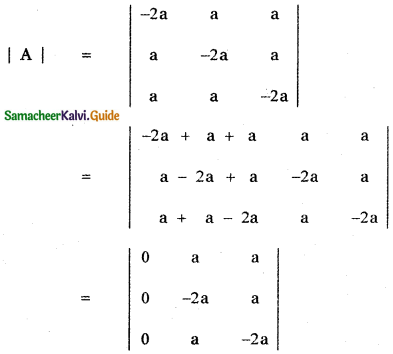
Advantages.

  • Rare, Endangered plants are propagated.
  • In a short duration, plants with desirable characteristics can be multiplied.
  • Produce Genetically identical plants.
  • Done in any season.
  • Plants without viable seeds (or) difficult to germinate can be propagated.
  • Meristem culture produces disease-free plants.
  • Cells can be genetically modified or transformed.

Samacheer Kalvi 12th Bio Botany Guide Chapter 1 Asexual and Sexual Reproduction in Plants

Question 29.
Distinguish mound layering and air layering.
Answer:
Mound Layering:
In mound layering, a lower flexible branch with leaves is bent to the ground and a part of the stem is buried in the soil and the tip of the branch is exposed above the soil. After the roots emerge from the buried stem, a cut is made in the parent plant so that the buried plant grows into a new plant.

Question 30.
Explain the conventional methods adopted in the vegetative propagation of higher plants.
Answer:
Conventional methods of vegetative propagation.
a) Cutting (Ex. Hibiscus)

  • Plant parts like stem, leaf are cut from the parent plant.
  • Cut part is placed in suitable medium,
  • It produces root and grows into a new plant.

b) Grafting (Ex. Citrus, Mango)

  • Two different plants are joined.
  • They grow as one plant.
  • Plant in soil is called stock.
  • Plant used for grafting is the scion.
  • It is of 5 types.

i) Bud grafting – scion is placed in the incision of stock.
ii) Approach grafting – Cut surfaces of stock scion are tied together.
iii) Crown Grafting – Wedge-shaped scion is inserted into the cleft of stock.
iv) Tongue grafting – Stock and scion are cut obliquely scion is fit into stock and bound with tape.
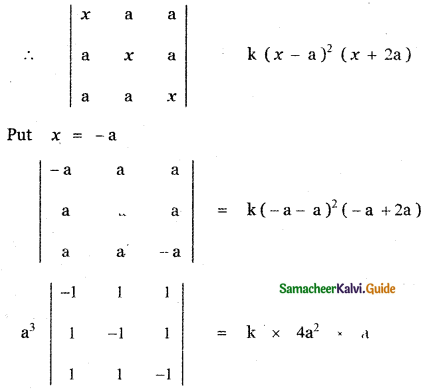
v) Wedge grafting – Twig of the scion is inserted into slot in the stock.
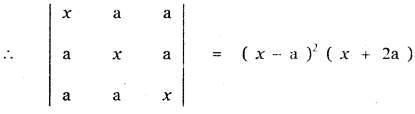
Samacheer Kalvi 12th Bio Botany Guide Chapter 1 Asexual and Sexual Reproduction in Plants

c) Layering
Stem of parent plant is allowed to develop roots while still intact. The root develops. The rooted part is cut and planted to grow as a new plant.

I) Mound Layering

  • Flexible branch is buried in soil.
  • Roots emerge from buried stem. It grows into a new plant.

ii) Air Layering

  • Nodal region is girdled.
  • Hormones are applied.
  • Rooting is promoted.
  • This area is covered by moist soil.
  • Roots emerge in 2-4 months.
  • Roots branches are removed from parent. They are grown separately.

Question 31.
Highlight the milestones from the history of plant embryology.
Answer:

  1. 1682 – Nehemiah Grew mentioned stamens as the male organ of a flower.
  2. 1694 – R.J. Camerarius described the structure of a flower, anther, pollen, and ovule
  3. 1761 – J.G. Kolreuter gave a detailed account of the importance of insects in pollination.
  4. 1824 – G.B. Amici discovered the pollen tube.
  5. 1848 – Hofmeister described the structure of pollen tetrad.
  6. 1870 – Hanstein described the development of embryos in Capsella and Alisma.
  7. 1878 – E. Strasburger reported polyembryony.
  8. 1884 – E. Strasburger discovered the process of Syngamy.
  9. 1899 – S.G. Nawaschin and L. Guignard independently discovered Double fertilization.
  10. 1904- E. Hanning initiated embryo culture.
  11. 1950 – D.A. Johansen proposed classification for embryo development.
  12. 1964 – S. Guha and S.C. Maheswari raised haploids from Datura pollen grains
  13. 1991 – E.S. Coen and E.M. Meyerowitz proposed the ABC model to describe the genetics of initiation and development of floral parts
  14. 2015 – K.V. Krishnamurthy summarized the molecular aspects of pre and post-fertilization reproductive development in flowering plants.

Question 32.
Discuss the importance of Modern methods in reproduction of plants.
Answer:
The genetic ability of a plant cell to produce the entire plant under suitable condition is said to be totipotency.

  • This characteristic feature of a cell is utilized in horticulture, forestry and industries to propagate plants.
  • The mature phloem parenchyma cells removed from the carrot were placed in a suitable medium under controlled conditions.
  • It stimulate to start dividing again to produce a new carrot plant.

Importance of modern methods of reproduction in plants.

  • Rapid Multiplication of desired plants in short duration.
  • Genetically identical plants are produced.
  • Tissue culture can be done at any season
  • Plants without viable seeds (or) difficult to germinate can be propagated.
  • Rare, Endangered plants are propagated.
  • Meristem culture produces disease-free plants.
  • Cells are genetically modified or transformed.

Samacheer Kalvi 12th Bio Botany Guide Chapter 1 Asexual and Sexual Reproduction in Plants

Question 33.
What is Cantharophily?
Answer:

  • It is the cross-pollination of flowers by beetles. They feed on pollen or juicy tissues of their flower.
  • The plants using this mode of pollination
  • Er. Nymphaea species of plants – Rhinoceros beetle.
  • Giant Water lily – Scarab beetle
  • Illicium plant – Diptera files.

Question 34.
List any two strategy adopted by bisexual flowers to prevent self-pollination.
Answer:
1) Dichogamy
Anthers and stigmas mature at different times.

  •  Protandry – Stamens mature earlier.
  • Protogyny – Stigmas mature earlier.

2) Herkogamy

  • Self pollination is impossible by the arrangement of stamens and stigmas.
  • Ex: In Hibiscus, stigmas project above the stamens.
  • In some plants, when the pollen grain of a flower reaches the stigma of the same.
  • It is unable to germinate or prevented to germinate on its own stigma.
  • It is a genetic mechanism.
    Example: Abutilon, passiflora.

Question 35.
What is the endothelium?
Answer:
In the Asteraceae species, the inner layer of the integument gets specialized for nourishing the embryosac and this is called the integumentary tapetum or endothelium.

Samacheer Kalvi 12th Bio Botany Guide Chapter 1 Asexual and Sexual Reproduction in Plants

Question 36.
“The endosperm of angiosperm is different from gymnosperm”. Do you agree? Justify your answer.
Answer:
Endosperm of Angiosperms

  1. Triploid Endosperm
  2. Endosperm is formed by triple fusion.
  3. Endosperm surrounds the embryo.

Endosperm of Gymnosperm

  1. Haploid endosperm.
  2. The endosperm is formed before fertilisation.
  3. Gymnosperms (Ex; pine) produce embryos. It provides nutrition as starch. with many cotyledons. Primary Endosperm is used as food.

Question 37.
Define the term Diplospory.
Answer:
Diplospory is a condition where a diploid embryosac is formed from megaspore mother cells without a regular meiotic division.
E.g: Eupatorium.

Question 38.
What is polyembryony? How can it be commercially exploited?
Answer:
Polyembryony

  • The occurrence of more than one embryo in a seed is called poly embroyony.

Practical Applications.

  • Seedlings from nucellar tissue of citrus are better clones for orchards.
  • Embryos from polyembryonic are virus-free.

Question 39.
Why does the zygote divide only after the division of the Primary endosperm cell?
Answer:
The primary endosperm nuclear (PEN) divides prior to zygotic division and form endosperm. Endosperm acts as a nutritive tissue and nourishes the developing embryo.

Samacheer Kalvi 12th Bio Botany Guide Chapter 1 Asexual and Sexual Reproduction in Plants

Question 40.
What is Mellitophily?
Answer:
Pollination by honeybee is called mellitophily (Latin word mellitus= honey or sweet), Among the insects the bees are the main flower visitors and dominant pollinators.

Question 41.
“Endothecium is associated with dehiscence of anther” Justify the statement.
Answer:
The inner tangential wall develops bands (sometimes radial walls also) of cellulose (sometimes also slightly lignified). The cells are hygroscopic. The cells along the junction of the two sporangia of an anther lobe lack these thickenings. This region is called stomium. This region along with the hygroscopic nature of endothecium helps in the dehiscence of anther at maturity.

Question 42.
List out the functions of tapetum.
Tapetum is the innermost layers of anther wall.
Answer:

  • Supplies nutrition to developing microspores.
  • Contributes sporopollenin through ubisch bodies. They play role in pollen wall formation.
  • Pollenkitt material is contributed by tapetal cells. It is layer transferred to pollen surface.
  • Exine proteins for rejection reaction are derived from tapetal cells.

Question 43.
Write a short note on Pollen kitt.
Answer:
Pollenkitt is contributed by the tapetum and coloured yellow or orange and is chiefly made of carotenoids or flavonoids. It is an oily layer forming a thick viscous coating over pollen surface. It attracts insects and protects damage from UV radiation.

Samacheer Kalvi 12th Bio Botany Guide Chapter 1 Asexual and Sexual Reproduction in Plants

Question 44.
Distinguish tenuinucellate and crassinucellate ovules.
Answer:
Tenuinucellate ovule

  1. The sporogenous cell is hypodermal
  2. It has single layer of nuclear tissue.
  3. It has very small nucellus

Crassinucellate ovule

  1. These ovules have sub-hypodermal sporogenous cell
  2. They have large nucellus.
  3. Many layers of cells are seen.

Question 45.
‘Pollination in Gymnosperms is different from Angiosperms’ – Give reasons.
Answer:
In gymnosperms, the ovules are exposed and the pollens are deposited directly on it. Hence the pollution is direct in a gymnosperm. Whereas in angiosperms it is said to be indirect, as the pollens are deposited on stigma or the pistil.

Samacheer Kalvi 12th Bio Botany Guide Chapter 1 Asexual and Sexual Reproduction in Plants

Question 46.
Write a short note on Heterostyly.
Answer:

  1. Heterostyly is a mechanism to promote cross-pollination.
  2. Different forms of flowers with different lengths of stamen and style.
  3. Pollination takes place between organs of same length.

a) Distyly. (Ex. Primula)

  • Thrum-eyed flowers have short styles. Anthers of pin have short stamen.
  • Anthers of thrum-eyed flowers and stigma of the pin are of the same height (both are long). This helps in effective pollination.

b) Tristyly (Ex. Lythrum)
3 kinds of flowers are there, with respect to the length of style and stamens. Flower of one type can’t pollinate their own type. They pollinate the other 2 types.

Question 47.
Enumerate the characteristic features of Entomophilous flowers.
Answer:
The characteristic features of entomophilous flowers are as follows:

  1. Flowers are generally large or if small they are aggregated in dense inflorescence. Example: Asteraceae flowers.
  2. Flowers are brightly coloured. The adjacent parts of the flowers may also be brightly coloured to attract insects. For example in Poinsettia and Bougainvillea, the bracts become coloured.
  3. Flowers are scented and produce nectar.
  4. Flowers in which there is no secretion of nectar, the pollen is either consumed as food or used in building up of its hive by the honeybees. Pollen and nectar are floral rewards for visitors.
  5. Flowers pollinated by flies and beetles produce foul odour to attract pollinators.
  6. In some flowers, juicy cells are present which are pierced and the contents are sucked by the insects.

Samacheer Kalvi 12th Bio Botany Guide Chapter 1 Asexual and Sexual Reproduction in Plants

Question 48.
Discuss the steps involved in
Microsporogenesis.
Microsporogenesis.
Answer:
Formation of haploid microspores from diploid microspore mother cell by meiosis.

  • The primary sporogeneous cells undergo mitosis to form sporogenous tissue. ‘
  • Sporogenous tissue functions as microspore mother cells.
  • Microspore mother cell divides meiotically to form a tetrad (4 haploid microspores)
  • Microspores get separated. They remain free in the anther locule. They develop into pollen grains.
  • Microspores are held together by pollinium. Filament (or thread) like part form pollinium is called retinaculum. Through retinaculum pollinia are attached to clip like corpusculum. This structure is called Translator (Y shapled).
    Samacheer Kalvi 12th Bio Botany Guide Chapter 1 Asexual and Sexual Reproduction in Plants (4)
    Samacheer Kalvi 12th Bio Botany Guide Chapter 1 Asexual and Sexual Reproduction in Plants (5)

Question 49.
With a suitable diagram explain the structure of an ovule.
Structure of ovule (Megasporangium)
Answer:
Samacheer Kalvi 12th Bio Botany Guide Chapter 1 Asexual and Sexual Reproduction in Plants (6)

  • Ovule of ovule (Megasporangium)
  • It has a stalk and a body.
  • stalk (funiculus) is at the base of ovule. It attaches ovule to the placenta.
  • Hilum is the junction (point of attachment) between ovule and funicle.
  • In an inverted ovule, the funicle is fused to the body of ovule. Thus a ridge called raphe is formed.
  • Body of ovule has central mass of reserve food called nucellus.
  • Nucellus is covered by 2 layers, called integuments.
  • Integument covers the nucellus completely except at the top. This forms a pore called micropyle.
  • Ovule with single integument is called unitegmic.
  • At the base of body, nucellus, integument and funicle meet. This is called chalaza.
  • Sac like structure in nucellus towards micropylar end is called embryosac (or) female gametophyte. It is formed from functional megaspore of nucellus.
  • The nutritive inner intergument layer is called integumentary tapetum or endothelium.
  • Tenuinucellate type ovule has hypodermal sporogenous cell. It has single layer of nucellar tissue.
  • Crassinucellate type, ovule has subhypodermal sporogenous cell.
  • Group of cells between chalaza and embryosac is called hypostase.
  • Thick walled cells above micropyle are called epistase.

Samacheer Kalvi 12th Bio Botany Guide Chapter 1 Asexual and Sexual Reproduction in Plants

Question 50.
Give a concise account on steps involved in the fertilization of an angiosperm plant.
Answer:
Steps in the fertilization of Angiosperms
1. Germination of pollen to form pollen tube in the stigma.

  • Pollens fall on receptive stigma.
  • Compatible pollen germinates to form a tube.
  • This is helped by stigmatic fluid in wet stigma and pellicle in dry stigma.
  • Compatibility is decided by recognition, rejection protein reaction, between pollen and stigma surface.
  • Pollen undergoes hydration. Pollen wall proteins cire released.
  • The entire content moves into pollen tube.
  • Growth is at the cytoplasmic contents at the tip.
  • The remaining part of pollen tube is occupied by a vacuole.
  • It is cut off from tip by callose plug.
  • The hemispherical, transparent pollen tip of pollen tube is called ‘cap block.
  • The “cape block” disappears and the growth of the pollen tube stops.

2. Growth of pollen tube in the style.

  • Hollow style glandular canal cells secrete mucilaginous substance. These secretions are nutrition for growing pollen tube. They control compatibility of style and pollen tube.
  • In solid style the pollen tube grows through the intercellular space of transmitting tissue. Semisolid style is intermediate between solid and open type.

Samacheer Kalvi 12th Bio Botany Guide Chapter 1 Asexual and Sexual Reproduction in Plants (7)

3. Entry of the pollen tube into the ovule.

  • Propgamy – Pollen tube enters through the micropyle.
  • Chalazogamy – Pollen tube enters through chalaza.
  • Monogamy – Pollen tube enters through integument.

4. Entry of pollen tube into the embryo sac.

  • Pollen tube enters embryosac at the micropylar end. It is guided by an obturator.
  • Pollen tube enters into one of the synergids.

5. Double fertilization and Triple fusion.

  • In Angiosperms, both the male gametes are involved in fertilization, it is called double fertilisation.
  • One of the male gametes fuses with the egg nucleus (syngamy). Thus zygote is formed.
  • The second gamete migrates to central cell. It fuses with polar nuclei (or) secondary nucleus. Thus primary Endosperm nucleus is formed. This involves the fusion of 3 nuclei so it is called Triple fusion.

Samacheer Kalvi 12th Bio Botany Guide Chapter 1 Asexual and Sexual Reproduction in Plants

Question 51.
What is endosperm. Explain the types. (OR) Write the three fusion of Antisper- mous plant fertilization.
The zygote divides into an endosperm.
The primary Endosperm Nucleus is the regulatory structure. It nourishes the developing embryo.
These types of endosperms are based on the mode of development.

a) Nuclear Endosperm. (Ex.Arachis)

  • Primary Endosperm Nucleus undergoes mitosis.
  • No cell wall formation.
  • A free nuclear condition exists

b) Cellular Endosperm (Ex. Helianthus)

  • Primary Endosperm Nucleus divides into 2 nuclei.
  • It is followed by wall formation.

c) Helobial Endosperm. (Ex. Vallisneria)

  • Primary Endosperm Nucleus moves towards the base of the embryo sac. It divides into 2 nuclei.
  • Cell wall is formed. It divides large micropylar chamber into form the small chalazal chamber.
  • Nucleus of micropylar chamber divides. The Chalazal chamber nucleus does not divide.

Question 52.
Differentiate the structure of Dicot and Monocot seed.
Answer:
Structure of Dicot seed

  1. Two cotyledons
  2. Two seeds may be seen
  3. The seed coat has outer coat testa and inner tegmen.
  4. In pea the cotyledons store the food. In castor the endosperm, stores reserve food.
  5. Coleoptile (sheath of plumule) coleorhiza (sheath of radicle) are absent.

Structure of Monocot seed :

  1. Only one cotyledon
  2. Paddy is one-seeded.
  3. Seed is enclosed by husk. The brown membranous seed coat closely adheres to grair
  4. Scutellum supplies embryo with food from endosperm through epithelium
  5. Coleoptile and coleorhiza are seen.

Samacheer Kalvi 12th Bio Botany Guide Chapter 1 Asexual and Sexual Reproduction in Plants

Question 53.
Give a detailed account of parthenocarpy. Add a note on its significance.
Answer:
In some plants, fruit-like structures may develop from the ovary without the act of fertilization. Such fruits are called parthenocarpic fruits. Invariably they will not have true seeds. Many commercial fruits are made seedless.
Examples: Banana, Grapes, and Papaya. Nitsch in 1963 classified the parthenocarpy into the following types:

  1. Genetic Parthenocarpy: Parthenocarpy arises due to hybridization or mutation.
    Examples: Citrus, Cucurbita.
  2. Environmental Parthenocarpy: Environmental conditions like frost, fog, low temperature, high temperature etc., induce Parthenocarpy. For example, low temperature for 3-19 hours induces parthenocarpy in Pear. Chemically
  3. induced Parthenocarpy: Application of growth-promoting substances like Auxins and Gibberellins induces parthenocarpy.
  4. Significance: The seedless fruits have great significance in horticulture.
    • Seedless fruits have great commercial importance.
    • Seedless fruits are useful for the preparation of jams, jellies, sauces, fruit drinks, etc.
    • A high proportion of edible parts is available in parthenocarpic fruits due to the absence of seeds.

12th Bio Botany Guide Asexual and Sexual Reproduction in Plants in Animals Additional Important Questions and Answers

I. Choose the correct answer

Question 1.
Match the following

A) Camerarius1. structure of a flower
B) Hofmeister2. Pollen Tetrad.
C) Hanning3. Discovery of the pollen tube.
D) Amici4. Embryo culture

a) A-1, B-2, C-4, D-3
b) A-1, B-2, C-3, D-4
c) A-4, B-3, C-2, D-1
d) A-2, B-1, C-4, D-3
Answer:
A-1,B-2,C-4,D-3

Samacheer Kalvi 12th Bio Botany Guide Chapter 1 Asexual and Sexual Reproduction in Plants

Question 2.
Find the Matching pair
a) Rhizome – Zingiber
b) Corm – Solanum
c) Tuber – Lilium
d) Bulb – Tuber
Answer:
a) Rhizome – Zingiber.

Question 3.
Find the mismatching pair
a) Runner – Centella
b) Sucker – Chrysanthemum
c) Stolon – Fragaria
d) Offset – Bryophyllum
Answer:
d) Offset – Bryophyllum.

Question 4.
Epiphyllous buds are in
a) Chrysanthemum
b) Agave
c) Curcuma
d) Scilla
Answer:
d) Scilla

Samacheer Kalvi 12th Bio Botany Guide Chapter 1 Asexual and Sexual Reproduction in Plants

Question 5.
Eyes of potato are referred to
a) adventitious roots
b) axillary buds
c) terminal buds
d) intercalary buds
Answer:
b) axillary buds

Question 6.
The T-shaped incision is made in grafting.
a) Bud
b) Approach
c) Tongue
d) Crown
Answer:
a) Bud

Question 7.
Plants propagated economically by vegetative propagation
a) Solanum tuberosum
b) Ixora
c) Jasminum
d) Chrysanthemum
Answer:
a) Solanum tuberosum

Samacheer Kalvi 12th Bio Botany Guide Chapter 1 Asexual and Sexual Reproduction in Plants

Question 8.
Steward produced……………plant from phloem
a) Beetroot
b) Carrot
c) Solanum
d) Radish
Answer:
b) Carrot

Question 9.
Arrange from the periphery to centre in another wall.
a) Endothecium, Middle layer, tapetum
b) Tapetum, middle layer, Endothecium
c) Endothecium, tapetum, middle layer
d) Middle layer, endothecium, tapetum
Answer:
a) Endothecium, Middle layer, tapetum

Question 10.
Microspores are held together by pollinium in
a) Hibiscus
b) Calotropis
c) Ixora
d) Datura
Answer:
b) Calotropis

Samacheer Kalvi 12th Bio Botany Guide Chapter 1 Asexual and Sexual Reproduction in Plants

Question 11.
…………… cells are hygroscopic in anther wall.
a) Epidermis
b) Endothecium
c) Middle layer
d) tapetum
Answer:
b) Endothecium

Question 12.
Find the wrong statement
a) Invasive tapetum is peri plasmodial.
b) Amoeboid tapetum is associated with male sterility
c) Middle layer is ephemeral.
d) Epithelium is hygroscopic
Answer:
d) Epithelium is hygroscopic

Question 13.
Find the correct statement
a) Carrot grass causes allergy
b) Bee pollen is an artificial substance.
c) Palynology is the study of honey pollen.
d) Mellitopalynology is the study of pollen grain.
Answer:
a) Carrot grass causes allergy

Samacheer Kalvi 12th Bio Botany Guide Chapter 1 Asexual and Sexual Reproduction in Plants

Question 14.
Not a shape of pollen grain
a) Globose
b) Ellipsoid
c) crescent-shaped
d) Cubical
Answer:
d) Cubical

Question 15.
…………… protects pollen grain from UV
radiation.
a) Sporopollenin
b) pollenkitt
c) Exine
d) callose.
Answer:
b) pollenkitt

Question 16.
Not in exine of pollen grain
a) Cellulose
b) Sporopollenin
c) Pollenkitt
d) Callose
Answer:
d) Callose

Samacheer Kalvi 12th Bio Botany Guide Chapter 1 Asexual and Sexual Reproduction in Plants

Question 17.
………………….. % of angiosperm pollen is liberated in 2 cell stage
a) 50
b) 60
c) 40
d) 30
Answer:
b) 60

Question 18.
Which one of the following is a dioecious plant?
a) Coconut
b) Bitter gourd
c) Pea plant
d) Date palm
Answer:
d) Date palm

Question 19.
Match the following

A) Orthotropous1. Leguminosae.
B) Anatropous2. Primulaceae
C) Hemianatropous3. Dicot, Monocot
D) Campylotropous4. Piperaceae

a) A-4, B-3, C-2, D-1
b) A-1, B-2, C-3, D-4
c) A-4, B-2, C-3, D-1
d) A-2, B-1, C-4, D-3
Answer:
a) A-4, B-3, C-2, D-1

Samacheer Kalvi 12th Bio Botany Guide Chapter 1 Asexual and Sexual Reproduction in Plants

Question 20.
Horseshoe shaped nucellus is in ……………  ovule.
a) Circinotropous
b) Amphitropous
c) Anatropous
d) Hemianatropous
Ans:
b) Amphitropous

Question 21.
Find the mismatching pair
a) Tetrasporic – Peperomia
b) Bisporic – Allium
c) Monosporic – Polygonum
d) Trisporic – Cactaceae
Ans :
d) Trisporic – Cactaceae

Question 22.
Homogamy is in ……………………….
a) Mirabilis
b) Commelina
c) Viola
d) Oxalis.
Answer:
a) Mirabilis

Question 23.
Protogyny is in ………………………..
a) Aristolochia
b) Helianthus
c) Viola
d) Oxalis.
Answer:
a) Aristolochia

Samacheer Kalvi 12th Bio Botany Guide Chapter 1 Asexual and Sexual Reproduction in Plants

Question 24.
Distyly is in ……………………….
a) Primula
b) Lythrum
c) Abutilon
d) Hibiscus
Answer:
a) Primula

Question 25.
Find the mismatching following
a) Passiflora – self sterility
b) Gloriosa – Herkogamy
c) Sugarcane – Anemophily
d) Urtica – Hydrophily
Answer:
d) Urtica – Hydrophily

Question 26.
Find the matching pair
a) Epihydrophily – Elodea.
b) Ornithaphily – Lemna
c) Entomophily – Vallisneria
d) Hydrophily – Kigelia.
Answer:
a) Epihydrophily – Elodea

Question 27.
Find the odd one
Not dealing with entry of pollen tube
a) Herkogamy
b) Porugamy
c) Mesogamy
d) chalozogamy
Answer:
a) Herkogamy

Samacheer Kalvi 12th Bio Botany Guide Chapter 1 Asexual and Sexual Reproduction in Plants

Question 28.
Not a post-fertilization change
a) Endosperm
b) Embryo development
c) Seed formation
d) Triple fusion
Answer:
d) Triple fusion.

Question 29.
Matching

A) Apple1. Edible receptacle
B) Jack fruit2. Beet root
C) Juicy flower stalk3. Anacardium
D) Perisperm4. Fleshy perianth

a) A-1, B-4, C-3, D-2
b) A-1, B-2, C-3, D-4
c) A-4, B-3, C-2, D-1
d) A-2, B-1, C-4, D-3
Answer:
a) A-1, B-4, C-3, D-2

Samacheer Kalvi 12th Bio Botany Guide Chapter 1 Asexual and Sexual Reproduction in Plants

Question 30.
Matching the following

A) Ovary1. zygote
B) Ovule2. Endosperm
C) Secondary nucleus3. Seed
D) Egg4. Fruit

a) A-4, B-3, C-2, D-1
b) A-1, B-2, C-4, D-3
c) A-2, B-1, C-4, D-3
d) A-3, B-2, C-1, D-4
Answer:
a) A-4, B-3, C-2, D-1

Question 31.
Which one of the following statements is not true regarding sporopollenin? I a
a) Sporopollenin is contributed by both pollen cytoplasm and tapetum.
b) It helps the pollen to withstand strong acid.
c) Sporopollenin is derived from phycobilins
d) It helps pollen during long period perservation in fossil deposits.
Answer:
a) Sporopollenin is contributed by both pollen cytoplasm and tapetum.

Question 32.
True (or) False
1) Beetles show Palaenophily
2) Bees show Cantharophily
3) Snails show Malacophily
4) Ants show Myrmecophily
a) 1,2,3 true 4 is false
b) 1,2 are true, 3,4 are false
c) 1,2,3 are true, 4 true
d) 1 is true 2,3,4 are false
Answer:
a) 1,2, 3 true 4 is false

Samacheer Kalvi 12th Bio Botany Guide Chapter 1 Asexual and Sexual Reproduction in Plants

Question 33.
Find the mismatching pair
a) Trap mechanism – Aristolochia.
b) Pit fall mechanism – Arum.
c) Clipmechanism – Aeclepiadaceae
d) Piston mechanism – Salvia
Answer:
d) Piston mechanism – Salvia

Question 34.
Find the mismatching pair
a) Obligate mutualism – Tridax
b) Pollen robber – Amurphophallus.
c) Pseudo copulation – Ophyrus.
d) Fig pollination – Wash.
Answer:
a) Obligate mutualism – Tridax

Question 35.
Fritillaria imperialis shows vegetative propagation by
a) Bulb
b) Runner
c) Bulbils
d) Sucker
Answer:
c) Bulblis

Samacheer Kalvi 12th Bio Botany Guide Chapter 1 Asexual and Sexual Reproduction in Plants

Question 36.
Generative apospory is in
a) Aerva
b) Ulmus
c) Balanophova
d) Allium
Answer:
a) Aerva

Question 37.
Terror of Bengal is
a) Eichhornia
b) Centella
c) Lilium
d) Murraya
Answer:
a) Eichhornia

Question 38.
Allium cepa is an example for ………………….
a) Corm
b) Tuber
c) Tunicated bulb
d) Naked bulb
Answer:
c) Tunicated bulb

Question 39.
Jasminum shows…………………….
a) Bud grafting
b) Approach grafting
c) Crown grafting
d) None
Answer:
d) None

Samacheer Kalvi 12th Bio Botany Guide Chapter 1 Asexual and Sexual Reproduction in Plants

Question 40.
Endangered plants can be produced by
a) Layering
b) Grafting
c) Micropropagation
d) Cutting
Answer:
c) Micropropagation

Question 41.
Disease free plants can be produced by
a) Meristem, culture
b) Grafting
c) Cutting
d) Layering
Answer:
a) Meristem, culture

Question 42.
Which one of the following is not an advantage of micro propagation?
a) Plants produced are genetically identical
b) Endangered plants can be propagated
c) Sometimes undesirable genetical changes occur.
d) Disease free plants can be produced.
Answer:
c) Sometimes undesirable genetical changes occur.

Question 43.
…………………………. has underground and aerial flowers
a) Scrophularia
b) Catharanthus
c) Commelina
d) Clerodendron
Answer:
c) commelina

Samacheer Kalvi 12th Bio Botany Guide Chapter 1 Asexual and Sexual Reproduction in Plants

Question 44.
Juicy cells are in the …………………. flowers
a) Ornithophilous
b) Hydrophilous
c) Entomophilous
d) Malacophilous
Answer:
c) Entomophilous

Question 45.
The central mass of parenchyma in ovule is
a) Nucellus
b) Chalaza
c) Endothelium
d) Embryosac.
Answer:
a) Nucellus

Question 46.
From the following which one is the column of sterile tissue surrounded by the anther lobe.
a) Periplasodium
b) pollen chamber
c) connective tissue
d) tapetum
Answer:
c) connective tissue

Question 47.
Oxalis shows …………………
a) Cleistogamy
b) Homogamy
c) Incomplete dichogamy
d) Geitonogamy
Answer:
a) Cleistogamy

Samacheer Kalvi 12th Bio Botany Guide Chapter 1 Asexual and Sexual Reproduction in Plants

Question 48.
Brightly coloured bracts attract insects in……………..
a) Poinsettia
b) Bougainvillea
c) Lemna
d) Both a,b
Answer:
d) Both a,b

Question 49.
In a male gametophyte, the chromosomal number of generative nucleus is (A)
a) (A)-(n);(B)-(2n)
b) (A)-(2n);(B)-(n)
c) (A)-(2n);(B)-(2n)
d) (A)-(n);(B)-(n)
Answer:
b) (A)-(2n);(B)-(n)

Question 50.
Endosperm is formed from …………………..
a) Ovary
b) Ovule
c) egg
d) Secondary nucleus
Answer:
d) secondary nucleus

Samacheer Kalvi 12th Bio Botany Guide Chapter 1 Asexual and Sexual Reproduction in Plants

Question 51.
First cell of Male gametophyte in angio…………………..
a) Primary endosperm
b) Microspore
c) Megaspore
d) Nucleus
Answer:
b) Microspore

Question 52.
Malus shows ………………….. cutting
a) Root
b) stem
c) leaf
d) Flower
Answer:
a) Root

Samacheer Kalvi 12th Bio Botany Guide Chapter 1 Asexual and Sexual Reproduction in Plants

Question 53.
Polygonaceae has …………………..type of ovule
a) Orthotropous
b) Anatropous
c) Hemianatropous
d) Campylotropous.
Answer:
a) Orthotropous

Question 54.
Not an animal pollinater
a) Lemur
b) Gecko Lizard
c) Garden lizard
d) All the above
Answer:
d) All the above

Question 55.
This shape is not seen in Tridax embryo
a) Globular
b) Heart
c) torpedo shape
d) Cuboidal
Answer:
d) cuboidal

Samacheer Kalvi 12th Bio Botany Guide Chapter 1 Asexual and Sexual Reproduction in Plants

Question 56.
Kigelia africana shows
a) Cheiropterophily
b) Malacophily
c) Entomophily
d) Zoophily
Answer:
a) Cheiropterophily

Question 57.
The pollen of Myosotis is micrometers.
a) 10
b) 100
c) 1
d) 20
Answer:
a) 10

Samacheer Kalvi 12th Bio Botany Guide Chapter 1 Asexual and Sexual Reproduction in Plants

Question 58.
Rhizome is not in
a) Musa paradisiaca
b) Zingifer officinale.
c) Curcuma longa
d) Colocasia
Answer:
d) Colocasia

Question 59.
The pollen of Nyctaginaceae is of microns
a) 50
b) 100
c) 200
d) 300
Answer:
c) 200

Question 60.
Does not show vegetative reproduction by root
a) Murraya
b) Dalberigia
c) Millinagtonia
d) Spinifex.
Answer:
d) spinifex

Samacheer Kalvi 12th Bio Botany Guide Chapter 1 Asexual and Sexual Reproduction in Plants

II. Two Marks 

Question 1.
Which characteristic feature of a plant cell in used in horticulture, forestry and industries to propagate plants
Answer:
The Genetic ability of plant cell to produce entire plant under suitable conditions is called totipotency.

Question 2.
Define tissue culture?
Answer:
The growth of plant tissue in special culture medium suitable controlled conditions.

Question 3.
Name the 3 types of gametic fusions in sexual reproduction of plants?
Answer:
Isogamy, Anisogamy and Oogamy.

Question 4.
What is microsporogenesis?
Answer:
Formation of haploid microspores from diploid microspore mother cell by meiosis.

Question 5.
Comment on amoeboid tapetum?
Answer:

  •  It is a third type of tapetum.
  • The cell wall is not lost.
  • Cells protrude into the anther cavity, by amoeboid movement.
  • It is connected to male sterility. It is not periplasmodial type.

Samacheer Kalvi 12th Bio Botany Guide Chapter 1 Asexual and Sexual Reproduction in Plants

Question 6.
What are Ubisch bodies?
Answer:
Tapetum contributes to sporopollenin through ubisch bodies. They play an important role in pollen wall formation.

Question 7.
Differentiate Exine and Intine?
Answer:
Exine Intine:

  1. Outer wall layer of pollen
  2. Thick
  3. Not uniform. Made of cellulose, sporopollenin, pollenkitt.

Intine :

  1. Inner wall layer.
  2. Thin
  3. Uniform made of pectin, hemicellulosc, cellulose, callose.

Question 8.
Comment on the sculpturing pattern of pollengrains?
Answer:

  • The exine is sculptured as rod, groove, wart, punctuation etc.
  • This pattern is used in plant identification and classification.

Question 9.
Mention the various shapes of pollengrains?
Answer:
Globose, ellipsoid, fusiform, lobed, angular, crescent shaped.

Samacheer Kalvi 12th Bio Botany Guide Chapter 1 Asexual and Sexual Reproduction in Plants

Question 10.
What do you know of Palynology?
Mention its uses.
Answer:

  • It is the study of pollengrains.
  • It helps to identity the coal, oil fields.
  • It reflects the vegetation of that area.

Question 11.
How can we preserve pollengrains?
Answer:
Pollen is preserved in liquid nitrogen (-196°C) in viable condition for prolonged duration. It is called cryopreservation. This pollen of economically important plants are stored in pollen bank.

Question 12.
What is Mellitopalynology?
Answer:
Study of flower honey and pollen.

Question 13.
Comment on Carrot Grass?
Answer:

  • Parthenium hysterophorus of Asteraceae family is called as carrot grass.
  • It is introduced as a contaminant with cereal from Tropical America.
  • Pollen of this plant causes allergy.

Question 14.
Differentiate hypostase from Epistase?
Answer:
Hypostase
Group of cells in the ovule between chalaza and embryosac.

Epistase :
Thick walled cells above the micropylar end above the embryosac.

Samacheer Kalvi 12th Bio Botany Guide Chapter 1 Asexual and Sexual Reproduction in Plants

Question 15.
What is Archesporium?
Answer:
In the ovule, a single hvpodermal cell in the nucellus become enlarged. “I his functions as Archesporium. In some plants it functions as megaspore mother cell directlv. It mev divide.

Question 16.
Prove that there is a co.evolution between plants and animals?
Answer:
Many plants are pollinated hv a particular animal species. The flowers are modified accordingly. This proves their co.evolution.

Question 17.
Draw this diagram and table the parts.
Answer:
Samacheer Kalvi 12th Bio Botany Guide Chapter 1 Asexual and Sexual Reproduction in Plants (8)

Question 18.
Define pollination?
Answer:
Transfer of pollengrains from anther to stigma of a flower.

Samacheer Kalvi 12th Bio Botany Guide Chapter 1 Asexual and Sexual Reproduction in Plants

Question 19.
Differentiate pollination in gymnosperms and angiosperms.
Answer:
Pollination in Gymnosperms

  1. Direct
  2. Pollens are directly deposited on the exposed ovules.

Pollination in Angiosperms :

  1. Indirect
  2. Pollens are deposited on the stigma of pistil.

Question 20.
What is chasmogamy?
Answer:
In many angiosperms, the flowers open. They exposure mature anther and stigma for pollination. This phenomenon is chasmo¬gamy. These are chasmogamous flowers.

Question 21.
Define cleistogamy?
Answer:
In some plants, pollination occurs without exposing or opening the sex organs. This phenomenon is called cleistogamy. Such flowers are called cleistogamous flowers.

Samacheer Kalvi 12th Bio Botany Guide Chapter 1 Asexual and Sexual Reproduction in Plants

Question 22.
Differentiate Autogamy and allogamy?
Answer:
Autogamy
Transfer of pollen on the stigma of the same flower

Allogamy :
Transfer of pollen of one flower to the stigma of another flower.

Question 23.
Name the abiotic agents of pollination?
Answer:

  • Pollination by wind (or) Anemophily.
  • Pollination by water (or) Hydrophily.

Question 24.
Define Zoophily?
Answer:
Pollination through animals (Ex. insects) is called as Zoophily.

Question 25.
What is cheiropterophily? Give example?
Answer:
Pollination by bats. Such plants are kigelia africana, Adansonia digitata.

Question 26.
Malacophily – Comment?
Answer:
Pollination by slugs and snail. Ex. Plants of Araceae, Water snails pollinate Lemna.

Samacheer Kalvi 12th Bio Botany Guide Chapter 1 Asexual and Sexual Reproduction in Plants

Question 27.
What is Myrmecophily?
Answer:
Pollination by ants Ex. Eegnminosae, plants.

Question 28.
Redraw the diagram and lable the parts.
Answer:
Samacheer Kalvi 12th Bio Botany Guide Chapter 1 Asexual and Sexual Reproduction in Plants (9)

Question 29.
What is cap block?
Answer:
The Hemispherical, transparent tip of pollentube is called cap block. It is seen by microscope. When it disappears the growth of pollen tube stops.

Samacheer Kalvi 12th Bio Botany Guide Chapter 1 Asexual and Sexual Reproduction in Plants

Question 30.
What is the significance of obtruator?
Answer:
In the ovary locule, the obtruator guides pollen tube towards the micropyle, of ovule.

Question 31.
Suggest the events after fertilization ?
Answer:

  • Endosperm, embryo development.
  • Formation of seed, fruit. These are called post fertilization changes.

Question 32.
What is Suspensor ?
Answer:

  • During the developement, the two cells of the basal cell undergoes several transverse division into form a six to ten called suspensor.
  • The suspensor helps to push the embryo deep into the endosperm.

Question 33.
What is Callus?
Answer:
Undifferentiated mass of cells obtained through tissue culture.

Samacheer Kalvi 12th Bio Botany Guide Chapter 1 Asexual and Sexual Reproduction in Plants

Question 34.
Define Apomixis ?
Answer:

  • It is defined as the substitution of the usual sexual system (Ampimixis) by a form of reproduction.
  • It does not involve meiosis and syngamy.

Question 35.
What is Scutellum?
Answer:

  • The seeds of paddy is one seeded and is called Caryopsis.
  • The embryo is small and consists of one shield shaped cotyledon known as scutellum.
  • It is present towards lateral side of embryonal axis.

Question 36.
Define Pollinium.
Answer:
In some plants, all the microspores in a microsporangium remain held together called pollinium.
Example: Calotropis

Samacheer Kalvi 12th Bio Botany Guide Chapter 1 Asexual and Sexual Reproduction in Plants

Question 37.
What is Amphitropous?
Answer:

  • A type of ovule.
  • It is between hilum and chalaza.
  • The curvature of the ovule leads to horse – shoe shaped nucellus.
    Example: Alismataceae.

Question 38.
Write the practical application of activation of nucellar tissue.
Answer:

  • The activation of micellar tissue or an\ other cells (sporopln lie ceils of the ovule) can produce more’ Ilian one embryo, known as poly embryonv.
  • The seedlings formed from the nucellar tissues in citrus are found belter clones lor orchards.
  • They are Disease resistant (virus free) and are preferred by Agriculturists than the normal seedlings.

Question 39.
Differentiate pineyed flower and thrum eyed flower.
Answer:
Pineyed flower :
Pin or long stv!e, long stigma tic pa iliac, short stamens and small pollen grains.
Ex : primula

Samacheer Kalvi 12th Bio Botany Guide Chapter 1 Asexual and Sexual Reproduction in Plants

Thrum eyed flower :
Thrum-eved or short style, small stigmatic papillae, long stamens and large pollen gains.

Question 40.
Differentiate Coleoptile and
Answer:
Coleoptile Coleorhiza :
The plumule is surrounded bv a proteetive sheath called coleoptile.

Coleorhiza:
The radicle including root cap is also covered bv a protects e sheath called coleorhiza.

III. Three Marks 

Question 1.
How does pollen tube grow through a solid style?
Answer:

  • It is common among dicots. It is character¬ized by the presence of central core of elorgated highly specialised cells called transmitting tissue.
  • This is equivalent to the lining cells of hollow style and does the same function.
  • Its contents are also similar to the content of those cells. The pollen tube grows through inter-cellular spaces of the transmitting tissue.

Samacheer Kalvi 12th Bio Botany Guide Chapter 1 Asexual and Sexual Reproduction in Plants

Question 2.
Give the significance of pollen calendar?
Answer:

  • It shows the production of pollen by plants during different seasons.
  • This benefits the allergic persons.
  • Pollen grains cause asthma, bronchitis, has fever, allergic rhinitis.

Question 3.
Comment on Caruncle?
Answer:
Cells at the tip of outer integument around micropyle develop into fleshy stucture. It is called caruncle. Ex. Ricinus communis.

Question 4.
What is perisperm?
Answer:
Remnant of nucellar tissue in the seed is called perisperm.
Ex. Black pepper, beet root.

Samacheer Kalvi 12th Bio Botany Guide Chapter 1 Asexual and Sexual Reproduction in Plants

Question 5.
What is Aril?
Answer:
The colourful, fleshy funiculus is called Aril. Ex. Myristica and Pithe cellobium.

Question 6.
Write about Endosperm?
Answer:
The Zygotas divides into endosperm. It is a nutritive tissue nourishing embryo. It is a regulatory structure.

Question 7.
Differentiate Endospermous and non-endospermous seeds?
Answer:
Endospermous seeds  :

  1. Seeds with endosperm
  2. It is also called ex-albuminous seeds
  3. Ex-Pea, Ground nut, bean

Non-Endospermous seeds :

  1. Seeds without endosperm
  2. It is also called albuminous seeds
  3. Paddy, Coconut, Castor.

Samacheer Kalvi 12th Bio Botany Guide Chapter 1 Asexual and Sexual Reproduction in Plants

Question 8.
Comment on Aleurone Tissue.
Answer:

  • These are layers of specialized cells around the endosperm, in cereals.
  • They have sphaerosomes (Ex. Barley, Maize) During germination, they secrete hydrolytic enzymes amylase,
  • protease. They digest reserve food of endosperm.

Question 9.
Mention the other interesting pollinating mechanism of plants?
Answer:

  • Trap Mechanism Ex. Aristolochia.
  • Pit fall mechanism Ex. Arum.
  • Clip or Translator Mechanism
    Ex. Asclepiadaceae
  • Piston Mechanism Ex. Papilionaceae.

Question 10.
Grafting is method of production of hybrid plants but not the method of reproduction. Do you agree this statement? Give logic reason for your answer.
Answer:

  • Eventhough Grafting is considered as artifica! method of vegetative reproduction, it is realtv used to produce plants combining favourable stem characteristics with root characteristics.
  • The stem of the plant to be grafted is known as scion and the root is called stock.
  • Here, one fnbrid is produced unlike in other method where manv number of plants are produced.

Question 11.
Comment on pollen (nectar) robber?
Answer:
Amorphophallus provide floral rewards. They are the safe site for laying eggs, visitors consume pollen and nectar. They do not help in pollination. They are pollen robbers.

Question 12.
Describe pseudocopulations?
Answer:

  • In Bee orchid (ophyrus) the morphology of flower is similar to female wasp (colpa).
  • Male wasp mistakes the flower for female wasp, and try to copulate. This pseudocopulation helps in pollination.
  • In pea cotyledons store food.

Samacheer Kalvi 12th Bio Botany Guide Chapter 1 Asexual and Sexual Reproduction in Plants

Question 13.
Write any two differences between male gametophyte and female gametophyte.
Anwer:
Male gametophyte :

  1. It is the pollen grain (microsporangium)
  2. It has two phases of growth – pro pollination and post pollination
  3. Pre pollination occurs in it.
  4. It is only 3 celled
  5. All cells of it are functional

Female gametophyte :

  1. it is t mbedded in side the ovum (megasporangium)
  2. All the cells are formed in single phase ol growth surrounded bv megaspore membrane.
  3. It is 7 celled and the growth occurs inside megasporangium

Question 14.
What are the disadvantages of self pollination?
Answer:

  1. Continuons self pollination produce weaker progeny
  2. Chance of producing new species and varieties are meagre.

Question 15.
Enlist the disadvantages of cross pollination?
Answer:

  • The process is uncertain since it depends on external agencies.
  • Various devices are needed to attract the pollinating agents.

Question 16.
Pollination is prerequisite for fertilisation. Discuss?
Answer:

  • Fertilisation forms fruits and seeds.
  • Pollination brings male and female gametes closer.
  • Cross pollination produces variations, due to mixing of genes. Variations help the adaptation of plants to environment. It helps in specifiation.

Question 17.
How is the surface of endosperm ? Discuss?
Answer:
Endosperm with irregularity and uneven ness in its surface forms the ruminate endosperm. Ex. Areca catchu, Passiflora, Myristica.

Question 18.
Discuss the functions of Endosperm?
Answer:

  • It is the nutritive tissue for the developing embryo.
  • The zygote divides only after the develpment of endosperm.
  • Endosperm regulates the embryo development.

Question 19.
Relate the role of cocount as endosperm?
Answer:

  • Coconut milk is a nutrient medium.
  • It induces the differentiation of embryo (embryoids), Plantlets of various plant tissues.
  • Coconut water is free nuclear endosperm. The white kernel part is cellular.

IV. Five Marks 

Question 1.
Illustrate the structure of cicer, a dicot seed?
Answer:

  • Seeds are attached to fruits by funiculus.
  • The scar of funiculus is called hilum.
  • Micropyle is the small pore below hilum.
  • O2 and water enters seed for germination through micropyle.
  • Each seed has outer thick seed coat.seed coat develops from the integuments of ovule.
  • Testa is the hard outer coat.
  • Tegmen is the thin membranous inner coat.
  • In pea testa, tegmen are fused.
  • Two cotyledons are laterally attached to embryonic axis.
    Samacheer Kalvi 12th Bio Botany Guide Chapter 1 Asexual and Sexual Reproduction in Plants 22
  • In castor endosperm has reserve food.
  • One end of embryonal axis projecting beyond the cotyledons. It is called radicle (embryonic root)
  • The other end of embryonal axis called plumule (embryonic shoot)
  • Embryonic axis above the cotyledons is epicotyl.
  • Cylindrical region between the cotyledons is hypocotyl.
  • Epicotyle terminates in plumule. Hypocotyl ends in radicle

Question 2.
Describe the structure of a monocot seed (Ex. Paddy)?
Answer:
Samacheer Kalvi 12th Bio Botany Guide Chapter 1 Asexual and Sexual Reproduction in Plants (10)

  • Paddy is a one seeded caryopsis.
  • The seed is enclosed by brown husk with 2 rows of glumes.
  • The brown, membranous seed coat is attached to grain.
  • Endosperm is the bulk of grain. It is the storage tissue.
  • It is separated from embryo by epithelium.
  • Embryo has one cotyledon called scutellum. It is later to embryonal axis.
  • A short axis with plumule and radicle is protected by root ‘ cap.
  • Coleoptile is a protective sheath of plumule.
  • Coleorhiza is the protective sheath of radicle.
  • Scutellum supplies food to embryo from endosperm through epithelium.

Samacheer Kalvi 12th Bio Botany Guide Chapter 1 Asexual and Sexual Reproduction in Plants

Question 3.
In some kinds of plant reproductions male, female gametes are not involved ? Justify? Apomixis.
Answer:
it is tile plant reproduction which does not involuo the union of male and female gametes.
A) Recurrent Apomixis.
Vegetative Reproduction and agamospernw.

B) Non recurrent Apomixis.
Alter meiosis, haploid embrvosoe is lormed.
It devleps into emhrvo without fertilization.

I) Vegetative Reproduction
Eiopagation of plants by parts other than seeds.
Ex. bulbil – I’riiiliaria imperialis.
Bulbs – Allium
Sucker – Chrysanthemum.
Samacheer Kalvi 12th Bio Botany Guide Chapter 1 Asexual and Sexual Reproduction in Plants (11)

a) Agamospory
Embryos are rormed without syngamy and meiosis.

b) Advcntiver Embryony
Embrvo arises from diploid sporopln tic coll of nuceilus or integument, lt is called sporophytic budding, Gametophylic phase is completeh absent.

c) Diplospory (Generative apospory)
Megaspore mother ceils gives rise to diploid embrvosac without meiosis. ex. Eupatorium.

d.) Apospory
Nucellar cell develop into diploid emhryo sac. This is somatic apospory. Ex. Hieracium, parthenium.

Samacheer Kalvi 12th Bio Botany Guide Chapter 1 Asexual and Sexual Reproduction in Plants

Question 4.
Differentiate heterostyly from herkogamy
Answer:
Heterostyly :

  1. Some plants produce two or three different forms of flowers that are different in their length of stamens and style
  2. Pollination will take place only between organs of the same length. Distyly: Eg Primula Herkogamy:

Herkogamy

  • Stamens and stigmas are arranged in such a way preventing self pollination.
  • Stigmas project for above the stamens Eg: Hibiscus

Question 5.
An entire plant can be produced from a single cell – Justify?
Answer:
The genetic ability of a plant cell to produce entire plant in suitable condition is called Totipotency.
i) Tissue Culture
Growth of plant tissue in special cutture medium under suitable conditions is called tissue culture.
Ex. F.C steward of Cornell University developed a new carrot plant from the phloem parenchyma cell.

ii) Micropropagation
Regenerationof whole plant from a cell or tissue of vegetative structures.

  • Advantages of Modern methods.
  • Plants with desired characteristics are multiplied rapidly in short duration.
  • Genetically identical plants are produced.
  • Done at any season.
  • Plants without viable seeds, difficult to germinate can be propagated.
  • Rare, endangered plants are propagated.
  • Meristem culture produces disease free plants.
  • Cells are transformed by genetic modification.

Disadvantages of modem methods

  • Labour intensive. It requires skilled workers.
  • Maintenance of sterile condition increases cost.
  • Genetically identical clones are susceptible to new diseases.
  • Genetical changes in callus is not desirable for commercial use.

Samacheer Kalvi 12th Bio Botany Guide Chapter 1 Asexual and Sexual Reproduction in Plants

Question 6.
Elaborate an account on the T.S of anther.
Answer:
1. Anther Wall
a) Epidermis

  • Protective single layer.
  • Cells undergo anticlinal division to cope up enlarging internal tissue.

b) Endothecium

  • Single layer of radially elongated cells.
  • Bands of cellulose (or) lignin are seen in tangetial wall.
  • At the junction of 2 sporangia these thickenings are absent. This region is called stomium.
  • Hygroscopic nature of endothecium helps in dehiscence of anther.

c) Middle layer

  • 2 to 3 layers next to endothecium.
  • These are ephemeral. Disintegrate or crushed during maturity.

d) Tapetum

  • It is dual in origin (from peripheral wall layer and connective tissue of anther lining.
  • It nourishes sporogenous tissue, microspore mother cell, microspores.
  • Cells are uninucleate, multinucleate with polyploid nucleus.
  • It contributes to wall material, sporopollenin, pollen kitt, tryphine.
  • It controls fertility or sterility of pollengrains. It is of 2 tvpes i) Secretory tapetum ii) Invasive tapetum

Samacheer Kalvi 12th Bio Botany Guide Chapter 1 Asexual and Sexual Reproduction in Plants (12)

2. Anther cavity.

  • It is filled with young microspores or mature pollengrains.
  • Microspore mother cells form microspore by meiosis.

3) Connective.

  • It is a colume of sterile tissue. It is surrounded by anther lobe. It has vascular tissue.

Question 7.
How does the male gametophyte develop?
Answer:

  • Haploid microspore is the first cell.
  • Development takes place at microsporangium.
  • Microspore nucleus divides into vegetative and generative nucleus.
  • Large vegetative cell and small generative cell is formed.
  • At this 2 celled stage, pollens are liberated from anther.
  • In some plants generative cell form 2 male gametes.
  • Male gametophyte grows when the pollen reaches the right stigma.
  • Pollen absorbs moisture and swells.
  • Intine grows as pollen tube through germ pore.
  • At the 2 celled stage, generative cells divides into 2 male cells at stigma.

Samacheer Kalvi 12th Bio Botany Guide Chapter 1 Asexual and Sexual Reproduction in Plants (13)
Samacheer Kalvi 12th Bio Botany Guide Chapter 1 Asexual and Sexual Reproduction in Plants (14)
Samacheer Kalvi 12th Bio Botany Guide Chapter 1 Asexual and Sexual Reproduction in Plants (15)

Samacheer Kalvi 12th Bio Botany Guide Chapter 1 Asexual and Sexual Reproduction in Plants

Question 8.
Ovules are of many types based on the orientation, form, position of micropyle with respect to funicle, chalaza – discuss?
Answer:
1. Orthotropous

  • Micropyle is at distal end,
  • Funicle and chalaza lie in one straight vertical line (Ex. Piperaceae)

2. Anatropous

  • Body of ovule is inverted.
  • Micropyle, funiculus lie close to each other Ex. Dicots, Monocots.

3. Hemianatropous

  • Body is transverse
  • It is at right angle to funicle. Ex. Primulaceae.

4. Campylotropous

  • Body is curved at micropylar end. Embroysac is curved.
  • Hilum, micropyle and chalaza are nearer. Ex.Leguminosae

5. Amphitropous
Less distance between hilum and chalaza. Nucellus is horse shoe shaped. Ex. Alismataceae.

6. Circinotropous. (Ex. Cactaceae)
Long funicle surrounds the ovule.

Samacheer Kalvi 12th Bio Botany Guide Chapter 1 Asexual and Sexual Reproduction in Plants (16)

Samacheer Kalvi 12th Bio Botany Guide Chapter 1 Asexual and Sexual Reproduction in Plants

Question 9.
How does the monosporic embryosac develop?
Answer:

  • Functional megaspore is the first cell of embryosac or female gametophyte.
  • Megaspore elongates along micropylar – chalaza! axis.
  • Nucleus undergoes mitosis without wall formation.
  • A central vacuole expands and pushed the nuclei towards the opposite poles.
  • Each nucleus divide mitotically twice. Thus 4 nuclei are formed at each pole.
  • Eight nuclei are in common cytoplasm.
  • Of the 4 nuclei at micropylar end, 3 nuclei form 3 antipodal cells. Fourth one is the lower polar nucleus.
  • Two polar nuclei fuse into secondary nucleus.
  • Thus 7 celled, 8 nucleated embrovsac is formed.

Samacheer Kalvi 12th Bio Botany Guide Chapter 1 Asexual and Sexual Reproduction in Plants (17)

Question 10.
Enlist the contrivances for crosspollination ?
Answer:
1) Dicliny or Unisexuality. ’
In unisexual flowers, only cross pollination is possible,

i) Monoecious (Ex. coconut)

  • Male and female flowers on same plant
  • Autogany is prevent in castor, maize. Geitonogamy takes place.

Dioecious.

  • Male and female flowers are on different plants.
  • Both autogamy, geitonogamy are prevented.

2) Monocliny or Bisexuality.
i) Dichogamy.
Anther and stigma mature at different times.

  • Protandry (Ex. Helianthus)
    Stamens mature earlier than stigma
  • Protogymy (Ex. Aristolochia)
    Stigmas mature earlier than stamen.

ii) Herkogamy.
Arrangement of stamen, stigma are different. Thus self pollination is prevented.
Ex . Hibiscus – Stigma project above stamen.

Samacheer Kalvi 12th Bio Botany Guide Chapter 1 Asexual and Sexual Reproduction in Plants (18)

Samacheer Kalvi 12th Bio Botany Guide Chapter 1 Asexual and Sexual Reproduction in Plants (19)

iii) Heterostyly,
Flowers differ in the length of stamen and style.
Pollination takes place between organs of the same length.

a) Distyly.
Pin flowers have long style. Thrum eyed flowers have long stamens. This same height helps in pollination.
Pin flowers have short stamens. Thrum eyed flowers have short style.
This helps in pollination.

b) Tristyly (Ex. Lythrum)
Plant produces 3 kinds of flowers with respect to length of style and stamens.
iv) Self sterility / Self incompatibility. Pollengrain of one flower is unable to germinate in the stigma of the same.
Ex. Passiflora

Question 11.
Enlist the characteristics of Anemophilous
Answer:

  • Flowers in pendulous, catkin like, spike inflorescence.
  • Inflorescence axis elongates. So, flowers are brought above leaf level.
  • Reduced perianth (or) Absent.
  • Small, colourless flowers do not / secrete nectar. The are not scented
  • Long, exerted, versatile filaments.
  • Enormous quantitv of pollen grains.
  • Minute, light, dry pollen easily cart ied by wind to long distances.
  • Violent bursting of anthers release the pollengrains. Ex. Urlica.
  • Protruding, feathery, branched stigma catch pollengrains.
  • Flowers are produced before leaves. So, they are carried without hindrance.

Samacheer Kalvi 12th Bio Botany Guide Chapter 1 Asexual and Sexual Reproduction in Plants

Question 12.
Explain pollination in maize?
Answer:

  • Maize is monoecious and unisexual.
  • Male inflorescence is at the terminal.
  • Female inflorescence is at the lateral lower level.
  • Heavy pollens cannot be carried by breeze.
  • Male inflorescence is shaken by wind. The released pollens fall vertically below
  • Male inflorescence (Tassel) Female inflorescence (Cob)
  • The long stigma (23 cm) projects beyond the leaves.
  • Pollens dropping from tassel is caught by the stigma.

Samacheer Kalvi 12th Bio Botany Guide Chapter 1 Asexual and Sexual Reproduction in Plants (20)

Question 13.
What do you know about the lever mechanism of pollination? Explain?
Answer:
Samacheer Kalvi 12th Bio Botany Guide Chapter 1 Asexual and Sexual Reproduction in Plants (21)

  • Salvia is adapted for bee pollination.
  • Bilabiate corolla has 2 stamens.
  • Each anther has upper fertile lobe and lower sterile lobe separated by long connective. The anthers swing freely.
  • The bee strikes against the sterile end of connective. So, fertile part of stamen descend. It strikes at the back of the bee.
  • When the bee visits another flower, the pollen is rubbed on stigma. Thus pollination is

Question 14.
Describe the development of Dicot embryo?
Answer:
Samacheer Kalvi 12th Bio Botany Guide Chapter 1 Asexual and Sexual Reproduction in Plants (1)

  • The embryo develops at micropylar end of embryo sac.
  • The zygote undergoes transverse division.
  • An upper terminal cell and lower basal cell is formed.
  • Divisions in zygote during development lead to the formation of embryo.
  • Before mature stage, embryo undergoes globular, heart shaped stages.
  • Mature embryo has a radicle, 2 cotyledons and a plumule.

Samacheer Kalvi 12th Bio Botany Guide Chapter 1 Asexual and Sexual Reproduction in Plants

Question 15.
Summarise the whole life cycle of an Angiosperm plant in the form of schematics diagram.
Answer:
Samacheer Kalvi 12th Bio Botany Guide Chapter 1 Asexual and Sexual Reproduction in Plants (2)

Question 16.
Explain epihy drophily with an example?
Answer:
Pollination occurs at water level Pollination in vallisneria.

  • It is submerged rooted hydrophyte.
  • At the time of pollination, the flowers come to water level by long coiled stalk.
  • Cup shaped depression is formed in female flower.
  • The detached male flower floats on water surface.
  • Male flower gets settled on the depression of female flower. It contacts stigma and bring out pollination.
  • Stalk of female flower coils. Thus the flower comes under water from surface. Then fruits are produced.

Samacheer Kalvi 12th Bio Botany Guide Chapter 1 Asexual and Sexual Reproduction in Plants (3)

Question 17.
Enlist the advantages, disadvantages of conventional methods of vegetative propagation?
Answer:
Advantages of conventional Methods.

  • Plants are genetically uniform.
  • Plants are produced quickly.
  • For plants with little or no seeds (or) when seeds do not germinate.
  • Economical vegetative propagation. Ex. Solanum tuberosum,
  • Plants with desirable characters like disease resistance, high yield can be grafted.

Disadvantages.

  • Virus infected plants produce virus infected new plants.
  • Bulky vegetative structures are difficult to handle.

Samacheer Kalvi 12th Bio Botany Guide Chapter 1 Asexual and Sexual Reproduction in Plants

Question 18.
Differentiate biosporic megaspore development from tetrasporic development.
Answer:
Biosporic megaspore :

  1. of the four megaspores if two are involved in Embryo Sac formation the development is called bisporic.
  2. Example: Allium

Tetrasporic megaspore

  1. If all the four megaspores are involved in Embryo Sac formation the . development is. called tetrasporic.
  2. Example: peperomia

Samacheer Kalvi 11th English Guide Prose Chapter 2 The Queen of Boxing

Tamilnadu State Board New Syllabus Samacheer Kalvi 11th English Guide Pdf Prose Chapter 2 The Queen of Boxing Text Book Back Questions and Answers, Summary, Notes.

Tamilnadu Samacheer Kalvi 11th English Solutions Prose Chapter 2 The Queen of Boxing

11th English Guide The Queen of Boxing Text Book Back Questions and Answers

1. Antonyms:

Now, find and write the antonyms for the words in Box A from the set of words in Box B:
Samacheer Kalvi 11th English Guide Prose Chapter 2 The Queen of Boxing 1

Samacheer Kalvi 11th English Guide Prose Chapter 2 The Queen of Boxing 2

Question 1.
amateur
Answer:
professional

Question 2.
compulsory
Answer:
optional

Question 3.
traditional
Answer:
modern

Question 4.
expensive
Answer:
cheap

Question 5.
hopeful
Answer:
desperate

Question 6.
accepted
Answer:
refused

Samacheer Kalvi 11th English Guide Prose Chapter 2 The Queen of Boxing

2. Based on your reading of the text answer the following questions in two to three sentences each:

Question a.
How did Mary Kom manage to get financial support for her trip to the USA?
Answer:
Mary Kom’s dad gave her Rs. 2,000/-. She spoke to her friend Only about her problem. He took some elders and friends to meet the two Members of Parliament and seek their support. Two MPs donated Rs, 5,000/- and 3,000/- respectively. Thus Mary Kom managed to raise a princely sum of Rs. 10,000/- for her trip to the USA.

Question b.
Why did Mary Kom think that she should not return empty-handed?
Answer:
Mary Kom thought that she should not return empty-handed as the money which the people donated for her, must not go waste.

Question c.
What was her first impression of America?
Answer:
America was cold and beautiful. What little she saw was very pleasing to her eyes. Americans were enormously nice too.

Question d.
Why did she call herself lucky?
Answer:
She did not have any match on the day of her arrival. So she called herself lucky. She was able to take enough rest to face her opponent in the round.

Samacheer Kalvi 11th English Guide Prose Chapter 2 The Queen of Boxing

Question e.
According to Mary Kom, What was the reason for her loss in the finals?
Answer:
Mary Kom was not accustomed to American food. The greatest disadvantage was her loss of appetite. She could not eat food however hard she tried. She started losing weight. She was just 46 kg before the finals. This probably cost her the dream of winning the gold in the finals.

Question f.
What made her feel confident about the competitive players? Explain.
Answer:
She was the only one to win a silver medal in the competition, in spite of her weight loss. This made her feel confident about competitive players.

Question g.
What difficulty did she experience while eating Chinese food?
Answer:
Once Mary Kom and her teammates were given chopsticks to eat their food in China. Other friends, asked for spoons and managed. But Mary Kom ended up using both her hands to hold the chopsticks to pick up the food and push it into her mouth. She managed the complex work and satisfied her hunger.

Question h.
How was she felicitated on her return to India?
Answer:
She received a warm welcome and was greeted with garlands, drumbeats, and dancing in the Delhi airport. There were victory ride, thanksgiving prayers, and words of praise and felici¬tation programmes held in Langol.

Question i.
What did she consider her greatest achievement? Why?
Answer:
Mary Kom won a medal in each of the six World Boxing Championships she attended. There were a number of other international level Boxing Championships in Taiwan, Vietnam Denmark, and so on. But it was retaining her world title in 2006 by defeating Steluta Duta of Romania 22-7 at the fourth World Championship in New Delhi that she considered her greatest achievement in life because she was able to win at home.

Samacheer Kalvi 11th English Guide Prose Chapter 2 The Queen of Boxing

3. Answer the following questions in a paragraph of about 100-150 words each:

Question 1.
Describe Mary Korn’s personal experiences during her first International Championship match from the time of selection to winning the medal.
Answer:
Mary Kom was selected for the Worlds Women Boxing Championship in the USA in the 48kg category. She was much worried because she did not have enough money for the trip. Her father managed to give her only a small amount. It was with the help of her friend Only. She received a princely sum as a donation from two MP s and a few more from the people. She left for the US with the thought that she could not come back empty-handed for the efforts of her people must not go waste.

When she entered Pennsylvania, she admired the beauty of it. She suffered from jet lag just because she travelled a long distance. Compared to her teammates she was lucky because she was able to take enough rest before she faced her opponent in each round. This made her won the match. She successfully entered the finals. To her bad luck, she lost her weight to 46 kg before her finals. It happened because of her loss of appetite, she lost her gold and won only a silver medal. These were her personal experiences during her first match.

Question 2.
Lack of adequate financial resources and sponsorships often affect sportspersons. How is this evident from Mary Kom’s life?
Answer:
Sports is all about Money. Mary Kom was selected to represent India in Pennsylvania, USA to contest under 48 kg World Women’s Boxing championship. Her father managed to collect only Rs. 2,000/- for her trip. Having heard of the cost of living.in USA, her heart sank. Things were very expensive in America. Her parents could do nothing more. She spoke to Onler and some of her friends. They met two local MPs and sought their help. Two MPs donated Rs. 5,000 and 3,000 respectively. It was only with the princely sum of Rs 10,000/- she was able to leave for USA.

Even after winning the first silver for India her financial worries did not end. Prize money offered respite to her immediate financial worries. She had no savings on her except a few insurance policies. She was getting married. She longed for a Government job under sports quota. With a government job she could follow her dreams with a steady income and flexible work schedule. It was only after she won her second World Women’s Boxing Championship gold, the Manipur state government offered her the job of a Sub-Inspector. Her ‘ first salary of Rs 15,000/- gave her a sense of relief.

“There is an old saying that money can’t buy happiness. If it could, I would buy myself four hits every game.”

Samacheer Kalvi 11th English Guide Prose Chapter 2 The Queen of Boxing

Question 3.
Why was Mary Kom named the ‘Queen of Boxing’ and ‘Magnificent Mary?’
Answer:
Mary Kom had a good run from 2001 to 2004. She won several golds. Even after her wedding she participated in boxing and won a gold in the Third and Fourth World Women’s Boxing Championships in October 2005 and November 2006. She also won a number of other international level championships in Taiwan, Vietnam, and Denmark. Her greatest achievement was defeating Steluta Duta of Romania at the Fourth World championships in New Delhi.

It was the most memorable moment for her just because she had that victory in her home country. The other Indian boxers also performed exceptionally well. India won four golds, one silver, and three bronzes. To crown it all India won the overall title too. Thus Mary Kom had a hat-trick victory of World championship Naturally the media christened her ‘Queen of Boxing’ and ‘Magnificent Mary’.

Reading:

Encoding and Decoding:

The passage given below is on Kabbadi. Read the passage and complete the activities that follow:

Kabbadi (கபடி in Tamil) is a contact team sport that originated in Tamil Nadu, India. It is the national sport of Bangladesh. It is also popular in South Asia and is the state game of the Indian states of Tamil Nadu, Kerala, Andhra Pradesh, Bihar, Haryana, Karnataka, Maharashtra, Punjab, and Telangana.

Samacheer Kalvi 11th English Guide Prose Chapter 2 The Queen of Boxing 6

Kabbadi is played between two teams of seven players: the objective of the game is for a single player on offence referred to as a raider, to run into the opposing teams half of a court, tag out as many of their defenders as possible, and return to their own half of the court—all without being tackled by the defenders. Points are scored for each player tagged by the raider, while the opposing team earns a point for stopping the raider.

Players are taken out of the game if they are tagged or tackled but can be ‘revived for each point scored by their team from a tag or tackle. The raider should hold his breath and utter the words like ‘kabbadi kabbadi, hututu hututu, chadu kudu’ etc. while the opponents try to catch him. If he stops uttering these words, he is considered out.

The game is known by its regional names in different parts of the subcontinent, such as Kabbadi or Chedugudu in Andhra Pradesh, Kabbadi in Kerala and Telangana, Hadudu in Bangladesh, Bhavatik in Maldives, Kauddi or Kabbadi in the Punjab Region, Hu-Tu-Tu in Western India and Hu-Do-Do in Eastern India and Chadakudu in South India. The highest governing body of Kabbadi is the International Kabbadi Federation.

Samacheer Kalvi 11th English Guide Prose Chapter 2 The Queen of Boxing

Given below is the visual presentation of the first paragraph:
Samacheer Kalvi 11th English Guide Prose Chapter 2 The Queen of Boxing 7

i) Represent the other paragraph in a visual form of your choice (flow chart, mind-map, pie-chart etc.):
Samacheer Kalvi 11th English Guide Prose Chapter 2 The Queen of Boxing 5

ii) Choose the correct option: (Text Book Page No. 42)

Question 1.
A contact sport usually involves _______ contact between players.
a) violent
b) gentle
c) Physical
Answer:
c) Physical

Question 2.
Kabbadi is a game played between _______.
a) seven teams of two players
b) two teams of seven players
c) four teams of seven players
Answer:
b) two teams of seven players

Question 3.
A single _______.
a) Player on offence is referred to as a raider
b) offence is referred to as a raider
c) raider is an offence by the player.
Answer:
a) Player on offence is referred to as a raider

Samacheer Kalvi 11th English Guide Prose Chapter 2 The Queen of Boxing

iii) Answer the following:

Question 1.
How does a raider score points for his team?
Answer:
Points are scored for each player by tagging the opponent players.

Question 2.
When does a raider concede a point to the opponent team?
Answer:
When the opposing team stops the raider it earns a point.

Question 3.
Can a player be revived when he/she is out of the game? Explain your answer?
Answer:
He can be revived for each point scored by this team from a tag or tackle.

Question 4.
Kabbadi is called by different names in different parts of India. Do you know how pallankuzhi is called in Karnataka, Andra Pradesh, and Kerala?
Answer:

  • Karnataka – Aligulimane
  • Andhra Pradesh – Vamana Guntalu
  • Kerala – Kuzhipara

ஆசிரியரைப் பற்றி:

மாங்டே சுங்னேஜங் மேரி கோம் ஐந்து முறை குத்துச்சண்டை சேம்பியன்ஷிப் பட்டத்தை வென்ற மிகச்சிறந்த குத்துச்சண்டை வீராங்கனை. 2012ல் நடைபெற்ற ஒலிம்பிக் போட்டிகளில் வெண்கல பதக்கம் வென்றவர். இவர் பள்ளி பருவத்திலேயே வளைக்கோல்பந்து, கால்பந்து, கள விளையாட்டுகள் ஆகியவற்றில் சிறந்து விளங்கினார். சிறந்த குத்துச்சண்டை வீரரும் 1998ஆம் ஆண்டில் நடைபெற்ற ஆசிய விளையாட்டு போட்டிகளில் தங்கம் வென்றவருமான டிங்கோ சிங் என்பவரால் கவரப்பட்டு மேரிக்காம் குத்துச்சண்டை விளையாட்டை விளையாட தொடங்கினார்.

முதன்முதலில் 2001ல் அமெரிக்காவில் உள்ள பெனிசில்வேனியாவில் நடைபெற்ற சர்வதேச குத்துச்சண்டை போட்டியில் சேம்பியன் சிப் வென்ற ஒரே பெண்மணி மேரிக்காம் ஆவார். இவரின் சாதனைக்காக இந்திய அரசால் 2010ல் பத்மஸ்ரீ விருதும் 2013ல் பத்ம பூஷன் விருதும் வழங்கப்பட்டது. 2013ல் இவரின் சுயசரிதை நூலான ‘அன்பிரேக்கபுல்’ என்று நூலை எழுதினார்.

Samacheer Kalvi 11th English Guide Prose Chapter 2 The Queen of Boxing

பாடத்தைப் பற்றி:
மேரிக்காம் நம் இந்திய நாட்டை சார்ந்த சிறந்த குத்துச்சண்டை வீராங்கனையாவார். 2001ம் ஆண்டில் நவம்பர் முதல் டிசம்பர் வரை நடைபெற்ற சர்வதேச குத்துச்சண்டை போட்டியில் பெண்களுக்கான 48 எடைபிரிவில் கலந்து கொண்டு வெள்ளிப்பதக்கம் பெற்றவர். அதன்பின் தன் துறையில் சாதிக்க வேண்டும் என்ற நோக்கத்தில் கடின பயிற்சி எடுத்து பல வெற்றிகளைக் கண்டார்.

இரண்டு முறை தான் கலந்து கொண்ட உலக குத்துச்சண்டை போட்டியில் தங்கம் வென்றார். இதனால் இவருக்கு உதவி காவல் ஆய்வாளராக அரசு பணி வழங்கப்பட்டடது திருமணம் ஆன பின்னும் தன் சாதனையை தொடர்ந்து கொண்டு இருக்கிறார். இவரின் சுயசரிதையில் குத்துச் சண்டையின் ராணி- மேரிகாம்” என்று குறிப்பிடப்பட்டுள்ளது. இந்த பாடம் இவரின் வாழ்வை முழுமையாய் எடுத்துக்காட்டுகிறது.

The Queen of Boxing Summary in Telugu

பாங்காங் போட்டித்தொடரை அடுத்து நான் 48 கி.கி பிரிவில் சர்வதேச குத்துச்சண்டை கழகத்தில் தேர்வு செய்யப்பட்டேன். (தொடக்கத்தில் கழகத்தின் சர்வதேச டி பாக்ஸி அமெச்சூர் அல்லது (AIBA) உலகளாவிய பெண்கள் குத்துச் சண்டை கழகம் பென்சில்வேனியா, USA, நவம்பர்-டிசம்பர் 2001 யில் நடைபெற்றது.

என் பயணத்திற்கு ரூ. 2000 மட்டுமே என் தந்தையால் ஏற்பாடு செய்ய முடிந்தது. அமெரிக்காவின் செலவீனங்களை, ஆடம்பரத்தை நினைக்கும் போது கவலையும் வருத்தமும் உண்டாகின.

Samacheer Kalvi 11th English Guide Prose Chapter 2 The Queen of Boxing

ஆனால் எனது பெற்றோராலும் என்னாலும் எதையும் செய்ய இயலவில்லை. என் நண்பர் ஆன்லரிடம் என் பிரச்சனையை எடுத்துக் கூறினேன். அவன் சில மாணவர்களையும் பெரியவர்களையும் அழைத்துக் கொண்டு நாடாளுமன்றத்தில் இரு உறுப்பினர்களை சந்தித்து உதவி நாடினான்.

Samacheer Kalvi 11th English Guide Prose Chapter 2 The Queen of Boxing 3

இரண்டு அமைச்சர்களும் தலா ரூ.5000 மற்றும் ரூ 3000 அளித்தனர். ஆகமொத்தம் என்னிடம் ரூ10,000 இருந்தது. இத்தொகை போதுமான பணம் என்று USA சென்றேன். பணம் இருப்பது எனக்கு ஆறுதல் அளித்து மக்கள் எனக்காக எடுத்த முயற்சியால் நான் வெறும் கையோடு அங்கிருந்து திரும்பி வர இயலாது.

குளிரும் அழகும் பொருந்திய நகரம் பென்சில்வேனியா. பனி பொழிந்து கொண்டிருந்தது. நாங்கள் விளையாட்டு அரங்கத்தினுள் அனுமதிக்கப்பட்டோம். அது எங்கள் கண்களுக்கு குளுமை அளித்தது. மக்கள் பேரன்புடன் பழகினர். இதுவே என் வாழ்வின் நீண்ட தூர பயணம். நானும் அமெரிக்காவை பார்த்துக்கொண்டே வந்தேன். ஆனால் எங்கள் குழு கடைசியாக வந்ததால் நேரடியாக விமான நிலையத்திலிருந்து விளையாட்டு திடலுக்கு செல்ல வேண்டியிருந்தது.

மற்ற அணி வீரர்கள் ஏற்கனவே அவர்களது எடையை சரிபார்த்தவிட்டார்கள். அது அனைத்து வீரர்களுக்கும் கட்டாயமாகும்.எனக்கு சோர்வாகவும் களைப்பாகவும் இருந்தது. நான் புறப்படும் போது காலை வேலையாக இருந்தது. இப்போது காலை வேலையாக உள்ளது. எடை சரிபார்த்த பிறகு எனக்கு இன்று போட்டிகள் இல்லை என தெரியவந்தது. ஆனால் மற்ற அணிகளுடன் இருப்பவர்களுக்கு அதிர்ஷ்டம் இல்லாமல் இருந்தது.

எனது எதிராளியை சுற்றுகளில் சந்திக்க எனக்கு நல்ல ஓய்வு கிடைத்தது, மேலும் வெல்வேன் என்ற நம்பிக்கை இருந்தது. புது எதிராளியை சந்திக்க போகிறோம் என்ற பயம் அரவே ஒழிந்தது. இந்த சேம்பியன்ஷிப் போட்டியில் 48கிலோ எடைப் பிரிவில் போட்டியிட்டேன்.

எனது அணியில் உள்ளவர்கள் ஒன்றன் பின் ஒன்றாக தோல்வியை சந்தித்தனர். ஆனால் நான் இறுதிச் சுற்றிற்கு முன்னேறினேன். தங்கம் வெல்வேன் என நம்பிக்கை வந்தது. நான் நினைத்தது போல் வீரர்கள் எளிதில் வெல்லக்கூடியவர்கள் அல்ல.

இந்த இடம் மற்றும் நடந்த நிகழ்வுகள் என் வாழ்க்கையில் மாற்றத்தை உண்டாக்கும் என உணர்ந்தேன். நான் எவரையும் காட்சியரங்கில் எதிருக்கு எதிராக சந்திப்பேன், என்று எனக்குள் சொல்லிக் கொண்டே இருந்தேன். கால் இறுதிச்சுற்றில் RSC முறையில் போலாந்தை சேர்ந்த நதியா காக்மியை வீழ்த்தினேன் (defeated-Referee stopped contest RSC நடுவர் போட்டியை நிறுத்துவது.

அதாவது போட்டியில் ஒருவர் உடல் வலிமையற்று போனால் வலிமையானவரை நடுவர் போட்டியின்றி வெற்றி பெற்றவராக அறிவிக்கலாம்). அறை இறுதியில் கனடாவின் ஜெமி பேகலை (Jamie Behal) 21-9 புள்ளிகணக்கில் வீழ்த்தி இறுதிச் சுற்றிற்கு முன்னேறினேன். ஆனால் துருகியின் குலாசாகின்டம் (Hula Sahin) 13-5 என்ற புள்ளி விகிதத்தில் தோல்வியுற்றேன்.

வென்றால் என் பசியின்மை. அங்கு உள்ள உணவை சாப்பிட நான் பழக்கப்படுத்திக் கொள்ளவில்லை. நான் முயற்சித்தாலும் என்னால் உணவு சாப்பிட முடியவில்லை. எனது எடைக் குறைந்தது. இறுதிச் சுற்றுக்கு முன்பு நான் 46 கிலோவாக குறைந்து விட்டேன். தங்கப் பதக்கம் வெல்ல வேண்டும் என்ற கனவை சிதைத்துவிட்டது. நான் என் அறைக்குச் சென்று அழுதேன்.

Samacheer Kalvi 11th English Guide Prose Chapter 2 The Queen of Boxing

பயிற்சியாளர்கள் கனிவாக என்னை தேற்றி உற்சாகப்படுத்தி வெள்ளி மடல் பெறச் செய்தனர். அணியில் நான் மட்டுமே பதக்கம் பெற்றிருந்தேன். இந்த தொடர் போட்டியிலிருந்து, நான் எந்த குத்துச்சண்டை வீரரையும் எதிர் கொள்ள முடியும் என்ற முடிவுக்கு வந்தேன்.

வாழ்க்கைப் பயணங்களில் நான் பலவிதமான நாடுகள் மற்றும் இடங்களுக்குச் சென்றிருக்கிறேன். ஒரு நாள் சீனாவில் எங்களுக்கு சாப்பிட பயன்படுத்தும் குச்சி (chopsticks) உணவை சாப்பிட கொடுக்கப்பட்டது. நான் அப்போது தான் கத்தி மற்றும் முள்கரண்டி (fork) கையாலும் கலையைக் கற்றிருந்தேன்.

இரு குச்சிகளை பயன்படுத்தி என் வயிற்றை நிறைக்க வேண்டும். கடைசியில் இருகைகளால் குச்சியை வைத்து உணவை எடுத்து வாயிக்குள் தினித்தேன்.

என் அணியினர் ஸ்பூனைக் கேட்டார்கள். ஆனால் நான் குச்சியை வைத்து சமாளித்து சாப்பிட்டேன். சீன உணவின் மீது ஆர்வம் இருந்தால் அது மிகவும் உதவியது. என் பசியையும் மனதையும் திருப்திபடுத்த நான் போதுமான அளவு உண்டேன்.

ஐந்து ஆண்டுகள் பயணத்தின் பின்பு சில பதப்படுத்தப்பட்ட உணவுகளை வீட்டில் செய்து எடுத்துச் செல்லத் தொடங்கினேன். நான் டெல்லிக்கு திரும்புகையில் விமான நிலையத்தில் உற்சாக வரவேற்பு அளித்தனர்.

பூங்கொத்து, கொடுத்து மேளத் தாளங்கள், ஆட்டங்கள் என உற்சாகமாக என்னை வரவேற்றனர். வெற்றி ஊர்வலம். வரவேற்பு உரை, ஆகியவை லங்கோல் (langol) அரசு குடியிருப்பு பகுதியில் நடந்தது. பாராட்டுகளும், நன்றிகளும் என் மீது தூவப்பட்டன. கலாச்சார பொன்னாடை (shawl) Oja lbomcha என்பவரால் எனக்கு அணிவிக்கப்பட்டது. அன்று நான் லங்கோல் மக்களிடம் எதிர்காலத்தில் நான் கண்டிப்பாக தங்கம் வெல்வேன் என்று கூறினேன்.

முதல் சர்வதேச வெள்ளிப்பதக்கம் எனக்கு பல உண்மைகளை புரியவைத்தது. குத்துச் சண்டைகள் மற்றும் அதை தொடர்ந்து பல விஷயங்கள் என் மனதில் பதிவாகி உள்ளது. வெள்ளிப்பதக்கம் எனக்கு மகிழ்ச்சி தரவில்லை. நான் இந்திய மண்ணைத் தொட்டு அடுத்த முறை தங்கப் பதக்கம் வாங்குவேன் என்று சபதமெடுத்தேன். அது என்னால் முடியும் என்று எனக்குத் தெரியும்.

Samacheer Kalvi 11th English Guide Prose Chapter 2 The Queen of Boxing

பென்சில்வேனியாவில் வெள்ளிப்பதக்கமும் பெற்ற பரிசுதொகையும் என்னுடைய அப்போதைய நிதிதேவையை பூர்த்தி செய்தது. நிரந்தர வருமானத்திற்கும் நீண்ட கால பாதுகாப்பிற்கும் எனக்கு ஒரு வேலை தேவைப்பட்டது. அதே சமயம் எனக்கு திருமணம் முடிந்தது. பாலிசிகள் (policies) தவிர என்னிடம் வேறு பணம் ஏதும கிடையாது.

Samacheer Kalvi 11th English Guide Prose Chapter 2 The Queen of Boxing 4

2 வது போட்டித்தொடரில் தங்கம் வென்றேன். மனிப்பூர் அரசு எனக்கு சப்-இன்ஸ்பெக்டர் (உதவி ஆய்வாளர்) பதவியை 2005 ஆம் ஆண்டு வழங்கியது. எனது பெரிய கனவு இவ்வேளையின் மூலம் நிவர்த்தியானது. முதல் வேளையில் ரூ15,000 சம்பாதித்தேன். ஸ்போர்ட்ஸ் கொட்டா மூலம் பெறும் வேலைகளுக்கு சக ஊழியர் போல நாம் சரியாக செல்ல இயலாது. அலுவலகத்தில் உதவி தேவைப்படும் நேரம் மட்டும் செல்வேன். பெரும்பாலும் நான் விடுமுறை எடுக்க வேண்டும்.

எனது திருமணத்திற்கு பிறகும் பதக்கம் நிறைய வென்றேன். குடும்பமும், நண்பர்களும் இதைப்பற்றி பேசாத அளவிற்கு முற்றுப்புள்ளி வைத்தேன். 2005 ஆம் ஆண்டு ரஷ்யாவில் உள்ள Podolsk ல் உலக முதன்மை நிலையில் வென்றேன்.

உலகளாவிய பெண்கள் போட்டித்தொடரில் சரிதா (Sarita) வெண்கலம் வென்றாள். என்னை ஒரு hero-வைப்போல் வரவேற்றனர். Bhagyachandra திறந்த வெளி திரையரங்கில் எங்களுக்கு வரவேற்பு நடந்தது.

2001 முதல் 2004 வரை நான் அதிக புள்ளிகள் எடுத்தேன். நிறைய தங்கப்பதக்கங்கள் பெண்கள் குத்துச்சண்டை தொடரிலும், 2வது பெண்கள் குத்துச்சண்டை பிரிவு 2002, 2 வது ஆசிய குத்துச்சண்டை பிரிவில் இசார்(Hisar) 2003ல் சாம்பியன்சிப், 2013ல் ஹிசாரிலும் Hungary யில் நடைபெற்ற போட்டியிலும் சாம்பியன் சிப் பெற்றேன்.

எனது திருமணத்திற்குப் பிறகு நான் பெற்ற பதக்கங்களை பார்த்து அனைவரும் திகைத்தனர். அக்டோபர் 2005 நவம்பர் 2006 ல் நடைபெற்ற 3-வது, 4-வது உலக பெண்கள் பிரிவில் திருமணத்திற்குப் பிறகு வென்றேன்.

Vietnam, Denmark, Taiwan போன்ற நாடுகளில் பல சர்வதேச தொடர்கள் நடைபெற்றன. 2006-ல் 4 வது உலக தொடரில் ரோமானியாவின் Stelata Duta வை டெல்லியில் வென்றேன். அது என்னுடைய பெரிய வெற்றி என கருதுவேன். இது எனக்கு மறக்க முடியாத ஒன்று.

Samacheer Kalvi 11th English Guide Prose Chapter 2 The Queen of Boxing

ஏனென்றால் நான் என் வீட்டில் (நாட்டில்) வெற்றி பெற முடிந்தது. இந்தியா 4 தங்கம் ஒரு வெள்ளி மற்றும் 3 வெண்கல பதக்கங்களை வென்று டைட்டிலை வென்றது. இந்த மூன்று முறை தொடர் சாதனையால் ஊடகம் என்னை குத்துச் சண்டை ராணி மகத்தான மேரி’ (Queen of Boxingand magnificent Mary) என அழைத்தது.

Samacheer Kalvi 11th English Guide Prose Chapter 1 The Portrait of a Lady

Tamilnadu State Board New Syllabus Samacheer Kalvi 11th English Guide Pdf Prose Chapter 1 The Portrait of a Lady Text Book Back Questions and Answers, Summary, Notes.

Tamilnadu Samacheer Kalvi 11th English Solutions Prose Chapter 1 The Portrait of a Lady

11th English Guide The Portrait of a Lady Text Book Back Questions and Answers

Textual Questions:

1. Answer the following questions in one or two sentences based on your understanding of the story:

Question a.
Describe the grandfather as seen in the portrait.
Answer:
The author’s grandfather looked as if he were a hundred years old with lots of grandchildren. He had loose-fitting garments. He looked too old to have had a wife and children.

Question b.
Why was the author left with his grandmother in the village?
Answer:
The author’s parents went to the city to make a living. So he was left with his grandma till they settle well in the city.

Question c.
Where did the author study in his childhood?
Answer:
The author studied on the veranda of a village temple. He learned letters of the alphabet from the priest.

Samacheer Kalvi 11th English Guide Prose Chapter 1 The Portrait of a Lady

Question d.
Why did the grandmother accompany the author to school?
Answer:
The grandmother was pious. She accompanied the author to school as it was attached to the temple where she used to sit and read scriptures.

Question e.
What made the dogs follow the grandmother after school hours?
Answer:
Grandmother brought a bundle of stale chapattis with her to the temple. The village dogs followed her. On return, she went on throwing the chapattis to the dogs who growled and fought with each other to have a piece of chapatti.

Question f.
What was the happiest time of the day for their grandmother?
Answer:
The grandma spends half an hour in the afternoon feeding the sparrows. That was the happiest time of the day for grandma.

Question g.
Why didn’t the grandma feel sentimental when the author went abroad for higher education?
Answer:
Half an hour in the afternoon, grandma devoted her time to feeding sparrows. That half-an-hour was the happiest time of the day for grandmother.

Samacheer Kalvi 11th English Guide Prose Chapter 1 The Portrait of a Lady

2. Answer the following questions in three or four sentences each:

Question a.
Describe the author’s grandmother.
Answer:
The author s grandmother was short, fat, and slightly bent. She was like the winter landscape in the mountains, an expanse of pure white serenity breathing peace and contentment. She was religious, affectionate, and caring.

Question b.
What was the daily routine of the grandmother at home?
Answer:
Grandma started the mornings with a sing-song prayer. She woke up the author bathed and dressed him up and wanted him to learn the prayers by heart. Both would march to the school which was attached to a temple. She would stay inside chanting prayers and telling beads. In the evening, she would throw the stale chapattis to village dogs as they returned home.

Question c.
How is school education in the village different from that in the city?
Answer:
In the village school along with the teaching of subjects, there is the teaching of God and the scriptures, whereas city school concentrates more on western science and learning than with scriptures.

Question d.
The grandmother appreciated the value of education. Give instances in support of your answer.
Answer:
Grandma did have respect for education and that is why she personally monitored the village education of the author. She insisted on good manners and love for all living things. She demonstrated this by feeding village dogs and sparrows. She didn’t object to the author going abroad.

Question e.
The grandmother was strong-minded. Justify.
Answer:
When the author went abroad for his higher studies, She did not show her emotions. She had strong personal likes and dislikes. She was a woman of contentment.

Question f.
How did the grandmother spend the last few hours of her life?
Answer:
When she was in her death bed, she did not like to waste her time talking with the family members instead, She laid peacefully in bed praying and telling her beads.

Samacheer Kalvi 11th English Guide Prose Chapter 1 The Portrait of a Lady

3. Answer the following in a paragraph of 100 – 150 words each:

Question a.
The grandmother played a vital role in the author’s formative year. Give your own example of how elders have a positive influence on the younger generation. Include examples from the story also.
Answer:
The grandmother really played a vital role in moulding the author in his formative years. She was a good friend of the author during his childhood days. Like most other grandmothers she used to tell him many fables. She made the author get up early in the morning and listen to morning prayer. It was because of her the author inherited both moral and spiritual values.

Even in our day-to-day life, we have seen that there exist some basic differences in the character of children who are in a joint family with that of the children in a nuclear family. The elders in the joint family always have a positive influence over their grandchildren. There is no doubt that they act as the best guide and guardian of the younger generation.

Question b.
As young Khushwant Singh, write a letter to your parents describing your daily routine along with your thoughts and feelings about staying in the village.
Answer:
Dear dad,

I am fine. I feel extremely happy to share my thoughts and feelings of staying in the village with grandmother. First of all, I thank you so much for leaving me with grandma when you left for the city. Grandma is very affectionate towards me and I can’t leave her at any cost. She wakes me up early in the morning and makes me listen to her morning prayer. Though it is monotonous, I like listening to her voice. She makes me get ready for school and gives me chapattis for breakfast.

She accompanies me to school. On the way, we used to feed street dogs with stale chapattis which grandma carries with her daily. When we return from school those dogs follow us till we reach home. She also helps me in my studies. I am very much devoted to the love and affection which she shows to me. I like the atmosphere here and want to stay here for long. Hope you fulfill my wish.

Yours affectionately,
Khushwant Singh.

Samacheer Kalvi 11th English Guide Prose Chapter 1 The Portrait of a Lady

Question c.
Animals are capable of empathy. Substantiate this statement with examples from the story as well as your own experiences.
Answer:
Animals, which are considered not to have the sixth sense are far better than the human beings who have it. In fact the feeling of empathy is found more in animals than that in humans. In this story, we come to know that the grandmother develops a cordial relationship with the sparrows, whom she feeds daily with bread crumbs.

Those birds are also very affectionate towards her which we can understand by the way they sit on her shoulders, legs, and head. When grandmother died all the sparrows gathered there silently without any chirruping and they did not even touch the bread crumbs offered to them by the author’s mother.

When her corpse was taken away they all flew away silently. This clearly proves the fact that animals are really capable of empathy. The _ dogs which are tamed at home also possess the same feeling of empathy. We have heard of such incidents as where a dog dies just because it can’t tolerate the death of it’s owner.

Vocabulary:

3a. Read the following words and choose the correct antonyms from the options given:

Samacheer Kalvi 11th English Guide Prose Chapter 1 The Portrait of a Lady 4

Samacheer Kalvi 11th English Guide Prose Chapter 1 The Portrait of a Lady

Question 1.
moist
(a) marshy
(b) arid
(c) slimy
(d) sultry
Answer:
(b. arid

Question 2.
frivolous
(a) serious
(b) sad
(c) furious
(d) happy
Answer:
(a) serious

Question 3.
omitted
(a) isolated
(b) rejected
(c) contracted
(d) included
Answer:
(d) included

Question 4.
protest
(a) promote
(b) apprehend
(c) accept
(d) project
Answer:
(c) accept

Question 5.
serenity
(a) simplicity
(b) anxiety
(c) absurdity
(d) stupidity
Answer:
(b) anxiety

Question 6.
scattered
(a) sprinkled
(b) multiplied
(c) gathered
(d) covered
Answer:
(c) gathered

Question 7.
monotonous
(a) interesting
(b) tiresome
(c) fragrant
(d) satisfying
Answer:
(a) interesting

Samacheer Kalvi 11th English Guide Prose Chapter 1 The Portrait of a Lady

Listening Activity:

Read the following statements and the given options. Now, listen to your teacher to read aloud a passage or play it on a recorder. You may listen to it again if required, to help you choose the right options:

Question i.
According to Napoleon ‘Good mothers make good ________.
a) housewives
b)jobs
c) nations
d)ideas
Answer:
c) nations

Question ii.
Mothers exhibit _______ love.
a) unauthorized
b) unapproved
c) unacceptable
d) unconditional
Answer:
d) unconditional

Question iii.
_______ mothers care much for their children.
a) Adapted
b) Adopted
c) Adoptive
d) Adaptable
Answer:
c) Adoptive

Question iv.
_______ is the most important thing in the world.
a) Wealth
b) Power
c) Love
d) Influence
Answer:
c) Love

Question v.
Love should be extended to _______ too.
a) friends
b) relatives
c) countrymen
d) creatures
Answer:
d) creatures

Samacheer Kalvi 11th English Guide Prose Chapter 1 The Portrait of a Lady

Reading:

Read the passage on ‘Laughter Therapy’ and answer the questions that follow:

1. Laughing is an excellent way to reduce stress in our lives; it can help you to cope with and survive a stressful life. Laughter provides full-scale support for your muscles and unleashes a rush of stress-busting endorphins. Since our body cannot distinguish between real and fake laughter, anything that makes you giggle will have a positive impact.

2. Laughter Therapy aims to get people laughing, in groups and individual sessions and can help reduce stress, make people and employees happier and more committed, as well as improve their interpersonal skills. This laughter comes from the body and not the mind.

3. Laughter Yoga (Hasya Yoga) is a practice involving prolonged voluntary laughter. It aims to get people laughing
in groups. It is practiced in the early mornings in open-parks. It has been made developed by Indian physician Madan Kataria, who writes about the practice in his 2002 book ‘Laugh for no reason. Laughter Yoga is based on the belief that voluntary laughter provides the same physiological as well as psychological benefits as spontaneous laughter.

4. Laughter yoga sessions may start with gentle warm-up techniques which include stretching, chanting, clapping, eye contact, and body movements to help break down inhibitions and encourage a sense of playfulness. Moreover, laughter is the best medicine. Breathing exercises are used to prepare the lungs for laughter followed by a series of laughter exercises that combine a method of acting and visualization techniques. Twenty minutes of laughter is sufficient to augment physiological development.

5. A handful of small scale scientific studies have indicated that laughter yoga has some medically beneficial effects, including cardiovascular health and mood. This therapy has proved to be good for depressed patients. Laughter therapy also plays a crucial role in social bonding.

Samacheer Kalvi 11th English Guide Prose Chapter 1 The Portrait of a Lady 1

Question a.
How does laughter help one to cope with stress?
Answer:
Laughter provides full-scale support for our muscles and unleashes a rush of stress-busting endorphins.

Question b.
Which word in the text (para 2) means the same as ‘dedicated’?
Answer:
Committed

Question c.
Why do you think voluntary laughter provides the same physiological as well as psychological benefits as spontaneous laughter?
Answer:
Our body cannot distinguish between real and fake laughter. Anything that makes us giggle will have a positive impact.

Question d.
‘Laughter is the best medicine’ explains.
Answer:
Laughter improves cardiovascular health and mood. It is also good for depressed patients.

Question e.
Given below is a set of activities. Which of these are followed in the ‘Laughter Yoga’ technique?

  • sitting on the ground with legs crossed
  • body movements
  • clapping
  • closed eyes
  • breathing exercises
  • chanting
  • stretching of arms and legs
  • bending backwards
  • running/jogging
  • eye contact

Answer:

  • Clapping
  • Breathing
  • Exercises
  • Bending backward
  • Stretching of arms and legs

Question f.
‘Laughter therapy also plays a crucial role in social bonding How?
Answer:
When people sit together in laughter there develops a good or cordial relationship among them which improves their social bonding.

Samacheer Kalvi 11th English Guide Prose Chapter 1 The Portrait of a Lady

ஆசிரியரைப் பற்றி:

குஷ்வந்த் சிங் ஒரு இந்திய நாவலாசிரியர் மற்றும் வழக்கறிஞர். இவர் டெல்லியில் உள்ள புனித ஸ்டீஃபன்ஸ் கல்லூரியிலும் லண்டனில் உள்ள கிங்ஸ் கல்லூரியிலும் கல்வி பயின்றார். இவர் மத்திய அரசின் வெளியுறவுத்துறை பணியில் 1947ம் ஆண்டு சேர்ந்தார்.

இவர் சிறந்த எழுத்தாளராக சிறந்துவிளங்கியதோடு, மதச்சார்பின்மை , விமர்சனம் (நையாண்டி), கவிதை ஆகியவற்றால் புகழ் பெற்றார். 1974ல் இவருக்கு பத்ம விபூஷன் விருதும், 2007ல் சாகித்ய அகாடமி விருதும் இவரின் இலக்கிய பணிகளுக்காக வழங்கப்பட்டது, “விஷ்னுவின் அடையாளம்,” “சீக்கியர்களின் வரலாறு,” ”பாக்கிஸ்தானுக்குச்செல்லும் ரயில்” மேலும் பல இவரின் படைப்புகள் ஆகும்.

Samacheer Kalvi 11th English Guide Prose Chapter 1 The Portrait of a Lady

பாடத்தைப் பற்றி:

இந்த பாடத்தில் கொடுக்கப்பட்டுள்ள கதை ஆசிரியருக்கும் (குஷ்வன் சிங்) அவருடைய அன்பான பாட்டிக்கும் இடையிலான பாச பிணைப்பை வெளிக்காட்டுகிறது. வயதான பாட்டி சிறுவனாக இருக்கும் ஆசிரியரை உருவாக்குவதில் காட்டும் அக்கரையை எடுத்துக் காட்டுகிறது. பாட்டிக்கும் சிறுவனுக்கும் இடையில் உள்ள உறவை பார்க்கும் போது மெய்சிலிர்கிறது. பாட்டி முழுக்க முழுக்க பக்திமயமானவர். தன்னுடைய பேரனையும் பக்தியிலும், ஒழுக்கத்திலும் சிறந்தவனாக வளர்க்கிறார். பாட்டி அதிகம் படிக்கவில்லை என்றாலும் அவள் தன் பேரனுக்கு ஓர் சிறந்த ஆசிரியைதான்.

மனிதர்களுக்கு மட்டுமல்லாது விலங்குகளுக்கும் (நாய்), (சிட்டுக்குருவி) பறவைகளுக்கும் உணவழித்து மகிழ்கிறாள். இதைபோன்ற அன்புறவு நாம் நம் பாட்டிகளிடத்திலும் கண்டிருக்கலாம். ஆனால் இத்தலைமுறையினரிடம் இருக்கிறதா? என்றால் கேள்விக்குறிதான். பாட்டி இறக்கும் பொது கூறப்படும் செய்தியை நாம் வாசிக்கும் போது நம்மை அறியாமலே நமக்கு கண்ணீர் வருகிறது. இக்கதையை நாம் முழுமைாக படித்து பாட்டியின் அன்பை புரிந்து கொள்வோம்.

Samacheer Kalvi 11th English Guide Prose Chapter 1 The Portrait of a Lady

The Portrait of a Lady Summary in Tamil

எனது பாட்டி அனைவரது பாட்டியைப்போல் வயதான பெண்மணி. சுமார் இருபது ஆண்டுகளாய் முதிர்ந்த வயதுடையவளாகவும் சுருங்கிய கண்ணங்களோடும் அவளைப் பார்க்கிறேன். என் சுற்றத்தார் அனைவரும் என் பாட்டி இளமையில் அழகாகவும், (Pretty) இளமையாகவும், (Young) அவருக்கும் கணவர் இருந்தார் எனவும் கூறுவார்கள். அது எனக்கு வியப்பாக இருந்தது. எங்கள் வீட்டின் ஓவிய அறையின் (வரவேற்பு அறை) (Drawing room) மேலே என் தாத்தாவின் புகைப்படம் தொடங்கவிடப்பட்டிருந்தது. அதில் அவர் மிகப்பெரிய தலைப்பாகையும், தளர் ஆடையும் அணிந்திருந்தார்.

அவரின் நீளமான வெண்மை தாடி அவரின் மார்பகம் மறையும் அளவிற்கு இருந்தது, அவரை பார்பதற்கு மனைவி குழந்தைகள் இருப்பவராக மட்டமில்லாமல் அதிகமாக பேரன் பேத்திகளை கொண்டவர் போலும் காணப்பட்டார். எங்கள் பாட்டி அடிக்கடி தான் சிறுவயதில் விளையாடிய விளையாட்டைப் பற்றி எங்களிடம் கூறுவாள். அது அவள் மேல் அபத்தமான மற்றும் மதிப்பிழக்க (Undignified) செய்யும் அளவில் இருந்தாலும் அதை நாங்கள் இறைதூதர் (Prophets) சொல்லும் நீதிக்கதை (Fables) போல் எண்ணிக்கொள்வோம்.

அவள் குள்ளமாகவும் (Short) சாய்வாகவும் (Bent) நடப்பாள். அவள் முகத்தில் எங்கேயும் குறுக்குவெட்டுக் கோடுகளாலான (criss – cross) சுருக்கங்கள் இருக்கும். நாங்கள் அறிந்ததிலிருந்து முதுமை நிலையில், மிகவும் முதுமையான நிலையில் சுமார் இருபது ஆண்டுகள் இருக்கிறாள். அவள் அழகாக இல்லை என்றாலும் அவள் அழகு தான்.

Samacheer Kalvi 11th English Guide Prose Chapter 1 The Portrait of a Lady 2

ஒரு கையை கால்களுக்கு ஊன்றுகோளாகவும் மற்றொரு கையில் ஜெபமாலையும் வைத்துக்கொண்டு சிரமப்பட்டு நடப்பாள் (hobbled). வெள்ளியை போன்று முடிகள் அவளது சுருங்கிய முகத்தில் விழுந்து கிடக்கும், அவளது உதடுகள் மௌன ஜெபங்கள் பொழியும் (inaudible). ஆம் அவள் அழகுதான். பனிக்காலத்தில் தோன்றும் இயற்கை பரப்பரப்பு காட்சிபோல் விரிந்து (expanses) அமைதியான சமாதான மனநிறைவுடன் இருப்பாள்.

Samacheer Kalvi 11th English Guide Prose Chapter 1 The Portrait of a Lady

நானும் எனது பாட்டியும் நல்ல நண்பர்கள். என் பெற்றோர்கள் என்னை என் பாட்டியுடன் விட்டுவிட்டு நகர்ப்புறத்திற்கு சென்றார்கள். என்னை தினமும் காலையில் எழுப்பி பள்ளிக்கூடத்திற்கு புறப்பட செய்வாள். காலையில் என்னை குழிக்க வைக்கும் போதே மாறுபாடின்றி (monotonous) ஜெப கீதங்கள் படிப்பாள். அவை அனைத்தும் நான் என் இதயத்தால் அறிந்து உணர்வேன் என்ற நம்பிக்கையில் பாடுவாள். அவளின் இனிமையான குரலுக்கு நானும் அடிமை.

ஆனால் அவற்றை கற்க முற்கொள்ளமாட்டேன். பின் மரத்தாலான என்னுடைய சிலேட்டை (slate) நன்று துடைத்து அதனுடன் மஞ்சள் வண்ண எழுதுகோல், சிவப்பு பேனா அனைத்தையும் ஒரு கொத்தாக சேர்த்து என்னிடம் கொடுப்பாள். காய்ந்த ரொட்டியில் (சப்பாத்தி) வெண்ணை தடவி சர்க்கரையைத் தூவி காலை உணவை முடித்துவிட்டு நாங்கள் பள்ளிக்கு செல்வோம். அதிகமான காய்ந்த ரொட்டிகளை கிராமத்தில் உள்ள நாய்களுக்கு போட கையில் எடுத்துக் கொண்டு வருவாள்.

பள்ளிக்கூடத்திற்கு அருகே கோவில் இருப்பதால் என் பாட்டி என்னுடனே பள்ளிக்கு வருவாள். புரோகிதர் (பூசாரி – Priest) எங்களுக்கு காலை ஜெபங்கள் மற்றும் ஸ்லோகங்கள் சொல்லித் தருவார்.குழந்தைகள் வரிசையாக அமர்ந்து ஸ்லோகங்கள் சொல்லும்போது என் பாட்டி உள்ளே அமர்ந்து சமயத் திரு நூல்களை வாசிப்பாள்.

அனைத்து வேலைகளையும் முடித்தப் பிறகு இருவரும் சேர்ந்து வீட்டுக்கு செல்வோம். அந்த நேரத்தில் எங்கள் கிராமத்து நாய்க்குட்டிகள் நாங்கள் போட்ட ரொட்டிகைளை தின்றுக்கொண்டு எங்கள் பின்னால் சண்டைப் போட்டுக்கொண்டும், விளையாடிக் கொண்டும் வரும்.

எனது பெற்றோர் நகர்ப்புறத்தில் குடியேறியப் பிறகு எங்களையும் அழைத்துச் சென்றார்கள். அது எங்கள் தோழமைக்கு திருப்பு முனையாக இருந்தது. ஒரே அறையை நாங்கள் பகிர்ந்து கொண்டாலும், என்னுடன் என் பாட்டி பள்ளிக்கு வர இயலவில்லை. நானும் பள்ளிக்கு விசைப்பேருந்தில் (Motorbus) செல்வேன். தெருவில் நாய்களுக்கு உணவு அளிக்க முடியாததால் மொட்டை மாடியில் (Courtyard) குருவிகளுக்கு (Sparrows) உணவு அளிப்பாள்.

வருடங்கள் உருண்டோட நாங்கள் குறைவாக பார்த்துகொண்டோம். சில நேரம் என்னை பள்ளிக்கு புரப்படச்செய்வாள். நான் பள்ளியில் இருந்து வந்ததும் என் ஆசிரியர் எனக்கு கற்பித்த பாடத்தைக் கேட்பாள். நான் ஆங்கில வார்த்தைகள் மற்றும் மேற்கத்திய அறிவியல் பற்றிய படிப்புகள், புவிஈர்ப்புவிசை,அரித்மேட்டிஸ் கொள்கைகள், உலக உருண்டை, ஆகியவற்றைப் பற்றி கூறுவேன். ஆனால், அவை அவளுக்கு மகிழ்ச்சி அளிக்கவில்லை.

Samacheer Kalvi 11th English Guide Prose Chapter 1 The Portrait of a Lady

கடவுள் மற்றும் புனிதநூல்கள் பற்றி கற்றுத்தராததால் எங்கள் பள்ளியின் மேல் நம்பிக்கை வரவில்லை. ஒருநாள், எங்களுக்கு இசை வகுப்பு நடந்ததாக அவளிடம் கூறினேன். அவள் ஒன்றும் கூறவில்லை . ஆனால் அவளின் அமைதியே அவளின் விருப்பமின்மையைக் கூறியது. அதன்பிறகு என்னுடன் எப்போதாவது தான் பேசுவாள்.

Samacheer Kalvi 11th English Guide Prose Chapter 1 The Portrait of a Lady 3

நான் பல்கலைக்கழகத்துக்கு படிக்கச் சென்றபோது. எனக்கு தனி அறை வழங்கப்பட்டது. எங்களது பொது தோழமை முறியப்பட்டது (snapped). எனது பாட்டி தனிமையான (seclusion) இடத்தை ஏற்றுக்கொண்டார். யாருடனும் பேசுவதற்காக மட்டுமே எப்பொழுதாவது தான் சுழற்றும் கைராட்டையை நிறுத்துவாள். காலை தொடங்கி மாலை வரை சுழலும் சக்கரத்தில் அமர்ந்திருந்து பிராத்தனைகளை ஒப்புவிப்பாள்.

மதியவேளை மட்டும் சற்று நேரம் எழுந்து குருவிகளுக்கு உணவு அளிப்பாள். அவள் வீட்டின் தாழ்வாரத்தில் (முற்றத்தில்) அமர்ந்துக் கொண்டு ரொட்டி துண்டை சிறு துண்டுகளாக்கி பறவைகளுக்கு கொடுப்பாள். நூற்றுக்கணக்கான சிறு பறவைகள் அதை எடுத்து சாப்பிட்ட, மெய்யான கூச்சல் குழப்பம் கலகலப்பான ஒலி நிறைந்த இடமாக அது மாறும். சில பறவைகள் அவள் கால்களிலும் சில அவளின் தோள்களிலும் சில பறவைகள் தலையிலும் கூட அமர்ந்திருக்கும். அவற்றைப் பார்த்து சிரிப்பாளே தவிர அவற்றை விரட்டியது இல்லை. அந்த அரைமணி நேரம் அவளுக்கு மகிழ்ச்சியான நேரமாக இருக்கும்.

மேல்நிலைப்படிப்புக்காக நான் வெளிநாடு செல்ல முடிவெடுத்தபோது என் பாட்டி மனமுடைந்து (upset) போவாள் என்று எனக்குத் தெரியும். முதிர்ந்த வயதில் வெளியில் சொல்ல முடியாத வகையில் நான் ஐந்து ஆண்டுகள் அவரை விட்டு பிரிந்து இருந்தேன். அவர் என்னை ரயில் நிலையத்தில் விட்டுச் செல்லும் போது எந்த ஒரு வார்த்தையையும், உணர்வையும் வெளிக்காட்ட வில்லை.

அவளின் உதடுகள் மட்டும் ஜெபங்களை ஒப்பிவித்து கொண்டிருந்தன. அவரது விரல்கள் ஜெபமாலை முத்துக்களை எண்ணிக் கொண்டிருந்த வேலையில், என் நெற்றியில் மெதுவாக முத்தமிட்டாள். நான் அவளை விட்டு வரும்போது நேசத்துக்குரிய பாசம் தென்பட்டாலும் அது எங்களது கடைசி உடல்தொடர்பு என உணர்ந்தேன்.

ஆனால், அது அப்படி நடக்கவில்லை . ஐந்து ஆண்டுகள் கழித்து திரும்பி வந்து மறுபடியும் புகைவண்டி நிலையத்தில் நான் பாட்டியை சந்தித்தேன். அவளின் பழைய இயல்பை பார்க்கவில்லை. அவள் வாயில் வார்த்தைகள் இல்லை அவள் என்னை கட்டி அனைத்தாள். அப்போதும் அவள் ஒப்புவிக்கும் ஜெபத்தை நான் கேட்கமுடிந்தது. எனது முதல் நாளில் அவளின் மகிழ்ச்சியான தருணங்களாக நினைத்து, நீண்ட நாட்களாக உணவளித்த பறவைகளைக் கடிந்து கொண்டாள்.

மாலை நேரத்தில் அவளிடத்தில் ஒரு மாறுதல் தெரிந்தது. அவள் ஜெபங்கள் இப்போது செய்வதில்லை. பக்கத்து வீட்டில் உள்ள பெண்களை அழைத்து பழைய கொட்டு ஒன்றை வைத்துப் பாட்டு பாடுவாள். பல மணி நேரமாக பழமையான கொட்டை வைத்து (Dilapidated drum) (தாயகம்) வீடு திரும்பும் வீரர்களின் பாடலை பாடினாள். நாங்கள் அவளை கடுஞ்சோர்வு அடைந்துவிடக் கூடாது என்பதற்காக நிறுத்துவோம். அவள் ஜெபம் செய்யாமல் பார்ப்பது இதுவே முதல்முறை.

மறுநாள் காலையில் அவளுக்கு உடம்பு சரியில்லாமல் போய்விட்டது. மிதமான காய்ச்சல்தான். மருத்துவர் அது எளிதில் குணமாகிவிடும் என கூறினார். என் பாட்டி வேறுமாதிரி நினைத்தாள். என் வாழ்க்கையின் கடைசி அகராதியை (இறப்பு) முடிப்பதற்கே ஜெபங்கள் செய்வதை விலக்கி வைக்கிறேன் என்றும், எங்களோடு பேசி நேரத்தை வீணாக்க விரும்பவில்லை என்றும் கூறினாள்.நாங்கள் போராடினோம் (Protested).

Samacheer Kalvi 11th English Guide Prose Chapter 1 The Portrait of a Lady

ஆனால் அவள் எங்கள் போராட்டத்தை புறக்கணித்தாள் (Ignored). தனது படுக்கையில் அமைதியாக படுத்துகொண்டு ஜெபங்கள் மற்றும் மணிகள் சொல்லிக்கொண்டாள். நாங்கள் நினைப்பதற்க்குள் ஜெபமாலை அவளின் உயிரற்ற விரல்களில் இருந்து கீழே விழுந்தது. ஒரு அமைதியான வெளுப்பு நிறம் (Pallor) அவள் மேல் தோன்றியது. பின்பு அவள் இறந்தது எங்களுக்குத் தெரிந்தது.

நாங்கள் அவளை கட்டிலில் இருந்து கீழே இறக்கி வைத்து எங்களின் சம்பிரதாய முறைப்படி அவரின் உடலை சிவப்பு துணிகளால் சுற்றினோம். சற்று நேரம் அழுதுவிட்டு இறுதிச் சடங்கு (Funeral) ஏற்பாடு செய்ய சென்றோம். மாலை நேரத்தில் அவரது அறைக்கு சென்று stretcherல் எடுத்துக்கொண்டு அடக்கம் செய்ய சென்றோம். சூரியன் மறையும் போது அவரது அறையில் உள்ள விளக்கிலும் ஒளியை ஏற்றிவிட்டு சென்றோம். நாங்கள் பாதி வழியில் திண்ணையில் நின்றோம்.

என் பாட்டியின் அறை தாழ்வாரத்தில் (முற்றத்தில்); அவளை சுற்றி உள்ள துணிகளில் குருவிகள் நின்றுக் கொண்டிருந்தன. அங்கு மகிழ்ச்சி இல்லை. நாங்கள் அவற்றைப்பார்த்து வருந்தினோம். என் அம்மா அவற்றிற்கு சில ரொட்டி துண்டுகள் போட்டாள். ஆனால் அக்குருவிகள் அவற்றை பார்க்க கூட இல்லை. நாங்கள் என் பாட்டியின் பிணத்தை எடுத்துச் செல்லும் போது அவைகளும் மெதுவாக பறந்து சென்றன. அடுத்த நாள் தூய்மை செய்பவர் ரொட்டி துண்டுகளை கூட்டி குப்பைத் தொட்டியில் போட்டார்.