Samacheer Kalvi 11th English Guide Poem 5 Everest is Not The Only Peak

Tamilnadu State Board New Syllabus Samacheer Kalvi 11th English Guide Pdf Poem 5 Everest is Not The Only Peak Text Book Back Questions and Answers, Summary, Notes.

Tamilnadu Samacheer Kalvi 11th English Solutions Poem 5 Everest is Not The Only Peak

11th English Guide Everest is Not The Only Peak Text Book Back Questions and Answers

A. Based on your understanding of the Poem, answer the following questions in a sentence or two each:

Question 1.
Which line is repeated in the poem? What is the effect created by this repetition?
Answer:
The line, “We are proud and feel so tall” is repeated often in the poem. This establishes beyond a doubt the poet’s pride in the dignity of labor and pride of hard work experienced by ordinary folks in life.

Question 2.
Who are the deserving ones?
Answer:
Men who are deemed in their duty and mission in life are the deserving ones.

Question 3.
Which quality does the speaker wish to nourish? What is his mission?
Answer:
The speaker wishes to nourish love to mankind. The poet loves to nourish the ones who nourish the world. His mission is to bless and praise the deserving ones.

Samacheer Kalvi 11th English Guide Poem 5 Everest is Not The Only Peak

Question 4.
Which path should we follow in life?
Answer:
We should be happy and proud of our position and we should follow this path in life.

Question 5.
What does ‘Everest’ in the title stand for?
Answer:
‘Everest’ means the greatest achievement in life or the highest point one can reach in life.

Question 6.
What does hillock ‘refer to in the line Every hillock has a summit to boast!’?
Answer:
Hillock refers to whatever position one holds.

Question 7.
Why does the speaker say “Everest is not the only Peak”?
Answer:
Everyone is not made to be a mountain climber or a captain. Each one has an important role in this life however small it may appear to be. The poet respects every small achievement in every walk of life. So, he says, “Everest is not the only peak”.

Question 8.
What does the ladder symbolize?
Answer:
The ladder symbolizes truth and standing on their own.

Samacheer Kalvi 11th English Guide Poem 5 Everest is Not The Only Peak

B. Read the given lines and answer the questions that follow:

1. Our nature it is that whatever we try
We do with devotion deep and true

Question a.
Who does ‘we’ refer to?
Answer:
‘We’ refers to human beings (virtuous people)

Question b.
How should we carry out our duties?
Answer:
We must do our duty with sincerity and deep devotion.

2. Defeat we repel, courage our fort:

Question a.
How do we react to defeat?
Answer:
We hate to face defeat.

Question b.
Which is considered as our stronghold?
Answer:
Courage is considered as our stronghold.

Samacheer Kalvi 11th English Guide Poem 5 Everest is Not The Only Peak

3. We are proud of the position we hold
humble as we are,

Question a.
What is the speaker proud of?
Answer:
The speaker is proud of the position he holds.

Question b.
How is the speaker both humble and proud?
Answer:
He is happy with his position.

Question c.
Pick out the alliteration in these lines.
Answer:
Proud, position; hold, humble

4. He, who does not stop, is a king we adore.
We bow before competence and merit.

Question a.
Who is adored as a king?
Answer:
We adore as a king who does not sacrifice his virtues or dignity for success.

Question b.
What is the figure of speech?
Answer:
Metaphor

5. Honour is a property, common to all
Indignity and pride no one needs to be poor.

Question a.
Who is considered rich?
Answer:
Dignity and pride are considered rich

Question b.
What is their asset?
Answer:
Honour is their asset.

Samacheer Kalvi 11th English Guide Poem 5 Everest is Not The Only Peak

Figure of Speech:

Poetic linesFigure of speech
1. He, who does not stop, is a king we adoreMetaphor
2. Honour is a property common to ailMetaphor
3. We bow before competence and meritMetaphor
4. The ones that are true and stand on their feet Are really the ladder for the rise of manMetaphor

Alliteration:

  1. ‘We do with devotion deep and true’
    Do – devotion – deep
  2. ‘We are proud of the position we’
    Proud – position
  3. A life that knows no kneeling and bending’
    Knows – kneeling
  4. ‘We deem it our duty and mission in life
    Deem – duty

Rhyming words and Rhyming scheme in the 1st stanza:

  • Tall – small – Rhyming words,
  • aabc – scheme

Samacheer Kalvi 11th English Guide Poem 5 Everest is Not The Only Peak

C. Answer the following questions ina paragraph of 100 – 150 words:

Paragraph:

PoemEverest is not the only peak
PoetKulothungan
ThemeStrength to design destiny

The poem does not focus on the destination but the journey towards it – Discuss:

The poet kulothungan says that we should do our work with dull determination and honesty in our activity/duty.

“We do with devotion deep and true”
The poet wishes to nourish the quality of doing his work with full dedication and never give it up.

“Never shall we fail in what we commit, Shall nourish the ones that nourish the world”
Poet says that we should not depend on others but stand on our own legs. That is the ladder for the man to reach the highest position in life.

“The ones that are true and stand on their own are really the ladder for the rise of man”
The poet kulothungan says us to be the happiest. There is some work for everyone to do in this world. The job which is to be completed is not very far away. If we cannot be the highway but we can be the trail.

“Everest is not the only peak,
every hillock has a summit to boast!”
The size doesn’t matter for winning and losing, what matters is the best whatever you are.

Samacheer Kalvi 11th English Guide Poem 5 Everest is Not The Only Peak

Explain the following with reference to the context:

I) ’We do with devotion deep and true’

Reference:
This line is taken from Poem – “Everest is not the only peak”, Poet – “Kulothungan”.
Context:
Here the poet talks about determination.
Explanation:
Poet says that we should do our work with full determination and be honest in our activity.

II) The ones that are true and stand on their own.
Are really the ladder for the rise of Man.

Reference:
This line is taken from Poem – “Everest is not the only peak”, Poet – “Kulothungan”.
Context:
Here the poet talks about the unaided life.
Explanation:
Poet says that we should not depend on others but stand on our own legs. That is the ladder for the man to reach the highest position in life.

Samacheer Kalvi 11th English Guide Poem 5 Everest is Not The Only Peak

கவிஞரைப் பற்றி:

பேராசிரியர் வி.சி. குழந்தைசாமி (1929-2016) ஒர சிறந்த பொறியியல் வல்லுனர். நீர்மேலாண்மை துறையில் சிறந்து விளங்கினார். சிறந்த எழுத்தாளர், கல்வியாளர், இலக்கியம், கல்வி என பல துறைகளில் கால் பதித்தவர். இவர் குலோத்துங்கன் என்ற புனைப்பெயரில் தன் கவிதைகளை எழுதியுள்ளார்.

1988ம் ஆண்டு தனது “வாழும் வள்ளுவம்” என்ற நூலுக்கு சாகித்திய அக்காடமி விருது பெற்றவர். 1999-ல் தமிழக அரசு வழங்கிய திருவள்ளுவர் விருதைப் பெற்றார். இவர் மனித வளமேண்பாடு பற்றிய கவிதைகளை அதிகம் எழுதியுள்ளார்.

கவிதையைப் பற்றி:

மனித திறமைகள் சிறியதாயினும், செயல்கள் குறைவாயினும் அதை நினைத்து நாம் பெறுமை பட வேண்டும். சாதனைகளும், புகழும் மட்டுமே வாழ்க்கையல்ல. பிறருக்கு துன்பம் தராத, பொய்வேசம் போடாதா வாழ்க்கையே சிறந்த வாழ்க்கை தோல்வி அடைந்தவன் திறமையில்லாதவன் அல்ல. சாதிப்பவன் எல்லாம் திறமைசாலியும் அல்ல. அனைவருமே அவரவர் வாழ்வில் சாதனையாளர்களே.

Samacheer Kalvi 11th English Guide Poem 5 Everest is Not The Only Peak

Everest is Not The Only Peak Summary in Tamil

உயரமாய் ஓங்கி உயர்ந்து வளர்ந்து நிற்பதில் யாம் பெருமை கொள்கிறோம்.
கடவுளுடைய அனுக்கிரகம் குறைவாக இருந்தபோதிலும் கூட
இயற்கையாகவே யாம் என்னதான் முயற்சித்தாலும்
அதை உண்மையான ஆழமான பக்தி முயற்சியுடன் செய்வோம்.

முற்றுகையை ஒவ்வாமையாக தைரியத்தைக் கோட்டையாக
ஆனால் கைப்பற்றுவது மற்றும் செய்வது இல்லை
மற்றவர்களை அன்பு செய்வதை இலாபமாக கருதி
ஓங்கி உயர்ந்து வளர்ந்து நிற்பதில் யாம் பெருமை கொள்கிறோம்.
இதை யாம் ஒரு கடமையாகவும், வாழ்வின் ஒரு திருப்பணியாகவும்
வாடி வருந்துவோரை ஆசிர்வதிக்கவும் துதிக்கவும்
யாம் செய்வதில் இருந்து சற்றும் தவறாமல்

உலகை உயர்த்துவதிலே உறுதியாய் நிற்கிறோம்.
யாம் தற்போது இருக்கின்ற நிலையைப் பார்த்து பெருமை கொள்கிறோம்
பணிந்து கொண்டு நிற்கிறோம் –
எங்களின் வாழ்வுப்பாதையை எண்ணி பெருமிதம் கொள்கிறோம்

Samacheer Kalvi 11th English Guide Poem 5 Everest is Not The Only Peak

மதிப்பு மிக்க எங்களின் பாதை
ஒரு வாழ்வில் வளையும் குறுகலானதும் இல்லாததை நினைத்து
ஓங்கி உயர்ந்து வளர்ந்து நிற்பதில் யாம் பெருமை கொள்கிறோம்
இமயம் ஒரு உச்சி அல்ல

அனைத்து உச்சிகளும் துதித்துப் பாடவே
நீங்கள் கொடுக்கின்ற உயரத்தைப் பற்றி கவலை இல்லை
மேலிருந்து கீழே இறங்கி வருபவனே அரசனாக யாம் கொள்வோம்.
உண்மைக்கும் நீதிக்கும் முன்னால் யாம் தலை வணங்குவோம்

உண்மையான காலிலே நிற்கும் ஒருவனை
யாம் ஒரு ஏணியாக மதித்து
மனிதனின் முழு வளர்ச்சிக்கு
எல்லோருக்கும் பொதுவாக, போற்றுவதற்கு உரிய ஒரு சொத்தாக

Samacheer Kalvi 11th English Guide Poem 5 Everest is Not The Only Peak

வறுமையிலும் பெருமையிலும் யாம் ஒரு ஏழை அல்ல
ஓங்கி உயர்ந்து வளர்ந்து நிற்பதிலே யாம் பெருமை கொள்கிறோம்.

Samacheer Kalvi 11th English Guide Poem 4 Macavity – The Mystery Cat

Tamilnadu State Board New Syllabus Samacheer Kalvi 11th English Guide Pdf Poem 4 Macavity – The Mystery Cat Text Book Back Questions and Answers, Summary, Notes.

Tamilnadu Samacheer Kalvi 11th English Solutions Poem 4 Macavity – The Mystery Cat

11th English Guide Macavity – The Mystery Cat Text Book Back Questions and Answers

A. Based on your understanding of the poem, answer the following questions in a sentence or two:

Question i.
What is Macavity’s nickname?
Answer:
Macavity’s nickname is “ Hidden Paw”.

Question ii.
Why is the flying squad frustrated?
Answer:
Macavity is too clever to leave any evidence of his guilt. He is a puzzle for the flying squad who is specialized in investigating the crime. So the flying squad is frustrated.

Question iii.
Which law does Macavity break?
Answer:
Macavity breaks human law and also the law of gravity.

Samacheer Kalvi 11th English Guide Poem 4 Macavity - The Mystery Cat

Question iv.
What makes the fakir stare in wonder?
Answer:
Macavity’s levitation is so powerful that it causes a fakir to stare bewildered.

Question v.
Describe Macavity’s appearance.
Answer:
Macavity is veiy tall and slim. His eyes are sunken. His brow is deeply lined. His head is highly domed. His coat is dusty and whiskers unkempt.

Question vi.
Where can you encounter Macavity?
Answer:
We can encounter Macavity in a by-street or in the square.

Question vii.
Why does the poet say Macavity is ‘outwardly’ respectable?
Answer:
The poet says that Macavity is respectable ‘outwardly’ because all his stealthy, criminal activities betray his vile nature.

Question viii.
Who does the secret service suspect when a loss is reported?
Answer:
The secret service suspects Macavity when a loss is reported.

Question ix.
What is Macavity expected to be doing after committing a crime?
Answer:
Mungojerrie and Griddlebone are examples of wicked cats.

Samacheer Kalvi 11th English Guide Poem 4 Macavity - The Mystery Cat

Question x.
Mention any two qualities of Macavity.
Answer:

Macavity possesses supernatural powers which allow him to levitate up in the air. He is so confident in his manner that whenever the crime is discovered, he disappears without leaving a single trace.

Question xi.
Which two characters does the poet refer to as examples of wicked cats?
Answer:
Macavity is too clever to be caught and he is nowhere near at the crime spot. He is an enigmatic figure to even the specialized detective agencies.

Question xii.
Why is Macavity called the napoleon of crime’?
Answer:

Napoleon of crime means the commanding leader of criminals. Here the Macavity is the commanding leader for other wicked cats (Mungojerrie and Griddle bone). So Macavity is called the ‘Napoleon of crime’.

Samacheer Kalvi 11th English Guide Poem 4 Macavity - The Mystery Cat

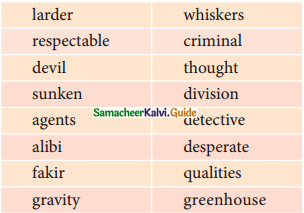
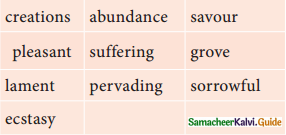
B) Read the poem and complete the summary using the words given in the box:

Samacheer Kalvi 11th English Guide Poem 4 Macavity - The Mystery Cat 1

‘Macavity — The Mystery Cat’ is a humorous poem, where the poet T.S. Eliot describes the mysterious (a) _______ of a shrewd vile cat. He commits a crime at every possible opportunity. He is an elusive master (b) _______ who leaves no evidence after he commits a crime. Even the Scotland Yard, the London (c) _______ agency is unable to arrest him. The Flying Squad is (d) ________ because every time they rush to the crime spot to seize Macavity, he is not there. He breaks the human law as well as the law of (e) _______. He baffles even a (f) ________ with his powers of levitation. Macavity appears tall and thin with (g) _______ eyes. He is always preoccupied with some serious (h) _______. His coat is dusty and his (j) _______are unkempt. Macavity is a (j) ________ in the guise of a cat. He appears to be outwardly (k) _________ but his actions disprove it. Macavity loots the (l) _______, ransacks the jewel-case, and breaks the (m) _______ glass but the wonder of wonders he is not to be found anywhere there. He is always a mile away from the scene of the crime, happily relaxing or doing difficult (n) ____________ sums. He is clever at making up an (o) _______ every time he plots a crime. All the notorious cats are nothing but the (p) ________ of Macavity, the Napoleon of Crime.

Samacheer Kalvi 11th English Guide Poem 4 Macavity - The Mystery Cat

Answers:
(a) Qualities
(b) Criminal
(c) Detective
(d) Desperate
(e) Gravity
(f) Fakir
(g) Sunken
(h) Thought
(i) Whiskers
(j) Devil
(k) Respectable
(l) Larder
(m) Greenhouse
(n) Division
(o) Alibi
(p) Agents

Paragraph:

1. What are the mysterious ways in which Macavity acts?
2. Describe the appearances and qualities of Macavity?

PoemMacavity The mystery cat
PoetT.S.Eliot
ThemeThe cat-master of crimes

Samacheer Kalvi 11th English Guide Poem 4 Macavity - The Mystery Cat

In T.S Eliot’s poem, ‘Macavity: The mystery cat, he describes the mysterious qualities of a cat of villainous characters.

‘Macavity’s a ginger cat, he’s very tall and thin:
Macavity is a tall and thin cat who is always up to some crime. He is too clever to leave any evidence of his guilt.

“He’s the bafflement of Scotland Yard, the flying squad’s despair”:
He is an enigma to every detective agency in the world including. Scotland Yard and flying squad who are specialized investigating crime.

“It must have been Macavity! But he’s a mile away”:
There is never enough proof to arrest and he’s a mile away from all crime spots.

“He’s broken every human law; he breaks the law of gravity”:
Not only does he breaks the human law but also breaks the law of gravity.

“His brow is deeply lined with thought, his head is highly domed”
His coat is dusty from neglect, his whiskers are uncombed.
He always moves his head from side to side, with movements like a snake.

His brows are deeply lining as a result of continuous planning of the crime. Macavity has sunken eyes and “his head is highly domed”. He never combs his whiskers His movements resemble that of a snake. He spends his time plotting for the criminal acts and how to carry them out. The poet accuses, Macavity of his behaviour, such as stealing milk but also holds him responsible for major crimes.

‘For he’s a fiend in feline shape, a monster of depravity’:
The cat is a devil in disguise and he is a monster of wickedness. He has been suspected of stifling Pekes, Vandalism, theft, cheating of cards, and spying. He has also controlled an organized crime with Mungojerrie, Griddle Bone among the members. So the poet says that all the notorious cats are nothing but the agents of Macavity, the Napoleon of crime.

“Are nothing more than agents for the cats who all the time Just controls their operator’s the Napoleon of Crime”?

Samacheer Kalvi 11th English Guide Poem 4 Macavity - The Mystery Cat

Read the given lines and answer the questions that follow:

i) Macavity’s a Mystery Cat: he’s called the Hidden Paw.

Question a.
Does the poet talk about a real cat?
Answer:
No, the poet talks about an imaginary character.

Question b.
Why is he called the Hidden Paw?
Answer:
He is called the Hidden Paw as he is the criminal mastermind who disregards the law.

ii) He’s the bafflement of Scotland Yard, the Flying Squad’s despair:
For when they reach the scene of crime Macavity s not there!

Question a.
What is ‘Scotland yard’?
Answer:

Scotland Yard is the world-famous headquarters of the London metropolitan police service known for quick investigation of crime and nabbing the criminal in record time.

Question b.
Why does the flying squad feel disappointed?
Answer:
Macavity is too clever to be caught and he is nowhere near at the crime spot. So the flying squad feels disappointed.

iii) He sways his head from side to side, with movements like a snake; And when you think he’s half asleep, he’s always wide awake…

Question a.
Explain the comparison made here.
Answer:
Macavity moves his head from side to side and his body movement is compared to a snake.

Question b.
What does he pretend to do?
Answer:
He pretends to be asleep.

iv) For he’s a fiend in feline shape.
A monster of depravity.

Question a.
How is the cat described in this line?
Answer:
The cat is a devil in disguise of a cat.

Question b.
Explain the phrase ‘monster depravity’
Answer:
‘Monster of depravity’ means he is a monster of wickedness.

v) And his footprints are not found in any file of Scotland yard’s

Question a.
What seems to be a challenge for the Scotland yard?
Answer:
Macavity s footprints are never to be found in any file of the Scotland yard’s.

Question b.
Why do they need his footprints?
Answer:
They need his footprints to catch him.

vi) ‘It must have been Macavity! But he’s a mile away.

Question a.
What is Macavity blamed for?
Answer:
Macavity is blamed for breaking the greenhouse glass and for theft. Also when the milk goes missing.

Question b.
Where is he?
Answer:
He is a mile away from the scene of the crime.

vii) There never was a cat of such deceitfulness and suavity.

Question a.
Which cat is being talked of here?
Answer:
Macavity is being talked.

Question b.
How is he different from the rest?
Answer:
He is different from the rest by his dishonesty, cunningness but be pretends to be innocent.

Samacheer Kalvi 11th English Guide Poem 4 Macavity - The Mystery Cat

E. Explain the following lines with reference to the context:

I. His powers of Levitation would make a fakir stare’

Reference:
This line is taken from the Poem “Macavity-The Mystery Cat”, Poet – “T.S Eliot”.
Context:
Here the poet talks about the power of Macavity.
Explanation:
The poet says that his levitation is so powerful that it causes a fakir to stare bewildered.

II. ‘And when you think he’s half asleep, he’s always wide awake.

Reference:
This line is taken from the Poem “Macavity-The Mystery Cat”, Poet – “T.S Eliot”.
Context:
Here the poet talks about the pretending sleep of Macavity.
Explanation:
Macavity is a clever fellow. When you think he is sleeping, he is wide awake in fact.

III. And his footprints are not found in any file of Scotland yard’s

Reference:
This line is taken from the Poem “Macavity-The Mystery Cat”, Poet – “T.S Eliot”.
Context:
Here the poet talks about the great escapism of Macavity.
Explanation:
Macavity footprints are never to be found in any file of the Scotland yards. When they try to find him he is a mile away from the scene of the crime.

Samacheer Kalvi 11th English Guide Poem 4 Macavity - The Mystery Cat

IV. There may be a scrap of paper in the hall or on the stair
But it’s useless to investigate

Reference:
This line is taken from the Poem “Macavity-The Mystery Cat”, Poet – “T.S Eliot”.
Context:
The poet talks about the mastermind of the cat.
Explanation:
When the foreign office’s Treaty is not found or the Admiralty Treaty is not found or the Admiralty loses some plans and drawing. It is useless to investigate as they all know that the mastermind behind this act is undoubtedly Macavity’s.

V. He always has an alibi, and one or two to spare.

Reference:
This line is taken from the Poem “Macavity – The Mystery Cat”, Poet – “T.S Eliot”.
Context:
Here the poet talks about making up an alibi.
Explanation:
The poet says that there has never been a cat of such deceitfulness and tactfulness. Macavity is always ready with an alibi or two and when the crime is discovered, Macavity is not there.

Samacheer Kalvi 11th English Guide Poem 4 Macavity - The Mystery Cat

F. Eliot has many figures of speech to present the poem to the readers in an interesting way. He has attributed the human qualities of a cat in this poem:

Question i.
Identify the literary devices used in the following lines: (Figure of Speech)
Answer:

  • He sways his head from side to side, with movements like a snake – simile
  • They say he cheats at cards. – metaphor/Personification
  • Macavity, Macavity there’s no one like Macavity -Repetition

Question ii.
Give four instances where the poet has used alliteration in the poem.
Answer:
Alliteration in the poem

  1. “His brow is deeply lined with thought, his head is highly domed.”
    Deeply – domed.
  2. “For he’s fiend in feline shape, a monster of depravity.”
    fiend – feline.
  3. “Or when the milk is missing, or another Peke’s been stippled.”
    Milk – missing.
  4. “And his footprints are not found in any file of Scotland yard’s.”
    Foot prints – found — file

Question iii.
What is the rhyme scheme used in the poem?
Answer:
aa, bb

Samacheer Kalvi 11th English Guide Poem 4 Macavity - The Mystery Cat

Question iv.
Pick out all the pairs of rhyming words used in the poem.
Answer:
Rhyming words:

  1. Paw – law
  2. Despair – there
  3. Macavity – gravity
  4. Stare – there
  5. Air – there
  6. Thin – in
  7. domed – uncombed
  8. Snake – awake
  9. Macavity – depravity
  10. Square – there
  11. Cards – yard’s
  12. Rifled – stifled
  13. Repair – there
  14. Astray – way
  15. Repair – there
  16. Stair – there
  17. Say – away
  18. Thumbs – sums
  19. Macavity – suavity
  20. Spare – there
  21. Known – griddlebone
  22. Time – crime.

Samacheer Kalvi 11th English Guide Poem 4 Macavity - The Mystery Cat

H. Speaking activity:

b) Meaning of the proverb:
What is proverb Expansion?

A proverb is a statement, accepted by all people of a particular community over the generations. ‘Expansion’ means developing and enlarging the idea or a thing. ‘Proverb Expansions’ means enlarging the idea confined in a proverb into a paragraph.
Hints:

  1. Be thorough with the exact meaning of the proverb.
  2. Then proceed to expand the proverb with examples and the relevant details.
  3. Arrange your ideas in order, that is relevant.
  4. Avoid everything that is irrelevant.
  5. Explain the meaning of the proverb in plain language.
  6. Avoid ‘Cliche’ and stereotyped uninteresting phrases.
  7. Make paragraphs of equal length and size.

Example:
When the mouse laughs at the cat, there is a hole nearby. Explain the meaning of this statement to your friends.

Meaning:
The meaning of this proverb is that we act tougher when we know we have a backup. When our backgrounds is strong we seem to be bolder in action.

Samacheer Kalvi 11th English Guide Poem 4 Macavity - The Mystery Cat

Additional Exercises:

Explain the meaning of the following proverbs:

1) ‘Slow and steady wins the race’
Consistency and steadiness can achieve massive success even if slow. A person with average talent can achieve success through continuous efforts. One can overcome difficulties through constant effort in the right direction.

2) Don’t judge a book by its cover
Things are not always what they seem. This proverb teaches you not to make judgments about other people because of how they look or dress. A book with a boring or plain over could be amazing. The same is true with people. A person might look like an athlete or fool, but there is probably a lot more to them than clothes suggest.

3) Strike while the iron is hot
This old expression comes from the days of blacksmiths. To shape the metal, the blacksmith would have to beat it with a hammer. Iron is easier to work with when it’s hot. This proverb means you should take advantage of the moment. If an opportunity presents itself to you, take it! Take action because the change may not come again.

4) Too many cooks spoil the broth
“Too many cooks in the kitchen.” This is a well-known experience – a lot of people all trying to work in a kitchen around a small table or stovetop will make a mess and ruin the food. This proverb talks about the trouble of too many people trying to do the same thing at once.

5) Honesty is the best policy
Lying a lot can be difficult because you might forget your lies, Soon enough, someone will find out you are lying. Even if no one ever finds out, you will feel guilty for not telling the truth. If you are honest and tell the truth, people will believe you and respect you. You will earn their trust and sleep well at night.

Samacheer Kalvi 11th English Guide Poem 4 Macavity - The Mystery Cat

C. Compose a poem:

c) Compose your own limericks on an elephant, a peacock, and a butterfly. Read it out to your class.

Elephant
I love Elephant
Its eyes are tiny
But they are shiny
Its trunk is long
But it is very strong
It moves slowly
But it is brain ‘A peacock’
Joy is a peacock-it’s beauty so rare;
A rainbow of colors that vibrantly flare.
After the train, brightly they come out.
Into a far-like form, uniquely it creates.
Never forget, this vision, joyfully it illuminates.
A butterfly
I saw a butterfly
It wings so high
This colourful fly
A treat to my eye.

Samacheer Kalvi 11th English Guide Poem 4 Macavity - The Mystery Cat

கவிஞரைப் பற்றி:

தாமஸ் ஸ்டேனஸ் எலியட் (1888-1965) மிகச்சிறந்த கட்டுரையாளர். இவர் இருபதாம் நூற்றாண்டின் மிகச்சிறந்த விமர்சகர், நாடக ஆசிரியர், கவிஞர் ஆவார். இவர் அமேரிக்காவில் உள்ள ஹார்வர்ட் பல்கலைக்கழகத்தின் மாணவர் சமஸ்கிருதம் கற்றதன் மூலம் இந்திய தத்துவயியலையும் கற்றார்.

” The Wasteland”, ” Love Song of I Alfred Prufrock”, “Ash Wednesday”, Four Qartets, “Journey of the magi”, “After strange gods”, Namingofcats ஆகியவை இவரின் சிறந்த படைப்புகள். இவருக்கு 1948ம் ஆண்டு இலக்கியத்திற்கான நோபல் பரிசு வழங்கப்பட்டது.

கவிதையைப் பற்றி:

கவிஞர் இந்த கவிதையில் ஒரு வீட்டில் இருந்த சுட்டித்தனமான பூனையின் செயல்பாடுகளை விவரிப்பதாக எழுதியுள்ளார். அப்பூனையின் பெயர் மெக்காவிட்டி. பூனைகள் நாம் காணமுடியாததை காணக்கூடிய, நாம் செய்ய அச்சப்படுகிற இருடத்திற்கும் செல்லக் கூடிய மர்மமான ஆற்றல் கொண்டவை.

அதைப்போல இக்கவிதையில் பேசப்படும் பூனையும் யாருடைய கையிலும் சிக்காமல் பல சேட்டைகளை செய்து வருவதாகவும், திருட்டுத்தனங்கள் செய்வதாகவும், ஆனால் திருட்டு நடந்த இடத்திற்கு காவல்துறை பிடிக்க சென்றால் அந்த இடத்தில் அந்த பூனை இருக்காது. இக்கவிதையில் மெக்காவிட்டி பூனையின் மர்மமான குண நலன்களைப் பற்றி தெளிவாகவும், நகைச்சுவையாகவும் கூறுகிறார்.

Samacheer Kalvi 11th English Guide Poem 4 Macavity - The Mystery Cat

Macavity – The Mystery Cat Summary in Tamil

மெக்கவிட்டி மர்மமான பூனை;
அவன் மறைவான பாதம் என்று அழைக்கப்படுவான்.
ஏனெனில் அவன் சட்டத்தை மதிக்காத முதன்மை குற்றவாளி
Scotland yard – ன் குழப்பமாகவும்;
Flying squad-ன் பிடிபடாத குற்றவாளி,
அவர்கள் குற்றம் நடந்த இடத்திற்கு செல்லும் போது
அங்கு மெக்கவிட்டி இருப்பது இல்லை.
Macavity அவன் போல் யாரும் இல்லை .

மனித சட்டத்தையும், புவி ஈர்ப்பு விசையையும் உடைத்தெரிந்தான்
அவன் தாவுதல் ஆற்றல் வாய்ந்ததாக இருக்கும்.
நீங்கள் குற்றம் நடந்த இடத்திற்கு செல்லும் போது,
Macavity அங்கு இருப்பது இல்லை.
நீங்கள் அடித்தளத்தில் அவனைத் தேடலாம்;
நீங்கள் காற்றிலும் அவனை தேடலாம்.

Samacheer Kalvi 11th English Guide Poem 4 Macavity - The Mystery Cat

ஆனால் நான் மறுபடியும் மறுபடியும் சொல்கிறேன்
Macavity ஒரு எச்சரிக்கையான (ginger) பூனை
அவன் மெலிந்தும் மற்றும் உயரமாகவும் இருப்பான்.
நீங்கள் அவனை பார்த்தவுடன் அவனை அறிவீர்கள்;
அவனது கண்கள் மூழ்கி இருக்கும்.
அவனது புருவங்கள் ஆழ்ந்த சிந்தனை கொண்டவை;
அது மிகவும் ஆதிக்கம் செலுத்தும்.

Samacheer Kalvi 11th English Guide Poem 4 Macavity - The Mystery Cat 2

அவனது உடல் முழுவதும் தூசி படிந்திருக்கும்
அவனது மீசைகள் சீராக இருக்காது.
அவனது தலையை பாம்பைப் போல் அங்கும் இங்கும் ஆட்டுவான்.
நீங்கள் அவன் கொஞ்சம் தூங்கி இருப்பான் என்று நினைப்பீர்கள்,
ஆனால் நன்று விழித்திருப்பான்.
Macavity யாரும் அவன் போல் இல்லை
பூனை (feline) வடிவம் கொண்ட எதிரி (fiend),
தீய பண்புகள் (depravity) கொண்ட அரக்கர்.

Samacheer Kalvi 11th English Guide Poem 4 Macavity - The Mystery Cat

அவனை நீங்கள் தெருவில் சந்திக்கலாம்,
அவனை square கூட பார்க்கலாம்.
ஆனால் ஒரு குற்றம் கண்டறிந்தால்,
Macavity அங்கு இருப்பதில்லை!
அவனது வெளிப்படுத்தல் மதிக்கக்கூடியதாக இருக்கும்
(அவர்கள் அவன் விலை ஏமாற்றுவதை கூறுவார்கள்)
அவனது காலடி தடங்கள் Scotlands எங்கும் காணப்படுவது இல்லை.

முழு அலமாரியும் (Larder’s) சூறையாடப்படும் போது,
நகைகள் எல்லாம் கொள்ளையிடப்படும் போதும்
பால் எல்லாம் காணாமல் போக, ஒரு பெக்கினி நாயை (Peke’s) அடக்கப்படும் போது
அல்லது கிரீன்ஹவுஸ் கண்ணாடிகள் உடையும் போது,
மரப்பட்டையின் பழைய பழுது
இதில் திகைக்கக்கூடிய விஷயம் என்ன என்றால்!

Macavity அங்கு இருப்பதில்லை!
வழிகாட்டிய ஒப்பந்தத்தை வெளிநாட்டு அலுவலகம் கண்டறியும் போது
அல்லது அரசு பணிகளின் திட்டங்கள் மற்றும் படங்கள் காணாமல் போகும் போது,
சில துண்டு காகிதங்கள் ஹால் மற்றும் படிகட்டுகளில் இருக்கும்
ஆனால் அவை விசாரிக்க ஏதுவாக இல்லை!
Macavity அங்கு இல்லை!
இழப்பு வெளிப்படுத்தபட்டதால்;
ரகசிய சேவை கூறியது. இது Macavity தான்!” ஆனால் பல மைல்கள் தள்ளி இருப்பான்.

Samacheer Kalvi 11th English Guide Poem 4 Macavity - The Mystery Cat

கண்டிப்பாக அவன் ஓய்வெடுக்கும் போது
அவன் கட்டைவிரலை நக்குவான்
அவன் தீவிரமாக பல கடினமான பெரிய செயல்களைச் செய்வான்.
Macavity, Macavity அவன் போல் யாரும் இல்லை
நம்பிக்கையும் (suavity) தந்திரமும் (deceitfulness) கொண்ட பூனையை பார்த்ததில்லை.

அவன் எப்போதும் வேற்றிட வாதம் கொண்டவன்,
ஒன்று அல்லது இரண்டு இடங்கள் தவிர
எந்த நேரத்தில் சில செயல்கள் ஏற்பட்டால்,
Macavity அங்கு இருப்பதில்லை!
அனைத்து பூனைகளின் சிறந்த செயல்கள்
அறிதாய் இருக்கும் என அவர்கள் கூறுவார்கள்.
(Mungojerrie பற்றி கூறுகிறேன், Griddlebone பற்றி கூறுகிறேன்)
அனைத்து நேரமும் முகவர்கள் போல் சிறந்தவர்கள் இல்லை
இதைப் போன்று இயக்கத்தை தடுக்க; நெப்போலியனின் குற்றங்கள்.
ஆகையால் Macavity யை Napoleon of crime என்று கூறினர்.

Samacheer Kalvi 12th Bio Botany Guide Chapter 9 Plant Breeding

Tamilnadu State Board New Syllabus Samacheer Kalvi 12th Bio Botany Guide Pdf Chapter 9 Plant Breeding Text Book Back Questions and Answers, Notes.

Tamilnadu Samacheer Kalvi 12th Bio Botany Solutions Chapter 9 Plant Breeding

12th Bio Botany Guide Plant Breeding Text Book Back Questions and Answers

I. Choose the correct answer

Question 1.
Assertion : Genetic variation provides the raw material for selection.
Reason : Genetic variations are differences in genotypes of the individuals.
a) Assertion is right and reason is wrong.
b) Assertion is wrong and reason is right.
c) Both reason and assertion is right.
d) Both reason and assertion is wrong.
Answer:
b) Assertion is wrong and reason is right.

Question 2.
While studying the history of domestication of various cultivated plants ………………. were recognized earlier.
a) Centres of origin
b) Centres of domestication
c) Centres of hybrid
d) Centres of variation
Answer:
a) Centres of origin

 Samacheer Kalvi 12th Bio Botany Guide Chapter 9 Plant Breeding

Question 3.
Pick out the odd pair …………..
a) Mass selection – Morphological characters
b) Purline selection – Repeated self pollination
c) Clonal selection — Sexually propagated
d) Natural selection – Involves nature
Answer:
c) Clonal selection – Sexually propagated

Question 4.
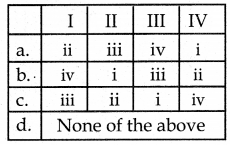
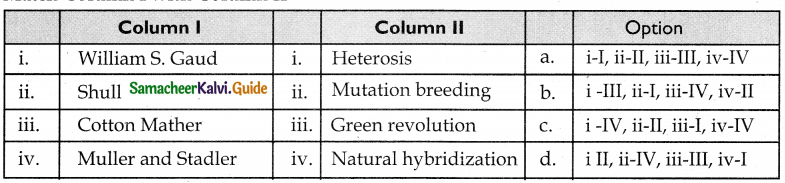
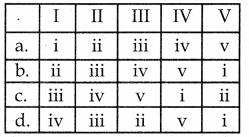
Match Column I with Column II
Samacheer Kalvi 12th Bio Botany Guide Chapter 9 Plant Breeding 1
Answer:
b) i -III, ii-I, iii-IV, iv-II

Question 5.
The quickest method of plant breeding is
a) Introduction
b) Selection
c) Hybridization
d) Mutation breeding
Answer:
b) Selection

 Samacheer Kalvi 12th Bio Botany Guide Chapter 9 Plant Breeding

Question 6.
Desired improved variety of economically useful crops are raised by
a) Natural selection
b) hybridization
c) mutation
d) biofertilisers
Answer:
b) hybridization

Question 7.
Plants having similar genotypes produced by plant breeding are called
a) clone
b) haploid
c) autopolyploid
d) genome
Answer:
a) clone

Question 8.
Importing better varieties and plants from outside and acclimatising them to local environment is called
a) cloning
b) heterosis
c) selection
d) introduction
Answer:
d) Introduction

 Samacheer Kalvi 12th Bio Botany Guide Chapter 9 Plant Breeding

Question 9.
Dwarfing gene of wheat is
a) pal 1
b) Atomita 1
c) Norin 10
d) pelita 2
Answer:
c) Norin 10

Question 10.
Crosses between the plants of the same variety are called
a) interspecific
b) inter varietal
c) intra varietal
d) inter generic
Answer:
c) Intra varietal

Question 11.
Progeny obtained as a result of repeat self pollination a cross pollinated crop to called
a) pure line
b) pedigree line
c) inbreed line
d) heterosis
Answer:
b) Pure line

 Samacheer Kalvi 12th Bio Botany Guide Chapter 9 Plant Breeding

Question 12.
Jaya and Ratna are the semi dwarf varieties of
a) wheat
b) rice
c) cowpea
d) mustard
Answer:
b) Rice

Question 13.
Which one of the following are the species that are crossed to give sugarcane varieties with high sugar, high yield, thick stems and ability to grow in the sugarcane belt of North India?
a) Saccharum robustum and Saccharum officinarum
b) Saccharum barberi and Saccharum officinarum
c) Saccharum sinense and Saccharum officinarum
d) Saccharum barberi and Saccharum robustum
Answer:
b)Saccharum barberi and Saccharum officinarum

Question 14.
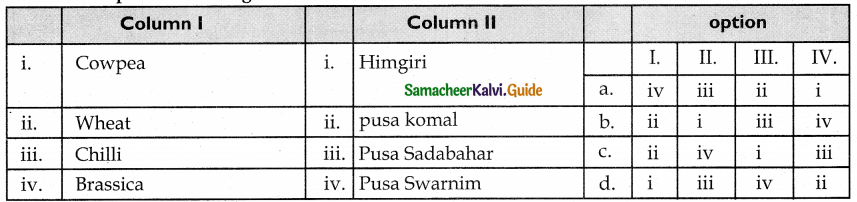
Match column I (crop) with column II (Corresponding disease resistant variety) and select the correct option from the given codes.
Samacheer Kalvi 12th Bio Botany Guide Chapter 9 Plant Breeding 2
Answer:
b) I-(ii), II-(i), IH-(iii), IV-(iv)

 Samacheer Kalvi 12th Bio Botany Guide Chapter 9 Plant Breeding

Question 15.
A Wheat variety, Atlas 66 which has been used as a donor for improving cultivated wheat, which is rich in
a) iron
b) carbohydrates
c) proteins
d) vitamins
Answer:
c) proteins

Question 16.
Which one of the following crop varieties correct matches with its resistance to a disease

VarietyResistance to disease
a. Pusa KomalBacterial blight
b. Pusa SadabaharWhite rust
c. Pusa ShubhraChilli mosaic virus
d. BrassicaPusa swarnim

Answer:
a) Pusa Komal – Bacterial blight

Question 17.
Which of the following is incorrectly paired?
a) Wheat – Himgiri
b) Milch breed – Sahiwal
c) Rice – Ratna
d) Pusa Komal – Brassica
Answer:
d) Pusa Komal – Brassica

 Samacheer Kalvi 12th Bio Botany Guide Chapter 9 Plant Breeding

Question 18.
Match list I with list II

List IList II
BiofertilizerOrganisms
i. Free living N2a. Aspergillus
ii. Symbiotic N2b. Arnanita
iii. P Solubilizingc. Anabaena azollae
iv. P Mobilizingd.d. Azotobactor

a. i c, ii a, iii b, iv d
b. i d, ii c, iii a, iv b
c. i a, ii c, iii b, iv d,
d. i b, ii a, iii d, iv c
Answer:
b. i d, ii c, iii a, iv b

Question 19.
Differentiate primary introduction from secondary introduction
Answer:

Primary introductionSecondary introduction
1. The introduced Variety is well adapted to the new environment.
2. There is no alternation to the original genotype
1. The introduced Variety is subjected to selection
2. The introduced Variety is subjected to selection
3. That variety is hybridized with a local variety to transfer one or a few characters to them.

Example :
Tea varieties collected from china and North East India initially grown in Botanical garden of kolkate from which appropriate clones have selected and introduced to different parts of India.

Question 20.
How are microbial innoculants used to increase the soil fertility?
Answer:

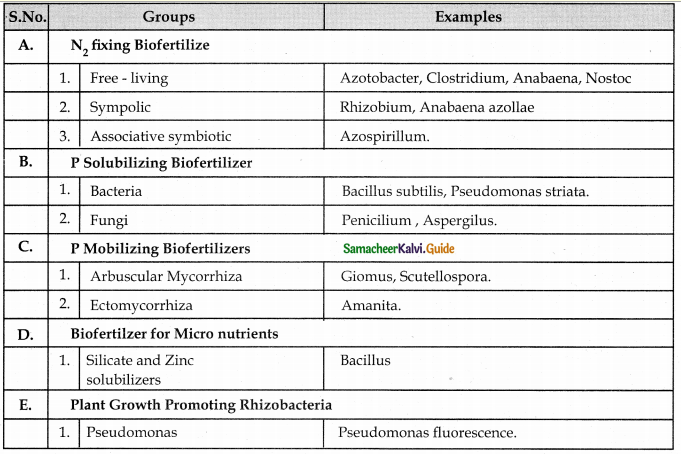
Biofertilizers or microbial innoculants are defined as preparations containing living cells or latent cells of efficient strains of microorganisms that help crop plants uptake of nutrients by their interactions in the rhizosphere when applied through seed or soil.

They are efficient in fixing nitrogen, solubilising phosphate and decomposing cellulose. They are designed to improve the soil fertility, plant growth, and also the number and biological activity of beneficial microorganisms in the soil. They are ecofriendly organic agro inputs and are more efficient and cost effective than chemical fertilizers.

 Samacheer Kalvi 12th Bio Botany Guide Chapter 9 Plant Breeding

Question 21.
What are the different types of hybridization?
Answer:
Types of hybridization:

(i) Intravarietal hybridization:
The cross between the plants of same variety. such crosses are useful only in the self. pollinated crops.

(ii) Intervarietal hybridization:
The cross between the plants belonging to two different varieties of the same species and is also known as intraspecific hybridization.

(iii) Interspecific hybridization:
The cross between the plants belonging to different species belonging to the same genus is also called intragenic hybridization.
Example:
Gossypium hirsutum
Gossypium arboreum

(v) Intergeneric hybridization:

  • The crosses are made between the plants belonging to two different genera.
  • The disadvantages are hybrid sterility time consuming and expensive procedure.
    Example : Raphanobrassica x Triticale

Question 22.
Explain the best suited type followed by plant breeders at present?
Answer:
Mutation breeding represents a new method of conventional breeding procedures as they have the advantage of improving the defect without losing an agronomic and quality character in agriculture and crop improvement. Mutation means the sudden heritable changes in the genotype or phenotype of an organism. Gene mutations are of considerable importance in plant breeding as they provide essential inputs for evolution as well as for recombination and selection. It is the only method for improving seedless crops.

 Samacheer Kalvi 12th Bio Botany Guide Chapter 9 Plant Breeding

Question 23.
Write a note on heterosis.
Answer:

  • The superiority of the FI hybrid in performance over its parents is called heterosis or hybird vigour.
  • G.H. Shull was the first scientist to use the term heterosis in 1912.
  • Heterosis are of the following types.
  • Euheterosis, Mutational Euheterosis, Balanced Euheterosis and Pseudoheterosis

(i) Euheterosis:
This is the true heterrosis which is inherited and is further classified as.

(a) Mutational Euheteosis:
Simplest type of euheterosis and results from the sheltering or eliminating of the deleterious unfavourable often lethal, recessive, mutant genes by their adaptively superior dominant alleles in cross pollinated crops.

(b) Balanced Euheterosis :
well balanced gene combinations which is more adaptive to environmental conditions and agricultural usefulness.

(ii) Psuedohetrosis:
Also termed as luxuriance progeny possess superiority over parents in vegetative growth but not in yield and adaptation usually sterile or poorly fertile.

Question 24.
List out the new breeding techniques involved in developing new traits in plant breeding.
Answer:
New Breeding Techniques (NBT) are a collection of methods that could increase and accelerate the development of new traits in plant breeding. These techniques often involve genome editing, to modify DNA at specific locations within the plants to produce new traits in crop plants. The various methods of achieving these changes in traits include the following.

  • Cutting and modifying the genome during the repair process by tools like CRISPR /Cas.
  • Genome editing to introduce changes in a few base pairs using a technique called Oligonucleotide-directed mutagenesis (ODM).
  • Transferring a gene from an identical or closely related species (cisgenesis).
  • Organizing processes that alter gene activity without altering the DNA itself (epigenetic methods)

 Samacheer Kalvi 12th Bio Botany Guide Chapter 9 Plant Breeding

12th Bio Botany Guide Plant Breeding Additional Important Questions and Answers

I. Match the Following

Question 1.

Column AColumn B
a. Darwins’s evolutionary theoryI. Origin of Cultivated plants
b. VavilovII. 12 mega gene centres
c. ZhukovskyIII. 12 main geographic centres
d. De candolleIV. Natural selection and Hybridization

A) a – iv, b – iii, c – ii, d – i
B) a – iv, b – ii, c – iii, d – i
C) a – ii, b – i, c – iv, d – iii
D) a – i, b – iv, c – ii, d – iii
Answer:
A) a – iv, b – iii, c – ii, d – i

Question 2.

Column AColumn B
a. Green RevolutionI. Muller and stadler
b. Mutation BreedingII. G.H. Shull
c. HeterosisIII. William S. Gaud
d. Director of IARIIV. Dr.B.P. Pal

A) a – ii, b – iii, c-iv, d-i
B) a – iii, b-ii, c-i, d-iv
c) a – iii, b – i, c-ii, d-iv
D) a – i, b-iv c-iii, d-ii
Answer:
c) a – iii, b – i, c – i, d – iv

 Samacheer Kalvi 12th Bio Botany Guide Chapter 9 Plant Breeding

Question 3.

Column AColumn B
a. MesoamericaI. Sesame
b. South East AsiaII. Bamboo
c. AbyssinianIII. Guava
d. ChinaIV. Hemp

A) a – ii, b – iii, c- i, d – iv
B) a – i, b – ii, c – iv, d – iii
c) a – iv, b – i, c – ii, d – iii
D) a – iii, b – iv c – i, d – iv
Answer:
D) a – iii, b – iv c – i, d – iv

Question 4.

Column AColumn B
a. Atomic GardenI. Dwarfing Genes
b. Protein EnrichedII. Caesium 137
c. Vitamin C EntichedIII. French Peas
d. Norin 10IV. Bitter Gourd

A) a – i, b – ii, c – iv, d – iii
B) a – ii, b – iii, c – iv, d – i
c) a – iii, b – iv, c – i, d – iii
D) a – iv, b – i, c – iii, d – ii
Answer:
B) a – ii, b – iii, c – iv, d – i

 Samacheer Kalvi 12th Bio Botany Guide Chapter 9 Plant Breeding

II. Choose the Odd man Out

Question 1.
a) Rhizoblum
b) Azolla
c) Trichoderma
d) Arbuscular mycorhizae
Answer:
c) Trichoderma

Question 2.
a) Anabaena
b) Amanita
c) Nostoc
d) Azospirillum
Answer:
b) Amanita

Question 3.
a) Natural selection
b) Mass selection
c) Purelinc selection
d) Clonal selection
Answer:
a) Natural selection

Question 4.
a) Cesium
b) Nitromethyl
c) Urea
d) X-ray
Answer:
d) X-ray

 Samacheer Kalvi 12th Bio Botany Guide Chapter 9 Plant Breeding

III. Choose the incorrect Pair

Question 1.

Column AColumn B
a. China1. Bamboo
b. South East Asia2. Coconut
c. Ethiopia3. Castor
d. South America4. Onion

Answer:
d) South America – Onion

Question 2.

Column AColumn B
a. C.T.Patel1. First Cotton hybrid
b. Dr. B.P. Pal2. Superior disease resistant wheat
c. Dr. K. Ramiah3. Wheat breeder
d. Sir. T.S. Venkataraman4. Sugar cane breeder

Answer:
C) Dr. K. Ramiah – Wheat breeder

 Samacheer Kalvi 12th Bio Botany Guide Chapter 9 Plant Breeding

Question 3.

Column AColumn B
a. N2 Fixing Bacteria1. Bacillus
b. Fungi2. Penicillium
c. Bacillus3. Silicate and Zinc Solubilizers
d. Symbiotic4. Rhizobium

Answer:
a) N2 Fixing Bacteria – Bacillus

Question 4.

Column AColumn B
a. Free Living fungi1. Trichoderma
b.Entomopathogenic2. Beauveria
c. Green Manuring3. Sonora – 63
d. Green Leaf Manure4. Cassia fistula

Answer:
c) Green Manuring – Sonora – 63

 Samacheer Kalvi 12th Bio Botany Guide Chapter 9 Plant Breeding

IV. Choose the incorrect Pair

Question 5.

Column AColumn B
a. Domestication wheat1. 1926
b. Blast resistant Rice2. 1940
c. Insect Resistant Cotton3. 1903
d. Waxy Corn4. 1953

Answer:
b) Blast resistant Rice -1940

Question 6.

Column AColumn B
a. Green Manuring1. Tephrosia purpurea
b. Rhizoctonia Solani2. Potato
c. Rice Variety3. Sonora 64
d. Ectomycorrhiza4. Nostoc

Answer:
a) Green Manuring – Tephrosia purpurea

 Samacheer Kalvi 12th Bio Botany Guide Chapter 9 Plant Breeding

Question 7

Column AColumn B
a. Mutational Breeding1. Triticale
b. Polyploid Breeding2. Atomita -2
c. M.S. Swaminathan3. TN 1 – hybrid rice
d. Jaya and Ratna4. Semi dwarf wheat

Answer:
c) M.S. Swaminathan – TN 1 – hybrid rice

Question 8.

Column AColumn B
a. Wheat1. Pusa komal
b. Cow pea2. pusa sadabahar
c. Brassica3. Himgiri
d. Cauliflower4. Pusa shubhra

Answer:
d) Cauliflower – Pusa shubhra

 Samacheer Kalvi 12th Bio Botany Guide Chapter 9 Plant Breeding

V. Assertion and Reason

Question 1.
Assertion : Growing of green manure crops and use of these crops as manure is called Green Manuring.
Reason : It helps to increase the nitrogen in the soil.
a) A & R are true.
b) A & R are Wrong.
c) A is true and R is Wrong.
d) A is wrong and R is true.
Answer:
a) A & R are true.

Question 2.
Assertion : Dr. M.S. Swaminathan is called “Father of green revolution in India.
Reason : He strived hard for conservation of traditional rice varities.
a) Both A & R is True.
b) Both A & R is Wrong.
c) A is True and R is Wrong.
d) A is wrong and R is True.
Answer:
c) A is True and R is Wrong

 Samacheer Kalvi 12th Bio Botany Guide Chapter 9 Plant Breeding

Question 3.
Assertion(A): A variety formed by pure line selection method shows more homozggosity with respect to all genes.
Reason(R): The pure line plants are produced by asexual method of vegetative propagation method.
a) (A) is correct; (R) is wrong
b) (A) is wrong; (R) is correct
c) (A) is correct; (R) does not explain
d) (A) is correct; (R) explain (A)
Answer:
a) (A) is correct; (R) is wrong

Question 4.
Assertion : Earliest record of Agriculture is found in the fertile Crescent region in and around River Nile
Reason : Approximately 12000, years ago Fertile crescent region is in and around. Tigris and Euphrates river.
a) Both A & R are True.
b) Both A & R are Wrong.
c) A is True and R is Wrong.
d) A is Wrong and R is True.
Answer:
d) A is Wrong and R is True

 Samacheer Kalvi 12th Bio Botany Guide Chapter 9 Plant Breeding

VI. Choose the Correct Statements

Question 1.
a) Vavilov Studied 247 Cultivated plants
b) Zhukovsky divided the whole world into 12 mega gene centres.
c) Valvilo intially propose 12 main geographic centres of origin
d) Harlan put forward the concept of mega gene centre for the origin of cultivated plants
Answer:
b) Zhukovsky divided the whole world into 12 mega gene centres

Question 2.
a) Foxtail mullet was domesticated by India
b) Wheat & Pea war domesticated by Ethiopia.
c) Castor and Coffee was domesticated by central East
d) Tomato & Pineapple was domesticated by south America
Answer:
d) Tomato & Pineapple was domesticated by south America

 Samacheer Kalvi 12th Bio Botany Guide Chapter 9 Plant Breeding

Question 3.
a) Seaweeds has more than 70 minerals vitamins and enzymes
b) Trichoderma is a parasitic fungi.
c) Rhizobium is a pathogenic bacteria
d) Azolla is submerged water fern
Answer:
a) Seaweeds has more than 70 minerals vitamins and enzymes

Question 4.
a) Hirngiri is a wheat variety that is resistant to Bacterial blight disease.
b) A Variety of CowPea, Pusakomal is resistent to Hill bunt disease.
c) Pusa shubra is a cauliflower variety that is resistant to Black rot disease
d) Pusa swarnim is a variety of Brassica that is resistent to TMV disease
Answer:
c) Pusa shubra is a cauliflower variety that is resistant to Black disease

 Samacheer Kalvi 12th Bio Botany Guide Chapter 9 Plant Breeding

VII. Choose the incorrect Statements

Question 1.
a) Mr. Jayaraman was a disciple of Dr. Nammalvar
b) Normal E. Borlaug was awarded Noble prize for peace in 1970.
c) M.S. Swaminathan produced the first semidwarf fertiliser responsive hybrid variety of rice TN 1..
d) Green revolution the term was Coined by Muller
Answer:
d) Green revolution the term was Coined by Muller

Question 2.
The disadvantage of pureline selection is
a) It is difficult to distinguish between hereditary variation from environmental variation.
b) New genotypes are never created so they are less stable to environmental fluctuations
c) The genotype is unchanged for a long period of time.
d) The plants show more heterozygosity.
Answer:
c) The genotype is unchanged for a long period of time.

Question 3.
The possible changes in the plant species due to domestication are
a) Adaptation to a greater diversity of environments.
b) Uniform flowering and fruiting.
c) Drop in Yield
d) Change in breeding system
Answer:
c) Drop in yield

 Samacheer Kalvi 12th Bio Botany Guide Chapter 9 Plant Breeding

Question 4.
a) Rhizobiurn is best suited for the wheat fields.
b) Azolla that fixes the atmospheric nitrogen along with blue green algae.
c) Arbuscular mycorrhizae also assures water availability
cl) Sea weed liquid fertilizer improves resistance of plants to frost and disease.
Answer:
a) Rhizobium is best suited for the wheat fields

VIII. Choose the correct answer.

Question 1.
The domesticated crop of Mesoamerica is …………………..
a) Tomato
b) Pine apple
c) Sweet Potato
d) Rubber
Answer:
a) Tomato

Question 2.
The domesticated plant of the chiloe centre.
a) Maize
b)Potato
c) Tobacco
d) Olive
Answer:
a) Maize

 Samacheer Kalvi 12th Bio Botany Guide Chapter 9 Plant Breeding

Question 3.
The domesticated plant of the Near East is______
a) Rye
b) Rice
c) hemp
d) Cotton
Answer:
a) Rye

Question 4.
Name the rice variety with saline tolerance and pest resistance.
a) Wild-type rice
b) Atomita – 2
c) Dwarf rice variety
d) Golden rice
Answer:
b) Atomita -2

Question 5.
Biofertilizers could be also called as …………………
a) Viral inoculants
b) Myco inoculants
c) Protozoan inoculants
d) Bacterial Inoculants
Answer:
d) Bacterial Inoculants

 Samacheer Kalvi 12th Bio Botany Guide Chapter 9 Plant Breeding

Question 6.
Beauveria species act as a parasite on …………… species.
a) Mammals
b) Aves
c) Arthropod
d) Amphibians
Answer:
c) Arthropod

Question 7.
Damping off of ……………. is caused by Rhizoctonia solani.
a) Tomato
b) Potato
c) Millet
d) Maize
Answer:
a) Tomato

Question 8.
Pongamia pinnata is an important plant species useful for ………………. manure.
a) Organic
b) Potassium rich
c) Green leaf
d) Calcium rich
Answer:
c) Green leaf

 Samacheer Kalvi 12th Bio Botany Guide Chapter 9 Plant Breeding

Question 9.
Match the following and find the correct answer
(i) Rhizobium – (A) Water ferm
(ii) Trichoderma – (B) Green manuring
(iii) Azolla – (C) Symbiotic bacterium
(iv) Crotolaria – (D) Free living fungus
a) (i) B; (ii) C; (iii) D; (iv) A
b) (i) C; (ii) D; (iii) B; (iv) A
c) (i) C; (ii) D; (iii) A; (iv) B
d) (i) B; (ii) D; (iii) C; (iv) A
Answer:
c) (i) C; (ii) D; (iii) A; (iv) B

Question 10.
More Vigorous hybrid corn was developed in _______
a) 1926
b) 1943
c) 1950
d) 1936
Answer:
a) 1926

Question 11.
In 10,000 BC Domestication of ……………….. was done.
a) Maize
b) Paddy
c) Wheat
d) Sugar cane
Answer:
c) Wheat

 Samacheer Kalvi 12th Bio Botany Guide Chapter 9 Plant Breeding

Question 12.
The newly introduced plant was carefully examined by the process called …………….
a) PCR Method
b) Dots Method
c) Cisgenesid
d) Quarantine
Answer:
d) Quarantine

Question 13.
National Bureau of plant Genetic Resources is located at ……………….
a) Rangpuri
b) Andhra
c) Pune
d) Bihar
Answer:
a) Rangpuri

Question 14.
Hereditary Variation cannot be distinguished from environmental variation in ………………
a) Pureline selection
b) Clonal Selection
c) Mass Selection
d) Hybridization
Answer:
c) Mass Selection

 Samacheer Kalvi 12th Bio Botany Guide Chapter 9 Plant Breeding

Question 15.
Johannsen in 1903 coined the word.
a) Clonal Selection
b) Pure line
c) Mass Selection
d) Heterosis
Answer:
b) Pure line

Question 16.
Which one of the following is a biopesticide?
a) Azolla
b) Rhizobium
c) Beauveria
d) Hevea
Answer:
c) Beauveria

 Samacheer Kalvi 12th Bio Botany Guide Chapter 9 Plant Breeding

Question 17.
…………….. is the best suited measure for maintaining hybrid vigour.
a) Asexual reproduction
b) Vegetative Propagation
c) Grafting
d) Cutting
Answer:
b) Vegetative Propagation

Question 18.
…………. is also termed as luxuriance.
a) Euheterosis
b) Heterosis
c) Mutational heterosis
d) Pseudo heterosis
Answer:
d) Pseudo heterosis

Question 19.
Muller and Stadler coined the term ………………….
a) Mutation Breeding
b) Modern Breeding
c) Plant Breeding
d) Poly ploidy
Answer:
a) Mutation Breeding

 Samacheer Kalvi 12th Bio Botany Guide Chapter 9 Plant Breeding

Question 20.
Mutation Breeding is the only method of improving …………… crops.
a) Multi seeded
b) single seeded
C) seedless
d) Nutritional
Answer:
c) seedless

Question 21.
Bose Research institute at Calcutta is the first …………. in India.
a) Botanical garden
b) planatorium
c) Zoological park
d) Gamma garden
Answer:
d) Gamma garden

Question 22.
Which one of the following selection method takes longer time in bringing about desired variation?
a) clonal selection
b) Mass selection
c) pureline selection
d) Natural selection
Answer:
d) Natural selection

 Samacheer Kalvi 12th Bio Botany Guide Chapter 9 Plant Breeding

Question 23.
(A) was originally grown in North India
(B) was orginally grown in South India
a) (A) Saccharum officinarum (B) Saccharum bareri
b) (A) Saccharu bareri (B) Saccharum officinarum
c) (A) Saccharum coarctatum (B) Saccharum alopecuroidum
d) (A) Saccharum alopecuroidum (B) Saccharu coarctatum
Answer:
b) (A) Saccharu bareri (B) Saccharum officinarum

Question 24.
Green revolution is the ………………. Agricultural revolution.
a) Third
b) second
c) third
d) fourth
Answer:
a) Third

Question 25.
…………….. received the national award for best genome saviour. .
a) Nel jeyaraman
b) C.T.Patel
c) Dr.B.P.Pal
d) N.G.P.Rao
Answer:
a) Nel jeyaraman

 Samacheer Kalvi 12th Bio Botany Guide Chapter 9 Plant Breeding

Question 26.
……………. is the breeding of crops for improved nutritional quality
a) Plant Breeding
b) Heterosis
c) Mutation
d) Biofortification
Answer:
d) Biofortification

Question 27.
High aspartic acid maize leads to resistance to ………………….
a) aphids
b) jassids
c) maize stem borer
d) leaf roller
Answer:
c) maize stem borer

Question 28.
Which one of the following is not a free living N2 fixing organism?
a) Anabaena azollae
b)Azotobacter
c) Clostridium
d) Nostoc
Answer:
c) Clostridium

 Samacheer Kalvi 12th Bio Botany Guide Chapter 9 Plant Breeding

IX. Fill in the blanks.

1. De candolle in his ……………. studied 247 caltivated plants.
Answer:
Origen of cultivated plants

2. Bamboo eas demesticated by ……………….
Answer:
China

3. He was an eminet Sorghum breeder,devoloped World’s first hybrid of Sorghum CSH-1.
Answer:
N.G.P.Rao.

 Samacheer Kalvi 12th Bio Botany Guide Chapter 9 Plant Breeding

4. ……………… is used as a biofertilizer for wetland rice cultivation
Answer:
Azolla.

5. Vavilov in the year ………………. converted 8 main geographic centres of origin to 12
Answer:
1935

6. Harlan says that the centre of crop plants means the places of ……………… origin of the crop plants.
Answer:
Agricultural

7. The ……………… was domesticate only in the Chiloe centre
Answer:
Potato

 Samacheer Kalvi 12th Bio Botany Guide Chapter 9 Plant Breeding

8. ………………. could be also called as Bioinoculants
Answer:
Biofertilizers

9. C.T.Patel devoloped World’s first …………….. hybrid
Answer:
Cotton

10. Choudhary ram dhan made …………….. as punjab granary of India.
Answer:
Wheat

11. Azdla is used as biofertiliser for wetland rice cultivation and is known to contribute ……………./ha/crop.
Answer:
40-60 kg

 Samacheer Kalvi 12th Bio Botany Guide Chapter 9 Plant Breeding

12. …………….. is Associated with Phycomycetous fungi and angiosperm roots.
Answer:
Arbuscular Mycorhizzoe

13. ……………… contains Auxin,Cytokinin and Gibberellins
Answer:
Seaweed liquid fertiliser

14. ……………… species are free living fungi that are common in soil and root ecosystem
Answer:
Trichoderma

15. Damping of tomato is caused by ……………..
Answer:
Rhizoctonia Solani

 Samacheer Kalvi 12th Bio Botany Guide Chapter 9 Plant Breeding

16. It is one of the most important green manure crops
Answer:
Tephrosia Purpurea

17. The double helix structure of DNA was identified by ……………. and …………….
Answer:
James Watson,Francis Crick

18. By 2050 we will …………….. need more food to feed the rapid growing population.
Answer:
50%

19. Crop domestication started early during ……………….
Answer:
10,000 Bc

20. ………………. Corn was developed using targetted breeding.
Answer:
Waxy

 Samacheer Kalvi 12th Bio Botany Guide Chapter 9 Plant Breeding

21. Rice variety of ……………. introduced from Philippines
Answer:
IR8

22. NBPGR is located in Chennai at …………………..
Answer:
Meenembakkan

23. Introduced plants get adapted to the new environment is called as ……………….
Answer:
Acclimatization

24. Tea varieties collected from China and North East India initially grown in Botanical garden of ……………….
Answer:
Kolkatta
Selection

 Samacheer Kalvi 12th Bio Botany Guide Chapter 9 Plant Breeding

25. ______ is the oldest and basic method of plant breeding
Answer:
Preliminary

26. In clonal selection …………… yield trial takes place during 3rd year.
Answer:
Intrageneric

27. Interspecific hybridization is also called as _____
Answer:
hybridization

28. Green revolution scheme began in ……………. in 1940’s.
Answer:
Mexico

 Samacheer Kalvi 12th Bio Botany Guide Chapter 9 Plant Breeding

29. In 2005 …………….. organized a first ever traditional paddy seed festival in his farm as an individual.
Answer:
Nel jayaraman

30. …………… is a cleaving protein.
Answer:
Cas9

X. Two Marks

Question 1.
What is Economic Botany?
Answer:
It is the study of the relationship between people and economically important plants.

Question 2.
When did people started practising Agriculture?
Answer:

  • Archeological evidence for earliest record of agriculture is found in the fertile crescent region in and around Tigris and Euphrates river valleys, approximate about 12,000 years
    ago

Question 3.
What was the contribution by De Candolle towards agriculture?
Answer:

  • He studied 247 cultivated plant species.
  • He attempted to solve the mystery about the anscestral form, region of domestication and history.

 Samacheer Kalvi 12th Bio Botany Guide Chapter 9 Plant Breeding

Question 4.
How many geographic centres were proposed by vavilov?
Answer:

  • Initially he proposed eight main geographic centres of origin.
  • Later by dividing few centres into two or three centres and added a new centre USA.
  • Thus making the 8 centres of Origin into 12.

Question 5.
Define Biofertilizers.
Answer:

  • It is defined as preparations containing living cells of efficient strains of micro organisms that help in crop yield.

Question 6.
What is component of seaweed liquid fertilizer?
Answer:

  • It contains Cytokinin, Gibberellins, and auxin a part from macro & micro nutrients.
  • It has Alginates, Carbohydrate, 70 types of minerals, Vitaming and enzymes.

 Samacheer Kalvi 12th Bio Botany Guide Chapter 9 Plant Breeding

Question 7.
Trichoderma has been recognised as bio¬control agent – Give Reasons.
Answer:

  • It control plant diseases
  • Ability to enhance root growth.
  • Increases crop productivity.
  • Provides resistance to abiotic stress.
  • Helps in uptake and use of nutrients.

Question 8.
What is plant introduction?
Answer:

  • Introduction of genotypes from a place where it is normally grown to a new place.
  • eg. IR & Rice from Philippines.

Question 9.
Define Acclimatization?
Answer:

  • The adjustment or adaptation of the introduced plant in the changed environment is called acclimatization.

 Samacheer Kalvi 12th Bio Botany Guide Chapter 9 Plant Breeding

Question 10.
What is Quarantine?
Answer:

  • All the introduced Crop must be free from presence of weeds, insects and disease causing Organisms.
  • It has to be carefully examined by the process called quarantine.
  • A strict isolation imposed to prevent the spread of disease.

Question 11.
What is Natural Selection?
Answer:

  • This is a rule in the nature.
  • It results in evolution reflected in the Darwinian’s principle survival of the fittest.
  • It takes longer time to bring about desired Variation.

Question 12.
What is Arificial Selection?
Answer:

  • It is a human involved process.
  • Having better crop from a mixed population.
  • The individuals differ in character.

 Samacheer Kalvi 12th Bio Botany Guide Chapter 9 Plant Breeding

Question 13.
Name the three types of Artificial Selection.
Answer:
a) Mass Selection,
b) Pureline Selection,
c) Clonal Selection

Question 14.
What is Emasculation
Answer:

  • It is a process of removal of anthers to prevent self pollination before the opening of a flower.

Question 15.
What are the various types of Mutagens?
Answer:

  • Physical Mutagen – UV short wave, X-ray, Alpha, Beta and Gamma Waves.
  • Chemical Mutagen – Cesium, Ethylmethane sulfonate Nitromethyl and Urea.

 Samacheer Kalvi 12th Bio Botany Guide Chapter 9 Plant Breeding

Question 16.
What is Gamma Garden?
Answer:

  • It is a form of mutation breeding.
  • The Radioactive sources are cobalt – 60 and Caesium -137
  • The first Gamma Garden in India is Bose Research institute at Calcutta.

Question 17.
What are the benefits of polyploidy?
Answer:

  • It often exhibit increase hybrid vigour.
  • Increase the tolerance to both biotic and abiotic stresses

Question 18.
How Polyploidy can be induced? List out the products achieved through polyploidy.
Answer:

  • Polyploidy can be induced by the use of cochicine to double the chromosome number.
  • Seedless Tomato, Apple, Watermelon and orange.

 Samacheer Kalvi 12th Bio Botany Guide Chapter 9 Plant Breeding

Question 19.
Define Green Revolution.
Answer:

  • It is the cumulative result of a series of research, development, innovation and technology transfer initiatives in Agriculture.

Question 20.
Write about the contribution of Dr. M.S.Swaminathan in mutation breeding.
Answer:

  • He is the pioneer mutation breeder.
  • He has produce sharbati Sonora is the amber grain coloured variety of wheat.
  • He is responsible for green revolution in India.

Question 21.
What are the objectives considered in Breeding to improve the nutritional quality of plants?
Answer:
To improve protein, oil, vitamin, Micronutrient and mineral content and quality

 Samacheer Kalvi 12th Bio Botany Guide Chapter 9 Plant Breeding

Question 22.
Tabulate certain crops and the pest resistant Variety?
Answer:

CropVarietyInsect pests
Brasica (rapeseed mustard)
Flat been
Okra (Bhindi)
Pusa Gaurav
Pusa Sem 2, Pusa Sem 3
Pusa Sawani, Pusa A
Aphids
Jassids, aphids and fruit borer
Shoot and Fruit borer

Question 23.
Expand the following.
Answer:

  • CRISPR – Clustered Regularly Interspaced short Palindromic Repeats
  • ODM – Oligonucleotide – Directed Mutagenesis.

Question 24.
Which method of artificial vegetative reproduction is good in plants. Give reason for your answer.
Answer:
Tissue culture is the modern artifical reproductive technique.

Reasons:

  •  large scale production of clones (genitically uniform population) from the callus tissue – developed from the chosen explant cells (invitro)
  • Both crop and tree species useful in forestry can be produced with desirable characters in large numbers with in a short span of time.

 Samacheer Kalvi 12th Bio Botany Guide Chapter 9 Plant Breeding

Question 25.
What are the advantages of rice field?
Answer:

  • Azolla is a free floating water fern that fixes atmospheric nitrogen in association with nitrogen fixing blue green algae. Anabaena azolla.
  • It is used as a bio-fertilizer for wetland rice cultivation and is known to contribute 40-60 kh/hal/crop.

Question 26.
Write the any three names of plant species useful in green manure?
Answer:

  • Cassia fistula
  • Sesbania grandiflora
  • Azadirachta indica

Question 27.
What is Bio-pesticides with example
Answer:
Bio-pesticides are biologically based agents used for the control of plant pests.
Example: Trichoderma.

 Samacheer Kalvi 12th Bio Botany Guide Chapter 9 Plant Breeding

XI. Differentiate Type Questions

Question 1.
Differentiate Biofertilizers and Green manuring
Answer:

Biofertilizers

Green Manure

It is defined aspreparations containing living or latent cells of efficient strains of micro organismsIt is defined as the growing of green manure crops and use of these crops directly in the field by ploughing
It helps the crops uptake of nutrients, when they are applied through seed or soil.It helps in increasing the content of nitrogen in the soil.
In improve soil fertility and ecofriendlyIt helps in improving the structure and physical properties of the soil.

Question 2.
Differentiate Pureline selection and clonal selection
Answer:

Pureline SelectionClonal Selection
It is a collection of plant obtained as a result of repeated self pollination from a single homozygous individual.It is asexually propagated and the clonal selection is employed to select improved variety from a mixed population.
The progeny shows more. homozygosity with respect to all genes.The progeny resemble in genetic constitution with the parent plant as they are mitotically divided

 Samacheer Kalvi 12th Bio Botany Guide Chapter 9 Plant Breeding

Question 3.
Differentiate Mutation Breeding and Polyploid Breeding
Answer:

Mutation BreedingPolyploid Breeding
Mutation means the sudden heritable changes in the genotype or phenotypeThe plants which possess more than two sets of chromosomes are called polyploids.
It is of considerable importance in plant breeding as they provide essential inputs for evolution as well as for recombination and selection.Poly ploidy often exhibit increased hybrid vigour and increased heterozygosity.

Question 4.
Differentiate Intervarietal and Interspecific Hybridization.
Answer:

Intervarietal HybridizationInterspecific Hybridization
The cross between the plants of two different varieties of the same species.The cross between the plants of two different species.
This technique has been the basis of improving self pollinated as well as cross pollinated crops.It is commonly used for transferring the beneficial genes from one species to another.


 Samacheer Kalvi 12th Bio Botany Guide Chapter 9 Plant Breeding

XII. Three marks

Question 1.
What are the fields involved in Economic Botany?
Answer:

  • Agronomy, Anthropology, Archaeology, Chemistry, trade and commerce.

Question 2.
Define Domestication.
Answer:

  • It is the process of bringing a plant species under the control of humans and gradually changing it through careful selection.

Question 3.
What is Organic Agriculture?
Answer:

  • It is as alternative agricultural system.
  • It is due to rapidly changing farming practices.
  • It is a production system that sustains the health of the soils, ecosystems and people.
  • It is based on ecological processes biodiversity and cycles adapted to local conditions

 Samacheer Kalvi 12th Bio Botany Guide Chapter 9 Plant Breeding

Question 4.
Write about the role played by Beauveria as a Bio-pesticide
Answer:

  • It is an entomo-pathogenic fungi
  • It acts as a parasite on various arthropod that causes white muscardine disease.
  • It also controls datnping off of tomato caused by Rhizoctonia Solani.

Question 5.
Differentiate Green manuring and Green leaf manuring.
Green Manuring

  • Growing of green manure crops and use these crops directly in the field by ploughing.
  • It increases the nitrogen in the soil.
  • It helps to improve the physical property of the soil.
    eg. Crotalaria juncea.

Green Leaf Manuring

  • Application of green leaves twigs, shrubs, plants growing in wasteland and field bunds.
  • The important plant species useful for green leaf manure are – cassia fistula. Delonix regia.

 Samacheer Kalvi 12th Bio Botany Guide Chapter 9 Plant Breeding

Question 6.
Define plant breeding
Answer:

  • Plant breeding is the science of improvement of crop varities with higher yield better quality, resistance to diseases and shorter durations which are suitable to particular environment.

Question 7.
What is the plan of thrid Agricultural Revolution
Answer:
The Green revolution or thrid Agricultural Revolution is the intensive plan of 1960’s to increase crop yield in developing countries by introducing the high yielding, resistant varieties, increased irrigation facilities, fertilizer application and better agricultural management.

Question 8.
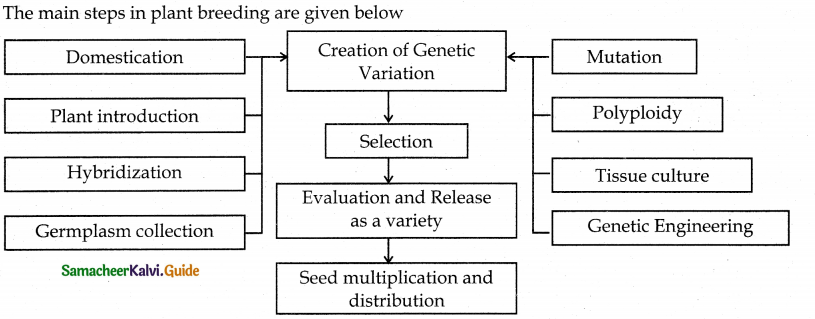
Draw a flow chart showing the steps involved in plant Breeding.
Answer:
The main steps in plant breeding are given below
Samacheer Kalvi 12th Bio Botany Guide Chapter 9 Plant Breeding 3

Question 9.
Write about NBPG R
Answer:

  • It is responsible for introduction and maintence of germplasm of various agricultural and horticultural station in our country.
  • It is also responsible for maintenance of plant materials of botanical and medicinal interest.
  • It is located at Rangpuri/New Delhi with four regional station at Amristar, Kolkata, Mumbai and Chennai.

 Samacheer Kalvi 12th Bio Botany Guide Chapter 9 Plant Breeding

Question 10.
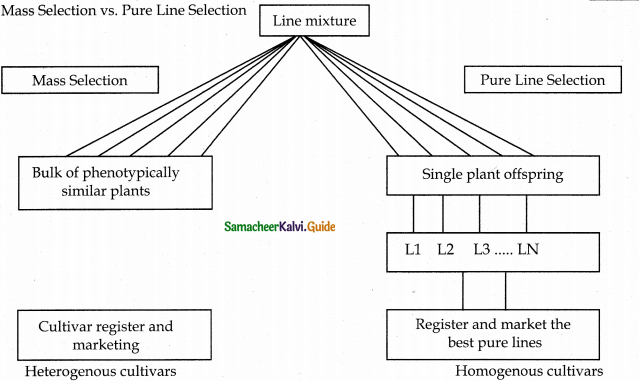
Draw the Schematic difference between Mass & Pureline selection.
Answer:
Samacheer Kalvi 12th Bio Botany Guide Chapter 9 Plant Breeding 4

Question 11.
What is hybridization?
Answer:

  • Hybridization is the method of producing new crop verities by crossing of plants that are genetically different.
  • It offers improvement in crop by combining the desirable character of two or more varities.
  • The first natural hybridization was observed by Cotton Mather in maize.

Question 12.
A type of Heterosis is called as Pseudoheterosis – Why?
Answer:

  • It is called as pseudoheterosis because the progeny is superior over parents by vegetative growth.
  • They are usually sterile.
  • It is also called as Luxuriance.

 Samacheer Kalvi 12th Bio Botany Guide Chapter 9 Plant Breeding

Question 13.
Tabulate certain crop variety and the disease to which they are resistant.
Answer:

CropVarietyResistance to diseases
WheatHimgiriLeaf and Stripe rust, hill bunt
BrassicaPusa swarnim (Kara rai)White rust
CauliflowerPusa Shubhra, Pusa snowball K-1Black rot and curl blight black rot.
CowpeaPusa KomalBacterial blight
ChilliPusa SadabaharChilly mosaic virus, Tobacco mosaic virus and Leaf curl.

Question 14.
What is Norm 10?

  • It is dwarfing genes with high photosynthetic rate and increases the respiratory activity.
  • Gonjiro Inazuka was scientist, who selected the Semi- dwarf wheat variety – Norm 1o.
  • This variety helped one billion lives from hunger and starvation.

Question 15.
How can we develop resistance to Insect pests in plants?

  • Insect resistance in host crop plants may be due to morphological, biochemical 0r physiological characteristics.
  • Hairy leaves in plants – Jassids in cotton
    – Cereal leaf bettle in wheat.
  • Solids Stem – Stem sawfly.
    Smooth leaves and nectar less cotton – Bol worms.
    High aspartic acid, low nitrogen and sugar content – Maize stem borers.

 Samacheer Kalvi 12th Bio Botany Guide Chapter 9 Plant Breeding

Question 16.
What are the plant breeding tools used to improve the crop varieties?
Answer:

  • Genetic Engineering, plant tissue culture, protoplasmic fusion, Molecular marking and DNA finger printing.

Question 17.
Define mutation breeding?
Answer:
Mutation means the sudden heritable changes in the genotype or phenotype of an organism.

Question 18.
What is Bio-fortification?
Answer:
Breeding crops with higher levels of vitamins and minerals or higher protein and healthier fats is the most practical means to improve public health.

 Samacheer Kalvi 12th Bio Botany Guide Chapter 9 Plant Breeding

Question 19.
Comment on sugercane.
Answer:

  • Saccharum bareri was originally grown in north India.
  • It is poor sugar content and yield.
  • Tropical canes grown in south India saccharurn officinarum had thicker stems and higher sugar content.
  • It did not grow well in North India
  • These two species were successfully crossed to get sugar cane varieties combining the desirable qualities of high yield thick stems high sugar and ability to grows in the sugar cane areas of North India.

XIII. Five Marks

Question 1.
What are the possible changes in the plant due to domestication?
Answer:

  • Adaption to the environmental alteration.
  • Adaption to wider geographical range.
  • Uniformity in flowering and fruiting.
  • Increased size of fruits and seeds.
  • Change in breeding system.
  • Increase in yield.
  • Increased resistance for disease and pest.
  • Developing seedless parthenocarpic fruit.
  • Enhancing the taste and nutritional composition.

Question 2.
Enumerate the History of Agriculture:
Answer:

  • 1807 – Alexander Yon Humboldt considered that original & source of most and their origin is an importable secret.
  • 1868 – Darwin’s theory proposed that natural selection and hybridization led to the origin of cultivate plants.
  • 1883 – De Candolle studied 247 cultivated plants species and was able to find the ancestral form, region of domestication and history.
  • 1887-1943 – Vavilov studied about the diverse forms of plants based on various criteria like morphology,cytology etc., He proposed 8 geographic centres and later developed it to 12 centres.
  • 1968 – Zhukovsky put forward the concept of mega gene and divided the whole world into 12 mega gene centres.
  • 1971 – Harlen believed that agriculture originated independently in three different areas.
    – There were non centres are the area were the crop has been shifted.

 Samacheer Kalvi 12th Bio Botany Guide Chapter 9 Plant Breeding

Question 3.
Tabulate the vavilov’s centres of crop origin and crop domesticated.
Answer:
Vavilov’s centres of crop origin and crops domesticated.

Vavilov’s centre of crop originCrops domesticated
1. ChinaFoxtail millet, soybean, bamboo, onion, .crucifers
2. IndiaRice, Sugarcane, mango, orange, eggplant, sesame
2a. South East AsiaRice, banana, coconut, clove, hemp.
3. Central EastWheat, pea, hemp, cotton, etc.,
4. The Near EastWheat, rye, many subtropical and tropical fruits
5. MediterraneanOlive, vegetables, oil, yielding plants, wheats
6. Ethiopia (Abyssinian)Wheat, barley, sesame, castor, coffee
7. Mesomerica (South Mexican & central American centre)Maize, bean, sweet potato, papaya, guava,
tobacco
8. South AmericaTomato, pine-apple
8a. South AmericaPotato
8b. The Brazilian-Paraguayan centreGroundnut, cashew nut, pine apple, peppers, rubber.

Question 4.
Write an essay on Indian plant Breeders.
Answer:

  • Dr.M.S.Swaminathan- He is pioneer in mutation breeder.
  • Sir.T.S.Venkatraman- An eminent sugarcane breeder.
  • Dr.B.P.Pal-Developed superior disease resistant varieties of wheat
  • Dr.K.Ramiah- Eminent Rice Breeder.
    N.G.P.Rao-An eminent sorghum breeder, developed world’s first hybrid of sorghum (CSH-1).
  • C.T.Patel-Developed world’s first cotton hybrid.
  • Choudhary Ram Dhan – wheat breeder,developed C-591 wheat which made Punjab as wheat granary of india.

 Samacheer Kalvi 12th Bio Botany Guide Chapter 9 Plant Breeding

Question 5.
Differentiate Rhizobium from Azolla as bio-fertilizers.
Answer:

  • Bio-fertilizers could also be called as microbial cultures or bacteria) fertilizers.
  • They are efficient in fixing nitrogen improve soil fertility, eco-friendly and cost effective.

Rhizobium:

  • It resides in the root nodules of leguminous plants.
  • It fixes the atmospheric Nitrogen.
  • It increases yield of paddy by 15-40%

Azolla:

  • Free floating water fern, with blue green algae fixes the Nitrogrn.
  • It increases the yield of rice.
  • It decomposes quickly.

Arbuscular Mycorrhizae:

  • They can dissolve the phosphates found in the soil.
  • It provides strength to resist disease, germ and unfavourable weather.

Seaweed Liquid Fertilizer:

  • It contains cytokinin, gibberellins and Auxin
  • Most of it are made from kelp ( Brown Algae).
  • The alginates in it react with metals in soil and retain moisture for a long time.
  • They have more than 70 minerals vitamin and enzymes.
  • Seeds soaked in seaweed germinate rapidly.

Question 6.
Tabulate the classification of Biofertilizers.
Answer:
Samacheer Kalvi 12th Bio Botany Guide Chapter 9 Plant Breeding 5

Question 7.
Discuss about Biopesticides in detail.
Answer:

  • They are biologically based agents used for the control of plant pests.
  • They are ecofriendly , Non – toxic and cheaper the chemical pesticide.

Trichoderma:

  • They are free living fungi in the soil.
  • They control plant disease.
  • It has the ability to enhance root growth development.
  • Increases the crop productivity.
  • It helps in resisting Abiotic stress.
  • It increases the uptake and use of nutrients.

Beauveria:

  • It is an entomo – pathogenic fungus
  • It parasitse arthropods that cause white muscardine and controls damping off of tomato

 Samacheer Kalvi 12th Bio Botany Guide Chapter 9 Plant Breeding

Question 8.
Enumerate the objectives of plant Breeding.
Answer:

  • To increase yield, Vigour and fertility of the crop.
  • To increase tolerance to environmental condition, Salinity, Temperature and drought.
  • To prevent premature falling of buds fruits etc.,
  • To improve the maturation of both the male and female gametes at the same time.
  • To develop resistance to pathogens and pests.
  • To develop photosensitive and thermos – Sensitive Varieties.

Question 9.
Discuss about the types of selection.
Answer:

  • Selection is the oldest and basic method of plant breeding.
  • There are two main types of selection – Natural and Artificial.

Natural Selection:

  • It occurs naturally.
  • It takes longer time in bringing about desired variation.
  • It reflected the Darwinian principle.

Artificial Selection:

  • It is a human involved process.
  • Producing better crop from a mixed population.

a) Mass Selection :

  • Large number of plants of similar phenotype are selected and crossed to get a new variety.
  • After repeated selection for five to six years it is distributed to the farmers.

b) Pureline Selection:

  • Plants obtained as a result of self pollination from a single homozygous individual.
  • The progeny shows homozy gosity with respect to all genes.
  • New Genotypes are never created,

c) Clonal Seection:

  • The progenies that are asexually propagated resembles the parent genetically.
  • The progeny is multiplied to form clone.
  • The genotype of a clone remains unchanged for a long period of time.

 Samacheer Kalvi 12th Bio Botany Guide Chapter 9 Plant Breeding

Question 10.
Describe the steps involved in Hybri-dization.
Answer:
a) Selection of Parents :

  • Male and female plants of desired characters are selected.
  • It should be tested for their homozygosity

b) Emasculation:

  • It is removal of anther before blooming.
  • It avoids self pollination

c) Bagging:
The stigma is protected against any undesirable pollen grains, by covering with a bag.

d) Crossing:
Transfer of pollen grains from selected male flower to the stigma of the emasculated female flower.

e) Harvesting Seeds and Raising Plants :

  • Due to fertilization seeds form.
  • These seeds are grown into a new generation.

Question 11.
Discuss about the types of heterosis.
Answer:
a) Euheterosis:

  • It is the true heterosis.
  • It is inherited

b) Mutational Euheterosis :

  • It is the simplest form.
  • Removal of harmful, recessive, mutant genes by superior dominant allele in cross pollinated crops.

c) Balanced Euheterosis:

  • Well balanced gene combination.
  • More adaptive to environment and agricultural usefulness.

d) Psuedo heterosis :

  • Also known as luxuriance.
  • Progeny possess superiority over parents in regetative Growth.
  • But not in yield & adaptation.
  • Usually sterile or poorly fertile.

 Samacheer Kalvi 12th Bio Botany Guide Chapter 9 Plant Breeding

Question 12.
Describe polyploid Breeding.
Answer:

  • The plants which posses more than two sets of chromosomes are called Polyploids.
  • It is the major force in the evolution of both wild and cultivated plants.
  • Polyploid of exhibit hybrid vigour.
  • Increases tolerance to biotic and abiotic stresses.
  • Polyploidy results in reduced fertility and producing seedless varieties.
  • If chromosomes is doubled by itself it is autopolyploidy.
  • Triploid condition in Sugarbeets result in Vigour.
  • Colchicine used to double the chromosomes. Eg. Triticale and Raphanobrassica

Question 13,
Biofortification is the breeding crops with
higher levels of nutrients. Justify it..
Answer:
Breeding of improved nutritional quality like
– Protein content and quality.
– Oil content and quality
– Vitamin Content
– Micro & Macro nutrient content.

  • In 2000 – Maize hybrid had twice the nutrient value than the parents.
  • Wheat – Atlass 66 having high protein content.
  • Iron fortified rice can be developed.
  • Vitamin A enriched vegetable.
  • Vitamin C enriched vegetables and iron and calcium crops also developed.

Question 14.
Enumerate the New Breeding Techniques.
Answer:

  • It is a collection of methods that could increase the development of new traits in plant breeding.
  • It often involve genome editing.
  • Cutting and modifying the genome during the repair process by tools like CRISPR.
  • Genome editing to introduce changes in few base pairs using a technique called ODM.
  • Transferring a gene from an identical or closely related species (Cisgenesis)
  • Organising process that alter gene activity without altering the DNA itself.

 Samacheer Kalvi 12th Bio Botany Guide Chapter 9 Plant Breeding

Question 15.
Ramu and Somu are farmers. Ramu cultivated the crops by self fertilization method. Somu cultivated the crops from mixed population.
(i) Who will get new variety?
(ii) Write the advantage and disadvantages of their selection.
Answer:
(i) Somu will get the new variety. Because he had selected the mixed population method.

(ii) Advantages of self fertilization method:
The repeated self pollination from a single homozygous individual produces a variety that shows more homozygosity with respect to all genes.

(iii) Dis advantages:

  • The major disadvantage of this type is that it never creates new genotypes.
  • The plants produced are also less adaptible and less stable to the environmental fluctuations.

Advantages of Mixed population method
In this method, a large number of plants of similar phenotype (or) morphological characters are selected and their seeds are mixed together to constitute a newer variety’.

Disadvantages:
The disadvantage of mixed population method is that it is difficult to distinguish the hereditary variation from environmental variation .

Question 16.
Mention the benefits of seed treatment?
Answer:

  • Prevents spread of plant disease
  • Protects seed from seedling blights
  • Improves germination
  • Improves germination
  • provides protection from storage insects
  • controls soil insects.

Samacheer Kalvi 11th Maths Guide Chapter 9 Limits and Continuity Ex 9.1

Tamilnadu State Board New Syllabus Samacheer Kalvi 11th Maths Guide Pdf Chapter 9 Limits and Continuity Ex 9.1 Text Book Back Questions and Answers, Notes.

Tamilnadu Samacheer Kalvi 11th Maths Solutions Chapter 9 Limits and Continuity Ex 9.1

In Problems 1 – 6, complete the table using calculator and use the result to estimate the limit.

Question 1.
Samacheer Kalvi 11th Maths Guide Chapter 9 Limits and Continuity Ex 9.1 2
Samacheer Kalvi 11th Maths Guide Chapter 9 Limits and Continuity Ex 9.1 1
Answer:
Samacheer Kalvi 11th Maths Guide Chapter 9 Limits and Continuity Ex 9.1 3

Samacheer Kalvi 11th Maths Guide Chapter 9 Limits and Continuity Ex 9.1

Question 2.
Samacheer Kalvi 11th Maths Guide Chapter 9 Limits and Continuity Ex 9.1 4
Samacheer Kalvi 11th Maths Guide Chapter 9 Limits and Continuity Ex 9.1 5
Answer:
Samacheer Kalvi 11th Maths Guide Chapter 9 Limits and Continuity Ex 9.1 6

Samacheer Kalvi 11th Maths Guide Chapter 9 Limits and Continuity Ex 9.1

Question 3.
Samacheer Kalvi 11th Maths Guide Chapter 9 Limits and Continuity Ex 9.1 7
Samacheer Kalvi 11th Maths Guide Chapter 9 Limits and Continuity Ex 9.1 8
Answer:
Samacheer Kalvi 11th Maths Guide Chapter 9 Limits and Continuity Ex 9.1 9

Samacheer Kalvi 11th Maths Guide Chapter 9 Limits and Continuity Ex 9.1

Question 4.
Samacheer Kalvi 11th Maths Guide Chapter 9 Limits and Continuity Ex 9.1 10
Samacheer Kalvi 11th Maths Guide Chapter 9 Limits and Continuity Ex 9.1 11
Answer:
Samacheer Kalvi 11th Maths Guide Chapter 9 Limits and Continuity Ex 9.1 12

Samacheer Kalvi 11th Maths Guide Chapter 9 Limits and Continuity Ex 9.1

Question 5.
Samacheer Kalvi 11th Maths Guide Chapter 9 Limits and Continuity Ex 9.1 13
Samacheer Kalvi 11th Maths Guide Chapter 9 Limits and Continuity Ex 9.1 14
Answer:
Samacheer Kalvi 11th Maths Guide Chapter 9 Limits and Continuity Ex 9.1 15

Samacheer Kalvi 11th Maths Guide Chapter 9 Limits and Continuity Ex 9.1

Question 6.
Samacheer Kalvi 11th Maths Guide Chapter 9 Limits and Continuity Ex 9.1 16
Samacheer Kalvi 11th Maths Guide Chapter 9 Limits and Continuity Ex 9.1 17
Answer:
Samacheer Kalvi 11th Maths Guide Chapter 9 Limits and Continuity Ex 9.1 18

Samacheer Kalvi 11th Maths Guide Chapter 9 Limits and Continuity Ex 9.1

Question 7.
Samacheer Kalvi 11th Maths Guide Chapter 9 Limits and Continuity Ex 9.1 19
Answer:
Samacheer Kalvi 11th Maths Guide Chapter 9 Limits and Continuity Ex 9.1 20
From the graph the value of the function at x = 3 is y = f(3) = 1
Samacheer Kalvi 11th Maths Guide Chapter 9 Limits and Continuity Ex 9.1 21

Question 8.
Samacheer Kalvi 11th Maths Guide Chapter 9 Limits and Continuity Ex 9.1 22
Samacheer Kalvi 11th Maths Guide Chapter 9 Limits and Continuity Ex 9.1 23
Answer:
Samacheer Kalvi 11th Maths Guide Chapter 9 Limits and Continuity Ex 9.1 24
From the graph the value of the function at x = 1 is y = f(1) = 3
Samacheer Kalvi 11th Maths Guide Chapter 9 Limits and Continuity Ex 9.1 25
Samacheer Kalvi 11th Maths Guide Chapter 9 Limits and Continuity Ex 9.1 26

Samacheer Kalvi 11th Maths Guide Chapter 9 Limits and Continuity Ex 9.1

Question 9.
Samacheer Kalvi 11th Maths Guide Chapter 9 Limits and Continuity Ex 9.1 27
Samacheer Kalvi 11th Maths Guide Chapter 9 Limits and Continuity Ex 9.1 28
Answer:
Samacheer Kalvi 11th Maths Guide Chapter 9 Limits and Continuity Ex 9.1 29

Question 10.
Samacheer Kalvi 11th Maths Guide Chapter 9 Limits and Continuity Ex 9.1 30
Samacheer Kalvi 11th Maths Guide Chapter 9 Limits and Continuity Ex 9.1 31
Answer:
Samacheer Kalvi 11th Maths Guide Chapter 9 Limits and Continuity Ex 9.1 32
Samacheer Kalvi 11th Maths Guide Chapter 9 Limits and Continuity Ex 9.1 33
From the graph the value of the function is y = f(1) = 3
Samacheer Kalvi 11th Maths Guide Chapter 9 Limits and Continuity Ex 9.1 34
Samacheer Kalvi 11th Maths Guide Chapter 9 Limits and Continuity Ex 9.1 35

Samacheer Kalvi 11th Maths Guide Chapter 9 Limits and Continuity Ex 9.1

Question 11.
Samacheer Kalvi 11th Maths Guide Chapter 9 Limits and Continuity Ex 9.1 36
Samacheer Kalvi 11th Maths Guide Chapter 9 Limits and Continuity Ex 9.1 37
Answer:
Samacheer Kalvi 11th Maths Guide Chapter 9 Limits and Continuity Ex 9.1 38
From the graph the value of the function at x = 3 the curve does not meet the line x = 3
∴ The value of the function is not defined at the point x = 3.
Hence \(\lim _{x \rightarrow 3} \frac{1}{x-3}\) does not exist at x = 3.

Question 12.
Samacheer Kalvi 11th Maths Guide Chapter 9 Limits and Continuity Ex 9.1 39
Answer:
Samacheer Kalvi 11th Maths Guide Chapter 9 Limits and Continuity Ex 9.1 40
From the graph x = 5 curve does not intersect the line x = 5
∴ The value of the function y = f(x) does not exist at x = 5.
Samacheer Kalvi 11th Maths Guide Chapter 9 Limits and Continuity Ex 9.1 41

Samacheer Kalvi 11th Maths Guide Chapter 9 Limits and Continuity Ex 9.1

Question 13.
\(\lim _{x \rightarrow 1}\) sin πx
Samacheer Kalvi 11th Maths Guide Chapter 9 Limits and Continuity Ex 9.1 42
Answer:
\(\lim _{x \rightarrow 1}\) sin πx
From the graph x = 1, the curve y = f(x) intersects the line x = 1 at x – axis.
∴ y = f(1) = 0
Hence \(\lim _{x \rightarrow 1}\) sin πx = 0

Question 14.
\(\lim _{x \rightarrow 0}\) sec x
Samacheer Kalvi 11th Maths Guide Chapter 9 Limits and Continuity Ex 9.1 43
Answer:
To find \(\lim _{x \rightarrow 0}\) sec x
Let y = f(x) = sec x
From the graph at x = 0 the curve intersect the y – axis.
At x = 0 we have y = 1
∴ \(\lim _{x \rightarrow 0}\) sec x = 1

Samacheer Kalvi 11th Maths Guide Chapter 9 Limits and Continuity Ex 9.1

Question 15.
Samacheer Kalvi 11th Maths Guide Chapter 9 Limits and Continuity Ex 9.1 44
Answer:
Samacheer Kalvi 11th Maths Guide Chapter 9 Limits and Continuity Ex 9.1 45
y = f(x) = sec x
From the graph at x = \(\frac{\pi}{2}\), the curve does not intersect the line x = \(\frac{\pi}{2}\)
At x = \(\frac{\pi}{2}\), the value of the function y = f(x) does not exist.
Hence Samacheer Kalvi 11th Maths Guide Chapter 9 Limits and Continuity Ex 9.1 45 does not exist.

Sketch the graph of f, then identify the values of x0 for which \(\lim _{x \rightarrow x_{0}}\) f (x) exists.

Question 16.
Samacheer Kalvi 11th Maths Guide Chapter 9 Limits and Continuity Ex 9.1 46
Answer:
Samacheer Kalvi 11th Maths Guide Chapter 9 Limits and Continuity Ex 9.1 47
At x = 4 , the curve does not exist. Hence, except at x0 = 4 , the limit of f(x) exists.

Samacheer Kalvi 11th Maths Guide Chapter 9 Limits and Continuity Ex 9.1

Question 17.
Samacheer Kalvi 11th Maths Guide Chapter 9 Limits and Continuity Ex 9.1 48
Answer:
Samacheer Kalvi 11th Maths Guide Chapter 9 Limits and Continuity Ex 9.1 49
From the figure when x = π, y = f(π) = 2. The function is not defined at x = π since sin x lies in the interval [ – 1, 1]
∴ The given function has limits at all points except at x = π
Samacheer Kalvi 11th Maths Guide Chapter 9 Limits and Continuity Ex 9.1 50
Samacheer Kalvi 11th Maths Guide Chapter 9 Limits and Continuity Ex 9.1 51
(π, 2) point is not possible since the range of the curve is [- 1 , 1] . Except x0 = π, the curve has limits.

Samacheer Kalvi 11th Maths Guide Chapter 9 Limits and Continuity Ex 9.1

Question 18.
Sketch the graph of a function f that satisfies the given values:
(i) f(0) is defined
\(\lim _{x \rightarrow 0}\) f(x) = 4
f(2) = 6
\(\lim _{x \rightarrow 2}\) f(x) = 3
Answer:
Samacheer Kalvi 11th Maths Guide Chapter 9 Limits and Continuity Ex 9.1 52

(ii) f(-2) = 0
f(2) = 0
\(\lim _{x \rightarrow-2}\) f(x) = 0
\(\lim _{x \rightarrow 2}\) f(x) does not exist.
Answer:
Samacheer Kalvi 11th Maths Guide Chapter 9 Limits and Continuity Ex 9.1 53

Samacheer Kalvi 11th Maths Guide Chapter 9 Limits and Continuity Ex 9.1

Question 19.
Write a brief description of the meaning of the notation \(\lim _{x \rightarrow 8}\) f(x) = 25
Answer:
Given \(\lim _{x \rightarrow 8}\) f(x) = 25
By the definition of limit
Samacheer Kalvi 11th Maths Guide Chapter 9 Limits and Continuity Ex 9.1 54
∴ f(8) = f(8+) = 25

Question 20.
If f(2) = 4, can you conclude anything about the limit of f (x) as x approaches 2?
Answer:
No, f(x) = 4, It is the value of the function at x = 2
This limit doesn’t exists at x = 2
Since f(2) = 4
It need not imply that \(\lim _{x \rightarrow 2^{-}} f(x)=\lim _{x \rightarrow 2^{+}} f(x)\)
∴ we cannot conclude at x = 2

Question 21.
If the limit of f (x) as x approaches 2 is 4, can you conclude anything about f (2)? Explain reasoning.
Answer:
\(\lim _{x \rightarrow 2}\) f(x) 4 , \(\lim _{x \rightarrow 2^{-}}\) f(x) = \(\lim _{x \rightarrow 2^{+}}\) f(x) = 4
When x approaches 2 from the left or from the right f(x) approaches 4.
Given that \(\lim _{x \rightarrow 2^{-}}\) f(x) = \(\lim _{x \rightarrow 2^{+}}\) f(x) = 4
The existence or non-existence at x =2 has no leaving on the existence of the limit of f(x) as x approaches to 2.
∴ We cannot conclude the value of f(2).

Question 22.
Samacheer Kalvi 11th Maths Guide Chapter 9 Limits and Continuity Ex 9.1 55
Answer:
Samacheer Kalvi 11th Maths Guide Chapter 9 Limits and Continuity Ex 9.1 56

Samacheer Kalvi 11th Maths Guide Chapter 9 Limits and Continuity Ex 9.1

Question 23.
Verify the existence of \(\lim _{x \rightarrow 0}\) f(x), where
Samacheer Kalvi 11th Maths Guide Chapter 9 Limits and Continuity Ex 9.1 57
Answer:
Samacheer Kalvi 11th Maths Guide Chapter 9 Limits and Continuity Ex 9.1 58
From equations (1) and (2) we get
f(1) ≠ f(1+)
∴ The limit of f(x) does not exist.

Samacheer Kalvi 11th English Guide Poem 3 Lines Written in Early Spring

Tamilnadu State Board New Syllabus Samacheer Kalvi 11th English Guide Pdf Poem 3 Lines Written in Early Spring Text Book Back Questions and Answers, Summary, Notes.

Tamilnadu Samacheer Kalvi 11th English Solutions Poem 3 Lines Written in Early Spring

11th English Guide Lines Written in Early Spring Text Book Back Questions and Answers

1. Find words from the poem that convey the following ideas:

Question a.
connected together
Answer:
blended

Question b.
spread over the surface of the ground in a straggling manner
Answer:
tuft

Question c.
make out or understand
Answer:
measure

Question d.
slender woody shoots growing from branches or stems of trees
Answer:
twigs

Samacheer Kalvi 11th English Guide Poem 3 Lines Written in Early Spring

2. Complete the summary of the poem by filling in the blanks with the words given below:

Samacheer Kalvi 11th English Guide Poem 3 Lines Written in Early Spring 1

The poet, in a relaxed state of mind, is sitting in a (1) _______. He reflects on how his mood brings (2) _______ thoughts, which are inevitably followed by (3) _______ ones. He feels connected to all of nature, and senses an inherent joy in all (4) _______. He has faith in the fact that all the primroses and periwinkles around him (5) _______ the air they breathe. He feels that every bird in the grove moves with (6) _______. As the twigs catch the breezy air, they do so with the same pleasure (7) _______ all life on earth. This joy of nature seems to be heaven-sent. Nature’s holy plan is to offer joy and peace to all forms of life on earth. The poet’s pleasant train of thought slowly leads to the sad reflection of how mankind alone has wrought sorrow and (8) _______ upon itself. He firmly believes that man is meant to spend his days blissfully taking part in the vitality and joy surrounding him in (9) _______. He, therefore, concludes rhetorically, emphasizing that he has good reason to (10) _______the distress, man unnecessarily brings upon himself.
Answer:

  1. Grove
  2. Pleasant
  3. Nature
  4. Distressed
  5. Calm
  6. Bower
  7. Breezy
  8. Peace
  9. Sorrow

Samacheer Kalvi 11th English Guide Poem 3 Lines Written in Early Spring

3. Read the lines given below and answer the questions that follow:

(i) And ’tis my faith that every flower’
Enjoys the air it breathes…

Question (a)
What is the poet’s faith?
Answer:
The poet has faith that nature lives, breathes and enjoys its own presence. Twigs, birds, creepers all live in harmony with each other in absolute bliss and contentment.

Question (b)
What trait of Nature do we see here?
Answer:
The trait of Nature we see here is sharing and love of nature in all its creations.

(ii) And I must think, do all I can,
That there was pleasure there…

Question (a)
What did the poet notice about the twigs?
Answer:
The poet noticed it is happy to spread out its tender leaves to catch the breezy air.

Question (b)
What was the poet’s thought about them?
Answer:
The poet thought the twigs were experiencing the joy of their contact with the breezy air.

(iii) If this belief from heaven be sent,
If such be Nature’s holy plan.

Question (a)
What does ‘heaven’ refer to?
Answer:
Heaven refers to God.

Question (b)
Why does the poet call it ‘holy’?
Answer:
The poet believes that the harmonious, peaceful, and happy co-existence of birds, plants, trees, and brooks soothes the troubled mind of man. So, the poet feels as if he were inside a sacred place when he is in the woods. So, he calls the plan ‘holy’.

Samacheer Kalvi 11th English Guide Poem 3 Lines Written in Early Spring

Additional Appreciation Questions:

1. I heard a thousand blended notes
While in a grove I sate reclined.

Question (a)
Where was the poet?
Answer:
The poet was in the grove.

Question (b)
What are blended notes?
Answer:
‘Blended notes’ relate to listening to the music of the breeze and the chirping of birds.

Question (c)
What does grove mean?
Answer:
Grove means a small area of land with a group of trees.

2. “To her fair works did nature link
The human soul that through me ran”

Question (a)
What is linked to human soul?
Answer:
Nature linked to human soul.

Question (b)
What are the fair works of nature?
Answer:
Human soul is the fair works of nature.

Samacheer Kalvi 11th English Guide Poem 3 Lines Written in Early Spring

3. “Through primrose tufts, in that sweet bower
The periwinkle trail’d its wreaths”

Question (a)
What is primrose?
Answer:
It is a wild plant with yellow flowers.

Question (b)
What does ‘tufts’ mean?
Answer:
‘Tufts’ means bunches.

Question (c)
Where did the poet get to see this scene?
Answer:
The poet saw this beautiful scene in a grove.

4. Have I not reason to lament
What man has made of man?

Question (a)
What reason has the poet got to lament?
Answer:
He is very much distressed at the plight of humanity.

Question (b)
What is the solution to the problem?
Answer:
Man has to love the nature and live in harmony with nature.

Samacheer Kalvi 11th English Guide Poem 3 Lines Written in Early Spring

4. Explain the following lines with reference to the context in about four to five sentences each:

I. In the sweet mood when pleasant thoughts
Bring sad thoughts to the mind.

Reference: These lines are from the poem “Lines Written in Early Spring” written by William Wordsworth.
Context: William Wordsworth was inspired in a small woodland grove, a landscape of beauty. He came upon this spot when walking near Alford village. While sensing the blissful mood and happiness of birds, plants, creepers and the murmuring brook, he juxtaposed what humans did to their kind in Napoleonic wars and amidst happy nature couldn’t help feeling sad. On that occasion, he said these words.

Explanation: The poet was captivated by the celestial beauty of the woodland near Alford village. The chirping of birds, the blooming flowers, and the brooks expressed their ecstasy of being alive. But their charm, peace, and contentment made Wordsworth compare the lives of war-mongers. Suddenly he became sad.
Comment: The poet beautifully portrays his mixed feelings.

II. The birds around me hopp’d and play’d
their thoughts I cannot measure.

Reference:
These lines are taken from Poem – “Lines Written in Early Spring”, Poet – “William Wordsworth”.
Context:
The poet utters these words while observing the beauty of nature.
Explanation:
The poet admires the beauty of nature while sitting in the grove. He observes that every creature is closely linked with nature. They not only feel happy on their own but also make others happy. He observes some birds around him which are hopping and playing happily. Though the poet cannot understand the thoughts in them, he is sure that they are happy.

III. Have I not reason to lament
What Man has made of man?

Reference: These lines are from the poem “Lines Written in Early Spring” written by William Wordsworth.
Context: William Wordsworth was inspired by a small woodland grove, a landscape of beauty. He came upon this spot when walking near Alford village. While sensing the blissful mood and happiness of birds, plants, creepers, and the murmuring brook, he juxtaposed what humans did to their kind in Napoleonic wars and amidst happy nature couldn’t help feeling sad. On that occasion, he said these words.

Explanation: William Wordsworth derived extreme pleasure listening to the songs of birds and voiceless communication of joy between plants, twigs, and flowers. Though he could not fathom the meaning, he realized the blissful state of nature. But he remembered the depravity of man which was evident in Napoleonic wars. He was fed up with man’s capacity to destroy innocent lives and property. So, he lamented “what man has made of man”.
Comment: The mixed feelings of happiness and sadness is well brought out.

Samacheer Kalvi 11th English Guide Poem 3 Lines Written in Early Spring

5A. Read the following sets of lines and identify the figures of speech used in each extract:

a. Toherfair works did Nature link
The human soul that through me ran.
b.And ‘tis my faith that every flower
Enjoys the air it breathes.
c. What Man has made of Man?

Poetic linesFigure of Speech
1. To her works did Nature linkPersonification
2. The human soul that through me ranPersonification
3. And ‘tis my faith that every flowerAlliteration/Personification
4. What Man has made of Man?Alliteration/Aphorism
5. I heard a thousand blended notesOnomatopoeia

Samacheer Kalvi 11th English Guide Poem 3 Lines Written in Early Spring

5B. Read the poem once again. Identify the rhyme scheme and pick out the rhyming pairs of words:
Answer:
The rhyme scheme of the Poem is ab ab, ab ab………
Rhyming words are:

  1. Notes – thoughts
  2. Reclined – mind
  3. Link – think
  4. Ran – man
  5. Bower – flower
  6. Wreaths – breathes
  7. Play’d – made
  8. Measure – pleasure
  9. Fan – can
  10. Air – there
  11. Sent – lament
  12. Plan – man.

6. Answer the following in a sentence or two:

Question (a)
How does the poet feel while enjoying the beauty of Nature?
Answer:
The poet was in a sweet mood reclining in a grove. Hearing a thousand blended notes, his mind was filled with pleasant thoughts. He was very happy.

Question (b)
Does Nature affect a person’s thoughts and feelings? Explain.
Answer:
Yes, the poet finds everything happy – helping and sharing with each other. He feels that man alone is not a part of it.

Samacheer Kalvi 11th English Guide Poem 3 Lines Written in Early Spring

Question (c)
How do people bring grief and sorrow to one another?
Answer:
People are jealous of one another’s wealth and possessions. One tries to harm the other by waging or provoking wars. Thus people bring grief and sorrow to one another.

Question (d)
Why does the poet think that the birds were happy?
Answer:
The way in which they hop and play makes the poet think that the birds were happy.

Question (e)
The poet finds joy in various objects of Nature. Explain
Answer:
The poet found joy in the primrose tufts, the sweet bower, the periwinkle, and the singing; birds.

Question (f)
Bring out the poet’s thoughts, while comparing Nature with human behaviour.
Answer:
Nature’s holy plan is that every creature should be happy but the humans fight with one another and lead a sorrowful life.

Samacheer Kalvi 11th English Guide Poem 3 Lines Written in Early Spring

7. Complete the following sentences by choosing the best options:

Question (a)
The poet experiences sadness because of _______.
i. the blended notes are jarring
ii. Nature is filled with negativity
iii. he is worried about the destruction caused to Nature
iv. natural calamities occur frequently
Answer:
iii. he is worried about the destruction caused to Nature

Question (b)
The poem is set in a _______.
i. city
ii. Village
iii. grove
iv. Park
Answer:
iii. grove

Question (c)
The poem speaks of _______.
i. Mans plan to shape density
ii. Man seeking pleasure and riches
iii. Man indulging in wars and acts of destruction
iv. Mans fear of Nature
Answer:
iii. Man indulging in wars and acts of destruction

Samacheer Kalvi 11th English Guide Poem 3 Lines Written in Early Spring

8. Answer in a paragraph of about 100 – 150 words:

Do you think the poet wants to say that man is unhappy because he has lost his link with nature and forgotten how to enjoy nature or because man is cruel to other men?

Paragraph:

PoemLines are written in Early spring
PoetWilliam Wordsworth
ThemeNature gives life to all

The poet brings out varied reasons for the unhappiness of man. The main reason is he is cruel to other men. In this context, he brings forth the French revolution which had a great impact on the people of both France and Britain. The poet laments about this behaviour of man. Fie also observes that the flowers, birds, and trees have a close link with Nature and follow Nature’s holy plan of being together and sharing happiness. This view is made clear from the lines,

Through primrose tufts, in that sweet bower,
The periwinkle trail’d its wreaths;

The poet feels that man’s innate state must be close to nature. His heart is filled with pain when he thinks about the behaviour of man. His grief gets expressed from the lines,

And much it grieved my heart to think
What man has made of man?

He concludes that except man all other creatures are happy as they have a close link with nature and they share and care for each other. He is not able to find a positive answer for what man has made of man. That is why he says,

Have I not reason to lament
What man has made of man?

Samacheer Kalvi 11th English Guide Poem 3 Lines Written in Early Spring

ஆசிரியரைப் பற்றி:

வில்லியம் வேர்ட்ஸ்வொர்த் (1770-1850) மிகச்சிறந்த ஆங்கிலக் கவிஞர். சாமுவேல் டெய்லர் கோல்ரிட்ஜிடன் இணைந்து Lyrical Ballads என்ற கவிதை தொகுப்பை வெளியிட்டதன் மூலம் ஆங்கில இலக்கியத்தில் புதிய ரொமாண்டிக் காலத்தை தொடங்கிவைத்தார்.

பிரிட்டனின் அரசவைக் கவிஞராக 1984ம் ஆண்டு முதல் வாழ்நாள் இறுதி வரை இருந்து வந்தார். இவர் இயற்க்கை கவிஞர் என்றே எல்லோராலும் அறியப்பட்டடார். “Daffodils”, “The Solitary Reaper”, “To the cuckoo'” “The tables turned”, Lines composed a few miles above Tintern Abbey ஆகியவை இவரின் புகழ் பெற்ற கவிதைகள்.

கவிதையைப் பற்றி:

இக்கவிதையில் கவிஞர் மனிதன் தன் சக மனிதனுக்கு செய்யும் இடையூறுகளை நினைத்து மனம் வருந்துகிறார். இயற்கை என்னும் அற்புதத்தை இறைவன் நமக்காக படைத்துள்ளார். அதில் ஒன்றாக கலந்து கவிஞர் மகிழ்ந்தாலும் மனிதர்களின் செயல்பாடுகள் இயற்க்கைக்கு எதிராக இருப்பதை நினைத்து .மனம் வெதும்புகிறார்.

Samacheer Kalvi 11th English Guide Poem 3 Lines Written in Early Spring

Lines Written in Early Spring Summary in Tamil

சோலையொன்றில் நான் சாய்ந்தமர்ந்திருந்த போது
ஆயிரம் கானங்கள் கலந்த இசையைக் கேட்டேன்.
அவ்வினிய தருணத்தில் இன்ப நினைவுகள்
சுமந்து வந்ததோ துன்ப நினைவுகள்.
என்னே இயற்கையின் கைவண்ணம்!

தன்னையே என் ஆன்மாவுடன் இணைந்து
துன்பறுத்துகிறது என் இதயத்தை – நினைக்க
வேண்டுகிறது மனிதன் மனிதனைக்கொண்டு உருவாக்கியதை
பிரிம் ரோஸ் மலர்களிடையே அம் மர நிழலடியில்
பெரிவிங்கிள் தன் ஊதா பூக்களை பரவ விட்டிருக்கிறது.

Samacheer Kalvi 11th English Guide Poem 3 Lines Written in Early Spring

என் மனம் கூறுகிறது, ஒவ்வொரு பூவும்
அதன் மணத்தை சுவாசத்தில் உணர்த்து மகிழும் என்று.
என்னைச் சுற்றி பறவைகள் துள்ளி விளையாடுகின்றன.
அதன் மன அலைகளோ அளவிட முடியாதவை.
ஆனால் அவற்றின் மிக எளிய அசைவுகள் கூட
மகிழ்வின் உச்சமாக மாறுகின்றன.
மலர் மொட்டுகள் இதழ் விரித்தன.

மணம் வீசும் தென்றல் தழுவிட
நானும் சிந்தித்து செயலாற்ற வேண்டும்
இங்கு இருக்கும் மகிழ்வில் கலந்திட
இந்நம்பிக்கை விண்ணின்று அனுப்பப்பட்ட தென்றல்
இது இயற்கையின் தூய திட்டமென்றால்,
நான் புலம்புவதற்கு காரணமாக இல்லை,
மனிதன் மனிதனைக் கொண்டு உருவாக்கியதை எண்ணி.

Samacheer Kalvi 11th English Guide Poem 2 Confessions of a Born Spectator

Tamilnadu State Board New Syllabus Samacheer Kalvi 11th English Guide Pdf Poem 2 Confessions of a Born Spectator Text Book Back Questions and Answers, Summary, Notes.

Tamilnadu Samacheer Kalvi 11th English Solutions Poem 2 Confessions of a Born Spectator

11th English Guide Confessions of a Born Spectator Text Book Back Questions and Answers

1. Based on your understanding of the poem, answer the following questions in a sentence or two:

Question a.
Why does the poet feel glad that he does not play any game?
Answer:
The poet feels glad that he was not a player but only a spectator. He is glad because of the risk of injuring himself and others is more if he becomes a player.

Question b.
Do you think the narrator is heroic? Why?
Answer:
No, just watching the heroic deeds of enthusiastic athletes is not considered heroic.

Question c.
The poet is satisfied just watching the heroic deeds of others. What could be the reason?
Answer:
The poet is very sensitive. He derives vicarious pleasure on seeing the play of all the players. He is not after glory, medals, and not interested in inflicting injury on any opponent. So, he is happy staying out of all rough games.

Samacheer Kalvi 11th English Guide Poem 2 Confessions of a Born Spectator

Question d.
The poet does not wish to exchange position with the runners. Why?
Answer:
The athletes never care for the feelings of others when they play enthusiastically. So the poet does not wish to exchange position with them.

Question e.
Are the athletes conscious of the feelings of others? Why do you say so?
Answer:
No, the athletes are zealous in their endeavour to win. In the process, they go to the extent of maiming fellow players. The player’s focus is mostly on winning and he is naturally not conscious of the feelings of others.

Question f.
Why would the referee ask whether there was a doctor in the stands? What stands is he referring to?
Answer:
The referee would ask for a doctor when any athlete cracks his wrist or got injured in any way. Stands here refer to the stadium or boxing ring.

Question g.
Why does the poet prefer to buy tickets worth their weight in radium? Bring out the significance of the metal referred to here?
Answer:
Radium is more expensive than diamonds. It is a rare metal discovered by Madam Curie. The poet was ready to buy tickets as expensive as radium just to stay as a spectator.

Samacheer Kalvi 11th English Guide Poem 2 Confessions of a Born Spectator

2. Read the poem again and complete the summary using the words given in the box: (Text Book Page No. 54)

Samacheer Kalvi 11th English Guide Poem 2 Confessions of a Born Spectator 1
In the poem Confessions of a Born Spectator, Ogden Nash talks about how people choose different sports in their lives or decide to become athletes. While admiring the talents of athletes and sportsmen, the poet (i)_________ that he is glad that he is neither a sportsman nor an athlete. Children have different (ii) _________ and wish to play various games. Each child has in mind something in particular, but the narrator is (iii) _________ he is not one of the players. Though the narrator (iv) _________ the talents of all athletes, he derives satisfaction from watching them but does not wish to (v) _______ places with them. He also sometimes regrets that (vi) _______ athletes play rough games without caring for the feelings of their sporting rivals. He feels that good sense and caution win over ego. The narrator wholeheartedly offers (vii) _______ the modest (viii) ___________ of athletes. Ultimately the narrator is (ix) _______ that he himself is not an athlete.
Answers:
(i) Confesses
(ii) Aims
(iii) Glad
(iv) Admires
(v) Exchange
(vi) Zealous
(vii) Thanksgiving
(viii) Physiques
(ix) Satisfied

Samacheer Kalvi 11th English Guide Poem 2 Confessions of a Born Spectator

3. Read the poem and answer the following in a short paragraph of 8 – 10 sentences each: (Text Book Page No. 55)

Question a./b.
How does the poet establish the victory of common sense over ego?/ The poet does not wish to exchange places with athletes. How does she justify his view?
Answer:
The poet readily considers himself as a Born Spectator. He admires the talents of the athletes who are skillful in varied sports. That is running ninety yards, knocking the champion to the floor, taking hold of the horse to make it win, etc. He satisfies his love for sports by watching the heroic deeds of sportspersons.

His ego gets slightly disturbed while watching such heroic deeds which induces him to act as an athlete. Thus arise a struggle between his ego and common sense. But when he sees athletes playing, so rough injuring others and never bothers about the opponents’ feeling his common sense has its victory.

Question c.
According to the poet, what contributes most to the injuries sustained by the athletes?
Answer:
According to the poet, the athletes perform heroic deeds and risk their lives to the maximum to attain success. They have to overcome many hurdles before they taste success. Apart from this, they get hurt physically too in many ways. So the poet feels that there is nothing wrong to buy tickets worth their radium.

As they are very active like radium let them be given a huge sum of money like that for radium. Being a spectator and realizing the hard effort of the athlete the poet readily feels that he can share everything with them. It is in this way one can contribute to the injuries sustained by the athletes.

Samacheer Kalvi 11th English Guide Poem 2 Confessions of a Born Spectator

4. Read the given lines and answer the questions that follow in a sentence or two:

a. With all my heart I do admire
Athletes who sweat for fun or hire

Question i.
Whom does the poet admire?
Answer:
The poet admires the athletes.

Question ii.
For what reasons do the athletes sweat?
Answer:
The athletes sweat either for fun or for monetary benefits.

b. Well, ego it might be pleased enough
But zealous athletes play so rough

Question i.
What pleases the ego?
Answer:
The daring spirit of the athletes pleases the ego.

Question ii.
Why are athletes often rough during play?
Answer:
They are rough as they play enthusiastically towards their victory.

c. When officialdom demands
Is there a doctor in the stands?

Question i.
Why are doctors called from stands by the sponsors?
Answer:
Doctors are called from stands when players get injured.

Question ii.
Why does the poet make such an observation?
Answer:
The poet himself is present as a spectator there in the stadium. He is not willing to exchange places with the athletes.

Samacheer Kalvi 11th English Guide Poem 2 Confessions of a Born Spectator

C. When snaps the knee and cracks the wrist:

Question i.
Identify and explain the use of the literary device in this line.
Answer:
The literary device used here is onomatopoeia. It imitates the natural sound of a thing. Here the snapping sound of the knee and the cracking sound of the wrist is explained.

Additional Appreciation questions:

1. “One infant grows up and becomes a Jockey
Another plays basketball or hockey,”
This one the prize ring hates to enter
That one becomes a tackle or center
I am just glad as I glad can be.

Question a.
What does ‘Jockey’ refer to?
Answer:
Jockey refers to horse riding.

Question b.
Who is playing the game?
Answer:
The infant is playing the game.

Question c.
Who is glad?
Answer:
The spectator is glad.

Question d.
Why is he glad?
Answer:
He is glad because he needn’t compete in the field.

Question e.
Whom does ‘they refer’ to?
Answer:
They refer to athletes.

Question f.
What is the figure of speech used in the 5th line?
Answer:
Simile.

Samacheer Kalvi 11th English Guide Poem 2 Confessions of a Born Spectator

2. Now A runs ninety yards to score
B knocks the champion to the floor
Cracking vertebrae and spines
Lashes his steed across the line:

Question a.
Why does ‘A’ run ninety yards?
Answer:
‘A’ runs ninety yards to win the match.

Question b.
Why does ‘B’ knock ‘A’?
Answer:
‘B’ disturbs ‘A’ because he doesn’t want A’ to win.

Question c.
Why does ‘B’ lash across the line?
Answer:
‘B’ lashes across the line to get victory over A.

Question d.
Who cracks whose vertebrae and spines?
Answer:
‘B’ cracks ‘A’s vertebrates and spines.

3. When swollen eye meets gnarled fist
When snaps the knee and cracks the wrist
When officialdom demands,
Is there a doctor in the stands?

Question a.
Why are the eyes swollen?
Answer:
The opponent is fierce enough to inflict injury on the other’s eye in the boxing event.

Question b.
What encounters the gnarled fist?
Answer:
The athletes swollen eyes encounter the gnarled fist during the contest.

4. “And reassure me a new
That you are not me and I am not you”

Question a.
Why does the poet repeat the line?
Answer:
He repeats the line again to stress the fact that each and every individual is unique.

Question b.
Whom does he assure?
Answer:
He assures himself.

Samacheer Kalvi 11th English Guide Poem 2 Confessions of a Born Spectator

Poetic lines-(Figures of Speech):

Poetic linesFigure of speech
1. I am just glad can beSimile
2. “When swollen eyes meet gnarled fistPersonification
When snaps the knee and cracks the wristOnomatopoeia
When officialdom demands”Anaphora
3. My limp and bashful spirit feeds on other people’s heroic deeds.Personification
4. My soul in true thanksgiving speaks for this modest of physiques.
5. I am glad that when my struggle begins to twist prudence and ego, prudence wins
6. Well, ego it might be pleased enough
7. Now ‘A’ runs ninety yards to score

Samacheer Kalvi 11th English Guide Poem 2 Confessions of a Born Spectator

5A. Explain the following with reference to the context in about 50 – 60 words each:

i. I am just glad as glad can be.
That I am not them, that they are not me ………

Reference:
These lines are taken from Poem – “Confessions of a Born Spectator”, Poet – “Ogden Nash”.
Context:
The poet says these words when he feels happy of not being an athlete.
Explanation:
The poet talks about how people choose different sports in their lives or decide to become athletes. While admiring the talents of athletes and sportsmen he confesses that he is happy that he is not a sportsman.

ii. They do not ever in their dealings
Consider one another’s feelings

Reference:
These lines are taken from Poem – “Confessions of a Born Spectator”, Poet – “Ogden Nash”.
Context:
Here the poet speaks about the behaviour of the athletes while playing.
Explanation:
The athletes used to play rough games when they play enthusiastically. In this regard, they never care for the feelings of their sporting rivals. The poet regrets this behaviour of the athletes.

iii. Athletes, I’ll drink to you,
Or eat with you,
Or anything except competing with you

Reference:
These lines are taken from Poem – “Confessions of a Born Spectator”, Poet – “Ogden Nash”.
Context:
Here the poet expresses his view of not competing with sportspersons in any way.
Explanation:
The poet is very clear of the view that he is a Born Spectator and not a sports person. He is ready to share everything with the athletes like spending gala time, dining together with them, etc. but is not ready to compete with them in their sports activities.

Samacheer Kalvi 11th English Guide Poem 2 Confessions of a Born Spectator

5B. Read the poem and complete the table with suitable rhyming words:

Question 1.
Samacheer Kalvi 11th English Guide Poem 2 Confessions of a Born Spectator 2
Answer:

EnterCenter
JockeyHockey
AdmireHire
pompRomp

Question 2.
Samacheer Kalvi 11th English Guide Poem 2 Confessions of a Born Spectator 3
Answer:

FeedsDeeds
ScoreFloor
PleaseThese
FirstWrist
DemandsStands
RadiumStadium

Samacheer Kalvi 11th English Guide Poem 2 Confessions of a Born Spectator

5C. Underline the alliterated words in the following lines: 

Question i.
For this most modest physiques…
Answer:
For this most modest physiques…

Question ii.
They do not ever in their dealings…
Answer:
They do not ever in their dealings…

5D. Find out the rhyme scheme of the given stanza:

Question 1.
One infant grows up and becomes a jockey
Another plays basketball or hockey
This one the prize ring hates to enter
That one becomes a tackle or center…
Answer:
The rhyme scheme of the poem is aa, bb.

Listening Activity:

Question 1.
Tejaswini Sawant is an Indian _______.
a) shooter
b) boxer
c) cricketer
Answer:
a) shooter

Question 2.
She represented India at the 9th South Asian Sports Federation Games in _______.
a) 2001
b) 2002
c) 2004
Answer:
c) 2004

Question 3.
In 2006, she won a Gold medal in the _______.
a) Commonwealth Games
b) Olympic Games
c) Asian Games
Answer:
a) Commonwealth Games

Question 4.
She became a world champion in the 50m Rifle Prone game held in _______.
a) Germany
b) Russia
c) India
Answer:
a) Germany

Question 5.
Tejaswini was the first Indian woman shooter to win a _______ medal at the World Championship in the 50m
rifle prone game.
a) gold
b) silver
c) bronze
Answer:
a) Gold

Samacheer Kalvi 11th English Guide Poem 2 Confessions of a Born Spectator

7. Paragraph:

In the poem “Confessions of a Born Spectator” the poet talks about how people choose to opt for different sports in their lives or decide to become athletes. At the same time, he confesses that he is glad that he is neither a sports person nor an athlete. He admires the talents of all athletes and derives great satisfaction watching them. This is understood from the lines

My limp and bashful spirit feeds
on other people’s heroic deeds.

Being a Born Spectator he does not wish to exchange places with the athletes at any cost. He doesn’t like to get injured in any way. Moreover, he regrets over the fact that Zealous athletes play rough games without even caring for each other’s feelings. The poet conveys this idea through the lines

They do not ever in their dealings
Consider one another’s feelings.

He feels that good sense and caution win over ego. He offers thanksgiving the modest physiques of athletes as they risk their lives to a great extend like snapping their knees and cracking their wrist etc. This shows that the athletes take a lot of trials to achieve the desired results. The poet is always ready to share a drink or a meal with the athletes. In fact, he is ready to do anything except competing with them. Ultimately the poet is satisfied that he himself is not an athlete which is clearly proved from the lines

And reassure me a new
That you are not me and I’m not you.

Samacheer Kalvi 11th English Guide Poem 2 Confessions of a Born Spectator

கவிஞரைப் பற்றி:

Frederic Ogden Nash என்பவர் ஒரு அமேரிக்க கவிஞர். இவர் 500ற்கும் மேற்பட்ட நகைச்சுவை கவிதைகளை இதுவரை எழுதியுள்ளார். இவரது கவிதைகளில், கதைகளில் பயன்படுத்திய எதுகை அமைப்பு முறை இவரை மிகச்சிறந்த நகைச்சுவை கவிஞராக அமேரிக்காவில் அடையாளம் கட்டப்பட்டுள்ளார். இவரின் நினைவாக அமேரிக்காவில் தபால்தலை வெளியிடப்பட்டிருக்கிறது.

கவிதையைப் பற்றி:

எந்த ஒரு போட்டியாக இருந்தாலும் அதில் இருவேறு செய்திகள் அடங்கி இருக்கும். ஒன்று விளையாட்டு வீரர், மற்றொன்று பார்வையாளர். வீரர் விளையாட்டில் கலந்து தன் திறமையை வெளிகாட்டுவார் பார்வையாளர் அதை வேடிக்கை பார்ப்பார். வீரர் காயப்பட்டு, எழும்புகள் உடைக்கப்பட்டு, வீரத்தை வெளிகாட்டுகிறார்.

ஆனால் பார்வையாளர் வெளியில் நின்று வேடிக்கை பார்த்து இரசிக்கிறார். இந்த கவிதையில் விளையாட்டு வீரர்களை வேடிக்கை பார்த்து இரசிக்கும் கவிஞர் அதை நகைச்சுவையாக பேசுகிறார்.

Samacheer Kalvi 11th English Guide Poem 2 Confessions of a Born Spectator

Confessions of a Born Spectator summary in Tamil

ஒரு குழந்தை வளர்ந்து ஒரு குதிரை வீரனாக (Jockey) மாறுகிறது.
மற்றொன்று கூடைப்பந்து அல்லது ஹாக்கி விளையாடுகிறது.
இது குத்துச் சண்டை வளையத்தில் (Prize Ring) நுழைய மறுக்கிறது.
அது பந்தைய வீரனாக அல்லது நடுவராகிறது.
மகிழ்ச்சியாக இருப்பதால் நான் மகிழ்ச்சியடைகிறேன்.
நான் அவர்களும் இல்லை, அவர்கள் அனைவரும் நான் இல்லை.
என் முழு உள்ளத்தோடு நான் மகிழ்கிறேன் (பாராட்டுகிறேன்)

வேடிக்கை அல்லது ஊதியத்திற்கு வியர்வை சிந்தும் வீரர்களை நான் மதிக்கிறேன்,
அவர்கள் களத்தில் பகட்டான (gaudy pomp) ஆடை அணிந்து கொள்கிறார்கள்.
கரடுமுரடாக, ஆர்வமாக விளையாடும் போது
ஒரவரக்கொருவர் காயம் உண்டாக்கி கொள்கிறார்கள்.
எனது குறைகளும் ஞானமும் எனது ஆற்றலை மற்ற வீரர்களின்
வீர செயல்களால் ஊக்கமளிக்கப்படுகிறது.

Samacheer Kalvi 11th English Guide Poem 2 Confessions of a Born Spectator

இப்போது A தொண்ணூறு தெலைதூரம் வெற்றிபெற ஓடுகிறார்
B வெற்றியாளரை தரையில் தள்ளிவிடுகிறார்.
அவனது முதுகையும் முதுகெலும்புகளையும் உடைத்துக்கொண்டு
பாதை (line) முழுவதும் தனது குதிரையை சவுக்கால் அடித்து (Steed) வசைப்படுகிறான் (lashes)
நீங்கள் என் விடா முயற்சி ஏதேனும்
ஒரு இலக்கை அடைய வைக்கும் என நினைப்பீர்கள்
ஆம் நன்றாக விடாமுயற்சி போதுமானமதாக இருக்கலாம்.

ஆனால் ஆர்வமுள்ள விளையாட்டு வீரர்கள் மிகவும் கடினமானவர்கள்
அவர்கள் எப்போதும் உணர்ச்சிகளில் வெல்பவர்கள் அல்ல
ஒருவரின் உணர்வுகளினால் வெல்கிறார்கள்.
எனக்கு துன்பம் வரும்போதெல்லாம்
என்னுடைய புத்திசாலித்தனம், விவேகம் வெற்றி பெறுகிறது.

வீங்கிய கண்கள் கரடுமுரடான முட்டியை சந்திக்கும் போது,
என்னை வெற்றியடையச் செய்வதை என்னி மகிழ்கிறேன்
முழங்கால்கள் மற்றும் மணிக்கட்டுகள் விரிசல் ஏற்படம் போது, நடுவர் கேட்கிறார்
அங்கே மருத்துவர் இருக்கிறாரா? என்று
என் ஆண்மா எளிமையான, உண்மையான நன்றிகளை சாதாரண உடலமைப்பிற்காக சொல்கிறது.

Samacheer Kalvi 11th English Guide Poem 2 Confessions of a Born Spectator

தடகள வீரர்களே நான் உங்களுடன் குடிக்கிறேன்
அல்லது உங்களுடன் சாப்பிடுகிறேன்
உங்களுடன் போட்டியிடும் எதையும் தவிர
அரங்கில் உங்கள் குதுகளத்தை (gambol) பார்க்க வேண்டும்
என்பதற்காக ரேடியம் மதிப்புள்ள டிக்கட்டை வாங்குகிறேன்.

இழந்துவிட்ட நம்பிக்கையை புதிதாக மறுபடியும் உறுதி செய்கிறேன்
நான் நீங்கள் இல்லை,
நீங்கள் நான் இல்லை, எனக்கு நானே உறுதி செய்து கொள்கிறேன்.

Samacheer Kalvi 11th Maths Guide Chapter 8 Vector Algebra – I Ex 8.3

Tamilnadu State Board New Syllabus Samacheer Kalvi 11th Maths Guide Pdf Chapter 8 Vector Algebra – I Ex 8.3 Text Book Back Questions and Answers, Notes.

Tamilnadu Samacheer Kalvi 11th Maths Solutions Chapter 8 Vector Algebra – I Ex 8.3

Question 1.
Find \(\vec{a}\) . \(\vec{b}\) when
(i) \(\vec{a}\) = î – 2ĵ + k̂ and \(\vec{b}\) = 3î – 4ĵ – 2k̂
(ii) \(\vec{a}\) = 2î + 2ĵ – k̂ and \(\vec{b}\) = 6î – 3ĵ + 2k̂
Answer:
(i) \(\vec{a}\) = î – 2ĵ + k̂ and \(\vec{b}\) = 3î – 4ĵ – 2k̂
\(\vec{a}\) . \(\vec{b}\) = (î – 2ĵ + k̂) . (3î – 4ĵ – 2k̂)
= (1) (3) + (-2) (-4) + (1) (-2)
= 3 + 8 – 2
= 9

Samacheer Kalvi 11th Maths Guide Chapter 6 Vector Algebra - I Ex 8.3

(ii) \(\vec{a}\) = 2î + 2ĵ – k̂ and \(\vec{b}\) = 6î – 3ĵ + 2k̂
\(\vec{a}\) . \(\vec{b}\) = (2î + 2ĵ – k̂) . (6î – 3ĵ + 2k̂)
= (2) (6) + (2) (-3) + (-1) (2)
= 12 – 6 – 2 = 12 – 8 = 4

Question 2.
Find the value λ for which the vectors \(\vec{a}\) and \(\vec{b}\) are perpendicular, where
(i) \(\vec{a}\) = 2î + λĵ – k̂ and \(\vec{b}\) = î – 2ĵ + 3k̂
(ii) \(\vec{a}\) = 2î + 4ĵ – k̂ and \(\vec{b}\) = 3î – 2ĵ + λk̂
Answer:
When \(\vec{a}\) and \(\vec{b}\) are ⊥r then \(\vec{a} \cdot \vec{b}\) = 0
\(\vec{a}\) ⊥r \(\vec{b}\) ⇒ \(\vec{a} \cdot \vec{b}\) = 0
(i) (2) (1) + (λ) (-2) + (1) (3) = 0 ⇒ λ = 5/2
(ii) (2) (3) + (4) (-2) + (-1) (λ) = 0
6 – 8 – λ = 0
-λ – 2 = 0 ⇒ -λ = 2 ⇒ λ = -2

Samacheer Kalvi 11th Maths Guide Chapter 6 Vector Algebra - I Ex 8.3

Question 3.
Samacheer Kalvi 11th Maths Guide Chapter 8 Vector Algebra - I Ex 8.3 2
Answer:
Samacheer Kalvi 11th Maths Guide Chapter 8 Vector Algebra - I Ex 8.3 1

Question 4.
Find the angle between the vectors
(i) 2î + 3ĵ – 6k̂ and 6î – 3ĵ + 2k̂
(ii) î – ĵ and ĵ – k̂
Answer:
(i) 2î + 3ĵ – 6k̂ and 6î – 3ĵ + 2k̂
Let θ be the angle between the given vectors, then
Samacheer Kalvi 11th Maths Guide Chapter 8 Vector Algebra - I Ex 8.3 3
Samacheer Kalvi 11th Maths Guide Chapter 8 Vector Algebra - I Ex 8.3 4

Samacheer Kalvi 11th Maths Guide Chapter 6 Vector Algebra - I Ex 8.3

(ii) î – ĵ and ĵ – k̂
Let θ be the angle between the given vectors, then
Samacheer Kalvi 11th Maths Guide Chapter 8 Vector Algebra - I Ex 8.3 5

Question 5.
Samacheer Kalvi 11th Maths Guide Chapter 8 Vector Algebra - I Ex 8.3 6
Answer:
Samacheer Kalvi 11th Maths Guide Chapter 8 Vector Algebra - I Ex 8.3 7
Samacheer Kalvi 11th Maths Guide Chapter 8 Vector Algebra - I Ex 8.3 8

Samacheer Kalvi 11th Maths Guide Chapter 6 Vector Algebra - I Ex 8.3

Question 6.
Show that the vectors \(\vec{a}\) = 2î + 3ĵ + 6k̂ \(\vec{b}\) = 6î + 2ĵ – 3k̂ and \(\vec{c}\) = 3î – 6ĵ + 6k̂ are mutually orthogonal.
Answer:
Given \(\vec{a}\) = 2î + 3ĵ + 6k̂ \(\vec{b}\) = 6î + 2ĵ – 3k̂ and \(\vec{c}\) = 3î – 6ĵ + 6k̂
\(\vec{a}\) . \(\vec{b}\) = (2î + 3ĵ + 6k̂) . (6î + 2ĵ – 3k̂)
= (2) (6) + (3) (2) + (6) (-3)
= 12 + 6 – 18
= 0
∴ \(\vec{a}\) and \(\vec{a}\) are perpendicular.

\(\vec{b}\) . \(\vec{c}\) = (6î + 2ĵ – 3k̂) . (3î – 6ĵ + 6k̂)
= (6) (3) + (2) (- 6) + (-3) (2)
= 18 – 12 – 6
= 0
∴ \(\vec{b}\) and \(\vec{c}\) are perpendicular.

\(\vec{c}\) . \(\vec{a}\) = (3î – 6ĵ + 6k̂) . (2î + 3ĵ + 6k̂)
= (3) (2) + (-6) (3) + (2) (6)
= 6 – 18 + 12
= 0
∴ \(\vec{c}\) and \(\vec{a}\) are perpendicular.
Hence \(\vec{a}\), \(\vec{b}\), \(\vec{c}\) are mutually perpendicular vectors.

Question 7.
Show that the vectors – î – 2ĵ – 6k̂, 2î – ĵ + k̂ and – î + 3ĵ + 5k̂ from a right-angled triangle.
Answer:
Samacheer Kalvi 11th Maths Guide Chapter 8 Vector Algebra - I Ex 8.3 9
CA = \(\sqrt{1+9+25}\) = \(\sqrt{35}\)
AB ≠ BC + CA
∴ The given vectors form a triangle, Also
AB2 = 41, BC2 = 6, CA2 = 35
AB2 = BC2 + CA2
∴ ∆ ABC is a right angled triangle.

Samacheer Kalvi 11th Maths Guide Chapter 6 Vector Algebra - I Ex 8.3

Question 8.
Samacheer Kalvi 11th Maths Guide Chapter 8 Vector Algebra - I Ex 8.3 10
Answer:
Samacheer Kalvi 11th Maths Guide Chapter 8 Vector Algebra - I Ex 8.3 11

Question 9.
Show that the points (2, – 1, 3), (4, 3, 1), and (3, 1, 2) are collinear.
Answer:
Let the given points be
A (2, -1, 3), B (4, 3, 1) and C (3, 1, 2)
Samacheer Kalvi 11th Maths Guide Chapter 8 Vector Algebra - I Ex 8.3 12
Samacheer Kalvi 11th Maths Guide Chapter 8 Vector Algebra - I Ex 8.3 13
AB = 2√6, BC = √6, CA = √6
BC + CA = √6 + √6 = 2√6
∴ BC + CA = BA = 2√6
Hence the given points A, B, C are collinear.

Samacheer Kalvi 11th Maths Guide Chapter 6 Vector Algebra - I Ex 8.3

Question 10.
If \(\vec{a}\), \(\vec{b}\) are unit vectors and θ is the angle between them, show that
(i) Samacheer Kalvi 11th Maths Guide Chapter 8 Vector Algebra - I Ex 8.3 14
(ii)Samacheer Kalvi 11th Maths Guide Chapter 8 Vector Algebra - I Ex 8.3 15
(iii) Samacheer Kalvi 11th Maths Guide Chapter 8 Vector Algebra - I Ex 8.3 16
Answer:
Given \(\vec{a}\) and \(\vec{b}\) are unit vectors.
∴ |\(\vec{a}\)| = 1 and |\(\vec{b}\)| = 1

(i) Samacheer Kalvi 11th Maths Guide Chapter 8 Vector Algebra - I Ex 8.3 14
Samacheer Kalvi 11th Maths Guide Chapter 8 Vector Algebra - I Ex 8.3 17

(ii) Samacheer Kalvi 11th Maths Guide Chapter 8 Vector Algebra - I Ex 8.3 15
Samacheer Kalvi 11th Maths Guide Chapter 8 Vector Algebra - I Ex 8.3 18
Samacheer Kalvi 11th Maths Guide Chapter 8 Vector Algebra - I Ex 8.3 19


(iii) Samacheer Kalvi 11th Maths Guide Chapter 8 Vector Algebra - I Ex 8.3 16
Samacheer Kalvi 11th Maths Guide Chapter 8 Vector Algebra - I Ex 8.3 20

Samacheer Kalvi 11th Maths Guide Chapter 6 Vector Algebra - I Ex 8.3

Question 11.
Samacheer Kalvi 11th Maths Guide Chapter 8 Vector Algebra - I Ex 8.3 21
Answer:
Samacheer Kalvi 11th Maths Guide Chapter 8 Vector Algebra - I Ex 8.3 22
Samacheer Kalvi 11th Maths Guide Chapter 8 Vector Algebra - I Ex 8.3 23
Samacheer Kalvi 11th Maths Guide Chapter 8 Vector Algebra - I Ex 8.3 24

Samacheer Kalvi 11th Maths Guide Chapter 6 Vector Algebra - I Ex 8.3

Question 12.
Find the projection of the vector î + 3ĵ + 7k̂ on the vector 2î + 6ĵ + 3k̂
Answer:
The given vectors are î + 3ĵ + 7k̂ and 2î + 6ĵ + 3k̂
Projection of î + 3ĵ + 7k̂ on 2î + 6ĵ + 3k̂ is
Samacheer Kalvi 11th Maths Guide Chapter 8 Vector Algebra - I Ex 8.3 25

Question 13.
Find λ, when the projection \(\vec{a}\) = λî + ĵ + 4k̂ on \(\vec{b}\) = 2î + 6ĵ + 3k̂ is 4 units.
Answer:
The given vectors are
\(\vec{a}\) = λî + ĵ + 4k̂ , \(\vec{b}\) = 2î + 6ĵ + 3k̂
Also given that projection of \(\vec{a}\) and \(\vec{b}\) is 4 units.
Samacheer Kalvi 11th Maths Guide Chapter 8 Vector Algebra - I Ex 8.3 26

Samacheer Kalvi 11th Maths Guide Chapter 6 Vector Algebra - I Ex 8.3

Question 14.
Samacheer Kalvi 11th Maths Guide Chapter 8 Vector Algebra - I Ex 8.3 27
Answer:
Samacheer Kalvi 11th Maths Guide Chapter 8 Vector Algebra - I Ex 8.3 28
Samacheer Kalvi 11th Maths Guide Chapter 8 Vector Algebra - I Ex 8.3 29
Samacheer Kalvi 11th Maths Guide Chapter 8 Vector Algebra - I Ex 8.3 30

Samacheer Kalvi 11th Maths Guide Chapter 8 Vector Algebra – I Ex 8.4

Tamilnadu State Board New Syllabus Samacheer Kalvi 11th Maths Guide Pdf Chapter 8 Vector Algebra – I Ex 8.4 Text Book Back Questions and Answers, Notes.

Tamilnadu Samacheer Kalvi 11th Maths Solutions Chapter 8 Vector Algebra – I Ex 8.4

Question 1.
Find the magnitude of \(\vec{a}\) × \(\vec{b}\) if \(\vec{a}\) = 2î + ĵ + 3k̂ and \(\vec{b}\) = 3î + 5ĵ – 2k̂
Answer:
The given vectors are \(\vec{a}\) = 2î + ĵ + 3k̂
\(\vec{b}\) = 3î + 5ĵ – 2k̂
Samacheer Kalvi 11th Maths Guide Chapter 8 Vector Algebra - I Ex 8.4 1

Samacheer Kalvi 11th Maths Guide Chapter 6 Vector Algebra - I Ex 8.4

Question 2.
Show that
Samacheer Kalvi 11th Maths Guide Chapter 8 Vector Algebra - I Ex 8.4 2
Answer:
Samacheer Kalvi 11th Maths Guide Chapter 8 Vector Algebra - I Ex 8.4 3

Question 3.
Find the vectors of magnitude 10√3 that are perpendicular to the plane which contains
î + 2ĵ + k̂ and î + 3ĵ + 4k̂
Answer:
Let the given vectors be \(\vec{a}\) = î + 2ĵ + k̂
\(\vec{b}\) = î + 3ĵ + 4k̂
Samacheer Kalvi 11th Maths Guide Chapter 8 Vector Algebra - I Ex 8.4 4

Samacheer Kalvi 11th Maths Guide Chapter 6 Vector Algebra - I Ex 8.4

Question 4.
Find the unit vectors perpendicular to each of the vectors \(\vec{a}\) + \(\vec{b}\) and \(\vec{a}\) – \(\vec{b}\), where \(\vec{a}\) = î + ĵ + k̂ and \(\vec{b}\) = î + 2ĵ + 3k̂
Answer:
Samacheer Kalvi 11th Maths Guide Chapter 8 Vector Algebra - I Ex 8.4 5
Samacheer Kalvi 11th Maths Guide Chapter 8 Vector Algebra - I Ex 8.4 6

Samacheer Kalvi 11th Maths Guide Chapter 6 Vector Algebra - I Ex 8.4

Question 5.
Find the area of the parallelogram whose two adjacent sides are determined by the vectors î + 2ĵ + 3k̂ and 3î – 2ĵ + k̂
Answer:
Samacheer Kalvi 11th Maths Guide Chapter 8 Vector Algebra - I Ex 8.4 7

Question 6.
Find the area of the triangle whose vertices are A(3, -1, 2), B(1, -1, -3), and C(4, -3, 1)
Answer:
The given vertices of the triangle ABC are
A(3, -1, 2), B(1, -1, -3) and C(4, -3, 1)
Samacheer Kalvi 11th Maths Guide Chapter 8 Vector Algebra - I Ex 8.4 8
Samacheer Kalvi 11th Maths Guide Chapter 8 Vector Algebra - I Ex 8.4 9

Samacheer Kalvi 11th Maths Guide Chapter 6 Vector Algebra - I Ex 8.4

Question 7.
Samacheer Kalvi 11th Maths Guide Chapter 8 Vector Algebra - I Ex 8.4 10
Answer:
Samacheer Kalvi 11th Maths Guide Chapter 8 Vector Algebra - I Ex 8.4 11
Samacheer Kalvi 11th Maths Guide Chapter 8 Vector Algebra - I Ex 8.4 12

Samacheer Kalvi 11th Maths Guide Chapter 6 Vector Algebra - I Ex 8.4

Question 8.
For any vector \(\vec{a}\) prove that
Samacheer Kalvi 11th Maths Guide Chapter 8 Vector Algebra - I Ex 8.4 13
Answer:
Samacheer Kalvi 11th Maths Guide Chapter 8 Vector Algebra - I Ex 8.4 14
Samacheer Kalvi 11th Maths Guide Chapter 8 Vector Algebra - I Ex 8.4 15
Samacheer Kalvi 11th Maths Guide Chapter 8 Vector Algebra - I Ex 8.4 16

Samacheer Kalvi 11th Maths Guide Chapter 6 Vector Algebra - I Ex 8.4

Question 9.
Samacheer Kalvi 11th Maths Guide Chapter 8 Vector Algebra - I Ex 8.4 17
Answer:
Samacheer Kalvi 11th Maths Guide Chapter 8 Vector Algebra - I Ex 8.4 18

Samacheer Kalvi 11th Maths Guide Chapter 6 Vector Algebra - I Ex 8.4

Question 10.
Find the angle between the vector 2î + ĵ – k̂ and î + 2ĵ + k̂ using vector product.
Answer:
Let the given vector be \(\vec{a}\) = 2î + ĵ – k̂ and \(\vec{b}\) = 2î + ĵ – k̂
Samacheer Kalvi 11th Maths Guide Chapter 8 Vector Algebra - I Ex 8.4 19
Samacheer Kalvi 11th Maths Guide Chapter 8 Vector Algebra - I Ex 8.4 20

Samacheer Kalvi 11th Maths Guide Chapter 8 Vector Algebra – I Ex 8.5

Tamilnadu State Board New Syllabus Samacheer Kalvi 11th Maths Guide Pdf Chapter 8 Vector Algebra – I Ex 8.5 Text Book Back Questions and Answers, Notes.

Tamilnadu Samacheer Kalvi 11th Maths Solutions Chapter 8 Vector Algebra – I Ex 8.5

Choose the correct or the most suitable answer from the given four alternatives:

Question 1.
The value of \(\overrightarrow{\mathbf{A B}}+\overrightarrow{\mathbf{B C}}+\overrightarrow{\mathbf{D A}}+\overrightarrow{\mathbf{C D}}\) is
(1) \(\overrightarrow{\mathbf{A D}}\)
(2) \(\overrightarrow{\mathbf{C A}}\)
(3) \(\overrightarrow{0}\)
(4) \(-\overrightarrow{\mathbf{A D}}\)
Answer:
(3) \(\overrightarrow{0}\)

Explaination:
Samacheer Kalvi 11th Maths Guide Chapter 8 Vector Algebra - I Ex 8.5 1

Samacheer Kalvi 11th Maths Guide Chapter 6 Vector Algebra - I Ex 8.5

Question 2.
If \(\overrightarrow{\mathbf{a}}+2 \overrightarrow{\mathbf{b}}\) and \(3 \overrightarrow{\mathbf{a}}+\mathbf{m} \overrightarrow{\mathbf{b}}\) are parallel, then the value of m is
(1) 3
(2) \(\frac{1}{3}\)
(3) 6
(4) \(\frac{1}{6}\)
Answer:
(3) 6

Explaination:
Samacheer Kalvi 11th Maths Guide Chapter 8 Vector Algebra - I Ex 8.5 2

Question 3.
The unit vector parallel to the resultant of the vectors î + ĵ – k̂ and î – 2ĵ + k̂ is
(1) Samacheer Kalvi 11th Maths Guide Chapter 8 Vector Algebra - I Ex 8.5 3
(2)Samacheer Kalvi 11th Maths Guide Chapter 8 Vector Algebra - I Ex 8.5 4
(3) Samacheer Kalvi 11th Maths Guide Chapter 8 Vector Algebra - I Ex 8.5 5
(4) Samacheer Kalvi 11th Maths Guide Chapter 8 Vector Algebra - I Ex 8.5 6
Answer:
(4) Samacheer Kalvi 11th Maths Guide Chapter 8 Vector Algebra - I Ex 8.5 6

Explaination:
Samacheer Kalvi 11th Maths Guide Chapter 8 Vector Algebra - I Ex 8.5 7

Samacheer Kalvi 11th Maths Guide Chapter 6 Vector Algebra - I Ex 8.5

Question 4.
A vector \(\overrightarrow{\mathbf{O P}}\) makes 60° and 45° with the positive direction of the x and y axes respectively. Then the angle between \(\overrightarrow{\mathbf{O P}}\) and the z – axis is
(1) 45°
(2) 60°
(3) 90°
(4) 30°
Answer:
(2) 60°

Explaination:
Given the angle made by \(\overrightarrow{\mathbf{O P}}\) with x – axis and y – axis are 60° and 45° respectively. Let the angle made by \(\overrightarrow{\mathbf{O P}}\) with the positive direction of z – axis be θ. Then
Samacheer Kalvi 11th Maths Guide Chapter 8 Vector Algebra - I Ex 8.5 8

Question 5.
If \(\overrightarrow{\mathbf{B A}}\) = 3î + 2ĵ + k̂ and the position vector of B is î + 3ĵ – k̂ then the position vector A is
(1) 4î + 2ĵ + k̂
(2) 4î + 5ĵ
(3) 4î
(4) – 4î
Answer:
(2) 4î + 5ĵ

Explaination:
Samacheer Kalvi 11th Maths Guide Chapter 8 Vector Algebra - I Ex 8.5 9

Samacheer Kalvi 11th Maths Guide Chapter 6 Vector Algebra - I Ex 8.5

Question 6.
A vector makes equal angle with the positive direction of the coordinate axes . Then each angle is equal to
(1) cos-1\(\left(\frac{1}{3}\right)\)
(2) cos-1\(\left(\frac{2}{3}\right)\)
(3) cos-1\(\left(\frac{1}{\sqrt{3}}\right)\)
(4) cos-1\(\left(\frac{2}{\sqrt{3}}\right)\)
Answer:
(3) cos-1\(\left(\frac{1}{\sqrt{3}}\right)\)

Explaination:
Let the angles made by a vector with the coordinate axes be α, α, α. Then
cos2 α + cos2 α + cos2 α = 1
[If α, β, γ are the angles made by a vector with coordinate axes respectively, then
cos2 α + cos2 β + cos2 γ = 1]
3 cos2 α = 1
Samacheer Kalvi 11th Maths Guide Chapter 8 Vector Algebra - I Ex 8.5 10

Question 7.
The vector \(\overrightarrow{\mathbf{a}}-\overrightarrow{\mathbf{b}}, \overrightarrow{\mathbf{b}}-\overrightarrow{\mathbf{c}}, \overrightarrow{\mathbf{c}}-\overrightarrow{\mathbf{a}}\) are
(1) parallel to each other
(2) unit vectors
(3) mutually perpendicular vectors
(4) coplanar vectors
Answer:
(4) coplanar vectors

Explaination:
Samacheer Kalvi 11th Maths Guide Chapter 8 Vector Algebra - I Ex 8.5 11
[The condition for the three vectors \(\vec{a}\), \(\vec{b}\), \(\vec{c}\) to be coplanar is \(\vec{a}\) = λ\(\vec{a}\) + μ\(\vec{b}\) where λ, μ are scalars. That is one vector is a Linear combination of the other two vectors.]
Samacheer Kalvi 11th Maths Guide Chapter 8 Vector Algebra - I Ex 8.5 12

Samacheer Kalvi 11th Maths Guide Chapter 6 Vector Algebra - I Ex 8.5

Question 8.
If ABCD is a parallelogram, then \(\overrightarrow{\mathbf{A B}}+\overrightarrow{\mathbf{A D}}+\overrightarrow{\mathbf{C B}}+\overrightarrow{\mathbf{C D}}\) is equal to
(1) 2 \((\overrightarrow{\mathbf{A B}}+\overrightarrow{\mathbf{A D}})\)
(2) 4 \(\overrightarrow{\mathbf{A C}}\)
(3) 4 \(\overrightarrow{\mathbf{B D}}\)
(4) \(\overrightarrow{0}\)
Answer:
(4) \(\overrightarrow{0}\)

Explaination:
Samacheer Kalvi 11th Maths Guide Chapter 8 Vector Algebra - I Ex 8.5 13

Question 9.
One of the diagonals of parallelogram ABCD with \(\vec{a}\) and \(\vec{b}\) as adjacent sides is \(\vec{a}\) + \(\vec{b}\). The other diagonal BD is
(1) \(\vec{a}\) – \(\vec{b}\)
(2) \(\vec{b}\) – \(\vec{a}\)
(3) \(\vec{a}\) + \(\vec{b}\)
(4) \(\frac{\overrightarrow{\mathbf{a}}+\overrightarrow{\mathbf{b}}}{2}\)
Answer:
(2) \(\vec{b}\) – \(\vec{a}\)

Explaination:
Samacheer Kalvi 11th Maths Guide Chapter 8 Vector Algebra - I Ex 8.5 14

Samacheer Kalvi 11th Maths Guide Chapter 6 Vector Algebra - I Ex 8.5

Question 10.
If \(\vec{a}\), \(\vec{b}\) are the vectors A and B, then which one o the following points whose position vector lies on AB, is
(1) \(\vec{a}\) + \(\vec{b}\)
(2) \(\frac{2 \vec{a}-\vec{b}}{2}\)
(3) \(\frac{2 \vec{a}+\vec{b}}{3}\)
(4) \(\frac{\vec{a}-\vec{b}}{3}\)
Answer:
(3) \(\frac{2 \vec{a}+\vec{b}}{3}\)

Explaination:
Samacheer Kalvi 11th Maths Guide Chapter 8 Vector Algebra - I Ex 8.5 15

Question 11.
If \(\vec{a}\), \(\vec{b}\), \(\vec{c}\) are the position vectors of three collinear points, then which of the following is true?
(1) \(\overrightarrow{\mathbf{a}}=\overrightarrow{\mathbf{b}}+\overrightarrow{\mathbf{c}}\)
(2) \(2 \overrightarrow{\mathbf{a}}=\overrightarrow{\mathbf{b}}+\overrightarrow{\mathbf{c}}\)
(3) \(\overrightarrow{\mathbf{b}}=\overrightarrow{\mathbf{c}}+\overrightarrow{\mathbf{a}}\)
(4) \(4 \overrightarrow{\mathbf{a}}+\overrightarrow{\mathbf{b}}+\overrightarrow{\mathbf{c}}=0\)
Answer:
(2) \(2 \overrightarrow{\mathbf{a}}=\overrightarrow{\mathbf{b}}+\overrightarrow{\mathbf{c}}\)

Explaination:
Samacheer Kalvi 11th Maths Guide Chapter 8 Vector Algebra - I Ex 8.5 16
Samacheer Kalvi 11th Maths Guide Chapter 8 Vector Algebra - I Ex 8.5 17

Samacheer Kalvi 11th Maths Guide Chapter 6 Vector Algebra - I Ex 8.5

Question 12.
If \(\vec{r}\) = \(\frac{9 \vec{a}+7 \vec{b}}{16}\), then the point p whose position vector \(\vec{r}\) divides the line joining the points with position vectors \(\vec{a}\) and \(\vec{b}\) in the ratio
(1) 7 : 9 internally
(2) 9 : 7 internally
(3) 9 : 7 externally
(4) 7 : 9 externally
Answer:
(1) 7 : 9 internally

Explaination:
Samacheer Kalvi 11th Maths Guide Chapter 8 Vector Algebra - I Ex 8.5 18
Samacheer Kalvi 11th Maths Guide Chapter 8 Vector Algebra - I Ex 8.5 19

Question 13.
If λî + 2λĵ + 2λk̂ is a unit vector, then the value of λ is
(1) \(\frac{1}{3}\)
(2) \(\frac{1}{4}\)
(3) \(\frac{1}{9}\)
(4) \(\frac{1}{2}\)
Answer:
(1) \(\frac{1}{3}\)

Explaination:
Samacheer Kalvi 11th Maths Guide Chapter 8 Vector Algebra - I Ex 8.5 20

Samacheer Kalvi 11th Maths Guide Chapter 6 Vector Algebra - I Ex 8.5

Question 14.
Two vertices of a triangle have position vectors 3î + 4ĵ – 4k̂ and 2î + 3ĵ + 4k̂. If the position vector of the centroid is î + 2ĵ + 3k̂, then the position vector of the third vertex is
(1) – 2î – ĵ + 9k̂
(2) – 2î – ĵ – 6k̂
(3) 2î – ĵ + 6k̂
(4) – 2î + ĵ + 6k̂
Answer:
(1) – 2î – ĵ + 9k̂

Explaination:
Let ABC be a triangle with centroid G. Given that
Samacheer Kalvi 11th Maths Guide Chapter 8 Vector Algebra - I Ex 8.5 21
Samacheer Kalvi 11th Maths Guide Chapter 8 Vector Algebra - I Ex 8.5 22

Samacheer Kalvi 11th Maths Guide Chapter 6 Vector Algebra - I Ex 8.5

Question 15.
Samacheer Kalvi 11th Maths Guide Chapter 8 Vector Algebra - I Ex 8.5 23
(1) 42
(2) 12
(3) 22
(4) 32
Answer:
(3) 22

Explaination:
Samacheer Kalvi 11th Maths Guide Chapter 8 Vector Algebra - I Ex 8.5 24
Samacheer Kalvi 11th Maths Guide Chapter 8 Vector Algebra - I Ex 8.5 25

Question 16.
If \(\vec{a}\) and \(\vec{b}\) having same magnitude and angle between them is 60° and their scalar product \(\frac{1}{2}\) is then |\(\vec{a}\)| is
(1) 2
(2) 3
(3) 7
(4) 1
Answer:
(4) 1

Explaination:
Samacheer Kalvi 11th Maths Guide Chapter 8 Vector Algebra - I Ex 8.5 26

Samacheer Kalvi 11th Maths Guide Chapter 6 Vector Algebra - I Ex 8.5

Question 17.
The value of θ ∈ (0, \(\frac{\pi}{2}\)) for which the vectors \(\vec{a}\) = (sin θ) î + (cos θ) ĵ and \(\vec{b}\) = î – √3ĵ + 2k̂ are perpendicular is equal to
(1) \(\frac{\pi}{3}\)
(2) \(\frac{\pi}{6}\)
(3) \(\frac{\pi}{4}\)
(4) \(\frac{\pi}{2}\)
Answer:
(1) \(\frac{\pi}{3}\)

Explaination:
Samacheer Kalvi 11th Maths Guide Chapter 8 Vector Algebra - I Ex 8.5 27

Question 18.
Samacheer Kalvi 11th Maths Guide Chapter 8 Vector Algebra - I Ex 8.5 28
(1) 15
(2) 35
(3) 45
(4) 25
Answer:
(4) 25

Explaination:
Samacheer Kalvi 11th Maths Guide Chapter 8 Vector Algebra - I Ex 8.5 29
Samacheer Kalvi 11th Maths Guide Chapter 8 Vector Algebra - I Ex 8.5 44

Samacheer Kalvi 11th Maths Guide Chapter 6 Vector Algebra - I Ex 8.5

Question 19.
Samacheer Kalvi 11th Maths Guide Chapter 8 Vector Algebra - I Ex 8.5 30
(1) 225
(2) 275
(3) 325
(4) 300
Answer:
(4) 300

Explaination:
Samacheer Kalvi 11th Maths Guide Chapter 8 Vector Algebra - I Ex 8.5 31
Samacheer Kalvi 11th Maths Guide Chapter 8 Vector Algebra - I Ex 8.5 32

Samacheer Kalvi 11th Maths Guide Chapter 6 Vector Algebra - I Ex 8.5

Question 20.
If \(\vec{a}\) and \(\vec{b}\) are two vectors of magnitude 2 and inclined at an angle 60°, then the angle between \(\vec{a}\) and \(\vec{a}\) + \(\vec{b}\) is
(1) 30°
(2) 60°
(3) 45°
(4) 90°
Answer:
(1) 30°

Explaination:
Samacheer Kalvi 11th Maths Guide Chapter 8 Vector Algebra - I Ex 8.5 33
Samacheer Kalvi 11th Maths Guide Chapter 8 Vector Algebra - I Ex 8.5 34

Samacheer Kalvi 11th Maths Guide Chapter 6 Vector Algebra - I Ex 8.5

Question 21.
If the projection of 5î – ĵ – 3k̂ on the vector î + 3ĵ + λk̂ is same as the projection of î + 3ĵ + λk̂ on 5î – ĵ – 3k̂, then λ is equal to
(1) ± 4
(2) ± 3
(3) ± 5
(4) ± 1
Answer:
(3) ± 5

Explaination:
Samacheer Kalvi 11th Maths Guide Chapter 8 Vector Algebra - I Ex 8.5 35

Samacheer Kalvi 11th Maths Guide Chapter 6 Vector Algebra - I Ex 8.5

Question 22.
If (1, 2, 4) and (2, – 3λ – 3) are the initial and terminal points of the vector î + 5ĵ – 7k̂ then the value of λ is equal to
(1) \(\frac{7}{3}\)
(2) \(-\frac{7}{3}\)
(3) \(-\frac{5}{3}\)
(4) \(\frac{7}{3}\)
Answer:
(4) \(\frac{7}{3}\)

Explaination:
Samacheer Kalvi 11th Maths Guide Chapter 8 Vector Algebra - I Ex 8.5 36
Samacheer Kalvi 11th Maths Guide Chapter 8 Vector Algebra - I Ex 8.5 37
Equating the like terms
5 = – 3λ – 2
3λ = – 5 – 2 = – 7
λ = \(-\frac{7}{3}\)

Samacheer Kalvi 11th Maths Guide Chapter 6 Vector Algebra - I Ex 8.5

Question 23.
If the points whose position vectors 10î + 3ĵ, 12î – 5ĵ and aî + 11ĵ are collinear then a is equal to
(1) 6
(2) 3
(3) 5
(4) 8
Answer:
(4) 8

Explaination:
The position vectors of the three points are
Samacheer Kalvi 11th Maths Guide Chapter 8 Vector Algebra - I Ex 8.5 38
The condition for the three points A, B, C are collinear is the area of the triangle formed by these points is zero.
Samacheer Kalvi 11th Maths Guide Chapter 8 Vector Algebra - I Ex 8.5 39

Samacheer Kalvi 11th Maths Guide Chapter 6 Vector Algebra - I Ex 8.5

Question 24.
Samacheer Kalvi 11th Maths Guide Chapter 8 Vector Algebra - I Ex 8.5 40
(1) 5
(2) 7
(3) 26
(4) 10
Answer:
(3) 26

Explaination:
Samacheer Kalvi 11th Maths Guide Chapter 8 Vector Algebra - I Ex 8.5 41
Samacheer Kalvi 11th Maths Guide Chapter 8 Vector Algebra - I Ex 8.5 42
(4x + 1) – 7 – (2 + x) = 70
4x + 1 – 7 – 2 – x = 70
3x – 8 = 70
3x = 70 + 8
3x = 78
x = \(\frac{78}{3}\) = 26

Samacheer Kalvi 11th Maths Guide Chapter 6 Vector Algebra - I Ex 8.5

Question 25.
If \(\vec{a}\) = î + 2ĵ + 2k̂, |\(\vec{b}\)| = 5 and the angle between \(\vec{a}\) and \(\vec{b}\) is \(\frac{\pi}{6}\), then the area of the triangle formed by these two vectors as two sides, is
(1) \(\frac{7}{4}\)
(2) \(\frac{15}{4}\)
(3) \(\frac{3}{4}\)
(4) \(\frac{17}{4}\)
Answer:
(2) \(\frac{15}{4}\)

Explaination:
Samacheer Kalvi 11th Maths Guide Chapter 8 Vector Algebra - I Ex 8.5 43

Samacheer Kalvi 12th Bio Botany Guide Chapter 5 Plant Tissue Culture

Tamilnadu State Board New Syllabus Samacheer Kalvi 12th Bio Botany Guide Pdf Chapter 5 Plant Tissue Culture Text Book Back Questions and Answers, Notes.

Tamilnadu Samacheer Kalvi 12th Bio Botany Solutions Chapter 5 Plant Tissue Culture

12th Bio Botany Guide Plant Tissue Culture Text Book Back Questions and Answers

Samacheer Kalvi 12th Bio Botany Guide Chapter 5 Plant Tissue Culture

I. Choose the correct answer from the given option:

Question 1.
Totipotency refers to.
a) capacity to generate genetically identical plants.
b) capacity to generate a whole plant from any plant cell/explant.
c) capacity to generate hybrid protoplasts.
d) recovery of healthy plants from diseased plants.
Answer:
b) capacity to generate a whole plant from any plant cell / explant

Question 2.
Micro propagation involves
a) vegetative multiplication of plants by using micro – organisms.
b) vegetative multiplication of plants by using small explants.
c) vegetative multiplication of plants by using microspores.
d) Non – vegetative multiplication of plants by using microspores and megaspores.
Ans:
b) vegetative multiplication of plants by using small explants.

Samacheer Kalvi 12th Bio Botany Guide Chapter 5 Plant Tissue Culture

Question 3.
Match the following

Column AColumn B
1. TotipotencyA. Reversion of mature cells into meristerm
2. DedifferentiationB. Biochemical and structural changes of cells
3. ExplantC. Properties of living cells develops into entire plant
4. DifferentiationD. Selected plant tissue transferred to culture medium

Samacheer Kalvi 12th Bio Botany Guide Chapter 5 Plant Tissue Culture 01
Answer:
c) 1-B, 2-A, 3-D, 4-C

Question 4.
The time duration for sterilization process by using autoclave is _____ minutes and the temperature is
a) 10 to 30 minutes and 1250 C
b) 15 to 30 minutes and 1210 C
c) 15 to 20 minutes and 1250 C
d) 10 to 20 minutes and 1210 C
Answer:
b) 15 to 30 minutes and 1210 C

Question 5.
Which of the following statement is correct.
a) Agar is not extracted from marine algae such as seaweeds.
b) Callus undergoes differentiation and produces somatic embryoids.
c) Surface sterilization of explants is done by using mercuric bromide
d) PH of the culture medium is 5.0 to 6.0
Answer:
b) Callus undergoes differentiation and produces somatic embryoids.

Samacheer Kalvi 12th Bio Botany Guide Chapter 5 Plant Tissue Culture

Question 6.
Select the incorrect statement from given statement
a) A tonic used for cardiac arrest is obtained from Digitalis purpuria
b) Medicine used to treat Rheumatic pain is extracted from Capsicum annum
c) An anti malarial drug is isolated from Cinchona officinalis.
d) Anti – carcinogenic property is not seen in Catharanthus roseus.
Answer:
d) Anti – carcinogenic property is not seen in Catharanthus roseus

Question 7.
Virus free plants are developed from
a) Organ culture
b) Meristem culture
c) Protoplast culture
d) Cell suspension culture
Answer:
b) Meristem culture

Question 8.
The prevention of large scale loss of biological interity.
a) Biopatent
b) Bioethics
c) Biosafety
d) Biofuel
Answer:
c) Biosafety

Samacheer Kalvi 12th Bio Botany Guide Chapter 5 Plant Tissue Culture

Question 9.
Cryopreservation means it is a process to preserve plant cells, tissues or organs
a) at very low temperature by using ether.
b) at very high temperature by using liquid nitrogen
c) at very low temperature of -196 by using liquid nitrogen
d) at very low temperature by using liquid nitrogen
Answer:
c) at very low temperature of -196 by using liquid nitrogen

Question 10.
Solidifying agent used in plant tissue culture is
a) Nicotinic acid
b) Cobaltous chloride
c) EDTA
d) Agar
Answer:
d) Agar

Question 11.
What is the name of the process given below? Write its 4 types.
Answer:
Samacheer Kalvi 12th Bio Botany Guide Chapter 5 Plant Tissue Culture 1
These are the basic steps in plat Tissue culture technology
The process is plant tissue culture. Based on the explants, plant tissue culture is classified as:

  1. Organ culture
  2. Meristem culture
  3. Protoplast culture
  4. Cell culture

Samacheer Kalvi 12th Bio Botany Guide Chapter 5 Plant Tissue Culture

Question 12.
How will you avoid the growth of microbes in the nutrient medium during the culture process? What are the techniques used to remove the microbes?
Answer:
The microbial growth in the culture medium can be overcome by autoclaving the medium at Plant Tissue Culture II 121°C (15 psi) for 15 to 30 minutes.

Chemical sterilization using chemicals, sterilizing using UV radiation. Alcoholic sterilization using ethanol, autoclaving and filtration, etc., are the various techniques used to remove microbes.

Question 13.
Write the various steps involved in cell suspension culture
Answer:
Definition: The culture of single cells or small aggregate of cells invitro in liquid medium is called cells suspension culture.

Preparation steps:
Samacheer Kalvi 12th Bio Botany Guide Chapter 5 Plant Tissue Culture 2

Production of Secondary Metabolites:

  • Alkaloids, flavonoids, terpenoids, phenolic compounds, and recombinant proteins.
  • secondary metabolites are chemical compounds that are not required by the plant for normal growth and development.
  • The process of production of secondary metabolites can be scaled up and automated using bio-reactors for commercial production.
  • Many strategies such as biotransformation, elicitation, and immobilization have been used to make cell suspension cultures more efficient in the production of secondary metabolites.

Samacheer Kalvi 12th Bio Botany Guide Chapter 5 Plant Tissue Culture

Question 14.
What do you mean Embryoids? Write its application.
Answer:
Somatic embryogenesis is the formation of embryos from the callus tissue directly and these embryos are called Embryoids or from the in vitro cells directly form pre-embryonic cells which differentiate into embryoids.
Applications:

  1. Somatic embryogenesis provides potential plantlets which after the hardening period can establish into plants.
  2. Somatic embryoids can be used for the production of synthetic seeds.
  3. Somatic embryogenesis is now reported in many plants such as Allium sativum, Hordeum vulgare, Oryza sativa, Zea mays and this is possible in any plant.

Question 15.
Give examples of micropropagation performed in plants.
Answer:
Micropropagations are performed in many plants.
Examples:

  1. Pineapple
  2. banana
  3. strawberry
  4. Potato, etc

Question 16.
Explain the basic concepts involved in plant tissue culture.
Answer:
Basic concepts of plant tissue culture are totipotency, differentiation, differentiation, and redifferentiation.

1. Totipotency: The property of live plant cells that they have the genetic potential when cultured in a nutrient medium to give rise to a complete individual plant.

2. Differentiation: The process of biochemical and structural changes by which cells become specialized in form and function.

3. Redifferentiation: The further differentiation of already differentiated cell into another type of cell. For example, when the component cells of callus have the ability to form a whole plant in a nutrient medium, the phenomenon is called redifferentiation.

4. Dedifferentiation: The phenomenon of the reversion of mature cells to the meristematic state leading to the formation of callus is called dedifferentiation. These two phenomena of redifferentiation and dedifferentiation are the inherent capacities of living plant cells or tissue. This is described as totipotency.
Samacheer Kalvi 12th Bio Botany Guide Chapter 5 Plant Tissue Culture 3

Samacheer Kalvi 12th Bio Botany Guide Chapter 5 Plant Tissue Culture

Question 17.
Based on the material used, how will you classify culture technology? Explain it.
Answer:
Based on the explants some other plant tissue culture types are:
1. The culture of embryos

  • anthers
  • ovaries
  • roots
  • shoots etc
    Samacheer Kalvi 12th Bio Botany Guide Chapter 5 Plant Tissue Culture 4

2. Meristem culture
The culture of any plant meristematic tissue on culture media.

3. Protoplast culture

  • Protoplasts (cells without a cell wall, but plasma membrane) are used to regenerate whole plants from single-cell protoplasts of 2 different plants fused into hybrids – later by PTC – develop into many plantlets.
  • This process of formation of somatic hybrids into somatic hybridization.

4. Cell culture

  • The formation of cell suspension from the callus
  • The cells are separated from the callus tissue and used for cell suspension culture

Question 18.
Give an account on Cryopreservation. The parts such as,
Answer:
Cryopreservation, also known as Cryo-conservation, is a process by which protoplasts, cells, tissues, organelles, organs, extracellular matrix, enzymes or any other biological materials are subjected to preservation by cooling to a very low-temperature of-196°C using liquid nitrogen. At this extremely low temperature, any enzymatic or chemical activity of the biological material will be totally stopped and this leads to the preservation of material in dormant status.

Later these materials can be activated by bringing to room temperature slowly for any experimental work. Protective agents like dimethyl sulphoxide, glycerol, or sucrose are added before the cryopreservation process. These protective agents are called cryoprotectants since they protect the cells, or tissues from the stress of freezing temperature.

Samacheer Kalvi 12th Bio Botany Guide Chapter 5 Plant Tissue Culture

Question 19.
What do you know about Germplasm conservation? Describe it. Definition
Answer:
Living genetic resources such as pollen, seeds, or plant tissue materials are preserved in living conditions for future use for many hybridization crop improvement research works. Eg. Pollen banks, Seedbanks

Purpose

  • To maintain viability and Fertility for future use
  • Gene bank, DNA bank of elite plants are maintained to keep
    • biological diversity
    • food security

Question 20.
Write the protocol for artificial seed preparation
Answer:
Later these seeds are grown in vitro medium and converted into plantlets. These plantlets require a hardening period (either greenhouse or hardening chamber) and then shifted to normal environmental conditions.

Samacheer Kalvi 12th Bio Botany Guide Chapter 5 Plant Tissue Culture 5

Samacheer Kalvi 12th Bio Botany Guide Chapter 5 Plant Tissue Culture

12th Bio Botany Guide Plant Tissue Culture Additional Important Questions and Answers

I. Choose the correct answer

Question 1.
Invitro means.
a) In a test tube.
b) inside the body
c) inside the cell
d) in a laboratory
Answer:
a) In a test tube

Samacheer Kalvi 12th Bio Botany Guide Chapter 5 Plant Tissue Culture

Question 2.
The concept of Totipotency was proposed by.
a) Hildbrandt
b) Haberlandt
c) Chilton
d) Takebe et-al
Answer:
b) Haberlandt

Question 3.
The scientist developed root cultures, used Knop’s solution along with 3 vitamins is.
a) Murashige & Skoog
b) P.R. White
c) Kanta et-al
d) E.C. Steward
Answer:
b) P.R. White

Samacheer Kalvi 12th Bio Botany Guide Chapter 5 Plant Tissue Culture

Question 4.
Virus-free Dahlia and Potato plants are produced by.
a) Morel
b) Martin
c) Morel & Martin
d) E.C steward
Answer:
c) Morel & Martin

Question 5.
The Indian scientists developed in vitro production of haploid embryos from
a) ovule of Nicotiana
b) anthers of Datura
c) gametes of Dahlia
d) Zygote of Carrot
Answer:
b) anthers of Datura

Samacheer Kalvi 12th Bio Botany Guide Chapter 5 Plant Tissue Culture

Question 6.
Melchers & Co workers produced
a) Somatic hybrid of Nicotiana species
b) Intergeneric hybrid between potato & tomato
c) Interspecific hybrid of Nicotiana glauca and Nicotiana longs dorffii
d) test tube fertilization in flowering plants
Answer:
b) Intergeneric hybrid between potato & tomato

Question 7.
The growth hormones added in MS – medium are
a) Auxin & Gibberellins
b) IAA & Kinetin
c) Gaibberelline & cytokinin
d) Auxin & ABA
Answer:
b) IAA & Kinetin

Question 8.
Somatic embryogenes is not applied in
a) Oryza sativa
b) Hordeum vulgare
c) Ficus bengaliensis
d) Avena sativa
Answer:
c) Ficus bengaliensis

Samacheer Kalvi 12th Bio Botany Guide Chapter 5 Plant Tissue Culture

Question 9.
Which one of the following is a correct set?
a) Vincristine Cinchona officinalis Anti carcinogen
b) Capsacin catharanthus roseus – Antimalarial
c) Digoxin Digitalis purpuria Cardiac tonic
d) Codeine Capsicum annum Analgesic
Answer:
c) Digoxin Digitalis purpuria Cardiac tonic

Question 10.
Germ plasm conservation does not include
a) DNA bank
b) Seed bank
c) SWISS bank
d) pollen bank
Answer:
c) SWISS bank

Question 11.
This is not of the strategies used to make cell suspension
a) biotrans formation
b) elicitation
c) immobilization
d) filtration
Answer:
d) filtration

Samacheer Kalvi 12th Bio Botany Guide Chapter 5 Plant Tissue Culture

Question 12.
Choose the odd man out with regard to protoplasmic fusion
a) somatic hybridization
b) Protoplasmic fusion
c) Embryoids
d) Polyethylene Glycol
Answer:
c) Embryoids

Question 13.
This is not a technique in PTC?
a) organ culture
b) Meristem culture
c) Cell culture
d) M.S. culture
Ans:Answer:d) M.S. culture

Question 14.
Which one of the following is the correct steps in the direct embryogenesis?
Samacheer Kalvi 12th Bio Botany Guide Chapter 5 Plant Tissue Culture 6
Answer:
b

Question 15.
Protoplasts are transferred to sucrose solution to
a) retain osmotic pressure
b)retain viability
c) restore solubility
d) sterilize the protoplast
Answer:
b) retain viability

Samacheer Kalvi 12th Bio Botany Guide Chapter 5 Plant Tissue Culture

Question 16.
Plants those can’not be subjected to hybridization technique can be raised by?
a) somatic embryogenesis
b) PTC
c) somatic hybridization
d) meristem culture
Answer:
c) somatic hybridization

Question 17.
Indole alkaloids used as bio medicine is got from
a) phyllanthus amaras
b) Acalypha indica
c) Catharanthus roseue
d) Avena sativa
Answer:
c) Catharanthus roseus

Question 18.
Virus is free in
a) cell culture
d) cambial culture
b) protoplasm culture
c) Apical meristem culture
Answer:
c) Apical meristem culture

Samacheer Kalvi 12th Bio Botany Guide Chapter 5 Plant Tissue Culture

Question 19.
From the following secondary metabolites which one is used as cardioc tonic
a) capsaicin
b) Quinine
c) Codeine
d) Digoxin
Answer:
d) Digoxin

II. Match the following

Question 20.

Column AColumn B
a Artificial seeds1 Protoplasmic Fusion
b Cybrid2 Plant tissue culture
c Virus free Potato3 Sec. metabolite
d Cosmetics / Pharmaceuticals4 Artificial / synseeds
e encapsulated embryoids5 Meristmculture

A) a-2, b-1, c-5, d-3, e-4
B) a-1, b-2, c-3, d-4, e-5
C) a-5, b-4, c-3, d-2, e-1
D) a-4, b-3, c-2, d-1, e-5
Answer:
a) a-2, b-1, c-5, d-3, e-4

Question 21.

Column AColumn B
a. Codeine1. Cardiac tonic
b. Quinine2. Treatment of Rheumatic pain
c. Vincristine3. Antimalaria drug
d. Digoxin4. Analgesic
e. Capsaicin5. Anti carcinogenic

A) a -1, b – 2, c-3, d-4, e-5
B) a – 4, b-3, c-5, d-1, e-2
C) a – 5, b – 4, c-3, d-2, e-1
D) a – 3, b-1 c-2, d-5, e-4 .
Answer:
b) a – 4, b-3, c-5, d-1, e-2

Samacheer Kalvi 12th Bio Botany Guide Chapter 5 Plant Tissue Culture

Question 22.

Column AColumn B
a High standard of homogeneity1. encapsulated seeds
b. Conservation of plant biodiversity2. cryopreservation
c. Conservation resources of germplasm3. micro-propagation
d. Liquid nitrogen4. Pollen banks/seed banks

A) a-4, b-3, c-2, d-1
B) a-2, b-4, c-1, d-3
C) a-3, b-1, c-4, d-2
D) a-1, b-2, c-3, d-4
Answer:
C) a-3, b-1, c-4, d-2

III. Choose the incorrect Statement

Question 23.
a) The plant material used in tissue culture should be surface sterilized
b) Callus is a mass of unorganized growth of plant cells or tissues in invivo culture
c) The fusion product of protoplasts without a nucleus of different cells is called cybrid
d) Bioreactors are used for the production of secondary metabolites in a commercial way
Answer:
b) Callus is a mass of unorganized growth of plant cells or tissues in invivo culture

Question 24.
Which one of the following statements is true regarding IPR?
a) The discoverer has the full rights on his / her property
b) IPR – includes only the process of the product, not trade secrets.
c) IPR is not protected by laws formed by the country.
d) The discoverer can use his discovery for his own company but can not sell it to others.
Answer:
a) The discoverer has the full rights on his/her property.

Samacheer Kalvi 12th Bio Botany Guide Chapter 5 Plant Tissue Culture

IV. Choose the correct Statement

Question 25.
a) The HGP was founded in 2010 as an integral part of ELSI
b) GEAC is an apex body under the UNO
c) GMOs-GEMs & Trans genie plants approval are not coming under the scanning of GEAC
d) The release of genetically engineered organisms and products into the environment need at least three levels of field trials such as BRL -1, BRLII & BRL III
Answer:
d) The release of genetically engineered organisms and products into the environment need at least three levels of field trials such as BRL -1, BRL II & BRL III

Question 26.
a) ‘Takepe’ regenerated tobacco plants from isolated mesophyll protoplasts.
b) Morel & Martin formulated Bioethics.
c) The photoperiod needs for Tissue culture is 12-18 hours of light.
d) The PH medium for Tissue culture should be below 5
Answer:
a) Takepe’ regenerated tobacco plants from isolated mesophyll protoplasts

V. In each of the following questions, two statements are given – one as Assertion (A) and the other one is Reason (R) Mark the correct answer as

Question 27.
Assertion: High yielding plants can be raised in large number by Micropropagation.
Reason: Micropropagation maintain high standards of homogeneity
a) If both ‘A’ and ‘R’ are true and ‘R’ is the correct explanation of A
b) It both A’ and ‘R’ are true but ‘R’ is not the correct explanation of A
c) It A is true but ‘R’ is false d) If both A & R are false
Answer:
a) If both ‘A’ and ‘R’ are true and ‘R’ is the correct explanation of A

Samacheer Kalvi 12th Bio Botany Guide Chapter 5 Plant Tissue Culture

Question 28.
Assertion: A major advantage of tissue culture is protoplast fusion.
Reason: It produces a genetically uniform population.
a) If both ‘A’ and ‘R1 are true and ‘R’ is the correct explanation of A
b) It both A’ and ‘R’ are true but ‘R’ is not the correct explanation of A
c) It A is true but ‘R’ is false
d) If both A & R are false
Answer:
c) It A is true but ‘R’ is false

Question 29.
Assertion(A): The explants are sterilized by mercuric chloride
Reason(R): Sterilization prevents the growth of other microorganisms in the Culture medium
a) (A) correct; (R) wrong
b) (A) wrong: (R) correct
c) Both (A) and (R) are correct; but (R) is not the explanation to (A)
d) Both (A) and (R) are correct; (R) is the explanation of (A)
Answer:
b) (A) wrong: (R) correct

VI. Two Marks

Question 1.
What are the contributions of Haberlandt to PTC?
Answer:

  • He did the in-vitro culture of plant cells
  • He used Knop’s salt solution as a culture medium
  • He only proposed the concept – Totipotency

Samacheer Kalvi 12th Bio Botany Guide Chapter 5 Plant Tissue Culture

Question 2.
What is the special contribution of Murashige and Skoog?
Answer:

  • They formulated a tissue culture medium
  • A landmark in PTC, because it is the most frequently medium for all kinds of tissue culture work.

Question 3.
Who developed first interspecific somatic hybrid?
Answer:
Carlson & co-worker obtained protoplast fusion between Nicotiana glauca & Nicotiana longdorffii, and developed the first interspecific somatic hybrid in 1971

Samacheer Kalvi 12th Bio Botany Guide Chapter 5 Plant Tissue Culture

Question 4.
Define Totipotency?
Answer:

  • The inherent genetic potential of any living plant cell, when cultured in the nutrient medium can develop into a complete individual plant.
  • One of the basic concepts exploited in tissue culture.

Question 5.
What are the components of Knop’s solution?
Answer:
I. It contains various salts dissolved in Sucrose solution

  • Calcium Chloride: 3.0 gm
  • Potassium Nitrate: 1.0 gm
  • Magnesium Sulphate: 1.0 gm
  • Dibasic Potassium Phosphate: 1.0 gm

II. Sucrose: 50 gm(optimal)
III. Deionized Water: 1000ml

Question 6.
Distinguish between Redifferentiation and Dedifferentiation.
Answer:
Redifferentiation :
The ability of callus tissue to develop into shoot & root (embryoid)

Dedifferentiation :
Reversion of mature tissue into meristematic state leading to the formation of callus.

Samacheer Kalvi 12th Bio Botany Guide Chapter 5 Plant Tissue Culture

Question 7.
Notes on PEG.
Answer:

  • PEG is Poly Ethylene Glycol.
  • It is the fusogenic agent that facilitates the fusion of 2 different protoplasts coming together in somatic hybridization to produce cybrid.

Question 8.
What is Agar?
Answer:

  • Agar is a mucilaginous polysaccharide obtained from marine algae (seaweeds)
  • Gelladium, Gracilaria, Gellidiella.
  • The Agar is a solidifying agent used in culture media preparation.

Question 9.
Notes on Autoclave.
Answer:

  • An autoclave is a device used to do wet steam sterilization.
  • Autoclaving at 15 psi (121°C) for 15-30 minutes.
  • Glassware, forceps, scalpels, and all accessories are subjected to autoclaving for

Question 10.
What are the minor nutrients added in MS medium?
Answer:

  • Sodium molybdate
  • Cupric sulphate
  • Cobaltous chloride.

Samacheer Kalvi 12th Bio Botany Guide Chapter 5 Plant Tissue Culture

Question 11.
Why do we subject plantlets to hardening?
Answer:
Hardening slowly steadily helps the plantlets from the conditions of readymade medium, light & temperature of the laboratory, to which they were used, to the conditions of light, temperature & soil in the natural environment.

Question 12.
What is cybrid?
Answer:
The fusion product of a protoplast without a nucleus of different cells is called a cybrid.

Question 13.
What are the various components of MS- Medium?
Answer:

  • Macronutrients, Micronutrients, Minor nutrients
  • Iron stock
  • Vitamins.
  • Growth Hormone all in specific measurement & along with these solidifying agent- Agar is also added.

Question 14.
How to remove the cell wall of a plant cell.
Answer:
The chosen leaf tissue is immersed in the following solutions.

  • 0.5% macrozyme. 2% onozuka cellulose enzyme dissolved in 13% sorbitol or mannitol kept at pH 5.4 at 25°c incubated during the night.
  • After a gentle teasing of the cells, the protoplasts are obtained.
  • Then they are transferred to 20% sucrose solution to retain viability.
  • Finally by centrifuging the protoplasts are isolated.

Samacheer Kalvi 12th Bio Botany Guide Chapter 5 Plant Tissue Culture

Question 15.
What is organogenesis?
Answer:

  • The morphological changes in the callus leading to the formation of the shoot, root, and then plantlets. The plantlets formation has 2 steps
  • Root formation is known as Rhizogenesis
  • Shoot formation is known as Caulogenesis.

Question 16.
Distinguish between callus & clone
Answer:
Callus :
It is the mass of unorganized growth of plant cells or tissues in in-vitro -culture medium.

Clone :
The clone develops from callus – which gets differentiated into many plantlets known as clones (i.e) genetically uniform population.

Question 17.
What is meant by hardening?
Answer:

  • Hardening is the gradual exposure of invitro developed plantlets in humid chambers in diffused light – or transferred to – greenhouse setup.
  • This enables them to get acclimatized to grow under normal field conditions.

Question 18.
How are the syn seeds produced?
Answer:

  • Somatic embryoids – can be used in the production of syn seeds.
  • They are nothing but somatic embryoids encapsulated in Agarose gel or calcium alginate/sodium
    alginate.

Samacheer Kalvi 12th Bio Botany Guide Chapter 5 Plant Tissue Culture

Question 19.
Give the tabulation of a few secondary metabolites their plant sources.
Answer:
Samacheer Kalvi 12th Bio Botany Guide Chapter 5 Plant Tissue Culture 7

Question 20.
Give the IPR – aspects in India
Answer:
Samacheer Kalvi 12th Bio Botany Guide Chapter 5 Plant Tissue Culture 8

Question 21.
Expand the following.
PTC, HEPA, RCGM -, GE AC, ELSI, GMO
Answer:
PTA – Plant Tissue Culture
HEPA – High-Efficiency Particulate Air
RCGM – Review Committee on Genetic Manipulation
GEAC – Genetic Engineering Approval Committee
ELSI – Ethical Legal and Social Implications
GMO – Genetically Modified Organism
GEM – Genetically Engineered Micro Organism

Samacheer Kalvi 12th Bio Botany Guide Chapter 5 Plant Tissue Culture

Question 22.
Name the cryoprotectants used in Cryopreservation
Answer:

  • Dimethyl sulphoxide, glycerol, or sucrose are added before cryopreservation process.
  • They protect the cells and tissues from the stress of freezing temperature, So known as Cryo protectants.

Question 23.
How is ELSI research funded?
Answer:
A percentage of the HGP – budget at the National Institute of Health & the V S Department of Energy was devoted to ELSI – research.

Question 24.
What is Biosafety?
Answer:
Biosafety is the prevention of large – scale loss of biological integrity, focusing both on ecology and human health.

Question 25.
Differentiate of Organ culture and meristem culture
Answer:
Organ culture :
The culture of embryos anthers, ovaries, roots, shoots

Meristem culture :
The culture of plant meristematic tissue on culture media
Give the tabulation of few secondary metaboltes a their plant sources.

Samacheer Kalvi 12th Bio Botany Guide Chapter 5 Plant Tissue Culture

Question 26.
What is somatic Embryogenesis?
Answer:
Somatic embryogenesis is the formation of embryos from the callus tissue directly and these embryos are called Embryoids or from the pre-embryonic cells which differentiate into embryoids.

VII. Three Marks

Question 1.
Give the name of few culture media used in PTC & their nature.
Answer:

  • M.S. Nutrient Medium (Muroshige & Skoog -1992)
    It has carbon sources, suitable vitamins & hormones
  • B5 – Medium (Gamborg.et.al 1968)
  • White Medium (White 1943)
  • Nitsch’s Medium (Nitsch & Nitsch 1969)
    The medium may be solid or semisolid or liquid – For solidification, a gelling agent such as agar is added.

Question 2.
Explain the Induction of Callus.
Answer:
Steps
I) Inoculation: Sterile segment of leaf, stem, tuber or root or (explant) is transferred to the sterile nutrient medium (MS – medium – + Auxins)

II) Incubation: The inoculated medium + auxins are incubated at 25 °C ± 2°C in an alternate light & dark period of 12 hours.

III) Induction of Callus:
The cell division occurs & the upper surface of the explant develop into a callus.
Callus – is a mass of unorganized growth of plant cells/tissue in-vitro – culture medium

Question 3.
Write the flow chart of plant Regeneration pathway.
Answer:
Plant Regeneration Pathway
From the explants, plants can be regenerated by somatic embryogenesis or organogenesis.
Samacheer Kalvi 12th Bio Botany Guide Chapter 5 Plant Tissue Culture 9

Samacheer Kalvi 12th Bio Botany Guide Chapter 5 Plant Tissue Culture

Question 4.
What are the application of somatic embrogenesis
Answer:

  • It provides potential → after hardening becomes plantlets
  • Used for production of synthetic seeds
  • Eg. Allium sativum, Hordeum Vulgare, Oryza – sativa, Zee mays etc.,

Question 5.
Distinguish between Somaclonal Variations & Gametoclonal variations (Invitro Condition)
Answer:
Somaclonal Variations :
Variation found in somatic parts such as

  • Leaf, stem
  • root, tuber
  • propagule etc

Gametoclonal variations:
Variations found in plants regenerated in vitro by gametes & gametophytes

Question 6.
Why there is a need to produce Virus-free plants?
Answer:

  • Chemicals can be used to control fungal and bacterial mycoplasma pathogens but not viruses generally.
  • Viral pathogens also cause great economic loss to the crops.
  • Shoot meristem culture – help to produce virus-free plants because shoot meristem is free of viruses.

Question 7.
What are the Advantages of Artificial seeds?
Answer:

  • Number/ time / cost – Millions of seeds produced / at any time / cheaper cost.
  • Method – Easy method to produce genetically engineered plants.
  • Quality – Seeds with desirable traits are produced.
  • Storage – can be stored for long time use by Cryopreservation method.
  • Nature of plants – Plants – Produced are identical
  • Period of dormancy – greatly reduced
  • Growth & Lifespan – grow faster, plants have a shorter life span

Samacheer Kalvi 12th Bio Botany Guide Chapter 5 Plant Tissue Culture

Question 8.
What are the applications of plant tissue culture?
Answer:

  • Somatic hybridization → Improve hybrids produced
  • Somatic embryoids → develop into syn – seeds help to conserve biodiversity
  • Meristem & Shoot tip culture → production of Disease Resistant Varieties
  • Production of plants → Stress resistant → herbicide tolerant → Drought tolerant
  • Micropropagation → Large number of plantlets produced in a short time & throughout the year of both
  • crop plants & true species – Used in Forestry

Question 9.
Write down the protocol for the micropropagation of banana.
Answer:
Samacheer Kalvi 12th Bio Botany Guide Chapter 5 Plant Tissue Culture 10 Samacheer Kalvi 12th Bio Botany Guide Chapter 5 Plant Tissue Culture 11

Question 10.
Write down the protocol for virus-free meristem tip culture.
Answer:
Samacheer Kalvi 12th Bio Botany Guide Chapter 5 Plant Tissue Culture 12

Question 11.
Which is the best conventional method to introduce disease resistance capacity into a plant? Explain.
Answer:

  • Plant tissue culture is the conventional method which is also known as micropropagation.
  • In this method, we take the meristematic tissue of the plant, referred to as explant is cultured over the given conditions of temperature and humidity, which makes the plant disease resistant.

Question 12.
What are the 3 parts of a patent? Explain them.
Answer:
It has 3 parts

  1. The grant
  2. The specifications
  3. The claim

The grant

  • It is a signed document (actually agreement) that grants patent rights to the inventor.
  • It is filled at the patent office, (not published)

The Specifications

    • It is a narrative describing the invention & how it was carried out.
  • Specifications & their claims are published from the patent office.

The Claim
The scope of the invention to be protected by the patent, preventing others from practicing it.

Samacheer Kalvi 12th Bio Botany Guide Chapter 5 Plant Tissue Culture

Question 13.
Write down the – general steps in patenting
Answer:
Samacheer Kalvi 12th Bio Botany Guide Chapter 5 Plant Tissue Culture 13

Question 14.
What is IPR? Explain the various aspects of if.
Answer:

  • It is a category of properly include products created through one’s knowledge, research & creativity.
  • It includes v Copyrights v Patents & v Trademarks
  • It also includes v trade secrets v publicity rights v moral rights v rights against unfair competitions
  • It also includes – designs & geographical indications

Other Various aspects :
The above-mentioned property of the discovery should not be exploited by others without legal permission or by getting proper authorization.
Rights – must be protected by the enforcement of laws framed by a country.

Samacheer Kalvi 12th Bio Botany Guide Chapter 5 Plant Tissue Culture

Question 15.
What are the future prospects of Biotechnology?
Answer:

  • It will bring in a great revolution like the computer revolution.
  • It will lead to new scientific – revolutions that would change the lives & future of people.
  • Major challenges will be met and major changes incomprehensible in many aspects of modern life.

Question 16.
What is the function of GEAC?
Answer:

  • It regulates -manufacturing, use, import, export, and storage of hazardous microbes or genetically modified organisms (GMOs) and cells in the country.
  • It approves – activities involving large-scale use of hazardous microbes and recombinants in research & Industrial production.
  • It is responsible – for approval of proposals relating to the release of GEO and products into the environment including experimental field trials (Biosafety Research Level – trial – I and II are known as BRL – I and BRL – II)

Question 17.
Write short notes on Ethical issues in Genomic Research?
Answer:

  • Privacy and fairness in the use of genetic information, including the potential for genetic discrimination in employment and insurance.
  • The integration of new genetic technologies such as genetic testing, into the practice of clinical medicine.
  • Ethical issues surrounding the design and conduct of genetic research with people, including the process of informed consent.

Question 18.
Which is Laboratory Facilities for PTC?
Answer:
Washing facility for glassware and ovens for drying glassware.
Medium preparation room with autoclave, electronic balance, and PH meter.

Culture facility:
Growing the plant inoculated into culture tubes at 22-280C with the illumination of light 2400 lux, with a photoperiod of 8 -16 hours and relative humidity of about 60%

Samacheer Kalvi 12th Bio Botany Guide Chapter 5 Plant Tissue Culture

VIII. Five Marks.

Question 1.
Give the milestones in PTC – (Any 5 only)
Answer:

  • Haberlandt (1902) – In-vitro culture of plant cells – (using knop’s salt solution + glucose & peptone)
  • He proposed the Totipotency concept.
  • P.R.White (1934) – In Knop’s solution + 3 vitamins (Pyridine, thiamine & nicotinic acid → developed root culture)
  • F.C.Steward (1948) – used coconut water → produced cell proliferates from carrot explants.
  • Morel & Martin (1952, 55) – Produced virus-free plants by shoot meristem culture →  Eg. Dahlia, Potato.
  • Murashige & Skoog (1962) – Most frequently used culture medium for all kinds of tissue culture work.
  • Guha & Maheswari (1964) – developed in-vitro production of haploid embryos from another of Datura.
  • Vasil & Hildbrandt (1965) – developed a tobacco plant by micropropagation.

Question 2.
List down the culture conditions PTC.
Answer:
PH :

  • PH of medium – should lie between 5.6 to 6 – Temperature
  • Incubation of culture normally at temperature 25°C ± 2°C for optimal growth.

Humidity & Light Intensity

  • 50-60% relative humidity
  • 16-hours of photo period by the illumination of cool white fluorescent tubes of approximately 1000 lux

Aeration :

  • Provided by shaking of flasks or tubes of liquid culture of Automatic shaker
  • Aeration of the medium bypassing with filter-sterilized air.

Samacheer Kalvi 12th Bio Botany Guide Chapter 5 Plant Tissue Culture

Question 3.
What are the needed Lab – facilities for PTC?
Answer:
Washing & drying facility (oven) for the glassware
Medium preparation room with

  • autoclave
  • electronic balance
  • PH meter etc., Maintain aseptic condition in,

a) Laminar air flow bench a positive pressure ventilation, unit

  • (High-Efficiency Particulate Air (HEPA) filter to maintain the aseptic condition.
  • Culture facility
  • growing the ex-plant – inoculate into culture tube at 22 – 28°C with the illumination of light 2000 lux with 8-6 hours photoperiod, the relative humidity of about 60%

Question 4.
Explain various steps in Protoplast culture.
Answer:
Protoplasts are cells without a cell wall but with a cell membrane or plasma membrane.
1. Isolation of protoplast
Samacheer Kalvi 12th Bio Botany Guide Chapter 5 Plant Tissue Culture 14 Samacheer Kalvi 12th Bio Botany Guide Chapter 5 Plant Tissue Culture 15

2. Fusion of protoplast (Agglutination & Fusion)
Protoplast (A) + Protoplast (B) – fused in to one in the presence of Fusogenic agent PEG in 25 – 30% concentration (Poly Ethylene Glycol) with Ca++ ions.

3. Culture of protoplast:
Protoplast viability is tested with Fluorescein diacetate – before culture.
MS – Medium – used – (with some modifications) droplet, plating or Micro drop array technique.

a. Incubation: done in continuous light (1000 – 2000 lux) at 25°C.
The cell wall formation occurs within (24-48 hrs).
The first division of new cells occurs between 2-7 days of culture.

4. Selection of somatic hybrid cells:
The fusion product of protoplasts without a nucleus of different cells – (cybrid)
Cybrid is also known as Somatic hybrid the process is known as somatic hybridization
Samacheer Kalvi 12th Bio Botany Guide Chapter 5 Plant Tissue Culture 16

Samacheer Kalvi 12th Bio Botany Guide Chapter 5 Plant Tissue Culture

Question 5.
What is meant by biosafety? Explain.
Answer:

  • It deals with the application of knowledge, techniques & equipment with strict guidelines in biological laboratories & related industries,
  • to prevent large scale loss of
    • biological integrity
    • ecology
    • human health aspects
  • to minimize human error and technical flaws & failures which contribute to unnecessary.
  • exposures & disposal of – pathogenic microbes & hazardous chemicals, to regularise, risk management assessment and to set in best safeguard measures as per need.

Question 6.
Expand ELSI & What is meant by Bioethics.
Answer:

  • ELSI – represents Ethical legal and social Implications.
  • Advancements in biotechnology such as,
    • In Agriculture – Transgenic plants
    • In the pharmaceutical Industry – genotherapy
    • Advancements of medicine etc.,
  • The biotechnological applications have raised controversies, hurting social beliefs, raising legal
    issues certain ecological principles & moral values.
  • So it is high time to regularise legally the modern biotechnological applications & manipulation as Bioethics, for the welfare of humanity & other plant & animal communities of our world.

Samacheer Kalvi 12th Bio Botany Guide Chapter 5 Plant Tissue Culture

Question 7.
Write about Potential risks and consideration for safety aspects.
Answer:

  • Pathogenicity – of living organisms & viruses natural or genetically modified to infect i) humans, ii) animals, iii) plants causing diseases
  • Toxicity of allergy – associated with microbial production.
  • Antibiotic-Resistant Microbes – increasing in number day by day.
  • Disposal problem – regard to spent microbial biomass & purification of effluents.
  • Safety aspects – regard to – i) contamination, ii) infection, iii) mutant strains
  • regard to industrial use of microorganisms containing invitro recombinants.

Samacheer Kalvi 12th Bio Botany Guide Chapter 5 Plant Tissue Culture

Question 8.
List down organizations implementing Bio-safety guidelines.
Answer:
IBSCs – Institutional Bio-Safety Committees monitor the research activity at the institutional level.
RCGM – The Review Committee on Genetic manipulation, functioning in the Department of Biotechnology (DBT) monitors the risky research activities in the laboratories.
GEAC – Genetic Engineering Approval Committee
– (Ministry of Environment and Forest)
– has the power to use GMO at a commercial level and open field trials of transgenic

  • crops
  • industrial product
  • health care products