Samacheer Kalvi 10th Tamil Guide Book Back Answers Solutions

Subject Matter Experts at SamacheerKalvi.Guide have created Tamil Nadu State Board Samacheer Kalvi 10th Tamil Book Answers Solutions Guide Pdf Free Download are part of Samacheer Kalvi 10th Books Solutions.

Let us look at these TN State Board New Syllabus Samacheer Kalvi 10th Std Tamil Guide Pdf of Text Book Back Questions and Answers Term 1, 2, 3, Chapter Wise Important Questions, Study Material, Question Bank, Notes, and revise our understanding of the subject.

Students can also read Tamil Nadu Samacheer Kalvi 10th Tamil Model Question Papers 2020-2021.

Samacheer Kalvi 10th Tamil Book Solutions Guide Pdf Free Download

Tamilnadu State Board Samacheer Kalvi 10th Tamil Book Back Answers Solutions Guide Term 1, 2, 3.

Samacheer Kalvi 10th Tamil Book Back Answers

We hope these Tamilnadu State Board Samacheer Kalvi Class 10th Tamil Book Solutions Answers Guide Pdf Free Download will help you get through your subjective questions in the exam.

Let us know if you have any concerns regarding TN State Board New Syllabus Samacheer Kalvi 10th Standard Tamil Guide Pdf of Text Book Back Questions and Answers, Chapter Wise Important Questions, Study Material, Question Bank, Notes, drop a comment below and we will get back to you as soon as possible.

Samacheer Kalvi 10th English Guide Book Back Answers Solutions

Subject Matter Experts at SamacheerKalvi.Guide have created Tamil Nadu State Board Samacheer Kalvi 10th English Book Answers Solutions Guide Pdf Free Download are part of Samacheer Kalvi 10th Books Solutions.

Let us look at these TN State Board New Syllabus Samacheer Kalvi 10th Std English Guide Pdf of Text Book Back Questions and Answers Term 1, 2, 3, Chapter Wise Important Questions, Study Material, Question Bank, Notes, and revise our understanding of the subject. Students can also read Tamilnadu Samacheer Kalvi 10th English Model Question Papers 2020-2021.

Samacheer Kalvi 10th English Book Solutions Guide Pdf Free Download

Samacheer Kalvi 10th English Book Back Answers

Tamilnadu State Board Samacheer Kalvi 10th English Book Back Answers Solutions Guide.

Samacheer Kalvi 10th English Book Solutions Prose

Samacheer Kalvi 10th English Book Solutions Poem

Samacheer Kalvi 10th English Book Solutions Supplementary

We hope these Tamilnadu State Board Samacheer Kalvi Class 10th English Book Solutions Answers Guide Pdf Free Download will help you get through your subjective questions in the exam.

Let us know if you have any concerns regarding TN State Board New Syllabus Samacheer Kalvi 10th Standard English Guide Pdf of Text Book Back Questions and Answers, Chapter Wise Important Questions, Study Material, Question Bank, Notes, drop a comment below and we will get back to you as soon as possible.
Samacheer Kalvi 10th Books Solutions Guide

Subject Matter Experts at SamacheerKalvi.Guide have created Tamil Nadu State Board Samacheer Kalvi 10th Books Answers Solutions Guide Pdf Free Download in English Medium and Tamil Medium are part of Samacheer Kalvi Books Solutions.

Let us look at these TN State Board New Syllabus Samacheer Kalvi 10th Std Guide Pdf of Text Book Back Questions and Answers Term 1, 2, 3, Chapter Wise Important Questions, Study Material, Question Bank, Notes, Formulas and revise our understanding of the subject.

Students can also read Tamil Nadu Samacheer Kalvi 10th Model Question Papers 2020-2021.

Tamilnadu Samacheer Kalvi 10th Guide Text Book Back Answers Solutions Pdf Free Download

TN Samacheer Kalvi 10th Book Back Answers Solutions Guide

We hope these Tamilnadu State Board Samacheer Kalvi Class 10th Std Books Solutions Answers Guide Pdf Free Download in English Medium and Tamil Medium will help you get through your subjective questions in the exam.

Let us know if you have any concerns regarding TN State Board New Syllabus Samacheer Kalvi 10th Standard Guides Pdf of Text Book Back Questions and Answers Term 1, 2, 3, Chapter Wise Important Questions, Study Material, Question Bank, Notes, Formulas, drop a comment below and we will get back to you as soon as possible.

Samacheer Kalvi 10th Maths Guide Book Back Answers Solutions

Subject Matter Experts at SamacheerKalvi.Guide have created Tamil Nadu State Board Samacheer Kalvi 10th Maths Book Answers Solutions Guide Pdf Free Download in English Medium and Tamil Medium are part of Samacheer Kalvi 10th Books Solutions.

Let us look at these TN State Board New Syllabus Samacheer Kalvi 10th Std Maths Guide Pdf of Text Book Back Questions and Answers Term 1, 2, 3, Chapter Wise Important Questions, Study Material, Question Bank, Notes, Formulas and revise our understanding of the subject.

Students can also read Tamil Nadu Samacheer Kalvi 10th Maths Model Question Papers 2020-2021 English & Tamil Medium.

Samacheer Kalvi 10th Maths Book Solutions Guide Pdf Free Download

Tamilnadu State Board Samacheer Kalvi 10th Maths Book Back Answers Solutions Guide Term 1, 2, 3.

Samacheer Kalvi 10th Maths Book Back Answers

Samacheer Kalvi 10th Maths Book with Answers Chapter 1 Relations and Functions

Samacheer Kalvi 10th Maths Book Solutions Chapter 2 Numbers and Sequences

TN 10th Maths Guide Samacheer Kalvi Pdf Free Download Chapter 3 Algebra

Samacheer Kalvi 10th Maths Guide Pdf Free Download Chapter 4 Geometry

Tamilnadu Board Class 10 Maths Chapter 5 Coordinate Geometry

Tamil Nadu State Board 10th Std Maths Chapter 6 Trigonometry

10th Samacheer Kalvi Maths Chapter Wise Questions Chapter 7 Mensuration

Samacheer Kalvi 10th Maths Important Questions Chapter 8 Statistics and Probability

Samacheer Kalvi 10th Maths Guide in Tamil Medium Pdf Download

Samacheer Kalvi 10th Maths Solution Book Tamil Medium Pdf, 10th Maths Guide in Tamil Medium Pdf Download 2020-2021.

10th Maths Solution Book Pdf Chapter 1 உறவுகளும் சார்புகளும்

10th Standard Maths Guide Chapter 2 எண்களும் தொடர்வரிசைகளும்

10th Maths Solution Chapter 3 இயற்கணிதம்

Samacheer Kalvi Guru 10th Maths Chapter 4 வடிவியல்

Samacheer Kalvi 10th Maths Book Back Answers Chapter 5 ஆயத்தொலை வடிவியல்

Tenth Maths Guide Chapter 6 முக்கோணவியல்

10th Samacheer Maths Solution Chapter 7 அளவியல்

Samacheer 10th Maths Guide Chapter 8 புள்ளியியலும் நிகழ்தகவும்

We hope these Tamilnadu State Board Samacheer Kalvi Class 10th Maths Book Solutions Answers Guide Pdf Free Download in English Medium and Tamil Medium will help you get through your subjective questions in the exam.

Let us know if you have any concerns regarding TN State Board New Syllabus Samacheer Kalvi 10th Standard Maths Guide Pdf of Text Book Back Questions and Answers Term 1, 2, 3, Chapter Wise Important Questions, Study Material, Question Bank, Notes, Formulas, drop a comment below and we will get back to you as soon as possible.

Samacheer Kalvi 10th Social Science Guide Book Back Answers Solutions

Subject Matter Experts at SamacheerKalvi.Guide have created Tamil Nadu State Board Samacheer Kalvi 10th Social Science Book Answers Solutions Guide Pdf Free Download of Volume 1, 2 in English Medium and Tamil Medium are part of Samacheer Kalvi 10th Books Solutions.

Let us look at these TN State Board New Syllabus Samacheer Kalvi 10th Std Social Science Guide Pdf of Text Book Back Questions and Answers Volume 1, 2, Chapter Wise Important Questions, Study Material, Question Bank, Notes, Formulas and revise our understanding of the subject. Students can also read Tamil Nadu Samacheer Kalvi 10th Social Science Model Question Papers 2020-2021 English & Tamil Medium.

Samacheer Kalvi 10th Social Science Book Solutions Guide Pdf Free Download

Samacheer Kalvi 10th Social Science Book Back Answers

Tamilnadu State Board Samacheer Kalvi 10th Social Science Book Back Answers Solutions Guide Volume 1, 2.

Samacheer Kalvi 10th Social Science History Book Solutions

Samacheer Kalvi 10th Social Science Geography Book Solutions

Samacheer Kalvi 10th Social Science Civics Book Solutions

Samacheer Kalvi 10th Social Science Economics Book Solutions

10th Social Science Guide Book Back Questions Tamil Medium with Answers

10th Social Science Book Back Questions Tamil Medium with Answers, 10th Social Science Guide in Tamil Medium Pdf Free Download 2021-2022, 10th New Social Science Book Back Answers in Tamil Medium.

10th Social Science Book Back Answers வரலாறு

Samacheer Kalvi 10th Social Book Solutions புவியியல்

10th Samacheer Social Guide குடிமையியல்

Social Science 10th Guide பொருளியல்

We hope these Tamilnadu State Board Samacheer Kalvi Class 10th Social Science Book Solutions Answers Guide Pdf Free Download in English Medium and Tamil Medium will help you get through your subjective questions in the exam.

Let us know if you have any concerns regarding TN State Board New Syllabus Samacheer Kalvi 10th Standard Social Science Guide Pdf of Text Book Back Questions and Answers Volume 1, 2, Chapter Wise Important Questions, Study Material, Question Bank, Notes, Formulas, drop a comment below and we will get back to you as soon as possible.

Samacheer Kalvi 10th Science Guide Book Back Answers Solutions

Subject Matter Experts at SamacheerKalvi.Guide have created Tamil Nadu State Board Samacheer Kalvi 10th Science Book Answers Solutions Guide Pdf Free Download in English Medium and Tamil Medium are part of Samacheer Kalvi 10th Books Solutions.

Let us look at these TN State Board New Syllabus Samacheer Kalvi 10th Std Science Guide Pdf of Text Book Back Questions and Answers Term 1, 2, 3, Chapter Wise Important Questions, Study Material, Question Bank, Notes, and revise our understanding of the subject.

Students can also read Tamil Nadu Samacheer Kalvi 10th Science Model Question Papers 2020-2021 English & Tamil Medium.

Samacheer Kalvi 10th Science Book Solutions Guide Pdf Free Download

Samacheer Kalvi 10th Science Book Back Answers

Tamilnadu State Board Samacheer Kalvi 10th Science Book Back Answers Solutions Guide.

Samacheer Kalvi 10th Science Physics Book Solutions

Samacheer Kalvi 10th Science Chemistry Book Solutions

Samacheer Kalvi 10th Science Biology Book Solutions

Samacheer Kalvi 10th Science Computer Science Book Solutions

10th New Science Book Back Questions Tamil Medium with Answers

10th Samacheer Kalvi Science Book Back Answers Tamil Medium, 10th Science Guide in Tamil Medium Pdf Free Download 2021-2022, 10th Science Book Back Answers in Tamil Medium.

Samacheer Kalvi 10th Science Book Solutions Physics

Tenth Science Guide Chemistry

Science Guide 10th Class Biology

Samacheer Kalvi 10th Science Book Solutions Computer Science

We hope these Tamilnadu State Board Samacheer Kalvi Class 10th Science Book Solutions Answers Guide Pdf Free Download in English Medium and Tamil Medium will help you get through your subjective questions in the exam.

Let us know if you have any concerns regarding TN State Board New Syllabus Samacheer Kalvi 10th Standard Science Guide Pdf of Text Book Back Questions and Answers Term 1, 2, 3, Chapter Wise Important Questions, Study Material, Question Bank, Notes, drop a comment below and we will get back to you as soon as possible.
Samacheer Kalvi 10th Maths Model Question Paper 5 English Medium

Students can Download Samacheer Kalvi 10th Maths Model Question Paper 5 English Medium Pdf, Samacheer Kalvi 10th Maths Model Question Papers helps you to revise the complete Tamilnadu State Board New Syllabus, helps students complete homework assignments and to score high marks in board exams.

Tamil Nadu Samacheer Kalvi 10th Maths Model Question Paper 5 English Medium

Instructions

  • The question paper comprises of four parts.
  • You are to attempt all the parts. An internal choice of questions is provided wherever applicable.
  • All questions of Part I, II, III and IV are to be attempted separately.
  • Question numbers 1 to 14 in Part I are Multiple Choice Quèstions of one-mark each. These are to be answered by choosing the most suitable answer from the given four alternatives and.writing the option code and the corresponding answer.
  • Question numbers 15 to 28 in Part II àre two-marks questions. These are to be answered in about one or two sentences.
  • Question numbers 29 to 42 in Part III are five-marks questions. These are to be answered in about three to five short sentences.
  • Question numbers 43 to 44 in Part IV are eight-marks questions. These are to be answered in detail. Draw diagrams wherever necessary.

Time: 3 Hours
Maximum Marks: 100

PART – I

I. Choose the correct answer. Answer all the questions. [14 × 1 =14]

Question 1.
The range of the relation R = {(x, x2) x is a prime number less than 13} is ………… .
(1) {2, 3, 5, 7}
(2) (2, 3, 5, 7, 11}
(3) {4,9,25,49, 121}
(4) {1, 4, 9, 25, 49, 121}
Answer:
(3) {4,9,25,49, 121}

Samacheer Kalvi 10th Maths Model Question Paper 5 English Medium

Question 2.
If g = {(1,1),(2, 3),(3,5),(4,7)} is a function given by g(x) = αx + β then the values of α and β are ……….. .
(1) (-1,2)
(2) (2,-1)
(3) (-1,-2)
(4) (1,2)
Answer:
(2) (2,-1)

Question 3.
The sum of the exponents of the prime factors in the prime factorization of 1729 is ……….. .
(1) 1
(2) 2
(3) 3
(4) 4
Answer:
(3) 3

Question 4.
The next term of the sequence \(\frac{3}{16}, \frac{1}{8}, \frac{1}{12}, \frac{1}{18}\) is ……….. .
(1) \(\frac{1}{24}\)
(2) \(\frac{1}{27}\)
(3) \(\frac{2}{3}\)
(4) \(\frac{1}{81}\)
Answer:
(2) \(\frac{1}{27}\)

Question 5.
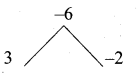
If (x – 6) is the HCF of x2 – 2x – 24 and x2 – kx – 6 then the value of k is ……….. .
(1) 3
(2) 5
(3) 6
(4) 8
Answer:
(2) 5

Question 6.
The solution of (2x – 1)2 = 9 is equal to ……….. .
(1) -1
(2) 2
(3) -1,2
(4) None of these
Answer:
(3) -1,2

Question 7.
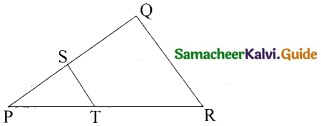
In a given figure ST || QR, PS = 2 cm and SQ = 3 cm. Then the ratio of the area of ∆PQR to the area of ∆PST is ……….. .
Samacheer Kalvi 10th Maths Model Question Paper 5 English Medium - 1
(1) 25 : 4
(2) 25 : 7
(3) 25 :11
(4) 25 : 13
Answer:
(1) 25 : 4

Samacheer Kalvi 10th Maths Model Question Paper 5 English Medium

Question 8.
The slope of the line joining (12, 3), (4, a) is \(\frac { 1 }{ 8 }\). The value of ‘a’ is ……….. .
(1) 1
(2) 4
(3) -5
(4) 2
Answer:
(4) 2

Question 9.
If sin θ + cos θ = a and sec θ + cosec θ = b, then the value of b (a2 – 1) is equal to ……….. .
(1) 2 a
(2) 3 a
(3) 0
(4) 2 ab
Answer:
(1) 2 a

Question 10.
The curved surface area of a right circular cone of height 15 cm and base diameter 16 cm is ……….. .
(1) 60π cm2
(2) 68π cm2
(3) 120π cm2
(4) 136π cm2
Answer:
(4) 136π cm2

Question 11.
The sum of all deviations of the data from its mean is ……….. .
(1) always positive
(2) always negative
(3) zero
(4) non-zero integer
Answer:
(3) zero

Question 12.
If \(\left( \begin{matrix} x+y & x-y \\ 7 & 6 \end{matrix} \right) =\left( \begin{matrix} 10 & 2 \\ 7 & z \end{matrix} \right) \) then x, y, z are ……….. .
(1) 4, 6, 6
(2) 6, 6, 4
(3) 6, 4, 6
(4) 4, 4, 6
Answer:
(3) 6, 4, 6

Question 13.
If the nth term of a sequence is 100n + 10 then the sequence is ……….. .
(1) an A.P.
(2) a G.P.
(3) a constant sequence
(4) neither A.P. nor G.P.
Answer:
(1) an A.P.

Samacheer Kalvi 10th Maths Model Question Paper 5 English Medium

Question 14.
Probability of getting 3 heads or 3 tails in tossing a coin 3 times is ……….. .
(1) \(\frac { 1 }{ 8 }\)
(2) \(\frac { 1 }{ 4 }\)
(3) \(\frac { 3 }{ 8 }\)
(4) \(\frac { 1 }{ 2 }\)
Answer:
(2) \(\frac { 1 }{ 4 }\)

PART – II

II. Answer any ten questions. Question No. 28 is compulsory. [10 × 2 = 20]

Question 15.
Let A = {x ∈ W / x < 2}, B = {x ∈ N / 1 < x ≤ 4} and C = {3, 5} find the value of (A × C) ∪ (B × C)
Answer:
A × C = {0,1} × {3,5}
= {(0,3 (0,5) (1,3) (1,5)}
B × C= (2,3,4) × (3,5)
= {(2,3) (2,5) (3,3) (3,5) (4,3) (4,5)}
(A × C) ∪ (B × C) = {(0,3) (0,5) (1,3) (1,5) (2,3) (2,5) (3,3) (3,5) (4,3) (4,5)}

Question 16.
Find k if fof(k) = 5 where f(k) = 2k – 1.
Answer:
fof(k) = f(f(k)) = 2(2k – 1)-1 = 4k – 3.
Thus, fof(k) = 4k – 3
But, it is given that fof(k) = 5
∴ 4k – 3 = 5 ⇒ k = 2.

Question 17.
Find the sum of the following 6 + 13 + 20 +…. + 97
Answer:
Here a = 6, d = 13 – 6 = 7, l = 97
n = \(\frac{l-a}{d}+1\)
= \(\frac{97-6}{7}+1\) = \(\frac{91}{7}+1\) = 13 + 1 = 14
Sn = \(\frac{n}{2}\)(a + l)
Sn = \(\frac{14}{2}\)(6 + 97) = 7 × 103 = 721

Question 18.
Rekha has 15 square colour papers of sizes 10 cm, 11 cm, 12 cm, …,.24 cm. How much area can be decorated with these colour papers?
Answer:
Area of 15 square colour papers
= 102 + 112 + 122 + …. + 242
= (12 + 22 + 32 + …. + 242) – (12 + 22 + 92)
= \(\frac{24 \times 25 \times 49}{6}-\frac{9 \times 10 \times 19}{6}\)
=4 × 25 × 49 – 3 × 5 × 19
= 4900 – 285
= 4615
Area can be decorated is 4615 cm2

Samacheer Kalvi 10th Maths Model Question Paper 5 English Medium

Question 19.
Simplify \(\frac{x+2}{4 y} \div \frac{x^{2}-x-6}{12 y^{2}}\)
Answer:
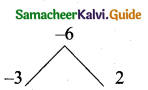
Samacheer Kalvi 10th Maths Model Question Paper 5 English Medium - 3
x2 – x – 6 = (x – 3) (x + 2)
= \(\frac{x+2}{4 y} \div \frac{x^{2}-x-6}{12 y^{2}}=\frac{x+2}{4 y}+\frac{(x-3)(x+2)}{12 y^{2}}\)
= \(\frac{(x+2)}{4 y} \times \frac{12 y^{2}}{(x-3)(x+2)}\)
= \(\frac{3 y}{x-3}\)

Question 20.
Solve \(\frac{x}{x-1}+\frac{x-1}{x}=2 \frac{1}{2}\)
Answer:
Let y = \(\frac{x}{x-1}\) then \(\frac{1}{y}=\frac{x-1}{x}\)
Therefore, \(\frac{x}{x-1}+\frac{x-1}{x}=2 \frac{1}{2}\) becomes \(y+\frac{1}{y}=\frac{5}{2}\)
2y2 – 5y + 2 = 0 then, y = \(\frac{1}{2}, 2\)
\(\frac{x}{x-1}=\frac{1}{2}\) we get, 2x = x – 1 implies x = – 1
\(\frac{x}{x-1}=2\) we get, x = 2x – 2 implies x = 2
∴ The roots are x = -1, 2

Question 21.
Construct a 3 × 3 matrix whose elements are given by aij = |i – 2j|
Answer:
aij = |i – 2j|
The general 3 × 3 matrices is
A = \(\left( \begin{matrix} { a }_{ 11 } & { a }_{ 12 } & { a }_{ 13 } \\ { a }_{ 21 } & { a }_{ 22 } & { a }_{ 23 } \\ { a }_{ 31 } & { a }_{ 32 } & { a }_{ 33 } \end{matrix} \right)\)
a11 = |1 – 2(1)| = |1 – 2| = |-1| = 1
a12 = |1 – 2(2)| = |1 – 4| = |-3| = 3
a13 = |1 – 2(3)| = |1 – 6| = |-5| = 5
a21 = |2 – 2(1)| = |2 – 2| = 0
a22 = |2 – 2(2)| = |2 – 4| = |-2| = 2
a23 = |2 – 2(3)| = |2 – 6| = |-4| = 4
a31 = |3 – 2(1)| = |3 – 2| = |1| = 1
a32 = |3 – 2(2)| = |3 – 4| = |-1| = 1
a33 = |3 – 2(3)| = |3 – 6| = |-3| = 3
The required matrix A = \(\left[ \begin{matrix} 1 & 3 & 5 \\ 0 & 2 & 4 \\ 1 & 1 & 3 \end{matrix} \right] \)

Question 22.
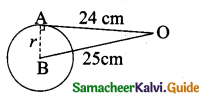
The length of the tangent to a circle from a point P, which is 25 cm away from the centre is 24 cm. What is the radius of the circle?
Answer:
Samacheer Kalvi 10th Maths Model Question Paper 5 English Medium - 4
Let the radius AB be r. In the right ∆ ABO,
OB2 = OA2 + AB2
252 = 242 + r2
252 – 242 = r2
(25 + 4) (25 – 24) = r2
r = √49 = 7
Radius of the circle = 7 cm

Samacheer Kalvi 10th Maths Model Question Paper 5 English Medium

Question 23.
If the straight lines 12y = – (p + 3)x + 12, 12x – 7y = 16 are perpendicular then find ‘p’.
Answer:
Slope of the first line 12y = -(p + 3)x + 12
y = \(-\frac{(p+3) x}{12}+1\) (comparing with y = mx + c)
Slope of the second line (m1) = \(\frac{-(p+3)}{12}\)
Slope of the second line 12x – 7y = 16
(m2) = \(\frac{-a}{b}=\frac{-12}{-7}=\frac{12}{7}\)
Since the two lines are perpemdicular.
m1 × m2 = -1
\(\frac{-(p+3)}{12} \times \frac{12}{7}=-1 \Rightarrow \frac{-(p+3)}{7}=-1\)
-(p + 3) = -7
– p – 3 = – 7 ⇒ -p = -7 + 3
– p = -4 ⇒ p = 4
The value of p = 4

Question 24.
Prove that 1 + \(\frac{\cot ^{2} \theta}{1+\csc \theta}\) = cosec θ
Answer:
Samacheer Kalvi 10th Maths Model Question Paper 5 English Medium - 5

Question 25.
Find the standard deviation of first 21 natural numbers.
Answer:
Here n = 21
Standard deviation of the first ‘n’ natural numbers,
= \(\sqrt{\frac{n^{2}-1}{12}}\)
1,2,3,4, ……. , 21 = \(\sqrt{\frac{21^{2}-1}{12}}=\sqrt{\frac{441-1}{12}}=\sqrt{\frac{440}{12}}\)
= \(\sqrt{36.666}\) = \(\sqrt{36.67}\)
= 6.055 = 6.06
Standard deviation of first 21 natural numbers = 6.06

Samacheer Kalvi 10th Maths Model Question Paper 5 English Medium

Question 26.
How many litres of water will a hemispherical tank hold whose diameter is 4.2m?
Answer:
Radius of the tank = \(\frac{4.2}{2}\) = 2.1 m
Volume of the hemisphere = \(\frac{2}{3}\) πr3 cu. unit
= \(\frac{2}{3} \times \frac{22}{7}\) × 2.1 × 2.1 × 2.1 m3
= 19.404 m3
= 19.4o4 × 1000 litre
= 19,4o4 litres

Question 27.
A two digit number is formed with the digits 2, 5, 9 (repetition is allowed). Find the probability that the number is divisible by 2.
Answer:
Sample space (S) = {22, 25, 29, 55, 59, 52, 99, 92, 95}
n(S) = 9
Let A be the event of getting number divisible by 2
A = {22,52,92}
n(A) = 3
P(A) = \(\frac{n(\mathrm{A})}{n(\mathrm{S})}=\frac{3}{9}=\frac{1}{3}\)

Question 28.
Solve √x + 5 = 2x + 3 using formula method.
Answer:
\(\sqrt{x+5}\) = 2x + 3
\((\sqrt{x+5})^{2}\) = (2x + 3)2
x + 5 = 4x2 + 9 + 12x
4x2 + 11x + 4 = 0
Here a = 4, b = 11, c = 5
x = \(\frac{-b \pm \sqrt{b^{2}-4 a c}}{2 a}\)
= \(\frac{-11 \pm \sqrt{121-64}}{8}\)
= \(\frac{-11 \pm \sqrt{57}}{8}\)
∴ x = \(\frac{-11+\sqrt{57}}{8}\) ; x = \(\frac{-11-\sqrt{57}}{8}\)

Samacheer Kalvi 10th Maths Model Question Paper 5 English Medium

PART – III

III. Answer any ten questions. Question No. 42 is compulsory. [10 × 5 = 50]

Question 29.
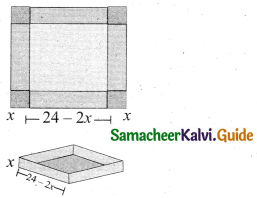
An open box is to be made from a square piece of material, 24 cm on a side, by cutting equal squares from the comers and turning up the sides as shown. Express the volume V of the box as a function of x.
Samacheer Kalvi 10th Maths Model Question Paper 5 English Medium - 2

Question 30.
Find the greatest number consisting of 6 digits which is exactly divisible by 24,15,36?

Question 31.
The present value of a machine is ₹40,000 and its value depreciates each year by 10%. Find the estimated value of the machine in the 6th year.

Question 32.
The sum of the digits of a three-digit number is 11. If the digits are reversed, the new number is 46 more than five times the old number. If the hundreds digit plus twice the tens digit is equal to the units digit, then find the original three digit number?

Question 33.
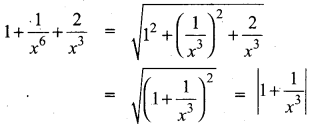
Find the square root of the expression \(\frac{4 x^{2}}{y^{2}}+\frac{20 x}{y}+13-\frac{30 y}{x}+\frac{9 y^{2}}{x^{2}}\)

Question 34.
If α, β are the roots of 7x2 + ax + 2 = 0 and if β – α = \(\frac { -13 }{ 7 }\) . Find the values of a.

Question 35.
State and prove Angle Bisector Theorem.

Question 36.
A quadrilateral has vertices at A(-4, -2) , B(5, -1) , C(6, 5) and D(-7, 6). Show that the mid-points of its sides form a parallelogram.

Samacheer Kalvi 10th Maths Model Question Paper 5 English Medium

Question 37.
Two ships are sailing in the sea on either side of the lighthouse. The angles of depression of two ships as observed from the top of the lighthouse are 60° and 45° respectively.
If the distance between the ships is 200 \(\left(\frac{\sqrt{3}+1}{\sqrt{3}}\right)\) meters, find the height of the light house.

Question 38.
A shuttle cock used for playing badminton has the shape of a frustum of a cone is mounted on a hemisphere. The diameters of the frustum are 5 cm and 2 cm. The height of the entire shuttle cock is 7 cm. Find its external surface area.

Question 39.
Two dice are rolled together. Find the probability of getting a doublet or sum of faces as 4.

Question 40.
Given f(x) = x – 2 ; g(x) = 3x + 5; h(x) = 2x – 3 verify that (goh) of = go (hof)

Question 41.
A 20 m deep well with inner diameter 7 m is dug and the earth from digging is evenly spread out to form a platform 22m by 14m. Find the height of the platform.

Question 42.
The mean and standard deviation of 20 items are found to be 10 and 2 respectively. At the time of checking it was found that an item 12 was wrongly entered as 8. Calculate the correct mean and standard deviation.

PART – IV

IV. Answer all the questions. [2 × 8 = 16]

Question 43.
(a) Construct a triangle similar to a given triangle PQR with its sides equal to \(\frac { 7 }{ 3 }\) of the corresponding sides of the triangle PQR (scale factor \(\frac { 7 }{ 3 }\)).

[OR]

(b) Draw a circle of diameter 6 cm from a point P, which is 8 cm away from its centre. Draw the two tangents PA and PB to the circle and measure their lengths.

Samacheer Kalvi 10th Maths Model Question Paper 5 English Medium

Question 44.
(a) Draw the graph of y = x2 – 5x – 6 and hence solve x2 – 5x – 14 = 0.

[OR]

(b) Solve graphically 2x2 + x – 6 = 0.

Must Read:

INDHOTEL Pivot Point Calculator

Samacheer Kalvi 10th Science Guide Chapter 6 Nuclear Physics

Students can download 10th Science Chapter 6 Nuclear Physics Questions and Answers, Notes, Samacheer Kalvi 10th Science Guide Pdf helps you to revise the complete Tamilnadu State Board New Syllabus, helps students complete homework assignments and to score high marks in board exams.

Tamilnadu Samacheer Kalvi 10th Science Solutions Chapter 6 Nuclear Physics

Samacheer Kalvi 10th Science Nuclear Physics Text Book Back Questions and Answers

I. Choose the correct answer.

Question 1.
Man-made radioactivity is also known as;
(a) Induced radioactivity
(b) Spontaneous radioactivity
(c) Artificial radioactivity
(d) (a) and (c)
Answer:
(a) Induced radioactivity

Question 2.
Unit of radioactivity is _____.
(a) roentgen
(b) curie
(c) becquerel
(d) all the above.
Answer:
(d) all the above.

Question 3.
Artificial radioactivity was discovered by:
(a) Becquerel
(b) Irene Curie
(c) Roentgen
(d) Neils Bohr
Answer:
(b) Irene Curie

Samacheer Kalvi 10th Science Guide Chapter 6 Nuclear Physics

Question 4.
In which of the following, no change in mass number of the daughter nuclei takes place _____.
(i) α decay
(ii) β decay
(iii) γ decay
(iv) neutron decay
(a) (i) is correct
(b) (ii) and (iii) are correct
(c) (i) & (iv) are correct
(d) (ii) & (iv) are correct.
Answer:
(b) (ii) and (iii) are correct

Question 5.
……. isotope is used for the treatment of cancer.
(a) Radio Iodine
(b) Radio Cobalt
(c) Radio Carbon
(d) Radio Nickel
Answer:
(b) Radio Cobalt

Question 6.
Gaming radiations are dangerous because of _____.
(a) it affects eyes & bones
(b) it affects tissues
(c) it produces genetic disorder
(d) it produces an enormous amount of heat.
Answer:
(c) it produces genetic disorder

Question 7.
……… aprons are used to protect us from gamma radiations.
(a) Lead oxide
(b) Iron
(c) Lead
(d) Aluminium
Answer:
(c) Lead

Question 8.
Which of the following statements is/are correct?
(i) a particles are photons.
(ii) Penetrating power of γ radiation is very low.
(iii) Ionization power is maximum for a rays.
(iv) Penetrating power of γ radiation is very high.
(a) (i) & (ii) are correct
(b) (ii) & (iii) are correct
(c) (iv) only correct
(d) (iii) & (iv) are correct
Answer:
(d) (iii) & (iv) are correct

Question 9.
Proton-Proton chain reaction is an example of _____.
(a) Nuclear fission
(b) α – decay
(c) Nuclear fusion
(d) β – decay.
Answer:
(c) Nuclear fusion

Question 10.
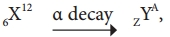
In the nuclear reaction Samacheer Kalvi 10th Science Guide Chapter 6 Nuclear Physics 1the value of A and Z.
(a) 8, 6
(b) 8, 4
(c) 4, 8
(d) cannot be determined with the given data
Answer:
(b) 8, 4

Question 11.
Kamini reactor is located at:
(a) Kalpakkam
(b) Koodankulam
(c) Mumbai
(d) Rajasthan
Answer:
(a) Kalpakkam

Question 12.
Which of the following is/are correct?
(i) Chain reaction takes place in a nuclear reactor and an atomic bomb.
(ii) The chain reaction in a nuclear reactor is controlled
(iii) The chain reaction in a nuclear reactor is not controlled
(iv) No chain reaction takes place in an atom bomb
(a) (i) only correct
(b) (i) & (ii) are correct
(c) (iv) only correct
(d) (iii) & (iv) are correct.
Answer:
(b) (i) & (ii) are correct

Samacheer Kalvi 10th Science Guide Chapter 6 Nuclear Physics

II. Fill in the blanks.

1. One roentgen is equal to ………… disintegrations per second.
2. Positron is an …………
3. Aneamia can be cured by ………… isotope.
4. Abbreviation of ICRP …………..
5. ………… is used to measure exposure rate of radiation in humans.
6. ………. has the greatest penetration power.
7. ZYAZ+1YA + X; Then, X is …………..
8. ZXAZYA This reaction is possible in …………. decay.
9. The average energy released in each fusion reaction is about …………. J.
10. Nuclear fusion is possible only at an extremely high temperature of the order of ……….. K.
11. The radio isotope of …………. helps to increase the productivity of crops.
12. If the radiation exposure is 100 R, it may cause ………….
Answer:
1. 1.6 × 10¹⁵ disintegrations / second
2. antiparticle [1e0]
3. Radio iron Fe59
4. International Commission on Radiological Protection
5. Dosimeter
6. Gama rays
7. X is -1e0
8. gamma
9. 3.84 × 10¹² J
10. 107 to 109 K
11. Radio phosphorus P – 32
12. fatal diseases like leukemia.

III. State whether the following statements are true or false: If false, correct the statement.

1. Plutonium -239 is a fissionable material.
2. Elements having atomic number greater than 83 can undergo nuclear fusion.
3. Nuclear fusion is more dangerous than nuclear fission.
4. Natural uranium U-238 is the core fuel used in a nuclear reactor.
5. If a moderator is not present, then a nuclear reactor will behave as an atom bomb.
6. During one nuclear fission on an average, 2 to 3 neutrons are produced.
7. Einstein’s theory of mass energy equivalence is used in nuclear fission and fusion.
Answer:
1. True
2. False – Elements having atomic number greater than 83 can undergo nuclear fission.
3. True
4. False – Natural U – 238 not used as fuel in a nuclear reactor.
5. True
6. True
7. True

IV. Match the following.

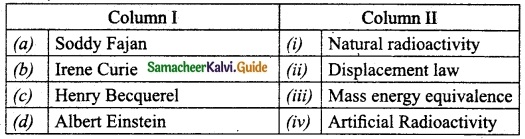
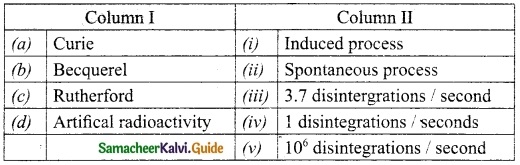
Question 1.
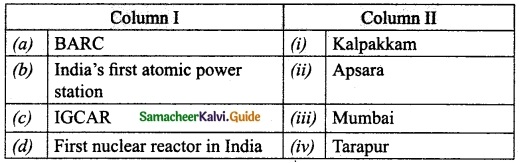
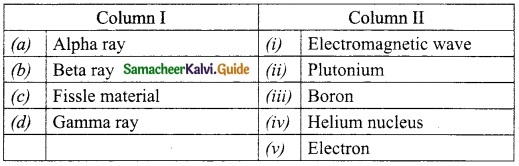
Match the column I with column II.
Samacheer Kalvi 10th Science Guide Chapter 6 Nuclear Physics 2
Answer:
(a) – (iii)
(b) – (i)
(c) – (iv)
(d) – (ii)

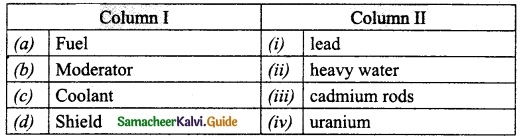
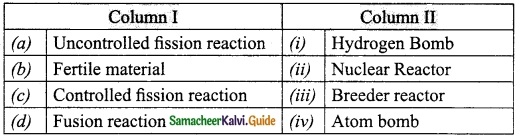
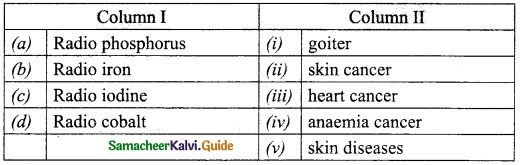
Question 2.
Match the column I with column II.
Samacheer Kalvi 10th Science Guide Chapter 6 Nuclear Physics 3
Answer:
(a) – (iv)
(b) – (ii)
(c) – (iii)
(d) – (i)

Samacheer Kalvi 10th Science Guide Chapter 6 Nuclear Physics

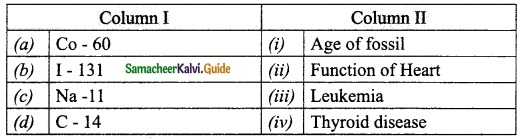
Question 3.
Match the column I with column II.
Samacheer Kalvi 10th Science Guide Chapter 6 Nuclear Physics 4
Answer:
(a) – (ii)
(b) – (iv)
(c) – (i)
(d) – (iii)

Question 4.
Match the column I with column II.
Samacheer Kalvi 10th Science Guide Chapter 6 Nuclear Physics 5
Answer:
(a) – (iv)
(b) – (iii)
(c) – (ii)
(d) – (i)

Question 5.
Match the column I with column II.
Samacheer Kalvi 10th Science Guide Chapter 6 Nuclear Physics 6
Answer:
(a) – (iii)
(b) – (iv)
(c) – (ii)
(d) – (i)

V. Arrange the following in the correct sequence.

Question 1.
Arrange in descending order, on the basis of their penetration power. Alpha rays, beta rays, gamma rays, cosmic rays
Answer:
gamma rays < beta rays < alpha rays < cosmic rays.

Question 2.
Arrange the following in the chronological order of discovery.
Nuclear reactor, radioactivity, artificial radioactivity, discovery of radium.
Answer:
Discovery of radium, Radioactivity, Artifical radioactivity, Nuclear reactor.

VI. Use the analogy to fill in the blank.

  1. Spontaneous process : Natural Radioactivity, Induced process : ………..
  2. Nuclear Fusion : Extreme temperature, Nuclear Fission : ………..
  3. Increasing crops : Radio phosphorous, Effective functioning of heart : …………
  4. Deflected by electric field : a ray, No Deflection : ………….

Answer:

  1. artifical radioactivity
  2. higher temperature
  3. Radio sodium
  4. γ-ray

VII. Numerical problems.

Question 1.
88Ra226 experiences three a – decay. Find the number of neutrons in the daughter element.
Answer:
Mass number of 88Ra226 is 266
Atomic number of 88Ra226 is 88
Mass number of α = 4
Atomic number of α = 2
After 3 a decay
Mass number of the daughter element is
= 266 – (3 × 4)
= 266 – 12
= 254
Atomic number of the daughter element is
= 88 – (3 × 2)
= 88 – 6
= 82
Number of neutrons is
= 254 – 82
= 172

Samacheer Kalvi 10th Science Guide Chapter 6 Nuclear Physics

Question 2.
A cobalt specimen emits induced radiation of 75.6 millicurie per second. Convert this disintegration in to becquerel (one curie = 3.7 × 10¹⁰ Bq).
Answer:
1 curie = 3.7 × 10¹⁰ Bq
∴ 75.6 × 10⁻³ curie = 75.6 × 10-3 × 3.7 × 1010
= 279.72 × 10⁷ Bq
= 279.72 × 10⁷ Becquerel

VIII. Assertion and reason type questions.

Question 1.
Assertion: A neutron impinging on U235, splits it to produce Barium and Krypton.
Reason: U – 235 is a fissile material.
(a) If both the assertion and the reason are true and the reason is the correct explanation of the assertion.
(b) If both the assertion and the reason are true, but the reason is not the correct explanation of the assertion.
(c) If the assertion is true, but the reason is false.
(d) If the assertion is false, but the reason is true.
Answer:
(a) If both the assertion and the reason are true and the reason is the correct explanation of the assertion.

Question 2.
Assertion: In a 3 – decay, the neutron number decreases by one.
Reason: In 3 – decay atomic number increases by one.
(a) If both the assertion and the reason are true and the reason is the correct explanation of the assertion.
(b) If both the assertion and the reason are true, but the reason is not the correct explanation of the assertion.
(c) If the assertion is true, but the reason is false.
(d) If the assertion is false, but the reason is true.
Answer:
(a) If both the assertion and the reason are true and the reason is the correct explanation of the assertion.

Question 3.
Assertion: Extreme temperature is necessary to execute nuclear fusion.
Reason: In a nuclear fusion, the nuclei of the reactants combine releasing high energy.
(a) If both the assertion and the reason are true and the reason is the correct explanation of the assertion.
(b) If both the assertion and the reason are true, but the reason is not the correct explanation of the assertion.
(c) If the assertion is true, but the reason is false.
(d) If the assertion is false, but the reason is true.
Answer:
(b) If both the assertion and the reason are true, but the reason is not the correct explanation of the assertion.

Question 4.
Assertion: Control rods are known as ‘neutron seeking rods’.
Reason: Control rods are used to perform sustained nuclear fission reaction.
(a) If both the assertion and the reason are true and the reason is the correct explanation of the assertion.
(b) If both the assertion and the reason are true, but the reason is not the correct explanation of the assertion.
(c) If the assertion is true, but the reason is false.
(d) If the assertion is false, but the reason is true.
Answer:
(a) If both the assertion and the reason are true and the reason is the correct explanation of the assertion.

IX. Answer in one or two words (VSA).

Question 1.
Who discovered natural radioactivity?
Answer:
Henri Becquerel

Question 2.
Which radioactive material is present in the ore of pitchblende?
Answer:
Uranium is the radioactive material is present in the ore of pitchblende.

Question 3.
Write any two elements which are used for inducing radioactivity?
Answer:
Boron and aluminium

Question 4.
Write the name of the electromagnetic radiation which is emitted during natural radioactivity.
Answer:
Gamma rays are the electromagnetic radiation which is emitted during natural radioactivity.

Samacheer Kalvi 10th Science Guide Chapter 6 Nuclear Physics

Question 5.
If A is a radioactive element which emits an α – particle and produces 104Rf259. Write the atomic number and mass number of the element A.
Answer:
Samacheer Kalvi 10th Science Guide Chapter 6 Nuclear Physics 7
Mass number A = 259 + 4 = 263
Atomic number Z = 104 + 2 = 106

Question 6.
What is the average energy released from a single fission process?
Answer:
200 MeV

Question 7.
Which hazardous radiation is the cause for the genetic disease?
Answer:
γ – ray (Gamma-ray) or any high energy nuclear particle passes through a human being, it disrupts the entire normal functioning of the biological system and the effect may be an either pathological or genetic disease.

Question 8.
What is the amount of radiation that may cause death of a person when exposed to it?
Answer:
600 R.

Question 9.
When and where was the first nuclear reactor built?
Answer:
The first nuclear reactor was built in 1942 at Chicago, USA.

Question 10.
Give the SI unit of radioactivity.
Answer:
The SI unit of radioactivity is becquerel.

Question 11.
Which material protects us from radiation?
Answer:
Lead

X. Answer the following questions in a few sentences.

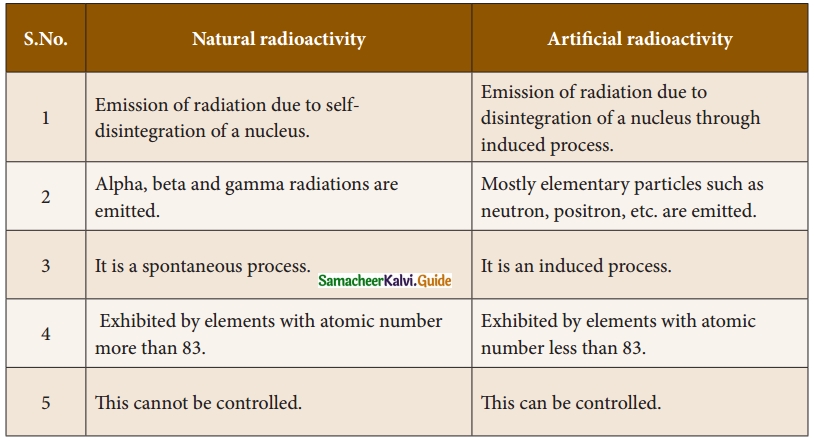
Question 1.
Write any three features of natural and artificial radioactivity.
Answer:
Samacheer Kalvi 10th Science Guide Chapter 6 Nuclear Physics 8

Question 2.
Define critical mass.
Answer:
The minimum mass of fissile material necessary to sustain the chain reaction is called ‘critical mass (mc)’. It depends on the nature, density and the size of the fissile material.

Question 3.
Define one roentgen.
Answer:
One roentgen is defined as the quantity of radioactive substance which produces a charge of 2.58 × 10⁻⁴ coulomb in 1 kg of air under standard conditions of pressure, temperature and humidity.

Question 4.
State Soddy and Fajan’s displacement law.
Answer:
(i) When a radioactive element emits an alpha particle, a daughter nucleus is formed whose mass number is less by 4 units and the atomic number is less by 2 units, than the mass number and atomic number of the parent nucleus.

(ii) When a radioactive element emits a beta particle, a daughter nucleus is formed whose mass number is the same and the atomic number is more by 1 unit, than the atomic number of the parent nucleus.

Samacheer Kalvi 10th Science Guide Chapter 6 Nuclear Physics

Question 5.
Give the function of control rods in a nuclear reactor.
Answer:
Control rods are used to control the number of neutrons in order to have a sustained chain reaction. Mostly boron or cadmium rods are used as control rods. They absorb the neutrons.

Question 6.
In Japan, some of the newborn children are having congenital diseases. Why?
Answer:
In Japan, there was a leakage of nuclear radiations in some areas. In those areas, if the new born children handled with careless they are exposed to harmful radiations then they have congenital diseases.

Question 7.
Mr. Ramu is working as an X – ray technician in a hospital. But, he does not wear the lead aprons. What suggestion will you give to Mr. Ramu?
Answer:
The intensity of X-rays is very low. So, X-rays do not produce any severe effects. There are certains clothes that can be used while operating X-ray machines. Ramu can use them and so he may not be severely affected by X-rays, he should avoid eating and drinking when he is working with X-rays.

Question 8.
What is stellar energy?
Answer:
Fusion reaction that takes place in the cores of the Sun and other stars results in an enormous amount of energy, which is called stellar energy.

Question 9.
Give any two uses of radio isotopes in the field of agriculture?
Answer:
The radio isotope of phosphorous (P-32) helps to increase the productivity of crops. The radiations from the radio isotopes can be used to kill the insects and parasites and prevent the wastage of agricultural products.

Question 10.
What is stellar energy?
Answer:
Fusion reaction that takes place in the cores of the Sun and other stars results in an enormous amount of energy, which is called as stellar energy.

XI. Answer the following questions in detail.

Question 1.
Explain the process of controlled and uncontrolled chain reactions.
Answer:
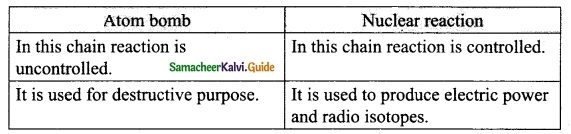
(i) Controlled chain reaction: In the controlled chain reaction the number of neutrons released is maintained to be one. This is achieved by absorbing the extra neutrons with a neutron absorber leaving only one neutron to produce further fission. Thus, the reaction is sustained in a controlled manner. The energy released due to a controlled chain reaction can be utilized for constructive purposes. Controlled chain reaction is used in a nuclear reactor to produce energy in a sustained and controlled manner.

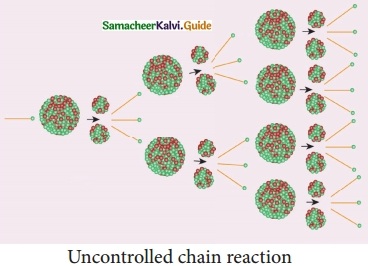
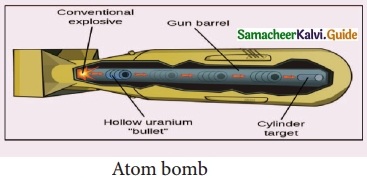
(ii) Uncontrolled chain reaction: In the uncontrolled chain reaction the number of neutrons multiplies indefinitely and causes fission in a large amount of the fissile material. This results in the release of a huge amount of energy within a fraction of a second. This kind of chain reaction is used in the atom bomb to produce an explosion.
Samacheer Kalvi 10th Science Guide Chapter 6 Nuclear Physics 9

Question 2.
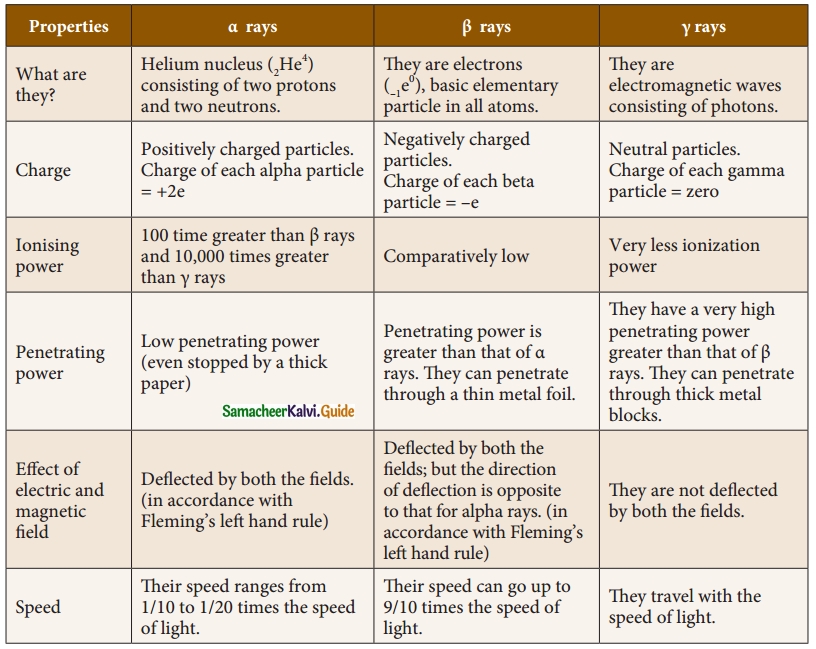
Compare the properties of alpha, beta and gamma radiations.
Answer:
Samacheer Kalvi 10th Science Guide Chapter 6 Nuclear Physics 10

Samacheer Kalvi 10th Science Guide Chapter 6 Nuclear Physics

Question 3.
What is a nuclear reactor? Explain its essential parts with their functions.
Answer:
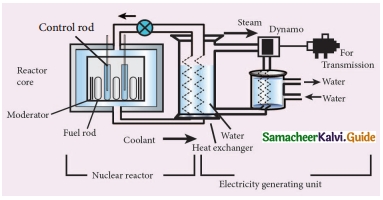
A Nuclear reactor is a device in which the nuclear fission reaction takes place in a self-sustained and controlled manner to produce electricity.
Components of a nuclear reactors:
The essential components of a nuclear reactor are

  1. fuel,
  2. moderator,
  3. control rod,
  4. coolant and
  5. protection wall.

1. Fuel : A fissile material is used as the fuel. The commonly used fuel material is uranium.
2. Moderator : A moderator is used to slow down the high energy neutrons to provide slow neutrons. Graphite and heavy water are the commonly used moderators
3. Control rod : Control rods are used to control the number of neutrons in order to have sustained chain reaction. Mostly boron or cadmium rods are used as control rods. They absorb the neutrons.
4. Coolant : A coolant is used to remove the heat produced in die reactor core, to produce steam. This steam is used to run a turbine in order to produce electricity. Water, air and helium are some of the coolants.
5. Protection wall : A thick concrete lead wall is built around the nuclear reactor in order to prevent the harmful radiations from escaping into the environment.
Samacheer Kalvi 10th Science Guide Chapter 6 Nuclear Physics 11

XII. HOT Questions.

Question 1.
The mass number of a radioactive element is 232 and its atomic number is 90. When this element undergoes certain nuclear reactions, it transforms into an isotope of lead with a mass number 208 and an atomic number 82. Determine the number of alpha and beta decay that can occur.
Answer:
\(_{90} \mathrm{x}^{232} \stackrel{4 \beta}{\longrightarrow} 94^{\mathrm{Y}^{232}+4_{-4} \mathrm{e}^{\circ}}\) (4β decay)
From the result of β decay,
\(94^{232} \stackrel{6 \alpha}{\longrightarrow} 82^{\mathrm{Pb}^{208}+6}_{} \mathrm{He}^{4}\) (6α decay)
The number of α decay = 6
The number of β decay = 4.

Question 2.
‘X – rays should not be taken often’. Give the reason.
Answer:
X-rays have some low intensity. Even then if a person undergoes the exposure of X-ray, his skin may be affected. The tissues near by the bones may be damaged.

Question 3.
Cell phone towers should be placed far away from the residential area – why?
Answer:
From the cell phone towers micro-waves are scattered for a particular area. This may affect small children and aged people. If people are exposed with those rays very often then they may be severly affected.

Samacheer Kalvi 10th Science Guide Chapter 6 Nuclear Physics

Samacheer Kalvi 10th Science Nuclear Physics Additional Important Questions and Answers

I. Choose the correct answer.

Question 1.
The elements that undergo spontaneous radioactivity:
(a) Uranium
(b) Radium
(c) Uranium and Radium
(d) None of the above
Answer:
(c) Uranium and Radium

Question 2.
The artificial (or) induced radioactive element is _____.
(a) Uranium
(b) Boron
(c) Radium
(d) none of these.
Answer:
(b) boron

Question 3.
The nucleons in a nucleus are attracted by:
(a) electrostatic force
(b) gravitational force
(c) nuclear force
(d) magnetic force
Answer:
(c) nuclear force

Question 4.
In p decay by one.
(a) mass number decreases
(b) atomic number decreases
(c) neutron number decreases
(d) proton number decreases
Answer:
(c) neutron number decreases

Question 5.
The charge of the α rays _____.
(a) 2e
(b) -e
(c) 0
(d) none of these.
Answer:
(a) 2e

Question 6.
In which process positron is emitted?
(a) natural radioactivity
(b) artifical radioactivity
(c) nuclear fission
(d) nuclear fussion
Answer:
(b) artifical radioactivity

Question 7.
The atomic number of the elements that exhibit natural radioactivity is:
(a) less than 83
(b) more than 83
(c) more than 42
(d) more than 82
Answer:
(b) more than 83

Question 8.
The ionising power of the α rays _____.
(a) 100 times greater than the β rays
(b) 1000 times greater than the γ rays
(c) very less ionization
(d) both (a) and (b).
Answer:
(d) both (a) and (b).

Samacheer Kalvi 10th Science Guide Chapter 6 Nuclear Physics

Question 9.
In the reaction Samacheer Kalvi 10th Science Guide Chapter 6 Nuclear Physics 12 is:
(a) 6C13
(b) 6C12
(c) 7N13
(d) 8O16
Answer:
(b) 6C12

Question 10.
Ionising power of β rays _____.
(а) 100 times greater than α rays
(b) 100 times less than α rays
(c) comparatively very less ionization power
(d) 1000 times less than γ rays.
Answer:
(b) 100 times less than α rays

Question 11.
During α – decay the mass number of the daughter element is:
(a) more by 2 units
(b) less by 2 units
(c) more by 4 units
(d) less by 4 units
Answer:
(d) less by 4 units

Question 12.
When α – particle is emitted the atomic number of daughter element is:
(a) more by 4 units
(b) less by 4 units
(c) less by 2 units
(d) more by 2 units
Answer:
(c) less by 2 units

Question 13.
Which power has more penetrating power?
(a) α rays
(b) γ rays
(c) β rays
(d) X rays.
Answer:
(b) γ rays

Question 14.
What is the charge of alpha particle?
(a) -e
(b) +e
(c) zero
(d) +2e
Answer:
(d) +2e

Question 15.
Which of the following has speed from 1/10 to 1/20 times the speed of light?
(a) β
(b) α
(c) γ
(d) all the above
Answer:
(b) α

Question 16.
In α – decay _____.
(a) atomic number decreases by 2 and the mass number decreases by 4
(b) atomic number increases by 2 and the mass number decrease by 4
(c) there is no change in atomic and mass number
(d) neutron number decreases by one.
Answer:
(a) atomic number decreases by 2 and the mass number decreases by 4

Question 17.
Which of the following is a fertile material?
(a) Thorium – 232
(b) Uranium – 238
(c) Plutonium – 240
(d) All the above
Answer:
(d) All the above

Question 18.
If the mass of the fissile material is less than the critical mass, then it is termed as:
(a) supercritical
(b) critical
(c) subcritical
(d) none of the above
Answer:
(b) critical

Question 19.
1 curie is equal to _____.
(a) the radioactivity of 1 gram of uranium
(b) 1 decay/second
(c) 3.7 × 10¹⁰ becquerel
(d) 1.6 × 10¹² decay / second.
Answer:
(c) 3.7 × 10¹⁰ becquerel

Question 20.
During nuclear fusion which of the following are emitted:
(a) alpha rays
(b) positrons
(c) neutrons
(d) all the above
Answer:
(d) all the above

Question 21.
Anaemia can be diagonised by:
(a) 15P32
(b) 26Fe59
(c) 11Na24
(d) 28Fe59
Answer:
(b) 26Fe59

Question 22.
I – 131 is used in the treatment of _____.
(a) cancer
(b) skin disease
(c) disease in the thyroid gland
(d) tumour.
Answer:
(c) disease in the thyroid gland

Samacheer Kalvi 10th Science Guide Chapter 6 Nuclear Physics

Question 23.
In which decay atomic number of daughter element is increased by 1 unit?
(a) α – decay
(b) β – decay
(c) γ – decay
(d) neutron decay
Answer:
(b) β – decay

Question 24.
in nuclear fusion ………… is satisfied.
(a) law of conservation of energy
(b) law of conservation of momentum
(c) law of conservation angular momentum
(d) mass energy relation
Answer:
(d) mass energy relation

Question 25.
The safe limit of receiving the radiation is about _____.
(a) 100 R
(b) 600 R
(c) 250 R
(d) 250 mR per week.
Answer:
(d) 250 mR per week.

Question 26.
Hydrogen bomb is based on the principle of:
(a) natural radioactivity
(b) induced radioactivity
(c) nuclear fusion
(d) nuclear fission
Answer:
(c) nuclear fusion

Question 27.
Uncontrolled chain reaction yields _____.
(a) nuclear reactor
(b) atom bomb
(c) hydrogen bomb
(d) breeder reactor.
Answer:
(b) atom bomb

Question 28.
In the following reaction.
1H3 + 1H2 → X + Y + energy X and Y are:
(a) 2He3, 0n1
(b) 2He4, 0n1
(c) 1H2, 0n1
(d) 1H3, 0n1
Answer:
(b) 2He4, 0n1

Question 29.
The number of α and ß particles emitted when 92U238 decays to 82Pb206 are respectively:
(a) 6, 8
(b) 8, 6
(c) 4, 3
(d) 3, 4
Answer:
(b) 8, 6

Question 30.
The fusion process can be carried out only at a temperature of _____.
(a) 1000°C
(b) 100°C
(c) 104°C
(d) 107 K.
Answer:
(d) 107 K.

Question 31.
Which of the following is used to cure goiter?
(a) Na24
(b) I131
(c) P32
(d) Fe59
Answer:
(b) I131

Question 32.
Which radio isotope is used to check the function of heart?
(a) Na24
(b) Fe59
(c) Co60
(d) I131
Answer:
(a) Na24

Question 33.
The fuel of the prototype fast breeder reactor is _____.
(a) low enriched uranium
(b) carbides of uranium
(c) high enriched uranium
(d) oxides of plutonium and uranium.
Answer:
(d) oxides of plutonium and uranium.

Question 34.
Which radio isotope is used as a smoke detector?
(a) Cf232
(b) I131
(c) Co60
(d) Am241
Answer:
(d) Am241

Question 35.
The control rod used in a nuclear reactor is _____.
(a) barium
(b) carbon
(c) cadmium
(d) Na.
Answer:
(c) cadmium

Samacheer Kalvi 10th Science Guide Chapter 6 Nuclear Physics

II. Fill in the blanks.

1. Radium was discovered by ………..
2. The photoelectric effect is an instantaneous process Natural radioactivity is a ………..
3. The elements with atomic number ……… undergo spontaneous radioactivity.
4. In natural radioactivity emission of radiation is due to ………. of a nucleus.
5. One disintegration per second is equal to ………..
6. S.I unit of radioactivity is ………….
7. The speed of ………. can go upto 9/10 times the velocity of light.
8. α ray is …………
9. ……….ray consists of photons.
10. ………… and ………… are deflected by electric and magnetic fields.
11. When uranium decays into thorium ……….. particle is emitted.
12. In ………… decay there is no change in the mass number of the product nuclear.
13. The minimum mass of a fissile material necessary to sustain the chain reaction is called …………
14. The value of 1MeV in joules is ………..
15. In the transformation 1H2 + 1H2 → X + energy. X is …………
16. Einstein’s mass energy relation is ………….
17. ……….causes the mutation in the human gene.
18. ……….. is also used in treatment of skin cancer.
19. The safe limit for receiving the radiation is ………….
20. The substances that are used as coolants are ………….. and
21. ………… reactors convert non-fissionable material units.
22. The expansion of BARC is ………….
23. The number of nuclear reactor that are operating in India are ……………
24. Identify X in the following transformation 12Mg24 + 0n1 → X + 1n1. X is ………….
25. In the reaction 92U238 + 0n193NP239 + X. X is ………….
Answer:
1. Marie Curie and pierre Curie
2. Spontaneous
3. more than 83
4. self-disintegration
5. Becquerel
6. Becquerel
7. β rays
8. a helium nucleus
9. Gamma
10. Alpha, beta
11. alpha
12. beta
13. critical mass
14. 1.602 × 10⁻¹³ J
15. 2He4
16. E = mc2
17. Gamma radiation
18. Radio-gold Au198
19. 100 mR per week
20. Water, air and helium
21. Breeder
22. Bhaba Atomic Research Centre
23. 22
24. 11Na24
25. -1e0

III. State whether the following statements are true or false: If false, correct the statement.

1. Artificial radioactivity is induced in the elements like boron, aluminum etc.
2. Natural radioactivity can be controlled.
3. 1 Rd = 3.7 × 10¹⁰ disintegrations / second.
4. The S.I units of radioactivity is roentgen.
5. The charge of each beta particle is – e
6. Beta ray travels with velocity of light.
7. Example for alpha decay is 92U23890Th234 + 2He4
8. Otto Hann and Strassman discovered nuclear fission.
9. In the mass of the fissile material is more than the critical mass it is termed as supercritical.
10. Hydrogen bomb is based on uncontrolled chain reaction.
11. 1eV = 1.602 × 10⁻¹⁶ Joule.
12. Hydrogen is based on nuclear fusion.
13. Positrons are emitted in nuclear fusion.
14. To diagnose anaemia P32 is used.
15. Radio phosphorous is used in the treatment of skin diseases.
16. To prevent the leakage of nuclear radiation concrete wall with lead lining is used.
Answer:
1. True
2. False – Artificial radio activity can be controlled.
3. False – 1 curie = 3.7 × 10106 disintegrations / second.
4. False – The S.l unit of radioactivity is Becquerel.
5. True
6. False – Gamma ray travels with velocity of light.
7. True
8. True
9. True
10. False – Atom bomb is based on uncontrolled chain reaction.
11. False – 1eV = 1.602 × 10⁻⁹ Joule
12. True
13. True
14. False – To diagonise aneamia Fe59 is used.
15. True
16. True
17. True

Samacheer Kalvi 10th Science Guide Chapter 6 Nuclear Physics

IV. Match the following.

Question 1.
Match the Column I with Column II.
Samacheer Kalvi 10th Science Guide Chapter 6 Nuclear Physics 13
Answer:
(a) – (iii)
(b) – (iv)
(c) – (v)
(d) – (i)

Question 2.
Match the Column I with Column II.
Samacheer Kalvi 10th Science Guide Chapter 6 Nuclear Physics 14
Answer:
(a) – (iv)
(b) – (v)
(c) – (ii)
(d) – (i)

Question 3.
Match the Column I with Column II.
Samacheer Kalvi 10th Science Guide Chapter 6 Nuclear Physics 15
Answer:
(a) – (v)
(b) – (iv)
(c) – (i)
(d) – (ii)

V. Numerical problems.

Question 1.
A radioactive isotope emits radiation of 7.4 × 10⁴ G Bq per second. Convert this disintegration in terms of curie.
Answer:
One curie = 3.7 × 10¹⁰ Becquerel
Becquerel (1 Bq) = One disintegration / second
∴ 1 Bq = \(\frac{1}{3.7×10^{10}}\) curie
∴ 7.4 × 10⁴ G Bq
= 7.4 × 104 × 109 × \(\frac{1}{3.7×10^{10}}\)
= 2 × 10³ curie
= 2,000 curie

Question 2.
The isotope 92U238 successfully undergoes three α – decays and two β – decays. What is the resulting isotope?
Answer:
Number and nature of decays = 3α and 2β
Atomic number of isotope is Z = 92
Mass number of isotope is A = 238
Resulting isotope:
After the emission of 3α particles atomic number
Z’ = Z = (3 × 2)
= Z – 6
= 92 – 6
Z’ = 86
After the emission of 2β particles atomic number
Z” = Z – 2 (-1) = 86 + 2 = 88
Mass number after the emission of 3α particles
A’ = A – 3α
= 238 – 3(4)
= 238 – 12
= 226
Mass number after the emission of 2β particles
A” = A’ – 2(0)
= 226
∴ Resulting isotope is 88Ra226

Question 3.
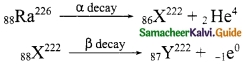
88Ra226 experiences one α – decay and one β – decay. Calculate the number of neutrons in the final daughter nucleus that is formed.
Answer:
α particle = 2He4
Atomic number of α particle = 2
Mass number of α particle = 4
Samacheer Kalvi 10th Science Guide Chapter 6 Nuclear Physics 16
Number of neutrons = Mass number – atomic number
= 222 – 87 = 135

Question 4.
State the number of protons, electrons neutrons and nucleons in 4Be9 atom.
Answer:
Atomic number of 4Be9 atom Z = 4
Mass number of 4Be9 atom A = 9
Number of protons = Atomic number Z = 4
Number of neutrons = A – Z = 9 – 4 = 5
Number of nucleons = A = 9

Samacheer Kalvi 10th Science Guide Chapter 6 Nuclear Physics

Question 5.
Determine X and Y in the following transformations.
(i) 4Be9 + α → X
(ii) 92U235 + 0n150Ba141 + Y + 30n1
Answer:
(i) 4Be9 + 2He46C13 [α = 2He4]
∴ X = 6C13

(ii) 92U235 + 0n150Ba141 + Y + 30n1
Equating atomic number on both sides we get,
235 + 1 = 141 + A + 3
236 = 144 + A
∴ A = 236 – 144
= 92
Equating atomic number on both sides are get
92 + 0 = 56 + 2 + 0
Z = 92 – 56 = 36
∴ Y is 36Kr92

Question 6.
Calculate the amount energy released when a radioactive element undergoes fusion and results in a mass defect of 4g.
Answer:
Velocity of light = 3 × 10⁸ m/s
Mass defect Δm = 4 × 10⁻³
By Einstein’s equation, energy released
E = mC²
= (4 × 10-3) × (3 × 108
= 36 × 1013 J
= 3.6 × 10¹⁴ J

Question 7.
Identify the radio isotopes in the following reactions.
Answer:
(i) 15P8 + 0n1 → X + γ
(ii) 0n1ZYA + -1e0 + γ
Answer:
(i) 15P31 + 0n1 → X + γ
Mass number of X = 31 + 1 = 32
Atomic number of Y= 15 + 0 =15
∴ X is 15P31

(ii) 0n1ZYA + -1e0 + γ
Mass number 1 = A + 0
∴ A = 1
Atomic number 0 = Z – 1
∴ Z = 1
ZYA is 1H1

VI. Assertion and reason type questions.

Question 1.
Assertion: Natural radioactivity is a spontaneous process.
Reason: It cannot be controlled.
(a) If both the assertion and the reason are true and the reason is the correct explanation of the assertion.
(b) If both the assertion and the reason are true, but the reason is not the correct explanation of the assertion.
(c) If the assertion is true, but the reason is false.
(d) If the assertion is false, but the reason is true.
Answer:
(a) If both the assertion and the reason are true and the reason is the correct explanation of the assertion.

Question 2.
Assertion: In artificial radioactivity neutron and positron are emitted. Reason: It can be controlled.
(a) If both the assertion and the reason are true and the reason is the correct explanation of the assertion.
(b) If both the assertion and the reason are true, but the reason is not the correct explanation of the assertion.
(c) If the assertion is true, but the reason is false.
(d) If the assertion is false, but the reason is true.
Answer:
(b) If both the assertion and the reason are true, but the reason is not the correct explanation of the assertion.

Question 3.
Assertion: p rays are electrons.
Reason: p rays travel with speed of light.
(a) If both the assertion and the reason are true and the reason is the correct explanation of the assertion.
(b) If both the assertion and the reason are true, but the reason is not the correct explanation of the assertion.
(c) If the assertion is true, but the reason is false.
(d) If the assertion is false, but the reason is true.
Answer:
(c) If the assertion is true, but the reason is false.

Samacheer Kalvi 10th Science Guide Chapter 6 Nuclear Physics

Question 4.
Assertion: Gamma rays have maximum ionising power.
Reason: Alpha rays have low penetrating power.
(a) If both the assertion and the reason are true and the reason is the correct explanation of the assertion.
(b) If both the assertion and the reason are true, but the reason is not the correct explanation of the assertion.
(c) If the assertion is true, but the reason is false.
(d) If the assertion is false, but the reason is true.
Answer:
(d) If the assertion is false, but the reason is true.

Question 5.
Assertion: Critical mass of a fissile material is the mass necessary to sustain chain reaction.
Reason: Critical mass depends on the nature, density and size of the fissile material.
(a) If both the assertion and the reason are true and the reason is the correct explanation of the assertion.
(b) If both the assertion and the reason are true, but the reason is not the correct explanation of the assertion.
(c) If the assertion is true, but the reason is false.
(d) If the assertion is false, but the reason is true.
Answer:
(c) If the assertion is true, but the reason is false.

Question 6.
Assertion: Nuclear fusion takes place in the cores of the sun and other stars.
Reason: Nuclear fusion is called as thermonuclear reaction.
(a) If both the assertion and the reason are true and the reason is the correct explanation of the assertion.
(b) If both the assertion and the reason are true, but the reason is not the correct explanation of the assertion.
(c) If the assertion is true, but the reason is false.
(d) If the assertion is false, but the reason is true.
Answer:
(a) If both the assertion and the reason are true and the reason is the correct explanation of the assertion.

Question 7.
Assertion: An alpha particle carries double the positive charge of protons.
Reason: The charge of alpha particle is equal to charge on the helium nucleus.
(a) If both the assertion and the reason are true and the reason is the correct explanation of the assertion.
(b) If both the assertion and the reason are true, but the reason is not the correct explanation of the assertion.
(c) If the assertion is true, but the reason is false.
(d) If the assertion is false, but the reason is true.
Answer:
(a) If both the assertion and the reason are true and the reason is the correct explanation of the assertion.

Question 8.
Assertion: Gamma rays are electromagnetic waves.
Reason: Gamma rays travel with speed of light.
(a) If both the assertion and the reason are true and the reason is the correct explanation of the assertion.
(b) If both the assertion and the reason are true, but the reason is not the correct explanation of the assertion.
(c) If the assertion is true, but the reason is false.
(d) If the assertion is false, but the reason is true.
Answer:
(a) If both the assertion and the reason are true and the reason is the correct explanation of the assertion.

VII. Answer in one or two words (VSA).

Question 1.
Who discovered the nucleus?
Answer:
Rutherford

Question 2.
Define ‘Natural Radioactivity’.
Answer:
This phenomenon of spontaneous emission of radiation from certain elements on their own is called ‘Natural radioactivity’.

Question 3.
State elements exhibiting radioactivity with atomic number less than 83.
Answer:
Uranium and radium

Question 4.
What is the nature of radioactive substances?
Answer:
They are earth metals and transition metals.

Question 5.
Define ‘One Rutherford (Rd)’.
Answer:
It is another unit of radioactivity. It is defined as the quantity of a radioactive substance, which produces 106 disintegrations in one second.
1 Rd = 106 disintegrations per second.

Samacheer Kalvi 10th Science Guide Chapter 6 Nuclear Physics

Question 6.
In 4Be9 + 2He4 → X. What is X?
Answer:
X is 6C13

Question 7.
What is the value of 1 curie?
Answer:
1 curie = 3.7 × 10¹⁰ disintegrations / second.

Question 8.
State the value of Rutherford.
Answer:
1 Rutherford = 106 disintegrations / second.

Question 9.
Explain the term ‘fissile material’ Give an example.
Answer:
Fissionable material is a radioactive element, which undergoes fission in a sustained manner when it absorbs a neutron. It is also termed as ‘fissile material’.
E.g. U235, plutonium (Pu239 and Pu241)

Question 10.
Which ray has greatest ionising power?
Answer:
Alpha ray

Question 11.
Which ray posses minimum ionising power?
Answer:
Gamma ray

Question 12.
Which ray is not deflected by electric and magnetic fields?
Answer:
Gamma ray

Question 13.
Name the ray that travels with speed about 9/10 times that of light?
Answer:
Beta ray

Question 14.
What is the charge of particle?
Answer:
It’s charge is +2e.

Question 15.
Which particle has a charge of -e?
Answer:
Beta particle

Question 16.
State that the ray consisting of protons.
Answer:
Gamma ray

Question 17.
When uranium emits an alpha particle which element is obtained as daughter element.
Answer:
Thorium 90Th234

Question 18.
Mention the value of 1eV in terms of joule.
Answer:
1eV = 1.602 × 10⁻¹⁹ joule

Question 19.
What is the value of 1Mev?
Answer:
1MeV = 106eV = 1.602 × 10⁻¹³ joule

Question 20.
Which radio isotope is used in the treatment of skin diseases?
Answer:
Radio Phosphorus P32

Question 21.
What is the use of radio iodine?
Answer:
Radio iodine is used to cure goiter.

Samacheer Kalvi 10th Science Guide Chapter 6 Nuclear Physics

Question 22.
Which isotope is used in airlines?
Answer:
Califorium Cf232 is used in airlines.

Question 23.
State the isotope used as a smoke detector.
Answer:
Americium Am241

Question 24.
Write down the uses of a nuclear reactor.
Answer:
Uses of a nuclear reactor

  • Nuclear reactors are widely used in power generation.
  • They are also used to produce radioisotopes, which are used in a variety of applications
  • Some reactors help us to do research in the field of nuclear physics.
  • Breeder reactors are used to convert non-fissionable materials into fissionable materials.

Question 25.
What are gamma rays?
Answer:
Gamma rays are electromagnetic waves consisting of photons.

Question 26.
Who discovered Cathode rays.
Answer:
J.J. Thomson

VIII. Answer the following question in few sentences.

Question 1.
What is radioactivity?
Answer:
The phenomenon of nuclear decay of certain elements with the emission of radiations like alpha, beta, and gamma rays is called ‘radioactivity’.

Question 2.
What is meant by natural radioactivity?
Answer:
This phenomenon of spontaneous emission of radiation from certain elements on their own is called ‘natural radioactivity’.

Question 3.
Define Rutherford.
Answer:
It is defined as the quantity of a radioactive substance, which produces 106 disintegrations in one second.
1 Rd = 106 disintegrations per second.

Question 4.
What is the unit of radioactivity? Define it.
Answer:
The SI unit of radioactivity is becquerel. It is defined as the quantity of one disintegration per second.

Question 5.
Define nuclear fission. State an example.
This process of breaking (splitting) up of a heavier nucleus into two smaller nuclei with the release of a large amount of energy and a few neutrons is called ‘nuclear fission’.
Eg: Nuclear fission of a uranium nucleus (U235)
92U235 + 0n156Ba141 + 36Kr92 + 30n1 + Q (energy)

Question 6.
How a product nucleus is identified in a nuclear reaction?
Answer:
In a nuclear reaction, the element formed as the product nucleus is identified by the atomic number of the resulting nucleus and not by its mass number.

Question 7.
What is fissile material?
Answer:
A fissionable material is a radioactive element, which undergoes fission in a sustained manner when it absorbs a neutron. It is also termed as ‘fissile material’.
Eg: U235, plutonium (Pu239 and Pu241)

Samacheer Kalvi 10th Science Guide Chapter 6 Nuclear Physics

Question 8.
What are fertile materials? Mention examples.
Answer:
There are some radioactive elements, which can be converted into fissionable material. They are called as fertile materials.
Eg: Uranium – 238, Thorium – 232, Plutonium – 240.

Question 9.
What is the composition of natural uranium?
Answer:
Natural uranium consists of 99.28 % of 92U238 and 0.72 % of 92U235.

Question 10.
What is nuclear fusion? State an example.
Answer:
The process in which two lighter nuclei combine to form a heavier nucleus is termed as ‘nuclear fusion’.
Eg: 1H2 + 1H22He4 + Q (Energy)

Question 11.
What is meant by chain reaction?
Answer:
A chain reaction is a self-propagating process in which the number of neutrons goes on multiplying rapidly almost in a geometrical progression.

Question 12.
What is meant by mass defect?
Answer:
The mass of the daughter nucleus formed during a nuclear reaction (fission and fusion) is lesser than the sum of the masses of the two parent nuclei. This difference in mass is called mass defect.

Question 13.
Nuclear fusion is named as thermonuclear reaction. Why?
Answer:
Nuclear fusion is possible only at an extremely high temperature of the order of 107 to 109 K and a high pressure to push the hydrogen nuclei closer to fuse with each other. Hence, it is named as ‘Thermonuclear reaction’.

Question 14.
What are the uses of radio isotopes in industries?
Answer:

  1. An isotope of californium (Cf252) is used in the airlines to detect the explosives in the luggage.
  2. An isotope of Americium (Am241) is used in many industries as a smoke detector.

Question 15.
What is the age of Earth?
Answer:
It is nearly 4.54 × 10⁹ years (around 45 Crore 40 lakh years).

Question 16.
What do you know about dosimeter?
Answer:
Dosimeter is a device used to detect the levels of exposure of an ionizing radiation.

Question 17.
What is the function of moderator in a nuclear reactor?
Answer:
A moderator is used to slow down the high energy neutrons to provide slow neutrons. Graphite and heavy water are the commonly used moderators.

Question 18.
How do coolants function in a nuclear reactor?
Answer:
A coolant is used to remove the heat produced in the reactor core, to produce steam. This steam is used to run a turbine in order to produce electricity. Water, air and helium are some of the coolants.

Question 19.
Name some operating reactors in India.
Answer:
Cirus, Dhuruva and Pumima.

Question 20.
Define Curie.
Answer:
Curie is defined as the quantity of a radioactive substance, which undergoes 3.7 × 10¹⁰ disintegrations in one second. This is actually close to the activity of 1 g of radium-226.

Samacheer Kalvi 10th Science Guide Chapter 6 Nuclear Physics

IX. Answer the following question in detail.

Question 1.
Write short notes on induced radioactivity.
Answer:
The phenomenon by which even light elements are made radioactive, by artificial or induced methods, is called ‘artificial radioactivity’ or ‘man-made radioactivity’.

This kind of radioactivity was discovered by Irene Curie and F.Joliot in 1934. Artificial radioactivity is induced in certain lighter elements like boron, aluminium etc., by bombarding them with radiations such as ‘alpha particles’ emitted during the natural radioactivity of uranium. This also results in the emission of invisible radiations and elementary” particles. During such a disintegration, the nucleus which undergoes disintegration is called ‘parent nucleus’ and that which is produced after the disintegration is called a ‘daughter nucleus’. The panicle, which is used to induce the artificial disintegration is termed as projectile and the particle which is produced after the disintegration is termed as ejected panicle. When the projectile hits the parent nucleus, it is converted into an unstable nucleus, which in turn decays spontaneously emitting the daughter nucleus along with an ejected particle.

If you denote the parent and daughter nuclei as X and Y respectively, then the nuclear disintegration is represented as follows: X (P,E) Y. Here, P and E represent the projectile particle and ejected particle respectively.
4Be9 + 2He46C13*
6C13*6C12 + 0n1
In the above nuclear reaction, 6C13* is unstable and is radioactive. This reaction can be represented as 4Be9 (α, n) 4C12
4Be9 + 2He46C12 + 0n1

Question 2.
Explain the concept of ‘Hydrogen bomb’.
Answer:
Hydrogen Bomb:

  • This releases a huge amount of energy in a very small time interval and leads to a Hydrogen bomb is based on the principle of nuclear fusion.
  • A hydrogen bomb is always designed to have an inbuilt atom bomb which creates the high temperature and pressure required for fusion when it explodes.
  • Fusion takes place in the hydrogen core and leads to the release of a very large amount of energy in an uncontrolled manner.
  • The energy released in a hydrogen bomb (or fusion bomb) is much higher than that released in an atom bomb (or fission bomb).

Question 3.
Explain
(i) alpha decay,
(ii) Beta decay,
(iii) gamma decay
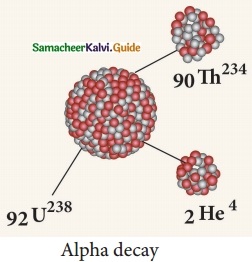
Answer:
(i) Alpha decay : A nuclear reaction in which an unstable parent nucleus emits an alpha particle and forms a stable daughter nucleus, is called, ‘alpha decay’.
Eg: Decay of uranium (U238) to thorium (Th234) with the emission of an alpha particle.
92U23890Th234 + 2He4 (α – decay)
In α – decay, the parent nucleus emits an a particle and so it is clear that for the daughter nucleus, the mass number decreases by four and the atomic number decreases by two.
Samacheer Kalvi 10th Science Guide Chapter 6 Nuclear Physics 17

(ii) Beta decay : A nuclear reaction, in which an unstable parent nucleus emits a beta particle and forms a stable daughter nucleus, is called ‘beta decay’.
Eg: Beta decay of phosphorous.
15P3216S32 + -1e0(β – decay)
In β – decay there is no change in the mass number of the daughter nucleus but the atomic number increases by one. In a nuclear reaction, the element formed as the product nucleus is identified by the atomic number of the resulting nucleus and not by its mass number.

(iii) Gamma decay: In a γ – decay, only the energy level of the nucleus changes. The atomic number and mass number of the radioactive nucleus remain the same.

Samacheer Kalvi 10th Science Guide Chapter 6 Nuclear Physics

Question 4.
What is the principle of atom bomb? Describe its structure.
Answer:
The atom bomb is based on the principle of uncontrolled chain reaction. In an uncontrolled chain reaction, the number of neutrons and the number of fission reactions multiply almost in a geometrical progression. This releases a huge amount of energy in a very small time interval and leads to an explosion.

Structure : An atom bomb consists of a piece of fissile material whose mass is subcritical. This piece has a cylindrical void. It has a cylindrical fissile material which can fit into this void and its mass is also subcritical. When the bomb has to be exploded, this cylinder is injected into the void using a conventional explosive. Now, the two pieces of fissile material join to form the supercritical mass, which leads to an explosion. The structure of an atom bomb.
Samacheer Kalvi 10th Science Guide Chapter 6 Nuclear Physics 18
During this explosion tremendous amount of energy in the form of heat, light and radiation is released. A region of very high temperature and pressure is formed in a fraction of a second along with the emission of hazardous radiation like y rays, which adversely affect the living creatures. This type of atom bombs were exploded in 1945 at Hiroshima and Nagasaki in Japan during the World War II.

Question 5.
What precautions are to he took for those, who are working in radiation laboratories?
Answer:

  1. Radio – Iodine (I131) is used to cure goitre.
  2. Radioactive materials should be kept in a thick-walled lead container.
  3. Lead coated aprons and lead gloves should be used while working with hazardous radioactive materials.
  4. We should avoid eating while handling radioactive materials.
  5. The radioactive materials should be handled only by tongs or by a remote control device.
  6. Dosimeters should be worn by the users to check the level of radiation.

Question 6.
What do you know about hydrogen bomb?
Answer:
Hydrogen bomb is based on the principle of nuclear fusion. A hydrogen bomb is always designed to have an inbuilt atom bomb which creates the high temperature and pressure required for fusion when it explodes. Then, fusion takes place in the hydrogen core and leads to the release of a very large amount of energy in an uncontrolled manner. The energy released in a hydrogen bomb (or fusion bomb) is much higher than that released in an atom bomb (or fission bomb).

Question 7.
What are the applications of radio isotopes in medicine?
Answer:
Medical applications of radio isotopes can be divided into two parts:

  1. Diagnosis
  2. Therapy

Radio isotopes are used as tracers to diagnose the nature of circulatory disorders of blood, defects of bone metabolism, to locate tumors, etc., Some of the radio isotopes which are used as tracers are: hydrogen, carbon, nitrogen, sulphur, etc.

  1. Radio-sodium (Na24) is used for the effective functioning of heart.
  2. Radio-Iodine (I131) is used to cure goiter.
  3. Radio-iron is (Fe59) is used to diagnose anaemia and also to provide treatment for the same.
  4. Radio-phosphorous (P32) is used in the treatment of skin diseases.
  5. Radio-cobalt (Co60) and
  6. Radio-gold (Au198) are used in the treatment of skin cancer.
  7. Radiations are used to sterilize the surgical devices as they can kill the germs and microbes.

Question 8.
Mention the applications of radio isotopes in agriculture and industries and archeological research.
Answer:
Agriculture : The radio isotope of phosphorous (P-32) helps to increase the productivity of crops. The radiations from the radio isotopes can be used to kill the insects and parasites and prevent the wastage of agricultural products. Certain perishable cereals exposed to radiations remain fresh beyond their normal life, enhancing the storage time. Very small doses of radiation prevent sprouting and spoilage of onions, potatoes and gram.

Industries : In industries, radioactive isotopes are used as tracers to detect any manufacturing defects such as cracks and leaks. Packaging faults can also be identified through radio activity. Gauges, which have radioactive sources are used in many industries to check the level of gases, liquids and solids.

  1. An isotope of californium (Cf 252) is used in the airlines to detect the explosives in the luggage.
  2. An isotope of Americium (Am241) is used in many industries as a smoke detector.

Archeological research : Using the technique of radio carbon dating, the age of the Earth, fossils, old paintings and monuments can be determined. In radio carbon dating, the existing amount of radio carbon is determined and this gives an estimate about the age of these things.

Samacheer Kalvi 10th Science Guide Chapter 6 Nuclear Physics

Question 9.
Compare the features of nuclear fission with nuclear fusion.
Answer:
Samacheer Kalvi 10th Science Guide Chapter 6 Nuclear Physics 19

Question 10.
Mention the preventive measures to be followed while working with radioactive materials.
Answer:
Radioactive materials should be kept in a thick walled lead container.

  1. Lead coated aprons and lead gloves should be used while working with hazardous radioactive materials.
  2. You should avoid eating while handling radioactive materials.
  3. The radioactive materials should be handled only by tongs or by a remote control device.
  4. Dosimeters should be worn by the users to check the level of radiation.

Question 11.
Write a note on nuclear power plants in India.
Answer:
Indian Atomic Energy Commission (AEC) was established in August 1948 by the Department of Indian Scientific Research committee at Bombay (now Mumbai) in Maharashtra. It is the nodal agency for all the research done in the field of atomic energy. Dr. Homi Jahangir Bhaba was the first chairman of Indian Atomic Energy Commission. Now, it is known as Bhaba Atomic Research Centre (BARC).

Nuclear power is the fifth largest source of power in India. Tarapur Atomic Power Station is India’s first nuclear power station. Now, there are a total of seven power stations, one each in Maharashtra, Rajasthan, Gujarat, Uttar Pradesh and two in Tamilnadu. In Tamilnadu, we have nuclear power stations in Kalpakkam and Kudankulam. Apsara was the first nuclear reactor built in India and Asia. Now, there are 22 nuclear reactors which are operating in India. Some other operating reactors are

  1. Cirus
  2. Dhuruva
  3. Pumima

Question 12.
Distinguish (i) atom bomb from Nuclear reactor,
(ii) Nuclear fission from Nuclear fusion.
Answer:
(i) atom bomb from nuclear reactor:
Samacheer Kalvi 10th Science Guide Chapter 6 Nuclear Physics 20

(ii) Nuclear fission from Nuclear fusion
Samacheer Kalvi 10th Science Guide Chapter 6 Nuclear Physics 21

Samacheer Kalvi 10th Science Guide Chapter 6 Nuclear Physics

X. Hot Questions.

Question 1.
A neutron is most effective as bulet in nuclear reactions. Why?
Answer:
This is because a neutron carries no charge. It can hit the nucleus directly without being repelled or attracted by the nucleus or electrons.

Question 2.
Why is \({ _{ 92 } }U^{ 238 }\) not suitable for chain reaction?
Answer:
Only fast-moving neutrons of 12 MeV can cause fission of \({ _{ 92 } }U^{ 238 }\) nuclei. But such neutron has fewer chances of interaction. They escape the fissionable material without causing fission.

Question 3.
Why cadmium is used as control rods in the nuclear reactor?
Answer:
As Cadmium has a high cross section for absorption of neutrons, cadmium is used as control rod.

Question 4.
Why is nuclear fusion not possible in a laboratory (or) Why is nuclear fusion difficult to carry out?
Answer:
Nuclear fusion requires a very high temperature of 106 – 107 K. This temperature is attained by causing an explosion due to the fission process. Moreover, no solid container can withstand such a high temperature.

Question 5.
Why is the penetrating power of a – particle is less than that of β – particle?
Answer:
Ionising power is directly proportional to kinetic energy that varies directly as mass of particle and square of its velocity. Hence ionising power of an alpha particle is more than that of β particle.

Question 6.
Why heavy water is used to slow down the fast moving neutrons?
Answer:
Since heavy water (D2O) is rich in hydrogen, it is used to slow down the fast moving neutrons.

Question 7.
The penetrating power of α – particle is less than that of β – particle – Why?
Answer:
(i) Penetrating power varies inversely as mass of the particle. But mass of alpha particles is very much greater than mass of beta particles.
(ii) Hence, penetrating power of α – particle is less than that of β – particles.

Samacheer Kalvi 10th Science Guide Chapter 6 Nuclear Physics

Question 8.
What are the units of activity of radio active elements?
Answer:
1 curie = 3.7 × 10¹⁰ disintegrations / second
1 rutherford = 106 disintegrations / second

Samacheer Kalvi 10th Social Science Guide History Chapter 10 Social Transformation in Tamil Nadu

Students can download 10th Social Science History Chapter 10 Social Transformation in Tamil Nadu Questions and Answers, Notes, Samacheer Kalvi 10th Social Science Guide Pdf helps you to revise the complete Tamilnadu State Board New Syllabus, helps students complete homework assignments and to score high marks in board exams.

Tamilnadu Samacheer Kalvi 10th Social Science Solutions History Chapter 10 Social Transformation in Tamil Nadu

Samacheer Kalvi 10th Social Science Social Transformation in Tamil Nadu Text Book Back Questions and Answers

I. Choose the correct answer

Question 1.
…………….. was the pioneer of social Reformers in India.
(a) C. W. Damotharanar
(b) Periyar
(c) Raja Rammohan Roy
(d) Maraimalai Adigal
Answer:
(c) Raja Rammohan Roy

Question 2.
…………… established a full-fledged printing press in 1709, at Tranquebar.
(a) Caldwell
(b) F.W.Ellis
(c) Ziegenbalg
(d) Meenakshisundaram
Answer:
(c) Ziegenbalg

Samacheer Kalvi 10th Social Science Guide History Chapter 10 Social Transformation in Tamil Nadu

Question 3.
…………….. was the official newspaper of the Self Respect Movement.
(a) Kudi Arasu
(b) Puratchi
(c) Viduthalai
(d) Paguththarivu
Answer:
(a) Kudi Arasu

Question 4.
Periyar wanted religion to be replaced by ………………
(a) Nationalism
(b) Iconoclasm
(c) Rationalism
(d) Spiritualism
Answer:
(c) Rationalism

Question 5.
…………….. founded Adi Dravida Mahajana Sabha in 1893.
(a) Rettaimalai Srinivasan
(b) B.R. Ambedkar
(c) Rajaji
(d) M.C. Rajah
Answer:
(a) Rettaimalai Srinivasan

Question 6.
India’s first organised trade union, the Madras Labour Union was formed in ………….
(a) 1918
(b) 1917
(c) 1916
(d) 1914
Answer:
(a) 1918

Question 7.
…………….. was established by the Justice Party Government for the selection of Government officials.
(a) Staff Selection Board
(b) Public Service Commission
(c) Provincial Staff Recruitment Board
(d) Staff Selection Commission
Answer:
(a) Staff Selection Board

Question 8.
……………. was the first elected Legislative Council Member from the depressed class in Madras Province.
(a) M. C. Rajah
(b) Rettaimalai Srinivasan
(c) T.M. Nair
(d) P. Varadarajulu
Answer:
(a) M. C. Rajah

Samacheer Kalvi 10th Social Science Guide History Chapter 10 Social Transformation in Tamil Nadu

II. Fill in the blanks

  1. ……………… was the first non-European language that went into print.
  2. The College of Fort St. George was founded by ………………
  3. ……………… is considered the father of Tamil linguistic purism.
  4. ……………… was the first to approve participation of women in the electoral politics.
  5. The name Suriyanarayana Sastri changed in Tamil as ………………
  6. ……………… gave prominence to Tamil music.
  7. The first Woman Legislator in India was

Answers:

  1. Tamil
  2. F.W. Ellis
  3. Maraimalai Adigal
  4. Justice Party Government
  5. Parithimar Kalaignar
  6. Abraham Pandithar
  7. Muthulakshmi Ammaiyar

III. Choose the correct statement

Question 1.
(i) Thirukkural was one of the earliest Tamil literary texts to be published in 1812.
(ii) Maraimalai Adigal collected and edited different palm leaf manuscripts of the Tamil grammars and literature.
(iii) Robert Caldwell established the close affinity between the Dravidian languages in contrast with Sanskrit and also established the antiquity of Tamil.
(iv) Thiru. V. Kalyanasundaram was an early pioneer in Trade union movement.
(a) (i) and (1%) are correct
(b) (i) and (iii) are correct
(c) (iv) is correct
(d) (ii) anA (iii) are correct
Answer:
(b) (i) and (iii) are correct

Question 2.
(i) Margret Cousin was one of the founders of Women’s India Association.
(ii) Periyar spent his entire life campaigning against superstitions through Thinkers or Rationalists Forums he had formed.
(iii) Singaravelar was a staunch supporter of the Hindu Mahasabha.
(iv) Periyar emphasised that the caste system in South India is linked with the arrival of Brahmins from the North.
(a) (iii) and (iv) are correct
(b) (ii), (iii) and (iv) are correct
(c) (i), (ii) and (iv) are correct
(d) (ii) and (iii) are correct
Answer:
(c) (i), (ii) and (iv) are correct

Samacheer Kalvi 10th Social Science Guide History Chapter 10 Social Transformation in Tamil Nadu

Question 3.
Assertion (A): The Justice Party continued to remain in Government from 192CE1937 in Madras Presidency.
Reason (R): The Congress Party boycotted the Madras Legislature during this period of Dyarchy.
(a) Both A and R are correct
(b) A is correct, but R is not the correct explanation
(c) Both A and R are wrong
(d) R is correct, but it has no relevance to A
Answer:
(b) A is correct, but R is not the correct explanation

Question 4.
Assertion (A): As World War I was in progress, the British Government was considering the introduction of representative institutions for Indians after the war.
Reason (R): In 1920, Dyarchy as a form of Government was introduced in the provinces.
(a) A is correct, but R is not the correct reason
(b) Both A and R are wrong
(c) Both A and R are right
(d) A is wrong and R has no relevance to A
Answer:
(c) Both A and R are right

IV. Match the following
Samacheer Kalvi 10th Social Science Guide History Chapter 10 Social Transformation in Tamil Nadu 1
Answer:
A. (iv)
B. (iii)
C. (i)
D. (ii)

V. Answer briefly

Question 1.
Write a note on Tamil Renaissance.
Answer:
C.W. Damotharanar collected and edited different palm leaf manuscripts of the Tamil grammars and literature. U.V. Swaminathar took efforts to publish the classical texts. These triggered an intellectual revolution and it was popularly known as Tamil Renaissance. Tamil language and culture played a significant role in their identity construction. The introduction of printing press, linguistic research on Dravidian languages, etc., underpinned the process of Tamil renaissance.

Tamil was the first non-European language that went into print. In the nineteenth century, Tamil scholars like C.W. Damotharanar, and U.V. Swaminathar spent their lifetime in the rediscovery of the Tamil classics. This provided the Tamil people with a revelation about their heritage. Therefore, the rediscovery of ancient classics and their publication is considered the foundation of Tamil renaissance.

Question 2.
Highlight the contribution of Caldwell for the cause of South Indian languages.
Answer:

  1. In 1816, F. W. Ellis who founded the College of Fort St. George, formulated the theory that the south Indian languages belonged to a separate family which was unrelated to the Indo – Aryan family of languages.
  2. Robert Caldwell (1814-1891) expanded this argument in a book titled. A comparative grammar of the Dravidian (or) South Indian family of languages in 1856.
  3. He established the close affinity between the Dravidian languages in contrast with Sanskrit and also established the antiquity of Tamil.

Samacheer Kalvi 10th Social Science Guide History Chapter 10 Social Transformation in Tamil Nadu

Question 3.
List out the personalities who contributed to the revival of Tamil literature through their writings.
Answer:
C.W. Damotharanar, U.V. Swaminathar, F.W. Ellis, Robert Caldwell, Subramania Bharati, Thiru Vi. Kalyanasundaram, Singaraveiar, PanditViar lyotheethassar, Sundaram Pillar and Maraimalai Adigal.

Question 4.
Discuss the importance of Hindu Religious Endowment Act passed by the Justicite Ministry.
Answer:

  1. The Justice Party further concentrated on reforms in religious institutions.
  2. Tamil Nadu has a large number of temples and these commanded huge resources.
  3. In general, the resources were monopolised and exploited by the ‘ dominant caste in the society and led to mismanagement of public resources.
  4. The Justice Party introduced the Hindu Religious Endowment (HRE) Act in 1926 and enabled any individual irrespective of their caste affiliation to become a member of the temple committee and govern the resources of the religious institutions.

Question 5.
What do you know of the Cheranmahadevi Gurukulam incident?
Answer:
A Gurukulam was established in Cheranmahadevi by V.V.S. Iyer with the financial support of the Tamil Nadu Congress Committee. However, students were discriminated on the basis of caste. Brahmin and non-Brahmin students were made to dine separately. Periyar was disturbed to see the discrimination. He questioned the practice, and severely criticized it. Despite his objections, Congress continued to support the iniquitous practice in the Gurukulam. This disappointed Periyar.

Samacheer Kalvi 10th Social Science Guide History Chapter 10 Social Transformation in Tamil Nadu

Question 6.
Name the newspapers published by the South Indian Liberal Foundation.
Answer:
Dravidian in Tamil, Justice in English and Andra Prakasika in Telugu to propagate ideals of the Party.

Question 7.
Estimate Periyar as a feminist
Answer:
Periyar was a great feminist. He believed in gender equality and raised voice over the plight of women. He emphasized on women’s right to divorce and property. He objected the terms like “giving in marriage”. This, he said, treats woman as a thing. He wanted it to substitute by “valkaithunai,” (companion) a word for marriage taken from the Tirukkural. Periyar’s most important work on this subject is Why the Woman is Enslaved ? He believed that property rights for women would provide them a social status and protection. He welcomed equal rights for males and females in property, guardianship and adoption.

Question 8.
Explain the proceedings of All India Trade Union Congress Conference held in 1920.
Answer:

  1. The first All India Trade Union Conference (AITUC) was held on 31st October 1920 in Bombay. The delegates discussed several resolutions.
  2. These included a demand for protection from police interference in labour disputes, the maintenance of an unemployment register restriction on exporting food stuffs, compensation for injuries and health insurance.
  3. In addition, the delegates demanded that Indian workers be given some representation in the Government just as empolyers had representatives on legislative councils.

VI. Answer the questions given under each caption

Question 1.
Periyar e.v.r

(a) When did Periyar founded the Dravidar Kazhagam?
Answer:
Periyar founded the Dravidar Kazhagam in the year 1944.

(b) What were the Newspapers and Journals run by Periyar?
Answer:
Kudi Arasu (Democracy) (1925) Revolt (1928) Puratchi Revolution (1933) Paguth tharivu (Rationalism) (1934) and Viduthalai (Liberation) (1935).

(c) Why was Periyar known as Vaikom hero?
Answer:

  1. In the name of caste dharma the “lower caste” people were denied access to the temples and the streets surrounding the temple.
  2. In Vaikom Catown in the then princely state of Travancore and in present day Kerala, people protest against this practice.
  3. People hailed him as Vaikom Virar (Hero of Vaikom) because Periyar led the movement and was imprisoned.

(d) Which was the most important work of Periyar?
Answer:
Periyar’s most important work on this subject is why the women is enslaved?

Question 2.
Labour Movement in Tamil Nadu

(a) Highlight the factors that caused the birth of Trade Union Movement in Madras.
Answer:
The factors that caused the birth of Trade Union Movement in Madras are

  • Retrenchment of workers at the end of the First World War.
  • Nationalists’ support to the cause of labour.

(b) Identify the three prominent persons associated with the Madras Labour Union.
Answer:
Three prominent persons associated with the Madras Labour Union are B.P. Walia, M. Singaravelar and Thiru.Vi. Kalyanasundaram.

(c) Where was the first conference of All India Trade Union Congress held?
Answer:
The first All India Trade Union Conference was held in Bombay.

(d) Who organized the first ever celebration of May Day in Madras and which year?
Answer:
M. Singaravelar organised the first ever celebration of May Day in Madras in 1923.

Question 3.
Maraimalai adigal

(a) Name the Sangam texts for which Maraimalai Adigai wrote commentaries.
Answer:
Maraimalai Adigai wrote commentaries on the sangam texts Pattinappalai and Mullaipattu.

(b) Name the Journal where he worked as a young man.
Answer:
Siddhanta Deepika.

(c) Why did he oppose imposition of Hindi?
Answer:
He promoted the use of pure Tamil words, impact on Tamil culture especially in language and literature.

(d) Who were the key influences in Maraimalai Adigal’s life?
Answer:
Maraimalai Adaigal’s teachers such as P. Sundaranar and Somasundra Nayagar were key influences in his life.

Samacheer Kalvi 10th Social Science Guide History Chapter 10 Social Transformation in Tamil Nadu

VII. Answer in detail

Question 1.
Attempt an essay on foundation and development of Tamil Renaissance in the 19fh Century.
Answer:
(i) In Tamil Nadu, the proliferation of the printing press acted as a catalyst for the publication and spread of secular ancient Tamil literature.

(ii) In the nineteenth century, Tamil scholars like C.W. Damotharanar, and U.V. Swaminathar spent their lifetime in the rediscovery of the Tamil classics.

(iii) C.W. Damotharanar collected and edited different palm leaf manuscripts of the Tamil grammars and literature. U.V. Swaminathar took efforts to publish the classical texts. These triggered an intellectual revolution and it was popularly known as Tamil Renaissance.

(iv) The transformation not only revived Tamil language and literature but also Tamil culture. It challenged the prevailed caste hierarchy and influenced the rise of Dravidian consciousness and established Tamil as a language of the Dravidian people.

(v) Tamil renaissance questioned the cultural hegemony of Brahminism. These developments were reflected in art, literature, religion, etc.

Samacheer Kalvi 10th Social Science Guide History Chapter 10 Social Transformation in Tamil Nadu

Question 2.
Describe the background for the formation of the Justice Party and point put its contribution to the cause of social justice.
Answer:

  1. As World War -1 was in progress the British Government was considering the introduction of representative institutions for Indians after the War.
  2. Fearing that such political reforms would further strengthen the political power of Brahmins, educated Non – Brahmins decided to organise themselves politically.
  3. On 20th, November 1916 around 30 prominent Non – Brahmin leaders including Dr. C. Natesanar Sir, Pitti Theyagarayar, T.M. Nair and Alamelu Mangai Thayarammal came together to form the South Indian Liberation Federation (SILF).

Programme and Activities:

  1. The Justice Party is the fountain head of the Non – Brahmin Movement in the country.
  2. The Justicite removed the legal hindrances restricting inter – caste marriages and broke the barriers that prevented Depressed Classes from the use of public wells and tanks.
  3. Hostels were established for the students belonging to this social group in 1923.
  4. The Justice Party Government was the first to approve participation of women in the electoral politics in (1921)
  5. The Justice Party worked towards legislating provisions for communal representation reservations for various communities.
  6. The Justice Party rule established the Staff Selection Board in 1924 for the selection of Government officials and encouraged all the communities to share the administrative powers.
  7. In 1929, the Government of British India adopted the pattern and established the Public Service Commission.
  8. The Justice Party introduced the Hindu Religious Endowment (HRE) Act in 1926 and enabled any individual, irrespective of their caste affiliation, to become a member of the temple committee and govern the resources of the religious institutions.

Samacheer Kalvi 10th Social Science Guide History Chapter 10 Social Transformation in Tamil Nadu

Question 3.
Estimate Periyar E.V.R’s decisive contribution to the social transformation of Tamil Nadu?
Answer:
Periyar was a great social reformer. His contribution to the social transformation of Tamil Nadu is really praise worthy.
(i) He launched ‘Temple entry’ movement to provide the lower caste people easy access to the temples.

(ii) He also started the Self-Respect movement in 1925, with the determination that there ought to be ‘no God; no religion; no Gandhi; no Congress; and no Brahmins’.

(iii) Periyar was critical of patriarchy. He condemned child marriage and the Devadasi system. Right from 1929, when the Self-Respect conference began to voice its concern over the plight of women, Periyar had been emphasising on women’s right to divorce and property.

(iv) He advocated atheism as a mode of critique to deconstruct the established practices of faith, culture and custom. Periyar wanted religion to be replaced by rationalism.

(v) He welcomed equal rights for males and females in property, guardianship and adoption. He was strong champion of birth control and contraception.

VIII. Students Activity

Question 1.
Students can be taught to distinguish between Labour Movement and Trade Union Movement. Project work on the activities of local trade union organisations may be done by students.
Answer:
Distinguish between Labour Movement and Trade Movement.

Labour Movement:

  1. It is a political movement campaigning to improve the rights and conditions of the working people.
  2. If originated in U.S.A focussing on rights, interests and protection of employees.
  3. Labour movement generally work for better wages, reasonable working hours and safer working conditions.

Trade union Movement:

  1. It is an association of workers forming a legal unit to improve their status by united action.
  2. It originated in Great Britain focussing to protect and promote the welfare of the employees.
  3. Trade Union Movement regulate employer – employee relationship and generally work for better wages, reasonable working hours and safer working conditions.

Activities of a local trade union: Students should visit with few of their classmates (with prior permission from the subject teacher and school authorities and parents) to visit a nearby industry where trade unions are organised by the workers.

They have to meet the trade, union leader and gather information on the activities performed by them in the factory. The collected information should be written down neatly and submit to the subject teacher.

Eg: In general, the following are the few activities performed by the trade union.

  1. Negotiate wages.
  2. Regulate relationship between workers (employees) and the employers.
  3. Raise demand for new uniform, or safer working condition, pure drinking water, sanitary facilities etc.,
  4. Protect the workers against discrimination.
  5. Protect the workers from exploitation.

Question 2.
Students can compile the activities of the local writers’ associations or women’s collectives.
Answer:
Local writers Association/women collectives: Students should find people who are writers and they write scripts for audio formats, digital media (or) T.V or screenwriters for films. Later, students can collect information about their.

  1. Name of their Association.
  2. Location.
  3. Job site.
  4. Nature of work.
  5. Year of joining the Association
  6. Membership fee
  7. Total no. of members
  8. Usefulness being the member

and submit in this format to the subject teacher. If students can find women organised themselves as a group, in the above-mentioned format can be used for that also. Eg: Women collectives (self-help group)

They work for their betterment together as a group (Sua Udavi Kuzhu).

Samacheer Kalvi 10th Social Science Guide History Chapter 10 Social Transformation in Tamil Nadu

Samacheer Kalvi 10th Social Science Social Transformation in Tamil Nadu Additional Important Questions and Answers

I. Choose the correct answer

Question 1.
………………. is also identified as the Indian renaissance.
(a) Historical development
(b) Political development
(c) Economic development
(d) None
Answer:
(a) Historical development

Question 2
Periyar transformed the justice Party into ………….
(a) Akali Dal
(b) Dravidar kazhagam
(c) Swarajya
Answer:
(b) Dravidar kazhagam

Question 3.
The basic inspiration of renaissance is:
(a) Knowledge
(b) Humanism
(c) Painting
(d) Transition
Answer:
(b) Humanism

Question 4.
Vaikom is a place in ……………
(a) Tamil Nadu
(b) Andhra Pradesh
(c) Kerala
Answer:
(c) Kerala

Samacheer Kalvi 10th Social Science Guide History Chapter 10 Social Transformation in Tamil Nadu

Question 5.
The introduction of ………………. on Dravidian languages are underpinned the Process of tamil renaissance
(a) Printing press
(b) linguistic research
(c) both (a) and (b)
(d) knowledge
Answer:
(c) both (a) and (b)

Question 6.
The Justice Party was established in 1916 by ……………
(a) Periyar
(b) Anna
(c) C. Natesanar, Pitti Theyagarayar, T.M. Nair and Alamelu Mangai Thayarammal
Answer:
(c) C. Natesanar, Pitti Theyagarayar, T.M. Nair and Alamelu Mangai Thayarammal

Question 7.
In which year Thirukkural, Tamil literary text to be published?
(a) 1810
(b) 1805
(c) 1808
(d) 1812
Answer:
(d) 1812

Question 8.
Self Respect Movement was started in the year …………….
(a) 1927
(b) 1925
(c) 1930
Answer:
(b) 1925

Question 9.
Who was collected and edited different palm – leaf manuscripts of the Tamil grammerand literature?
(a) U.V. Swaminathar
(b) C.W. Damotharanar
(c) Meenakshi Sundaranar
(d) P. Sundaranar
Answer:
(b) C.W. Damotharanar

Samacheer Kalvi 10th Social Science Guide History Chapter 10 Social Transformation in Tamil Nadu

Question 10.
Devadasi system was abolished by …………..
(a) Dr. Muthulakshmi Reddy
(b) Ramamirdhan
(c) Dr. S. Dharmambal
Answer:
(a) Dr. Muthulakshmi Reddy

Question 11.
………………. was popularly known as Vallalar.
(a) Ramalinga Adigal
(b) Parithimar Kalaignar
(c) Thiru.Vi. Ka
(d) Maraimalai Adigal
Answer:
(a) Ramalinga Adigal

Question 12.
Whose name is associated with the ‘Self-Respect’ movement?
(a) Muthulakshmi Reddy
(b) Rajaji
(c) Rettimalai Srinivasan
(d) Periyar
Answer:
(d) Periyar

Question 13.
Who was the first to argue that Tamil is a classical languages?
(a) Parithimar Kalaignar
(b) Maraimalai Adigal
(с) E.V. Ramasamy
(d) M. Singaravelar
Answer:
(a) Parithimar Kalaignar

Question 14.
Whose efforts led to the abolition of the devadasi system?
(a) Muthulakshmi Reddy
(b) Muvalur Ramamirtham
(c) M.C. Rajah
(d) Periyar
Answer:
(a) Muthulakshmi Reddy

Question 15.
Which organisation focused on educating and supporting Non – Brahmin graduates?
(a) Madras Dravidian Association
(b) Tani Tamil Iyakkam
(c) Tamil Isai Iyakkam
(d) None
Answer:
(a) Madras Dravidian Association

Question 16.
Who was the founder of Tani Tamil Iyakkam? (Pure Tamil Movement).
(a) M. Singaravelar
(b) Parithimar Kalaignar
(c) Ramalinga Adigal
(d) Maraimalai Adigal
Answer:
(d) Maraimalai Adigal

Question 17.
In which year Non – Brahmin Manifesto was released?
(a) 1905
(b) 1910
(c) 1912
(d) 1916
Answer:
(d) 1916

Samacheer Kalvi 10th Social Science Guide History Chapter 10 Social Transformation in Tamil Nadu

Question 18.
In which year the Congress contested the electron for the first time?
(a) 1930
(b) 1933
(c) 1935
(d) 1937
Answer:
(d) 1937

Question 19.
In which year Justice Party Government was the firstto approval participation of women in the electrol politics?
(a) 1910
(b) 1915
(c) 1919
(d) 1921
Answer:
(d) 1921

Question 20.
Which Party introduced the Hindu Religious Endowment? (HRE)
(a) The Justice Party
(b) The Congress Party
(c) both (a) and (b)
(d) none
Answer:
(a) The Justice Party

Question 21.
Who was the founder of the Self – Respect Movement?
(a) E.V. Ramasamy
(b) Rajaji
(c) Rettaimalai
(d) none
Answer:
(a) E.V. Ramasamy

Question 22.
In which year Rettaimalai Srinivasan was born?
(a) 1849
(b) 1852
(c) 1855
(d) 1859
Answer:
(d) 1859

Question 23.
Who was one of the prominent leaders from the “depressed class”?
(a) B.R. Ambedkar
(b) M.C. Rajah
(c) Rajaji
(d) none
Answer:
(b) M.C. Rajah

Question 24.
Who was a pioneer in the labour movement activities?
(a) M. Singaravelar
(b) M.C. Rajah .
(c) B.R. Ambedkar
(d) Rajaji
Answer:
(a) M. Singaravelar

Samacheer Kalvi 10th Social Science Guide History Chapter 10 Social Transformation in Tamil Nadu

Question 25.
Who was in the forefront of the campaign pressing for legislation to abolish Devadasi system?
(a) Nagammai
(b) Dr. Muthulakshmi
(c) Rukmani
(d) Neelambikai
Answer:
(b) Dr. Muthulakshmi

II. Fill in the blanks

  1. ………………. traditions were treated as primitive.
  2. ………………. was portrayed as conservative.
  3. ………………. brought changes in the socio – cultural life of the Indian sub – continent.
  4. Manonmaniam written by ……………….
  5. Tamil renaissance questioned the cultural hegemony of ……………….
  6. ………………. an early pioneer in Buddhist revival promoted communism and socialism.
  7. ………………. worked in a Journal Siddhanta Deepika.
  8. ………………. held high in the radical philosophy.
  9. ………………. complied a dictionary that provide pure Tamil equivalent to Sanskirt.
  10. The Madras Non – Brahmins Association was founded in ……………….
  11. ………………. founded the Madras United League.
  12. ………………. won the election and formed the first ever Indian Cabinet in Madras.
  13. ………………. later renamed as Madras Dravidian Association to support Dravidian uplift.
  14. ………………. became the chief minister of the Madras Presidency during (1920-26).
  15. ………………. is the fountain head of the Non – Brahmin Movement in the country.
  16. In 1929, the Government of ………………. adopted the pattern and established the public service commission.
  17. ………………. proposed a resolution regarding the rights of “Untouchables” to temple entry.
  18. ………………. demand for a separate electorates for scheduled castes.
  19. ………………. The Chief Minister of Madras State (1952 – 54) introduced to vocational training.
  20. ………………. wanted religion to be replaced by rationalism.
  21. ………………. who had worked for the the progress of the deprived castes.
  22. The first All India Trade Union (AITUC) was held in ……………….
  23. ………………. demanded abolition of untouchability.
  24. ………………. was a pioneer in the Labour Movement Activities.
  25. The first Tamil Isai conference was held in ……………….
  26. ………………. was one of the important objectives of the Self – Respect Movement.
  27. ………………. formed the All India Women’s Conference (AlWC).
  28. The Madras ………………. was enacted by the Government.
  29. ………………. founded the Tanjore Sangitha Vidhya Mahajana Sangam.
  30.  ………………. published a Tamil Newspaper Thozhilalan (Worker).

Answers:

  1. Indigenous
  2. Indian society
  3. The rise of Humanism
  4. P. Sundaranar
  5. Brahminism
  6. M. Singaravelar
  7. Maraimalai Adigal
  8. E.V. Ramasamy
  9. Neelambikai
  10. 1909
  11. C. Natesanar
  12. The Justice Party
  13. Madras United League
  14. A. Subbarayalu
  15. The Justice Party
  16. British India
  17. Periyar
  18. Dr. B.R. Ambedkar
  19. Rajaji
  20. Periyar
  21. Rettaimalai Srinivasan
  22. Bombay
  23. M.C. Rajah
  24. M. Singaravelar
  25. 1943
  26. Women’s Liberation
  27. Women’s India Association (WIA)
  28. Devadasis Act
  29. Abraham Pandithar
  30. M. Singaravelar

Samacheer Kalvi 10th Social Science Guide History Chapter 10 Social Transformation in Tamil Nadu

III. Choose the correct statement

Question 1.
(i) C.W. Damotharanar collected and edited different palm-leaf manuscripts of the Tamil grammar.
(ii) Ramalinga Adigal gave prominence to Tamil music.
(iii) Maraimalai Adigal promoted the use of pure Tamil words and removal of the Sanskirt influence from the Tamil language.
(iv) Muvalur Ramamirtham to became the first women legislator in India in 1926.
(a) (i) and (ii) are correct
(b) (i) and (iii) are correct
(c) (iv) is correct
(d) (ii) and (iii) are correct
Answer:
(b) (i) and (iii) are correct

Question 2.
(i) The Justice Party Rule established the Staff Selection Board in 1924 for the selection of Government officials.
(ii) Periyar had a close relationship with Singaravelar who is considered the first communist of South India.
(iii) The anti – Hindi agitation (1932 -1936) had a big impact on Tamil Nadu’s politics.
(iv) Rettaimalai Srinivasan criticised it as Kula Kalvi Thittam and opposed it tooth and nail.
(a) (i) and (ii) are correct
(b) (i) and (iv) are correct
(c) (iii) is correct
(d) (ii) and (iv) are correct
Answer:
(a) (i) and (ii) are correct

Question 3.
(i) Periyar was keen on the introduction of reservation in representative bodies such as the legislative council for Non – Brahmins.
(ii) All India Women’s Conference (AIWC) in 1937 to address the problem of Non – Brahmins.
(iii) The First World War (1912 -1920) provided stimulus to industrial growth ih India.
(iv) Women’s Liberation was one of the important objectives of Self – Respect Movement.
(a) (i) and (ii) are correct
(b) (i) and (iii) are correct
(c) (iv) is correct
(d) (i) and (iv) are correct
Answer:
(d) (i) and (iv) are correct

Samacheer Kalvi 10th Social Science Guide History Chapter 10 Social Transformation in Tamil Nadu

Question 4.
Assertion (A): Rettaimalai Srinivasan who had experienced the horrors of untouchability worked for the progress of the deprive castes.
Reason (R): He served as president of the scheduled castes federations and the Madras Provincial Depressed Classes.
(a) Both A and R are correct.
(b) A is correct but R is not the correct explanation of A.
(c) Both A and R wrong.
(d) R is correct but it has no relevance to A.
Answer:
(a) Both A and R are correct.

Question 5.
Assertion (A): Periyar E.V. Ramasamy was the founder of the Self – Respect movement.
Reason (R): The movement was concerned with the marginalised sections of the society and criticised Brahminism and it advocated a casteless society.
(a) Both A and R are wrong.
(b) A is correct and R is correct explanation of A.
(c) A is correct and R is wrong.
(d) Both A and R are correct but R is not the correct explanation of A.
Answer:
(b) A is correct and R is correct explanation of A.

IV. Match the following

Question 1.
Match the Column I with Column II.
Samacheer Kalvi 10th Social Science Guide History Chapter 10 Social Transformation in Tamil Nadu 2
Answer:
A. (iii)
B. (iv)
C. (ii)
D. (v)
E. (i)

Samacheer Kalvi 10th Social Science Guide History Chapter 10 Social Transformation in Tamil Nadu

Question 2.
Match the Column I with Column II.
Samacheer Kalvi 10th Social Science Guide History Chapter 10 Social Transformation in Tamil Nadu 3
Answer:
A. (iv)
B. (v)
C. (ii)
D. (iii)
E. (i)

Question 3.
Match the Column I with Column II.
Samacheer Kalvi 10th Social Science Guide History Chapter 10 Social Transformation in Tamil Nadu 4
Answer:
A. (iii)
B. (v)
C. (i)
D. (ii)
E. (iv)

Question 4.
Match the Column I with Column II.
Samacheer Kalvi 10th Social Science Guide History Chapter 10 Social Transformation in Tamil Nadu 5
Answer:
A. (iv)
B. (iii)
C. (v)
D. (i)
E. (ii)

Question 5.
Match the Column I with Column II.
Samacheer Kalvi 10th Social Science Guide History Chapter 10 Social Transformation in Tamil Nadu 6
Answer:
A. (iii)
B. (iv)
C. (v)
D. (i)
E. (ii)

Question 6.
Match the Column I with Column II.
Samacheer Kalvi 10th Social Science Guide History Chapter 10 Social Transformation in Tamil Nadu 7
Answer:
A. (v)
B. (iii)
C. (iv)
D. (i)
E. (ii)

Question 7.
Match the Column I with Column II.
Samacheer Kalvi 10th Social Science Guide History Chapter 10 Social Transformation in Tamil Nadu 8
Answer:
A. (iv)
B. (v)
C. (ii)
D. (i)
E. (iii)

Samacheer Kalvi 10th Social Science Guide History Chapter 10 Social Transformation in Tamil Nadu

Question 8.
Match the Column I with Column II.
Samacheer Kalvi 10th Social Science Guide History Chapter 10 Social Transformation in Tamil Nadu 9
Answer:
A. (iv)
B. (v)
C. (a)
D. (ii)
E. (iii)

V. Answer briefly

Question 1.
What are the aims of Self Respect Movement?
Answer:

  1. The Self Respect Movement condemned and fought against Brahmin domination over other castes, society, politics and religion.
  2. It fought to abolish traditionalism and superstitions.
  3. It advocated women education, widow remarriage, inter-caste marriages and opposed child marriage.

Question 2.
Explain about the basic inspiration of renaissance.
Answer:

  1. The basic inspiration of renaissance is humanism and questioning the fundamentalist religious practices that denied humans their dignity.
  2. This ideology of humanism stimulated creative energy in all spheres of social life and knowledge such as language, literature, philosophy, music, painting, architecture etc.

Question 3.
What were the causes for the failure of the Justice Party?
Answer:

  1. The Justice Party came to power when the world was in economic depression.
  2. The Nationalist Movement was popular and heading for freedom.
  3. Caste and wealth played vital role. Hence the party lost its hold.
  4. The rise of congress under the leadership of Ghandhi became a formidable challenge to Jus¬tice Party.

Samacheer Kalvi 10th Social Science Guide History Chapter 10 Social Transformation in Tamil Nadu

Question 4.
List out a few manuscripts of the Tamil grammar edited by C.W. Damotharanar and U.V. Swaminathar.
Answer:

  1. C.W. Domotharanar collected and edited different palm – leaf manuscripts of the Tamil grammar and literature.
  2. His edition included such texts as Tholkappiyam, Viracholiyam, Iraiyanar Akapporul, Illakkana Villakkam, Kaliththokai, and Culamani.
  3. U.V. Swaminathar took efforts to publish the classical texts such as Civakachinthamani, Paththupattu, Chilapathikaram, Purananuru, Purapporul – Venpa – Malai, Manimekalai, Ainkurunuru, and Pathitrupathu.

Question 5.
What was the different official positions hold by Periyar?
Answer:
Periyar held different official positions of Erode that included the chairmanship of Municipal Council, President of the Tamil Nadu Congress and President of the Justice Party.

Question 6.
What was the impact of Tamil language movement in the 20th century?
Answer:
In the 20th century Tamil language movement such as Tani Tamil Iyakkam and Tamil Isai Iyakkam made a significant cultural impact in creating a pure Tamil free from the influence of Sanskrit.

Question 7.
Discuss the work done by the Justice Party towards legislating provisions for communal representation?
Answer:
The Justice Party rule established the Staff Selection Board in 1924 for the selection of government officials and encouraged ail the communities to share the administrative powers. This ensured equitable distribution in appointments among various castes and communities as a part of achieving social justice.

Samacheer Kalvi 10th Social Science Guide History Chapter 10 Social Transformation in Tamil Nadu

Question 8.
Whom was Women’s India Association (WIA) started and what was its work?
Answer:

  1. Women’s India Association was started in 1917 by Annie Besant, Dorothy JinaraJadasa and Margaret cousins at Adyar Madras.
  2. The Association published pamphlets and bulletins in different languages to detail the problems of personal hygiene, marriage laws, voting rights, child care and women’s role in the public.

Question 9.
Who initiated the Self-Respect movement? What was it about?
Answer:
The Self-Respect movement was initiated by Periyar E.V. Ramaswamy. The movement was concerned with the marginalised sections of the society and criticised Brahminism and the cultural hegemony of the Brahmins. It advocated a casteless society devoid of rituals and difference based on birth. The movement declared rationality and self-respect as the birthright of all human beings and held these as more important than self-rule.

Question 10.
Who worked hard to abolish the Devadasi system?
Answer:
Dr. Muthulakshmi ammaiyar, was in the forefront of the campaign pressing for a legislation to abolish the devadasis system.

The Madras Devasasis (prevention of Dedication) Act 1947 was enacted by the Government.

Question 11.
What was the devadasi system? Why was it abolished?
Answer:
The devadasi system was a custom of dedicating young girls to the Hindu temples as a servant of God. Though intended as a service to God, it soon got corrupted leading to extensive immorality and abuse of the women.

Muthulakshmi Reddi started a campaign pressing for a legislation to abolish this system. Finally, the Madras Devadasis (Prevention of Dedication) was enacted by the government in 1947.

Samacheer Kalvi 10th Social Science Guide History Chapter 10 Social Transformation in Tamil Nadu

Question 12.
What were the titles given to Rettaimalai Srinivasan?
Answer:
Rettaimalai Srinivasan was honoured with such titles as Rao Sahib (1926), Rao Bahadur (1930) and Divan Bahadur (1936) for his selfless social services.

VI. Answer the question given under each caption

Question 1.
Rise Of the Dravidian Movement

(a) In what situation the Dravidian movement emerged?
Answer:
The Dravidian movement emerged as a defence of the Non – Brahmins against the Brahmin dominance.

(b) When was Madras Non – Brahmin Association formed?
Answer:
In 1909.

(c) Who was founded the Madras United League?
Answer:
C. Natesanar, a medical doctor founded the Madras United League.

(d) What is the main aim of the organisation?
Answer:
The organisation focused on educating and supporting Non – Brahmin graduates and conducting regular meetings to share their grievances.

Question 2.
Self Respect Movement:

(a) Who started the Self Respect Movement?
Answer:
E.V. Ramaswamy Periyar started the self respect movement.

(b) Why did he start?
Answer:
He started it in order to spread and execute his ideas and policies.

Samacheer Kalvi 10th Social Science Guide History Chapter 10 Social Transformation in Tamil Nadu

(c) When was it started?
Answer:
It was started in 1925.

(d) Name the laws passed by the Government due to the constant struggle of Self Respect Movement.
Answer:
Widow Remarriage Act, Women’s Right to property Act and abolition of Devadasi Act.

Question 3.
M.G. rajah

(a) Who was popularly known as M.C. Rajah?
Answer:
Mylar Chinnathambi Raja, popularly known as M.C. Rajah.

(b) What was his demand?
Answer:
He demanded abolition of untouchability and organised a number of political meetings for the “Untouchable castes” to have access to public wells and pathways to burial grounds.

(c) In which year All India Depressed Classes Association was formed?
Answer:
In 1928.

(d) What was the terms he advocated?
Answer:
He advocated the use of such as terms Adi – Dravida and Adi – Andhra.

Samacheer Kalvi 10th Social Science Guide History Chapter 10 Social Transformation in Tamil Nadu

VII. Answer in detail

Question 1.
Explain briefly about the self- respect movement.
Answer:

  1. The Self- Respect Movement introduced a programme of Non – Brahmin uplift in Tamil Nadu.
  2. The movement was concerned with the marginalised sections the society and Criticised Brahminism and the cultural hegemony of the Brahmin.
  3. It advocated a casteless society devoid of rituals and diffemeces based on birth.
  4. The movement declared rationality and Self – Respect as the birth right of all human beings and held these as more important than self – rule.
  5. The movement demanded women’s emancipations, deplored superstition and emphasised rationality.
  6. The movement also advocated self – respect marriage.
  7. The Self – Respect Movement championed not only the cause of the Non – Brahmin Hindus, but also that of the Muslims.
  8. The Self Respect Movement extrolled the lofty principles of Islam such as equity and brotherhood.
  9. Muslim elite considered the Tamil Muslims as Dravidian.
  10. He wanted the Dravidian Muslim to follow Mustapha Kemal Pasha of Turkey and Amanullah of Afghanistan who initiated reforms in Islamic society.

Samacheer Kalvi 10th Social Science Guide History Chapter 10 Social Transformation in Tamil Nadu

Question 2.
Give an account of Labour Movements in Tamil Nadu.
Answer:

  1. The first World War (1914 – 18) provided stimulus to industrial growth India.
  2. These industries catering to war time needs, had employed a huge number of workers.
  3. At the end of the War there were retrenchments across the industries as the War time requirements receded.
  4. Combined with high prices, this gave a momentum to the labour movement.
  5. The nationalist realising the value of organised labour power began to supported the cause of labour,
  6. B.P. Wadia, M. Singaravelar, ThiruVi. Ka and others initiated the formation of labour unions in the Madras presidency.
  7. In 1918 India’s first organised trade union the Madras Labour Union, was formed.
  8. The first All India Trade Union Conference (AITUC) was held on 31st October 1920 in Bombay.
  9. These included a demand for protection from police interference in labour disputes, the maintenance of an unemployment register restriction on exporting food stuffs, compensation for injuries and health Insurance.
  10. In addition, the delegates demanded that Indian workers be given some representation in the Government, just as employers, had representatives on legislative councils.
  11. M. Singaravelar (1860 – 1946) was a pioneer in the Labour Movement activities in the Madras Presidency.
  12. He organised the first over celebration of May Day in 1923.
  13. He published a Tamil newspaper Thozhilalan (workers) to address the problem of the working class.

VIII. Draw a time line for the following

Question 1.
Write any five important events between 1905 -1927.
Answer:
Given period: 1905 – 1927
Samacheer Kalvi 10th Social Science Guide History Chapter 10 Social Transformation in Tamil Nadu 10

Samacheer Kalvi 10th Social Science Guide History Chapter 10 Social Transformation in Tamil Nadu

Question 2.
Write any five important events between 1920 -1930.
Answer:
Given period: 1920 – 1930
Samacheer Kalvi 10th Social Science Guide History Chapter 10 Social Transformation in Tamil Nadu 11

Question 3.
Write any five important events between 1930 -1947.
Answer:
Given period: 1930 – 1947
Samacheer Kalvi 10th Social Science Guide History Chapter 10 Social Transformation in Tamil Nadu 12

Question 4.
Write any five important events between 1931 -1945.
Answer:
Given period: 1931 – 1945
Samacheer Kalvi 10th Social Science Guide History Chapter 10 Social Transformation in Tamil Nadu 13

Question 5.
Write any five important events between 1937 -1947.
Answer:
Given period 1937 – 1947
Samacheer Kalvi 10th Social Science Guide History Chapter 10 Social Transformation in Tamil Nadu 14

Samacheer Kalvi 10th Social Science Guide History Chapter 10 Social Transformation in Tamil Nadu

Question 6.
Write any five important events between 1906 -1925.
Answer:
Given period: 1906 – 1925
Samacheer Kalvi 10th Social Science Guide History Chapter 10 Social Transformation in Tamil Nadu 15

Samacheer Kalvi 10th Maths Model Question Paper 2 English Medium

Students can Download Samacheer Kalvi 10th Maths Model Question Paper 2 English Medium Pdf, Samacheer Kalvi 10th Maths Model Question Papers helps you to revise the complete Tamilnadu State Board New Syllabus, helps students complete homework assignments and to score high marks in board exams.

Tamil Nadu Samacheer Kalvi 10th Maths Model Question Paper 2 English Medium

Instructions

  • The question paper comprises of four parts.
  • You are to attempt all the parts. An internal choice of questions is provided wherever applicable.
  • All questions of Part I, II, III and IV are to be attempted separately.
  • Question numbers 1 to 14 in Part I are Multiple Choice Quèstions of one-mark each. These are to be answered by choosing the most suitable answer from the given four alternatives and.writing the option code and the corresponding answer.
  • Question numbers 15 to 28 in Part II àre two-marks questions. These are to be answered in about one or two sentences.
  • Question numbers 29 to 42 in Part III are five-marks questions. These are to be answered in about three to five short sentences.
  • Question numbers 43 to 44 in Part IV are eight-marks questions. These are to be answered in detail. Draw diagrams wherever necessary.

Time: 3 Hours
Maximum Marks: 100

PART – I

I. Choose the correct answer. Answer all the questions. [14 × 1 = 14]

Question 1.
If {(a, 8),(6, b)} represents an identity function, then the value of a and b are respectively …………. .
(1) (8,6)
(2) (8,8)
(3) (6,8)
(4) (6,6)
Answer:
(1) (8,6)

Samacheer Kalvi 10th Maths Model Question Paper 2 English Medium

Question 2.
If the H.C.F of 65 and 117 is expressible in the form of 65m -117, then the value of m is …………. .
(1) 4
(2) 2
(3) 1
(4) 3
Answer:
(2) 2

Question 3.
In an A.P, the first term is 1 and the common difference is 4. How many terms of the A.P must be taken for their sum to be equal to 120?
(1) 6
(2) 7
(3) 8
(4) 9
Answer:
(3) 8

Question 4.
\(\frac{3 y-3}{y} \div \frac{7 y-7}{3 y^{2}}\) is …………. .
(1) \(\frac{9 y}{7}\)
(2) \(\frac{9 y^{3}}{(21 y-21)}\)
(3) \(\frac{21 y^{2}-42 y+21}{3 y^{3}}\)
(4) \(\frac{7\left(y^{2}-2 y+1\right)}{y^{2}}\)
Answer:
(1) \(\frac{9 y}{7}\)

Question 5.
If the roots of the equation q2x2 + p2x + r2 = 0 are the squares of the roots of the equation qx2 + px + r = 0, then q, p, r are in …………. .
(1) A.P
(2) G.P
(3) Both A.P and G.P
(4) none of these
Answer:
(2) G.P

Samacheer Kalvi 10th Maths Model Question Paper 2 English Medium

Question 6.
The two tangents from an external points P to a circle with centre at O are PA and PB. If ∠APB = 70° then the value of ∠AOB is …………. .
(1) 100°
(2) 110°
(3) 120°
(4) 130°
Answer:
(2) 110°

Question 7.
A straight line has equation 8y = 4x + 21. Which of the following is true …………. .
(1) The slope is 0.5 and they intercept is 2.6
(2) The slope is 5 and the y intercept is 1.6
(3) The slope is 0.5 and the y intercept is 1.6
(4) The slope is 5 and they intercept is 2.6
Answer:
(1) The slope is 0.5 and they intercept is 2.6

Question 8.
A tower is 60 m height. Its shadow is x metres shorter when the sun’s altitude is 45° than when it has been 30° , then x is equal to …………. .
(1) 41.92 m
(2) 43.92 m
(3) 43 m
(4) 45.6 m
Answer:
(2) 43.92 m

Question 9.
A frustum of a right circular cone is of height 16 cm with radii of its ends as 8 cm and 20 cm. Then, the volume of the frustum is …………. .
(1) 3328π cm3
(2) 3228π cm3
(3) 3240π cm3
(4) 3340π cm3
Answer:
(1) 3328π cm3

Samacheer Kalvi 10th Maths Model Question Paper 2 English Medium

Question 10.
If the standard deviation of x, y,zisp then the standard deviation of 3x + 5, 3y + 5, 3z + 5 is …………. .
(1) 3p + 5
(2) 3p
(3) p + 5
(4) 9p + 5
Answer:
(2) 3p

Question 11.
A purse contains 10 notes of ₹2,000, 15 notes of ₹500, and 25 notes of ₹200. One note is drawn at random. What is the probability that the note is either a ₹500 note or ₹200 note?
(1) \(\frac{1}{5}\)
(2) \(\frac{3}{10}\)
(3) \(\frac{2}{3}\)
(4) \(\frac{4}{5}\)
Answer:
(4) \(\frac{4}{5}\)

Question 12.
If f = {(6, 3) (8, 9) (5, 3) (-1, 6)} then the pre-images of 3 are …………. .
(1) 5 and -1
(2) 6 and 8
(3) 8 and -1
(4) 6 and 5
Answer:
(4) 6 and 5

Question 13.
If α and β are the roots of the equation x2 + 2x + 8 = 0 then the value of \(\frac{\alpha}{\beta}+\frac{\beta}{\alpha}\) is …………. .
(1) \(\frac{1}{2}\)
(2) 6
(3) \(\frac{3}{2}\)
(4) \(\frac{-3}{2}\)
Answer:
(4) \(\frac{-3}{2}\)

Question 14.
If x – y = 3 and x + 2y = 6 are the diameters of a circle then the centre is at the point …………. .
(1) (0,0)
(2) (1,2)
(3) (4, 1)
(4) (1,-1)
Answer:
(3) (4, 1)

Samacheer Kalvi 10th Maths Model Question Paper 2 English Medium

PART-II

II. Answer any ten questions. Question No. 28 is compulsory. [10 × 2 = 20]

Question 15.
Let X = {3, 4, 6, 8}. Determine whether the relation
R = {(x, f(x)) |x ∈ X, f(x) = x2 + 1} is a function from X to N?
Answer:
f(x) = x2 + 1
f(3) = 32 + 1 = 9 + 1 = 10
f(4) = 42 + 1 = 16 + 1 = 17
f(6) = 62 + 1 = 36 + 1 = 37
f(8) = 82 + 1 = 64 + 1 = 65
ves. R is a function from X to N.

Question 16.
Find k if fof f(k) = 5 where f(k) = 2k – 1.
Answer:
fof(k) = f(f(k))
= 2(2k – 1) – 1 = 4k – 3
Thus, fof(k) = 4k – 3
But, it is given that fof (k) = 5
Therefore 4k – 3 = 5 ⇒ k = 2.

Question 17.
Find the least positive value of x such that 98 = (x + 4) mod 5
Answer:
98 ≡ (x + 4) (mod 5)
98 – (x + 4) = 5n , for some integer n.
94 – x = 5n
94 – x is a multiple of 5.
Therefore, the least positive value of x must be 4
Since 94 – 4 = 90 is the nearest multiple of 5 less than 94.

Question 18.
If the first term of an infinite G.P. is 8 and its sum to infinity is \(\frac { 32 }{ 3 }\) then find the common ratio.
Answer:
Here a = 8, S = \(\frac{32}{3}\)
\(\frac{a}{1-r}=\frac{32}{3}\)
\(\frac{8}{1-r}=\frac{32}{3}\)
32 – 32r = 24 ⇒ 32 r = 8
r = \(\frac{8}{32}=\frac{1}{4}\)
Common ratio = \(\frac{1}{4}\)

Samacheer Kalvi 10th Maths Model Question Paper 2 English Medium

Question 19.
Find the excluded values, of the expression \(\frac{x^{3}-27}{x^{3}+x^{2}-6 x}\)
Answer:
x3 – 27 = x3 – 33
= (x – 3) (x2 + x + 3)
Samacheer Kalvi 10th Maths Model Question Paper 2 English Medium - 2
x3 + x2 – 6x = x(x2 + x – 6) = x (x + 3) (x – 2)
\(\frac{x^{3}-27}{x^{3}+x^{2}-6}=\frac{(x-3)\left(x^{2}+x+3\right)}{x(x+3)(x-2)}\)
The expression \(\frac{(x-3)\left(x^{2}+x+3\right)}{x(x+3)(x-2)}\) is undefined
when x (x + 3) (x – 2) = 0
x = 0 or x + 3 = 0 or x – 2 = 0
x = 0 or x = -3 or x = 2
The excluded values are 0, -3 and 2

Question 20.
Find the square root of \(1+\frac{1}{x^{6}}+\frac{2}{x^{3}}\)
Answer:
Samacheer Kalvi 10th Maths Model Question Paper 2 English Medium - 3

Samacheer Kalvi 10th Maths Model Question Paper 2 English Medium

Question 21.
Find x and y if \(x\left[ \begin{matrix} 4 \\ -3 \end{matrix} \right] +\quad y\left[ \begin{matrix} -2 \\ 3 \end{matrix} \right] =\left[ \begin{matrix} 4 \\ 6 \end{matrix} \right] \)
Answer:
\(x\left[ \begin{matrix} 4 \\ -3 \end{matrix} \right] +y\left[ \begin{matrix} -2 \\ 3 \end{matrix} \right] =\left[ \begin{matrix} 4 \\ 6 \end{matrix} \right] \)
\(\left[ \begin{matrix} 4x \\ -3x \end{matrix} \right] +\left[ \begin{matrix} -2y \\ 3y \end{matrix} \right] =\left[ \begin{matrix} 4 \\ 6 \end{matrix} \right] \)
4x – 2y = 4
(1) ⇒ 2x – y = 2
(2) ⇒ -3x + 3y = 6
-x + y = 2
Samacheer Kalvi 10th Maths Model Question Paper 2 English Medium - 4
Substitute the Value of x = 4 in (2)
-4 + y = 2
y = 2 + 4 = 6
The value of x = 4 and y = 6


Question 22.
Show that in a triangle, the medians are concurrent.
Answer:
Medians are line segments joining each vertex to the midpoint of the corresponding opposite sides. Thus medians are the cevians where D, E, F are midpoints of BC, CA and AB respectively.
Samacheer Kalvi 10th Maths Model Question Paper 2 English Medium - 5
Since D is a midpoint of BC, BD = DC so \(\frac{B D}{D C}\) = 1 ….. (1)
Since, E is a midpoint of CA, CE = EA so \(\frac{C E}{E A}\) = 1 ……. (2)
Since, F is a midpoint of AB, AF = FB so \(\frac{A F}{F B}\) = 1 ……. (3)
Thus, multiplying (1), (2) and (3) we get,
\(\frac{\mathrm{BD}}{\mathrm{DC}} \times \frac{\mathrm{CE}}{\mathrm{EA}} \times \frac{\mathrm{AF}}{\mathrm{FB}}\) = 1 × 1 × 1 = 1
And so, Ceva’s theorem is satisfied. Hence the Medians are concurrent.

Samacheer Kalvi 10th Maths Model Question Paper 2 English Medium

Question 23.
A cat is located at the point(-6, -4) in xy plane. A bottle of milk is kept at (5, 11). The cat wish to consume the milk travelling through shortest possible distance. Find the equation of the path it needs to take its milk.
Answer:
Equation of the joining the point is
Samacheer Kalvi 10th Maths Model Question Paper 2 English Medium - 6
15(x + 6) = 11(y + 4)
15x + 90 = 11y + 44
15x – 11y + 90 – 44 = 0
15x – 11y + 46 = 0
The equation of the path is 15x – 11y + 46 = 0

Question 24.
If the circumference of a conical wooden piece is 484 cm then find its volume when its height is 105 cm.
Answer:
Circumference of the wooden piece = 484 cm
2πr = 484
2 × \(\frac { 22 }{ 7 }\) × r = 484 cm
r = \(\frac{484 \times 7}{2 \times 22}\)
r = 77 cm
Height of the wooden piece (h) = 105 cm
Volume of the conical wooden piect = \(\frac { 1 }{ 3 }\)πr2h cu. units
= \(\frac{1}{3} \times \frac{22}{7}\) × 77 × 77 × 105 cm3
= 22 × 11 × 77 × 35 cm3 = 652190 cm3
Volume of the wooden piece = 652190 cm3

Question 25.
The range of a set of data is 13.67 and the largest value is 70.08. Find the smallest value.
Answer:
Range R = 13.67
Largest value L = 70.08
Range R = L – S
13.67 = 70.08 – S
S = 70.08 – 13.67 = 56.41
Therefore, the smallest value is 56.41.

Question 26.
Three rotten eggs are mixed with 12 good ones. One egg is chosen at random. What is the probability of choosing a rotten egg?
Answer:
Number of good eggs = 12
Number of rotton eggs = 3
Totalnumberofeggs = 12 + 3 = 15
Sample space n (S) = 15
Let A be the event of choosirg a rotten egg
n(A) = 3
P(A) = \(\frac{n(\mathrm{A})}{n(\mathrm{S})}=\frac{3}{15}=\frac{1}{5}\)
The Probability is \(\frac{1}{5}\)

Samacheer Kalvi 10th Maths Model Question Paper 2 English Medium

Question 27.
Form the quadratic equation whose roots are 3 + √7 ; 3 – √7
Answer:
Sum of the roots = 3 + √7 + 3 – √7
= 6
Product of the roots (3 + √7) (3 – √7 )
= 32 – (√7)2
= 9 – 7
= 2
The required equation is x2 (sum of the roots) x + product of the roots = 0
x2 – (6)x + 2 = 0
x2 – 6x + 2 = 0

Question 28.
If a cos θ – b sin θ = c, then prove that (a sin θ + b cos θ) = ±\(\sqrt{a^{2}+b^{2}-c^{2}}\)
Answer:
Given a cos θ – bsin θ = c
Squaring on both sides
(a cos θ – b sin θ)2 = c2
a2cos2θ + b2sin2θ – 2 ab cosθ sinθ = c2
a2 (1 – sin2θ) + b2(1 – cos2θ) – 2ab cos θ sin θ = c2
a2 – a2 sin2 θ + b2 – b2cos2 θ – 2ab cos θ sin θ = c2
– a2 sin 2 θ – b2 cos2 θ – 2ab cos θ sin θ = – a2 – b2 + c2
a2 sin 2 θ + b2 cos2 θ + 2ab cos θ sin θ = + a2 + b2 – c2
(a sin θ + b cos θ)2 = a2 + b2 – c2
a sin θ + b cos θ = ± \(\sqrt{a^{2}+b^{2}-c^{2}}\)
Hence it is proved.

PART – III

III. Answer any ten questions. Question No. 42 is compulsory. [10 × 5 = 50]

Question 29.
A function f is defined by f(x) = 2x – 3
(i) find \(\frac{f(0)+f(1)}{2}\)
(ii) find x such that f(x) = 0.
(iii) find x such that f(x) = x.
(iv) find x such that f(x) = f( 1 – x).


Question 30.
If f(x) = 2x + 3, g(x) = 1 – 2x and h(x) = 3x. Prove that fo(goh) = (fog)oh

Samacheer Kalvi 10th Maths Model Question Paper 2 English Medium

Question 31.
If S1, S2, S3, ,…S3m are the sums of n terms of m A.P.,s whose first terms are 1,2, 3, ……… m and whose common differences are 1, 3, 5 ,………. (2m – 1) respectively, then show that (S1 + S2 + S3 + ………. + Sm) = \(\frac { 1 }{ 2 }\)mn(mn + 1)

Question 32.
In an A.P., sum of four consecutive terms is 28 and their sum of their squares is 276. Find the four numbers.

Question 33.
Simplify \(\frac{12 t^{2}-22 t+8}{3 t} \div \frac{3 t^{2}+2 t-8}{2 t^{2}+4 t}\)

Question 34.
The hypotenuse of a right triangle is 6 m more than twice of the shortest side. If the third side is 2 m less than the hypotenuse, find the sides of the triangle.

Question 35.
Find the equation of a straight line parallel to Y axis and passing through the point of intersection of the lines 4x + 5y = 13 and x – 8y + 9 = 0.

Question 36.
Two ships are sailing in the sea on either side of the lighthouse. The angles of depression of two ships as observed from the top of the lighthouse are 60° and 45° respectively.
If the distance between the ships is 200 \(\left(\frac{\sqrt{3}+1}{\sqrt{3}}\right)\) meters, find the height of the lighthouse.

Question 37.
Nathan, an engineering student was asked to make a model shaped like a cylinder with two cones attached at its two ends. The diameter of the model is 3 cm and its length is 12 cm. If each cone has a height of 2 cm, find the volume of the model that Nathan made.

Question 38.
The rainfall recorded in various places of five districts in a week are given below.
Samacheer Kalvi 10th Maths Model Question Paper 2 English Medium - 1
Find its standard deviation.

Question 39.
A bag contains 5 white and some black balls. If the probability of drawing a black ball from the bag is twice the probability of drawing a white ball then find the number of black balls.


Question 40.
If A = \(\left( \begin{matrix} 3 & 2 & 0 \\ 1 & 4 & 0 \\ 0 & 0 & 5 \end{matrix} \right) \) show that A2 – 7A + 10 I3

Samacheer Kalvi 10th Maths Model Question Paper 2 English Medium

Question 41.
Find the values of “a” and “b” given that p(x) = (x2 + 3x + 2) (x2 – 4x + a) g(x) = (x2 – 6x + 9) (x2+ 4x + b) and their G.C.D. is (x + 2) (x – 3)

Question 42.
A container, open from the top made up of a metal sheet is in the form of a frustum of a cone of height 16 cm with radii of its lower and upper ends as 8 cm and 20 cm respectively. Find the cost of milk which can completely fill the container at the rate of ₹ 40 per litre and the cost of metal sheet used if the costs ₹ 5 per 100 cm2, (use π = 3.14)

PART – IV

IV. Answer all the questions. [2 × 8 = 16]

Question 43.
(a) Draw a tangent to the circle from the point P having radius 3.6 cm, and centre at O. Point P is at a distance 7.2 cm from the centre.

[OR]

(b) Construct a ∆PQR such that QR = 6.5 cm, ∠P = 60° and the altitude from P to QR is of length 4.5 cm.

Samacheer Kalvi 10th Maths Model Question Paper 2 English Medium

Question 44.
(a) Draw a graph of y = 2x2 + x – 6 and hence solve the 2x2 + x – 10 = 0.

[OR]

(b) Draw the graph of y = x2 – 5x + 6 and hence solve x2 – 5x + 6 = 0.