Samacheer Kalvi 8th Social Science Guide Geography Chapter 3 Hydrologic Cycle

Tamilnadu State Board New Syllabus Samacheer Kalvi 8th Social Science Guide Pdf Geography Chapter 3 Hydrologic Cycle Text Book Back Questions and Answers, Important Questions, Notes.

Tamilnadu Samacheer Kalvi 8th Social Science Solutions Geography Chapter 3 Hydrologic Cycle

Samacheer Kalvi 8th Social Science Hydrologic Cycle Text Book Back Questions and Answers

I. Choose the Correct Answer.
1. The process in which the water moves between the oceans, atmosphere and land is called
a) River Cycle
b) Hydrologic Cycle
c) Rock Cycle
d) Life Cycle
Answer:
b) Hydrologic Cycle

2. The percentage of fresh water on the earth is
a) 71
b) 97
c) 2.8
d) 0.6
Answer:
c) 2.8

3. The process of changing of water from gaseous to liquid form is known as
a) Condensation
b) Evaporation
c) Sublimation
d) Rainfall –
Answer:
a) Condensation

4. Water that flows in the sub-soil or through the ground into the streams, rivers, lakes and oceans is termed as
a) Condensation
b) Evaporation
c) Transpiration
d) Runoff
Answer:
d) Runoff

Samacheer Kalvi 9th Social Science Guide Geography Chapter 7 Mapping Skills

5. The evaporation of water from the leaves of plants is called
a) Transpiration
b) Condensation
c) Water vapour
d) Precipitation
Answer:
a) Transpiration

6. Water that is good enough to drink is called
a) Groundwater
b) Surface water
c) Potable water
d) Artesian water
Answer:
c) Potable water

II. Fill in blank:
1. The degree of water vapour present in the atmosphere is known as …………………
Answer:
weather

2. There are ………………… phases in the water cycle.
Answer:
Three

3. The falling of water towards the earth surface from the atmosphere in any form is known as …………………
Precipitation

4. The precipitation with a rain drop size of <0.5mm in diameter is known as ………………….
Answer:
drizzle

5. Mist is denser than ………………….
Answer:
Clouds

III. Match the following:

1. Vegetation a) Clouds
2. Condensations b) Sleet
3. Snow and raindrops c) At the surface
4. Infiltration d) Transpiration

Answer:

1. Vegetation d) Transpiration
2. Condensations a) Clouds
3. Snow and raindrops b) Sleet
4. Infiltration c) At the surface

IV. Choose the correct statement:
1. Evaporation refers to
I. The process in which the gaseous form of water changes into liquid form.
II. It refers to the process in which the liquid form of water changes into a gaseous form.
III. Water boils at 100°C temperature but, it actually begins to evaporate at 0°C.
IV. It is responsible for the formation of clouds.
a) I, IV, and V are correct
b) II only correct
c) II and III are correct
d) All are correct
Answer:
c) II and III are correct

V. State whether thefollowing^statements are True or False:
1. Water boils at 212°F temperature but, it begins to evaporate at 32°F.
Answer:
True

2. Mist is not the tiny droplets of water hanging in the air.
Answer:
False

Samacheer Kalvi 9th Social Science Guide Geography Chapter 7 Mapping Skills

3. The sub-surface runoff is usually referred to as interflow.
Answer:
True

VI. Answer in brief:
1. Write a short note on the aquifer.
Answer:
An aquifer is an underground layer of water-bearing rock.

2. Define “ hydrological cycle”.
Answer:
The hydrological cycle is a global sun-driven process where water is transported from oceans to the atmosphere, from the atmosphere to land, and from land back to oceans

3. How is the dew formation takes place?
Answer:
Dew is a water droplet formed by the condensation of water vapour on a relatively cold surface of an object. It forms when the temperature of an object drops below the dew point temperature.

4. Write a short note on surface run-off.
Answer:
Surface Runoff is the portion of rainfall, which enters the stream immediately after the rainfall. It occurs when the rainfall is longer, heavier, and exceeds the rate of infiltration. In this condition, the excess water makes a head over the ground surface, which tends to move from one place to another following land gradient and is known as overland flow. When the overland flow joins the streams, channels or oceans, it is termed as surface runoff or surface flow.

VII. Give reasons:
1. Infiltration of water is low in the region of non-porous soil.
Answer:
Because percolation moves the infiltrated water through the soil profile and rock layers to form groundwater.

2. Freshwater is less on the earth.
Answer:
Most of the water on the earth is saline and is found in seas and oceans, which constitutes about 97.2%.

Samacheer Kalvi 9th Social Science Guide Geography Chapter 7 Mapping Skills

3. Snowfall is common in the polar region and mountainous regions.
Answer:
Often water vapour in a cloud is converted directly into snow pieces due to lowering of temperature and so it is common in the polar and mountainous regions.

VIII. Answer in a paragraph:
1. Explain the different stages involved in the hydrological cycle.
Answer:
The three important phases of the hydrologic cycle are:

  • Evapotranspiration,
  • Precipitation and
  • Runoff.

1. Evapotranspiration:
It is defined as the total loss of water from the earth through evaporation from the surface water bodies and the transpiration from vegetation. In cropped areas, it is difficult to determine the evaporation and transpiration separately. Therefore it is collectively called evapotranspiration.

2. Precipitation:
It refers to all forms of water that fall from clouds and reaches the earth’s surface. For the occurrence of precipitation, cloud droplets or ice crystals must grow heavy enough to fall through the air. When the droplets grow large in size, they tend to all. While moving down, by collecting some small droplets, they become heavy enough to fall out of the cloud as raindrops.

3. Runoff:
Runoff is the water that is pulled by gravity across the land’s surface. It replenishes groundwater and surface water as it percolates into an aquifer (it is an underground layer of water-bearing rock) or moves into a river, stream, or watershed. It comes from unabsorbed water from rain, snowmelt, irrigation or other sources, comprising a significant element in the water cycle as well as the water supply when it drains into a watershed. Runoff is also a major contributor to erosion which carves out canyons, gorges, and related landforms.

2. Distinguish between evaporation and transpiration.

Water boils at 100°C temperature but, it actually begins to evaporate at 0°c. Much of the water taken up by the plants is released through transpiration.

Evaporation Transpiration
1. The process in which the liquid form of water changes into gaseous form. The process by which the water content in the plant are released into the atmosphere in the form of water vapour.
3. The amount of water gets evaporated is about the same as the amount of water delivered to earth as precipitaion. The soil water content and the ability of the soil to conduct water the roots and the nature of the plant parts also determine the transpiration rate.
4. The rate of evaporation is low during the periods of calm winds than during windy times. The rate of transpiration is affected by the temperature, wind and humidity.

3. Give a detailed explanation on different forms of precipitation.
The form of precipitation in a region depends on the kind of weather or the climate of the region. The Precipitation in the warmer parts of the world is always in the form of rain or drizzle.
In colder region, precipitation may fall as snow or ice.
Common types of precipitation include rain, sleet, freezing rain, hail & snow.

Rain:

  • The most common kind of precipitation is rain.
  • The precipitation in the form of water droplet is rain.
  • Below 0.5 mm in diameter is known as drizzle and above 0.5 mm in diameter is known as rain.

Sleet:
The precipitation which takes place in the form of a mixture of water droplets and tiny particles of ice is known as sleet.

Freezing Rain:

  • Raindrops falling through cold air near the ground do not freeze in the air.
  • Instead, the raindrops freeze when they touch a cold surface.
  • This is called freezing rain.

Hail:
The precipitation which consists of round pellets of ice which are larger than 5mm in diameter is called as hail or hailstones.
Snow:
The precipitation in form of a powdery mass of ice is known as snowfall which is common in the polar and high mountainous regions.

Samacheer Kalvi 9th Social Science Guide Geography Chapter 7 Mapping Skills

4. Explain the run-off and its types.

Runoff is the water that is pulled by gravity across the land’s surface. It replenishes groundwater and surface water as it percolates into an aquifer (it is an underground layer of water-bearing rock) or moves into a river, stream, or watershed.

Types of Runoff:
Based on the time interval between the instance of rainfall and generation of runoff, the runoff may be classified into the following three types

1. Surface Runoff:
It is the portion of rainfall, which enters the stream immediately after the rainfall. It occurs when the rainfall is longer, heavier, and exceeds the rate of infiltration. In this condition, the excess water makes a head over the ground surface, which tends to move from one place to another following a land gradient and is known as overland flow. When the overland flow joins the streams, channels, or oceans, it is termed as surface runoff or surface flow.

2. Sub – Surface Runoff:
The water that has entered the subsoil and moves laterally without joining the water-table to the streams, rivers or oceans is known as sub-surface runoff. The subsurface runoff is usually referred as interflow.

3. Base Flow:
It is a flow of underground water from a saturated groundwater zone to a water channel. It usually appears at a downstream location where the channel elevation is lower than the groundwater table. Groundwater provides the streamflow during dry periods of small or no precipitation.

Samacheer Kalvi 8th Social Science Hydrologic Cycle Additional Important Questions and Answers

I. Choose the Correct answer.
1. The process of change of water into gaseous form is called ………………….
a) Evaporation
b) Evapotranspiration
c) Precipitation
d) Condensation
Answer:
a) Evaporation

2. …………… is the prime element which affects the rate of evaporation.
a) Temperature
b) Rain
c) Air
d) Mist
Answer:
c) Air

3. The quantity of water present on the earth is about ………………. million cubic miles.
a) 236
b) 263
c) 326
d) 362
Answer:
c) 326

4. …………………. Saturation occurs when the temperature drops down.
a) Air
b) Water
c) Land
d) Soil
Answer:
a) Air

5. ……………… of the moisture form plants through transpiration.
a) 10%
b) 50%
c) 80%
d) 90%
Answer:
a) 10%

Samacheer Kalvi 9th Social Science Guide Geography Chapter 7 Mapping Skills

6. The evaporation is more than precipitation in the …………………..
a) Oceans
b) Land side
c) Desert land
d) Water Source
Answer:
a) Oceans

7. The process of change of gaseous form of water into liquid form is called as ______________
a) Vapourisation
b) Transpiration
c) Condensation
d) Infiltration
Answer:
c) Condensation

8. An air layer next to the earth’s Surface to 1000 m or lower is called as _____________
a) Dew
b) Frost
c) Fog
d) Mist
Answer:
c) Fog

9. Water entering the soil at the Surface of the ground is termed as _____________
a) Infiltration
b) Percolation
c) Condensation
d) Vaporisation
Answer:
a) Infiltration

10. The flow of water from the unsaturated zone to the Saturated zone is termed as
a) Infiltration
b) Percolation
c) Condensation
d) Vaporisation
Answer:
b) Percolation

II. Fill in the blanks:
1. Water in India is available in Sources.
Answer:
Three

2. Hydrology is the science which deals with the various aspects of water such as ………………, ……………… and ……………….
Answer:
Occurrence, distribution, movement

3. Hydrologic cycle is a global …………….. process.
Answer:
Sun-driven

4. ………………… refers to all forms of water that fall from clouds and reaches the earth’s Surface.
Answer:
Precipitation

Samacheer Kalvi 9th Social Science Guide Geography Chapter 7 Mapping Skills

5. The three important phases of the hydrologic cycle are …………….., ………………., and ……………..
Answer:
Evapotranspiration, Precipitation, Run off

6. The Sleet falls, the raindrops freeze into solid particles of ………………….
Answer:
ice

7. Most of the water on the earth is …………… in the surface water.
Answer:
Saline

8. ……………….. is available in the form of glaciers.
Answer:
2.15%

9. ……………….. is a continuous process and takes place naturally.
Answer:
Hydrologic cycle

10. Water boils at
Answer:
100PC

11. The water content in salt water oceans is
Answer:
97.2%

12. The amount of Icecaps and glaciers in Fresh water is
Answer:
68.7%

13. The Ground water content in Fresh water is
Answer:
30.1%

14. The boiling point of water is
Answer:
2129F

15. There is a relationship between temperature and evaporation.
Answer:
positive

III. Match the follpwing:

1. Runoff a) Rain
2. Precipitation b) Snow
3. Polar region c) Water springs
4. Infiltration d) less than 0.5mm
5. Drizzle e) river

Answer:

1. Runoff e) river
2. Precipitation a) Rain
3. Polar region b) Snow
4. Infiltration c) Water springs
5. Drizzle d) less than 0.5mm

IV. Choose the correct statement:
1. a) Water entering the soil at the surface of the ground is termed as infiltration
b) Rain water Soaks into the ground, through the soil and underlying rock layers.
c) Some of the water remains underground and is called ground water.
d) The terms infiltration and percolation are other used inter changeably.
a) I, IV, and V are correct
b) II only correct
c) II and III are correct
d) All are correct
Answer:
d) AH are correct

V. State whether the following statements are True or False:
1. Water in India is available in three sources.
Answer:
True

2. Rain is the tiny droplets of water hanging in the air.
Answer:
False

Samacheer Kalvi 9th Social Science Guide Geography Chapter 7 Mapping Skills

3. Saturation occurs when the temperature increases.
Answer:
False

4. Evaporation is the process in which the liquid form of water changes into a gaseous form.
Answer:
True

VI. Answer in brief:
1. What are the Sources of water available in India.
Answer:

  • Water in India is available in three sources.
  • They are precipitation, surface water, and groundwater.

2. What is hydrology?
Answer:
Hydrology is the science which deals with the various aspects of water such as its occurrence, distribution, movement and properties on the planet earth.

3. What are the factors that increase the rate of evaporation?
Answer:

  • Increase in wind speed
  • Increase in temperature
  • Decrease in humidity and
  • Increase in the areal extent of surface water bodies.

VII.Give reasons:
1. Availability of water on the earth is not uniform. Why?
Answer:
The availability of water on the earth is not uniform because Some places are very rich and some places are poor in water resources.

2. Distinguish between Frost and Mist.
Answer:

Frost Mist
1. The ice crystals formed by the deposition of water vapour on a relatively cold surface of an object are known as frost. Mist is the tiny droplets of water hanging in the air.
2. Density increased Mist is less dense than fog.

VIII. Answer in a paragraph:

1. Water on the Earth – Explain.
Answer:

  • About 71 % of the earth’s surface is covered by water.
  • The quantity of water present on the earth is about 326 million cubic miles.
  • It is hard to visualise this massive quantity of water.
  • Most of the water on the earth is saline and is found in seas and oceans.
  • The salt water constitutes about 97.2% and the fresh water is only about 2.8%.
  • Out of this 2.8%, about 2.2% is available as surface water and the remaining 0.6% is groundwater. From this 2.2% of surface water, 2.15% is available in the form of glaciers and icecaps, 0.01% in lakes and streams and the remaining 0.04% is in other forms.
  • Only about 0.25% of the total ground water of 0.6% can be economically extracted with the present drilling technology.

2. Explain the forms of condensation.
Answer:
Dew, fog, and Clouds are the three major forms of condensation.

  • Dew: It is a water droplet formed by the condensation of water vapour on a relatively cold surface of an object.
  • Frost: The ice crystals formed by the deposition of water vapour on a relatively cold surface of an object is known as frost.
  • Fog: Fog is the suspended tiny water droplets or ice crystals in an air layer next to the earth’s surface.
  • Mist: Mist is the tiny droplets of water hanging in the air.
  • Clouds: Clouds consist of tiny water droplets/ice particles which are so small and light in weight.
Samacheer Kalvi 8th Social Science Guide Geography Chapter 2 Weather and Climate

Tamilnadu State Board New Syllabus Samacheer Kalvi 8th Social Science Guide Pdf Geography Chapter 2 Weather and Climate Text Book Back Questions and Answers, Important Questions, Notes.

Tamilnadu Samacheer Kalvi 8th Social Science Solutions Geography Chapter 2 Weather and Climate

Samacheer Kalvi 8th Social Science Weather and Climate Text Book Back Questions and Answers

I. Choose the correct answer:
1. Earth’s atmosphere contains about percentage of nitrogen and oxygen.
a) 78% and 21%
b) 22% and 1%
c) 21% and 0.97%
d) 10% and 20%
Answer:
a) 78% and 21%

2. ………………. is generally defined as the average conditions of the weather of a place or a region.
a) earth
b) atmosphere
c) climate
d) sun
Answer
c) climate

3. The earth receives energy from
a) current
b) electro magnetic radiation
c) waves
d) heat
Answer:
d) heat

4. Which one the following represents places with equal amount of rainfall
a) isotherm
b) isohel
c) isobar
d) isohytes
Answer:
d) isohytes

Samacheer Kalvi 9th Social Science Guide Geography Chapter 7 Mapping Skills

5. …………. is used to measure the humidity.
a) anemometer
b) barometer
c) hygrometer d) thermometer
Answer:
c) hygrometer

II. Fill in the blank
1. ……………….. refers to the condition of atmosphere for a short period of time.
Answer:
Weather

2. The scientific study of weather is called ………….
Answer:
Meteroiogy

3. The highest temperature ever recorded on the earth is ……………..
Answer:
56.7°C in in USA

4. …………. is a ratio between the actual amount of water vapour and the maximum amount of water vapour the air can hold.
Answer:
Humidity

5. …………. and ………….. are measured by anemometer and wind vane respectively.
Answer:
Wind direction and wind speed

6. ………… are imaginary lines which connect the same temperatures of different places.
Answer:
Isotherms

III. Match the following

1. Climate a) Locating and Tracking Storms
2. Isonif b) Cyclone
3. Hygrometer c) Equal Snowfall
4. Radar d) Long Term Changes
5. Low Pressure e) Humidity

Answer:

1. Climate d) Long Term Changes
2. Isonif c) Equal Snowfall
3. Hygrometer e) Humidity
4. Radar a) Locating and Tracking Storms
5. Low Pressure b) Cyclone

IV. State whether the following statements are True or False:
1. The atmosphere is a layer of gases surrounding the planet.
Answer:
True

2. The scientific study of weather is called Climatology.
Answer:
False

3. Isohel refers equal sunshine.
Answer:
True

4. Humidity is calculated by Aneroid Barometer.
Answer:
False

V. Answer in brief:
1. Define ‘weather’.
Answer:
Weather is the day today conditions(state) of the atmosphere at any place as regards sunshine, temperature, cloud cover. Wind fog condition, air pressure, humidity, precipitation and such other elements.

2. What is insolation?
Answer:
Incoming solar radiation are called Insolation.

Samacheer Kalvi 9th Social Science Guide Geography Chapter 7 Mapping Skills

3. What is meant by atmospheric pressure?
Answer:
The weight of air above a given area on the earth’s surface is called atmospheric pressure or air pressure.

4. Write a short note on “Planetary winds”
Answer:

  • Planetary winds are the ones which blow almost in the same direction throughout the year.
  • So, they are called as planetary winds.

5. What are “Isolines”?
Answer:
The distribution of weather elements is shown by means of Isolines on maps. Isolines are lines which join the places of equal values of weather elements.

VI. Distinguih the following:
1. Weather and climate.

Weather Climate
1. Weather is the day today conditions of the atmosphere like sunshine, temperature humidity and such other elements. Climate is generally defined as the average conditions of the weather of place or a region.
2. Weather is cool in .winter and hot in summer. The Climate does not change often like weather.

2. Absolute and relative humidity.

Absolute Humidity Relative Humidity
1. It is the mass or weight of water vapour present per unit volume of air. It is a ratio between the actual amount of water vapour present in the air and the maximum amount of water vapour it can hold at given temperature.
2. These expressed usually in grams per cubic meter of air. It is expressed as a percentage.

3. Permanent and seasonal winds.

Permanent wind Seasonal wind
1. Permanent winds, are also called planetary winds. Monsoon winds are also called as seasonal winds.
2. These winds blow almost in the same direction throughout the year. These winds are blowing from sea to land during summer and land to sea during winter.

VII. Give reasons:
1. The Weather and climate in different regions vary.
Answer:
The angle of the sun’s rays, the length of daytime, altitude, distribution of land and water bodies, location and direction of mountain ranges, air pressure, winds, and ocean currents are the major factors which affect the weather and climate of a region.

2. Temperature decreases with an increase in altitude.
Answer:
It is known as the Lapse rate which is 6.5-degree Celcius per 1000 meters is the troposphere.

3. Mountain climbers carry Oxygen cylinders while ascending peaks.
Answer:
With decreasing air pressure, the availability of oxygen to breathe also decreases. At very high altitudes, atmospheric pressure and available oxygen get so low that people can become sick and even die. Mountain climbers use bottled oxygen when they ascend very high peaks.

VIII. Answer in a paragraph:
1. How is temperature measured?
Answer:
Measuring Temperature:
1. The temperature of a unit volume of air at a given time is measured in scales like Celsius, Fahrenheit, and Kelvin. Meteorologist measures the temperature by the Thermometer, Stevenson screen and minimum and maximum Thermometer.

2. The energy received by the earth through insolation is lost by outgoing radiation.

3. Atmosphere is mainly heated by outgoing radiation from 2 to 4 pm. So the maximum temperature is recorded between 2 and 4 pm regularly and the minimum temperature is recorded around 4 am before sunrise.

Mean Temperature:
1. The average of the maximum and minimum temperatures within 24 hours is called mean daily temperature [(87°F + 73°F)/2=80°F].

2. Diurnal range of temperature is the difference between the maximum and minimum temperatures of a day. The annual range of temperature is the difference between the highest and lowest mean monthly temperatures of a year.

2. Write about the wind and its types.
Answer:
The horizontal movement of air is called wind. The wind systems are broadly categorized into three as follows.

  • Planetary winds
  • Seasonal winds
  • Local winds

1. Planetary Winds are the ones which blow almost in the same direction throughout the year. So, they are called as Permanent or planetary winds. Trade winds, Westerlies, and polar easterlies are the types of prevailing winds.

2. Seasonal winds are those which change their direction according to the season in a year. They are called as monsoon winds. These winds blow from sea to land during summer and land to sea during winter.

3. Local winds are the winds that blow over a small area only during a particular time of a day or a short period of a year. Land and sea breezes are examples of these winds.

3. List out the weather elements and associated measuring instruments.
Answer:

Weather elements Measuring instruments
Temperature Celsius, Fahrenheit, Kelvin
Rainfall Rain gauge
Air Pressure Aneroid Barometer
Humidity Hygrometer
Wind Anemometer

IX. Give any three suggestions to reduce global warming:

  1. Plant trees.
  2. Recycle the used things.
  3. Composite wasted food and biodegradables.

Samacheer Kalvi 8th Social Science Weather and Climate Additional Important Questions and Answers

I. Choose the Correct answer:
1. The word Klimo is derived from the language.
a) Greek
b) Latin
c) Arab
d) English
Answer:
a) Greek

2. Horizontal movement of air is called
a) Storm
b) Cyclone
c) Mist
d) Wind
Answer:
d) Wind

Samacheer Kalvi 9th Social Science Guide Geography Chapter 7 Mapping Skills

3. The average wind speed is low in
a) France
b) Canada
c) Argentina
d) Brazil
Answer:
d) Brazil

4. The temperature decreases per 1000 meters height is
a) 5°C
b) 6.5°C
c) 7°C
d) 8.5°C
Answer:
b) 6.5°C

5. …………….. is the difference between the maximum and minimum temperatures of a day.
a) Diurnal range
b) Heat conduction
c) Heat radiation
d) Heat elevation
Answer:
a) Diurnal range

6. Which Zone is called a Tropical Zone?
a) Torrid zone
b) Temperate zone
c) Frigid zone
d) Polar zone
Answer:
a) Torrid zone

7. Isobar means
a) Equal Sunshine
b) Equal atmospheric pressure
c) Equal temperature
d) Equal rainfall
Answer:
b) Equal atmospheric pressure

8. The name of an Equal amount of rainfall is
a) Isotherm
b) Isohel
c) Isohyet
d) Isollobar
Answer:
c) Isohyet

9. The name of Equal pressure tendency is
a) Isotherm
b) Isohel
c) Isohyet
d) Isollobar
Answer:
d) Isollobar

10. Major element of weather and climate is
a) Temperature
b) Sound
c) Light
d) Latitude
Answer:
a) Temperature

II. Fill in the blanks:
1. Heat energy from ………………. is received by the earth through three mechanisms.
Answer:
Solar radiation

2. ……………. and soil are the major factors which affect the distribution of temperature.
Answer:
Natural vegetation

Samacheer Kalvi 9th Social Science Guide Geography Chapter 7 Mapping Skills

3. The distribution of temperature is shown by means of ………………..
Answer:
Isotherms

4. Temperature zone lies between tropic of …………… circle in the Northern Hemisphere and the ………………. circle in the Southern Hemisphere.
Answer:
Arctic, Antarctic

5. Frigid zone is known as …………………
Answer:
polar region

6. ………………… is a major component of the water cycle.
Answer:
Rain

7. Generally rainfall is high in the …………….. region.
Answer:
Equatorial

8. The average of ……………. and ……………. temperatures within 24 hours is called mean daily temperature.
Answer:
maximum, minimum

9. …………………. is a diagram used to depict the direction and periods of prevailing winds on a map.
Answer:
Wind rose

10. Weather is the day to day conditions of the ………………………..
Answer:
atmosphere

11. The amount of carbon dioxide in the atmosphere is ………………..
Answer:
0.03%

12. The amount of argon in the atmosphere is …………….
Answer:
0.97%

13. The word Klimo means ……………….
Answer:
Inclination

14. Climate is the average atmospheric conditions usually for ………………..
Answer:
35 years

15. The Scientific Study of Climate is called …………….
Answer:
Climatology

III. Match the following:

1. Aniroid a) Temperature
2. Beaufort b) diagram
3. Wind rose c) Wind speed
4. Fahrenheit d) humidity
5. Hydrometer e) air pressure

Answer:

1. Aniroid e) air pressure
2. Beaufort c) Wind speed
3. Wind rose b) diagram
4. Fahrenheit a) Temperature
5. Hydrometer d) humidity

IV. State whether the following statements are True or False:
1. The highest temperature ever recorded on the earth is 56.7°C.
Answer:
True

2. The degree of heat present in the sun is termed as temperature.
Answer:
False

Samacheer Kalvi 9th Social Science Guide Geography Chapter 7 Mapping Skills

3. Rainfall is measured by Raingauge.
Answer:
True

4. Temperature decreases to 8°C per 1000 meters in height.
Answer:
False

5. Al-Balakhi prepared the first climatic Atlas of the world.
Answer:
True

V. Answer in brief:
1. What are the Controlling factors of weather and climate?
Answer:
The angle of the sun’s rays, the length of daytime, altitude, distribution of land and water bodies, location and direction of mountain ranges, air pressure, winds, and ocean currents are the major factors which affect the weather and climate of a region.

2. What are the factors affecting the distribution of temperature?
Answer:
Latitude, altitude, nature of the land, ocean currents, prevailing winds, slope, shelter, and distance from the sea, natural vegetation, and soil are the major factors which affect the distribution of temperature.

3. What are the Isotherms?
Answer:

  • The distribution of temperature is shown by means of Isotherms.
  • Isotherms are imaginary lines which connect the same temperatures of different places..

VI. Distinguish the following:
1. Torrid zone and Temperature zone.

Torrid zone

Temperature zone

1. It is a region between the tropic of cancer and the tropic of Capricorn. This zone lies between the Tropic of cancer and the Arctic circle in the Northern Hemisphere and between the Tropic of Capricorn and the Antarctic circle in the Southern Hemisphere.
2. This region receives the direct rays of the sun and gets the maximum heat from the sun. This zone gets the slanting rays of the sun
3. This zone is known as the tropical zone. The angle of the sun’s rays goes on decreasing towards the poles.

2. Specific humidity and Relative humidity.

Specific humidity

Relative humidity

1. Specific humidity is a ratio of the water vapor content of the mixture to the total air content on a mass basis. The relative humidity is a ratio between the actual amount of water vapour present in the air and the maximum amount of water vapour.
2. It is expressed in grams of vapour per kilogram of air. It is expressed as a percentage.

VII. Give reasons:
1. Why artificial pressure creates in Aircraft?
Answer:

  • At very high altitudes, atmospheric pressure and available oxygen get so low as the quick move from high pressure to low pressure can cause decompression sickness.
  • Aircraft create artificial pressure in the cabin which makes the passengers remain comfortable while flying.

VIII. Answer in a paragraph:
1. Define the types of humidity.
Answer:
The types of humidity are

  • Specific humidity
  • Absolute humidity
  • Relative humidity

Specific humidity:
Specific humidity is a ratio of the water vapor content of the mixture to the total air content on a mass basis. It is expressed in grams of vapour per kilogram of air.

Absolute humidity:
Absolute Humidity is the mass or weight of water vapour present per unit volume of air.

Relative humidity:
It is a ratio between the actual amount of water vapour present in the air and the maximum amount of water vapour it can hold at a given temperature.

Samacheer Kalvi 8th Social Science Guide Geography Chapter 1 Rocks and Soil

Tamilnadu State Board New Syllabus Samacheer Kalvi 8th Social Science Guide Pdf Geography Chapter 1 Rocks and Soil Text Book Back Questions and Answers, Important Questions, Notes.

Tamilnadu Samacheer Kalvi 8th Social Science Solutions Geography Chapter 1 Rocks and Soil

Samacheer Kalvi 8th Social Science Rocks and Soil Text Book Back Questions and Answers

I. Choose the correct answer:

1. Which of the following is known as sphere of rocks
a) Atmosphere
b) Biosphere
c) Lithosphere
d) Hydrosphere
Answer:
(c) Lithosphere

2. World soil day is observed on
a) 15th August
b) 12th January
c) 15th October
d) 5th December
Answer:
(d) 5th Decembe

3. Fossils are found in
a) Sedimentary rocks
b) Igneous rocks
c) Metamorphic rocks
d) Plutonic rocks
Answer:
(a) Sedimentary rocks

Samacheer Kalvi 9th Social Science Guide Geography Chapter 2 Lithosphere – II Exogenetic Processes

4. The top layer of soil is called as
a) organic layer or humas
b) topsoil
c) subsoil
d) bedrock
Answer:
(b) topsoil

5. Ideal soil for growing cotton is
a) Red soil
b) Black soil
c) Alluvial soil
d) Mountain soil
Answer:
(b) Black soil

6. The major components of soil is
a) Rocks
b) Minerals
c) Water
d) All the above
Answer:
(b) Minerals

7. Which one of the following is the most widespread most and productive category of soil
a) Alluvial soil
b) Black soil
c) Red soil
d) Mountain soil
Answer:
(a) Alluvial Soil

II. Fill in the blanks.

1. Scientific study of rocks is called …………….
Answer:
Petrology

2. ……………. soil is highly suitable for millets cultivation.
Answer:
Black

3. The “Skin of earth” is
Answer:
Soil

4. ……………. is the kind of metamorphic rock using which Taj Mahal was built.
Answer:
White marble

5. ……………. is known as the primary rocks.
Answer:
Igneous rock

True or False:

1. Igneous rocks are called primary rocks.
Answer:
True

2. Slate is formed from shale.
Answer:
True

3. Red soil is formed by the process of leaching.
Answer:
False

4. M-sand is used as alternative for natural sand in construction.
Answer:
True

5. Volcanic mountains are covered with sedimentary rocks.
Answer:
True

IV. Match the following:
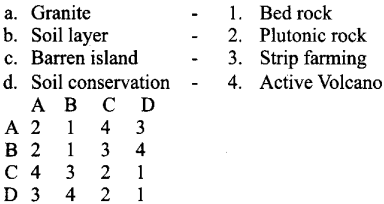
1.
Samacheer Kalvi 9th Social Science Guide Geography Chapter 1 Advent of the Europeans 1
Answer:
A) 2 14 3
Samacheer Kalvi 9th Social Science Guide Geography Chapter 2 Lithosphere – II Exogenetic Processes

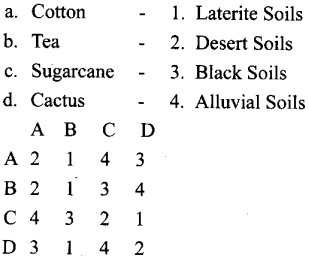
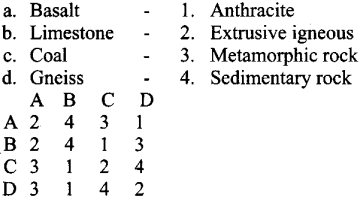
2.
Samacheer Kalvi 9th Social Science Guide Geography Chapter 1 Advent of the Europeans 2
Ans: D) 3, 1, 4, 2

V. Choose the incorrect statement from the following:

1. a) Igneous rocks are called the primary rocks.
b) Soil is the product of weathering of rocks.
c) Sedimentary rocks are the hardest ones.
d) Deccan plateau is the region of Igneous rocks.
Answer:
d) Deccan plateau is the region of Igneous rocks.

2. a) Soil erosion decreases its fertility.
b) Dynamic metamorphism is caused by high temperature.
c) Soil is a renewable source.
d) Humus is a part of the top layer of soil.
Answer:
c) Soil is a renewable source.

VI. Consider the. following statements and choose the right option from the given ones:
Statement (1): Sedimentary rocks consist of many layers.
Statement (2) : Sedimentary rocks are formed by the sediments deposited at different points of time.
(a) 1 and 2 are correct and 2 explains 1
(b) 1 and 2 are correct but, 2 does not explain 1
(c) 1 is correct but, 2 is incorrect
(d) 2 is correct but, 1 is incorrect.
Answer:
(a) 1 and 2 are correct and 2 explains 1

VII. Give reasons for the following:

1. Chemical sedimentary rocks are found in the beds of reservoirs.
Answer:
Chemical Sedimentary rocks are formed by the precipitating minerals from water. It is formed usually through the evaporation of chemical-rich solutions.

2. Igneous rocks are found in the regions of volcanoes
Answer:
The formation of igneous rocks takes place when there is an outflow of molten magma.

VIII. Distinguish the following:
1. Metamorphic rock and sedimentary rock.

Metamorphic rocks Sedimentary rocks
i) A rock formed by the alteration of igneous and sedimentary rocks subject to the high temperature and pressure is called metamorphic rocks. Due to high temperature and pressure, the undisturbed sediments of long period is cemented to form sedimentary rocks.
ii) Metamorphism is of two types:
a) Thermal Metamorphism and
b) Dynamic Metamorphism.
Sedimentary rocks are of three types:
a) Organic Sedimentary rocks,
b) Mechanical Sedimentary rocks and
c) Chemical Sedimentary rocks.

2. Soil conservation and Soil erosion.

Soil conservation Soil erosion
i) The process of protecting the soil from erosion to maintain its fertility. The removal or destructive of the top layer of soil by natural forces and human activities.
ii) Practised for the conservation of afforestation, controlled grazing, construction of dams, crop rotation, wind break, etc. Reduces the fertility of soil which leads to the reduction in the agricultural productivity.

IX. Give short answers
1. How are igneous rocks formed?
Answer:
The igneous rocks are formed by the solidification of molten magma.

2. Describe about the composition of soil.
Answer:

  • The basic components of soil are mineral, organic matter, water and air.
  • It consists of about 45% mineral, 5% organic matter, 25% of water, and 25% air.
  • The composition of soil varies from place to place and from time to time.

Samacheer Kalvi 9th Social Science Guide Geography Chapter 2 Lithosphere – II Exogenetic Processes

3. Define ‘rock’.
Answer:

  1. The rocks are the solid mineral materials forming a part of the surface of the earth and other similar planets.
  2. A rock is an aggregate of one or more minerals. Rock is an important natural resource and is found in solid-state.
  3. It may be hard or soft in nature.

4. State the types of soils.
Answer:

  • Alluvial soil
  • Black soil
  • Red soil
  • Laterites soil
  • Mountain soil
  • Desert soil

5. What is soil conservation?
Answer:
Soil conservation is the process of protecting the soil from erosion to maintain its fertility.

X. Give a detailed answer for the following:
1. Explain the process of soil formation.
Answer:
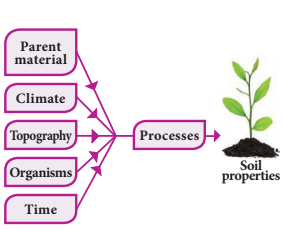
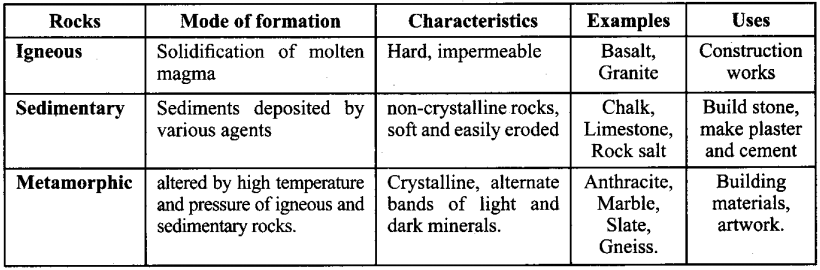
Soil and its Formation:
Samacheer Kalvi 9th Social Science Guide Geography Chapter 1 Advent of the Europeans 3

Igneous:
(i) The igneous rocks are formed by the solidification of molten magma. Also called Primary or Parent Rocks.
(ii) Types:

  • Extrusive Igneous Rocks.
  • Intrusive Igneous Rocks

1. Extrusive Igneous Rocks:
Molten magma which comes out from the interior of the earth’s surface gets solidified and forms such rocks. Fine-grained and glassy in nature. Eg., Basalt, found in northwestern peninsular India.

2. Intrusive Igneous rocks:
Molten magma cools down deep inside the earth’s crust, becomes solid and forms such rocks. Form large grains. Deep seated rocks are plutonic rock and ones at shallow depths – Hypabysal rocks. Example Granite, Diorite.

Sedimentary:
(i) Formed by the sediments derived and deposited by various agents. Also called stratified rocks.
(ii) Types:

  • Organic sedimentary rocks
  • Mechanical sedimentary rocks,
  • Chemical sedimentary rocks

1. Organic sedimentary rocks:
Formed due to decomposition of dead Plants and Animals. Contains fossils. Example Chalk, Talc

2. Mechanical sedimentary rocks:
Formed from the disintegration of Igneous and metamorphic rocks. Get deposited due to erosion by natural agents. Get cemented after a long time to form rocks. Example Sandstone, Shale.

3. Chemical sedimentary rocks: Formed by precipitating of minerals from water. Formed due to evaporation of chemical rich solution. Example Rock Salt.

Metamorphic:
(i) Formed when Igneous and sedimentary rocks are subjected to high temperature and pressure.
(ii) Types:

  • Thermal
  • Dynamic

1. Thermal Metamorphic:
If the change in rocks is caused by high temperature.

2. Dynamic Metamorphic:
If the change in rock is caused by high pressure. Formed from Igneous rocks. Eg., Granite into gneiss
Formed from Sedimentary rocks. Eg., Shale into Slate

Samacheer Kalvi 9th Social Science Guide Geography Chapter 2 Lithosphere – II Exogenetic Processes

3. Give an account of different layers of soil.
Layers of soil:
O – Horizon or humus:
This layer is dominated by organic material eg: leaves
A – Horizon or Topsoil:
It is a part of topsoil composed of organic matter mixed with mineral matter.
E – Horizon or Elevated layer:
E – stands for the elevated layer. This layer is significantly leached of clay, iron and aluminium oxides, which leaves a concentration of ore.
B – Horizontal or subsoil:
This layer reflects the chemical or physical alternation or parent material. Thus iron, clay, aluminium and organic compounds are found accumulated in the Horizon.
C – Horizon or Parent Rock:
Partially weathered parent material accumulates in this layer.
R – Horizon or Parent Rock:
This layer consists of an unweathered part of the bedrock.

4. Classify and explain the soil?
Answer:
Definition: Soil is a mixture of Organic matter, minerals, gases, liquids, and organisms that together support life.

Classification of soils:
Soils are classified on the basis of their formation, colour, physical and chemical properties. Based on these, soil is classified into six major types. They are Alluvial soil, Black soil, Red soil, Laterite soil, Mountain soil, Desert soil.

Alluvial soil:

  • Found in the regions of river valleys, flood plains, and coastal regions.
  • Formed by the deposition of silt by the running water.
  • Most productive of all soils.
  • Suitable for the cultivation of sugarcane, jute, rice, wheat.

Black soils:

  • Formed by weathering of igneous rocks.
  • Clayey in nature.
  • Retains moisture.
  • Ideal for growing cotton.

Red Soils:

  • Formed by weathering of metamorphic rocks and crystalline rocks.
  • Found in semi-arid regions.
  • Not a fertile.
  • Is soil brown-red in colour due to the presence of iron oxide
  • Suitable for millet cultivation.

Laterite soils:

  • Formed by the process of leaching.
  • Found in trophical regions, which experienced the alternate wet and dry conditions.
  • Infertile soil.
  • Suitable for plantation of tea and coffee.

Mountain soils:

  • Found in slopes of mountains.
  • Thin and acidic in nature.
  • The nature of soil differs based on the altitude.

Desert soils:

  • Found in the hot desert region.
  • Porous and saline in nature.
  • Infertile in nature.
  • Agriculture is not successful.

XI. Activity Corner.

1. Complete the following table with the help of an internet source.
Samacheer Kalvi 9th Social Science Guide Geography Chapter 1 Advent of the Europeans 5

Samacheer Kalvi 8th Social Science Rocks and Soil Additional Important Questions and Answers

I. Choose the Correct answer.
1. Petrology is derived from the ………….. word.
a) English
b) Latin
c) Greek
d) French
Answer:
(c) Greek

2. The soils found in the desert regions are …………..
a) Mountain Soils
b) Desert Soils
c) Black Soil
d) Red Soil
Answer:
(b) Desert Soils

3. Which Soils are formed by the weathering of metamorphic rocks?
a) Red Soils
b) Rock Soils
c) Laterite Soils
d) Mountain Soils
Answer:
(a) Red Soils

4. …………….. is a part composed of organic matter mixed with mineral matter.
a) Humus
b) Top Soil
c) Elevated layer
d) Sub-soil
Answer:
(b) Top Soil

5. The time to form one cm of soil is
a) 100 years
b) 200 years
c) 500 years
d) 1000 years
Answer:
(b) 200 years

6. …………….is known as the zone of accumulation.
a) Humus
b) Top Soil
c) Elevated layer
d) Sub-soil
Answer:
(d) Sub-soil

7. In the soil composition ………….. are minerals.
a) 5%
b) 10%
c) 25%
d) 45%
Answer:
(d) 45%

8. In the soil composition is air.
a) 5%
b) 10%
c) 25%
d) 40%.
Answer:
(c) 25%

9. ……………. soils are formed by the deposition of silt by the running water.
a) Black
b) Red
c) Alluvial
d) Desert
Answer:
(c) Alluvial

10. the Soil composition is organic matter.
a) 5%
b) 10%
c) 25%
d) 45%
Answer:
(a) 5%

II. Fill in the blanks:
1. A rock is an aggregate of ………….. or more minerals.
Answer:
one

2. There are ………….. different types of minerals found on the earth Surface.
Answer:
2000

Samacheer Kalvi 9th Social Science Guide Geography Chapter 2 Lithosphere – II Exogenetic Processes

3. Rocks are classified in to ………….. types.
Answer:
three

4. The two types of Intrusive Igneous rocks are ………….., …………..
Answer:
Plutonic rocks, Hypabysal rocks

5. Igneous Rocks are ………….. rocks
Answer:
Primary

6. ……………. into slate caused by thermal metamorphism.
Answer:
Basalt

7. Soil is a basic requirement for the growth of ………….. and …………..
Answer:
Plants, animals

8. To become a well-matured soil, it takes about ………….. years.
Answer:
3000

9. Parent Rock is converted to loose Rock by ……………
Answer:
soil

10. Laterite soil is suitable for plantation crops like ………….., …………..
Answer:
tea, coffee

III. State whether the following statements are true or false:

1. To become a well-matured soil, it taken about 2000 years.
Answer:
False

2. Lava comes out from a volcano.
Answer:
True

3. The word Ignis means rock.
Answer:
False

4. Oldest Sedimentary rocks of the world has been identified in Green land.
Answer:
True

5. Soil supports ecosystem and play an important role in land management.
Answer:
True

IV. Match the following:
1.
Samacheer Kalvi 9th Social Science Guide Geography Chapter 1 Advent of the Europeans 4
Answer:
D) 3 1 4 2

V. Choose the incorrect statement from the following:
1. a) Basalt into slate caused by thermal metamorphism.
b) Chemical Sedimentary rocks are also called evaporates.
c) Taj Mahal in India was built with white marbles of Sedimentary rocks.
d) Rocks have been used by mankind throughout history.
Answer:
c) Taj Mahal in India was built with white marbles of Sedimentary rocks.

VI. Consider the following statements and choose the right option from the given ones:
1. Statement (1): Petrology is a branch of geology.
Statement (2): It deals with the Study of water researches.
a) 1 and 2 are correct and 2 explains 1
b) 1 and 2 are correct but, 2 does not explain 1
c) 1 is correct but, 2 is incorrect
d) 2 is correct but, 1 is incorrect.
Answer:
c) 1 is correct but, 2 is incorrect

VII. Give reasons for the following:
1. Why soil is known as ‘Skin of the earth’?

  • Soil minerals form the basis of soil.
  • It forms on the surface of the earth.
  • so It is known as the ‘Skin of the earth’:

VIII. Distinguish the following:
1. Black Soil and Red Soil.

Black Soil Red Soil
1. These Soils are formed by the weathering of igneous rocks. These soils are formed by the weathering of metamorphic rocks and crystalline rocks.
2. It is retentive of moisture. Iron Oxide is present.
3. It is ideal for growing cotton. It is Suitable for millet cultivation.

IX. Give short answers:
1. Explain about Petrology.

  • Petrology is a branch of geology which deals with the study of rocks.
  • ‘Petrology’ is derived from the Greek word “Petrus” refers to rock and “Logos” refers to study

2. Name the layer in the Earth.
The layer found in the Earth are namely

  • Lithosphere
  • Hydrosphere
  • Atmosphere
  • Biosphere.

Samacheer Kalvi 9th Social Science Guide Geography Chapter 2 Lithosphere – II Exogenetic Processes

3. Explain the type of Igneous Rocks.

  • Extrusive Igneous Rocks
  • Intrusive Igneous Rocks.

X. Give a detailed answer for the following:
1. What are the uses of soil?
Answer:
Soil is one of the important natural resources. It is a basic requirement for plant growth and supports various life forms on the earth.

  • The minerals present in the soil enhance and nourishes the crops and plants.
  • It is used in the making of ceramics or pottery.
  • It is a source of material for construction and handicraft works.
  • It acts as a natural filter of water and purifies it.
  • Soil supports the ecosystem and plays an important role in land management.

Samacheer Kalvi 4th Tamil Guide Book Answers Solutions

Subject Matter Experts at SamacheerKalvi.Guide have created Tamil Nadu State Board Samacheer Kalvi 4th Tamil Book Answers Solutions Guide Pdf Free Download are part of Samacheer Kalvi 4th Books Solutions.

Let us look at these TN State Board New Syllabus Samacheer Kalvi 4th Std Tamil Guide Pdf of Text Book Back Questions and Answers Term 1, 2, 3, Chapter Wise Important Questions, Study Material, Question Bank, Notes, and revise our understanding of the subject.

Samacheer Kalvi 4th Tamil Book Solutions Guide Pdf Free Download

Tamilnadu State Board Samacheer Kalvi 4th Tamil Book Back Answers Solutions Guide Term 1, 2, 3.

Samacheer Kalvi 4th Tamil Book Back Answers

Samacheer Kalvi 4th Tamil Book Solutions Term 1

Samacheer Kalvi 4th Tamil Book Solutions Term 2

Samacheer Kalvi 4th Tamil Book Solutions Term 3

We hope these Tamilnadu State Board Samacheer Kalvi Class 4th Tamil Book Solutions Answers Guide Pdf Free Download will help you get through your subjective questions in the exam.

Let us know if you have any concerns regarding TN State Board New Syllabus Samacheer Kalvi 4th Standard Tamil Guide Pdf of Text Book Back Questions and Answers, Chapter Wise Important Questions, Study Material, Question Bank, Notes, drop a comment below and we will get back to you as soon as possible.

Samacheer Kalvi 10th English Guide Prose Chapter 1 His First Flight

Tamilnadu State Board New Syllabus Samacheer Kalvi 10th English Guide Pdf Prose Chapter 1 His First Flight Text Book Back Questions and Answers, Summary, Notes.

Tamilnadu Samacheer Kalvi 10th English Solutions Prose Chapter 1 His First Flight

10th English Guide His First Flight InText Questions and Answers

Question (a)
Why did the seagull fail to fly?
Answer:
The young seagull hesitated and feared to fly. He thought that his wings would not support him. Hence the sea gull failed to fly.

Question (b)
What did the parents do when the young seagull failed to fly?
Answer:
His parents, brothers and sister encouraged and also scolded him. They threatened him to go without food.

Samacheer Kalvi 10th English Guide Prose Chapter 1 His First Flight

Question (c)
What was the first catch of the young seagull’s older brother?
Answer:
The first catch of the young seagull’s older brother was herring, a type of fish.

Question (d)
What did the young seagull manage to find in his search for food on the ledge?
Answer:
The young seagull managed to find dried pieces of mackerel’s tail and eggshell.

Question (e)
What did the young bird do to seek the attention of his parents?
Answer:
The young bird stepped slowly out to the brink of the ledge and standing on one leg with the other leg hidden under his wing, he closed one eye, then the other, and pretended to be falling asleep. He would trot back and forth from one end of the ledge to the other, his long gray legs stepping daintily to seek the attention of his parents.

Samacheer Kalvi 10th English Guide Prose Chapter 1 His First Flight

Question (f)
What made the young seagull go mad?
Answer:
The sight of food made the young seagull go mad.

Question (g)
Why did the young bird utter a joyful scream?
Answer:
The seagull was quite hungry and yearned for food. When he saw a piece of fish in the beak of his mother, the sight was quite tempting and suddenly dived at the fish forgetting that he didn’t know how to fly and uttered a joyful scream falling outwards and downwards into space.

Question (h)
Did the mother bird offer any food to the young bird?
Answer:
No, the mother bird did not offer any food to the young bird.

Samacheer Kalvi 10th English Guide Prose Chapter 1 His First Flight

Question (i)
How did the bird feel when it started flying for the first time?
Answer:
The bird was seized with fear for a moment and could feel the tips of his wings cut through the air. The next moment he was fearless, though felt a bit dizzy, flapped his wings to soar up and down with a joyous scream.

Question (j)
What did the young bird’s family do when he started flying?
Answer:
They were flying around him, praising, soaring, and diving together with him.

10th English Guide His First Flight Textbook Questions and Answers

A. Answer the following questions in a sentence or two.

Question 1.
How was the young seagull’s first attempt to fly?
Answer:
The young seagull was very hungry. So he dived at the fish that was in his mother’s beak. But he fell into space and became terribly afraid. His heart stood still. He could hear nothing for just a minute. The next moment he felt his wings spread outwards and began to fly up and down fearless into the sky.

Question 2.
How did the parents support and encourage the young seagull’s brothers and sister?
Answer:
The seagull’s parents flew with his brothers and sister. They helped them in the perfect art of flying. They taught them to glide on the waves and dive for fish.

Samacheer Kalvi 10th English Guide Prose Chapter 1 His First Flight

Question 3.
Give an instance that shows the pathetic condition of “the young bird”?
Answer:
The young bird, starving for a day, finds a dried piece of mackerel’s tail at the far end of his ledge. He searches in vain the area where he was hatched and gnaws at the dried pieces of eggshell. He is in a pathetic state calling plaintively when he isn’t unable to reach his mother tearing at a piece of fish.

Question 4.
How did the bird try to reach its parents without having to fly?
Answer:
The bird walked from one end of the ledge to the other to reach its parents without flying.

Question 5.
Do you think that the young seagull’s parents were harsh to him? Why?
Answer:
No, the young seagull’s parents weren’t harsh to him. They were just teaching him a lifetime learning experience which is vital for his survival.

Samacheer Kalvi 10th English Guide Prose Chapter 1 His First Flight

Question 6.
What prompted the young seagull to fly finally?
Answer:
The sight of food maddened him and he dived at the fish. This prompted the young seagull to fly finally.

Question 7.
What happened to the seagull when it landed on the green sea?
Answer:
When the young seagull landed on the green sea, he completely forgot that he had not always been able to fly and shrieked shrilly, turning his beak sideways and crowed amusedly. He screamed with fright when he dropped his legs to stand on the green sea and sank into it.

Additional Questions and Answers

Question 1.
What prevented the young seagull from flying with his siblings?
Answer:
The fear prevented the young seagull from flying with his siblings.

Question 2.
What appeared to him so desperate?
Answer:
His failure to gather up the courage to take the plunge appeared to him so desperate.

Samacheer Kalvi 10th English Guide Prose Chapter 1 His First Flight

Question 3.
What had the young bird watched the previous day?
Answer:
The young bird had watched his parents flying about with his brothers and sister, perfecting them in the art of flight, teaching them how to skim the waves and dive for fish.

Question 4.
How did the young bird fall into space?
Answer:
The young bird fell outwards and downwards into space with a loud scream.

Samacheer Kalvi 10th English Guide Prose Chapter 1 His First Flight

Question 5.
Why did his heart stand still?
Answer:
His mother had swooped upwards. As he passed beneath her, he heard the swish of her wings. Then a monstrous terror seized him and his heart stood still.

Question 6.
What was his family doing when the young bird was floating on the sea?
Answer:
When the young bird was floating on the sea, his family was screaming, praising him and their beaks were offering him scraps of dog-fish.

Question 7.
What happened to the young sea gull at last?
Answer:
The young seagull had made his first flight at last.

B. Answer the following questions in a sentence or two.

Question 1.
Describe the struggles underwent by the young seagull to overcome its fear of flying.
Answer:
Introduction:
Liam O’ Flaherty is an Irish novelist and short-story writer. One of the best stories of him is “His First Flight”. This story is a parable about overcoming fears in life.

The young seagull:
The young seagull was one among the four off springs. He was not courageous. He was alone on the ledge. His parents, brothers and sister had flown away. He was afraid of flying. The little bird felt that his wings would not support him.

The reaction of parents:
The young bird’s parents, brothers and sister not only scolded, but also encouraged him. But he didnot have enough courage to fly. He was left alone for many hours. He could find nothing except the dried pieces of egg shells. He felt that he was starving to death.

The young one’s first flight:
The young bird was hungry. He begged his mother to bring a piece of fish. His parents wanted to teach him to fly. The mother seagull picked up a piece of fish. She flew across him. The sight of food maddened him. He cried and screamed. His wings opened up automatically. He flapped his wings. He realized that he was flying.”

Encouragement of the family:
The young bird’s family was very happy. His mother divided him. His father flew over him. His brothers and sister were flying around him. His family joined him in his first flight. They praised him for his effort. He was offered scraps of dog fish.

Conclusion:
This story speaks about the reluctance and courage of the bird.

“Confidence is the key to success”

(OR)

Title: His First Flight
Author: Liam O’Flaherty
Theme: The secret of happiness is courage.

The young seagull was alone on the ledge. He was afraid to fly. His parents, brothers and sister encouraged and scolded him. But he didnot have enough courage to fly. The little bird felt that his wings would not support him. He was left alone for many hours and he ate nothing. So he was very hungry. He begged his mother to bring a piece of fish.

His parents wanted to teach him to fly. The mother seagull picked up a piece of fish and flew across him. The sight of food maddened him. He dived. He cried and screamed. His wings opened up automatically. He flapped his wings. He realized that he was flying. His family joined him in his first flight. They praised him for his efforts. Thus his first flight became a success.

(OR)

  1. The young seagull was afraid of flying.
  2. The parents motivated the bird to fly.
  3. But he didn’t fly.
  4. One day he was hungry.
  5. The mother seagull picked up a piece of fish.
  6. He tried to catch the food.
  7. He started to fly.
  8. The seagull learnt the art of flying.

Samacheer Kalvi 10th English Guide Prose Chapter 1 His First Flight

Question 2.
Your parents sometimes behave like the young bird’s parents. They may seem cruel and unrelenting. Does it mean that they do not care for you? Explain your views about it with reference to the story.
Answer:
Introduction:
Parents are role models for children. They love their children. Whenever the children make mistake, they advise them to be good.

My brother and sister:
This incident took place when I was young. My elder brother and sister were good swimmers. All of them used to swim in the sea. But I never swam in the sea. My father wanted me to swim.

My experience:
I was afraid of the sea one day my father took me to the sea and asked me to swim. He was cruel. I drank sea water and felt very bad. I thought that I would drown and die in the sea. I felt that I was drowning after a struggle.

Conclusion:
After some minutes, I found I was swimming. All clapped their hands and appreciated me on my success. Now I am a good swimmer. I think that my parents were not cruel but they were wise.

(OR)

Title: His First Flight
Author: Liam O’Flaherty
Theme: Overcoming fear

Parents are role models for children. They love their children. They develop good habits and life skills in them. Whenever the children make mistake, they advise them to be good. They want them to go out and explore the world. This incident took place when I was young. My elder brother and sister were good sportspersons. They were also good swimmers. In those days, we used to go to the beach on weekends.

All of them used to swim in the sea. But I never swam in the sea. My father wanted me to learn swimming. One day he took me into the sea and asked me to swim. He seemed to be cruel.

I thought that I would drown and die in the sea. I drank sea water and felt very bad. My father left me alone for a moment. I felt that I was drowning after a great struggle. I found myself swimming. All clapped their hands and appreciated me on my success. Now I am a good swimmer.

“Confidence is the key to success”

(OR)

  1. I was young, we used to go to the beach.
  2. My brother and sister are good swimmers.
  3. My parents also swim well.
  4. I don’t swim as I was afraid of water.
  5. But my father wanted me to learn swimming.
  6. One day he took me into the sea.
  7. I thought that I would die.
  8. He taught me to swim but I found it difficult.
  9. I drank seawater and began to drown.
  10. After a big struggle, I came up.
  11. All praised me that I learned swimming.

Vocabulary:

Parts of Speech:
Read the following sentences

A Set 1

a. The young sea-gull uttered a joyful scream (adjective)
b. The young sea-gull screamed with joy (noun)
c. The young sea-gull screamed joyfully (adverb) Adjective

Adjective Noun Adverb
Joyful Joy Joyfully

B Set II

a. The young bird pretended to be falling asleep. (verb)
b. The young bird made a pretension of falling asleep (noun)
c. The young bird made a pretentious Posture of falling asleep (adjective)

Adjective Noun Adverb
Pretentious Pretension Pretended

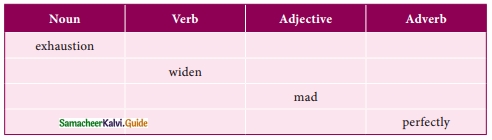
C. Change the parts of speech of the given words in the chart.


Answer:

D. Read the following sentences and change the form of the underlined words as directed.

Question 1.
His family was screaming and offering him food (to adjective)
Answer:
His screaming family was offering him food.

Question 2.
The young seagull gave out a loud call (to adverb)
Answer:
The young seagull gave out a call loudly.

Samacheer Kalvi 10th English Guide Prose Chapter 1 His First Flight

Question 3.
The bird cackled amusedly while flying (to noun)
Answer:
The bird cackled in amusement while flying.

Question 4.
The depth of the sea from the ledge scared the seagull (to adjective)
Answer:
The deep sea from the ledge scared the seagull.

Samacheer Kalvi 10th English Guide Prose Chapter 1 His First Flight

Question 5.
The successful flight of the bird was a proud moment for the seagull’s family (to a verb)
Answer:
The bird flew successfully and it was a proud moment for the seagull’s family.

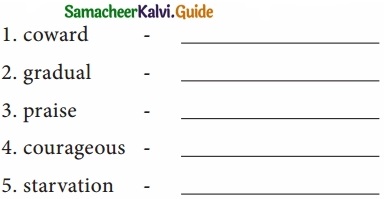
E. Use the following words to construct meaningful sentences on your own.


Answer:
1. coward – He is a coward.
2. gradual – There is a gradual improvement in my health.
3. praise – People praise honest leaders.
4. courageous – We must be courageous to speak against injustice.
5. Starvation – Millions will face starvation next year.

Listening Activity

F. Here is a travelogue by the students of Government Girls Higher Secondary School, Pattukkottai after their trip to Darjeeling. Listen to the travelogue and answer the following questions.

(i) Fill in the blanks with suitable words:

  1. The students visited ……………….. city.
  2. ………………… is the third highest mountain in the world.
  3. …………….. hill is 13km away from Darjeeling.
  4. The drinking water is supplied by ……………. lake.
  5. After Senchal lake, they visited ……………..

Answer:

  1. Darjeeling
  2. Kanchenjunga
  3. Tiger
  4. Senchal
  5. Batasia Loop

(ii) Do you think they had a memorable and enjoyable school trip?
Answer:
Yes, I am sure they had a memorable and enjoyable school trip.

(iii) Name a few places that you wish to visit with your classmates as a school trip?
Answer:
I wish to visit the Andaman Islands, Kashmir, and Kathmandu with my classmates as a school trip.

(iv) State whether the following statements are True or False.

1. As the sky was cloudy, they could get a glimpse of Mount Everest.
False

2. The toy train covers 14 km in three hours:
True

3. Tiger hill has earned international fame for the best sunset view.
False

Speaking Activity:

G. Here is a dialogue between a father and his daughter. Continue the dialogue with at least five utterances and use all the clues given above.

Father: Hi Mary, it has been a very long time since we went on a trip. Let’s plan one.
Mary: Yes, dad. I am also longing to go. Why don’t we plan one for this weekend? Father: Sure. Tell me, where shall we go?
Mary: Someplace were nearby but at least for two days.
Father: Hmm… I think we should go to the reserved forest nearby.
Mary: Yeah. I’ve never been to a forest. I have seen a forest only on TV and in movies. The forest is a good choice!
Father: OK. If we are going to the forest, we must list out what we should carry with us for two days.
Mary: I think we should carry suitable clothes like (1) …………………..
Father: What about the food? Do you have any idea, Mary?
Mary: Yeah. For food, I suggest (2) …………………….
Father: (3) ………………..
Mary: (4) …………………..
Answers:
1. Sweaters, raincoats, woollen caps, night coats, and gowns.
2. Bread, jam and butter, We can have biscuits as well as fruits.
3. What would you like to have to drink?
4. Apart from water, we need to have tinned juice. We can carry hot water.

Reading:

H. Read the following passage and answer the questions that follow

Bungee jumping is an activity that involves jumping from a tall structure while connected to a long elastic cord. The tall structure is usually a fixed object, such as a building, bridge or crane; but it is also possible to jump from a movable object, such as a hot-air-balloon or helicopter, that has the ability to hover above the ground. The thrill comes from the free-falling and the rebound. When the person jumps, the cord stretches and the jumper flies upwards again as the cord recoils and continues to oscillate up and down until all the kinetic energy is dissipated.

Jumping Heights, located in Mohan Chatti village, in Rishikesh has been rated as one of the most preferred bungee jumping destinations in India at a height of 83 meters. It is the only place in India where bungee jumping can be done from a fixed platform. This is also India’s only fixed platform Bungee-performed from a professional cantilever, to separate it from entertainment parks, and create instead an extreme adventure zone. The Bungee has been designed by David Allardice of New Zealand.

The Cantilever platform is built over a rocky cliff overlooking the river Hall, a tributary of the River Ganges. Bungee-ing amidst the vastness of nature lends the experience an absolutely breathtaking quality. Jumping heights is well known for its safety measures and experienced staff. It costs around Rs 2500 per jump, a bit expensive, but totally worth the experience. The Bungee jumping experience has been set amidst the astoundingly stunning landscape of Rishikesh. To Bungee jump, one must be at least 12 years and should weigh between 40-110 kg.

Question 1.
What is Bungee jumping?
Answer:
Bungee jumping is an activity that involves jumping from a tall structure while connected to a long elastic cord.

Samacheer Kalvi 10th English Guide Prose Chapter 1 His First Flight

Question 2.
Can Bungee be performed from a movable object? How?
Answer:
Yes, it is possible to perform from a movable object such as a hot-air-balloon or helicopter that has the ability to move above the ground.

Question 3.
When do you think Bungee becomes thrilling?
Answer:
When the person jumps, the cord stretches and the jumper flies upwards again as the cord recoils, and continues to oscillate up and down until all the kinetic energy is dissipated. Now, Bungee becomes thrilling from the free-falling and the rebound.

Samacheer Kalvi 10th English Guide Prose Chapter 1 His First Flight

Question 4.
What is the experience when one falls off the platform?
Answer:
When one falls off the platform, the cord stretches and the jumper flies upwards again as the cord recoils, and continues to oscillate up and down until the kinetic energy is dissipated.

Question 5.
Where is the Bungee jumping point located in India?
Answer:
Bungee jumping point is located in Mohan Chatti village, in Rishikesh, India at a height of 83 meters.

Question 6.
What is the minimum age to Bungee jump?
Answer:
The minimum age to Bungee – jumping is 12 years.

Writing:

I. Prepare attractive advertisements using the hints given below.

1. Home appliances – Aadi sale – 20-50% – Special Combo Offers – Muthusamy & Co, Raja Street, Gingee.

2. Mobile Galaxy – Smart phones – accessories – Sim Cards – Recharge – Free power banks on mobile purchase – No.1, Toll gate, Trichy

J. Write a report of the following events in about 100-120 words.

Question 1.
‘Educational Development Day’ was organized in your school on 15th July. The District Collector was the Chief Guest of the event. As part of the event, many competitions were held and the prizes were distributed to the winners and participants. It was a grand and successful event. Now, as a member of the organizing committee, write a report on the event in about 120 words.
Answer:

Educational Development Day

15th July 2019:

K.Mukilan

   St. Thomas Higher Secondary School, Nellai, organised the Educational Development Day on 15th July, 2019 to commemorate the birth anniversary of K. Kamaraj, the former Chief Minister of Tamilnadu. The event was to promote the development of education in Tamil nadu. About 800 students participated in the programme organised by the students and teachers. The event began with the prayer song by the school choir. The Headmaster welcomed the gathering.

The District collector presided over the function. She delivered the presidential address on the importance and development of education. She also unveiled the portrait of Thiru K. Kamaraj in the auditorium. The students and teachers also spoke on the occasion. This was followed by various cultural programme by the junior and senior boys and girls. Mementos were given to the chief guest and the guests of honour. The participation certificates were also given to the students. The assistant Headmaster proposed the vote of thanks. The event came to an end with the National Anthem.

Samacheer Kalvi 10th English Guide Prose Chapter 1 His First Flight

Question 2.
You are the School Pupil Leader. You have been asked to write a report on the Inaugural Ceremony of English Literary Association of your school which was held recently. Write a report on the same in not more than 120 words.
Answer:

Inaugural ceremony of English Literary Association

16th July 2019:

K.Mukilan

English Literary association was inaugurated in the auditorium of T.D.T.A. Higher Secondary School, Christianagaram on 16th June, 2019. The programme began with a prayer song. Prof. Dr. J. Alex, Principal of St. Thomas college of Education was the chief guest. The Headmaster welcomed the gathering. The chief guest delivered the presidential address. He spoke on the importance of English and the need for communicative skills in English. The Senior English teacher proposed the vote of thanks. The programme came to an end with the National Anthem.

Samacheer Kalvi 10th English Guide Prose Chapter 1 His First Flight

Question 3.
You are the Coordinator of the Science Forum of your school. An event had been organized on account of National Science Day for the members of the forum. Now, write a report on the observation of “National Science Day” at your school?
Answer:

National Science Day

17th July 2019:

                                                                                                                                                       K.Mukilan

National Science Day was celebrated on 28th February 2019 at St. Paul’s Higher Secondary School, Nellai. It was organised by the coordinator of the Science Club. This day is celebrated every year to remember the Indian Scientist. The students of St. Paul’s school organized a special assembly to mark the occasion.

The programme began with an introductiontory speech by the H.M. Students from Std X to XII participated in Quiz, debate and innovative projects. Children disguised themselves as famous scientists from various fields. Certificates were distributed to the winners of various competitions. The main purpose of the programme is to blossom budding scientist.

Grammar
Modals:

A. Complete these sentences using appropriate modals. The clues in the brackets will help you.

  1. When I was a child, I …………… climb trees easily but now I can’t. (ability in the past)
  2. I ………………. win the singing contest. (determination)
  3. You ………………. buy this book. It is worth buying (advice or suggestion)
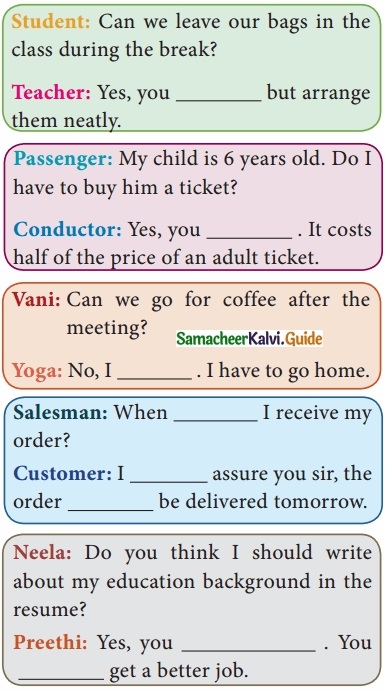
  4. Poongothai ……………….. speak several languages (ability in the present)
  5. I swear I ……………….. tell lies again (promise)
  6. My father ………………… play badminton in the evening when he was at college (past habit)
  7. You …………………. do as I say! (command)
  8. ………………… I have another glass of water? (request)
  9. Sibi has not practised hard but he ………………….. win the race (possibility)
  10. We ……………………. preserve our natural resources (duty)

Answers:

  1. could
  2. can
  3. should
  4. can
  5. shall not, won’t
  6. used to
  7. should, must
  8. may
  9. can
  10. ought to

B. Rewrite the following sentences by rectifying the errors in the use of modals.

Question 1.
Would I have your autograph?
Answer:
May, can I have your autograph.

Samacheer Kalvi 10th English Guide Prose Chapter 1 His First Flight

Question 2.
I can be fifteen next April.
Answer:
I shall be fifteen next April.

Question 3.
Take an umbrella. It should rain later.
Answer:
Take an umbrella. It may rain later.

Samacheer Kalvi 10th English Guide Prose Chapter 1 His First Flight

Question 4.
The Magistrate ordered that he might kitchen garden but we don’t do it now. pay the fine.
Answer:
The Magistrate ordered that he should / must pay the fine.

Question 5.
Answer:
Make me a cup of tea, will you?

Question 6.
You may speak politely to others.
Answer:
You must / ought to speak politely to others.

Samacheer Kalvi 10th English Guide Prose Chapter 1 His First Flight

Question 7.
You will get your teeth cleaned at least once a year.
Answer:
You should get your teeth cleaned once a year.

Question 8.
We could grow vegetables in our Kitchen garden but we don’t do it now.
Answer:
We used to grow vegetables in our kitchen garden but we don’t do it now.

Question 9.
Must I get your jacket? The weather is cold.
Answer:
Shall I get your jacket? The weather is cold.

Samacheer Kalvi 10th English Guide Prose Chapter 1 His First Flight

Question 10.
Could the train be on time?
Answer:
Will the train be on time?

C. Read the dialogue and fill in the blanks with suitable modals.

Dad: (1) ……………. we go out for dinner tonight?
Charan: Yes, Dad. We (2) ………………. go to a restaurant where I (3) ………………. have some ice cream.
Dad: OK. Then I (3) ……………… be home by 7 p.m. Mom and you (4) ……………… be ready then.
Charan: Sure, we (4) ……………… My friend told me that there is a magic show nearby, (5) ……………… you please take us there?
Dad: We (6) ……………… not have time to go for the magic show, I suppose. If we have enough time left, we (7) ……………. plan.
Charan: By the way, (8) …………………. we inform our gatekeeper about our outing.
Dad: Yes, we (9) ………………….. so that he will be aware we aren’t at home.
Charan: (10) ……………….. I call up Mom and tell her about our plan today?
Dad: You (11) …………………… Otherwise, we might be in trouble when she returns home.
Charan: Hmm… by the time you come home in the evening, we will be waiting for you. Hope you (12) ……………… be late. Bye.
Answers:

  1. shall
  2. shall, can
  3. shall, must / should
  4. shall, will
  5. may, shall
  6. should / must, will
  7. shall
  8. ought to
  9. will, won’t

D. Read the following dialogues and supply appropriate modals.

Student: Can we leave our bags in the class during the break?
Teacher: Yes, You (1) ……………. but arrange them neatly
Passenger: My child is 6 years old. Do I have to buy him a ticket?
Conductor: Yes, You (2) ………….. It costs half of the price of an adult ticket.
Vani: Can we go for coffee after the meeting?
Yoga: No, (3) ……………. I have to go home.
Salesman: When (4) …………….. I receive my order?
Customer: I (5) ………………. assure you, sir, the order will be delivered tomorrow.
Neela: Do you think, I should write about my educational background in the resume?
Preethi: Yes, you (6) ………………. You (7) …………… get a better job.
Answers:

  1. may
  2. must
  3. must
  4. I can’t / shan’t
  5. will
  6. should / must
  7. may

E. Here are a few sentences already done for you. The clues given would be helpful to make more sentences on your own.

1. I would suggest that you take the Uzhavan Express to Thanjavur from Chennai.
2. You will be more if you could book 3 tier A/C
3. You could enjoy ……………………..
4. You should visit ……………………..
5. You mustn’t miss …………………….
6. You can buy the ……………………
7. …………………….
8. …………………….
9. …………………….
10. …………………….
Answers:
3. the journey if you would travel by train.
4. all the important places.
5. visiting the places around Thanjavur.
6. the unique products of Thanjavur.
7. Art plates could be presented to your friends and relatives.
8. Paintings can be used to decorate the walls at home.
9. Bronze statues and dancing dolls will be identified with Thanjavur.
10. Poondi church can attract tourists for its miracles. Manora Fort Pattukkottai can remain as a historical monument.

Active and Passive:

F. Change the following sentences to the other voice.

Question 1.
The manager appointed many office assistants?
Answer:
Many office assistants were appointed by the manager.

Samacheer Kalvi 10th English Guide Prose Chapter 1 His First Flight

Question 2.
You are making a cake now?
Answer:
A cake is being made by you now.

Question 3.
This portrait was painted by my grandmother?
Answer:
My grandmother painted that portrait.

Question 4.
Malini had bought a colourful hat for her daughter?
Answer:
A colourful hat had been bought by Malini for her daughter.

Question 5.
They have asked me to pay the fine?
Answer:
Ihavebeenasked them to pay the fine by them.

Samacheer Kalvi 10th English Guide Prose Chapter 1 His First Flight

Question 6.
The militants were being taken to prison by the police?
Answer:
The police were taking the militants to the prison.

Question 7.
Does his behaviour vex me?
Answer:
I am vexed by his behaviour.

Question 8.
Rosy will solve the problem?
Answer:
The problem will be solved by Rosy.

Samacheer Kalvi 10th English Guide Prose Chapter 1 His First Flight

Question 9.
Our army has defeated the enemy?
Answer:
The enemy has been defeated by our army.

Question 10.
The salesman answered all the questions patiently?
Answer:
All the questions were answered patiently by the salesman.

G. Change the following into passive voice.

Question 1.
Please call me at once?
Answer:
You are requested to call me at once.

Question 2.
How did you cross the river?
Answer:
How was the river crossed by you?

Samacheer Kalvi 10th English Guide Prose Chapter 1 His First Flight

Question 3.
No one is borrowing the novels from the library?
Answer:
The novels are not being borrowed from the library.

Question 4.
Will you help me?
Answer:
Will I be helped by you?

Question 5.
Go for a jog early in the morning?
Answer:
You are advised to go for a jog early in the morning.

Samacheer Kalvi 10th English Guide Prose Chapter 1 His First Flight

Question 6.
Why have you left your brother at home?
Answer:
Why has your brother been left at home by you?

Question 7.
Nobody should violate the rules?
Answer:
The rules should not be violated.

Question 8.
Some one has to initiate it immediately?
Answer:
It has to be initiated immediately.

Samacheer Kalvi 10th English Guide Prose Chapter 1 His First Flight

Question 9.
Have you invited Raman for the party?
Answer:
Has Raman been invited to the party? (or) Has Raman been invited for the party by you?

Question 10.
Please, do not walk on the grass?
Answer:
You are requested not to walk on the grass.

Question 11.
Cross the busy road carefully?
Answer:
You are advised to cross the busy road carefully (or) Let the busy roads be crossed carefully.

Samacheer Kalvi 10th English Guide Prose Chapter 1 His First Flight

Question 12.
When will you book the tickets to Bengaluru?
Answer:
When will the tickets be booked to Bengaluru? (or) When will the tickets be booked to Bengaluru, by you?

H. In the following sentences the verbs have two objects namely Direct and Indirect objects. Change each of the following sentences into two passives using direct object as the subject in one and indirect in the other.

Question 1.
John gave a bar of chocolate to Jill.
(a) Jill was given ……………………
(b) A bar of chocolate was given …………………..

Question 2.
Pragathi lent a pencil to Keerthana.
(a) ………………………
(b) ……………………..

Question 3.
Sudha told the truth to her friend.
(a) …………………….
(b) …………………….

Question 4.
They offered the job to venkat.
(a) ……………………..
(b) ……………………..

Question 5.
The boss showed the new computer to Kaviya.
(a) ……………………..
(b) ……………………..
Answers:
1. (a) a bar of chocolate by John.
(b) to Jill by John.

2. (a) Keerthana was lent by a pencil by pragathi.
(b) A pencil was lent to keerthana by pragathi.

3. (a) The truth was told to her friend by sudha.
(b) Her friend was told the truth by sudha.

4. (a) A job was offered to venkat by them.
(b) Venkat was offered the job by them.

5. (a) The new computer was shown to kaviya by the boss.
(b) Kaviya was shown the new computer by the boss.

I. Rewrite the following passage in the passive voice.

A few days ago, someone stole Ambrose’s motorbike. Ambrose had left it outside his house. He reported the theft to the police. The police told him that they would try to find his motorbike. This morning, they found his motorbike. The police called Ambrose to the police station. The thieves had painted it and then sold it to someone else. The new owner had parked the motorbike outside a mall when the police found it. After an
enquiry, the police arrested the thieves.

Ambrose’s motorbike was stolen a few days ago. It had been left outside his house by Ambrose. The theft was reported to the police by him. He was told by the police that they would try to find his motor bike. Ambrose was called (by the police) to the police station. It had been painted by the thieves and then it was sold to someone else. The motorbike had been parked outside the mall by the new owner and it was found by the police. The thieves were arrested by the police, after an enquiry.

J. Write a recipe of your favourite dish in passive voice. Remember to list out the ingredients of the dish you have chosen and their quantity. Use simple present tense to write your recipe.

Ingredients:
Mangoes – 3
Chilly powder – 3 spoons
Salt – 2 spoons
Asafoetida – 1 spoon
Oil – 3 tea spoonfuls

Three mangoes are washed and dried. They are chopped into small pieces and dried. Then the salt is added along with a little asafoetida. Chilly powder is also added to it. The ingredients are mixed well and kept in the sunlight for a day.

2 or 3 spoonfuls of oil is poured in the frying pan. Oil is heated and mustard is added and fried. The heated oil is added to the ingredients. It must be kept in the sunlight for one more day. Now the mango pickle is ready.

K. Write a report of an event held at your school using passive voice. Use simple past tense to narrate the event.

“A Report of an event held in our school”

Once a cultural programme was organised by the teachers to entertain the school children on children’s day. It was performed by the teachers through a typical gypsy dance. They were all dressed up in the gypsy costumes. A sheer make up was done by an expert teacher. They were called to the stage by an announcement.

This was watched by a dog in the school. They looked like strangers and it was assumed by the dog. The dog started to bark at the participants. One of the teachers was chased by the dog. She ran for help and her tin was dropped. All the children were given a great surprise. And it was an interesting event given by the teachers on that day. Nobody could control their laughter besides their fear.

Samacheer Kalvi 5th Tamil Guide Book Answers Solutions

Subject Matter Experts at SamacheerKalvi.Guide have created Tamil Nadu State Board Samacheer Kalvi 5th Tamil Book Answers Solutions Guide Pdf Free Download are part of Samacheer Kalvi 5th Books Solutions.

Let us look at these TN State Board New Syllabus Samacheer Kalvi 5th Std Tamil Guide Pdf of Text Book Back Questions and Answers Term 1, 2, 3, Chapter Wise Important Questions, Study Material, Question Bank, Notes, and revise our understanding of the subject.

Samacheer Kalvi 5th Tamil Book Solutions Guide Pdf Free Download

Tamilnadu State Board Samacheer Kalvi 5th Tamil Book Back Answers Solutions Guide Term 1, 2, 3.

Samacheer Kalvi 5th Tamil Book Back Answers

Samacheer Kalvi 5th Tamil Book Solutions Term 1

Samacheer Kalvi 5th Tamil Book Solutions Term 2

Samacheer Kalvi 5th Tamil Book Solutions Term 3

We hope these Tamilnadu State Board Samacheer Kalvi Class 5th Tamil Book Solutions Answers Guide Pdf Free Download will help you get through your subjective questions in the exam.

Let us know if you have any concerns regarding TN State Board New Syllabus Samacheer Kalvi 5th Standard Tamil Guide Pdf of Text Book Back Questions and Answers, Chapter Wise Important Questions, Study Material, Question Bank, Notes, drop a comment below and we will get back to you as soon as possible.

Samacheer Kalvi 12th Tamil Guide Book Answers Solutions

Subject Matter Experts at SamacheerKalvi.Guide have created Tamil Nadu State Board Samacheer Kalvi 12th Tamil Book Answers Solutions Guide Pdf Free Download are part of Samacheer Kalvi 12th Books Solutions.

Let us look at these TN State Board New Syllabus Samacheer Kalvi 12th Std Tamil Guide Pdf of Text Book Back Questions and Answers Chapter Wise Important Questions, Study Material, Question Bank, Notes, and revise our understanding of the subject.

Students can also read Tamil Nadu 12th Tamil Model Question Papers 2020-2021.

Samacheer Kalvi 12th Tamil Book Solutions Answers Guide

Tamilnadu State Board Samacheer Kalvi 12th Tamil Book Back Answers Solutions Guide.

Samacheer Kalvi 12th Tamil Book Back Answers

We hope these Tamilnadu State Board Samacheer Kalvi Class 12th Tamil Book Solutions Answers Guide Pdf Free Download will help you get through your subjective questions in the exam.

Let us know if you have any concerns regarding TN State Board New Syllabus Samacheer Kalvi 12th Standard Tamil Guide Pdf of Text Book Back Questions and Answers, Chapter Wise Important Questions, Study Material, Question Bank, Notes, drop a comment below and we will get back to you as soon as possible.

Samacheer Kalvi 11th Tamil Guide Book Answers Solutions

Subject Matter Experts at SamacheerKalvi.Guide have created Tamil Nadu State Board Samacheer Kalvi 11th Tamil Book Answers Solutions Guide Pdf Free Download are part of Samacheer Kalvi 11th Books Solutions.

Let us look at these TN State Board New Syllabus Samacheer Kalvi 11th Std Tamil Guide Pdf of Text Book Back Questions and Answers Chapter Wise Important Questions, Study Material, Question Bank, Notes, and revise our understanding of the subject. Tamil Nadu Samacheer Kalvi 11th Tamil Model Question Papers 2020-2021.

Samacheer Kalvi 11th Tamil Book Solutions Answers Guide

Tamilnadu State Board Samacheer Kalvi 11th Tamil Book Back Answers Solutions Guide.

Samacheer Kalvi 11th Tamil Book Back Answers

We hope these Tamilnadu State Board Samacheer Kalvi Class 11th Tamil Book Solutions Answers Guide Pdf Free Download will help you get through your subjective questions in the exam.

Let us know if you have any concerns regarding TN State Board New Syllabus Samacheer Kalvi 11th Standard Tamil Guide Pdf of Text Book Back Questions and Answers, Chapter Wise Important Questions, Study Material, Question Bank, Notes, drop a comment below and we will get back to you as soon as possible.

Samacheer Kalvi 7th Tamil Guide Book Answers Solutions

Subject Matter Experts at SamacheerKalvi.Guide have created Tamil Nadu State Board Samacheer Kalvi 7th Tamil Book Answers Solutions Guide Pdf Free Download are part of Samacheer Kalvi 7th Books Solutions.

Let us look at these TN State Board New Syllabus Samacheer Kalvi 7th Std Tamil Guide Pdf of Text Book Back Questions and Answers Term 1, 2, 3, Chapter Wise Important Questions, Study Material, Question Bank, Notes, and revise our understanding of the subject.

Samacheer Kalvi 7th Tamil Book Solutions Guide Pdf Free Download

Tamilnadu State Board Samacheer Kalvi 7th Tamil Book Back Answers Solutions Guide Term 1, 2, 3.

Samacheer Kalvi 7th Tamil Book Back Answers

Samacheer Kalvi 7th Tamil Book Solutions Term 1

Samacheer Kalvi 7th Tamil Book Solutions Term 2

Samacheer Kalvi 7th Tamil Book Solutions Term 3

We hope these Tamilnadu State Board Samacheer Kalvi Class 7th Tamil Book Solutions Answers Guide Pdf Free Download will help you get through your subjective questions in the exam.

Let us know if you have any concerns regarding TN State Board New Syllabus Samacheer Kalvi 7th Standard Tamil Guide Pdf of Text Book Back Questions and Answers, Chapter Wise Important Questions, Study Material, Question Bank, Notes, drop a comment below and we will get back to you as soon as possible.

Samacheer Kalvi 5th Maths Guide Term 3 Chapter 6 Fractions Ex 6.5

Students can download 5th Maths Term 3 Chapter 6 Fractions 6.5 Questions and Answers, Notes, Samacheer Kalvi 5th Maths Guide Pdf helps you to revise the complete Tamilnadu State Board New Syllabus, helps students complete homework assignments and to score high marks in board exams.

Tamilnadu Samacheer Kalvi 5th Maths Solutions Term 3 Chapter 6 Fractions 6.5

Question 1.
Add the following fractions
(i) \(\frac{1}{5}\) + \(\frac{3}{5}\)
Answer:
\(\frac{1}{5}+\frac{3}{5}=\frac{1+3}{5}=\frac{4}{5}\)

Samacheer Kalvi 5th Maths Guide Term 3 Chapter 6 Fractions 6.5

(ii) \(\frac{1}{7}\) + \(\frac{3}{7}\)
Answer:
\(\frac{1}{7}+\frac{3}{7}=\frac{1+3}{7}=\frac{4}{7}\)

(iii) \(\frac{5}{12}\) + \(\frac{2}{12}\)
Answer:
\(\frac{5}{12}+\frac{2}{12}=\frac{5+2}{12}=\frac{7}{12}\)

(iv) \(\frac{3}{9}\) + \(\frac{7}{9}\)
Answer:
\(\frac{3}{9}+\frac{7}{9}=\frac{3+7}{9}=\frac{10}{9}\)

(v) \(\frac{2}{15}\) + \(\frac{3}{15}\)
Answer:
\(\frac{2}{15}+\frac{3}{15}=\frac{2+3}{15}=\frac{5}{15}\)

Samacheer Kalvi 5th Maths Guide Term 3 Chapter 6 Fractions 6.5

(vi) \(\frac{2}{7}\) + \(\frac{1}{7}\) + \(\frac{3}{7}\)
Answer:
\(\frac{2}{7}+\frac{1}{7}+\frac{3}{7}=\frac{2+1+3}{7}=\frac{6}{7}\)

(vii) \(\frac{3}{10}\) + \(\frac{5}{10}\) + \(\frac{2}{10}\)
Answer:
\(\frac{3}{10}+\frac{5}{10}+\frac{2}{10}=\frac{3+5+2}{10}=\frac{10}{10}=1\)

(viii) \(\frac{2}{9}\) + \(\frac{1}{9}\)
Answer:
\(\frac{2}{9}+\frac{1}{9}=\frac{2+1}{9}=\frac{3}{9}\)

(ix) \(\frac{3}{8}\) + \(\frac{2}{8}\)
Answer:
\(\frac{3}{8}+\frac{2}{8}=\frac{3+2}{8}=\frac{5}{8}\)

Samacheer Kalvi 5th Maths Guide Term 3 Chapter 6 Fractions 6.5

Question 2.
Mother gave \(\frac{2}{8}\) of guava to Meena and \(\frac{3}{8}\) of guava to Geetha. How many parts of the guava did she give them altogether?
Answer:
Meena get = \(\frac{2}{8}\)
Geeta get = \(\frac{3}{8}\)
Sum = \(\frac{2}{8}\) + \(\frac{3}{8}\) = \(\frac{5}{8}\)

Samacheer Kalvi 5th Maths Guide Term 3 Chapter 6 Fractions 6.5

Question 3.
The girls of Std V cleaned \(\frac{3}{5}\) of a field, while the boys cleaned \(\frac{1}{5}\) part of the field. What part of the field was cleaned altogether?
Answer:
Girls cleaned = \(\frac{3}{5}\)
Boys cleaned = \(\frac{1}{5}\)
Sum = \(\frac{3}{5}+\frac{1}{5}=\frac{4}{5}\)